EP3443572B1 - Ensemble transformateur divisé - Google Patents
Ensemble transformateur divisé Download PDFInfo
- Publication number
- EP3443572B1 EP3443572B1 EP17715194.1A EP17715194A EP3443572B1 EP 3443572 B1 EP3443572 B1 EP 3443572B1 EP 17715194 A EP17715194 A EP 17715194A EP 3443572 B1 EP3443572 B1 EP 3443572B1
- Authority
- EP
- European Patent Office
- Prior art keywords
- circuit board
- arrangement
- assembly
- partial
- split transformer
- Prior art date
- Legal status (The legal status is an assumption and is not a legal conclusion. Google has not performed a legal analysis and makes no representation as to the accuracy of the status listed.)
- Active
Links
Images




Classifications
-
- H—ELECTRICITY
- H01—ELECTRIC ELEMENTS
- H01F—MAGNETS; INDUCTANCES; TRANSFORMERS; SELECTION OF MATERIALS FOR THEIR MAGNETIC PROPERTIES
- H01F27/00—Details of transformers or inductances, in general
- H01F27/06—Mounting, supporting or suspending transformers, reactors or choke coils not being of the signal type
-
- H—ELECTRICITY
- H01—ELECTRIC ELEMENTS
- H01F—MAGNETS; INDUCTANCES; TRANSFORMERS; SELECTION OF MATERIALS FOR THEIR MAGNETIC PROPERTIES
- H01F27/00—Details of transformers or inductances, in general
- H01F27/28—Coils; Windings; Conductive connections
- H01F27/32—Insulating of coils, windings, or parts thereof
- H01F27/324—Insulation between coil and core, between different winding sections, around the coil; Other insulation structures
-
- H—ELECTRICITY
- H05—ELECTRIC TECHNIQUES NOT OTHERWISE PROVIDED FOR
- H05K—PRINTED CIRCUITS; CASINGS OR CONSTRUCTIONAL DETAILS OF ELECTRIC APPARATUS; MANUFACTURE OF ASSEMBLAGES OF ELECTRICAL COMPONENTS
- H05K1/00—Printed circuits
- H05K1/16—Printed circuits incorporating printed electric components, e.g. printed resistors, capacitors or inductors
- H05K1/165—Printed circuits incorporating printed electric components, e.g. printed resistors, capacitors or inductors incorporating printed inductors
-
- H—ELECTRICITY
- H01—ELECTRIC ELEMENTS
- H01F—MAGNETS; INDUCTANCES; TRANSFORMERS; SELECTION OF MATERIALS FOR THEIR MAGNETIC PROPERTIES
- H01F19/00—Fixed transformers or mutual inductances of the signal type
- H01F19/04—Transformers or mutual inductances suitable for handling frequencies considerably beyond the audio range
- H01F19/08—Transformers having magnetic bias, e.g. for handling pulses
- H01F2019/085—Transformer for galvanic isolation
-
- H—ELECTRICITY
- H01—ELECTRIC ELEMENTS
- H01F—MAGNETS; INDUCTANCES; TRANSFORMERS; SELECTION OF MATERIALS FOR THEIR MAGNETIC PROPERTIES
- H01F27/00—Details of transformers or inductances, in general
- H01F27/06—Mounting, supporting or suspending transformers, reactors or choke coils not being of the signal type
- H01F2027/065—Mounting on printed circuit boards
Definitions
- the invention describes a split transformer assembly, a switching converter circuit, and a method of manufacturing a split transformer assembly.
- An isolating transformer can be used in an application that electrically isolates an end device from the power supply (e.g. the mains power supply).
- a transformer generally comprises a primary winding, a secondary winding, and a core to magnetically couple the two windings.
- the transformer is generally located on a printed circuit board carrying other circuit components.
- certain regulations must be satisfied. For example, the IEC 61558-1 regulation specifies minimum distances for creepage and clearance for the windings, terminals and core of an isolating transformer. Creepage is the shortest path between two conductive parts (or between a conductive part and the bounding surface of the equipment) measured along the surface of the insulation.
- creepage and clearance distances may be specified as winding-to-winding distances, terminal-to-terminal distances, core-to-terminal distances, etc.
- a proper and adequate creepage distance protects against tracking, a process that produces a partially conducting path of localized deterioration on the surface of an insulating material as a result of the electric discharges on or close to an insulation surface.
- the degree of tracking required depends on two major factors: the comparative tracking index (CTI) of the material and the degree of pollution in the environment. Used for electrical insulating materials, the CTI provides a numerical value of the voltage that will cause failure by tracking during standard testing. Tracking can lead to damage of the insulating material because of humidity, the presence of contamination, corrosive substances, etc.
- triple insulated wire Electrical isolation between the primary and secondary sides of an isolating transformer can be ensured by using triple insulated wire, which can reduce the winding-to-winding creepage and clearance distances to almost zero.
- a disadvantage of using triple insulated wire is the added cost and problems associated with its availability. In any case, the creepage and clearance requirements will still apply to any terminal-to-core distance, i.e. the distance between the core and any conductor on the circuit board. This is because a core is regarded as a conductive component, and any electrical connectors on the circuit board must maintain a minimum distance to the core.
- split-bobbin design does not require triple insulated wire to comply with the winding-to-winding distances.
- this design cannot reduce the terminal-to-core creepage/clearance distances, so that a split-bobbin design extends unfavorably far outward from the board.
- a split bobbin design is difficult to miniaturize, since the coil-former and cover combination reduces the device size only on three sides.
- GB2252208A discloses an integrated circuit planar transformer, two core halves of the transformer is placed at opposite side of a PCB, and the PCB has through hole to allow the two core halves abut each other.
- Fig. 9 shows a structure similar as GB2252208A .
- the object of the invention is achieved by the split transformer assembly of claim 1; by the switching converter circuit arrangement of claim 9; and by the method of claim 14 of assembling a split transformer.
- the split transformer assembly comprises a circuit board; a first partial assembly comprising a primary winding arrangement shaped to accommodate a first core half; a second partial assembly comprising a secondary winding arrangement shaped to accommodate a second core half; and a transformer core comprising the first core half and the second core half.
- the first partial assembly is realized for mounting on one side of the circuit board and the second partial assembly is realized for mounting on the opposite side of the circuit board such that, when assembled, the transformer core halves (each contained in a partial assembly) are completely isolated by the material of the circuit board.
- the primary winding arrangement and first core half of the first partial assembly are spatially and electrically separate from the secondary winding arrangement and second core half of the second partial assembly.
- a “winding” in the context of the invention is a coil of wire, usually a copper wire.
- the wire can have a suitable thickness, and the winding or coil can have a suitable number of turns.
- a “winding arrangement” in the context of the invention can comprise one or more separate windings in a physical package that is mounted onto or attached to one side of the circuit board.
- a transformer core is generally made of a soft magnetic material such as a ferrite. In a low-inductance realization, the core might simply comprise air. In the following, but without restricting the invention in any way, it may be assumed that the core is a solid component made of a suitable ferrite.
- the first core half extends into the space defined by the primary winding arrangement, and the second core half extends into the space defined by the secondary winding arrangement.
- the core does not extend through an opening or cut-out in the PCB as known from the prior art. Instead, a layer of the circuit board material separates the two halves of the core.
- the printed circuit board serves as the separator between the core halves, and therefore as the isolation between the mains side of the transformer and the load side.
- “Completely” means that the material of the circuit board is adapted to separate the core halves throughout a whole area of the core halves and to provide an air gap for the core halves.
- an advantage of the inventive split transformer configuration is that its construction ensures isolation of the primary winding from the secondary winding, and also ensures isolation of the primary core half from the secondary core half, thus eliminating the need for a winding-to-winding safety distance and a terminal-to-terminal safety distance.
- the inventive split transformer assembly can have a favorably miniaturized form, and is particularly well suited as a component of a resonant converter.
- the inventive split transformer assembly can be realized for use in a power range extending from a few Watts to a several kilowatts.
- the switching converter circuit arrangement comprises a circuit board provided with conductive leads for electrically connecting a number of circuit components, and wherein a region on each side of the circuit board serves as a mounting region to receive a partial assembly.
- the mounting region is a physical part of the board and comprises an uninterrupted stretch of the circuit board.
- the region of the circuit board that carries the transformer assembly is free of any through-openings. This is in contrast to comparable prior art constructions in which an opening is formed in the circuit board to allow a transformer core to extend through the opening.
- An advantage of the inventive switching converter circuit arrangement is that the overall dimensions can be "shrunk", since the inventive split transformer assembly can be significantly smaller than a comparable prior art transformer assembly. In this way, for example, a resonant converter can be realized in a favorably miniaturized fashion.
- the method of assembling a split transformer comprises the steps of providing a first partial assembly by forming a primary winding arrangement to accommodate a first core half; providing a second partial assembly by forming a secondary winding arrangement to accommodate a second core half; and subsequently mounting the first partial assembly on a mounting region on a first side of a circuit board and mounting the second partial assembly on a mounting region on the opposite side of a circuit board such that the core halves are separated by the material of the circuit board.
- An advantage of the inventive method is that the creepage and clearance regulations can easily be complied with, even when the split transformer assembly is constructed in a miniaturized fashion. Furthermore, it is relatively straightforward to provide the first and second partial assemblies, so that the inventive split transformer can be manufactured at favorably low cost.
- the resulting split transformer assembly can be constructed in such a way to have a favorably small footprint and a favorably low height outward from the printed circuit board.
- first core half' and “primary core half' may be used interchangeably.
- second core half' and “secondary core half' may be used interchangeably.
- the split transformer assembly is mounted to the PCB by attaching the first partial assembly to one side of the board, and by attaching the second partial assembly to the opposite side of the board.
- the mounting region comprises a first mounting region on a first side of the circuit board for receiving the first partial assembly; and a second mounting region on the opposite side of the circuit board for receiving the second partial assembly.
- Each mounting region may comprise dedicated conductive areas applied in an appropriate pattern for connection to the terminals or ends of the primary and secondary windings.
- a winding arrangement of the inventive transformer may be self-supporting, i.e. one or more windings can be brought into the desired shape and then held in form by a suitable coating material.
- at least one of the partial assemblies comprises a coil former shaped to carry the winding arrangement of that partial assembly and to accommodate the core half of that partial assembly.
- the primary winding of the first partial assembly is arranged around a primary coil former, and the secondary winding of the second partial assembly is arranged around a secondary coil former.
- the coil formers comprise complementary shapes.
- a PCB will have a uniform thickness throughout, for example a nominal thickness of 1.0 mm, a nominal thickness of 1.6 mm, etc.
- the isolating layer between the core halves will have the thickness of the PCB.
- the transformer design may be adapted to suit this isolating layer or "board-gap" thickness.
- an unnecessarily large distance between the core halves may result in unwanted stress on the windings.
- the windings may overheat as a result and/or there may be an unfavorably high leakage and/or insufficient coupling between the primary and secondary windings.
- a preferred embodiment of the invention is based on the insight that an effective isolation between the core halves can be achieved with less material, which benefits the windings also.
- the circuit board thickness in the mounting region is less than the nominal circuit board thickness.
- the decreased thickness in the mounting region can be achieved in any number of ways.
- a PCB may be made of a layered construction of two or more laminated layers, wherein for example one such inner layer comprises an uninterrupted plane over its entire extent including the mounting region(s), while a further outer layer comprises a cut-out to expose a mounting region.
- the decreased thickness in the mounting region can be achieved by reducing the thickness of the circuit board in the first mounting region and/or in the second mounting region, for example by applying an appropriate subtractive technique such as milling. Material can be removed from one side only, or from both sides, as appropriate.
- the switching converter circuit arrangement comprises a connector arrangement for electrically connecting a winding to a conductive lead on the circuit board.
- the connector arrangement comprises at least one winding connector pin arranged for connection to a winding terminal and at least one lead connector pin arranged for connection to a conductive lead on the circuit board.
- a winding connector pin can be electrically connected to a lead connector pin through the body of the coil former. The required minimum distance between a winding connector pin and a lead connector pin can easily be complied with.
- the connector arrangement comprises a first portion, a second portion, and a hinge between the first portion and a second portion.
- the hinge allows the second portion to be folded in the direction of the coil former, thereby making an even more compact realization possible.
- the first portion is formed as part of a coil former and the second portion bears the connector pins.
- the connector arrangement can be "open", so that the windings can be arranged on the coil former.
- the second portion can be folded inward.
- This type of embodiment is particularly suited to a transformer assembly which comprises a coil former with a winding separator between separate and adjacent windings.
- Such an embodiment is generally preferred in order to reduce or eliminate parasitic capacitance of a winding.
- the terminals of the winding arrangement can be arranged to exit the coil former at the level of the winding separator. This permits an even more compact realization of the inventive transformer assembly, since the base of the coil former (i.e. the end that is secured to the PCB) can be thinner that in the case of a comparable transformer without such a two-part connector, and the assembly can have a smaller height. This will be explained later with the aid of the drawings.
- Fig. 1 shows a first embodiment of the inventive split transformer assembly 1.
- the main parts of the split transformer assembly 1 are the first partial assembly 10 comprising a primary coil former 10F, a primary winding arrangement 10W and a primary core half 10C; the second partial assembly 20 comprising a secondary coil former 20F, a secondary winding arrangement 20W and a secondary core half 20C.
- the coil formers 10F, 20F are essentially identical in shape and size, and the same applies to the core halves 10C, 20C.
- the coil formers (and core halves) could have different dimensions if necessary.
- the primary coil former 10F has an inner annular bound 103, an intermediate annular bound 102 and an outer annular bound 101 to define a separate annular compartment for two sections of the primary winding 10W when realized as a slotted winding.
- the secondary coil former 20F has an inner annular bound 203, an intermediate annular bound 202 and an outer annular bound 201 to define a separate annular compartment for sections of the slotted secondary winding 20W.
- Each coil former 10F, 20F has an essentially hollow annular shape, open at both ends and defining a cavity 110, 210 which will accommodate at least part of a core half 10C, 20C.
- a core half 10C, 20C is realized to have an E-shape in cross-section, so that a core half 10C, 20C is shaped to fit around and inside its coil former 10F, 20F, i.e. a core half 10C, 20C encloses and fills its coil former 10F, 20F.
- This type of core shape will be known to the skilled person.
- the diagram shows that the first partial assembly 10 and the second partial assembly 20 are mounted on opposite faces 310, 320 of a PCB 3.
- This can be done using any suitable technique, for example the partial assemblies 10, 20 can be soldered onto the circuit board in a surface-mount process.
- solder pads may be deposited on the PCB in a prior step, so that attachment of the partial assemblies 10, 20 can be done in a reflow step.
- FIG. 2 shows a close-up of the partial assemblies 10, 20 mounted to the PCB 3, showing that the PCB 3 has been locally thinned.
- the nominal or initial thickness T 3 of the PCB 3 can be in the usual range of 0.5 mm to 1.6 mm, while the mounting region thickness T MR is only 0.2 mm - 1.0 mm in height.
- the locally thinner mounting region 310M, 320M ensures a favorably short distance T MR through the insulating material between the primary core half 10C and the secondary core half 20C.
- a minimum DTI requirement (distance through insulation requirement as specified in IEC 61558-1, edition 2005 , table D1, appendix D) may present a limit to the minimum possible PCB thickness in the mounting region 310M, 320M, since the PCB material is effectively the insulation between the primary and secondary windings 10W, 20W closest to the board 3.
- the thickness may depend for example on the power rating of the application, for example a 300 V rms application may require an insulation thickness of at least 0.5 mm which, in the case of the inventive transformer assembly, corresponds to the mounting region PCB thickness T MR .
- FIGs. 1 and 2 the windings 10W, 20W of the split transformer assembly 1 have not yet been connected to the remainder of the circuit, and a connecting means was not included in the diagram for reasons of clarity.
- Figs. 3 and 4 show a preferred way of providing connectors for the transformer windings 10W, 20W to conductive leads 5 or contacts 5 previously printed on the PCB.
- the diagram shows a hinged connector 12.
- a first portion 121 of the hinged connector extends from the inner annular bound 103 of the primary coil former 10F.
- a second portion 122 is connected by means of a hinge 120 to the first portion 121.
- One end of the primary winding 10W leaves the coil former 10F at the level of the inner annular bound 103.
- the other end of the primary winding 10W leaves the coil former 10F at the level of the outer annular bound 101.
- the diagrams show the connector 12 in its open position, allowing the windings 10W to be wrapped around the coil former 10F.
- Fig. 5 shows the connector 12 in its closed position, i.e. with the second portion 122 flipped or bent upwards.
- the second portion 122 is shown to lie closely against the filled coil former 10F in a favorably compact manner.
- the second portion 122 comprises two winding connector pins 124, each of which is connected electrically (as indicated by the dotted lines) to a lead connector 123 on the underside of the second portion 122.
- FIG. 5 shows the first partial assembly 10 in place on the upper side 310 of the PCB, and the second partial assembly 20 ready for connection to the lower side 320 of the PCB, for example by means of prepared solder pads in the mounting region 320M.
- the mounting region 310M comprises a locally thinned area on the upper side 310 of the PCB 3.
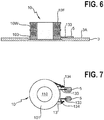
- Figs. 6 and 7 show an embodiment in which the winding terminals are soldered onto the respective PCB contacts 5.
- An electrical connection must be made between each terminal of the primary winding 10W and corresponding contacts 5 previously formed on a surface 3A of the PCB 3.
- each partial transformer assembly half i.e. the primary and secondary partial assemblies
- the ends of the windings 10W are electrically connected to SMD connecting pins 133 by means of pins 134 on a connector block 13 and a through connection (indicated by the dotted line), realized at the level of the inner annular bound 103.
- FIG. 7 shows a plan view of the coil former 10F and windings 10W of Fig. 6 , showing how the end portions of the windings 10W are connected to the mounting pins 134 and to the SMD connector pins 133 through the connector block 13.
- the inner annular bound 103 requires a certain thickness in order to accommodate a required minimum thickness of a connecting pin 134, so that the overall height of the assembly cannot be as compact as the embodiment explained in Figs. 1 - 4 above.
- Fig. 8 shows a circuit diagram of an embodiment of the inventive switching converter circuit 2, which includes a split transformer assembly 1 as part of an LLC resonant converter.
- the transformer assembly 1 may be understood to comprise leakage, as will be known to the skilled person, even though the diagram does not explicitly show a corresponding inductor in series with each of the primary and secondary windings. Equally, the transformer assembly 1 may be assumed to have a non-unity coupling factor.
- the inventive transformer assembly 1 is an isolating transformer with its first partial assembly 10 associated with a high-voltage side (on the left of the transformer in the diagram) and with its second partial assembly associated with a low-voltage side (on the right of the transformer in the diagram).
- This diagram is exemplary for any application requiring an isolation transformer with non-unity coupling and power ratings in the range up to several kilowatts, and for which miniaturization is a priority on account of a small device size.
- An example of such an application might be a driver of an LED lamp, a mobile device charger, a laptop adapter etc.
- Fig. 9 shows a prior art transformer assembly 9.
- windings 92 are printed onto a PCB 90, and openings 91 have been formed in the PCB 90 so that ferrite core halves 92 can extend through the openings 91.
- This type of realization can be realized with a low overall height, but the overall width W 9 is relatively large on account of the flat printed windings 92 and because of the minimum distances for clearance and creepage that must be complied with.
- Fig. 10 shows another prior art transformer assembly 7.
- a split bobbin design is used, with two separate bobbin halves 70, each carrying a winding 71, and an additional isolating separator 72 between the bobbin halves in order to meet the winding-to-winding creepage and clearance distances.
- the central portion of a ferrite E-core 73 extends into a cavity formed by the bobbin halves 70, and connector pins 74 allow the transformer assembly 7 to be connected to a PCB.
- the necessity of fulfilling the terminal-to-core creepage/clearance distance requirements results in an unfavorably large realization, primarily on account of the relatively great height H 7 .
- the split transformer assembly could be realized as an air core device.
- the windings may be self-supporting windings enclosed in a suitable coating material that imparts stability to the winding package.
Landscapes
- Engineering & Computer Science (AREA)
- Power Engineering (AREA)
- Microelectronics & Electronic Packaging (AREA)
- Dc-Dc Converters (AREA)
- Coils Or Transformers For Communication (AREA)
- Coils Of Transformers For General Uses (AREA)
Claims (15)
- Ensemble formant transformateur divisé (1) comprenant :- une carte de circuit imprimée (3) ;- un premier ensemble partiel (10) comprenant un agencement d'enroulement primaire (10W) façonné de manière à accueillir une première moitié de noyau (10C) ;- un second ensemble partiel (20) comprenant un agencement d'enroulement secondaire (20W) façonné de manière à accueillir une seconde moitié de noyau (20C) ;et dans lequel le premier ensemble partiel (10) est réalisé pour être monté sur un côté de la carte de circuit imprimée (3) et le second ensemble partiel (20) est réalisé pour être monté sur le côté opposé de la carte de circuit imprimée (3) de sorte que, lors du montage sur la carte de circuit imprimée (3), les moitiés de noyau (10C, 20C) des ensembles partiels (10, 20) sont entièrement isolées par le matériau de la carte de circuit imprimée (3).
- Ensemble formant transformateur divisé selon la revendication 1, dans lequel au moins l'un parmi les premier et second ensembles partiels (10, 20) comprend un corps de bobine (10F, 20F) façonné pour transporter l'agencement d'enroulement (10W, 20W) de cet ensemble partiel (10, 20) et pour accueillir la moitié de noyau (10C, 20C) de cet ensemble partiel (10, 20), et le matériau de la carte de circuit imprimée (3) est adapté pour séparer les moitiés de noyau (10C, 20C) dans toute la zone des moitiés de noyau (10C, 20C) et pour fournir un entrefer pour les moitiés de noyau (10C, 20C).
- Ensemble formant transformateur divisé selon la revendication 1 ou la revendication 2, comprenant un agencement de connecteur (12, 13) pour raccorder électriquement un enroulement primaire ou secondaire des premier et second agencements d'enroulement (10W, 20W) à un contact (5) sur la carte de circuit imprimée (3).
- Ensemble formant transformateur divisé selon la revendication 3, dans lequel l'agencement de connecteur (12, 13) comprend au moins une broche de connecteur d'enroulement (124) agencée pour être raccordée audit enroulement (10W, 20W) et au moins une broche de connecteur conductrice (123, 134) agencée pour être raccordée au contact (5) sur la carte de circuit imprimée (3).
- Ensemble formant transformateur divisé selon la revendication 3 ou la revendication 4, dans lequel l'agencement de connecteur (12, 13) comprend un contact à souder (123, 133) pour l'établissement d'un raccordement électrique entre ledit enroulement (10W, 20W) et le contact (5) de la carte de circuit imprimée (3).
- Ensemble formant transformateur divisé selon l'une quelconque des revendications 3-5, dans lequel l'agencement de connecteur (12) comprend une première partie (121) et une seconde partie (122), et comprenant une charnière (120) entre la première partie (121) et la seconde partie (122) de sorte que la seconde partie (122) présente une position ouverte et une position fermée par rapport au corps de bobine (10, 20).
- Ensemble formant transformateur divisé selon les revendications 4 et 6, dans lequel les broches de connecteur (124) sont agencées sur la seconde partie (122).
- Ensemble formant transformateur divisé selon la revendication 6 ou la revendication 7, comprenant un contact à souder (123) sur la face inférieure de la seconde partie (122) agencé pour former une connexion électrique avec le contact (5) sur la carte de circuit imprimée (3).
- Agencement de circuit convertisseur de commutation (2) comprenant un ensemble formant transformateur divisé (1) selon l'une quelconque des revendications 1 à 8, dans lequel la carte de circuit imprimée (3) est pourvue de fils conducteurs (5) pour raccorder électriquement un certain nombre de composants de circuit, et pourvue d'une région de montage (310M, 320M) pour recevoir les premier et second ensembles partiels (10, 20) de l'ensemble formant transformateur divisé (1).
- Agencement de circuit convertisseur de commutation selon la revendication 9, dans lequel la région de montage (310M, 320M) comprend une première région de montage (310M) sur un premier côté (3A, 310) de la carte de circuit imprimée (3) pour recevoir l'agencement d'enroulement primaire (10W) ; et/ou une seconde région de montage (320M) sur le côté opposé (3B) de la carte de circuit imprimée (3) pour recevoir l'agencement d'enroulement secondaire (20W).
- Agencement de circuit convertisseur de commutation selon la revendication 9 ou la revendication 10, dans lequel la carte de circuit imprimée (3) comprend une épaisseur nominale (T3), et dans lequel l'épaisseur de la carte de circuit imprimée (TMR) dans la région de montage (310M, 320M) est inférieure à l'épaisseur nominale (T3).
- Agencement de circuit convertisseur de commutation selon l'une quelconque des revendications 9 à 11, dans lequel la première région de montage (310M) comprend un évidement formé dans le premier côté (310, 3A) de la carte de circuit imprimée (3) et/ou la seconde région de montage (320M) comprend un évidement formé dans le second côté (320) de la carte de circuit imprimée (3).
- Agencement de circuit convertisseur de commutation selon l'une quelconque des revendications 9 à 12, dans lequel l'ensemble formant transformateur divisé (1) est réalisé en tant que composant d'une commande de lampe, et dans lequel l'épaisseur de matériau (TMR) de la carte de circuit imprimée (3) comprend au maximum 0,5 mm dans la région de montage (310M, 320M).
- Procédé d'assemblage d'un transformateur divisé (1), comprenant les étapes consistant à- fournir un agencement d'enroulement primaire (10W) ;- insérer une première moitié de noyau (10C) dans l'agencement d'enroulement primaire (10W) pour obtenir un premier ensemble partiel (10) ;- fournir un agencement d'enroulement secondaire (20W) ;- insérer une seconde moitié de noyau (20C) dans l'agencement d'enroulement secondaire (20W) pour obtenir un second ensemble partiel (20) ; etmonter le premier ensemble partiel (10) sur une région de montage (310M) sur un premier côté (310) d'une carte de circuit imprimée (3) et monter le second ensemble partiel (20) sur une région de montage (320M) sur le côté opposé (320) d'une carte de circuit imprimée (3) de sorte que, lors du montage sur la carte de circuit imprimée (3), les moitiés de noyau (10C, 20C) des ensembles partiels (10, 20) sont entièrement isolées par le matériau de la carte de circuit imprimée (3).
- Procédé selon la revendication 14, comprenant une étape consistant à monter un agencement d'enroulement (10W, 20W) dans une région évidée (310M, 320M) dans la carte de circuit imprimée (3).
Applications Claiming Priority (2)
| Application Number | Priority Date | Filing Date | Title |
|---|---|---|---|
| EP16165280 | 2016-04-14 | ||
| PCT/EP2017/058404 WO2017178374A1 (fr) | 2016-04-14 | 2017-04-07 | Ensemble transformateur divisé |
Publications (2)
| Publication Number | Publication Date |
|---|---|
| EP3443572A1 EP3443572A1 (fr) | 2019-02-20 |
| EP3443572B1 true EP3443572B1 (fr) | 2021-06-09 |
Family
ID=55754188
Family Applications (1)
| Application Number | Title | Priority Date | Filing Date |
|---|---|---|---|
| EP17715194.1A Active EP3443572B1 (fr) | 2016-04-14 | 2017-04-07 | Ensemble transformateur divisé |
Country Status (4)
| Country | Link |
|---|---|
| US (1) | US11322286B2 (fr) |
| EP (1) | EP3443572B1 (fr) |
| CN (1) | CN109074935B (fr) |
| WO (1) | WO2017178374A1 (fr) |
Families Citing this family (10)
| Publication number | Priority date | Publication date | Assignee | Title |
|---|---|---|---|---|
| JP6955988B2 (ja) * | 2017-12-11 | 2021-10-27 | 株式会社日立製作所 | 電力変換器ユニット、および電力変換装置 |
| US20200258675A1 (en) * | 2019-02-08 | 2020-08-13 | Lear Corporation | Hybrid transformer for dc/dc converter |
| US20210110966A1 (en) * | 2019-10-09 | 2021-04-15 | Power Integrations, Inc. | Magnet with multiple discs |
| US12057255B2 (en) * | 2019-12-02 | 2024-08-06 | Acleap Power Inc. | Hybrid transformers for power supplies |
| JP7367516B2 (ja) * | 2019-12-23 | 2023-10-24 | Tdk株式会社 | コイル構造 |
| US11651890B2 (en) * | 2020-03-02 | 2023-05-16 | Cyntec Co., Ltd. | Electronic structure having a transformer |
| JP7192815B2 (ja) * | 2020-03-16 | 2022-12-20 | 株式会社村田製作所 | インダクタ部品 |
| KR20220133639A (ko) * | 2021-03-25 | 2022-10-05 | 엘에스일렉트릭(주) | 절연형 컨버터용 외함 및 이를 이용한 절연형 컨버터 |
| CN113571309B (zh) * | 2021-07-23 | 2022-08-05 | 西安微电机研究所有限公司 | 一种航天领域用较大体积电感安装结构及工艺 |
| US12146642B1 (en) * | 2023-05-02 | 2024-11-19 | B/E Aerospace, Inc. | Split core isolated power |
Family Cites Families (24)
| Publication number | Priority date | Publication date | Assignee | Title |
|---|---|---|---|---|
| US4103268A (en) * | 1977-06-29 | 1978-07-25 | Gte Automatic Electric Laboratories Incorporated | Dual coil hinged bobbin assembly |
| JPS6384106A (ja) | 1986-09-29 | 1988-04-14 | Nippon Telegr & Teleph Corp <Ntt> | 絶縁トランス及びその製造方法 |
| DE8809646U1 (de) | 1988-07-28 | 1989-08-31 | Siemens AG, 1000 Berlin und 8000 München | Stromversorgungsgerät für elektronische Einrichtungen |
| GB2252208B (en) | 1991-01-24 | 1995-05-03 | Burr Brown Corp | Hybrid integrated circuit planar transformer |
| US5565837A (en) | 1992-11-06 | 1996-10-15 | Nidec America Corporation | Low profile printed circuit board |
| DE19615921A1 (de) * | 1996-04-22 | 1997-10-23 | Vacuumschmelze Gmbh | Induktives Bauelement in flacher Bauform |
| IE990428A1 (en) | 1998-05-26 | 2001-01-10 | Artesyn Tech | A transformer assembly |
| SE9903466D0 (sv) | 1999-09-24 | 1999-09-24 | Siemens Elema Ab | Isolation transformer |
| WO2001056045A1 (fr) * | 2000-01-27 | 2001-08-02 | Koninklijke Philips Electronics N.V. | Transformateur pourvu d'organes isolants formes par une plaque de montage adaptee a un circuit imprime |
| EP1279178A4 (fr) | 2000-04-06 | 2003-07-09 | Aria Corp | Bloc d'alimentation tous courants miniature et chargeur de batterie |
| US7477120B2 (en) * | 2001-08-13 | 2009-01-13 | Bose Corporation | Transformer shielding |
| US6734775B2 (en) * | 2002-04-29 | 2004-05-11 | Yu-Lin Chung | Transformer structure |
| DE102004037853A1 (de) * | 2004-08-04 | 2006-03-16 | Epcos Ag | Halterung für eine Drosselspule und ein induktives Bauelement mit der Halterung |
| WO2008152616A1 (fr) | 2007-06-11 | 2008-12-18 | Moog Limited | Transformateur de faible épaisseur |
| US8031042B2 (en) * | 2008-05-28 | 2011-10-04 | Flextronics Ap, Llc | Power converter magnetic devices |
| WO2011154993A1 (fr) * | 2010-06-08 | 2011-12-15 | 株式会社日立製作所 | Transformateur de séparation et dispositif d'alimentation électrique |
| TWI389149B (zh) * | 2010-08-26 | 2013-03-11 | Acbel Polytech Inc | Symmetrical leakage inductance adjustable flat transformer |
| GB201105077D0 (en) | 2011-03-25 | 2011-05-11 | Redisem Ltd | Transformer for resonant converters |
| US9053845B2 (en) * | 2012-06-12 | 2015-06-09 | General Electric Company | Transformer with planar primary winding |
| DE102013007850B4 (de) * | 2013-05-08 | 2023-08-10 | Sew-Eurodrive Gmbh & Co Kg | Transformatoranordnung |
| US10312012B2 (en) * | 2013-08-29 | 2019-06-04 | Solum Co., Ltd. | Transformer and power supply device including the same |
| CN204270848U (zh) | 2014-12-03 | 2015-04-15 | 陈利华 | 一种新型平面变压器的结构装置 |
| US9433043B1 (en) | 2015-04-26 | 2016-08-30 | Optolum, Inc. | Power supply for a plurality of light emitting diodes |
| CN105448507B (zh) | 2015-12-29 | 2017-12-26 | 中国科学院苏州生物医学工程技术研究所 | 高频旋转变压器 |
-
2017
- 2017-04-07 WO PCT/EP2017/058404 patent/WO2017178374A1/fr not_active Ceased
- 2017-04-07 EP EP17715194.1A patent/EP3443572B1/fr active Active
- 2017-04-07 CN CN201780023534.8A patent/CN109074935B/zh not_active Expired - Fee Related
- 2017-04-07 US US16/086,634 patent/US11322286B2/en active Active
Non-Patent Citations (1)
| Title |
|---|
| None * |
Also Published As
| Publication number | Publication date |
|---|---|
| EP3443572A1 (fr) | 2019-02-20 |
| WO2017178374A1 (fr) | 2017-10-19 |
| US11322286B2 (en) | 2022-05-03 |
| US20190103210A1 (en) | 2019-04-04 |
| CN109074935B (zh) | 2021-01-22 |
| CN109074935A (zh) | 2018-12-21 |
Similar Documents
| Publication | Publication Date | Title |
|---|---|---|
| EP3443572B1 (fr) | Ensemble transformateur divisé | |
| US10347413B2 (en) | Method of manufacturing an embedded magnetic component device | |
| JP6572871B2 (ja) | トランス装置およびその組み立て方法 | |
| US8643460B2 (en) | Transformer structure | |
| US20090102593A1 (en) | Coil form | |
| US20080088401A1 (en) | Transformer | |
| CN1307661C (zh) | 带有线圈末端的电子元件磁芯 | |
| JP2009252787A (ja) | コイル部品 | |
| US7091815B2 (en) | Electrical device, transformer, and inductor, and method of manufacturing electrical device | |
| HRP20240687T1 (hr) | Sklopovi induktora | |
| KR101610339B1 (ko) | 코일 부품 및 그 제조 방법 | |
| JP4845199B2 (ja) | トランス | |
| KR101187489B1 (ko) | 멀티 트랜스포머 및 이를 제조하는 방법 | |
| US12057255B2 (en) | Hybrid transformers for power supplies | |
| KR20230024523A (ko) | 코일 부품 | |
| US20230033439A1 (en) | Electrotechnical device for an aircraft | |
| US20240096548A1 (en) | Electronic device | |
| JP2001076942A (ja) | トランス | |
| JP2012099590A (ja) | トランス | |
| EP0542445B1 (fr) | Transformateur plat | |
| JP2025024950A (ja) | スイッチング電源装置及び電源用モジュール | |
| JP2856901B2 (ja) | トランス | |
| US20230046765A1 (en) | Electric transformer with a definite impedance by means of a second magnetic circuit | |
| KR20190014727A (ko) | 듀얼 코어 평면 트랜스포머 | |
| KR101590131B1 (ko) | 변압기 및 어댑터 |
Legal Events
| Date | Code | Title | Description |
|---|---|---|---|
| STAA | Information on the status of an ep patent application or granted ep patent |
Free format text: STATUS: UNKNOWN |
|
| STAA | Information on the status of an ep patent application or granted ep patent |
Free format text: STATUS: THE INTERNATIONAL PUBLICATION HAS BEEN MADE |
|
| PUAI | Public reference made under article 153(3) epc to a published international application that has entered the european phase |
Free format text: ORIGINAL CODE: 0009012 |
|
| STAA | Information on the status of an ep patent application or granted ep patent |
Free format text: STATUS: REQUEST FOR EXAMINATION WAS MADE |
|
| 17P | Request for examination filed |
Effective date: 20181114 |
|
| AK | Designated contracting states |
Kind code of ref document: A1 Designated state(s): AL AT BE BG CH CY CZ DE DK EE ES FI FR GB GR HR HU IE IS IT LI LT LU LV MC MK MT NL NO PL PT RO RS SE SI SK SM TR |
|
| AX | Request for extension of the european patent |
Extension state: BA ME |
|
| RAP1 | Party data changed (applicant data changed or rights of an application transferred) |
Owner name: SIGNIFY HOLDING B.V. |
|
| DAV | Request for validation of the european patent (deleted) | ||
| DAX | Request for extension of the european patent (deleted) | ||
| GRAP | Despatch of communication of intention to grant a patent |
Free format text: ORIGINAL CODE: EPIDOSNIGR1 |
|
| STAA | Information on the status of an ep patent application or granted ep patent |
Free format text: STATUS: GRANT OF PATENT IS INTENDED |
|
| INTG | Intention to grant announced |
Effective date: 20210113 |
|
| GRAS | Grant fee paid |
Free format text: ORIGINAL CODE: EPIDOSNIGR3 |
|
| GRAA | (expected) grant |
Free format text: ORIGINAL CODE: 0009210 |
|
| STAA | Information on the status of an ep patent application or granted ep patent |
Free format text: STATUS: THE PATENT HAS BEEN GRANTED |
|
| AK | Designated contracting states |
Kind code of ref document: B1 Designated state(s): AL AT BE BG CH CY CZ DE DK EE ES FI FR GB GR HR HU IE IS IT LI LT LU LV MC MK MT NL NO PL PT RO RS SE SI SK SM TR |
|
| REG | Reference to a national code |
Ref country code: GB Ref legal event code: FG4D |
|
| REG | Reference to a national code |
Ref country code: CH Ref legal event code: EP Ref country code: AT Ref legal event code: REF Ref document number: 1401170 Country of ref document: AT Kind code of ref document: T Effective date: 20210615 |
|
| REG | Reference to a national code |
Ref country code: DE Ref legal event code: R096 Ref document number: 602017039963 Country of ref document: DE |
|
| REG | Reference to a national code |
Ref country code: IE Ref legal event code: FG4D |
|
| REG | Reference to a national code |
Ref country code: LT Ref legal event code: MG9D |
|
| PG25 | Lapsed in a contracting state [announced via postgrant information from national office to epo] |
Ref country code: LT Free format text: LAPSE BECAUSE OF FAILURE TO SUBMIT A TRANSLATION OF THE DESCRIPTION OR TO PAY THE FEE WITHIN THE PRESCRIBED TIME-LIMIT Effective date: 20210609 Ref country code: FI Free format text: LAPSE BECAUSE OF FAILURE TO SUBMIT A TRANSLATION OF THE DESCRIPTION OR TO PAY THE FEE WITHIN THE PRESCRIBED TIME-LIMIT Effective date: 20210609 Ref country code: HR Free format text: LAPSE BECAUSE OF FAILURE TO SUBMIT A TRANSLATION OF THE DESCRIPTION OR TO PAY THE FEE WITHIN THE PRESCRIBED TIME-LIMIT Effective date: 20210609 Ref country code: BG Free format text: LAPSE BECAUSE OF FAILURE TO SUBMIT A TRANSLATION OF THE DESCRIPTION OR TO PAY THE FEE WITHIN THE PRESCRIBED TIME-LIMIT Effective date: 20210909 |
|
| REG | Reference to a national code |
Ref country code: AT Ref legal event code: MK05 Ref document number: 1401170 Country of ref document: AT Kind code of ref document: T Effective date: 20210609 |
|
| REG | Reference to a national code |
Ref country code: NL Ref legal event code: MP Effective date: 20210609 |
|
| PG25 | Lapsed in a contracting state [announced via postgrant information from national office to epo] |
Ref country code: NO Free format text: LAPSE BECAUSE OF FAILURE TO SUBMIT A TRANSLATION OF THE DESCRIPTION OR TO PAY THE FEE WITHIN THE PRESCRIBED TIME-LIMIT Effective date: 20210909 Ref country code: RS Free format text: LAPSE BECAUSE OF FAILURE TO SUBMIT A TRANSLATION OF THE DESCRIPTION OR TO PAY THE FEE WITHIN THE PRESCRIBED TIME-LIMIT Effective date: 20210609 Ref country code: SE Free format text: LAPSE BECAUSE OF FAILURE TO SUBMIT A TRANSLATION OF THE DESCRIPTION OR TO PAY THE FEE WITHIN THE PRESCRIBED TIME-LIMIT Effective date: 20210609 Ref country code: GR Free format text: LAPSE BECAUSE OF FAILURE TO SUBMIT A TRANSLATION OF THE DESCRIPTION OR TO PAY THE FEE WITHIN THE PRESCRIBED TIME-LIMIT Effective date: 20210910 Ref country code: LV Free format text: LAPSE BECAUSE OF FAILURE TO SUBMIT A TRANSLATION OF THE DESCRIPTION OR TO PAY THE FEE WITHIN THE PRESCRIBED TIME-LIMIT Effective date: 20210609 |
|
| PG25 | Lapsed in a contracting state [announced via postgrant information from national office to epo] |
Ref country code: SK Free format text: LAPSE BECAUSE OF FAILURE TO SUBMIT A TRANSLATION OF THE DESCRIPTION OR TO PAY THE FEE WITHIN THE PRESCRIBED TIME-LIMIT Effective date: 20210609 Ref country code: SM Free format text: LAPSE BECAUSE OF FAILURE TO SUBMIT A TRANSLATION OF THE DESCRIPTION OR TO PAY THE FEE WITHIN THE PRESCRIBED TIME-LIMIT Effective date: 20210609 Ref country code: AT Free format text: LAPSE BECAUSE OF FAILURE TO SUBMIT A TRANSLATION OF THE DESCRIPTION OR TO PAY THE FEE WITHIN THE PRESCRIBED TIME-LIMIT Effective date: 20210609 Ref country code: EE Free format text: LAPSE BECAUSE OF FAILURE TO SUBMIT A TRANSLATION OF THE DESCRIPTION OR TO PAY THE FEE WITHIN THE PRESCRIBED TIME-LIMIT Effective date: 20210609 Ref country code: CZ Free format text: LAPSE BECAUSE OF FAILURE TO SUBMIT A TRANSLATION OF THE DESCRIPTION OR TO PAY THE FEE WITHIN THE PRESCRIBED TIME-LIMIT Effective date: 20210609 Ref country code: RO Free format text: LAPSE BECAUSE OF FAILURE TO SUBMIT A TRANSLATION OF THE DESCRIPTION OR TO PAY THE FEE WITHIN THE PRESCRIBED TIME-LIMIT Effective date: 20210609 Ref country code: NL Free format text: LAPSE BECAUSE OF FAILURE TO SUBMIT A TRANSLATION OF THE DESCRIPTION OR TO PAY THE FEE WITHIN THE PRESCRIBED TIME-LIMIT Effective date: 20210609 Ref country code: PT Free format text: LAPSE BECAUSE OF FAILURE TO SUBMIT A TRANSLATION OF THE DESCRIPTION OR TO PAY THE FEE WITHIN THE PRESCRIBED TIME-LIMIT Effective date: 20211011 Ref country code: ES Free format text: LAPSE BECAUSE OF FAILURE TO SUBMIT A TRANSLATION OF THE DESCRIPTION OR TO PAY THE FEE WITHIN THE PRESCRIBED TIME-LIMIT Effective date: 20210609 |
|
| PG25 | Lapsed in a contracting state [announced via postgrant information from national office to epo] |
Ref country code: PL Free format text: LAPSE BECAUSE OF FAILURE TO SUBMIT A TRANSLATION OF THE DESCRIPTION OR TO PAY THE FEE WITHIN THE PRESCRIBED TIME-LIMIT Effective date: 20210609 |
|
| REG | Reference to a national code |
Ref country code: DE Ref legal event code: R097 Ref document number: 602017039963 Country of ref document: DE |
|
| PLBE | No opposition filed within time limit |
Free format text: ORIGINAL CODE: 0009261 |
|
| STAA | Information on the status of an ep patent application or granted ep patent |
Free format text: STATUS: NO OPPOSITION FILED WITHIN TIME LIMIT |
|
| PG25 | Lapsed in a contracting state [announced via postgrant information from national office to epo] |
Ref country code: DK Free format text: LAPSE BECAUSE OF FAILURE TO SUBMIT A TRANSLATION OF THE DESCRIPTION OR TO PAY THE FEE WITHIN THE PRESCRIBED TIME-LIMIT Effective date: 20210609 |
|
| 26N | No opposition filed |
Effective date: 20220310 |
|
| PG25 | Lapsed in a contracting state [announced via postgrant information from national office to epo] |
Ref country code: AL Free format text: LAPSE BECAUSE OF FAILURE TO SUBMIT A TRANSLATION OF THE DESCRIPTION OR TO PAY THE FEE WITHIN THE PRESCRIBED TIME-LIMIT Effective date: 20210609 |
|
| PG25 | Lapsed in a contracting state [announced via postgrant information from national office to epo] |
Ref country code: IT Free format text: LAPSE BECAUSE OF FAILURE TO SUBMIT A TRANSLATION OF THE DESCRIPTION OR TO PAY THE FEE WITHIN THE PRESCRIBED TIME-LIMIT Effective date: 20210609 |
|
| PGFP | Annual fee paid to national office [announced via postgrant information from national office to epo] |
Ref country code: GB Payment date: 20220419 Year of fee payment: 6 Ref country code: FR Payment date: 20220427 Year of fee payment: 6 |
|
| PGFP | Annual fee paid to national office [announced via postgrant information from national office to epo] |
Ref country code: DE Payment date: 20220628 Year of fee payment: 6 |
|
| REG | Reference to a national code |
Ref country code: CH Ref legal event code: PL |
|
| REG | Reference to a national code |
Ref country code: BE Ref legal event code: MM Effective date: 20220430 |
|
| PG25 | Lapsed in a contracting state [announced via postgrant information from national office to epo] |
Ref country code: MC Free format text: LAPSE BECAUSE OF FAILURE TO SUBMIT A TRANSLATION OF THE DESCRIPTION OR TO PAY THE FEE WITHIN THE PRESCRIBED TIME-LIMIT Effective date: 20210609 Ref country code: LU Free format text: LAPSE BECAUSE OF NON-PAYMENT OF DUE FEES Effective date: 20220407 Ref country code: LI Free format text: LAPSE BECAUSE OF NON-PAYMENT OF DUE FEES Effective date: 20220430 Ref country code: CH Free format text: LAPSE BECAUSE OF NON-PAYMENT OF DUE FEES Effective date: 20220430 |
|
| PG25 | Lapsed in a contracting state [announced via postgrant information from national office to epo] |
Ref country code: BE Free format text: LAPSE BECAUSE OF NON-PAYMENT OF DUE FEES Effective date: 20220430 |
|
| PG25 | Lapsed in a contracting state [announced via postgrant information from national office to epo] |
Ref country code: IE Free format text: LAPSE BECAUSE OF NON-PAYMENT OF DUE FEES Effective date: 20220407 |
|
| REG | Reference to a national code |
Ref country code: DE Ref legal event code: R119 Ref document number: 602017039963 Country of ref document: DE |
|
| GBPC | Gb: european patent ceased through non-payment of renewal fee |
Effective date: 20230407 |
|
| PG25 | Lapsed in a contracting state [announced via postgrant information from national office to epo] |
Ref country code: GB Free format text: LAPSE BECAUSE OF NON-PAYMENT OF DUE FEES Effective date: 20230407 |
|
| PG25 | Lapsed in a contracting state [announced via postgrant information from national office to epo] |
Ref country code: GB Free format text: LAPSE BECAUSE OF NON-PAYMENT OF DUE FEES Effective date: 20230407 Ref country code: FR Free format text: LAPSE BECAUSE OF NON-PAYMENT OF DUE FEES Effective date: 20230430 Ref country code: DE Free format text: LAPSE BECAUSE OF NON-PAYMENT OF DUE FEES Effective date: 20231103 |
|
| PG25 | Lapsed in a contracting state [announced via postgrant information from national office to epo] |
Ref country code: HU Free format text: LAPSE BECAUSE OF FAILURE TO SUBMIT A TRANSLATION OF THE DESCRIPTION OR TO PAY THE FEE WITHIN THE PRESCRIBED TIME-LIMIT; INVALID AB INITIO Effective date: 20170407 |
|
| PG25 | Lapsed in a contracting state [announced via postgrant information from national office to epo] |
Ref country code: MK Free format text: LAPSE BECAUSE OF FAILURE TO SUBMIT A TRANSLATION OF THE DESCRIPTION OR TO PAY THE FEE WITHIN THE PRESCRIBED TIME-LIMIT Effective date: 20210609 Ref country code: CY Free format text: LAPSE BECAUSE OF FAILURE TO SUBMIT A TRANSLATION OF THE DESCRIPTION OR TO PAY THE FEE WITHIN THE PRESCRIBED TIME-LIMIT Effective date: 20210609 |
|
| PG25 | Lapsed in a contracting state [announced via postgrant information from national office to epo] |
Ref country code: MT Free format text: LAPSE BECAUSE OF FAILURE TO SUBMIT A TRANSLATION OF THE DESCRIPTION OR TO PAY THE FEE WITHIN THE PRESCRIBED TIME-LIMIT Effective date: 20210609 |
|
| PG25 | Lapsed in a contracting state [announced via postgrant information from national office to epo] |
Ref country code: TR Free format text: LAPSE BECAUSE OF FAILURE TO SUBMIT A TRANSLATION OF THE DESCRIPTION OR TO PAY THE FEE WITHIN THE PRESCRIBED TIME-LIMIT Effective date: 20210609 |