EP3444126B1 - Procédé de fabrication d'un élastomère fonctionnalisé - Google Patents
Procédé de fabrication d'un élastomère fonctionnalisé Download PDFInfo
- Publication number
- EP3444126B1 EP3444126B1 EP18187845.5A EP18187845A EP3444126B1 EP 3444126 B1 EP3444126 B1 EP 3444126B1 EP 18187845 A EP18187845 A EP 18187845A EP 3444126 B1 EP3444126 B1 EP 3444126B1
- Authority
- EP
- European Patent Office
- Prior art keywords
- monomer
- copolymer
- weight
- catalyst
- formula
- Prior art date
- Legal status (The legal status is an assumption and is not a legal conclusion. Google has not performed a legal analysis and makes no representation as to the accuracy of the status listed.)
- Active
Links
Images

Classifications
-
- B—PERFORMING OPERATIONS; TRANSPORTING
- B60—VEHICLES IN GENERAL
- B60C—VEHICLE TYRES; TYRE INFLATION; TYRE CHANGING; CONNECTING VALVES TO INFLATABLE ELASTIC BODIES IN GENERAL; DEVICES OR ARRANGEMENTS RELATED TO TYRES
- B60C1/00—Tyres characterised by the chemical composition or the physical arrangement or mixture of the composition
- B60C1/0016—Compositions of the tread
-
- B—PERFORMING OPERATIONS; TRANSPORTING
- B60—VEHICLES IN GENERAL
- B60C—VEHICLE TYRES; TYRE INFLATION; TYRE CHANGING; CONNECTING VALVES TO INFLATABLE ELASTIC BODIES IN GENERAL; DEVICES OR ARRANGEMENTS RELATED TO TYRES
- B60C1/00—Tyres characterised by the chemical composition or the physical arrangement or mixture of the composition
-
- C—CHEMISTRY; METALLURGY
- C08—ORGANIC MACROMOLECULAR COMPOUNDS; THEIR PREPARATION OR CHEMICAL WORKING-UP; COMPOSITIONS BASED THEREON
- C08F—MACROMOLECULAR COMPOUNDS OBTAINED BY REACTIONS ONLY INVOLVING CARBON-TO-CARBON UNSATURATED BONDS
- C08F236/00—Copolymers of compounds having one or more unsaturated aliphatic radicals, at least one having two or more carbon-to-carbon double bonds
- C08F236/02—Copolymers of compounds having one or more unsaturated aliphatic radicals, at least one having two or more carbon-to-carbon double bonds the radical having only two carbon-to-carbon double bonds
- C08F236/04—Copolymers of compounds having one or more unsaturated aliphatic radicals, at least one having two or more carbon-to-carbon double bonds the radical having only two carbon-to-carbon double bonds conjugated
- C08F236/06—Butadiene
-
- C—CHEMISTRY; METALLURGY
- C08—ORGANIC MACROMOLECULAR COMPOUNDS; THEIR PREPARATION OR CHEMICAL WORKING-UP; COMPOSITIONS BASED THEREON
- C08F—MACROMOLECULAR COMPOUNDS OBTAINED BY REACTIONS ONLY INVOLVING CARBON-TO-CARBON UNSATURATED BONDS
- C08F236/00—Copolymers of compounds having one or more unsaturated aliphatic radicals, at least one having two or more carbon-to-carbon double bonds
- C08F236/02—Copolymers of compounds having one or more unsaturated aliphatic radicals, at least one having two or more carbon-to-carbon double bonds the radical having only two carbon-to-carbon double bonds
- C08F236/04—Copolymers of compounds having one or more unsaturated aliphatic radicals, at least one having two or more carbon-to-carbon double bonds the radical having only two carbon-to-carbon double bonds conjugated
- C08F236/08—Isoprene
Definitions
- Stereoregular polymers like polypropylene and polydienes are produced on a large scale by catalytic insertion polymerization.
- the production of synthetic rubbers like polybutadiene and polyisoprene traditionally employs Ziegler-Natta catalysis based on e.g. Ti, Co, or Ni, and Nd catalysts.
- Nd-based systems are known to yield butadiene rubber with the highest 1,4- cis content. This is important, as microstructure control is paramount in the synthesis of synthetic rubber because it translates directly to different polymer properties like glass transition temperature, crystallinity, or strain-induced crystallization. These properties are significant for tire manufacturing, the main application of synthetic rubber.
- the functionalization with polar groups can give access to improved properties of such materials.
- EP-A-3 181 593 describes a copolymer of a monomer selected from the group consisting of 1,3-butadiene and isoprene and of a monomer of formula I of that document.
- US-B1-6,344,538 describes functionalized monomers and polymerized functionalized monomers. It also describes a method of making a functionalized diene compound of the formula II of this application wherein Y may be NH 2 , as well as polymerizing this functionalized diene compound to produce a functionalized diene polymer wherein this polymer is a copolymer comprising at least one monomer selected from the group consisting of butadiene, isoprene, piperylene and hexadienes.
- the present invention is directed to a method of making an amine functionalized elastomer in accordance with claim 1.
- the invention is directed to a method of making an amine functionalized elastomer, comprising the steps of: polymerizing at least one first monomer selected from the group consisting of 1,3-butadiene and isoprene and a second monomer of formula I in the presence of a lanthanide-based coordination polymerization catalyst in a hydrocarbon solvent to form a first copolymer in solution; where R 1 is phenylene, a linear or branched alkane diyl group containing from 1 to 10 carbon atoms, or a combination of one or more phenylene groups and one or more linear or branched alkane diyl groups containing from 1 to 10 carbon atoms; and R 2 is methyl or ethyl; mixing the first copolymer in solution with a protic solvent followed by stirring to convert the first copolymer to a second copolymer given by the formula poly(M1 co M2) wherein M1 is the first monomer and M2 is of formula II where R
- a method of making an amine functionalized elastomer comprising the steps of: polymerizing at least one first monomer selected from the group consisting of 1,3-butadiene and isoprene and a second monomer of formula I in the presence of a polymerization catalyst in a hydrocarbon solvent to form a first copolymer in solution; where R 1 is phenylene, a linear or branched alkane diyl group containing from 1 to 10 carbon atoms, or a combination of one or more phenylene groups and one or more linear or branched alkane diyl groups containing from 1 to 10 carbon atoms; and R 2 is methyl or ethyl; mixing the first copolymer in solution with a protic solvent followed by stirring to convert the first copolymer to a second copolymer given by the formula poly(M1 co M2) wherein M1 is the first monomer and M2 is of formula II where R 1 is as previously defined.
- the repeat units of the copolymer derived from the comonomers may exhibit random distribution throughout the copolymer, however block copolymer or tapered copolymers are also possible structures of the polymers.
- the properties of the resulting copolymers may depend strongly both on the nature of the insertion of the comonomer and on the blockiness of the copolymer incorporation.
- the copolymers preferably have a high cis 1,4 microstructure of units derived from the first monomer and second monomer.
- the copolymer comprises at least 90 percent by weight of cis 1,4 microstructure content based on the weight of the polybutadiene content of the copolymer.
- the copolymer comprises at least 95 percent by weight of cis 1,4 microstructure content based on the weight of the polybutadiene content of the copolymer.
- the first copolymer is made via solution polymerization in the presence of a polymerization catalyst.
- Suitable catalysts include lanthanide catalyst systems based on neodymium and the like, and nickel based catalysts.
- the catalyst system is a nickel based system.
- nickel based catalyst systems contain (a) an organonickel compound, (b) an organoaluminum compound, and (c) a fluorine containing compound.
- Such nickel based catalyst systems and their use in the synthesis of polydienes is described in detail in US-A-3,856,764 , US-A-3,910,869 , and US-A-3,962,375 .
- the catalyst is a neodymium catalyst system: where R 1 and R 2 of units derived from monomer I are shown in the above example as propane diyl and trimethylsilyl groups.
- Such polymerizations are typically conducted in a hydrocarbon solvent that can be one or more aromatic, paraffinic, or cycloparaffinic compounds. These solvents will normally contain from 4 to 10 carbon atoms per molecule and will be liquids under the conditions of the polymerization.
- a hydrocarbon solvent that can be one or more aromatic, paraffinic, or cycloparaffinic compounds.
- These solvents will normally contain from 4 to 10 carbon atoms per molecule and will be liquids under the conditions of the polymerization.
- suitable organic solvents include pentane, isooctane, cyclohexane, normal hexane, benzene, toluene, xylene, ethylbenzene, and the like, alone or in admixture.
- polymerization medium In solution polymerizations that utilize the catalyst systems of this invention, there will normally be from 90 to 99 weight percent first monomer and 1 to 10 weight percent of second monomer in the polymerization medium.
- This second monomer concentration corresponds to a molar concentration of up to 2 mole percent. Higher second monomer incorporation is possible, including upto 4, 11, 20, 45 and even 100 mole percent of second monomer.
- Such polymerization mediums are, of course, comprised of an organic solvent, the monomer, and the catalyst system.
- the polymerization medium will contain from 75 to 99.5 weight percent first monomer.
- the polymerization medium will contain from 0.5 to 25 weight percent second monomer.
- the neodymium catalyst system used in the process of this invention is made by preforming three catalyst components. These components are (1) an organoaluminum compound, (2) a neodymium carboxylate, and (3) a dialkyl aluminum chloride.
- the neodymium carboxylate and the organoaluminum compound are first reacted together for 10 minutes to 30 minutes in the presence of isoprene or butadiene to produce a neodymium-aluminum catalyst component.
- the neodymium carboxylate and the organoaluminum compound are preferable reacted for 12 minutes to 30 minutes and are more preferable reacted for 15 to 25 minutes in producing the neodymium-aluminum catalyst component.
- the neodymium-aluminum catalyst component is then reacted with the dialkyl aluminum chloride for a period of at least 30 minutes to produce the neodymium catalyst system.
- the activity of the neodymium catalyst system normally improves as the time allowed for this step is increased up to about 24 hours. Greater catalyst activity is not normally attained by increasing the aging time over 24 hours. However, the catalyst system can be aged for much longer time periods before being used without any detrimental results.
- the neodymium catalyst system will typically be preformed at a temperature that is within the range of from 0oC to 100oC.
- the neodymium catalyst system will more typically be prepared at a temperature that is within the range of from 10oC to 60oC.
- the neodymium catalyst system will preferably be prepared at a temperature that is within the range of from 15oC to 30oC.
- the organoaluminum compound contains at least one carbon to aluminum bond and can be represented by the structural formula: in which R 1 is selected from the group consisting of alkyl (including cycloalkyl), alkoxy, aryl, alkaryl, arylalkyl radicals and hydrogen: R 2 is selected from the group consisting of alkyl (including cycloalkyl), aryl, alkaryl, arylalkyl radicals and hydrogen and R 3 is selected from a group consisting of alkyl (including cycloalkyl), aryl, alkaryl and arylalkyl radicals.
- Representative of the compounds corresponding to this definition are: diethylaluminum hydride, di-n-propylaluminum hydride, di-n-butylaluminum hydride, diisobutylaluminum hydride, diphenylaluminum hydride, di-p-tolylaluminum hydride, dibenzylaluminum hydride, phenylethylaluminum hydride, phenyl-n-propylaluminum hydride, p-tolylethylaluminum hydride, p-tolyl-n-propylaluminum hydride, p-tolylisopropylaluminum hydride, benzylethylaluminum hydride, benzyl-n-propylaluminum hydride, and benzylisopropylaluminum hydride and other organoaluminum hydrides.
- ethylaluminum dihydride ethylaluminum dihydride, butylaluminum dihydride, isobutylaluminum dihydride, octylaluminum dihydride, amylaluminum dihydride and other organoaluminum dihydrides. Also included are diethylaluminum ethoxide and dipropylaluminum ethoxide.
- trimethylaluminum triethylaluminum, tri-n-propylaluminum, triisopropylaluminum, tri-n-propylaluminum, triisopropylaluminim, tri-n-butylaluminum, triisobutylaluminum, tripentylaluminum, trihexylaluminum, tricyclohexylaluminum, trioctylaluminum, triphenylaluminum, tri-p-tolylaluminum, tribenzylaluminum, ethyldiphenylaluminum, ethyl-di-p-tolylaluminum, ethyldibenzylaluminum, diethylphenylaluminum, diethyl-p-tolylaluminum, diethylbenzylaluminum and other triorganoaluminum compounds.
- the neodymium carboxylate utilizes an organic monocarboxylic acid ligand that contains from 1 to 20 carbon atoms, such as acetic acid, propionic acid, valeric acid, hexanoic acid, 2-ethylhexanoic acid, neodecanoic acid, lauric acid, stearic acid and the like neodymium naphthenate, neodymium neodecanoate, neodymium octanoate, and other neodymium metal complexes with carboxylic acid containing ligands containing from 1 to 20 carbon atoms.
- organic monocarboxylic acid ligand that contains from 1 to 20 carbon atoms, such as acetic acid, propionic acid, valeric acid, hexanoic acid, 2-ethylhexanoic acid, neodecanoic acid, lauric acid, stearic acid and the like n
- the proportions of the catalyst components utilized in making the neodymium catalyst system of this invention can be varied widely.
- the atomic ratio of the halide ion to the neodymium metal can vary from 0.1/1 to 6/1. A more preferred ratio is from 0.5/1 to 3.5/1 and the most preferred ratio is 2/1.
- the molar ratio of the trialkylaluminum or alkylaluminum hydride to neodymium metal can range from 4/1 to 200/1 with the most preferred range being from 8/1 to 100/1.
- the molar ratio of isoprene or butadiene to neodymium metal can range from 0.2/1 to 3000/1 with the most preferred range being from 5/1 to 500/1.
- the amount of catalyst used to initiate the polymerization can be varied over a wide range. Low concentrations of the catalyst system are normally desirable in order to minimize ash problems. It has been found that polymerizations will occur when the catalyst level of the neodymium metal varies between 0.05 and 1.0 millimole of neodymium metal per 100 grams of monomer. A preferred ratio is between 0.1 and 0.3 millimole of neodymium metal per 100 grams of monomer.
- concentration of the total catalyst system employed depends upon factors such as purity of the system, polymerization rate desired, temperature and other factors. Therefore, specific concentrations cannot be set forth except to say that catalytic amounts are used.
- Temperatures at which the polymerization reaction is carried out can be varied over a wide range. Usually the temperature can be varied from extremely low temperatures such as -60oC up to high temperatures, such as 150oC or higher. Thus, the temperature is not a critical factor of the invention. It is generally preferred, however, to conduct the reaction at a temperature in the range of from 10oC to 90oC.
- the pressure at which the polymerization is carried out can also be varied over a wide range. The reaction can be conducted at atmospheric pressure or, if desired, it can be carried out at sub-atmospheric or super-atmospheric pressure. Generally, a satisfactory polymerization is obtained when the reaction is carried out at about autogenous pressure, developed by the reactants under the operating conditions used.
- the polymerization can be terminated by the addition of an alcohol or another protic source, such as water, with or without an added stabilizer such as BHT.
- a termination step results in the formation of a protic acid.
- an alkaline aqueous neutralizer solution to terminate the polymerization.
- Another advantage of using an alkaline aqueous neutralizer solution to terminate the polymerization is that no residual organic materials are added to the polymeric product.
- Polymerization can be terminated by simply adding an alkaline aqueous neutralizer solution to the polymer cement.
- the amount of alkaline aqueous neutralizer solution added will typically be within the range of from 1 weight percent to 50 weight percent based upon the weight of the polymer cement. More typically, the amount of the alkaline aqueous neutralizer solution added will be within the range of from 4 weight percent to 35 weight percent based upon the weight of the polymer cement. Preferable, the amount of the alkaline aqueous neutralizer solution added will be within the range of from 5 weight percent to 15 weight percent based upon the weight of the polymer cement.
- the alkaline aqueous neutralizer solution will typically have a pH which is within the range of 7.1 to 9.5.
- the alkaline aqueous neutralizer solution will more typically have a pH which is within the range of 7.5 to 9.0, and will preferable have a pH that is within the range of 8.0 to 8.5.
- the alkaline aqueous neutralizer solution will generally be a solution of an inorganic base, such as a sodium carbonate, a potassium carbonate, a sodium bicarbonate, a potassium bicarbonate, a sodium phosphate, a potassium phosphate, and the like.
- the alkaline aqueous neutralizer solution can be a 0.25 weight percent solution of sodium bicarbonate in water.
- the alkaline aqueous neutralizer solution is not soluble with the polymer cement it is important to utilize a significant level of agitation to mix the alkaline aqueous neutralizer solution into throughout the polymer cement to terminate the polymerization. Since the alkaline aqueous neutralizer solution is not soluble in the polymer cement it will readily separate after agitation is discontinued.
- the first copolymer in solution is mixed with a protic solvent followed by stirring to convert the first copolymer to the second copolymer.
- Suitable protic solvents include alcohols such as methanol and ethanol, and water.
- alcohols such as methanol and ethanol, and water.
- methanol is added to the first copolymer in solution in an amount corresponding to 40 equivalent to monomer of formula I.
- the resulting copolymer functionalized with primary amine groups may be isolated and purified using methods as are known in the art.
- Comonomer 1 (4-methylene-5-hexenyl)-bis(trimethylsilyl)amine was synthesized by Kumada-coupling of TMS 2 -(CH 2 ) 3 -MgCl with chloroprene catalyzed by (dppp)NiCl 2 .
- the crude product was purified by distillation (73 °C / 3.3 ⁇ 10 -1 mbar) to yield (4-methylene-5-hexenyl)-bis(trimethylsilyl)-amine (12.27 g , 48 mmol, 76%) as a colorless liquid.
- Comonomer 1 was copolymerized with 1,3-butadiene and isoprene using different Nd-based catalytic systems. These catalytic systems are based on the widely employed Nd-precursor Nd(versatate) 3 (NdV) and are activated with Al-alkyls diisobutylaluminium hydride (DIBALH) or triisobutylaluminium (TIBA) and a Cl-source ethylaluminium sesquichloride (EASC) or [PhNMe 2 H] + [B(C 6 F 5 ) 4 ] - . The polymerizations were conducted at elevated temperatures (50-60 °C) in aromatic solvents (benzene or toluene).
- DIBALH Al-alkyls diisobutylaluminium hydride
- TIBA triisobutylaluminium
- EASC Cl-source ethylaluminium sesquichloride
- the used comonomer was mixed with a certain amount of a BD stock solution (2.1 mmol BD per gram solution in C 6 D 6 ).
- C 6 D 6 was added to this mixture if necessary, to reach a total volume of 0.6 mL. This solution was transferred into an NMR tube.
- a certain amount of a preactivated catalyst stock solution (equal to 0.5 ⁇ mol Nd) in C 6 D 6 was added by syringe immediately before starting the NMR measurements at the indicated temperature. The reactions were monitored by 1 H NMR spectroscopy.
- the copolymers were worked up by precipitation in dry acetonitrile or methanol (if deprotection is desired) followed by drying under reduced pressure at 50 °C.
- the used comonomer was mixed with a certain amount of a BD stock solution (2.1 mmol BD per gram solution in toluene) in a glass vial with a magnetic stir bar.
- a certain amount of a preactivated catalyst stock solution was added by syringe (equal to 0.5 ⁇ mol Nd).
- the vial was stirred at 60 °C.
- the polymerization was quenched by the addition of BHT or a BHT-methanol solution (1 mg BHT per 1 mL MeOH).
- the copolymers were worked up by precipitation in dry acetonitrile or methanol (if deprotection is desired) followed by drying under reduced pressure at 50 °C.
- DIBALH Diisobutylaluminium hydride
- TIBA triisobutylaluminium
- EASC ethylaluminium sesquichloride
- 1 H- and 1D-TOCSY NMR spectra of the dissolved polymer are shown in Figure 1 .
Landscapes
- Engineering & Computer Science (AREA)
- Mechanical Engineering (AREA)
- Addition Polymer Or Copolymer, Post-Treatments, Or Chemical Modifications (AREA)
- Transition And Organic Metals Composition Catalysts For Addition Polymerization (AREA)
- Compositions Of Macromolecular Compounds (AREA)
Claims (11)
- Procédé destiné à la préparation d'un élastomère possédant une fonctionnalité amine, le procédé comprenant les étapes dans lesquelles :on polymérise au moins un premier monomère qui est choisi parmi le groupe constitué par le 1,3-butadiène et l'isoprène et un deuxième monomère qui répond à la formule I, en présence d'un catalyseur de polymérisation dans un solvant à base d'hydrocarbure afin d'obtenir un premier copolymère en solution :
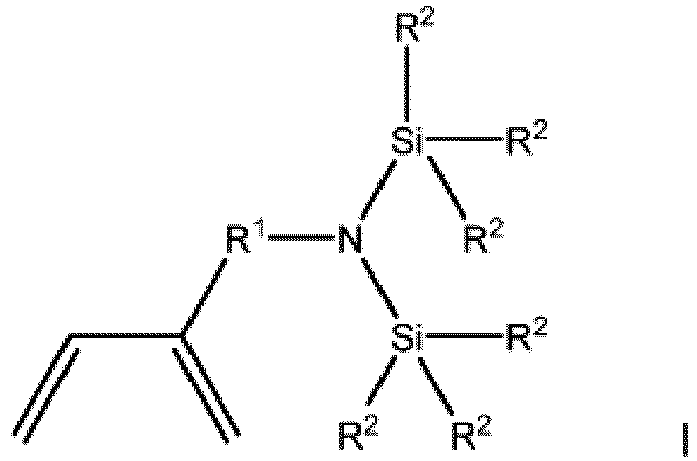 on mélange le premier copolymère en solution avec un solvant protique et on agite ensuite afin de transformer le premier copolymère en un deuxième copolymère répondant à la formule poly(M1 co M2) dans laquelle M1 représente le premier monomère et M2 répond à la formule II :
- Procédé selon la revendication 1, dans lequel le solvant protique est le méthanol.
- Procédé selon la revendication 1 ou 2, dans lequel le premier monomère est le 1,3-butadiène.
- Procédé selon au moins une des revendications précédentes, dans lequel le monomère répondant à la formule I est la (4-méthylène-5-hexényl)-bis(triméthylsilyl) amine.
- Procédé selon au moins une des revendications précédentes, dans lequel le deuxième copolymère comprend de 75 à 99,5 % en poids d'unités qui dérivent du premier monomère et de 0,5 à 25 % en poids d'unités qui dérivent du monomère répondant à la formule I.
- Procédé selon la revendication 5, dans lequel le deuxième copolymère comprend de 90 à 99 % en poids d'unités qui dérivent du premier monomère et de 1 à 10 % en poids d'unités qui dérivent du monomère répondant à la formule I.
- Procédé selon au moins une des revendications précédentes, dans lequel le deuxième copolymère comprend au moins 90 % en poids d'une teneur en microstructure 1,4-cis, lorsqu'on se base sur le poids de la teneur du copolymère en polybutadiène.
- Procédé selon la revendication 7, dans lequel le deuxième copolymère comprend au moins 95 % en poids d'une teneur en microstructure 1,4-cis, lorsqu'on se base sur le poids de la teneur du copolymère en polybutadiène.
- Procédé selon au moins une des revendications précédentes, dans lequel le catalyseur est un catalyseur de polymérisation par coordination à base de lanthanide.
- Procédé selon la revendication 9, dans lequel le catalyseur de polymérisation par coordination à base de lanthanide est un catalyseur à base de néodyme.
- Procédé selon au moins une des revendications 1 à 8, dans lequel le catalyseur est un catalyseur à base de nickel.
Applications Claiming Priority (2)
| Application Number | Priority Date | Filing Date | Title |
|---|---|---|---|
| US15/677,515 US20190055334A1 (en) | 2017-08-15 | 2017-08-15 | Method of making a functionalized elastomer |
| US15/677,531 US20190055335A1 (en) | 2017-08-15 | 2017-08-15 | Functionalized elastomer |
Publications (2)
| Publication Number | Publication Date |
|---|---|
| EP3444126A1 EP3444126A1 (fr) | 2019-02-20 |
| EP3444126B1 true EP3444126B1 (fr) | 2020-08-05 |
Family
ID=63259421
Family Applications (2)
| Application Number | Title | Priority Date | Filing Date |
|---|---|---|---|
| EP18187845.5A Active EP3444126B1 (fr) | 2017-08-15 | 2018-08-07 | Procédé de fabrication d'un élastomère fonctionnalisé |
| EP18187835.6A Active EP3444125B1 (fr) | 2017-08-15 | 2018-08-07 | Élastomères fonctionnalisés |
Family Applications After (1)
| Application Number | Title | Priority Date | Filing Date |
|---|---|---|---|
| EP18187835.6A Active EP3444125B1 (fr) | 2017-08-15 | 2018-08-07 | Élastomères fonctionnalisés |
Country Status (1)
| Country | Link |
|---|---|
| EP (2) | EP3444126B1 (fr) |
Families Citing this family (1)
| Publication number | Priority date | Publication date | Assignee | Title |
|---|---|---|---|---|
| EP3838932B1 (fr) * | 2019-12-20 | 2022-08-10 | The Goodyear Tire & Rubber Company | Synthèse de caoutchoucs copolymères isoprène-butadiène |
Family Cites Families (16)
| Publication number | Priority date | Publication date | Assignee | Title |
|---|---|---|---|---|
| US3856764A (en) | 1971-11-24 | 1974-12-24 | Goodyear Tire & Rubber | Polymerization process |
| US3962375A (en) | 1973-12-13 | 1976-06-08 | The Goodyear Tire & Rubber Company | Polymerization process |
| US3910869A (en) | 1974-01-31 | 1975-10-07 | Goodyear Tire & Rubber | Chemical process |
| DE4220563A1 (de) | 1992-06-24 | 1994-01-13 | Bayer Ag | Kautschukmischungen enthaltend Polybutadien-Gel |
| US5672639A (en) | 1996-03-12 | 1997-09-30 | The Goodyear Tire & Rubber Company | Starch composite reinforced rubber composition and tire with at least one component thereof |
| DE19701488A1 (de) | 1997-01-17 | 1998-07-23 | Bayer Ag | SBR-Kautschukgele enthaltende Kautschukmischungen |
| JP2001505225A (ja) | 1997-08-21 | 2001-04-17 | シーケイ・ウイトコ・コーポレーション | 充填材含有ゴム用保護化メルカプトシラン・カップリング剤 |
| DE19834804A1 (de) | 1998-08-01 | 2000-02-03 | Continental Ag | Kautschukmischung |
| DE19834803A1 (de) | 1998-08-01 | 2000-02-03 | Continental Ag | Kautschukmischung |
| DE19834802A1 (de) | 1998-08-01 | 2000-02-03 | Continental Ag | Kautschukmischung |
| US6344538B1 (en) * | 1998-08-24 | 2002-02-05 | Iowa State University Research Foundation, Inc. | Functionalized diene monomers and polymers containing functionalized dienes and methods for their preparation |
| DE19942620A1 (de) | 1999-09-07 | 2001-03-08 | Bayer Ag | Mikrogelhaltige Kautschukmischungen mit verkappten bifunktionellen Mercaptanen und hieraus hergestellte Vulkanisate |
| EP1285926B1 (fr) | 2001-08-06 | 2004-05-12 | Degussa AG | Composés Organosiliciés |
| US8598286B1 (en) * | 2012-11-05 | 2013-12-03 | The Goodyear Tire & Rubber Company | High cis diene/phenylbutadiene copolymers prepared using a Ziegler/Natta neodymium catalyst |
| EP3042786B1 (fr) * | 2014-12-19 | 2017-11-22 | The Goodyear Tire & Rubber Company | Élastomères fonctionnalisés |
| EP3181593B1 (fr) * | 2015-12-18 | 2018-07-18 | The Goodyear Tire & Rubber Company | Élastomère fonctionnalisé contenant un groupe d'azote |
-
2018
- 2018-08-07 EP EP18187845.5A patent/EP3444126B1/fr active Active
- 2018-08-07 EP EP18187835.6A patent/EP3444125B1/fr active Active
Non-Patent Citations (1)
| Title |
|---|
| None * |
Also Published As
| Publication number | Publication date |
|---|---|
| EP3444126A1 (fr) | 2019-02-20 |
| EP3444125B1 (fr) | 2020-08-05 |
| EP3444125A1 (fr) | 2019-02-20 |
Similar Documents
| Publication | Publication Date | Title |
|---|---|---|
| EP2075266B1 (fr) | Processus de polymérisation de volume pour la production de polydiènes | |
| US7671138B2 (en) | Polymers functionized with hydrobenzamides | |
| EP2075267B1 (fr) | Procédé de production de polydiènes | |
| EP1706434B1 (fr) | Procede de polymerisation en vrac pour la production de polydienes | |
| EP2673280B1 (fr) | Catalyseurs à base de complexes métalliques et procédés de polymérisation les utilisant | |
| US9056928B2 (en) | Processes for preparation of cyclic and acyclic diene copolymer and rubber composition | |
| US10457765B2 (en) | Metallic complex catalyst, polymerization methods employing same and polymer products thereof | |
| US8436111B2 (en) | Nickel catalyst system for the preparation of high CIS polybutadiene | |
| US20220119573A1 (en) | High cis-1,4 block copolymers of polybutadiene and polyisoprene | |
| US9416205B2 (en) | Organometallic complex catalyst and polymerization method employing same | |
| EP2900702B1 (fr) | Procédé de polymérisation employant un complexe de catalyseur organométallique | |
| EP2670759B1 (fr) | Catalyseur à base de complexes lanthanides et procédé de polymérisation utilisant le catalyseur | |
| EP3444126B1 (fr) | Procédé de fabrication d'un élastomère fonctionnalisé | |
| EP2670760B1 (fr) | Catalyseur complexe de lanthanide et procédé de polymérisation l'employant | |
| US9376508B2 (en) | Polymers and use thereof in preparation of high impact polymeric compositions | |
| US20190055334A1 (en) | Method of making a functionalized elastomer | |
| EP3148937B1 (fr) | Complexe métallique servant de catalyseur et procédés de polymérisation l'utilisant | |
| US20070276098A1 (en) | Polymers functionalized with hydrobenzamide |
Legal Events
| Date | Code | Title | Description |
|---|---|---|---|
| PUAI | Public reference made under article 153(3) epc to a published international application that has entered the european phase |
Free format text: ORIGINAL CODE: 0009012 |
|
| STAA | Information on the status of an ep patent application or granted ep patent |
Free format text: STATUS: THE APPLICATION HAS BEEN PUBLISHED |
|
| AK | Designated contracting states |
Kind code of ref document: A1 Designated state(s): AL AT BE BG CH CY CZ DE DK EE ES FI FR GB GR HR HU IE IS IT LI LT LU LV MC MK MT NL NO PL PT RO RS SE SI SK SM TR |
|
| AX | Request for extension of the european patent |
Extension state: BA ME |
|
| STAA | Information on the status of an ep patent application or granted ep patent |
Free format text: STATUS: REQUEST FOR EXAMINATION WAS MADE |
|
| 17P | Request for examination filed |
Effective date: 20190820 |
|
| RBV | Designated contracting states (corrected) |
Designated state(s): AL AT BE BG CH CY CZ DE DK EE ES FI FR GB GR HR HU IE IS IT LI LT LU LV MC MK MT NL NO PL PT RO RS SE SI SK SM TR |
|
| GRAP | Despatch of communication of intention to grant a patent |
Free format text: ORIGINAL CODE: EPIDOSNIGR1 |
|
| STAA | Information on the status of an ep patent application or granted ep patent |
Free format text: STATUS: GRANT OF PATENT IS INTENDED |
|
| INTG | Intention to grant announced |
Effective date: 20200224 |
|
| GRAS | Grant fee paid |
Free format text: ORIGINAL CODE: EPIDOSNIGR3 |
|
| GRAA | (expected) grant |
Free format text: ORIGINAL CODE: 0009210 |
|
| STAA | Information on the status of an ep patent application or granted ep patent |
Free format text: STATUS: THE PATENT HAS BEEN GRANTED |
|
| AK | Designated contracting states |
Kind code of ref document: B1 Designated state(s): AL AT BE BG CH CY CZ DE DK EE ES FI FR GB GR HR HU IE IS IT LI LT LU LV MC MK MT NL NO PL PT RO RS SE SI SK SM TR |
|
| REG | Reference to a national code |
Ref country code: GB Ref legal event code: FG4D |
|
| REG | Reference to a national code |
Ref country code: CH Ref legal event code: EP |
|
| REG | Reference to a national code |
Ref country code: AT Ref legal event code: REF Ref document number: 1298203 Country of ref document: AT Kind code of ref document: T Effective date: 20200815 |
|
| REG | Reference to a national code |
Ref country code: DE Ref legal event code: R096 Ref document number: 602018006609 Country of ref document: DE |
|
| REG | Reference to a national code |
Ref country code: IE Ref legal event code: FG4D |
|
| REG | Reference to a national code |
Ref country code: LT Ref legal event code: MG4D |
|
| REG | Reference to a national code |
Ref country code: NL Ref legal event code: MP Effective date: 20200805 |
|
| REG | Reference to a national code |
Ref country code: AT Ref legal event code: MK05 Ref document number: 1298203 Country of ref document: AT Kind code of ref document: T Effective date: 20200805 |
|
| PG25 | Lapsed in a contracting state [announced via postgrant information from national office to epo] |
Ref country code: FI Free format text: LAPSE BECAUSE OF FAILURE TO SUBMIT A TRANSLATION OF THE DESCRIPTION OR TO PAY THE FEE WITHIN THE PRESCRIBED TIME-LIMIT Effective date: 20200805 Ref country code: LT Free format text: LAPSE BECAUSE OF FAILURE TO SUBMIT A TRANSLATION OF THE DESCRIPTION OR TO PAY THE FEE WITHIN THE PRESCRIBED TIME-LIMIT Effective date: 20200805 Ref country code: PT Free format text: LAPSE BECAUSE OF FAILURE TO SUBMIT A TRANSLATION OF THE DESCRIPTION OR TO PAY THE FEE WITHIN THE PRESCRIBED TIME-LIMIT Effective date: 20201207 Ref country code: HR Free format text: LAPSE BECAUSE OF FAILURE TO SUBMIT A TRANSLATION OF THE DESCRIPTION OR TO PAY THE FEE WITHIN THE PRESCRIBED TIME-LIMIT Effective date: 20200805 Ref country code: NO Free format text: LAPSE BECAUSE OF FAILURE TO SUBMIT A TRANSLATION OF THE DESCRIPTION OR TO PAY THE FEE WITHIN THE PRESCRIBED TIME-LIMIT Effective date: 20201105 Ref country code: GR Free format text: LAPSE BECAUSE OF FAILURE TO SUBMIT A TRANSLATION OF THE DESCRIPTION OR TO PAY THE FEE WITHIN THE PRESCRIBED TIME-LIMIT Effective date: 20201106 Ref country code: BG Free format text: LAPSE BECAUSE OF FAILURE TO SUBMIT A TRANSLATION OF THE DESCRIPTION OR TO PAY THE FEE WITHIN THE PRESCRIBED TIME-LIMIT Effective date: 20201105 Ref country code: SE Free format text: LAPSE BECAUSE OF FAILURE TO SUBMIT A TRANSLATION OF THE DESCRIPTION OR TO PAY THE FEE WITHIN THE PRESCRIBED TIME-LIMIT Effective date: 20200805 Ref country code: ES Free format text: LAPSE BECAUSE OF FAILURE TO SUBMIT A TRANSLATION OF THE DESCRIPTION OR TO PAY THE FEE WITHIN THE PRESCRIBED TIME-LIMIT Effective date: 20200805 Ref country code: AT Free format text: LAPSE BECAUSE OF FAILURE TO SUBMIT A TRANSLATION OF THE DESCRIPTION OR TO PAY THE FEE WITHIN THE PRESCRIBED TIME-LIMIT Effective date: 20200805 |
|
| PG25 | Lapsed in a contracting state [announced via postgrant information from national office to epo] |
Ref country code: PL Free format text: LAPSE BECAUSE OF FAILURE TO SUBMIT A TRANSLATION OF THE DESCRIPTION OR TO PAY THE FEE WITHIN THE PRESCRIBED TIME-LIMIT Effective date: 20200805 Ref country code: NL Free format text: LAPSE BECAUSE OF FAILURE TO SUBMIT A TRANSLATION OF THE DESCRIPTION OR TO PAY THE FEE WITHIN THE PRESCRIBED TIME-LIMIT Effective date: 20200805 Ref country code: RS Free format text: LAPSE BECAUSE OF FAILURE TO SUBMIT A TRANSLATION OF THE DESCRIPTION OR TO PAY THE FEE WITHIN THE PRESCRIBED TIME-LIMIT Effective date: 20200805 Ref country code: LV Free format text: LAPSE BECAUSE OF FAILURE TO SUBMIT A TRANSLATION OF THE DESCRIPTION OR TO PAY THE FEE WITHIN THE PRESCRIBED TIME-LIMIT Effective date: 20200805 Ref country code: IS Free format text: LAPSE BECAUSE OF FAILURE TO SUBMIT A TRANSLATION OF THE DESCRIPTION OR TO PAY THE FEE WITHIN THE PRESCRIBED TIME-LIMIT Effective date: 20201205 |
|
| PG25 | Lapsed in a contracting state [announced via postgrant information from national office to epo] |
Ref country code: LU Free format text: LAPSE BECAUSE OF NON-PAYMENT OF DUE FEES Effective date: 20200807 Ref country code: SM Free format text: LAPSE BECAUSE OF FAILURE TO SUBMIT A TRANSLATION OF THE DESCRIPTION OR TO PAY THE FEE WITHIN THE PRESCRIBED TIME-LIMIT Effective date: 20200805 Ref country code: EE Free format text: LAPSE BECAUSE OF FAILURE TO SUBMIT A TRANSLATION OF THE DESCRIPTION OR TO PAY THE FEE WITHIN THE PRESCRIBED TIME-LIMIT Effective date: 20200805 Ref country code: RO Free format text: LAPSE BECAUSE OF FAILURE TO SUBMIT A TRANSLATION OF THE DESCRIPTION OR TO PAY THE FEE WITHIN THE PRESCRIBED TIME-LIMIT Effective date: 20200805 Ref country code: DK Free format text: LAPSE BECAUSE OF FAILURE TO SUBMIT A TRANSLATION OF THE DESCRIPTION OR TO PAY THE FEE WITHIN THE PRESCRIBED TIME-LIMIT Effective date: 20200805 Ref country code: CZ Free format text: LAPSE BECAUSE OF FAILURE TO SUBMIT A TRANSLATION OF THE DESCRIPTION OR TO PAY THE FEE WITHIN THE PRESCRIBED TIME-LIMIT Effective date: 20200805 |
|
| REG | Reference to a national code |
Ref country code: DE Ref legal event code: R097 Ref document number: 602018006609 Country of ref document: DE |
|
| REG | Reference to a national code |
Ref country code: BE Ref legal event code: MM Effective date: 20200831 |
|
| PG25 | Lapsed in a contracting state [announced via postgrant information from national office to epo] |
Ref country code: AL Free format text: LAPSE BECAUSE OF FAILURE TO SUBMIT A TRANSLATION OF THE DESCRIPTION OR TO PAY THE FEE WITHIN THE PRESCRIBED TIME-LIMIT Effective date: 20200805 Ref country code: MC Free format text: LAPSE BECAUSE OF FAILURE TO SUBMIT A TRANSLATION OF THE DESCRIPTION OR TO PAY THE FEE WITHIN THE PRESCRIBED TIME-LIMIT Effective date: 20200805 |
|
| PLBE | No opposition filed within time limit |
Free format text: ORIGINAL CODE: 0009261 |
|
| STAA | Information on the status of an ep patent application or granted ep patent |
Free format text: STATUS: NO OPPOSITION FILED WITHIN TIME LIMIT |
|
| PG25 | Lapsed in a contracting state [announced via postgrant information from national office to epo] |
Ref country code: SK Free format text: LAPSE BECAUSE OF FAILURE TO SUBMIT A TRANSLATION OF THE DESCRIPTION OR TO PAY THE FEE WITHIN THE PRESCRIBED TIME-LIMIT Effective date: 20200805 |
|
| 26N | No opposition filed |
Effective date: 20210507 |
|
| PG25 | Lapsed in a contracting state [announced via postgrant information from national office to epo] |
Ref country code: BE Free format text: LAPSE BECAUSE OF NON-PAYMENT OF DUE FEES Effective date: 20200831 Ref country code: SI Free format text: LAPSE BECAUSE OF FAILURE TO SUBMIT A TRANSLATION OF THE DESCRIPTION OR TO PAY THE FEE WITHIN THE PRESCRIBED TIME-LIMIT Effective date: 20200805 Ref country code: IE Free format text: LAPSE BECAUSE OF NON-PAYMENT OF DUE FEES Effective date: 20200807 |
|
| REG | Reference to a national code |
Ref country code: CH Ref legal event code: PL |
|
| PG25 | Lapsed in a contracting state [announced via postgrant information from national office to epo] |
Ref country code: LI Free format text: LAPSE BECAUSE OF NON-PAYMENT OF DUE FEES Effective date: 20210831 Ref country code: CH Free format text: LAPSE BECAUSE OF NON-PAYMENT OF DUE FEES Effective date: 20210831 |
|
| PG25 | Lapsed in a contracting state [announced via postgrant information from national office to epo] |
Ref country code: TR Free format text: LAPSE BECAUSE OF FAILURE TO SUBMIT A TRANSLATION OF THE DESCRIPTION OR TO PAY THE FEE WITHIN THE PRESCRIBED TIME-LIMIT Effective date: 20200805 Ref country code: MT Free format text: LAPSE BECAUSE OF FAILURE TO SUBMIT A TRANSLATION OF THE DESCRIPTION OR TO PAY THE FEE WITHIN THE PRESCRIBED TIME-LIMIT Effective date: 20200805 Ref country code: CY Free format text: LAPSE BECAUSE OF FAILURE TO SUBMIT A TRANSLATION OF THE DESCRIPTION OR TO PAY THE FEE WITHIN THE PRESCRIBED TIME-LIMIT Effective date: 20200805 |
|
| PG25 | Lapsed in a contracting state [announced via postgrant information from national office to epo] |
Ref country code: MK Free format text: LAPSE BECAUSE OF FAILURE TO SUBMIT A TRANSLATION OF THE DESCRIPTION OR TO PAY THE FEE WITHIN THE PRESCRIBED TIME-LIMIT Effective date: 20200805 |
|
| GBPC | Gb: european patent ceased through non-payment of renewal fee |
Effective date: 20220807 |
|
| PG25 | Lapsed in a contracting state [announced via postgrant information from national office to epo] |
Ref country code: GB Free format text: LAPSE BECAUSE OF NON-PAYMENT OF DUE FEES Effective date: 20220807 |
|
| PGFP | Annual fee paid to national office [announced via postgrant information from national office to epo] |
Ref country code: DE Payment date: 20250724 Year of fee payment: 8 |
|
| PGFP | Annual fee paid to national office [announced via postgrant information from national office to epo] |
Ref country code: IT Payment date: 20250723 Year of fee payment: 8 |
|
| PGFP | Annual fee paid to national office [announced via postgrant information from national office to epo] |
Ref country code: FR Payment date: 20250725 Year of fee payment: 8 |
|
| REG | Reference to a national code |
Ref country code: DE Ref legal event code: R081 Ref document number: 602018006609 Country of ref document: DE Owner name: G-3 CHICKADEE PURCHASER, LLC, AKRON, US Free format text: FORMER OWNER: THE GOODYEAR TIRE & RUBBER COMPANY, AKRON, OHIO, US |