EP3444366A1 - Alliage à base de nickel, aube de turbine, et procédé pour la production d'article moulé par injection de l'alliage à base de nickel - Google Patents
Alliage à base de nickel, aube de turbine, et procédé pour la production d'article moulé par injection de l'alliage à base de nickel Download PDFInfo
- Publication number
- EP3444366A1 EP3444366A1 EP17778942.7A EP17778942A EP3444366A1 EP 3444366 A1 EP3444366 A1 EP 3444366A1 EP 17778942 A EP17778942 A EP 17778942A EP 3444366 A1 EP3444366 A1 EP 3444366A1
- Authority
- EP
- European Patent Office
- Prior art keywords
- nickel
- base alloy
- molded article
- injection molded
- producing
- Prior art date
- Legal status (The legal status is an assumption and is not a legal conclusion. Google has not performed a legal analysis and makes no representation as to the accuracy of the status listed.)
- Withdrawn
Links
Images


Classifications
-
- C—CHEMISTRY; METALLURGY
- C22—METALLURGY; FERROUS OR NON-FERROUS ALLOYS; TREATMENT OF ALLOYS OR NON-FERROUS METALS
- C22C—ALLOYS
- C22C19/00—Alloys based on nickel or cobalt
- C22C19/03—Alloys based on nickel or cobalt based on nickel
- C22C19/05—Alloys based on nickel or cobalt based on nickel with chromium
- C22C19/051—Alloys based on nickel or cobalt based on nickel with chromium and Mo or W
- C22C19/056—Alloys based on nickel or cobalt based on nickel with chromium and Mo or W with the maximum Cr content being at least 10% but less than 20%
-
- B—PERFORMING OPERATIONS; TRANSPORTING
- B22—CASTING; POWDER METALLURGY
- B22F—WORKING METALLIC POWDER; MANUFACTURE OF ARTICLES FROM METALLIC POWDER; MAKING METALLIC POWDER; APPARATUS OR DEVICES SPECIALLY ADAPTED FOR METALLIC POWDER
- B22F1/00—Metallic powder; Treatment of metallic powder, e.g. to facilitate working or to improve properties
- B22F1/06—Metallic powder characterised by the shape of the particles
- B22F1/068—Flake-like particles
-
- B—PERFORMING OPERATIONS; TRANSPORTING
- B22—CASTING; POWDER METALLURGY
- B22F—WORKING METALLIC POWDER; MANUFACTURE OF ARTICLES FROM METALLIC POWDER; MAKING METALLIC POWDER; APPARATUS OR DEVICES SPECIALLY ADAPTED FOR METALLIC POWDER
- B22F1/00—Metallic powder; Treatment of metallic powder, e.g. to facilitate working or to improve properties
- B22F1/14—Treatment of metallic powder
- B22F1/148—Agglomerating
-
- B—PERFORMING OPERATIONS; TRANSPORTING
- B22—CASTING; POWDER METALLURGY
- B22F—WORKING METALLIC POWDER; MANUFACTURE OF ARTICLES FROM METALLIC POWDER; MAKING METALLIC POWDER; APPARATUS OR DEVICES SPECIALLY ADAPTED FOR METALLIC POWDER
- B22F1/00—Metallic powder; Treatment of metallic powder, e.g. to facilitate working or to improve properties
- B22F1/16—Metallic particles coated with a non-metal
-
- B—PERFORMING OPERATIONS; TRANSPORTING
- B22—CASTING; POWDER METALLURGY
- B22F—WORKING METALLIC POWDER; MANUFACTURE OF ARTICLES FROM METALLIC POWDER; MAKING METALLIC POWDER; APPARATUS OR DEVICES SPECIALLY ADAPTED FOR METALLIC POWDER
- B22F3/00—Manufacture of workpieces or articles from metallic powder characterised by the manner of compacting or sintering; Apparatus specially adapted therefor ; Presses and furnaces
- B22F3/22—Manufacture of workpieces or articles from metallic powder characterised by the manner of compacting or sintering; Apparatus specially adapted therefor ; Presses and furnaces for producing castings from a slip
- B22F3/225—Manufacture of workpieces or articles from metallic powder characterised by the manner of compacting or sintering; Apparatus specially adapted therefor ; Presses and furnaces for producing castings from a slip by injection molding
-
- B—PERFORMING OPERATIONS; TRANSPORTING
- B22—CASTING; POWDER METALLURGY
- B22F—WORKING METALLIC POWDER; MANUFACTURE OF ARTICLES FROM METALLIC POWDER; MAKING METALLIC POWDER; APPARATUS OR DEVICES SPECIALLY ADAPTED FOR METALLIC POWDER
- B22F3/00—Manufacture of workpieces or articles from metallic powder characterised by the manner of compacting or sintering; Apparatus specially adapted therefor ; Presses and furnaces
- B22F3/24—After-treatment of workpieces or articles
-
- B—PERFORMING OPERATIONS; TRANSPORTING
- B22—CASTING; POWDER METALLURGY
- B22F—WORKING METALLIC POWDER; MANUFACTURE OF ARTICLES FROM METALLIC POWDER; MAKING METALLIC POWDER; APPARATUS OR DEVICES SPECIALLY ADAPTED FOR METALLIC POWDER
- B22F5/00—Manufacture of workpieces or articles from metallic powder characterised by the special shape of the product
- B22F5/04—Manufacture of workpieces or articles from metallic powder characterised by the special shape of the product of turbine blades
-
- F—MECHANICAL ENGINEERING; LIGHTING; HEATING; WEAPONS; BLASTING
- F01—MACHINES OR ENGINES IN GENERAL; ENGINE PLANTS IN GENERAL; STEAM ENGINES
- F01D—NON-POSITIVE DISPLACEMENT MACHINES OR ENGINES, e.g. STEAM TURBINES
- F01D5/00—Blades; Blade-carrying members; Heating, heat-insulating, cooling or antivibration means on the blades or the members
- F01D5/12—Blades
- F01D5/28—Selecting particular materials; Particular measures relating thereto; Measures against erosion or corrosion
-
- B—PERFORMING OPERATIONS; TRANSPORTING
- B22—CASTING; POWDER METALLURGY
- B22F—WORKING METALLIC POWDER; MANUFACTURE OF ARTICLES FROM METALLIC POWDER; MAKING METALLIC POWDER; APPARATUS OR DEVICES SPECIALLY ADAPTED FOR METALLIC POWDER
- B22F3/00—Manufacture of workpieces or articles from metallic powder characterised by the manner of compacting or sintering; Apparatus specially adapted therefor ; Presses and furnaces
- B22F3/24—After-treatment of workpieces or articles
- B22F2003/248—Thermal after-treatment
-
- B—PERFORMING OPERATIONS; TRANSPORTING
- B22—CASTING; POWDER METALLURGY
- B22F—WORKING METALLIC POWDER; MANUFACTURE OF ARTICLES FROM METALLIC POWDER; MAKING METALLIC POWDER; APPARATUS OR DEVICES SPECIALLY ADAPTED FOR METALLIC POWDER
- B22F2301/00—Metallic composition of the powder or its coating
- B22F2301/15—Nickel or cobalt
-
- B—PERFORMING OPERATIONS; TRANSPORTING
- B22—CASTING; POWDER METALLURGY
- B22F—WORKING METALLIC POWDER; MANUFACTURE OF ARTICLES FROM METALLIC POWDER; MAKING METALLIC POWDER; APPARATUS OR DEVICES SPECIALLY ADAPTED FOR METALLIC POWDER
- B22F2302/00—Metal Compound, non-Metallic compound or non-metal composition of the powder or its coating
- B22F2302/10—Carbide
-
- B—PERFORMING OPERATIONS; TRANSPORTING
- B22—CASTING; POWDER METALLURGY
- B22F—WORKING METALLIC POWDER; MANUFACTURE OF ARTICLES FROM METALLIC POWDER; MAKING METALLIC POWDER; APPARATUS OR DEVICES SPECIALLY ADAPTED FOR METALLIC POWDER
- B22F2998/00—Supplementary information concerning processes or compositions relating to powder metallurgy
- B22F2998/10—Processes characterised by the sequence of their steps
-
- B—PERFORMING OPERATIONS; TRANSPORTING
- B22—CASTING; POWDER METALLURGY
- B22F—WORKING METALLIC POWDER; MANUFACTURE OF ARTICLES FROM METALLIC POWDER; MAKING METALLIC POWDER; APPARATUS OR DEVICES SPECIALLY ADAPTED FOR METALLIC POWDER
- B22F2999/00—Aspects linked to processes or compositions used in powder metallurgy
-
- B—PERFORMING OPERATIONS; TRANSPORTING
- B22—CASTING; POWDER METALLURGY
- B22F—WORKING METALLIC POWDER; MANUFACTURE OF ARTICLES FROM METALLIC POWDER; MAKING METALLIC POWDER; APPARATUS OR DEVICES SPECIALLY ADAPTED FOR METALLIC POWDER
- B22F9/00—Making metallic powder or suspensions thereof
- B22F9/02—Making metallic powder or suspensions thereof using physical processes
- B22F9/06—Making metallic powder or suspensions thereof using physical processes starting from liquid material
- B22F9/08—Making metallic powder or suspensions thereof using physical processes starting from liquid material by casting, e.g. through sieves or in water, by atomising or spraying
- B22F9/082—Making metallic powder or suspensions thereof using physical processes starting from liquid material by casting, e.g. through sieves or in water, by atomising or spraying atomising using a fluid
-
- F—MECHANICAL ENGINEERING; LIGHTING; HEATING; WEAPONS; BLASTING
- F05—INDEXING SCHEMES RELATING TO ENGINES OR PUMPS IN VARIOUS SUBCLASSES OF CLASSES F01-F04
- F05D—INDEXING SCHEME FOR ASPECTS RELATING TO NON-POSITIVE-DISPLACEMENT MACHINES OR ENGINES, GAS-TURBINES OR JET-PROPULSION PLANTS
- F05D2230/00—Manufacture
- F05D2230/20—Manufacture essentially without removing material
- F05D2230/21—Manufacture essentially without removing material by casting
-
- F—MECHANICAL ENGINEERING; LIGHTING; HEATING; WEAPONS; BLASTING
- F05—INDEXING SCHEMES RELATING TO ENGINES OR PUMPS IN VARIOUS SUBCLASSES OF CLASSES F01-F04
- F05D—INDEXING SCHEME FOR ASPECTS RELATING TO NON-POSITIVE-DISPLACEMENT MACHINES OR ENGINES, GAS-TURBINES OR JET-PROPULSION PLANTS
- F05D2230/00—Manufacture
- F05D2230/50—Building or constructing in particular ways
-
- F—MECHANICAL ENGINEERING; LIGHTING; HEATING; WEAPONS; BLASTING
- F05—INDEXING SCHEMES RELATING TO ENGINES OR PUMPS IN VARIOUS SUBCLASSES OF CLASSES F01-F04
- F05D—INDEXING SCHEME FOR ASPECTS RELATING TO NON-POSITIVE-DISPLACEMENT MACHINES OR ENGINES, GAS-TURBINES OR JET-PROPULSION PLANTS
- F05D2300/00—Materials; Properties thereof
- F05D2300/10—Metals, alloys or intermetallic compounds
- F05D2300/17—Alloys
- F05D2300/175—Superalloys
-
- F—MECHANICAL ENGINEERING; LIGHTING; HEATING; WEAPONS; BLASTING
- F05—INDEXING SCHEMES RELATING TO ENGINES OR PUMPS IN VARIOUS SUBCLASSES OF CLASSES F01-F04
- F05D—INDEXING SCHEME FOR ASPECTS RELATING TO NON-POSITIVE-DISPLACEMENT MACHINES OR ENGINES, GAS-TURBINES OR JET-PROPULSION PLANTS
- F05D2300/00—Materials; Properties thereof
- F05D2300/20—Oxide or non-oxide ceramics
- F05D2300/22—Non-oxide ceramics
- F05D2300/226—Carbides
-
- F—MECHANICAL ENGINEERING; LIGHTING; HEATING; WEAPONS; BLASTING
- F05—INDEXING SCHEMES RELATING TO ENGINES OR PUMPS IN VARIOUS SUBCLASSES OF CLASSES F01-F04
- F05D—INDEXING SCHEME FOR ASPECTS RELATING TO NON-POSITIVE-DISPLACEMENT MACHINES OR ENGINES, GAS-TURBINES OR JET-PROPULSION PLANTS
- F05D2300/00—Materials; Properties thereof
- F05D2300/60—Properties or characteristics given to material by treatment or manufacturing
- F05D2300/608—Microstructure
-
- F—MECHANICAL ENGINEERING; LIGHTING; HEATING; WEAPONS; BLASTING
- F05—INDEXING SCHEMES RELATING TO ENGINES OR PUMPS IN VARIOUS SUBCLASSES OF CLASSES F01-F04
- F05D—INDEXING SCHEME FOR ASPECTS RELATING TO NON-POSITIVE-DISPLACEMENT MACHINES OR ENGINES, GAS-TURBINES OR JET-PROPULSION PLANTS
- F05D2300/00—Materials; Properties thereof
- F05D2300/60—Properties or characteristics given to material by treatment or manufacturing
- F05D2300/609—Grain size
Definitions
- the present invention relates to a nickel-base alloy, a turbine blade, and a method for producing an injection molded article of a nickel-base alloy.
- nickel-base alloys containing nickel as a primary component are used.
- An example of the nickel-base alloy is a nickel-base alloy containing aluminum.
- As the nickel-base alloy containing aluminum there is a precipitation hardening-type nickel-base alloy having a structure in which the alloy-phase particles of Ni 3 Al (trinickel aluminide), which are referred to as ⁇ prime precipitates, are precipitated.
- the precipitation hardening-type nickel-base alloy has a high strength at a high temperature.
- PTL 1 describes a method for producing a precipitation hardening-type nickel-base alloy in which the precipitation state of ⁇ prime precipitates is controlled by carrying out a predetermined treatment such as a thermal treatment.
- the present invention has been made in consideration of what has been described above, and an object of the present invention is to provide a nickel-base alloy having high high-temperature strength, a turbine blade using the same, and a method for producing an injection molded article of a nickel-base alloy.
- a nickel-base alloy of the present invention includes at least one metal element among chromium, molybdenum, and niobium, nickel, aluminum, and carbon, and has crystal grains containing the nickel as a primary component, and carbides which are precipitated in crystal grain boundaries between the crystal grains, have a diameter of 0.1 ⁇ m or more and 10 ⁇ m or less, have an aspect ratio of 3 or more, and include the metal element and the carbon.
- the nickel-base alloy of the present invention preferably further has metal precipitates which are precipitated in the crystal grain boundaries, have a diameter of 0.1 ⁇ m or more and 20 ⁇ m or less, have an aspect ratio of 3 or more, and include an alloy including the nickel or the niobium and the aluminum.
- the crystal grain boundaries further become strong, and thus the high-temperature strength further becomes high.
- a content ratio of the aluminum is preferably 2% by mass or more and 7% by mass or less. In such a case, in the nickel-base alloy, it is possible to make the precipitation amount of precipitates in the crystal grain boundaries more appropriate, and it is possible to further increase the high-temperature strength.
- the nickel-base alloy of the present invention is preferably used. In such a case, in the turbine blade, the high-temperature strength becomes high.
- a method for producing an injection molded article of a nickel-base alloy of the present invention has an injection molding step of injecting a powder material of a nickel-base alloy which includes at least one metal element among chromium, molybdenum, and niobium, nickel, aluminum, and carbon and has a grain size of 1 ⁇ m or more and 50 ⁇ m or less into a molding tool and forming an injection molded article, and a thermal treatment step of heating the injection molded article so as to crystallize an alloy containing the nickel as a primary component and generating a crystal structure having crystal grains containing the nickel as a primary component and carbides which are precipitated in crystal grain boundaries between the crystal grains, have a diameter of 0.1 ⁇ m or more and 10 ⁇ m or less, have an aspect ratio of 3 or more, and include the metal element and the carbon.
- the method for producing an injection molded article of a nickel-base alloy since it is possible to produce an injection molded article of a nickel-base alloy in which carbides which have a diameter of 0.1 ⁇ m or more and 10 ⁇ m or less, have an aspect ratio of 3 or more, and include a metal element and carbon are precipitated in crystal grain boundaries between crystal grains containing nickel as a primary component, it is possible to produce an injection molded article of a nickel-base alloy which has strong crystal grain boundaries, and it is possible to produce an injection molded article of a nickel-base alloy which has high high-temperature strength.
- the thermal treatment step preferably further generates a crystal structure further having metal precipitates which are precipitated in the crystal grain boundaries, have a diameter of 0.1 ⁇ m or more and 20 ⁇ m or less, have an aspect ratio of 3 or more, and include an alloy including the nickel or the niobium and the aluminum. Since this method enables the production of an injection molded article of a nickel-base alloy in which crystal grain boundaries are stronger due to the metal precipitates, it is possible to produce an injection molded article of a nickel-base alloy which has higher high-temperature strength.
- a content ratio of the aluminum is preferably 2% by mass or more and 7% by mass or less. In such a case, it is possible to produce an injection molded article of a nickel-base alloy which has higher high-temperature strength.
- the method for producing an injection molded article of a nickel-base alloy of the present invention preferably further includes a step of melting and mixing a material of a nickel-base alloy including at least one metal element among chromium, molybdenum, and niobium, nickel, aluminum, and carbon so as to produce an ingot of the nickel-base alloy, and a step of heating a periphery of the ingot, melting a part of the ingot so as to generate liquid droplets of the nickel-base alloy, and blowing cooling gas to the liquid droplets so as to cool the liquid droplets, thereby producing a powder material of the nickel-base alloy.
- This method enables the stable production of an injection molded article of a nickel-base alloy having high high-temperature strength.
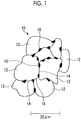
- Fig. 1 is a view illustrating an example of the crystal structure of a nickel-base alloy 10 according to an embodiment of the present invention.
- the nickel-base alloy 10 includes at least one metal element among chromium (Cr), molybdenum (Mo), and niobium (Nb), nickel (Ni), aluminum (Al), carbon (C), and inevitable impurities.
- Cr chromium
- Mo molybdenum
- Nb niobium
- Ni nickel
- Al aluminum
- C carbon
- the content ratio of aluminum is preferably 2% by mass or more and 7% by mass or less.
- the content ratio of chromium is preferably 10% by mass or more and 20% by mass or less.
- the content ratio of molybdenum is preferably 1% by mass or more and 10% by mass or less.
- the content ratio of niobium is preferably 1% by mass or more and 7% by mass or less.
- the content ratio of carbon is preferably 0.01% by mass or more and 0.2% by mass or less.
- the nickel-base alloy 10 is preferably, for example, the same component as INCONEL713C (INCONEL is a registered trademark of No. 0298860) or INCONEL718 (INCONEL is a registered trademark).
- the nickel-base alloy 10 has a plurality of crystal grains 12 and a plurality of precipitates 16. In the nickel-base alloy 10, portions between the crystal grains 12, that is, the boundaries between the respective crystal grains 12 become crystal grain boundaries 14.
- the crystal grain 12 is a crystal containing nickel as the primary component.
- the grain size of the crystal grain 12 is preferably 1 ⁇ m or more and 100 ⁇ m or less and more preferably 1 ⁇ m or more and 20 ⁇ m or less.
- the grain size of the crystal grain 12 is obtained from the diameter of a circle having the same area as the cross-sectional area of the crystal grain 12 on a cross section of the nickel-base alloy 10.
- the precipitates 16 are precipitated in the crystal grain boundaries 14.
- the precipitates 16 are precipitated in a dotted fashion along the crystal grain boundaries 14 in a film shape.
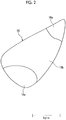
- Fig. 2 is a view illustrating an example of the structure of the precipitate 16 that is precipitated in the crystal grain boundary 14 in the nickel-base alloy 10.
- the precipitate 16 has carbides 16a and a metal precipitate 16b. That is, the carbides 16a and the metal precipitate 16b are all precipitated in a dotted fashion along the crystal grain boundaries 14 in a film shape.
- the carbide 16a includes at least one metal element among chromium, molybdenum, and niobium and carbon.
- the diameter of the carbide 16a is 0.1 ⁇ m or more and 10 ⁇ m or less, preferably 0.1 ⁇ m or more and 5 ⁇ m or less, and more preferably 0.1 ⁇ m or more and 2 ⁇ m or less.
- the diameter of the carbide 16a is obtained from the diameter of a circle having the same area as the cross-sectional area of the carbide 16a on a cross section of the nickel-base alloy 10.
- the aspect ratio of the carbide 16a is 3 or more and preferably 3 or more and 20 or less.
- the aspect ratio of the carbide 16a is obtained by approximating the cross section of the carbide 16a on a cross section of the nickel-base alloy 10 to an ellipse and obtaining the value of the ratio of the long diameter to the short diameter of the approximated ellipse, that is, (long diameter)/(short diameter).
- the carbide 16a needs to include a part of at least one metal element among chromium, molybdenum, and niobium and a part of carbon.
- the crystal grain 12 may include a part of at least one metal element among chromium, molybdenum, and niobium or a part of carbon and may include a carbide having the same composition and constitution as the carbide 16a.
- the metal precipitate 16b includes an alloy including nickel or niobium and aluminum.
- the metal precipitate 16b include a ⁇ prime precipitate including Ni 3 Al (trinickel aluminide), which is an alloy including nickel and aluminum, as the primary component and a ⁇ double prime precipitate including Nb 3 Al (triniobium aluminide), which is an alloy including niobium and aluminum, as the primary component.
- a ⁇ prime precipitate including Ni 3 Al (trinickel aluminide) which is an alloy including nickel and aluminum, as the primary component
- Nb 3 Al triniobium aluminide
- any one of the ⁇ prime precipitate and the ⁇ double prime precipitate is precipitated in the crystal grain boundary 14 depending on the content ratios of the respective elements of the nickel-base alloy 10.
- the metal precipitate 16b is the ⁇ prime precipitate.
- the metal precipitate 16b is the ⁇ prime precipitate.
- the diameter of the metal precipitate 16b is 0.1 ⁇ m or more and 20 ⁇ m or less and preferably 0.1 ⁇ m or more and 10 ⁇ m or less.
- the diameter of the metal precipitate 16b is obtained from the diameter of a circle having the same area as the cross-sectional area of the metal precipitate 16b on a cross section of the nickel-base alloy 10.
- the aspect ratio of the metal precipitate 16b is 3 or more and preferably 3 or more and 20 or less.
- the aspect ratio of the metal precipitate 16b is obtained by approximating the cross section of the metal precipitate 16b on a cross section of the nickel-base alloy 10 to an ellipse and obtaining the value of the ratio of the long diameter to the short diameter of the approximated ellipse, that is, (long diameter)/(short diameter).
- the metal precipitate 16b needs to include a part of nickel or niobium and a part of aluminum.
- the crystal grain 12 may include a part of nickel or niobium or a part of aluminum and may include a metal precipitate having the same composition and constitution as the metal precipitate 16b.
- the carbides 16a are precipitated in the crystal grain boundaries 14, the crystal grain boundaries 14 are strong. Therefore, in the nickel-base alloy 10, the high-temperature strength is high, that is, the tensile strength at a high temperature is high, and the creep characteristic at a high temperature is favorable. In addition, in the nickel-base alloy 10, since the carbides 16a are precipitated in a dotted fashion along the crystal grain boundaries 14 in a film shape, the crystal grain boundaries 14 do not become brittle even at a high temperature and are persistent. In addition, the elongation of the nickel-base alloy 10 at a high temperature decreases, and it becomes difficult for the nickel-base alloy to elongate at a high temperature.
- the metal precipitates 16b are precipitated in the crystal grain boundaries 14 and thus suppress the slip or dislocation of the nickel-base alloy 10, that is, the nickel-base alloy is precipitation-cured, whereby the crystal grain boundaries 14 become stronger. Therefore, in the nickel-base alloy 10, the high-temperature strength becomes higher, that is, the tensile strength at a high temperature does not become higher, and the creep characteristic at a high temperature becomes more favorable. In addition, in the nickel-base alloy 10, since the metal precipitates 16b are precipitated in a dotted fashion along the crystal grain boundaries 14 in a film shape, the crystal grain boundaries 14 do not become brittle even at a high temperature and become more persistent. In addition, the elongation of the nickel-base alloy 10 at a high temperature further decreases, and it becomes more difficult for the nickel-base alloy to elongate at a high temperature.
- the content ratio of aluminum is preferably set to 1% by mass or more.
- the content ratio of aluminum is set to 1% by mass or more in the nickel-base alloy 10, it is possible to make the precipitation amount of precipitates in the crystal grain boundaries appropriate, and it is possible to increase the high-temperature strength.
- the content ratio of aluminum is more preferably set to 2% by mass or more.
- the content ratio of aluminum is set to 2% by mass or more in the nickel-base alloy 10, it is possible to make the precipitation amount of precipitates in the crystal grain boundaries more appropriate, and it is possible to further increase the high-temperature strength.
- a turbine blade according to an embodiment of the present invention is an example of an injection molded article in which the nickel-base alloy according to the embodiment of the present invention is used.
- the turbine blade according to an embodiment of the present invention is a turbine blade that is used for members that are used in high-temperature environments, for example, gas turbines such as aircraft engines or motors or turbochargers, and the nickel-base alloy 10 according to the embodiment of the present invention is preferably used as a material.
- the high-temperature strength is high, that is, the tensile strength at a high temperature is high, and the creep characteristic at a high temperature is favorable.
- the turbine blade in which the nickel-base alloy 10 is used does not become brittle even at a high temperature and is persistent.
- the elongation of the turbine blade in which the nickel-base alloy 10 is used at a high temperature decreases, and it becomes difficult for the turbine blade to elongate at a high temperature.
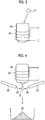
- Fig. 3 is a view illustrating an example of the constitution of a device for producing an ingot 28 of the nickel-base alloy.
- Fig. 4 is a view illustrating an example of the constitution of a device for producing a powder material 38 of the nickel-base alloy.
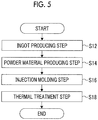
- Fig. 5 is a flowchart illustrating an example of steps of a method for producing an injection molded article of the nickel-base alloy.
- the method for producing an injection molded article of the nickel-base alloy will be described using Figs. 3, 4 , and 5 .
- the respective devices illustrated in Figs. 3 and 4 may be fully automatically operated or may be operated by an operator's operation.
- the scope of the production device and the production method of the present embodiment includes devices and methods relating to metal injection molding (MIM), and thus a molding tool is used.
- MIM metal injection molding
- the molding tool may have been produced in advance or may be produced each time MIM is carried out.
- the device for producing the ingot 28 of the nickel-base alloy illustrated in Fig. 3 is an example of a device for carrying out an ingot producing step of Step S12 in Fig. 5 using a so-called induction melting method and has a refractory crucible 24 into which a material 22 of the nickel-base alloy is injected and a coil 26 spirally wound around the refractory crucible 24.
- the material 22 is a material prepared so as to obtain the same range of composition as the nickel-base alloy 10 and includes at least one metal element among chromium, molybdenum, and niobium, nickel, aluminum, carbon, and inevitable impurities.
- the coil 26 is connected to an alternating power supply at both ends and allows the flow of alternating current.
- the coil 26 When alternating current is caused to flow through the coil, the coil 26 generates a magnetic field in the refractory crucible 24.
- the material 22 that has been injected into the refractory crucible 24 is electromagnetically induced by the magnetic field generated in the refractory crucible 24, and current flows in the material.
- the material 22 in which current flows generates heat due to the intrinsic electrical resistance of the material 22. As a result, the material 22 melts and mixes together.
- the magnetic field generated in the refractory crucible 24 disappears.
- the electromagnetic induction of the material 22 in the refractory crucible 24 by the magnetic field generated in the refractory crucible 24 ends, and the current in the material disappears.
- the heat generation of the material 22 ends.
- the material 22 in the refractory crucible 24 naturally cools, solidifies, and turns into the ingot 28 of the nickel-base alloy having the same range of composition as the nickel-base alloy 10.
- the device for producing the ingot 28 of the nickel-base alloy is capable of producing the ingot 28 of the nickel-base alloy having the same range of composition as the nickel-base alloy 10 from the material 22 of the nickel-base alloy prepared so as to obtain the same range of composition as the nickel-base alloy 10.
- the device for producing the powder material 38 of the nickel-base alloy illustrated in Fig. 4 is an example of a device for carrying out a powder material producing step of Step S14 in Fig. 5 using a so-called atomizing method and has a mechanism that disposes the ingot 28 of the nickel-base alloy, a coil 30 spirally wound around the disposed ingot 28, and a cooling gas blowing portion 36 that blows cooling gas 34 to liquid droplets 32 of the nickel-base alloy which are generated from a lower side portion of the ingot 28 in the vertical direction.
- the ingot 28 has the same range of composition as the nickel-base alloy 10 and includes at least one metal element among chromium, molybdenum, and niobium, nickel, aluminum, carbon, and inevitable impurities.
- the coil 30 is connected to an alternating power supply at both ends and allows the flow of alternating current.
- a gas that does not chemically react with the nickel-base alloy for example, noble gas such as argon gas is preferably exemplified, but the cooling gas is not limited thereto.
- the coil 30 When alternating current is caused to flow through the coil, the coil 30 generates a magnetic field in the periphery of the ingot 28.
- the ingot 28 is electromagnetically induced by the magnetic field generated in the ingot, and current flows in the periphery.
- the ingot 28 in which current flows in the periphery generates heat due to the intrinsic electrical resistance of the ingot 28.
- the peripheral portion of the ingot 28 is heated, a part of the peripheral portion melts, and the liquid droplets 32 of the nickel-base alloy that drop downwards from the lower side portion in the vertical direction are generated.
- the liquid droplets 32 generated from the ingot 28 are cooled by the cooling gas 34 blown from the cooling gas blowing portion 36, turned into powder having a small grain size, accumulated below, and turned into the powder material 38 of the nickel-base alloy having the same range of composition as the nickel-base alloy 10.
- the powder material 38 produced in the powder material producing step of Step S14 has the same range of composition as the nickel-base alloy 10 and includes at least one metal element among chromium, molybdenum, and niobium, nickel, aluminum, carbon, and inevitable impurities.
- the device for producing the powder material 38 of the nickel-base alloy is capable of producing the powder material 38 of the nickel-base alloy having the same range of composition as the nickel-base alloy 10 from the ingot 28 of the nickel-base alloy having the same range of composition as the nickel-base alloy 10.
- the powder material 38 of the nickel-base alloy is produced using the above-described method and is thus produced to have a grain size of 1 ⁇ m or more and 50 ⁇ m or less and preferably 1 ⁇ m or more and 20 ⁇ m or less.
- a method for producing an injection molded article of the nickel-base alloy of the present embodiment includes the ingot producing step S12, the powder material producing step S14, an injection molding step S16, and a thermal treatment step S18.
- the ingot producing step S12 is a step for producing the ingot 28 of the nickel-base alloy having the same range of composition as the nickel-base alloy 10 from the material 22 of the nickel-base alloy prepared so as to obtain the same range of composition as the nickel-base alloy 10 as described above using, for example, the device for producing the ingot 28 of the nickel-base alloy illustrated in Fig. 3 .
- the powder material producing step S14 is a step for producing the powder material 38 of the nickel-base alloy having the same range of composition as the nickel-base alloy 10 from the ingot 28 of the nickel-base alloy prepared so as to obtain the same range of composition as the nickel-base alloy 10 as described above using, for example, the device for producing the powder material 38 of the nickel-base alloy illustrated in Fig. 4 .
- the injection molding step S16 is a step of injecting the powder material 38 of the nickel-base alloy produced in the powder material producing step S14 into a molding tool and forming an injection molded article, that is, a step relating to MIM. In a case in which the shape of the molding tool is complicate, the injection molding step S16 is carried out at an increased injection pressure of the powder material 38 of the nickel-base alloy.
- the thermal treatment step S18 is a step of heating the injection molded article formed in the injection molding step S16 so as to crystallize powder particles (a particulate alloy) containing the nickel as the primary component and generating a crystal structure having crystal grains containing nickel as the primary component and carbides which are precipitated in crystal grain boundaries between the crystal grains and include at least one metal element among chromium, molybdenum, and niobium and the carbon.
- a defatting treatment that removes a binder mixed into the powder material during the injection molding is also carried out.
- the ranges of the diameter and aspect ratio of the carbide that is precipitated in the crystal grain boundary are the same as the ranges of the diameter and aspect ratio of the carbide 16a in the nickel-base alloy 10.
- the range of the grain size of the crystal grain containing nickel as the primary component is the same as the preferred range of the grain size of the crystal grain 12 in the nickel-base alloy 10.
- the thermal treatment step S18 preferably further generates a crystal structure further having metal precipitates which are precipitated in the crystal grain boundaries of the crystal grains containing nickel as the primary component and include an alloy including nickel or niobium and aluminum.
- the ranges of the diameter and aspect ratio of the metal precipitate that is precipitated in the crystal grain boundary are the same as the ranges of the diameter and aspect ratio of the metal precipitate 16b in the nickel-base alloy 10.
- the powder material 38 is molded along the molding tool in the injection molding step S16 and is then sintered in the thermal treatment step S18. Therefore, unlike a casting method, a molten material is not injected into a casting die, particles are closely packed and then sintered by carrying out a thermal treatment. Therefore, in the produced injection molded article of a nickel-base alloy, compared with a casting molded article formed using a casting method, the grain diameter of the crystal grain containing nickel as the primary component is small, and it is possible to set the grain size to, for example, preferably 1 ⁇ m or more and 50 ⁇ m or less and more preferably 1 ⁇ m or more and 20 ⁇ m or less.
- the carbides including chromium, molybdenum, and niobium and carbon are dissolved in the respective powder particles, present in a distributed fashion, and held in a state in which the carbides solidify and are not precipitated. That is, the injection molded article formed in the injection molding step S16 is held in a state in which it is possible to finely control the precipitation state of the carbides including chromium, molybdenum, and niobium and carbon using the injection molding step S16 and the following step.
- the metal precipitates are dissolved in the respective powder particles and present in a distributed fashion. That is, the injection molded article formed in the injection molding step S16 is held in a state in which it is possible to finely control the precipitation state of the metal precipitates using the injection molding step S16 and the following step.
- the method for producing an injection molded article of a nickel-base alloy according to the present embodiment in the thermal treatment step S18, it is possible to finely control the precipitation state of the carbides so that the carbides become the same structure as the carbides 16a in the nickel-base alloy 10. Specifically, the state of the precipitates that are precipitated in the crystal grain boundaries can be controlled by controlling the temperature or time of the thermal treatment. Therefore, the method for producing an injection molded article of a nickel-base alloy according to the present embodiment enables the production of an injection molded article in which a nickel-base alloy having strong crystal grain boundaries as exemplified as the nickel-base alloy 10 in which the carbides 16a are precipitated in the crystal grain boundaries 14 is used.
- the method for producing an injection molded article of a nickel-base alloy according to the present embodiment enables the production of an injection molded article in which a nickel-base alloy having stronger crystal grain boundaries as exemplified as the nickel-base alloy 10 in which the metal precipitates 16b are further precipitated in the crystal grain boundaries 14 is used.
- the method for producing an injection molded article of a nickel-base alloy according to the present embodiment enables the production of an injection molded article having high high-temperature strength in which a nickel-base alloy having strong crystal grain boundaries as exemplified as the nickel-base alloy 10 is used. That is, the method for producing an injection molded article of a nickel-base alloy according to the present embodiment enables the production of an injection molded article in which the tensile strength at a high temperature is high and the creep characteristic at a high temperature is favorable. In addition, the method for producing an injection molded article of a nickel-base alloy according to the present embodiment enables the production of an injection molded article which does not become brittle even at a high temperature and is persistent.
- the method for producing an injection molded article of a nickel-base alloy according to the present embodiment enables the production of an injection molded article in which the elongation at a high temperature decreases and it is difficult for the injection molded article to elongate at a high temperature.
- the content ratio of aluminum is preferably set to 1% by mass or more.
- the method for producing an injection molded article of a nickel-base alloy according to the present embodiment enables the strengthening of the crystal grain boundaries and the production of an injection molded article having high high-temperature strength even in a case in which the content ratio of aluminum is 1% by mass or more.
- the content ratio of aluminum is more preferably set to 2% by mass or more.
- the method for producing an injection molded article of a nickel-base alloy according to the present embodiment enables the strengthening of the crystal grains and the production of an injection molded article having high high-temperature strength even in a case in which the content ratio of aluminum is 2% by mass or more.
- the material 22 of the nickel-base alloy prepared so as to obtain the same range of composition as the nickel-base alloy 10 is selected as the initial material, but it is also allowed to select the ingot 28 of a nickel-base alloy having the same range of composition as the nickel-base alloy 10 as the initial material and carry out only the powder material producing step S14 and the following treatments without carrying out the treatment of the ingot producing step S12.
- the same treatment as the ingot producing step S12 was carried out on a material of a nickel-base alloy having almost the same composition as INCONEL713C (INCONEL is a registered trademark), that is, including 6.1% by mass of aluminum, 13% by mass of chromium, 4.5% by mass of molybdenum, 2.3% by mass of niobium, and 0.14% by mass of carbon so as to produce the ingot 28 of the nickel-base alloy, and the same treatment as the powder material producing step S14 was carried out on the ingot of the nickel-base alloy so as to produce the powder material 38 of the nickel-base alloy. After that, the same treatment as the injection molding step S16 was carried out on the powder material 38 of the nickel-base alloy so as to form an injection molded article.
- the same treatment as the thermal treatment step S18 was carried out on the injection molded article, thereby producing the injection molded article of a nickel-base alloy according to the embodiment of the present invention.
- the injection molded article of a nickel-base alloy produced using the method for producing an injection molded article of a nickel-base alloy according to the embodiment of the present invention was considered as an injection molded article of Example 1.
- a cross section of the injection molded article of Example 1 was observed and captured using a scanning electron microscope (SEM), thereby acquiring an SEM image of Example 1.
- SEM scanning electron microscope
- the SEM observation and capturing were carried out using SS-550 manufactured by Shimadzu Corporation at an accelerated voltage set to 15 kV.
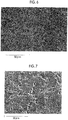
- the SEM image of Example 1 is illustrated in Figs. 6 and 7 .
- EPMA images of Example 1 were respectively acquired by measuring the in-plane distributions of the content ratios of individual elements of aluminum, niobium, and molybdenum in a cross section of the injection molded article of Example 1 using an electron probe microanalyser (EPMA) and expressing the in-plane distributions using contrasting densities.
- EPMA electron probe microanalysisr
- EPMA-1720 manufactured by Horiba Ltd. was used, the accelerated voltage was set to 15 kV, and the diameter of the electron beam was made to converge toward 0.1 ⁇ m.
- the respective EPMA images of Example 1 are respectively illustrated in Figs. 8, 9 , and 10 .
- light-colored places are places in which the content ratios of the respective elements are higher than those in deep-colored places.
- Fig. 6 is an example of the SEM image of the cross section of the injection molded article of the nickel-base alloy of Example 1.
- Fig. 7 is an enlarged SEM image of a portion in a dotted frame in the SEM image of Fig. 6 .
- Fig. 8 is an example of an image illustrating the result of the in-plane distribution measurement of the content ratio of aluminum in the same region as in the SEM image of Fig. 7 using the EPMA.
- Fig. 9 is an example of an image illustrating the result of the in-plane distribution measurement of the content ratio of niobium in the same region as in the SEM image of Fig. 7 using the EPMA.
- Fig. 10 is an example of an image illustrating the result of the in-plane distribution measurement of the content ratio of molybdenum in the same region as in the SEM image of Fig. 7 using the EPMA.
- Fig. 11 is a graph illustrating the measurement results of the tensile strengths at high temperatures of injection molded articles of a nickel-base alloy of Example 1 and Comparative Example 1.
- Example 1 From the SEM images of Example 1 illustrated in Figs. 6 and 7 , it was found that, in the injection molded article of Example 1 produced using the method for producing an injection molded article of a nickel-base alloy according to the present embodiment, the grain size of a plurality of crystal grains containing nickel as the primary component was 1 ⁇ m or more and 20 ⁇ m or less.
- Example 1 From the EPMA image of Example 1 illustrated in Fig. 8 , it was found that, in the injection molded article of Example 1, aluminum was present in a dotted fashion in a film shape along the crystal grain boundaries of the plurality of crystal grains containing nickel as the primary component in a shape having a diameter of 0.1 ⁇ m or more and 20 ⁇ m or less and an aspect ratio of 3 or more. From the above-described finding, it is assumed that the injection molded article of Example 1 has ⁇ prime precipitates that are metal precipitates which are precipitated in the crystal grain boundaries of the plurality of crystal grains containing nickel as the primary component, have a diameter of 0.1 ⁇ m or more and 20 ⁇ m or less, have an aspect ratio of 3 or more, and include an alloy including nickel and aluminum.
- Example 1 From the EPMA images of Example 1 illustrated in Figs. 9 and 10 , it was found that, in the injection molded article of Example 1, niobium and molybdenum were present in a dotted fashion in a film shape along the crystal grain boundaries of the plurality of crystal grains containing nickel as the primary component in a shape having a grain size of 0.1 ⁇ m or more and 10 ⁇ m or less and an aspect ratio of 3 or more.
- the injection molded article of Example 1 has carbides which are precipitated in the crystal grain boundaries of the plurality of crystal grains containing nickel as the primary component, have a diameter of 0.1 ⁇ m or more and 20 ⁇ m or less, have an aspect ratio of 3 or more, and include niobium or molybdenum and carbon.
- the injection molded article in a state of before the treatment of the thermal treatment step S18 in Example 1 was considered as an injection molded article of Comparative Example 1.
- a cross section of the injection molded article of Comparative Example 1 was observed and captured using an SEM under the same conditions as in Example 1, thereby acquiring SEM images of Comparative Example 1.
- the SEM images of Comparative Example 1 are illustrated in Figs. 12 and 13 .
- EPMA images of Comparative Example 1 were respectively acquired by measuring the in-plane distributions of the content ratios of individual elements of aluminum, niobium, and molybdenum in a cross section of the injection molded article of Comparative Example 1 using the EPMA under the same conditions as in Example 1 and expressing the in-plane distributions using contrasting densities.
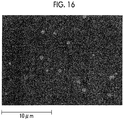
- the respective EPMA images of Comparative Example 1 are respectively illustrated in Fig. 14, 15 , and 16 .
- light-colored places are places in which the content ratios of the respective elements are higher than those in deep-colored places.
- individual tensile strengths at a plurality of temperatures in a range of 650°C or higher and 900°C or lower were measured using round bar tensile test specimens of American Society for Testing and Materials ASTM E8 sampled from an arbitrary location of the injection molded article of Comparative Example 1 according to the standard test methods for elevated temperature tension tests of metallic materials specified by ASTM E21.
- the measurement results of the respective tensile strengths of Comparative Example 1 were illustrated in Fig. 11 together with the measurement results of the respective tensile strengths of Example 1.
- Fig. 12 is an example of the SEM image of the cross section of the injection molded article of a nickel-base alloy of Comparative Example 1.
- Fig. 13 is an enlarged SEM image of a portion in a dotted frame which corresponds to a region in which the crystal grain boundaries intersect each other in the SEM image of Fig. 12 .
- Fig. 14 is an example of an image illustrating the result of the in-plane distribution measurement of the content ratio of aluminum in the same region as in the SEM image of Fig. 13 using the EPMA.
- Fig. 15 is an example of an image illustrating the result of the in-plane distribution measurement of the content ratio of niobium in the same region as in the SEM image of Fig. 13 using the EPMA.
- Fig. 16 is an example of an image illustrating the result of the in-plane distribution measurement of the content ratio of molybdenum in the same region as in the SEM image of Fig. 13 using the EPMA.
- the injection molded article of Comparative Example 1 turns into a state of the injection molded article of Example 1, that is, has carbides which are precipitated in the crystal grain boundaries of the plurality of crystal grains containing nickel as the primary component, have a diameter of 0.1 ⁇ m or more and 10 ⁇ m or less, have an aspect ratio of 3 or more, and include niobium or molybdenum and carbon.
Landscapes
- Engineering & Computer Science (AREA)
- Mechanical Engineering (AREA)
- Chemical & Material Sciences (AREA)
- Manufacturing & Machinery (AREA)
- Materials Engineering (AREA)
- Metallurgy (AREA)
- Organic Chemistry (AREA)
- General Engineering & Computer Science (AREA)
- Nanotechnology (AREA)
- Powder Metallurgy (AREA)
- Supercharger (AREA)
- Turbine Rotor Nozzle Sealing (AREA)
Applications Claiming Priority (2)
| Application Number | Priority Date | Filing Date | Title |
|---|---|---|---|
| JP2016075933A JP2017186610A (ja) | 2016-04-05 | 2016-04-05 | ニッケル基合金、タービン翼及びニッケル基合金の射出成型品の製造方法 |
| PCT/JP2017/010781 WO2017175563A1 (fr) | 2016-04-05 | 2017-03-16 | Alliage à base de nickel, aube de turbine, et procédé pour la production d'article moulé par injection de l'alliage à base de nickel |
Publications (2)
| Publication Number | Publication Date |
|---|---|
| EP3444366A1 true EP3444366A1 (fr) | 2019-02-20 |
| EP3444366A4 EP3444366A4 (fr) | 2019-08-28 |
Family
ID=60001119
Family Applications (1)
| Application Number | Title | Priority Date | Filing Date |
|---|---|---|---|
| EP17778942.7A Withdrawn EP3444366A4 (fr) | 2016-04-05 | 2017-03-16 | Alliage à base de nickel, aube de turbine, et procédé pour la production d'article moulé par injection de l'alliage à base de nickel |
Country Status (5)
| Country | Link |
|---|---|
| US (1) | US20180298470A1 (fr) |
| EP (1) | EP3444366A4 (fr) |
| JP (1) | JP2017186610A (fr) |
| CA (1) | CA3006713C (fr) |
| WO (1) | WO2017175563A1 (fr) |
Cited By (1)
| Publication number | Priority date | Publication date | Assignee | Title |
|---|---|---|---|---|
| EP3616808A4 (fr) * | 2017-04-25 | 2020-12-30 | Mitsubishi Heavy Industries Aero Engines, Ltd. | Élément métallique et son procédé de fabrication |
Families Citing this family (5)
| Publication number | Priority date | Publication date | Assignee | Title |
|---|---|---|---|---|
| DE102020116868A1 (de) * | 2019-07-05 | 2021-01-07 | Vdm Metals International Gmbh | Pulver aus einer Nickel-Kobaltlegierung, sowie Verfahren zur Herstellung des Pulvers |
| DE102020116858A1 (de) | 2019-07-05 | 2021-01-07 | Vdm Metals International Gmbh | Nickel-Basislegierung für Pulver und Verfahren zur Herstellung eines Pulvers |
| JP7487458B2 (ja) * | 2019-09-19 | 2024-05-21 | 大同特殊鋼株式会社 | 粉末材料、積層造形物、および粉末材料の製造方法 |
| US11591683B2 (en) | 2020-02-18 | 2023-02-28 | Pratt & Whitney Canada Corp. | Method of manufacturing nickel based super alloy parts |
| US20250129483A1 (en) * | 2023-10-23 | 2025-04-24 | Honeywell International Inc. | Components and methods for forming a layer of chromia thereon |
Family Cites Families (8)
| Publication number | Priority date | Publication date | Assignee | Title |
|---|---|---|---|---|
| JPS5837382A (ja) | 1981-08-26 | 1983-03-04 | Matsushita Electric Ind Co Ltd | 流量制御弁 |
| JP5657964B2 (ja) * | 2009-09-15 | 2015-01-21 | 三菱日立パワーシステムズ株式会社 | 高強度Ni基鍛造超合金及びその製造方法 |
| GB201114606D0 (en) * | 2011-08-24 | 2011-10-05 | Rolls Royce Plc | A nickel alloy |
| JP5478601B2 (ja) * | 2011-12-22 | 2014-04-23 | 株式会社日立製作所 | Ni基鍛造合金と、それを用いたガスタービン |
| JP5921401B2 (ja) * | 2012-02-10 | 2016-05-24 | 株式会社東芝 | Ni基合金、その製造方法およびタービン用部品 |
| JP5721189B2 (ja) * | 2013-03-12 | 2015-05-20 | 株式会社 東北テクノアーチ | 耐熱性Ni基合金及びその製造方法 |
| JP6338828B2 (ja) * | 2013-06-10 | 2018-06-06 | 三菱日立パワーシステムズ株式会社 | Ni基鍛造合金並びにこれを用いたタービンディスク、タービンスペーサ及びガスタービン |
| JP6249102B2 (ja) * | 2014-07-23 | 2017-12-20 | 株式会社Ihi | Ni合金部品の製造方法 |
-
2016
- 2016-04-05 JP JP2016075933A patent/JP2017186610A/ja active Pending
-
2017
- 2017-03-16 WO PCT/JP2017/010781 patent/WO2017175563A1/fr not_active Ceased
- 2017-03-16 CA CA3006713A patent/CA3006713C/fr active Active
- 2017-03-16 US US15/781,506 patent/US20180298470A1/en not_active Abandoned
- 2017-03-16 EP EP17778942.7A patent/EP3444366A4/fr not_active Withdrawn
Cited By (1)
| Publication number | Priority date | Publication date | Assignee | Title |
|---|---|---|---|---|
| EP3616808A4 (fr) * | 2017-04-25 | 2020-12-30 | Mitsubishi Heavy Industries Aero Engines, Ltd. | Élément métallique et son procédé de fabrication |
Also Published As
| Publication number | Publication date |
|---|---|
| WO2017175563A1 (fr) | 2017-10-12 |
| CA3006713A1 (fr) | 2017-10-12 |
| EP3444366A4 (fr) | 2019-08-28 |
| US20180298470A1 (en) | 2018-10-18 |
| CA3006713C (fr) | 2021-11-09 |
| JP2017186610A (ja) | 2017-10-12 |
Similar Documents
| Publication | Publication Date | Title |
|---|---|---|
| CA3006713C (fr) | Alliage a base de nickel, aube de turbine, et procede pour la production d'article moule par injection de l'alliage a base de nickel | |
| Haines et al. | Powder bed fusion additive manufacturing of Ni-based superalloys: a review of the main microstructural constituents and characterization techniques | |
| Amar et al. | Additive manufacturing of VCoNi medium-entropy alloy: Microstructure evolution and mechanical properties | |
| Vikram et al. | Effect of heat treatment on the modification of microstructure of selective laser melted (SLM) IN718 and its consequences on mechanical behavior | |
| JP6499546B2 (ja) | 積層造形用Ni基超合金粉末 | |
| US20200158123A1 (en) | Alloy article, method for manufacturing said alloy article, product formed of said alloy article, and fluid machine having said product | |
| Grossmann et al. | Processing and property assessment of NiTi and NiTiCu shape memory actuator springs | |
| WO2019194869A2 (fr) | Alliages al-mg-si destinés à des applications telles que des opérations de fabrication additive | |
| KR20170012080A (ko) | 파우더 기반 제조 공정에서 사용하기 위한 고온 니켈계 초합금 | |
| JPH0835029A (ja) | 高強度高延性鋳造アルミニウム合金およびその製造方法 | |
| Maziasz et al. | High strength, ductility, and impact toughness at room temperature in hot-extruded FeAl alloys | |
| US20180322979A1 (en) | Copper alloy wire rod and method for manufacturing copper alloy wire rod | |
| Liu et al. | Dendritic morphology evolution and microhardness enhancement of rapidly solidified Ni-based superalloys | |
| KR20150071511A (ko) | 초고강도 알루미늄 합금 성형체 및 그 제조 방법 | |
| Wu et al. | Effect of boron addition on the microstructure and stress-rupture properties of directionally solidified superalloys | |
| Horvay et al. | Development of nitinol alloys for additive manufacturing | |
| Wu et al. | High temperature creep behaviors of laser remelted multiphase Ni3Al-based superalloy at 1000° C/120 MPa | |
| Agh et al. | Investigation of the stress rupture behavior of GTD-111 superalloy melted by VIM/VAR | |
| Tan et al. | Precipitation of ß-NiAl/Laves eutectics in a Ru-containing single crystal Ni-Based superalloy | |
| EP4722399A1 (fr) | Procédé de production d'alliage à base de tial, et alliage à base de tial | |
| CN100406160C (zh) | 生产磁活性形状记忆金属合金的方法 | |
| Winberg et al. | Recrystallization in a powder metallurgy nickel-base superalloy | |
| JP2021021140A (ja) | ニッケル基合金の射出成型品及びニッケル基合金の射出成型品の製造方法 | |
| GB2633526A (en) | Ni-based alloy member manufacturing method | |
| Güler et al. | Investigation of the Post-Processing Heat Treatments on Hot Tensile Properties of Selectively Laser Melted IN939 Superalloy |
Legal Events
| Date | Code | Title | Description |
|---|---|---|---|
| STAA | Information on the status of an ep patent application or granted ep patent |
Free format text: STATUS: THE INTERNATIONAL PUBLICATION HAS BEEN MADE |
|
| PUAI | Public reference made under article 153(3) epc to a published international application that has entered the european phase |
Free format text: ORIGINAL CODE: 0009012 |
|
| STAA | Information on the status of an ep patent application or granted ep patent |
Free format text: STATUS: REQUEST FOR EXAMINATION WAS MADE |
|
| 17P | Request for examination filed |
Effective date: 20180604 |
|
| AK | Designated contracting states |
Kind code of ref document: A1 Designated state(s): AL AT BE BG CH CY CZ DE DK EE ES FI FR GB GR HR HU IE IS IT LI LT LU LV MC MK MT NL NO PL PT RO RS SE SI SK SM TR |
|
| AX | Request for extension of the european patent |
Extension state: BA ME |
|
| DAV | Request for validation of the european patent (deleted) | ||
| DAX | Request for extension of the european patent (deleted) | ||
| RIC1 | Information provided on ipc code assigned before grant |
Ipc: F01D 5/28 20060101ALI20190718BHEP Ipc: B22F 3/02 20060101ALI20190718BHEP Ipc: C22C 19/03 20060101ALI20190718BHEP Ipc: B22F 9/08 20060101ALI20190718BHEP Ipc: C22C 1/04 20060101ALI20190718BHEP Ipc: C22C 19/05 20060101AFI20190718BHEP Ipc: F02C 7/00 20060101ALI20190718BHEP |
|
| A4 | Supplementary search report drawn up and despatched |
Effective date: 20190729 |
|
| STAA | Information on the status of an ep patent application or granted ep patent |
Free format text: STATUS: EXAMINATION IS IN PROGRESS |
|
| 17Q | First examination report despatched |
Effective date: 20200403 |
|
| STAA | Information on the status of an ep patent application or granted ep patent |
Free format text: STATUS: THE APPLICATION IS DEEMED TO BE WITHDRAWN |
|
| 18D | Application deemed to be withdrawn |
Effective date: 20200814 |