EP3444882A1 - Catalyseur de réduction d'oxygène de métal non noble préparé à l'aide de précurseurs de porosité non poreuse - Google Patents
Catalyseur de réduction d'oxygène de métal non noble préparé à l'aide de précurseurs de porosité non poreuse Download PDFInfo
- Publication number
- EP3444882A1 EP3444882A1 EP17001391.6A EP17001391A EP3444882A1 EP 3444882 A1 EP3444882 A1 EP 3444882A1 EP 17001391 A EP17001391 A EP 17001391A EP 3444882 A1 EP3444882 A1 EP 3444882A1
- Authority
- EP
- European Patent Office
- Prior art keywords
- precursor
- precursors
- heat
- metal
- porosity
- Prior art date
- Legal status (The legal status is an assumption and is not a legal conclusion. Google has not performed a legal analysis and makes no representation as to the accuracy of the status listed.)
- Withdrawn
Links
- 239000003054 catalyst Substances 0.000 title claims abstract description 72
- 239000002243 precursor Substances 0.000 title claims abstract description 70
- 229910000510 noble metal Inorganic materials 0.000 title claims abstract description 23
- QVGXLLKOCUKJST-UHFFFAOYSA-N atomic oxygen Chemical compound [O] QVGXLLKOCUKJST-UHFFFAOYSA-N 0.000 title claims description 8
- 239000001301 oxygen Substances 0.000 title claims description 8
- 229910052760 oxygen Inorganic materials 0.000 title claims description 8
- 230000009467 reduction Effects 0.000 title claims description 6
- 238000010438 heat treatment Methods 0.000 claims abstract description 53
- 239000000203 mixture Substances 0.000 claims abstract description 28
- 238000000034 method Methods 0.000 claims abstract description 21
- 238000002156 mixing Methods 0.000 claims abstract description 19
- 238000005406 washing Methods 0.000 claims abstract description 17
- 238000004519 manufacturing process Methods 0.000 claims abstract description 4
- CKUAXEQHGKSLHN-UHFFFAOYSA-N [C].[N] Chemical compound [C].[N] CKUAXEQHGKSLHN-UHFFFAOYSA-N 0.000 claims abstract description 3
- 229910052751 metal Inorganic materials 0.000 claims description 20
- 239000002184 metal Substances 0.000 claims description 20
- ZMXDDKWLCZADIW-UHFFFAOYSA-N N,N-Dimethylformamide Chemical compound CN(C)C=O ZMXDDKWLCZADIW-UHFFFAOYSA-N 0.000 claims description 18
- 239000000843 powder Substances 0.000 claims description 18
- 229920002239 polyacrylonitrile Polymers 0.000 claims description 17
- XEEYBQQBJWHFJM-UHFFFAOYSA-N Iron Chemical compound [Fe] XEEYBQQBJWHFJM-UHFFFAOYSA-N 0.000 claims description 16
- 239000002253 acid Substances 0.000 claims description 16
- OKTJSMMVPCPJKN-UHFFFAOYSA-N Carbon Chemical compound [C] OKTJSMMVPCPJKN-UHFFFAOYSA-N 0.000 claims description 12
- 239000000446 fuel Substances 0.000 claims description 11
- 239000007789 gas Substances 0.000 claims description 11
- XLYOFNOQVPJJNP-UHFFFAOYSA-N water Substances O XLYOFNOQVPJJNP-UHFFFAOYSA-N 0.000 claims description 10
- 238000001035 drying Methods 0.000 claims description 9
- 239000002904 solvent Substances 0.000 claims description 9
- 239000012298 atmosphere Substances 0.000 claims description 8
- 229910052799 carbon Inorganic materials 0.000 claims description 8
- 239000007833 carbon precursor Substances 0.000 claims description 8
- 239000007787 solid Substances 0.000 claims description 8
- DGEZNRSVGBDHLK-UHFFFAOYSA-N [1,10]phenanthroline Chemical compound C1=CN=C2C3=NC=CC=C3C=CC2=C1 DGEZNRSVGBDHLK-UHFFFAOYSA-N 0.000 claims description 7
- CSCPPACGZOOCGX-UHFFFAOYSA-N Acetone Chemical compound CC(C)=O CSCPPACGZOOCGX-UHFFFAOYSA-N 0.000 claims description 6
- LFQSCWFLJHTTHZ-UHFFFAOYSA-N Ethanol Chemical compound CCO LFQSCWFLJHTTHZ-UHFFFAOYSA-N 0.000 claims description 6
- OKKJLVBELUTLKV-UHFFFAOYSA-N Methanol Chemical compound OC OKKJLVBELUTLKV-UHFFFAOYSA-N 0.000 claims description 6
- 229910052742 iron Inorganic materials 0.000 claims description 6
- 239000012528 membrane Substances 0.000 claims description 6
- 238000000498 ball milling Methods 0.000 claims description 5
- PXHVJJICTQNCMI-UHFFFAOYSA-N Nickel Chemical compound [Ni] PXHVJJICTQNCMI-UHFFFAOYSA-N 0.000 claims description 4
- 239000000047 product Substances 0.000 claims description 4
- BDERNNFJNOPAEC-UHFFFAOYSA-N propan-1-ol Chemical compound CCCO BDERNNFJNOPAEC-UHFFFAOYSA-N 0.000 claims description 4
- XZMCDFZZKTWFGF-UHFFFAOYSA-N Cyanamide Chemical compound NC#N XZMCDFZZKTWFGF-UHFFFAOYSA-N 0.000 claims description 3
- 229920000877 Melamine resin Polymers 0.000 claims description 3
- MUBZPKHOEPUJKR-UHFFFAOYSA-N Oxalic acid Chemical class OC(=O)C(O)=O MUBZPKHOEPUJKR-UHFFFAOYSA-N 0.000 claims description 3
- 229910017052 cobalt Inorganic materials 0.000 claims description 3
- 239000010941 cobalt Substances 0.000 claims description 3
- GUTLYIVDDKVIGB-UHFFFAOYSA-N cobalt atom Chemical compound [Co] GUTLYIVDDKVIGB-UHFFFAOYSA-N 0.000 claims description 3
- JDSHMPZPIAZGSV-UHFFFAOYSA-N melamine Chemical compound NC1=NC(N)=NC(N)=N1 JDSHMPZPIAZGSV-UHFFFAOYSA-N 0.000 claims description 3
- 229920000767 polyaniline Polymers 0.000 claims description 3
- 150000004032 porphyrins Chemical class 0.000 claims description 3
- BVKZGUZCCUSVTD-UHFFFAOYSA-L Carbonate Chemical compound [O-]C([O-])=O BVKZGUZCCUSVTD-UHFFFAOYSA-L 0.000 claims description 2
- VYZAMTAEIAYCRO-UHFFFAOYSA-N Chromium Chemical compound [Cr] VYZAMTAEIAYCRO-UHFFFAOYSA-N 0.000 claims description 2
- RYGMFSIKBFXOCR-UHFFFAOYSA-N Copper Chemical compound [Cu] RYGMFSIKBFXOCR-UHFFFAOYSA-N 0.000 claims description 2
- IAZDPXIOMUYVGZ-UHFFFAOYSA-N Dimethylsulphoxide Chemical compound CS(C)=O IAZDPXIOMUYVGZ-UHFFFAOYSA-N 0.000 claims description 2
- PWHULOQIROXLJO-UHFFFAOYSA-N Manganese Chemical compound [Mn] PWHULOQIROXLJO-UHFFFAOYSA-N 0.000 claims description 2
- QAOWNCQODCNURD-UHFFFAOYSA-L Sulfate Chemical compound [O-]S([O-])(=O)=O QAOWNCQODCNURD-UHFFFAOYSA-L 0.000 claims description 2
- 150000001242 acetic acid derivatives Chemical class 0.000 claims description 2
- 229910052804 chromium Inorganic materials 0.000 claims description 2
- 239000011651 chromium Substances 0.000 claims description 2
- 229910052802 copper Inorganic materials 0.000 claims description 2
- 239000010949 copper Substances 0.000 claims description 2
- 229960001760 dimethyl sulfoxide Drugs 0.000 claims description 2
- 239000012467 final product Substances 0.000 claims description 2
- 229920000554 ionomer Polymers 0.000 claims description 2
- 239000007791 liquid phase Substances 0.000 claims description 2
- 229910052748 manganese Inorganic materials 0.000 claims description 2
- 239000011572 manganese Substances 0.000 claims description 2
- 229910052759 nickel Inorganic materials 0.000 claims description 2
- 150000003891 oxalate salts Chemical class 0.000 claims description 2
- IEQIEDJGQAUEQZ-UHFFFAOYSA-N phthalocyanine Chemical compound N1C(N=C2C3=CC=CC=C3C(N=C3C4=CC=CC=C4C(=N4)N3)=N2)=C(C=CC=C2)C2=C1N=C1C2=CC=CC=C2C4=N1 IEQIEDJGQAUEQZ-UHFFFAOYSA-N 0.000 claims description 2
- IJGRMHOSHXDMSA-UHFFFAOYSA-N Atomic nitrogen Chemical compound N#N IJGRMHOSHXDMSA-UHFFFAOYSA-N 0.000 claims 2
- 229910052757 nitrogen Inorganic materials 0.000 claims 1
- 230000000694 effects Effects 0.000 abstract description 19
- 239000000463 material Substances 0.000 abstract description 11
- 239000000126 substance Substances 0.000 abstract description 10
- 150000003839 salts Chemical class 0.000 abstract description 5
- 150000002894 organic compounds Chemical class 0.000 abstract description 3
- 238000001308 synthesis method Methods 0.000 abstract description 3
- CDBYLPFSWZWCQE-UHFFFAOYSA-L Sodium Carbonate Chemical compound [Na+].[Na+].[O-]C([O-])=O CDBYLPFSWZWCQE-UHFFFAOYSA-L 0.000 description 26
- 238000003786 synthesis reaction Methods 0.000 description 15
- 230000015572 biosynthetic process Effects 0.000 description 14
- 239000000243 solution Substances 0.000 description 14
- 229910000029 sodium carbonate Inorganic materials 0.000 description 13
- 239000012621 metal-organic framework Substances 0.000 description 10
- 230000010287 polarization Effects 0.000 description 9
- 238000013459 approach Methods 0.000 description 8
- VLTRZXGMWDSKGL-UHFFFAOYSA-N perchloric acid Chemical compound OCl(=O)(=O)=O VLTRZXGMWDSKGL-UHFFFAOYSA-N 0.000 description 8
- 239000011148 porous material Substances 0.000 description 7
- 238000006722 reduction reaction Methods 0.000 description 6
- GRYLNZFGIOXLOG-UHFFFAOYSA-N Nitric acid Chemical compound O[N+]([O-])=O GRYLNZFGIOXLOG-UHFFFAOYSA-N 0.000 description 5
- 239000006185 dispersion Substances 0.000 description 5
- 239000000976 ink Substances 0.000 description 5
- 238000005259 measurement Methods 0.000 description 5
- 229910017604 nitric acid Inorganic materials 0.000 description 5
- QJGQUHMNIGDVPM-UHFFFAOYSA-N nitrogen group Chemical group [N] QJGQUHMNIGDVPM-UHFFFAOYSA-N 0.000 description 5
- 239000012071 phase Substances 0.000 description 5
- 229920006395 saturated elastomer Polymers 0.000 description 5
- KFZMGEQAYNKOFK-UHFFFAOYSA-N Isopropanol Chemical compound CC(C)O KFZMGEQAYNKOFK-UHFFFAOYSA-N 0.000 description 4
- MCMNRKCIXSYSNV-UHFFFAOYSA-N Zirconium dioxide Chemical compound O=[Zr]=O MCMNRKCIXSYSNV-UHFFFAOYSA-N 0.000 description 4
- 230000003197 catalytic effect Effects 0.000 description 4
- 150000001875 compounds Chemical class 0.000 description 4
- 238000011068 loading method Methods 0.000 description 4
- 239000000376 reactant Substances 0.000 description 4
- 238000004832 voltammetry Methods 0.000 description 4
- VEXZGXHMUGYJMC-UHFFFAOYSA-N Hydrochloric acid Chemical compound Cl VEXZGXHMUGYJMC-UHFFFAOYSA-N 0.000 description 3
- 229920000557 Nafion® Polymers 0.000 description 3
- QAOWNCQODCNURD-UHFFFAOYSA-N Sulfuric acid Chemical compound OS(O)(=O)=O QAOWNCQODCNURD-UHFFFAOYSA-N 0.000 description 3
- 239000006229 carbon black Substances 0.000 description 3
- 235000019241 carbon black Nutrition 0.000 description 3
- 239000012018 catalyst precursor Substances 0.000 description 3
- 238000009826 distribution Methods 0.000 description 3
- 239000003792 electrolyte Substances 0.000 description 3
- 230000000877 morphologic effect Effects 0.000 description 3
- 230000007935 neutral effect Effects 0.000 description 3
- 230000003647 oxidation Effects 0.000 description 3
- 238000007254 oxidation reaction Methods 0.000 description 3
- 238000002360 preparation method Methods 0.000 description 3
- 238000003756 stirring Methods 0.000 description 3
- 238000003775 Density Functional Theory Methods 0.000 description 2
- YNPNZTXNASCQKK-UHFFFAOYSA-N Phenanthrene Natural products C1=CC=C2C3=CC=CC=C3C=CC2=C1 YNPNZTXNASCQKK-UHFFFAOYSA-N 0.000 description 2
- 238000004833 X-ray photoelectron spectroscopy Methods 0.000 description 2
- 239000011149 active material Substances 0.000 description 2
- 230000002776 aggregation Effects 0.000 description 2
- 238000004458 analytical method Methods 0.000 description 2
- 238000005119 centrifugation Methods 0.000 description 2
- 238000006243 chemical reaction Methods 0.000 description 2
- 230000003247 decreasing effect Effects 0.000 description 2
- 238000009792 diffusion process Methods 0.000 description 2
- 238000000157 electrochemical-induced impedance spectroscopy Methods 0.000 description 2
- 238000005516 engineering process Methods 0.000 description 2
- 238000001914 filtration Methods 0.000 description 2
- 239000001257 hydrogen Substances 0.000 description 2
- 229910052739 hydrogen Inorganic materials 0.000 description 2
- 238000002354 inductively-coupled plasma atomic emission spectroscopy Methods 0.000 description 2
- 150000002678 macrocyclic compounds Chemical class 0.000 description 2
- 238000012986 modification Methods 0.000 description 2
- 230000004048 modification Effects 0.000 description 2
- 238000002429 nitrogen sorption measurement Methods 0.000 description 2
- 238000001179 sorption measurement Methods 0.000 description 2
- 238000012360 testing method Methods 0.000 description 2
- 238000005979 thermal decomposition reaction Methods 0.000 description 2
- 229910052723 transition metal Inorganic materials 0.000 description 2
- 150000003624 transition metals Chemical class 0.000 description 2
- 238000004627 transmission electron microscopy Methods 0.000 description 2
- 238000002525 ultrasonication Methods 0.000 description 2
- UFHFLCQGNIYNRP-UHFFFAOYSA-N Hydrogen Chemical compound [H][H] UFHFLCQGNIYNRP-UHFFFAOYSA-N 0.000 description 1
- 239000011865 Pt-based catalyst Substances 0.000 description 1
- 238000003917 TEM image Methods 0.000 description 1
- 150000007513 acids Chemical class 0.000 description 1
- 239000000853 adhesive Substances 0.000 description 1
- 230000001070 adhesive effect Effects 0.000 description 1
- 238000005054 agglomeration Methods 0.000 description 1
- 238000004220 aggregation Methods 0.000 description 1
- 229910052783 alkali metal Inorganic materials 0.000 description 1
- 229910052784 alkaline earth metal Inorganic materials 0.000 description 1
- PNEYBMLMFCGWSK-UHFFFAOYSA-N aluminium oxide Inorganic materials [O-2].[O-2].[O-2].[Al+3].[Al+3] PNEYBMLMFCGWSK-UHFFFAOYSA-N 0.000 description 1
- 239000007864 aqueous solution Substances 0.000 description 1
- 239000002585 base Substances 0.000 description 1
- 239000002041 carbon nanotube Substances 0.000 description 1
- 239000003575 carbonaceous material Substances 0.000 description 1
- 150000004649 carbonic acid derivatives Chemical class 0.000 description 1
- 238000003763 carbonization Methods 0.000 description 1
- 150000001768 cations Chemical class 0.000 description 1
- 239000003795 chemical substances by application Substances 0.000 description 1
- 238000007906 compression Methods 0.000 description 1
- 230000006835 compression Effects 0.000 description 1
- 230000001143 conditioned effect Effects 0.000 description 1
- 238000012937 correction Methods 0.000 description 1
- 125000004122 cyclic group Chemical group 0.000 description 1
- 238000003795 desorption Methods 0.000 description 1
- 238000011161 development Methods 0.000 description 1
- 230000018109 developmental process Effects 0.000 description 1
- 230000034964 establishment of cell polarity Effects 0.000 description 1
- 238000005530 etching Methods 0.000 description 1
- 238000001704 evaporation Methods 0.000 description 1
- 230000008020 evaporation Effects 0.000 description 1
- 238000002474 experimental method Methods 0.000 description 1
- 238000009472 formulation Methods 0.000 description 1
- 239000011521 glass Substances 0.000 description 1
- 229910021397 glassy carbon Inorganic materials 0.000 description 1
- 150000002431 hydrogen Chemical class 0.000 description 1
- 230000006872 improvement Effects 0.000 description 1
- 230000001939 inductive effect Effects 0.000 description 1
- 229910052741 iridium Inorganic materials 0.000 description 1
- 239000002082 metal nanoparticle Substances 0.000 description 1
- 239000000178 monomer Substances 0.000 description 1
- 150000002825 nitriles Chemical class 0.000 description 1
- 239000012299 nitrogen atmosphere Substances 0.000 description 1
- 229910052762 osmium Inorganic materials 0.000 description 1
- 229910052763 palladium Inorganic materials 0.000 description 1
- 239000002245 particle Substances 0.000 description 1
- 229910052697 platinum Inorganic materials 0.000 description 1
- 229920000642 polymer Polymers 0.000 description 1
- 239000005518 polymer electrolyte Substances 0.000 description 1
- 238000002459 porosimetry Methods 0.000 description 1
- 238000012805 post-processing Methods 0.000 description 1
- 230000008569 process Effects 0.000 description 1
- 238000012545 processing Methods 0.000 description 1
- 239000010453 quartz Substances 0.000 description 1
- 230000005855 radiation Effects 0.000 description 1
- 230000002441 reversible effect Effects 0.000 description 1
- 229910052707 ruthenium Inorganic materials 0.000 description 1
- VYPSYNLAJGMNEJ-UHFFFAOYSA-N silicon dioxide Inorganic materials O=[Si]=O VYPSYNLAJGMNEJ-UHFFFAOYSA-N 0.000 description 1
- 229910052709 silver Inorganic materials 0.000 description 1
- 239000012265 solid product Substances 0.000 description 1
- 238000000527 sonication Methods 0.000 description 1
- 238000001228 spectrum Methods 0.000 description 1
- 239000007921 spray Substances 0.000 description 1
- 238000006467 substitution reaction Methods 0.000 description 1
- 239000000725 suspension Substances 0.000 description 1
- 230000009466 transformation Effects 0.000 description 1
- 229910021642 ultra pure water Inorganic materials 0.000 description 1
- 239000012498 ultrapure water Substances 0.000 description 1
- 238000003828 vacuum filtration Methods 0.000 description 1
Images


Classifications
-
- H—ELECTRICITY
- H01—ELECTRIC ELEMENTS
- H01M—PROCESSES OR MEANS, e.g. BATTERIES, FOR THE DIRECT CONVERSION OF CHEMICAL ENERGY INTO ELECTRICAL ENERGY
- H01M4/00—Electrodes
- H01M4/86—Inert electrodes with catalytic activity, e.g. for fuel cells
- H01M4/96—Carbon-based electrodes
-
- H—ELECTRICITY
- H01—ELECTRIC ELEMENTS
- H01M—PROCESSES OR MEANS, e.g. BATTERIES, FOR THE DIRECT CONVERSION OF CHEMICAL ENERGY INTO ELECTRICAL ENERGY
- H01M4/00—Electrodes
- H01M4/86—Inert electrodes with catalytic activity, e.g. for fuel cells
- H01M4/88—Processes of manufacture
-
- H—ELECTRICITY
- H01—ELECTRIC ELEMENTS
- H01M—PROCESSES OR MEANS, e.g. BATTERIES, FOR THE DIRECT CONVERSION OF CHEMICAL ENERGY INTO ELECTRICAL ENERGY
- H01M4/00—Electrodes
- H01M4/86—Inert electrodes with catalytic activity, e.g. for fuel cells
- H01M4/90—Selection of catalytic material
- H01M4/9008—Organic or organo-metallic compounds
-
- H—ELECTRICITY
- H01—ELECTRIC ELEMENTS
- H01M—PROCESSES OR MEANS, e.g. BATTERIES, FOR THE DIRECT CONVERSION OF CHEMICAL ENERGY INTO ELECTRICAL ENERGY
- H01M4/00—Electrodes
- H01M4/86—Inert electrodes with catalytic activity, e.g. for fuel cells
- H01M2004/8678—Inert electrodes with catalytic activity, e.g. for fuel cells characterised by the polarity
- H01M2004/8689—Positive electrodes
-
- H—ELECTRICITY
- H01—ELECTRIC ELEMENTS
- H01M—PROCESSES OR MEANS, e.g. BATTERIES, FOR THE DIRECT CONVERSION OF CHEMICAL ENERGY INTO ELECTRICAL ENERGY
- H01M8/00—Fuel cells; Manufacture thereof
- H01M8/10—Fuel cells with solid electrolytes
- H01M2008/1095—Fuel cells with polymeric electrolytes
-
- Y—GENERAL TAGGING OF NEW TECHNOLOGICAL DEVELOPMENTS; GENERAL TAGGING OF CROSS-SECTIONAL TECHNOLOGIES SPANNING OVER SEVERAL SECTIONS OF THE IPC; TECHNICAL SUBJECTS COVERED BY FORMER USPC CROSS-REFERENCE ART COLLECTIONS [XRACs] AND DIGESTS
- Y02—TECHNOLOGIES OR APPLICATIONS FOR MITIGATION OR ADAPTATION AGAINST CLIMATE CHANGE
- Y02E—REDUCTION OF GREENHOUSE GAS [GHG] EMISSIONS, RELATED TO ENERGY GENERATION, TRANSMISSION OR DISTRIBUTION
- Y02E60/00—Enabling technologies; Technologies with a potential or indirect contribution to GHG emissions mitigation
- Y02E60/30—Hydrogen technology
- Y02E60/50—Fuel cells
Definitions
- the present invention relates to a catalyst based on non-noble metals and that can be used to accelerate the kinetics of the oxygen reduction reaction, which is of pivotal importance to low-temperature fuel cells and metal-air batteries. More specifically, this disclosure deals with the initial catalyst precursors and synthesis methods used to prepare these non-noble metal catalysts, as well as with the use of the final materials themselves.
- PEFCs Polymer electrolyte fuel cells
- HOR and ORR hydrogen oxidation and oxygen reduction reactions
- the sluggish kinetics of the ORR on Pt translate into PEFC-cathode loadings of ⁇ 0.3 mg pt ⁇ cm -2 , accounting for ⁇ 50 % of the PEFC-stack cost and that need to be decreased ⁇ 3-to-5-fold in order to render this technology cost-competitive.
- NMCs non-noble metal catalysts
- the highly-microporous carbon black was substituted with a metalorganic framework (MOF) with an even larger (micro)porosity.
- MOF metalorganic framework
- the thermal decomposition of the MOF in the synthesis' heat-treatment step implies that this component acts both as a porosity-precursor and as the catalyst support, since the MOF's organic backbone does not fully decompose and instead yields a carbonaceous, high surface area material.
- the resulting non-noble metal catalyst displays further-improved ORR-activity and high current density performance, which has motivated a surge of interest in the use of MOFs as catalyst precursors.
- MOFs remain specialty chemicals with a high price.
- the final catalyst cost on the exclusive base of the MOF's price should be in the order of ⁇ US$ 9-36 g -1 .
- NMCs non-ncble metal catalysts
- the individual precursors comprise:
- the synthesis method comprises:
- the non-porous salt acting as a porosity precursor can be a (bi)carbonate [Me x (H)CO 3 ] or a (bi)oxalate [Me x (H)C 2 O 4 ], whereby the counter-cation (Me) corresponds to (an) alkali-, alkali earth- or transition-metal.
- the porosity precursor is a non-porous chemical, i.e., its initial surface area is ⁇ 10 m 2 g -1 .
- the nitrogen- and carbon-precursor can be polyacrylonitrile, polyaniline, cyanamide, phenanthroline, or melamine.
- the non-noble metal is iron, cobalt, nickel, chromium, copper or manganese (and combinations thereof), and is delivered in the form of an acetate, oxalate, oxide, sulfate, porphyrin, phthalocyanine, or metal-phenanthroline complex.
- the porosity precursor and the nitrogen- / carbon-precursor are mixed in weight ratios ranging between 30-to-10 and 10-to-90.
- the mass of the metal precursor is such that the precursors' mixture has an initial metal content ranging between 0.01 and 10 wt. %.
- the precursors' mixing includes planetary ball milling, either of the dry precursors, or following their preliminary mixing in a solvent solution and drying.
- the precursors' premixing in a solvent involves the use of water, ethanol, methanol, n-propanol, acetone, dimethylformamide Or dimethysulfoxide (or combinations thereof).
- the first heat treatment step is performed at a temperature ranging between 500 and 1100°C, and under an atmosphere of inert or reactive gas (e.g. Ar or N 2 , vs. NH 3 , H 2 or CO 2 , respectively).
- inert or reactive gas e.g. Ar or N 2 , vs. NH 3 , H 2 or CO 2 , respectively.
- the acid washing step is performed in an aqueous solution of an acid like HClO 4 , H 2 SO 4 , HNO 3 or HCl (or combinations thereof), and in concentrations ranging between 0.01 and 5 M.
- the second heat treatment step is performed at a temperature ranging between 500 and 1100°C, and under an atmosphere of inert or reactive gas (e.g. Ar or N 2 , vs. NH 3 , H 2 or CO 2 , respectively).
- inert or reactive gas e.g. Ar or N 2 , vs. NH 3 , H 2 or CO 2 , respectively.
- a membrane electrode assembly with a cathode including a non-noble metal oxygen reduction catalyst prepared by the method according any of the preceding features above comprises:
- a “catalyst” is a material that accelerates the kinetics of a chemical reaction without getting depleted by the latter.
- “non-noble metal catalysts” are catalysts that do not contain any noble metal, whereby the latter may comprise Pt, Pd, Au, Rh, Ir, Ru, Os or Ag.
- a "catalyst precursor” refers to a material that contains one or more of the elements needed for the preparation of a non-noble metal catalyst, or that leads to this required feature(s) due to its transformation along the steps involved in the catalyst's synthesis.
- the properties generally acknowledged as needed for a non-noble metal catalyst are a carbon support, its corresponding (micro)porosity and surface nitrogen functionalities, and the presence of a non-noble transition metal.
- the current invention presents a novel NNMC-synthesis approach in which a non-porous material is used as the porosity precursor.
- the latter precursor comprises a thermally decomposable compound that releases gas during the first heat treatment step of the NNMC's synthesis, producing a porous material.
- the precursor needed for the carbon support comprises an organic compound, monomer or polymer (or combinations thereof) that partially decomposes and recombines during the NNMC's synthesis heat treatment steps, as to yield graphene-like 2D and 3D structures (i.e., platelets, tubes) similar to those observed in carbon blacks or nanotubes.
- these carbon precursors might contain N-functionalities, therefore additionally acting as N-precursors (although this is not a formal requirement).
- compounds envisaged for this task include (but are not limited to) polyacrylonitrile, polyaniline, cyanamide, phenanthroline, or melamine.
- this comprises a salt, oxide or macrocyclic compound (or combination thereof) in which the metal(s) of interest may be in the oxidation state preferred for the catalytic function (e.g., for Fe-based NNMCs the metal is preferably in the Fe 2+ form), although others can also be considered.
- ORR-active Me-N 4 sites described above instead of yielding aggregate side phases, which are generally regarded as ORR-inactive
- preferred compounds are those in which the metal is pre-coordinated by N-groups (e.g., porphyrins, phthalocyanines and Me-phenanthroline complexes) and/or salts which are soluble in the solvent(s) chosen for the precursors' mixing step (if applicable, cf. below).
- the latter morphological features and corresponding transport properties shall determine the catalyst's fuel cell performance at the high current densities required for maximum power output (relevant, e.g., in automotive applications).
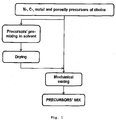
- Figure 1 schematizes the two main routes that can be followed to mix the precursors.
- the precursors are first dispersed and/or dissolved in a solvent or mixture of solvents, stirred and recovered by evaporation of the liquid phase.
- the resulting solid is additionally blended using a mechanical step, e.g., ball milling of different intensities (and with or without solvent, whereby the latter case would imply the need for the drying of the mixture).
- a mechanical step e.g., ball milling of different intensities (and with or without solvent, whereby the latter case would imply the need for the drying of the mixture).
- the initial mixing through solvents is overlooked, and all precursors are mechanically mixed directly.
- the ratio between porosity- and carbon-precursor shall be between 90:10 and 10:90 (weight:weight), and preferably between 70:30 and 30:70.
- the metal content while too little metal shall lead to a low number of sites (i.e., a poor ORR-activity), too much metal shall result in excessive agglomeration into side-phases and a lower performance.
- the initial metal content on the basis of all precursors' masses shall vary between 0.01 and 10 wt. %, and preferably be between 0.1 and 5 wt. %.
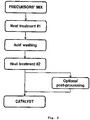
- the dry precursor mixture is initially submitted to a first heat treatment step in which the porosity precursor decomposes to release gas and (in combination with the carbonization of the remaining precursors) yields a high surface area, carbon-based material.
- This first heat treatment step is to be performed at temperatures ranging between 500 and 1100°C (and, preferably, between 650 and 850°C), and for durations between 5 min and 10 hours (whereby 10-60 min is preferred).
- this step can be performed in an inert atmosphere (e.g., with Ar or N 2 gases), in a reducing environment (H 2 ) or using NH 3 , which acts as an additional porosity-inducing agent (due to its capacity to etch the carbon support) and N-precursor.
- an inert atmosphere e.g., with Ar or N 2 gases
- a reducing environment H 2
- NH 3 acts as an additional porosity-inducing agent (due to its capacity to etch the carbon support) and N-precursor.
- the resulting solid powder is to be washed with acid, as to remove any soluble, metal side phases and the oxides derived from the thermal decomposition of the porosity precursor (see discussion above).
- This acid washing can be performed using a variety of acids (e.g., HClO 4 , HNO 3 , HCl or H 2 SO 4 ) and concentrations (e.g., 0.01 to 5 M), applying various durations, and even different temperatures.
- a heated HNO 3 solution e.g., at 60 C
- This acid washing step is finalized by recovering the solid product (e.g., through filtration of centrifugation), washing it with water until the pH of the washing solution is neutral, and drying the resulting powder.
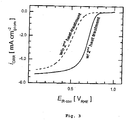
- the third step of the synthesis comprises to submit the dry, acid-washed material to a second heat treatment, which is typically performed at temperatures greater than those used in the first heat treatment step (e.g., at 80C to 1000 °C). While this second heat treatment is not compulsory to obtain an ORR-active material, it has been observed that it does lead to a significant increase of activity when compared to the acid-washed, non-heat-treated powder (as depicted in Figure 3 ). As in the above case, this heat treatment can be performed in an inert atmosphere (e.g., with Ar or N 2 gases), a reducing environment (H 2 ) or using NH 3 as a porosity- and N-precursor.
- a second heat treatment is typically performed at temperatures greater than those used in the first heat treatment step (e.g., at 80C to 1000 °C). While this second heat treatment is not compulsory to obtain an ORR-active material, it has been observed that it does lead to a significant increase of activity when compared to the acid-
- the catalyst resulting from these three steps can undergo further modifications aiming at the tuning of its porosity and morphological features, as to improve its mass transport properties when processed into a fuel cell catalyst layer.
- modifications could imply the tuning of the NNMC particle size using mechanical processing tools like ball milling, and/or the addition to the catalyst ink of soluble chemicals that may increase the catalyst layer's porosizy.
- Na 2 CO 3 , polyacrylonitrile (PAN) and a Fe 2+ -phenanthroline complex are chosen as the porosity-, N-/C-, and metal-precursors, respectively.
- the initial metal content of this precursors' mixture is set to a value of 0.1 wt. % Fe (on the basis of all precursors' masses), and Na 2 CO 3 :PAN weight ratios between 3:1 and 1:2 are investigated.
- the required masses of Na 2 CO 3 and PAN are dispersed separately in dimethylformamide (DMF), whereby the resulting suspensions are left stirring overnight at ⁇ 80 °C.
- DMF dimethylformamide
- the Fe 2+- phenanthroline complex is formed by mixing in ⁇ 20 mL of DMF the required mass of iron (in the form of Fe 2+ -acetate) along with the mass of phenanthroline (phen) needed for an Fe:phen molar ratio of 1:5.
- the contents of all three containers i.e., DMF-based solutions / dispersions of Na 2 CO 3 , PAN and Fe-phen
- the volume of the resulting dispersion is decreased until a muddy mixture is obtained, and the latter is left to dry overnight in a furnace at ⁇ 120 C.
- the resulting solid is then ground with a pestle and transferred to a ZrO 2 jar for planetary ball milling. Typically, ⁇ 2.5 g of precursor mixture are placed alongside 15 ZrO 2 balls (5 mm in diameter), and milled for 80 min at 300 rpm.
- a fraction of this precursor mixture is heat treated for 30 min at 750 °C under a N 2 atmosphere.
- the ball milled powder is weighed and transferred to an alumina crucible that is then placed inside a quartz tube at the center of a heating furnace. The temperature is first ramped (at 5 °C ⁇ min -1 ) to 150 °C, held for three hours, then ramped again to 750 °C. After thirty minutes, heating is halted and the furnace is left to cool down through natural convection.
- the resulting powder is then ground and acid-washed overnight in a 0.1 M solution of HClO 4 in water at room temperature.
- a given mass of heat-treated powder ("X", in mg) is first weighed and ultrasonically dispersed in a ⁇ X/2 volume (in mL) of acid solution. After ca. five minutes, the resulting dispersion is transferred from the ultrasonication bath to a stirring plate where it is left mixing overnight. The remaining powder is then recovered by vacuum-filtration, abundantly washed with water until the pH of the washing solution is neutral, and dried at ⁇ 100 °C.
- the resulting, acid-washed material is then submitted to a second heat treatment step that improves its catalytic activity (see Figure 3 , for the catalyst made using a Na 2 CO 3 :PAN ratio of 3:1).
- the latter heat treatment is similar to the first step described above, with the exception that the sample is heated to 950 °C for one hour, and that the heating atmosphere is a reducing mixture of H 2 in Ar (5% vol.).
- the ORR-activity of the resulting, final catalysts is electrochemically determined using rotating disc electrode (RDE) voltammetry in 0.1 M HClO 4 and at room temperature.
- RDE rotating disc electrode
- inks of each catalyst are prepared by dispersing a given amount of powder in a 3:1 volume mixture of water and isopropanol, and adding the volume of a recast Nafion solution required for a Nafion-to-catalys mass ratio cf 0.3. Following ultrasonication of this ink, the volume of it required for a loading of 500 ⁇ g NNMC ⁇ cm -2 is dropcasted atop the glassy carbon disc of a PTFE-embedded RDE.
- the loaded RDE is mounted on a rotator shaft and immersed in a three-electrode electrochemical cell containing the O 2 -saturated electrolyte, along with an Au-mesh as the counterelectrode and a custom-made reversible hydrogen electrode as the reference.
- the electrode is then voltammetrically conditioned by recording 25 cyclic voltamogramms (CVs) between 0.05 and 1.0 V vs. RHE at 50 mV ⁇ s -1 .
- CVs cyclic voltamogramms
- the electrolyte is then saturated with N 2 as to record baseline CVs (for subsequent capacitive correction) under the same conditions.
- the high frequency resistance (needed to correct the polarization curves for resistive effects) is determined using potentiostatic electrochemical impedance spectroscopy at 0.45 V vs. RHE, applying a 5 mV perturbation between 200 kHz and 1 Hz.
- Figure 4A displays the polarization curves obtained for catalysts prepared using initial Na 2 CO 3 :PAN ratios between 3:1 and 1:2 (mass:mass). Considering the average overpotentials (on the basis of three measurements) needed to reach a current of 500 ⁇ A ⁇ cm -2 , plotted in Figure 4B , the NNMCs with the best ORR-activities (i.e., with the lowest overpotentials) are obtained using ratios of 2:1 and 1:1.
- NNMCs with a fixed Na 2 CO 3 :PAN ratio of 2:1 were synthesized to study the effect of the temperature of the first heat treatment step on their ORR-activity and physico-chemical features.
- catalysts submitted to all steps in Figure 2 were characterized using X-ray photoelectron spectroscopy to determine their surface chemical composition, N 2 -porosimetry to estimate their surface area and pore size distribution, and inductively coupled plasma optical emission spectrometry to quantify their metal content.
- XPS small amounts of sample were pressed on adhesive Cu-tape stuck to a sample holder and step-wise transferred into an ultra-high-vacuum analysis chamber.
- Total surface areas were derived applying the Brunnauer-Emmett-Teller equation (adsorption branch) in the P/P 0 range between 0.05 and 0.25, and pore size distributions were quantified using the quenched solid density functional theory, assuming slit-like pore geometries.
- adsorption branch adsorption branch
- pore size distributions were quantified using the quenched solid density functional theory, assuming slit-like pore geometries.
- weighed amounts of NNMC were digested in HNO 3 - HCl mixtures, and the resulting solution was diluted in ultrapure water prior to analysis. Additionally, transmission electron microscopy (TEM) was used to determine the compositional and morphological features of selected samples.
- TEM transmission electron microscopy
- Figure 5A displays the ORR polarization curves recorded for the NNMCs as a function of the heat treatment temperature, whereby the best-performing catalyst is the one prepared at 750 °C. Specifically, when its ORR-activity is plotted in the form of a so-called Tafel plot (i.e., displaying the potential vs. the logarithm of the kinetically-controlled current, see Figure 5B ), this catalysts reaches an ORR-activity of ⁇ 1 A ⁇ g -1 at 0.8 V vs. RHE.
- Figures 6A, 6B, 6C and 6D display the relation between the first heat treatment temperature and the ORR-overpotential (averaged on the basis of three measurements), surface N-content, (micro)porosity and Fe-concentration, respectively.
- neither of these three physico-chemical variables displays an univocal relation with the ORR-activity, implying that none of them is the sole limiting factor determining the catalysts' performance.
- the NNMCs prepared using first heat treatment temperatures of 650 and 750 °C were characterized using TEM.
- the catalyst prepared at 650 °C exclusively consists of a carbon-based phase with alveolar structure, whereas in the case of the 750 °C sample ( Figure 7B ) metal nanoparticles encapsulated in a carbon-shell were also discernible.
- Figure 7A illustrates that the catalyst prepared at 650 °C exclusively consists of a carbon-based phase with alveolar structure
- metal nanoparticles encapsulated in a carbon-shell were also discernible.
- the catalyst synthesized with a Na 2 CO 3 :PAN ratio of 2:1, an initial Fe-content of 0.1 wt.% and using a first heat treatment temperature of 750 °C was selected for PEFC testing in a 1 cm 2 "differential" cell in which mass transport losses due to limitations in reactants' supply can be neglected.
- a weighed mass of catalyst was processed into an ink containing water, isopropanol and the amount of recast Nafion solution required for a Nafion-to-catalyst ratio of 1:1 (weight:weight).
- the ink Following sonication of the ink, it was spray-coated on a piece on Nafion XL-100 membrane confined inside a frame as to expose an active area of 1 cm 2 . After drying, the resulting catalyst-coated membrane (CCM) was weighed, and the NNMC loading was estimated to be 0.8 mg ⁇ cm -2 . The CCM was then hotpressed at 120 C and 1 bar ⁇ cm -2 for 5 minutes with a gas diffusion layer (GDL 25 BC, Sigracet) and a commercial gas diffusion electrode (0.4 mg Pt ⁇ cm -2 HISPEC 9100 Pt/HAS [Johnson Matthey] on Sigracet GDL 25 BC) on cathode and anode, respectively.
- GDL 25 BC gas diffusion layer
- Sigracet commercial gas diffusion electrode
- the resulting membrane electrode assembly was mounted in the differential fuel cell with a compression of ⁇ 20 %, and pure H 2 and O 2 at flows > 30-fold above stoichiometry needs, with 100 % relative humidity and 1.5 bar abs were circulated through anode and cathode, respectively.
- the cell was then heated to 80 °C and a polarization curve was recorded in galvanostatic increments, holding each current for three minutes at each value and taking the average of the last two minutes as representative of the cell performance.
- the high frequency resistance at each current was additionally determined after each galvanostatic step using electrochemical impedance spectroscopy.
- Figure 8A displays the polarization curve recorded using this membrane electrode assembly (MEA), which reaches a current density of ⁇ 200 mA ⁇ cm -2 at an application-relevant potential of 0.6 V (i.e., for a power output of ⁇ 120 mW ⁇ cm -2 ). Additionally, in the high-potential regime (cf. Figure 8B ), the catalyst reaches a mass-specific current density of ⁇ 10 mA ⁇ g -1 at 0.8 V vs.
- MEA membrane electrode assembly
- RHE which is ⁇ 10-fold larger than the value observed in RDE-measurements (see Figure 5C and discussion above) - an improvement that has been previously reported in the NNMC-literature, and that can be tentatively assigned to the poorer utilization of the NNMC catalyst layer in RDE experiments in aqueous environment vs. fuel cell measurements in which the fed reactants can better access the active sites embedded in the catalysts' micropores.
Landscapes
- Chemical & Material Sciences (AREA)
- Chemical Kinetics & Catalysis (AREA)
- Electrochemistry (AREA)
- General Chemical & Material Sciences (AREA)
- Engineering & Computer Science (AREA)
- Materials Engineering (AREA)
- Manufacturing & Machinery (AREA)
- Catalysts (AREA)
- Inert Electrodes (AREA)
Priority Applications (2)
| Application Number | Priority Date | Filing Date | Title |
|---|---|---|---|
| EP17001391.6A EP3444882A1 (fr) | 2017-08-15 | 2017-08-15 | Catalyseur de réduction d'oxygène de métal non noble préparé à l'aide de précurseurs de porosité non poreuse |
| PCT/EP2018/070484 WO2019034396A1 (fr) | 2017-08-15 | 2018-07-27 | Catalyseur de réduction d'oxygène de métaux non nobles préparé au moyen de précurseurs de porosité non poreux |
Applications Claiming Priority (1)
| Application Number | Priority Date | Filing Date | Title |
|---|---|---|---|
| EP17001391.6A EP3444882A1 (fr) | 2017-08-15 | 2017-08-15 | Catalyseur de réduction d'oxygène de métal non noble préparé à l'aide de précurseurs de porosité non poreuse |
Publications (1)
| Publication Number | Publication Date |
|---|---|
| EP3444882A1 true EP3444882A1 (fr) | 2019-02-20 |
Family
ID=59790894
Family Applications (1)
| Application Number | Title | Priority Date | Filing Date |
|---|---|---|---|
| EP17001391.6A Withdrawn EP3444882A1 (fr) | 2017-08-15 | 2017-08-15 | Catalyseur de réduction d'oxygène de métal non noble préparé à l'aide de précurseurs de porosité non poreuse |
Country Status (2)
| Country | Link |
|---|---|
| EP (1) | EP3444882A1 (fr) |
| WO (1) | WO2019034396A1 (fr) |
Cited By (2)
| Publication number | Priority date | Publication date | Assignee | Title |
|---|---|---|---|---|
| CN114068962A (zh) * | 2021-11-08 | 2022-02-18 | 岭南师范学院 | 一种铁氮碳复合氧还原催化剂及其制备方法和应用 |
| CN114855214A (zh) * | 2022-05-05 | 2022-08-05 | 中汽创智科技有限公司 | 一种抗反极催化剂及其制备方法和用途 |
Families Citing this family (7)
| Publication number | Priority date | Publication date | Assignee | Title |
|---|---|---|---|---|
| CN110661008B (zh) * | 2019-10-11 | 2022-08-16 | 南京航空航天大学 | 一种金属空气电池用双金属活性的单原子催化剂及其制备方法、金属空气电池 |
| US11701399B2 (en) | 2020-02-26 | 2023-07-18 | Industrial Technology Research Institute | Composition for modulating intestinal permeability and/or treating and/or preventing leaky gut related diseases, and method for modulating intestinal permeability and/or treating and/or preventing leaky gut related diseases |
| CN111883784B (zh) * | 2020-07-14 | 2021-06-18 | 超威电源集团有限公司 | 一种金属空气电池纳米银氧电极的制备方法及金属空气电池 |
| CN113044840B (zh) * | 2021-03-09 | 2023-11-21 | 陕西科技大学 | 一种活性炭负载钼和氮双掺杂碳纳米片阵列复合材料及其制备方法和应用 |
| CN119725565A (zh) * | 2024-12-16 | 2025-03-28 | 中国科学技术大学 | 金属氯化物盐辅助热解的Fe-N-C阴极氧还原催化剂及其制备方法、应用 |
| CN120878860B (zh) * | 2025-09-29 | 2025-11-28 | 长春工程学院 | 一种拓扑绝缘体复合催化材料的制备方法及应用 |
| CN121172162B (zh) * | 2025-11-19 | 2026-02-17 | 山东科技大学 | 一种非贵金属orr催化剂及其制备方法 |
Citations (3)
| Publication number | Priority date | Publication date | Assignee | Title |
|---|---|---|---|---|
| WO2009075038A1 (fr) * | 2007-12-12 | 2009-06-18 | Toyota Jidosha Kabushiki Kaisha | Catalyseur d'électrodes pour piles à combustible, procédé de préparation d'un catalyseur d'électrodes pour piles à combustibles et pile à combustible à électrolyte polymère |
| US20140011673A1 (en) * | 2008-11-10 | 2014-01-09 | Institut National De La Recherche Scientifique | Catalyst precursors, catalysts and methods of producing same |
| WO2014202749A1 (fr) * | 2013-06-21 | 2014-12-24 | Technical University Of Denmark | Nouveau matériau catalyseur métallique sans platine |
-
2017
- 2017-08-15 EP EP17001391.6A patent/EP3444882A1/fr not_active Withdrawn
-
2018
- 2018-07-27 WO PCT/EP2018/070484 patent/WO2019034396A1/fr not_active Ceased
Patent Citations (3)
| Publication number | Priority date | Publication date | Assignee | Title |
|---|---|---|---|---|
| WO2009075038A1 (fr) * | 2007-12-12 | 2009-06-18 | Toyota Jidosha Kabushiki Kaisha | Catalyseur d'électrodes pour piles à combustible, procédé de préparation d'un catalyseur d'électrodes pour piles à combustibles et pile à combustible à électrolyte polymère |
| US20140011673A1 (en) * | 2008-11-10 | 2014-01-09 | Institut National De La Recherche Scientifique | Catalyst precursors, catalysts and methods of producing same |
| WO2014202749A1 (fr) * | 2013-06-21 | 2014-12-24 | Technical University Of Denmark | Nouveau matériau catalyseur métallique sans platine |
Non-Patent Citations (1)
| Title |
|---|
| M. LEFEVRE ET AL: "Recent Advances in Non-Precious Metal Electrocatalysts for Oxygen Reduction in PEM Fuel Cells", ECS TRANSACTIONS, vol. 45, no. 2, 27 April 2012 (2012-04-27), US, pages 35 - 44, XP055428898, ISSN: 1938-6737, DOI: 10.1149/1.3701967 * |
Cited By (3)
| Publication number | Priority date | Publication date | Assignee | Title |
|---|---|---|---|---|
| CN114068962A (zh) * | 2021-11-08 | 2022-02-18 | 岭南师范学院 | 一种铁氮碳复合氧还原催化剂及其制备方法和应用 |
| CN114855214A (zh) * | 2022-05-05 | 2022-08-05 | 中汽创智科技有限公司 | 一种抗反极催化剂及其制备方法和用途 |
| CN114855214B (zh) * | 2022-05-05 | 2023-09-12 | 中汽创智科技有限公司 | 一种抗反极催化剂及其制备方法和用途 |
Also Published As
| Publication number | Publication date |
|---|---|
| WO2019034396A1 (fr) | 2019-02-21 |
Similar Documents
| Publication | Publication Date | Title |
|---|---|---|
| EP3444882A1 (fr) | Catalyseur de réduction d'oxygène de métal non noble préparé à l'aide de précurseurs de porosité non poreuse | |
| Yang et al. | Fe, Cu dual-metal single atom catalyst on commercial carbon black for efficient oxygen reduction reaction | |
| Liu et al. | Zinc assisted epitaxial growth of N-doped CNTs-based zeolitic imidazole frameworks derivative for high efficient oxygen reduction reaction in Zn-air battery | |
| Xiao et al. | Nitrogen-coordinated single iron atom catalysts derived from metal organic frameworks for oxygen reduction reaction | |
| Wu et al. | Iron phthalocyanine coupled with Co-Nx sites in carbon nanostraws for Zn-Air batteries | |
| Khalid et al. | Multifunctional electrocatalysts derived from conducting polymer and metal organic framework complexes | |
| US10305115B2 (en) | Non-platinum group metal electrocatalysts using metal organic framework materials and method of preparation | |
| Jiang et al. | A cobalt–nitrogen complex on N-doped three-dimensional graphene framework as a highly efficient electrocatalyst for oxygen reduction reaction | |
| Guo et al. | Mechanochemical synthesis of multi-site electrocatalysts as bifunctional zinc–air battery electrodes | |
| Hu et al. | Unusual formation of tetragonal microstructures from nitrogen-doped carbon nanocapsules with cobalt nanocores as a bi-functional oxygen electrocatalyst | |
| US8835343B2 (en) | Non-platinum group metal electrocatalysts using metal organic framework materials and method of preparation | |
| US10886539B2 (en) | Catalyst-carrier carbon material, solid-polymer fuel cell catalyst, solid-polymer fuel cell, and method for manufacturing catalyst-carrier carbon material | |
| Roncaroli et al. | Cobalt and iron complexes with N-heterocyclic ligands as pyrolysis precursors for oxygen reduction catalysts | |
| Tran et al. | Fe–N-functionalized carbon electrocatalyst derived from a zeolitic imidazolate framework for oxygen reduction: Fe and NH 3 treatment effects | |
| KR102381910B1 (ko) | 다공성 질소 도핑 고흑연성 탄소체, 이를 포함하는 촉매 및 이의 제조방법 | |
| Zhao et al. | Enhanced oxygen electroreduction over nitrogen-free carbon nanotube-supported CuFeO 2 nanoparticles | |
| US20230082237A1 (en) | Heteroelement-doped high-graphite porous carbon body, catalyst comprising same, and method for producing same | |
| Fan et al. | N, P-Doped carbon with encapsulated Co nanoparticles as efficient electrocatalysts for oxygen reduction reactions | |
| Luo et al. | Boosting the primary Zn–air battery oxygen reduction performance with mesopore-dominated semi-tubular doped-carbon nanostructures | |
| Bao et al. | A ZIF-derived hollow carbon nanoframework loaded with FeCu alloy nanoparticles for efficient oxygen reduction reaction and zinc–air batteries | |
| KR102838389B1 (ko) | 이중금속 함유 nc-탄소나노튜브 중공 복합체, 이를 포함하는 전기 촉매 및 이의 제조방법 | |
| Xin et al. | Highly reactive N, N′-carbonyldiimidazole-tailored bifunctional electrocatalyst for oxygen reduction and oxygen evolution | |
| Jhong et al. | Enhanced activity of selenocyanate-containing transition metal chalcogenides supported by nitrogen-doped carbon materials for the oxygen reduction reaction | |
| JP2019172496A (ja) | 窒素含有炭素材料の製造方法 | |
| Ferraz et al. | Co/N nanoparticles supported on a C3N4/polydopamine framework as a bifunctional electrocatalyst for rechargeable zinc-air batteries |
Legal Events
| Date | Code | Title | Description |
|---|---|---|---|
| PUAI | Public reference made under article 153(3) epc to a published international application that has entered the european phase |
Free format text: ORIGINAL CODE: 0009012 |
|
| AK | Designated contracting states |
Kind code of ref document: A1 Designated state(s): AL AT BE BG CH CY CZ DE DK EE ES FI FR GB GR HR HU IE IS IT LI LT LU LV MC MK MT NL NO PL PT RO RS SE SI SK SM TR |
|
| AX | Request for extension of the european patent |
Extension state: BA ME |
|
| STAA | Information on the status of an ep patent application or granted ep patent |
Free format text: STATUS: THE APPLICATION IS DEEMED TO BE WITHDRAWN |
|
| 18D | Application deemed to be withdrawn |
Effective date: 20190821 |