EP3445014A1 - Vorrichtung und verfahren zur erzeugung von heterogenen funktionsäquivalenten - Google Patents
Vorrichtung und verfahren zur erzeugung von heterogenen funktionsäquivalenten Download PDFInfo
- Publication number
- EP3445014A1 EP3445014A1 EP17854638.8A EP17854638A EP3445014A1 EP 3445014 A1 EP3445014 A1 EP 3445014A1 EP 17854638 A EP17854638 A EP 17854638A EP 3445014 A1 EP3445014 A1 EP 3445014A1
- Authority
- EP
- European Patent Office
- Prior art keywords
- heterogeneous
- template
- pool
- heterogeneous functional
- functional equivalent
- Prior art date
- Legal status (The legal status is an assumption and is not a legal conclusion. Google has not performed a legal analysis and makes no representation as to the accuracy of the status listed.)
- Withdrawn
Links
Images


Classifications
-
- H—ELECTRICITY
- H04—ELECTRIC COMMUNICATION TECHNIQUE
- H04L—TRANSMISSION OF DIGITAL INFORMATION, e.g. TELEGRAPHIC COMMUNICATION
- H04L63/00—Network architectures or network communication protocols for network security
- H04L63/14—Network architectures or network communication protocols for network security for detecting or protecting against malicious traffic
- H04L63/1441—Countermeasures against malicious traffic
- H04L63/145—Countermeasures against malicious traffic the attack involving the propagation of malware through the network, e.g. viruses, trojans or worms
-
- G—PHYSICS
- G06—COMPUTING OR CALCULATING; COUNTING
- G06F—ELECTRIC DIGITAL DATA PROCESSING
- G06F21/00—Security arrangements for protecting computers, components thereof, programs or data against unauthorised activity
- G06F21/10—Protecting distributed programs or content, e.g. vending or licensing of copyrighted material ; Digital rights management [DRM]
- G06F21/12—Protecting executable software
- G06F21/14—Protecting executable software against software analysis or reverse engineering, e.g. by obfuscation
-
- H—ELECTRICITY
- H04—ELECTRIC COMMUNICATION TECHNIQUE
- H04L—TRANSMISSION OF DIGITAL INFORMATION, e.g. TELEGRAPHIC COMMUNICATION
- H04L63/00—Network architectures or network communication protocols for network security
- H04L63/14—Network architectures or network communication protocols for network security for detecting or protecting against malicious traffic
- H04L63/1408—Network architectures or network communication protocols for network security for detecting or protecting against malicious traffic by monitoring network traffic
- H04L63/1416—Event detection, e.g. attack signature detection
-
- H—ELECTRICITY
- H04—ELECTRIC COMMUNICATION TECHNIQUE
- H04L—TRANSMISSION OF DIGITAL INFORMATION, e.g. TELEGRAPHIC COMMUNICATION
- H04L63/00—Network architectures or network communication protocols for network security
- H04L63/14—Network architectures or network communication protocols for network security for detecting or protecting against malicious traffic
- H04L63/1408—Network architectures or network communication protocols for network security for detecting or protecting against malicious traffic by monitoring network traffic
- H04L63/1425—Traffic logging, e.g. anomaly detection
-
- H—ELECTRICITY
- H04—ELECTRIC COMMUNICATION TECHNIQUE
- H04L—TRANSMISSION OF DIGITAL INFORMATION, e.g. TELEGRAPHIC COMMUNICATION
- H04L63/00—Network architectures or network communication protocols for network security
- H04L63/14—Network architectures or network communication protocols for network security for detecting or protecting against malicious traffic
- H04L63/1441—Countermeasures against malicious traffic
Definitions
- the present invention relates to the field of cyberspace security defense technologies, and in particular, to an apparatus for generating heterogeneous functional equivalent and method thereof.
- the cyberspace environment composed of computers includes a network device terminal (e.g., a mobile phone or a computer), software (e.g., a browser or communication software) running on the terminal and related to a network, a server, various devices (e.g., a switch and a router) providing interconnections for the network, etc.
- a network device terminal e.g., a mobile phone or a computer
- software e.g., a browser or communication software
- server e.g., a server
- various devices e.g., a switch and a router
- Apparatuses in the cyberspace field may be composed of a system, a subsystem, a unit, a module, a component, or a device.
- a structure state presented outwardly by these apparatuses is referred to as structure characterization.
- structure characterization For an apparatus with a given service function in the existing cyberspace field, there is a certain mapping relationship between its exterior structure form and interior structure form, and this mapping relationship is usually static and determinate as for a technical architecture in the cyberspace field.
- most redundant systems in the prior art are homogeneous redundant systems, the interior implementation mechanism of which has similar relationships to the exterior structure to some extent.
- This application provides an apparatus for generating heterogeneous functional equivalent and method thereof, so as to improve security of an apparatus in cyberspace.
- a first aspect provides an apparatus for generating heterogeneous functional equivalent, comprising: a heterogeneous functional equivalent generator and an element pool connected to the heterogeneous functional equivalent generator, where the element pool includes at least one element, wherein the heterogeneous functional equivalent generator is configured to obtain a generation policy, where the generation policy includes a function list for selecting an element according to a function and a number of heterogeneous functional equivalents to be generated; the heterogeneous functional equivalent generator is further configured to select element sets corresponding to the number from the element pool according to the generation policy, where each of the element sets is a set comprising at least one element for constructing a heterogeneous functional equivalent; and the heterogeneous functional equivalent generator is further configured to combine the selected element sets to generate the number of heterogeneous functional equivalents.
- different elements are selected from an element pool according to a generation policy, and these elements are combined to generate a plurality of different heterogeneous functional equivalents, so that sufficient heterogeneous functional equivalents are available to a heterogeneous redundant system, which resolves a problem in generating a heterogeneous functional equivalent in the heterogeneous redundant system.
- a particular number of element sets are selected from the element pool according to a certain generation policy, so that the generated heterogeneous functional equivalents are flexible and variable, which prevents an unknown defect, e.g., a trapdoor or a backdoor, in a network apparatus from being snooped and attacked, and improves network system security.
- an unknown defect e.g., a trapdoor or a backdoor
- the apparatus further includes a template pool including at least one template
- the generation policy further includes at least one template selected from the template pool
- the heterogeneous functional equivalent generator is further configured to combine or compile the element sets selected from the element pool and the selected at least one template, to generate the number of heterogeneous functional equivalents. Different templates are selected from the template pool, so that the generated heterogeneous functional equivalents are more stable and secure.
- heterogeneous functional equivalent generator is specifically further configured to search in the element pool according to the function list in the generation policy, and select the element sets corresponding to the number.
- the function list in the generation policy elements in the element pool are classified according to different functions, thereby making it convenient to search for and find an element for generating a heterogeneous functional equivalent.
- the heterogeneous functional equivalent generator is specifically further configured to: obtain the attribute value of each element and the heterogeneous degree between any two elements in the element pool, and the attribute value of the template and the heterogeneous degree between two templates; and select the element sets corresponding to the number from the element pool according to the generation policy, the attribute value of each element and the heterogeneous degree between any two elements with a same-function, and the attribute value of the template and the heterogeneous degree between the two templates, where the attribute value of each element includes reliability, complexity, or use frequency of each element, and the heterogeneous degree is the difference degree between any two elements with the same function.
- the attribute values of elements, the heterogeneous degree between two elements, and the attribute value of the selected template and the heterogeneous degree between different templates are calculated, so that the generated heterogeneous functional equivalents are of higher quality as for the overall attribute, and the capability of the heterogeneous functional equivalents in resisting external attack and snooping is enhanced.
- the template includes a same template or different templates, and the different templates indicate different templates used to generate heterogeneous functional equivalents with a same function. Because each heterogeneous functional equivalent is formed by combining or compiling at least one element by using a template, different templates enable the generated heterogeneous functional equivalents to have a plurality of functions, and to provide different functions according to external services, while the exterior structures of these heterogeneous functional equivalents the same, and function switching is performed only in the heterogeneous functional equivalents. Therefore, the capability of the heterogeneous functional equivalents in resisting intrusion and attack is enhanced, and network security is further improved.
- the heterogeneous functional equivalent generator is configured to obtain the generation policy by reception from outside, generation from inside or in a manner of combining reception from outside and generation from inside.
- the generated generation policy is random and variable, which prevents the generation policy from being easily attacked or intruded due to a monotonous mode.
- a second aspect provides a method for generating heterogeneous functional equivalent generation, comprising: obtaining a generation policy, where the generation policy includes a function list for selecting an element according to a function and the number of heterogeneous functional equivalents to be generated; selecting element sets corresponding to the number from the element pool according to the generation policy, where each of the element sets is a set comprising at least one element for constructing a heterogeneous functional equivalent; and combining the selected element sets to generate the number of heterogeneous functional equivalents.
- combining the selected element sets to generate the number of heterogeneous functional equivalents includes: combining or compiling the element sets selected from the element pool and the selected at least one template, to generate the number of heterogeneous functional equivalents.
- selecting element sets corresponding to the number from the element pool according to the generation policy includes: searching in the element pool according to the function list in the generation policy, and selecting the element sets corresponding to the number.
- selecting element sets corresponding to the number from the element pool according to the generation policy further includes: obtaining the attribute value of each element and the heterogeneous degree between any two elements in the element pool, and the attribute value of the template and the heterogeneous degree between two templates; and selecting the element sets corresponding to the number from the element pool according to the generation policy, the attribute value of each element and the heterogeneous degree between any two elements with a same function, and the attribute value of the template and the heterogeneous degree between the two templates, where the attribute value of each element includes reliability, complexity, or use frequency of each element, and the heterogeneous degree is a difference degree between any two elements with a same function.
- the template includes a same template or different templates, and the different templates indicate different templates used to generate heterogeneous functional equivalents with a same function.
- obtaining a generation policy includes: obtaining the generation policy by reception from outside, generation from inside or in a manner of combining reception from outside and generation from inside.
- a third aspect provides an element pool, where the element pool is connected to the heterogeneous functional equivalent generator, and configured to provide element sets to the heterogeneous functional equivalent generator according to the generation policy, where the element pool comprises at least one element, each element has a function, and the element set is a set comprising at least one element for constructing a heterogeneous functional equivalent.
- a fourth aspect provides a template pool, where the template pool is connected to the heterogeneous functional equivalent generator, and configured to provide a template to the heterogeneous functional equivalent generator, where the template pool comprises at least one template, and each template is used to combine or compile elements selected from the element pool, so that the generated heterogeneous functional equivalents have at least one function.
- a fifth aspect provides a heterogeneous functional equivalent generator, including a transceiver and a processor, where the transceiver is configured to obtain a generation policy, where the generation policy includes a function list for selecting an element according to a function and the number of heterogeneous functional equivalents to be generated; and the processor is configured to select element sets corresponding to the number from the element pool according to the generation policy, and combine the selected element sets to generate the number of heterogeneous functional equivalents, where each of the element sets is a set comprising at least one element for constructing a heterogeneous functional equivalent.
- the processor is further configured to combine or compile the element sets selected from the element pool and the selected at least one template, to generate the number of heterogeneous functional equivalents.
- the processor is configured to select the element sets corresponding to the number from the element pool according to the generation policy, the attribute value of each element and the heterogeneous degree between any two elements with a same function, and the attribute value of the template and the heterogeneous degree between two templates, where the attribute value of each element includes reliability, complexity, or use frequency of each element, and the heterogeneous degree indicates the difference degree between any two elements with a same function.
- the generator further includes a memory, where the memory stores the generation policy and the generated heterogeneous functional equivalents, and the transceiver is further configured to output the generated heterogeneous functional equivalents.
- the memory stores an attribute value database and a heterogeneous degree database, where the attribute value database is configured to store the attribute value of each element in the element pool; and the heterogeneous degree database is configured to store the heterogeneous degree between any two elements with a same function.
- a sixth aspect further provides a computer storage medium, where the computer storage medium is capable of storing a program, and when being executed, the program is capable of performing some or all of the steps in implementations of the apparatus for generating heterogeneous functional equivalent and method thereof provided in the present invention.
- an apparatus for generating heterogeneous functional equivalent is provided, so as to improve cyberspace security.
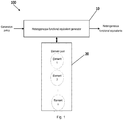
- Fig. 1 shows an apparatus for generating heterogeneous functional equivalent 100.
- the apparatus 100 includes an element pool 20 including a plurality of elements, and a heterogeneous functional equivalent generator 10.
- Each element in the element pool 20 is a basic unit for generating a heterogeneous functional equivalent.
- the element pool includes at least one element such as element 1, element 2, ..., element n, and so on.
- Each element may be a system, a subsystem, a module, a function, a middleware, a component, etc.
- each element is a software, hardware, or software/hardware apparatus with a certain function.
- the heterogeneous functional equivalent generator 10 is configured to obtain a generation policy, where the generation policy includes a function list for selecting an element according to a function and the number of to-be-generated heterogeneous functional equivalents.
- the function list is a set of several functions included in the to-be-generated heterogeneous functional equivalents.
- the heterogeneous functional equivalent generator 10 is further configured to select element sets corresponding to the number from the element pool 20 according to the generation policy, where each of the element sets is a set including at least one element for constructing a heterogeneous functional equivalent.
- the heterogeneous functional equivalent generator 10 is further configured to generate the number of heterogeneous functional equivalents based on the selected element sets.
- different elements are selected from an element pool according to a generation policy, and these elements are combined to generate a plurality of different heterogeneous functional equivalents, so that sufficient heterogeneous functional equivalents are available to a heterogeneous redundant system, which resolves a problem in generating a heterogeneous functional equivalent in the heterogeneous redundant system.
- a particular number of element sets are selected from an element pool according to a certain generation policy, so that generated heterogeneous functional equivalents are flexible and variable, which prevents an unknown defect, e.g., a trapdoor or a backdoor, in a network apparatus from being snooped and attacked, and improves network system security.
- an unknown defect e.g., a trapdoor or a backdoor
- the apparatus further includes a template pool 30 including at least one template
- the generation policy further includes at least one template selected from the template pool, e.g., template 1, template 2, ..., or template n, and each template is used to generate a heterogeneous functional equivalent.
- the generated heterogeneous functional equivalent may be implemented by software, hardware, or a combination thereof. A specific implementation may be determined according to a system implementation.
- the heterogeneous functional equivalent is implemented in various manners, and is output to outside by the heterogeneous functional equivalent generator.
- different elements are selected from an element pool according to a generation policy, and these elements are combined to generate a plurality of different heterogeneous functional equivalents, so that sufficient heterogeneous functional equivalents are available to a heterogeneous redundant system, which resolves problem in generating a heterogeneous functional equivalent generation in the heterogeneous redundant system.
- a particular number of element sets are selected from an element pool according to a certain generation policy, so that generated heterogeneous functional equivalents are flexible and variable, which prevents an unknown defect, e.g., a trapdoor or a backdoor, in a network apparatus from being snooped and attacked, and improves network system security.
- an unknown defect e.g., a trapdoor or a backdoor
- the apparatus further includes a template pool 30 including at least one template
- the generation policy further includes at least one template selected from the template pool 30.
- the heterogeneous functional equivalent generator 10 is further configured to combine or compile the element sets selected from the element pool 20 and the selected at least one template, to generate the number of heterogeneous functional equivalents. Different templates are selected from the template pool, so that the generated heterogeneous functional equivalents are more stable and secure.
- the heterogeneous functional equivalent generator receives a generation policy that is input from outside, including a heterogeneous functional equivalent template, a function list, and a generation number.
- the heterogeneous functional equivalent template indicates the remaining part in a heterogeneous functional equivalent upon removal of functions in the function list from the heterogeneous functional equivalent, e.g., the remaining part in a software code engineering upon removal of several function implementation files.
- the function list indicates a set of function attributes included in heterogeneous functional equivalents. For example, a heterogeneous functional equivalent in accordance with an OSPF routing protocol includes function attributes such as route calculation and link state maintenance.
- the generation number is the number of heterogeneous functional equivalents needing to be generated.
- the template includes a same template or different templates, and the different templates are different templates used to generate heterogeneous functional equivalents with a same function. Because each heterogeneous functional equivalent is formed by combining or compiling at least one element by using a template, different templates enable the generated heterogeneous functional equivalents to include a plurality of functions, and accordingly to provide different functions according to exterior services, while the exterior structures of these heterogeneous functional equivalents are the same, and function switching is performed only in the heterogeneous functional equivalents. Therefore, the capability of the heterogeneous functional equivalents in resisting intrusion and attack is enhanced, and network security is further improved.
- heterogeneous functional equivalent generator is specifically further configured to search in the element pool according to the function list in the generation policy, and select the element sets corresponding to the number.
- the function list in the generation policy elements in the element pool are classified according to different functions, thereby making it convenient to search for and find an element for generating a heterogeneous functional equivalent.
- the heterogeneous functional equivalent generator is specifically further configured to obtain the attribute value of each element and the heterogeneous degree between any two elements in the element pool, and the attribute value of the template and the heterogeneous degree between two templates; and to select the element sets corresponding to the number from the element pool according to the generation policy, the attribute value of each element and the heterogeneous degree between any two same-function elements, and the attribute value of the template and the heterogeneous degree between the two templates.
- the attribute value of each element includes reliability, complexity, or use frequency of each element, and the heterogeneous degree is a difference degree between any two elements with a same function.
- the generated heterogeneous functional equivalents are of higher quality as for the overall attribute by calculating the attribute value of each element, the heterogeneous degree between two elements, and the attribute value of the selected template and the heterogeneous degree between different templates, and the capability of the heterogeneous functional equivalents in resisting external attack and snooping is enhanced.
- the heterogeneous functional equivalent generator is configured to obtain the generation policy by reception from outside, generation from inside, or in a manner of combining reception from outside and generation from inside.
- the generated generation policy is random and variable, which prevents the generation policy from being easily attacked or intruded due to a monotonous mode.
- the "from outside” includes input from outside, or a case where a policy generation apparatus is started as triggered by an exterior service request, and sends a generated policy to the heterogeneous functional equivalent generator.
- the "from inside” includes a case where all generation policies are stored in an internal generation policy database, and a generation policy is randomly or selectively invoked therefrom as triggered by an external request.
- the manner of combining reception from outside and generation from inside includes a case where a set of parameters are input from outside, and the generator performs calculation according to the set of parameters to generate a generation policy for generating a heterogeneous functional equivalent.
- an element and a template for generating a heterogeneous functional equivalent are selected with further reference to the attribute value of each element and the heterogeneous degree between any two elements, and the attribute value of the template and the heterogeneous degree between two templates.
- a specific reference-based selection process is as follows:
- the element set with the highest single-element-set attribute value is selected during selection based on attribute values, in order to achieve higher quality of the generated heterogeneous functional equivalents, where the single-element-set attribute value is the sum of attribute values of all elements in the element set.
- the attribute values of all element sets are compared and the heterogeneous degree between any two element sets is compared with the heterogeneous degree between other two element sets, and two elements or element sets having a higher heterogeneous degree are selected.
- the heterogeneous functional equivalent generator calculates the attribute value of each element and the heterogeneous degree between two elements, and the attribute value of a selected template and the heterogeneous degree between different templates, so that generated heterogeneous functional equivalents are of higher quality as for the overall attribute, and the capability of the heterogeneous functional equivalents in resisting external attack and snooping is enhanced.
- heterogeneous functional equivalent generator uses an internally preset generation policy.
- a process of generating the five heterogeneous functional equivalents is as follows:
- the generator obtains, according to the generation policy, all element sets that can be used to generate heterogeneous functional equivalents, where each element set corresponds to one heterogeneous functional equivalent.
- each element set corresponding to one heterogeneous functional equivalent
- the heterogeneous degrees between element sets are evaluated according to the attribute values of current elements and the heterogeneous degrees between the elements.
- element sets that can achieve optimal indexes of attribute value and heterogeneous degree are selected from the element pool.
- an element set A includes elements A1 and A2
- an element set B includes B1 and B2.
- the attribute values (which may be understood as metric value of reliability) of the elements A1, A2, B1, and B2 are x1, x2, y1, and y2.
- the elements A1 and B1 have a same function, and the heterogeneous degree therebetween is q(A1, B1).
- the elements A2 and B2 have a same function, and the heterogeneous degree therebetween is q(A2, B2).
- the attribute value of the element set A may be defined as x1+x2
- the attribute value of the element set B may be defined as y1+y2
- the heterogeneous degree between the element sets A and B may be defined as q(A1, B1)+q(A2, B2).
- the element set with a higher attribute value is selected as the element set for generating a heterogeneous functional equivalent.
- elements corresponding to a higher one of the two values are selected to generate a heterogeneous functional equivalent. For example, if q(A1, B1)>q(A2, B2), the elements A1 and B1 are selected as the elements for generating a heterogeneous functional equivalent.
- heterogeneous functional equivalent generator is specifically further configured to search in the element pool according to the function list in the generation policy, and select element unit sets corresponding to the number.
- the generated heterogeneous functional equivalents are formed of a set including two or more element unit sets
- the heterogeneous degrees between the element unit sets and attribute values of the element unit sets are also compared.
- the specific comparison process is the same as the process of comparing heterogeneous degrees for the individual elements and attribute values of the individual elements, and more detailed description is omitted herein.
- the attribute value and heterogeneous degree are calculated for element units, element unit sets, sets including element unit sets, and the element unit, the element unit set, and the set including element unit sets corresponding to the highest values are selected, so that the selected element unit is optimal, and accordingly the generated heterogeneous functional equivalent has an optimal function so as to provides a better service for an external request.
- This embodiment further provides a method for generating heterogeneous functional equivalent, corresponding to the apparatus embodiment.
- the method includes: Step 301: obtaining, by a heterogeneous functional equivalent generator, a generation policy, where the generation policy includes a function list for selecting one or more elements according to a function and the number of to-be-generated heterogeneous functional equivalents.
- the generation policy may be obtained by reception from outside, generation from inside, or in a manner of combining reception from outside and generation from inside.
- Step 302 Selecting element sets, corresponding to the number, from the element pool according to the generation policy, where each of the element sets is a set comprising at least one element for constructing a heterogeneous functional equivalent.
- the selecting of element sets corresponding to the number comprises: searching in the element pool according to the function list in the generation policy, and selecting the element sets corresponding to the number.
- Step 303 Combining the selected element sets to generate the number of heterogeneous functional equivalents.
- different elements are selected from the element pool according to a generation policy, and these elements are combined to generate a plurality of different heterogeneous functional equivalents, so that sufficient heterogeneous functional equivalents are available to a heterogeneous redundant system, which resolves the problem in generating a heterogeneous functional equivalent generation in the heterogeneous redundant system.
- a particular number of element sets are selected from the element pool according to a certain generation policy, so that the generated heterogeneous functional equivalents are flexible and variable, which prevents an unknown defect, e.g., a trapdoor or a backdoor, in a network apparatus from being snooped and attacked, and improves network system security.
- an unknown defect e.g., a trapdoor or a backdoor
- combining the selected element sets to generate the number of heterogeneous functional equivalents includes: combining or compiling the element sets selected from the element pool and the selected at least one template, to generate the number of heterogeneous functional equivalents.
- the template includes a same template or different templates, and the different templates are different templates used to generate heterogeneous functional equivalents with a same function. Different templates are selected from the template pool, so that the generated heterogeneous functional equivalents are more stable and secure.
- selecting element sets corresponding to the number from the element pool according to the generation policy further includes:
- the attribute value of an element set is a weighted value or an extreme value of the attribute values of all elements in the element set, and the attribute value of each element unit includes reliability, complexity, or use frequency of the element unit.
- the heterogeneous degree between two element sets is a weighted value or an extreme value of heterogeneous degrees of element unit pairs corresponding to each of all functions in the both function sets, and the heterogeneous degree between element units is the difference degree between the two element units with a same function.
- the generated heterogeneous functional equivalents can have a better overall attribute value.
- the generated heterogeneous functional equivalents can have a better overall heterogeneous degree. Therefore, according to the apparatus and the method, not only a large number of heterogeneous functional equivalents but also the heterogeneous functional equivalents with high quality can be generated.
- an embodiment of this application provides an element pool.
- the element pool is connected to the heterogeneous functional equivalent generator, and configured to provide an element set to the heterogeneous functional equivalent generator according to the generation policy.
- the element pool includes at least one element, each element has a function, and the element set is a set including at least one element for constructing a heterogeneous functional equivalent.
- a template pool is further provided.
- the template pool is connected to the heterogeneous functional equivalent generator, and configured to provide a template, which is equivalent to a frame structure for combining selected elements, to the heterogeneous functional equivalent generator.
- the template pool includes at least one template, and each template is used to combine or compile the elements selected from the element pool, so that the generated heterogeneous functional equivalents have at least one function.
- a heterogeneous functional equivalent generator 400 includes a transceiver 401 and a processor 402.
- the transceiver 401 is configured to obtain a generation policy via an antenna 4011, where the generation policy includes a function list for selecting an element according to a function and the number of to-be-generated heterogeneous functional equivalents.
- the processor 402 is configured to select the element sets corresponding to the number from the element pool according to the generation policy, and generate the number of heterogeneous functional equivalents based on the selected element sets, where each of the element sets is a set including at least one element for constructing a heterogeneous functional equivalent.
- the processor is further configured to combine or compile the element sets selected from the element pool and the selected at least one template, to generate the number of heterogeneous functional equivalents.
- the processor 402 is configured to select the element sets corresponding to the number from the element pool according to the generation policy, the attribute value of each element and the heterogeneous degree between any two elements with a same function, and the attribute value of the template and the heterogeneous degree between two templates, where the attribute value of each element includes reliability, complexity, or use frequency of each element, and the heterogeneous degree is the difference degree between any two elements with a same function.
- the processor 402 may be, e.g., a central processing unit (CPU), a network processor (NP), or a combination thereof.
- the processor may further include a hardware chip.
- the hardware chip may be an application-specific integrated circuit (ASIC), a programmable logic device (PLD), or a combination thereof.
- the PLD may be a complex programmable logic device (CPLD), a field-programmable gate array (FPGA), a generic array logic (GAL) device, or any combination thereof.
- the generator further includes a memory 403, where the memory 403 is configured to store the generation policy and the generated heterogeneous functional equivalents; and the transceiver 401 is further configured to output the generated heterogeneous functional equivalents.
- the memory 403 further includes: an attribute value database 4031 and a heterogeneous degree database 4032.
- the attribute value database 4031 is configured to store the attribute value of each element in the element pool; and the heterogeneous degree database 4032 is configured to store the heterogeneous degree between any two elements with the same function.
- the processor 402 is further configured to calculate the attribute value of an element set according to the attribute value of each element, and calculate the heterogeneous degree between two element sets with the same function.
- the memory 403 may be a volatile memory, a non-volatile memory, or a combination thereof.
- the volatile memory may be a random-access memory (RAM).
- the non-volatile memory may be a read-only memory (ROM), a flash memory, a hard disk drive (HDD), or a solid-state drive (SSD).
Landscapes
- Engineering & Computer Science (AREA)
- Computer Security & Cryptography (AREA)
- Computer Hardware Design (AREA)
- General Engineering & Computer Science (AREA)
- Signal Processing (AREA)
- Computer Networks & Wireless Communication (AREA)
- Computing Systems (AREA)
- Theoretical Computer Science (AREA)
- Software Systems (AREA)
- General Health & Medical Sciences (AREA)
- Health & Medical Sciences (AREA)
- Virology (AREA)
- General Physics & Mathematics (AREA)
- Physics & Mathematics (AREA)
- Multimedia (AREA)
- Technology Law (AREA)
- Data Exchanges In Wide-Area Networks (AREA)
- Organic Low-Molecular-Weight Compounds And Preparation Thereof (AREA)
Applications Claiming Priority (2)
| Application Number | Priority Date | Filing Date | Title |
|---|---|---|---|
| CN201610856793.6A CN106549935A (zh) | 2016-09-27 | 2016-09-27 | 一种异构功能等价体生成装置及方法 |
| PCT/CN2017/100197 WO2018059187A1 (zh) | 2016-09-27 | 2017-09-01 | 一种异构功能等价体生成装置及方法 |
Publications (2)
| Publication Number | Publication Date |
|---|---|
| EP3445014A1 true EP3445014A1 (de) | 2019-02-20 |
| EP3445014A4 EP3445014A4 (de) | 2019-12-04 |
Family
ID=58368311
Family Applications (1)
| Application Number | Title | Priority Date | Filing Date |
|---|---|---|---|
| EP17854638.8A Withdrawn EP3445014A4 (de) | 2016-09-27 | 2017-09-01 | Vorrichtung und verfahren zur erzeugung von heterogenen funktionsäquivalenten |
Country Status (4)
| Country | Link |
|---|---|
| US (1) | US11201895B2 (de) |
| EP (1) | EP3445014A4 (de) |
| CN (1) | CN106549935A (de) |
| WO (1) | WO2018059187A1 (de) |
Families Citing this family (9)
| Publication number | Priority date | Publication date | Assignee | Title |
|---|---|---|---|---|
| CN106549935A (zh) * | 2016-09-27 | 2017-03-29 | 上海红阵信息科技有限公司 | 一种异构功能等价体生成装置及方法 |
| CN107358105B (zh) * | 2017-06-01 | 2020-05-29 | 珠海高凌信息科技股份有限公司 | 异构功能等价体相异性测量方法,分配方法、装置及设备 |
| CN107347066B (zh) * | 2017-07-05 | 2019-08-20 | 中国人民解放军信息工程大学 | 一种功能等价体异构度最大化调度方法及装置 |
| CN107395414B (zh) * | 2017-07-19 | 2020-07-28 | 上海红阵信息科技有限公司 | 一种基于输出裁决的负反馈控制方法及系统 |
| CN108366049B (zh) * | 2018-01-15 | 2020-08-18 | 中国人民解放军战略支援部队信息工程大学 | 一种异构功能等价执行体的实现方法 |
| CN109525594B (zh) * | 2018-12-24 | 2021-03-23 | 中国人民解放军战略支援部队信息工程大学 | 一种异构冗余网络中后门部署方法及装置 |
| CN110610068B (zh) * | 2019-09-16 | 2021-11-23 | 郑州昂视信息科技有限公司 | 一种应用异构化的方法及装置 |
| CN111079151B (zh) * | 2019-12-12 | 2022-02-08 | 中国联合网络通信集团有限公司 | 异构体生成方法、服务器和计算机可读介质 |
| CN114257519B (zh) * | 2021-11-02 | 2023-05-16 | 中国人民解放军战略支援部队信息工程大学 | 多功能等价执行体系统的异构度评估方法及装置 |
Family Cites Families (14)
| Publication number | Priority date | Publication date | Assignee | Title |
|---|---|---|---|---|
| US6243851B1 (en) * | 1998-03-27 | 2001-06-05 | Xilinx, Inc. | Heterogeneous method for determining module placement in FPGAs |
| US8260907B2 (en) * | 2002-04-04 | 2012-09-04 | Ca, Inc. | Methods, systems and computer program products for triggered data collection and correlation of status and/or state in distributed data processing systems |
| US8434059B2 (en) * | 2009-05-01 | 2013-04-30 | Apple Inc. | Systems, methods, and computer-readable media for fertilizing machine-executable code |
| WO2011116446A1 (en) | 2010-03-24 | 2011-09-29 | Irdeto Canada Corporation | System and method for random algorithm selection to dynamically conceal the operation of software |
| CN102801750B (zh) * | 2011-05-26 | 2015-03-18 | 上海红神信息技术有限公司 | 一种云计算目标系统构建方法 |
| CN103368858B (zh) | 2012-04-01 | 2016-01-20 | 百度在线网络技术(北京)有限公司 | 多策略组合加载的流量清洗方法及装置 |
| US9170790B2 (en) * | 2012-12-06 | 2015-10-27 | International Business Machines Corporation | Replacing annotated program code in a networked computing environment |
| CN104252391B (zh) * | 2013-06-28 | 2017-09-12 | 国际商业机器公司 | 用于在分布式计算系统中管理多个作业的方法和装置 |
| US9003511B1 (en) * | 2014-07-22 | 2015-04-07 | Shape Security, Inc. | Polymorphic security policy action |
| CN106156631B (zh) | 2015-06-01 | 2019-03-12 | 上海红神信息技术有限公司 | 一种服务功能与结构表征对应关系不确定的软硬件装置 |
| CN108700864B (zh) * | 2016-01-11 | 2021-05-07 | 西门子股份公司 | 可编程逻辑控制器中网络攻击弹性控制的程序随机化 |
| EP3440542B1 (de) * | 2016-03-09 | 2021-04-28 | Shape Security, Inc. | Anwendung von bytecode-verschleierungstechniken auf programme, die in einer interpretierten sprachen geschrieben sind |
| CN106549935A (zh) | 2016-09-27 | 2017-03-29 | 上海红阵信息科技有限公司 | 一种异构功能等价体生成装置及方法 |
| CN110134428B (zh) * | 2018-02-09 | 2024-02-06 | 中兴通讯股份有限公司 | 一种安全防护方法及装置 |
-
2016
- 2016-09-27 CN CN201610856793.6A patent/CN106549935A/zh active Pending
-
2017
- 2017-09-01 WO PCT/CN2017/100197 patent/WO2018059187A1/zh not_active Ceased
- 2017-09-01 EP EP17854638.8A patent/EP3445014A4/de not_active Withdrawn
- 2017-09-01 US US16/330,691 patent/US11201895B2/en active Active
Also Published As
| Publication number | Publication date |
|---|---|
| CN106549935A (zh) | 2017-03-29 |
| US11201895B2 (en) | 2021-12-14 |
| WO2018059187A1 (zh) | 2018-04-05 |
| US20210288975A1 (en) | 2021-09-16 |
| EP3445014A4 (de) | 2019-12-04 |
Similar Documents
| Publication | Publication Date | Title |
|---|---|---|
| US11201895B2 (en) | Apparatus for generating heterogeneous functional equivalent and method thereof | |
| US11856016B2 (en) | Systems and methods for controlling declutter of a security events graph | |
| US20250280016A1 (en) | Cloud content scanning using locally deployed containerized scanners | |
| US10616196B1 (en) | User authentication with multiple authentication sources and non-binary authentication decisions | |
| US10686807B2 (en) | Intrusion detection system | |
| CN114788228B (zh) | 检测暴力攻击 | |
| Garetto et al. | Modeling malware spreading dynamics | |
| EP4027276B1 (de) | Anomaliedetektion basierend auf einem ereignisbaum | |
| JP2024538102A (ja) | 適応型ネットワーク攻撃予測システム | |
| US20120047581A1 (en) | Event-driven auto-restoration of websites | |
| US20190281072A1 (en) | Asset discovery using established network connections of known assets | |
| US9742769B2 (en) | Method and system for determining trusted wireless access points | |
| EP3607698A1 (de) | Detektion von anomalem schlüsselmaterial | |
| WO2022099115A1 (en) | System and method for machine learning assisted security analysis of 5g network connected systems | |
| EP3220598B1 (de) | Verarbeitung von zertifikatvalidierungswarnungen | |
| US20240137390A1 (en) | Security Events Graph for Alert Prioritization | |
| Maaloul et al. | Vertical handover decision policy based on the end user's perceived quality of service | |
| CN107005558B (zh) | 基于位置的用户歧义消除 | |
| CN107358105B (zh) | 异构功能等价体相异性测量方法,分配方法、装置及设备 | |
| Liu et al. | Virus infection control in online social networks based on probabilistic communities | |
| EP4118807B1 (de) | Vorrichtung und verfahren zur anomaliedetektion | |
| KR102179854B1 (ko) | 소진성 네트워크 자원의 사용 방법 및 장치 | |
| CN117692169A (zh) | 风险识别方法、装置、电子设备及存储介质 | |
| US20220385681A1 (en) | Conditional security measures using rolling set of risk scores | |
| US20260134108A1 (en) | Identifying cybersecurity risks using graph expansion and fluents |
Legal Events
| Date | Code | Title | Description |
|---|---|---|---|
| STAA | Information on the status of an ep patent application or granted ep patent |
Free format text: STATUS: THE INTERNATIONAL PUBLICATION HAS BEEN MADE |
|
| PUAI | Public reference made under article 153(3) epc to a published international application that has entered the european phase |
Free format text: ORIGINAL CODE: 0009012 |
|
| STAA | Information on the status of an ep patent application or granted ep patent |
Free format text: STATUS: REQUEST FOR EXAMINATION WAS MADE |
|
| 17P | Request for examination filed |
Effective date: 20181113 |
|
| AK | Designated contracting states |
Kind code of ref document: A1 Designated state(s): AL AT BE BG CH CY CZ DE DK EE ES FI FR GB GR HR HU IE IS IT LI LT LU LV MC MK MT NL NO PL PT RO RS SE SI SK SM TR |
|
| AX | Request for extension of the european patent |
Extension state: BA ME |
|
| A4 | Supplementary search report drawn up and despatched |
Effective date: 20191031 |
|
| RIC1 | Information provided on ipc code assigned before grant |
Ipc: H04L 29/06 20060101ALI20191025BHEP Ipc: G06F 21/14 20130101AFI20191025BHEP |
|
| DAV | Request for validation of the european patent (deleted) | ||
| DAX | Request for extension of the european patent (deleted) | ||
| STAA | Information on the status of an ep patent application or granted ep patent |
Free format text: STATUS: EXAMINATION IS IN PROGRESS |
|
| 17Q | First examination report despatched |
Effective date: 20201009 |
|
| STAA | Information on the status of an ep patent application or granted ep patent |
Free format text: STATUS: THE APPLICATION HAS BEEN WITHDRAWN |
|
| 18W | Application withdrawn |
Effective date: 20211108 |