EP3445192B1 - Vêtement pour système de harnais - Google Patents
Vêtement pour système de harnais Download PDFInfo
- Publication number
- EP3445192B1 EP3445192B1 EP16899686.6A EP16899686A EP3445192B1 EP 3445192 B1 EP3445192 B1 EP 3445192B1 EP 16899686 A EP16899686 A EP 16899686A EP 3445192 B1 EP3445192 B1 EP 3445192B1
- Authority
- EP
- European Patent Office
- Prior art keywords
- front layer
- garment
- harness
- inner front
- straps
- Prior art date
- Legal status (The legal status is an assumption and is not a legal conclusion. Google has not performed a legal analysis and makes no representation as to the accuracy of the status listed.)
- Not-in-force
Links
Images






Classifications
-
- A—HUMAN NECESSITIES
- A41—WEARING APPAREL
- A41D—OUTERWEAR; PROTECTIVE GARMENTS; ACCESSORIES
- A41D11/00—Garments for children
-
- A—HUMAN NECESSITIES
- A41—WEARING APPAREL
- A41D—OUTERWEAR; PROTECTIVE GARMENTS; ACCESSORIES
- A41D13/00—Professional, industrial or sporting protective garments, e.g. surgeons' gowns or garments protecting against blows or punches
- A41D13/0007—Garments with built-in harnesses
-
- A—HUMAN NECESSITIES
- A41—WEARING APPAREL
- A41D—OUTERWEAR; PROTECTIVE GARMENTS; ACCESSORIES
- A41D27/00—Details of garments or of their making
-
- A—HUMAN NECESSITIES
- A41—WEARING APPAREL
- A41D—OUTERWEAR; PROTECTIVE GARMENTS; ACCESSORIES
- A41D27/00—Details of garments or of their making
- A41D27/02—Linings
- A41D27/04—Removable linings
-
- A—HUMAN NECESSITIES
- A41—WEARING APPAREL
- A41D—OUTERWEAR; PROTECTIVE GARMENTS; ACCESSORIES
- A41D27/00—Details of garments or of their making
- A41D27/18—Cloth collars
-
- A—HUMAN NECESSITIES
- A41—WEARING APPAREL
- A41D—OUTERWEAR; PROTECTIVE GARMENTS; ACCESSORIES
- A41D3/00—Overgarments
- A41D3/02—Overcoats
-
- B—PERFORMING OPERATIONS; TRANSPORTING
- B32—LAYERED PRODUCTS
- B32B—LAYERED PRODUCTS, i.e. PRODUCTS BUILT-UP OF STRATA OF FLAT OR NON-FLAT, e.g. CELLULAR OR HONEYCOMB, FORM
- B32B3/00—Layered products comprising a layer with external or internal discontinuities or unevennesses, or a layer of non-planar shape; Layered products comprising a layer having particular features of form
- B32B3/02—Layered products comprising a layer with external or internal discontinuities or unevennesses, or a layer of non-planar shape; Layered products comprising a layer having particular features of form characterised by features of form at particular places, e.g. in edge regions
- B32B3/06—Layered products comprising a layer with external or internal discontinuities or unevennesses, or a layer of non-planar shape; Layered products comprising a layer having particular features of form characterised by features of form at particular places, e.g. in edge regions for securing layers together; for attaching the product to another member, e.g. to a support, or to another product, e.g. groove/tongue, interlocking
-
- B—PERFORMING OPERATIONS; TRANSPORTING
- B32—LAYERED PRODUCTS
- B32B—LAYERED PRODUCTS, i.e. PRODUCTS BUILT-UP OF STRATA OF FLAT OR NON-FLAT, e.g. CELLULAR OR HONEYCOMB, FORM
- B32B7/00—Layered products characterised by the relation between layers; Layered products characterised by the relative orientation of features between layers, or by the relative values of a measurable parameter between layers, i.e. products comprising layers having different physical, chemical or physicochemical properties; Layered products characterised by the interconnection of layers
- B32B7/02—Physical, chemical or physicochemical properties
- B32B7/022—Mechanical properties
-
- B—PERFORMING OPERATIONS; TRANSPORTING
- B60—VEHICLES IN GENERAL
- B60R—VEHICLES, VEHICLE FITTINGS, OR VEHICLE PARTS, NOT OTHERWISE PROVIDED FOR
- B60R22/00—Safety belts or body harnesses in vehicles
- B60R22/10—Safety belts or body harnesses in vehicles specially adapted for children or animals
- B60R22/105—Safety belts or body harnesses in vehicles specially adapted for children or animals for children
-
- A—HUMAN NECESSITIES
- A41—WEARING APPAREL
- A41D—OUTERWEAR; PROTECTIVE GARMENTS; ACCESSORIES
- A41D2400/00—Functions or special features of garments
- A41D2400/80—Friction or grip reinforcement
-
- B—PERFORMING OPERATIONS; TRANSPORTING
- B32—LAYERED PRODUCTS
- B32B—LAYERED PRODUCTS, i.e. PRODUCTS BUILT-UP OF STRATA OF FLAT OR NON-FLAT, e.g. CELLULAR OR HONEYCOMB, FORM
- B32B2437/00—Clothing
Definitions
- the invention relates to to a garment wearable by an individual using a harness system for a permanent or removable vehicle seat. More particularly, it relates to to a garment adapted to keep an individual warm in a vehicle seat, but compensating against the loss of safety that may be inherent in conventional garments.
- a vehicle restraint system such as a seat belt, is designed to secure the occupant of a vehicle against harmful movement that may result during a collision or a sudden stop.
- the restraint system may include a lap belt that goes over the waist.
- the restraint system may also include a shoulder harness that goes diagonally over the vehicle occupant's outboard shoulder and is buckled inboard of his or her lap.
- the shoulder harness may attach to the lap belt tongue, or it may have a tongue and buckle completely separate from those of the lap belt.
- a child restraint system also commonly referred to as a child safety seat or a car seat, is a restraint which is secured to the seat of an automobile or other vehicle equipped with safety harnesses or seat belts, to hold a child in the event of a crash.
- Child safety seats provide passive restraints and must be properly used to be effective. However, many child safety restraints are not used properly.
- the chest clips of the harness should be placed even with the child's armpits. However, often the chest clips are placed on the child either too low (e.g., near the abdomen) or too high (e.g., near the neck) on the child. This may happen if parents are inexperienced or do not pay enough attention. In some cases, the chest clips may be originally placed in the correct position on the child but gradually slid away from the desired position during transport.
- the straps of the harness should lie flat against the child's chest and over his or her hips with no slack. Failing to tightly secure the child's car-seat straps can result in a child being jostled too much or becoming completely displaced in a crash. This poses a significant risk in winter or other cold environments when loose or bulky garments can affect the fit of the car seat to the child and can interfere with the proper function of the restraint system. When a child is wearing a winter coat, it may feel like he or she is strapped snugly into a car seat when the straps are actually dangerously loose.
- the average puffy coat/snowsuit may add about 4 inches of slack into the child's harness straps, which bulk can significantly increase the risk of injury, especially the risk of head injury.
- bulk creates slack, and a child in a car seat may wiggle and/or play with the restraint system of the car seat, and slide his or her arms out of the straps. This can cause potential harm to the child and distract the driver.
- a puffy garment may also pose a safety risk because there may be slack in the seat belts between the wearer's body and the webbing.
- U.S. Patent No. 8,118,364 disclosed a travel blanket that can be placed upon an infant in a car seat.
- U.S. Patent No. 8,225,422 discloses a clothing for a child in a car seat, the clothing having two parts, a body having an always-open area and a blanket that is sized to form a covering over the always-open area.
- the blankets may become loose and/or the child may pull the blanket off.
- U.S. Patent No. 6,408,439 discloses a garment having an upper portion that can be wrapped around a child's torso from the front while the child is seated in a car seat.
- the garment is essentially a front covering, which lacks appearance of regular clothing that may be worn by a child not sitting a car seat.
- U.S. Pub. No. 2013/0007940 discloses an infant garment with an open back for placement on an infant while positioned in a car seat. Similarly, this rear-opening garment is specially designed for car seat, lacking the appearance of a regular clothing for a child not in a car seat.
- U.S. Pub. No. 2010/0115685 discloses a jacket-type garment without a front closure to prevent a child in a car seat from move his or her arms out of the harness straps. However, the disclosed garment must be permanently attached to the car seat.
- 2005/0017566 discloses a child's garment having a rear portion that is worn like a vest but does not cover the chest area of the child, and a front portion that is attached to the rear portion to help retain the position of the belts of the car seat and prevent a child from wiggling out of the belts. Nonetheless, the front portion and the rear portion are detached from each other and they must be assembled manually to cover the child in a car seat.
- the foregoing patent documents are hereby incorporated in their entireties for all purposes.
- US 2015/181953 A1 discloses a wearable garment according to the preamble of claim 1.
- a child's garment that has an appropriate appearance, warmth, and comfort, and which is easy to be donned for the child both in and out of a car seat, which can be worn in a car seat but allowing for proper attachment of the restraint system. More generally, there is a need for a garment wearable by an individual using a harness system for a vehicle seat, wherein the garment is adapted to snuggly receive one or more harness straps of the harness system so as to reduce slack in the harness straps.
- the garment according to claim 1 overcomes problems in the prior art and addresses one or more of the aforementioned or other needs.
- the invention is a garment wearable by an individual using a harness system of a vehicle seat, such as a fixed seat or a removable car seat for a child.
- the garment has an inner front layer and an adjacent outer front layer, wherein the outer front layer has a higher compressibility than the inner front layer, and the garment is adapted to receive one or more harness straps of the harness system between the inner front layer and the outer front layer when the one or more harness straps are routed from a shoulder region to a waist region of the garment, and when so routed, the one or more harness straps lie flush against at least a chest area of the inner front layer.
- the garment further includes an inner collar corresponding to at least a posterior region of left and/or right sides of the individual's neck and an outer collar corresponding to at least an anterior region of left and/or right sides of an individual's neck, wherein the inner collar overlaps with the outer collar on left and/or right sides of the individual's neck so as to form left and/or right channels for respectively receiving the one or two harness straps routed over left and/or right shoulder regions of the individual.
- the inner front layer may have a left edge joining a left panel of the outer front layer and a right edge joining a right panel of the outer front layer, wherein a spatial distance between the left edge and the right edge may be progressively wider from the waist region to the left and right shoulder regions of the garment, and the spatial distance is sufficiently wide so as to accommodate the one or more harness straps.
- the inner front layer has a first thickness when no force is applied via the one or more harness straps, and a second thickness in response to a predetermined force applied normally to the inner front layer via the one or more harness straps, and the ratio of the second thickness to the first thickness may be greater than a first predefined ratio.
- the outer front layer has a first thickness when no force is applied and a second thickness in response to a predetermined force applied normally to the outer front layer, and the ratio of the second thickness to the first thickness may be less than a second predefined ratio.
- the outer front layer may have a closable opening.
- the opening in the outer front layer is opened and closed by a zipper.
- the opening in the outer front layer may be sufficiently opened so as to expose and allow access to the one or more harness straps fastened over the inner front layer. In certain embodiments, the opening in the outer front layer may be sufficiently closed so as to cover and inhibit access to the one or more harness straps fastened over the inner front layer.
- the inner front layer may have an alignment marker for aligning a cross member of the harness system that interconnects a pair of vertically oriented harness straps that lie flush against at least the chest area of the inner front layer.
- the alignment marker may have a non-slip exterior surface area arranged to receive a portion of the pair of vertically oriented harness straps.
- the inner front layer may have a non-slip exterior surface extending from the shoulder region to the waist region.
- a first harness strap is received in the left channel and extends from the left shoulder region to left waist region of the garment
- a second harness strap is received in the right channel and extends from the right shoulder region to right waist region of the garment, and both the first and second harness straps lie flush against the chest area of the inner front layer.
- only one harness strap is received in the left or right channel and extends from the left or right shoulder region to an opposite-side waist region of the garment, and the harness strap lies flush against the chest area of the inner front layer.
- the harness strap is adapted to interconnect with a lap strap of the harness system at the opposite-side waist region of the garment, wherein the lap strap is routed from left waist region to right waist region of the garment.
- the garment in another embodiment, includes an inner front layer and an adjacent outer front layer, wherein the outer front layer may include a left panel, a right panel, and a coupling member adapted to join or separate the left panel and the right panel, wherein the inner front layer may have a left edge joining the left panel of the outer front layer, and a right edge joining the right panel of the outer front layer, wherein a spatial distance between the left edge and the right edge may be sufficiently wide so as to accommodate one or more harness straps of the harness system when the one or more harness straps are routed from a shoulder region to a waist region of the garment, and when so routed, the one or more harness straps lie flush against at least a chest area of the inner front layer.
- the outer front layer has a higher compressibility than the inner front layer.
- the inner front layer has a first thickness when no force is applied via the one or more harness straps, and a second thickness in response to a predetermined force applied normally to the inner front layer via the one or more harness straps, and the ratio of the second thickness to the first thickness may be greater than a first predefined ratio.
- the outer front layer has a first thickness when no force is applied and a second thickness in response to a predetermined force applied normally to the outer front layer, and the ratio of the second thickness to the first thickness may be less than a second predefined ratio.
- the coupling member may be a zipper.
- the left panel and the right panel of the outer front layer may be sufficiently separated by the coupling member so as to expose and allow access to the one or more harness straps fastened over the inner front layer.
- the left panel and the right panel of the outer front layer may be sufficiently joined by the coupling member so as to cover and inhibit access to the one or more harness straps fastened over the inner front layer.
- the inner front layer may have an alignment marker for aligning a cross member of the harness system that interconnects a pair of vertically oriented harness straps that lie flush against at least the chest area of the inner front layer.
- the alignment marker may have a non-slip exterior surface area arranged to receive a portion of the pair of vertically oriented harness straps.
- the inner front layer may have a non-slip exterior surface extending from the shoulder region to the waist region.
- the garment includes an inner collar corresponding to at least a posterior region of left and/or right sides of the individual's neck and an outer collar corresponding to at least an anterior region of left and/or right sides of the individual's neck, wherein the inner collar overlaps with the outer collar on left and/or right sides of the individual's neck so as to form left and/or right channels for respectively receiving one or two harness straps routed over left and/or right shoulder regions of the individual.
- a first harness strap is received in the left channel and extends from the left shoulder region to left waist region of the garment
- a second harness strap is received in the right channel and extends from the right shoulder region to right waist region of the garment, and both the first and second harness straps lie flush against the chest area of the inner front layer.
- only one harness strap is received in the left or right channel and extends from the left or right shoulder region to an opposite-side waist region of the garment, and the harness strap lies flush against the chest area of the inner front layer.
- the harness strap is adapted to interconnect with a lap strap of the harness system at the opposite-side waist region of the garment, wherein the lap strap is routed from left waist region to right waist region of the garment.
- the garment may include an inner front layer and an adjacent outer front layer, wherein the inner front layer may have a left edge joining a left panel of the outer front layer, and a right edge joining a right panel of the outer front layer, and the garment is configured to snuggly receive one or more harness straps of the harness system between the inner front layer and the outer front layer when the one or more harness straps are routed from a shoulder region to a waist region of the garment, and when so routed, the one or more harness straps may lie flush against a chest area of the inner front layer without substantially overlying the outer front layer when they are tightened.
- the chest area may be between a waist region and left and right shoulder regions of the garment, and each of the one or more harness straps may be routed over an upper surface of left or right shoulder of the individual.
- the outer front layer has a higher compressibility than the inner front layer.
- FIGS. 1-13 Representative embodiments according to the invention are shown in FIGS. 1-13 , wherein the same or generally similar features share common reference numerals.
- the invention is generally directed to an individual's insulated or otherwise bulky garment worn over at least the upper body.
- the garment is adapted to keep the individual warm and comfortable sitting in a vehicle. It also has a utility, appearance and ease of use that are appropriate for when the individual is not sitting in the vehicle. For example, it may have the appearance and functionality of conventional garments and can be easily donned. More particularly, the garment may be a child's jacket, coat, vest, sweater, long coat, raincoat, jumpsuit, or other types of clothing worn over the upper body of the child, and the garment is configured to snuggly receive one or more harness straps of a harness system. A person of ordinary skill of art should understand from the teaching of this application that the garment may be suitable for a child or an adult.
- the harness system may be a standard 5-point harness system used in a child's car seat, or may be a 4-point, 5-point, or 6-point harness system (e.g., including two shoulder straps and two lap belts) used by race car drivers or pilots.
- the harness system may also be a regular vehicle restraint system that includes a shoulder harness, and optionally a lap belt.
- the garment may have various sizes and attributes (e.g., color, pattern, etc.) to accommodate the needs of children with respect to age, gender, size, and styles.
- the garment may have different sizes that can fit the infants, toddlers, and school age children who still need to ride the automobile with a car seat.
- One exemplary such garment is the Road CoatTM, which is designed and manufactured by One Kid LLC, Fairfield, Connecticut.
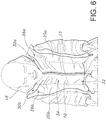
- the garment 1 has a rear portion 5 covering the back of the child's upper body, and a double-layer structure 8 that covers some or all of the front of the child's upper body.
- the double-layer structure 8 includes an inner front layer 10 and an adjacent outer front layer 20.
- the rear portion 5 and the outer front layer 20 may form a unitary piece, or they may be coupled together (e.g., by sewing or any type of fastening means), and collectively they encircle the child's upper body.
- the garment 1 may include a pair of sleeves 2, and/or a hood 3, each of which may be permanently or detachably coupled to the garment 1.
- the inner front layer 10 has an anterior surface and an exterior surface.
- the outer front layer 20 also has an anterior surface and an exterior surface.
- the anterior and/or the exterior surfaces of the inner front layer 10 and/or the outer front layer 20 may be made of the same or different fabric structures and/or materials.
- the fabric may have a woven and/or knit structure, and the fabric material may be cotton, silk, natural or synthetic fibers, nylon, polyester, fleece, wool, or their combinations thereof, to provide desired comfort level and properties such as thermal insulation, windproofness, water-resistance or waterproofness, stain-resistance, breathability, elasticity, cut/tear resistance, or purely aesthetic features.
- the fabric sections may be formed as baffles that hold insulation, such as down or synthetic fill materials.
- one or more pockets 4 may be sewn to the exterior and/or interior surfaces of the inner front layer 10 and/or the outer front layer 20.
- Other clothing accessories and/or decorative elements may be attached to the garment, as known in the art.
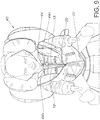
- the garment 1 is adapted to receive one or more harness straps 42 of the car seat 40 between the inner front layer 10 and the outer front layer 20. More specifically, the one or more harness straps 42 may be fastened over the exterior surface of the inner front layer 10, and beneath the interior surface of the outer front layer 20.
- a typical 5-point harness system of the car seat 40 may include a pair of harness clips 44a, 44b (or collectively referenced to chest or harness clips 44), a pair of shoulder straps 48a, 48b, a buckle 46 for receiving and releasing the tongues 45 of the shoulder straps (48a, 48b), a pair of hip straps 49a, 49b, a harness adjuster 47 for adjusting the tightness of the harness straps 42, etc.
- the harness straps 42 may include any of the shoulder straps 48a, 48b, hip straps 49a, 49b, and the harness adjuster 47.
- the outer front layer 20 has a left panel 20a, a right panel 20b and a coupling member 22.
- the left panel 20a and the right panel 20b together may define a closeable opening, and the coupling member 22 is adapted to close or open the opening by joining or separating the left panel 20a and the right panel 20b.
- the coupling member 22 may be a zipper.
- the coupling member 22 may include snaps, a hoop and lock mechanism such as VELCRO®, button(s), buckle(s), clip(s), etc.
- the coupling member 22 of the outer front layer 20 may be located along the outer edges of the left and right panels (20a, 20b) that define the closeable opening.
- the coupling member 22 may be generally parallel to a vertical axis Y, and the left panel 20a and the right panel 20b may be generally symmetric about a midline 14 of the garment.
- the inner front layer 10 may also have a closeable front opening, for example, along a vertical midline 14.
- the front opening of the inner front layer 10 may be opened and/or closed by any kind of coupling mechanism 15 such as zippers, snaps, VELCRO®, button(s), buckle(s), clip(s), etc.
- the inner front layer 10 may not have a closeable front opening. Instead, the inner front layer 10 may have a top opening in the neck region so that it may be put on the child from the top.
- the inner front layer 10 may have a left edge 12a joining the left panel 20a of the outer front layer, and a right edge 12b joining the right panel 20b of the outer front layer.
- the inner front layer 10 may be permanently joined with the outer front layer 20 along the edges (12a 12b), for example, by means of sewing, unitary, seamless weaving or knitting, welding, moulding, or fusing.
- the inner front layer 10 may be attached to the outer front layer 20 along the edges (12a, 12b) by detachable coupling mechanisms such as snaps, zippers, VELCRO®, button(s), buckle(s), clip(s), etc.
- the spatial distance between the left edge 12a and the right edge 12b along a horizontal axis X may define the width (W) of the inner front layer 10. If the inner front layer 10 has a closeable front opening, the width (W) may be measured when the front opening is closed.
- the spatial distance between the left edge 12a and the right edge 12b, or the width (W) of the inner front layer may be relatively narrow in the waist region 32, becoming progressively wider toward the left and right shoulder regions 36a, 36b of the garment.
- a gap or space 35 may be formed between the inner front layer 10 and the outer front layer 20, with the left edge 12a and the right edge 12b respectively defining the left and right boundaries of the gap or space 35.
- this gap or space 35 may be based on the nature of the loose stacking of the front layer 10 against the outer front layer 20.
- the width (W) of the inner front layer 10 may be sufficiently wide to accommodate the harness straps 42 of the car seat, including the shoulder straps 48a, 48b, the hip straps 49a, 49b, and the harness adjuster 47, as well as the chest clips 44 and the buckle 46.
- the width (W) of the inner front layer 10 may be sufficiently wide so that the gap or space between the inner front layer 10 and the outer front layer 20 may be large enough to receive the components of the harness straps 42, including, the shoulder straps 48a, 48b, hip straps 49a, 49b, and harness adjuster 47, as well as the chest clips 44 and the buckle 46.
- the left and right shoulder straps 48a, 48b generally run from the respective left and right should regions 36a, 36b to at least the waist region 32 of the garment, and lie flush against at least a chest area 34 of the inner front layer 10.
- the garment 1 is configured to snuggly receive the harness straps 42 of the car seat 40 between the inner front layer 10 and the outer front layer 20 when left and right shoulder straps 48a, 48b are tightened, so that both the left and right shoulder straps 48a, 48b may lie flush against a chest area 34 of the inner front layer 10 without substantially overlying the outer front layer 20.
- the chest area 34 may be between a waist region 32 and the left and right shoulder regions 36a, 36b of the garment, and the left and right shoulder straps 48a, 48b may be routed over respective upper surfaces 38a, 38b of the left and right shoulders of the child.
- the opening in the outer front layer 20 may be sufficiently opened, e.g., by uncoupling the coupling member 22 and pulling the left panel 20a and right panel 20b apart, so as to expose and allow access to the harness straps 42 fastened over the inner front layer 10, as shown in FIGS. 1 , 5 and 8 .
- This may facilitate a parent to conveniently secure and adjust the harness straps 42 over the child in the car seat or to release the harness straps 42 and remove the child from the car seat.
- the opening in the outer front layer 20 may be sufficiently closed, e.g., by completely joining the left panel 20a and right panel 20b together through the coupling member 22, so as to cover and inhibit access to the harness straps 42 fastened over the inner front layer 10, as shown in FIGS. 5 , 7 and 10 . This may prevent the child from playing with the harness straps 42 and accidently unbuckling the chest clips or loosen the harness straps, and/or sliding his or her arms out of the harness straps 48a, 48b.
- the inner front layer 10 and the outer front layer 20 may be constructed to have desired compressibility to keep the child warm and to improve the safety of the child in a car seat relative to conventional bulky garments.
- Compressibility described herein is a measure of the relative thickness (or volume) change of a garment area as a response to a force applied normally (or pressure) via one or more harness straps to the garment area.
- a force applied normally (or pressure) via one or more harness straps to the garment area.
- a child sitting in car seat will experience a force or pressure when the harness straps become taut against the body.
- slack is taken out and the child may lose the protection from the harness straps.
- the force (F) or pressure applied to the child by the harness straps of the car seat may be predetermined by direct measurement, e.g., using a force or pressure sensor attached to a dummy sitting in a car seat in an automobile crash test, or by theoretical calculations based on physical parameters including the automobile's speed, stopping distance, child's body weight, etc.
- the inner front layer 10 may have a relatively low compressibility, so that when a collision force is applied to the child via the harness straps, the thickness of the inner front layer may not change significantly.
- the inner front layer 10 may have a first thickness (Dil) when no force is applied (i.e., uncompressed), and a second thickness (Di2) in response to a predetermined force or pressure (F) applied normally to the inner front layer 10 (i.e., compressed).
- the ratio of the second thickness to the first thickness (Di2/Dil) may be greater than a first predefined ratio (Ri).
- the ratio Di2/Dil may be between 0 and 1, and it may correlate with the compressibility of the inner front layer 10.
- a higher Di2/Di1 ratio may generally correspond to lower compressibility and a lower Di2/Dil ratio may generally correspond to higher compressibility of the inner front layer 10.
- the outer front layer 20 can have a relatively high compressibility, e.g., due to highly compressible filling materials as described below, so that it may offer good thermal insulation to the child.
- the outer front layer 20 may have a first thickness (Dol) when no force is applied (i.e., uncompressed), and a second thickness (Do2) in response to a predetermined force or pressure (F) applied normally to the inner front layer 10 (i.e., compressed).
- the ratio of the second thickness to the first thickness (Do2/Dol) may be less than a second predefined ratio (Ro).
- the ratio Do2/Do1 may be between 0 and 1, and it may reflect the compressibility of the outer front layer 20.
- a higher Do2/Do1 ratio may generally correspond to lower compressibility and a lower Do2/Do1 ratio may generally correspond to higher compressibility of the outer front layer 20.
- the compressibility of the outer front layer 20 is higher than the compressibility of the inner front layer 10 (Ri). In other words, the outer front layer 20 is more compressible than the inner front layer 10.
- Different types and/or amount of fill material may be used in different parts of the garment 1 (e.g., the rear portion 5, the sleeves 2, the hood 3, the inner front layer 10, the outer front layer 20, etc.) to achieve a desired level of compressibility and thermal insulation for different parts of the garment 1.
- the fill material may be, for example, particles or bats of natural or synthetic down or feathers, vegetable or animal fibers or fur, natural or synthetic fibers such as polyester, foam, or various combinations thereof, as known in the art or to be discovered, that are insulating material suitable for use in garments.
- Each part of the garment 1 may include one or more layers of fabrics.
- baffle constructs may be used in selective parts of the garment 1 to restrict the movement of the fill material.
- the uncompressed outer front layer may have a thickness of 0.25 to 2 inches or thereabout.
- the inner front layer may have a thickness of 0.05 to 0.5 inches or thereabout.
- the ratio Ro2/Rol which reflects the compressibility of the outer front layer 20, may be between 0.1 and 0.5, with uncompressed outer front layer 20 being at least 0.5 inch thick.
- the ratio Ri2/Ril which reflects the compressibility of the inner front layer 10, may be between 0.8 and 1, with uncompressed outer front layer between 0.1 and 0.5 inches.
- the outer front layer may have a thickness of 0.75 inch or thereabout, and the inner front layer may have a thickness of 0.0625 inch or thereabout.
- the exterior surface of the inner front layer 10 may have an alignment marker 16 for aligning a cross member (e.g., the chest clips) of the harness straps 42.
- the vertical location of the alignment marker 16 may generally correspond to the height of armpits of the child wearing the garment.
- the alignment marker 16 may be located in a chest area 34, symmetric along the midline 14, and can be visibly perceived when the outer front layer 20 is opened.
- the alignment marker 16 can offer a visual cue for a parent who can easily identify the correct location to place the chest clips 44 of the harness straps 42.
- the exterior surface of the inner front layer 10 may have a non-slip exterior surface area 19 corresponding to the alignment marker 16 and for receiving a portion of the pair of vertically oriented shoulder straps 48a, 48b.
- the non-slip exterior surface area 19 may surround or may be located coextensive with the alignment marker 16, so that when the chest clips 44 are properly aligned with the alignment marker 16, they will be placed over the non-slip exterior surface area 19.
- the non-slip exterior surface area 19 may be constructed from slip resistant material such as silicone, or natural or synthetic rubber.
- the non-slip exterior surface area 19 may be a mechanical retention system, such as a groove, or a clip system, etc.
- the surface need not be a contiguous surface but can be formed as bands, dots, etc., to define a general surface area.
- the chest clips 44 when they are properly aligned with the alignment marker 16, they may have a tendency to stay in the non-slip exterior surface area 19 and resist the urge to move or shift to a different location due to shaking or vibrating of the automobile during transport.
- the exterior surface of the inner front layer 10 may have a non-slip exterior surface 19' that extends from the shoulder regions 36a, 36b to the waist region 32 of the garment.
- the non-slip exterior surface 19' will resist the movement of the harness straps 42 relative to the inner front layer 10.
- the garment 1 may further include an inner collar 18 generally corresponding to at least a posterior region of the left and right sides of the child's neck, and outer collars 28a, 28b generally corresponding to at least an anterior region of the left and right sides of the child's neck.
- the inner collar 18 and the outer collars 28a, 28b may be coupled together by VELCRO® or other types of fastener, such as zippers, snaps, button(s), buckle(s), clip(s), etc.
- the inner collar 18 and/or the outer collars 28a, 28b may be fixedly (e.g., by means of sewing, weaving, knitting, etc.) or detachably coupled (e.g., by means of zippers, VELCRO®, etc.) to different parts of the garment 1.
- the inner collar 18 and/or the outer collars 28a, 28b may form part(s) of a unitary piece of the garment.
- the inner collar 18 may be part of, or coupled to, the rear portion 5 of the garment 1.
- the outer collars 28a, 28b may be part of, or coupled to, the outer front layer 20 of the garment 1.
- the outer collars 28a, 28b may extend on both left and right sides of the neck.
- the width of the outer collars 28a, 28b may taper from the anterior to the posterior region of the neck.
- the outer collars 28a, 28b on each side of the neck may form a trapezoid-like shape.
- the outer collars 28a, 28b may diminish in width significantly or even disappear at the back of the neck.
- the inner collar 18 may extend from the back of the neck to the left and right sides of the neck. In each side, the width of the inner collar 18 may taper from the posterior to the anterior region of the neck. In certain embodiments, the inner collar 18 may diminish in width significantly or even disappear in the anterior region of left and right sides of the neck.
- the inner collar 18 overlaps at least partially by the outer collars 28a, 28b on left and/or right sides of the child's neck so as to form left and/or right channels 30a, 30b, respectively.
- the channel 30a or 30b may be formed in a manner so that the overlapping inner collar 18 is closer to the neck of the wearer than the overlapping outer collar 28a or 28b.
- the left channel 30a may be generally located near the left shoulder region 36a, formed by the left posterior part of the inner collar 18 overlapping at least partially with the left anterior part of the outer collar 28a.
- the right channel 30b may be generally located near the right shoulder region 36b, formed by the right posterior part of the inner collar 18 overlapping at least partially with the right anterior part of the outer collar 28b.
- the left and right channels 30a, 30b are adapted to respectively receive the left and right shoulder straps 48a, 48b near the shoulder regions 36a, 36b of the child.
- FIG. 3 schematically shows the right shoulder strap 48b being received in channel 30b near the right shoulder region 36b.
- the channels 30a, 30b form the entrances and/or exits for the shoulder straps 48a, 48b to enter and/or exit the space formed between the inner front layer 10 and the outer front layer 20.
- the shoulder straps 48a, 48b of the car seat can be pulled from behind the back of the child, over the shoulders of the child through the respective channels 30a, 30b, and then fastened over the inner front layer 10 through the chest clips 44 and the buckle 46.
- the overlapping inner collar 18 may also prevent the shoulder straps 48a, 48b from touching or irritating the child's neck skin.
- the overlapping outer layers 28a, 28b may also prevent the shoulder straps 48a, 48b from shifting away from the desired shoulder location.
- the channels 30a, 30b may provide a further protective mechanism to secure the harness straps.
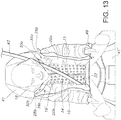
- FIG. 13 illustrates another embodiment according to the inventive subject matter, where the child is sitting in a booster seat 41' rather than a car seat as described above.
- a child sitting in a booster seat may use regular vehicle restraint system instead of the standard 5-point harness system of the car seat.
- the child wearing the garment depicted in FIG. 12 sits on a booster seat 41' that is placed on a regular vehicle seat 41.
- the child uses a regular vehicle restraint system including a shoulder harness 43 and a lap belt 49.
- the shoulder harness 43 is received in the left channel 30a and extends from the left shoulder region 36a to the right side of the waist region 32.
- the lap belt 49 which may be optional, extends from the left side to the right side of the waist region 32.
- the shoulder harness 43 interconnects with the lap belt 32 at the right side of the waist region 32.
- the shoulder harness 49 may be received in the right channel 30b and extends from the right shoulder region 36b to the left side of the waist region 32, and interconnects with the lap belt 32 at the left side of the waist region 32.
- the booster seat 41' may be removed, so that an older child or an adult who wears the garment described above may sit directly on the vehicle seat 41 and be properly restrained by the shoulder harness 43, and optionally the lap belt 49.
Landscapes
- Engineering & Computer Science (AREA)
- Textile Engineering (AREA)
- Mechanical Engineering (AREA)
- Health & Medical Sciences (AREA)
- General Health & Medical Sciences (AREA)
- Physical Education & Sports Medicine (AREA)
- Professional, Industrial, Or Sporting Protective Garments (AREA)
Claims (13)
- Vêtement en mesure d'être porté par un individu utilisant un système de harnais pour un siège de véhicule (40, 41), le vêtement comportant :une couche avant intérieure (10) ;une couche avant extérieure adjacente (20) ;dans lequel la couche avant extérieure (20) a une plus grande compressibilité par rapport à la couche avant intérieure ; etle vêtement est adapté pour recevoir une ou plusieurs sangles de harnais (42) du système de harnais entre la couche avant intérieure et la couche avant extérieure (20) quand lesdites une ou plusieurs sangles de harnais sont acheminées depuis la région au niveau des épaules (36a, 36b) jusqu'à une région au niveau de la taille (32) du vêtement, et une fois acheminées, lesdites une ou plusieurs sangles de harnais reposent de niveau contre au moins une zone au niveau de la poitrine (34) de la couche avant intérieure ;comportant un col intérieur (18) correspondant à au moins une région postérieure des côtés gauche et/ou droit du cou de l'individu ;un col extérieur (28a, 28b) correspondant à au moins une région antérieure des côtés gauche et/ou droit du cou d'un individu ;caractérisé par le col intérieur chevauchant le col extérieur (28a, 28b) sur les côtés gauche et/ou droit du cou de l'individu de manière à former des canaux gauche et/ou droit (30a, 30b) pour recevoir respectivement lesdites une ou plusieurs sangles de harnais (42) acheminées sur les régions au niveau des épaules côté gauche et/ou côté droit de l'individu.
- Vêtement selon la revendication 1, dans lequel la couche avant intérieure a un bord gauche (12a, 12b) joignant un panneau gauche (20a, 20b) de la couche avant extérieure (20), et un bord droit (12b) joignant un panneau droit (20b) de la couche avant extérieure, dans lequel une distance spatiale entre le bord gauche et le bord droit est progressivement plus large depuis la région au niveau de la taille (32) jusqu'aux régions au niveau des épaules côté gauche et côté droit (36a, 36b) du vêtement, et la distance spatiale est suffisamment large de manière à recevoir lesdites une ou plusieurs sangles de harnais (42).
- Vêtement selon la revendication 1, dans lequel la couche avant intérieure (10) a une première épaisseur quand aucune force n'est appliquée par le biais desdites une ou plusieurs sangles de harnais (42), et une deuxième épaisseur en réponse à une force prédéterminée appliquée normalement sur la couche avant intérieure par le biais desdites une ou plusieurs sangles de harnais, et le rapport entre la deuxième épaisseur et la première épaisseur est supérieur à un premier rapport prédéfini.
- Vêtement selon la revendication 1, dans lequel la couche avant extérieure (20) a une première épaisseur quand aucune force n'est appliquée, et une deuxième épaisseur en réponse à une force prédéterminée appliquée normalement sur la couche avant extérieure, et le rapport entre la deuxième épaisseur et la première épaisseur est inférieur à un deuxième rapport prédéfini.
- Vêtement selon la revendication 1, dans lequel la couche avant extérieure (20) a une ouverture en mesure d'être fermée.
- Vêtement selon la revendication 5, dans lequel l'ouverture dans la couche avant extérieure (20) peut être suffisamment ouverte de manière à exposer et à permettre l'accès auxdites une ou plusieurs sangles de harnais (42) attachées par-dessus la couche avant intérieure.
- Vêtement selon l'une quelconque des revendications 1 à 6, dans lequel la couche avant intérieure (10) a un marqueur d'alignement (16) servant à aligner un élément transversal du système de harnais qui interconnecte une paire de sangles de harnais (42) orientées à la verticale qui reposent de niveau contre au moins la zone au niveau de la poitrine (34) de la couche avant intérieure.
- Vêtement selon l'une quelconque des revendications 1 à 6, dans lequel la couche avant intérieure (10) a une surface extérieure antidérapante (19) s'étendant depuis la région au niveau des épaules (36a, 36b) jusqu'à la région au niveau de la taille (32).
- Vêtement selon la revendication 1, dans lequel une première sangle de harnais est reçue dans le canal gauche (30a, 30b) et s'étend depuis la région au niveau des épaules côté gauche (36a, 36b) jusqu'à une région au niveau de la taille côté gauche (32) du vêtement, et une deuxième sangle de harnais est reçue dans le canal droit et s'étend depuis la région au niveau des épaules côté droit (36b) jusqu'à une région au niveau de la taille côté droit, et à la fois les première et deuxième sangles de harnais (42) reposent de niveau contre la zone au niveau de la poitrine (34) de la couche avant intérieure (10).
- Vêtement selon la revendication 1, dans lequel uniquement une sangle de harnais est reçue dans le canal gauche ou droit (30a, 30b) et s'étend depuis la région au niveau des épaules côté gauche ou côté droit (36a, 36b) jusqu'à une région au niveau de la taille de côté opposé (32) du vêtement, et la sangle de harnais repose de niveau contre la zone au niveau de la poitrine (34) de la couche avant intérieure (10).
- Vêtement selon la revendication 10, dans lequel la sangle de harnais est adaptée pour s'interconnecter avec une sangle sous-abdominale du système de harnais au niveau de la région au niveau de la taille de côté opposé (32) du vêtement, dans lequel la sangle sous-abdominale est acheminée depuis une région au niveau de la taille côté gauche jusqu'à une région au niveau de la taille côté droit du vêtement.
- Vêtement selon la revendication 1, comportant un panneau gauche (20a), un panneau droit (20b) et un élément d'accouplement (22) adapté pour joindre ou séparer le panneau gauche et le panneau droit, dans lequel la couche avant intérieure a un bord gauche (12a, 12b) joignant le panneau gauche (20a, 20b) de la couche avant extérieure (20), et un bord droit (12b) joignant le panneau droit (20b) de la couche avant extérieure, dans lequel une distance spatiale entre le bord gauche et le bord droit est suffisamment large de manière à recevoir une ou plusieurs sangles de harnais (42) du système de harnais quand lesdites une ou plusieurs sangles de harnais sont acheminées depuis la région au niveau des épaules (36a, 36b) jusqu'à une région au niveau de la taille (32) du vêtement, et une fois acheminées, lesdites une ou plusieurs sangles de harnais reposent de niveau contre au moins une zone au niveau de la poitrine (34) de la couche avant intérieure.
- Vêtement selon la revendication 12, dans lequel la couche avant intérieure (10) a un marqueur d'alignement (16) servant à aligner un élément transversal du système de harnais qui interconnecte une paire de sangles de harnais (42) orientées à la verticale qui reposent de niveau contre au moins la zone au niveau de la poitrine (34) de la couche avant intérieure (10), dans lequel le marqueur d'alignement a une zone (19) de surface extérieure anti-dérapante (19) agencée pour recevoir une partie de la paire de sangles de harnais orientées à la verticale.
Applications Claiming Priority (2)
| Application Number | Priority Date | Filing Date | Title |
|---|---|---|---|
| US201662325876P | 2016-04-21 | 2016-04-21 | |
| PCT/US2016/065425 WO2017184210A1 (fr) | 2016-04-21 | 2016-12-07 | Vêtement pour système de harnais |
Publications (3)
| Publication Number | Publication Date |
|---|---|
| EP3445192A1 EP3445192A1 (fr) | 2019-02-27 |
| EP3445192A4 EP3445192A4 (fr) | 2019-10-30 |
| EP3445192B1 true EP3445192B1 (fr) | 2021-01-20 |
Family
ID=60116258
Family Applications (1)
| Application Number | Title | Priority Date | Filing Date |
|---|---|---|---|
| EP16899686.6A Not-in-force EP3445192B1 (fr) | 2016-04-21 | 2016-12-07 | Vêtement pour système de harnais |
Country Status (7)
| Country | Link |
|---|---|
| US (2) | US10779585B2 (fr) |
| EP (1) | EP3445192B1 (fr) |
| JP (1) | JP6837078B2 (fr) |
| KR (1) | KR102098518B1 (fr) |
| CN (1) | CN109561739B (fr) |
| CA (1) | CA3018481C (fr) |
| WO (1) | WO2017184210A1 (fr) |
Cited By (1)
| Publication number | Priority date | Publication date | Assignee | Title |
|---|---|---|---|---|
| DE202022101379U1 (de) | 2022-03-15 | 2022-03-25 | Marta Rizk | Winterbekleidung zur Erhöhung der Sicherheit einer in einem mit Sicherheitsgurten ausgestatteten Fahrzeug oder Vorrichtung sitzenden Person |
Families Citing this family (10)
| Publication number | Priority date | Publication date | Assignee | Title |
|---|---|---|---|---|
| US20180199640A1 (en) * | 2017-01-13 | 2018-07-19 | Teton Outfitters, Llc, D/B/A Klim | Outerwear garment |
| US12134366B2 (en) * | 2017-12-19 | 2024-11-05 | Universal City Studios Llc | Passive restraint techniques for amusement park rides |
| DE102018205136A1 (de) * | 2018-04-05 | 2019-10-10 | Adidas Ag | Bekleidungsartikel |
| US12016409B2 (en) * | 2019-09-26 | 2024-06-25 | Marla Halerz-Sroczynski | Garment having safety grooves |
| CN111231884B (zh) * | 2020-02-27 | 2021-12-21 | 江苏大学 | 一种主动式儿童气囊背心装置及其控制方法 |
| CA3150245A1 (fr) * | 2021-02-26 | 2022-08-26 | Tempo Outerwear Inc. | Veste multicouche pour enfant configuree pour eviter de nuire a l'efficacite d'un siege de securite pour enfants dans un vehicule |
| USD1084603S1 (en) | 2021-03-11 | 2025-07-22 | Buckle Me Baby Coats, Llc | Child's outerwear garment |
| US11820322B1 (en) * | 2022-05-17 | 2023-11-21 | Hoonyoung Kim | Restraint system |
| US12582175B2 (en) * | 2023-08-29 | 2026-03-24 | Rebekah L. Dresp | Coat with bag and pet carriers and weighted hood |
| US20250331582A1 (en) * | 2024-04-30 | 2025-10-30 | Buckle Me Baby Coats, Llc | Child Safety Coat With Precompressed Fill |
Family Cites Families (29)
| Publication number | Priority date | Publication date | Assignee | Title |
|---|---|---|---|---|
| US200226A (en) * | 1878-02-12 | Improvement in duster-coats | ||
| US1281430A (en) * | 1916-01-03 | 1918-10-15 | Maurice W Turner | Wearing-apparel. |
| US1906912A (en) | 1931-04-14 | 1933-05-02 | Jack C Lockwood | Shirt |
| US2051482A (en) * | 1934-02-07 | 1936-08-18 | Hyman Sam Bernard | Convertible garment |
| US4320538A (en) * | 1980-10-23 | 1982-03-23 | Gilbert Saft | Wearing apparel |
| US4843647A (en) * | 1987-08-31 | 1989-07-04 | Burlington Industries, Inc. | Cold weather system |
| US4999850A (en) * | 1989-12-26 | 1991-03-19 | Grilliot William L | Firefighter's integrated garment |
| US5161258A (en) * | 1990-12-06 | 1992-11-10 | Coltrain Lori A | Garment for restraining a child in a vehicle |
| US6314578B1 (en) * | 1999-05-13 | 2001-11-13 | Zenkoku Bousai Jigyo Kyogyo Kumiai | Child protecting clothes for vehicles |
| US6367882B1 (en) * | 2000-02-28 | 2002-04-09 | H. Koch & Sons Co., Inc. | Slip-retarding upper torso restraint harness and system |
| US6408439B1 (en) | 2000-05-19 | 2002-06-25 | Julia R. Garforth-Crippen | Garment for use in a child car seat |
| JP3073383U (ja) * | 2000-05-19 | 2000-11-24 | 禮司郎 西村 | 車両用幼児防護用品 |
| US6698025B1 (en) * | 2002-08-26 | 2004-03-02 | Liloebe, Llc | Multi-garment outfit with nontraditional access |
| US7117539B1 (en) * | 2004-04-08 | 2006-10-10 | Jmi (Usa) Ltd. | Garment with stowable vest |
| US9498007B2 (en) | 2004-06-10 | 2016-11-22 | Dahlia Rizk | Child's outerwear garment |
| GB2448922A (en) * | 2007-05-04 | 2008-11-05 | Dr Sven Kelling | Garment convertible into a bag |
| US20090070914A1 (en) * | 2007-09-17 | 2009-03-19 | Juliet Marie Landeck | Garment having a combination jacket and vest |
| US20090100566A1 (en) * | 2007-10-18 | 2009-04-23 | Shannon Schiavino | Non-slip emblems and their application to baby clothing |
| US8225422B1 (en) | 2007-10-18 | 2012-07-24 | Mcsparron Erin J | Car seat coat |
| US8118364B2 (en) | 2007-12-26 | 2012-02-21 | Davis Margaret A | Blanket for placement upon an infant secured in a seat and method of use |
| US7954172B2 (en) | 2008-11-11 | 2011-06-07 | Natalie Ann Hepler | Garment for retaining a child in a car-seat |
| US8950013B2 (en) * | 2009-03-10 | 2015-02-10 | Robert Bates | Grip garment |
| US20100282803A1 (en) * | 2009-05-06 | 2010-11-11 | Terrence Simmons | Garment with integrated hidden backpack support |
| US20130007940A1 (en) | 2011-07-06 | 2013-01-10 | Claudia Jane Ryerson | Child garment for car seat and method of clothing child restrained in car seat |
| EP2739361B8 (fr) * | 2011-08-02 | 2018-03-07 | Lion Group, Inc. | Vêtement de protection à orifices |
| US10463086B2 (en) | 2013-11-26 | 2019-11-05 | Vanessa Danielle Brown | Outerwear garment with semi-removable front panels |
| US9840225B2 (en) * | 2014-01-07 | 2017-12-12 | Kristy L Cobb | KC chest clip having an extension guard |
| EP3324770A4 (fr) * | 2015-07-19 | 2019-01-09 | Webb, Jasen, L. | Support à frottement fonctionnel et esthétique |
| US20170238623A1 (en) | 2016-02-19 | 2017-08-24 | Jamie Wallace | Child Safety Seat Compatible Apparel System |
-
2016
- 2016-12-07 EP EP16899686.6A patent/EP3445192B1/fr not_active Not-in-force
- 2016-12-07 CN CN201680087041.6A patent/CN109561739B/zh not_active Expired - Fee Related
- 2016-12-07 KR KR1020187033379A patent/KR102098518B1/ko not_active Expired - Fee Related
- 2016-12-07 WO PCT/US2016/065425 patent/WO2017184210A1/fr not_active Ceased
- 2016-12-07 JP JP2018555458A patent/JP6837078B2/ja not_active Expired - Fee Related
- 2016-12-07 CA CA3018481A patent/CA3018481C/fr active Active
- 2016-12-07 US US15/529,073 patent/US10779585B2/en active Active
-
2020
- 2020-08-11 US US16/990,889 patent/US20200367579A1/en not_active Abandoned
Non-Patent Citations (1)
| Title |
|---|
| None * |
Cited By (1)
| Publication number | Priority date | Publication date | Assignee | Title |
|---|---|---|---|---|
| DE202022101379U1 (de) | 2022-03-15 | 2022-03-25 | Marta Rizk | Winterbekleidung zur Erhöhung der Sicherheit einer in einem mit Sicherheitsgurten ausgestatteten Fahrzeug oder Vorrichtung sitzenden Person |
Also Published As
| Publication number | Publication date |
|---|---|
| KR102098518B1 (ko) | 2020-04-07 |
| CN109561739A (zh) | 2019-04-02 |
| WO2017184210A1 (fr) | 2017-10-26 |
| US20200367579A1 (en) | 2020-11-26 |
| US20180184730A1 (en) | 2018-07-05 |
| CA3018481A1 (fr) | 2017-10-26 |
| US10779585B2 (en) | 2020-09-22 |
| CA3018481C (fr) | 2021-02-09 |
| EP3445192A1 (fr) | 2019-02-27 |
| KR20190009752A (ko) | 2019-01-29 |
| JP6837078B2 (ja) | 2021-03-03 |
| EP3445192A4 (fr) | 2019-10-30 |
| CN109561739B (zh) | 2021-02-05 |
| JP2019515147A (ja) | 2019-06-06 |
Similar Documents
| Publication | Publication Date | Title |
|---|---|---|
| EP3445192B1 (fr) | Vêtement pour système de harnais | |
| US9498007B2 (en) | Child's outerwear garment | |
| US7954172B2 (en) | Garment for retaining a child in a car-seat | |
| US20150069812A1 (en) | Supplemental restraint system with six restraint points | |
| US10918140B2 (en) | Garment for use with seat restraints and method of use therefor | |
| US20080196139A1 (en) | Child's garment for use with carrier | |
| US20180199638A1 (en) | Child's garment | |
| US20240306744A1 (en) | Garment having safety grooves | |
| US10471928B2 (en) | Safety device for use with a safety harness | |
| CA2997584A1 (fr) | Vetement d'enfant isole destine aux sieges d'auto pour enfant et une methode d'utilisation associee | |
| SK9638Y1 (sk) | Zimný odev na zvýšenie bezpečnosti osoby sediacej v dopravnom prostriedku alebo v zariadení vybavenom bezpečnostnými pásmi | |
| KR20020046888A (ko) | 하아네스형 충격 방지복 | |
| WO2008086059A3 (fr) | Couverture réutilisable pour sièges avec des ensembles sangles |
Legal Events
| Date | Code | Title | Description |
|---|---|---|---|
| STAA | Information on the status of an ep patent application or granted ep patent |
Free format text: STATUS: THE INTERNATIONAL PUBLICATION HAS BEEN MADE |
|
| PUAI | Public reference made under article 153(3) epc to a published international application that has entered the european phase |
Free format text: ORIGINAL CODE: 0009012 |
|
| STAA | Information on the status of an ep patent application or granted ep patent |
Free format text: STATUS: REQUEST FOR EXAMINATION WAS MADE |
|
| 17P | Request for examination filed |
Effective date: 20180926 |
|
| AK | Designated contracting states |
Kind code of ref document: A1 Designated state(s): AL AT BE BG CH CY CZ DE DK EE ES FI FR GB GR HR HU IE IS IT LI LT LU LV MC MK MT NL NO PL PT RO RS SE SI SK SM TR |
|
| AX | Request for extension of the european patent |
Extension state: BA ME |
|
| DAV | Request for validation of the european patent (deleted) | ||
| DAX | Request for extension of the european patent (deleted) | ||
| A4 | Supplementary search report drawn up and despatched |
Effective date: 20190930 |
|
| RIC1 | Information provided on ipc code assigned before grant |
Ipc: A41D 15/00 20060101ALI20190924BHEP Ipc: A41D 27/04 20060101ALI20190924BHEP Ipc: A41D 27/18 20060101ALI20190924BHEP Ipc: B60R 22/14 20060101ALI20190924BHEP Ipc: A41D 11/00 20060101ALI20190924BHEP Ipc: A41D 1/02 20060101AFI20190924BHEP Ipc: A41D 13/00 20060101ALI20190924BHEP |
|
| STAA | Information on the status of an ep patent application or granted ep patent |
Free format text: STATUS: EXAMINATION IS IN PROGRESS |
|
| 17Q | First examination report despatched |
Effective date: 20200513 |
|
| GRAP | Despatch of communication of intention to grant a patent |
Free format text: ORIGINAL CODE: EPIDOSNIGR1 |
|
| STAA | Information on the status of an ep patent application or granted ep patent |
Free format text: STATUS: GRANT OF PATENT IS INTENDED |
|
| RIC1 | Information provided on ipc code assigned before grant |
Ipc: A41D 27/18 20060101ALI20200611BHEP Ipc: A41D 11/00 20060101ALI20200611BHEP Ipc: A41D 15/00 20060101ALI20200611BHEP Ipc: A41D 1/02 20060101AFI20200611BHEP Ipc: B60R 22/10 20060101ALI20200611BHEP Ipc: A41D 27/04 20060101ALI20200611BHEP Ipc: A41D 13/00 20060101ALI20200611BHEP |
|
| INTG | Intention to grant announced |
Effective date: 20200715 |
|
| GRAS | Grant fee paid |
Free format text: ORIGINAL CODE: EPIDOSNIGR3 |
|
| GRAA | (expected) grant |
Free format text: ORIGINAL CODE: 0009210 |
|
| STAA | Information on the status of an ep patent application or granted ep patent |
Free format text: STATUS: THE PATENT HAS BEEN GRANTED |
|
| AK | Designated contracting states |
Kind code of ref document: B1 Designated state(s): AL AT BE BG CH CY CZ DE DK EE ES FI FR GB GR HR HU IE IS IT LI LT LU LV MC MK MT NL NO PL PT RO RS SE SI SK SM TR |
|
| REG | Reference to a national code |
Ref country code: GB Ref legal event code: FG4D |
|
| REG | Reference to a national code |
Ref country code: CH Ref legal event code: EP |
|
| REG | Reference to a national code |
Ref country code: DE Ref legal event code: R096 Ref document number: 602016051907 Country of ref document: DE |
|
| REG | Reference to a national code |
Ref country code: AT Ref legal event code: REF Ref document number: 1355574 Country of ref document: AT Kind code of ref document: T Effective date: 20210215 |
|
| REG | Reference to a national code |
Ref country code: IE Ref legal event code: FG4D |
|
| REG | Reference to a national code |
Ref country code: NL Ref legal event code: MP Effective date: 20210120 |
|
| REG | Reference to a national code |
Ref country code: LT Ref legal event code: MG9D |
|
| REG | Reference to a national code |
Ref country code: AT Ref legal event code: MK05 Ref document number: 1355574 Country of ref document: AT Kind code of ref document: T Effective date: 20210120 |
|
| PG25 | Lapsed in a contracting state [announced via postgrant information from national office to epo] |
Ref country code: GR Free format text: LAPSE BECAUSE OF FAILURE TO SUBMIT A TRANSLATION OF THE DESCRIPTION OR TO PAY THE FEE WITHIN THE PRESCRIBED TIME-LIMIT Effective date: 20210421 Ref country code: FI Free format text: LAPSE BECAUSE OF FAILURE TO SUBMIT A TRANSLATION OF THE DESCRIPTION OR TO PAY THE FEE WITHIN THE PRESCRIBED TIME-LIMIT Effective date: 20210120 Ref country code: HR Free format text: LAPSE BECAUSE OF FAILURE TO SUBMIT A TRANSLATION OF THE DESCRIPTION OR TO PAY THE FEE WITHIN THE PRESCRIBED TIME-LIMIT Effective date: 20210120 Ref country code: PT Free format text: LAPSE BECAUSE OF FAILURE TO SUBMIT A TRANSLATION OF THE DESCRIPTION OR TO PAY THE FEE WITHIN THE PRESCRIBED TIME-LIMIT Effective date: 20210520 Ref country code: NO Free format text: LAPSE BECAUSE OF FAILURE TO SUBMIT A TRANSLATION OF THE DESCRIPTION OR TO PAY THE FEE WITHIN THE PRESCRIBED TIME-LIMIT Effective date: 20210420 Ref country code: LT Free format text: LAPSE BECAUSE OF FAILURE TO SUBMIT A TRANSLATION OF THE DESCRIPTION OR TO PAY THE FEE WITHIN THE PRESCRIBED TIME-LIMIT Effective date: 20210120 Ref country code: BG Free format text: LAPSE BECAUSE OF FAILURE TO SUBMIT A TRANSLATION OF THE DESCRIPTION OR TO PAY THE FEE WITHIN THE PRESCRIBED TIME-LIMIT Effective date: 20210420 |
|
| PG25 | Lapsed in a contracting state [announced via postgrant information from national office to epo] |
Ref country code: SE Free format text: LAPSE BECAUSE OF FAILURE TO SUBMIT A TRANSLATION OF THE DESCRIPTION OR TO PAY THE FEE WITHIN THE PRESCRIBED TIME-LIMIT Effective date: 20210120 Ref country code: AT Free format text: LAPSE BECAUSE OF FAILURE TO SUBMIT A TRANSLATION OF THE DESCRIPTION OR TO PAY THE FEE WITHIN THE PRESCRIBED TIME-LIMIT Effective date: 20210120 Ref country code: LV Free format text: LAPSE BECAUSE OF FAILURE TO SUBMIT A TRANSLATION OF THE DESCRIPTION OR TO PAY THE FEE WITHIN THE PRESCRIBED TIME-LIMIT Effective date: 20210120 Ref country code: PL Free format text: LAPSE BECAUSE OF FAILURE TO SUBMIT A TRANSLATION OF THE DESCRIPTION OR TO PAY THE FEE WITHIN THE PRESCRIBED TIME-LIMIT Effective date: 20210120 Ref country code: RS Free format text: LAPSE BECAUSE OF FAILURE TO SUBMIT A TRANSLATION OF THE DESCRIPTION OR TO PAY THE FEE WITHIN THE PRESCRIBED TIME-LIMIT Effective date: 20210120 |
|
| PG25 | Lapsed in a contracting state [announced via postgrant information from national office to epo] |
Ref country code: IS Free format text: LAPSE BECAUSE OF FAILURE TO SUBMIT A TRANSLATION OF THE DESCRIPTION OR TO PAY THE FEE WITHIN THE PRESCRIBED TIME-LIMIT Effective date: 20210520 |
|
| REG | Reference to a national code |
Ref country code: DE Ref legal event code: R097 Ref document number: 602016051907 Country of ref document: DE |
|
| PG25 | Lapsed in a contracting state [announced via postgrant information from national office to epo] |
Ref country code: SM Free format text: LAPSE BECAUSE OF FAILURE TO SUBMIT A TRANSLATION OF THE DESCRIPTION OR TO PAY THE FEE WITHIN THE PRESCRIBED TIME-LIMIT Effective date: 20210120 Ref country code: CZ Free format text: LAPSE BECAUSE OF FAILURE TO SUBMIT A TRANSLATION OF THE DESCRIPTION OR TO PAY THE FEE WITHIN THE PRESCRIBED TIME-LIMIT Effective date: 20210120 Ref country code: EE Free format text: LAPSE BECAUSE OF FAILURE TO SUBMIT A TRANSLATION OF THE DESCRIPTION OR TO PAY THE FEE WITHIN THE PRESCRIBED TIME-LIMIT Effective date: 20210120 |
|
| PLBE | No opposition filed within time limit |
Free format text: ORIGINAL CODE: 0009261 |
|
| STAA | Information on the status of an ep patent application or granted ep patent |
Free format text: STATUS: NO OPPOSITION FILED WITHIN TIME LIMIT |
|
| PG25 | Lapsed in a contracting state [announced via postgrant information from national office to epo] |
Ref country code: DK Free format text: LAPSE BECAUSE OF FAILURE TO SUBMIT A TRANSLATION OF THE DESCRIPTION OR TO PAY THE FEE WITHIN THE PRESCRIBED TIME-LIMIT Effective date: 20210120 Ref country code: SK Free format text: LAPSE BECAUSE OF FAILURE TO SUBMIT A TRANSLATION OF THE DESCRIPTION OR TO PAY THE FEE WITHIN THE PRESCRIBED TIME-LIMIT Effective date: 20210120 Ref country code: RO Free format text: LAPSE BECAUSE OF FAILURE TO SUBMIT A TRANSLATION OF THE DESCRIPTION OR TO PAY THE FEE WITHIN THE PRESCRIBED TIME-LIMIT Effective date: 20210120 |
|
| 26N | No opposition filed |
Effective date: 20211021 |
|
| PG25 | Lapsed in a contracting state [announced via postgrant information from national office to epo] |
Ref country code: AL Free format text: LAPSE BECAUSE OF FAILURE TO SUBMIT A TRANSLATION OF THE DESCRIPTION OR TO PAY THE FEE WITHIN THE PRESCRIBED TIME-LIMIT Effective date: 20210120 Ref country code: ES Free format text: LAPSE BECAUSE OF FAILURE TO SUBMIT A TRANSLATION OF THE DESCRIPTION OR TO PAY THE FEE WITHIN THE PRESCRIBED TIME-LIMIT Effective date: 20210120 |
|
| PG25 | Lapsed in a contracting state [announced via postgrant information from national office to epo] |
Ref country code: SI Free format text: LAPSE BECAUSE OF FAILURE TO SUBMIT A TRANSLATION OF THE DESCRIPTION OR TO PAY THE FEE WITHIN THE PRESCRIBED TIME-LIMIT Effective date: 20210120 |
|
| REG | Reference to a national code |
Ref country code: DE Ref legal event code: R081 Ref document number: 602016051907 Country of ref document: DE Owner name: ONE KID, LLC, WESTPORT, US Free format text: FORMER OWNER: IHC DESIGN, LLC, WESTPORT, CT, US |
|
| PG25 | Lapsed in a contracting state [announced via postgrant information from national office to epo] |
Ref country code: IS Free format text: LAPSE BECAUSE OF FAILURE TO SUBMIT A TRANSLATION OF THE DESCRIPTION OR TO PAY THE FEE WITHIN THE PRESCRIBED TIME-LIMIT Effective date: 20210520 |
|
| REG | Reference to a national code |
Ref country code: GB Ref legal event code: 732E Free format text: REGISTERED BETWEEN 20220505 AND 20220512 |
|
| PG25 | Lapsed in a contracting state [announced via postgrant information from national office to epo] |
Ref country code: MC Free format text: LAPSE BECAUSE OF FAILURE TO SUBMIT A TRANSLATION OF THE DESCRIPTION OR TO PAY THE FEE WITHIN THE PRESCRIBED TIME-LIMIT Effective date: 20210120 |
|
| REG | Reference to a national code |
Ref country code: CH Ref legal event code: PL |
|
| REG | Reference to a national code |
Ref country code: BE Ref legal event code: MM Effective date: 20211231 |
|
| PG25 | Lapsed in a contracting state [announced via postgrant information from national office to epo] |
Ref country code: LU Free format text: LAPSE BECAUSE OF NON-PAYMENT OF DUE FEES Effective date: 20211207 Ref country code: IE Free format text: LAPSE BECAUSE OF NON-PAYMENT OF DUE FEES Effective date: 20211207 |
|
| PG25 | Lapsed in a contracting state [announced via postgrant information from national office to epo] |
Ref country code: BE Free format text: LAPSE BECAUSE OF NON-PAYMENT OF DUE FEES Effective date: 20211231 |
|
| PG25 | Lapsed in a contracting state [announced via postgrant information from national office to epo] |
Ref country code: LI Free format text: LAPSE BECAUSE OF NON-PAYMENT OF DUE FEES Effective date: 20211231 Ref country code: CH Free format text: LAPSE BECAUSE OF NON-PAYMENT OF DUE FEES Effective date: 20211231 |
|
| PGFP | Annual fee paid to national office [announced via postgrant information from national office to epo] |
Ref country code: IT Payment date: 20221111 Year of fee payment: 7 Ref country code: GB Payment date: 20221027 Year of fee payment: 7 Ref country code: FR Payment date: 20221110 Year of fee payment: 7 Ref country code: DE Payment date: 20221025 Year of fee payment: 7 |
|
| PG25 | Lapsed in a contracting state [announced via postgrant information from national office to epo] |
Ref country code: NL Free format text: LAPSE BECAUSE OF NON-PAYMENT OF DUE FEES Effective date: 20210120 Ref country code: CY Free format text: LAPSE BECAUSE OF FAILURE TO SUBMIT A TRANSLATION OF THE DESCRIPTION OR TO PAY THE FEE WITHIN THE PRESCRIBED TIME-LIMIT Effective date: 20210120 |
|
| PG25 | Lapsed in a contracting state [announced via postgrant information from national office to epo] |
Ref country code: HU Free format text: LAPSE BECAUSE OF FAILURE TO SUBMIT A TRANSLATION OF THE DESCRIPTION OR TO PAY THE FEE WITHIN THE PRESCRIBED TIME-LIMIT; INVALID AB INITIO Effective date: 20161207 |
|
| PG25 | Lapsed in a contracting state [announced via postgrant information from national office to epo] |
Ref country code: MK Free format text: LAPSE BECAUSE OF FAILURE TO SUBMIT A TRANSLATION OF THE DESCRIPTION OR TO PAY THE FEE WITHIN THE PRESCRIBED TIME-LIMIT Effective date: 20210120 |
|
| PG25 | Lapsed in a contracting state [announced via postgrant information from national office to epo] |
Ref country code: TR Free format text: LAPSE BECAUSE OF FAILURE TO SUBMIT A TRANSLATION OF THE DESCRIPTION OR TO PAY THE FEE WITHIN THE PRESCRIBED TIME-LIMIT Effective date: 20210120 |
|
| REG | Reference to a national code |
Ref country code: DE Ref legal event code: R119 Ref document number: 602016051907 Country of ref document: DE |
|
| GBPC | Gb: european patent ceased through non-payment of renewal fee |
Effective date: 20231207 |
|
| PG25 | Lapsed in a contracting state [announced via postgrant information from national office to epo] |
Ref country code: MT Free format text: LAPSE BECAUSE OF FAILURE TO SUBMIT A TRANSLATION OF THE DESCRIPTION OR TO PAY THE FEE WITHIN THE PRESCRIBED TIME-LIMIT Effective date: 20210120 |
|
| PG25 | Lapsed in a contracting state [announced via postgrant information from national office to epo] |
Ref country code: DE Free format text: LAPSE BECAUSE OF NON-PAYMENT OF DUE FEES Effective date: 20240702 |
|
| PG25 | Lapsed in a contracting state [announced via postgrant information from national office to epo] |
Ref country code: GB Free format text: LAPSE BECAUSE OF NON-PAYMENT OF DUE FEES Effective date: 20231207 |
|
| PG25 | Lapsed in a contracting state [announced via postgrant information from national office to epo] |
Ref country code: FR Free format text: LAPSE BECAUSE OF NON-PAYMENT OF DUE FEES Effective date: 20231231 |
|
| PG25 | Lapsed in a contracting state [announced via postgrant information from national office to epo] |
Ref country code: GB Free format text: LAPSE BECAUSE OF NON-PAYMENT OF DUE FEES Effective date: 20231207 Ref country code: FR Free format text: LAPSE BECAUSE OF NON-PAYMENT OF DUE FEES Effective date: 20231231 Ref country code: DE Free format text: LAPSE BECAUSE OF NON-PAYMENT OF DUE FEES Effective date: 20240702 |
|
| PG25 | Lapsed in a contracting state [announced via postgrant information from national office to epo] |
Ref country code: IT Free format text: LAPSE BECAUSE OF NON-PAYMENT OF DUE FEES Effective date: 20231207 |