EP3446504B1 - Partage commandé par les abonnés d'un service de communications à l'aide d'un vsim - Google Patents
Partage commandé par les abonnés d'un service de communications à l'aide d'un vsim Download PDFInfo
- Publication number
- EP3446504B1 EP3446504B1 EP16721942.7A EP16721942A EP3446504B1 EP 3446504 B1 EP3446504 B1 EP 3446504B1 EP 16721942 A EP16721942 A EP 16721942A EP 3446504 B1 EP3446504 B1 EP 3446504B1
- Authority
- EP
- European Patent Office
- Prior art keywords
- host
- guest
- service
- network
- vsim
- Prior art date
- Legal status (The legal status is an assumption and is not a legal conclusion. Google has not performed a legal analysis and makes no representation as to the accuracy of the status listed.)
- Active
Links
Images



Classifications
-
- H—ELECTRICITY
- H04—ELECTRIC COMMUNICATION TECHNIQUE
- H04W—WIRELESS COMMUNICATION NETWORKS
- H04W12/00—Security arrangements; Authentication; Protecting privacy or anonymity
- H04W12/04—Key management, e.g. using generic bootstrapping architecture [GBA]
-
- H—ELECTRICITY
- H04—ELECTRIC COMMUNICATION TECHNIQUE
- H04W—WIRELESS COMMUNICATION NETWORKS
- H04W12/00—Security arrangements; Authentication; Protecting privacy or anonymity
- H04W12/30—Security of mobile devices; Security of mobile applications
- H04W12/35—Protecting application or service provisioning, e.g. securing SIM application provisioning
-
- H—ELECTRICITY
- H04—ELECTRIC COMMUNICATION TECHNIQUE
- H04W—WIRELESS COMMUNICATION NETWORKS
- H04W12/00—Security arrangements; Authentication; Protecting privacy or anonymity
- H04W12/60—Context-dependent security
- H04W12/61—Time-dependent
-
- H—ELECTRICITY
- H04—ELECTRIC COMMUNICATION TECHNIQUE
- H04W—WIRELESS COMMUNICATION NETWORKS
- H04W8/00—Network data management
- H04W8/18—Processing of user or subscriber data, e.g. subscribed services, user preferences or user profiles; Transfer of user or subscriber data
- H04W8/183—Processing at user equipment or user record carrier
-
- H—ELECTRICITY
- H04—ELECTRIC COMMUNICATION TECHNIQUE
- H04W—WIRELESS COMMUNICATION NETWORKS
- H04W8/00—Network data management
- H04W8/18—Processing of user or subscriber data, e.g. subscribed services, user preferences or user profiles; Transfer of user or subscriber data
- H04W8/20—Transfer of user or subscriber data
- H04W8/205—Transfer to or from user equipment or user record carrier
-
- H—ELECTRICITY
- H04—ELECTRIC COMMUNICATION TECHNIQUE
- H04W—WIRELESS COMMUNICATION NETWORKS
- H04W12/00—Security arrangements; Authentication; Protecting privacy or anonymity
- H04W12/06—Authentication
-
- H—ELECTRICITY
- H04—ELECTRIC COMMUNICATION TECHNIQUE
- H04W—WIRELESS COMMUNICATION NETWORKS
- H04W88/00—Devices specially adapted for wireless communication networks, e.g. terminals, base stations or access point devices
- H04W88/02—Terminal devices
Definitions
- the present disclosure generally relates to communication networks. More particularly, and not by way of any limitation, the present disclosure is directed to a system and method for effectuating subscriber-driven sharing of a communications service including, e.g., voice and/or data services.
- a communications service including, e.g., voice and/or data services.
- WO 2008/040964 A2 describes a virtual SIM system to enable the use of virtual SIMs from a single mobile communications device equipped with a master SIM related to the virtual SIMs.
- WO 2012/174722 A1 describes a method and apparatus for providing a virtual SIM.
- a first device sends a message to a base station in a telecommunications network to request a virtual SIM for use by a second device.
- the base station After receiving the request from the first device, the base station generates the virtual SIM and creates a mapping among the first device's SIM memory device, the virtual SIM, and identification information for the second device.
- the base station transfers the virtual SIM to the second device either directly, or the base station may transfer the virtual SIM to the first device for transmission to the second device via device-to-device technologies.
- the second device then may establish a connection with the base station using the virtual SIM for both uplink and downlink communications.
- the present patent disclosure is broadly directed to systems, methods, apparatuses as well as client devices and associated non-transitory computer-readable media for facilitating service sharing (e.g., voice services, data services, multimedia services, etc.) in a network environment.
- service sharing e.g., voice services, data services, multimedia services, etc.
- vSEVI virtual subscriber identification module
- a guest user's authentication information is provided using the vSIM for performing guest registration and remote provisioning for the vSIM, the remote provisioning including allocation of a temporary phone number and/or an Internet Protocol (IP) address, which may be used in a mapping relationship for routing calls or sessions engaged by the guest using a service shared with the host subscriber.
- IP Internet Protocol
- An embodiment of a system or apparatus, virtualized or otherwise, for facilitating service sharing in a network environment.
- the claimed embodiment comprises, inter alia, one or more processors; and a persistent memory module coupled to the one or more processors, the persistent memory module including program instructions for performing the following acts when executed by the one or more processors: upon receiving a request from a host subscriber for instantiating a vSIM, authenticating the host subscriber by a host service provider network and generating a vSEVI populated with the host subscriber's service profile with respect to one or more host services to which the host subscriber has a subscription and is requesting or has requested to share; downloading the vSIM to a host and/or guest subscriber device or otherwise associating the vSIM with the host/guest subscriber device in a cloud platform; upon receiving a guest user's credentials, performing guest registration and remote provisioning for the vSIM, the remote provisioning including allocation of a temporary phone number and an IP address that are attached to the vSIM-
- the time duration for which the mapping relations or associations may be maintained could be a time window manually configured, automatically configured, or remain unbounded for indeterminate amount of time or with some system overrides, or a duration that can be configured to be extended as needed, etc.
- the associative relationship associated with mapping relations based on remote provisioning may be dependent on a preconfigured time limit that may be extended as needed.
- the remotely-provisioned phone number could be the original number (e.g., guest's or the host's).
- the claimed embodiment comprises, inter alia, one or more processors; and a persistent memory module coupled to the one or more processors, the persistent memory module including program instructions for performing, when executed by the one or more processors, the following acts: upon receiving an input from a host subscriber, generating a request for instantiating a vSIM to a host service provider network; receiving a vSEVI populated with the host subscriber's service profile with respect to one or more host services to which the host subscriber has a subscription and is requesting to share with one or more guests; and facilitating, using a guest user's credentials (e.g., input on the host subscriber device, initiation of a guest registration and remote provisioning process for the vSIM), the remote provisioning including receiving a temporary phone number and/or an IP address that are attached to the vSIM-based host service and mapped in one or more associative relationships to a number of parameters operative to facilitate routing as noted
- a guest user's credentials e.g., input on the host
- One or more embodiments of a non-transitory computer-readable medium containing computer-executable program instructions or code portions stored thereon are disclosed for performing one or more embodiments of the methods set forth herein when executed by a processor entity of a network node, a client UE device, and the like. Further features of the various embodiments are as claimed in the dependent claims appended hereto.
- One or more embodiments of the present invention enable a host subscriber to advantageously provide the convenience of sharing a service to their friends and family in a timely fashion in the event the guests are unable to use their own service, which may be due to service outage, poor network quality, low battery on the device, etc. Further, an implementation of the present invention can provide a revenue opportunity for service providers by way of offering a service sharing service to its subscribers depending on billing arrangements for shared services. Additional benefits and advantages of the embodiments will be apparent in view of the following description and accompanying Figures.
- Coupled may be used to indicate that two or more elements, which may or may not be in direct physical or electrical contact with each other, co-operate or interact with each other.
- Connected may be used to indicate the establishment of communication, i.e., a communicative relationship, between two or more elements that are coupled with each other.
- an element, component or module may be configured to perform a function if the element is capable of performing or otherwise structurally arranged to perform that function.
- a network element or node may be comprised of one or more pieces of service network equipment, including hardware and software that communicatively interconnects other equipment on a network (e.g., other network elements, end stations, etc.), and is adapted to host one or more applications or services, either in a virtualized or non-virtualized environment, with respect to a plurality of subscribers and associated user equipment that are operative to receive/consume services (e.g., voice services, data services, media services, or any combination thereof, including an Over-The-Top (OTT) communications service, by way of illustration) in a network infrastructure adapted for providing services using a variety of access networks, one or more transmission technologies, architectures, communications protocols, etc.
- OTT Over-The-Top
- an example communications network may be architected as a circuit-switched network, a packet-switched network or a combination thereof.
- Example subscriber end stations or client devices may comprise a variety of communications devices adapted for receiving/consuming services, e.g., including smartphones, multimedia/video phones, mobile/wireless user equipment with or without integrated subscriber identity/identification modules (SIMs), tethered/wireline phones, satellite phones, cordless phones, portable laptops, netbooks, palm tops, tablets, computers, etc.
- SIMs subscriber identity/identification modules
- a voice telephony service can facilitate a voice telephony service, as well as gaming systems or consoles (such as the Wii®, Play Station 3®, etc.) that may be configured for receiving or placing voice/data calls, and the like, which may be adapted for facilitating service sharing in accordance one or more embodiments set forth herein.
- gaming systems or consoles such as the Wii®, Play Station 3®, etc.
- One or more embodiments of the present patent disclosure may be implemented using different combinations of software, firmware, and/or hardware.
- one or more of the techniques shown in the Figures may be implemented using code and data stored and executed on one or more electronic devices or nodes (e.g., a subscriber client device or end station, a network element, etc.).
- Such electronic devices may store and communicate (internally and/or with other electronic devices over a network) code and data using computer-readable media, such as non-transitory computer-readable storage media (e.g., magnetic disks, optical disks, random access memory, read-only memory, flash memory devices, phase-change memory, etc.), transitory computer-readable transmission media (e.g., electrical, optical, acoustical or other form of propagated signals - such as carrier waves, infrared signals, digital signals), etc.
- non-transitory computer-readable storage media e.g., magnetic disks, optical disks, random access memory, read-only memory, flash memory devices, phase-change memory, etc.
- transitory computer-readable transmission media e.g., electrical, optical, acoustical or other form of propagated signals - such as carrier waves, infrared signals, digital signals
- network elements may typically include a set of one or more processors coupled to one or more other components, such as one or more storage devices (e.g., non-transitory machine-readable storage media) as well as storage database(s), user input/output devices (e.g., a keyboard, a touch screen, a pointing device, and/or a display), and network connections for effectuating signaling and/or bearer media transmission.
- the coupling of the set of processors and other components may be typically through one or more buses and bridges (also termed as bus controllers), arranged in any known (e.g., symmetric/shared multiprocessing) or heretofore unknown architectures.
- the storage device or component of a given electronic device or network element may be configured to store code and/or data for execution on one or more processors of that element, node or electronic device for purposes of implementing one or more techniques of the present disclosure.
- Network environment 100 depicted therein is an example network environment 100 wherein one or more embodiments of the present invention may be practiced for facilitating service sharing between a host subscriber, e.g., as represented by a communications device, customer premises equipment (CPE) or user equipment (UE) 102 associated therewith, generally referred to as "host subscriber device", and one or more guests using such a host subscriber device 102 for consuming or sharing a host subscriber's service.
- Network environment 100 may include a host service provider network infrastructure 106 operative with the host subscriber device 102 via a suitable wired/wireless access network 104 using any known or heretofore unknown technologies.
- an example subscriber device 102 may broadly comprise any type of communications device based on a number of technologies that a host subscriber may use for consuming services according to one or more subscriber plans or profiles. Accordingly, where an example subscriber device 102 is provided as a wireless mobile communications device, it may include multi-band interfacing functionality compliant with at least one of a General Packet Radio Service (GPRS) network, an Enhanced Data Rates for Global System for Mobile Communications (GSM) Evolution (EDGE) network, a 3 rd Generation Partnership Project (3GPP)-compliant network (e.g., Universal Mobile Telecommunications System (UMTS) network, HSPA), a 4G network (e.g., Long Term Evolution (LTE) network), a 5G network, a Next Generation Network (NGN), an Integrated Digital Enhanced Network (IDEN), a Code Division Multiple Access (CDMA) network, a Time Division Multiple Access (TDMA) network, an IP Multimedia Subsystem (IMS) networks, etc.
- GPRS General Packet Radio Service
- Various mobile network elements 108 comprising an operator domain may comprise nodes or functionalities such as one or more network management nodes 118, provisioning node(s) 119, Advanced Intelligent Network (AIN) services node(s) 114, charging gateway node(s) 116, Home Location Register (HLR) node(s) 110, Visitor Location Register (VLR) node(s) and Mobile Service Switching Center(s) (MSCs) 112, and the like, that can interact with a service sharing platform 120 using standardized protocols and technologies such as SS7, HTTP, AAA (Authentication, Authorization and Accounting) protocols (e.g., Diameter, Radius protocols), etc.
- the service sharing platform 120 may include nodes or functionalities such as user ID management node(s) 128, billing logic node(s) 126, calling and message handling node(s) 122, as well as a virtual SIM management node 124 that may be configured to facilitate service sharing between the host subscriber and one or more guest users as will be set forth in addition detail below.
- nodes or functionalities such as user ID management node(s) 128, billing logic node(s) 126, calling and message handling node(s) 122, as well as a virtual SIM management node 124 that may be configured to facilitate service sharing between the host subscriber and one or more guest users as will be set forth in addition detail below.
- the host subscriber may receive/consume various services using the subscriber device 102 (e.g., voice services, data services, circuit-switched network services, packet-switched network services, VOIP services, OTT services, etc.) including value-added services or AIN-based services such as, e.g., call screening, prepaid calling, toll free calling, account card calling, family group calling, private number plan services, prefix free dialing (for instance, when making calls from abroad), call distribution services based on various call criteria (location, time, calling party, etc.), home area discounting, reverse charging, call transfer, call queuing, and the like, according to one or more host subscriber service plans or profiles that may be provided or identified in association with a SIM module.
- AIN-based services such as, e.g., call screening, prepaid calling, toll free calling, account card calling, family group calling, private number plan services, prefix free dialing (for instance, when making calls from abroad), call distribution services based on various call criteria (location,
- SIMs may be implemented in one arrangement according to known Universal Integrated Circuit Card (UICC) standards based on the type of network (e.g., in a GSM network, the UICC may contain an application conventionally known as SIM, whereas in a UMTS network it may be provided as a USIM application, in a CDMA network it may be provided as a CSIM application, in an IMS network it may be provided as an ISIM application, and so on). Further, where a UICC card is provided with multi-network-compatible applications, it may be implemented as a removable user identity card or RUIM.
- SIM virtual SIM
- Soft SIM or terms of similar import may be employed somewhat synonymously, and may generally encompass all such implementations regardless of which network technology is used in a service provider network.
- NFV network function virtualization
- BSCs base station controllers
- BTSs base transceiver stations
- RNCs radio network controllers
- NFV network function virtualization
- certain aspects of the host subscriber device 102 may also be virtualized in a cloud and/or provided as software-centric applications that can be local (i.e., on the device).
- a SIM or RUIM may be virtualized in a cloud and/or provided as a soft SIM or electronic SIM (or e-SIM).
- a collection of software applications and data that perform all of the functionality of a SIM card/module may not reside in a hardware secure data storage module. Rather, the collection may be stored in the memory and processor of the subscriber device itself, i.e., there would be no SIM hardware layer. In an example implementation, the storage in the memory/processor of the device will also need to be appropriately secure.
- the entire SIM application/functionality resided in the cloud, which may be owned/operated by the service provider or may be provided by a third-party entity (e.g., a private cloud storage service), wherein an association relative to the subscriber-to-SIM relationship is appropriately created/provisioned, updated and maintained.
- additional device functionalities may also be suitably virtualized in certain implementations although it will be realized that virtualization of the host subscriber device 102 is not necessarily a requirement for practicing an embodiment of the present invention.
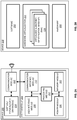
- FIGS. 2A and 2B depict example arrangements of a host subscriber device that may be configured for sharing a service with a guest user according to an embodiment of the present invention.
- FIG. 2A illustrates an example configuration for a client UE device 200 that may be representative of host subscriber device 102 set forth hereinabove in accordance with at least one embodiment of the present disclosure.
- UE device 200 may comprise, for example, a system module 204 configured to handle general operations for device 200 and may include, for example, one or more processing modules or processors 202, one or more memory modules 207, one or more power modules 206, as well as a user interface module 208 and communication interface module 210, e.g., which may be further coupled to a communication module 212.
- communication interface module 210 and communication module 212 may form a communication subsystem that may include suitable transmitter/receiver (transceiver) functionality for effectuating single-mode, dual-mode, or multi-mode scanning and communications over a plurality of bands depending on radio technology.
- transmitter/receiver transmitter/receiver
- one or more wide area wireless Tx/Rx modules as well as one or more wireless WLAN Tx/Rx modules that are compliant with one or more radio technologies exemplified above may be provided as part of such a communications subsystem.
- each Tx/Rx module may include other associated components such as one or more local oscillator (LO) modules, RF switches, RF bandpass filters, A/D and D/A converters, signal processing modules and the like.
- UE device 200 may also comprise a physical or, virtualized, or soft SIM module 214 coupled to at least communication module 212. Whereas communication module 212 and SIM module 214 have been shown as separate from system module 204, it is also possible in some embodiments for some or all of the features associated with communication module 212 and/or SIM module 214 to be incorporated in system module 200.
- Processing module(s) 202 may comprise one or more processors disposed as separate components, or alternatively, may comprise one or more processing cores embodied in one integrated circuit (IC), for example in a System-on-a-Chip (SOC) configuration, and circuitry configured to support the one or more processors that may be configured to run on any software platform including, e.g., a suitable operating system (OS) environment.
- IC integrated circuit
- SOC System-on-a-Chip
- Example circuitry configured to support the one or more processors may include interface or bridging circuitry that may be configured to handle communications between processing module 202, memory module 204 and other modules communicating on various wired and/or wireless buses in device 200.
- bridging circuitry may be configured to handle the signaling between modules by converting from one type/speed of signaling to another, and may be further configured to be compatible with a variety of different devices to allow for different system implementations, upgrades, etc. Some of the functionality described above may also be incorporated within the one or more processors, memory module 204 or other system modules.
- Processing module(s) 202 may be configured to execute instructions, which may include program code configured to cause processing module(s) 202 to perform activities such as, but not limited to, reading data, writing data, processing data, formulating data, converting data, transforming data, etc. in connection with executing instructions, data, etc., that may be stored in memory module(s) 204, e.g., for performing one or more device processes as will be set forth below.
- Memory module(s) 204 may comprise any type of volatile or nonvolatile memory modules based on semiconductor, magnetic, and/or optical storage technologies.
- Power module(s) 206 may include power sources that are internal to UE device 200 (e.g., a battery) and/or interfaces for obtaining power from external sources (e.g., AC power line, solar power, etc.), as well as any related circuitry configured to supply, regulate, modulate, adapt or convert power for operation of the device.
- power sources that are internal to UE device 200 (e.g., a battery) and/or interfaces for obtaining power from external sources (e.g., AC power line, solar power, etc.), as well as any related circuitry configured to supply, regulate, modulate, adapt or convert power for operation of the device.
- User interface module or subsystem 208 may include circuitry configured to allow subscribers/users to interact with device 200 such as, for example, various input mechanisms (e.g., microphones, switches, buttons, knobs, keyboards, speakers, touch-sensitive surfaces, one or more sensors configured to capture images and/or sense proximity, distance, motion, gestures, etc.) and output mechanisms (e.g., speakers, displays, lighted/flashing indicators, electromechanical components for vibration, motion, etc.).
- various input mechanisms e.g., microphones, switches, buttons, knobs, keyboards, speakers, touch-sensitive surfaces, one or more sensors configured to capture images and/or sense proximity, distance, motion, gestures, etc.
- output mechanisms e.g., speakers, displays, lighted/flashing indicators, electromechanical components for vibration, motion, etc.
- communications interface module 210 and communication module 212 may be configured to handle various types of wired/wireless communications including close-proximity wireless media (e.g., such as in the instance of RF identification (RFID) or Near-Field Communication (NFC), infrared (IR), optical character recognition (OCR), magnetic readers, etc.), short-range wireless media (e.g., Bluetooth, wireless local area networking (WLAN), Wi-Fi, etc.) and long range wireless mediums (e.g., cellular, satellite, etc.), in accordance with various standards and/or protocols.
- close-proximity wireless media e.g., such as in the instance of RF identification (RFID) or Near-Field Communication (NFC), infrared (IR), optical character recognition (OCR), magnetic readers, etc.
- short-range wireless media e.g., Bluetooth, wireless local area networking (WLAN), Wi-Fi, etc.
- long range wireless mediums e.g., cellular, satellite, etc.
- UE device 250 is representative of a virtualized UE device such as device 200 set forth above that can be configured to operate as host subscriber device 102 shown in FIG. 1 for effectuating subscriber-driven sharing of a service according to an embodiment of the present invention.
- virtualized UE device 250 may comprise, for example, software section or portion 252, hardware virtualization layer 254 including one or more virtualized SIM (vSIM) modules 256 and a hardware platform section 258.
- Hardware 258 may include the physical equipment portion of device 250 upon which software 252 may be executed for performing various tasks.
- At least one vSIM may be provisioned with respect to a specific guest user such that the guest user may share or otherwise consume a particular service that the host subscriber may have.
- the embodiments set forth herein enable host subscribers to directly share their services with one or more guest users via on-demand instantiation of virtual SIMs, preferably relying on procedures that are compatible with service providers' existing business processes according to one implementation.
- Various functionalities, modules, components or blocks for facilitating such service sharing may be grouped into the following: (i) Instantiation of virtual SIM for service sharing wherein the sharing user (i.e., the host subscriber or "sharer") instantiates a virtual SIM as a part of his/her service; (ii) Enabling of virtual SIM for service sharing whereby the host subscriber and/or service provider activates the virtual SIM and enables service sharing for a specified duration; (iii) Registration of the guest user and device wherein the guest user (also referred to as a shared user or a "sharee") and the UE device are registered with the service provider using the shared SIM and user identity verified, which completes authentication and authorization, thereby resulting in a temporarily assigned phone number and IP address; (iv) Call and data session routing mechanisms for routing calls or data sessions to the right phone number or IP address for the guest user; and (v) Termination of sharing whereby the host, service provider, or shared user can invoke a procedure to terminate the sharing service.
- the sharing user
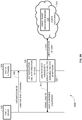
- FIGS. 3A and 3B depict example message flow diagrams 300A/300B for facilitating service sharing according to an embodiment of the present invention.
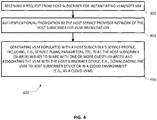
- FIG. 4 depicts a flowchart of steps, acts, blocks and/or functions of a process 400 that may take place in connection with the message flow of FIG. 3A according to an example embodiment of the present invention.
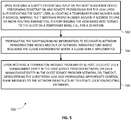
- FIG. 5 depicts a flowchart of steps, acts, blocks and/or functions of a process 500 that may take place in connection with the message flow of FIG. 3B according to an embodiment of the present invention.
- reference numeral 300A in FIG. 3A generally refers to a message flow between a host subscriber/device 302 (which is representative of device 102 in FIG. 1 and/or devices 200/250 in FIGS.
- the host subscriber initiates a request 306 for instantiation of a vSIM or soft SIM for service sharing using the subscriber's device, which may be propagated to and received by an appropriate control and management node of the service provider network as set forth in block 402.
- a request may include or identify a specific service to be shared, time duration for sharing, among other parameters, indicia, etc.
- the service provider network 304 may engage (optionally or otherwise in one example implementation) in a suitable authentication/authorization procedure to verify that the host subscriber is authorized for service sharing and vSIM instantiation (blocks 308, 404).
- a vSIM may be generated that may be preferably populated with information relative to at least a portion of the host subscriber's service profile, including, e.g., service plans, parameters, etc., which the host subscriber (sharer) wishes to share with one or more guests (sharees), as set forth at blocks 310, 406.
- An associative mechanism may be engaged for binding the vSIM with the host subscriber device, e.g., downloading the vSIM to host subscriber device (e.g., as a soft SIM) or in a cloud storage/service environment (e.g., as a cloud vSIM).
- a device SIM downloading path 312 and a cloud virtualization path 314 are respectively illustrated in FIG. 3A , wherein a cloud platform 316 is operative to host a vSIM service binding database 318 with respect to the shared services of the host subscriber(s).
- the downloading path 312 may also represent downloading the vSIM to a guest user's device under certain conditions or scenarios.
- Reference numeral 300B in FIG. 3B is illustrative of message flows relative to a scenario where a guest user 352 (e.g., a user visiting the host for a duration of time) may be enabled to share a host subscriber's service according to an embodiment.
- this time duration may be implemented in a number of ways, including, e.g., as a preconfigured duration that may be extended when the need arises, etc.
- the guest 352 or the host 302 may initiate a number of operations with respect to performing a guest registration process and remote provisioning using vSIM as indicated by message flow 354.
- the guest's credentials including but not limited to guest name, identity, telephone number, Personal Identification Number (PIN) or password or other authentication indicia, device ID, etc. may be input on the host subscriber device.
- such information may also be transmitted to the host subscriber device from the guest user's device using NFC or other device-to-device communications.
- a challenge/response mechanism may be provided with respect to the guest user wherein appropriate credentials and/or other response input may be supplied.
- at least a portion of the information may be used for authentication and authorization of the guest user, either via in-network or out-of-network procedures as set forth in block 356.
- mapping relationships or correspondence may be, created, generated or otherwise obtained relative to the provisioned temporary phone number and/or IP address information and a plurality of parameters such as at least one of, including but not limited to, host service provider ID, guest location, host device ID, guest device ID, guest's original phone number etc., thereby binding the vSIM-based host service(s) to the guest for "personalizing" the vSIM on a temporary basis, as set forth in blocks 358, 502.
- mapping relationships may be propagated to suitable network infrastructure elements for facilitating appropriate routing of call and data sessions involving any shared services without violating extant normal call/session setup/routing protocols, procedures, techniques and methodologies.
- SP subscriber provider
- other mapping relationships may be applied in network infrastructures other than the host SP network, for example, the guest SP network or some other third-party network(s).
- an example mapping relationship that may be applied at the host SP network infrastructure may comprise the following: ⁇ Host-SP assigned temporary allocated phone number ⁇ ⁇ ⁇ Guest location; Guest temporary IP address ⁇ . It should be appreciated that "location" in this mapping relationship could be implicit, because the host SP network is aware of the guest's real-time location using other mechanisms such as GPS, triangulation, etc.
- An example mapping relationship that may be applied at the guest SP network may comprise the following: ⁇ Guest original phone number ⁇ ⁇ ⁇ Host SP network ID; Guest location; Guest temporary IP address ⁇ .
- a still further mapping relationship may comprise: ⁇ Guest original phone number ⁇ ⁇ ⁇ Host-SP assigned temporary allocated phone number; Guest temporary IP address ⁇ .
- a still further mapping relationship may comprise: ⁇ Guest original phone number ⁇ ⁇ ⁇ Host SP network ID; temporary allocated phone number ⁇ .
- an example mapping relationship could be: ⁇ Guest original SIP URL ⁇ ⁇ ⁇ Host SP network ID; Guest temporary SIP URL ⁇ .
- device IDs of the host and/or guest may also be provided in certain additional or alternative embodiments.
- FIG. 1 A still further mapping relationship may comprise: ⁇ Guest original phone number ⁇ ⁇ ⁇ Host SP network ID; temporary allocated phone number ⁇ .
- an example mapping relationship could be: ⁇ Guest original SIP URL ⁇ ⁇ ⁇ Host SP network ID; Guest temporary SIP URL ⁇ .
- reference numerals 360 and 362 refer to appropriate network communication messages that may be effectuated for propagating suitable mapping information to the cloud platform 316 and/or other network infrastructure domains and elements, e.g., the guest's home network including HLR/VLR nodes, etc., as set forth in blocks 364, 504.
- a registration completion message 366 may be provided to the host subscriber device 302 to inform the guest and/or the host that the guest has been registered and allowed to use the host subscriber device and share/consume the designated shared service.
- the guest 352 can make/receive voice/data calls or sessions using the host subscriber equipment and shared host service(s) as per the host subscriber plan(s) applicable to the shared services (block 368).
- the host services on the guest device also, if so desired, depending on vSIM instantiation. That is, in such an illustrative scenario, the guest's device is operational but the guest desires to use/share the host services on his/her device.
- the guest device could be used, depending on availability, operational status, as well as the desire to consume/share host services on the original device. It should be therefore appreciated that in case when the guest device cannot physically be used (no battery, wrong frequencies, etc), the host device will be used. In other cases, guest device could be utilized.
- a termination procedure may be implemented wherein a suitable termination message may be issued in one optional arrangement from or by any of the host, the guest (e.g., either using the shared host subscriber device or from some other UE belonging to the host or the guest), a management entity in the host service provider network and/or in the guest's home network, or responsive to a predefined timer mechanism, etc., whereupon the guest may be deregistered from the vSIM. Further, appropriate control plane messages may be generated and propagated through the service provider networks' infrastructures and/or associated cloud platforms to update the mapping relations, location databases, etc., pursuant to the deregistration of the guest, as set forth at block 506 of process 500.
- the vSIM can also be destroyed as a part of the deregistration process. It could be that vSIM is created once and then mapped to a guest when needed, or vSIM is created every time the service sharing is initiated for one or more guests.
- At least portions of the foregoing acts, functions, blocks and processes may be performed by one or more nodes of the service network provider network (e.g., network elements associated with infrastructure components 108, 120), or by the subscriber device 102, 200, 250 operating as a host/guest device, or in combination thereof, wherein suitably configured processor module(s) may be adapted to execute stored program instructions to facilitate subscriber-driven service sharing as set forth herein.
- An example network node, element, subsystem or apparatus may comprise an embodiment set forth in FIGS. 6A/6B described below, with or without virtualization.
- the sharing user or host subscriber device may be configured to invoke a procedure to instantiate the vSIM or soft SIM for service sharing only in case where there isn't one already created.
- the host subscriber may also provide the sharee or guest user's device ID to the operator, or alternatively provide the guest user with a specifically generated link to the soft SIM.
- the soft SIM may be securely provisioned on the to-be-shared device when alternative connectivity is available.
- the device can be on WiFi and connect to a specific server to download the soft/vSIM, e.g., using procedures similar to the procedures used for downloading secure certificates and the like;
- An emergency channel can be used to send the soft/vSIM as a Short Message Service (SMS) message or a Multimedia Message Service (MMS) message, which the user may accept to install on the device;
- SMS Short Message Service
- MMS Multimedia Message Service
- a peer-to-peer (P2P) mechanism can be used for the primary sharing user to provide the shared user/device with the soft SIM.
- P2P WiFi, Quick Response (QR) code sharing, and NFC are examples of such P2P mechanisms.
- the sharee/user may invoke a soft SIM installation procedure for enabling remote provisioning.
- Skilled artisans will appreciate that this can be easily accomplished with an application on the host's and/or guest's subscriber device.
- the application need not be provided as a smartphone app.
- invoking a remote provisioning mechanism for the soft/vSIM may initiate authentication and authorization procedures for the newly instantiated soft/vSIM and device at one or more various network infrastructure elements, possibly including third-party or private party elements in some embodiments.
- An example remote provisioning mechanism may follow known procedures, and on successful authentication of the soft/vSIM, the network system may provide the device with temporary routing indicia, e.g., an E.164 phone number and/or an IP address as noted previously. While this may be a default practice in an example implementation, it should be appreciated that it is possible for the sharing user to suggest or provide the phone number, or even for the shared service user to request one. Of course, whether the system can actually grant this or not may depend on service provider constraints (e.g., whether the requested number is within the service provider's allowed range, is it already assigned to someone else, and such).
- service provider constraints e.g., whether the requested number is within the service provider's allowed range, is it already assigned to someone else, and such).
- embodiments of the present invention may be practiced in conjunction with all existing mechanisms for routing voice calls and data sessions. Accordingly, suitable control signaling for routing to the shared device over the air interface can be applied in an embodiment of the present invention without modifications.
- termination of a shared service it should be noted that various implementations may be invoked as pointed out earlier.
- the sharing host subscriber, shared service user or guest, or service provider, or a predefined timer, or any other event trigger on the end-user or operator device can invoke known procedures to dissociate the soft/vSIM from the shared service user and associated device, thus terminating the sharing of a designated service.
- Additional examples include sharing time expiration, returning to the pre-configured coverage or battery level (e.g., with respect to shared subscriber device and/or the guest's device), with potential hysteresis parameters to prevent frequent sharing initiation/termination procedures, especially in fully automatic systems.
- calls may be routed to a suitable process handling the "party unavailable" logic (e.g., voicemail) within the guest SP; this is an example case when service sharing is enabled, but only with Host SP assigned temporary number. Calls to original/home host number will go to Host SP as before, and based on Host device (when vSIM is installed on Host device) and/or Host SP policies and capabilities, they may be either routed as before (allowing simultaneous Host and Guest services), or re-routed to "unavailable"/"busy" logic (such as voicemail) as noted above.
- "party unavailable" logic e.g., voicemail
- Another example scenario may involve: Host/Guest device with new vSIM, Guest SP-assigned (probably, Guest original) phone number, Host SP-assigned temporary IP address.
- This is a scenario when Guest does not want a new phone number. Again, communications may not involve Guest SP at all; everything may be routed via Host SP, similar to the processes above. Calls to the Guest original phone number will go via the Guest SP similar to the above and will be handled based on mapping (if provided by Host SP). If no mapping is provided, the shared service will be a data service only. Accordingly, in a scenario where the Host SP communicates with the Guest SP, the routing may involve a typical roaming scenario based on a handshake and business agreement between service providers.
- Another possibility is a "roaming lite" service that the Guest home SP offers, but does not need a handshake with the Host SP.
- the guest user communicates his/her temporary whereabouts (phone number and network ID, no need for IP address) with the guest home SP.
- the HLR/VLR in the guest home SP maintains a mapping to the new phone number.
- the HLR/VLR responds to the calling infrastructure with a call redirect and offering the guest's temporary number.
- the calling HLR/VLR then simply redirects the call to the Guest's temporary number in the Host SP.
- the temporary IP address need not be included in any mapping.
- IP routing may be employed in combination with the teachings herein.
- the user can register their SIP URL with the new HLR/VLR/CSCF or some other call handling/routing function even in VoIP.
- Voice call routing in this scenario works similar to a scenario set forth above. A potential issue that may arise is if the SIP URL for the user is granted by the Guest SP, in which case they own it. In that case, the routing will be similar to one where the Guest SP needs to map the original SIP URL to the temporary SIP URL
- Guest SP processing may not involve Guest temporary number.
- the guest SP infrastructure may not even be aware of that information. Rather, the guest SP infrastructure cares only about Host SP (and the fact that there is an agreement between Guest and Host SP to support such calls and revenue sharing model for such call) and Guest temporary IP address for facilitating call routing regardless of whether a shared service vSIM could be either on Host or Guest device.
- the Guest SP applicable mapping one implementation may involve the Guest SP infrastructure potentially updating Guest status in HLR as "roaming".
- Guest might choose (or Host SP might decide for whatever reason) not to have Host SP assigned temporary phone number; in such a case it will be reachable for phone calls only via the original Guest SP assigned phone number using one of the additional mapping relationships set forth hereinabove. Further, there is no need in any phone number mapping for the purpose of pure data service, as the temporary IP address will be used for that.
- mapping relationships may be automatically exchanged between the SPs. If there is no business agreement, or if the guest chooses to purchase only "roaming lite", the guest user provides the mapping to the guest home SP using a special interface from the phone to some user service portal that populates the mapping into the HLR/VLR for circuit voice or the CSCF for VoIP.
- IP address and/or location need not be included in certain mappings.
- the CSCF in the Host SP already maintains an internal map ⁇ Guest temporary SIP URL ⁇ ⁇ ⁇ Guest temporary location; Guest temporary IP address ⁇ and therefore can reach the user device with plain old IP routing.
- location information once the Host SP ID is available, calls get routed to the Host SP, which would know the location using well established air interface techniques such as LA update in GSM/EDGE, RA update in UMTS HSPA, and TA update in LTE, etc.
- the mappings that the Host SP maintains for the guest's temporary whereabouts may all be provided as internal, since the Host SP ID, guest location, guest IP address, etc. are all available.
- a subscriber device may have multiple SIMs available concurrently (e.g., one original, one shared service vSIM), for example, as illustrated in device 250 of FIG. 2B .
- SIMs available concurrently
- suitable logic may be provided in order to enable the user to select the context in which the request is handled - e.g., original vs. shared service - in accordance with an embodiment of the present invention. For instance, it can be accomplished by direct end-user selection using GUI, or via some automated process implemented on the device.
- NFV network function virtualization
- various physical resources, services, applications and functions executing within an example network environment may be provided as virtual appliances, machines or functions, wherein the resources and applications are virtualized into suitable virtual network functions (VNFs) or virtual network elements (VNEs) via a suitable virtualization layer.
- VNFs virtual network functions
- VNEs virtual network elements
- Resources comprising compute resources, memory resources, and network infrastructure resources are virtualized into corresponding virtual resources wherein virtual compute resources, virtual memory resources and virtual network resources are collectively operative to support a VNF layer, whose overall management and orchestration functionality may be supported by a virtualized infrastructure manager (VIM) in conjunction with a VNF manager and an NFV orchestrator.
- VIP virtualized infrastructure manager
- An Operation Support System (OSS) and/or Business Support System (BSS) component may typically be provided for handling network-level functionalities such as network management, fault management, configuration management, service management, and subscriber management, etc., which may interface with VNF layer and NFV orchestration components via suitable interfaces.
- OSS Operation Support System
- BSS Business Support System
- an example network architecture disclosed herein may be virtualized as set forth above and architected in a cloud-computing environment comprising a shared pool of configurable virtual resources.
- Various pieces of software e.g., call processing software, vSIM instantiation, remote provisioning and user authentication, etc., as well as platforms and infrastructure of a network may be implemented in a service-oriented architecture, e.g., Software as a Service (SaaS), Platform as a Service (PaaS), infrastructure as a Service (IaaS) etc., with involved parties providing different features of an example embodiment of the present invention.
- SaaS Software as a Service
- PaaS Platform as a Service
- IaaS infrastructure as a Service
- cloud-computing environment may comprise one or more of private clouds, public clouds, hybrid clouds, community clouds, distributed clouds, multiclouds and interclouds (e.g., "cloud of clouds"), and the like.
- private clouds public clouds
- hybrid clouds community clouds
- distributed clouds multiclouds and interclouds (e.g., "cloud of clouds")
- multiclouds and interclouds e.g., "cloud of clouds”
- FIGS. 6A and 6B illustrate connectivity between network devices (NDs) within an exemplary network, as well as three exemplary implementations of the NDs, according to some embodiments of the invention wherein at least one or more portions of the network environment shown in FIG. 1 may be implemented in a virtualized environment.
- NDs network devices
- a network device may be an electronic device that communicatively interconnects other electronic devices on the network (e.g., other network devices, end-user devices).
- Some network devices may be configured as "multiple services network devices" that provide support for multiple networking functions (e.g., routing, bridging, switching, Layer 2 aggregation, session border control, Quality of Service, and/or subscriber management), and/or provide support for multiple application services (e.g., data, voice, and video).
- FIG. 6A illustrates connectivity among a plurality of network devices (NDs) within an exemplary network, as well as three exemplary implementations of the NDs, according to some embodiments of the invention.
- NDs 600A-H may be representative of carrier network switching elements, access network elements, Selective Routers, Location Databases, media gateways (MGWs), Call Session Control Function (CSCF) nodes, as well as the network elements provided as part of the infrastructure components 108, 120 shown in FIG.
- NDs 600A-H may be representative of carrier network switching elements, access network elements, Selective Routers, Location Databases, media gateways (MGWs), Call Session Control Function (CSCF) nodes, as well as the network elements provided as part of the infrastructure components 108, 120 shown in FIG.
- MGWs media gateways
- CSCF Call Session Control Function
- example connectivity is illustrated by way of lines between A-B, B-C, C-D, D-E, E-F, F-G, and A-G, as well as between H and each of A, C, D, and G.
- NDs may be provided as physical devices, and the connectivity between these NDs can be wireless or wired (often referred to as a link).
- An additional line extending from NDs 600A, E, and F illustrates that these NDs act as ingress and egress nodes for the network (and thus, these NDs are sometimes referred to as edge NDs; while the other NDs may be called core NDs).
- Two of the exemplary ND implementations in FIG. 6A are: (1) a special-purpose network device 602 that uses custom application-specific integrated-circuits (ASICs) and a proprietary operating system (OS); and (2) a general purpose network device 604 that uses common off-the-shelf (COTS) processors and a standard OS.
- ASICs application-specific integrated-circuits
- OS operating system
- COTS common off-the-shelf
- the special-purpose network device 602 includes appropriate hardware 610 (e.g., custom or application-specific hardware) comprising compute resource(s) 612 (which typically include a set of one or more processors), forwarding resource(s) 614 (which typically include one or more ASICs and/or network processors), and physical network interfaces (NIs) 616 (sometimes called physical ports), as well as non-transitory machine readable storage media 618 having stored therein suitable application-specific software or program instructions 620 (e.g., switching, routing, call processing, etc).
- appropriate hardware 610 e.g., custom or application-specific hardware
- compute resource(s) 612 which typically include a set of one or more processors
- forwarding resource(s) 614 which typically include one or more ASICs and/or network processors
- NIs physical network interfaces
- suitable application-specific software or program instructions 620 e.g., switching, routing, call processing, etc.
- a physical NI is hardware in an ND through which a network connection (e.g., wirelessly through a wireless network interface controller (WNIC) or through plugging in a cable to a physical port connected to a network interface controller (NIC)) is made, such as those shown by the connectivity between NDs 600A-H.
- a network connection e.g., wirelessly through a wireless network interface controller (WNIC) or through plugging in a cable to a physical port connected to a network interface controller (NIC)
- WNIC wireless network interface controller
- NIC network interface controller
- Each of the custom software instance(s) 622, and that part of the hardware 610 that executes that application software instance form a separate virtual network element 630A-R.
- Each of the virtual network element(s) (VNEs) 630A-R includes a control communication and configuration module 632A-R (sometimes referred to as a local control module or control communication module) and forwarding table(s) 634A-R with respect to suitable application/service instances 633A-R, such that a given virtual network element (e.g., 630A) includes the control communication and configuration module (e.g., 632A), a set of one or more forwarding table(s) (e.g., 634A), and that portion of the application hardware 610 that executes the virtual network element (e.g., 630A) for supporting the application instance 633A (e.g., vSIM instantiation, remote provisioning, call/session routing, call/session prioritization, caller query logic and integrated messaging, and the like in relation to a messaging subsystem virtualization).
- a control communication and configuration module 632A-R sometimes referred to as a local control module or control communication module
- the special-purpose network device 602 is often physically and/or logically considered to include: (1) a ND control plane 624 (sometimes referred to as a control plane) comprising the compute resource(s) 612 that execute the control communication and configuration module(s) 632A-R; and (2) a ND forwarding plane 626 (sometimes referred to as a forwarding plane, a data plane, or a media or bearer plane) comprising the forwarding resource(s) 614 that can utilize the forwarding or destination table(s) 634A-R and the physical NIs 616.
- a ND control plane 624 (sometimes referred to as a control plane) comprising the compute resource(s) 612 that execute the control communication and configuration module(s) 632A-R
- a ND forwarding plane 626 sometimes referred to as a forwarding plane, a data plane, or a media or bearer plane
- the forwarding resource(s) 614 that can utilize the forwarding or destination table(s) 634A-R and the
- the ND control plane 624 (the compute resource(s) 612 executing the control communication and configuration module(s) 632A-R) is typically responsible for participating in controlling how bearer traffic (e.g., voice/data/video) is to be routed.
- bearer traffic e.g., voice/data/video
- ND forwarding plane 626 is responsible for receiving that data on the physical NIs 616 and forwarding that data out the appropriate ones of the physical NIs 616 based on the forwarding information.
- FIG. 6B illustrates an exemplary way to implement the special-purpose network device 602 according to some embodiments of the invention, wherein an example special-purpose network device includes one or more cards 638 (typically hot-pluggable) coupled to an interconnect mechanism. While in some embodiments the cards 638 are of two types, one or more that operate as the ND forwarding plane 626 (sometimes called line cards), and one or more that operate to implement the ND control plane 624 (sometimes called control cards)), alternative embodiments may combine functionality onto a single card and/or include additional card types (e.g., one additional type of card is called a service card, resource card, or multi-application card).
- additional card types e.g., one additional type of card is called a service card, resource card, or multi-application card.
- a service card can provide specialized processing (e.g., Layer 4 to Layer 6 services (e.g., firewall, Internet Protocol Security (IPsec) (RFC 4301 and 4309), Secure Sockets Layer (SSL) / Transport Layer Security (TLS), Intrusion Detection System (IDS), peer-to-peer (P2P), Voice over IP (VoIP) Session Border Controller, Mobile Wireless Gateways (Gateway General Packet Radio Service (GPRS) Support Node (GGSN), Evolved Packet Core (EPC) Gateway)).
- IPsec Internet Protocol Security
- SSL Secure Sockets Layer
- TLS Transport Layer Security
- IDS Intrusion Detection System
- P2P peer-to-peer
- VoIP Voice over IP
- GPRS General Packet Radio Service
- GGSN General Packet Radio Service
- EPC Evolved Packet Core Gateway
- the general purpose network device 604 includes hardware 640 comprising a set of one or more processor(s) 642 (which are often COTS processors) and network interface controller(s) 644 (NICs; also known as network interface cards) (which include physical NIs 646), as well as non-transitory machine readable storage media 648 having stored therein software 650, e.g., general purpose operating system software.
- the processor(s) 642 execute the software 650 to instantiate one or more sets of one or more applications 664A-R with respect to facilitating subscriber-driven service sharing, for example, including vSIM instantiation, SIM binding, authentication/authorization, remote provisioning, etc.
- alternative embodiments may use different forms of virtualization - represented by a virtualization layer 654 and software containers 662A-R.
- a virtualization layer 654 represents the kernel of an operating system (or a shim executing on a base operating system) that allows for the creation of multiple software containers 662A-R that may each be used to execute one of the sets of applications 664A-R.
- the multiple software containers 662A-R are each a user space instance (typically a virtual memory space); these user space instances are separate from each other and separate from the kernel space in which the operating system is run, the set of applications running in a given user space, unless explicitly allowed, cannot access the memory of the other processes
- the virtualization layer 654 represents a hypervisor (sometimes referred to as a virtual machine monitor (VMM)) or a hypervisor executing on top of a host operating system; and (2) the software containers 662A-R each represent a tightly isolated form of software container called a virtual machine that is run by the hypervisor and may include a guest operating system.
- VMM virtual machine monitor
- a virtual machine is a software implementation of a physical machine that runs programs as if they were executing on a physical, non-virtualized machine; and applications generally do not know they are running on a virtual machine as opposed to running on a "bare metal" host electronic device, though some systems provide para-virtualization which allows an operating system or application to be aware of the presence of virtualization for optimization purposes.
- the instantiation of the one or more sets of one or more applications 664A-R, as well as the virtualization layer 654 and software containers 662A-R if implemented, are collectively referred to as software instance(s) 652.
- Each set of applications 664A-R, corresponding software container 662A-R if implemented, and that part of the hardware 640 that executes them (be it hardware dedicated to that execution and/or time slices of hardware temporally shared by software containers 662A-R), forms a separate virtual network element(s) 1060A-R.
- the virtual network element(s) 660A-R perform similar functionality to the virtual network element(s) 630A-R - e.g., similar to the control communication and configuration module(s) 632A and forwarding table(s) 634A (this virtualization of the hardware 640 is sometimes referred to as NFV architecture, as mentioned previously in the present patent disclosure.
- NFV may be used to consolidate many network equipment types onto industry standard high volume server hardware, physical switches, and physical storage, which could be located in data centers, NDs, and customer premise equipment (CPE).
- CPE customer premise equipment
- different embodiments of the invention may implement one or more of the software container(s) 662A-R differently.
- each software container 662A-R corresponds to one VNE 660A-R
- alternative embodiments may implement this correspondence at a finer level granularity (e.g., line card virtual machines virtualize line cards, control card virtual machines virtualize control cards, etc.).
- line card virtual machines virtualize line cards
- control card virtual machines virtualize control cards
- the virtualization layer 654 may include a virtual switch that provides similar forwarding services as a physical Ethernet switch. Specifically, this virtual switch forwards traffic between software containers 662A-R and the NIC(s) 644, as well as optionally between the software containers 662A-R. In addition, this virtual switch may enforce network isolation between the VNEs 660A-R that by policy are not permitted to communicate with each other (e.g., by honoring virtual local area networks (VLANs)).
- VLANs virtual local area networks
- the third exemplary ND implementation in FIG. 6A is a hybrid network device 606, which includes both custom ASICs/proprietary OS and COTS processors/standard OS in a single ND or a single card within an ND
- a platform VM i.e., a VM that implements the functionality of the special-purpose network device 602 could provide for para-virtualization to the application-specific hardware present in the hybrid network device 606 for effectuating a particular embodiment of a subscriber-driven service sharing scenario.
- a single one of multiple VNEs implemented by an ND is being considered (e.g., only one of the VNEs is part of a given virtual network) or where only a single VNE is currently being implemented by an ND
- the shortened term network element (NE) is sometimes used to refer to that VNE.
- each of the VNEs receives data on the physical NIs (e.g., 616, 646) and forwards that data out the appropriate ones of the physical NIs (e.g., 616, 646) for routing a call/session pursuant to a shared service/plan of a host subscriber.
- the physical NIs e.g., 616, 646
- embodiments of the present invention enable subscribers and customers to provide the convenience of sharing a service to their friends and family in a timely fashion using relatively simple processes in the event the guests are unable to use their own service (e.g., due to service outage, poor network quality, outside of coverage area, low battery on the device, etc.). Further, while not specifically described, an implementation of the present invention can provide a revenue opportunity for service providers by way of offering a service sharing service to its subscribers depending on billing arrangements for shared services.
- a family plan may typically require that multiple SIM cards issued to family members all be registered in one account associated with the registered plan purchaser. From a billing viewpoint, this requires subscription and charging information to be aggregated for all the SIMs for billing purposes. Adding a family member to the plan requires fairly extensive interaction with the operator's customer service personnel, and/or a trip to the store or a wait for the new SIM to arrive by mail. Also, it should be appreciated that roaming services are often expensive when available.
- switching SIMs on a subscriber device can be inconvenient. In the first place, switching the SIM out of a phone works only if the phone is carrier unlocked. This is often not the case for on-contract phones. When a phone is indeed unlocked from the home carrier, it might be a small task for the user to switch the SIM but it is still an annoyance. Sometimes the SIMs are not of the same size, which may require an adapter or cutting a SIM card to size. For temporary uses such as roaming, it also means that the user loses the home service number or settings when the handset is dual SIM capable, and has to refresh them when switching back. Moreover, the operator incurs transaction costs on the control and management planes due to re-authentication etc. Those skilled in the art can readily recognize upon reference hereto that an embodiment of the present invention involving service sharing can advantageously overcome the foregoing shortcomings, among others.
- Such computer program instructions may be provided to a processor circuit of a general purpose computer circuit, special purpose computer circuit, and/or other programmable data processing circuit to produce a machine, so that the instructions, which execute via the processor of the computer and/or other programmable data processing apparatus, transform and control transistors, values stored in memory locations, and other hardware components within such circuitry to implement the functions/acts specified in the block diagrams and/or flowchart block or blocks, and thereby create means (functionality) and/or structure for implementing the functions/acts specified in the block diagrams and/or flowchart block(s).
- the computer program instructions may also be stored in a tangible computer-readable medium that can direct a computer or other programmable data processing apparatus to function in a particular manner, such that the instructions stored in the computer-readable medium produce an article of manufacture including instructions which implement the functions/acts specified in the block diagrams and/or flowchart block or blocks.
- tangible, non-transitory computer-readable medium may include an electronic, magnetic, optical, electromagnetic, or semiconductor data storage system, apparatus, or device. More specific examples of the computer-readable medium would include the following: a portable computer diskette, a random access memory (RAM) circuit, a read-only memory (ROM) circuit, an erasable programmable read-only memory (EPROM or Flash memory) circuit, a portable compact disc read-only memory (CD-ROM), and a portable digital video disc read-only memory (DVD/Blu-ray).
- RAM random access memory
- ROM read-only memory
- EPROM or Flash memory erasable programmable read-only memory
- CD-ROM compact disc read-only memory
- DVD/Blu-ray portable digital video disc read-only memory
- the computer program instructions may also be loaded onto or otherwise downloaded to a computer and/or other programmable data processing apparatus to cause a series of operational steps to be performed on the computer and/or other programmable apparatus to produce a computer-implemented process.
- embodiments of the present invention may be embodied in hardware and/or in software (including firmware, resident software, micro-code, etc.) that runs on a processor or controller, which may collectively be referred to as "circuitry,” "a module” or variants thereof.
- an example processing unit may include, by way of illustration, a general purpose processor, a special purpose processor, a conventional processor, a digital signal processor (DSP), a plurality of microprocessors, one or more microprocessors in association with a DSP core, a controller, a microcontroller, Application Specific Integrated Circuits (ASICs), Field Programmable Gate Arrays (FPGAs) circuits, any other type of integrated circuit (IC), and/or a state machine.
- DSP digital signal processor
- ASICs Application Specific Integrated Circuits
- FPGAs Field Programmable Gate Arrays
- an example processor unit may employ distributed processing in certain embodiments.
- the functions/acts described in the blocks may occur out of the order shown in the flowcharts.
- two blocks shown in succession may in fact be executed substantially concurrently or the blocks may sometimes be executed in the reverse order, depending upon the functionality/acts involved.
- the functionality of a given block of the flowcharts and/or block diagrams may be separated into multiple blocks and/or the functionality of two or more blocks of the flowcharts and/or block diagrams may be at least partially integrated.
- some of the diagrams include arrows on communication paths to show a primary direction of communication, it is to be understood that communication may occur in the opposite direction relative to the depicted arrows.
- other blocks may be added/inserted between the blocks that are illustrated.
Landscapes
- Engineering & Computer Science (AREA)
- Computer Networks & Wireless Communication (AREA)
- Signal Processing (AREA)
- Computer Security & Cryptography (AREA)
- Databases & Information Systems (AREA)
- Telephonic Communication Services (AREA)
- Mobile Radio Communication Systems (AREA)
Claims (14)
- Système (120, 602, 604) pour la facilitation de partage de service dans un environnement de réseau (100), comprenant :un ou plusieurs processeurs (612, 642) ; etun module de mémoire persistante (618, 648) couplé aux un ou plusieurs processeurs (612, 642), le module de mémoire persistante (618, 648) incluant des instructions de programme pour réaliser, lorsqu'elles sont exécutées par les un ou plusieurs processeurs (618, 648) :suite à la réception d'une demande à partir d'un dispositif d'abonné hôte (302) utilisé par un abonné hôte pour l'instanciation (306, 402) d'un module d'identification d'abonné virtuel, vSIM, l'authentification (308, 404) de l'abonné hôte (302) par un réseau de fournisseur de service d'hôte (304) et la génération (310, 406) d'un vSIM peuplé avec le profil de service de l'abonné hôte par rapport à un ou plusieurs services d'hôte auxquels l'abonné hôte (302) a un abonnement et qu'il demande de partager ;l'association (312, 314, 406) du vSIM à au moins un du dispositif d'abonné hôte (302) et d'un dispositif d'abonné invité utilisé par un utilisateur invité (352) ;suite à la réception des justificatifs de l'utilisateur invité, la réalisation de l'enregistrement d'invité et du provisionnement à distance (354, 502) pour le vSIM, le provisionnement à distance incluant l'attribution (358, 502) d'un numéro de téléphone temporaire et d'une adresse protocole Internet, IP, qui sont attachés au service d'hôte à base de vSIM et la création (358, 502) d'une ou de plusieurs relations de mappage relativement au numéro de téléphone temporaire et à l'adresse IP pendant une durée ; etla propagation (360, 362, 504) d'au moins une des relations de mappage vers une ou plusieurs bases de données de localisation et de routage d'au moins un du réseau de fournisseur de service d'hôte (304) et d'un réseau de fournisseur de service d'invité (364) pour la facilitation (368) du routage d'appels pour l'utilisateur invité (352) en utilisant au moins un des services d'hôte à base de vSIM ;dans lequel le provisionnement à distance est réalisé en réponse à l'authentification (356) de l'utilisateur invité auprès du réseau de fournisseur de service d'invité et la détermination que le réseau de fournisseur de service d'hôte et le réseau de fournisseur de service d'invité ont un arrangement de partage de service.
- Système (120, 602, 604) selon la revendication l, dans lequel le vSIM est fourni (314) sous forme de SIM en nuage (318) dans une plate-forme de stockage à base de nuage (316), le SIM en nuage (318) étant identifié auprès d'au moins un du dispositif d'abonné hôte (302) ou du dispositif d'abonné invité (352) dans la plate-forme de service à base de nuage (316).
- Système (120, 602, 604) selon la revendication l, dans lequel l'association du vSIM à au moins un du dispositif d'abonné hôte (302) et du dispositif d'abonné invité (352) comprend le téléchargement respectif (312) du vSIM sur le dispositif d'abonné hôte (302) ou le dispositif d'abonné invité (352).
- Système (120, 602, 604) selon la revendication 1, dans lequel le service d'hôte à base de vSIM ou l'au moins un des services d'hôte à base de vSIM comprend au moins un de : un service de voix, un service de données, un service vidéo, un service de réseau à commutation de circuits, un service de réseau à commutation de paquets, un service de voix sur IP, VoIP, et un service de communication OTT (Over-The-Top).
- Système (120, 602, 604) selon la revendication 1, dans lequel la durée comprend une fenêtre temporelle qui est au moins un de : configurée manuellement, configurée automatiquement, une période non limitée, une fenêtre temporelle extensible ayant un forçage de système, et une duration préconfigurée reçue par l'intermédiaire d'une entrée provenant d'au moins un de l'abonné hôte et de l'utilisateur invité.
- Système (120, 602, 604) selon la revendication 1, dans lequel les une ou plusieurs relations de mappage impliquant au moins un du numéro de téléphone temporaire et de l'adresse IP est terminée (506) dans un processus de désenregistrement suite à la réception d'un message de terminaison à partir d'au moins un de : (i) l'abonné hôte, (ii) l'utilisateur invité, (iii) une entité de gestion dans le réseau de fournisseur de service d'hôte, (iv) une entité de gestion du réseau de fournisseur de service d'invité, et (v) un mécanisme de temporisation.
- Système (120, 602, 604) selon la revendication 1, dans lequel les justificatifs de l'entrée d'utilisateur invité comprennent au moins un de : le nom, l'identité, le numéro de téléphone, le numéro d'identification personnel, PIN, le mot de passe, et l'indication d'authentification, de l'utilisateur invité.
- Système (120, 602, 604) selon la revendication l, dans lequel les instructions de programme sont en outre configurées pour la création, ou le procédé comprend la création, d'un ou de plusieurs vSIMs à chaque fois qu'un partage de service est initié pour un ou plusieurs utilisateurs invités.
- Procédé (300A/B, 400, 500) pour la facilitation de partage de service dans un environnement de réseau (100), le procédé (300A/B, 400, 500) étant réalisé par un système (120, 602, 602) et comprenant :suite à la réception d'une demande à partir d'un dispositif d'abonné hôte (302) utilisé par un abonné hôte pour l'instanciation (306, 402) d'un module d'identification d'abonné virtuel (vSIM), l'authentification (308, 404) de l'abonné hôte (302) par un réseau de fournisseur de service d'hôte (304) et la génération (310, 406) d'un vSIM peuplé avec le profil de service de l'abonné hôte par rapport à un ou plusieurs services d'hôte auxquels l'abonné hôte (302) a un abonnement et qu'il demande de partager ;l'association (312, 314, 406) du vSIM à au moins un du dispositif d'abonné hôte (302) et d'un dispositif d'abonné invité utilisé par un utilisateur invité (352) ;suite à la réception des justificatifs de l'utilisateur invité, la réalisation de l'enregistrement d'invité et du provisionnement à distance (354, 502) pour le vSIM, le provisionnement à distance incluant l'attribution (358, 502) d'un numéro de téléphone temporaire et d'une adresse protocole Internet, IP, qui sont attachés au service d'hôte à base de vSIM et la création (358, 502) d'une ou de plusieurs relations de mappage relativement au numéro de téléphone temporaire et à l'adresse IP pendant une durée préconfigurée ; etla propagation (360, 362, 504) d'au moins une des relations de mappage vers une ou plusieurs bases de données de localisation et de routage d'au moins un du réseau de fournisseur de service d'hôte (304) et d'un réseau de fournisseur de service d'invité (364) pour la facilitation (368) du routage d'appels pour l'utilisateur invité dispositif (352) en utilisant au moins un des services d'hôte à base de vSIM ;dans lequel le provisionnement à distance est réalisé en réponse à l'authentification (356) de l'utilisateur invité auprès du réseau de fournisseur de service d'invité et la détermination que le réseau de fournisseur de service d'hôte et le réseau de fournisseur de service d'invité ont un arrangement de partage de service.
- Procédé (300A/B, 400, 500) selon la revendication 9, comprenant en outre la terminaison (506) des une ou plusieurs relations de mappage impliquant au moins un du numéro de téléphone temporaire et de l'adresse IP dans un processus de désenregistrement lors de la réception d'un message de terminaison à partir d'au moins un de : (i) l'abonné hôte, (ii) l'utilisateur invité, (iii) une entité de gestion dans le réseau de fournisseur de service d'hôte, (iv) une entité de gestion du réseau de fournisseur de service d'invité, et (v) un mécanisme de temporisation.
- Procédé (300A/B, 400, 500) selon la revendication 9, comprenant en outre :la réalisation d'un second enregistrement d'invité et du provisionnement à distance pour le vSIM en utilisant les justificatifs d'un autre invité, le provisionnement à distance incluant l'attribution d'un autre numéro de téléphone temporaire et d'une autre adresse IP qui sont attachés au service d'hôte à base de vSIM et mappés dans une relation associative relativement à un autre numéro de téléphone temporaire et une autre adresse IP pour une autre durée ; etla propagation de la relation associative vers une ou plusieurs bases de données de localisation et de routage d'au moins un du réseau de fournisseur de service d'hôte et d'un réseau de fournisseur de service associé au numéro de téléphone de l'autre utilisateur invité pour la facilitation du routage d'appels pour l'autre utilisateur invité en utilisant au moins un des services à base de vSIM partagés avec l'abonné hôte, et optionnellement dans lequel l'entrée de justificatifs de l'autre utilisateur invité comprend au moins un de : le nom, l'identité, le numéro de téléphone, le numéro d'identification personnel, PIN, le mot de passe, et l'indication d'authentification, de l'autre utilisateur invité.
- Système selon l'une quelconque des revendications 1 à 8, dans lequel le dispositif d'abonné (200) doit être utilisé en tant qu'abonné invité et comprend :
un ou plusieurs processeurs (202) ; et un module de mémoire persistante (207) couplé aux un ou plusieurs processeurs (202), le module de mémoire persistante (207) incluant des instructions de programme pour réaliser, lorsqu'elles sont exécutées par les un ou plusieurs processeurs :suite à la réception d'une entrée à partir d'un abonné hôte, la génération de la demande (306) de l'instanciation du module d'identification d'abonné virtuel, vSIM, au réseau de fournisseur de service d'hôte (304) ;la réception (312) du vSIM peuplé avec le profil de service de l'abonné hôte par rapport aux un ou plusieurs services d'hôte auxquels l'abonné hôte a un abonnement et qu'il demande de partager avec un ou plusieurs invités ; etla facilitation, en utilisant les justificatifs de l'entrée d'utilisateur invité, de l'initiation du processus d'enregistrement d'invité et de provisionnement à distance (354) pour le vSIM, le provisionnement à distance incluant la réception du numéro de téléphone temporaire et de l'adresse protocole Internet, IP, qui sont attachés au service d'hôte à base de vSIM et mappés dans les une ou plusieurs relation associatives pendant une durée. - Système selon la revendication 12, dans lequel le dispositif d'abonné comprend en outre :
une interface de communication (210, 212) opérationnelle avec une technologie d'accès radio conforme à : une norme sélectionnée parmi au moins un de : norme IEEE 802.11, norme IEEE 802.16, norme HiperLan, norme HiperLan II, norme Wi-Max, norme OpenAir, et norme Bluetooth, ou conforme à au moins un de : un réseau GPRS (General Packet Radio Service), un réseau EDGE (Enhanced Data Rates for Global System for Mobile Communications, GSM, Evolution), un réseau conforme à 3GPP (3rd Generation Partnership Project), un réseau 4G, un réseau 5G, un réseau NGN (Next Generation Network), un réseau IDEN (Integrated Digital Enhanced Network), un réseau CDMA (Code Division Multiple Access), un réseau UMTS (Universal Mobile Télécommunications System), un réseau TDMA (Time Division Multiple Access), et un réseau LTE (Long Term Evolution). - Système selon la revendication 12, dans lequel le dispositif d'abonné comprend en outre :deux ou plus vSIMs (214), dont un premier comprend le vSIM configuré pour partager des services et dont un second comprend un vSIM configuré pour un de : les propres services d'origine de l'utilisateur invité et les propres services d'origine de l'abonné hôte ; etune interface utilisateur (208) configurée pour recevoir une entrée utilisateur opérationnelle pour indiquer si un service partagé ou un service d'origine est occupé.
Applications Claiming Priority (1)
| Application Number | Priority Date | Filing Date | Title |
|---|---|---|---|
| PCT/IB2016/052251 WO2017182844A1 (fr) | 2016-04-21 | 2016-04-21 | Partage commandé par les abonnés d'un service de communications à l'aide d'un vsim |
Publications (2)
| Publication Number | Publication Date |
|---|---|
| EP3446504A1 EP3446504A1 (fr) | 2019-02-27 |
| EP3446504B1 true EP3446504B1 (fr) | 2020-09-23 |
Family
ID=55963418
Family Applications (1)
| Application Number | Title | Priority Date | Filing Date |
|---|---|---|---|
| EP16721942.7A Active EP3446504B1 (fr) | 2016-04-21 | 2016-04-21 | Partage commandé par les abonnés d'un service de communications à l'aide d'un vsim |
Country Status (4)
| Country | Link |
|---|---|
| US (1) | US11089469B2 (fr) |
| EP (1) | EP3446504B1 (fr) |
| CN (1) | CN109417704B (fr) |
| WO (1) | WO2017182844A1 (fr) |
Cited By (1)
| Publication number | Priority date | Publication date | Assignee | Title |
|---|---|---|---|---|
| WO2025174760A1 (fr) * | 2024-02-12 | 2025-08-21 | Google Llc | Procédés et dispositifs de partage d'un profil sim |
Families Citing this family (17)
| Publication number | Priority date | Publication date | Assignee | Title |
|---|---|---|---|---|
| CN112399423B (zh) * | 2016-07-14 | 2022-09-16 | 华为技术有限公司 | 一种通过虚拟客户识别模块进行通信的方法及设备 |
| KR102589503B1 (ko) * | 2017-01-02 | 2023-10-16 | 삼성전자 주식회사 | 데이터 사용량을 공유 받는 공유 대상 장치를 설정하는 방법과, 이를 위한 전자 장치 |
| US10631367B2 (en) * | 2017-04-14 | 2020-04-21 | Verizon Patent And Licensing Inc. | Virtualized equipment for multi-network and cross cell utilization |
| US10285026B2 (en) * | 2017-08-08 | 2019-05-07 | T-Mobile Usa, Inc. | Service sharing between devices |
| FR3074397B1 (fr) * | 2017-11-30 | 2019-11-29 | Orange | Procede de traitement d'un appel entrant dans un reseau de telecommunications et serveur tas le mettant en oeuvre |
| IT201800005763A1 (it) | 2018-05-28 | 2019-11-28 | Tirozzi Gianluca | Metodo, apparati e sistema per la realizzazione di un protocollo criptato di trasmissione di pacchetti dati criptati denoniminato "transport encrypted protocol" (tep) |
| US11375404B2 (en) * | 2018-07-16 | 2022-06-28 | Revokind, Inc. | Decentralized infrastructure methods and systems |
| US11388599B2 (en) | 2019-05-09 | 2022-07-12 | Mediatek Inc. | Device-to-device subscriber identity module sharing method and associated apparatuses |
| KR102647646B1 (ko) * | 2019-05-15 | 2024-03-13 | 현대자동차주식회사 | 엣지 컴퓨팅에 기초한 이동체 동작 방법 및 장치 |
| US20240020576A1 (en) * | 2019-07-31 | 2024-01-18 | BioSymetrics, Inc. | Methods, systems, and frameworks for federated learning while ensuring bi directional data security |
| CN110519761B (zh) | 2019-08-12 | 2022-09-09 | 深圳市优克联新技术有限公司 | 用户身份识别卡的验证方法、装置、电子设备及存储介质 |
| US10701551B1 (en) * | 2019-09-11 | 2020-06-30 | T-Mobile Usa, Inc. | Methods for sharing a virtual SIM card |
| US11129013B2 (en) * | 2019-10-21 | 2021-09-21 | Google Llc | Instant eSIM test profile generator |
| CN114846780B (zh) * | 2020-02-04 | 2025-09-19 | 瑞典爱立信有限公司 | 处理通信网络中的ims服务的提供的节点和方法 |
| JP7771614B2 (ja) * | 2021-10-08 | 2025-11-18 | 株式会社リコー | 情報処理システム、認証方法、プログラム、機器 |
| EP4416972A1 (fr) * | 2021-12-20 | 2024-08-21 | Google LLC | Balayage de réseau étendu pour un équipement utilisateur comprenant de multiples modules d'identité d'abonné |
| US12610347B2 (en) | 2023-05-05 | 2026-04-21 | T-Mobile Usa, Inc. | Escalated and persistent messages for network service access by subscriber devices of a wireless telecommunication network |
Family Cites Families (19)
| Publication number | Priority date | Publication date | Assignee | Title |
|---|---|---|---|---|
| GB0619711D0 (en) * | 2006-10-05 | 2006-11-15 | Christie Tyrone M | Virtual subscriber identities for mobile communications networks |
| US8200736B2 (en) * | 2007-12-24 | 2012-06-12 | Qualcomm Incorporated | Virtual SIM card for mobile handsets |
| CN101222715B (zh) * | 2008-01-29 | 2013-04-03 | 展讯通信(上海)有限公司 | 一种单套通信器件实现的双卡双待手机 |
| DE102008025792A1 (de) | 2008-05-29 | 2009-12-17 | T-Mobile International Ag | Personalisierung einer SIM mittels einer eindeutigen, personlisierten MasterSIM |
| US8634828B2 (en) * | 2009-06-08 | 2014-01-21 | Qualcomm Incorporated | Method and apparatus for switching virtual SIM service contracts based upon a user profile |
| US20120059918A1 (en) * | 2010-09-08 | 2012-03-08 | Qualcomm Incorporated | Location based service data connection support across multiple profiles |
| US9769657B2 (en) * | 2011-04-05 | 2017-09-19 | Valid Soluciones Tecnologicas, S.A.U. | Method and system for the remote provisioning of subscription |
| WO2012174722A1 (fr) | 2011-06-23 | 2012-12-27 | Renesas Mobile Corporation | Procédé et appareil pour fournir un numéro de carte sim virtuel pour des communications mobiles |
| WO2013097177A1 (fr) | 2011-12-30 | 2013-07-04 | Telefonaktiebolaget Lm Ericsson (Publ) | Plate-forme en nuage pour carte sim virtuelle |
| CN104145449A (zh) * | 2012-02-29 | 2014-11-12 | 交互数字专利控股公司 | 在不进行定制或预付费协定的情况下进行网络接入和网络服务的提供 |
| EP2704467A1 (fr) * | 2012-09-03 | 2014-03-05 | Alcatel Lucent | Personnalisation initiale de carte à puce avec génération locale de clés. |
| CN102917339B (zh) | 2012-10-11 | 2014-06-11 | 华为技术有限公司 | 虚拟用户识别模块的实现与通信方法、装置及系统 |
| WO2014101094A1 (fr) | 2012-12-28 | 2014-07-03 | Intel Corporation | Module d'identification d'abonné (sim) virtuel |
| EP3014914B1 (fr) | 2013-06-24 | 2020-04-01 | Telefonaktiebolaget LM Ericsson (publ) | Passerelle, dispositif client et procédés destinés à faciliter la communication entre un dispositif client et un serveur d'applications |
| CN103391535B (zh) * | 2013-07-31 | 2017-02-01 | 华为技术有限公司 | 多终端共享虚拟sim卡的方法、终端、服务器及系统 |
| US9094825B2 (en) * | 2013-10-18 | 2015-07-28 | Cellco Partnership | Method and apparatus for providing service based on voice session authentication |
| US9853670B2 (en) * | 2014-10-31 | 2017-12-26 | Samsung Electronics Co., Ltd. | System and method for portable infotainment via dynamic SIM twinning with temporary service plan transferring in connected car |
| US9723462B2 (en) * | 2014-11-07 | 2017-08-01 | At&T Intellectual Property I, L.P. | Cloud-based device twinning |
| CN105263133A (zh) * | 2015-09-14 | 2016-01-20 | 惠州Tcl移动通信有限公司 | 一种虚拟sim卡实现方法及系统 |
-
2016
- 2016-04-21 CN CN201680086879.3A patent/CN109417704B/zh active Active
- 2016-04-21 US US16/094,804 patent/US11089469B2/en active Active
- 2016-04-21 WO PCT/IB2016/052251 patent/WO2017182844A1/fr not_active Ceased
- 2016-04-21 EP EP16721942.7A patent/EP3446504B1/fr active Active
Non-Patent Citations (1)
| Title |
|---|
| None * |
Cited By (1)
| Publication number | Priority date | Publication date | Assignee | Title |
|---|---|---|---|---|
| WO2025174760A1 (fr) * | 2024-02-12 | 2025-08-21 | Google Llc | Procédés et dispositifs de partage d'un profil sim |
Also Published As
| Publication number | Publication date |
|---|---|
| WO2017182844A1 (fr) | 2017-10-26 |
| US20200296572A1 (en) | 2020-09-17 |
| US11089469B2 (en) | 2021-08-10 |
| CN109417704B (zh) | 2022-05-13 |
| CN109417704A (zh) | 2019-03-01 |
| EP3446504A1 (fr) | 2019-02-27 |
Similar Documents
| Publication | Publication Date | Title |
|---|---|---|
| EP3446504B1 (fr) | Partage commandé par les abonnés d'un service de communications à l'aide d'un vsim | |
| JP7041212B2 (ja) | 仮想化されたモバイルコアネットワークへの接続 | |
| US11445435B2 (en) | Managing network enrollment and redirection for internet-of-things and like devices | |
| KR102409214B1 (ko) | 사용자 장비를 위한 이동 코어 네트워크 서비스 노출 | |
| US20220210655A1 (en) | Systems and methods for application access control | |
| US11184479B2 (en) | Mobile roaming and authentication | |
| US8839382B2 (en) | Mobile network operator and data service provider interoperation | |
| US10064043B2 (en) | Connecting user equipment to different core networks | |
| WO2022159725A1 (fr) | Gestion d'identités fédérée dans un système de cinquième génération (5g) | |
| US11330441B2 (en) | Systems and methods for remote device security attestation and manipulation detection | |
| US20210112411A1 (en) | Multi-factor authentication in private mobile networks | |
| US10164871B2 (en) | Methods and devices for multi-device link aggregation | |
| US10623452B2 (en) | System and method for network assisted multi-line registration in an IMS network | |
| CN107409308A (zh) | 用于向位置提供包括移动服务的网络服务的系统、方法和制造品 | |
| US20210211878A1 (en) | Facilitating Residential Wireless Roaming Via VPN Connectivity Over Public Service Provider Networks | |
| CN113574829A (zh) | 与第三方应用共享通信网络锚定加密密钥 | |
| CN107306378A (zh) | 一种智能手表管理手机的方法和系统 | |
| US20190146658A1 (en) | Notification of a wireless local area network by a browser application of a wireless communication device | |
| US10660002B2 (en) | System and method for differentiated system continuity when changing networks | |
| US9578069B1 (en) | Cooperative IMS access from a visited domain | |
| CN105409259B (zh) | 通过wifi为非蜂窝设备提供电话服务 | |
| US9699631B2 (en) | Preventing access of calls to unauthorized users and automating call transfers | |
| GB2625993A (en) | Authentication in a personal area network | |
| EP3065369A1 (fr) | Procédé et système pour autoriser automatiquement des communications basées sur un emplacement | |
| US12526860B2 (en) | Mobility edge network systems and methods |
Legal Events
| Date | Code | Title | Description |
|---|---|---|---|
| STAA | Information on the status of an ep patent application or granted ep patent |
Free format text: STATUS: UNKNOWN |
|
| STAA | Information on the status of an ep patent application or granted ep patent |
Free format text: STATUS: THE INTERNATIONAL PUBLICATION HAS BEEN MADE |
|
| PUAI | Public reference made under article 153(3) epc to a published international application that has entered the european phase |
Free format text: ORIGINAL CODE: 0009012 |
|
| STAA | Information on the status of an ep patent application or granted ep patent |
Free format text: STATUS: REQUEST FOR EXAMINATION WAS MADE |
|
| 17P | Request for examination filed |
Effective date: 20181105 |
|
| AK | Designated contracting states |
Kind code of ref document: A1 Designated state(s): AL AT BE BG CH CY CZ DE DK EE ES FI FR GB GR HR HU IE IS IT LI LT LU LV MC MK MT NL NO PL PT RO RS SE SI SK SM TR |
|
| AX | Request for extension of the european patent |
Extension state: BA ME |
|
| DAV | Request for validation of the european patent (deleted) | ||
| DAX | Request for extension of the european patent (deleted) | ||
| STAA | Information on the status of an ep patent application or granted ep patent |
Free format text: STATUS: EXAMINATION IS IN PROGRESS |
|
| 17Q | First examination report despatched |
Effective date: 20200303 |
|
| GRAP | Despatch of communication of intention to grant a patent |
Free format text: ORIGINAL CODE: EPIDOSNIGR1 |
|
| STAA | Information on the status of an ep patent application or granted ep patent |
Free format text: STATUS: GRANT OF PATENT IS INTENDED |
|
| RIC1 | Information provided on ipc code assigned before grant |
Ipc: H04W 8/20 20090101ALI20200706BHEP Ipc: H04W 12/04 20090101AFI20200706BHEP Ipc: H04W 8/18 20090101ALI20200706BHEP Ipc: H04W 12/06 20090101ALI20200706BHEP Ipc: H04W 12/00 20090101ALI20200706BHEP Ipc: H04W 88/02 20090101ALI20200706BHEP |
|
| GRAS | Grant fee paid |
Free format text: ORIGINAL CODE: EPIDOSNIGR3 |
|
| GRAA | (expected) grant |
Free format text: ORIGINAL CODE: 0009210 |
|
| STAA | Information on the status of an ep patent application or granted ep patent |
Free format text: STATUS: THE PATENT HAS BEEN GRANTED |
|
| INTG | Intention to grant announced |
Effective date: 20200727 |
|
| AK | Designated contracting states |
Kind code of ref document: B1 Designated state(s): AL AT BE BG CH CY CZ DE DK EE ES FI FR GB GR HR HU IE IS IT LI LT LU LV MC MK MT NL NO PL PT RO RS SE SI SK SM TR |
|
| REG | Reference to a national code |
Ref country code: GB Ref legal event code: FG4D |
|
| REG | Reference to a national code |
Ref country code: CH Ref legal event code: EP |
|
| REG | Reference to a national code |
Ref country code: IE Ref legal event code: FG4D |
|
| REG | Reference to a national code |
Ref country code: DE Ref legal event code: R096 Ref document number: 602016044492 Country of ref document: DE Ref country code: AT Ref legal event code: REF Ref document number: 1317661 Country of ref document: AT Kind code of ref document: T Effective date: 20201015 |
|
| PG25 | Lapsed in a contracting state [announced via postgrant information from national office to epo] |
Ref country code: FI Free format text: LAPSE BECAUSE OF FAILURE TO SUBMIT A TRANSLATION OF THE DESCRIPTION OR TO PAY THE FEE WITHIN THE PRESCRIBED TIME-LIMIT Effective date: 20200923 Ref country code: HR Free format text: LAPSE BECAUSE OF FAILURE TO SUBMIT A TRANSLATION OF THE DESCRIPTION OR TO PAY THE FEE WITHIN THE PRESCRIBED TIME-LIMIT Effective date: 20200923 Ref country code: BG Free format text: LAPSE BECAUSE OF FAILURE TO SUBMIT A TRANSLATION OF THE DESCRIPTION OR TO PAY THE FEE WITHIN THE PRESCRIBED TIME-LIMIT Effective date: 20201223 Ref country code: SE Free format text: LAPSE BECAUSE OF FAILURE TO SUBMIT A TRANSLATION OF THE DESCRIPTION OR TO PAY THE FEE WITHIN THE PRESCRIBED TIME-LIMIT Effective date: 20200923 Ref country code: GR Free format text: LAPSE BECAUSE OF FAILURE TO SUBMIT A TRANSLATION OF THE DESCRIPTION OR TO PAY THE FEE WITHIN THE PRESCRIBED TIME-LIMIT Effective date: 20201224 Ref country code: NO Free format text: LAPSE BECAUSE OF FAILURE TO SUBMIT A TRANSLATION OF THE DESCRIPTION OR TO PAY THE FEE WITHIN THE PRESCRIBED TIME-LIMIT Effective date: 20201223 |
|
| REG | Reference to a national code |
Ref country code: AT Ref legal event code: MK05 Ref document number: 1317661 Country of ref document: AT Kind code of ref document: T Effective date: 20200923 |
|
| PG25 | Lapsed in a contracting state [announced via postgrant information from national office to epo] |
Ref country code: RS Free format text: LAPSE BECAUSE OF FAILURE TO SUBMIT A TRANSLATION OF THE DESCRIPTION OR TO PAY THE FEE WITHIN THE PRESCRIBED TIME-LIMIT Effective date: 20200923 Ref country code: LV Free format text: LAPSE BECAUSE OF FAILURE TO SUBMIT A TRANSLATION OF THE DESCRIPTION OR TO PAY THE FEE WITHIN THE PRESCRIBED TIME-LIMIT Effective date: 20200923 |
|
| REG | Reference to a national code |
Ref country code: NL Ref legal event code: MP Effective date: 20200923 |
|
| REG | Reference to a national code |
Ref country code: LT Ref legal event code: MG4D |
|
| PG25 | Lapsed in a contracting state [announced via postgrant information from national office to epo] |
Ref country code: CZ Free format text: LAPSE BECAUSE OF FAILURE TO SUBMIT A TRANSLATION OF THE DESCRIPTION OR TO PAY THE FEE WITHIN THE PRESCRIBED TIME-LIMIT Effective date: 20200923 Ref country code: RO Free format text: LAPSE BECAUSE OF FAILURE TO SUBMIT A TRANSLATION OF THE DESCRIPTION OR TO PAY THE FEE WITHIN THE PRESCRIBED TIME-LIMIT Effective date: 20200923 Ref country code: PT Free format text: LAPSE BECAUSE OF FAILURE TO SUBMIT A TRANSLATION OF THE DESCRIPTION OR TO PAY THE FEE WITHIN THE PRESCRIBED TIME-LIMIT Effective date: 20210125 Ref country code: SM Free format text: LAPSE BECAUSE OF FAILURE TO SUBMIT A TRANSLATION OF THE DESCRIPTION OR TO PAY THE FEE WITHIN THE PRESCRIBED TIME-LIMIT Effective date: 20200923 Ref country code: LT Free format text: LAPSE BECAUSE OF FAILURE TO SUBMIT A TRANSLATION OF THE DESCRIPTION OR TO PAY THE FEE WITHIN THE PRESCRIBED TIME-LIMIT Effective date: 20200923 Ref country code: EE Free format text: LAPSE BECAUSE OF FAILURE TO SUBMIT A TRANSLATION OF THE DESCRIPTION OR TO PAY THE FEE WITHIN THE PRESCRIBED TIME-LIMIT Effective date: 20200923 |
|
| PG25 | Lapsed in a contracting state [announced via postgrant information from national office to epo] |
Ref country code: IS Free format text: LAPSE BECAUSE OF FAILURE TO SUBMIT A TRANSLATION OF THE DESCRIPTION OR TO PAY THE FEE WITHIN THE PRESCRIBED TIME-LIMIT Effective date: 20210123 Ref country code: PL Free format text: LAPSE BECAUSE OF FAILURE TO SUBMIT A TRANSLATION OF THE DESCRIPTION OR TO PAY THE FEE WITHIN THE PRESCRIBED TIME-LIMIT Effective date: 20200923 Ref country code: ES Free format text: LAPSE BECAUSE OF FAILURE TO SUBMIT A TRANSLATION OF THE DESCRIPTION OR TO PAY THE FEE WITHIN THE PRESCRIBED TIME-LIMIT Effective date: 20200923 Ref country code: AT Free format text: LAPSE BECAUSE OF FAILURE TO SUBMIT A TRANSLATION OF THE DESCRIPTION OR TO PAY THE FEE WITHIN THE PRESCRIBED TIME-LIMIT Effective date: 20200923 Ref country code: AL Free format text: LAPSE BECAUSE OF FAILURE TO SUBMIT A TRANSLATION OF THE DESCRIPTION OR TO PAY THE FEE WITHIN THE PRESCRIBED TIME-LIMIT Effective date: 20200923 |
|
| REG | Reference to a national code |
Ref country code: DE Ref legal event code: R097 Ref document number: 602016044492 Country of ref document: DE |
|
| PG25 | Lapsed in a contracting state [announced via postgrant information from national office to epo] |
Ref country code: SK Free format text: LAPSE BECAUSE OF FAILURE TO SUBMIT A TRANSLATION OF THE DESCRIPTION OR TO PAY THE FEE WITHIN THE PRESCRIBED TIME-LIMIT Effective date: 20200923 |
|
| PLBE | No opposition filed within time limit |
Free format text: ORIGINAL CODE: 0009261 |
|
| STAA | Information on the status of an ep patent application or granted ep patent |
Free format text: STATUS: NO OPPOSITION FILED WITHIN TIME LIMIT |
|
| PG25 | Lapsed in a contracting state [announced via postgrant information from national office to epo] |
Ref country code: SI Free format text: LAPSE BECAUSE OF FAILURE TO SUBMIT A TRANSLATION OF THE DESCRIPTION OR TO PAY THE FEE WITHIN THE PRESCRIBED TIME-LIMIT Effective date: 20200923 Ref country code: DK Free format text: LAPSE BECAUSE OF FAILURE TO SUBMIT A TRANSLATION OF THE DESCRIPTION OR TO PAY THE FEE WITHIN THE PRESCRIBED TIME-LIMIT Effective date: 20200923 |
|
| 26N | No opposition filed |
Effective date: 20210624 |
|
| PG25 | Lapsed in a contracting state [announced via postgrant information from national office to epo] |
Ref country code: IT Free format text: LAPSE BECAUSE OF FAILURE TO SUBMIT A TRANSLATION OF THE DESCRIPTION OR TO PAY THE FEE WITHIN THE PRESCRIBED TIME-LIMIT Effective date: 20200923 |
|
| PG25 | Lapsed in a contracting state [announced via postgrant information from national office to epo] |
Ref country code: MC Free format text: LAPSE BECAUSE OF FAILURE TO SUBMIT A TRANSLATION OF THE DESCRIPTION OR TO PAY THE FEE WITHIN THE PRESCRIBED TIME-LIMIT Effective date: 20200923 |
|
| PG25 | Lapsed in a contracting state [announced via postgrant information from national office to epo] |
Ref country code: LU Free format text: LAPSE BECAUSE OF NON-PAYMENT OF DUE FEES Effective date: 20210421 |
|
| REG | Reference to a national code |
Ref country code: BE Ref legal event code: MM Effective date: 20210430 |
|
| PG25 | Lapsed in a contracting state [announced via postgrant information from national office to epo] |
Ref country code: FR Free format text: LAPSE BECAUSE OF NON-PAYMENT OF DUE FEES Effective date: 20210430 Ref country code: CH Free format text: LAPSE BECAUSE OF NON-PAYMENT OF DUE FEES Effective date: 20210430 Ref country code: LI Free format text: LAPSE BECAUSE OF NON-PAYMENT OF DUE FEES Effective date: 20210430 |
|
| PG25 | Lapsed in a contracting state [announced via postgrant information from national office to epo] |
Ref country code: IE Free format text: LAPSE BECAUSE OF NON-PAYMENT OF DUE FEES Effective date: 20210421 |
|
| PG25 | Lapsed in a contracting state [announced via postgrant information from national office to epo] |
Ref country code: IS Free format text: LAPSE BECAUSE OF FAILURE TO SUBMIT A TRANSLATION OF THE DESCRIPTION OR TO PAY THE FEE WITHIN THE PRESCRIBED TIME-LIMIT Effective date: 20210123 |
|
| PG25 | Lapsed in a contracting state [announced via postgrant information from national office to epo] |
Ref country code: BE Free format text: LAPSE BECAUSE OF NON-PAYMENT OF DUE FEES Effective date: 20210430 |
|
| PG25 | Lapsed in a contracting state [announced via postgrant information from national office to epo] |
Ref country code: NL Free format text: LAPSE BECAUSE OF NON-PAYMENT OF DUE FEES Effective date: 20200923 Ref country code: CY Free format text: LAPSE BECAUSE OF FAILURE TO SUBMIT A TRANSLATION OF THE DESCRIPTION OR TO PAY THE FEE WITHIN THE PRESCRIBED TIME-LIMIT Effective date: 20200923 |
|
| PG25 | Lapsed in a contracting state [announced via postgrant information from national office to epo] |
Ref country code: HU Free format text: LAPSE BECAUSE OF FAILURE TO SUBMIT A TRANSLATION OF THE DESCRIPTION OR TO PAY THE FEE WITHIN THE PRESCRIBED TIME-LIMIT; INVALID AB INITIO Effective date: 20160421 |
|
| PG25 | Lapsed in a contracting state [announced via postgrant information from national office to epo] |
Ref country code: MK Free format text: LAPSE BECAUSE OF FAILURE TO SUBMIT A TRANSLATION OF THE DESCRIPTION OR TO PAY THE FEE WITHIN THE PRESCRIBED TIME-LIMIT Effective date: 20200923 |
|
| PG25 | Lapsed in a contracting state [announced via postgrant information from national office to epo] |
Ref country code: TR Free format text: LAPSE BECAUSE OF FAILURE TO SUBMIT A TRANSLATION OF THE DESCRIPTION OR TO PAY THE FEE WITHIN THE PRESCRIBED TIME-LIMIT Effective date: 20200923 |
|
| PG25 | Lapsed in a contracting state [announced via postgrant information from national office to epo] |
Ref country code: MT Free format text: LAPSE BECAUSE OF FAILURE TO SUBMIT A TRANSLATION OF THE DESCRIPTION OR TO PAY THE FEE WITHIN THE PRESCRIBED TIME-LIMIT Effective date: 20200923 |
|
| PGFP | Annual fee paid to national office [announced via postgrant information from national office to epo] |
Ref country code: DE Payment date: 20250429 Year of fee payment: 10 |
|
| PGFP | Annual fee paid to national office [announced via postgrant information from national office to epo] |
Ref country code: GB Payment date: 20250428 Year of fee payment: 10 |