EP3447501A1 - Machine rotative - Google Patents
Machine rotative Download PDFInfo
- Publication number
- EP3447501A1 EP3447501A1 EP17810182.0A EP17810182A EP3447501A1 EP 3447501 A1 EP3447501 A1 EP 3447501A1 EP 17810182 A EP17810182 A EP 17810182A EP 3447501 A1 EP3447501 A1 EP 3447501A1
- Authority
- EP
- European Patent Office
- Prior art keywords
- magnetic sensor
- rotor
- magnet
- housing
- magnetic
- Prior art date
- Legal status (The legal status is an assumption and is not a legal conclusion. Google has not performed a legal analysis and makes no representation as to the accuracy of the status listed.)
- Withdrawn
Links
Images







Classifications
-
- G—PHYSICS
- G01—MEASURING; TESTING
- G01P—MEASURING LINEAR OR ANGULAR SPEED, ACCELERATION, DECELERATION, OR SHOCK; INDICATING PRESENCE, ABSENCE, OR DIRECTION, OF MOVEMENT
- G01P3/00—Measuring linear or angular speed; Measuring differences of linear or angular speeds
- G01P3/42—Devices characterised by the use of electric or magnetic means
- G01P3/44—Devices characterised by the use of electric or magnetic means for measuring angular speed
- G01P3/48—Devices characterised by the use of electric or magnetic means for measuring angular speed by measuring frequency of generated current or voltage
- G01P3/481—Devices characterised by the use of electric or magnetic means for measuring angular speed by measuring frequency of generated current or voltage of pulse signals
- G01P3/487—Devices characterised by the use of electric or magnetic means for measuring angular speed by measuring frequency of generated current or voltage of pulse signals delivered by rotating magnets
-
- F—MECHANICAL ENGINEERING; LIGHTING; HEATING; WEAPONS; BLASTING
- F01—MACHINES OR ENGINES IN GENERAL; ENGINE PLANTS IN GENERAL; STEAM ENGINES
- F01D—NON-POSITIVE DISPLACEMENT MACHINES OR ENGINES, e.g. STEAM TURBINES
- F01D17/00—Regulating or controlling by varying flow
- F01D17/02—Arrangement of sensing elements
- F01D17/06—Arrangement of sensing elements responsive to speed
-
- G—PHYSICS
- G01—MEASURING; TESTING
- G01D—MEASURING NOT SPECIALLY ADAPTED FOR A SPECIFIC VARIABLE; ARRANGEMENTS FOR MEASURING TWO OR MORE VARIABLES NOT COVERED IN A SINGLE OTHER SUBCLASS; TARIFF METERING APPARATUS; MEASURING OR TESTING NOT OTHERWISE PROVIDED FOR
- G01D5/00—Mechanical means for transferring the output of a sensing member; Means for converting the output of a sensing member to another variable where the form or nature of the sensing member does not constrain the means for converting; Transducers not specially adapted for a specific variable
- G01D5/12—Mechanical means for transferring the output of a sensing member; Means for converting the output of a sensing member to another variable where the form or nature of the sensing member does not constrain the means for converting; Transducers not specially adapted for a specific variable using electric or magnetic means
- G01D5/14—Mechanical means for transferring the output of a sensing member; Means for converting the output of a sensing member to another variable where the form or nature of the sensing member does not constrain the means for converting; Transducers not specially adapted for a specific variable using electric or magnetic means influencing the magnitude of a current or voltage
-
- G—PHYSICS
- G01—MEASURING; TESTING
- G01P—MEASURING LINEAR OR ANGULAR SPEED, ACCELERATION, DECELERATION, OR SHOCK; INDICATING PRESENCE, ABSENCE, OR DIRECTION, OF MOVEMENT
- G01P1/00—Details of instruments
-
- G—PHYSICS
- G01—MEASURING; TESTING
- G01P—MEASURING LINEAR OR ANGULAR SPEED, ACCELERATION, DECELERATION, OR SHOCK; INDICATING PRESENCE, ABSENCE, OR DIRECTION, OF MOVEMENT
- G01P1/00—Details of instruments
- G01P1/02—Housings
- G01P1/026—Housings for speed measuring devices, e.g. pulse generator
-
- F—MECHANICAL ENGINEERING; LIGHTING; HEATING; WEAPONS; BLASTING
- F05—INDEXING SCHEMES RELATING TO ENGINES OR PUMPS IN VARIOUS SUBCLASSES OF CLASSES F01-F04
- F05B—INDEXING SCHEME RELATING TO WIND, SPRING, WEIGHT, INERTIA OR LIKE MOTORS, TO MACHINES OR ENGINES FOR LIQUIDS COVERED BY SUBCLASSES F03B, F03D AND F03G
- F05B2220/00—Application
- F05B2220/40—Application in turbochargers
Definitions
- the present invention relates to a rotary machine such as a turbocharger.
- a rotary machine serving as a turbocharger, or the like
- a rotary machine that includes a rotor configured to axially rotate around a rotation axis and a housing configured to house the rotor
- the rotor has a magnet attached thereto so that the rotation speed of the rotor can be measured.
- the magnet is attached to the rotor such that the arrangement direction of a pair of magnetic poles is the same as the radial direction of the rotor.
- the rotary machine is provided with a magnetic sensor outside the housing.
- the rotary machine is configured such that the rotation speed of the rotor is detected on the basis of the time variation of the output of the magnetic sensor.
- the magnetic sensor is attached to the housing, and attempts to arrange the magnetic sensor as close as possible to the magnet have been made.
- techniques that make it possible to measure the rotation speed accurately with high sensitivity even when the rotation speed is extremely high, have been demanded.
- the magnetic sensor has only to be arranged at the position adjacent to the magnet in the radial direction of the rotor and the magnetic sensitive direction of the magnetic sensor has only to be the same as the radial direction (refer to FIG. 24 ). It is because it has been considered that such arrangement makes it possible to arrange the magnetic sensor close to the magnet, and at the same time to increase the output of the magnetic sensor because the magnetic field of the magnet acts on the magnetic sensor in the magnetism sensing direction.
- Patent Document 1 Japanese Patent No. 5032578
- the output of the magnetic sensor is lowered as the rotation speed of the rotor becomes high (refer to FIG. 25 ).
- This is considered, by the assumption, to be caused by an eddy current that generates in the housing.
- the housing is formed of a conductive material such as metal or the like, when the magnetic field of the magnet that acts on the housing varies with time by rotation of the magnet, an eddy current generates inside the housing.
- the lowering of the output of the magnetic sensor is considered to be caused by cancelling out of the magnetic field of the magnet by the magnetic field generated by the eddy current.
- the present invention has been made in view of such a background, and it is intended to provide a rotary machine in which the output of a magnetic sensor is hardly lowered even if the rotation speed of a rotor becomes high.
- One aspect of the present invention is a rotary machine including:
- the magnet is attached to the rotor such that the arrangement direction of the pair of magnetic poles is the same as the radial direction of the rotor.
- the magnetic sensor is attached to the housing. And, the magnetism sensing direction of the magnetic sensor is set orthogonal to the radial direction.
- the output of the magnetic sensor can remain at a high level even if the rotation speed of the rotor becomes high, to thereby detect the rotation speed of the rotor accurately.
- the present aspect can provide a rotary machine in which the output of the magnetic sensor is hardly lowered even if the rotation speed of the rotor becomes high.
- the magnetism sensing direction of the magnetic sensor is orthogonal to the radial direction.
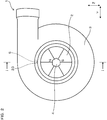
- the magnetism sensing direction is orthogonal to the radial direction means that the direction (radial direction) parallel to a straight line SL which passes through the magnetic sensor 5 (refer to FIG. 3 ) and a rotation axis A and is orthogonal to the rotation axis A is orthogonal to the magnetism sensing direction of the magnetic sensor 5.
- orthogonal mentioned here is not strictly restricted, and is permitted to have some displacement. Specifically, displacement at the level of ⁇ 10°from the orthogonal can be accepted with no problem.
- the magnetic sensor is preferably arranged at a position apart from the magnet by a prescribed distance in an axial direction of the rotor.
- the magnetic sensor is preferably located on the inside than an intermediate position between an exterior surface and an interior surface of the housing in the radial direction.
- the magnetic sensor can be closer to the magnet.
- the output of the magnetic sensor can be increased. Accordingly, the rotation speed of the rotor can be detected more accurately.
- the housing has a recessed part recessively formed inward in the radial direction from the exterior surface of the housing, and the magnetic sensor is arranged in the recessed part.
- the magnetic sensor when manufacturing the rotary machine, the magnetic sensor can be easily disposed inside the housing from the outside of the housing. In this way, the rotary machine can be readily manufactured.
- the magnetic sensor when the magnetic sensor is disposed in the recessed part, the magnetic sensor can be arranged close to the magnet. Therefore, the output of the magnetic sensor can be increased to thereby detect the rotation speed of the rotor accurately.
- two or more of the magnetic sensors are provided, which differ from each other in output corresponding to the magnetic field generated from the magnet so that the difference of outputs between the two magnetic sensors is used to detect the rotation speed of the rotor.
- the rotary machine is used as a turbocharger
- the rotor is a compressor wheel of the turbocharger
- the housing is a compressor housing containing the compressor wheel
- the magnetic sensor is attached to the compressor housing.
- the compressor housing is an intake side housing of a turbocharger
- the temperature is lower than that of a turbine housing that is an exhaust side housing. Therefore, by attaching the magnetic sensor to the compressor housing, the magnetic sensor can be prevented from having a high temperature to thereby prevent shortening of the life of the magnetic sensor.
- the magnetic sensor is preferably a magneto-impedance sensor.
- a magneto-impedance sensor (hereinafter, also referred to as an MI sensor) has high sensitivity for detecting magnetism and is also excellent in high-speed response. Therefore, although other-type magnetic sensors also can be used, particularly in the case of high-speed rotation at 10000 rpm or higher, by using an MI sensor, time variation of the magnetic field of the magnet can be accurately detected, so that the rotation speed of the rotor can be accurately detected.
- the magnet is preferably attached to the rotation axis.
- the magnet When the magnet is attached to the rotation axis, the magnet is hardly affected by a centrifugal force accompanied with the rotation of the rotor. Accordingly, any failure, for example, dropping of the magnet by the centrifugal force, etc. can be prevented.
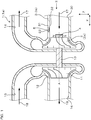
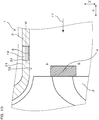
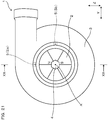
- a rotary machine 1 of the present embodiment includes a rotor 2, a housing 3, a magnet 4, and a magnetic sensor 5.
- the rotor 2 axially rotates around a rotation axis A.
- the housing 3 is formed of a conductive material and contains the rotor 2.
- the magnet 4 is attached to the rotor 2 in such a manner that the arrangement direction of a pair of magnetic poles is in a radial direction of the rotor 2.
- the magnetic sensor 5 is attached to the housing 3. The magnetic sensor 5 detects time variation of the magnetic field generated from the magnet 4. In this way, it is configured to detect rotation speed of the rotor 2.
- the magnetic sensor 5 is arranged on the outside than the magnet 4 in the radial direction.
- the magnetism sensing direction of the magnetic sensor 5 is orthogonal to the radial direction.
- the rotary machine 1 of the present embodiment is a turbocharger 1a that is to be installed in an engine of a vehicle, and the like.
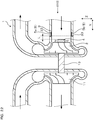
- the turbocharger 1a includes a turbo wheel 11, a turbo housing 12 for housing the turbo wheel 11, a turbo shaft 13, a compressor wheel 2a, a compressor housing 3a for housing the compressor wheel 2a, an air inlet 30, an air outlet 14, an exhaust air inlet 15, and an exhaust air outlet 16.
- the turbo shaft 13 connects the turbo wheel 11 and the compressor wheel 2a.
- the rotor 2 of the present embodiment is the compressor wheel 2a of the turbocharger 1a.
- the housing 3 of the present embodiment is the compressor housing 3a.
- the magnetic sensor 5 is attached to the compressor housing 3a.
- the compressor housing 3a is made of aluminum.
- the magnet 4 of the present embodiment is attached such that the center coincides with the rotation axis A of the compressor wheel 2a.
- the magnet 4 of the present embodiment is a nut that has been magnetized (magnetized nut). Using this magnetized nut, the compressor wheel 2a is tightened to the turbo shaft 13.
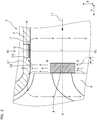
- the magnetic sensor 5 is arranged at a position apart from the magnet 4 by a prescribed distance L in the axial direction (X direction).
- the magnetic sensor 5 of the present embodiment is a magneto-impedance sensor.
- the housing 3 has a recessed part 33 recessively formed inward in the radial direction from the exterior surface of the housing.
- the magnetic sensor 5 is arranged in the recessed part 33.
- the magnetism sensing direction of the magnetic sensor 5 is the same as the axial direction.
- the magnetic sensor 5 is located on the inside than an intermediate position M between an exterior surface 31 and an interior surface 32 of the housing 3 in the radial direction.
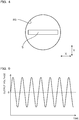
- the magnet 4 When the rotor 2 rotates, the magnet 4 also rotates. Thus, the magnetic field that is generated from the magnet 4 and acts on the housing 3 varies with time. Accordingly, as shown in FIG.5 , the output of the magnetic sensor 5 varies with time. It is configured to detect the rotation speed of the rotor 2 using the time variation of the output. In the present embodiment, detected values of the rotation speed are transmitted to an ECU that is not shown in the figure. The ECU uses the detected values to control the engine.
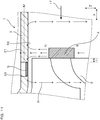
- the rotary machine 1 shown in FIG.1 to FIG. 3 was prepared as sample 1 that falls within the scope of the present invention. Further, as shown in FIG. 6 and FIG.7 , the rotary machine 1 in which the magnetism sensing direction of the magnetic sensor 5 is in the direction (Y direction) that is orthogonal to both of the axial direction (X direction) and the opening direction of the recessed part 33 (Z direction) was prepared as sample 2 that falls within the scope of the present invention. Still further, as shown in FIG.24 , the rotary machine 1 in which the magnetism sensing direction of the magnetic sensor 5 is in the radial direction (Z direction) was prepared as a comparative sample that departs from the scope of the present invention.
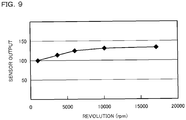
- the magnetic sensor 5 was arranged at the position adjacent to the magnet 4 in the radial direction. Each rotor 2 of these samples is rotated to reach 1000 to 17000 rpm to measure the amplitude of the output voltage of the magnetic sensor 5. Then, the relation between the revolution of the rotor 2 and the amplitude of the output voltage was graphed. The results are shown in FIG. 8 , FIG. 9 and FIG. 25 . It is noted that in these graphs, the output of the magnetic sensor 5 (ordinate) is indicated by the ratio of indices when setting the magnitude of the output at 1000 rpm as 100.
- FIG.8 shows the measurement result of sample 1
- FIG.9 shows the measurement result of sample 2.
- FIG. 25 shows the measurement result of the comparative sample. From FIG. 8 and FIG.9 , it is found that in each of samples 1 and 2 that fall within the scope of the present invention, the output of the magnetic sensor 5 gradually increases as the revolution of the rotor 2 increases. In contrast, as shown in FIG 25 , the comparative sample shows that the output of the magnetic sensor 5 gradually decreases as the revolution of the rotor 2 increases.
- the magnet 4 is attached to the rotor 2 such that the arrangement direction of a pair of magnetic poles is the same as the radial direction of the rotor.
- the magnetic sensor 5 is attached to the housing 3. The magnetism sensing direction of the magnetic sensor 5 is made orthogonal to the radial direction of the rotor.
- the output of the magnetic sensor 5 can remain at a high level even if the rotation speed of the rotor 2 becomes high, which makes it possible to accurately detect the rotation speed of the rotor 2.
- the magnetic sensor 5 of the present embodiment is arranged at a position apart from the magnet 4 by the prescribed distance L in an axial direction (X direction) of the rotor 2.
- part of a magnetic field H generated from the magnet 4 flows inside the housing 3 in the direction orthogonal to the radial direction at the position apart from the magnet 4 in the axial direction. Therefore, when the magnetic sensor 5 is arranged at the position apart from the magnet 4 by the prescribed distance L in the axial direction, the intensity of the magnetic field H of the magnet 4, which acts on the magnetic sensor 5 in the magnetism sensing direction, can be enhanced. Thus, the output of the magnetic sensor 5 can be increased, accordingly the rotation speed of the rotor 2 can be detected accurately.
- the magnetic sensor 5 of the present embodiment is located on the inside than the intermediate position M between the exterior surface 31 and the interior surface 32 of the housing 3 in the radial direction.
- the magnetic sensor 5 can be closer to the magnet 4.
- the output of the magnetic sensor 5 can be increased. Consequently, the rotation speed of the rotor 2 can be detected more accurately.
- the housing 3 of the present embodiment has a recessed part 33 recessively formed inward in the radial direction from the exterior surface 31. And the magnetic sensor 5 is arranged in the recessed part 33.
- the magnetic sensor 5 can be easily disposed inside the housing 3 from the outside of the housing 3. In this way, it becomes possible to readily manufacture the rotary machine 1.
- the magnetic sensor 5 when the magnetic sensor 5 is disposed in the recessed part 33, the magnetic sensor 5 can be made close to the magnet 4. Therefore, the output of the magnetic sensor 5 can be increased to thereby detect the rotation speed of the rotor 2 accurately.
- the rotary machine 1 of the present embodiment is used as a turbocharger 1a.
- the rotor 2 is a compressor wheel 2a of the turbocharger 1
- the housing 3 is a compressor housing 3a for housing the compressor wheel 2a.
- the magnetic sensor 5 is attached to the compressor housing 3a.
- the compressor housing 3a is an intake side housing 3 of a turbocharger 1a
- the temperature is lower than that of a turbine housing 12 that is an exhaust side housing. Therefore, by attaching the magnetic sensor 5 to the compressor housing 3a, the magnetic sensor 5 can be prevented from having a high temperature to thereby prevent shortening of the life of the magnetic sensor 5.
- the magnetic sensor 5 of the present embodiment is an MI sensor.
- An MI sensor is excellent both in sensitivity for detecting magnetism and response speed. Therefore, even in the case of high-speed rotation exceeding 10000 rpm, by using an MI sensor, time variation of the magnetic field of the magnet 4 can be accurately detected, so that the rotation speed of the rotor 2 can be accurately detected.
- the magnet 4 of the present embodiment is attached such that the center coincides with the rotation axis A of the rotor 2.
- the magnet 4 When the magnet 4 is attached to the rotation axis A in such a manner, the magnet 4 is hardly affected by a centrifugal force accompanied with the rotation of the rotor 2. Accordingly, any failure, for example, dropping of the magnet 4 by the centrifugal force, etc. can be prevented.
- the present embodiment can provide a rotary machine in which the output of the magnetic sensor is hardly lowered even if the rotation speed of the rotor becomes high.
- the rotary machine 1 of the present embodiment is the turbocharger 1a, however, the present invention is not limited thereto.
- the rotary machine 1 can also be applied to some other type of turbo, air motor, and the like.
- the magnetism sensing direction of the magnetic sensor 5 is in the axial direction of the rotor 2 (X direction: refer to FIG. 3 ) or Y direction (refer to FIG. 6 ), however, the present invention is not limited to this. As long as the magnetism sensing direction is orthogonal to the radial direction, the same effects can be obtained even when the magnetism sensing direction is in the direction between X direction and Y direction.
- the present embodiment uses the magnet 4 equipped with a pair of magnetic poles, however, the present invention is not limited to this configuration.
- the magnet 4 equipped with two or more pair of magnetic poles can be used. Accordingly, the magnet 4 can be attached to the rotor 2 such that each of plural pairs of magnetic poles is in the radial direction.
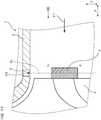
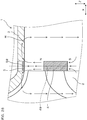
- the present embodiment is an example in which the shape of the housing 3 is modified.
- the housing 3 has a through hole 34 formed passing therethrough in the radial direction.
- the magnetic sensor 5 is disposed inside this through hole 34 and is sealed therein by a sealing member 19 such as an epoxy resin, a ceramic adhesive, and the like.
- the magnetic sensor 5 is disposed such that the magnetism sensing direction of the magnetic sensor 5 is in the axial direction (X direction) of the rotor 2, in the same way as in Embodiment 1. Further, the magnetic sensor 5 is located on the inside than an intermediate position M between the exterior surface 31 and the interior surface 32 of the housing 3 in the radial direction.
- the present embodiment has the same configurations and operational effects as those in Embodiment 1.
- the present embodiment is an example in which the arrangement position of the magnetic sensor 5 is modified.
- the magnetic sensor 5 is arranged at a position apart from the magnet 4 by a predetermined distance L in the axial direction (X direction) in the same way as in Embodiment 1.
- the magnetic sensor 5 is located on the side closer to the rotor 2 than the magnet 4 in the X direction.
- the housing 3 has the recessed part 33 formed therein.
- the magnetic sensor 5 is disposed in the recessed part 33.
- the magnetic sensor 5 is located on the inside than the intermediate position M between the exterior surface 31 and the interior surface 32 of the housing 3 in the radial direction.
- the present embodiment has the same configurations and operational effects as those in Embodiment 1.
- the present embodiment is an example in which the arrangement position of the magnetic sensor 5 is modified.
- the magnetic sensor 5 is arranged at the position adjacent to the magnet 4 in the radial direction (the position where the center of the magnetic sensor 5 is located on the straight line SL drawn in the radial direction passing through the magnet 4).
- the magnetic sensor 5 is arranged such that the magnetism sensing direction is in the Y direction.
- part of the magnetic field H generated from the magnet 4 acts on the magnetic sensor 5 in the Y direction, that is, in the magnetism sensing direction.
- the output of the magnetic sensor 5 can be increased. Accordingly, it becomes possible to accurately detect time variation of the magnetic field H of the magnet 4 by the magnetic sensor 5, so that the rotation speed of the rotor 2 can be measured accurately.
- the present embodiment has the same configurations and operational effects as those in Embodiment 1.
- the present embodiment is an example in which the shape of the housing 3 and the attached position of the magnetic sensor 5 are modified. As shown in FIG. 14 , in the present embodiment, the housing 3 does not have the recessed part 33 or the through hole 34 formed therein. In the present embodiment, the magnetic sensor 5 is attached to the interior surface 32 of the housing 3. It is noted that although not shown in the figure, the magnetic sensor 5 may be attached to the exterior surface 31 of the housing 3.
- the present embodiment has the same configurations and operational effects as those in Embodiment 1.
- the present embodiment is a modified example in which the number of the magnetic sensor 5 is changed.
- the rotary machine 1 of the present embodiment includes two magnetic sensors 5, i.e. a first magnetic sensor 5a and a second magnetic sensor 5b.
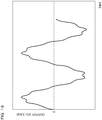
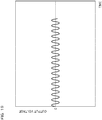
- the first magnetic sensor 5a is arranged at the position closer to the magnet 4 than the second magnetic sensor 5b is. Therefore, the magnetic field H of the magnet 4 acts on the first magnetic sensor 5a more strongly than on the second magnetic sensor 5b. Accordingly, as shown in FIG 17 , the output intensity of the first magnetic sensor 5a is higher than that of the second magnetic sensor 5b (refer to FIG. 18 ).
- another component that generates a disturbance magnetic field is disposed around the rotary machine 1.
- another component that generates a disturbance magnetic field is provided inside the engine room.
- the disturbance magnetic field is cancelled using the two magnetic sensors 5a and 5b. Specifically, as shown in Fig. 17 and FIG. 18 , an output that results from the disturbance magnetic field (noise component) is generated from each of the magnetic sensors 5a and 5b in the same way.
- the disturbance magnetic field acts on the two magnetic sensors 5a and 5b with the same intensity.
- the noise components output from the magnetic sensors 5a and 5b have nearly the same intensity. Therefore, subtracting the output of the second magnetic sensor 5b from the output of the first magnetic sensor 5a eliminates the noise components, so that the component that resulted from the magnetic field H of the magnet 4 is left as shown in FIG.19 .
- the rotation speed of the rotor 2 is calculated.
- the present embodiment has the same configurations and operational effects as those in Embodiment 1.
- the present embodiment is a modified example in which the arrangement positions of the two magnetic sensors 5a and 5b are changed.
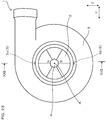
- the magnetic sensors 5a and 5b are arranged such that the first magnetic sensor 5a, the rotation axis A, and the second magnetic sensor 5b form the angle of 90° when viewed from the axial direction (X direction).
- the distance L from each of the magnetic sensors 5a and 5b to the magnet 4 is set equal.
- the amplitudes of the outputs of the magnetic sensors 5a and 5b are equal to each other.
- the output waveform having a certain amplitude obtained by eliminating the noise components that resulted from the disturbance magnetic field can be obtained by calculating the difference between the outputs of the two magnetic sensors 5a and 5b.
- the present embodiment has the same configurations and operational effects as those in Embodiment 1.
- the present embodiment is a modified example in which the arrangement positions of the two magnetic sensors 5a and 5b are changed.
- the magnetic sensors 5a and 5b are arranged such that the first magnetic sensor 5a, the rotation axis A, and the second magnetic sensor 5b form the angle of 180° when viewed from the axial direction (X direction).
- the distance L from each of the magnetic sensors 5a and 5b to the magnet 4 is set equal.
- the amplitudes of the outputs of the magnetic sensors 5a and 5b are equal to each other.
- the phases of the outputs of the magnetic sensors 5a and 5b are deviated from each other by 180°, therefore, by calculating the difference between the outputs of the two magnetic sensors 5a and 5b, the noise components that resulted from the disturbance magnetic field can be eliminated, and at the same time the resulting output after calculation is allowed to have an amplitude twice as large as the original amplitudes of the outputs of the magnetic sensors 5a and 5b. Accordingly, it becomes possible to measure the rotation speed of the rotor 2 more accurately.
- the present embodiment has the same configurations and operational effects as those in Embodiment 6.
Landscapes
- Physics & Mathematics (AREA)
- General Physics & Mathematics (AREA)
- Engineering & Computer Science (AREA)
- Mechanical Engineering (AREA)
- General Engineering & Computer Science (AREA)
Applications Claiming Priority (2)
| Application Number | Priority Date | Filing Date | Title |
|---|---|---|---|
| JP2016114992A JP6233455B1 (ja) | 2016-06-09 | 2016-06-09 | 回転機 |
| PCT/JP2017/020330 WO2017213004A1 (fr) | 2016-06-09 | 2017-05-31 | Machine rotative |
Publications (2)
| Publication Number | Publication Date |
|---|---|
| EP3447501A1 true EP3447501A1 (fr) | 2019-02-27 |
| EP3447501A4 EP3447501A4 (fr) | 2019-07-31 |
Family
ID=60417511
Family Applications (1)
| Application Number | Title | Priority Date | Filing Date |
|---|---|---|---|
| EP17810182.0A Withdrawn EP3447501A4 (fr) | 2016-06-09 | 2017-05-31 | Machine rotative |
Country Status (4)
| Country | Link |
|---|---|
| US (1) | US10900988B2 (fr) |
| EP (1) | EP3447501A4 (fr) |
| JP (1) | JP6233455B1 (fr) |
| WO (1) | WO2017213004A1 (fr) |
Families Citing this family (5)
| Publication number | Priority date | Publication date | Assignee | Title |
|---|---|---|---|---|
| JP6840970B2 (ja) * | 2016-09-21 | 2021-03-10 | 日立金属株式会社 | 回転速度検出装置付きターボチャージャ |
| JP6926502B2 (ja) * | 2017-02-10 | 2021-08-25 | 日立金属株式会社 | ターボ用回転センサ及びターボチャージャ |
| US10895583B2 (en) * | 2018-05-25 | 2021-01-19 | Hitachi Metals, Ltd. | Turbo rotation sensor |
| JP7054449B2 (ja) * | 2018-05-25 | 2022-04-14 | 日立金属株式会社 | ターボ用回転センサ |
| EP3825657A1 (fr) * | 2019-11-22 | 2021-05-26 | Berlin Heart GmbH | Machine rotative à détection sans capteur de la position de rotor |
Family Cites Families (20)
| Publication number | Priority date | Publication date | Assignee | Title |
|---|---|---|---|---|
| JPS5032578B1 (fr) | 1969-05-30 | 1975-10-22 | ||
| DE3122376A1 (de) * | 1981-06-05 | 1982-12-23 | Robert Bosch Gmbh, 7000 Stuttgart | Vorrichtung zur erfassung der drehzahl von rotierenden teilen |
| JPS63136945A (ja) * | 1986-11-27 | 1988-06-09 | Toshiba Corp | 空気調和機の送風機用モータ |
| EP0606942A1 (fr) * | 1993-01-15 | 1994-07-20 | Magnavox Electronic Systems Company | Procédé et dispositif de mesure de la vitesse de rotation et de l'angle de rotation |
| US5602472A (en) | 1993-01-15 | 1997-02-11 | Hughes Electronics | Apparatus and method for determining angular position and rotational speed using a rotating magnet and a directional magnetometer |
| US5670877A (en) * | 1994-12-05 | 1997-09-23 | Hughes Electronics | Shaft rotation sensor with magnetic sensors angularly spaced apart with respect to a magnetic source |
| WO1996024067A1 (fr) * | 1995-02-02 | 1996-08-08 | Siemens Aktiengesellschaft | Dispositif permettant de mesurer la vitesse de rotation ou de detecter le sens de rotation d'un champ magnetique rotatif |
| US6124709A (en) * | 1998-06-05 | 2000-09-26 | Cts Corporation | Magnetic position sensor having a variable width magnet mounted into a rotating disk and a hall effect sensor |
| US6265867B1 (en) * | 1999-05-19 | 2001-07-24 | Arthur D. Little, Inc. | Position encoder utilizing fluxgate sensors |
| US6483296B1 (en) * | 1999-06-17 | 2002-11-19 | Denso Corporation | Angular position detection apparatus |
| US6919657B2 (en) * | 2003-10-10 | 2005-07-19 | Sunonwealth Electric Machine Industry Co., Ltd. | Combination structure of a motor |
| DE102005010921A1 (de) * | 2004-07-15 | 2006-02-09 | Siemens Ag | Abgasturbolader |
| JP2006058274A (ja) * | 2004-08-20 | 2006-03-02 | Aec:Kk | 検出センサ |
| DE102005029764B4 (de) * | 2005-06-27 | 2010-11-11 | Continental Automotive France | Sensor zur Messung der Drehzahl einer Turbowelle |
| DE102006003599A1 (de) | 2006-01-25 | 2007-08-16 | Siemens Ag | Kompressorgehäuse für einen Abgasturbolader |
| DE102006040667B3 (de) | 2006-08-30 | 2008-01-10 | Siemens Ag | Waste-Gate-Aktuator für einen Abgasturbolader |
| US8564283B2 (en) | 2008-02-07 | 2013-10-22 | Hitachi Metals, Ltd. | Rotation-angle-detecting apparatus, rotating machine and rotation-angle-detecting method |
| JP5705705B2 (ja) * | 2011-11-11 | 2015-04-22 | 日立オートモティブシステムズ株式会社 | 磁界角計測装置およびそれを用いた回転機 |
| US10408892B2 (en) * | 2013-07-19 | 2019-09-10 | Allegro Microsystems, Llc | Magnet with opposing directions of magnetization for a magnetic sensor |
| JP5886269B2 (ja) * | 2013-12-27 | 2016-03-16 | マブチモーター株式会社 | 回転検出装置およびモータ |
-
2016
- 2016-06-09 JP JP2016114992A patent/JP6233455B1/ja not_active Expired - Fee Related
-
2017
- 2017-05-31 WO PCT/JP2017/020330 patent/WO2017213004A1/fr not_active Ceased
- 2017-05-31 US US16/306,789 patent/US10900988B2/en not_active Expired - Fee Related
- 2017-05-31 EP EP17810182.0A patent/EP3447501A4/fr not_active Withdrawn
Also Published As
| Publication number | Publication date |
|---|---|
| US10900988B2 (en) | 2021-01-26 |
| JP2017219455A (ja) | 2017-12-14 |
| EP3447501A4 (fr) | 2019-07-31 |
| WO2017213004A1 (fr) | 2017-12-14 |
| JP6233455B1 (ja) | 2017-11-22 |
| US20190137536A1 (en) | 2019-05-09 |
Similar Documents
| Publication | Publication Date | Title |
|---|---|---|
| US10900988B2 (en) | Rotary machine | |
| US6323641B1 (en) | Non-contacting position sensor with helical flux linkage | |
| US20050122095A1 (en) | Rotation sensor and method | |
| US20150308859A1 (en) | method for monitoring a rotation of a compressor wheel | |
| US20170115320A1 (en) | Magnetic sensing system and method for detecting shaft speed | |
| US9470554B2 (en) | Position detector | |
| EP3221678B1 (fr) | Appareil de détection de vitesse angulaire et de température | |
| US20150233735A1 (en) | Sensor device for acquiring at least one rotational property of a rotating element | |
| US20140340081A1 (en) | Magnetic sensor | |
| US20060267581A1 (en) | Angle position sensor | |
| CA2873702A1 (fr) | Compteur sans batterie pour milieux en ecoulement | |
| US6404185B1 (en) | Apparatus and method for sensing an angular position of a flux linkage member | |
| US10408854B2 (en) | Sensor arrangement for measuring the rate of rotation of a rotating component | |
| US20090319120A1 (en) | Vehicle steering angle sensor | |
| US20240255310A1 (en) | Sensing apparatus | |
| US10487680B2 (en) | Turbo rotation sensor and turbocharger | |
| US20150110650A1 (en) | Exhaust-gas turbocharger | |
| JP6344590B2 (ja) | ターボチャージャ | |
| AU2010305079A1 (en) | Measuring device for detecting rotation signals | |
| JP6489032B2 (ja) | ターボ用回転センサ及びターボチャージャ | |
| JP5831689B2 (ja) | 回転角検出装置と方法 | |
| JP6452060B1 (ja) | ターボチャージャ | |
| JP6493821B2 (ja) | ターボチャージャ | |
| US10895583B2 (en) | Turbo rotation sensor | |
| CN205643376U (zh) | 一种新型电机速度编码器 |
Legal Events
| Date | Code | Title | Description |
|---|---|---|---|
| STAA | Information on the status of an ep patent application or granted ep patent |
Free format text: STATUS: THE INTERNATIONAL PUBLICATION HAS BEEN MADE |
|
| PUAI | Public reference made under article 153(3) epc to a published international application that has entered the european phase |
Free format text: ORIGINAL CODE: 0009012 |
|
| STAA | Information on the status of an ep patent application or granted ep patent |
Free format text: STATUS: REQUEST FOR EXAMINATION WAS MADE |
|
| 17P | Request for examination filed |
Effective date: 20181122 |
|
| AK | Designated contracting states |
Kind code of ref document: A1 Designated state(s): AL AT BE BG CH CY CZ DE DK EE ES FI FR GB GR HR HU IE IS IT LI LT LU LV MC MK MT NL NO PL PT RO RS SE SI SK SM TR |
|
| AX | Request for extension of the european patent |
Extension state: BA ME |
|
| RIC1 | Information provided on ipc code assigned before grant |
Ipc: G01P 1/02 20060101ALI20190329BHEP Ipc: G01P 1/00 20060101ALI20190329BHEP Ipc: G01P 3/487 20060101AFI20190329BHEP |
|
| A4 | Supplementary search report drawn up and despatched |
Effective date: 20190703 |
|
| RIC1 | Information provided on ipc code assigned before grant |
Ipc: G01P 1/00 20060101ALI20190627BHEP Ipc: G01P 3/487 20060101AFI20190627BHEP Ipc: G01P 1/02 20060101ALI20190627BHEP |
|
| DAV | Request for validation of the european patent (deleted) | ||
| DAX | Request for extension of the european patent (deleted) | ||
| STAA | Information on the status of an ep patent application or granted ep patent |
Free format text: STATUS: EXAMINATION IS IN PROGRESS |
|
| 17Q | First examination report despatched |
Effective date: 20210125 |
|
| GRAP | Despatch of communication of intention to grant a patent |
Free format text: ORIGINAL CODE: EPIDOSNIGR1 |
|
| STAA | Information on the status of an ep patent application or granted ep patent |
Free format text: STATUS: GRANT OF PATENT IS INTENDED |
|
| INTG | Intention to grant announced |
Effective date: 20220314 |
|
| STAA | Information on the status of an ep patent application or granted ep patent |
Free format text: STATUS: THE APPLICATION IS DEEMED TO BE WITHDRAWN |
|
| 18D | Application deemed to be withdrawn |
Effective date: 20220726 |