EP3447663A1 - Système et procédé pour le profilage d'événements - Google Patents
Système et procédé pour le profilage d'événements Download PDFInfo
- Publication number
- EP3447663A1 EP3447663A1 EP18190269.3A EP18190269A EP3447663A1 EP 3447663 A1 EP3447663 A1 EP 3447663A1 EP 18190269 A EP18190269 A EP 18190269A EP 3447663 A1 EP3447663 A1 EP 3447663A1
- Authority
- EP
- European Patent Office
- Prior art keywords
- event
- class
- language specific
- news
- nlps
- Prior art date
- Legal status (The legal status is an assumption and is not a legal conclusion. Google has not performed a legal analysis and makes no representation as to the accuracy of the status listed.)
- Ceased
Links
Images




Classifications
-
- G—PHYSICS
- G06—COMPUTING OR CALCULATING; COUNTING
- G06F—ELECTRIC DIGITAL DATA PROCESSING
- G06F40/00—Handling natural language data
- G06F40/30—Semantic analysis
-
- G—PHYSICS
- G06—COMPUTING OR CALCULATING; COUNTING
- G06F—ELECTRIC DIGITAL DATA PROCESSING
- G06F16/00—Information retrieval; Database structures therefor; File system structures therefor
- G06F16/20—Information retrieval; Database structures therefor; File system structures therefor of structured data, e.g. relational data
- G06F16/28—Databases characterised by their database models, e.g. relational or object models
- G06F16/284—Relational databases
- G06F16/285—Clustering or classification
-
- G—PHYSICS
- G06—COMPUTING OR CALCULATING; COUNTING
- G06F—ELECTRIC DIGITAL DATA PROCESSING
- G06F40/00—Handling natural language data
- G06F40/20—Natural language analysis
- G06F40/253—Grammatical analysis; Style critique
-
- G—PHYSICS
- G06—COMPUTING OR CALCULATING; COUNTING
- G06F—ELECTRIC DIGITAL DATA PROCESSING
- G06F40/00—Handling natural language data
- G06F40/20—Natural language analysis
- G06F40/279—Recognition of textual entities
- G06F40/289—Phrasal analysis, e.g. finite state techniques or chunking
- G06F40/295—Named entity recognition
-
- G—PHYSICS
- G06—COMPUTING OR CALCULATING; COUNTING
- G06N—COMPUTING ARRANGEMENTS BASED ON SPECIFIC COMPUTATIONAL MODELS
- G06N20/00—Machine learning
Definitions
- the embodiments herein generally relate to data processing, and more particularly to data processing for event profiling.
- event profiling is a process of gathering information relevant to a particular topic or event from multiple sources and storing them for easy future reference.
- the event profiling can be performed either manually or as an automated process.
- profiling experts can be engaged in gathering, filing, cleaning and compiling reliable information for different categories of end consumers.
- the automated event profiling of information from multiple textual sources is an emerging field in the field of text processing.
- keyword based approaches are used for automated event profiling. But the keyword based approaches are facing challenges to handle finer nuances of natural language reporting and therefore are often unable to contextually interpret and extract the correct details. Additionally, the present automatic event profiling methods face challenges in ensuring verifiability of information, reliability of information sources and handling factual variations or contradictions.
- Embodiments of the present disclosure present technological improvements as solutions to one or more of the above-mentioned technical problems recognized by the inventors in conventional systems.
- a processor implemented method for event profiling comprising receiving, by one or more hardware processors, a set of articles for the event profiling of an event from one or more data sources, wherein the set of articles are multilingual. Further, aggregating, by the one or more hardware processors, the set of articles to obtain a plurality of groups with each group comprising a plurality of news related to a common event information component, wherein the plurality of news are aggregated across date, sources of information and languages. Further, analyzing, by the one or more hardware processors, the plurality of groups to identify relevant linguistic features corresponding to each group among the plurality of groups by utilizing a set of language specific Natural Language Processors (NLPs) to obtain an analyzed data set.
- NLPs Natural Language Processors
- classifying by a plurality of classifying agents implemented by the one or more hardware processors, the plurality of groups identified with the relevant linguistic features as class members of a plurality of classes, wherein each class among the plurality of classes is identified by a unique event related factor, wherein the plurality of classifying agents are language specific classifiers.
- disambiguating by the one or more hardware processors, class membership of each class member of the plurality of classes to obtain a disambiguated data set, wherein disambiguation is performed based on voting among the plurality of classifying agents for a class of each class member, relationship validity among each class member and corresponding class and relationship validity among each class member and remaining other class members of the class.
- a system comprising: one or more data storage devices operatively coupled to the one or more processors and configured to store instructions configured for execution by the one or more processors to receive a set of articles for the event profiling of an event from one or more data sources, wherein the set of articles are multilingual; aggregate the set of articles to obtain a plurality of groups with each group comprising a plurality of news related to a common event information component, wherein the plurality of news are aggregated across date, sources of information and languages; analyze the plurality of groups to identify relevant linguistic features corresponding to each group among the plurality of groups by utilizing a set of language specific Natural Language Processors (NLPs) to obtain an analyzed data set; classify the plurality of groups identified with the relevant linguistic features as class members of a plurality of classes, wherein each class among the plurality of classes is identified by a unique event related factor, wherein the step of classifying is performed by a plurality of classifying agents that are language specific classifiers; disambiguate class membership
- a computer program product comprising a non-transitory computer readable medium having a computer readable program embodied therein, wherein the computer readable program, when executed on a computing device, causes the computing device to receive a set of articles for the event profiling of an event from one or more data sources, wherein the set of articles are multilingual; aggregate the set of articles to obtain a plurality of groups with each group comprising a plurality of news related to a common event information component, wherein the plurality of news are aggregated across date, sources of information and languages; analyze the plurality of groups to identify relevant linguistic features corresponding to each group among the plurality of groups by utilizing a set of language specific Natural Language Processors (NLPs) to obtain an analyzed data set; classify by a plurality of classifying agents the plurality of groups identified with the relevant linguistic features as class members of a plurality of classes, wherein each class among the plurality of classes is identified by a unique event related factor, wherein the plurality of classifying
- NLPs Natural Language
- Natural language processing techniques for event profiling from articles extracted from digital data sources such as published News articles from internet is an area of research and development.
- An event may refer a crime event, sports event, natural calamity, safety incident, disaster incident and the like.
- the articles from different sources regularly report a set of events containing a set of event details including, information about a set of entities associated with the set of events, details of the set of events and other related information.
- the set of event details may not be published together.
- the set of event details may refer to a plurality of past events. Identifying an event from the set of events as at least one of a new event and an old event and extracting the set of event details is a challenging task.
- Conventional automated event profiling methods face challenges in ensuring verifiability of information, reliability of information sources and handling factual variations or contradictions.
- incremental compiling of facts from sources generated over a period of time also needs efficient entity resolution and linking mechanisms to ensure information continuity.
- Various embodiments of the present disclosure provide method and system for event profiling.
- an ensemble of probabilistic classifiers are used for automated extraction of finer details of the event.
- the ensemble of probabilistic classifiers use linguistic features for profiling information about the event, wherein the information is spread across various data sources. Further, disambiguates can be used to augment the accuracy of the event profiling.
- the system and method disclosed provides complete automated event profiling ensuring verifiability of information, reliability of information sources and handling factual variations or contradictions.
- incremental compiling of facts from sources generated over a period of time is also handled providing efficient entity resolution and linking mechanisms to ensure information continuity.
- the information collected is not limited to any language and sources of information are crawled without language barriers. This enables the system to capture all possible variations and details in information related to an event, say crime, which may be hidden in local news and not rightly captured in common used News languages world-wide, such as English.
- FIG.1 through FIG. 8 where similar reference characters denote corresponding features consistently throughout the figures, there are shown preferred embodiments and these embodiments are described in the context of the following exemplary system and/or method.
- FIG. 1 illustrates a network environment 100 implementing a system 102 for event profiling, in accordance with an embodiment of the present disclosure.
- the system 102 is configured to receive a set of articles for the event profiling of an event from one or more data sources.
- the set of articles are multilingual not restricting to any specific language or source.
- the set of articles also referred as digital documents, include digitally published News articles, microblogs, content from social media and the like.
- the system 102 may be embodied in a computing device, for instance a computing device 104.
- the present disclosure is explained with the system 102 implemented on a server.
- the system 102 may also be implemented in a variety of computing systems, such as a laptop computer, a desktop computer, a notebook, a workstation, a cloud-based computing environment and the like.
- the system 102 may be implemented in a cloud-based environment. It will be understood that the system 102 may be accessed by multiple users through one or more user devices 106-1, 106-2... 106-N, collectively referred to as user devices 106 hereinafter, or applications residing on the user devices 106.
- Examples of the user devices 106 may include, but are not limited to, a portable computer, a personal digital assistant, a handheld device, a Smartphone, a Tablet Computer, a workstation and the like.
- the user devices 106 are communicatively coupled to the system 102 through a network 108.
- the network 108 may be a wireless or a wired network, or a combination thereof.
- the network 108 can be implemented as a computer network, as one of the different types of networks, such as virtual private network (VPN), intranet, local area network (LAN), wide area network (WAN), the internet, and such.
- the network 106 may either be a dedicated network or a shared network, which represents an association of the different types of networks that use a variety of protocols, for example, Hypertext Transfer Protocol (HTTP), Transmission Control Protocol/Internet Protocol (TCP/IP), and Wireless Application Protocol (WAP), to communicate with each other.
- the network 108 may include a variety of network devices, including routers, bridges, servers, computing devices, storage devices. The network devices within the network 108 may interact with the system 102 through communication links.
- the system 102 may also be implemented in a workstation, a mainframe computer, a server, and a network server.
- the system 102 may be coupled to a data repository, for example, a repository 112.
- the repository 112 may store data processed, received, and generated by the system 102.
- the system 102 may include the data repository 112. The components and functionalities of the system 102 are described further in detail with reference to FIG. 2 .
- FIG. 2 illustrates a block diagram of a system 200 for event profiling, in accordance with an embodiment of the present disclosure.
- the system for event profiling 200 (hereinafter referred to as system 200) may be an example of the system 102 ( FIG. 1 ).
- the system 200 may be embodied in, or is in direct communication with the system, for example the system 102 ( FIG. 1 ).
- the system 200 includes or is otherwise in communication with one or more hardware processors such as a processor 202, at least one memory such as a memory 204, and an I/O interface 206 and an event profiling unit 250.
- the event profiling unit 250 can be implemented as a standalone unit in the system 200.
- event profiling unit 250 can be implemented as a module in the memory 204.
- the processor 202, memory 204, and the I/O interface 206 may be coupled by a system bus such as a system bus 208 or a similar mechanism.
- the I/O interface 206 may include a variety of software and hardware interfaces, for example, a web interface, a graphical user interface, and the like.
- the interfaces 206 may include a variety of software and hardware interfaces, for example, interfaces for peripheral device(s), such as a keyboard, a mouse, an external memory, a camera device, and a printer. Further, the interfaces 206 may enable the system 200 to communicate with other devices, such as web servers and external databases.
- the interfaces 206 can facilitate multiple communications within a wide variety of networks and protocol types, including wired networks, for example, local area network (LAN), cable, etc., and wireless networks, such as Wireless LAN (WLAN), cellular, or satellite.
- the interfaces 206 may include one or more ports for connecting a number of computing systems with one another or to another server computer.
- the I/O interface 206 may include one or more ports for connecting a number of devices to one another or to another server.
- the hardware processor 202 may be implemented as one or more microprocessors, microcomputers, microcontrollers, digital signal processors, central processing units, state machines, logic circuitries, and/or any devices that manipulate signals based on operational instructions.
- the hardware processor 202 is configured to fetch and execute computer-readable instructions stored in the memory 204.
- the memory 204 may include any computer-readable medium known in the art including, for example, volatile memory, such as static random access memory (SRAM) and dynamic random access memory (DRAM), and/or non-volatile memory, such as read only memory (ROM), erasable programmable ROM, flash memories, hard disks, optical disks, and magnetic tapes.
- volatile memory such as static random access memory (SRAM) and dynamic random access memory (DRAM)
- non-volatile memory such as read only memory (ROM), erasable programmable ROM, flash memories, hard disks, optical disks, and magnetic tapes.
- the memory 204 includes a plurality of modules 220 and a repository 240 for storing data processed, received, and generated by one or more of the modules 220.
- the modules 220 may include routines, programs, objects, components, data structures, and so on, which perform particular tasks or implement particular abstract data types.
- the repository 240 includes a system database 242 and other data 244.
- the other data 244 may include data generated as a result of the execution of one or more modules in the modules 220.
- the repository 240 is further configured to maintain a plurality of event ontologies.
- the event can be a crime and an example crime ontology knowledge base is as shown in FIG. 8 .
- a crime related ontological knowledge base has been collected from one or more digital sources.
- the one or more digital sources includes WikiCrimes, WordNet®, legal resources, and a subset of the news resources.
- a semi-supervised learning technique has been used to enhance the existing ontology.
- the ontology knowledge base has been initiated with a few seed concepts and then expanded by utilizing a set of knowledge inferred from other resources. Further, a set of terms and phrases, following concepts linguistically similar to the seed concepts has been included in the ontology knowledgebase. Table 1 depicts some of the seed concepts related to different type of crime information. Apart from using the semi-supervised technique of ontology extension, a set of ontology inference rules are used to obtain better semantic representation of a domain. For example, a "Crime Target” concept may have the type man, woman or a child. On the other hand, "Child Abuse” is a type of "Sex Crime”. Hence, an inference rule can be constructed.
- the inference rule can be "if the crime type is of "Child Abuse” then the “Crime Target” will be of the type “Child””. Similarly, if the "Crime Type” is “Sexual Assault” then there is a high chance of the "Crime Target” to be of type "Woman”.
- the inference rules were constructed using first order logic. In another embodiment, the inference rules can be obtained using more generalized frameworks like, Owl and SPARQL.
- the event profiling unit 250 of the system 200 can be configured to receive a set of articles for the event profiling of an event from one or more data sources.
- the set of articles are multilingual not specific to any particular language.
- the event for example herein is a crime event, thus event may be interchangeably referred as crime or crime event.
- the event ontology may be interchangeably referred as crime ontology with regards to description herein for crime profiling.
- the one or more articles can be a set of crime News articles.
- the set of news digitized News articles can be received from a set of digital sources.
- a site specific document crawler can be used to receive the set of digitized News articles.
- the event profiling unit 250 of the system 200 can be configured to aggregate set of articles to obtain a plurality of groups. Each group, so aggregated, comprises a plurality of news related to an event information component, for example herein crime information component as depicted in table 2A, 2B and 2C below.
- an event information component for example herein crime information component as depicted in table 2A, 2B and 2C below.
- plurality of news refers to all received or noteworthy information associated with the event information component, from any digital source.
- the plurality of news are aggregated across date, sources of information and languages and the like.
- a method of aggregating the set of articles is further explained with reference to FIG. 3 for the crime event.
- the set of articles are crawled (302) are pre-processed (304) and a set of metadata associated with the set of articles are extracted.
- a set of crime information components are extracted (306) from a set of articles by utilizing the metadata.
- a plurality of similar news from the set of articles are aggregated (308) across on date, sources of information and languages.
- Table 2A Crime components Extraction Techniques Crime type Linguistic pattern learning and Dictionary based Crime location location entity extraction, linguistic pattern learning, and ontological reasoning Crime date and time Temporal Entity extraction and linguistic pattern learning criminal name Named Entity extraction and linguistic pattern learning Booking under section Ontology based and Linguistic pattern learning Judge Named Entity extraction and pattern learning Judiciary Date/Time Temporal Entity extraction and pattern learning Table 2B: Crime components Extraction Techniques Accused Name* Named Entity extraction and pattern learning Accused Sex pattern learning Accused Age pattern learning Victim Name* Named Entity extraction and pattern learning Victim Sex pattern learning Victim Age pattern learning Accused Lawyer Named Entity extraction and pattern learning Victim Lawyer Named Entity extraction and pattern learning Table 2C: Crime components Extraction Techniques Law Enforcement Named Entity extraction and pattern learning Arrest Location location entity extraction and pattern learning Judiciary Location location entity extraction and pattern learning Arrest Date/Time Temporal Entity extraction and pattern learning Action taken Pattern learning Booked under section* Pattern learning Court order Pattern learning Punishment Pattern
- the event profiling unit 250 of the event profiling system 200 can be configured to analyse the plurality of groups to identify relevant linguistic features corresponding to each group among the plurality of groups.
- the identification of relevant linguistic features is based on a set of language specific Natural Language Processors (NLPs) to obtain an analysed data set by analysing each news article in each group.
- NLPs Natural Language Processors
- the set of NLPs can be applied to extract relevant linguistic features from the aggregated articles.
- Table 3 provides language detection using the set of language specific NLP analysers.
- Table 3 Source date news Language s1 d2 1) Indrani Mukherjea to be interrogated in connection with Byculla prison inmate's death English s1 d1 2) High court grants bail trio in Mohsin Shaikh murder case English s2 d5 3) Indrani plotted murder in London, Skyped driver English s3 d4 4) Sheena Bora murder: Indrani wanted to kill her two children, ex-driver testifies English s1 d2 Rohtak gangrape-murder: Victim's brother found destroyed in Sonepat English s4 d2 5) ... Hindi s4 d2 6) ... Hindi s5 d2 7) Bengali
- the set of NLP analysers includes a pre-processor, a dependency based syntactic parser, a morphological analyser, a Named Entity Recognizer (NER), a pronoun resolver and an entity resolver.
- the pre-processor extracts from the plurality of news in each group a set of raw news text and a set of headlines of the set of raw news from one or more web pages.
- the set of headlines are retained since it may contain relevant information about the event.
- the set of headlines are used to narrow down a search in case, body of the extracted text mentions one or more events or people.
- the pre-processor removes all Hypertext Markup Language (HTML) tags and foreign language characters from the extracted text.
- HTML Hypertext Markup Language
- the dependency parser for example, a Stanford parser, performs Part-Of-Speech (POS) tagging and syntactic processing on the pre-processed data.
- POS Tagger is a piece of software tool to read the pre-processed data and assigns parts of speech to each functional and content words, including noun, pronoun, verb, adjective, adverbs. Additionally, the POS tagging tokenizes the pre-processed data and labels each word with the corresponding POS. From the output of the POS tagger, root verbs are extracted and passed to the morphological analyser to identify the tense, aspect and modality of the root verb.
- the Stanford parser is used to extract different dependency relations within a set of pre-processed sentences.
- a set of dependency features associated with the Stanford dependency parser includes adverbial clause modifier, auxiliary, negation modifier, marker, referent, open clausal complement, clausal complement, expletive, coordination, passive auxiliary, nominal subject, direct object, and copula, conjunct.
- a named entity extractor can be a Stanford NER.
- the Stanford NER extracts a set of named entities.
- the set of entities can be at least one of "Person” and “Organization”, “Location”, “Date”, “Time”, “Money” and “Percent”.
- the set of named entities extracted and resolved includes “Person” and “Organization”, “Location”, “Date”, “Time”.
- the dependency parsed text along with the named entity tags are then passed through a co-reference resolver.
- a Stanford Deterministic Co-reference Resolution System implements a multi-pass sieve algorithm, is used via the Stanford CoreNLP tool suite.
- an extra layer of multiple passes is added.
- the additional layer can modify the raw text whenever a co-referenced phrase gets resolved. Further, the modified text is sent in as a fresh input to the co-reference module, until no further changes to the input text are detected.
- Manju Sharma The body of Manju Sharma (66) was found with injury marks on her head and face at her residence-cum-nursing home yesterday, Sub Inspector Naresh Kumar said. The doctor's son Deepak , yesterday tried to contact his mother over the phone, but got no response. When a police team visited Dr. Sharma 's residence, they found her dead, said the SI .
- the entity resolver resolves a set of different entity names obtained from the NER, which is an iterative process as shown for example below:
- Dr. Sharma is identified in second Iteration and Manju Sharma, while SI is identified to be abbreviation for Sub-Inspector in third iteration and the named entities are resolved.
- various abbreviations of a person e.g., "Tom Hayes” as “Mr. Hays” or organization name (e.g., "Kosovo Liberation Army” as “KLA”
- the entity resolver can automatically extract the abbreviations of entities by utilizing a mutual information based statistical learning method.
- the basic intuition of the present disclosure is that a named entity and its abbreviations tend to appear in adjacent sentences. The said co-occurrence could appear frequently in a corpus.
- a Bigram Mutual Information (BMI) measure a variant of the standard mutual information (MI) measure has been extended to conduct statistical inference for the abbreviations of business entities.
- BMI t i t j ⁇ ⁇ Pr t i t j ⁇ log 2 Pr t i t j Pr t i Pr t j ⁇ 1 ⁇ ⁇ Pr t i , ⁇ t j ⁇ log 2 Pr t i , ⁇ t j Pr t i Pr ⁇ t j + Pr ⁇ t i , t j ⁇ log 2 Pr ⁇ t i t j Pr ⁇ t i Pr t j
- an abbreviation extractor BMI (ti , tj) is a function to "infer” the statistical association between two terms t i and t j .
- one of the terms is the seeding business full name.
- a parameter ⁇ ⁇ [0, 1] was used to adjust a relative weight of positive and negative evidence respectively.
- P r ( t i , t j ) is the joint probability that both terms appear in a text window
- P r (t i ) is the probability that a term t i appears in a text window.
- an algorithm to perform final entity resolution is as given below:
- NE be a list of entities.
- an empty dictionary (NE Res) are created to hold a set of resolved entities.
- an entity N from the NE is selected.
- the entity N is not available in the dictionary NE Res.
- the entity N can be selected as a key to NE Res, and removed from the list.
- the above steps are iterated for each remaining entity (N Oth) from the list of entities. If the N Oth can be resolved to be the same physical entity as N, the N Oth is added as a value against key N in the dictionary. At the same time N Oth is removed from the original list NE.
- a dictionary is obtained to provide a list of named entities.
- the dictionary includes a set of names referring to the same entity among the list of entities.
- the event profiling unit 250 of the system 200 can be configured to classify by a plurality of classifying agents implemented by the one or more hardware processors 202, the plurality of groups identified with the relevant linguistic features into class members of a plurality of classes. Each class among the plurality of classes is identified by a unique event related factor, wherein the classification utilizes a plurality of language specific classifiers.
- the classifier used are set of language specific classifiers to obtain a set of classified data. For example, a Support Vector Machine (SVM) based classifier can be used. Initially, an annotated corpus was prepared where the event related seed concepts are labelled.
- SVM Support Vector Machine
- a set of new crime related concepts are learnt by considering all the related words, co-occurring with the seed concepts as a set of features.
- the features we use an SVM based classifier that classifies unknown words into any of the below four event related factors, for example in case of crime event, crime related factors, namely, "Nature of crime", “Criminal”, “Victim”, "Enforcement” news.
- crime related factors namely, "Nature of crime", “Criminal”, “Victim”, "Enforcement” news.
- the SVM is implemented using the LIBSVM software.
- the LIBSVM is an open source Library for Support Vector Machines.
- the present disclosure has been tested with a linear kernel on the data.
- the classification module learns each of the above linguistic features from an example training sample of 3000 texts collected from various online sources.
- the event profiling unit 250 of the event profiling system 200 can be configured to disambiguate by the one or more hardware processors 202, class membership of each class member of the plurality of classes to obtain a disambiguated data set, wherein the disambiguation is performed based on voting among the plurality of classifying agents for the class of each class member, relationship validity among each class member and corresponding class and relationship validity among each class member and remaining other class members of the class;.
- the method implemented by system 200 for disambiguation of the set of classified data is explained with reference to FIG.6 , which is performed by a trained diambiguator implemented by the one or more hardware processors 202.
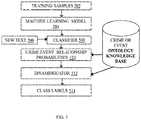
- the training of the disambiguator is explained with reference to FIG. 5 .
- a set of input training samples are given (at step 502) to a machine learning model.
- the machine learning model (at step 504) is used to classify the input text by utilizing a set of classifiers (at step 508).
- the set of classifiers can predict a set of crime components available in input text (506). Now, depending upon the input text 506, a classifier among the set of classifiers may fail to predict the one or more crime components.
- crime event relationship probabilities are calculated for training the disambiguator at step 512 for the class labels 514. It is also observed that the output of the classifier may be ambiguous. For example, the ambiguity can be due to assigning same crime component to one or more crime component class.
- LCB officials four teams, led by inspector J D Purohit and sub-inspectors H K Solanki, K A Patel and S B Padheriya, are working on the case.
- LCB seized a car parked by Shailesh Patel outside Devnarayan Dhaba, a roadside eatery, on Monday.”
- a classifier among the set of classifiers may predict both Shailesh Patel and Navin Shah as "Accuse Name” incorrectly, instead of predicting Shailesh Patel as "Accuse Name” and Navin Shah as "Victim Name".
- the classifier can wrongly classify J D Purohit and H K Solanki as "Victim Name” instead of "law enforcement".
- the disambiguator can be utilized.
- the disambiguator works in three steps. Step-1: receive a set of linguistic structures and lexical patterns and assign a probabilistic score to each of the predicted crime components.
- Step-3 Perform classification by utilizing the set of classifiers and ensemble a set of prediction scores. Further, select a score based on a majority voting method.
- the set of classified data are received (at step 602) from the plurality of classification agents associated with the set of classifiers. Further, a majority voting is performed (at step 604) among the plurality of classifying agents to determine a candidate class associated with a class member. Further, relationship probabilities associated with the class member is calculated (at step 606). Further, a relationship between an identified class and the identified member of the class is checked (at step 608) for validity and the step 608 is repeated till final class members are identified (as in step 620). During each iteration, if the relationship is valid (at step 610), the class member is given to linguistic evidence collector (at step 614), else, the relationship between the class and the other class member is checked for validity (at step 612).
- step (614) If it is valid, it is given to linguistic evidence collector at step (614), else, the relationship probabilities are calculated again at step (606). Further, at step (616) it is assessed whether the collected evidence agree with the relationship of the class member. If the evidence agree with the relationship, the class member and the relationship is updated in the crime ontology knowledgebase (at step 618), otherwise the relationship probabilities are calculated again and the process in repeated until all the relationships among the class members are processed and the final class members are identified (at step 620)
- the event profiling unit 250 of the event profiling system 200 can be configured to analyse, by the one or more hardware processors, the disambiguated data set to obtain linked information for data in the disambiguated data set.
- An information linker explained herein for crime event profiling, implemented by one or more hardware processors handles multi-lingual sources, applies transliteration for Named Entities, applies machine translation for information other than Named Entities and performs linking of documents using cosine and jaccard similarity on Crime Information Components.
- the analysis and linking of the set of classified data includes (i) identification of "nature of a crime” and “action taken” and (ii) identification of "accused name", "location of crime”, “date of crime”.
- identification of "nature of a crime” and "action taken” can be performed as given below: Interaction of the extracted text with the ontology knowledge base is used to identify patterns that are likely to indicate the Nature of the Crime committed. It is difficult to attach a level of confidence to the obtained information in this case, because, a crime often differs by geography. However, given the documents being processed exclusively talk of crime, if a term matches a crime pattern, it is an illegal activity. Further, the knowledge base is also employed to find occurrence of legal/law-enforcement related patterns across the whole document. Taking into account the presence of a story flow in a news document, paragraphs with higher density of candidate patterns have a higher confidence of describing the action taken in response to the crime.
- identification of "accused name”, "location of crime”, “and date of crime” can be performed as given below:
- the ontology knowledge base is used to label the terms present in a processed sentence. Labels are assigned on the basis of relevancy of a term to one of the three categories (Location, Date and Accused and Victim Name) with respect to the features obtained previously. Given a named entity occurring in a sentence, and one of the terms labelled as relevant in the same sentence, a distance between the two entities in the dependency graph is computed. In case either one or both of the named entity and the term is a phrase, the minimum distance between the two is considered.
- N and T be two phrases in a sentence
- a set of sub graphs N g , T g are calculated corresponding to N and T respectively. Further, the distance can be calculated using equation 4.from the sentence dependency graph.
- dist N T min d x y , wherex ⁇ N g , y ⁇ T g
- d(x,y) is minimum distance between two nodes x, y on a graph named entities which occur in Named Entity-Term pairs with distance below a certain threshold are considered to be candidate entities.
- the determination of confidence on the candidate entities is done over the whole document. Having collected all candidate NETerm pairs in the document, the named entities are resolved among themselves, to combine different expression of the same entity.
- FIG. 7 illustrates an example flow diagram of the method for event profiling, according to some embodiments of the present disclosure.
- the method may be described in the general context of computer executable instructions.
- computer executable instructions can include routines, programs, objects, components, data structures, procedures, modules, functions, etc., that perform particular functions or implement particular abstract data types.
- the method may also be practiced in a distributed computing environment where functions are performed by remote processing devices that are linked through a communication network.
- the order in which the method is described is not intended to be construed as a limitation, and any number of the described method blocks can be combined in any order to implement the method, or an alternative method.
- the method can be implemented in any suitable hardware, software, firmware, or combination thereof.
- the method includes, receiving by one or more hardware processors 201, the set of articles for the event profiling of an event from one or more data sources, wherein the set of articles are multilingual.
- set of articles received are all documents from digital sources and at step 704 the set of articles received are through site specific document crawlers.
- the method includes aggregating, by the one or more hardware processors 202, the set of articles to obtain the plurality of groups with each group comprising a plurality of news related to a common event information component, wherein the plurality of news articles are aggregated across date, sources of information and languages.
- the method includes analysing, by the one or more hardware processors 202, the plurality of groups to identify relevant linguistic features corresponding to each group among the plurality of groups by utilizing a set of language specific Natural Language Processors (NLPs) to obtain an analysed data set.
- NLPs Natural Language Processors
- the method includes classifying, by the plurality of classifying agents implemented by the one or more hardware processors 202, the plurality of groups identified with the relevant linguistic features into class members of the plurality of classes, wherein each class among the plurality of classes is identified by the unique event related factor.
- the classification utilizes a plurality of language specific classifiers.
- the method includes disambiguating, by the one or more hardware processors 202, class membership of each class member of the plurality of classes to obtain the disambiguated data set.
- the disambiguation is performed based on voting among the plurality of classifying agents for the class of each class member, relationship validity among each class member and corresponding class and relationship validity among each class member and remaining other class members of the class.
- the method includes analysing, by the one or more hardware processors 202, the disambiguated data set to obtain linked information for data in the disambiguated data set.
- the method includes updating the event ontology in an ontology knowledge base using the linked information, wherein a semi-supervised technique is utilized for incremental updating of the event ontology.
- the storage manger 716 stores the linked information, which is then shared with language specific classifiers for continuous learning.
- a crime information extraction method is explained with reference to FIG. 4 .
- a set of crime components and a relationship associated with the set of crime components are imported form the crime ontology.
- the crime components includes Name of the accused, Name of the Victim, Nature of Crime, Action taken, Crime location.
- a crime annotated data set is imported from the set of crime components.
- the annotated data set is pre-processed using the POS tagger, the dependency parser and the named entity recognizer.
- a new document is received from the multilingual document aggregator.
- the new document is pre-processed to obtain a set of named entities.
- the set of entities are disambiguated.
- the linguistic and statistical features associated with the disambiguated entities are obtained.
- language specific analysers are designed.
- the set of crime components are classified by utilizing a supervised machine learning technique to obtain a set of extracted crime components.
- the supervised machine learning techniques includes Conditional Random Field (CRF), Support Vector Machine (SVM), and Long-Short Term Memory (LSTM).
- CRF Conditional Random Field
- SVM Support Vector Machine
- LSTM Long-Short Term Memory
- the prediction accuracy is enhanced and a new crime component may be identified.
- the methods for prediction accuracy utilizes a plurality of language specific components including minimum dependency distance, linguistic patterns and ontology based disambiguation techniques. An example disambiguation technique is as shown in FIG. 6 .
- the set of extracted crime components are visualized.
- the crime ontology knowledgebase is updated if there is any new crime component is identified.
- a sample crime information can be as shown below: "Multiple teams of Khannagar police's local crime branch (LCB) arrested Shailesh Patel, one of the two prime accused in the Navin Shah kidnapping-murder case, and also seized the SUV in which the murder took place.
- LCB local crime branch
- the set of multilingual news articles are extracted from a plurality of digital sources. Further, the crime related information has been extracted based on computational linguistic based methods. Further the crime related information is classified based on the set of classifiers. Further, the classified data is disambiguated and visualized. Finally, the event ontology knowledgebase has been updated.
- the method of disambiguation of the present disclosure along with supervised learning techniques and continuous updating of the ontology knowledgebase increases accurate prediction for event profiling. In crime news, it often happens that new allegations/facts/evidences come into the news at different times. When a new information arrives, we determine whether it refers to an existing case or a new case. If it is of an existing case, the case is updated accordingly. This is an ongoing process.
- the final output provided by the system 200 can be a Crime register, composed of information related to different aspects of a crime, as made available to the end-user. All this information is represented in the back-end as a hierarchical semantic structure called the crime ontology.
- the NLP s remains the same.
- the knowledge base for Safety Incidents focus on (a) Incidence (b) Location of Incidence (c) Date of Incident, instead of a) nature of crime, b)perpetrators/victim names, c) criminal names, and d) action taken SVM based classification model to learn concepts remains the same.
- the NLPs remain the same.
- the knowledge base for Disasters focus on (a) Disaster Incident (b) Location of Disaster (c) Technical Magnitude of Disaster , instead of a) nature of crime, b) perpetrators/victim names, c) criminal names, and d) action taken, SVM based classification model to learn concepts remains the same.
- the method and system described herein thus focuses on incremental extraction and summarization of domain specific information from multiple documents (set of articles), across different languages and published over an extended time period.
- the extracted information is gathered to generate reports and also support visualization and analysis of reported data.
- the extraction process provides following features:
- the hardware device can be any kind of device which can be programmed including e.g. any kind of computer like a server or a personal computer, or the like, or any combination thereof.
- the device may also include means which could be e.g. hardware means like e.g. an application-specific integrated circuit (ASIC), a field-programmable gate array (FPGA), or a combination of hardware and software means, e.g.
- ASIC application-specific integrated circuit
- FPGA field-programmable gate array
- the means can include both hardware means and software means.
- the method embodiments described herein could be implemented in hardware and software.
- the device may also include software means.
- the embodiments may be implemented on different hardware devices, e.g. using a plurality of CPUs.
- the embodiments herein can comprise hardware and software elements.
- the embodiments that are implemented in software include but are not limited to, firmware, resident software, microcode, etc.
- the functions performed by various modules described herein may be implemented in other modules or combinations of other modules.
- a computer-usable or computer readable medium can be any apparatus that can comprise, store, communicate, propagate, or transport the program for use by or in connection with the instruction execution system, apparatus, or device.
- a computer-readable storage medium refers to any type of physical memory on which information or data readable by a processor may be stored.
- a computer-readable storage medium may store instructions for execution by one or more processors, including instructions for causing the processor(s) to perform steps or stages consistent with the embodiments described herein.
- the term "computer-readable medium” should be understood to include tangible items and exclude carrier waves and transient signals, i.e., be non-transitory. Examples include random access memory (RAM), read-only memory (ROM), volatile memory, nonvolatile memory, hard drives, CD ROMs, DVDs, flash drives, disks, and any other known physical storage media.
Landscapes
- Engineering & Computer Science (AREA)
- Theoretical Computer Science (AREA)
- Physics & Mathematics (AREA)
- General Engineering & Computer Science (AREA)
- General Physics & Mathematics (AREA)
- Databases & Information Systems (AREA)
- Artificial Intelligence (AREA)
- Health & Medical Sciences (AREA)
- Audiology, Speech & Language Pathology (AREA)
- Computational Linguistics (AREA)
- General Health & Medical Sciences (AREA)
- Data Mining & Analysis (AREA)
- Software Systems (AREA)
- Computer Vision & Pattern Recognition (AREA)
- Evolutionary Computation (AREA)
- Medical Informatics (AREA)
- Computing Systems (AREA)
- Mathematical Physics (AREA)
- Machine Translation (AREA)
Applications Claiming Priority (1)
| Application Number | Priority Date | Filing Date | Title |
|---|---|---|---|
| IN201721029896 | 2017-08-23 |
Publications (1)
| Publication Number | Publication Date |
|---|---|
| EP3447663A1 true EP3447663A1 (fr) | 2019-02-27 |
Family
ID=63363992
Family Applications (1)
| Application Number | Title | Priority Date | Filing Date |
|---|---|---|---|
| EP18190269.3A Ceased EP3447663A1 (fr) | 2017-08-23 | 2018-08-22 | Système et procédé pour le profilage d'événements |
Country Status (2)
| Country | Link |
|---|---|
| US (1) | US10796097B2 (fr) |
| EP (1) | EP3447663A1 (fr) |
Cited By (3)
| Publication number | Priority date | Publication date | Assignee | Title |
|---|---|---|---|---|
| CN111414747A (zh) * | 2020-02-26 | 2020-07-14 | 重庆兆光科技股份有限公司 | 一种基于弱监督学习的时间知识模糊测度方法及系统 |
| EP3835994A1 (fr) * | 2019-12-13 | 2021-06-16 | Tata Consultancy Services Limited | Système et procédé d'identification et de profilage d'événements indésirables |
| WO2025201330A1 (fr) * | 2024-03-26 | 2025-10-02 | Risksis Technology Limited | Systèmes d'évaluation de risque de crime et de recommandation, et procédés associés |
Families Citing this family (11)
| Publication number | Priority date | Publication date | Assignee | Title |
|---|---|---|---|---|
| CN111046671A (zh) * | 2019-12-12 | 2020-04-21 | 中国科学院自动化研究所 | 基于图网络融入词典的中文命名实体识别方法 |
| US20210192133A1 (en) * | 2019-12-20 | 2021-06-24 | International Business Machines Corporation | Auto-suggestion of expanded terms for concepts |
| CN111428036B (zh) * | 2020-03-23 | 2022-05-27 | 浙江大学 | 一种基于生物医学文献的实体关系挖掘方法 |
| CN112070112B (zh) * | 2020-07-28 | 2021-11-16 | 浙江警察学院 | 涉网犯罪分类方法、装置、计算机设备及存储介质 |
| CN111932413B (zh) * | 2020-09-14 | 2021-01-12 | 平安国际智慧城市科技股份有限公司 | 案件要素提取方法、装置、设备及介质 |
| CN112307772B (zh) * | 2020-11-05 | 2022-03-25 | 广东工业大学 | 一种基于语义本体的广彩瓷知识库的构建方法 |
| CN112612871B (zh) * | 2020-12-17 | 2023-09-15 | 浙江大学 | 一种基于序列生成模型的多事件检测方法 |
| US11983498B2 (en) | 2021-03-18 | 2024-05-14 | Augmented Intelligence Technologies, Inc. | System and methods for language processing of document sequences using a neural network |
| CN113869040B (zh) * | 2021-06-22 | 2024-12-06 | 国网甘肃省电力公司天水供电公司 | 一种电网调度的语音识别方法 |
| US12586399B2 (en) * | 2021-12-02 | 2026-03-24 | International Business Machines Corporation | Date and time feature identification |
| CN116050609B (zh) * | 2023-01-04 | 2026-04-24 | 贵州大学 | 一种融合行为词的罪名预测多任务学习方法及其系统 |
Citations (4)
| Publication number | Priority date | Publication date | Assignee | Title |
|---|---|---|---|---|
| US20120254188A1 (en) * | 2011-03-30 | 2012-10-04 | Krzysztof Koperski | Cluster-based identification of news stories |
| US20170004128A1 (en) * | 2015-07-01 | 2017-01-05 | Institute for Sustainable Development | Device and method for analyzing reputation for objects by data mining |
| US20170116054A1 (en) * | 2013-12-02 | 2017-04-27 | Qbase, LLC | Event detection through text analysis using dynamic self evolving/learning module |
| CA2956627A1 (fr) * | 2016-01-29 | 2017-07-29 | Thomson Reuters Enterprise Centre Gmbh | Systeme et moteur servant au regroupement cible d'evenements d'informations |
Family Cites Families (1)
| Publication number | Priority date | Publication date | Assignee | Title |
|---|---|---|---|---|
| DK179049B1 (en) * | 2016-06-11 | 2017-09-18 | Apple Inc | Data driven natural language event detection and classification |
-
2018
- 2018-08-22 EP EP18190269.3A patent/EP3447663A1/fr not_active Ceased
- 2018-08-23 US US16/110,490 patent/US10796097B2/en active Active
Patent Citations (4)
| Publication number | Priority date | Publication date | Assignee | Title |
|---|---|---|---|---|
| US20120254188A1 (en) * | 2011-03-30 | 2012-10-04 | Krzysztof Koperski | Cluster-based identification of news stories |
| US20170116054A1 (en) * | 2013-12-02 | 2017-04-27 | Qbase, LLC | Event detection through text analysis using dynamic self evolving/learning module |
| US20170004128A1 (en) * | 2015-07-01 | 2017-01-05 | Institute for Sustainable Development | Device and method for analyzing reputation for objects by data mining |
| CA2956627A1 (fr) * | 2016-01-29 | 2017-07-29 | Thomson Reuters Enterprise Centre Gmbh | Systeme et moteur servant au regroupement cible d'evenements d'informations |
Non-Patent Citations (2)
| Title |
|---|
| "Proceedings of the 2008 conference on New Trends in Multimedia and Network Information Systems", 1 January 2008, IOS PRESS AMSTERDAM, THE NETHERLANDS, THE NETHERLANDS 2008, NL, ISBN: 978-1-58603-904-2, article JAKUB PISKORSKI ET AL: "Cluster-Centric Approach to News Event Extraction", pages: 276 - 290, XP055496177 * |
| GREGOR LEBAN ET AL: "Using news articles for real-time cross-lingual event detection and filtering", PROCEEDINGS OF THE NEWSIR' 16 WORKSHOP AT ECIR, 20 March 2016 (2016-03-20), XP055509705, Retrieved from the Internet <URL:http://ceur-ws.org/Vol-1568/paper6.pdf> [retrieved on 20180925] * |
Cited By (4)
| Publication number | Priority date | Publication date | Assignee | Title |
|---|---|---|---|---|
| EP3835994A1 (fr) * | 2019-12-13 | 2021-06-16 | Tata Consultancy Services Limited | Système et procédé d'identification et de profilage d'événements indésirables |
| CN111414747A (zh) * | 2020-02-26 | 2020-07-14 | 重庆兆光科技股份有限公司 | 一种基于弱监督学习的时间知识模糊测度方法及系统 |
| CN111414747B (zh) * | 2020-02-26 | 2023-08-18 | 重庆兆光科技股份有限公司 | 一种基于弱监督学习的时间知识模糊测度方法及系统 |
| WO2025201330A1 (fr) * | 2024-03-26 | 2025-10-02 | Risksis Technology Limited | Systèmes d'évaluation de risque de crime et de recommandation, et procédés associés |
Also Published As
| Publication number | Publication date |
|---|---|
| US20190065467A1 (en) | 2019-02-28 |
| US10796097B2 (en) | 2020-10-06 |
Similar Documents
| Publication | Publication Date | Title |
|---|---|---|
| US10796097B2 (en) | System and method for event profiling | |
| Parimala et al. | Spatiotemporal‐based sentiment analysis on tweets for risk assessment of event using deep learning approach | |
| Abualhaija et al. | A machine learning-based approach for demarcating requirements in textual specifications | |
| Cetto et al. | Graphene: Semantically-linked propositions in open information extraction | |
| Chan et al. | A text-based decision support system for financial sequence prediction | |
| Budi et al. | Application of named entity recognition method for Indonesian datasets: a review | |
| Ressan et al. | Naïve-Bayes family for sentiment analysis during COVID-19 pandemic and classification tweets | |
| Tseng et al. | Mining term networks from text collections for crime investigation | |
| Valentin et al. | PADI-web 3.0: A new framework for extracting and disseminating fine-grained information from the news for animal disease surveillance | |
| Nuseir et al. | Hierarchical classifiers for multi-way sentiment analysis of arabic reviews | |
| Dasgupta et al. | Crimeprofiler: Crime information extraction and visualization from news media | |
| CN111026885B (zh) | 一种基于文本语料的涉恐事件实体属性抽取系统及方法 | |
| Khatoon et al. | Development of social media analytics system for emergency event detection and crisis management | |
| Ng et al. | Application of natural language processing algorithms for extracting information from news articles in event-based surveillance | |
| Yeasmin et al. | Study of abstractive text summarization techniques | |
| Olsen et al. | Socio-political events of conflict and unrest: A survey of available datasets | |
| Khemani et al. | Detecting health misinformation: a comparative analysis of machine learning and graph convolutional networks in classification tasks | |
| Anggara et al. | Analysis of Netizen Comments Sentiment on Public Official Statements on Instagram Social Media Accounts | |
| Freitas et al. | A Semantic Best-Effort Approach for Extracting Structured Discourse Graphs from Wikipedia. | |
| Harber et al. | Feasibility and utility of lexical analysis for occupational health text | |
| Das et al. | Analysis of Bangla transformation of sentences using machine learning | |
| Archana et al. | Explicit sarcasm handling in emotion level computation of tweets-A big data approach | |
| Sankarasubramanian | Industrial accident report analysis using natural language processing | |
| Ghosal et al. | Political Bias Detection from Hindi News Using Neutrosophic Sets, MuRil and Extended Hindi SentiWordNet | |
| Carnaz et al. | Knowledge representation of crime-related events: a preliminary approach |
Legal Events
| Date | Code | Title | Description |
|---|---|---|---|
| PUAI | Public reference made under article 153(3) epc to a published international application that has entered the european phase |
Free format text: ORIGINAL CODE: 0009012 |
|
| STAA | Information on the status of an ep patent application or granted ep patent |
Free format text: STATUS: THE APPLICATION HAS BEEN PUBLISHED |
|
| AK | Designated contracting states |
Kind code of ref document: A1 Designated state(s): AL AT BE BG CH CY CZ DE DK EE ES FI FR GB GR HR HU IE IS IT LI LT LU LV MC MK MT NL NO PL PT RO RS SE SI SK SM TR |
|
| AX | Request for extension of the european patent |
Extension state: BA ME |
|
| STAA | Information on the status of an ep patent application or granted ep patent |
Free format text: STATUS: REQUEST FOR EXAMINATION WAS MADE |
|
| 17P | Request for examination filed |
Effective date: 20190827 |
|
| RBV | Designated contracting states (corrected) |
Designated state(s): AL AT BE BG CH CY CZ DE DK EE ES FI FR GB GR HR HU IE IS IT LI LT LU LV MC MK MT NL NO PL PT RO RS SE SI SK SM TR |
|
| STAA | Information on the status of an ep patent application or granted ep patent |
Free format text: STATUS: EXAMINATION IS IN PROGRESS |
|
| 17Q | First examination report despatched |
Effective date: 20200629 |
|
| STAA | Information on the status of an ep patent application or granted ep patent |
Free format text: STATUS: THE APPLICATION HAS BEEN REFUSED |
|
| 18R | Application refused |
Effective date: 20211105 |