EP3447827A1 - Système d'électrode à électrode polymère - Google Patents
Système d'électrode à électrode polymère Download PDFInfo
- Publication number
- EP3447827A1 EP3447827A1 EP17187975.2A EP17187975A EP3447827A1 EP 3447827 A1 EP3447827 A1 EP 3447827A1 EP 17187975 A EP17187975 A EP 17187975A EP 3447827 A1 EP3447827 A1 EP 3447827A1
- Authority
- EP
- European Patent Office
- Prior art keywords
- electrode
- electrochemical conversion
- molecule
- pedot
- polymer
- Prior art date
- Legal status (The legal status is an assumption and is not a legal conclusion. Google has not performed a legal analysis and makes no representation as to the accuracy of the status listed.)
- Withdrawn
Links
- 229920000642 polymer Polymers 0.000 title claims abstract description 33
- 238000006243 chemical reaction Methods 0.000 claims abstract description 90
- QIGBRXMKCJKVMJ-UHFFFAOYSA-N Hydroquinone Chemical compound OC1=CC=C(O)C=C1 QIGBRXMKCJKVMJ-UHFFFAOYSA-N 0.000 claims description 94
- AZQWKYJCGOJGHM-UHFFFAOYSA-N 1,4-benzoquinone Chemical compound O=C1C=CC(=O)C=C1 AZQWKYJCGOJGHM-UHFFFAOYSA-N 0.000 claims description 45
- 229920001609 Poly(3,4-ethylenedioxythiophene) Polymers 0.000 claims description 37
- 238000000034 method Methods 0.000 claims description 34
- 230000008569 process Effects 0.000 claims description 31
- 239000000446 fuel Substances 0.000 claims description 30
- YCIMNLLNPGFGHC-UHFFFAOYSA-N catechol Chemical compound OC1=CC=CC=C1O YCIMNLLNPGFGHC-UHFFFAOYSA-N 0.000 claims description 28
- 229920001467 poly(styrenesulfonates) Polymers 0.000 claims description 23
- 229960002796 polystyrene sulfonate Drugs 0.000 claims description 22
- 239000011970 polystyrene sulfonate Substances 0.000 claims description 22
- 238000012546 transfer Methods 0.000 claims description 19
- 239000002322 conducting polymer Substances 0.000 claims description 17
- 229920001940 conductive polymer Polymers 0.000 claims description 17
- 229920005610 lignin Polymers 0.000 claims description 17
- -1 poly(3,4-ethylenedioxythiophene) Polymers 0.000 claims description 17
- 229920000447 polyanionic polymer Polymers 0.000 claims description 8
- 150000001450 anions Chemical class 0.000 claims description 2
- 229920000144 PEDOT:PSS Polymers 0.000 description 46
- BASFCYQUMIYNBI-UHFFFAOYSA-N platinum Chemical compound [Pt] BASFCYQUMIYNBI-UHFFFAOYSA-N 0.000 description 30
- 239000010408 film Substances 0.000 description 26
- 239000000243 solution Substances 0.000 description 19
- 229910021397 glassy carbon Inorganic materials 0.000 description 18
- 238000002484 cyclic voltammetry Methods 0.000 description 17
- FAPWRFPIFSIZLT-UHFFFAOYSA-M Sodium chloride Chemical group [Na+].[Cl-] FAPWRFPIFSIZLT-UHFFFAOYSA-M 0.000 description 16
- 229910052697 platinum Inorganic materials 0.000 description 12
- QAOWNCQODCNURD-UHFFFAOYSA-N Sulfuric acid Chemical compound OS(O)(=O)=O QAOWNCQODCNURD-UHFFFAOYSA-N 0.000 description 11
- 239000003792 electrolyte Substances 0.000 description 11
- 230000003647 oxidation Effects 0.000 description 11
- 238000007254 oxidation reaction Methods 0.000 description 11
- QTBSBXVTEAMEQO-UHFFFAOYSA-N Acetic acid Chemical compound CC(O)=O QTBSBXVTEAMEQO-UHFFFAOYSA-N 0.000 description 10
- 239000000203 mixture Substances 0.000 description 9
- IAZDPXIOMUYVGZ-UHFFFAOYSA-N Dimethylsulphoxide Chemical compound CS(C)=O IAZDPXIOMUYVGZ-UHFFFAOYSA-N 0.000 description 8
- 125000003118 aryl group Chemical group 0.000 description 8
- 239000011780 sodium chloride Substances 0.000 description 8
- 239000002253 acid Substances 0.000 description 7
- 238000002474 experimental method Methods 0.000 description 7
- PEDCQBHIVMGVHV-UHFFFAOYSA-N Glycerine Chemical compound OCC(O)CO PEDCQBHIVMGVHV-UHFFFAOYSA-N 0.000 description 6
- 150000001875 compounds Chemical class 0.000 description 6
- 230000009467 reduction Effects 0.000 description 6
- 230000002441 reversible effect Effects 0.000 description 6
- WOAHJDHKFWSLKE-UHFFFAOYSA-N 1,2-benzoquinone Chemical compound O=C1C=CC=CC1=O WOAHJDHKFWSLKE-UHFFFAOYSA-N 0.000 description 5
- 229940005561 1,4-benzoquinone Drugs 0.000 description 5
- 239000000463 material Substances 0.000 description 5
- 238000005259 measurement Methods 0.000 description 5
- 239000007787 solid Substances 0.000 description 5
- VMHLLURERBWHNL-UHFFFAOYSA-M Sodium acetate Chemical compound [Na+].CC([O-])=O VMHLLURERBWHNL-UHFFFAOYSA-M 0.000 description 4
- 150000007513 acids Chemical class 0.000 description 4
- UCTWMZQNUQWSLP-UHFFFAOYSA-N adrenaline Chemical compound CNCC(O)C1=CC=C(O)C(O)=C1 UCTWMZQNUQWSLP-UHFFFAOYSA-N 0.000 description 4
- 229910052799 carbon Inorganic materials 0.000 description 4
- HYVDWYISUNRFCU-UHFFFAOYSA-N chembl452666 Chemical compound OC1=CC(O)=C2C(=O)C(O)=C(O)C(=O)C2=C1O HYVDWYISUNRFCU-UHFFFAOYSA-N 0.000 description 4
- 238000009792 diffusion process Methods 0.000 description 4
- VYFYYTLLBUKUHU-UHFFFAOYSA-N dopamine Chemical compound NCCC1=CC=C(O)C(O)=C1 VYFYYTLLBUKUHU-UHFFFAOYSA-N 0.000 description 4
- 238000003411 electrode reaction Methods 0.000 description 4
- KQPYUDDGWXQXHS-UHFFFAOYSA-N juglone Chemical compound O=C1C=CC(=O)C2=C1C=CC=C2O KQPYUDDGWXQXHS-UHFFFAOYSA-N 0.000 description 4
- 229910052751 metal Inorganic materials 0.000 description 4
- 239000002184 metal Substances 0.000 description 4
- RQNVIKXOOKXAJQ-UHFFFAOYSA-N naphthazarin Chemical compound O=C1C=CC(=O)C2=C1C(O)=CC=C2O RQNVIKXOOKXAJQ-UHFFFAOYSA-N 0.000 description 4
- VCMMXZQDRFWYSE-UHFFFAOYSA-N plumbagin Chemical compound C1=CC=C2C(=O)C(C)=CC(=O)C2=C1O VCMMXZQDRFWYSE-UHFFFAOYSA-N 0.000 description 4
- 239000000126 substance Substances 0.000 description 4
- JOXIMZWYDAKGHI-UHFFFAOYSA-N toluene-4-sulfonic acid Chemical compound CC1=CC=C(S(O)(=O)=O)C=C1 JOXIMZWYDAKGHI-UHFFFAOYSA-N 0.000 description 4
- GKWLILHTTGWKLQ-UHFFFAOYSA-N 2,3-dihydrothieno[3,4-b][1,4]dioxine Chemical compound O1CCOC2=CSC=C21 GKWLILHTTGWKLQ-UHFFFAOYSA-N 0.000 description 3
- CSCPPACGZOOCGX-UHFFFAOYSA-N Acetone Chemical compound CC(C)=O CSCPPACGZOOCGX-UHFFFAOYSA-N 0.000 description 3
- OKTJSMMVPCPJKN-UHFFFAOYSA-N Carbon Chemical compound [C] OKTJSMMVPCPJKN-UHFFFAOYSA-N 0.000 description 3
- 230000008901 benefit Effects 0.000 description 3
- 230000015572 biosynthetic process Effects 0.000 description 3
- 239000004020 conductor Substances 0.000 description 3
- 150000005205 dihydroxybenzenes Chemical class 0.000 description 3
- 239000000123 paper Substances 0.000 description 3
- 229920000867 polyelectrolyte Polymers 0.000 description 3
- 238000006116 polymerization reaction Methods 0.000 description 3
- 238000009790 rate-determining step (RDS) Methods 0.000 description 3
- 238000006479 redox reaction Methods 0.000 description 3
- 230000002829 reductive effect Effects 0.000 description 3
- 238000004832 voltammetry Methods 0.000 description 3
- XLYOFNOQVPJJNP-UHFFFAOYSA-N water Chemical group O XLYOFNOQVPJJNP-UHFFFAOYSA-N 0.000 description 3
- 239000002023 wood Substances 0.000 description 3
- SFLSHLFXELFNJZ-QMMMGPOBSA-N (-)-norepinephrine Chemical compound NC[C@H](O)C1=CC=C(O)C(O)=C1 SFLSHLFXELFNJZ-QMMMGPOBSA-N 0.000 description 2
- KETQAJRQOHHATG-UHFFFAOYSA-N 1,2-naphthoquinone Chemical compound C1=CC=C2C(=O)C(=O)C=CC2=C1 KETQAJRQOHHATG-UHFFFAOYSA-N 0.000 description 2
- FRASJONUBLZVQX-UHFFFAOYSA-N 1,4-naphthoquinone Chemical group C1=CC=C2C(=O)C=CC(=O)C2=C1 FRASJONUBLZVQX-UHFFFAOYSA-N 0.000 description 2
- WVCHIGAIXREVNS-UHFFFAOYSA-N 2-hydroxy-1,4-naphthoquinone Chemical compound C1=CC=C2C(O)=CC(=O)C(=O)C2=C1 WVCHIGAIXREVNS-UHFFFAOYSA-N 0.000 description 2
- CHCCBPDEADMNCI-UHFFFAOYSA-N 3-Methyl-2-cyclopenten-1-one Chemical compound CC1=CC(=O)CC1 CHCCBPDEADMNCI-UHFFFAOYSA-N 0.000 description 2
- LPYUENQFPVNPHY-UHFFFAOYSA-N 3-methoxycatechol Chemical compound COC1=CC=CC(O)=C1O LPYUENQFPVNPHY-UHFFFAOYSA-N 0.000 description 2
- CHWNEIVBYREQRF-UHFFFAOYSA-N 4-Ethyl-2-methoxyphenol Chemical compound CCC1=CC=C(O)C(OC)=C1 CHWNEIVBYREQRF-UHFFFAOYSA-N 0.000 description 2
- RZVHIXYEVGDQDX-UHFFFAOYSA-N 9,10-anthraquinone Chemical group C1=CC=C2C(=O)C3=CC=CC=C3C(=O)C2=C1 RZVHIXYEVGDQDX-UHFFFAOYSA-N 0.000 description 2
- MMNWSHJJPDXKCH-UHFFFAOYSA-N 9,10-dioxoanthracene-2-sulfonic acid Chemical compound C1=CC=C2C(=O)C3=CC(S(=O)(=O)O)=CC=C3C(=O)C2=C1 MMNWSHJJPDXKCH-UHFFFAOYSA-N 0.000 description 2
- NEZONWMXZKDMKF-JTQLQIEISA-N Alkannin Chemical compound C1=CC(O)=C2C(=O)C([C@@H](O)CC=C(C)C)=CC(=O)C2=C1O NEZONWMXZKDMKF-JTQLQIEISA-N 0.000 description 2
- 239000004229 Alkannin Substances 0.000 description 2
- VEXZGXHMUGYJMC-UHFFFAOYSA-M Chloride anion Chemical compound [Cl-] VEXZGXHMUGYJMC-UHFFFAOYSA-M 0.000 description 2
- OGPMEHXDIDDMDJ-UHFFFAOYSA-N Erythroglancin Natural products COc1cc(O)c2C(=O)c3c(O)cc(OC)c(O)c3C(=O)c2c1 OGPMEHXDIDDMDJ-UHFFFAOYSA-N 0.000 description 2
- ZMOIGGHUSNHCAB-UHFFFAOYSA-N Isoplumbagin Natural products C1=CC(O)=C2C(=O)C(C)=CC(=O)C2=C1 ZMOIGGHUSNHCAB-UHFFFAOYSA-N 0.000 description 2
- KFZMGEQAYNKOFK-UHFFFAOYSA-N Isopropanol Chemical compound CC(C)O KFZMGEQAYNKOFK-UHFFFAOYSA-N 0.000 description 2
- WTDRDQBEARUVNC-LURJTMIESA-N L-DOPA Chemical compound OC(=O)[C@@H](N)CC1=CC=C(O)C(O)=C1 WTDRDQBEARUVNC-LURJTMIESA-N 0.000 description 2
- WTDRDQBEARUVNC-UHFFFAOYSA-N L-Dopa Natural products OC(=O)C(N)CC1=CC=C(O)C(O)=C1 WTDRDQBEARUVNC-UHFFFAOYSA-N 0.000 description 2
- MEPSBMMZQBMKHM-UHFFFAOYSA-N Lomatiol Natural products CC(=C/CC1=C(O)C(=O)c2ccccc2C1=O)CO MEPSBMMZQBMKHM-UHFFFAOYSA-N 0.000 description 2
- FBWADIKARMIWNM-UHFFFAOYSA-N N-3,5-dichloro-4-hydroxyphenyl-1,4-benzoquinone imine Chemical compound C1=C(Cl)C(O)=C(Cl)C=C1N=C1C=CC(=O)C=C1 FBWADIKARMIWNM-UHFFFAOYSA-N 0.000 description 2
- LRHPLDYGYMQRHN-UHFFFAOYSA-N N-Butanol Chemical compound CCCCO LRHPLDYGYMQRHN-UHFFFAOYSA-N 0.000 description 2
- ISWSIDIOOBJBQZ-UHFFFAOYSA-N Phenol Chemical compound OC1=CC=CC=C1 ISWSIDIOOBJBQZ-UHFFFAOYSA-N 0.000 description 2
- JUJWROOIHBZHMG-UHFFFAOYSA-N Pyridine Chemical compound C1=CC=NC=C1 JUJWROOIHBZHMG-UHFFFAOYSA-N 0.000 description 2
- CIEYTVIYYGTCCI-UHFFFAOYSA-N SJ000286565 Natural products C1=CC=C2C(=O)C(CC=C(C)C)=C(O)C(=O)C2=C1 CIEYTVIYYGTCCI-UHFFFAOYSA-N 0.000 description 2
- UNNKKUDWEASWDN-UHFFFAOYSA-N alkannin Natural products CC(=CCC(O)c1cc(O)c2C(=O)C=CC(=O)c2c1O)C UNNKKUDWEASWDN-UHFFFAOYSA-N 0.000 description 2
- 235000019232 alkannin Nutrition 0.000 description 2
- 239000001000 anthraquinone dye Substances 0.000 description 2
- 239000007864 aqueous solution Substances 0.000 description 2
- KUCQYCKVKVOKAY-CTYIDZIISA-N atovaquone Chemical compound C1([C@H]2CC[C@@H](CC2)C2=C(C(C3=CC=CC=C3C2=O)=O)O)=CC=C(Cl)C=C1 KUCQYCKVKVOKAY-CTYIDZIISA-N 0.000 description 2
- 229960003159 atovaquone Drugs 0.000 description 2
- ALPCEXCHMFUSAN-UHFFFAOYSA-N beta-Dihydroplumbagin Natural products C1=CC=C2C(=O)C(C)CC(=O)C2=C1O ALPCEXCHMFUSAN-UHFFFAOYSA-N 0.000 description 2
- VYTBDSUNRJYVHL-UHFFFAOYSA-N beta-Hydrojuglone Natural products O=C1CCC(=O)C2=C1C=CC=C2O VYTBDSUNRJYVHL-UHFFFAOYSA-N 0.000 description 2
- 239000000872 buffer Substances 0.000 description 2
- 229950008349 buparvaquone Drugs 0.000 description 2
- KLLIVCPQDTYMLC-HDJSIYSDSA-N chembl292009 Chemical compound C1C[C@@H](C(C)(C)C)CC[C@@H]1CC1=C(O)C(=O)C2=CC=CC=C2C1=O KLLIVCPQDTYMLC-HDJSIYSDSA-N 0.000 description 2
- JMFRWRFFLBVWSI-NSCUHMNNSA-N coniferol Chemical compound COC1=CC(\C=C\CO)=CC=C1O JMFRWRFFLBVWSI-NSCUHMNNSA-N 0.000 description 2
- 125000004122 cyclic group Chemical group 0.000 description 2
- 229960003638 dopamine Drugs 0.000 description 2
- 238000002848 electrochemical method Methods 0.000 description 2
- 238000003487 electrochemical reaction Methods 0.000 description 2
- 239000007772 electrode material Substances 0.000 description 2
- 239000011521 glass Substances 0.000 description 2
- LHGVFZTZFXWLCP-UHFFFAOYSA-N guaiacol Chemical compound COC1=CC=CC=C1O LHGVFZTZFXWLCP-UHFFFAOYSA-N 0.000 description 2
- RUQPQFLYDCXMGX-UHFFFAOYSA-N hexahydroxy-1,4-naphthalenedione Chemical compound OC1=C(O)C(O)=C2C(=O)C(O)=C(O)C(=O)C2=C1O RUQPQFLYDCXMGX-UHFFFAOYSA-N 0.000 description 2
- KNOSIOWNDGUGFJ-UHFFFAOYSA-N hydroxysesamone Natural products C1=CC(O)=C2C(=O)C(CC=C(C)C)=C(O)C(=O)C2=C1O KNOSIOWNDGUGFJ-UHFFFAOYSA-N 0.000 description 2
- 150000002500 ions Chemical class 0.000 description 2
- 239000002655 kraft paper Substances 0.000 description 2
- CWPGNVFCJOPXFB-UHFFFAOYSA-N lapachol Chemical compound C1=CC=C2C(=O)C(=O)C(CC=C(C)C)=C(O)C2=C1 CWPGNVFCJOPXFB-UHFFFAOYSA-N 0.000 description 2
- SIUGQQMOYSVTAT-UHFFFAOYSA-N lapachol Natural products CC(=CCC1C(O)C(=O)c2ccccc2C1=O)C SIUGQQMOYSVTAT-UHFFFAOYSA-N 0.000 description 2
- 230000000670 limiting effect Effects 0.000 description 2
- 238000004502 linear sweep voltammetry Methods 0.000 description 2
- 239000000178 monomer Substances 0.000 description 2
- 229960002748 norepinephrine Drugs 0.000 description 2
- SFLSHLFXELFNJZ-UHFFFAOYSA-N norepinephrine Natural products NCC(O)C1=CC=C(O)C(O)=C1 SFLSHLFXELFNJZ-UHFFFAOYSA-N 0.000 description 2
- FFWOKTFYGVYKIR-UHFFFAOYSA-N physcion Chemical compound C1=C(C)C=C2C(=O)C3=CC(OC)=CC(O)=C3C(=O)C2=C1O FFWOKTFYGVYKIR-UHFFFAOYSA-N 0.000 description 2
- FGIUAXJPYTZDNR-UHFFFAOYSA-N potassium nitrate Chemical compound [K+].[O-][N+]([O-])=O FGIUAXJPYTZDNR-UHFFFAOYSA-N 0.000 description 2
- 239000000047 product Substances 0.000 description 2
- 239000000376 reactant Substances 0.000 description 2
- 230000001172 regenerating effect Effects 0.000 description 2
- 230000004044 response Effects 0.000 description 2
- 238000000926 separation method Methods 0.000 description 2
- 239000001632 sodium acetate Substances 0.000 description 2
- 235000017281 sodium acetate Nutrition 0.000 description 2
- 238000004528 spin coating Methods 0.000 description 2
- 239000000758 substrate Substances 0.000 description 2
- 238000003786 synthesis reaction Methods 0.000 description 2
- LZFOPEXOUVTGJS-ONEGZZNKSA-N trans-sinapyl alcohol Chemical compound COC1=CC(\C=C\CO)=CC(OC)=C1O LZFOPEXOUVTGJS-ONEGZZNKSA-N 0.000 description 2
- 235000019168 vitamin K Nutrition 0.000 description 2
- 239000011712 vitamin K Substances 0.000 description 2
- 239000002699 waste material Substances 0.000 description 2
- UZLQSPYGTUMKGS-UHFFFAOYSA-N 2,3-dimethylcyclopent-2-en-1-one Chemical compound CC1=C(C)C(=O)CC1 UZLQSPYGTUMKGS-UHFFFAOYSA-N 0.000 description 1
- HIXDQWDOVZUNNA-UHFFFAOYSA-N 2-(3,4-dimethoxyphenyl)-5-hydroxy-7-methoxychromen-4-one Chemical group C=1C(OC)=CC(O)=C(C(C=2)=O)C=1OC=2C1=CC=C(OC)C(OC)=C1 HIXDQWDOVZUNNA-UHFFFAOYSA-N 0.000 description 1
- ZBCATMYQYDCTIZ-UHFFFAOYSA-N 4-methylcatechol Chemical compound CC1=CC=C(O)C(O)=C1 ZBCATMYQYDCTIZ-UHFFFAOYSA-N 0.000 description 1
- 229920003043 Cellulose fiber Polymers 0.000 description 1
- VYZAMTAEIAYCRO-UHFFFAOYSA-N Chromium Chemical compound [Cr] VYZAMTAEIAYCRO-UHFFFAOYSA-N 0.000 description 1
- 241000270722 Crocodylidae Species 0.000 description 1
- 241000195493 Cryptophyta Species 0.000 description 1
- 229920002488 Hemicellulose Polymers 0.000 description 1
- 239000012901 Milli-Q water Substances 0.000 description 1
- CBENFWSGALASAD-UHFFFAOYSA-N Ozone Chemical compound [O-][O+]=O CBENFWSGALASAD-UHFFFAOYSA-N 0.000 description 1
- 235000008331 Pinus X rigitaeda Nutrition 0.000 description 1
- 235000011613 Pinus brutia Nutrition 0.000 description 1
- 241000018646 Pinus brutia Species 0.000 description 1
- 229920001131 Pulp (paper) Polymers 0.000 description 1
- 229910021607 Silver chloride Inorganic materials 0.000 description 1
- QAOWNCQODCNURD-UHFFFAOYSA-L Sulfate Chemical compound [O-]S([O-])(=O)=O QAOWNCQODCNURD-UHFFFAOYSA-L 0.000 description 1
- 241000592342 Tracheophyta Species 0.000 description 1
- 230000002378 acidificating effect Effects 0.000 description 1
- 239000012491 analyte Substances 0.000 description 1
- 238000004458 analytical method Methods 0.000 description 1
- 150000001491 aromatic compounds Chemical class 0.000 description 1
- 230000031018 biological processes and functions Effects 0.000 description 1
- 238000009835 boiling Methods 0.000 description 1
- 239000006227 byproduct Substances 0.000 description 1
- 239000011203 carbon fibre reinforced carbon Chemical group 0.000 description 1
- 238000005266 casting Methods 0.000 description 1
- 230000008859 change Effects 0.000 description 1
- 229910052729 chemical element Inorganic materials 0.000 description 1
- 239000007806 chemical reaction intermediate Substances 0.000 description 1
- 239000007795 chemical reaction product Substances 0.000 description 1
- 239000003153 chemical reaction reagent Substances 0.000 description 1
- 229910052804 chromium Inorganic materials 0.000 description 1
- 239000011651 chromium Substances 0.000 description 1
- LZFOPEXOUVTGJS-UHFFFAOYSA-N cis-sinapyl alcohol Natural products COC1=CC(C=CCO)=CC(OC)=C1O LZFOPEXOUVTGJS-UHFFFAOYSA-N 0.000 description 1
- 238000004140 cleaning Methods 0.000 description 1
- 239000003245 coal Substances 0.000 description 1
- 239000011248 coating agent Substances 0.000 description 1
- 238000000576 coating method Methods 0.000 description 1
- 238000002485 combustion reaction Methods 0.000 description 1
- 229940119526 coniferyl alcohol Drugs 0.000 description 1
- 229920000547 conjugated polymer Polymers 0.000 description 1
- 238000012937 correction Methods 0.000 description 1
- 238000005260 corrosion Methods 0.000 description 1
- 230000007797 corrosion Effects 0.000 description 1
- 239000003431 cross linking reagent Substances 0.000 description 1
- LNNWVNGFPYWNQE-GMIGKAJZSA-N desomorphine Chemical compound C1C2=CC=C(O)C3=C2[C@]24CCN(C)[C@H]1[C@@H]2CCC[C@@H]4O3 LNNWVNGFPYWNQE-GMIGKAJZSA-N 0.000 description 1
- 229910003460 diamond Inorganic materials 0.000 description 1
- 239000010432 diamond Substances 0.000 description 1
- 239000002019 doping agent Substances 0.000 description 1
- 230000000694 effects Effects 0.000 description 1
- 230000005611 electricity Effects 0.000 description 1
- 230000005274 electronic transitions Effects 0.000 description 1
- 239000000839 emulsion Substances 0.000 description 1
- 238000005516 engineering process Methods 0.000 description 1
- RTZKZFJDLAIYFH-UHFFFAOYSA-N ether Substances CCOCC RTZKZFJDLAIYFH-UHFFFAOYSA-N 0.000 description 1
- 230000001747 exhibiting effect Effects 0.000 description 1
- 239000002803 fossil fuel Substances 0.000 description 1
- 125000000524 functional group Chemical group 0.000 description 1
- PCHJSUWPFVWCPO-UHFFFAOYSA-N gold Chemical compound [Au] PCHJSUWPFVWCPO-UHFFFAOYSA-N 0.000 description 1
- 239000010931 gold Substances 0.000 description 1
- 229910052737 gold Inorganic materials 0.000 description 1
- 229960001867 guaiacol Drugs 0.000 description 1
- 238000010438 heat treatment Methods 0.000 description 1
- 239000012212 insulator Substances 0.000 description 1
- FYMCOOOLDFPFPN-UHFFFAOYSA-K iron(3+);4-methylbenzenesulfonate Chemical compound [Fe+3].CC1=CC=C(S([O-])(=O)=O)C=C1.CC1=CC=C(S([O-])(=O)=O)C=C1.CC1=CC=C(S([O-])(=O)=O)C=C1 FYMCOOOLDFPFPN-UHFFFAOYSA-K 0.000 description 1
- 230000002427 irreversible effect Effects 0.000 description 1
- 238000012933 kinetic analysis Methods 0.000 description 1
- 239000007788 liquid Substances 0.000 description 1
- 238000004519 manufacturing process Methods 0.000 description 1
- 230000007246 mechanism Effects 0.000 description 1
- 239000012528 membrane Substances 0.000 description 1
- VNWKTOKETHGBQD-UHFFFAOYSA-N methane Chemical compound C VNWKTOKETHGBQD-UHFFFAOYSA-N 0.000 description 1
- 238000002156 mixing Methods 0.000 description 1
- 230000007935 neutral effect Effects 0.000 description 1
- 239000011368 organic material Substances 0.000 description 1
- 229920000620 organic polymer Polymers 0.000 description 1
- 229920002959 polymer blend Polymers 0.000 description 1
- 239000002861 polymer material Substances 0.000 description 1
- 239000011148 porous material Substances 0.000 description 1
- 238000002360 preparation method Methods 0.000 description 1
- 230000001737 promoting effect Effects 0.000 description 1
- UMJSCPRVCHMLSP-UHFFFAOYSA-N pyridine Natural products COC1=CC=CN=C1 UMJSCPRVCHMLSP-UHFFFAOYSA-N 0.000 description 1
- 238000011002 quantification Methods 0.000 description 1
- 239000002994 raw material Substances 0.000 description 1
- 238000011946 reduction process Methods 0.000 description 1
- 238000011160 research Methods 0.000 description 1
- 230000027756 respiratory electron transport chain Effects 0.000 description 1
- 150000003839 salts Chemical class 0.000 description 1
- 229920006395 saturated elastomer Polymers 0.000 description 1
- HKZLPVFGJNLROG-UHFFFAOYSA-M silver monochloride Chemical compound [Cl-].[Ag+] HKZLPVFGJNLROG-UHFFFAOYSA-M 0.000 description 1
- 239000000344 soap Substances 0.000 description 1
- 239000002904 solvent Substances 0.000 description 1
- 241000894007 species Species 0.000 description 1
- 230000003068 static effect Effects 0.000 description 1
- 230000003335 steric effect Effects 0.000 description 1
- 238000003756 stirring Methods 0.000 description 1
- 239000003115 supporting electrolyte Substances 0.000 description 1
- 239000000725 suspension Substances 0.000 description 1
- 230000001360 synchronised effect Effects 0.000 description 1
- 239000010409 thin film Substances 0.000 description 1
- BSXLLFUSNQCWJP-UHFFFAOYSA-N thiophene-2-sulfonic acid Chemical compound OS(=O)(=O)C1=CC=CS1 BSXLLFUSNQCWJP-UHFFFAOYSA-N 0.000 description 1
- PTNLHDGQWUGONS-UHFFFAOYSA-N trans-p-coumaric alcohol Natural products OCC=CC1=CC=C(O)C=C1 PTNLHDGQWUGONS-UHFFFAOYSA-N 0.000 description 1
- PTNLHDGQWUGONS-OWOJBTEDSA-N trans-p-coumaryl alcohol Chemical compound OC\C=C\C1=CC=C(O)C=C1 PTNLHDGQWUGONS-OWOJBTEDSA-N 0.000 description 1
- BPSIOYPQMFLKFR-UHFFFAOYSA-N trimethoxy-[3-(oxiran-2-ylmethoxy)propyl]silane Chemical compound CO[Si](OC)(OC)CCCOCC1CO1 BPSIOYPQMFLKFR-UHFFFAOYSA-N 0.000 description 1
- 238000001075 voltammogram Methods 0.000 description 1
Images





Classifications
-
- H—ELECTRICITY
- H01—ELECTRIC ELEMENTS
- H01M—PROCESSES OR MEANS, e.g. BATTERIES, FOR THE DIRECT CONVERSION OF CHEMICAL ENERGY INTO ELECTRICAL ENERGY
- H01M4/00—Electrodes
- H01M4/86—Inert electrodes with catalytic activity, e.g. for fuel cells
- H01M4/90—Selection of catalytic material
- H01M4/9008—Organic or organo-metallic compounds
-
- H—ELECTRICITY
- H01—ELECTRIC ELEMENTS
- H01M—PROCESSES OR MEANS, e.g. BATTERIES, FOR THE DIRECT CONVERSION OF CHEMICAL ENERGY INTO ELECTRICAL ENERGY
- H01M8/00—Fuel cells; Manufacture thereof
- H01M8/18—Regenerative fuel cells, e.g. redox flow batteries or secondary fuel cells
- H01M8/184—Regeneration by electrochemical means
- H01M8/188—Regeneration by electrochemical means by recharging of redox couples containing fluids; Redox flow type batteries
-
- Y—GENERAL TAGGING OF NEW TECHNOLOGICAL DEVELOPMENTS; GENERAL TAGGING OF CROSS-SECTIONAL TECHNOLOGIES SPANNING OVER SEVERAL SECTIONS OF THE IPC; TECHNICAL SUBJECTS COVERED BY FORMER USPC CROSS-REFERENCE ART COLLECTIONS [XRACs] AND DIGESTS
- Y02—TECHNOLOGIES OR APPLICATIONS FOR MITIGATION OR ADAPTATION AGAINST CLIMATE CHANGE
- Y02E—REDUCTION OF GREENHOUSE GAS [GHG] EMISSIONS, RELATED TO ENERGY GENERATION, TRANSMISSION OR DISTRIBUTION
- Y02E60/00—Enabling technologies; Technologies with a potential or indirect contribution to GHG emissions mitigation
- Y02E60/30—Hydrogen technology
- Y02E60/50—Fuel cells
Definitions
- the invention relates to electrode systems comprising an electrode and a molecule susceptible to electrochemical conversion.
- Black liquor comprises approximately half of the organic material originally present in the wood.
- Black liquor is rich in lignin residues obtained after the sulfate (kraft) process.
- kraft sulfate
- benzenediols have been used in both combustion engines and in electrochemical energy devices such as fuel cells, typically fuel cells comprising platinum electrodes.
- Yet another object of the present invention is to provide improved flow batteries exhibiting high reversibility and low dependence on non-renewable resources.
- a further object of the invention is to provide a reversible process for electrochemical conversion of a molecule susceptible to electrochemical conversion.
- an electrode system comprising a polymer electrode having an electron conductive phase and a proton conductive phase; and a molecule susceptible to electrochemical conversion.
- electrode systems providing reversibility of the electrochemical conversions they facilitate is highly desired, for example, in applications relating to energy conversion.
- Some targeted applications of the present invention include for the electrode system to be used in a fuel cell or a flow battery. In such applications, high electrochemical reversibility is desired since it allows for re-chargeability of the fuel cell or flow battery.
- Rechargeable fuel cells are also generally denoted as regenerative fuel cells.
- Flow batteries constitute a sub-group of regenerative fuel cells.
- polymer electrodes in electrode systems has been found to be advantageous in that such electrodes are based on abundant chemical elements, mainly carbon.
- Polymer electrodes furthermore provide the advantage that such electrodes may be processed from a solution. Polymer electrodes can therefore be provided by coating the polymer onto a substrate. The substrate may have a relatively large area.
- polymer electrodes provide yet another advantage in that insulating oxide layers do not form on polymer electrodes. Metal electrodes typically suffer from the formation of a passivating oxide layer at their surface.
- Polymer electrodes are defined as electrodes comprising at least one polymer.
- the polymer electrodes disclosed herein generally comprises a proton conducting phase and an electron conducting phase.
- this means that the polymer electrode comprises a polymer capable of conducting both protons and electrons or a mixture of polymers wherein at least one polymer is capable of conducting protons and at least one polymer is capable of conducting electrons.
- Polymer conductivity in polymer electrodes is the result of several molecular processes.
- Polymer conductivity typically occurs in conjugated polymer materials, where the conducting polymers have a backbone of contiguous sp 2 hybridized carbon centers. In such materials, one valence electron on each carbon center resides in a p z -orbital orthogonal to the other three sigma-bonds.
- the p z -orbitals in the material combine to a molecular wide delocalized set of orbitals.
- the electrons in the delocalized orbitals have a high mobility when some of these electrons are removed by oxidation or added by reduction from/to the delocalized set of orbitals.
- the conjugated p-orbitals form a one-dimensional electronic band, and the electrons become mobile when the band is partially emptied (by oxidation) or when electrons are added an otherwise unfilled band (by reduction). Such addition or removal of electrons is generally denoted as doping.
- the inventors have found that decrease in overpotential, yielding higher currents and higher reversibility, particularly in electrochemical conversions involving the transfer of two protons and two electrons, can be achieved by providing an electrode comprising an electron conducting material and a proton conducting material in the vicinity of the molecule susceptible to electrochemical conversion.
- the molecule susceptible to electrochemical conversion is a benzenediol
- the electrochemical conversion is the redox conversion of the benzenediol
- two protons per molecule may be provided by the proton conducting phase when the molecule susceptible to electrochemical conversion is in the vicinity of the proton conducting phase.
- Cyclic voltammetry is a type of potentiodynamic electrochemical measurement.
- the working electrode potential is ramped linearly versus time.
- the working electrode's potential is ramped in the opposite direction to return to the initial potential. These cycles of ramps in potential may be repeated as many times as needed.
- the current at the working electrode is plotted versus the applied voltage (that is, the working electrode's potential) to give the cyclic voltammogram trace.
- Cyclic voltammetry is generally used to study the electrochemical properties of an analyte in solution.
- the reversibility of an electrochemical conversion is measured as the ratio between the anodic and cathodic peak currents (i pa/ i pc ) .
- a i pa /i pc -ratio close to 1 indicates that the electrochemical conversion is reversible.
- Electrode systems capable of reversible electrochemical conversions are particularly useful in energy conversion applications, such as fuel cells and flow batteries.
- the term electrode system denotes a system comprising at least one electrode and a least one molecule susceptible to electrochemical conversion.
- the electrochemical system may further comprise a second electrode and/or an electrolyte.
- the electrode system according to the present invention is suitable for use in for example energy conversion applications, such as fuel cells and/or flow batteries.
- An electron conducting phase is in the present disclosure defined as a phase or moiety capable of conducting electrons between the electron conducting phase and the molecule susceptible to electrochemical conversion.
- the electron conducting phase may be capable of donating electrons to the molecule susceptible to electrochemical conversion or accepting electrons from the molecule susceptible to electrochemical conversion.
- the electron conducting phase may be capable of donating two electrons per molecule susceptible to electrochemical conversion and to accept two electrons per molecule from the molecule susceptible to electrochemical conversion.
- the proton conducting phase may be defined in a way akin to the electrode conducting phase, but with the difference that the proton conducting phase is capable of conducting protons between the proton conducting phase and the molecule susceptible to electrochemical conversion.
- a molecule susceptible to electrochemical conversion is defined as a molecule which can be converted in an electrochemical conversion, preferably an electrochemical reaction involving transfer of two electrons and two protons per molecule.
- the molecule susceptible to electrochemical conversion may typically be suitable as fuel for an electrochemical energy device such as in a fuel cell or a flow battery.
- the molecule susceptible to electrochemical conversion may be an aromatic molecule.
- the molecule susceptible to electrochemical conversion may be obtainable from lignin, preferably lignin obtained from so called black liquor. Lignin obtained from black liquor may be depolymerized into a plethora of molecules. Several of such molecules may be susceptible to electrochemical conversion.
- the electrochemical conversion may be a redox-reaction, such as the redox conversion of hydroquinone to benzoquinone and/or the redox conversion of benzoquinone to hydroquinone.
- Lignin is a class of complex organic polymers that form structural materials in the support tissue of vascular plants and some algae. Lignin, is a collective name of a series of aromatic polymers coming from the polymerization of 4-hydroxycinnamyl alcohol (H), coniferyl alcohol (G), and sinapyl alcohol (S), interlinked by ether and carbon-carbon bonds. Lignin may be depolymerized into several aromatic compounds by methods known to a person skilled in the art.
- Typical aromatic molecules that can be obtained by the depolymerization of lignin includes 2-methulcyclopentenone, 3-methylcyclopentenone, phenol, 2,3-dimethylcyclopentenone, guaiacol, catechol, 3-methoxycatechol, 4-ethylguaiacol, 4-methylcatechol, syringoll, hydroquinone, DCPIP, compounds containing ortho- or para-benzoquinone moieties such as dopamine, adrenaline, norepinephrine, L-DOPA, compounds containing ortho- or para-naphthoquinone moieties such as vitamins K, atovaquone, buparvaquone, naphthazarin, alkannin, plumbagin, spinochrome D, juglone, hennotannic acid, lapachol, hexahydroxynaphthoquinone, compounds containing anthraquinone moieties such as anthraquinone dyes, 2-
- Black liquor is a waste product from the paper and pulp industry, more particularly from the kraft process wherein pulp wood is digested into paper pulp by removing lignin, hemicellulose and other extractives from the wood to free the cellulose fibers. Black liquor generally comprises about 35-45 percent lignin.
- the molecule susceptible to electrochemical conversion may be a ortho- or para-aromatic diol or quinone, such as a benzene diol. Such molecules may be obtained from the depolymerisation of lignin.
- Aromatic diols comprise at least one aromatic functional group and two hydroxide groups.
- the molecule susceptible to electrochemical conversion is a benzene diol, preferably the ortho-isomer, commonly known as catechol, or the para-isomer, commonly known as hydroquinone.
- Benzenediols for example, are energy-rich molecules that can store two electrons per aromatic ring.
- the molecule susceptible to electrochemical conversion is selected from the group consisting of catechol, hydroquinone, DCPIP, compounds containing ortho- or para-benzoquinone moieties such as dopamine, adrenaline, norepinephrine, L-DOPA, compounds containing ortho- or para-naphthoquinone moieties such as vitamins K, atovaquone, buparvaquone, naphthazarin, alkannin, plumbagin, spinochrome D, juglone, hennotannic acid, lapachol, hexahydroxynaphthoquinone, compounds containing anthraquinone moieties such as anthraquinone dyes, 2-anthraquinonesulfonate, parietin, or a combination thereof.
- catechol catechol
- hydroquinone DCPIP
- compounds containing ortho- or para-benzoquinone moieties such as dopamine, adrenaline, norepinephrine
- the electron conducting phase comprises a conducting polymer, preferably a p-type conducting polymer, more preferably doped poly(3,4-ethylenedioxythiophene) (p-type PEDOT).
- a p-type conducting polymer is generally defined as a conducting polymer that has been doped oxidatively.
- Doped poly(3,4-ethylenedioxythiophene) (p-type PEDOT). is a p-type conducting polymer based on the 3,4-ethylenedioxythiophene (EDOT) monomer.
- the p-type PEDOT of the present invention may be synthesized according to methods known to the skilled person in the art.
- P-type PEDOT has a high electrical conductivity and is therefore suited to act as an electron conduction phase.
- P-type PEDOT provides several additional advantages such as high stability over different charge and discharge cycles, and high processability.
- P-type PEDOT can be electrogenerated directly on several support materials.
- the proton conducting phase comprises an anion, such as a polyanion, preferably polystyrene sulfonate (PSS).
- the proton conducting phase is capable of acting as a counter-ion balancing the positive charge of the electron conducting phase.
- Polyanions are a type of polyelectrolytes, i.e. polymers having a repeating unit comprising a negatively charged group.
- One group of polyanions of particular interest are polyanionic acids.
- Polyanionic acids generally have a high proton conductivity and are therefore suitable to act as the proton conducting phase of the present invention.
- Polystyrene sulfonate is a polyanionic acid commonly used as a counter-ion to PEDOT.
- the proton conducting phase comprises PSS.
- the proton conducting phase may also comprise tosylate (tos) or chloride ions.
- the polymer electrode comprises PEDOT:PSS.
- PEDOT:PSS is a polymer mixture of the two phases, PEDOT and PSS, wherein PEDOT is doped with PSS.
- PEDOT:PSS is a transparent/semitransparent conducting polymer mixture with high ductility in different applications.
- PEDOT:PSS can be electropolymerized or polymerized in water in the form of an emulsion. With the addition of a high boiling point solvent such as dimethylsulfoxide, thin films of PEDOT:PSS can reach electrical conductivities of about 1000 S/cm.
- PEDOT:PSS also provides a wide and clear electrochemical potential window. Furthermore, PEDOT:PSS provides a high resistance to corrosion, in particular in acid environments.
- the electrochemical conversion involves transfer of 2 protons and 2 electrons per molecule susceptible to electrochemical conversion.
- the electrochemical conversion is preferably a redox conversion.
- the term transfer is supposed to denote that electrons and protons transfer from/to the electrode to/from the molecule susceptible to electrochemical conversion.
- the molecule susceptible to electrochemical conversion is either oxidized or reduced.
- the molecule susceptible to electrochemical conversion is hydroquinone. By transfer of two electron and two protons to the electrode the hydroquinone is oxidized to 1,4-benzoquinone. Consequently, 1,4-benzoquinone may be reduced into hydroquinone by transfer of two electrons and two protons from the electrode to the 1,4-benzoquinone.
- the molecule susceptible to electrochemical conversion is catchecol.
- the hydroquinone By transfer of two electrons and two protons to the electrode the hydroquinone is oxidized to 1,4-benzoquinone. Consequently, 1,2-benzoquinone may be reduced into catechol by transfer of two electrons and two protons from the electrode to the 1,2-benzoquinone
- the molecule susceptible to electrochemical conversion is selected from the group consisting of catechol, hydroquinone, benzoquinone or a combination thereof.
- the benzoquinone is 1,4-benzoquinone or 1,2-benzoquinone.
- the molecule susceptible for electrochemical conversion is obtained from the depolymerisation of lignin.
- Lignin is an abundant, renewable raw material obtainable from for example black liquor. Approximately 170 million tonnes/year of black liquor is produced each year as a by-product from the paper and pulp industry.
- the electrode system according to the present invention for electrochemical conversion of the molecule susceptible to electrochemical conversion.
- electrochemical conversion involves transfer of 2 protons and 2 electrons per molecule of the molecule susceptible to electrochemical conversion.
- a fuel cell is an electrochemical cell that converts chemical energy from a fuel into electricity through an electrochemical reaction of a fuel.
- a fuel cell generally comprises a cathode electrode, an anode electrode, an electrolyte and a fuel.
- the electrode system of the present invention may be used in a fuel cell wherein the electrode acts as anode and the molecule susceptible to electrochemical conversion acts as fuel.
- the cathode may for example be a Pt/Ru-electrode and the electrolyte any suitable electrolyte known to a person skilled in the art.
- the electrode system disclosed herein provides an electrochemical conversion which provides a high reversibility, making it suitable for use in fuel cell applications.
- Flow batteries are a type of electrochemical cell wherein chemical energy is provided by two chemical components dissolved in liquid and separated by a membrane.
- the electrode system disclosed herein provides an electrochemical conversion which provides a high reversibility, making it suitable for use in flow batteries.
- a use of the electrode system in electrochemical synthesis in another aspect of the invention, there is provided a use of the electrode system in electrochemical synthesis.
- a fuel cell comprising the electrode system disclosed herein.
- a flow battery comprising the electrode system disclosed herein.
- a process for electrochemical conversion in a system comprising a polymer electrode having an electron conductive phase, a proton conductive phase and a molecule susceptible to electrochemical conversion, wherein the process comprises the steps of
- the process for electrochemical conversion disclosed herein yields a high current density and high reversibility.
- the reversibility of the conversion is governed by contacting of the molecule susceptible to electrochemical conversion with the polymer electrode, and more particularly with the proton conducting phase of the polymer electrode.
- the proton conducting phase allows for the transport of protons between the proton conducting phase and the molecule susceptible to electrochemical conversion. This allows for an enhancement of the proton-associated redox kinetics, yielding a high current density and high reversibility.
- the electrochemical conversion comprises transfer of 2 protons per molecule between the molecule and the proton conducting phase; and transfer of 2 electrons per molecule between the molecule and the electron conducting phase.
- said electron conducting phase comprises a conducting polymer, preferably a p-type conducting polymer, more preferably doped poly(3,4-ethylenedioxythiophene) (PEDOT).
- a conducting polymer preferably a p-type conducting polymer, more preferably doped poly(3,4-ethylenedioxythiophene) (PEDOT).
- PEDOT poly(3,4-ethylenedioxythiophene)
- the proton conducting phase comprises a polyanion, preferably polystyrene sulfonate (PSS).
- PSS polystyrene sulfonate
- the proton conducting phase is capable of acting as a counter-ion balancing the positive charge of the electron conducting phase.
- Polyanions are a type of polyelectrolytes, i.e. polymers having a repeating unit comprising a negatively charged group.
- One group of polyanions of particular interest are polyanionic acids.
- Polyanionic acids generally have a high proton conductivity and are therefore suitable to act as the proton conducting phase of the present invention.
- Polystyrene sulfonate is a polyanionic acid commonly used as a counter-ion to PEDOT.
- the proton conducting phase comprises PSS.
- the proton conducting phase may also comprise tosylate (tos) or chloride ions.
- the electron conducting phase is PEDOT and the proton conducting phase is PSS.
- the molecule susceptible to electrochemical conversion may be selected from the group consisting of catechol, hydroquinone, benzoquinone or a combination thereof.
- said process is performed in a fuel cell or a flow battery.
- Microscopic slides were utilized as a solid isolative support for the fabrication of PEDOT:PSS films.
- the ends of the slides were sequentially covered by a layer of chromium (10nm) and gold (50nm) to ensure a good electric contact between the crocodile clip and PEDOT:PSS films.
- the contacts between the conducting polymer films and metal layers remained dry during all electrochemical measurements to ensure the absence of metal electrode contribution in the registering currents.
- metal-modified glass slides were cleaned with soap and rinsed with acetone, distill water and isopropanol.
- the slides were treated with UV-ozone in Ozone cleaning device (Model: PSD-UV8) for 15 minutes.
- a suspension of PH1000, DMSO, 10 mM glycerol, GOPS Volume fraction volumetric ratio of 94%, 4%, 1.5% and 0.5%) are used in the solution for spin coating.
- DMSO is used to enhance solubility
- glycerol is to increase the viscosity
- GOPS is used as crosslinking agent.
- Poly(3,4-ethylenedioxythiophene)tosylate (PEDOT:tos) electrodes were prepared by chemical polymerization from a mixture of Clevios CB-54 [40wt% iron(iii)-tosylate in butanol] and EDOT monomer.
- Clevios CB-54 was stabilized by adding Pyridine and stirring for 1 h.
- Cyclic voltammetry is an important electroanalytical technique. It is rarely capable of quantitative determination, but widely applied in the study of redox processes, for understanding the reaction intermediates and the stability of reaction products. Cyclic voltammetry experiments were performed in an aqueous solution of 1 mM HQ and 0.1 M H 2 SO 4 (for the pH experiments below, the supporting electrolyte is NaCl) at room temperature with a computer controlled potentiostat (SP200, BioLogic)). Ag/AgCl saturated by 3M KCl solution was used as the reference electrode while a platinum mesh was used as the counter electrode.
- composition of the buffer of 1 mM HQ solution with different pH values Composition pH (before adding HQ) pH (after adding HQ) 60ml 0.1 M HCl in 0.1 M NaCl 1.05 1.25 10ml 0.1 M HCl+50ml 0.1 M NaCl 1.80 1.81
- RDE Rotating disk electrode
- a glassy carbon electrode (GCE, 5 mm diameter) was used in the setup of rotating disk electrode (RDE, Pine Research Instrumentation Inc., USA) in a one compartment electrochemical cell having a of volume of 200 ml.
- PEDOT:PSS films were deposited on the glassy carbon electrode via blend drop-casting followed by the heating (60 °C for 15 minutes). The film thickness was controlled by the blend volume by deducing from the capacitance currents acquired by cyclic voltammetry.
- Six samples with the following PEDOT:PSS film thicknesses were prepared: 101 nm, 239nm, 438nm, 514nm, 726nm and 848nm, respectively.
- the rotating rates were 1000, 1500, 2000, 2500, 3000 and 3500 rpm, respectively.
- the scan rate of linear sweep voltammetry is 20mV/s.
- the reference electrode is the same as for the cyclic voltammetry.
- the PEDOT:PSS electrodes were compared with a platinum (Pt) electrode, a glassy carbon electrode and a PEDOT:Tosylate (Tos) electrode.
- PEDOT:tos film showed larger capacitive currents than PEDOT:PSS, due to higher density of PEDOT and smaller contribution from isolative primitive dopant for the PEDOT:tos, indicated by thiophene-sulfonate ratio R T / S R T/S .
- PEDOT:PSS is composed of 2.5 times more PSS than PEDOT and this makes this material less conducting and also more hydrophilic, which on the other hand makes it easy to swell in aqueous electrolytes, promoting proton diffusion due to steric effect.
- PSS, as polyacid is a very good proton conducting material, providing high proton concentration close to PEDOT.
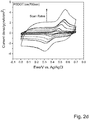
- the faradic current at conducting polymer PEDOT:PSS (around 630nm), PEDOT:tos(around 700nm) electrode is much higher than that at Pt and glassy carbon electrode.
- ⁇ Ep peak-to-peak separation
- PEDOT:PSS Contrary to PEDOT:PSS, PEDOT:tos experiences the lack of proton supply. Having a lower electronic conductivity, PEDOT:PSS manifests significantly faster proton-associated redox phenomena illustrating the control by the ionic process as a rate-determining step (RDS) of a whole electrode reaction happening on conducting polymer. In other words, sacrificing the electronic conductivity due to blending with an insulator (e.g. PSS), the complex redox process shows higher rates due to the boost of RDS by the increase of proton transport.
- RDS rate-determining step
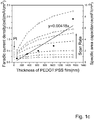
- a film thickness dependence study for the PEDOT:PSS electrode has been undertaken, see Fig. 1 c.
- the capacitive currents scale linearly with the film thickness, showing an access to the bulk of PEDOT:PSS for the ions of the background electrolyte to establish the double layers due to the appropriate ionic conductivity maintained by PSS.
- the oxidation peak current density experience saturation at high thicknesses due to the lack of the access to the bulk of the polymer for the larger, neutral HQ and BQ molecules.
- the porosity of the PEDOT:PSS film for HQ/BQ redox couple yields the larger faradic currents in comparison with collected smooth electrodes (e.g platinum and glassy carbon electrode) showing the significant excess of surface area available for faradaic process over the geometrical macroscopic surface area, considering the conductivity of Pt (9.4*10 6 S/cm) is 3 orders of magnitude larger than PEDOT:PSS ( ⁇ 103 S/cm).
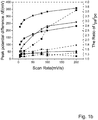
- a fast potential ramp led to larger oxidation current densities on thicker PEDOT:PSS film electrodes, which illustrate the access of deeper pores by higher field gradients.
- Figs. 3a-c The pH study of voltammetric response is displayed in Figs. 3a-c .
- the decay of redox peak current densities visible at high pH values ( Fig. 3a ) is attributed to the decrease of electrical conductivity of PEDOT:PSS as reported in literature.
- the diffusion coefficients D can be gained from the slope of i -1 vs. w -1/2 plots, while kinetic current i k can be obtained from the intercept. Showing a minor thickness dependence, see Fig. 4c , the values of diffusion coefficient were around 7.71*10 -6 cm 2 s -1 for HQ and 7.88*10 -6 cm 2 s -1 for BQ at PEDOT:PSS electrodes, which is quite close to reported for platinum (7.4 ⁇ 0.2)*10 -6 cm 2 ⁇ s -1 in 0.1 M KNO 3 .
- PEDOT:PSS film electrode for proton-associated redox reaction is believed to be the well-established proton transport via abundant acidic groups from PSS, see the schematic illustration in Fig.6a.
Landscapes
- Chemical & Material Sciences (AREA)
- Engineering & Computer Science (AREA)
- Chemical Kinetics & Catalysis (AREA)
- Electrochemistry (AREA)
- General Chemical & Material Sciences (AREA)
- Materials Engineering (AREA)
- Life Sciences & Earth Sciences (AREA)
- Manufacturing & Machinery (AREA)
- Sustainable Development (AREA)
- Sustainable Energy (AREA)
- Inert Electrodes (AREA)
Priority Applications (2)
| Application Number | Priority Date | Filing Date | Title |
|---|---|---|---|
| EP17187975.2A EP3447827A1 (fr) | 2017-08-25 | 2017-08-25 | Système d'électrode à électrode polymère |
| EP18190508.4A EP3447836B1 (fr) | 2017-08-25 | 2018-08-23 | Système d'électrode à électrode polymère |
Applications Claiming Priority (1)
| Application Number | Priority Date | Filing Date | Title |
|---|---|---|---|
| EP17187975.2A EP3447827A1 (fr) | 2017-08-25 | 2017-08-25 | Système d'électrode à électrode polymère |
Publications (1)
| Publication Number | Publication Date |
|---|---|
| EP3447827A1 true EP3447827A1 (fr) | 2019-02-27 |
Family
ID=59702632
Family Applications (2)
| Application Number | Title | Priority Date | Filing Date |
|---|---|---|---|
| EP17187975.2A Withdrawn EP3447827A1 (fr) | 2017-08-25 | 2017-08-25 | Système d'électrode à électrode polymère |
| EP18190508.4A Active EP3447836B1 (fr) | 2017-08-25 | 2018-08-23 | Système d'électrode à électrode polymère |
Family Applications After (1)
| Application Number | Title | Priority Date | Filing Date |
|---|---|---|---|
| EP18190508.4A Active EP3447836B1 (fr) | 2017-08-25 | 2018-08-23 | Système d'électrode à électrode polymère |
Country Status (1)
| Country | Link |
|---|---|
| EP (2) | EP3447827A1 (fr) |
Citations (7)
| Publication number | Priority date | Publication date | Assignee | Title |
|---|---|---|---|---|
| EP0987775A2 (fr) * | 1998-09-04 | 2000-03-22 | NEC Corporation | Electrode polymère, pile électrochimique secondaire la contenant et procédé de préparation |
| WO2004091015A1 (fr) * | 2003-04-09 | 2004-10-21 | Graham Simpson Murray | Polymere conducteur, compositions a base de polymeres conducteurs et leur utilisation |
| US20140138576A1 (en) * | 2012-07-27 | 2014-05-22 | Sun Catalytix Corporation | Aqueous redox flow batteries featuring improved cell design characteristics |
| US20140335425A1 (en) * | 2013-05-09 | 2014-11-13 | Nathan Lawrence | Proton/cation transfer polymer |
| US20160028070A1 (en) * | 2013-03-11 | 2016-01-28 | Fluidic, Inc. | Integrable redox-active polymer batteries |
| US20160043423A1 (en) * | 2012-09-26 | 2016-02-11 | President And Fellows Of Harvard College | Small organic molecule based flow battery |
| US20170241025A1 (en) * | 2016-02-23 | 2017-08-24 | South Dakota Board Of Regents | Self-organized and electrically conducting pedot polymer matrix for applications in sensors and energy generation and storage |
Family Cites Families (4)
| Publication number | Priority date | Publication date | Assignee | Title |
|---|---|---|---|---|
| JP5334856B2 (ja) * | 2006-11-06 | 2013-11-06 | アグファ−ゲバルト | 太陽光暴露に対して改善された安定性を備えた層構造 |
| US8840812B2 (en) * | 2007-10-05 | 2014-09-23 | Shin-Etsu Polymer Co., Ltd. | Conductive polymer solution, conductive coating film, and input device |
| CN101976727B (zh) * | 2010-09-17 | 2012-12-26 | 天津理工大学 | 一种具有掺杂抗氧化剂的活性层的有机光伏电池及其制备 |
| WO2016205407A1 (fr) * | 2015-06-15 | 2016-12-22 | Biosolar, Inc. | Cathode à haute capacité destinée à être utilisée dans des supercondensateurs et des batteries et procédés de fabrication desdites cathodes |
-
2017
- 2017-08-25 EP EP17187975.2A patent/EP3447827A1/fr not_active Withdrawn
-
2018
- 2018-08-23 EP EP18190508.4A patent/EP3447836B1/fr active Active
Patent Citations (7)
| Publication number | Priority date | Publication date | Assignee | Title |
|---|---|---|---|---|
| EP0987775A2 (fr) * | 1998-09-04 | 2000-03-22 | NEC Corporation | Electrode polymère, pile électrochimique secondaire la contenant et procédé de préparation |
| WO2004091015A1 (fr) * | 2003-04-09 | 2004-10-21 | Graham Simpson Murray | Polymere conducteur, compositions a base de polymeres conducteurs et leur utilisation |
| US20140138576A1 (en) * | 2012-07-27 | 2014-05-22 | Sun Catalytix Corporation | Aqueous redox flow batteries featuring improved cell design characteristics |
| US20160043423A1 (en) * | 2012-09-26 | 2016-02-11 | President And Fellows Of Harvard College | Small organic molecule based flow battery |
| US20160028070A1 (en) * | 2013-03-11 | 2016-01-28 | Fluidic, Inc. | Integrable redox-active polymer batteries |
| US20140335425A1 (en) * | 2013-05-09 | 2014-11-13 | Nathan Lawrence | Proton/cation transfer polymer |
| US20170241025A1 (en) * | 2016-02-23 | 2017-08-24 | South Dakota Board Of Regents | Self-organized and electrically conducting pedot polymer matrix for applications in sensors and energy generation and storage |
Also Published As
| Publication number | Publication date |
|---|---|
| EP3447836B1 (fr) | 2020-12-23 |
| EP3447836A1 (fr) | 2019-02-27 |
Similar Documents
| Publication | Publication Date | Title |
|---|---|---|
| Tajik et al. | Recent developments in conducting polymers: Applications for electrochemistry | |
| Sato et al. | Enzyme-based glucose fuel cell using Vitamin K3-immobilized polymer as an electron mediator | |
| Surridge et al. | The Electrochemistry Group Medal Lecture. Electron self-exchange dynamics between redox sites in polymers | |
| Hao et al. | Generating power from cellulose in an alkaline fuel cell enhanced by methyl viologen as an electron-transfer catalyst | |
| Henning et al. | Polymer films on electrodes. 6. Bioconductive polymers produced by incorporation of tetrathiafulvalenium in a polyelectrolyte (Nafion) matrix | |
| Kuwahara et al. | Immobilization of glucose oxidase on carbon paper electrodes modified with conducting polymer and its application to a glucose fuel cell | |
| Che et al. | Conducting polymer electrocatalysts for proton‐coupled electron transfer reactions: Toward organic fuel cells with forest fuels | |
| Mayahi et al. | SPEEK/cSMM membrane for simultaneous electricity generation and wastewater treatment in microbial fuel cell | |
| Valiollahi et al. | Electrochemical hydrogen production on a metal-free polymer | |
| Pradeepa et al. | Sensitive and selective determination of vanillin in the presence of dopamine and uric acid using low-cost and trouble-free pencil graphite electrode modified with methyl orange | |
| JPWO2011025021A1 (ja) | 微生物燃料電池用電極及びそれを用いた微生物燃料電池 | |
| Ensafi et al. | Application of conductive polymers in electrochemistry | |
| Christwardana et al. | Fabrication of a polyvinyl alcohol-bentonite composite coated on a carbon felt anode for improving yeast microbial fuel cell performance | |
| Sousa et al. | Impedimetric sensor for pentoses based on electrodeposited carbon nanotubes and molecularly imprinted poly-o-phenylenediamine | |
| Kuwahara et al. | Fabrication of enzyme electrodes with a polythiophene derivative and application of them to a glucose fuel cell | |
| EP3447836B1 (fr) | Système d'électrode à électrode polymère | |
| Siao et al. | Electrochemical study of PEDOT-PSS-MDB-modified electrode and its electrocatalytic sensing of hydrogen peroxide | |
| Wang et al. | Metal-dispersed porous carbon films as electrocatalytic sensors | |
| González‐Tejera et al. | Electrochemical, FTIR and morphological study of polypyrrole—Polystyrenesulphonate conducting films | |
| Tsai et al. | Copper nanoparticles with copper hexacyanoferrate and poly (3, 4-ethylenedioxythiophene) hybrid film modified electrode for hydrogen peroxide detection | |
| Li et al. | Immobilization of laccase into poly (3, 4-ethylenedioxythiophene) assisted biocathode for biofuel cell applications | |
| Anandhakumar et al. | Anodic oxidation of chlorophenols in micelles and microemulsions on glassy carbon electrode: the medium effect on electroanalysis and electrochemical detoxification | |
| Radhi et al. | Electrochemical characterization of the redox couple of [Fe (CN) 6] 3−/[Fe (CN) 6] 4− mediated by a grafted polymer modified glassy carbon electrode | |
| Zhao et al. | Electropolymerization of Methylene Blue on Carbon Ionic Liquid Electrode and Its Electrocatalysis to 3, 4‐Dihydroxybenzoic Acid | |
| Holzhauser et al. | Influence of counter-ions on the permeability of polypyrrole films to hydrogen |
Legal Events
| Date | Code | Title | Description |
|---|---|---|---|
| PUAI | Public reference made under article 153(3) epc to a published international application that has entered the european phase |
Free format text: ORIGINAL CODE: 0009012 |
|
| AK | Designated contracting states |
Kind code of ref document: A1 Designated state(s): AL AT BE BG CH CY CZ DE DK EE ES FI FR GB GR HR HU IE IS IT LI LT LU LV MC MK MT NL NO PL PT RO RS SE SI SK SM TR |
|
| AX | Request for extension of the european patent |
Extension state: BA ME |
|
| STAA | Information on the status of an ep patent application or granted ep patent |
Free format text: STATUS: THE APPLICATION IS DEEMED TO BE WITHDRAWN |
|
| 18D | Application deemed to be withdrawn |
Effective date: 20190228 |