EP3447939A1 - Trägerfrequenzbestimmungsverfahren und zugehörige verarbeitungseinheit, detektionsverfahren und zugehöriger empfänger - Google Patents
Trägerfrequenzbestimmungsverfahren und zugehörige verarbeitungseinheit, detektionsverfahren und zugehöriger empfänger Download PDFInfo
- Publication number
- EP3447939A1 EP3447939A1 EP17306092.2A EP17306092A EP3447939A1 EP 3447939 A1 EP3447939 A1 EP 3447939A1 EP 17306092 A EP17306092 A EP 17306092A EP 3447939 A1 EP3447939 A1 EP 3447939A1
- Authority
- EP
- European Patent Office
- Prior art keywords
- phase
- signal
- amplitude
- modulation
- states
- Prior art date
- Legal status (The legal status is an assumption and is not a legal conclusion. Google has not performed a legal analysis and makes no representation as to the accuracy of the status listed.)
- Withdrawn
Links
- 238000000034 method Methods 0.000 title claims abstract description 24
- 238000001514 detection method Methods 0.000 title description 3
- 230000003287 optical effect Effects 0.000 claims abstract description 26
- 230000000694 effects Effects 0.000 claims abstract description 6
- 230000010287 polarization Effects 0.000 claims description 11
- 230000001427 coherent effect Effects 0.000 claims description 8
- 238000011084 recovery Methods 0.000 claims description 8
- 238000007493 shaping process Methods 0.000 claims description 6
- 238000012952 Resampling Methods 0.000 claims description 5
- 238000006243 chemical reaction Methods 0.000 claims description 5
- 239000006185 dispersion Substances 0.000 claims description 5
- 230000014509 gene expression Effects 0.000 claims description 5
- 238000001914 filtration Methods 0.000 claims description 3
- 230000006870 function Effects 0.000 description 16
- 238000010586 diagram Methods 0.000 description 7
- 230000005540 biological transmission Effects 0.000 description 4
- 239000013307 optical fiber Substances 0.000 description 2
- 230000010363 phase shift Effects 0.000 description 2
- 238000012935 Averaging Methods 0.000 description 1
- 239000000654 additive Substances 0.000 description 1
- 230000000996 additive effect Effects 0.000 description 1
- 238000004364 calculation method Methods 0.000 description 1
- 230000001419 dependent effect Effects 0.000 description 1
- 230000003993 interaction Effects 0.000 description 1
- 230000003595 spectral effect Effects 0.000 description 1
Images



Classifications
-
- H—ELECTRICITY
- H04—ELECTRIC COMMUNICATION TECHNIQUE
- H04B—TRANSMISSION
- H04B10/00—Transmission systems employing electromagnetic waves other than radio-waves, e.g. infrared, visible or ultraviolet light, or employing corpuscular radiation, e.g. quantum communication
- H04B10/60—Receivers
- H04B10/61—Coherent receivers
- H04B10/616—Details of the electronic signal processing in coherent optical receivers
- H04B10/6164—Estimation or correction of the frequency offset between the received optical signal and the optical local oscillator
Definitions
- the present invention refers to the reception of an optical signal and more specifically to the carrier frequency estimation of an optical signal modulated in amplitude and phase.
- Fig.1a represents the constellation symbols in the case of a Quadrature Phase Shift Keying (QPSK) and Fig.1b represents the results of the application of a fourth power to the constellation symbols of Fig.1a . Only the real and positive part of the constellation symbols remains.
- QPSK Quadrature Phase Shift Keying
- the frequency offset can be retrieved using the following frequency estimator:
- the invention refers to a method for estimating a carrier frequency offset at the reception of an optical signal modulated in amplitude and phase, the signal comprising a series of modulation symbols, the method comprising the following steps:
- the modulation format corresponds to a modulation format based on constellation shaping.
- the function f is computed for N equally spaced frequencies by a fast fourier transform "FFT" of the corrected states.
- the predetermined correction factor is a sign correction factor for the M th power resulting states located in the left hemisphere of the complex plane in the absence of phase and frequency shift.
- the sign correction factor depends on the amplitude of the modulation symbols.
- the predetermined correction factor is a weighted factor based on a calculated variance of an estimated phase of the different M th power resulting states.
- the variance of the estimated phase of the different Mth power resulting states depends on their amplitude.
- the modulation format corresponds to a square quadrature amplitude modulation "QAM" format and wherein the number M of the power is equal to four.
- the method comprises the following preliminary steps:
- the present invention also refers to a method for detecting a received optical signal modulated in amplitude and phase wherein the method comprises the following steps:
- the present invention also refers to a processing unit configured for estimating a carrier frequency of a received optical signal modulated in amplitude and phase, the signal comprising a series of modulation symbols and the processing unit being configured for:
- the present invention also refers to an optical receiver comprising:
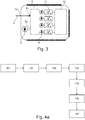
- Fig.3 discloses the structure of an optical receiver 1 based on a coherent detection.
- the optical receiver 1 comprises a local oscillator 3, generally a tunable laser source and a coherent mixer 5.
- the coherent mixer 5 comprises a first input 5a linked to the input 1a of the optical receiver 1 which is generally connected to an optical transmission mean such as an optical fiber 7 and a second input 5b linked to the local oscillator 3.
- the local oscillator 3 is set at the same frequency as the signal received on the input 1a in order to enable the detection of the said received signal.
- the coherent mixer 5 is configured for mixing the incoming signal received from the optical fiber 7 and the signal produced by the local oscillator 3.
- the optical receiver 1 also comprises a plurality (four in the present case) of optical detectors 9 such as photo-diodes configured for detecting the different parts (in-phase and quadrature parts of the different polarizations) of the mixed signal.
- the optical receiver 1 also comprises a plurality of analog to digital conversion units 11 configured to convert the signals detected by the optical detectors 9 into digital signals in order to apply digital signal processing on these signals.
- the optical receiver 1 also comprises a digital processing unit 13.
- the digital processing unit 13 refers for example to a processor.
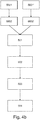
- Fig.4a represents the different steps of the digital signal processing.
- the first step 101 refers to a deskew and resampling step.
- the second step 102 refers to a chromatic dispersion step.
- the third step 103 refers to a timing recovery step wherein the modulation frequency is recovered.
- the fourth step 104 refers to a polarization demultipexing step.
- Such polarization demultiplexing is for example achieved by a constant modulus algorithm.
- the fifth step 105 refers to a frequency offset recovery configured for estimating the data signal frequency of the transmitted signal and for compensating the frequency detuning between the incoming signal frequency and the local oscillator frequency.
- the sixth step 106 refers to a carrier phase recovery wherein the phase noise is filtered in order to retrieve the carrier phase.
- the seventh step 107 refers to a demapping step wherein the constellation symbols are converted into data bits.
- the present invention deals more specifically with the fifth step 105 and the frequency offset recovery when the incoming signal is modulated in amplitude and phase, for example when quadrature phase shift keying (QPSK) or quadrature amplitude modulation (QAM) format are used for the transmission of the optical signals.
- QPSK quadrature phase shift keying
- QAM quadrature amplitude modulation
- the present invention is particularly interesting when constellation shaping is used.
- the present invention refers to the application of a predetermined correction factor on the constellation symbols corresponding to the M th power of the received modulation symbols, the predetermined correction factor being dependent of the amplitude and/or of the phase of the transmitted modulation symbols.
- the first sub-step 501 corresponds to the filtering of the modulation symbols of the incoming signals by amplitude.
- the amplitude corresponds to the distance of a symbol from the origin in the constellation diagram.
- the second sub-step 502 refers to the computation of a M th power of the signal leading to M th power resulting states.
- the number M is predetermined according to the modulation format in order to remove the modulation effects on the carrier signal. For example, in the case of a square-QAM modulation, such as a 16-QAM modulation, a fourth power can be used.
- the periodogram represents the M th power of each of the transmitted symbols.
- the third sub-step 503 corresponds to the application of a predetermined correction factor for the different M th power resulting states.
- the correction factor depends for example on the phase or on the amplitude or both the phase and the amplitude of the given M th power resulting state.
- the application of the correction factor provides a corrected state.
- the fourth sub-step 504 refers to the calculation of a predetermined estimator of the carrier frequency offset based on the corrected states.
- FFT Fast Fourier Transform
- the predetermined correction factor in the third sub-step 503 corresponds to a sign correction factor wherein a negative sign is applied to the incoming modulation symbols having a predetermined amplitude.
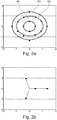
- the modulation symbols leading to a negative sign are the modulation symbols of the middle ring in the 16-QAM constellation represented in fig.2a .
- the different symbols can be gathered in three rings, an inner ring noted R1, a middle ring noted R2 and an outer ring noted R3, each ring corresponding to a common amplitude of the symbols corresponding to the distance between the symbols of a ring and the origin of the graph.
- a preliminary step 5001 of assigning a sign correction factor to each amplitude level is achieved.
- Such preliminary step is for example based on statistics made on a high number of transmitted symbols.
- the correction factor is then determined based on the assigned sign estimator in an another preliminary step 5002.
- the predetermined correction factor corresponds to a sign and variance correction factor.
- the variance function can be determined based on statistics made on many noisy symbols wherein the phase of the noisy symbols after application of a 4 th power operation is determined and wherein an estimator corresponding to the variance of the obtained phases according to the amplitude of the symbols can then be determined and used as a phase variance estimator which can be used for the transmitted symbols processing.
- Fig.5a represents such histogram.
- the vertical lines at amplitudes 0.45, 1 and 1.35 represent the theoretical amplitudes of the respectively inner ring R1, middle ring R2 and outer ring R3 of the constellation diagram of fig.2a .
- the middle ring R2 comprises 8 different symbols whereas the inner R1 and outer R3 rings comprise 4 different symbols which explains a higher peak associated to the amplitude of 1.
- Fig.5b represents the variance in the phase estimator as a function of the amplitude
- the horizontal line represents the variance in the case of a random phase.
- the variance appears to be a weighting factor so that the lower the variance, the higher the confidence to the associated symbols.
- Fig.5c represents the sign correction factor as a function of the amplitude.
- the sign factor is either equals to 1 or to -1.
- a preliminary step 5001' of assigning a sign correction factor and a variance correction factor to each amplitude level is achieved.
- Such preliminary step is for example based on statistics made on a high number of transmitted symbols.
- the correction factor is then determined based on the assigned phase correction factor and sign correction factor in an another preliminary step 5002'.
- Such estimators enable estimating the frequency offset taking into account the contribution of all the symbols. Furthermore, it can be seen that the higher the amplitude of the symbols, the lower the variance. Indeed, for a given gap between the real position of a symbol and its theoretical position in the periodogram, noise corruption over a symbol having a higher amplitude would lead to a smaller shift of the phase of the symbols and therefore to a better accuracy of the estimated frequency. A higher confidence is therefore given to the symbols of higher amplitude.
- the variance is also higher in the region where the sign estimator is switched from -1 to 1 (or from 1 to -1), where there is too much uncertainty of which ring the received signal belong.
- the above disclosed method is not limited to 16-QAM modulation symbols but may be applied to any modulation format comprising a phase and amplitude modulation.
- Fig.6a, 6b and 6c represent respectively the graphs of the number of symbols, the variance in the phase estimator and the sign estimator (corresponding to the graphs described in FIG. 5 a to 5c) in the case of a transmission based on a 64-QAM modulation format.
- the 64-QAM modulation format constellation comprises a higher number of rings (seven rings) but the same method can be applied to recover the frequency offset.
- processors may be provided through the use of dedicated hardware as well as hardware capable of executing software in association with appropriate software.
- the functions may be provided by a single dedicated processor, by a single shared processor, or by a plurality of individual processors, some of which may be shared.
- processor or “controller” should not be construed to refer exclusively to hardware capable of executing software, and may implicitly include, without limitation, digital signal processor (DSP) hardware, network processor, application specific integrated circuit (ASIC), field programmable gate array (FPGA), read only memory (ROM) for storing software, random access memory (RAM), and non volatile storage.
- DSP digital signal processor
- ASIC application specific integrated circuit
- FPGA field programmable gate array
- ROM read only memory
- RAM random access memory
- non volatile storage Other hardware, conventional and/or custom, may also be included.
- any switches shown in the FIGS. are conceptual only. Their function may be carried out through the operation of program logic, through dedicated logic, through the interaction of program control and dedicated logic, or even manually, the particular technique being selectable by the implementer as more specifically understood from the context.
Landscapes
- Physics & Mathematics (AREA)
- Electromagnetism (AREA)
- Engineering & Computer Science (AREA)
- Computer Networks & Wireless Communication (AREA)
- Signal Processing (AREA)
- Optical Communication System (AREA)
Priority Applications (1)
| Application Number | Priority Date | Filing Date | Title |
|---|---|---|---|
| EP17306092.2A EP3447939A1 (de) | 2017-08-24 | 2017-08-24 | Trägerfrequenzbestimmungsverfahren und zugehörige verarbeitungseinheit, detektionsverfahren und zugehöriger empfänger |
Applications Claiming Priority (1)
| Application Number | Priority Date | Filing Date | Title |
|---|---|---|---|
| EP17306092.2A EP3447939A1 (de) | 2017-08-24 | 2017-08-24 | Trägerfrequenzbestimmungsverfahren und zugehörige verarbeitungseinheit, detektionsverfahren und zugehöriger empfänger |
Publications (1)
| Publication Number | Publication Date |
|---|---|
| EP3447939A1 true EP3447939A1 (de) | 2019-02-27 |
Family
ID=59772564
Family Applications (1)
| Application Number | Title | Priority Date | Filing Date |
|---|---|---|---|
| EP17306092.2A Withdrawn EP3447939A1 (de) | 2017-08-24 | 2017-08-24 | Trägerfrequenzbestimmungsverfahren und zugehörige verarbeitungseinheit, detektionsverfahren und zugehöriger empfänger |
Country Status (1)
| Country | Link |
|---|---|
| EP (1) | EP3447939A1 (de) |
Citations (1)
| Publication number | Priority date | Publication date | Assignee | Title |
|---|---|---|---|---|
| US20150200731A1 (en) * | 2014-01-14 | 2015-07-16 | Cisco Technology, Inc. | Sub-Sampled Carrier Phase Recovery |
-
2017
- 2017-08-24 EP EP17306092.2A patent/EP3447939A1/de not_active Withdrawn
Patent Citations (1)
| Publication number | Priority date | Publication date | Assignee | Title |
|---|---|---|---|---|
| US20150200731A1 (en) * | 2014-01-14 | 2015-07-16 | Cisco Technology, Inc. | Sub-Sampled Carrier Phase Recovery |
Non-Patent Citations (3)
| Title |
|---|
| BILAL SYED MUHAMMAD ET AL: "Carrier Phase Estimation Through the Rotation Algorithm for 64-QAM Optical Systems", JOURNAL OF LIGHTWAVE TECHNOLOGY, IEEE SERVICE CENTER, NEW YORK, NY, US, vol. 33, no. 9, 1 May 2015 (2015-05-01), pages 1766 - 1773, XP011576045, ISSN: 0733-8724, [retrieved on 20150317], DOI: 10.1109/JLT.2015.2402441 * |
| TADAO NAKAGAWA ET AL: "Non-data-aided wide-range frequency offset estimator for QAM optical coherent receivers", 2011 OPTICAL FIBER COMMUNICATION CONFERENCE AND EXPOSITION AND THE NATIONAL FIBER OPTIC ENGINEERS CONFERENCE (OFC/NFOEC 2011) : LOS ANGELES, CALIFORNIA, USA, 6 - 10 MARCH 2011, IEEE, PISCATAWAY, NJ, USA, 6 March 2011 (2011-03-06), pages 1 - 3, XP031946233, ISBN: 978-1-4577-0213-6 * |
| YULIANG GAO ET AL: "Low-complexity two-stage carrier phase estimation for 16-QAM systems using QPSK partitioning and maximum likelihood detection", 2011 OPTICAL FIBER COMMUNICATION CONFERENCE AND EXPOSITION AND THE NATIONAL FIBER OPTIC ENGINEERS CONFERENCE (OFC/NFOEC 2011) : LOS ANGELES, CALIFORNIA, USA, 6 - 10 MARCH 2011, IEEE, PISCATAWAY, NJ, USA, 6 March 2011 (2011-03-06), pages 1 - 3, XP031946238, ISBN: 978-1-4577-0213-6 * |
Similar Documents
| Publication | Publication Date | Title |
|---|---|---|
| US12063138B2 (en) | Probabilistic shaping QAM dynamic equalization and digital signal processing method | |
| CN108512802B (zh) | 用于同相和正交相位失配补偿的电路、方法和接收装置 | |
| RU2511719C2 (ru) | Схема восстановления несущей и схема демодуляции на основе способа квазикогерентного детектирования | |
| US8781029B2 (en) | Frequency offset estimation apparatus, reception apparatus, frequency offset estimation method, and reception method | |
| US8660438B2 (en) | Digital coherent receiver and receiving method | |
| EP1777906A1 (de) | Einrichtung zum ausgleich von amplitudenfehlern sowie einrichtung zum ausgleich von orthogonalitätsfehlern | |
| US20150071395A1 (en) | Complexity reduced feed forward carrier recovery methods for m-qam modulation formats | |
| GB2313270A (en) | Digital Broadcasting Receiver | |
| JP2018042219A (ja) | 受信装置及び位相誤差補償方法 | |
| JPH09219693A (ja) | デジタル放送受信機 | |
| CN102027696A (zh) | 滤波器系数控制装置和方法 | |
| CN102725960A (zh) | 用于相位和振荡器频率估计的方法 | |
| CN103430003A (zh) | 用于估计接收到的光信号的色散的方法 | |
| CA3012977C (en) | Phase compensation device, phase compensation method and communication apparatus | |
| CN104486272A (zh) | 一种反馈信号的修正方法及装置 | |
| JP6024531B2 (ja) | 周波数誤差推定装置及び方法、周波数誤差補償装置、並びに、光受信機 | |
| CN102647381A (zh) | 一种mpsk相干光通信系统中频率偏移估计方法及装置 | |
| US20190123832A1 (en) | Phase recovery for signals with quadrature amplitude modulation | |
| US8155244B2 (en) | Demodulation using blind constellation identification for communication signals | |
| CN109246044B (zh) | 用于32进制正交振幅调制信号的频偏估计方法及系统 | |
| EP2337294B1 (de) | IQ-Ungleichgewichtseinschätzung für nicht symmetrische Pilotensymbole | |
| EP3447939A1 (de) | Trägerfrequenzbestimmungsverfahren und zugehörige verarbeitungseinheit, detektionsverfahren und zugehöriger empfänger | |
| JP3851143B2 (ja) | 変調方式識別回路、これを備えた受信装置、無線局、及び変調方式識別方法 | |
| JP3983688B2 (ja) | 変調型式識別回路および復調装置 | |
| WO2020174656A1 (ja) | 受信信号処理装置、受信信号処理方法及び光受信器 |
Legal Events
| Date | Code | Title | Description |
|---|---|---|---|
| PUAI | Public reference made under article 153(3) epc to a published international application that has entered the european phase |
Free format text: ORIGINAL CODE: 0009012 |
|
| AK | Designated contracting states |
Kind code of ref document: A1 Designated state(s): AL AT BE BG CH CY CZ DE DK EE ES FI FR GB GR HR HU IE IS IT LI LT LU LV MC MK MT NL NO PL PT RO RS SE SI SK SM TR |
|
| AX | Request for extension of the european patent |
Extension state: BA ME |
|
| RAP1 | Party data changed (applicant data changed or rights of an application transferred) |
Owner name: NOKIA SOLUTIONS AND NETWORKS OY |
|
| 17P | Request for examination filed |
Effective date: 20190827 |
|
| RBV | Designated contracting states (corrected) |
Designated state(s): AL AT BE BG CH CY CZ DE DK EE ES FI FR GB GR HR HU IE IS IT LI LT LU LV MC MK MT NL NO PL PT RO RS SE SI SK SM TR |
|
| GRAP | Despatch of communication of intention to grant a patent |
Free format text: ORIGINAL CODE: EPIDOSNIGR1 |
|
| INTG | Intention to grant announced |
Effective date: 20200128 |
|
| RIN1 | Information on inventor provided before grant (corrected) |
Inventor name: RIOS MULLER, RAFAEL Inventor name: RENAUDIER, JEREMIE |
|
| STAA | Information on the status of an ep patent application or granted ep patent |
Free format text: STATUS: THE APPLICATION IS DEEMED TO BE WITHDRAWN |
|
| 18D | Application deemed to be withdrawn |
Effective date: 20200609 |