EP3449877B1 - Implant à utiliser dans un système de remplacement total d'une cheville - Google Patents
Implant à utiliser dans un système de remplacement total d'une cheville Download PDFInfo
- Publication number
- EP3449877B1 EP3449877B1 EP18200312.9A EP18200312A EP3449877B1 EP 3449877 B1 EP3449877 B1 EP 3449877B1 EP 18200312 A EP18200312 A EP 18200312A EP 3449877 B1 EP3449877 B1 EP 3449877B1
- Authority
- EP
- European Patent Office
- Prior art keywords
- implant
- soft tissue
- anchor
- tissue
- bone
- Prior art date
- Legal status (The legal status is an assumption and is not a legal conclusion. Google has not performed a legal analysis and makes no representation as to the accuracy of the status listed.)
- Active
Links
- 239000007943 implant Substances 0.000 title claims description 118
- 210000003423 ankle Anatomy 0.000 title claims description 24
- 210000004872 soft tissue Anatomy 0.000 claims description 77
- 210000000988 bone and bone Anatomy 0.000 claims description 61
- 210000001519 tissue Anatomy 0.000 claims description 37
- 210000004233 talus Anatomy 0.000 claims description 16
- 210000002303 tibia Anatomy 0.000 claims description 10
- 210000000544 articulatio talocruralis Anatomy 0.000 description 9
- 230000014759 maintenance of location Effects 0.000 description 6
- 230000003278 mimic effect Effects 0.000 description 4
- 230000008878 coupling Effects 0.000 description 3
- 238000010168 coupling process Methods 0.000 description 3
- 238000005859 coupling reaction Methods 0.000 description 3
- 239000000463 material Substances 0.000 description 3
- 239000004705 High-molecular-weight polyethylene Substances 0.000 description 2
- -1 for example Substances 0.000 description 2
- 230000037431 insertion Effects 0.000 description 2
- 238000003780 insertion Methods 0.000 description 2
- 238000009434 installation Methods 0.000 description 2
- 239000002184 metal Substances 0.000 description 2
- 229910052751 metal Inorganic materials 0.000 description 2
- 210000002435 tendon Anatomy 0.000 description 2
- 208000010392 Bone Fractures Diseases 0.000 description 1
- 229910000684 Cobalt-chrome Inorganic materials 0.000 description 1
- 239000004698 Polyethylene Substances 0.000 description 1
- 229910001069 Ti alloy Inorganic materials 0.000 description 1
- RTAQQCXQSZGOHL-UHFFFAOYSA-N Titanium Chemical compound [Ti] RTAQQCXQSZGOHL-UHFFFAOYSA-N 0.000 description 1
- 238000005299 abrasion Methods 0.000 description 1
- 230000003110 anti-inflammatory effect Effects 0.000 description 1
- 206010003246 arthritis Diseases 0.000 description 1
- 208000037873 arthrodesis Diseases 0.000 description 1
- 238000011882 arthroplasty Methods 0.000 description 1
- 210000000459 calcaneus Anatomy 0.000 description 1
- 239000000919 ceramic Substances 0.000 description 1
- 210000002082 fibula Anatomy 0.000 description 1
- 239000011521 glass Substances 0.000 description 1
- 238000002513 implantation Methods 0.000 description 1
- 230000003993 interaction Effects 0.000 description 1
- 210000003141 lower extremity Anatomy 0.000 description 1
- 239000007769 metal material Substances 0.000 description 1
- 210000003205 muscle Anatomy 0.000 description 1
- 201000008482 osteoarthritis Diseases 0.000 description 1
- 229940124583 pain medication Drugs 0.000 description 1
- 238000000554 physical therapy Methods 0.000 description 1
- 239000004033 plastic Substances 0.000 description 1
- 229920003023 plastic Polymers 0.000 description 1
- 229920000573 polyethylene Polymers 0.000 description 1
- 230000000717 retained effect Effects 0.000 description 1
- 239000005060 rubber Substances 0.000 description 1
- 238000001356 surgical procedure Methods 0.000 description 1
- 229910000811 surgical stainless steel Inorganic materials 0.000 description 1
- 239000010936 titanium Substances 0.000 description 1
- 229910052719 titanium Inorganic materials 0.000 description 1
- 210000001364 upper extremity Anatomy 0.000 description 1
Images

Classifications
-
- A—HUMAN NECESSITIES
- A61—MEDICAL OR VETERINARY SCIENCE; HYGIENE
- A61F—FILTERS IMPLANTABLE INTO BLOOD VESSELS; PROSTHESES; DEVICES PROVIDING PATENCY TO, OR PREVENTING COLLAPSING OF, TUBULAR STRUCTURES OF THE BODY, e.g. STENTS; ORTHOPAEDIC, NURSING OR CONTRACEPTIVE DEVICES; FOMENTATION; TREATMENT OR PROTECTION OF EYES OR EARS; BANDAGES, DRESSINGS OR ABSORBENT PADS; FIRST-AID KITS
- A61F2/00—Filters implantable into blood vessels; Prostheses, i.e. artificial substitutes or replacements for parts of the body; Appliances for connecting them with the body; Devices providing patency to, or preventing collapsing of, tubular structures of the body, e.g. stents
- A61F2/02—Prostheses implantable into the body
- A61F2/30—Joints
- A61F2/42—Joints for wrists or ankles; for hands, e.g. fingers; for feet, e.g. toes
- A61F2/4202—Joints for wrists or ankles; for hands, e.g. fingers; for feet, e.g. toes for ankles
-
- A—HUMAN NECESSITIES
- A61—MEDICAL OR VETERINARY SCIENCE; HYGIENE
- A61F—FILTERS IMPLANTABLE INTO BLOOD VESSELS; PROSTHESES; DEVICES PROVIDING PATENCY TO, OR PREVENTING COLLAPSING OF, TUBULAR STRUCTURES OF THE BODY, e.g. STENTS; ORTHOPAEDIC, NURSING OR CONTRACEPTIVE DEVICES; FOMENTATION; TREATMENT OR PROTECTION OF EYES OR EARS; BANDAGES, DRESSINGS OR ABSORBENT PADS; FIRST-AID KITS
- A61F2/00—Filters implantable into blood vessels; Prostheses, i.e. artificial substitutes or replacements for parts of the body; Appliances for connecting them with the body; Devices providing patency to, or preventing collapsing of, tubular structures of the body, e.g. stents
- A61F2/02—Prostheses implantable into the body
- A61F2/30—Joints
- A61F2/30721—Accessories
- A61F2/30749—Fixation appliances for connecting prostheses to the body
-
- A—HUMAN NECESSITIES
- A61—MEDICAL OR VETERINARY SCIENCE; HYGIENE
- A61F—FILTERS IMPLANTABLE INTO BLOOD VESSELS; PROSTHESES; DEVICES PROVIDING PATENCY TO, OR PREVENTING COLLAPSING OF, TUBULAR STRUCTURES OF THE BODY, e.g. STENTS; ORTHOPAEDIC, NURSING OR CONTRACEPTIVE DEVICES; FOMENTATION; TREATMENT OR PROTECTION OF EYES OR EARS; BANDAGES, DRESSINGS OR ABSORBENT PADS; FIRST-AID KITS
- A61F2/00—Filters implantable into blood vessels; Prostheses, i.e. artificial substitutes or replacements for parts of the body; Appliances for connecting them with the body; Devices providing patency to, or preventing collapsing of, tubular structures of the body, e.g. stents
- A61F2/02—Prostheses implantable into the body
- A61F2/30—Joints
- A61F2002/30001—Additional features of subject-matter classified in A61F2/28, A61F2/30 and subgroups thereof
- A61F2002/30316—The prosthesis having different structural features at different locations within the same prosthesis; Connections between prosthetic parts; Special structural features of bone or joint prostheses not otherwise provided for
- A61F2002/30329—Connections or couplings between prosthetic parts, e.g. between modular parts; Connecting elements
- A61F2002/30433—Connections or couplings between prosthetic parts, e.g. between modular parts; Connecting elements using additional screws, bolts, dowels, rivets or washers e.g. connecting screws
-
- A—HUMAN NECESSITIES
- A61—MEDICAL OR VETERINARY SCIENCE; HYGIENE
- A61F—FILTERS IMPLANTABLE INTO BLOOD VESSELS; PROSTHESES; DEVICES PROVIDING PATENCY TO, OR PREVENTING COLLAPSING OF, TUBULAR STRUCTURES OF THE BODY, e.g. STENTS; ORTHOPAEDIC, NURSING OR CONTRACEPTIVE DEVICES; FOMENTATION; TREATMENT OR PROTECTION OF EYES OR EARS; BANDAGES, DRESSINGS OR ABSORBENT PADS; FIRST-AID KITS
- A61F2/00—Filters implantable into blood vessels; Prostheses, i.e. artificial substitutes or replacements for parts of the body; Appliances for connecting them with the body; Devices providing patency to, or preventing collapsing of, tubular structures of the body, e.g. stents
- A61F2/02—Prostheses implantable into the body
- A61F2/30—Joints
- A61F2002/30001—Additional features of subject-matter classified in A61F2/28, A61F2/30 and subgroups thereof
- A61F2002/30316—The prosthesis having different structural features at different locations within the same prosthesis; Connections between prosthetic parts; Special structural features of bone or joint prostheses not otherwise provided for
- A61F2002/30329—Connections or couplings between prosthetic parts, e.g. between modular parts; Connecting elements
- A61F2002/30461—Connections or couplings between prosthetic parts, e.g. between modular parts; Connecting elements sutured, ligatured or stitched
-
- A—HUMAN NECESSITIES
- A61—MEDICAL OR VETERINARY SCIENCE; HYGIENE
- A61F—FILTERS IMPLANTABLE INTO BLOOD VESSELS; PROSTHESES; DEVICES PROVIDING PATENCY TO, OR PREVENTING COLLAPSING OF, TUBULAR STRUCTURES OF THE BODY, e.g. STENTS; ORTHOPAEDIC, NURSING OR CONTRACEPTIVE DEVICES; FOMENTATION; TREATMENT OR PROTECTION OF EYES OR EARS; BANDAGES, DRESSINGS OR ABSORBENT PADS; FIRST-AID KITS
- A61F2/00—Filters implantable into blood vessels; Prostheses, i.e. artificial substitutes or replacements for parts of the body; Appliances for connecting them with the body; Devices providing patency to, or preventing collapsing of, tubular structures of the body, e.g. stents
- A61F2/02—Prostheses implantable into the body
- A61F2/30—Joints
- A61F2002/30001—Additional features of subject-matter classified in A61F2/28, A61F2/30 and subgroups thereof
- A61F2002/30316—The prosthesis having different structural features at different locations within the same prosthesis; Connections between prosthetic parts; Special structural features of bone or joint prostheses not otherwise provided for
- A61F2002/30329—Connections or couplings between prosthetic parts, e.g. between modular parts; Connecting elements
- A61F2002/30462—Connections or couplings between prosthetic parts, e.g. between modular parts; Connecting elements retained or tied with a rope, string, thread, wire or cable
-
- A—HUMAN NECESSITIES
- A61—MEDICAL OR VETERINARY SCIENCE; HYGIENE
- A61F—FILTERS IMPLANTABLE INTO BLOOD VESSELS; PROSTHESES; DEVICES PROVIDING PATENCY TO, OR PREVENTING COLLAPSING OF, TUBULAR STRUCTURES OF THE BODY, e.g. STENTS; ORTHOPAEDIC, NURSING OR CONTRACEPTIVE DEVICES; FOMENTATION; TREATMENT OR PROTECTION OF EYES OR EARS; BANDAGES, DRESSINGS OR ABSORBENT PADS; FIRST-AID KITS
- A61F2/00—Filters implantable into blood vessels; Prostheses, i.e. artificial substitutes or replacements for parts of the body; Appliances for connecting them with the body; Devices providing patency to, or preventing collapsing of, tubular structures of the body, e.g. stents
- A61F2/02—Prostheses implantable into the body
- A61F2/30—Joints
- A61F2002/30001—Additional features of subject-matter classified in A61F2/28, A61F2/30 and subgroups thereof
- A61F2002/30667—Features concerning an interaction with the environment or a particular use of the prosthesis
- A61F2002/30688—Means for allowing passage or sliding of tendons or ligaments
-
- A—HUMAN NECESSITIES
- A61—MEDICAL OR VETERINARY SCIENCE; HYGIENE
- A61F—FILTERS IMPLANTABLE INTO BLOOD VESSELS; PROSTHESES; DEVICES PROVIDING PATENCY TO, OR PREVENTING COLLAPSING OF, TUBULAR STRUCTURES OF THE BODY, e.g. STENTS; ORTHOPAEDIC, NURSING OR CONTRACEPTIVE DEVICES; FOMENTATION; TREATMENT OR PROTECTION OF EYES OR EARS; BANDAGES, DRESSINGS OR ABSORBENT PADS; FIRST-AID KITS
- A61F2/00—Filters implantable into blood vessels; Prostheses, i.e. artificial substitutes or replacements for parts of the body; Appliances for connecting them with the body; Devices providing patency to, or preventing collapsing of, tubular structures of the body, e.g. stents
- A61F2/02—Prostheses implantable into the body
- A61F2/30—Joints
- A61F2/42—Joints for wrists or ankles; for hands, e.g. fingers; for feet, e.g. toes
- A61F2/4202—Joints for wrists or ankles; for hands, e.g. fingers; for feet, e.g. toes for ankles
- A61F2002/4205—Tibial components
-
- A—HUMAN NECESSITIES
- A61—MEDICAL OR VETERINARY SCIENCE; HYGIENE
- A61F—FILTERS IMPLANTABLE INTO BLOOD VESSELS; PROSTHESES; DEVICES PROVIDING PATENCY TO, OR PREVENTING COLLAPSING OF, TUBULAR STRUCTURES OF THE BODY, e.g. STENTS; ORTHOPAEDIC, NURSING OR CONTRACEPTIVE DEVICES; FOMENTATION; TREATMENT OR PROTECTION OF EYES OR EARS; BANDAGES, DRESSINGS OR ABSORBENT PADS; FIRST-AID KITS
- A61F2/00—Filters implantable into blood vessels; Prostheses, i.e. artificial substitutes or replacements for parts of the body; Appliances for connecting them with the body; Devices providing patency to, or preventing collapsing of, tubular structures of the body, e.g. stents
- A61F2/02—Prostheses implantable into the body
- A61F2/30—Joints
- A61F2/42—Joints for wrists or ankles; for hands, e.g. fingers; for feet, e.g. toes
- A61F2/4202—Joints for wrists or ankles; for hands, e.g. fingers; for feet, e.g. toes for ankles
- A61F2002/4207—Talar components
Definitions
- the present invention relates to an implant for use in a total ankle replacement system, in particular a talar implant.
- the invention also relates to a total ankle replacement system.
- An ankle joint may become severely damaged and painful due to arthritis, prior ankle surgery, bone fracture, osteoarthritis, and/or one or more additional conditions.
- Options for treating the injured ankle have included anti-inflammatory and pain medications, braces, physical therapy, joint arthrodesis, and total ankle replacement.
- Total ankle replacement generally comprises two components - tibial implant and a talar implant.
- the implants comprise articulation surfaces sized and configured to mimic the range of motion of the ankle joint.
- the talar implant may comprise an implant sized and configured to mimic the talar dome and the tibial implant may comprise an articulation surface sized and configured to mimic articulation of the tibia.
- An articulating component may be located between the talar implant and the tibial implant.
- An example of such a talar implant is disclosed in US 2011/218648 .
- Soft tissue around the ankle can also be comprised.
- soft tissue may be partially or completely disconnected from a bone prior to and/or during a total ankle replacement.
- soft tissue When performing an ankle replacement, soft tissue must be anchored back to the bone. If bone is not available, the soft tissue cannot be properly anchored and will continue to deteriorate.
- US 2012/185057 discloses a malleolar implant having a body provided with an outer flange within which the posterior tibial tendon can sit.
- US 5 888 203 discloses a prosthesis for upper and lower extremity arthroplasty, having a body provided with two through channels in which ligamentous means are received.
- US 2011/202138 discloses an implant having a body provided with an outer groove or trough in which the muscles and tendons can extend.
- the present invention is an implant as defined in claim 1.
- an implant in various embodiments, includes a body including an articulation surface and an opposed bone contact surface.
- the implant defines a predetermined thickness between the articulation surface and the bone contact surface.
- the body defines at least one anchor hole sized and configured to receive an anchor therethrough.
- the anchor is configured to couple soft tissue to the body.
- the anchors are coupled to soft tissue and passed through the at least one anchor hole to anchor the soft tissue to the body of the implant.
- a total ankle replacement system in various embodiments, includes a tibial implant sized and configured to couple to a resected tibia and a talar implant sized and configured to couple to a resected talus.
- the talar implant includes a body having an articulation surface and an opposed bone contact surface. The body defines a predetermined thickness between the articulation surface and the bone contact surface. The body defines at least one anchor hole sized and configured to receive an anchor therethrough. The anchor is configured to couple soft tissue to the body.
- an implant in various embodiments, includes a body having an articulation surface and an opposed bone contact surface.
- the body defines a predetermined thickness between the articulation surface and the bone contact surface.
- the body defines at least one tissue groove formed thereon sized and configured to receive soft tissue.
- the tissue groove extends at least a predetermined depth from the articulation surface into the body.
- the present disclosure generally provides an implant for use with a total ankle replacement system.
- the implant comprises a body having one or more anchor holes formed therethrough.
- the anchor holes are configured to receive an anchor and/or soft tissue therein to couple the soft tissue to the implant.
- a groove is formed on the talar implant to receive soft tissue therein.
- the implant provides a secure anchor to allow soft tissue to be positioned at an anatomically correct and/or desirable position with respect to the implant and a bone.
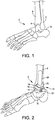
- FIG. 1 illustrates an anatomic view of an ankle joint 2.
- the ankle joint 2 comprises a talus 4 in contact with a tibia 6 and a fibula 8.
- a calcaneus 10 is located adjacent to the talus 4.
- the talus 4 and the tibia 6 may be resected, or cut, to allow insertion of a talar implant and a tibial implant.
- FIG. 2 illustrates the ankle joint 2 of FIG. 1 having a total ankle replacement system 12 inserted therein.
- the total ankle replacement system 12 comprises a talar implant 14 and a tibial implant 18.
- the talar implant 14 comprises a body 15 defining a talar articulation surface 16 (or talar dome).
- a stem 22 extends into the talus 4 to anchor the talar implant 14 to the talus 4.
- the tibial implant 18 is sized and configured for installation into the tibia 6.
- the tibial implant 18 comprises a body 19 having an articulation surface 20 and a tibial stem 24 extending into the tibia 6 to anchor the tibial implant 18.
- the talar joint surface 16 and the tibial joint surface 20 are mutually sized and configured to articulate.
- the joint surfaces 16, 20 replace the natural ankle joint surfaces, which are removed, to restore a range of motion that mimics the natural joint.
- One or more holes may be formed in the tibia and/or the talus prior to and during insertion of the tibial implant 18 or the talar implant 12.
- a hole is drilled starting in the bottom of the talus, extending through the talus and into the tibia.
- the hole may comprise, for example, a 6mm hole configured to receive the stem 24 of the tibial implant 18.
- the joint surfaces 16, 20 may be made of various materials, such as, for example, polyethylene, high molecular weight polyethylene (HMWPE), rubber, titanium, titanium alloys, chrome cobalt, surgical steel, and/or any other suitable metal, ceramic, sintered glass, artificial bone, and/or any combination thereof.
- the joint surfaces 16, 20 may comprise different materials.
- the tibial joint surface 20 may comprise a plastic or other non-metallic material and the talar joint surface 16 may comprise a metal surface.
- any suitable combination of materials may be used.
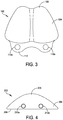
- FIG. 3 illustrates one example of a talar implant 102 having a plurality of anchor holes 110a, 110b formed therethrough.
- the talar implant 102 comprises a body 104 having an articulation surface 106 and an opposed bone contact surface (see FIG. 4 ).
- the body 104 has a predetermined thickness between the articulation surface 106 and the bone contact surface.
- the predetermined thickness can be configured based on the patient (e.g., patient-specific) and/or selected from a range of predetermined thicknesses.
- the articulation surface 106 is sized and configured to interface with an opposing joint surface of a total ankle replacement system.
- the articulation surface 106 is sized and configured to interface with a tibial joint surface, such as, for example, a tibial joint surface 20 as shown in FIG. 2 .
- the articulation surface 106 may be sized and configured to interface with an articulation implant located between a tibial portion of a total ankle replacement and the implant 106.
- the articulation surface 106 may comprise any suitable shape, such as, for example, a saddle shape (having two hemispheres) as illustrated in FIG. 3 or a dome shape.
- the bone contact surface comprises a surface configured to contact a resected bone section.
- the bone contact surface is configured to rest on and couple to a resected talus.
- the bone contact surface may comprise a planar surface, a concave surface, and/or any desirably shaped surface.
- the talar implant 102 comprises one or more anchor holes 110a, 110b formed therethrough.
- the anchor holes 110a, 110b may be formed through any suitable portion of the talar implant 102.
- the anchor holes 110a, 110b are formed through a neck flange 112 coupled to the body 104.
- the anchor holes 110a, 110b are formed through the body 104, for example, through a side of the body 104 and/or through the body 104 from the bone contact surface to the articulation surface 106.
- the anchor holes 110a, 110b are sized and configured to receive a soft tissue anchor therethrough.
- the anchor is coupled to soft tissue and couples the soft tissue to the implant 102.
- a suture (not shown) is passed through the anchor holes 110a, 110b and through soft tissue to attach the soft tissue to the talar implant 102.
- a needle may be coupled to the suture to pass the suture through soft tissue and to couple the soft tissue and the talar implant 102.
- Any suitable anchor such as, for example, sutures, staples, tissue tags, and/or any other suitable anchors may be used.
- the anchor holes are sized and configured to receive soft tissue therethrough.
- Soft tissue may be threaded through the anchor holes 110a, 110b to anchor the soft tissue to the implant 102.
- the soft tissue is retained in the anchor holes 110a, 110b by one or more retention devices, such as, for example, a suture, a tissue tag, a staple, and/or any other suitable retention device.
- soft tissue is passed through the anchor holes 110a, 110b and coupled to a bone to maintain the soft tissue in a fixed position.
- the anchor holes 110a, 110b are positioned to align the implant 102, the soft tissue, and a bone.
- the anchor holes 110a, 110b are configured to align soft tissue in an anatomically correct and/or desirable position when the soft tissue is coupled to the implant 102.
- the soft tissue may be anchored to and used to position the implant 102 prior to coupling the implant 102 to a bone.
- the implant 102 can comprise any number of anchor holes 110a, 110b, such as, for example, one anchor hole, two anchor holes, three anchor holes, and/or any other suitable number of anchor holes.
- a first subset of the anchor holes 110a, 110b may be used to anchor soft tissue to the implant 102 and a second subset of the anchor holes 110a, 110b may not be used.
- the anchor holes 110a, 110b are formed through an extension attached to the body 104 of the implant 102.
- the anchor holes 110a, 110b are formed through a neck flange 112 coupled to the body 104.
- the neck flange 112 is sized and configured to position attached soft tissue in an anatomically correct and/or desirable position with respect to the body 104.
- the soft tissue is positioned in a spaced arrangement with respect to the body 104 by the neck flange 112 to mimic the natural placement of the soft tissue and/or to prevent damage to the soft tissue caused by contact with the implant 102, the bone, and/or other structures.
- neck flange 12 extends from an anterior portion of the implant 102, it will be appreciated that one or more flanges 112 and/or other extensions may extend from any suitable portion of the body 104 (such as anterior, posterior, lateral, etc.) and may comprise any suitable number of anchor holes 110a, 110b formed therethrough.
- FIG. 4 illustrates one example of an implant 202 having a plurality of anchor holes 210a, 210b formed through a body 204 of the implant 202.
- the implant 202 is similar to the implant 102 discussed with respect to FIG. 1 , and similar description is not repeated herein.
- the implant 202 has a plurality of anchor holes 210a, 210b extending through the body 204 from an articulation surface 206 to a bone contact surface 208.
- the anchor holes 210a, 210b are sized and configured to receive one or more anchors therein.
- the anchors (not shown) are passed through soft tissue located near the implantation site of the implant 202 to couple the soft tissue to the body 204.
- the anchor holes 210a, 210b are sized and configured to receive soft tissue therethrough.
- the soft tissue may be anchored to the body 204 by a suitable retention device, such as, for example, one or more sutures, staples, tissue tags, and/or any other suitable retention device.
- one or more anchors and/or soft tissue may be coupled to the bone through the anchor holes 210a, 210b.
- anchor holes 210a, 210b are illustrated extending through a lower portion of the body 204, it will be appreciated that any number of anchor holes may be located through any portion of the body 204.
- the anchor holes 210a, 210b may be located in any suitable arrangement on the body 204.
- the anchor holes 210a, 210b are horizontally aligned along a bottom edge of the body 204.
- the anchor holes 210a, 210b may be horizontally aligned, vertically aligned, diagonally aligned, and/or randomly placed on the body 204.
- FIG. 5 illustrates one example of an implant 302 having one or more anchor holes 310a, 310b formed through a stem 314.
- the implant 302 is similar to the implants 104, 204 described with respect to FIGS. 3-4 , and similar description is not repeated herein.
- the implant 302 comprises a stem 314 extending from a bone contact surface 308 of the body 304.
- the stem 314 is sized and configured to be inserted into a hole formed in a bone, such as, for example, a hole formed in a resected talus during a total ankle replacement.
- the stem 314 comprises one or more anchor holes 310a, 310b.
- the anchor holes 310a, 310b are sized and configured to receive one or more sutures therethrough.
- the anchor holes 310a, 310b are sized and configured to receive soft tissue therethrough.
- the soft tissue is coupled to the body 304 by one or more retention devices, such as, for example, sutures, staples, tissue tags, and/or any other suitable retention device.
- soft tissue is coupled to the implant 302 by passing one or more anchors through the anchor holes 310a, 310b and the soft tissue.
- a stem 314 of the implant 302 is inserted into a hole formed in a resected talus and anchored to the bone by a bone screw inserted from a first side of the bone, through the fastener hole 316, and into a second side of the bone.
- the fastener hole 316 and the fastener 318 are configured to couple the implant 302 to a bone, such as, for example, a talus.
- the fastener hole 316 may be located through any portion of the implant 302, such as, for example, the stem 314 and/or the body 304.
- the fastener hole 316 may comprise internal threading for coupling to external threads of a fastener 318 inserted through the fastener hole 316.
- soft tissue is coupled to the stem 314 using the one or more anchor holes 310a, 310b prior to installation of the implant 302 in a bone.
- the soft tissue coupled to the stem 314 is drawn into the hole and coupled to the bone.
- one or more access holes are formed through the bone to allow soft tissue and/or anchors to be passed through holes 310a, 310b after the implant 302 is installed in the bone.
- FIG. 6 illustrates a cross-section of one embodiment of an implant 402 having a tissue groove 420 formed thereon.
- the implant 402 is similar to the implants 102, 202, 302 described in conjunction with FIGS. 3-5 , and similar description is not repeated herein.
- the implant 402 comprises a body 404 having a tissue groove 420 formed thereon.
- the tissue groove 420 is sized and configured to receive soft tissue therein.
- the tissue groove 420 is configured to position soft tissue in an anatomically correct and/or desirable position when the implant 402 is coupled to a bone.
- the tissue groove 420 is configured to position soft tissue in a position corresponding to a natural placement of the soft tissue in a joint, such as, for example, an ankle joint.
- the tissue groove 420 is configured to position the soft tissue such that the soft tissue is not damaged by contact with the implant 402 and/or a bone section.
- the tissue groove 420 is configured to protect soft tissue from damage.
- the tissue groove 420 extends from the articulation surface 406 a predetermined depth into the body 404 of the implant 402.
- the tissue groove 420 can comprise a depth such that soft tissue inserted into the tissue groove 420 to be located at or below the surface of the body 404.
- the tissue groove 420 protects soft tissue from damage due to rubbing, abrasions, and/or other interactions with a bone and/or an implant.
- a single tissue groove 420 is illustrated, it will be appreciated that multiple tissue grooves 420 may be formed on the body 404.
- the tissue groove 420 extends from the articulation surface 406 to the bone contact surface 408.
- soft tissue and/or anchors can be coupled to the bone through the tissue groove 420.
- the implant 402 includes a neck flange 412 coupled to the body 404.
- the neck flange 412 extends from an anterior portion of the body 404 and is configured to bear against a neck of a bone, such as, for example, a talus.
- the neck flange 418 includes one or more fastener holes 416a, 416b formed therethrough.
- one or more fasteners are inserted through the fastener holes 416a, 416b to anchor the implant 402 to a bone.
- a bone screw is inserted through each of the one or more fastener holes 416a, 416b to anchor the implant 402 to a bone.
- one or more anchor holes are formed through the body 404 and/or the neck flange 412.
- an implant in various embodiments, includes a body including an articulation surface and an opposed bone contact surface.
- the implant defines a predetermined thickness between the articulation surface and the bone contact surface.
- the body defines at least one anchor hole sized and configured to receive an anchor therethrough.
- the anchor is configured to couple soft tissue to the body.
- the anchors are coupled to soft tissue and passed through the at least one anchor hole to anchor the soft tissue to the body of the implant.
- the body defines one or more fastener holes therethrough sized and configured to receive a fastener.
- the at least one anchor hole can be sized and configured to receive soft tissue therethrough.
- the soft tissue is coupled to the anchor.
- the body comprises a stem extending from the bone contact surface of the body.
- the at least one anchor hole is formed through the stem.
- the body comprises a neck flange extending from an anterior portion of the body. The at least one anchor hole is formed through the neck flange.
- the body defines one or more tissue grooves formed thereon.
- the one or more tissue grooves can include a channel formed in the body, wherein the channel has a depth such that soft tissue placed in the channel is at or below an edge of the channel.
- the one or more tissue grooves can extend from an articulation surface to a bone contact surface.
- a total ankle replacement system in various embodiments, includes a tibial implant sized and configured to couple to a resected tibia and a talar implant sized and configured to couple to a resected talus.
- the talar implant includes a body having an articulation surface and an opposed bone contact surface. The body defines a predetermined thickness between the articulation surface and the bone contact surface. The body defines at least one anchor hole sized and configured to receive an anchor therethrough. The anchor is configured to couple soft tissue to the body.
- the body defines one or more fastener holes therethrough sized and configured to receive a fastener.
- the at least one anchor hole is sized and configured to receive soft tissue therethrough.
- the soft tissue can be coupled to the at least one suture.
- the body can include a stem extending from the bone contact surface. At least one of the anchor holes is formed through the stem.
- the body can include a neck flange extending from an anterior portion of the body. At least one of the anchor holes is formed through the neck flange.
- the body defines one or more tissue grooves formed thereon.
- the one or more tissue grooves can include a channel formed in the body having a depth such that soft tissue placed in the channel is at or below an edge of the channel.
- the one or more tissue grooves can extend from an articulation surface to a bone contact surface.
- an implant in various embodiments, includes a body having an articulation surface and an opposed bone contact surface.
- the body defines a predetermined thickness between the articulation surface and the bone contact surface.
- the body defines at least one tissue groove formed thereon sized and configured to receive soft tissue.
- the tissue groove extends at least a predetermined depth from the articulation surface into the body.
- the at least one groove can include a depth such that soft tissue placed in the groove is at or below an edge of the at least one groove.
- the body can further define at least one fastener hole formed therethrough.
- the body defines one or more anchor holes formed therethrough. The anchor holes are sized and configured to receive at least one suture therethrough.
Landscapes
- Health & Medical Sciences (AREA)
- Orthopedic Medicine & Surgery (AREA)
- Cardiology (AREA)
- Oral & Maxillofacial Surgery (AREA)
- Transplantation (AREA)
- Engineering & Computer Science (AREA)
- Biomedical Technology (AREA)
- Heart & Thoracic Surgery (AREA)
- Vascular Medicine (AREA)
- Life Sciences & Earth Sciences (AREA)
- Animal Behavior & Ethology (AREA)
- General Health & Medical Sciences (AREA)
- Public Health (AREA)
- Veterinary Medicine (AREA)
- Prostheses (AREA)
Claims (11)
- Implant destiné à être utilisé dans un système de remplacement total de cheville, l'implant (14 ; 102 ; 202 ; 302 ; 402) comprenant un corps (104 ; 204 ; 304 ; 404) comprenant une surface d'articulation (106 ; 206 ; 306 ; 406) et une surface de contact d'os opposée (208 ; 308 ; 408) et au moins une rainure de tissu (420) définie par le corps, la au moins une rainure de tissu étant dimensionnée et configurée pour recevoir du tissu mou à l'intérieur de cette dernière et positionner le tissu mou dans une position anatomiquement souhaitable lorsque l'implant est couplé à un os, caractérisé en ce que le corps (104 ; 204 ; 304 ; 404) définit en outre un ou plusieurs trous d'ancrage (110a, 110b ; 210a, 210b ; 310a, 310b) qui sont configurés pour recevoir le tissu mou à travers ces derniers.
- Implant selon la revendication 1, dans lequel la au moins une rainure de tissu (420) comprend un canal formé dans le corps (404), et dans lequel le canal a une profondeur de sorte que le tissu mou placé dans le canal est au niveau de ou au-dessous d'un bord du canal.
- Implant selon la revendication 1 ou la revendication 2, dans lequel la au moins une rainure de tissu (420) s'étend de la surface d'articulation (406) à la surface de contact d'os (408).
- Implant selon l'une quelconque des revendications précédentes, dans lequel la au moins une rainure de tissu (420) s'étend sur une profondeur prédéterminée à partir de la surface d'articulation (406) dans le corps (404).
- Implant selon l'une quelconque des revendications précédentes, dans lequel le corps (104 ; 404) comprend une bride de col (112 ; 412) s'étendant à partir de la surface de contact d'os (408) du corps.
- Implant selon la revendication 5, dans lequel la bride de col (412) définit un ou plusieurs trous de fixation (416a ; 416b), chacun des un ou plusieurs de trous de fixation étant dimensionné et configuré pour recevoir une fixation afin d'ancrer l'implant (402) dans un os.
- Implant selon la revendication 6, dans lequel la fixation est une vis à os.
- Implant selon l'une quelconque des revendications précédentes, dans lequel les un ou plusieurs trous d'ancrage (110a, 110b ; 210a, 210b ; 310a, 310b) sont configurés pour recevoir un ancrage afin de retenir le tissu mou.
- Implant selon la revendication 8, dans lequel l'ancrage comprend une suture, une agrafe et/ou un marqueur de tissu.
- Implant selon l'une quelconque des revendications précédentes, dans lequel la au moins une rainure de tissu (420) est configurée pour positionner le tissu mou dans une position correspondant à un emplacement naturel du tissu mou dans une articulation.
- Système de remplacement total de cheville comprenant :un implant tibial (18) dimensionné et configuré pour se coupler à un tibia réséqué (6) ; etun implant astragalien (14 ; 102 ; 202 ; 302 ; 402) dimensionné et configuré pour se coupler à un astragale réséqué (4), l'implant astragalien étant selon l'une quelconque des revendications 1 à 10.
Applications Claiming Priority (2)
| Application Number | Priority Date | Filing Date | Title |
|---|---|---|---|
| US14/835,184 US20170056188A1 (en) | 2015-08-25 | 2015-08-25 | Total ankle talar prosthesis with anchor holes and grooves |
| EP16161905.1A EP3135251B1 (fr) | 2015-08-25 | 2016-03-23 | Implant astragalien et système de remplacement total d'une cheville comprenant un tel implant astragalien |
Related Parent Applications (2)
| Application Number | Title | Priority Date | Filing Date |
|---|---|---|---|
| EP16161905.1A Division-Into EP3135251B1 (fr) | 2015-08-25 | 2016-03-23 | Implant astragalien et système de remplacement total d'une cheville comprenant un tel implant astragalien |
| EP16161905.1A Division EP3135251B1 (fr) | 2015-08-25 | 2016-03-23 | Implant astragalien et système de remplacement total d'une cheville comprenant un tel implant astragalien |
Publications (2)
| Publication Number | Publication Date |
|---|---|
| EP3449877A1 EP3449877A1 (fr) | 2019-03-06 |
| EP3449877B1 true EP3449877B1 (fr) | 2019-10-09 |
Family
ID=55588168
Family Applications (2)
| Application Number | Title | Priority Date | Filing Date |
|---|---|---|---|
| EP18200312.9A Active EP3449877B1 (fr) | 2015-08-25 | 2016-03-23 | Implant à utiliser dans un système de remplacement total d'une cheville |
| EP16161905.1A Not-in-force EP3135251B1 (fr) | 2015-08-25 | 2016-03-23 | Implant astragalien et système de remplacement total d'une cheville comprenant un tel implant astragalien |
Family Applications After (1)
| Application Number | Title | Priority Date | Filing Date |
|---|---|---|---|
| EP16161905.1A Not-in-force EP3135251B1 (fr) | 2015-08-25 | 2016-03-23 | Implant astragalien et système de remplacement total d'une cheville comprenant un tel implant astragalien |
Country Status (6)
| Country | Link |
|---|---|
| US (1) | US20170056188A1 (fr) |
| EP (2) | EP3449877B1 (fr) |
| JP (1) | JP2017042588A (fr) |
| CN (1) | CN106473842A (fr) |
| AU (1) | AU2016202925B2 (fr) |
| CA (2) | CA2924192C (fr) |
Families Citing this family (3)
| Publication number | Priority date | Publication date | Assignee | Title |
|---|---|---|---|---|
| CA3017712C (fr) * | 2016-03-28 | 2020-10-27 | Wright Medical Technology, Inc. | Plaque talar de resurfacage anterieur |
| AU2019302325B2 (en) | 2018-04-24 | 2024-05-02 | Paragon 28, Inc. | Implants and methods of use and assembly |
| TWI786139B (zh) | 2018-06-22 | 2022-12-11 | 財團法人工業技術研究院 | 人工關節 |
Family Cites Families (16)
| Publication number | Priority date | Publication date | Assignee | Title |
|---|---|---|---|---|
| FR2705559B1 (fr) * | 1993-05-28 | 1995-08-04 | Lafosse Laurent | Prothèse articulaire de doigt à bouclier. |
| US5702468A (en) * | 1995-03-09 | 1997-12-30 | Uresil Corporation | Carpal bone biaxially restrained prosthesis |
| US6673116B2 (en) * | 1999-10-22 | 2004-01-06 | Mark A. Reiley | Intramedullary guidance systems and methods for installing ankle replacement prostheses |
| US8052756B2 (en) * | 2002-10-24 | 2011-11-08 | Biomet Manufacturing Corp. | Method and apparatus for wrist arthroplasty |
| US7722676B2 (en) * | 2003-02-05 | 2010-05-25 | Wright Medical Technology, Inc. | Articulating implant system |
| JP4191194B2 (ja) * | 2003-08-27 | 2008-12-03 | ヴァルデマール・リンク・ゲゼルシャフト・ミット・ベシュレンクテル・ハフツング・ウント・コムパニー・コマンディットゲゼルシャフト | 足関節エンドプロテーゼ |
| AT502926B1 (de) * | 2004-11-08 | 2011-04-15 | Alphamed Medizintechnik Fischer Gmbh | Sprunggelenksprothesenelemente |
| US20060247788A1 (en) * | 2005-03-31 | 2006-11-02 | The Regents Of The University Of California | Total ankle arthroplasty |
| WO2007103826A2 (fr) * | 2006-03-02 | 2007-09-13 | Talus Medical, Inc. | Prothèse osseuse |
| US20090105840A1 (en) * | 2007-10-18 | 2009-04-23 | Inbone Technologies, Inc. | Fibular stiffener and bony defect replacer |
| CN116570353A (zh) * | 2009-08-27 | 2023-08-11 | 铸造有限责任公司 | 用于改变膝关节中髌骨与股骨之间的负载及治疗髋关节疾病的设备 |
| US8303667B2 (en) * | 2010-03-02 | 2012-11-06 | Alastair Younger | Fastening system for prostheses |
| WO2011149936A2 (fr) * | 2010-05-24 | 2011-12-01 | Skeletal Dynamics Llc | Dispositifs, outils et procédés de traitement d'une articulation multiaxiale |
| US8647391B2 (en) * | 2010-07-07 | 2014-02-11 | Global Orthopaedic Solutions Llc | Malleolar replacement devices |
| US20120010718A1 (en) * | 2010-07-08 | 2012-01-12 | Still Gregory P | Partial ankle joint replacement implant |
| GB2500918A (en) * | 2012-04-05 | 2013-10-09 | Biomet Uk Healthcare Ltd | A prosthetic ankle with sliding engaging components |
-
2015
- 2015-08-25 US US14/835,184 patent/US20170056188A1/en not_active Abandoned
-
2016
- 2016-03-18 CA CA2924192A patent/CA2924192C/fr active Active
- 2016-03-18 CA CA3024807A patent/CA3024807C/fr active Active
- 2016-03-23 EP EP18200312.9A patent/EP3449877B1/fr active Active
- 2016-03-23 JP JP2016058268A patent/JP2017042588A/ja active Pending
- 2016-03-23 EP EP16161905.1A patent/EP3135251B1/fr not_active Not-in-force
- 2016-03-23 CN CN201610170250.9A patent/CN106473842A/zh active Pending
- 2016-05-06 AU AU2016202925A patent/AU2016202925B2/en not_active Ceased
Non-Patent Citations (1)
| Title |
|---|
| None * |
Also Published As
| Publication number | Publication date |
|---|---|
| EP3135251A1 (fr) | 2017-03-01 |
| AU2016202925B2 (en) | 2017-10-05 |
| CA2924192C (fr) | 2018-12-18 |
| EP3135251B1 (fr) | 2018-11-28 |
| US20170056188A1 (en) | 2017-03-02 |
| AU2016202925A1 (en) | 2017-03-16 |
| CA3024807A1 (fr) | 2017-02-25 |
| CA2924192A1 (fr) | 2017-02-25 |
| EP3449877A1 (fr) | 2019-03-06 |
| CA3024807C (fr) | 2022-09-27 |
| JP2017042588A (ja) | 2017-03-02 |
| CN106473842A (zh) | 2017-03-08 |
Similar Documents
| Publication | Publication Date | Title |
|---|---|---|
| US11285020B2 (en) | Bone joint replacement and repair assembly and method of repairing and replacing a bone joint | |
| US10070967B2 (en) | Orthopaedic implant and method of installing same | |
| US10350079B2 (en) | Talus surface implant | |
| US9186256B2 (en) | Wrist implants and methods | |
| EP3244838B1 (fr) | Vis orientée pour fixation du dôme astragalien | |
| US9877839B2 (en) | Modular talar fixation method and system | |
| EP3649990B1 (fr) | Dôme astragalien intra-osseux comportant des pattes extensibles | |
| EP3449877B1 (fr) | Implant à utiliser dans un système de remplacement total d'une cheville | |
| US11504244B2 (en) | Anterior resurfacing talar plate | |
| US20140236302A1 (en) | Shoulder inter-spacer component and surgical method of implantation | |
| EP1839627B1 (fr) | Composant de genou prothétique | |
| BR102016006345A2 (pt) | Implants and total ankle replacement system |
Legal Events
| Date | Code | Title | Description |
|---|---|---|---|
| PUAI | Public reference made under article 153(3) epc to a published international application that has entered the european phase |
Free format text: ORIGINAL CODE: 0009012 |
|
| STAA | Information on the status of an ep patent application or granted ep patent |
Free format text: STATUS: THE APPLICATION HAS BEEN PUBLISHED |
|
| AC | Divisional application: reference to earlier application |
Ref document number: 3135251 Country of ref document: EP Kind code of ref document: P |
|
| AK | Designated contracting states |
Kind code of ref document: A1 Designated state(s): AL AT BE BG CH CY CZ DE DK EE ES FI FR GB GR HR HU IE IS IT LI LT LU LV MC MK MT NL NO PL PT RO RS SE SI SK SM TR |
|
| STAA | Information on the status of an ep patent application or granted ep patent |
Free format text: STATUS: REQUEST FOR EXAMINATION WAS MADE |
|
| 17P | Request for examination filed |
Effective date: 20190409 |
|
| RBV | Designated contracting states (corrected) |
Designated state(s): AL AT BE BG CH CY CZ DE DK EE ES FI FR GB GR HR HU IE IS IT LI LT LU LV MC MK MT NL NO PL PT RO RS SE SI SK SM TR |
|
| GRAP | Despatch of communication of intention to grant a patent |
Free format text: ORIGINAL CODE: EPIDOSNIGR1 |
|
| STAA | Information on the status of an ep patent application or granted ep patent |
Free format text: STATUS: GRANT OF PATENT IS INTENDED |
|
| RIC1 | Information provided on ipc code assigned before grant |
Ipc: A61F 2/42 20060101AFI20190503BHEP |
|
| INTG | Intention to grant announced |
Effective date: 20190604 |
|
| GRAS | Grant fee paid |
Free format text: ORIGINAL CODE: EPIDOSNIGR3 |
|
| GRAA | (expected) grant |
Free format text: ORIGINAL CODE: 0009210 |
|
| STAA | Information on the status of an ep patent application or granted ep patent |
Free format text: STATUS: THE PATENT HAS BEEN GRANTED |
|
| AC | Divisional application: reference to earlier application |
Ref document number: 3135251 Country of ref document: EP Kind code of ref document: P |
|
| AK | Designated contracting states |
Kind code of ref document: B1 Designated state(s): AL AT BE BG CH CY CZ DE DK EE ES FI FR GB GR HR HU IE IS IT LI LT LU LV MC MK MT NL NO PL PT RO RS SE SI SK SM TR |
|
| REG | Reference to a national code |
Ref country code: GB Ref legal event code: FG4D |
|
| REG | Reference to a national code |
Ref country code: CH Ref legal event code: EP |
|
| REG | Reference to a national code |
Ref country code: IE Ref legal event code: FG4D |
|
| REG | Reference to a national code |
Ref country code: DE Ref legal event code: R096 Ref document number: 602016022380 Country of ref document: DE |
|
| REG | Reference to a national code |
Ref country code: AT Ref legal event code: REF Ref document number: 1187927 Country of ref document: AT Kind code of ref document: T Effective date: 20191115 |
|
| REG | Reference to a national code |
Ref country code: NL Ref legal event code: MP Effective date: 20191009 |
|
| REG | Reference to a national code |
Ref country code: LT Ref legal event code: MG4D |
|
| REG | Reference to a national code |
Ref country code: AT Ref legal event code: MK05 Ref document number: 1187927 Country of ref document: AT Kind code of ref document: T Effective date: 20191009 |
|
| PG25 | Lapsed in a contracting state [announced via postgrant information from national office to epo] |
Ref country code: GR Free format text: LAPSE BECAUSE OF FAILURE TO SUBMIT A TRANSLATION OF THE DESCRIPTION OR TO PAY THE FEE WITHIN THE PRESCRIBED TIME-LIMIT Effective date: 20200110 Ref country code: FI Free format text: LAPSE BECAUSE OF FAILURE TO SUBMIT A TRANSLATION OF THE DESCRIPTION OR TO PAY THE FEE WITHIN THE PRESCRIBED TIME-LIMIT Effective date: 20191009 Ref country code: BG Free format text: LAPSE BECAUSE OF FAILURE TO SUBMIT A TRANSLATION OF THE DESCRIPTION OR TO PAY THE FEE WITHIN THE PRESCRIBED TIME-LIMIT Effective date: 20200109 Ref country code: LV Free format text: LAPSE BECAUSE OF FAILURE TO SUBMIT A TRANSLATION OF THE DESCRIPTION OR TO PAY THE FEE WITHIN THE PRESCRIBED TIME-LIMIT Effective date: 20191009 Ref country code: SE Free format text: LAPSE BECAUSE OF FAILURE TO SUBMIT A TRANSLATION OF THE DESCRIPTION OR TO PAY THE FEE WITHIN THE PRESCRIBED TIME-LIMIT Effective date: 20191009 Ref country code: AT Free format text: LAPSE BECAUSE OF FAILURE TO SUBMIT A TRANSLATION OF THE DESCRIPTION OR TO PAY THE FEE WITHIN THE PRESCRIBED TIME-LIMIT Effective date: 20191009 Ref country code: PL Free format text: LAPSE BECAUSE OF FAILURE TO SUBMIT A TRANSLATION OF THE DESCRIPTION OR TO PAY THE FEE WITHIN THE PRESCRIBED TIME-LIMIT Effective date: 20191009 Ref country code: NO Free format text: LAPSE BECAUSE OF FAILURE TO SUBMIT A TRANSLATION OF THE DESCRIPTION OR TO PAY THE FEE WITHIN THE PRESCRIBED TIME-LIMIT Effective date: 20200109 Ref country code: ES Free format text: LAPSE BECAUSE OF FAILURE TO SUBMIT A TRANSLATION OF THE DESCRIPTION OR TO PAY THE FEE WITHIN THE PRESCRIBED TIME-LIMIT Effective date: 20191009 Ref country code: LT Free format text: LAPSE BECAUSE OF FAILURE TO SUBMIT A TRANSLATION OF THE DESCRIPTION OR TO PAY THE FEE WITHIN THE PRESCRIBED TIME-LIMIT Effective date: 20191009 Ref country code: PT Free format text: LAPSE BECAUSE OF FAILURE TO SUBMIT A TRANSLATION OF THE DESCRIPTION OR TO PAY THE FEE WITHIN THE PRESCRIBED TIME-LIMIT Effective date: 20200210 Ref country code: NL Free format text: LAPSE BECAUSE OF FAILURE TO SUBMIT A TRANSLATION OF THE DESCRIPTION OR TO PAY THE FEE WITHIN THE PRESCRIBED TIME-LIMIT Effective date: 20191009 |
|
| PG25 | Lapsed in a contracting state [announced via postgrant information from national office to epo] |
Ref country code: HR Free format text: LAPSE BECAUSE OF FAILURE TO SUBMIT A TRANSLATION OF THE DESCRIPTION OR TO PAY THE FEE WITHIN THE PRESCRIBED TIME-LIMIT Effective date: 20191009 Ref country code: RS Free format text: LAPSE BECAUSE OF FAILURE TO SUBMIT A TRANSLATION OF THE DESCRIPTION OR TO PAY THE FEE WITHIN THE PRESCRIBED TIME-LIMIT Effective date: 20191009 Ref country code: IS Free format text: LAPSE BECAUSE OF FAILURE TO SUBMIT A TRANSLATION OF THE DESCRIPTION OR TO PAY THE FEE WITHIN THE PRESCRIBED TIME-LIMIT Effective date: 20200224 |
|
| PG25 | Lapsed in a contracting state [announced via postgrant information from national office to epo] |
Ref country code: AL Free format text: LAPSE BECAUSE OF FAILURE TO SUBMIT A TRANSLATION OF THE DESCRIPTION OR TO PAY THE FEE WITHIN THE PRESCRIBED TIME-LIMIT Effective date: 20191009 |
|
| REG | Reference to a national code |
Ref country code: DE Ref legal event code: R097 Ref document number: 602016022380 Country of ref document: DE |
|
| PG2D | Information on lapse in contracting state deleted |
Ref country code: IS |
|
| PG25 | Lapsed in a contracting state [announced via postgrant information from national office to epo] |
Ref country code: EE Free format text: LAPSE BECAUSE OF FAILURE TO SUBMIT A TRANSLATION OF THE DESCRIPTION OR TO PAY THE FEE WITHIN THE PRESCRIBED TIME-LIMIT Effective date: 20191009 Ref country code: DK Free format text: LAPSE BECAUSE OF FAILURE TO SUBMIT A TRANSLATION OF THE DESCRIPTION OR TO PAY THE FEE WITHIN THE PRESCRIBED TIME-LIMIT Effective date: 20191009 Ref country code: RO Free format text: LAPSE BECAUSE OF FAILURE TO SUBMIT A TRANSLATION OF THE DESCRIPTION OR TO PAY THE FEE WITHIN THE PRESCRIBED TIME-LIMIT Effective date: 20191009 Ref country code: CZ Free format text: LAPSE BECAUSE OF FAILURE TO SUBMIT A TRANSLATION OF THE DESCRIPTION OR TO PAY THE FEE WITHIN THE PRESCRIBED TIME-LIMIT Effective date: 20191009 Ref country code: IS Free format text: LAPSE BECAUSE OF FAILURE TO SUBMIT A TRANSLATION OF THE DESCRIPTION OR TO PAY THE FEE WITHIN THE PRESCRIBED TIME-LIMIT Effective date: 20200209 |
|
| PLBE | No opposition filed within time limit |
Free format text: ORIGINAL CODE: 0009261 |
|
| STAA | Information on the status of an ep patent application or granted ep patent |
Free format text: STATUS: NO OPPOSITION FILED WITHIN TIME LIMIT |
|
| PG25 | Lapsed in a contracting state [announced via postgrant information from national office to epo] |
Ref country code: SM Free format text: LAPSE BECAUSE OF FAILURE TO SUBMIT A TRANSLATION OF THE DESCRIPTION OR TO PAY THE FEE WITHIN THE PRESCRIBED TIME-LIMIT Effective date: 20191009 Ref country code: SK Free format text: LAPSE BECAUSE OF FAILURE TO SUBMIT A TRANSLATION OF THE DESCRIPTION OR TO PAY THE FEE WITHIN THE PRESCRIBED TIME-LIMIT Effective date: 20191009 |
|
| 26N | No opposition filed |
Effective date: 20200710 |
|
| PG25 | Lapsed in a contracting state [announced via postgrant information from national office to epo] |
Ref country code: MC Free format text: LAPSE BECAUSE OF FAILURE TO SUBMIT A TRANSLATION OF THE DESCRIPTION OR TO PAY THE FEE WITHIN THE PRESCRIBED TIME-LIMIT Effective date: 20191009 |
|
| REG | Reference to a national code |
Ref country code: CH Ref legal event code: PL |
|
| PG25 | Lapsed in a contracting state [announced via postgrant information from national office to epo] |
Ref country code: SI Free format text: LAPSE BECAUSE OF FAILURE TO SUBMIT A TRANSLATION OF THE DESCRIPTION OR TO PAY THE FEE WITHIN THE PRESCRIBED TIME-LIMIT Effective date: 20191009 |
|
| REG | Reference to a national code |
Ref country code: BE Ref legal event code: MM Effective date: 20200331 |
|
| PG25 | Lapsed in a contracting state [announced via postgrant information from national office to epo] |
Ref country code: LU Free format text: LAPSE BECAUSE OF NON-PAYMENT OF DUE FEES Effective date: 20200323 |
|
| PG25 | Lapsed in a contracting state [announced via postgrant information from national office to epo] |
Ref country code: IE Free format text: LAPSE BECAUSE OF NON-PAYMENT OF DUE FEES Effective date: 20200323 Ref country code: CH Free format text: LAPSE BECAUSE OF NON-PAYMENT OF DUE FEES Effective date: 20200331 Ref country code: LI Free format text: LAPSE BECAUSE OF NON-PAYMENT OF DUE FEES Effective date: 20200331 |
|
| PG25 | Lapsed in a contracting state [announced via postgrant information from national office to epo] |
Ref country code: BE Free format text: LAPSE BECAUSE OF NON-PAYMENT OF DUE FEES Effective date: 20200331 |
|
| PGFP | Annual fee paid to national office [announced via postgrant information from national office to epo] |
Ref country code: GB Payment date: 20220127 Year of fee payment: 7 Ref country code: DE Payment date: 20220126 Year of fee payment: 7 |
|
| PG25 | Lapsed in a contracting state [announced via postgrant information from national office to epo] |
Ref country code: TR Free format text: LAPSE BECAUSE OF FAILURE TO SUBMIT A TRANSLATION OF THE DESCRIPTION OR TO PAY THE FEE WITHIN THE PRESCRIBED TIME-LIMIT Effective date: 20191009 Ref country code: MT Free format text: LAPSE BECAUSE OF FAILURE TO SUBMIT A TRANSLATION OF THE DESCRIPTION OR TO PAY THE FEE WITHIN THE PRESCRIBED TIME-LIMIT Effective date: 20191009 Ref country code: CY Free format text: LAPSE BECAUSE OF FAILURE TO SUBMIT A TRANSLATION OF THE DESCRIPTION OR TO PAY THE FEE WITHIN THE PRESCRIBED TIME-LIMIT Effective date: 20191009 |
|
| PGFP | Annual fee paid to national office [announced via postgrant information from national office to epo] |
Ref country code: IT Payment date: 20220210 Year of fee payment: 7 Ref country code: FR Payment date: 20220209 Year of fee payment: 7 |
|
| PG25 | Lapsed in a contracting state [announced via postgrant information from national office to epo] |
Ref country code: MK Free format text: LAPSE BECAUSE OF FAILURE TO SUBMIT A TRANSLATION OF THE DESCRIPTION OR TO PAY THE FEE WITHIN THE PRESCRIBED TIME-LIMIT Effective date: 20191009 |
|
| P01 | Opt-out of the competence of the unified patent court (upc) registered |
Effective date: 20230515 |
|
| REG | Reference to a national code |
Ref country code: DE Ref legal event code: R119 Ref document number: 602016022380 Country of ref document: DE |
|
| GBPC | Gb: european patent ceased through non-payment of renewal fee |
Effective date: 20230323 |
|
| PG25 | Lapsed in a contracting state [announced via postgrant information from national office to epo] |
Ref country code: GB Free format text: LAPSE BECAUSE OF NON-PAYMENT OF DUE FEES Effective date: 20230323 |
|
| PG25 | Lapsed in a contracting state [announced via postgrant information from national office to epo] |
Ref country code: GB Free format text: LAPSE BECAUSE OF NON-PAYMENT OF DUE FEES Effective date: 20230323 Ref country code: FR Free format text: LAPSE BECAUSE OF NON-PAYMENT OF DUE FEES Effective date: 20230331 Ref country code: DE Free format text: LAPSE BECAUSE OF NON-PAYMENT OF DUE FEES Effective date: 20231003 |
|
| PG25 | Lapsed in a contracting state [announced via postgrant information from national office to epo] |
Ref country code: IT Free format text: LAPSE BECAUSE OF NON-PAYMENT OF DUE FEES Effective date: 20230323 |