EP3450371B1 - Système d'ascenseur avec robot mobile - Google Patents
Système d'ascenseur avec robot mobile Download PDFInfo
- Publication number
- EP3450371B1 EP3450371B1 EP17188490.1A EP17188490A EP3450371B1 EP 3450371 B1 EP3450371 B1 EP 3450371B1 EP 17188490 A EP17188490 A EP 17188490A EP 3450371 B1 EP3450371 B1 EP 3450371B1
- Authority
- EP
- European Patent Office
- Prior art keywords
- elevator
- mobile robot
- control signal
- data center
- user
- Prior art date
- Legal status (The legal status is an assumption and is not a legal conclusion. Google has not performed a legal analysis and makes no representation as to the accuracy of the status listed.)
- Active
Links
Images


Classifications
-
- B—PERFORMING OPERATIONS; TRANSPORTING
- B66—HOISTING; LIFTING; HAULING
- B66B—ELEVATORS; ESCALATORS OR MOVING WALKWAYS
- B66B1/00—Control systems of elevators in general
- B66B1/34—Details, e.g. call counting devices, data transmission from car to control system, devices giving information to the control system
- B66B1/3415—Control system configuration and the data transmission or communication within the control system
- B66B1/3446—Data transmission or communication within the control system
- B66B1/3461—Data transmission or communication within the control system between the elevator control system and remote or mobile stations
-
- B—PERFORMING OPERATIONS; TRANSPORTING
- B66—HOISTING; LIFTING; HAULING
- B66B—ELEVATORS; ESCALATORS OR MOVING WALKWAYS
- B66B1/00—Control systems of elevators in general
- B66B1/24—Control systems with regulation, i.e. with retroactive action, for influencing travelling speed, acceleration, or deceleration
- B66B1/2408—Control systems with regulation, i.e. with retroactive action, for influencing travelling speed, acceleration, or deceleration where the allocation of a call to an elevator car is of importance, i.e. by means of a supervisory or group controller
-
- B—PERFORMING OPERATIONS; TRANSPORTING
- B66—HOISTING; LIFTING; HAULING
- B66B—ELEVATORS; ESCALATORS OR MOVING WALKWAYS
- B66B1/00—Control systems of elevators in general
- B66B1/34—Details, e.g. call counting devices, data transmission from car to control system, devices giving information to the control system
- B66B1/46—Adaptations of switches or switchgear
- B66B1/468—Call registering systems
-
- G—PHYSICS
- G05—CONTROLLING; REGULATING
- G05D—SYSTEMS FOR CONTROLLING OR REGULATING NON-ELECTRIC VARIABLES
- G05D1/00—Control of position, course, altitude or attitude of land, water, air or space vehicles, e.g. using automatic pilots
- G05D1/02—Control of position or course in two dimensions
- G05D1/021—Control of position or course in two dimensions specially adapted to land vehicles
- G05D1/0276—Control of position or course in two dimensions specially adapted to land vehicles using signals provided by a source external to the vehicle
- G05D1/0285—Control of position or course in two dimensions specially adapted to land vehicles using signals provided by a source external to the vehicle using signals transmitted via a public communication network, e.g. GSM network
-
- G—PHYSICS
- G05—CONTROLLING; REGULATING
- G05D—SYSTEMS FOR CONTROLLING OR REGULATING NON-ELECTRIC VARIABLES
- G05D1/00—Control of position, course, altitude or attitude of land, water, air or space vehicles, e.g. using automatic pilots
- G05D1/40—Control within particular dimensions
- G05D1/43—Control of position or course in two dimensions [2D]
-
- B—PERFORMING OPERATIONS; TRANSPORTING
- B66—HOISTING; LIFTING; HAULING
- B66B—ELEVATORS; ESCALATORS OR MOVING WALKWAYS
- B66B2201/00—Aspects of control systems of elevators
- B66B2201/10—Details with respect to the type of call input
- B66B2201/101—Single call input
-
- B—PERFORMING OPERATIONS; TRANSPORTING
- B66—HOISTING; LIFTING; HAULING
- B66B—ELEVATORS; ESCALATORS OR MOVING WALKWAYS
- B66B2201/00—Aspects of control systems of elevators
- B66B2201/10—Details with respect to the type of call input
- B66B2201/104—Call input for a preferential elevator car or indicating a special request
-
- B—PERFORMING OPERATIONS; TRANSPORTING
- B66—HOISTING; LIFTING; HAULING
- B66B—ELEVATORS; ESCALATORS OR MOVING WALKWAYS
- B66B2201/00—Aspects of control systems of elevators
- B66B2201/40—Details of the change of control mode
- B66B2201/402—Details of the change of control mode by historical, statistical or predicted traffic data, e.g. by learning
-
- B—PERFORMING OPERATIONS; TRANSPORTING
- B66—HOISTING; LIFTING; HAULING
- B66B—ELEVATORS; ESCALATORS OR MOVING WALKWAYS
- B66B2201/00—Aspects of control systems of elevators
- B66B2201/40—Details of the change of control mode
- B66B2201/403—Details of the change of control mode by real-time traffic data
-
- B—PERFORMING OPERATIONS; TRANSPORTING
- B66—HOISTING; LIFTING; HAULING
- B66B—ELEVATORS; ESCALATORS OR MOVING WALKWAYS
- B66B2201/00—Aspects of control systems of elevators
- B66B2201/40—Details of the change of control mode
- B66B2201/46—Switches or switchgear
- B66B2201/4607—Call registering systems
- B66B2201/4638—Wherein the call is registered without making physical contact with the elevator system
-
- B—PERFORMING OPERATIONS; TRANSPORTING
- B66—HOISTING; LIFTING; HAULING
- B66B—ELEVATORS; ESCALATORS OR MOVING WALKWAYS
- B66B2201/00—Aspects of control systems of elevators
- B66B2201/40—Details of the change of control mode
- B66B2201/46—Switches or switchgear
- B66B2201/4607—Call registering systems
- B66B2201/4653—Call registering systems wherein the call is registered using portable devices
Definitions
- the invention concerns in general the technical field of elevators. More particularly, the invention concerns elevator system comprising one or more mobile robots.
- an elevator is called to a floor by using a user interface typically arranged in the doorway of the elevator.
- a user interface typically arranged in the doorway of the elevator.
- a button for calling the elevator on the floor when a user enters a building and walks to the elevator he presses a button for calling the elevator on the floor. It is straightforward to understand that almost always this kind of implementation for generating elevator calls causes a waiting of the elevator. Only if the elevator resides in the floor from which the elevator call is generated the waiting time for the user is minor - only the time it takes to open elevator doors.
- a slightly more sophisticated solutions are such that the elevator call giving devices are arranged distant from the elevator itself, e.g. on a doorway of a building for example. Now, the user may make the elevator call when entering the building, and this gives the elevator system some time to arrange the elevator on the floor when the user walks to the elevator. Still more sophisticated solutions are such that a mobile phone or similar is used for generating the elevator call to the elevator system. This enables the user to select optimal timing for him/her for calling the elevator.
- An objective of the invention is to present an elevator system, a mobile robot and a method for generating an elevator control signal. Another objective of the invention is that the elevator system, the mobile robot and the method for generating the elevator control signal make a use of elevator more comfortable.
- an elevator system comprising: an elevator controller, at least one mobile robot, and a data center; wherein the data center is configured to generate at least one control signal to the at least one mobile robot for instructing the at least one mobile robot to a predetermined position; and wherein the at least one mobile robot is configured to generate at least one control signal to the elevator controller for controlling an elevator in response to an interaction with at least one user in the predetermined position.
- the mobile robot may comprise a user interface for interacting with the at least one user.
- the data center may be configured to generate the control signal for instructing the at least one mobile robot to the predetermined position based on at least one of the following: real-time data obtained in a vicinity of the elevator, statistical data generated from data gathered in a vicinity of the elevator.
- the obtained real-time data represents user traffic within the vicinity of the elevator.
- the elevator system may further comprise a sensor system for obtaining the real-time data representing the user traffic.
- the data center may be configured to generate the statistical data from data gathered in the vicinity of the elevator.
- the statistical data may represent user traffic over a period of time in the vicinity of the elevator.
- the at least one control signal generated by the data center may be transmitted to the at least one mobile robot by one of the following: the data center, through the elevator controller.
- the data center may further be configured to initiate a timer, in response to a generation of the at least one control signal to the at least one mobile robot for instructing the at least one mobile robot to a predetermined position, for reserving the at least one mobile robot to serve for the duration of the timer.
- the data center may be configured to, in response to detection that no interaction is performed between the mobile robot and the user during the duration of the timer, generate a release signal to the mobile robot for releasing the mobile robot.
- the control signal generated by the at least one mobile robot to the elevator controller may be at least one of the following: an elevator call, an elevator door control signal, a control signal for setting the elevator to a predetermined operational state.
- a mobile robot for generating an elevator control signal according to claim 12 is provided.
- a method for generating an elevator control signal comprises: generating, by a data center, at least one control signal to at least one mobile robot for instructing the at least one mobile robot to a predetermined position; and generating, by the at least one mobile robot, at least one control signal to the elevator controller for controlling an elevator in response to an interaction with at least one user in the predetermined position.
- the generation of the at least one control signal by the data center may comprise: transmitting the control signal to the mobile robot in one of the following manner: directly from the data center, indirectly through an elevator controller.
- the method may further comprise: initiating a timer in the data center, in response to a generation of the at least one control signal to the at least one mobile robot for instructing the at least one mobile robot to a predetermined position, for reserving the at least one mobile robot to serve for the duration of the timer.
- the method may further comprise: generating by the data center, in response to detection that no interaction is performed between the mobile robot and the user during the duration of the timer, a release signal to the mobile robot for releasing the mobile robot.
- a number of refers herein to any positive integer starting from one, e.g. to one, two, or three.
- a plurality of refers herein to any positive integer starting from two, e.g. to two, three, or four.
- the present relates at least in part to an elevator system comprising devices and entities of an elevator residing in a location where an elevator is operated.
- the elevator system according to the present invention comprises a mobile robot configured to communicate with one or more other entities belonging to the elevator system.
- the elevator system may comprise a data center configured to communicate with one or more other entities belonging to the elevator system.
- FIG. 1 schematically illustrates at least some aspects of an embodiment of the invention wherein an elevator environment comprises one or more elevators residing in a location, such as in a building or in a ship.
- the elevator comprises an elevator controller 110, which is configured to control elevator entities 120 installed in the location.
- the entities 120 may comprise, but are not limited to, drive circuit and devices, safety circuit and devices, sensors, elevator call devices 122 and elevator door 124 circuits and devices, elevator cabin and similar.
- the entities are at least communicatively coupled to each other either directly or indirectly e.g. through the elevator controller 110, which operates as a master device for the elevator.
- the elevator may be communicatively coupled, e.g. from the elevator controller 110, to a data center 140.
- the data center 140 may refer to a stand-alone server or to a plurality of servers providing distributed computing resource in the elevator system.
- the data center 140 may perform monitoring function of the elevator system, but also to obtain information from other resources, such as from one or more sensors arranged in the location of the elevator or in any other location.
- the elevator controller 110 and the data center 140 may be communicatively coupled to each other e.g. over a communication network 130.
- the communication network may implement a wired or a wireless communication technology.
- the communication network 130 may e.g. be a mobile communication network.
- the elevator controller 110 comprises a communication interface, such a modem implementing the communication technology in use, towards the communication network 130.
- the data center is configured accordingly to communicate through the communication network 130.
- the elevator system further comprises at least one mobile robot 150.
- the term mobile robot 150 shall in this context be understood as a machine capable of carrying out actions automatically in response to an input provided to the robot.
- the robot comprises means for enabling it to be mobile within the area it operates, such as the location of the elevator.
- the means for enabling the mobility may refer to power generating means, such as an electric motor receiving its power from a battery located in the robot.
- the mobile robot 150 comprises means of transport, such as a drive shaft and a number of tyres, or similar, into which the power is brought from the electric motor.
- the means for enabling the mobility as described above is a non-limiting example and any means by means of which the robot may be mobile may be applied to.
- the mobile robot 150 may comprise computing resources for controlling an operation of the robot. At least part of the controlling may be received from an external control device, which in the context of the present invention may refer to the elevator controller 110 or the data center 140, or even a combination of these, or to some other entity, which is configured to generate and transmit control signals to the mobile robot 150.
- the mobile robot 150 may comprise a communication interface through which the mobile robot may be communicatively coupled to the data center 140 or to the elevator controller 110 or both.
- the mobile robot 150 may be configured to communicate with the data center 140 through the elevator controller 110.
- the communication between the mobile robot 140 and the mentioned entities i.e. the data center 140 and/or the elevator controller 110 may e.g. be arranged through the communication network 130.
- the mobile robot 150 may be configured to communicate with at least one of the mentioned entities locally e.g. over a short range wireless communication technology.
- the mobile robot 150 and the elevator controller 110 may be coupled to a local Wi-Fi network and the communication may be arranged over it.
- a dedicated communication channel may be arranged between the mobile robot 150 and the elevator controller 110.
- the mobile robot 150 may also be equipped with a number of sensors.
- the sensors may e.g. obtain information on the environment.
- An example of the sensors may e.g. be sensors obtaining position information broadcast e.g. from an applicable positioning system, such as from an indoor positioning system.
- the positioning of the mobile robot 150 may also be based on a transmitter arranged in the robot, which transmitter is configured to transmit a signal detected by one or more receivers arranged in the area and on the basis of the detected signal the position of the mobile robot 150 may be derived.
- the mobile robot 150 may comprise a user interface e.g. comprising I/O devices, such as buttons, keyboard, touch screen, microphone, loudspeaker, display and so on, for receiving input and outputting information.
- the I/O devices may also refer to sensors mentioned earlier.
- the input given to a robot may e.g. be an indication on a need to use the elevator, i.e. giving an elevator call through the mobile robot 150, which indication may be signaled from the robot 150 to the elevator controller 110.
- the input given to a robot may indicate another type of control request towards the elevator, such as requesting to control the door of the elevator (e.g. to open or to close).
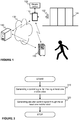
- FIG. 2 illustrating an example of an environment in which the invention may be applied to.
- the present invention is not only limited to a generation of the elevator call signal, but any other control signal for controlling the elevator may also be generated, such as a signal for controlling one or more elevator doors.
- the generated signal may carry information causing a plurality of operations in the elevator, such as generating an elevator call as well as a control signal for the elevator doors.
- the building comprises an elevator arranged to carry passengers from one floor to another.
- the elevator doors 124 are illustrated for indicating the location of the elevator in Figure 2 .
- the elevator is controlled by the elevator controller 110.
- the elevator controller is communicatively coupled to a data center 140.
- a sensor system in the building comprising a plurality of sensors 210A, 210B and a sensor controller 220, which may be configured to transmit obtained sensor information in a form of sensor data to the data center 140.
- the sensors 210A, 210B may e.g. be infrared sensors configured to detect motion originating e.g. from persons roaming in the building.
- the data center 140 receives sensor data either in a raw form or processed by the sensor controller 220 in a predetermined manner.
- the communication between the data center 140 and the sensor controller 220 may be arranged with any known wireless communication method.
- the data center 140 may be configured to generate a control signal for the mobile robot 150 at least in part on a basis of the data obtained from the sensor system.
- the sensor system may provide information on the persons roaming in the building and the data center 140 may process the data and based on that to generate a signal to the elevator controller 110.
- the generated signal may carry information to the mobile robot 140.
- the information may e.g.
- the data center 140 may be configured, e.g. through a programming, to process the information received from the sensor system so that an understanding on persons and possibly their motion and/or position in the building may be generated.
- the data center 140 may e.g. store information on a lay-out of the building.
- the data center may e.g. generate information on a position into which the mobile robot 150 shall be instructed in order to serve the at least one person.
- the generated information may express either directly or indirectly the position.
- the elevator controller 110 may generate the position for the mobile robot 150 on the basis of the information received from the data center 140.
- the elevator controller 110 generates a control signal to the mobile robot 150, which interprets the content of the control signal and may generate necessary control signals internally for generating the motion power in order to move the mobile robot 150 into the position as instructed.
- the mobile robot 150 may be moved to a position for serving the at least one person roaming in the building. For example, the mobile robot 150 may be moved towards the person.
- the mobile robot 150 may be configured to prompt the person to indicate a need for an elevator.
- the prompting may be arranged with a voice prompt or with a prompt displayed on the display of the user interface or any similar prompting mechanism.
- at least one of the persons may indicate e.g. through a predetermined action performed with the user interface of the mobile robot 150 that an elevator is needed.
- the mobile robot 150 generates, in response to a receipt of the indication, a signal to the elevator controller 110, which in turn may generate an elevator call.
- the embodiment described above is based on an idea that the mobile robot 150 receives its instructions, or control signal, from the elevator controller 110.
- the data center 140 may generate the instruction to the mobile robot 150 and transmit it directly to the mobile robot 150.
- the elevator controller 110 is not involved in the instructing the mobile robot 150 to the determined position for reaching the one or more persons.
- the mobile robot 150 receives the indication on the need of an elevator, it may be arranged that the mobile robot 150 generates the signal to the data center 140 for providing information on the indication of the need for the elevator.
- the data center 140 may be configured to transmit the information to the elevator controller 110 for generating the elevator call, or any other type of control signal, as explained.
- the mobile robot 150 may be directly communicatively coupled to the elevator controller 110 and, hence, the mobile robot 150 may generate the signal, in response to receipt of such input from the at least one person, for indicating the need for the elevator directly to the elevator controller 110.
- control signal generated for the mobile robot 150 is based on a measurement data representing real-time information on occurrences with the location, such as in a building, of the robot.
- the real-time information may be obtained with a sensor system, as described.
- the data center may be provided with statistical information on user traffic in the location.
- the statistical information may be generated on a basis of data gathered within the location during a period of time. For example, the data may be gathered with any sensor system, or even manually, i.e. by any manner as long as statistical information may be generated.
- the statistical information is generated in a time based manner. In other words, the statistical information represents user traffic in a time based manner.
- This kind of data advantageously provides information where are the user traffic flows at a certain time, or period of time, within the location in question.
- the data center 140 may generate control signal either directly to the mobile robot 150 or indirectly e.g. through the elevator controller 110 to the mobile robot 150 for instructing the mobile robot 150, or a plurality of mobile robots 150, to move to predetermined position in the location for serving the users as described.
- Some aspects of the invention may relate to an even more sophisticated embodiment in which the data center 140 may be configured to determine, based on at least one predetermined criterion, at least one time frame during which the mobile robot 150 in question is reserved to serve a certain user.
- the mobile robot 150 may be instructed to some location through the mechanism as described above it may happen that the user who triggered the moving of the mobile robot 150 may not need the elevator at all and, hence, does not interact with the mobile robot 150 at all.
- the mobile robot 150 is provided, e.g. in the instruction message to move, also the time frame information indicating a period of time it is reserved for serving the user in question.
- the mobile robot may release itself from serving the user. This may e.g. cause the mobile robot 150 to return to a predetermined location, such as waiting area, and waiting for a next instruction message.
- the data center 140, or even the elevator controller 110 may be configured to, e.g. in response of transmitting the instruction message towards the mobile robot 150 either directly or indirectly, initiate a timer for indicating the time frame the mobile robot 150 is reserved for performing the task in question, i.e. serving the user.
- the time parameter for the timer may be determined based on the task the mobile robot 150 is instructed to perform, e.g. based on known durations to perform the task in question, or there may be a default value for all tasks.
- the data center 140, or the elevator controller 110 may be configured to generate a release signal to the mobile robot 150 for indicating that it is released from the task previously instructed.
- the elevator system may operate more efficiently and the number of mobile robots 150 needed to operate in a certain area may be optimized.
- the mobile robot 150 may be configured to guide the user to an elevator, or even to a final destination, in response to an interaction with the user.
- the user indicates to the mobile robot 150 a person or a location, such as an office or similar, who he intends to meet or where the user is going to.
- the mobile robot 150 may determine either internally, or externally by communicating e.g. with the data center, instructions to reach the destination and as an outcome of the determination the mobile robot 150 may generate an elevator call signal, which may e.g. indicate the elevator the user needs for reaching the destination as well as an indication that the mobile robot 150 intends to access the elevator car with the user.
- the provision of these pieces of information may cause adjustment of the operation of the elevator system.
- the elevator doors may be maintained open longer than in at least one other situation, because an entering of the mobile robot may require a longer loading time than in some other situation.
- the indication may cause the elevator system adjust its operation further.
- FIG. 3 schematically illustrates a principle of the method according to an embodiment.
- the system may be configured to generate a control signal for moving at least one mobile robot 150 to a predetermined position.
- the generation of the control signal may refer to, but is not limited to, a data center generates the control signal, or indication of it, and transmits it either directly to the at least one mobile robot 150 or indirectly to the at least one mobile robot 150 through an elevator controller 110.
- the generation of the control signal may be initiated in response to a predetermined triggering event.
- the triggering event may be pre-defined e.g. through statistical analysis on e.g. user traffic within the location or any real-time monitoring arrangement, such as sensor system generating data representing user traffic in the location.
- the control signal causes the at least one mobile robot 150 to move to a predetermined position in the location.
- one or more users may indicate with the mobile robot 150 that they are willing to use an elevator.
- the indication may e.g. be performed through a user interface of the at least one mobile robot 150.
- the at least mobile robot 150 may be configured to receive the indication by any other manner, e.g. by identifying the user in question, and through the identification to obtain data e.g. by communicating with the data center 140 on the assumable destination of the user.
- the mobile robot 150 may be configured to generate an elevator call without any specific user action.
- the elevator controller 110 may generate necessary control signals for reserving an elevator for the user in question.
- the elevator call may be transmitted from the mobile robot 150 directly to the elevator controller 110, or indirectly to the elevator controller 110 through the data center 140.
- the method as schematically illustrated in Figure 3 is a non-limiting example and the method may comprise further steps as described in the context of the description of Figure 2 , for example.
- FIG. 4 schematically illustrates an example of a mobile robot 150 belonging to an elevator system.
- the mobile robot 150 may comprise at least the following entities: processing unit 410, memory unit 420, communication unit 430, user interface (Ul) unit 440, sensor unit 450 and motor unit 460.
- the mentioned entities may comprise one or more operating units, e.g. one or more microprocessors or similar, one or more memories, one or more communication devices, such as modems, one or more user interface devices, one or more sensors and one or more motors.
- the mobile robot 150 may comprise further devices and entities, such as batteries for storing energy to be used by the other entities.
- the entities belonging to the mobile robot 150 may be communicatively coupled to each other with e.g. a communication bus.
- the processing unit 410 may be configured to control the operation of the mobile robot 150 as well as communication with any external entity, such as with a data center 140, an elevator controller 110, other mobile robots, or other entities. The communication may be performed e.g. in a wireless manner.
- the users of the elevator system may provide input through the user interface unit 440 with the mobile robot 150 and the mobile robot may, under control of the processing unit 410, output information, such as prompting, to the user.
- the sensors may comprise any sensors by means of which the mobile robot 150 may obtain information on an environment, but also the sensor unit 450 may comprise sensors enabling positioning and/or navigation within the location.
- the processing unit 410 may also be configured to generate control signals to the motor unit 460 in order to make the mobile robot 150 to move.
- the mobile robot 150 may comprise means enabling the robot to be mobile, such as the transport means as described earlier.
- the operation of the processing unit 410 may be achieved by executing portions of computer program code stored e.g. in the memory unit 420 for generating the control signals and, thus, causing the mobile robot 150 to operate in the manner as described.
- the memory unit 420 may also be used for storing obtained and received information together with any other data either permanently or temporarily.
- the mobile robot 150 may be configured so that the user interface is disabled in response to a receipt of an input from a user in order to enable the robot to perform the task requested by the user. In this manner no other user may input other request when the first request is served by the mobile robot 150 in question.
- FIG. 5 schematically illustrates an example of a data center 140 in which the data center 140 is implemented with a stand-alone server device.
- the data center 140 in this kind of implementation may comprise a processing unit 510 comprising one or more processors, a memory unit 520 comprising one or more memories and a communication unit 530 comprising one or more communication devices, such as modems.
- the memory unit 520 may store portions of computer program code and any other data
- the processing unit 510 may cause the data center 140 to operate as described by executing at least some portions of the computer program code stored in the memory unit 520.
- the data center 140 may be configured to communicate with any sensor system, mobile robot 150, elevator controller 110, or some combination of these, for example.
- the data center 140 may comprise a timer implementation by means of which it may be configured to monitor duration of time.
- FIG. 6 schematically illustrates an example of an elevator controller 110 which is configured to communicate with at least one of the following: a data center 140, mobile robot 150.
- the elevator controller 110 may comprise a processing unit 610 comprising one or more processors, a memory unit 620 comprising one or more memories and a communication unit 630 comprising one or more communication devices, such as modems or other devices.
- the memory unit 620 may store portions of computer program code and any other data
- the processing unit 610 may cause the elevator controller 110 to operate as described by executing at least some portions of the computer program code stored in the memory unit 620.
- the generated control signal by the mobile robot is an elevator call signal.
- the generated control signal may be any other type, such as causing a control to elevator doors, or any other elevator related function. Some further non-limiting examples of the type of the generated control signal may be canceling the elevator call generated earlier or changing the elevator call.
- the control signal may instruct the elevator to change its operational state, such as instructing the elevator to set to energy saving mode or instructing the elevator to enter or exit maintenance area.
- the type of the generated control signal may also relate to an external phenomenon, such as fire, earthquake or vandalism, i.e. disabling use of the elevator.
- the mobile robot provides an interface for a user, such as a passenger, to control an elevator in one way or another.
- the invention is especially applicable to be used for causing an elevator call.
Landscapes
- Engineering & Computer Science (AREA)
- Automation & Control Theory (AREA)
- Computer Networks & Wireless Communication (AREA)
- Aviation & Aerospace Engineering (AREA)
- Radar, Positioning & Navigation (AREA)
- Remote Sensing (AREA)
- Physics & Mathematics (AREA)
- General Physics & Mathematics (AREA)
- Elevator Control (AREA)
Claims (16)
- Système d'ascenseur comprenant :un contrôleur d'ascenseur (110),au moins un robot mobile (150), le ou les robots mobiles (150) étant configurés pour générer au moins un signal de commande vers le contrôleur d'ascenseur (110) afin de piloter un ascenseur en réponse à une interaction avec au moins un utilisateur dans une position prédéterminée,caractérisé en ce que le système d'ascenseur comprend en outre :un centre de données (140),le centre de données (140) étant configuré pour générer au moins un signal de commande vers le ou les robots mobiles (150) afin d'enseigner à ce ou à ces robots mobiles (150) la position prédéterminée.
- Système d'ascenseur selon la revendication 1, le robot mobile (150) comprenant une interface utilisateur destinée à une interaction avec le ou les utilisateurs.
- Système d'ascenseur selon l'une quelconque des revendications précédentes, dans lequel le centre de données (140) est configuré pour générer un signal de commande afin d'enseigner à ce ou à ces robots mobiles (150) la position prédéterminée sur la base d'au moins l'un des éléments suivants : des données en temps réel obtenu au voisinage de l'ascenseur, des données statistiques générées à partir des données rassemblées au voisinage de l'ascenseur.
- Système d'ascenseur selon la revendication 3, dans lequel les données en temps réel obtenues représentent le trafic utilisateur au voisinage de l'ascenseur.
- Système d'ascenseur selon la revendication 4, le système d'ascenseur comprenant en outre un système de capteurs permettant d'obtenir les données en temps réel représentant le trafic utilisateur.
- Système d'ascenseur selon la revendication 3, dans lequel le centre de données (140) est configuré pour générer des données statistiques à partir de données rassemblées au voisinage de l'ascenseur.
- Système d'ascenseur selon la revendication 6, dans lequel les données statistiques représentent le trafic utilisateur sur un certain intervalle de temps au voisinage de l'ascenseur.
- Système d'ascenseur selon l'une quelconque des revendications précédentes, dans lequel le ou les signaux de commande générés par le centre de données (140) sont transmis à ce que ces robots mobiles (150) par l'un des composants suivants : le centre de données (140), au travers du contrôleur d'ascenseur (110).
- Système d'ascenseur selon l'une quelconque des revendications précédentes, le centre de données (140) étant en outre configuré pour lancer une horloge, en réponse à la génération du ou des signaux de commande vers le ou les robots mobiles (150) afin d'enseigner à ce ou à ces robots mobiles (150) une position prédéterminée, dans le but de réserver le ou les robots mobiles (150) à servir pendant la durée de l'horloge
- Système d'ascenseur selon la revendication 9, dans lequel le centre de données (140) est configuré, en réponse à la détection du fait qu'aucune interaction n'est réalisée entre le robot mobile (150) et l'utilisateur pendant la durée de l'horloge, pour générer un signal de libération vers le robot mobile (150) afin de libérer le robot mobile (150).
- Système d'ascenseur selon l'une quelconque des revendications précédentes, dans lequel le signal de commande généré par le ou les robots mobiles (150) vers le contrôleur d'ascenseur (110) est au moins l'un des suivants : un appel de l'ascenseur, un signal de commande de porte d'ascenseur, un signal de commande permettant de positionner l'ascenseur à un état fonctionnel prédéterminé.
- Robot mobile (150) destiné à générer un signal de commande d'ascenseur, le robot mobile comprenant :au moins un processeur (410),au moins une mémoire (420) incluant un code de programmation informatique,dans lequel la ou les mémoires (420) et le code de programmation informatique sont configurés, avec le ou les processeurs (410), pour amener le robot mobile (150) à effectuer :
la génération d'au moins un signal de commande vers le contrôleur d'ascenseur (110) afin de commander un ascenseur en réponse à une interaction avec au moins un utilisateur dans une position prédéterminée, caractérisé en ce que le robot mobile (150) est en outre amené à effectuer :
la réception d'au moins un signal de commande, par l'intermédiaire d'une interface de communication avec un centre de données (140), destiné à ordonner au robot mobile (150) de se déplacer vers la position prédéterminée. - Procédé permettant de générer un signal de commande d'ascenseur, caractérisé en ce que le procédé comprend :la génération (310), par un centre de données (140), d'au moins un signal de commande vers au moins un robot mobile (150) afin d'enseigner à ce ou à ces robots mobiles (150) une position prédéterminée, etla génération (320), par le ou les robots mobiles (150), d'au moins un signal de commande vers le contrôleur d'ascenseur (110) afin de commander un ascenseur en réponse à une interaction avec au moins un utilisateur dans la position prédéterminée.
- Procédé selon la revendication 13, dans lequel la génération du ou des signaux de commande par le centre de données comprend :
la transmission du signal de commande vers le robot mobile (150) selon l'une des manières suivantes : directement à partir du centre de données (140), indirectement par l'intermédiaire d'un contrôleur d'ascenseur (110). - Procédé selon l'une quelconque des revendications 13 et 14, le procédé comprenant en outre :
Le lancement d'une horloge dans le centre de données, en réponse à la génération du ou des signaux de commande vers le ou les robots mobiles (150) afin d'enseigner à ce ou à ces robots mobiles (150) une position prédéterminée, dans le but de réserver le ou les robots mobiles (150) à servir pendant la durée de l'horloge. - Procédé selon la revendication 15, le procédé comprenant en outre :
la génération d'un signal de libération vers le robot mobile (150), par le centre de données (140), en réponse à la détection du fait qu'aucune interaction n'est réalisée entre le robot mobile (150) et l'utilisateur pendant la durée de l'horloge, afin de libérer le robot mobile (150).
Priority Applications (5)
| Application Number | Priority Date | Filing Date | Title |
|---|---|---|---|
| EP17188490.1A EP3450371B1 (fr) | 2017-08-30 | 2017-08-30 | Système d'ascenseur avec robot mobile |
| PCT/EP2018/072096 WO2019042771A1 (fr) | 2017-08-30 | 2018-08-15 | Système d'ascenseur comprenant un robot mobile |
| CN202610041360.9A CN121872196A (zh) | 2017-08-30 | 2018-08-15 | 具有移动式机器人的电梯系统 |
| CN201880055871.XA CN111032552A (zh) | 2017-08-30 | 2018-08-15 | 具有移动式机器人的电梯系统 |
| US16/790,200 US12441582B2 (en) | 2017-08-30 | 2020-02-13 | Elevator system, mobile robot, and method for generating elevator control signal using the mobile robot |
Applications Claiming Priority (1)
| Application Number | Priority Date | Filing Date | Title |
|---|---|---|---|
| EP17188490.1A EP3450371B1 (fr) | 2017-08-30 | 2017-08-30 | Système d'ascenseur avec robot mobile |
Publications (2)
| Publication Number | Publication Date |
|---|---|
| EP3450371A1 EP3450371A1 (fr) | 2019-03-06 |
| EP3450371B1 true EP3450371B1 (fr) | 2021-04-14 |
Family
ID=59829158
Family Applications (1)
| Application Number | Title | Priority Date | Filing Date |
|---|---|---|---|
| EP17188490.1A Active EP3450371B1 (fr) | 2017-08-30 | 2017-08-30 | Système d'ascenseur avec robot mobile |
Country Status (4)
| Country | Link |
|---|---|
| US (1) | US12441582B2 (fr) |
| EP (1) | EP3450371B1 (fr) |
| CN (2) | CN121872196A (fr) |
| WO (1) | WO2019042771A1 (fr) |
Families Citing this family (17)
| Publication number | Priority date | Publication date | Assignee | Title |
|---|---|---|---|---|
| EP3604193B1 (fr) * | 2018-08-03 | 2024-03-13 | KONE Corporation | Génération d'un signal de commande vers un transporteur |
| US11368497B1 (en) * | 2018-09-18 | 2022-06-21 | Amazon Technolgies, Inc. | System for autonomous mobile device assisted communication |
| KR102933912B1 (ko) * | 2019-11-22 | 2026-03-04 | 엘지전자 주식회사 | 로봇 및 그의 제어 방법 |
| US20210284504A1 (en) * | 2020-03-16 | 2021-09-16 | Otis Elevator Company | Specialized, personalized & enhanced elevator calling for robots & co-bots |
| CN113401746B (zh) * | 2020-03-16 | 2024-09-20 | 奥的斯电梯公司 | 用于机器人和个人的电梯召唤协调 |
| US20210284492A1 (en) * | 2020-03-16 | 2021-09-16 | Otis Elevator Company | Robot concierge |
| CN113401738A (zh) * | 2020-03-16 | 2021-09-17 | 奥的斯电梯公司 | 电梯运行管理方法和装置、电梯系统以及可读存储介质 |
| US11932512B2 (en) * | 2020-03-16 | 2024-03-19 | Otis Elevator Company | Methods and architectures for end-to-end robot integration with elevators and building systems |
| CN113401750B (zh) | 2020-03-16 | 2024-08-30 | 奥的斯电梯公司 | 电梯系统与机器乘客之间的交互安全控制 |
| CN111573449A (zh) * | 2020-06-02 | 2020-08-25 | 上海人云科技有限公司 | 一种无接触乘梯方法及系统 |
| KR102363944B1 (ko) * | 2020-07-15 | 2022-02-17 | 네이버랩스 주식회사 | 로봇 탑승을 위한 엘리베이터 제어 방법 및 시스템 |
| JP7407101B2 (ja) * | 2020-11-24 | 2023-12-28 | 株式会社日立ビルシステム | エレベーターシステム |
| CN112777438A (zh) * | 2021-01-28 | 2021-05-11 | 上海有个机器人有限公司 | 机器人等梯方法、装置、终端及存储介质 |
| CN114180420B (zh) * | 2021-11-29 | 2023-06-13 | 北京云迹科技股份有限公司 | 机器人及其乘坐电梯的控制方法和装置 |
| US20230176581A1 (en) * | 2021-12-07 | 2023-06-08 | Otis Elevator Company | Robot configured for performing a self-assessment of its external surface |
| CN119072444A (zh) * | 2022-04-25 | 2024-12-03 | 通力股份公司 | 在设置有电梯的建筑物中递送包裹 |
| DE102023120173A1 (de) | 2023-07-28 | 2025-01-30 | Tk Escalator Norte, S.A. | Aufzugsanlage zur selbstständigen Nutzung durch Roboter |
Citations (3)
| Publication number | Priority date | Publication date | Assignee | Title |
|---|---|---|---|---|
| JP2008162758A (ja) | 2006-12-28 | 2008-07-17 | Toshiba Elevator Co Ltd | エレベータ誘導用ロボット制御システム |
| US20090057068A1 (en) | 2006-01-12 | 2009-03-05 | Otis Elevator Company | Video Aided System for Elevator Control |
| US20170225321A1 (en) | 2016-02-09 | 2017-08-10 | Cobalt Robotics Inc. | Mobile Robot Map Generation |
Family Cites Families (9)
| Publication number | Priority date | Publication date | Assignee | Title |
|---|---|---|---|---|
| JP2002348055A (ja) * | 2001-05-23 | 2002-12-04 | Mitsubishi Electric Corp | エレベータの利用客誘導装置 |
| JP5148496B2 (ja) * | 2005-10-04 | 2013-02-20 | オーチス エレベータ カンパニー | ワイヤレス自立型エレベータコールリクエストエントリシステム |
| FI118381B (fi) * | 2006-06-19 | 2007-10-31 | Kone Corp | Hissijärjestelmä |
| JP5572018B2 (ja) * | 2010-07-08 | 2014-08-13 | 株式会社日立製作所 | 自律移動装置同乗エレベータシステム |
| FI20115542A0 (fi) * | 2011-06-03 | 2011-06-03 | Marimils Oy | Menetelmä ja järjestelmä valvontaan |
| US9796093B2 (en) * | 2014-10-24 | 2017-10-24 | Fellow, Inc. | Customer service robot and related systems and methods |
| CN105892320B (zh) * | 2016-04-26 | 2018-06-26 | 京东方科技集团股份有限公司 | 自助服务机器人、服务方法、控制装置和服务系统 |
| WO2017199343A1 (fr) * | 2016-05-17 | 2017-11-23 | 三菱電機株式会社 | Système d'ascenseur |
| US11897727B2 (en) * | 2016-10-04 | 2024-02-13 | Mitsubishi Electric Corporation | Elevator control device and autonomous moving body control device |
-
2017
- 2017-08-30 EP EP17188490.1A patent/EP3450371B1/fr active Active
-
2018
- 2018-08-15 CN CN202610041360.9A patent/CN121872196A/zh active Pending
- 2018-08-15 CN CN201880055871.XA patent/CN111032552A/zh active Pending
- 2018-08-15 WO PCT/EP2018/072096 patent/WO2019042771A1/fr not_active Ceased
-
2020
- 2020-02-13 US US16/790,200 patent/US12441582B2/en active Active
Patent Citations (3)
| Publication number | Priority date | Publication date | Assignee | Title |
|---|---|---|---|---|
| US20090057068A1 (en) | 2006-01-12 | 2009-03-05 | Otis Elevator Company | Video Aided System for Elevator Control |
| JP2008162758A (ja) | 2006-12-28 | 2008-07-17 | Toshiba Elevator Co Ltd | エレベータ誘導用ロボット制御システム |
| US20170225321A1 (en) | 2016-02-09 | 2017-08-10 | Cobalt Robotics Inc. | Mobile Robot Map Generation |
Also Published As
| Publication number | Publication date |
|---|---|
| WO2019042771A1 (fr) | 2019-03-07 |
| CN111032552A (zh) | 2020-04-17 |
| CN121872196A (zh) | 2026-04-17 |
| US12441582B2 (en) | 2025-10-14 |
| US20200180903A1 (en) | 2020-06-11 |
| EP3450371A1 (fr) | 2019-03-06 |
Similar Documents
| Publication | Publication Date | Title |
|---|---|---|
| US12441582B2 (en) | Elevator system, mobile robot, and method for generating elevator control signal using the mobile robot | |
| KR102388495B1 (ko) | 엘리베이터의 자동 호출 등록 시스템 | |
| EP3533742B1 (fr) | Terminal mobile personnel et procédé de demande de service d'ascenseur | |
| US11097924B2 (en) | Hand detection for elevator operation | |
| CN110790097B (zh) | 向输送机系统生成控制信号 | |
| EP3393957B1 (fr) | Demande de service d'ascenseur à l'aide d'un dispositif utilisateur | |
| EP3505477B1 (fr) | Détermination d'une demande d'appel d'ascenseur anormale dans un système automatique de demande d'appel d'ascenseur | |
| EP3331795B1 (fr) | Système et procédé de déclenchement d'appels de cabine et de palier pour un système d'ascenseur | |
| JP2014031263A (ja) | エレベータシステム | |
| JP5740511B2 (ja) | エレベータシステム | |
| JP2019052027A (ja) | 支援ロボット及びそれと連動するビル管理システム装置 | |
| CN106809708A (zh) | 电梯的群管理系统 | |
| CN113767058B (zh) | 电梯的自动呼梯登记系统 | |
| JP5088362B2 (ja) | エレベータの制御装置 | |
| CN112020471B (zh) | 电梯系统的通信解决方案 | |
| HK40018076A (en) | Elevator system with a mobile robot | |
| JP6119852B2 (ja) | エレベータの制御装置 | |
| JP7683792B1 (ja) | エレベーターシステム、ならびにエレベーターの制御装置、制御方法、および制御プログラム | |
| JP2018111590A (ja) | エレベーター、エレベーターシステムおよびプログラム | |
| JP7837425B2 (ja) | エレベータ乗りかごの清掃 | |
| EP4368552B1 (fr) | Détection d'une demande de sonde dans un procédé et dans un système de commande d'une cabine d'ascenseur | |
| HK40023203A (en) | Generation of a control signal to a conveyor system | |
| HK40129672A (zh) | 用於在电梯门厅区域内引导用户的解决方案 | |
| JP2003321175A (ja) | エレベータ装置及びエレベータの運転方法 | |
| HK40023203B (zh) | 向输送机系统生成控制信号 |
Legal Events
| Date | Code | Title | Description |
|---|---|---|---|
| PUAI | Public reference made under article 153(3) epc to a published international application that has entered the european phase |
Free format text: ORIGINAL CODE: 0009012 |
|
| STAA | Information on the status of an ep patent application or granted ep patent |
Free format text: STATUS: THE APPLICATION HAS BEEN PUBLISHED |
|
| AK | Designated contracting states |
Kind code of ref document: A1 Designated state(s): AL AT BE BG CH CY CZ DE DK EE ES FI FR GB GR HR HU IE IS IT LI LT LU LV MC MK MT NL NO PL PT RO RS SE SI SK SM TR |
|
| AX | Request for extension of the european patent |
Extension state: BA ME |
|
| STAA | Information on the status of an ep patent application or granted ep patent |
Free format text: STATUS: REQUEST FOR EXAMINATION WAS MADE |
|
| 17P | Request for examination filed |
Effective date: 20190903 |
|
| RBV | Designated contracting states (corrected) |
Designated state(s): AL AT BE BG CH CY CZ DE DK EE ES FI FR GB GR HR HU IE IS IT LI LT LU LV MC MK MT NL NO PL PT RO RS SE SI SK SM TR |
|
| GRAP | Despatch of communication of intention to grant a patent |
Free format text: ORIGINAL CODE: EPIDOSNIGR1 |
|
| STAA | Information on the status of an ep patent application or granted ep patent |
Free format text: STATUS: GRANT OF PATENT IS INTENDED |
|
| INTG | Intention to grant announced |
Effective date: 20201113 |
|
| GRAS | Grant fee paid |
Free format text: ORIGINAL CODE: EPIDOSNIGR3 |
|
| GRAA | (expected) grant |
Free format text: ORIGINAL CODE: 0009210 |
|
| STAA | Information on the status of an ep patent application or granted ep patent |
Free format text: STATUS: THE PATENT HAS BEEN GRANTED |
|
| AK | Designated contracting states |
Kind code of ref document: B1 Designated state(s): AL AT BE BG CH CY CZ DE DK EE ES FI FR GB GR HR HU IE IS IT LI LT LU LV MC MK MT NL NO PL PT RO RS SE SI SK SM TR |
|
| REG | Reference to a national code |
Ref country code: GB Ref legal event code: FG4D |
|
| REG | Reference to a national code |
Ref country code: CH Ref legal event code: EP |
|
| REG | Reference to a national code |
Ref country code: DE Ref legal event code: R096 Ref document number: 602017036565 Country of ref document: DE |
|
| REG | Reference to a national code |
Ref country code: IE Ref legal event code: FG4D |
|
| REG | Reference to a national code |
Ref country code: AT Ref legal event code: REF Ref document number: 1382205 Country of ref document: AT Kind code of ref document: T Effective date: 20210515 |
|
| REG | Reference to a national code |
Ref country code: LT Ref legal event code: MG9D |
|
| REG | Reference to a national code |
Ref country code: AT Ref legal event code: MK05 Ref document number: 1382205 Country of ref document: AT Kind code of ref document: T Effective date: 20210414 |
|
| REG | Reference to a national code |
Ref country code: NL Ref legal event code: MP Effective date: 20210414 |
|
| PG25 | Lapsed in a contracting state [announced via postgrant information from national office to epo] |
Ref country code: HR Free format text: LAPSE BECAUSE OF FAILURE TO SUBMIT A TRANSLATION OF THE DESCRIPTION OR TO PAY THE FEE WITHIN THE PRESCRIBED TIME-LIMIT Effective date: 20210414 Ref country code: BG Free format text: LAPSE BECAUSE OF FAILURE TO SUBMIT A TRANSLATION OF THE DESCRIPTION OR TO PAY THE FEE WITHIN THE PRESCRIBED TIME-LIMIT Effective date: 20210714 Ref country code: AT Free format text: LAPSE BECAUSE OF FAILURE TO SUBMIT A TRANSLATION OF THE DESCRIPTION OR TO PAY THE FEE WITHIN THE PRESCRIBED TIME-LIMIT Effective date: 20210414 Ref country code: NL Free format text: LAPSE BECAUSE OF FAILURE TO SUBMIT A TRANSLATION OF THE DESCRIPTION OR TO PAY THE FEE WITHIN THE PRESCRIBED TIME-LIMIT Effective date: 20210414 Ref country code: FI Free format text: LAPSE BECAUSE OF FAILURE TO SUBMIT A TRANSLATION OF THE DESCRIPTION OR TO PAY THE FEE WITHIN THE PRESCRIBED TIME-LIMIT Effective date: 20210414 Ref country code: LT Free format text: LAPSE BECAUSE OF FAILURE TO SUBMIT A TRANSLATION OF THE DESCRIPTION OR TO PAY THE FEE WITHIN THE PRESCRIBED TIME-LIMIT Effective date: 20210414 |
|
| PG25 | Lapsed in a contracting state [announced via postgrant information from national office to epo] |
Ref country code: NO Free format text: LAPSE BECAUSE OF FAILURE TO SUBMIT A TRANSLATION OF THE DESCRIPTION OR TO PAY THE FEE WITHIN THE PRESCRIBED TIME-LIMIT Effective date: 20210714 Ref country code: PL Free format text: LAPSE BECAUSE OF FAILURE TO SUBMIT A TRANSLATION OF THE DESCRIPTION OR TO PAY THE FEE WITHIN THE PRESCRIBED TIME-LIMIT Effective date: 20210414 Ref country code: PT Free format text: LAPSE BECAUSE OF FAILURE TO SUBMIT A TRANSLATION OF THE DESCRIPTION OR TO PAY THE FEE WITHIN THE PRESCRIBED TIME-LIMIT Effective date: 20210816 Ref country code: SE Free format text: LAPSE BECAUSE OF FAILURE TO SUBMIT A TRANSLATION OF THE DESCRIPTION OR TO PAY THE FEE WITHIN THE PRESCRIBED TIME-LIMIT Effective date: 20210414 Ref country code: RS Free format text: LAPSE BECAUSE OF FAILURE TO SUBMIT A TRANSLATION OF THE DESCRIPTION OR TO PAY THE FEE WITHIN THE PRESCRIBED TIME-LIMIT Effective date: 20210414 Ref country code: LV Free format text: LAPSE BECAUSE OF FAILURE TO SUBMIT A TRANSLATION OF THE DESCRIPTION OR TO PAY THE FEE WITHIN THE PRESCRIBED TIME-LIMIT Effective date: 20210414 Ref country code: IS Free format text: LAPSE BECAUSE OF FAILURE TO SUBMIT A TRANSLATION OF THE DESCRIPTION OR TO PAY THE FEE WITHIN THE PRESCRIBED TIME-LIMIT Effective date: 20210814 Ref country code: GR Free format text: LAPSE BECAUSE OF FAILURE TO SUBMIT A TRANSLATION OF THE DESCRIPTION OR TO PAY THE FEE WITHIN THE PRESCRIBED TIME-LIMIT Effective date: 20210715 |
|
| REG | Reference to a national code |
Ref country code: DE Ref legal event code: R026 Ref document number: 602017036565 Country of ref document: DE |
|
| PLBI | Opposition filed |
Free format text: ORIGINAL CODE: 0009260 |
|
| PLAX | Notice of opposition and request to file observation + time limit sent |
Free format text: ORIGINAL CODE: EPIDOSNOBS2 |
|
| PG25 | Lapsed in a contracting state [announced via postgrant information from national office to epo] |
Ref country code: SK Free format text: LAPSE BECAUSE OF FAILURE TO SUBMIT A TRANSLATION OF THE DESCRIPTION OR TO PAY THE FEE WITHIN THE PRESCRIBED TIME-LIMIT Effective date: 20210414 Ref country code: SM Free format text: LAPSE BECAUSE OF FAILURE TO SUBMIT A TRANSLATION OF THE DESCRIPTION OR TO PAY THE FEE WITHIN THE PRESCRIBED TIME-LIMIT Effective date: 20210414 Ref country code: RO Free format text: LAPSE BECAUSE OF FAILURE TO SUBMIT A TRANSLATION OF THE DESCRIPTION OR TO PAY THE FEE WITHIN THE PRESCRIBED TIME-LIMIT Effective date: 20210414 Ref country code: ES Free format text: LAPSE BECAUSE OF FAILURE TO SUBMIT A TRANSLATION OF THE DESCRIPTION OR TO PAY THE FEE WITHIN THE PRESCRIBED TIME-LIMIT Effective date: 20210414 Ref country code: DK Free format text: LAPSE BECAUSE OF FAILURE TO SUBMIT A TRANSLATION OF THE DESCRIPTION OR TO PAY THE FEE WITHIN THE PRESCRIBED TIME-LIMIT Effective date: 20210414 Ref country code: CZ Free format text: LAPSE BECAUSE OF FAILURE TO SUBMIT A TRANSLATION OF THE DESCRIPTION OR TO PAY THE FEE WITHIN THE PRESCRIBED TIME-LIMIT Effective date: 20210414 Ref country code: EE Free format text: LAPSE BECAUSE OF FAILURE TO SUBMIT A TRANSLATION OF THE DESCRIPTION OR TO PAY THE FEE WITHIN THE PRESCRIBED TIME-LIMIT Effective date: 20210414 |
|
| 26 | Opposition filed |
Opponent name: OTIS ELEVATOR COMPANY Effective date: 20220114 |
|
| REG | Reference to a national code |
Ref country code: CH Ref legal event code: PL |
|
| PG25 | Lapsed in a contracting state [announced via postgrant information from national office to epo] |
Ref country code: MC Free format text: LAPSE BECAUSE OF FAILURE TO SUBMIT A TRANSLATION OF THE DESCRIPTION OR TO PAY THE FEE WITHIN THE PRESCRIBED TIME-LIMIT Effective date: 20210414 |
|
| REG | Reference to a national code |
Ref country code: BE Ref legal event code: MM Effective date: 20210831 |
|
| PG25 | Lapsed in a contracting state [announced via postgrant information from national office to epo] |
Ref country code: LI Free format text: LAPSE BECAUSE OF NON-PAYMENT OF DUE FEES Effective date: 20210831 Ref country code: CH Free format text: LAPSE BECAUSE OF NON-PAYMENT OF DUE FEES Effective date: 20210831 |
|
| PLBB | Reply of patent proprietor to notice(s) of opposition received |
Free format text: ORIGINAL CODE: EPIDOSNOBS3 |
|
| PG25 | Lapsed in a contracting state [announced via postgrant information from national office to epo] |
Ref country code: IS Free format text: LAPSE BECAUSE OF FAILURE TO SUBMIT A TRANSLATION OF THE DESCRIPTION OR TO PAY THE FEE WITHIN THE PRESCRIBED TIME-LIMIT Effective date: 20210814 Ref country code: LU Free format text: LAPSE BECAUSE OF NON-PAYMENT OF DUE FEES Effective date: 20210830 Ref country code: AL Free format text: LAPSE BECAUSE OF FAILURE TO SUBMIT A TRANSLATION OF THE DESCRIPTION OR TO PAY THE FEE WITHIN THE PRESCRIBED TIME-LIMIT Effective date: 20210414 |
|
| PG25 | Lapsed in a contracting state [announced via postgrant information from national office to epo] |
Ref country code: IT Free format text: LAPSE BECAUSE OF FAILURE TO SUBMIT A TRANSLATION OF THE DESCRIPTION OR TO PAY THE FEE WITHIN THE PRESCRIBED TIME-LIMIT Effective date: 20210414 Ref country code: IE Free format text: LAPSE BECAUSE OF NON-PAYMENT OF DUE FEES Effective date: 20210830 Ref country code: BE Free format text: LAPSE BECAUSE OF NON-PAYMENT OF DUE FEES Effective date: 20210831 |
|
| REG | Reference to a national code |
Ref country code: DE Ref legal event code: R100 Ref document number: 602017036565 Country of ref document: DE |
|
| PG25 | Lapsed in a contracting state [announced via postgrant information from national office to epo] |
Ref country code: CY Free format text: LAPSE BECAUSE OF FAILURE TO SUBMIT A TRANSLATION OF THE DESCRIPTION OR TO PAY THE FEE WITHIN THE PRESCRIBED TIME-LIMIT Effective date: 20210414 |
|
| P01 | Opt-out of the competence of the unified patent court (upc) registered |
Effective date: 20230525 |
|
| PG25 | Lapsed in a contracting state [announced via postgrant information from national office to epo] |
Ref country code: HU Free format text: LAPSE BECAUSE OF FAILURE TO SUBMIT A TRANSLATION OF THE DESCRIPTION OR TO PAY THE FEE WITHIN THE PRESCRIBED TIME-LIMIT; INVALID AB INITIO Effective date: 20170830 |
|
| PLCK | Communication despatched that opposition was rejected |
Free format text: ORIGINAL CODE: EPIDOSNREJ1 |
|
| PLBN | Opposition rejected |
Free format text: ORIGINAL CODE: 0009273 |
|
| STAA | Information on the status of an ep patent application or granted ep patent |
Free format text: STATUS: OPPOSITION REJECTED |
|
| 27O | Opposition rejected |
Effective date: 20230619 |
|
| PG25 | Lapsed in a contracting state [announced via postgrant information from national office to epo] |
Ref country code: MK Free format text: LAPSE BECAUSE OF FAILURE TO SUBMIT A TRANSLATION OF THE DESCRIPTION OR TO PAY THE FEE WITHIN THE PRESCRIBED TIME-LIMIT Effective date: 20210414 |
|
| PG25 | Lapsed in a contracting state [announced via postgrant information from national office to epo] |
Ref country code: TR Free format text: LAPSE BECAUSE OF FAILURE TO SUBMIT A TRANSLATION OF THE DESCRIPTION OR TO PAY THE FEE WITHIN THE PRESCRIBED TIME-LIMIT Effective date: 20210414 |
|
| PG25 | Lapsed in a contracting state [announced via postgrant information from national office to epo] |
Ref country code: MT Free format text: LAPSE BECAUSE OF FAILURE TO SUBMIT A TRANSLATION OF THE DESCRIPTION OR TO PAY THE FEE WITHIN THE PRESCRIBED TIME-LIMIT Effective date: 20210414 |
|
| PGFP | Annual fee paid to national office [announced via postgrant information from national office to epo] |
Ref country code: DE Payment date: 20250820 Year of fee payment: 9 |
|
| PGFP | Annual fee paid to national office [announced via postgrant information from national office to epo] |
Ref country code: GB Payment date: 20250821 Year of fee payment: 9 |
|
| PGFP | Annual fee paid to national office [announced via postgrant information from national office to epo] |
Ref country code: FR Payment date: 20250828 Year of fee payment: 9 |