EP3451433B1 - Wiederaufladbare lithiumbatterie - Google Patents
Wiederaufladbare lithiumbatterie Download PDFInfo
- Publication number
- EP3451433B1 EP3451433B1 EP18182841.9A EP18182841A EP3451433B1 EP 3451433 B1 EP3451433 B1 EP 3451433B1 EP 18182841 A EP18182841 A EP 18182841A EP 3451433 B1 EP3451433 B1 EP 3451433B1
- Authority
- EP
- European Patent Office
- Prior art keywords
- additive
- lithium battery
- active material
- rechargeable lithium
- electrolyte
- Prior art date
- Legal status (The legal status is an assumption and is not a legal conclusion. Google has not performed a legal analysis and makes no representation as to the accuracy of the status listed.)
- Active
Links
Images

Classifications
-
- H—ELECTRICITY
- H01—ELECTRIC ELEMENTS
- H01M—PROCESSES OR MEANS, e.g. BATTERIES, FOR THE DIRECT CONVERSION OF CHEMICAL ENERGY INTO ELECTRICAL ENERGY
- H01M10/00—Secondary cells; Manufacture thereof
- H01M10/05—Accumulators with non-aqueous electrolyte
- H01M10/056—Accumulators with non-aqueous electrolyte characterised by the materials used as electrolytes, e.g. mixed inorganic/organic electrolytes
- H01M10/0564—Accumulators with non-aqueous electrolyte characterised by the materials used as electrolytes, e.g. mixed inorganic/organic electrolytes the electrolyte being constituted of organic materials only
- H01M10/0566—Liquid materials
- H01M10/0567—Liquid materials characterised by the additives
-
- H—ELECTRICITY
- H01—ELECTRIC ELEMENTS
- H01M—PROCESSES OR MEANS, e.g. BATTERIES, FOR THE DIRECT CONVERSION OF CHEMICAL ENERGY INTO ELECTRICAL ENERGY
- H01M10/00—Secondary cells; Manufacture thereof
- H01M10/05—Accumulators with non-aqueous electrolyte
- H01M10/052—Li-accumulators
-
- H—ELECTRICITY
- H01—ELECTRIC ELEMENTS
- H01M—PROCESSES OR MEANS, e.g. BATTERIES, FOR THE DIRECT CONVERSION OF CHEMICAL ENERGY INTO ELECTRICAL ENERGY
- H01M10/00—Secondary cells; Manufacture thereof
- H01M10/05—Accumulators with non-aqueous electrolyte
- H01M10/052—Li-accumulators
- H01M10/0525—Rocking-chair batteries, i.e. batteries with lithium insertion or intercalation in both electrodes; Lithium-ion batteries
-
- H—ELECTRICITY
- H01—ELECTRIC ELEMENTS
- H01M—PROCESSES OR MEANS, e.g. BATTERIES, FOR THE DIRECT CONVERSION OF CHEMICAL ENERGY INTO ELECTRICAL ENERGY
- H01M10/00—Secondary cells; Manufacture thereof
- H01M10/05—Accumulators with non-aqueous electrolyte
- H01M10/056—Accumulators with non-aqueous electrolyte characterised by the materials used as electrolytes, e.g. mixed inorganic/organic electrolytes
- H01M10/0564—Accumulators with non-aqueous electrolyte characterised by the materials used as electrolytes, e.g. mixed inorganic/organic electrolytes the electrolyte being constituted of organic materials only
- H01M10/0566—Liquid materials
- H01M10/0568—Liquid materials characterised by the solutes
-
- H—ELECTRICITY
- H01—ELECTRIC ELEMENTS
- H01M—PROCESSES OR MEANS, e.g. BATTERIES, FOR THE DIRECT CONVERSION OF CHEMICAL ENERGY INTO ELECTRICAL ENERGY
- H01M4/00—Electrodes
- H01M4/02—Electrodes composed of, or comprising, active material
- H01M4/36—Selection of substances as active materials, active masses, active liquids
- H01M4/48—Selection of substances as active materials, active masses, active liquids of inorganic oxides or hydroxides
- H01M4/50—Selection of substances as active materials, active masses, active liquids of inorganic oxides or hydroxides of manganese
- H01M4/505—Selection of substances as active materials, active masses, active liquids of inorganic oxides or hydroxides of manganese of mixed oxides or hydroxides containing manganese for inserting or intercalating light metals, e.g. LiMn2O4 or LiMn2OxFy
-
- H—ELECTRICITY
- H01—ELECTRIC ELEMENTS
- H01M—PROCESSES OR MEANS, e.g. BATTERIES, FOR THE DIRECT CONVERSION OF CHEMICAL ENERGY INTO ELECTRICAL ENERGY
- H01M4/00—Electrodes
- H01M4/02—Electrodes composed of, or comprising, active material
- H01M4/36—Selection of substances as active materials, active masses, active liquids
- H01M4/48—Selection of substances as active materials, active masses, active liquids of inorganic oxides or hydroxides
- H01M4/52—Selection of substances as active materials, active masses, active liquids of inorganic oxides or hydroxides of nickel, cobalt or iron
- H01M4/525—Selection of substances as active materials, active masses, active liquids of inorganic oxides or hydroxides of nickel, cobalt or iron of mixed oxides or hydroxides containing iron, cobalt or nickel for inserting or intercalating light metals, e.g. LiNiO2, LiCoO2 or LiCoOxFy
-
- H—ELECTRICITY
- H01—ELECTRIC ELEMENTS
- H01M—PROCESSES OR MEANS, e.g. BATTERIES, FOR THE DIRECT CONVERSION OF CHEMICAL ENERGY INTO ELECTRICAL ENERGY
- H01M4/00—Electrodes
- H01M4/02—Electrodes composed of, or comprising, active material
- H01M2004/026—Electrodes composed of, or comprising, active material characterised by the polarity
- H01M2004/028—Positive electrodes
-
- H—ELECTRICITY
- H01—ELECTRIC ELEMENTS
- H01M—PROCESSES OR MEANS, e.g. BATTERIES, FOR THE DIRECT CONVERSION OF CHEMICAL ENERGY INTO ELECTRICAL ENERGY
- H01M2300/00—Electrolytes
- H01M2300/0017—Non-aqueous electrolytes
- H01M2300/0025—Organic electrolyte
-
- H—ELECTRICITY
- H01—ELECTRIC ELEMENTS
- H01M—PROCESSES OR MEANS, e.g. BATTERIES, FOR THE DIRECT CONVERSION OF CHEMICAL ENERGY INTO ELECTRICAL ENERGY
- H01M2300/00—Electrolytes
- H01M2300/0017—Non-aqueous electrolytes
- H01M2300/0025—Organic electrolyte
- H01M2300/0028—Organic electrolyte characterised by the solvent
- H01M2300/0037—Mixture of solvents
- H01M2300/004—Three solvents
-
- Y—GENERAL TAGGING OF NEW TECHNOLOGICAL DEVELOPMENTS; GENERAL TAGGING OF CROSS-SECTIONAL TECHNOLOGIES SPANNING OVER SEVERAL SECTIONS OF THE IPC; TECHNICAL SUBJECTS COVERED BY FORMER USPC CROSS-REFERENCE ART COLLECTIONS [XRACs] AND DIGESTS
- Y02—TECHNOLOGIES OR APPLICATIONS FOR MITIGATION OR ADAPTATION AGAINST CLIMATE CHANGE
- Y02E—REDUCTION OF GREENHOUSE GAS [GHG] EMISSIONS, RELATED TO ENERGY GENERATION, TRANSMISSION OR DISTRIBUTION
- Y02E60/00—Enabling technologies; Technologies with a potential or indirect contribution to GHG emissions mitigation
- Y02E60/10—Energy storage using batteries
Definitions
- This disclosure relates to a rechargeable lithium battery.
- a portable information device such as a cell phone, a laptop, smart phone, and the like or an electric vehicle has used a rechargeable lithium battery having high energy density and easy portability as a driving power source.
- a rechargeable lithium battery is manufactured by using materials capable of reversibly intercalating and deintercalating lithium ions as a positive active material and a negative active material and filling an electrolyte between the positive electrode and the negative electrode.
- the rechargeable lithium battery uses lithium-transition metal oxide as the positive active material, various carbon-based materials as the negative active material, and an electrolyte prepared by dissolving a lithium salt in a non-aqueous organic solvent.
- an appropriate combination of the positive and negative active materials and the electrolyte is one of the important factors of improving performance of the rechargeable lithium battery.
- Example embodiments provide a rechargeable lithium battery having improved resistance characteristics at room temperature and high temperature.
- this disclosure provides a rechargeable lithium battery including a negative electrode, a positive electrode including a positive active material, and a non-aqueous electrolyte, wherein the non-aqueous electrolyte includes a non-aqueous organic solvent, a lithium salt, a first additive including at least one of compounds represented by Chemical Formulae 1 to 4 and a second additive including at least one of compounds represented by Chemical Formula 5 and Chemical Formula 6, and the positive active material includes a compound including 70 mol% or greater of Ni.
- R 1 to R 9 are independently a primary, secondary, or tertiary alkyl group, alkenyl group, or aryl group
- X is hydrogen or a halogen atom
- n is an integer ranging from 0 to 3
- m1 and m2 are independently an integer ranging from 0 to 3.
- R g , R h , R i , and R j are independently a halogen; or a halogen-substituted or unsubstituted alkyl group or at least two of R g , R h , R i , and R j are linked to form an oxalate group, and R k and R p are independently a halogen; or a halogen-substituted or unsubstituted alkyl group or R k and R p are linked to form an oxalate group.
- the amount of the first additive ranges from 0.1 wt% to 7 wt% based on the total weight of the electrolyte and the amount of the second additive ranges from 0.1 wt% to 10 wt% based on the total weight of the electrolyte.
- a rechargeable lithium battery having improved resistance characteristics at room temperature and a high temperature may be realized.
- FIG. 1 is a schematic view showing a rechargeable lithium battery according to an example embodiment of this disclosure.
- a rechargeable lithium battery includes a positive electrode, a negative electrode, and a non-aqueous electrolyte.
- FIG. 1 a rechargeable lithium battery according to an embodiment is described with reference to FIG. 1 .
- FIG. 1 is a schematic view showing a rechargeable lithium battery according to an embodiment of this disclosure.
- a rechargeable lithium battery 100 includes an electrode assembly 40 and a case 50 housing the same.
- the electrode assembly 40 may include a positive electrode 10, a negative electrode 20, a separator 30 disposed between the positive electrode 10 and the negative electrode 20, and a non-aqueous electrolyte (not shown) impregnated in the positive electrode 10, the negative electrode 20, and the separator 30.
- the non-aqueous electrolyte includes a non-aqueous organic solvent, a lithium salt, a first additive including at least one of compounds represented by Chemical Formulae 1 to 4, and a second additive including at least one of compounds represented by Chemical Formula 5 and Chemical Formula 6.
- R 1 to R 9 are independently a primary, secondary, or tertiary alkyl group, alkenyl group, or aryl group
- X is hydrogen or a halogen atom
- n is an integer ranging from 0 to 3
- m1 and m2 are independently an integer ranging from 0 to 3.
- the alkyl group may be a C1 to C9 alkyl group
- the alkenyl group may be a C2 to C9 alkenyl group
- the aryl group may be a C6 to C12 aryl group.
- alkyl group, alkenyl group, aryl group may be alkyl group, alkenyl group, aryl group substituted with a halogen atom such as fluorine, an alkoxy group such as a methoxy group, and cyano (-CN), isocyanate (-NCO), and isothiocyatate (-NCS) groups.
- the halogen atom may be at least one selected from F, Cl, Br, I, and a combination thereof.
- R g , R h , R i , and R j are independently a halogen; or a halogen-substituted or unsubstituted alkyl group or at least two of R g , R h , R i , and R j are linked to form an oxalate group, and R k and R p are independently a halogen; or a halogen-substituted or unsubstituted alkyl group or R k and R p are linked to form an oxalate group.
- the alkyl group may be a C1 to C5 alkyl group and the halogen may be one or more selected from F, Cl, Br, I, and a combination thereof.
- the first additive may be, for example, one or more selected from bis(triethylsilyl) sulfate, bis(trimethylsilyl) sulfate, di-t-butylsilylbis(trifluoromethane sulfonate), trimethylsilyl methane sulfonate, trimethylsilyl ethane sulfonate, trimethylsilyl benzene sulfonate, trimethylsilyl trifluoromethane sulfonate, and triethylsilyl trifluoromethane sulfonate.
- the second additive may be, for example, one or more selected from lithium difluorobis(oxalato)phosphate, lithium tetrafluoro(oxalato)phosphate, lithium tris(oxalato)phosphate, lithium difluorobis(oxalato)borate, and lithium bis(oxalato)borate.
- non-aqueous electrolyte of the present embodiment includes a compound represented by Chemical Formula 1 as a first additive and a compound represented by Chemical Formula 5 as a second additive, a rechargeable lithium battery having improved cycle-life at room temperature and high temperature may be effectively realized.
- An amount of the first additive ranges from 0.1 wt% to 7 wt%, and may range more specifically, 0.5 wt% to 5 wt% based on the total weight of the electrolyte.
- the first additive is included in an amount of greater than or equal to 0.1 wt% and less than or equal to 7 wt%, low temperature performance and output may be improved by suppressing a decomposition reaction of an electrolyte solution at a negative electrode and thus lowering initial resistance and suppressing a decomposition of a solvent.
- the amount of the additive when the amount of the additive is less than 0.1 wt%, an effect of protecting the negative electrode may be deteriorated, but when the amount is greater than 7 wt%, ion conductivity of an electrolyte may be decreased and thus deteriorate cycle-life performance, and accordingly, the first additive may be used within the amount range.
- the second additive is included within a range of 0.1 wt% to 10 wt% and may be specifically included within a range of 0.5 wt% to 7 wt% based on the total weight of the electrolyte.
- a LiPF 6 hydrolysis may be suppressed, but when the amount is less than or equal to 10 wt%, an oxidative decomposition may be suppressed through a film formation on the positive electrode.
- a mixing ratio of the first and second additive may be in a range of 3 : 1 to 1 : 3 and specifically, 1 : 1 to 1 : 2 based on a weight ratio.
- the mixing ratio of the first and second additives satisfies the range, that is, the first additive is used in an amount range of less than or equal to 3 times or greater than or equal to 1/3 as much as the second additive weight, a side reaction is reduced, excellent coating characteristics are obtained, and a resistance increase rate may be improved during repeated cycles or a storage due to improved safety at a high temperature.
- the non-aqueous organic solvent serves as a medium for transmitting ions taking part in the electrochemical reaction of a rechargeable lithium battery.
- the non-aqueous organic solvent may include a carbonate-based, ester-based, ether-based, ketone-based, alcohol-based, or aprotic solvent.
- the carbonate based solvent may include dimethyl carbonate (DMC), diethyl carbonate (DEC), dipropyl carbonate (DPC), methylpropyl carbonate (MPC), ethylpropyl carbonate (EPC), methylethyl carbonate (MEC), ethylene carbonate (EC), propylene carbonate (PC), butylene carbonate (BC), and the like.
- the ester-based solvent may include methyl acetate, ethyl acetate, n-propyl acetate, dimethylacetate, methylpropionate, ethylpropionate, ⁇ -butyrolactone, decanolide, valerolactone, mevalonolactone, caprolactone, and the like.
- the ether based solvent may include dibutyl ether, tetraglyme, diglyme, dimethoxyethane, 2-methyltetrahydrofuran, tetrahydrofuran, and the like, and the ketone based solvent may include cyclohexanone, and the like.
- the alcohol based solvent may include ethanol, isopropyl alcohol, and the like
- the aprotic solvent may include nitriles such as R-CN (R is a C2 to C20 linear, branched, or cyclic hydrocarbon group, or may include a double bond, an aromatic ring, or an ether bond), and the like, amides such as dimethyl formamide, and the like, dioxolanes such as 1,3-dioxolane, and the like, sulfolanes, and the like.
- the non-aqueous organic solvent may be used alone or in a mixture.
- the mixture ratio may be controlled in accordance with a desirable battery performance.
- a mixed solvent of cyclic carbonate and linear (chain) carbonate When the non-aqueous organic solvent is used in a mixture, a mixed solvent of cyclic carbonate and linear (chain) carbonate; a mixed solvent of cyclic carbonate and a propionate based solvent; or a mixed solvent of cyclic carbonate, linear carbonate, and a propionate based solvent.
- the propionate based solvent may be methylpropionate, ethylpropionate, propylpropionate , or a combination thereof.
- the cyclic carbonate and the linear carbonate or the cyclic carbonate and the propionate based solvent when they are mixed, they may be mixed in a volume ratio of about 1:1 to about 1:9 and thus performance of an electrolyte solution may be improved.
- the cyclic carbonate, the linear carbonate, and the propionate based solvent when they are mixed, they may be mixed in a volume ratio of about 1:1:1 to about 3:3:4.
- the mixing ratios of the solvents may be appropriately adjusted according to desirable properties.
- the non-aqueous organic solvent of this disclosure may further include an aromatic hydrocarbon-based organic solvent in addition to the carbonate based solvent.
- the carbonate based solvent and the aromatic hydrocarbon-based organic solvent may be mixed in a volume ratio of about 1:1 to about 30:1.
- the aromatic hydrocarbon-based organic solvent may be an aromatic hydrocarbon-based compound of Chemical Formula 8.
- R 10 to R 15 are the same or different and are selected from hydrogen, a halogen, a C1 to C10 alkyl group, a haloalkyl group, and a combination thereof.
- aromatic hydrocarbon-based organic solvent may be selected from benzene, fluorobenzene, 1,2-difluorobenzene, 1,3-difluorobenzene, 1,4-difluorobenzene, 1,2,3-trifluorobenzene, 1,2,4-trifluorobenzene, chlorobenzene, 1,2-dichlorobenzene, 1,3-dichlorobenzene, 1,4-dichlorobenzene, 1,2,3-trichlorobenzene, 1,2,4-trichlorobenzene, iodobenzene, 1,2-diiodobenzene, 1,3-diiodobenzene, 1,4-diiodobenzene, 1,2,3-triiodobenzene, 1,2,4-triiodobenzene, toluene, fluorotoluene, 2,3-difluorotoluene, 2,4-di
- the non-aqueous electrolyte may further include an additive of vinylene carbonate or an ethylene carbonate-based compound represented by Chemical Formula 9 to improve cycle life.
- R 16 and R 17 are the same or different, and selected from hydrogen, a halogen, a cyano group (CN), a nitro group (NO 2 ), and a fluorinated C1 1 to C5 alkyl group, provided that at least one of R 16 and R 17 is selected from a halogen, a cyano group (CN), a cyano group (CN), a nitro group (NO 2 ), and a fluorinated C1 1 to C5 alkyl group, and R 16 and R 17 are not simultaneously hydrogen.
- Examples of the ethylene carbonate-based compound include difluoro ethylenecarbonate, chloroethylene carbonate, dichloroethylene carbonate, bromoethylene carbonate, dibromoethylene carbonate, nitroethylene carbonate, cyanoethylene carbonate, or fluoroethylene carbonate.
- the amount of the additive for improving cycle life may be flexibly used within an appropriate range.
- the lithium salt dissolved in an organic solvent supplies a battery with lithium ions, basically operates the rechargeable lithium battery, and improves transportation of the lithium ions between positive and negative electrodes.
- the lithium salt include at least one supporting salt selected from LiPF 6 , LiBF 4 , LiSbF 6 , LiAsF 6 , LiN(SO 2 C 2 F 5 ) 2 , Li(CF 3 SO 2 ) 2 N, LiN(SO 3 C 2 F 5 ) 2 , LiC 4 F 9 SO 3 , LiClO 4 , LiAlO 2 , LiAlCl 4 , LiN(C x F 2x+1 SO 2 )(C y F 2y+1 SO 2 ), (where x and y are natural numbers, e.g., an integer of 1 to 20), LiCI, Lil, and LiB(C 2 O 4 ) 2 (lithium bis(oxalato) borate; LiBOB).
- a concentration of the lithium salt may range from about 0.1 M to about 2.0 M.
- the positive electrode 10 includes a positive active material layer disposed on a positive current collector.
- the positive active material layer includes a positive active material and the positive active material may include the positive active material for a rechargeable lithium battery according to an embodiment.
- the positive active material may include a compound including 70 mol% or greater of Ni.
- the compound including 70 mol% or greater of Ni may be represented by Chemical Formula 7.
- Chemical Formula 7 Li a Ni x Co y Me z O 2
- the compound represented by Chemical Formula 7 may include nickel in a high amount, that is, x may be in a range of 0.7 to 0.98.
- a positive active material including the compound including nickel in a high amount is used, a rechargeable lithium battery having high-capacity may be obtained.
- a rechargeable lithium battery having very high capacity may be realized, compared to a compound including nickel in a low amount, that is, x is less than 0.7, is used as a positive active material for a rechargeable lithium battery.
- the compound represented by Chemical Formula 7 may be, for example, prepared as a mixture of a lithium-containing compound, a nickel-containing compound, a cobalt-containing compound, and a Me-containing compound.
- the lithium-containing compound may be for example lithium acetate, lithium nitrate, lithium hydroxide, lithium carbonate, lithium acetate, a hydrate thereof, or a combination thereof.
- the nickel-containing compound may be nickel nitrate, nickel hydroxide, nickel carbonate, nickel acetate, nickel sulfate, a hydrate thereof, or a combination thereof.
- the cobalt-containing compound may be for example cobalt nitrate, cobalt hydroxide, cobalt carbonate, cobalt acetate, cobalt sulfate, a hydrate thereof, or a combination thereof.
- the Me-containing compound may be for example Me-containing nitrate, Me-containing hydroxide, Me-containing carbonate, Me-containing acetate, Me-containing sulfate, a hydrate thereof, or a combination thereof.
- a mixing ratio of the lithium-containing compound, the nickel-containing compound, the cobalt-containing compound, and the Me-containing compound may be appropriately adjusted to obtain the compound of Chemical Formula 7.
- the positive active material may be included in an amount of about 90 wt% to about 98 wt% based on the total weight of the positive active material layer in the positive active material layer.
- a positive active material including at least two kinds of compounds represented by each different Chemical Formula may be for example used. Specifically, a positive active material including a compound including Ni, Co, and Mn and a compound including Ni, Co, and Al may be applied. Otherwise, the positive active material prepared by mixing a compound including no nickel and a compound including Ni, Co, and Mn, or a compound including Ni, Co, and Al may be applied.
- the compound represented by Chemical Formula 7 may be included in an amount of about 30 wt% to about 97 wt% based on a total amount of the positive active material.
- the positive active material layer may include a binder and a conductive material.
- the binder and the conductive material may be included in an amount of about 1 wt% to about 5 wt%, respectively based on the total amount of the positive active material layer.
- the binder improves binding properties of positive active material particles with one another and with a current collector.
- the binder may be polyvinyl alcohol, carboxylmethyl cellulose, hydroxypropyl cellulose, diacetyl cellulose, polyvinylchloride, carboxylated polyvinylchloride, polyvinylfluoride, an ethylene oxide-containing polymer, polyvinylpyrrolidone, polyurethane, polytetrafluoroethylene, polyvinylidene fluoride, polyethylene, polypropylene, a styrene-butadiene rubber, an acrylated styrene-butadiene rubber, an epoxy resin, nylon, and the like, but are not limited thereto.
- the conductive material is included to provide electrode conductivity. Any electrically conductive material may be used as a conductive material unless it causes a chemical change.
- the conductive material include a carbon-based material such as natural graphite, artificial graphite, carbon black, acetylene black, ketjen black, a carbon fiber, and the like; a metal-based material of a metal powder or a metal fiber including copper, nickel, aluminum, silver, and the like; a conductive polymer such as a polyphenylene derivative; or a mixture thereof.
- the positive current collector may be an aluminum foil, a nickel foil, or a combination thereof, but is not limited thereto.
- the negative electrode 20 includes a negative current collector and a negative active material layer positioned on the current collector.
- the negative active material layer includes a negative active material.
- the negative active material includes a material that reversibly intercalates/deintercalates lithium ions, a lithium metal, a lithium metal alloy, a material being capable of doping/dedoping lithium, or a transition metal oxide.
- the material that can reversibly intercalate/deintercalate lithium ions includes a carbon material.
- the carbon material may be any generally-used carbon-based negative active material in a rechargeable lithium battery.
- Examples of the carbon-based negative active material may include crystalline carbon, amorphous carbon, or mixtures thereof.
- the crystalline carbon may be non-shaped, or sheet, flake, spherical, or fiber shaped natural graphite or artificial graphite.
- the amorphous carbon may be a soft carbon, a hard carbon, a mesophase pitch carbonization product, fired coke, and the like.
- the lithium metal alloy includes an alloy of lithium and a metal selected from Na, K, Rb, Cs, Fr, Be, Mg, Ca, Sr, Si, Sb, Pb, In, Zn, Ba, Ra, Ge, Al, and Sn.
- the material being capable of doping/dedoping lithium may be a silicon-based material, for example, Si, SiO x (0 ⁇ x ⁇ 2), a Si-Q alloy (wherein Q is an element selected from an alkali metal, an alkaline-earth metal, a Group 13 element, a Group 14 element, a Group 15 element, a Group 16 element, a transition metal, a rare earth element, and a combination thereof, and not Si), a Si-carbon composite, Sn, SnO 2 , Sn-R (wherein R is an element selected from an alkali metal, an alkaline-earth metal, a Group 13 element, a Group 14 element, a Group 15 element, a Group 16 element, a transition metal, a rare earth element, and a combination thereof, and not Sn), a Sn-carbon composite, and the like.
- the elements Q and R may be selected from Mg, Ca, Sr, Ba, Ra, Sc, Y, Ti, Zr, Hf, Rf, V, Nb, Ta, Db, Cr, Mo, W, Sg, Tc, Re, Bh, Fe, Pb, Ru, Os, Hs, Rh, Ir, Pd, Pt, Cu, Ag, Au, Zn, Cd, B, Al, Ga, Sn, In, Ge, P, As, Sb, Bi, S, Se, Te, Po, and a combination thereof.
- the transition metal oxide includes lithium titanium oxide.
- the negative active material may be included in an amount of about 95 wt% to about 99 wt% based on the total weight of the negative active material layer.
- the negative active material may be for example a silicon-carbon composite including crystalline carbon and a silicon particle.
- an average diameter (D50) of the silicon particle included in the silicon-carbon composite may range from about 10 nm to about 200 nm.
- the silicon-carbon composite may include an amorphous carbon layer on at least one surface thereof.
- an average diameter (D50) of a particle indicates a diameter of a particle where an accumulated volume is about 50 volume% in a particle distribution.
- the negative active material may include two or more kinds of the negative active materials.
- a silicon-carbon composite as a first negative active material and crystalline carbon as a second negative active material may be included.
- the negative active material is prepared by mixing at least two kinds of negative active materials, a mixing ratio thereof may be appropriately adjusted, but an amount of Si may be adjusted in a range of about 3 wt% to about 50 wt% based on the total weight of the negative active material.
- a second negative active material layer including the second negative active material may be formed on a first negative active material layer including the first negative active material. Otherwise, the first and second negative active materials may be mixed in an appropriate ratio to form one negative active material layer.
- the negative active material layer includes a negative active material and a binder, and optionally a conductive material.
- the negative active material may be included in an amount of about 95 wt% to about 99 wt% based on the total weight of the negative active material layer.
- a content of the binder may be about 1 wt% to about 5 wt% based on the total weight of the negative active material layer.
- the negative active material layer includes a conductive material, the negative active material layer includes about 90 wt% to about 98 wt% of the negative active material, about 1 wt% to about 5 wt% of the binder, and about 1 wt% to about 5 wt% of the conductive material.
- the binder improves binding properties of negative active material particles with one another and with a current collector.
- the binder includes a non-water-soluble binder, a water-soluble binder, or a combination thereof.
- the non-water-soluble binder may be selected from polyvinylchloride, carboxylated polyvinylchloride, polyvinylfluoride, an ethylene oxide-containing polymer, polyvinylpyrrolidone, polyurethane, polytetrafluoroethylene, polyvinylidene fluoride, polyethylene, polypropylene, polyamideimide, polyimide, or a combination thereof.
- the water-soluble binder may be a styrene-butadiene rubber, an acrylated styrene-butadiene rubber, a polyvinyl alcohol, sodium polyacrylate, a copolymer of propylene and a C2 to C8 olefin, a copolymer of (meth)acrylic acid and (meth)acrylic acid alkyl ester, or a combination thereof.
- a cellulose-based compound may be further used to provide viscosity as a thickener.
- the cellulose-based compound includes one or more of carboxylmethyl cellulose, hydroxypropylmethyl cellulose, methyl cellulose, or alkali metal salts thereof.
- the alkali metals may be Na, K, or Li.
- the thickener may be included in an amount of about 0.1 parts to about 3 parts by weight based on 100 parts by weight of the negative active material.
- the conductive material is included to provide electrode conductivity. Any electrically conductive material may be used as a conductive material unless it causes a chemical change.
- the conductive material include a carbon-based material such as natural graphite, artificial graphite, carbon black, acetylene black, ketjen black, denka black, carbon fiber, and the like; a metal-based material of a metal powder or a metal fiber including copper, nickel, aluminum silver, and the like; a conductive polymer such as a polyphenylene derivative; or a mixture thereof.
- the negative current collector may include one selected from a copper foil, a nickel foil, a stainless steel foil, a titanium foil, a nickel foam, a copper foam, a polymer substrate coated with a conductive metal, and a combination thereof.
- the electrode assembly 40 may have a structure obtained by interposing a separator 30 between band-shaped positive electrode 10 and negative electrode 20, spirally winding them, and compressing it into flat.
- a plurality of quadrangular sheet-shaped positive and negative electrodes may be alternatively stacked with a plurality of separator therebetween.
- the separator 30 may be any generally-used separator in a lithium battery which can separate a positive electrode 10 and a negative electrode 20 and provide a transporting passage for lithium ions. In other words, it may have low resistance to ion transport and excellent impregnation for an electrolyte solution.
- the separator 30 may be, for example, selected from a glass fiber, polyester, polyethylene, polypropylene, polytetrafluoroethylene, or a combination thereof. It may have a form of a non-woven fabric or a woven fabric.
- a polyolefin-based polymer separator such as polyethylene and polypropylene is mainly used.
- a coated separator including a ceramic component or a polymer material may be used.
- it may have a mono-layered or multi-layered structure.
- a non-aqueous electrolyte including first and second additives and a positive electrode including a positive active material including a compound including greater than or equal to 70 mol% of Ni may be used to realize a lithium battery having remarkably improved room temperature and high temperature cycle-life characteristics.
- the rechargeable lithium battery according to an example embodiment may be included in a device.
- a device may be for example, one of a mobile phone, a tablet computer, a laptop computer, a power tool, a wearable electronic device, an electric vehicle, a hybrid electric vehicle, a plug-in hybrid electric vehicle, and a power storage device.
- the device to which the rechargeable lithium battery is applied is well known in a related art and thus will not be specifically illustrated in the present specification.
- a non-aqueous electrolyte for a rechargeable lithium battery was prepared by adding 1.15 M LiPF 6 to a mixed solvent of ethylene carbonate, ethylmethylcarbonate, and dimethyl carbonate (in a volume ratio of 20:40:40) and then, first and second additives to 100 wt% of the obtained mixture in a composition shown in Table 1.
- the non-aqueous electrolyte prepared in (1), a positive electrode, and a negative electrode were used to fabricate a cylindrical rechargeable lithium battery in a common method.
- 3 g of an electrolyte was injected theretinto.
- the positive electrode was fabricated by mixing 96 wt% of a positive active material, 2 wt% of a ketjen black conductive material, and 2 wt% of polyvinylidene fluoride according to a composition shown in Table 1 in an N-methylpyrrolidone solvent to prepare positive active material slurry, coating the positive active material slurry on an aluminum foil, and then, drying and compressing it.
- the negative electrode was fabricated by mixing 96 wt% of an artificial graphite negative active material, 2 wt% of a ketjen black conductive material, and 2 wt% of polyvinylidene fluoride in an N-methylpyrrolidone solvent to prepare negative active material slurry, coating the negative active material slurry on a copper foil, and then, drying and compressing it.
- Each rechargeable lithium battery according to Examples 1 to 9 and Comparative Examples 1 to 7 was 300 cycles charged and discharged at 1 C at room temperature (25 °C) and 45 °C, and then, its resistance variation ratio was measured and shown in Table 1.
- Table 1 shows a positive electrode composition and each compound marked as first and second additives as follows.
- the rechargeable lithium battery cells of Examples 1 to 9 using a nickel-based positive active material including 70 mol% of Ni as a positive active material and an electrolyte including at least one of compounds represented by Chemical Formulas 1 to 4 as a first additive and at least one of compounds represented by Chemical Formulas 5 and 6 as a second additive showed a low resistance variation ratio at room temperature.
- a rechargeable lithium battery cell using the same positive active material as used in Example but including no first and second additives according to Comparative Example 1 or rechargeable lithium battery cells including either one of the first and second additives according to Comparative Examples 2 and 3 showed a very high resistance variation ratio at room temperature, 45 °C, and 60 °C.
- Comparative Example 4 using an electrolyte including no first and second additives and a positive active material including Ni in a low mole ratio of 60 mol% and Comparative Example 5 using the electrolyte including the first and second additives but using the positive active material including Ni in a low mole ratio of 60 mol% showed a higher resistance variation ratio at room temperature, 45 °C, and 60 °C compared with the example embodiments.
Landscapes
- Chemical & Material Sciences (AREA)
- General Chemical & Material Sciences (AREA)
- Chemical Kinetics & Catalysis (AREA)
- Electrochemistry (AREA)
- Engineering & Computer Science (AREA)
- Manufacturing & Machinery (AREA)
- Inorganic Chemistry (AREA)
- General Physics & Mathematics (AREA)
- Condensed Matter Physics & Semiconductors (AREA)
- Physics & Mathematics (AREA)
- Materials Engineering (AREA)
- Secondary Cells (AREA)
- Battery Electrode And Active Subsutance (AREA)
Claims (7)
- Eine wiederaufladbare Lithiumbatterie (100), aufweisend
eine negative Elektrode (20);
eine positive Elektrode (10), die ein positives aktives Material aufweist; und einen nicht-wässrigen Elektrolyt,
wobei der nicht-wässrige Elektrolyt aufweist
ein nicht-wässriges organisches Lösungsmittel, ein Lithiumsalz, ein erstes Additiv, das zumindest eine von Verbindungen, die durch die chemischen Formeln 1 bis 4 dargestellt sind, und ein zweites Additiv, das zumindest eine von Verbindungen, die durch die chemische Formel 5 und die chemische Formel 6 dargestellt sind, aufweist,
wobei das positive aktive Material eine Verbindung, die 70 mol% oder mehr Ni aufweist, aufweist


 R1 bis R9 unabhängig voneinander eine primäre, sekundäre oder tertiäre Alkylgruppe, Alkenylgruppe oder Arylgruppe sind, X Wasserstoff oder ein Halogenatom ist,n eine Ganzzahl im Bereich von 0 bis 3 ist, undm1 und m2 unabhängig voneinander eine Ganzzahl im Bereich von 0 bis 3 sind,
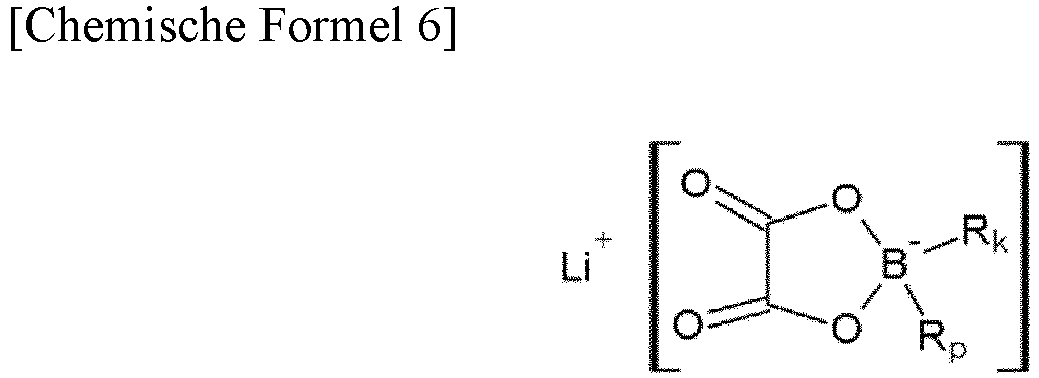 Rg, Rh, Ri und Rj unabhängig voneinander ein Halogen oder eine halogensubstituierte oder -unsubstituierte Alkylgruppe sind oder zumindest zwei von Rg, Rh, Ri und Rj verknüpft sind, um eine Oxalatgruppe zu bilden, undRk und Rp unabhängig voneinander ein Halogen oder eine halogensubstituierte oder -unsubstituierte Alkylgruppe sind oder Rk und Rp verknüpft sind, um eine Oxalatgruppe zu bilden;wobei die Menge des ersten Additivs im Bereich von 0,1 Gew.-% bis 7 Gew.-%, bezogen auf das Gesamtgewicht des Elektrolyts, liegt; undwobei die Menge des zweiten Additivs im Bereich von 0,1 Gew.-% bis 10 Gew.-%, bezogen auf das Gesamtgewicht des Elektrolyts, liegt.
 - Die wiederaufladbare Lithiumbatterie nach Anspruch 1, wobei die Menge des ersten Additivs im Bereich von 0,5 Gew.-% bis 5 Gew.-%, bezogen auf das Gesamtgewicht des Elektrolyts, liegt.
- Die wiederaufladbare Lithiumbatterie nach Anspruch 1, wobei die Menge des zweiten Additivs im Bereich von 0,5 Gew.-% bis 7 Gew.-%, bezogen auf das Gesamtgewicht des Elektrolyts, liegt.
- Die wiederaufladbare Lithiumbatterie nach einem der vorhergehenden Ansprüche, wobei ein Mischungsverhältnis des ersten Additivs und des zweiten Additivs im Bereich von 3:1 bis 1:3 liegt.
- Die wiederaufladbare Lithiumbatterie nach einem der vorhergehenden Ansprüche, wobei das erste Additiv eines oder mehrere ausgewählt aus Bis(triethylsilyl)sulfat, Bis(trimethylsilyl)sulfat, Di-t-butylsilylbis(trifluormethansulfonat) Trimethylsilylmethansulfonat, Trimethylsilylethansulfonat, Trimethylsilylbenzolsulfonat, Trimethylsilyltrifluormethansulfonat und Triethylsilyltrifluormethansulfonat ist.
- Die wiederaufladbare Lithiumbatterie nach einem der vorhergehenden Ansprüche, wobei das zweite Additiv eines oder mehrere ausgewählt aus Lithiumdifluorbis(oxalato)phosphat, Lithiumtetrafluor(oxalato)phosphat, Lithiumtris(oxalato)phosphat, Lithiumdifluorbis(oxalato)borat und Lithiumbis(oxalato)borat ist.
- Die wiederaufladbare Lithiumbatterie nach einem der vorhergehenden Ansprüche, wobei die Verbindung, die 70 mol% oder mehr Ni aufweist, durch die chemische Formel 7 dargestellt ist:
[Chemische Formel 7] LiaNixCoyMezO2
wobei in der chemischen Formel 7 gilt: 0,9≤a≤1,1; 0,7≤x≤0,98; 0<y≤0,3; 0<z≤0,3; x+y+z=1, und
Me Mn oder Al ist.
Applications Claiming Priority (1)
| Application Number | Priority Date | Filing Date | Title |
|---|---|---|---|
| KR1020170113339A KR102488601B1 (ko) | 2017-09-05 | 2017-09-05 | 리튬 이차 전지 |
Publications (2)
| Publication Number | Publication Date |
|---|---|
| EP3451433A1 EP3451433A1 (de) | 2019-03-06 |
| EP3451433B1 true EP3451433B1 (de) | 2020-04-22 |
Family
ID=62916506
Family Applications (1)
| Application Number | Title | Priority Date | Filing Date |
|---|---|---|---|
| EP18182841.9A Active EP3451433B1 (de) | 2017-09-05 | 2018-07-11 | Wiederaufladbare lithiumbatterie |
Country Status (4)
| Country | Link |
|---|---|
| US (1) | US11342586B2 (de) |
| EP (1) | EP3451433B1 (de) |
| KR (1) | KR102488601B1 (de) |
| CN (1) | CN109428110B (de) |
Families Citing this family (13)
| Publication number | Priority date | Publication date | Assignee | Title |
|---|---|---|---|---|
| JP7137755B2 (ja) * | 2018-09-19 | 2022-09-15 | トヨタ自動車株式会社 | リチウムイオン二次電池用非水電解液 |
| CN109818063A (zh) * | 2019-03-12 | 2019-05-28 | 杉杉新材料(衢州)有限公司 | 一种三元锂离子电池非水电解液及三元锂离子电池 |
| KR102722091B1 (ko) * | 2019-03-28 | 2024-10-28 | 현대자동차주식회사 | 리튬 이차전지 |
| CN110492177B (zh) * | 2019-07-09 | 2021-03-26 | 深圳市比克动力电池有限公司 | 电池电解液用添加剂、锂离子电池电解液、锂离子电池 |
| US12438153B2 (en) | 2019-07-22 | 2025-10-07 | Lg Energy Solution, Ltd. | Lithium secondary battery |
| EP4080533A4 (de) * | 2019-12-17 | 2023-09-20 | Mitsubishi Chemical Corporation | Nichtwässrige elektrolytlösung und energievorrichtung |
| CN111710909B (zh) * | 2020-06-28 | 2022-06-17 | 天目湖先进储能技术研究院有限公司 | 锂电池电解液的多功能添加剂及其制备方法和应用 |
| US12049925B2 (en) * | 2020-12-30 | 2024-07-30 | Dana Heavy Vehicle Systems Group, Llc | Systems and method for an electric motor with spray ring |
| CN113193229B (zh) * | 2021-04-15 | 2022-10-11 | 中国科学院成都有机化学有限公司 | 一种硅基电解液添加剂、电解液及锂离子电池 |
| CN113363580A (zh) * | 2021-06-16 | 2021-09-07 | 珠海市赛纬电子材料股份有限公司 | 非水电解液及其二次电池 |
| CN113363581B (zh) * | 2021-06-16 | 2022-07-29 | 珠海市赛纬电子材料股份有限公司 | 非水电解液及其二次电池 |
| CN114142086A (zh) * | 2021-11-16 | 2022-03-04 | 合肥国轩高科动力能源有限公司 | 一种耐低温锂离子电池电解液及锂离子电池 |
| CN119695276B (zh) * | 2025-02-24 | 2025-06-24 | 深圳市量能科技有限公司 | 一种高温型锂离子电池电解液及含有其的锂离子电池 |
Family Cites Families (31)
| Publication number | Priority date | Publication date | Assignee | Title |
|---|---|---|---|---|
| US6350546B1 (en) * | 1998-01-20 | 2002-02-26 | Wilson Greatbatch Ltd. | Sulfate additives for nonaqueous electrolyte rechargeable cells |
| EP1195834B1 (de) | 2000-10-03 | 2010-09-15 | Central Glass Company, Limited | Elektrolyt für elektrochemische Vorrichtung |
| JP4448275B2 (ja) | 2001-05-11 | 2010-04-07 | 三星エスディアイ株式会社 | リチウム二次電池用電解液及びこれを含むリチウム二次電池 |
| KR100412522B1 (ko) * | 2001-05-11 | 2003-12-31 | 삼성에스디아이 주식회사 | 비수성 전해액 및 이를 포함하는 리튬 이차 전지 |
| AU2003221334A1 (en) * | 2002-03-08 | 2003-09-22 | Mitsubishi Chemical Corporation | Nonaqueous electrolyte and lithium-ion secondary battery containing the same |
| JP4337324B2 (ja) * | 2002-10-10 | 2009-09-30 | 三菱化学株式会社 | 非水系電解液及びそれを用いたリチウム二次電池 |
| KR100544118B1 (ko) * | 2003-06-13 | 2006-01-23 | 삼성에스디아이 주식회사 | 저온 성능과 안전성이 개선된 비수계 전해액 및 이를채용한 리튬 전지 |
| JP4797403B2 (ja) * | 2005-03-01 | 2011-10-19 | 三菱化学株式会社 | 非水系電解液二次電池及び非水系電解液二次電池用電解液 |
| US7255965B2 (en) * | 2005-04-25 | 2007-08-14 | Ferro Corporation | Non-aqueous electrolytic solution |
| US20080193852A1 (en) | 2006-02-03 | 2008-08-14 | Sanyo Electric Co., Ltd. | Nonaqueous Electrolyte Secondary Battery |
| KR100898290B1 (ko) | 2007-09-12 | 2009-05-18 | 삼성에스디아이 주식회사 | 리튬 이차 전지 |
| CN102082292B (zh) * | 2010-12-24 | 2012-12-26 | 西安瑟福能源科技有限公司 | 一种高温型锂离子电池电解液及锂离子电池 |
| US9350048B2 (en) | 2011-03-23 | 2016-05-24 | Samsung Sdi Co., Ltd. | Electrolyte for a lithium rechargeable battery, lithium rechargeable battery including the same, and method of manufacturing a lithium rechargeable battery |
| US8308971B1 (en) | 2011-06-09 | 2012-11-13 | Wildcat Discovery Technologies, Inc. | Materials for battery electrolytes and methods for use |
| KR20150079586A (ko) * | 2012-10-22 | 2015-07-08 | 아사히 가라스 가부시키가이샤 | 이차 전지용 비수 전해액 및 리튬 이온 이차 전지 |
| JP5729525B2 (ja) | 2013-04-01 | 2015-06-03 | 宇部興産株式会社 | 非水電解液及びそれを用いた蓄電デバイス |
| KR101634749B1 (ko) * | 2013-06-18 | 2016-06-29 | 주식회사 엘지화학 | 수명 특성이 향상된 리튬 이차전지 |
| JP6542209B2 (ja) | 2013-07-19 | 2019-07-10 | ビーエーエスエフ ソシエタス・ヨーロピアBasf Se | リチウムイオン電池用電解質における電解質添加剤としての反応性リチウムアルコキシボレートの使用 |
| CN105745779B (zh) * | 2013-12-25 | 2021-02-05 | 旭化成株式会社 | 含有含甲硅烷基化合物的用于添加于电解液中的组合物、电解液以及锂离子二次电池 |
| EP3098893B1 (de) * | 2014-01-22 | 2017-11-29 | Mitsubishi Chemical Corporation | Nicht-wässrige elektrolytlösung und diese verwendende sekundärbatterie mit nicht-wässrigem elektrolyt |
| CN104810551A (zh) * | 2014-07-09 | 2015-07-29 | 万向A一二三系统有限公司 | 一种适用于高低温环境的锂离子动力电池电解液 |
| CN106471664B (zh) * | 2014-07-15 | 2020-01-21 | 宇部兴产株式会社 | 非水电解液以及使用了该非水电解液的蓄电设备 |
| JP6376454B2 (ja) * | 2014-08-28 | 2018-08-22 | 株式会社Gsユアサ | 蓄電素子及び蓄電素子の製造方法 |
| CN104600362A (zh) * | 2015-02-05 | 2015-05-06 | 深圳市三讯电子有限公司 | 一种动力电池及其锂离子电解液 |
| JP2016197508A (ja) * | 2015-04-02 | 2016-11-24 | 旭化成株式会社 | 非水電解液添加剤、非水電解液、リチウムイオン二次電池 |
| CN109585921B (zh) * | 2015-07-09 | 2021-12-14 | 深圳新宙邦科技股份有限公司 | 一种锂离子电池非水电解液及锂离子电池 |
| CN106898817B (zh) * | 2015-12-18 | 2019-12-10 | 比亚迪股份有限公司 | 锂离子电池电解液及锂离子电池 |
| CN105845980B (zh) * | 2016-03-30 | 2020-05-05 | 宁德时代新能源科技股份有限公司 | 一种电解液及含有该电解液的锂离子电池 |
| CN106299324A (zh) * | 2016-10-17 | 2017-01-04 | 广州天赐高新材料股份有限公司 | 一种用于高容量锂离子电池的电解液、制备方法及锂离子电池 |
| CN107069094B (zh) * | 2017-03-23 | 2019-02-15 | 福建省劲德电源科技有限公司 | 一种超低温放电的锂离子电池电解液 |
| CN107093766B (zh) * | 2017-04-28 | 2020-01-14 | 中国工程物理研究院电子工程研究所 | 一种锂离子电池电解液 |
-
2017
- 2017-09-05 KR KR1020170113339A patent/KR102488601B1/ko active Active
-
2018
- 2018-07-11 EP EP18182841.9A patent/EP3451433B1/de active Active
- 2018-08-17 CN CN201810939052.3A patent/CN109428110B/zh active Active
- 2018-08-27 US US16/113,254 patent/US11342586B2/en active Active
Non-Patent Citations (1)
| Title |
|---|
| None * |
Also Published As
| Publication number | Publication date |
|---|---|
| CN109428110A (zh) | 2019-03-05 |
| CN109428110B (zh) | 2022-04-29 |
| US11342586B2 (en) | 2022-05-24 |
| KR20190026429A (ko) | 2019-03-13 |
| US20190074546A1 (en) | 2019-03-07 |
| KR102488601B1 (ko) | 2023-01-12 |
| EP3451433A1 (de) | 2019-03-06 |
Similar Documents
| Publication | Publication Date | Title |
|---|---|---|
| EP3451433B1 (de) | Wiederaufladbare lithiumbatterie | |
| KR101733737B1 (ko) | 리튬 이차 전지용 전해액 및 이를 포함하는 리튬 이차 전지 | |
| EP2320510A1 (de) | Wiederaufladbare Lithiumbatterie | |
| EP3249721A1 (de) | Positivelektrode für eine wiederaufladbare lithiumbatterie und wiederaufladbare lithiumbatterie damit | |
| US20220367860A1 (en) | Positive active material for rechargeable lithium battery and rechargeable lithium battery including same | |
| US9893348B2 (en) | Positive active material for lithium secondary battery and lithium secondary battery | |
| EP4220803A1 (de) | Elektrolyt für eine wiederaufladbare lithiumbatterie und wiederaufladbare lithiumbatterie damit | |
| KR20150128362A (ko) | 리튬 이차 전지 | |
| US11784347B2 (en) | Electrolyte for rechargeable lithium battery and rechargeable lithium battery including same | |
| KR20210088491A (ko) | 리튬 이차 전지용 양극 활물질의 제조 방법 | |
| US20080118846A1 (en) | Rechargeable lithium battery | |
| US10784499B2 (en) | Positive active material for rechargeable lithium battery and rechargeable lithium battery including same | |
| US20200373616A1 (en) | Lithium secondary battery | |
| KR102488602B1 (ko) | 리튬 이차 전지용 비수 전해질 및 이를 포함하는 리튬 이차 전지 | |
| KR102764219B1 (ko) | 리튬 이차 전지용 전해액 및 이를 포함하는 리튬 이차 전지 | |
| KR102114229B1 (ko) | 리튬 이차 전지용 양극 활물질, 이의 제조방법 및 이를 포함하는 리튬 이차 전지 | |
| KR102296816B1 (ko) | 리튬 이차 전지용 전해액 및 이를 포함하는 리튬 이차 전지 | |
| US20180026266A1 (en) | Positive Active Material For Lithium Secondary Battery, Method For Producing Same, And Lithium Secondary Battery Comprising Same | |
| EP3435453B1 (de) | Positives aktivmaterial für wiederaufladbare lithiumbatterie und wiederaufladbare lithiumbatterie dasselbe umfassend | |
| EP3553851A1 (de) | Elektrodenanordnung und wiederaufladbare batterie damit | |
| KR20240131882A (ko) | 리튬 이차 전지용 전해액 및 이를 포함하는 리튬 이차전지 | |
| KR101673177B1 (ko) | 리튬 이차 전지용 양극 활물질, 이의 제조 방법 및 이를 포함하는 리튬 이차 전지 | |
| EP4358185A1 (de) | Wiederaufladbare lithiumbatterie | |
| EP4372847A1 (de) | Wiederaufladbare lithiumbatterie | |
| EP4354542A1 (de) | Wiederaufladbare lithiumbatterie |
Legal Events
| Date | Code | Title | Description |
|---|---|---|---|
| PUAI | Public reference made under article 153(3) epc to a published international application that has entered the european phase |
Free format text: ORIGINAL CODE: 0009012 |
|
| STAA | Information on the status of an ep patent application or granted ep patent |
Free format text: STATUS: REQUEST FOR EXAMINATION WAS MADE |
|
| 17P | Request for examination filed |
Effective date: 20180711 |
|
| AK | Designated contracting states |
Kind code of ref document: A1 Designated state(s): AL AT BE BG CH CY CZ DE DK EE ES FI FR GB GR HR HU IE IS IT LI LT LU LV MC MK MT NL NO PL PT RO RS SE SI SK SM TR |
|
| AX | Request for extension of the european patent |
Extension state: BA ME |
|
| RIC1 | Information provided on ipc code assigned before grant |
Ipc: H01M 4/525 20100101ALI20191031BHEP Ipc: H01M 10/052 20100101ALI20191031BHEP Ipc: H01M 10/0567 20100101AFI20191031BHEP Ipc: H01M 10/0525 20100101ALN20191031BHEP |
|
| GRAP | Despatch of communication of intention to grant a patent |
Free format text: ORIGINAL CODE: EPIDOSNIGR1 |
|
| STAA | Information on the status of an ep patent application or granted ep patent |
Free format text: STATUS: GRANT OF PATENT IS INTENDED |
|
| INTG | Intention to grant announced |
Effective date: 20191212 |
|
| GRAS | Grant fee paid |
Free format text: ORIGINAL CODE: EPIDOSNIGR3 |
|
| GRAA | (expected) grant |
Free format text: ORIGINAL CODE: 0009210 |
|
| STAA | Information on the status of an ep patent application or granted ep patent |
Free format text: STATUS: THE PATENT HAS BEEN GRANTED |
|
| AK | Designated contracting states |
Kind code of ref document: B1 Designated state(s): AL AT BE BG CH CY CZ DE DK EE ES FI FR GB GR HR HU IE IS IT LI LT LU LV MC MK MT NL NO PL PT RO RS SE SI SK SM TR |
|
| REG | Reference to a national code |
Ref country code: CH Ref legal event code: EP |
|
| REG | Reference to a national code |
Ref country code: IE Ref legal event code: FG4D |
|
| REG | Reference to a national code |
Ref country code: DE Ref legal event code: R096 Ref document number: 602018003933 Country of ref document: DE |
|
| REG | Reference to a national code |
Ref country code: AT Ref legal event code: REF Ref document number: 1261352 Country of ref document: AT Kind code of ref document: T Effective date: 20200515 |
|
| REG | Reference to a national code |
Ref country code: LT Ref legal event code: MG4D |
|
| REG | Reference to a national code |
Ref country code: NL Ref legal event code: MP Effective date: 20200422 |
|
| PG25 | Lapsed in a contracting state [announced via postgrant information from national office to epo] |
Ref country code: FI Free format text: LAPSE BECAUSE OF FAILURE TO SUBMIT A TRANSLATION OF THE DESCRIPTION OR TO PAY THE FEE WITHIN THE PRESCRIBED TIME-LIMIT Effective date: 20200422 Ref country code: LT Free format text: LAPSE BECAUSE OF FAILURE TO SUBMIT A TRANSLATION OF THE DESCRIPTION OR TO PAY THE FEE WITHIN THE PRESCRIBED TIME-LIMIT Effective date: 20200422 Ref country code: NL Free format text: LAPSE BECAUSE OF FAILURE TO SUBMIT A TRANSLATION OF THE DESCRIPTION OR TO PAY THE FEE WITHIN THE PRESCRIBED TIME-LIMIT Effective date: 20200422 Ref country code: PT Free format text: LAPSE BECAUSE OF FAILURE TO SUBMIT A TRANSLATION OF THE DESCRIPTION OR TO PAY THE FEE WITHIN THE PRESCRIBED TIME-LIMIT Effective date: 20200824 Ref country code: GR Free format text: LAPSE BECAUSE OF FAILURE TO SUBMIT A TRANSLATION OF THE DESCRIPTION OR TO PAY THE FEE WITHIN THE PRESCRIBED TIME-LIMIT Effective date: 20200723 Ref country code: NO Free format text: LAPSE BECAUSE OF FAILURE TO SUBMIT A TRANSLATION OF THE DESCRIPTION OR TO PAY THE FEE WITHIN THE PRESCRIBED TIME-LIMIT Effective date: 20200722 Ref country code: SE Free format text: LAPSE BECAUSE OF FAILURE TO SUBMIT A TRANSLATION OF THE DESCRIPTION OR TO PAY THE FEE WITHIN THE PRESCRIBED TIME-LIMIT Effective date: 20200422 Ref country code: IS Free format text: LAPSE BECAUSE OF FAILURE TO SUBMIT A TRANSLATION OF THE DESCRIPTION OR TO PAY THE FEE WITHIN THE PRESCRIBED TIME-LIMIT Effective date: 20200822 |
|
| REG | Reference to a national code |
Ref country code: AT Ref legal event code: MK05 Ref document number: 1261352 Country of ref document: AT Kind code of ref document: T Effective date: 20200422 |
|
| PG25 | Lapsed in a contracting state [announced via postgrant information from national office to epo] |
Ref country code: BG Free format text: LAPSE BECAUSE OF FAILURE TO SUBMIT A TRANSLATION OF THE DESCRIPTION OR TO PAY THE FEE WITHIN THE PRESCRIBED TIME-LIMIT Effective date: 20200722 Ref country code: RS Free format text: LAPSE BECAUSE OF FAILURE TO SUBMIT A TRANSLATION OF THE DESCRIPTION OR TO PAY THE FEE WITHIN THE PRESCRIBED TIME-LIMIT Effective date: 20200422 Ref country code: HR Free format text: LAPSE BECAUSE OF FAILURE TO SUBMIT A TRANSLATION OF THE DESCRIPTION OR TO PAY THE FEE WITHIN THE PRESCRIBED TIME-LIMIT Effective date: 20200422 Ref country code: LV Free format text: LAPSE BECAUSE OF FAILURE TO SUBMIT A TRANSLATION OF THE DESCRIPTION OR TO PAY THE FEE WITHIN THE PRESCRIBED TIME-LIMIT Effective date: 20200422 |
|
| PG25 | Lapsed in a contracting state [announced via postgrant information from national office to epo] |
Ref country code: AL Free format text: LAPSE BECAUSE OF FAILURE TO SUBMIT A TRANSLATION OF THE DESCRIPTION OR TO PAY THE FEE WITHIN THE PRESCRIBED TIME-LIMIT Effective date: 20200422 |
|
| REG | Reference to a national code |
Ref country code: DE Ref legal event code: R097 Ref document number: 602018003933 Country of ref document: DE |
|
| PG25 | Lapsed in a contracting state [announced via postgrant information from national office to epo] |
Ref country code: DK Free format text: LAPSE BECAUSE OF FAILURE TO SUBMIT A TRANSLATION OF THE DESCRIPTION OR TO PAY THE FEE WITHIN THE PRESCRIBED TIME-LIMIT Effective date: 20200422 Ref country code: AT Free format text: LAPSE BECAUSE OF FAILURE TO SUBMIT A TRANSLATION OF THE DESCRIPTION OR TO PAY THE FEE WITHIN THE PRESCRIBED TIME-LIMIT Effective date: 20200422 Ref country code: EE Free format text: LAPSE BECAUSE OF FAILURE TO SUBMIT A TRANSLATION OF THE DESCRIPTION OR TO PAY THE FEE WITHIN THE PRESCRIBED TIME-LIMIT Effective date: 20200422 Ref country code: ES Free format text: LAPSE BECAUSE OF FAILURE TO SUBMIT A TRANSLATION OF THE DESCRIPTION OR TO PAY THE FEE WITHIN THE PRESCRIBED TIME-LIMIT Effective date: 20200422 Ref country code: CZ Free format text: LAPSE BECAUSE OF FAILURE TO SUBMIT A TRANSLATION OF THE DESCRIPTION OR TO PAY THE FEE WITHIN THE PRESCRIBED TIME-LIMIT Effective date: 20200422 Ref country code: IT Free format text: LAPSE BECAUSE OF FAILURE TO SUBMIT A TRANSLATION OF THE DESCRIPTION OR TO PAY THE FEE WITHIN THE PRESCRIBED TIME-LIMIT Effective date: 20200422 Ref country code: RO Free format text: LAPSE BECAUSE OF FAILURE TO SUBMIT A TRANSLATION OF THE DESCRIPTION OR TO PAY THE FEE WITHIN THE PRESCRIBED TIME-LIMIT Effective date: 20200422 Ref country code: SM Free format text: LAPSE BECAUSE OF FAILURE TO SUBMIT A TRANSLATION OF THE DESCRIPTION OR TO PAY THE FEE WITHIN THE PRESCRIBED TIME-LIMIT Effective date: 20200422 |
|
| PG25 | Lapsed in a contracting state [announced via postgrant information from national office to epo] |
Ref country code: MC Free format text: LAPSE BECAUSE OF FAILURE TO SUBMIT A TRANSLATION OF THE DESCRIPTION OR TO PAY THE FEE WITHIN THE PRESCRIBED TIME-LIMIT Effective date: 20200422 Ref country code: SK Free format text: LAPSE BECAUSE OF FAILURE TO SUBMIT A TRANSLATION OF THE DESCRIPTION OR TO PAY THE FEE WITHIN THE PRESCRIBED TIME-LIMIT Effective date: 20200422 Ref country code: PL Free format text: LAPSE BECAUSE OF FAILURE TO SUBMIT A TRANSLATION OF THE DESCRIPTION OR TO PAY THE FEE WITHIN THE PRESCRIBED TIME-LIMIT Effective date: 20200422 |
|
| PLBE | No opposition filed within time limit |
Free format text: ORIGINAL CODE: 0009261 |
|
| STAA | Information on the status of an ep patent application or granted ep patent |
Free format text: STATUS: NO OPPOSITION FILED WITHIN TIME LIMIT |
|
| 26N | No opposition filed |
Effective date: 20210125 |
|
| REG | Reference to a national code |
Ref country code: BE Ref legal event code: MM Effective date: 20200731 |
|
| PG25 | Lapsed in a contracting state [announced via postgrant information from national office to epo] |
Ref country code: LU Free format text: LAPSE BECAUSE OF NON-PAYMENT OF DUE FEES Effective date: 20200711 |
|
| PG25 | Lapsed in a contracting state [announced via postgrant information from national office to epo] |
Ref country code: BE Free format text: LAPSE BECAUSE OF NON-PAYMENT OF DUE FEES Effective date: 20200731 Ref country code: SI Free format text: LAPSE BECAUSE OF FAILURE TO SUBMIT A TRANSLATION OF THE DESCRIPTION OR TO PAY THE FEE WITHIN THE PRESCRIBED TIME-LIMIT Effective date: 20200422 |
|
| PG25 | Lapsed in a contracting state [announced via postgrant information from national office to epo] |
Ref country code: IE Free format text: LAPSE BECAUSE OF NON-PAYMENT OF DUE FEES Effective date: 20200711 |
|
| REG | Reference to a national code |
Ref country code: CH Ref legal event code: PL |
|
| PG25 | Lapsed in a contracting state [announced via postgrant information from national office to epo] |
Ref country code: LI Free format text: LAPSE BECAUSE OF NON-PAYMENT OF DUE FEES Effective date: 20210731 Ref country code: CH Free format text: LAPSE BECAUSE OF NON-PAYMENT OF DUE FEES Effective date: 20210731 |
|
| PG25 | Lapsed in a contracting state [announced via postgrant information from national office to epo] |
Ref country code: TR Free format text: LAPSE BECAUSE OF FAILURE TO SUBMIT A TRANSLATION OF THE DESCRIPTION OR TO PAY THE FEE WITHIN THE PRESCRIBED TIME-LIMIT Effective date: 20200422 Ref country code: MT Free format text: LAPSE BECAUSE OF FAILURE TO SUBMIT A TRANSLATION OF THE DESCRIPTION OR TO PAY THE FEE WITHIN THE PRESCRIBED TIME-LIMIT Effective date: 20200422 Ref country code: CY Free format text: LAPSE BECAUSE OF FAILURE TO SUBMIT A TRANSLATION OF THE DESCRIPTION OR TO PAY THE FEE WITHIN THE PRESCRIBED TIME-LIMIT Effective date: 20200422 |
|
| PG25 | Lapsed in a contracting state [announced via postgrant information from national office to epo] |
Ref country code: MK Free format text: LAPSE BECAUSE OF FAILURE TO SUBMIT A TRANSLATION OF THE DESCRIPTION OR TO PAY THE FEE WITHIN THE PRESCRIBED TIME-LIMIT Effective date: 20200422 |
|
| P01 | Opt-out of the competence of the unified patent court (upc) registered |
Effective date: 20230528 |
|
| PGFP | Annual fee paid to national office [announced via postgrant information from national office to epo] |
Ref country code: GB Payment date: 20250626 Year of fee payment: 8 |
|
| PGFP | Annual fee paid to national office [announced via postgrant information from national office to epo] |
Ref country code: FR Payment date: 20250623 Year of fee payment: 8 |
|
| PGFP | Annual fee paid to national office [announced via postgrant information from national office to epo] |
Ref country code: DE Payment date: 20250624 Year of fee payment: 8 |