EP3453218B1 - Präambelerkennung und ankunftszeitschätzung für ein einzel-ton-frequenz-hopping-direkt-zugriffspräambel - Google Patents
Präambelerkennung und ankunftszeitschätzung für ein einzel-ton-frequenz-hopping-direkt-zugriffspräambel Download PDFInfo
- Publication number
- EP3453218B1 EP3453218B1 EP17722507.5A EP17722507A EP3453218B1 EP 3453218 B1 EP3453218 B1 EP 3453218B1 EP 17722507 A EP17722507 A EP 17722507A EP 3453218 B1 EP3453218 B1 EP 3453218B1
- Authority
- EP
- European Patent Office
- Prior art keywords
- symbol
- estimate
- toa
- group
- symbol groups
- Prior art date
- Legal status (The legal status is an assumption and is not a legal conclusion. Google has not performed a legal analysis and makes no representation as to the accuracy of the status listed.)
- Active
Links
Images





Classifications
-
- H—ELECTRICITY
- H04—ELECTRIC COMMUNICATION TECHNIQUE
- H04W—WIRELESS COMMUNICATION NETWORKS
- H04W74/00—Wireless channel access
-
- H—ELECTRICITY
- H04—ELECTRIC COMMUNICATION TECHNIQUE
- H04L—TRANSMISSION OF DIGITAL INFORMATION, e.g. TELEGRAPHIC COMMUNICATION
- H04L25/00—Baseband systems
- H04L25/02—Details ; arrangements for supplying electrical power along data transmission lines
- H04L25/0202—Channel estimation
- H04L25/0204—Channel estimation of multiple channels
-
- H—ELECTRICITY
- H04—ELECTRIC COMMUNICATION TECHNIQUE
- H04L—TRANSMISSION OF DIGITAL INFORMATION, e.g. TELEGRAPHIC COMMUNICATION
- H04L27/00—Modulated-carrier systems
- H04L27/26—Systems using multi-frequency codes
- H04L27/2601—Multicarrier modulation systems
- H04L27/2602—Signal structure
- H04L27/261—Details of reference signals
-
- H—ELECTRICITY
- H04—ELECTRIC COMMUNICATION TECHNIQUE
- H04B—TRANSMISSION
- H04B1/00—Details of transmission systems, not covered by a single one of groups H04B3/00 - H04B13/00; Details of transmission systems not characterised by the medium used for transmission
- H04B1/69—Spread spectrum techniques
- H04B1/713—Spread spectrum techniques using frequency hopping
- H04B1/7136—Arrangements for generation of hop frequencies, e.g. using a bank of frequency sources, using continuous tuning or using a transform
-
- H—ELECTRICITY
- H04—ELECTRIC COMMUNICATION TECHNIQUE
- H04J—MULTIPLEX COMMUNICATION
- H04J11/00—Orthogonal multiplex systems, e.g. using WALSH codes
- H04J11/0023—Interference mitigation or co-ordination
-
- H—ELECTRICITY
- H04—ELECTRIC COMMUNICATION TECHNIQUE
- H04L—TRANSMISSION OF DIGITAL INFORMATION, e.g. TELEGRAPHIC COMMUNICATION
- H04L27/00—Modulated-carrier systems
- H04L27/26—Systems using multi-frequency codes
- H04L27/2601—Multicarrier modulation systems
- H04L27/2647—Arrangements specific to the receiver only
- H04L27/2655—Synchronisation arrangements
- H04L27/2657—Carrier synchronisation
- H04L27/2659—Coarse or integer frequency offset determination and synchronisation
-
- H—ELECTRICITY
- H04—ELECTRIC COMMUNICATION TECHNIQUE
- H04L—TRANSMISSION OF DIGITAL INFORMATION, e.g. TELEGRAPHIC COMMUNICATION
- H04L27/00—Modulated-carrier systems
- H04L27/26—Systems using multi-frequency codes
- H04L27/2601—Multicarrier modulation systems
- H04L27/2647—Arrangements specific to the receiver only
- H04L27/2655—Synchronisation arrangements
- H04L27/2662—Symbol synchronisation
-
- H—ELECTRICITY
- H04—ELECTRIC COMMUNICATION TECHNIQUE
- H04L—TRANSMISSION OF DIGITAL INFORMATION, e.g. TELEGRAPHIC COMMUNICATION
- H04L27/00—Modulated-carrier systems
- H04L27/26—Systems using multi-frequency codes
- H04L27/2601—Multicarrier modulation systems
- H04L27/2647—Arrangements specific to the receiver only
- H04L27/2655—Synchronisation arrangements
- H04L27/2668—Details of algorithms
- H04L27/2673—Details of algorithms characterised by synchronisation parameters
- H04L27/2675—Pilot or known symbols
-
- H—ELECTRICITY
- H04—ELECTRIC COMMUNICATION TECHNIQUE
- H04L—TRANSMISSION OF DIGITAL INFORMATION, e.g. TELEGRAPHIC COMMUNICATION
- H04L5/00—Arrangements affording multiple use of the transmission path
- H04L5/0001—Arrangements for dividing the transmission path
- H04L5/0003—Two-dimensional division
- H04L5/0005—Time-frequency
- H04L5/0007—Time-frequency the frequencies being orthogonal, e.g. OFDM(A) or DMT
-
- H—ELECTRICITY
- H04—ELECTRIC COMMUNICATION TECHNIQUE
- H04W—WIRELESS COMMUNICATION NETWORKS
- H04W56/00—Synchronisation arrangements
- H04W56/004—Synchronisation arrangements compensating for timing error of reception due to propagation delay
- H04W56/0045—Synchronisation arrangements compensating for timing error of reception due to propagation delay compensating for timing error by altering transmission time
-
- H—ELECTRICITY
- H04—ELECTRIC COMMUNICATION TECHNIQUE
- H04W—WIRELESS COMMUNICATION NETWORKS
- H04W74/00—Wireless channel access
- H04W74/08—Non-scheduled access, e.g. ALOHA
-
- H—ELECTRICITY
- H04—ELECTRIC COMMUNICATION TECHNIQUE
- H04W—WIRELESS COMMUNICATION NETWORKS
- H04W74/00—Wireless channel access
- H04W74/08—Non-scheduled access, e.g. ALOHA
- H04W74/0833—Random access procedures, e.g. with 4-step access
-
- H—ELECTRICITY
- H04—ELECTRIC COMMUNICATION TECHNIQUE
- H04B—TRANSMISSION
- H04B1/00—Details of transmission systems, not covered by a single one of groups H04B3/00 - H04B13/00; Details of transmission systems not characterised by the medium used for transmission
- H04B1/69—Spread spectrum techniques
- H04B1/713—Spread spectrum techniques using frequency hopping
- H04B1/7136—Arrangements for generation of hop frequencies, e.g. using a bank of frequency sources, using continuous tuning or using a transform
- H04B2001/71367—Arrangements for generation of hop frequencies, e.g. using a bank of frequency sources, using continuous tuning or using a transform using a transform
-
- H—ELECTRICITY
- H04—ELECTRIC COMMUNICATION TECHNIQUE
- H04B—TRANSMISSION
- H04B2201/00—Indexing scheme relating to details of transmission systems not covered by a single group of H04B3/00 - H04B13/00
- H04B2201/69—Orthogonal indexing scheme relating to spread spectrum techniques in general
- H04B2201/713—Frequency hopping
- H04B2201/71353—Fast frequency hopping
-
- H—ELECTRICITY
- H04—ELECTRIC COMMUNICATION TECHNIQUE
- H04L—TRANSMISSION OF DIGITAL INFORMATION, e.g. TELEGRAPHIC COMMUNICATION
- H04L27/00—Modulated-carrier systems
- H04L27/26—Systems using multi-frequency codes
- H04L27/2601—Multicarrier modulation systems
- H04L27/2647—Arrangements specific to the receiver only
- H04L27/2655—Synchronisation arrangements
- H04L27/2657—Carrier synchronisation
- H04L27/266—Fine or fractional frequency offset determination and synchronisation
-
- H—ELECTRICITY
- H04—ELECTRIC COMMUNICATION TECHNIQUE
- H04W—WIRELESS COMMUNICATION NETWORKS
- H04W74/00—Wireless channel access
- H04W74/08—Non-scheduled access, e.g. ALOHA
- H04W74/0833—Random access procedures, e.g. with 4-step access
- H04W74/0836—Random access procedures, e.g. with 4-step access with 2-step access
Definitions
- the present disclosure generally relates to communication networks, and more particularly to a receiver baseband processor and method for performing preamble detection and time-of-arrival (ToA) estimation for a single-tone frequency hopping random access preamble such as a Narrowband Internet of Things (NB-IoT) Physical Random Access Channel (NPRACH).
- NB-IoT Narrowband Internet of Things
- NPRACH Physical Random Access Channel
- Narrowband Internet of Things is an emerging cellular technology that will provide improved coverage for massive number of low-throughput low-cost devices with low device power consumption in delay-tolerant applications.
- a new single tone signal with frequency hopping has been designed for NB-IoT Physical Random Access Channel (NPRACH).
- the Networked Society and IoT are associated with new requirements on cellular networks with respect to device cost, battery lifetime, and coverage for example.
- SoC system-on-a-chip
- PA integrated power amplifier
- This constraint limits uplink "coverage", which is related to how much path loss is allowed between a user terminal and a base station.
- PA backoff is needed when the communication signal has non-unity, peak-to-average power ratio (PAPR).
- PAPR peak-to-average power ratio
- LTE Long Term Evolution
- SC-FDMA single-carrier frequency-division multiple-access
- the new random access preamble signal is referred to as a single-tone frequency hopping NB-IoT PRACH (NPRACH).
- NPRACH single-tone frequency hopping NB-IoT PRACH
- Generation of the random access preamble signal includes concatenating N preamble symbol groups, each preamble symbol comprising a single tone.
- NPRACH uses the following hopping pattern, resulting in at least four different subcarrier frequencies. Inner layer fixed-size hopping is applied within every four symbol groups.
- First level single-subcarrier hopping is used between the first and the second symbol groups and between the third and the fourth symbol groups. Further, the two single-subcarrier hoppings are mirrored, i.e., if the first hopping is "UP”, the second hopping is "DOWN", and vice versa. Second level 6-subcarrier hopping is used between the second and the third symbol groups. Outer-layer pseudo-random hopping is applied between groups of four symbol groups.
- the new NPRACH signal is single-tone based and has extremely low PAPR, and thus reduces the need for PA backoff to the greatest extent and maximizes PA efficiency.
- the new NPRACH signal is compatible with SC-FDMA and orthogonal frequency-division multiple-access (OFDMA) as in any OFDM symbol interval, the new NPRACH signal looks like an OFDM signal of one single subcarrier.
- a radio network node such as a base station receives the NPRACH signal from a wireless communication device, and a baseband processor within the radio network node processes the received signal in an attempt to detect a random access preamble that comprises multiple symbol groups, with each of the symbol groups on a single tone during a different time resource, according to a frequency hopping pattern that hops the single tone different frequency distances at different symbol groups, wherein each symbol group comprises one or more symbols.
- the OFDM signal is identical to the SC-FDMA signal.
- hopping patterns are carefully designed such that (1) accurate time-of-arrival estimation can be performed by the base station, (2) the frequency resources can be fully utilized by PRACH while maintaining orthogonality of different preambles.
- NB-PRACH design Huawei, Hi Silicon and Neul, R1-161357, 3GPP TSG RAN WG1 Meeting #84, February 2016 describes a signal structure for NB-PRACH.
- US 2015/0365975 describes a method for processing random access preamble signals.
- the new single-tone frequency hopping NPRACH requires new receiver algorithms for preamble detection and time-of-arrival (ToA) estimation.
- Traditional correlation algorithms for Zadoff-Chu sequence based PRACH in LTE do not apply to NPRACH preamble detection and ToA estimation in NB-IoT.
- the present disclosure provides receiver algorithms for preamble detection and time-of-arrival estimation for single-tone frequency hopping random access preambles such as the NPRACH design in NB-IoT.
- the algorithms achieve a very high detection rate, a very low false alarm rate, and an accurate time-of-arrival estimation in NPRACH, which are important for NB-IoT systems to function properly.
- the algorithms offer different performance and complexity trade-offs, and provide important guidance for the implementation of network equipment such as base stations.
- the present disclosure provides new receiver algorithms for preamble detection and time-of-arrival (ToA) estimation when using the single-tone frequency hopping NPRACH.
- One or more embodiments of the present patent disclosure may be implemented using different combinations of software and firmware, or hardware.
- one or more of the techniques shown in the Figures may be implemented using code and data stored and executed on one or more electronic devices or nodes.
- random access serves multiple purposes such as initial access when establishing a radio link, scheduling requests, and so on.
- a main objective of random access is to achieve uplink synchronization, which is important for maintaining the uplink orthogonality in LTE.
- the time of arrival (ToA) of each UE's signal needs to be within the cyclic prefix (CP) of the OFDMA or SC-FDMA signal at the base station.
- CP cyclic prefix
- random access can be either contention-based or contention-free.
- the contention-based random access procedure consists of four steps: (1) the UE transmits a Random Access Preamble (PRACH), which is received by an eNodeB (eNB); (2) the eNB transmits a Random Access Response; (3) the UE transmits an access request (Scheduled Transmission); and (4) the eNB resolves any contention and provides an uplink grant.
- PRACH Random Access Preamble
- eNB eNodeB
- the eNB transmits a Random Access Response
- the UE transmits an access request (Scheduled Transmission); and (4) the eNB resolves any contention and provides an uplink grant.
- Step 1 involves physical-layer processing specifically designed for random access, while the remaining Steps 2-4 follow the same physical-layer processing used in uplink and downlink data transmission.
- the UE uses reserved preambles assigned by the base station. In this case, contention resolution is not needed, and thus only Steps 1 and 2 are required.
- the NB-IoT PRACH serves similar purposes as in LTE, and reuses the random access procedure in LTE.
- the PRACH preamble does not occupy the entire random access segment, leaving some time as guard time (GT).
- GT guard time
- the GT may follow the preamble.
- the GT may precede the preamble.
- PRACH preambles should be designed such that accurate time-of-arrival estimation can be performed by the base stations.
- PRACH signal and "PRACH preamble” are used interchangeably.
- FIG. 1 is a flowchart illustrating an overall method of time-of-arrival (ToA) estimation and preamble detection for a single-tone frequency hopping random access preamble in an exemplary embodiment of the present disclosure.
- the method may be performed in a baseband processor of a receiver.
- the processor FFT processes a received signal and identifies logical tones. For every logical tone, the processor performs steps 12 through 18.
- received symbols are read on each logical tone.
- a Time of Arrival (ToA) estimate is determined.
- a statistic is formed based on the ToA estimate.
- the statistic is compared to a threshold.
- the method it is determined whether the statistic is greater than or equal to the threshold. If so, the method moves to step 17 where the processor determines that a preamble is present and utilizes the ToA estimate for a timing advance command. When the statistic is less than the threshold, the method may move instead to step 18 where the processor discards the ToA estimate.
- FIG. 2 is an illustrative drawing illustrating an example of FFT processing of a received signal as performed in step 11 of FIG. 1 .
- FFT windows are shown for the processing of a PRACH symbol group consisting of a cyclic prefix (CP) and 5 symbols.
- CP cyclic prefix
- FIG. 3 is an illustrative drawing of one example of the basic structure of a PRACH symbol group 31 having a CP and 5 symbols.
- the symbol group is basically a single tone OFDM signal.
- the non-CP part of the PRACH symbol group may consist of one or more symbols.
- Current 3GPP agreements state that one CP (of length either 266.7 ⁇ s or 66.7 ⁇ s) and five symbols (0, 1, 2, 3, 4) constitute a basic symbol group.
- a number of OFDM symbol groups, each one as illustrated in FIG. 3 are concatenated to form a PRACH preamble. But the frequency positions of the symbol groups of the same PRACH preamble vary according to some hopping patterns.
- FIG. 4 is an illustrative drawing illustrating an example of a relationship of logical tones to physical tones.
- the vertical axis indicates the frequency domain where each unit indicates a tone.
- the horizontal axis indicates the time domain where each unit is one symbol group.
- each rectangle indicates a time-frequency position of a symbol group, whose structure is illustrated in Figure 3 .
- the figure highlights one logical tone referred to as logical tone "0", while other logical tones are not shown.
- the rectangles labeled as "0" together constitute the logical tone "0".
- the disclosed receiver algorithms for preamble detection and time-of-arrival (ToA) estimation are designed for single-tone frequency hopping random access preambles such as the NPRACH design in NB-IoT.
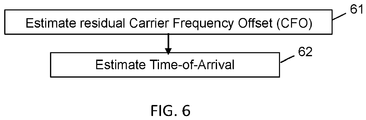
- This disclosure focuses on two basic approaches: a receiver algorithm for joint ToA and residual carrier frequency offset estimation ( FIG. 5 ), and a receiver algorithm for two-step ToA estimation with residual carrier frequency offset estimation ( FIG. 6 ).
- residual CFO estimation is performed followed by ToA estimation.
- Three alternatives for residual CFO estimation are described ( FIGS. 7-9 ), and two alternatives for ToA estimation are described ( FIGS. 10-11 ).
- the alternatives for ToA estimation are (1) direct search based on a maximum likelihood rule ( FIG.
- FIG. 10 Details for determining the coarse timing estimate are provided in FIG. 12 .
- FIGS. 13-14 Two alternatives for determining the fine timing estimate are provided in FIGS. 13-14 .
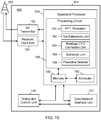
- An exemplary embodiment of a receiver configured to perform the method is provided in FIG. 15 .
- the n -th sample of the m -th OFDM symbol is given by: where is the CP length in terms of OFDM samples.
- ICI inter-channel interference
- the n -th sample of the m -th OFDM symbol at the receiver is given by: where ⁇ ⁇ is the residual carrier frequency offset (normalized by the OFDM sampling rate), and v [ n;m ] is additive white Gaussian noise.
- the residual carrier frequency offset is due to the imperfect frequency estimation in the cell search. It will become clear later that this residual carrier frequency offset has a pronounced effect on ToA estimation.
- the receiver For each OFDM symbol, the receiver discards the first N cp samples and performs a FFT on the remaining N samples.
- the received symbol on the l -th subcarrier at OFDM symbol time m is given by:
- the received symbol consists of three terms: (i) the signal term, (ii) the ICI term, and (iii) the noise term. More explicitly,
- the objective is to estimate the delay D in the presence of unknown channel gain a [ m ], residual carrier frequency offset ⁇ ⁇ , ICI and noise, assuming the data symbol S [ k ; m ] is known.
- n ( m ) is a mapping from symbol group index to the subcarrier index.
- n ( m ) is determined by the adopted hopping pattern of NPRACH.
- the i-th received symbol in symbol group m (after FFT at the receiver) is given by: where u [ m ] is the symbol value of the transmitted NPRACH preamble at symbol group m.
- this section discloses algorithms enabling a base station to detect the random access preamble and estimate the ToA.
- One embodiment starts with ToA estimation and then utilizes the corresponding ToA estimation statistic to determine (i.e., detect) the presence of the preamble.
- FIG. 5 is a flowchart illustrating an exemplary embodiment in which the ToA estimation and residual CFO estimation are jointly estimated.
- the received symbols and a conjugate of pilot symbols are element-wise multiplied to create L symbol groups.
- the L symbol groups are divided into L/Q blocks, each block having Q symbol groups.
- a two-dimensional array is formed with zero value elements.
- the zero value element is updated to the value of the symbol.
- a two-dimensional FFT is performed to obtain a two-dimensional FFT output.
- the L/Q two-dimensional FFT outputs are non-coherently combined to obtain a two-dimensional array.
- the position of the maximum value in the two-dimensional array is found.
- the position of the maximum value in the two-dimensional array is converted to the ToA and the residual CFO estimates.
- the ToA and residual CFO can be jointly estimated as follows
- the above rule of joint ToA and residual CFO estimation is intuitive.
- the estimate ( ⁇ *, D *) is the one that yields the maximum correlation of the transmitted preamble symbols and the received symbols whose phase shifts due to ToA and residual CFO are corrected by the estimate.
- the estimation rule takes the form of a two-dimensional discrete-time Fourier transform (DTFT).
- DTFT discrete-time Fourier transform
- FIG. 6 is a flowchart illustrating an exemplary embodiment in which ToA and residual CFO estimation are separately estimated in a two-step process instead of a joint estimation of ToA and residual CFO.
- Step 61 residual CFO ( ⁇ *) is first estimated and its effect is corrected, and then the ToA D * is estimated at step 62.
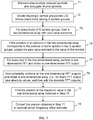
- FIG. 7 is a flowchart illustrating a first exemplary embodiment for estimating residual CFO in step 61 of FIG. 6 .
- the received symbols and a conjugate of pilot symbols are element-wise multiplied to create symbol groups.
- the L symbol groups are divided into L/Q blocks, each block having Q symbol groups.
- a two-dimensional array is formed with zero value elements.
- the zero value element is updated to the value of the symbol.
- a one-dimensional FFT is performed to obtain a one-dimensional FFT output.
- all the one-dimensional FFT outputs are non-coherently combined to obtain a one-dimensional array.
- the position of the maximum value in the one-dimensional array is found.
- the position of the maximum value in the one-dimensional array is converted to the residual CFO estimate.
- the above estimation rule takes the form of a one-dimensional discrete-time Fourier transform (DTFT).
- DTFT discrete-time Fourier transform
- FIG. 8 is a flowchart illustrating a second exemplary embodiment for estimating residual CFO in step 61 of FIG. 6 .
- the baseband processor performs differential processing of the symbols in each symbol group, wherein beginning with symbol 1, each symbol (0, 1, 2, 3, 4) in the symbol group is multiplied by the conjugate of the previous symbol in the group to produce an output symbol.
- all the output symbols from the differential processing in each symbol group are summed, resulting in a single symbol value for each symbol group.
- the single symbol values for all of the symbol groups are summed to obtain a final symbol.
- the residual CFO is estimated based on a phase of the final symbol.
- FIG. 9 is a flowchart illustrating a third exemplary embodiment for estimating residual CFO in step 61 of FIG. 6 .
- the received symbols and a conjugate of pilot symbols are element-wise multiplied to create L symbol groups.
- the L symbol groups are divided into L/4 blocks, each block having four symbol groups (0, 1, 2, 3).
- the baseband processor performs differential processing of symbols in symbol groups 0 and 1, and symbol groups 2 and 3, respectively.
- each symbol in group 0 is multiplied by the conjugate of the symbol in group 1 having the same relative position in the group to produce an output symbol
- each symbol in group 2 is multiplied by the conjugate of the symbol in group 3 having the same relative position in the group to produce an output symbol.
- the output symbols obtained from the differential processing are summed, resulting in a new symbol.
- the L/4 new symbols obtained by summing the output symbols are summed, resulting in a final symbol.
- the residual CFO is estimated based on a phase of the final symbol.
- FIG. 10 is a flowchart illustrating a first exemplary embodiment for estimating ToA in step 62 of FIG. 6 .
- the received symbols and a conjugate of pilot symbols are element-wise multiplied to create L symbol groups.
- a phase shift is corrected using the residual CFO estimate.
- the L symbol groups are divided into L/Q blocks, each block having Q symbol groups.
- a search is performed to find a ToA value that yields a maximum statistic, which is a summation of absolute values of the statistics from the L/Q blocks.
- ToA can be estimated by searching over the feasible range:
- FIG. 11 is a flowchart illustrating a second exemplary embodiment for estimating ToA in step 62 of FIG. 6 .
- a coarse timing estimate is determined based on 1-tone hopping.
- a fine timing estimate is determined based on 6-tone and/or random hopping.
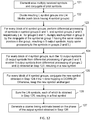
- FIG. 12 is a flowchart illustrating an exemplary embodiment for determining a coarse timing estimate in step 111 of FIG. 11 .
- the received symbols and a conjugate of pilot symbols are element-wise multiplied to create L symbol groups.
- the L symbol groups are divided into L/4 blocks, each block having four symbol groups (0, 1, 2, 3).
- the baseband processor performs differential processing of symbols in symbol groups 0 and 1, and symbol groups 2 and 3, respectively.
- each symbol in group 0 is multiplied by the conjugate of the symbol in group 1 having the same relative position in the group to produce an output symbol
- each symbol in group 2 is multiplied by the conjugate of the symbol in group 3 having the same relative position in the group to produce an output symbol.
- the output symbols obtained from the differential processing are summed, resulting in a new symbol.
- the new symbol is conjugated when the 1-tone hopping is DOWN-UP, otherwise the symbol is kept unchanged.
- the 1-tone hopping is defined as DOWN-UP when a tone index decreases from symbol group 0 to symbol group 1 due to hopping, and the tone index increases from symbol group 2 to symbol group 3 due to hopping.
- the L/4 symbols are summed after conjugating, resulting in a final symbol.
- the coarse timing estimate is generated based on a phase of the final symbol.
- the 1-tone hopping in NPRACH frequency hopping enables a large ToA estimation range (and thus supports large cell size).
- the coarse ToA estimation can be performed based on the 1-tone hopping.
- the two single-subcarrier hoppings are mirrored, i.e., if the first hopping is "UP”, the second hopping is "DOWN", and vice versa. Therefore, it is possible to utilize this mirroring to cancel the effect of residual CFO in the coarse timing estimate. In other words, the residual CFO estimate performed in Step 1 does not need to be invoked for this coarse timing estimate. Take symbol group 0, 1, 2, and 3 for example.
- Fine ToA Estimation based on 6-tone hopping and/or pseudo-random hopping.
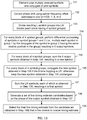
- FIG. 13 is a flowchart illustrating a first exemplary embodiment for determining a fine timing estimate in step 112 of FIG. 11 .
- the coarse timing estimate can be refined by utilizing larger hopping distances in NPRACH that include both 6-tone hopping and pseudo-random hopping. This exemplary embodiment is only based on 6-tone hopping.
- the residual CFO estimated in Step 1 is first utilized to correct the phase shift due to residual CFO.
- the received symbols and a conjugate of pilot symbols are element-wise multiplied to create L symbol groups.
- the phase shift is corrected using the residual CFO estimate.
- the L symbol groups are divided into L/4 blocks, each block having four symbol groups (0, 1, 2, 3).
- the baseband processor performs differential processing of symbols in symbol groups 1 and 2, wherein each symbol in group 1 is multiplied by the conjugate of the symbol in group 2 having the same relative position in the group to produce an output symbol.
- the output symbols obtained from the differential processing are summed, resulting in a new symbol.
- the new symbol is conjugated when the 6-tone hopping is UP, otherwise keeping the symbol unchanged.
- the 6-tone hopping is defined as UP when a tone index increases from symbol group 1 to symbol group 2 due to hopping.
- the L/4 symbols are summed after conjugating, resulting in a final symbol.
- a set of fine timing estimate candidates is generated based on a phase of the final symbol.
- the fine timing estimate is selected from the candidate set that is closest to the coarse timing estimate.
- the residual CFO estimate may be utilized to correct the phase shift as follows:
- M 6 fine timing estimate candidates from 6-tone hopping
- symbol group 0 and 3 are however more distant in the time domain and thus their utilization is more sensitive to Doppler and remaining CFO after residual CFO correction. Therefore, it is a tradeoff between energy gain and robustness to Doppler and remaining CFO.
- D ⁇ arg min n D fine ⁇ n ⁇ D coarse ⁇
- FIG. 14 is a flowchart illustrating a second exemplary embodiment for determining a fine timing estimate in step 112 of FIG. 11 .
- the received symbols and a conjugate of pilot symbols are element-wise multiplied to create L symbol groups.
- the phase shift is corrected using the residual CFO estimate.
- the L symbol groups are divided into L/4 blocks, each block having four symbol groups (0, 1, 2, 3).
- the baseband processor performs differential processing of symbols in symbol groups 1 and 2, and symbol groups 0 and 3, respectively.
- Each symbol in group 1 is multiplied by the conjugate of the symbol in group 2 having the same relative position in the group, and each symbol in group 0 is multiplied by the conjugate of the symbol in group 3 having the same relative position in the group to produce output symbols.
- the output symbols obtained from the differential processing are summed, resulting in a new symbol.
- the new symbol is conjugated when the 6-tone hopping is UP, otherwise the symbol is kept unchanged.
- the 6-tone hopping is defined as UP when a tone index increases from symbol group 1 to symbol group 2 due to hopping, wherein when the 6-tone hopping is UP for symbol groups 1 and 2, the hopping is also UP for symbol groups 0 and 3.
- the L/4 symbols are summed after conjugating, resulting in a final symbol.
- a set of fine timing estimate candidates is generated based on a phase of the final symbol.
- the fine timing estimate from the candidate set is selected that is closest to the coarse timing estimate.
- a threshold-based approach may be utilized for the detection of NPRACH in NB-IoT.
- One possible choice of the statistic used to compare against the detection threshold is I ( ⁇ *, D *).
- I ( ⁇ ⁇ * ,D *) is not readily available. But it can be calculated based on the estimates of residual CFO and ToA. Alternatively, any reasonable statistic obtained along the estimation may be used for this purpose. For simplicity, the same notation " I ( ⁇ ⁇ * ,D *)" is utilized to refer to any of these possible metrics.
- the detection threshold is usually chosen such that the false alarm rate is below some target. With the detection threshold selected, the systems can measure the miss detection probability.
- the detection threshold may be set according to a noise power estimate.
- the detection threshold is not set dependent on the noise power estimate, but the detection metric I ( ⁇ ⁇ * ,D *) is normalized according to a noise power estimate.
- FIG. 15 is a simplified block diagram of a baseband processor of a receiver in an exemplary embodiment of the present disclosure.
- a radio network node such as a base station 151 is shown to include an RF transmitter 152, which utilizes an antenna system 153 to transmit downlink signals and data to UEs.
- a receiver front end 154 receives uplink radio signals and data from the UE's through the antenna system and provides the signals to a baseband processor 155.
- the base station may also include a timing and control unit 156 and a core network interface unit 157.
- the baseband processor 155 may include a processing circuit 158, a memory 159, and a scheduler 160.
- the memory may store computer program instructions that, when executed by the processing circuit, implement the algorithms described above.
- the processing circuit may include an FFT processor 161, a ToA estimation unit 162, a residual CFO estimation unit 163, a statistical unit 164 configured to calculate the preamble detection statistic, and a preamble detector 165 configured to compare the statistic to the preamble detection threshold.
Landscapes
- Engineering & Computer Science (AREA)
- Signal Processing (AREA)
- Computer Networks & Wireless Communication (AREA)
- Power Engineering (AREA)
- Mobile Radio Communication Systems (AREA)
Claims (12)
- Verfahren in einem Basisbandprozessor (155) eines Empfängers zum Durchführen von Präambel-Erkennung und Schätzung einer Ankunftszeit, ToA, für eine Einton-Frequenzsprung-Direktzugriffspräambel, wobei das Verfahren umfasst:Verarbeiten (11) eines empfangenen Signals mit einer schnellen Fourier-Transformation, FFT, und Identifizieren von logischen Tönen; undfür jeden logischen Ton:Auslesen (12) von empfangenen Symbolen;Bestimmen (13) einer ToA-Schätzung und einer Schätzung eines Rest-Trägerfrequenzoffsets, CFO;Bilden (14) einer Statistik basierend auf der ToA-Schätzung und der Rest-CFO-Schätzung;Vergleichen (15, 16) der Statistik mit einer Präambel-Schwelle; und,wenn die Statistik höher als oder gleich wie die Schwelle ist, Bestimmen, dass eine Präambel vorhanden ist (17), und Verwenden der ToA-Schätzung durch den Basisbandprozessor des Empfängers für einen Taktvorstellungsbefehl.
- Verfahren nach Anspruch 1, wobei das Bestimmen (13) einer ToA-Schätzung und einer Rest-CFO-Schätzung ein gemeinsames Bestimmen der ToA-Schätzung und der Rest-CFO-Schätzung umfasst, und wobei das gemeinsame Bestimmen der ToA-Schätzung und der Rest-CFO-Schätzung umfasst:elementweises Multiplizieren (51) der empfangenen Symbole und eines Konjugats von Pilotsymbolen zum Erzeugen von L Symbolgruppen;Teilen (52) der L Symbolgruppen in L/Q Blöcke, wobei jeder Block Q Symbolgruppen aufweist;Bilden (53) eines zweidimensionalen Arrays mit Nullwert-Elementen für jeden Block von Q Symbolgruppen;Aktualisieren (54), wenn die Position eines Elements im zweidimensionalen Array der Position eines Symbols in den Q Symbolgruppen in einem zweidimensionalen Zeit-Frequenz-Gitter entspricht, des Nullwert-Elements auf den Wert des Symbols;Durchführen (55) einer zweidimensionalen FFT, um eine zweidimensionale FFT-Ausgabe zu erhalten, für jedes zweidimensionale Array;nichtkohärentes Kombinieren (56) von L/Q zweidimensionalen FFT-Ausgaben, um ein zweidimensionales Array zu erhalten;Ermitteln (57) der Position des größten Wertes im zweidimensionalen Array; undUmsetzen (58) der Position des größten Wertes im zweidimensionalen Array in die ToA- und Rest-CFO-Schätzungen.
- Verfahren nach Anspruch 1, wobei das Bestimmen einer ToA-Schätzung und einer Rest-CFO-Schätzung ein getrenntes Bestimmen (61) einer Rest-CFO-Schätzung und anschließendes Bestimmen (62) der ToA-Schätzung umfasst.
- Verfahren nach Anspruch 3, wobei das Bestimmen (61) der Rest-CFO-Schätzung umfasst:elementweises Multiplizieren (71) der empfangenen Symbole und eines Konjugats von Pilotsymbolen zum Erzeugen von L Symbolgruppen;Teilen (72) der L Symbolgruppen in L/Q Blöcke, wobei jeder Block Q Symbolgruppen aufweist;Bilden (73) eines zweidimensionalen Arrays mit Nullwert-Elementen für jeden Block von Q Symbolgruppen;Aktualisieren (74), wenn die Position eines Elements im zweidimensionalen Array der Position eines Symbols in den Q Symbolgruppen in einem zweidimensionalen Zeit-Frequenz-Gitter entspricht, des Nullwert-Elements auf den Wert des Symbols;Durchführen (75) einer eindimensionalen FFT, um eine eindimensionale FFT-Ausgabe zu erhalten, für jede Zeile im zweidimensionalen Array;nichtkohärentes Kombinieren (76) aller eindimensionalen FFT-Ausgaben, um ein eindimensionales Array zu erhalten;Ermitteln (77) der Position des größten Wertes im eindimensionalen Array; undUmsetzen (78) der Position des größten Wertes im eindimensionalen Array in die Rest-CFO-Schätzung.
- Verfahren nach Anspruch 3, wobei das Bestimmen (61) der Rest-CFO-Schätzung umfasst:elementweises Multiplizieren (91) der empfangenen Symbole und eines Konjugats von Pilotsymbolen zum Erzeugen von L Symbolgruppen;Teilen (92) der L Symbolgruppen in L/4 Blöcke, wobei jeder Block vier Symbolgruppen (0, 1, 2, 3) aufweist;Durchführen von differenzieller Verarbeitung (93) von Symbolen in den Symbolgruppen 0 und 1 bzw. den Symbolgruppen 2 und 3 für jeden Block von vier Symbolgruppen, wobei jedes Symbol in Gruppe 0 mit dem Konjugat des Symbols in Gruppe 1 multipliziert wird, das die gleiche relative Position in der Gruppe aufweist, um ein Ausgangssymbol zu erzeugen, und jedes Symbol in Gruppe 2 mit dem Konjugat des Symbols in Gruppe 3 multipliziert wird, das die gleiche relative Position der Gruppe aufweist, um ein Ausgangssymbol zu erzeugen;Summieren (94) der aus der differenziellen Verarbeitung erhaltenen Ausgangssymbole für jeden Block von vier Symbolgruppen, was zu einem neuen Symbol führt;Summieren (95) der L/4 neuen Symbole, die durch das Summieren der Produkte erhalten werden, was zu einem letzten Symbol führt; undSchätzen (96) des Rest-CFOs basierend auf einer Phase des letzten Symbols.
- Verfahren nach Anspruch 3, wobei das Bestimmen (62) der ToA-Schätzung umfasst:Bestimmen (111) einer groben Taktschätzung basierend auf 1-Ton-Springen; undBestimmen (112) einer feinen Taktschätzung basierend auf 6-Ton- und/oder Zufallsspringen.
- Verfahren nach Anspruch 6, wobei das Bestimmen (111) der groben Taktschätzung umfasst:elementweises Multiplizieren (121) der empfangenen Symbole und eines Konjugats von Pilotsymbolen zum Erzeugen von L Symbolgruppen;Teilen (122) der L Symbolgruppen in L/4 Blöcke, wobei jeder Block vier Symbolgruppen (0, 1, 2, 3) aufweist;Durchführen von differenzieller Verarbeitung (123) von Symbolen in den Symbolgruppen 0 und 1 bzw. den Symbolgruppen 2 und 3 für jeden Block von vier Symbolgruppen, wobei jedes Symbol in Gruppe 0 mit dem Konjugat des Symbols in Gruppe 1 multipliziert wird, das die gleiche relative Position in der Gruppe aufweist, um ein Ausgangssymbol zu bilden, und jedes Symbol in Gruppe 2 mit dem Konjugat des Symbols in Gruppe 3 multipliziert wird, das die gleiche relative Position der Gruppe aufweist, um ein Ausgangssymbol zu erzeugen;Summieren (124) der aus der differenziellen Verarbeitung erhaltenen Ausgangssymbole für jeden Block von vier Symbolgruppen, was zu einem neuen Symbol führt;Konjugieren (125) des neuen Symbols für jeden Block von vier Symbolen, wenn das 1-Ton-Springen DOWN-UP ist, andernfalls Unveränderthalten des Symbols, wobei das 1-Ton-Springen DOWN-UP ist, wenn ein Ton-Index infolge Springens von Symbolgruppe 0 auf Symbolgruppe 1 abfällt, und der Ton-Index infolge Springens von Symbolgruppe 2 auf Symbolgruppe 3 ansteigt;Summieren (126) der L/4 Symbole nach dem Konjugieren, was zu einem letzten Symbol führt; undErzeugen (127) der feinen ToA-Schätzung basierend auf einer Phase des letzten Symbols.
- Verfahren nach Anspruch 6, wobei das Bestimmen (112) der feinen Taktschätzung umfasst:elementweises Multiplizieren (131) der empfangenen Symbole und eines Konjugats von Pilotsymbolen zum Erzeugen von L Symbolgruppen;Korrigieren (132) einer Phasenverschiebung unter Verwendung der Rest-CFO-Schätzung;Teilen (133) der L Symbolgruppen in L/4 Blöcke, wobei jeder Block vier Symbolgruppen (0, 1, 2, 3) aufweist;Durchführen von differenzieller Verarbeitung (134) von Symbolen in den Symbolgruppen 1 und 2 für jeden Block von vier Symbolgruppen, wobei jedes Symbol in Gruppe 1 mit dem Konjugat des Symbols in Gruppe 2 multipliziert wird, das die gleiche relative Position in der Gruppe aufweist, um ein Ausgangssymbol zu erzeugen,Summieren (135) der aus der differenziellen Verarbeitung erhaltenen Ausgangssymbole für jeden Block von vier Symbolgruppen, was zu einem neuen Symbol führt;Konjugieren (136) des neuen Symbols für jeden Block von vier Symbolen, wenn das 6-Ton-Springen UP ist, andernfalls Unveränderthalten des Symbols, wobei das 6-Ton-Springen UP ist, wenn ein Ton-Index infolge Springens von Symbolgruppe 1 auf Symbolgruppe 2 ansteigt;Summieren (137) der L/4 Symbole nach dem Konjugieren, was zu einem letzten Symbol führt;Erzeugen (138) eines Satzes von Kandidaten feiner Taktschätzungen basierend auf einer Phase des letzten Symbols; undAuswählen (139) der feinen Taktschätzung aus dem Kandidatensatz, der der groben Taktschätzung am nächsten ist.
- Empfänger (154, 155) zum Durchführen von Präambel-Erkennung und Schätzung einer Ankunftszeit, ToA, für eine Einton-Frequenzsprung-Direktzugriffspräambel, wobei der Empfänger umfasst:ein Empfänger-Frontend (154) zum Empfangen eines Hochfrequenz, HF,-Signals; undeinen Basisbandprozessor (155) zum Verarbeiten des HF-Signals, wobei der Basisbandprozessor eine Verarbeitungsschaltung (158) umfasst, die konfiguriert ist zum:Verarbeiten (161) des empfangenen Signals mit einer schnellen Fourier-Transformation, FFT, und Identifizieren von logischen Tönen; undfür jeden logischen Ton:Auslesen von empfangenen Symbolen;Bestimmen einer ToA-Schätzung (162) und einer Schätzung eines Rest-Trägerfrequenzoffsets, CFO;Bilden einer Statistik (164) basierend auf der ToA-Schätzung und der Rest-CFO-Schätzung;Vergleichen (165) der Statistik mit einer Präambel-Schwelle; und,wenn die Statistik höher als oder gleich wie die Schwelle ist, Bestimmen, dass eine Präambel vorhanden ist, und Verwenden der ToA-Schätzung für einen Taktvorstellungsbefehl.
- Empfänger nach Anspruch 9, wobei die Verarbeitungsschaltung (158) eine ToA-Schätzeinheit (162) umfasst, die zum gemeinsamen Bestimmen der ToA-Schätzung und der Rest-CFO-Schätzung konfiguriert ist.
- Empfänger nach Anspruch 9, wobei die Verarbeitungsschaltung (158) eine Rest-CFO-Schätzeinheit (163) und eine ToA-Schätzeinheit (162) umfasst, wobei die Rest-CFO-Schätzeinheit und die ToA-Schätzeinheit zum getrennten Bestimmen der Rest-CFO-Schätzung und anschließenden Bestimmen der ToA-Schätzung konfiguriert sind.
- Empfänger nach Anspruch 11, wobei die ToA-Schätzeinheit (162) zum Bestimmen der ToA durch Bestimmen (111) einer groben Taktschätzung und anschließendes Bestimmen (112) einer feinen Taktschätzung konfiguriert ist, und wobei die ToA-Schätzeinheit (162) zum Bestimmen (111) der groben Taktschätzung basierend auf 1-Ton-Springen und Bestimmen (112) der feinen Taktschätzung basierend auf 6-Ton- und/oder Zufallsspringen konfiguriert ist.
Applications Claiming Priority (2)
| Application Number | Priority Date | Filing Date | Title |
|---|---|---|---|
| US15/148,691 US10148461B2 (en) | 2016-05-06 | 2016-05-06 | Preamble detection and time-of-arrival estimation for a single-tone frequency hopping random access preamble |
| PCT/IB2017/052291 WO2017191522A1 (en) | 2016-05-06 | 2017-04-21 | Preamble detection and time-of-arrival estimation for a single- tone frequency hopping random access preamble |
Publications (2)
| Publication Number | Publication Date |
|---|---|
| EP3453218A1 EP3453218A1 (de) | 2019-03-13 |
| EP3453218B1 true EP3453218B1 (de) | 2020-06-03 |
Family
ID=58692535
Family Applications (1)
| Application Number | Title | Priority Date | Filing Date |
|---|---|---|---|
| EP17722507.5A Active EP3453218B1 (de) | 2016-05-06 | 2017-04-21 | Präambelerkennung und ankunftszeitschätzung für ein einzel-ton-frequenz-hopping-direkt-zugriffspräambel |
Country Status (6)
| Country | Link |
|---|---|
| US (2) | US10148461B2 (de) |
| EP (1) | EP3453218B1 (de) |
| CN (1) | CN109076609B (de) |
| IL (1) | IL262371B (de) |
| RU (1) | RU2698918C9 (de) |
| WO (1) | WO2017191522A1 (de) |
Families Citing this family (24)
| Publication number | Priority date | Publication date | Assignee | Title |
|---|---|---|---|---|
| US10148461B2 (en) * | 2016-05-06 | 2018-12-04 | Telefonaktiebolaget L M Ericsson (Publ) | Preamble detection and time-of-arrival estimation for a single-tone frequency hopping random access preamble |
| CN108633092B (zh) * | 2017-03-24 | 2023-04-18 | 中兴通讯股份有限公司 | 一种信息发送方法、装置及终端 |
| US10798734B2 (en) * | 2017-03-28 | 2020-10-06 | Centre Of Excellence In Wireless Technology | Method and wireless device for transmitting RACH preamble in wireless communication network |
| KR102312572B1 (ko) * | 2017-06-21 | 2021-10-14 | 삼성전자 주식회사 | 무선 통신 시스템에서 업링크 동기를 수행하는 방법 |
| KR102356442B1 (ko) * | 2017-11-13 | 2022-01-28 | 한국전자통신연구원 | 랜덤 액세스용 프리엠블의 타이밍 추정 방법, 랜덤 액세스용 프리엠블 검출 방법 및 랜덤 액세스용 프리엠블 검출 장치 |
| WO2019098681A1 (ko) | 2017-11-14 | 2019-05-23 | 엘지전자 주식회사 | 시간 분할 듀플렉싱을 지원하는 협대역 iot 시스템에서 랜덤 액세스 프리앰블을 전송하기 위한 방법 및 이를 위한 장치 |
| WO2019095322A1 (zh) * | 2017-11-17 | 2019-05-23 | 华为技术有限公司 | 一种通信方法及装置 |
| EP3732926B1 (de) * | 2017-12-29 | 2023-09-20 | Nokia Technologies Oy | Verfahren und vorrichtung zur nprach-detektion |
| CN113708911B (zh) * | 2018-05-10 | 2023-04-07 | 中兴通讯股份有限公司 | 信号的发送方法及装置、存储介质、电子装置 |
| TWI666947B (zh) * | 2018-05-16 | 2019-07-21 | Yuan Ze University | 多用戶隨機存取訊號之分析方法 |
| WO2019222883A1 (zh) * | 2018-05-21 | 2019-11-28 | 华为技术有限公司 | 通信方法、通信设备和网络设备 |
| CN108924943B (zh) * | 2018-07-09 | 2022-02-22 | 重庆邮电大学 | 基于窄带物联网随机接入信道的最大相关估计检测方法 |
| CN110740106B (zh) * | 2018-07-19 | 2021-07-20 | 大唐移动通信设备有限公司 | 一种频偏估计方法及装置 |
| EP3611855B1 (de) * | 2018-08-16 | 2020-10-07 | Shenzhen Goodix Technology Co., Ltd. | Erkennung von falsch-positiven in einem nb-iot-downlink-steuerkanal basierend auf effektiver und geplanter coderate |
| CN110891036B (zh) * | 2018-09-07 | 2020-12-04 | 大唐移动通信设备有限公司 | 一种nprach定时同步估计的方法及装置 |
| KR102174653B1 (ko) * | 2018-10-24 | 2020-11-05 | 연세대학교 산학협력단 | 무선 통신 시스템의 랜덤 액세스 장치 및 방법 |
| CN109379151B (zh) * | 2018-11-02 | 2022-07-29 | 京信网络系统股份有限公司 | 时延估计方法、装置及系统 |
| CN114079606B (zh) * | 2020-08-17 | 2023-10-24 | 海能达通信股份有限公司 | 一种空口时间对齐方法、装置及电子设备 |
| WO2022053552A1 (en) | 2020-09-11 | 2022-03-17 | Université Du Luxembourg | Detection of single-tone frequency hopping random access preamble |
| US11627531B2 (en) * | 2020-11-29 | 2023-04-11 | Silicon Laboratories Inc. | WLAN receiver early power down based on center frequency offset detection |
| CN112532552B (zh) * | 2021-02-09 | 2021-06-18 | 北京思凌科半导体技术有限公司 | 采样频率偏差估计方法、装置、存储介质及电子设备 |
| US11671933B2 (en) | 2021-02-16 | 2023-06-06 | Lockheed Martin Corporation | Random-access endpoint communication handling for satellite-transported communication links |
| CN115913858A (zh) * | 2022-10-25 | 2023-04-04 | 易科奇通信技术(深圳)有限公司 | 时延估计方法、装置、接收设备和可读存储介质 |
| TWI915037B (zh) | 2024-10-22 | 2026-02-11 | 瑞昱半導體股份有限公司 | 無線通訊裝置及控制實體層封包接收方法 |
Family Cites Families (12)
| Publication number | Priority date | Publication date | Assignee | Title |
|---|---|---|---|---|
| US5898684A (en) * | 1996-12-19 | 1999-04-27 | Stanford Telecommunications, Inc. | TDMA burst receiver |
| US6493380B1 (en) * | 1999-05-28 | 2002-12-10 | Nortel Networks Limited | System and method for estimating signal time of arrival |
| US6510186B1 (en) * | 1999-05-28 | 2003-01-21 | Nortel Networks Limited | Signal time of arrival estimation method and system |
| KR20050040988A (ko) * | 2003-10-29 | 2005-05-04 | 삼성전자주식회사 | 주파수도약 직교 주파수 분할 다중화 기반 셀룰러시스템을 위한 통신방법 |
| KR100659937B1 (ko) * | 2004-10-12 | 2006-12-21 | 삼성전자주식회사 | 무선통신시스템에서 셀 인식 및 하향링크 동기를 획득하기위한 장치 및 방법 |
| WO2007001222A1 (en) * | 2005-06-29 | 2007-01-04 | Telefonaktiebolaget Lm Ericsson (Publ) | Evaluation of random access preamble codes |
| US7675888B2 (en) * | 2005-09-14 | 2010-03-09 | Texas Instruments Incorporated | Orthogonal frequency division multiplexing access (OFDMA) ranging |
| US8023595B2 (en) * | 2007-08-17 | 2011-09-20 | Ntt Docomo, Inc. | Method and system of time-of-arrival estimation for ultra wideband multi-band orthogonal frequency division multiplexing signals |
| US8842571B1 (en) * | 2013-02-22 | 2014-09-23 | Marvell International Ltd. | Method and apparatus for determining a time of arrival of a data unit |
| EP3155777B1 (de) | 2014-06-11 | 2021-01-06 | Telefonaktiebolaget LM Ericsson (publ) | Verarbeitung von direktzugriffspräambelsequenzen |
| US20170265230A1 (en) * | 2016-03-14 | 2017-09-14 | Futurewei Technologies, Inc. | System and Method for Random Access Backoffs |
| US10148461B2 (en) * | 2016-05-06 | 2018-12-04 | Telefonaktiebolaget L M Ericsson (Publ) | Preamble detection and time-of-arrival estimation for a single-tone frequency hopping random access preamble |
-
2016
- 2016-05-06 US US15/148,691 patent/US10148461B2/en active Active
-
2017
- 2017-04-21 CN CN201780027755.2A patent/CN109076609B/zh active Active
- 2017-04-21 RU RU2018143007A patent/RU2698918C9/ru active
- 2017-04-21 EP EP17722507.5A patent/EP3453218B1/de active Active
- 2017-04-21 WO PCT/IB2017/052291 patent/WO2017191522A1/en not_active Ceased
-
2018
- 2018-10-14 IL IL262371A patent/IL262371B/en active IP Right Grant
- 2018-12-04 US US16/209,596 patent/US10673653B2/en active Active
Non-Patent Citations (1)
| Title |
|---|
| None * |
Also Published As
| Publication number | Publication date |
|---|---|
| RU2698918C9 (ru) | 2019-10-08 |
| CN109076609B (zh) | 2021-04-27 |
| RU2698918C1 (ru) | 2019-09-02 |
| EP3453218A1 (de) | 2019-03-13 |
| US20170324587A1 (en) | 2017-11-09 |
| IL262371B (en) | 2019-03-31 |
| CN109076609A (zh) | 2018-12-21 |
| US10673653B2 (en) | 2020-06-02 |
| US10148461B2 (en) | 2018-12-04 |
| WO2017191522A1 (en) | 2017-11-09 |
| US20190116066A1 (en) | 2019-04-18 |
Similar Documents
| Publication | Publication Date | Title |
|---|---|---|
| US10673653B2 (en) | Preamble detection and time-of-arrival estimation for a single-tone frequency hopping random access preamble | |
| Lin et al. | Random access preamble design and detection for 3GPP narrowband IoT systems | |
| US8254344B2 (en) | Reference sequence construction for fast cell search | |
| US11812416B2 (en) | Coherent detection of large physical random access control channel (PRACH) delays | |
| US8320360B2 (en) | Method and apparatus for fast cell search | |
| US7742392B2 (en) | Blind carrier frequency offset estimator based on single-OFDM-symbol PN ranging code in multi-user OFDMA uplink | |
| US9398617B2 (en) | Methods and apparatus for random access in a communication system | |
| US9007887B2 (en) | Wireless communication system and communication method therefor | |
| US20060039451A1 (en) | Method and apparatus for fast cell search | |
| US20150365975A1 (en) | Processing of Random Access Preamble Sequences | |
| CN108924943B (zh) | 基于窄带物联网随机接入信道的最大相关估计检测方法 | |
| Schreiber et al. | 5G new radio physical random access preamble design | |
| EP2115904A1 (de) | Pröambelentwurf für synchronisation und zellensuche | |
| CN105530701B (zh) | 一种干扰源定位方法及装置 | |
| US8374452B2 (en) | Method and apparatus for fast cell search | |
| TWI435577B (zh) | 在通訊系統中傳送測距前置碼至基地台的使用者終端及方法 | |
| WO2018064909A1 (zh) | 干扰源小区定位方法和装置以及对应的基站 | |
| US8315153B2 (en) | Wireless communications equipments with function of detecting random access signal, wireless communications systems with function of detecting random access signal and method of random access signal detection | |
| WO2022053552A1 (en) | Detection of single-tone frequency hopping random access preamble | |
| KR20050025897A (ko) | 초기 레인징 신호 검출 방법 및 초기 레인징 신호 생성 방법 | |
| US20150188746A1 (en) | Method and system for performing initial ranging in cognitive radio network | |
| CN119520200B (zh) | 一种面向航空通信的随机接入前导检测方法 | |
| Luo et al. | TOA estimation scheme based on CNN for b-IFDM-based preambles | |
| WO2026020306A1 (en) | Rach detection and ta estimation algorithm for prach coverage enhancement | |
| Yang et al. | An efficient ToA estimation technique based on phase correction for 5G mMTC system |
Legal Events
| Date | Code | Title | Description |
|---|---|---|---|
| STAA | Information on the status of an ep patent application or granted ep patent |
Free format text: STATUS: UNKNOWN |
|
| STAA | Information on the status of an ep patent application or granted ep patent |
Free format text: STATUS: THE INTERNATIONAL PUBLICATION HAS BEEN MADE |
|
| PUAI | Public reference made under article 153(3) epc to a published international application that has entered the european phase |
Free format text: ORIGINAL CODE: 0009012 |
|
| STAA | Information on the status of an ep patent application or granted ep patent |
Free format text: STATUS: REQUEST FOR EXAMINATION WAS MADE |
|
| 17P | Request for examination filed |
Effective date: 20181206 |
|
| AK | Designated contracting states |
Kind code of ref document: A1 Designated state(s): AL AT BE BG CH CY CZ DE DK EE ES FI FR GB GR HR HU IE IS IT LI LT LU LV MC MK MT NL NO PL PT RO RS SE SI SK SM TR |
|
| AX | Request for extension of the european patent |
Extension state: BA ME |
|
| STAA | Information on the status of an ep patent application or granted ep patent |
Free format text: STATUS: EXAMINATION IS IN PROGRESS |
|
| 17Q | First examination report despatched |
Effective date: 20190517 |
|
| DAV | Request for validation of the european patent (deleted) | ||
| DAX | Request for extension of the european patent (deleted) | ||
| GRAP | Despatch of communication of intention to grant a patent |
Free format text: ORIGINAL CODE: EPIDOSNIGR1 |
|
| STAA | Information on the status of an ep patent application or granted ep patent |
Free format text: STATUS: GRANT OF PATENT IS INTENDED |
|
| INTG | Intention to grant announced |
Effective date: 20191206 |
|
| RIN1 | Information on inventor provided before grant (corrected) |
Inventor name: ADHIKARY, ANSUMAN Inventor name: LIN, XINGQIN Inventor name: WANG, YI-PIN ERIC |
|
| GRAS | Grant fee paid |
Free format text: ORIGINAL CODE: EPIDOSNIGR3 |
|
| GRAA | (expected) grant |
Free format text: ORIGINAL CODE: 0009210 |
|
| STAA | Information on the status of an ep patent application or granted ep patent |
Free format text: STATUS: THE PATENT HAS BEEN GRANTED |
|
| AK | Designated contracting states |
Kind code of ref document: B1 Designated state(s): AL AT BE BG CH CY CZ DE DK EE ES FI FR GB GR HR HU IE IS IT LI LT LU LV MC MK MT NL NO PL PT RO RS SE SI SK SM TR |
|
| REG | Reference to a national code |
Ref country code: GB Ref legal event code: FG4D |
|
| REG | Reference to a national code |
Ref country code: CH Ref legal event code: EP Ref country code: AT Ref legal event code: REF Ref document number: 1278439 Country of ref document: AT Kind code of ref document: T Effective date: 20200615 |
|
| REG | Reference to a national code |
Ref country code: DE Ref legal event code: R096 Ref document number: 602017017674 Country of ref document: DE |
|
| REG | Reference to a national code |
Ref country code: LT Ref legal event code: MG4D |
|
| PG25 | Lapsed in a contracting state [announced via postgrant information from national office to epo] |
Ref country code: LT Free format text: LAPSE BECAUSE OF FAILURE TO SUBMIT A TRANSLATION OF THE DESCRIPTION OR TO PAY THE FEE WITHIN THE PRESCRIBED TIME-LIMIT Effective date: 20200603 Ref country code: FI Free format text: LAPSE BECAUSE OF FAILURE TO SUBMIT A TRANSLATION OF THE DESCRIPTION OR TO PAY THE FEE WITHIN THE PRESCRIBED TIME-LIMIT Effective date: 20200603 Ref country code: GR Free format text: LAPSE BECAUSE OF FAILURE TO SUBMIT A TRANSLATION OF THE DESCRIPTION OR TO PAY THE FEE WITHIN THE PRESCRIBED TIME-LIMIT Effective date: 20200904 Ref country code: NO Free format text: LAPSE BECAUSE OF FAILURE TO SUBMIT A TRANSLATION OF THE DESCRIPTION OR TO PAY THE FEE WITHIN THE PRESCRIBED TIME-LIMIT Effective date: 20200903 Ref country code: SE Free format text: LAPSE BECAUSE OF FAILURE TO SUBMIT A TRANSLATION OF THE DESCRIPTION OR TO PAY THE FEE WITHIN THE PRESCRIBED TIME-LIMIT Effective date: 20200603 |
|
| REG | Reference to a national code |
Ref country code: NL Ref legal event code: MP Effective date: 20200603 |
|
| PG25 | Lapsed in a contracting state [announced via postgrant information from national office to epo] |
Ref country code: RS Free format text: LAPSE BECAUSE OF FAILURE TO SUBMIT A TRANSLATION OF THE DESCRIPTION OR TO PAY THE FEE WITHIN THE PRESCRIBED TIME-LIMIT Effective date: 20200603 Ref country code: LV Free format text: LAPSE BECAUSE OF FAILURE TO SUBMIT A TRANSLATION OF THE DESCRIPTION OR TO PAY THE FEE WITHIN THE PRESCRIBED TIME-LIMIT Effective date: 20200603 Ref country code: HR Free format text: LAPSE BECAUSE OF FAILURE TO SUBMIT A TRANSLATION OF THE DESCRIPTION OR TO PAY THE FEE WITHIN THE PRESCRIBED TIME-LIMIT Effective date: 20200603 Ref country code: BG Free format text: LAPSE BECAUSE OF FAILURE TO SUBMIT A TRANSLATION OF THE DESCRIPTION OR TO PAY THE FEE WITHIN THE PRESCRIBED TIME-LIMIT Effective date: 20200903 |
|
| REG | Reference to a national code |
Ref country code: AT Ref legal event code: MK05 Ref document number: 1278439 Country of ref document: AT Kind code of ref document: T Effective date: 20200603 |
|
| PG25 | Lapsed in a contracting state [announced via postgrant information from national office to epo] |
Ref country code: AL Free format text: LAPSE BECAUSE OF FAILURE TO SUBMIT A TRANSLATION OF THE DESCRIPTION OR TO PAY THE FEE WITHIN THE PRESCRIBED TIME-LIMIT Effective date: 20200603 Ref country code: NL Free format text: LAPSE BECAUSE OF FAILURE TO SUBMIT A TRANSLATION OF THE DESCRIPTION OR TO PAY THE FEE WITHIN THE PRESCRIBED TIME-LIMIT Effective date: 20200603 |
|
| PG25 | Lapsed in a contracting state [announced via postgrant information from national office to epo] |
Ref country code: CZ Free format text: LAPSE BECAUSE OF FAILURE TO SUBMIT A TRANSLATION OF THE DESCRIPTION OR TO PAY THE FEE WITHIN THE PRESCRIBED TIME-LIMIT Effective date: 20200603 Ref country code: IT Free format text: LAPSE BECAUSE OF FAILURE TO SUBMIT A TRANSLATION OF THE DESCRIPTION OR TO PAY THE FEE WITHIN THE PRESCRIBED TIME-LIMIT Effective date: 20200603 Ref country code: RO Free format text: LAPSE BECAUSE OF FAILURE TO SUBMIT A TRANSLATION OF THE DESCRIPTION OR TO PAY THE FEE WITHIN THE PRESCRIBED TIME-LIMIT Effective date: 20200603 Ref country code: ES Free format text: LAPSE BECAUSE OF FAILURE TO SUBMIT A TRANSLATION OF THE DESCRIPTION OR TO PAY THE FEE WITHIN THE PRESCRIBED TIME-LIMIT Effective date: 20200603 Ref country code: SM Free format text: LAPSE BECAUSE OF FAILURE TO SUBMIT A TRANSLATION OF THE DESCRIPTION OR TO PAY THE FEE WITHIN THE PRESCRIBED TIME-LIMIT Effective date: 20200603 Ref country code: AT Free format text: LAPSE BECAUSE OF FAILURE TO SUBMIT A TRANSLATION OF THE DESCRIPTION OR TO PAY THE FEE WITHIN THE PRESCRIBED TIME-LIMIT Effective date: 20200603 Ref country code: EE Free format text: LAPSE BECAUSE OF FAILURE TO SUBMIT A TRANSLATION OF THE DESCRIPTION OR TO PAY THE FEE WITHIN THE PRESCRIBED TIME-LIMIT Effective date: 20200603 Ref country code: PT Free format text: LAPSE BECAUSE OF FAILURE TO SUBMIT A TRANSLATION OF THE DESCRIPTION OR TO PAY THE FEE WITHIN THE PRESCRIBED TIME-LIMIT Effective date: 20201006 |
|
| PG25 | Lapsed in a contracting state [announced via postgrant information from national office to epo] |
Ref country code: SK Free format text: LAPSE BECAUSE OF FAILURE TO SUBMIT A TRANSLATION OF THE DESCRIPTION OR TO PAY THE FEE WITHIN THE PRESCRIBED TIME-LIMIT Effective date: 20200603 Ref country code: PL Free format text: LAPSE BECAUSE OF FAILURE TO SUBMIT A TRANSLATION OF THE DESCRIPTION OR TO PAY THE FEE WITHIN THE PRESCRIBED TIME-LIMIT Effective date: 20200603 Ref country code: IS Free format text: LAPSE BECAUSE OF FAILURE TO SUBMIT A TRANSLATION OF THE DESCRIPTION OR TO PAY THE FEE WITHIN THE PRESCRIBED TIME-LIMIT Effective date: 20201003 |
|
| REG | Reference to a national code |
Ref country code: DE Ref legal event code: R097 Ref document number: 602017017674 Country of ref document: DE |
|
| PLBE | No opposition filed within time limit |
Free format text: ORIGINAL CODE: 0009261 |
|
| STAA | Information on the status of an ep patent application or granted ep patent |
Free format text: STATUS: NO OPPOSITION FILED WITHIN TIME LIMIT |
|
| PG25 | Lapsed in a contracting state [announced via postgrant information from national office to epo] |
Ref country code: DK Free format text: LAPSE BECAUSE OF FAILURE TO SUBMIT A TRANSLATION OF THE DESCRIPTION OR TO PAY THE FEE WITHIN THE PRESCRIBED TIME-LIMIT Effective date: 20200603 |
|
| 26N | No opposition filed |
Effective date: 20210304 |
|
| PG25 | Lapsed in a contracting state [announced via postgrant information from national office to epo] |
Ref country code: SI Free format text: LAPSE BECAUSE OF FAILURE TO SUBMIT A TRANSLATION OF THE DESCRIPTION OR TO PAY THE FEE WITHIN THE PRESCRIBED TIME-LIMIT Effective date: 20200603 |
|
| PG25 | Lapsed in a contracting state [announced via postgrant information from national office to epo] |
Ref country code: MC Free format text: LAPSE BECAUSE OF FAILURE TO SUBMIT A TRANSLATION OF THE DESCRIPTION OR TO PAY THE FEE WITHIN THE PRESCRIBED TIME-LIMIT Effective date: 20200603 |
|
| PG25 | Lapsed in a contracting state [announced via postgrant information from national office to epo] |
Ref country code: LU Free format text: LAPSE BECAUSE OF NON-PAYMENT OF DUE FEES Effective date: 20210421 |
|
| REG | Reference to a national code |
Ref country code: BE Ref legal event code: MM Effective date: 20210430 |
|
| PG25 | Lapsed in a contracting state [announced via postgrant information from national office to epo] |
Ref country code: LI Free format text: LAPSE BECAUSE OF NON-PAYMENT OF DUE FEES Effective date: 20210430 Ref country code: CH Free format text: LAPSE BECAUSE OF NON-PAYMENT OF DUE FEES Effective date: 20210430 Ref country code: FR Free format text: LAPSE BECAUSE OF NON-PAYMENT OF DUE FEES Effective date: 20210430 |
|
| PG25 | Lapsed in a contracting state [announced via postgrant information from national office to epo] |
Ref country code: IE Free format text: LAPSE BECAUSE OF NON-PAYMENT OF DUE FEES Effective date: 20210421 |
|
| PG25 | Lapsed in a contracting state [announced via postgrant information from national office to epo] |
Ref country code: IS Free format text: LAPSE BECAUSE OF FAILURE TO SUBMIT A TRANSLATION OF THE DESCRIPTION OR TO PAY THE FEE WITHIN THE PRESCRIBED TIME-LIMIT Effective date: 20201003 |
|
| PG25 | Lapsed in a contracting state [announced via postgrant information from national office to epo] |
Ref country code: BE Free format text: LAPSE BECAUSE OF NON-PAYMENT OF DUE FEES Effective date: 20210430 |
|
| PG25 | Lapsed in a contracting state [announced via postgrant information from national office to epo] |
Ref country code: CY Free format text: LAPSE BECAUSE OF FAILURE TO SUBMIT A TRANSLATION OF THE DESCRIPTION OR TO PAY THE FEE WITHIN THE PRESCRIBED TIME-LIMIT Effective date: 20200603 |
|
| PG25 | Lapsed in a contracting state [announced via postgrant information from national office to epo] |
Ref country code: HU Free format text: LAPSE BECAUSE OF FAILURE TO SUBMIT A TRANSLATION OF THE DESCRIPTION OR TO PAY THE FEE WITHIN THE PRESCRIBED TIME-LIMIT; INVALID AB INITIO Effective date: 20170421 |
|
| PG25 | Lapsed in a contracting state [announced via postgrant information from national office to epo] |
Ref country code: MK Free format text: LAPSE BECAUSE OF FAILURE TO SUBMIT A TRANSLATION OF THE DESCRIPTION OR TO PAY THE FEE WITHIN THE PRESCRIBED TIME-LIMIT Effective date: 20200603 |
|
| PG25 | Lapsed in a contracting state [announced via postgrant information from national office to epo] |
Ref country code: TR Free format text: LAPSE BECAUSE OF FAILURE TO SUBMIT A TRANSLATION OF THE DESCRIPTION OR TO PAY THE FEE WITHIN THE PRESCRIBED TIME-LIMIT Effective date: 20200603 |
|
| PG25 | Lapsed in a contracting state [announced via postgrant information from national office to epo] |
Ref country code: MT Free format text: LAPSE BECAUSE OF FAILURE TO SUBMIT A TRANSLATION OF THE DESCRIPTION OR TO PAY THE FEE WITHIN THE PRESCRIBED TIME-LIMIT Effective date: 20200603 |
|
| PGFP | Annual fee paid to national office [announced via postgrant information from national office to epo] |
Ref country code: DE Payment date: 20250429 Year of fee payment: 9 |
|
| PGFP | Annual fee paid to national office [announced via postgrant information from national office to epo] |
Ref country code: GB Payment date: 20250428 Year of fee payment: 9 |