EP3453385A1 - Invention concernant des nanoparticules comportant des taxanes pour l'application par voie d'inhalation pulmonaire - Google Patents
Invention concernant des nanoparticules comportant des taxanes pour l'application par voie d'inhalation pulmonaire Download PDFInfo
- Publication number
- EP3453385A1 EP3453385A1 EP17189860.4A EP17189860A EP3453385A1 EP 3453385 A1 EP3453385 A1 EP 3453385A1 EP 17189860 A EP17189860 A EP 17189860A EP 3453385 A1 EP3453385 A1 EP 3453385A1
- Authority
- EP
- European Patent Office
- Prior art keywords
- tpgs
- paclitaxel
- nanoparticles
- pla
- polymers
- Prior art date
- Legal status (The legal status is an assumption and is not a legal conclusion. Google has not performed a legal analysis and makes no representation as to the accuracy of the status listed.)
- Withdrawn
Links
Images




Classifications
-
- A—HUMAN NECESSITIES
- A61—MEDICAL OR VETERINARY SCIENCE; HYGIENE
- A61K—PREPARATIONS FOR MEDICAL, DENTAL OR TOILETRY PURPOSES
- A61K9/00—Medicinal preparations characterised by special physical form
- A61K9/48—Preparations in capsules, e.g. of gelatin, of chocolate
- A61K9/50—Microcapsules having a gas, liquid or semi-solid filling; Solid microparticles or pellets surrounded by a distinct coating layer, e.g. coated microspheres, coated drug crystals
- A61K9/51—Nanocapsules; Nanoparticles
- A61K9/5107—Excipients; Inactive ingredients
- A61K9/513—Organic macromolecular compounds; Dendrimers
- A61K9/5146—Organic macromolecular compounds; Dendrimers obtained otherwise than by reactions only involving carbon-to-carbon unsaturated bonds, e.g. polyethylene glycol, polyamines, polyanhydrides
- A61K9/5153—Polyesters, e.g. poly(lactide-co-glycolide)
-
- A—HUMAN NECESSITIES
- A61—MEDICAL OR VETERINARY SCIENCE; HYGIENE
- A61K—PREPARATIONS FOR MEDICAL, DENTAL OR TOILETRY PURPOSES
- A61K31/00—Medicinal preparations containing organic active ingredients
- A61K31/33—Heterocyclic compounds
- A61K31/335—Heterocyclic compounds having oxygen as the only ring hetero atom, e.g. fungichromin
- A61K31/337—Heterocyclic compounds having oxygen as the only ring hetero atom, e.g. fungichromin having four-membered rings, e.g. taxol
-
- A—HUMAN NECESSITIES
- A61—MEDICAL OR VETERINARY SCIENCE; HYGIENE
- A61K—PREPARATIONS FOR MEDICAL, DENTAL OR TOILETRY PURPOSES
- A61K45/00—Medicinal preparations containing active ingredients not provided for in groups A61K31/00 - A61K41/00
- A61K45/06—Mixtures of active ingredients without chemical characterisation, e.g. antiphlogistics and cardiaca
-
- A—HUMAN NECESSITIES
- A61—MEDICAL OR VETERINARY SCIENCE; HYGIENE
- A61K—PREPARATIONS FOR MEDICAL, DENTAL OR TOILETRY PURPOSES
- A61K9/00—Medicinal preparations characterised by special physical form
- A61K9/0012—Galenical forms characterised by the site of application
- A61K9/007—Pulmonary tract; Aromatherapy
- A61K9/0073—Sprays or powders for inhalation; Aerolised or nebulised preparations generated by other means than thermal energy
- A61K9/0078—Sprays or powders for inhalation; Aerolised or nebulised preparations generated by other means than thermal energy for inhalation via a nebulizer such as a jet nebulizer, ultrasonic nebulizer, e.g. in the form of aqueous drug solutions or dispersions
-
- A—HUMAN NECESSITIES
- A61—MEDICAL OR VETERINARY SCIENCE; HYGIENE
- A61K—PREPARATIONS FOR MEDICAL, DENTAL OR TOILETRY PURPOSES
- A61K9/00—Medicinal preparations characterised by special physical form
- A61K9/48—Preparations in capsules, e.g. of gelatin, of chocolate
- A61K9/50—Microcapsules having a gas, liquid or semi-solid filling; Solid microparticles or pellets surrounded by a distinct coating layer, e.g. coated microspheres, coated drug crystals
- A61K9/5005—Wall or coating material
- A61K9/5021—Organic macromolecular compounds
- A61K9/5026—Organic macromolecular compounds obtained by reactions only involving carbon-to-carbon unsaturated bonds, e.g. polyvinyl pyrrolidone, poly(meth)acrylates
-
- A—HUMAN NECESSITIES
- A61—MEDICAL OR VETERINARY SCIENCE; HYGIENE
- A61K—PREPARATIONS FOR MEDICAL, DENTAL OR TOILETRY PURPOSES
- A61K9/00—Medicinal preparations characterised by special physical form
- A61K9/48—Preparations in capsules, e.g. of gelatin, of chocolate
- A61K9/50—Microcapsules having a gas, liquid or semi-solid filling; Solid microparticles or pellets surrounded by a distinct coating layer, e.g. coated microspheres, coated drug crystals
- A61K9/5005—Wall or coating material
- A61K9/5021—Organic macromolecular compounds
- A61K9/5031—Organic macromolecular compounds obtained otherwise than by reactions only involving carbon-to-carbon unsaturated bonds, e.g. polyethylene glycol, poly(lactide-co-glycolide)
-
- A—HUMAN NECESSITIES
- A61—MEDICAL OR VETERINARY SCIENCE; HYGIENE
- A61K—PREPARATIONS FOR MEDICAL, DENTAL OR TOILETRY PURPOSES
- A61K9/00—Medicinal preparations characterised by special physical form
- A61K9/48—Preparations in capsules, e.g. of gelatin, of chocolate
- A61K9/50—Microcapsules having a gas, liquid or semi-solid filling; Solid microparticles or pellets surrounded by a distinct coating layer, e.g. coated microspheres, coated drug crystals
- A61K9/5089—Processes
-
- A—HUMAN NECESSITIES
- A61—MEDICAL OR VETERINARY SCIENCE; HYGIENE
- A61K—PREPARATIONS FOR MEDICAL, DENTAL OR TOILETRY PURPOSES
- A61K9/00—Medicinal preparations characterised by special physical form
- A61K9/48—Preparations in capsules, e.g. of gelatin, of chocolate
- A61K9/50—Microcapsules having a gas, liquid or semi-solid filling; Solid microparticles or pellets surrounded by a distinct coating layer, e.g. coated microspheres, coated drug crystals
- A61K9/51—Nanocapsules; Nanoparticles
- A61K9/5107—Excipients; Inactive ingredients
- A61K9/513—Organic macromolecular compounds; Dendrimers
- A61K9/5138—Organic macromolecular compounds; Dendrimers obtained by reactions only involving carbon-to-carbon unsaturated bonds, e.g. polyvinyl pyrrolidone, poly(meth)acrylates
-
- A—HUMAN NECESSITIES
- A61—MEDICAL OR VETERINARY SCIENCE; HYGIENE
- A61K—PREPARATIONS FOR MEDICAL, DENTAL OR TOILETRY PURPOSES
- A61K9/00—Medicinal preparations characterised by special physical form
- A61K9/48—Preparations in capsules, e.g. of gelatin, of chocolate
- A61K9/50—Microcapsules having a gas, liquid or semi-solid filling; Solid microparticles or pellets surrounded by a distinct coating layer, e.g. coated microspheres, coated drug crystals
- A61K9/51—Nanocapsules; Nanoparticles
- A61K9/5192—Processes
-
- B—PERFORMING OPERATIONS; TRANSPORTING
- B82—NANOTECHNOLOGY
- B82Y—SPECIFIC USES OR APPLICATIONS OF NANOSTRUCTURES; MEASUREMENT OR ANALYSIS OF NANOSTRUCTURES; MANUFACTURE OR TREATMENT OF NANOSTRUCTURES
- B82Y30/00—Nanotechnology for materials or surface science, e.g. nanocomposites
-
- B—PERFORMING OPERATIONS; TRANSPORTING
- B82—NANOTECHNOLOGY
- B82Y—SPECIFIC USES OR APPLICATIONS OF NANOSTRUCTURES; MEASUREMENT OR ANALYSIS OF NANOSTRUCTURES; MANUFACTURE OR TREATMENT OF NANOSTRUCTURES
- B82Y40/00—Manufacture or treatment of nanostructures
-
- B—PERFORMING OPERATIONS; TRANSPORTING
- B82—NANOTECHNOLOGY
- B82Y—SPECIFIC USES OR APPLICATIONS OF NANOSTRUCTURES; MEASUREMENT OR ANALYSIS OF NANOSTRUCTURES; MANUFACTURE OR TREATMENT OF NANOSTRUCTURES
- B82Y5/00—Nanobiotechnology or nanomedicine, e.g. protein engineering or drug delivery
Definitions
- the present invention relates to the fields of internal medicine, pharmacology and nanotechnology.
- Pulmonary hypertension (PH) is a serious, life-threatening disease of the human pulmonary vascular system that severely limits exercise capacity.
- the increase in pulmonary arterial pressure and vascular resistance with subsequent right heart dysfunction results in greatly reduced life expectancy in the case of the pulmonary arterial hypertension (PAH) subtype, the average survival time without treatment is only 2.8 years after diagnosis.
- various vasoactive agents have been approved for the treatment of this disease, but these do not result in any cure or sustained prognostic improvement.
- the drugs available to date address the basic metabolic pathways of pulmonary vascular regulation: the prostacyclin, nitric oxide (NO) and endothelin pathways.
- Bosentan, ambrisentan and macitentan are approved oral medicines from the group of endothelin receptor antagonists.
- New research shows that pulmonary hypertension with proliferative, anti-apoptotic and thus tumor-like changes of pulmonary Resistance vessels is associated.
- the Forkhead box O (FoxO) transcription factors play a key role in the control of cellular proliferation, in diseased vessels they are down-regulated or inactivated. It has been proposed that the pharmacological reconstitution of FoxO activity by the known substance paclitaxel leads to a re-remodeling of the pathologically altered pulmonary resistance vessels and thus to a significant improvement in pulmonary hypertension.
- Paclitaxel is a well-known chemotherapeutic agent from the group of taxanes and is available as Abraxane® or Taxol® for the intravenous treatment of various tumor diseases.
- the respective adjuvants of the paclitaxel which are sparingly soluble in water, limit its pulmonary application.
- Taxol® the attached solubilizer Macrogolglycerolricinoleate (Cremophor) damages the gas exchange essential function of the pulmonary surfactant system.
- paclitaxel is bound to approximately 130 nanometers of albumin nanoparticles. In therapeutic trials with inhaled application of aerosolized Abraxane® in patients with severe PH, the drug was initially well tolerated.
- the amount of active ingredient used can be significantly reduced, since in the inhalation application of the drug is brought directly to the lungs and not only takes place a distribution and dilution throughout the body.
- the administration by inhalation of active substances for the treatment of lung diseases is particularly advantageous.
- paclitaxel and other taxanes such as docetaxel or second generation taxanes such as SB-T-1214 and to provide a preparation to make them accessible to inhaled administration, eg the active ingredient as an aerosol to apply by inhalation.
- patients with pulmonary hypertension PH
- drugs and therapeutics that promise better efficacy due to their anti-tumor properties.
- the direct inhalation application of the drug into the lungs facilitates the targeted and low-side-effect treatment of pulmonary hypertension.
- Numerous materials such.
- biocompatible nanoparticles have long been known as suitable drug carrier systems for the so-called drug delivery for taxanes.
- nanoparticulate formulations have been described for intravenous tumor therapy (eg Bernabeu et al .; Paclitaxel: What has been done and the challenges remain ahead, Int J Pharm. 2017 526 (1-2): 474-495 ). Although these known nanoparticles are suitable for intravenous administration. However, they are not stable to nebulization and therefore not suitable for inhalation application or for use in a nebulizer.
- nanoparticulate carrier systems are known for the pulmonary administration of other active substances such as treprostinil, iloprost, these are not suitable for the use of taxanes such as docetaxel or second generation taxanes such as SB-T-1214 and in particular paclitaxel because they do not contain the active substance taxanes can absorb, since it is not soluble in water.
- These carrier systems are not nebulizable and also not stable to the process of aerosol production, which has a high mechanical load by pressurization, ultrasonic and / or thermal treatment.
- nanoparticle-encapsulated taxanes such as docetaxel or second-generation taxanes such as SB-T-1214, in particular paclitaxel
- inhalation administration into the lungs would be desirable, so that controlled release of active substance at the lung site of action is achieved in order to treat the pulmonary
- taxanes such as docetaxel and second generation taxanes such as SB-T-1214 especially paclitaxel.
- the object of the present invention is to provide biocompatible nanoparticles for the inhalative administration of active substance such as paclitaxel and other taxanes such as docetaxel or second generation taxanes such as SB-T-1214, which are suitable for inhalation administration and for the treatment of pulmonary hypertension.
- the particles should be easy to prepare, have a high degree of loading of active ingredient, be storage stable and stable to the processes of aerosol production, such as pressurization, ultrasonic and / or thermal treatment.
- the particles have a high degree of loading of active ingredient and are easy to prepare. They are stable to the process of aerosol production, ie pressurization, ultrasonic and / or thermal treatment.
- the storage stability of the particles according to the invention is evident in that the physicochemical properties such as size, zeta potential and loading did not change significantly after 11 months. It can be shown a shelf life of at least 11 months.
- the nanoparticles according to the invention are composed of the biodegradable polymers PLGA (poly (lactide-co-glycolide)), PLA (polylactides), PLA-PEO-PLA (poly (lactides-b-ethylene oxide -b-lactides), together with an alpha Tocopherol derivative TPGS (D-alpha-tocopheryl polyethylene glycol 1000 succinate) or TPGS-750-M (and DL- ⁇ -tocopherol methoxypolyethylene glycol succinate and PVA (poly (vinyl alcohol) in various compositions prepared by a modified solvent evaporation method
- paclitaxel-containing nanoparticles are present, in other embodiments nano-particles containing docetaxel or second-generation taxane (SB-T-1214) containing nanoparticles.
- the nanoparticles comprise at least three polymers, independently selected from the list comprising PLGA, PLA, TPGS, TPGS-750M, PVA, LAEOLA / PLA-PEO-PLA and at least one active substance selected from the list comprising paclitaxel, docetaxel and SB- T-1214th
- the particles have a core-shell structure, wherein the core contains the at least one active ingredient and at least two polymers and these polymers are independently selected from the list comprising RG502H, RG504, PLA, LAEOLA / PLA-PEO-PLA, TPGS and TPGS 750M.
- the shell contains PVA and / or TPGS.
- These PVA-coated active substance-containing nanoparticles have a high loading efficiency of active ingredient based on the total particle weight between 1% and 80%, preferably between 3% and 70%, particularly preferably between 5% and 50%, very particularly preferably between 10% and 40 % on.
- the size is 200-3000 nm.
- the nanoparticles are present as nanoparticle suspension after production. This nanoparticle suspension is aerosolized by means of a conventional aerosol generator, for example a piezoelectric aerosol generator, whereby the physicochemical properties of the nanoparticles are preserved.
- the particles show a composition-dependent release of active substance, as exemplified by paclitaxel in in vitro experiments.
- the nanoparticles according to the invention and the nanoparticle suspension prepared therefrom prove to be suitable for nebulisation and thus for the inhalative administration of paclitaxel, docetaxel second generation taxane (SB-T-1214). They represent a suitable therapeutic for the treatment of pulmonary hypertension.
- a further aspect of the invention is a process for the preparation of the nanoparticles according to the invention.
- the nanoparticles according to the invention are hybrid matrix nanoparticles which consist of a combination of biocompatible polymers, active ingredient (selected from the group paclitaxel, docetaxel, second generation taxanes such as SB-T-1214) and a tocopherol derivative in its matrix and a Protective PVA coat (Coat) consist.
- the active substance selected from the group paclitaxel, docetaxel, second generation taxanes such as SB-T-1214
- the preparation from aqueous medium is therefore not possible.
- PVA as coat and the tocopherol derivative react synergistically in this case to prevent crystallization of the active ingredient.
- the PVA coating additionally protects the particles against the influence of the nebulizing kinetic energy and allows for long storage stability as an aqueous suspension, which is advantageous with regard to nebulisation in vibrating mesh nebulizers (only liquids can be nebulised).
- a poloxamer coating is not suitable because of its high water solubility and incompatibility with the lung tissue.
- Another aspect is the need for a reliable buffer to adjust to a neutral pH of 7.4. Polymers based on lactic acid or glycolic acid tend to autocatalytic cleavage into the monomers contained in slightly acidic to acidic conditions.
- HEPES was found as a suitable buffer.
- HEPES is a short name known to those skilled in the art and is 2- (4- (2-hydroxyethyl) -1-piperazinyl) ethanesulfonic acid.
- HEPES is characterized by a good compatibility with humans, since it does not diffuse through cell membranes and therefore, among other things, does not carry any hazardous substance labeling (GHS).
- GLS hazardous substance labeling
- HEPES hardly interacts with polymers as a buffer substance. It shows a high solubility and is very inexpensive to produce.
- the polymers PLA and PLGA used individually are unsuitable for adequately encapsulating the active substance since they can not be used to produce suitable particle properties. Only the combination of PLA and PLGA leads to very good particle properties and to a very good loading.
- the desired release profile can be achieved by the mixing ratio.
- the carrier and stabilizer in the matrix are PLGA (in different monomer ratios and functional end groups) and TPGS or TPGS 750-M.
- hydrophilic components such as PLA or triblock copolymers such as PLA-PEO-PLA pore-like structures can be created, through which the active ingredient can be released in a targeted manner (sustained release).
- the particle suspension is purified by centrifuging the particle suspension from step e) one to five times, preferably three times over a period of from 20 to 50 minutes, preferably at about 0 ° C to 30 ° C, preferably at about 4 ° C, with an acceleration of 10,000 g to 20,000 g, preferably with an acceleration of about 14,000 g, wherein the supernatant in each case by fresh Aqua purif. is replaced and the particles are temporarily resuspended by means of ultrasound in an ultrasonic bath.
- step e) or after step f) a further additional step g) for the filtration of the particle suspension through a filter having a pore size between 2 microns and 8 microns, preferably from about 5 microns.
- pulse sequences can be used, for example: 3 minutes at 25-30 watts or an amplitude of 60-75%, and in the interval 0.5 sec pause and 1 s sound effect.
- the solvent portion (organic phase) is then evaporated in a rotary evaporator under reduced pressure at 35 ° C for about 2-3 h. From the emulsion this creates a suspension.
- the suspended particles are centrifuged three times (14,000 g, 30 min., 4 ° C).
- the supernatant is purified by fresh Aqua purif. replaced and resuspended the particles via ultrasound in an ultrasonic bath.
- the particle suspension is filtered through a 5 ⁇ m nylon slip-on filter. The suspension can be stored for up to 11 months, the pure particles have a shelf life of well over 11 months.
- Paclitaxel, docetaxel and second generation taxanes such as SB-T-1214 are commercially available e.g. at the company Abmole Biosciense.
- Poly (lactide-co-glycolide), PLGA for short is commercially available e.g. as Resomer® RG502H, acid terminated, Mw 7,000-17,000) or Resomer® RG504 (lactide: glycolide 50:50, ester-terminated, Mw 38,000-54,000) and Resomer® RG504H (acid-terminated, lactide: glycolide 50:50, Mw 38,000-54,000) from Boehringer Ingelheim.
- Poly (vinyl alcohol), PVA for short is commercially available e.g.
- D-alpha tocopheryl polyethylene glycol 1000 succinate, TPGS for short, and DL- ⁇ -tocopherol methoxypolyethylene glycol succinate, TPGS-750-M for short, is commercially available e.g. by Sigmar Aldrich.
- Polylactides, PLA for short is available commercially, e.g. from Polysciences.
- Poly (lactide-b-ethylene oxide -b-lactide), short PLA-PEO-PLA or LAEOLA, (ratio LA: EO: LA corresponds to 2: 8: 2) and polylactides, short PLA (15 kD) is commercially available e.g. from Polysciences.
- HEPES is commercially available e.g. by Sigmar Aldrich.
- This example (also referred to as PTX-1) shows PLGA-PLA-TPGS-PVA nanoparticles in which the drug paclitaxel is embedded.
- the load is 10.99%.
- Aqueous phase 1% PVA and 0.05% HEPES (2- (4- (2-hydroxyethyl) -1-piperazinyl) -ethanesulfonic acid) are dissolved with constant stirring at 80-90 ° C, the pH to 7.4 with HCl and the solution filtered after cooling.
- Organic phase 15 mg / ml RG502H, 15 mg / ml PLA, 10 mg / ml paclitaxel and 10 mg / ml TPGS are dissolved in dichloromethane and the solution is filtered.
- the shell contains the polymer PVA and the core the polymers RG502H, PLA and TPGS as well as the active ingredient paclitaxel.
- the polymers present in the core are approximately in the ratio of 3: 3: 2 (RG502H: PLA: TPGS) to each other before.
- This example shows PLGA-PLA-TPGS-PVA nanoparticles in which the drug paclitaxel is embedded.
- the load is 9.17%.
- Aqueous phase 1% PVA and 0.05% HEPES (2- (4- (2-hydroxyethyl) -1-piperazinyl) -ethanesulfonic acid) are dissolved with constant stirring at 80-90 ° C, the pH to 7.4 with HCl and the solution filtered after cooling.
- Organic phase 30 mg / ml RG504, 10 mg / ml paclitaxel and 10 mg / ml TPGS are dissolved in dichloromethane and the solution is filtered.
- the shell contains the polymer PVA and the core contains the polymers RG504 and TPGS as the active ingredient paclitaxel.
- the polymers located in the core are approximately in the ratio 3: 1 (RG504: TPGS) to each other before.
- This example shows PLGA-TPGS nanoparticles in which the drug paclitaxel is embedded.
- the load is 13.75%.
- Aqueous phase 0.05% HEPES (2- (4- (2-hydroxyethyl) -1-piperazinyl) -ethanesulfonic acid) are dissolved with constant stirring, the pH adjusted to 7.4 with HCl and the solution filtered.
- the particle size is 408.8 nm and the PDI is 0.607.
- the preparation takes place as described above.
- This example shows PLGA-TPGS nanoparticles in which the drug paclitaxel is embedded.
- the load is 14.5%.
- Aqueous phase 0.05% HEPES (2- (4- (2-hydroxyethyl) -1-piperazinyl) -ethanesulfonic acid) are dissolved with constant stirring, the pH adjusted to 7.4 with HCl and the solution filtered.
- the particle size is 630.3 nm and the PDI is 0.66.
- the preparation takes place as described above.
- This example shows PLGA-TPGS-TPGS nanoparticles in which the drug paclitaxel is embedded.
- the load is 15.10%.
- Aqueous phase 0.03% TPGS and 0.05% HEPES (2- (4- (2-hydroxyethyl) -1-piperazinyl) -ethanesulfonic acid) are dissolved with constant stirring, the pH adjusted to 7.4 with HCl and the Solution filtered.
- the particle size is 218 nm and the PDI is 0.265.
- the preparation takes place as described above.
- This example shows PLGA-PLGA-TPGS-PVA nanoparticles in which the drug paclitaxel is embedded.
- the load is 18.85%.
- Aqueous phase 0.1% PVA and 0.05% HEPES (2- (4- (2-hydroxyethyl) -1-piperazinyl) -ethanesulfonic acid) are dissolved with constant stirring at 80-90 ° C, the pH to 7, 4 adjusted with HCl and the solution filtered after cooling.
- Organic phase 15 mg RG504, 15 mg RG502H, 5 mg / ml paclitaxel and 15 mg / ml TPGS are dissolved in dichloromethane and the solution is filtered.
- the particle size is 218 nm and the PDI 0.319.
- the preparation takes place as described above.
- This example shows PLGA-LAEOLA-TPGS-PVA nanoparticles in which the drug paclitaxel is embedded.
- the load is 36.22%.
- Aqueous phase 0.1% PVA and 0.05% HEPES (2- (4- (2-hydroxyethyl) -1-piperazinyl) -ethanesulfonic acid) are dissolved with constant stirring at 80-90 ° C, the pH to 7, 4 adjusted with HCl and the solution filtered after cooling.
- Organic phase 15 mg / ml RG502H, 15 mg / ml LAEOLA; 10 mg / ml paclitaxel and 10 mg / ml TPGS are dissolved in dichloromethane and the solution is filtered.
- the particle size is 1135 nm and the PDI is 0.789.
- the preparation takes place as described above.
- This example shows PLGA-LAEOLA-TPGS-PVA nanoparticles in which the drug paclitaxel is embedded.
- the load is 67.48%.
- Aqueous phase 0.1% PVA and 0.05% HEPES (2- (4- (2-hydroxyethyl) -1-piperazinyl) -ethanesulfonic acid) are dissolved with constant stirring at 80-90 ° C, the pH to 7, 4 adjusted with HCl and the solution filtered after cooling.
- Organic phase 15 mg / ml RG502H, 15 mg / ml LAEOLA, 10 mg / ml paclitaxel and 10 mg / ml TPGS-750-M are dissolved in dichloromethane and the solution is filtered.
- the particle size is 2293 nm and the PDI 0.938. The preparation takes place as described above.
- This example shows PLGA-PLA-TPGS-PVA nanoparticles in which the drug paclitaxel is embedded.
- the load is 37.53%.
- Aqueous phase 0.1% PVA and 0.05% HEPES (2- (4- (2-hydroxyethyl) -1-piperazinyl) -ethanesulfonic acid) are dissolved with constant stirring at 80-90 ° C, the pH to 7, 4 adjusted with HCl and the solution filtered after cooling.
- Organic phase 15 mg / ml RG502H, 15 mg / ml PLA, 10 mg / ml paclitaxel and 10 mg / ml TPGS-750-M are dissolved in dichloromethane and the solution is filtered.
- the particle size is 754.7 nm and the PDI 0.717.
- the preparation takes place as described above.
- This example shows PLGA-PLGA-TPGS-PVA nanoparticles in which the drug paclitaxel is embedded.
- the load is 46.54%.
- Aqueous phase 0.1% PVA and 0.05% HEPES (2- (4- (2-hydroxyethyl) -1-piperazinyl) -ethanesulfonic acid) are dissolved with constant stirring at 80-90 ° C, the pH to 7, 4 adjusted with HCl and the solution filtered after cooling.
- Organic phase 15 mg / ml RG504, 15 mg / ml RG502H, 10 mg / ml paclitaxel and 10 mg / ml TPGS are dissolved in ethyl acetate and the solution is filtered.
- the particle size is 768.7 nm and the PDI 0.73.
- the preparation takes place as described above.
- This example shows PLGA-PLA-TPGS-PVA nanoparticles in which the drug paclitaxel is embedded.
- the load is 61.12%.
- Aqueous phase 0.1% PVA and 0.05% HEPES (2- (4- (2-hydroxyethyl) -1-piperazinyl) -ethanesulfonic acid) are dissolved with constant stirring at 80-90 ° C, the pH to 7, 4 adjusted with HCl and the solution filtered after cooling.
- Organic phase 15 mg / ml RG502H, 15 mg / ml PLA, 10 mg / ml paclitaxel and 10 mg / ml TPGS are dissolved in ethyl acetate and the solution is filtered.
- the particle size is 428 nm and the PDI is 0.617.
- the preparation takes place as described above.
- This example shows PLGA-TPGS-PVA nanoparticles in which the drug paclitaxel is embedded.
- the load is 36.18%.
- Aqueous phase 0.1% PVA and 0.05% HEPES (2- (4- (2-hydroxyethyl) -1-piperazinyl) -ethanesulfonic acid) are dissolved with constant stirring at 80-90 ° C, the pH to 7, 4 adjusted with HCl and the solution filtered after cooling.
- Organic phase 30 mg / ml RG504, 10 mg / ml paclitaxel and 10 mg / ml TPGS are dissolved in ethyl acetate and the solution is filtered.
- the particle size is 264.1 nm and the PDI 0.55.
- the preparation takes place as described above.
- the particle suspension containing the active ingredient paclitaxel or other taxanes such as docetaxel or second generation taxanes such as SB-T-1214 is measured and characterized as follows in terms of size and PDI (dispersion index, dispersity index or polydispersity index).
- PDI dispersity index or polydispersity index
- 10 .mu.l of the particle suspension á about 10 mg / ml of nanoparticles are removed after purification and in 1 ml of aqua. Purif. added. In this dilute dispersion, the particles are then measured for size and PDI.
- 1 ml of particle suspension undiluted at 60 ° C. is used three times Dried overnight and the yield determined gravimetrically. The recovery, loading and loading capacity takes place in conclusion from the concentration determination via HPLC.
- the loading capacity ie the maximum achievable loading, based on the amount of active ingredient used, is consistently below 90%.
- the particle suspension containing the active ingredient paclitaxel or one of the other taxanes such as docetaxel or second generation taxanes such as SB-T-1214 are aerosolized.
- the nebulization is carried out with a nebulizer, as is known in the art, for example, the eFlow® (PARI) with the addition of 1 mM CaCl 2 as the electrolyte.
- a nebulizer as is known in the art, for example, the eFlow® (PARI) with the addition of 1 mM CaCl 2 as the electrolyte.
- 1 mM CaCl 2 solution is used as a reference.
- the median mass-related aerodynamic diameter (MMAD) of the aerosol droplets is determined by laser diffraction (HELOS, Sympatec). All measurements are analyzed in Mie mode.
- the "fine particle fraction” corresponds to the volume amount of aerosol with droplet sizes smaller than 5.25 ⁇ m.
- nanoparticle suspension containing the active substance paclitaxel or one of the other taxanes such as docetaxel or second generation taxanes such as SB-T-1214 is embedded, centrifuged undiluted, the clear supernatant discarded and the residue with saline phosphate buffer (PBS, pH 7 , 4, 0.1% sodium dodecyl sulfate) again ad 2 ml.
- PBS saline phosphate buffer
- the samples thus obtained are incubated with constant shaking at 37 ° C. At predetermined times, in each case 100 ⁇ l are removed, centrifuged off and the pellet is analyzed by means of HPLC for the remaining active ingredient content. From the concentration values thus obtained in the pellets, the respective current concentration in the supernatant ("free PTX") is determined by calculation.
- the polymeric nanoparticles into which the drug is added e.g. Paclitaxel or other taxanes such as docetaxel or second generation taxanes such as SB-T-1214 is embedded in the effects of their cytotoxicity, proliferation and apoptosis on human IPAH-PASMC cells in particular.
- Paclitaxel or other taxanes such as docetaxel or second generation taxanes such as SB-T-1214
- these are smooth muscle cells from human pulmonary arteries (PASMC) isolated from the lungs of patients with idiopathic pulmonary arterial hypertension (IPAH).
- PASMC human pulmonary arteries isolated from the lungs of patients with idiopathic pulmonary arterial hypertension
- the two particle suspensions PTX-F1 and PTX-F2 were used in the in-vitro studies.
- the two particle suspensions PTX-F1 and PTX-F2 were tested for their cytotoxicity with different concentrations and for different times on human IPAH-PASMC cells. It showed that both are not toxic to the cells. These showed unchanged vitality and no discernible morphological changes or death.
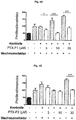
- the particle suspension PTX-F1 significantly reduced, in a dose-dependent manner, the growth factor-stimulated proliferation of human IPAH-PASMC cells ( FIG. 5A ).
- PTX-F2 also showed antiproliferative effects at higher concentrations ( FIG. 5B ).
- As a control nanoparticles were used without active ingredient, which were prepared by the above method, wherein in step b) no active ingredient was added.
- the two particle suspensions PTX-F1 and PTX-F2 were tested on human IPAH-PASMC cells with regard to their apoptotic effect.
- Stimulation with growth factors causes strong resistance of IPAH-PASMC cells to apoptosis compared to unstimulated IPAH-PASMC cells.
- the particle suspension PTX-F1 significantly increased, in a dose-dependent manner, the growth factor-induced apoptosis resistance of human IPAH-PASMC cells ( FIG. 6A ).
- PTX-F2 showed growth factor-induced apoptosis resistance only at high concentrations ( FIG. 6B ).
- nanoparticles without drug were used.
- the nanoparticles according to the invention are characterized in that they have a dynamic release kinetics for the active substance contained.
- This dynamic release kinetics comprises at least two temporally successive phases:
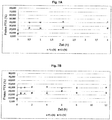
- the first phase in the first phase is a so-called "burst phase", ie a period in which a particularly rapid release of active substance takes place (duration: up to about 2 hours, but preferably shorter , eg about 1 h), so that after a short time a substantially constant concentration of the active substance in the liquid phase outside of the particles is achieved.
- burst phase ie a period in which a particularly rapid release of active substance takes place (duration: up to about 2 hours, but preferably shorter , eg about 1 h)
- the achievement of this essentially constant concentration marks the individual end of the burst phase for each individual particle variant according to the invention.
- the plateau phase then follows, in which a slower release of the active substance takes place, whereby the concentration achieved in the burst phase in the liquid phase is essentially maintained substantially.
- This plateau phase extends over a period of up to about 4 hours, preferably over a period of up to about 12 hours, more preferably over a period of up to about 150 hours, and most preferably over a period of up to about 400 hours ( Fig. 7A, 7B and 7C ).
- the nanoparticles according to the invention to release at least one active ingredient, for example paclitaxel or other taxanes, such as docetaxel or second generation taxanes, such as SB-T-1214 both rapidly and for a sustained release (depot effect), which is a treatment is extremely advantageous.
- active ingredient for example paclitaxel or other taxanes, such as docetaxel or second generation taxanes, such as SB-T-1214
- the determination of the storage stability is carried out by way of example with reference to paclitaxel-containing nanoparticles according to the invention.
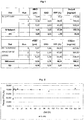
- the results are in Fig. 8 shown: After 11 months storage in Aq. least. at 0 - 4 ° C the particle sizes, the PDI and the zeta potential are essentially unchanged; the percentage loading of active ingredient (paclitaxel in the example) decreased slightly in both examples (11% vs. 8.5% and 9.2% vs. 8.2%, respectively), but was still extremely good.
- the particles of the invention have a very good storage stability.
Landscapes
- Health & Medical Sciences (AREA)
- Chemical & Material Sciences (AREA)
- Engineering & Computer Science (AREA)
- Bioinformatics & Cheminformatics (AREA)
- General Health & Medical Sciences (AREA)
- Veterinary Medicine (AREA)
- Public Health (AREA)
- Medicinal Chemistry (AREA)
- Pharmacology & Pharmacy (AREA)
- Epidemiology (AREA)
- Life Sciences & Earth Sciences (AREA)
- Animal Behavior & Ethology (AREA)
- Physics & Mathematics (AREA)
- Biomedical Technology (AREA)
- Nanotechnology (AREA)
- Optics & Photonics (AREA)
- Pulmonology (AREA)
- Otolaryngology (AREA)
- Dispersion Chemistry (AREA)
- Pharmaceuticals Containing Other Organic And Inorganic Compounds (AREA)
- Medicinal Preparation (AREA)
Priority Applications (3)
| Application Number | Priority Date | Filing Date | Title |
|---|---|---|---|
| EP17189860.4A EP3453385A1 (fr) | 2017-09-07 | 2017-09-07 | Invention concernant des nanoparticules comportant des taxanes pour l'application par voie d'inhalation pulmonaire |
| PCT/EP2018/073725 WO2019048424A1 (fr) | 2017-09-07 | 2018-09-04 | Invention concernant des nanparticules contenant des taxanes destinées à une application par inhalation |
| US16/645,288 US20210315829A1 (en) | 2017-09-07 | 2018-09-04 | Invention Relating to Nanoparticles Containing Taxanes for Administration by Inhalation |
Applications Claiming Priority (1)
| Application Number | Priority Date | Filing Date | Title |
|---|---|---|---|
| EP17189860.4A EP3453385A1 (fr) | 2017-09-07 | 2017-09-07 | Invention concernant des nanoparticules comportant des taxanes pour l'application par voie d'inhalation pulmonaire |
Publications (1)
| Publication Number | Publication Date |
|---|---|
| EP3453385A1 true EP3453385A1 (fr) | 2019-03-13 |
Family
ID=59974126
Family Applications (1)
| Application Number | Title | Priority Date | Filing Date |
|---|---|---|---|
| EP17189860.4A Withdrawn EP3453385A1 (fr) | 2017-09-07 | 2017-09-07 | Invention concernant des nanoparticules comportant des taxanes pour l'application par voie d'inhalation pulmonaire |
Country Status (3)
| Country | Link |
|---|---|
| US (1) | US20210315829A1 (fr) |
| EP (1) | EP3453385A1 (fr) |
| WO (1) | WO2019048424A1 (fr) |
Citations (2)
| Publication number | Priority date | Publication date | Assignee | Title |
|---|---|---|---|---|
| WO2010005721A2 (fr) * | 2008-06-16 | 2010-01-14 | Bind Biosciences, Inc. | Nanoparticules polymères pharmacologiquement chargées et leurs méthodes de fabrication et d’utilisation |
| US20140271871A1 (en) | 2007-05-03 | 2014-09-18 | Abraxis Bioscience, Llc | Methods and compositions for treating pulmonary hypertension |
-
2017
- 2017-09-07 EP EP17189860.4A patent/EP3453385A1/fr not_active Withdrawn
-
2018
- 2018-09-04 WO PCT/EP2018/073725 patent/WO2019048424A1/fr not_active Ceased
- 2018-09-04 US US16/645,288 patent/US20210315829A1/en not_active Abandoned
Patent Citations (2)
| Publication number | Priority date | Publication date | Assignee | Title |
|---|---|---|---|---|
| US20140271871A1 (en) | 2007-05-03 | 2014-09-18 | Abraxis Bioscience, Llc | Methods and compositions for treating pulmonary hypertension |
| WO2010005721A2 (fr) * | 2008-06-16 | 2010-01-14 | Bind Biosciences, Inc. | Nanoparticules polymères pharmacologiquement chargées et leurs méthodes de fabrication et d’utilisation |
Non-Patent Citations (4)
| Title |
|---|
| BERNABEU ET AL.: "Paclitaxel: What has been done and the challenges remain ahead", INT J PHARM., vol. 526, no. 1-2, 2017, pages 474 - 495, XP085057495, DOI: doi:10.1016/j.ijpharm.2017.05.016 |
| BOWEN P: "Particle Size Distribution Measurement from Millimeters to Nanometers and from Rods to Platelets", JOURNAL OF DISPERSION SCIENCE AND TECHNOLOGY, TAYLOR AND FRANCIS GROUP, NEW YORK, NY, US, vol. 23, no. 5, 1 January 2002 (2002-01-01), pages 631 - 662, XP009102859, ISSN: 0193-2691, DOI: 10.1081/DIS-120015368 * |
| FENG S-S ET AL: "Chemotherapeutic engineering: Application and further development of chemical engineering principles for chemotherapy of cancer and other diseases", CHEMICAL ENGINEERING SCI, OXFORD, GB, vol. 58, no. 18, 1 September 2003 (2003-09-01), pages 4087 - 4114, XP004453411, ISSN: 0009-2509, DOI: 10.1016/S0009-2509(03)00234-3 * |
| MU L ET AL: "Vitamin E TPGS used as emulsifier in the solvent evaporation/extraction technique for fabrication of polymeric nanospheres for controlled release of paclitaxel (Taxol )", JOURNAL OF CONTROLLED RELEASE, ELSEVIER, AMSTERDAM, NL, vol. 80, no. 1, 4 January 2016 (2016-01-04), pages 129 - 144, XP029377498, ISSN: 0168-3659, DOI: 10.1016/S0168-3659(02)00025-1 * |
Also Published As
| Publication number | Publication date |
|---|---|
| US20210315829A1 (en) | 2021-10-14 |
| WO2019048424A1 (fr) | 2019-03-14 |
Similar Documents
| Publication | Publication Date | Title |
|---|---|---|
| EP1073426B1 (fr) | Formulation pharmaceutique de ciclosporine presentant de meilleures proprietes biopharmaceutiques, une meilleure qualite et stabilite en termes de physique, et procede permettant de la preparer | |
| DE60013425T2 (de) | Arzneizusammensetzungen zur aerosolbildung und zu inhalationszwecken | |
| DE69107026T2 (de) | Injizierbare galenische retardzubereitung. | |
| DE69928665T2 (de) | Kortikosteroide enthaltende wässrige Zusammensetzungen zum nasalen oder pulmonalen Zuführen | |
| DE69631119T2 (de) | Pulver zur verwendung in trockenpulverinhalatoren | |
| DE69314326T2 (de) | Verfahren und vorrichtung zur wirkstofffreisetzung durch überkritischen lösungen | |
| DE69709722T2 (de) | Mikrokugeln aus polysaccharid zur pulmonaren wirkstoffabgabe | |
| DE60031184T2 (de) | Pharmazeutische Zusammensetzung enthaltend Fenofibrat und Verfahren zu deren Herstellung | |
| DE69637288T2 (de) | Beclomethason-Nanopartikel Dispersionen enthaltende Aerosole | |
| DE3686025T2 (de) | Verfahren und system zum einatmen von liposomen. | |
| DE60131265T2 (de) | Pharmazeutische formulierungen für trockenpulverinhalatoren | |
| EP0167825B1 (fr) | Nanobilles lipidiques comme véhicule pour médicaments destinés à l'administration orale | |
| EP2819659B1 (fr) | Procédé de fabrication de nanoparticules chargées d'une substance active | |
| EP2448559B1 (fr) | Liposomes destinés à une application pulmonaire | |
| DE60220519T2 (de) | Mizellares arzneistoffverabreichungssystem für hydrophobe arzneistoffe | |
| WO2012160088A1 (fr) | Nanoparticules et microparticules biocompatibles enrobées de stabilisateurs pour une application pulmonaire | |
| Patil-Gadhe et al. | Pulmonary targeting potential of rosuvastatin loaded nanostructured lipid carrier: Optimization by factorial design | |
| EP0790821A1 (fr) | Nanosuspensions pharmaceutiques pour application de medicaments constituant des systemes a solubilite de saturation et a vitesse de dissolution accrues | |
| DE10004860A1 (de) | Druckluftinhalator zur pulmonalen Applikation liposomalen Pulver-Aerosols sowie dafür geeignete Pulver-Aerosole | |
| CN103751787A (zh) | 维生素e tpgs在制备多孔药物载体微粒中的用途 | |
| US20110104291A1 (en) | Formulation of Fine Particles Using Liquefied or Dense Gases | |
| DE3917617A1 (de) | Mikronisierte bioabbaubare partikel, verfahren zur ihrer herstellung und ihre verwendung | |
| WO2012160085A1 (fr) | Particules nanopolymériques biocompatibles contenant des principes actifs pour une application pulmonaire | |
| DE102005042768A1 (de) | Magnetfeld-gesteuerter Wirkstofftransfer für die Aerosoltherapie | |
| DE10145361A1 (de) | Verfahren zur Herstellung von flüssigen, sterilen Zubereitungen zur Inhalation |
Legal Events
| Date | Code | Title | Description |
|---|---|---|---|
| PUAI | Public reference made under article 153(3) epc to a published international application that has entered the european phase |
Free format text: ORIGINAL CODE: 0009012 |
|
| STAA | Information on the status of an ep patent application or granted ep patent |
Free format text: STATUS: THE APPLICATION HAS BEEN PUBLISHED |
|
| AK | Designated contracting states |
Kind code of ref document: A1 Designated state(s): AL AT BE BG CH CY CZ DE DK EE ES FI FR GB GR HR HU IE IS IT LI LT LU LV MC MK MT NL NO PL PT RO RS SE SI SK SM TR |
|
| AX | Request for extension of the european patent |
Extension state: BA ME |
|
| STAA | Information on the status of an ep patent application or granted ep patent |
Free format text: STATUS: REQUEST FOR EXAMINATION WAS MADE |
|
| 17P | Request for examination filed |
Effective date: 20190913 |
|
| RBV | Designated contracting states (corrected) |
Designated state(s): AL AT BE BG CH CY CZ DE DK EE ES FI FR GB GR HR HU IE IS IT LI LT LU LV MC MK MT NL NO PL PT RO RS SE SI SK SM TR |
|
| STAA | Information on the status of an ep patent application or granted ep patent |
Free format text: STATUS: EXAMINATION IS IN PROGRESS |
|
| 17Q | First examination report despatched |
Effective date: 20201023 |
|
| STAA | Information on the status of an ep patent application or granted ep patent |
Free format text: STATUS: THE APPLICATION IS DEEMED TO BE WITHDRAWN |
|
| 18D | Application deemed to be withdrawn |
Effective date: 20230401 |