EP3453768A2 - Procédé de détection de séquence d'acide nucléique cible à l'aide d'un fragment de marqueur complémentaire clivé et composition associée - Google Patents
Procédé de détection de séquence d'acide nucléique cible à l'aide d'un fragment de marqueur complémentaire clivé et composition associée Download PDFInfo
- Publication number
- EP3453768A2 EP3453768A2 EP17789853.3A EP17789853A EP3453768A2 EP 3453768 A2 EP3453768 A2 EP 3453768A2 EP 17789853 A EP17789853 A EP 17789853A EP 3453768 A2 EP3453768 A2 EP 3453768A2
- Authority
- EP
- European Patent Office
- Prior art keywords
- primer
- sequence
- cctf
- seq
- cleaved
- Prior art date
- Legal status (The legal status is an assumption and is not a legal conclusion. Google has not performed a legal analysis and makes no representation as to the accuracy of the status listed.)
- Granted
Links
Images









Classifications
-
- C—CHEMISTRY; METALLURGY
- C12—BIOCHEMISTRY; BEER; SPIRITS; WINE; VINEGAR; MICROBIOLOGY; ENZYMOLOGY; MUTATION OR GENETIC ENGINEERING
- C12Q—MEASURING OR TESTING PROCESSES INVOLVING ENZYMES, NUCLEIC ACIDS OR MICROORGANISMS; COMPOSITIONS OR TEST PAPERS THEREFOR; PROCESSES OF PREPARING SUCH COMPOSITIONS; CONDITION-RESPONSIVE CONTROL IN MICROBIOLOGICAL OR ENZYMOLOGICAL PROCESSES
- C12Q1/00—Measuring or testing processes involving enzymes, nucleic acids or microorganisms; Compositions therefor; Processes of preparing such compositions
- C12Q1/68—Measuring or testing processes involving enzymes, nucleic acids or microorganisms; Compositions therefor; Processes of preparing such compositions involving nucleic acids
- C12Q1/6813—Hybridisation assays
- C12Q1/6827—Hybridisation assays for detection of mutation or polymorphism
- C12Q1/683—Hybridisation assays for detection of mutation or polymorphism involving restriction enzymes, e.g. restriction fragment length polymorphism [RFLP]
-
- C—CHEMISTRY; METALLURGY
- C12—BIOCHEMISTRY; BEER; SPIRITS; WINE; VINEGAR; MICROBIOLOGY; ENZYMOLOGY; MUTATION OR GENETIC ENGINEERING
- C12Q—MEASURING OR TESTING PROCESSES INVOLVING ENZYMES, NUCLEIC ACIDS OR MICROORGANISMS; COMPOSITIONS OR TEST PAPERS THEREFOR; PROCESSES OF PREPARING SUCH COMPOSITIONS; CONDITION-RESPONSIVE CONTROL IN MICROBIOLOGICAL OR ENZYMOLOGICAL PROCESSES
- C12Q1/00—Measuring or testing processes involving enzymes, nucleic acids or microorganisms; Compositions therefor; Processes of preparing such compositions
- C12Q1/68—Measuring or testing processes involving enzymes, nucleic acids or microorganisms; Compositions therefor; Processes of preparing such compositions involving nucleic acids
- C12Q1/6876—Nucleic acid products used in the analysis of nucleic acids, e.g. primers or probes
- C12Q1/6888—Nucleic acid products used in the analysis of nucleic acids, e.g. primers or probes for detection or identification of organisms
- C12Q1/689—Nucleic acid products used in the analysis of nucleic acids, e.g. primers or probes for detection or identification of organisms for bacteria
-
- C—CHEMISTRY; METALLURGY
- C12—BIOCHEMISTRY; BEER; SPIRITS; WINE; VINEGAR; MICROBIOLOGY; ENZYMOLOGY; MUTATION OR GENETIC ENGINEERING
- C12Q—MEASURING OR TESTING PROCESSES INVOLVING ENZYMES, NUCLEIC ACIDS OR MICROORGANISMS; COMPOSITIONS OR TEST PAPERS THEREFOR; PROCESSES OF PREPARING SUCH COMPOSITIONS; CONDITION-RESPONSIVE CONTROL IN MICROBIOLOGICAL OR ENZYMOLOGICAL PROCESSES
- C12Q1/00—Measuring or testing processes involving enzymes, nucleic acids or microorganisms; Compositions therefor; Processes of preparing such compositions
- C12Q1/68—Measuring or testing processes involving enzymes, nucleic acids or microorganisms; Compositions therefor; Processes of preparing such compositions involving nucleic acids
- C12Q1/6806—Preparing nucleic acids for analysis, e.g. for polymerase chain reaction [PCR] assay
-
- C—CHEMISTRY; METALLURGY
- C12—BIOCHEMISTRY; BEER; SPIRITS; WINE; VINEGAR; MICROBIOLOGY; ENZYMOLOGY; MUTATION OR GENETIC ENGINEERING
- C12Q—MEASURING OR TESTING PROCESSES INVOLVING ENZYMES, NUCLEIC ACIDS OR MICROORGANISMS; COMPOSITIONS OR TEST PAPERS THEREFOR; PROCESSES OF PREPARING SUCH COMPOSITIONS; CONDITION-RESPONSIVE CONTROL IN MICROBIOLOGICAL OR ENZYMOLOGICAL PROCESSES
- C12Q1/00—Measuring or testing processes involving enzymes, nucleic acids or microorganisms; Compositions therefor; Processes of preparing such compositions
- C12Q1/68—Measuring or testing processes involving enzymes, nucleic acids or microorganisms; Compositions therefor; Processes of preparing such compositions involving nucleic acids
- C12Q1/6813—Hybridisation assays
- C12Q1/6816—Hybridisation assays characterised by the detection means
-
- C—CHEMISTRY; METALLURGY
- C12—BIOCHEMISTRY; BEER; SPIRITS; WINE; VINEGAR; MICROBIOLOGY; ENZYMOLOGY; MUTATION OR GENETIC ENGINEERING
- C12Q—MEASURING OR TESTING PROCESSES INVOLVING ENZYMES, NUCLEIC ACIDS OR MICROORGANISMS; COMPOSITIONS OR TEST PAPERS THEREFOR; PROCESSES OF PREPARING SUCH COMPOSITIONS; CONDITION-RESPONSIVE CONTROL IN MICROBIOLOGICAL OR ENZYMOLOGICAL PROCESSES
- C12Q1/00—Measuring or testing processes involving enzymes, nucleic acids or microorganisms; Compositions therefor; Processes of preparing such compositions
- C12Q1/68—Measuring or testing processes involving enzymes, nucleic acids or microorganisms; Compositions therefor; Processes of preparing such compositions involving nucleic acids
- C12Q1/6813—Hybridisation assays
- C12Q1/6816—Hybridisation assays characterised by the detection means
- C12Q1/6818—Hybridisation assays characterised by the detection means involving interaction of two or more labels, e.g. resonant energy transfer
-
- C—CHEMISTRY; METALLURGY
- C12—BIOCHEMISTRY; BEER; SPIRITS; WINE; VINEGAR; MICROBIOLOGY; ENZYMOLOGY; MUTATION OR GENETIC ENGINEERING
- C12Q—MEASURING OR TESTING PROCESSES INVOLVING ENZYMES, NUCLEIC ACIDS OR MICROORGANISMS; COMPOSITIONS OR TEST PAPERS THEREFOR; PROCESSES OF PREPARING SUCH COMPOSITIONS; CONDITION-RESPONSIVE CONTROL IN MICROBIOLOGICAL OR ENZYMOLOGICAL PROCESSES
- C12Q1/00—Measuring or testing processes involving enzymes, nucleic acids or microorganisms; Compositions therefor; Processes of preparing such compositions
- C12Q1/68—Measuring or testing processes involving enzymes, nucleic acids or microorganisms; Compositions therefor; Processes of preparing such compositions involving nucleic acids
- C12Q1/6813—Hybridisation assays
- C12Q1/6816—Hybridisation assays characterised by the detection means
- C12Q1/6823—Release of bound markers
-
- C—CHEMISTRY; METALLURGY
- C12—BIOCHEMISTRY; BEER; SPIRITS; WINE; VINEGAR; MICROBIOLOGY; ENZYMOLOGY; MUTATION OR GENETIC ENGINEERING
- C12Q—MEASURING OR TESTING PROCESSES INVOLVING ENZYMES, NUCLEIC ACIDS OR MICROORGANISMS; COMPOSITIONS OR TEST PAPERS THEREFOR; PROCESSES OF PREPARING SUCH COMPOSITIONS; CONDITION-RESPONSIVE CONTROL IN MICROBIOLOGICAL OR ENZYMOLOGICAL PROCESSES
- C12Q1/00—Measuring or testing processes involving enzymes, nucleic acids or microorganisms; Compositions therefor; Processes of preparing such compositions
- C12Q1/68—Measuring or testing processes involving enzymes, nucleic acids or microorganisms; Compositions therefor; Processes of preparing such compositions involving nucleic acids
- C12Q1/6844—Nucleic acid amplification reactions
- C12Q1/6853—Nucleic acid amplification reactions using modified primers or templates
-
- C—CHEMISTRY; METALLURGY
- C12—BIOCHEMISTRY; BEER; SPIRITS; WINE; VINEGAR; MICROBIOLOGY; ENZYMOLOGY; MUTATION OR GENETIC ENGINEERING
- C12Q—MEASURING OR TESTING PROCESSES INVOLVING ENZYMES, NUCLEIC ACIDS OR MICROORGANISMS; COMPOSITIONS OR TEST PAPERS THEREFOR; PROCESSES OF PREPARING SUCH COMPOSITIONS; CONDITION-RESPONSIVE CONTROL IN MICROBIOLOGICAL OR ENZYMOLOGICAL PROCESSES
- C12Q1/00—Measuring or testing processes involving enzymes, nucleic acids or microorganisms; Compositions therefor; Processes of preparing such compositions
- C12Q1/68—Measuring or testing processes involving enzymes, nucleic acids or microorganisms; Compositions therefor; Processes of preparing such compositions involving nucleic acids
- C12Q1/6844—Nucleic acid amplification reactions
- C12Q1/686—Polymerase chain reaction [PCR]
-
- C—CHEMISTRY; METALLURGY
- C12—BIOCHEMISTRY; BEER; SPIRITS; WINE; VINEGAR; MICROBIOLOGY; ENZYMOLOGY; MUTATION OR GENETIC ENGINEERING
- C12Q—MEASURING OR TESTING PROCESSES INVOLVING ENZYMES, NUCLEIC ACIDS OR MICROORGANISMS; COMPOSITIONS OR TEST PAPERS THEREFOR; PROCESSES OF PREPARING SUCH COMPOSITIONS; CONDITION-RESPONSIVE CONTROL IN MICROBIOLOGICAL OR ENZYMOLOGICAL PROCESSES
- C12Q1/00—Measuring or testing processes involving enzymes, nucleic acids or microorganisms; Compositions therefor; Processes of preparing such compositions
- C12Q1/68—Measuring or testing processes involving enzymes, nucleic acids or microorganisms; Compositions therefor; Processes of preparing such compositions involving nucleic acids
- C12Q1/6869—Methods for sequencing
- C12Q1/6872—Methods for sequencing involving mass spectrometry
-
- C—CHEMISTRY; METALLURGY
- C12—BIOCHEMISTRY; BEER; SPIRITS; WINE; VINEGAR; MICROBIOLOGY; ENZYMOLOGY; MUTATION OR GENETIC ENGINEERING
- C12Q—MEASURING OR TESTING PROCESSES INVOLVING ENZYMES, NUCLEIC ACIDS OR MICROORGANISMS; COMPOSITIONS OR TEST PAPERS THEREFOR; PROCESSES OF PREPARING SUCH COMPOSITIONS; CONDITION-RESPONSIVE CONTROL IN MICROBIOLOGICAL OR ENZYMOLOGICAL PROCESSES
- C12Q1/00—Measuring or testing processes involving enzymes, nucleic acids or microorganisms; Compositions therefor; Processes of preparing such compositions
- C12Q1/70—Measuring or testing processes involving enzymes, nucleic acids or microorganisms; Compositions therefor; Processes of preparing such compositions involving virus or bacteriophage
- C12Q1/701—Specific hybridization probes
- C12Q1/705—Specific hybridization probes for herpetoviridae, e.g. herpes simplex, varicella zoster
-
- C—CHEMISTRY; METALLURGY
- C12—BIOCHEMISTRY; BEER; SPIRITS; WINE; VINEGAR; MICROBIOLOGY; ENZYMOLOGY; MUTATION OR GENETIC ENGINEERING
- C12Q—MEASURING OR TESTING PROCESSES INVOLVING ENZYMES, NUCLEIC ACIDS OR MICROORGANISMS; COMPOSITIONS OR TEST PAPERS THEREFOR; PROCESSES OF PREPARING SUCH COMPOSITIONS; CONDITION-RESPONSIVE CONTROL IN MICROBIOLOGICAL OR ENZYMOLOGICAL PROCESSES
- C12Q1/00—Measuring or testing processes involving enzymes, nucleic acids or microorganisms; Compositions therefor; Processes of preparing such compositions
- C12Q1/70—Measuring or testing processes involving enzymes, nucleic acids or microorganisms; Compositions therefor; Processes of preparing such compositions involving virus or bacteriophage
- C12Q1/701—Specific hybridization probes
- C12Q1/708—Specific hybridization probes for papilloma
-
- G—PHYSICS
- G01—MEASURING; TESTING
- G01N—INVESTIGATING OR ANALYSING MATERIALS BY DETERMINING THEIR CHEMICAL OR PHYSICAL PROPERTIES
- G01N27/00—Investigating or analysing materials by the use of electric, electrochemical, or magnetic means
- G01N27/62—Investigating or analysing materials by the use of electric, electrochemical, or magnetic means by investigating the ionisation of gases, e.g. aerosols; by investigating electric discharges, e.g. emission of cathode
- G01N27/622—Ion mobility spectrometry
- G01N27/623—Ion mobility spectrometry combined with mass spectrometry
-
- G—PHYSICS
- G01—MEASURING; TESTING
- G01N—INVESTIGATING OR ANALYSING MATERIALS BY DETERMINING THEIR CHEMICAL OR PHYSICAL PROPERTIES
- G01N30/00—Investigating or analysing materials by separation into components using adsorption, absorption or similar phenomena or using ion-exchange, e.g. chromatography or field flow fractionation
- G01N30/02—Column chromatography
- G01N30/62—Detectors specially adapted therefor
- G01N30/72—Mass spectrometers
-
- C—CHEMISTRY; METALLURGY
- C12—BIOCHEMISTRY; BEER; SPIRITS; WINE; VINEGAR; MICROBIOLOGY; ENZYMOLOGY; MUTATION OR GENETIC ENGINEERING
- C12Q—MEASURING OR TESTING PROCESSES INVOLVING ENZYMES, NUCLEIC ACIDS OR MICROORGANISMS; COMPOSITIONS OR TEST PAPERS THEREFOR; PROCESSES OF PREPARING SUCH COMPOSITIONS; CONDITION-RESPONSIVE CONTROL IN MICROBIOLOGICAL OR ENZYMOLOGICAL PROCESSES
- C12Q2521/00—Reaction characterised by the enzymatic activity
- C12Q2521/10—Nucleotidyl transfering
- C12Q2521/101—DNA polymerase
-
- C—CHEMISTRY; METALLURGY
- C12—BIOCHEMISTRY; BEER; SPIRITS; WINE; VINEGAR; MICROBIOLOGY; ENZYMOLOGY; MUTATION OR GENETIC ENGINEERING
- C12Q—MEASURING OR TESTING PROCESSES INVOLVING ENZYMES, NUCLEIC ACIDS OR MICROORGANISMS; COMPOSITIONS OR TEST PAPERS THEREFOR; PROCESSES OF PREPARING SUCH COMPOSITIONS; CONDITION-RESPONSIVE CONTROL IN MICROBIOLOGICAL OR ENZYMOLOGICAL PROCESSES
- C12Q2525/00—Reactions involving modified oligonucleotides, nucleic acids, or nucleotides
- C12Q2525/10—Modifications characterised by
- C12Q2525/131—Modifications characterised by incorporating a restriction site
-
- C—CHEMISTRY; METALLURGY
- C12—BIOCHEMISTRY; BEER; SPIRITS; WINE; VINEGAR; MICROBIOLOGY; ENZYMOLOGY; MUTATION OR GENETIC ENGINEERING
- C12Q—MEASURING OR TESTING PROCESSES INVOLVING ENZYMES, NUCLEIC ACIDS OR MICROORGANISMS; COMPOSITIONS OR TEST PAPERS THEREFOR; PROCESSES OF PREPARING SUCH COMPOSITIONS; CONDITION-RESPONSIVE CONTROL IN MICROBIOLOGICAL OR ENZYMOLOGICAL PROCESSES
- C12Q2600/00—Oligonucleotides characterized by their use
- C12Q2600/16—Primer sets for multiplex assays
-
- C—CHEMISTRY; METALLURGY
- C12—BIOCHEMISTRY; BEER; SPIRITS; WINE; VINEGAR; MICROBIOLOGY; ENZYMOLOGY; MUTATION OR GENETIC ENGINEERING
- C12Y—ENZYMES
- C12Y207/00—Transferases transferring phosphorus-containing groups (2.7)
- C12Y207/07—Nucleotidyltransferases (2.7.7)
- C12Y207/07007—DNA-directed DNA polymerase (2.7.7.7), i.e. DNA replicase
Definitions
- the present invention relates to a method for detecting target nucleic acid sequence using cleaved complementary Tag fragment and a composition therefor, and specifically relates to a method of identifying the amplified product by ligating a template of tag capable of producing a marked substance to a primer that specifically reacts with the target sequence, thereby synthesizing and releasing the tag by restriction enzyme activity in the PCR reaction and introducing it into the reaction solution. Also, the present invention relates to a method for generating and identifying a tag characterized in that the tag generated during a reaction using only one kind of template sequence of a tag for one target sequence is analyzed in various analyzing apparatuses to identify the tag, and a composition used in the method.
- PCR Polymerase Chain Reaction
- Multiple PCR is a method that can simultaneously amplify nucleic acids of multiple target sequences, and is relatively fast and simple compared to other methods, and thus plays a very large role in diagnosis field such as genetic test, identification of organisms in samples, and microbial or viral infection, etc.
- the most common method for confirming the results of such multiplex PCR is to design primers by varying an amplification product size of the target sequence as desired in PCR, and to analyze the size of the amplified product by electrophoresis of the PCR result, and then to confirm as to whether amplification of the target sequence is made.
- the number of genes that can be amplified at one time is limited to 3 to 4 experimentally because there is a restriction that the size of the amplification product should be limited within a narrow range, due to that the efficiency of amplification depends on the size of the amplification product that can be generated during the PCR reaction and thus a uniform amplification efficiency cannot be guaranteed.
- Real-time PCR guarantees a confirmation of a rapid PCR result in confirming the PCR results, and it can identify as to whether the amplification is made by marking fluorescent material regardless of the size of the amplified product.
- the methods performing and detecting Real-time PCR can be divided into intercalating method and probe method, wherein the intercalating method is referred to a method of confirming fluorescence intensity by inserting fluorescent substance between double-stranded base sequences. Since this method cannot distinguish the amplification products forming the double strands, and can observe all of them as the fluorescence of the same wavelength. Therefore, it has a limit on identifying the amplification product by each target sequence to detect and identify at least one amplified product simultaneously.
- the probe method is a method of detecting the amplified product by reading the fluorescence value of the probe designated for each target sequence and, in the case of using this method, since the amplification product can be detected only in the number of analyzable fluorescence channels of a device to be used, the multiple analysis over the number of fluorescent channels is not suitable for this.
- xTAG a constant base sequence comprised of a random array of thymine (T), adenine (A), and guanine (G), which constitutes the nucleic acid, was set and named xTAG.
- the present invention is derived to solve the above problems and to meet the above needs and the object of the present invention is to provide a method for solving the uncertainty which can be occurred when the results are determined depending on the length of the generated product in amplifying and analyzing a target sequence using an amplification reaction such as PCR, and for solving the restriction to the maximum numbers of amplification that can be identified in multiple detection.
- the another object of the present invention to provide a method for improving accuracy by solving errors due to non-specific amplification which can be caused by the use of artificial sequence as a tag itself in identifying a target sequence amplification by forming the tag.
- the present invention provides a primer with the structure comprising a target sequence and a non-complementary random nucleic acid sequence and sequentially comprising a restriction enzyme recognition sequence and a nucleic acid sequence complementary to the target sequence.
- the restriction enzyme recognition sequence is preferably one selected from the group consisting of Pho I, PspGI, BstNI, TfiI, ApeKI, TspMI, BstBI, BstEII, BstNI, BstUI, BssKI, BstYI, TaqI, Mwol, TseI, Tsp45I, Tsp509I, TspRI, Tth111I, Nb.BsmI, Nb.BsrDI, Nt.BspQI, Nt.BstNBI restriction enzymes and Nick restriction enzymes, but is not limited thereto.
- the said primer is preferably one that a modified dNTP inserted at the cleavage site of the restriction enzyme recognition sequence of the primer, for the purpose of that a cleaved by-product other than the cleaved complementary tag fragment allow not to participate in the reaction, and the modified dNTP to be inserted into the cleavage site is phosphorothioated dNTP, dNTP containing 7-deazapurine, or a 2'-O-methyl nucleotide (2'-OmeN) in a DNA template, but is not limited thereto.
- the primer is from 5 mers or more to 50 mers or less in length of the cleaved complementary tag fragment as generated.
- the primer is one or more one selected from the group consisting of SEQ ID NOS: 1, 3, 9, 11, 13, 15, 17, 19, 21, 23, 25, 27, 29, 31, 33, 74, 76, 78, 80, 82, 86, 115, 117, 119, 121, 123, 125, 127, 129, 131, 151, 153, 155, 156, 159, 161, 164, 166, 168, 170, 204, 205, 207, 218, 220 and 222, but is not limited thereto.
- the present invention provides a method for forming a tag to be used in classifying and analyzing the kinds of the target sequences amplified in the Polymerase Chain Reaction, and identifying it, comprising:
- the instrument used for the mass spectrometry is preferably a matrix-assisted laser desorption-ionization-time-of-flight mass spectrometer ((MALDI -TOF MS), a Liquid Chromatography Mass Spectrometer, or a High Performance Liquid Chromatography Mass Spectrometer, but is not limited thereto.
- MALDI -TOF MS matrix-assisted laser desorption-ionization-time-of-flight mass spectrometer
- Liquid Chromatography Mass Spectrometer or a High Performance Liquid Chromatography Mass Spectrometer
- the mass per unit electric charge (m / z) of the cleaved tag fragment to be used for mass spectrometry is preferably from greater than 0 to 10000 Da or less, but is not limited thereto.
- DNA polymerase in order to preserve the mass of a cleaved complementary tag fragment to be used in mass analysis during the amplification process, it is preferable to use DNA polymerase that the function of adenine-addition elongation effect (A tailing) at the 3 'end, which is an intrinsic property of the nucleic acid polymerase, is inhibited, but is not limited thereto.
- a tailing adenine-addition elongation effect
- the fluorescence signal it is preferable to analyze the fluorescence signal using the oligonucleotide that is tagged by fluorescence and Quencher and has the complementary sequence of the cleaved complementary tag fragment as the identification method of the cleaved complementary tag fragment, but it is not limited thereto.
- the oligonucleotide is preferably 5 or more in length, but is not limited thereto.
- a quencher to the nucleotide at the 3 'end of the oligonucleotide in order to prevent elongation of the base sequence from the oligonucleotide in the method, but is not limited thereto.
- the complementary tag fragment cleaved by analyzing the cycle threshold (Ct) value of the fluorescence signal of the oligonucleotide, but not limited thereto.
- the sexually transmitted disease causative organism is preferable one selected from the group consisting of Chlamydia trachomatis, Neisseria. Gonorrhea, Mycoplasma hominis, Mycoplasma genitalium, Trichomonas vaginalis, Ureaplasma urealyticum, Ureaplasma parvum, Candida albicans, Gardnerella vaginalis, Herpes simplex virus 1, Herpes simplex virus 2, Treponema pallidum, but is not limited thereto.
- the present invention also provides a composition for diagnosing sexually-transmitted diseases, comprising the primer of the present invention as an effective component.
- the causative organism of gastrointestinal tract disease is selected from the group consisting of Rotavirus A, Astrovirus, Adenovirus F40, Adenovirus F41, Norovirus GI and Norovirus GII, but is not limited thereto.
- the present invention also provides a composition for diagnosing a gastrointestinal disease agent comprising the primer of the present invention as an effective component.
- the subpopulations of the human papilloma virus is preferably selected from the group consisting of types 16, 18, 33, 35, 51, 53, 59, 68a, and 82, but is not limited thereto.
- the present invention also provides a composition for diagnosing HPV comprising the primer of the present invention as an effective component.
- a causative organism of the respiratory disease in the method, and the causative organism of the respiratory disease is one being selected from the group consisting of I nfluenza A / H1N1, Influenza A / H3N2, Influenza A / H1N1 / 2009pdm, Influenza B, Parainfluenza 1, Parainfluenza 3, Respiratory syncytial virus A, Respiratory syncytial virus B, Human metapneumovirus, Adenovirus, but is not limited thereto
- the present invention also provides a composition for the diagnosis of respiratory diseases, comprising the primer of the present invention as an effective component.
- the method is preferably a single nucleotide polymorphism (SNP), wherein the single base mutation is preferably one selected from the group consisting of r6265 of the Brain-derived neurotrophic factor gene (BDNF gene), but is not limited thereto.
- SNP single nucleotide polymorphism
- the present invention also provides a composition for analyzing the BDNF gene rs6265 gene comprising the primer of the present invention as an effective component.
- the present inventors have tried our best to develop the method that can perform a multiplex amplification reaction on a large number of targets at one time by clearly distinguishing each amplification product through an easier, faster and more efficient method in preforming the amplification reaction and can analyze the results.
- the present invention relates to a method of forming tags to be used for sorting and analyzing kinds of amplified target sequences during a PCR reaction.
- the present invention is characterized in comprising the steps of: (1) hybridizing a target sequence with a primer comprising a template of a tag for generating the tag, (2) generating the tag from the template of the tag using a restriction enzyme during the PCR reaction, and (3) analyzing the generated tag with various analysis equipment to identify the tag.
- step (1) prior to hybridizing the CTPO and the target sequence, the structure of CTPO is divided into a template portion of the CCTF, a restriction enzyme recognition sequence, and a sequence complementary to the target as shown in the following Formula 1.
- Formula 1 5'-A-B-C-3'
- the A site in the structural formula 1 is comprised of a random sequence to be a template of the CCTF, and the complementary sequence of the CCTF template, that is, the CCTF site, is elongated by amplifying it after annealing with the target sequence and then the CCTF site is released by the restriction enzyme during the amplification.
- the released CCTF is characterized by being a random sequence having 5 or more oligonucleotides in length so that it can be specifically analyzed as a tag. Random sequences can be used in any sequence that does not create a by-product during the PCR reaction.
- the nucleotide sequence to be used as a template for CCTF is free from any sequence that does not cause a hybridization reaction during the amplification reaction
- B is a restriction enzyme recognition sequence, which means a specific recognition sequence of restriction enzymes and Nick restriction enzymes having thermal stability that can be used during amplification.
- it includes Pho I, PspGI, BstNI, TfiI, ApeKI, TspMI, BstBI, BstEII, BstNI, BstUI, BssKI, BstYI, TaqI, MwoI, TseI, Tsp45I, Tsp509I, TspRI, Tth111I, Nb.BsmI, Nb.BsrDI, Nt .BspQI, Nt.BstNBI, etc.
- PspGI can be used, and the restriction enzyme used in Example of the present invention is PspGI.
- the modified dNTP is inserted into a site cleaved by the restriction enzyme in the restriction enzyme recognition sequence of CTPO so as not to exist and participate the cleaved by-products other than CCTF in the reaction.
- examples thereof include phosphorothioated dNTPs, dNTPs containing 7-deazapurine, or 2'-O-methyl nucleotides (2'-OMeN) in DNA templates, etc.
- PNAS 89 (1992) 392-396 and Nucleic Acids Research 20 (1) 1991 55-61 can be applied to the present invention.
- a phosphothiolated bond is inserted into the cleavage site among the recognition sequence to prevent the cleavage of the template of CCTF by a restriction enzyme, thereby securing a template capable of generating CCTF and to prevent a by-product which can be generated by releasing the template of CCTF into the reaction solution, thereby increasing the efficiency of the reaction.
- SDA Strand Displacement Amplification
- the C site shown in the structural formula 1 means a part after the restriction enzyme recognition sequence up to the 3 'end, and is composed of a target specific sequence so that it binds specifically to the target during amplification so as to maintain its role as a primer.
- step (2) when the amplification product is formed by CTPO, and the amplified product present in the double strand is cleaved to CCTF by the restriction enzyme and released into the reaction solution, the appropriate concentration of the restriction enzyme to be used can be varied depending on the purpose of use. In addition, the results are different depending on the type of polymerase to be used, which can be also varied depending on the purpose of use. For example, when CCTF is formed for the purpose of mass spectrometry, it is preferable that the weight of CCTF should be kept constant regardless of the amplification process and should not reflect the intrinsic property of the nucleic acid polymerase.
- nucleic acid polymerase having no adenine addition extension effect (A tailing) at the 3 'end should be selected and used.
- a tailing adenine addition extension effect
- nucleic acid polymerase enzymes that do not make A tailing Phusion polymerase, Vent polymerase, Deep Vent polymerase, Bst polymerase, etc. are present.
- a restriction enzyme reaction time can be further added during the PCR process. Reaction time, reaction temperature, etc. can be applied differently depending on the kind of the specific restriction enzyme and the reaction intention.
- step (3) as the step that the generated CCTF is analyzed through various analysis equipment to identify the target nucleic acid sequence, when the mass of the generated CCTF is directly analyzed, the kinds of CCTF are diversified through recombination of length and sequence, Mass spectrometry such as MALDI-TOF MS, LC MS and HPLC MS can be used to observe the intrinsic mass of the generated CCTF, and the amplified target sequence can be identified and identified using the said mass. It is preferable to observe it through MALDI-TOF MS, the range of mass of CCTF which is easy to observe is 1200 Da or more. The amplification products can be observed by forming various CCTFs in the mass range as above.
- the amplified target sequence can be identified by observing the fluorescence signal of CCTF, and this is the method which comprises hybridizing CCTF with SCO which is tagged with the fluorescence and the quencher so that the generated CCTF can provide the fluorescence signal at the inherent dissociation temperature, and is the sequence complementary to the CCTF having the inherent dissociation temperature, analyzing the fluorescence signal at the inherent dissociation temperature, and confirming the generation of CCTF, thereby identifying the presence of the target nucleic acid sequence.
- the use concentration of the restriction enzyme is designated according to the purpose of use, and the kind of the polymerase is not related to the A tailing unlike the mass analysis.
- the CCTF released from the amplification product and introduced into the reaction solution reacts with the SCO present in the reaction solution, wherein the component of the SCO is as follows.
- the complementary sequence of CCTF exists to enable hybridization with CCTF from the 5 'end to the 3' end and the sequence of SCO is determined by CCTF length, sequence recombination depending on CCTF.
- the combination of the length and the sequence may be designed differently to give the inherent dissociation temperature of CCTF and SCO, such as in the case using the method such the length of CCTF and the method of sequence recombination, etc.
- the SCO is composed of a complementary sequence of CCTF, and the fluorescent substance is contained in the sequence, and the position of the fluorescent substance is possible in anywhere at least a certain length apart from the quencher.
- a blocker is positioned so that SCO serves as a primer during the reaction to prevent the nucleotide sequence from elongation. Spacer C3, Phosphat, ddC, Inverted END and Quencher, etc.
- the blocker may be used as the blocker, but not limited thereto.
- the quencher when the quencher is located at the 3 'end of SCO, the SCO is served as a primer during the reaction to prevent the nucleotide sequence from elongation, and simultaneously hybridizes with CCTF to suppress the emission of the fluorescent material by the FRET phenomenon, before it forms a double strand with CCTF.
- a quencher in combination with a substance preventing nucleotide sequence elongation, an unnecessary modification reaction can be shortened in the production of SCO, thereby increasing the yield of the production reaction and further reducing the manufacturing cost.
- CCTF generated during the reaction By using the hybridization of CCTF generated during the reaction with SCO contained in the reaction, it can be identified as to whether CCTF is generated by identifying the dissociation of the double strand with the fluorescence and analyzing it to confirm whether CCTF is generated due to the target sequence, and then the target sequence can be identified.
- the range of temperature that can be defined by the inherent dissociation temperature of the SCO is ⁇ 95 °C, and if there is no interference of the dissociation temperature of each double strand, there is no limitation in defining the inherent dissociation temperature for each fluorescent substance.
- SCO's fluorophore and quencher can be exemplified as Alexa Fluor 350, Alexa Fluor 405, Alexa Fluor 430, Alexa Fluor 488, Alexa Fluor 514, Alexa Fluor 532, Alexa Fluor 546, Alexa Fluor 555, Alexa Fluor 568, Alexa Fluor 594, Alexa Fluor 610, Alexa Fluor 633, Alexa Fluor 635, Alexa Fluor 647, Alexa Fluor 660, Alexa Fluor 680, Alexa Fluor 700, Alexa Fluor 750, Alexa Fluor 790, ATTO 390, ATTO 425, ATTO 465, ATTO 488, ATTO 495, ATTO 514, ATTO 520, ATTO 532, ATTO Rho6G, ATTO 540Q, ATTO 550, ATTO 565, ATTO Rho3B, ATTO Rho11, ATTO Rho12, ATTO Thio12, ATTO 580Q, ATTO Rho101, ATTO
- FAM Fluorescein, Fluorescein-C3, Calcein, Carboxyrhodamine 6G, Carboxy-X-rhodamine (ROX), Cascade Blue, Cascade Yellow, Cy2, Cy3, Cy5, Cy3.5, Cy5.5, Cy7, dansyl, Dapoxyl, Dialkylaminocoumarin, 4',5'- Dichloro-2',7'-dimethoxy-fluorescein, DM-NERF, Eosin, Erythrosin, HEX, Hydroxycoumarin, IRD40, IRD 700, IRD 800, JOE, Lissamine rhodamine B, LC Red 610, LC Red 640, Marina Blue, Methoxycoumarin, Naphthofluorescein, NED, Oregon Green 488, Oregon Green 500, Oregon Green 514, Pacific Blue, PyMPO, Pyrene, Phycoerythrin, Rhodamine 6G, Rhodamine Green, Rhodamine Red, Rhod
- TET VIC
- Yakima Yellow BMN-Q460, DDQ-I, Dabcyl, BMN-Q530, BMN-Q535, Eclipse, Iowa Black FQ, BHQ-1, TQ2, IQ4, QSY-7, BHQ-2, TQ3, DDQ-II, BBQ-650, Iowa Black RQ, QSY-21, BHQ-3, etc., and may also include any fluorescent material and quencher.
- the reaction between SCO and CCTF occurs simultaneously with the amplification reaction and the CCTF formation reaction, and in this case, by utilizing the fact that the double strand formation ratio of SCO represents a similar efficiency to the amplification amount of the target sequence, the Ct graph of the SCO having the inherent dissociation temperature can be made, and by using this, it is possible to identify the target sequence in a different manner from the inherent dissociation temperature analysis method.
- the method of the present invention since an arbitrary tag (CCTF) is generated and cleaved by restriction enzymes during the amplification reaction, the double strand of the restriction enzyme recognition sequence is not formed before the amplification reaction of the artificial sequence (CTPO) added to form the tag and thus, there is no possibility that it is randomly cleaved; since the tags are generated only by the reaction products specifically generated to the target sequence during PCR, the method of the present invention has the high accuracy for forming CCTF, and can obtain more delicate analysis results than the existing PCR result analysis depending on the length of the PCR amplification product or the specificity of the specific sequence; and the method of the present invention can distinguish and interpret amplification products specifically even if various kinds of amplification products are produced in the same length.
- CPO artificial sequence
- the device for interpretation can be selected and applied ordinarily.
- the method of the present invention can be used in the fields of diagnosis, etc., which require rapid multiple analysis using an amplification reaction.
- Example 1 the causative organism of sexually transmitted diseases, DNAs of Neisseria. gonorrhoeae (NG) and Mycoplasma. Hominis (MH) were used as the targets.
- the forward primers of NG and MH targeting in this example were manufactured based on the method described in the Detailed Description of the Invention as CTPO.
- the 5 'end of the forward primer was an arbitrary nucleotide sequence consisting of a sequence non-complementary to the DNA of NG and MH so that it could be used as a template of CCTF, and a restriction enzyme recognition sequence was consecutively located thereon.
- the sequence after the restriction enzyme recognition sequence up to the 3 'end is composed of a sequence complementary to the target region of the DNA of NG and MH, and plays a role as a primer.
- the 5 'end of forward primer is composed of a different number of nucleotides with each other and has a different mass value for each CCTF generated, in order to design that the amplification products can be distinguished from each other as the mass when CCTF is formed.
- the reverse primer is consisted of a sequence complementary to the target site of the DNA of NG and MH.
- Primer information and target sequence information being amplified and generated are as follows.
- the sequence and mass of the CCTF produced in the amplified product are as follows.
- Primer 1 and Primer 3 as forward primers, and Primer 2 and Primer 4 as reverse primers were subjected and PCR reaction was performed simultaneously, and then, the formation of CCTF was determined.
- MALDI matrix [22.8 mg ammonium citrate, 148.5 mg hydroxypicolinic acid, 1.12 Ml acetonitrile, 7.8 Ml H 2 O] was previously dotting on Anchor chip plate of MALDI-TOF mass spectrometry (Biflex IV, Bruker), and then, was dried at 37 °C for 30 minutes.
- 10 ⁇ l of the third distilled water was dissolved in a sample of the collection plate after the purification and desalting procedure, and 2 ⁇ l of the solution was dropped onto the dried MALDI Matrix, the Maldin Matrix was dried again at 37 °C for 30 minutes, and then was analyzed by MALDI-TOF mass spectrometry.
- the analysis method follows the manual of the MALDI-TOF mass spectrometry.
- Fig. 2 The result of analyzing the CCTF produced by the above reaction using a mass spectrometer is as shown in Fig. 2 . From the result of Fig. 2 , it can be confirmed the peaks of 4083 Da, the mass of CCTF 1 which can be formed when performing PCT with the combination of Primer 1 and Primer 2, and 4351 Da, the mass of CCTF 2 which can be formed when performing PCT with the combination of Primer 3 and Primer 4 (a). These results demonstrated that the PCR amplification product can be analyzed using CCTF formed by CTPO, and that CCTF can be used to accurately amplify and differentiate the target sequence in the reaction product comprising various primers.
- the target nucleic acid sequence can be detected more precisely than the conventional PCR method by performing the PCR using the CCTF marking technique and distinguishing the tag fragments of various lengths through mass analysis using MALDI-TOF MS after performing PCR.
- the CCTF generated during the PCR reaction is combined with the SCO capable of generating a fluorescence signal at the inherent dissociation temperature to form an intrinsic dissociation temperature peak, which can be observed directly after the PCR process using a real-time PCR instrument.
- CCTF is formed, and at the same time it is hybridized with the CCTF complementary sequence region of SCO to form a double strand.
- the SCO used in this example used different fluorescent reporters, respectively, and the inherent dissociation temperature was adjusted to enable discrimination of CCTF.
- CCTF analysis was performed using a real-time PCR instrument using 12 kinds of the causative organisms of the sexually transmitted diseases, 5 types of the causative organisms of gastrointestinal diseases, 9 types of HPV subtypes, 10 types of the causative organisms of the respiratory disease and single base mutation rs6265 nucleic acid of BDNF gene, respectively.
- the forward primer used in this example was CTPO and was constructed on the same principle as in Example 1 above.
- the 5 'end of CTPO was composed of 19 ⁇ 20 mers of nucleotide sequences, and was composed of a sequence non-complementary to DNA of the target sequence to form CCTF.
- the restriction enzyme recognition sequence was then located, and from this up to the 3' end, it was composed of the sequence complementary to each target site was composed to play a role as a primer.
- the reverse primer was composed of sequence complementary to the target site to be amplified.
- SCO which forms a complementary bond with CCTF to be a double-stranded template, was positioned by positioning fluorescent offsetting molecules (BHQ-1 or BHQ-2), and the fluorescent reporter molecular was positioned so as to have a certain distance.
- Primer information and target sequence information which is amplified and generated are as follows
- the bold and slanted font of the Primer sequences means the restriction enzyme recognition sequence, and the underline is the complementary sequence of the CCTF produced thereby.
- the part represented by * is a tag that modified dCTP was inserted into C in the recognition sequence to block the site cleaved by the PspGI restriction enzyme.
- the parentheses mean the position of the nucleotide sequence in which the fluorescent offsetting molecule and the fluorescent reporter are located.
- the sequence of the CCTF produced from the amplified product is as follows.
- PCR reaction was performed using the following CFX96 Real-time PCR (Bio-Rad, USA) with 20 ⁇ l of total reaction solution of each of Primer 5, 6, 7, 8, 9, 10, 11, 12, 13, 14, 15, 16, 17, 18, 19, 20, 21, 22, 23, 24, 25, 26, 27, 28, 29, 30 and SCO 1, 2, 3, 4, 5, 6, 7, 8, 9, 10, 11, 12, 13 prepared by adding 0.15 ⁇ M, PspGI (NEB, USA) 5U, PCR buffer (1x), MgCl 2 2.5 mM, dNTP 200 ⁇ M, h-Taq DNA polymerase (Solgent, Korea) 1.6 U, template DNA of genomic DNA of CT, NG, MH, MG, TV, UU, UP, CA, GV, HSV1, HSV2, TP and IC 100 pg/rxn, respectively. 95 °C 15 mins, 95 °C 30 secs, 63 °C 1 min (50 cycles).
- a reaction was performed using a cycle at the denaturation temperature of 95 °C for 15 minutes once, and with a cycle at the denaturation temperature of 95 °C for 30 seconds, and an annealing temperature of 63 °C for 1 minute 50 times. After the reaction, the reaction mixture was cooled to 50 °C in the same apparatus, held at 50 °C for 30 seconds, and then slowly heated from 50 °C to 95 °C to obtain an inherent dissociation temperature analysis curve. Data analysis was performed with Bio-Rad CFX Manager 1.6.
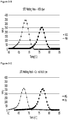
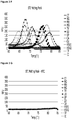
- FIG. 3 (a) shows the results of multiple inherent dissociation temperature measurements for causative organisms of CT, NG, MH, MG, TV, UU, UP, CA, GV, HSV1, HSV2, TP, IC.
- CT FAM 80 °C
- NG HEX 76.5 °C
- MH HEX 68 °C
- MG CalRed610 67.5 °C
- TV Quasar670 71.5 °C
- UU CalRed610 77 °C
- UP FAM 77 °C
- GV Quasar670 78.5 °C
- HSV 1 Quasar705 73.5 °C
- HSV 2 Quasar705 79 °C
- TP Quasar705 66 °C
- IC Quasar670
- the target nucleic acid sequence can be detected more quickly and simply than the conventional PCR method by analyzing the fluorescence of the SCO using the real-time PCR instrument, simultaneously with the PCR using the marking technique of CCTF.
- CCTF analysis was performed with Real-time PCR instrument for DNA of the causative organisms of the gastrointestinal diseases, Rotavirus A(RVA), Astrovirus(AstV), Adenovirus F40(AdV 40), Adenovirus F41(AdV 41), Norovirus G I (NoV G I), Norovirus G II (NoV G II), and External control (EC).
- the forward primer used in this example was CTPO and was constructed on the same principle as in Example 1 above.
- the 5 'end of CTPO was composed of 19 ⁇ 20 mers of nucleotide sequences, and was composed of a sequence non-complementary to DNA of the target sequence so as to form CCTF.
- the restriction enzyme recognition sequence was consecutively located, and after this up to the 3' end, it was composed of the sequence complementary to each target site to play a role as a primer.
- the reverse primer was composed of sequence complementary to the target site to be amplified.
- SCO which forms a complementary bond with CCTF to be a double-stranded template, was positioned by positioning fluorescent offsetting molecules (BHQ-1 or BHQ-2), and the fluorescent reporter molecular was positioned so as to have a certain distance.
- Primer information and target sequence information which is amplified and generated are as follows.
- the bold and slanted font of the Primer sequence means the restriction enzyme recognition sequence, and the underline is the complementary sequence of the CCTF produced thereby.
- the part represented by * is a tag that modified dCTP was inserted into C in the recognition sequence to block the site cleaved by the PspGI restriction enzyme.
- the parentheses mean the position of the nucleotide sequence in which the fluorescent offsetting molecule and the fluorescent reporter are located.
- the sequence of the CCTF produced from the amplified product is as follows.
- PCR reaction was performed using CFX96 Real-time PCR (Bio-Rad, USA) with 20 ⁇ l of total reaction solution of each of Primer 31, 32, 33, 34, 35, 36, 37, 38, 39, 40, 41, 42, 43, 44, 45 and SCO 14, 15, 16, 17, 18, 19, 20 prepared by adding 0.15 ⁇ M, PspGI (NEB, USA) 1U, PCR buffer (1x), MgCl 2 2.5 mM, dNTP 200 ⁇ M, DTT 0.1mM, RNase Inhibitor 1U, SuperiorScript III (Enzynomics, Korea) 1U and the nucleic acid of the genomic RNA of RVA, AstV, AdV 40, AdV41, NoV G I, NoV G II and EC(MS2 phage) 1x10 ⁇ 4 pg/rxn, respectively.
- a reverse transcription reaction was performed using a cycle at the denaturation temperature of 55 °C for 20 minutes once, and with a cycle at the denaturation temperature of 95 °C for 10 minutes 1 time, and with a cycle at an annealing temperature of 63 °C for 1 minute 50 times repeatedly.
- the reaction mixture was cooled to 50 °C in the same apparatus, held at 50 °C for 30 seconds, and then slowly heated from 50 °C to 95 °C to obtain an inherent dissociation temperature analysis curve. Data analysis was performed with Bio-Rad CFX Manager 1.6.
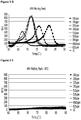
- Fig. 4 shows the results of multiple inherent dissociation temperature measurements for causative organisms of RVA, AstV, AdV 40, AdV 41, NoV G I , NoV G II. It was identified that the peak was observed at the inherent dissociation temperature that each SCO has : RVA: HEX 78 °C, AstV: CalRed610 78 °C, AdV 40: CalRed610 67 °C, AdV 41: CalRed610 67 °C, NoV G I : FAM 68 °C, NoV G II: FAM 84 °C, EC: HEX 69 °C (a)(b)(c)(d), and no peak of SCO visualizing CCTF was observed when the target sequence was not added in the same composition (e).
- the target nucleic acid sequence can be detected more quickly and simply than the conventional PCR method by analyzing the fluorescence of the SCO using the real-time PCR instrument, simultaneously with the PCR using the marking technique of CCTF.
- CCTF analysis was performed with Real-time PCR instrument for DNA of subtypes of Human Papillomavirus (HPV), 16 type, 18 type, 33 type, 35 type, 51 type, 53 type, 59 type, 68a type, 82 type and Internal control (IC).
- HPV Human Papillomavirus
- 16 type 16 type
- 18 type 33 type
- 35 type 51 type, 53 type, 59 type, 68a type, 82 type
- IC Internal control
- the forward primer used in this example was CTPO and was constructed on the same principle as in Example 1 above.
- the 5 'end of CTPO was composed of 19 ⁇ 20 mers of nucleotide sequences, and was composed of a sequence non-complementary to DNA of the target sequence to form CCTF.
- the restriction enzyme recognition sequence was consecutively located, and after this up to the 3' end, a sequence complementary to each target site was composed to play a role as a primer.
- the reverse primer was composed of sequence complementary to the target site to be amplified.
- SCO which forms a complementary bond with CCTF to be a double-stranded template, was positioned by positioning fluorescent offsetting molecules (BHQ-1 or BHQ-2), and the fluorescent reporter molecular was positioned so as to have a certain distance.
- Primer information and target sequence information which is amplified and generated are as follows.
- the bold and slanted font of the Primer sequence means the restriction enzyme recognition sequence, and the underline is the complementary sequence of the CCTF produced thereby.
- the part represented by * is a tag that modified dCTP was inserted into C in the recognition sequence to block the site cleaved by the PspGI restriction enzyme.
- the parentheses mean the position of the nucleotide sequence in which the fluorescent offsetting molecule and the fluorescent reporter are located.
- the sequence of the CCTF produced from the amplified product is as follows.
- PCR reaction was performed using CFX96 Real-time PCR (Bio-Rad, USA) with 20 ⁇ l of total reaction solution of each of Primer 46, 47, 48, 49, 50, 51, 52, 53, 54, 55, 56, 57, 58, 59, 60, 61, 62, 63 and SCO 21, 22, 23, 24 prepared by adding 0.15 ⁇ M, PspGI (NEB, USA) 5U, PCR buffer (1x), MgCl 2 2.5 mM, dNTP 200 ⁇ M, h-Taq DNA polymerase (Solgent, Korea) 1.6 U and HPV type 16, type 18, type 33, type 35, type 51, type 53, type 59, type 68a, type 82 and template DNA of genomic DNA of IC 100 pg/rxn, respectively.
- a reaction was performed using a cycle at the denaturation temperature of 95 °C for 15 minutes once, and with a cycle at the denaturation temperature of 95 °C for 30 second and at an annealing temperature of 63 °C for 1 minute 50 times repeatedly.
- the reaction mixture was cooled to 50 °C in the same apparatus, held at 50 °C for 30 seconds, and then slowly heated from 50 °C to 95 °C to obtain an inherent dissociation temperature analysis curve.
- Data analysis was performed with Bio-Rad CFX Manager 1.6.
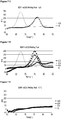
- Fig. 5 shows the results of multiple inherent dissociation temperature measurements for each target of type 16, type 18, type 33, type 35, type 51, type 53, type 59, type 68a, type 82, IC. It was identified that the peak was observed at the inherent dissociation temperature that each SCO has (type 16: HEX 76.5 °C, type 18: FAM 78 °C, type 33: Quasar670 71 °C, type 35: Quasar670 71 °C, type 51: Quasar670 71 °C, type 53: Quasar670 71 °C, type 59: Quasar670 71 °C, type 68 a: Quasar670 71 °C, type 82: Quasar670 71 °C, IC: Quasar670 67.5 °C) (a)(b)(c)(d), and no peak of SCO visualizing CCTF was observed when the target sequence was not added in the
- the target nucleic acid sequence can be detected more quickly and simply than the conventional PCR method by analyzing the fluorescence of the SCO using the real-time PCR instrument, simultaneously with the PCR using the marking technique of CCTF.
- CCTF analysis was performed using Real-time PCR instrument of nucleic acids of the causative organisms of the respiratory diseases, Influenza A/H1N1(Flu A/H1N1), Influenza A/H3N2(Flu A/H3N2), Influenza A/H1N1/2009pdm(Flu A/H1N1/2009pdm), Influenza B(Flu B), Parainfluenza 1(PIV1), Parainfluenza 3(PIV3), Respiratory syncytial virus A(RSV A), Respiratory syncytial virus B(RSV B), Human metapneumovirus(MPV), Adenovirus(AdV) and External control (EC).
- the forward primer used in this example was CTPO and was constructed on the same principle as in Example 1 above.
- the 5 'end of CTPO was composed of 19 ⁇ 20 mers of nucleotide sequences, and was composed of a sequence non-complementary to DNA of the target sequence so as to form CCTF.
- the restriction enzyme recognition sequence was then consecutively located, and after this up to the 3' end, a sequence complementary to each target site was composed to play a role as a primer.
- the reverse primer was composed of sequence complementary to the target site to be amplified.
- SCO which forms a complementary bond with CCTF to be a double-stranded template, was positioned by positioning fluorescent offsetting molecules (BHQ-1 or BHQ-2), and the fluorescent reporter molecular was positioned so as to have a certain distance.
- Primer information and target sequence information which is amplified and generated are as follows.
- the bold and slanted font of the Primer sequence means the restriction enzyme recognition sequence, and the underline is the complementary sequence of the CCTF produced thereby.
- the part represented by * is a tag that modified dCTP was inserted into C in the recognition sequence to block the site cleaved by the PspGI restriction enzyme.
- the parentheses mean the position of the nucleotide sequence in which the fluorescent offsetting molecule and the fluorescent reporter are located.
- the sequence of the CCTF produced from the amplified product is as follows.
- PCR reaction was performed using CFX96 Real-time PCR (Bio-Rad, USA) with 20 ⁇ l of total reaction solution of each of 64, 65, 66, 67, 68, 69, 70, 71, 72, 73, 74, 75, 76, 77, 78, 79, 80, 81, 82, 83, 84 and SCO 33, 34, 35, 36, 37, 38, 39, 40, 41, 42, 43 prepared by adding 0.15 ⁇ M, PspGI (NEB, USA) 1U, PCR buffer (1x), MgCl 2 2.5 mM, dNTP 200 ⁇ M, DTT 0.1mM, RNase Inhibitor 1U, SuperiorScript III (Enzynomics, Korea) 1U Flu A/H1N1, Flu A/H3N2, Flu A/H1N1/2009pdm, the template nucleic acid of the genomic RNA of Flu B, PIV1, PIV3, RSV A, RSV B, hMPV, A
- a reaction was repeatedly performed with a cycle at the reverse transcription reaction temperature of 55 °C for 20 minutes once, and with a cycle at the denaturation temperature of 95 °C for 30 seconds, and an annealing temperature of 63 °C for 1 minute 50 times repeatedly.
- the reaction mixture was cooled to 50 °C in the same apparatus, held at 50 °C for 30 seconds, and then slowly heated from 50 °C to 95 °C to obtain an inherent dissociation temperature analysis curve.
- Data analysis was performed with Bio-Rad CFX Manager 1.6.
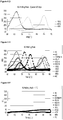
- Fig. 6 shows the results of multiple inherent dissociation temperature measurements for causative organisms of Flu A/H1N1, Flu A/H3N2, Flu A/H1N1/2009pdm, Flu B, PIV1, PIV3, RSV A, RSV B, hMPV, ADV, EC(Ms2 phage).
- the target nucleic acid sequence can be detected more quickly and simply than the conventional PCR method by analyzing the fluorescence of the SCO using the real-time PCR instrument, simultaneously with the PCR using the marking technique of CCTF.
- CCTF analysis was performed with Real-time PCR instrument for analyzing the genotype of rs6265, single nucleotide polymorphism of BDNF gene.
- the forward primer used in this example was CTPO and was constructed on the same principle as in Example 1 above.
- the 5 'end of CTPO was composed of 19 ⁇ 20 mers of nucleotide sequences, and was composed of a sequence non-complementary to DNA of the target sequence so as to form CCTF.
- the restriction enzyme recognition sequence was then located, and from this up to the 3' end, a sequence complementary to each target site was composed to play a role as a primer.
- the reverse primer was composed of sequence complementary to the target site to be amplified.
- SCO which forms a complementary bond with CCTF to be a double-stranded template, was positioned by positioning fluorescent offsetting molecules (BHQ-1 or BHQ-2), and the fluorescent reporter molecular was positioned so as to have a certain distance.
- Primer information and target sequence information which is amplified and generated are as follows.
- the bold and slanted font of the Primer sequence means the restriction enzyme recognition sequence, and the underline is the complementary sequence of the CCTF produced thereby.
- the part represented by * is a tag that modified dCTP was inserted into C in the recognition sequence to block the site cleaved by the PspGI restriction enzyme.
- the parentheses mean the position of the nucleotide sequence in which the fluorescent offsetting molecule and the fluorescent reporter are located.
- the sequence of the CCTF produced from the amplified product is as follows.
- PCR reaction was performed using the following CFX96 Real-time PCR (Bio-Rad, USA) with 20 ⁇ l of total reaction solution of each of Primer 85, 86, 87, 88, 89 and SCO 44, 45, 46 prepared by adding 0.15 ⁇ iM, PspGI (NEB, USA) 5U, PCR buffer (1x), MgCl 2 2.5 mM, dNTP 200 ⁇ iM, h-Taq DNA polymerase (Solgent, Korea) 1.6 U and Flu A/H1N1, Flu A/H3N2, Flu A/H1N1/2009pdm, the template nucleic acids of the genomic RNA of Flu B, PIV1, PIV3, RSV A, RSV B, hMPV, ADV and MS2 phage 1x10 ⁇ 4 copies/rxn, respectively.
- a reaction was performed using a cycle at the denaturation temperature of 95 °C for 15 minutes once, and with a cycle at the denaturation temperature of 95 °C for 30 seconds, and an annealing temperature of 63 °C for 1 minute 50 times repeatedly.
- the reaction mixture was cooled to 50 °C in the same apparatus, held at 50 °C for 30 seconds, and then slowly heated from 50 °C to 95 °C to obtain an inherent dissociation temperature analysis curve.
- Data analysis was performed with Bio-Rad CFX Manager 1.6.
- Fig. 7 shows the results of multiple inherent dissociation temperature measurements for the genotype of mutant type A/A, wild type G/G and heterozygote A/G of rs6265 and IC. It was identified that the peak was observed at the inherent dissociation temperature that each SCO has (A/A: 76.5 °C, A/G: 76.5 °C 75 °C, G/G 75 °C, IC: 66 °C) (a)(b)(c)(d), and no peak of SCO visualizing CCTF was observed when the target sequence was not added in the same composition (e).
- the target nucleic acid sequence can be detected more quickly and simply than the conventional PCR method by analyzing the fluorescence of the SCO using the real-time PCR instrument, simultaneously with the PCR using the marking technique of CCTF.
- Example 2 It has been proved in Example 2 that SCO can be used to confirm whether CCTF is generated with a real-time PCR device.
- the SCO used in the above method is simultaneously formed during the reaction in which the target sequence is generated during the PCR amplification process, and it is possible to identify CCTF generated by real-time fluorescence analysis. Based on this, the present example demonstrated that a standard curve formation is possible when analyzing the formation of CCTF using SCO in the case of PCR with multiple target sequences.
- STI sexually transmitted infections
- NG Neisseria. gonorrhea
- MH Mycoplasma. hominis
- UP Ureaplasma. parvum
- the forward primer used in this example was constructed based on the method described in the detailed description of the invention above as CPTO.
- the 5 'end of the forward primer was composed of a 19-mer or 21-mer nucleotide sequence, and was composed of non-complementary sequences to DNA of each causative organism so as to form CCTF.
- the restriction enzyme recognition sequence was then consecutively located. After this up to the 3' end, a sequence complementary to DNA of each causative organism was composed to play a role as a primer.
- the reverse primer was composed of sequence complementary to the target site of DNA by each causative organism.
- SCO which forms a dimer with CCTF, was designed to have a double tag, and was separately designed for each causative organism.
- SCO was designed by positioning quencher (BHQ-1 or BHQ-2) at 3' end, with reporter molecular (each FAM, HEX, CAL Fluor Red 610) positioned at a certain distance, and its sequence was complementary to CCTF sequence to be analyzed.
- Primer information and target sequence information which is amplified and generated are as follows.
- the bold and slanted font of the Primer sequence means the restriction enzyme recognition sequence, and the underline is the complementary sequence of the CCTF produced thereby.
- the part represented by * is a tag that modified dCTP was inserted into C in the recognition sequence to block the site cleaved by the PspGI restriction enzyme.
- the parentheses mean the position of the nucleotide sequence in which the fluorescent offsetting molecule and the fluorescent reporter are located.
- Primer and primer corresponding to NG in SCO is the same as those used in Example 2.
- the sequence of the CCTF produced from the amplified product is as follows.
- PCR reaction was performed using the following CFX96 Real-time PCR (Bio-Rad, USA) with 20 ⁇ l of total reaction solution obtained by adding three kinds of the specific forward primers and three kinds of reverse primers of each target sequence, as mentioned in the above primer design, and three kinds of SCO to be 0.15 ⁇ M, respectively, and adding PspGI (NEB, USA) 2 U, PCR buffer (1x), MgCl 2 2.5 mM, dNTP 200 ⁇ M, h-Taq DNA polymerase (Solgent, Korea) 1.6 U, and contained the template DNA diluted by 10-folds with 100 pg/ ⁇ l genomic DNA proven by the conventional quantitation method for each causative organism.
- a reaction was repeatedly performed with a cycle at the denaturation temperature of 95 °C for 15 minutes once, and with a cycle at the denaturation temperature of 95 °C for 30 seconds, and an annealing temperature of 63 °C for 1 minute 50 times.
- fluorescence signals were collected at the annealing stage, and the data analysis was performed with Bio-Rad CFX Manager 1.6.
- Cycle threshold (Ct) was started with an algebraic amplifier using a known number of DNA concentrations to create a standard curve for the strain.
- Regression coefficient (r 2 ) in the linear regression analysis of the standard curve was represented by NG 0.9982, MG 0.999, UP 0.9992, respectively.
- the slope of the regression plot was NG -3.85, MG -3.89, and UP -3.66, respectively.
- E 10 [-1/slope] -1) was 81.8% for NG, 80.7% for MG and 87.6% for UP, respectively, and thus, they were listed in the proper range of between 80 and 120%.
Landscapes
- Chemical & Material Sciences (AREA)
- Life Sciences & Earth Sciences (AREA)
- Organic Chemistry (AREA)
- Health & Medical Sciences (AREA)
- Proteomics, Peptides & Aminoacids (AREA)
- Engineering & Computer Science (AREA)
- Zoology (AREA)
- Wood Science & Technology (AREA)
- Physics & Mathematics (AREA)
- Immunology (AREA)
- Analytical Chemistry (AREA)
- Biochemistry (AREA)
- General Health & Medical Sciences (AREA)
- Molecular Biology (AREA)
- Genetics & Genomics (AREA)
- Bioinformatics & Cheminformatics (AREA)
- General Engineering & Computer Science (AREA)
- Biotechnology (AREA)
- Microbiology (AREA)
- Biophysics (AREA)
- Chemical Kinetics & Catalysis (AREA)
- Spectroscopy & Molecular Physics (AREA)
- Virology (AREA)
- General Physics & Mathematics (AREA)
- Pathology (AREA)
- Electrochemistry (AREA)
- Measuring Or Testing Involving Enzymes Or Micro-Organisms (AREA)
Applications Claiming Priority (2)
| Application Number | Priority Date | Filing Date | Title |
|---|---|---|---|
| KR20160050313 | 2016-04-25 | ||
| PCT/KR2017/004297 WO2017188669A2 (fr) | 2016-04-25 | 2017-04-21 | Procédé de détection de séquence d'acide nucléique cible à l'aide d'un fragment de marqueur complémentaire clivé et composition associée |
Publications (4)
| Publication Number | Publication Date |
|---|---|
| EP3453768A2 true EP3453768A2 (fr) | 2019-03-13 |
| EP3453768A4 EP3453768A4 (fr) | 2020-01-01 |
| EP3453768B1 EP3453768B1 (fr) | 2025-03-26 |
| EP3453768C0 EP3453768C0 (fr) | 2025-03-26 |
Family
ID=60159893
Family Applications (1)
| Application Number | Title | Priority Date | Filing Date |
|---|---|---|---|
| EP17789853.3A Active EP3453768B1 (fr) | 2016-04-25 | 2017-04-21 | Procédé de détection de séquence d'acide nucléique cible à l'aide d'un fragment de marqueur complémentaire clivé et composition associée |
Country Status (6)
| Country | Link |
|---|---|
| US (2) | US11193161B2 (fr) |
| EP (1) | EP3453768B1 (fr) |
| JP (1) | JP6796660B2 (fr) |
| KR (1) | KR101961642B1 (fr) |
| CN (1) | CN109072305A (fr) |
| WO (1) | WO2017188669A2 (fr) |
Cited By (1)
| Publication number | Priority date | Publication date | Assignee | Title |
|---|---|---|---|---|
| EP4237584B1 (fr) * | 2020-10-29 | 2025-04-23 | Biocartis NV | Cartouche générique et procédé de détection d'acides nucléiques multiplex |
Families Citing this family (8)
| Publication number | Priority date | Publication date | Assignee | Title |
|---|---|---|---|---|
| WO2019045532A2 (fr) | 2017-08-31 | 2019-03-07 | Seegene, Inc. | Évaluation de la performance de composants à l'aide d'une paire d'amorces de formation de dimères |
| KR102345601B1 (ko) | 2017-09-29 | 2021-12-30 | 주식회사 씨젠 | Pto 절단 및 연장-의존적 연장 분석에 의한 타겟 핵산 서열의 검출 |
| EP3735476B1 (fr) | 2018-01-05 | 2023-08-23 | Seegene, Inc. | Procédé de détermination de la présence ou de l'absence de m. tuberculosis, m. bovis et m. bovis bcg dans un échantillon |
| KR102464501B1 (ko) | 2018-04-20 | 2022-11-17 | 주식회사 씨젠 | 샘플 내 복수의 타겟 핵산 서열의 검출을 위한 방법 및 장치 |
| CN110702813B (zh) * | 2019-10-23 | 2022-03-11 | 贵州中医药大学 | 一种苗药黑骨藤hplc指纹图谱研究及多成分含量测定方法 |
| CN111041127A (zh) * | 2020-01-10 | 2020-04-21 | 上海润达榕嘉生物科技有限公司 | 一种hsv1病毒的检测引物及其试剂盒 |
| JP7585843B2 (ja) * | 2021-02-10 | 2024-11-19 | 株式会社島津製作所 | オリゴヌクレオチドプローブ、検査液および検出方法 |
| CN115873946A (zh) * | 2022-08-04 | 2023-03-31 | 山东鲁抗好丽友生物技术开发有限公司 | 基于Blocker的基因突变检测试剂盒及其应用 |
Family Cites Families (22)
| Publication number | Priority date | Publication date | Assignee | Title |
|---|---|---|---|---|
| US5512441A (en) * | 1994-11-15 | 1996-04-30 | American Health Foundation | Quantative method for early detection of mutant alleles and diagnostic kits for carrying out the method |
| US5830655A (en) * | 1995-05-22 | 1998-11-03 | Sri International | Oligonucleotide sizing using cleavable primers |
| US5935791A (en) * | 1997-09-23 | 1999-08-10 | Becton, Dickinson And Company | Detection of nucleic acids by fluorescence quenching |
| DE60131903T2 (de) * | 2000-10-24 | 2008-11-27 | The Board of Trustees of the Leland S. Stanford Junior University, Palo Alto | Direkte multiplex charakterisierung von genomischer dna |
| EP1347060A4 (fr) * | 2000-12-26 | 2004-08-18 | Takara Bio Inc | Procede de detection d'un micro-organisme pathogene |
| WO2003050304A1 (fr) * | 2001-12-08 | 2003-06-19 | Seegene, Inc | Systeme d'amorce de commande de recuit permettant de reguler la specificite du recuit d'une amorce et ses applications |
| IL163600A0 (en) | 2002-03-01 | 2005-12-18 | Ravgen Inc | Methods for detection of genetic disorders |
| EP2192193A1 (fr) * | 2002-10-18 | 2010-06-02 | Genematrix Inc. | Procede de detection de mutations |
| GB0228614D0 (en) * | 2002-12-07 | 2003-01-15 | Fu Guoliang | Oligonucleotide guided analysis of gene expression |
| WO2008136868A2 (fr) * | 2006-12-05 | 2008-11-13 | Sequenom, Inc. | Détection et quantification de biomolécules à l'aide de la spectrométrie de masse |
| EP2310522B1 (fr) * | 2008-06-17 | 2013-03-20 | Sigma-Aldrich Co. LLC | Procédé de réaction en chaîne par la polymérase en temps réel faisant intervenir un système de détection universel |
| KR101025450B1 (ko) * | 2008-08-06 | 2011-04-04 | (주)진매트릭스 | 다중 염기변이 분석방법 |
| KR20110048734A (ko) * | 2009-11-03 | 2011-05-12 | 주식회사 씨젠 | 5―미스매치 프로브 타겟 검출 |
| JP5684737B2 (ja) * | 2010-01-21 | 2015-03-18 | アークレイ株式会社 | 標的配列の増幅方法、多型検出方法およびそれに用いる試薬 |
| JP5852222B2 (ja) * | 2011-03-29 | 2016-02-03 | シージーン アイエヌシー | Pto切断及び延長−依存的切断によるターゲット核酸配列の検出 |
| KR20130101952A (ko) * | 2012-02-02 | 2013-09-16 | 주식회사 씨젠 | Pto 절단과 연장-의존적 혼성화를 이용한 타겟 핵산서열의 검출 |
| US9828629B2 (en) * | 2013-03-15 | 2017-11-28 | Roche Molecular Systems, Inc. | Nucleic acid target identification by structure based probe cleavage |
| TR201815755T4 (tr) * | 2013-04-01 | 2018-11-21 | Genomictree Inc | Allele özgü reaktif primer kullanan nükleik asit amplifikasyon yöntemi. |
| KR101503726B1 (ko) * | 2013-04-30 | 2015-03-19 | (주)진매트릭스 | Dna 제한효소에 의해 활성 조절이 가능한 프라이머 및 이를 이용한 유전자 증폭방법 그리고 이러한 프라이머의 설계방법 |
| KR101738596B1 (ko) * | 2014-05-28 | 2017-05-22 | (주)진매트릭스 | 유전자 표적부위 염기서열분석방법 및 그 분석용 조성물 |
| WO2015193483A1 (fr) * | 2014-06-19 | 2015-12-23 | Multiplicom N.V. | Réactions en chaîne par polymérase quantitatives médiées par restriction |
| KR101616796B1 (ko) | 2015-01-05 | 2016-05-12 | 엘에스산전 주식회사 | 냉각장치를 갖는 태양광 모듈 |
-
2017
- 2017-04-18 KR KR1020170049845A patent/KR101961642B1/ko active Active
- 2017-04-21 CN CN201780025886.7A patent/CN109072305A/zh active Pending
- 2017-04-21 WO PCT/KR2017/004297 patent/WO2017188669A2/fr not_active Ceased
- 2017-04-21 US US16/095,695 patent/US11193161B2/en active Active
- 2017-04-21 EP EP17789853.3A patent/EP3453768B1/fr active Active
- 2017-04-21 JP JP2018556900A patent/JP6796660B2/ja active Active
-
2020
- 2020-12-08 US US17/115,740 patent/US20210189456A1/en not_active Abandoned
Cited By (1)
| Publication number | Priority date | Publication date | Assignee | Title |
|---|---|---|---|---|
| EP4237584B1 (fr) * | 2020-10-29 | 2025-04-23 | Biocartis NV | Cartouche générique et procédé de détection d'acides nucléiques multiplex |
Also Published As
| Publication number | Publication date |
|---|---|
| KR101961642B1 (ko) | 2019-03-25 |
| EP3453768B1 (fr) | 2025-03-26 |
| US20190177768A1 (en) | 2019-06-13 |
| US20210189456A1 (en) | 2021-06-24 |
| CN109072305A (zh) | 2018-12-21 |
| US11193161B2 (en) | 2021-12-07 |
| WO2017188669A2 (fr) | 2017-11-02 |
| WO2017188669A3 (fr) | 2018-08-09 |
| EP3453768C0 (fr) | 2025-03-26 |
| JP2019514384A (ja) | 2019-06-06 |
| JP6796660B2 (ja) | 2020-12-09 |
| KR20170121700A (ko) | 2017-11-02 |
| EP3453768A4 (fr) | 2020-01-01 |
Similar Documents
| Publication | Publication Date | Title |
|---|---|---|
| EP3453768B1 (fr) | Procédé de détection de séquence d'acide nucléique cible à l'aide d'un fragment de marqueur complémentaire clivé et composition associée | |
| US9074243B2 (en) | Detection of amplification products | |
| US20130323738A1 (en) | Detection of Amplification Products | |
| JP6021813B2 (ja) | 多重増幅および検出 | |
| US20100297630A1 (en) | Method for the simultaneous detection of multiple nucleic acid sequences in a sample | |
| US11753679B2 (en) | Looped primer and loop-de-loop method for detecting target nucleic acid | |
| KR102208001B1 (ko) | 돼지 써코바이러스 2형 및 3형 동시 검출용 조성물 및 이의 용도 | |
| CN112029903A (zh) | 一种SARS-CoV-2病毒核酸检测的引物组、试剂盒及其应用 | |
| US20200407794A1 (en) | Molecular targets for fetal nucleic acid analysis | |
| CN108220480B (zh) | 一种用于特异性检测hpv18的rpa荧光定量引物对、探针及试剂盒 | |
| EP4083229A1 (fr) | Méthodes et compositions pour la détection d'acides nucléiques | |
| US20210054446A1 (en) | Promer for Real-Time Detection of Nucleic Acid or Protein and Method of detecting Nucleic Acid or Protein Using the Same | |
| CN104164506A (zh) | 实时pcr检测单核苷酸多态性的方法及其应用 | |
| US11209368B2 (en) | Method for detecting specific nucleic acid sequences | |
| Yang et al. | An amplification-free detection method of nucleic acids by a molecular beacon probe based on endonuclease activity | |
| JP4190562B2 (ja) | 遺伝子配列検査法 | |
| Li et al. | One-pot, ultrasensitive, and multiplex detection of SARS-CoV-2 genes utilizing self-priming hairpin-mediated isothermal amplification | |
| CN114250273A (zh) | 用于核酸检测的组合物 | |
| CN116904564A (zh) | 同时检测n种目标基因的荧光实时检测系统、方法、多重引物、试剂盒 | |
| CN121450804B (zh) | 一种检测外显子跳跃突变的系统以及方法和应用 | |
| CN114958972B (zh) | 一种用于等位基因多态性分型的引物设计方法及其应用 | |
| CN110951919A (zh) | 一种用于检测的寡核苷酸、试剂盒以及使用其的检测方法 | |
| US10246739B2 (en) | Exonuclease cycling assay | |
| US20250075266A1 (en) | Dna detection method and dna detection kit | |
| CN117701688A (zh) | 一种动态监测rna和dna的探针自复位分析方法 |
Legal Events
| Date | Code | Title | Description |
|---|---|---|---|
| STAA | Information on the status of an ep patent application or granted ep patent |
Free format text: STATUS: THE INTERNATIONAL PUBLICATION HAS BEEN MADE |
|
| PUAI | Public reference made under article 153(3) epc to a published international application that has entered the european phase |
Free format text: ORIGINAL CODE: 0009012 |
|
| STAA | Information on the status of an ep patent application or granted ep patent |
Free format text: STATUS: REQUEST FOR EXAMINATION WAS MADE |
|
| 17P | Request for examination filed |
Effective date: 20181126 |
|
| AK | Designated contracting states |
Kind code of ref document: A2 Designated state(s): AL AT BE BG CH CY CZ DE DK EE ES FI FR GB GR HR HU IE IS IT LI LT LU LV MC MK MT NL NO PL PT RO RS SE SI SK SM TR |
|
| AX | Request for extension of the european patent |
Extension state: BA ME |
|
| DAV | Request for validation of the european patent (deleted) | ||
| DAX | Request for extension of the european patent (deleted) | ||
| A4 | Supplementary search report drawn up and despatched |
Effective date: 20191129 |
|
| RIC1 | Information provided on ipc code assigned before grant |
Ipc: C12Q 1/6853 20180101ALI20191125BHEP Ipc: G01N 30/72 20060101ALI20191125BHEP Ipc: G01N 27/62 20060101ALI20191125BHEP Ipc: C12Q 1/6872 20180101ALI20191125BHEP Ipc: C12Q 1/6823 20180101ALI20191125BHEP Ipc: C12Q 1/68 20180101AFI20191125BHEP |
|
| STAA | Information on the status of an ep patent application or granted ep patent |
Free format text: STATUS: EXAMINATION IS IN PROGRESS |
|
| 17Q | First examination report despatched |
Effective date: 20201120 |
|
| GRAP | Despatch of communication of intention to grant a patent |
Free format text: ORIGINAL CODE: EPIDOSNIGR1 |
|
| STAA | Information on the status of an ep patent application or granted ep patent |
Free format text: STATUS: GRANT OF PATENT IS INTENDED |
|
| INTG | Intention to grant announced |
Effective date: 20250113 |
|
| GRAS | Grant fee paid |
Free format text: ORIGINAL CODE: EPIDOSNIGR3 |
|
| GRAA | (expected) grant |
Free format text: ORIGINAL CODE: 0009210 |
|
| STAA | Information on the status of an ep patent application or granted ep patent |
Free format text: STATUS: THE PATENT HAS BEEN GRANTED |
|
| AK | Designated contracting states |
Kind code of ref document: B1 Designated state(s): AL AT BE BG CH CY CZ DE DK EE ES FI FR GB GR HR HU IE IS IT LI LT LU LV MC MK MT NL NO PL PT RO RS SE SI SK SM TR |
|
| REG | Reference to a national code |
Ref country code: GB Ref legal event code: FG4D |
|
| REG | Reference to a national code |
Ref country code: CH Ref legal event code: EP |
|
| REG | Reference to a national code |
Ref country code: DE Ref legal event code: R096 Ref document number: 602017088546 Country of ref document: DE |
|
| REG | Reference to a national code |
Ref country code: IE Ref legal event code: FG4D |
|
| U01 | Request for unitary effect filed |
Effective date: 20250423 |
|
| U07 | Unitary effect registered |
Designated state(s): AT BE BG DE DK EE FI FR IT LT LU LV MT NL PT RO SE SI Effective date: 20250429 |
|
| PG25 | Lapsed in a contracting state [announced via postgrant information from national office to epo] |
Ref country code: RS Free format text: LAPSE BECAUSE OF FAILURE TO SUBMIT A TRANSLATION OF THE DESCRIPTION OR TO PAY THE FEE WITHIN THE PRESCRIBED TIME-LIMIT Effective date: 20250626 |
|
| PG25 | Lapsed in a contracting state [announced via postgrant information from national office to epo] |
Ref country code: NO Free format text: LAPSE BECAUSE OF FAILURE TO SUBMIT A TRANSLATION OF THE DESCRIPTION OR TO PAY THE FEE WITHIN THE PRESCRIBED TIME-LIMIT Effective date: 20250626 |
|
| PG25 | Lapsed in a contracting state [announced via postgrant information from national office to epo] |
Ref country code: HR Free format text: LAPSE BECAUSE OF FAILURE TO SUBMIT A TRANSLATION OF THE DESCRIPTION OR TO PAY THE FEE WITHIN THE PRESCRIBED TIME-LIMIT Effective date: 20250326 |
|
| PG25 | Lapsed in a contracting state [announced via postgrant information from national office to epo] |
Ref country code: GR Free format text: LAPSE BECAUSE OF FAILURE TO SUBMIT A TRANSLATION OF THE DESCRIPTION OR TO PAY THE FEE WITHIN THE PRESCRIBED TIME-LIMIT Effective date: 20250627 |
|
| U20 | Renewal fee for the european patent with unitary effect paid |
Year of fee payment: 9 Effective date: 20250729 |
|
| PG25 | Lapsed in a contracting state [announced via postgrant information from national office to epo] |
Ref country code: SM Free format text: LAPSE BECAUSE OF FAILURE TO SUBMIT A TRANSLATION OF THE DESCRIPTION OR TO PAY THE FEE WITHIN THE PRESCRIBED TIME-LIMIT Effective date: 20250326 |
|
| PG25 | Lapsed in a contracting state [announced via postgrant information from national office to epo] |
Ref country code: ES Free format text: LAPSE BECAUSE OF FAILURE TO SUBMIT A TRANSLATION OF THE DESCRIPTION OR TO PAY THE FEE WITHIN THE PRESCRIBED TIME-LIMIT Effective date: 20250326 |
|
| PG25 | Lapsed in a contracting state [announced via postgrant information from national office to epo] |
Ref country code: PL Free format text: LAPSE BECAUSE OF FAILURE TO SUBMIT A TRANSLATION OF THE DESCRIPTION OR TO PAY THE FEE WITHIN THE PRESCRIBED TIME-LIMIT Effective date: 20250326 |
|
| PG25 | Lapsed in a contracting state [announced via postgrant information from national office to epo] |
Ref country code: SK Free format text: LAPSE BECAUSE OF FAILURE TO SUBMIT A TRANSLATION OF THE DESCRIPTION OR TO PAY THE FEE WITHIN THE PRESCRIBED TIME-LIMIT Effective date: 20250326 |
|
| PG25 | Lapsed in a contracting state [announced via postgrant information from national office to epo] |
Ref country code: IS Free format text: LAPSE BECAUSE OF FAILURE TO SUBMIT A TRANSLATION OF THE DESCRIPTION OR TO PAY THE FEE WITHIN THE PRESCRIBED TIME-LIMIT Effective date: 20250726 |
|
| REG | Reference to a national code |
Ref country code: CH Ref legal event code: H13 Free format text: ST27 STATUS EVENT CODE: U-0-0-H10-H13 (AS PROVIDED BY THE NATIONAL OFFICE) Effective date: 20251125 |
|
| PG25 | Lapsed in a contracting state [announced via postgrant information from national office to epo] |
Ref country code: MC Free format text: LAPSE BECAUSE OF FAILURE TO SUBMIT A TRANSLATION OF THE DESCRIPTION OR TO PAY THE FEE WITHIN THE PRESCRIBED TIME-LIMIT Effective date: 20250326 |
|
| PG25 | Lapsed in a contracting state [announced via postgrant information from national office to epo] |
Ref country code: CH Free format text: LAPSE BECAUSE OF NON-PAYMENT OF DUE FEES Effective date: 20250430 |
|
| PG25 | Lapsed in a contracting state [announced via postgrant information from national office to epo] |
Ref country code: CZ Free format text: LAPSE BECAUSE OF FAILURE TO SUBMIT A TRANSLATION OF THE DESCRIPTION OR TO PAY THE FEE WITHIN THE PRESCRIBED TIME-LIMIT Effective date: 20250326 |
|
| PLBE | No opposition filed within time limit |
Free format text: ORIGINAL CODE: 0009261 |
|
| STAA | Information on the status of an ep patent application or granted ep patent |
Free format text: STATUS: NO OPPOSITION FILED WITHIN TIME LIMIT |
|
| REG | Reference to a national code |
Ref country code: CH Ref legal event code: L10 Free format text: ST27 STATUS EVENT CODE: U-0-0-L10-L00 (AS PROVIDED BY THE NATIONAL OFFICE) Effective date: 20260211 |
|
| GBPC | Gb: european patent ceased through non-payment of renewal fee |
Effective date: 20250626 |
|
| 26N | No opposition filed |
Effective date: 20260105 |
|
| PG25 | Lapsed in a contracting state [announced via postgrant information from national office to epo] |
Ref country code: GB Free format text: LAPSE BECAUSE OF NON-PAYMENT OF DUE FEES Effective date: 20250626 |
|
| PG25 | Lapsed in a contracting state [announced via postgrant information from national office to epo] |
Ref country code: IE Free format text: LAPSE BECAUSE OF NON-PAYMENT OF DUE FEES Effective date: 20250421 |