EP3457727A1 - Procédé pour empêcher un accès non autorisé à un dispositif sans contact - Google Patents
Procédé pour empêcher un accès non autorisé à un dispositif sans contact Download PDFInfo
- Publication number
- EP3457727A1 EP3457727A1 EP17306208.4A EP17306208A EP3457727A1 EP 3457727 A1 EP3457727 A1 EP 3457727A1 EP 17306208 A EP17306208 A EP 17306208A EP 3457727 A1 EP3457727 A1 EP 3457727A1
- Authority
- EP
- European Patent Office
- Prior art keywords
- contactless
- contactless device
- reader
- previous
- terminal reader
- Prior art date
- Legal status (The legal status is an assumption and is not a legal conclusion. Google has not performed a legal analysis and makes no representation as to the accuracy of the status listed.)
- Withdrawn
Links
Images
Classifications
-
- G—PHYSICS
- G06—COMPUTING OR CALCULATING; COUNTING
- G06F—ELECTRIC DIGITAL DATA PROCESSING
- G06F21/00—Security arrangements for protecting computers, components thereof, programs or data against unauthorised activity
- G06F21/30—Authentication, i.e. establishing the identity or authorisation of security principals
- G06F21/31—User authentication
- G06F21/34—User authentication involving the use of external additional devices, e.g. dongles or smart cards
- G06F21/35—User authentication involving the use of external additional devices, e.g. dongles or smart cards communicating wirelessly
-
- G—PHYSICS
- G06—COMPUTING OR CALCULATING; COUNTING
- G06K—GRAPHICAL DATA READING; PRESENTATION OF DATA; RECORD CARRIERS; HANDLING RECORD CARRIERS
- G06K19/00—Record carriers for use with machines and with at least a part designed to carry digital markings
- G06K19/06—Record carriers for use with machines and with at least a part designed to carry digital markings characterised by the kind of the digital marking, e.g. shape, nature, code
- G06K19/08—Record carriers for use with machines and with at least a part designed to carry digital markings characterised by the kind of the digital marking, e.g. shape, nature, code using markings of different kinds or more than one marking of the same kind in the same record carrier, e.g. one marking being sensed by optical and the other by magnetic means
-
- H—ELECTRICITY
- H04—ELECTRIC COMMUNICATION TECHNIQUE
- H04W—WIRELESS COMMUNICATION NETWORKS
- H04W4/00—Services specially adapted for wireless communication networks; Facilities therefor
- H04W4/80—Services using short range communication, e.g. near-field communication [NFC], radio-frequency identification [RFID] or low energy communication
Definitions
- This invention relates generally to a method of preventing unauthorized access to a contactless device.
- the invention relates more particularly to the field of methods implemented so that an owner consent is provided to a reader before any access to the contactless device.
- the invention is also related to a reader and a contactless device configured to implement such method.
- a contactless communication system for performing wireless communication at close range in a non-contact manner with the use of a contactless device is in widespread use.
- the contactless devices have an embedded antenna connected to a microchip, enabling the chip to pick up and respond to radio waves.
- the energy required for the contactless device to manipulate and transmit data is derived from the electromagnetic field generated by a reader.
- Contactless device do not require direct contact with the reader because they employ the passive transponder technology of Radio Frequency Identification (RFID). By just waving the contactless device near the reader, secure identification, electronic payment transaction and authentication are completed in milliseconds.
- RFID Radio Frequency Identification
- a contactless reader may be used for surreptitious interrogation (e.g., data skimming) of the contactless device.
- Another known solution is to use an electromagnetic shielding to protect information without requiring proactive measures by the owner.
- shielding can prevent the exchange of information between a contactless device and a reader.
- One simplest method is to prevent the contactless device from being powered up by the electromagnetic field by shielding the contactless device.
- This shielding allows isolating the contactless device from the surrounding world by different forms of metal shielding.
- shielding the contactless device can be effective, it is inconvenient for user because it requires to the user to remember that the contactless device is on a shield during use.
- Another solution is to simply shield or provide a means to disabling the antenna which may employee a pressure sensitive switch or special shielding built into the antenna.
- the problem with shielding only the antenna is that the antenna can couple capacitively to the shield in such a way that the shield itself becomes an antenna.
- Another known solution is to prevent the access to only part of the functions and contents of the contactless device, e.g. using authentication protocols like Basic Access Control (BAC) or Password Authenticated Connection Establishment (PACE).
- BAC Basic Access Control
- PACE Password Authenticated Connection Establishment
- the ISO 14443 generally recommends in its part 3 an INITIALIZATION and an ANTICOLLISION processes to deal with the presence of multiple contactless devices in a reader's operating volume or field.
- the INITIALIZATION describes the requirements for proximity coupling device (PCD) (i.e., the reader) and the contactless device to establish communication when the contactless device is brought into the reader's radio frequency (RF) field.
- PCD proximity coupling device
- RF radio frequency
- the ANTICOLLISION defines what happens when multiple contactless devices enter the magnetic field at the same time, identifying how the system determines which contactless device to use in the transaction and ensuring that all contactless devices presented are inventoried and processed.
- the reader first polls and inventories all contactless device entering its field using polling commands such as Request (REQ) and Answer To Request (ATQ) commands. Then, an ANTICOLLISION algorithm or loop is used to prepare for dialogue between the reader and one or more selected contactless device out of the total number of contactless devices responding to a request command.
- a binary search algorithm based on the unique identifier (UID) of each contactless device is prescribed. Communication with the contactless device starts with the ANTICOLLISION procedure, where the reader sends a request and contactless devices in the RF field answer.
- the first request is called REQA, to which contactless devices answer with ATQA.
- the ATQA is often invariant between contactless devices.
- the ISO 14443 INITIALIZATION and ANTICOLLISION scheme is designed to allow the construction of readers capable of communication with several contactless devices of the same type, which are powered simultaneously.
- the contactless devices Types A wait silently in the field for a polling command. Then the reader sends an ANTICOLLISION command with no UID or a partial UID of the contactless device, to which the contactless device(s) with matching partial UID will answer with the remainder of their UID. Reader can see potential collisions in the RF field (there are several contactless devices answering but they have different UIDs) and then send new ANTICOLLISION command where the colliding bit is set to 0 or 1. This is repeated until the reader has found one UID in full without collisions. This process is referred to as the ANTICOLLISION loop. Finally the reader sends a SELECT command with the complete UID, to which the selected CONTACTLESS DEVICE answers with SAK.
- the ISO 14443 ANTICOLLISION scheme have known drawbacks. For example, the ANTICOLLISION algorithms can become corrupted if contactless devices enter and/or leave the reader field after they have been inventoried or tallied. Further, concurrent reader communication with a number of contactless devices distributes available power, which is limited, between the contactless devices. Low power availability may affect contactless device functionality.
- the method of the present invention overcomes known drawbacks of conventional ANTICOLLISION schemes of type A that are used in or recommended for contactless devices.
- the purpose of the present invention is to let the reader power up and establish communication with a single contactless device even if there are several in the RF field.
- the method proposed by the present invention allows to let the reader to establish direct communication with one single contactless device even if there are several in the RF field.
- the invention proposes to introduce slight modification on the behavior of the contactless device and an adaptation from the reader.
- the reader need to know in advance the UID of the contactless device he would like to establish a communication.
- the reader does not need to know the UID of any of the contactless devices in advance, all contactless devices allow establishment of communication.
- the present invention proposes to send a SELECT command directly to the contactless device of the present invention, without using the ANTICOLLISION loop.
- the contactless device will grant access to only reader sending a SELECT command with its complete UID.
- the contactless device will deny access to readers not aware of its complete UID.
- the contactless device of the present invention does not answer to ANTICOLLISION commands (with no or partial UID).
- the reader compliant to these contactless device does not try to use the ANTICOLLISION command when it knows the UID, but goes directly to SELECT command (which is allowed in the standard).
- the UID of the contactless device is computed by the reader from identity information provided by a positive action corresponding to the user consent.
- the identity information can be entered onto the reader.
- the identity information can be entered by the user to the reader.
- the identity information is retrieved by the reader on the body of the contactless device.
- the identity information can be printed on the contactless device.
- the identity information can be encoded into an optical character recognition format such as a Machine-Readable Zone (MRZ), a bar code...
- MMRZ Machine-Readable Zone
- the reader in this case comprise optical means able to scan and decode the optical encoded data.
- the identity information can be printed in any known format.
- the reader comprises means able to read the said identity information.
- the identity information provided to the reader by such positive actions represent the consent of the owner of the contactless device. Therefore only reader in possession of the identity information can establish communication with the contactless devices requiring knowledge of their UID.
- Readers not having this information or which do not utilize it to skip the ANTICOLLISION loop cannot establish communication with such contactless devices. It is therefore not possible to access them without a visual inspection or data provided to the reader, which usually correlates to consent of the user.
- the readers adopting this method can still operate with all ISO 14443 compliant contactless devices, as they can use the ANTICOLLISION loop normally, and also with contactless devices of the present as skipping the ANTICOLLISION loop is compliant to the standard ISO 14443. But the contactless devices of the present invention do not operate on readers that are not able to skip the ANTICOLLISION loop.
- the contactless device can support both the direct SELECT protocol and the ANTICOLLISION loop protocol.
- the contactless device uses the ANTICOLLISION loop or the direct SELECT protocol accordingly. Indeed, if the identifier information received is complete, the contactless device triggers the direct SELECT protocol otherwise the ANTICOLLISION loop protocol is selected. This allows to use the same device to establish services that do not require user consent and services that do require it.
- the invention proposes a method to prevent unauthorized access to a contactless device by a contactless terminal reader wherein when the contactless device is in the RF field of the terminal reader:
- the communication between the terminal reader and the contactless device is under the protocol communication ISO 14443 type A.
- the terminal reader is configured to skip an ANTICOLLISION loop of the standard ISO 14443 type A and to send instead a SELECT command with the complete generated unique identifier to the contactless device.
- the identity information is printed on a support of the contactless device.
- the identity information is printed in a machine readable format.
- the machine readable format can be a machine readable zone (MRZ), a barcode or a guilloche network.
- the identity information is entered onto the terminal reader.
- the generation of the unique identifier of the contactless device comprises the following step:
- the implemented function is a cryptographic operation.
- the contactless device can be a driving licenses, identity cards, membership cards, badges or passes, passports, discount cards, banking cards, money cards, multi-application cards, and other papers of value; and security documents such as bank notes wherein a contactless module is inserted.
- the present invention relates also to a contactless terminal reader comprising:
- the contactless terminal reader according to the previous claim, wherein the terminal reader is compliant with the standard ISO 14443 type A.
- the present invention also relates to a contactless device comprising means to grant access request only for contactless terminal reader in possession of its complete unique identifier computed from identity information provided by a positive action corresponding to a user consent according to any previous claims.
- an action when an action is said to be performed by a device, it is in fact executed by a microprocessor in this device controlled by instruction codes recorded in a program memory on said device.
- An action is also ascribed to an application or software. This means that part of the instruction codes making up the application or software are executed by the microprocessor.
- the contactless devices can be driving licenses, identity cards, membership cards, badges or passes, passports, discount cards, banking cards, money cards, multi-application cards, and other papers of value; and security documents such as bank notes wherein a contactless module is inserted.
- the contactless device may take the shape of card or booklet or something else.
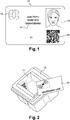
- FIG. 1 illustrates a data carrier in the form of an identification card 10, e.g. a national identity card or a driving license.
- the identification card 10 of the present invention can be manufactured according to any type of known manufacturing process.
- the identification card 10 comprises a support 11.
- the support 11 can comprise fibrous layers and/or plastic layers and/or metallic layers or a combination of such layers.
- the identification card 10 can comprise a picture 13 of the owner of the identification card 10.
- the picture 13 may be fastened or integrated into the support 11.
- the support 13 may also bears alphanumeric identification data 14 relating to the owner of the identification card 10.
- the identification data 14 may comprise usual identification data known from person skilled in the art, such as the first and last names, the date of birth, the place of birth or the like.
- the identification data 14 may also comprise additional information like a reference of the identification card 10 or the identification of the authority that issued the identification card 10.
- the identification card 10 comprises a contactless chip 12.
- the chip 12 may be embedded between several layers of the support 11 according to techniques commonly known by person skilled in the art.
- the support 11 also comprises a machine readable area 15.
- the machine readable area 15 comprises identity information related to the unique identifier (UID) of the contactless chip 12:
- the machine readable area 15 is data encoded in optical character recognition format.
- the machine readable area 15 is a 2D barcode.
- Encoding specifications of 2D barcodes such as QR Code, Aztec Code, PDF417 or Datamatrix can notably be used.
- the 2D-barcode may notably comply with the requirements set in the ISO/IEC 15415 specification.
- the machine readable area 15 can be a special machine-readable zone (MRZ). In an embodiment, the machine readable area 15 may notably be based on a guilloche network.
- MMRZ machine-readable zone
- the machine readable area 15 may notably be based on a guilloche network.
- the machine readable area 15 may be integrated in the support by printing or engraving, or by various techniques known per se by person skilled in the art.
- the machine readable area 15 may notably be based on microprinting, on optical variable ink, on UV printing, on rainbow printing, on a diffractive optical variable device, on laser engraving or on changeable multiple laser image.
- FIG. 2 shows entities involved in a flow diagram during a setup phase of a contactless communication between a terminal reader 16 and the identification card 10.
- the terminal reader 16 comprises a scanner 17 able to scan and decode the machine readable area 15.
- the scanner 17 is controlled by an application executed on the terminal reader 16. This application is adapted to decode the machine readable area 15 into binary data.
- the scanner 17 and the associated application may conform to the 2D barcode ISO/IEC 15426-2 specifications.
- the terminal reader 16 may be any mobile communication device comprising a scanner and supporting contactless communication.
- the terminal reader 16 may be realized as a smart phone, a computer and the like.
- the terminal reader 16 can be a control system for checking the validity of data carrier.
- the use of such control system may for instance be performed in airport terminals or in border checkpoints.
- Such control system can comprise a terminal and a scanner connected to the terminal.
- the form of the terminal reader 16 illustrated in FIG. 2 is merely an example for the sake of convenience in the description, and the kind and form of the terminal reader 16 described in the present disclosure are not interpreted as being limited to those of the terminal shown in FIG. 2 .
- the identification card 10 is a non-contact card that transmits and receives information using an RF, and is a contactless device that supports RF communication protocols such as ISO 14443 Type A. Moreover, the identification card 10 may be referred to as a PICC (Proximity IC Contactless device), or may be a typical RF contactless device. The form of the identification card 10 is merely an example for the sake of convenience in the description, but is not limited thereto.
- the terminal reader 16 may generate the unique 10 (UID) of the identification card 10 based on identity information provided to the terminal reader.
- UID unique 10
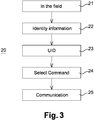
- FIG.3 illustrates an exemplary flow diagram during a communication setup phase 20 between the terminal reader 16 and the identification card 10 according to the communication protocol of ISO 14443 Type A.
- the process flow is depicted with labeled arrows to which respective numbers are assigned. The flow is understood as being performed sequentially from top to bottom as indicated by the increasing numbers. However, it should be noted that there may be multiple instances of this protocol run in parallel without specified ordering.
- FIG. 3 is a flow chart depicting a set of functions 20 that can be carried out in accordance with an example embodiment.
- the set of functions 20 can be performed during the setup phase of communication.
- the set of functions 20 are shown within steps 21 through 25. A description of these steps now follows.
- the setup phase process is set up, at step 21.
- the identification card 10 is thus in the communication range of the terminal reader 16.
- the scanner 17 of the terminal reader 16 scan the machine readable area 15.
- the scanned data is decoded into a binary data string.
- the terminal reader 16 retrieves the identity information related to the UID of the identification card 10 from the binary data string.
- the terminal reader 16 may generate, at step 23, the UID of the identification card 10 from at least one part over the identity information retrieved.
- the UID is generated by using an implemented embedded function or macro on at least one part over the identity information.
- the implemented function can be a one-way function such a hash function or a MAC (Message Authentication Code) operation.
- the implemented function can be cryptographic encryption scheme.
- the UID can be an encryption of at least one part over the identity information with an encryption key stored or provided to the terminal reader 16.
- the method of generating the UID on at least one part over the identity information is virtually limitless and will depend on what type of technologies are used to generate such UID. Persons skilled in the art can readily ascertain their suitability.
- the UID may have different size (byte) of 4 bytes, 7 bytes or 10 bytes depending on the identification card 10.
- the standard ISO 14443 Type A offers the possibility to send a SELECT command directly, without using the ANTICOLLISION loop process, when the UID is already known.
- the terminal reader sends a SELECT command directly to the identification card with the complete UID generated.
- the identification card 10 transmits to the terminal reader 16 a SAK (Select Acknowledge, Type A) as the response to the received command.
- SAK Select Acknowledge, Type A
- the INITIALIZATION phase 20 is over and the contactless communication between the terminal reader 16 and the identification card 10 is established.
- a terminal reader not able to skip the ANTICOLLISION loop cannot establish any communication with the identification card of the present invention.
- the generation of the UID from identity information provided to the terminal reader 16 allows to the owner of the identification card 10 to be sure that his commitment is used properly and that he approves on the contactless communication which is ongoing between the terminal reader 16 and the contactless device 10.
- the terminal readers adopting this method can still operate with all ISO 14443-3 compliant PICCs, as they can use the ANTICOLLISION loop normally, and as skipping the ANTICOLLISION loop is compliant to the standard.
- the identity information is encoded as a MRZ.
- the identity information is plain text printed onto the support 11 of the identification card 10.
- the terminal reader can comprise a camera configured to read such plain text.
- the owner involvement can be required.
- the owner can be prompted by the terminal reader 16 to enter a PIN or the like from its interface. From the data entered by the owner, the terminal reader can derivate the UID.
Landscapes
- Engineering & Computer Science (AREA)
- Theoretical Computer Science (AREA)
- Physics & Mathematics (AREA)
- General Physics & Mathematics (AREA)
- Computer Networks & Wireless Communication (AREA)
- Computer Security & Cryptography (AREA)
- Signal Processing (AREA)
- Computer Hardware Design (AREA)
- Software Systems (AREA)
- General Engineering & Computer Science (AREA)
- Mobile Radio Communication Systems (AREA)
- Credit Cards Or The Like (AREA)
Priority Applications (2)
| Application Number | Priority Date | Filing Date | Title |
|---|---|---|---|
| EP17306208.4A EP3457727A1 (fr) | 2017-09-18 | 2017-09-18 | Procédé pour empêcher un accès non autorisé à un dispositif sans contact |
| PCT/EP2018/075187 WO2019053283A1 (fr) | 2017-09-18 | 2018-09-18 | Procédé destiné à empêcher un accès non autorisé à un dispositif sans contact |
Applications Claiming Priority (1)
| Application Number | Priority Date | Filing Date | Title |
|---|---|---|---|
| EP17306208.4A EP3457727A1 (fr) | 2017-09-18 | 2017-09-18 | Procédé pour empêcher un accès non autorisé à un dispositif sans contact |
Publications (1)
| Publication Number | Publication Date |
|---|---|
| EP3457727A1 true EP3457727A1 (fr) | 2019-03-20 |
Family
ID=60811973
Family Applications (1)
| Application Number | Title | Priority Date | Filing Date |
|---|---|---|---|
| EP17306208.4A Withdrawn EP3457727A1 (fr) | 2017-09-18 | 2017-09-18 | Procédé pour empêcher un accès non autorisé à un dispositif sans contact |
Country Status (2)
| Country | Link |
|---|---|
| EP (1) | EP3457727A1 (fr) |
| WO (1) | WO2019053283A1 (fr) |
Citations (2)
| Publication number | Priority date | Publication date | Assignee | Title |
|---|---|---|---|---|
| US20070063055A1 (en) * | 2003-04-14 | 2007-03-22 | Hans Graf | Contactless data carrier |
| US20130311788A1 (en) * | 2010-12-31 | 2013-11-21 | Mourad Faher | System providing an improved skimming resistance for an electronic identity document |
-
2017
- 2017-09-18 EP EP17306208.4A patent/EP3457727A1/fr not_active Withdrawn
-
2018
- 2018-09-18 WO PCT/EP2018/075187 patent/WO2019053283A1/fr not_active Ceased
Patent Citations (2)
| Publication number | Priority date | Publication date | Assignee | Title |
|---|---|---|---|---|
| US20070063055A1 (en) * | 2003-04-14 | 2007-03-22 | Hans Graf | Contactless data carrier |
| US20130311788A1 (en) * | 2010-12-31 | 2013-11-21 | Mourad Faher | System providing an improved skimming resistance for an electronic identity document |
Non-Patent Citations (1)
| Title |
|---|
| IEEE, PISCATAWAY, NJ, USA, 13 July 2000 (2000-07-13), XP040389512 * |
Also Published As
| Publication number | Publication date |
|---|---|
| WO2019053283A1 (fr) | 2019-03-21 |
Similar Documents
| Publication | Publication Date | Title |
|---|---|---|
| CA2646239C (fr) | Procede de fabrication d'une carte personnelle securisee et son processus d'usinage | |
| EP2659413B1 (fr) | Système fournissant une résistance améliorée contre le vol de données pour un document d'identité électronique | |
| JP4759505B2 (ja) | 非接触データキャリア | |
| US20090096580A1 (en) | Secure authentication | |
| KR101330867B1 (ko) | 결제 디바이스에 대한 상호인증 방법 | |
| MXPA04000253A (es) | Sistema y metodo para pagos utilizando la identificacion de radio frecuencia en operaciones vinculadas y no-vinculadas. | |
| JP2015525386A (ja) | 支払い装置、支払いシステムおよび支払い方法 | |
| US8123136B2 (en) | Processing apparatus of portable electronic devices, portable electronic device, and processing system of portable electronic devices | |
| Richter et al. | Fingerprinting e-passports | |
| EP2663106A1 (fr) | Solutions sécurisées de communication en champ proche et circuits | |
| EP3457727A1 (fr) | Procédé pour empêcher un accès non autorisé à un dispositif sans contact | |
| JP2011022841A (ja) | 携帯可能電子装置の処理システム、携帯可能電子装置、及び携帯可能電子装置の処理装置 | |
| KR101713956B1 (ko) | 금융카드 | |
| CN107145932A (zh) | 基于rfid防伪的银行卡及其验证方法、制备方法 | |
| US20070262143A1 (en) | Card Reading Device Having Both Contact and Contactless Card Reading Functions | |
| KR200433667Y1 (ko) | 개인 인증 수단이 구비된 알에프아이디 단말기 | |
| KR101792249B1 (ko) | 코드 이미지를 이용한 카드 거래 처리 방법 | |
| US12204982B1 (en) | Using a barcode to facilitate secure near-field communication | |
| WO2011023697A1 (fr) | Procédé et dispositif pour la vérification de documents sécurisés | |
| JP6609070B2 (ja) | 非接触型情報記録媒体及びその読取装置 | |
| TWI521443B (zh) | 一種個人安全卡及其使用方法 | |
| KR100558555B1 (ko) | Ic카드 자동 발급 장치 및 방법 | |
| JP2023074317A (ja) | 電子情報記憶媒体、icカード、処理方法、及びプログラム | |
| Mackinnon et al. | Smart cards: A case study | |
| KR20120088017A (ko) | 코드 이미지 인증 방법 및 시스템과 이를 위한 스마트폰 |
Legal Events
| Date | Code | Title | Description |
|---|---|---|---|
| PUAI | Public reference made under article 153(3) epc to a published international application that has entered the european phase |
Free format text: ORIGINAL CODE: 0009012 |
|
| STAA | Information on the status of an ep patent application or granted ep patent |
Free format text: STATUS: THE APPLICATION HAS BEEN PUBLISHED |
|
| AK | Designated contracting states |
Kind code of ref document: A1 Designated state(s): AL AT BE BG CH CY CZ DE DK EE ES FI FR GB GR HR HU IE IS IT LI LT LU LV MC MK MT NL NO PL PT RO RS SE SI SK SM TR |
|
| AX | Request for extension of the european patent |
Extension state: BA ME |
|
| STAA | Information on the status of an ep patent application or granted ep patent |
Free format text: STATUS: THE APPLICATION IS DEEMED TO BE WITHDRAWN |
|
| 18D | Application deemed to be withdrawn |
Effective date: 20190921 |