EP3458504B1 - Komposit für kraftübertragung und kraftübertragungsriemen - Google Patents
Komposit für kraftübertragung und kraftübertragungsriemen Download PDFInfo
- Publication number
- EP3458504B1 EP3458504B1 EP17731213.9A EP17731213A EP3458504B1 EP 3458504 B1 EP3458504 B1 EP 3458504B1 EP 17731213 A EP17731213 A EP 17731213A EP 3458504 B1 EP3458504 B1 EP 3458504B1
- Authority
- EP
- European Patent Office
- Prior art keywords
- elastomeric
- aromatic
- elastomer
- aldehyde
- composite
- Prior art date
- Legal status (The legal status is an assumption and is not a legal conclusion. Google has not performed a legal analysis and makes no representation as to the accuracy of the status listed.)
- Active
Links
- 0 C[C@@]1*[C@](C)[C@](*CCCOC*)CC1 Chemical compound C[C@@]1*[C@](C)[C@](*CCCOC*)CC1 0.000 description 1
Images


Classifications
-
- C—CHEMISTRY; METALLURGY
- C08—ORGANIC MACROMOLECULAR COMPOUNDS; THEIR PREPARATION OR CHEMICAL WORKING-UP; COMPOSITIONS BASED THEREON
- C08J—WORKING-UP; GENERAL PROCESSES OF COMPOUNDING; AFTER-TREATMENT NOT COVERED BY SUBCLASSES C08B, C08C, C08F, C08G or C08H
- C08J5/00—Manufacture of articles or shaped materials containing macromolecular substances
- C08J5/04—Reinforcing macromolecular compounds with loose or coherent fibrous material
- C08J5/06—Reinforcing macromolecular compounds with loose or coherent fibrous material using pretreated fibrous materials
-
- B—PERFORMING OPERATIONS; TRANSPORTING
- B29—WORKING OF PLASTICS; WORKING OF SUBSTANCES IN A PLASTIC STATE IN GENERAL
- B29D—PRODUCING PARTICULAR ARTICLES FROM PLASTICS OR FROM SUBSTANCES IN A PLASTIC STATE
- B29D29/00—Producing belts or bands
- B29D29/10—Driving belts having wedge-shaped cross-section
- B29D29/103—Multi-ribbed driving belts
-
- B—PERFORMING OPERATIONS; TRANSPORTING
- B32—LAYERED PRODUCTS
- B32B—LAYERED PRODUCTS, i.e. PRODUCTS BUILT-UP OF STRATA OF FLAT OR NON-FLAT, e.g. CELLULAR OR HONEYCOMB, FORM
- B32B37/00—Methods or apparatus for laminating, e.g. by curing or by ultrasonic bonding
- B32B37/12—Methods or apparatus for laminating, e.g. by curing or by ultrasonic bonding characterised by using adhesives
-
- B—PERFORMING OPERATIONS; TRANSPORTING
- B32—LAYERED PRODUCTS
- B32B—LAYERED PRODUCTS, i.e. PRODUCTS BUILT-UP OF STRATA OF FLAT OR NON-FLAT, e.g. CELLULAR OR HONEYCOMB, FORM
- B32B38/00—Ancillary operations in connection with laminating processes
- B32B38/08—Impregnating
-
- C—CHEMISTRY; METALLURGY
- C08—ORGANIC MACROMOLECULAR COMPOUNDS; THEIR PREPARATION OR CHEMICAL WORKING-UP; COMPOSITIONS BASED THEREON
- C08G—MACROMOLECULAR COMPOUNDS OBTAINED OTHERWISE THAN BY REACTIONS ONLY INVOLVING UNSATURATED CARBON-TO-CARBON BONDS
- C08G8/00—Condensation polymers of aldehydes or ketones with phenols only
- C08G8/04—Condensation polymers of aldehydes or ketones with phenols only of aldehydes
-
- C—CHEMISTRY; METALLURGY
- C08—ORGANIC MACROMOLECULAR COMPOUNDS; THEIR PREPARATION OR CHEMICAL WORKING-UP; COMPOSITIONS BASED THEREON
- C08L—COMPOSITIONS OF MACROMOLECULAR COMPOUNDS
- C08L23/00—Compositions of homopolymers or copolymers of unsaturated aliphatic hydrocarbons having only one carbon-to-carbon double bond; Compositions of derivatives of such polymers
- C08L23/02—Compositions of homopolymers or copolymers of unsaturated aliphatic hydrocarbons having only one carbon-to-carbon double bond; Compositions of derivatives of such polymers not modified by chemical after-treatment
- C08L23/16—Ethylene-propylene or ethylene-propylene-diene copolymers
-
- C—CHEMISTRY; METALLURGY
- C09—DYES; PAINTS; POLISHES; NATURAL RESINS; ADHESIVES; COMPOSITIONS NOT OTHERWISE PROVIDED FOR; APPLICATIONS OF MATERIALS NOT OTHERWISE PROVIDED FOR
- C09J—ADHESIVES; NON-MECHANICAL ASPECTS OF ADHESIVE PROCESSES IN GENERAL; ADHESIVE PROCESSES NOT PROVIDED FOR ELSEWHERE; USE OF MATERIALS AS ADHESIVES
- C09J109/00—Adhesives based on homopolymers or copolymers of conjugated diene hydrocarbons
- C09J109/10—Latex
-
- C—CHEMISTRY; METALLURGY
- C09—DYES; PAINTS; POLISHES; NATURAL RESINS; ADHESIVES; COMPOSITIONS NOT OTHERWISE PROVIDED FOR; APPLICATIONS OF MATERIALS NOT OTHERWISE PROVIDED FOR
- C09J—ADHESIVES; NON-MECHANICAL ASPECTS OF ADHESIVE PROCESSES IN GENERAL; ADHESIVE PROCESSES NOT PROVIDED FOR ELSEWHERE; USE OF MATERIALS AS ADHESIVES
- C09J161/00—Adhesives based on condensation polymers of aldehydes or ketones; Adhesives based on derivatives of such polymers
- C09J161/04—Condensation polymers of aldehydes or ketones with phenols only
- C09J161/06—Condensation polymers of aldehydes or ketones with phenols only of aldehydes with phenols
- C09J161/12—Condensation polymers of aldehydes or ketones with phenols only of aldehydes with phenols with polyhydric phenols
-
- F—MECHANICAL ENGINEERING; LIGHTING; HEATING; WEAPONS; BLASTING
- F16—ENGINEERING ELEMENTS AND UNITS; GENERAL MEASURES FOR PRODUCING AND MAINTAINING EFFECTIVE FUNCTIONING OF MACHINES OR INSTALLATIONS; THERMAL INSULATION IN GENERAL
- F16G—BELTS, CABLES, OR ROPES, PREDOMINANTLY USED FOR DRIVING PURPOSES; CHAINS; FITTINGS PREDOMINANTLY USED THEREFOR
- F16G1/00—Driving-belts
- F16G1/06—Driving-belts made of rubber
- F16G1/08—Driving-belts made of rubber with reinforcement bonded by the rubber
-
- F—MECHANICAL ENGINEERING; LIGHTING; HEATING; WEAPONS; BLASTING
- F16—ENGINEERING ELEMENTS AND UNITS; GENERAL MEASURES FOR PRODUCING AND MAINTAINING EFFECTIVE FUNCTIONING OF MACHINES OR INSTALLATIONS; THERMAL INSULATION IN GENERAL
- F16G—BELTS, CABLES, OR ROPES, PREDOMINANTLY USED FOR DRIVING PURPOSES; CHAINS; FITTINGS PREDOMINANTLY USED THEREFOR
- F16G1/00—Driving-belts
- F16G1/28—Driving-belts with a contact surface of special shape, e.g. toothed
-
- B—PERFORMING OPERATIONS; TRANSPORTING
- B32—LAYERED PRODUCTS
- B32B—LAYERED PRODUCTS, i.e. PRODUCTS BUILT-UP OF STRATA OF FLAT OR NON-FLAT, e.g. CELLULAR OR HONEYCOMB, FORM
- B32B37/00—Methods or apparatus for laminating, e.g. by curing or by ultrasonic bonding
- B32B37/12—Methods or apparatus for laminating, e.g. by curing or by ultrasonic bonding characterised by using adhesives
- B32B2037/1253—Methods or apparatus for laminating, e.g. by curing or by ultrasonic bonding characterised by using adhesives curable adhesive
-
- B—PERFORMING OPERATIONS; TRANSPORTING
- B32—LAYERED PRODUCTS
- B32B—LAYERED PRODUCTS, i.e. PRODUCTS BUILT-UP OF STRATA OF FLAT OR NON-FLAT, e.g. CELLULAR OR HONEYCOMB, FORM
- B32B38/00—Ancillary operations in connection with laminating processes
- B32B2038/0052—Other operations not otherwise provided for
- B32B2038/0076—Curing, vulcanising, cross-linking
-
- B—PERFORMING OPERATIONS; TRANSPORTING
- B32—LAYERED PRODUCTS
- B32B—LAYERED PRODUCTS, i.e. PRODUCTS BUILT-UP OF STRATA OF FLAT OR NON-FLAT, e.g. CELLULAR OR HONEYCOMB, FORM
- B32B2305/00—Condition, form or state of the layers or laminate
- B32B2305/08—Reinforcements
Definitions
- the field of the present invention is that of composites comprising an elastomeric material and reinforcing elements embedded in this elastomeric material.
- the present invention relates more particularly to such composites forming power transmission belts.
- a composite forming a power transmission belt comprising an elastomeric material comprising at least one elastomer of the ethylene alpha olefin type, for example EPDM, and reinforcing elements embedded in this elastomeric material.
- Each reinforcing element is a multifilament strand of elementary textile monofilaments.
- Each reinforcing element is impregnated with a composition ensuring the cohesion of the monofilaments of the multifilament strand with each other and making it possible to avoid the fraying of each reinforcing element.
- This cohesion composition forming a core layer of the reinforcing element, results from the reaction of one or more isocyanates and comprises for example a uretidinedione, an isocyanurate or a mixture of these two compounds.
- Each impregnated reinforcement element is coated with an adhesive layer.
- the adhesive layer comprises an adhesive composition of the RFL (Resorcinol-Formaldehyde-Latex) type.
- RFL type adhesive compositions comprise, in a well known manner, a thermosetting phenolic resin, obtained by the condensation of resorcinol with formaldehyde, and one or more diene rubber latex in aqueous solution.
- the object of the invention is to provide composites comprising new simple adhesive systems making it possible to maintain or even improve the endurance of these composites.
- in the ortho position of a function is meant the position occupied by the carbon of the aromatic nucleus immediately adjacent to the carbon of the aromatic nucleus carrying the function.
- composition based on it is of course understood to mean a resin comprising the mixture and / or the reaction product of the various basic constituents used for this resin, some of them possibly being intended to react or susceptible to react with each other or with their close chemical environment, at least in part, during the various phases of manufacturing the resin, the reinforcing element, the composite, in particular during a crosslinking step.
- aromatic polyphenol the aromatic ring carrying at least two hydroxyl functions in meta position relative to one another, the two ortho positions of at least one of the hydroxyl functions being unsubstituted is a benzene nucleus.
- the adhesive composition therefore comprises at least one (that is to say one or more) phenol-aldehyde resin; this phenol-aldehyde resin being based on at least one (that is to say one or more) an aromatic polyphenol and at least one (that is to say one or more) aromatic aldehyde, constituents which go be described in detail below.
- elastomeric matrix a matrix with elastomeric behavior.
- elastomeric bonding layer is meant a layer with elastomeric behavior ensuring a physicochemical bond between the adhesive layer and the elastomeric matrix.
- directly coating an object means that the layer is in contact with the object without any other object, in particular another layer being interposed between the two.
- any range of values designated by the expression “between a and b” represents the range of values going from more than a to less than b (ie limits a and b excluded) while any range of values designated by the expression “from a to b” signifies the range of values going from a to b (that is to say including the strict limits a and b).
- the carbon products mentioned in the description can be of fossil origin or bio-based. In the latter case, they can be, partially or totally, from biomass or obtained from renewable raw materials from biomass.
- the aromatic polyphenol can be a simple molecule comprising one or more aromatic rings, at least one of these aromatic rings, or even each aromatic ring carrying at least two hydroxyl functions in meta position, one with respect to the other, the two ortho positions of at least one of the hydroxyl functions being unsubstituted.
- a simple molecule does not include a repeating unit.
- Such a pre-condensed resin based on aromatic polyphenol is in accordance with the invention and comprises, unlike the simple molecule described above, a repeating unit.
- the repeating unit comprises at least one aromatic nucleus carrying at least two hydroxyl functions in meta position relative to each other.
- the aromatic polyphenol is a mixture of an aromatic polyphenol forming a single molecule and a pre-condensed resin based on aromatic polyphenol.
- aromatic nucleus (s) of the aromatic polyphenol are described.
- aromatic polyphenol in its simple molecule form. This aromatic polyphenol can then be condensed and will partially define the repeating pattern. The characteristics of the pre-condensed resin are described in more detail below.
- the aromatic nucleus of the aromatic polyphenol carries three hydroxyl functions in the meta position relative to each other.
- the two ortho positions of each hydroxyl function are unsubstituted.
- the two carbon atoms located on either side (in ortho position) of the hydroxylated carbon atom (ie, carrying the hydroxyl function) carry a simple hydrogen atom.
- the remainder of the aromatic nucleus of the aromatic polyphenol is unsubstituted.
- the other carbon atoms of the rest of the aromatic nucleus (those other than the carbon atoms carrying the hydroxyl functions) carry a simple hydrogen atom.
- the aromatic polyphenol comprises several aromatic rings, at least two of them each carrying at least two hydroxyl functions in meta position relative to each other, the two ortho positions of at least one of the hydroxyl functions of at least one aromatic ring being unsubstituted.
- At least one of the aromatic rings of the aromatic polyphenol carries three hydroxyl functions in the meta position relative to each other.
- the two ortho positions of each hydroxyl function of at least one aromatic ring are unsubstituted.
- each aromatic nucleus of the aromatic polyphenol is a benzene nucleus.
- aromatic polyphenol comprising a single aromatic nucleus
- the aromatic polyphenol comprises several aromatic rings
- at least two of these aromatic rings are chosen from those of general formulas: in which the symbols Z 1 , Z 2 , identical or different if they are several on the same aromatic nucleus, represent an atom (for example carbon, sulfur or oxygen) or a linking group by definition at least divalent, which links to the minus these two aromatic rings to the rest of the aromatic polyphenol.
- aromatic polyphenol 2,2 ', 4,4'-tetrahydroxydiphenyl sulfide with the following structural formula:
- aromatic polyphenol 2,2 ', 4,4'-tetrahydroxydiphenyl benzophenone with the following structural formula:
- each compound IV and V is an aromatic polyphenol comprising two aromatic rings (of formulas III-c ) each of which carries at least two (in this case two) hydroxyl functions in meta position, one relative to the other.
- the aromatic polyphenol is chosen from the group consisting of resorcinol ( I ), phloroglucinol ( II ), 2,2 ', 4,4'-tetrahydroxydiphenyl sulfide (IV), 2,2 ', 4,4'-tetrahydroxybenzophenone (V), pre-condensed resins from at least one of these aromatic polyphenols and mixtures of these compounds.
- the aromatic polyphenol is phloroglucinol.
- the aromatic polyphenol comprises a pre-condensed resin based on the aromatic polyphenol as described in any one of these embodiments.
- the compound capable of reacting with said aromatic polyphenol comprising an aldehyde function is chosen from the group consisting of formaldehyde, furfuraldehyde, 2,5-furanedicarboxaldehyde, 1,4-benzenedicarboxaldehyde, 1,3-benzenedicarboxaldehyde, 1,2-benzenedicarboxaldehyde and mixtures of these compounds.
- the compound comprising an aldehyde function is chosen from the group consisting of furfuraldehyde, 2,5-furanedicarboxaldehyde, 1,4-benzenedicarboxaldehyde, 1,3-benzenedicarboxaldehyde, 1,2-benzenedicarboxaldehyde and mixtures of these compounds.
- the repeating unit meets the characteristics of the aromatic polyphenol defined above with the exception that at least one of the carbon atoms of the aromatic ring, which was unsubstituted, is linked to another reason.
- this pre-condensed resin is free of free formaldehyde. Indeed, even in the case where the pre-condensed resin is based on an aromatic polyphenol as described above and on formaldehyde, the formaldehyde having already reacted with the aromatic polyphenol, the pre-condensed resin is devoid of free formaldehyde capable to be able to react with the aromatic polyphenol according to the invention in a subsequent step.
- the aromatic polyphenol can also comprise a mixture of a free molecule of aromatic polyphenol and of a pre-condensed resin based on aromatic polyphenol, such as as previously described.
- the aromatic polyphenol can also comprise a mixture of phloroglucinol and of a pre-condensed resin based on phloroglucinol.
- the aromatic nucleus of the aromatic aldehyde carries the aldehyde function.
- the aromatic aldehyde is an aromatic polyaldehyde in which the aromatic nucleus carries at least two aldehyde functions.
- the aromatic nucleus of the aromatic aldehyde is chosen from the group consisting of a benzene nucleus and a furan nucleus, preferably the aromatic nucleus of the aromatic aldehyde is a benzene nucleus and a benzene nucleus.
- the aldehyde has the general formula (A ') :
- R represents -CHO.
- X represents O.
- aldehyde of general formula (A ') X represents O and R represents -CHO.
- the aldehyde used is then 2,5-furanedicarboxaldehyde and has the formula (B'b):
- X includes N.
- X represents NH.
- the aldehyde used has the formula (Ca):
- Aldehyde used is of formula (C'a):
- R represents -CHO in the variant of the aldehyde of formula (C'a) and the aldehyde obtained is then 2,5-1H-pyrroledicarboxaldehyde.
- X represents NR1 with R1 representing an alkyl, arylalkyl, alkylaryl or cycloalkyl group.
- the aldehyde used has the formula (Cb):
- X includes S.
- X represents S.
- the aldehyde used is of formula (Da):
- X represents S.
- the aldehyde used is of formula (D'a):
- R represents -CHO in the variant of the aldehyde of formula (IV'a) and is then 2,5-thiophenedicarboxaldehyde.
- X represents SR2 with R2 representing an alkyl, arylalkyl, alkylaryl or cycloalkyl group.
- the aldehyde used is of formula (Db):
- X represents R3-S-R2 with R2, R3 each representing, independently of one another, an alkyl, arylalkyl, alkylaryl or cycloalkyl group.
- the aldehyde used has the formula (Dc) :
- X represents NH, S or O.
- R representing -H or -CHO and preferably R representing -CHO.
- there will preferably be R in position 5 and the group -CHO in position 2 on the aromatic nucleus (general formula (A ') ).
- the adhesive composition is devoid of formaldehyde.
- each aldehyde other than the aromatic aldehyde according to the invention is preferably different from formaldehyde.
- the adhesive composition is then also preferably devoid of formaldehyde.
- the or each aldehyde of the phenol-aldehyde resin is different from formaldehyde.
- formaldehyde-free it is meant that the mass content of formaldehyde by total weight of the aldehyde (s) is strictly less than 1%.
- the adhesive composition may include formaldehyde.
- the adhesive composition then comprises a mass content of formaldehyde in total weight of the aldehyde (s) less than or equal to 10%, preferably 5% and more preferably 2%.
- the aromatic aldehyde is chosen from the group consisting of 1,2-benzene-dicarboxaldehyde, 1,3-benzene-dicarboxaldehyde, 1,4-benzene-dicarboxaldehyde, furfuraldehyde, 2,5-furanedicarboxaldehyde and mixtures of these compounds, preferably the aromatic aldehyde is chosen from 1,3-benzene-dicarboxaldehyde, 1,4-benzene-dicarboxaldehyde, furfuraldehyde, 2,5-furanedicarboxaldehyde and mixtures of these compounds, more preferably the aromatic aldehyde is 1,4-benzene-dicarboxaldehyde.
- the adhesive composition comprises at least one unsaturated elastomer latex.
- a latex is a stable dispersion of microparticles of elastomer (s) suspended in an aqueous solution.
- the latexes of unsaturated elastomer that is to say carrier of carbon-carbon double bonds), in particular of diene elastomer, are well known to those skilled in the art.
- the latex elastomer (s) is or are dispersed in the resin and ensures or ensure a good bond between the adhesive layer and the elastomeric material in which the element reinforcement is drowned.
- Such a latex also has the advantage of being relatively soft and flexible, which makes it possible to accompany the deformations of the reinforcing element without the adhesive layer breaking.
- the elastomer or elastomers of such a latex have or have the advantage of having raw tack with the elastomeric material in which the reinforcing element is embedded.
- the unsaturated latex elastomer is preferably a diene elastomer, more preferably a diene elastomer preferably chosen from the group consisting of polybutadienes, butadiene copolymers, polyisoprenes, isoprene copolymers, vinylpyridine-styrene-butadiene terpolymers, ethylene alpha olefin type elastomers, polychloroprene elastomers and mixtures of these elastomers.
- the elastomer of ethylene alpha olefin type is chosen from the group consisting of ethylene-propylene copolymers (EPM), ethylene-propylene-diene copolymers (EPDM) and mixtures of these copolymers.
- EPM ethylene-propylene copolymers
- EPDM ethylene-propylene-diene copolymers
- the aqueous adhesive composition according to the invention can of course comprise all or part of the usual additives for aqueous adhesive compositions such as those used in conventional RFL glues; there may be mentioned for example bases such as ammonia, sodium, potassium or ammonium hydroxide, dyes, fillers such as carbon black or silica, antioxidants or other stabilizers, and thickeners, for example carboxymethylcellulose, or gelling agents , for example a gelatin, making it possible to increase the viscosity of the composition. Mention will also be made of additives making it possible to modify the setting or gel time and the opening time of the resin.
- bases such as ammonia, sodium, potassium or ammonium hydroxide
- dyes such as carbon black or silica, antioxidants or other stabilizers
- thickeners for example carboxymethylcellulose
- gelling agents for example a gelatin
- the setting or gel time is the time during which the resin can be applied to its substrate and the opening time is the time during which, after application of the resin to its substrate , the resin can be left in the open air without altering the quality of the subsequent adhesive bond with the complementary substrate.
- the setting or freezing time and the opening time are notably a function of the temperature, the pressure or also the resin concentration.
- N2 is defined as the number of reactive sites of the aromatic polyphenol as follows: each free carbon in the aromatic nucleus adjacent to a hydroxyl function carried by the aromatic nucleus represents a reactive site, each free carbon can only be counted as a reactive site for a single adjacent hydroxyl function.
- thermosetting resin itself is mixed.
- This first resinification step can be carried out according to several embodiments.
- the pre-condensed resin based on aromatic polyphenol is advantageously prepared by gradually mixing the aromatic polyphenol and the compound capable of reacting with said aromatic polyphenol comprising at least one aldehyde function, for example formaldehyde, in molar quantities as described above.
- the components based on the pre-condensed resin are mixed in a basic solvent such as an aqueous sodium hydroxide solution, preferably having a pH between 8 and 13, more preferably between 9 and 12.
- a basic solvent such as an aqueous sodium hydroxide solution, preferably having a pH between 8 and 13, more preferably between 9 and 12.
- the components based on the pre-condensed resin are mixed in an acidic or neutral solvent such as an aqueous solution having a pH of between 4 and 7, preferably between 5 and 7.
- an acidic or neutral solvent such as an aqueous solution having a pH of between 4 and 7, preferably between 5 and 7.
- a person skilled in the art may have to add a thickener, for example carboxymethylecellulose, or a gelling agent, for example a gelatin, in order to limit the sedimentation of the pre-condensed resin.
- a thickener for example carboxymethylecellulose
- a gelling agent for example a gelatin
- all of the constituents are mixed with stirring for a variable time depending on the temperature used and the specific composition targeted, for example for a period which can vary between 1 min and 6 h, at a temperature between 20 ° C and 90 ° C, preferably between 20 and 60 ° C.
- the molar quantity n2 of aromatic polyphenol A2 and the molar quantity n1 of the aromatic compound A1 are such that [(n2 ⁇ N2) + (n'2N'2)] / (n1 ⁇ N1) > 1, preferably 1 ⁇ [(n2 ⁇ N2) +) + (n'2N'2)] / (n1 ⁇ N1) ⁇ 5.
- this pre-condensed resin based on aromatic polyphenol and aromatic aldehyde is gradually mixed in a basic solvent such as an aqueous sodium hydroxide solution, preferably having a pH of between 8 and 13 , more preferably between 9 and 12 or else in an acidic or neutral solvent such as an aqueous solution having a pH of between 4 and 7, preferably between 5 and 7.
- a basic solvent such as an aqueous sodium hydroxide solution, preferably having a pH of between 8 and 13 , more preferably between 9 and 12 or else in an acidic or neutral solvent such as an aqueous solution having a pH of between 4 and 7, preferably between 5 and 7.
- a basic solvent such as an aqueous sodium hydroxide solution, preferably having a pH of between 8 and 13 , more preferably between 9 and 12 or else in an acidic or neutral solvent such as an aqueous solution having a pH of between 4 and 7, preferably between 5 and 7.
- all of the constituents is mixed with stirring for a variable time depending on the
- pre-condensed resin based on aromatic polyphenol and aromatic aldehyde in order to obtain crosslinking and a concentration suitable for the desired use, in particular depending on the nature of the resin.
- pre-condensed based on aromatic polyphenol pre-condensed based on aromatic polyphenol.
- the pre-condensed resin based on aromatic polyphenol is prepared under conditions analogous to the pre-condensed resin based on aromatic polyphenol of the first embodiment. Then, this pre-condensed resin based on aromatic polyphenol and aromatic aldehyde is gradually mixed under conditions analogous to those of the first embodiment.
- those skilled in the art will be able to adjust the molar amounts of pre-condensed resin based on aromatic polyphenol and aromatic aldehyde in order to obtain crosslinking and a concentration suitable for the desired use, in particular depending on the nature of the pre-condensed resin based on aromatic polyphenol.
- an aromatic polyphenol according to the invention is used in the form of a simple molecule, for example phloroglucinol.
- the aromatic polyphenol is firstly mixed in a basic solvent such as an aqueous sodium hydroxide solution, preferably having a pH between 9 and 13, more preferably between 10 and 12 or else in an acidic solvent. or neutral such as an aqueous solution having a pH between 4 and 7, preferably between 5 and 7.
- a basic solvent such as an aqueous sodium hydroxide solution, preferably having a pH between 9 and 13, more preferably between 10 and 12 or else in an acidic solvent. or neutral such as an aqueous solution having a pH between 4 and 7, preferably between 5 and 7.
- a person skilled in the art may have to add a thickener, for example carboxymethylecellulose, or a gelling agent, for example a gelatin, in order to limit the sedimentation of the aromatic polyphenol.
- a thickener for example carboxymethylecellulose
- a gelling agent for example a gelatin
- the aromatic aldehyde is first mixed in an aqueous solution, preferably in a basic solvent such as an aqueous sodium hydroxide solution, preferably having a pH between 8 and 13, more preferably between 9 and 12. Then, the aromatic polyphenol is added and the components are mixed under conditions analogous to those of the first embodiment.
- a basic solvent such as an aqueous sodium hydroxide solution
- n2 of aromatic polyphenol and a molar quantity n1 of aromatic aldehyde such as 0.3 ⁇ (n2 ⁇ N2) / (n1 ⁇ N1) ⁇ 3 and preferably 1 ⁇ (n2 ⁇ N2) / (n1 ⁇ N1) ⁇ 2.
- the partially crosslinked thermosetting resin is generally diluted in water, before being added to the latex or to the latexes (if they are several) of unsaturated elastomer (s) ( s) to constitute the aqueous adhesive composition of the invention, according to a general procedure which is well known to those skilled in the art in the field of RFL adhesives.
- the aqueous adhesive composition has a pH of between 9 and 13, more preferably between 10 and 12 so as to limit the possible precipitation of the certain unsaturated elastomer latex (s).
- a base will be added making it possible to obtain a pH between 9 and 13, more preferably between 10 and 12 before adding the unsaturated elastomer latex (s) so as to limit the possible precipitation of the elastomer latex (s) ( s) unsaturated.
- the constituents of the adhesive composition are added in the following order: water, optional additives soluble in water (for example ammonia), the latex (regardless of order), partially crosslinked (diluted) thermosetting resin.
- water optional additives soluble in water (for example ammonia)
- the latex for example the latex
- partially crosslinked (diluted) thermosetting resin The whole is mixed with stirring for 1 to 30 min, for example at 20 ° C.
- the aqueous adhesive composition is generally stored at ambient temperature (23 ° C.) during a maturation time which can typically vary from 1 to several hours or even days, before its final use.
- the level of dry extract of phenol-aldehyde resin preferably represents between 5 and 60%, more preferably between 10 and 30% by weight of the dry extract of adhesive composition.
- the level of unsaturated elastomer (that is to say the dry extract of the latex or latexes) is preferably between 40 and 95%, more preferably between 70 and 90%, by weight of the extract dryness of the adhesive composition.
- the weight ratio of polyphenol to aromatic aldehyde is preferably between 0.1 and 3, more preferably between 0.25 and 2.
- the weight ratio of the dry resin extract to the dry latex extract is preferably between 0.1 and 2.0, more preferably between 0.15 and 1.0.
- the water content of the adhesive composition is preferably between 60 and 90%, more preferably between 60 and 85%.
- the adhesive composition comprises a gelatin.
- Gelatin makes it possible to slow down the dewetting of the reinforcing elements and therefore to ensure better adhesion between the reinforcing element and the elastomeric material.
- gelatin is meant any mixture of proteins comprising products of the total or partial hydrolysis of collagen.
- the elastomeric matrix in which the reinforcing element (s) is (are) embedded may comprise, in addition to an elastomer chosen from the group consisting of an elastomer of the ethylene alpha olefin type, a polychloroprene elastomer and mixtures of these elastomers, one or more other elastomers.
- the elastomeric matrix may also include one or more other components.
- the elastomeric matrix comprises an ethylene alpha olefin type elastomer.
- the elastomeric matrix comprises at least 50 phr of the elastomer of ethylene alpha olefin type and more preferably at least 60 phr of the elastomer of ethylene alpha olefin type.
- the ethylene alpha olefin type elastomer is chosen from the group consisting of ethylene-propylene copolymers (EPM), ethylene-propylene-diene copolymers (EPDM) and mixtures of these copolymers.
- the elastomeric matrix comprises a polychloroprene elastomer.
- the elastomeric matrix comprises at least 50 phr of the polychloroprene elastomer and more preferably at least 60 phr of the polychloroprene elastomer.
- the elastomeric matrix includes a reinforcing filler.
- any type of reinforcing filler known for its capacity to reinforce an elastomeric matrix can be used, for example an organic filler such as carbon black, an inorganic reinforcing filler such as silica, or else a blend of these two types of filler, in particular a blend of carbon black and silica.
- carbon blacks all the carbon blacks conventionally used in elastomeric matrices are suitable.
- any inorganic or mineral filler (whatever its color and its origin (natural or synthetic), also called “white” filler, “clear” filler or even “non-black filler” as opposed to carbon black, capable of reinforcing on its own, without other means than an intermediate coupling agent, an elastomeric matrix, in other words capable of replace, in its reinforcing function, a conventional carbon black, such a charge is generally characterized, in a known manner, by the presence of hydroxyl groups (-OH) on its surface.
- -OH hydroxyl groups
- reinforcing inorganic filler is present in the form of powder, microbeads, granules, beads or any other suitable densified form.
- reinforcing inorganic filler is also understood to mean mixtures of different reinforcing inorganic fillers.
- mineral fillers of the siliceous type in particular silica (SiO 2 ), or of the aluminous type, in particular of alumina (Al 2 O 3 ) are suitable.
- the rate of total reinforcing filler is included in a range of 10 to 100 phr.
- Carbon black can advantageously constitute the only reinforcing filler or the majority reinforcing filler. Of course, it is possible to use a single carbon black or a blend of several carbon blacks of different grades. Carbon black can also be used in blending with other reinforcing fillers and in particular reinforcing inorganic fillers as described above, and in particular silica.
- the elastomeric matrix comprises a metal salt of an ⁇ , ⁇ unsaturated organic acid.
- the level of metallic salt of organic acid ⁇ , ⁇ unsaturated ranges from 2 to 50 phr, and preferably from 15 to 25 phr.
- the metal salt of ⁇ , ⁇ unsaturated organic acid is zinc methacrylate, in particular zinc mono-methacrylate.
- the elastomeric matrix comprises various additives.
- the rubber compositions can also comprise all or part of the usual additives usually used in elastomeric materials, such as for example plasticizers or extension oils, whether the latter are of aromatic or non-aromatic nature, protective agents such as anti-ozone waxes, anti-ozone chemicals, antioxidants, anti-fatigue agents or even adhesion promoters, such as for example those disclosed in EP0964030 .
- plasticizers or extension oils whether the latter are of aromatic or non-aromatic nature
- protective agents such as anti-ozone waxes, anti-ozone chemicals, antioxidants, anti-fatigue agents or even adhesion promoters, such as for example those disclosed in EP0964030 .
- the elastomeric matrix comprises a crosslinking system.
- the crosslinking system advantageously comprises a peroxide, preferably an organic peroxide.
- a peroxide preferably an organic peroxide.
- the peroxide level ranges from 0.5 to 8 phr.
- the crosslinking system includes a co-crosslinking agent, preferably sulfur or triallylcyanurate.
- a co-crosslinking agent preferably sulfur or triallylcyanurate.
- the level of the co-crosslinking agent ranges from 0.5 to 5 phr.
- the reinforcing element is metallic.
- the reinforcing element is a wired reinforcing element.
- the term “wired reinforcing element” means elongated elements of great length relative to their cross section, whatever the shape of the latter, for example circular, oblong, rectangular or square, or even flat, this wired element being able to be rectilinear as not straight, for example twisted, or wavy.
- the diameter of each wired reinforcement element is preferably less than 5 mm, more preferably within a range from 0.1 to 0.5 mm. Mention will also be made of the strips or bands which have a great length in relation to their thickness.
- the reinforcing element may comprise, in one embodiment, a single metallic elementary monofilament.
- the reinforcing element comprises several elementary metallic monofilaments assembled together, for example by wiring or twisting.
- the reinforcing elements comprising several elementary metallic monofilaments, mention may be made, for example, of layered cables and multi-strand cables.
- Each wire elementary metal monofilament is unitary, that is to say that the constituents of each metal elementary monofilament are inseparable from each other.
- the metallic reinforcing element comprises one or more elementary metallic monofilaments each comprising a steel core.
- the steel core is monolithic, that is to say that it came, for example, from material or from molding.
- the adhesive layer directly covers the steel core of the or each metallic elementary monofilament.
- the adhesive layer covers at least part of the or each elementary metallic monofilament.
- the adhesive layer can partially or entirely coat the or each metallic elementary monofilament.
- the adhesive layer can coat certain parts of this monofilament or indeed all of it.
- the adhesive layer can coat several metallic elementary monofilaments without coating others or else only coating certain parts of some or all of the metallic elementary monofilaments.
- the steel may have a pearlitic, ferritic, austenitic, bainitic, martensitic microstructure or a microstructure resulting from a mixture of these microstructures.
- the steel comprises a carbon content ranging from 0.2% to 1% by mass and more preferably from 0.3% to 0.7% by mass.
- the steel used comprises less than 0.5%, preferably at most 0.05% limit inclusive, and more preferably at most 0.02% limit inclusive by mass of chromium.
- the steel comprises at least 0.5% terminal inclusive, preferably at least 5% terminal inclusive and more preferably at least 15% terminal inclusive by mass of chromium.
- the adhesive layer directly covers a layer of a metallic coating directly coating the steel core of the or each metallic elementary monofilament.
- the metal of the metal coating layer is made of a metal different from steel.
- the metal of the layer of the metallic coating directly coating at least part of the steel core of the or each metallic elementary monofilament is chosen from zinc, copper, tin and the alloys of these metals.
- alloys of these metals we will mention brass and bronze.
- the adhesive layer directly coats an intermediate non-metallic adhesion layer coating the steel core of the or each metallic elementary monofilament.
- the intermediate non-metallic adhesion layer directly coats the layer of metallic coating directly coating the steel core of the or each wire reinforcement element.
- the non-metallic intermediate layer generally called adhesion primer, makes it possible, in combination with the adhesive layer comprising the adhesive composition, to improve the adhesion of the reinforcing element to the elastomeric matrix.
- adhesion primers are those commonly used by those skilled in the art for the pre-sizing of certain textile fibers (in particular polyester fibers, for example PET, aramid, aramid / nylon).
- an epoxy-based primer in particular based on polyglycerol polyglycidyl ether. It is also possible to use a primer based on blocked isocyanate.
- directly coating an object means that the layer is in contact with the object without any other object, in particular another layer being interposed between the two.
- the reinforcing element is non-metallic.
- the reinforcing element can thus be a wire element such as a monofilament, a multifilament strand of several elementary monofilaments, an assembly of several multifilament strands, a film, or also a fabric produced from one or more of these elements. , for example, woven fabric, crossover fabric or knitted fabric.
- the non-metallic reinforcing element is a wire element.
- the term “wireframe” is understood to mean generally any elongated element of great length relative to its cross section, whatever the shape of the latter, for example circular, oblong, rectangular or square, or even flat, this wire element being able to be rectilinear as not straight, for example twisted, or wavy.
- the largest dimension of its cross section is preferably less than 5 mm, more preferably less than 3 mm.
- This wire element can take any known form, it can for example be an elementary monofilament of large diameter (for example and preferably equal to or greater than 50 ⁇ m), a multifilament strand (consisting of a plurality of elementary filaments of small diameter, typically less than 30 ⁇ m), of a plied or cabled formed of several multifial strands or monofilament strands twisted or cabled together, or of an assembly, a group, a row of monofilaments, filamentary element such that for example a strip or strip comprising several of these monofilaments, multifial strands or monofilament strands grouped together, for example aligned in a main direction, straight or not.
- Such wire elements can also be films.
- film we mean generally a long element, of great length relative to its cross section, the cross section of which has an aspect ratio (width to thickness) greater than 5, preferably greater than 10, and whose width is preferably at least equal to 3 mm, more preferably at least 5 mm.
- the non-metallic reinforcing element comprises at least one multifilament strand of elementary monofilaments.
- the non-metallic reinforcing element comprises several multifilament strands of elementary monofilaments, these multifilament strands being wound in a helix around one another.
- the non-metallic reinforcing element is made of a material chosen from the group consisting of textile materials, mineral materials and combinations of these materials.
- the term “textile” is understood, in a manner well known to those skilled in the art, any material of natural material such as synthetic, capable of being transformed into monofilament, fiber or film by any suitable transformation process. Mention may be made, for example, without the examples below being limiting, of a polymer spinning process such as for example melt spinning, solution spinning or gel spinning.
- the non-metallic reinforcing element is made of a textile material, preferably chosen from the group consisting of polyesters, polyamides, polyketones, polyvinyl alcohols, celluloses and combinations of these materials.
- polyesters examples include PET (polyethylene terephthalate), PEN (polyethylene naphthalate), PBT (polybutylene terephthalate), PBN (polybutylene naphthalate), PPT (polypropylene terephthalate), PPN (polypropylene naphthalate).
- polyamides there may be mentioned aliphatic polyamides such as polyamides 4-6, 6, 6-6 (nylon), 11 or 12 and aromatic polyamides such as aramid.
- celluloses such as cotton, rayon, linen, hemp.
- the non-metallic reinforcing element is made of a textile material chosen from the group consisting of polyesters, aliphatic polyamides and aromatic polyamides and combinations of these materials.
- the non-metallic reinforcing element is made of a mineral material chosen from the group consisting of glass fibers, carbon fibers and combinations of these materials.
- the elastomeric body directly coats the adhesive layer.
- body “directly” coating an object it is meant that the body is in contact with the object without any other object, in particular another layer being interposed between the two.
- the composite comprises an elastomeric bonding layer produced in an elastomeric bonding composition and directly coating the adhesive layer, the elastomeric bonding composition comprising at least one elastomer chosen from the group consisting of an ethylene type elastomer alpha olefin, a polychloroprene (CR) elastomer and mixtures of these elastomers.
- the elastomeric body therefore directly covers the elastomeric bonding layer.
- the elastomer of ethylene alpha olefin type is chosen from the group consisting of ethylene-propylene copolymers (EPM), ethylene-propylene-diene copolymers (EPDM) and mixtures of these copolymers.
- EPM ethylene-propylene copolymers
- EPDM ethylene-propylene-diene copolymers
- the elastomer (s) of the elastomeric binding composition is or are identical to the elastomer (s) of the elastomeric matrix.
- the elastomeric bonding layer forms a sheath around the reinforcing element.
- a sheath ensures mechanical tightening of the elastomeric bonding layer against the reinforcing element coated with the adhesive layer.
- the adhesive layer directly coats the non-metallic reinforcing member.
- the adhesive layer directly coats a cohesion composition impregnating the non-metallic reinforcing element.
- the reinforcing elements thus impregnated then undergo coating with the adhesive composition.
- the cohesion composition is based on a reaction product of an isocyanate.
- a reaction product is for example a uretidinedione, an isocyanurate or else a mixture of these two compounds.
- directly coating an object means that the layer is in contact with the object without any other object, in particular another layer being interposed between the two.
- the composite forms a power transmission belt.
- the power transmission belt comprises a mechanical drive layer arranged in contact with the elastomeric body, the mechanical drive layer being provided with ribs.
- the training layer is produced in an elastomeric composition
- an elastomeric composition comprising at least one elastomer chosen from the group consisting of an ethylene alpha olefin type elastomer, a hydrogenated nitrile elastomer (HNBR), a nitrile elastomer (NBR), a polyethylene chlorosulfonated with alkyl groups (ACSM), a polychloroprene elastomer (CR), a polybutadiene (BR), a natural rubber (NR), a synthetic polyisoprene (IR), a butadiene-styrene copolymer (SBR), a copolymer isoprene-butadiene (BIR), an isoprene-styrene copolymer (SIR), a butadiene-styrene-isoprene copolymer (SBIR) and mixtures of these elastomers.
- the elastomer of the elastomeric composition of the training layer is chosen from the group consisting of an ethylene alpha olefin type elastomer, a polychloroprene (CR) elastomer, a polybutadiene (BR), a natural rubber (NR), a butadiene-styrene copolymer (SBR) and the mixtures of these elastomers.
- CR polychloroprene
- BR polybutadiene
- NR natural rubber
- SBR butadiene-styrene copolymer
- the ethylene alpha olefin type elastomer is chosen from the group consisting of ethylene-propylene copolymers (EPM), ethylene-propylene-diene copolymers (EPDM) and mixtures of these copolymers.
- EPM ethylene-propylene copolymers
- EPDM ethylene-propylene-diene copolymers
- the ethylene alpha olefin type elastomer of at least one of the first and second elastomeric materials is chosen from the group consisting of ethylene-propylene copolymers (EPM), ethylene-propylene copolymers diene (EPDM) and mixtures of these copolymers.
- EPM ethylene-propylene copolymers
- EPDM ethylene-propylene copolymers diene
- the method comprises, prior to the step of arranging the stack, a step of impregnating the reinforcing element with a cohesion composition.
- the method comprises, prior to the step of arranging the stack, a step of coating the reinforcing element with the adhesive composition, this coating step can advantageously be carried out after the impregnation step. previously described.
- each first and second elastomeric layer is arranged directly in contact with the adhesive layer.
- the method comprises, prior to the step of arranging the stack, a step of coating the adhesive layer directly with the elastomeric binding composition, this step being implicitly carried out after the step coating the reinforcing element with the adhesive composition.
- the elastomeric binding composition then comprising at least one elastomer chosen from the group consisting of an elastomer of the ethylene alpha olefin type, a polychloroprene (CR) elastomer and mixtures of these elastomers.
- the ethylene alpha olefin type elastomer of the elastomeric binding composition is chosen from the group consisting of ethylene-propylene copolymers (EPM), ethylene-propylene-diene copolymers (EPDM) and mixtures of these copolymers.
- EPM ethylene-propylene copolymers
- EPDM ethylene-propylene-diene copolymers
- the step of coating the adhesive composition on the reinforcing element can be carried out according to any suitable method, in particular by any known coating technique such as for example spraying, impregnation by dipping, scrolling in a bath or other equivalent technique of depositing a thin or ultra-thin adhesive film, or by a combination of one or more of these techniques.
- any known coating technique such as for example spraying, impregnation by dipping, scrolling in a bath or other equivalent technique of depositing a thin or ultra-thin adhesive film, or by a combination of one or more of these techniques.
- the weight of dry extract of the aqueous adhesive composition deposited on a kilogram of the reinforcing element is preferably between 5 and 100 g, more preferably between 30 and 70 g, even more preferably between 40 and 60 g.
- the reinforcing element prior to the step of coating the reinforcing element with the adhesive composition, the reinforcing element is impregnated with a cohesive composition.
- the coated reinforcing element undergoes a first heat treatment aimed at removing any solvent or water, at a temperature preferably between 110 ° C and 260 ° C, more preferably between 130 ° C and 250 ° C, for example by passing through a tunnel oven, typically several meters long, such as those commonly used for heat treatment after gluing of textile reinforcing elements coated with an RFL glue.
- the anhydrous material thus obtained undergoes a second heat treatment to complete the crosslinking of the adhesive composition, preferably led to air in a tunnel oven as described above.
- the treatment temperature is preferably between 150 ° C and 350 ° C. Treatment times are from a few seconds to a few minutes depending on the case (for example between 10 s and 10 min).
- this step of directly coating the adhesive layer with the elastomeric bonding composition can be carried out by any known coating technique such as for example the impregnation by dipping, impregnation by whitewash, case hardening or by a combination of one or more of these techniques.
- the adhesive layer is coated directly with the elastomeric bonding composition by extruding a sheath of the elastomeric bonding composition around the reinforcing element coated with the layer the adhesive layer. The extrusion of the sheath around the adhesive layer ensures good cohesion between the sheath and the adhesive composition, improving the endurance of the final composite.
- a third elastomeric layer made of a third elastomeric material is stacked.
- the third elastomeric material is produced in an elastomeric composition
- an elastomeric composition comprising at least one elastomer chosen from the group consisting of an ethylene alpha olefin type elastomer, a hydrogenated nitrile elastomer (HNBR), a nitrile elastomer (NBR), a chlorosulfonated polyethylene with alkyl groups (ACSM), a polychloroprene elastomer (CR), a polybutadiene (BR), a natural rubber (NR), a synthetic polyisoprene (IR), a butadiene-styrene copolymer (SBR), an isoprene copolymer- butadiene (BIR), an isoprene-styrene copolymer (SIR), a butadiene-styrene-isoprene copolymer (SBIR) and mixtures of these elast
- the elastomer of the elastomeric composition of the third elastomeric material is chosen from the group consisting of an ethylene alpha olefin type elastomer, a polychloroprene (CR) elastomer, a polybutadiene (BR), a natural rubber. (NR), a butadiene-styrene copolymer (SBR) and mixtures of these elastomers.
- CR polychloroprene
- BR polybutadiene
- NR natural rubber.
- SBR butadiene-styrene copolymer
- the ethylene alpha olefin type elastomer is chosen from the group consisting of ethylene-propylene copolymers (EPM), ethylene-propylene-diene copolymers (EPDM) and mixtures of these copolymers.
- EPM ethylene-propylene copolymers
- EPDM ethylene-propylene-diene copolymers
- the stack is molded and cross-linked so as to provide ribs for the mechanical drive in the third layer.
- the power transmission belt P is intended for driving in rotation any body.
- the power transmission belt P comprises an elastomeric body 20 produced in an elastomeric matrix and in which are embedded reinforcing elements R.
- the power transmission belt P comprises also a layer 22 of mechanical drive arranged in contact with the elastomeric body 20.
- the layer of mechanical drive 22 is provided with several ribs 24 each extending in a general direction Y substantially perpendicular to a longitudinal direction X of the belt P.
- Each rib 24 has a trapezoidal shape in cross section.
- the general directions of the ribs 24 are substantially parallel to one another.
- the ribs 24 extend over the entire length of the belt P. These ribs 24 are intended to be engaged in grooves or grooves of complementary shape, for example carried by pulleys on which the belt is intended to be mounted.
- the elastomeric body 20 is formed on the one hand by a first elastomeric layer 26 made of a first elastomeric material and on the other hand by a second elastomeric layer 28 made of a second elastomeric material.
- the mechanical drive layer 22 is formed by a third layer made of a third elastomeric material.
- Each first and second elastomeric material comprises a reinforcing filler, here carbon black (10 to 100 phr), a metallic salt of ⁇ , ⁇ unsaturated organic acid, here zinc monomethacrylate (2 to 50 phr), an agent for dispersion of the reinforcing filler (1 to 10 pce), an antioxidant (0.5 to 8 pce), an organic peroxide (0.5 to 8 pce), a crosslinking co-agent (0.5 to 5 pce by weight ) and a plasticizer (1 to 20 pce by weight).
- a reinforcing filler here carbon black (10 to 100 phr), a metallic salt of ⁇ , ⁇ unsaturated organic acid, here zinc monomethacrylate (2 to 50 phr), an agent for dispersion of the reinforcing filler (1 to 10 pce), an antioxidant (0.5 to 8 pce), an organic peroxide (0.5 to 8 pce), a crosslinking co-agent (0.5 to 5 pce by weight
- At least one of the first and second elastomeric materials, and therefore the elastomeric body 20, also comprises at least one elastomer chosen from the group consisting of an elastomer of the ethylene alpha olefin type, a polychloroprene (CR) elastomer and mixtures of these elastomers.
- each first and second elastomeric material comprises a mixture of natural rubber (NR) and of an ethylene-propylene-diene copolymer (EPDM), the proportion of natural rubber being less than 30 phr.
- the third elastomeric material is produced in an elastomeric composition
- an elastomeric composition comprising at least one elastomer chosen from the group consisting of an ethylene alpha olefin type elastomer, a hydrogenated nitrile elastomer (HNBR), a nitrile elastomer (NBR), a chlorosulfonated polyethylene with alkyl groups (ACSM), a polychloroprene elastomer (CR), a polybutadiene (BR), a natural rubber (NR), a synthetic polyisoprene (IR), a butadiene-styrene copolymer (SBR), an isoprene-butadiene copolymer ( BIR), an isoprene-styrene copolymer (SIR), a butadiene-styrene-isoprene copolymer (SBIR) and mixtures of these elast
- the elastomer of the elastomeric composition of the third elastomeric material is chosen from the group consisting of an ethylene alpha olefin type elastomer, a polychloroprene (CR) elastomer, a polybutadiene (BR), a natural rubber (NR) , a butadiene-styrene copolymer (SBR) and the mixtures of these elastomers.
- CR polychloroprene
- BR polybutadiene
- NR natural rubber
- SBR butadiene-styrene copolymer
- the elastomer of the elastomeric composition of the third material elastomeric is an elastomer of the ethylene alpha olefin type, for example an ethylene-propylene copolymer (EPM), an ethylene-propylene-diene copolymer (EPDM) or a mixture of these copolymers.
- EPM ethylene-propylene copolymer
- EPDM ethylene-propylene-diene copolymer
- a mixture of these copolymers for example an ethylene-propylene copolymer (EPM), an ethylene-propylene-diene copolymer (EPDM) or a mixture of these copolymers.
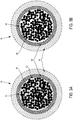
- FIG. 2A and 2B two variants of coated reinforcing elements R in accordance with the invention.
- a reinforcing element R comprising a reinforcing element 10 impregnated with a cohesion composition 12 described below, directly coated with an adhesive layer 14 produced in an adhesive composition C1 described below.
- the reinforcing element 10 comprises several multifilament strands of elementary monofilaments 18, here polyamide monofilaments, in this case nylon 4-6.
- the reinforcing element of the figure 1B is devoid of cohesion composition 12.
- the elastomeric body 20 directly covers the adhesive layer 14.
- the reinforcing elements R coated with Figures 3A and 3B comprise an elastomeric bonding layer 16 directly coating the adhesive layer 14.
- the elastomeric body 20 directly covers the elastomeric binding layer 16.
- the elastomeric binding composition comprises at least one elastomer chosen from the group consisting of an elastomer of ethylene alpha olefin type, a polychloroprene (CR) elastomer and mixtures of these elastomers .
- the elastomeric binding composition comprises a mixture of natural rubber (NR) and an ethylene-propylene-diene copolymer (EPDM), the proportion of natural rubber being less than 30 phr.
- the method comprises a step of impregnating each reinforcing element 10 with the cohesion composition 12.
- the reinforcing element 10 is passed through a bath generally based on isocyanate in a solvent, for example based on toluene.
- the method comprises a step of coating the reinforcing element with the adhesive composition C1.
- the reinforcing elements are passed through in the adhesive composition C0 or C1, then the reinforcing elements thus coated are dried in a drying oven at 140 ° C for 30 s.
- the adhesive composition is crosslinked by passing the coated reinforcing elements through a treatment oven at 240 ° C for 30 s.
- the method comprises a step of coating the adhesive layer directly with an elastomeric binding composition.
- the layer is directly coated adhesive C1 of the elastomeric bonding composition by extruding a sheath of the elastomeric bonding composition around the reinforcing element coated with the layer the adhesive layer.
- Reinforcement elements are then obtained coated with the adhesive layer produced in the adhesive composition, the adhesive layer being coated directly with the elastomeric bonding layer produced in the elastomeric bonding composition.
- the elastomeric bonding layer then forms a sheath around the reinforcing element.
- the stack is manipulated in the raw state and placed in a mold.
- the previously obtained stack is molded and crosslinked.
- aqueous adhesive compositions were prepared, one in accordance with the invention (denoted below C1) and one not in accordance with the invention (control composition denoted below CO). Their formulations (expressed as a percentage by weight) are presented in table 1 appended. The quantities listed in this table are those of the constituents in the dry state, brought to a total of 100 parts by weight of aqueous adhesive composition (that is to say the constituents plus water).
- the control composition C0 is a conventional RFL adhesive.
- the aromatic nucleus of the aromatic polyphenol carries three hydroxyl functions in the meta position with respect to each other. The two ortho positions of each hydroxyl function are unsubstituted. The remainder of the aromatic ring of the aromatic polyphenol is unsubstituted.
- the polyphenol comprises a single aromatic nucleus and this aromatic nucleus is a benzene nucleus.
- the polyphenol is chosen from the group consisting of resorcinol, phloroglucinol, 2,2 ', 4,4'-tetrahydroxydiphenyl sulfide, 2,2', 4,4'-tetrahydroxybenzophenone, pre-condensed resins from 'at least one of these aromatic polyphenols and mixtures of these compounds.
- resorcinol phloroglucinol
- phloroglucinol 2,2 ', 4,4'-tetrahydroxydiphenyl sulfide
- 2,2', 4,4'-tetrahydroxybenzophenone pre-condensed resins from 'at least one of these aromatic polyphenols and mixtures of these compounds.
- the aromatic nucleus carries the aldehyde function.
- the aromatic aldehyde is chosen from the group consisting of 1,2-benzene-dicarboxaldehyde, 1,3-benzene-dicarboxaldehyde, 1,4-benzene-dicarboxaldehyde, furfuraldehyde, 2,5-furanedicarboxaldehyde and mixtures of these compounds, preferably the aromatic aldehyde is chosen from 1,3-benzene-dicarboxaldehyde, 1,4-benzene-dicarboxaldehyde, furfuraldehyde, 2,5-furanedicarboxaldehyde and mixtures of these compounds.
- Aromatic aldehyde is an aromatic polyaldehyde in which the aromatic nucleus carries at least two aldehyde functions, here two exactly.
- the aromatic nucleus of the aromatic aldehyde is a benzene nucleus. More preferably here, the aromatic aldehyde is 1,4-benzene-dicarboxaldehyde.
- the adhesive composition also comprises an unsaturated elastomer latex comprising one or more elastomers.
- the unsaturated latex elastomers are diene elastomers, preferably chosen from the group consisting of polybutadienes, butadiene copolymers, polyisoprenes, isoprene copolymers, vinylpyridine-styrene-butadiene terpolymers, elastomers of ethylene alpha olefin type, polychloroprene elastomers and mixtures of these elastomers.
- it is a NR / SBR / VP-SBR mixture.
- Each reinforcing element is a non-metallic reinforcing element comprising three multifilament strands of elementary monofilaments having a title of 2350 tex assembled together according to a twist of 125 turns.m -1 .
- Each reinforcing element is made of a textile material, here an aliphatic polyamide, in this case nylon 4-6.
- the reinforcing elements R01 and R11 are impregnated a cohesion composition which is subsequently itself directly coated with the layer of adhesive composition C0 and C1 respectively.
- the cohesion composition is based on a reaction product of at least one isocyanate, here this reaction product is an isocyanurate.
- the reinforcing elements R02 and R12 are devoid of the cohesion composition.
- Each reinforcement element R01, R02, R11 and R12 is coated with an adhesive layer C0 or C1 produced in an adhesive composition and directly coating the reinforcement element directly for the reinforcement elements R02 and R12, or directly the composition of cohesion permeating the reinforcing element for the reinforcing elements R01 and R11.
- Table 2 ⁇ /b> R01 R02 R11 R12 Cohesion composition Yes No Yes No Adhesive composition C0 C0 C1 C1
- each coated reinforcement element R01, R02, R11 and R12 was embedded in an elastomeric matrix identical to that described above (except for test piece E5 for which the only elastomer of the elastomeric matrix is natural rubber ). Then, the specimen was molded and crosslinked. More precisely, each test piece is a block consisting of two plates of the elastomeric matrix of dimensions 200 mm by 4.5 mm and thickness 3.5 mm, applied one on the other before crosslinking (the thickness of the block resulting is 7 mm).
- the reinforcing elements coated with the adhesive composition are embedded in the elastomeric matrix, at equal distance and leaving protruding from one side of these plates one end of the reinforcing element. of sufficient length for subsequent traction.
- the block comprising the reinforcing elements is then placed in a suitable mold and then cooked under pressure.
- the temperature and the crosslinking time are adapted to the test conditions targeted and left to the initiative of those skilled in the art; by way of example, in the present case, the crosslinking of the block is carried out at 160 ° C. for 15 min.
- the test piece thus formed is placed in the jaws of a traction machine adapted to allow each block to be tested, at a given speed and temperature (for example, in this case, at 100 mm / min and 20 ° C or 120 ° C).
- the adhesion levels are characterized by measuring the so-called tear-out force (denoted F max ) to tear off the reinforcing elements from the test piece.
- F max tear-out force
- a value greater than that of the control specimen E1 arbitrarily fixed at 100, indicates an improved result, that is to say a greater breakout force than that of the test piece.
- the metallic reinforcing element would comprise one or more monofilaments metallic elementals each comprising a steel core.
- the adhesive layer directly covers the steel core of the or each metallic elementary monofilament.
- the adhesive layer directly covers a layer of a metallic coating directly coating the steel core of the or each metallic elementary monofilament.
- the metal of the layer of the metallic coating directly coating the steel core of the or each metallic elementary monofilament is chosen from zinc, copper, tin and the alloys of these metals.
- the adhesive layer directly coats an intermediate non-metallic adhesion layer coating the steel core of the or each metallic elementary monofilament.
Landscapes
- Chemical & Material Sciences (AREA)
- Engineering & Computer Science (AREA)
- Organic Chemistry (AREA)
- General Engineering & Computer Science (AREA)
- Medicinal Chemistry (AREA)
- Chemical Kinetics & Catalysis (AREA)
- Health & Medical Sciences (AREA)
- Polymers & Plastics (AREA)
- Mechanical Engineering (AREA)
- Materials Engineering (AREA)
- Manufacturing & Machinery (AREA)
- Laminated Bodies (AREA)
- Adhesives Or Adhesive Processes (AREA)
- Treatments For Attaching Organic Compounds To Fibrous Goods (AREA)
- Compositions Of Macromolecular Compounds (AREA)
Claims (15)
- Verbund (P1, P2), umfassend:- mindestens ein Verstärkungselement (10),- eine Klebstoffschicht (14), die aus einer Klebstoffzusammensetzung hergestellt ist und mit der das Verstärkungselement (10) beschichtet ist,- einen elastomeren Körper (20), der aus einer elastomeren Matrix besteht, die mindestens ein Elastomer aus der Gruppe bestehend aus einem Elastomer vom Ethylen-alpha-Olefin-Typ, einem Polychloroprenelastomer (CR) und Mischungen dieser Elastomere umfasst und in den das mit der Klebstoffschicht (14) beschichtete Verstärkungselement (10) eingebettet ist,wobei der Verbund (P1, P2) dadurch gekennzeichnet ist, dass die Klebstoffzusammensetzung mindestens ein Phenol-Aldehyd-Harz auf Basis von- mindestens einem aromatischen Polyphenol mit mindestens einem aromatischen Kern, der mindestens zwei Hydroxylfunktionen in meta-Position zueinander trägt, wobei die beiden ortho-Positionen zu mindestens einer der Hydroxylfunktionen unsubstituiert sind, und- mindestens einem aromatischen Aldehyd, der mindestens eine Aldehydfunktion trägt und mindestens einen aromatischen Kern umfasst,umfasst.
- Verbund (P1, P2) nach dem vorhergehenden Anspruch, wobei das aromatische Polyphenol aus der Gruppe bestehend aus Resorcinol, Phloroglucinol, 2,2',4,4'-Tetrahydroxydiphenylsulfid, 2,2',4,4'-Tetrahydroxybenzophenon, aus mindestens einem dieser aromatischen Polyphenole vorkondensierten Harzen und Mischungen dieser Verbindungen ausgewählt ist.
- Verbund (P1, P2) nach einem der vorhergehenden Ansprüche, wobei der aromatische Aldehyd die allgemeine Formel (A) aufweist:
 X N, S oder O umfasstR für -H oder -CHO steht.
 - Verbund (P1, P2) nach einem der Ansprüche 1 und 2, wobei der aromatische Aldehyd aus der Gruppe bestehend aus 1,2-Benzoldicarboxaldehyd, 1,3-Benzoldicarboxaldehyd, 1,4-Benzoldicarboxaldehyd, Furfuraldehyd, 2,5-Furandicarboxaldehyd und Mischungen dieser Verbindungen ausgewählt ist, wobei der aromatische Aldehyd vorzugsweise aus 1,3-Benzoldicarboxaldehyd, 1,4-Benzoldicarboxaldehyd, Furfuraldehyd, 2,5-Furandicarboxaldehyd und Mischungen dieser Verbindungen ausgewählt ist und es sich bei dem aromatischen Aldehyd weiter bevorzugt um 1,4-Benzoldicarboxaldehyd handelt.
- Verbund (P1, P2) nach einem der vorhergehenden Ansprüche,
wobei das Elastomer vom Ethylen-alpha-Olefin-Typ aus der Gruppe bestehend aus Ethylen-Propylen-Copolymeren (EPM), Ethylen-Propylen-Dien-Copolymeren (EPDM) und Mischungen dieser Copolymere ausgewählt ist. - Verbund (P1, P2) nach einem der vorhergehenden Ansprüche, wobei die Klebstoffzusammensetzung mindestens einen Latex eines ungesättigten Elastomers umfasst.
- Verbund (P1, P2) nach dem vorhergehenden Anspruch, wobei es sich bei dem ungesättigten Elastomer des Latex um ein Dienelastomer handelt, das vorzugsweise aus der Gruppe bestehend aus Polybutadienen, Butadien-Copolymeren, Polyisoprenen, Isopren-Copolymeren, Vinylpyridin-Styrol-Butadien-Terpolymeren, Elastomeren vom Ethylen-alpha-Olefin-Typ, Polychloroprenelastomeren (CR) und Mischungen dieser Elastomere ausgewählt ist.
- Verbund (P1, P2) nach dem vorhergehenden Anspruch, wobei das Elastomer vom Ethylen-alpha-Olefin-Typ aus der Gruppe bestehend aus Ethylen-Propylen-Copolymeren (EPM), Ethylen-Propylen-Dien-Copolymeren (EPDM) und Mischungen dieser Copolymere ausgewählt ist.
- Verbund (P1, P2) nach einem der vorhergehenden Ansprüche, wobei das Verstärkungselement (10) nichtmetallisch ist.
- Verbund (P1, P2) nach einem der Ansprüche 1 bis 9, wobei der elastomere Körper (20) die Klebstoffschicht (14) direkt beschichtet.
- Verbund (P1, P2) nach einem der Ansprüche 1 bis 9, umfassend eine elastomere Verbindungsschicht (16), die aus einer elastomeren Verbindungszusammensetzung besteht und mit der die Klebstoffschicht (14) direkt beschichtet ist, wobei die elastomere Verbindungszusammensetzung mindestens ein Elastomer umfasst, das aus der Gruppe bestehend aus einem Elastomer vom Ethylen-alpha-Olefin-Typ, einem Polychloroprenelastomer (CR) und Mischungen dieser Elastomere ausgewählt ist.
- Verbund (P1, P2) nach dem vorhergehenden Anspruch, wobei das Elastomer vom Ethylen-alpha-Olefin-Typ aus der Gruppe bestehend aus Ethylen-Propylen-Copolymeren (EPM), Ethylen-Propylen-Dien-Copolymeren (EPDM) und Mischungen dieser Copolymere ausgewählt ist.
- Verbund (P1, P2) nach einem der vorhergehenden Ansprüche, der einen Kraftübertragungsriemen bildet.
- Verfahren zur Herstellung eines Verbunds (P1, P2), dadurch gekennzeichnet, dass das Verfahren die folgenden Schritte umfasst:1) Zusammenstellen eines Stapels in ungehärtetem Zustand, der in der angegebenen Reihenfolge Folgendes umfasst:- eine erste elastomere Schicht (26) aus einem ersten elastomeren Material,- mindestens ein Verstärkungselement (10), das mit einer Klebstoffschicht (14) aus einer Klebstoffzusammensetzung beschichtet ist, wobei die Klebstoffzusammensetzung mindestens ein Phenol-Aldehyd-Harz auf Basis von- mindestens einem aromatischen Polyphenol mit mindestens einem aromatischen Kern, der mindestens zwei Hydroxylfunktionen in meta-Position zueinander trägt, wobei die beiden ortho-Positionen zu mindestens einer der Hydroxylfunktionen unsubstituiert sind, und- mindestens einem aromatischen Aldehyd, der mindestens eine Aldehydfunktion trägt und mindestens einen aromatischen Kern umfasst, umfasst,- eine zweite elastomere Schicht (28) aus einem zweiten elastomeren Material, wobei mindestens eines der ersten und zweiten elastomeren Materialien mindestens ein Elastomer umfasst, das aus der Gruppe bestehend aus einem Elastomer vom Ethylen-alpha-Olefin-Typ, einem Polychloroprenelastomer (CR) und Mischungen dieser Elastomere ausgewählt ist,2) Formen und Vernetzen des Stapels.
- Verfahren zur Herstellung eines Kraftübertragungsriemens (P1, P2), dadurch gekennzeichnet, dass das Verfahren die folgenden Schritte umfasst:1) Zusammenstellen eines Stapels in ungehärtetem Zustand, der in der angegebenen Reihenfolge Folgendes umfasst:- eine erste elastomere Schicht (26) aus einem ersten elastomeren Material,- mindestens ein Verstärkungselement (10), das mit einer Klebstoffschicht (14) aus einer Klebstoffzusammensetzung beschichtet ist, wobei die Klebstoffzusammensetzung mindestens ein Phenol-Aldehyd-Harz auf Basis von- mindestens einem aromatischen Polyphenol mit mindestens einem aromatischen Kern, der mindestens zwei Hydroxylfunktionen in meta-Position zueinander trägt, wobei die beiden ortho-Positionen zu mindestens einer der Hydroxylfunktionen unsubstituiert sind, und- mindestens einem aromatischen Aldehyd, der mindestens eine Aldehydfunktion trägt und mindestens einen aromatischen Kern umfasst, umfasst,- eine zweite elastomere Schicht (28) aus einem zweiten elastomeren Material, wobei mindestens eines der ersten und zweiten elastomeren Materialien mindestens ein Elastomer umfasst, das aus der Gruppe bestehend aus einem Elastomer vom Ethylen-alpha-Olefin-Typ, einem Polychloroprenelastomer (CR) und Mischungen dieser Elastomere ausgewählt ist,- eine dritte elastomere Schicht zur mechanischen Mitnahme (22), die in Kontakt mit der zweiten elastomeren Schicht (28) angeordnet ist, aus einem dritten elastomeren Material,2) Formen und Vernetzen des Stapels.
Applications Claiming Priority (2)
| Application Number | Priority Date | Filing Date | Title |
|---|---|---|---|
| FR1654527A FR3051474B1 (fr) | 2016-05-20 | 2016-05-20 | Composite et courroie de transmission de puissance |
| PCT/FR2017/051228 WO2017198968A1 (fr) | 2016-05-20 | 2017-05-19 | Composite et courroie de transmission de puissance |
Publications (2)
| Publication Number | Publication Date |
|---|---|
| EP3458504A1 EP3458504A1 (de) | 2019-03-27 |
| EP3458504B1 true EP3458504B1 (de) | 2020-07-01 |
Family
ID=56557775
Family Applications (1)
| Application Number | Title | Priority Date | Filing Date |
|---|---|---|---|
| EP17731213.9A Active EP3458504B1 (de) | 2016-05-20 | 2017-05-19 | Komposit für kraftübertragung und kraftübertragungsriemen |
Country Status (6)
| Country | Link |
|---|---|
| EP (1) | EP3458504B1 (de) |
| CN (1) | CN109153796B (de) |
| AU (1) | AU2017267362B2 (de) |
| CA (1) | CA3024851C (de) |
| FR (1) | FR3051474B1 (de) |
| WO (1) | WO2017198968A1 (de) |
Cited By (2)
| Publication number | Priority date | Publication date | Assignee | Title |
|---|---|---|---|---|
| EP4074803B1 (de) * | 2019-12-09 | 2025-11-19 | Bridgestone Corporation | Verfahren zur herstellung einer klebstoffzusammensetzung, kautschuk/organisches faserkordverbundmaterial und reifen |
| FR3163421A1 (fr) * | 2024-06-18 | 2025-12-19 | Hutchinson | Courroie de transmission à impact environnemental réduit |
Family Cites Families (8)
| Publication number | Priority date | Publication date | Assignee | Title |
|---|---|---|---|---|
| JPH09158989A (ja) * | 1995-12-07 | 1997-06-17 | Mitsuboshi Belting Ltd | 接着処理繊維コード及びこれを用いた動力伝動用ベルト |
| FR2779731B1 (fr) * | 1998-06-11 | 2000-08-11 | Hutchinson | Composition d'elastomere a base d'epdm et courroie de transmission de puissance realisee essentiellement en cet elastomere |
| EP2675839B1 (de) * | 2011-02-17 | 2019-08-14 | Milliken & Company | Klebstoffzusammensetzung und textilmaterialien und damit behandelte gegenstände |
| FR2978769B1 (fr) * | 2011-08-04 | 2013-09-27 | Michelin Soc Tech | Composition adhesive aqueuse a base de polyaldehyde et de polyphenol |
| FR2978770B1 (fr) * | 2011-08-04 | 2013-09-27 | Michelin Soc Tech | Composition adhesive aqueuse a base de polyaldehyde et phloroglucinol |
| FR3000963B1 (fr) * | 2013-01-16 | 2015-03-13 | Michelin & Cie | Composition adhesive aqueuse a base de polyaldehyde et de polyphenol |
| FR3017071B1 (fr) * | 2014-02-06 | 2016-01-29 | Michelin & Cie | Element de renfort metallique bronze adherise par une composition adhesive a base d'aldehyde aromatique et de polyphenol |
| FR3019609B1 (fr) * | 2014-04-03 | 2016-05-13 | Hutchinson | Courroie de transmission de puissance. |
-
2016
- 2016-05-20 FR FR1654527A patent/FR3051474B1/fr not_active Expired - Fee Related
-
2017
- 2017-05-19 AU AU2017267362A patent/AU2017267362B2/en not_active Ceased
- 2017-05-19 EP EP17731213.9A patent/EP3458504B1/de active Active
- 2017-05-19 CN CN201780031243.3A patent/CN109153796B/zh active Active
- 2017-05-19 WO PCT/FR2017/051228 patent/WO2017198968A1/fr not_active Ceased
- 2017-05-19 CA CA3024851A patent/CA3024851C/fr active Active
Non-Patent Citations (1)
| Title |
|---|
| None * |
Cited By (3)
| Publication number | Priority date | Publication date | Assignee | Title |
|---|---|---|---|---|
| EP4074803B1 (de) * | 2019-12-09 | 2025-11-19 | Bridgestone Corporation | Verfahren zur herstellung einer klebstoffzusammensetzung, kautschuk/organisches faserkordverbundmaterial und reifen |
| FR3163421A1 (fr) * | 2024-06-18 | 2025-12-19 | Hutchinson | Courroie de transmission à impact environnemental réduit |
| WO2025262052A1 (fr) * | 2024-06-18 | 2025-12-26 | Hutchinson | Courroie de transmission à impact environnemental reduit |
Also Published As
| Publication number | Publication date |
|---|---|
| CN109153796A (zh) | 2019-01-04 |
| EP3458504A1 (de) | 2019-03-27 |
| CN109153796B (zh) | 2021-05-14 |
| AU2017267362B2 (en) | 2021-11-18 |
| FR3051474A1 (fr) | 2017-11-24 |
| CA3024851A1 (fr) | 2017-11-23 |
| AU2017267362A1 (en) | 2019-01-03 |
| FR3051474B1 (fr) | 2018-05-18 |
| CA3024851C (fr) | 2024-10-29 |
| WO2017198968A1 (fr) | 2017-11-23 |
Similar Documents
| Publication | Publication Date | Title |
|---|---|---|
| EP3458503B1 (de) | Komposit für kraftübertragung und kraftübertragungsriemen | |
| EP3102407B1 (de) | Stahlbewehrungselement mit einer beschichtung aus einer klebstoffzusammensetzung mit aromatischem aldehyd und polyphenol | |
| EP3102406B1 (de) | Mit einer haftstoffzusammensetzung mit aromatischem aldehyd und polyphenol haftend gemachte kautschukzusammensetzung mit mindestens einem stahlverstärkungselement | |
| EP3102645B1 (de) | Stahlbewehrungselement mit einer beschichtung aus einer klebstoffzusammensetzung mit aromatischem aldehyd und polyphenol | |
| EP2739693B1 (de) | Wässrige klebstoffzusammensetzung auf der basis von polyaldehyd und polyphenol | |
| EP2739691B1 (de) | Wässrige klebstoffzusammensetzung auf basis von polyaldehyd und 2,2 ', 4,4'-tetrahydroxydiphenylsulfid | |
| EP3022241B1 (de) | Wässrige klebstoffzusammensetzung mit einer basis aus aldehyd und polyphenol biologischen ursprungs | |
| EP3102646A1 (de) | Durch eine klebstoffzusammensetzung mit aromatischem aldehyd und polyphenol haftbar gemachtes verstärkungselement aus bronziertem metall | |
| WO2019063913A1 (fr) | Composition adhesive comportant un sel de phosphate et une resine thermodurcissable | |
| FR3000963A1 (fr) | Composition adhesive aqueuse a base de polyaldehyde et de polyphenol | |
| CA3024851C (fr) | Composite et courroie de transmission de puissance | |
| EP3688074B1 (de) | Verbund- und kraftübertragungsriemen | |
| EP3688104B1 (de) | Elektrotauchlackierungsverfahren von einer wässrigenklebstoffzusammensetzung enthaltend ein phosphatsalz und ein wärmehärtbares harz auf einem leitfähigen element | |
| EP3688073B1 (de) | Verbund- und kraftübertragungsriemen | |
| FR3142376A1 (fr) | Procédé d’encollage d’un élément de renfort métallique |
Legal Events
| Date | Code | Title | Description |
|---|---|---|---|
| STAA | Information on the status of an ep patent application or granted ep patent |
Free format text: STATUS: UNKNOWN |
|
| STAA | Information on the status of an ep patent application or granted ep patent |
Free format text: STATUS: THE INTERNATIONAL PUBLICATION HAS BEEN MADE |
|
| PUAI | Public reference made under article 153(3) epc to a published international application that has entered the european phase |
Free format text: ORIGINAL CODE: 0009012 |
|
| STAA | Information on the status of an ep patent application or granted ep patent |
Free format text: STATUS: REQUEST FOR EXAMINATION WAS MADE |
|
| 17P | Request for examination filed |
Effective date: 20181220 |
|
| AK | Designated contracting states |
Kind code of ref document: A1 Designated state(s): AL AT BE BG CH CY CZ DE DK EE ES FI FR GB GR HR HU IE IS IT LI LT LU LV MC MK MT NL NO PL PT RO RS SE SI SK SM TR |
|
| AX | Request for extension of the european patent |
Extension state: BA ME |
|
| DAV | Request for validation of the european patent (deleted) | ||
| DAX | Request for extension of the european patent (deleted) | ||
| REG | Reference to a national code |
Ref country code: DE Ref legal event code: R079 Ref document number: 602017019059 Country of ref document: DE Free format text: PREVIOUS MAIN CLASS: C08J0005060000 Ipc: B32B0038080000 |
|
| RIC1 | Information provided on ipc code assigned before grant |
Ipc: B32B 37/12 20060101ALI20191127BHEP Ipc: F16G 1/28 20060101ALI20191127BHEP Ipc: C08L 23/16 20060101ALI20191127BHEP Ipc: C09J 109/10 20060101ALI20191127BHEP Ipc: C08J 5/06 20060101ALI20191127BHEP Ipc: C08G 8/04 20060101ALI20191127BHEP Ipc: B29D 29/10 20060101ALI20191127BHEP Ipc: B32B 38/00 20060101ALI20191127BHEP Ipc: B32B 38/08 20060101AFI20191127BHEP Ipc: C09J 161/12 20060101ALI20191127BHEP Ipc: F16G 1/08 20060101ALI20191127BHEP |
|
| GRAP | Despatch of communication of intention to grant a patent |
Free format text: ORIGINAL CODE: EPIDOSNIGR1 |
|
| STAA | Information on the status of an ep patent application or granted ep patent |
Free format text: STATUS: GRANT OF PATENT IS INTENDED |
|
| INTG | Intention to grant announced |
Effective date: 20200116 |
|
| GRAS | Grant fee paid |
Free format text: ORIGINAL CODE: EPIDOSNIGR3 |
|
| GRAA | (expected) grant |
Free format text: ORIGINAL CODE: 0009210 |
|
| STAA | Information on the status of an ep patent application or granted ep patent |
Free format text: STATUS: THE PATENT HAS BEEN GRANTED |
|
| AK | Designated contracting states |
Kind code of ref document: B1 Designated state(s): AL AT BE BG CH CY CZ DE DK EE ES FI FR GB GR HR HU IE IS IT LI LT LU LV MC MK MT NL NO PL PT RO RS SE SI SK SM TR |
|
| REG | Reference to a national code |
Ref country code: CH Ref legal event code: EP Ref country code: AT Ref legal event code: REF Ref document number: 1285794 Country of ref document: AT Kind code of ref document: T Effective date: 20200715 |
|
| REG | Reference to a national code |
Ref country code: IE Ref legal event code: FG4D Free format text: LANGUAGE OF EP DOCUMENT: FRENCH |
|
| REG | Reference to a national code |
Ref country code: DE Ref legal event code: R096 Ref document number: 602017019059 Country of ref document: DE |
|
| REG | Reference to a national code |
Ref country code: LT Ref legal event code: MG4D |
|
| PG25 | Lapsed in a contracting state [announced via postgrant information from national office to epo] |
Ref country code: BG Free format text: LAPSE BECAUSE OF FAILURE TO SUBMIT A TRANSLATION OF THE DESCRIPTION OR TO PAY THE FEE WITHIN THE PRESCRIBED TIME-LIMIT Effective date: 20201001 |
|
| REG | Reference to a national code |
Ref country code: NL Ref legal event code: MP Effective date: 20200701 |
|
| REG | Reference to a national code |
Ref country code: AT Ref legal event code: MK05 Ref document number: 1285794 Country of ref document: AT Kind code of ref document: T Effective date: 20200701 |
|
| PG25 | Lapsed in a contracting state [announced via postgrant information from national office to epo] |
Ref country code: FI Free format text: LAPSE BECAUSE OF FAILURE TO SUBMIT A TRANSLATION OF THE DESCRIPTION OR TO PAY THE FEE WITHIN THE PRESCRIBED TIME-LIMIT Effective date: 20200701 Ref country code: CZ Free format text: LAPSE BECAUSE OF FAILURE TO SUBMIT A TRANSLATION OF THE DESCRIPTION OR TO PAY THE FEE WITHIN THE PRESCRIBED TIME-LIMIT Effective date: 20200701 Ref country code: HR Free format text: LAPSE BECAUSE OF FAILURE TO SUBMIT A TRANSLATION OF THE DESCRIPTION OR TO PAY THE FEE WITHIN THE PRESCRIBED TIME-LIMIT Effective date: 20200701 Ref country code: AT Free format text: LAPSE BECAUSE OF FAILURE TO SUBMIT A TRANSLATION OF THE DESCRIPTION OR TO PAY THE FEE WITHIN THE PRESCRIBED TIME-LIMIT Effective date: 20200701 Ref country code: SE Free format text: LAPSE BECAUSE OF FAILURE TO SUBMIT A TRANSLATION OF THE DESCRIPTION OR TO PAY THE FEE WITHIN THE PRESCRIBED TIME-LIMIT Effective date: 20200701 Ref country code: GR Free format text: LAPSE BECAUSE OF FAILURE TO SUBMIT A TRANSLATION OF THE DESCRIPTION OR TO PAY THE FEE WITHIN THE PRESCRIBED TIME-LIMIT Effective date: 20201002 Ref country code: LT Free format text: LAPSE BECAUSE OF FAILURE TO SUBMIT A TRANSLATION OF THE DESCRIPTION OR TO PAY THE FEE WITHIN THE PRESCRIBED TIME-LIMIT Effective date: 20200701 Ref country code: ES Free format text: LAPSE BECAUSE OF FAILURE TO SUBMIT A TRANSLATION OF THE DESCRIPTION OR TO PAY THE FEE WITHIN THE PRESCRIBED TIME-LIMIT Effective date: 20200701 Ref country code: PT Free format text: LAPSE BECAUSE OF FAILURE TO SUBMIT A TRANSLATION OF THE DESCRIPTION OR TO PAY THE FEE WITHIN THE PRESCRIBED TIME-LIMIT Effective date: 20201102 Ref country code: NO Free format text: LAPSE BECAUSE OF FAILURE TO SUBMIT A TRANSLATION OF THE DESCRIPTION OR TO PAY THE FEE WITHIN THE PRESCRIBED TIME-LIMIT Effective date: 20201001 |
|
| PG25 | Lapsed in a contracting state [announced via postgrant information from national office to epo] |
Ref country code: RS Free format text: LAPSE BECAUSE OF FAILURE TO SUBMIT A TRANSLATION OF THE DESCRIPTION OR TO PAY THE FEE WITHIN THE PRESCRIBED TIME-LIMIT Effective date: 20200701 Ref country code: PL Free format text: LAPSE BECAUSE OF FAILURE TO SUBMIT A TRANSLATION OF THE DESCRIPTION OR TO PAY THE FEE WITHIN THE PRESCRIBED TIME-LIMIT Effective date: 20200701 Ref country code: LV Free format text: LAPSE BECAUSE OF FAILURE TO SUBMIT A TRANSLATION OF THE DESCRIPTION OR TO PAY THE FEE WITHIN THE PRESCRIBED TIME-LIMIT Effective date: 20200701 Ref country code: IS Free format text: LAPSE BECAUSE OF FAILURE TO SUBMIT A TRANSLATION OF THE DESCRIPTION OR TO PAY THE FEE WITHIN THE PRESCRIBED TIME-LIMIT Effective date: 20201101 |
|
| PG25 | Lapsed in a contracting state [announced via postgrant information from national office to epo] |
Ref country code: NL Free format text: LAPSE BECAUSE OF FAILURE TO SUBMIT A TRANSLATION OF THE DESCRIPTION OR TO PAY THE FEE WITHIN THE PRESCRIBED TIME-LIMIT Effective date: 20200701 |
|
| REG | Reference to a national code |
Ref country code: DE Ref legal event code: R097 Ref document number: 602017019059 Country of ref document: DE |
|
| PG25 | Lapsed in a contracting state [announced via postgrant information from national office to epo] |
Ref country code: DK Free format text: LAPSE BECAUSE OF FAILURE TO SUBMIT A TRANSLATION OF THE DESCRIPTION OR TO PAY THE FEE WITHIN THE PRESCRIBED TIME-LIMIT Effective date: 20200701 Ref country code: RO Free format text: LAPSE BECAUSE OF FAILURE TO SUBMIT A TRANSLATION OF THE DESCRIPTION OR TO PAY THE FEE WITHIN THE PRESCRIBED TIME-LIMIT Effective date: 20200701 Ref country code: SM Free format text: LAPSE BECAUSE OF FAILURE TO SUBMIT A TRANSLATION OF THE DESCRIPTION OR TO PAY THE FEE WITHIN THE PRESCRIBED TIME-LIMIT Effective date: 20200701 Ref country code: EE Free format text: LAPSE BECAUSE OF FAILURE TO SUBMIT A TRANSLATION OF THE DESCRIPTION OR TO PAY THE FEE WITHIN THE PRESCRIBED TIME-LIMIT Effective date: 20200701 |
|
| PLBE | No opposition filed within time limit |
Free format text: ORIGINAL CODE: 0009261 |
|
| STAA | Information on the status of an ep patent application or granted ep patent |
Free format text: STATUS: NO OPPOSITION FILED WITHIN TIME LIMIT |
|
| PG25 | Lapsed in a contracting state [announced via postgrant information from national office to epo] |
Ref country code: AL Free format text: LAPSE BECAUSE OF FAILURE TO SUBMIT A TRANSLATION OF THE DESCRIPTION OR TO PAY THE FEE WITHIN THE PRESCRIBED TIME-LIMIT Effective date: 20200701 |
|
| 26N | No opposition filed |
Effective date: 20210406 |
|
| PG25 | Lapsed in a contracting state [announced via postgrant information from national office to epo] |
Ref country code: SK Free format text: LAPSE BECAUSE OF FAILURE TO SUBMIT A TRANSLATION OF THE DESCRIPTION OR TO PAY THE FEE WITHIN THE PRESCRIBED TIME-LIMIT Effective date: 20200701 |
|
| PG25 | Lapsed in a contracting state [announced via postgrant information from national office to epo] |
Ref country code: SI Free format text: LAPSE BECAUSE OF FAILURE TO SUBMIT A TRANSLATION OF THE DESCRIPTION OR TO PAY THE FEE WITHIN THE PRESCRIBED TIME-LIMIT Effective date: 20200701 |
|
| PG25 | Lapsed in a contracting state [announced via postgrant information from national office to epo] |
Ref country code: MC Free format text: LAPSE BECAUSE OF FAILURE TO SUBMIT A TRANSLATION OF THE DESCRIPTION OR TO PAY THE FEE WITHIN THE PRESCRIBED TIME-LIMIT Effective date: 20200701 Ref country code: LU Free format text: LAPSE BECAUSE OF NON-PAYMENT OF DUE FEES Effective date: 20210519 |
|
| REG | Reference to a national code |
Ref country code: BE Ref legal event code: MM Effective date: 20210531 |
|
| PG25 | Lapsed in a contracting state [announced via postgrant information from national office to epo] |
Ref country code: IE Free format text: LAPSE BECAUSE OF NON-PAYMENT OF DUE FEES Effective date: 20210519 |
|
| PG25 | Lapsed in a contracting state [announced via postgrant information from national office to epo] |
Ref country code: BE Free format text: LAPSE BECAUSE OF NON-PAYMENT OF DUE FEES Effective date: 20210531 |
|
| PG25 | Lapsed in a contracting state [announced via postgrant information from national office to epo] |
Ref country code: CY Free format text: LAPSE BECAUSE OF FAILURE TO SUBMIT A TRANSLATION OF THE DESCRIPTION OR TO PAY THE FEE WITHIN THE PRESCRIBED TIME-LIMIT Effective date: 20200701 |
|
| PG25 | Lapsed in a contracting state [announced via postgrant information from national office to epo] |
Ref country code: HU Free format text: LAPSE BECAUSE OF FAILURE TO SUBMIT A TRANSLATION OF THE DESCRIPTION OR TO PAY THE FEE WITHIN THE PRESCRIBED TIME-LIMIT; INVALID AB INITIO Effective date: 20170519 |
|
| PGFP | Annual fee paid to national office [announced via postgrant information from national office to epo] |
Ref country code: CH Payment date: 20230605 Year of fee payment: 7 |
|
| PGFP | Annual fee paid to national office [announced via postgrant information from national office to epo] |
Ref country code: TR Payment date: 20230518 Year of fee payment: 7 |
|
| PGFP | Annual fee paid to national office [announced via postgrant information from national office to epo] |
Ref country code: GB Payment date: 20230524 Year of fee payment: 7 |
|
| PG25 | Lapsed in a contracting state [announced via postgrant information from national office to epo] |
Ref country code: MK Free format text: LAPSE BECAUSE OF FAILURE TO SUBMIT A TRANSLATION OF THE DESCRIPTION OR TO PAY THE FEE WITHIN THE PRESCRIBED TIME-LIMIT Effective date: 20200701 |
|
| PG25 | Lapsed in a contracting state [announced via postgrant information from national office to epo] |
Ref country code: MT Free format text: LAPSE BECAUSE OF FAILURE TO SUBMIT A TRANSLATION OF THE DESCRIPTION OR TO PAY THE FEE WITHIN THE PRESCRIBED TIME-LIMIT Effective date: 20200701 |
|
| REG | Reference to a national code |
Ref country code: CH Ref legal event code: PL |
|
| GBPC | Gb: european patent ceased through non-payment of renewal fee |
Effective date: 20240519 |
|
| PG25 | Lapsed in a contracting state [announced via postgrant information from national office to epo] |
Ref country code: CH Free format text: LAPSE BECAUSE OF NON-PAYMENT OF DUE FEES Effective date: 20240531 |
|
| PG25 | Lapsed in a contracting state [announced via postgrant information from national office to epo] |
Ref country code: GB Free format text: LAPSE BECAUSE OF NON-PAYMENT OF DUE FEES Effective date: 20240519 |
|
| PGFP | Annual fee paid to national office [announced via postgrant information from national office to epo] |
Ref country code: DE Payment date: 20250521 Year of fee payment: 9 |
|
| PGFP | Annual fee paid to national office [announced via postgrant information from national office to epo] |
Ref country code: IT Payment date: 20250527 Year of fee payment: 9 |
|
| PGFP | Annual fee paid to national office [announced via postgrant information from national office to epo] |
Ref country code: FR Payment date: 20250528 Year of fee payment: 9 |