EP3459559A1 - Minigastrinderivate, insbesondere zur verwendung in positiver cck2-rezeptor-tumordiagnose und/oder -behandlung - Google Patents
Minigastrinderivate, insbesondere zur verwendung in positiver cck2-rezeptor-tumordiagnose und/oder -behandlung Download PDFInfo
- Publication number
- EP3459559A1 EP3459559A1 EP17192428.5A EP17192428A EP3459559A1 EP 3459559 A1 EP3459559 A1 EP 3459559A1 EP 17192428 A EP17192428 A EP 17192428A EP 3459559 A1 EP3459559 A1 EP 3459559A1
- Authority
- EP
- European Patent Office
- Prior art keywords
- dglu
- minigastrin
- stands
- tyr
- gly
- Prior art date
- Legal status (The legal status is an assumption and is not a legal conclusion. Google has not performed a legal analysis and makes no representation as to the accuracy of the status listed.)
- Withdrawn
Links
Images




Classifications
-
- A—HUMAN NECESSITIES
- A61—MEDICAL OR VETERINARY SCIENCE; HYGIENE
- A61K—PREPARATIONS FOR MEDICAL, DENTAL OR TOILETRY PURPOSES
- A61K38/00—Medicinal preparations containing peptides
- A61K38/04—Peptides having up to 20 amino acids in a fully defined sequence; Derivatives thereof
- A61K38/10—Peptides having 12 to 20 amino acids
-
- A—HUMAN NECESSITIES
- A61—MEDICAL OR VETERINARY SCIENCE; HYGIENE
- A61K—PREPARATIONS FOR MEDICAL, DENTAL OR TOILETRY PURPOSES
- A61K38/00—Medicinal preparations containing peptides
- A61K38/16—Peptides having more than 20 amino acids; Gastrins; Somatostatins; Melanotropins; Derivatives thereof
- A61K38/17—Peptides having more than 20 amino acids; Gastrins; Somatostatins; Melanotropins; Derivatives thereof from animals; from humans
- A61K38/22—Hormones
- A61K38/2207—Gastrins; Cholecystokinins [CCK]
-
- A—HUMAN NECESSITIES
- A61—MEDICAL OR VETERINARY SCIENCE; HYGIENE
- A61K—PREPARATIONS FOR MEDICAL, DENTAL OR TOILETRY PURPOSES
- A61K51/00—Preparations containing radioactive substances for use in therapy or testing in vivo
- A61K51/02—Preparations containing radioactive substances for use in therapy or testing in vivo characterised by the carrier, i.e. characterised by the agent or material covalently linked or complexing the radioactive nucleus
- A61K51/04—Organic compounds
- A61K51/0474—Organic compounds complexes or complex-forming compounds, i.e. wherein a radioactive metal (e.g. 111In3+) is complexed or chelated by, e.g. a N2S2, N3S, NS3, N4 chelating group
- A61K51/0482—Organic compounds complexes or complex-forming compounds, i.e. wherein a radioactive metal (e.g. 111In3+) is complexed or chelated by, e.g. a N2S2, N3S, NS3, N4 chelating group chelates from cyclic ligands, e.g. DOTA
-
- A—HUMAN NECESSITIES
- A61—MEDICAL OR VETERINARY SCIENCE; HYGIENE
- A61K—PREPARATIONS FOR MEDICAL, DENTAL OR TOILETRY PURPOSES
- A61K51/00—Preparations containing radioactive substances for use in therapy or testing in vivo
- A61K51/02—Preparations containing radioactive substances for use in therapy or testing in vivo characterised by the carrier, i.e. characterised by the agent or material covalently linked or complexing the radioactive nucleus
- A61K51/04—Organic compounds
- A61K51/08—Peptides, e.g. proteins, carriers being peptides, polyamino acids, proteins
-
- A—HUMAN NECESSITIES
- A61—MEDICAL OR VETERINARY SCIENCE; HYGIENE
- A61K—PREPARATIONS FOR MEDICAL, DENTAL OR TOILETRY PURPOSES
- A61K51/00—Preparations containing radioactive substances for use in therapy or testing in vivo
- A61K51/02—Preparations containing radioactive substances for use in therapy or testing in vivo characterised by the carrier, i.e. characterised by the agent or material covalently linked or complexing the radioactive nucleus
- A61K51/04—Organic compounds
- A61K51/08—Peptides, e.g. proteins, carriers being peptides, polyamino acids, proteins
- A61K51/088—Peptides, e.g. proteins, carriers being peptides, polyamino acids, proteins conjugates with carriers being peptides, polyamino acids or proteins
-
- A—HUMAN NECESSITIES
- A61—MEDICAL OR VETERINARY SCIENCE; HYGIENE
- A61K—PREPARATIONS FOR MEDICAL, DENTAL OR TOILETRY PURPOSES
- A61K51/00—Preparations containing radioactive substances for use in therapy or testing in vivo
- A61K51/12—Preparations containing radioactive substances for use in therapy or testing in vivo characterised by a special physical form, e.g. emulsion, microcapsules, liposomes, characterized by a special physical form, e.g. emulsions, dispersions, microcapsules
- A61K51/1217—Dispersions, suspensions, colloids, emulsions, e.g. perfluorinated emulsion, sols
- A61K51/1234—Liposomes
-
- A—HUMAN NECESSITIES
- A61—MEDICAL OR VETERINARY SCIENCE; HYGIENE
- A61K—PREPARATIONS FOR MEDICAL, DENTAL OR TOILETRY PURPOSES
- A61K51/00—Preparations containing radioactive substances for use in therapy or testing in vivo
- A61K51/12—Preparations containing radioactive substances for use in therapy or testing in vivo characterised by a special physical form, e.g. emulsion, microcapsules, liposomes, characterized by a special physical form, e.g. emulsions, dispersions, microcapsules
- A61K51/1241—Preparations containing radioactive substances for use in therapy or testing in vivo characterised by a special physical form, e.g. emulsion, microcapsules, liposomes, characterized by a special physical form, e.g. emulsions, dispersions, microcapsules particles, powders, lyophilizates, adsorbates, e.g. polymers or resins for adsorption or ion-exchange resins
- A61K51/1244—Preparations containing radioactive substances for use in therapy or testing in vivo characterised by a special physical form, e.g. emulsion, microcapsules, liposomes, characterized by a special physical form, e.g. emulsions, dispersions, microcapsules particles, powders, lyophilizates, adsorbates, e.g. polymers or resins for adsorption or ion-exchange resins microparticles or nanoparticles, e.g. polymeric nanoparticles
-
- C—CHEMISTRY; METALLURGY
- C07—ORGANIC CHEMISTRY
- C07K—PEPTIDES
- C07K14/00—Peptides having more than 20 amino acids; Gastrins; Somatostatins; Melanotropins; Derivatives thereof
- C07K14/435—Peptides having more than 20 amino acids; Gastrins; Somatostatins; Melanotropins; Derivatives thereof from animals; from humans
- C07K14/575—Hormones
- C07K14/595—Gastrins; Cholecystokinins [CCK]
-
- G—PHYSICS
- G01—MEASURING; TESTING
- G01N—INVESTIGATING OR ANALYSING MATERIALS BY DETERMINING THEIR CHEMICAL OR PHYSICAL PROPERTIES
- G01N33/00—Investigating or analysing materials by specific methods not covered by groups G01N1/00 - G01N31/00
- G01N33/48—Biological material, e.g. blood, urine; Haemocytometers
- G01N33/50—Chemical analysis of biological material, e.g. blood, urine; Testing involving biospecific ligand binding methods; Immunological testing
- G01N33/53—Immunoassay; Biospecific binding assay; Materials therefor
- G01N33/575—Immunoassay; Biospecific binding assay; Materials therefor for cancer
- G01N33/5758—Immunoassay; Biospecific binding assay; Materials therefor for cancer involving compounds serving as markers for tumours, cancers or neoplasias, e.g. cellular determinants, receptors, heat shock/stress proteins, A-protein, oligosaccharides or metabolites
-
- G—PHYSICS
- G01—MEASURING; TESTING
- G01N—INVESTIGATING OR ANALYSING MATERIALS BY DETERMINING THEIR CHEMICAL OR PHYSICAL PROPERTIES
- G01N2333/00—Assays involving biological materials from specific organisms or of a specific nature
- G01N2333/435—Assays involving biological materials from specific organisms or of a specific nature from animals; from humans
- G01N2333/705—Assays involving receptors, cell surface antigens or cell surface determinants
- G01N2333/72—Assays involving receptors, cell surface antigens or cell surface determinants for hormones
- G01N2333/726—G protein coupled receptor, e.g. TSHR-thyrotropin-receptor, LH/hCG receptor, FSH
Definitions
- the present invention relates to minigastrin derivates and their use in CCK2 receptor positive tumour diagnosis and/or treatment.
- G protein-coupled receptors are used as target proteins for radiolabelled peptides since the early 90's.
- the somatostatin receptor was the prototype for radionuclide imaging and therapy with peptides (Lit) resulting in a clinical first line therapies for neuroendocrine tumors with Y-90 and Lu-177 labelled derivatives of octreotide (Lit).
- GPCR gastrin realising peptide analogues
- GLP-1 glucagon-like peptide 1 analogues
- NT neurotensin analogues
- NPY neuropeptide Y analogues
- GCP gastrin realising peptide analogues
- GLP-1 glucagon-like peptide 1 analogues
- NT neurotensin analogues
- NPY neuropeptide Y analogues
- CCK-2 R cholecystokinin-2 receptor
- This receptor is mainly expressed on medullary thyroid carcinomas (MTC), small cell lung cancers (SCLC) and stromal ovarial tumors ( Reubi, Int J Cancer. 1996 and Reubi, Cancer Res. 1997 ).
- Radiolabelled gastrin analogues are good candidates for targeting imaging and therapy. It was shown that In-111 labelled gastrin analogues are superior for detecting MTC compared to OctreoScan-111 and give additional information on neuroendocrine tumours particularly if they are negative in somatostatin receptor scintigraphy ( Endocr Relat Cancer. 2006 Dec;13(4) :1203-11 .; Eur J Nucl Med Mol Imaging. 2006 Nov;33(11):1273-9 ).
- the radiolabelled peptides could not be used for therapy.
- the high kidney uptake is correlated with the six negatively charged glutamic acids.
- 12 gastrin related compounds were designed, synthesised and compared as 111In labelled compounds.
- the best compounds with respect to a high tumour to kidney ratio are the minigastrins with six D-glutamic acids or six glutamines. These compounds still possess a methionine which can be oxidised easily. This is a disadvantage for clinical application because the receptor affinity is dramatically decreased after oxidation of the methionine and the production under GMP may be hampered dramatically.
- a high potential for a significant improvement of the therapy and the image generation with patients having metastasized medullary thyroid carcinomas (MTC), small cell lung cancers (SCLC) and further CCK-2 receptor positive tumours has a specific labelling of the tumour cells with radio-labelled gastrin analogue.
- MTC medullary thyroid carcinomas
- SCLC small cell lung cancers
- CCK-2 receptor positive tumours has a specific labelling of the tumour cells with radio-labelled gastrin analogue.
- the proof of an over-expression of the respective CCK-2 target receptor at 92% of the investigated MTC, said proof being yielded by in-vitro studies [Reubi 1997].
- the same working group identified the same over-expression of the CCK-2 target receptor at 57% of small cell lung cancers, 65% of astrocytomes and 100% of stromal ovarial tumours.
- phase 0 study had been executed at eight patients having advanced metastasized medullary thyroid carcinomas. For two patients a partial remission was achieved, four patients showed a stabilization of the formerly strongly progressive course of the cancer disease MTC after a therapy with 90 Y-labelled minigastrin analogue. This study had to be stopped due to the nephrotoxicity of the therapy in terms of a strong accumulation of the substances used in said assay in the kidneys.
- Lu-PP-F11 the linear minigastrin analogue with six D-Glu residues, hereinafter called PP-F11
- PP-F11 the linear minigastrin analogue with six D-Glu residues
- This PP-F11 minigastrin analogue has been further improved according to the international patent application WO 2015/067473 A1 wherein the minigastrin analogue PP-F11 having the formula: X-DGlu-DGlu-DGlu-DGlu-DGlu-DGlu-Ala-Tyr-Gly-Trp-Y-Asp-Phe-NH 2 , wherein Y stands for an amino acid replacing methionine and X stands for a chemical group attached to the peptide for the purpose of diagnostic and/or therapeutic intervention at CCK-2 receptor relevant diseases.
- very suitable compounds with respect to a high tumour to kidney ratio are minigastrin derivates with six D-glutamic acids or six glutamines.
- minigastrin derivates which further improve the accumulation by the metabolic stabilization of the peptide or improving its receptor affinity and specificity in CCK-2 receptor positive tumours by simultaneously very low accumulation in other organs, e.g. the kidneys.
- a minigastrin derviate having the formula: X-Z-Ala-Tyr-Gly-Trp-Met-Asp-Phe-NH 2 (Y), wherein at least one of the connecting or terminal amide bonds between, before or after the amino acids of the sequence Z, Ala, Tyr, Gly, Trp, Met, Asp, Phe and NH 2 or Y (C-terminal) is replaced by a 1,4-disubstituted or a 1,5-disubstituted 1,2,3-triazole, while X stands for a chemical group attached to the peptide for the purpose of diagnostic and/or therapeutic intervention at CCK-2 receptor relevant diseases, Y stands for C-terminal modifications of the peptide, such as amide, primary and secondary amides, free carboxylic acids and carboxylic ester derivatives including but not limited to amides and esters derived from linear or branched alkyl-,alkenyl-, alkyny
- minigastrin derivates have a high receptor specific cell internalization, excellent IC 50 values towards CCK2 and sufficient plasma stability.
- methionine is replaced by norleucine or another amino acid which conserve the affinity to the receptor, preferably to give minigastrin derivate [Nle 15 ]-MG11 having one DGlu only.
- X may stand for a radionuclide including the attachment group like a chelator for radiometals such as 177 Lu or 90 Y or 111 In, or a prostethic group for non-metals like 18 F , 11C, or radioiodines or a functional group suitable for pre-targeting approaches.
- the X may stand for an optically active chemical compound, such Alexa Fluor® 647, IRDye 680RD, DY-700 or any other photoactive substance and for optical therapeutic application it may be a photosensitizer like Photofrin, Forscam or Photochlor.
- the active chemical compound may be an optical active nanopartical.
- X may stand for a chemotherapeutic active compound, such as gemcitabine, doxorubicine or cyclophosphamide.
- X may also stand for a combination of an imaging agent (dye, radionuclide) and a therapeutic entity (cytotoxic compounds, radionuclide).
- the delivery of the described agents may be done by a nanoparticle or liposome as X whereas they are loaded with chemotherapeutic agents.
- Z may also present a linker or spacer unit that covalently connects the peptide with the imaging probe or therapeutic while keeping them at distance in order to avoid potential interference with the biological properties of the peptide.
- Linker moieties may include but are not limited to linear or branched alkyl chains of 1-20 carbon length containing but not limited to 1-10 heteroatoms (including O, S, N, P), all carbon or heterocyclic aromatic moieties such as phenyl, naphthalene, triazoles, thiophenes, furans etc., and unsaturated C-C or C-heteroatom (O, N, S, P) bonds either in the main linker chain or in one or several sidechains.
- heteroatoms including O, S, N, P
- all carbon or heterocyclic aromatic moieties such as phenyl, naphthalene, triazoles, thiophenes, furans etc.
- unsaturated C-C or C-heteroatom O, N, S, P bonds either in the main linker chain or in one or several sidechains.
- X stands for a chelator wherein one chelator for radiometals can be DOTA (1,4,7,10-tetraazacyclododecane-1,4,7,10-tetraacetic acid) and/or the radionuclide is selected from the group consisting of 177 Lu, Ga-68/67, 90 Y and 111 In.
- DOTA 1,4,7,10-tetraazacyclododecane-1,4,7,10-tetraacetic acid
- the radionuclide is selected from the group consisting of 177 Lu, Ga-68/67, 90 Y and 111 In.
- Radionuclides Tc-99m, Cu-64/67, Ac-225, Bi-213, Pb-212, Th-227
- suitable chelators such as MAG3, HYNIC, NOTA, NODAGA, DOTAGA, CHX-A"-DTPA, DFO, TCMC, HEHA, sarcophagines, cross-bridged versions of cyclam and cylcen chelators.
- Suitable minigastrin derivates are PP-F11N and [Nle 15 ]-MG11 which are defined as:
- X stands for a nanoparticle or a liposome which have a diagnostic function (e.g. optical active or MRI contrast agent) or which have therapeutic function by themselves or are loaded with an active compound.
- a diagnostic function e.g. optical active or MRI contrast agent
- a diagnostic intervention at CCK-2 receptor relevant diseases and/or a therapeutic intervention at CCK-2 receptor relevant diseases is/are foreseen.
- [Nle 15 ]-MG11 is a truncated analogue of minigastrin, a regulatory peptide with high affinity and specificity towards the cholecystokinin 2 receptor (CCK2R) which is overexpressed in various types of cancer.
- CCK2R cholecystokinin 2 receptor
- the N-terminal conjugation of 1,4,7,10-tetraazacyclododecane-1,4,7,10-tetraacetic acid (DOTA) allows for radiolabelling of the peptide with metallic radionuclides (e.g., 177 Lu) and subsequent use for in vivo tumour imaging and peptide receptor radionuclide therapy.
- metallic radionuclides e.g., 177 Lu
- a drawback of using MG11 as a tumour-targeting vector is its low tumour uptake due to fast enzymatic degradation which results in a biological half-life of only a few minutes.
- the solution was then diluted with CH 2 Cl 2 and the organic layer was extracted with water, 1 M NaHSO 4 and water.
- the combined organic phases were dried over Na 2 SO 4 , filtered, and the solvent was removed under reduced pressure.
- the crude reaction workup was subsequently dissolved in anhydrous MeOH (0.1 M according to initial yield), K 2 CO 3 (3 equiv.) and dimethyl-(1-diazo-2-oxopropyl)phosphonate (2 equiv.) were added and the reaction mixture was stirred for 12-14 h at RT.
- the reaction mixture was diluted with water and the aqueous phase was extracted with CH 2 Cl 2 three times.
- the combined organic phases were dried over Na 2 SO 4 , filtered, and the solvent was removed under reduced pressure.
- the Fmoc-protected amino acids or DOTA-tris(tert-butyl ester) (2 equiv., 0.06 mmol), HATU (1.9 equiv., 0.057 mmol) and DIPEA (5 equiv., 0.15 mmol) in DMF (total 3 mL) were added to the resin.
- the suspension was shaken for 1 h at rt.
- the solvent was removed by filtration, and the resin was repeatedly washed with DMF and CH 2 Cl 2 . Completion of the reaction was monitored by the Kaiser test and the coupling was repeated if necessary.
- the free N-terminal amine was treated with imidazole-1-sulfonyl azide hydrochloride (3 equiv., 0.09 mmol), DIPEA (9 equiv., 0.27 mmol) and a catalytic amount of CuSO 4 (0.01 equiv., 0.03 ⁇ mol)7 in DMF (total 2 mL).
- the suspension was shaken for 1 h at rt.
- the solvent was removed by filtration, and the resin was repeatedly washed with a 0.5% solution of sodium diethyldithiocarbamate in DMF, DMF and CH 2 Cl 2 . Completion of the reaction was monitored by the Kaiser test and repeated if necessary.
- the conjugates were deprotected and cleaved from the resin using TFA/TIS/H 2 O/phenol (92.5/2.5/2.5/2.5, 6 mL) with agitation for 5 h at rt.
- the cleavage mixture was separated from the resin by filtration and a stream of nitrogen was applied for evaporation of the volatile components.
- the crude peptide was then precipitated by the addition of ice-cold diethyl ether (15 mL).
- Stock solutions were prepared by dissolving the reference substances (DOTA-[Nle15]-MG11 and DOTA-PP-F11-N) or the triazolominigastrins (1 mg, 750 nmol) in ammonium acetate buffer (50 ⁇ L, 0.5 M, pH 5.5) and addition of water to a final peptide concentration of 250 ⁇ M (approx. 0.3 mg/mL).
- DOTA-functionalized compounds (1 nmol, 4 ⁇ L of 250 ⁇ M stock solution) were added to a mixture of aq. HCl (22.5 ⁇ L, 0.05 M, pH 1.3), ammonium acetate buffer (10 ⁇ L, 0.5 M, pH 5.5) and aq.
- test compounds 25 nmol, 100 ⁇ L, 250 ⁇ M
- a 5-molar excess of aq. 175 LuCl 3 125 nmol, 12.5 ⁇ L, 10 mM
- ammonium acetate 5 ⁇ L, 0.5 M, pH 5.5
- DOTA-functionalized compounds were labelled with higher amount of 177 LuCl 3 resulting in specific activities of 45-55 MBq/nmol and - after quality control - diluted with PBS to reach concentrations of 100 pmol/mL.
- MZ-CRC1 Human Medullary Thyroid Cancer cells (MZ-CRC1) expressing the CCK2R were grown in monolayers in NunclonTM Delta treated cell culture flasks in humidified air at 5% CO 2 and 37 °C. The cells were maintained in the culture medium DMEM (high glucose (4.5 g/L)) supplemented with 20 mM L-Glutamine (L-Glu) and 10% FCS. The culture was passaged regularly at 80 to 90% confluency using a 0.25% trypsin 0.38 ⁇ EDTA solution. Assays were conducted in the assay medium DMEM (high glucose) containing 0.1% BSA.
- MZ-CRC1 cells were placed in six-well plates (0.85 ⁇ 106 cells/well) in cell culture medium and incubated overnight for attachment. On the day of the experiment, the medium was removed and the cells were washed twice with 1 mL PBS. The plates were put on ice for preparation. 0.9 mL of assay medium was dispensed to all wells except the ones for nonspecific binding. 0.2 pmol of 177Lu-labelled conjugates (100 ⁇ L, 2 nM in assay medium, ca. 4.2 kBq) were dispensed to all wells.
- minigastrin (1 nmol, 100 ⁇ L, 10 ⁇ M in assay medium) was added to 0.8 mL of assay medium containing the 177 Lu labelled conjugates.
- the plates were incubated at 37 °C in 5% CO 2 to allow binding and internalization. The process was stopped after 30, 60, 120 and 240 min by collection of the supernatant. The cells were washed twice with PBS (each 0.6 mL). The combined supernatants represent the free, unbound fraction of radioactivity.
- Membrane-bound activity was determined by incubating the cells with cold saline glycine buffer (0.6 mL, 0.05 M, pH 2.8) twice for 5 min at rt.
- the internalized fraction was isolated by two cycles of cell lysis with NaOH (each 0.6 mL, 1 M, 10 min, rt).
- the 177 Lu-labelled compounds were diluted with 0.9% NaCl to a concentration of 3.75 ⁇ M and incubated (375 pmol, 100 ⁇ L, 7.5-12 MBq) in nitrogen-flushed fresh human blood plasma (1.5 mL) at 37 °C. At different time points (0.5, 1, 2, 4, 6 and 24 h) aliquots (75 ⁇ L) were taken and the proteins were precipitated in CH 3 CN (100 ⁇ L) and centrifuged (2 min, 14680 rpm, rt). The supernatant (75 ⁇ L) was diluted with water (75 ⁇ L) and analyzed by ⁇ -HPLC.
- the lipophilicity of the radiolabelled triazolopeptides was determined by the "shake flask method".
- Tissue distribution data were calculated as percent injected activity per gram of tissue (% ID/g) and statistical analysis was performed with GraphPad Prism.
- Figure 1 illustrates the specific internalization for the the minigastrin derivate DOTA[Nle15]-MG11 as a reference and the derivated minigastrins having incorporated Tz (1,4-disubstituted 1,2,3-triazole) at different positions in the chain of the last six amino acides.
- DOTA[Nle15, Tyr 12 -(Tz)-Gly 13 ]-MG11 shows a value of more than 50% of specific internalization after 120 minutes.
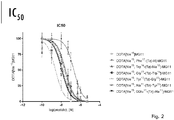
- Figure 2 illustrates the half maximal inhibitory concentration IC 50 of [Nle 15 ]-MG11 in its derivated forms according to the termed triazole-scan as compared to the reference minigastrin derivate DOTA[Nle15]-MG11. Accordingly, DOTA[Nle15, Tyr 12 -(Tz)-Gly 13 ]-MG11 is the minigastrin derivate having the highest effectiveness in displacing the radiolabelled reference compound PP-F11-N.
- Figure 3 illustrates the plasma stability of [Nle 15 ]-MG11 in its derivated forms according to the termed triazole-scan as compared to the reference minigastrin derivate DOTA[Nle15]-MG11. Most of the derivates behave similar to the reference derivate. DOTA[Nle15, Tyr 12 -(Tz)-Gly 13 ]-MG11 has in this regard a lower stability but nevertheless more than 60% of the peptides remain stable for at least more than 2 hours which allows for a brought range of diagnostic and therapeutic applications.
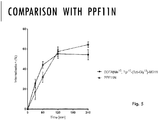
- the minigastrin derivate DOTA[Nle15, Tyr 12 -(Tz)-Gly 13 ]-MG11 possesses a higher specific internalization at time spans in the range up to 120 min and therefore a higher effectiveness to "block" the addressed receptors (e.g. GPCRs).
Landscapes
- Health & Medical Sciences (AREA)
- Life Sciences & Earth Sciences (AREA)
- Chemical & Material Sciences (AREA)
- Medicinal Chemistry (AREA)
- General Health & Medical Sciences (AREA)
- Proteomics, Peptides & Aminoacids (AREA)
- Public Health (AREA)
- Veterinary Medicine (AREA)
- Pharmacology & Pharmacy (AREA)
- Epidemiology (AREA)
- Animal Behavior & Ethology (AREA)
- Physics & Mathematics (AREA)
- Engineering & Computer Science (AREA)
- Gastroenterology & Hepatology (AREA)
- Immunology (AREA)
- Optics & Photonics (AREA)
- Molecular Biology (AREA)
- Endocrinology (AREA)
- Zoology (AREA)
- Organic Chemistry (AREA)
- Biochemistry (AREA)
- Urology & Nephrology (AREA)
- Hematology (AREA)
- Biomedical Technology (AREA)
- Dispersion Chemistry (AREA)
- Bioinformatics & Cheminformatics (AREA)
- Cell Biology (AREA)
- Toxicology (AREA)
- Biophysics (AREA)
- Genetics & Genomics (AREA)
- Pathology (AREA)
- Microbiology (AREA)
- Analytical Chemistry (AREA)
- Biotechnology (AREA)
- General Physics & Mathematics (AREA)
- Food Science & Technology (AREA)
- Nanotechnology (AREA)
- Peptides Or Proteins (AREA)
- Medicines That Contain Protein Lipid Enzymes And Other Medicines (AREA)
- Medicines Containing Antibodies Or Antigens For Use As Internal Diagnostic Agents (AREA)
Priority Applications (7)
| Application Number | Priority Date | Filing Date | Title |
|---|---|---|---|
| EP17192428.5A EP3459559A1 (de) | 2017-09-21 | 2017-09-21 | Minigastrinderivate, insbesondere zur verwendung in positiver cck2-rezeptor-tumordiagnose und/oder -behandlung |
| PCT/EP2018/073020 WO2019057445A1 (en) | 2017-09-21 | 2018-08-27 | MINIGASTRINE DERIVATIVES IN PARTICULAR FOR USE IN THE DIAGNOSIS AND / OR TREATMENT OF POSITIVE TUMORS FOR THE CCK2 RECEPTOR |
| EP18769063.1A EP3684395B1 (de) | 2017-09-21 | 2018-08-27 | Minigastrinderivate, insbesondere zur verwendung in positiver cck2-rezeptor-tumordiagnose und/oder -behandlung |
| KR1020207010967A KR20200054285A (ko) | 2017-09-21 | 2018-08-27 | 특히 cck2 수용체 양성 종양 진단 및/또는 치료에 사용하기 위한, 미니가스트린 유도체 |
| CN201880061386.3A CN111132689A (zh) | 2017-09-21 | 2018-08-27 | 特别用于cck2受体阳性肿瘤的诊断和/或治疗的微小胃泌素衍生物 |
| JP2020516682A JP7026784B2 (ja) | 2017-09-21 | 2018-08-27 | ミニガストリン誘導体、特にcck2受容体陽性腫瘍の診断及び/又は治療において使用するためのミニガストリン誘導体 |
| US16/649,637 US20210361735A1 (en) | 2017-09-21 | 2018-08-27 | Minigastrin derivates, in particular for use in cck2 receptor positive tumour diagnosis and/or treatment |
Applications Claiming Priority (1)
| Application Number | Priority Date | Filing Date | Title |
|---|---|---|---|
| EP17192428.5A EP3459559A1 (de) | 2017-09-21 | 2017-09-21 | Minigastrinderivate, insbesondere zur verwendung in positiver cck2-rezeptor-tumordiagnose und/oder -behandlung |
Publications (1)
| Publication Number | Publication Date |
|---|---|
| EP3459559A1 true EP3459559A1 (de) | 2019-03-27 |
Family
ID=60080580
Family Applications (2)
| Application Number | Title | Priority Date | Filing Date |
|---|---|---|---|
| EP17192428.5A Withdrawn EP3459559A1 (de) | 2017-09-21 | 2017-09-21 | Minigastrinderivate, insbesondere zur verwendung in positiver cck2-rezeptor-tumordiagnose und/oder -behandlung |
| EP18769063.1A Active EP3684395B1 (de) | 2017-09-21 | 2018-08-27 | Minigastrinderivate, insbesondere zur verwendung in positiver cck2-rezeptor-tumordiagnose und/oder -behandlung |
Family Applications After (1)
| Application Number | Title | Priority Date | Filing Date |
|---|---|---|---|
| EP18769063.1A Active EP3684395B1 (de) | 2017-09-21 | 2018-08-27 | Minigastrinderivate, insbesondere zur verwendung in positiver cck2-rezeptor-tumordiagnose und/oder -behandlung |
Country Status (6)
| Country | Link |
|---|---|
| US (1) | US20210361735A1 (de) |
| EP (2) | EP3459559A1 (de) |
| JP (1) | JP7026784B2 (de) |
| KR (1) | KR20200054285A (de) |
| CN (1) | CN111132689A (de) |
| WO (1) | WO2019057445A1 (de) |
Cited By (4)
| Publication number | Priority date | Publication date | Assignee | Title |
|---|---|---|---|---|
| EP3868394A1 (de) * | 2020-02-20 | 2021-08-25 | Paul Scherrer Institut | Mono- und multi-triazolominigastrine für das targeting von cck2r-positiven neoplasien |
| WO2022023539A1 (en) * | 2020-07-31 | 2022-02-03 | Debiopharm International S.A. | Gallium-labeled gastrin analogue and use in a method of imaging cckb-receptor-positive tumors or cancers |
| US20220218852A1 (en) * | 2019-04-18 | 2022-07-14 | Provincial Health Services Authority | Novel radiolabelled cxcr4-targeting compounds for diagnosis and therapy |
| US12616761B2 (en) | 2024-06-27 | 2026-05-05 | The University Of British Columbia | CXCR4-targeting compounds |
Families Citing this family (5)
| Publication number | Priority date | Publication date | Assignee | Title |
|---|---|---|---|---|
| EP3412303A1 (de) | 2017-06-08 | 2018-12-12 | Medizinische Universität Innsbruck | Verbessertes pharmakokinetik- und cholecystokinin-2-rezeptor (cck2r)-zielverfahren für diagnose und therapie |
| WO2021186060A1 (en) * | 2020-03-20 | 2021-09-23 | Debiopharm International S.A. | Radiolabeled gastrin analogue for use in a method of treating and/or imaging cckb receptor positive diseases, in particular pulmonary and extrapulmonary small-cell carcinoma |
| EP4188455A1 (de) * | 2020-07-31 | 2023-06-07 | Paul Scherrer Institut | Zusammensetzung mit einem rapalog und einem radioaktiv markierten gastrin-analogon, insbesondere zur verwendung bei der behandlung und/oder diagnose von cckb-rezeptor-positivem krebs oder tumoren |
| AU2021466987B2 (en) * | 2021-09-28 | 2025-11-20 | Paul Scherrer Institut | Method for predicting the response of a patient diagnosed with cancer to treatment and/or imaging with a compound targeting cck2-r, and compound for use in methods of selectively treating and/or imaging cancer |
| JP2025509631A (ja) * | 2022-03-16 | 2025-04-11 | ピーター・マッカラム・キャンサー・インスティテュート | セラノスティック薬剤の標的送達 |
Citations (3)
| Publication number | Priority date | Publication date | Assignee | Title |
|---|---|---|---|---|
| US20070041903A1 (en) * | 2005-08-19 | 2007-02-22 | Theodosia Maina | Modified minigastrin analogs for oncology applications |
| WO2012156511A1 (en) * | 2011-05-19 | 2012-11-22 | Universitätsspital Basel | Bombesin receptor targeting peptide incorporating a 1, 2, 3-triazole group in the backbone for preparing in vivo diagnostic and therapeutic agents |
| WO2015067473A1 (en) | 2013-11-06 | 2015-05-14 | Paul Scherrer Institut | Mini-gastrin analogue, in particular for use in cck2 receptor positive tumour diagnosis and/or treatment |
Family Cites Families (1)
| Publication number | Priority date | Publication date | Assignee | Title |
|---|---|---|---|---|
| US7226577B2 (en) * | 2003-01-13 | 2007-06-05 | Bracco Imaging, S. P. A. | Gastrin releasing peptide compounds |
-
2017
- 2017-09-21 EP EP17192428.5A patent/EP3459559A1/de not_active Withdrawn
-
2018
- 2018-08-27 EP EP18769063.1A patent/EP3684395B1/de active Active
- 2018-08-27 CN CN201880061386.3A patent/CN111132689A/zh active Pending
- 2018-08-27 KR KR1020207010967A patent/KR20200054285A/ko not_active Ceased
- 2018-08-27 US US16/649,637 patent/US20210361735A1/en not_active Abandoned
- 2018-08-27 WO PCT/EP2018/073020 patent/WO2019057445A1/en not_active Ceased
- 2018-08-27 JP JP2020516682A patent/JP7026784B2/ja active Active
Patent Citations (3)
| Publication number | Priority date | Publication date | Assignee | Title |
|---|---|---|---|---|
| US20070041903A1 (en) * | 2005-08-19 | 2007-02-22 | Theodosia Maina | Modified minigastrin analogs for oncology applications |
| WO2012156511A1 (en) * | 2011-05-19 | 2012-11-22 | Universitätsspital Basel | Bombesin receptor targeting peptide incorporating a 1, 2, 3-triazole group in the backbone for preparing in vivo diagnostic and therapeutic agents |
| WO2015067473A1 (en) | 2013-11-06 | 2015-05-14 | Paul Scherrer Institut | Mini-gastrin analogue, in particular for use in cck2 receptor positive tumour diagnosis and/or treatment |
Non-Patent Citations (7)
| Title |
|---|
| ENDOCR RELAT CANCER, vol. 13, no. 4, December 2006 (2006-12-01), pages 1203 - 11 |
| EUR J NUCL MED MOL IMAGING., vol. 33, no. 11, November 2006 (2006-11-01), pages 1273 - 9 |
| LUDMILA MELICHAROVA ET AL: "Preclinical evaluation of gastrin derivatives labelled with <sup>111</sup>in: radiolabelling, affinity profile and pharmacokinetics in rats", BIOMEDICAL PAPERS OF THE FACULTY OF MEDICINE OF PALACK UNIVERSITY, OLOMOUC CZECH REPUBLIC, 27 September 2013 (2013-09-27), CZ, XP055453844, ISSN: 1213-8118, DOI: 10.5507/bp.2013.064 * |
| MACKE, REUBI J NUCL MED, vol. 49, 2008, pages 1735 - 1738 |
| REUBI, CANCER RES., 1997 |
| REUBI, INT J CANCER., 1996 |
| ROOSENBURG S ET AL: "PET and SPECT Imaging of a Radio labeled Minigastrin Analogue Conjugated with DOTA, NOTA, and NODAGA and Labeled with Cu-64, Ga-68, and In-111", MOLECULAR PHARMACEUTICS, vol. 11, no. 11, November 2014 (2014-11-01), pages 3930 - 3937, XP002778524, ISSN: 1543-8384 * |
Cited By (6)
| Publication number | Priority date | Publication date | Assignee | Title |
|---|---|---|---|---|
| US20220218852A1 (en) * | 2019-04-18 | 2022-07-14 | Provincial Health Services Authority | Novel radiolabelled cxcr4-targeting compounds for diagnosis and therapy |
| EP3868394A1 (de) * | 2020-02-20 | 2021-08-25 | Paul Scherrer Institut | Mono- und multi-triazolominigastrine für das targeting von cck2r-positiven neoplasien |
| WO2021165285A1 (en) * | 2020-02-20 | 2021-08-26 | Paul Scherrer Institut | Mono- and multi-triazolominigastrins for targeting of cck2r-positive neoplasms |
| WO2022023539A1 (en) * | 2020-07-31 | 2022-02-03 | Debiopharm International S.A. | Gallium-labeled gastrin analogue and use in a method of imaging cckb-receptor-positive tumors or cancers |
| US20230270893A1 (en) * | 2020-07-31 | 2023-08-31 | Debiopharm International S.A. | Gallium-labeled gastrin analogue and use in a method of imaging cckb-receptor-positive tumors or cancers |
| US12616761B2 (en) | 2024-06-27 | 2026-05-05 | The University Of British Columbia | CXCR4-targeting compounds |
Also Published As
| Publication number | Publication date |
|---|---|
| KR20200054285A (ko) | 2020-05-19 |
| EP3684395A1 (de) | 2020-07-29 |
| EP3684395C0 (de) | 2024-06-19 |
| WO2019057445A1 (en) | 2019-03-28 |
| JP2020534327A (ja) | 2020-11-26 |
| JP7026784B2 (ja) | 2022-02-28 |
| US20210361735A1 (en) | 2021-11-25 |
| CN111132689A (zh) | 2020-05-08 |
| EP3684395B1 (de) | 2024-06-19 |
Similar Documents
| Publication | Publication Date | Title |
|---|---|---|
| EP3459559A1 (de) | Minigastrinderivate, insbesondere zur verwendung in positiver cck2-rezeptor-tumordiagnose und/oder -behandlung | |
| JP5784911B2 (ja) | ボンベシンアナログペプチドアンタゴニスト複合体 | |
| EP2790732B1 (de) | Geklickte, somatostatinkonjugierte analoga für biologische anwendungen | |
| JP7502801B2 (ja) | ガストリン放出ペプチド受容体(grpr)のインビボイメージングおよびgrpr関連障害の治療のための放射性標識ボンベシン由来化合物 | |
| TW200829277A (en) | Compounds and methods for 18F labeled agents | |
| JP7421232B2 (ja) | フッ化ケイ素アクセプタ置換放射性医薬品とその前駆体 | |
| EP3868394A1 (de) | Mono- und multi-triazolominigastrine für das targeting von cck2r-positiven neoplasien | |
| JP2025108673A (ja) | 炭酸脱水素酵素ixを標的にするペプチドリガンド、これを含むペプチド構造体及びその用途 | |
| KR20090096716A (ko) | 아지리딘의 플루오르화에 의한 방사성표지 | |
| AU2016372245B2 (en) | Selective glucagon receptor agonists comprising a chelating moiety for imaging purposes | |
| CN117320759A (zh) | 放射性药物生长抑素受体配体及其前体 | |
| JP4318985B2 (ja) | ソマトスタチンアナログ誘導体およびその利用 | |
| WO2012156511A1 (en) | Bombesin receptor targeting peptide incorporating a 1, 2, 3-triazole group in the backbone for preparing in vivo diagnostic and therapeutic agents | |
| KR20250170626A (ko) | 탄산탈수소효소 ⅸ를 표적으로 하는 펩타이드 구조체 및 이들의 용도 | |
| HK1153760B (zh) | 铃蟾肽类似肽拮抗物缀合物 |
Legal Events
| Date | Code | Title | Description |
|---|---|---|---|
| PUAI | Public reference made under article 153(3) epc to a published international application that has entered the european phase |
Free format text: ORIGINAL CODE: 0009012 |
|
| AK | Designated contracting states |
Kind code of ref document: A1 Designated state(s): AL AT BE BG CH CY CZ DE DK EE ES FI FR GB GR HR HU IE IS IT LI LT LU LV MC MK MT NL NO PL PT RO RS SE SI SK SM TR |
|
| AX | Request for extension of the european patent |
Extension state: BA ME |
|
| RIN1 | Information on inventor provided before grant (corrected) |
Inventor name: BEHE, MARTIN Inventor name: GROB, NATHALIE Inventor name: SCHIBLI, ROGER Inventor name: MINDT, THOMAS |
|
| STAA | Information on the status of an ep patent application or granted ep patent |
Free format text: STATUS: THE APPLICATION IS DEEMED TO BE WITHDRAWN |
|
| 18D | Application deemed to be withdrawn |
Effective date: 20190928 |