EP3459701A2 - Schneidvorrichtung, system mit einer schneidvorrichtung und einer weiterverarbeitungseinrichtung sowie verfahren zum zerkleinern von pastösen stoffen - Google Patents
Schneidvorrichtung, system mit einer schneidvorrichtung und einer weiterverarbeitungseinrichtung sowie verfahren zum zerkleinern von pastösen stoffen Download PDFInfo
- Publication number
- EP3459701A2 EP3459701A2 EP18191208.0A EP18191208A EP3459701A2 EP 3459701 A2 EP3459701 A2 EP 3459701A2 EP 18191208 A EP18191208 A EP 18191208A EP 3459701 A2 EP3459701 A2 EP 3459701A2
- Authority
- EP
- European Patent Office
- Prior art keywords
- section
- outlet
- cutting
- flow cross
- central body
- Prior art date
- Legal status (The legal status is an assumption and is not a legal conclusion. Google has not performed a legal analysis and makes no representation as to the accuracy of the status listed.)
- Granted
Links
Images




Classifications
-
- B—PERFORMING OPERATIONS; TRANSPORTING
- B02—CRUSHING, PULVERISING, OR DISINTEGRATING; PREPARATORY TREATMENT OF GRAIN FOR MILLING
- B02C—CRUSHING, PULVERISING, OR DISINTEGRATING IN GENERAL; MILLING GRAIN
- B02C18/00—Disintegrating by knives or other cutting or tearing members which chop material into fragments
- B02C18/06—Disintegrating by knives or other cutting or tearing members which chop material into fragments with rotating knives
- B02C18/16—Details
- B02C18/22—Feed or discharge means
- B02C18/2225—Feed means
-
- B—PERFORMING OPERATIONS; TRANSPORTING
- B26—HAND CUTTING TOOLS; CUTTING; SEVERING
- B26D—CUTTING; DETAILS COMMON TO MACHINES FOR PERFORATING, PUNCHING, CUTTING-OUT, STAMPING-OUT OR SEVERING
- B26D1/00—Cutting through work characterised by the nature or movement of the cutting member or particular materials not otherwise provided for; Apparatus or machines therefor; Cutting members therefor
- B26D1/01—Cutting through work characterised by the nature or movement of the cutting member or particular materials not otherwise provided for; Apparatus or machines therefor; Cutting members therefor involving a cutting member which does not travel with the work
- B26D1/12—Cutting through work characterised by the nature or movement of the cutting member or particular materials not otherwise provided for; Apparatus or machines therefor; Cutting members therefor involving a cutting member which does not travel with the work having a cutting member moving about an axis
- B26D1/25—Cutting through work characterised by the nature or movement of the cutting member or particular materials not otherwise provided for; Apparatus or machines therefor; Cutting members therefor involving a cutting member which does not travel with the work having a cutting member moving about an axis with a non-circular cutting member
- B26D1/34—Cutting through work characterised by the nature or movement of the cutting member or particular materials not otherwise provided for; Apparatus or machines therefor; Cutting members therefor involving a cutting member which does not travel with the work having a cutting member moving about an axis with a non-circular cutting member moving about an axis parallel to the line of cut
- B26D1/36—Cutting through work characterised by the nature or movement of the cutting member or particular materials not otherwise provided for; Apparatus or machines therefor; Cutting members therefor involving a cutting member which does not travel with the work having a cutting member moving about an axis with a non-circular cutting member moving about an axis parallel to the line of cut and rotating continuously in one direction during cutting, e.g. mounted on a rotary cylinder
-
- A—HUMAN NECESSITIES
- A23—FOODS OR FOODSTUFFS; TREATMENT THEREOF, NOT COVERED BY OTHER CLASSES
- A23P—SHAPING OR WORKING OF FOODSTUFFS, NOT FULLY COVERED BY A SINGLE OTHER SUBCLASS
- A23P30/00—Shaping or working of foodstuffs characterised by the process or apparatus
- A23P30/10—Moulding
-
- B—PERFORMING OPERATIONS; TRANSPORTING
- B01—PHYSICAL OR CHEMICAL PROCESSES OR APPARATUS IN GENERAL
- B01J—CHEMICAL OR PHYSICAL PROCESSES, e.g. CATALYSIS OR COLLOID CHEMISTRY; THEIR RELEVANT APPARATUS
- B01J2/00—Processes or devices for granulating materials, e.g. fertilisers in general; Rendering particulate materials free flowing in general, e.g. making them hydrophobic
- B01J2/20—Processes or devices for granulating materials, e.g. fertilisers in general; Rendering particulate materials free flowing in general, e.g. making them hydrophobic by expressing the material, e.g. through sieves and fragmenting the extruded length
-
- B—PERFORMING OPERATIONS; TRANSPORTING
- B02—CRUSHING, PULVERISING, OR DISINTEGRATING; PREPARATORY TREATMENT OF GRAIN FOR MILLING
- B02C—CRUSHING, PULVERISING, OR DISINTEGRATING IN GENERAL; MILLING GRAIN
- B02C18/00—Disintegrating by knives or other cutting or tearing members which chop material into fragments
- B02C18/06—Disintegrating by knives or other cutting or tearing members which chop material into fragments with rotating knives
- B02C18/14—Disintegrating by knives or other cutting or tearing members which chop material into fragments with rotating knives within horizontal containers
-
- B—PERFORMING OPERATIONS; TRANSPORTING
- B26—HAND CUTTING TOOLS; CUTTING; SEVERING
- B26D—CUTTING; DETAILS COMMON TO MACHINES FOR PERFORATING, PUNCHING, CUTTING-OUT, STAMPING-OUT OR SEVERING
- B26D1/00—Cutting through work characterised by the nature or movement of the cutting member or particular materials not otherwise provided for; Apparatus or machines therefor; Cutting members therefor
- B26D1/01—Cutting through work characterised by the nature or movement of the cutting member or particular materials not otherwise provided for; Apparatus or machines therefor; Cutting members therefor involving a cutting member which does not travel with the work
- B26D1/12—Cutting through work characterised by the nature or movement of the cutting member or particular materials not otherwise provided for; Apparatus or machines therefor; Cutting members therefor involving a cutting member which does not travel with the work having a cutting member moving about an axis
- B26D1/25—Cutting through work characterised by the nature or movement of the cutting member or particular materials not otherwise provided for; Apparatus or machines therefor; Cutting members therefor involving a cutting member which does not travel with the work having a cutting member moving about an axis with a non-circular cutting member
- B26D1/26—Cutting through work characterised by the nature or movement of the cutting member or particular materials not otherwise provided for; Apparatus or machines therefor; Cutting members therefor involving a cutting member which does not travel with the work having a cutting member moving about an axis with a non-circular cutting member moving about an axis substantially perpendicular to the line of cut
- B26D1/28—Cutting through work characterised by the nature or movement of the cutting member or particular materials not otherwise provided for; Apparatus or machines therefor; Cutting members therefor involving a cutting member which does not travel with the work having a cutting member moving about an axis with a non-circular cutting member moving about an axis substantially perpendicular to the line of cut and rotating continuously in one direction during cutting
-
- B—PERFORMING OPERATIONS; TRANSPORTING
- B26—HAND CUTTING TOOLS; CUTTING; SEVERING
- B26D—CUTTING; DETAILS COMMON TO MACHINES FOR PERFORATING, PUNCHING, CUTTING-OUT, STAMPING-OUT OR SEVERING
- B26D7/00—Details of apparatus for cutting, cutting-out, stamping-out, punching, perforating, or severing by means other than cutting
- B26D7/06—Arrangements for feeding or delivering work of other than sheet, web, or filamentary form
- B26D7/0683—Arrangements for feeding or delivering work of other than sheet, web, or filamentary form specially adapted for elongated articles
-
- B—PERFORMING OPERATIONS; TRANSPORTING
- B29—WORKING OF PLASTICS; WORKING OF SUBSTANCES IN A PLASTIC STATE IN GENERAL
- B29B—PREPARATION OR PRETREATMENT OF THE MATERIAL TO BE SHAPED; MAKING GRANULES OR PREFORMS; RECOVERY OF PLASTICS OR OTHER CONSTITUENTS OF WASTE MATERIAL CONTAINING PLASTICS
- B29B9/00—Making granules
- B29B9/02—Making granules by dividing preformed material
- B29B9/06—Making granules by dividing preformed material in the form of filamentary material, e.g. combined with extrusion
-
- B—PERFORMING OPERATIONS; TRANSPORTING
- B29—WORKING OF PLASTICS; WORKING OF SUBSTANCES IN A PLASTIC STATE IN GENERAL
- B29C—SHAPING OR JOINING OF PLASTICS; SHAPING OF MATERIAL IN A PLASTIC STATE, NOT OTHERWISE PROVIDED FOR; AFTER-TREATMENT OF THE SHAPED PRODUCTS, e.g. REPAIRING
- B29C48/00—Extrusion moulding, i.e. expressing the moulding material through a die or nozzle which imparts the desired form; Apparatus therefor
- B29C48/001—Combinations of extrusion moulding with other shaping operations
- B29C48/0022—Combinations of extrusion moulding with other shaping operations combined with cutting
-
- B—PERFORMING OPERATIONS; TRANSPORTING
- B29—WORKING OF PLASTICS; WORKING OF SUBSTANCES IN A PLASTIC STATE IN GENERAL
- B29C—SHAPING OR JOINING OF PLASTICS; SHAPING OF MATERIAL IN A PLASTIC STATE, NOT OTHERWISE PROVIDED FOR; AFTER-TREATMENT OF THE SHAPED PRODUCTS, e.g. REPAIRING
- B29C48/00—Extrusion moulding, i.e. expressing the moulding material through a die or nozzle which imparts the desired form; Apparatus therefor
- B29C48/03—Extrusion moulding, i.e. expressing the moulding material through a die or nozzle which imparts the desired form; Apparatus therefor characterised by the shape of the extruded material at extrusion
- B29C48/04—Particle-shaped
-
- B—PERFORMING OPERATIONS; TRANSPORTING
- B29—WORKING OF PLASTICS; WORKING OF SUBSTANCES IN A PLASTIC STATE IN GENERAL
- B29C—SHAPING OR JOINING OF PLASTICS; SHAPING OF MATERIAL IN A PLASTIC STATE, NOT OTHERWISE PROVIDED FOR; AFTER-TREATMENT OF THE SHAPED PRODUCTS, e.g. REPAIRING
- B29C48/00—Extrusion moulding, i.e. expressing the moulding material through a die or nozzle which imparts the desired form; Apparatus therefor
- B29C48/03—Extrusion moulding, i.e. expressing the moulding material through a die or nozzle which imparts the desired form; Apparatus therefor characterised by the shape of the extruded material at extrusion
- B29C48/131—Curved articles
-
- B—PERFORMING OPERATIONS; TRANSPORTING
- B29—WORKING OF PLASTICS; WORKING OF SUBSTANCES IN A PLASTIC STATE IN GENERAL
- B29C—SHAPING OR JOINING OF PLASTICS; SHAPING OF MATERIAL IN A PLASTIC STATE, NOT OTHERWISE PROVIDED FOR; AFTER-TREATMENT OF THE SHAPED PRODUCTS, e.g. REPAIRING
- B29C48/00—Extrusion moulding, i.e. expressing the moulding material through a die or nozzle which imparts the desired form; Apparatus therefor
- B29C48/25—Component parts, details or accessories; Auxiliary operations
- B29C48/30—Extrusion nozzles or dies
- B29C48/3001—Extrusion nozzles or dies characterised by the material or their manufacturing process
-
- B—PERFORMING OPERATIONS; TRANSPORTING
- B29—WORKING OF PLASTICS; WORKING OF SUBSTANCES IN A PLASTIC STATE IN GENERAL
- B29C—SHAPING OR JOINING OF PLASTICS; SHAPING OF MATERIAL IN A PLASTIC STATE, NOT OTHERWISE PROVIDED FOR; AFTER-TREATMENT OF THE SHAPED PRODUCTS, e.g. REPAIRING
- B29C48/00—Extrusion moulding, i.e. expressing the moulding material through a die or nozzle which imparts the desired form; Apparatus therefor
- B29C48/25—Component parts, details or accessories; Auxiliary operations
- B29C48/30—Extrusion nozzles or dies
- B29C48/301—Extrusion nozzles or dies having reciprocating, oscillating or rotating parts
-
- B—PERFORMING OPERATIONS; TRANSPORTING
- B29—WORKING OF PLASTICS; WORKING OF SUBSTANCES IN A PLASTIC STATE IN GENERAL
- B29C—SHAPING OR JOINING OF PLASTICS; SHAPING OF MATERIAL IN A PLASTIC STATE, NOT OTHERWISE PROVIDED FOR; AFTER-TREATMENT OF THE SHAPED PRODUCTS, e.g. REPAIRING
- B29C48/00—Extrusion moulding, i.e. expressing the moulding material through a die or nozzle which imparts the desired form; Apparatus therefor
- B29C48/25—Component parts, details or accessories; Auxiliary operations
- B29C48/30—Extrusion nozzles or dies
- B29C48/32—Extrusion nozzles or dies with annular openings, e.g. for forming tubular articles
- B29C48/325—Extrusion nozzles or dies with annular openings, e.g. for forming tubular articles being adjustable, i.e. having adjustable exit sections
- B29C48/327—Extrusion nozzles or dies with annular openings, e.g. for forming tubular articles being adjustable, i.e. having adjustable exit sections with centering means
-
- B—PERFORMING OPERATIONS; TRANSPORTING
- B29—WORKING OF PLASTICS; WORKING OF SUBSTANCES IN A PLASTIC STATE IN GENERAL
- B29C—SHAPING OR JOINING OF PLASTICS; SHAPING OF MATERIAL IN A PLASTIC STATE, NOT OTHERWISE PROVIDED FOR; AFTER-TREATMENT OF THE SHAPED PRODUCTS, e.g. REPAIRING
- B29C48/00—Extrusion moulding, i.e. expressing the moulding material through a die or nozzle which imparts the desired form; Apparatus therefor
- B29C48/25—Component parts, details or accessories; Auxiliary operations
- B29C48/30—Extrusion nozzles or dies
- B29C48/32—Extrusion nozzles or dies with annular openings, e.g. for forming tubular articles
- B29C48/33—Extrusion nozzles or dies with annular openings, e.g. for forming tubular articles with parts rotatable relative to each other
-
- A—HUMAN NECESSITIES
- A23—FOODS OR FOODSTUFFS; TREATMENT THEREOF, NOT COVERED BY OTHER CLASSES
- A23V—INDEXING SCHEME RELATING TO FOODS, FOODSTUFFS OR NON-ALCOHOLIC BEVERAGES AND LACTIC OR PROPIONIC ACID BACTERIA USED IN FOODSTUFFS OR FOOD PREPARATION
- A23V2002/00—Food compositions, function of food ingredients or processes for food or foodstuffs
-
- B—PERFORMING OPERATIONS; TRANSPORTING
- B26—HAND CUTTING TOOLS; CUTTING; SEVERING
- B26D—CUTTING; DETAILS COMMON TO MACHINES FOR PERFORATING, PUNCHING, CUTTING-OUT, STAMPING-OUT OR SEVERING
- B26D1/00—Cutting through work characterised by the nature or movement of the cutting member or particular materials not otherwise provided for; Apparatus or machines therefor; Cutting members therefor
- B26D1/0006—Cutting members therefor
- B26D2001/006—Cutting members therefor the cutting blade having a special shape, e.g. a special outline, serrations
-
- B—PERFORMING OPERATIONS; TRANSPORTING
- B26—HAND CUTTING TOOLS; CUTTING; SEVERING
- B26D—CUTTING; DETAILS COMMON TO MACHINES FOR PERFORATING, PUNCHING, CUTTING-OUT, STAMPING-OUT OR SEVERING
- B26D2210/00—Machines or methods used for cutting special materials
- B26D2210/02—Machines or methods used for cutting special materials for cutting food products, e.g. food slicers
Definitions
- the invention relates to a cutting device, a system and a method for comminuting and separating, in particular, such pasty ones Substances with heavy or non-dividable fibers and / or particles.
- Such pasty substances are comminuted into pellets, so that informal masses can be reliably separated into uniform shaped bodies.
- the moldings Simultaneously with the comminution and separation, the moldings, which may be contaminated with fibers and foreign substances and also surface-sticky, may be introduced into a surrounding fluid, for example in a vacuum or high pressure environment.
- a device for producing pellets in which the length of cords or strands previously produced by a die can be selected independently of the feed rate of the material being pressed through and the speed of rotation of cutting knives.
- webs are arranged between the mold openings in the die, which are at least as wide as a knife.
- the cutting tool is rotated at intervals to perform a cutting process in a circle when the strands have reached the desired length. Subsequently, the knives remain in the respective rest position in front of a bridge.
- a disadvantage of the solutions known from the prior art is that the material flow must be forced through mold breaks and thereby separated to produce uniform particles before the cords or strands are divided transversely.
- the actual separation process is unproblematic, but a high pressure for pressing the pasty substance through the openings of the die is needed. Since most pasty substances are incompressible, the energy required for pressing is very high.
- the material used is highly loaded and the pasty substances are exposed to high compressive stresses and temperature increases due to the effects of force.
- this type of production of pellets is prone to clogging, especially when the pasty substances fibers, hair, wires, contaminants or soot particles.
- the resulting strings of pasty material after cutting strongly tend to re-bonding and must be kept consuming separate from each other or optionally additionally comminuted. This is usually done by cutting devices before the passage of the substance through the die to produce predetermined breaking points.
- a cutting instrument moves directly on the inside of the die, so that both the die and the cutting instrument are subject to very high wear and a very high mechanical load.
- the object of the present invention is to provide a device, a system and a method for comminuting pasty substances, with which pasty substances can be reliably comminuted with the least possible expenditure of energy to form parts or pellets.
- the cutting device for comminuting pasty substances with a nozzle with a nozzle housing having at least one inlet with an inlet flow cross section through which the pasty substance enters the nozzle, and an outlet with an outlet flow cross section through which the pasty substance the nozzle exits, as well as having a flow channel leading from the inlet to the outlet and with a arranged at the outlet, rotating cutting tool for cutting the emerging pasty substance provides that the outlet flow cross-section has the shape of a particular interrupted annular gap, which by a formed in the conveying direction of the pasty substance in cross-section increasing central body within the nozzle and an inner wall of the flow channel.
- the central body is thus arranged or formed within the flow channel and ensures that the material flow conveyed from the inlet to the outlet is transformed or rearranged, so that no separate material streams have to be forced through an outlet or through form openings in a die.
- This has the advantage that due to the central body, which enlarges in the direction of the outlet, a rearrangement, deflection or diversion of the material flow results without this being divided. Thereby There are no flow obstacles or stalls, where congestion or adhesions form or fibers, wires or other materials can get caught within the pasty mass.
- the nozzle housing may be integrally formed and manufactured in a primary molding process, alternatively, a multi-part design with fastening means may be provided to each other, which may facilitate machining the inner wall of the flow channel and the shape of the flow channel.
- the shape of the pellets is not done by matrices, but by an embodiment of an intermediate space of an inner wall of a flow channel and a central body located therein.
- the central body may be integrally formed with the nozzle housing or, if the nozzle housing is formed in multiple parts, integrally formed with a part of a nozzle housing part to ensure a continuous inner surface or a continuous inner wall of the flow channel.
- a one-piece design for example as a casting, as an additive produced component or as a sintered component complex geometries can be generated without interfaces. The assembly effort is reduced and ensures increased durability due to the closed inner surface.
- the central body may be fastened as a separate insert in the flow channel.
- central body By a separate embodiment of the central body, it is possible to install different central body in a nozzle housing, for example, to achieve a greater variety of variants in the adaptation of the cutting device to the desired performance parameters.
- different central bodies can be inserted into a nozzle housing and fixed thereto, for example, to adapt the geometry of the annular gap, which is formed between the inner wall of the flow channel and the outer contour of the central body, to the desired pellet size or to the material used.
- maintenance work can be carried out or replacement can be facilitated if worn on the central body.
- corresponding material pairings can be provided, so that different materials are used for the production of the cutting device, in particular the nozzle housing and the central body, the one to each existing Load adapted material selection allows. Also, the production of a partially complex structure with a curved flow channel can be facilitated by a multi-part design.
- the central body extends from the inner wall of the flow channel in the conveying direction inclined into the flow channel, so that a continuous or quasi-continuous deformation of the flow cross section along the conveying direction within the flow channel.
- the starting point on the inner wall of the flow channel, the pasty material is passed around the approach of the central body around.
- the central body is not located and need not be located centrally within the flow channel, but only within the flow channel and protrudes into it.
- this may have a conical shape, which penetrates the inner wall or bulges from this into the flow channel, so that the material flow is rearranged in the form of a curved surface, the outlet flow cross section opens in the form of an annular gap.
- a development of the invention provides that the flow cross-sectional area of the flow channel is not reduced in the conveying direction.
- the area of the outlet flow cross section is not smaller than the area of the inlet flow cross section, it is preferably at least equal to the area or larger than the area of the inlet flow cross section, on the one hand to relax or at least compress the pasty material, so that after Possibility no or only a slight increase in pressure within the conveyed substance before the outlet takes place. If there is no dynamic pressure due to an area reduction in the area of dies, high volume flows can be achieved with only a slight pressure loss. Even sensitive materials can therefore be processed in the cutting device.
- the central body is conical, which may be formed continuously increasing in cross-section. Even with a non-conical shape of the central body of this can be formed continuously increasing in cross-section, if a deviating from a cone shape is desired. Together with the increasing cross-sectional area of the central body along the conveying direction from the inlet to the outlet, it is provided that the inner diameter of the inner wall of the flow housing increases to ensure an at least constant area of the flow cross-section along the conveying direction within the flow channel.
- the annular gap in particular a broken annular gap, by a continuous change in cross section over the length of the flow channel, which has a rearrangement of the material flow without dividing into a plurality of partial streams result.
- the central body may be formed as a solid component or as a molded fitting in a one-piece design.
- the central body may be formed as a hollow body and, for example, in an embodiment of the flow channel as a tube by increasing impressions with a corresponding expansion on the opposite side done, so that is made by forming the central body of a one-piece tube.
- the shape of the broken annular gap is then substantially C-shaped or approximately C-shaped.
- the respective ends of an interrupted annular gap can be rectilinear, tapered or rounded and are designed depending on the respective process parameters, materials used, production methods and the pasty substances to be cut or cut.
- the central body In a non-integral design of the central body this can be mounted longitudinally displaceable and in particular spring-loaded against the displacement direction of the housing.
- a longitudinal displaceability of the central body along the longitudinal extension of the flow channel in or against the conveying direction it is possible to change the shape or the area of the outlet flow cross-section and adapt it to the respective process parameters.
- the central body In the longitudinally displaced position, the central body is on the nozzle housing fixable or lockable.
- a spring-loaded mounting of the central body within the nozzle housing there is the possibility that when conveying the pasty material larger solids that can not pass through the outlet flow cross-section, move the central body and thus cause an increase in the outlet flow cross-section.
- the outlet flow cross-section increases with a displacement of the central body in the conveying direction, so that disturbances can be avoided and solids or other disruptive bodies can be transported through the flow channel up to the outlet. About the spring load of the central body is then moved back to the starting position.
- a drive shaft of the cutting tool is mounted in the central body, so that through the central body through the cutting tool can be driven.
- the drive shaft preferably passes through the central body and exits the nozzle housing.
- the drive shaft connects the rotating cutting tool with a drive mounted outside of the nozzle housing, unless the cutting tool is driven by a direct drive. Since the shaft or the direct drive runs within the central body and thus within the nozzle housing, there is no material contact of the shaft with the pasty substance. There are thus no moving parts within the nozzle housing, which may come into contact with the pasty substance to be divided, so that a contamination of the pasty substance or a wear of the shaft or the drive is out of the question.
- the nozzle housing is provided with a bend, so that the flow channel also performs a bend.
- the shaft in particular if it is designed as a rigid shaft, can then be introduced in a straight line in the region of the bend in the central body and extends within the central body in a straight line to the outlet.
- the shaft is preferably mounted such that it is arranged centrally in the center of the annular gap or, in the case of a non-circular or polygonal configuration of the shape of the outlet flow cross-section, so that a cutting element or a cutting edge on the cutting tool covers the entire outlet flow cross-section can paint over.
- the shaft can run in an outer housing and then in the inner central body, without touching the product. If the central body is formed by a depression or deformation of the flow channel or the nozzle housing, the shaft always extends outside the nozzle housing on the outside in a fold formed by the indentation or invagination and preferably does not touch the outside of the housing.
- the drive shaft itself may be designed to be displaceable, so that the cutting tool is also displaceably mounted relative to the outlet. Thus, it can be reacted to material fluctuations or blockages, without having to interrupt the flow or crushing the same.
- the drive shaft may also be spring-loaded in the direction of the outlet, so that upon impact of solid materials on the cutting tool or cutting the cutting tool an axial displacement away from the outlet is made possible and after removal of the obstacle to return to the starting position.
- the drive shaft can also be designed as a flexible shaft.
- the outlet flow cross section may be formed as a single, interrupted annular gap, wherein the central body forms a single web at the outlet flow cross section.
- the bridge of the annular gap is interrupted.
- the web may be between 1 and 180 degrees, preferably between 60 and 10 degrees, in particular between 25 and 15 degrees of the total circumference, the shape and dimensions of the web being the resulting shaped bodies or pellets influence in their shape.
- the length of the pellets is determined by the radian measure or the proportion of the circumference of the uninterruptible part of the annular gap at the outlet flow cross-section.
- the contour of the web can change in the direction of flow; in particular, the web width or web height can be reduced or widened in order to achieve improved separation and detachment from the cutting element.
- the annular gap does not have to have a constant circle radius or a constant compromise radius, but rather there is the possibility that the interrupted Annular gap has different central circular radii at the beginning and the end, so as to influence the cutting geometry and separation behavior of the material.
- the central body can be formed as a cone with a web arranged on or formed on the lateral surface, which is fitted into the flow channel or molded therein.
- the inlet flow cross section continuously merges into the outlet flow cross section, in particular the area of the flow cross section along the flow channel remains essentially the same.
- the difference between the inner diameter, the inner wall and the outer diameter of the central body can vary over the circumference, but preferably remains the same.
- projections are arranged or formed, which protrude into the annular gap in the outlet flow cross-section. Due to the tensile stresses arising on the outside as a result of the deformation of the pasty substance, it is advantageous if the projections project from the outer circumference, that is to say from the inner wall of the nozzle housing, into the outlet flow cross section.
- the projections may be formed in the housing itself or arranged in the form of an attachment after the exit and before cutting the pasty material. The attachment to the housing is used for molding, scoring or pressing or even passing the material flow to the cutting edges of the cutting tool.
- the projections are used to create predetermined breaking points in the pasty substance and in the comminuted pelletized shaped body, over which the length of fragments after an example drying and mechanical stress can be predetermined. So that no foreign substances can adhere to the projections, it is advantageous to make them tapered in a wedge shape counter to the flow direction of the substance.
- the cutting tool has at least one cutting edge inclined from the inside to the outside, counter to the direction of rotation.
- the cutting edge may be bent, similar to a dorsal fin, a fin or a saber.
- the blades may be replaceably disposed on the cutting tool and may be disposed at a predetermined angle to the plane of the cutting tool on the periphery of the cutting tool.
- the angle of the cutting edges can be used to set how far a separation from the subsequent material flow takes place.
- the number of cutting depends on the speed required to determine the particular desired width of the pellets or the molded body to be produced. Usually one to four rotating blades are used, which can be provided with a wear-reducing coating.
- the blades preferably have a slope facing away from the nozzle to provide an additional separation pulse.
- the cutting tool may be axially spaced in the conveying direction to the central body and stored to the nozzle housing, so that the cutting the nozzle housing and the central body or an attachment located thereon do not touch. As a result, the wear of the cutting tool and the attachment is reduced.
- cutting elements such as wires or cords may also be arranged on the cutting tool or be formed by air, steam or liquid jets which cut the pasty material.
- the arrangement of the cutting or cutting elements can be designed irregularly on the circumference of the cutting tool, whereby batches of pellets or shaped bodies of different thickness can be produced in one operation.
- the web and the nozzle housing moves the blade or move the cutting or cutting elements exclusively in the pasty substance and not comparable to a pair of scissors touching on the housing, the web, the essay or the central body. This reduces the wear of the knives, and the interference of the generated moldings or pellets by the knife is minimal.
- the cutting edges are adjustably aligned at an angle to the plane of rotation of the cutting tool.
- the angle of the cutting to the plane of the rotary tool is between 0 and 60 degrees, preferably between 2 degrees and 15 degrees and depends in particular on the expected rotational speed and the outflow velocity of the pasty substance.
- the annular gap or the contour of the annular gap preferably surrounds the central body by more than 180 degrees.
- the axis of rotation of the cutting tool is substantially in the center of the annular gap or in the center of the annular gap, if this is circular.
- the axis of rotation of the cutting tool is thus also surrounded by the annular gap by more than 180 degrees.
- the inventive system with a cutting device, as described above, and a further processing device provides that the cutting device is arranged on the further processing device, wherein in the further processing means the separate, comminuted, pasty substance, which is now in the form of moldings or pellets , is further processed.
- the further processing means By separating, cutting, crushing or dividing is generally understood the dissolution of a substance context, so that a separate molded body is formed.
- pasty biomasses or multiphase mixtures can be used, in particular pressure, temperature or shear-sensitive or dilatant or abrasive masses whose separation can cause high wear of extruders, pumps and matrices and pasty masses with a high fiber content and very long and hard-to-cut fibers, hair or contaminants in which other cutting devices would lock or consuming separation or cutting devices must be kept in front of the outlet openings.
- the system provides for drying in the processing of dewatered sludges, especially sewage sludge.
- the pellets may be thermally, mechanically or chemically treated or reacted, subsequently or partially concurrently roasted, fritted, dried, granulated, fluidized, pneumatically transported, stored, cooled, heated, mixed homogenized or incorporated or hardened into a new chemical solution or cured.
- the system can also be used to produce food, feed, building materials and similar intermediate and final products.
- the cutting device produces uniform, uniform shaped bodies which, as a rule, can be described as a curved parallelepiped in the case of a round configuration or an approximately round configuration of the annular gap.
- the result is an interrupted-annular, curved parallelepiped when using a broken annular gap, if a complete annular gap is present, creates a helix.
- the shape of the pellets produced depends on the shape of the outlet opening, the presence or absence of cutting elements which protrude into the annular gap and produce predetermined breaking points, as well as the width, angle, offset of the circle radii of the beginning and end of the interrupted annular outlet and designs of the footbridge. Further influencing factors are the substances used, the flow rate of the substance, the direction of the outflow as well as the arrangement, design and number of cutting edges on the cutting tool and their orientation, the temperature of the nozzle and the environmental conditions of the further processing device.
- a negative or positive pressure prevail, which also bears against the outlet flow cross-section.
- the pasty shaped article is transported into the further processing device without pressure change.
- the generally still moist and sticky shaped bodies can be processed directly in an overpressure atmosphere without they again being able to adhere to one another or a separate transport device and a pressure lock, in particular a rotary valve, having to be introduced into an overpressure environment.
- a direct entry into a dryer in particular a fluidized bed evaporator, a roasting or frying, granulation, fluidization, cooling, mixing or homogenizing done
- the transport distance is reduced, no subsequent adhesion of the molded body to each other and in particular at Fluidized bed evaporators or fluidizing hardly any wall contact with adhesions takes place.
- the substance may be in a negative pressure atmosphere are promoted, whereby here the problem of the adhesion of separate moldings is not or less urgent.
- the method for comminuting pasty substances provides inter alia the steps of passing a pasty substance through a nozzle, wherein the cross-sectional shape of the pasty substance during passage through the nozzle from an inlet to an outlet of the nozzle from an inlet flow cross-section to one of them Deviating outlet flow cross section is changed.
- the pasty substance is expelled from the outlet of the nozzle with the exit flow cross-section and cut or separated during its exit and / or exit from the outlet with a rotary cutting tool, the pasty substance cut into an elongated pellet and the cross-section cut to the exit direction of the pasty substance and along a long side of the pellet is performed so that the cut surface forms a long side.
- the singulation and configuration of the shaped article with a rotating cutting element is transverse to the direction and along a long side of an elongated, bent or poly-diagonally shaped pellet on its long side.
- the length of the shaped body is determined by the radian measure or the circumferential portion of the uninterruptible part of the annular gap and not by the outflow velocity of the exiting strands as in the prior art or by the rotational speed of the rotating cutting element.
- the width of the shaped body is determined by the outflow velocity of the substance and by the number and the rotational speed of the cutting edges.
- the height of the shaped body and the pellet is defined by the height of the annular gap.
- the pasty substance is forced through the outlet flow cross-section in the form of an open annular gap, so that an automatic separation of the shaped body results after the circulation of a cutting edge along the outlet flow cross-section.
- the pasty substance is preferably transferred from the inlet to the outlet flow cross section in a continuously changing shape, without any division into different material flows.
- the pasty substance can be rearranged from a circular inlet flow cross-section to an open or closed annular outlet flow cross-section, so that the production of shaped bodies is effected by a diagonal division of an exiting bent material surface.
- the formation of the curved surface, which are separated by the cutting edges of the cutting tool from the pasty material flow, does not follow by extrusion, but by a rearrangement, diversion or deflection of the material flow along the conveying direction.
- depressions are produced in the subsequently cut pellets when the pasty substance emerges on its outside.
- the cutting speed of the cutting tool is preferably set greater than the exit speed of the pasty substance, so that it remains ensured that the length of the shaped body is predetermined by the radian measure or the length of the annular gap and not by the outflow velocity of the pasty material.
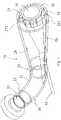
- FIG. 1 shows in a perspective, partially transparent view of a cutting device 10 for comminuting pasty substances with a nozzle 20 having a nozzle housing 21.
- the nozzle housing 21 is formed as a pipe with a bend.
- the nozzle 20 has one in the inlet 22 with an inlet flow cross-section 23, which is shown slightly offset for better representation.
- the pasty material to be comminuted is conveyed through the flow channel 26 formed in the nozzle housing 21 in the direction of an outlet 24 with an outlet flow cross-section 25. This can be done by a pump or the like, which is connected to the nozzle 20 and upstream of the cutting device 10.
- a rotating cutting tool 30 with four cutting edges 31 is arranged.
- the cutting tool 30 is driven via a drive shaft 52, which is led out of the nozzle housing 21 in the region of the bend.
- the drive shaft is mounted within the flow channel 26 in a central body 28, which forms the outlet flow cross-section 25 together with an inner wall 29 of the nozzle housing 21.
- the central body 28 extends from the outlet 24 in the flow channel 26 counter to the conveying direction.
- the central body 28 is conically shaped and has on its lateral surface on a web 281 which bears against the inner wall 29 of the nozzle housing 21.
- an extension which is up to the Inner wall 29 extends and terminates there or in, so that a continuous or almost continuous transition from the substantially circular inlet flow cross-section 23 takes place to the formed as an interrupted annular gap 27 outlet flow cross-section.
- the extension may be made separately from the conical central body 28, preferably the central body 28 forms an insert or indentation which, without further internals, rearranges the flow of material from the inlet 22 to the outlet 24 without splitting it into two separate streams.
- projections 271 on the central body 28 can also project from the outside, that is to say from the inner wall 29 of the nozzle housing 21, into the outlet flow cross-section.
- projections can also be manufactured separately and attached to the nozzle housing 21 via an attachment, attachment ring or insert. Alternatively, such projections may also be integrally formed.
- FIG. 2 shows the cutting device according to FIG. 1 in a sectional view.
- the inlet 22 and the outlet 24 are formed at opposite ends of the nozzle 20.
- the central body 28 is arranged, which has a substantially conical contour.
- the drive shaft 52 is guided, which drives the cutting tool 30 with the blades 31.
- the blades 31 completely sweep the outlet flow section 25, which is in the form of an interrupted annular gap.
- the drive shaft 25 is sealed relative to the transported material in the flow channel 26 stored so that an outside of the nozzle housing 21 arranged motor drive can not come into contact with the pasty substance.
- FIG. 2 It will be noted that the blades 31 are spaced from the nozzle 20 at the outlet 24 and thus do not abut or slide along the housing 21 or the center body. It is only the pasty material is cut by the cutting, so that a reduction in wear can be achieved.
- the central body 28 is shown as a separate component which is inserted into the nozzle housing 21 and fixed thereto.
- a web 281 is integrally formed or arranged, which ensures that in the region of the outlet 24, the outlet flow cross-section is formed as a broken annular gap, in the illustrated embodiment as a circular, interrupted annular gap.
- annular gap shapes such as polygonal shapes or oval shapes.
- nozzle 20 with the central body 28 can also be formed in one piece, for example in a casting process or in a forming process in which a first tubular base part taken as a nozzle housing 21 and the central body 28 is bent or formed inwardly ,
- the nozzle housing 21 is circumferentially enlarged over the conveying direction in the direction of the outlet 24, so that the pasty medium is not jammed within the nozzle 20.
- the central body 28 extends from the inner wall 29 in the direction of the flow channel 26 and in the conveying direction volume enlarging, preferably continuous volumenverellornd and projects into the flow channel, the material flow is relocated adjacent to the inner wall 29 and the outer contour of the central body 28 and reshaped, until the shape of the outlet flow cross section 25 is reached.
- FIG. 3 a variant of a possible outlet opening is shown as an interrupted annular gap 27.
- the outlet flow cross section 25 is formed by the outer contour of the central body 28 and the inner wall 29 of the nozzle housing 21. Via the web 281, the annular shape of the gap is interrupted.
- the end contours of the annular gap 27 are formed by the shape of the web 28.
- the length of the shaped body to be produced is essentially defined by the length of the annular gap or the radian measure of the interrupted outlet opening.
- FIG. 4 a variant shown in which the web 281 forms different circular radii R1, R2.
- the output radius R1 is smaller than the final radius R2 when the cutting element, not shown, rotates in the direction of the arrow.
- the radius changes from the initial radius R1 to the final radius R2 in the illustrated exemplary embodiment, so that a spiral-like shape of the molded article produced is obtained after truncation results.
- a continuous change of the radius makes sense. In principle, however, deviating shapes of the annular gap 27 or of the interrupted annular gap 27 can also be used.
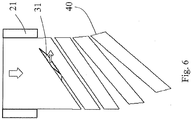
- FIG. 5 shows two views of the molding 40 or pellets obtained by the cutting process.
- the pasty material was through an annular gap, as shown in the FIG. 3 is shown pressed through and cut transversely to the exit direction of the rotary cutting tool 30.
- the result is an interrupted, annularly bent parallelepiped, in which the length is defined essentially by the length of the annular gap.
- the molding has two end faces 41, which are formed by the web 281, at which the material flow of the pasty material separated from each other and bent out of the outlet 24 is pushed out.
- the cross section of the end faces is a parallelepiped, a total of four longitudinal sides are present, an outer side 49, which abuts the outlet on the inner side 29 of the nozzle housing 21.
- the shape of the molded body 40 is first dependent on the shape of the annular gap 27 or the outlet flow cross-section 25. If an attachment or inserts are present within the outlet flow cross-section 25, over predetermined elements, such as cutting predetermined breaking points 47 or indentations in the outer long side 49 or the inner long side 48 are incorporated.
- the thickness of the space body 40 is determined in particular by the flow rate of the pasty substance and the number of revolutions of the cutting tool together with the number of cutting edges 31 and their orientation and arrangement on the circumference influenced by the cutting tool.
- the cut surfaces 43 of the shaped bodies 40 are not located on the end faces 41 but on the longitudinal sides 43 of the pellets.
- saber-type cutting edges 31 are arranged, over which the material pressed through the outlet 24 is cut transversely to the outflow direction and along the long extension of the respective shaped bodies 40 produced.
- the nozzle housing 21 and the central body 28 are formed as separate components and joined together.
- the outlet flow cross section is formed by the outer contour of the central body 28 and the inner contour of the inner surface 29 of the nozzle housing at the outlet 24.
- FIG. 8 shows a perspective sectional view of FIG. 7 in that it can be seen that the cone-shaped central body 28 increases continuously from a passage area through the inner wall 29 near the inlet 22 in the direction of the outlet 24, so that the cross-sectional shape of the inlet cross-section 23 changes continuously until an interrupted annular gap is generated ,
- the longitudinal axis of the cone is not collinear with the longitudinal axis or center axis of the nozzle housing 21 in the outlet region, so that over the length of the flow channel changing, not rotationally symmetrical flow cross-sectional shapes result.
- Within the flow channel 26 no separation or division takes place into two separate streams of material transported through, but the transported material is rearranged and reshaped until it is brought into a curved, flat shape.
- a separation of the two ends of the annular gap takes place.
- a helical division of the pasty medium is then made.
- a separation in the length can be done via the introduced predetermined breaking points in the further processing of the formed blanks.
- FIG. 9 shows the cutting device in a partially assembled state, in which only the nozzle housing 21 with the central body 28 and on the lateral surface of the cone-shaped central body 28 integrally molded web 281 can be seen.
- the central body 28 is connected via a slot, as shown for example in the FIG. 11 designated by the reference numeral 218, inserted into the housing.
- the web 281 protrudes through the nozzle housing 21.
- different variants of the central body 28 can be coupled to a nozzle housing 21 as a base body. Likewise, worn components can be replaced more easily.
- FIG. 10 shows the mounting condition according to FIG. 9 in a rear view from the inlet side. It can be seen that the central body 28 with the conical basic shape penetrates the wall of the nozzle housing 21. Material flowing from the inlet side to the outlet side is moved around the central body 28 at the penetration site and contacts the inner wall 29 of the nozzle housing 21 and the outer wall of the central body 28 and around the central body 28 without material flow separation. Within the central body 28, a bore 285 for receiving the drive shaft 52 is incorporated.
- FIG. 11 shows the nozzle housing 21 in a single view with the in the conveying direction extending to the outlet 24 slot 218.
- the slot 218 is shaped so that the web 281 is closely received and the conical central body 28 fits snugly against the nozzle housing 21, so that a dense completion and a continuous as possible transition from the inner wall 29 of the nozzle housing to the conical central body 28 takes place.
Landscapes
- Engineering & Computer Science (AREA)
- Mechanical Engineering (AREA)
- Manufacturing & Machinery (AREA)
- Life Sciences & Earth Sciences (AREA)
- Forests & Forestry (AREA)
- Chemical & Material Sciences (AREA)
- Food Science & Technology (AREA)
- Polymers & Plastics (AREA)
- Organic Chemistry (AREA)
- Chemical Kinetics & Catalysis (AREA)
- Processing And Handling Of Plastics And Other Materials For Molding In General (AREA)
- Crushing And Pulverization Processes (AREA)
- Crushing And Grinding (AREA)
- Details Of Cutting Devices (AREA)
- Formation And Processing Of Food Products (AREA)
Abstract
(a) einer Düse (20) mit einem Düsengehäuse (21), das zumindest einen Einlass (22) mit einem Eintritts-Strömungsquerschnitt (23), durch den der pastöse Stoff in die Düse (20) eintritt, und einen Auslass (24) mit einem Austritts-Strömungsquerschnitt (25), durch den der pastöse Stoff aus der Düse (20) austritt, sowie einen von dem Einlass (22) zu dem Auslass (24) führenden Strömungskanal (26) aufweist, und
(b) einem an dem Auslass (24) angeordneten, rotierenden Schneidwerkzeug (30) zum Schneiden des austretenden pastösen Stoffes,
wobei der Austritts-Strömungsquerschnitt (25) die Form eines geschlossenen oder unterbrochenen Ringspaltes (27) aufweist, der durch einen sich in Förderrichtung des pastösen Stoffes im Querschnitt vergrößernden Zentralkörper (28) innerhalb der Düse (20) und einer Innenwand (29) des Strömungskanals (26) gebildet ist.
Description
- Die Erfindung betrifft eine Schneidvorrichtung zum Zerkleinern von pastösen Stoffen mit einer Düse mit einem Düsengehäuse, das zumindest einen Einlass mit einem Eintritts-Strömungsquerschnitt, durch den der pastöse Stoff in die Düse eintritt, und einen Auslass mit einem Austritts-Strömungsquerschnitt, durch den der pastöse Stoff aus der Düse austritt, sowie einen von dem Einlass zu dem Auslass führenden Strömungskanal aufweist, mit einem an dem Auslass angeordneten rotierenden Schneidwerkzeug zum Schneiden des austretenden pastösen Stoffes. Die Erfindung betrifft ebenfalls ein System aus einer solchen Schneidvorrichtung und einer Weiterverarbeitungseinrichtung, die mit der Schneidvorrichtung gekoppelt ist sowie ein Verfahren zum Zerkleinern von pastösen Stoffen mit den Schritten:
- a) Durchleiten eines pastösen Stoffes durch eine Düse, wobei die Querschnittsform des pastösen Stoffes während des Durchtritts durch die Düse von einem Einlass zu einem Auslass der Düse von einem Eintritts-Strömungsquerschnitt zu einem davon abweichenden Austritts-Strömungsquerschnitt verändert wird,
- b) Herausdrücken des pastösen Stoffes aus dem Auslass der Düse mit dem Austritts- Strömungsquerschnitt sowie
- c) Schneiden des pastösen Stoffes nach einem Austritt aus dem Auslass mit einem rotierenden Schneidwerkzeug
- Die Erfindung betrifft insbesondere eine Schneidvorrichtung, ein System und ein Verfahren zum Zerkleinern und zum Vereinzeln insbesondere von solchen pastösen Stoffen mit schwer oder nicht zerteilbaren Fasern und/oder Partikeln. Solche pastösen Stoffe werden zu Pellets zerkleinert, so dass formlose Massen zuverlässig zu gleichförmigen Formkörpern vereinzelt werden können. Gleichzeitig mit der Zerkleinerung und Vereinzelung können die Formkörper, die mit Fasern und Fremdstoffen verunreinigt und auch oberflächig klebrig sein können, in ein umgebendes Fluid eingebracht werden, beispielsweise in eine Vakuum- oder Hochdruckumgebung.
- Bei aus dem Stand der Technik bekannten Verfahren zum Pelletieren pastöser Stoffe oder gestaltloser Massen wird der Stoff durch eine Formdurchbrüche aufweisende Matrize oder Düsenplatte gepresst, der Schneideinrichtung vorgelagert oder nachgelagert sind, um die entstehenden Schnüre oder Materialstränge mit Sollbruchstellen zu versehen oder vollständig über den Querschnitt der aus den Formausbrüchen austretenden Massen zu teilen. Solche Vorrichtungen sind aus der
EP 0 225 351 A1 , derDE 196 17 972 B4 oder derDE 40 13 760 C2 bekannt. Diesen Schneidvorrichtungen gemeinsam ist, dass bei verändertem Materialdurchsatz die Bewegung der Schneideinrichtung angepasst wird, um eine konstante Pelletlänge zu erhalten. Dadurch entstehen insbesondere bei Produktschwankungen, also bei nicht kontanten Zusammensetzungen des zu vereinzelnden Stoffes und bei sehr großen und sehr kleinen Materialdurchsätzen, Probleme bei der Vereinzelung der geschnittenen Formkörper. - Aus der
EP 0 945 172 A1 ist ein Verfahren bekannt, bei dem ein pumpbarer Stoff durch einen aus zwei Teilen einer Vorrichtung gebildeten Ringspalt nach außen gefördert wird, wobei zumindest ein Teil der beiden den Spalt und die Öffnungen im Außenring bildenden Teile drehbar ist und sich im Gehäuse sowie im Stoff bewegt. Die dabei entstehenden Partikel sind ungleichmäßig und werden mit einem hohen Impuls weggeschleudert. - Aus der
DE 197 10 302 A1 ist eine Vorrichtung bekannt, bei der pastöse Medien zerkleinert werden, indem ein Schredder vor einem Produktauslass die Masse mit einer mit Schlagzähnen versehenen Walze von dem Produktstrom abschlägt. Dadurch werden ungleichförmige Partikel mit einem hohen Impuls erzeugt. - Aus der
EP 1 618 947 A1 ist eine Vorrichtung zum Erzeugen von Pellets beschrieben, bei der die Länge von zuvor durch eine Matrize erzeugter Schnüre oder Stränge unabhängig von der Vorschubgeschwindigkeit des hindurchgepressten Materials und der Drehgeschwindigkeit von Trennmessern gewählt werden kann. Dazu sind zwischen den Formdurchbrüchen in der Matrize Stege angeordnet, die mindestens so breit wie ein Messer sind. Das Schneidwerkzeug wird zur Ausführung eines Schneidvorganges intervallmäßig im Kreis gedreht, wenn die Stränge die jeweils gewünschte Länge erreicht haben. Anschließend verbleiben die Messer in der jeweiligen Ruheposition vor einem Steg. - Nachteilig an den aus dem Stand der Technik bekannten Lösungen ist, dass der Stoffstrom durch Formdurchbrüche gepresst und dadurch getrennt werden muss, um gleichförmige Partikel zu erzeugen, bevor die Schnüre oder Stränge quer geteilt werden. Der eigentliche Trennvorgang ist dabei unproblematisch, jedoch wird ein hoher Druck zum Verpressen des pastösen Stoffes durch die Öffnungen der Matrize benötigt. Da die meisten pastösen Stoffe inkompressibel sind, ist der Energieaufwand für das Durchpressen sehr hoch. Darüber hinaus wird das eingesetzte Material hoch belastet und die pastösen Stoffe werden hohen Druckbeanspruchungen und Temperaturerhöhungen infolge der Krafteinwirkungen ausgesetzt. Darüber hinaus ist diese Art der Herstellung von Pellets anfällig für Verstopfungen, insbesondere wenn die pastösen Stoffe Fasern, Haare, Drähte, Störstoffe oder Rußpartikel aufweisen. Darüber hinaus neigen die entstehenden Schnüre aus pastösem Material nach dem Schneiden stark zum erneuten Verkleben und müssen aufwendig voneinander getrennt gehalten oder gegebenenfalls zusätzlich zerkleinert werden. Dies geschieht meist durch Schneideinrichtungen vor dem Durchtritt des Stoffes durch die Matrize, um Sollbruchstellen zu erzeugen. Dazu bewegt sich ein Schneidinstrument direkt auf der Innenseite der Matrize, so dass sowohl die Matrize als auch das Schneidinstrument einem sehr hohen Verschleiß und einer sehr hohen mechanischen Belastung unterliegen.
- Aufgabe der vorliegenden Erfindung ist es, eine Vorrichtung, ein System und ein Verfahren zum Zerkleinern von pastösen Stoffen bereitzustellen, mit denen pastöse Stoffe zuverlässig mit einem möglichst geringen Energieaufwand zu Formteilen oder Pellets zerkleinert werden können.
- Erfindungsgemäß wird diese Aufgabe durch eine Schneidvorrichtung mit den Merkmalen des Hauptanspruches sowie ein System und ein Verfahren mit den Merkmalen der nebengeordneten Ansprüche gelöst. Vorteilhafte Ausgestaltungen und Weiterbildungen der Erfindung sind in den Unteransprüchen, der Beschreibung sowie den Figuren offenbart.
- Die erfindungsgemäße Schneidvorrichtung zum Zerkleinern von pastösen Stoffe mit einer Düse mit einem Düsengehäuse, das zumindest einen Einlass mit einem Eintritts-Strömungsquerschnitt, durch den der pastöse Stoff in die Düse eintritt, und einen Auslass mit einem Austritts-Strömungsquerschnitt, durch den der pastöse Stoff aus der Düse austritt, sowie einen von dem Einlass zu dem Auslass führenden Strömungskanal aufweist und mit einem an dem Auslass angeordneten, rotierenden Schneidwerkzeug zum Schneiden des austretenden pastösen Stoffes sieht vor, dass der Austritts-Strömungsquerschnitt die Form eines insbesondere unterbrochenen Ringspaltes aufweist, der durch einen sich in Förderrichtung des pastösen Stoffes im Querschnitt vergrößernden Zentralkörper innerhalb der Düse und einer Innenwand des Strömungskanals gebildet ist. Die Düse mit dem Düsengehäuse ist im Wesentlichen rohrförmig, wobei das Düsengehäuse geradlinig ausgerichtet oder auch gebogen sein kann. Vorzugsweise weist das Düsengehäuse nur eine Biegung mit einem vergleichsweise großen Biegeradius auf. Das Gehäuse weist nur einen Auslass auf, der einen Austritts-Strömungsquerschnitt bildet, durch den der pastöse Stoff aus der Düse austritt. Der Austritts-Strömungsquerschnitt hat die Form eines Ringspaltes, insbesondere eines unterbrochenen Ringspaltes, wobei die Kontur des Ringspaltes bevorzugt kreisförmig ausgebildet ist, grundsätzlich besteht jedoch auch die Möglichkeit, dass die Kontur des Ringspaltes oval oder polygonal ausgebildet sein kann. Der Ringspalt wird durch einen sich in Förderrichtung des pastösen Stoffes im Querschnitt vergrößernden Zentralkörpers zusammen mit einer Innenwand des Strömungskanals gebildet. Der Zentralkörper ist somit innerhalb des Strömungskanals angeordnet oder ausgebildet und sorgt dafür, dass sich der von dem Einlass zum Auslass geförderte Stoffstrom umformt oder umlagert, so dass keine voneinander getrennten Stoffströme durch einen Auslass oder durch Formausbrechungen in einer Matrize hindurchgepresst werden müssen. Dies hat den Vorteil, dass durch den sich in Richtung auf den Auslass vergrößernden Zentralkörper eine Umlagerung, Umlenkung oder Umleitung des Stoffstromes ergibt, ohne dass dieser geteilt wird. Dadurch entstehen keine Strömungshindernisse oder Strömungsabrisse, an denen sich Stauungen oder Verklebungen bilden oder Fasern, Drähte oder andere Materialien innerhalb der pastösen Masse verfangen können. Das Düsengehäuse kann einteilig ausgebildet und in einem Urformverfahren hergestellt sein, alternativ dazu kann eine mehrteilige Ausgestaltung mit Befestigungsmitteln aneinander vorgesehen sein, was eine Bearbeitung der Innenwand des Strömungskanals sowie die Formgestaltung des Strömungskanals erleichtern kann. Die Formgestaltung der Pellets erfolgt nicht durch Matrizen, sondern durch eine Ausgestaltung eines Zwischenraumes einer Innenwand eines Strömungskanals und einem darin befindlichen Zentralkörper.
- Der Zentralkörper kann einstückig mit dem Düsengehäuse ausgebildet sein oder aber, wenn das Düsengehäuse mehrteilig ausgebildet ist, einstückig mit einem Teil eines Düsengehäuseteils ausgebildet sein, um eine kontinuierliche Innenoberfläche oder eine durchgehende Innenwand des Strömungskanals zu gewährleisten. Durch eine einstückige Ausgestaltung, beispielsweise als Gussteil, als additiv hergestelltes Bauteil oder als gesintertes Bauteil können komplexe Geometrien ohne Schnittstellen erzeugt werden. Der Montageaufwand wird verringert und aufgrund der geschlossenen Innenoberfläche eine vergrößerte Haltbarkeit gewährleistet. Alternativ zu einer einstückigen Ausgestaltung des Zentralkörpers mit dem Düsengehäuse oder einem Düsengehäuseteil kann der Zentralkörper als separater Einsatz in dem Strömungskanal befestigt sein. Durch eine separate Ausgestaltung des Zentralkörpers ist es möglich, unterschiedliche Zentralkörper in ein Düsengehäuse einzubauen, um beispielsweise eine größere Variantenvielfalt bei der Anpassung der Schneidvorrichtung an die gewünschten Leistungsparameter zu erreichen. Je nach zu verarbeitendem Stoff können unterschiedliche Zentralkörper in ein Düsengehäuse eingesetzt und daran festgelegt werden, beispielsweise um die Geometrie des Ringspaltes, der zwischen der Innenwand des Strömungskanals und der Außenkontur des Zentralkörpers gebildet wird, an die gewünschte Pelletgröße oder an das verwendete Material anzupassen. Darüber hinaus können bei Verschleiß an dem Zentralkörper Wartungsarbeiten vorgenommen oder ein Austausch erleichtert werden. Darüber hinaus können entsprechende Materialpaarungen vorgesehen werden, so dass unterschiedliche Materialien zur Herstellung der Schneidvorrichtung, insbesondere des Düsengehäuses und des Zentralkörpers verwendet werden, die eine an die jeweils vorhandenen Belastungen angepasste Materialauswahl ermöglicht. Auch kann die Herstellung einer teilweisen komplexen Struktur mit einem gebogenen Strömungskanal durch eine mehrteilige Ausgestaltung erleichtert werden.
- In einer Weiterbildung der Erfindung ist vorgesehen, dass der Zentralkörper sich von der Innenwand des Strömungskanals in Förderrichtung geneigt in den Strömungskanal hinein erstreckt, so dass eine kontinuierliche oder quasi kontinuierliche Umformung des Strömungsquerschnitts entlang der Förderrichtung innerhalb des Strömungskanals erfolgt. Durch den Ansatzpunkt an der Innenwand des Strömungskanals wird das pastöse Material um den Ansatz des Zentralkörpers herum geleitet. Der Zentralkörper befindet sich nicht und muss sich nicht zentral innerhalb des Strömungskanals befinden, sondern nur innerhalb des Strömungskanals und ragt in diesen hinein. Zumindest im Bereich des Ansatzes, also an dem dem Einlass zugewandten Ende des Zentralkörpers, kann dieser eine Kegelform aufweisen, die die Innenwand durchdringt oder von dieser in den Strömungskanal hinein sich wölbt, so dass der Stoffstrom in Form einer gebogenen Fläche umgelagert wird, die in den Austritts-Strömungsquerschnitt in Form eines Ringspaltes mündet.
- Eine Weiterbildung der Erfindung sieht vor, dass sich die Strömungsquerschnittsfläche des Strömungskanals in Förderrichtung nicht verringert. Auch die Fläche des Austritts-Strömungsquerschnitts ist nicht kleiner als die Fläche des Eintritts-Strömungsquerschnitts, bevorzugt ist sie zumindest gleich der Fläche oder größer als die Fläche des Eintritts-Strömungsquerschnitts, um einerseits das pastöse Material zu entspannen oder zumindest zu komprimieren, so dass nach Möglichkeit keine oder nur eine geringe Druckerhöhung innerhalb des geförderten Stoffes vor dem Auslass erfolgt. Bei einem nicht vorhandenen Staudruck durch eine Flächenverringerung im Bereich von Matrizen können hohe Volumenströme bei nur einem geringen Druckverlust erreicht werden. Auch empfindliche Materialien können daher in der Schneidvorrichtung verarbeitet werden. Darüber hinaus sind keine Druckschwankungen in einer vorgeschalteten Fördereinrichtung zu erwarten, die beispielsweise bei unterschiedlich hohen Wasseranteilen innerhalb des pastösen Stoffes auftreten können. Insbesondere bei der Verarbeitung von Mehrphasengemischen kann es sonst zu Kompressibilitätsschwankungen kommen, die nachteilige Auswirkungen auf den Antrieb bzw. die Pumpe sowie auf eine Materialbelastung haben.
- In einer Ausgestaltungsform der Erfindung ist der Zentralkörper konisch ausgebildet, wobei dieser sich kontinuierlich im Querschnitt vergrößernd ausgebildet sein kann. Auch bei einer nicht konischen Formgebung des Zentralkörpers kann dieser sich kontinuierlich im Querschnitt vergrößernd ausgebildet sein, wenn eine von einem Konus abweichende Formgebung gewünscht ist. Zusammen mit der sich vergrößernden Querschnittsfläche des Zentralköpers entlang der Förderrichtung von dem Einlass zum Auslass ist vorgesehen, dass sich auch der Innendurchmesser der Innenwand des Strömungsgehäuses vergrößert, um eine zumindest gleichbleibende Fläche des Strömungsquerschnittes entlang der Förderrichtung innerhalb des Strömungskanals zu gewährleisten. Somit entsteht der Ringspalt, insbesondere ein unterbrochener Ringspalt, durch eine kontinuierliche Querschnittsveränderung über die Länge des Strömungskanals, was eine Umlagerung des Stoffstromes ohne eine Aufteilung in mehrere Teilströme zur Folge hat.
- Der Zentralkörper kann als massives Bauteil ausgebildet sein oder als ein angeformtes Formstück bei einer einstückigen Ausgestaltung. Alternativ kann der Zentralkörper als Hohlkörper ausgebildet sein und beispielsweise bei einer Ausgestaltung des Strömungskanals als Rohr durch ein zunehmendes Eindrücken mit einem korrespondierenden Aufweiten auf der gegenüberliegenden Seite erfolgen, so dass über eine Umformung der Zentralkörper aus einem einteiligen Rohr hergestellt ist. Die Form des unterbrochenen Ringspaltes ist dann im Wesentlichen C-förmig oder angenähert C-förmig. Die jeweiligen Enden eines unterbrochenen Ringspaltes können geradlinig, spitz zulaufend oder abgerundet sein und sind abhängig von den jeweiligen Prozessparametern, verwendeten Materialien, Fertigungsverfahren sowie der zu zerteilenden oder zu zerschneidenden pastösen Stoffe gestaltet.
- Bei einer nicht einteiligen Ausgestaltung des Zentralkörpers kann dieser längsverschieblich und insbesondere federbelastet entgegen der Verschieberichtung an dem Gehäuse gelagert sein. Durch eine Längsverschieblichkeit des Zentralkörpers entlang der Längserstreckung des Strömungskanals in oder entgegen der Förderrichtung ist es möglich, die Form beziehungsweise die Fläche des Austritts-Strömungsquerschnittes zu verändern und an die jeweiligen Prozessparameter anzupassen. In der jeweils längsverschobenen Position ist der Zentralkörper an dem Düsengehäuse festlegbar oder arretierbar. Bei einer federbelasteten Lagerung des Zentralkörpers innerhalb des Düsengehäuses besteht die Möglichkeit, dass bei einer Förderung des pastösen Materials größere Feststoffe, die nicht durch den Austritts-Strömungsquerschnitt hindurchtreten können, den Zentralkörper verschieben und somit eine Vergrößerung des Austritts-Strömungsquerschnittes bewirken. Da sich der Zentralkörper entgegen der Förderrichtung verjüngt, vergrößert sich bei einer Verschiebung des Zentralkörpers in Förderrichtung der Austritts-Strömungsquerschnitt, so dass Störungen vermieden und Feststoffe oder andere Störkörper durch den Strömungskanal bis aus dem Auslass heraus befördert werden können. Über die Federbelastung wird der Zentralkörper dann wieder in die Ausgangsstellung zurückbewegt.
- In einer vorteilhaften Ausgestaltung ist eine Antriebswelle des Schneidwerkzeuges in dem Zentralkörper gelagert, so dass durch den Zentralkörper hindurch das Schneidwerkzeug angetrieben werden kann. Die Antriebswelle reicht bevorzugt durch den Zentralkörper hindurch und tritt aus dem Düsengehäuse aus. Die Antriebswelle verbindet das rotierende Schneidwerkzeug mit einem außerhalb des Düsengehäuses gelagerten Antrieb, sofern das Schneidwerkzeug nicht durch einen Direktantrieb angetrieben wird. Da die Welle oder der Direktantrieb innerhalb des Zentralkörpers und somit innerhalb des Düsengehäuses verläuft, findet keine Stoffberührung der Welle mit dem pastösen Stoff statt. Es befinden sich somit keine beweglichen Teile innerhalb des Düsengehäuses, die mit dem zu zerteilenden, pastösen Stoff in Berührung kommen können, so dass eine Kontaminierung des pastösen Stoffes oder auch ein Verschleiß der Welle oder des Antriebes nicht in Frage kommt.
- Bevorzugt ist das Düsengehäuse mit einer Biegung versehen, so dass der Strömungskanal ebenfalls eine Biegung ausführt. Dadurch wird das Herausführen der Antriebswelle aus dem Düsengehäuse erleichtert. Die Welle, insbesondere wenn sie als starre Welle ausgebildet ist, kann dann geradlinig im Bereich der Biegung in den Zentralkörper eingeführt werden und erstreckt sich innerhalb des Zentralkörpers geradlinig bis zum Auslass. Bevorzugt ist die Welle derart gelagert, dass sie im Mittelpunkt des Ringspaltes oder, bei einer unrunden oder polygonalen Ausgestaltung der Form des Austritts-Strömungsquerschnittes, zentral darin angeordnet ist, so dass ein Schneidelement oder eine Schneide an dem Schneidwerkzeug den gesamten Austritts-Strömungsquerschnitt überstreichen kann. Die Welle kann in einem Außengehäuse und anschließend in dem innenliegenden Zentralkörper verlaufen, ohne das Produkt zu berühren. Sofern der Zentralkörper durch eine Eindrückung oder Umformung des Strömungskanals oder des Düsengehäuses ausgebildet wird, verläuft die Welle stets außerhalb des Düsengehäuses auf der Außenseite in einer durch die Eindrückung ausgebildeten Falte oder Einstülpung und berührt die Außenseite des Gehäuses vorzugsweise nicht.
- Die Antriebswelle selbst kann verschiebbar ausgebildet sein, so dass auch das Schneidwerkzeug verschiebbar relativ zu dem Auslass gelagert ist. Somit kann auf Stoffschwankungen oder Verblockungen reagiert werden, ohne den Stoffstrom oder die Zerkleinerung desselben unterbrechen zu müssen. Die Antriebswelle kann ebenfalls federbelastet in Richtung auf den Auslass gelagert sein, so dass bei Auftreffen von festen Materialien auf das Schneidwerkzeug oder Schneiden des Schneidwerkzeuges eine Axialverlagerung von dem Auslass weg ermöglicht wird und nach Beseitigung des Hindernisses eine Rückkehr in die Ausgangsstellung erfolgt. Die Antriebswelle kann auch als biegsame Welle ausgebildet sein.
- Der Austritts-Strömungsquerschnitt kann in einer Ausführungsform als einzelner, unterbrochener Ringspalt ausgebildet sein, wobei der Zentralkörper an dem Austritts-Strömungsquerschnitt einen einzigen Steg ausbildet. Über den Steg wird der Ringspalt unterbrochen. Der Steg kann in Abhängigkeit von den Materialeigenschaften des zu zerkleinernden Stoffes zwischen 1 Grad und 180 Grad, vorzugsweise zwischen 60 Grad und 10 Grad, insbesondere zwischen 25 Grad und 15 Grad des Gesamtumfanges betragen, wobei die Form und Abmessungen des Steges die entstehenden Formkörper oder Pellets in ihrer Form beeinflussen. Die Länge der Pellets wird durch das Bogenmaß beziehungsweise den Anteil am Umfang des unterbrechungsfreien Teils des Ringspaltes an dem Austritts-Strömungsquerschnitt bestimmt. Die Kontur des Steges kann sich in Strömungsrichtung verändern, insbesondere kann die Stegbreite oder Steghöhe sich verringern oder verbreitern, um eine verbesserte Abtrennung und ein Ablösen von dem Schneidelement zu erreichen.
- Der Ringspalt muss keinen konstanten Kreisradius oder einen konstanten Kompromissradius aufweisen, vielmehr besteht die Möglichkeit, dass der unterbrochene Ringspalt verschiedene mittlere Kreisradien an dem Anfang und dem Ende aufweist, um so die Schnittgeometrien und Ablösungsverhalten des Materials zu beeinflussen.
- Der Zentralkörper kann als Kegel mit einem an einem an der Mantelfläche angeordneten oder ausgebildeten Steg ausgebildet sein, der in den Strömungskanal eingepasst oder darin eingeformt ist. Bevorzugt geht der Eintritts-Strömungsquerschnitt kontinuierlich in den Austritts-Strömungsquerschnitt über, insbesondere bleibt die Fläche des Strömungsquerschnittes entlang des Strömungskanals im Wesentlichen gleich. Die Differenz zwischen den Innendurchmesser, der Innenwand und dem Außendurchmesser des Zentralkörpers kann sich über den Umfang verändern, bleibt jedoch vorzugsweise gleich.
- In einer Weiterbildung der Erfindung sind zum Erzeugen von Sollbruchstellen in den pastösen Stoff an dem Auslass, insbesondere in dem Ringspalt, Vorsprünge angeordnet oder ausgebildet, die in den Ringspalt im Austritts-Strömungsquerschnitt hineinragen. Aufgrund der durch die Umformung des pastösen Stoffes an der Außenseite entstehenden Zugspannungen ist es vorteilhaft, wenn die Vorsprünge von dem Außenumfang, also von der Innenwand des Düsengehäuses in den Austritts-Strömungsquerschnitt hineinragen. Die Vorsprünge können in dem Gehäuse selbst ausgebildet oder in Gestalt eines Aufsatzes nach dem Austritt und vor dem Schneiden des pastösen Materials angeordnet sein. Der Aufsatz auf das Gehäuse dient zum Formen, Einritzen oder Verpressen oder auch Leiten des Stoffstromes zu den Schneiden des Schneidwerkzeuges. Die Vorsprünge dienen zur Erzeugung von Sollbruchstellen in dem pastösen Stoff und in dem zerkleinerten, in Pelletform vorliegenden Formkörper, über die die Länge von Bruchstücken nach einer beispielsweisen Trocknung und mechanischen Belastung vorbestimmt werden kann. Damit an den Vorsprüngen keine Störstoffe anhaften können, ist es vorteilhaft, diese entgegen der Strömungsrichtung des Stoffes verjüngend keilförmig auszubilden.
- Das Schneidwerkzeug weist zumindest eine von innen nach außen, entgegen der Rotationsrichtung geneigte Schneide auf. Die Schneide kann gebogen sein, ähnlich einer Rückenflosse, einer Finne oder einem Säbel. Es können mehrere rotationssymmetrisch angeordnete Schneiden an dem Schneidwerkzeug vorhanden sein, wobei die Schneiden von der Antriebswelle oder einem Direktantrieb in Rotationen versetzt werden. Die Schneiden können auswechselbar an dem Schneidwerkzeug angeordnet sein und können in einem vorbestimmten Winkel zur Ebene des Schneidwerkzeuges auf dem Umfang des Schneidwerkzeuges angeordnet sein. Über den Winkel der Schneiden lässt sich einstellen, wie weit eine Trennung von dem nachfolgenden Materialstrom erfolgt. Die Anzahl der Schneiden richtet sich nach der erforderlichen Drehzahl, um die jeweils gewünschte Breite der Pellets oder der zu erzeugenden Formkörper zu bestimmen. Üblicherweise werden ein bis vier rotierenden Schneiden eingesetzt, die mit einer verschleißreduzierenden Beschichtung versehen sein können. Die Schneiden weisen vorzugsweise eine Schräge auf, die von der Düse weg weist, um einen zusätzlichen Trennimpuls bereitzustellen.
- Das Schneidwerkzeug kann in Förderrichtung axial beabstandet zu dem Zentralkörper und zu dem Düsengehäuse gelagert sein, so dass die Schneiden das Düsengehäuse und den Zentralkörper oder einen daran befindlichen Aufsatz nicht berühren. Dadurch wird der Verschleiß des Schneidwerkzeuges und des Aufsatzes verringert. Alternativ zu einer Ausgestaltung des Schneidwerkzeuges mit klingenartigen oder säbelartigen Schneiden können auch Schneidelemente wie Drähte oder Schnüre an dem Schneidwerkzeug angeordnet sein oder durch Luft, Dampf oder Flüssigkeitsstrahlen ausgebildet werden, die das pastöse Material schneiden.
- Um optional unterschiedliche Dicken der zu erzeugenden Formkörper oder Pellets erzeugen zu können, kann die Anordnung der Schneiden oder Schneidelemente unregelmäßig an dem Umfang des Schneidwerkzeuges gestaltet sein, wodurch in einem Arbeitsgang unterschiedlich dicke Chargen an Pellets oder Formkörpern erzeugt werden können.
- Durch die Axialbeabstandung von dem Zentralkörper, dem Steg und dem Düsengehäuse bewegt sich die Schneide oder bewegen sich die Schneiden oder Schneidelemente ausschließlich in dem pastösen Stoff und nicht vergleichbar einer Schere berührend auf dem Gehäuse, dem Steg, dem Aufsatz oder dem Zentralkörper. Dies verringert den Verschleiß der Messer, und die Beeinflussung der erzeugten Formkörper oder Pellets durch die Messer ist minimal.
- Um ein Wegschleudern der abgeschnittenen Formkörper zu erleichtern, sind die Schneiden in einem Winkel zur Rotationsebene des Schneidwerkzeuges einstellbar ausgerichtet. Der Winkel der Schneiden zur Ebene des Rotationswerkzeuges beträgt zwischen 0 und 60 Grad, vorzugsweise zwischen 2 Grad und 15 Grad und richtet sich insbesondere nach der zu erwartenden Drehungsgeschwindigkeit und der Ausströmgeschwindigkeit des pastösen Stoffes.
- Bevorzugt umgibt der Ringspalt beziehungsweise die Kontur des Ringspaltes den Zentralkörper um mehr als 180 Grad. Bei einer Zentralanordnung des Schneidwerkzeuges liegt die Drehachse des Schneidwerkzeuges im Wesentlichen im Zentrum des Ringspaltes oder im Mittelpunkt des Ringspaltes, sofern dieser kreisförmig ausgebildet ist. Die Drehachse des Schneidwerkzeuges wird somit ebenfalls von dem Ringspalt um mehr 180 Grad umgeben.
- Das erfindungsgemäße System mit einer Schneidvorrichtung, wie sie oben beschrieben worden ist, und eine Weiterverarbeitungseinrichtung sieht vor, dass die Schneidvorrichtung an der Weiterverarbeitungseinrichtung angeordnet ist, wobei in der Weiterverarbeitungseinrichtung der getrennte, zerkleinerte, pastöse Stoff, der nunmehr in Form von Formkörpern oder Pellets vorliegt, weiterverarbeitet wird. Unter Trennen, Schneiden, Zerkleinern oder Teilen wird allgemein das Auflösen eines Stoffzusammenhanges verstanden, so dass ein getrennter Formkörper entsteht. Als zu verarbeitende Stoffe können pastöse Biomassen oder Mehrphasengemische eingesetzt werden, insbesondere auch druck-, temperatur- oder scherempfindliche oder dilatante oder abrasive Massen, deren Trennung einen hohen Verschleiß von Extrudern, Pumpen und Matrizen hervorrufen kann sowie pastöse Massen mit einem hohen Faseranteil und sehr langen und schwer schneidbaren Fasern, Haaren oder Störstoffen, bei denen andere Schneideinrichtungen verblocken würden oder aufwendige Trenn- oder Schneideinrichtungen vor den Austrittsöffnungen vorgehalten werden müssen. Das System sieht insbesondere eine Trocknung bei der Verarbeitung entwässerter Schlämme, insbesondere Klärschlämme vor. Die Pellets können thermisch, mechanisch oder chemisch behandelt werden oder reagieren, anschließend oder teilweise gleichzeitig können sie geröstet, frittiert, getrocknet, granuliert, fluidisiert, pneumatisch transportiert, gelagert, gekühlt, erwärmt, gemischt homogenisiert oder in eine neue, chemische Lösung eingebracht oder erhärtet bzw. ausgehärtet werden. Neben einer Verwendung für Abwässer- oder in der Schlammbehandlung kann das System auch zur Herstellung von Lebensmitteln, Futtermitteln, Baustoffen und ähnlichen Zwischen- und Endprodukten eingesetzt werden. Vorteilhafterweise werden durch die Schneideinrichtung gleichmäßige, gleichförmige Formkörper hergestellt, die in der Regel bei einer runden Ausgestaltung oder einer angenähert runden Ausgestaltung des Ringspaltes als gebogenes Parallelepiped beschrieben werden können. Es entsteht ein unterbrochen-ringförmiges, gebogenes Parallelepiped bei Verwendung eines unterbrochenen Ringspaltes, sofern ein vollständiger Ringspalt vorhanden ist, entsteht eine Wendel. Die Form der erzeugten Pellets ist abhängig von der Form der Austrittsöffnung, dem Vorhandensein oder Nichtvorhandensein von Schneidelementen, die in den Ringspalt hineinragen und Sollbruchstellen erzeugen, sowie der Breite, des Winkels, des Versatzes der Kreisradien von Anfang und Ende des unterbrochen ringförmigen Austritts und Ausführungen des Steges. Weitere Einflussgrößen sind die eingesetzten Stoffe, die Strömungsgeschwindigkeit des Stoffes, die Richtung der Ausströmung sowie der Anordnung, Ausführung und Anzahl der Schneiden auf dem Schneidwerkzeug sowie deren Orientierung, die Temperatur der Düse und die Umgebungsbedingungen der Weiterverarbeitungseinrichtung.
- In der Weiterverarbeitungseinrichtung kann ein Unter- oder Überdruck herrschen, der auch an dem Austritts-Strömungsquerschnitt anliegt. Durch die Förderung in einen Überdruckraum der Weiterverarbeitungseinrichtung wird der pastöse Formkörper ohne Druckveränderung in die Weiterverarbeitungseinrichtung transportiert. Dies führt dazu, dass die in der Regel noch feuchten und klebrigen Formkörper direkt in einer Überdruckatmosphäre verarbeitet werden können, ohne dass sie wieder aneinander anhaften können oder eine separate Transporteinrichtung und eine Druckschleuse, insbesondere eine Zellenradschleuse, in eine Überdruckumgebung eingeführt werden müssten. So können bspw. ein direkter Eintrag in einen Trockner, insbesondere einen Wirbelschichtverdampfungstrockner, eine Rösteinrichtung oder eine Frittiereinrichtung, Granuliereinrichtung, Fluidisierungseinrichtung, Kühleinrichtung, einen Mischer oder Homogenisierer erfolgen, wobei sich die Transportstrecke verringert, keine nachträgliche Anhaftung der erzeugten Formkörper aneinander ergibt und insbesondere bei Wirbelschichtverdampfungstrocknern oder Fluidisierungseinrichtungen kaum eine Wandberührung mit Anhaftungen erfolgt. Ebenso kann der Stoff in eine Unterdruckatmosphäre gefördert werden, wobei sich hier das Problem der Anhaftung voneinander getrennter Formkörper nicht oder weniger dringlich stellt.
- Das Verfahren zum Zerkleinern von pastösen Stoffen sieht unter anderem die Schritte des Durchleitens eines pastösen Stoffes durch eine Düse vor, wobei die Querschnittsform des pastösen Stoffes während des Durchtritts durch die Düse von einem Einlass zu einem Auslass der Düse von einem Eintritts-Strömungsquerschnitt zu einem davon abweichenden Austritts-Strömungsquerschnitts verändert wird. Der pastöse Stoff wird aus dem Auslass der Düse mit dem Austritts-Strömungsquerschnitt herausgedrückt und während seines Austrittes und/oder nach seinem Austritt aus dem Auslass mit einem rotierendem Schneidwerkzeug geschnitten oder getrennt wird, wobei der pastöse Stoff zu einem langgestreckten Pellets geschnitten und der Schnitt quer zur Austrittsrichtung des pastösen Stoffes und entlang einer langen Seite des Pellets ausgeführt wird, sodass die Schnittfläche eine Langseite bildet. Anders als bei den Schneideinrichtungen und den Schneidverfahren gemäß dem Stand der Technik erfolgt die Vereinzelung und Ausgestaltung des Formkörpers mit einem rotierenden Schneidelement quer zur Richtung und entlang einer langen Seite eines langgestreckten, gebogenen oder polydiagonal geformten Pellets an dessen langer Seite. In Folge des Schnittes entlang der langen Seite kommt es zu einer Verdichtung der langen Schnittflächen, einer Glättung der Oberfläche entlang der Schnittfläche und damit zu einer zusätzlichen Stabilisierung der Seitenflächen der noch pastösen Formkörper. Die Länge der Formkörper wird dabei durch das Bogenmaß bzw. den Umfangsanteil des unterbrechungsfreien Teils des Ringspaltes bestimmt und nicht durch die Ausströmgeschwindigkeit der austretenden Stränge wie beim Stand der Technik oder durch die Umdrehungsgeschwindigkeit des rotierenden Schneidelements. Erfindungsgemäß wird die Breite des Formkörpers durch die Ausströmgeschwindigkeit des Stoffes bestimmt und durch die Anzahl und die Drehgeschwindigkeit der Schneiden. Die Höhe des Formkörpers und des Pellets wird durch die Höhe des Ringspaltes definiert.
- Vorteilhafterweise wird der pastöse Stoff durch den Austritts-Strömungsquerschnitt in Gestalt eines offenen Ringspalts hindurchgedrückt, sodass sich nach dem Umlauf einer Schneide entlang des Austritts-Strömungsquerschnitts eine automatische Abtrennung des Formkörpers ergibt.
- Der pastöse Stoff wird von dem Einlass bis zu dem Austritts-Strömungsquerschnitt bevorzugt kontinuierlich formändernd umgelagert, ohne dass eine Aufteilung in unterschiedliche Stoffströme erfolgt. Der pastöse Stoff kann von einem runden Eintritts-Strömungsquerschnitts zu einem offenen oder geschlossenen ringförmigen Austritts-Strömungsquerschnitts umgelagert werden, sodass die Erzeugung von Formkörpern durch eine Diagonalteilung einer austretenden gebogenen Stofffläche erfolgt. Die Bildung der gebogenen Fläche, die durch die Schneiden des Schneidwerkzeuges von dem pastösen Stoffstrom getrennt werden, folgt nicht durch Extrusion, sondern durch eine entlang der Förderrichtung vorgenommene Umlagerung, Umleitung oder Umlenkung des Stoffstromes.
- Zur Erzeugung von Sollbruchstellen werden beim Austreten des pastösen Stoffes an dessen Außenseite Vertiefungen in den anschließend geschnittenen Pellets erzeugt. Die Schnittgeschwindigkeit des Schneidwerkzeuges ist bevorzugt größer als die Austrittsgeschwindigkeit des pastösen Stoffes eingestellt, sodass gewährleistet bleibt, dass die Länge des Formkörpers durch das Bogenmaß bzw. die Länge des Ringspaltes vorbestimmt wird und nicht durch die Ausströmgeschwindigkeit des pastösen Materials.
- Nachfolgend wird die Erfindung anhand der Figuren näher erläutert. Es zeigen:
- Figur 1
- eine perspektivische Ansicht eines Schneidwerkzeuges;
- Figur 2
- eine Schnittdarstellung der
Figur 1 ; - Figur 3
- eine Draufsicht auf einen Auslass;
- Figur 4
- eine Variante einer Auslassgestaltung;
- Figur 5
- Darstellungen erzeugter Formkörper;
- Figur 6
- eine schematische Darstellung der Erzeugung der Formkörper in Draufsicht;
- Figur 7
- eine Schnittdarstellung einer Variante einer Schneideinrichtung mit einem Gehäuse und einem separaten Zentralkörper;
- Figur 8
- eine perspektivische Teilschnittdarstellung der Ausführungsform gemäß
Figur 7 ; - Figur 9
- eine perspektivische Ansicht eines Gehäuses mit eingesetztem Zentralkörper;
- Figur 10
- eine Rückansicht der
Figur 7 ; sowie - Figur 11
- das Düsengehäuse in Einzeldarstellung.
-
Figur 1 zeigt in einer perspektivischen, teiltransparenten Ansicht eine Schneidvorrichtung 10 zum Zerkleinern von pastösen Stoffen mit einer Düse 20, die ein Düsengehäuse 21 aufweist. In dem dargestellten Ausführungsbeispiel ist das Düsengehäuse 21 als ein Rohr mit einer Biegung ausgebildet. Die Düse 20 weist einen im Einlass 22 mit einem Eintritts-Strömungsquerschnitt 23 auf, der zur besseren Darstellbarkeit leicht versetzt eingezeichnet ist. Von dem Einlass 22 wird das zu zerkleinernde pastöse Material durch den in dem Düsengehäuse 21 gebildeten Strömungskanal 26 in Richtung auf einen Auslass 24 mit einem Auslass-Strömungsquerschnitt 25 gefördert. Dies kann durch eine Pumpe oder ähnliches geschehen, die an der Düse 20 angeschlossen und der Schneidvorrichtung 10 vorgelagert ist. An dem Auslass 24 ist ein rotierendes Schneidwerkzeug 30 mit vier Schneiden 31 angeordnet. Das Schneidwerkzeug 30 wird über eine Antriebswelle 52 angetrieben, die aus dem Düsengehäuse 21 im Bereich der Biegung herausgeführt ist. Die Antriebswelle ist innerhalb des Strömungskanals 26 in einem Zentralkörper 28 gelagert, der zusammen mit einer Innenwand 29 des Düsengehäuses 21 den Auslass-Strömungsquerschnitt 25 bildet. Der Zentralkörper 28 erstreckt sich von dem Auslas 24 entgegen der Förderrichtung in den Strömungskanal 26 hinein. In dem dargestellten Ausführungsbeispiel ist der Zentralkörper 28 kegelförmig ausgebildet und weist an seiner Mantelfläche einen Steg 281 auf, der an der Innenwand 29 des Düsengehäuses 21 anliegt. An die Kegelspitze des Zentralkörpers 28 schließt sich eine Verlängerung an, die bis zu der Innenwand 29 reicht und daran oder darin ausläuft, so dass ein kontinuierlicher oder nahezu kontinuierlicher Übergang von dem im Wesentlichen kreisförmigen Eintritts-Strömungsquerschnitt 23 zu dem als unterbrochener Ringspalt 27 ausgebildeten Auslass-Strömungsquerschnitt stattfindet. Die Verlängerung kann separat von dem kegelförmigen Zentralkörper 28 gefertigt sein, vorzugsweise bildet der Zentralkörper 28 einen Einsatz oder eine Einformung, die ohne weitere Einbauten eine Umlagerung des Materialstromes von dem Einlass 22 zum Auslass 24 ohne eine Aufteilung in zwei getrennte Stoffströme vornimmt. - Die Querschnittsfläche innerhalb des Strömungskanals 26 bleibt von dem Einlass 22 bis zum Auslass 24 gleich oder verringert sich zumindest nicht, auch wenn sich die Form des Strömungsquerschnittes von dem Einlass 22 zu dem Auslass 24 ändert.
- An dem Zentralkörper 28 sind im Bereich des Auslasses 24 radial in den Auslass-Strömungsquerschnitt hinein ragende Vorsprünge 271 angeordnet, die als Schneiden oder als Eindrückelemente ausgebildet sind und Einschnitte oder Vertiefungen in der Oberfläche des zu erzeugenden Formkörpers ausbilden, so dass dort Sollbruchstellen entstehen, über die eine definierte Bruchstelle und damit auch eine gleichmäßige Länge der Teilstücke aus dem Formkörper erreicht werden kann. Die Vorsprünge 271 können an einem Aufsatz, Aufsatzring oder an einer Manschette an dem Zentralkörper 28 angeordnet sein. Der Aufsatz oder die Manschette kann auswechselbar an dem Zentralkörper 28 angeordnet sein, um unterschiedliche Abstände der Sollbruchstellen oder unterschiedliche Geometrien erzeugen zu können und um bei Verschleiß ein Auswechseln zu ermöglichen.
- Alternativ oder ergänzend zu den Vorsprüngen 271 an dem Zentralkörper 28 können solche Vorsprünge auch von außen, also von der Innenwand 29 des Düsengehäuses 21 in den Auslass-Strömungsquerschnitt hineinragen. Auch diese Vorsprünge können separat hergestellt und über einen Aufsatz, Aufsatzring oder Einsatz an dem Düsengehäuse 21 befestigt sein. Alternativ können solche Vorsprünge auch einstückig ausgebildet sein.
- Die Schneiden 31 an dem Schneidwerkzeug 30 sind entgegen der Drehrichtung, die durch den Pfeil angedeutet ist, nach hinten gebogen, so dass sich eine finnenartige oder säbelartige Schneidenkontur ergibt. Die Schneiden 31 weisen eine Abschrägung auf, die von dem Düsengehäuse 21 weg zeigt, um einen Trennimpuls oder eine Trennkraft aufzubringen, wenn die pastöse Masse geschnitten oder getrennt wird. Dadurch wird eine erleichterte Trennung und eine verbesserte Vereinzelung des abgeschnittenen Formteils von dem nachfließenden, durch den Strömungskanal 26 gepressten Materialstrom erreicht.
-
Figur 2 zeigt die Schneidvorrichtung gemäßFigur 1 in einer Schnittdarstellung. Der Einlass 22 und der Auslass 24 sind an entgegengesetzten Enden der Düse 20 ausgebildet. Innerhalb des Strömungskanals 26, der von dem rohrförmigen Düsengehäuse 21 gebildet wird, ist der Zentralkörper 28 angeordnet, der eine im Wesentlichen kegelförmige Kontur aufweist. Durch den Zentralkörper 28 ist die Antriebswelle 52 geführt, die das Schneidwerkzeug 30 mit den Klingen 31 antreibt. Die Klingen 31 überstreichen den Auslass-Strömungsquerschnitt 25, der in Gestalt eines unterbrochenen Ringspaltes ausgebildet ist, vollständig. Die Antriebswelle 25 ist abgedichtet gegenüber dem in den Strömungskanal 26 transportierten Material gelagert, so dass ein außerhalb des Düsengehäuses 21 angeordneter motorischer Antrieb nicht in Kontakt mit dem pastösen Stoff treten kann. Die Antriebswelle 52 kann axial verschieblich innerhalb des Zentralkörpers 28 gelagert sein, bevorzugt mit einer Federkraft in Richtung auf die dargestellte Grundstellung gelagert. Für den Fall, dass ein Störgegenstand oder eine massive Komponente gegen eine Schneide 31 des Schneidwerkzeuges 30 stößt, kann somit das Schneidwerkzeug 30 in Förderrichtung verlagert werden, damit der Gegenstand austreten und anschließend der Schneidvorgang fortgesetzt werden kann. - Der
Figur 2 ist zu entnehmen, dass die Schneiden 31 beabstandet zu dem Auslass 24 aus der Düse 20 angeordnet sind und somit nicht an dem Gehäuse 21 oder dem Zentralkörper anliegen oder daran entlanggleiten. Es wird ausschließlich das pastöse Material durch die Schneiden zertrennt, so dass eine Verschleißverringerung erreicht werden kann. - In der
Figur 2 ist der Zentralkörper 28 als separates Bauteil dargestellt, das in das Düsengehäuse 21 eingeschoben und daran festgelegt ist. An dem kegelförmigen Zentralkörper 28 ist ein Steg 281 angeformt oder angeordnet, der dafür sorgt, dass im Bereich des Auslasses 24 der Auslass-Strömungsquerschnitt als unterbrochener Ringspalt, im dargestellten Ausführungsbeispiel als kreisförmiger, unterbrochener Ringspalt ausgebildet ist. Es können auch andere Ringspaltformen vorhanden sein, beispielsweise polygonale Formen oder ovale Formen. Alternativ zu einer zweiteiligen oder mehrteiligen Ausgestaltung der Düse 20 mit dem Zentralkörper 28 können diese auch einteilig ausgebildet sein, beispielsweise in einem Gussverfahren oder in einem Umformverfahren, bei dem ein zunächst rohrförmiges Grundteil als Düsengehäuse 21 genommen und der Zentralkörper 28 nach innen eingebogen oder eingeformt wird. Um die Querschnittskonstanz beizubehalten, ist das Düsengehäuse 21 über die Förderrichtung in Richtung zum Auslass 24 hin im Umfang vergrößert, so dass das pastöse Medium nicht innerhalb der Düse 20 gestaut wird. Da sich der Zentralkörper 28 von der Innenwand 29 in Richtung des Strömungskanals 26 hinein erstreckt und in Förderrichtung volumenvergrößernd, vorzugsweise kontinuierlich volumenvergrößernd ausgebildet ist und in den Strömungskanal hineinragt, wird der Stoffstrom an der Innenwand 29 und der Außenkontur des Zentralkörpers 28 anliegend umgelagert und umgeformt, bis die Form des Auslass-Strömungsquerschnitts 25 erreicht wird. - In der
Figur 3 ist eine Variante einer möglichen Auslassöffnung als unterbrochener Ringspalt 27 dargestellt. Der Auslass-Strömungsquerschnitt 25 wird durch die Außenkontur des Zentralkörpers 28 und die Innenwand 29 des Düsengehäuses 21 gebildet. Über den Steg 281 wird die Ringform des Spaltes unterbrochen. Die Endkonturen des Ringspaltes 27 werden durch die Form des Steges 28 ausgebildet. Die Länge des zu erzeugenden Formkörpers wird im Wesentlichen durch die Länge des Ringspaltes bzw. des Bogenmaßes der unterbrochenen Auslassöffnung definiert. - Alternativ zu der Ausführungsform mit einem im Wesentlichen konstanten Radius des Ringspaltes 27 ist in der
Figur 4 eine Variante gezeigt, bei der der Steg 281 unterschiedliche Kreisradien R1, R2 ausbildet. Als Bezugsradius wird jeweils die Mitte des Ringspaltes 27 angenommen. Der Ausgangsradius R1 ist kleiner als der Endradius R2, wenn sich das nicht dargestellte Schneidelement in Pfeilrichtung dreht. Der Radius ändert sich von dem Anfangsradius R1 zum Endradius R2 im dargestellten Ausführungsbespiel kontant, so dass sich eine spiralartige Form des erzeugten Formlings nach dem Abschneiden ergibt. Zur Erzeugung möglichst gleichmäßiger Formlinge oder Pellets ist eine kontinuierliche Veränderung des Radius sinnvoll. Grundsätzlich können aber auch abweichende Formgestaltungen des Ringspaltes 27 bzw. des unterbrochenen Ringspaltes 27 eingesetzt werden. -
Figur 5 zeigt zwei Ansichten des durch den Schneidvorgang erhaltenen Formlings 40 oder Pellets. In der dargestellten Ausführungsform wurde das pastöse Material durch einen Ringspalt, wie er in derFigur 3 gezeigt ist, hindurchgepresst und quer zur Austrittsrichtung von dem rotierenden Schneidwerkzeug 30 abgeschnitten. Es ergibt sich ein unterbrochenes, ringförmig gebogenes Parallelepiped, bei dem die Länge im Wesentlichen durch die Länge des Ringspaltes definiert wird. Der Formling weist zwei Stirnseiten 41 auf, die durch den Steg 281 gebildet sind, an denen der Stoffstrom des pastösen Materials voneinander getrennt und gebogen aus dem Auslass 24 herausgedrückt wird. Der Querschnitt der Stirnseiten ist ein Parallelepiped, insgesamt sind vier Längsseiten vorhanden, eine äußere Seite 49, die am Austritt an der Innenseite 29 des Düsengehäuses 21 anliegt. Die Innenseite 48 liegt an der Außenseite des Zentralkörpers 28 an und liegt der Außenseite 49 gegenüber. Weiterhin sind zwei einander gegenüberliegende Langseiten 43 ausgebildet, die sich in der Längserstreckung des Formkörpers 40 ausbilden und durch die Schneiden 31 des Schneidwerkzeuges 30 durch auseinanderfolgende Schnitte gebildet sind. Mit der erfindungsgemäßen Vorrichtung wird somit durch einen quer zur Austrittsrichtung ausgeführten rotierenden Schnitt entlang einer Längsseite 43 des zu erzeugenden Formkörpers 40 eine Trennung von dem nachfolgenden Materialstrom erreicht. - Die Form des Formkörpers 40 ist zunächst abhängig von der Form des Ringspaltes 27 oder des Auslass-Strömungsquerschnitts 25. Sofern ein Aufsatz oder Einsätze innerhalb des Auslass-Strömungsquerschnittes 25 vorhanden sind, können über darin befindliche Elemente, wie Schneiden Sollbruchstellen 47 oder Eindrückungen in der Außenlangseite 49 oder der Innenlangseite 48 eingearbeitet werden. Die Dicke des Raumkörpers 40 wird insbesondere durch die Strömungsgeschwindigkeit des pastösen Stoffes und die Umdrehungszahl des Schneidwerkzeuges zusammen mit der Anzahl der Schneiden 31 sowie deren Orientierung und Anordnung auf dem Umfang des Schneidwerkzeuges beeinflusst. Im Unterschied zu anderen Pelletiervorrichtungen befinden sich die Schnittflächen 43 der Formkörper 40 nicht an den Stirnseiten 41, sondern an den Längsseiten 43 der Pellets.
-
Figur 6 zeigt eine schematische Draufsicht auf einen austretenden Stoffstrom, der aus dem Düsengehäuse 21 heraustritt. Der Ringspalt ist gebogen, so dass sich eine gebogene Stofffläche in die Bildebene hinein ergibt. Die Schneide 31 bewegt sich in Pfeilrichtung nach rechts, während sich der Stoffstrom in Förderrichtung gemäß Pfeilrichtung nach unten bewegt. Durch eine Schrägeinstellung der Schneide 31 erfolgt eine Diagonalteilung einer austretenden, gebogenen Stofffläche. Aufgrund der Winkelstellung der Schneide 31 ergibt sich ein in Förderrichtung wirkender Kraftanteil, so dass der abgeschnittene Formling 40 wie dargestellt von dem nachfolgenden Stoffstrom abgetrennt und mit einem leichten Drehimpuls von dem Düsenaustritt weg bewegt wird. - In der
Figur 7 ist eine schematische Schnittdarstellung der Schneidvorrichtung 10 gezeigt, bei der die Düse aus einem sich kontinuierlich konisch erweiternden Rohr als Düsengehäuse 21 ausgebildet ist. Der Einlass 22 weist gegenüber dem Auslass 24 einen geringeren Durchmesser auf. Innerhalb des Düsengehäuses 21 ist ein kegelförmiger Zentralkörper 28 eingesetzt, der in einem später erläuterten Schlitz des Düsengehäuses 21 eingesetzt und an dem Düsengehäuse 21 festgelegt ist. Der Zentralkörper 28 weist einen nach unten gerichteten Steg 281 auf, der das Düsengehäuse 21 durchdringt und bis zur auslassseitigen Endfläche des Zentralkörpers 28 reicht. Über den Steg 28 wird der ansonsten durch den kegelförmigen Zentralkörper 28 gebildete, umlaufende Ringspalt unterbrochen. Da der kegelförmige Zentralkörper 28 das Düsengehäuse 21 durchdringt, ragt der Zentralkörper 28 von der Innenwand 29 von der Einlassseite kommend zunehmend in den Strömungskanal 26 hinein und kompensiert vollständig oder nahezu die sich vergrößernde Querschnittsfläche aufgrund der Vergrößerung des Düsengehäuses 21 in Auslassrichtung. Damit bleibt die Fläche des jeweiligen Strömungsquerschnittes in Förderrichtung im Wesentlichen konstant, gegebenenfalls vergrößert sie sich, um den bei dem Pumpen durch die Düse 20 entstehenden Druck in dem pastösen Stoff zu entspannen. - Innerhalb des Zentralkörpers 28 ist die Antriebswelle 52 gelagert, gegebenenfalls axial verschieblich, und ragt aus dem Düsengehäuse 21 hinaus, wo sie dann außerhalb des Düsengehäuses 21 angetrieben wird.
- An dem Schneidwerkzeug 30 sind säbelartige Schneiden 31 angeordnet, über die das durch den Auslass 24 gepresste Material quer zur Ausströmrichtung und entlang der Langerstreckung der jeweiligen erzeugten Formkörper 40 geschnitten wird. In dem Ausführungsbeispiel der
Figur 7 sind das Düsengehäuse 21 und der Zentralkörper 28 als separate Bauteile ausgebildet und ineinander gefügt. Der Austritts-Strömungsquerschnitt wird durch die Außenkontur des Zentralkörpers 28 und die Innenkontur der Innenfläche 29 des Düsengehäuses am Auslass 24 gebildet. -
Figur 8 zeigt eine perspektivische Schnittdarstellung derFigur 7 , in der zu erkennen ist, dass der kegelförmige Zentralkörper 28 sich kontinuierlich von einer Durchtrittsfläche durch die Innenwand 29 nahe dem Einlass 22 in Richtung auf den Auslass 24 vergrößert, so dass die Querschnittsform des Einlassquerschnittes 23 sich kontinuierlich verändert, bis ein unterbrochener Ringspalt erzeugt wird. Die Längsachse des Kegels ist nicht kollinear zu der Längsachse oder Mittelachse des Düsengehäuses 21 im Auslassbereich, so dass sich über die Länge des Strömungskanals sich verändernde, nicht rotationssymmetrische Strömungsquerschnittsformen ergeben. Innerhalb des Strömungskanals 26 findet keine Trennung oder Aufteilung in zwei voneinander getrennte Stoffströme des durchtransportierten Materials statt, vielmehr wird das transportierte Material umgelagert und umgeformt, bis es in eine gebogene, flache Form gebracht ist. Über den Steg 281 findet eine Trennung der beiden Enden des Ringspaltes statt. Grundsätzlich ist es auch möglich, auf den Steg 281 zu verzichten, so dass ein vollständiger Ringspalt an dem Auslass 24 entsteht. Über die Schneiden 31 oder die zumindest eine Schneide 31 wird dann eine wendelförmige Zerteilung des pastösen Mediums vorgenommen. Eine Trennung in der Länge kann über die eingebrachten Sollbruchstellen bei der Weiterverarbeitung der erzeugten Formlinge erfolgen. -
Figur 9 zeigt die Schneidvorrichtung in einem teilmontierten Zustand, bei dem nur das Düsengehäuse 21 mit dem Zentralkörper 28 und dem an der Mantelfläche des kegelförmigen Zentralkörpers 28 angeformten Steg 281 zu sehen ist. Der Zentralkörper 28 wird über einen Schlitz, wie er beispielsweise in derFigur 11 mit dem Bezugszeichen 218 bezeichnet ist, in das Gehäuse eingeführt. Der Steg 281 ragt durch das Düsengehäuse 21 hindurch. Über die separate Ausgestaltung von Zentralkörper 28 und Düsengehäuse 21 können unterschiedliche Varianten des Zentralkörpers 28 mit einem Düsengehäuse 21 als Grundkörper gekoppelt werden. Ebenso können verschlissene Komponenten leichter ausgetauscht werden. -
Figur 10 zeigt den Montagezustand gemäßFigur 9 in einer Rückansicht von der Einlassseite aus. Es ist zu erkennen, dass der Zentralkörper 28 mit der kegelförmigen Grundform die Wand des Düsengehäuses 21 durchdringt. Von der Einlassseite zur Auslassseite strömendes Material wird an der Durchdringungsstelle um den Zentralkörper 28 herum bewegt und legt sich an die Innenwand 29 des Düsengehäuses 21 und an die Außenwand des Zentralkörpers 28 und um den Zentralkörper 28 herum, ohne dass eine Stoffstromtrennung erfolgt. Innerhalb des Zentralkörpers 28 ist eine Bohrung 285 zur Aufnahme der Antriebswelle 52 eingearbeitet. -
Figur 11 zeigt das Düsengehäuse 21 in einer Einzeldarstellung mit dem in Förderrichtung sich bis zum Auslass 24 erstreckenden Schlitz 218. Der Schlitz 218 ist so geformt, dass der Steg 281 eng aufgenommen wird und der kegelförmige Zentralkörper 28 dicht anliegend an dem Düsengehäuse 21 anliegt, so dass ein dichter Abschluss und ein möglichst kontinuierlicher Übergang von der Innenwand 29 des Düsengehäuses zum kegelförmigen Zentralkörper 28 erfolgt.
Claims (27)
- Schneidvorrichtung (10) zum Zerkleinern von pastösen Stoffen mit(a) einer Düse (20) mit einem Düsengehäuse (21), das zumindest einen Einlass (22) mit einem Eintritts-Strömungsquerschnitt (23), durch den der pastöse Stoff in die Düse (20) eintritt, und einen Auslass (24) mit einem Austritts-Strömungsquerschnitt (25), durch den der pastöse Stoff aus der Düse (20) austritt, sowie einen von dem Einlass (22) zu dem Auslass (24) führenden Strömungskanal (26) aufweist, und(b) einem an dem Auslass (24) angeordneten, rotierenden Schneidwerkzeug (30) zum Schneiden des austretenden pastösen Stoffes,dadurch gekennzeichnet, dass
der Austritts-Strömungsquerschnitt (25) die Form eines geschlossenen oder unterbrochenen Ringspaltes (27) aufweist, der durch einen sich in Förderrichtung des pastösen Stoffes im Querschnitt vergrößernden Zentralkörper (28) innerhalb der Düse (20) und einer Innenwand (29) des Strömungskanals (26) gebildet ist. - Schneidvorrichtung nach Anspruch 1, dadurch gekennzeichnet, dass der Zentralkörper (28) einstückig mit dem Düsengehäuse (21) ausgebildet oder als separater Einsatz in dem Strömungskanal (26) befestigt ist.
- Schneidvorrichtung nach Anspruch 1 oder 2, dadurch gekennzeichnet, dass der Zentralkörper (28) von der Innenwand (29) des Strömungskanals (26) in Förderrichtung geneigt sich in den Strömungskanal (26) hinein erstreckt.
- Schneidvorrichtung nach einem der voranstehenden Ansprüche, dadurch gekennzeichnet, dass sich die Strömungsquerschnittsfläche in Förderrichtung nicht verringert.
- Schneidvorrichtung nach einem der voranstehenden Ansprüche, dadurch gekennzeichnet, dass die Fläche des Austritts-Strömungsquerschnitts (25) nicht kleiner als die Fläche der Eintritts-Strömungsquerschnittes (23) ist.
- Schneidvorrichtung nach einem der voranstehenden Ansprüche, dadurch gekennzeichnet, dass der Zentralkörper (28) konisch und/oder sich kontinuierlich im Querschnitt vergrößernd ausgebildet ist.
- Schneidvorrichtung nach einem der voranstehenden Ansprüche, dadurch gekennzeichnet, dass der Zentralkörper (28) als Hohlkörper ausgebildet ist.
- Schneidvorrichtung nach einem der voranstehenden Ansprüche, dadurch gekennzeichnet, dass der Zentralkörper (28) längsverschieblich an dem Düsengehäuse (21) gelagert ist.
- Schneidvorrichtung nach einem der voranstehenden Ansprüche, dadurch gekennzeichnet, dass eine Antriebswelle (52) des Schneidwerkzeugs (30) in dem Zentralkörper (28) gelagert ist.
- Schneidvorrichtung nach einem der voranstehenden Ansprüche, dadurch gekennzeichnet, dass der Austritts-Strömungsquerschnitt (25) als ein einzelner unterbrochener Spalt (26) ausgebildet ist und der Zentralkörper (28) an dem Austritts-Strömungsquerschnitt (25) einen einzigen Steg (281) ausbildet.
- Schneidvorrichtung nach einem der voranstehenden Ansprüche, dadurch gekennzeichnet, dass der Zentralkörper (28) als Kegel mit einem an der Mantelfläche angeordneten oder ausgebildeten Steg (281) ausgebildet ist.
- Schneidvorrichtung nach einem der voranstehenden Ansprüche, dadurch gekennzeichnet, dass der Eintritts-Strömungsquerschnitt (23) kontinuierlich in den Austritts-Strömungsquerschnitt (25) übergeht.
- Schneidvorrichtung nach einem der voranstehenden Ansprüche, dadurch gekennzeichnet, dass zum Erzeugen von Sollbruchstellen in dem pastösen Stoff an dem Auslass (24) Vorsprünge (271) angeordnet oder ausgebildet sind, die in den Ringspalt (27) im Austritts-Strömungsquerschnitt (25) hineinragen.
- Schneidvorrichtung nach einem der voranstehenden Ansprüche, dadurch gekennzeichnet, dass das Schneidwerkzeug (30) zumindest eine von innen nach außen entgegen der Rotationsrichtung geneigte Schneide (31) aufweist.
- Schneidvorrichtung nach einem der voranstehenden Ansprüche, dadurch gekennzeichnet, dass das Schneidwerkzeug (30) in Förderrichtung axial beabstandet zu dem Zentralkörper (28) und dem Düsengehäuse (21) gelagert ist.
- Schneidvorrichtung nach einem der voranstehenden Ansprüche, dadurch gekennzeichnet, dass das Schneidwerkzeug (30) mehrere Schneiden (31) oder Schneidelemente aufweist.
- Schneidvorrichtung nach einem der voranstehenden Ansprüche, dadurch gekennzeichnet, dass der Ringspalt (27) den Zentralkörper (28) um mehr als 180° umgibt.
- System mit einer Schneidvorrichtung nach einem der voranstehenden Ansprüche und einer Weiterverarbeitungseinrichtung (50), an der die Schneidvorrichtung (10) angeordnet ist und in der der zerkleinerte pastöse Stoff weiterverarbeitet wird.
- System nach Anspruch 18, dadurch gekennzeichnet, dass in der Weiterverarbeitungseinrichtung (50) ein Unter- oder Überdruck herrscht, der an dem Austritts-Strömungsquerschnitt (25) anliegt.
- System nach Anspruch 18 oder 19, dadurch gekennzeichnet, dass die Weiterverarbeitungseinrichtung (50) als Trockner, Wirbelschichtverdampfungstrockner, Rösteinrichtung, Frittiereinrichtung, Granuliereinrichtung, Fluidisierungseinrichtung, Kühleinrichtung, Mischer oder Homogenisierer ausgebildet ist.
- Verfahren zum Zerkleinern von pastösen Stoffen mit den Schritten:(a) Durchleiten eines pastösen Stoffes durch eine Düse (20), wobei die Querschnittsform des pastösen Stoffes während des Durchtritts durch die Düse (20) von einem Einlass (22) zu einem Auslass (24) der Düse (20) von einen von einem Eintritts-Strömungsquerschnitt (23) zu einem davon abweichenden Austritts-Strömungsquerschnitt (25) verändert wird,(b) Herausdrücken des pastösen Stoffes aus dem Auslass (24) der Düse (20) mit dem Austritts-Strömungsquerschnitt (25),(c) Schneiden des pastösen Stoffes während seines Austrittes und/oder nach seinem Austritt aus dem Auslass (24) mit einem rotierenden Schneidwerkzeug (30),
dadurch gekennzeichnet, dass(d) der pastöse Stoff zu einem langgestreckten Pellet geschnitten und der Schnitt quer zur Austrittsrichtung des pastösen Stoffes und entlang einer Langseite des Pellets ausgeführt wird, so dass die Schnittfläche die Langseite bildet. - Verfahren nach Anspruch 21, dadurch gekennzeichnet, dass der pastöse Stoff durch den Austritts-Strömungsquerschnitt (25) in Gestalt eines offenen Ringspalts hindurchgedrückt wird.
- Verfahren nach Anspruch 21 oder 22, dadurch gekennzeichnet, dass der pastöse Stoff von dem Einlass (22) zu dem Austritts-Strömungsquerschnitt (25) kontinuierlich formändernd umgelagert wird.
- Verfahren nach Anspruch 23, dadurch gekennzeichnet, dass in der Düse (20) bis zu dem Schneidwerkzeug (30) keine Aufteilung des pastösen Stoffes in mehrere Stoffströme erfolgt.
- Verfahren nach einem der Ansprüche 21 bis 24, dadurch gekennzeichnet, dass der pastöse Stoff von einem runden Eintritts-Strömungsquerschnitt (23) zu einem offenen ringförmigen Austritts-Strömungsquerschnitt (25) umgelagert wird.
- Verfahren nach einem der Ansprüche 21 bis 25, dadurch gekennzeichnet, dass beim Austreten des pastösen Stoffes an dessen Außenseite Vertiefungen als Sollbruchstellen in dem anschließend geschnittenen Pellet erzeugt werden.
- Verfahren nach einem der Ansprüche 21 bis 26, dadurch gekennzeichnet, dass die Schnittgeschwindigkeit des Schneidwerkzeuges größer als die Austrittsgeschwindigkeit des pastösen Stoffes eingestellt wird.
Priority Applications (1)
| Application Number | Priority Date | Filing Date | Title |
|---|---|---|---|
| PL18191208T PL3459701T3 (pl) | 2017-08-31 | 2018-08-28 | Urządzenie tnące do rozdrabniania substancji o konsystencji pasty |
Applications Claiming Priority (1)
| Application Number | Priority Date | Filing Date | Title |
|---|---|---|---|
| DE102017120047.9A DE102017120047B4 (de) | 2017-08-31 | 2017-08-31 | Schneidvorrichtung, System mit einer Schneidvorrichtung und einer Weiterverarbeitungseinrichtung sowie Verfahren zum Zerkleinern von pastösen Stoffen |
Publications (3)
| Publication Number | Publication Date |
|---|---|
| EP3459701A2 true EP3459701A2 (de) | 2019-03-27 |
| EP3459701A3 EP3459701A3 (de) | 2019-06-05 |
| EP3459701B1 EP3459701B1 (de) | 2021-11-03 |
Family
ID=63442487
Family Applications (1)
| Application Number | Title | Priority Date | Filing Date |
|---|---|---|---|
| EP18191208.0A Active EP3459701B1 (de) | 2017-08-31 | 2018-08-28 | Schneidvorrichtung zum zerkleinern von pastösen stoffen |
Country Status (7)
| Country | Link |
|---|---|
| US (1) | US20190061192A1 (de) |
| EP (1) | EP3459701B1 (de) |
| JP (1) | JP2019048373A (de) |
| CN (1) | CN109433371A (de) |
| DE (1) | DE102017120047B4 (de) |
| DK (1) | DK3459701T3 (de) |
| PL (1) | PL3459701T3 (de) |
Families Citing this family (2)
| Publication number | Priority date | Publication date | Assignee | Title |
|---|---|---|---|---|
| DE102022002368A1 (de) | 2022-06-30 | 2024-01-04 | Universität Düsseldorf. Körperschaft des öffentlichen Rechts | Schneidevorrichtung und Schneideverfahren für Schnittstücke von Extrudaten unterschiedlicher Länge |
| CN117322343B (zh) * | 2023-11-22 | 2025-07-04 | 山东安然纳米实业发展有限公司 | 一种具有导流罩的裁切结构及其植物组织培养罐 |
Family Cites Families (8)
| Publication number | Priority date | Publication date | Assignee | Title |
|---|---|---|---|---|
| US1987358A (en) | 1932-09-06 | 1935-01-08 | Bonnot Company | Method and apparatus for plastic material manufacture |
| US3025565A (en) * | 1958-05-28 | 1962-03-20 | Wacker Chemie Gmbh | Process and apparatus for granulating and forming plastic masses |
| DE3518323A1 (de) | 1985-05-22 | 1986-11-27 | SEVAR Entsorgungsanlagen GmbH, 8590 Marktredwitz | Verfahren und vorrichtung zum trocknen von klaerschlamm |
| DE4013760A1 (de) | 1990-04-28 | 1991-10-31 | Sevar Entsorgung | Einrichtung zum formen wuerstchenfoermiger formlinge aus pastoesem schlammaterial |
| DE19617972B4 (de) | 1996-05-06 | 2005-02-10 | Alb. Klein Umwelttechnik Gmbh | Vorrichtung und Verfahren zum Pelletieren von Schlamm |
| DE19710302A1 (de) | 1997-02-28 | 1998-09-03 | Bech Ulrich Dipl Ing | Schlamm-Schredder |
| DE19813485A1 (de) | 1998-03-26 | 1999-09-30 | Sep Tech Studien | Zerkleinerungs- und Zuteilungsvorrichtung für zerstückelbare, pumpbare Stoffe |
| CH704751B1 (de) | 2004-07-21 | 2012-10-15 | Buss Ag | Schneidvorrichtung für zähplastische Materialien sowie Verfahren zum Betrieb der Schneidvorrichtung. |
-
2017
- 2017-08-31 DE DE102017120047.9A patent/DE102017120047B4/de active Active
-
2018
- 2018-08-17 JP JP2018153355A patent/JP2019048373A/ja active Pending
- 2018-08-28 DK DK18191208.0T patent/DK3459701T3/da active
- 2018-08-28 US US16/114,277 patent/US20190061192A1/en not_active Abandoned
- 2018-08-28 EP EP18191208.0A patent/EP3459701B1/de active Active
- 2018-08-28 PL PL18191208T patent/PL3459701T3/pl unknown
- 2018-08-30 CN CN201811001469.1A patent/CN109433371A/zh active Pending
Also Published As
| Publication number | Publication date |
|---|---|
| JP2019048373A (ja) | 2019-03-28 |
| CN109433371A (zh) | 2019-03-08 |
| DE102017120047A1 (de) | 2019-02-28 |
| EP3459701A3 (de) | 2019-06-05 |
| EP3459701B1 (de) | 2021-11-03 |
| US20190061192A1 (en) | 2019-02-28 |
| PL3459701T3 (pl) | 2022-02-21 |
| DE102017120047B4 (de) | 2021-07-08 |
| DK3459701T3 (da) | 2022-01-31 |
Similar Documents
| Publication | Publication Date | Title |
|---|---|---|
| DE1457182C3 (de) | Vorrichtung zum kontinuierlichen Mischen | |
| EP1931951B1 (de) | Dosiereinrichtung für pulver- oder pastenförmige substanzen | |
| EP1815958B1 (de) | Misch- und Knetmaschine | |
| EP1631371B1 (de) | Vorrichtung zur behandlung von feststoffen | |
| EP0652824B1 (de) | Schneckenpresse | |
| EP2766163B1 (de) | Vorrichtung zum aufbereiten von kunststoffmaterial | |
| EP2755769B1 (de) | Vorrichtung zum mischen | |
| WO2019007756A1 (de) | Vorrichtung und verfahren zur extrusion von thermo-mechanisch verformbaren materialien in schüttgutform und schneckenextruder kompakter bauform | |
| EP3473396B1 (de) | Asymmetrische zweiflüglige schneckenwelle für eine misch- und knetmaschine | |
| WO2013052987A1 (de) | Vorrichtung zum aufbereiten von kunststoffmaterial | |
| DE69107923T2 (de) | Verfahren und Vorrichtung zum Übertragen und Verfestigen von Feststoffteilchen. | |
| EP3459701B1 (de) | Schneidvorrichtung zum zerkleinern von pastösen stoffen | |
| AT511564A1 (de) | Mischvorrichtung und verfahren zum mischen eines schüttgutes oder einer pastösen masse | |
| EP3964069B1 (de) | Teig-behandlungseinheit, sowie vorrichtung und verfahren zum behandeln von teig | |
| EP0428978B1 (de) | Vorrichtung zum Auspressen von Bearbeitungsgut | |
| DE1145787B (de) | Schneckenstrangpresse mit einem Stauabschnitt, dessen Querschnitt veraenderlich ist | |
| DE1288297B (de) | Extrusionseinrichtung zum Herstellen von Schlaeuchen aus thermoplastischem Material | |
| EP2584322A1 (de) | Dosierwalzen, Dosiervorrichtungen und Dosierverfahren für Schüttgutpartikel | |
| DE1937547A1 (de) | Verfahren und Vorrichtung zum Granulieren von duroplastischen Pressmassen | |
| EP3941701B1 (de) | Schnecke mit hinterschnittenem steg für einen extruder oder förderer | |
| EP2654437B1 (de) | Knetvorrichtung zum kneten und mischen von teig | |
| EP1917440B1 (de) | Vorrichtung zum fördern von dickstoffmaterial | |
| EP2501531B1 (de) | Vorrichtung zum granulieren | |
| DE19754873A1 (de) | Extrusionsvorrichtung | |
| EP3300793B1 (de) | Vorrichtung zum mischen eines pulverförmigen guts mit einer flüssigkeit |
Legal Events
| Date | Code | Title | Description |
|---|---|---|---|
| PUAI | Public reference made under article 153(3) epc to a published international application that has entered the european phase |
Free format text: ORIGINAL CODE: 0009012 |
|
| STAA | Information on the status of an ep patent application or granted ep patent |
Free format text: STATUS: THE APPLICATION HAS BEEN PUBLISHED |
|
| AK | Designated contracting states |
Kind code of ref document: A2 Designated state(s): AL AT BE BG CH CY CZ DE DK EE ES FI FR GB GR HR HU IE IS IT LI LT LU LV MC MK MT NL NO PL PT RO RS SE SI SK SM TR |
|
| AX | Request for extension of the european patent |
Extension state: BA ME |
|
| PUAL | Search report despatched |
Free format text: ORIGINAL CODE: 0009013 |
|
| AK | Designated contracting states |
Kind code of ref document: A3 Designated state(s): AL AT BE BG CH CY CZ DE DK EE ES FI FR GB GR HR HU IE IS IT LI LT LU LV MC MK MT NL NO PL PT RO RS SE SI SK SM TR |
|
| AX | Request for extension of the european patent |
Extension state: BA ME |
|
| RIC1 | Information provided on ipc code assigned before grant |
Ipc: B29B 9/06 20060101AFI20190429BHEP Ipc: B29C 48/33 20190101ALI20190429BHEP Ipc: B29C 48/04 20190101ALN20190429BHEP |
|
| STAA | Information on the status of an ep patent application or granted ep patent |
Free format text: STATUS: REQUEST FOR EXAMINATION WAS MADE |
|
| 17P | Request for examination filed |
Effective date: 20191204 |
|
| RBV | Designated contracting states (corrected) |
Designated state(s): AL AT BE BG CH CY CZ DE DK EE ES FI FR GB GR HR HU IE IS IT LI LT LU LV MC MK MT NL NO PL PT RO RS SE SI SK SM TR |
|
| GRAP | Despatch of communication of intention to grant a patent |
Free format text: ORIGINAL CODE: EPIDOSNIGR1 |
|
| STAA | Information on the status of an ep patent application or granted ep patent |
Free format text: STATUS: GRANT OF PATENT IS INTENDED |
|
| RIC1 | Information provided on ipc code assigned before grant |
Ipc: A23P 30/10 20160101ALN20210604BHEP Ipc: B26D 1/28 20060101ALN20210604BHEP Ipc: B26D 1/36 20060101ALN20210604BHEP Ipc: B29C 48/04 20190101ALN20210604BHEP Ipc: B29C 48/30 20190101ALI20210604BHEP Ipc: B29C 48/33 20190101ALI20210604BHEP Ipc: B29B 9/06 20060101AFI20210604BHEP |
|
| INTG | Intention to grant announced |
Effective date: 20210622 |
|
| GRAS | Grant fee paid |
Free format text: ORIGINAL CODE: EPIDOSNIGR3 |
|
| GRAA | (expected) grant |
Free format text: ORIGINAL CODE: 0009210 |
|
| STAA | Information on the status of an ep patent application or granted ep patent |
Free format text: STATUS: THE PATENT HAS BEEN GRANTED |
|
| AK | Designated contracting states |
Kind code of ref document: B1 Designated state(s): AL AT BE BG CH CY CZ DE DK EE ES FI FR GB GR HR HU IE IS IT LI LT LU LV MC MK MT NL NO PL PT RO RS SE SI SK SM TR |
|
| REG | Reference to a national code |
Ref country code: GB Ref legal event code: FG4D Free format text: NOT ENGLISH |
|
| REG | Reference to a national code |
Ref country code: AT Ref legal event code: REF Ref document number: 1443575 Country of ref document: AT Kind code of ref document: T Effective date: 20211115 Ref country code: CH Ref legal event code: EP |
|
| REG | Reference to a national code |
Ref country code: IE Ref legal event code: FG4D Free format text: LANGUAGE OF EP DOCUMENT: GERMAN |
|
| REG | Reference to a national code |
Ref country code: DE Ref legal event code: R096 Ref document number: 502018007657 Country of ref document: DE |
|
| REG | Reference to a national code |
Ref country code: DK Ref legal event code: T3 Effective date: 20220124 |
|
| REG | Reference to a national code |
Ref country code: NL Ref legal event code: FP |
|
| REG | Reference to a national code |
Ref country code: LT Ref legal event code: MG9D |
|
| PG25 | Lapsed in a contracting state [announced via postgrant information from national office to epo] |
Ref country code: RS Free format text: LAPSE BECAUSE OF FAILURE TO SUBMIT A TRANSLATION OF THE DESCRIPTION OR TO PAY THE FEE WITHIN THE PRESCRIBED TIME-LIMIT Effective date: 20211103 Ref country code: LT Free format text: LAPSE BECAUSE OF FAILURE TO SUBMIT A TRANSLATION OF THE DESCRIPTION OR TO PAY THE FEE WITHIN THE PRESCRIBED TIME-LIMIT Effective date: 20211103 Ref country code: FI Free format text: LAPSE BECAUSE OF FAILURE TO SUBMIT A TRANSLATION OF THE DESCRIPTION OR TO PAY THE FEE WITHIN THE PRESCRIBED TIME-LIMIT Effective date: 20211103 Ref country code: BG Free format text: LAPSE BECAUSE OF FAILURE TO SUBMIT A TRANSLATION OF THE DESCRIPTION OR TO PAY THE FEE WITHIN THE PRESCRIBED TIME-LIMIT Effective date: 20220203 |
|
| PG25 | Lapsed in a contracting state [announced via postgrant information from national office to epo] |
Ref country code: IS Free format text: LAPSE BECAUSE OF FAILURE TO SUBMIT A TRANSLATION OF THE DESCRIPTION OR TO PAY THE FEE WITHIN THE PRESCRIBED TIME-LIMIT Effective date: 20220303 Ref country code: SE Free format text: LAPSE BECAUSE OF FAILURE TO SUBMIT A TRANSLATION OF THE DESCRIPTION OR TO PAY THE FEE WITHIN THE PRESCRIBED TIME-LIMIT Effective date: 20211103 Ref country code: PT Free format text: LAPSE BECAUSE OF FAILURE TO SUBMIT A TRANSLATION OF THE DESCRIPTION OR TO PAY THE FEE WITHIN THE PRESCRIBED TIME-LIMIT Effective date: 20220303 Ref country code: NO Free format text: LAPSE BECAUSE OF FAILURE TO SUBMIT A TRANSLATION OF THE DESCRIPTION OR TO PAY THE FEE WITHIN THE PRESCRIBED TIME-LIMIT Effective date: 20220203 Ref country code: LV Free format text: LAPSE BECAUSE OF FAILURE TO SUBMIT A TRANSLATION OF THE DESCRIPTION OR TO PAY THE FEE WITHIN THE PRESCRIBED TIME-LIMIT Effective date: 20211103 Ref country code: HR Free format text: LAPSE BECAUSE OF FAILURE TO SUBMIT A TRANSLATION OF THE DESCRIPTION OR TO PAY THE FEE WITHIN THE PRESCRIBED TIME-LIMIT Effective date: 20211103 Ref country code: GR Free format text: LAPSE BECAUSE OF FAILURE TO SUBMIT A TRANSLATION OF THE DESCRIPTION OR TO PAY THE FEE WITHIN THE PRESCRIBED TIME-LIMIT Effective date: 20220204 Ref country code: ES Free format text: LAPSE BECAUSE OF FAILURE TO SUBMIT A TRANSLATION OF THE DESCRIPTION OR TO PAY THE FEE WITHIN THE PRESCRIBED TIME-LIMIT Effective date: 20211103 |
|
| PG25 | Lapsed in a contracting state [announced via postgrant information from national office to epo] |
Ref country code: SM Free format text: LAPSE BECAUSE OF FAILURE TO SUBMIT A TRANSLATION OF THE DESCRIPTION OR TO PAY THE FEE WITHIN THE PRESCRIBED TIME-LIMIT Effective date: 20211103 Ref country code: SK Free format text: LAPSE BECAUSE OF FAILURE TO SUBMIT A TRANSLATION OF THE DESCRIPTION OR TO PAY THE FEE WITHIN THE PRESCRIBED TIME-LIMIT Effective date: 20211103 Ref country code: RO Free format text: LAPSE BECAUSE OF FAILURE TO SUBMIT A TRANSLATION OF THE DESCRIPTION OR TO PAY THE FEE WITHIN THE PRESCRIBED TIME-LIMIT Effective date: 20211103 Ref country code: EE Free format text: LAPSE BECAUSE OF FAILURE TO SUBMIT A TRANSLATION OF THE DESCRIPTION OR TO PAY THE FEE WITHIN THE PRESCRIBED TIME-LIMIT Effective date: 20211103 Ref country code: CZ Free format text: LAPSE BECAUSE OF FAILURE TO SUBMIT A TRANSLATION OF THE DESCRIPTION OR TO PAY THE FEE WITHIN THE PRESCRIBED TIME-LIMIT Effective date: 20211103 |
|
| REG | Reference to a national code |
Ref country code: DE Ref legal event code: R097 Ref document number: 502018007657 Country of ref document: DE |
|
| PLBE | No opposition filed within time limit |
Free format text: ORIGINAL CODE: 0009261 |
|
| STAA | Information on the status of an ep patent application or granted ep patent |
Free format text: STATUS: NO OPPOSITION FILED WITHIN TIME LIMIT |
|
| 26N | No opposition filed |
Effective date: 20220804 |
|
| PG25 | Lapsed in a contracting state [announced via postgrant information from national office to epo] |
Ref country code: AL Free format text: LAPSE BECAUSE OF FAILURE TO SUBMIT A TRANSLATION OF THE DESCRIPTION OR TO PAY THE FEE WITHIN THE PRESCRIBED TIME-LIMIT Effective date: 20211103 |
|
| PG25 | Lapsed in a contracting state [announced via postgrant information from national office to epo] |
Ref country code: SI Free format text: LAPSE BECAUSE OF FAILURE TO SUBMIT A TRANSLATION OF THE DESCRIPTION OR TO PAY THE FEE WITHIN THE PRESCRIBED TIME-LIMIT Effective date: 20211103 |
|
| PG25 | Lapsed in a contracting state [announced via postgrant information from national office to epo] |
Ref country code: MC Free format text: LAPSE BECAUSE OF FAILURE TO SUBMIT A TRANSLATION OF THE DESCRIPTION OR TO PAY THE FEE WITHIN THE PRESCRIBED TIME-LIMIT Effective date: 20211103 |
|
| REG | Reference to a national code |
Ref country code: CH Ref legal event code: PL |
|
| PG25 | Lapsed in a contracting state [announced via postgrant information from national office to epo] |
Ref country code: LU Free format text: LAPSE BECAUSE OF NON-PAYMENT OF DUE FEES Effective date: 20220828 Ref country code: LI Free format text: LAPSE BECAUSE OF NON-PAYMENT OF DUE FEES Effective date: 20220831 Ref country code: CH Free format text: LAPSE BECAUSE OF NON-PAYMENT OF DUE FEES Effective date: 20220831 |
|
| REG | Reference to a national code |
Ref country code: BE Ref legal event code: MM Effective date: 20220831 |
|
| PG25 | Lapsed in a contracting state [announced via postgrant information from national office to epo] |
Ref country code: IT Free format text: LAPSE BECAUSE OF FAILURE TO SUBMIT A TRANSLATION OF THE DESCRIPTION OR TO PAY THE FEE WITHIN THE PRESCRIBED TIME-LIMIT Effective date: 20211103 |
|
| P01 | Opt-out of the competence of the unified patent court (upc) registered |
Effective date: 20230605 |
|
| PG25 | Lapsed in a contracting state [announced via postgrant information from national office to epo] |
Ref country code: IE Free format text: LAPSE BECAUSE OF NON-PAYMENT OF DUE FEES Effective date: 20220828 |
|
| PG25 | Lapsed in a contracting state [announced via postgrant information from national office to epo] |
Ref country code: BE Free format text: LAPSE BECAUSE OF NON-PAYMENT OF DUE FEES Effective date: 20220831 |
|
| PG25 | Lapsed in a contracting state [announced via postgrant information from national office to epo] |
Ref country code: HU Free format text: LAPSE BECAUSE OF FAILURE TO SUBMIT A TRANSLATION OF THE DESCRIPTION OR TO PAY THE FEE WITHIN THE PRESCRIBED TIME-LIMIT; INVALID AB INITIO Effective date: 20180828 |
|
| PG25 | Lapsed in a contracting state [announced via postgrant information from national office to epo] |
Ref country code: CY Free format text: LAPSE BECAUSE OF FAILURE TO SUBMIT A TRANSLATION OF THE DESCRIPTION OR TO PAY THE FEE WITHIN THE PRESCRIBED TIME-LIMIT Effective date: 20211103 |
|
| PG25 | Lapsed in a contracting state [announced via postgrant information from national office to epo] |
Ref country code: MK Free format text: LAPSE BECAUSE OF FAILURE TO SUBMIT A TRANSLATION OF THE DESCRIPTION OR TO PAY THE FEE WITHIN THE PRESCRIBED TIME-LIMIT Effective date: 20211103 |
|
| REG | Reference to a national code |
Ref country code: DE Ref legal event code: R081 Ref document number: 502018007657 Country of ref document: DE Owner name: BMA BRAUNSCHWEIGISCHE MASCHINENBAUANSTALT GMBH, DE Free format text: FORMER OWNER: BMA BRAUNSCHWEIGISCHE MASCHINENBAUANSTALT AG, 38122 BRAUNSCHWEIG, DE |
|
| PG25 | Lapsed in a contracting state [announced via postgrant information from national office to epo] |
Ref country code: TR Free format text: LAPSE BECAUSE OF FAILURE TO SUBMIT A TRANSLATION OF THE DESCRIPTION OR TO PAY THE FEE WITHIN THE PRESCRIBED TIME-LIMIT Effective date: 20211103 |
|
| REG | Reference to a national code |
Ref country code: NL Ref legal event code: PD Owner name: BMA BRAUNSCHWEIGISCHE MASCHINENBAUANSTALT GMBH; DE Free format text: DETAILS ASSIGNMENT: CHANGE OF OWNER(S), CHANGE OF LEGAL ENTITY; FORMER OWNER NAME: BMA BRAUNSCHWEIGISCHE MASCHINENBAUANSTALT AG Effective date: 20240624 |
|
| PG25 | Lapsed in a contracting state [announced via postgrant information from national office to epo] |
Ref country code: MT Free format text: LAPSE BECAUSE OF FAILURE TO SUBMIT A TRANSLATION OF THE DESCRIPTION OR TO PAY THE FEE WITHIN THE PRESCRIBED TIME-LIMIT Effective date: 20211103 |
|
| REG | Reference to a national code |
Ref country code: AT Ref legal event code: MM01 Ref document number: 1443575 Country of ref document: AT Kind code of ref document: T Effective date: 20230828 |
|
| PG25 | Lapsed in a contracting state [announced via postgrant information from national office to epo] |
Ref country code: AT Free format text: LAPSE BECAUSE OF NON-PAYMENT OF DUE FEES Effective date: 20230828 |
|
| PG25 | Lapsed in a contracting state [announced via postgrant information from national office to epo] |
Ref country code: AT Free format text: LAPSE BECAUSE OF NON-PAYMENT OF DUE FEES Effective date: 20230828 |
|
| PGFP | Annual fee paid to national office [announced via postgrant information from national office to epo] |
Ref country code: NL Payment date: 20250821 Year of fee payment: 8 |
|
| PGFP | Annual fee paid to national office [announced via postgrant information from national office to epo] |
Ref country code: DE Payment date: 20250819 Year of fee payment: 8 Ref country code: DK Payment date: 20250821 Year of fee payment: 8 |
|
| PGFP | Annual fee paid to national office [announced via postgrant information from national office to epo] |
Ref country code: PL Payment date: 20250825 Year of fee payment: 8 |
|
| PGFP | Annual fee paid to national office [announced via postgrant information from national office to epo] |
Ref country code: GB Payment date: 20250822 Year of fee payment: 8 |
|
| PGFP | Annual fee paid to national office [announced via postgrant information from national office to epo] |
Ref country code: FR Payment date: 20250827 Year of fee payment: 8 |
|
| PGFP | Annual fee paid to national office [announced via postgrant information from national office to epo] |
Ref country code: AT Payment date: 20260410 Year of fee payment: 5 |