EP3459792B1 - Procédé, dispositif et support d'enregistrement lisible par ordinateur pourvu d'instructions d'identification d'un côté sortie d'un véhicule automobile - Google Patents
Procédé, dispositif et support d'enregistrement lisible par ordinateur pourvu d'instructions d'identification d'un côté sortie d'un véhicule automobile Download PDFInfo
- Publication number
- EP3459792B1 EP3459792B1 EP18192828.4A EP18192828A EP3459792B1 EP 3459792 B1 EP3459792 B1 EP 3459792B1 EP 18192828 A EP18192828 A EP 18192828A EP 3459792 B1 EP3459792 B1 EP 3459792B1
- Authority
- EP
- European Patent Office
- Prior art keywords
- motor vehicle
- exit side
- door
- determined
- opening
- Prior art date
- Legal status (The legal status is an assumption and is not a legal conclusion. Google has not performed a legal analysis and makes no representation as to the accuracy of the status listed.)
- Active
Links
Images



Classifications
-
- B—PERFORMING OPERATIONS; TRANSPORTING
- B60—VEHICLES IN GENERAL
- B60Q—ARRANGEMENT OF SIGNALLING OR LIGHTING DEVICES, THE MOUNTING OR SUPPORTING THEREOF OR CIRCUITS THEREFOR, FOR VEHICLES IN GENERAL
- B60Q9/00—Arrangement or adaptation of signal devices not provided for in one of main groups B60Q1/00 - B60Q7/00, e.g. haptic signalling
- B60Q9/008—Arrangement or adaptation of signal devices not provided for in one of main groups B60Q1/00 - B60Q7/00, e.g. haptic signalling for anti-collision purposes
-
- B—PERFORMING OPERATIONS; TRANSPORTING
- B60—VEHICLES IN GENERAL
- B60Q—ARRANGEMENT OF SIGNALLING OR LIGHTING DEVICES, THE MOUNTING OR SUPPORTING THEREOF OR CIRCUITS THEREFOR, FOR VEHICLES IN GENERAL
- B60Q9/00—Arrangement or adaptation of signal devices not provided for in one of main groups B60Q1/00 - B60Q7/00, e.g. haptic signalling
-
- B—PERFORMING OPERATIONS; TRANSPORTING
- B60—VEHICLES IN GENERAL
- B60Q—ARRANGEMENT OF SIGNALLING OR LIGHTING DEVICES, THE MOUNTING OR SUPPORTING THEREOF OR CIRCUITS THEREFOR, FOR VEHICLES IN GENERAL
- B60Q1/00—Arrangement of optical signalling or lighting devices, the mounting or supporting thereof or circuits therefor
- B60Q1/26—Arrangement of optical signalling or lighting devices, the mounting or supporting thereof or circuits therefor the devices being primarily intended to indicate the vehicle, or parts thereof, or to give signals, to other traffic
- B60Q1/32—Arrangement of optical signalling or lighting devices, the mounting or supporting thereof or circuits therefor the devices being primarily intended to indicate the vehicle, or parts thereof, or to give signals, to other traffic for indicating vehicle sides, e.g. clearance lights
- B60Q1/323—Arrangement of optical signalling or lighting devices, the mounting or supporting thereof or circuits therefor the devices being primarily intended to indicate the vehicle, or parts thereof, or to give signals, to other traffic for indicating vehicle sides, e.g. clearance lights on or for doors
- B60Q1/324—Arrangement of optical signalling or lighting devices, the mounting or supporting thereof or circuits therefor the devices being primarily intended to indicate the vehicle, or parts thereof, or to give signals, to other traffic for indicating vehicle sides, e.g. clearance lights on or for doors for signalling that a door is open or intended to be opened
-
- B—PERFORMING OPERATIONS; TRANSPORTING
- B60—VEHICLES IN GENERAL
- B60Q—ARRANGEMENT OF SIGNALLING OR LIGHTING DEVICES, THE MOUNTING OR SUPPORTING THEREOF OR CIRCUITS THEREFOR, FOR VEHICLES IN GENERAL
- B60Q1/00—Arrangement of optical signalling or lighting devices, the mounting or supporting thereof or circuits therefor
- B60Q1/26—Arrangement of optical signalling or lighting devices, the mounting or supporting thereof or circuits therefor the devices being primarily intended to indicate the vehicle, or parts thereof, or to give signals, to other traffic
- B60Q1/50—Arrangement of optical signalling or lighting devices, the mounting or supporting thereof or circuits therefor the devices being primarily intended to indicate the vehicle, or parts thereof, or to give signals, to other traffic for indicating other intentions or conditions, e.g. request for waiting or overtaking
- B60Q1/525—Arrangement of optical signalling or lighting devices, the mounting or supporting thereof or circuits therefor the devices being primarily intended to indicate the vehicle, or parts thereof, or to give signals, to other traffic for indicating other intentions or conditions, e.g. request for waiting or overtaking automatically indicating risk of collision between vehicles in traffic or with pedestrians, e.g. after risk assessment using the vehicle sensor data
-
- B—PERFORMING OPERATIONS; TRANSPORTING
- B60—VEHICLES IN GENERAL
- B60Q—ARRANGEMENT OF SIGNALLING OR LIGHTING DEVICES, THE MOUNTING OR SUPPORTING THEREOF OR CIRCUITS THEREFOR, FOR VEHICLES IN GENERAL
- B60Q3/00—Arrangement of lighting devices for vehicle interiors; Lighting devices specially adapted for vehicle interiors
- B60Q3/80—Circuits; Control arrangements
Definitions
- the present invention relates to a method, a device and a computer-readable storage medium with instructions for identifying an exit side of a motor vehicle.
- the invention also relates to a motor vehicle in which a method according to the invention or a device according to the invention is used.
- the DE 103 12 252 A1 a method for avoiding personal injury and damage to property caused by motor vehicle doors of stopped or parked motor vehicles.
- the outside space next to the motor vehicle is monitored with a camera. If a stopping process is detected or if a door is unlocked, a monitoring mode is activated and an acoustic, visual or haptic warning signal is issued to a vehicle occupant if a stationary or approaching object is detected that could lead to a collision with the door or the exiting vehicle occupant.
- a similar solution is from DE 10 2012 015 753 A1 known, which describes a method for warning a user of a motor vehicle of a risk of the motor vehicle colliding with an object. If a risk of collision is determined, the user is warned of the risk of a collision by means of an interior lighting device provided for illuminating an interior of the motor vehicle. For example, a luminous color, a luminous intensity or a lighting location can be changed.
- the DE 10 2010 020 811 A1 a door lock with an illuminated inside handle for a motor vehicle.
- sensors are activated that record the surroundings of the motor vehicle. If a road user is detected in the area, a warning is given to a vehicle occupant.
- a visual warning can be issued by the illuminated inside handle or an acoustic warning.
- the vehicle occupant is regularly warned, taking into account an exit side. This is determined by the door that the vehicle occupant is about to open.
- the warning can be issued independently of an exit page. In this case, potential risks in the entire area surrounding the motor vehicle are recorded.
- the exit side for a vehicle occupant is usually determined by the seat of the vehicle occupant in the motor vehicle. As a rule, the driver will get out on the driver's side and the passenger on the passenger side.
- a method for outputting information for leaving a motor vehicle as a function of a risk of collision when leaving the motor vehicle is known.
- the procedure is used in particular after an accident.
- the information indicates via which exit the motor vehicle can be exited with a minimal risk of collision.
- the risk of collision is determined depending on dynamic and static environmental conditions.
- the output can take place acoustically by a voice command, optically by a display and haptically by appropriate suggestions from the vehicle occupants. Equally provided is the egress by opening the doors on the side which is possible to leave the motor vehicle with the minimum risk of collision.
- DE 10 2011 014 263 A1 describes a window device for a motor vehicle which has a transparent first pane for coupling out light and a transparent second pane which is connected in parallel to the first pane.
- the window device has an illumination device for coupling first light into the first pane.
- the second pane has a second structure for coupling out light. With the lighting device, a second light can be coupled into the second pane independently of the first light.
- the window device can be used to indicate a hazard when exiting.
- the term computer is to be understood broadly. In particular, it also includes control units and other processor-based data processing devices.
- the solution according to the invention uses a simulation of the physical opening of at least one door in order to make the exit side clear to the vehicle occupants without actually opening the door.
- Reasons against an automated opening of the door are, for example, a dangerous situation in the vicinity of the vehicle or the desire of the vehicle occupant to stay longer in the vehicle.
- simulating a door opening the outside world and the sealed-off interior are carefully brought together. This careful merging allows the vehicle occupant to adjust to the changed environment and make the transition between the two spaces in a pleasant way.
- external noises are reproduced at least in a door area on the determined exit side.
- the outside noises can be simulated outside noises or real outside noises captured by a microphone. Examples of simulated external noises are recorded real noises retrieved from memory or artificial noises generated based on simulation parameters. Due to the typically built-in noise insulation, hardly any external noise penetrates into the interior of a motor vehicle. The reproduction of external noise therefore immediately creates the impression that a door has been opened. Here, too, environmental parameters or the time of day can be taken into account. In a noisy environment or an uncomfortable background noise, it may be preferable to play only simulated external sounds instead of real external sounds, or to filter the real external sounds or play them at a reduced volume. Likewise, relatively few real ones occur at night external noise, so it may make more sense to play simulated external noise.
- an air flow is generated at least in a door area on the determined exit side.
- the air flowing into the interior from the outside world through an open door can be simulated in a simple manner.
- brightness is additionally increased at least in a door area on the determined exit side.
- the luminosity of an illumination can be changed or the transparency of a window can be increased.
- Slightly darkened windows are often used in motor vehicles. Increasing the brightness therefore immediately gives the impression that a door has been opened. If, for example, electrochromic panes are installed whose light transmission can be controlled, the light transmission of a window can be increased by controlling the panes accordingly.
- Electrochromic panes can be realized, for example, on the basis of PDLC glass (PDLC: Polymer Dispersed Liquid Crystal; polymer dispersed liquid crystal) or SPD glass (SPD: Suspended Particles Device; aerosol device).
- PDLC Polymer Dispersed Liquid Crystal
- SPD glass Suspended Particles Device
- the brightness of an existing lighting can simply be increased.
- Environmental parameters or the time of day can also be taken into account. For example, increasing the light transmission of a window at night when there is no outside lighting has little effect, so it makes sense to change the lighting instead. In the case of particularly bright sunlight, it can make sense to increase the light transmission of the window only slightly so that the vehicle occupant is not dazzled.
- Temporal sequences can also be implemented, for example by first increasing the brightness and only adding external noise and an air flow after a certain period of time.
- the user By purely simulating the changing stimuli of light, sound and air, the user is made aware of the door without the potential complications of physically opening the door. By appealing to several senses, the concept takes into account the aspect of accessibility and can also be perceived by visually or hearing impaired users.
- the exit side is determined using vehicle sensors or using a position of the motor vehicle from map data. For example, curbs, buildings, vehicles or people in the vicinity of the motor vehicle can be detected on the basis of data from the vehicle sensors. While curbs, buildings or people on one side of the motor vehicle indicate that an exit should take place on this side, detected vehicles are an indication that an exit should take place on the opposite side. Based on this information, it is therefore easy to determine a sensible exit page. If the position of the motor vehicle is known, the exit side can alternatively also be taken directly from available map data. This has the advantage that there is no need to evaluate sensor data, which could possibly result in errors.
- a method according to the invention or a device according to the invention is used particularly advantageously in a vehicle, in particular a motor vehicle.
- FIG. 1 shows schematically a method for identifying an exit side of a motor vehicle.
- the existence of an exit situation is detected 10.
- the existence of an exit situation can be assumed, for example, when the motor vehicle has reached a previously recorded destination, the driver switches off the motor vehicle or a vehicle occupant opens his seat belt when the motor vehicle is stationary.
- an exit side of the motor vehicle is determined 11.
- Data from vehicle sensors can be used for this purpose, for example by detecting curbs, buildings, vehicles or people in the vicinity of the motor vehicle.
- the exit side can also be determined using a position of the motor vehicle from map data.
- the opening of a door is simulated 12 on the determined exit side.
- brightness on the determined exit side can be increased, optionally over the entire length of the interior of the motor vehicle or at least in a door area. To increase the brightness, a luminosity of an illumination can be adjusted.
- the light transmission of a window can also be increased, e.g. when using electrochromic panes. It is also possible, in order to simulate the opening of the door, to reproduce external noises at least in a door area on the determined exit side.
- the outside noise can be simulated outside noise or real outside noise captured by a microphone.
- an air flow can be generated at least in a door area on the determined exit side.
- the various approaches to simulating the opening of the door can also be combined in whole or in part, or implemented in a desired time sequence.
- the Device 20 has an input 21 through which data from vehicle sensors, navigation data or other information can be received.
- the device 20 also has a unit 22 for determining a driving situation, by means of which the presence of an exit situation can be detected.
- the existence of an exit situation can be assumed, for example, when the motor vehicle has reached a previously recorded destination, the driver switches off the motor vehicle or a vehicle occupant opens his seat belt when the motor vehicle is stationary. It is also possible that the presence of an exit situation is detected by components outside of the device 20 . In this case, corresponding information can be transmitted to the device 20 via the input 21 .
- an analysis unit 23 determines an exit side of the motor vehicle.
- data from vehicle sensors can be used, for example by detecting curbs, buildings, vehicles or people in the vicinity of the motor vehicle.
- the exit side can also be determined using a position of the motor vehicle from map data.
- a control unit 24 then simulates the opening of a door on the determined exit side.
- brightness on the determined exit side can be increased, optionally over the entire length of the interior of the motor vehicle or at least in a door area.
- a luminosity of an illumination can be adjusted.
- the transparency of a window can also be increased, for example when using electrochromic panes.
- the outside noise can be simulated outside noise or real outside noise captured by a microphone.
- an air flow can be generated at least in a door area on the determined exit side.
- Control commands from the control unit 24 are output to corresponding control units of the motor vehicle via an output 27 of the device 20 .
- the unit 22 for determining a driving situation, the analysis unit 23 and the control unit 24 can be controlled by a control unit 25 . If necessary, settings of the unit 22 for determining a driving situation, the analysis unit 23, the control unit 24 or the control unit 25 can be changed via a user interface 28 .
- the data occurring in the device 20 can, if required, be stored in a memory 26 of the device 20, for example for later evaluation or for use by the components of the device 20.
- the Unit 22 for determining a driving situation, analysis unit 23, control unit 24 and control unit 25 can be implemented as dedicated hardware, for example as integrated circuits. Of course, they can also be partially or fully combined or implemented as software running on a suitable processor, for example a GPU (GPU: Graphics Processing Unit; graphics processor).
- the input 21 and the output 27 can be implemented as separate interfaces or as a combined bidirectional interface.
- the device 30 has a processor 32 and a memory 31 .
- the device 30 is a computer or a control device. Instructions are stored in the memory 31 which, when executed by the processor 32, cause the device 30 to carry out the steps according to one of the methods described.
- the instructions stored in the memory 31 thus embody a program which can be executed by the processor 32 and implements the method according to the invention.
- Device 30 has an input 33 for receiving data from a sensor system in the motor vehicle, for example from a front camera in the motor vehicle or from lidar, radar or ultrasonic sensors, or data from a navigation system in the motor vehicle. Data generated by the processor 32 is provided via an output 34 . In addition, they can be stored in memory 31.
- the input 33 and the output 34 can be combined to form a bidirectional interface.
- Processor 32 may include one or more processing units, such as microprocessors, digital signal processors, or combinations thereof.
- the memories 26, 31 of the described embodiments can have both volatile and non-volatile memory areas and can include a wide variety of memory devices and storage media, for example hard disks, optical storage media or semiconductor memories.
- Motor vehicle 40 has a device 20 for identifying an exit side 41 .
- the device 20 can control components in the doors 42 or windows 43 of the motor vehicle 40 directly or indirectly.
- Further components of the motor vehicle 40 are an environment sensor 44, a navigation system 45, a data transmission unit 46 and a control computer 47 for controlling the motor vehicle 40.
- the data transmission unit 46 can be used, for example, to set up a connection to service providers. Curbs, buildings, vehicles or people in the vicinity of the motor vehicle can be detected, among other things, on the basis of the data from the surroundings sensor system 44, which can include a camera and lidar, radar or ultrasonic sensors, for example.
- a memory 48 is provided for storing data. Data is exchanged between the various components of motor vehicle 40 via a network 49.
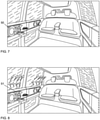
- figure 5 shows an interior of a motor vehicle in an initial state.
- the panes are relatively heavily tinted, which is indicated by the hatching of the windows 43, and almost no noise from the outside world reaches the interior. This is the usual state while driving or as long as no exit situation was detected.
- FIG. 6 shows the interior of the motor vehicle with a lightened exit side.
- the tinting of the windows is reduced on the exit side, allowing more light to enter the interior. This is indicated by the reduced hatching of the window 43.
- the increase in light transmission is not limited to the door area, but extends over a larger part of the interior.
- FIG. 7 shows the interior of the motor vehicle with a suggested additional reproduction of external noise.
- noises from the outside world are recorded and played into the interior with loudspeakers 50 from the direction of the door.
- simulated external noise is played back.
- FIG. 8 shows the interior of the motor vehicle with an indicated additional generation of an air flow. A noticeable flow of air enters the vehicle interior from the side of the door through ventilation slots 51 .
- Temporal sequences can also be implemented, for example by first increasing the brightness and only adding external noise and an air flow after a certain period of time.
- the time of day can also be taken into account when simulating the opening of the door. For example, increasing the light transmission of a window at night when there is no outside lighting has little effect, so it makes sense to change the lighting instead. There is also relatively little real outside noise at night, so that better simulated outside noises are reproduced.
- Another option is to consider environmental parameters. In a noisy environment or an unpleasant background noise, it is preferable to play back only simulated outside noise instead of real outside noise, or to filter the real outside noise or play it back at a reduced volume. In particularly bright sunlight, it can make sense to increase the light transmission of a window only slightly so that the vehicle occupants are not dazzled.
- the associated parameters can preferably be configured for the user of the motor vehicle, so that the user can specify which of the approaches described are to be used and how they should be configured.
Landscapes
- Engineering & Computer Science (AREA)
- Mechanical Engineering (AREA)
- Human Computer Interaction (AREA)
- Power-Operated Mechanisms For Wings (AREA)
- Window Of Vehicle (AREA)
- Traffic Control Systems (AREA)
- Fittings On The Vehicle Exterior For Carrying Loads, And Devices For Holding Or Mounting Articles (AREA)
Claims (9)
- Procédé d'identification d'un côté sortie (41) d'un véhicule automobile (40), comprenant les étapes de :- détermination, par une unité d'analyse, (11) d'un côté sortie du véhicule automobile (40) ; et- simulation, par une unité de commande, (12) de l'ouverture d'une porte (42) sur le côté sortie déterminé (41),caractérisé en ce que, pour la simulation (12) de l'ouverture de la porte (42), des bruits extérieurs sont reproduits au moins dans une zone de porte sur le côté sortie (41) déterminé ou un courant d'air est généré au moins dans une zone de porte sur le côté sortie (41) déterminé.
- Procédé selon la revendication 1, dans lequel, pour la simulation (12) de l'ouverture de la porte (42), une luminosité est en outre augmentée au moins dans une zone de porte sur le côté sortie (41) déterminé.
- Procédé selon la revendication 2, dans lequel, pour l'augmentation de la luminosité, une intensité lumineuse d'un éclairage est modifiée ou une transparence d'une fenêtre (43) est augmentée.
- Procédé selon l'une quelconque des revendications précédentes, dans lequel les bruits extérieurs sont des bruits extérieurs simulés ou des bruits extérieurs réels saisis par un microphone.
- Procédé selon l'une quelconque des revendications précédentes, dans lequel le côté sortie (41) est déterminé (11) à l'aide de capteurs de véhicule (44) ou à partir de données de carte au moyen d'une position du véhicule automobile (40).
- Procédé selon la revendication 5, dans lequel des bords de trottoir, bâtiments, véhicules ou personnes sont détectés dans l'environnement du véhicule automobile (40) sur la base de données des capteurs de véhicule (44).
- Support d'enregistrement lisible par ordinateur pourvu d'instructions, lesquelles, lors de leur exécution par un ordinateur, amènent l'ordinateur à exécuter les étapes d'un procédé selon l'une quelconque des revendications 1 à 6 d'identification d'un côté sortie (41) d'un véhicule automobile (40).
- Dispositif (20) d'identification d'un côté sortie (41) d'un véhicule automobile (40), comprenant :- une unité d'analyse (23) pour la détermination (11) d'un côté sortie du véhicule automobile (40) ; et- une unité de commande (24) pour la simulation (12) de l'ouverture d'une porte (42) sur le côté sortie déterminé (41) ;caractérisé en ce que l'unité de commande (24) est configurée, pour la simulation (12) de l'ouverture de la porte (42), pour reproduire des bruits extérieurs au moins dans une zone de porte sur le côté sortie (41) déterminé ou pour générer un courant d'air au moins dans une zone de porte sur le côté sortie (41) déterminé.
- Véhicule automobile (40), caractérisé en ce que le véhicule automobile (40) présente un dispositif (20) selon la revendication 8 ou est configuré pour exécuter un procédé selon l'une quelconque des revendications 1 à 6 d'identification d'un côté sortie (41) du véhicule automobile (40).
Applications Claiming Priority (1)
| Application Number | Priority Date | Filing Date | Title |
|---|---|---|---|
| DE102017217074.3A DE102017217074A1 (de) | 2017-09-26 | 2017-09-26 | Verfahren, Vorrichtung und computerlesbares Speichermedium mit Instruktionen zum Kennzeichnen einer Ausstiegsseite eines Kraftfahrzeugs |
Publications (2)
| Publication Number | Publication Date |
|---|---|
| EP3459792A1 EP3459792A1 (fr) | 2019-03-27 |
| EP3459792B1 true EP3459792B1 (fr) | 2022-03-16 |
Family
ID=63517818
Family Applications (1)
| Application Number | Title | Priority Date | Filing Date |
|---|---|---|---|
| EP18192828.4A Active EP3459792B1 (fr) | 2017-09-26 | 2018-09-05 | Procédé, dispositif et support d'enregistrement lisible par ordinateur pourvu d'instructions d'identification d'un côté sortie d'un véhicule automobile |
Country Status (4)
| Country | Link |
|---|---|
| US (2) | US10507765B2 (fr) |
| EP (1) | EP3459792B1 (fr) |
| CN (1) | CN109552170B (fr) |
| DE (1) | DE102017217074A1 (fr) |
Families Citing this family (3)
| Publication number | Priority date | Publication date | Assignee | Title |
|---|---|---|---|---|
| DE102017217074A1 (de) | 2017-09-26 | 2019-03-28 | Volkswagen Aktiengesellschaft | Verfahren, Vorrichtung und computerlesbares Speichermedium mit Instruktionen zum Kennzeichnen einer Ausstiegsseite eines Kraftfahrzeugs |
| US10744934B2 (en) * | 2018-07-10 | 2020-08-18 | Gentex Corporation | Light mapping system for vehicle passenger compartment |
| DE102021130586A1 (de) | 2021-11-23 | 2023-05-25 | Ford Global Technologies Llc | System und Verfahren zum Erzeugen von wenigstens einer optischen und/oder akustischen Ausstiegsempfehlung |
Family Cites Families (23)
| Publication number | Priority date | Publication date | Assignee | Title |
|---|---|---|---|---|
| JP3800172B2 (ja) * | 2002-12-24 | 2006-07-26 | トヨタ自動車株式会社 | 車両用周辺監視装置 |
| DE10312252A1 (de) | 2003-03-19 | 2004-09-30 | Siemens Ag | Verfahren und Vorrichtung zur Vermeidung von Personen- und Sachschäden durch Kraftfahrzeugtüren |
| DE102004061689A1 (de) | 2004-12-22 | 2006-07-06 | Daimlerchrysler Ag | Fahrzeugtür mit Ausstiegshilfe |
| US7987030B2 (en) | 2005-05-25 | 2011-07-26 | GM Global Technology Operations LLC | Vehicle illumination system and method |
| DE102006024609A1 (de) | 2006-05-26 | 2007-11-29 | Bayerische Motoren Werke Ag | Verfahren zur Überwachung des Schwenkraums einer Fahrzeugtür |
| DE102008012898A1 (de) | 2008-03-06 | 2009-09-10 | Robert Bosch Gmbh | Verfahren und Steuergerät zur Ausgabe von Informationen für das Verlassen eines Automobils |
| DE102008064022A1 (de) | 2008-12-19 | 2009-09-17 | Daimler Ag | Anordnung und Verfahren zur Bereitstellung von gefahrensituationsabhängigen Warninformationen |
| DE102009012242A1 (de) * | 2009-03-07 | 2010-10-14 | Rheinmetall Landsysteme Gmbh | Akustisches, taktil unterstützbares Fahrzeuginsasseninformationssystem |
| DE102010020811A1 (de) | 2010-05-18 | 2011-11-24 | Giacomo Sorce | Warnsignal für Kraftfahrzeugtüren |
| DE102011014263B4 (de) | 2011-03-17 | 2014-03-27 | Audi Ag | Fenstervorrichtung mit Beleuchtung für ein Kraftfahrzeug |
| JP2013093013A (ja) | 2011-10-06 | 2013-05-16 | Ricoh Co Ltd | 画像処理装置、車両 |
| DE102012015753A1 (de) | 2012-08-08 | 2014-02-13 | Daimler Ag | Ansteuern einer Innenraumbeleuchtungsvorrichtung zum Warnen eines Nutzers eines Kraftfahrzeugs vor einer Kollisionsgefahr |
| DE102012218482A1 (de) * | 2012-10-10 | 2014-06-12 | Continental Automotive Gmbh | Verfahren und Vorrichtung zum Betreiben eines Fahrerassistenzsystems eines Fahrzeugs |
| CN202966134U (zh) * | 2012-12-06 | 2013-06-05 | 华创车电技术中心股份有限公司 | 车辆开门防撞装置 |
| DE102014226187B4 (de) * | 2014-12-17 | 2025-01-30 | Bayerische Motoren Werke Aktiengesellschaft | Kommunikation mittels eines Luftstoßes |
| DE102015200160A1 (de) * | 2015-01-08 | 2016-07-14 | Bombardier Transportation Gmbh | Verfahren zur Anzeige einer Information für Fahrgäste im Bodenbereich eines Fahrzeuges zum Zweck der Personenförderung |
| DE102015006425A1 (de) | 2015-05-19 | 2016-11-24 | Audi Ag | Fahrerassistenzsystem zum Unterstützen einer Person beim Aussteigen aus einem Kraftfahrzeug, Kraftfahrzeug sowie Verfahren |
| AT517270A1 (de) * | 2015-05-27 | 2016-12-15 | Siemens Ag Oesterreich | Passagierinformation für Passagiere in Fahrzeugen |
| EP3124350B1 (fr) * | 2015-07-31 | 2018-09-12 | Gebr. Bode GmbH & Co. KG | Systeme de commande de porte et procede de commande commune de portes de vehicule et de quai |
| JP6427125B2 (ja) * | 2016-01-29 | 2018-11-21 | 矢崎総業株式会社 | 車内照明装置 |
| CN206171301U (zh) * | 2016-10-10 | 2017-05-17 | 北京汽车研究总院有限公司 | 一种乘客下车提醒系统及汽车 |
| US20180222384A1 (en) * | 2017-02-08 | 2018-08-09 | Ford Global Technologies, Llc | Audio of external speakers of vehicles based on ignition switch positions |
| DE102017217074A1 (de) | 2017-09-26 | 2019-03-28 | Volkswagen Aktiengesellschaft | Verfahren, Vorrichtung und computerlesbares Speichermedium mit Instruktionen zum Kennzeichnen einer Ausstiegsseite eines Kraftfahrzeugs |
-
2017
- 2017-09-26 DE DE102017217074.3A patent/DE102017217074A1/de not_active Withdrawn
-
2018
- 2018-09-05 EP EP18192828.4A patent/EP3459792B1/fr active Active
- 2018-09-24 US US16/139,345 patent/US10507765B2/en active Active
- 2018-09-26 CN CN201811122379.8A patent/CN109552170B/zh active Active
-
2019
- 2019-12-13 US US16/713,575 patent/US10882448B2/en active Active
Also Published As
| Publication number | Publication date |
|---|---|
| DE102017217074A1 (de) | 2019-03-28 |
| US20190092232A1 (en) | 2019-03-28 |
| US10882448B2 (en) | 2021-01-05 |
| US10507765B2 (en) | 2019-12-17 |
| US20200114819A1 (en) | 2020-04-16 |
| EP3459792A1 (fr) | 2019-03-27 |
| CN109552170A (zh) | 2019-04-02 |
| CN109552170B (zh) | 2022-07-19 |
Similar Documents
| Publication | Publication Date | Title |
|---|---|---|
| DE102016100064B4 (de) | Adative Anzeige in B-Säule | |
| EP2744106B1 (fr) | Dispositif et procédé d'adaptation automatique de l'intensité sonore de bruits dans l'habitacle d'un véhicule | |
| EP3040245A1 (fr) | Dispositif et procede d'assistance a un utilisateur lors d'une commande d'un connecteur destinee au reglage par moteur electrique d'une partie d'un moyen de locomotion | |
| EP3459792B1 (fr) | Procédé, dispositif et support d'enregistrement lisible par ordinateur pourvu d'instructions d'identification d'un côté sortie d'un véhicule automobile | |
| EP2744105B1 (fr) | Dispositif et procédé d'adaptation automatique de l'intensité sonore de bruits dans l'habitacle d'un véhicule | |
| DE102015101964A1 (de) | Systeme und Verfahren zum Anzeigen eines Freiraums für eine Fahrzeugtür | |
| DE102017213177A1 (de) | Verfahren zum Betreiben eines Bildschirms eines Kraftfahrzeugs sowie Kraftfahrzeug | |
| DE102021126193A1 (de) | Multimodales Combiner-HUD für ein Fahrzeug mit von außen sichtbarer HUD-Außenanzeige in Parkposition | |
| DE102020123469A1 (de) | Verfahren zum Betreiben eines elektrisch antreibbaren Kraftfahrzeugs in einem Privatsphärenmodus während eines Ladevorgangs sowie eine Steuereinheit zum Durchführen des Verfahrens und ein Kraftfahrzeug | |
| DE102016212681A1 (de) | Steuervorrichtung und Verfahren zum sprachbasierten Betreiben eines Kraftfahrzeugs | |
| DE102012018556B4 (de) | Assistenzsystem zur Ermöglichung einer erweiterten Vorausschau für nachfolgende Verkehrsteilnehmer | |
| DE102017206876B4 (de) | Verfahren zum Betreiben eines Sprachsteuerungssystems in einem Kraftfahrzeug undSprachsteuerungssystem | |
| DE102016220449A1 (de) | Fahrtrichtungsanzeiger-Steuersystem, Fortbewegungsmittel und Verfahren zur Anpassung des Leuchterscheinungsbildes eines Fahrtrichtungsanzeigers | |
| DE102020117542A1 (de) | Bauteil zur Montage in einem Außenbereich eines Fahrzeugs | |
| DE102017103391A1 (de) | Verfahren zur Verbesserung der Benutzerfreundlichkeit eines Fahrzeugs | |
| DE19859712A1 (de) | Betätigungs- und Lösegeräuschsimulator | |
| DE102015212223B3 (de) | Verfahren zur Ansteuerung eines Anzeigegeräts für ein Fahrzeug | |
| DE102016211034A1 (de) | Informationsbereitstellungsvorrichtung für ein Fahrzeug | |
| DE102019206782A1 (de) | Interaktionsvorrichtung für ein Fahrzeug | |
| WO2021204317A1 (fr) | Ensemble ouvrant de véhicule automobile | |
| DE102019135379A1 (de) | Optische Anordnung, Fahrzeug und Verfahren | |
| WO2024083365A1 (fr) | Procédé de surveillance d'un véhicule à moteur | |
| DE202004020891U1 (de) | Dachmodul für ein Kraftfahrzeug | |
| DE102022210288A1 (de) | Verfahren und Vorrichtung zur Ermittlung eines Regelungszustandes einer Ampel | |
| DE102019207181A1 (de) | Verfahren zum Betreiben einer Anzeigevorrichtung eines vollautonomen Kraftfahrzeugs, Steuereinrichtung, und vollautonomes Kraftfahrzeug |
Legal Events
| Date | Code | Title | Description |
|---|---|---|---|
| PUAI | Public reference made under article 153(3) epc to a published international application that has entered the european phase |
Free format text: ORIGINAL CODE: 0009012 |
|
| STAA | Information on the status of an ep patent application or granted ep patent |
Free format text: STATUS: THE APPLICATION HAS BEEN PUBLISHED |
|
| AK | Designated contracting states |
Kind code of ref document: A1 Designated state(s): AL AT BE BG CH CY CZ DE DK EE ES FI FR GB GR HR HU IE IS IT LI LT LU LV MC MK MT NL NO PL PT RO RS SE SI SK SM TR |
|
| AX | Request for extension of the european patent |
Extension state: BA ME |
|
| STAA | Information on the status of an ep patent application or granted ep patent |
Free format text: STATUS: REQUEST FOR EXAMINATION WAS MADE |
|
| 17P | Request for examination filed |
Effective date: 20190927 |
|
| RBV | Designated contracting states (corrected) |
Designated state(s): AL AT BE BG CH CY CZ DE DK EE ES FI FR GB GR HR HU IE IS IT LI LT LU LV MC MK MT NL NO PL PT RO RS SE SI SK SM TR |
|
| STAA | Information on the status of an ep patent application or granted ep patent |
Free format text: STATUS: EXAMINATION IS IN PROGRESS |
|
| 17Q | First examination report despatched |
Effective date: 20201215 |
|
| GRAP | Despatch of communication of intention to grant a patent |
Free format text: ORIGINAL CODE: EPIDOSNIGR1 |
|
| STAA | Information on the status of an ep patent application or granted ep patent |
Free format text: STATUS: GRANT OF PATENT IS INTENDED |
|
| INTG | Intention to grant announced |
Effective date: 20211018 |
|
| GRAS | Grant fee paid |
Free format text: ORIGINAL CODE: EPIDOSNIGR3 |
|
| GRAA | (expected) grant |
Free format text: ORIGINAL CODE: 0009210 |
|
| STAA | Information on the status of an ep patent application or granted ep patent |
Free format text: STATUS: THE PATENT HAS BEEN GRANTED |
|
| AK | Designated contracting states |
Kind code of ref document: B1 Designated state(s): AL AT BE BG CH CY CZ DE DK EE ES FI FR GB GR HR HU IE IS IT LI LT LU LV MC MK MT NL NO PL PT RO RS SE SI SK SM TR |
|
| REG | Reference to a national code |
Ref country code: GB Ref legal event code: FG4D Free format text: NOT ENGLISH |
|
| REG | Reference to a national code |
Ref country code: CH Ref legal event code: EP Ref country code: DE Ref legal event code: R096 Ref document number: 502018009092 Country of ref document: DE |
|
| REG | Reference to a national code |
Ref country code: IE Ref legal event code: FG4D Free format text: LANGUAGE OF EP DOCUMENT: GERMAN |
|
| REG | Reference to a national code |
Ref country code: AT Ref legal event code: REF Ref document number: 1475660 Country of ref document: AT Kind code of ref document: T Effective date: 20220415 |
|
| REG | Reference to a national code |
Ref country code: LT Ref legal event code: MG9D |
|
| REG | Reference to a national code |
Ref country code: NL Ref legal event code: MP Effective date: 20220316 |
|
| PG25 | Lapsed in a contracting state [announced via postgrant information from national office to epo] |
Ref country code: SE Free format text: LAPSE BECAUSE OF FAILURE TO SUBMIT A TRANSLATION OF THE DESCRIPTION OR TO PAY THE FEE WITHIN THE PRESCRIBED TIME-LIMIT Effective date: 20220316 Ref country code: RS Free format text: LAPSE BECAUSE OF FAILURE TO SUBMIT A TRANSLATION OF THE DESCRIPTION OR TO PAY THE FEE WITHIN THE PRESCRIBED TIME-LIMIT Effective date: 20220316 Ref country code: NO Free format text: LAPSE BECAUSE OF FAILURE TO SUBMIT A TRANSLATION OF THE DESCRIPTION OR TO PAY THE FEE WITHIN THE PRESCRIBED TIME-LIMIT Effective date: 20220616 Ref country code: LT Free format text: LAPSE BECAUSE OF FAILURE TO SUBMIT A TRANSLATION OF THE DESCRIPTION OR TO PAY THE FEE WITHIN THE PRESCRIBED TIME-LIMIT Effective date: 20220316 Ref country code: HR Free format text: LAPSE BECAUSE OF FAILURE TO SUBMIT A TRANSLATION OF THE DESCRIPTION OR TO PAY THE FEE WITHIN THE PRESCRIBED TIME-LIMIT Effective date: 20220316 Ref country code: BG Free format text: LAPSE BECAUSE OF FAILURE TO SUBMIT A TRANSLATION OF THE DESCRIPTION OR TO PAY THE FEE WITHIN THE PRESCRIBED TIME-LIMIT Effective date: 20220616 |
|
| PG25 | Lapsed in a contracting state [announced via postgrant information from national office to epo] |
Ref country code: LV Free format text: LAPSE BECAUSE OF FAILURE TO SUBMIT A TRANSLATION OF THE DESCRIPTION OR TO PAY THE FEE WITHIN THE PRESCRIBED TIME-LIMIT Effective date: 20220316 Ref country code: GR Free format text: LAPSE BECAUSE OF FAILURE TO SUBMIT A TRANSLATION OF THE DESCRIPTION OR TO PAY THE FEE WITHIN THE PRESCRIBED TIME-LIMIT Effective date: 20220617 Ref country code: FI Free format text: LAPSE BECAUSE OF FAILURE TO SUBMIT A TRANSLATION OF THE DESCRIPTION OR TO PAY THE FEE WITHIN THE PRESCRIBED TIME-LIMIT Effective date: 20220316 |
|
| PG25 | Lapsed in a contracting state [announced via postgrant information from national office to epo] |
Ref country code: NL Free format text: LAPSE BECAUSE OF FAILURE TO SUBMIT A TRANSLATION OF THE DESCRIPTION OR TO PAY THE FEE WITHIN THE PRESCRIBED TIME-LIMIT Effective date: 20220316 |
|
| PG25 | Lapsed in a contracting state [announced via postgrant information from national office to epo] |
Ref country code: SM Free format text: LAPSE BECAUSE OF FAILURE TO SUBMIT A TRANSLATION OF THE DESCRIPTION OR TO PAY THE FEE WITHIN THE PRESCRIBED TIME-LIMIT Effective date: 20220316 Ref country code: SK Free format text: LAPSE BECAUSE OF FAILURE TO SUBMIT A TRANSLATION OF THE DESCRIPTION OR TO PAY THE FEE WITHIN THE PRESCRIBED TIME-LIMIT Effective date: 20220316 Ref country code: RO Free format text: LAPSE BECAUSE OF FAILURE TO SUBMIT A TRANSLATION OF THE DESCRIPTION OR TO PAY THE FEE WITHIN THE PRESCRIBED TIME-LIMIT Effective date: 20220316 Ref country code: PT Free format text: LAPSE BECAUSE OF FAILURE TO SUBMIT A TRANSLATION OF THE DESCRIPTION OR TO PAY THE FEE WITHIN THE PRESCRIBED TIME-LIMIT Effective date: 20220718 Ref country code: ES Free format text: LAPSE BECAUSE OF FAILURE TO SUBMIT A TRANSLATION OF THE DESCRIPTION OR TO PAY THE FEE WITHIN THE PRESCRIBED TIME-LIMIT Effective date: 20220316 Ref country code: EE Free format text: LAPSE BECAUSE OF FAILURE TO SUBMIT A TRANSLATION OF THE DESCRIPTION OR TO PAY THE FEE WITHIN THE PRESCRIBED TIME-LIMIT Effective date: 20220316 Ref country code: CZ Free format text: LAPSE BECAUSE OF FAILURE TO SUBMIT A TRANSLATION OF THE DESCRIPTION OR TO PAY THE FEE WITHIN THE PRESCRIBED TIME-LIMIT Effective date: 20220316 |
|
| PG25 | Lapsed in a contracting state [announced via postgrant information from national office to epo] |
Ref country code: PL Free format text: LAPSE BECAUSE OF FAILURE TO SUBMIT A TRANSLATION OF THE DESCRIPTION OR TO PAY THE FEE WITHIN THE PRESCRIBED TIME-LIMIT Effective date: 20220316 Ref country code: IS Free format text: LAPSE BECAUSE OF FAILURE TO SUBMIT A TRANSLATION OF THE DESCRIPTION OR TO PAY THE FEE WITHIN THE PRESCRIBED TIME-LIMIT Effective date: 20220716 Ref country code: AL Free format text: LAPSE BECAUSE OF FAILURE TO SUBMIT A TRANSLATION OF THE DESCRIPTION OR TO PAY THE FEE WITHIN THE PRESCRIBED TIME-LIMIT Effective date: 20220316 |
|
| REG | Reference to a national code |
Ref country code: DE Ref legal event code: R097 Ref document number: 502018009092 Country of ref document: DE |
|
| PLBE | No opposition filed within time limit |
Free format text: ORIGINAL CODE: 0009261 |
|
| STAA | Information on the status of an ep patent application or granted ep patent |
Free format text: STATUS: NO OPPOSITION FILED WITHIN TIME LIMIT |
|
| PG25 | Lapsed in a contracting state [announced via postgrant information from national office to epo] |
Ref country code: DK Free format text: LAPSE BECAUSE OF FAILURE TO SUBMIT A TRANSLATION OF THE DESCRIPTION OR TO PAY THE FEE WITHIN THE PRESCRIBED TIME-LIMIT Effective date: 20220316 |
|
| 26N | No opposition filed |
Effective date: 20221219 |
|
| PG25 | Lapsed in a contracting state [announced via postgrant information from national office to epo] |
Ref country code: SI Free format text: LAPSE BECAUSE OF FAILURE TO SUBMIT A TRANSLATION OF THE DESCRIPTION OR TO PAY THE FEE WITHIN THE PRESCRIBED TIME-LIMIT Effective date: 20220316 |
|
| PG25 | Lapsed in a contracting state [announced via postgrant information from national office to epo] |
Ref country code: MC Free format text: LAPSE BECAUSE OF FAILURE TO SUBMIT A TRANSLATION OF THE DESCRIPTION OR TO PAY THE FEE WITHIN THE PRESCRIBED TIME-LIMIT Effective date: 20220316 |
|
| REG | Reference to a national code |
Ref country code: CH Ref legal event code: PL |
|
| REG | Reference to a national code |
Ref country code: BE Ref legal event code: MM Effective date: 20220930 |
|
| P01 | Opt-out of the competence of the unified patent court (upc) registered |
Effective date: 20230523 |
|
| PG25 | Lapsed in a contracting state [announced via postgrant information from national office to epo] |
Ref country code: LU Free format text: LAPSE BECAUSE OF NON-PAYMENT OF DUE FEES Effective date: 20220905 |
|
| PG25 | Lapsed in a contracting state [announced via postgrant information from national office to epo] |
Ref country code: LI Free format text: LAPSE BECAUSE OF NON-PAYMENT OF DUE FEES Effective date: 20220930 Ref country code: IT Free format text: LAPSE BECAUSE OF FAILURE TO SUBMIT A TRANSLATION OF THE DESCRIPTION OR TO PAY THE FEE WITHIN THE PRESCRIBED TIME-LIMIT Effective date: 20220316 Ref country code: IE Free format text: LAPSE BECAUSE OF NON-PAYMENT OF DUE FEES Effective date: 20220905 Ref country code: CH Free format text: LAPSE BECAUSE OF NON-PAYMENT OF DUE FEES Effective date: 20220930 |
|
| PG25 | Lapsed in a contracting state [announced via postgrant information from national office to epo] |
Ref country code: BE Free format text: LAPSE BECAUSE OF NON-PAYMENT OF DUE FEES Effective date: 20220930 |
|
| PG25 | Lapsed in a contracting state [announced via postgrant information from national office to epo] |
Ref country code: HU Free format text: LAPSE BECAUSE OF FAILURE TO SUBMIT A TRANSLATION OF THE DESCRIPTION OR TO PAY THE FEE WITHIN THE PRESCRIBED TIME-LIMIT; INVALID AB INITIO Effective date: 20180905 |
|
| PG25 | Lapsed in a contracting state [announced via postgrant information from national office to epo] |
Ref country code: CY Free format text: LAPSE BECAUSE OF FAILURE TO SUBMIT A TRANSLATION OF THE DESCRIPTION OR TO PAY THE FEE WITHIN THE PRESCRIBED TIME-LIMIT Effective date: 20220316 |
|
| PG25 | Lapsed in a contracting state [announced via postgrant information from national office to epo] |
Ref country code: MK Free format text: LAPSE BECAUSE OF FAILURE TO SUBMIT A TRANSLATION OF THE DESCRIPTION OR TO PAY THE FEE WITHIN THE PRESCRIBED TIME-LIMIT Effective date: 20220316 |
|
| PG25 | Lapsed in a contracting state [announced via postgrant information from national office to epo] |
Ref country code: TR Free format text: LAPSE BECAUSE OF FAILURE TO SUBMIT A TRANSLATION OF THE DESCRIPTION OR TO PAY THE FEE WITHIN THE PRESCRIBED TIME-LIMIT Effective date: 20220316 |
|
| PG25 | Lapsed in a contracting state [announced via postgrant information from national office to epo] |
Ref country code: MT Free format text: LAPSE BECAUSE OF FAILURE TO SUBMIT A TRANSLATION OF THE DESCRIPTION OR TO PAY THE FEE WITHIN THE PRESCRIBED TIME-LIMIT Effective date: 20220316 |
|
| REG | Reference to a national code |
Ref country code: AT Ref legal event code: MM01 Ref document number: 1475660 Country of ref document: AT Kind code of ref document: T Effective date: 20230905 |
|
| PG25 | Lapsed in a contracting state [announced via postgrant information from national office to epo] |
Ref country code: AT Free format text: LAPSE BECAUSE OF NON-PAYMENT OF DUE FEES Effective date: 20230905 |
|
| PG25 | Lapsed in a contracting state [announced via postgrant information from national office to epo] |
Ref country code: AT Free format text: LAPSE BECAUSE OF NON-PAYMENT OF DUE FEES Effective date: 20230905 |
|
| PGFP | Annual fee paid to national office [announced via postgrant information from national office to epo] |
Ref country code: DE Payment date: 20250930 Year of fee payment: 8 |
|
| PGFP | Annual fee paid to national office [announced via postgrant information from national office to epo] |
Ref country code: GB Payment date: 20250923 Year of fee payment: 8 |
|
| PGFP | Annual fee paid to national office [announced via postgrant information from national office to epo] |
Ref country code: FR Payment date: 20250925 Year of fee payment: 8 |
|
| PGFP | Annual fee paid to national office [announced via postgrant information from national office to epo] |
Ref country code: AT Payment date: 20260410 Year of fee payment: 5 |