EP3459985B1 - Urée uréthanes (ii) - Google Patents
Urée uréthanes (ii) Download PDFInfo
- Publication number
- EP3459985B1 EP3459985B1 EP17192570.4A EP17192570A EP3459985B1 EP 3459985 B1 EP3459985 B1 EP 3459985B1 EP 17192570 A EP17192570 A EP 17192570A EP 3459985 B1 EP3459985 B1 EP 3459985B1
- Authority
- EP
- European Patent Office
- Prior art keywords
- compound
- carbon atoms
- stands
- urea urethane
- diamine
- Prior art date
- Legal status (The legal status is an assumption and is not a legal conclusion. Google has not performed a legal analysis and makes no representation as to the accuracy of the status listed.)
- Revoked
Links
Images


Classifications
-
- C—CHEMISTRY; METALLURGY
- C08—ORGANIC MACROMOLECULAR COMPOUNDS; THEIR PREPARATION OR CHEMICAL WORKING-UP; COMPOSITIONS BASED THEREON
- C08G—MACROMOLECULAR COMPOUNDS OBTAINED OTHERWISE THAN BY REACTIONS ONLY INVOLVING UNSATURATED CARBON-TO-CARBON BONDS
- C08G18/00—Polymeric products of isocyanates or isothiocyanates
- C08G18/06—Polymeric products of isocyanates or isothiocyanates with compounds having active hydrogen
- C08G18/28—Polymeric products of isocyanates or isothiocyanates with compounds having active hydrogen characterised by the compounds used containing active hydrogen
- C08G18/30—Low-molecular-weight compounds
- C08G18/38—Low-molecular-weight compounds having heteroatoms other than oxygen
- C08G18/3819—Low-molecular-weight compounds having heteroatoms other than oxygen having nitrogen
-
- C—CHEMISTRY; METALLURGY
- C08—ORGANIC MACROMOLECULAR COMPOUNDS; THEIR PREPARATION OR CHEMICAL WORKING-UP; COMPOSITIONS BASED THEREON
- C08G—MACROMOLECULAR COMPOUNDS OBTAINED OTHERWISE THAN BY REACTIONS ONLY INVOLVING UNSATURATED CARBON-TO-CARBON BONDS
- C08G18/00—Polymeric products of isocyanates or isothiocyanates
- C08G18/06—Polymeric products of isocyanates or isothiocyanates with compounds having active hydrogen
- C08G18/70—Polymeric products of isocyanates or isothiocyanates with compounds having active hydrogen characterised by the isocyanates or isothiocyanates used
- C08G18/72—Polyisocyanates or polyisothiocyanates
- C08G18/74—Polyisocyanates or polyisothiocyanates cyclic
- C08G18/76—Polyisocyanates or polyisothiocyanates cyclic aromatic
- C08G18/7614—Polyisocyanates or polyisothiocyanates cyclic aromatic containing only one aromatic ring
- C08G18/7621—Polyisocyanates or polyisothiocyanates cyclic aromatic containing only one aromatic ring being toluene diisocyanate including isomer mixtures
-
- C—CHEMISTRY; METALLURGY
- C08—ORGANIC MACROMOLECULAR COMPOUNDS; THEIR PREPARATION OR CHEMICAL WORKING-UP; COMPOSITIONS BASED THEREON
- C08G—MACROMOLECULAR COMPOUNDS OBTAINED OTHERWISE THAN BY REACTIONS ONLY INVOLVING UNSATURATED CARBON-TO-CARBON BONDS
- C08G18/00—Polymeric products of isocyanates or isothiocyanates
- C08G18/06—Polymeric products of isocyanates or isothiocyanates with compounds having active hydrogen
- C08G18/08—Processes
- C08G18/10—Prepolymer processes involving reaction of isocyanates or isothiocyanates with compounds having active hydrogen in a first reaction step
-
- C—CHEMISTRY; METALLURGY
- C08—ORGANIC MACROMOLECULAR COMPOUNDS; THEIR PREPARATION OR CHEMICAL WORKING-UP; COMPOSITIONS BASED THEREON
- C08G—MACROMOLECULAR COMPOUNDS OBTAINED OTHERWISE THAN BY REACTIONS ONLY INVOLVING UNSATURATED CARBON-TO-CARBON BONDS
- C08G18/00—Polymeric products of isocyanates or isothiocyanates
- C08G18/06—Polymeric products of isocyanates or isothiocyanates with compounds having active hydrogen
- C08G18/28—Polymeric products of isocyanates or isothiocyanates with compounds having active hydrogen characterised by the compounds used containing active hydrogen
- C08G18/2805—Compounds having only one group containing active hydrogen
- C08G18/2815—Monohydroxy compounds
- C08G18/283—Compounds containing ether groups, e.g. oxyalkylated monohydroxy compounds
-
- C—CHEMISTRY; METALLURGY
- C08—ORGANIC MACROMOLECULAR COMPOUNDS; THEIR PREPARATION OR CHEMICAL WORKING-UP; COMPOSITIONS BASED THEREON
- C08G—MACROMOLECULAR COMPOUNDS OBTAINED OTHERWISE THAN BY REACTIONS ONLY INVOLVING UNSATURATED CARBON-TO-CARBON BONDS
- C08G18/00—Polymeric products of isocyanates or isothiocyanates
- C08G18/06—Polymeric products of isocyanates or isothiocyanates with compounds having active hydrogen
- C08G18/28—Polymeric products of isocyanates or isothiocyanates with compounds having active hydrogen characterised by the compounds used containing active hydrogen
- C08G18/30—Low-molecular-weight compounds
- C08G18/32—Polyhydroxy compounds; Polyamines; Hydroxyamines
- C08G18/3225—Polyamines
- C08G18/3237—Polyamines aromatic
- C08G18/3243—Polyamines aromatic containing two or more aromatic rings
-
- C—CHEMISTRY; METALLURGY
- C08—ORGANIC MACROMOLECULAR COMPOUNDS; THEIR PREPARATION OR CHEMICAL WORKING-UP; COMPOSITIONS BASED THEREON
- C08G—MACROMOLECULAR COMPOUNDS OBTAINED OTHERWISE THAN BY REACTIONS ONLY INVOLVING UNSATURATED CARBON-TO-CARBON BONDS
- C08G18/00—Polymeric products of isocyanates or isothiocyanates
- C08G18/06—Polymeric products of isocyanates or isothiocyanates with compounds having active hydrogen
- C08G18/28—Polymeric products of isocyanates or isothiocyanates with compounds having active hydrogen characterised by the compounds used containing active hydrogen
- C08G18/40—High-molecular-weight compounds
- C08G18/48—Polyethers
- C08G18/4833—Polyethers containing oxyethylene units
-
- C—CHEMISTRY; METALLURGY
- C08—ORGANIC MACROMOLECULAR COMPOUNDS; THEIR PREPARATION OR CHEMICAL WORKING-UP; COMPOSITIONS BASED THEREON
- C08G—MACROMOLECULAR COMPOUNDS OBTAINED OTHERWISE THAN BY REACTIONS ONLY INVOLVING UNSATURATED CARBON-TO-CARBON BONDS
- C08G18/00—Polymeric products of isocyanates or isothiocyanates
- C08G18/06—Polymeric products of isocyanates or isothiocyanates with compounds having active hydrogen
- C08G18/28—Polymeric products of isocyanates or isothiocyanates with compounds having active hydrogen characterised by the compounds used containing active hydrogen
- C08G18/40—High-molecular-weight compounds
- C08G18/48—Polyethers
- C08G18/4862—Polyethers containing at least a part of the ether groups in a side chain
-
- C—CHEMISTRY; METALLURGY
- C08—ORGANIC MACROMOLECULAR COMPOUNDS; THEIR PREPARATION OR CHEMICAL WORKING-UP; COMPOSITIONS BASED THEREON
- C08G—MACROMOLECULAR COMPOUNDS OBTAINED OTHERWISE THAN BY REACTIONS ONLY INVOLVING UNSATURATED CARBON-TO-CARBON BONDS
- C08G18/00—Polymeric products of isocyanates or isothiocyanates
- C08G18/06—Polymeric products of isocyanates or isothiocyanates with compounds having active hydrogen
- C08G18/28—Polymeric products of isocyanates or isothiocyanates with compounds having active hydrogen characterised by the compounds used containing active hydrogen
- C08G18/65—Low-molecular-weight compounds having active hydrogen with high-molecular-weight compounds having active hydrogen
- C08G18/66—Compounds of groups C08G18/42, C08G18/48, or C08G18/52
- C08G18/6666—Compounds of group C08G18/48 or C08G18/52
- C08G18/667—Compounds of group C08G18/48 or C08G18/52 with compounds of group C08G18/32 or polyamines of C08G18/38
- C08G18/6681—Compounds of group C08G18/48 or C08G18/52 with compounds of group C08G18/32 or polyamines of C08G18/38 with compounds of group C08G18/32 or C08G18/3271 and/or polyamines of C08G18/38
- C08G18/6685—Compounds of group C08G18/48 or C08G18/52 with compounds of group C08G18/32 or polyamines of C08G18/38 with compounds of group C08G18/32 or C08G18/3271 and/or polyamines of C08G18/38 with compounds of group C08G18/3225 or polyamines of C08G18/38
-
- C—CHEMISTRY; METALLURGY
- C08—ORGANIC MACROMOLECULAR COMPOUNDS; THEIR PREPARATION OR CHEMICAL WORKING-UP; COMPOSITIONS BASED THEREON
- C08G—MACROMOLECULAR COMPOUNDS OBTAINED OTHERWISE THAN BY REACTIONS ONLY INVOLVING UNSATURATED CARBON-TO-CARBON BONDS
- C08G71/00—Macromolecular compounds obtained by reactions forming a ureide or urethane link, otherwise, than from isocyanate radicals in the main chain of the macromolecule
- C08G71/02—Polyureas
-
- C—CHEMISTRY; METALLURGY
- C09—DYES; PAINTS; POLISHES; NATURAL RESINS; ADHESIVES; COMPOSITIONS NOT OTHERWISE PROVIDED FOR; APPLICATIONS OF MATERIALS NOT OTHERWISE PROVIDED FOR
- C09D—COATING COMPOSITIONS, e.g. PAINTS, VARNISHES OR LACQUERS; FILLING PASTES; CHEMICAL PAINT OR INK REMOVERS; INKS; CORRECTING FLUIDS; WOODSTAINS; PASTES OR SOLIDS FOR COLOURING OR PRINTING; USE OF MATERIALS THEREFOR
- C09D175/00—Coating compositions based on polyureas or polyurethanes; Coating compositions based on derivatives of such polymers
- C09D175/02—Polyureas
-
- C—CHEMISTRY; METALLURGY
- C09—DYES; PAINTS; POLISHES; NATURAL RESINS; ADHESIVES; COMPOSITIONS NOT OTHERWISE PROVIDED FOR; APPLICATIONS OF MATERIALS NOT OTHERWISE PROVIDED FOR
- C09D—COATING COMPOSITIONS, e.g. PAINTS, VARNISHES OR LACQUERS; FILLING PASTES; CHEMICAL PAINT OR INK REMOVERS; INKS; CORRECTING FLUIDS; WOODSTAINS; PASTES OR SOLIDS FOR COLOURING OR PRINTING; USE OF MATERIALS THEREFOR
- C09D5/00—Coating compositions, e.g. paints, varnishes or lacquers, characterised by their physical nature or the effects produced; Filling pastes
- C09D5/04—Thixotropic paints
-
- C—CHEMISTRY; METALLURGY
- C09—DYES; PAINTS; POLISHES; NATURAL RESINS; ADHESIVES; COMPOSITIONS NOT OTHERWISE PROVIDED FOR; APPLICATIONS OF MATERIALS NOT OTHERWISE PROVIDED FOR
- C09D—COATING COMPOSITIONS, e.g. PAINTS, VARNISHES OR LACQUERS; FILLING PASTES; CHEMICAL PAINT OR INK REMOVERS; INKS; CORRECTING FLUIDS; WOODSTAINS; PASTES OR SOLIDS FOR COLOURING OR PRINTING; USE OF MATERIALS THEREFOR
- C09D7/00—Features of coating compositions, not provided for in group C09D5/00; Processes for incorporating ingredients in coating compositions
- C09D7/40—Additives
- C09D7/43—Thickening agents
-
- C—CHEMISTRY; METALLURGY
- C09—DYES; PAINTS; POLISHES; NATURAL RESINS; ADHESIVES; COMPOSITIONS NOT OTHERWISE PROVIDED FOR; APPLICATIONS OF MATERIALS NOT OTHERWISE PROVIDED FOR
- C09D—COATING COMPOSITIONS, e.g. PAINTS, VARNISHES OR LACQUERS; FILLING PASTES; CHEMICAL PAINT OR INK REMOVERS; INKS; CORRECTING FLUIDS; WOODSTAINS; PASTES OR SOLIDS FOR COLOURING OR PRINTING; USE OF MATERIALS THEREFOR
- C09D7/00—Features of coating compositions, not provided for in group C09D5/00; Processes for incorporating ingredients in coating compositions
- C09D7/40—Additives
- C09D7/65—Additives macromolecular
Definitions
- the present invention is related to coating additives and covers urea urethanes with improved rheological behavior, thixotropic agents comprising them, a process for their manufacture and their use as additives for coatings, lacquers and paints.
- organically modified bentonites, silicic acids, hydrogenated castor oil and polyamide waxes are predominantly used.
- a disadvantage of these substances is that they are generally dry solids that have to be dispersed by means of solvents and shear forces to form semi-finished products or be introduced into the liquid coating compound by systematic temperature control. If these temperatures are not maintained, crystallites, which may result in defects in the coating, occur in the finished coating compound.
- European Patent EP 0006252 B1 (BYK CHEMIE) describes a process for preparing a thixotropic agent that eliminates some of the abovementioned disadvantages by describing urea urethanes that are prepared in aprotic solvents in the presence of LiCI by reacting isocyanate adducts with polyamines.
- the disadvantage of the products prepared in this way is the undefined structure of said urea urethanes due to the preparation process.
- isocyanate monoadducts are described, there are in fact no monoadducts at all in this case, as becomes clearly apparent from the Example, but mixtures of different adducts.
- one mole of a diisocyanate is first reacted with one mole of a monoalcohol.
- This process partly produces the desired NCO-functional monoadducts, but also diadducts with no NCO-functionality.
- a proportion of the monomeric diisocyanate remains unreacted.
- the proportions of these different compounds may vary, depending on the accessibility of the NCO group and the reaction conditions applied, such as temperature and time.
- the reason for the greatest disadvantage is, however, that all these adducts prepared in this way contain fairly large amounts of unreacted diisocyanate that, during the further reaction with polyamines in the presence of lithium chloride, results in uncontrolled chain extension of the urea urethane and in polymeric urea compounds. These products then have a tendency to precipitation and can be kept in solution only with the greatest difficulty.
- European patent EP 1048681 B1 (BYK CHEMIE) proposing to conduct the reaction explained above using molar excess of the diisocyanate compound of at least 1.5, preferably of about 2 to 3 and up to 5.
- the unreacted diisocyanate is separated off for example by vacuum distillation.
- a major drawback of the processes described above is linked to the fact that they require the presence of lithium salts as an initiator for forming the urethanes. Once said urethanes are formulated into a ready-to-use additive they also serve as stabilizers for the final customer products, such as for example paints and lacquers. Notwithstanding these benefits, lithium salts are still under objection, since they are highly corrosive. Another drawback of lithium is that its sources are limited and its production is usually harmful for environment.
- a second object of the invention is providing thixotropic agents bases on urea urethanes which are either free of lithium or show at least a reduced amount when compared to products found in the market.
- a first object of the present invention is directed to a urea urethane, obtainable or obtained according to a process encompassing or consisting of the following steps:
- Another object of the present invention is directed to a thixotropic agent comprising the new urea urethane as described above and a solvent.
- the preferred solvents are aprotic and encompass for example dimethyl formamide, dimethyl acetamide, N-methyl pyrrolidone, N-ethyl pyrrolidone, N-propyl pyrrolidone or N-butyl pyrrolidone or similar alkyl pyrrolidones.
- the solvent is present in an amount of from about 20 to about 95 % by weight, preferably about 40 to about 80 % by weight and more preferably about 50 to about 60 % by weight.
- Said thixotropic agents may also contain small amounts of lithium salts, in particular of lithium chloride and/or lithium nitrate, which are added to the formulation, but are not present during the formation of the urethanes.
- the amounts may range from about 0.1 to about 2 % wt.-%, preferably from about 0.5 to about 1 wt.-%. These amounts can be helpful for further improving stability of viscosity within a paint or a liquor.
- Another object of the present invention refers to a process for obtaining a urea urethane, encompassing or consisting of the following steps:
- Suitable monohydroxyl compounds encompass linear or branched, aliphatic or aromatic alcohols having 4 to 22 and preferably 6 to 12 carbon atoms and their alkylene oxide adducts, preferably adducts of on average 1 to 20, and preferably 2 to 10 mol ethylene oxide, propylene oxide or their mixtures to one of the aforementioned alcohols.
- butanol all isomers
- pentanol hexanol, heptanol, octanol, nonanol, decanol, undecanol, dodecanol
- myristyl alcohol stearyl alcohol, cetyl alcohol, oleyl alcohol, erucyl alcohol
- behenyl alcohol phenol, benzyl alcohol and their technical mixtures and adducts of 1 to 20 mol, preferably 2 to 10 mol ethylene oxide and/or 1 to 5, preferably 2 to 4 mol propylene oxide.
- alkyl polyalkylene glycol ethers preferably alkyl polyethylene glycol ethers having a molecular weight of from about 200 to about 1,000 Dalton, as for example methyl ethers (MPEG) or butyl ethers (BPEG) of PEG100, PEG200, PEG300, PEG350 or PEG500.
- MPEG methyl ethers
- BPEG butyl ethers
- diisocyanate compound can be of aliphatic origin
- the preferred embodiments encompass aromatic or cycloaliphatic compounds or their mixtures, such as for example
- toluylene diisocyanate also cited as toluol diisocyanate.
- a toluylene diisocyanate encompassing about 50 to about 80 mol-% of the 2,4-isomer is particularly preferred.
- Suitable diamine compounds encompass aliphatic, cycloaliphatic and aromatic diamines.
- a suitable diamine is for example in which R'" stands for hydrogen or a methyl group.
- the preferred species, however, is xylene diamine.
- the urea urethanes of the present invention are obtained by reacting MPEG300, MPEG350, BPEG300 or BPEG350 with toluylene diisocyanate in a molar ration of from 1:1.05 to 1:1.6 to form a pre-polymer, which is subsequently reacted with xylene diamine to form the final product and is illustrated by the following formula:
- Reaction step 1 Formation of the pre-polymer
- the pre-polymer is formed it is advantageous removing the unreacted diisocyanate for example by distillation in vacuum.
- the remaining pre-polymers show a content of unreacted diisocyanate of less than 0.5 % by weight, and preferably about 0.1 to 0.2 % by weight.
- Reaction step 2 Formation of the urea urethane
- the pre-polymer thus obtained is reacted with a diamine compound, preferably in at least one solvent, preferably an aprotic solvent such as dimethyl formamide, dimethyl acetamide, N-methyl pyrrolidone, N-ethyl pyrrolidone, N-propyl pyrrolidone or N-butyl pyrrolidone or similar alkyl pyrrolidones.
- a diamine compound - and optionally also the lithium salt - are dissolved in the solvent and placed into the reactor to which the pre-polymer is added.
- the preferred solvent is N-methyl pyrrolidone, since it is today not labeled as CMR
- the molar ratio between pre-polymer and diamine compound is adjusted to about 1:1.2 to 1.2:1, preferably to about 1:1.1 to 1.1:1.
- the solids amount can adjusted in broad ranges of from about 5 to about 80 % by weight, preferably about 20 to about 60 % by weight, and more preferred about 40 to about 50 % by weight.
- the amount to 100 % is the solvent, optionally comprising small amounts of suitable additives as for example corrosion inhibitors.
- the urea urethanes prepared according to the present invention do not contain either free isocyanate groups or free amino groups. They are accordingly physiologically safe. Furthermore, no adverse side reactions occur with binders or fillers. The storage stability of these urea urethane solutions prepared in this way is extraordinarily high and is certainly 6 months or more at, normal storage temperature.
- a surfactant is understood being any substance capable of lowering surface tension (or interfacial tension) between two liquids or between a liquid and a solid.
- Suitable surfactants according to the invention encompass, anionic, non-ionic, cationic, amphoteric and zwitterionic surfactants and of course their mixtures.
- Particular preferred are surfactants of anionic type and/or showing an HLB value in the range of 8 to 12 and being soluble in used solvent and polymer mixture
- surfactants of the sulfonate type alk(en)yl sulfonates, alkoxylated alk(en)yl sulfates, ester sulfonates and/or soaps are used as the anionic surfactants.
- Suitable surfactants of the sulfonate type are advantageously C 9-13 alkylbenzene sulfonates, olefin sulfonates, i.e.
- mixtures of alkene- and hydroxyalkane sulfonates, and disulfonates as are obtained, for example, by the sulfonation with gaseous sulfur trioxide of C 12-18 monoolefins having a terminal or internal double bond and subsequent alkaline or acidic hydrolysis of the sulfonation products.
- Alk(en)yl sulfates are the alkali and especially the sodium salts of the sulfuric acid half-esters of the C 12 -C 18 fatty alcohols, for example, from coconut butter alcohol, tallow alcohol, lauryl, myristyl, cetyl or stearyl alcohol or from C 8 -C 20 oxo alcohols and those half-esters of secondary alcohols of these chain lengths.
- Alk(en)yl sulfates of the cited chain lengths that comprise a synthetic straight chain alkyl group manufactured petrochemically are also preferred.
- the C 12 -C 16 alkyl sulfates and C 12 -C 15 alkyl sulfates as well as C 14 -C 15 alkyl sulfates and C 14 -C 16 alkyl sulfates are particularly preferred on the grounds of laundry performance.
- the 2,3-alkyl sulfates which can be obtained from Shell Oil Company under the trade name DANTM, are also suitable anionic surfactants.
- Alk(en)yl ether sulfates Sulfuric acid mono-esters derived from straight-chained or branched C 7 -C 21 alcohols ethoxylated with 1 to 6 moles ethylene oxide are also suitable, such as 2-methyl-branched C 9 -C 11 alcohols with an average of 3.5 mol ethylene oxide (EO) or C 12 -C 18 fatty alcohols with 1 to 4 EO.
- EO mol ethylene oxide
- esters of alpha-sulfo fatty acids e.g., the alpha-sulfonated methyl esters of hydrogenated coco-, palm nut- or tallow acids are likewise suitable.
- Soaps in particular, can be considered as further anionic surfactants.
- Saturated fatty acid soaps are particularly suitable, such as the salts of lauric acid, myristic acid, palmitic acid, stearic acid, hydrogenated erucic acid and behenic acid, and especially soap mixtures derived from natural fatty acids such as coconut oil fatty acid, palm kernel oil fatty acid or tallow fatty acid.
- Those soap mixtures are particularly preferred that are composed of 50 to 100 wt. % of saturated C 12 -C 24 fatty acid soaps and 0 to 50 wt. % of oleic acid soap.
- Sulfosuccinates are anionic surfactants of the sulfosuccinate type.
- Sulfosuccinates represent sulfonation products of succinic acid mono and diesters having the general formula R 1 OOC-CH 2 -CH(SO 3 X)-COOR 2
- R 1 H, C 1 -C 18 alkyl
- R 2 C 1 -C 18 alkyl
- X alkali, alkaline earth, ammonium or alkyl ammonium.
- the preferred sulfosuccinates represent mono or diesters of lineare or branched alcohols having 6 to 12 and preferably 8 atoms, such as octanol or 2-ethylhexyl alcohol.
- the structures may also incorporate polyalkylene glycol groups, such as for example 1 to 10 moles of ethylene oxide and/or propylene oxide.
- These structures also called ether sulfosuccinates
- the added nonionic surfactants are preferably alkoxylated and/or propoxylated, particularly primary alcohols having preferably 8 to 18 carbon atoms and an average of 1 to 12 mol ethylene oxide (EO) and/or 1 to 10 mol propylene oxide (PO) per mol alcohol.
- C 8 -C 16 -Alcohol alkoxylates advantageously ethoxylated and/or propoxylated C 10 -C 15 -alcohol alkoxylates, particularly C 12 -C 14 alcohol alkoxylates, with an ethoxylation degree between 2 and 10, preferably between 3 and 8, and/or a propoxylation degree between 1 and 6, preferably between 1.5 and 5, are particularly preferred.
- ethoxylation and propoxylation constitute statistical average values that can be a whole or a fractional number for a specific product.
- Preferred alcohol ethoxylates and propoxylates have a narrowed homolog distribution (narrow range ethoxylates/propoxylates, NRE/NRP).
- fatty alcohols with more than 12 EO can also be used. Examples of these are (tallow) fatty alcohols with 14 EO, 16 EO, 20 EO, 25 EO, 30 EO or 40 EO.
- alkylglycosides that satisfy the general Formula RO(G) x , can be added, e.g., as compounds, particularly with anionic surfactants, in which R means a primary linear or methyl-branched, particularly 2-methyl-branched, aliphatic group containing 8 to 22, preferably 12 to 18 carbon atoms and G stands for a glycose unit containing 5 or 6 carbon atoms, preferably for glucose.
- the degree of oligomerization x which defines the distribution of monoglycosides and oligoglycosides, is any number between 1 and 10, preferably between 1.1 and 1.4.
- Fatty acid ester alkoxylates are alkoxylated, preferably ethoxylated or ethoxylated and propoxylated fatty acid alkyl esters preferably containing 1 to 4 carbon atoms in the alkyl chain, more particularly the fatty acid methyl esters which are described, for example, in Japanese Patent Application JP-A-58/217598 or which are preferably produced by the process described in International Patent Application WO-A-90/13533 .
- Methyl esters of C 12 -C 18 fatty acids containing an average of 3 to 15 EO, particularly containing an average of 5 to 12 EO are particularly preferred.
- Nonionic surfactants of the amine oxide type for example, N-coco alkyl-N,N-dimethylamine oxide and N-tallow alkyl-N,N-dihydroxyethylamine oxide, and the fatty acid alkanolamides may also be suitable.
- the quantity in which these nonionic surfactants are used is preferably no more than the quantity in which the ethoxylated fatty alcohols are used and, particularly no more than half that quantity.
- Gemini surfactants can be considered as further surfactants.
- such compounds are understood to mean compounds that have two hydrophilic groups and two hydrophobic groups per molecule. As a rule, these groups are separated from one another by a "spacer".
- the spacer is usually a hydrocarbon chain that is intended to be long enough such that the hydrophilic groups are a sufficient distance apart to be able to act independently of one another.
- These types of surfactants are generally characterized by an unusually low critical micelle concentration and the ability to strongly reduce the surface tension of water. In exceptional cases, however, not only dimeric but also trimeric surfactants are meant by the term gemini surfactants.
- Suitable gemini surfactants are, for example, sulfated hydroxy mixed ethers according to German Patent Application DE 4321022 A1 or dimer alcohol bis- and trimer alcohol tris sulfates and ether sulfates according to International Patent Application WO 96/23768 A1 .
- Blocked end group dimeric and trimeric mixed ethers according to German Patent Application DE 19513391 A1 are especially characterized by their bifunctionality and multifunctionality.
- Gemini polyhydroxyfatty acid amides or polyhydroxyfatty acid amides, such as those described in International Patent Applications WO 95/19953 A1 , WO 95/19954 A1 and WO 95/19955 A1 can also be used.
- Cationically active surfactants comprise the hydrophobic high molecular group required for the surface activity in the cation by dissociation in aqueous solution.
- a group of important representatives of the cationic surfactants are the tetraalkyl ammonium salts of the general formula: (R 1 R 2 R 3 R 4 N + ) X - .
- R1 stands for C 1 -C 8 alk(en)yl, R 2 , R 3 and R 4 , independently of each other, for alk(en)yl radicals having 1 to 22 carbon atoms.
- X is a counter ion, preferably selected from the group of the halides, alkyl sulfates and alkyl carbonates.
- Cationic surfactants, in which the nitrogen group is substituted with two long acyl groups and two short alk(en)yl groups are particularly preferred.
- Esterquats A further class of cationic surfactants particularly useful as co-surfactants for the present invention is represented by the so-called esterquats.
- Esterquats are generally understood to be quaternised fatty acid triethanolamine ester salts. These are known compounds which can be obtained by the relevant methods of preparative organic chemistry. Reference is made in this connection to International patent application WO 91/01295 A1 , according to which triethanolamine is partly esterified with fatty acids in the presence of hypophosphorous acid, air is passed through the reaction mixture and the whole is then quaternised with dimethyl sulphate or ethylene oxide.
- German patent DE 4308794 C1 describes a process for the production of solid esterquats in which the quaternisation of triethanolamine esters is carried out in the presence of suitable dispersants, preferably fatty alcohols.
- esterquats suitable for use in accordance with the invention are products of which the acyl component derives from monocarboxylic acids corresponding to formula RCOOH in which RCO is an acyl group containing 6 to 10 carbon atoms, and the amine component is triethanolamine (TEA).
- monocarboxylic acids are caproic acid, caprylic acid, capric acid and technical mixtures thereof such as, for example, so-called head-fractionated fatty acid.
- Esterquats of which the acyl component derives from monocarboxylic acids containing 8 to 10 carbon atoms are preferably used.
- esterquats are those of which the acyl component derives from dicarboxylic acids like malonic acid, succinic acid, maleic acid, fumaric acid, glutaric acid, sorbic acid, pimelic acid, azelaic acid, sebacic acid and/or dodecanedioic acid, but preferably adipic acid.
- esterquats of which the acyl component derives from mixtures of monocarboxylic acids containing 6 to 22 carbon atoms, and adipic acid are preferably used.
- the molar ratio of mono and dicarboxylic acids in the final esterquat may be in the range from 1:99 to 99:1 and is preferably in the range from 50:50 to 90:10 and more particularly in the range from 70:30 to 80:20.
- other suitable esterquats are quaternized ester salts of mono-/dicarboxylic acid mixtures with diethanolalkyamines or 1,2-dihydroxypropyl dialkylamines.
- the esterquats may be obtained both from fatty acids and from the corresponding triglycerides in admixture with the corresponding dicarboxylic acids.
- Betaines Amphoteric or ampholytic surfactants possess a plurality of functional groups that can ionize in aqueous solution and thereby--depending on the conditions of the medium--lend anionic or cationic character to the compounds (see DIN 53900, July 1972). Close to the isoelectric point (around pH 4), the amphoteric surfactants form inner salts, thus becoming poorly soluble or insoluble in water. Amphoteric surfactants are subdivided into ampholytes and betaines, the latter existing as zwitterions in solution. Ampholytes are amphoteric electrolytes, i.e. compounds that possess both acidic as well as basic hydrophilic groups and therefore behave as acids or as bases depending on the conditions.
- betaines are known surfactants which are mainly produced by carboxyalkylation, preferably carboxymethylation, of amine compounds.
- the starting materials are preferably condensed with halocarboxylic acids or salts thereof, more particularly sodium chloroacetate, one mole of salt being formed per mole of betaine.
- halocarboxylic acids or salts thereof more particularly sodium chloroacetate
- unsaturated carboxylic acids such as acrylic acid for example, is also possible.
- betaines are the carboxy alkylation products of secondary and, in particular, tertiary amines which correspond to formula R 1 R 2 R 3 N-(CH 2 ) q COOX where R 1 is a an alkyl radical having 6 to 22 carbon atoms, R 2 is hydrogen or an alkyl group containing 1 to 4 carbon atoms, R 3 is an alkyl group containing 1 to 4 carbon atoms, q is a number of 1 to 6 and X is an alkali and/or alkaline earth metal or ammonium.
- Typical examples are the carboxymethylation products of hexylmethylamine, hexyldimethylamine, octyldimethylamine, decyldimethylamine, C 12/14 -cocoalkyldimethyl-amine, myristyldimethylamine, cetyldimethylamine, stearyldimethylamine, stearylethyl-methylamine, oleyldimethylamine, C 16/18 -tallowalkyldimethylamine and their technical mixtures, and particularly dodecyl methylamine, dodecyl dimethylamine, dodecyl ethylmethylamine and technical mixtures thereof.
- Alkylamido betaines are the carboxyalkylation products of amidoamines corresponding to formula R 1 CO(R 3 )(R 4 )-NH-(CH 2 ) p -N-(CH 2 ) q COOX in which R 1 CO is an aliphatic acyl radical having 6 to 22 carbon atoms and 0 or 1 to 3 double bonds, R 2 is hydrogen or an alkyl radical having 1 to 4 carbon atoms, R 3 is an alkyl radical having 1 to 4 carbon atoms, p is a number from 1 to 6, q is a number from 1 to 3 and X is an alkali and/or alkaline earth metal or ammonium.
- Typical examples are reaction products of fatty acids having 6 to 22 carbon atoms, like for example caproic acid, caprylic acid, caprinic acid, lauric acid, myristic acid, palmitic acid, palmoleic acid, stearic acid, isostearic acid, oleic acid, elaidic acid, petroselinic acid, linolic acid linoleic acid, elaeostearic acid, arachidonic acid, gadoleic acid, behenic acid, erucic acid and their technical mixtures with N,N-dimethylaminoethylamine, N,N-dimethylaminopropylamine, N,N-diethylaminoethylamine und N,N-diethylaminopropylamine, which are condensed with sodium chloroacetate.
- the commercially available products include Dehyton® K and Dehyton® PK (Cognis Deutschland GmbH & Co., KG) as well as
- Imidazolines Other suitable starting materials for the betaines to be used for the purposes of the invention are imidazolines. These substances are also known and may be obtained, for example, by cyclizing condensation of 1 or 2 moles of C 6 - C 22 fatty acids with polyfunctional amines, such as for example aminoethyl ethanolamine (AEEA) or diethylenetriamine. The corresponding carboxyalkylation products are mixtures of different open-chain betaines. Typical examples are condensation products of the above- mentioned fatty acids with AEEA, preferably imidazolines based on lauric acid, which are subsequently betainised with sodium chloroacetate. The commercially available products include Dehyton® G (Cognis Deutschland GmbH & Co., KG)
- the amount of surfactants is about 0.2 to about 2 mol, preferably about 0.5 to about 1.5 mol, particularly preferred about 0.75 to about 1.25 mol of surfactant, calculated on the amine equivalent of the diamine used.
- Another object of the present invention refers to a method for adjusting the rheological properties of a paint, a lacquer or a coating composition encompassing the following steps:
- the present invention also encompasses the use of the urea urethane, the agent or the product obtained according to the process - all as described above - as a rheology modifier, particularly for non-solid paints, lacquers and coating compositions.
- a 1-I-reactor was loaded with diisocyanate and placed under a nitrogen blanket at 25°C.
- the glycol compound was added dropwise to the mixture while stirring. The temperature did not exceed above 35°C.
- the reaction was followed on NCO content and stopped when the NCO content had reached a value corresponding to the theoretical amount for a mono adduct. Subsequently the excess of diisocyanate was evaporated at 150 to 175 °C under vacuum. A slightly brown product was obtained.
- the final NCO content was in each case less than 7 % and the product showed a viscosity of about 400 to about 500 mPas (measured at 25°C).
- the final free diisocyanate content was below 0.1%
- the reactor was loaded with surfactant, about 220 g n-Butyl pyrrolidone (NBP) and 4.5 wt.-% m-xylene diamine calculated on the NCO content.
- the mixtures were heated under stirring up to 95°C. Once the surfactant was completely dissolved, a homogeneous mixture of about 180 g mono-adduct from example A and 72.50 g NBP was added in approximate 1 hour. The reaction mixture was stirred for about 50 minutes and cooled down to room temperature once no NCO signal was found in IR. Clear low viscous products were observed.
- Tables 1 and 2 provide the parameters for the various working examples and the components used for preparing the polyurethanes: Table 1 Reaction conditions Parameters 1 2 3 4 5 6 7 8 9 10 A Isocyanate Type A1 A1 A1 A1 A2 A1 A2 A1 A1 A1 A1 A1 A1 A1 A1 A1 Amount [g] 209 261 348 870 375 261 375 261 375 261 Amount [mol] 1.2 1.5 2.0 3.0 1.5 1.5 1.5 1.5 1.5 1.5 1.5 B Glycol compound Type B1 B1 B1 B1 B1 B1 B1 B1 B1 B2 B1 B1 Amount [g] 382 382 382 382 382 382 455 382 455 382 Amount [mol] 1.0 1.0 1.0 1.0 1.0 1.0 1.0 1.0 1.0 C Surfactant Type C1 C1 C1 C1 C3 C4 C5 C6 Amount [wt.-%]* 1.2 1.4 1.4 1.5 1.2 1.2 1.2 1.2 1.2 *
- a first 1-I-reactor was loaded with 209 g (1.2 moles) toluene diisocyanate and placed under a nitrogen blanket at 25°C. 382 g (1.0 mole) polyethylene glycol monobutyl ether was added dropwise to the mixture while stirring. The temperature did not exceed above 35°C. After completing the addition the reaction was followed on NCO content and stopped when the NCO content had reached a value corresponding to the theoretical amount for a mono adduct.Subsequently the excess of diisocyanate was evaporated at 150 to 175 °C under vacuum. A slightly brown product was obtained. The final NCO content was in each case less than 7 % and the product showed a viscosity of about 400 to about 500 mPas.
- the final free diisocyanate content was below 0.1%.
- a second 1-I-reactor was loaded with 1.2 wt.-% lithium chloride, 220 g n-butyl pyrrolidone (NBP) and 22.5 g m-xylene diamine (4.5 wt.-% calculated on the NCO content). The mixture was heated under stirring up to 95°C. Once the salt was completely dissolved, a homogeneous mixture of about 180 g mono-adduct from as obtained above and 72.50 g NBP were added in approximate 1 hour. The reaction mixture was stirred for about 50 minutes and cooled down to room temperature once no NCO signal was found in IR. A clear low viscous product was observed.
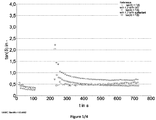
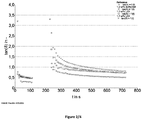
- the figures show the tan delta which is G"/G' (Viscous loss modulus/ Elastic storage modulus).
- G"/G' Viscos loss modulus/ Elastic storage modulus.
- a tan delta value below 1 means that elastic modulus is dominant and that the material behaves like a solid. Values above 1 means that the material is behaving like a (viscous) liquid.
- the product according to the present invention showed a better gel performance when compared to the LiCI-based comparison.
- the results are also shown in Figure 4/4 .
Landscapes
- Chemical & Material Sciences (AREA)
- Organic Chemistry (AREA)
- Health & Medical Sciences (AREA)
- Chemical Kinetics & Catalysis (AREA)
- Medicinal Chemistry (AREA)
- Polymers & Plastics (AREA)
- Life Sciences & Earth Sciences (AREA)
- Engineering & Computer Science (AREA)
- Materials Engineering (AREA)
- Wood Science & Technology (AREA)
- Organic Low-Molecular-Weight Compounds And Preparation Thereof (AREA)
- Paints Or Removers (AREA)
- Emulsifying, Dispersing, Foam-Producing Or Wetting Agents (AREA)
Claims (15)
- Urée uréthane, pouvant être obtenu ou obtenu selon un procédé comprenant ou constitué des étapes suivantes :(a) mise à disposition d'un composé monohydroxylé de formule (I)
R-OH (I)
dans laquelle R est n-alkyle ou isoalkyle contenant 4 à 22 atomes de carbone, cycloalkyle contenant 6 à 12 atomes de carbone, aralkyle contenant 7 à 12 atomes de carbone ou un radical de formule CmH2m+1(O-CnH2n)x- ou CmH2m+1(OOC-CvH2v)x-, et m représente un entier allant de 1 à 22, n représente un entier de 2 à 4, x représente un entier de 1 à 15 et v signifie 4 ou 5 ;(b) mise à disposition d'un composé de type diisocyanate de formule (II)
OCN-[A]-NCO (II)
dans laquelle A représente un radical alkylène linéaire ou ramifié possédant 2 à 10 atomes de carbone et/ou un radical toluylène ;(c) mise en réaction dudit composé monohydroxylé et dudit composé de type diisocyanate pour former un prépolymère ;(d) mise en réaction dudit prépolymère avec un composé de type diamine, ledit composé de type diamine étant choisi dans le groupe constitué par(d1) composé (III)
H2N-[B]-NH2 (III)
où B représente un groupe alkylène linéaire, ramifié et/ou cyclique possédant 2 à 12 atomes de carbone ; et/ou(d2) composé (IV)ledit prépolymère et ladite diamine étant mis à réagir en présence d'un tensioactif.
H2N-(CH2)a-Ph-(CH2)bNH2 (IV)
dans lequel a et b représentent indépendamment l'un de l'autre des entiers de 1 à 5 et Ph représente un radical phényle, - Urée uréthane selon la revendication 1, ledit composé monohydroxylé étant un éther d'alkyle de polyalkylèneglycol possédant un poids moléculaire d'environ 200 à environ 1000 Daltons.
- Urée uréthane selon la revendication 1, ledit composé de type diisocyanate étant un diisocyanate de toluylène.
- Urée uréthane selon la revendication 1, ledit composé monohydroxylé et ledit composé de type diisocyanate étant mis à réagir en un rapport molaire allant de 1:1,05 à 1:6.
- Urée uréthane selon la revendication 1, le composé de type diamine étant un xylène diamine.
- Urée uréthane selon la revendication 1, le tensioactif étant un tensioactif anionique.
- Urée uréthane selon la revendication 6, le tensioactif étant un sulfosuccinate.
- Urée uréthane selon la revendication 1, les tensioactifs étant présents en une quantité allant d'environ 1,0 à environ 2,0 % en poids calculée sur le mélange réactionnel total.
- Urée uréthane selon la revendication 1, ledit prépolymère et ledit composé de type diamine étant mise à réagir dans un solvant aprotique.
- Agent thixotropique comprenant l'urée uréthane selon la revendication 1 et un solvant.
- Agent selon la revendication 10, le solvant étant présent en une quantité d'environ 20 à environ 95 % en poids.
- Agent selon la revendication 10 comprenant en outre un sel de lithium.
- Procédé pour l'obtention d'une urée uréthane, comprenant ou constitué des étapes suivantes :(a) mise à disposition d'un composé monohydroxylé de formule (I)
R-OH (I)
dans laquelle R est n-alkyle ou isoalkyle contenant 4 à 22 atomes de carbone, cycloalkyle contenant 6 à 12 atomes de carbone, aralkyle contenant 7 à 12 atomes de carbone ou un radical de formule CmH2m+1(O-CnH2n)x- ou CmH2m+1(OOC-CvH2v)x-, et m représente un entier allant de 1 à 22, n représente un entier de 2 à 4, x représente un entier de 1 à 15 et v signifie 4 ou 5 ;(b) mise à disposition d'un composé de type diisocyanate de formule (II)
OCN-[A]-NCO (II)
dans laquelle A représenté un radical alkylène linéaire ou ramifié possédant 2 à 10 atomes de carbone et/ou un radical toluylène ;(c) mise en réaction dudit composé monohydroxylé et dudit composé de type diisocyanate pour former un prépolymère ;(d) mise en réaction dudit prépolymère avec un composé de type diamine, ledit composé de type diamine étant choisi dans le groupe constitué par(d1) composé (III)
H2N-[B]-NH2 (III)
où B représente un groupe alkylène linéaire, ramifié et/ou cyclique possédant 2 à 12 atomes de carbone ; et/ou(d2) composé (IV)
H2N-(CH2)a-Ph-(CH2)bNH2 (IV)
dans lequel a et b représentent indépendamment l'un de l'autre des entiers de 1 à 5 et Ph représente un radical phényle,
ledit prépolymère et ladite diamine étant mis à réagir en présence d'un tensioactif. - Procédé pour l'ajustement des propriétés rhéologiques d'une peinture, d'une laque ou d'une composition de revêtement comprenant les étapes suivantes :(i) mise à disposition d'une peinture, d'une laque ou d'une composition de revêtement non solide ; et(ii) ajout d'une quantité utile de l'urée uréthane selon la revendication 1, de l'agent selon la revendication 2 ou du produit obtenu selon le procédé selon la revendication 5.
- Utilisation de l'urée uréthane selon la revendication 1, de l'agent selon la revendication 2 ou du produit obtenu selon le procédé selon la revendication 5 en tant que modificateur de rhéologie, particulièrement pour des peintures, des laques et des compositions de revêtement non solides.
Priority Applications (4)
| Application Number | Priority Date | Filing Date | Title |
|---|---|---|---|
| EP17192570.4A EP3459985B1 (fr) | 2017-09-22 | 2017-09-22 | Urée uréthanes (ii) |
| EP18158532.4A EP3381961B1 (fr) | 2017-04-01 | 2018-02-26 | Composition de résine de coulée |
| US16/131,899 US10882944B2 (en) | 2017-09-22 | 2018-09-14 | Urea urethanes (II) |
| CN201811088742.9A CN109535371B (zh) | 2017-09-22 | 2018-09-18 | 脲氨酯 |
Applications Claiming Priority (1)
| Application Number | Priority Date | Filing Date | Title |
|---|---|---|---|
| EP17192570.4A EP3459985B1 (fr) | 2017-09-22 | 2017-09-22 | Urée uréthanes (ii) |
Publications (2)
| Publication Number | Publication Date |
|---|---|
| EP3459985A1 EP3459985A1 (fr) | 2019-03-27 |
| EP3459985B1 true EP3459985B1 (fr) | 2020-06-17 |
Family
ID=59982274
Family Applications (1)
| Application Number | Title | Priority Date | Filing Date |
|---|---|---|---|
| EP17192570.4A Revoked EP3459985B1 (fr) | 2017-04-01 | 2017-09-22 | Urée uréthanes (ii) |
Country Status (3)
| Country | Link |
|---|---|
| US (1) | US10882944B2 (fr) |
| EP (1) | EP3459985B1 (fr) |
| CN (1) | CN109535371B (fr) |
Cited By (2)
| Publication number | Priority date | Publication date | Assignee | Title |
|---|---|---|---|---|
| EP4368649A1 (fr) | 2022-11-14 | 2024-05-15 | Cliq Swisstech (The Netherlands) B.V. | Procédé continu pour la préparation d'uréthanes d'urée |
| EP4556502A1 (fr) | 2023-11-17 | 2025-05-21 | Cliq Swisstech (The Netherlands) B.V. | Stabilisateurs pour urée-uréthanes |
Families Citing this family (4)
| Publication number | Priority date | Publication date | Assignee | Title |
|---|---|---|---|---|
| EP3381960B1 (fr) * | 2017-04-01 | 2021-08-25 | CliQ SwissTech (Netherlands) B.V. | Urée urethanes |
| FR3117124B1 (fr) * | 2020-12-07 | 2023-12-01 | Arkema France | Composition thixotropique à base de diurée-diuréthane |
| CN112961303B (zh) * | 2021-02-04 | 2023-01-03 | 江苏奥斯佳材料科技股份有限公司 | 一种用于软质聚氨酯泡沫的柔软剂及其应用 |
| WO2026027332A1 (fr) * | 2024-07-29 | 2026-02-05 | Basf Se | Composition d'urée-uréthane et utilisation de ceux-ci en tant qu'additifs de régulation de rhéologie |
Citations (4)
| Publication number | Priority date | Publication date | Assignee | Title |
|---|---|---|---|---|
| US5093031A (en) | 1986-06-27 | 1992-03-03 | Isp Investments Inc. | Surface active lactams |
| US20020115882A1 (en) | 2000-08-16 | 2002-08-22 | Karlheinz Haubennestel | Rheologically active urea urethane compounds |
| US20110265691A1 (en) | 2008-12-01 | 2011-11-03 | Byk-Chemie Gmbh | Method for producing rheologically effective urea urethanes in organic salts |
| US20160185985A1 (en) | 2012-12-15 | 2016-06-30 | Byk-Chemie Gmbh | Composition for rheology control |
Family Cites Families (30)
| Publication number | Priority date | Publication date | Assignee | Title |
|---|---|---|---|---|
| US3075930A (en) * | 1960-08-10 | 1963-01-29 | Atlantic Res Corp | Expanded polyurethane plastic containing zein and process for preparing same |
| US3386942A (en) * | 1964-06-29 | 1968-06-04 | Eastman Kodak Co | Stabilization of non-yellowing segmented polyurethane copolymers of polymeric diols, functionally aliphatic diisocyanates and functionally aliphatic diamines |
| FR1456620A (fr) * | 1965-07-22 | 1966-07-08 | Kuhlmann Ets | élastomères de polyuréthane-polyurée coulables à froid |
| US3872049A (en) * | 1973-10-02 | 1975-03-18 | Textron Inc | Method for preparing urea urethane polymer particles |
| DE2822908C2 (de) | 1978-05-26 | 1980-03-20 | Byk-Mallinckrodt Chemische Produkte Gmbh, 4230 Wesel | Thixotropiemittel für Überzugsmittel |
| JPS58217598A (ja) | 1982-06-10 | 1983-12-17 | 日本油脂株式会社 | 洗剤組成物 |
| NL8500476A (nl) | 1985-02-20 | 1986-09-16 | Akzo Nv | Thixotrope bekledingssamenstelling. |
| US4762950A (en) * | 1985-12-16 | 1988-08-09 | Basf Corporation | Selective oxyalkylaton of N-(2-hydroxyalkyl)-aniline |
| DE3914131A1 (de) | 1989-04-28 | 1990-10-31 | Henkel Kgaa | Verwendung von calcinierten hydrotalciten als katalysatoren fuer die ethoxylierung bzw. propoxylierung von fettsaeureestern |
| ES2021900A6 (es) | 1989-07-17 | 1991-11-16 | Pulcra Sa | Procedimiento de obtencion de tensioactivos cationicos derivados de amonio cuaternario con funcion amino-ester. |
| DE4308794C1 (de) | 1993-03-18 | 1994-04-21 | Henkel Kgaa | Verfahren zur Herstellung von festen Esterquats mit verbesserter Wasserdispergierbarkeit |
| DE4321022A1 (de) | 1993-06-24 | 1995-01-05 | Henkel Kgaa | Sulfatierte Hydroxymischether |
| US5512699A (en) | 1994-01-25 | 1996-04-30 | The Procter & Gamble Company | Poly polyhydroxy fatty acid amides |
| US5534197A (en) | 1994-01-25 | 1996-07-09 | The Procter & Gamble Company | Gemini polyhydroxy fatty acid amides |
| WO1995019955A1 (fr) | 1994-01-25 | 1995-07-27 | The Procter & Gamble Company | Amides jumeles de polyether d'acides gras |
| DE4409322C1 (de) | 1994-03-18 | 1995-04-06 | Henkel Kgaa | Verfahren zur Herstellung von Esterquats |
| DE19503061A1 (de) | 1995-02-01 | 1996-08-08 | Henkel Kgaa | Dimeralkohol-bis- und Trimeralkohol-tris-sulfate und -ethersulfate |
| DE19513391A1 (de) | 1995-04-08 | 1996-10-10 | Henkel Kgaa | Bi- und multifunktionelle Mischether |
| DE19919482C2 (de) | 1999-04-29 | 2001-04-26 | Byk Chemie Gmbh | Verfahren zur Herstellung eines Thixotropie-Mittels und dessen Verwendung |
| DE10039837C2 (de) * | 2000-08-16 | 2003-03-20 | Byk Chemie Gmbh | Verfahren zur Herstellung einer lagerstabilen, rheologisch wirksamen Harnstoffurethan-Lösung mit breiter Verträglichkeit |
| CN100427319C (zh) * | 2003-10-23 | 2008-10-22 | Chemipro化成株式会社 | 分散液组合物及记录材料 |
| US8859680B2 (en) * | 2004-09-01 | 2014-10-14 | Ppg Industries Ohio, Inc | Poly(ureaurethane)s, articles and coatings prepared therefrom and methods of making the same |
| DE102006012999A1 (de) * | 2006-03-22 | 2007-09-27 | Byk-Chemie Gmbh | Additionsverbindungen als Dispergiermittel und Dispersionsstabilisatoren |
| EP2110397A1 (fr) * | 2008-04-16 | 2009-10-21 | Sika Technology AG | Polymère de polyuréthane basé sur des blocs de copolymères amphiphiles et leur utilisation comme modificateur de résistance aux chocs |
| WO2010110784A1 (fr) * | 2009-03-24 | 2010-09-30 | Ppg Industries Ohio, Inc. | Polyuréthanes, articles et revêtements préparés à partir de ceux-ci et leurs procédés de fabrication |
| EP2687552A1 (fr) * | 2012-07-17 | 2014-01-22 | Huntsman International Llc | Utilisation de nanoparticules de polyurée comme modificateurs de la performance dans des matériaux en polyuréthane |
| KR20150069010A (ko) * | 2012-10-16 | 2015-06-22 | 다우 글로벌 테크놀로지스 엘엘씨 | 개선된 엠보싱 특성을 갖는 폴리우레탄 분산액 기재 합성 피혁 |
| US9598313B2 (en) * | 2014-05-29 | 2017-03-21 | Nano And Advanced Materials Institute Limited | Self-healing material and preparation process thereof |
| JP6228684B2 (ja) * | 2014-08-07 | 2017-11-08 | 三井化学株式会社 | 重合性組成物、成形体およびその用途 |
| EP3381960B1 (fr) * | 2017-04-01 | 2021-08-25 | CliQ SwissTech (Netherlands) B.V. | Urée urethanes |
-
2017
- 2017-09-22 EP EP17192570.4A patent/EP3459985B1/fr not_active Revoked
-
2018
- 2018-09-14 US US16/131,899 patent/US10882944B2/en active Active
- 2018-09-18 CN CN201811088742.9A patent/CN109535371B/zh active Active
Patent Citations (4)
| Publication number | Priority date | Publication date | Assignee | Title |
|---|---|---|---|---|
| US5093031A (en) | 1986-06-27 | 1992-03-03 | Isp Investments Inc. | Surface active lactams |
| US20020115882A1 (en) | 2000-08-16 | 2002-08-22 | Karlheinz Haubennestel | Rheologically active urea urethane compounds |
| US20110265691A1 (en) | 2008-12-01 | 2011-11-03 | Byk-Chemie Gmbh | Method for producing rheologically effective urea urethanes in organic salts |
| US20160185985A1 (en) | 2012-12-15 | 2016-06-30 | Byk-Chemie Gmbh | Composition for rheology control |
Non-Patent Citations (3)
| Title |
|---|
| "Römpp-Lexicon Lacke und Druckfarben", 1 January 1998, GEORG THIEME VERLAG, article ZORLL U., HANS-JÜRGEN P. ADLER: "Tenside", pages: 557 - 558, XP055967145 |
| ANONYMOUS: "Tenside", WIKIPEDIA, 8 September 2021 (2021-09-08), XP055967134, Retrieved from the Internet <URL:https://de.wikipedia.org/wiki/Tenside> |
| FABRY BERND: "Tenside", CHEMIE IN UNSERE SEIT, no. 4, 25 January 1995 (1995-01-25), pages 214 - 222, XP055967138 |
Cited By (2)
| Publication number | Priority date | Publication date | Assignee | Title |
|---|---|---|---|---|
| EP4368649A1 (fr) | 2022-11-14 | 2024-05-15 | Cliq Swisstech (The Netherlands) B.V. | Procédé continu pour la préparation d'uréthanes d'urée |
| EP4556502A1 (fr) | 2023-11-17 | 2025-05-21 | Cliq Swisstech (The Netherlands) B.V. | Stabilisateurs pour urée-uréthanes |
Also Published As
| Publication number | Publication date |
|---|---|
| US10882944B2 (en) | 2021-01-05 |
| US20190135969A1 (en) | 2019-05-09 |
| CN109535371B (zh) | 2022-05-10 |
| CN109535371A (zh) | 2019-03-29 |
| EP3459985A1 (fr) | 2019-03-27 |
Similar Documents
| Publication | Publication Date | Title |
|---|---|---|
| EP3459985B1 (fr) | Urée uréthanes (ii) | |
| US6420466B1 (en) | Process for preparing a thixotropic agent and its use | |
| ES2377944T3 (es) | Compuestos de biuret para el control de la reología | |
| US6617468B2 (en) | Rheologically active urea urethane compounds | |
| US20110265691A1 (en) | Method for producing rheologically effective urea urethanes in organic salts | |
| JP5542897B2 (ja) | レオロジー調整剤 | |
| CA2765392C (fr) | Polyhydroxydiamines utilisees comme additifs multifonctionnels a faible odeur, faible teneur en composes organiques volatils, pour peintures et enduits | |
| US20210087410A1 (en) | Method for modifying a casting resin and/or coating composition | |
| WO2018138236A1 (fr) | Amides contenant des groupes urée et/ou uréthane comme et dans des agents de régulation rhéologique, leurs préparation et utilisation | |
| JP4128785B2 (ja) | 新規ポリウレタンおよび水性系の増粘におけるその使用 | |
| MX2007007155A (es) | Nuevos poliuretanos y su uso para espesar sistemas acuosos. | |
| EP3381961A1 (fr) | Composition de résine de coulée | |
| CN103374114B (zh) | 苄基胺疏水物 | |
| TWI893246B (zh) | 以雙脲-雙胺基甲酸酯為主之觸變組成物 | |
| KR100236510B1 (ko) | 음극 침착가능한 피복 조성물용 안료 페이스트 수지, 이의 제조방법, 및 제조된 수지를 포함하는 음극 침착가능한 피복 조성물 | |
| CN114096617A (zh) | 含水增稠组合物 | |
| EP3381960B1 (fr) | Urée urethanes | |
| CA3084652A1 (fr) | Agent epaississant associatif exempt de biocide | |
| EP2729009B1 (fr) | Compositions de glyphosate de métal alcalin | |
| EP2925814B1 (fr) | Composés aminoalcools comme stabilisants de congélation-décongélation à faible teneur en cov pour des peintures et des revêtements | |
| JP2023547338A (ja) | 疎水性エンドキャッピング基を有する分岐レオロジー改質剤 | |
| EP4360617B1 (fr) | Formulation comprenant des esterquats à base de trialcanolamines | |
| MX2015005140A (es) | Mezcla de compuestos de isocianato y su uso como emulsionante. | |
| CA3156899C (fr) | Mélange de polymère d’oxyde d’alkylène modifié de façon hydrophobe | |
| JP2008115199A (ja) | 揺変性付与剤及び肌荒れ抑制型揺変性付与剤並びにそれらの製造方法 |
Legal Events
| Date | Code | Title | Description |
|---|---|---|---|
| PUAI | Public reference made under article 153(3) epc to a published international application that has entered the european phase |
Free format text: ORIGINAL CODE: 0009012 |
|
| STAA | Information on the status of an ep patent application or granted ep patent |
Free format text: STATUS: THE APPLICATION HAS BEEN PUBLISHED |
|
| AK | Designated contracting states |
Kind code of ref document: A1 Designated state(s): AL AT BE BG CH CY CZ DE DK EE ES FI FR GB GR HR HU IE IS IT LI LT LU LV MC MK MT NL NO PL PT RO RS SE SI SK SM TR |
|
| AX | Request for extension of the european patent |
Extension state: BA ME |
|
| STAA | Information on the status of an ep patent application or granted ep patent |
Free format text: STATUS: REQUEST FOR EXAMINATION WAS MADE |
|
| 17P | Request for examination filed |
Effective date: 20190830 |
|
| RBV | Designated contracting states (corrected) |
Designated state(s): AL AT BE BG CH CY CZ DE DK EE ES FI FR GB GR HR HU IE IS IT LI LT LU LV MC MK MT NL NO PL PT RO RS SE SI SK SM TR |
|
| GRAP | Despatch of communication of intention to grant a patent |
Free format text: ORIGINAL CODE: EPIDOSNIGR1 |
|
| STAA | Information on the status of an ep patent application or granted ep patent |
Free format text: STATUS: GRANT OF PATENT IS INTENDED |
|
| INTG | Intention to grant announced |
Effective date: 20200117 |
|
| GRAS | Grant fee paid |
Free format text: ORIGINAL CODE: EPIDOSNIGR3 |
|
| GRAA | (expected) grant |
Free format text: ORIGINAL CODE: 0009210 |
|
| STAA | Information on the status of an ep patent application or granted ep patent |
Free format text: STATUS: THE PATENT HAS BEEN GRANTED |
|
| AK | Designated contracting states |
Kind code of ref document: B1 Designated state(s): AL AT BE BG CH CY CZ DE DK EE ES FI FR GB GR HR HU IE IS IT LI LT LU LV MC MK MT NL NO PL PT RO RS SE SI SK SM TR |
|
| REG | Reference to a national code |
Ref country code: GB Ref legal event code: FG4D |
|
| REG | Reference to a national code |
Ref country code: CH Ref legal event code: EP |
|
| REG | Reference to a national code |
Ref country code: IE Ref legal event code: FG4D |
|
| REG | Reference to a national code |
Ref country code: DE Ref legal event code: R096 Ref document number: 602017018211 Country of ref document: DE |
|
| REG | Reference to a national code |
Ref country code: AT Ref legal event code: REF Ref document number: 1281218 Country of ref document: AT Kind code of ref document: T Effective date: 20200715 |
|
| RAP2 | Party data changed (patent owner data changed or rights of a patent transferred) |
Owner name: CLIQ SWISSTECH (NETHERLENDS) B.V. |
|
| PG25 | Lapsed in a contracting state [announced via postgrant information from national office to epo] |
Ref country code: LT Free format text: LAPSE BECAUSE OF FAILURE TO SUBMIT A TRANSLATION OF THE DESCRIPTION OR TO PAY THE FEE WITHIN THE PRESCRIBED TIME-LIMIT Effective date: 20200617 Ref country code: NO Free format text: LAPSE BECAUSE OF FAILURE TO SUBMIT A TRANSLATION OF THE DESCRIPTION OR TO PAY THE FEE WITHIN THE PRESCRIBED TIME-LIMIT Effective date: 20200917 Ref country code: GR Free format text: LAPSE BECAUSE OF FAILURE TO SUBMIT A TRANSLATION OF THE DESCRIPTION OR TO PAY THE FEE WITHIN THE PRESCRIBED TIME-LIMIT Effective date: 20200918 Ref country code: SE Free format text: LAPSE BECAUSE OF FAILURE TO SUBMIT A TRANSLATION OF THE DESCRIPTION OR TO PAY THE FEE WITHIN THE PRESCRIBED TIME-LIMIT Effective date: 20200617 Ref country code: FI Free format text: LAPSE BECAUSE OF FAILURE TO SUBMIT A TRANSLATION OF THE DESCRIPTION OR TO PAY THE FEE WITHIN THE PRESCRIBED TIME-LIMIT Effective date: 20200617 |
|
| REG | Reference to a national code |
Ref country code: LT Ref legal event code: MG4D |
|
| REG | Reference to a national code |
Ref country code: NL Ref legal event code: MP Effective date: 20200617 |
|
| PG25 | Lapsed in a contracting state [announced via postgrant information from national office to epo] |
Ref country code: HR Free format text: LAPSE BECAUSE OF FAILURE TO SUBMIT A TRANSLATION OF THE DESCRIPTION OR TO PAY THE FEE WITHIN THE PRESCRIBED TIME-LIMIT Effective date: 20200617 Ref country code: RS Free format text: LAPSE BECAUSE OF FAILURE TO SUBMIT A TRANSLATION OF THE DESCRIPTION OR TO PAY THE FEE WITHIN THE PRESCRIBED TIME-LIMIT Effective date: 20200617 Ref country code: BG Free format text: LAPSE BECAUSE OF FAILURE TO SUBMIT A TRANSLATION OF THE DESCRIPTION OR TO PAY THE FEE WITHIN THE PRESCRIBED TIME-LIMIT Effective date: 20200917 Ref country code: LV Free format text: LAPSE BECAUSE OF FAILURE TO SUBMIT A TRANSLATION OF THE DESCRIPTION OR TO PAY THE FEE WITHIN THE PRESCRIBED TIME-LIMIT Effective date: 20200617 |
|
| REG | Reference to a national code |
Ref country code: AT Ref legal event code: MK05 Ref document number: 1281218 Country of ref document: AT Kind code of ref document: T Effective date: 20200617 |
|
| PG25 | Lapsed in a contracting state [announced via postgrant information from national office to epo] |
Ref country code: AL Free format text: LAPSE BECAUSE OF FAILURE TO SUBMIT A TRANSLATION OF THE DESCRIPTION OR TO PAY THE FEE WITHIN THE PRESCRIBED TIME-LIMIT Effective date: 20200617 Ref country code: NL Free format text: LAPSE BECAUSE OF FAILURE TO SUBMIT A TRANSLATION OF THE DESCRIPTION OR TO PAY THE FEE WITHIN THE PRESCRIBED TIME-LIMIT Effective date: 20200617 |
|
| PG25 | Lapsed in a contracting state [announced via postgrant information from national office to epo] |
Ref country code: SM Free format text: LAPSE BECAUSE OF FAILURE TO SUBMIT A TRANSLATION OF THE DESCRIPTION OR TO PAY THE FEE WITHIN THE PRESCRIBED TIME-LIMIT Effective date: 20200617 Ref country code: EE Free format text: LAPSE BECAUSE OF FAILURE TO SUBMIT A TRANSLATION OF THE DESCRIPTION OR TO PAY THE FEE WITHIN THE PRESCRIBED TIME-LIMIT Effective date: 20200617 Ref country code: AT Free format text: LAPSE BECAUSE OF FAILURE TO SUBMIT A TRANSLATION OF THE DESCRIPTION OR TO PAY THE FEE WITHIN THE PRESCRIBED TIME-LIMIT Effective date: 20200617 Ref country code: RO Free format text: LAPSE BECAUSE OF FAILURE TO SUBMIT A TRANSLATION OF THE DESCRIPTION OR TO PAY THE FEE WITHIN THE PRESCRIBED TIME-LIMIT Effective date: 20200617 Ref country code: ES Free format text: LAPSE BECAUSE OF FAILURE TO SUBMIT A TRANSLATION OF THE DESCRIPTION OR TO PAY THE FEE WITHIN THE PRESCRIBED TIME-LIMIT Effective date: 20200617 Ref country code: CZ Free format text: LAPSE BECAUSE OF FAILURE TO SUBMIT A TRANSLATION OF THE DESCRIPTION OR TO PAY THE FEE WITHIN THE PRESCRIBED TIME-LIMIT Effective date: 20200617 Ref country code: PT Free format text: LAPSE BECAUSE OF FAILURE TO SUBMIT A TRANSLATION OF THE DESCRIPTION OR TO PAY THE FEE WITHIN THE PRESCRIBED TIME-LIMIT Effective date: 20201019 |
|
| PG25 | Lapsed in a contracting state [announced via postgrant information from national office to epo] |
Ref country code: PL Free format text: LAPSE BECAUSE OF FAILURE TO SUBMIT A TRANSLATION OF THE DESCRIPTION OR TO PAY THE FEE WITHIN THE PRESCRIBED TIME-LIMIT Effective date: 20200617 Ref country code: SK Free format text: LAPSE BECAUSE OF FAILURE TO SUBMIT A TRANSLATION OF THE DESCRIPTION OR TO PAY THE FEE WITHIN THE PRESCRIBED TIME-LIMIT Effective date: 20200617 Ref country code: IS Free format text: LAPSE BECAUSE OF FAILURE TO SUBMIT A TRANSLATION OF THE DESCRIPTION OR TO PAY THE FEE WITHIN THE PRESCRIBED TIME-LIMIT Effective date: 20201017 |
|
| REG | Reference to a national code |
Ref country code: DE Ref legal event code: R026 Ref document number: 602017018211 Country of ref document: DE |
|
| PLBI | Opposition filed |
Free format text: ORIGINAL CODE: 0009260 |
|
| PLAX | Notice of opposition and request to file observation + time limit sent |
Free format text: ORIGINAL CODE: EPIDOSNOBS2 |
|
| 26 | Opposition filed |
Opponent name: BYK-CHEMIE GMBH Effective date: 20210315 |
|
| PG25 | Lapsed in a contracting state [announced via postgrant information from national office to epo] |
Ref country code: DK Free format text: LAPSE BECAUSE OF FAILURE TO SUBMIT A TRANSLATION OF THE DESCRIPTION OR TO PAY THE FEE WITHIN THE PRESCRIBED TIME-LIMIT Effective date: 20200617 |
|
| REG | Reference to a national code |
Ref country code: CH Ref legal event code: PL |
|
| PG25 | Lapsed in a contracting state [announced via postgrant information from national office to epo] |
Ref country code: SI Free format text: LAPSE BECAUSE OF FAILURE TO SUBMIT A TRANSLATION OF THE DESCRIPTION OR TO PAY THE FEE WITHIN THE PRESCRIBED TIME-LIMIT Effective date: 20200617 |
|
| PLBB | Reply of patent proprietor to notice(s) of opposition received |
Free format text: ORIGINAL CODE: EPIDOSNOBS3 |
|
| REG | Reference to a national code |
Ref country code: BE Ref legal event code: MM Effective date: 20200930 |
|
| PG25 | Lapsed in a contracting state [announced via postgrant information from national office to epo] |
Ref country code: LU Free format text: LAPSE BECAUSE OF NON-PAYMENT OF DUE FEES Effective date: 20200922 |
|
| PG25 | Lapsed in a contracting state [announced via postgrant information from national office to epo] |
Ref country code: IE Free format text: LAPSE BECAUSE OF NON-PAYMENT OF DUE FEES Effective date: 20200922 Ref country code: LI Free format text: LAPSE BECAUSE OF NON-PAYMENT OF DUE FEES Effective date: 20200930 Ref country code: BE Free format text: LAPSE BECAUSE OF NON-PAYMENT OF DUE FEES Effective date: 20200930 Ref country code: CH Free format text: LAPSE BECAUSE OF NON-PAYMENT OF DUE FEES Effective date: 20200930 |
|
| PG25 | Lapsed in a contracting state [announced via postgrant information from national office to epo] |
Ref country code: TR Free format text: LAPSE BECAUSE OF FAILURE TO SUBMIT A TRANSLATION OF THE DESCRIPTION OR TO PAY THE FEE WITHIN THE PRESCRIBED TIME-LIMIT Effective date: 20200617 Ref country code: MT Free format text: LAPSE BECAUSE OF FAILURE TO SUBMIT A TRANSLATION OF THE DESCRIPTION OR TO PAY THE FEE WITHIN THE PRESCRIBED TIME-LIMIT Effective date: 20200617 Ref country code: CY Free format text: LAPSE BECAUSE OF FAILURE TO SUBMIT A TRANSLATION OF THE DESCRIPTION OR TO PAY THE FEE WITHIN THE PRESCRIBED TIME-LIMIT Effective date: 20200617 |
|
| PG25 | Lapsed in a contracting state [announced via postgrant information from national office to epo] |
Ref country code: MK Free format text: LAPSE BECAUSE OF FAILURE TO SUBMIT A TRANSLATION OF THE DESCRIPTION OR TO PAY THE FEE WITHIN THE PRESCRIBED TIME-LIMIT Effective date: 20200617 Ref country code: MC Free format text: LAPSE BECAUSE OF FAILURE TO SUBMIT A TRANSLATION OF THE DESCRIPTION OR TO PAY THE FEE WITHIN THE PRESCRIBED TIME-LIMIT Effective date: 20200617 |
|
| APAH | Appeal reference modified |
Free format text: ORIGINAL CODE: EPIDOSCREFNO |
|
| APBM | Appeal reference recorded |
Free format text: ORIGINAL CODE: EPIDOSNREFNO |
|
| APBP | Date of receipt of notice of appeal recorded |
Free format text: ORIGINAL CODE: EPIDOSNNOA2O |
|
| APBQ | Date of receipt of statement of grounds of appeal recorded |
Free format text: ORIGINAL CODE: EPIDOSNNOA3O |
|
| PGFP | Annual fee paid to national office [announced via postgrant information from national office to epo] |
Ref country code: DE Payment date: 20240919 Year of fee payment: 8 |
|
| PLAB | Opposition data, opponent's data or that of the opponent's representative modified |
Free format text: ORIGINAL CODE: 0009299OPPO |
|
| R26 | Opposition filed (corrected) |
Opponent name: BYK-CHEMIE GMBH Effective date: 20210315 |
|
| REG | Reference to a national code |
Ref country code: DE Ref legal event code: R064 Ref document number: 602017018211 Country of ref document: DE Ref country code: DE Ref legal event code: R103 Ref document number: 602017018211 Country of ref document: DE |
|
| APBU | Appeal procedure closed |
Free format text: ORIGINAL CODE: EPIDOSNNOA9O |
|
| PGFP | Annual fee paid to national office [announced via postgrant information from national office to epo] |
Ref country code: GB Payment date: 20250923 Year of fee payment: 9 |
|
| PGFP | Annual fee paid to national office [announced via postgrant information from national office to epo] |
Ref country code: FR Payment date: 20250922 Year of fee payment: 9 |
|
| RDAF | Communication despatched that patent is revoked |
Free format text: ORIGINAL CODE: EPIDOSNREV1 |
|
| STAA | Information on the status of an ep patent application or granted ep patent |
Free format text: STATUS: PATENT REVOKED |
|
| RDAG | Patent revoked |
Free format text: ORIGINAL CODE: 0009271 |
|
| REG | Reference to a national code |
Ref country code: CH Ref legal event code: N12 Free format text: ST27 STATUS EVENT CODE: U-0-0-N10-N12 (AS PROVIDED BY THE NATIONAL OFFICE) Effective date: 20251029 |
|
| 27W | Patent revoked |
Effective date: 20250912 |
|
| GBPR | Gb: patent revoked under art. 102 of the ep convention designating the uk as contracting state |
Effective date: 20250912 |
|
| PGFP | Annual fee paid to national office [announced via postgrant information from national office to epo] |
Ref country code: IT Payment date: 20250930 Year of fee payment: 9 |