EP3460465A1 - Vorrichtung für eine ultraschall-ermüdungsprüfmaschine - Google Patents
Vorrichtung für eine ultraschall-ermüdungsprüfmaschine Download PDFInfo
- Publication number
- EP3460465A1 EP3460465A1 EP18192109.9A EP18192109A EP3460465A1 EP 3460465 A1 EP3460465 A1 EP 3460465A1 EP 18192109 A EP18192109 A EP 18192109A EP 3460465 A1 EP3460465 A1 EP 3460465A1
- Authority
- EP
- European Patent Office
- Prior art keywords
- test piece
- jig
- testing machine
- screw
- fatigue testing
- Prior art date
- Legal status (The legal status is an assumption and is not a legal conclusion. Google has not performed a legal analysis and makes no representation as to the accuracy of the status listed.)
- Withdrawn
Links
- 238000009661 fatigue test Methods 0.000 title claims description 63
- 238000012360 testing method Methods 0.000 claims abstract description 186
- 238000003825 pressing Methods 0.000 claims description 14
- 230000005484 gravity Effects 0.000 abstract description 9
- 238000010586 diagram Methods 0.000 description 20
- 239000000463 material Substances 0.000 description 13
- 238000006073 displacement reaction Methods 0.000 description 7
- 238000004519 manufacturing process Methods 0.000 description 7
- 238000000034 method Methods 0.000 description 6
- 125000006850 spacer group Chemical group 0.000 description 5
- 229910000831 Steel Inorganic materials 0.000 description 4
- 239000010959 steel Substances 0.000 description 4
- 238000005219 brazing Methods 0.000 description 3
- 238000004364 calculation method Methods 0.000 description 3
- 238000002788 crimping Methods 0.000 description 3
- 238000003466 welding Methods 0.000 description 3
- 230000003321 amplification Effects 0.000 description 2
- 239000004918 carbon fiber reinforced polymer Substances 0.000 description 2
- 239000002131 composite material Substances 0.000 description 2
- 238000003199 nucleic acid amplification method Methods 0.000 description 2
- 238000004088 simulation Methods 0.000 description 2
- 229910052782 aluminium Inorganic materials 0.000 description 1
- XAGFODPZIPBFFR-UHFFFAOYSA-N aluminium Chemical compound [Al] XAGFODPZIPBFFR-UHFFFAOYSA-N 0.000 description 1
- 230000005540 biological transmission Effects 0.000 description 1
- 230000007423 decrease Effects 0.000 description 1
- 230000000694 effects Effects 0.000 description 1
- 239000000835 fiber Substances 0.000 description 1
- 238000010030 laminating Methods 0.000 description 1
- 229910052751 metal Inorganic materials 0.000 description 1
- 239000002184 metal Substances 0.000 description 1
- 239000007769 metal material Substances 0.000 description 1
- 230000000149 penetrating effect Effects 0.000 description 1
- 238000010079 rubber tapping Methods 0.000 description 1
- 230000003068 static effect Effects 0.000 description 1
- 238000009864 tensile test Methods 0.000 description 1
Images




Classifications
-
- G—PHYSICS
- G01—MEASURING; TESTING
- G01N—INVESTIGATING OR ANALYSING MATERIALS BY DETERMINING THEIR CHEMICAL OR PHYSICAL PROPERTIES
- G01N29/00—Investigating or analysing materials by the use of ultrasonic, sonic or infrasonic waves; Visualisation of the interior of objects by transmitting ultrasonic or sonic waves through the object
- G01N29/22—Details, e.g. general constructional or apparatus details
- G01N29/221—Arrangements for directing or focusing the acoustical waves
-
- G—PHYSICS
- G01—MEASURING; TESTING
- G01N—INVESTIGATING OR ANALYSING MATERIALS BY DETERMINING THEIR CHEMICAL OR PHYSICAL PROPERTIES
- G01N3/00—Investigating strength properties of solid materials by application of mechanical stress
- G01N3/02—Details
- G01N3/04—Chucks
-
- G—PHYSICS
- G01—MEASURING; TESTING
- G01M—TESTING STATIC OR DYNAMIC BALANCE OF MACHINES OR STRUCTURES; TESTING OF STRUCTURES OR APPARATUS, NOT OTHERWISE PROVIDED FOR
- G01M5/00—Investigating the elasticity of structures, e.g. deflection of bridges or air-craft wings
- G01M5/0066—Investigating the elasticity of structures, e.g. deflection of bridges or air-craft wings by exciting or detecting vibration or acceleration
-
- G—PHYSICS
- G01—MEASURING; TESTING
- G01M—TESTING STATIC OR DYNAMIC BALANCE OF MACHINES OR STRUCTURES; TESTING OF STRUCTURES OR APPARATUS, NOT OTHERWISE PROVIDED FOR
- G01M5/00—Investigating the elasticity of structures, e.g. deflection of bridges or air-craft wings
- G01M5/0091—Investigating the elasticity of structures, e.g. deflection of bridges or air-craft wings by using electromagnetic excitation or detection
-
- G—PHYSICS
- G01—MEASURING; TESTING
- G01M—TESTING STATIC OR DYNAMIC BALANCE OF MACHINES OR STRUCTURES; TESTING OF STRUCTURES OR APPARATUS, NOT OTHERWISE PROVIDED FOR
- G01M7/00—Vibration-testing of structures; Shock-testing of structures
- G01M7/02—Vibration-testing by means of a shake table
- G01M7/022—Vibration control arrangements, e.g. for generating random vibrations
-
- G—PHYSICS
- G01—MEASURING; TESTING
- G01M—TESTING STATIC OR DYNAMIC BALANCE OF MACHINES OR STRUCTURES; TESTING OF STRUCTURES OR APPARATUS, NOT OTHERWISE PROVIDED FOR
- G01M7/00—Vibration-testing of structures; Shock-testing of structures
- G01M7/02—Vibration-testing by means of a shake table
- G01M7/027—Specimen mounting arrangements, e.g. table head adapters
-
- G—PHYSICS
- G01—MEASURING; TESTING
- G01N—INVESTIGATING OR ANALYSING MATERIALS BY DETERMINING THEIR CHEMICAL OR PHYSICAL PROPERTIES
- G01N29/00—Investigating or analysing materials by the use of ultrasonic, sonic or infrasonic waves; Visualisation of the interior of objects by transmitting ultrasonic or sonic waves through the object
- G01N29/22—Details, e.g. general constructional or apparatus details
-
- G—PHYSICS
- G01—MEASURING; TESTING
- G01N—INVESTIGATING OR ANALYSING MATERIALS BY DETERMINING THEIR CHEMICAL OR PHYSICAL PROPERTIES
- G01N29/00—Investigating or analysing materials by the use of ultrasonic, sonic or infrasonic waves; Visualisation of the interior of objects by transmitting ultrasonic or sonic waves through the object
- G01N29/22—Details, e.g. general constructional or apparatus details
- G01N29/223—Supports, positioning or alignment in fixed situation
-
- G—PHYSICS
- G01—MEASURING; TESTING
- G01N—INVESTIGATING OR ANALYSING MATERIALS BY DETERMINING THEIR CHEMICAL OR PHYSICAL PROPERTIES
- G01N2203/00—Investigating strength properties of solid materials by application of mechanical stress
- G01N2203/003—Generation of the force
- G01N2203/0055—Generation of the force using mechanical waves, e.g. acoustic
-
- G—PHYSICS
- G01—MEASURING; TESTING
- G01N—INVESTIGATING OR ANALYSING MATERIALS BY DETERMINING THEIR CHEMICAL OR PHYSICAL PROPERTIES
- G01N2203/00—Investigating strength properties of solid materials by application of mechanical stress
- G01N2203/0058—Kind of property studied
- G01N2203/0069—Fatigue, creep, strain-stress relations or elastic constants
- G01N2203/0073—Fatigue
-
- G—PHYSICS
- G01—MEASURING; TESTING
- G01N—INVESTIGATING OR ANALYSING MATERIALS BY DETERMINING THEIR CHEMICAL OR PHYSICAL PROPERTIES
- G01N2203/00—Investigating strength properties of solid materials by application of mechanical stress
- G01N2203/02—Details not specific for a particular testing method
- G01N2203/04—Chucks, fixtures, jaws, holders or anvils
- G01N2203/0423—Chucks, fixtures, jaws, holders or anvils using screws
-
- G—PHYSICS
- G01—MEASURING; TESTING
- G01N—INVESTIGATING OR ANALYSING MATERIALS BY DETERMINING THEIR CHEMICAL OR PHYSICAL PROPERTIES
- G01N2291/00—Indexing codes associated with group G01N29/00
- G01N2291/02—Indexing codes associated with the analysed material
- G01N2291/023—Solids
- G01N2291/0231—Composite or layered materials
-
- G—PHYSICS
- G01—MEASURING; TESTING
- G01N—INVESTIGATING OR ANALYSING MATERIALS BY DETERMINING THEIR CHEMICAL OR PHYSICAL PROPERTIES
- G01N2291/00—Indexing codes associated with group G01N29/00
- G01N2291/02—Indexing codes associated with the analysed material
- G01N2291/025—Change of phase or condition
- G01N2291/0258—Structural degradation, e.g. fatigue of composites, ageing of oils
Definitions
- the present invention relates to a jig for an ultrasonic fatigue testing machine attached to a test piece when performing a fatigue test by resonating the test piece using an ultrasonic wave.
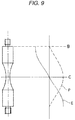
- Fig. 9 is an explanatory diagram illustrating a relationship of a shape of an annular test piece of the related art with respect to stress curve and an amplitude curve.
- an annular test piece is illustrated on the left side of the drawing and an axial stress curve P indicated by a dashed line and a displacement curve E indicated by a solid line are illustrated on the right side of the drawing.
- a test piece for an ultrasonic fatigue test needs to have the same resonance frequency as the ultrasonic vibration generated from the ultrasonic transducer.
- a shape of the test piece is designed such that stress amplification becomes zero at a test piece attachment position B in the horn (becomes an antinode of a displacement vibration) and stress amplification becomes maximal at a center position C of the test piece (becomes a node of the displacement vibration).
- a male screw corresponding to a female screw formed at a front end of the horn is integrally formed with a body of the test piece at the time of manufacturing the test piece by processing the material (see Fig. 9 of Patent Literature 1).
- the ultrasonic fatigue testing machine is designed for a standard annular test piece. Accordingly, even when a plate-shaped test piece is manufactured for an ultrasonic fatigue test, a male screw having a screw diameter corresponding to the female screw of the horn needs to be formed similarly to the annular test piece.
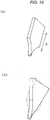
- Fig. 10 is a diagram illustrating a resonance simulation of a plate-shaped test piece model. Additionally, Fig. 10 illustrates a 1/2 model in which the plate-shaped test piece designed so that stress at the center portion during resonance becomes the same as that of the annular test piece is cut at the center portion thereof.
- Fig. 10(a) illustrates a state before the resonance occurs.
- Fig. 10(b) illustrates a state where a maximal sinusoidal stress waveform which can be realized by a general ultrasonic fatigue testing machine is applied to the test piece, where the test piece before the resonance occurs is indicated by a dashed line and the test piece having a lateral vibration during resonance is indicated by a solid line.
- the plate-shaped test piece of Fig. 10 is designed so that the stress at the center portion is the same as that of the annular test piece by a configuration in which the width dimensions at both ends are larger than the diameter of the center portion.
- the test piece is vibrated longitudinally in parallel to the wave traveling direction (a direction of an arrow A of Fig. 10(a) ).
- a lateral vibration occurs at frequencies close to longitudinal vibration as indicated by a solid line in Fig. 10 (b) and thus a normal test is hindered. In this way, there is a case where the plate-shaped test piece corresponding to high stress is not easily manufactured.
- the invention has been made to solve the above-described problems and an object of the invention is to provide a jig for an ultrasonic fatigue testing machine capable of facilitating a design of a test piece formed of various materials and performing a fatigue test in which high stress is repeatedly applied to a test piece.
- a jig for an ultrasonic fatigue testing machine used in a fatigue test in which a vibration generated from an ultrasonic transducer is amplified by a horn and a test piece connected to a front end of the horn is resonated, including: a main body portion; and a grip portion holding an end of the test piece, in which the jig is attached to both ends of the test piece to adjust the mass of both ends of the test piece.
- the jig for the ultrasonic fatigue testing machine of claim 1 in which an end of the main body portion opposite to the grip portion is provided with a screw portion to be connected to the horn.
- the jig for the ultrasonic fatigue testing machine of claim 1 in which when an end of the main body portion is connected to the horn, an adjustment plate is inserted between the main body portion and the horn, and when the end of the main body portion serves as a free end, the adjustment plate is attached to the free end to adjust the mass of both ends of the test piece.
- the jig for the ultrasonic fatigue testing machine of claim 1 in which the grip portion includes a pressing force generation member that sandwiches the end of the test piece by a pressing force using a screw when holding the end of the test piece.
- the jig for the ultrasonic fatigue testing machine of claim 4 in which the mass of both ends of the test piece is adjusted by changing the weight of the pressing force generation member.
- the jig for the ultrasonic fatigue testing machine is attached to both ends of the test piece, it is possible to increase the mass near the end of the test piece. Accordingly, since it is possible to increase the mass near the end of the test piece in relation to the center portion of the test piece without increasing the mass of the end of the test piece itself, it is possible to repeatedly apply high stress as a target value to the center portion of the test piece. Thus, it is possible to perform a fatigue test with high stress of 1000 MPa for the test piece even in a current device without increasing the capacity of the ultrasonic fatigue testing machine designed for the annular test piece.
- the jig for the ultrasonic fatigue testing machine is attached to both ends of the test piece, it is not necessary to provide the screw portion to be connected to the horn of the ultrasonic fatigue testing machine at the test piece itself when manufacturing the test piece and it is possible to perform an ultrasonic fatigue test for a material which is not easily subjected to threading.
- the jig for the ultrasonic fatigue testing machine is prepared as a pair of jigs each having a different weight, even when the accuracy of the desired resonance frequency is not obtained in the test piece manufactured according to a length obtained by a calculation, it is possible to easily adjust the resonance frequency by replacing the jig for the ultrasonic fatigue testing machine attached to the test piece with another jig having a different weight since the resonance frequency ⁇ is ⁇ (spring constant/mass) in a simple spring-mass system. For this reason, since there is no need to determine an optimal test piece length by measuring each resonance frequency after manufacturing test pieces each having a different length as in the related art, it is possible to easily manufacture the test piece.
- the adjustment plate since the mass of both ends of the test piece is adjusted by the adjustment plate, it is possible to easily and finely adjust the resonance frequency corresponding to target stress applied to the center portion of the test piece by adjusting the number of the adjustment plates or the thickness thereof.
- the weight of the pressing force generation member in response to the target stress applied to the center portion of the test piece, it is possible to more easily change the weight of the jig for the ultrasonic fatigue testing machine and thus to finely adjust the resonance frequency of the test piece.
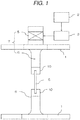
- Fig. 1 is an outline diagram of an ultrasonic fatigue testing machine which performs a fatigue test by attaching a jig 10 for the ultrasonic fatigue testing machine according to the invention thereto.
- the ultrasonic fatigue testing machine is used to perform a fatigue test by resonating a test piece S using ultrasonic waves and includes a vibration portion 7 which includes an ultrasonic transducer 5 vibrated by a signal generated from an oscillator 3 and a horn 6 amplifying a vibration and transmitting the vibration to the test piece S and a frame 1 which is attached to the vibration portion 7.
- the oscillator 3 generates the signal based on a test frequency set by a control unit 2.
- the arrangement of the vibration portion 13 and the test piece S illustrated in Fig. 1 is set to perform a fatigue test in which a longitudinal vibration is applied to the test piece S.
- the test piece S is a plate-shaped test piece and both ends thereof are sandwiched by a pair of jigs 10 for the ultrasonic fatigue testing machine (hereinafter, the jig 10 for the ultrasonic fatigue testing machine will be referred to as the "jig 10" if necessary in the specification).
- the pair of jigs 10 has the same mass and the mass is adjusted in consideration of the test piece shape so that the stress at the center portion of the test piece S becomes a desired value (target stress) within the ability range of the device. That is, the jig 10 serves as a weight adjustment tool for adjusting the resonance frequency and the stress of the test piece S. In order to adjust the weight, the length or width of the jig 10 may be adjusted.
- the upper and lower jigs 10 are attached to both ends of the test piece S so that the center of gravity of the upper jig 10 and the center of gravity of the lower jig 10 are located on a vertical line passing through the center portion of the test piece S.
- the upper jig 10 is connected to the horn 6 by the screw-connection.
- the lower jig 10 is connected to the horn 6 fixed to the frame 1 by the screw-connection.
- the lower jig 10 is also connected to the horn 6 resonated at the same cycle in order to apply average stress to the test piece S. Additionally, the lower jig 10 may be a free end according to the purpose of the test. Further, in the example of Fig. 1 , a longitudinal vibration is applied to the test piece S from the upper side of the test piece S, but when a vibration is applied to the test piece S from the upper and lower sides of the frame 1, the horn 6 connected to the lower jig 10 is also connected to the ultrasonic transducer 5 and the oscillator 3.
- Fig. 2 is an outline diagram of the jig 10 for the ultrasonic fatigue testing machine according to the invention.
- the jig 10 includes a main body portion 11 and a pair of grip portions 12 which sandwiches the end of the test piece S.
- An end (an end surface) of the main body portion 11 of the jig 10 at a connection side to the horn 6 and a side opposite to the grip portion 12 is provided with a screw portion 16 which is connected to the front end of the horn 6 by the screw-connection.
- the end of the test piece S is inserted between the pair of grip portions 12 and the test piece S and the jig 10 are integrally held by shrink fitting, crimping, or fixing such as welding, brazing, or adhering.
- the pair of jigs 10 is attached to the test piece S so that the centers of gravity of the pair of jigs 10 are aligned to the line passing through the center portion of the test piece S.
- Fig. 3 is an outline diagram illustrating a weight adjustment of the jig 10 for the ultrasonic fatigue testing machine.
- Fig. 3(a) illustrates the weight adjustment of the jig 10 connected to the horn 6 by the screw-connection and
- Fig. 3(b) illustrates the weight adjustment when the lower jig 10 is a free end.
- the pair of jigs 10 is prepared to have the same mass according to the size of the test piece S. Meanwhile, in the prepared jig 10, there is a case where the weight is insufficient for the stress at the center portion of the test piece S to become a desired value (target stress). In such a case, as illustrated in Fig. 3 , the weight of the pair of jigs 10 is adjusted.
- the weight of the jig 10 is adjusted.
- the substantial mass of both ends of the test piece S can be set to be sufficiently larger than that of the center portion so that stress at the center portion of the test piece S becomes a target value.
- a plurality of adjustment plates 13a and 13b each having a different thickness are provided.
- the adjustment plates 13a and 13b are provided with holes through which the screw portion 16 passes.
- the adjustment plates 13a and 13b each having a different thickness are selected to have a target weight and are inserted between the front end of the horn 6 and the jig 10 so that the weight of both ends of the test piece S is adjusted. Additionally, when the lower jig 10 is not connected to the horn 6 and is used as a free end, an end surface of the jig 10 is provided with a male screw and the adjustment plates 14a and 14b each having a different thickness are fixed by a bolt 15 as illustrated in Fig. 3(b) .
- the jig 10 When a test starts by connecting the jig 10 to the front end of the horn 6 while the pair of jigs 10 is attached to both ends of the test piece S, the jig 10 is resonated along with the test piece S. As in the related art, it is not necessary to process the test piece S to be directly connected to the horn 6. Then, the length of the test piece S is determined in consideration of the weight of the jig 10 so that the connection portion between the horn 6 and the jig 10 becomes the antinode of the displacement vibration and the center portion of the test piece S becomes the node of the displacement vibration.
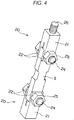
- Fig. 4 is an outline diagram of a jig 20 for an ultrasonic fatigue testing machine according to the invention.
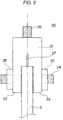
- Fig. 5 is a front outline diagram of the jig 20 for the ultrasonic fatigue testing machine according to the invention.
- the jig 20 includes a main body portion 21 and a pair of grip portions 22 which sandwiches the end of the test piece S by a pressing force.
- the main body portion 21 of the jig 20 at the connection side to the horn 6 is provided with a screw portion 26 which is connected to the front end of the horn 6 by the screw-connection.
- the pair of grip portions 22 is provided with a hole through which a screw 24 penetrating the test piece S and the grip portion 22 passes. Additionally, it is necessary to form a hole, through which the screw 24 passes, in the test piece S to be attached to the jig 20. Further, it is ideal that no gap is formed while the end of the test piece S is inserted between the pair of grip portions 22. In this embodiment, as illustrated in Fig.
- a split 27 is provided at a position of the main body portion 21 near the end of the test piece S, the inner surface of the grip portion 22 can be sufficiently brought into close contact with the side surface of the end of the test piece S by pressing the left and right two nuts 25 in a balanced manner and generating a pressing force to act on the test piece S.
- a spacer may be inserted between the inner surface of the grip portion 22 and the end of the test piece S.
- the spacer for example, soft metal such as aluminum used as a tab can be adopted.
- a user reliably clamps and holds the test piece S by the pair of grip portions 22 by fastening a nut 25 to both ends of the screw 24 and operating the screw 24 and the nut 25 so that the centers of gravity of the pair of jigs 20 are aligned to the line passing through the center portion of the test piece S.
- the center of gravity of the jig 20 is aligned to the center of gravity of the test piece S, unnecessary lateral resonance can be prevented.
- the jig 20 of the second embodiment is fixed to the test piece S by a screw differently from the jig 10 of the first embodiment, the test piece S can be repeatedly used while being replaced.
- the jig 20 When a test starts by connecting the jig 20 to the front end of the horn 6 while the pair of jigs 20 is attached to both ends of the test piece S, the jig 20 is resonated along with the test piece S. That is, the test piece S and the jig 20 are entirely resonated at the test frequency.
- the weight of the jig 20 is adjusted as described above, the substantial mass of both ends of the test piece S can be set to be sufficiently larger than that of the center portion so that stress at the center portion of the test piece S becomes a target value.
- the length of the test piece S is determined in consideration of the weight of the jig 20 so that the connection portion between the horn 6 and the jig 20 becomes an antinode of the displacement vibration and the center portion of the test piece S becomes a node of the displacement vibration.
- the screw 24 and the nut 25 are used as a pressing force generation member for pressing the pair of grip portions 22 against the test piece S and the weight of the jig 20 is changed by the nut 25.
- the jig 20 may be provided as a pair of jigs such that the weight of the main body portion 21 of the jig 20 is different and may be replaced for the test piece S in response to a desired resonance frequency or target stress applied to the center portion of the test piece S.
- the adjustment plate 13a, 13b, 14a, or 14b may be inserted into the pair of jigs 20 to adjust the weight as in the case of the first embodiment illustrated in Fig. 3 .
- Fig. 6 is a front outline diagram of a jig 30 for an ultrasonic fatigue testing machine according to a third embodiment of the invention.
- the same members as those in the second embodiment are denoted by the same reference numerals and a detailed description thereof will be omitted.
- the jig 30 of the embodiment includes a pair of screws 34 instead of the screw 24.
- the screw 34 is, for example, a hexagon socket stop screw, a slit stop screw, or the like and can be tightened using a tool.
- Each of the left and right grip portions 22 is provided with a screw hole into which the screw 34 is threaded.
- a spacer 33 contacting the side surface of the end of the test piece S is disposed at the front end of the screw 34.
- the jig 30 is used when it is difficult to process a hole through which the screw 24 passes at both ends of the test piece S.
- the user clamps and holds the test piece S to the pair of grip portions 22 by operating each of the screws 34 threaded into the screw holes formed in the pair of grip portions 22 in a balanced manner and bringing the spacer 33 into close contact with the side surfaces of both ends of the test piece S so that a pressing force acts thereon.
- the nut 25 is used to adjust the weight of the jig 30.
- the test piece S is clamped by the screw 34 and the nut is threaded into the screw 34 so that the test piece is fixed against the outer surface of the grip portion 22. Accordingly, it is possible to adjust the weight of the jig 30 by using the nuts 25 each having a different thickness.
- the screw 34 is used as a pressing force generation member that presses the pair of grip portions 22 against the test piece S and the weight of the jig 20 is changed by the nut 25.
- a bolt may be employed instead of the screw 34 and the nut 25. Even when the size of the bolt head is changed, the weight of the jig 30 can be changed.
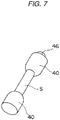
- Fig. 7 is an outline diagram of a jig 40 for an ultrasonic fatigue testing machine according to a fourth embodiment of the invention and Fig. 8 is a cross-sectional outline diagram thereof.
- Fig. 8(a) illustrates the jig 40 which holds the test piece S by shrink fitting, crimping, or fixing such as welding, brazing, or adhering
- Fig. 8(b) illustrates a modified example of the jig 40 which holds the test piece S by the screw 44.
- the jig 40 of the embodiment is used to hold the test piece S called a steel wire.
- the test piece S it is not practical to prepare the test piece S having a bent shape at the center portion as described with reference to Fig. 9 when performing a test on the steel wire.
- One end of the jig 40 is provided with a screw portion 46 to be connected to the horn 6 and the other end thereof is provided with a hole into which the front end of the test piece S is insertable as illustrated in Fig. 8(a) . Additionally, since the inner wall of the hole is in close contact with the side surface of the test piece S, this hole serves as the grip portion of the invention. That is, the end of the test piece S is inserted into the hole and the jig 40 is attached to the test piece S by shrink fitting, crimping, or fixing such as welding, brazing, or adhering. Further, as illustrated in Fig.
- the test piece S may be held by the jig 40 in such a manner that a screw hole is provided at the side portion of the jig 40 so as to perpetrate the inner wall of the hole and the screw 44 is inserted so that the front end of the screw 44 is in close contact with the side surface of the test piece S.
- the weight can be adjusted by inserting the adjustment plate 13a, 13b, 14a, or 14b into the pair of jigs 40.
- the test piece S can be easily manufactured.
- a plate-shaped test piece processed into a shape for a general static tensile test can be used for an ultrasonic fatigue test depending on the material.
Landscapes
- Physics & Mathematics (AREA)
- General Physics & Mathematics (AREA)
- Biochemistry (AREA)
- Life Sciences & Earth Sciences (AREA)
- Chemical & Material Sciences (AREA)
- Analytical Chemistry (AREA)
- Health & Medical Sciences (AREA)
- General Health & Medical Sciences (AREA)
- Immunology (AREA)
- Pathology (AREA)
- Engineering & Computer Science (AREA)
- Aviation & Aerospace Engineering (AREA)
- Acoustics & Sound (AREA)
- Electromagnetism (AREA)
- Investigating Strength Of Materials By Application Of Mechanical Stress (AREA)
Applications Claiming Priority (1)
| Application Number | Priority Date | Filing Date | Title |
|---|---|---|---|
| JP2017179086A JP2019053009A (ja) | 2017-09-19 | 2017-09-19 | 超音波疲労試験機用治具 |
Publications (1)
| Publication Number | Publication Date |
|---|---|
| EP3460465A1 true EP3460465A1 (de) | 2019-03-27 |
Family
ID=63490253
Family Applications (1)
| Application Number | Title | Priority Date | Filing Date |
|---|---|---|---|
| EP18192109.9A Withdrawn EP3460465A1 (de) | 2017-09-19 | 2018-08-31 | Vorrichtung für eine ultraschall-ermüdungsprüfmaschine |
Country Status (4)
| Country | Link |
|---|---|
| US (1) | US20190086307A1 (de) |
| EP (1) | EP3460465A1 (de) |
| JP (1) | JP2019053009A (de) |
| CN (1) | CN109520825A (de) |
Families Citing this family (13)
| Publication number | Priority date | Publication date | Assignee | Title |
|---|---|---|---|---|
| CN109765129A (zh) * | 2019-03-22 | 2019-05-17 | 吉林大学 | 一种可实现多轴超声疲劳试验的谐振系统 |
| CN113884260B (zh) * | 2020-07-01 | 2024-04-19 | 中国航发商用航空发动机有限责任公司 | 振级放大振动疲劳试验夹具 |
| CN111693371A (zh) * | 2020-07-06 | 2020-09-22 | 上海大学绍兴研究院 | 一种陶瓷基复合材料拉伸性能测试的测试工装 |
| CN112113847A (zh) * | 2020-10-20 | 2020-12-22 | 河南理工大学 | 二维超声振动拉伸试验装置 |
| CN112666018A (zh) * | 2020-11-03 | 2021-04-16 | 四川大学 | 针对异种金属焊接接头的超声频率机械加载疲劳实验系统 |
| CN112881160B (zh) * | 2021-01-12 | 2023-01-17 | 中国商用飞机有限责任公司北京民用飞机技术研究中心 | 一种金属宽板疲劳试验用的夹具 |
| CN115655674B (zh) * | 2021-07-07 | 2025-11-25 | 中国航发商用航空发动机有限责任公司 | 振动疲劳试验装置 |
| CN114324025B (zh) * | 2021-12-23 | 2025-05-30 | 中车株洲电机有限公司 | 焊接结构疲劳寿命试验装置及方法 |
| CN114577591A (zh) * | 2022-02-23 | 2022-06-03 | 华东理工大学 | 一种板状试样的疲劳试验夹具 |
| JP7789598B2 (ja) * | 2022-03-18 | 2025-12-22 | 日本発條株式会社 | 超音波疲労試験機、及び超音波疲労試験方法 |
| CN114942180A (zh) * | 2022-03-25 | 2022-08-26 | 华东理工大学 | 一种适用于不同疲劳试验机的多功能疲劳试验夹具 |
| CN115420592A (zh) * | 2022-11-07 | 2022-12-02 | 清华大学 | 一种金属疲劳试验偏心加载辅助装置 |
| DE102023000033A1 (de) * | 2023-01-10 | 2024-07-11 | Technische Universität Dortmund, Körperschaft des öffentlichen Rechts | Prüfvorrichtung und Verfahren zur Beurteilung des Ermüdungsverhaltens eines Werkstoffs an Flachproben mittels Ultraschall |
Citations (7)
| Publication number | Priority date | Publication date | Assignee | Title |
|---|---|---|---|---|
| JPS58211627A (ja) * | 1982-06-03 | 1983-12-09 | Mitsubishi Heavy Ind Ltd | 疲労き裂插入方法 |
| JPS63210747A (ja) * | 1987-02-27 | 1988-09-01 | Ngk Spark Plug Co Ltd | 耐久試験用治具のセラミツク試料保持手段 |
| JPH01112447U (de) * | 1988-01-26 | 1989-07-28 | ||
| JPH0587719A (ja) | 1991-03-27 | 1993-04-06 | Ngk Insulators Ltd | セラミツクス用超音波疲労試験治具 |
| JPH05164667A (ja) * | 1991-12-12 | 1993-06-29 | Mitsubishi Heavy Ind Ltd | 表面き裂進展測定方法 |
| JP2013221872A (ja) * | 2012-04-17 | 2013-10-28 | Shimadzu Corp | 試験片把持具 |
| CN108627572A (zh) * | 2018-05-10 | 2018-10-09 | 江苏大学 | 超声裂解试验装置与方法 |
Family Cites Families (3)
| Publication number | Priority date | Publication date | Assignee | Title |
|---|---|---|---|---|
| JP4883307B2 (ja) * | 2007-07-04 | 2012-02-22 | 株式会社島津製作所 | 材料試験機 |
| JP5856296B2 (ja) * | 2011-07-22 | 2016-02-09 | スネクマ | 制御された雰囲気において制御されたひずみ比で高サイクル型の材料疲労試験を実行するための装置および方法 |
| JP6004113B2 (ja) * | 2013-08-07 | 2016-10-05 | 株式会社島津製作所 | 材料試験機の治具装着装置 |
-
2017
- 2017-09-19 JP JP2017179086A patent/JP2019053009A/ja not_active Withdrawn
-
2018
- 2018-06-12 US US16/005,902 patent/US20190086307A1/en not_active Abandoned
- 2018-08-31 EP EP18192109.9A patent/EP3460465A1/de not_active Withdrawn
- 2018-09-17 CN CN201811080389.XA patent/CN109520825A/zh not_active Withdrawn
Patent Citations (7)
| Publication number | Priority date | Publication date | Assignee | Title |
|---|---|---|---|---|
| JPS58211627A (ja) * | 1982-06-03 | 1983-12-09 | Mitsubishi Heavy Ind Ltd | 疲労き裂插入方法 |
| JPS63210747A (ja) * | 1987-02-27 | 1988-09-01 | Ngk Spark Plug Co Ltd | 耐久試験用治具のセラミツク試料保持手段 |
| JPH01112447U (de) * | 1988-01-26 | 1989-07-28 | ||
| JPH0587719A (ja) | 1991-03-27 | 1993-04-06 | Ngk Insulators Ltd | セラミツクス用超音波疲労試験治具 |
| JPH05164667A (ja) * | 1991-12-12 | 1993-06-29 | Mitsubishi Heavy Ind Ltd | 表面き裂進展測定方法 |
| JP2013221872A (ja) * | 2012-04-17 | 2013-10-28 | Shimadzu Corp | 試験片把持具 |
| CN108627572A (zh) * | 2018-05-10 | 2018-10-09 | 江苏大学 | 超声裂解试验装置与方法 |
Also Published As
| Publication number | Publication date |
|---|---|
| CN109520825A (zh) | 2019-03-26 |
| JP2019053009A (ja) | 2019-04-04 |
| US20190086307A1 (en) | 2019-03-21 |
Similar Documents
| Publication | Publication Date | Title |
|---|---|---|
| EP3460465A1 (de) | Vorrichtung für eine ultraschall-ermüdungsprüfmaschine | |
| US3368085A (en) | Sonic transducer | |
| US8950458B2 (en) | System and method for mounting ultrasonic tools | |
| JP4820786B2 (ja) | 衝撃引張応力計測方法 | |
| GB1599461A (en) | Ultrasonic transducer | |
| US8113258B2 (en) | Ultrasonic welding device | |
| US8025087B2 (en) | Ultrasonic vibration welder | |
| JP6454715B2 (ja) | 超音波接合装置 | |
| US10054181B2 (en) | Damping component and damping structure | |
| Mostafavi et al. | Detection of terminal oscillation pattern in ultrasonic metal welding | |
| JP6296860B2 (ja) | フレッティング疲労試験方法およびフレッティング疲労試験装置 | |
| JP2007278779A (ja) | 熱疲労用試験方法および熱疲労試験用試験片並びに熱疲労試験の試験片装着用継手 | |
| US4523710A (en) | Method for fabricating a fastener plate | |
| CN108593234A (zh) | 高周疲劳试验装置及其应用 | |
| JP4795016B2 (ja) | 燃料電池スタック | |
| CN108136711B (zh) | 具有低传递率的超声砧 | |
| CN110455929B (zh) | 一种非共振形式的高频振动裂解试验装置及方法 | |
| KR102420483B1 (ko) | 수동 공구, 이것에 사용되는 비트 및 토크 센서 | |
| Kim et al. | Evaluation of welding performance of 20 kHz and 40 kHz ultrasonic metal welding | |
| JP7789598B2 (ja) | 超音波疲労試験機、及び超音波疲労試験方法 | |
| JP6772715B2 (ja) | 疲労試験方法及び疲労試験装置 | |
| JP3187918B2 (ja) | セラミックス用超音波疲労試験治具 | |
| Park et al. | Tensile strength of cu sheets welded by ultrasonic metal welding | |
| CN109719575B (zh) | 以施加预应力提高抗疲劳强度的非金属材质超声波工具头 | |
| CN116083713B (zh) | 一种夹持装置及管道残余应力调控设备 |
Legal Events
| Date | Code | Title | Description |
|---|---|---|---|
| PUAI | Public reference made under article 153(3) epc to a published international application that has entered the european phase |
Free format text: ORIGINAL CODE: 0009012 |
|
| STAA | Information on the status of an ep patent application or granted ep patent |
Free format text: STATUS: REQUEST FOR EXAMINATION WAS MADE |
|
| 17P | Request for examination filed |
Effective date: 20180918 |
|
| AK | Designated contracting states |
Kind code of ref document: A1 Designated state(s): AL AT BE BG CH CY CZ DE DK EE ES FI FR GB GR HR HU IE IS IT LI LT LU LV MC MK MT NL NO PL PT RO RS SE SI SK SM TR |
|
| AX | Request for extension of the european patent |
Extension state: BA ME |
|
| STAA | Information on the status of an ep patent application or granted ep patent |
Free format text: STATUS: THE APPLICATION HAS BEEN WITHDRAWN |
|
| 18W | Application withdrawn |
Effective date: 20200529 |