EP3462811A1 - A device for selectively heating a target with ir radiation - Google Patents

A device for selectively heating a target with ir radiation Download PDF

Info

Publication number
EP3462811A1
EP3462811A1 EP17194236.0A EP17194236A EP3462811A1 EP 3462811 A1 EP3462811 A1 EP 3462811A1 EP 17194236 A EP17194236 A EP 17194236A EP 3462811 A1 EP3462811 A1 EP 3462811A1
Authority
EP
European Patent Office
Prior art keywords
range
source
target
radiation
elongate bodies
Prior art date
Legal status (The legal status is an assumption and is not a legal conclusion. Google has not performed a legal analysis and makes no representation as to the accuracy of the status listed.)
Withdrawn
Application number
EP17194236.0A
Other languages
German (de)
French (fr)
Inventor
Martin Klinecky
Current Assignee (The listed assignees may be inaccurate. Google has not performed a legal analysis and makes no representation or warranty as to the accuracy of the list.)
Excelitas Noblelight GmbH
Original Assignee
Heraeus Noblelight GmbH
Priority date (The priority date is an assumption and is not a legal conclusion. Google has not performed a legal analysis and makes no representation as to the accuracy of the date listed.)
Filing date
Publication date
Application filed by Heraeus Noblelight GmbH filed Critical Heraeus Noblelight GmbH
Priority to EP17194236.0A priority Critical patent/EP3462811A1/en
Priority to EP18773220.1A priority patent/EP3689103B1/en
Priority to US16/650,255 priority patent/US11617231B2/en
Priority to KR1020207012071A priority patent/KR20200080242A/en
Priority to PCT/EP2018/076312 priority patent/WO2019063713A1/en
Priority to JP2020516554A priority patent/JP7240386B2/en
Priority to CN201880063577.3A priority patent/CN111149425A/en
Publication of EP3462811A1 publication Critical patent/EP3462811A1/en
Withdrawn legal-status Critical Current

Links

Images

Classifications

    • HELECTRICITY
    • H05ELECTRIC TECHNIQUES NOT OTHERWISE PROVIDED FOR
    • H05BELECTRIC HEATING; ELECTRIC LIGHT SOURCES NOT OTHERWISE PROVIDED FOR; CIRCUIT ARRANGEMENTS FOR ELECTRIC LIGHT SOURCES, IN GENERAL
    • H05B3/00Ohmic-resistance heating
    • H05B3/10Heating elements characterised by the composition or nature of the materials or by the arrangement of the conductor
    • H05B3/12Heating elements characterised by the composition or nature of the materials or by the arrangement of the conductor characterised by the composition or nature of the conductive material
    • H05B3/14Heating elements characterised by the composition or nature of the materials or by the arrangement of the conductor characterised by the composition or nature of the conductive material the material being non-metallic
    • H05B3/148Silicon, e.g. silicon carbide, magnesium silicide, heating transistors or diodes
    • BPERFORMING OPERATIONS; TRANSPORTING
    • B29WORKING OF PLASTICS; WORKING OF SUBSTANCES IN A PLASTIC STATE IN GENERAL
    • B29CSHAPING OR JOINING OF PLASTICS; SHAPING OF MATERIAL IN A PLASTIC STATE, NOT OTHERWISE PROVIDED FOR; AFTER-TREATMENT OF THE SHAPED PRODUCTS, e.g. REPAIRING
    • B29C37/00Component parts, details, accessories or auxiliary operations, not covered by group B29C33/00 or B29C35/00
    • B29C37/02Deburring or deflashing
    • B29C37/04Deburring or deflashing of welded articles, e.g. deburring or deflashing in combination with welding
    • HELECTRICITY
    • H05ELECTRIC TECHNIQUES NOT OTHERWISE PROVIDED FOR
    • H05BELECTRIC HEATING; ELECTRIC LIGHT SOURCES NOT OTHERWISE PROVIDED FOR; CIRCUIT ARRANGEMENTS FOR ELECTRIC LIGHT SOURCES, IN GENERAL
    • H05B3/00Ohmic-resistance heating
    • H05B3/40Heating elements having the shape of rods or tubes
    • H05B3/42Heating elements having the shape of rods or tubes non-flexible
    • H05B3/44Heating elements having the shape of rods or tubes non-flexible heating conductor arranged within rods or tubes of insulating material
    • BPERFORMING OPERATIONS; TRANSPORTING
    • B29WORKING OF PLASTICS; WORKING OF SUBSTANCES IN A PLASTIC STATE IN GENERAL
    • B29CSHAPING OR JOINING OF PLASTICS; SHAPING OF MATERIAL IN A PLASTIC STATE, NOT OTHERWISE PROVIDED FOR; AFTER-TREATMENT OF THE SHAPED PRODUCTS, e.g. REPAIRING
    • B29C35/00Heating, cooling or curing, e.g. crosslinking or vulcanising; Apparatus therefor
    • B29C35/02Heating or curing, e.g. crosslinking or vulcanizing during moulding, e.g. in a mould
    • B29C35/08Heating or curing, e.g. crosslinking or vulcanizing during moulding, e.g. in a mould by wave energy or particle radiation
    • B29C35/0805Heating or curing, e.g. crosslinking or vulcanizing during moulding, e.g. in a mould by wave energy or particle radiation using electromagnetic radiation
    • BPERFORMING OPERATIONS; TRANSPORTING
    • B29WORKING OF PLASTICS; WORKING OF SUBSTANCES IN A PLASTIC STATE IN GENERAL
    • B29CSHAPING OR JOINING OF PLASTICS; SHAPING OF MATERIAL IN A PLASTIC STATE, NOT OTHERWISE PROVIDED FOR; AFTER-TREATMENT OF THE SHAPED PRODUCTS, e.g. REPAIRING
    • B29C65/00Joining or sealing of preformed parts, e.g. welding of plastics materials; Apparatus therefor
    • B29C65/02Joining or sealing of preformed parts, e.g. welding of plastics materials; Apparatus therefor by heating, with or without pressure
    • B29C65/14Joining or sealing of preformed parts, e.g. welding of plastics materials; Apparatus therefor by heating, with or without pressure using wave energy, i.e. electromagnetic radiation, or particle radiation
    • B29C65/1403Joining or sealing of preformed parts, e.g. welding of plastics materials; Apparatus therefor by heating, with or without pressure using wave energy, i.e. electromagnetic radiation, or particle radiation characterised by the type of electromagnetic or particle radiation
    • B29C65/1412Infrared [IR] radiation
    • HELECTRICITY
    • H05ELECTRIC TECHNIQUES NOT OTHERWISE PROVIDED FOR
    • H05BELECTRIC HEATING; ELECTRIC LIGHT SOURCES NOT OTHERWISE PROVIDED FOR; CIRCUIT ARRANGEMENTS FOR ELECTRIC LIGHT SOURCES, IN GENERAL
    • H05B3/00Ohmic-resistance heating
    • H05B3/20Heating elements having extended surface area substantially in a two-dimensional [2D] plane, e.g. plate-heater
    • HELECTRICITY
    • H10SEMICONDUCTOR DEVICES; ELECTRIC SOLID-STATE DEVICES NOT OTHERWISE PROVIDED FOR
    • H10PGENERIC PROCESSES OR APPARATUS FOR THE MANUFACTURE OR TREATMENT OF DEVICES COVERED BY CLASS H10
    • H10P72/00Handling or holding of wafers, substrates or devices during manufacture or treatment thereof
    • H10P72/04Apparatus for manufacture or treatment
    • H10P72/0431Apparatus for thermal treatment
    • H10P72/0436Apparatus for thermal treatment mainly by radiation
    • BPERFORMING OPERATIONS; TRANSPORTING
    • B29WORKING OF PLASTICS; WORKING OF SUBSTANCES IN A PLASTIC STATE IN GENERAL
    • B29CSHAPING OR JOINING OF PLASTICS; SHAPING OF MATERIAL IN A PLASTIC STATE, NOT OTHERWISE PROVIDED FOR; AFTER-TREATMENT OF THE SHAPED PRODUCTS, e.g. REPAIRING
    • B29C35/00Heating, cooling or curing, e.g. crosslinking or vulcanising; Apparatus therefor
    • B29C35/02Heating or curing, e.g. crosslinking or vulcanizing during moulding, e.g. in a mould
    • B29C35/08Heating or curing, e.g. crosslinking or vulcanizing during moulding, e.g. in a mould by wave energy or particle radiation
    • B29C35/0805Heating or curing, e.g. crosslinking or vulcanizing during moulding, e.g. in a mould by wave energy or particle radiation using electromagnetic radiation
    • B29C2035/0822Heating or curing, e.g. crosslinking or vulcanizing during moulding, e.g. in a mould by wave energy or particle radiation using electromagnetic radiation using IR radiation
    • HELECTRICITY
    • H05ELECTRIC TECHNIQUES NOT OTHERWISE PROVIDED FOR
    • H05BELECTRIC HEATING; ELECTRIC LIGHT SOURCES NOT OTHERWISE PROVIDED FOR; CIRCUIT ARRANGEMENTS FOR ELECTRIC LIGHT SOURCES, IN GENERAL
    • H05B2203/00Aspects relating to Ohmic resistive heating covered by group H05B3/00
    • H05B2203/032Heaters specially adapted for heating by radiation heating

Definitions

  • the invention relates to a device for heating a target with IR radiation. More specifically, the invention relates to a device, a process for heat treating a target, a process for making a composite, a use of an IR source, a use of an array of IR sources and a use of the device.
  • Devices and processes for heating a target have numerous industrially important applications including moulding and forming of thermoplastics; curing of substrates and substrate surfaces, especially of plastic substrates; curing of coatings; chemical activation; welding; burr removal; sterilisation; cleaning and oxidation.
  • a number of approaches to heating a target presented in the state of the art employ a simple thermal emitter, which can be approximated by a black body. Such approaches can suffer from the disadvantage that the wavelength of the radiation cannot be easily controlled and selective and controlled heating is not possible.
  • a number of approaches presented in the art employ direct heating from an emitter and can suffer from the disadvantage of uneven heating of a target surface. There exists a need in the state of the art for improved approaches to heating a target, in particular for heating a non-flat target surface or for selective heating of a composite target.
  • the invention is generally based on the object of overcoming at least one of the problems encountered in the state of the art in relation to heating a target.
  • An object of the invention is to provide a device for applying IR radiation with a reduced wavelength bandwidth to a target.
  • An object of the invention is to provide a device for applying IR radiation with a well defined wavelength to a target.
  • An object of the invention is to provide a device for applying IR radiation with a controllable wavelength to a target.
  • An object of the invention is to provide a device for heating a target.
  • An object of the invention is to provide a device for melting a target.
  • An object of the invention is to provide a device for selectively heating a constituent of a composite.
  • An object of the invention is to provide a device for selectively melting a constituent of a composite.
  • An object of the invention is to provide a device for creating a composite.
  • An object of the invention is to provide a device for applying IR radiation selectively to part of a target surface.
  • An object of the invention is to provide a device for applying IR radiation to a target whilst reducing heating of the target by conduction.
  • An object of the invention is to provide a device for applying IR radiation to a target whilst reducing heating of the target by convection.
  • An object of the invention is to provide a device for applying IR radiation with a well defined wavelength to a target whilst reducing the application of radiation with other wavelengths to the target.
  • An object of the invention is to provide a device for removing irregularities from a target.
  • An object of the invention is to provide a device for removing moulding burrs from a target.
  • An object of the invention is to provide a device for treating a moulded item.
  • An object of the invention is to provide a device for heating a plastic.
  • An object of the invention is to provide a device for melting a plastic.
  • An object of the invention is to provide a process for applying IR radiation with a reduced wavelength bandwidth to a target.
  • An object of the invention is to provide a process for applying IR radiation with a well defined wavelength to a target.
  • An object of the invention is to provide a process for applying IR radiation with a controllable wavelength to a target.
  • An object of the invention is to provide a process for heating a target.
  • An object of the invention is to provide a process for melting a target.
  • An object of the invention is to provide a process for selectively heating a constituent of a composite.
  • An object of the invention is to provide a process for selectively melting a constituent of a composite.
  • An object of the invention is to provide a process for creating a composite.
  • An object of the invention is to provide a process for applying IR radiation selectively to part of a target surface.
  • An object of the invention is to provide a process for applying IR radiation to a target whilst reducing heating of the target by conduction.
  • An object of the invention is to provide a process for applying IR radiation to a target whilst reducing heating of the target by convection.
  • An object of the invention is to provide a process for applying IR radiation with a well defined wavelength to a target whilst reducing the application of radiation with other wavelengths to the target.
  • An object of the invention is to provide a process for removing irregularities from a target.
  • An object of the invention is to provide a process for removing moulding burrs from a target.
  • An object of the invention is to provide a process for treating a moulded item.
  • An object of the invention is to provide a process for heating a plastic.
  • An object of the invention is to provide a process for melting a plastic.
  • a particular object of the invention is to provide a device for treating a target with increased selectivity of location.
  • a particular object of the invention is to provide a device for heating a target with increased selectivity of location.
  • a particular object of the invention is to provide a device for melting a target with increased selectivity of location.
  • a particular object of the invention is to provide a device for removing burrs from a target with increased selectivity of location.
  • a particular object of the invention is to provide a device for treating inaccessible locations in a target, in particular cavities.
  • a particular object of the invention is to provide a device for heating inaccessible locations in a target, in particular cavities.
  • a particular object of the invention is to provide a device for melting inaccessible locations in a target, in particular cavities.
  • a particular object of the invention is to provide a device for removing burrs from inaccessible locations in a target.
  • a particular object of the invention is to provide a process for treating a target with increased selectivity of location.
  • a particular object of the invention is to provide a process for heating a target with increased selectivity of location.
  • a particular object of the invention is to provide a process for melting a target with increased selectivity of location.
  • a particular object of the invention is to provide a process for removing burrs from a target with increased selectivity of location.
  • a particular object of the invention is to provide a process for treating inaccessible locations in a target, in particular cavities.
  • a particular object of the invention is to provide a process for heating inaccessible locations in a target, in particular cavities.
  • a particular object of the invention is to provide a process for melting inaccessible locations in a target, in particular cavities.
  • a particular object of the invention is to provide a process for removing burrs from inaccessible locations in a target, in particular cavities.
  • the IR source is a thermal IR source and the first surface area is at least 15 times as great as the second surface area, preferably at least 50 times, more preferably at least 100 times.
  • the IR source is a semiconductor based IR source and the first surface area is at least 2 times as great as the second surface area, preferably at least 5 times, more preferably at least 10 times.
  • the elongate bodies are rigid and the first surface area is at least 15 times as great as the second surface area, preferably at least 50 times, more preferably at least 100 times. In one aspect of this embodiment, the elongate bodies are flexible and the first surface area is at least 2 times as great as the second surface area, preferably at least 5 times, more preferably at least 10 times.
  • the inlets have a third surface area and the first surface area is greater than the third surface area.
  • the first surface area is at least two times as great as the third surface area, more preferably at least five times, more preferably at least ten times, more preferably at least 100 times.
  • the IR source is a thermal IR source and the first surface area is at least 15 times as great as the third surface area, preferably at least 50 times, more preferably at least 100 times.
  • the IR source is a semiconductor based IR source and the first surface area is at least 2 times as great as the third surface area, preferably at least 5 times, more preferably at least 10 times.
  • the elongate bodies are rigid and the first surface area is at least 15 times as great as the third surface area, preferably at least 50 times, more preferably at least 100 times.
  • the elongate bodies are flexible and the first surface area is at least 2 times as great as the third surface area, preferably at least 5 times, more preferably at least 10 times.
  • the IR source comprises a thermal emitter, preferably is a thermal emitter.
  • part of the substrate is removed in formation of the treated substrate, such as removal of a burr, preferably by melting or burning or both.
  • the device comprises an IR source for providing IR radiation. IR radiation provided by the IR source is employed for heating the target.
  • the device comprises a set of elongate bodies each having an inlet and an outlet. IR radiation from the IR source is coupled into the inlets of the elongate bodies and decoupled at the outlets of the elongate bodies. In this way, the elongate bodies provide a path for IR radiation from the IR source to be delivered at the outlets, preferably to the surface of the target.
  • the device comprises a support for holding the outlets in a relative spatial configuration.
  • the device comprises a set of elongate bodies.
  • Preferred elongate bodies serve to convey IR radiation from the radiation source to the target.
  • Each elongate body comprised in the set of elongate bodies has an inlet and an outlet.
  • the inlet allows coupling of IR radiation emitted from the IR source into the elongate body.
  • IR radiation can also be coupled into the elongate body through its side.
  • the outlet allows decoupling of IR radiation from the elongate body.
  • An inlet is preferably a face, more preferably a substantially flat face, most preferably a flat face.
  • An outlet is preferably a face, more preferably a substantially flat face, most preferably a flat face.
  • the elongate body has two ends.
  • the inlet of an elongate body is at one end of the elongate body and the outlet of the elongate body is at the other end of the elongate body.
  • the set of elongate bodies consists of 2 or more, or 3 or more elongate bodies, preferably 10 or more, more preferably 20 or more, more preferably 50 or more, more preferably 100 or more, more preferably 200 or more.
  • the set of elongate bodies may consist of up to 10,000 elongate bodies. In one embodiment, the number of elongate bodies is in the range from 3 to 500, preferably in the range from 10 to 400, more preferably in the range from 20 to 300.
  • the elongate bodies preferably have a low attenuation measured at a IR peak emission wavelength of the IR source.
  • the attenuation is preferably less than 1000 dB/km, more preferably less than 100 dB/km, most preferably less than 20 dB/km. Attenuation might be as low as about 1 dB/km.
  • Preferred elongate bodies are one or more selected from the group consisting of the following: a glass rod, a glass fibre, a plastic optical fibre, a hollow silica tube, a liquid light guide, preferably a glass fibre or a glass rod.
  • a preferred elongate body is rigid. Rigid in this context preferably means having a bending radius of at least 3 m, more preferably at least 5 m, most preferably at least 10 m.
  • a preferred rigid elongate body is a glass rod, more preferably a quartz glass rod.
  • a preferred rigid elongate body has a diameter in the range from 1.5 mm to 10 cm, preferably in the range from 2 mm to 5 cm, more preferably in the range from 3 mm to 2.5 cm.
  • the elongate bodies are rigid, preferably glass rods, and the IR source is a thermal emitter.
  • a preferred elongate body is flexible.
  • Flexible in this context preferably means having a bending radius of less than 3 m, more preferably less than 1m, most preferably less than 50 cm.
  • a preferred flexible elongate body is a glass fibre, more preferably a quartz glass fibre.
  • the elongate bodies are flexible and the IR source is a semiconductor based IR source.
  • one or more elongate bodies are glass fibres, preferably quartz glass fibres.
  • Preferred glass fibres have a core diameter in the range from 5 to 1500 ⁇ m, preferably in the range from 6 to 1000 ⁇ m, more preferably in the range from 8 to 500 ⁇ m.
  • a glass fibre may have a cladding, preferably making a diameter contribution in the range from 20 to 200 ⁇ m, more preferably in the range from 20 to 180 ⁇ m, most preferably in the range from 20 to 150 ⁇ m.
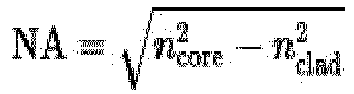
  • n core is the refractive index of the core material and n clad is the refractive index of the cladding material.
  • Preferred materials for a cladding are one or more selected from the group consisting of: glass or hard polymer, preferably glass.
  • the preferred glass is quartz glass.
  • one or more elongate bodies are plastic optical fibres.
  • Preferred materials for plastic optical fibres are one or more selected from the group consisting of the following: Polymethacrylate or polymethylmethacrylate.
  • Preferred plastic optical fibres have a core diameter in the range from 200 to 3000 ⁇ m, preferably in the range from 250 to 2900 ⁇ m, more preferably in the range from 300 to 2500 ⁇ m.
  • a plastic optical fibre may have a cladding, preferably making a diameter contribution in the range from 250 to 3050 ⁇ m, preferably in the range from 300 to 2900 ⁇ m, more preferably in the range from 350 to 2500 ⁇ m.
  • Preferred glass fibres which comprise a core and a cladding have a numerical aperture in the range from 0.05 to 0.9, preferably from 0.1 to 0.9, more preferably from 0.2 to 0.9.
  • one or more elongate bodies are hollow silicate tubes.
  • Preferred hollow silicate tubes have a core diameter in the range from 300 to 1000 ⁇ m, preferably in the range from 350 to 950 ⁇ m, more preferably in the range from 400 to 900 ⁇ m.
  • Preferred hollow silicate tubes have a cladding.
  • the cladding may make a diameter contribution in the range from 400 to 1300 ⁇ m, preferably in the range from 450 to 1200 ⁇ m, more preferably in the range from 500 to 1000 ⁇ m.
  • the cladding is preferably an aluminium halide or silver halide.
  • Preferred glass fibres which comprise a core and a cladding have a numerical aperture in the range from 0.05 to 0.9, preferably from 0.1 to 0.9, more preferably from 0.2 to 0.9.
  • one or more elongate bodies are liquid light guides.
  • Preferred liquid light guides have a core diameter in the range from 3000 to 5000 ⁇ m, preferably in the range from 3300 to 4700 ⁇ m, more preferably in the range from 3500 to 4500 ⁇ m.
  • a glass fibre may have a cladding, preferably making a diameter contribution in the range from 6000 to 1000 ⁇ m, more preferably in the range from 6500 to 9500 ⁇ m, most preferably in the range from 7000 to 9000 ⁇ m.
  • Preferred glass fibres have a numerical aperture in the range from 0.05 to 0.9, preferably from 0.1 to 0.9, more preferably from 0.2 to 0.9.
  • the set of elongate bodies may be gathered together into a bundle over at least part of the length of the elongate bodies.
  • the device may comprise a support for holding the outlets in a fixed relative position.
  • the relative configuration of the outlets defines an outlet surface, wherein the outlets lie within the outlet surface.
  • the emitter surface of the IR source is the surface over which the IR source emits IR radiation.
  • the emitter surface of the IR source is simply the area over which the IR source element emits IR radiation.
  • the emitter surface of the IR source is surface defined by the IR source elements, wherein the IR source elements lie within the emitter surface of the IR source.
  • the emitter surface of the IR source is a single connected area having a perimeter defined by the outermost IR source elements, which lie on the perimeter.
  • the outlets lie within the outlet surface and there may be gaps in the outlet surface between the area occupied by the outlets.
  • IR radiation provided is provided from the proportion of the outlet surface which is occupied by outlets.
  • the outlets are densely packed. It is preferred in this embodiment for the IR radiation to be provided from a proportion of the outlet surface in the range from 0.1 to 0.9, preferably in the range from 0.2 to 0.9 more preferably in the range from 0.3 to 0.9.
  • a number of arrangements of the IR source and the set of elongate bodies are possible within the scope of the invention. Such arrangements are determined by the relationship between the individual elongate bodies which make up the set of elongate bodies and the individual IR source elements which make up the IR source.
  • the relationship between individual IR source elements and individual elongate bodies can be one-to-one, many-to-one, one-to-many, many-to-many, or a mixed.
  • a single IR source element is arranged in correspondence with a single elongate body.
  • the IR radiation emitted from the IR source element couples predominantly, preferably substantially exclusively, more preferably exclusively into the elongate body.
  • the light coupled into the elongate body is coupled predominantly, preferably substantially exclusively, more preferably exclusively from the IR source element.
  • a grouping of two or more IR source elements is arranged in correspondence with a single elongate body.
  • the IR radiation emitted from the grouping of IR source elements couples predominantly, preferably substantially exclusively, more preferably exclusively into the elongate body.
  • the light coupled into the elongate body is coupled predominantly, preferably substantially exclusively, more preferably exclusively from the group of IR source elements.
  • a single IR source element is arranged in correspondence with a grouping of two or more elongate bodies.
  • the IR radiation emitted from the IR source element couples predominantly, preferably substantially exclusively, more preferably exclusively into the grouping of elongate bodies.
  • the light coupled into the grouping of elongate bodies is coupled predominantly, preferably substantially exclusively, more preferably exclusively from the IR source element.
  • a grouping of two or more IR source elements is arranged in correspondence with a grouping of two or more elongate bodies.
  • the IR radiation emitted from the grouping of IR source elements couples predominantly, preferably substantially exclusively, more preferably exclusively into the grouping of elongate bodies.
  • the light coupled into the grouping of elongate bodies is coupled predominantly, preferably substantially exclusively, more preferably exclusively from the grouping of IR source elements.
  • the IR source elements of the IR source and the elongate bodies of the set of elongate bodies are arranged in one-to-one relationships.
  • Each IR source elements corresponds one-to-one with a corresponding elongate body.
  • the IR source elements of the IR source and the elongate bodies of the set of elongate bodies are arranged in one-to-many relationships.
  • Each IR source element corresponds one-to-many with a corresponding grouping of elongate bodies.
  • the IR source elements of the IR source and the elongate bodies of the set of elongate bodies are arranged in one-to-many relationships.
  • Each IR source elements belongs to a grouping of two or more IR source elements which corresponds many-to-one with a corresponding elongate body.
  • the IR source elements of the IR source and the elongate bodies of the set of elongate bodies are arranged in many-to-many relationships.
  • Each IR source elements belongs to a grouping of two or more IR source elements which corresponds many-to-many with a corresponding grouping of elongate bodies.
  • IR source elements of the IR source and the elongate bodies of the set of elongate bodies are arranged to include two different types of relationship selected from the group consisting of the following: one-to-one, one-to-many, many-to-one, many-to-many and mixed.
  • the device comprises an IR source.
  • Preferred IR sources serve to provide IR radiation for heating the target surface. IR radiation from the IR source is conveyed to the target by the set of elongate bodies.
  • the IR source may be a single IR source element or may consist of a collection of IR source elements.
  • An IR source element emits radiation from a single connected area.
  • An IR source which emits radiation from more than one connected areas consists of more than one IR source element.
  • An IR source element may be selected by the skilled person depending on its suitability in the context of the present invention.
  • the IR source comprises a semiconductor IR emitter.
  • Semiconductor IR emitters are also referred to IR diode emitters.
  • a semiconductor IR emitter is arranged and configured to emit IR radiation from a semiconductor part.
  • Preferred semiconductor IR emitters harness a semiconductor bandgap to emit radiation at a wavelength which depends on the width of the semiconductor bandgap.
  • Preferred types of semiconductor IR emitters are IR LEDs and IR semiconductor lasers.
  • the device comprises an IR source element having a peak emission wavelength in the range from 790 to 830 nm, preferably in the range from 800 to 820 nm, more preferably in the range from 805 to 815 nm, the IR source element preferably being an IR LED.
  • the device comprises an IR source element having a peak emission wavelength in the range from 830 to 870 nm, preferably in the range from 840 to 860 nm, more preferably in the range from 845 to 855 nm, the IR source element preferably being an IR LED.
  • the device comprises an IR source element having a peak emission wavelength in the range from 920 to 960 nm, preferably in the range from 930 to 950 nm, more preferably in the range from 935 to 945 nm, the IR source element preferably being an IR LED.
  • the device comprises an IR source element having a peak emission wavelength in the range from 950 to 990 nm, preferably in the range from 960 to 980 nm, more preferably in the range from 965 to 975 nm, the IR source element preferably being an IR VCSEL.
  • the device comprises an IR source element having a peak emission wavelength in the range from 960 to 1000 nm, preferably in the range from 970 to 990 nm, more preferably in the range from 975 to 985 nm, the IR source element preferably being an IR VCSEL.
  • the IR source comprises a thermal IR emitter, preferably is a thermal IR emitter.
  • the device comprises an IR source element having a peak emission wavelength in the range from 0.8 to 3 ⁇ m, preferably in the range from 1 to 2.5 ⁇ m, more preferably in the range from 1.25 to 2 ⁇ m, the IR source element preferably being a thermal IR emitter.
  • the device may comprise one or more optical elements.
  • Preferred optical elements serve to alter the path of IR radiation emitted from the IR source.
  • an optical element can be employed for one or more of the following: adjusting coupling, preferably coupling into an elongate body; adjusting decoupling, preferably decoupling from an elongate body; focusing; divergence and collimation.
  • the skilled person may employ an optical element which he considers suitable in the context of the invention.
  • Preferred optical elements selected from the group consisting of the following: a lens; a collimator; a diffractor, preferably a diffraction grating.
  • the device of the invention comprises an optical element for increasing the proportion of IR radiation emitted from an IR source element which is coupled into the elongate bodies.
  • IR radiation couples into the elongate bodies at the inlets and decouples from the elongate bodies at the outlets.
  • the inlet may be in contact with either an IR source element or an optical element or neither.
  • Coupling of IR radiation from the IR source into the inlets of the set of elongate bodies may be achieved either with the inlets in contact with the IR source or with the inlets at a distance from the IR source.
  • a preferred distance between the inlet of an elongate body and the IR source is in the range from 1 mm to 1 cm, preferably 1 mm to 5 mm, more preferably 1 mm to 3 mm.
  • one or more elongate bodies are in direct contact with the IR source. Direct contact between elongate bodies with the IR source may a mere resting in contact or may be attachment. A preferred attachment is welding or insertion or both.
  • a set of elongate bodies, preferably all of the elongate bodies, and a set of IR source elements, preferably all of the IR source elements are contacted in one-to-one relationships.
  • a set of elongate bodies, preferably all of the elongate bodies, and a set of IR source elements, preferably all of the IR source elements are contacted in one-to-many relationships.
  • a set of elongate bodies, preferably all of the elongate bodies, and a set of IR source elements, preferably all of the IR source elements are contacted in many-to-one relationships.
  • one or more elongate bodies are in direct contact with one or more optical elements. Direct contact between elongate bodies and optical elements may a mere resting in contact or may be attachment. A preferred attachment is welding or insertion or both.
  • a set of elongate bodies, preferably all of the elongate bodies, and a set of optical elements, preferably all of the optical elements are contacted in one-to-one relationships.
  • a set of elongate bodies, preferably all of the elongate bodies, and a set of optical elements, preferably all of the optical elements are contacted in one-to-many relationships.
  • a set of elongate bodies, preferably all of the elongate bodies, and a set of optical elements, preferably all of the optical elements are contacted in many-to-one relationships.
  • one or more elongate bodies are positioned at a distance from the IR source.
  • a set of elongate bodies, preferably all of the elongate bodies, and a set of IR source elements, preferably all of the IR source elements are in distance correspondence in one-to-one relationships.
  • a set of elongate bodies, preferably all of the elongate bodies, and a set of IR source elements, preferably all of the IR source elements are in distance correspondence in one-to-many relationships.
  • a set of elongate bodies, preferably all of the elongate bodies, and a set of IR source elements, preferably all of the IR source elements are in distance correspondence in many-to-one relationships.
  • one or more elongate bodies are positioned at a distance from one or more optical elements.
  • a set of elongate bodies, preferably all of the elongate bodies, and a set of optical elements, preferably all of the optical elements are in distance correspondence in one-to-one relationships.
  • a set of elongate bodies, preferably all of the elongate bodies, and a set of optical elements, preferably all of the optical elements are in distance correspondence in one-to-many relationships.
  • a set of elongate bodies, preferably all of the elongate bodies, and a set of optical elements, preferably all of the optical elements are in distance correspondence in many-to-one relationships.
  • the device and the process of the invention are useful for heating a target, especially a target surface which is difficult to access.
  • One application of the invention is for treating moulded parts, preferably moulded plastic parts.
  • a preferred treatment of moulded parts is the removal of moulding burrs.
  • the invention may be employed for heating one or more selected from the group consisting of the following: a plastic, silicon, a metal, an inorganic compound and a composite.
  • thermoplastics are one or more selected from the group consisting of the following: acrylonitrile butadiene styrene co-polymer, polyacrylate, a polylactide, polymethyl methacrylate, polycarbonate, polyethylene terephthalate, poly ethylene, poly propylene, poly styrene, poly ether ketone and poly vinyl chloride.
  • Preferred inorganic compounds are ZnO or SiC.
  • Another application of the invention is for making a composite item from two or more parts.
  • the device or the process of the invention or both can be employed for heating a target surface to soften or melt it. A further part is then welded to the softened or melted target surface.
  • IR LEDs are employed as IR source elements, but other IR source elements are possible, such as IR VCSELs; Glass fibres are employed as elongate bodies, but other elongate bodies are possible, such as plastic fibres; lenses are employed as optical elements, but other optical elements are possible, such as diffraction gratings.
  • Figure 1a is a schematic diagram showing a one-to-one relationship in which a single IR LED 103 corresponds with a single glass fibre 101.
  • IR radiation 104 emitted from the IR LED 101 is coupled into the inlet of the glass fibre 101 via a lens 102.
  • the IR radiation 104 emitted from the IR LED 103 couples only into the glass fibre 101, not into any other glass fibres 101. Only IR radiation from the IR LED 103 is coupled into the glass fibre 101, not IR radiation from any other IR LEDs.
  • Figure 1b is a schematic diagram showing a one-to-many relationship in which a single IR LED 103 corresponds with a grouping of two glass fibres 101.
  • IR radiation 104 emitted from the IR LED 101 is coupled into the inlets of the grouping of glass fibres 101 via a lens 102.
  • the IR radiation 104 emitted from the IR LED 103 couples only into the grouping of glass fibres 101, not into any other glass fibres 101. Only IR radiation from the IR LED 103 is coupled into the grouping of glass fibre 101, not IR radiation from any other IR LEDs.
  • Figure 1c is a schematic diagram showing a many-to-one relationship in which a grouping of 4 IR LEDs 103 corresponds with a single glass fibre 101.
  • IR radiation 104 emitted from the grouping of IR LED 101 is coupled into the inlet of the glass fibre 101 via a lens 102.
  • the IR radiation 104 emitted from the grouping of IR LEDs 103 couples only into the glass fibre 101, not into any other glass fibres 101. Only IR radiation from the grouping of IR LEDs 103 is coupled into the glass fibre 101, not IR radiation from any other IR LEDs.
  • Figure 1d is a schematic diagram showing a many-to-many relationship in which a grouping of 4 IR LEDs 103 corresponds with a grouping of 2 glass fibres 101.
  • IR radiation 104 emitted from the grouping of IR LED 101 is coupled into the inlets of the grouping of glass fibres 101 via a lens 102.
  • the IR radiation 104 emitted from the grouping of IR LEDs 103 couples only into the grouping of glass fibres 101, not into any other glass fibres 101. Only IR radiation from the grouping of IR LEDs 103 is coupled into the grouping of glass fibres 101, not IR radiation from any other IR LEDs.
  • Figure 1e is a schematic diagram showing a mixed relationship between 6 IR LEDs 103 and 2 glass fibres 101.
  • IR radiation 104 emitted from the 4 IR LEDs on the left 103c is coupled into the left glass fibre 101b via the lens 102b.
  • IR radiation 104 emitted from the 4 IR LEDs on the right 103a is coupled into the right glass fibre 101a via the lens 102a.
  • IR radiation 104 emitted from the 2 IR LEDs in the centre 103b is coupled into both the right glass fibre 101a via the lens 102a and the left glass fibre 101b via the lens 102b.
  • the left glass fibre 101b receives IR radiation from both the 4 IR LEDs on the left 103c and the 2 IR LEDs in the centre 103b.
  • the right glass fibre 101a receives IR radiation from both the 4 IR LEDs on the right 103a and the 2 IR LEDs in the centre 103b.
  • the relationship between the IR LEDs 103 and the glass fibres 101 here cannot be described as any of the following: one-to-one, one-to-many, many-to-one or many-to-many.
  • FIG 2 is a schematic diagram showing an array 201 of IR LEDs 103 corresponding one-to-one with a set of glass fibres 101.
  • the IR LEDs 103 are together considered to be the IR source 201.
  • Each IR LED 103 is in one-to-one correspondence with a corresponding glass fibre 101.
  • IR radiation source from and IR LED 103 is coupled to the corresponding glass fibre 101 via a lens 102.
  • FIG 3 is a schematic diagram showing a thermal emitter 402 having a glass coating 401 which has a glass rod 403 welded to it at 404.
  • IR radiation 405 passes from the thermal emitter 402 into the glass rod 403 via the inlet 406 and out of the outlet 407.
  • FIG 4 is a schematic diagram showing a thermal emitter 402 having a glass coating 401 which has a 3 glass rods 403 welded to it.
  • IR radiation 405 passes from the thermal emitter 402 into the glass rods 403 and intersects at a target 501.
  • Figure 6 is a schematic diagram showing an array 201 of IR LEDs 103 coupled one-to-one to glass fibres 101.
  • the glass fibres 101 are grouped into a bundle 301.
  • IR Radiation 104 from the IR LEDs 103 is conducted via the glass fibres 101 and exits from the end of the fibre bundle 301.
  • Figure 7 shows schematically the surface of a test substrate.
  • the surface has a cubic cavity with sides of 10 mm 701.
  • Testing point A is at the midpoint of the back interior face
  • B is the midpoint of a side face of the cavity
  • C is on the exterior face of the substrate 5 mm from the cavity.
  • the outlet surface e.g. tip of glass rod
  • the emitter is located 5 mm 710 from the exterior substrate surface.
  • the surface of the substrate has ridges as shown in figure 8 .
  • Figure 8 shows schematically the surface of the test substrate of figure 7 at each of the test locations A, B and C.
  • the test surface at those locations has a series of ridges of height 0.5 mm and ridges of height 0.2 mm.
  • Figure 9 shows schematically the thermal IR emitter 904 being used to apply radiation 903 to the test substrate 901 of figures 7 & 8 .
  • the thermal emitter 401 is too large to enter the cavity 902
  • Figure 10 shows the device of figure 4 , being a glass rod 403 welded to a thermal IR emitter 904, used to apply radiation 903 to the cavity 902 of the test substrate 901 of figure 7 .
  • the end of the glass rod 403 can reach into the cavity 902 to apply IR radiation 903.
  • Figure 11 shows an array of IR LEDs 905 employed for applying radiation 903 to the cavity 902 of the test substrate 901 of figure 7 .
  • the array 905 cannot fit inside the cavity 902 of the test substrate 901.
  • Figure 12 shows an array of IR LEDs 201 coupled to a bundle 301 of glass fibres 101, employed for applying radiation 903 to the cavity 902 of the test substrate 901 of figure 7 .
  • the end of the fibre bundle 301 is small enough to enter into the cavity 902 to apply IR radiation 903 to its inside.
  • Figure 13 shows a flat target surface.
  • the outlet of the emitter was placed at a point 1005 5 mm above a point 1004 on the target surface.
  • the midpoint of the outlet surface was located at point 1005.
  • temperature measurements were made at point 1004 and on the rings 1003, 1002 and 1001 spaced 5 mm, 10 mm and 15 mm respectively from point 1004.
  • Optical power flux is measured according to CIE 84-1989.
  • Peak emission wavelength and bandwidth are measured according to CIE 63-1984.
  • Peak emission wavelength is at a maximum in the spectral emission density.
  • Bandwidth is the width of the distribution about the peak emission wavelength for which spectral emission density is greater than or equal to half the peak value.
  • Adhesion is measured using the tape test of ASTM D3359-17 using a ranking from 1 to 5, where 1 is the poorest performing and 5 is the best performing.
  • a device is provided according to figures 2 and 6 .
  • the square array had a spacing between adjacent IR LEDs of 2.5 mm. The array therefore had an overall size of 15 mm by 15 mm.
  • Over each IR LED was positioned a circular collimating lens commercially available from the company Heraeus Noblelight GmbH, Germany having a cross sectional diameter of 1.25 mm. Each lens was at a distance of 1 mm from the corresponding IR LED with the flat side directed towards the IR LED.
  • the other ends of the glass fibre were tightly bundled and hold together by a tape to give an outlet surface area of 18 mm 2 .
  • the outlet surface was brought into proximity to a target substrate made of acrylonitrile butadiene styrene as shown in figures 7 & 8 . It was introduced into the cavity at a distance of 5 mm from the back face as shown in figure 12 .
  • IR radiation was applied to the target surface for 5 s by activating the IR LED array. The ratio of the emitter surface area to the surface area of the outlet surface was thus 13:1.
  • a device is provided according to figure 3 .
  • Example 1a was repeated except that the array was employed without the glass fibres coupled.
  • the array was positioned 5 mm from the target substrate exterior surface as shown in figure 11 .
  • IR radiation was likewise applied to the target surface for 5 s by activating the IR LED array.
  • Example 1b was repeated except that the thermal emitter was employed without the attached glass rod.
  • the thermal emitter was positioned 5 mm from the target substrate exterior surface as shown in figure 9 .
  • IR radiation was likewise applied to the target surface for 5 s by activating the thermal emitter.
  • the inventive examples 1a and 1b both allowed selective heating and removal of the ridges at A at the far end of the cavity without impairing the ridges at C.
  • the ridges on the side of the cavity B were also untouched.
  • heating at position A in the cavity could not be achieved without impairing the external surface at C.
  • Examples la, 1b, 2a, 2b were repeated, but with a target according to figure 13 .
  • the emitter outlet was positioned 5 mm from the centre point of the target. Measurements of temperature were taken on the concentric rings once the temperature at the centre point reached 150 °C.
  • Table 2 Example Temp. at centre [°C] Temp. on ring 1 [°C] Temp. on ring 2 [°C] Temp. on ring 3 [°C] 3a 150 30 25 25 3b 150 40 25 25 4a 150 130 80 50 4b 150 150 140 130
  • inventive examples 3a and 3b provided a better selective heating at the centre of the target than the corresponding comparative examples 4a and 4b respectively.

Landscapes

  • Physics & Mathematics (AREA)
  • Health & Medical Sciences (AREA)
  • Electromagnetism (AREA)
  • Toxicology (AREA)
  • Thermal Sciences (AREA)
  • Oral & Maxillofacial Surgery (AREA)
  • Mechanical Engineering (AREA)
  • Engineering & Computer Science (AREA)
  • Resistance Heating (AREA)
  • Apparatus For Disinfection Or Sterilisation (AREA)
  • Laser Beam Processing (AREA)
  • Physical Or Chemical Processes And Apparatus (AREA)
  • Non-Portable Lighting Devices Or Systems Thereof (AREA)
  • Heating, Cooling, Or Curing Plastics Or The Like In General (AREA)

Abstract

In general, the invention relates to a device for heating a target with IR radiation. More specifically, the invention relates to a device, a process for heat treating a target, a process for making a composite, a use of an IR source, a use of an array of IR sources and a use of the device.
The invention relates to a device for treating a target, the device comprising the following:
a. An IR source adapted and arranged to emit IR radiation from an emitter surface having a first surface area;
b. A set of elongate bodies consisting of 1 or more elongate bodies, each elongate body having an inlet, collectively referred to as the inlets, and each elongate body having an outlet, collectively referred to as the outlets;
wherein IR radiation emitted from the IR source is coupled into the set of elongate bodies via the inlets and decoupled from the elongate body via the outlets over an outlet surface having a second surface area;
wherein the first surface area is greater than the second surface area.

Description

    FIELD OF THE INVENTION
  • In general, the invention relates to a device for heating a target with IR radiation. More specifically, the invention relates to a device, a process for heat treating a target, a process for making a composite, a use of an IR source, a use of an array of IR sources and a use of the device.
  • BACKGROUND OF THE INVENTION
  • Devices and processes for heating a target have numerous industrially important applications including moulding and forming of thermoplastics; curing of substrates and substrate surfaces, especially of plastic substrates; curing of coatings; chemical activation; welding; burr removal; sterilisation; cleaning and oxidation. A number of approaches to heating a target presented in the state of the art employ a simple thermal emitter, which can be approximated by a black body. Such approaches can suffer from the disadvantage that the wavelength of the radiation cannot be easily controlled and selective and controlled heating is not possible. A number of approaches presented in the art employ direct heating from an emitter and can suffer from the disadvantage of uneven heating of a target surface. There exists a need in the state of the art for improved approaches to heating a target, in particular for heating a non-flat target surface or for selective heating of a composite target.
  • SUMMARY OF THE INVENTION
  • The invention is generally based on the object of overcoming at least one of the problems encountered in the state of the art in relation to heating a target.
  • An object of the invention is to provide a device for applying IR radiation with a reduced wavelength bandwidth to a target.
  • An object of the invention is to provide a device for applying IR radiation with a well defined wavelength to a target.
  • An object of the invention is to provide a device for applying IR radiation with a controllable wavelength to a target.
  • An object of the invention is to provide a device for heating a target.
  • An object of the invention is to provide a device for melting a target.
  • An object of the invention is to provide a device for selectively heating a constituent of a composite.
  • An object of the invention is to provide a device for selectively melting a constituent of a composite.
  • An object of the invention is to provide a device for creating a composite.
  • An object of the invention is to provide a device for applying IR radiation selectively to part of a target surface.
  • An object of the invention is to provide a device for applying IR radiation to a target whilst reducing heating of the target by conduction.
  • An object of the invention is to provide a device for applying IR radiation to a target whilst reducing heating of the target by convection.
  • An object of the invention is to provide a device for applying IR radiation with a well defined wavelength to a target whilst reducing the application of radiation with other wavelengths to the target.
  • An object of the invention is to provide a device for removing irregularities from a target.
  • An object of the invention is to provide a device for removing moulding burrs from a target.
  • An object of the invention is to provide a device for treating a moulded item.
  • An object of the invention is to provide a device for heating a plastic.
  • An object of the invention is to provide a device for melting a plastic.
  • An object of the invention is to provide a process for applying IR radiation with a reduced wavelength bandwidth to a target.
  • An object of the invention is to provide a process for applying IR radiation with a well defined wavelength to a target.
  • An object of the invention is to provide a process for applying IR radiation with a controllable wavelength to a target.
  • An object of the invention is to provide a process for heating a target.
  • An object of the invention is to provide a process for melting a target.
  • An object of the invention is to provide a process for selectively heating a constituent of a composite.
  • An object of the invention is to provide a process for selectively melting a constituent of a composite.
  • An object of the invention is to provide a process for creating a composite.
  • An object of the invention is to provide a process for applying IR radiation selectively to part of a target surface.
  • An object of the invention is to provide a process for applying IR radiation to a target whilst reducing heating of the target by conduction.
  • An object of the invention is to provide a process for applying IR radiation to a target whilst reducing heating of the target by convection.
  • An object of the invention is to provide a process for applying IR radiation with a well defined wavelength to a target whilst reducing the application of radiation with other wavelengths to the target.
  • An object of the invention is to provide a process for removing irregularities from a target.
  • An object of the invention is to provide a process for removing moulding burrs from a target.
  • An object of the invention is to provide a process for treating a moulded item.
  • An object of the invention is to provide a process for heating a plastic.
  • An object of the invention is to provide a process for melting a plastic.
  • A particular object of the invention is to provide a device for treating a target with increased selectivity of location.
  • A particular object of the invention is to provide a device for heating a target with increased selectivity of location.
  • A particular object of the invention is to provide a device for melting a target with increased selectivity of location.
  • A particular object of the invention is to provide a device for removing burrs from a target with increased selectivity of location.
  • A particular object of the invention is to provide a device for treating inaccessible locations in a target, in particular cavities.
  • A particular object of the invention is to provide a device for heating inaccessible locations in a target, in particular cavities.
  • A particular object of the invention is to provide a device for melting inaccessible locations in a target, in particular cavities.
  • A particular object of the invention is to provide a device for removing burrs from inaccessible locations in a target.
  • A particular object of the invention is to provide a process for treating a target with increased selectivity of location.
  • A particular object of the invention is to provide a process for heating a target with increased selectivity of location.
  • A particular object of the invention is to provide a process for melting a target with increased selectivity of location.
  • A particular object of the invention is to provide a process for removing burrs from a target with increased selectivity of location.
  • A particular object of the invention is to provide a process for treating inaccessible locations in a target, in particular cavities.
  • A particular object of the invention is to provide a process for heating inaccessible locations in a target, in particular cavities.
  • A particular object of the invention is to provide a process for melting inaccessible locations in a target, in particular cavities.
  • A particular object of the invention is to provide a process for removing burrs from inaccessible locations in a target, in particular cavities.
  • A contribution to achieving at least one of the above described objects is made by the subject matter of the category forming claims of the invention. A further contribution is made by the subject matter of the dependent claims of the invention which represent specific embodiments of the invention.
  • DETAILED DESCRIPTION OF THE INVENTION
  • A contribution to achieving at least one of the above objects is made by the following embodiments.
    • |1| A device for treating a target, the device comprising the following:
      1. a. An IR source adapted and arranged to emit IR radiation from an emitter surface having a first surface area;
      2. b. A set of elongate bodies consisting of 1 or more elongate bodies, preferably 2 or more, more preferably 5 or more, more preferably 10 or more, more preferably 20 or more, each elongate body having an inlet, collectively referred to as the inlets, and each elongate body having an outlet, collectively referred to as the outlets;
      wherein IR radiation emitted from the IR source is coupled into the set of elongate bodies via the inlets and decoupled from the elongate body via the outlets over an outlet surface having a second surface area;
      wherein the first surface area is greater than the second surface area. Preferably the first surface area is at least two times as great as the second surface area, more preferably at least five times, more preferably at least ten times, more preferably at least 100 times.
  • In one aspect of this embodiment, the IR source is a thermal IR source and the first surface area is at least 15 times as great as the second surface area, preferably at least 50 times, more preferably at least 100 times.
  • In one aspect of this embodiment, the IR source is a semiconductor based IR source and the first surface area is at least 2 times as great as the second surface area, preferably at least 5 times, more preferably at least 10 times.
  • In one aspect of this embodiment, the elongate bodies are rigid and the first surface area is at least 15 times as great as the second surface area, preferably at least 50 times, more preferably at least 100 times.
    In one aspect of this embodiment, the elongate bodies are flexible and the first surface area is at least 2 times as great as the second surface area, preferably at least 5 times, more preferably at least 10 times.
  • In one embodiment, the inlets have a third surface area and the first surface area is greater than the third surface area. Preferably the first surface area is at least two times as great as the third surface area, more preferably at least five times, more preferably at least ten times, more preferably at least 100 times.
  • In one aspect of this embodiment, the IR source is a thermal IR source and the first surface area is at least 15 times as great as the third surface area, preferably at least 50 times, more preferably at least 100 times.
  • In one aspect of this embodiment, the IR source is a semiconductor based IR source and the first surface area is at least 2 times as great as the third surface area, preferably at least 5 times, more preferably at least 10 times.
    In one aspect of this embodiment, the elongate bodies are rigid and the first surface area is at least 15 times as great as the third surface area, preferably at least 50 times, more preferably at least 100 times.
    In one aspect of this embodiment, the elongate bodies are flexible and the first surface area is at least 2 times as great as the third surface area, preferably at least 5 times, more preferably at least 10 times.
  • In one embodiment the IR source comprises a thermal emitter, preferably is a thermal emitter.
    • |2| The device according to embodiment 111, wherein the IR source comprises a semiconductor.
    • |3| The device according to any of the preceding embodiments, wherein the IR source comprises a laser.
    • |4| The device according to any of the preceding embodiments, wherein the IR source comprises an IR-LED.
    • |5| The device according to any of the preceding embodiments, wherein the IR source comprises an IR semiconductor laser, preferably a vertical-cavity surface-emitting laser (VCSEL).
    • |6| The device according to any of the preceding embodiments, wherein the IR source has one or more of the following properties:
      1. a. an emitter surface with an optical power flux in the range from 1 to 250 W/cm2, preferably in the range from 5 to 200 W/cm2, more preferably in the range from 10 to 150 W/cm2;
      2. b. a peak emission wavelength in the range from 800 to 1600 nm, preferably in the range from 800 to 1300 nm, more preferably in the range from 800 to 1000 nm;
      3. c. a bandwidth of emission wavelength in the range from 1 to 50 nm, preferably in the range from 2 to 40 nm, more preferably in the range from 3 to 35 nm;
      4. d. total power output in the range from 10 W to 100 kW, preferably in the range from 100 W to 10 kW, more preferably in the range from 300 W to 5 kW.
    • |7| The device according to any of the preceding embodiments, wherein the IR source has one or more of the following properties:
      1. a. an emitter surface with an optical power flux in the range from 1 to 50 W/cm2, preferably in the range from 2 to 45 cm2, more preferably in the range from 5 to 40 cm2;
      2. b. a peak emission wavelength in the range from 800 to 1600 nm, preferably in the range from 800 to 1300 nm, more preferably in the range from 800 to 1000 nm;
      3. c. a bandwidth of emission wavelength in the range from 5 to 50 nm, preferably in the range from 10 to 45 nm, more preferably in the range from 15 to 40 nm;
      4. d. total power output in the range from 10 W to 100 kW, preferably in the range from 100 W to 10 kW, more preferably in the range from 300 W to 5 kW.
    • |8| The device according to any of the preceding embodiments, wherein the IR source has one or more of the following properties:
      1. a. an emitter surface with an optical power flux in the range from 20 to 250 W/cm2; preferably in the range from 30 to 200 W/cm2, more preferably in the range from 50 to 150 W/cm2;
      2. b. a peak emission wavelength in the range from 800 to 1600 nm, preferably in the range from 800 to 1300 nm, more preferably in the range from 800 to 1000 nm;
      3. c. a bandwidth of emission wavelength in the range from 1 to 50 nm, preferably in the range from 2 to 30 nm, more preferably in the range from 3 to 20 nm;
      4. d. total power output in the range from 10 W to 100 kW, preferably in the range from 100 W to 10 kW, more preferably in the range from 300 W to 5 kW.
    • |9| The device according to any of the preceding embodiments, wherein the IR source has one or more of the following properties
      1. a. an emitter surface with an optical power flux in the range from 1 to 60 W/cm2, preferably in the range from 5 to 50 W/cm2, more preferably in the range from 10 to 50 W/cm2;
      2. b. a peak emission wavelength in the range from 800 to 3000 nm, preferably in the range from 800 to 2500 nm, more preferably in the range from 800 to 2000 nm;
      3. c. a bandwidth of emission wavelength in the range from 100 to 4800 nm, preferably in the range from 500 to 4000 nm, more preferably in the range from 1000 to 3500 nm
      4. d. total power output in the range from 10 W to 100 kW, preferably in the range from 25 W to 50 kW, more preferably in the range from 50 W to 10 kW.
      5. e. Comprises an electrical insulator at a temperature in the range from 200°C to 1100°C during normal operation, preferably in the range from 150°C to 850°C, more preferably in the range from 100°C to 650°C.
    • |10| The device according to any of the preceding embodiments, wherein the IR source has one or more of the following properties:
      1. a. an emitter surface with an optical power flux in the range from 1 to 250 W/cm2, preferably in the range from 5 to 200 W/cm2, more preferably in the range from 10 to 150 W/cm2;
      2. b. a peak emission wavelength in the range 200 to 5000 nm, preferably in the range from 600 to 3000 nm, more preferably in the range from 800 to 2500 nm;
      3. c. a bandwidth of emission wavelength in the range from 1 to 4800 nm, preferably in the range from 2 to 4000 nm, more preferably in the range from 3 to 3500 nm;
      4. d. total power output in the range from 10 W to 100 kW, preferably in the range from 100 W to 10 kW, more preferably in the range from 300 W to 5 kW.
    • |11| The device according to any of the preceding embodiments, wherein the IR source comprises an IR source element having one or more of the following properties:
      1. a. an emitter surface with an optical power flux in the range from 0.1 to 1000 W/cm2, preferably in the range from 1 to 800 W/cm2, more preferably in the range from 2 to 700 W/cm2;
      2. b. a peak emission wavelength in the range from 800 to 1600 nm, preferably in the range from 800 to 1300 nm, more preferably in the range from 800 to 1000 nm;
      3. c. a bandwidth of emission wavelength in the range from 1 to 50 nm, preferably in the range from 2 to 40 nm, more preferably in the range from 3 to 35 nm;
      4. d. total power output in the range from 0.001 to 15 W, preferably in the range from 0.005 to 8 W, more preferably from 0.01 to 5 W.
    • |12| The device according to any of the preceding embodiments, wherein the IR source comprises an IR source element having one or more of the following properties:
      1. a. an emitter surface with an optical power flux in the range from 20 to 1000 W/cm2, preferably in the range from 30 to 800 W/cm2, more preferably in the range from 50 to 700 W/cm2;
      2. b. a peak emission wavelength in the range from 800 to 1600 nm, preferably in the range from 800 to 1300 nm, more preferably in the range from 800 to 1000 nm;
      3. c. a bandwidth of emission wavelength in the range from 5 to 100 nm, preferably in the range from 10 to 50 nm, more preferably in the range from 15 to 40 nm;
      4. d. total power output in the range from 0.05 to 15 W, preferably in the range from 0.5 to 8 W, more preferably in the range from 1 to 5 W.
    • |13| The device according to any of the preceding embodiments, wherein the IR source comprises an IR source element having one or more of the following properties:
      1. a. an emitter surface with an optical power flux in the range from 0.1 to 20 W/cm2, preferably in the range from 1 to 18 W/cm2, more preferably in the range from 2 to 15 W/cm2;
      2. b. a peak emission wavelength in the range from 800 to 1600 nm, preferably in the range from 800 to 1300 nm, more preferably in the range from 800 to 1000 nm;
      3. c. a bandwidth of emission wavelength in the range from 1 to 50 nm, preferably in the range from 2 to 30 nm, more preferably in the range from 3 to 20 nm;
      4. d. total power output in the range from 1 to 100 mW, preferably in the range from 5 to 70 mW, more preferably in the range from 10 to 50 mW.
    • |14| The device according to any of the preceding embodiments, wherein the elongate bodies are made of a glass.
    • 1151The device according to any of the preceding embodiments, wherein the IR radiation source comprises IR source elements corresponding one-to-one to the set of elongate bodies and wherein the light from each IR source element couples into the corresponding elongate body. In one aspect of this embodiment, an optical element is positioned between each IR source element and the corresponding elongate body.
    • 1161The device according to any of the preceding embodiments, wherein the device is arranged and configured to providing a maximum total power output from the outlets in the range from 10 W to 10 kW, preferably in the range from 100 W to 5 kW, more preferably in the range from 500 W to 3 kW.
    • |17| The device according to any of the preceding embodiments, wherein the device is arranged and configured to providing a maximum power output at a single outlet in the range from 0.01 to 5 W, preferably in the range from 0.1 to 4 W, more preferably in the range from 1 to 3.5 W.
    • 1181The device according to any of the preceding embodiments, wherein the device is arranged and configured to providing heat to a target surface with an average power density in the range from 20 to 1000 W/cm2, preferably in the range from 40 to 800 W/cm2, more preferably in the range from 60 to 700 W/cm2;
    • 1191The device according to any of the preceding embodiments, comprising an optical element. The optical element is preferably positioned between the IR source and the inlets. The optical element is preferably one or more selected from the group consisting of: a refractor, a collimator and a lens.
    • |20| The device according to any of the preceding embodiments, comprising a refracting element having a refractor inlet and a refractor outlet, wherein the IR radiation decoupled from the outlets is coupled into the refracting element via the refractor inlet and decoupled from the refracting element via the refractor outlet.
    • |21| The device according to embodiment 1201, comprising a further elongate body having a further inlet and a further outlet, wherein the IR radiation decoupled from the refracting element is coupled into the further elongate body via the further inlet and decoupled from the further elongate body at the further outlet.
    • 1221A heat treated target obtainable by applying IR radiation to a target from a device according to any of the embodiments |1| to 1211.
    • |23|A process for making a treated substrate, the process comprising the following steps:
      1. a. providing a substrate having a cavity and a target located inside the cavity;
      2. b. providing an IR source outside the cavity;
      3. c. providing a set of elongate bodies consisting of one or more elongate bodies, each elongate body having an inlet outside the cavity and an outlet inside the cavity;
      4. d. transferring IR radiation emitted by the IR source to the target via the elongate bodies to obtain the heat treated substrate.
    • |24|The process according to embodiment |23|, wherein the treated substrate differs from the substrate in one or more ways selected from the group consisting of the following:
      1. a. The weight of the treated substrate is different to the weight of the substrate. Preferably the weight of the treated substrate is less than the weight of the substrate;
      2. b. The shape of the treated substrate is different to the shape of the substrate;
      3. c. The total surface area of the treated substrate is different to the total surface area of the substrate.
  • It is preferred in this embodiment that part of the substrate is removed in formation of the treated substrate, such as removal of a burr, preferably by melting or burning or both.
    • |25|The process according to embodiment |23| or |24|, wherein the set of elongate bodies are made of a glass.
    • |26|The process according to any of the embodiments |23| to |25|, the device comprising an optical element positioned between the IR source and one of the elongate bodies. Preferably, the device comprises one lens per IR source element positioned between said IR source element and a corresponding inlet.
    • |27|The process according to any of the embodiments |23| to |26|, wherein the IR source emits from an emitter surface having a first surface area and the IR radiation is applied to a target surface, wherein the first surface are is greater than the target surface.
    • |28|The process according to any of the embodiments |23| to |27|, wherein the IR radiation is applied to a target surface having a surface area per IR source element in the range from 0.0025 mm2 to 100 cm2, preferably in the range from 0.005 mm2 to 20 cm2, more preferably in the range from 0.01 mm2 to 1 cm2.
      In one aspect of this embodiment, the IR radiation is applied to a target surface having a surface area per IR source element in the range from 0.0025 mm2 to 1 cm2, preferably in the range from 0.005 mm2 to 0.5 cm2, more preferably in the range from 0.01 mm2 to 0.1 cm2. It is preferred in this context for one or more of the set of elongate bodies to be flexible.
      In one aspect of this embodiment, the IR radiation is applied to a target surface having a surface area per IR source element in the range from 0.1 cm2 to 100 cm2, preferably in the range from 1 cm2 to 50 cm2, more preferably in the range from 2 mm2 to 20 cm2. It is preferred in this context for one or more of the set of elongate bodies to be rigid.
    • |29|The process according to any of the embodiments |23| to |28|, comprising a refracting element positioned between the elongate bodies and the target.
    • |30|The process according to embodiment |29|, wherein the device comprises a further elongate body positioned between the refracting element and the target.
    • |31|A heat treated target obtainable by a process according to one of the embodiments |23| to 30.
    • |32|A process for making a composite comprising the following process steps:
      1. a. Providing a heat treated target according to embodiment |22| or 1311;
      2. b. Contacting the heat treated target with a further part to obtain the composite.
    • 1331The process according to embodiment |32|, wherein the further part is selected from the group consisting of: a metal, a metal oxide and a polymer.
    • |34|A composite obtainable by a process according to embodiment |32| or 1331.
    • |35|A use of an IR LED array in a device for heat treating the inside of a cavity of a substrate, wherein the IR LED is located outside the cavity.
    • 1361A use of a device according to any of the embodiments |1| to |21| for improving location selectivity of heating.
    Device
  • A contribution to achieving at least one of the above mentioned objects is made by a device for heating a target. The device comprises an IR source for providing IR radiation. IR radiation provided by the IR source is employed for heating the target. The device comprises a set of elongate bodies each having an inlet and an outlet. IR radiation from the IR source is coupled into the inlets of the elongate bodies and decoupled at the outlets of the elongate bodies. In this way, the elongate bodies provide a path for IR radiation from the IR source to be delivered at the outlets, preferably to the surface of the target. The device comprises a support for holding the outlets in a relative spatial configuration.
  • Elongate Bodies
  • The device comprises a set of elongate bodies. Preferred elongate bodies serve to convey IR radiation from the radiation source to the target. Each elongate body comprised in the set of elongate bodies has an inlet and an outlet. The inlet allows coupling of IR radiation emitted from the IR source into the elongate body. IR radiation can also be coupled into the elongate body through its side. The outlet allows decoupling of IR radiation from the elongate body. An inlet is preferably a face, more preferably a substantially flat face, most preferably a flat face. An outlet is preferably a face, more preferably a substantially flat face, most preferably a flat face. The elongate body has two ends. Preferably the inlet of an elongate body is at one end of the elongate body and the outlet of the elongate body is at the other end of the elongate body. Preferred elongate bodies are light guides.
  • In one embodiment, the set of elongate bodies consists of 2 or more, or 3 or more elongate bodies, preferably 10 or more, more preferably 20 or more, more preferably 50 or more, more preferably 100 or more, more preferably 200 or more. The set of elongate bodies may consist of up to 10,000 elongate bodies. In one embodiment, the number of elongate bodies is in the range from 3 to 500, preferably in the range from 10 to 400, more preferably in the range from 20 to 300.
  • The elongate bodies preferably have a low attenuation measured at a IR peak emission wavelength of the IR source. The attenuation is preferably less than 1000 dB/km, more preferably less than 100 dB/km, most preferably less than 20 dB/km. Attenuation might be as low as about 1 dB/km.
  • Preferred elongate bodies are one or more selected from the group consisting of the following: a glass rod, a glass fibre, a plastic optical fibre, a hollow silica tube, a liquid light guide, preferably a glass fibre or a glass rod.
  • In one embodiment, a preferred elongate body is rigid. Rigid in this context preferably means having a bending radius of at least 3 m, more preferably at least 5 m, most preferably at least 10 m. A preferred rigid elongate body is a glass rod, more preferably a quartz glass rod. A preferred rigid elongate body has a diameter in the range from 1.5 mm to 10 cm, preferably in the range from 2 mm to 5 cm, more preferably in the range from 3 mm to 2.5 cm.
  • In one embodiment, the elongate bodies are rigid, preferably glass rods, and the IR source is a thermal emitter.
  • In one embodiment, a preferred elongate body is flexible. Flexible in this context preferably means having a bending radius of less than 3 m, more preferably less than 1m, most preferably less than 50 cm. A preferred flexible elongate body is a glass fibre, more preferably a quartz glass fibre.
  • In one embodiment, the elongate bodies are flexible and the IR source is a semiconductor based IR source.
  • In one embodiment, one or more elongate bodies are glass fibres, preferably quartz glass fibres. Preferred glass fibres have a core diameter in the range from 5 to 1500 µm, preferably in the range from 6 to 1000 µm, more preferably in the range from 8 to 500 µm. A glass fibre may have a cladding, preferably making a diameter contribution in the range from 20 to 200 µm, more preferably in the range from 20 to 180 µm, most preferably in the range from 20 to 150 µm. Preferred glass fibres which comprise a core and a cladding have a numerical aperture in the range from 0.05 to 0.9, preferably from 0.1 to 0.9, more preferably from 0.2 to 0.9. The numerical aperture is given by the following formula: NA = n core 2 n clad 2
    Figure imgb0001
  • In which ncore is the refractive index of the core material and nclad is the refractive index of the cladding material.
  • Preferred materials for a cladding are one or more selected from the group consisting of: glass or hard polymer, preferably glass. The preferred glass is quartz glass.
  • In one embodiment, one or more elongate bodies are plastic optical fibres. Preferred materials for plastic optical fibres are one or more selected from the group consisting of the following: Polymethacrylate or polymethylmethacrylate. Preferred plastic optical fibres have a core diameter in the range from 200 to 3000 µm, preferably in the range from 250 to 2900 µm, more preferably in the range from 300 to 2500 µm. A plastic optical fibre may have a cladding, preferably making a diameter contribution in the range from 250 to 3050 µm, preferably in the range from 300 to 2900 µm, more preferably in the range from 350 to 2500 µm.
    Preferred glass fibres which comprise a core and a cladding have a numerical aperture in the range from 0.05 to 0.9, preferably from 0.1 to 0.9, more preferably from 0.2 to 0.9.
  • In one embodiment, one or more elongate bodies are hollow silicate tubes. Preferred hollow silicate tubes have a core diameter in the range from 300 to 1000 µm, preferably in the range from 350 to 950 µm, more preferably in the range from 400 to 900 µm. Preferred hollow silicate tubes have a cladding. The cladding may make a diameter contribution in the range from 400 to 1300 µm, preferably in the range from 450 to 1200 µm, more preferably in the range from 500 to 1000 µm. The cladding is preferably an aluminium halide or silver halide.
  • Preferred glass fibres which comprise a core and a cladding have a numerical aperture in the range from 0.05 to 0.9, preferably from 0.1 to 0.9, more preferably from 0.2 to 0.9.
  • In one embodiment, one or more elongate bodies are liquid light guides. Preferred liquid light guides have a core diameter in the range from 3000 to 5000 µm, preferably in the range from 3300 to 4700 µm, more preferably in the range from 3500 to 4500 µm. A glass fibre may have a cladding, preferably making a diameter contribution in the range from 6000 to 1000 µm, more preferably in the range from 6500 to 9500 µm, most preferably in the range from 7000 to 9000 µm. Preferred glass fibres have a numerical aperture in the range from 0.05 to 0.9, preferably from 0.1 to 0.9, more preferably from 0.2 to 0.9.
  • The set of elongate bodies may be gathered together into a bundle over at least part of the length of the elongate bodies.
  • Support
  • The device may comprise a support for holding the outlets in a fixed relative position.
  • Outlet surface and Emitter Surface
  • The relative configuration of the outlets defines an outlet surface, wherein the outlets lie within the outlet surface.
  • The emitter surface of the IR source is the surface over which the IR source emits IR radiation. Where the IR source consists of a single IR source element, the emitter surface of the IR source is simply the area over which the IR source element emits IR radiation. Where the IR source consists of a plurality of IR source elements, the emitter surface of the IR source is surface defined by the IR source elements, wherein the IR source elements lie within the emitter surface of the IR source. The emitter surface of the IR source is a single connected area having a perimeter defined by the outermost IR source elements, which lie on the perimeter.
  • The outlets lie within the outlet surface and there may be gaps in the outlet surface between the area occupied by the outlets. IR radiation provided is provided from the proportion of the outlet surface which is occupied by outlets. In one embodiment, the outlets are densely packed. It is preferred in this embodiment for the IR radiation to be provided from a proportion of the outlet surface in the range from 0.1 to 0.9, preferably in the range from 0.2 to 0.9 more preferably in the range from 0.3 to 0.9.
  • Arrangement of IR source and Elongate Bodies
  • A number of arrangements of the IR source and the set of elongate bodies are possible within the scope of the invention. Such arrangements are determined by the relationship between the individual elongate bodies which make up the set of elongate bodies and the individual IR source elements which make up the IR source.
  • The relationship between individual IR source elements and individual elongate bodies can be one-to-one, many-to-one, one-to-many, many-to-many, or a mixed. In a one-to-one relationship, a single IR source element is arranged in correspondence with a single elongate body. The IR radiation emitted from the IR source element couples predominantly, preferably substantially exclusively, more preferably exclusively into the elongate body. The light coupled into the elongate body is coupled predominantly, preferably substantially exclusively, more preferably exclusively from the IR source element. In a many-to-one relationship a grouping of two or more IR source elements is arranged in correspondence with a single elongate body. The IR radiation emitted from the grouping of IR source elements couples predominantly, preferably substantially exclusively, more preferably exclusively into the elongate body. The light coupled into the elongate body is coupled predominantly, preferably substantially exclusively, more preferably exclusively from the group of IR source elements. In a one-to-many relationship, a single IR source element is arranged in correspondence with a grouping of two or more elongate bodies. The IR radiation emitted from the IR source element couples predominantly, preferably substantially exclusively, more preferably exclusively into the grouping of elongate bodies. The light coupled into the grouping of elongate bodies is coupled predominantly, preferably substantially exclusively, more preferably exclusively from the IR source element. In a many-to-many relationship, a grouping of two or more IR source elements is arranged in correspondence with a grouping of two or more elongate bodies. The IR radiation emitted from the grouping of IR source elements couples predominantly, preferably substantially exclusively, more preferably exclusively into the grouping of elongate bodies. The light coupled into the grouping of elongate bodies is coupled predominantly, preferably substantially exclusively, more preferably exclusively from the grouping of IR source elements. Mixed relationships between IR source elements and elongate bodies which are not fully described by a one-to-one, one-to-many, many-to-one or many-to-many relationship are also possible.
  • In one embodiment of the invention, the IR source elements of the IR source and the elongate bodies of the set of elongate bodies are arranged in one-to-one relationships. Each IR source elements corresponds one-to-one with a corresponding elongate body.
  • In one embodiment of the invention, the IR source elements of the IR source and the elongate bodies of the set of elongate bodies are arranged in one-to-many relationships. Each IR source element corresponds one-to-many with a corresponding grouping of elongate bodies.
  • In one embodiment of the invention, the IR source elements of the IR source and the elongate bodies of the set of elongate bodies are arranged in one-to-many relationships. Each IR source elements belongs to a grouping of two or more IR source elements which corresponds many-to-one with a corresponding elongate body.
  • In one embodiment of the invention, the IR source elements of the IR source and the elongate bodies of the set of elongate bodies are arranged in many-to-many relationships. Each IR source elements belongs to a grouping of two or more IR source elements which corresponds many-to-many with a corresponding grouping of elongate bodies.
  • In one embodiment of the invention, IR source elements of the IR source and the elongate bodies of the set of elongate bodies are arranged to include two different types of relationship selected from the group consisting of the following: one-to-one, one-to-many, many-to-one, many-to-many and mixed.
  • IR Source
  • The device comprises an IR source. Preferred IR sources serve to provide IR radiation for heating the target surface. IR radiation from the IR source is conveyed to the target by the set of elongate bodies.
  • The IR source may be a single IR source element or may consist of a collection of IR source elements. An IR source element emits radiation from a single connected area. An IR source which emits radiation from more than one connected areas consists of more than one IR source element.
  • An IR source element may be selected by the skilled person depending on its suitability in the context of the present invention.
  • In one embodiment, the IR source comprises a semiconductor IR emitter. Semiconductor IR emitters are also referred to IR diode emitters. A semiconductor IR emitter is arranged and configured to emit IR radiation from a semiconductor part. Preferred semiconductor IR emitters harness a semiconductor bandgap to emit radiation at a wavelength which depends on the width of the semiconductor bandgap. Preferred types of semiconductor IR emitters are IR LEDs and IR semiconductor lasers.
  • In one embodiment, the device comprises an IR source element having a peak emission wavelength in the range from 790 to 830 nm, preferably in the range from 800 to 820 nm, more preferably in the range from 805 to 815 nm, the IR source element preferably being an IR LED.
  • In one embodiment, the device comprises an IR source element having a peak emission wavelength in the range from 830 to 870 nm, preferably in the range from 840 to 860 nm, more preferably in the range from 845 to 855 nm, the IR source element preferably being an IR LED.
  • In one embodiment, the device comprises an IR source element having a peak emission wavelength in the range from 920 to 960 nm, preferably in the range from 930 to 950 nm, more preferably in the range from 935 to 945 nm, the IR source element preferably being an IR LED.
  • In one embodiment, the device comprises an IR source element having a peak emission wavelength in the range from 950 to 990 nm, preferably in the range from 960 to 980 nm, more preferably in the range from 965 to 975 nm, the IR source element preferably being an IR VCSEL.
  • In one embodiment, the device comprises an IR source element having a peak emission wavelength in the range from 960 to 1000 nm, preferably in the range from 970 to 990 nm, more preferably in the range from 975 to 985 nm, the IR source element preferably being an IR VCSEL.
  • In one embodiment, the IR source comprises a thermal IR emitter, preferably is a thermal IR emitter.
  • In one embodiment, the device comprises an IR source element having a peak emission wavelength in the range from 0.8 to 3 µm, preferably in the range from 1 to 2.5 µm, more preferably in the range from 1.25 to 2 µm, the IR source element preferably being a thermal IR emitter.
  • Optical Elements
  • The device may comprise one or more optical elements. Preferred optical elements serve to alter the path of IR radiation emitted from the IR source. In particular an optical element can be employed for one or more of the following: adjusting coupling, preferably coupling into an elongate body; adjusting decoupling, preferably decoupling from an elongate body; focusing; divergence and collimation. The skilled person may employ an optical element which he considers suitable in the context of the invention. Preferred optical elements selected from the group consisting of the following: a lens; a collimator; a diffractor, preferably a diffraction grating.
  • In one embodiment, the device of the invention comprises an optical element for increasing the proportion of IR radiation emitted from an IR source element which is coupled into the elongate bodies.
  • Coupling
  • IR radiation couples into the elongate bodies at the inlets and decouples from the elongate bodies at the outlets. The inlet may be in contact with either an IR source element or an optical element or neither.
  • Coupling of IR radiation from the IR source into the inlets of the set of elongate bodies may be achieved either with the inlets in contact with the IR source or with the inlets at a distance from the IR source. A preferred distance between the inlet of an elongate body and the IR source is in the range from 1 mm to 1 cm, preferably 1 mm to 5 mm, more preferably 1 mm to 3 mm.
  • In one embodiment, one or more elongate bodies are in direct contact with the IR source. Direct contact between elongate bodies with the IR source may a mere resting in contact or may be attachment. A preferred attachment is welding or insertion or both. In one aspect of this embodiment, a set of elongate bodies, preferably all of the elongate bodies, and a set of IR source elements, preferably all of the IR source elements, are contacted in one-to-one relationships. In one aspect of this embodiment, a set of elongate bodies, preferably all of the elongate bodies, and a set of IR source elements, preferably all of the IR source elements, are contacted in one-to-many relationships. In one aspect of this embodiment, a set of elongate bodies, preferably all of the elongate bodies, and a set of IR source elements, preferably all of the IR source elements, are contacted in many-to-one relationships.
  • In one embodiment, one or more elongate bodies are in direct contact with one or more optical elements. Direct contact between elongate bodies and optical elements may a mere resting in contact or may be attachment. A preferred attachment is welding or insertion or both. In one aspect of this embodiment, a set of elongate bodies, preferably all of the elongate bodies, and a set of optical elements, preferably all of the optical elements, are contacted in one-to-one relationships. In one aspect of this embodiment, a set of elongate bodies, preferably all of the elongate bodies, and a set of optical elements, preferably all of the optical elements, are contacted in one-to-many relationships. In one aspect of this embodiment, a set of elongate bodies, preferably all of the elongate bodies, and a set of optical elements, preferably all of the optical elements, are contacted in many-to-one relationships.
  • In one embodiment, one or more elongate bodies are positioned at a distance from the IR source. In one aspect of this embodiment, a set of elongate bodies, preferably all of the elongate bodies, and a set of IR source elements, preferably all of the IR source elements, are in distance correspondence in one-to-one relationships. In one aspect of this embodiment, a set of elongate bodies, preferably all of the elongate bodies, and a set of IR source elements, preferably all of the IR source elements, are in distance correspondence in one-to-many relationships. In one aspect of this embodiment, a set of elongate bodies, preferably all of the elongate bodies, and a set of IR source elements, preferably all of the IR source elements, are in distance correspondence in many-to-one relationships.
  • In one embodiment, one or more elongate bodies are positioned at a distance from one or more optical elements. In one aspect of this embodiment, a set of elongate bodies, preferably all of the elongate bodies, and a set of optical elements, preferably all of the optical elements, are in distance correspondence in one-to-one relationships. In one aspect of this embodiment, a set of elongate bodies, preferably all of the elongate bodies, and a set of optical elements, preferably all of the optical elements, are in distance correspondence in one-to-many relationships. In one aspect of this embodiment, a set of elongate bodies, preferably all of the elongate bodies, and a set of optical elements, preferably all of the optical elements, are in distance correspondence in many-to-one relationships.
  • Technological Applications
  • The device and the process of the invention are useful for heating a target, especially a target surface which is difficult to access. One application of the invention is for treating moulded parts, preferably moulded plastic parts. A preferred treatment of moulded parts is the removal of moulding burrs. The invention may be employed for heating one or more selected from the group consisting of the following: a plastic, silicon, a metal, an inorganic compound and a composite. Preferred thermoplastics are one or more selected from the group consisting of the following: acrylonitrile butadiene styrene co-polymer, polyacrylate, a polylactide, polymethyl methacrylate, polycarbonate, polyethylene terephthalate, poly ethylene, poly propylene, poly styrene, poly ether ketone and poly vinyl chloride. Preferred inorganic compounds are ZnO or SiC.
  • Another application of the invention is for making a composite item from two or more parts. The device or the process of the invention or both can be employed for heating a target surface to soften or melt it. A further part is then welded to the softened or melted target surface.
  • DESCRIPTION OF THE FIGURES
  • The invention is now further elucidated with the aid of figures. These figures are for illustrative purposes only and do not restrict the scope of the invention. The specific embodiment presented in the figures might be generalised in the following way: IR LEDs are employed as IR source elements, but other IR source elements are possible, such as IR VCSELs; Glass fibres are employed as elongate bodies, but other elongate bodies are possible, such as plastic fibres; lenses are employed as optical elements, but other optical elements are possible, such as diffraction gratings.
    • Figure 1a is a schematic diagram showing a one-to-one relationship between an IR LED and a glass fibre.
    • Figure 1b is a schematic diagram showing a many-to-one relationship between a grouping of IR LEDs and a glass fibre.
    • Figure 1c is a schematic diagram showing a one-to-many relationship between an IR LED and a grouping of glass fibres.
    • Figure 1d is a schematic diagram showing a many-to-many relationship between a grouping of IR LED and a grouping of glass fibres.
    • Figure 1e is a schematic diagram showing a mixed relationship between IR LEDs and glass fibres.
    • Figure 2 is a schematic diagram showing an array of IR LEDs corresponding one-to-one with a set of glass fibres.
    • Figure 3 is a schematic diagram showing a thermal emitter which has a glass rod welded to it.
    • Figure 4 is a schematic diagram showing a thermal emitter having 3 glass rods welded to it.
    • Figure 6 is a schematic diagram showing an array of IR LEDs coupled one-to-one to glass fibres.
    • Figure 7 shows schematically the surface of a test substrate.
    • Figure 8 shows schematically the surface of the test substrate of figure 7.
    • Figure 9 shows schematically a thermal IR emitter being used to apply radiation to the test substrate.
    • Figure 10 shows the device of figure 4 used to apply radiation to the test substrate.
    • Figure 11 shows an array of IR LEDs employed for applying radiation to the test substrate.
    • Figure 12 shows an array of IR LEDs coupled to a bundle of glass fibres employed for applying radiation to the test substrate.
    • Figure 13 shows a test surface.
  • Figure 1a is a schematic diagram showing a one-to-one relationship in which a single IR LED 103 corresponds with a single glass fibre 101. IR radiation 104 emitted from the IR LED 101 is coupled into the inlet of the glass fibre 101 via a lens 102. The IR radiation 104 emitted from the IR LED 103 couples only into the glass fibre 101, not into any other glass fibres 101. Only IR radiation from the IR LED 103 is coupled into the glass fibre 101, not IR radiation from any other IR LEDs.
  • Figure 1b is a schematic diagram showing a one-to-many relationship in which a single IR LED 103 corresponds with a grouping of two glass fibres 101. IR radiation 104 emitted from the IR LED 101 is coupled into the inlets of the grouping of glass fibres 101 via a lens 102. The IR radiation 104 emitted from the IR LED 103 couples only into the grouping of glass fibres 101, not into any other glass fibres 101. Only IR radiation from the IR LED 103 is coupled into the grouping of glass fibre 101, not IR radiation from any other IR LEDs.
  • Figure 1c is a schematic diagram showing a many-to-one relationship in which a grouping of 4 IR LEDs 103 corresponds with a single glass fibre 101. IR radiation 104 emitted from the grouping of IR LED 101 is coupled into the inlet of the glass fibre 101 via a lens 102. The IR radiation 104 emitted from the grouping of IR LEDs 103 couples only into the glass fibre 101, not into any other glass fibres 101. Only IR radiation from the grouping of IR LEDs 103 is coupled into the glass fibre 101, not IR radiation from any other IR LEDs.
  • Figure 1d is a schematic diagram showing a many-to-many relationship in which a grouping of 4 IR LEDs 103 corresponds with a grouping of 2 glass fibres 101. IR radiation 104 emitted from the grouping of IR LED 101 is coupled into the inlets of the grouping of glass fibres 101 via a lens 102. The IR radiation 104 emitted from the grouping of IR LEDs 103 couples only into the grouping of glass fibres 101, not into any other glass fibres 101. Only IR radiation from the grouping of IR LEDs 103 is coupled into the grouping of glass fibres 101, not IR radiation from any other IR LEDs.
  • Figure 1e is a schematic diagram showing a mixed relationship between 6 IR LEDs 103 and 2 glass fibres 101. IR radiation 104 emitted from the 4 IR LEDs on the left 103c is coupled into the left glass fibre 101b via the lens 102b. IR radiation 104 emitted from the 4 IR LEDs on the right 103a is coupled into the right glass fibre 101a via the lens 102a. IR radiation 104 emitted from the 2 IR LEDs in the centre 103b is coupled into both the right glass fibre 101a via the lens 102a and the left glass fibre 101b via the lens 102b. The left glass fibre 101b receives IR radiation from both the 4 IR LEDs on the left 103c and the 2 IR LEDs in the centre 103b. The right glass fibre 101a receives IR radiation from both the 4 IR LEDs on the right 103a and the 2 IR LEDs in the centre 103b. The relationship between the IR LEDs 103 and the glass fibres 101 here cannot be described as any of the following: one-to-one, one-to-many, many-to-one or many-to-many.
  • Figure 2 is a schematic diagram showing an array 201 of IR LEDs 103 corresponding one-to-one with a set of glass fibres 101. The IR LEDs 103 are together considered to be the IR source 201. Each IR LED 103 is in one-to-one correspondence with a corresponding glass fibre 101. IR radiation source from and IR LED 103 is coupled to the corresponding glass fibre 101 via a lens 102.
  • Figure 3 is a schematic diagram showing a thermal emitter 402 having a glass coating 401 which has a glass rod 403 welded to it at 404. IR radiation 405 passes from the thermal emitter 402 into the glass rod 403 via the inlet 406 and out of the outlet 407.
  • Figure 4 is a schematic diagram showing a thermal emitter 402 having a glass coating 401 which has a 3 glass rods 403 welded to it. IR radiation 405 passes from the thermal emitter 402 into the glass rods 403 and intersects at a target 501.
  • Figure 6 is a schematic diagram showing an array 201 of IR LEDs 103 coupled one-to-one to glass fibres 101. The glass fibres 101 are grouped into a bundle 301. IR Radiation 104 from the IR LEDs 103 is conducted via the glass fibres 101 and exits from the end of the fibre bundle 301.
  • Figure 7 shows schematically the surface of a test substrate. The surface has a cubic cavity with sides of 10 mm 701. Testing point A is at the midpoint of the back interior face, B is the midpoint of a side face of the cavity and C is on the exterior face of the substrate 5 mm from the cavity. For an elongate body, the outlet surface (e.g. tip of glass rod) is positioned at point 702 which is 5 mm from the back face of the cavity. For a non-elongate emitter, the emitter is located 5 mm 710 from the exterior substrate surface. At each of A, B and C, the surface of the substrate has ridges as shown in figure 8.
  • Figure 8 shows schematically the surface of the test substrate of figure 7 at each of the test locations A, B and C. The test surface at those locations has a series of ridges of height 0.5 mm and ridges of height 0.2 mm.
  • Figure 9 shows schematically the thermal IR emitter 904 being used to apply radiation 903 to the test substrate 901 of figures 7 & 8. The thermal emitter 401 is too large to enter the cavity 902
  • Figure 10 shows the device of figure 4, being a glass rod 403 welded to a thermal IR emitter 904, used to apply radiation 903 to the cavity 902 of the test substrate 901 of figure 7. The end of the glass rod 403 can reach into the cavity 902 to apply IR radiation 903.
  • Figure 11 shows an array of IR LEDs 905 employed for applying radiation 903 to the cavity 902 of the test substrate 901 of figure 7. The array 905 cannot fit inside the cavity 902 of the test substrate 901.
  • Figure 12 shows an array of IR LEDs 201 coupled to a bundle 301 of glass fibres 101, employed for applying radiation 903 to the cavity 902 of the test substrate 901 of figure 7. The end of the fibre bundle 301 is small enough to enter into the cavity 902 to apply IR radiation 903 to its inside.
  • Figure 13 shows a flat target surface. For the examples, the outlet of the emitter was placed at a point 1005 5 mm above a point 1004 on the target surface. For larger outlet surfaces, the midpoint of the outlet surface was located at point 1005. Following irradiation, temperature measurements were made at point 1004 and on the rings 1003, 1002 and 1001 spaced 5 mm, 10 mm and 15 mm respectively from point 1004.
  • TEST METHODS Optical Power Flux
  • Optical power flux is measured according to CIE 84-1989.
  • Peak emission wavelength and Bandwidth
  • Peak emission wavelength and bandwidth are measured according to CIE 63-1984.
  • Peak emission wavelength is at a maximum in the spectral emission density. Bandwidth is the width of the distribution about the peak emission wavelength for which spectral emission density is greater than or equal to half the peak value.
  • Temperature at Target Surface
  • Temperature is measured according to DIN IEC 60584.
  • Adhesion
  • Adhesion is measured using the tape test of ASTM D3359-17 using a ranking from 1 to 5, where 1 is the poorest performing and 5 is the best performing.
  • EXAMPLES
  • The following examples describe how the invention may be put into practice. The examples are not exhaustive and do not represent a limit on the scope of the claimed invention.
  • Example 1a
  • A device is provided according to figures 2 and 6. As IR source a 5 by 5 square array of IR LEDs commercially available from the company Osram having the following properties was employed: emitter peak wavelength = 940 nm, emission wavelength bandwidth = 100 nm, optical flux = 10 W/cm2, emitting area 1 mm2. The square array had a spacing between adjacent IR LEDs of 2.5 mm. The array therefore had an overall size of 15 mm by 15 mm. Over each IR LED was positioned a circular collimating lens commercially available from the company Heraeus Noblelight GmbH, Germany having a cross sectional diameter of 1.25 mm. Each lens was at a distance of 1 mm from the corresponding IR LED with the flat side directed towards the IR LED. A quartz glass fibre with a numerical aperture of 0.37 commercially available from the company Laser Components GmbH, Germany having the following properties was positioned with one end 1 mm from the curved surface of each lens: Length = 5 m, core diameter = 0.8 mm, cladding material = hard polymer, coating diameter contribution = 0.1 mm. The other ends of the glass fibre were tightly bundled and hold together by a tape to give an outlet surface area of 18 mm2. The outlet surface was brought into proximity to a target substrate made of acrylonitrile butadiene styrene as shown in figures 7 & 8. It was introduced into the cavity at a distance of 5 mm from the back face as shown in figure 12. IR radiation was applied to the target surface for 5 s by activating the IR LED array. The ratio of the emitter surface area to the surface area of the outlet surface was thus 13:1.
  • Example 1b
  • A device is provided according to figure 3. As IR source a thermal emitter commercially available from the company Heraeus Noblelight GmbH, Germany having the following properties was employed: emitter peak wavelength = 1250 nm, emission wavelength bandwidth = 3000 nm, optical flux = 10 W/cm2, emitting area of 30 x 25 mm2. A quartz glass staff with a numerical aperture of 0.9 commercially available from the company Heraeus Quarzglas GmbH, Germany having the following properties was welded with one end to the surface of the insulating material of the thermal emitter: Length = 10 cm, core diameter = 5 mm, The outlet surface was brought into proximity to the target substrate according to figures 7 & 8 made of acrylonitrile butadiene styrene. It was introduced into the cavity at a distance of 5 mm from the back face as shown in figure 10. IR radiation was applied to the target surface for 5 s by activating the thermal emitter. The ratio of emitter surface area to inlet surface area was thus 38:1 and the ratio of emitter surface area to outlet surface area was also 38:1.
  • Example 2a
  • Example 1a was repeated except that the array was employed without the glass fibres coupled. The array was positioned 5 mm from the target substrate exterior surface as shown in figure 11. IR radiation was likewise applied to the target surface for 5 s by activating the IR LED array.
  • Example 2b
  • Example 1b was repeated except that the thermal emitter was employed without the attached glass rod. The thermal emitter was positioned 5 mm from the target substrate exterior surface as shown in figure 9. IR radiation was likewise applied to the target surface for 5 s by activating the thermal emitter.
  • Measurements
  • In each case, the target substrate was subsequently inspected at positions A, B and C to see whether the ridges were still identifiable or whether they had been melted away. Also, the larger scale integrity of the structure was inspected. Table 1
    Example A B C Large Scale structure
    1a 2 0 0 No impairment
    1b 2 1 0 No impairment
    2a 0 0 2 Exterior corners rounded slightly
    2b 2 2 2 Substantial modification of structure. External and internal corners rounded
    0 = both small ridges and large ridge identifiable post heating
    1= small ridges not identifiable. Large ridge identifiable post heating
    2 = neither small ridges nor large ridges identifiable post heating
  • As is evident from table 1, the inventive examples 1a and 1b both allowed selective heating and removal of the ridges at A at the far end of the cavity without impairing the ridges at C. In 1a the ridges on the side of the cavity B were also untouched. In 1b, there was some melting of the ridges at B. In both of the comparative examples 2a and 2b, heating at position A in the cavity could not be achieved without impairing the external surface at C. There was also an impairment of the large scale structure of the substrate in the comparative examples.
  • Examples 3a-4b
  • Examples la, 1b, 2a, 2b were repeated, but with a target according to figure 13. In each case, the emitter outlet was positioned 5 mm from the centre point of the target. Measurements of temperature were taken on the concentric rings once the temperature at the centre point reached 150 °C. Table 2
    Example Temp. at centre [°C] Temp. on ring 1 [°C] Temp. on ring 2 [°C] Temp. on ring 3 [°C]
    3a 150 30 25 25
    3b 150 40 25 25
    4a 150 130 80 50
    4b 150 150 140 130
  • As is evident from table 2, the inventive examples 3a and 3b provided a better selective heating at the centre of the target than the corresponding comparative examples 4a and 4b respectively.
  • REFERENCE LIST
  • 101
    Elongate body
    102
    Optical element
    103
    IR source element
    104
    IR radiation
    201
    IR source (array)
    301
    Fibre bundle
    302
    Target
    303
    Support/flexible outlet surface
    401
    Glass coating
    402
    Thermal IR source
    403
    Glass rod
    404
    Weld
    405
    IR radiation
    406
    Inlet
    407
    Outlet
    501
    Target
    701
    Cavity aperture = 10 mm
    702
    Position for outlet
    703
    Separation = 5 mm
    801
    Large ridge = 0.5 mm
    802
    Small ridge = 0.2 mm
    901
    Test substrate
    902
    Cavity
    903
    IR radiation
    904
    Thermal emitter
    905
    Array of IR LEDs
    1001
    Outer ring at 15 mm separation
    1002
    Middle ring at 10 mm separation
    1003
    Inner ring at 5 mm separation
    1004
    Midpoint of target surface
    1005
    Emitter position at 5 mm separation

Claims (16)

  1. A device for treating a target, the device comprising the following:
    a. An IR source adapted and arranged to emit IR radiation from an emitter surface having a first surface area;
    b. A set of elongate bodies consisting of 1 or more elongate bodies, each elongate body having an inlet, collectively referred to as the inlets, and each elongate body having an outlet, collectively referred to as the outlets;
    wherein IR radiation emitted from the IR source is coupled into the set of elongate bodies via the inlets and decoupled from the elongate body via the outlets over an outlet surface having a second surface area;
    wherein the first surface area is greater than the second surface area.
  2. The device according to claim 1, wherein the IR source comprises a thermal emitter.
  3. The device according to claim 1 or 2, wherein the IR source comprises a semiconductor.
  4. The device according to any of the preceding claims, wherein the IR source comprises an IR-LED.
  5. The device according to any of the preceding embodiments, wherein the IR source has one or more of the following properties:
    a. an emitter surface with an optical power flux in the range from 1 to 250 W/cm2;
    b. a peak emission wavelength in the range from 800 to 1600 nm;
    c. a bandwidth of emission wavelength in the range from 1 to 50 nm;
    d. total power output in the range from 10 W to 100 kW.
  6. The device according to any of the preceding embodiments, wherein the IR source has one or more of the following properties
    a. an emitter surface with an optical power flux in the range from 1 to 60 W/cm2;
    b. a peak emission wavelength in the range from 800 to 3000 nm;
    c. a bandwidth of emission wavelength in the range from 100 to 4800 nm;
    d. total power output in the range from 10 W to 100 kW;
    e. Comprises an electrical insulator at a temperature in the range from 200°C to 1100°C during normal operation.
  7. The device according to any of the preceding claims, wherein the elongate bodies are made of a glass.
  8. The device according to any of the preceding embodiments, wherein the IR radiation source comprises IR source elements corresponding one-to-one to the set of elongate bodies and wherein the light from each IR source element couples into the corresponding elongate body. In one aspect of this embodiment, an optical element is positioned between each IR source element and the corresponding elongate body.
  9. The device according to any of the preceding embodiments, wherein the device is arranged and configured to providing a maximum total power output from the outlets in the range from 10 W to 10 kW.
  10. A heat treated target obtainable by applying IR radiation to a target from a device according to any of the claims 1 to 9.
  11. A process for making a treated substrate, the process comprising the following steps:
    a. providing a substrate having a cavity and a target located inside the cavity;
    b. providing an IR source outside the cavity;
    c. providing a set of elongate bodies consisting of one or more elongate bodies, each elongate body having an inlet outside the cavity and an outlet inside the cavity;
    d. transferring IR radiation emitted by the IR source to the target via the elongate bodies to obtain the heat treated substrate.
  12. A heat treated target obtainable by a process according to claim 11.
  13. A process for making a composite comprising the following process steps:
    a. Providing a heat treated target according to claim 10 or 12;
    b. Contacting the heat treated target with a further part to obtain the composite.
  14. A composite obtainable by a process according to claim 13.
  15. A use of an IR LED array in a device for heat treating the inside of a cavity of a substrate, wherein the IR LED is located outside the cavity.
  16. A use of a device according to any of the claims 1 to 9 for improving location selectivity of heating.
EP17194236.0A 2017-09-29 2017-09-29 A device for selectively heating a target with ir radiation Withdrawn EP3462811A1 (en)

Priority Applications (7)

Application Number Priority Date Filing Date Title
EP17194236.0A EP3462811A1 (en) 2017-09-29 2017-09-29 A device for selectively heating a target with ir radiation
EP18773220.1A EP3689103B1 (en) 2017-09-29 2018-09-27 A device for selectively heating a target with ir radiation
US16/650,255 US11617231B2 (en) 2017-09-29 2018-09-27 Device for selectively heating a target with IR radiation
KR1020207012071A KR20200080242A (en) 2017-09-29 2018-09-27 Device for selectively heating the target with IR radiation
PCT/EP2018/076312 WO2019063713A1 (en) 2017-09-29 2018-09-27 A device for selectively heating a target with ir radiation
JP2020516554A JP7240386B2 (en) 2017-09-29 2018-09-27 Device for selective heating of targets with infrared radiation
CN201880063577.3A CN111149425A (en) 2017-09-29 2018-09-27 Apparatus for selectively heating a target using IR radiation

Applications Claiming Priority (1)

Application Number Priority Date Filing Date Title
EP17194236.0A EP3462811A1 (en) 2017-09-29 2017-09-29 A device for selectively heating a target with ir radiation

Publications (1)

Publication Number Publication Date
EP3462811A1 true EP3462811A1 (en) 2019-04-03

Family

ID=60043001

Family Applications (2)

Application Number Title Priority Date Filing Date
EP17194236.0A Withdrawn EP3462811A1 (en) 2017-09-29 2017-09-29 A device for selectively heating a target with ir radiation
EP18773220.1A Active EP3689103B1 (en) 2017-09-29 2018-09-27 A device for selectively heating a target with ir radiation

Family Applications After (1)

Application Number Title Priority Date Filing Date
EP18773220.1A Active EP3689103B1 (en) 2017-09-29 2018-09-27 A device for selectively heating a target with ir radiation

Country Status (6)

Country Link
US (1) US11617231B2 (en)
EP (2) EP3462811A1 (en)
JP (1) JP7240386B2 (en)
KR (1) KR20200080242A (en)
CN (1) CN111149425A (en)
WO (1) WO2019063713A1 (en)

Families Citing this family (1)

* Cited by examiner, † Cited by third party
Publication number Priority date Publication date Assignee Title
JP7763418B2 (en) * 2021-10-14 2025-11-04 芝浦機械株式会社 Deburring device

Citations (5)

* Cited by examiner, † Cited by third party
Publication number Priority date Publication date Assignee Title
WO2003019983A1 (en) * 2001-08-27 2003-03-06 Roger Miller Infrared welder
EP1374797A1 (en) * 2002-06-24 2004-01-02 Coltene/Whaledent, Inc. LED curing light
JP2005001383A (en) * 2003-05-20 2005-01-06 Frontier:Kk Method for manufacturing plastic container, method for heating preform, and method for heating plastic container
WO2005078356A1 (en) * 2004-02-05 2005-08-25 Worldbest Corporation Radiator apparatus
US20160007412A1 (en) * 2014-07-02 2016-01-07 Applied Materials, Inc. Apparatus, systems, and methods for temperature control of substrates using embedded fiber optics and epoxy optical diffusers

Family Cites Families (15)

* Cited by examiner, † Cited by third party
Publication number Priority date Publication date Assignee Title
DE3442804A1 (en) 1984-11-23 1986-06-05 Bosch-Siemens Hausgeräte GmbH, 7000 Stuttgart Radiant heater for hotplates, especially glass-ceramic hotplates
JPH08299280A (en) 1995-04-28 1996-11-19 Canon Inc Fundus camera
DE19815439A1 (en) 1998-04-07 1999-10-14 Tetra Laval Holdings & Finance Process for welding laminate packaging materials
JP2000126886A (en) 1998-10-27 2000-05-09 Hitachi Ltd Laser light irradiation device
DE19943393C1 (en) 1999-09-10 2001-01-25 Espe Dental Ag Dental material radiation device e.g. for hardening dental filling, has light beams from light-emitting diodes directed onto focus region at input end of light conductor
US7006763B2 (en) * 2001-08-27 2006-02-28 Extol, Inc. Method and apparatus for infrared welding of thermoplastic parts
JP2005014401A (en) 2003-06-26 2005-01-20 Tokai Rika Co Ltd Resin joining method and resin joining object
DE102007015233A1 (en) * 2007-03-29 2008-10-02 Osram Gesellschaft mit beschränkter Haftung LED lamp for e.g. motor vehicle light, has LED emitting visible light, and radiation-emitting semiconductor component emitting electromagnetic radiation with maximum intensity outside visible spectral region
JP2013001610A (en) 2011-06-17 2013-01-07 Kureha Corp Method for producing laminated glass
JP5749093B2 (en) 2011-06-21 2015-07-15 Hoya Candeo Optronics株式会社 Optical unit for irradiation apparatus and irradiation apparatus
JP2013020714A (en) 2011-07-07 2013-01-31 Konica Minolta Holdings Inc Electromagnetic wave radiation device
JP2015088481A (en) 2013-09-26 2015-05-07 パナソニックIpマネジメント株式会社 Infrared radiation element and manufacturing method thereof
CN106415810B (en) 2014-01-17 2020-03-20 皇家飞利浦有限公司 Heating system comprising semiconductor light source
DE102016101048B3 (en) 2016-01-21 2017-03-09 Schott Ag Glass ceramic hob with an infrared sensor
CN106290219A (en) 2016-08-24 2017-01-04 中国电子科技集团公司第四十九研究所 A new type of infrared radiation source

Patent Citations (5)

* Cited by examiner, † Cited by third party
Publication number Priority date Publication date Assignee Title
WO2003019983A1 (en) * 2001-08-27 2003-03-06 Roger Miller Infrared welder
EP1374797A1 (en) * 2002-06-24 2004-01-02 Coltene/Whaledent, Inc. LED curing light
JP2005001383A (en) * 2003-05-20 2005-01-06 Frontier:Kk Method for manufacturing plastic container, method for heating preform, and method for heating plastic container
WO2005078356A1 (en) * 2004-02-05 2005-08-25 Worldbest Corporation Radiator apparatus
US20160007412A1 (en) * 2014-07-02 2016-01-07 Applied Materials, Inc. Apparatus, systems, and methods for temperature control of substrates using embedded fiber optics and epoxy optical diffusers

Also Published As

Publication number Publication date
EP3689103B1 (en) 2026-04-15
JP7240386B2 (en) 2023-03-15
CN111149425A (en) 2020-05-12
KR20200080242A (en) 2020-07-06
US11617231B2 (en) 2023-03-28
US20200275531A1 (en) 2020-08-27
EP3689103A1 (en) 2020-08-05
JP2020535597A (en) 2020-12-03
WO2019063713A1 (en) 2019-04-04

Similar Documents

Publication Publication Date Title
US8655128B2 (en) Optical fiber bundle and optical irradiator
CN105377784B (en) Curing device, photochemical system and photochemical method for ultraviolet curing
CN103827718B (en) The double-elliptic reflective device with common location focus for curing optical fiber
US4983014A (en) Bundle of optical fibers for transmission of electromagnetic radiation of high luminous intensity
CN106463404B (en) Temperature control equipment with groove-guided optical fiber heating, substrate temperature control system, electronic device processing system and processing method
US20170029326A1 (en) Method and Apparatus Providing Increased UVLED Intensity and Uniform Curing of Optical-Fiber Coatings
US6908576B2 (en) Method of manufacturing plastic optical fiber
WO2011079108A1 (en) Uv led based lamp for compact uv curing lamp assemblies
JP2017511897A (en) Photonic crystal fiber, particularly single-mode fiber for infrared wavelength region and method for producing photonic crystal fiber
JP2001316136A (en) Laser light curing system
WO2020030980A1 (en) Ambient fiber lighting systems and methods
EP3462811A1 (en) A device for selectively heating a target with ir radiation
CA1307961C (en) Optical fiber bundle having improved terminal structure
US9764049B2 (en) Radiation delivery system and method
US4984864A (en) Optical splitter having a self-contained optical source
EP0247659A1 (en) Irradiation device, arrangement for and method of cladding a filamentary body
EP3462810A1 (en) A device for heating a target with ir radiation
US12397476B2 (en) Nested elliptic reflector for curing optical fibers
JP2007193026A (en) Light source device and manufacturing method thereof

Legal Events

Date Code Title Description
PUAI Public reference made under article 153(3) epc to a published international application that has entered the european phase

Free format text: ORIGINAL CODE: 0009012

AK Designated contracting states

Kind code of ref document: A1

Designated state(s): AL AT BE BG CH CY CZ DE DK EE ES FI FR GB GR HR HU IE IS IT LI LT LU LV MC MK MT NL NO PL PT RO RS SE SI SK SM TR

AX Request for extension of the european patent

Extension state: BA ME

STAA Information on the status of an ep patent application or granted ep patent

Free format text: STATUS: THE APPLICATION IS DEEMED TO BE WITHDRAWN

18D Application deemed to be withdrawn

Effective date: 20191005