EP3462903B1 - Composition aqueuse pour animaux d'élevage - Google Patents
Composition aqueuse pour animaux d'élevage Download PDFInfo
- Publication number
- EP3462903B1 EP3462903B1 EP17732254.2A EP17732254A EP3462903B1 EP 3462903 B1 EP3462903 B1 EP 3462903B1 EP 17732254 A EP17732254 A EP 17732254A EP 3462903 B1 EP3462903 B1 EP 3462903B1
- Authority
- EP
- European Patent Office
- Prior art keywords
- hours
- period
- composition
- transportation
- location
- Prior art date
- Legal status (The legal status is an assumption and is not a legal conclusion. Google has not performed a legal analysis and makes no representation as to the accuracy of the status listed.)
- Active
Links
Images


Classifications
-
- A—HUMAN NECESSITIES
- A61—MEDICAL OR VETERINARY SCIENCE; HYGIENE
- A61K—PREPARATIONS FOR MEDICAL, DENTAL OR TOILETRY PURPOSES
- A61K33/00—Medicinal preparations containing inorganic active ingredients
-
- A—HUMAN NECESSITIES
- A23—FOODS OR FOODSTUFFS; TREATMENT THEREOF, NOT COVERED BY OTHER CLASSES
- A23K—FODDER
- A23K20/00—Accessory food factors for animal feeding-stuffs
- A23K20/10—Organic substances
-
- A—HUMAN NECESSITIES
- A23—FOODS OR FOODSTUFFS; TREATMENT THEREOF, NOT COVERED BY OTHER CLASSES
- A23K—FODDER
- A23K20/00—Accessory food factors for animal feeding-stuffs
- A23K20/10—Organic substances
- A23K20/142—Amino acids; Derivatives thereof
-
- A—HUMAN NECESSITIES
- A23—FOODS OR FOODSTUFFS; TREATMENT THEREOF, NOT COVERED BY OTHER CLASSES
- A23K—FODDER
- A23K20/00—Accessory food factors for animal feeding-stuffs
- A23K20/10—Organic substances
- A23K20/163—Sugars; Polysaccharides
-
- A—HUMAN NECESSITIES
- A23—FOODS OR FOODSTUFFS; TREATMENT THEREOF, NOT COVERED BY OTHER CLASSES
- A23K—FODDER
- A23K20/00—Accessory food factors for animal feeding-stuffs
- A23K20/20—Inorganic substances, e.g. oligoelements
- A23K20/22—Compounds of alkali metals
-
- A—HUMAN NECESSITIES
- A23—FOODS OR FOODSTUFFS; TREATMENT THEREOF, NOT COVERED BY OTHER CLASSES
- A23K—FODDER
- A23K20/00—Accessory food factors for animal feeding-stuffs
- A23K20/20—Inorganic substances, e.g. oligoelements
- A23K20/24—Compounds of alkaline earth metals, e.g. magnesium
-
- A—HUMAN NECESSITIES
- A23—FOODS OR FOODSTUFFS; TREATMENT THEREOF, NOT COVERED BY OTHER CLASSES
- A23K—FODDER
- A23K50/00—Feeding-stuffs specially adapted for particular animals
- A23K50/10—Feeding-stuffs specially adapted for particular animals for ruminants
-
- A—HUMAN NECESSITIES
- A23—FOODS OR FOODSTUFFS; TREATMENT THEREOF, NOT COVERED BY OTHER CLASSES
- A23K—FODDER
- A23K50/00—Feeding-stuffs specially adapted for particular animals
- A23K50/70—Feeding-stuffs specially adapted for particular animals for birds
- A23K50/75—Feeding-stuffs specially adapted for particular animals for birds for poultry
-
- A—HUMAN NECESSITIES
- A61—MEDICAL OR VETERINARY SCIENCE; HYGIENE
- A61K—PREPARATIONS FOR MEDICAL, DENTAL OR TOILETRY PURPOSES
- A61K31/00—Medicinal preparations containing organic active ingredients
- A61K31/185—Acids; Anhydrides, halides or salts thereof, e.g. sulfur acids, imidic, hydrazonic or hydroximic acids
- A61K31/19—Carboxylic acids, e.g. valproic acid
-
- A—HUMAN NECESSITIES
- A61—MEDICAL OR VETERINARY SCIENCE; HYGIENE
- A61K—PREPARATIONS FOR MEDICAL, DENTAL OR TOILETRY PURPOSES
- A61K31/00—Medicinal preparations containing organic active ingredients
- A61K31/185—Acids; Anhydrides, halides or salts thereof, e.g. sulfur acids, imidic, hydrazonic or hydroximic acids
- A61K31/19—Carboxylic acids, e.g. valproic acid
- A61K31/195—Carboxylic acids, e.g. valproic acid having an amino group
- A61K31/197—Carboxylic acids, e.g. valproic acid having an amino group the amino and the carboxyl groups being attached to the same acyclic carbon chain, e.g. gamma-aminobutyric acid [GABA], beta-alanine, epsilon-aminocaproic acid or pantothenic acid
- A61K31/198—Alpha-amino acids, e.g. alanine or edetic acid [EDTA]
-
- A—HUMAN NECESSITIES
- A61—MEDICAL OR VETERINARY SCIENCE; HYGIENE
- A61K—PREPARATIONS FOR MEDICAL, DENTAL OR TOILETRY PURPOSES
- A61K31/00—Medicinal preparations containing organic active ingredients
- A61K31/70—Carbohydrates; Sugars; Derivatives thereof
- A61K31/7004—Monosaccharides having only carbon, hydrogen and oxygen atoms
-
- A—HUMAN NECESSITIES
- A61—MEDICAL OR VETERINARY SCIENCE; HYGIENE
- A61K—PREPARATIONS FOR MEDICAL, DENTAL OR TOILETRY PURPOSES
- A61K33/00—Medicinal preparations containing inorganic active ingredients
- A61K33/04—Sulfur, selenium or tellurium; Compounds thereof
-
- A—HUMAN NECESSITIES
- A61—MEDICAL OR VETERINARY SCIENCE; HYGIENE
- A61K—PREPARATIONS FOR MEDICAL, DENTAL OR TOILETRY PURPOSES
- A61K33/00—Medicinal preparations containing inorganic active ingredients
- A61K33/06—Aluminium, calcium or magnesium; Compounds thereof, e.g. clay
-
- A—HUMAN NECESSITIES
- A61—MEDICAL OR VETERINARY SCIENCE; HYGIENE
- A61K—PREPARATIONS FOR MEDICAL, DENTAL OR TOILETRY PURPOSES
- A61K33/00—Medicinal preparations containing inorganic active ingredients
- A61K33/42—Phosphorus; Compounds thereof
-
- A—HUMAN NECESSITIES
- A61—MEDICAL OR VETERINARY SCIENCE; HYGIENE
- A61K—PREPARATIONS FOR MEDICAL, DENTAL OR TOILETRY PURPOSES
- A61K9/00—Medicinal preparations characterised by special physical form
- A61K9/08—Solutions
Definitions
- the present disclosure is in the field of livestock liquid supplements for preventing or minimizing live body weight loss in livestock animals subjected to a prolonged period of feed deprivation, e.g. such as during the period before slaughter or during a period surrounding transportation from one location to another location (e.g. before, during and/or after), and/or for minimizing carcass weight loss or carcass yield loss, and/or meat quality deterioration and/or for preventing or minimizing deterioration of the well-being or health of livestock animals subjected to a prolonged period of feed deprivation, e.g. such as during the period before slaughter or during a period surrounding transportation from one location to another location (e.g. before, during and/or after).
- a prolonged period of feed deprivation e.g. such as during the period before slaughter or during a period surrounding transportation from one location to another location (e.g. before, during and/or after).
- livestock animals e.g. cattle, beef, poultry, etc.
- livestock animals e.g. cattle, beef, poultry, etc.
- a range of challenging stimuli including handling stress, transport stress, changes in social structure (separation and mixing of groups), and feed deprivation.
- These stimuli alone or in combination, may lead to loss of live body weight, which often translates into a lower carcass weight or yield and/or poor meat quality (e.g. after slaughter of the animal) or may jeopardize the well-being or health of the animal (e.g. if not slaughtered).
- sources of certain amino acids e.g. alanine, lysine, phenylalanine, methionine, threonine, leucine, isoleucine, valine, tryptophan and glutamate and optionally one or more sources of energy (e.g. glucose).
- sources of energy e.g. glucose
- WO2004/047553 discloses a supplement for livestock animals comprising electrolytes selected from the group consisting of calcium, manganese, magnesium, potassium, and amino acids such as glycine and aspartic acid, and optionally vitamins B, C and E, arginine, histidine and cysteine, and trace minerals chromium, selenium, calcium, copper, iron and zinc.
- US6,299,913 describes a feedstock for improving the lactational performance of dairy cows.
- US2002110621 describes hydrating beverages for animals comprising water, glycerol, sodium, and potassium.
- US3,241,974 describes a method of minimizing weight loss in animals during transportation, slaughter and aging.
- US5,089,477 describes compositions and methods for achieving improved physiological response to exercise.
- the electrolytes-based feed supplements described above are not optimal because such feed supplements are often reported to be ineffective at alleviating or preventing the negative effects of handling stress transport stress, and/or feed deprivation in livestock animals, such as during the pre-slaughter period or during periods surrounding transportation from one location to another location ((e.g. before, during and/or after transportation) and/or ineffective at preventing or minimizing live body weight loss, and/or carcass weight loss as well as poor meat quality as a result of prolonged feed deprivation, such as for instance during the pre-slaughter period or are ineffective at preventing or minimizing feed deprivation-induced effects on the well-being or health of livestock animals during periods surrounding transportation from one location to another location (e.g. before, during and/or after transportation).
- compositions for livestock animals e.g. beef, poultry, such as broiler chickens
- livestock animals e.g. beef, poultry, such as broiler chickens
- feed deprivation e.g. such as during the pre-slaughter period or during periods surrounding transportation from one location to another location (e.g. before, during and/or after transportation)
- feed deprivation-induced carcass weight loss and/or carcass yield loss and/or meat quality deterioration post slaughter e.g. before, during and/or after transportation
- the present disclosure relates to an aqueous composition for a livestock animal comprising potassium and sodium, wherein the potassium to sodium ratio is in the range of about 65:35 to about 95:05, and wherein the composition is hypotonic or isotonic.
- composition as taught herein may further comprise one or more electrolytes selected from magnesium, calcium, chloride, bicarbonate, acetate, propionate, sulphate and phosphate.
- composition as taught herein may further comprise one or more gluconeogenic precursor.
- the gluconeogenic precursor may be selected from glycerol, propylene glycol, dextrose, lactate, a glucogenic amino acid, and sugar, and may preferably be glycerol.
- the glucogenic amino acid may be selected from alanine, glutamine, glycine, serine, valine, histidine, arginine, cysteine, proline, glutamate, aspartate, asparagine, methionine, phenylalanine, isoleucine, threonine, tyrosine and tryptophan.
- the amino acid may be selected from alanine and glutamine.
- the sugar may be selected from sucrose and maltose.
- composition as taught herein may further comprise an alkalinizing agent.
- the alkalinizing agent may be selected from acetate, propionate, bicarbonate, citrate, carbonate, lactate and may preferably be acetate and/or propionate anions.
- the livestock animal may be selected from ruminants and monogastric animals.
- the ruminant may be selected from bovine, ovine and caprine, may preferably be bovine (e.g. beef).
- the monogastric animal may be selected from poultry, swine, horses, and may preferably be poultry (e.g. broiler chicken).
- the present invention relates to a concentrate suitable for the preparation of the composition as taught herein which, when diluted in water, provides a composition as taught herein.
- the concentrate as taught herein may be about 5 to 30 times, preferably about 20 times, more concentrated that the composition as taught herein.
- the present disclosure relates to a method for preventing or minimizing live body weight loss in livestock animals subjected to feed deprivation comprising the step of:
- the period of feed deprivation may be about 0.05 to 72 hours, preferably about 1 to 48 hours, e.g. about 5 to 72 hours or about 12 to 48 hours.
- the period of feed deprivation may be prior to slaughter or prior transportation from one location to another location or during transportation from one location to another location.
- the present disclosure relates to a method for minimizing carcass weight loss and/or for minimizing meat quality deterioration comprising the step of:
- the present disclosure relates to a method for preventing or minimizing deterioration of the well-being or health of a livestock animal comprising the step of:
- the livestock animal may be selected from ruminants and monogastric animals.
- the ruminant may be selected from bovine, ovine and caprine, and may preferably be bovine (e.g. beef).
- the monogastric animal may be selected from poultry, swine, horses, and may preferably be poultry (e.g. broiler chickens).
- the composition may further comprise one or more electrolytes selected from magnesium, calcium, chloride, bicarbonate, acetate, propionate, sulphate and phosphate.
- the composition may further comprise one or more gluconeogenic precursor.
- the gluconeogenic precursor may be selected from glycerol, propylene glycol, dextrose, lactate, a glucogenic amino acid, and sugar, and preferably is glycerol.
- the glucogenic amino acid may be selected from alanine, glutamine, glycine, serine, valine, histidine, arginine, cysteine, proline, glutamate, aspartate, asparagine, methionine, phenylalanine, isoleucine, threonine, tyrosine and tryptophan.
- the glucogenic amino acid may be selected from alanine and glutamine.
- the sugar may be selected from sucrose and maltose.
- the composition may further comprise an alkalinizing agent.
- the alkalinizing agent may be selected from acetate, propionate, bicarbonate, citrate, carbonate, lactate and preferably acetate and/or propionate anions.
- 'electrolyte(s)' refers to a substance that produces an electrically conducting solution when dissolved in a polar solvent, such as water.
- a polar solvent such as water.
- the dissolved electrolyte separates into cations and anions, which disperse uniformly through the solvent. If an electrical potential (voltage) is applied to such a solution, the cations of the solution would be drawn to the electrode that has an abundance of electrons, while the anions would be drawn to the electrode that has a deficit of electrons.
- the movement of anions and cations in opposite directions within the solution amounts to a current. This includes most soluble salts, acids, and bases.
- Electrolytes are usually provided in the form of a salt. Sodium is the main electrolyte found in extracellular fluid and potassium is the main intracellular electrolyte; both are involved in fluid balance and blood pressure control.
- Electrolyte solutions are normally formed when a salt is placed into a solvent, such as water, and the individual components dissociate due to the thermodynamic interactions between solvent and solute molecules, in a process called solvation.
- table salt sodium chloride
- NaCI sodium chloride
- the salt a solid
- electrolyte balance is regulated by hormones, in general with the kidneys flushing out excess levels.
- electrolyte homeostasis is regulated by hormones such as antidiuretic hormone, aldosterone and parathyroid hormone.
- electrolyte homeostasis may be regulated by oral, or in emergencies, intravenous intake of electrolyte-containing substances. If no treated or restored, serious electrolyte disturbances may lead to cardiac and neurological complications.
- 'livestock animal(s)' refers to domesticated animals raised in an agricultural setting for commercial purposes (e.g. meat, wool, milk, etc).
- the term 'livestock animal(s)' is encompasses cattle (e.g. beef), sheep, goats, swine, poultry (including egg-producing poultry or broiler chickens), and equine animals used for food.
- a livestock animal may be a ruminant (e.g. bovine (beef), ovine, or caprine) or a monogastric animal (e.g. swine, horse, or poultry).
- 'ruminants' or 'ruminant animals' refers to mammals that are able to acquire nutrients from plant-based food through fermentation in a specialized stomach chamber prior to digestion, principally through bacterial actions.
- the process typically requires regurgitation of fermented ingesta (known as cud), and chewing it again.
- the process of rechewing the cud to further break down plant matter and stimulate digestion is called "rumination”.
- the primary difference between ruminant animals and non-ruminant animals e.g. monogastric animal
- ruminant animals have a four-chambered stomach.
- Non-limiting examples of ruminants include bovine animals such as beef cattle, sheep, goats, buffalo, moose, elks, bison, giraffes, yak, deer, antelopes, dairy cattle, and the like.
- monogastric animal(s)' refers to an animal having a simple single-chambered stomach, compared with a ruminant organism, like a beef, cow, goat, or sheep, which has a four-chambered complex stomach.
- monogastric animals include omnivores such as humans, rats, dogs and pigs, and carnivores such as cats, and herbivores such as horses and rabbits.
- bovine animals' or 'bovine' as used herein refers to a variety of bovine animals including cows, bulls (beef), steers, stags, heifers, calves, oxen, and the like.
- bovine animals include both domestic and wild bovine animals and male and female bovine animals (particularly growing animals).
- Bovine animals may be of the genus Bos , e.g., the species Bos taurus, Bos indicus, or the like.
- 'ovine animals' or 'ovine' as used herein refers to animals belonging to the Ovis genus of mammals, which is part of the goat-antelope subfamily of the ruminant family Bovidae.
- Non-limiting examples of ovine animals include sheep, mouflon, urial, and the like.
- ovine animals include both domestic and wild ovine animals and male and female ovine animals (particularly growing animals).
- caprine animals' or 'caprine' refers to animals belonging to the Capra genus of mammals, which is part of the Caprinae subfamily of the ruminant family Bovidae.
- Non-limiting examples of caprine animals include goat, ibex, markhor and the like.
- caprine animals include both domestic and wild caprine animals and male and female caprine animals (particularly growing animals).
- feed deprivation' refers to a prolonged period of time where a livestock animal does not eat any feed or food or does not receive any feed or does not have access to feed or any substance containing nutrients, such as carbohydrates, proteins, and fats, that can be ingested by a living organism and metabolized into energy and body tissue.
- a livestock animal may be forced subjected to a period of feed deprivation, for instance such as during the pre-slaughter period, or during a period surrounding transportation from one location to another location (e.g. before, during and/or after) or may be feed deprived as a result of illness or stress or (voluntary) refusal to eat feed.
- the term 'a period of feed deprivation' refers to a period of time in the range of about 0.5 hour to about 72 hours, for instance about 1 hour to about 72 hours, about 10 to about 70 hours, about 15 to about 65 hours, about 20 to about 60 hours, about 25 to about 55 hours, about 30 to about 50 hours, or about 35 to about 45 hours, preferably about 12 hours to 48 hours, for instance about 16 to about 44 hours, about 20 to about 40 hours, about 24 to about 36 hours, or about 28 to about 32 hours during which a livestock animal does not eat or does not receive or does not have access to feed.
- Non-limiting consequence(s) of feed deprivation include loss of live body weight, loss of carcass weight and/or poor meat quality as well as deterioration of the well-being or health of a livestock animal.
- 'pre-slaughter period' or period prior to slaughter' refers to a period of time in the range of about 5 hours to about 72 hours, for instance 10 to 70 hours, 15 to 65 hours, 20 to 60 hours, 25 to 55 hours, 30 to 50 hours, or 35 to 45 hours, preferably about 12 hours to 48 hours, for instance 16 to 44 hours, 20 to 40 hours, 24 to 36 hours, or 28 to 32 hours prior to the slaughter of a livestock animal.
- livestock animals destined for slaughter may be transported from one location to another location. Prior transport, livestock animals typically do not have access to feed but usually have access to water. During transport, livestock animals typically do not have access to feed and may or may not have access to water (usually not).
- the term 'pre-slaughter period' may also include a post-transport period, wherein the livestock animals are maintained at the other location (e.g. the slaughter house) for a certain time, for instance 2 to 36 hours, 5 to 30 hours, 8 to 28 hours or 12 to 24 hours, prior to slaughter. During this period, livestock animals typically do not have access to feed but have access to water.
- the term 'pre-slaughter period' also includes instances where the livestock animals are not transported to another location before slaughter but remain where they are or are moved to a different pen or paddock in the same property. Typically, livestock animals may be held in this location for a certain time, for instance 2 to 36 hours, 5 to 30 hours, 8 to 28 hours or 12 to 24 hours, prior slaughter and do not have access to feed but usually have access to water during this period.
- the term “during periods surrounding transportation” as used herein refers to periods before, during or after transportation of a livestock animal from one location to another location.
- the term “period before transportation” or “pre-transportation period” refers to a period of time in the range of about 0.05 hour to about 72 hours, for instance about 1 hour to about 72 hours, about 5 to about 70 hours, about 10 to about 65 hours, about 20 to about 60 hours, about 25 to about 55 hours, about 30 to about 50 hours, or about 35 to about 45 hours, preferably about 12 hours to about 48 hours, for instance about 16 to about 44 hours, about 20 to about 40 hours, about 24 to about 36 hours, or about 28 to about 32 hours prior to transporting a livestock animal from one location to another location.
- after transportation or "post-transportation period” refers to a period of time in the range of about 0.5 hours to about 72 hours, for instance about 1 to about 72 hours, about 5 to about 70 hours, about 10 to about 70 hours, about 15 to about 65 hours, about 20 to about 60 hours, about 25 to about 55 hours, about 30 to about 50 hours, or about 35 to about 45 hours, preferably about 12 hours to about 48 hours, for instance about 16 to about 44 hours, about 20 to about 40 hours, about 24 to about 36 hours, or about 28 to about 32 hours after transporting a livestock animal from one location to another location.
- period during transportation refers to any period of time during transportation of a livestock animal from one location to another location. It is understood that the length of said period will depend on the time it takes to transport a livestock animal from one location to another. For instance, if the total time needed to transport a livestock animal from one location to another is 3 hours, the "a period during transportation" may be 3 hours, or the first hour of transportation or the last hour of transportation, and so on, etc.
- the duration of the feed deprivation period is substantially the same as the duration of the pre-slaughter period or the pre-transport period, i.e., about 0.05 hour to about 72 hours, for instance about 1 hour to about 72 hours, about 10 to about 70 hours, about 15 to about 65 hours, about 20 to about 60 hours, about 25 to about 55 hours, about 30 to about 50 hours, or about 35 to about 45 hours, preferably about 12 hours to about 48 hours, for instance about 16 to about 44 hours, about 20 to about 40 hours, about 24 to about 36 hours, or about 28 to about 32 hours.
- the duration of the feed deprivation period is substantially the same as the period during transportation, i.e. the total time it takes to transport a livestock animal from one location to another location.
- 'osmolarity' or 'osmotic concentration' refers to the measure of solute concentration, defined as the number of osmoles (Osm) of solute per litre (L) of solution (osmol/L or Osm/L).
- the osmolarity of a solution is usually expressed as Osm/L (pronounced “osmolar"), in the same way that the molarity of a solution is expressed as "M" (pronounced "molar”).
- molarity measures the number of moles of solute per unit volume of solution
- osmolarity measures the number of osmoles of solute particles per unit volume of solution.
- This value allows the measurement of the osmotic pressure of a solution and the determination of how the solvent will diffuse across a semipermeable membrane (osmosis) separating two solutions of different osmotic concentration.
- Osmolarity is distinct from molarity because it measures osmoles of solute particles rather than moles of solute. The distinction arises because some compounds can dissociate in solution, whereas others cannot.
- Ionic compounds, such as salts can dissociate in solution into their constituent ions, so there is not a one-to-one relationship between the molarity and the osmolarity of a solution. For example, sodium chloride (NaCI) dissociates into Na+ and CI- ions.
- a 1 mol/L NaCI solution is a 2 osmol/L NaCl solution.
- Both sodium and chloride ions affect the osmotic pressure of the solution.
- Nonionic compounds do not dissociate, and form only 1 osmole of solute per 1 mole of solute.
- a 1 mol/L solution of glucose is 1 osmol/L.
- Multiple compounds may contribute to the osmolarity of a solution.
- a 3 Osm solution might consist of: 3 moles glucose, or 1.5 moles NaCl, or 1 mole glucose + 1 mole NaCl, or 2 moles glucose + 0.5 mole NaCl, or any other such combination.
- 'effective solute' or 'non-penetrating solute' refers to a solute (e.g. NaCI), which can exert an osmotic force across a membrane.
- a solute e.g. NaCI
- an effective solute is one that cannot cross, for instance, the membrane of a cell and as a result will cause a water movement either inside or outside the cell.
- effective solutes include sodium ions, potassium ions, chloride ions, magnesium ions.
- ineffective solute refers to a solute (e.g. glycerol, glucose), which does not exert an osmotic force across a membrane.
- a solute e.g. glycerol, glucose
- an ineffective solute is one that can cross, for instance, the membrane of a cell and as a result will not cause a water movement either inside or outside the cell.
- ineffective solutes include glycerol, glucose, urea and others.
- 'tonicity' refers to a measure of the effective osmotic pressure gradient (as defined by the water potential of the two solutions) of two solutions separated by a semipermeable membrane.
- tonicity is the relative concentration of the effective solutes that determine the direction and extent of diffusion. It is commonly used when describing the response of cells immersed in an external solution. Tonicity is influenced only by solutes that cannot cross the membrane (i.e. effective solutes), as only these exert an effective osmotic pressure. Such solutes are referred to as 'effective solutes' or 'non-penetrating solutes'. Solutes able to freely cross the membrane do not affect tonicity because they will always be in equal concentrations on both sides of the membrane. Such solutes are referred to as 'ineffective solutes'.
- the tonicity of the solution will parallel its osmolarity relative to the cell such that a hyposmotic solution will also be an hypotonic solution or an isosmotic solution will also be an isotonic or a hyperosmotic solution will also be an hypertonic solution.
- tonicity when the composition as taught herein contains a mixture of effective (non-penetrating) and ineffective (penetrating) solutes, tonicity will be influenced solely by the effective solutes present in the composition. In other words, water will move towards the area where the highest concentration of effective (non-penetrating) solutes is, for instance outside the cells. In this case, the concentration of the ineffective (penetrating) solutes will have no impact on tonicity of the composition. Therefore, in certain embodiments, one or more ineffective solutes may be added to the compositions as taught herein without affecting tonicity, irrespective of their effect on osmolarity (e.g. even if they cause osmolarity to be greater than 300 mosm/L).
- tonicity can easily determine the tonicity of a composition or solution.
- the term 'isotonic composition' as used herein refers to a composition having a concentration of effective solutes, primarily related to the concentrations of the electrolytes, in an amount which is not significantly different than the concentration of that ingredient found in the physiological fluids of the animal (e.g. livestock animal) such as plasma, interstitial and intracellular fluids.
- an isotonic solution is one that has an effective osmole concentration that is the same as the solute concentration of a cell. In this case the cell neither swells nor shrinks because there is no concentration gradient for water across the cell membrane. Water molecules diffuse through the plasma membrane in both directions, and as the rate of water diffusion is the same in each direction that cell will neither gain nor lose water.
- isotonic solution is a physiological saline solution (also know as isotonic saline) i.e. a solution of 0.90% w/v of NaCl, having an osmolarity of 308 mOsm/L.
- hypertonic solution refers to a composition having a concentration of effective solutes, primarily related to the concentrations of the electrolytes, in an amount which is greater than the concentration of that ingredient found in the physiological fluids of the animal such as plasma, interstitial and intracellular fluids.
- a hypertonic solution is one with a higher concentration of solutes outside the cell than inside the cell.
- the tendency is for water to flow out of the cell in order to balance the concentration of the solutes.
- the cytosol of the cell is conversely categorized as hypotonic, opposite of the outer solution.
- a non-limiting example of hypertonic solution would be a saline solution that has more than 0.90% w/v of NaCl and an osmolarity greater than 308 mOsm/L.
- hypotonic composition refers to a composition having a concentration of effective solutes, primarily related to the concentrations of the electrolytes, in an amount which is lower than the concentration of that ingredient found in the physiological fluids of the animal such as plasma, interstitial and intracellular fluids.
- a hypotonic solution has a lower concentration of solutes outside the cell than inside the cell.
- water will typically go into the cell, and may cause it to burst in extreme cases.
- hypotonic solution would be a saline solution that has less than 0.90% w/v of NaCl and an osmolarity lower than 308 mOsm/L.
- a hypotonic composition as taught herein has a minimum concentration of 3 grams of electrolytes per litre of water.
- 'carcass weight' also known as 'dressed weight' refers to the weight of an animal post slaughter, after removing all the internal organs, head as well as inedible (or less desirable) portions of the tail and legs.
- increased carcass weight is also referred to as 'increased carcass yield', e.g. more meat is yielded.
- alkalinizing agent(s)' refers to compounds or substances suitable for restoring the alkalinity (i.e. the amount of alkali or base in a solution, which is often expressed in terms of pH) of a solution or blood.
- alkalinizing agents are often used to manage disorders associated with low pH of the blood, e.g. for treating acidosis due to renal failure.
- Non-limiting examples of alkalinizing agents include anions of, as well as any salts thereof, propionate, bicarbonate (e.g. sodium bicarbonate), citrate (e.g. potassium citrate), carbonate (e.g. calcium carbonate), lactate (e.g. sodium lactate), acetate (e.g. calcium acetate), and others.
- Propionate and sodium bicarbonate are non-limiting examples of commonly preferred alkalinizing agents.
- gluconeogenic precursor(s)' refers to compounds or substances involved in the gluconeogenesis metabolic pathway that results in the generation of glucose in a living organism.
- gluconeogenic precursor(s) include glycerol, propylene glycol, dextrose, lactate, propionate, glucogenic amino acids such as alanine, glutamine, glycine, serine, valine, histidine, arginine, cysteine, proline, glutamate, aspartate, asparagine, methionine, phenylalanine, isoleucine, threonine, tyrosine or tryptophan, and sugars (e.g.
- one or more gluconeogenic precursors may be added to the compositions as taught herein for the purpose of providing a livestock animal with a source of energy to help sustain metabolic functions and/or spare muscle glycogen, for instance during a period of feed deprivation such as during the pre-slaughter period.
- the gluconeogenic precursor is an ineffective solute.
- live body weight or mass' refers to the body weight or mass of a livestock animal while still alive, e.g. just before slaughter or during a period surrounding transportation from one location to another location (e.g. before, during and/or after transportation).
- the live body weight of a livestock animal is the body weight before slaughter or during a period surrounding transportation from one location to another location (e.g. before or after transportation or at any time during the transportation period), e.g.
- about 0.05 hour to about 72 hours for instance about 1.0 hour to about 72 hours for instance about 10 to about 70 hours, about 15 to about 65 hours, about 20 to about 60 hours, about 25 to about 55 hours, about 30 to about 50 hours, or about 35 to about 45 hours, preferably about 12 hours to about 48 hours, for instance about 16 to about 44 hours, about 20 to about 40 hours, about 24 to about 36 hours, or about 28 to about 32 hours before slaughter or during a period surrounding transportation from one location to another location (e.g. before or after transportation or at any time during the transportation period).
- a feed deprivation-induced decrease in live body weight in a livestock animal translates into or correlates with a decrease in carcass weight or carcass yield after slaughter of said livestock animal and/or deterioration of the well-being or health of said livestock animal (e.g. deterioration of the physiological condition in terms of body weight, muscle mass, fur, wool, hair, skin, appetite, reflexes, digestion, etc.) and/ or medical or health state (e.g. presence or absence of diseases or infections etc.) after a period of transportation from one location to another location.
- deterioration of the physiological condition in terms of body weight, muscle mass, fur, wool, hair, skin, appetite, reflexes, digestion, etc. e.g. deterioration of the physiological condition in terms of body weight, muscle mass, fur, wool, hair, skin, appetite, reflexes, digestion, etc.
- medical or health state e.g. presence or absence of diseases or infections etc.
- well-being or "health” of a livestock animal refers to a general term for the condition of an animal (e.g. livestock animal) in terms of its social (e.g. social behavior), psychological (e.g. mental alertness), physiological (e.g. body weight, muscle mass, fur, wool, hair, skin, appetite, reflexes, digestion, etc.) and/ or medical or health state (e.g. presence or absence of diseases or infections etc.).
- social e.g. social behavior
- psychological e.g. mental alertness
- physiological e.g. body weight, muscle mass, fur, wool, hair, skin, appetite, reflexes, digestion, etc.
- medical or health state e.g. presence or absence of diseases or infections etc.
- 'about' indicates a range of normal tolerance in the art, for example within 2 standard deviations of the mean.
- the term "about” can be understood as encompassing values that deviate at most 10%, 9%, 8%, 7%, 6%, 5%, 4%, 3%, 2%, 1%, 0.5%, 0.1%, 0.05%, or 0.01% of the indicated value.
- references to an element by the indefinite article 'a' or 'an' does not exclude the possibility that more than one of the elements is present, unless the context clearly requires that there be one and only one of the elements.
- the indefinite article 'a' or 'an' thus usually means 'at least one'.
- test livestock animal' refers to a livestock animal (e.g. beef, poultry such as broiler chickens) administered with compositions as taught herein.
- control livestock animal' refers to a livestock animal (e.g. beef, poultry such as broiler chickens) not administered with a composition as taught herein or administered with water or a composition wherein the potassium to sodium ratio is lower than one.
- the control livestock animal is a livestock animal (e.g. beef or poultry such as broiler chicken) not administered with any composition or administered with water or a composition wherein the potassium to sodium ratio is lower than one, preferably of the same genus and/or species as the test livestock animal (e.g. beef or poultry such as broiler chickens).
- the terms 'to minimize' and 'minimized live body weight loss' or 'minimized carcass weight loss' or 'minimized carcass yield loss' of a livestock animal e.g. beef, poultry such as broiler chickens
- a livestock animal e.g. beef, poultry such as broiler chickens
- the terms 'to minimize' and 'minimized live body weight loss' or 'minimized carcass weight loss' or 'minimized carcass yield loss' of a livestock animal e.g. beef, poultry such as broiler chickens
- the live body weight loss or carcass weight loss or carcass yield loss of a test livestock animal is minimized when it is at least 5%, such as at least 10%, 15%, 25%, 30%, 35%, 40%, 45%, or 50% less than the corresponding live body weight loss or carcass weight loss or carcass yield loss of a control livestock animal.
- a livestock animal subjected to a prolonged feed deprivation for instance during the pre-slaughter period or during a period surrounding transportation (e.g.
- Carcass weight or carcass yield may be considered increased when the carcass weight or yield of a test livestock animal (i.e. administered with the composition as taught herein it is at least 0.5%, such as at least 1%, 1.5%, 2%, 2.5%, 3%, 3.5%, 4.0%, 4.5%, 5%, 6%, 7%, 8%, 9%, or 10% or more, higher than the corresponding carcass weight or carcass yield of a control livestock animal.
- the live body weight loss or carcass weight loss or carcass yield loss of a test livestock animal may be increased or decreased when it is statistically significantly minimized compared to the live body weight loss or carcass weight loss or carcass yield loss of a control livestock animal.
- the term 'meat quality deterioration' as used herein refers to a deterioration in meat quality.
- the perception of meat's juiciness or dryness depends on the binding of water to muscle proteins, and this process is influenced by pH. Water-holding capacity is best in meat with a pH of around 5.8. A pH that is too low or too high results in less than desirable meat.
- glycogen is broken down to lactic acid, which causes the pH to decrease.
- prolonged feed deprivation such as during the pre-slaughter period or during a period surrounding transportation from one location to another location (e.g.
- meat quality for instance taste, colour, juiciness, tenderness, dryness, and the like, thereby making the meat less attractive to consumers.
- meat quality deterioration it means that the meat quality is perceived to be of higher quality by consumers.
- meat quality may be considered improved when the meat is perceived to be of higher quality by consumers.
- the term 'to prevent or minimize live body weight loss or carcass weight loss or carcass yield loss during the pre-slaughter period or during periods surrounding transportation from one location to another location refers to substantially no changes in live body weight loss or carcass weight loss or carcass yield loss during the pre-slaughter period or during periods surrounding transportation from one location to another location (e.g. before, during and/or after transportation).
- the term "preventing or minimizing feed deprivation-induced effects on the well-being or health of a livestock animal during periods surrounding transportation of said livestock animal from one location to another location (e.g. before, during and/or after transportation)” as used herein refers to substantially no changes in the well-being or health of said livestock animal during periods surrounding transportation from one location to another location (e.g. before, during and/or after transportation), e.g. no substantial change in the physiological condition of the livestock animal in terms of body weight, muscle mass, fur, wool, hair, skin, appetite, reflexes, digestion, etc.) and/ or its medical or health state (e.g. presence or absence of diseases or infections etc.).
- Existing electrolyte-based feed supplement compositions for livestock animals are characterized in that they are more concentrated in sodium than potassium, i.e. wherein the ratio of sodium to potassium is greater than one (e.g. selectrolyte, solulyte concentrate, glucotrans, and others).
- an electrolyte-based liquid composition which is more concentrated in potassium than sodium (i.e. wherein the molar ratio of potassium to sodium is greater than one), and which is (as a whole) isotonic or hypotonic, can efficiently prevent or minimize live body weight loss in livestock animals (e.g. beefs, poultry such as broiler chickens, etc.) during a period of prolonged feed deprivation (e.g. such as during the pre-slaughter period or during period surrounding transportation from one location to another location (e.g. before, during and/or after transportation) in contrast to traditional electrolyte-based compositions (i.e. wherein the sodium to potassium molar ratio is greater than one).
- livestock animals e.g. beefs, poultry such as broiler chickens, etc.
- a period of prolonged feed deprivation e.g. such as during the pre-slaughter period or during period surrounding transportation from one location to another location (e.g. before, during and/or after transportation) in contrast to traditional electro
- administering a livestock animal e.g. beefs, poultry such as broiler chickens, etc.
- a livestock animal e.g. beefs, poultry such as broiler chickens, etc.
- administering a livestock animal e.g. beefs, poultry such as broiler chickens, etc.
- a composition according to the disclosure during a period surrounding transportation from one location to another location (e.g. before, during or after transportation)
- leads to improved well-being or health of livestock animal during periods surrounding transportation from one location to another location e.g. before, during and/or after transportation
- compositions of the disclosure are particularly well-suited for situations involving a prolonged period of feed deprivation, such as during the pre-slaughter period or during periods surrounding transportation from one location to another location (e.g. before, during or after transportation).
- livestock animals are often held in an environment without feed for a prolonged period, e.g. from about 0.05 hours to 72 hours or about 5 hours to about 72 hours. This causes the livestock animals to loose or excrete potassium via the kidneys at a greater rate than sodium.
- live body weight loss, carcass weight loss and/or meat quality deterioration as well as deterioration of the well-being or health of the livestock animal could be prevented or minimized by administering the composition of the disclosure to a livestock animal prior to slaughter (e.g. about 0.05 hours to about 72 hours, for instance about 5 hours to about 72 hours before slaughter) or during a period surrounding transportation (e.g. about 0.05 hours to about 72 hours before transportation; or e.g. about 5 hours to about 72 hours after transportation; or e.g. during transportation such as at any time point during the transportation period).
- a livestock animal prior to slaughter e.g. about 0.05 hours to about 72 hours, for instance about 5 hours to about 72 hours before slaughter
- a period surrounding transportation e.g. about 0.05 hours to about 72 hours before transportation; or e.g. about 5 hours to about 72 hours after transportation; or e.g. during transportation such as at any time point during the transportation period.
- the present invention relates to an aqueous composition as set out in claims 1 - 5.
- the present disclosure further describes an aqueous composition for a livestock animal comprising potassium and sodium, wherein the potassium to sodium ratio is greater than one, such as for instance a ratio of 65:35, 70:30, 75:25, 80:20, 85:15, 90:10 or 95:05, and wherein the composition is hypotonic or isotonic.
- the composition as taught herein is considered 'hypotonic' when its osmolarity is greater than about 100 mosm/L and lower than about 320 mosm/L, e.g. between about 100 and about 300 mosm/L or between about 105 and about 295 mosm/L or between about 110 and about 290 mosm/L or between about 120 and about 280 mosm/L or between about 130 and about 270 mosm/L or between about 140 and about 260 mosm/L or between about 150 and about 250 mosm/L or between about 160 and about 240 mosm/L or between about 170 and about 230 mosm/L or between about 180 and about 220 mosm/L or about 190 and about 210 mosm/L.
- composition as taught herein is considered 'isotonic' when its osmolarity is about around 300 mosm/L.
- the potassium to sodium ratio is in the range of about 65:35 to about 95:05, such as 65:35, 70:30, 75:25, 80:20, 85:15, 90:10 or 95:05, preferably at least 75:25.
- a livestock animal e.g. a beef or a poultry such as a broiler chicken
- the composition as taught herein i.e. having a potassium to sodium ratio is greater than one
- the negative impact of prolonged feed deprivation e.g. during the pre-slaughter period or during a period surrounding transportation (e.g.
- composition as taught herein i.e. having the potassium to sodium ratio as described above
- isotonic state i.e. a composition, which as a whole, will not cause any significant water movement inside or outside the cells of an organism
- its effects on feed deprivation-induced live body weight loss, carcass weight loss and/or carcass yield loss, minimized meat quality deterioration as well as well as deterioration of the well-being or health of a livestock animal were further enhanced.
- compositions as taught herein when in an isotonic state, may be particularly advantageous to prevent or reduce the severity or occurrence of feed deprivation-induced live body weight loss and/or carcass weight or yield loss, poor meat quality as well as deterioration of the well-being or health of a livestock animal (e.g. beef, poultry such as broiler chickens) during a period of prolonged feed deprivation, such as for instance during the pre-slaughter period or during periods surrounding transport (e.g. before, during or after) to the slaughter house or to other locations or other instances involving prolonged feed deprivation.
- a livestock animal e.g. beef, poultry such as broiler chickens
- a period of prolonged feed deprivation such as for instance during the pre-slaughter period or during periods surrounding transport (e.g. before, during or after) to the slaughter house or to other locations or other instances involving prolonged feed deprivation.
- composition as taught herein i.e. having the potassium to sodium ratio as described above
- hypotonic state i.e. a composition, which as a whole, will cause water to go inside the cells of an organism, e.g. beef
- feed deprivation-induced carcass weight loss or carcass yield loss poor meat quality, as well as deterioration of the well-being or health of a livestock animal were further enhanced.
- compositions of the disclosure when in an hypotonic state, may be particularly advantageous to prevent or reduce the severity or occurrence of feed deprivation-induced live body weight loss and/or carcass weight or yield loss, poor meat quality as well as deterioration of the well-being or health of a livestock animal during a period of prolonged feed deprivation, such as for instance during the pre-slaughter period or during periods surrounding transport (e.g. before, during and/or after) to the slaughter house or other locations other instances involving prolonged feed deprivation.
- composition as taught herein may further comprise one or more electrolytes selected from magnesium, calcium, chloride, bicarbonate or carbonate, acetate, propionate, sulphate and phosphate.
- the composition as taught herein comprises at least magnesium. It was surprisingly observed that adding magnesium to the compositions as taught herein improved the efficacy of the compositions as taught herein, i.e. better prevented loss in live body weight and/or loss in carcass weight or yield as well as deterioration of the well-being or health or reduced or minimized the loss in live body weight and/or carcass weight or yield as well as deterioration of the well-being or health of a livestock animal, as would normally occur in response to a prolonged period of feed deprivation.
- composition as taught herein may further comprise ions of magnesium, chloride, carbonate or bicarbonate, and/or acetate.
- the total amount of effective electrolytes (i.e., non-penetrating or effective solutes) that is present in the composition as taught herein i.e. having a potassium to sodium ratio greater than one and which is, as a whole, isotonic or hypotonic
- the composition as taught herein comprises a potassium salt and a sodium salt as the sole electrolytes
- the osmolarity of the total electrolytes i.e.
- potassium salt and sodium salt is in the range of about 100 to about 300 mosm/L, such as for instance 125 to 275 mosm/L, 150 to 250 mosm/L, or 175 to 225 mosm/L.
- the osmolarity of the total electrolytes i.e. potassium salt, sodium salt and magnesium salt
- the total amount of electrolytes e.g.
- composition of the disclosure which has an osmolarity in the range of about 100 to about 300 mosm/L, such as for instance 125 to 275 mosm/L, 150 to 250 mosm/L, or 175 to 225 mosm/L, and not the composition as a whole.
- the composition as taught herein may have an osmolarity that exceeds 300 mosm/L when comprising an additional compound which is an ineffective solute (penetrating solute).
- an ineffective solute is glycerol.
- Glycerol contributes to the osmolarity of the composition, but does not have any effect on the tonicity of the composition taught herein.
- the composition as taught herein may comprise a concentration of electrolytes such as potassium salts and sodium salts, which are effective solutes having a total osmolarity of about 300 mosm/L and may further comprise an ineffective solute such as glycerol. Despite increasing the osmolarity beyond 300 mosm/L, such composition would still be isotonic.
- the osmolarity may not exceed 320, 310, or 300 mosm/L.
- the composition as taught herein may comprise a concentration of effective solutes such as potassium salts and sodium salts having a total osmolarity of about 150 mosm/L and may further comprise another effective solute, such as magnesium salts, having an osmolarity of 150 mosm/L.
- the osmolarity of the composition as a whole does not exceed 300 mosm/L.
- the composition as taught herein further comprises one or more gluconeogenic precursor. It was found that it may be advantageous to add one or more gluconeogenic precursors to the composition as taught herein to provide a source of energy to the livestock animal during a period of feed deprivation, such as during the pre-slaughter period or periods surrounding transportation from one location to another (e.g. before, during and/or after). Specifically, it was found that adding one or more gluconeogenic precursors in the composition as taught herein better prevented or minimized live body weight loss, and/or carcass weight loss or carcass yield loss, meat quality deterioration as well as deterioration of the well-being or health associated with prolonged period of feed deprivation. Any suitable gluconeogenic precursor may be added to the compositions of the present disclosure.
- the one or more gluconeogenic precursors is selected from glycerol, propylene glycol, dextrose, lactate, amino acid, and sugar, and others.
- the amino acid may be any glucogenic amino acid.
- the amino acid is selected from alanine and glutamine.
- the sugar may be any sugars, such as sucrose, maltose, glucose or dextrose, fructose, galactose, lactose and the like.
- the sugar is selected from sucrose and maltose.
- the one or more gluconeogenic precursors does not affect the tonicity of the composition as taught herein, i.e. the composition remains isotonic or hypotonic, i.e. such gluconeogenic precursors are ineffective solutes.
- gluconeogenic precursor include glycerol and propylene glycol. It will be appreciated that when adding a gluconeogenic precursor such as glycerol, the tonicity of the composition as taught herein will not be changed or affected despite a change in osmolarity.
- the one or more gluconeogenic precursors may affect the tonicity of the composition as taught herein', i.e., they are effective solutes.
- the addition of such compound into the composition as taught herein would contribute to or affect the tonicity of said composition.
- the gluconeogenic precursor may be glycerol. It was found that adding glycerol to the compositions of the disclosure may be particularly advantageous because it further improved the efficacy of said compositions in terms of preventing and/or minimizing feed deprivation-induced live body weight loss and/or carcass weight loss or carcass yield loss,quality deterioration (i.e. meat quality was improved) as well as deterioration of the well-being or health of livestock animals prior to slaughter or during periods surrounding transportation from one location to another location (e.g. before, during and/or after).
- the composition as taught herein may further comprise one or more alkalinizing agents. It was found that it is advantageous to add one or more alkalinizing agents to the composition as taught herein to prevent disturbances or help normalize blood pH in livestock animal subjected to prolonged feed deprivation, such as during the pre-slaughter period or during periods surrounding transportation (e.g. before, during and/or after). Prolonged feed deprivation in animals (e.g. livestock animals) may lead to a condition referred to 'acidosis', which is an increased acidity in the blood and other body tissue (i.e. an increased hydrogen ion concentration). Acidosis typically occurs when arterial pH falls below 7.35, while its counterpart (alkalosis) occurs at a pH over 7.45.
- 'acidosis' is an increased acidity in the blood and other body tissue (i.e. an increased hydrogen ion concentration). Acidosis typically occurs when arterial pH falls below 7.35, while its counterpart (alkalosis) occurs at a pH over 7.45.
- Any suitable alkalinizing agents may be added to the composition of the present disclosure, i.e. compounds capable of preventing changes in pH (i.e. going below pH ⁇ 7.35) or capable of restoring pH to physiological levels (i.e. around pH 7.4) or capable of reversing acidosis.
- the one or more alkalinizing agents may be selected from propionate, bicarbonate, citrate, carbonate, lactate and acetate anions or any salts thereof.
- the alkalinizing agent is a propionate anion or any salt therefore and/or acetate. It may be advantageous to add propionate and acetate to the compositions as taught herein to facilitate sodium and water absorption in the small intestine as well as produce energy when metabolized.
- the livestock animal may be any livestock animals for instance any domesticated animals raised in an agricultural setting for commercial purposes (e.g. meat, wool, milk, etc.), such as cattle (e.g. beef), sheep, goats, swine, poultry (including egg-producing poultry and broiler chickens), and equine animals.
- the livestock animal may be any ruminants or any monogastric animals.
- the livestock animal may be a ruminant selected from bovine, ovine and caprine.
- bovine include bulls (beef), steers, stags, heifers, cows, calves, oxen, and the like.
- ovine include sheep, mouflon, urial, and the like.
- caprine include goat, ibex, markhor and the like.
- bovine, ovine and caprine animals include both domestic and wild bovine, ovine and caprine animals and male and female bovine, ovine and caprine animals (particularly male bovine, ovine and caprine animals).
- the livestock animal is a growing bovine, e.g. steer, heifer or bull destined for meat production.
- the livestock animal may be a monogastric animal selected from poultry (e.g. broiler chickens), swine (e.g. pigs), or horses.
- the livestock animal is poultry, e.g. broiler chickens, which are chickens reared and prepared for meat consumption for the broiler industry.
- the present disclosure relates to a concentrate suitable for the preparation of the composition as taught hereinabove which, when diluted in water, provides a composition as taught hereinabove, i.e. having a potassium to sodium ratio that is greater than one, and which is (as a whole) isotonic or hypotonic.
- the concentrate is about 5 to 50 times, for instance, 8 to 45 times, 10 to 40 times, 12 to 35 times, 15 to 30 times, 17 to 25 times, 18 to 20 times, more concentrated than the composition as taught hereinabove.
- the concentrate composition may be reconstituted at the time of use (e.g. just before administering to a livestock animal) by the addition of a solvent (e.g. water) in a suitable amount so that the resulting composition has the properties as taught herein. Therefore, it is understood that when the compositions as taught herein are in the form of 'concentrates' or 'concentrate compositions', said compositions are not immediately suitable for administration to a livestock animal because they must be first reconstituted in a suitable amount of liquid (e.g. water) so as to achieve the characteristics as taught herein, i.e. having a potassium to sodium ratio that is greater than one, and which is (as a whole) isotonic or hypotonic.
- a solvent e.g. water
- the term 'concentrate' or 'concentrate composition' also encompasses instances where the ingredients (e.g. salts and/or others) of the compositions as taught herein are present in an amount that is about 5- to about 50-fold more elevated, for instance, 8- to 45-fold, 10- to 40-fold, 12- to 35-fold, 15- to 30-fold, 17- to 25-fold, 18- to 20-fold, preferably about 20-fold more elevated than the same ingredients (e.g. salts and/or others) present in a composition ready for use, i.e. composition having the properties as taught herein. It is thus understood that such concentrate (e.g.
- compositions as taught herein i.e. having a potassium to sodium ratio that is greater than one, and which is (as a whole) isotonic or hypotonic, and thus which is ready for use, i.e. read to be administered to or ready to be ingested by a livestock animal.
- composition or concentrate as taught herein may be in a dry form (e.g. dry powder, crystals) or gel form or liquid form, preferably liquid form, for instance aqueous form.
- a dry form e.g. dry powder, crystals
- gel form or liquid form preferably liquid form, for instance aqueous form.
- suitable amounts of electrolytes e.g. in the form of salts, and optionally any other additional compounds (e.g. gluconeogenic precursor like glycerol and/or alkalinising agent such as propionate anions or salt thereof, in drinking water so as to arrive at the compositions of the disclosure.
- composition having a potassium to sodium molar ratio of 75:25 can be prepared by adding the following ingredients to one litre of drinking water: Salt g/Kg product g/L drinking water NaCl 36.27 0.276 Na propionate 155.4 1.181 KCI 497.4 3.78 MgAc 310.9 2.36
- composition having the following characteristics: 3.63% NaCl; 15.54% Na propionate; 49.74% KCI; 31.09 MgAcetate (MgAc).
- the mixture obtained has an osmolarity of 200 mosm/L (provided by the total amount of electrolytes present in the mixture) and is hypotonic.
- the present disclosure relates to a non-therapeutic method for preventing or minimizing live body weight loss in livestock animals subjected to feed deprivation comprising the step of:
- the present disclosure relates to a non-therapeutic method for minimizing carcass weight loss or carcass yield loss and/or meat quality deterioration comprising the step of:
- the present disclosure relates to a non-therapeutic method for preventing or minimizing deterioration of the well-being or health of a livestock animal comprising the step of:
- the step of administering the composition as taught herein may be performed by any suitable manner.
- the composition as taught herein may be provided or diluted in the drinking water, and thus may be voluntary ingested or swallowed by the livestock animal (e.g. beef or poultry such as broiler chickens).
- livestock animal e.g. beef or poultry such as broiler chickens.
- composition as taught herein may be provided or administered as a drench, where a suitable amount of liquid composition as taught herein is administered to the livestock animal by pouring it down the throat.
- composition as taught herein may be provided or administered via an injection, e.g. intravenous or subcutaneous, of a suitable amount of liquid composition as taught herein.
- an effective amount of composition is an amount that is sufficient to prevent or minimize feed deprivation-induced live body weight loss and/or carcass weight loss or carcass yield loss, meat quality deterioration and/or deterioration of the well-being or health of a livestock animal, or that is sufficient to increase carcass weight or carcass yield and/or to improve meat quality and/or to improve the well-being or health of a test livestock animal administered with such composition and subjected to a prolonged feed deprivation period compared to a control livestock animal subjected to prolonged feed deprivation period and not administered with any compositions or administered with a composition not as taught herein.
- the period of feed deprivation is about 0.05 hour to about 72 hours or 5 hours to 72 hours or about 1 hour to about 48 hours, such as e.g. about 5 to about 72 hours or about 12 hours to about 48 hours.
- compositions as taught herein may be provided or administered to the livestock animals according to the methods as taught above, within a period such as about 0.05 hour to about 72 hours, about 5 hours to about 70 hours, about 6 hours to about 68 hours, about 7 hours to about 66 hours, about 8 hours to about 64 hours, about 9 hours to about 62 hours, about 10 hours to about 60 hours, about 11 hours to about 58 hours, about 12 hours to about 56 hours, about 13 hours to about 54 hours, about 14 hours to about 52 hours, about 15 hours to about 50 hours, about 16 hours to about 48 hours, about 17 hours to about 46 hours, about 18 hours to about 44 hours, about 19 hours to about 42 hours, about 20 hours to about 40 hours, about 21 hours to about 38 hours, about 22 hours to about 36 hours, about 23 hours to about 32 hours, about 24 hours to about 30 hours, about 24 hours to about 28 hours, or about 24 hours to about 26 hours from the onset of feed deprivation.
- compositions as taught herein may be provided or administered to the livestock animals according to the methods as taught above, within a period such as about 0.05 hour to 72 hours, about 5 hours to about 70 hours, about 6 hours to about 68 hours, about 7 hours to about 66 hours, about 8 hours to about 64 hours, about 9 hours to about 62 hours, about 10 hours to about 60 hours, about 11 hours to about 58 hours, about 12 hours to about 56 hours, about 13 hours to about 54 hours, about 14 hours to about 52 hours, about 15 hours to about 50 hours, about 16 hours to about 48 hours, about 17 hours to about 46 hours, about 18 hours to about 44 hours, about 19 hours to about 42 hours, about 20 hours to about 40 hours, about 21 hours to about 38 hours, about 22 hours to about 36 hours, about 23 hours to about 32 hours, about 24 hours to about 30 hours, about 24 hours to about 28 hours, or about 24 hours to about 26 hours after the feed deprivation period has been ended.
- the period of feed deprivation occurs prior to slaughter, for instance during transport to the slaughter house and/or at the slaughter house.
- the compositions as taught herein may be provided at least within 5 hours, preferably at least within 10, 12, 16, 20 hours, more preferably within at least 24 hours prior to slaughter.
- the period of feed deprivation occurs prior the transportation of a livestock animal from one location to another.
- the compositions as taught herein may be provided at least within 0.05 hours, such as at least within 1, 2, 4, 6, 8, 10, 12, 16, 20, 24, 30, 40, 50, 60, 70 or 72 hours, more preferably within at least 24 hours prior to being transported from one location to another location.
- the period of feed deprivation occurs during transportation from one location to another, preferably during the entire transportation period. For instance, if the total duration of the transportation period is 10 hours, then the total duration of the feed deprivation period will be 10 hours.
- the compositions as taught herein may be provided at any time(s) during transportation period such as within about 1 minute from the onset of transportation, about 15 minutes from the onset of transportation, about 30 min from the onset of transportation, about 45 minutes from the onset of transportation, about 1 hour from the onset of transportation, about 2 hours from the onset of transportation, and so on. It is understood that the timing for administering the composition as taught herein during transportation will depend on the total duration of the transportation period.
- the composition as taught herein may also be provided during the entire duration of the transportation period (which is substantially the same as the feed deprivation period), e.g. composition may be provided ad libitum during said period.
- the composition as taught herein may be administered or made available to the livestock animal for 10 hours, e.g. ad libitum during the whole 10 hour-period where the livestock animal is free to voluntary ingest or drink the composition as taught herein as many times as desired, during this period.
- compositions as taught herein may be provided within a reasonable period after the onset of feed deprivation, such as for instance within 0.05 hours, such as within 1, 2, 4, 6, 8, 10, 12, 16, 20, 24, 30, 40, 50, 60, 70 or 72 hours, more preferably within 24 hours after the onset of feed deprivation.
- compositions as taught herein may be provided within a reasonable period after the feed deprivation has ended, such as for instance within 0.05 hours, such as within 1, 2, 4, 6, 8, 10, 12, 16, 20, 24, 30, 40, 50, 60, 70 or 72 hours, more preferably within 24 hours after the feed deprivation period has ended.
- compositions as taught herein may be provided to a livestock animal once (only one time) or more than once (e.g. 2, 3, 4, or 5 times or more) just before (e.g. one hour) or at the onset of feed deprivation, for instance during the pre-slaughter period, e.g. 5 to 72 hours, for instance 10 to 70 hours, 15 to 65 hours, 20 to 60 hours, 25 to 55 hours, 30 to 50 hours, or 35 to 45 hours, preferably about 12 hours to 48 hours, for instance 16 to 44 hours, 20 to 40 hours, 24 to 36 hours, or 28 to 32 hours, before slaughter or e.g.
- compositions as taught herein may be provided to a livestock animal once (only one time) or more than once (e.g. 2, 3, 4, or 5 times or more) just after (e.g. one hour) the feed deprivation period has been ended, for instance after transportation from one location to another location, such as within about 0.05 hour to about 72 hours, about 1 hour to about 70 hours, about 5 hours to about 70 hours, about 6 hours to about 68 hours, about 7 hours to about 66 hours, about 8 hours to about 64 hours, about 9 hours to about 62 hours, about 10 hours to about 60 hours, about 11 hours to about 58 hours, about 12 hours to about 56 hours, about 13 hours to about 54 hours, about 14 hours to about 52 hours, about 15 hours to about 50 hours, about 16 hours to about 48 hours, about 17 hours to about 46 hours, about 18 hours to about 44 hours, about 19 hours to about 42 hours, about 20 hours to about 40 hours, about 21 hours to about 38 hours, about 22 hours to about 36 hours, about 23 hours to about 32 hours, about 24 hours to
- compositions as taught herein may be provided to a livestock animal once (only one time) or more than once (e.g. 2, 3, 4, or 5 times or more) during the period of feed deprivation, for instance during the pre-slaughter period (e.g. may include transport to the slaughter house and/or stay at the slaughter house) or during transportation from one location to another location (e.g. which does not necessarily involve slaughtering the livestock animal once arrived at the new location).
- a livestock animal once (only one time) or more than once (e.g. 2, 3, 4, or 5 times or more) during the period of feed deprivation, for instance during the pre-slaughter period (e.g. may include transport to the slaughter house and/or stay at the slaughter house) or during transportation from one location to another location (e.g. which does not necessarily involve slaughtering the livestock animal once arrived at the new location).
- compositions as taught herein may be provided to a livestock animal once (only one time) or more than once (e.g. 2, 3, 4, or 5 times or more) before or at the onset of feed deprivation and/or during the period of feed deprivation, for instance during the pre-slaughter period (e.g. may include transport to the slaughter house and/or stay at the slaughter house) or for instance before and/or during being transported from one location to another location (which does not necessarily involve slaughtering the livestock animal once arrived at the new location).
- a livestock animal once (only one time) or more than once (e.g. 2, 3, 4, or 5 times or more) before or at the onset of feed deprivation and/or during the period of feed deprivation, for instance during the pre-slaughter period (e.g. may include transport to the slaughter house and/or stay at the slaughter house) or for instance before and/or during being transported from one location to another location (which does not necessarily involve slaughtering the livestock animal once arrived at the new location).
- the livestock animal may be selected as taught above.
- the present disclosure relates to non-therapeutic use of the compositions as taught herein for preventing or minimizing live body weight loss in a livestock animal (e.g. beef or bull or poultry such as broiler chickens) subjected to a period of feed deprivation, for instance during the pre-slaughter period or during a period surrounding transportation from one location to another location (e.g. before, during and/or after).
- a livestock animal e.g. beef or bull or poultry such as broiler chickens
- a period of feed deprivation for instance during the pre-slaughter period or during a period surrounding transportation from one location to another location (e.g. before, during and/or after).
- the present disclosure relates to non-therapeutic use of the compositions as taught herein for preventing or minimizing carcass weight loss or carcass yield loss following slaughter of a livestock animal subjected to a period of feed deprivation, for instance during the pre-slaughter period or during a period surrounding transportation from one location to another location (e.g. before, during and/or after).
- the present disclosure relates to non-therapeutic use of the compositions as taught herein for preventing or minimizing deterioration of the well-being or health of a livestock animal or for improving the well-being or health of a livestock animal subjected to a period of feed deprivation, for instance during the pre-slaughter period or during a period surrounding transportation from one location to another location (e.g. before, during and/or after).
- the present disclosure relates to non-therapeutic use of the compositions as taught herein for increasing carcass weight or carcass yield following slaughter of a livestock animal subjected to a period of feed deprivation, for instance during the pre-slaughter period or during a period surrounding transportation from one location to another location (e.g. before, during and/or after).
- the present disclosure relates to non-therapeutic use of the compositions as taught herein for preventing or minimizing deterioration of meat quality or for increasing or improving meat quality after slaughter of a livestock animal subjected to a period of feed deprivation, for instance during the pre-slaughter period or during a period surrounding transportation from one location to another location (e.g. before, during and/or after).
- the pre-slaughter period or the periods surrounding transportation (e.g. before, during or after) or the prolonged period of feed deprivation are defined as taught herein.
- the livestock animal may be selected as taught above.
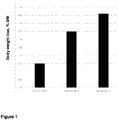
- the goal of this experiment was to assess the effects of varying potassium to sodium ratios on live body weight loss in Holstein bulls subjected to a 24-hour feed deprivation period.
- compositions 1, 2 and 3 were made according to Tables 2, 3, and 4, respectively. Specifically, the ingredients were added in the amounts prescribed into one litre of drinking water. The compositions were stirred using a milk shuttle, at ambient temperature, until all ingredients were dissolved. The total electrolyte osmolarity was 200 mosm/L for compositions 1, 2, and 3.
- Table 2 Ingredients of composition 1. Ingredients Amounts (g/L of water) Sodium Chloride (NaCl) 0.30 Sodium Carbonate (NaHCO3) 1.06 Potassium Chloride (KCI) 3.88 Magnesium salts from organic acids (MgAc) 2.43 Table 3. Ingredients of composition 2.
- composition intake weight kg of the composition before consumption ⁇ weight kg of the composition after consumption .
- the results are depicted in Figure 1 .
- the results show that bulls which received composition 1 (potassium to sodium ration of 75:25) lost less live body weight after a 24h feed deprivation period than bulls which received composition 2 (potassium to sodium ration of 40:60) and composition 3 (potassium to sodium ration of 25:75).
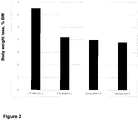
- the goal of this experiment was to assess the effects of aqueous compositions having a potassium to sodium ratio greater than one and varying total electrolyte osmolarity on live body weight loss in Holstein bulls subjected to a 48-hour feed deprivation period.
- the bulls were in individually housed in pens measuring 2.5 m x 3.5 m.
- the bulls were individually weighted twice: 1) one hour prior the onset of the feed deprivation period and 2) at the end of the feed deprivation period (i.e. at 48 h after onset).
- the percentage of body weight loss in response to 48 h feed deprivation (%BW) for each individual bull was calculated as in experiment 1.
- compositions 1 pure water
- 2, 3 and 4 were made according to Tables 6, 7, and 8, respectively. Specifically, the ingredients were added in the amounts prescribed into one litre of drinking water. The compositions were stirred using a milk shuttle, at ambient temperature, until all ingredients were dissolved. The potassium to sodium ratio was fixed at 75:25 for all compositions. Table 6.
- Ingredients of composition 2. Ingredients Amounts (g/L of water) Sodium Chloride (NaCI) 0.14 Sodium Carbonate (NaHCO3) 0.50 Potassium Chloride (KCl) 1.84 Magnesium salts from organic acids (MgAc) 1.15 Table 7. Ingredients of composition 3.
- the results are depicted in Figure 2 .
- the results show that bulls which received compositions 1, 2, or 3 (total electrolyte osmolarity of 100, 200, and 300 mosm/L, respectively) lost less live body weight after a 48h feed deprivation period than bulls which received composition 1 (total electrolyte osmolarity of 0 mosm/L).
- the results indicate that compositions having a potassium to sodium ration greater than one and in which the total electrolytes present in the composition have an osmolarity between 100 and 300 mosm/L work equally well at preventing or reducing feed deprivation-induced live body weight loss.
- the goal of this experiment was to assess whether varying the amount of glycerol in the compositions according to the invention (i.e. having a potassium to sodium molar ratio greater than one) influenced the effect of the composition as taught herein on live body weight loss in Holstein bulls subjected to a 48h feed deprivation.
- compositions 1, 2, and 3 were made according to Table 2 above. An amount of 20 ml/L and 40/L ml of glycerol was added to compositions 2 and 3, respectively. No glycerol was added to composition 1.
- composition intake weight kg of the composition before consumption ⁇ weight kg of the composition after consumption .
- the results are depicted in Figure 3 .
- the results show that bulls, which received compositions 2 or 4 (comprising 2% and 4% glycerol, respectively) lost less live body weight after a 48h feed deprivation period than bulls which received composition 1 (comprising 0% glycerol).
- the results indicate that aqueous compositions having a potassium to sodium ration greater than one, and which further comprise glycerol, work better at preventing or minimizing feed deprivation-induced live body weight loss than compositions having a potassium to sodium ration greater than one but devoid of glycerol.
- the goal of this experiment was to compare feed deprivation-induced live body weight loss and carcass weight loss in Holstein bulls administered with the composition as taught herein compared to Holstein bulls administered with drinking water.
- Composition 2 was made according to Table 2 above. An amount of 20 ml/L of glycerol was added to composition 2. Composition 1 consisted of pure drinking water.
- the results are depicted in Figures 4 and 5 .
- the results show that bulls which received composition 2 lost less live body weight after a 48h feed deprivation period than bulls, which received composition 1 (see Figure 4 ).
- the results also show that after slaughter, carcass weight was higher in bulls, which received composition 2 prior to slaughter compared to bulls which received composition 1 prior to slaughter (see Figure 5 ).
Landscapes
- Life Sciences & Earth Sciences (AREA)
- Chemical & Material Sciences (AREA)
- Health & Medical Sciences (AREA)
- Polymers & Plastics (AREA)
- Animal Husbandry (AREA)
- Food Science & Technology (AREA)
- Engineering & Computer Science (AREA)
- Zoology (AREA)
- Epidemiology (AREA)
- Public Health (AREA)
- Veterinary Medicine (AREA)
- General Health & Medical Sciences (AREA)
- Animal Behavior & Ethology (AREA)
- Pharmacology & Pharmacy (AREA)
- Medicinal Chemistry (AREA)
- Inorganic Chemistry (AREA)
- Birds (AREA)
- Proteomics, Peptides & Aminoacids (AREA)
- Molecular Biology (AREA)
- Fodder In General (AREA)
- Pharmaceuticals Containing Other Organic And Inorganic Compounds (AREA)
- Agricultural Chemicals And Associated Chemicals (AREA)
Claims (12)
- Composition aqueuse pour un animal d'élevage comprenant du potassium et du sodium, dans laquelle le rapport potassium/sodium est dans la plage allant d'environ 65:35 à environ 95:05, et dans laquelle la composition a une osmolarité supérieure à environ 100 mosm/L et inférieure à environ 320 mosm/L, et dans laquelle la composition comprend un agent alcalinisant.
- Composition selon la revendication 1, comprenant en outre un ou plusieurs électrolytes choisis parmi le magnésium, le calcium, le chlorure, le bicarbonate, l'acétate, le propionate, le sulfate et le phosphate.
- Composition selon la revendication 1 ou 2, comprenant en outre un ou plusieurs précurseurs gluconéogènes.
- Composition selon l'une quelconque des revendications précédentes, dans laquelle le précurseur gluconéogène est choisi parmi le glycérol, le propylène glycol, le dextrose, le lactate, un acide aminé glucogénique et le sucre, et est de préférence le glycérol.
- Composition selon l'une quelconque des revendications précédentes, dans laquelle l'agent alcalinisant est choisi parmi les anions propionate, bicarbonate, citrate, carbonate, lactate, acétate et propionate, de préférence les anions acétate et/ou propionate.
- Concentré approprié pour la préparation de la composition selon l'une quelconque des revendications précédentes qui, lorsqu'il est dilué dans de l'eau, fournit une composition selon l'une quelconque des revendications 1 à 5.
- Concentré selon la revendication 6, qui est environ 5 à 30 fois, de préférence environ 20 fois, plus concentré que la composition selon l'une quelconque des revendications 1 à 5.
- Procédé non thérapeutique pour prévenir ou réduire la perte de poids corporel chez des animaux d'élevage soumis à une privation d'aliments, comprenant l'étape de :- administrer audit animal d'élevage une quantité efficace d'une composition aqueuse selon l'une quelconque des revendications 1 à 5, au début de et/ou pendant une période de privation d'aliments et/ou après la fin d'une période de privation d'aliments.
- Procédé selon la revendication 8, dans lequel la période de privation d'aliments est d'environ 0,05 à 72 heures, de préférence d'environ 1 à 48 heures, comme environ 5 à 72 heures ou environ 12 à 48 heures.
- Procédé selon l'une quelconque des revendications 8 à 9, dans lequel la période de privation d'aliments se situe avant abattage ou avant transport d'un emplacement à un autre emplacement ou pendant transport d'un emplacement à un autre emplacement.
- Procédé non-thérapeutique pour réduire la perte de poids d'une carcasse et/ou pour réduire la dégradation de la qualité d'une viande comprenant l'étape de:- administrer à un animal d'élevage une quantité efficace d'une composition aqueuse l'une quelconque des revendications 1 à 5 au cours d'une période allant d'environ 5 à environ 72 heures, de préférence d'environ 12 à environ 48 heures avant abattage ou dans une période allant d'environ 0,05 à environ 72 heures, de préférence d'environ 1 à environ 48 heures avant transport d'un emplacement à un autre emplacement ; ou d'environ 0,05 à environ 72 heures, de préférence d'environ 1 à environ 48 heures après transport d'un emplacement à un autre emplacement ; ou dans une période au cours d'un transport d'un endroit à un autre endroit.
- Composition aqueuse selon l'une quelconque des revendications 1 à 5, pour utilisation dans la prévention ou la minimisation de la détérioration du bien-être ou de la santé d'un animal d'élevage, dans laquelle la composition aqueuse est administrée dans une période allant d'environ 0,05 à environ 72 heures avant transport d'un emplacement à un autre emplacement, ou dans une période allant d'environ 0,05 à environ 72 heures après transport d'un emplacement à un autre emplacement ; ou dans une période au cours d'un transport d'un emplacement à un autre emplacement.
Applications Claiming Priority (2)
| Application Number | Priority Date | Filing Date | Title |
|---|---|---|---|
| NL2016909 | 2016-06-07 | ||
| PCT/NL2017/050376 WO2017213502A1 (fr) | 2016-06-07 | 2017-06-07 | Composition aqueuse pour animaux d'élevage |
Publications (2)
| Publication Number | Publication Date |
|---|---|
| EP3462903A1 EP3462903A1 (fr) | 2019-04-10 |
| EP3462903B1 true EP3462903B1 (fr) | 2022-08-03 |
Family
ID=56889166
Family Applications (1)
| Application Number | Title | Priority Date | Filing Date |
|---|---|---|---|
| EP17732254.2A Active EP3462903B1 (fr) | 2016-06-07 | 2017-06-07 | Composition aqueuse pour animaux d'élevage |
Country Status (8)
| Country | Link |
|---|---|
| US (2) | US11207346B2 (fr) |
| EP (1) | EP3462903B1 (fr) |
| CN (1) | CN109561713A (fr) |
| BR (1) | BR112018075184B1 (fr) |
| ES (1) | ES2933678T3 (fr) |
| MX (1) | MX391751B (fr) |
| PL (1) | PL3462903T4 (fr) |
| WO (1) | WO2017213502A1 (fr) |
Families Citing this family (1)
| Publication number | Priority date | Publication date | Assignee | Title |
|---|---|---|---|---|
| EP3462903B1 (fr) * | 2016-06-07 | 2022-08-03 | Nutreco IP Assets B.V. | Composition aqueuse pour animaux d'élevage |
Family Cites Families (12)
| Publication number | Priority date | Publication date | Assignee | Title |
|---|---|---|---|---|
| US3241974A (en) * | 1963-07-24 | 1966-03-22 | Haver Lockhart Lab Inc | Method of minimizing weight loss in animals during transportation, slaughter and aging |
| US5089477A (en) * | 1988-07-29 | 1992-02-18 | University Of Florida | Compositions and methods for achieving improved physiological response to exercise |
| US5466680A (en) * | 1992-03-26 | 1995-11-14 | Cytologics, Inc. | Method and compositions for enhancing white blood cell functioning on a mucosal or cutaneous surface |
| US5505968A (en) * | 1993-07-02 | 1996-04-09 | Her Majesty The Queen In Right Of Canada, As Represented By The Department Of Agriculture | Antemortem nutrient supplement for livestock |
| US6485764B2 (en) * | 2000-01-25 | 2002-11-26 | Robert A. Robergs | Hydrating beverages and method |
| US6299913B1 (en) * | 2000-07-25 | 2001-10-09 | Church & Dwight Co., Inc. | Macromineral dietary factors in ruminant nutrition |
| US6682762B2 (en) * | 2001-10-09 | 2004-01-27 | Heart-O-Dixie Animal Nutrition, Llc | Poultry and livestock feed additive |
| WO2004047553A1 (fr) | 2002-11-25 | 2004-06-10 | R.A.T.E., Llc | Supplement alimentaire pour betail et methode d'utilisation |
| US20050095271A1 (en) * | 2003-10-23 | 2005-05-05 | Crank Sports, Inc. | Electrolyte Energy Gel |
| US7906160B2 (en) * | 2004-10-07 | 2011-03-15 | Next Proteins, Inc. | Protein beverage and method of making the same |
| EP1916907B1 (fr) * | 2005-07-15 | 2012-03-14 | Fisher Feeds Limited | Aliments pour animaux |
| EP3462903B1 (fr) * | 2016-06-07 | 2022-08-03 | Nutreco IP Assets B.V. | Composition aqueuse pour animaux d'élevage |
-
2017
- 2017-06-07 EP EP17732254.2A patent/EP3462903B1/fr active Active
- 2017-06-07 ES ES17732254T patent/ES2933678T3/es active Active
- 2017-06-07 WO PCT/NL2017/050376 patent/WO2017213502A1/fr not_active Ceased
- 2017-06-07 BR BR112018075184-7A patent/BR112018075184B1/pt active IP Right Grant
- 2017-06-07 CN CN201780049221.XA patent/CN109561713A/zh active Pending
- 2017-06-07 MX MX2018015160A patent/MX391751B/es unknown
- 2017-06-07 PL PL17732254.2T patent/PL3462903T4/pl unknown
- 2017-06-07 US US16/306,404 patent/US11207346B2/en active Active
-
2021
- 2021-11-29 US US17/536,674 patent/US20220079979A1/en not_active Abandoned
Also Published As
| Publication number | Publication date |
|---|---|
| MX2018015160A (es) | 2019-08-16 |
| US20200316106A1 (en) | 2020-10-08 |
| BR112018075184B1 (pt) | 2022-08-02 |
| PL3462903T3 (pl) | 2023-02-06 |
| BR112018075184A2 (pt) | 2019-03-26 |
| ES2933678T3 (es) | 2023-02-13 |
| MX391751B (es) | 2025-03-21 |
| WO2017213502A1 (fr) | 2017-12-14 |
| EP3462903A1 (fr) | 2019-04-10 |
| US11207346B2 (en) | 2021-12-28 |
| CN109561713A (zh) | 2019-04-02 |
| US20220079979A1 (en) | 2022-03-17 |
| PL3462903T4 (pl) | 2023-02-06 |
Similar Documents
| Publication | Publication Date | Title |
|---|---|---|
| Schweigel et al. | Magnesium transport in the gastrointestinal tract | |
| DE60220640T2 (de) | Rehydratisierungs-zusammensetzung | |
| US4839347A (en) | Composition for treating dehydration | |
| RU2490931C2 (ru) | Препарат для улучшения здоровья и продуктивности сельскохозяйственных животных и птиц, в т.ч. в условиях стрессовой нагрузки, и способ его применения | |
| US20220079979A1 (en) | Aqueous composition for livestock animals | |
| EP2094116B1 (fr) | Préparation alcaline solide ou aqueuse comprenant un composant de créatine, leur procédé de fabrication et leur utilisation | |
| Ortolani et al. | Ammonia toxicity from urea in a Brazilian dairy goat flock | |
| Aremmt et al. | Study the Role of Selenium or Zinc as Organic form on some Antioxidant and Liver Enzymes of Rams | |
| HU187467B (en) | Method for producing preparation suitable for preventing health deterioration of alimentary origin promoting the utilization of fodder of animals | |
| EP1776956B1 (fr) | Agent préventif et/ou thérapeutique pour la calcipénie | |
| RU2441650C1 (ru) | Способ лечения бронхопневмонии у телят | |
| EP0114104B1 (fr) | Composition riche en énergie pour l'administration orale et solution pour combattre la diarrhée chez les mammifères | |
| AU2019101209A4 (en) | Compositions for Administration to Ruminant Animals | |
| RU2791325C1 (ru) | Лечебно-профилактическое средство для сельскохозяйственных животных | |
| RU2702658C1 (ru) | Инъекционное средство для лечения и профилактики заболеваний печени у животных | |
| RU2851818C2 (ru) | Кормовой концентрат | |
| Smith | Fluid therapy in adult cattle. | |
| Abbott | Clinical aspects of trace element and vitamin nutrition | |
| JPS61280239A (ja) | 反すう動物の輸送、移動方法 | |
| RU2752956C1 (ru) | Способ повышения неспецифической резистентности организма телят | |
| AU2019101215A4 (en) | Compositions for Administration to Ruminant Animals | |
| RU2549291C1 (ru) | Вода для кошек и собак | |
| CH722032A2 (de) | Energy Drink mit Atomarem Aktivem Mikroclusterisiertem Wasserstoff-Wasser, mit Vitaminen, Mineralstoffen und Spurenelementen, Lithiumcarbonat, L-Citrullinmalat, Taurin, L-Argenin, Creatin, Betanin, Stevia... | |
| AU2020204386A1 (en) | Injectable trace mineral supplement containing vitamin B12 | |
| JP2008546834A (ja) | セレンの豊富な食品の生産用の非経口投与セレノメチオニン |
Legal Events
| Date | Code | Title | Description |
|---|---|---|---|
| STAA | Information on the status of an ep patent application or granted ep patent |
Free format text: STATUS: UNKNOWN |
|
| STAA | Information on the status of an ep patent application or granted ep patent |
Free format text: STATUS: THE INTERNATIONAL PUBLICATION HAS BEEN MADE |
|
| PUAI | Public reference made under article 153(3) epc to a published international application that has entered the european phase |
Free format text: ORIGINAL CODE: 0009012 |
|
| STAA | Information on the status of an ep patent application or granted ep patent |
Free format text: STATUS: REQUEST FOR EXAMINATION WAS MADE |
|
| 17P | Request for examination filed |
Effective date: 20190107 |
|
| AK | Designated contracting states |
Kind code of ref document: A1 Designated state(s): AL AT BE BG CH CY CZ DE DK EE ES FI FR GB GR HR HU IE IS IT LI LT LU LV MC MK MT NL NO PL PT RO RS SE SI SK SM TR |
|
| AX | Request for extension of the european patent |
Extension state: BA ME |
|
| DAV | Request for validation of the european patent (deleted) | ||
| DAX | Request for extension of the european patent (deleted) | ||
| STAA | Information on the status of an ep patent application or granted ep patent |
Free format text: STATUS: EXAMINATION IS IN PROGRESS |
|
| 17Q | First examination report despatched |
Effective date: 20200103 |
|
| 17Q | First examination report despatched |
Effective date: 20200115 |
|
| GRAP | Despatch of communication of intention to grant a patent |
Free format text: ORIGINAL CODE: EPIDOSNIGR1 |
|
| STAA | Information on the status of an ep patent application or granted ep patent |
Free format text: STATUS: GRANT OF PATENT IS INTENDED |
|
| RIC1 | Information provided on ipc code assigned before grant |
Ipc: A23K 20/10 20160101AFI20210614BHEP Ipc: A23K 20/22 20160101ALI20210614BHEP Ipc: A23K 20/142 20160101ALI20210614BHEP Ipc: A23K 20/163 20160101ALI20210614BHEP Ipc: A23K 50/10 20160101ALI20210614BHEP Ipc: A23K 50/75 20160101ALI20210614BHEP |
|
| INTG | Intention to grant announced |
Effective date: 20210719 |
|
| GRAJ | Information related to disapproval of communication of intention to grant by the applicant or resumption of examination proceedings by the epo deleted |
Free format text: ORIGINAL CODE: EPIDOSDIGR1 |
|
| STAA | Information on the status of an ep patent application or granted ep patent |
Free format text: STATUS: EXAMINATION IS IN PROGRESS |
|
| INTC | Intention to grant announced (deleted) | ||
| GRAS | Grant fee paid |
Free format text: ORIGINAL CODE: EPIDOSNIGR3 |
|
| STAA | Information on the status of an ep patent application or granted ep patent |
Free format text: STATUS: GRANT OF PATENT IS INTENDED |
|
| GRAP | Despatch of communication of intention to grant a patent |
Free format text: ORIGINAL CODE: EPIDOSNIGR1 |
|
| INTG | Intention to grant announced |
Effective date: 20220107 |
|
| RAP1 | Party data changed (applicant data changed or rights of an application transferred) |
Owner name: NUTRECO IP ASSETS B.V. |
|
| GRAA | (expected) grant |
Free format text: ORIGINAL CODE: 0009210 |
|
| STAA | Information on the status of an ep patent application or granted ep patent |
Free format text: STATUS: THE PATENT HAS BEEN GRANTED |
|
| AK | Designated contracting states |
Kind code of ref document: B1 Designated state(s): AL AT BE BG CH CY CZ DE DK EE ES FI FR GB GR HR HU IE IS IT LI LT LU LV MC MK MT NL NO PL PT RO RS SE SI SK SM TR |
|
| REG | Reference to a national code |
Ref country code: AT Ref legal event code: REF Ref document number: 1508028 Country of ref document: AT Kind code of ref document: T Effective date: 20220815 Ref country code: CH Ref legal event code: EP |
|
| REG | Reference to a national code |
Ref country code: DE Ref legal event code: R096 Ref document number: 602017060167 Country of ref document: DE |
|
| REG | Reference to a national code |
Ref country code: IE Ref legal event code: FG4D |
|
| REG | Reference to a national code |
Ref country code: NL Ref legal event code: FP |
|
| REG | Reference to a national code |
Ref country code: LT Ref legal event code: MG9D |
|
| PG25 | Lapsed in a contracting state [announced via postgrant information from national office to epo] |
Ref country code: SE Free format text: LAPSE BECAUSE OF FAILURE TO SUBMIT A TRANSLATION OF THE DESCRIPTION OR TO PAY THE FEE WITHIN THE PRESCRIBED TIME-LIMIT Effective date: 20220803 Ref country code: RS Free format text: LAPSE BECAUSE OF FAILURE TO SUBMIT A TRANSLATION OF THE DESCRIPTION OR TO PAY THE FEE WITHIN THE PRESCRIBED TIME-LIMIT Effective date: 20220803 Ref country code: PT Free format text: LAPSE BECAUSE OF FAILURE TO SUBMIT A TRANSLATION OF THE DESCRIPTION OR TO PAY THE FEE WITHIN THE PRESCRIBED TIME-LIMIT Effective date: 20221205 Ref country code: NO Free format text: LAPSE BECAUSE OF FAILURE TO SUBMIT A TRANSLATION OF THE DESCRIPTION OR TO PAY THE FEE WITHIN THE PRESCRIBED TIME-LIMIT Effective date: 20221103 Ref country code: LV Free format text: LAPSE BECAUSE OF FAILURE TO SUBMIT A TRANSLATION OF THE DESCRIPTION OR TO PAY THE FEE WITHIN THE PRESCRIBED TIME-LIMIT Effective date: 20220803 Ref country code: LT Free format text: LAPSE BECAUSE OF FAILURE TO SUBMIT A TRANSLATION OF THE DESCRIPTION OR TO PAY THE FEE WITHIN THE PRESCRIBED TIME-LIMIT Effective date: 20220803 Ref country code: FI Free format text: LAPSE BECAUSE OF FAILURE TO SUBMIT A TRANSLATION OF THE DESCRIPTION OR TO PAY THE FEE WITHIN THE PRESCRIBED TIME-LIMIT Effective date: 20220803 |
|
| REG | Reference to a national code |
Ref country code: ES Ref legal event code: FG2A Ref document number: 2933678 Country of ref document: ES Kind code of ref document: T3 Effective date: 20230213 |
|
| REG | Reference to a national code |
Ref country code: AT Ref legal event code: MK05 Ref document number: 1508028 Country of ref document: AT Kind code of ref document: T Effective date: 20220803 |
|
| PG25 | Lapsed in a contracting state [announced via postgrant information from national office to epo] |
Ref country code: IS Free format text: LAPSE BECAUSE OF FAILURE TO SUBMIT A TRANSLATION OF THE DESCRIPTION OR TO PAY THE FEE WITHIN THE PRESCRIBED TIME-LIMIT Effective date: 20221203 Ref country code: HR Free format text: LAPSE BECAUSE OF FAILURE TO SUBMIT A TRANSLATION OF THE DESCRIPTION OR TO PAY THE FEE WITHIN THE PRESCRIBED TIME-LIMIT Effective date: 20220803 Ref country code: GR Free format text: LAPSE BECAUSE OF FAILURE TO SUBMIT A TRANSLATION OF THE DESCRIPTION OR TO PAY THE FEE WITHIN THE PRESCRIBED TIME-LIMIT Effective date: 20221104 |
|
| PG25 | Lapsed in a contracting state [announced via postgrant information from national office to epo] |
Ref country code: SM Free format text: LAPSE BECAUSE OF FAILURE TO SUBMIT A TRANSLATION OF THE DESCRIPTION OR TO PAY THE FEE WITHIN THE PRESCRIBED TIME-LIMIT Effective date: 20220803 Ref country code: RO Free format text: LAPSE BECAUSE OF FAILURE TO SUBMIT A TRANSLATION OF THE DESCRIPTION OR TO PAY THE FEE WITHIN THE PRESCRIBED TIME-LIMIT Effective date: 20220803 Ref country code: DK Free format text: LAPSE BECAUSE OF FAILURE TO SUBMIT A TRANSLATION OF THE DESCRIPTION OR TO PAY THE FEE WITHIN THE PRESCRIBED TIME-LIMIT Effective date: 20220803 Ref country code: CZ Free format text: LAPSE BECAUSE OF FAILURE TO SUBMIT A TRANSLATION OF THE DESCRIPTION OR TO PAY THE FEE WITHIN THE PRESCRIBED TIME-LIMIT Effective date: 20220803 Ref country code: AT Free format text: LAPSE BECAUSE OF FAILURE TO SUBMIT A TRANSLATION OF THE DESCRIPTION OR TO PAY THE FEE WITHIN THE PRESCRIBED TIME-LIMIT Effective date: 20220803 |
|
| REG | Reference to a national code |
Ref country code: DE Ref legal event code: R097 Ref document number: 602017060167 Country of ref document: DE |
|
| PG25 | Lapsed in a contracting state [announced via postgrant information from national office to epo] |
Ref country code: SK Free format text: LAPSE BECAUSE OF FAILURE TO SUBMIT A TRANSLATION OF THE DESCRIPTION OR TO PAY THE FEE WITHIN THE PRESCRIBED TIME-LIMIT Effective date: 20220803 Ref country code: EE Free format text: LAPSE BECAUSE OF FAILURE TO SUBMIT A TRANSLATION OF THE DESCRIPTION OR TO PAY THE FEE WITHIN THE PRESCRIBED TIME-LIMIT Effective date: 20220803 |
|
| PLBE | No opposition filed within time limit |
Free format text: ORIGINAL CODE: 0009261 |
|
| STAA | Information on the status of an ep patent application or granted ep patent |
Free format text: STATUS: NO OPPOSITION FILED WITHIN TIME LIMIT |
|
| P01 | Opt-out of the competence of the unified patent court (upc) registered |
Effective date: 20230508 |
|
| PG25 | Lapsed in a contracting state [announced via postgrant information from national office to epo] |
Ref country code: AL Free format text: LAPSE BECAUSE OF FAILURE TO SUBMIT A TRANSLATION OF THE DESCRIPTION OR TO PAY THE FEE WITHIN THE PRESCRIBED TIME-LIMIT Effective date: 20220803 |
|
| 26N | No opposition filed |
Effective date: 20230504 |
|
| PG25 | Lapsed in a contracting state [announced via postgrant information from national office to epo] |
Ref country code: SI Free format text: LAPSE BECAUSE OF FAILURE TO SUBMIT A TRANSLATION OF THE DESCRIPTION OR TO PAY THE FEE WITHIN THE PRESCRIBED TIME-LIMIT Effective date: 20220803 |
|
| PG25 | Lapsed in a contracting state [announced via postgrant information from national office to epo] |
Ref country code: MC Free format text: LAPSE BECAUSE OF FAILURE TO SUBMIT A TRANSLATION OF THE DESCRIPTION OR TO PAY THE FEE WITHIN THE PRESCRIBED TIME-LIMIT Effective date: 20220803 |
|
| PG25 | Lapsed in a contracting state [announced via postgrant information from national office to epo] |
Ref country code: MC Free format text: LAPSE BECAUSE OF FAILURE TO SUBMIT A TRANSLATION OF THE DESCRIPTION OR TO PAY THE FEE WITHIN THE PRESCRIBED TIME-LIMIT Effective date: 20220803 |
|
| REG | Reference to a national code |
Ref country code: CH Ref legal event code: PL |
|
| REG | Reference to a national code |
Ref country code: BE Ref legal event code: MM Effective date: 20230630 |
|
| GBPC | Gb: european patent ceased through non-payment of renewal fee |
Effective date: 20230607 |
|
| PG25 | Lapsed in a contracting state [announced via postgrant information from national office to epo] |
Ref country code: LU Free format text: LAPSE BECAUSE OF NON-PAYMENT OF DUE FEES Effective date: 20230607 |
|
| REG | Reference to a national code |
Ref country code: IE Ref legal event code: MM4A |
|
| PG25 | Lapsed in a contracting state [announced via postgrant information from national office to epo] |
Ref country code: LU Free format text: LAPSE BECAUSE OF NON-PAYMENT OF DUE FEES Effective date: 20230607 |
|
| PG25 | Lapsed in a contracting state [announced via postgrant information from national office to epo] |
Ref country code: IE Free format text: LAPSE BECAUSE OF NON-PAYMENT OF DUE FEES Effective date: 20230607 |
|
| PG25 | Lapsed in a contracting state [announced via postgrant information from national office to epo] |
Ref country code: IE Free format text: LAPSE BECAUSE OF NON-PAYMENT OF DUE FEES Effective date: 20230607 Ref country code: GB Free format text: LAPSE BECAUSE OF NON-PAYMENT OF DUE FEES Effective date: 20230607 Ref country code: CH Free format text: LAPSE BECAUSE OF NON-PAYMENT OF DUE FEES Effective date: 20230630 |
|
| PG25 | Lapsed in a contracting state [announced via postgrant information from national office to epo] |
Ref country code: FR Free format text: LAPSE BECAUSE OF NON-PAYMENT OF DUE FEES Effective date: 20230630 Ref country code: BE Free format text: LAPSE BECAUSE OF NON-PAYMENT OF DUE FEES Effective date: 20230630 |
|
| PG25 | Lapsed in a contracting state [announced via postgrant information from national office to epo] |
Ref country code: BG Free format text: LAPSE BECAUSE OF FAILURE TO SUBMIT A TRANSLATION OF THE DESCRIPTION OR TO PAY THE FEE WITHIN THE PRESCRIBED TIME-LIMIT Effective date: 20220803 |
|
| PG25 | Lapsed in a contracting state [announced via postgrant information from national office to epo] |
Ref country code: BG Free format text: LAPSE BECAUSE OF FAILURE TO SUBMIT A TRANSLATION OF THE DESCRIPTION OR TO PAY THE FEE WITHIN THE PRESCRIBED TIME-LIMIT Effective date: 20220803 |
|
| PGFP | Annual fee paid to national office [announced via postgrant information from national office to epo] |
Ref country code: PL Payment date: 20250527 Year of fee payment: 9 Ref country code: DE Payment date: 20250618 Year of fee payment: 9 |
|
| PGFP | Annual fee paid to national office [announced via postgrant information from national office to epo] |
Ref country code: NL Payment date: 20250624 Year of fee payment: 9 |
|
| PG25 | Lapsed in a contracting state [announced via postgrant information from national office to epo] |
Ref country code: CY Free format text: LAPSE BECAUSE OF FAILURE TO SUBMIT A TRANSLATION OF THE DESCRIPTION OR TO PAY THE FEE WITHIN THE PRESCRIBED TIME-LIMIT; INVALID AB INITIO Effective date: 20170607 |
|
| PG25 | Lapsed in a contracting state [announced via postgrant information from national office to epo] |
Ref country code: HU Free format text: LAPSE BECAUSE OF FAILURE TO SUBMIT A TRANSLATION OF THE DESCRIPTION OR TO PAY THE FEE WITHIN THE PRESCRIBED TIME-LIMIT; INVALID AB INITIO Effective date: 20170607 |
|
| PGFP | Annual fee paid to national office [announced via postgrant information from national office to epo] |
Ref country code: ES Payment date: 20250718 Year of fee payment: 9 |
|
| PGFP | Annual fee paid to national office [announced via postgrant information from national office to epo] |
Ref country code: IT Payment date: 20250630 Year of fee payment: 9 |
|
| PG25 | Lapsed in a contracting state [announced via postgrant information from national office to epo] |
Ref country code: TR Free format text: LAPSE BECAUSE OF FAILURE TO SUBMIT A TRANSLATION OF THE DESCRIPTION OR TO PAY THE FEE WITHIN THE PRESCRIBED TIME-LIMIT Effective date: 20220803 |