EP3463271B1 - Schonende mittel und verfahren zur oxidativen färbung mit ausgewählten dicarbonsäuren - Google Patents
Schonende mittel und verfahren zur oxidativen färbung mit ausgewählten dicarbonsäuren Download PDFInfo
- Publication number
- EP3463271B1 EP3463271B1 EP17726642.6A EP17726642A EP3463271B1 EP 3463271 B1 EP3463271 B1 EP 3463271B1 EP 17726642 A EP17726642 A EP 17726642A EP 3463271 B1 EP3463271 B1 EP 3463271B1
- Authority
- EP
- European Patent Office
- Prior art keywords
- group
- acid
- weight
- formula
- colorant
- Prior art date
- Legal status (The legal status is an assumption and is not a legal conclusion. Google has not performed a legal analysis and makes no representation as to the accuracy of the status listed.)
- Active
Links
Classifications
-
- A—HUMAN NECESSITIES
- A61—MEDICAL OR VETERINARY SCIENCE; HYGIENE
- A61K—PREPARATIONS FOR MEDICAL, DENTAL OR TOILETRY PURPOSES
- A61K8/00—Cosmetics or similar toiletry preparations
- A61K8/18—Cosmetics or similar toiletry preparations characterised by the composition
- A61K8/30—Cosmetics or similar toiletry preparations characterised by the composition containing organic compounds
- A61K8/33—Cosmetics or similar toiletry preparations characterised by the composition containing organic compounds containing oxygen
- A61K8/34—Alcohols
- A61K8/347—Phenols
-
- A—HUMAN NECESSITIES
- A61—MEDICAL OR VETERINARY SCIENCE; HYGIENE
- A61K—PREPARATIONS FOR MEDICAL, DENTAL OR TOILETRY PURPOSES
- A61K8/00—Cosmetics or similar toiletry preparations
- A61K8/18—Cosmetics or similar toiletry preparations characterised by the composition
- A61K8/30—Cosmetics or similar toiletry preparations characterised by the composition containing organic compounds
- A61K8/33—Cosmetics or similar toiletry preparations characterised by the composition containing organic compounds containing oxygen
- A61K8/36—Carboxylic acids; Salts or anhydrides thereof
- A61K8/362—Polycarboxylic acids
-
- A—HUMAN NECESSITIES
- A61—MEDICAL OR VETERINARY SCIENCE; HYGIENE
- A61K—PREPARATIONS FOR MEDICAL, DENTAL OR TOILETRY PURPOSES
- A61K8/00—Cosmetics or similar toiletry preparations
- A61K8/18—Cosmetics or similar toiletry preparations characterised by the composition
- A61K8/19—Cosmetics or similar toiletry preparations characterised by the composition containing inorganic ingredients
- A61K8/22—Peroxides; Oxygen; Ozone
-
- A—HUMAN NECESSITIES
- A61—MEDICAL OR VETERINARY SCIENCE; HYGIENE
- A61K—PREPARATIONS FOR MEDICAL, DENTAL OR TOILETRY PURPOSES
- A61K8/00—Cosmetics or similar toiletry preparations
- A61K8/18—Cosmetics or similar toiletry preparations characterised by the composition
- A61K8/19—Cosmetics or similar toiletry preparations characterised by the composition containing inorganic ingredients
- A61K8/25—Silicon; Compounds thereof
-
- A—HUMAN NECESSITIES
- A61—MEDICAL OR VETERINARY SCIENCE; HYGIENE
- A61K—PREPARATIONS FOR MEDICAL, DENTAL OR TOILETRY PURPOSES
- A61K8/00—Cosmetics or similar toiletry preparations
- A61K8/18—Cosmetics or similar toiletry preparations characterised by the composition
- A61K8/30—Cosmetics or similar toiletry preparations characterised by the composition containing organic compounds
- A61K8/33—Cosmetics or similar toiletry preparations characterised by the composition containing organic compounds containing oxygen
- A61K8/36—Carboxylic acids; Salts or anhydrides thereof
- A61K8/365—Hydroxycarboxylic acids; Ketocarboxylic acids
-
- A—HUMAN NECESSITIES
- A61—MEDICAL OR VETERINARY SCIENCE; HYGIENE
- A61K—PREPARATIONS FOR MEDICAL, DENTAL OR TOILETRY PURPOSES
- A61K8/00—Cosmetics or similar toiletry preparations
- A61K8/18—Cosmetics or similar toiletry preparations characterised by the composition
- A61K8/30—Cosmetics or similar toiletry preparations characterised by the composition containing organic compounds
- A61K8/40—Cosmetics or similar toiletry preparations characterised by the composition containing organic compounds containing nitrogen
- A61K8/41—Amines
-
- A—HUMAN NECESSITIES
- A61—MEDICAL OR VETERINARY SCIENCE; HYGIENE
- A61K—PREPARATIONS FOR MEDICAL, DENTAL OR TOILETRY PURPOSES
- A61K8/00—Cosmetics or similar toiletry preparations
- A61K8/18—Cosmetics or similar toiletry preparations characterised by the composition
- A61K8/30—Cosmetics or similar toiletry preparations characterised by the composition containing organic compounds
- A61K8/40—Cosmetics or similar toiletry preparations characterised by the composition containing organic compounds containing nitrogen
- A61K8/41—Amines
- A61K8/415—Aminophenols
-
- A—HUMAN NECESSITIES
- A61—MEDICAL OR VETERINARY SCIENCE; HYGIENE
- A61K—PREPARATIONS FOR MEDICAL, DENTAL OR TOILETRY PURPOSES
- A61K8/00—Cosmetics or similar toiletry preparations
- A61K8/18—Cosmetics or similar toiletry preparations characterised by the composition
- A61K8/30—Cosmetics or similar toiletry preparations characterised by the composition containing organic compounds
- A61K8/40—Cosmetics or similar toiletry preparations characterised by the composition containing organic compounds containing nitrogen
- A61K8/44—Aminocarboxylic acids or derivatives thereof, e.g. aminocarboxylic acids containing sulfur; Salts; Esters or N-acylated derivatives thereof
-
- A—HUMAN NECESSITIES
- A61—MEDICAL OR VETERINARY SCIENCE; HYGIENE
- A61K—PREPARATIONS FOR MEDICAL, DENTAL OR TOILETRY PURPOSES
- A61K8/00—Cosmetics or similar toiletry preparations
- A61K8/18—Cosmetics or similar toiletry preparations characterised by the composition
- A61K8/30—Cosmetics or similar toiletry preparations characterised by the composition containing organic compounds
- A61K8/40—Cosmetics or similar toiletry preparations characterised by the composition containing organic compounds containing nitrogen
- A61K8/44—Aminocarboxylic acids or derivatives thereof, e.g. aminocarboxylic acids containing sulfur; Salts; Esters or N-acylated derivatives thereof
- A61K8/447—Aminocarboxylic acids or derivatives thereof, e.g. aminocarboxylic acids containing sulfur; Salts; Esters or N-acylated derivatives thereof containing sulfur
-
- A—HUMAN NECESSITIES
- A61—MEDICAL OR VETERINARY SCIENCE; HYGIENE
- A61K—PREPARATIONS FOR MEDICAL, DENTAL OR TOILETRY PURPOSES
- A61K8/00—Cosmetics or similar toiletry preparations
- A61K8/18—Cosmetics or similar toiletry preparations characterised by the composition
- A61K8/30—Cosmetics or similar toiletry preparations characterised by the composition containing organic compounds
- A61K8/46—Cosmetics or similar toiletry preparations characterised by the composition containing organic compounds containing sulfur
- A61K8/463—Cosmetics or similar toiletry preparations characterised by the composition containing organic compounds containing sulfur containing sulfuric acid derivatives, e.g. sodium lauryl sulfate
-
- A—HUMAN NECESSITIES
- A61—MEDICAL OR VETERINARY SCIENCE; HYGIENE
- A61K—PREPARATIONS FOR MEDICAL, DENTAL OR TOILETRY PURPOSES
- A61K8/00—Cosmetics or similar toiletry preparations
- A61K8/18—Cosmetics or similar toiletry preparations characterised by the composition
- A61K8/30—Cosmetics or similar toiletry preparations characterised by the composition containing organic compounds
- A61K8/46—Cosmetics or similar toiletry preparations characterised by the composition containing organic compounds containing sulfur
- A61K8/466—Cosmetics or similar toiletry preparations characterised by the composition containing organic compounds containing sulfur containing sulfonic acid derivatives; Salts
-
- A—HUMAN NECESSITIES
- A61—MEDICAL OR VETERINARY SCIENCE; HYGIENE
- A61K—PREPARATIONS FOR MEDICAL, DENTAL OR TOILETRY PURPOSES
- A61K8/00—Cosmetics or similar toiletry preparations
- A61K8/18—Cosmetics or similar toiletry preparations characterised by the composition
- A61K8/30—Cosmetics or similar toiletry preparations characterised by the composition containing organic compounds
- A61K8/49—Cosmetics or similar toiletry preparations characterised by the composition containing organic compounds containing heterocyclic compounds
- A61K8/4906—Cosmetics or similar toiletry preparations characterised by the composition containing organic compounds containing heterocyclic compounds with one nitrogen as the only hetero atom
- A61K8/4913—Cosmetics or similar toiletry preparations characterised by the composition containing organic compounds containing heterocyclic compounds with one nitrogen as the only hetero atom having five membered rings, e.g. pyrrolidone carboxylic acid
-
- A—HUMAN NECESSITIES
- A61—MEDICAL OR VETERINARY SCIENCE; HYGIENE
- A61K—PREPARATIONS FOR MEDICAL, DENTAL OR TOILETRY PURPOSES
- A61K8/00—Cosmetics or similar toiletry preparations
- A61K8/18—Cosmetics or similar toiletry preparations characterised by the composition
- A61K8/72—Cosmetics or similar toiletry preparations characterised by the composition containing organic macromolecular compounds
- A61K8/81—Cosmetics or similar toiletry preparations characterised by the composition containing organic macromolecular compounds obtained by reactions involving only carbon-to-carbon unsaturated bonds
- A61K8/817—Compositions of homopolymers or copolymers of compounds having one or more unsaturated aliphatic radicals, each having only one carbon-to-carbon double bond, and at least one being terminated by a single or double bond to nitrogen or by a heterocyclic ring containing nitrogen; Compositions or derivatives of such polymers, e.g. vinylimidazol, vinylcaprolactame, allylamines (Polyquaternium 6)
- A61K8/8182—Copolymers of vinyl-pyrrolidones. Compositions of derivatives of such polymers
-
- A—HUMAN NECESSITIES
- A61—MEDICAL OR VETERINARY SCIENCE; HYGIENE
- A61Q—SPECIFIC USE OF COSMETICS OR SIMILAR TOILETRY PREPARATIONS
- A61Q5/00—Preparations for care of the hair
- A61Q5/08—Preparations for bleaching the hair
-
- A—HUMAN NECESSITIES
- A61—MEDICAL OR VETERINARY SCIENCE; HYGIENE
- A61Q—SPECIFIC USE OF COSMETICS OR SIMILAR TOILETRY PREPARATIONS
- A61Q5/00—Preparations for care of the hair
- A61Q5/10—Preparations for permanently dyeing the hair
-
- A—HUMAN NECESSITIES
- A61—MEDICAL OR VETERINARY SCIENCE; HYGIENE
- A61K—PREPARATIONS FOR MEDICAL, DENTAL OR TOILETRY PURPOSES
- A61K2800/00—Properties of cosmetic compositions or active ingredients thereof or formulation aids used therein and process related aspects
- A61K2800/40—Chemical, physico-chemical or functional or structural properties of particular ingredients
- A61K2800/42—Colour properties
- A61K2800/43—Pigments; Dyes
- A61K2800/432—Direct dyes
- A61K2800/4322—Direct dyes in preparations for temporarily coloring the hair further containing an oxidizing agent
-
- A—HUMAN NECESSITIES
- A61—MEDICAL OR VETERINARY SCIENCE; HYGIENE
- A61K—PREPARATIONS FOR MEDICAL, DENTAL OR TOILETRY PURPOSES
- A61K2800/00—Properties of cosmetic compositions or active ingredients thereof or formulation aids used therein and process related aspects
- A61K2800/40—Chemical, physico-chemical or functional or structural properties of particular ingredients
- A61K2800/42—Colour properties
- A61K2800/43—Pigments; Dyes
- A61K2800/432—Direct dyes
- A61K2800/4324—Direct dyes in preparations for permanently dyeing the hair
-
- A—HUMAN NECESSITIES
- A61—MEDICAL OR VETERINARY SCIENCE; HYGIENE
- A61K—PREPARATIONS FOR MEDICAL, DENTAL OR TOILETRY PURPOSES
- A61K2800/00—Properties of cosmetic compositions or active ingredients thereof or formulation aids used therein and process related aspects
- A61K2800/40—Chemical, physico-chemical or functional or structural properties of particular ingredients
- A61K2800/59—Mixtures
-
- A—HUMAN NECESSITIES
- A61—MEDICAL OR VETERINARY SCIENCE; HYGIENE
- A61K—PREPARATIONS FOR MEDICAL, DENTAL OR TOILETRY PURPOSES
- A61K2800/00—Properties of cosmetic compositions or active ingredients thereof or formulation aids used therein and process related aspects
- A61K2800/80—Process related aspects concerning the preparation of the cosmetic composition or the storage or application thereof
- A61K2800/88—Two- or multipart kits
- A61K2800/882—Mixing prior to application
Definitions
- the present invention relates to an agent for oxidative hair coloring that is gentle on the hair and a gentle method for oxidative hair coloring in which keratinic fibers are protected from oxidative influences or oxidative hair damage is repaired.
- the aggressive agents can damage the keratin fibers.
- the natural hydrophobicity of the keratin fibers is reduced, since the colorants first have to make the hair capable of penetrating in order to develop their effect.
- the water-repellent effect is a natural protection of the hair, on the other hand, parameters desired by the consumer, such as shine, suppleness, feel and "fall" of the hair are closely linked to it.
- pre-treatment agents are on the market, which are intended to protect the hair from aggressive influences.
- these often weigh down the hair or impair the success of the subsequent lightening or coloring of the hair.
- the wash fastness of the dyeing can be impaired by the pretreatment agent.
- Numerous post-treatment agents are also known which are used to attempt to repair the damage to the hair caused by the oxidative coloring treatment.
- all of these processes require a multi-stage application process, namely either an application of a further hair treatment agent before or after the dyeing. This is often perceived as a nuisance by consumers, since the oxidative dyeing treatment itself, with several work steps and an exposure time of up to 60 minutes, is very laborious.
- the present invention was based on the object of providing an agent and a method for oxidative hair coloring with a hair-protecting treatment which overcomes the disadvantages mentioned without adversely affecting the color result of the oxidative coloring treatment.
- a colorant and a method should be provided in which the hair is not weighed down and the least possible damage to the hair occurs.
- the hair protection achieved should take as little time as possible and, if possible, take place together with the dyeing step itself.
- dicarboxylic acids such as succinic acid in hair care are state of the art. These are widely used in shampoos and in particular in conditioners in order to develop care effects there.
- the patent application discloses this WO 2005/115314A1 a method for restructuring keratin fibers, in which the keratin fibers are brought into contact with cystine and with at least one dicarboxylic acid having 2 to 10 carbon atoms, preferred dicarboxylic acids being selected from oxalic acid, malonic acid, succinic acid, glutaric acid, adipic acid, pimelic acid, azelaic acid, maleic acid, Fumaric acid and sorbic acid and succinic acid is particularly preferred.
- the patent application DE10051774A1 describes the use of short-chain Carboxylic acids with a molecular weight below 750 g/mol in cosmetic products as an active ingredient for restructuring keratin fibers.
- the patent application EP1174112A discloses hair treatment compositions which, in addition to an organic acid, contain an organic solvent, a cationic surfactant and a higher alcohol as other essential ingredients and are used to repair pores in hair.
- Agents which are to be admixed to dyeing compositions for the purpose of fiber protection and which contain dicarboxylic acids have recently also become available on the market.
- no further hair treatment agent is applied before or after the dyeing, but this agent has to be mixed with the actual dye before application, which also means a further work step and is perceived as annoying by the consumer.
- oxidative colorants with improved fiber protection can be provided if the color cream to be mixed with the developer during preparation by the customer contains at least one dicarboxylic acid with 2 to 10 carbon atoms in addition to typical components such as water and dyes or their precursors and is largely free of peroxides. This not only avoids a further work step, but these agents are also more effective in fiber protection compared to the subsequent admixture, with otherwise the same amounts of dicarboxylic acid(s) being used
- the agents according to the invention or used in the method according to the invention preferably contain at least one coupler component. Particularly beautiful colorations can be achieved if the agent contains at least one coupler component as the coupler component selected from the group consisting of 3-amino-2-methylamino-6-methoxypyridine and 3-amino-6-methylphenol , 3-amino-2-hydroxypyridine, 1,3-bis(2,4-diaminophenoxy)propane, 2,7-dihydroxynaphthalene, 2-methylresorcinol, 2,5-dimethylresorcinol, 4-chlororesorcinol, 3-amino- phenol, 2-amino-3-hydroxypyridine, 2-chloro-6-methyl-3-aminophenol, 2,6-dihydroxy-3,4-dimethylpyridine, 2-( ⁇ 3-[(2-hydroxyethyl)amino] -4-methoxy-5-methylphenyl ⁇ amino)ethanol, 2-( ⁇ 3-[(2-Hydroxyeth
- Agents that are also preferred according to the invention are characterized in that they contain at least one coupler component and/or its physiologically tolerable salt in a proportion by weight of from 0.001 to 5.0% by weight, more preferably from 0.025 to 2.5% by weight, particularly preferably from 0.05 to 2% by weight and in particular from 0.1 to 1.5% by weight, based in each case on the total weight of the ready-to-use composition.
- the agent according to the invention or used in the method according to the invention contains at least one further color-providing component which is selected from additional oxidation dye precursors of the developer type and/or substantive dyes.
- Preferred further developer components are selected from at least one compound from the group formed from p-phenylenediamine, p-tolylenediamine, 2-(2-hydroxyethyl)-p-phenylenediamine, 2-(1,2-dihydroxyethyl)-p-phenylenediamine , N,N-bis(2-hydroxyethyl)-p-phenylenediamine, 2-methoxymethyl-p-phenylenediamine, N-(4-amino-3-methylphenyl)-N-[3-(1H-imidazol-1-yl )-propyl]amine, N,N'-bis(2-hydroxyethyl)-N,N'-bis(4-aminophenyl)-1,3-diamino-propan-2-ol, bis(2-hydroxy -5-aminophenyl)methane, 1,3-bis(2,5-diaminophenoxy)propan-2-ol, N,N'-bis
- Particularly preferred additional developer components are p-toluylenediamine, 2-(2-hydroxyethyl)-p-phenylenediamine, 2-methoxymethyl-p-phenylenediamine, N-(4-amino-3-methylphenyl)-N-[3-(1H- imidazol-1-yl)propyl]-amine, and/or 4,5-diamino-1-(2-hydroxyethyl)pyrazole and their physiologically tolerable salts.
- the developer components are preferably used in an amount of 0.0001 to 10% by weight, preferably 0.001 to 5% by weight, based in each case on the ready-to-use composition.
- colorants according to the invention or used in the process according to the invention are those which, based on their weight, contain 0.05 to 5% by weight, preferably 0.1 to 4.5% by weight, more preferably 0.15 to 4 % by weight, more preferably 0.2 to 3.5% by weight and in particular 0.25 to 3% by weight of oxidation dye precursors.
- the agents according to the invention or used in the process according to the invention can contain at least one substantive dye. These are dyes that are applied directly to the hair and do not require an oxidative process to develop the color. Direct dyes are usually nitrophenylenediamines, nitroaminophenols, azo dyes, anthraquinones or indophenols.
- the substantive dyes are preferably used in an amount of from 0.001 to 20% by weight, in particular from 0.05 to 5% by weight, based in each case on the total application preparation.
- the total amount of substantive dyes is preferably at most 3% by weight.
- Direct dyes can be divided into anionic, cationic and nonionic direct dyes, which can be selected and used according to the requirements of the carrier base by those skilled in the art.
- Preferred anionic substantive dyes are those sold under the international designations or trade names Bromophenol Blue, Tetrabromophenol Blue, Acid Yellow 1, Yellow 10, Acid Yellow 23, Acid Yellow 36, Acid Orange 7, Acid Red 33, Acid Red 52, Pigment Red 57:1, Acid Blue 7, Acid Green 50, Acid Violet 43, Acid Black 1 and Acid Black 52 known compounds.
- Preferred cationic direct dyes are Basic Blue 7, Basic Blue 26, Basic Violet 2 and Basic Violet 14, Basic Yellow 57, Basic Red 76, Basic Blue 16, Basic Blue 347 (Cationic Blue 347/Dystar), Basic Blue 99, Basic Brown 16 and Basic Brown 17 as well as Yellow 87, Basic Orange 31 and Basic Red 51.
- Nonionic nitro and quinone dyes and neutral azo dyes are particularly suitable as nonionic direct dyes.
- Preferred nonionic substantive dyes are those sold under the international designations or trade names HC Yellow 2, HC Yellow 4, HC Yellow 5, HC Yellow 6, HC Yellow 12, HC Orange 1, Disperse Orange 3, HC Red 1, HC Red 3, HC Red 10, HC Red 11, HC Red 13, HC Red BN, HC Blue 2, HC Blue 11, HC Blue 12, Disperse Blue 3, HC Violet 1, Disperse Violet 1, Disperse Violet 4, Disperse Black 9 known compounds, and 1,4-diamino-2-nitrobenzene, 2-amino-4-nitrophenol, 1,4-bis(2-hydroxyethyl)amino-2-nitrobenzene, 3-nitro-4-(2-hydroxyethyl)aminophenol , 2-(2-Hydroxyethyl)amino-4,6-dinitrophenol, 4-[(2-Hydroxyethyl)amino]-3-nitro
- Preferred colorants according to the invention or colorants used in processes preferred according to the invention can also contain natural-analogous dyes.
- Compositions which are preferred according to the invention and which contain precursors of nature-analogous dyes are preferably used as air-oxidative colorants. In this embodiment, therefore, no additional oxidizing agent is added to said compositions before use.
- the dye precursors of nature-analogous dyes are preferably used in an amount of 0.001 to 5% by weight, based on the total application preparation.
- Derivatives of 5,6-dihydroxyindoline, in particular 5,6-dihydroxyindoline, N-methyl-5,6-dihydroxyindoline, N-ethyl-5,6-dihydroxyindoline, N-propyl-5,6 are particularly well suited as precursors of nature-analogous hair dyes -dihydroxyindoline, N-butyl-5,6-dihydroxyindoline and 5,6-dihydroxyindoline-2-carboxylic acid, and also derivatives of 5,6-dihydroxyindole, in particular 5,6-dihydroxyindole, N-methyl-5,6-dihydroxyindole, N-ethyl-5,6-dihydroxyindole, N-propyl-5,6-dihydroxyindole, N-
- colorants according to the invention or used in the method according to the invention are preferred which contain 0.05 to 5% by weight, preferably 0.1 to 4.5% by weight, more preferably 0.15 to 4% by weight, even further preferably 0.2 to 3.5% by weight and in particular 0.25 to 3% by weight of substantive dye(s).
- the agents used in the invention or in the method according to the invention contain 0.1 to 5% by weight, each converted to the undissociated dicarboxylic acid and based on the weight of the colorant, dicarboxylic acid(s) having 2 to 10 carbon atoms, selected from malic acid, D-tartaric, L-tartaric, meso-tartaric, tartaric, alpha-ketoglutaric, beta-ketoglutaric and oxaloacetic acid, and/or salt(s) of these acid(s), the dicarboxylic acid being selected from malic acid.
- the dicarboxylic acid mentioned makes a significant contribution to the reduced hair damage caused by the colorants according to the invention.
- the colorants according to the invention have a pH in the range from 8.5 to 11.0, preferably 10 to 10.5, measured in each case at 20.degree.
- the at least one dicarboxylic acid having 2 to 10 carbon atoms may be present as an undissociated acid, partially dissociated, or fully dissociated.
- the counterion is selected from physiologically tolerable cations, such as in particular the alkali metal, alkaline earth metal and zinc ions and ammonium ions, alkylammonium, alkanolammonium and glucammonium ions, in particular the Mono-, di- and trimethyl, ethyl and hydroxyethyl ammonium ions.
- dicarboxylic acids having 2 to 10 carbon atoms are particularly preferred as counterions for the partially or completely dissociated dicarboxylic acids having 2 to 10 carbon atoms.
- dicarboxylic acids having 2 to 10 carbon atoms and neutralized with alkaline-reacting amino acids such as, for example, arginine, lysine, ornithine and histidine, can also be used.
- the sodium, potassium, ammonium, monoethanolammonium, lysine and arginine salts and mixtures thereof are preferred salts of dicarboxylic acids having 2 to 10 carbon atoms.
- Preferred colorants according to the present invention contain the at least one dicarboxylic acid having 2 to 10 carbon atoms selected from malic acid, D-tartaric acid, L-tartaric acid, meso-tartaric acid, tartaric acid, alpha-ketoglutaric acid, beta-ketoglutaric acid and oxaloacetic acid, or one or more salts thereof in a total amount of 0.2 to 4% by weight, preferably 0.33 to 3% by weight, particularly preferably 0.5 to 2% by weight, in each case converted to the undissociated dicarboxylic acid and based on the weight of the Coloring agent, which necessarily contains malic acid.
- Coloring agents according to the invention or used in the method according to the invention are particularly preferred which contain at least one dicarboxylic acid having 2 to 10 carbon atoms selected from malic acid, D-tartaric acid, L-tartaric acid, mesotartaric acid, tartaric acid, alpha-ketoglutaric acid, beta-ketoglutaric acid and oxaloacetic acid , is contained in a total amount of 0.2 to 4% by weight, preferably 0.33 to 3% by weight, particularly preferably 0.5 to 2% by weight, in each case converted to the undissociated dicarboxylic acid and based on the weight of the colorant according to the invention, with malic acid being mandatory.
- Very particularly preferred colorants according to the invention or used in the process according to the invention contain, in each case converted to the undissociated dicarboxylic acid and based on the weight of the colorant, 0.2 to 4% by weight, preferably 0.33 to 3% by weight, particularly preferably 0.5 to 2% by weight of malic acid.
- the colorants according to the invention or used in the process according to the invention contain 20 to 95% by weight of water.
- Preferred detergents contain 30 to 90% by weight, particularly preferably 40 to 85% by weight, extremely preferably 45 to 82.5% by weight and in particular 40 to 80% by weight of water, based in each case on the total weight of the product according to the invention coloring agent.
- the colorants according to the invention or used in the process according to the invention contain less than 0.1% by weight of peroxide compound(s).
- hair colors made from agents according to the invention by adding oxidizing agent preparations are more effective in fiber protection than those made from conventional coloring creams, developers and a subsequent admixture of the dicarboxylic acid(s), with otherwise the same amounts used.
- colorants according to the invention or used in the process according to the invention even lower in peroxide.
- Particularly preferred colorants according to the invention or used in the process according to the invention contain less than 0.01% by weight, preferably less than 0.005% by weight, particularly preferably less than 0.001% by weight, of peroxide compounds and are in particular free of peroxide compounds.
- Particularly preferred colorants according to the invention or used in the process according to the invention contain less than 0.01% by weight, preferably less than 0.005% by weight, particularly preferably less than 0.001% by weight, hydrogen peroxide (calculated as 100% H 2 O 2 ). Very particularly preferred agents are completely free of hydrogen peroxide.
- Particularly preferred colorants according to the invention or used in the process according to the invention contain less than 0.01% by weight, preferably less than 0.005% by weight, particularly preferably less than 0.001% by weight, of potassium, sodium and/or ammonium persulfate. Very particularly preferred compositions are completely free from persulfates.
- the colorants according to the invention or used in the method according to the invention also contain mixtures of arginine and lysine in a total amount of 0.05 to 3% by weight, preferably 0.1 to 2% by weight, particularly preferably 0.2 to 1.2% % by weight, in each case converted to the undissociated amino acid and based on the weight of the colorant, at least one amino acid from the group arginine, lysine, histidine, asparagine, glutamine, cysteine, methionine, tryptophan and mixtures thereof in a total amount of 0.05 to 3% by weight, preferably 0.1 to 2% by weight, particularly preferably 0.2 to 1.2% by weight, converted in each case to the undissociated amino acid and based on the weight of the colorant.
- the compounds of the formula (II) to be used optionally are the Bunte salts of an amino acid, an oligopeptide or a peptide.
- the radical R1 can either represent a hydrogen atom or a structural element of the formula (IV).
- the structural element of the formula (IV) is further characterized by the repeat index x, where x is an integer from 1 to 100.
- the repeat index x indicates how many structural elements of the formula (IV) are contained in the compound of the formula (II).
- x is an integer from 1 to 50, more preferably x is an integer from 1 to 20, and most preferably x is an integer from 1 to 10.
- radical R2 in each of the structural elements of the formula (IV) can be chosen independently of the preceding structural element of the formula (IV). If the compounds of the formula (II) contain, for example, 10 structural units of the formula (IV), these 10 structural units can be the same or else different.
- the radical R2 stands for a hydrogen atom, a methyl group, an isopropyl group, a 2-methylpropyl group, a 1-methylpropyl group, a benzyl group, a 4-hydroxybenzyl group, a hydroxymethyl group, a 1-hydroxyethyl group, a 4-aminobutyl group, a 3-carbamimidamidopropyl group, a 2-carboxyethyl group, a carboxymethyl group, a 2-carbamoylethyl group, a carbamoylmethyl group, a sulfanylmethyl group, a 2-(methylsulfanyl)ethyl group, a 1H-imidazol-4-ylmethyl group, a 1H-indol-3-ylmethyl group or a (sulfosulfanyl)methyl group.
- the structural element of the formula (IV) is therefore an amino acid which is peptidically linked via its amino and/or its acid function within the compound of the formula (II).
- the amino acid is cysteine, it can also be in the form of a Bunte salt.
- the structural element of the formula (IV) is based on the amino acid glycine. If R2 is a methyl group, the structural element of formula (IV) is based on the amino acid alanine.
- the structural element of formula (IV) is based on the amino acid (H 3 C) 2 CH- valine (H 3 C) 2 CH-CH 2 - leucine H 3 C-CH 2 -CH(CH 3 )- isoleucine C6H5 - CH2- phenylalanine 4 -OH- C6H5 - CH2- tyrosine HO-CH 2 - serine H 3 C-CH(OH)- threonine H 2 N-CH 2 -CH 2 -CH 2 -CH 2 -CH 2 - lysine H 2 NC(NH)-NH-CH 2 -CH 2 -CH 2 - arginine HOOC-CH 2 -CH 2 - glutamic acid HOOC-CH 2 - aspartic acid H 2 NC(O)-CH 2 -CH 2 - glutamine H 2 NC(O)-CH 2 - asparagine HS-CH 2 - cysteine H 3 CS-
- radical R2 can also stand for a (sulfosulfanyl)methyl group, which is a Bunte salt structure of the formula HO-S(O 2 )-S-CH 2 -.
- the Bunte salt structure of the formula HO-S(O 2 )-S-CH 2 - can also exist in its deprotonated form.
- M1 represents the moiety -OM2 or represents a Structural element of formula (V)
- the structural element of the formula (V) is characterized by the repeat index y, where y is an integer from 1 to 100.
- the repetition index y indicates how many structural elements of the formula (V) are contained in the compound of the formula (II).
- y is an integer from 1 to 50, more preferably y is an integer from 1 to 20, and most preferably y is an integer from 1 to 10.
- the compound of formula (II) contains 10 structural elements of formula (V).
- radical R3 in each of the structural elements of the formula (V) can be chosen independently of the preceding structural element of the formula (V). If the compounds of the formula (II) contain, for example, 10 structural units of the formula (V), these 10 structural units can be the same or else different.
- the radical R3 stands for a hydrogen atom, a methyl group, an isopropyl group, a 2-methylpropyl group, a 1-methylpropyl group, a benzyl group, a 4-hydroxybenzyl group, a hydroxymethyl group, a 1-hydroxyethyl group, a 4-aminobutyl group, a 3- carbamimidamidopropyl group, a 2-carboxyethyl group, a carboxymethyl group, a 2-carbamoylethyl group, a carbamoylmethyl group, a sulfanylmethyl group, a 2-(methylsulfanyl)ethyl group, a 1H-imidazole 4-ylmethyl group, a 1H-indol-3-ylmethyl group or a (sulfosulfanyl)methyl group.
- the structural element of the formula (V) is therefore also an amino acid which is peptidically linked via its amino and/or its acid function within the compound of the formula (II).
- the amino acid is cysteine, it can also be in the form of a Bunte salt.
- the structural element of formula (V) is based on the amino acid -H glycine -CH 3 alanine (H 3 C) 2 CH- valine (H 3 C) 2 CH-CH 2 - leucine H 3 C-CH 2 -CH(CH 3 )- isoleucine C6H5 - CH2- phenylalanine 4 -OH- C6H5 - CH2- tyrosine HO-CH 2 - serine H 3 C-CH(OH)- threonine H 2 N-CH 2 -CH 2 -CH 2 -CH 2 -CH 2 - lysine H 2 NC(NH)-NH-CH 2 -CH 2 -CH 2 - arginine HOOC-CH 2 -CH 2 - glutamic acid HOOC-CH 2 - aspartic acid H 2 NC(O)-CH 2 -CH 2 - glutamine H 2 NC(O)-CH 2 - asparagine HS-CH 2
- radical R3 can also stand for a (sulfosulfanyl)methyl group, which is a Bunte salt structure of the formula HO-S(O 2 )-S-CH 2 -.
- the Bunte salt structure of the formula HO—S(O 2 )—S—CH 2 — can also be present here in its deprotonated form.
- the radical M2 stands for a hydrogen atom, an equivalent of a monovalent or polyvalent cation or an ammonium ion (NH 4 ) + .
- Preferred equivalents of a monovalent or polyvalent cation are, in particular, the cations of sodium and potassium (Na + or K + ) or else magnesium or calcium (1 ⁇ 2 Mg 2+ or 1 ⁇ 2 Ca 2+ ).
- the -OM2 moiety When M2 is a hydrogen atom, the -OM2 moiety is the -OH moiety. When M2 is a sodium cation, the -OM2 moiety is -ONa. When M2 is a potassium cation, the -OM2 moiety is the -OK moiety. When M2 is an ammonium ion, the -OM2 moiety is -O(NH 4 ).
- the -OM2 group is always adjacent to a carbonyl group.
- M2 is H, K, Na or ammonium
- the compound of formula (II) is therefore either in the form of an acid in its protonated form or else the sodium, potassium or ammonium salt of this acid.
- the compounds of the formula (II) according to the invention are either the Bunte salts of the amino acid cysteine, the Bunte salts of oligopeptides or the Bunte salts of peptides.
- the compound of formula (II) is the Bunte salt of the amino acid cysteine.
- the compound of formula (II) is the compound of formula (IIa), where M2 is again defined as previously described.
- the colorant according to the invention can also contain a plurality of compounds of the formula (II) as a mixture of different oligopeptides. These oligopeptides are defined by their average molecular weight.
- the average molecular weight M w of the at least one oligopeptide of the formula (II) can be determined, for example, by gel permeation chromatography (GPC) using polystyrene as an internal standard.
- the molar weight of the compound of the formula (II) used according to the invention can vary. It is particularly preferred according to the invention if the compound of formula (II) is an oligopeptide which has a molecular weight M w of 200 to 2000 Da, preferably 250 to 1500 Da, preferably 300 to 1200 Da, in particular 400 up to 800 Da.
- oligopeptide in the context of the present invention is understood as meaning condensation products of amino acids which have the molecular weights mentioned above.
- a colorant according to the invention is characterized in that it contains at least one compound of the formula (II) which is a Molecular weight M w from 200 to 2000 Da (Dalton), preferably from 250 to 1500 Da, preferably from 300 to 1200 Da, in particular from 400 to 800 Da.
- formula (II) which is a Molecular weight M w from 200 to 2000 Da (Dalton), preferably from 250 to 1500 Da, preferably from 300 to 1200 Da, in particular from 400 to 800 Da.
- a mixture of oligomers is used in the colorant according to the invention, these mixtures can be defined by their average molecular weight.
- a preferred colorant according to the invention is characterized in that it contains at least one mixture of compounds of the formula (II) which has an average molecular weight M w of from 200 to 2000 Da, preferably from 250 to 1500 Da, preferably from 300 to 1200 Da , in particular from 400 to 800 Da.
- the protective or repair effect possessed by the compounds of the formula (II) also depends on the repeat indices x and y. As previously described, it is most preferred when x is an integer from 1 to 10 and y is an integer from 1 to 10.
- the proportion of the Bunte salt units contained in the compound of the formula (II) also has a decisive influence on the effectiveness of the protective effect or “repair effect” of the compounds.
- Compounds with at least one Bunte salt unit - such as is present in the compound of formula (IIa) - are very effective, particularly when used as a monomeric compound. Oligopeptides with at least one Bunte salt unit are particularly effective if they have a low molecular weight of up to 1200, in particular 800 daltons.
- the compound of the formula (II) has at least two, preferably at least three, Bunte salt units.
- the at least one compound of the formula (II) is present in a total amount of from 0.001 to 10% by weight, based on the total weight of the colorant preferred according to the invention.
- the compound(s) of the formula (II) can bring about a very good reduction in hair damage even when used in low concentrations.
- the colorant preferred according to the invention contains one or more compounds of the formula (II) listed above in a total amount of from 0.001 to 2.5% by weight, more preferably from 0.01 to 1.0% by weight. % and particularly preferably from 0.02 to 0.1% by weight, based in each case on the weight of the colorant according to the invention.
- a colorant according to the invention is characterized in that it contains one or more compounds of the formula (II) listed above in a total amount of from 0.001 to 2.5% by weight, more preferably from 0.01 to 1.0 % by weight and particularly preferably from 0.02 to 0.1% by weight, based in each case on the weight of the colorant according to the invention.
- polymer is understood to mean polymers within the meaning of the IUPAC definition which comprise at least 10 identical constitutive units.
- the number of constitutive units in a polymer is called the degree of polymerization.
- Polymers A which are preferred according to the invention each have a degree of polymerization in the range from 40 to 1000, preferably 100 to 800, particularly preferably 350 to 650.
- Further inventively preferred polymers A with at least ten constitutive units of the formula (I) contain 40 to 1000, preferably 100 to 800, particularly preferably 350 to 650 identical constitutive units of the formula (I).
- R 1 and R 2 preferably each independently represent hydrogen or a C 2 -C 10 -acyl group, which is preferably selected from an acetyl, propanoyl or n-butanoyl group, particularly preferably selected from an acetyl group.
- Polymers A which are preferred according to the invention have at least 10 constitutive units of the formula (I) in which X represents nitrogen, the polymer A containing no permanently ionic constitutive units.
- Further polymers A which are particularly preferred according to the invention have at least 10 constitutive units of the formula (I) in which X is nitrogen and R 1 and R 2 together with X form a five- or six-membered, saturated or unsaturated ring which optionally contains further heteroatoms , which are preferably selected from N and O, and/or optionally substituted with at least one C1-C6-alkyl group and/or with at least one functional group.
- Another particularly preferred combination of substituents X, R 1 , R 2 is an ⁇ -caprolactam group, so that a particularly preferred constitutive unit of the formula (I) according to the invention is a unit of the formula (I b),
- Another particularly preferred combination of substituents X, R 1 , R 2 is an imidazole group, so that another particularly preferred unit of the formula (I) according to the invention is a unit in which X represents nitrogen and R 1 and R 2 together with this nitrogen atom form a five-membered unsaturated ring which contains nitrogen as a further heteroatom.
- polymers A preferred according to the invention have 25-100 mol%, preferably 55-100 mol%, particularly preferably 85-100 mol%, of constitutive units of the formula (I) in which X is nitrogen, where Polymer A contains no permanent ionic constituent units.
- Further polymers A preferred according to the invention have 25-100 mol %, preferably 55-100 mol %, particularly preferably 85-100 mol %, of constitutive units of the formula (I) in which X is nitrogen and R 1 and R 2 together with X form a five- or six-membered, saturated or unsaturated ring which optionally contains further heteroatoms selected from N and O and optionally substituted with at least one C1 - C6-alkyl group and/or with at least one functional group is wherein the polymer A contains no permanent ionic constitutive units.
- formula (I) in which X is nitrogen and R 1 and R 2 together with X form a five- or six-membered, saturated or unsaturated ring which optionally contains further heteroatoms selected from N and O and optionally substituted with at least one C1 - C6-alkyl group and/or with at least one functional group is wherein the polymer A contains no permanent ionic constitutive units.
- Polymers A which are particularly preferred according to the invention contain 98-100 mol % of constitutive units of the formula (Ia), where the polymer A contains no permanently ionic constitutive units.
- Polymers A that are extraordinarily preferred according to the invention contain 98-100 mol % of constitutive units of the formula (Ia) and have a degree of polymerization in the range from 40 to 1000, preferably 100 to 800, particularly preferably 350 to 650, the polymer A not having any permanent contains ionic constitutive units.
- Particularly preferred polymers A are polyvinylpyrrolidone homopolymers with a degree of polymerization in the range from 40 to 1000, preferably 100 to 800, particularly preferably 350 to 650.
- Another particularly preferred combination of substituents X, R 1 , R 2 is a constitutive unit of the formula (I) in which X is oxygen, p is zero and R 1 is hydrogen.
- Another particularly preferred combination of substituents X, R 1 , R 2 is a constitutive unit of formula (I) in which X is oxygen, p is zero and R 1 is an acetyl group.
- polymers A preferred according to the invention contain 75-92 mol % of constitutive units of the formula (I) in which X is oxygen, p is zero and R 1 is hydrogen, and 8-25 mol % of constitutive units of the formula (I) wherein X is oxygen, p is zero and R 1 is an acetyl group, wherein polymer A contains no permanent ionic constituent units.
- Further polymers A preferred according to the invention contain 40 to 1000, preferably 100 to 800, particularly preferably 350 to 650 constitutive units of the formula (I), of which 75-92 mol % are constitutive units of the formula (I) in which X is oxygen , p is zero and R 1 is hydrogen, and 8-25% by moles of constitutive units of formula (I) wherein X is oxygen, p is zero and R 1 is an acetyl group, the polymer A having no contains permanent ionic constitutive units.
- polymers A preferred according to the invention contain 65-25 mol % of constitutive units of the formula (Ia) and 35-75 mol % of constitutive units of the formula (I) in which X is oxygen, p is zero and R 1 is an acetyl group, the polymer A containing no permanent ionic constituent units.
- polymers A preferred according to the invention contain 40 to 1000, preferably 100 to 800, particularly preferably 350 to 650 constitutive units of the formula (I), of which 65-25 mol % are constitutive units of the formula (Ia) and 35-75 mol % % constitutive units of formula (I) wherein X is oxygen, p is zero and R 1 is an acetyl group, wherein polymer A contains no permanent ionic constitutive units.
- the at least one polymer A with at least ten constitutive units of the formula (I) has no permanent ionic charges.
- the constitutive units of the formula (I) it is possible for the constitutive units of the formula (I) to be ionic, in particular cationic, for example by protonation of the nitrogen atom in an acidic carrier.
- these charges are not permanent, but temporary, since they depend on the surrounding medium.
- Preferred colorants according to the invention contain at least one polymer A with at least ten constitutive units of the formula (I) in a total amount of 0.2 to 5% by weight, preferably 0.5 to 3% by weight, particularly preferably 1.0 to 2.3% by weight, based in each case on the weight of the dye.
- Colorants preferred according to the invention contain at least one permanently cationic polymer B as a further optional ingredient.
- the permanently cationic polymer preferably also contains at least one permanently anionically charged monomer type, the cationic monomers being present in a molar excess over the anionic monomers, so that the at least one second polymer according to the invention has a cationic net charge .
- Such polymers which are preferred according to the invention are also referred to as amphoteric or zwitterionic polymers.
- extremely preferred permanent cationic polymers are selected from 2-[2-hydroxy-3-(trimethylammonio)propoxy]ethylcellulose ether chloride, amphoteric copolymers with a cationic net charge, which are made from acrylamidopropyltrimethylammonium chloride and acrylic acid in a molar ratio of 60:40 to 95:5, preferably from 75 :25 to 90:10 to one another, consist of terpolymers of acrylic acid, diallyldimethylammonium chloride and acrylamide, and mixtures of two and three of these polymers.
- Particularly preferred polymer B mixtures contain 2-[2-hydroxy-3-(trimethylammonio)propoxy]ethylcellulose ether chloride and at least one amphoteric copolymer with a net cationic charge, which is composed of acrylamidopropyltrimethylammonium chloride and acrylic acid in a molar ratio of from 60:40 to 95:5, preferably from 75 :25 to 90:10 to each other.
- polymer B mixtures contain 2-[2-hydroxy-3-(trimethylammonio)propoxy]ethylcellulose ether chloride, at least one amphoteric copolymer with a net cationic charge, which is composed of acrylamidopropyltrimethylammonium chloride and acrylic acid in a molar ratio of from 60:40 to 95:5, preferably from 75:25 to 90:10 to one another, and at least one terpolymer of acrylic acid, diallyldimethylammonium chloride and acrylamide.
- Permanently cationic polymers B that are also extremely preferred according to the invention are selected from polyquaternium-10, amphoteric copolymers with a cationic net charge, which consist of acrylamidopropyltrimethylammonium chloride and acrylic acid in a molar ratio of 60:40 to 95:5, preferably 75:25 to 90:10 , and Polyquaternium-39, as well as two- and three-way blends of these polymers.
- polymer B mixtures contain polyquaternium-10 and at least one amphoteric copolymer with a net cationic charge, which consists of acrylamidopropyltrimethylammonium chloride and acrylic acid in a molar ratio of from 60:40 to 95:5, preferably from 75:25 to 90:10 to one another.
- polymer B mixtures contain polyquaternium-10 and at least one amphoteric copolymer with a net cationic charge, which consists of acrylamidopropyltrimethylammonium chloride and acrylic acid in a molar ratio of from 60:40 to 95:5, preferably from 75:25 to 90:10, and Polyquaternium-39.
- Preferred colorants according to the invention contain the at least one permanently cationic polymer B in a total amount of 0.05 to 1.5% by weight, preferably 0.1 to 1.0% by weight, particularly preferably 0.2 to 0.8% by weight .-%, based in each case on the weight of the colorant according to the invention.
- the coloring preparation according to the invention or used in the method according to the invention preferably contains at least one alkalizing agent selected from ammonium hydroxide, monoethanolamine and sodium silicates and mixtures thereof.
- a coloring agent must have a pH in the range from 6.5 to 11.0, preferably 8 to 10.5, particularly preferably 8.5 to 10, measured at 20° C. in each case .
- the outer keratin fiber layer opens optimally to absorb the oxidation dye precursors and the desired effect of the peroxide compound added via the developer emulsion unfolds optimally.
- the coloring preparations according to the invention or used in the method according to the invention have a pH in the range from 8.5 to 11.0, preferably 10 to 10.5, measured in each case at 20.degree.
- Ammonia is preferably used in the form of its aqueous solution.
- Corresponding aqueous ammonia solutions can be 10 to 35 percent solutions (calculated in % by weight, 100 g of aqueous ammonia solution accordingly contain 10 to 35 g of ammonia).
- Ammonia is preferably used in the form of a 20 to 30% by weight solution, particularly preferably in the form of a 25% by weight solution.
- the colorant according to the invention is characterized in that it contains ammonium hydroxide in an amount of from 0.20 to 2.5% by weight, preferably from 0.5 to 2.0% by weight, more preferably from 1 0 to 1.5% by weight and particularly preferably from 0.31 to 0.8% by weight, based on the total weight of the colorant according to the invention.
- preferred ones according to the invention contain coloring agent monoethanolamine.
- monoethanolamine is to be used in a total amount of 0.2-6.5% by weight, preferably 0.5-4.0% by weight, more preferably 0.7 to 2 5% by weight and particularly preferably from 0.8 to 1.6% by weight, based on the total weight of the colorant according to the invention.
- sodium silicates are chemical compounds composed of sodium oxide and silicon dioxide and which can occur in different molar ratios (monosilicate, metasilicate and polysilicate).
- An example of a sodium silicate is the sodium salt of orthosilicic acid with the molecular formula Na 4 SiO 4 , which is also referred to as sodium orthosilicate.
- suitable sodium silicates are disodium metasilicate or sodium metasilicate with the molecular formula Na 2 SiO 3 , disodium disilicate with the molecular formula Na 2 Si 2 O 5 or disodium trisilicate with the molecular formula Na 2 Si 3 O 7 .
- Silicates in amorphous form can be prepared by fusing silica and alkali oxide together in molar ratios between 1:1 and 4:1.
- the solids thus obtained are dissolved at about 150° C. and 5 bar steam pressure in order to obtain a solution of the sodium silicates in water; these corresponding solutions are alkali water glasses.
- Glass-like (amorphous) sodium silicates solidified from a melt or their aqueous solutions are referred to as alkali water glasses. This is also called soda water glass.
- sodium silicates are also included in the definition of sodium silicates.
- the molar composition of water glasses is usually 2 to 4 moles of SiO 2 per mole of alkali metal oxide (Na 2 O).
- sodium silicate which is in the form of an aqueous solution, has an Na 2 O content of 7.5 to 8.8% by weight and an SiO 2 content of 25.0 to 28.5% by weight. % owns and that the CAS no. 1344-09-5 (Chemical Abstracts Number).
- Further colorants preferred according to the invention contain at least one sodium silicate in a total amount of 0.1 to 9% by weight, preferably 0.2 to 8% by weight, particularly preferably 1 to 7.5% by weight, based in each case on the total weight of the colorant according to the invention.
- alkalizing agents such as potassium hydroxide (KOH) and sodium hydroxide (NaOH) can also be present, usually in a total amount of 0.05 to 1.5% by weight, preferably 0.1 to 0.6% by weight, based on each case on the total weight of the colorant according to the invention.
- KOH potassium hydroxide
- NaOH sodium hydroxide
- the coloring preparation according to the invention or used in the method according to the invention optionally contains further auxiliaries and additives. According to the invention, it has proven to be preferred if the coloring preparation contains at least one thickener. There are no fundamental restrictions with regard to these thickeners. Both organic and purely inorganic thickeners can be used.
- an optionally present polymer A or an optionally present polymer B can already act as a thickener.
- the thickening polymers described below may thus fall within the definition of polymer A or polymer B, where appropriate.
- the thickener is an anionic synthetic polymer.
- Preferred anionic groups are the carboxylate and the sulfonate group.
- anionic monomers that can constitute the polymeric anionic thickeners are acrylic acid, methacrylic acid, crotonic acid, itaconic acid, maleic anhydride, and 2-acrylamido-2-methylpropane sulfonic acid. Some or all of the acidic groups can be present as the sodium, potassium, ammonium, mono- or triethanolammonium salt.
- Preferred monomers are maleic anhydride and, in particular, 2-acrylamido-2-methylpropanesulfonic acid and acrylic acid.
- Preferred anionic homopolymers are uncrosslinked and crosslinked polyacrylic acids. Allyl ethers of pentaerythritol, of sucrose and of propylene can be preferred crosslinking agents. Such compounds are commercially available, for example, under the trade name Carbopol® . Also preferred is the homopolymer of 2-acrylamido-2-methylpropanesulfonic acid, which is commercially available, for example, under the name Rheothik® 11-80 . Within this first embodiment, it may also be preferred to use copolymers of at least one anionic monomer and at least one nonionic monomer. With regard to the anionic monomers, reference is made to the substances listed above.
- Preferred nonionic monomers are acrylamide, methacrylamide, acrylic acid esters, methacrylic acid esters, itaconic acid mono- and diesters, vinylpyrrolidinone, vinyl ethers and vinyl esters.
- the anionic acrylic acid and/or methacrylic acid polymers or copolymers are preferably used in the agents according to the invention in an amount of 0.1 to 10% by weight, particularly preferably 1 to 5% by weight, based in each case on the weight of the means, included.
- Preferred anionic copolymers are, for example, copolymers of acrylic acid, methacrylic acid or their C 1 -C 6 -alkyl esters, as sold under the INCI declaration Acrylates Copolymers.
- a preferred commercial product is, for example, Aculyn® 33 from Rohm & Haas.
- copolymers of acrylic acid, methacrylic acid or their C 1 -C 6 -alkyl esters and the esters of an ethylenically unsaturated acid and an alkoxylated fatty alcohol preference is also given to copolymers of acrylic acid, methacrylic acid or their C 1 -C 6 -alkyl esters and the esters of an ethylenically unsaturated acid and an alkoxylated fatty alcohol.
- Suitable ethylenically unsaturated acids are, in particular, acrylic acid, methacrylic acid and itaconic acid; suitable alkoxylated fatty alcohols are, in particular, steareth-20 or ceteth-20.
- Such copolymers are sold by Rohm & Haas under the trade name Aculyn® 22 and by National Starch under the trade names Structure® 2001 and Structure® 3001 .
- Preferred anionic copolymers are also acrylic acid-acrylamide copolymers and, in particular, polyacrylamide copolymers with monomers containing sulfonic acid groups.
- a particularly preferred anionic copolymer consists of 70 to 55 mole % acrylamide and 30 to 45 mole % 2-acrylamido-2-methylpropane sulfonic acid, where the sulfonic acid group is wholly or partly present as sodium, potassium, ammonium, mono- or triethanolammonium salt is present.
- This copolymer can also be crosslinked, with preferred crosslinking agents being polyolefinically unsaturated compounds such as tetraallyloxythane, allylsucrose, allylpentaerythritol and methylenebisacrylamide come into use.
- preferred crosslinking agents being polyolefinically unsaturated compounds such as tetraallyloxythane, allylsucrose, allylpentaerythritol and methylenebisacrylamide come into use.
- Such a polymer is contained in the commercial products Sepigel® 305 and Simulgel® 600 from SEPPIC.
- the use of these compounds, which contain a hydrocarbon mixture (C 13 -C 14 isoparaffin or isohexadecane) and a nonionic emulsifier (Laureth-7 or Polysorbate-80) in addition to the polymer component, has proven to be particularly advantageous within the scope of the teaching according to the invention.
- Polymers of maleic anhydride and methyl vinyl ether, especially those with crosslinks, are also preferred thickeners.
- a maleic acid/methyl vinyl ether copolymer crosslinked with 1,9-decadiene is commercially available under the name Stabileze® QM.
- the thickener is a cationic synthetic polymer.
- Preferred cationic groups are quaternary ammonium groups.
- those polymers in which the quaternary ammonium group is bonded via a C 1 -C 4 hydrocarbon group to a polymer main chain made up of acrylic acid, methacrylic acid or their derivatives have proven to be particularly suitable.
- physiologically tolerable counterions X ⁇ are halide ions, sulfate ions, phosphate ions, methosulfate ions and organic ions such as lactate, citrate, tartrate and acetate ions.
- halide ions, especially chloride are preferred.
- naturally occurring thickeners are used.
- Preferred thickeners of this embodiment are, for example, nonionic guar gum.
- both modified and unmodified guar gums can be used.
- Unmodified guar gums are marketed, for example, under the trade name Jaguar® C by Rhone Poulenc.
- Modified guar gums preferred according to the invention contain C 1 -C 6 -hydroxyalkyl groups. The groups hydroxymethyl, hydroxyethyl, hydroxypropyl and hydroxybutyl are preferred. Guar gums modified in this way are known in the prior art and can be produced, for example, by reacting the guar gums with alkylene oxides.
- the degree of hydroxyalkylation which corresponds to the number of alkylene oxide molecules consumed in relation to the number of free hydroxy groups in the guar gum, is preferably between 0.4 and 1.2.
- Guar gums modified in this way are commercially available from Rhone Poulenc under the trade names Jaguar® HP8 , Jaguar® HP60, Jaguar® HP120 , Jaguar® DC 293 and Jaguar® HP105 .
- biosaccharide gums of microbial origin such as scleroglucangums or xanthan gums
- gums from plant exudates such as gum arabic, ghatti gum, karaya gum, tragacanth gum, carrageen gum, agar agar, locust bean gum, pectins, Alginates, starch fractions and derivatives such as amylose, amylopectin and dextrins, cellulose derivatives such as methyl cellulose, carboxyalkyl celluloses and hydroxyalkyl celluloses.
- Preferred hydroxyalkyl celluloses are, in particular, the hydroxyethyl celluloses sold under the names Cellosize® from Amerchol and Natrosol® from Hercules.
- Suitable carboxyalkyl celluloses are, in particular, the carboxymethyl celluloses marketed under the names Blanose® by Aqualon, Aquasorb® and Ambergum® by Hercules and Cellgon® by Montello.
- Starches and derivatives thereof are also preferred.
- Starch is a storage substance in plants, which occurs primarily in tubers and roots, in grain seeds and in fruits and can be obtained from a large number of plants in high yields.
- the polysaccharide which is insoluble in cold water and forms a colloidal solution in boiling water, can be obtained, for example, from potatoes, cassava, sweet potatoes, maranta, corn, cereals, rice, legumes such as peas and beans, bananas or the pith of certain types of palm trees (e.g the sago palm) can be obtained.
- Natural starches obtained from plants and/or chemically or physically modified starches can be used according to the invention.
- One Modification can be achieved, for example, by introducing different functional groups on one or more of the starch's hydroxyl groups. They are usually esters, ethers or amides of starch with optionally substituted C 1 -C 40 radicals.
- a corn starch etherified with a 2-hydroxypropyl group, such as that sold by National Starch under the trade name Amaze® is particularly advantageous.
- Layered silicates (polymeric, crystalline sodium disilicates) have proven to be particularly suitable inorganic thickeners for the purposes of the present invention.
- clays in particular magnesium aluminum silicates, such as bentonite, especially smectites, such as montmorillonite or hectorite, which may also be suitably modified, and synthetic layered silicates, such as the magnesium layered silicate sold by Süd Chemie under the trade name Optigel® , are preferred .
- optionally hydrated SiO 2 compounds can also be added to the composition according to the invention or used in the method according to the invention. It can be preferred according to the invention to use the optionally hydrated SiO 2 compounds in amounts of 0.05% by weight to 15% by weight, particularly preferably in amounts of 0.15% by weight to 10% by weight and in full particularly preferably in amounts of 0.2% by weight to 5% by weight, based in each case on the composition.
- the amounts given reflect the content of the SiO 2 compounds (without their water content) in the agents.
- the present invention is not subject to any restrictions with regard to the optionally hydrated SiO 2 compounds.
- Silicic acids, their oligomers and polymers and their salts are preferred.
- Preferred salts are the alkali metal salts, especially the potassium and sodium salts. The sodium salts are most preferred.
- the optionally hydrated SiO 2 compounds can be present in various forms.
- the SiO 2 compounds are preferably used in the form of silica gels (silica gel) or particularly preferably as water glass. Some of these SiO 2 compounds can be present in aqueous solution.
- water glasses are particularly preferred which are formed from a silicate of the formula (SiO 2 ) n (Na 2 O) m (K 2 O) p , where n stands for a positive rational number and m and p stand independently for one positive rational number or for 0, with the proviso that at least one of the parameters m or p is different from 0 and the ratio between n and the sum of m and p is between 1:4 and 4:1.
- Metasilicates in which the ratio between n and the sum of m and p is 1:2 or below are preferred.
- the water glasses can also contain small amounts of other additives, such as phosphates or magnesium salts.
- Water glasses that are particularly preferred according to the invention are marketed, inter alia, by Henkel under the names Ferrosil® 119, Natronwasserglas 40/42, Portil® A, Portil® AW and Portil® W and by Akzo under the name Britesil® C20.
- An emulsifier or surfactant is preferably also added to the colorants according to the invention or used in the process according to the invention, surface-active substances being referred to as surfactants or emulsifiers depending on the area of application and being selected from anionic, cationic, zwitterionic, amphoteric and nonionic surfactants and emulsifiers. These substances are described in detail below.
- Preferred anionic surfactants are alkyl sulfates, alkyl ether sulfates and ether carboxylic acids having 10 to 18 carbon atoms in the alkyl group and up to 12 glycol ether groups in the molecule.
- Zwitterionic surfactants are surface-active compounds which contain at least one quaternary ammonium group and at least one carboxylate, sulfonate or sulfate group in the molecule.
- Particularly suitable zwitterionic surfactants are the so-called betaines such as the N-alkyl-N,N-dimethylammonium glycinates, for example coconut alkyl dimethylammonium glycinate, N-acylaminopropyl-N,N-dimethylammonium glycinates, for example cocoacylaminopropyl dimethylammonium glycinate, and 2-alkyl -3-carboxymethyl-3-hydroxyethylimidazolines each having 8 to 18 carbon atoms in the alkyl or acyl group, and cocoacylaminoethylhydroxyethylcarboxymethylglycinate.
- a preferred zwitterionic surfactant is the fatty acid amide derivative known by the INCI name
- Amphoteric surfactants are surface-active compounds which, in addition to a C 8 -C 24 -alkyl or -acyl group, contain at least one free amino group and at least one --COOH or --SO 3 H group in the molecule and are capable of forming inner salts .
- amphoteric surfactants are N-alkylglycines, N-alkylpropionic acids, N-alkylaminobutyric acids, N-alkyliminodipropionic acids, N-hydroxyethyl-N-alkylamidopropylglycines, N-alkyltaurines, N-alkylsarcosines, 2-alkylaminopropionic acids and alkylaminoacetic acids, each with about 8 to 24 C -atoms in the alkyl group.
- Particularly preferred amphoteric surfactants are N -cocoalkylaminopropionate, cocoacylaminoethylaminopropionate and C12-C18-acylsarcosine.
- anionic, nonionic, zwitterionic or amphoteric surfactants are used in amounts of 0.1 to 45% by weight, preferably 1 to 30% by weight and very particularly preferably 1 to 15% by weight, based on the total amount of the ready-to-use composition .
- Cationic surfactants of the quaternary ammonium compound, esterquat and amidoamine type are also preferred according to the invention.
- Preferred quaternary ammonium compounds are ammonium halides, especially chlorides and bromides, such as alkyltrimethylammonium chlorides, dialkyldimethylammonium chlorides and trialkylmethylammonium chlorides, e.g. B.
- cetyltrimethylammonium chloride stearyltrimethylammonium chloride, distearyldimethylammonium chloride, lauryldimethylammonium chloride, lauryldimethylbenzylammonium chloride and tricetylmethylammonium chloride, and the imidazolium compounds known under the INCI names Quaternium-27 and Quaternium-83.
- the long alkyl chains of the above surfactants preferably have 10 to 18 carbon atoms.
- Other cationic surfactants that can be used according to the invention are the quaternized protein hydrolyzates.
- the alkylamidoamines are usually prepared by amidating natural or synthetic fatty acids and fatty acid fractions with dialkylaminoamines and, in addition to a good conditioning effect, are particularly notable for their good biodegradability.
- a compound from this group of substances that is particularly suitable according to the invention is stearamidopropyldimethylamine, which is commercially available under the name Tegoamid® S 18.
- Quaternary ester compounds, so-called “esterquats”, are also very readily biodegradable. Esterquats are known substances that contain both at least one ester function and at least one quaternary ammonium group as a structural element.
- Preferred esterquats are quaternized ester salts of fatty acids with triethanolamine, quaternized ester salts of fatty acids with diethanolalkylamines, and quaternized ester salts of fatty acids with 1,2-dihydroxypropyldialkylamines.
- Such products are marketed, for example, under the trademarks Stepantex® , Dehyquart® and Armocare® .
- the products Armocare® VGH-70, an N,N-bis(2-palmitoyloxyethyl)dimethylammonium chloride, and Dehyquart® F-75, Dehyquart® C-4046, Dehyquart® L80 and Dehyquart® AU-35 are examples of such esterquats .
- the cationic surfactants are preferably present in the agents used according to the invention in amounts of 0.05 to 10% by weight, based on the agent as a whole. Amounts of 0.1 to 5% by weight are particularly preferred.
- nonionic, zwitterionic and/or amphoteric surfactants and mixtures thereof can be preferred.
- the agents according to the invention or used in the method according to the invention preferably contain the emulsifiers in amounts of 0.1 to 25% by weight, in particular 0.5 to 15% by weight, based on the total amount of the agent ready for use.
- Nonionic emulsifiers or surfactants with an HLB value of 10-15 can be particularly preferred according to the invention.
- the emulsifiers which contain no ethylene oxide and/or propylene oxide in the molecule can be very particularly preferred.
- the oxidation colorant according to the invention is mixed with an oxidizing agent preparation (B) to form a ready-to-use agent which contains at least one peroxide compound, which is preferably hydrogen peroxide, the composition (B) preferably having a pH in the range from 2.5 to 6.5, preferably 3.0-5.5, particularly preferably 3.5 to 5.0, measured in each case at 20°C.
- Preferred oxidizing agents are selected from peroxo compounds, preferably selected from hydrogen peroxide, solid addition compound of hydrogen peroxide to inorganic or organic compounds such as sodium perborate, sodium percarbonate, magnesium percarbonate, sodium percarbamide, polyvinylpyrrolidone n H 2 O 2 (n is a positive integer greater than 0), urea peroxide and Melamine peroxide, also selected from diammonium peroxodisulphate (also referred to as ammonium persulphate), disodium peroxodisulphate (also referred to as sodium persulphate) and dipotassium peroxodisulphate (also referred to as potassium persulphate) and from mixtures of these oxidizing agents.
- peroxo compounds preferably selected from hydrogen peroxide, solid addition compound of hydrogen peroxide to inorganic or organic compounds such as sodium perborate, sodium percarbonate, magnesium percarbonate, sodium percarbamide, polyvinylpyrrolidone n H 2 O 2
- Oxidizing agents which are very particularly preferably used according to the invention are aqueous hydrogen peroxide solutions.
- concentration of a hydrogen peroxide solution depends on the one hand on the legal requirements and on the other hand on the desired effect definitely; preferably 6 to 12% by weight solutions in water are used.
- Oxidation colorants preferred according to the invention are characterized in that the composition (B) used for their preparation contains, based on its weight, 1-24% by weight, preferably 4-10% by weight, particularly preferably 3-6% by weight, of hydrogen peroxide (calculated as 100% H 2 O 2 ).
- the dye according to the invention which contains one or more oxidation dye precursors and optionally one or more direct dyes, is usually mixed with an aqueous composition (B) containing oxidizing agent to form the ready-to-use agent shortly before application to the hair and then applied to the hair applied.
- the colorant (A) according to the invention and the oxidizing agent-containing composition (B) are usually matched to one another in such a way that with a mixing ratio of 1 to 1, based on parts by weight, the hair colorant has an initial concentration of hydrogen peroxide of 0.5-12% by weight.
- peroxide or its adducts with organic or inorganic compounds For coloring that requires a strong lightening of very dark hair, the use of hydrogen peroxide or its adducts with organic or inorganic compounds is often not sufficient. In these cases, a combination of hydrogen peroxide and peroxodisulfate salts (persulfate salts) is usually used.
- Preferred persulfate salts are ammonium peroxydisulfate, potassium peroxydisulfate, sodium peroxydisulfate, and mixtures thereof.
- the at least one persulfate salt is preferably present in a total amount of 0.1 to 25% by weight, particularly preferably in a total amount of 1 to 15% by weight, based on the weight of the oxidation colorant according to the invention.
- Example 6 is not according to the invention.
Landscapes
- Health & Medical Sciences (AREA)
- Life Sciences & Earth Sciences (AREA)
- Animal Behavior & Ethology (AREA)
- General Health & Medical Sciences (AREA)
- Public Health (AREA)
- Veterinary Medicine (AREA)
- Birds (AREA)
- Epidemiology (AREA)
- Emergency Medicine (AREA)
- Chemical & Material Sciences (AREA)
- Inorganic Chemistry (AREA)
- Cosmetics (AREA)
Description
- Die vorliegende Erfindung betrifft ein das Haar schonendes Mittel zur oxidativen Haarfärbung sowie ein schonendes Verfahren zur oxidativen Haarfärbung, bei dem keratinische Fasern vor oxidativen Einflüssen geschützt bzw. oxidative Haarschäden repariert werden.
- Beim oxidativen Färben von Haaren kann es aufgrund der aggressiven Agentien zu Schäden an der keratinischen Faser kommen. Insbesondere die natürliche Hydrophobizität der keratinischen Faser wird reduziert, da die Färbemittel das Haar zunächst penetrationsfähig machen müssen, um ihre Wirkung zu entfalten. Die wasserabweisende Wirkung ist aber einerseits ein natürlicher Schutz des Haares, andererseits sind vom Verbraucher erwünschte Parameter wie Glanz, Geschmeidigkeit, Griff und "Fallen" der Haare eng mit ihr verknüpft.
- Um die genannten Nachteile zu überwinden, sind so genannte Vorbehandlungsmittel auf dem Markt, die das Haar vor dem aggressiven Einfluss schützen sollen. Diese beschweren das Haar aber oft oder beeinträchtigen den Erfolg der im Anschluss stattfindenden Aufhellung bzw. Färbung des Haares. Insbesondere die Waschechtheit der Färbung kann durch das Vorbehandlungsmittel verschlechtert sein. Auch sind zahlreiche Nachbehandlungsmittel bekannt, mit denen versucht wird, die bei der oxidativen Färbebehandlung verursachten Haarschädigungen zu reparieren. Alle diese Verfahren erfordern aber ein mehrstufiges Anwendungsverfahren, eben entweder eine dem Färben vor- oder nachgelagerte Applikation eines weiteren Haarbehandlungsmittels. Dies wird vom Verbraucher häufig als lästig wahrgenommen, da bereits die oxidative Färbebehandlung selbst mit mehreren Arbeitsschritten und einer Einwirkzeit von bis zu 60 Minuten sehr aufwendig ist.
- Der vorliegenden Erfindung lag die Aufgabe zugrunde, ein Mittel und ein Verfahren zur oxidativen Haarfärbung mit einer Haar schützenden Behandlung bereitzustellen, das die genannten Nachteile überwindet, ohne das Farbergebnis der oxidativen Färbebehandlung negativ zu beeinflussen. Dabei sollten insbesondere ein Färbemittel und ein Verfahren bereitgestellt werden, bei dem das Haar nicht beschwert wird und eine möglichst geringe Haarschädigung auftritt. Weiterhin sollte der erzielte Haarschutz möglichst wenig zeitaufwendig sein und möglichst zusammen mit dem Färbeschritt selbst erfolgen.
- Der Einsatz von Dicarbonsäuren wie Bernsteinsäure in der Haarpflege ist Stand der Technik. Diese werden in Shampoos und insbesondere in Conditionern breit eingesetzt, um dort Pflegeeffekte zu entfalten. So offenbart die Patentanmeldung
WO 2005/115314A1 ein Verfahren zur Restrukturierung keratinischer Fasern, bei dem die Keratinfasern mit Cystin und mit mindestens einer Dicarbonsäure mit 2 bis 10 Kohlenstoffatomen in Kontakt gebracht werden, wobei bevorzugte Dicarbonsäuren ausgewählt sind aus Oxalsäure, Malonsäure, Bernsteinsäure, Glutarsäure, Adipinsäure, Pimelinsäure, Azelainsäure, Maleinsäure, Fumarsäure und Sorbinsäure und Bernsteinsäure besonders bevorzugt ist. Die PatentanmeldungDE 10051774 A1 beschreibt die Verwendung kurzkettiger Carbonsäuren mit einem Molekulargewicht unter 750 g/mol in kosmetischen Mitteln als Wirkstoff zur Restrukturierung keratinischer Fasern. Die PatentanmeldungEP1174112A offenbart Haarbehandlungsmittel, die neben einer organischen Säure als weitere zwingende Bestandteile ein organisches Lösungsmittel, ein kationisches Tensid und einen höheren Alkohol enthalten und zur Reparatur von Poren in Haaren dienen. - In neuerer Zeit werden im Markt auch Agentien angeboten, die Färbezusammensetzungen zum Zwecke des Faserschutzes zugemischt werden sollen und Dicarbonsäuren enthalten. Bei den genannten Mitteln erfolgt zwar keine dem Färben vor- oder nachgelagerte Applikation eines weiteren Haarbehandlungsmittels, doch muss dieses Mittel vor der Applikation mit dem eigentlichen Färbemittel vermischt werden, was ebenfalls einen weiteren Arbeitsschritt bedeutet und vom Verbraucher als lästig empfunden wird.
- Es wurde nun gefunden, dass oxidative Färbemittel mit verbessertem Faserschutz bereitgestellt werden können, wenn die im Verlaufe der Vorbereitung durch den Kunden mit dem Entwickler zu vermischende Färbecreme neben typischen Bestandteilen wie Wasser und Farbstoffen bzw. deren Vorprodukten mindestens eine Dicarbonsäure mit 2 bis 10 Kohlenstoffatomen enthält und weitgehend frei ist von Peroxiden. Dabei wird nicht nur ein weiterer Arbeitsschritt vermieden, vielmehr sind diese Mittel bei ansonsten gleichen Einsatzmengen der Dicarbonsäure(n) auch gegenüber der nachträglichen Zumischung effektiver im Faserschutz
- Gegenstand der vorliegenden Erfindung sind in einer ersten Ausführungsform Färbemittel für keratinische Fasern, insbesondere für Humanhaar, enthaltend - bezogen auf ihr Gewicht -
- a) mindestens eine Verbindung, ausgewählt aus der Gruppe von Oxidationsfarbstoffvorprodukten, direktziehenden Farbstoffen sowie deren Mischungen,
- b) 0,1 bis 5 Gew.-%, jeweils umgerechnet auf die undissoziierte Dicarbonsäure und bezogen auf das Gewicht des Färbemittels, Dicarbonsäure(n) mit 2 bis 10 Kohlenstoffatomen, ausgewählt aus Äpfelsäure, D-Weinsäure, L-Weinsäure, meso-Weinsäure, Traubensäure, alpha-Ketoglutarsäure, beta-Ketoglutarsäure und Oxalessigsäure, und/oder Salz(e) dieser Säure(n),
- c) 20 bis 95 Gew.-% Wasser und
- d) weniger als 0,1 Gew.-% Peroxidverbindung(en),
- dadurch gekennzeichnet, dass 0,05 bis 5 Gew.-%, vorzugsweise 0,1 bis 4,5 Gew.-%, weiter bevorzugt 0,15 bis 4 Gew.-%, noch weiter bevorzugt 0,2 bis 3,5 Gew.-% und insbesondere 0,25 bis 3 Gew.-% Oxidationsfarbstoffvorprodukte enthalten sind,
- weiterhin dadurch gekennzeichnet, dass die mindestens eine Dicarbonsäure mit 2 bis 10 Kohlenstoffatomen ausgewählt ist aus Äpfelsäure,
- weiterhin dadurch gekennzeichnet, dass es zusätzlich Mischungen aus Arginin und Lysin in einer Gesamtmenge von 0,05 bis 3 Gew.-%, bevorzugt 0,1 bis 2 Gew.-%, besonders bevorzugt 0,2 bis 1,2 Gew.-%, jeweils umgerechnet auf die undissoziierte Aminosäure und bezogen auf das Gewicht des Färbemittels, enthält, wobei
- mindestens eine Aminosäure aus der Gruppe Arginin, Lysin, Histidin, Asparagin, Glutamin, Cystein, Methionin, Tryptophan sowie Mischungen hiervon in einer Gesamtmenge von 0,05 bis 3 Gew.-%, bevorzugt 0,1 bis 2 Gew.-%, besonders bevorzugt 0,2 bis 1,2 Gew.-%, enthalten ist, jeweils umgerechnet auf die undissoziierte Aminosäure und bezogen auf das Gewicht des Färbemittels, und
- gekennzeichnet durch einen pH-Wert im Bereich von 8,5 bis 11,0, bevorzugt 10 bis 10,5, jeweils gemessen bei 20°C.
- Ein weiterer Gegenstand der vorliegenden Erfindung ist ein Verfahren zur oxidativen Färbung keratinischer Fasern, insbesondere von Humanhaar, das folgende Verfahrensschritte umfasst
- I. Bereitstellen einer Zusammensetzung (A), enthaltend - bezogen auf ihr Gewicht -
- a) mindestens eine Verbindung, ausgewählt aus der Gruppe von Oxidationsfarbstoffvorprodukten, direktziehenden Farbstoffen sowie deren Mischungen,
- b) 0,1 bis 5 Gew.-%, jeweils umgerechnet auf die undissoziierte Dicarbonsäure und bezogen auf das Gewicht der Zusammensetzung (A), Dicarbonsäure(n) mit 2 bis 10 Kohlenstoffatomen, ausgewählt aus Äpfelsäure, D-Weinsäure, L-Weinsäure, meso-Weinsäure, Traubensäure, alpha-Ketoglutarsäure, beta-Ketoglutarsäure und Oxalessigsäure, und/oder Salz(e) dieser Säure(n),
- c) 20 bis 95 Gew.-% Wasser und
- d) weniger als 0,1 Gew.-% Peroxidverbindung(en),
- e) 0,05 bis 5 Gew.-%, vorzugsweise 0,1 bis 4,5 Gew.-%, weiter bevorzugt 0,15 bis 4 Gew.-%, noch weiter bevorzugt 0,2 bis 3,5 Gew.-% und insbesondere 0,25 bis 3 Gew.-% Oxidationsfarbstoffvorprodukte,
- f) Mischungen aus Arginin und Lysin, in einer Gesamtmenge von 0,05 bis 3 Gew.-%, bevorzugt 0,1 bis 2 Gew.-%, besonders bevorzugt 0,2 bis 1,2 Gew.-%, jeweils umgerechnet auf die undissoziierte Aminosäure und bezogen auf das Gewicht des Färbemittels, wobei
- mindestens eine Aminosäure aus der Gruppe Arginin, Lysin, Histidin, Asparagin, Glutamin, Cystein, Methionin, Tryptophan sowie Mischungen hiervon in einer Gesamtmenge von 0,05 bis 3 Gew.-%, bevorzugt 0,1 bis 2 Gew.-%, besonders bevorzugt 0,2 bis 1,2 Gew.-%, enthalten ist, jeweils umgerechnet auf die undissoziierte Aminosäure und bezogen auf das Gewicht des Färbemittels,
- dadurch gekennzeichnet, dass die mindestens eine Dicarbonsäure mit 2 bis 10 Kohlenstoffatomen ausgewählt ist aus Äpfelsäure und
- gekennzeichnet durch einen pH-Wert im Bereich von 8,5 bis 11,0, bevorzugt 10 bis 10,5, jeweils gemessen bei 20°C,
- II. Bereitstellen einer Zusammensetzung (B), enthaltend mindestens eine Peroxidverbindung, die bevorzugt Wasserstoffperoxid ist,
wobei die Zusammensetzung (B) bevorzugt einen pH-Wert im Bereich von 2,5 bis 6,5, bevorzugt 3,0 - 5,5, besonders bevorzugt 3,5 bis 5,0, aufweist, jeweils gemessen bei 20°C, - III. Vermischen der Zusammensetzungen (A) und (B) miteinander, direkt anschließend
- IV. Auftragen der Mischung aus (A) und (B) auf die keratinischen Fasern, insbesondere auf das Humanhaar, und
- V. Ausspülen nach einer Einwirkzeit von 0,1 bis 60 Minuten, bevorzugt 1 bis 45 Minuten, besonders bevorzugt 10 bis 30 Minuten,
- VI. ggf. weitere Haarbehandlungen, wie Verformen, Konditionieren und/oder Trocknen.
- Die erfindungsgemäßen bzw. im erfindungsgemäßen Verfahren eingesetzten Mittel enthalten bevorzugt mindestens eine Kupplerkomponente. Besonders schöne Färbungen können erzielt werden, wenn als Kupplerkomponente mindestens eine Kupplerkomponente in den Mitteln enthalten ist, die ausgewählt ist aus der Gruppe die gebildet wird aus 3-Amino-2-methylamino-6-meth-oxypyridin, 3-Amino-6-methylphenol, 3-Amino-2-hydroxypyridin, 1,3-Bis-(2,4-diaminophenoxy)pro-pan, 2,7-Dihydroxynaphthalin, 2-Methylresorcin, 2,5-Dimethylresorcin, 4-Chlorresorcin, 3-Amino-phenol, 2-Amino-3-hydroxypyridin, 2-Chlor-6-methyl-3-aminophenol, 2,6-Dihydroxy-3,4-dimethyl-pyridin, 2-({3-[(2-Hydroxyethyl)amino]-4-methoxy-5-methylphenyl}amino)ethanol, 2-({3-[(2-Hydroxy-ethyl)amino]-2-methoxy-5-methylphenyl}amino)ethanol, 1-Methoxy-2-amino-4-beta-hydroxy-ethyl-aminobenzol (Lehmanns Blau), 2,4-Diaminophenoxyethanol, 5-Amino-4-chloro-o-Kresol, 2,4-Dichlor-m-aminophenol, 2,6-Dihydroxy-3,4-dimethylpyridin und/oder einem physiologisch verträglichen Salz dieser Verbindungen.
- Ebenfalls gemäß Erfindung bevorzugte Mittel sind dadurch gekennzeichnet, dass sie die mindestens eine Kupplerkomponente und/oder deren physiologisch verträgliches Salz in einem Gewichtsanteil von 0,001 bis 5,0 Gew.-%, mehr bevorzugt von 0,025 bis 2,5 Gew.-%, besonders bevorzugt von 0,05 bis 2 Gew.-% und insbesondere von 0,1 bis 1,5 Gew.-%, jeweils bezogen auf das Gesamtgewicht des anwendungsbereiten Mittels, enthalten.
- Um eine ausgewogene und subtile Nuancenausbildung zu erzielen, ist es gemäß Erfindung vorteilhaft, wenn weitere farbgebende Komponenten im erfindungsgemäßen Mittel enthalten sind.
- Es kann daher erfindungsgemäß bevorzugt sein, wenn das erfindungsgemäße bzw. im erfindungsgemäßen Verfahren eingesetzte Mittel mindestens eine weitere farbgebende Komponente enthält, die ausgewählt ist aus zusätzlichen Oxidationsfarbstoffvorprodukten vom Entwicklertyp und/oder direktziehenden Farbstoffen.
- Bevorzugte weitere Entwicklerkomponenten werden ausgewählt aus mindestens einer Verbindung aus der Gruppe, die gebildet wird aus p-Phenylendiamin, p-Toluylendiamin, 2-(2-Hydroxyethyl)-p-phenylendiamin, 2-(1,2-Dihydroxyethyl)-p-phenylendiamin, N,N-Bis-(2-hydroxyethyl)-p-phenylendiamin, 2-Methoxymethyl-p-phenylendiamin, N-(4-Amino-3-methylphenyl)-N-[3-(1H-imidazol-1-yl)-propyl]amin, N,N'-Bis-(2-hydroxyethyl)-N,N'-bis-(4-aminophenyl)-1,3-diamino-propan-2-ol, Bis-(2-hydroxy-5-aminophenyl)methan, 1,3-Bis-(2,5-diaminophenoxy)-propan-2-ol, N,N'-Bis-(4-aminophenyl)-1,4-diazacycloheptan, 1,10-Bis-(2,5-diaminophenyl)-1,4,7,10-tetraoxadecan, 4-Aminophenol, 4-Amino-3-methylphenol, 4-Amino-2-aminomethylphenol, 4-Amino-2-(1,2-dihydroxyethyl)-phenol und 4-Amino-2-(diethylaminomethyl)phenol, 4,5-Diamino-1-(2-hydroxyethyl)pyrazol, 2,4,5,6-Tetraaminopyrimidin, 4-Hydroxy-2,5,6-triaminopyrimidin, 2-Hydroxy-4,5,6-triaminopyrimidin, sowie den physiologisch verträglichen Salzen dieser Verbindungen. Besonders bevorzugte zusätzliche Entwicklerkomponenten sind dabei p-Toluylendiamin, 2-(2-Hydroxyethyl)-p-phenylendiamin, 2-Methoxymethyl-p-phenylendiamin, N-(4-Amino-3-methylphenyl)-N-[3-(1H-imidazol-1-yl)propyl]-amin, und/oder 4,5-Diamino-1-(2-hydroxyethyl)-pyrazol sowie deren physiologisch verträglichen Salze.
- Die Entwicklerkomponenten werden bevorzugt in einer Menge von 0,0001 bis 10 Gew.-%, vorzugsweise 0,001 bis 5 Gew.-%, jeweils bezogen auf das anwendungsbereite Mittel, verwendet.
- Zusammenfassend sind erfindungsgemäße bzw. im erfindungsgemäßen Verfahren eingesetzte Färbemittel solche, die, jeweils bezogen auf ihr Gewicht, 0,05 bis 5 Gew.-%, vorzugsweise 0,1 bis 4,5 Gew.-%, weiter bevorzugt 0,15 bis 4 Gew.-%, noch weiter bevorzugt 0,2 bis 3,5 Gew.-% und insbesondere 0,25 bis 3 Gew.-% Oxidationsfarbstoffvorprodukte enthalten.
- In Ergänzung zu Oxidationsfarbstoffvorprodukten können die erfindungsgemäßen bzw. im erfindungsgemäßen Verfahren eingesetzten Mittel mindestens einen direktziehenden Farbstoff enthalten. Dabei handelt sich um Farbstoffe, die direkt auf das Haar aufziehen und keinen oxidativen Prozess zur Ausbildung der Farbe benötigen. Direktziehende Farbstoffe sind üblicherweise Nitrophenylendiamine, Nitroaminophenole, Azofarbstoffe, Anthrachinone oder Indophenole.
- Die direktziehenden Farbstoffe werden jeweils bevorzugt in einer Menge von 0,001 bis 20 Gew.-%, insbesondere von 0,05 bis 5 Gew.-%, jeweils bezogen auf die gesamte Anwendungszubereitung, eingesetzt. Die Gesamtmenge an direktziehenden Farbstoffen beträgt vorzugsweise höchstens 3 Gew.-%.
- Direktziehende Farbstoffe können in anionische, kationische und nichtionische direktziehende Farbstoffe unterteilt werden, die der Anforderungen der Trägerbasis vom Fachmann ausgewählt und eingesetzt werden.
- Bevorzugte anionische direktziehende Farbstoffe sind die unter den internationalen Bezeichnungen bzw. Handelsnamen Bromphenolblau, Tetrabromphenolblau, Acid Yellow 1, Yellow 10, Acid Yellow 23, Acid Yellow 36, Acid Orange 7, Acid Red 33, Acid Red 52, Pigment Red 57:1, Acid Blue 7, Acid Green 50, Acid Violet 43, Acid Black 1 und Acid Black 52 bekannten Verbindungen.
- Bevorzugte kationische direktziehende Farbstoffe sind Basic Blue 7, Basic Blue 26, Basic Violet 2 und Basic Violet 14, Basic Yellow 57, Basic Red 76, Basic Blue 16, Basic Blue 347 (Cationic Blue 347 / Dystar), Basic Blue 99, Basic Brown 16 und Basic Brown 17 sowie Yellow 87, Basic Orange 31 und Basic Red 51.
- Als nichtionische direktziehende Farbstoffe eignen sich insbesondere nichtionische Nitro- und Chinonfarbstoffe und neutrale Azofarbstoffe. Bevorzugte nichtionische direktziehende Farbstoffe sind die unter den internationalen Bezeichnungen bzw. Handelsnamen HC Yellow 2, HC Yellow 4, HC Yellow 5, HC Yellow 6, HC Yellow 12, HC Orange 1, Disperse Orange 3, HC Red 1, HC Red 3, HC Red 10, HC Red 11, HC Red 13, HC Red BN, HC Blue 2, HC Blue 11, HC Blue 12, Disperse Blue 3, HC Violet 1, Disperse Violet 1, Disperse Violet 4, Disperse Black 9 bekannten Verbindungen, sowie 1,4-Diamino-2-nitrobenzol, 2-Amino-4-nitrophenol, 1,4-Bis-(2-hydroxyethyl)-amino-2-nitrobenzol, 3-Nitro-4-(2-hydroxyethyl)-aminophenol, 2-(2-Hydroxyethyl)amino-4,6-dinitrophenol, 4-[(2-Hydroxyethyl)amino]-3-nitro-1-methylbenzol, 1-Amino-4-(2-hydroxyethyl)-amino-5-chlor-2-nitrobenzol, 4-Amino-3-nitrophenol, 1-(2'-Ureidoethyl)amino-4-nitrobenzol, 2-[(4-Amino-2-nitrophenyl)amino]-benzoesäure, 6-Nitro-1,2,3,4-tetrahydrochinoxalin, 2-Hydroxy-1,4-naphthochinon, Pikraminsäure und deren Salze, 2-Amino-6-chloro-4-nitrophenol, 4-Ethylamino-3-nitrobenzoesäure und 2-Chlor-6-ethylamino-4-nitrophenol.
- Bevorzugte erfindungsgemäße Färbemittel bzw. in erfindungsgemäß bevorzugten Verfahren eingesetzte Färbemittel können auch naturanaloge Farbstoffe enthalten. Erfindungsgemäß bevorzugte Zusammensetzungen, die Vorstufen naturanaloger Farbstoffe enthalten, werden bevorzugt als luftoxidative Färbemittel verwendet. In dieser Ausführungsform werden die besagten Zusammensetzungen folglich vor der Anwendung nicht mit einem zusätzlichen Oxidationsmittel versetzt.
- Die Farbstoffvorstufen naturanaloger Farbstoffe werden jeweils bevorzugt in einer Menge von 0,001 bis 5 Gew.-%, bezogen auf die gesamte Anwendungszubereitung, eingesetzt. Besonders gut als Vorstufen naturanaloger Haarfarbstoffe geeignet sind Derivate des 5,6-Dihydroxyindolins, insbesondere 5,6-Dihydroxyindolin, N-Methyl-5,6-dihydroxyindolin, N-Ethyl-5,6-dihydroxyindolin, N-Propyl-5,6-dihydroxyindolin, N-Butyl-5,6-dihydroxyindolin sowie 5,6-Dihydroxyindolin-2-carbonsäure, sowie weiterhin Derivate des 5,6-Dihydroxyindols, insbesondere 5,6-Dihydroxyindol, N-Methyl-5,6-dihydroxyindol, N-Ethyl-5,6-dihydroxyindol, N-Propyl-5,6-dihydroxyindol, N-Butyl-5,6-dihydroxyindol, 5,6-Dihydroxyindol-2-carbonsäure, sowie physiologisch verträgliche Salze der vorstehend genannten Verbindungen.
- Zusammenfassend sind erfindungsgemäße bzw. im erfindungsgemäßen Verfahren eingesetzte Färbemittel bevorzugt, die 0,05 bis 5 Gew.-%, vorzugsweise 0,1 bis 4,5 Gew.-%, weiter bevorzugt 0,15 bis 4 Gew.-%, noch weiter bevorzugt 0,2 bis 3,5 Gew.-% und insbesondere 0,25 bis 3 Gew.-% direktziehende(n) Farbstoff(e) enthalten.
- Die im gemäß Erfindung bzw. im erfindungsgemäßen Verfahren eingesetzten Mittel enthalten 0,1 bis 5 Gew.-%, jeweils umgerechnet auf die undissoziierte Dicarbonsäure und bezogen auf das Gewicht des Färbemittels, Dicarbonsäure(n) mit 2 bis 10 Kohlenstoffatomen, ausgewählt aus Äpfelsäure, D-Weinsäure, L-Weinsäure, meso-Weinsäure, Traubensäure, alpha-Ketoglutarsäure, beta-Ketoglutarsäure und Oxalessigsäure, und/oder Salz(e) dieser Säure(n), wobei die Dicarbonsäure aus Äpfelsäure ausgewählt ist.
- Die genannte Dicarbonsäure leistet einen wesentlichen Beitrag zur verringerten Haarschädigung durch die erfindungsgemäßen Färbemittel.
- Die erfindungsgemäßen Färbemittel weisen einen pH-Wert im Bereich von 8,5 bis 11,0, bevorzugt 10 bis 10,5, auf, jeweils gemessen bei 20°C. Je nach pH-Wert des erfindungsgemäßen Färbemittels oder der in einem der erfindungsgemäßen Färbeverfahren eingesetzten Zusammensetzungen kann die mindestens eine Dicarbonsäure mit 2 bis 10 Kohlenstoffatomen als undissoziierte Säure, teilweise dissoziiert oder vollständig dissoziiert vorliegen. Liegt die mindestens eine Dicarbonsäure mit 2 bis 10 Kohlenstoffatomen teilweise dissoziiert oder vollständig dissoziiert vor, so ist das Gegenion ausgewählt aus physiologisch verträglichen Kationen, wie insbesondere den Alkalimetall-, Erdalkalimetall- und Zinkionen sowie Ammoniumionen, Alkylammonium-, Alkanolammonium- und Glucammoniumionen, insbesondere die Mono-, Di- und Trimethyl-, -ethyl- und -hydroxyethylammoniumionen. Ebenfalls bevorzugt sind die Salze der gesättigten Dicarbonsäuren mit 2 bis 10 Kohlenstoffatomen mit Amino-C1-C6-Alkanolen, insbesondere mit Monoethanolamin, und Amino-C1-C6-Alkandiolen, insbesondere mit 2-Amino-2-methylpropan-1-ol, 2-Amino-2-methyl-propan-1,3-diol, 2-Aminopropan-1-ol, 3-Aminopropan-1-ol, 1-Aminopropan-2-ol (MIPA) und 2-Amino-2-(hydroxymethyl)propan-1,3-diol (TRIS), wobei die Salze mit Monoethanolamin, 2-Amino-2-methylpropan-1-ol und 2-Amino-2-methylpropan-1,3-diol besonders bevorzugt sind. Außerordentlich bevorzugt sind Natrium-, Kalium-, Magnesium-, Ammonium und Monoethanolammonium-lonen als Gegenionen für die teilweise oder vollständig dissoziierten Dicarbonsäuren mit 2 bis 10 Kohlenstoffatomen. Daneben können jedoch auch mit alkalisch reagierenden Aminosäuren, wie beispielsweise Arginin, Lysin, Ornithin und Histidin, neutralisierte Dicarbonsäuren mit 2 bis 10 Kohlenstoffatomen eingesetzt werden.
- Die Natrium-, Kalium-, Ammonium-, Monoethanolammonium-, Lysin- sowie Argininsalze sowie deren Mischungen sind bevorzugte Salze der Dicarbonsäuren mit 2 bis 10 Kohlenstoffatomen. Bevorzugte Färbemittel gemäß der vorliegenden Erfindung enthalten die mindestens eine Dicarbonsäure mit 2 bis 10 Kohlenstoffatomen, ausgewählt aus Äpfelsäure, D-Weinsäure, L-Weinsäure, meso-Weinsäure, Traubensäure, alpha-Ketoglutarsäure, beta-Ketoglutarsäure und Oxalessigsäure, oder ein oder mehrere Salze hiervon in einer Gesamtmenge von 0,2 bis 4 Gew.-%, bevorzugt 0,33 bis 3 Gew.-%, besonders bevorzugt 0,5 bis 2 Gew.-%, jeweils umgerechnet auf die undissoziierte Dicarbonsäure und bezogen auf das Gewicht des Färbemittels, wobei zwingend Äpfelsäure enthalten ist.
- Auch wenn die Dicarbonsäuren in Salzform vorliegen, beziehen sich die vorstehenden Mengenangaben auf die jeweilige Dicarbonsäure in undissoziierter Form, um die Mengenangabe nicht durch unterschiedliche Molgewichte der Salze zu verfälschen.
- Besonders bevorzugt sind erfindungsgemäße bzw. im erfindungsgemäßen Verfahren eingesetzte Färbemittel bevorzugt, die mindestens eine Dicarbonsäure mit 2 bis 10 Kohlenstoffatomen, ausgewählt aus Äpfelsäure, D-Weinsäure, L-Weinsäure, meso-Weinsäure, Traubensäure, alpha-Ketoglutarsäure, beta-Ketoglutarsäure und Oxalessigsäure, in einer Gesamtmenge von 0,2 bis 4 Gew.-%, bevorzugt 0,33 bis 3 Gew.-%, besonders bevorzugt 0,5 bis 2 Gew.-%, enthalten ist, jeweils umgerechnet auf die undissoziierte Dicarbonsäure und bezogen auf das Gewicht des erfindungsgemäßen Färbemittels, enthalten, wobei zwingend Äpfelsäure enthalten ist.
- Ganz besonders bevorzugte erfindungsgemäße bzw. im erfindungsgemäßen Verfahren eingesetzte Färbemittel enthalten, jeweils umgerechnet auf die undissoziierte Dicarbonsäure und bezogen auf das Gewicht des Färbemittels, 0,2 bis 4 Gew.-%, bevorzugt 0,33 bis 3 Gew.-%, besonders bevorzugt 0,5 bis 2 Gew.-% Äpfelsäure.
- Die erfindungsgemäßen bzw. im erfindungsgemäßen Verfahren eingesetzten Färbemittel enthalten 20 bis 95 Gew.-% Wasser. Bevorzugte Mittel enthalten 30 bis 90 Gew.-%, besonders bevorzugt 40 bis 85 Gew.-%, außerordentlich bevorzugt 45 bis 82,5 Gew.-% und insbesondere 40 bis 80 Gew.-% Wasser, jeweils bezogen auf das Gesamtgewicht des erfindungsgemäßen Färbemittels.
- Die erfindungsgemäßen bzw. im erfindungsgemäßen Verfahren eingesetzten Färbemittel enthalten weniger als 0,1 Gew.-% Peroxidverbindung(en). Überraschenderweise sind aus erfindungsgemäßen Mitteln durch Zugabe von Oxidationsmittelzubereitungen ("Entwicklern") hergestellte Haarfarben gegenüber solchen, die aus herkömmlichen Färbecremes, Entwicklern und einer nachträglichen Zumischung der Dicarbonsäure(n) erhalten wurden, bei ansonsten gleichen Einsatzmengen effektiver im Faserschutz.
- Es ist bevorzugt, die erfindungsgemäßen bzw. im erfindungsgemäßen Verfahren eingesetzten Färbemittel noch peroxidärmer zu gestalten. Besonders bevorzugte erfindungsgemäße bzw. im erfindungsgemäßen Verfahren eingesetzte Färbemittel enthalten weniger als 0,01 Gew.-%, vorzugsweise weniger als 0,005, besonders bevorzugt weniger als 0,001 Gew.-% Peroxidverbindungen und sind insbesondere frei von Peroxidverbindungen.
- Besonders bevorzugte erfindungsgemäße bzw. im erfindungsgemäßen Verfahren eingesetzte Färbemittel enthalten weniger als 0,01 Gew.-%, vorzugsweise weniger als 0,005, besonders bevorzugt weniger als 0,001 Gew.-% Wasserstoffperoxid (berechnet als 100 %-iges H2O2). Ganz besonders bevorzugte Mittel sind vollständig frei von Wasserstoffperoxid.
- Besonders bevorzugte erfindungsgemäße bzw. im erfindungsgemäßen Verfahren eingesetzte Färbemittel enthalten weniger als 0,01 Gew.-%, vorzugsweise weniger als 0,005, besonders bevorzugt weniger als 0,001 Gew.-% Kalium-, Natrium- und/oder Ammoniumpersulfat. Ganz besonders bevorzugte Mittel sind vollständig frei von Persulfaten.
- Die erfindungsgemäßen bzw. im erfindungsgemäßen Verfahren eingesetzten Färbemittel enthalten weiterhin Mischungen aus Arginin und Lysin in einer Gesamtmenge von 0,05 bis 3 Gew.-%, bevorzugt 0,1 bis 2 Gew.-%, besonders bevorzugt 0,2 bis 1,2 Gew.-%, jeweils umgerechnet auf die undissoziierte Aminosäure und bezogen auf das Gewicht des Färbemittels, enthält,
wobei mindestens eine Aminosäure aus der Gruppe Arginin, Lysin, Histidin, Asparagin, Glutamin, Cystein, Methionin, Tryptophan sowie Mischungen hiervon in einer Gesamtmenge von 0,05 bis 3 Gew.-%, bevorzugt 0,1 bis 2 Gew.-%, besonders bevorzugt 0,2 bis 1,2 Gew.-%, enthalten ist, jeweils umgerechnet auf die undissoziierte Aminosäure und bezogen auf das Gewicht des Färbemittels, enthalten ist. - Diese Aminosäuren verleihen den erfindungsgemäßen bzw. im erfindungsgemäßen Verfahren eingesetzten Färbemitteln eine nochmals verbesserte Faserschutzwirkung.
- Weiterhin wurde überraschend festgestellt, dass die verringerte Haarschädigungswirkung der erfindungsgemäßen bzw. im erfindungsgemäßen Verfahren eingesetzten Färbemittel weiter unterstützt werden kann, wenn mindestens eine Verbindung der allgemeinen Formel (II) enthalten ist.
- Bevorzugte erfindungsgemäße bzw. im erfindungsgemäßen Verfahren eingesetzte Färbemittel enthalten daher zusätzlich mindestens eine Verbindung der allgemeinen Formel (II)

R1 für ein Wasserstoffatom oder für ein Strukturelement der Formel (IV) steht
- x für eine ganze Zahl von 1 bis 100 steht,
- der Rest R2 in jedem der Strukturelemente der Formel (IV) jeweils unabhängig vom vorangegangenen Strukturelement der Formel (IV) gewählt werden kann,
- R2 steht für ein Wasserstoffatom, eine Methylgruppe, eine Isopropylgruppe, eine 2-Methyl-propylgruppe, eine 1-Methyl-propylgruppe, eine Benzylgruppe, eine 4-Hydroxybenzylgruppe, eine Hydroxymethylgruppe, 1-Hydroxyethylgruppe, eine 4-Aminobutylgruppe, eine 3-Carbamimidamidopropyl-Gruppe, eine 2-Carboxyethyl-Gruppe, eine Carboxymethyl-Gruppe, eine 2-Carbamoylethyl-Gruppe, eine Carbamoylmethyl-Gruppe, eine Sulfanylmethyl-Gruppe, eine 2-(Methylsulfanyl)ethyl-Gruppe, eine 1H-Imidazol-4-ylmethyl-Gruppe, eine 1H-lndol-3-ylmethyl-Gruppe oder eine (Sulfosulfanyl)methyl-Gruppe,
- M1 steht für die Gruppierung -OM2 oder für ein Strukturelement der Formel (V)

- y für eine ganze Zahl von 1 bis 100 steht,
- der Rest R3 in jedem der Strukturelemente der Formel (V) jeweils unabhängig vom vorangegangenen Strukturelement der Formel (V) gewählt werden kann,
- R3 steht für ein Wasserstoffatom, eine Methylgruppe, eine Isopropylgruppe, eine 2-Methyl-propylgruppe, eine 1-Methyl-propylgruppe, eine Benzylgruppe, eine 4-Hydroxybenzylgruppe, eine Hydroxymethylgruppe, eine 1-Hydroxyethylgruppe, eine 4-Aminobutylgruppe, eine 3-Carbamimidamidopropyl-Gruppe, eine 2-Carboxyethyl-Gruppe, eine Carboxymethyl-Gruppe, eine 2-Carbamoylethyl-Gruppe, eine Carbamoylmethyl-Gruppe, eine Sulfanylmethyl-Gruppe, eine 2-(Methylsulfanyl)ethyl-Gruppe, eine 1H-Imidazol-4-ylmethyl-Gruppe, eine 1H-lndol-3-ylmethyl-Gruppe oder eine (Sulfosulfanyl)methyl-Gruppe,
- M2 steht für ein Wasserstoffatom, ein Äquivalent eines ein oder mehrwertigen Kations oder ein Ammoniumion (NH4)+,
- wobei bevorzugt eine oder mehrere Verbindungen der vorstehend aufgeführten Formel (II) in einer Gesamtmenge von 0,001 bis 2,5 Gew.-% weiter bevorzugt von 0,01 bis 1,0 Gew.% und besonders bevorzugt von 0,02 bis 0,1 Gew.-% enthalten sind, jeweils bezogen auf das Gewicht des erfindungsgemäßen Färbemittels.
- Bei den optional einzusetzenden Verbindungen der Formel (II) handelt es sich um das Bunte-Salz einer Aminosäure, eines Oligopeptids oder eines Peptids.
- Der Rest R1 kann entweder für ein Wasserstoffatom oder für ein Strukturelement der Formel (IV) stehen

- Das Strukturelement der Formel (IV) ist weiterhin gekennzeichnet durch den Wiederholungsindex x, wobei x für eine ganze Zahl von 1 bis 100 steht. Der Wiederholungsindex x gibt an, wie viele Strukturelemente der Formel (IV) in der Verbindung der Formel (II) enthalten sind.
- Bevorzugt steht x für eine ganze Zahl von 1 bis 50, weiter bevorzugt steht x für eine ganze Zahl von 1 bis 20, und ganz besonders bevorzugt steht x für eine ganze Zahl von 1 bis 10.
- Wenn x beispielweise für die Zahl 10 steht, beinhaltet die Verbindung der Formel (II) 10 Strukturelemente der Formel (IV).
- Hierbei ist wesentlich, dass der Rest R2 in jedem der Strukturelemente der Formel (IV) jeweils unabhängig vom vorangegangenen Strukturelement der Formel (IV) gewählt werden kann. Enthalten die Verbindungen der Formel (II) beispielsweise 10 Struktureinheiten der Formel (IV), so können diese 10 Struktureinheiten gleich oder aber auch verschieden sein.
- Der Rest R2 steht für ein Wasserstoffatom, eine Methylgruppe, eine Isopropylgruppe, eine 2-Methylpropylgruppe, eine 1-Methyl-propylgruppe, eine Benzylgruppe, eine 4-Hydroxybenzylgruppe, eine Hydroxymethylgruppe, eine 1-Hydroxethylgruppe, eine 4-Aminobutylgruppe, eine 3-Carbamimidamidopropyl-Gruppe, eine 2-Carboxyethyl-Gruppe, eine Carboxymethyl-Gruppe, eine 2-Carbamoylethyl-Gruppe, eine Carbamoylmethyl-Gruppe, eine Sulfanylmethyl-Gruppe, eine 2-(Methylsulfanyl)ethyl-Gruppe, eine 1H-Imidazol-4-ylmethyl-Gruppe, eine 1H-Indol-3-ylmethyl-Gruppe oder für eine (Sulfosulfanyl)methyl-Gruppe.
- Bei dem Strukturelement der Formel (IV) handelt es sich somit um eine Aminosäure, die peptidisch über ihre Amino- und/oder ihre Säurefunktion innerhalb der Verbindung der Formel (II) verknüpft ist. Wenn es sich bei der Aminosäure um Cystein handelt, kann diese auch in Form eines Bunte-Salzes vorliegen.
- Wenn der Rest R2 für ein Wasserstoffatom steht, so beruht das Strukturelement der Formel (IV) auf der Aminosäure Glycin. Ist R2 eine Methylgruppe, so beruht das Strukturelement der Formel (IV) auf der Aminosäure Alanin.
- Analog gilt:
Wenn der Rest R2 für ... steht, beruht das Strukturelement der Formel (IV) auf der Aminosäure (H3C)2CH- Valin (H3C)2CH-CH2- Leucin H3C-CH2-CH(CH3)- Isoleucin C6H5-CH2- Phenylalanin 4-OH-C6H5-CH2- Tyrosin HO-CH2- Serin H3C-CH(OH)- Threonin H2N-CH2-CH2-CH2-CH2- Lysin H2N-C(NH)-NH-CH2-CH2-CH2- Arginin HOOC-CH2-CH2- Glutaminsäure HOOC-CH2- Asparaginsäure H2N-C(O)-CH2-CH2- Glutamin H2N-C(O)-CH2- Asparagin HS-CH2- Cystein H3C-S-CH2-CH2- Methionin 1H-Imidazol-4-ylmethyl- Histidin 1H-Indol-3-ylmethyl- Tryptophan - Schließlich kann der Rest R2 auch für eine (Sulfosulfanyl)methyl-Gruppe stehen, hierbei handelt es sich um eine Bunte-Salz-Struktur der Formel HO-S(O2)-S-CH2-.
- Je nach pH-Wert des Färbemittels kann die Bunte-Salz-Struktur der Formel HO-S(O2)-S-CH2- auch in ihrer deprotonierten Form vorliegen.
- Innerhalb der Verbindung der Formel (II) steht M1 steht die Gruppierung -OM2 oder für ein Strukturelement der Formel (V)

- Das Strukturelement der Formel (V) ist gekennzeichnet durch den Wiederholungsindex y, wobei y für eine ganze Zahl von 1 bis 100 steht. Der Wiederholungsindex y gibt an, wie viele Strukturelemente der Formel (V) in der Verbindung der Formel (II) enthalten sind.
- Bevorzugt steht y für eine ganze Zahl von 1 bis 50, weiter bevorzugt steht y für eine ganze Zahl von 1 bis 20, und ganz besonders bevorzugt steht y für eine ganze Zahl von 1 bis 10.
- Wenn y beispielweise für die Zahl 10 steht, beinhaltet die Verbindung der Formel (II) 10 Strukturelemente der Formel (V).
- Hierbei ist wesentlich, dass der Rest R3 in jedem der Strukturelemente der Formel (V) jeweils unabhängig vom vorangegangenen Strukturelement der Formel (V) gewählt werden kann. Enthalten die Verbindungen der Formel (II) beispielsweise 10 Struktureinheiten der Formel (V), so können diese 10 Struktureinheiten gleich oder aber auch verschieden sein.
- Der Rest R3 steht für ein Wasserstoffatom, eine Methylgruppe, eine Isopropylgruppe, eine 2-Methylpropylgruppe, eine 1-Methyl-propylgruppe, eine Benzylgruppe, eine 4-Hydroxybenzylgruppe, eine Hydroxymethylgruppe, eine 1-Hydroxyethylgruppe, eine 4-Aminobutylgruppe, eine 3-Carbamimidamidopropyl-Gruppe, eine 2-Carboxyethyl-Gruppe, eine Carboxymethyl-Gruppe, eine 2-Carbamoylethyl-Gruppe, eine Carbamoylmethyl-Gruppe, eine Sulfanylmethyl-Gruppe, eine 2-(Methyl-sulfanyl)ethyl-Gruppe, eine 1H-Imidazol-4-ylmethyl-Gruppe, eine 1H-Indol-3-ylmethyl-Gruppe oder eine (Sulfosulfanyl)methyl-Gruppe.
- Damit handelt es sich auch bei dem Strukturelement der Formel (V) um eine Aminosäure, die peptidisch über ihre Amino- und/oder ihre Säurefunktion innerhalb der Verbindung der Formel (II) verknüpft ist. Wenn es sich bei der Aminosäure um Cystein handelt, kann diese auch in Form eines Bunte-Salzes vorliegen.
Wenn der Rest R3 für ... steht, beruht das Strukturelement der Formel (V) auf der Aminosäure -H Glycin -CH3 Alanin (H3C)2CH- Valin (H3C)2CH-CH2- Leucin H3C-CH2-CH(CH3)- Isoleucin C6H5-CH2- Phenylalanin 4-OH-C6H5-CH2- Tyrosin HO-CH2- Serin H3C-CH(OH)- Threonin H2N-CH2-CH2-CH2-CH2- Lysin H2N-C(NH)-NH-CH2-CH2-CH2- Arginin HOOC-CH2-CH2- Glutaminsäure HOOC-CH2- Asparaginsäure H2N-C(O)-CH2-CH2- Glutamin H2N-C(O)-CH2- Asparagin HS-CH2- Cystein H3C-S-CH2-CH2- Methionin 1H-Imidazol-4-ylmethyl- Histidin 1H-Indol-3-ylmethyl- Tryptophan - Schließlich kann der Rest R3 auch für eine (Sulfosulfanyl)methyl-Gruppe stehen, hierbei handelt es sich um eine Bunte-Salz Struktur der Formel HO-S(O2)-S-CH2-.
- Je nach pH-Wert des Färbemittels kann auch hier die Bunte-Salz Struktur der Formel HO-S(O2)-S-CH2- auch in ihrer deprotonierten Form vorliegen.
- Der Rest M2 steht für ein Wasserstoffatom, ein Äquivalent eines ein oder mehrwertigen Kations oder ein Ammoniumion (NH4)+.
- Als bevorzugte Äquivalente eines ein oder mehrwertigen Kations können insbesondere die Kationen von Natrium und Kalium (Na+ bzw. K+) oder auch Magnesium oder Calcium (1/2 Mg2+ oder ½ Ca2+) genannt werden.
- Steht M2 für ein Wasserstoffatom, so handelt es sich bei der Gruppierung -OM2 um die Gruppierung -OH. Steht M2 für ein Natriumkation, so handelt es sich bei der Gruppierung -OM2 um die Gruppierung -ONa. Steht M2 für ein Kaliumkation, so handelt es sich bei der Gruppierung -OM2 um die Gruppierung -OK. Steht M2 für ein Ammoniumion, so handelt es sich bei der Gruppierung -OM2 um die Gruppierung -O(NH4).
- Die Gruppierung -OM2 ist stets einer Carbonylgruppe benachbart. In Summe liegt, wenn M2 für H, K, Na oder Ammonium steht, damit in der Verbindung der Formel (II) daher entweder in Form eine Säure in ihrer protonierten Form oder aber das Natrium, Kalium oder Ammoniumsalz dieser Säure vor.
- Bei den erfindungsgemäßen Verbindungen der Formel (II) handelt es sich entweder um das Bunte-Salz der Aminosäure Cystein, um die Bunte-Salze von Oligo-Peptiden oder aber um die Bunte-Salze von Peptiden.
- Wenn der Rest R1 für ein Wasserstoffatom steht und der Rest M1 für eine Gruppierung -OM2 steht, dann handelt es sich bei der Verbindung der Formel (II) um das Bunte-Salz der Aminosäure Cystein. In diesem Fall handelt es sich bei der Verbindung der Formel (II) um die Verbindung der Formel (IIa),
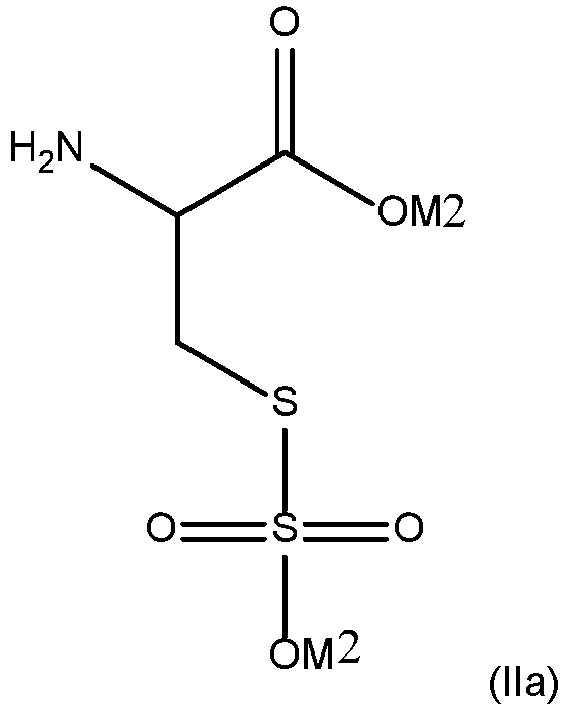
- Liegt die Verbindung der Formel (IIa) in Form ihrer freien Säure vor, so handelt es sich um 2-Amino-3-(sulfosulfanyl)propansäure. Diese Substanz ist kommerziell erhältlich.
- Es hat sich herausgestellt, dass der Einsatz der Verbindung der Formel (IIa) in Färbemitteln bereits bei besonders geringen Einsatzmengen zu einer besonders effektiven Reduzierung der Haarschädigung führt, die auch nach wiederholten Haarwäschen noch vorhanden ist. Deshalb ist der Einsatz von Verbindungen der Formel (IIa) ganz besonders bevorzugt.
- In einer ganz besonders bevorzugten Ausführungsform ist ein erfindungsgemäßes oder im erfindungsgemäßen Verfahren eingesetztes Färbemittel, dadurch gekennzeichnet, dass es mindestens eine Verbindung der Formel (II) enthält, wobei
- R1 für ein Wasserstoffatom steht und
- M1 für eine Gruppierung -OM2 steht.
- Wenn eine Verbindung der Formel (IIa) eingesetzt wird, so handelt es sich bevorzugt um den Einsatz dieser spezifischen Verbindung. Werden als Verbindungen der Formel (II) jedoch die Bunte-Salze von Oligopeptiden eingesetzt, so kann das erfindungsgemäße Färbemittel auch mehrere Verbindungen der Formel (II) als Gemisch verschiedener Oligopeptide enthalten. Diese Oligopeptide werden durch ihr mittleres Molgewicht definiert. Das mittlere Molekulargewicht Mw des mindestens einen Oligopeptids der Formel (II) kann beispielsweise durch Gelpermeationschromatographie (GPC) mit Polystyrol als internem Standard bestimmt werden.
- Je nachdem, wie viele Strukturelemente der Formel (IV) und/oder (V) in der Verbindung der Formel (II) enthält sind, und je nach Art dieser Aminosäuren kann das Molgewicht der erfindungsgemäß verwendeten Verbindung der Formel (II) variieren. Es ist erfindungsgemäß besonders bevorzugt, wenn es sich bei der Verbindung der Formel (II) um ein Oligopeptid handelt, das ein Molekulargewicht Mw von 200 bis 2.000 Da, vorzugsweise von 250 bis 1.500 Da, bevorzugt von 300 bis 1.200 Da, insbesondere von 400 bis 800 Da aufweist.
- Unter dem Begriff "Oligopeptid" im Rahmen der vorliegenden Erfindung werden Kondensationsprodukte von Aminosäuren verstanden, welche die oben genannten Molekulargewichte besitzen.
- In einer ganz besonders bevorzugten Ausführungsform ist ein erfindungsgemäßes Färbemittel dadurch gekennzeichnet, dass es mindestens eine Verbindung der Formel (II) enthält, die ein Molekulargewicht Mw von 200 bis 2.000 Da (Dalton), vorzugsweise von 250 bis 1.500 Da, bevorzugt von 300 bis 1.200 Da, insbesondere von 400 bis 800 Da aufweist.
- Wird im erfindungsgemäßen Färbemittel eine Mischung von Oligomeren eingesetzt, so können diese Mischungen durch ihr mittleres Molekulargewicht definiert werden.
- In diesem Fall ist ein bevorzugtes erfindungsgemäßes Färbemittel dadurch gekennzeichnet, dass es mindestens eine Mischung von Verbindungen der Formel (II) enthält, die ein mittleres Molekulargewicht Mw von 200 bis 2.000 Da, vorzugsweise von 250 bis 1.500 Da, bevorzugt von 300 bis 1.200 Da, insbesondere von 400 bis 800 Da aufweist.
- Weiterhin hat sich gezeigt, dass der Schutz- oder Repair-Effekt, den die Verbindungen der Formel (II) besitzen, auch von den Wiederholungsindices x und y abhängt. Wie zuvor beschrieben, ist es ganz besonders bevorzugt, wenn x für eine ganze Zahl von 1 bis 10 steht und y für eine ganze Zahl von 1 bis 10 steht.
- In einer weiteren ganz besonders bevorzugten Ausführungsform ist ein erfindungsgemäßes Färbeoder Blondiermittel dadurch gekennzeichnet, dass es mindestens eine Verbindung der Formel (II) enthält, wobei
- R1 für ein Strukturelement der Formel (IV) steht, und
- M1 für ein Strukturelement der Formel (V) steht, und
- x für eine ganze Zahl von 1 bis 10 steht und
- y für eine ganze Zahl von 1 bis 10 steht.
- Neben dem Molekulargewicht der Verbindung der Formel (II) nimmt auch der Anteil der Bunte-Salz Einheiten, die in der Verbindung der Formel (II) enthalten sind, einen entscheidenden Einfluss auf die Wirksamkeit der Schutzwirkung oder "Repair-Wirkung" der Verbindungen.
- Verbindungen mit mindestens einer Bunte-Salz-Einheit - wie sie beispielsweise in der Verbindung der Formel (IIa) vorhanden ist - sind sehr effektiv, insbesondere wenn sie als monomere Verbindung eingesetzt werden. Oligopeptide mit mindestens einer Bunte-Salz Einheit sind besonders wirksam, wenn sie ein niedriges Molekulargewicht von bis zu 1200, insbesondere 800 Dalton besitzen.
- Bei Einsatz von Oligopeptiden ist es jedoch von ganz besonderem Vorteil, wenn die Verbindung der Formel (II) mindestens zwei, bevorzugt mindestens drei Bunte-Salz Einheiten besitzt.
- In einer weiteren ganz besonders bevorzugten Ausführungsform ist ein erfindungsgemäßes Färbemittel dadurch gekennzeichnet, dass es mindestens eine Verbindung der Formel (II) enthält, wobei
- R1 für ein Strukturelement der Formel (IV) steht, und
- der Rest R2 in mindestens einem Strukturelement der Formel (IV) für eine (Sulfosulfanyl)methyl-Gruppe (d.h. eine Gruppe HO-S(O2)-S-CH2-) steht.
- In einer weiteren ganz besonders bevorzugten Ausführungsform ist ein erfindungsgemäßes Färbemittel dadurch gekennzeichnet, dass es mindestens eine Verbindung der Formel (II) enthält, wobei
- R1 für ein Strukturelement der Formel (IV) steht, und
- x für eine ganze Zahl von mindestens 3 steht und
- der Rest R2 in mindestens 3 Strukturelementen der Formel (IV) für eine 2-Carboxyethyl-Gruppe (d.h. eine Gruppe HOOC-CH2-CH2-) steht.
- In einer weiteren ganz besonders bevorzugten Ausführungsform ist ein erfindungsgemäßes Färbemittel dadurch gekennzeichnet, dass es mindestens eine Verbindung der Formel (II) enthält, wobei
- M1 für ein Strukturelement der Formel (V) steht, und
- y für eine ganze Zahl von mindestens 3 steht und
- der Rest R3 in mindestens 3 Strukturelementen der Formel (IV) für eine Gruppe (Glu) steht.
- Die mindestens eine Verbindung der Formel (II) ist - bezogen auf das Gesamtgewicht des erfindungsgemäß bevorzugten Färbemittels in einer Gesamtmenge von 0,001 bis 10 Gew.-% enthalten.
- Überraschenderweise hat sich jedoch herausgestellt, dass die Verbindung(en) der Formel (II) bereits in geringen Einsatzkonzentrationen eine sehr gute Reduzierung der Haarschädigung bewirken können. Aus diesem Grund ist es besonders vorteilhaft, wenn das erfindungsgemäß bevorzugte Färbemittel eine oder mehrere Verbindungen der vorstehend aufgeführten Formel (II) in einer Gesamtmenge von 0,001 bis 2,5 Gew.-% weiter bevorzugt von 0,01 bis 1,0 Gew.-% und besonders bevorzugt von 0,02 bis 0,1 Gew.-% enthält, jeweils bezogen auf das Gewicht des erfindungsgemäßen Färbemittels.
- In einer weiteren ganz besonders bevorzugten Ausführungsform ist ein erfindungsgemäßes Färbemittel dadurch gekennzeichnet, dass es eine oder mehrere Verbindungen der vorstehend aufgeführten Formel (II) in einer Gesamtmenge von 0,001 bis 2,5 Gew.-% weiter bevorzugt von 0,01 bis 1,0 Gew.-% und besonders bevorzugt von 0,02 bis 0,1 Gew.-% enthält, jeweils bezogen auf das Gewicht des erfindungsgemäßen Färbemittels.
- Weiterhin wurde überraschend festgestellt, dass die verringerte Haarschädigungswirkung der erfindungsgemäßen bzw. im erfindungsgemäßen Verfahren eingesetzten Färbemittel weiter unterstützt werden kann, wenn bestimmte Polymere enthalten sind.
- Bevorzugte erfindungsgemäße bzw. im erfindungsgemäßen Verfahren eingesetzte Färbemittel enthalten daher zusätzlich mindestens ein Polymer A, das mindestens zehn konstitutive Einheiten der Formel (I) aufweist,

- X für Stickstoff oder Sauerstoff steht und
- R1 und R2 jeweils unabhängig voneinander für Wasserstoff oder eine C2-C10-Acylgruppe stehen oder R1 und R2 zusammen mit X einen fünf- oder sechsgliedrigen, gesättigten oder ungesättigten Ring bilden, der gegebenenfalls weitere Heteroatome enthält, die bevorzugt ausgewählt sind aus N und O, und/oder gegebenenfalls mit mindestens einer C1 - C6-Alkylgruppe und/oder mit mindestens einer funktionellen Gruppe substituiert ist, und
- p = 0 ist, wenn X für Sauerstoff steht und p = 1 ist, wenn X für Stickstoff steht,
- Unter "Polymer" werden im Sinne der vorliegenden Anmeldung Polymere im Sinne der IUPAC-Definition verstanden, die mindestens 10 identische konstitutive Einheiten umfassen.
- Die Anzahl an konstitutiven Einheiten in einem Polymer bezeichnet man als Polymerisationsgrad. Erfindungsgemäß bevorzugte Polymere A weisen jeweils einen Polymerisationsgrad im Bereich von 40 bis 1000, bevorzugt 100 bis 800, besonders bevorzugt 350 bis 650, auf. Weitere erfindungsgemäß bevorzugte Polymere A mit mindestens zehn konstitutiven Einheit der Formel (I) enthalten 40 bis 1000, bevorzugt 100 bis 800, besonders bevorzugt 350 bis 650 identische konstitutive Einheiten der Formel (I).
- R1 und R2 stehen bevorzugt jeweils unabhängig voneinander für Wasserstoff oder für eine C2-C10-Acylgruppe, die bevorzugt ausgewählt aus einer Acetyl-, Propanoyl-, oder n-Butanoyl-Gruppe, besonders bevorzugt ausgewählt aus einer Acetyl-Gruppe.
- Erfindungsgemäß bevorzugte Polymere A weisen mindestens 10 konstitutive Einheiten der Formel (I) auf, in denen X für Stickstoff steht, wobei das Polymer A keine permanent-ionischen konstitutiven Einheiten enthält.
- Weitere erfindungsgemäß besonders bevorzugte Polymere A weisen mindestens 10 konstitutive Einheiten der Formel (I) auf, in denen X für Stickstoff steht und R1 und R2 zusammen mit X einen fünf- oder sechsgliedrigen, gesättigten oder ungesättigten Ring bilden, der gegebenenfalls weitere Heteroatome enthält, die bevorzugt ausgewählt sind aus N und O, und/oder gegebenenfalls mit mindestens einer C1 - C6-Alkylgruppe und/oder mit mindestens einer funktionellen Gruppe substituiert ist.
- Wenn R1 und R2 zusammen mit X einen fünf- oder sechsgliedrigen, gesättigten oder ungesättigten Ring bilden, der gegebenenfalls weitere Heteroatome enthält, die bevorzugt ausgewählt sind aus N und O, so ist dieser Ring bevorzugt mit mindestens einer funktionellen Gruppe substituiert, die ausgewählt ist aus =O. Ein besonders bevorzugte Substituenten-Kombination X, R1, R2 ist eine Pyrrolidon-Gruppe, so dass es sich bei einer erfindungsgemäß besonders bevorzugten konstitutiven Einheit der Formel (I) um eine Einheit der Formel (la) handelt,

- Eine weitere besonders bevorzugte Substituenten-Kombination X, R1, R2 ist eine ε-Caprolactam-Gruppe, so dass es sich bei einer erfindungsgemäß besonders bevorzugten konstitutiven Einheit der Formel (I) um eine Einheit der Formel (I b) handelt,

- in der X für Stickstoff steht und R1 und R2 zusammen mit diesem Stickstoffatom einen sechsgliedrigen gesättigten Ring bilden, der keine weiteren Heteroatome enthält und der mit einer funktionellen Gruppe =O substituiert ist.
- Eine weitere besonders bevorzugte Substituenten-Kombination X, R1, R2 ist eine Imidazol-Gruppe, so dass es sich bei einer weiteren erfindungsgemäß besonders bevorzugten Einheit der Formel (I) um eine Einheit handelt, in der X für Stickstoff steht und R1 und R2 zusammen mit diesem Stickstoffatom einen fünfgliedrigen ungesättigten Ring bilden, der als weiteres Heteroatom Stickstoff enthält.
- Weitere erfindungsgemäß bevorzugte Polymere A weisen zu 25 - 100 Mol-%, bevorzugt zu 55 - 100 Mol-%, besonders bevorzugt zu 85 - 100 Mol-% konstitutive Einheiten der Formel (I) auf, in denen X für Stickstoff steht, wobei das Polymer A keine permanent-ionischen konstitutiven Einheiten enthält.
- Weitere erfindungsgemäß bevorzugte Polymere A weisen zu 25 - 100 Mol-%, bevorzugt zu 55 - 100 Mol-%, besonders bevorzugt zu 85 - 100 Mol-% konstitutive Einheiten der Formel (I) auf, in denen X für Stickstoff steht und R1 und R2 zusammen mit X einen fünf- oder sechsgliedrigen, gesättigten oder ungesättigten Ring bilden, der gegebenenfalls weitere Heteroatome enthält, die ausgewählt sind aus N und O und gegebenenfalls mit mindestens einer C1 - C6-Alkylgruppe und/oder mit mindestens einer funktionellen Gruppe substituiert ist, wobei das Polymer A keine permanent-ionischen konstitutiven Einheiten enthält.
- Erfindungsgemäß besonders bevorzugte Polymere A weisen zu 98 - 100 Mol-% konstitutive Einheiten der Formel (la) auf, wobei das Polymer A keine permanent-ionischen konstitutiven Einheiten enthält.
- Erfindungsgemäß außerordentlich bevorzugte Polymere A weisen zu 98 - 100 Mol-% konstitutive Einheiten der Formel (la) auf und haben einen Polymerisationsgrad im Bereich von 40 bis 1000, bevorzugt 100 bis 800, besonders bevorzugt 350 bis 650, wobei das Polymer A keine permanent-ionischen konstitutiven Einheiten enthält. Besonders bevorzugte Polymere A sind Polyvinylpyrrolidon-Homopolymere mit einem Polymerisationsgrad im Bereich von 40 bis 1000, bevorzugt 100 bis 800, besonders bevorzugt 350 bis 650.
- Eine weitere besonders bevorzugte Substituenten-Kombination X, R1, R2 ist eine konstitutive Einheit der Formel (I), in der X für Sauerstoff steht, p null ist und R1 für Wasserstoff steht.
- Eine weitere besonders bevorzugte Substituenten-Kombination X, R1, R2 ist eine konstitutive Einheit der Formel (I), in der X für Sauerstoff steht, p null ist und R1 für eine Acetylgruppe steht.
- Weitere erfindungsgemäß bevorzugte Polymere A enthalten zu 75-92 Mol-% konstitutive Einheiten der Formel (I), in der X für Sauerstoff steht, p null ist und R1 für Wasserstoff steht, und zu 8 - 25 Mol-% konstitutive Einheiten der Formel (I), in der X für Sauerstoff steht, p null ist und R1 für eine Acetylgruppe steht, wobei das Polymer A keine permanent-ionischen konstitutiven Einheiten enthält.
- Weitere erfindungsgemäß bevorzugte Polymere A enthalten 40 bis 1000, bevorzugt 100 bis 800, besonders bevorzugt 350 bis 650 konstitutive Einheiten der Formel (I), davon zu 75-92 Mol-% konstitutive Einheiten der Formel (I), in der X für Sauerstoff steht, p null ist und R1 für Wasserstoff steht, und zu 8 - 25 Mol-% konstitutive Einheiten der Formel (I), in der X für Sauerstoff steht, p null ist und R1 für eine Acetylgruppe steht, wobei das Polymer A keine permanent-ionischen konstitutiven Einheiten enthält.
- Weitere erfindungsgemäß bevorzugte Polymere A enthalten zu 65-25 Mol-% konstitutive Einheiten der Formel (la) und zu 35 - 75 Mol-% konstitutive Einheiten der Formel (I), in der X für Sauerstoff steht, p null ist und R1 für eine Acetylgruppe steht, wobei das Polymer A keine permanent-ionischen konstitutiven Einheiten enthält.
- Weitere erfindungsgemäß bevorzugte Polymere A enthalten 40 bis 1000, bevorzugt 100 bis 800, besonders bevorzugt 350 bis 650 konstitutive Einheiten der Formel (I), davon zu 65-25 Mol-% konstitutive Einheiten der Formel (la) und zu 35 - 75 Mol-% konstitutive Einheiten der Formel (I), in der X für Sauerstoff steht, p null ist und R1 für eine Acetylgruppe steht, wobei das Polymer A keine permanent-ionischen konstitutiven Einheiten enthält.
- Das mindestens eine Polymer A mit mindestens zehn konstitutiven Einheiten der Formel (I) weist keine permanenten ionischen Ladungen auf. Es ist aber möglich, dass die konstitutiven Einheiten der Formel (I), beispielsweise durch Protonierung des Stickstoffatoms in einem sauren Träger, ionisch, insbesondere kationisch, vorliegen. Diese Ladungen sind aber nicht permanent, sondern temporär, da sie vom umgebenden Medium abhängig sind.
- Bevorzugte erfindungsgemäße Färbemittel enthalten das mindestens eine Polymer A mit mindestens zehn konstitutiven Einheiten der Formel (I) in einer Gesamtmenge von 0,2 bis 5 Gew.-%, bevorzugt 0,5 bis 3 Gew.-%, besonders bevorzugt 1,0 bis 2,3 Gew.-%, jeweils bezogen auf das Gewicht des Färbemittels.
- Als weiteren optionalen Inhaltsstoff enthalten erfindungsgemäß bevorzugte Färbemittel mindestens ein permanent kationisches Polymer B.
- Bevorzugt enthält das permanent kationische Polymer neben mindestens einem permanent kationisch geladenen Monomer-Typ auch mindestens einen permanent anionisch geladenen Monomer-Typ, wobei die kationischen Monomere im molaren Überschuss zu den anionischen Monomeren vorliegen, so dass das mindestens eine zweite erfindungsgemäße Polymer eine kationische Nettoladung aufweist. Derartige erfindungsgemäß bevorzugte Polymere werden auch als amphotere oder zwitterionische Polymere bezeichnet.
- In einer ersten bevorzugten Ausführungsform enthalten erfindungsgemäß bevorzugte Färbe- oder Blondiermittel mindestens ein permanent kationisches Polymer, das ausgewählt ist aus
- kationischen Polymeren, die aufgebaut sind aus Monomeren mit quartären Ammoniumgruppen der allgemeinen Formel (a),
R3-CH=CR4-CO-Z-(CnH2n)-N(+)R5R6R7 A(-) (a),
in der R3 und R4 unabhängig voneinander für Wasserstoff oder eine Methylgruppe stehen, R5, R6 und R7 unabhängig voneinander für eine Alkylgruppe mit 1 bis 4 Kohlenstoffatomen stehen, Z für eine NH-Gruppe oder ein Sauerstoffatom steht, n für eine ganze Zahl von 2 bis 4 steht und A(-) das Anion einer anorganischen oder organischen Säure darstellt, bevorzugt ausgewählt aus kationischen Polymeren, die aufgebaut sind aus Acrylamidopropyltrimethylammoniumchlorid,- besonders bevorzugt ausgewählt aus amphoteren Polymeren mit kationischer Nettoladung, die durch Polymerisation aufgebaut sind aus
- a) kationischen Monomeren mit quartären Ammoniumgruppen der allgemeinen Formel (a),
R3-CH=CR4-CO-Z-(CnH2n)-N(+)R5R6R7 A(-) (a),
in der R3 und R4 unabhängig voneinander für Wasserstoff oder eine Methylgruppe stehen, R5, R6 und R7 unabhängig voneinander für eine Alkylgruppe mit 1 bis 4 Kohlenstoffatomen stehen, Z für eine NH-Gruppe oder ein Sauerstoffatom steht, n für eine ganze Zahl von 2 bis 4 steht und A(-) das Anion einer anorganischen oder organischen Säure darstellt, und - b) mindestens einer ungesättigten Carbonsäure, ausgewählt aus Acrylsäure, Methacrylsäure und Crotonsäure sowie aus Mischungen dieser Säuren, wobei die mindestens eine ungesättigte Carbonsäure in Form ihrer Salze vorliegen kann,
- a) kationischen Monomeren mit quartären Ammoniumgruppen der allgemeinen Formel (a),
- außerordentlich bevorzugt ausgewählt aus amphoteren Polymeren mit kationischer Nettoladung, die den mindestens einen Monomer-Typ der allgemeinen Formel (a) und den mindestens einen Monomer-Typ der ungesättigten Carbonsäure, ausgewählt aus Acrylsäure, Methacrylsäure und Crotonsäure sowie Mischungen hiervon, in einem Molverhältnis von 60:40 bis 95:5, bevorzugt von 75:25 bis 90:10 zueinander enthalten,
- außerordentlich bevorzugt ausgewählt aus amphoteren Copolymeren mit kationischer Nettoladung, die aus Acrylamidopropyltrimethylammoniumchlorid und Acrylsäure im Molverhältnis von 60:40 bis 95:5, bevorzugt von 75:25 bis 90:10 zueinander, bestehen;
- besonders bevorzugt ausgewählt aus amphoteren Polymeren mit kationischer Nettoladung, die durch Polymerisation aufgebaut sind aus
- 2-[2-Hydroxy-3-(trimethylammonio)propoxy]ethylcelluloseetherchlorid, das beispielsweise unter der INCI-Bezeichnung Polyquaternium-10 erhältlich ist,
- Terpolymeren aus Acrylsäure, Diallyldimethylammoniumchlorid und Acrylamid, wie sie beispielsweise unter der INCI-Bezeichnung Polyquaternium-39 erhältlich sind,
- Homopolymeren des N,N,N-Trimethyl-2-[(methyl-1-oxo-2-propenyl)oxy]ethanaminiumchlorid, wie sie beispielsweise unter der INCI-Bezeichnung Polyquaternium-37 erhältlich sind,
- Copolymeren aus Diallyldimethylammoniumchlorid und Acrylsäure, wie sie beispielsweise unter der INCI-Bezeichnung Polyquaternium-22 erhältlich sind,
- Hydroxyethylcellulose-Dimethyldiallylammoniumchlorid-Copolymeren, wie sie beispielsweise unter der INCI-Bezeichnung Polyquaternium-4 erhältlich sind,
- Copolymeren aus Acrylamid und beta-Methacrylyloxyethyltrimethylammoniummethosulfat, wie sie beispielsweise unter der INCI-Bezeichnung Polyquaternium-5 erhältlich sind,
- Homopolymeren des N,N-Dimethyl-N-2-Propenyl-2-Propen-1-aminiumchlorid, wie sie beispielsweise unter der INCI-Bezeichnung Polyquaternium-6 erhältlich sind,
- Copolymeren aus Diallyldimethylammoniumchlorid und Acrylamid, wie sie beispielsweise unter der INCI-Bezeichnung Polyquaternium-7 erhältlich sind,
- Copolymeren aus Vinylpyrrolidon und Dimethylaminoethylmethacrylatdiethylsulfat, wie sie beispielsweise unter der INCI-Bezeichnung Polyquaternium-11 erhältlich sind,
- sowie Mischungen der vorgenannten Polymere.
- Erfindungsgemäß außerordentlich bevorzugte permanente kationische Polymere sind ausgewählt aus 2-[2-Hydroxy-3-(trimethylammonio)propoxy]ethylcelluloseetherchlorid, amphoteren Copolymeren mit kationischer Nettoladung, die aus Acrylamidopropyltrimethylammoniumchlorid und Acrylsäure im Molverhältnis von 60:40 bis 95:5, bevorzugt von 75:25 bis 90:10 zueinander, bestehen und Terpolymeren aus Acrylsäure, Diallyldimethylammoniumchlorid und Acrylamid, sowie Zweierund Dreier-Mischungen dieser Polymere.
- Besonders bevorzugte Polymer B-Mischungen enthalten 2-[2-Hydroxy-3-(trimethylammonio)propoxy]ethylcelluloseetherchlorid und mindestens ein amphoteres Copolymer mit kationischer Nettoladung, das aus Acrylamidopropyltrimethylammoniumchlorid und Acrylsäure im Molverhältnis von 60:40 bis 95:5, bevorzugt von 75:25 bis 90:10 zueinander, besteht.
- Weitere besonders bevorzugte Polymer B-Mischungen enthalten 2-[2-Hydroxy-3-(trimethylammonio)propoxy]ethylcelluloseetherchlorid, mindestens ein amphoteres Copolymer mit kationischer Nettoladung, das aus Acrylamidopropyltrimethylammoniumchlorid und Acrylsäure im Molverhältnis von 60:40 bis 95:5, bevorzugt von 75:25 bis 90:10 zueinander, besteht, und mindestens ein Terpolymer aus Acrylsäure, Diallyldimethylammoniumchlorid und Acrylamid.
- Erfindungsgemäß ebenfalls außerordentlich bevorzugte permanent-kationische Polymere B sind ausgewählt aus Polyquaternium-10, amphoteren Copolymeren mit kationischer Nettoladung, die aus Acrylamidopropyltrimethylammoniumchlorid und Acrylsäure im Molverhältnis von 60:40 bis 95:5, bevorzugt von 75:25 bis 90:10 zueinander, bestehen, und Polyquaternium-39, sowie Zweierund Dreier-Mischungen dieser Polymere.
- Weitere besonders bevorzugte Polymer B-Mischungen enthalten Polyquaternium-10 und mindestens ein amphoteres Copolymer mit kationischer Nettoladung, das aus Acrylamidopropyltrimethylammoniumchlorid und Acrylsäure im Molverhältnis von 60:40 bis 95:5, bevorzugt von 75:25 bis 90:10 zueinander, besteht.
- Weitere besonders bevorzugte Polymer B-Mischungen enthalten Polyquaternium-10 und mindestens ein amphoteres Copolymer mit kationischer Nettoladung, das aus Acrylamidopropyltrimethylammoniumchlorid und Acrylsäure im Molverhältnis von 60:40 bis 95:5, bevorzugt von 75:25 bis 90:10 zueinander, besteht, und Polyquaternium-39.
- Bevorzugte erfindungsgemäße Färbemittel enthalten das mindestens eine permanent kationische Polymer B in einer Gesamtmenge von 0,05 bis 1,5 Gew.-%, bevorzugt 0,1 bis 1,0 Gew.-%, besonders bevorzugt 0,2 bis 0,8 Gew.-%, jeweils bezogen auf das Gewicht des erfindungsgemäßen Färbemittels.
- Die erfindungsgemäße bzw. im erfindungsgemäßen Verfahren verwendete Färbezubereitung enthält vorzugsweise mindestens ein Alkalisierungsmittel, ausgewählt aus Ammoniumhydroxid, Monoethanolamin und Natriumsilikaten sowie Mischungen hiervon.
- Zur Erzielung der gewünschten haltbaren Färbung der keratinischen Fasern muss ein Färbemittel einen pH-Wert im Bereich von 6,5 bis 11,0, bevorzugt 8 bis 10,5, besonders bevorzugt 8,5 bis 10, jeweils gemessen bei 20°C, aufweisen. Bei diesen pH-Werten öffnet sich die äußere Keratinfaserschicht optimal zur Aufnahme der Oxidationsfarbstoffvorprodukte und entfaltet sich die gewünschte Wirkung der über die Entwickleremulsion zugesetzten Peroxidverbindung optimal.
- Die erfindungsgemäßen bzw. im erfindungsgemäßen Verfahren verwendeten Färbezubereitungen weisen einen pH-Wert im Bereich von 8,5 bis 11,0, bevorzugt 10 bis 10,5, jeweils gemessen bei 20°C, auf.
- Bevorzugt wird Ammoniak in Form seiner wässrigen Lösung eingesetzt. Bei entsprechenden wässrigen Ammoniak-Lösungen kann es sich um 10 bis 35 prozentige Lösungen handeln (berechnet in Gew.-%, 100 g wässrige Ammoniaklösung enthalten dementsprechend 10 bis 35 g Ammoniak). Bevorzugt wird Ammoniak in Form einer 20 bis 30 Gew.-%igen Lösung, besonders bevorzugt in Form einer 25 Gew.-%igen Lösung eingesetzt.
- In einer besonders bevorzugten Ausführungsform ist das erfindungsgemäße Färbemittel dadurch gekennzeichnet, dass es Ammoniumhydroxid in einer Menge von 0,20 bis 2,5 Gew.-%, bevorzugt von 0,5 bis 2,0 Gew.-%, weiter bevorzugt von 1,0 bis 1,5 Gew.-% und besonders bevorzugt von 0,31 bis 0,8 Gew.-% - bezogen auf das Gesamtgewicht des erfindungsgemäßen Färbemittels - enthält.
- Zusätzlich zu bzw. anstelle von Ammoniumhydroxid enthalten bevorzugte erfindungsgemäße Färbemittel Monoethanolami.
- Zur Erzielung einer maximalen Geruchsabdeckung und zur Optimierung der Echtheitseigenschaften ist Monoethanolamin in einer Gesamtmenge von 0,2 - 6,5 Gew.-%, bevorzugt von 0,5 - 4,0 Gew.-%, weiter bevorzugt von 0,7 bis 2,5 Gew.-% und besonders bevorzugt von 0,8 bis 1,6 Gew.% - bezogen auf das Gesamtgewicht des erfindungsgemäßen Färbemittels - enthalten.
- Bei Natriumsilikaten im Sinne der vorliegenden Erfindung handelt es sich um chemische Verbindungen, die sich aus Natriumoxid und Siliciumdioxid zusammengesetzen und die in verschiedenen molaren Verhältnissen (Monosilikat, Metasilikat und Polysilikat) vorkommen können. Ein Beispiel für ein Natriumsilikat ist das Natriumsalz der Orthokieselsäure mit der Summenformel Na4SiO4, das auch als Natriumorthosilikat bezeichnet wird.
- Weitere Beispiele für geeignete Natriumsilikate sind das Dinatriummetasilikat bzw. Natriummetasilikat mit der Summenformel Na2SiO3, das Dinatriumdisilikat mit der Summenformel Na2Si2O5 oder das Dinatriumtrisilikat mit der Summenformel Na2Si3O7.
- Silikate in amorpher Form können durch das Zusammenschmelzen von Siliciumdioxid und Alkalioxid in molaren Verhältnissen zwischen 1:1 und 4:1 hergestellt werden. Die so erhaltenen Feststoffe werden bei etwa 150 °C und 5 bar Dampfdruck gelöst, um eine Lösung der Natriumsilikate in Wasser zu erhalten, bei diesen entsprechenden Lösungen handelt es sich um Alkaliwassergläser. Als Alkaliwassergläser werden aus einer Schmelze erstarrte, glasartige (amorphe) Natriumsilikate oder ihre wässrigen Lösungen bezeichnet. Diese nennt man auch Natronwasserglas. Auch Natronwassergläser sind innerhalb dieser Erfindung von der Definition der Natriumsilikate umfasst.
- Die molare Zusammensetzung bei Wassergläsern beträgt üblicherweise 2 bis 4 mol SiO2 auf 1 mol Alkalioxid (Na2O).
- Ein Beispiel für ein bevorzugtes Natriumsilikat ist Natronwasserglas, das in Form seiner wässrigen Lösung vorliegt, einen Na2O-Gehalt von 7,5 bis 8,8 Gew.-% und einen SiO2 Gehalt von 25,0 bis 28,5 Gew.-% besitzt und das die CAS-Nr. 1344-09-5 (Chemical Abstracts Number) hat.
- Weitere erfindungsgemäß bevorzugte Färbemittel enthalten mindestens ein Natriumsilikat in einer Gesamtmenge von 0,1 bis 9 Gew.-%, bevorzugt 0,2 bis 8 Gew.-%, besonders bevorzugt 1 bis 7,5 Gew.-%, jeweils bezogen auf das Gesamtgewicht des erfindungsgemäßen Färbemittels.
- Weiterhin können andere Alkalisierungsmittel, wie Kaliumhydroxid (KOH) und Natriumhydroxid (NaOH) enthalten sein, meist in einer Gesamtmenge von 0,05 bis 1,5 Gew.-%, bevorzugt 0,1 bis 0,6 Gew.-%, jeweils bezogen auf das Gesamtgewicht des erfindungsgemäßen Färbemittels.
- Die erfindungsgemäße bzw. im erfindungsgemäßen Verfahren verwendete Färbezubereitung enthält optional weitere Hilfs- und Zusatzstoffe. So hat es sich erfindungsgemäß als bevorzugt erwiesen, wenn die Färbezubereitung mindestens ein Verdickungsmittel enthält. Bezüglich dieser Verdickungsmittel bestehen keine prinzipiellen Einschränkungen. Es können sowohl organische als auch rein anorganische Verdickungsmittel zum Einsatz kommen.
- Ggf. kann schon ein optional enthaltenes Polymer A oder ein optional enthaltenes Polymer B als Verdickungsmittel fungieren. Die nachstehend beschriebenen verdickenden Polymere können somit ggf. unter die Definition für Polymer A oder Polymer B fallen.
- Gemäß einer ersten bevorzugten Ausführungsform handelt es sich bei dem Verdickungsmittel um ein anionisches, synthetisches Polymer. Bevorzugte anionische Gruppen sind die Carboxylat- und die Sulfonatgruppe.
- Beispiele für anionische Monomere, aus denen die polymeren anionischen Verdickungsmittel bestehen können, sind Acrylsäure, Methacrylsäure, Crotonsäure, Itaconsäure, Maleinsäureanhydrid und 2-Acrylamido-2-methylpropansulfonsäure. Dabei können die sauren Gruppen ganz oder teilweise als Natrium-, Kalium-, Ammonium-, Mono- oder Triethanolammonium-Salz vorliegen. Bevorzugte Monomere sind Maleinsäureanhydrid sowie insbesondere 2-Acrylamido-2-methylpropansulfonsäure und Acrylsäure.
- Bevorzugte anionische Homopolymere sind unvernetzte und vernetzte Polyacrylsäuren. Dabei können Allylether von Pentaerythrit, von Sucrose und von Propylen bevorzugte Vernetzungsagentien sein. Solche Verbindungen sind beispielsweise unter dem Warenzeichnen Carbopol® im Handel erhältlich. Ebenfalls bevorzugt ist das Homopolymer der 2-Acrylamido-2-methylpropansulfonsäure, das beispielsweise unter der Bezeichnung Rheothik®11-80 im Handel erhältlich ist. Innerhalb dieser ersten Ausführungsform kann es weiterhin bevorzugt sein, Copolymere aus mindestens einem anionischen Monomer und mindestens einem nichtionogenen Monomer einzusetzen. Bezüglich der anionischen Monomere wird auf die oben aufgeführten Substanzen verwiesen. Bevorzugte nichtionogene Monomere sind Acrylamid, Methacrylamid, Acrylsäureester, Methacrylsäureester, Itaconsäuremono- und -diester, Vinylpyrrolidinon, Vinylether und Vinylester. Die anionischen Acrylsäure- und/oder Methacrylsäure-Polymerisate oder -Copolymerisate sind in den erfindungsgemäßen Mitteln bevorzugt in einer Menge von 0,1 bis 10 Gew.-%, besonders bevorzugt von 1 bis 5 Gew.-%, jeweils bezogen auf das Gewicht des Mittels, enthalten. Bevorzugte anionische Copolymere sind beispielsweise Copolymere aus Acrylsäure, Methacrylsäure oder deren C1-C6-Alkylestern, wie sie unter der INCI-Deklaration Acrylates Copolymere vertrieben werden. Ein bevorzugtes Handelsprodukt ist beispielsweise Aculyn® 33 der Firma Rohm & Haas. Weiterhin bevorzugt sind aber auch Copolymere aus Acrylsäure, Methacrylsäure oder deren C1-C6-Alkylestern und den Estern einer ethylenisch ungesättigten Säure und einem alkoxylierten Fettalkohol. Geeignete ethylenisch ungesättigte Säuren sind insbesondere Acrylsäure, Methacrylsäure und Itaconsäure; geeignete alkoxylierte Fettalkohole sind insbesondere Steareth-20 oder Ceteth-20. Derartige Copolymere werden von der Firma Rohm & Haas unter der Handelsbezeichnung Aculyn® 22 sowie von der Firma National Starch unter den Handelsbezeichnungen Structure® 2001 und Structure® 3001 vertrieben.
- Bevorzugte anionische Copolymere sind weiterhin Acrylsäure-Acrylamid-Copolymere sowie insbesondere Polyacrylamidcopolymere mit Sulfonsäuregruppen-haltigen Monomeren. Ein besonders bevorzugtes anionisches Copolymer besteht aus 70 bis 55 Mol-% Acrylamid und 30 bis 45 Mol-% 2-Acrylamido-2-methylpropansulfonsäure, wobei die Sulfonsäuregruppe ganz oder teilweise als Natrium-, Kalium-, Ammonium-, Mono- oder Triethanolammonium-Salz vorliegt. Dieses Copolymer kann auch vernetzt vorliegen, wobei als Vernetzungsagentien bevorzugt polyolefinisch ungesättigte Verbindungen wie Tetraallyloxythan, Allylsucrose, Allylpentaerythrit und Methylen-bisacrylamid zum Einsatz kommen. Ein solches Polymer ist in den Handelsprodukten Sepigel®305 und Simulgel® 600 der Firma SEPPIC enthalten. Die Verwendung dieser Verbindungen, die neben der Polymerkomponente eine Kohlenwasserstoffmischung (C13-C14-Isoparaffin beziehungsweise Isohexadecan) und einen nichtionogenen Emulgator (Laureth-7 beziehungsweise Polysorbate-80) enthalten, hat sich im Rahmen der erfindungsgemäßen Lehre als besonders vorteilhaft erwiesen. Auch Polymere aus Maleinsäureanhydrid und Methylvinylether, insbesondere solche mit Vernetzungen, sind bevorzugte Verdickungsmittel. Ein mit 1,9-Decadien vernetztes Maleinsäure-Methylvinylether-Copolymer ist unter der Bezeichnung Stabileze® QM im Handel erhältlich.
- Bevorzugt kann das erfindungsgemäße bzw. im erfindungsgemäßen Verfahren verwendete Mittel zusätzlich mindestens ein anionisches Acrylsäure- und/oder Methacrylsäure-Polymerisat oder
- Copolymerisat. Bevorzugte Polymerisate dieser Art sind:
- Polymerisate z.B. aus wenigstens 10 Gew.-% Acrylsäure-Niedrigalkylester, 25 bis 70 Gew.-% Methacrylsäure und ggf. bis zu 40 Gew.-% eines weiteren Comonomeren,
- Mischpolymerisate aus 50 bis 75 Gew.-% Ethylacrylat, 25 bis 35 Gew.-% Acrylsäure und 0 bis 25 Gew.-% anderer Comonomeren bekannt. Geeignete Dispersionen dieser Art sind im Handel erhältlich, z.B. unter der Handelsbezeichnung Latekoll® D (BASF).
- Copolymerisate aus 50 bis 60 Gew.-% Ethylacrylat, 30 bis 40 Gew.-% Methacrylsäure und 5 bis 15 Gew.-% Acrylsäure, vernetzt mit Ethylenglycoldimethacrylat.
- Gemäß einer weiteren Ausführungsform handelt es sich bei dem Verdickungsmittel um einen kationisches synthetisches Polymer. Bevorzugte kationische Gruppen sind quartäre Ammoniumgruppen. Insbesondere solche Polymere, bei denen die quartäre Ammoniumgruppe über eine C1-C4-Kohlenwasserstoffgruppe an eine aus Acrylsäure, Methacrylsäure oder deren Derivaten aufgebaute Polymerhauptkette gebunden sind, haben sich als besonders geeignet erwiesen.
- Homopolymere der allgemeinen Formel (HP-1),

- R1 steht für eine Methylgruppe
- R2, R3 und R4 stehen für Methylgruppen
- m hat den Wert 2,
- Als physiologisch verträgliches Gegenionen X- kommen beispielsweise Halogenidionen, Sulfationen, Phosphationen, Methosulfationen sowie organische Ionen wie Lactat-, Citrat-, Tartrat- und Acetationen in Betracht. Bevorzugt sind Halogenidionen, insbesondere Chlorid.
- In einer weiteren bevorzugten Ausführungsform werden natürlich vorkommende Verdickungsmittel eingesetzt. Bevorzugte Verdickungsmittel dieser Ausführungsform sind beispielsweise nichtionischen Guargums. Erfindungsgemäß können sowohl modifizierte als auch unmodifizierte Guargums zum Einsatz kommen. Nichtmodifizierte Guargums werden beispielsweise unter der Handelsbezeichnung Jaguar® C von der Firma Rhone Poulenc vertrieben. Erfindungsgemäß bevorzugte modifizierte Guargums enthalten C1-C6-Hydroxyalkylgruppen. Bevorzugt sind die Gruppen Hydroxymethyl, Hydroxyethyl, Hydroxypropyl und Hydroxybutyl. Derart modifizierte Guargums sind im Stand der Technik bekannt und können beispielsweise durch Reaktion der Guargums mit Alkylenoxiden hergestellt werden. Der Grad der Hydroxyalkylierung, der der Anzahl der verbrauchten Alkylenoxidmoleküle im Verhältnis zur Zahl der freien Hydroxygruppen der Guargums entspricht, liegt bevorzugt zwischen 0,4 und 1,2. Derart modifizierte Guargums sind unter den Handelsbezeichnungen Jaguar® HP8, Jaguar® HP60, Jaguar® HP120, Jaguar® DC 293 und Jaguar® HP105 der Firma Rhone Poulenc im Handel erhältlich.
- Weiterhin geeignete natürliche Verdickungsmittel sind ebenfalls bereits aus dem Stand der Technik bekannt.
- Gemäß dieser Ausführungsform bevorzugt sind weiterhin Biosaccharidgums mikrobiellen Ursprungs, wie die Skleroglucangums oder Xanthangums, Gums aus pflanzlichen Exsudaten, wie beispielsweise Gummi arabicum, Ghatti-Gummi, Karaya-Gummi, Tragant-Gummi, Carrageen-Gummi, Agar-Agar, Johannisbrotkernmehl, Pektine, Alginate, Stärke-Fraktionen und Derivate wie Amylose, Amylopektin und Dextrine, Cellulosederivate, wie beispielsweise Methylcellulose, Carboxyalkylcellulosen und Hydroxyalkylcellulosen.
- Bevorzugte Hydroxyalkylcellulosen sind insbesondere die Hydroxyethylcellulosen, die unter den Bezeichnungen Cellosize® der Firma Amerchol und Natrosol® der Firma Hercules vertrieben werden. Geeignete Carboxyalkylcellulosen sind insbesondere die Carboxymethylcellulosen, wie sie unter den Bezeichnungen Blanose® von der Firma Aqualon, Aquasorb® und Ambergum® von der Firma Hercules und Cellgon® von der Firma Montello vertrieben werden.
- Bevorzugt sind weiterhin Stärke und deren Derivate. Stärke ist ein Speicherstoff von Pflanzen, der vor allem in Knollen und Wurzeln, in Getreide-Samen und in Früchten vorkommt und aus einer Vielzahl von Pflanzen in hoher Ausbeute gewonnen werden kann. Das Polysaccharid, das in kaltem Wasser unlöslich ist und in siedendem Wasser eine kolloidale Lösung bildet, kann beispielsweise aus Kartoffeln, Maniok, Bataten, Maranta, Mais, Getreide, Reis, Hülsenfrüchte wie beispielsweise Erbsen und Bohnen, Bananen oder dem Mark bestimmter Palmensorten (beispielsweise der Sagopalme) gewonnen werden. Erfindungsgemäß einsetzbar sind natürliche, aus Pflanzen gewonnene Stärken und/oder chemisch oder physikalisch modifizierte Stärken. Eine Modifizierung lässt sich beispielsweise durch Einführung unterschiedlicher funktioneller Gruppen an einer oder mehreren der Hydroxylgruppen der Stärke erreichen. Üblicherweise handelt es sich um Ester, Ether oder Amide der Stärke mit gegebenenfalls substituierten C1-C40-Resten. Besonders vorteilhaft ist eine mit einer 2-Hydroxypropylgruppe veretherte Maisstärke, wie sie beispielsweise von der Firma National Starch unter der Handelsbezeichnung Amaze® vertrieben wird.
- Als anorganische Verdickungsmittel haben sich Schichtsilikate (polymere, kristalline Natriumdisilicate) als besonders geeignet im Sinne der vorliegenden Erfindung erwiesen. Insbesondere Tone, insbesondere Magnesium Aluminium Silicate, wie beispielsweise Bentonit, besonders Smektite, wie Montmorillonit oder Hectorit, die gegebenenfalls auch geeignet modifiziert sein können, und synthetische Schichtsilikate, wie beispielsweise das von der Firma Süd Chemie unter der Handelsbezeichnung Optigel® vertriebene Magnesiumschichtsilikat, sind bevorzugt.
- Zur weiteren Steigerung der Leistung können der erfindungsgemäßen bzw. im erfindungsgemäßen Verfahren verwendeten Zusammensetzung zusätzlich gegebenenfalls hydratisierte SiO2-Verbindung zugesetzt werden. Es kann erfindungsgemäß bevorzugt sein, die gegebenenfalls hydratisierten SiO2-Verbindungen in Mengen von 0,05 Gew.-% bis 15 Gew.-%, besonders bevorzugt in Mengen von 0,15 Gew.-% bis 10 Gew.-% und ganz besonders bevorzugt in Mengen von 0,2 Gew.% bis 5 Gew.-%, jeweils bezogen auf die Zusammensetzung, einzusetzen. Die Mengenangaben geben dabei jeweils den Gehalt der SiO2-Verbindungen (ohne deren Wasseranteil) in den Mitteln wieder.
- Hinsichtlich der gegebenenfalls hydratisierten SiO2-Verbindungen unterliegt die vorliegende Erfindung prinzipiell keinen Beschränkungen. Bevorzugt sind Kieselsäuren, deren Oligomeren und Polymeren sowie deren Salze. Bevorzugte Salze sind die Alkalisalze, insbesondere die Kalium und Natriumsalze. Die Natriumsalze sind ganz besonders bevorzugt.
- Die gegebenenfalls hydratisierten SiO2-Verbindungen können in verschiedenen Formen vorliegen. Erfindungsgemäß bevorzugt werden die SiO2-Verbindungen in Form von Kieselgelen (Silicagel) oder besonders bevorzugt als Wasserglas eingesetzt. Diese SiO2-Verbindungen können teilweise in wässriger Lösung vorliegen.
- Erfindungsgemäß ganz besonders bevorzugt sind Wassergläser, die aus einem Silikat der Formel (SiO2)n(Na2O)m(K2O)p gebildet werden, wobei n steht für eine positive rationale Zahl und m und p stehen unabhängig voneinander für eine positive rationale Zahl oder für 0, mit den Maßgaben, dass mindestens einer der Parameter m oder p von 0 verschieden ist und das Verhältnis zwischen n und der Summe aus m und p zwischen 1:4 und 4:1 liegt. Bevorzugt sind Metasilikate, in denen das Verhältnis zwischen n und der Summe aus m und p bei 1:2 oder darunter liegt.
- Neben den durch die Summenformel beschriebenen Komponenten können die Wassergläser in geringen Mengen noch weitere Zusatzstoffe, wie beispielsweise Phosphate oder Magnesiumsalze, enthalten.
- Erfindungsgemäß besonders bevorzugte Wassergläser werden unter anderem von der Firma Henkel unter den Bezeichnungen Ferrosil® 119, Natronwasserglas 40/42, Portil® A, Portil® AW und Portil® W und von der Firma Akzo unter der Bezeichnung Britesil® C20 vertrieben.
- Vorzugsweise wird den erfindungsgemäßen bzw. im erfindungsgemäßen Verfahren verwendeten Färbemitteln weiterhin ein Emulgator bzw. ein Tensid zugesetzt, wobei oberflächenaktive Substanzen je nach Anwendungsgebiet als Tenside oder als Emulgatoren bezeichnet werden und aus anionischen, kationischen, zwitterionischen, amphoteren und nichtionischen Tensiden und Emulgatoren ausgewählt sind. Diese Stoffe werden nachfolgend ausführlich beschrieben.
- Als anionische Tenside eignen sich in erfindungsgemäßen Zubereitungen alle für die Verwendung am menschlichen Körper geeigneten anionischen oberflächenaktiven Stoffe. Diese sind gekennzeichnet durch eine wasserlöslich machende, anionische Gruppe wie beispielsweise eine Carboxylat-, Sulfat-, Sulfonat- oder Phosphat-Gruppe und eine lipophile Alkylgruppe mit etwa 8 bis 30 C-Atomen. Zusätzlich können im Molekül Glykol- oder Polyglykolether-Gruppen, Ester-, Ether- und Amidgruppen sowie Hydroxylgruppen enthalten sein. Beispiele für geeignete anionische Tenside sind, jeweils in Form der Natrium-, Kalium- und Ammonium- sowie der Mono, Di- und Trialkanolammoniumsalze mit 2 bis 4 C-Atomen in der Alkanolgruppe,
- lineare und verzweigte Fettsäuren mit 8 bis 30 C-Atomen (Seifen),
- Ethercarbonsäuren der Formel RO(CH2CH2O)xCH2COOH, in der R eine lineare Alkylgruppe mit 8 bis 30 C-Atomen und x = 0 oder 1 bis 16 ist,
- Acylsarcoside mit 8 bis 24 C-Atomen in der Acylgruppe,
- Acyltauride mit 8 bis 24 C-Atomen in der Acylgruppe,
- Acylisethionate mit 8 bis 24 C-Atomen in der Acylgruppe,
- Sulfobernsteinsäuremono- und -dialkylester mit 8 bis 24 C-Atomen in der Alkylgruppe und Sulfobernsteinsäuremono-alkylpolyoxyethylester mit 8 bis 24 C-Atomen in der Alkylgruppe und 1 bis 6 Oxyethylgruppen,
- lineare Alkansulfonate mit 8 bis 24 C-Atomen,
- lineare α-Olefinsulfonate mit 8 bis 24 C-Atomen,
- Sulfonate ungesättigter Fettsäuren mit 8 bis 24 C-Atomen und 1 bis 6 Doppelbindungen,
- α-Sulfofettsäuremethylester von Fettsäuren mit 8 bis 30 C-Atomen,
- Alkylsulfate und Alkylethersulfate der Formel RO(CH2CH2O)xSO3H, in der R eine bevorzugt lineare Alkylgruppe mit 8 bis 30 C-Atomen und x = 0 oder 1 bis 12 ist,
- Gemische oberflächenaktiver Hydroxysulfonate,
- sulfatierte Hydroxyalkylpolyethylen- und/oder Hydroxyalkylenpropylenglykolether,
- Ester der Weinsäure und Zitronensäure mit Alkoholen, die Anlagerungsprodukte von etwa 2-15 Molekülen Ethylenoxid und/oder Propylenoxid an Fettalkohole mit 8 bis 22 C-Atomen darstellen,
- Alkyl- und/oder Alkenyletherphosphate der Formel

- sulfatierte Fettsäurealkylenglykolester der Formel RC(O)O(alkO)nSO3H, in der R für einen linearen oder verzweigten, aliphatischen, gesättigten und/oder ungesättigten Alkylrest mit 6 bis 22 C-Atomen, alk für CH2CH2, CHCH3CH2 und/oder CH2CHCH3 und n für eine Zahl von 0,5 bis 5 steht,
- Monoglyceridsulfate und Monoglyceridethersulfate.
- Bevorzugte anionische Tenside sind Alkylsulfate, Alkylethersulfate und Ethercarbonsäuren mit 10 bis 18 C-Atomen in der Alkylgruppe und bis zu 12 Glykolethergruppen im Molekül.
- Als zwitterionische Tenside werden solche oberflächenaktiven Verbindungen bezeichnet, die im Molekül mindestens eine quartäre Ammoniumgruppe und mindestens eine Carboxylat-, Sulfonatoder Sulfat-Gruppe tragen. Besonders geeignete zwitterionische Tenside sind die sogenannten Betaine wie die N-Alkyl-N,N-dimethylammonium-glycinate, beispielsweise das Kokosalkyl-dimethylammoniumglycinat, N-Acyl-aminopropyl-N,N-dimethylammoniumglycinate, beispielsweise das Kokosacylaminopropyl-dimethylammoniumglycinat, und 2-Alkyl-3-carboxymethyl-3-hydroxyethylimidazoline mit jeweils 8 bis 18 C-Atomen in der Alkyl- oder Acylgruppe sowie das Kokosacylaminoethylhydroxyethylcarboxymethylglycinat. Ein bevorzugtes zwitterionisches Tensid ist das unter der INCI-Bezeichnung Cocamidopropyl Betaine bekannte Fettsäureamid-Derivat.
- Unter amphoteren Tensiden werden solche oberflächenaktiven Verbindungen verstanden, die außer einer C8-C24-Alkyl- oder -Acylgruppe im Molekül mindestens eine freie Aminogruppe und mindestens eine -COOH- oder -SO3H-Gruppe enthalten und zur Ausbildung innerer Salze befähigt sind. Beispiele für geeignete amphotere Tenside sind N-Alkylglycine, N-Alkylpropionsäuren, N-Alkylaminobuttersäuren, N-Alkyliminodipropionsäuren, N-Hydroxyethyl-N-alkylamidopropylglycine, N-Alkyltaurine, N-Alkylsarcosine, 2-Alkylaminopropionsäuren und Alkylaminoessigsäuren mit jeweils etwa 8 bis 24 C-Atomen in der Alkylgruppe. Besonders bevorzugte amphotere Tenside sind das N-Kokosalkylaminopropionat, das Kokosacylaminoethylaminopropionat und das C12-C18-Acylsarcosin.
- Weiterhin hat es sich als vorteilhaft erwiesen, wenn die erfindungsgemäßen Färbe- und Aufhellmittel weitere, nichtionogene grenzflächenaktive Stoffe, enthalten. Nichtionische Tenside enthalten als hydrophile Gruppe z. B. eine Polyolgruppe, eine Polyalkylenglykolethergruppe oder eine Kombination aus Polyol- und Polyglykolethergruppe. Solche Verbindungen sind beispielsweise
- Anlagerungsprodukte von 1 bis 50 Mol Ethylenoxid und/oder 0 bis 5 Mol Propylenoxid an lineare und verzweigte Fettalkohole mit 8 bis 30 C-Atomen, wie beispielsweise beispielsweise Lauryl-, Myristyl-, Cetyl-, aber auch Stearyl-, Isostearyl- und Oleylalkohol, an Fettsäuren mit 8 bis 30 C-Atomen und an Alkylphenole mit 8 bis 15 C-Atomen in der Alkylgruppe,
- mit einem Methyl- oder C2-C6-Alkylrest endgruppenverschlossene Anlagerungsprodukte von 1 bis 50 Mol Ethylenoxid und/oder 0 bis 5 Mol Propylenoxid an lineare und verzweigte Fettalkohole mit 8 bis 30 C-Atomen, an Fettsäuren mit 8 bis 30 C-Atomen und an Alkylphenole mit 8 bis 15 C-Atomen in der Alkylgruppe, wie beispielsweise die unter den Verkaufsbezeichnungen Dehydol® LS, Dehydol® LT (Cognis) erhältlichen Typen,
- Polyglycerinester und alkoxylierte Polyglycerinester, wie beispielsweise Poly(3)glycerin-diisostearat (Handelsprodukt: Lameform®TGI (Henkel)) und Poly(2)glycerinpolyhydroxy-stearat (Handelsprodukt: Dehymuls®PGPH (Henkel)).
- Polyolfettsäureester, wie beispielsweise das Handelsprodukt Hydagen® HSP (Cognis) oder Sovermol-Typen (Cognis),
- höher alkoxylierte, bevorzugt propoxylierte und insbesondere ethoxylierte, Mono-, Di- und Triglyceride, wie beispielsweise Glycerinmonolaurat + 20 Ethylenoxid und Glycerinmonostearat + 20 Ethylenoxid,
- Aminoxide,
- Hydroxymischether,
- Sorbitanfettsäureester und Anlagerungeprodukte von Ethylenoxid an Sorbitanfettsäureester wie beispielsweise die Polysorbate und Sorbitanmonolaurat + 20 Mol Ethylenoxid (EO),
- Zuckerfettsäureester und Anlagerungsprodukte von Ethylenoxid an Zuckerfettsäureester,
- Anlagerungsprodukte von Ethylenoxid an Fettsäurealkanolamide und Fettamine,
- Fettsäure-N-alkylglucamide,
- Alkylphenole und Alkylphenolalkoxylate mit 6 bis 21, insbesondere 6 bis 15 Kohlenstoffatomen in der Alkylkette und 1 bis 30 Ethylenoxid- und/oder Propylenoxid-Einheiten. Bevorzugte Vertreter dieser Klasse sind beispielsweise Nonylphenol + 9 EO und Octylphenol + 8 EO;
- Alkylpolyglykoside entsprechend der allgemeinen Formel RO-(Z)x, wobei R für Alkyl, Z für Zucker sowie x für die Anzahl der Zuckereinheiten steht. Die erfindungsgemäß verwendbaren Alkylpolyglykoside können lediglich einen bestimmten Alkylrest R enthalten. Üblicherweise werden diese Verbindungen aber ausgehend von natürlichen Fetten und Ölen oder Mineralölen hergestellt. In diesem Fall liegen als Alkylreste R Mischungen entsprechend den Ausgangsverbindungen bzw. entsprechend der jeweiligen Aufarbeitung dieser Verbindungen vor. Die erfindungsgemäß verwendbaren Alkylpolyglykoside enthalten im Schnitt 1,1 bis 5 Zuckereinheiten. Alkylpolyglykoside mit x-Werten von 1,1 bis 2,0 sind bevorzugt. Ganz besonders bevorzugt sind Alkylglykoside, bei denen x 1,1 bis 1,8 beträgt. Auch die alkoxylierten Homologen der genannten Alkylpolyglykoside können erfindungsgemäß eingesetzt werden. Diese Homologen können durchschnittlich bis zu 10 Ethylenoxid- und/oder Propylenoxideinheiten pro Alkylglykosideinheit enthalten.
- Die anionischen, nichtionischen, zwitterionischen oder amphoteren Tenside werden in Mengen von 0,1 bis 45 Gew.%, bevorzugt 1 bis 30 Gew.% und ganz besonders bevorzugt von 1 bis 15 Gew.%, bezogen auf die Gesamtmenge des anwendungsbereiten Mittels, eingesetzt.
- Erfindungsgemäß bevorzugt sind ebenfalls kationische Tenside vom Typ der quartären Ammoniumverbindungen, der Esterquats und der Amidoamine. Bevorzugte quaternäre Ammoniumverbindungen sind Ammoniumhalogenide, insbesondere Chloride und Bromide, wie Alkyltrimethylammoniumchloride, Dialkyldimethylammoniumchloride und Trialkylmethylammoniumchloride, z. B. Cetyltrimethylammoniumchlorid, Stearyltrimethylammoniumchlorid, Distearyldimethylammoniumchlorid, Lauryldimethylammoniumchlorid, Lauryldimethylbenzylammoniumchlorid und Tricetylmethylammoniumchlorid, sowie die unter den INCI-Bezeichnungen Quaternium-27 und Quaternium-83 bekannten Imidazolium-Verbindungen. Die langen Alkylketten der oben genannten Tenside weisen bevorzugt 10 bis 18 Kohlenstoffatome auf. Weitere erfindungsgemäß verwendbare kationische Tenside stellen die quaternisierten Proteinhydrolysate dar.
- Die Alkylamidoamine werden üblicherweise durch Amidierung natürlicher oder synthetischer Fettsäuren und Fettsäureschnitte mit Dialkylaminoaminen hergestellt und zeichnen sich neben einer guten konditionierenden Wirkung speziell durch ihre gute biologische Abbaubarkeit aus. Eine erfindungsgemäß besonders geeignete Verbindung aus dieser Substanzgruppe stellt das unter der Bezeichnung Tegoamid® S 18 im Handel erhältliche Stearamidopropyl-dimethylamin dar. Ebenfalls sehr gut biologisch abbaubar sind quaternäre Esterverbindungen, sogenannte "Esterquats". Bei Esterquats handelt es sich um bekannte Stoffe, die sowohl mindestens eine Esterfunktion als auch mindestens eine quartäre Ammoniumgruppe als Strukturelement enthalten. Bevorzugte Esterquats sind quaternierte Estersalze von Fettsäuren mit Triethanolamin, quaternierte Estersalze von Fettsäuren mit Diethanolalkylaminen und quaternierten Estersalzen von Fettsäuren mit 1,2-Dihydroxypropyldialkylaminen. Solche Produkte werden beispielsweise unter den Warenzeichen Stepantex®, Dehyquart® und Armocare® vertrieben. Die Produkte Armocare® VGH-70, ein N,N-Bis(2-Palmitoyloxyethyl)dimethylammoniumchlorid, sowie Dehyquart® F-75, Dehy-quart® C-4046, Dehyquart® L80 und Dehyquart® AU-35 sind Beispiele für solche Esterquats.
- Die kationischen Tenside sind in den erfindungsgemäß verwendeten Mitteln bevorzugt in Mengen von 0,05 bis 10 Gew.-%, bezogen auf das gesamte Mittel, enthalten. Mengen von 0,1 bis 5 Gew.% sind besonders bevorzugt.
- In einer bevorzugten Ausführungsform können nicht-ionische, zwitterionische und/oder amphotere Tenside sowie deren Mischungen bevorzugt sein.
- In einer weiteren bevorzugten Ausführungsform kann die Wirkung erfindungsgemäßer bzw im erfindungsgemäßen Verfahren verwendeter Färbemittel durch Emulgatoren gesteigert werden. Solche Emulgatoren sind beispielsweise
- Anlagerungsprodukte von 4 bis 30 Mol Ethylenoxid und/oder 0 bis 5 Mol Propylenoxid an lineare Fettalkohole mit 8 bis 22 C-Atomen, an Fettsäuren mit 12 bis 22 C-Atomen und an Alkylphenole mit 8 bis 15 C-Atomen in der Alkylgruppe,
- C12-C22-Fettsäuremono- und -diester von Anlagerungsprodukten von 1 bis 30 Mol Ethylenoxid an Polyole mit 3 bis 6 Kohlenstoffatomen, insbesondere an Glycerin,
- Ethylenoxid- und Polyglycerin-Anlagerungsprodukte an Methylglucosid-Fettsäureester, Fettsäurealkanolamide und Fettsäureglucamide,
- C8-C22-Alkylmono- und -oligoglycoside und deren ethoxylierte Analoga, wobei Oligomerisierungsgrade von 1,1 bis 5, insbesondere 1,2 bis 2,0, und Glucose als Zuckerkomponente bevorzugt sind,
- Gemische aus Alkyl-(oligo)-glucosiden und Fettalkoholen zum Beispiel das im Handel erhältliche Produkt Montanov®68,
- Anlagerungsprodukte von 5 bis 60 Mol Ethylenoxid an Rizinusöl und gehärtetes Rizinusöl,
- Partialester von Polyolen mit 3 bis 6 Kohlenstoffatomen mit gesättigten Fettsäuren mit 8 bis 22 C-Atomen,
- Sterine, wobei als Sterine eine Gruppe von Steroiden verstanden wird, die am C-Atom 3 des Steroid-Gerüstes eine Hydroxylgruppe tragen und sowohl aus tierischem Gewebe (Zoosterine) wie auch aus pflanzlichen Fetten (Phytosterine) isoliert werden. Beispiele für Zoosterine sind das Cholesterin und das Lanosterin. Beispiele geeigneter Phytosterine sind Ergosterin, Stigmasterin und Sitosterin. Auch aus Pilzen und Hefen werden Sterine, die sogenannten Mykosterine, isoliert.
- Phospholipide, vor allem Glucose-Phospolipide, die z. B. als Lecithine bzw. Phosphatidylcholine aus z.B. Eidotter oder Pflanzensamen (z.B. Sojabohnen) gewonnen werden,
- Fettsäureester von Zuckern und Zuckeralkoholen, wie Sorbit
- Polyglycerine und Polyglycerinderivate wie beispielsweise Polyglycerinpoly-12-hydroxystearat (Handelsprodukt Dehymuls® PGPH)
- Lineare und verzweigte Fettsäuren mit 8 bis 30 C-Atomen und deren Na-, K-, Ammonium-, Ca, Mg- und Zn-Salze.
- Die erfindungsgemäßen bzw im erfindungsgemäßen Verfahren verwendeten Mittel enthalten die Emulgatoren bevorzugt in Mengen von 0,1 bis 25 Gew.-%, insbesondere 0,5 bis 15 Gew.-%, bezogen auf die Gesamtmenge des anwendungsbereiten Mittel.
- Nichtionogene Emulgatoren bzw. Tenside mit einem HLB-Wert von 10-15 können erfindungsgemäß besonders bevorzugt sein. Unter den genannten Emulgatoren-Typen können die Emulgatoren, welche kein Ethylenoxid und/oder Propylenoxid im Molekül enthalten ganz besonders bevorzugt sein.
- Die Auswahl dieser weiteren Stoffe wird der Fachmann gemäß der gewünschten Eigenschaften der Mittel treffen.
- Das erfindungsgemäße Oxidationsfärbemittel wird bei dem erfindungsgemäßen Färbeverfahren mit einer Oxidationsmittelzubereitung (B) zu einem anwendungsbereiten Mittel vermischt, die mindestens eine Peroxidverbindung, die bevorzugt Wasserstoffperoxid ist, enthält, wobei die Zusammensetzung (B) bevorzugt einen pH-Wert im Bereich von 2,5 bis 6,5, bevorzugt 3,0 - 5,5, besonders bevorzugt 3,5 bis 5,0, aufweist, jeweils gemessen bei 20°C.
- Bevorzugte Oxidationsmittel sind ausgewählt aus Peroxoverbindungen, bevorzugt ausgewählt aus Wasserstoffperoxid, festen Anlagerungsverbindung von Wasserstoffperoxid an anorganische oder organische Verbindungen, wie Natriumperborat, Natriumpercarbonat, Magnesiumpercarbonat, Natriumpercarbamid, Polyvinylpyrrolidon n H2O2 (n ist eine positive ganze Zahl größer 0), Harnstoffperoxid und Melaminperoxid, weiterhin ausgewählt aus Diammoniumperoxodisulfat (auch als Ammoniumpersulfat bezeichnet), Dinatriumperoxodisulfat (auch als Natriumpersulfat bezeichnet) und Dikaliumperoxodisulfat (auch als Kaliumpersulfat bezeichnet) sowie aus Mischungen dieser Oxidationsmittel. Erfindungsgemäß ganz besonders bevorzugt verwendete Oxidationsmittel sind wässrige Wasserstoffperoxid-Lösungen. Die Konzentration einer Wasserstoffperoxid-Lösung wird einerseits von den gesetzlichen Vorgaben und andererseits von dem gewünschten Effekt bestimmt; bevorzugt werden 6- bis 12-Gewichtsprozentige Lösungen in Wasser verwendet. Erfindungsgemäß bevorzugte Oxidationsfärbemittel sind dadurch gekennzeichnet, dass die zu ihrer Herstellung eingesetzte Zusammensetzung (B) - bezogen auf ihr Gewicht - 1 - 24 Gew.-%, bevorzugt 4 - 10 Gew.-%, besonders bevorzugt 3 - 6 Gew.-% Wasserstoffperoxid (berechnet als 100%iges H2O2) enthält.
- Für oxidative Haarfärbeverfahren wird üblicherweise kurz vor der Applikation auf das Haar das erfindungsgemäße Färbemittel, das ein oder mehrere Oxidationsfarbstoffvorprodukte und ggf. ein oder mehrere direktziehende Farbstoffe enthält, mit einer wässrigen Oxidationsmittel-haltigen Zusammensetzung (B) zu dem anwendungsbereiten Mittel vermischt und dann auf das Haar appliziert. Meistens sind das erfindungsgemäße Färbemittel (A) und die Oxidationsmittel-haltige Zusammensetzung (B) so aufeinander abgestimmt, dass bei einem Mischungsverhältnis von 1 zu 1, bezogen auf Gewichtsteile, im Haarfärbemittel eine Anfangskonzentration an Wasserstoffperoxid von 0,5 - 12 Gew.-%, bevorzugt 2 - 10 Gew.-%, besonders bevorzugt 3 - 6 Gew.-% Wasserstoffperoxid (berechnet als 100%iges H2O2) bezogen auf das Gewicht des Oxidationsfärbemittel vorliegt. Es ist aber genauso gut möglich, das erfindungsgemäße Färbemittel (A) und die Oxidationsmittel-haltige Zusammensetzung (B) so aufeinander abzustimmen, dass sich die im anwendungsbereiten Oxidationsfärbemittel notwendigen Konzentrationen durch andere Mischungsverhältnisse als 1:1 ergeben, beispielsweise durch ein Gewichts-bezogenes Mischungsverhältnis von 1:2 oder 1:3 oder auch 2:3.
- Für eine Färbung, die eine starke Aufhellung sehr dunklen Haares erfordert, ist der Einsatz von Wasserstoffperoxid oder dessen Anlagerungsprodukten an organische bzw. anorganische Verbindungen oftmals nicht ausreichend. In diesen Fällen wird in der Regel eine Kombination aus Wasserstoffperoxid und Peroxodisulfatsalzen (Persulfatsalzen) eingesetzt. Bevorzugte Persulfatsalze sind Ammoniumperoxidisulfat, Kaliumperoxidisulfat, Natriumperoxidisulfat, sowie Mischungen hiervon.
- Das mindestens eine Persulfatsalz ist bevorzugt in einer Gesamtmenge von 0,1 bis 25 Gew.-%, besonders bevorzugt in einer Gesamtmenge von 1 bis 15 Gew.-%, bezogen auf das Gewicht des erfindungsgemäßen Oxidationsfärbemittels, enthalten.
- Es wurden folgende Färbecremes hergestellt (Angaben in Gew.-%):
Zusammensetzung E1 E2 E3 E4 Water, demineralized ad 100 Propanediol-1,2 6,0 6,0 6,0 6,0 Cetearyl Alcohol 9,0 9,0 9,0 9,0 Ceteareth-20 2,4 2,4 2,4 2,4 Sterareth-100 0,6 0,6 0,6 0,6 Paraffinum Liquidum 2,5 2,5 2,5 2,5 Glyceryl Monostearate 0,5 0,5 0,5 0,5 Sodium sulfite anhydrous 0,1 0,1 0,1 0,1 EDETA Powder 0,5 0,5 0,5 0,5 Hydrolyzed Wheat protein 0,2 0,2 0,2 0,2 Hydrolyzed silk protein 0,2 0,2 0,2 0,2 PVP solution 30 % - 2,0 2,0 2,0 L-Arginine 0,2 0,2 0,2 0,2 Lysine HCl 0,2 0,2 0,2 0,2 Äpfelsäure 1,5 1,5 1,5 1,5 D-/L-Weinsäure (racemisch) - - - 0,2 Vitamin C e 300 DAB - 0,05 0,05 0,05 DC CE-8411 Smooth Plus Emulsion - 2,0 2,0 2,0 Apricot kernel oil - 0,2 0,2 0,2 Ammonia 25 % 12,0 12,0 12,0 12,0 Parfum 0,5 0,5 0,5 0,5 p-Toluylenediamine sulfate 0,2 0,2 0,2 0,2 Resorcinol 0,08 0,08 0,1 0,1 2-Methylresorcinol 0,020 0,020 - 4-Chlororesorcinol 0,02 0,02 - 2-Amino-3-hydroxypyridine 0,009 0,009 - m-Aminophenol 0,004 0,004 0,01 0,01 4-Amino-3-Methylphenol - - 0,02 0,02 p-Amino-o-cresol - - 0,008 0,008 - Beispiel 6 ist nicht erfindungsgemäß.
Zusammensetzung E5 6 E7 E8 Water, demineralized ad 100 Carbomer 0,1 0,1 0,1 0,1 Ammonia 25 % 12,5 12,5 12,5 12,5 Fatty Alcohol Sulfate-Na C16-18 0,8 0,8 0,8 0,8 Sodium Laureth Sulfate 27% 5,1 5,1 5,1 5,1 Potassium hydroxide 50% 1,2 1,2 1,2 1,2 Oleic Acid 0,4 0,4 0,4 0,4 EDETA Powder 0,2 0,2 0,2 0,2 Glyceryl Monostearate 4,6 4,6 4,6 4,62 2-Octyldodecanol 2,3 2,3 2,3 2,3 Cetearyl Alcohol 13,9 13,9 13,9 13,9 Ceteareth-20 3,5 3,5 3,5 3,5 Sodium sulfite anhydrous 0,1 0,1 0,1 0,1 PVP solution 30 % 1,5 1,5 - - L-Arginine 0,2 0,2 0,2 0,2 Lysine HCl 0,2 0,2 0,2 0,2 D-/L-Weinsäure (racemisch) - 1,0 - - Kaliumtartrat (D-/L-Racemat) - - 1,0 - Äpfelsäure 1,0 - 1,0 2,0 Vitamin C e 300 DAB 0,05 0,05 0,05 0,05 Parfum 0,4 0,4 0,4 0,4 p-Toluylenediamine sulfate 0,1 0,1 0,1 0,1 Resorcinol 0,06 0,06 0,06 0,06 2-Methylresorcinol 0,003 0,003 0,003 0,003 p-Amino-o-cresol 0,002 0,002 0,002 0,002 4-Amino-3-nitrophenol 0,01 0,01 0,01 0,01
wobei das mindestens eine Polymer A mit mindestens zehn konstitutiven Einheiten der Formel (I) bevorzugt in einer Gesamtmenge von 0,2 bis 5 Gew.-%, besonders bevorzugt 0,5 bis 3 Gew.-%, außerordentlich bevorzugt 1,0 bis 2,3 Gew.-%, jeweils bezogen auf das Gewicht des Färbemittels, enthalten ist.
Claims (8)
- Färbemittel für keratinische Fasern, insbesondere für Humanhaar, enthaltend - bezogen auf ihr Gewicht -a) mindestens eine Verbindung, ausgewählt aus der Gruppe von Oxidationsfarbstoffvorprodukten, direktziehenden Farbstoffen sowie deren Mischungen,b) 0,1 bis 5 Gew.-%, jeweils umgerechnet auf die undissoziierte Dicarbonsäure und bezogen auf das Gewicht des Färbemittels, Dicarbonsäure(n) mit 2 bis 10 Kohlenstoffatomen, ausgewählt aus Äpfelsäure, D-Weinsäure, L-Weinsäure, meso-Weinsäure, Traubensäure, alpha-Ketoglutarsäure, beta-Ketoglutarsäure und Oxalessigsäure, und/oder Salz(e) dieser Säure(n),c) 20 bis 95 Gew.-% Wasser undd) weniger als 0,1 Gew.-% Peroxidverbindung(en),dadurch gekennzeichnet, dass 0,05 bis 5 Gew.-%, vorzugsweise 0,1 bis 4,5 Gew.-%, weiter bevorzugt 0,15 bis 4 Gew.-%, noch weiter bevorzugt 0,2 bis 3,5 Gew.-% und insbesondere 0,25 bis 3 Gew.-% Oxidationsfarbstoffvorprodukte enthalten sind,weiterhin dadurch gekennzeichnet, dass die mindestens eine Dicarbonsäure mit 2 bis 10 Kohlenstoffatomen ausgewählt ist aus Äpfelsäure,weiterhin dadurch gekennzeichnet, dass es zusätzlich Mischungen aus Arginin und Lysin, in einer Gesamtmenge von 0,05 bis 3 Gew.-%, bevorzugt 0,1 bis 2 Gew.-%, besonders bevorzugt 0,2 bis 1,2 Gew.-%, jeweils umgerechnet auf die undissoziierte Aminosäure und bezogen auf das Gewicht des Färbemittels, enthält, wobeimindestens eine Aminosäure aus der Gruppe Arginin, Lysin, Histidin, Asparagin, Glutamin, Cystein, Methionin, Tryptophan sowie Mischungen hiervon in einer Gesamtmenge von 0,05 bis 3 Gew.-%, bevorzugt 0,1 bis 2 Gew.-%, besonders bevorzugt 0,2 bis 1,2 Gew.-%, enthalten ist, jeweils umgerechnet auf die undissoziierte Aminosäure und bezogen auf das Gewicht des Färbemittels, undgekennzeichnet durch einen pH-Wert im Bereich von 8,5 bis 11,0, bevorzugt 10 bis 10,5, jeweils gemessen bei 20°C.
- Färbemittel nach Anspruch 1, dadurch gekennzeichnet, dass es 0,05 bis 5 Gew.-%, vorzugsweise 0,1 bis 4,5 Gew.-%, weiter bevorzugt 0,15 bis 4 Gew.-%, noch weiter bevorzugt 0,2 bis 3,5 Gew.-% und insbesondere 0,25 bis 3 Gew.-% direktziehende(n) Farbstoff(e) enthält.
- Färbemittel nach einem der Ansprüche 1 oder 2, dadurch gekennzeichnet, dass die mindestens eine Dicarbonsäure mit 2 bis 10 Kohlenstoffatomen in einer Gesamtmenge von 0,2 bis 4 Gew.-%, bevorzugt 0,33 bis 3 Gew.-%, besonders bevorzugt 0,5 bis 2 Gew.-%, enthalten ist, jeweils umgerechnet auf die undissoziierte Dicarbonsäure und bezogen auf das Gewicht des Färbemittels.
- Färbemittel nach einem der Ansprüche 1 bis 3, dadurch gekennzeichnet, dass es weniger als 0,01 Gew.-%, vorzugsweise weniger als 0,005, besonders bevorzugt weniger als 0,001 Gew.% Peroxidverbindungen enthält und insbesondere frei ist von Peroxidverbindungen.
- Färbemittel nach einem der Ansprüche 1 bis 4, dadurch gekennzeichnet, dass es zusätzlich mindestens eine Verbindung der allgemeinen Formel (III) enthält

R1 für ein Wasserstoffatom oder für ein Strukturelement der Formel (IV) steht x für eine ganze Zahl von 1 bis 100 steht,der Rest R2 in jedem der Strukturelemente der Formel (IV) jeweils unabhängig vom vorangegangenen Strukturelement der Formel (IV) gewählt werden kann,R2 steht für ein Wasserstoffatom, eine Methylgruppe, eine Isopropylgruppe, eine 2-Methyl-propylgruppe, eine 1-Methyl-propylgruppe, eine Benzylgruppe, eine 4-Hydroxybenzylgruppe, eine Hydroxymethylgruppe, 1-Hydroxyethylgruppe, eine 4-Aminobutylgruppe, eine 3-Carbamimidamidopropyl-Gruppe, eine 2-Carboxyethyl-Gruppe, eine Carboxymethyl-Gruppe, eine 2-Carbamoylethyl-Gruppe, eine Carbamoylmethyl-Gruppe, eine Sulfanylmethyl-Gruppe, eine 2-(Methylsulfanyl)ethyl-Gruppe, eine 1H-Imidazol-4-ylmethyl-Gruppe, eine 1H-lndol-3-ylmethyl-Gruppe oder eine (Sulfosulfanyl)methyl-Gruppe,M1 steht für die Gruppierung -OM2 oder für ein Strukturelement der Formel (V)wobei
 y für eine ganze Zahl von 1 bis 100 steht,der Rest R3 in jedem der Strukturelemente der Formel (V) jeweils unabhängig vom vorangegangenen Strukturelement der Formel (V) gewählt werden kann,R3 steht für ein Wasserstoffatom, eine Methylgruppe, eine Isopropylgruppe, eine 2-Methyl-propylgruppe, eine 1-Methyl-propylgruppe, eine Benzylgruppe, eine 4-Hydroxybenzylgruppe, eine Hydroxymethylgruppe, eine 1-Hydroxyethylgruppe, eine 4-Aminobutylgruppe, eine 3-Carbamimidamidopropyl-Gruppe, eine 2-Carboxyethyl-Gruppe, eine Carboxymethyl-Gruppe, eine 2-Carbamoylethyl-Gruppe, eine Carbamoylmethyl-Gruppe, eine Sulfanylmethyl-Gruppe, eine 2-(Methylsulfanyl)ethyl-Gruppe, eine 1H-Imidazol-4-ylmethyl-Gruppe, eine 1H-Indol-3-ylmethyl-Gruppe oder eine (Sulfosulfanyl)methyl-Gruppe,M2 steht für ein Wasserstoffatom, ein Äquivalent eines ein oder mehrwertigen Kations oder ein Ammoniumion (NH4)+,wobei bevorzugt eine oder mehrere Verbindungen der vorstehend aufgeführten Formel (III) in einer Gesamtmenge von 0,001 bis 2,5 Gew.-% weiter bevorzugt von 0,01 bis 1,0 Gew.-% und besonders bevorzugt von 0,02 bis 0,1 Gew.-% enthalten sind, jeweils bezogen auf das Gewicht des erfindungsgemäßen Färbemittels.
 - Färbemittel nach einem der Ansprüche 1 bis 5, dadurch gekennzeichnet, dass es zusätzlich mindestens ein Polymer A enthält, das mindestens zehn konstitutive Einheiten der Formel (I) aufweist,
 - X für Stickstoff oder Sauerstoff steht und- R1 und R2 jeweils unabhängig voneinander für Wasserstoff oder eine C2-C10-Acylgruppe stehen oder R1 und R2 zusammen mit X einen fünf- oder sechsgliedrigen, gesättigten oder ungesättigten Ring bilden, der gegebenenfalls weitere Heteroatome enthält, die bevorzugt ausgewählt sind aus N und O, und/oder gegebenenfalls mit mindestens einer C1 - C6-Alkylgruppe und/oder mit mindestens einer funktionellen Gruppe substituiert ist, und- p = 0 ist, wenn X für Sauerstoff steht und p = 1 ist, wenn X für Stickstoff steht,wobei das Polymer A keine permanent-ionischen konstitutiven Einheiten enthält,
wobei das mindestens eine Polymer A mit mindestens zehn konstitutiven Einheiten der Formel (I) bevorzugt in einer Gesamtmenge von 0,2 bis 5 Gew.-%, besonders bevorzugt 0,5 bis 3 Gew.-%, außerordentlich bevorzugt 1,0 bis 2,3 Gew.-%, jeweils bezogen auf das Gewicht des Färbemittels, enthalten ist. - Verfahren zur oxidativen Färbung keratinischer Fasern, insbesondere von Humanhaar, das folgende Verfahrensschritte umfasstI. Bereitstellen einer Zusammensetzung (A), enthaltenda) mindestens eine Verbindung, ausgewählt aus der Gruppe von Oxidationsfarbstoffvorprodukten, direktziehenden Farbstoffen sowie deren Mischungen,b) 0,1 bis 5 Gew.-%, jeweils umgerechnet auf die undissoziierte Dicarbonsäure und bezogen auf das Gewicht der Zusammensetzung (A), Dicarbonsäure(n) mit 2 bis 10 Kohlenstoffatomen, ausgewählt aus Äpfelsäure, D-Weinsäure, L-Weinsäure, meso-Weinsäure, Traubensäure, alpha-Ketoglutarsäure, beta-Ketoglutarsäure, Oxalessigsäure, Maleinsäure und Fumarsäure, und/oder Salz(e) dieser Säure(n),c) 20 bis 95 Gew.-% Wasser undd) weniger als 0,1 Gew.-% Peroxidverbindung(en),e) 0,05 bis 5 Gew.-%, vorzugsweise 0,1 bis 4,5 Gew.-%, weiter bevorzugt 0,15 bis 4 Gew.-%, noch weiter bevorzugt 0,2 bis 3,5 Gew.-% und insbesondere 0,25 bis 3 Gew.-% Oxidationsfarbstoffvorprodukte,f) Mischungen aus Arginin und Lysin in einer Gesamtmenge von 0,05 bis 3 Gew.%, bevorzugt 0,1 bis 2 Gew.-%, besonders bevorzugt 0,2 bis 1,2 Gew.-%, jeweils umgerechnet auf die undissoziierte Aminosäure und bezogen auf das Gewicht des Färbemittels, wobeidadurch gekennzeichnet, dass die mindestens eine Dicarbonsäure mit 2 bis 10 Kohlenstoffatomen ausgewählt ist aus Äpfelsäure und
mindestens eine Aminosäure aus der Gruppe Arginin, Lysin, Histidin, Asparagin, Glutamin, Cystein, Methionin, Tryptophan sowie Mischungen hiervon in einer Gesamtmenge von 0,05 bis 3 Gew.-%, bevorzugt 0,1 bis 2 Gew.-%, besonders bevorzugt 0,2 bis 1,2 Gew.-%, enthalten ist, jeweils umgerechnet auf die undissoziierte Aminosäure und bezogen auf das Gewicht des Färbemittels,
gekennzeichnet durch einen pH-Wert im Bereich von 8,5 bis 11,0, bevorzugt 10 bis 10,5, jeweils gemessen bei 20°C,II. Bereitstellen einer Zusammensetzung (B), enthaltend mindestens eine Peroxidverbindung, die bevorzugt Wasserstoffperoxid ist, wobei die Zusammensetzung (B) bevorzugt einen pH-Wert im Bereich von 2,5 bis 6,5, bevorzugt 3,0 - 5,5, besonders bevorzugt 3,5 bis 5,0, aufweist, jeweils gemessen bei 20°C,III. Vermischen der Zusammensetzungen (A) und (B) miteinander, direkt anschließendIV. Auftragen der Mischung aus (A) und (B) auf die keratinischen Fasern, insbesondere auf das Humanhaar, undV. Ausspülen nach einer Einwirkzeit von 0,1 bis 60 Minuten, bevorzugt 1 bis 45 Minuten, besonders bevorzugt 10 bis 30 Minuten,VI. ggf. weitere Haarbehandlungen, wie Verformen, Konditionieren und/oder Trocknen. - Verfahren nach Anspruch 7, dadurch gekennzeichnet, dass die Zusammensetzung (A) ein Färbemittel gemäß einem der Ansprüche 1 - 6 ist.
Applications Claiming Priority (2)
| Application Number | Priority Date | Filing Date | Title |
|---|---|---|---|
| DE102016209468.8A DE102016209468A1 (de) | 2016-05-31 | 2016-05-31 | Haar schonende Mittel und Verfahren zur oxidativen Haarfärbung oder Blondierung mit ausgewählten Dicarbonsäuren |
| PCT/EP2017/063161 WO2017207631A1 (de) | 2016-05-31 | 2017-05-31 | Schonende mittel und verfahren zur oxidativen färbung mit ausgewählten dicarbonsäuren |
Publications (2)
| Publication Number | Publication Date |
|---|---|
| EP3463271A1 EP3463271A1 (de) | 2019-04-10 |
| EP3463271B1 true EP3463271B1 (de) | 2022-07-27 |
Family
ID=58794099
Family Applications (3)
| Application Number | Title | Priority Date | Filing Date |
|---|---|---|---|
| EP17733363.0A Withdrawn EP3463272A1 (de) | 2016-05-31 | 2017-05-31 | Ausgewählte dicarbonsäuren in haar schonenden mittel und verfahren zur oxidativen haarfärbung oder blondierung |
| EP17726324.1A Active EP3463270B1 (de) | 2016-05-31 | 2017-05-31 | Haar schonende mittel und verfahren zur oxidativen haarfärbung oder blondierung mit ausgewählten dicarbonsäuren |
| EP17726642.6A Active EP3463271B1 (de) | 2016-05-31 | 2017-05-31 | Schonende mittel und verfahren zur oxidativen färbung mit ausgewählten dicarbonsäuren |
Family Applications Before (2)
| Application Number | Title | Priority Date | Filing Date |
|---|---|---|---|
| EP17733363.0A Withdrawn EP3463272A1 (de) | 2016-05-31 | 2017-05-31 | Ausgewählte dicarbonsäuren in haar schonenden mittel und verfahren zur oxidativen haarfärbung oder blondierung |
| EP17726324.1A Active EP3463270B1 (de) | 2016-05-31 | 2017-05-31 | Haar schonende mittel und verfahren zur oxidativen haarfärbung oder blondierung mit ausgewählten dicarbonsäuren |
Country Status (4)
| Country | Link |
|---|---|
| US (3) | US20200375860A1 (de) |
| EP (3) | EP3463272A1 (de) |
| DE (1) | DE102016209468A1 (de) |
| WO (3) | WO2017207629A1 (de) |
Families Citing this family (14)
| Publication number | Priority date | Publication date | Assignee | Title |
|---|---|---|---|---|
| EP3290085B1 (de) * | 2016-09-06 | 2024-11-06 | Wella Operations US, LLC | Haarfärbe- oder bleichzusammensetzung mit vermindertem geruch |
| KR102190915B1 (ko) * | 2018-08-31 | 2020-12-15 | 씨제이제일제당 주식회사 | 점착 조성물, 및 이의 제조방법 |
| KR102190917B1 (ko) * | 2018-08-31 | 2020-12-15 | 씨제이제일제당 주식회사 | 점착 조성물, 및 이의 제조방법 |
| US10869816B2 (en) * | 2019-04-29 | 2020-12-22 | Henkel IP & Holding GmbH | Powder additive to reduce the damage of bleaching and colouring agents |
| TW202131893A (zh) * | 2019-10-31 | 2021-09-01 | 日商花王股份有限公司 | 包含胺基酸之水性氧化性組合物 |
| US11826451B2 (en) | 2019-12-31 | 2023-11-28 | L'oreal | Compositions for treating hair |
| FR3115204A1 (fr) * | 2020-10-15 | 2022-04-22 | L'oreal | Compositions Eclaircissantes pour cheveux AVEC PROTECTION CONTRE LES DOMMAGES ET BIENFAITS SENSORIELS ET ProcEdEs d'utilisation |
| CN116322616A (zh) * | 2020-08-26 | 2023-06-23 | 欧莱雅 | 提供损伤保护和感官益处的毛发增亮组合物和使用方法 |
| US12109289B2 (en) | 2021-06-30 | 2024-10-08 | L'oreal | Compositions for imparting color and tone to the hair |
| US12036299B2 (en) | 2021-06-30 | 2024-07-16 | L'oreal | Compositions containing direct dyes for imparting color and tone to the hair |
| US12409123B2 (en) | 2022-07-31 | 2025-09-09 | L'oreal | Compositions and methods for altering the color of hair |
| US12109287B2 (en) | 2022-07-31 | 2024-10-08 | L'oreal | Compositions and methods for altering the color of hair |
| US12144879B2 (en) | 2022-07-31 | 2024-11-19 | L'oreal | Compositions and methods for altering the color of hair |
| FR3145274A1 (fr) * | 2023-01-31 | 2024-08-02 | L'oreal | Agent d’éclaircissement en au moins deux parties comprenant un silicate dans une teneur particulière, un sel peroxygéné, un composé de type aminoacide, un (poly)acide carboxylique et un agent oxydant |
Family Cites Families (25)
| Publication number | Priority date | Publication date | Assignee | Title |
|---|---|---|---|---|
| US2296902A (en) * | 1941-01-31 | 1942-09-29 | Magazine Repeating Razor Co | Razor |
| US3629330A (en) * | 1965-05-24 | 1971-12-21 | Clairol Inc | Components for hair dyeing compositions |
| GB1136659A (en) | 1965-12-29 | 1968-12-11 | Clairol Inc | Dyeing process and composition |
| DE3714775A1 (de) * | 1987-05-04 | 1988-11-24 | Wella Ag | Verwendung von 2,6-dinitro-anilinderivaten in haarfaerbemitteln und neue 2,6-dinitro-anilinderivate |
| JPH0737370B2 (ja) | 1991-09-20 | 1995-04-26 | 花王株式会社 | 染毛剤組成物 |
| DE4421031A1 (de) | 1994-06-16 | 1995-12-21 | Henkel Kgaa | Direktziehendes Haarfärbemittel |
| TWI278328B (en) | 2000-07-21 | 2007-04-11 | Kao Corp | Hair cosmetic composition |
| DE10051774A1 (de) | 2000-10-19 | 2002-04-25 | Henkel Kgaa | Neue Verwendung von kurzkettigen Carbonsäuren |
| RU2308936C2 (ru) | 2001-03-19 | 2007-10-27 | Л`Аван Гард Инк. | Композиция для одновременного осветления и окрашивания волос, содержащая устойчивые к обесцвечиванию кислотные и основные красители |
| JP2002363048A (ja) * | 2001-05-31 | 2002-12-18 | Nicca Chemical Co Ltd | 2剤式染毛・脱色剤組成物用第1剤、2剤式染毛・脱色剤組成物キット、及びそれを用いた毛髪処理方法 |
| US6515114B1 (en) * | 2002-06-10 | 2003-02-04 | Clariant Finance (Bvi) Limited | Bunte salt azo dye compound |
| DE102004024506A1 (de) | 2004-05-18 | 2005-12-15 | Henkel Kgaa | Verfahren zur Restrukturierung keratinischer Fasern |
| DE102008036957A1 (de) | 2008-08-08 | 2010-02-11 | Henkel Ag & Co. Kgaa | Mattierungsadditiv für Blondierungen |
| DE102008062239A1 (de) | 2008-12-16 | 2010-06-17 | Henkel Ag & Co. Kgaa | Verfahren zum Entfärben keratinhaltiger Fasern |
| EP2332516A1 (de) * | 2009-12-09 | 2011-06-15 | KPSS-Kao Professional Salon Services GmbH | Verfahren zur oxidativen Färbung von Keratinfasern |
| DE102011088815A1 (de) * | 2011-12-16 | 2013-06-20 | Henkel Ag & Co. Kgaa | Pulverförmige Kosmetika |
| WO2014065274A1 (ja) * | 2012-10-23 | 2014-05-01 | 野口 秀人 | パーマ液および頭髪用調整剤 |
| DE102012223803A1 (de) * | 2012-12-19 | 2014-06-26 | Henkel Ag & Co. Kgaa | Haarschonendes Oxidationsfärbemittel mit ölhaltiger Oxidationsmittelzusammensetzung |
| CA2918829A1 (en) * | 2013-08-23 | 2015-02-26 | The Procter & Gamble Company | Hair colouring methods and kits thereof |
| DE102015218077A1 (de) * | 2015-09-21 | 2017-03-23 | Henkel Ag & Co. Kgaa | Haar schonendes Oxidationsfärbe- oder -blondiermittel und schonendes Haarfärbe- oder -blondierverfahren |
| EP3377030B1 (de) * | 2015-11-20 | 2020-05-06 | Henkel AG & Co. KGaA | Haar schonende mittel und verfahren zur oxidativen haarfärbung oder blondierung |
| DE102015222946A1 (de) * | 2015-11-20 | 2017-05-24 | Henkel Ag & Co. Kgaa | Haar schonende Mittel und Verfahren zur oxidativen Haarfärbung oder Blondierung |
| DE102015225137A1 (de) * | 2015-12-14 | 2017-06-14 | Henkel Ag & Co. Kgaa | Oxidationsmittel zur oxidativen Färbe- und Blondierbehandlung keratinischer Fasern mit reduzierter Schädigung |
| DE102016200688A1 (de) * | 2016-01-20 | 2017-07-20 | Henkel Ag & Co. Kgaa | Keratinfaserschonende Mittel und Verfahren zur oxidativen Haarfärbung |
| DE102016213441A1 (de) * | 2016-07-22 | 2018-01-25 | Henkel Ag & Co. Kgaa | Haar schonende Mittel und Verfahren zur oxidativen Haarfärbung mit verbesserter Aufhellleistung |
-
2016
- 2016-05-31 DE DE102016209468.8A patent/DE102016209468A1/de active Pending
-
2017
- 2017-05-31 EP EP17733363.0A patent/EP3463272A1/de not_active Withdrawn
- 2017-05-31 US US16/305,721 patent/US20200375860A1/en not_active Abandoned
- 2017-05-31 EP EP17726324.1A patent/EP3463270B1/de active Active
- 2017-05-31 WO PCT/EP2017/063159 patent/WO2017207629A1/de not_active Ceased
- 2017-05-31 US US16/305,610 patent/US11033472B2/en active Active
- 2017-05-31 US US16/305,621 patent/US10987291B2/en active Active
- 2017-05-31 EP EP17726642.6A patent/EP3463271B1/de active Active
- 2017-05-31 WO PCT/EP2017/063160 patent/WO2017207630A1/de not_active Ceased
- 2017-05-31 WO PCT/EP2017/063161 patent/WO2017207631A1/de not_active Ceased
Also Published As
| Publication number | Publication date |
|---|---|
| DE102016209468A1 (de) | 2017-11-30 |
| WO2017207630A1 (de) | 2017-12-07 |
| US11033472B2 (en) | 2021-06-15 |
| US20200375860A1 (en) | 2020-12-03 |
| EP3463271A1 (de) | 2019-04-10 |
| US20200330348A1 (en) | 2020-10-22 |
| EP3463272A1 (de) | 2019-04-10 |
| EP3463270A1 (de) | 2019-04-10 |
| US10987291B2 (en) | 2021-04-27 |
| US20200323755A1 (en) | 2020-10-15 |
| WO2017207631A1 (de) | 2017-12-07 |
| EP3463270B1 (de) | 2023-10-25 |
| WO2017207629A1 (de) | 2017-12-07 |
Similar Documents
| Publication | Publication Date | Title |
|---|---|---|
| EP3463271B1 (de) | Schonende mittel und verfahren zur oxidativen färbung mit ausgewählten dicarbonsäuren | |
| EP3405169B1 (de) | Haarschonendes verfahren zur oxidativen haarfärbung | |
| EP2320854B1 (de) | Aufhellmittel mit 2-acylpyridinium-derivaten | |
| EP3389791A1 (de) | Oxidationsmittel zur oxidativen färbe- und blondierbehandlung keratinischer fasern mit reduzierter schädigung | |
| EP3082968A1 (de) | Mittel zur haarfärbung mit intensiver konditionierung | |
| DE102011085754A1 (de) | Farbintensivierung durch Polyquaternium | |
| DE102011079643A1 (de) | Neue Oxidationsfarbstoffvorprodukte | |
| DE102012218460A1 (de) | Haarfärbemittel enthaltend Aminopyrimidinderivate | |
| EP2906191B1 (de) | Haarfärbemittel enthaltend aminopyrimidinderivate | |
| DE102022202753B3 (de) | Mittel zur oxidativen Färbung von Keratinfasern, enthaltend mindestens ein Oxidationsfarbstoff-vorprodukt vom Entwicklertyp, mindestens ein Oxidationsfarbstoffvorprodukt vom Kupplertyp und Isatin | |
| DE102014225380A1 (de) | Haarfärbemittel enthaltend Tetraaminopyrimidinderivate | |
| EP4496555A1 (de) | Mittel zur oxidativen färbung von keratinfasern, enthaltend mindestens ein oxidationsfarbstoff-vorprodukt vom typ der p-phenylendiamine, isatin und mindestens ein oxidationsmittel | |
| DE102011079724A1 (de) | Neue Oxidationsfarbstoffvorprodukte | |
| WO2023179921A1 (de) | Mittel zur oxidativen färbung von keratinfasern, enthaltend mindestens ein oxidationsfarbstoff-vorprodukt vom entwicklertyp, isatin und mindestens ein bestimmtes alkalisierungsmittel | |
| WO2023179920A1 (de) | Mittel zur oxidativen färbung von keratinfasern, enthaltend mindestens ein oxidationsfarbstoff-vorprodukt vom entwicklertyp, isatin und mindestens einen bestimmten komplexbildner | |
| DE102017222001A1 (de) | Mittel zum oxidativen Färben von Haaren enthaltend Anisol-Derivate | |
| DE102011079645A1 (de) | Neue Oxidationsfarbstoffvorprodukte | |
| DE102011086723A1 (de) | Trimere Entwicklermoleküle | |
| DE102011079744A1 (de) | Neue Oxidationsfarbstoffvorprodukte | |
| DE102011079774A1 (de) | Neue Oxidationsfarbstoffvorprodukte | |
| DE102011085753A1 (de) | Farbintensivierung durch Polyacrylat | |
| DE102011079773A1 (de) | Neue Oxidationsfarbstoffvorprodukte |
Legal Events
| Date | Code | Title | Description |
|---|---|---|---|
| STAA | Information on the status of an ep patent application or granted ep patent |
Free format text: STATUS: UNKNOWN |
|
| STAA | Information on the status of an ep patent application or granted ep patent |
Free format text: STATUS: THE INTERNATIONAL PUBLICATION HAS BEEN MADE |
|
| PUAI | Public reference made under article 153(3) epc to a published international application that has entered the european phase |
Free format text: ORIGINAL CODE: 0009012 |
|
| STAA | Information on the status of an ep patent application or granted ep patent |
Free format text: STATUS: REQUEST FOR EXAMINATION WAS MADE |
|
| 17P | Request for examination filed |
Effective date: 20181107 |
|
| AK | Designated contracting states |
Kind code of ref document: A1 Designated state(s): AL AT BE BG CH CY CZ DE DK EE ES FI FR GB GR HR HU IE IS IT LI LT LU LV MC MK MT NL NO PL PT RO RS SE SI SK SM TR |
|
| AX | Request for extension of the european patent |
Extension state: BA ME |
|
| DAV | Request for validation of the european patent (deleted) | ||
| DAX | Request for extension of the european patent (deleted) | ||
| STAA | Information on the status of an ep patent application or granted ep patent |
Free format text: STATUS: EXAMINATION IS IN PROGRESS |
|
| 17Q | First examination report despatched |
Effective date: 20200708 |
|
| GRAP | Despatch of communication of intention to grant a patent |
Free format text: ORIGINAL CODE: EPIDOSNIGR1 |
|
| STAA | Information on the status of an ep patent application or granted ep patent |
Free format text: STATUS: GRANT OF PATENT IS INTENDED |
|
| INTG | Intention to grant announced |
Effective date: 20220225 |
|
| GRAS | Grant fee paid |
Free format text: ORIGINAL CODE: EPIDOSNIGR3 |
|
| GRAA | (expected) grant |
Free format text: ORIGINAL CODE: 0009210 |
|
| STAA | Information on the status of an ep patent application or granted ep patent |
Free format text: STATUS: THE PATENT HAS BEEN GRANTED |
|
| AK | Designated contracting states |
Kind code of ref document: B1 Designated state(s): AL AT BE BG CH CY CZ DE DK EE ES FI FR GB GR HR HU IE IS IT LI LT LU LV MC MK MT NL NO PL PT RO RS SE SI SK SM TR |
|
| REG | Reference to a national code |
Ref country code: CH Ref legal event code: EP |
|
| REG | Reference to a national code |
Ref country code: DE Ref legal event code: R096 Ref document number: 502017013526 Country of ref document: DE |
|
| REG | Reference to a national code |
Ref country code: AT Ref legal event code: REF Ref document number: 1506592 Country of ref document: AT Kind code of ref document: T Effective date: 20220815 |
|
| REG | Reference to a national code |
Ref country code: IE Ref legal event code: FG4D Free format text: LANGUAGE OF EP DOCUMENT: GERMAN |
|
| REG | Reference to a national code |
Ref country code: LT Ref legal event code: MG9D |
|
| REG | Reference to a national code |
Ref country code: NL Ref legal event code: MP Effective date: 20220727 |
|
| PG25 | Lapsed in a contracting state [announced via postgrant information from national office to epo] |
Ref country code: SE Free format text: LAPSE BECAUSE OF FAILURE TO SUBMIT A TRANSLATION OF THE DESCRIPTION OR TO PAY THE FEE WITHIN THE PRESCRIBED TIME-LIMIT Effective date: 20220727 Ref country code: RS Free format text: LAPSE BECAUSE OF FAILURE TO SUBMIT A TRANSLATION OF THE DESCRIPTION OR TO PAY THE FEE WITHIN THE PRESCRIBED TIME-LIMIT Effective date: 20220727 Ref country code: PT Free format text: LAPSE BECAUSE OF FAILURE TO SUBMIT A TRANSLATION OF THE DESCRIPTION OR TO PAY THE FEE WITHIN THE PRESCRIBED TIME-LIMIT Effective date: 20221128 Ref country code: NO Free format text: LAPSE BECAUSE OF FAILURE TO SUBMIT A TRANSLATION OF THE DESCRIPTION OR TO PAY THE FEE WITHIN THE PRESCRIBED TIME-LIMIT Effective date: 20221027 Ref country code: NL Free format text: LAPSE BECAUSE OF FAILURE TO SUBMIT A TRANSLATION OF THE DESCRIPTION OR TO PAY THE FEE WITHIN THE PRESCRIBED TIME-LIMIT Effective date: 20220727 Ref country code: LV Free format text: LAPSE BECAUSE OF FAILURE TO SUBMIT A TRANSLATION OF THE DESCRIPTION OR TO PAY THE FEE WITHIN THE PRESCRIBED TIME-LIMIT Effective date: 20220727 Ref country code: LT Free format text: LAPSE BECAUSE OF FAILURE TO SUBMIT A TRANSLATION OF THE DESCRIPTION OR TO PAY THE FEE WITHIN THE PRESCRIBED TIME-LIMIT Effective date: 20220727 Ref country code: FI Free format text: LAPSE BECAUSE OF FAILURE TO SUBMIT A TRANSLATION OF THE DESCRIPTION OR TO PAY THE FEE WITHIN THE PRESCRIBED TIME-LIMIT Effective date: 20220727 Ref country code: ES Free format text: LAPSE BECAUSE OF FAILURE TO SUBMIT A TRANSLATION OF THE DESCRIPTION OR TO PAY THE FEE WITHIN THE PRESCRIBED TIME-LIMIT Effective date: 20220727 |
|
| PG25 | Lapsed in a contracting state [announced via postgrant information from national office to epo] |
Ref country code: PL Free format text: LAPSE BECAUSE OF FAILURE TO SUBMIT A TRANSLATION OF THE DESCRIPTION OR TO PAY THE FEE WITHIN THE PRESCRIBED TIME-LIMIT Effective date: 20220727 Ref country code: IS Free format text: LAPSE BECAUSE OF FAILURE TO SUBMIT A TRANSLATION OF THE DESCRIPTION OR TO PAY THE FEE WITHIN THE PRESCRIBED TIME-LIMIT Effective date: 20221127 Ref country code: HR Free format text: LAPSE BECAUSE OF FAILURE TO SUBMIT A TRANSLATION OF THE DESCRIPTION OR TO PAY THE FEE WITHIN THE PRESCRIBED TIME-LIMIT Effective date: 20220727 Ref country code: GR Free format text: LAPSE BECAUSE OF FAILURE TO SUBMIT A TRANSLATION OF THE DESCRIPTION OR TO PAY THE FEE WITHIN THE PRESCRIBED TIME-LIMIT Effective date: 20221028 |
|
| PG25 | Lapsed in a contracting state [announced via postgrant information from national office to epo] |
Ref country code: SM Free format text: LAPSE BECAUSE OF FAILURE TO SUBMIT A TRANSLATION OF THE DESCRIPTION OR TO PAY THE FEE WITHIN THE PRESCRIBED TIME-LIMIT Effective date: 20220727 Ref country code: RO Free format text: LAPSE BECAUSE OF FAILURE TO SUBMIT A TRANSLATION OF THE DESCRIPTION OR TO PAY THE FEE WITHIN THE PRESCRIBED TIME-LIMIT Effective date: 20220727 Ref country code: DK Free format text: LAPSE BECAUSE OF FAILURE TO SUBMIT A TRANSLATION OF THE DESCRIPTION OR TO PAY THE FEE WITHIN THE PRESCRIBED TIME-LIMIT Effective date: 20220727 Ref country code: CZ Free format text: LAPSE BECAUSE OF FAILURE TO SUBMIT A TRANSLATION OF THE DESCRIPTION OR TO PAY THE FEE WITHIN THE PRESCRIBED TIME-LIMIT Effective date: 20220727 |
|
| REG | Reference to a national code |
Ref country code: DE Ref legal event code: R097 Ref document number: 502017013526 Country of ref document: DE |
|
| PG25 | Lapsed in a contracting state [announced via postgrant information from national office to epo] |
Ref country code: SK Free format text: LAPSE BECAUSE OF FAILURE TO SUBMIT A TRANSLATION OF THE DESCRIPTION OR TO PAY THE FEE WITHIN THE PRESCRIBED TIME-LIMIT Effective date: 20220727 Ref country code: EE Free format text: LAPSE BECAUSE OF FAILURE TO SUBMIT A TRANSLATION OF THE DESCRIPTION OR TO PAY THE FEE WITHIN THE PRESCRIBED TIME-LIMIT Effective date: 20220727 |
|
| PLBE | No opposition filed within time limit |
Free format text: ORIGINAL CODE: 0009261 |
|
| STAA | Information on the status of an ep patent application or granted ep patent |
Free format text: STATUS: NO OPPOSITION FILED WITHIN TIME LIMIT |
|
| REG | Reference to a national code |
Ref country code: DE Ref legal event code: R084 Ref document number: 502017013526 Country of ref document: DE |
|
| PG25 | Lapsed in a contracting state [announced via postgrant information from national office to epo] |
Ref country code: AL Free format text: LAPSE BECAUSE OF FAILURE TO SUBMIT A TRANSLATION OF THE DESCRIPTION OR TO PAY THE FEE WITHIN THE PRESCRIBED TIME-LIMIT Effective date: 20220727 |
|
| 26N | No opposition filed |
Effective date: 20230502 |
|
| P01 | Opt-out of the competence of the unified patent court (upc) registered |
Effective date: 20230530 |
|
| PG25 | Lapsed in a contracting state [announced via postgrant information from national office to epo] |
Ref country code: SI Free format text: LAPSE BECAUSE OF FAILURE TO SUBMIT A TRANSLATION OF THE DESCRIPTION OR TO PAY THE FEE WITHIN THE PRESCRIBED TIME-LIMIT Effective date: 20220727 |
|
| REG | Reference to a national code |
Ref country code: CH Ref legal event code: PL |
|
| PG25 | Lapsed in a contracting state [announced via postgrant information from national office to epo] |
Ref country code: MC Free format text: LAPSE BECAUSE OF FAILURE TO SUBMIT A TRANSLATION OF THE DESCRIPTION OR TO PAY THE FEE WITHIN THE PRESCRIBED TIME-LIMIT Effective date: 20220727 |
|
| REG | Reference to a national code |
Ref country code: BE Ref legal event code: MM Effective date: 20230531 |
|
| PG25 | Lapsed in a contracting state [announced via postgrant information from national office to epo] |
Ref country code: MC Free format text: LAPSE BECAUSE OF FAILURE TO SUBMIT A TRANSLATION OF THE DESCRIPTION OR TO PAY THE FEE WITHIN THE PRESCRIBED TIME-LIMIT Effective date: 20220727 Ref country code: LU Free format text: LAPSE BECAUSE OF NON-PAYMENT OF DUE FEES Effective date: 20230531 Ref country code: LI Free format text: LAPSE BECAUSE OF NON-PAYMENT OF DUE FEES Effective date: 20230531 Ref country code: CH Free format text: LAPSE BECAUSE OF NON-PAYMENT OF DUE FEES Effective date: 20230531 |
|
| REG | Reference to a national code |
Ref country code: IE Ref legal event code: MM4A |
|
| PG25 | Lapsed in a contracting state [announced via postgrant information from national office to epo] |
Ref country code: IE Free format text: LAPSE BECAUSE OF NON-PAYMENT OF DUE FEES Effective date: 20230531 |
|
| PG25 | Lapsed in a contracting state [announced via postgrant information from national office to epo] |
Ref country code: IE Free format text: LAPSE BECAUSE OF NON-PAYMENT OF DUE FEES Effective date: 20230531 |
|
| PG25 | Lapsed in a contracting state [announced via postgrant information from national office to epo] |
Ref country code: IT Free format text: LAPSE BECAUSE OF FAILURE TO SUBMIT A TRANSLATION OF THE DESCRIPTION OR TO PAY THE FEE WITHIN THE PRESCRIBED TIME-LIMIT Effective date: 20220727 Ref country code: BE Free format text: LAPSE BECAUSE OF NON-PAYMENT OF DUE FEES Effective date: 20230531 |
|
| REG | Reference to a national code |
Ref country code: AT Ref legal event code: MM01 Ref document number: 1506592 Country of ref document: AT Kind code of ref document: T Effective date: 20230531 |
|
| PG25 | Lapsed in a contracting state [announced via postgrant information from national office to epo] |
Ref country code: AT Free format text: LAPSE BECAUSE OF NON-PAYMENT OF DUE FEES Effective date: 20230531 |
|
| PG25 | Lapsed in a contracting state [announced via postgrant information from national office to epo] |
Ref country code: AT Free format text: LAPSE BECAUSE OF NON-PAYMENT OF DUE FEES Effective date: 20230531 |
|
| PG25 | Lapsed in a contracting state [announced via postgrant information from national office to epo] |
Ref country code: BG Free format text: LAPSE BECAUSE OF FAILURE TO SUBMIT A TRANSLATION OF THE DESCRIPTION OR TO PAY THE FEE WITHIN THE PRESCRIBED TIME-LIMIT Effective date: 20220727 |
|
| PG25 | Lapsed in a contracting state [announced via postgrant information from national office to epo] |
Ref country code: BG Free format text: LAPSE BECAUSE OF FAILURE TO SUBMIT A TRANSLATION OF THE DESCRIPTION OR TO PAY THE FEE WITHIN THE PRESCRIBED TIME-LIMIT Effective date: 20220727 |
|
| PGFP | Annual fee paid to national office [announced via postgrant information from national office to epo] |
Ref country code: DE Payment date: 20250521 Year of fee payment: 9 |
|
| PGFP | Annual fee paid to national office [announced via postgrant information from national office to epo] |
Ref country code: FR Payment date: 20250528 Year of fee payment: 9 |
|
| PG25 | Lapsed in a contracting state [announced via postgrant information from national office to epo] |
Ref country code: CY Free format text: LAPSE BECAUSE OF FAILURE TO SUBMIT A TRANSLATION OF THE DESCRIPTION OR TO PAY THE FEE WITHIN THE PRESCRIBED TIME-LIMIT; INVALID AB INITIO Effective date: 20170531 |
|
| PG25 | Lapsed in a contracting state [announced via postgrant information from national office to epo] |
Ref country code: HU Free format text: LAPSE BECAUSE OF FAILURE TO SUBMIT A TRANSLATION OF THE DESCRIPTION OR TO PAY THE FEE WITHIN THE PRESCRIBED TIME-LIMIT; INVALID AB INITIO Effective date: 20170531 |
|
| PG25 | Lapsed in a contracting state [announced via postgrant information from national office to epo] |
Ref country code: TR Free format text: LAPSE BECAUSE OF FAILURE TO SUBMIT A TRANSLATION OF THE DESCRIPTION OR TO PAY THE FEE WITHIN THE PRESCRIBED TIME-LIMIT Effective date: 20220727 |
|
| PGFP | Annual fee paid to national office [announced via postgrant information from national office to epo] |
Ref country code: GB Payment date: 20260306 Year of fee payment: 10 |