EP3463657B1 - Procede de preparation d'un catalyseur d'hydrogenation selective - Google Patents
Procede de preparation d'un catalyseur d'hydrogenation selective Download PDFInfo
- Publication number
- EP3463657B1 EP3463657B1 EP17719561.7A EP17719561A EP3463657B1 EP 3463657 B1 EP3463657 B1 EP 3463657B1 EP 17719561 A EP17719561 A EP 17719561A EP 3463657 B1 EP3463657 B1 EP 3463657B1
- Authority
- EP
- European Patent Office
- Prior art keywords
- catalyst
- palladium
- range
- support
- porous support
- Prior art date
- Legal status (The legal status is an assumption and is not a legal conclusion. Google has not performed a legal analysis and makes no representation as to the accuracy of the status listed.)
- Active
Links
Images

Classifications
-
- B—PERFORMING OPERATIONS; TRANSPORTING
- B01—PHYSICAL OR CHEMICAL PROCESSES OR APPARATUS IN GENERAL
- B01J—CHEMICAL OR PHYSICAL PROCESSES, e.g. CATALYSIS OR COLLOID CHEMISTRY; THEIR RELEVANT APPARATUS
- B01J37/00—Processes, in general, for preparing catalysts; Processes, in general, for activation of catalysts
- B01J37/02—Impregnation, coating or precipitation
- B01J37/0201—Impregnation
- B01J37/0213—Preparation of the impregnating solution
-
- C—CHEMISTRY; METALLURGY
- C07—ORGANIC CHEMISTRY
- C07C—ACYCLIC OR CARBOCYCLIC COMPOUNDS
- C07C7/00—Purification; Separation; Use of additives
- C07C7/148—Purification; Separation; Use of additives by treatment giving rise to a chemical modification of at least one compound
- C07C7/163—Purification; Separation; Use of additives by treatment giving rise to a chemical modification of at least one compound by hydrogenation
-
- B—PERFORMING OPERATIONS; TRANSPORTING
- B01—PHYSICAL OR CHEMICAL PROCESSES OR APPARATUS IN GENERAL
- B01J—CHEMICAL OR PHYSICAL PROCESSES, e.g. CATALYSIS OR COLLOID CHEMISTRY; THEIR RELEVANT APPARATUS
- B01J23/00—Catalysts comprising metals or metal oxides or hydroxides, not provided for in group B01J21/00
- B01J23/38—Catalysts comprising metals or metal oxides or hydroxides, not provided for in group B01J21/00 of noble metals
- B01J23/40—Catalysts comprising metals or metal oxides or hydroxides, not provided for in group B01J21/00 of noble metals of the platinum group metals
- B01J23/44—Palladium
-
- B—PERFORMING OPERATIONS; TRANSPORTING
- B01—PHYSICAL OR CHEMICAL PROCESSES OR APPARATUS IN GENERAL
- B01J—CHEMICAL OR PHYSICAL PROCESSES, e.g. CATALYSIS OR COLLOID CHEMISTRY; THEIR RELEVANT APPARATUS
- B01J23/00—Catalysts comprising metals or metal oxides or hydroxides, not provided for in group B01J21/00
- B01J23/38—Catalysts comprising metals or metal oxides or hydroxides, not provided for in group B01J21/00 of noble metals
- B01J23/48—Silver or gold
- B01J23/50—Silver
-
- B—PERFORMING OPERATIONS; TRANSPORTING
- B01—PHYSICAL OR CHEMICAL PROCESSES OR APPARATUS IN GENERAL
- B01J—CHEMICAL OR PHYSICAL PROCESSES, e.g. CATALYSIS OR COLLOID CHEMISTRY; THEIR RELEVANT APPARATUS
- B01J35/00—Catalysts, in general, characterised by their form or physical properties
- B01J35/30—Catalysts, in general, characterised by their form or physical properties characterised by their physical properties
- B01J35/391—Physical properties of the active metal ingredient
- B01J35/394—Metal dispersion value, e.g. percentage or fraction
-
- B—PERFORMING OPERATIONS; TRANSPORTING
- B01—PHYSICAL OR CHEMICAL PROCESSES OR APPARATUS IN GENERAL
- B01J—CHEMICAL OR PHYSICAL PROCESSES, e.g. CATALYSIS OR COLLOID CHEMISTRY; THEIR RELEVANT APPARATUS
- B01J35/00—Catalysts, in general, characterised by their form or physical properties
- B01J35/30—Catalysts, in general, characterised by their form or physical properties characterised by their physical properties
- B01J35/396—Distribution of the active metal ingredient
- B01J35/397—Egg shell like
-
- B—PERFORMING OPERATIONS; TRANSPORTING
- B01—PHYSICAL OR CHEMICAL PROCESSES OR APPARATUS IN GENERAL
- B01J—CHEMICAL OR PHYSICAL PROCESSES, e.g. CATALYSIS OR COLLOID CHEMISTRY; THEIR RELEVANT APPARATUS
- B01J35/00—Catalysts, in general, characterised by their form or physical properties
- B01J35/40—Catalysts, in general, characterised by their form or physical properties characterised by dimensions, e.g. grain size
-
- B—PERFORMING OPERATIONS; TRANSPORTING
- B01—PHYSICAL OR CHEMICAL PROCESSES OR APPARATUS IN GENERAL
- B01J—CHEMICAL OR PHYSICAL PROCESSES, e.g. CATALYSIS OR COLLOID CHEMISTRY; THEIR RELEVANT APPARATUS
- B01J35/00—Catalysts, in general, characterised by their form or physical properties
- B01J35/60—Catalysts, in general, characterised by their form or physical properties characterised by their surface properties or porosity
- B01J35/66—Pore distribution
- B01J35/67—Pore distribution monomodal
-
- B—PERFORMING OPERATIONS; TRANSPORTING
- B01—PHYSICAL OR CHEMICAL PROCESSES OR APPARATUS IN GENERAL
- B01J—CHEMICAL OR PHYSICAL PROCESSES, e.g. CATALYSIS OR COLLOID CHEMISTRY; THEIR RELEVANT APPARATUS
- B01J37/00—Processes, in general, for preparing catalysts; Processes, in general, for activation of catalysts
- B01J37/02—Impregnation, coating or precipitation
- B01J37/0201—Impregnation
- B01J37/0211—Impregnation using a colloidal suspension
-
- B—PERFORMING OPERATIONS; TRANSPORTING
- B01—PHYSICAL OR CHEMICAL PROCESSES OR APPARATUS IN GENERAL
- B01J—CHEMICAL OR PHYSICAL PROCESSES, e.g. CATALYSIS OR COLLOID CHEMISTRY; THEIR RELEVANT APPARATUS
- B01J37/00—Processes, in general, for preparing catalysts; Processes, in general, for activation of catalysts
- B01J37/02—Impregnation, coating or precipitation
- B01J37/0215—Coating
- B01J37/0221—Coating of particles
- B01J37/0223—Coating of particles by rotation
-
- B—PERFORMING OPERATIONS; TRANSPORTING
- B01—PHYSICAL OR CHEMICAL PROCESSES OR APPARATUS IN GENERAL
- B01J—CHEMICAL OR PHYSICAL PROCESSES, e.g. CATALYSIS OR COLLOID CHEMISTRY; THEIR RELEVANT APPARATUS
- B01J37/00—Processes, in general, for preparing catalysts; Processes, in general, for activation of catalysts
- B01J37/12—Oxidising
- B01J37/14—Oxidising with gases containing free oxygen
-
- B—PERFORMING OPERATIONS; TRANSPORTING
- B01—PHYSICAL OR CHEMICAL PROCESSES OR APPARATUS IN GENERAL
- B01J—CHEMICAL OR PHYSICAL PROCESSES, e.g. CATALYSIS OR COLLOID CHEMISTRY; THEIR RELEVANT APPARATUS
- B01J37/00—Processes, in general, for preparing catalysts; Processes, in general, for activation of catalysts
- B01J37/16—Reducing
- B01J37/18—Reducing with gases containing free hydrogen
-
- B—PERFORMING OPERATIONS; TRANSPORTING
- B01—PHYSICAL OR CHEMICAL PROCESSES OR APPARATUS IN GENERAL
- B01J—CHEMICAL OR PHYSICAL PROCESSES, e.g. CATALYSIS OR COLLOID CHEMISTRY; THEIR RELEVANT APPARATUS
- B01J6/00—Heat treatments such as Calcining; Fusing ; Pyrolysis
- B01J6/001—Calcining
-
- C—CHEMISTRY; METALLURGY
- C07—ORGANIC CHEMISTRY
- C07C—ACYCLIC OR CARBOCYCLIC COMPOUNDS
- C07C5/00—Preparation of hydrocarbons from hydrocarbons containing the same number of carbon atoms
- C07C5/02—Preparation of hydrocarbons from hydrocarbons containing the same number of carbon atoms by hydrogenation
- C07C5/03—Preparation of hydrocarbons from hydrocarbons containing the same number of carbon atoms by hydrogenation of non-aromatic carbon-to-carbon double bonds
- C07C5/05—Partial hydrogenation
-
- C—CHEMISTRY; METALLURGY
- C07—ORGANIC CHEMISTRY
- C07C—ACYCLIC OR CARBOCYCLIC COMPOUNDS
- C07C7/00—Purification; Separation; Use of additives
- C07C7/148—Purification; Separation; Use of additives by treatment giving rise to a chemical modification of at least one compound
- C07C7/163—Purification; Separation; Use of additives by treatment giving rise to a chemical modification of at least one compound by hydrogenation
- C07C7/167—Purification; Separation; Use of additives by treatment giving rise to a chemical modification of at least one compound by hydrogenation for removal of compounds containing a triple carbon-to-carbon bond
-
- B—PERFORMING OPERATIONS; TRANSPORTING
- B01—PHYSICAL OR CHEMICAL PROCESSES OR APPARATUS IN GENERAL
- B01J—CHEMICAL OR PHYSICAL PROCESSES, e.g. CATALYSIS OR COLLOID CHEMISTRY; THEIR RELEVANT APPARATUS
- B01J2523/00—Constitutive chemical elements of heterogeneous catalysts
-
- B—PERFORMING OPERATIONS; TRANSPORTING
- B01—PHYSICAL OR CHEMICAL PROCESSES OR APPARATUS IN GENERAL
- B01J—CHEMICAL OR PHYSICAL PROCESSES, e.g. CATALYSIS OR COLLOID CHEMISTRY; THEIR RELEVANT APPARATUS
- B01J35/00—Catalysts, in general, characterised by their form or physical properties
- B01J35/50—Catalysts, in general, characterised by their form or physical properties characterised by their shape or configuration
- B01J35/51—Spheres
-
- B—PERFORMING OPERATIONS; TRANSPORTING
- B01—PHYSICAL OR CHEMICAL PROCESSES OR APPARATUS IN GENERAL
- B01J—CHEMICAL OR PHYSICAL PROCESSES, e.g. CATALYSIS OR COLLOID CHEMISTRY; THEIR RELEVANT APPARATUS
- B01J35/00—Catalysts, in general, characterised by their form or physical properties
- B01J35/60—Catalysts, in general, characterised by their form or physical properties characterised by their surface properties or porosity
- B01J35/61—Surface area
- B01J35/615—100-500 m2/g
-
- B—PERFORMING OPERATIONS; TRANSPORTING
- B01—PHYSICAL OR CHEMICAL PROCESSES OR APPARATUS IN GENERAL
- B01J—CHEMICAL OR PHYSICAL PROCESSES, e.g. CATALYSIS OR COLLOID CHEMISTRY; THEIR RELEVANT APPARATUS
- B01J35/00—Catalysts, in general, characterised by their form or physical properties
- B01J35/60—Catalysts, in general, characterised by their form or physical properties characterised by their surface properties or porosity
- B01J35/63—Pore volume
- B01J35/633—Pore volume less than 0.5 ml/g
-
- B—PERFORMING OPERATIONS; TRANSPORTING
- B01—PHYSICAL OR CHEMICAL PROCESSES OR APPARATUS IN GENERAL
- B01J—CHEMICAL OR PHYSICAL PROCESSES, e.g. CATALYSIS OR COLLOID CHEMISTRY; THEIR RELEVANT APPARATUS
- B01J35/00—Catalysts, in general, characterised by their form or physical properties
- B01J35/60—Catalysts, in general, characterised by their form or physical properties characterised by their surface properties or porosity
- B01J35/63—Pore volume
- B01J35/635—0.5-1.0 ml/g
-
- B—PERFORMING OPERATIONS; TRANSPORTING
- B01—PHYSICAL OR CHEMICAL PROCESSES OR APPARATUS IN GENERAL
- B01J—CHEMICAL OR PHYSICAL PROCESSES, e.g. CATALYSIS OR COLLOID CHEMISTRY; THEIR RELEVANT APPARATUS
- B01J35/00—Catalysts, in general, characterised by their form or physical properties
- B01J35/60—Catalysts, in general, characterised by their form or physical properties characterised by their surface properties or porosity
- B01J35/63—Pore volume
- B01J35/638—Pore volume more than 1.0 ml/g
-
- B—PERFORMING OPERATIONS; TRANSPORTING
- B01—PHYSICAL OR CHEMICAL PROCESSES OR APPARATUS IN GENERAL
- B01J—CHEMICAL OR PHYSICAL PROCESSES, e.g. CATALYSIS OR COLLOID CHEMISTRY; THEIR RELEVANT APPARATUS
- B01J35/00—Catalysts, in general, characterised by their form or physical properties
- B01J35/60—Catalysts, in general, characterised by their form or physical properties characterised by their surface properties or porosity
- B01J35/64—Pore diameter
- B01J35/647—2-50 nm
-
- B—PERFORMING OPERATIONS; TRANSPORTING
- B01—PHYSICAL OR CHEMICAL PROCESSES OR APPARATUS IN GENERAL
- B01J—CHEMICAL OR PHYSICAL PROCESSES, e.g. CATALYSIS OR COLLOID CHEMISTRY; THEIR RELEVANT APPARATUS
- B01J37/00—Processes, in general, for preparing catalysts; Processes, in general, for activation of catalysts
- B01J37/02—Impregnation, coating or precipitation
- B01J37/03—Precipitation; Co-precipitation
- B01J37/031—Precipitation
- B01J37/033—Using Hydrolysis
-
- C—CHEMISTRY; METALLURGY
- C07—ORGANIC CHEMISTRY
- C07C—ACYCLIC OR CARBOCYCLIC COMPOUNDS
- C07C2521/00—Catalysts comprising the elements, oxides or hydroxides of magnesium, boron, aluminium, carbon, silicon, titanium, zirconium or hafnium
- C07C2521/02—Boron or aluminium; Oxides or hydroxides thereof
- C07C2521/04—Alumina
-
- C—CHEMISTRY; METALLURGY
- C07—ORGANIC CHEMISTRY
- C07C—ACYCLIC OR CARBOCYCLIC COMPOUNDS
- C07C2523/00—Catalysts comprising metals or metal oxides or hydroxides, not provided for in group C07C2521/00
- C07C2523/38—Catalysts comprising metals or metal oxides or hydroxides, not provided for in group C07C2521/00 of noble metals
- C07C2523/40—Catalysts comprising metals or metal oxides or hydroxides, not provided for in group C07C2521/00 of noble metals of the platinum group metals
- C07C2523/44—Palladium
Definitions
- the selective hydrogenation process makes it possible to transform the polyunsaturated compounds from petroleum fractions by conversion of the most unsaturated compounds to the corresponding alkenes, avoiding total saturation and therefore the formation of the corresponding alkanes.
- the object of the invention is to provide a process for the preparation of a catalyst with improved performance and a process for the selective hydrogenation of unsaturated hydrocarbon compounds present in hydrocarbon fractions, preferably fractions resulting from steam cracking or cracking catalytic.
- the selective hydrogenation catalysts of these cuts are often based on palladium, in the form of small metallic particles deposited on a support which can be a refractory oxide.
- the palladium content and the size of the palladium particles are among the criteria which have an importance on the activity and the selectivity of the catalysts.
- the macroscopic distribution of the metallic particles in the support also constitutes an important criterion, mainly in the context of rapid and consecutive reactions such as selective hydrogenations. These elements must generally be located in a crust at the periphery of the support in order to avoid the problems of transfer of intragranular material which can lead to defects in activity and a loss of selectivity.
- the document US2006 / 025302 describes a catalyst for the selective hydrogenation of acetylene and of diolefins, comprising palladium distributed in such a way that 90% of the palladium is introduced into the catalyst in a crust of less than 250 ⁇ m.
- the document FR2922784 discloses a process for the preparation of a catalyst comprising palladium, a porous support comprising at least one refractory oxide selected from the group consisting of silica, alumina and silica-alumina, in which the specific surface of the porous support is included between 50 and 210 m 2 / g, in which at least 80% by weight of palladium is distributed in a crust at the periphery of the support, the thickness of said crust is between 20 and 200 ⁇ m, which method comprises a preparation step of a colloidal solution of palladium oxide or of palladium hydroxide in aqueous phase, a step of impregnating said solution on the porous support, a step of maturation, then a step of drying and calcination.
- this document does not disclose the rate of impregnation of the solution on the porous support or the type of impregnation device used.
- the document FR2968578 discloses a process for the preparation of a catalyst from a colloidal aqueous suspension of agglomerates of metal oxide nanoparticles which can be impregnated on a porous alumina support making it possible to obtain a metallic active phase at the periphery of the support.
- this document does not disclose the impregnation flow rate of the colloidal suspension on the porous support or the type of impregnation device used.
- the deposition of the active phase of palladium on the support is carried out according to all the techniques known to those skilled in the art, for example by dry or wet impregnation techniques.
- Selective hydrogenation catalysts are very often shaped by methods known to those skilled in the art, and in particular by kneading-extrusion, pelletizing, granulation, draining in oil (“ oil-drop ” according to English terminology). -saxonne).
- the selective hydrogenation catalysts can thus be in the form of balls, cylinders, cartwheel, hollow cylinder, honeycomb or any other geometric form used by a person skilled in the art.
- no differentiation is brought on the advantage of the shaping of the support of the catalyst on the dispersion of the metallic particles on the support of the catalyst and thus on its catalytic activity.
- the shaping of the selective hydrogenation catalyst with structural and textural iso-properties of the selective hydrogenation catalyst does not therefore a priori influence the performance in terms of catalytic activity.
- catalysts comprising palladium and a porous support with a specific specific surface prepared using a particular technique for impregnating palladium on said porous support makes it possible to improve the distribution of metallic particles to the surface of said catalyst and makes it possible to obtain improved catalytic activity performances in the sense that their catalytic activity is significantly greater than that of the catalysts obtained by conventional methods of preparation.
- the preparation process according to the invention makes it possible to prepare catalysts having a very thin crust thickness.
- a catalyst obtained by such a preparation process makes it possible to offer a larger external surface available and allows a more surface impregnation of the support but also an accessibility of the filler to the improved active phase.
- said porous support is in the form of a ball.
- said porous support is in the form of an extruded.
- said porous support is in the form of an extrusion of length h between 2 and 10 mm.
- said porous support comprises a section comprising at least three lobes. More preferably, the number of lobes of the extruded n is chosen from the group consisting of integer values 3, 4, 5, 6, 7, 8, 9 and 10.
- the number of lobes n is chosen from the group consisting of integer values 3 and 4.
- the extruded is in the form of a cylinder.
- said catalyst further comprises silver at a content of between 0.02 and 3% by weight of silver relative to the total weight of the catalyst.
- the support has a pore diameter of between 2 and 50 nm.
- a maturing step c) is carried out for a period of between 0.5 and 40 hours.
- said dried catalyst obtained at the end of step e) is subjected to a reducing treatment by contacting with a reducing gas at a temperature between 80 and 180 ° C.
- the rotary impregnation device of step b) is a rotating barrel.
- group VIIIB according to the CAS classification corresponds to the metals in columns 8, 9 and 10 according to the new IUPAC classification.
- the textural and structural properties of the support and of the catalyst described below are determined by the characterization methods known to those skilled in the art.
- the total pore volume and the pore distribution are determined in the present invention by mercury porosimetry (cf. Rouquerol F .; Rouquerol J .; Singh K. "Adsorption by Powders & Porous Solids: Principle, methodology and applications", Academic Press, 1999 ). More particularly, the total pore volume is measured by mercury porosimetry according to standard ASTM D4284-92 with a wetting angle of 140 °, for example using an Autopore III TM model device of the Micromeritics TM brand.
- the specific surface is determined in the present invention by the BET method, method described in the same reference work as porosimetry with mercury, and more particularly according to standard ASTM D3663-03.
- the particle dispersion is a unitless number, often expressed as a%. The smaller the particles, the greater the dispersion. It is defined in the publication of R. Van Hardeveld and F. Hartog, "The statistics of surface atoms and surface sites on metal crystals", Surface Science 15, 1969, 189-230 .
- the distribution profiles of the elements within the catalyst grains are obtained by Castaing microprobe. At least 30 points of analysis are carried out along the diameter of the ball or of the extruded at a rate of ten points on the crust of an active element (here palladium) and ten point at grain center.
- the distribution profile c ( x ) for x ⁇ [- r ; + r ] is thus obtained with c the local concentration of the element, r the radius of the ball or extruded and x the position of the point d along the diameter of the grain relative to the center of this grain.
- the distribution of the elements is characterized by an adimensional coefficient R weighting the local concentration by an increasing weight according to the position on the diameter.
- R ⁇ - r r vs x x 2 dx / r 2 3 ⁇ - r r vs x dx
- an element whose concentration is uniform has a coefficient R equal to 1
- an element deposited in a dome has a coefficient greater than 1
- an element distributed in crust has a coefficient less than 1.
- the analysis by Castaing microprobe gives the values of the concentrations in a finite number of values of x, R is thus evaluated numerically by integration methods well known to those skilled in the art. Preferably, R is determined by the trapezoid method.
- the distribution of the alkaline element is defined as homogeneous when the distribution coefficient R defined above is between 0.8 and 1.2.
- the distribution of the alkaline earth element is defined as homogeneous when the distribution coefficient R defined above is between 0.8 and 1.2.
- a crust thickness is measured by Castaing microprobe (or microanalysis by electronic microprobe).
- the device used is a CAMECA® XS100, equipped with four monochromatic crystals allowing the simultaneous analysis of four elements.
- the Castaing microprobe analysis technique consists in detecting X-rays emitted by a solid after excitation of its elements by a high-energy electron beam.
- the catalyst grains are coated in pads of epoxy resin. These studs are polished until reaching the cut to the diameter of the balls or extruded then metallized by carbon deposition in a metallic evaporator.
- the electronic probe is swept along the diameter of five beads or extruded to obtain the average distribution profile of the constituent elements of the solids.
- the palladium When the palladium is left in the crust, its local concentration generally decreases gradually when it is measured starting from the edge of the catalytic grain inwards. A distance from the edge of the grain, at which the local palladium content becomes zero, often cannot be determined with precision and reproducibility.
- the crust thickness In order to measure a crust thickness which is significant for the majority of palladium particles, the crust thickness is defined as the distance from the edge of the grain containing 80% by weight of palladium. It is defined in the publication of L; Sorbier et al. "Measurement of palladium crust thickness on catalyst by EPMA" Materials Science and Engineering 32 (2012 ).
- the crust thickness can alternatively be defined as the distance to the edge of the grain containing 80% by weight of palladium. From the distribution profile obtained by the Castaing microprobe (c (x)), we can calculate the cumulative quantity Q ( y ) of palladium in the grain as a function of the distance y from the edge of the grain of radius r.
- a proximity criterion is thus defined, which accounts for the relative location of the two metals in the support.
- the latter determined by microprobe represents the mass ratio at any point y of the support of the metallic elements added, in our case Pd and Ag.
- the proximity ratio of a catalyst containing locally uniformly distributed metals will be 1.
- the proximity ratio RP is between 0.5 and 2, preferably between 0.8 and 1.4.
- the colloidal suspension is generally obtained by hydrolysis of the palladium cation in an aqueous medium, which leads to the formation of particles of palladium oxide or hydroxide in suspension.
- the aqueous solution of alkali hydroxide or alkaline earth hydroxide is generally selected from the group consisting of aqueous solutions of sodium hydroxide, aqueous solutions of magnesium hydroxide.
- the aqueous solution is an aqueous solution of sodium hydroxide.
- an aqueous solution comprising at least one precursor salt of palladium also called here solution (II)
- the aqueous solution comprising at least one alkali or alkaline earth hydroxide also called here solution (I)
- the solutions (I) and (II) can be poured simultaneously into the apparatus.
- the aqueous solution (II) then the aqueous solution (I) is poured into the apparatus.
- the palladium precursor salt is generally selected from the group consisting of palladium chloride, palladium nitrate and palladium sulfate. Very preferably, the precursor salt of palladium is palladium nitrate.
- the colloidal suspension generally remains in the apparatus for a residence time of between 0 and 20 hours.
- concentrations of solution (I) and (II) are generally chosen in order to obtain a pH of the colloidal suspension of between 1.0 and 3.5.
- the pH of the colloidal suspension can be modified during this residence time by adding amounts of acid or base compatible with the stability of the colloidal suspension.
- the preparation temperature is between 5 ° C and 40 ° C and preferably between 15 ° C and 35 ° C.
- the palladium concentration is preferably between 5 and 150 millimoles per liter (mmol / L), more preferably between 8 and 80 millimoles per liter.
- step b) depositing the colloidal suspension prepared in step a) by impregnation on a support.
- the colloidal suspension prepared in step a) is then impregnated on a porous support.
- the porous support comprises at least one refractory oxide selected from the group consisting of silica, alumina and silica-alumina.
- the porous support is alumina.
- the porous support can be either in the form of a ball, or in the form of an extruded.
- an extruded support is meant a support comprising a length h and an equivalent diameter Deq in which the length h is greater than the equivalent diameter Deq.
- the extrusion comprises a length h of between 2 and 10 mm, preferably between 2 and 8 mm, and more preferably between 3 and 6 mm.
- the extrudate is selected from the cylinders and the extrudates comprising a section comprising at least three lobes.
- the extrudate comprises a section comprising at least three lobes.
- the section of the extrudate can be characterized by a radius R corresponding to equation (1):
- R o represents the maximum distance between the center of the extruded and the wall of the extruded
- R represents the distance between the center of the extruded and the wall of the extruded for an angle a
- r represents the radius d 'one lobe of the extruded
- n corresponds to the number of lobes of the extruded
- the Int () function represents the whole part of the ratio ⁇ + ⁇ 2 2 2
- the function Int () means the whole part of the ratio ⁇ + ⁇ 2 2 ⁇ ⁇ not .
- the number of lobes of the extruded n is chosen from the group consisting of integer values 3, 4, 5, 6, 7, 8, 9 and 10; preferably the number of lobes n is chosen from the group consisting of integer values 3, 4, 5 and 6; more preferably, the number of lobes n is chosen from the group consisting of integer values 3 and 4; and very preferably the number of lobes n is 3.
- the figure 1 shows an illustrative and nonlimiting diagram of a section of an extruded in which are represented all the parameters R o , R, r and a, n being the number of lobes of the extruded.
- the section of the extruded corresponds to a section of the extruded in a plane perpendicular to the direction of the extrusion.
- the extruded section has four lobes.
- the processes for manufacturing supported extrudates known to a person skilled in the art often cause imperfections in shape linked to the mechanics of the phases present, which can cause a difference between the measurable R value (R mes ) and the defined R value. by equation (1).
- the measurable R value (R mes ) linked to the R value defined by equation (1) of the present invention is advantageously between R-15% R and R + 15% R, preferably between R-10% R and R + 10% R, more preferably between R-5% R and R + 5% R, even more preferably between R-3% R and R + 3% R.
- the specific surface of the porous support is between 140 and 250 m 2 / g, preferably between 165 and 250 m 2 / g, more preferably between 170 and 220 m 2 / g and even more preferably between 175 and 210 m 2 / g.
- the pore volume of the support is generally between 0.1 and 1.5 cm 3 / g, preferably between 0.2 and 1.0 cm 3 / g.
- the support for the selective hydrogenation catalyst is purely mesoporous, i.e. it has a pore diameter of between 2 and 50 nm, preferably between 5 and 30 nm and more preferably 8 to 20 nm.
- the catalyst support therefore comprises neither micropores ( ⁇ 2 nm), nor macropores (> 50 nm).
- the support may optionally include sulfur.
- the sulfur can come from at least one of the synthetic precursors of the alumina support, in particular aluminum sulphate. Depending on the pH of the precipitation of the alumina gel, an amount of residual sulfur is contained in the final support.
- the sulfur content included in the support can be between 0.0050 and 0.25% by weight relative to the total weight of the catalyst, preferably between 0.0075 and 0.20% by weight.
- the support can optionally undergo a set of treatments before the impregnation step, such as calcinations or hydrations.
- the support can also already include one or more metallic elements before the impregnation of the colloidal suspension.
- Metal elements can also be introduced into the colloidal suspension. These metallic elements can be introduced either by conventional techniques, or by using the method according to the present invention.
- the colloidal suspension is poured onto the support.
- This process is carried out in a rotary impregnation device, such as an impregnating barrel, continuously, that is to say that the stage of preparation of the colloidal suspension precedes the stage of impregnation on the support. and that most of the colloidal suspension is sent to the impregnation step, continuously, after adjusting the residence time of the colloidal suspension in step b).
- the rotary impregnation device used is preferably a conventional impregnator barrel whose enclosure can be placed under reduced pressure (about 20 mm Hg) or under gas sweep (nitrogen).
- the rotary impregnation device is equipped with a double jacket, in which a heat transfer fluid circulates via a thermoregulator.
- the impregnation temperature is between 40 and 90 ° C, preferably between 50 and 70 ° C.
- the rotary impregnation device in which the support, with a specific surface of between 140 and 250 m 2 / g, has been loaded operates at a rotational speed of between 4 and 20 revolutions / minute. Above 20 rpm the palladium crust obtained on the support is too weak, ie below 20 ⁇ m, and part of the palladium is not impregnated on the support.
- the rotation of the drum is too low, ie less than 4 revolutions / minute, the palladium crust obtained on the support can exceed 100 ⁇ m thick, and the dispersion of palladium on the support is not satisfactory, this is ie less than 15%.
- the rate of addition of the colloidal solution obtained in step a) on the porous support is between 1 and 20 liter (s) per hour. Above 20 liters per hour, the palladium crust obtained is too thick, i.e. above 100 ⁇ m and the palladium dispersion is not satisfactory, i.e. less than 15%.
- colloidal solution is poured into a tank which pours continuously into a rotating drum comprising the support to be impregnated.
- step b) maturation of the impregnated support during step b) for a period of between 0.5 and 40 hours (optional step)
- the impregnated support can be cured in the wet state for 0.5 to 40 h, preferably for 1 to 30 h.
- the catalyst precursor is generally dried in order to remove all or part of the water introduced during the impregnation, preferably at a temperature between 50 ° C and 250 ° C, more preferably between 70 ° C and 200 ° C.
- the drying time is between 0.5 h and 20 h.
- the drying is generally carried out under the combustion air of a hydrocarbon, preferably methane, or under heated air comprising between 0 and 80 grams of water per kilogram of combustion air, an oxygen level of between 5% and 25% volume and a carbon dioxide level of between 0% and 10% volume.
- the catalyst is generally calcined under combustion air, preferably a methane combustion air comprising between 40 and 80 grams of water per kg of combustion air, an oxygen level of between 5% and 15% by volume. and a CO 2 level of between 4% and 10% volume.
- the calcination temperature is generally between 250 ° C and 900 ° C, preferably between approximately 300 ° C and approximately 500 ° C.
- the calcination time is generally between 0.5 h and 5 h.
- step f reduction of the oxide thus supported obtained in step e), preferably by means of hydrogen gas (optional step)
- the catalyst is generally reduced.
- This step is preferably carried out in the presence of a reducing gas, either in situ, that is to say in the reactor where the catalytic transformation is carried out, or ex situ.
- this step is carried out at a temperature between 80 ° C and 180 ° C, even more preferably between 100 ° C and 160 ° C.
- the reduction is carried out in the presence of a reducing gas comprising between 25 vol% and 100 vol% of hydrogen, preferably 100% volume of hydrogen.
- the hydrogen is optionally supplemented with an inert gas for the reduction, preferably of argon, nitrogen or methane.
- the reduction generally includes a temperature rise phase and then a plateau.
- the duration of the reduction stage is generally between 1 and 10 hours, preferably between 2 and 8 hours.
- the Hourly Volumetric Speed (VVH) is generally between 150 and 3000, preferably between 300 and 1500 liters of reducing gas per hour and per liter of catalyst.
- the catalyst may contain one or more promoter metals, in particular silver.
- the promoter metal (s) can be introduced during the preparation of the support, on the support already formed, during step a) or at the end of steps b), c), d), e) or f).
- the catalyst also comprises silver.
- the silver can be introduced during the preparation of the support, on the support already formed, during step a) or at the end of steps b), c), d), e) or f).
- the deposit of silver on the support can advantageously be carried out by any method known to those skilled in the art, preferably by impregnating said support with at least one solution containing at least one silver precursor, and preferably by dry impregnation or by excess impregnation.
- This solution contains at least one silver precursor at the desired concentration to obtain on the final catalyst a silver content of between 0.02 and 3% by weight of silver relative to the total weight of the catalyst, preferably between 0.05 and 0.3% by weight.
- the catalyst also comprises silver
- at least 80% by weight of the silver being distributed in a crust at the periphery of the support, the thickness of said crust being between 20 and 100 ⁇ m , preferably between 25 and 90 ⁇ m, the local silver content at each point along the diameter of the grain having the same evolution as the local palladium content.
- the catalyst obtained by the process according to the invention may comprise at least one metal selected from the group consisting of alkalis and alkaline earths.
- the alkali metal is generally selected from the group consisting of lithium, sodium, potassium, rubidium and cesium, preferably by lithium, sodium and potassium, very preferably by sodium and potassium. Even more preferably, the alkali metal is sodium.
- the alkaline earth metal is generally selected from the group consisting of magnesium, calcium, strontium and barium, preferably by magnesium and calcium, very preferably by magnesium.
- the alkali metal, when present, is distributed homogeneously across the support with a coefficient R of between 0.8 and 1.2.
- the alkaline earth metal, when present, is distributed homogeneously across the support with a coefficient R of between 0.8 and 1.2.
- the catalyst obtained by the process according to the invention comprises a metallic dispersion (D) d is between 15% and 70%, preferably between 20% and 70%, and more preferably between 25% and 60%.
- the catalyst obtained by the process according to the invention comprises a palladium content of between 0.01 and 2% by weight of palladium, preferably between 0.05 and 1% by weight, relative to the total weight of the catalyst.
- the catalyst according to the invention can be used in processes involving a transformation of organic compounds.
- the catalyst according to the invention can be used in the processes comprising hydrogenation reactions of the compounds comprising aromatic functions, ketones, aldehydes, acids or nitro, the hydrogenation of carbon monoxide into C1-C6 alcohols, into methanol or in dimethyl ether, isomerization or hydro-isomerization reactions, hydrogenolysis, and generally reactions involving cuts or formations of carbon-carbon bonds.
- the operating conditions generally used for these reactions are as follows: a temperature between 0 ° C and 500 ° C, preferably between 25 and 350 ° C, a pressure between 0.1 and 20 MPa, preferably between 0.1 and 10 MPa, an hourly volume velocity (VVH) of between 0.1 and 50 h -1 , preferably between 0.5 and 20 h -1 for a liquid charge; and between 500 and 30,000 h -1 , preferably between 500 and 15,000 h -1 for a gas charge.
- VVH hourly volume velocity
- the hydrogen to charge molar ratio is between 1 and 500 liters per liter, preferably between 10 and 150 liters per liter.
- the catalyst according to the invention can also be used in the hydrogenation reactions of compounds comprising acetylenic, diene and olefinic functions.
- the invention also relates to the process for selective hydrogenation by bringing a charge onto the catalyst according to the invention or onto the catalyst prepared according to the invention, said charge being selected from the group consisting of cuts C3 of steam cracking , C4 steam cracking cuts, C5 steam cracking cuts and steam cracking essences also called pyrolysis essences.
- the catalysts according to the invention are used for the selective hydrogenation reactions of polyunsaturated cuts of hydrocarbons resulting from steam cracking and / or catalytic cracking, preferably polyunsaturated cuts of hydrocarbons from steam cracking.
- Hydrocarbon conversion processes such as steam cracking or catalytic cracking are carried out at high temperature and produce a wide variety of unsaturated molecules such as ethylene, propylene, linear butenes, isobutene, pentenes as well as molecules unsaturated containing up to about 15 carbon atoms.
- polyunsaturated compounds are also formed: acetylene, propadiene and methylacetylene (or propyne), 1-2 and 1-3 butadiene, vinylacetylene and ethylacetylene, and other polyunsaturated compounds whose boiling point corresponds to the gasoline fraction C5 + . All these polyunsaturated compounds must be eliminated to allow the use of these different cuts in petrochemical processes such as polymerization units.
- the C3 steam cracking cut can have the following average composition: of the order of 90% by weight of propylene, of the order of 3 to 8% by weight of propadiene and methylacetylene, the remainder being essentially propane. In some C3 sections, between 0.1 and 2% by weight of C2 and C4 may also be present.
- the specifications concerning the concentrations of these polyunsaturated compounds for the petrochemical and polymerization units are very low: 20-30 ppm by weight of MAPD (MethylAcetylene and PropaDiene) for chemical quality propylene and less than 10 ppm by weight or even up to 1 ppm by weight for the "polymerization" quality.
- MAPD MetalAcetylene and PropaDiene
- a C4 steam cracking cut has for example the following average molar composition: 1% butane, 46.5% butene, 51% butadiene, 1.3% VinylAcetylene (VAC) and 0.2% butyne. In some C4 cuts, between 0.1 and 2% by weight of C3 and C5 may also be present. Again the specifications are strict: diolefin content strictly less than 10 ppm by weight for a C4 cut which will be used in petrochemicals or polymerization.
- a C5 steam cracking section has for example the following average composition by mass: 21% of pentanes, 45% of pentenes, 34% of pentadienes.
- the selective hydrogenation process has gradually become necessary to eliminate the polyunsaturated compounds from the petroleum fractions C3 to C5 mentioned because this process allows the conversion of the most unsaturated compounds to the corresponding alkenes while avoiding total saturation and therefore the formation of the corresponding alkanes .
- the selective hydrogenation can be carried out in the gas or liquid phase, preferably in the liquid phase.
- a liquid phase reaction lowers the energy cost and increases the cycle time of the catalysts.
- the pressure is generally between 1 and 3 MPa, the temperature between 2 and 50 ° C and the hydrogen / hydrogen molar ratio (polyunsaturated compounds to be hydrogenated) between 0.1 and 4, preferably between 1 and 2.
- the pressure is generally between 1 and 3 MPa, the temperature between 40 and 120 ° C and the hydrogen / hydrogen (polyunsaturated compounds to be hydrogenated) molar ratio between 0.1 and 4, preferably between 1 and 2.
- the filler is a pyrolysis gasoline.
- the pyrolysis gasoline corresponds to a cut whose boiling temperature is generally between 0 ° C and 250 ° C, preferably between 10 ° C and 220 ° C.
- This charge generally comprises the cut C5-C12 with traces of C3, C4, C13, C14, C15 (for example between 0.1 to 3% by weight for each of these cuts).
- Selective hydrogenation of a pyrolysis essence consists in bringing the charge to be treated into contact with hydrogen introduced in excess in one or more reactors containing the hydrogenation catalyst.
- the hydrogen flow rate is adjusted in order to have sufficient quantity to theoretically hydrogenate all of the diolefins, acetylenics and aromatic alkenyls and to maintain an excess of hydrogen at the outlet of the reactor.
- the hydrogen / hydrogen (polyunsaturated compounds to be hydrogenated) molar ratio is generally between 1 and 2
- the temperature is generally between 40 ° C.
- the hourly space velocity (corresponding to the volume of hydrocarbon per volume of catalyst and per hour) is generally between 0.5 h-1 and 10 h-1, preferably between 1 h-1 and 5 h-1 and the pressure is generally between 1.0 MPa and 6.5 MPa, preferably between 2.0 MPa and 3.5 MPa.
- Examples 1 to 3 and 8 relate to processes for the preparation of catalysts not in accordance with the invention and Examples 4 to 7 relate to processes for the preparation of a catalyst according to the invention.
- Example 9 relates to the application of these catalysts in a selective hydrogenation reaction.
- the specific surface of the catalyst support is less than that of the catalysts according to the invention (ie less than 140 m 2 / g). Furthermore, the impregnation step is not in accordance with the invention.
- a colloidal suspension of Pd oxide is prepared with stirring at 25 ° C. by dilution of 230 g of a solution of palladium nitrate Pd (NO 3 ) 2 containing 8.5% by weight of palladium Pd with approximately 4.8L d demineralized water, then adding approximately 150ml of a solution of soda to reach a pH of 2.4.
- the suspension is then diluted with demineralized water to a volume which corresponds to the pore volume of the alumina support, the specific surface of which is 71 m 2 / g shaped in the form of beads.
- This solution is then impregnated in an impregnation barrel at a rotation speed of 6 revolutions / minute (rpm) and a rate of addition of the solution of 22 lites / hour (l / h) on approximately 10 kg of an alumina.
- a step of maturing the impregnated support before drying for a period of 20 h is carried out in air in a confined and humid environment.
- the solid obtained is dried for 16 h at 90 ° C under a nitrogen flow.
- the catalyst is then calcined under a flow of air for 2 h at 450 ° C.
- the catalyst C1 thus prepared contains 0.19% by weight of palladium relative to the total weight of catalyst.
- the characterization of catalyst C1 by Castaing microprobe shows that 80% of the Pd is distributed over a crust with a thickness of approximately 189 ⁇ m.
- the apparent dispersion of palladium in catalyst C1 is 22%.
- the impregnation step is not in accordance with the invention.
- a colloidal suspension of Pd oxide is prepared with stirring at 25 ° C. by dilution of 230 g of a solution of palladium nitrate Pd (NO 3 ) 2 containing 8.5% by weight of palladium Pd with approximately 7.5L d demineralized water, then adding approximately 150ml of sodium hydroxide solution to reach a pH of 2.4.
- the suspension is then diluted with demineralized water to a volume which corresponds to the pore volume of the alumina support, the specific surface of which is 140 m 2 / g shaped in the form of beads.
- This solution is then impregnated in an impregnation barrel at a rotational speed of 6 rpm and a rate of addition of the solution of 22 l / h on approximately 10 kg of an alumina.
- a step of maturing the impregnated support before drying for a period of 20 h is carried out in air in a confined and humid environment.
- the solid obtained is dried for 16 h at 90 ° C under a nitrogen flow.
- the catalyst is then calcined under a flow of air for 2 h at 450 ° C.
- the catalyst C2 thus prepared contains 0.19% by weight of palladium relative to the total weight of catalyst.
- the characterization of the catalyst C2 by Castaing microprobe shows that 80% of the Pd is distributed over a crust with a thickness of approximately 150 ⁇ m.
- the apparent dispersion of the palladium in catalyst C2 is 26%.
- the specific surface of the support is less than that of the catalysts according to the invention (ie less than 140 m 2 / g).
- the impregnation step is in accordance with the invention.
- a colloidal suspension of Pd oxide is prepared with stirring at 25 ° C. by dilution of 230 g of a solution of palladium nitrate Pd (NO 3 ) 2 containing 8.5% by weight of palladium Pd with approximately 4.8L d demineralized water, then adding approximately 150 ml of sodium hydroxide solution to reach a pH of 2.4.
- the suspension is then diluted with demineralized water to a volume which corresponds to the pore volume of the alumina support, the specific surface of which is 71 m 2 / g shaped in the form of beads.
- This solution is then impregnated in an impregnation barrel at a rotational speed of 14 rpm and a rate of addition of the solution of 5.4 l / h on approximately 10 kg of an alumina.
- a step of maturing the impregnated support before drying for a period of 20 h is carried out in air in a confined and humid environment.
- the solid obtained is dried for 16 h at 90 ° C under a nitrogen flow.
- the catalyst is then calcined under a flow of air for 2 h at 450 ° C.
- the catalyst C3 thus prepared contains 0.19% by weight of palladium relative to the total weight of catalyst.
- the characterization of the catalyst C3 by Castaing microprobe shows that 80% of the Pd is distributed over a crust with a thickness of approximately 112 ⁇ m.
- the apparent dispersion of palladium in catalyst C3 is 23%.
- the specific surface of the support is in accordance with the invention.
- the impregnation step is in accordance with the invention.
- a colloidal suspension of Pd oxide is prepared with stirring at 25 ° C. by dilution of 230 g of a solution of palladium nitrate Pd (NO 3 ) 2 containing 8.5% by weight of palladium Pd with approximately 4.8L of demineralized water, then adding approximately 150 ml of sodium hydroxide solution to reach a pH of 2.4.
- the suspension is then diluted with demineralized water to a volume which corresponds to the pore volume of the alumina support, the specific surface of which is 210 m 2 / g shaped in the form of beads.
- This solution is then impregnated in an impregnation barrel at a rotational speed of 14 rpm and a rate of addition of the solution of 5.4 l / h on approximately 10 kg of an alumina.
- a stage of maturation of the impregnated support before drying for a duration of 20 h is carried out in air in a confined and humid environment.
- the solid obtained is dried for 16 h at 90 ° C under a nitrogen flow.
- the catalyst is then calcined under a flow of air for 2 h at 450 ° C.
- the catalyst C4 thus prepared contains 0.19% by weight of palladium relative to the total weight of catalyst.
- the characterization of catalyst C4 by Castaing microprobe shows that 80% of the Pd is distributed over a crust with a thickness of approximately 65 ⁇ m.
- the apparent dispersion of palladium in catalyst C4 is 27%.
- the specific surface of the support is in accordance with the invention.
- the impregnation step is in accordance with the invention.
- a colloidal suspension of Pd oxide is prepared with stirring at 25 ° C. by dilution of 230 g of a solution of palladium nitrate Pd (NO 3 ) 2 containing 8.5% by weight of palladium Pd with approximately 7.5L d demineralized water, then adding approximately 150 ml of sodium hydroxide solution to reach a pH of 2.4.
- the suspension is then diluted with demineralized water to a volume which corresponds to the pore volume of the alumina support, the specific surface of which is 140 m 2 / g shaped in the form of beads.
- This solution is then impregnated in an impregnation barrel at a rotational speed of 14 rpm and a rate of addition of the solution of 5.4 l / h on approximately 10 kg of an alumina.
- a step of maturing the impregnated support before drying for a period of 20 h is carried out in air in a confined and humid environment.
- the solid obtained is dried for 16 h at 90 ° C under a nitrogen flow.
- the catalyst is then calcined under a flow of air for 2 h at 450 ° C.
- the catalyst C5 thus prepared contains 0.19% by weight of palladium relative to the total weight of catalyst.
- the characterization of catalyst C5 by Castaing microprobe shows that 80% of the Pd is distributed over a crust with a thickness of approximately 93 ⁇ m.
- the apparent dispersion of the palladium in catalyst C5 is 21%.
- the specific surface of the support is in accordance with the invention.
- the impregnation step of the process is in accordance with the invention.
- a colloidal suspension of Pd oxide is prepared with stirring at 25 ° C. by dilution of 230 g of a solution of palladium nitrate Pd (NO 3 ) 2 containing 8.5% by weight of palladium Pd with approximately 6.2L of demineralized water, then addition of approximately 150ml of a sodium hydroxide solution to arrive at a pH of 2.4.
- the suspension is then diluted with demineralized water to a volume which corresponds to the porous volume of the alumina support, the specific surface of which is 210 m 2 / g shaped in the form of three-lobed extrudates with an average length of between 3 and 6 mm.
- This solution is then impregnated in an impregnation barrel at a speed of rotation of 14 rpm and a rate of addition of the solution of 5.4 l / h on approximately 10 kg of an alumina.
- a step of maturing the impregnated support before drying for a period of 20 h is carried out in air in a confined and humid environment.
- the solid obtained is dried for 16 h at 90 ° C under a nitrogen flow.
- the catalyst is then calcined under a flow of air for 2 h at 450 ° C.
- the catalyst C6 thus prepared contains 0.19% by weight of palladium relative to the total weight of catalyst.
- the characterization of catalyst C6 using a Castaing microprobe shows that 80% of the Pd is distributed over a crust with a thickness of approximately 25 ⁇ m.
- the apparent dispersion of palladium in catalyst C6 is 31%.
- Example 7 Preparation of a catalyst C7 according to the invention
- the specific surface of the support is in accordance with the invention.
- the impregnation step of the process is in accordance with the invention.
- a colloidal suspension of Pd oxide is prepared with stirring at 25 ° C. by dilution of 230 g of a solution of palladium nitrate Pd (NO 3 ) 2 containing 8.5% by weight of palladium Pd with approximately 6.2L d demineralized water, then adding approximately 150ml of sodium hydroxide solution to reach a pH of 2.4.
- the suspension is then diluted with demineralized water to a volume which corresponds to the porous volume of the alumina support whose specific surface is 200 m 2 / g shaped in the form of cylindrical extrudates of an average length of between 2 and 4 mm.
- This solution is then impregnated in an impregnation barrel at a speed of rotation of 14 rpm and a rate of addition of the solution of 5.5 l / h on approximately 10 kg of an alumina.
- a step of maturing the impregnated support before drying for a period of 20 h is carried out in air in a confined and humid environment.
- the solid obtained is dried for 16 h at 90 ° C under a nitrogen flow.
- the catalyst is then calcined under a flow of air for 2 h at 450 ° C.
- the catalyst C7 thus prepared contains 0.19% by weight of palladium relative to the total weight of catalyst.
- the characterization of catalyst C7 by Castaing microprobe shows that 80% of the Pd is distributed over a crust with a thickness of approximately 29 ⁇ m.
- the apparent dispersion of palladium in catalyst C7 is 28%.
- the specific surface of the support is in accordance with the invention.
- the impregnation step is not in accordance with the invention.
- a colloidal suspension of Pd oxide is prepared with stirring at 25 ° C. by dilution of 230 g of a solution of palladium nitrate Pd (NO 3 ) 2 containing 8.5% by weight of palladium Pd with approximately 6.2L d demineralized water, then adding approximately 150ml of sodium hydroxide solution to reach a pH of 2.4.
- the suspension is then diluted with demineralized water to a volume which corresponds to the porous volume of the alumina support whose specific surface is 210 m 2 / g shaped in the form of cylindrical extrudates of an average length of between 2 and 4 mm.
- This solution is then impregnated in an impregnation barrel at a speed of rotation of 25 rpm and a rate of addition of the solution of 15 L / h on approximately 10 kg of an alumina.
- a step of maturing the impregnated support before drying for a period of 20 h is carried out in air in a confined and humid environment.
- the solid obtained is dried for 16 h at 90 ° C under a nitrogen flow.
- the catalyst is then calcined under a flow of air for 2 h at 450 ° C.
- the catalyst C8 thus prepared contains 0.19% by weight of palladium relative to the total weight of catalyst.
- the characterization of catalyst C8 by Castaing microprobe shows that 80% of the Pd is distributed over a crust whose thickness is below the detection threshold.
- the apparent dispersion of palladium in catalyst C8 is 13%.
- the catalysts C1 to C8 are treated under a flow of 1 liter of hydrogen per hour and per gram of catalyst with a rise in temperature of 300 ° C / h and a plateau at 150 ° C for 2 hours.
- the catalysts are then subjected to a hydrogenation test in a perfectly stirred batch reactor of the “Grignard” type. To do this, 4 ml of beads or extrudates of reduced catalyst are fixed in the absence of air in an annular basket situated around the stirring mobile.
- the baskets used in the reactors are of the Robinson Mahonnay type.
- the hydrogenation is carried out in the liquid phase.
- composition of the filler is as follows: 8% by weight styrene, 8% by weight isoprene, 10 ppm of S introduced in the form of pentanethiol, 100 ppm of S introduced in the form of thiophene, the solvent being n-heptane.
- the test is carried out under a constant pressure of 3.5 MPa of hydrogen and at a temperature of 45 ° C.
- the reaction products are analyzed by gas chromatography.
- the catalytic activities are expressed in moles of H 2 consumed per minute and per gram of palladium and are reported in Table 2 below.
- Table 2 Activities measured in the hydrogenation of a styrene-isoprene mixture in the presence of sulfur ⁇ /u> Catalyst Activity* % / Ref ** C1 (non-compliant) 0.31 41 C2 (non-compliant) 0.63 84 C3 (non-compliant) 0.52 69 C4 (compliant) 0.75 100 C5 (compliant) 0.73 97 C6 (compliant) 1.13 150 C7 (compliant) 0.97 130 C8 (non-compliant) 0.59 79 * in (moles H 2 ) / [min ⁇ (gram of palladium)] **% / Ref corresponds to the gain converted to%, obtained compared to the reference catalyst C4 whose activity is defined at 100%.
- Catalyst C8 has a too thin crust thickness ( ⁇ 20 ⁇ m) due to the high specific surface of its support and the fact that the preparation process is unsuitable (the rotation of the rotating barrel is too high, likewise for the flow too high also).
- Catalyst C1 does not give satisfactory results in terms of activity, the latter being prepared by a process not in accordance with the invention.
- the catalyst C1 has too low a specific surface.
- Catalyst C2 does not give satisfactory results in terms of activity, the latter being prepared by a process not in accordance with the invention.
- Catalyst C3 does not give satisfactory results in terms of activity, even though the step of impregnating the colloidal solution on the support is in accordance with the invention, the latter being prepared using a support whose specific surface is too weak.
Landscapes
- Chemical & Material Sciences (AREA)
- Organic Chemistry (AREA)
- Chemical Kinetics & Catalysis (AREA)
- Engineering & Computer Science (AREA)
- Materials Engineering (AREA)
- Water Supply & Treatment (AREA)
- Oil, Petroleum & Natural Gas (AREA)
- Analytical Chemistry (AREA)
- General Chemical & Material Sciences (AREA)
- Physics & Mathematics (AREA)
- Thermal Sciences (AREA)
- Catalysts (AREA)
- Nanotechnology (AREA)
- Low-Molecular Organic Synthesis Reactions Using Catalysts (AREA)
Description
- Le procédé d'hydrogénation sélective permet de transformer les composés polyinsaturés des coupes pétrolières par conversion des composés les plus insaturés vers les alcènes correspondants en évitant la saturation totale et donc la formation des alcanes correspondants.
- L'objet de l'invention est de proposer un procédé de préparation d'un catalyseur à performances améliorées et un procédé d'hydrogénation sélective des composés hydrocarbonés insaturés présent dans les coupes d'hydrocarbures, de préférence des coupes issues du vapocraquage ou du craquage catalytique.
- Les catalyseurs d'hydrogénation sélective de ces coupes sont souvent à base de palladium, sous forme de petites particules métalliques déposées sur un support qui peut être un oxyde réfractaire. La teneur en palladium et la taille des particules de palladium font partie des critères qui ont une importance sur l'activité et la sélectivité des catalyseurs.
La répartition macroscopique des particules métalliques dans le support constitue également un critère important, principalement dans le cadre de réactions rapides et consécutives telles que les hydrogénations sélectives. Il faut généralement que ces éléments se situent dans une croûte à la périphérie du support afin d'éviter les problèmes de transfert de matière intragranulaire pouvant conduire à des défauts d'activité et une perte de sélectivité. Par exemple, le documentUS2006/025302 décrit un catalyseur pour l'hydrogénation sélective de l'acétylène et de dioléfines, comprenant du palladium réparti de telle façon que 90% du palladium est introduit dans le catalyseur dans une croûte inférieure à 250 µm. - Le document
FR2922784 - Le document
FR2968578 - En général, le dépôt de la phase active de palladium sur le support est réalisé selon toutes les techniques connues de l'homme du métier, par exemple par des techniques d'imprégnation à sec ou par voie humide.
- Les catalyseurs d'hydrogénation sélectives sont très souvent mis en forme par des méthodes connues de l'homme du métier, et en particulier par malaxage-extrusion, pastillage, granulation, égouttage dans l'huile (« oil-drop » selon la terminologie anglo-saxonne). Les catalyseurs d'hydrogénation sélective peuvent ainsi se présenter sous formes de billes, cylindres, roue de charrette, cylindre creux, nid d'abeille ou tout autre forme géométrique utilisées par l'homme du métier. Cependant, aucune différenciation n'est apportée sur l'avantage de la mise en forme du support du catalyseur sur la dispersion des particules métalliques sur le support du catalyseur et donc sur son activité catalytique. La mise en forme du catalyseur d'hydrogénation sélective à iso-propriétés structurales et texturales du catalyseur d'hydrogénation sélective n'influe à priori donc pas sur les performances en terme d'activité catalytique.
- De manière totalement surprenante, la demanderesse a constaté que des catalyseurs comprenant du palladium et un support poreux de surface spécifique précise préparés à partir d'une technique particulière d'imprégnation du palladium sur ledit support poreux permet d'améliorer la répartition des particules métalliques à la surface dudit catalyseur et permet l'obtention de performances d'activité catalytique améliorées en ce sens que leur activité catalytique est significativement plus importante que celle des catalyseurs obtenus par des méthodes classiques de préparation. Le procédé de préparation selon l'invention permet de préparer des catalyseurs ayant une épaisseur de croûte très fine.
- Un catalyseur obtenu par un tel procédé de préparation permet d'offrir une plus grande surface externe disponible et permet une imprégnation plus en surface du support mais également une accessibilité de la charge à la phase active améliorée.
- La présente invention concerne un procédé de préparation d'un catalyseur comprenant du palladium, un support poreux comprenant au moins un oxyde réfractaire sélectionné dans le groupe constitué par la silice, l'alumine et la silice-alumine, ledit support poreux comprenant une surface spécifique comprise entre 140 et 250 m2/g, dans lequel au moins 80% poids du palladium est réparti dans une croûte à la périphérie dudit support, l'épaisseur de ladite croûte étant comprise entre 20 et 100 µm, la teneur en palladium dans le catalyseur est comprise entre 0,01 et 2 % poids par rapport au poids total du catalyseur, la dispersion métallique D du palladium est comprise entre 15 % et 70 %, lequel procédé comprenant les étapes suivantes :
- a) on prépare une solution colloïdale d'oxyde de palladium ou d'hydroxyde de palladium en phase aqueuse ;
- b) on ajoute à un débit compris 1 et 20 litre(s)/heure ladite solution obtenue à l'étape a) sur ledit support poreux ; ledit support poreux étant contenu dans un dispositif d'imprégnation rotatif fonctionnant à une vitesse de rotation comprise entre 4 et 20 tours/minute ;
- c) optionnellement, on soumet le support poreux imprégné obtenu à l'étape b) à une maturation afin d'obtenir un précurseur de catalyseur ;
- d) on sèche le précurseur de catalyseur obtenu à l'étape b) ou c) à une température comprise entre 70°C et 200°C pendant une durée comprise entre 0,5 et 20 heures ;
- e) on calcine le précurseur de catalyseur obtenu à l'étape d) à une température comprise entre 300°C et 500°C.
- Dans un mode de réalisation selon l'invention, ledit support poreux se présente sous la forme d'une bille.
- Dans un autre mode de réalisation selon l'invention, ledit support poreux se présente sous la forme d'un extrudé.
- Avantageusement, ledit support poreux se présente sous la forme d'un extrudé de longueur h comprise entre 2 et 10 mm.
- De préférence, ledit support poreux comprend une section comportant au moins trois lobes. Plus préférentiellement, le nombre de lobes de l'extrudé n est choisi dans le groupe constitué par les valeurs entières 3, 4, 5, 6, 7, 8, 9 et 10.
- Encore plus préférentiellement, le nombre de lobes n est choisi dans le groupe constitué par les valeurs entières 3 et 4.
- Dans un autre mode de réalisations selon l'invention, l'extrudé se présente sous la forme d'un cylindre.
- De préférence, ledit catalyseur comprend en outre de l'argent à une teneur comprise entre 0,02 et 3 % poids en argent par rapport au poids total du catalyseur.
- Avantageusement, le support présente un diamètre de pores compris entre 2 et 50 nm. Dans un mode de réalisation particulier, on réalise une étape c) de maturation pendant une durée comprise entre 0,5 et 40 heures.
- Dans un mode de réalisation particulier, on soumet ledit catalyseur séché obtenu à l'issue de l'étape e) à un traitement réducteur par mise en contact avec un gaz réducteur à une température comprise entre 80 et 180°C.
- Avantageusement, le dispositif d'imprégnation rotatif de l'étape b) est un tonneau tournant.
- Dans la suite, les groupes d'éléments chimiques sont donnés selon la classification CAS (CRC Handbook of Chemistry and Physics, éditeur CRC press, rédacteur en chef D.R. Lide, 81ème édition, 2000-2001). Par exemple, le groupe VIIIB selon la classification CAS correspond aux métaux des colonnes 8, 9 et 10 selon la nouvelle classification IUPAC.
- Les propriétés texturales et structurales du support et du catalyseur décrits ci-après sont déterminées par les méthodes de caractérisation connues de l'homme du métier. Le volume poreux total et la distribution poreuse sont déterminés dans la présente invention par porosimétrie au mercure (cf. Rouquerol F.; Rouquerol J.; Singh K. « Adsorption by Powders & Porous Solids: Principle, methodology and applications », Academic Press, 1999). Plus particulièrement, le volume poreux total est mesuré par porosimétrie au mercure selon la norme ASTM D4284-92 avec un angle de mouillage de 140°, par exemple au moyen d'un appareil modèle Autopore III™ de la marque Micromeritics™. La surface spécifique est déterminée dans la présente invention par la méthode B.E.T, méthode décrite dans le même ouvrage de référence que la porosimétrie au mercure, et plus particulièrement selon la norme ASTM D3663-03.
- La dispersion de particules est un nombre sans unité, souvent exprimé en %. La dispersion est d'autant plus grande que les particules sont petites. Elle est définie dans publication de R. Van Hardeveld et F. Hartog, « The statistics of surface atoms and surface sites on metal crystals», Surface Science 15, 1969, 189-230.
- Les profils de répartition des éléments au sein des grains de catalyseurs sont obtenus par microsonde de Castaing. Au moins 30 points d'analyses sont effectués le long du diamètre de la bille ou de l'extrudé à raison d'une dizaine de points sur la croûte d'un élément actif (ici le palladium) et d'une dizaine de point au centre du grain. Il est ainsi obtenu le profil de répartition c(x) pour x ∈ [-r;+r] avec c la concentration locale de l'élément, r le rayon de la bille ou de l'extrudé et x la position du point d'analyse le long du diamètre du grain par rapport au centre de ce grain.
- La répartition des éléments est caractérisée par un coefficient R adimensionnel pondérant la concentration locale par un poids croissant en fonction de la position sur le diamètre. Par définition :

- Ainsi un élément dont la concentration est uniforme présente un coefficient R égal à 1, un élément déposé en dôme (concentration au cœur plus importante que la concentration aux bords du support) présente un coefficient supérieur à 1 et un élément réparti en croûte (concentration aux bords plus importante que la concentration au coeur du support) présente un coefficient inférieur à 1. L'analyse par microsonde de Castaing donne les valeurs des concentrations en un nombre fini de valeurs de x, R est ainsi évalué numériquement par des méthodes d'intégration bien connues de l'homme du métier. De préférence, R est déterminé par la méthode des trapèzes.
- La répartition de l'élément alcalin est définie comme homogène lorsque le coefficient de répartition R défini ci-dessus est compris entre 0,8 et 1,2.
- La répartition de l'élément alcalino-terreux est définie comme homogène lorsque le coefficient de répartition R défini ci-dessus est compris entre 0,8 et 1,2.
- Afin d'analyser la répartition de la phase métallique sur le support, on mesure une épaisseur de croûte par microsonde de Castaing (ou microanalyse par microsonde électronique). L'appareil utilisé est un CAMECA® XS100, équipé de quatre cristaux monochromateurs permettant l'analyse simultanée de quatre éléments. La technique d'analyse par microsonde de Castaing consiste en la détection de rayonnement X émis par un solide après excitation de ses éléments par un faisceau d'électrons de hautes énergies. Pour les besoins de cette caractérisation, les grains de catalyseur sont enrobés dans des plots de résine époxy. Ces plots sont polis jusqu'à atteindre la coupe au diamètre des billes ou extrudés puis métallisés par dépôt de carbone en évaporateur métallique. La sonde électronique est balayée le long du diamètre de cinq billes ou extrudés pour obtenir le profil de répartition moyen des éléments constitutifs des solides.
- Lorsque le palladium est reparti en croûte, sa concentration locale diminue généralement progressivement lorsqu'elle est mesurée en partant du bord du grain catalytique vers l'intérieur. Une distance du bord du grain, à laquelle la teneur locale en palladium devient nulle, ne peut souvent pas être déterminée avec précision et reproductibilité. Afin de mesurer une épaisseur de croûte qui est significative pour la majorité des particules de palladium, l'épaisseur de croûte est définie comme la distance au bord du grain contenant 80 % en poids de palladium. Elle est définit dans la publication de L ; Sorbier et al. "Measurement of palladium crust thickness on catalyst by EPMA" Materials Science and Engineering 32 (2012). Pour mesurer une épaisseur de croûte qui est significative pour la majorité des particules de palladium, l'épaisseur de croûte peut de façon alternative être définie comme la distance au bord du grain contenant 80% en poids du palladium. A partir du profil de répartition obtenu par la microsonde de Castaing (c(x)), on peut calculer la quantité cumulée Q(y) de palladium dans le grain en fonction de la distance y au bord du grain de rayon r.
- Pour une bille :

- Pour un extrudé :

- r : rayon du grain ;
- y : distance au bord du grain ;
- x : variable d'intégration (position sur le profil).
- On suppose que le profil de concentration suit le diamètre pris de x = - r à x = + r (x = 0 étant le centre).
- Q(r) correspond ainsi à la quantité totale de l'élément dans le grain. On résout ensuite numériquement l'équation suivante en y :

- Dans un mode de réalisation selon l'invention, le catalyseur comprend en outre de l'argent (Ag). Les catalyseurs Palladium (Pd) - Argent (Ag) sont caractérisés par microsonde de Castaing. Cette analyse permet de connaitre localement la concentration massique en métal Pd, Ag.
Pour un catalyseur, cette analyse permet de déterminer la répartition relative des deux métaux le long du grain catalytique par intégration d'une succession d'analyses FX à une distance y au bord du grain. La formule permettant d'estimer la proximité des deux métaux est la suivante:
Rapport de proximité =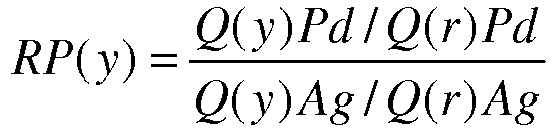
- Q (y) Pd = Somme des concentrations en palladium entre le bord du grain et une distance y du bord du grain catalytique (%pds)
- Q (y) Ag = Somme des concentrations en argent entre le bord du grain et une distance y du bord du grain catalytique (%pds)
- Q (r) Pd = teneur en palladium totale du grain catalytique (%pds)
- Q (r) Ag= teneur en argent totale du grain catalytique (%pds).
- On définit ainsi un critère de proximité, qui rend compte de la localisation relative des deux métaux dans le support. Ce dernier, déterminé par microsonde représente le rapport massique en tout point y du support des éléments métalliques ajoutés, dans notre cas Pd et Ag. Le rapport de proximité d'un catalyseur contant des métaux localement uniformément répartis sera de 1.
- Dans le catalyseur selon l'invention, le rapport de proximité RP est compris entre 0,5 et 2, de préférence entre 0,8 et 1,4.
- Le catalyseur préparé par le procédé de préparation selon l'invention est un catalyseur comprend du palladium, un support un support poreux comprenant au moins un oxyde réfractaire sélectionné dans le groupe constitué par la silice, l'alumine et la silice-alumine, ledit support poreux comprenant une surface spécifique comprise entre 140 et 250 m2/g, dans lequel au moins 80% poids du palladium le palladium est réparti dans une croûte à la périphérie dudit support, l'épaisseur de ladite croûte étant comprise entre 20 et 100 µm, de préférence entre 25 et 90 µm, la teneur en palladium dans le catalyseur est comprise entre 0,01 et 2 % poids par rapport au poids total du catalyseur, la dispersion métallique D du palladium est comprise entre 15 % et 70 %, ledit catalyseur étant préparé par un procédé comprenant au moins les étapes suivantes :
- a) on prépare une solution colloïdale d'oxyde de palladium ou d'hydroxyde de palladium en phase aqueuse ;
- b) on ajoute à un débit compris 1 et 20 litre(s)/heure ladite solution obtenue à l'étape a) sur ledit support poreux ; ledit support poreux étant contenu dans un dispositif d'imprégnation rotatif fonctionnant à une vitesse de rotation comprise entre 4 et 20 tours/minute ;
- c) optionnellement, on soumet le support poreux imprégné obtenu à l'étape b) à une maturation afin d'obtenir un précurseur de catalyseur ;
- d) on sèche le précurseur de catalyseur obtenu à l'étape b) ou c) à une température comprise entre 70°C et 200°C pendant une durée comprise entre 0,5 et 20 heures ;
- e) on calcine le précurseur de catalyseur obtenu à l'étape d) à une température comprise entre 300°C et 500°C.
- Les différentes étapes du procédé menant au catalyseur selon l'invention seront détaillées par la suite.
- La suspension colloïdale est généralement obtenue par hydrolyse du cation palladium en milieu aqueux, ce qui conduit à la formation de particules d'oxyde ou d'hydroxyde de palladium en suspension.
- La solution aqueuse d'hydroxyde d'alcalins ou d'hydroxyde alcalino-terreux est généralement sélectionnée dans le groupe constitué par les solutions aqueuses d'hydroxyde de sodium, les solutions aqueuses d'hydroxyde de magnésium. De manière préférée, de préférence la solution aqueuse est une solution aqueuse d'hydroxyde de sodium.
- Typiquement, on approvisionne dans un appareillage adapté la solution aqueuse comprenant au moins un sel précurseur du palladium [appelée aussi ici solution (II)] puis la solution aqueuse comprenant au moins un hydroxyde d'alcalins ou d'alcalino-terreux [appelée aussi ici solution (I)]. Alternativement, les solutions (I) et (II) peuvent être versées simultanément dans l'appareillage. De préférence, la solution aqueuse (II) puis la solution aqueuse (I) est versée dans l'appareillage.
- Le sel précurseur du palladium est généralement sélectionné dans le groupe constitué par le chlorure de palladium, le nitrate de palladium et le sulfate de palladium. De manière très préférée, le sel précurseur du palladium est le nitrate de palladium.
- La suspension colloïdale reste généralement dans l'appareillage pendant un temps de séjour compris entre 0 et 20 heures.
- Les concentrations de la solution (I) et (II) sont généralement choisies afin d'obtenir un pH de la suspension colloïdale compris entre 1,0 et 3,5. Ainsi, le pH de la suspension colloïdale peut être modifié pendant ce temps de séjour par ajout de quantités d'acide ou de base compatibles avec la stabilité de la suspension colloïdale.
- En général, la température de préparation est comprise entre 5°C et 40°C et de manière préférée entre 15°C et 35°C.
- La concentration en palladium est de préférence comprise entre 5 et 150 millimoles par litre (mmol/L), de manière plus préférée entre 8 et 80 millimoles par litre.
- La suspension colloïdale préparée à l'étape a) est ensuite imprégnée sur un support poreux. Le support poreux comprend au moins un oxyde réfractaire sélectionné dans le groupe constitué par la silice, l'alumine et la silice-alumine. De préférence, le support poreux est de l'alumine.
Le support poreux peut se présenter soit sous la forme d'une bille, soit sous la forme d'un extrudé. On entend par un support extrudé, un support comprenant une longueur h et un diamètre équivalent Déq dans lequel la longueur h est supérieure au diamètre équivalent Déq. De préférence l'extrudé comprend une longueur h comprise entre 2 et 10 mm, de préférence entre 2 et 8 mm, et plus préférentiellement entre préférence entre 3 et 6 mm.
De préférence, l'extrudé est sélectionné parmi les cylindres et les extrudés comprenant une section comportant au moins trois lobes.
Dans un mode de réalisation préféré selon l'invention, l'extrudé comprend une section comportant au moins trois lobes. - Lorsque l'extrudé comprend une section comportant au moins trois lobes, la section de l'extrudé peut être caractérisée par un rayon R répondant à l'équation (1):


- Selon la présente invention, on entend par la fonction Int(), la partie entière du rapport

- Ainsi, de manière illustrative, l'application de la fonction Int () pour un rapport égal à 1,8 correspond à la valeur entière 1 c'est à dire Int(1,8)=1, et l'application de la fonction Int () pour un rapport égal à 2,1 correspond à la valeur entière 2 c'est à dire Int(2,1)=2.
- Avantageusement, dans ce mode particulier selon l'invention, le nombre de lobes de l'extrudé n est choisi dans le groupe constitué par les valeurs entières 3, 4, 5, 6, 7, 8, 9 et 10; de manière préférée le nombre de lobes n est choisi dans le groupe constitué par les valeurs entières 3, 4, 5 et 6; de manière plus préférée, le nombre de lobes n est choisi dans le groupe constitué par les valeurs entières 3 et 4; et de manière très préférée le nombre de lobes n est 3.
- Pour plus de clarté dans l'application de l'équation (1) selon l'invention, la
figure 1 montre un schéma illustratif et non limitatif d'une section d'un extrudé dans lequel sont représentés tous les paramètres Ro, R, r et a, n étant le nombre de lobes de l'extrudé. La section de l'extrudé correspond à une coupe de l'extrudé selon un plan perpendiculaire à la direction de l'extrusion. En référence à lafigure 1 , la section de l'extrudé comporte quatre lobes. - Les procédés de fabrication d'extrudés supportés connus de l'homme du métier engendrent souvent des imperfections de forme liées à la mécanique des phases en présence, ce qui peut engendrer un écart entre la valeur R mesurable (Rmes) et la valeur R définie par l'équation (1). La valeur R mesurable (Rmes) liée à la valeur R définie par l'équation (1) de la présente invention est avantageusement comprise entre R-15%R et R+15%R, de préférence entre R-10%R et R+10%R, de manière plus préférée entre R-5%R et R+5%R, de manière encore plus préférée entre R-3%R et R+3%R.
- Selon l'invention, la surface spécifique du support poreux est comprise entre 140 et 250 m2/g, de préférence entre 165 et 250 m2/g, plus préférentiellement entre 170 et 220 m2/g et encore plus préférentiellement entre 175 et 210 m2/g.
- Le volume poreux du support est généralement compris entre 0,1 et 1,5 cm3/g, de préférence compris entre 0,2 et 1,0 cm3/g.
- De préférence, le support du catalyseur d'hydrogénation sélective est purement mésoporeux, i.e. qu'il présente un diamètre de pores compris entre 2 et 50 nm, de préférence entre 5 et 30 nm et de manière encore préférée de 8 à 20 nm. Dans ce mode de réalisation, le support de catalyseur ne comprend donc ni de micropores (< 2 nm), ni de macropores (>50 nm).
- Le support peut comprendre éventuellement du soufre. Le soufre peut provenir d'au moins un des précurseurs de synthèse du support d'alumine, notamment le sulfate d'aluminium. Selon le pH de la précipitation du gel d'alumine, une quantité de soufre résiduelle est contenue dans le support final. La teneur en soufre comprise dans le support peut être comprise entre 0,0050 et 0,25 % en poids par rapport au poids total du catalyseur, de préférence entre 0,0075 et 0,20 % en poids.
- Le support peut éventuellement subir un ensemble de traitements avant l'étape d'imprégnation, tel que des calcinations ou des hydratations. Le support peut aussi déjà comprendre un ou plusieurs éléments métalliques avant l'imprégnation de la suspension colloïdale. Des éléments métalliques peuvent aussi être introduits dans la suspension colloïdale. Ces éléments métalliques peuvent être introduits soit par des techniques conventionnelles, soit en utilisant le procédé selon la présente invention.
- Selon l'invention, la suspension colloïdale est versée sur le support. Ce processus est réalisé dans un dispositif d'imprégnation rotatif, tel qu'un tonneau imprégnateur, de façon continue, c'est-à-dire que l'étape de préparation de la suspension colloïdale précède l'étape d'imprégnation sur le support et que l'essentiel de la suspension colloïdale est envoyée vers l'étape d'imprégnation, en continu, après ajustement du temps de séjour de la suspension colloïdale à l'étape b).
Le dispositif d'imprégnation rotatif utilisé est de préférence un tonneau imprégnateur classique dont l'enceinte peut être mise sous pression réduite (environ 20 mm Hg) ou sous balayage de gaz (azote).
Le dispositif d'imprégnation rotatif est équipé d'une double-enveloppe, dans laquelle circule un fluide caloporteur via un thermorégulateur. Il est ainsi possible de réguler une température de paroi au sein de l'imprégnateur et un temps de séchage. Dans un mode de réalisation préféré, la température d'imprégnation est comprise entre 40 et 90°C, de préférence entre 50 et 70°C.
Selon l'invention, le dispositif d'imprégnation rotatif dans lequel le support, de surface spécifique comprise entre 140 et 250 m2/g, a été chargé fonctionne à une vitesse de rotation comprise entre 4 et 20 tours/minute. Au-dessus de 20 tours/minute la croûte de palladium obtenue sur le support est trop faible, i.e. en dessous de 20 µm, et une partie du palladium n'est pas imprégnée sur le support. Si la rotation du tambour est trop faible, i.e. inférieure à 4 tours/minute, la croûte de palladium obtenue sur le support peut excéder 100 µm d'épaisseur, et la dispersion du palladium sur le support n'est pas satisfaisante, c'est à dire inférieure à 15%. - Selon l'invention, le débit d'ajout de la solution colloïdale obtenue à l'étape a) sur le support poreux est compris entre 1 et 20 litre(s) par heure. Au-dessus de 20 litres par heure, la croûte de palladium obtenue est trop épaisse, i.e. au-dessus de 100 µm et la dispersion du palladium n'est pas satisfaisante, c'est à dire inférieure à 15%.
- On peut par exemple citer comme processus continu, un processus où la solution colloïdale est versée dans un bac qui se déverse en continu dans un tambour tournant comprenant le support à imprégner.
- Après imprégnation, le support imprégné peut être maturé à l'état humide pendant 0,5 à 40 h, de manière préférée pendant 1 à 30 h.
- Le précurseur du catalyseur est généralement séché afin d'éliminer toute ou une partie de l'eau introduite lors de l'imprégnation, de préférence à une température comprise entre 50°C et 250°C, de manière plus préférée entre 70°C et 200°C. La durée du séchage est comprise entre 0,5 h et 20 h.
Le séchage est généralement effectué sous air de combustion d'un hydrocarbure, de préférence du méthane, ou sous air chauffé comprenant entre 0 et 80 grammes d'eau par kilogramme d'air de combustion, un taux d'oxygène compris entre 5% et 25% volume et un taux de dioxyde de carbone compris entre 0% et 10% volume. - Après séchage le catalyseur est généralement calciné sous air de combustion, de préférence un air de combustion du méthane comprenant entre 40 et 80 gramme d'eau par kg d'air de combustion, un taux d'oxygène compris entre 5% et 15% volume et un taux de CO2 compris entre 4% et 10% volume. La température de calcination est généralement comprise entre 250°C et 900°C, de préférence comprise entre environ 300°C et environ 500°C. La durée de calcination est généralement comprise entre 0,5 h et 5 h.
- Le catalyseur est généralement réduit. Cette étape est de préférence réalisée en présence d'un gaz réducteur, soit in-situ, c'est-à-dire dans le réacteur où est réalisée la transformation catalytique, soit ex-situ. De manière préférée, cette étape est effectuée à une température comprise entre 80°C et 180°C, de manière encore plus préférée entre 100°C et 160°C.
La réduction est réalisée en présence d'un gaz réducteur comprenant entre 25 vol% et 100 vol% d'hydrogène, de préférence 100% volume d'hydrogène. L'hydrogène est éventuellement complété par un gaz inerte pour la réduction, de préférence de l'argon, de l'azote ou du méthane.
La réduction comprend généralement une phase de montée en température puis un palier. La durée du palier de réduction est généralement comprise entre 1 et 10 heures, de préférence entre 2 et 8 heures.
La Vitesse Volumétrique Horaire (V.V.H) est généralement comprise entre 150 et 3000, de préférence entre 300 et 1500 litres de gaz réducteur par heure et par litre de catalyseur. - Selon une variante, le catalyseur peut contenir un ou plusieurs métaux promoteurs, en particulier de l'argent. Le ou les métaux promoteurs peuvent être introduit lors de la préparation du support, sur le support déjà formé, pendant l'étape a) ou à l'issue des étapes b), c), d), e) ou f).
- Dans un mode de réalisation particulier selon l'invention, le catalyseur comprend en outre de l'argent. L'argent peut être introduit lors de la préparation du support, sur le support déjà formé, pendant l'étape a) ou à l'issue des étapes b), c), d), e) ou f).
Le dépôt d'argent sur le support peut avantageusement être réalisé par toute méthode connue de l'homme du métier, préférentiellement par imprégnation dudit support par au moins une solution contenant au moins un précurseur d'argent, et de préférence, par imprégnation à sec ou par imprégnation en excès. Cette solution contient au moins un précurseur d'argent à la concentration voulue pour obtenir sur le catalyseur final une teneur en argent comprise entre 0,02 et 3 % poids en argent par rapport au poids total du catalyseur, de préférence entre 0,05 et 0,3 % poids.
Dans le mode de réalisation dans lequel le catalyseur comprend en outre de l'argent, au moins 80 % poids de l'argent étant réparti dans une croûte à la périphérie du support, l'épaisseur de ladite croûte étant comprise entre 20 et 100 µm, de préférence comprise entre 25 et 90 µm, la teneur locale en argent à chaque point le long du diamètre du grain ayant la même évolution que la teneur locale en palladium. - Le catalyseur obtenu par le procédé selon l'invention peut comprendre au moins un métal sélectionné dans le groupe constitué par les alcalins et les alcalino-terreux.
Le métal alcalin est généralement sélectionné dans le groupe constitué par le lithium, le sodium, le potassium, le rubidium et le césium, de préférence par le lithium, le sodium et le potassium, de manière très préférée par le sodium et le potassium. De manière encore plus préférée, le métal alcalin est le sodium.
Le métal alcalino-terreux est généralement sélectionné dans le groupe constitué par le magnésium, le calcium, le strontium et le baryum, de préférence par le magnésium et le calcium, de manière très préférée par le magnésium.
Le métal alcalin, lorsqu'il est présent, est réparti de manière homogène à travers le support avec un coefficient R compris entre 0,8 et 1,2.
Le métal alcalino-terreux, lorsqu'il est présent, est réparti de manière homogène à travers le support avec un coefficient R compris entre 0,8 et 1,2. - Le catalyseur obtenu par le procédé selon l'invention comprend une dispersion métallique (D) d est comprise entre 15% et 70%, de préférence entre 20% et 70%, et plus préférentiellement entre 25% et 60%.
- Le catalyseur obtenu par le procédé selon l'invention comprend une teneur en palladium comprise entre 0,01 et 2 % poids en palladium, de façon préférée entre 0,05 et 1% poids, par rapport au poids total du catalyseur.
- Le catalyseur selon l'invention peut être utilisé dans les procédés faisant intervenir une transformation de composés organiques. Ainsi, le catalyseur selon l'invention peut être utilisé dans les procédés comprenant des réactions d'hydrogénation des composés comportant des fonctions aromatiques, cétones, aldéhydes, acides ou nitro, l'hydrogénation du monoxyde de carbone en alcools C1-C6, en méthanol ou en diméthyl-éther, les réactions d'isomérisation ou d'hydro-isomérisation, d'hydrogénolyse, et d'une manière générale les réactions faisant intervenir des coupures ou des formations de liaisons carbone-carbone.
- Les conditions opératoires généralement utilisées pour ces réactions sont les suivantes: une température comprise entre 0°C et 500°C, de préférence entre 25 et 350°C, une pression comprise entre 0,1 et 20 MPa, de préférence entre 0,1 et 10 MPa, une vitesse volumique horaire (V.V.H.) comprise entre 0,1 et 50 h-1, de préférence entre 0,5 et 20 h-1 pour une charge liquide; et entre 500 et 30 000 h-1, de préférence entre 500 et 15 000 h-1 pour une charge gazeuse. Lorsque de l'hydrogène est présent, le rapport molaire hydrogène sur charge est compris entre 1 et 500 litres par litre, de préférence entre 10 et 150 litres par litre.
- La mise en œuvre du catalyseur selon l'invention et les conditions de son utilisation doivent être adaptées par l'utilisateur à la réaction et à la technologie utilisée.
- Le catalyseur selon l'invention peut aussi être utilisé dans les réactions d'hydrogénation des composés comportant des fonctions acétyléniques, diéniques, oléfiniques.
L'invention concerne aussi le procédé d'hydrogénation sélective par mise en contact d'une charge sur le catalyseur selon l'invention ou sur le catalyseur préparé selon l'invention, ladite charge étant sélectionnée dans le groupe constitué par les coupes C3 de vapocraquage, les coupes C4 de vapocraquage, les coupes C5 de vapocraquage et les essences de vapocraquage appelée aussi essences de pyrolyse. - Selon une application préférée, les catalyseurs selon l'invention sont mise en oeuvre pour les réactions d'hydrogénation sélective des coupes poly-insaturées d'hydrocarbures issues de vapocraquage et/ou de craquage catalytique, de préférence des coupes poly-insaturées d'hydrocarbures issues du vapocraquage.
- Les procédés de conversion des hydrocarbures tels que le vapocraquage ou le craquage catalytique sont opérés à haute température et produisent une grande variété de molécules insaturées telles que l'éthylène, le propylène, les butènes linéaires, l'isobutène, les pentènes ainsi que des molécules insaturés contenant jusqu'à environ 15 atomes de carbone.
En parallèle sont également formés des composés polyinsaturés: acétylène, propadiène et méthylacétylène (ou propyne), 1-2 et 1-3 butadiène, vinylacétylène et éthylacétylène, et d'autres composés polyinsaturés dont le point d'ébullition correspond à la fraction essence C5+.
Tous ces composés polyinsaturés doivent être éliminés pour permettre l'utilisation de ces différentes coupes dans les procédés de pétrochimie tels que les unités de polymérisation. - Ainsi, par exemple, la coupe C3 de vapocraquage peut avoir la composition moyenne suivante : de l'ordre de 90% poids propylène, de l'ordre de 3 à 8% poids de propadiène et méthylacétylène, le reste étant essentiellement du propane. Dans certaines coupes C3, entre 0,1 et 2% poids de C2 et de C4 peut aussi être présent. Les spécifications concernant les concentrations de ces composés polyinsaturés pour les unités de pétrochimie et de polymérisation sont très basses : 20-30 ppm poids de MAPD (MéthylAcétylène et PropaDiène) pour le propylène qualité chimique et moins de 10 ppm poids voire jusqu'à 1 ppm poids pour la qualité « polymérisation ».
Une coupe C4 de vapocraquage présente par exemple la composition molaire moyenne suivante : 1 % de butane, 46,5% de butène, 51% de butadiène, 1,3% de VinylAcetylène (VAC) et 0,2% de butyne. Dans certaines coupes C4, entre 0,1 et 2% poids de C3 et de C5 peut aussi être présent. Là encore les spécifications sont sévères : teneur en dioléfines strictement inférieure à 10 ppm poids pour une coupe C4 qui sera utilisée en pétrochimie ou polymérisation.
Une coupe C5 de vapocraquage présente par exemple la composition moyenne en masse suivante : 21% de pentanes, 45% de pentènes, 34% de pentadiènes. - Le procédé d'hydrogénation sélective s'est progressivement imposé pour éliminer les composés polyinsaturés des coupes pétrolières C3 à C5 citées car ce procédé permet la conversion des composés les plus insaturés vers les alcènes correspondants en évitant la saturation totale et donc la formation des alcanes correspondant.
- L'hydrogénation sélective peut être réalisée en phase gaz ou liquide, de préférence en phase liquide. En effet, une réaction en phase liquide permet d'abaisser le coût énergétique et d'augmenter la durée de cycle des catalyseurs.
Pour une réaction en phase liquide, la pression est généralement comprise entre 1 et 3 MPa, la température entre 2 et 50°C et le ratio molaire hydrogène/(composés polyinsaturés à hydrogéner) entre 0,1 et 4, de préférence entre 1 et 2.
Pour une réaction d'hydrogénation en phase gazeuse, la pression est généralement comprise entre 1 et 3 MPa, la température entre 40 et 120°C et le ratio molaire hydrogène/(composés polyinsaturés à hydrogéner) entre 0,1 et 4, de préférence entre 1 et 2. - Le vapocraquage produit principalement de l'éthylène, du propylène, une coupe C4 ainsi que de l'essence de vapocraquage appelée aussi essence de pyrolyse.
Selon un autre mode préféré, la charge est une essence de pyrolyse. L'essence de pyrolyse correspond à une coupe dont la température d'ébullition est généralement comprise entre 0°C et 250°C, de préférence entre 10°C et 220°C. Cette charge comprend généralement la coupe C5-C12 avec des traces de C3, C4, C13, C14, C15 (par exemple entre 0,1 à 3% poids pour chacune de ces coupes). - Par exemple, une coupe C5-200°C a généralement une composition en % poids suivante:
- Paraffines 8 - 12 ;
- Aromatiques 58 - 62 ;
- Mono-oléfines 8 - 10 ;
- Dioléfines 18-22 ;
- Soufre 20 - 300 ppm.
- L'hydrogénation sélective d'une essence de pyrolyse consiste à mettre en contact la charge à traiter avec de l'hydrogène introduit en excès dans un ou plusieurs réacteurs contenant le catalyseur d'hydrogénation.
Le débit d'hydrogène est ajusté afin d'en disposer en quantité suffisante pour hydrogéner théoriquement l'ensemble des dioléfines, des acétyléniques et des alkényl aromatiques et de maintenir un excès d'hydrogène en sortie de réacteur. Afin de limiter le gradient de température dans le réacteur, il peut être avantageux de recycler une fraction de l'effluent à l'entrée et/ou au milieu du réacteur.
Dans le cas d'une hydrogénation sélective d'essence de pyrolyse, le ratio molaire hydrogène/(composés polyinsaturés à hydrogéner) est généralement compris entre 1 et 2, la température est généralement comprise entre 40°C et 200°C, de préférence entre 50 et 180°C, la vitesse horaire spatiale (correspondant au volume d'hydrocarbure par volume de catalyseur et par heure) est comprise généralement entre 0,5 h-1 et 10 h-1 , de préférence entre 1 h-1 et 5 h-1 et la pression est généralement comprise entre 1,0 MPa et 6,5 MPa, de préférence entre 2,0 MPa et 3,5 MPa. - Les exemples présentés ci-dessous visent à démontrer l'amélioration de l'activité catalytique en hydrogénation sélective des catalyseurs selon l'invention. Les exemples 1 à 3 et 8 concernent des procédés de préparation de catalyseurs non conformes à l'invention et les exemples 4 à 7 concernent des procédés de préparation d'un catalyseur selon l'invention. L'exemple 9 concerne l'application de ces catalyseurs dans une réaction d'hydrogénation sélective.
- Dans cet exemple, la surface spécifique du support du catalyseur est inférieure à celle des catalyseurs conformes à l'invention (i.e. inférieure à 140 m2/g). Par ailleurs, l'étape d'imprégnation n'est pas conforme à l'invention.
- Une suspension colloïdale d'oxyde de Pd est préparée sous agitation à 25°C par dilution de 230 g d'une solution de nitrate de palladium Pd(NO3)2 contenant 8,5 % poids de palladium Pd avec environ 4,8L d'eau déminéralisée, puis ajout d'environ 150ml d'une solution de soude pour arriver à un pH de 2,4. La suspension est ensuite diluée avec de l'eau déminéralisée à un volume qui correspond au volume poreux du support alumine dont la surface spécifique est de 71 m2/g mise en forme sous forme de billes. Cette solution est ensuite imprégnée en tonneau d'imprégnation à une vitesse de rotation de 6 tours/minute (tr/min) et un débit d'ajout de la solution de 22 lites/heure (l/h) sur environ 10 kg d'une alumine. Une étape de maturation du support imprégné avant séchage d'une durée de 20 h est effectuée sous air en milieu confiné et humide. Le solide obtenu est séché pendant 16h à 90°C sous débit d'azote. Le catalyseur est ensuite calciné sous un flux d'air 2 h à 450°C.
Le catalyseur C1 ainsi préparé contient 0,19% poids de palladium par rapport au poids total de catalyseur.
La caractérisation du catalyseur C1 par microsonde de Castaing montre que 80% du Pd est réparti sur une croûte d'épaisseur environ 189 µm.
Le sodium est réparti de façon homogène avec un coefficient de répartition R(Na)=0,92.
La dispersion apparente du palladium du catalyseur C1 est de 22%. - Dans cet exemple, l'étape d'imprégnation n'est pas conforme à l'invention.
- Une suspension colloïdale d'oxyde de Pd est préparée sous agitation à 25°C par dilution de 230 g d'une solution de nitrate de palladium Pd(NO3)2 contenant 8,5 % poids de palladium Pd avec environ 7,5L d'eau déminéralisée, puis ajout d'environ 150ml d'une solution de soude pour arriver à un pH de 2,4. La suspension est ensuite diluée avec de l'eau déminéralisée à un volume qui correspond au volume poreux du support alumine dont la surface spécifique est de 140 m2/g mise en forme sous forme de billes. Cette solution est ensuite imprégnée en tonneau d'imprégnation à une vitesse de rotation de 6 tr/min et un débit d'ajout de la solution de 22 l/h sur environ 10kg d'une alumine. Une étape de maturation du support imprégné avant séchage d'une durée de 20 h est effectuée sous air en milieu confiné et humide. Le solide obtenu est séché pendant 16h à 90°C sous débit d'azote. Le catalyseur est ensuite calciné sous un flux d'air 2 h à 450°C.
Le catalyseur C2 ainsi préparé contient 0,19% poids de palladium par rapport au poids total de catalyseur.
La caractérisation du catalyseur C2 par microsonde de Castaing montre que 80% du Pd est réparti sur une croûte d'épaisseur environ 150 µm.
Le sodium est réparti de façon homogène avec un coefficient de répartition R(Na)=0,92. La dispersion apparente du palladium du catalyseur C2 est de 26%. - Dans cet exemple, la surface spécifique du support est inférieure à celle des catalyseurs conformes à l'invention (i.e. inférieure à 140 m2/g). Cependant, l'étape d'imprégnation est conforme à l'invention.
- Une suspension colloïdale d'oxyde de Pd est préparée sous agitation à 25°C par dilution de 230 g d'une solution de nitrate de palladium Pd(NO3)2 contenant 8,5 % poids de palladium Pd avec environ 4,8L d'eau déminéralisée, puis ajout d'environ 150 ml d'une solution de soude pour arriver à un pH de 2,4. La suspension est ensuite diluée avec de l'eau déminéralisée à un volume qui correspond au volume poreux du support alumine dont la surface spécifique est de 71 m2/g mise en forme sous forme de billes. Cette solution est ensuite imprégnée en tonneau d'imprégnation à une vitesse de rotation de 14 tr/min et un débit d'ajout de la solution de 5,4l/h sur environ 10kg d'une alumine. Une étape de maturation du support imprégné avant séchage d'une durée de 20 h est effectuée sous air en milieu confiné et humide. Le solide obtenu est séché pendant 16h à 90°C sous débit d'azote. Le catalyseur est ensuite calciné sous un flux d'air 2 h à 450°C.
Le catalyseur C3 ainsi préparé contient 0,19% poids de palladium par rapport au poids total de catalyseur.
La caractérisation du catalyseur C3 par microsonde de Castaing montre que 80% du Pd est réparti sur une croûte d'épaisseur environ 112 µm.
Le sodium est réparti de façon homogène avec un coefficient de répartition R(Na)=0,92.
La dispersion apparente du palladium du catalyseur C3 est de 23%. - Dans cet exemple, la surface spécifique du support est conforme à l'invention. Par ailleurs, l'étape d'imprégnation est conforme à l'invention.
- Une suspension colloïdale d'oxyde de Pd est préparée sous agitation à 25°C par dilution de 230 g d'une solution de nitrate de palladium Pd(NO3)2 contenant 8,5 % poids de palladium Pd avec environ 4.8L d'eau déminéralisée, puis ajout d'environ 150 ml d'une solution de soude pour arriver à un pH de 2,4. La suspension est ensuite diluée avec de l'eau déminéralisée à un volume qui correspond au volume poreux du support alumine dont la surface spécifique est de 210 m2/g mise en forme sous forme de billes. Cette solution est ensuite imprégnée en tonneau d'imprégnation à une vitesse de rotation de 14 tr/min et un débit d'ajout de la solution de 5,4l/h sur environ 10kg d'une alumine. Une étape de maturation du support imprégné avant séchage d'une durée de 20 h est effectuée sous air en milieu confiné et humide. Le solide obtenu est séché pendant 16h à 90°C sous débit d'azote. Le catalyseur est ensuite calciné sous un flux d'air 2 h à 450°C.
Le catalyseur C4 ainsi préparé contient 0,19% poids de palladium par rapport au poids total de catalyseur.
La caractérisation du catalyseur C4 par microsonde de Castaing montre que 80% du Pd est réparti sur une croûte d'épaisseur environ 65 µm.
Le sodium est réparti de façon homogène avec un coefficient de répartition R(Na)=0,92.
La dispersion apparente du palladium du catalyseur C4 est de 27%. - Dans cet exemple, la surface spécifique du support est conforme à l'invention. Par ailleurs, l'étape d'imprégnation est conforme à l'invention.
- Une suspension colloïdale d'oxyde de Pd est préparée sous agitation à 25°C par dilution de 230 g d'une solution de nitrate de palladium Pd(NO3)2 contenant 8,5 % poids de palladium Pd avec environ 7,5L d'eau déminéralisée, puis ajout d'environ 150 ml d'une solution de soude pour arriver à un pH de 2,4. La suspension est ensuite diluée avec de l'eau déminéralisée à un volume qui correspond au volume poreux du support alumine dont la surface spécifique est de 140 m2/g mise en forme sous forme de billes. Cette solution est ensuite imprégnée en tonneau d'imprégnation à une vitesse de rotation de 14 tr/min et un débit d'ajout de la solution de 5,4l/h sur environ 10kg d'une alumine. Une étape de maturation du support imprégné avant séchage d'une durée de 20 h est effectuée sous air en milieu confiné et humide. Le solide obtenu est séché pendant 16h à 90°C sous débit d'azote. Le catalyseur est ensuite calciné sous un flux d'air 2 h à 450°C.
Le catalyseur C5 ainsi préparé contient 0,19% poids de palladium par rapport au poids total de catalyseur.
La caractérisation du catalyseur C5 par microsonde de Castaing montre que 80% du Pd est réparti sur une croûte d'épaisseur environ 93 µm.
Le sodium est réparti de façon homogène avec un coefficient de répartition R(Na)=0,92.
La dispersion apparente du palladium du catalyseur C5 est de 21%. - Dans cet exemple, la surface spécifique du support est conforme à l'invention. L'étape d'imprégnation du procédé est conforme à l'invention.
- Une suspension colloïdale d'oxyde de Pd est préparée sous agitation à 25°C par dilution de 230 g d'une solution de nitrate de palladium Pd(NO3)2 contenant 8,5 % poids de palladium Pd avec environ 6,2L d'eau déminéralisée, puis ajout d'environ 150ml d'une solution de soude pour arriver à un pH de 2,4. La suspension est ensuite diluée avec de l'eau déminéralisée à un volume qui correspond au volume poreux du support alumine dont la surface spécifique est de 210 m2/g mise en forme sous forme d'extrudés trilobés d'une longueur moyenne comprise entre 3 et 6 mm. Cette solution est ensuite imprégnée en tonneau d'imprégnation à une vitesse de rotation de 14tr/min et un débit d'ajout de la solution de 5,4l/h sur environ 10kg d'une alumine. Une étape de maturation du support imprégné avant séchage d'une durée de 20 h est effectuée sous air en milieu confiné et humide. Le solide obtenu est séché pendant 16h à 90°C sous débit d'azote. Le catalyseur est ensuite calciné sous un flux d'air 2 h à 450°C.
Le catalyseur C6 ainsi préparé contient 0,19% poids de palladium par rapport au poids total de catalyseur.
La caractérisation du catalyseur C6 par microsonde de Castaing montre que 80% du Pd est réparti sur une croûte d'épaisseur environ 25 µm.
Le sodium est réparti de façon homogène avec un coefficient de répartition R(Na)=0,92.
La dispersion apparente du palladium du catalyseur C6 est de 31%. - Dans cet exemple, la surface spécifique du support est conforme à l'invention. L'étape d'imprégnation du procédé est conforme à l'invention.
- Une suspension colloïdale d'oxyde de Pd est préparée sous agitation à 25°C par dilution de 230 g d'une solution de nitrate de palladium Pd(NO3)2 contenant 8,5 % poids de palladium Pd avec environ 6,2L d'eau déminéralisée, puis ajout d'environ 150ml d'une solution de soude pour arriver à un pH de 2,4. La suspension est ensuite diluée avec de l'eau déminéralisée à un volume qui correspond au volume poreux du support alumine dont la surface spécifique est de 200 m2/g mise en forme sous forme d'extrudés cylindriques d'une longueur moyenne comprise entre 2 et 4 mm. Cette solution est ensuite imprégnée en tonneau d'imprégnation à une vitesse de rotation de 14tr/min et un débit d'ajout de la solution de 5,5l/h sur environ 10kg d'une alumine. Une étape de maturation du support imprégné avant séchage d'une durée de 20 h est effectuée sous air en milieu confiné et humide. Le solide obtenu est séché pendant 16h à 90°C sous débit d'azote. Le catalyseur est ensuite calciné sous un flux d'air 2 h à 450°C.
Le catalyseur C7 ainsi préparé contient 0,19% poids de palladium par rapport au poids total de catalyseur.
La caractérisation du catalyseur C7 par microsonde de Castaing montre que 80% du Pd est réparti sur une croûte d'épaisseur environ 29 µm.
Le sodium est réparti de façon homogène avec un coefficient de répartition R(Na)=0,92.
La dispersion apparente du palladium du catalyseur C7 est de 28%. - Dans cet exemple, la surface spécifique du support est conforme à l'invention. Cependant, l'étape d'imprégnation n'est pas conforme à l'invention.
- Une suspension colloïdale d'oxyde de Pd est préparée sous agitation à 25°C par dilution de 230 g d'une solution de nitrate de palladium Pd(NO3)2 contenant 8,5 % poids de palladium Pd avec environ 6,2L d'eau déminéralisée, puis ajout d'environ 150ml d'une solution de soude pour arriver à un pH de 2,4. La suspension est ensuite diluée avec de l'eau déminéralisée à un volume qui correspond au volume poreux du support alumine dont la surface spécifique est de 210 m2/g mise en forme sous forme d'extrudés cylindriques d'une longueur moyenne comprise entre 2 et 4 mm. Cette solution est ensuite imprégnée en tonneau d'imprégnation à une vitesse de rotation de 25 tr/min et un débit d'ajout de la solution de 15 L/h sur environ 10kg d'une alumine. Une étape de maturation du support imprégné avant séchage d'une durée de 20 h est effectuée sous air en milieu confiné et humide. Le solide obtenu est séché pendant 16h à 90°C sous débit d'azote.
Le catalyseur est ensuite calciné sous un flux d'air 2 h à 450°C.
Le catalyseur C8 ainsi préparé contient 0,19% poids de palladium par rapport au poids total de catalyseur.
La caractérisation du catalyseur C8 par microsonde de Castaing montre que 80% du Pd est réparti sur une croûte dont l'épaisseur est en dessous du seuil de détection.
Le sodium est réparti de façon homogène avec un coefficient de répartition R(Na)=0,91.
La dispersion apparente du palladium du catalyseur C8 est de 13%. - Les résultats des exemples 1 à 8 sont représentés dans le tableau 1 ci-après.
Tableau 1 : Caractéristiques techniques et morphologiques des catalyseurs C1 à C8 Vitesse de rotation (tr/min) Débit ajout solution d'imprégnation (l/h) SBET support (m2/g) Forme Taille croute (µm) Dispersion (%) C1 (non conforme) 6 22 71 billes 189 22 C2 (non conforme) 6 22 140 billes 150 26 C3 (non conforme) 14 5,4 71 billes 112 23 C4 (conforme) 14 5,4 210 billes 65 27 C5 (conforme) 14 5,4 140 billes 93 21 C6 (conforme) 14 5,4 210 extrudés trilobés 25 31 C7 (conforme) 14 5,5 200 extrudés cylindriques 29 28 C8 (non conforme) 25 15 210 extrudés cylindriques <sd* 13 *sd = seuil de détection - Test catalytique en hydrogénation d'un mélange styrène isoprène en présence de S.
- Avant le test catalytique, les catalyseurs C1 à C8 sont traités sous un flux de 1 litre d'hydrogène par heure et par gramme de catalyseur avec une montée en température de 300°C/h et un palier à 150°C pendant 2 heures.
- Les catalyseurs sont ensuite soumis à un test d'hydrogénation dans un réacteur discontinu parfaitement agité de type « Grignard ». Pour ce faire, 4 ml de billes ou d'extrudés de catalyseur réduit sont fixées à l'abri de l'air dans un panier annulaire situé autour du mobile d'agitation. Les paniers utilisés dans les réacteurs sont de type Robinson Mahonnay.
- La composition de la charge est la suivante : 8% poids styrène, 8% poids isoprène, 10 ppm de S introduits sous forme de pentanethiol, 100 ppm de S introduits sous forme de thiophène, le solvant étant du n-heptane.
Le test est réalisé sous une pression constante de 3,5 MPa d'hydrogène et à une température de 45°C. Les produits de la réaction sont analysés par chromatographie en phase gazeuse. - Les activités catalytiques sont exprimées en moles de H2 consommées par minute et par gramme de palladium et sont reportées dans le tableau 2 ci-après.
Tableau 2 : Activités mesurées en hydrogénation d'un mélange styrène-isoprène en présence de soufre Catalyseur Activité* %/Ref** C1 (non conforme) 0,31 41 C2 (non conforme) 0,63 84 C3 (non conforme) 0,52 69 C4 (conforme) 0,75 100 C5 (conforme) 0,73 97 C6 (conforme) 1,13 150 C7 (conforme) 0,97 130 C8 (non conforme) 0,59 79 * en (moles H2)/[min×(gramme de palladium)]
** %/Ref correspond au gain converti en %, obtenu par rapport au catalyseur de référence C4 dont l'activité est défini à 100%. - On observe que les catalyseurs C4, C5, C6 et C7 ont une activité supérieure par rapport au catalyseurs C1, C2, C3 et C8 (non conformes à l'invention).
Le catalyseur C8 a une épaisseur de croûte trop fine (<20 µm) du fait de la haute surface spécifique de son support et du fait que le procédé de préparation est non adapté (la rotation du tonneau tournant est trop élevée, de même pour le débit un débit trop élevé également). Le catalyseur C1 ne donne pas des résultats satisfaisants en terme d'activité, ce dernier étant préparé par un procédé non conforme à l'invention. Par ailleurs le catalyseur C1 présente une surface spécifique trop faible.
Le catalyseur C2 ne donne pas de résultats satisfaisants en terme d'activité, ce dernier étant préparé par un procédé non conforme à l'invention.
Le catalyseur C3 ne donne pas des résultats satisfaisants en terme d'activité, quand bien même l'étape d'imprégnation de la solution colloïdale sur le support est conforme à l'invention, ce dernier étant préparé en utilisant un support dont la surface spécifique est trop faible.
Claims (13)
- Procédé de préparation d'un catalyseur comprenant du palladium, un support poreux comprenant au moins un oxyde réfractaire sélectionné dans le groupe constitué par la silice, l'alumine et la silice-alumine, ledit support poreux comprenant une surface spécifique comprise entre 140 et 250 m2/g, telle que mesurée par la méthode B.E.T. selon la norme ASTM D3663-03, dans lequel au moins 80% poids du palladium est réparti dans une croûte à la périphérie dudit support, l'épaisseur de ladite croûte étant comprise entre 20 et 100 µm, la teneur en palladium dans le catalyseur est comprise entre 0,01 et 2 % poids par rapport au poids total du catalyseur, la dispersion métallique D du palladium est comprise entre 15% et 70%, lequel procédé comprenant les étapes suivantes :a) on prépare une solution colloïdale d'oxyde de palladium ou d'hydroxyde de palladium en phase aqueuse ;b) on ajoute à un débit compris 1 et 20 litre(s)/heure ladite solution obtenue à l'étape a) sur ledit support poreux ; ledit support poreux étant contenu dans un dispositif d'imprégnation rotatif fonctionnant à une vitesse de rotation comprise entre 4 et 20 tours/minute ;c) optionnellement, on soumet le support poreux imprégné obtenu à l'étape b) à une maturation afin d'obtenir un précurseur de catalyseur ;d) on sèche le précurseur de catalyseur obtenu à l'étape b) ou c) à une température comprise entre 70°C et 200°C pendant une durée comprise entre 0,5 et 20 heures ;e) on calcine le précurseur de catalyseur obtenu à l'étape d) à une température comprise entre 300°C et 500°C.
- Procédé selon la revendication 1, caractérisé en ce que ledit support poreux se présente sous la forme d'une bille.
- Procédé selon la revendication 1, caractérisé en ce que ledit support poreux se présente sous la forme d'un extrudé.
- Procédé selon la revendication 3, caractérisé en ce que ledit support poreux se présente sous la forme d'un extrudé de longueur h comprise entre 2 et 10 mm.
- Procédé selon les revendications 3 ou 4, caractérisé en ce que ledit support poreux comprend une section comportant au moins trois lobes.
- Procédé selon la revendication 5, dans lequel le nombre de lobes de l'extrudé n est choisi dans le groupe constitué par les valeurs entières 3, 4, 5, 6, 7, 8, 9 et 10.
- Procédé selon les revendications 5 ou 6, dans lequel le nombre de lobes n est choisi dans le groupe constitué par les valeurs entières 3 et 4.
- Procédé selon la revendication 3, caractérisé en ce que l'extrudé se présente sous la forme d'un cylindre.
- Procédé selon l'une quelconque des revendications précédentes, caractérisé en ce que ledit catalyseur comprend en outre de l'argent à une teneur comprise entre 0,02 et 3 % poids en argent par rapport au poids total du catalyseur.
- Procédé selon l'une quelconque des revendications précédentes, caractérisé en ce que le support présente un diamètre de pores compris entre 2 et 50 nm.
- Procédé selon l'une quelconque des revendications précédentes, dans lequel on réalise une étape c) de maturation pendant une durée comprise entre 0,5 et 40 heures.
- Procédé selon l'une quelconque des revendications précédentes, dans lequel on soumet ledit catalyseur séché obtenu à l'issue de l'étape e) à un traitement réducteur par mise en contact avec un gaz réducteur à une température comprise entre 80 et 180°C.
- Procédé selon l'une quelconque des revendications précédentes, dans lequel le dispositif d'imprégnation rotatif de l'étape b) est un tonneau tournant.
Applications Claiming Priority (2)
| Application Number | Priority Date | Filing Date | Title |
|---|---|---|---|
| FR1654833A FR3051685B1 (fr) | 2016-05-30 | 2016-05-30 | Procede de preparation d'un catalyseur d'hydrogenation selective . |
| PCT/EP2017/059640 WO2017207168A1 (fr) | 2016-05-30 | 2017-04-24 | Procede de preparation d'un catalyseur d'hydrogenation selective |
Publications (2)
| Publication Number | Publication Date |
|---|---|
| EP3463657A1 EP3463657A1 (fr) | 2019-04-10 |
| EP3463657B1 true EP3463657B1 (fr) | 2020-02-26 |
Family
ID=56787559
Family Applications (1)
| Application Number | Title | Priority Date | Filing Date |
|---|---|---|---|
| EP17719561.7A Active EP3463657B1 (fr) | 2016-05-30 | 2017-04-24 | Procede de preparation d'un catalyseur d'hydrogenation selective |
Country Status (8)
| Country | Link |
|---|---|
| US (1) | US10946370B2 (fr) |
| EP (1) | EP3463657B1 (fr) |
| JP (1) | JP7005524B2 (fr) |
| CN (1) | CN109562369B (fr) |
| DK (1) | DK3463657T3 (fr) |
| FR (1) | FR3051685B1 (fr) |
| TW (1) | TWI746558B (fr) |
| WO (1) | WO2017207168A1 (fr) |
Families Citing this family (3)
| Publication number | Priority date | Publication date | Assignee | Title |
|---|---|---|---|---|
| FR3051684B1 (fr) * | 2016-05-30 | 2020-09-04 | Ifp Energies Now | Catalyseur d'hydrogenation selective comprenant un support extrude |
| US11772078B2 (en) * | 2022-01-21 | 2023-10-03 | GM Global Technology Operations LLC | Layered catalyst structures and methods of making the same |
| CN120001366A (zh) * | 2023-11-14 | 2025-05-16 | 中国石油化工股份有限公司 | 一种高分散度的炔烃加氢催化剂及其制备方法和应用 |
Family Cites Families (25)
| Publication number | Priority date | Publication date | Assignee | Title |
|---|---|---|---|---|
| FR2421858A1 (fr) * | 1978-04-05 | 1979-11-02 | Inst Francais Du Petrole | Procede d'hydrogenation selective d'une fraction d'hydrocarbures renfermant au moins un hydrocarbure diolefinique et au moins un hydrocarbure acetylenique |
| US4484015A (en) * | 1981-05-06 | 1984-11-20 | Phillips Petroleum Company | Selective hydrogenation |
| US4493906A (en) * | 1983-03-08 | 1985-01-15 | The Dow Chemical Company | Catalyst for the selective hydrogenation of acetylenes |
| US4940687A (en) * | 1983-04-13 | 1990-07-10 | Beijing Research Institute Of Chemical Industry | Catalyst and process for hydrogenation of unsaturated hydrocarbons |
| DE4323980C1 (de) * | 1993-07-16 | 1995-03-30 | Hoechst Ag | Palladium und Kalium sowie Cadmium, Barium oder Gold enthaltender Schalenkatalysator, Verfahren zu dessen Herstellung sowie dessen Verwendung zur Herstellung von Vinylacetat |
| EP0686615B2 (fr) * | 1994-06-09 | 2007-06-27 | Institut Francais Du Petrole | Procédé d'hydrogénation catalytique et catalyseur utilisable dans ce procédé |
| US5583274A (en) * | 1995-01-20 | 1996-12-10 | Phillips Petroleum Company | Alkyne hydrogenation process |
| US6054409A (en) * | 1995-06-06 | 2000-04-25 | Institut Francais Du Petrole | Selective hydrogenation catalyst and a process using that catalyst |
| DE19734974A1 (de) * | 1997-08-13 | 1999-02-25 | Hoechst Ag | Verfahren zur Herstellung von porös geträgerten Metall-Nanopartikel-haltigen Katalysatoren, insbesondere für die Gasphasenoxidation von Ethylen und Essigsäure zu Vinylacetat |
| DE19753738A1 (de) * | 1997-12-04 | 1999-06-10 | Degussa | Verfahren zur Herstellung eines Katalysators |
| DE19840373A1 (de) * | 1998-09-04 | 2000-03-09 | Basf Ag | Katalysator und Verfahren zur Selektivhydrierung ungesättigter Verbindungen in Kohlenwasserstoffströmen |
| DE102007025442B4 (de) * | 2007-05-31 | 2023-03-02 | Clariant International Ltd. | Verwendung einer Vorrichtung zur Herstellung eines Schalenkatalysators und Schalenkatalysator |
| FR2922784B1 (fr) * | 2007-10-29 | 2011-05-13 | Inst Francais Du Petrole | Catalyseur comprenant du palladium et son application en hydrogenation selective |
| US8772561B2 (en) * | 2008-11-19 | 2014-07-08 | Uop Llc | Methods for selective hydrogenation performance using a layered sphere catalyst with new formulations |
| FR2968578B1 (fr) * | 2010-12-14 | 2013-06-28 | IFP Energies Nouvelles | Nouveau procede de preparation de catalyseurs a base de palladium et utilisation de ces catalyseurs en hydrogenation selective |
| CN102266797A (zh) * | 2011-06-24 | 2011-12-07 | 淄博齐茂催化剂有限公司 | 一种浸渍异形催化剂载体的方法 |
| CN103084183B (zh) * | 2011-10-27 | 2014-09-17 | 中国石油化工股份有限公司 | 一种固定床用催化剂的制备方法和固定床用催化剂 |
| FR2991197B1 (fr) | 2012-05-31 | 2014-08-22 | IFP Energies Nouvelles | Catalyseur comprenant du palladium et de l'argent et son application en hydrogenation selective |
| FR2990882B1 (fr) * | 2012-05-24 | 2015-05-15 | IFP Energies Nouvelles | Procede de preparation d'un catalyseur a base d'un metal du groupe viii et contenant du silicium et procede d'hydrogenation selective mettant en oeuvre ledit catalyseur |
| FR2993795B1 (fr) * | 2012-07-25 | 2016-01-08 | IFP Energies Nouvelles | Procede de preparation de catalyseurs a base de particules metalliques de dispersion controlee |
| DE102013015436A1 (de) * | 2012-09-19 | 2014-03-20 | Clariant International Ltd. | Kupfer-promotierter Schalenkatalysator zur Herstellung von Alkenylcarbonsäureestern |
| CN105195237A (zh) * | 2014-06-10 | 2015-12-30 | 中国石油化工股份有限公司 | 浸渍转鼓和催化剂生产设备 |
| FR3051684B1 (fr) * | 2016-05-30 | 2020-09-04 | Ifp Energies Now | Catalyseur d'hydrogenation selective comprenant un support extrude |
| FR3059253B1 (fr) * | 2016-11-29 | 2020-01-17 | IFP Energies Nouvelles | Catalyseur d'hydrogenation selective d'une coupe d'hydrocarbures c3. |
| FR3059252B1 (fr) * | 2016-11-29 | 2018-11-16 | IFP Energies Nouvelles | Catalyseur d’hydrogenation selective de coupes c3 de vapocraquage et/ou de craquage catalytique |
-
2016
- 2016-05-30 FR FR1654833A patent/FR3051685B1/fr active Active
-
2017
- 2017-04-24 CN CN201780034008.1A patent/CN109562369B/zh active Active
- 2017-04-24 JP JP2018562049A patent/JP7005524B2/ja active Active
- 2017-04-24 DK DK17719561.7T patent/DK3463657T3/da active
- 2017-04-24 EP EP17719561.7A patent/EP3463657B1/fr active Active
- 2017-04-24 US US16/305,772 patent/US10946370B2/en active Active
- 2017-04-24 WO PCT/EP2017/059640 patent/WO2017207168A1/fr not_active Ceased
- 2017-05-26 TW TW106117716A patent/TWI746558B/zh active
Non-Patent Citations (1)
| Title |
|---|
| None * |
Also Published As
| Publication number | Publication date |
|---|---|
| TWI746558B (zh) | 2021-11-21 |
| US20200254436A1 (en) | 2020-08-13 |
| EP3463657A1 (fr) | 2019-04-10 |
| JP2019521842A (ja) | 2019-08-08 |
| CN109562369A (zh) | 2019-04-02 |
| FR3051685B1 (fr) | 2018-06-08 |
| CN109562369B (zh) | 2022-09-20 |
| DK3463657T3 (da) | 2020-05-18 |
| FR3051685A1 (fr) | 2017-12-01 |
| JP7005524B2 (ja) | 2022-02-10 |
| US10946370B2 (en) | 2021-03-16 |
| TW201834748A (zh) | 2018-10-01 |
| WO2017207168A1 (fr) | 2017-12-07 |
Similar Documents
| Publication | Publication Date | Title |
|---|---|---|
| EP2214818B1 (fr) | Procédé de préparation d'un catalyseur comprenant du palladium | |
| EP2669005B1 (fr) | Procédé de préparation d'un catalyseur comprenant du palladium et de l'argent utile en hydrogenation selective | |
| EP2474354B1 (fr) | Nouveau procédé de preparation de catalyseurs à base de palladium et utilisation de ces catalyseurs en hydrogénation selective | |
| EP4003588B1 (fr) | Procede de preparation d'un catalyseur comprenant une phase active de nickel repartie en croute | |
| EP3265226B1 (fr) | Catalyseur comprenant de l'or disperse et du palladium et son application en hydrogenation selective | |
| WO2018177709A1 (fr) | Catalyseur en multicouches pour l'hyrogénation sélective, sa préparation et son utilisation | |
| EP3326713B1 (fr) | Catalyseur d'hydrogenation selective d'une coupe d'hydrocarbures c3 | |
| WO2021018603A1 (fr) | Catalyseur comprenant une phase active de nickel soufre repartie en croute | |
| EP3463657B1 (fr) | Procede de preparation d'un catalyseur d'hydrogenation selective | |
| EP3463656B1 (fr) | Catalyseur d'hydrogenation selective comprenant un support extrude | |
| EP4157521B1 (fr) | Procede de preparation d'un catalyseur comprenant une phase active de nickel repartie en croute | |
| EP1935488A1 (fr) | Catalyseur préparé par imprégnation d'une solution aqueuse contenant des particules oxy(hydroxy)de d'un cation en interaction avec une espèce moléculaire d'un métal du groupe VIII | |
| EP2315628B1 (fr) | Procede de preparation d'un materiau coeur-couche ayant une bonne resistance mecanique | |
| EP3332869B1 (fr) | Catalyseur d'hydrogenation selective de coupes c3 de vapocraquage et/ou de craquage catalytique | |
| WO2022090023A1 (fr) | Catalyseur d'hydrogenation selective a base de palladium sur un support en oxyde de zinc | |
| FR3033268B1 (fr) | Catalyseur comprenant de l'or disperse de maniere homogene dans un support poreux | |
| FR3134016A1 (fr) | Catalyseur a base de palladium et de fluor sur un support d’alumine | |
| FR3132647A1 (fr) | Procede de preparation d’un catalyseur comprenant une phase active de palladium et de cuivre | |
| FR3132646A1 (fr) | Catalyseur comprenant une phase active de palladium et de cuivre | |
| FR3134015A1 (fr) | Catalyseur a base de palladium et de zinc sur un support d’alumine | |
| WO2024017701A1 (fr) | Procede de preparation d'un catalyseur comprenant un metal du groupe viii a partir d'une alumine alpha |
Legal Events
| Date | Code | Title | Description |
|---|---|---|---|
| STAA | Information on the status of an ep patent application or granted ep patent |
Free format text: STATUS: UNKNOWN |
|
| STAA | Information on the status of an ep patent application or granted ep patent |
Free format text: STATUS: THE INTERNATIONAL PUBLICATION HAS BEEN MADE |
|
| PUAI | Public reference made under article 153(3) epc to a published international application that has entered the european phase |
Free format text: ORIGINAL CODE: 0009012 |
|
| STAA | Information on the status of an ep patent application or granted ep patent |
Free format text: STATUS: REQUEST FOR EXAMINATION WAS MADE |
|
| 17P | Request for examination filed |
Effective date: 20190102 |
|
| AK | Designated contracting states |
Kind code of ref document: A1 Designated state(s): AL AT BE BG CH CY CZ DE DK EE ES FI FR GB GR HR HU IE IS IT LI LT LU LV MC MK MT NL NO PL PT RO RS SE SI SK SM TR |
|
| AX | Request for extension of the european patent |
Extension state: BA ME |
|
| RIN1 | Information on inventor provided before grant (corrected) |
Inventor name: PETIT-CLAIR, CARINE Inventor name: BOUALLEG, MALIKA Inventor name: MARTIN, MICHEL Inventor name: AVENIER, PRISCILLA |
|
| DAV | Request for validation of the european patent (deleted) | ||
| DAX | Request for extension of the european patent (deleted) | ||
| REG | Reference to a national code |
Ref country code: DE Ref legal event code: R079 Ref document number: 602017012300 Country of ref document: DE Free format text: PREVIOUS MAIN CLASS: B01J0037020000 Ipc: B01J0037030000 |
|
| GRAP | Despatch of communication of intention to grant a patent |
Free format text: ORIGINAL CODE: EPIDOSNIGR1 |
|
| STAA | Information on the status of an ep patent application or granted ep patent |
Free format text: STATUS: GRANT OF PATENT IS INTENDED |
|
| RIC1 | Information provided on ipc code assigned before grant |
Ipc: B01J 35/10 20060101ALI20190905BHEP Ipc: B01J 37/18 20060101ALI20190905BHEP Ipc: B01J 35/00 20060101ALI20190905BHEP Ipc: B01J 37/02 20060101ALI20190905BHEP Ipc: C07C 7/163 20060101ALN20190905BHEP Ipc: B01J 23/50 20060101ALI20190905BHEP Ipc: B01J 35/08 20060101ALI20190905BHEP Ipc: B01J 23/44 20060101ALI20190905BHEP Ipc: B01J 37/14 20060101ALI20190905BHEP Ipc: C07C 7/167 20060101ALN20190905BHEP Ipc: C07C 5/05 20060101ALN20190905BHEP Ipc: B01J 37/03 20060101AFI20190905BHEP Ipc: B01J 35/02 20060101ALI20190905BHEP |
|
| INTG | Intention to grant announced |
Effective date: 20190927 |
|
| GRAS | Grant fee paid |
Free format text: ORIGINAL CODE: EPIDOSNIGR3 |
|
| GRAA | (expected) grant |
Free format text: ORIGINAL CODE: 0009210 |
|
| STAA | Information on the status of an ep patent application or granted ep patent |
Free format text: STATUS: THE PATENT HAS BEEN GRANTED |
|
| AK | Designated contracting states |
Kind code of ref document: B1 Designated state(s): AL AT BE BG CH CY CZ DE DK EE ES FI FR GB GR HR HU IE IS IT LI LT LU LV MC MK MT NL NO PL PT RO RS SE SI SK SM TR |
|
| REG | Reference to a national code |
Ref country code: GB Ref legal event code: FG4D Free format text: NOT ENGLISH |
|
| REG | Reference to a national code |
Ref country code: CH Ref legal event code: EP |
|
| REG | Reference to a national code |
Ref country code: DE Ref legal event code: R096 Ref document number: 602017012300 Country of ref document: DE |
|
| REG | Reference to a national code |
Ref country code: AT Ref legal event code: REF Ref document number: 1236975 Country of ref document: AT Kind code of ref document: T Effective date: 20200315 |
|
| REG | Reference to a national code |
Ref country code: IE Ref legal event code: FG4D Free format text: LANGUAGE OF EP DOCUMENT: FRENCH |
|
| REG | Reference to a national code |
Ref country code: DK Ref legal event code: T3 Effective date: 20200512 |
|
| REG | Reference to a national code |
Ref country code: NL Ref legal event code: FP |
|
| PG25 | Lapsed in a contracting state [announced via postgrant information from national office to epo] |
Ref country code: NO Free format text: LAPSE BECAUSE OF FAILURE TO SUBMIT A TRANSLATION OF THE DESCRIPTION OR TO PAY THE FEE WITHIN THE PRESCRIBED TIME-LIMIT Effective date: 20200526 Ref country code: FI Free format text: LAPSE BECAUSE OF FAILURE TO SUBMIT A TRANSLATION OF THE DESCRIPTION OR TO PAY THE FEE WITHIN THE PRESCRIBED TIME-LIMIT Effective date: 20200226 Ref country code: RS Free format text: LAPSE BECAUSE OF FAILURE TO SUBMIT A TRANSLATION OF THE DESCRIPTION OR TO PAY THE FEE WITHIN THE PRESCRIBED TIME-LIMIT Effective date: 20200226 |
|
| REG | Reference to a national code |
Ref country code: LT Ref legal event code: MG4D |
|
| PG25 | Lapsed in a contracting state [announced via postgrant information from national office to epo] |
Ref country code: BG Free format text: LAPSE BECAUSE OF FAILURE TO SUBMIT A TRANSLATION OF THE DESCRIPTION OR TO PAY THE FEE WITHIN THE PRESCRIBED TIME-LIMIT Effective date: 20200526 Ref country code: IS Free format text: LAPSE BECAUSE OF FAILURE TO SUBMIT A TRANSLATION OF THE DESCRIPTION OR TO PAY THE FEE WITHIN THE PRESCRIBED TIME-LIMIT Effective date: 20200626 Ref country code: GR Free format text: LAPSE BECAUSE OF FAILURE TO SUBMIT A TRANSLATION OF THE DESCRIPTION OR TO PAY THE FEE WITHIN THE PRESCRIBED TIME-LIMIT Effective date: 20200527 Ref country code: SE Free format text: LAPSE BECAUSE OF FAILURE TO SUBMIT A TRANSLATION OF THE DESCRIPTION OR TO PAY THE FEE WITHIN THE PRESCRIBED TIME-LIMIT Effective date: 20200226 Ref country code: LV Free format text: LAPSE BECAUSE OF FAILURE TO SUBMIT A TRANSLATION OF THE DESCRIPTION OR TO PAY THE FEE WITHIN THE PRESCRIBED TIME-LIMIT Effective date: 20200226 Ref country code: HR Free format text: LAPSE BECAUSE OF FAILURE TO SUBMIT A TRANSLATION OF THE DESCRIPTION OR TO PAY THE FEE WITHIN THE PRESCRIBED TIME-LIMIT Effective date: 20200226 |
|
| PG25 | Lapsed in a contracting state [announced via postgrant information from national office to epo] |
Ref country code: ES Free format text: LAPSE BECAUSE OF FAILURE TO SUBMIT A TRANSLATION OF THE DESCRIPTION OR TO PAY THE FEE WITHIN THE PRESCRIBED TIME-LIMIT Effective date: 20200226 Ref country code: PT Free format text: LAPSE BECAUSE OF FAILURE TO SUBMIT A TRANSLATION OF THE DESCRIPTION OR TO PAY THE FEE WITHIN THE PRESCRIBED TIME-LIMIT Effective date: 20200719 Ref country code: SK Free format text: LAPSE BECAUSE OF FAILURE TO SUBMIT A TRANSLATION OF THE DESCRIPTION OR TO PAY THE FEE WITHIN THE PRESCRIBED TIME-LIMIT Effective date: 20200226 Ref country code: SM Free format text: LAPSE BECAUSE OF FAILURE TO SUBMIT A TRANSLATION OF THE DESCRIPTION OR TO PAY THE FEE WITHIN THE PRESCRIBED TIME-LIMIT Effective date: 20200226 Ref country code: LT Free format text: LAPSE BECAUSE OF FAILURE TO SUBMIT A TRANSLATION OF THE DESCRIPTION OR TO PAY THE FEE WITHIN THE PRESCRIBED TIME-LIMIT Effective date: 20200226 Ref country code: CZ Free format text: LAPSE BECAUSE OF FAILURE TO SUBMIT A TRANSLATION OF THE DESCRIPTION OR TO PAY THE FEE WITHIN THE PRESCRIBED TIME-LIMIT Effective date: 20200226 Ref country code: EE Free format text: LAPSE BECAUSE OF FAILURE TO SUBMIT A TRANSLATION OF THE DESCRIPTION OR TO PAY THE FEE WITHIN THE PRESCRIBED TIME-LIMIT Effective date: 20200226 Ref country code: RO Free format text: LAPSE BECAUSE OF FAILURE TO SUBMIT A TRANSLATION OF THE DESCRIPTION OR TO PAY THE FEE WITHIN THE PRESCRIBED TIME-LIMIT Effective date: 20200226 |
|
| REG | Reference to a national code |
Ref country code: AT Ref legal event code: MK05 Ref document number: 1236975 Country of ref document: AT Kind code of ref document: T Effective date: 20200226 |
|
| REG | Reference to a national code |
Ref country code: DE Ref legal event code: R097 Ref document number: 602017012300 Country of ref document: DE |
|
| PG25 | Lapsed in a contracting state [announced via postgrant information from national office to epo] |
Ref country code: MC Free format text: LAPSE BECAUSE OF FAILURE TO SUBMIT A TRANSLATION OF THE DESCRIPTION OR TO PAY THE FEE WITHIN THE PRESCRIBED TIME-LIMIT Effective date: 20200226 |
|
| REG | Reference to a national code |
Ref country code: CH Ref legal event code: PL |
|
| PLBE | No opposition filed within time limit |
Free format text: ORIGINAL CODE: 0009261 |
|
| STAA | Information on the status of an ep patent application or granted ep patent |
Free format text: STATUS: NO OPPOSITION FILED WITHIN TIME LIMIT |
|
| PG25 | Lapsed in a contracting state [announced via postgrant information from national office to epo] |
Ref country code: CH Free format text: LAPSE BECAUSE OF NON-PAYMENT OF DUE FEES Effective date: 20200430 Ref country code: AT Free format text: LAPSE BECAUSE OF FAILURE TO SUBMIT A TRANSLATION OF THE DESCRIPTION OR TO PAY THE FEE WITHIN THE PRESCRIBED TIME-LIMIT Effective date: 20200226 Ref country code: LU Free format text: LAPSE BECAUSE OF NON-PAYMENT OF DUE FEES Effective date: 20200424 Ref country code: LI Free format text: LAPSE BECAUSE OF NON-PAYMENT OF DUE FEES Effective date: 20200430 |
|
| 26N | No opposition filed |
Effective date: 20201127 |
|
| PG25 | Lapsed in a contracting state [announced via postgrant information from national office to epo] |
Ref country code: PL Free format text: LAPSE BECAUSE OF FAILURE TO SUBMIT A TRANSLATION OF THE DESCRIPTION OR TO PAY THE FEE WITHIN THE PRESCRIBED TIME-LIMIT Effective date: 20200226 Ref country code: SI Free format text: LAPSE BECAUSE OF FAILURE TO SUBMIT A TRANSLATION OF THE DESCRIPTION OR TO PAY THE FEE WITHIN THE PRESCRIBED TIME-LIMIT Effective date: 20200226 |
|
| PG25 | Lapsed in a contracting state [announced via postgrant information from national office to epo] |
Ref country code: IE Free format text: LAPSE BECAUSE OF NON-PAYMENT OF DUE FEES Effective date: 20200424 |
|
| GBPC | Gb: european patent ceased through non-payment of renewal fee |
Effective date: 20210424 |
|
| PG25 | Lapsed in a contracting state [announced via postgrant information from national office to epo] |
Ref country code: GB Free format text: LAPSE BECAUSE OF NON-PAYMENT OF DUE FEES Effective date: 20210424 |
|
| PG25 | Lapsed in a contracting state [announced via postgrant information from national office to epo] |
Ref country code: TR Free format text: LAPSE BECAUSE OF FAILURE TO SUBMIT A TRANSLATION OF THE DESCRIPTION OR TO PAY THE FEE WITHIN THE PRESCRIBED TIME-LIMIT Effective date: 20200226 Ref country code: MT Free format text: LAPSE BECAUSE OF FAILURE TO SUBMIT A TRANSLATION OF THE DESCRIPTION OR TO PAY THE FEE WITHIN THE PRESCRIBED TIME-LIMIT Effective date: 20200226 Ref country code: CY Free format text: LAPSE BECAUSE OF FAILURE TO SUBMIT A TRANSLATION OF THE DESCRIPTION OR TO PAY THE FEE WITHIN THE PRESCRIBED TIME-LIMIT Effective date: 20200226 |
|
| PG25 | Lapsed in a contracting state [announced via postgrant information from national office to epo] |
Ref country code: MK Free format text: LAPSE BECAUSE OF FAILURE TO SUBMIT A TRANSLATION OF THE DESCRIPTION OR TO PAY THE FEE WITHIN THE PRESCRIBED TIME-LIMIT Effective date: 20200226 Ref country code: AL Free format text: LAPSE BECAUSE OF FAILURE TO SUBMIT A TRANSLATION OF THE DESCRIPTION OR TO PAY THE FEE WITHIN THE PRESCRIBED TIME-LIMIT Effective date: 20200226 |
|
| PGFP | Annual fee paid to national office [announced via postgrant information from national office to epo] |
Ref country code: NL Payment date: 20250424 Year of fee payment: 9 |
|
| PGFP | Annual fee paid to national office [announced via postgrant information from national office to epo] |
Ref country code: DE Payment date: 20250428 Year of fee payment: 9 |
|
| PGFP | Annual fee paid to national office [announced via postgrant information from national office to epo] |
Ref country code: DK Payment date: 20250424 Year of fee payment: 9 |
|
| PGFP | Annual fee paid to national office [announced via postgrant information from national office to epo] |
Ref country code: BE Payment date: 20250424 Year of fee payment: 9 Ref country code: IT Payment date: 20250422 Year of fee payment: 9 |
|
| PGFP | Annual fee paid to national office [announced via postgrant information from national office to epo] |
Ref country code: FR Payment date: 20250424 Year of fee payment: 9 |