EP3464404B1 - Polyuréthanes avec émission réduite d'aldéhyde - Google Patents
Polyuréthanes avec émission réduite d'aldéhyde Download PDFInfo
- Publication number
- EP3464404B1 EP3464404B1 EP17727863.7A EP17727863A EP3464404B1 EP 3464404 B1 EP3464404 B1 EP 3464404B1 EP 17727863 A EP17727863 A EP 17727863A EP 3464404 B1 EP3464404 B1 EP 3464404B1
- Authority
- EP
- European Patent Office
- Prior art keywords
- polyurethane
- process according
- compounds
- weight
- polyurethanes
- Prior art date
- Legal status (The legal status is an assumption and is not a legal conclusion. Google has not performed a legal analysis and makes no representation as to the accuracy of the status listed.)
- Not-in-force
Links
- 229920002635 polyurethane Polymers 0.000 title claims description 77
- 239000004814 polyurethane Substances 0.000 title claims description 77
- 125000002485 formyl group Chemical class [H]C(*)=O 0.000 title description 14
- 229920005830 Polyurethane Foam Polymers 0.000 claims description 39
- 150000001875 compounds Chemical class 0.000 claims description 39
- 239000011496 polyurethane foam Substances 0.000 claims description 39
- 239000003054 catalyst Substances 0.000 claims description 29
- 229920000642 polymer Polymers 0.000 claims description 29
- 238000000034 method Methods 0.000 claims description 22
- 239000012948 isocyanate Substances 0.000 claims description 20
- 150000002513 isocyanates Chemical class 0.000 claims description 20
- 238000004519 manufacturing process Methods 0.000 claims description 18
- 239000005056 polyisocyanate Substances 0.000 claims description 18
- 229920001228 polyisocyanate Polymers 0.000 claims description 18
- 239000004970 Chain extender Substances 0.000 claims description 17
- 239000000126 substance Substances 0.000 claims description 16
- 239000004604 Blowing Agent Substances 0.000 claims description 15
- 239000003431 cross linking reagent Substances 0.000 claims description 11
- 125000004435 hydrogen atom Chemical group [H]* 0.000 claims description 10
- 239000011541 reaction mixture Substances 0.000 claims description 10
- 150000001412 amines Chemical class 0.000 claims description 8
- 125000001931 aliphatic group Chemical group 0.000 claims description 7
- 239000001257 hydrogen Substances 0.000 claims description 4
- 229910052739 hydrogen Inorganic materials 0.000 claims description 4
- 125000001302 tertiary amino group Chemical group 0.000 claims description 4
- 150000004945 aromatic hydrocarbons Chemical class 0.000 claims description 3
- 125000002496 methyl group Chemical group [H]C([H])([H])* 0.000 claims description 3
- 229910052717 sulfur Inorganic materials 0.000 claims description 3
- 125000003277 amino group Chemical group 0.000 claims description 2
- 125000001495 ethyl group Chemical group [H]C([H])([H])C([H])([H])* 0.000 claims description 2
- 229910052760 oxygen Inorganic materials 0.000 claims description 2
- 238000006467 substitution reaction Methods 0.000 claims 2
- 125000001183 hydrocarbyl group Chemical group 0.000 claims 1
- PSIKPHJLTVSQFO-UHFFFAOYSA-N propanedihydrazide Chemical compound NNC(=O)CC(=O)NN PSIKPHJLTVSQFO-UHFFFAOYSA-N 0.000 claims 1
- WSFSSNUMVMOOMR-UHFFFAOYSA-N Formaldehyde Chemical compound O=C WSFSSNUMVMOOMR-UHFFFAOYSA-N 0.000 description 30
- 239000006260 foam Substances 0.000 description 28
- 229920005862 polyol Polymers 0.000 description 27
- 150000003077 polyols Chemical class 0.000 description 27
- 150000003254 radicals Chemical class 0.000 description 23
- PEDCQBHIVMGVHV-UHFFFAOYSA-N Glycerine Chemical compound OCC(O)CO PEDCQBHIVMGVHV-UHFFFAOYSA-N 0.000 description 18
- 239000000203 mixture Substances 0.000 description 17
- 239000004721 Polyphenylene oxide Substances 0.000 description 16
- 229920000570 polyether Polymers 0.000 description 16
- IKHGUXGNUITLKF-UHFFFAOYSA-N Acetaldehyde Chemical compound CC=O IKHGUXGNUITLKF-UHFFFAOYSA-N 0.000 description 14
- 239000000654 additive Substances 0.000 description 14
- -1 aliphatic alcohols Chemical class 0.000 description 13
- GOOHAUXETOMSMM-UHFFFAOYSA-N Propylene oxide Chemical compound CC1CO1 GOOHAUXETOMSMM-UHFFFAOYSA-N 0.000 description 12
- XLYOFNOQVPJJNP-UHFFFAOYSA-N water Substances O XLYOFNOQVPJJNP-UHFFFAOYSA-N 0.000 description 11
- UPMLOUAZCHDJJD-UHFFFAOYSA-N 4,4'-Diphenylmethane Diisocyanate Chemical compound C1=CC(N=C=O)=CC=C1CC1=CC=C(N=C=O)C=C1 UPMLOUAZCHDJJD-UHFFFAOYSA-N 0.000 description 9
- 239000007858 starting material Substances 0.000 description 9
- LYCAIKOWRPUZTN-UHFFFAOYSA-N Ethylene glycol Chemical compound OCCO LYCAIKOWRPUZTN-UHFFFAOYSA-N 0.000 description 8
- 229910052757 nitrogen Inorganic materials 0.000 description 8
- 239000007787 solid Substances 0.000 description 7
- IAYPIBMASNFSPL-UHFFFAOYSA-N Ethylene oxide Chemical compound C1CO1 IAYPIBMASNFSPL-UHFFFAOYSA-N 0.000 description 6
- ZNGSVRYVWHOWLX-KHFUBBAMSA-N (1r,2s)-2-(methylamino)-1-phenylpropan-1-ol;hydrate Chemical compound O.CN[C@@H](C)[C@H](O)C1=CC=CC=C1.CN[C@@H](C)[C@H](O)C1=CC=CC=C1 ZNGSVRYVWHOWLX-KHFUBBAMSA-N 0.000 description 5
- 238000006243 chemical reaction Methods 0.000 description 5
- GSEJCLTVZPLZKY-UHFFFAOYSA-N Triethanolamine Chemical compound OCCN(CCO)CCO GSEJCLTVZPLZKY-UHFFFAOYSA-N 0.000 description 4
- WERYXYBDKMZEQL-UHFFFAOYSA-N butane-1,4-diol Chemical compound OCCCCO WERYXYBDKMZEQL-UHFFFAOYSA-N 0.000 description 4
- 150000001735 carboxylic acids Chemical class 0.000 description 4
- 238000010276 construction Methods 0.000 description 4
- 125000002887 hydroxy group Chemical group [H]O* 0.000 description 4
- 229920000728 polyester Polymers 0.000 description 4
- 230000009467 reduction Effects 0.000 description 4
- RUELTTOHQODFPA-UHFFFAOYSA-N toluene 2,6-diisocyanate Chemical compound CC1=C(N=C=O)C=CC=C1N=C=O RUELTTOHQODFPA-UHFFFAOYSA-N 0.000 description 4
- WEVYAHXRMPXWCK-UHFFFAOYSA-N Acetonitrile Chemical compound CC#N WEVYAHXRMPXWCK-UHFFFAOYSA-N 0.000 description 3
- 239000004971 Cross linker Substances 0.000 description 3
- DNIAPMSPPWPWGF-UHFFFAOYSA-N Propylene glycol Chemical compound CC(O)CO DNIAPMSPPWPWGF-UHFFFAOYSA-N 0.000 description 3
- ZMANZCXQSJIPKH-UHFFFAOYSA-N Triethylamine Chemical compound CCN(CC)CC ZMANZCXQSJIPKH-UHFFFAOYSA-N 0.000 description 3
- XSQUKJJJFZCRTK-UHFFFAOYSA-N Urea Chemical compound NC(N)=O XSQUKJJJFZCRTK-UHFFFAOYSA-N 0.000 description 3
- 230000000996 additive effect Effects 0.000 description 3
- 238000005253 cladding Methods 0.000 description 3
- 230000006835 compression Effects 0.000 description 3
- 238000007906 compression Methods 0.000 description 3
- MTHSVFCYNBDYFN-UHFFFAOYSA-N diethylene glycol Chemical compound OCCOCCO MTHSVFCYNBDYFN-UHFFFAOYSA-N 0.000 description 3
- 239000000945 filler Substances 0.000 description 3
- 229930195733 hydrocarbon Natural products 0.000 description 3
- 239000012774 insulation material Substances 0.000 description 3
- 238000002360 preparation method Methods 0.000 description 3
- 239000003380 propellant Substances 0.000 description 3
- 150000005846 sugar alcohols Polymers 0.000 description 3
- HORQAOAYAYGIBM-UHFFFAOYSA-N 2,4-dinitrophenylhydrazine Chemical compound NNC1=CC=C([N+]([O-])=O)C=C1[N+]([O-])=O HORQAOAYAYGIBM-UHFFFAOYSA-N 0.000 description 2
- GXVUZYLYWKWJIM-UHFFFAOYSA-N 2-(2-aminoethoxy)ethanamine Chemical compound NCCOCCN GXVUZYLYWKWJIM-UHFFFAOYSA-N 0.000 description 2
- IJGRMHOSHXDMSA-UHFFFAOYSA-N Atomic nitrogen Chemical compound N#N IJGRMHOSHXDMSA-UHFFFAOYSA-N 0.000 description 2
- 239000004215 Carbon black (E152) Substances 0.000 description 2
- CURLTUGMZLYLDI-UHFFFAOYSA-N Carbon dioxide Chemical compound O=C=O CURLTUGMZLYLDI-UHFFFAOYSA-N 0.000 description 2
- FBPFZTCFMRRESA-FSIIMWSLSA-N D-Glucitol Natural products OC[C@H](O)[C@H](O)[C@@H](O)[C@H](O)CO FBPFZTCFMRRESA-FSIIMWSLSA-N 0.000 description 2
- FBPFZTCFMRRESA-JGWLITMVSA-N D-glucitol Chemical compound OC[C@H](O)[C@@H](O)[C@H](O)[C@H](O)CO FBPFZTCFMRRESA-JGWLITMVSA-N 0.000 description 2
- 239000005057 Hexamethylene diisocyanate Substances 0.000 description 2
- UFHFLCQGNIYNRP-UHFFFAOYSA-N Hydrogen Chemical compound [H][H] UFHFLCQGNIYNRP-UHFFFAOYSA-N 0.000 description 2
- VYPSYNLAJGMNEJ-UHFFFAOYSA-N Silicium dioxide Chemical compound O=[Si]=O VYPSYNLAJGMNEJ-UHFFFAOYSA-N 0.000 description 2
- PPBRXRYQALVLMV-UHFFFAOYSA-N Styrene Chemical compound C=CC1=CC=CC=C1 PPBRXRYQALVLMV-UHFFFAOYSA-N 0.000 description 2
- CZMRCDWAGMRECN-UGDNZRGBSA-N Sucrose Chemical compound O[C@H]1[C@H](O)[C@@H](CO)O[C@@]1(CO)O[C@@H]1[C@H](O)[C@@H](O)[C@H](O)[C@@H](CO)O1 CZMRCDWAGMRECN-UGDNZRGBSA-N 0.000 description 2
- 229930006000 Sucrose Natural products 0.000 description 2
- WYURNTSHIVDZCO-UHFFFAOYSA-N Tetrahydrofuran Chemical compound C1CCOC1 WYURNTSHIVDZCO-UHFFFAOYSA-N 0.000 description 2
- 239000004433 Thermoplastic polyurethane Substances 0.000 description 2
- ZJCCRDAZUWHFQH-UHFFFAOYSA-N Trimethylolpropane Chemical compound CCC(CO)(CO)CO ZJCCRDAZUWHFQH-UHFFFAOYSA-N 0.000 description 2
- OFLXLNCGODUUOT-UHFFFAOYSA-N acetohydrazide Chemical compound C\C(O)=N\N OFLXLNCGODUUOT-UHFFFAOYSA-N 0.000 description 2
- 239000013543 active substance Substances 0.000 description 2
- WNLRTRBMVRJNCN-UHFFFAOYSA-N adipic acid Chemical compound OC(=O)CCCCC(O)=O WNLRTRBMVRJNCN-UHFFFAOYSA-N 0.000 description 2
- IBVAQQYNSHJXBV-UHFFFAOYSA-N adipic acid dihydrazide Chemical compound NNC(=O)CCCCC(=O)NN IBVAQQYNSHJXBV-UHFFFAOYSA-N 0.000 description 2
- HIFVAOIJYDXIJG-UHFFFAOYSA-N benzylbenzene;isocyanic acid Chemical class N=C=O.N=C=O.C=1C=CC=CC=1CC1=CC=CC=C1 HIFVAOIJYDXIJG-UHFFFAOYSA-N 0.000 description 2
- 239000011230 binding agent Substances 0.000 description 2
- 150000001718 carbodiimides Chemical class 0.000 description 2
- 125000004432 carbon atom Chemical group C* 0.000 description 2
- 239000002666 chemical blowing agent Substances 0.000 description 2
- 238000001514 detection method Methods 0.000 description 2
- IUNMPGNGSSIWFP-UHFFFAOYSA-N dimethylaminopropylamine Chemical compound CN(C)CCCN IUNMPGNGSSIWFP-UHFFFAOYSA-N 0.000 description 2
- SZXQTJUDPRGNJN-UHFFFAOYSA-N dipropylene glycol Chemical compound OCCCOCCCO SZXQTJUDPRGNJN-UHFFFAOYSA-N 0.000 description 2
- 239000002270 dispersing agent Substances 0.000 description 2
- 230000000694 effects Effects 0.000 description 2
- 239000003995 emulsifying agent Substances 0.000 description 2
- 150000002148 esters Chemical class 0.000 description 2
- RRAMGCGOFNQTLD-UHFFFAOYSA-N hexamethylene diisocyanate Chemical compound O=C=NCCCCCCN=C=O RRAMGCGOFNQTLD-UHFFFAOYSA-N 0.000 description 2
- WGCNASOHLSPBMP-UHFFFAOYSA-N hydroxyacetaldehyde Natural products OCC=O WGCNASOHLSPBMP-UHFFFAOYSA-N 0.000 description 2
- ZFSLODLOARCGLH-UHFFFAOYSA-N isocyanuric acid Chemical compound OC1=NC(O)=NC(O)=N1 ZFSLODLOARCGLH-UHFFFAOYSA-N 0.000 description 2
- QQVIHTHCMHWDBS-UHFFFAOYSA-N isophthalic acid Chemical compound OC(=O)C1=CC=CC(C(O)=O)=C1 QQVIHTHCMHWDBS-UHFFFAOYSA-N 0.000 description 2
- 239000007788 liquid Substances 0.000 description 2
- 150000002736 metal compounds Chemical class 0.000 description 2
- 229920003023 plastic Polymers 0.000 description 2
- 239000004033 plastic Substances 0.000 description 2
- 229920005906 polyester polyol Polymers 0.000 description 2
- 229920002959 polymer blend Polymers 0.000 description 2
- 150000003141 primary amines Chemical group 0.000 description 2
- 150000003335 secondary amines Chemical group 0.000 description 2
- 239000000243 solution Substances 0.000 description 2
- 239000002904 solvent Substances 0.000 description 2
- 239000000600 sorbitol Substances 0.000 description 2
- 238000003860 storage Methods 0.000 description 2
- 239000005720 sucrose Substances 0.000 description 2
- 229920002803 thermoplastic polyurethane Polymers 0.000 description 2
- IUTCEZPPWBHGIX-UHFFFAOYSA-N tin(2+) Chemical class [Sn+2] IUTCEZPPWBHGIX-UHFFFAOYSA-N 0.000 description 2
- ZIBGPFATKBEMQZ-UHFFFAOYSA-N triethylene glycol Chemical compound OCCOCCOCCO ZIBGPFATKBEMQZ-UHFFFAOYSA-N 0.000 description 2
- ZBBLRPRYYSJUCZ-GRHBHMESSA-L (z)-but-2-enedioate;dibutyltin(2+) Chemical compound [O-]C(=O)\C=C/C([O-])=O.CCCC[Sn+2]CCCC ZBBLRPRYYSJUCZ-GRHBHMESSA-L 0.000 description 1
- ZFDWWDZLRKHULH-UHFFFAOYSA-N 1,2-dimethyl-5,6-dihydro-4h-pyrimidine Chemical compound CN1CCCN=C1C ZFDWWDZLRKHULH-UHFFFAOYSA-N 0.000 description 1
- GIWQSPITLQVMSG-UHFFFAOYSA-N 1,2-dimethylimidazole Chemical compound CC1=NC=CN1C GIWQSPITLQVMSG-UHFFFAOYSA-N 0.000 description 1
- JGVZJRHAZOBPMW-UHFFFAOYSA-N 1,3-bis(dimethylamino)propan-2-ol Chemical compound CN(C)CC(O)CN(C)C JGVZJRHAZOBPMW-UHFFFAOYSA-N 0.000 description 1
- FCQPNTOQFPJCMF-UHFFFAOYSA-N 1,3-bis[3-(dimethylamino)propyl]urea Chemical compound CN(C)CCCNC(=O)NCCCN(C)C FCQPNTOQFPJCMF-UHFFFAOYSA-N 0.000 description 1
- MPJZCYUPWINKPK-UHFFFAOYSA-N 1,4-diazabicyclo[2.2.2]octan-3-ylmethanol Chemical compound C1CN2C(CO)CN1CC2 MPJZCYUPWINKPK-UHFFFAOYSA-N 0.000 description 1
- OVBFMUAFNIIQAL-UHFFFAOYSA-N 1,4-diisocyanatobutane Chemical compound O=C=NCCCCN=C=O OVBFMUAFNIIQAL-UHFFFAOYSA-N 0.000 description 1
- RXYPXQSKLGGKOL-UHFFFAOYSA-N 1,4-dimethylpiperazine Chemical compound CN1CCN(C)CC1 RXYPXQSKLGGKOL-UHFFFAOYSA-N 0.000 description 1
- GEEGPFGTMRWCID-UHFFFAOYSA-N 1-n,1-n,1-n',1-n'-tetramethylbutane-1,1-diamine Chemical compound CCCC(N(C)C)N(C)C GEEGPFGTMRWCID-UHFFFAOYSA-N 0.000 description 1
- VRWWRSQIOZLGAM-UHFFFAOYSA-N 2,2-bis(3-oxobutanoyloxymethyl)butyl 3-oxobutanoate Chemical compound CC(=O)CC(=O)OCC(CC)(COC(=O)CC(C)=O)COC(=O)CC(C)=O VRWWRSQIOZLGAM-UHFFFAOYSA-N 0.000 description 1
- GIAFURWZWWWBQT-UHFFFAOYSA-N 2-(2-aminoethoxy)ethanol Chemical compound NCCOCCO GIAFURWZWWWBQT-UHFFFAOYSA-N 0.000 description 1
- BJKRRLWNBFNWNA-UHFFFAOYSA-N 2-[2-(dimethylamino)ethoxy]ethyl carbamate Chemical compound CN(C)CCOCCOC(N)=O BJKRRLWNBFNWNA-UHFFFAOYSA-N 0.000 description 1
- NCUPDIHWMQEDPR-UHFFFAOYSA-N 2-[2-[2-(dimethylamino)ethoxy]ethyl-methylamino]ethanol Chemical compound CN(C)CCOCCN(C)CCO NCUPDIHWMQEDPR-UHFFFAOYSA-N 0.000 description 1
- JZRJVXYQKBRUMY-UHFFFAOYSA-N 2-[bis[3-(dimethylamino)propyl]amino]ethanol Chemical compound CN(C)CCCN(CCO)CCCN(C)C JZRJVXYQKBRUMY-UHFFFAOYSA-N 0.000 description 1
- BFSVOASYOCHEOV-UHFFFAOYSA-N 2-diethylaminoethanol Chemical compound CCN(CC)CCO BFSVOASYOCHEOV-UHFFFAOYSA-N 0.000 description 1
- KRPRVQWGKLEFKN-UHFFFAOYSA-N 3-(3-aminopropoxy)propan-1-amine Chemical compound NCCCOCCCN KRPRVQWGKLEFKN-UHFFFAOYSA-N 0.000 description 1
- IIVBUJGYWCCLNG-UHFFFAOYSA-N 3-(dimethylamino)propylurea Chemical compound CN(C)CCCNC(N)=O IIVBUJGYWCCLNG-UHFFFAOYSA-N 0.000 description 1
- SXFJDZNJHVPHPH-UHFFFAOYSA-N 3-methylpentane-1,5-diol Chemical compound OCCC(C)CCO SXFJDZNJHVPHPH-UHFFFAOYSA-N 0.000 description 1
- BRKHZWFIIVVNTA-UHFFFAOYSA-N 4-cyclohexylmorpholine Chemical compound C1CCCCC1N1CCOCC1 BRKHZWFIIVVNTA-UHFFFAOYSA-N 0.000 description 1
- HRPVXLWXLXDGHG-UHFFFAOYSA-N Acrylamide Chemical compound NC(=O)C=C HRPVXLWXLXDGHG-UHFFFAOYSA-N 0.000 description 1
- NLHHRLWOUZZQLW-UHFFFAOYSA-N Acrylonitrile Chemical compound C=CC#N NLHHRLWOUZZQLW-UHFFFAOYSA-N 0.000 description 1
- SKSDEMJMLMCQRL-UHFFFAOYSA-N CC(CC(NN)=O)=O Chemical compound CC(CC(NN)=O)=O SKSDEMJMLMCQRL-UHFFFAOYSA-N 0.000 description 1
- OKTJSMMVPCPJKN-UHFFFAOYSA-N Carbon Chemical compound [C] OKTJSMMVPCPJKN-UHFFFAOYSA-N 0.000 description 1
- XFXPMWWXUTWYJX-UHFFFAOYSA-N Cyanide Chemical compound N#[C-] XFXPMWWXUTWYJX-UHFFFAOYSA-N 0.000 description 1
- 229920000089 Cyclic olefin copolymer Polymers 0.000 description 1
- FBPFZTCFMRRESA-KVTDHHQDSA-N D-Mannitol Chemical compound OC[C@@H](O)[C@@H](O)[C@H](O)[C@H](O)CO FBPFZTCFMRRESA-KVTDHHQDSA-N 0.000 description 1
- LFQSCWFLJHTTHZ-UHFFFAOYSA-N Ethanol Chemical compound CCO LFQSCWFLJHTTHZ-UHFFFAOYSA-N 0.000 description 1
- 229930195725 Mannitol Natural products 0.000 description 1
- CERQOIWHTDAKMF-UHFFFAOYSA-N Methacrylic acid Chemical compound CC(=C)C(O)=O CERQOIWHTDAKMF-UHFFFAOYSA-N 0.000 description 1
- KWYHDKDOAIKMQN-UHFFFAOYSA-N N,N,N',N'-tetramethylethylenediamine Chemical compound CN(C)CCN(C)C KWYHDKDOAIKMQN-UHFFFAOYSA-N 0.000 description 1
- UEEJHVSXFDXPFK-UHFFFAOYSA-N N-dimethylaminoethanol Chemical compound CN(C)CCO UEEJHVSXFDXPFK-UHFFFAOYSA-N 0.000 description 1
- AKNUHUCEWALCOI-UHFFFAOYSA-N N-ethyldiethanolamine Chemical compound OCCN(CC)CCO AKNUHUCEWALCOI-UHFFFAOYSA-N 0.000 description 1
- SLINHMUFWFWBMU-UHFFFAOYSA-N Triisopropanolamine Chemical compound CC(O)CN(CC(C)O)CC(C)O SLINHMUFWFWBMU-UHFFFAOYSA-N 0.000 description 1
- ISKQADXMHQSTHK-UHFFFAOYSA-N [4-(aminomethyl)phenyl]methanamine Chemical compound NCC1=CC=C(CN)C=C1 ISKQADXMHQSTHK-UHFFFAOYSA-N 0.000 description 1
- OCBFFGCSTGGPSQ-UHFFFAOYSA-N [CH2]CC Chemical compound [CH2]CC OCBFFGCSTGGPSQ-UHFFFAOYSA-N 0.000 description 1
- CQQXCSFSYHAZOO-UHFFFAOYSA-L [acetyloxy(dioctyl)stannyl] acetate Chemical compound CCCCCCCC[Sn](OC(C)=O)(OC(C)=O)CCCCCCCC CQQXCSFSYHAZOO-UHFFFAOYSA-L 0.000 description 1
- UKLDJPRMSDWDSL-UHFFFAOYSA-L [dibutyl(dodecanoyloxy)stannyl] dodecanoate Chemical compound CCCCCCCCCCCC(=O)O[Sn](CCCC)(CCCC)OC(=O)CCCCCCCCCCC UKLDJPRMSDWDSL-UHFFFAOYSA-L 0.000 description 1
- 150000001241 acetals Chemical class 0.000 description 1
- 239000002253 acid Substances 0.000 description 1
- 150000001252 acrylic acid derivatives Chemical class 0.000 description 1
- 239000004480 active ingredient Substances 0.000 description 1
- 239000001361 adipic acid Substances 0.000 description 1
- 235000011037 adipic acid Nutrition 0.000 description 1
- 150000001298 alcohols Chemical class 0.000 description 1
- 150000001335 aliphatic alkanes Chemical class 0.000 description 1
- 125000002947 alkylene group Chemical group 0.000 description 1
- 150000001408 amides Chemical group 0.000 description 1
- 150000001409 amidines Chemical class 0.000 description 1
- 238000013459 approach Methods 0.000 description 1
- 239000007864 aqueous solution Substances 0.000 description 1
- 125000003118 aryl group Chemical group 0.000 description 1
- 239000000022 bacteriostatic agent Substances 0.000 description 1
- 230000015572 biosynthetic process Effects 0.000 description 1
- NUMHJBONQMZPBW-UHFFFAOYSA-K bis(2-ethylhexanoyloxy)bismuthanyl 2-ethylhexanoate Chemical compound [Bi+3].CCCCC(CC)C([O-])=O.CCCCC(CC)C([O-])=O.CCCCC(CC)C([O-])=O NUMHJBONQMZPBW-UHFFFAOYSA-K 0.000 description 1
- 229910052797 bismuth Inorganic materials 0.000 description 1
- FNYKAWJEEWSNEH-UHFFFAOYSA-K bismuth;3,3,5,5-tetramethylhexanoate Chemical compound [Bi+3].CC(C)(C)CC(C)(C)CC([O-])=O.CC(C)(C)CC(C)(C)CC([O-])=O.CC(C)(C)CC(C)(C)CC([O-])=O FNYKAWJEEWSNEH-UHFFFAOYSA-K 0.000 description 1
- ZZUFUNZTPNRBID-UHFFFAOYSA-K bismuth;octanoate Chemical compound [Bi+3].CCCCCCCC([O-])=O.CCCCCCCC([O-])=O.CCCCCCCC([O-])=O ZZUFUNZTPNRBID-UHFFFAOYSA-K 0.000 description 1
- OHJMTUPIZMNBFR-UHFFFAOYSA-N biuret Chemical group NC(=O)NC(N)=O OHJMTUPIZMNBFR-UHFFFAOYSA-N 0.000 description 1
- HCOMFAYPHBFMKU-UHFFFAOYSA-N butanedihydrazide Chemical compound NNC(=O)CCC(=O)NN HCOMFAYPHBFMKU-UHFFFAOYSA-N 0.000 description 1
- 239000004202 carbamide Substances 0.000 description 1
- 229910052799 carbon Inorganic materials 0.000 description 1
- 239000001569 carbon dioxide Substances 0.000 description 1
- 229910002092 carbon dioxide Inorganic materials 0.000 description 1
- XEVRDFDBXJMZFG-UHFFFAOYSA-N carbonyl dihydrazine Chemical compound NNC(=O)NN XEVRDFDBXJMZFG-UHFFFAOYSA-N 0.000 description 1
- 230000003197 catalytic effect Effects 0.000 description 1
- 230000001413 cellular effect Effects 0.000 description 1
- 239000003795 chemical substances by application Substances 0.000 description 1
- 239000011093 chipboard Substances 0.000 description 1
- 229960002887 deanol Drugs 0.000 description 1
- JQZRVMZHTADUSY-UHFFFAOYSA-L di(octanoyloxy)tin Chemical compound [Sn+2].CCCCCCCC([O-])=O.CCCCCCCC([O-])=O JQZRVMZHTADUSY-UHFFFAOYSA-L 0.000 description 1
- PNOXNTGLSKTMQO-UHFFFAOYSA-L diacetyloxytin Chemical compound CC(=O)O[Sn]OC(C)=O PNOXNTGLSKTMQO-UHFFFAOYSA-L 0.000 description 1
- 150000004985 diamines Chemical class 0.000 description 1
- 239000012975 dibutyltin dilaurate Substances 0.000 description 1
- 229940043276 diisopropanolamine Drugs 0.000 description 1
- XXBDWLFCJWSEKW-UHFFFAOYSA-N dimethylbenzylamine Chemical compound CN(C)CC1=CC=CC=C1 XXBDWLFCJWSEKW-UHFFFAOYSA-N 0.000 description 1
- 239000012972 dimethylethanolamine Substances 0.000 description 1
- 239000012971 dimethylpiperazine Substances 0.000 description 1
- 239000006185 dispersion Substances 0.000 description 1
- PYBNTRWJKQJDRE-UHFFFAOYSA-L dodecanoate;tin(2+) Chemical compound [Sn+2].CCCCCCCCCCCC([O-])=O.CCCCCCCCCCCC([O-])=O PYBNTRWJKQJDRE-UHFFFAOYSA-L 0.000 description 1
- 239000000975 dye Substances 0.000 description 1
- 230000032050 esterification Effects 0.000 description 1
- 238000005886 esterification reaction Methods 0.000 description 1
- 150000002170 ethers Chemical class 0.000 description 1
- QUPDWYMUPZLYJZ-UHFFFAOYSA-N ethyl Chemical compound C[CH2] QUPDWYMUPZLYJZ-UHFFFAOYSA-N 0.000 description 1
- SHZIWNPUGXLXDT-UHFFFAOYSA-N ethyl hexanoate Chemical compound CCCCCC(=O)OCC SHZIWNPUGXLXDT-UHFFFAOYSA-N 0.000 description 1
- 239000003063 flame retardant Substances 0.000 description 1
- 239000004872 foam stabilizing agent Substances 0.000 description 1
- 238000005187 foaming Methods 0.000 description 1
- 125000000524 functional group Chemical group 0.000 description 1
- 230000001408 fungistatic effect Effects 0.000 description 1
- 150000008282 halocarbons Chemical class 0.000 description 1
- 238000004128 high performance liquid chromatography Methods 0.000 description 1
- 150000002429 hydrazines Chemical class 0.000 description 1
- 150000002430 hydrocarbons Chemical class 0.000 description 1
- 230000007062 hydrolysis Effects 0.000 description 1
- 238000006460 hydrolysis reaction Methods 0.000 description 1
- 239000003112 inhibitor Substances 0.000 description 1
- 238000009413 insulation Methods 0.000 description 1
- NIMLQBUJDJZYEJ-UHFFFAOYSA-N isophorone diisocyanate Chemical compound CC1(C)CC(N=C=O)CC(C)(CN=C=O)C1 NIMLQBUJDJZYEJ-UHFFFAOYSA-N 0.000 description 1
- 229940102253 isopropanolamine Drugs 0.000 description 1
- 150000002576 ketones Chemical class 0.000 description 1
- 230000007774 longterm Effects 0.000 description 1
- 239000000594 mannitol Substances 0.000 description 1
- 235000010355 mannitol Nutrition 0.000 description 1
- 238000005259 measurement Methods 0.000 description 1
- 229910052751 metal Inorganic materials 0.000 description 1
- 239000002184 metal Substances 0.000 description 1
- CRVGTESFCCXCTH-UHFFFAOYSA-N methyl diethanolamine Chemical group OCCN(C)CCO CRVGTESFCCXCTH-UHFFFAOYSA-N 0.000 description 1
- 230000004048 modification Effects 0.000 description 1
- 238000012986 modification Methods 0.000 description 1
- 239000000178 monomer Substances 0.000 description 1
- 238000000465 moulding Methods 0.000 description 1
- TXXWBTOATXBWDR-UHFFFAOYSA-N n,n,n',n'-tetramethylhexane-1,6-diamine Chemical compound CN(C)CCCCCCN(C)C TXXWBTOATXBWDR-UHFFFAOYSA-N 0.000 description 1
- 239000005445 natural material Substances 0.000 description 1
- SLCVBVWXLSEKPL-UHFFFAOYSA-N neopentyl glycol Chemical compound OCC(C)(C)CO SLCVBVWXLSEKPL-UHFFFAOYSA-N 0.000 description 1
- 229940117969 neopentyl glycol Drugs 0.000 description 1
- 150000002894 organic compounds Chemical class 0.000 description 1
- 150000002924 oxiranes Chemical class 0.000 description 1
- 125000004430 oxygen atom Chemical group O* 0.000 description 1
- 239000002245 particle Substances 0.000 description 1
- WXZMFSXDPGVJKK-UHFFFAOYSA-N pentaerythritol Chemical compound OCC(CO)(CO)CO WXZMFSXDPGVJKK-UHFFFAOYSA-N 0.000 description 1
- UKODFQOELJFMII-UHFFFAOYSA-N pentamethyldiethylenetriamine Chemical compound CN(C)CCN(C)CCN(C)C UKODFQOELJFMII-UHFFFAOYSA-N 0.000 description 1
- 229960004624 perflexane Drugs 0.000 description 1
- ZJIJAJXFLBMLCK-UHFFFAOYSA-N perfluorohexane Chemical compound FC(F)(F)C(F)(F)C(F)(F)C(F)(F)C(F)(F)C(F)(F)F ZJIJAJXFLBMLCK-UHFFFAOYSA-N 0.000 description 1
- 150000002989 phenols Chemical class 0.000 description 1
- 239000000049 pigment Substances 0.000 description 1
- 229920000515 polycarbonate Polymers 0.000 description 1
- 239000004417 polycarbonate Substances 0.000 description 1
- 229920006149 polyester-amide block copolymer Polymers 0.000 description 1
- 229920006324 polyoxymethylene Polymers 0.000 description 1
- 229920006295 polythiol Polymers 0.000 description 1
- 239000011527 polyurethane coating Substances 0.000 description 1
- 125000002924 primary amino group Chemical group [H]N([H])* 0.000 description 1
- WGYKZJWCGVVSQN-UHFFFAOYSA-N propylamine Chemical group CCCN WGYKZJWCGVVSQN-UHFFFAOYSA-N 0.000 description 1
- ADRDEXBBJTUCND-UHFFFAOYSA-N pyrrolizidine Chemical compound C1CCN2CCCC21 ADRDEXBBJTUCND-UHFFFAOYSA-N 0.000 description 1
- 150000003839 salts Chemical class 0.000 description 1
- 125000000467 secondary amino group Chemical group [H]N([*:1])[*:2] 0.000 description 1
- 239000000377 silicon dioxide Substances 0.000 description 1
- 150000003384 small molecules Chemical class 0.000 description 1
- 150000003512 tertiary amines Chemical class 0.000 description 1
- YLQBMQCUIZJEEH-UHFFFAOYSA-N tetrahydrofuran Natural products C=1C=COC=1 YLQBMQCUIZJEEH-UHFFFAOYSA-N 0.000 description 1
- 229920001169 thermoplastic Polymers 0.000 description 1
- 239000004416 thermosoftening plastic Substances 0.000 description 1
- 150000003606 tin compounds Chemical class 0.000 description 1
- IMFACGCPASFAPR-UHFFFAOYSA-N tributylamine Chemical compound CCCCN(CCCC)CCCC IMFACGCPASFAPR-UHFFFAOYSA-N 0.000 description 1
- IMNIMPAHZVJRPE-UHFFFAOYSA-N triethylenediamine Chemical compound C1CN2CCN1CC2 IMNIMPAHZVJRPE-UHFFFAOYSA-N 0.000 description 1
- AVWRKZWQTYIKIY-UHFFFAOYSA-N urea-1-carboxylic acid Chemical compound NC(=O)NC(O)=O AVWRKZWQTYIKIY-UHFFFAOYSA-N 0.000 description 1
- 239000012855 volatile organic compound Substances 0.000 description 1
Classifications
-
- C—CHEMISTRY; METALLURGY
- C08—ORGANIC MACROMOLECULAR COMPOUNDS; THEIR PREPARATION OR CHEMICAL WORKING-UP; COMPOSITIONS BASED THEREON
- C08J—WORKING-UP; GENERAL PROCESSES OF COMPOUNDING; AFTER-TREATMENT NOT COVERED BY SUBCLASSES C08B, C08C, C08F, C08G or C08H
- C08J9/00—Working-up of macromolecular substances to porous or cellular articles or materials; After-treatment thereof
- C08J9/0014—Use of organic additives
- C08J9/0028—Use of organic additives containing nitrogen
-
- C—CHEMISTRY; METALLURGY
- C08—ORGANIC MACROMOLECULAR COMPOUNDS; THEIR PREPARATION OR CHEMICAL WORKING-UP; COMPOSITIONS BASED THEREON
- C08G—MACROMOLECULAR COMPOUNDS OBTAINED OTHERWISE THAN BY REACTIONS ONLY INVOLVING UNSATURATED CARBON-TO-CARBON BONDS
- C08G18/00—Polymeric products of isocyanates or isothiocyanates
- C08G18/06—Polymeric products of isocyanates or isothiocyanates with compounds having active hydrogen
- C08G18/08—Processes
- C08G18/10—Prepolymer processes involving reaction of isocyanates or isothiocyanates with compounds having active hydrogen in a first reaction step
- C08G18/12—Prepolymer processes involving reaction of isocyanates or isothiocyanates with compounds having active hydrogen in a first reaction step using two or more compounds having active hydrogen in the first polymerisation step
-
- C—CHEMISTRY; METALLURGY
- C08—ORGANIC MACROMOLECULAR COMPOUNDS; THEIR PREPARATION OR CHEMICAL WORKING-UP; COMPOSITIONS BASED THEREON
- C08G—MACROMOLECULAR COMPOUNDS OBTAINED OTHERWISE THAN BY REACTIONS ONLY INVOLVING UNSATURATED CARBON-TO-CARBON BONDS
- C08G18/00—Polymeric products of isocyanates or isothiocyanates
- C08G18/06—Polymeric products of isocyanates or isothiocyanates with compounds having active hydrogen
- C08G18/08—Processes
- C08G18/16—Catalysts
- C08G18/18—Catalysts containing secondary or tertiary amines or salts thereof
- C08G18/1825—Catalysts containing secondary or tertiary amines or salts thereof having hydroxy or primary amino groups
-
- C—CHEMISTRY; METALLURGY
- C08—ORGANIC MACROMOLECULAR COMPOUNDS; THEIR PREPARATION OR CHEMICAL WORKING-UP; COMPOSITIONS BASED THEREON
- C08G—MACROMOLECULAR COMPOUNDS OBTAINED OTHERWISE THAN BY REACTIONS ONLY INVOLVING UNSATURATED CARBON-TO-CARBON BONDS
- C08G18/00—Polymeric products of isocyanates or isothiocyanates
- C08G18/06—Polymeric products of isocyanates or isothiocyanates with compounds having active hydrogen
- C08G18/28—Polymeric products of isocyanates or isothiocyanates with compounds having active hydrogen characterised by the compounds used containing active hydrogen
- C08G18/30—Low-molecular-weight compounds
- C08G18/32—Polyhydroxy compounds; Polyamines; Hydroxyamines
- C08G18/3203—Polyhydroxy compounds
- C08G18/3206—Polyhydroxy compounds aliphatic
-
- C—CHEMISTRY; METALLURGY
- C08—ORGANIC MACROMOLECULAR COMPOUNDS; THEIR PREPARATION OR CHEMICAL WORKING-UP; COMPOSITIONS BASED THEREON
- C08G—MACROMOLECULAR COMPOUNDS OBTAINED OTHERWISE THAN BY REACTIONS ONLY INVOLVING UNSATURATED CARBON-TO-CARBON BONDS
- C08G18/00—Polymeric products of isocyanates or isothiocyanates
- C08G18/06—Polymeric products of isocyanates or isothiocyanates with compounds having active hydrogen
- C08G18/28—Polymeric products of isocyanates or isothiocyanates with compounds having active hydrogen characterised by the compounds used containing active hydrogen
- C08G18/30—Low-molecular-weight compounds
- C08G18/32—Polyhydroxy compounds; Polyamines; Hydroxyamines
- C08G18/3225—Polyamines
- C08G18/3228—Polyamines acyclic
- C08G18/3231—Hydrazine or derivatives thereof
-
- C—CHEMISTRY; METALLURGY
- C08—ORGANIC MACROMOLECULAR COMPOUNDS; THEIR PREPARATION OR CHEMICAL WORKING-UP; COMPOSITIONS BASED THEREON
- C08G—MACROMOLECULAR COMPOUNDS OBTAINED OTHERWISE THAN BY REACTIONS ONLY INVOLVING UNSATURATED CARBON-TO-CARBON BONDS
- C08G18/00—Polymeric products of isocyanates or isothiocyanates
- C08G18/06—Polymeric products of isocyanates or isothiocyanates with compounds having active hydrogen
- C08G18/28—Polymeric products of isocyanates or isothiocyanates with compounds having active hydrogen characterised by the compounds used containing active hydrogen
- C08G18/30—Low-molecular-weight compounds
- C08G18/32—Polyhydroxy compounds; Polyamines; Hydroxyamines
- C08G18/3271—Hydroxyamines
- C08G18/3278—Hydroxyamines containing at least three hydroxy groups
- C08G18/3281—Hydroxyamines containing at least three hydroxy groups containing three hydroxy groups
-
- C—CHEMISTRY; METALLURGY
- C08—ORGANIC MACROMOLECULAR COMPOUNDS; THEIR PREPARATION OR CHEMICAL WORKING-UP; COMPOSITIONS BASED THEREON
- C08G—MACROMOLECULAR COMPOUNDS OBTAINED OTHERWISE THAN BY REACTIONS ONLY INVOLVING UNSATURATED CARBON-TO-CARBON BONDS
- C08G18/00—Polymeric products of isocyanates or isothiocyanates
- C08G18/06—Polymeric products of isocyanates or isothiocyanates with compounds having active hydrogen
- C08G18/28—Polymeric products of isocyanates or isothiocyanates with compounds having active hydrogen characterised by the compounds used containing active hydrogen
- C08G18/40—High-molecular-weight compounds
- C08G18/4009—Two or more macromolecular compounds not provided for in one single group of groups C08G18/42 - C08G18/64
- C08G18/4018—Mixtures of compounds of group C08G18/42 with compounds of group C08G18/48
-
- C—CHEMISTRY; METALLURGY
- C08—ORGANIC MACROMOLECULAR COMPOUNDS; THEIR PREPARATION OR CHEMICAL WORKING-UP; COMPOSITIONS BASED THEREON
- C08G—MACROMOLECULAR COMPOUNDS OBTAINED OTHERWISE THAN BY REACTIONS ONLY INVOLVING UNSATURATED CARBON-TO-CARBON BONDS
- C08G18/00—Polymeric products of isocyanates or isothiocyanates
- C08G18/06—Polymeric products of isocyanates or isothiocyanates with compounds having active hydrogen
- C08G18/28—Polymeric products of isocyanates or isothiocyanates with compounds having active hydrogen characterised by the compounds used containing active hydrogen
- C08G18/40—High-molecular-weight compounds
- C08G18/42—Polycondensates having carboxylic or carbonic ester groups in the main chain
- C08G18/4205—Polycondensates having carboxylic or carbonic ester groups in the main chain containing cyclic groups
- C08G18/4208—Polycondensates having carboxylic or carbonic ester groups in the main chain containing cyclic groups containing aromatic groups
- C08G18/4211—Polycondensates having carboxylic or carbonic ester groups in the main chain containing cyclic groups containing aromatic groups derived from aromatic dicarboxylic acids and dialcohols
- C08G18/4216—Polycondensates having carboxylic or carbonic ester groups in the main chain containing cyclic groups containing aromatic groups derived from aromatic dicarboxylic acids and dialcohols from mixtures or combinations of aromatic dicarboxylic acids and aliphatic dicarboxylic acids and dialcohols
-
- C—CHEMISTRY; METALLURGY
- C08—ORGANIC MACROMOLECULAR COMPOUNDS; THEIR PREPARATION OR CHEMICAL WORKING-UP; COMPOSITIONS BASED THEREON
- C08G—MACROMOLECULAR COMPOUNDS OBTAINED OTHERWISE THAN BY REACTIONS ONLY INVOLVING UNSATURATED CARBON-TO-CARBON BONDS
- C08G18/00—Polymeric products of isocyanates or isothiocyanates
- C08G18/06—Polymeric products of isocyanates or isothiocyanates with compounds having active hydrogen
- C08G18/28—Polymeric products of isocyanates or isothiocyanates with compounds having active hydrogen characterised by the compounds used containing active hydrogen
- C08G18/40—High-molecular-weight compounds
- C08G18/48—Polyethers
- C08G18/4804—Two or more polyethers of different physical or chemical nature
-
- C—CHEMISTRY; METALLURGY
- C08—ORGANIC MACROMOLECULAR COMPOUNDS; THEIR PREPARATION OR CHEMICAL WORKING-UP; COMPOSITIONS BASED THEREON
- C08G—MACROMOLECULAR COMPOUNDS OBTAINED OTHERWISE THAN BY REACTIONS ONLY INVOLVING UNSATURATED CARBON-TO-CARBON BONDS
- C08G18/00—Polymeric products of isocyanates or isothiocyanates
- C08G18/06—Polymeric products of isocyanates or isothiocyanates with compounds having active hydrogen
- C08G18/28—Polymeric products of isocyanates or isothiocyanates with compounds having active hydrogen characterised by the compounds used containing active hydrogen
- C08G18/40—High-molecular-weight compounds
- C08G18/48—Polyethers
- C08G18/4833—Polyethers containing oxyethylene units
- C08G18/4837—Polyethers containing oxyethylene units and other oxyalkylene units
-
- C—CHEMISTRY; METALLURGY
- C08—ORGANIC MACROMOLECULAR COMPOUNDS; THEIR PREPARATION OR CHEMICAL WORKING-UP; COMPOSITIONS BASED THEREON
- C08G—MACROMOLECULAR COMPOUNDS OBTAINED OTHERWISE THAN BY REACTIONS ONLY INVOLVING UNSATURATED CARBON-TO-CARBON BONDS
- C08G18/00—Polymeric products of isocyanates or isothiocyanates
- C08G18/06—Polymeric products of isocyanates or isothiocyanates with compounds having active hydrogen
- C08G18/28—Polymeric products of isocyanates or isothiocyanates with compounds having active hydrogen characterised by the compounds used containing active hydrogen
- C08G18/40—High-molecular-weight compounds
- C08G18/48—Polyethers
- C08G18/50—Polyethers having heteroatoms other than oxygen
- C08G18/5021—Polyethers having heteroatoms other than oxygen having nitrogen
-
- C—CHEMISTRY; METALLURGY
- C08—ORGANIC MACROMOLECULAR COMPOUNDS; THEIR PREPARATION OR CHEMICAL WORKING-UP; COMPOSITIONS BASED THEREON
- C08G—MACROMOLECULAR COMPOUNDS OBTAINED OTHERWISE THAN BY REACTIONS ONLY INVOLVING UNSATURATED CARBON-TO-CARBON BONDS
- C08G18/00—Polymeric products of isocyanates or isothiocyanates
- C08G18/06—Polymeric products of isocyanates or isothiocyanates with compounds having active hydrogen
- C08G18/28—Polymeric products of isocyanates or isothiocyanates with compounds having active hydrogen characterised by the compounds used containing active hydrogen
- C08G18/65—Low-molecular-weight compounds having active hydrogen with high-molecular-weight compounds having active hydrogen
- C08G18/66—Compounds of groups C08G18/42, C08G18/48, or C08G18/52
- C08G18/6666—Compounds of group C08G18/48 or C08G18/52
- C08G18/667—Compounds of group C08G18/48 or C08G18/52 with compounds of group C08G18/32 or polyamines of C08G18/38
- C08G18/6674—Compounds of group C08G18/48 or C08G18/52 with compounds of group C08G18/32 or polyamines of C08G18/38 with compounds of group C08G18/3203
-
- C—CHEMISTRY; METALLURGY
- C08—ORGANIC MACROMOLECULAR COMPOUNDS; THEIR PREPARATION OR CHEMICAL WORKING-UP; COMPOSITIONS BASED THEREON
- C08G—MACROMOLECULAR COMPOUNDS OBTAINED OTHERWISE THAN BY REACTIONS ONLY INVOLVING UNSATURATED CARBON-TO-CARBON BONDS
- C08G18/00—Polymeric products of isocyanates or isothiocyanates
- C08G18/06—Polymeric products of isocyanates or isothiocyanates with compounds having active hydrogen
- C08G18/70—Polymeric products of isocyanates or isothiocyanates with compounds having active hydrogen characterised by the isocyanates or isothiocyanates used
- C08G18/72—Polyisocyanates or polyisothiocyanates
- C08G18/721—Two or more polyisocyanates not provided for in one single group C08G18/73 - C08G18/80
- C08G18/725—Combination of polyisocyanates of C08G18/78 with other polyisocyanates
-
- C—CHEMISTRY; METALLURGY
- C08—ORGANIC MACROMOLECULAR COMPOUNDS; THEIR PREPARATION OR CHEMICAL WORKING-UP; COMPOSITIONS BASED THEREON
- C08G—MACROMOLECULAR COMPOUNDS OBTAINED OTHERWISE THAN BY REACTIONS ONLY INVOLVING UNSATURATED CARBON-TO-CARBON BONDS
- C08G18/00—Polymeric products of isocyanates or isothiocyanates
- C08G18/06—Polymeric products of isocyanates or isothiocyanates with compounds having active hydrogen
- C08G18/70—Polymeric products of isocyanates or isothiocyanates with compounds having active hydrogen characterised by the isocyanates or isothiocyanates used
- C08G18/72—Polyisocyanates or polyisothiocyanates
- C08G18/74—Polyisocyanates or polyisothiocyanates cyclic
- C08G18/76—Polyisocyanates or polyisothiocyanates cyclic aromatic
- C08G18/7657—Polyisocyanates or polyisothiocyanates cyclic aromatic containing two or more aromatic rings
- C08G18/7664—Polyisocyanates or polyisothiocyanates cyclic aromatic containing two or more aromatic rings containing alkylene polyphenyl groups
- C08G18/7671—Polyisocyanates or polyisothiocyanates cyclic aromatic containing two or more aromatic rings containing alkylene polyphenyl groups containing only one alkylene bisphenyl group
-
- C—CHEMISTRY; METALLURGY
- C08—ORGANIC MACROMOLECULAR COMPOUNDS; THEIR PREPARATION OR CHEMICAL WORKING-UP; COMPOSITIONS BASED THEREON
- C08G—MACROMOLECULAR COMPOUNDS OBTAINED OTHERWISE THAN BY REACTIONS ONLY INVOLVING UNSATURATED CARBON-TO-CARBON BONDS
- C08G18/00—Polymeric products of isocyanates or isothiocyanates
- C08G18/06—Polymeric products of isocyanates or isothiocyanates with compounds having active hydrogen
- C08G18/70—Polymeric products of isocyanates or isothiocyanates with compounds having active hydrogen characterised by the isocyanates or isothiocyanates used
- C08G18/72—Polyisocyanates or polyisothiocyanates
- C08G18/77—Polyisocyanates or polyisothiocyanates having heteroatoms in addition to the isocyanate or isothiocyanate nitrogen and oxygen or sulfur
- C08G18/78—Nitrogen
- C08G18/79—Nitrogen characterised by the polyisocyanates used, these having groups formed by oligomerisation of isocyanates or isothiocyanates
- C08G18/797—Nitrogen characterised by the polyisocyanates used, these having groups formed by oligomerisation of isocyanates or isothiocyanates containing carbodiimide and/or uretone-imine groups
-
- C—CHEMISTRY; METALLURGY
- C08—ORGANIC MACROMOLECULAR COMPOUNDS; THEIR PREPARATION OR CHEMICAL WORKING-UP; COMPOSITIONS BASED THEREON
- C08J—WORKING-UP; GENERAL PROCESSES OF COMPOUNDING; AFTER-TREATMENT NOT COVERED BY SUBCLASSES C08B, C08C, C08F, C08G or C08H
- C08J9/00—Working-up of macromolecular substances to porous or cellular articles or materials; After-treatment thereof
- C08J9/04—Working-up of macromolecular substances to porous or cellular articles or materials; After-treatment thereof using blowing gases generated by a previously added blowing agent
-
- C—CHEMISTRY; METALLURGY
- C08—ORGANIC MACROMOLECULAR COMPOUNDS; THEIR PREPARATION OR CHEMICAL WORKING-UP; COMPOSITIONS BASED THEREON
- C08K—Use of inorganic or non-macromolecular organic substances as compounding ingredients
- C08K5/00—Use of organic ingredients
- C08K5/16—Nitrogen-containing compounds
- C08K5/22—Compounds containing nitrogen bound to another nitrogen atom
- C08K5/24—Derivatives of hydrazine
- C08K5/25—Carboxylic acid hydrazides
-
- C—CHEMISTRY; METALLURGY
- C08—ORGANIC MACROMOLECULAR COMPOUNDS; THEIR PREPARATION OR CHEMICAL WORKING-UP; COMPOSITIONS BASED THEREON
- C08K—Use of inorganic or non-macromolecular organic substances as compounding ingredients
- C08K5/00—Use of organic ingredients
- C08K5/36—Sulfur-, selenium-, or tellurium-containing compounds
- C08K5/37—Thiols
- C08K5/372—Sulfides, e.g. R-(S)x-R'
- C08K5/3725—Sulfides, e.g. R-(S)x-R' containing nitrogen
-
- C—CHEMISTRY; METALLURGY
- C08—ORGANIC MACROMOLECULAR COMPOUNDS; THEIR PREPARATION OR CHEMICAL WORKING-UP; COMPOSITIONS BASED THEREON
- C08G—MACROMOLECULAR COMPOUNDS OBTAINED OTHERWISE THAN BY REACTIONS ONLY INVOLVING UNSATURATED CARBON-TO-CARBON BONDS
- C08G2101/00—Manufacture of cellular products
-
- C—CHEMISTRY; METALLURGY
- C08—ORGANIC MACROMOLECULAR COMPOUNDS; THEIR PREPARATION OR CHEMICAL WORKING-UP; COMPOSITIONS BASED THEREON
- C08G—MACROMOLECULAR COMPOUNDS OBTAINED OTHERWISE THAN BY REACTIONS ONLY INVOLVING UNSATURATED CARBON-TO-CARBON BONDS
- C08G2110/00—Foam properties
- C08G2110/0041—Foam properties having specified density
- C08G2110/005—< 50kg/m3
-
- C—CHEMISTRY; METALLURGY
- C08—ORGANIC MACROMOLECULAR COMPOUNDS; THEIR PREPARATION OR CHEMICAL WORKING-UP; COMPOSITIONS BASED THEREON
- C08G—MACROMOLECULAR COMPOUNDS OBTAINED OTHERWISE THAN BY REACTIONS ONLY INVOLVING UNSATURATED CARBON-TO-CARBON BONDS
- C08G2110/00—Foam properties
- C08G2110/0041—Foam properties having specified density
- C08G2110/0058—≥50 and <150kg/m3
-
- C—CHEMISTRY; METALLURGY
- C08—ORGANIC MACROMOLECULAR COMPOUNDS; THEIR PREPARATION OR CHEMICAL WORKING-UP; COMPOSITIONS BASED THEREON
- C08G—MACROMOLECULAR COMPOUNDS OBTAINED OTHERWISE THAN BY REACTIONS ONLY INVOLVING UNSATURATED CARBON-TO-CARBON BONDS
- C08G2110/00—Foam properties
- C08G2110/0041—Foam properties having specified density
- C08G2110/0066—≥ 150kg/m3
-
- C—CHEMISTRY; METALLURGY
- C08—ORGANIC MACROMOLECULAR COMPOUNDS; THEIR PREPARATION OR CHEMICAL WORKING-UP; COMPOSITIONS BASED THEREON
- C08G—MACROMOLECULAR COMPOUNDS OBTAINED OTHERWISE THAN BY REACTIONS ONLY INVOLVING UNSATURATED CARBON-TO-CARBON BONDS
- C08G2110/00—Foam properties
- C08G2110/0083—Foam properties prepared using water as the sole blowing agent
-
- C—CHEMISTRY; METALLURGY
- C08—ORGANIC MACROMOLECULAR COMPOUNDS; THEIR PREPARATION OR CHEMICAL WORKING-UP; COMPOSITIONS BASED THEREON
- C08J—WORKING-UP; GENERAL PROCESSES OF COMPOUNDING; AFTER-TREATMENT NOT COVERED BY SUBCLASSES C08B, C08C, C08F, C08G or C08H
- C08J2375/00—Characterised by the use of polyureas or polyurethanes; Derivatives of such polymers
- C08J2375/04—Polyurethanes
- C08J2375/08—Polyurethanes from polyethers
Definitions
- the present invention relates to a process for the preparation of polyurethanes in which (a) polyisocyanate, (b) polymeric compounds with groups reactive toward isocyanates, (c) catalysts, (d) compounds of the general formula R (-S) n , where R stands for any radical, n stands for any number from 1 to 8 and S stands for a radical according to formula 1: and optionally (e) blowing agents, (f) chain extenders and / or crosslinking agents and (g) auxiliaries and / or additives are mixed to form a reaction mixture and the reaction mixture is allowed to react to form the polyurethane.
- the present invention further relates to a polyurethane which can be produced by such a process and to the use of such a polyurethane in closed spaces, for example in means of transport.
- Polyurethanes are characterized by a wide range of possible uses, for example in the furniture industry as seat cushions or as binders for chipboard, as insulation material in the construction industry, as insulation material, for example for pipes, hot water storage tanks or refrigerators, and as trim parts, for example in vehicle construction.
- Polyurethanes are often used in automobile construction in particular, for example in exterior automobile cladding as spoilers, roof elements, spring elements and in interior automobile cladding as roof cladding, foam backing carpets, door linings, steering wheels, switch buttons and seat cushions.
- polyurethanes tend to emit organic substances which can lead to odor nuisance or, in the case of high concentrations, to discomfort.
- enclosed spaces for example inside buildings or vehicles, for example automobiles, are particularly affected.
- An example of such emissions is the emission of aldehydes.
- aldehyde emissions can be reduced by the subsequent addition of polymeric substances with primary and / or secondary amino groups.
- the amine groups in the polymer are responsible for reducing emissions. Since these are reactive towards isocyanate and are largely deactivated by reaction with the isocyanate, the polymeric active ingredient should be added to the foam that has already been produced.
- the disadvantage here is a cumbersome method with an additional one Step of post-treatment of the foam. Use in compact systems or closed-cell foams is not possible.
- US 2006/0141236 describes the use of hydrazine compounds in polyurethanes as aldehyde scavengers.
- the active substance is added directly to the polyol component.
- the examples describe the use of acethydrazide, carbohydrazide and adipic acid dihydrazide. This results in reductions in aldehyde emissions of 60 to 70%.
- WO 2015082316 describes the use of CH-acid compounds of the general formula R 1 -CH 2 -R 2 , where R 1 and R 2 independently of one another stand for an electron-withdrawing radical, for reducing formaldehyde emissions in combination with built-in catalysts.
- Formaldehyde can be effectively reduced, but the foam samples still show high emissions of volatile, organic substances (VOC).
- polyurethanes in particular polyurethane foams, which have reduced aldehyde emissions, in particular formaldehyde and acetaldehyde.
- the substances responsible for the reduced aldehyde emission should have a long-term effectiveness and should not lead to any additional emissions from the polyurethane.
- the low-emission polyurethane foams should be able to be produced by a simple process in which the substances responsible for reducing the aldehyde emissions can be added directly to the reaction mixture for producing the polyurethane.
- inexpensive and easy-to-use substances should be used that do not impair the production of the polyurethanes.
- the object according to the invention could be achieved by a process for the preparation of polyurethanes in which (a) polyisocyanate, (b) polymeric compounds with isocyanate-reactive groups, (c) catalysts, (d) compounds of the general formula R (-S) n , where R is any radical, n is any number from 1 to 8 and S is a radical according to formula 1: and optionally (e) blowing agents, (f) chain extenders and / or crosslinking agents and (g) auxiliaries and / or additives are mixed to form a reaction mixture and the reaction mixture is allowed to react to form the polyurethane.
- the present invention also provides a polyurethane obtainable by such a process and the use of the polyurethane according to the invention in closed spaces, for example in means of transport.
- Polyurethane in the context of the invention includes all known polyisocyanate polyadducts. These include addition products of isocyanate and alcohol as well as modified polyurethanes, which can contain isocyanurate, allophanate, urea, carbodiimide, uretonimine, biuret structures and other isocyanate addition products. These polyurethanes according to the invention include, in particular, solid polyisocyanate polyaddition products, such as duromers, and foams based on polyisocyanate polyaddition products, such as flexible foams, semi-rigid foams, rigid foams or integral foams, as well as polyurethane coatings and binders.
- solid polyisocyanate polyaddition products such as duromers
- foams based on polyisocyanate polyaddition products such as flexible foams, semi-rigid foams, rigid foams or integral foams, as well as polyurethane coatings and binders.
- polyurethanes are to be understood as meaning polymer blends containing polyurethanes and further polymers, as well as foams made from these polymer blends.
- the polyurethanes according to the invention are preferably polyurethane foams or solid polyurethanes which, apart from the polyurethane building blocks (a) to (g) explained below, contain no further polymers.
- polyurethane foams are understood to mean foams according to DIN 7726.
- Flexible polyurethane foams according to the invention have a compressive stress at 10% compression or compressive strength according to DIN 53 421 / DIN EN ISO 604 of 15 kPa and less, preferably 1 to 14 kPa and in particular 4 to 14 kPa.
- Semi-rigid polyurethane foams according to the invention have a compressive stress at 10% compression according to DIN 53 421 / DIN EN ISO 604 of greater than 15 to less than 80 kPa.
- semi-rigid polyurethane foams and flexible polyurethane foams according to the invention have an open-cell content of preferably greater than 85%, particularly preferably greater than 90%. Further details on flexible polyurethane foams according to the invention and semi-rigid polyurethane foams can be found in " Kunststoff Handbuch, Volume 7, Polyurethane ", Carl Hanser Verlag, 3rd Edition 1993, Chapter 5 .
- the rigid polyurethane foams according to the invention have a compressive stress at 10% compression of greater than or equal to 80 kPa, preferably greater than or equal to 120 kPa, particularly preferably greater than or equal to 150 kPa. Furthermore, the rigid polyurethane foam according to DIN ISO 4590 has a closed cell content of greater than 80%, preferably greater than 90%. Further Details on rigid polyurethane foams according to the invention can be found in " Kunststoff Handbuch, Volume 7, Polyurethane ", Carl Hanser Verlag, 3rd edition 1993, chapter 6 .
- elastomeric polyurethane foams are to be understood as meaning polyurethane foams according to DIN 7726 which, after brief deformation by 50% of the thickness according to DIN 53 577, show no permanent deformation above 2% of their initial thickness after 10 minutes.
- This can be a rigid polyurethane foam, a semi-rigid polyurethane foam or a flexible polyurethane foam.
- Polyurethane integral foams are polyurethane foams in accordance with DIN 7726 with an edge zone that, due to the molding process, has a higher density than the core.
- the total density averaged over the core and the edge zone is preferably above 100 g / L.
- Integral polyurethane foams within the meaning of the invention can also be rigid polyurethane foams, semi-rigid polyurethane foams or flexible polyurethane foams. Further details on polyurethane integral skin foams according to the invention can be found in " Kunststoff Handbuch, Volume 7, Polyurethane ", Carl Hanser Verlag, 3rd Edition 1993, Chapter 7 .
- Polyurethanes according to the invention are obtained by mixing polyisocyanates (a) with polymeric compounds with isocyanate-reactive groups (b), catalysts (c), compounds (d) of the general formula R (-S) n , where R is any radical, n stands for any number from 1 to 8 and S stands for a radical according to formula 1: and optionally blowing agents (e), chain extenders (f) and other auxiliaries and additives (g) mixed to form a reaction mixture and allowed to react.
- the polyurethane according to the invention is a polyurethane foam with an average density of 10 to 850 g / L, preferably a semi-rigid polyurethane foam or a flexible polyurethane foam or a rigid polyurethane foam, particularly preferably an elastomeric flexible polyurethane foam, a semi-rigid polyurethane foam or an elastomeric integral polyurethane foam.
- the elastomeric polyurethane integral foam preferably has an average density of 150 to 500 g / l over the core and the edge zone.
- the flexible polyurethane foam preferably has an average density of 10 to 100 g / l.
- the semi-rigid polyurethane foam preferably has an average density of 70 to 150 g / l.
- the polyurethane is a solid polyurethane with a density of preferably more than 850 g / l, preferably 900 to 1400 g / L and particularly preferably 1000 to 1300 g / L.
- a solid polyurethane is obtained without the addition of a blowing agent. Small amounts of blowing agent, for example water, which is contained in the polyols for production reasons, is not to be understood as adding blowing agent in the context of the present invention.
- the reaction mixture for producing the compact polyurethane preferably contains less than 0.2% by weight, particularly preferably less than 0.1% by weight and in particular less than 0.05% by weight of water.
- the polyurethane according to the invention is preferably used in the interior of means of transport, such as ships, aircraft, trucks, cars or buses, particularly preferably cars or buses and in particular cars.
- the interior of cars and buses is referred to below as the automobile interior part.
- a flexible polyurethane foam can be used as a seat cushion, a semi-rigid polyurethane foam as the back-foaming of door side elements or instrument panels, a polyurethane integral foam as a steering wheel, switch button or headrest and a solid polyurethane, for example as a cable sheathing.
- the polyisocyanate components (a) used to produce the polyurethanes according to the invention include all polyisocyanates known for the production of polyurethanes. These include the aliphatic, cycloaliphatic and aromatic di- or polyvalent isocyanates known from the prior art and any mixtures thereof.
- Examples are 2,2'-, 2,4'- and 4,4'-diphenylmethane diisocyanate, the mixtures of monomeric diphenylmethane diisocyanates and higher nuclear homologues of diphenylmethane diisocyanate (polymer MDI), isophorone diisocyanate (IPDI) or its oligomers, 2,4- or 2,6-tolylene diisocyanate (TDI) or mixtures thereof, tetramethylene diisocyanate or its oligomers, hexamethylene diisocyanate (HDI) or its oligomers, naphthylene diisocyanate (NDI) or mixtures thereof.
- polymer MDI polymer MDI
- IPDI isophorone diisocyanate
- TDI 2,4- or 2,6-tolylene diisocyanate
- HDI hexamethylene diisocyanate
- NDI naphthylene diisocyanate
- TDI 2,4- and / or 2,6-tolylene diisocyanate
- monomeric diphenylmethane diisocyanates and / or higher nuclear homologues of diphenylmethane diisocyanate (polymer MDI) and mixtures thereof are preferably used.
- isocyanates are for example in " Kunststoff Handbuch, Volume 7, Polyurethane ", Carl Hanser Verlag, 3rd edition 1993, chapters 3.2 and 3.3.2 specified.
- the polyisocyanate component (a) can be used in the form of polyisocyanate prepolymers.
- These polyisocyanate prepolymers can be obtained by adding the above-described polyisocyanates (component (a-1)) in excess, for example at temperatures from 30 to 100 ° C., preferably at about 80 ° C., with polymer compounds having groups (b) (component (a-2)) and / or chain extenders (c) (component (a-3)) are converted to the isocyanate prepolymer.
- Polymeric compounds with isocyanate-reactive groups (a-2) and chain extenders (a3) are known to the person skilled in the art and are described, for example, in “ Kunststoff Handbuch, 7, Polyurethane ", Carl Hanser-Verlag, 3rd edition 1993, chapter 3.1 .
- the polymer compounds with isocyanate-reactive groups described below under (b) can also be used as polymeric compounds with groups (a-2) reactive toward isocyanates.
- polymeric compounds with isocyanate-reactive groups it is possible to use all known compounds with at least two isocyanate-reactive hydrogen atoms, for example those with a functionality of 2 to 8 and a number average molecular weight of 400 to 15,000 g / mol.
- compounds selected from the group of polyether polyols, polyester polyols or mixtures thereof can be used.
- Polyetherols are produced, for example, from epoxides such as propylene oxide and / or ethylene oxide, or from tetrahydrofuran with hydrogen-active starter compounds such as aliphatic alcohols, phenols, amines, carboxylic acids, water or compounds based on natural substances such as sucrose, sorbitol or mannitol, using a catalyst. Mention should be made here of basic catalysts or double metal cyanide catalysts, for example in PCT / EP2005 / 010124 , EP 90444 or WO 05/090440 described.
- Polyesterols are prepared, for example, from aliphatic or aromatic dicarboxylic acids and polyhydric alcohols, polythioether polyols, polyester amides, hydroxyl-containing polyacetals and / or hydroxyl-containing aliphatic polycarbonates, preferably in the presence of an esterification catalyst. Further possible polyols are for example in " Plastics Handbook, Volume 7, Polyurethane ", Carl Hanser Verlag, 3rd Edition 1993, Chapter 3.1 specified.
- filler-containing polyetherols or polyesterols also referred to as polymer polyetherols or polymer polyesterols.
- Such compounds preferably contain dispersed particles of thermoplastics, for example composed of olefinic monomers such as acrylonitrile, styrene, (meth) acrylates, (meth) acrylic acid and / or acrylamide.
- Such filler-containing polyols are known and commercially available. Their production is described, for example, in DE 111 394 , U.S. 3,304,273 , U.S. 3,383,351 , U.S. 3,523,093 , DE 1 152 536 , DE 1 152 537 WO 2008/055952 and WO2009 / 128279 .
- component (b) contains polyetherols and more preferably no polyesterols.
- Catalysts c) greatly accelerate the reaction of the polyols (b) and optionally chain extenders and crosslinking agents (f) and chemical blowing agents (e) with the organic, optionally modified polyisocyanates (a).
- the catalysts (c) here preferably contain built-in amine catalysts.
- Typical catalysts which can be used to prepare the polyurethanes include, for example, amidines, such as 2,3-dimethyl-3,4,5,6-tetrahydropyrimidine, tertiary amines, such as triethylamine, tributylamine, dimethylbenzylamine, N-methyl-, N -Ethyl-, N-cyclohexylmorpholine, N, N, N ', N'-tetramethylethylenediamine, N, N, N', N'-tetramethylbutanediamine, N, N, N ', N'-tetramethylhexanediamine, pentamethyl-diethylenetriamine, Tetramethyl diaminoethyl ether, bis (dimethylaminopropyl) urea, dimethylpiperazine, 1,2-dimethylimidazole, 1-aza-bicyclo- (3,3,0) -octane, and preferably 1,4-diaza-bicy
- Organic metal compounds are also suitable, preferably organic tin compounds, such as tin (II) salts of organic carboxylic acids, e.g. Tin (II) acetate, tin (II) octoate, tin (II) ethylhexoate and tin (II) laurate and the dialkyltin (IV) salts of organic carboxylic acids, e.g.
- tin (II) salts of organic carboxylic acids e.g. Tin (II) acetate, tin (II) octoate, tin (II) ethylhexoate and tin (II) laurate and the dialkyltin (IV) salts of organic carboxylic acids, e.g.
- the organic metal compounds can be used alone or, preferably, in combination with strongly basic amines. If component (b) is an ester, preference is given to using exclusively amine catalysts.
- Amine catalysts which can be incorporated have at least one, preferably 1 to 8 and particularly preferably 1 to 2 isocyanate-reactive groups, such as primary amine groups, secondary amine groups, hydroxyl groups, amides or urea groups, preferably primary amine groups, secondary amine groups, hydroxyl groups.
- Build-in amine catalysts are mostly used for the production of low-emission polyurethanes, which are used in particular in the interior of automobiles. Such catalysts are known and for example in EP1888664 described. These include compounds which, in addition to the isocyanate-reactive group or groups, preferably have one or more tertiary amino groups.
- At least one of the tertiary amino groups of the catalysts that can be incorporated carries at least two aliphatic hydrocarbon radicals, preferably with 1 to 10 carbon atoms per radical, particularly preferably with 1 to 6 carbon atoms per radical.
- the tertiary amino groups particularly preferably carry two radicals, selected independently of one another from methyl and Ethyl radical as well as another organic radical.
- Examples of usable catalysts that can be incorporated are bisdimethylaminopropylurea, bis (N, N-dimethylaminoethoxyethyl) carbamate, dimethylaminopropylurea, N, N, N-trimethyl-N-hydroxyethylbis (aminopropyl ether), N, N, N-trimethyl- N-hydroxyethylbis (aminoethylether), diethylethanolamine, bis (N, N-dimethyl-3-aminopropyl) amine, dimethylaminopropylamine, 3-dimethyaminopropyl-N, N-dimethylpropane-1,3-diamine, dimethyl-2- (2-aminoethoxyethanol) , (1,3-bis (dimethylamino) propan-2-ol), N, N-bis- (3-dimethylamino-propyl) -N-isopropanolamine, bis- (di
- Catalysts (c) can be used, for example, in a concentration of 0.001 to 5% by weight, in particular 0.05 to 2% by weight, as a catalyst or catalyst combination, based on the weight of component (b). In a particularly preferred embodiment, only built-in catalysts are used as catalysts (c).
- R (-S) n is used as component (d), where R is any radical, n is any number from 1 to 8 and S is a radical according to formula 1:
- the radical R preferably contains hydrogen atoms and carbon, nitrogen and / or oxygen atoms.
- R can stand for a hydrocarbon radical, a polyether radical or a polyester radical, for example a polyether radical or polyester radical which corresponds to one of the polymeric compounds with isocyanate-reactive groups (b), one or more of the terminal hydrogen atoms being replaced by a compound of the general formula (1) is replaced.
- R is, for example, a radical selected from the group consisting of -NH 2 , -NH-NH 2 , -NH-NH-R 3 , -NH-R 4 , -NR 5 R 6 , -OR 7 or -R 8 , where R 3 , R 4 , R 5 , R 6 , R 7 and R 8 are independently selected from the group consisting of aliphatic, araliphatic or aromatic hydrocarbons, which can be substituted, and n is an integer 1-8, preferably from 1 to 6.
- H 2 OH -NH-NH-C l H 2l NH 2, -NH-NH- (C 2 H 4 O) m H, -NH-NH- (C 2 H 4 O) m -C 2 H 4 NH 2 , -NH-NH- (C 3 H 6 O) m H, -NH-NH- (C 3 H 6 O) m -C 3 H 6 NH 2 , -NH 2 and particularly preferred for -NH-NH 2 .
- l stands for whole numbers from 1 to 20, preferably from 1 to 10
- m stands for whole numbers from 1 to 50, preferably from 1 to 25.
- n 2 to 8
- n 2 to 6
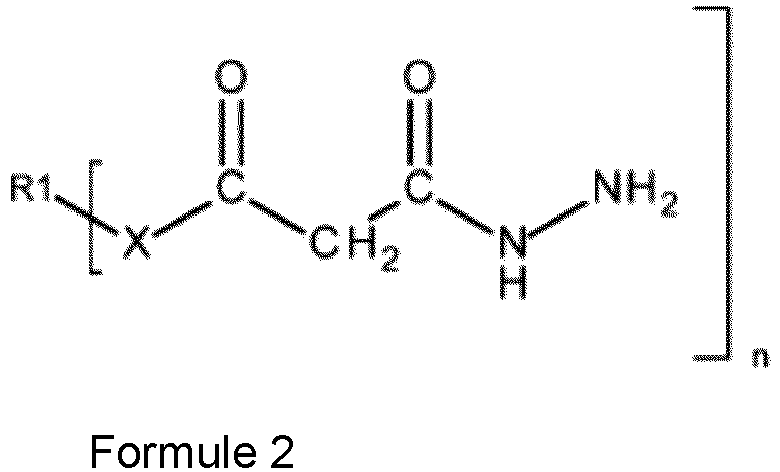
- R 1 stands for a hydrocarbon radical, which can be substituted and preferably for a polyether radical, preferably based on ethylene oxide or propylene oxide, or a polyester radical, each with the functionality n, for example a polyether radical or polyester radical of one of the polymeric compounds with isocyanate-reactive groups ( b) corresponds to.
- the compound of general formula 2 is by esterifying a polyhydric alcohol, for example a glycol such as ethylene glycol or propylene glycol, an oligomeric polyhydric alcohol such as diethylene glycol, triethylene glycol, dipropylene glycol or triethylene glycol or a polymeric alkylene oxide or higher alcohols such as Trimethylolpropane, glycerol, neopentylglycol, 2-methyl-1,3-prpandiol, 3-methyl-1,5-pentanediol, 1,4-butanediol, 1,6-hehandiol, pentaerythritol, sorbitol, or sucrose with a compound of formula 3 receive: where and R 9 stands for a hydrogen atom or an alkyl radical, preferably a methyl, an ethyl or a propyl radical, and R 10 stands for —OR 9 , OH or —NH — NH 2
- malonic acid dihydrazide is used as compound (d). This corresponds to the chemical formula:
- the compound (d) of the general formula R (-S) n is preferably used in amounts of 0.01 to 5% by weight, particularly preferably 0.05 to 2% by weight and in particular 0.1 to 1 % By weight, based on the total weight of components (a) to (f), are used.
- the compound (d) can be used as a pure substance or in the form of a solution or a dispersion.
- chain extenders or crosslinking agents (f) polymeric compounds or compounds with isocyanate-reactive groups (b), polyisocyanates (a) or water can be used as solvents / dispersants.
- the isocyanates (a) can also be used as solvents or dispersants, in particular for compounds (d) which do not have negative effects Have an influence on the storage stability of the isocyanates (a).
- the compound (d) is particularly preferably used in the form of a water solution.
- reaction mixtures according to the invention also contain blowing agent (s). All blowing agents known for the production of polyurethanes can be used. These can contain chemical and / or physical blowing agents. Such propellants are for example in " Kunststoff Handbuch, Volume 7, Polyurethane ", Carl Hanser Verlag, 3rd Edition 1993, Chapter 3.4.5 described. Chemical blowing agents are understood to mean compounds which react with isocyanate to form gaseous products. Examples of such blowing agents are water or carboxylic acids. Physical blowing agents are understood to mean compounds which are dissolved or emulsified in the starting materials for polyurethane production and which evaporate under the conditions of polyurethane formation.
- blowing agent blowing agent
- hydrocarbons such as perfluorinated alkanes such as perfluorohexane, chlorofluorocarbons, and ethers, esters, ketones, acetals and / or liquid carbon dioxide.
- the propellant can be used in any desired amount.
- the blowing agent is preferably used in an amount such that the resulting polyurethane foam has a density of 10 to 850 g / L, particularly preferably 20 to 800 g / L and in particular 25 to 500 g / L.
- Propellants containing water are particularly preferably used.
- chain extenders and crosslinking agents (f) it is possible to use compounds with at least two isocyanate-reactive groups which have a molecular weight of less than 400 g / mol, with molecules with two isocyanate-reactive hydrogen atoms as chain extenders and molecules with more than two isocyanate-reactive groups Hydrogen are referred to as crosslinkers.
- the chain extender or crosslinking agent can also be dispensed with.
- the addition of chain extenders, crosslinking agents or, if appropriate, mixtures thereof can prove to be advantageous.
- chain extenders and / or crosslinking agents are to be used, these are usually used in amounts of 0.5 to 60% by weight, preferably 1 to 40% by weight and particularly preferably 1.5 to 20% by weight, each based on the total weight of components (b) to (f) are used.
- chain extenders and / or crosslinkers (f) are used, the chain extenders and / or crosslinkers known in the production of polyurethanes can be used. These are preferably low molecular weight compounds with functional groups reactive toward isocyanates, for example glycerol, trimethylolpropane, glycol and diamines. Further possible low molecular weight chain extenders and / or Crosslinking agents are for example in " Kunststoff Handbuch, Volume 7, Polyurethane ", Carl Hanser Verlag, 3rd edition 1993, chapters 3.2 and 3.3.2 specified.
- auxiliaries and / or additives can also be used. All auxiliaries and additives known for the production of polyurethanes can be used. Examples include surface-active substances, foam stabilizers, cell regulators, release agents, fillers, dyes, pigments, flame retardants, hydrolysis inhibitors, fungistatic and bacteriostatic substances. Such substances are known and for example in " Kunststoff Handbuch, Volume 7, Polyurethane ", Carl Hanser Verlag, 3rd Edition 1993, Chapters 3.4.4 and 3.4.6 to 3.4.11 described.
- a ratio of NCO groups of the polyisocyanates (a) to the sum of the reactive hydrogen atoms of components (b), (c), (d) and optionally (e) and (f) of 1.5 to 20: 1, preferably 1.5 to 8: 1 used.
- a ratio of 1: 1 corresponds to an isocyanate index of 100.
- the special starting substances (a) to (g) for the production of polyurethanes according to the invention only differ quantitatively and qualitatively slightly if the polyurethane according to the invention is to be produced as a thermoplastic polyurethane, a flexible foam, a semi-rigid foam, a rigid foam or an integral foam.
- no blowing agents are used in the production of solid polyurethanes, and strictly difunctional starting substances are predominantly used for thermoplastic polyurethane.
- the elasticity and hardness of the polyurethane according to the invention can be varied, for example, via the functionality and the chain length of the higher molecular weight compound with at least two reactive hydrogen atoms. Such modifications are known to the person skilled in the art.
- the starting materials for the production of a solid polyurethane are for example in EP 0989146 or EP 1460094 , the starting materials for the production of flexible foam in PCT / EP2005 / 010124 and EP 1529792 , the starting materials for the production of a semi-rigid foam in " Kunststoff Handbuch, Volume 7, Polyurethane ", Carl Hanser Verlag, 3rd Edition 1993, Chapter 5.4 , the starting materials for the production of a rigid foam in PCT / EP2005 / 010955 and the starting materials for the production of an integral skin foam in EP 364854 , US 5506275 or EP 897402 described.
- the compounds (d) are then added in each case to the starting materials described in these documents.
- the invention also provides a polyurethane obtainable by a process according to the invention.
- the polyurethanes according to the invention are preferably used in closed rooms, for example as thermal insulation materials in residential buildings, such as insulation for pipes and refrigerators, in furniture construction, for example as decorative elements or as seat cushions, as mattresses and in the interior of vehicles, for example in automobile interiors, for example as steering wheels, Dashboards, door panels, foam backing carpets, acoustic foams such as headliners, as well as headrests or gear knobs.
- polyurethanes according to the invention both the formaldehyde and acetaldehyde emissions are significantly reduced compared to a reference product without an additive but also compared to additives for aldehyde reduction from the prior art. Furthermore, polyurethanes according to the invention emit only very small amounts of volatile, organic compounds (VOC) in accordance with VDA 278 and VDA 277. Compounds (d) and in particular malonic acid dihydrazide are temperature-stable. As a result, this compound does not lose its activity even at reaction temperatures of up to 200 ° C, which can occur in the production of certain polyurethane foams.
- VOC volatile, organic compounds
- Polyol 1 Glycerol-initiated polyether polyol based on ethylene oxide and propylene oxide with an average OH number of 27 mg KOH / g, an average functionality of 2.5 and a propylene oxide content, based on the total weight of the polyether, of 78% by weight.
- Polyol 2 Glycerol-initiated polyether polyol based on ethylene oxide and propylene oxide with an average OH number of 35 mg KOH / g, an average functionality of 2.7 and a propylene oxide content, based on the total weight of the polyether, of 85% by weight.
- Polyol 3 Glycerol-initiated polyether polyol based on ethylene oxide and propylene oxide with an average OH number of 42 mg KOH / g, an average functionality of 2.7 and a propylene oxide content, based on the total weight of the polyether, of 25% by weight.
- Polyol 4 Glycerol-initiated polyether polyol based on ethylene oxide and propylene oxide with an average OH number of 28 mg KOH / g, an average functionality of 2.7 and a propylene oxide content, based on the total weight of the polyether, of 84% by weight.
- Polyol 5 Polyether polyol with an OH number of 250 mg KOH / g and an average functionality of 2.0 based on polyol 4 (35% by weight), propylene oxide (45% by weight) and dimethylaminopropylamine (20% by weight).
- Polyol 6 Polyester polyol made from adipic acid, 1,4-butanediol, isophthalic acid and monoethylene glycol with an average OH number of 55 mg KOH / g.
- TEOA Triethanolamine Isopur SU-12021: Black paste from ISL-Chemie Emulsifier: Half-ester of a maleic acid-olefin copolymer
- Jeffcat® ZF10 Huntsman catalyst
- V1 Adipic acid dihydrazides
- V2 Succinic acid dihydrazide
- V3 Carbodihydrazides
- V4 Acethydrazide
- V5 Trimethylolpropane triacetoacetate
- A1 Malonic acid dihydrazide
- Mixture A was prepared by mixing the following components: 50.0 Parts by weight of polyol 1 34.3 Parts by weight of polyol 2 2.0 Parts by weight of polyol 3 3.0 Parts by weight of polyol 5 6.0 Parts by weight of polyol 6 0.5 Parts by weight TEOA 0.5 Parts by weight of emulsifier 0.5 Parts by weight Isopur SU-12021 2.9 Parts by weight of water 0.3 Parts by weight Jeffcat ZF10 0.3-1.2 Parts by weight of compounds V1-V5 and A1 according to Table 1
- the additives V1-V4 and A1 were used in the form of aqueous solutions, V5 was used as pure substances in liquid form.
- the total water content of mixture A was adjusted to 2.9 parts by weight.
- the isocyanate component was made by mixing the following components: 30.0 Parts by weight Iso 1 35.0 Parts by weight Iso 2 35.0 Parts by weight Iso 3
- the procedure for determining formaldehyde and acetaldehyde was analogous to ASTM D-5116-06.
- the chamber size was 4.7 liters.
- Pieces with a size of 110 mm x 100 mm x 25 mm from the inside of the foam were used as polyurethane samples.
- the temperature in the measuring chamber was 65 ° C. and the relative humidity 50% during the measurement.
- the air exchange rate was 3.0 liters per hour.
- the exhaust air stream with volatile aldehydes from the polyurethane was passed through a cartridge with 2,4-dinitrophenylhydrazine coated silica for 120 minutes.
- the DNPH cartridge was then eluted with a mixture of acetonitrile and water.
- the concentration of formaldehyde and acetaldehyde in the eluate was determined by means of HPLC. According to this structure, the detection limit for formaldehyde emissions is ⁇ 11 ⁇ g / m 3 . and for acetaldehyde emissions at ⁇ 6 ⁇ g / m 3
- Table 1 Formaldehyde values determined in the chamber for semi-rigid foams without the addition of additives (reference) as well as with the addition of the respective additives V1 - V5 and A1 in the specified concentrations, in each case specified in parts by weight of the above specified mixture A. Table 1 Parts by weight. in A Formaldehyde ( ⁇ g / m 3 ) Acetaldehyde ( ⁇ g) 3 ) reference - 605 266 V1 0.3% 338 113 V2 0.3% 177 157 V3 0.7% 63 131 V4 1.2% 369 195 V5 0.3% 263 235 A1 0.3% ⁇ NG 77
- Table 1 shows that the use of the additive A1 according to the invention (malonic acid dihydrazide) reduces the formaldehyde emissions to values below the detection limit of 11 ⁇ g / m 3 even at low concentrations of 0.3 parts by weight in mixture A.
- the additive A1 also significantly reduces acetaldehyde emissions.
Landscapes
- Chemical & Material Sciences (AREA)
- Health & Medical Sciences (AREA)
- Chemical Kinetics & Catalysis (AREA)
- Medicinal Chemistry (AREA)
- Polymers & Plastics (AREA)
- Organic Chemistry (AREA)
- Engineering & Computer Science (AREA)
- Materials Engineering (AREA)
- Polyurethanes Or Polyureas (AREA)
Claims (14)
- Procédé pour la préparation de polyuréthanes, dans lequel on mélange(a) du polyisocyanate,(b) des composés polymères présentant des groupes réactifs par rapport aux isocyanates,(c) des catalyseurs,(d) des composés de formule générale R(-S)n et le cas échéant(e) des agents gonflants,(f) des agents d'allongement de chaîne et/ou des réticulants et(g) des adjuvants et/ou des additifs,
en un mélange réactionnel et on laisse réagir le mélange réactionnel en polyuréthane,
R représentant un radical quelconque, n représentant un nombre quelconque de 1 à 8 et S représentant un radical selon la formule 1 :
- Procédé selon la revendication 1, caractérisé en ce que le composé R(-S)n (d) correspond à la formule générale 2
- Procédé selon la revendication 1, caractérisé en ce que le composé de formule générale R(-S)n du composant (d) est le dihydrazide de l'acide malonique.
- Procédé selon l'une quelconque des revendications 1 à 3, caractérisé en ce que le composant (d), par rapport au poids total des composants (a) à (f), est contenu à raison de 0,01 à 5% en poids.
- Procédé selon l'une quelconque des revendications 1 à 4, caractérisé en ce que les composés polymères présentant des groupes réactifs par rapport aux isocyanates (b) contiennent des polyétherols.
- Procédé selon l'une quelconque des revendications 1 à 5, caractérisé en ce que les catalyseurs (c) contiennent des catalyseurs incorporables à base d'amine.
- Procédé selon la revendication 6, caractérisé en ce que des composés, qui présentent outre le ou les groupes réactifs par rapport aux isocyanates, un ou plusieurs groupes amino tertiaire, aliphatiques sont utilisés comme catalyseurs incorporables.
- Procédé selon la revendication 7, caractérisé en ce qu'au moins un groupe amino tertiaire du catalyseur incorporable porte deux radicaux, choisis indépendamment l'un de l'autre parmi un radical méthyle et éthyle, ainsi qu'un autre radical organique.
- Procédé selon l'une quelconque des revendications 1 à 8, caractérisé en ce que le polyuréthane est une mousse de polyuréthane présentant une densité moyenne de 10 à 850 g/l.
- Procédé selon l'une quelconque des revendications 1 à 9, caractérisé en ce que le polyuréthane est un polyuréthane compact présentant une densité moyenne supérieure à 850 g/l.
- Procédé selon l'une quelconque des revendications 1 à 10, caractérisé en ce que le polyuréthane est un matelas ou une partie d'un mobilier.
- Polyuréthane, pouvant être préparé selon un procédé selon l'une quelconque des revendications 1 à 11.
- Utilisation de polyuréthanes selon la revendication 12 dans des espaces fermés.
- Utilisation selon la revendication 13, l'espace fermé étant l'espace interne de moyens de transport.
Applications Claiming Priority (2)
| Application Number | Priority Date | Filing Date | Title |
|---|---|---|---|
| EP16172951 | 2016-06-03 | ||
| PCT/EP2017/063297 WO2017207687A1 (fr) | 2016-06-03 | 2017-06-01 | Polyuréthanes à émission d'aldéhydes réduite |
Publications (2)
| Publication Number | Publication Date |
|---|---|
| EP3464404A1 EP3464404A1 (fr) | 2019-04-10 |
| EP3464404B1 true EP3464404B1 (fr) | 2020-10-07 |
Family
ID=56101352
Family Applications (1)
| Application Number | Title | Priority Date | Filing Date |
|---|---|---|---|
| EP17727863.7A Not-in-force EP3464404B1 (fr) | 2016-06-03 | 2017-06-01 | Polyuréthanes avec émission réduite d'aldéhyde |
Country Status (9)
| Country | Link |
|---|---|
| US (1) | US20190119460A1 (fr) |
| EP (1) | EP3464404B1 (fr) |
| JP (1) | JP6957526B2 (fr) |
| KR (1) | KR20190015750A (fr) |
| CN (1) | CN109196011A (fr) |
| BR (1) | BR112018074936A2 (fr) |
| CA (1) | CA3026167A1 (fr) |
| MX (1) | MX2018014984A (fr) |
| WO (1) | WO2017207687A1 (fr) |
Families Citing this family (11)
| Publication number | Priority date | Publication date | Assignee | Title |
|---|---|---|---|---|
| WO2019119196A1 (fr) * | 2017-12-18 | 2019-06-27 | Huntsman International Llc | Composition à émission d'aldéhyde réduite |
| EP3746494B1 (fr) | 2018-02-02 | 2024-05-29 | Basf Se | Polyuréthane à faible émission de composés organiques |
| PL3841140T3 (pl) * | 2018-08-21 | 2022-12-05 | Dow Global Technologies Llc | Lepkosprężyste pianki poliuretanowe |
| DE102018130176A1 (de) * | 2018-11-28 | 2020-05-28 | Adler Pelzer Holding Gmbh | Polyurethan-Schaumstoff-Formulierung und Schallisolierungen mit darauf basierenden Schäumen |
| DE102018130184A1 (de) | 2018-11-28 | 2020-05-28 | Adler Pelzer Holding Gmbh | Polyurethan-Schaumstoff-Formulierung und Schallisolierungen mit darauf basierenden Schäumen (Motorkapsel) |
| US12006412B2 (en) | 2018-12-21 | 2024-06-11 | Huntsman International Llc | Reaction mixture suitable for manufacturing of foam with reduced aldehyde emission |
| US12435199B2 (en) | 2019-05-02 | 2025-10-07 | Basf Se | Melamine formaldehyde foam with reduced formaldehyde emission |
| WO2021013607A1 (fr) * | 2019-07-24 | 2021-01-28 | Evonik Operations Gmbh | Fabrication de systèmes polyuréthanes |
| WO2021035662A1 (fr) * | 2019-08-30 | 2021-03-04 | Dow Global Technologies Llc | Procédés de réduction des émissions d'aldéhyde dans des polyols de polyéther et des mousses de polyuréthane |
| EP3932968A1 (fr) | 2020-07-02 | 2022-01-05 | Covestro Deutschland AG | Procédé de réduction des émissions des polyuréthanes |
| JP7814388B2 (ja) * | 2020-11-25 | 2026-02-16 | ビーエーエスエフ ソシエタス・ヨーロピア | アルデヒド放出量を低減させたポリウレタン |
Family Cites Families (31)
| Publication number | Priority date | Publication date | Assignee | Title |
|---|---|---|---|---|
| FR1257780A (fr) | 1960-02-26 | 1961-04-07 | Saint Gobain | Perfectionnement à la polymérisation en masse de dérivés de l'éthylène |
| US3304273A (en) | 1963-02-06 | 1967-02-14 | Stamberger Paul | Method of preparing polyurethanes from liquid, stable, reactive, filmforming polymer/polyol mixtures formed by polymerizing an ethylenically unsaturated monomer in a polyol |
| GB1022434A (en) | 1961-11-28 | 1966-03-16 | Union Carbide Corp | Improvements in and relating to polymers |
| US3523093A (en) | 1961-11-28 | 1970-08-04 | Paul Stamberger | Method of producing polyurethanes by reacting polyisocyanate with a preformed polymer resulting from polymerization of ethylenically unsaturated monomers |
| DE1152536B (de) | 1962-03-30 | 1963-08-08 | Bayer Ag | Verfahren zur Herstellung Urethangruppen enthaltender Schaumstoffe |
| DE1152537B (de) | 1962-06-02 | 1963-08-08 | Bayer Ag | Verfahren zur Herstellung von homogenen, Urethangruppen aufweisenden Kunststoffen |
| US4048105A (en) * | 1975-12-19 | 1977-09-13 | Mccord Corporation | High density urethane foam for rim |
| AU551979B2 (en) | 1982-03-31 | 1986-05-15 | Shell Internationale Research Maatschappij B.V. | Epoxy polymerisation catalysts |
| DE3835193A1 (de) | 1988-10-15 | 1990-04-19 | Basf Ag | Verfahren zur herstellung von formkoerpern mit einer verdichteten randzone und einem zelligen kern, vorzugsweise schuhsohlen |
| US5506275A (en) | 1995-05-15 | 1996-04-09 | Basf Corporation | 1,1,1,2-tetrafluoroethane as a blowing agent in integral skin polyurethane shoe soles |
| JP3069845B2 (ja) * | 1996-04-26 | 2000-07-24 | 大塚化学株式会社 | 消臭性樹脂組成物 |
| DE19618392A1 (de) | 1996-05-08 | 1997-11-13 | Basf Ag | Verfahren zur Herstellung von elastischen Polyurethan-Formkörpern mit kompakter Oberfläche und zelligem Kern |
| JP4147637B2 (ja) | 1998-09-21 | 2008-09-10 | 東ソー株式会社 | ポリウレタン製造用の触媒 |
| WO2001062309A1 (fr) * | 2000-02-23 | 2001-08-30 | Otsuka Kagaku Kabushiki Kaisha | Compositions de desodorisant |
| JP3400985B2 (ja) * | 2000-11-02 | 2003-04-28 | 大塚化学ホールディングス株式会社 | 合成木質建材のアルデヒド類除去方法、及びアルデヒド類低放出化合成木質建材 |
| DE10258046A1 (de) | 2002-12-11 | 2004-06-24 | Basf Ag | Verfahren zur Erniedrigung von Emissionen aus Polyurethanschaumstoffen |
| DE602004004561T2 (de) | 2003-03-18 | 2007-11-15 | Tosoh Corp. | Katalysatorzusammensetzung für die Herstellung von Polyurethanharz und Verfahren zu ihrer Herstellung |
| DE10352876A1 (de) | 2003-11-10 | 2005-06-23 | Basf Ag | Verfahren zur Herstellung von Polyurethan-Weichschaumstoffen |
| DE102004013408A1 (de) | 2004-03-18 | 2005-10-06 | Basf Ag | Polyetheralkohole und Verfahren zur Herstellung von Polyetheralkoholen zur Polyurethansynthese |
| JP3959092B2 (ja) * | 2004-12-27 | 2007-08-15 | 住化バイエルウレタン株式会社 | ポリウレタン成形品およびその製造方法 |
| DE102005024144A1 (de) | 2005-05-23 | 2006-11-30 | Basf Ag | Verfahren zur Herstellung von viskoelastischen Polyurethan-Weichschaumstoffen |
| KR101632029B1 (ko) | 2006-11-09 | 2016-06-21 | 바스프 에스이 | 폴리올 분산액의 제조 방법 |
| JP4724149B2 (ja) * | 2007-05-09 | 2011-07-13 | 住化バイエルウレタン株式会社 | ポリウレタン樹脂の製造法およびそのポリウレタン成形品 |
| WO2009084236A1 (fr) * | 2007-12-28 | 2009-07-09 | Midori Hokuyo Co., Ltd. | Cuir à faible teneur en composés organiques volatils |
| JP5269466B2 (ja) | 2008-04-15 | 2013-08-21 | 株式会社スピルリナ研究所 | 経口摂取用組成物 |
| JP6231495B2 (ja) * | 2012-01-25 | 2017-11-15 | バイエル・インテレクチュアル・プロパティ・ゲゼルシャフト・ミット・ベシュレンクテル・ハフツングBayer Intellectual Property GmbH | 布地被覆用ポリウレタン分散体 |
| US10066047B2 (en) | 2012-02-02 | 2018-09-04 | Covestro Llc | Polyurethane foams with decreased aldehyde emissions, a process for preparing these foams and a method for decreasing aldehyde in polyurethane foams |
| MX390818B (es) | 2013-12-02 | 2025-03-20 | Basf Se | Poliuretanos que tienen emision de aldehido reducida. |
| JP2015209437A (ja) * | 2014-04-23 | 2015-11-24 | スリーボンドファインケミカル株式会社 | 硬化性樹脂組成物 |
| JP2015209438A (ja) * | 2014-04-23 | 2015-11-24 | スリーボンドファインケミカル株式会社 | 硬化性樹脂組成物 |
| CN107002351B (zh) * | 2014-10-24 | 2020-06-19 | 东丽株式会社 | 片状物 |
-
2017
- 2017-06-01 EP EP17727863.7A patent/EP3464404B1/fr not_active Not-in-force
- 2017-06-01 BR BR112018074936-2A patent/BR112018074936A2/pt not_active Application Discontinuation
- 2017-06-01 MX MX2018014984A patent/MX2018014984A/es unknown
- 2017-06-01 CA CA3026167A patent/CA3026167A1/fr not_active Abandoned
- 2017-06-01 US US16/306,060 patent/US20190119460A1/en not_active Abandoned
- 2017-06-01 JP JP2018563410A patent/JP6957526B2/ja not_active Expired - Fee Related
- 2017-06-01 KR KR1020197000223A patent/KR20190015750A/ko not_active Ceased
- 2017-06-01 WO PCT/EP2017/063297 patent/WO2017207687A1/fr not_active Ceased
- 2017-06-01 CN CN201780032087.2A patent/CN109196011A/zh active Pending
Non-Patent Citations (1)
| Title |
|---|
| None * |
Also Published As
| Publication number | Publication date |
|---|---|
| WO2017207687A1 (fr) | 2017-12-07 |
| US20190119460A1 (en) | 2019-04-25 |
| KR20190015750A (ko) | 2019-02-14 |
| MX2018014984A (es) | 2019-09-06 |
| JP6957526B2 (ja) | 2021-11-02 |
| JP2019517615A (ja) | 2019-06-24 |
| BR112018074936A2 (pt) | 2019-03-12 |
| CA3026167A1 (fr) | 2017-12-07 |
| EP3464404A1 (fr) | 2019-04-10 |
| CN109196011A (zh) | 2019-01-11 |
Similar Documents
| Publication | Publication Date | Title |
|---|---|---|
| EP3077436B1 (fr) | Polyuréthanes avec émission réduite d'aldéhyde | |
| WO2017207687A1 (fr) | Polyuréthanes à émission d'aldéhydes réduite | |
| EP3077438B1 (fr) | Polyuréthanes ayant des émissions en aldéhyde réduites | |
| EP3303430B1 (fr) | Polyurethanes avec emission reduite d'aldehyde | |
| EP4251669B1 (fr) | Polyuréthanes à émission réduite d'aldéhyde | |
| EP3870624B1 (fr) | Mousses de polyuréthane à teneur en amines aromatiques réduite | |
| EP3155030B1 (fr) | Polyuréthanes avec émission réduite d'aldéhyde | |
| EP3746494B1 (fr) | Polyuréthane à faible émission de composés organiques | |
| WO2016166008A1 (fr) | Polyuréthanes à émission d'aldéhyde réduite | |
| EP3827039B1 (fr) | Stabilisateurs de mousse sans silicone destinés à la fabrication de mousses de polyuréthane | |
| EP3512896B1 (fr) | Procede de reduction d'emissions d'aldehyde de mousses de polyurethane | |
| EP3455270B1 (fr) | Mousse polyurethane souple non-adhesive | |
| EP2799459A1 (fr) | Polyuréthane comprenant des liaisons halogènes | |
| EP2895521B1 (fr) | Polyuréthane comprenant des liaisons halogènes | |
| EP4175991B1 (fr) | Mousses de polyuréthane à des propriétés acoustiques améliorées | |
| EP4355803A1 (fr) | Polyamines utilisées comme capteurs d'aldéhyde | |
| EP4267642A1 (fr) | Nouveau catalyseur de production de polyuréthanes | |
| EP2708577A1 (fr) | Polyuréthane comprenant des liaisons halogènes | |
| DE10245576A1 (de) | Modifizierte, einbaubare PUR-Katalysatoren mit verbessertem Emissions- und Alterungsverhalten |
Legal Events
| Date | Code | Title | Description |
|---|---|---|---|
| STAA | Information on the status of an ep patent application or granted ep patent |
Free format text: STATUS: UNKNOWN |
|
| STAA | Information on the status of an ep patent application or granted ep patent |
Free format text: STATUS: THE INTERNATIONAL PUBLICATION HAS BEEN MADE |
|
| PUAI | Public reference made under article 153(3) epc to a published international application that has entered the european phase |
Free format text: ORIGINAL CODE: 0009012 |
|
| STAA | Information on the status of an ep patent application or granted ep patent |
Free format text: STATUS: REQUEST FOR EXAMINATION WAS MADE |
|
| 17P | Request for examination filed |
Effective date: 20190103 |
|
| AK | Designated contracting states |
Kind code of ref document: A1 Designated state(s): AL AT BE BG CH CY CZ DE DK EE ES FI FR GB GR HR HU IE IS IT LI LT LU LV MC MK MT NL NO PL PT RO RS SE SI SK SM TR |
|
| AX | Request for extension of the european patent |
Extension state: BA ME |
|
| DAV | Request for validation of the european patent (deleted) | ||
| DAX | Request for extension of the european patent (deleted) | ||
| GRAP | Despatch of communication of intention to grant a patent |
Free format text: ORIGINAL CODE: EPIDOSNIGR1 |
|
| STAA | Information on the status of an ep patent application or granted ep patent |
Free format text: STATUS: GRANT OF PATENT IS INTENDED |
|
| RIC1 | Information provided on ipc code assigned before grant |
Ipc: C08G 18/32 20060101ALI20200330BHEP Ipc: C08G 18/72 20060101ALI20200330BHEP Ipc: C08G 18/79 20060101ALI20200330BHEP Ipc: C08G 18/48 20060101AFI20200330BHEP Ipc: C08G 101/00 20060101ALI20200330BHEP Ipc: C08G 18/76 20060101ALI20200330BHEP Ipc: C08G 18/42 20060101ALI20200330BHEP Ipc: C08G 18/12 20060101ALI20200330BHEP Ipc: C08K 5/372 20060101ALI20200330BHEP Ipc: C08G 18/66 20060101ALI20200330BHEP Ipc: C08G 18/50 20060101ALI20200330BHEP Ipc: C08G 18/18 20060101ALI20200330BHEP Ipc: C08G 18/40 20060101ALI20200330BHEP Ipc: C08K 5/25 20060101ALI20200330BHEP |
|
| INTG | Intention to grant announced |
Effective date: 20200428 |
|
| GRAS | Grant fee paid |
Free format text: ORIGINAL CODE: EPIDOSNIGR3 |
|
| GRAA | (expected) grant |
Free format text: ORIGINAL CODE: 0009210 |
|
| STAA | Information on the status of an ep patent application or granted ep patent |
Free format text: STATUS: THE PATENT HAS BEEN GRANTED |
|
| AK | Designated contracting states |
Kind code of ref document: B1 Designated state(s): AL AT BE BG CH CY CZ DE DK EE ES FI FR GB GR HR HU IE IS IT LI LT LU LV MC MK MT NL NO PL PT RO RS SE SI SK SM TR |
|
| REG | Reference to a national code |
Ref country code: GB Ref legal event code: FG4D Free format text: NOT ENGLISH |
|
| REG | Reference to a national code |
Ref country code: CH Ref legal event code: EP Ref country code: AT Ref legal event code: REF Ref document number: 1321082 Country of ref document: AT Kind code of ref document: T Effective date: 20201015 |
|
| REG | Reference to a national code |
Ref country code: IE Ref legal event code: FG4D Free format text: LANGUAGE OF EP DOCUMENT: GERMAN |
|
| REG | Reference to a national code |
Ref country code: DE Ref legal event code: R096 Ref document number: 502017007618 Country of ref document: DE |
|
| REG | Reference to a national code |
Ref country code: NL Ref legal event code: MP Effective date: 20201007 |
|
| PG25 | Lapsed in a contracting state [announced via postgrant information from national office to epo] |
Ref country code: GR Free format text: LAPSE BECAUSE OF FAILURE TO SUBMIT A TRANSLATION OF THE DESCRIPTION OR TO PAY THE FEE WITHIN THE PRESCRIBED TIME-LIMIT Effective date: 20210108 Ref country code: FI Free format text: LAPSE BECAUSE OF FAILURE TO SUBMIT A TRANSLATION OF THE DESCRIPTION OR TO PAY THE FEE WITHIN THE PRESCRIBED TIME-LIMIT Effective date: 20201007 Ref country code: NO Free format text: LAPSE BECAUSE OF FAILURE TO SUBMIT A TRANSLATION OF THE DESCRIPTION OR TO PAY THE FEE WITHIN THE PRESCRIBED TIME-LIMIT Effective date: 20210107 Ref country code: PT Free format text: LAPSE BECAUSE OF FAILURE TO SUBMIT A TRANSLATION OF THE DESCRIPTION OR TO PAY THE FEE WITHIN THE PRESCRIBED TIME-LIMIT Effective date: 20210208 Ref country code: RS Free format text: LAPSE BECAUSE OF FAILURE TO SUBMIT A TRANSLATION OF THE DESCRIPTION OR TO PAY THE FEE WITHIN THE PRESCRIBED TIME-LIMIT Effective date: 20201007 |
|
| REG | Reference to a national code |
Ref country code: LT Ref legal event code: MG4D |
|
| PG25 | Lapsed in a contracting state [announced via postgrant information from national office to epo] |
Ref country code: ES Free format text: LAPSE BECAUSE OF FAILURE TO SUBMIT A TRANSLATION OF THE DESCRIPTION OR TO PAY THE FEE WITHIN THE PRESCRIBED TIME-LIMIT Effective date: 20201007 Ref country code: BG Free format text: LAPSE BECAUSE OF FAILURE TO SUBMIT A TRANSLATION OF THE DESCRIPTION OR TO PAY THE FEE WITHIN THE PRESCRIBED TIME-LIMIT Effective date: 20210107 Ref country code: PL Free format text: LAPSE BECAUSE OF FAILURE TO SUBMIT A TRANSLATION OF THE DESCRIPTION OR TO PAY THE FEE WITHIN THE PRESCRIBED TIME-LIMIT Effective date: 20201007 Ref country code: IS Free format text: LAPSE BECAUSE OF FAILURE TO SUBMIT A TRANSLATION OF THE DESCRIPTION OR TO PAY THE FEE WITHIN THE PRESCRIBED TIME-LIMIT Effective date: 20210207 Ref country code: LV Free format text: LAPSE BECAUSE OF FAILURE TO SUBMIT A TRANSLATION OF THE DESCRIPTION OR TO PAY THE FEE WITHIN THE PRESCRIBED TIME-LIMIT Effective date: 20201007 Ref country code: SE Free format text: LAPSE BECAUSE OF FAILURE TO SUBMIT A TRANSLATION OF THE DESCRIPTION OR TO PAY THE FEE WITHIN THE PRESCRIBED TIME-LIMIT Effective date: 20201007 |
|
| PG25 | Lapsed in a contracting state [announced via postgrant information from national office to epo] |
Ref country code: HR Free format text: LAPSE BECAUSE OF FAILURE TO SUBMIT A TRANSLATION OF THE DESCRIPTION OR TO PAY THE FEE WITHIN THE PRESCRIBED TIME-LIMIT Effective date: 20201007 Ref country code: NL Free format text: LAPSE BECAUSE OF FAILURE TO SUBMIT A TRANSLATION OF THE DESCRIPTION OR TO PAY THE FEE WITHIN THE PRESCRIBED TIME-LIMIT Effective date: 20201007 |
|
| REG | Reference to a national code |
Ref country code: DE Ref legal event code: R097 Ref document number: 502017007618 Country of ref document: DE |
|
| PG25 | Lapsed in a contracting state [announced via postgrant information from national office to epo] |
Ref country code: SM Free format text: LAPSE BECAUSE OF FAILURE TO SUBMIT A TRANSLATION OF THE DESCRIPTION OR TO PAY THE FEE WITHIN THE PRESCRIBED TIME-LIMIT Effective date: 20201007 Ref country code: LT Free format text: LAPSE BECAUSE OF FAILURE TO SUBMIT A TRANSLATION OF THE DESCRIPTION OR TO PAY THE FEE WITHIN THE PRESCRIBED TIME-LIMIT Effective date: 20201007 Ref country code: CZ Free format text: LAPSE BECAUSE OF FAILURE TO SUBMIT A TRANSLATION OF THE DESCRIPTION OR TO PAY THE FEE WITHIN THE PRESCRIBED TIME-LIMIT Effective date: 20201007 Ref country code: EE Free format text: LAPSE BECAUSE OF FAILURE TO SUBMIT A TRANSLATION OF THE DESCRIPTION OR TO PAY THE FEE WITHIN THE PRESCRIBED TIME-LIMIT Effective date: 20201007 Ref country code: RO Free format text: LAPSE BECAUSE OF FAILURE TO SUBMIT A TRANSLATION OF THE DESCRIPTION OR TO PAY THE FEE WITHIN THE PRESCRIBED TIME-LIMIT Effective date: 20201007 Ref country code: SK Free format text: LAPSE BECAUSE OF FAILURE TO SUBMIT A TRANSLATION OF THE DESCRIPTION OR TO PAY THE FEE WITHIN THE PRESCRIBED TIME-LIMIT Effective date: 20201007 |
|
| PLBE | No opposition filed within time limit |
Free format text: ORIGINAL CODE: 0009261 |
|
| STAA | Information on the status of an ep patent application or granted ep patent |
Free format text: STATUS: NO OPPOSITION FILED WITHIN TIME LIMIT |
|
| PG25 | Lapsed in a contracting state [announced via postgrant information from national office to epo] |
Ref country code: DK Free format text: LAPSE BECAUSE OF FAILURE TO SUBMIT A TRANSLATION OF THE DESCRIPTION OR TO PAY THE FEE WITHIN THE PRESCRIBED TIME-LIMIT Effective date: 20201007 |
|
| 26N | No opposition filed |
Effective date: 20210708 |
|
| PG25 | Lapsed in a contracting state [announced via postgrant information from national office to epo] |
Ref country code: IT Free format text: LAPSE BECAUSE OF FAILURE TO SUBMIT A TRANSLATION OF THE DESCRIPTION OR TO PAY THE FEE WITHIN THE PRESCRIBED TIME-LIMIT Effective date: 20201007 Ref country code: AL Free format text: LAPSE BECAUSE OF FAILURE TO SUBMIT A TRANSLATION OF THE DESCRIPTION OR TO PAY THE FEE WITHIN THE PRESCRIBED TIME-LIMIT Effective date: 20201007 |
|
| PG25 | Lapsed in a contracting state [announced via postgrant information from national office to epo] |
Ref country code: SI Free format text: LAPSE BECAUSE OF FAILURE TO SUBMIT A TRANSLATION OF THE DESCRIPTION OR TO PAY THE FEE WITHIN THE PRESCRIBED TIME-LIMIT Effective date: 20201007 |
|
| PG25 | Lapsed in a contracting state [announced via postgrant information from national office to epo] |
Ref country code: MC Free format text: LAPSE BECAUSE OF FAILURE TO SUBMIT A TRANSLATION OF THE DESCRIPTION OR TO PAY THE FEE WITHIN THE PRESCRIBED TIME-LIMIT Effective date: 20201007 |
|
| REG | Reference to a national code |
Ref country code: CH Ref legal event code: PL |
|
| GBPC | Gb: european patent ceased through non-payment of renewal fee |
Effective date: 20210601 |
|
| REG | Reference to a national code |
Ref country code: BE Ref legal event code: MM Effective date: 20210630 |
|
| PG25 | Lapsed in a contracting state [announced via postgrant information from national office to epo] |
Ref country code: LU Free format text: LAPSE BECAUSE OF NON-PAYMENT OF DUE FEES Effective date: 20210601 |
|
| PG25 | Lapsed in a contracting state [announced via postgrant information from national office to epo] |
Ref country code: LI Free format text: LAPSE BECAUSE OF NON-PAYMENT OF DUE FEES Effective date: 20210630 Ref country code: IE Free format text: LAPSE BECAUSE OF NON-PAYMENT OF DUE FEES Effective date: 20210601 Ref country code: GB Free format text: LAPSE BECAUSE OF NON-PAYMENT OF DUE FEES Effective date: 20210601 Ref country code: CH Free format text: LAPSE BECAUSE OF NON-PAYMENT OF DUE FEES Effective date: 20210630 |
|
| PG25 | Lapsed in a contracting state [announced via postgrant information from national office to epo] |
Ref country code: IS Free format text: LAPSE BECAUSE OF FAILURE TO SUBMIT A TRANSLATION OF THE DESCRIPTION OR TO PAY THE FEE WITHIN THE PRESCRIBED TIME-LIMIT Effective date: 20210207 Ref country code: FR Free format text: LAPSE BECAUSE OF NON-PAYMENT OF DUE FEES Effective date: 20210630 |
|
| PG25 | Lapsed in a contracting state [announced via postgrant information from national office to epo] |
Ref country code: BE Free format text: LAPSE BECAUSE OF NON-PAYMENT OF DUE FEES Effective date: 20210630 |
|
| PG25 | Lapsed in a contracting state [announced via postgrant information from national office to epo] |
Ref country code: CY Free format text: LAPSE BECAUSE OF FAILURE TO SUBMIT A TRANSLATION OF THE DESCRIPTION OR TO PAY THE FEE WITHIN THE PRESCRIBED TIME-LIMIT Effective date: 20201007 |
|
| PG25 | Lapsed in a contracting state [announced via postgrant information from national office to epo] |
Ref country code: HU Free format text: LAPSE BECAUSE OF FAILURE TO SUBMIT A TRANSLATION OF THE DESCRIPTION OR TO PAY THE FEE WITHIN THE PRESCRIBED TIME-LIMIT; INVALID AB INITIO Effective date: 20170601 |
|
| PGFP | Annual fee paid to national office [announced via postgrant information from national office to epo] |
Ref country code: DE Payment date: 20230627 Year of fee payment: 7 |
|
| REG | Reference to a national code |
Ref country code: AT Ref legal event code: MM01 Ref document number: 1321082 Country of ref document: AT Kind code of ref document: T Effective date: 20220601 |
|
| PG25 | Lapsed in a contracting state [announced via postgrant information from national office to epo] |
Ref country code: AT Free format text: LAPSE BECAUSE OF NON-PAYMENT OF DUE FEES Effective date: 20220601 |
|
| PG25 | Lapsed in a contracting state [announced via postgrant information from national office to epo] |
Ref country code: MK Free format text: LAPSE BECAUSE OF FAILURE TO SUBMIT A TRANSLATION OF THE DESCRIPTION OR TO PAY THE FEE WITHIN THE PRESCRIBED TIME-LIMIT Effective date: 20201007 |
|
| PG25 | Lapsed in a contracting state [announced via postgrant information from national office to epo] |
Ref country code: TR Free format text: LAPSE BECAUSE OF FAILURE TO SUBMIT A TRANSLATION OF THE DESCRIPTION OR TO PAY THE FEE WITHIN THE PRESCRIBED TIME-LIMIT Effective date: 20201007 |
|
| PG25 | Lapsed in a contracting state [announced via postgrant information from national office to epo] |
Ref country code: MT Free format text: LAPSE BECAUSE OF FAILURE TO SUBMIT A TRANSLATION OF THE DESCRIPTION OR TO PAY THE FEE WITHIN THE PRESCRIBED TIME-LIMIT Effective date: 20201007 |
|
| REG | Reference to a national code |
Ref country code: DE Ref legal event code: R119 Ref document number: 502017007618 Country of ref document: DE |
|
| PG25 | Lapsed in a contracting state [announced via postgrant information from national office to epo] |
Ref country code: DE Free format text: LAPSE BECAUSE OF NON-PAYMENT OF DUE FEES Effective date: 20250101 |