EP3465978B1 - Protection de la confidentialité dans des réseaux de télécommunication sans fil - Google Patents
Protection de la confidentialité dans des réseaux de télécommunication sans fil Download PDFInfo
- Publication number
- EP3465978B1 EP3465978B1 EP16731521.7A EP16731521A EP3465978B1 EP 3465978 B1 EP3465978 B1 EP 3465978B1 EP 16731521 A EP16731521 A EP 16731521A EP 3465978 B1 EP3465978 B1 EP 3465978B1
- Authority
- EP
- European Patent Office
- Prior art keywords
- privacy
- entity
- network
- sensitive data
- context information
- Prior art date
- Legal status (The legal status is an assumption and is not a legal conclusion. Google has not performed a legal analysis and makes no representation as to the accuracy of the status listed.)
- Active
Links
Images



Classifications
-
- H—ELECTRICITY
- H04—ELECTRIC COMMUNICATION TECHNIQUE
- H04W—WIRELESS COMMUNICATION NETWORKS
- H04W12/00—Security arrangements; Authentication; Protecting privacy or anonymity
- H04W12/02—Protecting privacy or anonymity, e.g. protecting personally identifiable information [PII]
-
- H—ELECTRICITY
- H04—ELECTRIC COMMUNICATION TECHNIQUE
- H04L—TRANSMISSION OF DIGITAL INFORMATION, e.g. TELEGRAPHIC COMMUNICATION
- H04L63/00—Network architectures or network communication protocols for network security
- H04L63/04—Network architectures or network communication protocols for network security for providing a confidential data exchange among entities communicating through data packet networks
- H04L63/0428—Network architectures or network communication protocols for network security for providing a confidential data exchange among entities communicating through data packet networks wherein the data content is protected, e.g. by encrypting or encapsulating the payload
- H04L63/0442—Network architectures or network communication protocols for network security for providing a confidential data exchange among entities communicating through data packet networks wherein the data content is protected, e.g. by encrypting or encapsulating the payload wherein the sending and receiving network entities apply asymmetric encryption, i.e. different keys for encryption and decryption
-
- H—ELECTRICITY
- H04—ELECTRIC COMMUNICATION TECHNIQUE
- H04L—TRANSMISSION OF DIGITAL INFORMATION, e.g. TELEGRAPHIC COMMUNICATION
- H04L9/00—Cryptographic mechanisms or cryptographic arrangements for secret or secure communications; Network security protocols
- H04L9/08—Key distribution or management, e.g. generation, sharing or updating, of cryptographic keys or passwords
- H04L9/0891—Revocation or update of secret information, e.g. encryption key update or rekeying
-
- H—ELECTRICITY
- H04—ELECTRIC COMMUNICATION TECHNIQUE
- H04L—TRANSMISSION OF DIGITAL INFORMATION, e.g. TELEGRAPHIC COMMUNICATION
- H04L9/00—Cryptographic mechanisms or cryptographic arrangements for secret or secure communications; Network security protocols
- H04L9/30—Public key, i.e. encryption algorithm being computationally infeasible to invert or user's encryption keys not requiring secrecy
- H04L9/3066—Public key, i.e. encryption algorithm being computationally infeasible to invert or user's encryption keys not requiring secrecy involving algebraic varieties, e.g. elliptic or hyper-elliptic curves
- H04L9/3073—Public key, i.e. encryption algorithm being computationally infeasible to invert or user's encryption keys not requiring secrecy involving algebraic varieties, e.g. elliptic or hyper-elliptic curves involving pairings, e.g. identity based encryption [IBE], bilinear mappings or bilinear pairings, e.g. Weil or Tate pairing
-
- H—ELECTRICITY
- H04—ELECTRIC COMMUNICATION TECHNIQUE
- H04L—TRANSMISSION OF DIGITAL INFORMATION, e.g. TELEGRAPHIC COMMUNICATION
- H04L9/00—Cryptographic mechanisms or cryptographic arrangements for secret or secure communications; Network security protocols
- H04L9/32—Cryptographic mechanisms or cryptographic arrangements for secret or secure communications; Network security protocols including means for verifying the identity or authority of a user of the system or for message authentication, e.g. authorization, entity authentication, data integrity or data verification, non-repudiation, key authentication or verification of credentials
- H04L9/3247—Cryptographic mechanisms or cryptographic arrangements for secret or secure communications; Network security protocols including means for verifying the identity or authority of a user of the system or for message authentication, e.g. authorization, entity authentication, data integrity or data verification, non-repudiation, key authentication or verification of credentials involving digital signatures
-
- H—ELECTRICITY
- H04—ELECTRIC COMMUNICATION TECHNIQUE
- H04W—WIRELESS COMMUNICATION NETWORKS
- H04W12/00—Security arrangements; Authentication; Protecting privacy or anonymity
- H04W12/04—Key management, e.g. using generic bootstrapping architecture [GBA]
-
- H—ELECTRICITY
- H04—ELECTRIC COMMUNICATION TECHNIQUE
- H04W—WIRELESS COMMUNICATION NETWORKS
- H04W12/00—Security arrangements; Authentication; Protecting privacy or anonymity
- H04W12/04—Key management, e.g. using generic bootstrapping architecture [GBA]
- H04W12/041—Key generation or derivation
-
- H—ELECTRICITY
- H04—ELECTRIC COMMUNICATION TECHNIQUE
- H04W—WIRELESS COMMUNICATION NETWORKS
- H04W12/00—Security arrangements; Authentication; Protecting privacy or anonymity
- H04W12/04—Key management, e.g. using generic bootstrapping architecture [GBA]
- H04W12/043—Key management, e.g. using generic bootstrapping architecture [GBA] using a trusted network node as an anchor
- H04W12/0433—Key management protocols
-
- H—ELECTRICITY
- H04—ELECTRIC COMMUNICATION TECHNIQUE
- H04W—WIRELESS COMMUNICATION NETWORKS
- H04W12/00—Security arrangements; Authentication; Protecting privacy or anonymity
- H04W12/06—Authentication
-
- H—ELECTRICITY
- H04—ELECTRIC COMMUNICATION TECHNIQUE
- H04L—TRANSMISSION OF DIGITAL INFORMATION, e.g. TELEGRAPHIC COMMUNICATION
- H04L2209/00—Additional information or applications relating to cryptographic mechanisms or cryptographic arrangements for secret or secure communication H04L9/00
- H04L2209/80—Wireless
Definitions
- the solution disclosed in this document generally relates to telecommunication networks, and more particularly to wireless telecommunication networks.
- the solution disclosed in this document is concerned with the protection of privacy-sensitive pieces of information (or with the preservation of the privacy of users' sensitive information) which happen to be exchanged in wireless telecommunication networks (e.g., mobile networks and Wi-Fi networks) between end users and elements of the network or between the network elements themselves.
- wireless telecommunication networks e.g., mobile networks and Wi-Fi networks
- wireless telecommunication networks any wireless network, including any type of mobile network, for example second generation networks - 2G - (e.g., GSM - Global System for Mobile communications), third generation networks - 3G - (e.g., UMTS - Universal Mobile Telecommunications System), fourth generation networks - 4G - (e.g., LTE / LTE-A - Long Term Evolution / LTE-Advanced), and fifth generation networks - 5G - which are currently under definition, and any Wi-Fi network based on various IEEE standards/technologies.
- second generation networks - 2G - e.g., GSM - Global System for Mobile communications
- third generation networks - 3G - e.g., UMTS - Universal Mobile Telecommunications System
- fourth generation networks - 4G - e.g., LTE / LTE-A - Long Term Evolution / LTE-Advanced
- fifth generation networks - 5G - which are currently under definition, and any Wi-
- privacy-sensitive pieces of information are exposed over the air in clear text in a number of situations.
- Examples of privacy-sensitive pieces of information that happen to be exposed are: user's or subscriber's identity, user device identifiers and capabilities, authentication information, location information, etc.. From the subscriber's point of view, such pieces of information are critical and, therefore, they should be protected from unauthorized disclosure and treating/handling, preferably along the whole path from their source (sender) to their final destination (recipient).
- symmetric cryptography symmetric encryption
- AKA Authentication Key Agreement
- 3GPP Technical Specification 3GPP TS 33.401 of the 3rd Generation Partnership Project
- SAE Technical Specification Group Services and System Aspects
- SAE Technical Specification Group Services and System Aspects
- SAE 3GPP System Architecture Evolution
- the user is required to provide his/her subscriber identifier (i.e., the IMSI - International Mobile Subscriber Identity) to the mobile network in order for the mobile network to be able to subsequently retrieve the user's credentials and perform the user authentication procedure.
- the subscriber identifier is sent to the mobile network in clear text, since no cryptographic material is yet available/shared between the user and the network before the conclusion of the AKA procedure.
- an attacker can gather all IMSIs that are active in a certain geographic area.
- An IMSI sniffer can achieve this in two different manners: passive and active.
- a passive sniffer will be simply observing unencrypted wireless traffic and storing all observed IMSIs.
- An active sniffer will be using a fake base station (fake BTS - Base Transceiver Station), to which mobile phones in the neighbourhood thereof will attempt to connect due to the detection of a stronger radio signal: and the fake base station will request (with an Identity Request message) each user to identify itself.
- the active IMSI sniffing is also known as IMSI catching in the mobile networks environment, and it is considered a feasible attack and, in recent years, even affordable by using out-of-the-shelves tools, as explained in detail in " Practical attacks against privacy and availability in 4G/LTE mobile communication systems", Altaf Shaik, Ravishankar Borgaonkar, N. Asokan, Valtteri Niemi, Jean-Pierre Seifert (available at http://arxiv.org/pdf/1510.07563.pdf ) and in https://www.sba-research.org/wp-content/uploads/publications/DabrowskiEtAl-IMSI-Catcher-Catcher-ACSAC2014.pdf.
- IMSI sniffing/catching attacks mostly relate to the issue of users' location privacy, as the transmission of IMSI reveals the user approximate location.
- Location privacy attacks attempt to link an identity to a location.
- User's location tracking is performed by sniffing the user identities sent in clear text over the air.
- An attacker can collect users' identities in an area or place (e.g., in an airport) and can further on track the users' presence and movements, as explained in details in https://www.sba-research.org/wp-content/uploads/publications/DabrowskiEtAl-IMSI-Catcher-Catcher-ACSAC2014.pdf.
- IMSI-catch me if you can: IMSI-catcher-catchers", Adrian Dabrowski, Nicola Pianta, Thomas Klepp, Martin Mulazzani, and Edgar Weippl, in Proceedings of the 30th Annual Computer Security Applications 1 Conference, pages 246-255.
- ACM, 2014 available at https://www.sba-research.org/wp-content/uploads/publications/DabrowskiEtAl-IMSI-Catcher-Catcher-ACSAC2014.pdf ) several indicators for the possible presence of IMSI catchers have been presented. They are based on a network of stationary measurement devices and an Android app, each capable of detecting IMSI catchers. R Labs.
- Snoopsnitch website at https://opensource.srlabs.de/projects/snoopsnitch also proposes the use of an Android app capable of detecting IMSI catchers.
- the app collects and analyzes mobile radio data to make a user aware of the mobile network security and to warn the user about threats like fake base stations (IMSI catchers), user tracking and over-the-air updates.
- IMSI catchers fake base stations
- These mechanisms are based on heuristics and are useful to warn the users about a potential presence of a fake BTS, but they do not actually prevent IMSI sniffing.
- SendAuthenticationInfo message is legitimately used in roaming scenarios and cannot be filtered out at the borders.
- the use of the SendAuthenticationInfo message is only an example, as also reported in " The Fall of SS7 How Can the Critical Security Controls Help" (https://www.sans.org/reading-room/whitepapers/critical/fall-ss7--critical-security-controls-help-36225 ), where the authors describe how other messages can be illegitimately sent, like Hostile MAP Updates Location Requests, leading to DoS against legitimate subscribers.
- Update Location Request messages are sent by a roaming network entity towards the user's home network in order to update the location information stored (in the Home Subscriber System - HSS) regarding a particular subscriber.
- IMSI user's identity
- Sending hostile location update messages can be used to cause DoS against one particular subscriber, by requesting relocation of this user (IMSI) to a non-existent network entity within the home network HSS.
- IMSI This user is then seen as unavailable and he/she becomes unreachable on the network. This means that the user can receive neither calls nor messages.
- a mechanism is therefore necessary to ensure the authenticity of the request's originator as well as the confidentiality of the returned sensitive information.
- New signalling protocols such as the DIAMETER protocol used in 4G network can be abused for the same purposes.
- US 2012/0170745 A1 proposes a method and device for encrypting a subscriber identity during a paging procedure, which are particularly adapted to the paging performed by an MME using an IMSI.
- the method includes: A, using a key generated by the subscriber identity of the called UE to encrypt data Y which is obtained on the basis of the subscriber identity, then performing paging using a cipher text; and B, after the called UE receives the paging, determining by the called UE whether the cipher text is included, and if the cipher text is included, regarding itself as the called UE.
- the data Y is the subscriber identity; in the second preferred embodiment, the data Y is the data combined by the subscriber identity and the random data X, and the random data X is sent along with the cipher text during the paging; in the third preferred embodiment, the data Y is the data combined by the subscriber identity and the random data Z, and the data Y contains the subscriber identity at a specific location, when receiving the paging, the UE performs decryption using the subscriber identity and determines whether the decrypted plaintext contains the subscriber identity at a location the same as the specific location to determine whether the paging is for itself.
- US 2008/130898 A1 discloses a method and apparatus including units configured to send a request from a first network entity to a user equipment for an identifier and receive a message indicating that a public key is required from the user equipment by the first network entity.
- the method and apparatus also includes units configured to send, by the first network entity, the public key to the user equipment and receive an encrypted identifier by the first network entity, wherein upon authenticating the public key, the user equipment encrypts at least part of the identifier using the public key, thereby enabling further processing between the network entity and the user equipment.
- the IMSIs are encrypted in paging request messages so that only the destination UE (user's mobile device) can decrypt it.
- the encryption key is the IMSI itself.
- Three embodiments are described. In the first embodiment the IMSI is encrypted using the same IMSI as a key. In the second embodiment the IMSI and a random data are encrypted using the IMSI as a key. In the third embodiment the IMSI, a random data and the UE location are encrypted using the IMSI as a key.
- the Applicant has observed that the solution proposed therein is specific to LTE and does not cover all other cases (e.g., 5G mobile networks, Wi-Fi networks).
- the Applicant has observed that the increased computational power of present and future mobile devices, can support (already now or in the near future) the use of the asymmetric (public key-based) cryptography which up to now have been rejected by the 3GPP standardization group, where private keys are deployed on network elements/entities for signature and decryption, while all end users are entitled to perform public key encryption operations in order to protect any sensitive information they send to the authorized network elements.
- the Applicant has tackled the problem of eliminating 5a or at least reducing the risks of exposing user privacy-sensitive data in wireless networks.
- the solution disclosed in this document proposes a method of protecting the exchange of privacy-sensitive data in a wireless communication network.
- the method comprises:
- Said privacy support context information suitable to identify the wireless communication network may for example comprise one among: a wireless communication network identifier, particularly a Public Land Mobile Network Identifier, PLMN; a Service Set Identifier, SSID.
- a wireless communication network identifier particularly a Public Land Mobile Network Identifier, PLMN
- SSID Service Set Identifier
- Said privacy support context information may for example comprise a combination of said wireless communication network identifier and a function indication adapted to identify a function of the second entity.
- said privacy support context information comprises a combination of two or more identifiers of wireless communication networks.
- said privacy support context information suitable to identify the wireless communication network comprises identifying information adapted to identify a currently active private secret cryptographic key of the wireless communication network.
- Said privacy support context information may for example be broadcasted to the first entity by the wireless communication network, particularly exploiting at least one signaling message.
- said privacy support context information may for example be transmitted using one among: at least one Radio Resource Control message, particularly an RRC MIB message or an RRC SYSTEM INFORMATION message; at least one Beacon message.
- said privacy support context information may be sent to the first entity contextually to, or as part of, a selection procedure of the wireless communication network, performed by the first entity, by a wireless network entity providing the wireless connection to the wireless communication network, particularly contextually to, or as part of, a Wi-Fi network discovery procedure or a mobile device synchronization procedure.
- Said public cryptographic key may for example be provisioned to the first entity upon subscription of the first entity to the wireless communication network or subsequently over the air.
- the wireless communication network comprises a first wireless communication network and a second wireless communication network, each comprising respective second entities which have been provided with first and second private secret cryptographic keys respectively bound to the public cryptographic key and associated to respective first and second privacy support context information.
- the first entity is connected to the first wireless network and has to send privacy-sensitive data to one of the second entities of the second wireless network as final recipient.
- the method comprises:
- the method further comprises:
- said privacy-sensitive data may comprise identifying information for authenticating the first entity in said wireless communication network.
- the method may further comprise:
- the method may further comprise:
- Said digital signature may for example be applied by using an attribute-based encryption and signature cryptosystem.
- said generating and providing a private secret cryptographic key comprises generating and providing to said second entity at least two private secret cryptographic keys, and wherein the privacy support context information suitable to identify the wireless communication network comprises an indication of a currently used private secret cryptographic key among the at least two private secret cryptographic keys.
- the method may further comprise revoking one of the at least two private secret cryptographic keys.
- the solution disclosed in this document proposes a system for protecting the exchange of privacy-sensitive data in a wireless communication network, as set forth in claim 17.
- the solution disclosed herein proposes the use of a dynamic, combined digital signature and encryption scheme to protect privacy-sensitive data from exposure and unauthorized handling which can lead to a denial of service attack against the user or to user tracking.
- the proposed solution is quite light, since it does not require the deployment of a traditional and complete public key infrastructure (PKI), which was, in the past, considered too expensive for this context, not necessarily from the computational point of view, but mostly because it implicitly means the issue and management of public/private key pairs for billions of (mobile) users.
- PKI public key infrastructure
- the proposed solution even if still based on a public key cryptography approach, reduces significantly the complexity and costs of key deployment and management, since most of the involved entities (e.g., basically all end users) are merely encrypting entities while only authorized network elements/entities perform both digital signature and encryption operations.
- the proposed solution does not heavily involve the end devices in key management procedures, while it provides for (possibly smooth) key revocation, such that all the entities always use the currently active public (and their corresponding private) keys and not some revoked, obsolete or even compromised key.
- the proposed solution can require only one public key, which can be the same for all the communicating elements involved, and a number of private secret keys at least equal to the number of roaming wireless network partners.
- Each private secret key is bound to the public key through the use of a specific privacy support information identifying the wireless network entity entitled to use that private key.
- the private secret key is used by its owner (the wireless network entity authorized to use it) to sign potentially any signalling messages sent towards a roaming wireless network entity, so as to prove the authenticity of the request.
- Private secret keys are also able to decrypt any sensitive data encrypted with the (unique) public key and the specific privacy support information of the wireless network entity authorized to decrypt it.
- Public privacy support information is used to dynamically differentiate the authorized wireless networks entities (network elements/entities of wireless networks appertaining to different administrative domains or different operators in the mobile network terminology) each time authorized to perform decryption or signature verification.
- the proposed solution can be applied at different points in a wireless network: at the wireless access network level, to protect privacy-sensitive data transmitted OTA in wireless networks, and at the wireless core network level, to protect privacy-sensitive data exchanged between networks entities belonging to wireless networks that have a roaming agreement between them.
- the protection/encryption is performed at the source of the privacy-sensitive information (e.g., the end user device) and the decryption is enabled dynamically on the authorized wireless network elements/entities taking into account the user mobility.
- the proposed solution ensures that privacy-sensitive data is not exposed OTA by avoiding its transmission in clear text.
- the dynamic combined digital signature and encryption scheme is used when the wireless network receiving the privacy-sensitive data is not in charge of the user owning the privacy-sensitive data and needs to exchange the privacy-sensitive data with the user's home network; this situation is typical of a roaming scenario.
- the proposed solution ensures that privacy-sensitive data is exchanged in a protected way and handled only by authenticated and authorized wireless network entities.
- the application of the protection scheme at these two levels ensures an end-to-end protection of privacy-sensitive information, thereby ensuring the protection of privacy-sensitive information in roaming scenarios as well, together with the authentication of all wireless network entities involved in the exchange of sensitive information.
- the solution proposed herein provides inter alia IMSI encryption in all unicast messages, including Attach Request messages, which are sent when the AKA procedure is not completed yet. Therefore, the solution proposed herein prevents IMSI sniffing in most situations and may be combined with an improved use of IMSI pseudonyms, since 4G and 3G/2G networks already use temporary identities instead of IMSIs (e.g., TMSI - Temporary Mobile Subscriber Identity, GUTI-Globally Unique Temporary ID). Moreover, the proposed solution can also protect any kind of privacy-sensitive information, by providing confidentially and authentication to all messages containing information that, if revealed, can compromise the users' privacy.
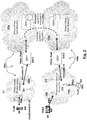
- Figure 1 illustrates a high-level logical-functional architecture of a scheme according to an embodiment of the solution disclosed herein implemented in a wireless network, in the following also referred to as "privacy-aware wireless network”.
- the wireless network is a mobile network 105, and comprises a wireless access network ("privacy-aware wireless access network”) 110 and a core network (“privacy-aware core network”) 115.
- the privacy-aware wireless network 105 comprises two basic logical-functional elements/entities: EE entities and SEE entities.
- EE entities like entities EE1, EEi and EEn shown in Figure 1 , are basically encrypting entities, which implement an encryption function for encrypting privacy-sensitive data (Sensitive Information) SI ( SI1 , SIi , Sin in Figure 1 ) that they have to send Over The Air (OTA) to the privacy-aware wireless network 105.
- the EE entities are in possession of a public key PubK, generated and provisioned to the EE entities as described in detail later on, and "privacy support context information", shortly “context information" CI, which is for example broadcasted by the privacy-aware wireless network 105.
- EE entities may also have a digital signature verification function enabled.
- end user devices in a mobile network smarttphones, tablets, personal computers equipped with Internet keys
- UE User Equipment
- SEE entities like entities SEEe and SEEc shown in Figure 1 , are both digital signing and encrypting entities, but they also have a digital signature verification functionality enabled and can have a decryption functionality enabled.
- SEE entities are elements which are in possession of private secret keys PSK (generated and provisioned as described in detail later on) for digital signing and decryption (while EE entities only need to know the public key PubK and the correct context information CI required to successfully deliver OTA their privacy-sensitive data SI in a protected mode).
- the functions of the SEE entities can be implemented on a network element located at the edge between the privacy-aware wireless access network 110 and the privacy-aware core network 115, like the SEE entity SEEe in Figure 1 , or directly on a core network element, like the SEE entity SEEc in Figure 1 , or the functions of the SEE entities can be implemented in a distributed manner on both the above types of network elements.
- the public key PubK can be the same for all the network entities involved in the scheme according to the solution disclosed herein.
- the public key PubK can be the same for all the different privacy-aware wireless networks participating in the SI protection scheme according to the solution disclosed herein, such as wireless networks appertaining to different administrative domains or different network operators, in mobile network terminology.
- different authorized privacy-aware wireless networks or network entities can be grouped in clusters where the public key PubK is the same within a cluster and different for different clusters. This may reduce the bitsize of the public key(s) PubK, which may be advantageous for some implementations.
- Context information CI may be data straightly related to the identity of the privacy-aware wireless network 105 and is for example generated at the cryptosystem initialization stage (as described later on).
- Suitable context information CI can for example be or include a wireless network identifier, e.g., for a mobile network, the Public Land Mobile Network IDentifier (the PLMN ID, which, as known, is the Mobile Country Code MCC plus the Mobile Network Code MNC), possibly concatenated with information identifying a private secret key in a multiplicity of stored private secret keys (e.g., an index that identifies the currently active private secret key PSK, currently used by the SEE entities of the mobile network), or the Service Set IDentifier (SSID) for a Wi-Fi network, concatenated with a private secret key identifying information or any other identification information construction.
- the PLMN ID which, as known, is the Mobile Country Code MCC plus the Mobile Network Code MNC
- SSID Service Set IDentifier
- the context information CI may relate to a number of different authorized privacy-aware wireless networks or other entities (e.g., for lawful interception), in which case there is a set [CI] of individual context information CI.
- the various wireless network identifiers may also be logically combined (by using, for example, "and", “or” and “not” logical operators) and may also contain various network roles/functions, like, for example: (PLMN ID and role:MME) for the individual context information of the Mobility Management Entity (MME) of a PLMN, or (PLMN ID and role:HSS) for the individual context information of the Home Subscriber Server (HSS) of a PLMN This might meet the needs of some network configurations.
- the privacy-sensitive data SI is called “protected SI” (PSI).
- PSI protected SI
- Reference numerals PSI1, PSIi and PSIn in Figure 1 denote encrypted, protected privacy-sensitive data SI generated by the EE entities EE1, EEi and EEn, respectively, by encrypting their privacy-sensitive data SI SI1, SIi , SIn using the public key PubK and the context information CI broadcasted by the privacy-aware wireless network 105.
- the EE entities EE1, EEi and EEn send the protected privacy-sensitive data SI PSI1, PSIi and PSIn OTA to the privacy-aware wireless network 105.
- Encryption (and decryption) functions can be applied either to protect any specific piece of privacy-sensitive data SI, like privacy-sensitive user identifying data or generic privacy-sensitive data (for example, user/subscriber's identity, user device identifier, user device capabilities, network capabilities, user-related authentication information, user-related location information, etc.), or to protect an entire message used to convey the SI.
- SI privacy-sensitive user identifying data
- generic privacy-sensitive data for example, user/subscriber's identity, user device identifier, user device capabilities, network capabilities, user-related authentication information, user-related location information, etc.
- the encryption is performed by using the public key PubK and the context information CI provided by the serving privacy-aware wireless network, where by "serving privacy-aware wireless network” it is meant the wireless network that, at a certain moment, provides wireless connectivity to the EE entity (user device) together with the privacy-sensitive data protection service.
- the serving privacy-aware wireless network can be the home wireless network of the considered user, i.e. the wireless network to which the user subscribed for the wireless communication services, e.g. mobile communication services, like in the example of Figure 1 .
- the serving privacy-aware wireless (mobile) network can also be a visited wireless (mobile) network, as in the examples depicted in Figures 2 and 3 , where 105a and 105b denote two interconnected privacy-aware wireless (mobile) networks, e.g. two wireless (mobile) networks which have a roaming agreement and participate to the protection scheme according to the solution disclosed herein.
- the two privacy-aware wireless networks 105a and 105b have respective privacy-aware wireless access networks 110a and 110b and respective privacy-aware core networks 115a and 115b.
- SEE1 denotes an SEE entity of the SEE entities SEE1 of the privacy-aware wireless network 105a
- SEE2 denotes an SEE entity of the SEE entities SEE2 of the privacy-aware wireless network 105b.
- CI1 and CI2 denote the context information of the privacy-aware wireless networks 105a and 105b, respectively
- PSK1 and PSK2 denote the private secret keys of the privacy-aware wireless networks 105a and 105b, respectively.
- EE entities EE1 and EEn are for example served by their home wireless network 105a, whereas EE entity EEi, being a subscriber of the privacy-aware wireless networks 105b, is at the considered moment served by the visited wireless network 105a, as depicted in Figure 3 .
- Digital signature (and digital signature verification) functions can be applied to mutually authenticate the network entities involved in the processing/handling or simply transfer of privacy-sensitive data SI.
- digital signature and digital signature verification functions are applied to mutually authenticate the SEE entities SEE1 and SEE2 of the two privacy-aware wireless networks 105a and 105b (like the SEE entities SEE1 and SEE2 in Figure 2 ).
- the digital signature is performed by using the private secret key PSK1, PSK2 of the privacy-aware wireless network 105a, 105b and the context information CI1, CI2 associated thereto. In this way, the receiving network entity can be sure that the sending signing network entity is indeed authenticated (i.e., in possession of the private secret key PSK1 / PSK2 corresponding to the declared context information CI1 / CI2 ).
- Authorized network entities are those network entities which have been provisioned (as described later on) with the necessary decryption and signature private secret keys (like the private secret keys PSK1, PSK2 ) associated/bound with/to the corresponding context information (like the context information CI1, CI2 ). Therefore, only the authorized network entities are allowed to decrypt the information encrypted by the EE entities (where the EE entities may be a user device, e.g. a UE, or other network entity).
- the digital signature function is automatically enabled if the network entities that handle the SI are part of different administrative networks (e.g., in a roaming scenario), i.e., whenever the CI information changes along the path between the source of privacy-sensitive data SI and the final destination of the privacy-sensitive data SI.
- the authorized network entities are the SEE entities SEEe, SEEc of the home wireless network 105 to which a user device EE1, EEi, EEn is connected.
- authorized network entities can be the SEE entities of the home wireless network of a user and the SEE entities of the serving visited wireless network to which a user, like the user represented by the EE entity EEi in Figure 3 , is connected after a mobility change, and the home wireless network of the user.
- the authorized network entities of the visited wireless network (the roaming partner of the home wireless network) may be requesting or sending privacy-sensitive data from or to the home wireless network of the user: such an exchange of privacy-sensitive data also requires authentication and therefore signatures.
- the solution disclosed herein allows any EE entity (wireless device or UE in the mobile network terminology) to dynamically select the SEE entity which is authorized to perform decryption of the privacy-sensitive data SI owned by the EE entity, based on the context information CI received OTA from the serving wireless network.
- the solution disclosed herein is based on a combined Attribute-Based Encryption and Signature cryptosystem (ABES).
- ABES Attribute-Based Encryption and Signature cryptosystem
- each communicating entity is assigned a set of attributes and the sensitive information is encrypted and/or signed with respect to a given access policy or structure regarding the attributes.
- ABE Attribute-Based Encryption
- the sensitive information is encrypted in such a way that only the entities whose attributes satisfy a given access policy can decrypt.
- ABS Attribute-Based Signature
- the sensitive information is signed in such a way that only the entities whose attributes satisfy a given access policy can produce a valid signature.
- the cryptosystem implements an initialization procedure Init, a private secret key(s) generation procedure KeyGen, encryption and decryption procedures Encrypt and Decrypt, digital signature and digital signature verification procedures Sign and Verify, and a private secret key(s) revocation procedure Revoke.
- Such procedures are for example implemented as algorithms executed by data processing systems.
- Ciphertext-Policy ABE Ciphertext-Policy ABE
- KP-ABE Key-Policy ABE
- the total access policy is embedded in the encryption function and hence the ciphertext (and is also part of ciphertext)
- the decrypting entity attributes are embedded into its private secret key (and are part of the private secret key)
- the total set of attributes is embedded in the encryption function and hence the ciphertext (and is also part of ciphertext)
- the decrypting entity access policy is embedded into its private secret key (and is part of the private secret key).
- the embodiment of the solution described in the sequel follows the CP-type notation, but, for the particular attributes considered, can equivalently be represented as the KP-type cryptosystem.
- the encryption procedure Encrypt(PubK, SI, A) is performed on EE entities, and sometimes also on SEE entities.
- the encryption procedure Encrypt(PubK, SI, A) takes as input public parameters PP representing the public key PubK, the privacy-sensitive information SI to be protected and an access structure (also known as access policy) A defined over a universe U of all accepted privacy-support context information CI as attributes for a given PubK.
- the universe U is a set of all relevant attributes
- the access structure A is a set of subsets S of attributes from the universe U satisfying the access policy.
- the encryption procedure outputs a ciphertext CT equal to the protected privacy-sensitive information PSI such that a private secret key PSK generated from a subset S can be used to decrypt the ciphertext (protected privacy-sensitive information) PSI if and only if S e A.
- the access structure A is implicitly included in the ciphertext.
- the access structure A can be defined as a set of all subsets S of the universe U containing at least one element of the set [CI], i.e., having a nonzero intersection with the set [CI].
- a single-element subset S satisfies the access policy if and only if S ⁇ [CI]. Note that single-element subsets S determine private secret keys PSK for individual networks or network entities in the system.
- the encryption procedure should inherently be randomizing with respect to the privacy-sensitive data SI and the access structure A. This means that repeated executions of the encryption procedure for the same privacy-sensitive data SI and/or the same access structure A should give rise to random ciphertexts. This property allows ensuring unlinkability of repeated encryptions with the same public key PubK.
- the decryption procedure Decrypt(PubK, PSI, PSK) is performed on SEE entities.
- the digital signature procedure Sign(PubK, PSK, A, SI) is performed on SEE entities.
- the digital signature procedure takes as input the public key PubK, the privacy-sensitive data SI, an access structure A, and a private secret key PSK associated with a subset of attributes S . It outputs a valid digital signature ⁇ if S e A.
- the access structure A is implicitly included in the signature.
- the digital signature verification procedure Verify(PubK, ⁇ , SI) is performed on SEE entities, but can be also performed by EE entities.
- the digital signature verification procedure takes as input the public key PubK, the (received) privacy-sensitive data SI, a signature ⁇ with an access structure A and the public key PubK.
- the digital signature verification procedure outputs "True” if the digital signature is valid and "False” otherwise.
- the procedures according to the solution disclosed herein can be implemented with a scheme such as, for example, CCP-ABES (Combined Ciphertext Policy - Attribute Base Encryption and Signature), presented in Cheng Chen, Jie Chen, HoonWei Lim, Zhenfeng Zhang, and Dengguo Feng: "Combined Public-Key Schemes: The Case of ABE and ABS", in Proceedings of Provable Security, 6th International Conference ProveSec 2012, China , in the sense that the basic ABES mathematics may be the same as described by the cited scheme. It should be noted that this scheme can deal with access structures corresponding to arbitrary linear secret sharing schemes.
- the privacy support context information CI used in the solution disclosed herein corresponds to the attributes in a way as described above.
- the tuple of algorithms ( Init, KeyGen, Encrypt, Decrypt, Sign, Verify, Revoke ) partially matches the tuple (Setup, KeyGen, Encrypt, Decrypt, Sign, Verify) from the ABES scheme.
- the initialization and revocation procedures require additional specific steps dependent on the deployment context.
- Figure 4 illustrates a possible procedure of initialization and distribution (provisioning) of cryptographic material and public identification data, according to an embodiment of the solution disclosed herein.
- the initialization stage is preferably performed on a trusted Key Generation Entity (KGE) 405, which performs the abovementioned initialization procedure Init.
- KGE trusted Key Generation Entity
- the initialization procedure Init (s ⁇ , U) takes as input a security parameter sk, which is intrinsical to the mathematical security analysis of ABE (Attribute-Based Encryption) schemes and as such defines the achievable security level, along with a universe U of accepted context information CI, i.e., the context information CI of all the privacy-aware wireless networks, i.e. their SEE entities involved in the protection scheme.
- the security parameter sk and the universe U of accepted context information CI are for example defined/agreed upon by representatives of the wireless network operators.
- public parameters PP which collectively form the system public key PubK and a master secret key MSK (which is only known to the trusted KGE 405 ) are generated.
- the security parameter sk and the master secret key MSK are well-known parameters intrinsic to all ABE schemes and their role is defined, for example, in the same work "Combined Public-Key Schemes: The Case of ABE and ABS” cited above, or in " Attribute-Based Encryption for Fine-Grained Access Control of Encrypted Data" by V. Goyal, O. Pandey, A. Sahai, B. Waters, available at: https://eprint.iacr.org/2006/309.pdf .
- the security level of a practical implementation depends on a careful choice of the security parameter sk and on the absolute secrecy of the master secret key MSK.
- the bitsize of the public key PubK is linear in the cardinality
- the network entities could be clustered in groups each associated with a different public key PubK. In particular, the cluster can be centered around network operators and their roaming partners.
- the trusted KGE 405 also performs the private secret key generation procedure KeyGen.
- the private secret key generation procedure KeyGen(PubK, MSK, CI) takes as input public key PubK, the master secret key MSK, and a support context information CI (belonging to the universe U), and outputs the private secret key PSK associated with the context information CI.
- the private secret key generation procedure KeyGen should preferably be randomizing with respect to the context information CI, that is, the private secret key PSK should be random if the private secret key generation procedure KeyGen is repeated for the same context information CI.
- the private secret key generation procedure KeyGen can output a random private secret key PSK for each context information CI ⁇ [CI], for the same public key PubK.
- there is a multiplicity of different private secret keys PSK corresponding to different context information CI ⁇ [CI] and each such private secret key PSK can decrypt the same encrypted message produced by the encryption procedure.
- the private secret keys PSK can be generated (i.e., the private secret keys generation process can be performed) at the initialization stage or subsequently, e.g. at any time a wireless network (and therefore its authorized SEE entities) becomes active in the system, i.e., becomes an authorized privacy-aware wireless network.
- An authorized privacy-aware wireless network may require more than just one private secret key PSK, e.g., a predetermined number of private secret keys PSK (a private secret keys set), in order to guarantee the possibility of implementing a smooth private secret key revocation (without disruption of communication and/or privacy-sensitive data SI protection functionalities).
- All the private secret keys PSK are bound to the public key PubK and a private secret key PSK is implicitly selected/authorized by an encrypting entity and indicated by a signing entity by means of a specific context information CI, e.g., by using an index pointing to the right key.
- the private secret keys generated by the trusted KGE 405 are securely provisioned to the SEE entities of the different authorized privacy-aware wireless networks, for example using a secure Out Of Band (OOB) secure communication channel.
- OOB Out Of Band
- the context information CI of the different authorized privacy-aware wireless networks should be available to all connecting EE entities before any device attach procedure can start, and to all communicating SEE entities (e.g., SEE appertaining to a home wireless network and to a roaming partner wireless network).
- Updated context information CI is continuously provided by all authorized privacy-aware wireless networks to the connecting devices (EE entities), as well as to the roaming partners wireless networks.
- the context information CI can be provided in broadcast in appropriate signaling messages, specific to the underling communication technology.
- this procedure in performed by means of specific signaling messages sent in broadcast contextually to, or as part of, the network selection procedure (e.g., Wi-Fi discovery procedure, or device synchronization procedure in mobile network, etc.).
- the context information CI is preferably sent by extending the use of one of the already defined signaling message types or by defining a new dedicated field inside the already defined message types (this may be necessary in case the context information CI does not fit in the size defined for the current signaling messages).
- the context information CI can be sent in a new type of broadcast or unicast signaling message as expected to be for future-generation mobile networks.
- the context information CI can be transmitted using one of the RRC (Radio Resource Control) messages sent in broadcast, like the RRC MIB or the RRC SYSTEM INFORMATION message.
- RRC Radio Resource Control
- the context information CI can be transmitted by using, for example, the Beacon messages.
- a private secret key identification information (current network Privacy Attribute PA) is preferably also provided inside the context information CI in order to allow for smooth key revocation procedures.
- Figure 5 depicts the process of generation and distribution of cryptographic material and public identification data in a scenario of a given number n of mobile networks MN1, MN2, MN3,..., MN n owned and managed by different mobile network operators having roaming agreements with each other, and willing to take part to the same privacy protection scheme according to the solution disclosed herein.
- Each mobile network MN i, with i ⁇ [1,n], participating in the privacy protection scheme has to provide, to EE entities and to SEE entities of the other mobile networks, its own privacy support context information CI i ( i ⁇ [1,n]).
- the context information CI i of a mobile network MN i basically identifies the mobile network MN i and also provides an indexing scheme to identify the corresponding currently active private secret key PSK i ( i ⁇ [1,n]). All the context information CI1, CI2, CI3,..., CI n form the universe U of accepted context information: U ⁇ CI 1 ⁇ CI 2 ⁇ .. CI n .
- All mobile networks MN i (e.g., the mobile networks operators' representatives) also agree on a security parameter sk.
- the trusted KGE entity 405 takes the universe U of accepted context information and the security parameter sk in input and generates the master secret key MSK (which remains secret to the KGE entity 405 ) and the public key PubK of the system.
- the private secret key PSK i i ⁇ [1,n]
- the network's SEE entities for decrypting privacy-sensitive data SI sent by its own users over the communication network and to sign privacy-sensitive data SI exchanged between the mobile networks participating at the scheme.
- the public key PubK is available to any actor in the scheme (be it an EE entity or a SEE entity), while the private secret key PSK i of any mobile network MNi remains secret to the other mobile networks (and to the EE entities), and to any other unauthorized entity.
- the universe U of accepted context information is also available to all the partner mobile networks MN1, MN2, MN3,..., MN n and each mobile network MN i broadcasts its own current context information CI i to its served users.
- the generic mobile network MN i stores the respective private secret key PSK i (or sets of private secret keys) in the appropriate Mobility Management Entities (MME), the exact location of which depends on the specific network architecture.
- the private secret keys PSK i might also be stored in the authentication entities of the mobile networks MN i (basically the Home Subscriber Server - HSS in 4G networks) and eventually in the Diameter Edge Agent (DEA, generally the first entry point to the home mobile network in a roaming scenario).
- MME Mobility Management Entities
- DEA Diameter Edge Agent
- the mobile networks users shall be provisioned with the public key PubK and the context information CI of the current serving mobile network MN i .
- the public key PubK for example unique for the whole system of mobile networks
- the context information CI i of the currently serving mobile network MN i are the only inputs necessary to a user device MD to encrypt the user's privacy-sensitive data SI which is sent to the SEE entity of the currently serving mobile network MN i (for example, the MME of the currently serving mobile network).
- the roaming partner mobile networks involved in any exchange of privacy-sensitive data SI related to a roaming user should be able to identify correctly their corresponding context information CI in order to be able to encrypt/decrypt and sign or verify the privacy-sensitive data SI or the protected privacy-sensitive data PSI they exchange.
- the privacy-sensitive data SI might be the roaming user's identifying information, the user's authentication data, the roaming user's location data, etc..
- the provisioning of the public encryption key PubK to a mobile device MD can be performed by the home mobile network at subscription time or via secure OTA procedures.
- the private secret key revocation procedure Revoke(CI, PSK), for revoking a private secret key (because it is close to its expiration time or because it has been compromised or leaked, etc.), or , is mainly performed by the trusted KGE 405 (or by a dedicated Trusted Third Party as agreed upon between the partner mobile networks operators).
- the trusted KGE 405 has its own private secret key PSKrev and context information CIrev.
- the private secret key PSKrev is kept secret like the master secret key MSK (since its protection and secrecy are as high as those of the master secret key MSK ).
- the corresponding context information CI is inserted in a revocation list signed by the trusted KGE 405 with the private secret key PSKrev and the trusted KGE context information CIrev.
- the revocation list is then made available to each partner wireless network, which will provide the revocation list to its users, preferably in special revocation messages broadcasted periodically over their network together with the context information CIrev of the trusted KGE 405, in order for the user devices to be able to verify the authenticity of the signature and therefore of the information contained therein.
- the user devices Prior to encrypting their privacy-sensitive data SI, the user devices should then control that the context information CI of the currently serving mobile network, broadcasted in normal CI messages, is not included in the revocation list.
- the period of the broadcasted revocation messages can be longer than the period of the normal CI broadcast messages.
- Figure 6 shows an embodiment of the solution disclosed herein, for the protection of sensitive information in a home network to which a mobile user device (UE) is connected.
- UE mobile user device
- a mobile user device MD is connected to its home mobile network HMN via a mobile communication connection MC (like a 3G, 4G, 5G connection), but the mobile user device MD is not yet authenticated in the home mobile network HMN.
- a mobile communication connection MC like a 3G, 4G, 5G connection
- the home mobile network HMN has been assigned (e.g. in the initialization stage, as described in the foregoing) and is broadcasting the (home mobile network) context information HCI (i.e., the current network privacy attribute).
- the SEE entities ( HMME, HAE, as discussed shortly hereafter) of the home mobile network HMN are provisioned with the current corresponding private secret key HPSK to be used for decryption and digital signing, since the SEE entities of the home mobile network HMN are authorized to decrypt privacy-sensitive data SI of the users which are subscribers of the home mobile network HMN and also to digitally sign SI records.
- the mobile devices of all users subscriber of the home network HMN are provisioned (at subscription time or using some suitable OTA procedure) with the corresponding encryption public key PubK.
- This public key PubK and the current context information HCI of the home network HMN will be used by all home network user devices (all EE entities) to encrypt privacy-sensitive data SI by performing the encryption procedure Encrypt(PP, SI, A) (reference EALG in Figure 6 ).
- the mobile device MD is connected to (but it is not yet authenticated in) its home network HMN and it has received, during the radio access procedure, the home network context information HCI used to perform encryption and therefore to protect the privacy-sensitive data SI.
- the mobile device MD is an EE entity and always uses the public key PubK together with the broadcasted home network context information HCI in order to encrypt the privacy-sensitive data SI, which, otherwise, would be sent in clear text on the mobile connection MC, since the legacy authentication procedure has not been performed/completed yet at this stage.
- the authorized SEE entity of the home network HMN receives the protected (encrypted) sensitive information PSI and, by using the home network private secret key HPSK, the associated home network context information HCI, performs the decryption procedure Decrypt(PP, PSI, PSK) (reference DALG in Figure 6 ), and retrieves the privacy-sensitive data SI in clear text. In this way the home network HMN is able to identify the user and to perform authentication (e.g., to complete the AKA procedure).
- Decryption operations can be performed by any authorized SEE entity in the home network HMN, such as the home authentication entity HAE (e.g., the HSS in LTE networks) or by the entity in charge of mobility management HMME (e.g., the MME in LTE network): depending on the particular network architecture, one configuration may be preferred over the other.
- Reliance on the mobility management entity HMME is for example appropriate in cases where load balancing solutions are adopted in the home network HMN, which require the availability of the identifying privacy-sensitive data SI in clear text in order to be able to identify the entity in the home network HMN which is in charge with the authentication of a particular user.
- the location and mobile network function of the SEE entity in charge of decryption of privacy-sensitive data depends on the home network architecture and configuration.
- the digital signature function (reference SALG in Figure 6 ) is preferably always located on the SEE entity which requests or produces the privacy-sensitive data SI related to a user, since digitally signing requires the availability of the private secret key PSK.
- the issuing home authentication entity HAE (the HSS in LTE networks) can potentially sign and encrypt them before transmission to the home mobility management entity HMME.
- the encryption is performed with the public key PubK, while the digital signature employs the home private secret key HPSK.
- the home mobility management entity HMME can also digitally sign its request.
- This mechanism is superfluous if a secure channel already exists between the network elements involved in the exchange, since they belong to the same mobile network MN. Nevertheless, such a mechanism can be considered useful when the elements involved appertain to different mobile networks MN like in a roaming scenario (as described below).
- Figure 7 shows another embodiment of the solution disclosed herein, for the protection of privacy-sensitive information in a visited serving mobile network, to which a user device (UE) is connected in roaming after a mobility change, and the home network.
- UE user device
- Figure 7 represents a roaming scenario, where a mobile user device is connected to a serving mobile network which is different from its home mobile network.
- the mobile device MD When a mobile device MD changes location and moves, from the home mobile network HMN, to a new mobile network, herein referred as visited mobile network VMN, the mobile device MD should be able to dynamically authorize the visited mobile network VMN to perform decryption of protected privacy-sensitive data by using the visited network context information VCI broadcasted over the visited mobile connection VMC.
- the mobile device MD receives the visited network context information VCI broadcasted over the visited mobile connection VMC and the mobile device MD uses the received visited mobile network context information VCI together with the public key PubK to perform the encryption (reference EALG in Figure 7 ) of privacy-sensitive (identifying) data SI. Therefore, the mobile device MD is an EE entity in the visited mobile network VMN as it would be in its home mobile network HMN, and the context information changed dynamically and in a stealth manner from the previous home mobile network context information HCI to the correct one (visited mobile network context information VCI ) in the given mobile context.
- the visited mobile network VMN receives the protected (encrypted) privacy-sensitive data PSI from the mobile device MD.
- the visited mobile network SEE entity VMME in the visited mobile network VMN that is preferably the network entity which, in the visited mobile network VMN, is in charge of mobility management, decrypts (reference DALG in Figure 7 ) the encrypted privacy-sensitive data PSI and retrieves the privacy-sensitive data SI in clear text.
- the visited mobile network SEE entity VMME has been provisioned for this purpose (in the initialization stage or after) with the necessary private secret decryption key VPSK (that is different from the home network private secret decryption key HPSK ).
- the visited mobile network SEE entity VMME retrieves the privacy-sensitive data SI in clear text and, based thereon, correctly identifies the user's home mobile network HMN.
- the visited mobile network SEE entity VMME has to forward the privacy-sensitive data SI to the home mobile network HMN, in order to, for example, retrieve the user authentication data (indeed, the authentication data is computed by the home mobile network).
- the visited mobile network SEE entity VMME retrieves the home network context information HCI of the home mobile network HMN and, prior to forwarding, encrypts (reference EALG in Figure 7 ) the privacy-sensitive information SI with the home mobile network context information HCI and the public key PubK; the visited mobile network SEE entity VMME also signs (reference SALG in Figure 7 ) the message to be sent with its own visited mobile network private secret encryption key VPSK and with the visited mobile network context information VCI, in order to guarantee the authentication of the sender.
- the SEE entity in the home mobile network HMN that receives the message with the encrypted and signed privacy-sensitive data PSI from the visited mobile network VMN is able to decrypt (reference DALG in Figure 7 ) the received message using the home mobile network private secret key HPSK and to verify (reference VALG in Figure 7 ) the signature with the public key PubK and the visited mobile network context information VCI.
- Such SEE entity in the home mobile network HMN can be the home network authentication entity HAE or a Diameter Edge Agent DEA generally used in a roaming scenario as a first entry point to the home mobile network HMN. This choice depends on the network architecture and specific configurations.
- the Diameter Edge Agent DEA In cases where the Diameter Edge Agent DEA is the SEE entity, the Diameter Edge Agent DEA should be provisioned with the home mobile network private secret key HPSK to be able to decrypt and retrieve in clear text the encrypted privacy-sensitive information PSI and to forward then the authentication request to the home network authentication entity HAE.
- the public key PubK should be available to all elements, therefore the Diameter Edge Agent DEA should be able to verify the signature as well.
- the home mobile network authentication entity HAE of the home network HMN verifies the user's identifying information contained in the privacy-sensitive data SI and computes the authentication data that needs to be sent back to the SEE entity VMME of the visited mobile network VMN. Therefore, the home mobile network authentication entity HAE retrieves the visited mobile network context information VCI of the visited mobile network VMN and, prior to forwarding the authentication data, encrypts (reference EALG in Figure 7 ) the privacy-sensitive information (which now contains the authentication data) with the visited mobile network context information VCI and the public key PubK.
- the home mobile network authentication entity HAE may also digitally sign (reference SALG in Figure 7 ) the message to be sent with its own home mobile network private secret key HPSK and with the home mobile network context information HCI, in order to guarantee to the visited mobile network VMN the authenticity of the sender of the privacy-sensitive information SI. Subsequently, the new protected privacy-sensitive information PSI is sent to the visited mobile network VMN.
- the SEE entity VMME in the visited mobile network VMN that receives the message with the encrypted and signed privacy-sensitive data PSI is able to decrypt it (reference DALG in Figure 7 ) using the visited mobile network private secret key VPSK and to verify (reference VALG in Figure 7 ) the signature with the public key PubK and the home mobile network context information HCI.
- a visited mobile network VMN and a home mobile network HMN exchange privacy-sensitive information SI, that can be and is not limited to: the user identifying information (such as the subscriber's identifier present in Attach Requests and Identity Responses), the authentication data (Authentication Information Request - AIR - and related answer Authentication Information Answer - AIA - related to the Diameter signaling protocol), the location information (Update Location Request - ULR and the related answer Update Location Answer - ULA related to the Diameter protocol), etc.
- the user identifying information such as the subscriber's identifier present in Attach Requests and Identity Responses
- the authentication data Authentication Information Request - AIR - and related answer Authentication Information Answer - AIA - related to the Diameter signaling protocol
- the location information Update Location Request - ULR and the related answer Update Location Answer - ULA related to the Diameter protocol
- An advantage of the described embodiments of the solution here disclosed is the use of local context privacy support information broadcasted over the communication channel, which allow a mobile device to dynamically authorize the decryption of the privacy-sensitive data to authorized network entities only, depending on the wireless network to which the mobile device is connected.
- Another advantage of the described embodiments of the solution here disclosed is the limited amount of cryptographic material that has to be distributed to the mobile devices (only one public encryption key PubK ), and therefore that has to be managed on device.
- the solution disclosed herein provides the home mobile network HMN with a home mobile network private secret key HPSK (used for decryption and signing) that, depending on the network configuration and architecture, can be stored in any entity of the home mobile network having the role of an SEE entity: such an SEE entity can for example be the home mobile network mobility management entity HMME, the home mobile network authentication entity HAE or the Diameter Edge Entity DEA.
- HPSK used for decryption and signing
- the home mobile network private secret key HPSK is bound to the home mobile network context information HCI and allows the decryption of privacy-sensitive data for all the home mobile network users, as well as the signing (and therefore authentication) of privacy-sensitive data generated for all users.
- Any visited mobile network VMN i.e. any mobile network that has a roaming agreement with the home mobile network HMN, is provisioned with its own private secret key (the visited network private secret key VPSK in the embodiment described above) to decrypt the encrypted privacy-sensitive data PSI of all its served users, including the served users belonging to (i.e., subscriber of) another home mobile network HMN which are in roaming and have to use the correct visited mobile network context information VCI.
- the visited mobile network private secret key VPSK can be stored in any visited mobile network mobility management entity VMME that plays the role of SEE entity in the visited mobile network.
- Figure 8 depicts an embodiment of the solution disclosed herein applied to a Wi-Fi scenario in which any authentication method based on the exchange of privacy-sensitive identifying information in clear text is usually implemented (e.g., like when using EAP-SIM - defined in IETF RFC 4186 - , EAP-AKA - defined in IETF RFC 4187 - or EAP-AKA' - defined in IETF RFC 5448 - authentication protocols).
- any authentication method based on the exchange of privacy-sensitive identifying information in clear text is usually implemented (e.g., like when using EAP-SIM - defined in IETF RFC 4186 - , EAP-AKA - defined in IETF RFC 4187 - or EAP-AKA' - defined in IETF RFC 5448 - authentication protocols).
- a wireless user device WD is connected to a (privacy-aware) Wi-Fi network WN via a wireless connection (like for example the ones specified by the IEEE 802.11 wireless LAN standards).
- the wireless user device WD supports 3GPP access capabilities, i.e. it is provided with a USIM and the credentials in the device's USIM card are used for the authentication procedure.
- the Wi-Fi network WN has been provisioned (e.g. in the initialization stage) and is broadcasting the privacy support context information WCI (i.e., the current network privacy attribute); for example, the context information WCI is broadcasted by the access points of the Wi-Fi network WN.
- One of the supported user authentication protocols e.g., EAP-SIM, EAP-AKA, EAP-AKA'
- EAP-SIM EAP-AKA
- EAP-AKA' is based on an initial exchange of privacy-sensitive user identifying information SI in clear text.
- the wireless devices WD are EE entities: they have available (have been provisioned with) the public key PubK and receive from the access points the current context information WCI.
- the public key PubK of the cryptosystem is provisioned to wireless devices WD of all users which are subscribers of the Wi-Fi network WN at subscription time or using a secure OTA procedure.
- the SEE entities of the Wi-Fi network WN are provisioned with the current corresponding private secret key HPSK (for decryption and digital signing), since the SEE entities are authorized to decrypt privacy-sensitive data SI of their home (subscriber) users and also to sign SI records.
- HPSK private secret key
- the public key PubK will be used by all the wireless devices WD (all EE entities) to encrypt (reference EALG in Figure 8 ) privacy-sensitive data SI by using the the current context information WCI of the Wi-Fi network WN.
- the wireless device WD shown in Figure 8 is connected to the Wi-Fi network WN and has received, during the wireless access procedure, the context information WCI in order to be able to perform encryption and therefore to protect the privacy-sensitive data SI (which, otherwise, would be sent in clear text on the wireless connection, since the legacy authentication procedure has not been performed/completed yet).
- An additional authentication server 3GPP AAA server AuthS can also be present in the Wi-Fi network WN, but typically this might not be required to have the role of SEE entity, since it should be sufficient for this network element to forward the encrypted privacy-sensitive information SI to the configured SEE entity.
- the authentication server AuthS uses the realm, a fully qualified domain name that identifies the home Wi-Fi Network.
- the realm is indicated in the user identity in the format known as NAI that is "username@realm”.
- the Username can be the IMSI or a temporary pseudonym and the 'realm' will be a fully qualified domain name that identifies the home Wi-Fi Network.
- the usage and format of NAIs for 3GPP WLAN Interworking have been defined in the 3GPP TS23.003. For this reason the wireless device WD only encrypts the username part of the NAI .
- the authorized SEE entity of the Wi-Fi network WN is an element of the home mobile network HMN of the user, i.e. the mobile network to which the user has subscribed and received its subscriber ID and SIM (Subscriber Identity Module).
- the authorized SEE entity is an HLR (Home Location Register) or an HSS (Home Subscriber Server).
- the SEE entity receives the protected (encrypted) privacy-sensitive data PSI and, by using the home mobile network private secret key HPSK and the associated context information WCI, performs a decryption (reference DALG in Figure 8 ) to retrieve the sensitive information SI in clear text. In this way the home mobile network HMN is able to identify the user and to perform authentication (e.g., to complete the AKA procedure).
- the location of the SEE might vary from one network architecture to another.
- the digital signature function (reference SALG in Figure 8 ) is always located on the SEE entity which produces the privacy-sensitive SI data related to a user.
- the issuing entity HLR or HSS can sign them before transmission to the authentication server AuthS of the Wi-Fi network WN. If such information is also encrypted the authentication server AuthS shall have the home mobile network private secret key HPSK.
- the encryption (reference EALG in Figure 8 ) is performed with the public key PubK, while the digital signature procedure employs the home mobile network private secret key HPSK. In this scenario the encryption function is available on all the network elements involved in the scheme.
- the protection of privacy-sensitive data is guaranteed in roaming scenarios as well, based on appropriate context information together with the authentication of all network entities involved in the handling/processing of the privacy-sensitive data.
- the solution disclosed in this document provides protection of any privacy-sensitive data or information SI exchanged in wireless networks (like Wi-Fi networks and mobile networks, including future 5G mobile networks) by dynamically enabling an encryption and digital signing function, and a decryption and digital signature verification function, only on specifically authorized network entities/elements that can dynamically change based on the user mobility; such dynamics is made possible by exploiting public Context Information exchanged in the wireless networks.
- an owner of privacy-sensitive data controls and has the guarantee of the protection of her/his privacy-sensitive data, by allowing only the authorized network entities to access the privacy-sensitive data.
- the protection of the privacy-sensitive data is preserved while such data propagates through the wireless network to its final destination (i.e. to the recipient network entity authorized to handle the privacy-sensitive data).
- the private secret keys are deployed only on the authorized network entities which have to perform signature and decryption operations, while all end users are entitled to perform targeted public key-based encryption operations in order to protect any privacy-sensitive data they send to the wireless network and to select the authorized network entities able to decrypt and handle the privacy-sensitive data that the end users send.
- the protection of privacy-sensitive data is guaranteed in roaming scenarios as well, together with the authentication of all network entities involved in the handling/processing of the privacy-sensitive data.
- a remarkable advantage of the solution disclosed herein is that it does not heavily involve the end user devices in key management procedures, and can provide for smooth private secret key revocation, such that all the communicating entities always use the currently active public and private secret keys and not some revoked obsolete or even compromised keys.
- the key revocation is smooth in the sense that it does not disrupt either the communication or the protection services.
- Another advantage of the solution disclosed herein is that the broadcast of fake context information, such as fake network and key identifiers, does not compromise the protection of exchanged privacy-sensitive data, because the decryption of encrypted privacy-sensitive data by an unauthorized entity is not allowed, for at least two reasons.
- a fake entity is not provisioned with the corresponding decryption private secret key
- the EE entity owning the privacy-sensitive data cannot encrypt it by using a fake identifier/attribute information: the encryption process would fail because the fake context information is not originally present in the CI universe U.
- a fake network cannot sign the messages carrying the privacy-sensitive data as an authorized network (entity) would do, even if the fake network (entity) knows the associated context information, unless of course the private secret key of an authorized SEE entity has been compromised.
- a fake entity can broadcast fake context information referring to, for example, a compromised past private secret key that has been revoked and is no longer used in the system. Therefore, all EE entities should have means to control if the broadcasted context information is valid or not at any given moment in time.
- the revocation procedure described in the foregoing meets this requirement: a revoked context information (or a list of revoked context information) is sent in a secure way to all EE entities that are correctly authenticated. Such information is sent signed with the private secret key of the current serving wireless network so that it can be authenticated (the digital signature correctly verified) by the EE entities.
- the user device will not perform the network's attach procedure but it will look for an alternative wireless network, if available, which guarantees the privacy of the privacy-sensitive identification data.
Landscapes
- Engineering & Computer Science (AREA)
- Computer Security & Cryptography (AREA)
- Computer Networks & Wireless Communication (AREA)
- Signal Processing (AREA)
- Theoretical Computer Science (AREA)
- Computing Systems (AREA)
- Physics & Mathematics (AREA)
- Mathematical Analysis (AREA)
- Mathematical Optimization (AREA)
- Mathematical Physics (AREA)
- Pure & Applied Mathematics (AREA)
- General Physics & Mathematics (AREA)
- Algebra (AREA)
- Computer Hardware Design (AREA)
- General Engineering & Computer Science (AREA)
- Mobile Radio Communication Systems (AREA)
Claims (17)
- Procédé de protection de l'échange de données sensibles à la confidentialité (SI) dans un réseau de communication sans fil, le procédé comprenant les étapes ci-dessous consistant à :- générer, et fournir une clé cryptographique publique (PubK) à une première entité (EE1, EEi, EEn ; MD ; WD), possédant des données sensibles à la confidentialité (SI) à envoyer à un réseau de communication sans fil (105 ; 105a, 105b ; HMN, VMN) par le biais d'une connexion sans fil (HMC ; VMC) ;- générer, et fournir une clé cryptographique secrète privée (PSK ; PSK1, PSK2; HPSK; VPSK) à une seconde entité (SEEe, SEEc ; SEE1, SEE2 ; HSS_SSE ; HMME, HAE, VME; HLR/HSS), laquelle est le destinataire intermédiaire ou final prévu des données sensibles à la confidentialité (SI), la clé cryptographique secrète privée (PSK ; PSK1, PSK2 ; HPSK ; VPSK) étant liée à la clé cryptographique publique et étant associée à des informations de contexte de support de confidentialité (CI; CI1, CI2; HCI ; VCI) appropriées pour identifier le réseau de communication sans fil ;- faire en sorte que le réseau de communication sans fil envoie, à la première entité, des informations de contexte de support de confidentialité de réseau sans fil respectives ;- faire en sorte que la première entité reçoive les informations de contexte de support de confidentialité de réseau sans fil envoyées par le réseau de communication sans fil et chiffre les données sensibles à la confidentialité (SI) en utilisant la clé cryptographique publique et les informations de contexte de support de confidentialité de réseau sans fil reçues, en vue d'obtenir des données sensibles à la confidentialité chiffrées et protégées (PSI1 ; PSIi ; PSIn) ;- faire en sorte que la première entité envoie à la seconde entité, par l'intermédiaire du réseau de communication sans fil, les données sensibles à la confidentialité chiffrées ;- faire en sorte que la seconde entité déchiffre les données sensibles à la confidentialité chiffrées en exploitant la clé cryptographique secrète privée ;dans lequel le réseau de communication sans fil comprend un premier réseau de communication sans fil (105a ; VMN) et un second réseau de communication sans fil (105b ; HMN), comprenant chacun des secondes entités respectives (SEE2, SEE1 ; HSS_SSE ; VME ; HSS_SSE ; DEA ; HAE ; HMME) qui ont été pourvues de première et seconde clés cryptographiques secrètes privées (PSK2, PSK1 ; VPSK, HPSK) respectivement liées à la clé cryptographique publique et associées à des premières et secondes informations de contexte de support de confidentialité respectives (CI2, CI1 ; VCI, HCI); et
dans lequel la première entité est connectée au premier réseau sans fil et doit envoyer des données sensibles à la confidentialité (SI) à l'une (HSS_SSE ; DEA ; HAE ; HMME) des secondes entités du second réseau sans fil en tant que destinataire final,
le procédé comprenant les étapes ci-dessous consistant à :- faire en sorte que le premier réseau de communication sans fil et le second réseau de communication sans fil se communiquent mutuellement les premières et secondes informations de contexte de support de confidentialité respectives (CI2, CI1 ; VCI, HCI);- au niveau de la première entité, recevoir les premières informations de contexte de support de confidentialité (VCI) envoyées par le premier réseau de communication sans fil et chiffrer les données sensibles à la confidentialité (SI) en utilisant la clé cryptographique publique (PubK) et les premières informations de contexte de support de confidentialité (VCI) du premier réseau sans fil, en vue d'obtenir des premières données sensibles à la confidentialité chiffrées et protégées (PSIi ; PSI) ;- faire en sorte que la première entité envoie les données sensibles à la confidentialité chiffrées à l'une (SEE1 ; VMME) des secondes entités du premier réseau sans fil en tant que destinataire intermédiaire ;- faire en sorte que la seconde entité (SEE1 ; VMME) du premier réseau sans fil déchiffre les données sensibles à la confidentialité chiffrées en exploitant la première clé cryptographique secrète privée (PSK2 ; VPSK), en vue de récupérer les données sensibles à la confidentialité (SI) ;- faire en sorte que la seconde entité (SEE1 ; VMME) du premier réseau sans fil récupère les secondes informations de contexte de support de confidentialité (C12 ; HCI) du second réseau sans fil en consultant les données sensibles à la confidentialité récupérées (SI) ;- faire en sorte que la seconde entité (SEE1 ; VMME) du premier réseau sans fil chiffre les données sensibles à la confidentialité (SI) en exploitant la clé cryptographique publique (PubK) et les secondes informations de contexte de support de confidentialité (C12 ; HCI) du second réseau sans fil, en vue d'obtenir des secondes données sensibles à la confidentialité chiffrées et protégées (PSI) ;- faire en sorte que la seconde entité (SEE1 ; VMME) du premier réseau sans fil envoie les secondes données sensibles à la confidentialité chiffrées et protégées (PSI) à l'une (HSS_SSE ; HSS_SSE ; DEA ; HAE ; HMME) des secondes entités du second réseau sans fil en tant que destinataire final ;- faire en sorte que la seconde entité (HSS_SSE ; HSS_SSE ; DEA ; HAE ; HMME) du second réseau sans fil déchiffre les secondes données sensibles à la confidentialité chiffrées et protégées (PSI) reçues, en exploitant les secondes clés cryptographiques secrètes privées (PSK2 ; HPSK). - Procédé selon la revendication 1, dans lequel lesdites informations de contexte de support de confidentialité (Cl; Cl1, CI2 ; HCI ; VCI) appropriées pour identifier le réseau de communication sans fil comprennent un identifiant parmi : un identifiant de réseau de communication sans fil, en particulier un identifiant de réseau mobile terrestre public, PLMN ; et un identifiant d'ensemble de services, SSID.
- Procédé selon la revendication 2, dans lequel lesdites informations de contexte de support de confidentialité comprennent une combinaison dudit identifiant de réseau de communication sans fil et d'une indication de fonction apte à identifier une fonction de la seconde entité.
- Procédé selon la revendication 2 ou 3, dans lequel lesdites informations de contexte de support de confidentialité comprennent une combinaison de deux identifiants ou plus de réseaux de communication sans fil.
- Procédé selon l'une quelconque des revendications précédentes, dans lequel lesdites informations de contexte de support de confidentialité (CI; CI1, CI2 ; HCI ; VCI) appropriées pour identifier le réseau de communication sans fil comprennent des informations d'identification aptes à identifier une clé cryptographique secrète privée actuellement active du réseau de communication sans fil.
- Procédé selon l'une quelconque des revendications précédentes, dans lequel lesdites informations de contexte de support de confidentialité sont diffusées à la première entité par le réseau de communication sans fil, en exploitant en particulier au moins un message de signalisation.
- Procédé selon la revendication 6, dans lequel lesdites informations de contexte de support de confidentialité sont transmises en utilisant un message parmi : au moins un message de gestion des ressources radio, notamment un message RRC MIB ou un message d'information système de gestion RRC « RRC SYSTEM INFORMATION » ; et au moins un message de balise « Beacon ».
- Procédé selon l'une quelconque des revendications précédentes, dans lequel lesdites informations de contexte de support de confidentialité sont envoyées à la première entité contextuellement à, ou dans le cadre d'une procédure de sélection du réseau de communication sans fil, mise en œuvre par la première entité, par une entité de réseau sans fil fournissant la connexion sans fil au réseau de communication sans fil, en particulier contextuellement à, ou dans le cadre d'une procédure de découverte de réseau Wi-Fi ou d'une procédure de synchronisation de dispositif mobile.
- Procédé selon l'une quelconque des revendications précédentes, dans lequel ladite clé cryptographique publique (PubK) est fournie à la première entité lors de l'abonnement de la première entité au réseau de communication sans fil, ou subséquemment, par voie hertzienne.
- Procédé selon l'une quelconque des revendications précédentes, comprenant en outre les étapes ci-dessous consistant à :- faire en sorte que la seconde entité (SEE1 ; VMME) du premier réseau sans fil applique une signature numérique aux secondes données sensibles à la confidentialité chiffrées et protégées (PSI) en exploitant la première clé cryptographique secrète privée (PSK1 ; VPSK) et les premières informations de contexte de support de confidentialité (VCI) du premier réseau sans fil avant d'envoyer les secondes données sensibles à la confidentialité chiffrées et protégées (PSI) à la seconde entité (HSS_SSE ; HSS_SSE ; DEA ; HAE ; HMME) du second réseau sans fil ; et- faire en sorte que la seconde entité (HSS_SSE ; HSS_SSE ; DEA ; HAE ; HMME) du second réseau sans fil vérifie la signature numérique appliquée par la seconde entité de réseau (SEE1 ; VMME) du premier réseau sans fil, en exploitant la clé cryptographique publique (PubK) et les premières informations de contexte de support de confidentialité (VCI) du premier réseau sans fil.
- Procédé selon l'une quelconque des revendications précédentes, dans lequel lesdites données sensibles à la confidentialité (SI) comprennent des informations d'identification pour authentifier la première entité dans ledit réseau de communication sans fil.
- Procédé selon la revendication 11, comprenant en outre les étapes ci-dessous consistant à :- faire en sorte que la seconde entité (HSS_SSE ; HSS_SSE ; DEA ; HAE ; HMME) du second réseau sans fil vérifie les informations d'identification de la première entité, et calculer des données d'authentification pour l'authentification de la première entité de réseau ;- faire en sorte que la seconde entité (HSS_SSE ; HSS_SSE ; DEA ; HAE ; HMME) du second réseau sans fil chiffre lesdites données d'authentification pour l'authentification de la première entité, en utilisant la clé cryptographique publique (PubK) et les premières informations de contexte de support de confidentialité (CI2 ; VCI) du premier réseau sans fil, en vue d'obtenir des données d'authentification protégées et chiffrées pour l'authentification de la première entité ;- faire en sorte que la seconde entité (HSS_SSE ; HSS_SSE ; DEA ; HAE ; HMME) du second réseau sans fil envoie les données d'authentification protégées et chiffrées à la seconde entité (SEE1 ; VMME) du premier réseau sans fil ;- faire en sorte que la seconde entité (SEE1 ; VMME) du premier réseau sans fil déchiffre les données d'authentification protégées et chiffrées en utilisant la première clé cryptographique secrète privée (VPSK) pour récupérer les données d'authentification ; et- faire en sorte que la seconde entité (SEE1 ; VMME) du premier réseau sans fil authentifie la première entité de réseau.
- Procédé selon la revendication 12, comprenant en outre les étapes ci-dessous consistant à :- faire en sorte que la seconde entité (HSS_SSE ; HSS_SSE ; DEA ; HAE ; HMME) du second réseau sans fil applique une signature numérique aux données d'authentification protégées et chiffrées, en utilisant la seconde clé cryptographique secrète privée (HPSK) et les secondes informations de contexte de support de confidentialité (HCI) du second réseau sans fil, avant de les envoyer à la seconde entité (SEE1 ; VMME) du premier réseau sans fil ;- faire en sorte que la seconde entité (SEE1 ; VMME) du premier réseau sans fil vérifie la signature numérique appliquée par la seconde entité (HSS_SSE ; HSS_SSE ; DEA ; HAE ; HMME) du second réseau sans fil, en utilisant la clé cryptographique publique (PubK) et les secondes informations de contexte de support de confidentialité (HCI) du second réseau sans fil.
- Procédé selon la revendication 10 ou 13, dans lequel ladite signature numérique est appliquée en utilisant un système cryptographique de signature et chiffrement à base d'attributs.
- Procédé selon l'une quelconque des revendications précédentes, dans lequel ladite étape de génération et de fourniture d'une clé cryptographique secrète privée comprend l'étape consistant à générer et à fournir, à ladite seconde entité, au moins deux clés cryptographiques secrètes privées, et dans lequel les informations de contexte de support de confidentialité (CI ; CI1, CI2 ; HCI ; VCI) appropriées pour identifier le réseau de communication sans fil comprennent une indication d'une clé cryptographique secrète privée actuellement utilisée parmi lesdites au moins deux clés cryptographiques secrètes privées.
- Procédé selon la revendication 15, comprenant en outre l'étape de révocation d'une desdites au moins deux clés cryptographiques secrètes privées.
- Système destiné à protéger l'échange de données sensibles à la confidentialité (SI) dans un réseau de communication sans fil, le système comprenant :- un réseau de communication sans fil fournissant une connectivité sans fil à des premières entités (EE1, EEi, EEn ; MD ; WD) possédant des données sensibles à la confidentialité (SI) à envoyer au réseau de communication sans fil (105 ; 105a, 105b ; HMN, VMN) par le biais d'une connexion sans fil (HMC ; VMC) ;- une fonction de chiffrement, dans la première entité, pour chiffrer les données sensibles à la confidentialité (SI) à envoyer en utilisant une clé cryptographique publique et des informations de contexte de support de confidentialité de réseau sans fil reçues en provenance du réseau de communication sans fil, en vue d'obtenir des données sensibles à la confidentialité chiffrées et protégées (PSI1 ; PSIi ; PSIn), dans lesquelles les informations de contexte de support de confidentialité de réseau sans fil sont appropriées pour identifier le réseau de communication sans fil ;- une seconde entité (SEEe, SEEc ; SEE1, SEE2 ; HSS_SSE ; HMME, HAE, VME ; HLR/HSS) dans le réseau de communication sans fil, qui est le destinataire intermédiaire ou final prévu des données sensibles à la confidentialité (SI) ;- une fonction de déchiffrement, dans la seconde entité, pour déchiffrer les données sensibles à la confidentialité chiffrées reçues en provenance de la première entité, en utilisant une clé cryptographique secrète privée liée à la clé cryptographique publique et associée aux informations de contexte de support de confidentialité (CI ; CI1, CI2 ; HCI ; VCI) appropriées pour identifier le réseau de communication sans fil ;dans lequel le réseau de communication sans fil comprend un premier réseau de communication sans fil (105a ; VMN) et un second réseau de communication sans fil (105b ; HMN), comprenant chacun des secondes entités respectives (SEE2, SEE1 ; HSS_SSE ; VME ; HSS_SSE ; DEA ; HAE ; HMME) qui ont été pourvues de première et seconde clés cryptographiques secrètes privées (PSK2, PSK1 ; VPSK, HPSK) respectivement liées à la clé cryptographique publique et associées à des premières et secondes informations de contexte de support de confidentialité respectives (CI2, CI1 ; VCI, HCI) ; et
dans lequel la première entité est connectée au premier réseau de communication sans fil et doit envoyer des données sensibles à la confidentialité (SI) à l'une (HSS_SSE ; DEA ; HAE ; HMME) des secondes entités du second réseau de communication sans fil, en tant que destinataire final ;
dans lequel :- le premier réseau de communication sans fil et le second réseau de communication sans fil se communiquent mutuellement les premières et secondes informations de contexte de support de confidentialité respectives (CI2, CI1 ; VCI, HCI) ;- la fonction de chiffrement, dans la première entité, est configurée de manière à chiffrer les données sensibles à la confidentialité (SI) en utilisant la clé cryptographique publique (PubK) et les premières informations de contexte de support de confidentialité (VCI) du premier réseau sans fil reçues en provenance du premier réseau de communication sans fil, en vue d'obtenir des premières données sensibles à la confidentialité chiffrées et protégées (PSIi ; PSI) ;- la fonction de déchiffrement, dans une seconde entité (SEE1 ; VMME) du premier réseau sans fil, qui est un destinataire intermédiaire des premières données sensibles à la confidentialité chiffrées et protégées (PSIi ; PSI), est configurée de manière à déchiffrer les premières données sensibles à la confidentialité chiffrées et protégées en exploitant la première clé cryptographique secrète privée (PSK2 ; VPSK) en vue de récupérer les données sensibles à la confidentialité (SI) ;- la seconde entité (SEE1 ; VMME) du premier réseau sans fil est configurée de manière à récupérer les secondes informations de contexte de support de confidentialité (CI2 ; HCI) du second réseau sans fil, en consultant les données sensibles à la confidentialité récupérées (SI) ;- une fonction de chiffrement, dans la seconde entité (SEE1 ; VMME) du premier réseau sans fil, est configurée de manière à chiffrer les données sensibles à la confidentialité (SI), en exploitant la clé cryptographique publique (PubK) et les secondes informations de contexte de support de confidentialité (CI2 ; HCI) du second réseau sans fil, en vue d'obtenir des secondes données sensibles à la confidentialité chiffrées et protégées (PSI) ; et- la fonction de déchiffrement, dans la seconde entité (HSS_SSE ; HSS_SSE ; DEA ; HAE ; HMME) du second réseau sans fil qui est le destinataire final des données sensibles à la confidentialité (SI), est configurée de manière à déchiffrer les secondes données sensibles à la confidentialité chiffrées et protégées (PSI), reçues en provenance de la seconde entité (SEE1 ; VMME) du premier réseau sans fil, en exploitant les secondes clés cryptographiques secrètes privées (PSK2 ; HPSK).
Applications Claiming Priority (1)
| Application Number | Priority Date | Filing Date | Title |
|---|---|---|---|
| PCT/EP2016/062150 WO2017207017A1 (fr) | 2016-05-30 | 2016-05-30 | Protection de la confidentialité dans des réseaux de télécommunication sans fil |
Publications (2)
| Publication Number | Publication Date |
|---|---|
| EP3465978A1 EP3465978A1 (fr) | 2019-04-10 |
| EP3465978B1 true EP3465978B1 (fr) | 2021-07-07 |
Family
ID=56194430
Family Applications (1)
| Application Number | Title | Priority Date | Filing Date |
|---|---|---|---|
| EP16731521.7A Active EP3465978B1 (fr) | 2016-05-30 | 2016-05-30 | Protection de la confidentialité dans des réseaux de télécommunication sans fil |
Country Status (4)
| Country | Link |
|---|---|
| US (1) | US12089034B2 (fr) |
| EP (1) | EP3465978B1 (fr) |
| CN (1) | CN109417475B (fr) |
| WO (1) | WO2017207017A1 (fr) |
Families Citing this family (18)
| Publication number | Priority date | Publication date | Assignee | Title |
|---|---|---|---|---|
| US11792172B2 (en) | 2017-05-05 | 2023-10-17 | Nokia Technologies Oy | Privacy indicators for controlling authentication requests |
| EP3788810A4 (fr) * | 2018-05-22 | 2021-06-02 | Huawei Technologies Co., Ltd. | Authentification de réseau de desserte concernant une technologie d'accès |
| EP3618475A1 (fr) * | 2018-08-27 | 2020-03-04 | Koninklijke Philips N.V. | Procédé et dispositif pour établir une liaison sécurisée sans fil tout en conservant la confidentialité contre le suivi |
| US20190050367A1 (en) * | 2018-09-27 | 2019-02-14 | Intel Corporation | Technologies for selectively excluding user data from machine learning operations |
| WO2020065007A1 (fr) * | 2018-09-28 | 2020-04-02 | Deutsche Telekom Ag | Système de messagerie de signalisation de paquet universel |
| ES2911073T3 (es) * | 2018-10-17 | 2022-05-17 | Koa Health B V | Método, sistema y programas informáticos para proporcionar un modelo de usuario con conocimiento de ubicación que conserva la privacidad del usuario |
| CN111182548B (zh) * | 2018-11-09 | 2021-08-31 | 华为技术有限公司 | 伪网络设备识别方法及通信装置 |
| JP7273523B2 (ja) * | 2019-01-25 | 2023-05-15 | 株式会社東芝 | 通信制御装置および通信制御システム |
| US11108749B2 (en) * | 2019-03-25 | 2021-08-31 | Micron Technology, Inc. | Secure device coupling |
| US20220210635A1 (en) * | 2019-04-29 | 2022-06-30 | Telefonaktiebolaget Lm Ericsson (Publ) | Providing privacy for non-public networks |
| BR112021025083A2 (pt) * | 2019-06-14 | 2022-01-25 | Nokia Technologies Oy | Fornecimento de controle de acesso a serviços de operador local restritos por equipamento de usuário |
| CN111885486B (zh) * | 2020-07-23 | 2022-05-06 | 中国联合网络通信集团有限公司 | 一种位置更新方法和装置 |
| CN112040473A (zh) * | 2020-09-02 | 2020-12-04 | 中国联合网络通信集团有限公司 | 双卡终端的接入方法、终端及服务器 |
| EP4260494A1 (fr) * | 2020-12-10 | 2023-10-18 | Nokia Technologies Oy | Aspects d'itinérance pour des fonctions d'analyse de données de réseau |
| US12596844B2 (en) * | 2022-05-25 | 2026-04-07 | Verizon Patent And Licensing Inc. | Systems and methods for secure aggregating and reporting of monitored data |
| CN115879151B (zh) * | 2022-12-07 | 2023-08-01 | 中国人民解放军国防科技大学 | 一种敏感数据隐私保护的天际线查询方法及系统 |
| CN117424700B (zh) * | 2023-10-20 | 2024-07-02 | 重庆大学 | 基于充电桩自组网的数据安全访问方法及装置 |
| CN118827035A (zh) * | 2024-07-31 | 2024-10-22 | 西安电子科技大学 | 一种去中心化多授权机构可搜索密文策略属性基加密方法 |
Family Cites Families (52)
| Publication number | Priority date | Publication date | Assignee | Title |
|---|---|---|---|---|
| FI106604B (fi) * | 1997-04-16 | 2001-02-28 | Nokia Networks Oy | Menetelmä tilaajan identiteetin suojaamiseksi |
| US6834350B1 (en) * | 1999-07-06 | 2004-12-21 | Watchguard Technologies, Inc. | Secure and differentiated delivery of network security information |
| US20020087862A1 (en) * | 2000-01-07 | 2002-07-04 | Sandeep Jain | Trusted intermediary |
| US20030021417A1 (en) * | 2000-10-20 | 2003-01-30 | Ognjen Vasic | Hidden link dynamic key manager for use in computer systems with database structure for storage of encrypted data and method for storage and retrieval of encrypted data |
| US20030115452A1 (en) * | 2000-12-19 | 2003-06-19 | Ravi Sandhu | One time password entry to access multiple network sites |
| US7181017B1 (en) * | 2001-03-23 | 2007-02-20 | David Felsher | System and method for secure three-party communications |
| US7961884B2 (en) * | 2002-08-13 | 2011-06-14 | Ipass Inc. | Method and system for changing security information in a computer network |
| US7373508B1 (en) * | 2002-06-04 | 2008-05-13 | Cisco Technology, Inc. | Wireless security system and method |
| TWI241101B (en) * | 2003-01-02 | 2005-10-01 | Tatung Co Ltd | Method for generating key data of successful communication upon proceeding network connection |
| US7571321B2 (en) * | 2003-03-14 | 2009-08-04 | Voltage Security, Inc. | Identity-based-encryption messaging system |
| WO2005057507A2 (fr) * | 2003-12-02 | 2005-06-23 | Koolspan, Inc | Autorisation securisee a distance |
| US7690040B2 (en) * | 2004-03-10 | 2010-03-30 | Enterasys Networks, Inc. | Method for network traffic mirroring with data privacy |
| GB2415579B (en) * | 2004-06-23 | 2006-12-20 | Hewlett Packard Development Co | Cryptographic method and apparatus |
| JP4456966B2 (ja) * | 2004-09-17 | 2010-04-28 | 富士通株式会社 | 無線端末 |
| US7992193B2 (en) * | 2005-03-17 | 2011-08-02 | Cisco Technology, Inc. | Method and apparatus to secure AAA protocol messages |
| US7809361B2 (en) * | 2006-06-19 | 2010-10-05 | Nokia Corporation | Address privacy in short-range wireless communication |
| US20080065878A1 (en) * | 2006-09-08 | 2008-03-13 | Michael Hutson | Method and system for encrypted message transmission |
| US8347090B2 (en) * | 2006-10-16 | 2013-01-01 | Nokia Corporation | Encryption of identifiers in a communication system |
| US8538028B2 (en) * | 2006-11-20 | 2013-09-17 | Toposis Corporation | System and method for secure electronic communication services |
| US8266427B2 (en) * | 2007-06-08 | 2012-09-11 | Cisco Technology, Inc. | Secure mobile IPv6 registration |
| CN101953114B (zh) * | 2007-11-07 | 2014-05-14 | 托普瑟斯公司 | 用于网络服务的多方记账的系统和方法 |
| US8526616B2 (en) * | 2008-03-18 | 2013-09-03 | Christopher V. FEUDO | Method for payload encryption of digital voice or data communications |
| US8270952B2 (en) * | 2009-01-28 | 2012-09-18 | Headwater Partners I Llc | Open development system for access service providers |
| US8656177B2 (en) * | 2008-06-23 | 2014-02-18 | Voltage Security, Inc. | Identity-based-encryption system |
| US8756675B2 (en) * | 2008-08-06 | 2014-06-17 | Silver Spring Networks, Inc. | Systems and methods for security in a wireless utility network |
| US8880879B2 (en) * | 2008-09-04 | 2014-11-04 | Intel Corporation | Accelerated cryptography with an encryption attribute |
| DE202008013415U1 (de) * | 2008-10-10 | 2009-03-19 | Compugroup Holding Ag | Datenverarbeitungssystem zur Bereitstellung von Berechtigungsschlüsseln |
| CN102026174B (zh) | 2009-09-17 | 2014-03-12 | 中兴通讯股份有限公司 | 一种寻呼过程中用户标识的保密方法及装置 |
| WO2011115407A2 (fr) * | 2010-03-15 | 2011-09-22 | Samsung Electronics Co., Ltd. | Procédé et système pour la fourniture d'informations sécurisée et à distance à une carte de circuit intégré universelle d'un équipement d'utilisateur |
| US9813233B2 (en) * | 2010-04-13 | 2017-11-07 | Cornell University | Private overlay for information networks |
| CN102131188B (zh) * | 2010-09-01 | 2013-12-04 | 华为技术有限公司 | 用户身份信息传输的方法、用户设备、网络侧设备及系统 |
| CN102036238B (zh) * | 2010-12-27 | 2013-12-11 | 中国科学院软件研究所 | 一种基于公钥实现用户与网络认证和密钥分发的方法 |
| WO2012129503A1 (fr) * | 2011-03-23 | 2012-09-27 | Interdigital Patent Holdings, Inc. | Systèmes et procédés pour sécuriser des communications réseau |
| US8958559B2 (en) * | 2011-06-03 | 2015-02-17 | Apple Inc. | System and method for secure instant messaging |
| US8694771B2 (en) * | 2012-02-10 | 2014-04-08 | Connect In Private Panama Corp. | Method and system for a certificate-less authenticated encryption scheme using identity-based encryption |
| US9876775B2 (en) * | 2012-11-09 | 2018-01-23 | Ent Technologies, Inc. | Generalized entity network translation (GENT) |
| US20140310349A1 (en) * | 2013-04-12 | 2014-10-16 | Nokia Corporation | Method and apparatus for establishing relationships among devices and users |
| CN103415012A (zh) * | 2013-08-15 | 2013-11-27 | 惠州Tcl移动通信有限公司 | 一种无线路由器的鉴权方法和鉴权装置 |
| US9350550B2 (en) * | 2013-09-10 | 2016-05-24 | M2M And Iot Technologies, Llc | Power management and security for wireless modules in “machine-to-machine” communications |
| US9485093B2 (en) * | 2014-02-10 | 2016-11-01 | Broadcom Corporation | Push button configuration pairing |
| GB2518469B (en) * | 2014-04-02 | 2016-03-16 | Photonstar Led Ltd | Wireless nodes with security key |
| WO2015196415A1 (fr) * | 2014-06-26 | 2015-12-30 | 华为技术有限公司 | Procédé et dispositif de transmission sécurisant les données |
| US9130744B1 (en) * | 2014-09-22 | 2015-09-08 | Envelope, Llc | Sending an encrypted key pair and a secret shared by two devices to a trusted intermediary |
| US10038674B2 (en) * | 2014-10-17 | 2018-07-31 | Sap Se | Secure mobile data sharing |
| GB2531848B (en) * | 2014-10-31 | 2017-12-13 | Hewlett Packard Entpr Dev Lp | Management of cryptographic keys |
| CN105162573B (zh) * | 2015-07-13 | 2019-09-17 | 深圳天通信息科技有限公司 | 基于多线性映射的可撤销分权威密钥策略的属性加密方法 |
| US9882894B2 (en) * | 2015-12-15 | 2018-01-30 | Verizon Patent And Licensing Inc. | Secure authentication service |
| US10149168B2 (en) * | 2015-12-16 | 2018-12-04 | Qualcomm Incorporated | Secured paging |
| US10382206B2 (en) * | 2016-03-10 | 2019-08-13 | Futurewei Technologies, Inc. | Authentication mechanism for 5G technologies |
| US10873464B2 (en) * | 2016-03-10 | 2020-12-22 | Futurewei Technologies, Inc. | Authentication mechanism for 5G technologies |
| US10212141B2 (en) * | 2016-05-04 | 2019-02-19 | Nxp Usa, Inc. | Autonomous key update mechanism with blacklisting of compromised nodes for mesh networks |
| US10581841B2 (en) * | 2017-02-13 | 2020-03-03 | Zentel Japan Corporation | Authenticated network |
-
2016
- 2016-05-30 US US16/303,833 patent/US12089034B2/en active Active
- 2016-05-30 WO PCT/EP2016/062150 patent/WO2017207017A1/fr not_active Ceased
- 2016-05-30 EP EP16731521.7A patent/EP3465978B1/fr active Active
- 2016-05-30 CN CN201680087417.3A patent/CN109417475B/zh active Active
Non-Patent Citations (1)
| Title |
|---|
| None * |
Also Published As
| Publication number | Publication date |
|---|---|
| CN109417475A (zh) | 2019-03-01 |
| CN109417475B (zh) | 2022-06-28 |
| US20200322794A1 (en) | 2020-10-08 |
| US12089034B2 (en) | 2024-09-10 |
| WO2017207017A1 (fr) | 2017-12-07 |
| EP3465978A1 (fr) | 2019-04-10 |
Similar Documents
| Publication | Publication Date | Title |
|---|---|---|
| EP3465978B1 (fr) | Protection de la confidentialité dans des réseaux de télécommunication sans fil | |
| US11647006B2 (en) | Protecting signaling messages in hop-by-hop network communication link | |
| US9768961B2 (en) | Encrypted indentifiers in a wireless communication system | |
| CN101946536B (zh) | 演进网络中的应用特定的主密钥选择 | |
| CN102131188B (zh) | 用户身份信息传输的方法、用户设备、网络侧设备及系统 | |
| Abdo et al. | Ensured confidentiality authentication and key agreement protocol for EPS | |
| Elouafiq | Authentication and Encryption in GSM and 3GUMTS: An Emphasis on Protocols and Algorithms | |
| Behrad et al. | Securing authentication for mobile networks, a survey on 4G issues and 5G answers | |
| Alnashwan et al. | Privacy-aware secure region-based handover for small cell networks in 5G-enabled mobile communication | |
| Behrad et al. | A survey on authentication and access control for mobile networks: from 4G to 5G | |
| Vijayakumar et al. | A new SmartSMS protocol for secure SMS communication in m-health environment | |
| Amadeo et al. | Securing the mobile edge through named data networking | |
| Mjolsnes et al. | Private identification of subscribers in mobile networks: status and challenges | |
| Dong et al. | Securing 5g bootstrapping: A two-layer ibs authentication protocol | |
| Angermeier et al. | PAL-privacy augmented LTE: A privacy-preserving scheme for vehicular LTE communication | |
| Joudah et al. | Implementing of 5g authentication and key agreement protocol: Practical security measures | |
| Choudhury | Enhanced anonymity: Customized for roaming and non-roaming iot-devices in 5g mobile network | |
| Chow et al. | A lightweight D2D authentication scheme against free-riding attacks in 5G cellular network | |
| Narang et al. | Survey of Mobile WiMAX and its threats | |
| Alnashwan | Privacy-aware Secure Authentication and Handover Protocols for 5G-enabled Mobile Communication | |
| Vafaei | Encryption of 4G mobile broadband systems | |
| Manos | Security and Privacy in the Air interface of cellular networks | |
| Ozhelvaci | Secure and efficient authentication schemes for 5G heterogeneous networks | |
| Adegoke | Automated key sharing in the authentication process of LTE base stations | |
| Akman | Providing Identity Privacy in 5G Networks by Using Pseudonyms |
Legal Events
| Date | Code | Title | Description |
|---|---|---|---|
| STAA | Information on the status of an ep patent application or granted ep patent |
Free format text: STATUS: THE INTERNATIONAL PUBLICATION HAS BEEN MADE |
|
| PUAI | Public reference made under article 153(3) epc to a published international application that has entered the european phase |
Free format text: ORIGINAL CODE: 0009012 |
|
| STAA | Information on the status of an ep patent application or granted ep patent |
Free format text: STATUS: REQUEST FOR EXAMINATION WAS MADE |
|
| 17P | Request for examination filed |
Effective date: 20181218 |
|
| AK | Designated contracting states |
Kind code of ref document: A1 Designated state(s): AL AT BE BG CH CY CZ DE DK EE ES FI FR GB GR HR HU IE IS IT LI LT LU LV MC MK MT NL NO PL PT RO RS SE SI SK SM TR |
|
| AX | Request for extension of the european patent |
Extension state: BA ME |
|
| DAV | Request for validation of the european patent (deleted) | ||
| DAX | Request for extension of the european patent (deleted) | ||
| STAA | Information on the status of an ep patent application or granted ep patent |
Free format text: STATUS: EXAMINATION IS IN PROGRESS |
|
| 17Q | First examination report despatched |
Effective date: 20200309 |
|
| 17Q | First examination report despatched |
Effective date: 20200604 |
|
| REG | Reference to a national code |
Ref country code: DE Ref legal event code: R079 Ref document number: 602016060312 Country of ref document: DE Free format text: PREVIOUS MAIN CLASS: H04L0009300000 Ipc: H04L0009080000 |
|
| GRAP | Despatch of communication of intention to grant a patent |
Free format text: ORIGINAL CODE: EPIDOSNIGR1 |
|
| STAA | Information on the status of an ep patent application or granted ep patent |
Free format text: STATUS: GRANT OF PATENT IS INTENDED |
|
| RIC1 | Information provided on ipc code assigned before grant |
Ipc: H04L 9/30 20060101ALI20210201BHEP Ipc: H04L 9/08 20060101AFI20210201BHEP Ipc: H04L 29/06 20060101ALI20210201BHEP Ipc: H04W 12/04 20210101ALI20210201BHEP Ipc: H04W 12/06 20210101ALI20210201BHEP Ipc: H04W 12/02 20090101ALI20210201BHEP Ipc: H04L 9/32 20060101ALI20210201BHEP |
|
| INTG | Intention to grant announced |
Effective date: 20210222 |
|
| GRAS | Grant fee paid |
Free format text: ORIGINAL CODE: EPIDOSNIGR3 |
|
| GRAA | (expected) grant |
Free format text: ORIGINAL CODE: 0009210 |
|
| STAA | Information on the status of an ep patent application or granted ep patent |
Free format text: STATUS: THE PATENT HAS BEEN GRANTED |
|
| AK | Designated contracting states |
Kind code of ref document: B1 Designated state(s): AL AT BE BG CH CY CZ DE DK EE ES FI FR GB GR HR HU IE IS IT LI LT LU LV MC MK MT NL NO PL PT RO RS SE SI SK SM TR |
|
| REG | Reference to a national code |
Ref country code: GB Ref legal event code: FG4D |
|
| REG | Reference to a national code |
Ref country code: AT Ref legal event code: REF Ref document number: 1409656 Country of ref document: AT Kind code of ref document: T Effective date: 20210715 |
|
| REG | Reference to a national code |
Ref country code: DE Ref legal event code: R096 Ref document number: 602016060312 Country of ref document: DE |
|
| REG | Reference to a national code |
Ref country code: IE Ref legal event code: FG4D |
|
| REG | Reference to a national code |
Ref country code: LT Ref legal event code: MG9D |
|
| REG | Reference to a national code |
Ref country code: NL Ref legal event code: MP Effective date: 20210707 |
|
| REG | Reference to a national code |
Ref country code: AT Ref legal event code: MK05 Ref document number: 1409656 Country of ref document: AT Kind code of ref document: T Effective date: 20210707 |
|
| PG25 | Lapsed in a contracting state [announced via postgrant information from national office to epo] |
Ref country code: RS Free format text: LAPSE BECAUSE OF FAILURE TO SUBMIT A TRANSLATION OF THE DESCRIPTION OR TO PAY THE FEE WITHIN THE PRESCRIBED TIME-LIMIT Effective date: 20210707 Ref country code: SE Free format text: LAPSE BECAUSE OF FAILURE TO SUBMIT A TRANSLATION OF THE DESCRIPTION OR TO PAY THE FEE WITHIN THE PRESCRIBED TIME-LIMIT Effective date: 20210707 Ref country code: PT Free format text: LAPSE BECAUSE OF FAILURE TO SUBMIT A TRANSLATION OF THE DESCRIPTION OR TO PAY THE FEE WITHIN THE PRESCRIBED TIME-LIMIT Effective date: 20211108 Ref country code: NL Free format text: LAPSE BECAUSE OF FAILURE TO SUBMIT A TRANSLATION OF THE DESCRIPTION OR TO PAY THE FEE WITHIN THE PRESCRIBED TIME-LIMIT Effective date: 20210707 Ref country code: NO Free format text: LAPSE BECAUSE OF FAILURE TO SUBMIT A TRANSLATION OF THE DESCRIPTION OR TO PAY THE FEE WITHIN THE PRESCRIBED TIME-LIMIT Effective date: 20211007 Ref country code: HR Free format text: LAPSE BECAUSE OF FAILURE TO SUBMIT A TRANSLATION OF THE DESCRIPTION OR TO PAY THE FEE WITHIN THE PRESCRIBED TIME-LIMIT Effective date: 20210707 Ref country code: ES Free format text: LAPSE BECAUSE OF FAILURE TO SUBMIT A TRANSLATION OF THE DESCRIPTION OR TO PAY THE FEE WITHIN THE PRESCRIBED TIME-LIMIT Effective date: 20210707 Ref country code: FI Free format text: LAPSE BECAUSE OF FAILURE TO SUBMIT A TRANSLATION OF THE DESCRIPTION OR TO PAY THE FEE WITHIN THE PRESCRIBED TIME-LIMIT Effective date: 20210707 Ref country code: AT Free format text: LAPSE BECAUSE OF FAILURE TO SUBMIT A TRANSLATION OF THE DESCRIPTION OR TO PAY THE FEE WITHIN THE PRESCRIBED TIME-LIMIT Effective date: 20210707 Ref country code: BG Free format text: LAPSE BECAUSE OF FAILURE TO SUBMIT A TRANSLATION OF THE DESCRIPTION OR TO PAY THE FEE WITHIN THE PRESCRIBED TIME-LIMIT Effective date: 20211007 Ref country code: LT Free format text: LAPSE BECAUSE OF FAILURE TO SUBMIT A TRANSLATION OF THE DESCRIPTION OR TO PAY THE FEE WITHIN THE PRESCRIBED TIME-LIMIT Effective date: 20210707 |
|
| PG25 | Lapsed in a contracting state [announced via postgrant information from national office to epo] |
Ref country code: PL Free format text: LAPSE BECAUSE OF FAILURE TO SUBMIT A TRANSLATION OF THE DESCRIPTION OR TO PAY THE FEE WITHIN THE PRESCRIBED TIME-LIMIT Effective date: 20210707 Ref country code: LV Free format text: LAPSE BECAUSE OF FAILURE TO SUBMIT A TRANSLATION OF THE DESCRIPTION OR TO PAY THE FEE WITHIN THE PRESCRIBED TIME-LIMIT Effective date: 20210707 Ref country code: GR Free format text: LAPSE BECAUSE OF FAILURE TO SUBMIT A TRANSLATION OF THE DESCRIPTION OR TO PAY THE FEE WITHIN THE PRESCRIBED TIME-LIMIT Effective date: 20211008 |
|
| REG | Reference to a national code |
Ref country code: DE Ref legal event code: R097 Ref document number: 602016060312 Country of ref document: DE |
|
| PG25 | Lapsed in a contracting state [announced via postgrant information from national office to epo] |
Ref country code: DK Free format text: LAPSE BECAUSE OF FAILURE TO SUBMIT A TRANSLATION OF THE DESCRIPTION OR TO PAY THE FEE WITHIN THE PRESCRIBED TIME-LIMIT Effective date: 20210707 |
|
| PLBE | No opposition filed within time limit |
Free format text: ORIGINAL CODE: 0009261 |
|
| STAA | Information on the status of an ep patent application or granted ep patent |
Free format text: STATUS: NO OPPOSITION FILED WITHIN TIME LIMIT |
|
| PG25 | Lapsed in a contracting state [announced via postgrant information from national office to epo] |
Ref country code: SM Free format text: LAPSE BECAUSE OF FAILURE TO SUBMIT A TRANSLATION OF THE DESCRIPTION OR TO PAY THE FEE WITHIN THE PRESCRIBED TIME-LIMIT Effective date: 20210707 Ref country code: SK Free format text: LAPSE BECAUSE OF FAILURE TO SUBMIT A TRANSLATION OF THE DESCRIPTION OR TO PAY THE FEE WITHIN THE PRESCRIBED TIME-LIMIT Effective date: 20210707 Ref country code: RO Free format text: LAPSE BECAUSE OF FAILURE TO SUBMIT A TRANSLATION OF THE DESCRIPTION OR TO PAY THE FEE WITHIN THE PRESCRIBED TIME-LIMIT Effective date: 20210707 Ref country code: EE Free format text: LAPSE BECAUSE OF FAILURE TO SUBMIT A TRANSLATION OF THE DESCRIPTION OR TO PAY THE FEE WITHIN THE PRESCRIBED TIME-LIMIT Effective date: 20210707 Ref country code: CZ Free format text: LAPSE BECAUSE OF FAILURE TO SUBMIT A TRANSLATION OF THE DESCRIPTION OR TO PAY THE FEE WITHIN THE PRESCRIBED TIME-LIMIT Effective date: 20210707 Ref country code: AL Free format text: LAPSE BECAUSE OF FAILURE TO SUBMIT A TRANSLATION OF THE DESCRIPTION OR TO PAY THE FEE WITHIN THE PRESCRIBED TIME-LIMIT Effective date: 20210707 |
|
| 26N | No opposition filed |
Effective date: 20220408 |
|
| REG | Reference to a national code |
Ref country code: CH Ref legal event code: PL |
|
| REG | Reference to a national code |
Ref country code: BE Ref legal event code: MM Effective date: 20220531 |
|
| PG25 | Lapsed in a contracting state [announced via postgrant information from national office to epo] |
Ref country code: MC Free format text: LAPSE BECAUSE OF FAILURE TO SUBMIT A TRANSLATION OF THE DESCRIPTION OR TO PAY THE FEE WITHIN THE PRESCRIBED TIME-LIMIT Effective date: 20210707 Ref country code: LU Free format text: LAPSE BECAUSE OF NON-PAYMENT OF DUE FEES Effective date: 20220530 Ref country code: LI Free format text: LAPSE BECAUSE OF NON-PAYMENT OF DUE FEES Effective date: 20220531 Ref country code: CH Free format text: LAPSE BECAUSE OF NON-PAYMENT OF DUE FEES Effective date: 20220531 |
|
| PG25 | Lapsed in a contracting state [announced via postgrant information from national office to epo] |
Ref country code: IE Free format text: LAPSE BECAUSE OF NON-PAYMENT OF DUE FEES Effective date: 20220530 |
|
| PG25 | Lapsed in a contracting state [announced via postgrant information from national office to epo] |
Ref country code: BE Free format text: LAPSE BECAUSE OF NON-PAYMENT OF DUE FEES Effective date: 20220531 |
|
| P01 | Opt-out of the competence of the unified patent court (upc) registered |
Effective date: 20230528 |
|
| P02 | Opt-out of the competence of the unified patent court (upc) changed |
Effective date: 20230530 |
|
| PG25 | Lapsed in a contracting state [announced via postgrant information from national office to epo] |
Ref country code: HU Free format text: LAPSE BECAUSE OF FAILURE TO SUBMIT A TRANSLATION OF THE DESCRIPTION OR TO PAY THE FEE WITHIN THE PRESCRIBED TIME-LIMIT; INVALID AB INITIO Effective date: 20160530 |
|
| PG25 | Lapsed in a contracting state [announced via postgrant information from national office to epo] |
Ref country code: MK Free format text: LAPSE BECAUSE OF FAILURE TO SUBMIT A TRANSLATION OF THE DESCRIPTION OR TO PAY THE FEE WITHIN THE PRESCRIBED TIME-LIMIT Effective date: 20210707 Ref country code: CY Free format text: LAPSE BECAUSE OF FAILURE TO SUBMIT A TRANSLATION OF THE DESCRIPTION OR TO PAY THE FEE WITHIN THE PRESCRIBED TIME-LIMIT Effective date: 20210707 |
|
| PG25 | Lapsed in a contracting state [announced via postgrant information from national office to epo] |
Ref country code: MT Free format text: LAPSE BECAUSE OF FAILURE TO SUBMIT A TRANSLATION OF THE DESCRIPTION OR TO PAY THE FEE WITHIN THE PRESCRIBED TIME-LIMIT Effective date: 20210707 |
|
| PGFP | Annual fee paid to national office [announced via postgrant information from national office to epo] |
Ref country code: DE Payment date: 20250519 Year of fee payment: 10 |
|
| PGFP | Annual fee paid to national office [announced via postgrant information from national office to epo] |
Ref country code: GB Payment date: 20250527 Year of fee payment: 10 |
|
| PGFP | Annual fee paid to national office [announced via postgrant information from national office to epo] |
Ref country code: IT Payment date: 20250530 Year of fee payment: 10 |
|
| PGFP | Annual fee paid to national office [announced via postgrant information from national office to epo] |
Ref country code: FR Payment date: 20250526 Year of fee payment: 10 |
|
| PG25 | Lapsed in a contracting state [announced via postgrant information from national office to epo] |
Ref country code: TR Free format text: LAPSE BECAUSE OF FAILURE TO SUBMIT A TRANSLATION OF THE DESCRIPTION OR TO PAY THE FEE WITHIN THE PRESCRIBED TIME-LIMIT Effective date: 20210707 |