EP3467669A1 - Verarbeitungssystem, verarbeitungsvorrichtung, verarbeitungsverfahren, programm und informationsspeichermedium - Google Patents
Verarbeitungssystem, verarbeitungsvorrichtung, verarbeitungsverfahren, programm und informationsspeichermedium Download PDFInfo
- Publication number
- EP3467669A1 EP3467669A1 EP17912355.9A EP17912355A EP3467669A1 EP 3467669 A1 EP3467669 A1 EP 3467669A1 EP 17912355 A EP17912355 A EP 17912355A EP 3467669 A1 EP3467669 A1 EP 3467669A1
- Authority
- EP
- European Patent Office
- Prior art keywords
- users
- information
- processing device
- characteristics information
- clusters
- Prior art date
- Legal status (The legal status is an assumption and is not a legal conclusion. Google has not performed a legal analysis and makes no representation as to the accuracy of the status listed.)
- Ceased
Links
Images

Classifications
-
- G—PHYSICS
- G06—COMPUTING OR CALCULATING; COUNTING
- G06F—ELECTRIC DIGITAL DATA PROCESSING
- G06F16/00—Information retrieval; Database structures therefor; File system structures therefor
- G06F16/20—Information retrieval; Database structures therefor; File system structures therefor of structured data, e.g. relational data
- G06F16/28—Databases characterised by their database models, e.g. relational or object models
- G06F16/284—Relational databases
- G06F16/285—Clustering or classification
-
- G—PHYSICS
- G06—COMPUTING OR CALCULATING; COUNTING
- G06F—ELECTRIC DIGITAL DATA PROCESSING
- G06F16/00—Information retrieval; Database structures therefor; File system structures therefor
- G06F16/90—Details of database functions independent of the retrieved data types
- G06F16/906—Clustering; Classification
-
- G—PHYSICS
- G06—COMPUTING OR CALCULATING; COUNTING
- G06Q—INFORMATION AND COMMUNICATION TECHNOLOGY [ICT] SPECIALLY ADAPTED FOR ADMINISTRATIVE, COMMERCIAL, FINANCIAL, MANAGERIAL OR SUPERVISORY PURPOSES; SYSTEMS OR METHODS SPECIALLY ADAPTED FOR ADMINISTRATIVE, COMMERCIAL, FINANCIAL, MANAGERIAL OR SUPERVISORY PURPOSES, NOT OTHERWISE PROVIDED FOR
- G06Q30/00—Commerce
- G06Q30/02—Marketing; Price estimation or determination; Fundraising
- G06Q30/0201—Market modelling; Market analysis; Collecting market data
Definitions
- the present invention relates to techniques for dividing users into clusters separately using first characteristics information indicating characteristics of the users in a first environment and second characteristics information indicating characteristics of the users in a second environment.
- Patent Literature 1 discloses a technique for a classifier including an initial divider, an updater, a repeat controller, and an output unit.
- the initial divider divides n targets into K clusters.
- the updater updates the division into clusters by calculating, for each of the K clusters, a centroid of targets classified into the cluster; associating each of the n targets with the nearest centroid to the target among the K centroids; and grouping each set of targets associated with a same centroid as one cluster to reclassify the n targets into the K clusters.
- the repeat controller causes the updater to repeat the update until the division into clusters no longer changes.
- the output unit After that, the output unit outputs this.
- a television viewing history server collects a user' s viewing history in conjunction with a television used by the user via the Internet.
- an electronic marketplace server collects the corresponding purchase history.
- the viewing history indicates a characteristic of the user in an environment where the user watches television programs.
- the purchase history indicates a characteristic of the user in an environment where the user purchases items in the electronic marketplace.
- Patent Literature 2 discloses a technique in which an information processing system, which combines characteristics data of customers included in a plurality of databases., combines characteristics data of customers who have similar characteristics.
- a processing system includes a first processing device and a second processing device.
- the present invention provides a processing system, a processing device, a processing method, a program, and an information storage medium that are suitable for dividing users into clusters separately using first characteristics information indicating characteristics of the users in a first environment and second characteristics information indicating characteristics of the users in a second environment.
- FIG. 1 is a diagram schematically illustrating a configuration of a processing system according to the embodiment of the present invention. The following describes the processing system with reference to this diagram.
- a processing system 101 includes a first processing device 111 and a second processing device 121.
- the first processing device 111 and the second processing device 121 each include a computer or an electronic circuit that is separate from the other processing device.
- the first processing device 111 is managed by a provider of a service relating to a first environment.
- the second processing device 121 is managed by a provider of a service relating to a second environment. Thus, information exchangeable between both the providers is usually limited.
- each program to be executed by the corresponding computer can be stored in a computer-readable non-transitory information storage medium, such as a compact disk, a flexible disk, a hard disk, a magneto-optical disk, a digital video disk, a magnetic tape, a read only memory (ROM), an electrically erasable programmable ROM (EEPROM), a flash memory, or a semiconductor memory.
- This information storage medium can be distributed and sold separately from each computer.
- a program stored in a non-transitory information storage medium such as a flash memory
- a random access memory RAM
- instructions included in the read program are executed by a central processing unit (CPU).
- CPU central processing unit
- a CPU directly reads and executes instructions included in a program stored in the ROM.
- Each program can be distributed and sold, separately from a computer that will execute the program, over a transitory transmission medium such as a computer network, for example, from a distribution or management server managed by a business operator to the computer.
- the first processing device 111 and the second processing device 121 can be implemented in an application specific integrated circuit (ASIC).
- ASIC application specific integrated circuit
- the first processing device 111 and the second processing device 121 in this embodiment can be implemented using a field programmable gate array (FPGA), which compiles a program into a design script for an electronic circuit and dynamically builds the electronic circuit based on the design script, or other intermediate technologies between a computer and an ASIC.
- FPGA field programmable gate array
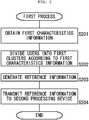
- FIG. 2 is a flowchart showing a control flow of a first process executed by the first processing device of the present invention.
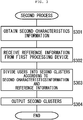
- FIG. 3 is a flowchart showing a control flow of a second process executed by the second processing device of the present invention. The following describes the control flows with reference to these flowcharts.
- a first obtainer 112 obtains first characteristics information u 1 , u 2 , ⁇ , u N respectively indicating characteristics of users 1, 2, ⁇ , N in the first environment (Step S201).
- a second obtainer 122 obtains second characteristics information v 1 , v 2 , ⁇ , v N respectively indicating characteristics of the users 1, 2, ⁇ , N in the second environment (Step S301).
- the first characteristics information u 1 , u 2 , ⁇ , u N and the second characteristics information v 1 , v 2 , ⁇ , v N are respectively vectors indicating characteristics of the users 1, 2, ⁇ , N. These vectors are sometimes called feature vectors in the field of clustering technology.
- the first environment, where the first characteristics information u 1 , u 2 , ⁇ , u N is obtained, and the second environment, where the second characteristics information v 1 , v 2 , ⁇ , v N is obtained, are generally different.
- the dimension of the vector u i and the dimension of the vector v j are generally different, and the type of a characteristic value indicated by the k-th element of the vector u i and the type of a characteristic value indicated by the k-th element of the vector v j are generally different.
- Example characteristic values of a user can include not only the user' s gender, age, age group, occupation, place of residence, annual income, family structure, and other relatively static information, but also the user' s actions and behavior in a service that provides an environment where the characteristic values are collected, such as how many times, how often, what time period, and when the user accessed the service, how many times, how often, what time period, and when the user obtained content or products provided in the service, whether an object to be obtained is free or paid, how much was paid for the object, of what kind the object is, and other various digitized history information.
- Each user' s feature vector is generated by collecting and totaling, for the user, such feature values and then arranging them in a predetermined order.
- This feature vector is feature information indicating the user' s characteristic.
- users are identified by the integers from 1 to N, that is, 1, 2, ⁇ , N.
- users may be identified by user names such as email addresses that the users registered in the corresponding service, terminal identification information such as the serial numbers of terminals that the users used when using the corresponding service, session IDs stored as browser cookies, or terminal identification IDs for advertisement (e.g., identifications for advertisers (IDFAs) or advertising identifiers (AdIDs)) used on smartphones and tablets.
- user names such as email addresses that the users registered in the corresponding service
- terminal identification information such as the serial numbers of terminals that the users used when using the corresponding service
- session IDs stored as browser cookies or terminal identification IDs for advertisement (e.g., identifications for advertisers (IDFAs) or advertising identifiers (AdIDs)) used on smartphones and tablets.
- IDFAs identifications for advertisers
- AdIDs advertising identifiers
- a converter such as a hub server separated from both the first processing device 111 and the second processing device 121 may convert between user identification information for the first processing device 111 and user identification information for the second processing device 121.
- a first divider 113 of the first processing device 111 divides the users 1, 2, ⁇ , N into first clusters P[1], P[2], ⁇ , P[S] by performing clustering on the obtained first characteristics information u 1 , u 2 , ⁇ , u N (Step S202).
- P 1 ⁇ P 2 ⁇ ⁇ ⁇ P S 1 , 2 , ⁇ , N ;
- the first divider 113 can use various known techniques for clustering.
- the first divider 113 can use divisive optimization clustering techniques, such as k-means and x-means, and hierarchical clustering techniques, such as a centroid method, a Ward method, and a group average method.
- divisive optimization clustering techniques such as k-means and x-means
- hierarchical clustering techniques such as a centroid method, a Ward method, and a group average method.
- d(_,_) for characteristics information
- the Euclidean distance and the Manhattan distance can be used.
- Scaling may be performed using the Mahalanobis distance.
- a generator 114 of the first processing device 111 generates reference information obtained by dividing the users 1, 2, ⁇ , N into the first clusters P[1], P[2], ⁇ , P[S] (Step S203) .
- This reference information is to be referred as information similar to training information and guidelines information for clustering when the second processing device 121 divides the users.
- the reference information is information expressing characteristics of the users 1, 2, ⁇ , N, but the content of the information is limited so that the second processing device 121 cannot identify the first characteristics information u 1 , u 2 , ⁇ , u N . Thus, even when the reference information is transmitted to the second processing device 121, the first characteristics information u 1 , u 2 , ⁇ , u N is not leaked. In this embodiment, either belonging information or representation information can be used as the reference information.
- the belonging information is information indicating which of the first clusters the users 1, 2, ⁇ , N belong to by the first characteristics information u 1 , u 2 , ⁇ , u N .
- the belonging information may be any information from which a set of P[1], P[2], ⁇ , P[S], P 1 , P 2 , ⁇ , P S each of which is a set of user numbers, can be derived.
- the generator 114 can generate N S-dimensional vectors in which the j-th element is nonzero and the other elements are zero, and determine all the N S-dimensional vectors to be the belonging information, where N is the number of all users.
- the belonging information becomes a set of N S-dimensional unit vectors.
- the degree of similarity may be the cosine of the angle between the characteristics information u i of the user i and the centroid vector c(P[j]) of the cluster P[j] to which the user i belongs.
- the degree of similarity may be the function that decreases as the distance D from the centroid vector c(P[j]) of the cluster P[j] to the characteristics information u i increases, such as exp(-D 2 ), exp(-
- ), or 1/(1+D), where the distance D is calculated using D d(c(P[j]),u i ).
- the degree of similarity between the first characteristics information u i of the user i and the centroid vector of the cluster P[j] to which the user i belongs is referred to as s i .
- the representation information is information about the cluster to which each user belongs, which represents information obtained from the first characteristics information u 1 , u 2 , ⁇ , u N so that the characteristic of each user from cannot be identified.
- the representation information may be the centroid of the cluster to which each user belongs.
- the generator 114 when the user i belongs to the cluster P[j], the generator 114 generates the centroid vector of the cluster P[j] in association with the user i in place of the first characteristics information u i , and determines all the N centroid vectors to be the representation information, where N is the number of all users.
- the centroid vector of a cluster corresponds to the average of characteristics information of users who belong to the cluster and is calculated in the clustering process. Thus, this can be used as personally unidentifiable information that expresses characteristics of the users.
- the representation information can include the above degree of similarity.
- the use of the degree of similarity can adjust how much the second processing device 121 should reflect the representation information in clustering.
- the j-th element of the vector w i is set to 1 or the degree of similarity s i of u 1 to c(P[j]), and the other elements are set to 0, for the cluster P[j] to which the user i belongs.
- the vector w i is set to c(P[j]), for the cluster P[j] to which the user i belongs.
- the vectors w 1 , w 2 , ⁇ , w N and the degrees of similarity s 1 , s 2 , ⁇ , s N can be used together as the representation information.
- the obtained reference information is transmitted from a transmitter 115 of the first processing device 111 to the second processing device 121 (Step S204), and the first process ends.
- a receiver 123 of the second processing device 121 receives the reference information transmitted from the first processing device 111 (Step S302).
- the second characteristics information may be obtained (Step S301) after the reference information is received (Step S302).
- Step S301 may be performed before Step S302.
- both Steps S301 and S302 may be performed concurrently.
- a second divider 124 of the second processing device 121 divides the users 1, 2, ⁇ , N into second clusters Q[1], Q[2], ⁇ , Q[T] by performing clustering on the transmitted reference information and the obtained second characteristics information v 1 , v 2 , ⁇ , v N (Step S303).
- the second processing device 121 then outputs the second clusters Q[1], Q[2], ⁇ , Q[T] as a result of dividing the users in the second environment in view of the first environment (Step S304), and terminates this process.
- the second clusters Q[1], Q[2], ⁇ , Q[T] satisfy the following conditions, as with the first clusters P[1], P[2], ⁇ , P[S].
- Q 1 ⁇ Q 2 ⁇ ⁇ ⁇ Q T 1 , 2 , ⁇ , N ;
- the restriction that the total number of the second clusters, T, is equal to the total number of the first clusters, S may be added.
- the restriction that S is smaller than T may be added, or S and T may be independent of each other.
- the second divider 124 and the first divider 113 are similar in that they can use various known technique for clustering.
- the second divider 124 differs from the first divider 113 in that it uses not only the second characteristics information v 1 , v 2 , ⁇ , v N but also the vectors w 1 , w 2 , ⁇ , w N included in the reference information and the degrees of similarity s 1 , s 2 , ⁇ , s N included in the reference information.
- concatenated vectors obtained by respectively concatenating the second characteristics information v 1 , v 2 , ⁇ , v N and the vectors w 1 , w 2 , ⁇ , w N v 1 + + w 1 , v 2 + + w 2 , ⁇ , v N + + w N are used as feature vectors for clustering.
- a concatenated vector a++b which is obtained by concatenating a vector a and a vector b, is a vector in which the elements of the vector a are followed by the elements of the vector b.
- the present application uses the operator "++" for vector concatenation.
- the dimension of the concatenated vector v i ++w i is equal to the sum of the dimension of the vector v i and the dimension of the vector w i .
- the vector w i in the belonging information mode is a vector in which the j-th element is nonzero (1 or the degree of similarity s i ) and the other elements are zero.
- the vector w i in the representation information mode is the centroid vector c(P[j]) or vector s i c(P[j]) obtained by multiplying this and the degree of similarity.
- reference information vectors of users who belong to the same cluster through the clustering based on the first characteristics information are perfectly equal or point in the same direction.
- clustering using vectors obtained by concatenating the reference information and the second characteristics information enables the results of the division based on the first characteristics information to be reflected in clustering using the second characteristics information. This divides the users into segments according to the users' characteristics more accurately without obtaining the first characteristics information.
- the linear sum of the second characteristics information v 1 , v 2 , ⁇ , v N and the vectors w 1 , w 2 , ⁇ , w N v 1 + w 1 , v 2 + w 2 , ⁇ , v N + w N or v 1 + s 1 w 1 , v 2 + s 2 w 2 , ⁇ , v N + s N w N are used as feature vectors for clustering.
- This mode can be applied to a case where the representation information is used as the reference information, a user' s same type of characteristic values obtained under different environments are stored in each element of a feature vector that is the user ' s first characteristics information and the corresponding element of a feature vector that is the user' s second characteristics information, and the characteristic values vary depending on the user' s actions and behavior.
- a billing amount in the first environment and a billing amount in the second environment are to be added.
- meaningful information can be obtained by adding the billing amount element of a reference information vector obtained from the first characteristics information and the billing amount element of a reference information vector obtained from the second characteristics information.
- an element for a related option is set to nonzero
- an element for an unrelated option is set to zero (e.g., for males, the element "male gender” is set to 1, the element "female gender” is set to 0, and the element "other gender” is set to 0)
- the linear sum of vectors can be found by adding the vectors after multiplying the degree of similarity s i as a coefficient.
- the degree of similarity s i indicates how much the centroid c(P[j]) reflects the user i' s characteristic.
- the linear sum using the degree of similarity s i improves the accuracy.
- the result of the division by the first divider 113 P 1 , P 2 , ⁇ , P S is derived from the belonging information or the representation information, and this result is used as an initial division by the second divider 124 to perform clustering on the second characteristics information v 1 , v 2 , ⁇ , v N .
- Patent Literature 1 employs a random division as an initial division. However, as with this mode, the technique disclosed in Patent Literature 1 can be applied using P 1 , P 2 , ⁇ , P S as an initial division.
- the centroid vector c(P[j]) in the first environment is the average of first characteristics information u k of k-th user who belong to the cluster. That is, the centroid is the average of characteristics information itself used for the division into clusters.
- the mean vector e(P[j]) in the second environment is the average of second characteristics information v k obtained by the second processing device 121 for the k-th user who belong to each of the clusters into which the users are divided according to the first characteristics information by the first processing device 111. That is, the mean vector is the average of characteristics information (the second characteristics information) that is different from the characteristics information (the first characteristics information) used for the division into clusters.
- use of the belonging information can provide the division Q 1 , Q 2 , ⁇ , Q T that is similar to the result of the division by the first divider 113 P 1 , P 2 , ⁇ , P S and corresponds to the second characteristics information v 1 , v 2 , ⁇ , v N .
- the above techniques can also be applied to cases of performing clustering while keeping characteristics information collected in three or more environments separate.
- (R-1) In an (R-1)-th environment, clustering is performed according to the (R-2)-th reference information and (R-1)-th characteristics information to obtain (R-1)-th reference information based on the resulting (R-1)-th division. After that, (R) in an R-th environment, clustering is preferably performed according to the (R-1)-th reference information and R-th characteristics information to obtain an R-th division.
- (R-1) In an (R-1)-th environment, clustering is performed accordingto (R-1)-thcharacteristics information to obtain (R-1)-th reference information based on the resulting (R-1)-th division. After that, (R) in an R-th environment, clustering is preferably performed according to the first reference information, the second reference information, ..., the (R-1)-th reference information, and R-th characteristics information to obtain an R-th division.
- a processing system includes a first processing device and a second processing device.
- the second processing device may divide the plurality of users into second clusters according to integration vectors obtained by concatenating, for each user, the obtained second characteristics information and vectors relating to the transmitted representation information.
- the second processing device may divide the plurality of users into second clusters by finding, for each user, a linear sum of corresponding elements of the obtained second characteristics information and vectors relating to the transmitted representation information.
- the representation information may include the degree of similarity between a centroid based on the first characteristics information of a cluster to which the user belongs and first characteristics information obtained for the user, and the second processing device may change coefficients for the linear sum according to the degrees of similarity relating to the transmitted representation information.
- a processing device includes a receiver, an obtainer, and a divider.
- the receiver receives, from another processing device, representation information representing characteristics of users belonging to each of first clusters using a centroid vector based on first characteristics information of the cluster.
- the first characteristics information indicates a characteristic of each of a plurality of users in a first environment.
- the plurality of users are divided into the first clusters according to the first characteristics information.
- the obtainer obtains second characteristics information indicating a characteristic of each of the plurality of users in a second environment.
- the divider divides the plurality of users into second clusters according to the received representation information and the obtained second characteristics information.
- a processing method according to this embodiment is performed by a first processing device and a second processing device.
- a program according to this embodiment causes a computer to function as a receiver, an obtainer, and a divider.
- the receiver receives, from another processing device, representation information representing characteristics of users belonging to each of first clusters using a centroid vector based on first characteristics information of the cluster.
- the first characteristics information indicates a characteristic of each of a plurality of users in a first environment.
- the plurality of users are divided into the first clusters according to the first characteristics information.
- the obtainer obtains second characteristics information indicating a characteristic of each of the plurality of users in a second environment.
- the divider divides the plurality of users into second clusters according to the received representation information and the obtained second characteristics information.
- the above program is stored in a non-transitory computer-readable information storage medium according to this embodiment.
- the present invention provides a processing system, a processing device, a processing method, a program, and an information storage medium that are suitable for dividing users into clusters separately using first characteristics information indicating characteristics of the users in a first environment and second characteristics information indicating characteristics of the users in a second environment.
Landscapes
- Engineering & Computer Science (AREA)
- Databases & Information Systems (AREA)
- Theoretical Computer Science (AREA)
- Business, Economics & Management (AREA)
- Data Mining & Analysis (AREA)
- Physics & Mathematics (AREA)
- General Physics & Mathematics (AREA)
- Finance (AREA)
- Strategic Management (AREA)
- Development Economics (AREA)
- Accounting & Taxation (AREA)
- General Engineering & Computer Science (AREA)
- Entrepreneurship & Innovation (AREA)
- Game Theory and Decision Science (AREA)
- General Business, Economics & Management (AREA)
- Marketing (AREA)
- Economics (AREA)
- Information Retrieval, Db Structures And Fs Structures Therefor (AREA)
Applications Claiming Priority (1)
| Application Number | Priority Date | Filing Date | Title |
|---|---|---|---|
| PCT/JP2017/027764 WO2019026152A1 (ja) | 2017-07-31 | 2017-07-31 | 処理システム、処理装置、処理方法、プログラム、ならびに、情報記録媒体 |
Publications (2)
| Publication Number | Publication Date |
|---|---|
| EP3467669A1 true EP3467669A1 (de) | 2019-04-10 |
| EP3467669A4 EP3467669A4 (de) | 2020-01-22 |
Family
ID=65232416
Family Applications (1)
| Application Number | Title | Priority Date | Filing Date |
|---|---|---|---|
| EP17912355.9A Ceased EP3467669A4 (de) | 2017-07-31 | 2017-07-31 | Verarbeitungssystem, verarbeitungsvorrichtung, verarbeitungsverfahren, programm und informationsspeichermedium |
Country Status (4)
| Country | Link |
|---|---|
| US (1) | US11755624B2 (de) |
| EP (1) | EP3467669A4 (de) |
| JP (1) | JP6499373B1 (de) |
| WO (1) | WO2019026152A1 (de) |
Families Citing this family (1)
| Publication number | Priority date | Publication date | Assignee | Title |
|---|---|---|---|---|
| US20210248462A1 (en) * | 2020-02-07 | 2021-08-12 | Nec Laboratories America, Inc. | Interpreting convolutional sequence model by learning local and resolution-controllable prototypes |
Family Cites Families (18)
| Publication number | Priority date | Publication date | Assignee | Title |
|---|---|---|---|---|
| JPS55159000A (en) | 1979-05-28 | 1980-12-10 | Kadota Kagu Kk | Preparation of inlay pattern |
| JP2001023047A (ja) * | 1999-07-12 | 2001-01-26 | Daikoku:Kk | 統合型顧客管理システム |
| JP2006092504A (ja) | 2004-09-25 | 2006-04-06 | Just Syst Corp | 分類装置、分類方法、ならびに、プログラム |
| WO2011001584A1 (ja) * | 2009-06-29 | 2011-01-06 | 日本電気株式会社 | 情報分類装置、情報分類方法及び情報分類プログラム |
| US8595058B2 (en) * | 2009-10-15 | 2013-11-26 | Visa U.S.A. | Systems and methods to match identifiers |
| US20130339085A1 (en) * | 2012-06-13 | 2013-12-19 | Kenshoo Ltd. | Identifying a non-obvious target audience for an advertising campaign |
| US9589280B2 (en) * | 2013-07-17 | 2017-03-07 | PlaceIQ, Inc. | Matching anonymized user identifiers across differently anonymized data sets |
| EP2973039B1 (de) * | 2013-03-15 | 2020-09-16 | Factual Inc. | Vorrichtung, systeme und verfahren zur gruppierung von datensätzen |
| JP5797686B2 (ja) * | 2013-04-26 | 2015-10-21 | シャープ株式会社 | 情報処理装置、および情報提供方法 |
| MY175611A (en) * | 2014-08-08 | 2020-07-01 | Hakuhodo Dy Holdings Inc | Information-processing system |
| JP5649756B1 (ja) | 2014-08-08 | 2015-01-07 | 株式会社博報堂Dyホールディングス | 情報処理システム、及び、プログラム。 |
| JP6278918B2 (ja) * | 2015-03-19 | 2018-02-14 | 日本電信電話株式会社 | データ解析装置、方法、及びプログラム |
| WO2017017740A1 (ja) * | 2015-07-24 | 2017-02-02 | 株式会社日立製作所 | 情報配信装置及び方法 |
| WO2017062684A1 (en) * | 2015-10-06 | 2017-04-13 | Numerica Corporation | Systems and methods for dynamically generating patrol schedules based on historic demand event data |
| US10565627B2 (en) * | 2015-12-30 | 2020-02-18 | Google Llc | Systems and methods for automatically generating remarketing lists |
| US20170206551A1 (en) * | 2016-01-15 | 2017-07-20 | Adobe Systems Incorporated | Personalized Recommendation Computation in Real Time using Incremental Matrix Factorization and User Factor Clustering |
| GB2562423B (en) * | 2016-02-25 | 2020-04-29 | Sas Inst Inc | Cybersecurity system |
| CN109643408A (zh) * | 2016-08-11 | 2019-04-16 | 皇家飞利浦有限公司 | 激励程序中的智能对等者分组 |
-
2017
- 2017-07-31 EP EP17912355.9A patent/EP3467669A4/de not_active Ceased
- 2017-07-31 JP JP2018504306A patent/JP6499373B1/ja active Active
- 2017-07-31 US US16/317,072 patent/US11755624B2/en active Active
- 2017-07-31 WO PCT/JP2017/027764 patent/WO2019026152A1/ja not_active Ceased
Also Published As
| Publication number | Publication date |
|---|---|
| WO2019026152A1 (ja) | 2019-02-07 |
| JPWO2019026152A1 (ja) | 2019-11-07 |
| EP3467669A4 (de) | 2020-01-22 |
| US20210374160A1 (en) | 2021-12-02 |
| JP6499373B1 (ja) | 2019-04-10 |
| US11755624B2 (en) | 2023-09-12 |
Similar Documents
| Publication | Publication Date | Title |
|---|---|---|
| US10417650B1 (en) | Distributed and automated system for predicting customer lifetime value | |
| CN109784973B (zh) | 基于大数据分析的广告投放方法、装置及电子设备 | |
| KR101363171B1 (ko) | 하이브리드 협업적 여과 방법을 이용한 코사인 유사도 기반 전문가 추천 장치 및 방법 | |
| CN112598472A (zh) | 产品推荐方法、装置、系统、介质和程序产品 | |
| US20200234218A1 (en) | Systems and methods for entity performance and risk scoring | |
| US10552996B2 (en) | Systems and techniques for determining associations between multiple types of data in large data sets | |
| US20170287023A1 (en) | Blacklisting Based on Image Feature Analysis and Collaborative Filtering | |
| CN111061979A (zh) | 一种用户标签的推送方法、装置、电子设备和介质 | |
| WO2020150597A1 (en) | Systems and methods for entity performance and risk scoring | |
| KR102537601B1 (ko) | 광고 전략을 생성하기 위한 광고 방법 및 장치 | |
| CN108932658B (zh) | 数据处理方法、装置和计算机可读存储介质 | |
| WO2019001463A1 (zh) | 数据处理方法及装置 | |
| CN118134665A (zh) | 自动化计量方法、装置、设备、介质和程序产品 | |
| EP3486795A1 (de) | Verarbeitungssystem, verarbeitungsvorrichtung, verarbeitungsverfahren, programm und informationsaufzeichnungsmedium | |
| CN110019774B (zh) | 标签分配方法、装置、存储介质及电子装置 | |
| CN110110210B (zh) | 推送展示信息的方法和装置 | |
| US20200234207A1 (en) | Management support system and method | |
| US11755624B2 (en) | Processing system, processing device, processing method, program, and information storage medium | |
| KR100992345B1 (ko) | 서비스 평가 방법, 시스템 및 컴퓨터 판독가능한 기록매체 | |
| US20130339085A1 (en) | Identifying a non-obvious target audience for an advertising campaign | |
| CN113554041B (zh) | 一种对用户标记标签的方法和装置 | |
| CN113076450A (zh) | 一种目标推荐列表的确定方法和装置 | |
| CN112785197B (zh) | 信息推荐方法、装置、计算设备、介质和程序产品 | |
| JP5388988B2 (ja) | 広告選択装置、方法及びプログラム | |
| CN110020118A (zh) | 一种计算用户之间相似度的方法及装置 |
Legal Events
| Date | Code | Title | Description |
|---|---|---|---|
| STAA | Information on the status of an ep patent application or granted ep patent |
Free format text: STATUS: UNKNOWN |
|
| STAA | Information on the status of an ep patent application or granted ep patent |
Free format text: STATUS: THE INTERNATIONAL PUBLICATION HAS BEEN MADE |
|
| PUAI | Public reference made under article 153(3) epc to a published international application that has entered the european phase |
Free format text: ORIGINAL CODE: 0009012 |
|
| STAA | Information on the status of an ep patent application or granted ep patent |
Free format text: STATUS: REQUEST FOR EXAMINATION WAS MADE |
|
| 17P | Request for examination filed |
Effective date: 20181213 |
|
| AK | Designated contracting states |
Kind code of ref document: A1 Designated state(s): AL AT BE BG CH CY CZ DE DK EE ES FI FR GB GR HR HU IE IS IT LI LT LU LV MC MK MT NL NO PL PT RO RS SE SI SK SM TR |
|
| AX | Request for extension of the european patent |
Extension state: BA ME |
|
| A4 | Supplementary search report drawn up and despatched |
Effective date: 20200102 |
|
| RIC1 | Information provided on ipc code assigned before grant |
Ipc: G06F 16/00 20190101AFI20191217BHEP Ipc: G06F 16/906 20190101ALI20191217BHEP Ipc: G06Q 30/02 20120101ALI20191217BHEP |
|
| DAV | Request for validation of the european patent (deleted) | ||
| DAX | Request for extension of the european patent (deleted) | ||
| STAA | Information on the status of an ep patent application or granted ep patent |
Free format text: STATUS: EXAMINATION IS IN PROGRESS |
|
| 17Q | First examination report despatched |
Effective date: 20210521 |
|
| RAP3 | Party data changed (applicant data changed or rights of an application transferred) |
Owner name: RAKUTEN GROUP, INC. |
|
| REG | Reference to a national code |
Ref country code: DE Ref legal event code: R003 |
|
| STAA | Information on the status of an ep patent application or granted ep patent |
Free format text: STATUS: THE APPLICATION HAS BEEN REFUSED |
|
| 18R | Application refused |
Effective date: 20230714 |