EP3467723B1 - Procédé et appareil de construction de modèles de réseau basé sur l'apprentissage par machine - Google Patents
Procédé et appareil de construction de modèles de réseau basé sur l'apprentissage par machine Download PDFInfo
- Publication number
- EP3467723B1 EP3467723B1 EP17805881.4A EP17805881A EP3467723B1 EP 3467723 B1 EP3467723 B1 EP 3467723B1 EP 17805881 A EP17805881 A EP 17805881A EP 3467723 B1 EP3467723 B1 EP 3467723B1
- Authority
- EP
- European Patent Office
- Prior art keywords
- network
- data processing
- sub
- processing step
- data
- Prior art date
- Legal status (The legal status is an assumption and is not a legal conclusion. Google has not performed a legal analysis and makes no representation as to the accuracy of the status listed.)
- Active
Links
Images




Classifications
-
- G—PHYSICS
- G06—COMPUTING OR CALCULATING; COUNTING
- G06F—ELECTRIC DIGITAL DATA PROCESSING
- G06F18/00—Pattern recognition
- G06F18/20—Analysing
- G06F18/24—Classification techniques
- G06F18/241—Classification techniques relating to the classification model, e.g. parametric or non-parametric approaches
- G06F18/2413—Classification techniques relating to the classification model, e.g. parametric or non-parametric approaches based on distances to training or reference patterns
- G06F18/24133—Distances to prototypes
- G06F18/24137—Distances to cluster centroïds
- G06F18/2414—Smoothing the distance, e.g. radial basis function networks [RBFN]
-
- G—PHYSICS
- G06—COMPUTING OR CALCULATING; COUNTING
- G06F—ELECTRIC DIGITAL DATA PROCESSING
- G06F3/00—Input arrangements for transferring data to be processed into a form capable of being handled by the computer; Output arrangements for transferring data from processing unit to output unit, e.g. interface arrangements
- G06F3/01—Input arrangements or combined input and output arrangements for interaction between user and computer
- G06F3/03—Arrangements for converting the position or the displacement of a member into a coded form
- G06F3/041—Digitisers, e.g. for touch screens or touch pads, characterised by the transducing means
- G06F3/047—Digitisers, e.g. for touch screens or touch pads, characterised by the transducing means using sets of wires, e.g. crossed wires
-
- G—PHYSICS
- G06—COMPUTING OR CALCULATING; COUNTING
- G06N—COMPUTING ARRANGEMENTS BASED ON SPECIFIC COMPUTATIONAL MODELS
- G06N3/00—Computing arrangements based on biological models
- G06N3/02—Neural networks
- G06N3/04—Architecture, e.g. interconnection topology
- G06N3/044—Recurrent networks, e.g. Hopfield networks
-
- G—PHYSICS
- G06—COMPUTING OR CALCULATING; COUNTING
- G06N—COMPUTING ARRANGEMENTS BASED ON SPECIFIC COMPUTATIONAL MODELS
- G06N3/00—Computing arrangements based on biological models
- G06N3/02—Neural networks
- G06N3/04—Architecture, e.g. interconnection topology
- G06N3/044—Recurrent networks, e.g. Hopfield networks
- G06N3/0442—Recurrent networks, e.g. Hopfield networks characterised by memory or gating, e.g. long short-term memory [LSTM] or gated recurrent units [GRU]
-
- G—PHYSICS
- G06—COMPUTING OR CALCULATING; COUNTING
- G06N—COMPUTING ARRANGEMENTS BASED ON SPECIFIC COMPUTATIONAL MODELS
- G06N3/00—Computing arrangements based on biological models
- G06N3/02—Neural networks
- G06N3/04—Architecture, e.g. interconnection topology
- G06N3/045—Combinations of networks
-
- G—PHYSICS
- G06—COMPUTING OR CALCULATING; COUNTING
- G06N—COMPUTING ARRANGEMENTS BASED ON SPECIFIC COMPUTATIONAL MODELS
- G06N3/00—Computing arrangements based on biological models
- G06N3/02—Neural networks
- G06N3/04—Architecture, e.g. interconnection topology
- G06N3/045—Combinations of networks
- G06N3/0455—Auto-encoder networks; Encoder-decoder networks
-
- G—PHYSICS
- G06—COMPUTING OR CALCULATING; COUNTING
- G06N—COMPUTING ARRANGEMENTS BASED ON SPECIFIC COMPUTATIONAL MODELS
- G06N3/00—Computing arrangements based on biological models
- G06N3/02—Neural networks
- G06N3/04—Architecture, e.g. interconnection topology
- G06N3/0464—Convolutional networks [CNN, ConvNet]
-
- G—PHYSICS
- G06—COMPUTING OR CALCULATING; COUNTING
- G06N—COMPUTING ARRANGEMENTS BASED ON SPECIFIC COMPUTATIONAL MODELS
- G06N3/00—Computing arrangements based on biological models
- G06N3/02—Neural networks
- G06N3/04—Architecture, e.g. interconnection topology
- G06N3/047—Probabilistic or stochastic networks
-
- G—PHYSICS
- G06—COMPUTING OR CALCULATING; COUNTING
- G06N—COMPUTING ARRANGEMENTS BASED ON SPECIFIC COMPUTATIONAL MODELS
- G06N3/00—Computing arrangements based on biological models
- G06N3/02—Neural networks
- G06N3/08—Learning methods
- G06N3/082—Learning methods modifying the architecture, e.g. adding, deleting or silencing nodes or connections
-
- G—PHYSICS
- G06—COMPUTING OR CALCULATING; COUNTING
- G06N—COMPUTING ARRANGEMENTS BASED ON SPECIFIC COMPUTATIONAL MODELS
- G06N3/00—Computing arrangements based on biological models
- G06N3/02—Neural networks
- G06N3/08—Learning methods
- G06N3/09—Supervised learning
-
- H—ELECTRICITY
- H04—ELECTRIC COMMUNICATION TECHNIQUE
- H04L—TRANSMISSION OF DIGITAL INFORMATION, e.g. TELEGRAPHIC COMMUNICATION
- H04L41/00—Arrangements for maintenance, administration or management of data switching networks, e.g. of packet switching networks
- H04L41/14—Network analysis or design
- H04L41/145—Network analysis or design involving simulating, designing, planning or modelling of a network
-
- H—ELECTRICITY
- H04—ELECTRIC COMMUNICATION TECHNIQUE
- H04L—TRANSMISSION OF DIGITAL INFORMATION, e.g. TELEGRAPHIC COMMUNICATION
- H04L41/00—Arrangements for maintenance, administration or management of data switching networks, e.g. of packet switching networks
- H04L41/16—Arrangements for maintenance, administration or management of data switching networks, e.g. of packet switching networks using machine learning or artificial intelligence
-
- G—PHYSICS
- G06—COMPUTING OR CALCULATING; COUNTING
- G06F—ELECTRIC DIGITAL DATA PROCESSING
- G06F18/00—Pattern recognition
- G06F18/20—Analysing
- G06F18/21—Design or setup of recognition systems or techniques; Extraction of features in feature space; Blind source separation
- G06F18/214—Generating training patterns; Bootstrap methods, e.g. bagging or boosting
-
- G—PHYSICS
- G06—COMPUTING OR CALCULATING; COUNTING
- G06F—ELECTRIC DIGITAL DATA PROCESSING
- G06F18/00—Pattern recognition
- G06F18/20—Analysing
- G06F18/23—Clustering techniques
-
- G—PHYSICS
- G06—COMPUTING OR CALCULATING; COUNTING
- G06N—COMPUTING ARRANGEMENTS BASED ON SPECIFIC COMPUTATIONAL MODELS
- G06N20/00—Machine learning
- G06N20/10—Machine learning using kernel methods, e.g. support vector machines [SVM]
-
- G—PHYSICS
- G06—COMPUTING OR CALCULATING; COUNTING
- G06N—COMPUTING ARRANGEMENTS BASED ON SPECIFIC COMPUTATIONAL MODELS
- G06N20/00—Machine learning
- G06N20/20—Ensemble learning
-
- G—PHYSICS
- G06—COMPUTING OR CALCULATING; COUNTING
- G06N—COMPUTING ARRANGEMENTS BASED ON SPECIFIC COMPUTATIONAL MODELS
- G06N5/00—Computing arrangements using knowledge-based models
- G06N5/01—Dynamic search techniques; Heuristics; Dynamic trees; Branch-and-bound
-
- G—PHYSICS
- G06—COMPUTING OR CALCULATING; COUNTING
- G06N—COMPUTING ARRANGEMENTS BASED ON SPECIFIC COMPUTATIONAL MODELS
- G06N7/00—Computing arrangements based on specific mathematical models
- G06N7/01—Probabilistic graphical models, e.g. probabilistic networks
-
- H—ELECTRICITY
- H04—ELECTRIC COMMUNICATION TECHNIQUE
- H04L—TRANSMISSION OF DIGITAL INFORMATION, e.g. TELEGRAPHIC COMMUNICATION
- H04L41/00—Arrangements for maintenance, administration or management of data switching networks, e.g. of packet switching networks
- H04L41/12—Discovery or management of network topologies
Definitions
- This application relates to the field of Internet technologies, and in particular, to a machine learning-based network model building method and apparatus.
- the network model includes: a non-neural network (NN) model and an NN model.
- An NN is a complex network system formed by a large number of processing units (referred to as neurons) connected to each other, and is a high-complexity non-linear dynamic learning system.
- the basis of the NN is the neurons, and the NN model is indicated by using a network topology, a node feature, and a learning rule of the neurons.
- D1 paper of Jeffrey Dean ET AL: “Large Scale Distributed Deep Networks", 2012 ) considers the problem of training a deep network with billions of parameters using tens of thousands of CPU cores.
- D1 develops a software framework called DistBelief that can utilize computing clusters with thousands of machines to train large models.
- D1 develops two algorithms for large-scale distributed training: (i) Downpour SGD, an asynchronous stochastic gradient descent procedure supporting a large number of model replicas, and (ii) Sandblaster, a framework that supports a variety of distributed batch optimization procedures, including a distributed implementation of L-BFGS.
- Downpour SGD and Sandblaster L-BFGS both increase the scale and speed of deep network training.
- D1 uses the system to train a deep network 30x larger than previously reported in the literature, and achieves state-of-the-art performance on ImageNet, a visual object recognition task with 16 million images and 21k categories. D1 shows that these same techniques dramatically accelerate the training of a more modestly- sized deep network for a commercial speech recognition service.
- a neural network having an input layer, a hidden layer, and an output layer with each layer having one or more nodes is presented. Each node in the input layer is connected to each node in the hidden layer and each node in the hidden layer is connected to each node in the output layer. Each connection between nodes has an associated weight. All nodes in the input layer are connected to a different historical datum from the set of historical data.
- the neural network being operative by outputting a prediction or classification, the output of the output layer nodes, when presented with input data.
- the weights associated with the connections of the neural network are first adjusted by a training device.
- the training device then iteratively applies a training set to the neural network, the training set consisting of historical data. After each iteration the weights associated with the connections are adjusted according to the difference between the prediction or classification produced by the neural network given the training data and the known prediction or classification of the historical data.
- D3 ( CN 104751227 A ) at best discloses a method and a system for constructing a deep neural network.
- the method comprises the steps of determining the number of nodes at a deep neural network input layer and the number of the nodes in an output layer; acquiring training data; determining the number of deep neural network hidden layers and the number of nodes of a first hidden layer; determining the number of the nodes at subsequent hidden layers according to the data quantity of the training data, the number of the hidden layers, and the number of nodes of the first hidden layer; enabling the number of the nodes of the hidden layer to be gradually reduced; determining the model parameters of the deep neural network according to the training data to obtain the deep neural network.
- the deep neural network constructed by the method and system has the advantages that the number of parameters of the neural network can be greatly decreased, the storage space required is reduced, and the training speed of the model is increased.
- D4 ( CN 103729459 A ) at best discloses a sentiment classification method for generating a model deep-convinced-degree network on the basis of the probability of depth study.
- a plurality of Boltzmann machine layers are stacked, namely, output of this layer is used as input of the next layer.
- input information can be expressed in a grading mode, and abstraction can be conducted layer by layer.
- a multi-layer sensor containing a plurality of hidden layers is the basic study structure of the method. More abstract high layers are formed through combining the characteristics of lower layers and are used for expressing attribute categories or characteristics, so that the distribution type character presentation of data can be discovered.
- the method belongs to monitoring-free study, and a mainly-used model is the deep-convinced-degree network. The method enables a machine to conduct characteristic abstract better so as to improve the accuracy of sentiment classifications.
- D5 ( EP 2533176 A1 ) at best discloses a method for determining whether an input vector is known or unknown by a neuron.
- the method includes the steps of: constructing a constraint and its complement from the input vector; alternately adding the constraint and its complement to the constraints set of the neuron; and testing the constraints set to determine if there is a solution in either case. If there is a solution for either the constraint or its complement, but not both, it is determined that the input vector is known by the neuron, and if there is a solution when both the constraint and its complement are alternately added to the constraints set, it is determined that the input vector is not known by the neuron.
- Embodiments of this application provide a machine learning-based network model building method and apparatus, to simplify a process of building a network model, and improve the model building efficiency
- the invention is set out in the independent claims and preferred embodiments are defined by the dependent claims.
- a data processing procedure of an original network model is analyzed, actual operating data generated by the original network model in the data processing procedure is used as a reference dataset, at least one equivalent sub-network is hierarchically built, optimization training is performed on the at least one sub-network, and a target network model is finally formed by means of merging.
- Layers of the target network model are flexibly and quickly built by using the actual operating data of the original network model and then are merged to form the target network model, and there is no need to design an entire structure of the target network model from the very beginning. Therefore, a model building process is simplified, and the model building efficiency is effectively improved.
- Optimization adjustment on the target network model is performed in a divided manner, optimization adjustment is first performed on each sub-network, and then the at least one sub-network is merged, so that an optimization adjustment process of the target network model is more flexible, and the model building efficiency is further improved.
- a process of performing machine learning on a network model to build an NN model data of an existing network model needs to be labeled to form a training set, and then an NN model is built from the very beginning.
- massive data needs to be manually labeled to generate labeled data used as the training set.
- the process requires massive human-machine interaction, and needs to consume a large number of device resources.
- building the NN model from the very beginning requires complex parameter adjustment on the entire built network model, leading to heavy workload and low model building efficiency.
- the network model includes: a non-NN model and an NN model.
- An NN is a complex network system formed by a large number of processing units (referred to as neurons in the NN) connected to each other, and is a high-complexity non-linear dynamic learning system.
- the neurons are basic units forming the NN.
- the NN model is indicated by using a network topology, a node feature, and a learning rule of the neurons. Compared with the non-NN model, the NN model has a stronger deep learning capability and a better environmental adaptability.
- the embodiments of this application provide a learning-based network model building method and apparatus, so that a data processing procedure of an original network model is analyzed, at least one equivalent sub-network is hierarchically built by using actual operating data generated by the original network model in the data processing procedure as a reference dataset, optimization training is performed on the at least one sub-network, and a target network model is finally formed by means of merging.
- the target network model is built by using the machine learning process, so that the following beneficial effects can be obtained:
- the original network model may be a non-NN model or an NN model
- the target network model may be an NN model.
- the original network model is described by using a non-NN model as an example
- the target network model is described by using an NN model as an example.
- an embodiment of this application discloses a machine learning-based network model building method.
- the method may include the following step S101 to step S104: S101: Obtain a data processing procedure of an original network model and a reference dataset generated by the original network model in the data processing procedure.
- the original network model is used as a tool of analyzing, controlling, and determining, and performs a series of data processing steps in an operation process to form a complete data processing procedure.
- the data processing step herein may include, but is not limited to, at least one of the following:
- step S101 at least one data processing step in the data processing procedure operated by the original network model may be analyzed and recorded.
- the original network model generates operating data when performing each data processing step.
- the operating data herein may include, but is not limited to, input data and intermediate data that are used and output data that is obtained by the original network model in an actual operation process; or input data, intermediate data, and output data that are labeled and used by the original network model in a training or test process; or analog input data and intermediate data that are manually injected for the original network model and obtained output data.
- some or all operating data is extracted from the operating data of each data processing step as the reference dataset.
- S102 Hierarchically build at least one sub-network according to the data processing procedure and the reference dataset.
- the data processing procedure records at least one data processing step performed by the original network model, and the reference dataset includes at least one group of input/output data corresponding to each data processing step.
- the idea of hierarchical building is: each data processing step of the original network model may be performed by a sub-network having an equivalent function, and therefore, one data processing step may correspond to a network main structure of one sub-network; in addition, an input/output layer of the sub-network may be determined by input/output data of the data processing step. Therefore, in the step, the at least one sub-network may be hierarchically built according to the data processing procedure of the original network model and the extracted reference dataset.
- step a1 is equivalent to a sub-network b1 at a first layer
- a main network structure of the sub-network b1 is determined by step a1
- an input layer and an output layer of the sub-network b1 is determined by input/output data extracted from step a1
- step a2 is equivalent to a sub-network b2 at a second layer
- a main network structure of the sub-network b2 is determined by step a2
- an input layer and an output layer of the sub-network b2 is determined by input/output data extracted from step a2.
- step a4 is equivalent to a sub-network b4 at a fourth layer, a main network structure of the sub-network b4 is determined by step a4, and an input layer and an output layer of the sub-network b4 is determined by input/output data extracted from step a4. It can be further learned according to the example that the target network model is formed by the sub-network b1, the sub-network b2, a sub-network b3, and the sub-network b4 by means of layered connection.
- S103 Perform optimization training on the at least one sub-network by using the reference dataset.
- An objective of optimization training is to: continuously adjust a parameter of the at least one sub-network with reference to data in the reference dataset, so that a performance indicator of the sub-network reaches a same or even higher level of a performance indicator of a corresponding data processing step in the original network model.
- the parameter of the sub-network herein may include: at least one of a network node, a weight, and a training rate.
- at least one group of input/output data extracted from each data processing step is used for performing optimization training on a sub-network equivalent to the data processing step.
- step S102 at least one group of input/output data corresponding to step a1 in the reference dataset is used for performing optimization training on the sub-network b1, and at least one group of input/output data corresponding to step a2 is used for performing optimization training on the sub-network b2.
- at least one group of input/output data corresponding to step a4 is used for performing optimization training on the sub-network b4.
- S104 Merge the at least one sub-network on which the optimization training has been performed, to form a target network model.
- the at least one sub-network on which the optimization training has been performed needs to be continuously iteratively merged.
- joint optimization further needs to be performed on a network formed by means of continuous merging, so that the complete target network model is finally formed.
- the target network model formed by using iterative merging and joint optimization processes is a deep network, and has relatively high performance reliability.
- a data processing procedure of an original network model is analyzed, actual operating data generated by the original network model in the data processing procedure is used as a reference dataset, at least one equivalent sub-network is hierarchically built, optimization training is performed on the at least one sub-network, and a target network model is finally formed by means of merging.
- Layers of the target network model are flexibly and quickly built by using the actual operating data of the original network model and then are merged to form the target network model, and there is no need to design an entire structure of the target network model from the very beginning. Therefore, a model building process is simplified, and the model building efficiency is effectively improved.
- Optimization adjustment on the target network model is performed in a divided manner, optimization adjustment is first performed on each sub-network, and then the at least one sub-network is merged, so that an optimization adjustment process of the target network model is more flexible, and the model building efficiency is further improved.
- An embodiment of this application discloses another machine learning-based network model building method.
- the method may include the following step S201 to step S204: S201: Obtain at least one data processing step performed by an original network model in a data processing procedure.
- the original network model is used as a tool of analyzing, controlling, and determining, and performs a series of data processing steps in an operation process to form a complete data processing procedure.
- at least one data processing step performed in the data processing procedure operated by the original network model may be analyzed and recorded. For example, it is assumed that four steps in total that are "step a1 ⁇ step a2 ⁇ step a3 ⁇ step a4" performed in the data processing procedure of the original network model are obtained.
- to-be-processed data is referred to as original data.
- the original data is processed by using a series of data processing steps, that is, processed by using data processing steps in the original network model, to finally obtain an output result.
- Each data processing step is used for completing a particular processing function, for example, classifying the data or obtaining the data through statistics.
- the data processing steps form the data processing procedure.
- the data processing procedure may include: one or more data processing sub-procedures including a data processing step.
- a result obtained by using each data processing sub-procedure is referred to as an output sub-result. After output sub-results are obtained, the data sub-results are merged to obtain the output result.
- each data processing step is referred to as a network node
- each data processing sub-procedure is referred to as a sub-path in the original network model
- each sub-path is a one-way path formed by sequentially connecting network nodes in series according to a performing sequence of the data processing steps.
- the original network model is a network model obtained by combining sub-paths.
- a data processing procedure forming an original network model includes three data processing sub-procedures.
- a first data processing sub-procedure includes: a node 11 corresponding to a data classification processing step, a node 12 corresponding to a data statistical processing step, and a node 13 corresponding o a data regression processing step.
- a second data processing sub-procedure includes: a node 21 corresponding to a data clustering processing step and a node 22 corresponding to a data function mapping processing step.
- a third data processing sub-procedure includes: a node 31 corresponding to a data component analysis processing step, a node 32 corresponding to the data statistical processing step, that is, the node 12, a node 33 corresponding to the data regression processing step, that is, the node 13, and a node 34 corresponding to a data sequence analysis processing step.
- the original data is processed by using data processing steps in the first data processing sub-procedure, to obtain a first output sub-result.
- the original data is processed by using data processing steps in the second data processing sub-procedure, to obtain a second output sub-result.
- the original data is processed by using data processing steps in the third data processing sub-procedure, to obtain a third output sub-result.
- FIG. 2A is a schematic diagram of the original network model according to this embodiment of this application.
- step S201 the at least one data processing step, for example, the data classification processing step corresponding to the node 11 in FIG. 2A , in the data processing procedure forming the original network model may be obtained.
- the original network model generates the operating data when performing each data processing step.
- the operating data herein may include, but is not limited to, input data and intermediate data that are used and output data that is obtained by the original network model in an actual operation process; or input data, intermediate data, and output data that are labeled and used by the original network model in a training or test process; or analog input data and intermediate data that are manually injected for the original network model and obtained output data.
- the operating data generated when the original network model performs each data processing step is obtained.
- operating data generated when the original network model performs step a1 In accordance with the example described in S201, operating data generated when the original network model performs step a1, operating data generated when the original network model performs step a2, operating data generated when the original network model performs step a3, and operating data generated when the original network model performs step a4 need to be respectively obtained.
- the operating data generated when each data processing step is performed may be obtained, for example, operating data generated when the data classification processing step corresponding to the node 11 is performed.
- one of the two groups of input/output data may be extracted as a sample to be added to the reference dataset, or the two groups of input/output data may be both extracted to be added to the reference dataset.
- the reference dataset includes at least one group of input/output data corresponding to each data processing step.
- Step S201 to step S203 in this embodiment may be specific detailed steps of step S101 shown in FIG. 1 .
- S204 Search a preset equivalent correspondence table for a network main structure of a sub-network that is equivalent to each data processing step.
- the data processing step may include, but is not limited to, at least one of the following: (1). an undiversified machine learning step; (2). a data statistics step; (3). a sequence analysis step; (4). a function processing step; and (5). a data editing processing step.
- Each type of data processing step has an equivalent network main structure of a sub-network.
- Table 1 Preset equivalent correspondence table Data processing step Equivalent network main structure Undiversified machine learning (classification) Fully connected layer and Maxout layer Undiversified machine learning (clustering and component analysis) Autoencoder and Restricted Boltzmann Machines (RBM) Undiversified machine learning (encoder) Autoencoder, embedding structure, and longshort term memory (LSTM) Data statistics Pooling layer, convolutional layer, and fully connected layer Function processing (linear mapping function) Multilayer perceptron Sequence analysis Recurrent NN (RNN), LSTM, and fully connected layer Data editing processing (data merging and splitting) Merge layer and split layer ... ...
- RBM Restricted Boltzmann Machines
- LSTM Longshort term memory
- a network main structure equivalent to the data statistics step includes a pooling layer, a convolutional layer, and a fully connected layer. Therefore, any one of or a combination of the pooling layer, the convolutional layer, and the fully connected layer is equivalent to the data statistics step.
- a final network main structure of the sub-network may be determined by using a feedback of an actual training effect, for example, a network main structure whose error ratio is minimum is selected. It may be understood that Table 1 is not exhaustive, and another data processing step and an equivalent network main structure may be added to Table 1 if existing.
- An equivalent network main structure corresponding to each data processing step is pre-stored in Table 1.
- equivalent processing of the data classification processing step may be completed by using the network main structure of the fully connected layer and/or the Maxout layer.
- each network main structure may be a neural sub-network including at least one neuron.
- the neuron may be a narrow or generalized neuron.
- an equivalent network main structure of a sub-network is determined for each data processing step in the original network model according to the equivalent correspondence table.
- S205 Determine, according to at least one group of input/output data corresponding to each data processing step, an input layer structure and an output layer structure of the sub-network that are equivalent to the data processing step.
- the dimension of an equivalent input layer of the sub-network needs to be determined according to input data corresponding to each data processing step, and the dimension of an equivalent output layer of the sub-network needs to be determined according to output data corresponding to each data processing step. That is, the dimension of an input layer of a sub-network that is equivalent to a data processing step is the same as that of input data corresponding to the data processing step, and the dimension of an output layer of the sub-network that is equivalent to the data processing step is the same as that of output data corresponding to the data processing step.
- the dimension herein may include a data source, the data amount, and the like.
- S206 Build, according to the network main structure, the input layer structure, and the output layer structure of the sub-network that are equivalent to each data processing step, the sub-network equivalent to the data processing step, where one sub-network is equivalent to one data processing step.
- one sub-network being equivalent to one data processing step means that with a same input, a processing result obtained by means of processing using the sub-network is the same as or similar to a processing result obtained by means of processing using the data processing step. Being similar means that a difference between the two processing results is less than a preset threshold.
- Step S204 to step S206 in this embodiment may be specific detailed steps of step S102 shown in FIG. 1 .
- S207 Sequentially read the at least one group of input/output data corresponding to each data processing step from the reference dataset.
- S208 Perform optimization adjustment on a parameter of the sub-network equivalent to each data processing step with reference to the at least one group of input/output data corresponding to each data processing step and according to an NN training optimization algorithm, where the parameter includes: at least one of a network node, a weight, and a training rate.
- the NN training optimization algorithm may include, but is not limited to, at least one of the following: a stochastic gradient descent algorithm, RMSProp (an optimization algorithm), a momentum method, AdaGrad (an algorithm for allocating different learning rates to parameters), and AdaDelta (an optimization algorithm).
- a stochastic gradient descent algorithm an optimization algorithm
- RMSProp an optimization algorithm
- a momentum method an algorithm for allocating different learning rates to parameters
- AdaDelta an optimization algorithm
- At least one group of input/output data corresponding to step a1 is read from the reference dataset for performing optimization training on a sub-network b1 equivalent to step a1
- at least one group of input/output data corresponding to step a2 is read from the reference dataset for performing optimization training on a sub-network b2 equivalent to step a2.
- at least one group of input/output data corresponding to step a4 is read from the reference dataset for performing optimization training on a sub-network b4 equivalent to step a4.
- Step S207 and step S208 in this embodiment may be specific detailed steps of step S103 shown in FIG. 1 .
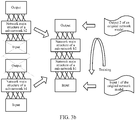
- FIG. 3a is a schematic diagram of processes of building and performing optimization training on the sub-network b1 equivalent to the data processing step a1 in the original network model.
- S209 Select any sub-network from the at least one sub-network as a seed network.
- S210 Select a sub-network other than the seed network from the at least one sub-network as a to-be-merged object network according to a preset merging sequence, where the merging sequence may be set according to data processing steps, and the preset merging sequence includes any one of the following: a performing sequence of the at least one data processing step, a reverse performing sequence of the at least one data processing step, and a sequence of structural similarity levels between the at least one sub-network.
- step S209 and step S210 the original network model performs four data processing steps: "step a1 ⁇ step a2 ⁇ step a3 ⁇ step a4", and equivalent sub-networks are respectively the sub-network b1, the sub-network b2, a sub-network b3, and the sub-network b4.
- the sub-network b3 equivalent to step a3 is should be selected as the to-be-merged object network according to the performing sequence of the at least one data processing step; (2) if selection is performed according to a sequence reverse to the performing sequence of the at least one data processing step, the sub-network b1 equivalent to step a1 should be selected as the to-be-merged object network; (3) if selection is performed according to the sequence of structural similarity levels between the at least one sub-network, a sub-network having a highest structural similarity with the sub-network b2 should be selected as the to-be-merged object network. Assuming that network main structures of the sub-network b2 and the sub-network b4 are both a fully connected layer structure, the sub-network b4 is selected as the to-be-merged object network.
- S211 Split an input layer and an output layer between the seed network and the to-be-merged object network.
- an input layer and an output layer of the sub-network need to be both split in the step.
- the seed network is used as an upper-layer sub-network, and the to-be-merged object network is used as a lower-layer sub-network, an input layer of the seed network and an output layer of the to-be-merged object network need to be both split.
- the seed network is used as a lower-layer sub-network, and the to-be-merged object network is used as an upper-layer sub-network, an output layer of the seed network and an input layer of the to-be-merged object network need to be both split.
- step S212 Perform merging connection on the seed network and the to-be-merged object network in a fully connected manner; and if the merging connection succeeds, go to step S214; or if the merging connection fails, go to step S213.
- W is a weight matrix, and ⁇ indicates a matrix multiplication.
- the seed network is A and the to-be-merged object network is B.
- Each neuron used as an output in the seed network is mapped to a neuron used as an input in the to-be-merged object network by means of mapping of the specified weight matrix W, that is, a mapping relationship between each neuron used as an output in the seed network and each neuron used as an input in the to-be-merged object network is established. For example, in FIG.
- a mapping relationship between each neuron in the sub-network b1 and each neuron of the sub-network b2 is established in a fully connected manner by using a weight matrix, to establish a connection between the sub-network b1 and the sub-network b2.
- S213 Add an intermediate hidden layer between the seed network and the to-be-merged object network, and perform merging connection on the seed network and the to-be-merged object network in a fully connected manner by using the intermediate hidden layer.
- S214 Perform, with reference to at least one group of input/output data corresponding to a data processing step equivalent to the seed network and at least one group of input/output data corresponding to a data processing step equivalent to the to-be-merged object network, optimization adjustment on a parameter of a network obtained by means of merging connection.
- the seed network and the to-be-merged object network may both be a sub-NN, and optimization adjustment may be performed on the sub-NN by using the input/output data determined in the step.
- An input layer of the network obtained by means of merging connection is an input layer of a lower-layer sub-network
- an output layer of the network obtained by means of merging connection is an output layer of an upper-layer sub-network. Therefore, in the step, optimization adjustment needs to be performed, with reference to output data corresponding to a data processing step equivalent to the upper-layer sub-network and output data corresponding to a data processing step equivalent to the lower-layer sub-network, on the parameter of the network obtained by means of merging connection.
- step S215 Iterate the process of step S210 to step S214 by using the network obtained by means of merging connection as a seed network until merging connection is performed on all the at least one sub-network, to form a target network model.
- step S210 to step S214 may be repeatedly performed.
- sub-networks corresponding to data processing steps in each data processing sub-procedure are sequentially merged according to the preset merging sequence, for example, according to a performing sequence of the data processing steps in each data processing sub-procedure, to obtain a merged sub-network.
- sub-networks corresponding to data processing steps in the first data processing sub-procedure are merged to obtain a merged first sub-NN.
- sub-networks corresponding to data processing steps in the second data processing sub-procedure are merged to obtain a merged second sub-NN
- sub-networks corresponding to data processing steps in the third data processing sub-procedure are merged to obtain a merged third sub-NN.
- Merging processing corresponding to the node 00 is performed on the merged first sub-NN, the merged second sub-NN, and the merged third sub-NN in the preset merging sequence, to obtain the target network model, for example, an NN model.
- Step S209 to step S215 in this embodiment may be specific detailed steps of step S104 shown in FIG. 1 .
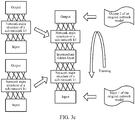
- step S209 to step S215 refer to FIG. 3b and FIG. 3c .
- FIG. 3b and FIG. 3c are respectively a schematic diagram of a process of merging the sub-network b1 and the sub-network b2 and a schematic diagram of a process of performing optimization training on the network obtained by means of merging connection.
- the intermediate hidden layer is used for adapting an output of a previous sub-network to an input of a next sub-network.
- the output of the sub-network b1 may be adjusted by means of processing of the intermediate hidden layer, so that the form of the output of the adjusted sub-network b1 matches the form of the input of the sub-network b2.
- a data processing procedure of an original network model is analyzed, actual operating data generated by the original network model in the data processing procedure is used as a reference dataset, at least one equivalent sub-network is hierarchically built, optimization training is performed on the at least one sub-network, and a target network model is finally formed by means of merging.
- Layers of the target network model are flexibly and quickly built by using the actual operating data of the original network model and then are merged to form the target network model, and there is no need to design an entire structure of the target network model from the very beginning. Therefore, a model building process is simplified, and the model building efficiency is effectively improved.
- Optimization adjustment on the target network model is performed in a divided manner, optimization adjustment is first performed on each sub-network, and then the at least one sub-network is merged, so that an optimization adjustment process of the target network model is more flexible, and the model building efficiency is further improved.
- An embodiment of this application further discloses a machine learning-based network model building apparatus.
- the apparatus may run the following units:
- the apparatus specifically runs the following units:
- the apparatus specifically runs the following units:
- the apparatus specifically runs the following units:
- the apparatus specifically runs the following units:
- the seed selection unit 4001 is further configured to iterate, by using the network obtained by means of merging connection as a seed network, corresponding processing performed by the to-be-merged object selection unit 4002, the splitting unit 4003, the merging connection unit 4004, and the optimization adjustment unit 4005 until merging connection is performed on all the at least one sub-network, to form the target network model.
- the apparatus further runs the following unit: an addition unit 4006, configured to add an intermediate hidden layer between the seed network and the to-be-merged object network if the merging connection fails, so that the merging connection unit 4004 performs merging connection on the seed network and the to-be-merged object network in a fully connected manner by using the intermediate hidden layer.
- an addition unit 4006 configured to add an intermediate hidden layer between the seed network and the to-be-merged object network if the merging connection fails, so that the merging connection unit 4004 performs merging connection on the seed network and the to-be-merged object network in a fully connected manner by using the intermediate hidden layer.
- the apparatus shown in FIG. 4 can be configured to perform the steps in the method described in the embodiments of FIG. 1 to FIG. 3 . Therefore, for functions of the units of the apparatus shown in FIG. 4 , refer to the descriptions of the steps shown in FIG. 3 , and details are not described herein again.
- a data processing procedure of an original network model is analyzed, actual operating data generated by the original network model in the data processing procedure is used as a reference dataset, at least one equivalent sub-network is hierarchically built, optimization training is performed on the at least one sub-network, and a target network model is finally formed by means of merging.
- Layers of the target network model are flexibly and quickly built by using the actual operating data of the original network model and then are merged to form the target network model, and there is no need to design an entire structure of the target network model from the very beginning. Therefore, a model building process is simplified, and the model building efficiency is effectively improved.
- Optimization adjustment on the target network model is performed in a divided manner, optimization adjustment is first performed on each sub-network, and then the at least one sub-network is merged, so that an optimization adjustment process of the target network model is more flexible, and the model building efficiency is further improved.
- the program may be stored in a computer-readable storage medium.
- the program may include the procedures of the methods in the foregoing embodiments.
- the storage medium may be: a magnetic disk, an optical disc, a read-only memory (ROM), a random access Memory (RAM), or the like.
- FIG. 5 is a schematic structural diagram of a machine learning-based network model building apparatus according to an embodiment of this application.
- the network model building apparatus 50 may include: a processor 501, a non-volatile computer-readable memory 502, a display unit 503, and a network communications interface 504. These components perform communication through a bus 505.
- the memory 502 stores a plurality of program modules, including: an application program 506, a network communications module 507, and an operating system 508.
- the processor 501 may read various modules (not shown in the figure) included in the application program in the memory 502 to perform various function applications and data processing of the network model building apparatus. There may be one or more processors 501 in this embodiment, and the processor 501 may be a CPU, a processing unit/module, an ASIC, a logical module, a programmable gate array, or the like.
- the operating system 508 may be: a Windows operating system, an Linux operating system, or an Android operating system.
- the operating system 508 may include a network model building module 509.
- the network model building apparatus 509 may include computer-executable instruction sets 509-1 formed by the functional modules in the apparatus shown in FIG. 4 and corresponding metadata and heuristic algorithms 509-2. These computer-executable instruction sets may be executed by the processor 501 to complete the method shown in FIG. 1 or FIG. 2 or the functions of the apparatus shown in FIG.4 .
- the application program 506 may include an application program installed and running in a terminal device.
- the network communications interface 504 cooperates with the network communications module 507 to complete receiving and sending of various network signals of the network model building apparatus 50.
- the display unit 503 has a display panel, configured to complete input and displaying of relevant information.
- the functional modules in the embodiments of this application may be integrated into one processing unit, or each of the modules may exist alone physically, or two or more modules may be integrated into one unit.
- the integrated unit may be implemented in the form of hardware, or may be implemented in the form of a software functional unit.
- the functional modules in the embodiments may be located in one terminal or at a network node, or may be distributed on a plurality of terminals or at a plurality of network nodes.
- this application further provides a storage medium, storing computer-readable instructions.
- the computer-readable instructions are executed by at least one processor to perform any method embodiment above.
Landscapes
- Engineering & Computer Science (AREA)
- Theoretical Computer Science (AREA)
- Physics & Mathematics (AREA)
- Data Mining & Analysis (AREA)
- Artificial Intelligence (AREA)
- Evolutionary Computation (AREA)
- General Engineering & Computer Science (AREA)
- General Physics & Mathematics (AREA)
- Life Sciences & Earth Sciences (AREA)
- Software Systems (AREA)
- Mathematical Physics (AREA)
- Computing Systems (AREA)
- Computational Linguistics (AREA)
- Biophysics (AREA)
- Molecular Biology (AREA)
- General Health & Medical Sciences (AREA)
- Health & Medical Sciences (AREA)
- Biomedical Technology (AREA)
- Signal Processing (AREA)
- Computer Networks & Wireless Communication (AREA)
- Computer Vision & Pattern Recognition (AREA)
- Bioinformatics & Cheminformatics (AREA)
- Bioinformatics & Computational Biology (AREA)
- Evolutionary Biology (AREA)
- Medical Informatics (AREA)
- Databases & Information Systems (AREA)
- Probability & Statistics with Applications (AREA)
- Human Computer Interaction (AREA)
- Data Exchanges In Wide-Area Networks (AREA)
- Management, Administration, Business Operations System, And Electronic Commerce (AREA)
Claims (5)
- Procédé de construction de modèles de réseau basé sur l'apprentissage par machine, comprenant :l'obtention d'une procédure de traitement de données d'un modèle de réseau d'origine et d'un jeu de données de référence généré par le modèle de réseau d'origine lors de la procédure de traitement de données (S101) en obtenant au moins une étape de traitement de données réalisée par le modèle de réseau d'origine lors de la procédure de traitement de données ; l'obtention de données d'exploitation générées lorsque le modèle de réseau d'origine effectue chaque étape de traitement de données ; et l'extraction de quelques données, ou de toutes celles-ci, des données d'exploitation générées lorsque le modèle de réseau d'origine effectue chaque étape de traitement de données pour former le jeu de données de référence, dans lequel le jeu de données de référence comprend au moins un groupe de données d'entrée/sortie correspondant à chaque étape de traitement de données ;la construction, hiérarchiquement, d'au moins un sous-réseau en fonction de la procédure de traitement de données et du jeu de données de référence (S102) en recherchant dans une table de correspondance d'équivalence prédéfinie une structure principale de réseau d'un sous-réseau qui équivaut à chaque étape de traitement de données, la détermination, en fonction de l'au moins un groupe de données d'entrée/sortie correspondant à chaque étape de traitement de données, d'une structure de couche d'entrée et d'une structure de couche de sortie du sous-réseau qui équivalent à l'étape de traitement de données, et la construction, en fonction de la structure principale de réseau, de la structure de couche d'entrée et la structure de couche de sortie du sous-réseau qui équivalent à chaque étape de traitement de données, du sous-réseau équivalant à l'étape de traitement de données, dans lequel un sous-réseau équivaut à une étape de traitement de données ;la réalisation d'un apprentissage d'optimisation pour l'au moins un sous-réseau en utilisant le jeu de données de référence (S103) en lisant séquentiellement l'au moins un groupe de données d'entrée/sortie correspondant à chaque étape de traitement de données à partir du jeu de données de référence ; et la réalisation d'un ajustement d'optimisation pour un paramètre du sous-réseau équivalant à chaque étape de traitement de données avec référence à l'au moins un groupe de données d'entrée/sortie correspondant à chaque étape de traitement de données et en fonction d'un algorithme d'optimisation de formation de réseau neuronal, NN, dans lequel le paramètre comprend : au moins l'un(e) parmi un nœud de réseau, un poids, et une vitesse d'apprentissage ; etla fusion itérative de l'au moins un sous-réseau pour lequel l'apprentissage d'optimisation a été réalisé afin de former un modèle de réseau cible (S104) en sélectionnant un sous-réseau quelconque parmi l'au moins un sous-réseau en tant que réseau de départ ; l'obtention d'une séquence de fusion spécifiée en fonction de chaque étape de traitement de données, et la sélection d'un sous-réseau différent du réseau de départ parmi l'au moins un sous-réseau en tant que réseau d'objets à fusionner en fonction de la séquence de fusion, la séparation d'une couche d'entrée et d'une couche de sortie entre le réseau de départ et le réseau d'objets à fusionner ; la réalisation d'une fusion de connexion du réseau de départ et du réseau d'objets à fusionner de manière entièrement connectée ; la réalisation, en se référant à au moins un groupe de données d'entrée/sortie correspondant à une étape de traitement de données équivalant au réseau de départ et au moins un groupe de données d'entrée/sortie correspondant à une étape de traitement de données équivalant au réseau d'objets à fusionner si la fusion de connexion réussit, d'un ajustement d'optimisation d'un paramètre d'un réseau obtenu au moyen d'une fusion de connexion ; et l'itération du traitement en utilisant le réseau obtenu au moyen d'une fusion de connexion en tant que réseau de départ jusqu'à ce qu'une fusion de connexion soit réalisée pour l'ensemble des au moins un sous-réseau afin de former le modèle de réseau cible.
- Procédé selon la revendication 1, comprenant en outre :
l'ajout d'une couche cachée intermédiaire entre le réseau de départ et le réseau d'objets à fusionner si la fusion de connexion échoue, et la réalisation d'une fusion de connexion pour le réseau de départ et le réseau d'objets à fusionner de manière entièrement connectée en utilisant la couche cachée intermédiaire. - Appareil de construction de modèles de réseau basé sur l'apprentissage machine, comprenant :un module d'obtention (101) configuré pour obtenir une procédure de traitement de données d'un modèle de réseau d'origine et un jeu de données de référence généré par le modèle de réseau d'origine lors de la procédure de traitement de données, dans lequel le module d'obtention (101) comprend une unité d'obtention d'étape (1001) configurée pour obtenir au moins une étape de traitement de données réalisée par le modèle de réseau d'origine lors de la procédure de traitement de données ; une unité d'obtention de données (1002) configurée pour obtenir des données d'exploitation générées lorsque le modèle de réseau d'origine effectue chaque étape de traitement de données ; et une unité d'extraction d'échantillonnage (1003) configurée pour extraire quelques données, ou l'ensemble de celles-ci, des données d'exploitation générées lorsque le modèle de réseau d'origine effectue chaque étape de traitement de données pour former le jeu de données de référence, dans lequel le jeu de données de référence comprend au moins un groupe de données d'entrée/sortie correspondant à chaque étape de traitement de données ;un module de construction hiérarchique (102) configuré pour construire hiérarchiquement au moins un sous-réseau en fonction de la procédure de traitement de données et du jeu de données de référence, dans lequel le module de construction hiérarchique (102) comprend une unité de recherche (2001) configurée pour rechercher, dans une table de correspondance d'équivalence prédéfinie, une structure principale de réseau d'un sous-réseau qui équivaut à chaque étape de traitement de données ; une unité de détermination (2002) configurée pour déterminer, en fonction de l'au moins un groupe de données d'entrée/sortie correspondant à chaque étape de traitement de données, une structure de couche d'entrée et une structure de couche de sortie du sous-réseau qui équivalent à l'étape de traitement de données ; et une unité de construction (2003) configurée pour construire, en fonction de la structure principale de réseau, la structure de couche d'entrée et la structure de couche de sortie du sous-réseau qui équivalent à chaque étape de traitement de données, le sous-réseau équivalant à l'étape de traitement de données, dans lequel un sous-réseau équivaut à une étape de traitement de données ;un module d'apprentissage d'optimisation (103) configuré pour effectuer un apprentissage d'optimisation pour l'au moins un sous-réseau en utilisant le jeu de données de référence, dans lequel le module d'apprentissage d'optimisation (103) comprend une unité de lecture (3001) configurée pour lire séquentiellement l'au moins un groupe de données d'entrée/sortie correspondant à chaque étape de traitement de données à partir du jeu de données de référence ; et une unité d'ajustement (3002) configurée pour effectuer l'ajustement d'optimisation pour le paramètre du sous-réseau équivalant à chaque étape de traitement de données en se référant à l'au moins un groupe de données d'entrée/sortie correspondant à chaque étape de traitement de données et en fonction d'un algorithme d'optimisation d'apprentissage NN, dans lequel le paramètre comprend : au moins l'un(e) parmi un nœud de réseau, un poids, et une vitesse d'apprentissage ; etun module de fusion (104) configuré pour fusionner itérativement l'au moins un sous-réseau pour lequel l'apprentissage d'optimisation a été effectué afin de former un modèle de réseau cible, dans lequel le module de fusion (104) comprend une unité de sélection de départ (4001) configurée pour sélectionner un sous-réseau quelconque parmi l'au moins un sous-réseau en tant que réseau de départ ; une unité de sélection d'objets à fusionner (4002) configurée pour : obtenir une séquence de fusion spécifiée en fonction de chaque étape de traitement de données, et sélectionner un sous-réseau différent du réseau de départ parmi l'au moins un sous-réseau en tant que réseau d'objets à fusionner en fonction de la séquence de fusion ; une unité de séparation (4003) configurée pour séparer une couche d'entrée et une couche de sortie entre le réseau de départ et le réseau d'objets à fusionner ; une unité de fusion de connexion (4004) configurée pour effectuer une fusion de connexion pour le réseau de départ et le réseau d'objets à fusionner de manière entièrement connectée, et une unité d'ajustement d'optimisation (4005) configurée pour effectuer, en se référant à au moins un groupe de données d'entrée/sortie correspondant à une étape de traitement de données équivalant au réseau de départ et au moins un groupe de données d'entrée/sortie correspondant à une étape de traitement de données équivalant au réseau d'objets à fusionner si la fusion de connexion est une réussite, l'ajustement d'optimisation pour un paramètre d'un réseau obtenu au moyen de la fusion de connexion, dans lequel l'unité de sélection de départ (4001) est en outre configurée pour itérer, en utilisant le réseau obtenu au moyen de la fusion de connexion en tant que réseau de départ, un traitement correspondant effectué par l'unité de sélection d'objets à fusionner, l'unité de séparation, l'unité de fusion de connexion, et l'unité d'ajustement d'optimisation jusqu'à ce que la fusion de connexion soit effectuée pour l'ensemble des au moins un sous-réseaux, afin de former le modèle de réseau cible.
- Appareil selon la revendication 3, dans lequel le module de fusion (104) comprend en outre :
une unité d'ajout (4006) configurée pour ajouter une couche cachée intermédiaire entre le réseau de départ et le réseau d'objets à fusionner si la fusion de connexion échoue, de sorte que l'unité de fusion de connexion effectue une fusion de connexion pour le réseau de départ et le réseau d'objets à fusionner de manière entièrement connectée en utilisant la couche cachée intermédiaire. - Support de stockage lisible par ordinateur, stockant des instructions lisibles par ordinateur, les instructions lisibles par ordinateur étant exécutées par au moins un processeur afin de :
mettre en œuvre le procédé de construction de modèles de réseau basé sur l'apprentissage par machine selon l'une quelconque des revendications 1 à 2.
Applications Claiming Priority (2)
| Application Number | Priority Date | Filing Date | Title |
|---|---|---|---|
| CN201610389530.9A CN106096727B (zh) | 2016-06-02 | 2016-06-02 | 一种基于机器学习的网络模型构造方法及装置 |
| PCT/CN2017/086917 WO2017206936A1 (fr) | 2016-06-02 | 2017-06-02 | Procédé et appareil de construction de modèles de réseau basé sur l'apprentissage par machine |
Publications (3)
| Publication Number | Publication Date |
|---|---|
| EP3467723A1 EP3467723A1 (fr) | 2019-04-10 |
| EP3467723A4 EP3467723A4 (fr) | 2019-04-10 |
| EP3467723B1 true EP3467723B1 (fr) | 2021-02-24 |
Family
ID=57447501
Family Applications (1)
| Application Number | Title | Priority Date | Filing Date |
|---|---|---|---|
| EP17805881.4A Active EP3467723B1 (fr) | 2016-06-02 | 2017-06-02 | Procédé et appareil de construction de modèles de réseau basé sur l'apprentissage par machine |
Country Status (6)
| Country | Link |
|---|---|
| US (1) | US11741361B2 (fr) |
| EP (1) | EP3467723B1 (fr) |
| JP (1) | JP6549332B2 (fr) |
| KR (1) | KR102173555B1 (fr) |
| CN (1) | CN106096727B (fr) |
| WO (1) | WO2017206936A1 (fr) |
Families Citing this family (55)
| Publication number | Priority date | Publication date | Assignee | Title |
|---|---|---|---|---|
| CN106096727B (zh) | 2016-06-02 | 2018-12-07 | 腾讯科技(深圳)有限公司 | 一种基于机器学习的网络模型构造方法及装置 |
| CN108629413B (zh) * | 2017-03-15 | 2020-06-16 | 创新先进技术有限公司 | 神经网络模型训练、交易行为风险识别方法及装置 |
| US11126894B2 (en) * | 2017-06-05 | 2021-09-21 | Siemens Aktiengesellschaft | Method and apparatus for analysing an image |
| US20190138929A1 (en) | 2017-07-07 | 2019-05-09 | Darwinai Corporation | System and method for automatic building of learning machines using learning machines |
| TWI696971B (zh) * | 2017-12-12 | 2020-06-21 | 浩霆 黃 | 金融商品的相關性預測系統及其方法 |
| DE102018109835A1 (de) * | 2018-04-24 | 2019-10-24 | Albert-Ludwigs-Universität Freiburg | Verfahren und Vorrichtung zum Ermitteln einer Netzkonfiguration eines neuronalen Netzes |
| WO2019211651A1 (fr) * | 2018-05-02 | 2019-11-07 | Telefonaktiebolaget Lm Ericsson (Publ) | Accélération sensible au placement d'optimisation de paramètre dans un modèle prédictif |
| CN109034367A (zh) * | 2018-08-22 | 2018-12-18 | 广州杰赛科技股份有限公司 | 神经网络更新方法、装置、计算机设备和可读存储介质 |
| CN109167789B (zh) * | 2018-09-13 | 2021-04-13 | 上海海事大学 | 一种云环境LDoS攻击数据流检测方法及系统 |
| CN109447273A (zh) * | 2018-09-30 | 2019-03-08 | 深圳市元征科技股份有限公司 | 模型训练方法、广告推荐方法、相关装置、设备及介质 |
| JP7115207B2 (ja) * | 2018-10-11 | 2022-08-09 | 富士通株式会社 | 学習プログラム、学習方法および学習装置 |
| CN111105020B (zh) * | 2018-10-29 | 2024-03-29 | 西安宇视信息科技有限公司 | 特征表示迁移学习方法及相关装置 |
| KR20200052439A (ko) * | 2018-10-29 | 2020-05-15 | 삼성에스디에스 주식회사 | 딥러닝 모델의 최적화 시스템 및 방법 |
| CN111224805A (zh) * | 2018-11-26 | 2020-06-02 | 中兴通讯股份有限公司 | 一种网络故障根因检测方法、系统及存储介质 |
| CN111291771B (zh) * | 2018-12-06 | 2024-04-02 | 西安宇视信息科技有限公司 | 对池化层特征优化的方法及装置 |
| CN109684087B (zh) * | 2018-12-17 | 2020-01-10 | 中科寒武纪科技股份有限公司 | 运算方法、装置及相关产品 |
| CN109685203B (zh) * | 2018-12-21 | 2020-01-17 | 中科寒武纪科技股份有限公司 | 数据处理方法、装置、计算机系统及存储介质 |
| CN109726718B (zh) * | 2019-01-03 | 2022-09-16 | 电子科技大学 | 一种基于关系正则化的视觉场景图生成系统及方法 |
| CN109684648B (zh) * | 2019-01-14 | 2020-09-01 | 浙江大学 | 一种多特征融合的古今汉语自动翻译方法 |
| CN111435432B (zh) * | 2019-01-15 | 2023-05-26 | 北京市商汤科技开发有限公司 | 网络优化方法及装置、图像处理方法及装置、存储介质 |
| CN111600734B (zh) * | 2019-02-21 | 2021-11-02 | 烽火通信科技股份有限公司 | 一种网络故障处理模型的构建方法、故障处理方法及系统 |
| CN109978024B (zh) * | 2019-03-11 | 2020-10-27 | 北京工业大学 | 一种基于互联模块化神经网络的出水bod预测方法 |
| CN110046706B (zh) * | 2019-04-18 | 2022-12-20 | 腾讯科技(深圳)有限公司 | 模型生成方法、装置及服务器 |
| WO2020218172A1 (fr) * | 2019-04-23 | 2020-10-29 | 株式会社ソシオネクスト | Procédé de génération de modèle d'inférence et modèle d'inférence |
| GB2596477B (en) * | 2019-04-29 | 2023-02-22 | Landmark Graphics Corp | Hybrid neural network and autoencoder |
| CN112001475B (zh) * | 2019-05-27 | 2025-09-30 | 阿里巴巴集团控股有限公司 | 一种数据处理系统和方法 |
| CN110380888B (zh) * | 2019-05-29 | 2021-02-23 | 华为技术有限公司 | 一种网络异常检测方法和装置 |
| CN110322021B (zh) * | 2019-06-14 | 2021-03-30 | 清华大学 | 大规模网络表征学习的超参数优化方法和装置 |
| CN110414570B (zh) * | 2019-07-04 | 2022-01-28 | 北京迈格威科技有限公司 | 图像分类模型生成方法、装置、设备和存储介质 |
| CN110570013B (zh) * | 2019-08-06 | 2023-04-07 | 山东省科学院海洋仪器仪表研究所 | 一种单站位在线波周期数据的预测诊断方法 |
| US11763157B2 (en) * | 2019-11-03 | 2023-09-19 | Microsoft Technology Licensing, Llc | Protecting deep learned models |
| JP7203000B2 (ja) * | 2019-11-12 | 2023-01-12 | Hoya株式会社 | プログラム、情報処理方法及び情報処理装置 |
| US11847500B2 (en) | 2019-12-11 | 2023-12-19 | Cisco Technology, Inc. | Systems and methods for providing management of machine learning components |
| CN113811897B (zh) * | 2019-12-30 | 2022-05-31 | 深圳元戎启行科技有限公司 | 神经网络模型的推理方法、装置、计算机设备和存储介质 |
| JP6795863B1 (ja) * | 2020-01-24 | 2020-12-02 | Eaglys株式会社 | 秘密計算用変換装置、秘密計算システム、秘密計算用変換方法、および秘密計算用変換プログラム |
| US11501216B2 (en) | 2020-02-21 | 2022-11-15 | King.Com Ltd. | Computer system, a computer device and a computer implemented method |
| CN111584027B (zh) * | 2020-04-30 | 2022-03-11 | 天津大学 | 融合复杂网络和图卷积的脑控康复系统运动想象识别系统 |
| CN113780513B (zh) * | 2020-06-10 | 2024-05-03 | 杭州海康威视数字技术股份有限公司 | 网络模型量化、推理方法、装置、电子设备及存储介质 |
| JP7576939B2 (ja) * | 2020-07-22 | 2024-11-01 | 株式会社野村総合研究所 | 秘密計算システム、秘密計算方法、及びプログラム |
| CN112150605B (zh) * | 2020-08-17 | 2024-02-02 | 北京化工大学 | 用于mri局部sar估计的膝关节模型构建方法 |
| US12045721B2 (en) * | 2020-10-08 | 2024-07-23 | Lg Electronics Inc. | Method and device for transmitting OFDM signal, and method and device for receiving OFDM signal |
| US12047248B2 (en) | 2020-10-26 | 2024-07-23 | Samsung Electronics Co., Ltd. | Method of controlling state control parameter for adjusting state of network of base station by using any one of plurality of models and electronic device performing the method |
| KR20220055363A (ko) * | 2020-10-26 | 2022-05-03 | 삼성전자주식회사 | 복수의 모델들 중 어느 하나의 모델을 이용하여 기지국의 네트워크의 상태를 조정하기 위한 상태 제어 파라미터를 제어하는 방법 및 이를 수행하는 전자 장치 |
| CN112990467A (zh) * | 2020-12-24 | 2021-06-18 | 重庆大学 | 一种基于生成式贝叶斯因果网络的汽车故障分析方法 |
| KR102593844B1 (ko) | 2021-02-25 | 2023-10-25 | 주식회사 인제니오에이아이 | 딥러닝 네트워크 구성 방법, 딥러닝 자동화 플랫폼 서비스 시스템 및 이를 위한 컴퓨터 프로그램 |
| CN113378777B (zh) * | 2021-06-30 | 2025-03-04 | 沈阳康慧类脑智能协同创新中心有限公司 | 基于单目摄像机的视线检测的方法和装置 |
| CN113378998B (zh) * | 2021-07-12 | 2022-07-22 | 西南石油大学 | 一种基于机器学习的地层岩性随钻识别方法 |
| CN113554077B (zh) * | 2021-07-13 | 2024-09-06 | 南京铉盈网络科技有限公司 | 基于多模态神经网络模型的工况评估及业务量预测方法 |
| CN113919387A (zh) * | 2021-08-18 | 2022-01-11 | 东北林业大学 | 基于gbdt-lr模型的脑电信号情感识别 |
| KR102644593B1 (ko) * | 2021-11-23 | 2024-03-07 | 한국기술교육대학교 산학협력단 | 지능형 디바이스 개발을 위한 ai 분화 기반의 하드웨어 정보에 최적의 지능형 소프트웨어 개발도구 |
| KR102761919B1 (ko) | 2021-12-24 | 2025-02-05 | 부산대학교 산학협력단 | 표 형식 데이터의 연속형 변수 임베딩 기법을 이용한 어텐션 기반 딥러닝 모델 |
| CN114492789B (zh) * | 2022-01-25 | 2024-05-14 | 天津工业大学 | 一种数据样本的神经网络模型构建方法及装置 |
| KR102902318B1 (ko) * | 2022-05-04 | 2025-12-22 | 네이버 주식회사 | 자동기계학습을 구현하기 위한 앙상블 예측 방법, 컴퓨터 장치, 및 컴퓨터 프로그램 |
| KR20250121975A (ko) * | 2022-12-14 | 2025-08-12 | 어드밴스드 마이크로 디바이시즈, 인코포레이티드 | 네트워크 집합적 오프로드 메시지 청킹 관리 |
| CN116451099B (zh) * | 2023-06-19 | 2023-09-01 | 浪潮通用软件有限公司 | 一种基于随机遍历的高熵knn聚类方法、设备及介质 |
Family Cites Families (14)
| Publication number | Priority date | Publication date | Assignee | Title |
|---|---|---|---|---|
| JPH04190461A (ja) * | 1990-11-26 | 1992-07-08 | Fujitsu Ltd | ニューラルネットワークの構築表示方法 |
| JPH05128082A (ja) * | 1991-07-19 | 1993-05-25 | Fujitsu Ltd | 階層ネツトワーク構成データ処理装置とその学習処理方法 |
| JP3035106B2 (ja) * | 1993-03-11 | 2000-04-17 | 株式会社東芝 | 大規模情報認識回路 |
| JPH0793160A (ja) * | 1993-09-20 | 1995-04-07 | Toshiba Corp | 推論装置 |
| US6119112A (en) * | 1997-11-19 | 2000-09-12 | International Business Machines Corporation | Optimum cessation of training in neural networks |
| JP3678636B2 (ja) | 2000-08-21 | 2005-08-03 | Necソフト株式会社 | ニューラルネットワークの学習方法 |
| EP2533176A1 (fr) * | 2005-11-15 | 2012-12-12 | Bernadette Garner | Procédé permettant de déterminer si des vecteurs d'entrée sont connus ou inconnus par un neurone |
| CN101814160A (zh) * | 2010-03-08 | 2010-08-25 | 清华大学 | 一种基于特征聚类的rbf神经网络建模方法 |
| CN103345656B (zh) * | 2013-07-17 | 2016-01-20 | 中国科学院自动化研究所 | 一种基于多任务深度神经网络的数据识别方法及装置 |
| CN104751227B (zh) * | 2013-12-31 | 2018-03-06 | 科大讯飞股份有限公司 | 用于语音识别的深度神经网络的构建方法及系统 |
| US9870537B2 (en) * | 2014-01-06 | 2018-01-16 | Cisco Technology, Inc. | Distributed learning in a computer network |
| CN103729459A (zh) * | 2014-01-10 | 2014-04-16 | 北京邮电大学 | 一种构建情感分类模型的方法 |
| CN103838836B (zh) * | 2014-02-25 | 2016-09-28 | 中国科学院自动化研究所 | 基于判别式多模态深度置信网多模态数据融合方法和系统 |
| CN106096727B (zh) * | 2016-06-02 | 2018-12-07 | 腾讯科技(深圳)有限公司 | 一种基于机器学习的网络模型构造方法及装置 |
-
2016
- 2016-06-02 CN CN201610389530.9A patent/CN106096727B/zh active Active
-
2017
- 2017-06-02 KR KR1020187013732A patent/KR102173555B1/ko active Active
- 2017-06-02 JP JP2018543424A patent/JP6549332B2/ja active Active
- 2017-06-02 WO PCT/CN2017/086917 patent/WO2017206936A1/fr not_active Ceased
- 2017-06-02 EP EP17805881.4A patent/EP3467723B1/fr active Active
-
2018
- 2018-05-21 US US15/984,754 patent/US11741361B2/en active Active
Non-Patent Citations (1)
| Title |
|---|
| None * |
Also Published As
| Publication number | Publication date |
|---|---|
| US20180268296A1 (en) | 2018-09-20 |
| WO2017206936A1 (fr) | 2017-12-07 |
| US11741361B2 (en) | 2023-08-29 |
| CN106096727A (zh) | 2016-11-09 |
| EP3467723A1 (fr) | 2019-04-10 |
| EP3467723A4 (fr) | 2019-04-10 |
| KR102173555B1 (ko) | 2020-11-03 |
| KR20180069877A (ko) | 2018-06-25 |
| JP6549332B2 (ja) | 2019-07-24 |
| CN106096727B (zh) | 2018-12-07 |
| JP2018533153A (ja) | 2018-11-08 |
Similar Documents
| Publication | Publication Date | Title |
|---|---|---|
| EP3467723B1 (fr) | Procédé et appareil de construction de modèles de réseau basé sur l'apprentissage par machine | |
| US20190354810A1 (en) | Active learning to reduce noise in labels | |
| JP2023082017A (ja) | コンピュータシステム | |
| CN114981800B (zh) | 个性化自动化机器学习 | |
| EP3924893A1 (fr) | Apprentissage incrémentiel d'outils d'apprentissage automatique | |
| US12393615B2 (en) | Guided exploration for conversational business intelligence | |
| CN113590863A (zh) | 图像聚类方法、装置及计算机可读存储介质 | |
| CN113642727A (zh) | 神经网络模型的训练方法和多媒体信息的处理方法、装置 | |
| US11037073B1 (en) | Data analysis system using artificial intelligence | |
| CN111783873A (zh) | 基于增量朴素贝叶斯模型的用户画像方法及装置 | |
| CN117296064A (zh) | 计算环境中的可解释人工智能 | |
| CN113609337A (zh) | 图神经网络的预训练方法、训练方法、装置、设备及介质 | |
| JP7597479B2 (ja) | 解釈可能な結果を生成するように構成された分解可能な階層的な層を有する予測モデル | |
| JP2024503036A (ja) | 改善された深層学習モデルのための方法およびシステム | |
| CN110968692A (zh) | 一种文本分类方法及系统 | |
| CN119538118A (zh) | 数据分级分类方法及装置 | |
| CN116431813A (zh) | 智能客服问题分类方法、装置、电子设备及存储介质 | |
| CN114529191B (zh) | 用于风险识别的方法和装置 | |
| CN118278534A (zh) | 一种生成模型的方法及装置 | |
| CN117999560A (zh) | 机器学习模型的硬件感知渐进训练 | |
| US20200074277A1 (en) | Fuzzy input for autoencoders | |
| CN120067327A (zh) | 基于图卷积神经网络的技术成熟度计算系统和方法 | |
| US20240419690A1 (en) | Records processing based on record attribute embeddings | |
| CN115982614B (zh) | 使用决策边界对数据进行机器学习分类 | |
| CN117591726A (zh) | 基于多任务学习的Web服务包推荐方法、系统、介质及设备 |
Legal Events
| Date | Code | Title | Description |
|---|---|---|---|
| STAA | Information on the status of an ep patent application or granted ep patent |
Free format text: STATUS: THE INTERNATIONAL PUBLICATION HAS BEEN MADE |
|
| PUAI | Public reference made under article 153(3) epc to a published international application that has entered the european phase |
Free format text: ORIGINAL CODE: 0009012 |
|
| STAA | Information on the status of an ep patent application or granted ep patent |
Free format text: STATUS: REQUEST FOR EXAMINATION WAS MADE |
|
| 17P | Request for examination filed |
Effective date: 20180419 |
|
| A4 | Supplementary search report drawn up and despatched |
Effective date: 20190218 |
|
| AK | Designated contracting states |
Kind code of ref document: A1 Designated state(s): AL AT BE BG CH CY CZ DE DK EE ES FI FR GB GR HR HU IE IS IT LI LT LU LV MC MK MT NL NO PL PT RO RS SE SI SK SM TR |
|
| AX | Request for extension of the european patent |
Extension state: BA ME |
|
| DAV | Request for validation of the european patent (deleted) | ||
| DAX | Request for extension of the european patent (deleted) | ||
| STAA | Information on the status of an ep patent application or granted ep patent |
Free format text: STATUS: EXAMINATION IS IN PROGRESS |
|
| 17Q | First examination report despatched |
Effective date: 20191203 |
|
| GRAP | Despatch of communication of intention to grant a patent |
Free format text: ORIGINAL CODE: EPIDOSNIGR1 |
|
| STAA | Information on the status of an ep patent application or granted ep patent |
Free format text: STATUS: GRANT OF PATENT IS INTENDED |
|
| INTG | Intention to grant announced |
Effective date: 20201117 |
|
| GRAS | Grant fee paid |
Free format text: ORIGINAL CODE: EPIDOSNIGR3 |
|
| GRAA | (expected) grant |
Free format text: ORIGINAL CODE: 0009210 |
|
| STAA | Information on the status of an ep patent application or granted ep patent |
Free format text: STATUS: THE PATENT HAS BEEN GRANTED |
|
| AK | Designated contracting states |
Kind code of ref document: B1 Designated state(s): AL AT BE BG CH CY CZ DE DK EE ES FI FR GB GR HR HU IE IS IT LI LT LU LV MC MK MT NL NO PL PT RO RS SE SI SK SM TR |
|
| REG | Reference to a national code |
Ref country code: CH Ref legal event code: EP |
|
| REG | Reference to a national code |
Ref country code: AT Ref legal event code: REF Ref document number: 1365419 Country of ref document: AT Kind code of ref document: T Effective date: 20210315 |
|
| REG | Reference to a national code |
Ref country code: IE Ref legal event code: FG4D |
|
| REG | Reference to a national code |
Ref country code: DE Ref legal event code: R096 Ref document number: 602017033424 Country of ref document: DE |
|
| REG | Reference to a national code |
Ref country code: LT Ref legal event code: MG9D |
|
| REG | Reference to a national code |
Ref country code: NL Ref legal event code: MP Effective date: 20210224 |
|
| PG25 | Lapsed in a contracting state [announced via postgrant information from national office to epo] |
Ref country code: LT Free format text: LAPSE BECAUSE OF FAILURE TO SUBMIT A TRANSLATION OF THE DESCRIPTION OR TO PAY THE FEE WITHIN THE PRESCRIBED TIME-LIMIT Effective date: 20210224 Ref country code: BG Free format text: LAPSE BECAUSE OF FAILURE TO SUBMIT A TRANSLATION OF THE DESCRIPTION OR TO PAY THE FEE WITHIN THE PRESCRIBED TIME-LIMIT Effective date: 20210524 Ref country code: GR Free format text: LAPSE BECAUSE OF FAILURE TO SUBMIT A TRANSLATION OF THE DESCRIPTION OR TO PAY THE FEE WITHIN THE PRESCRIBED TIME-LIMIT Effective date: 20210525 Ref country code: HR Free format text: LAPSE BECAUSE OF FAILURE TO SUBMIT A TRANSLATION OF THE DESCRIPTION OR TO PAY THE FEE WITHIN THE PRESCRIBED TIME-LIMIT Effective date: 20210224 Ref country code: FI Free format text: LAPSE BECAUSE OF FAILURE TO SUBMIT A TRANSLATION OF THE DESCRIPTION OR TO PAY THE FEE WITHIN THE PRESCRIBED TIME-LIMIT Effective date: 20210224 Ref country code: NO Free format text: LAPSE BECAUSE OF FAILURE TO SUBMIT A TRANSLATION OF THE DESCRIPTION OR TO PAY THE FEE WITHIN THE PRESCRIBED TIME-LIMIT Effective date: 20210524 Ref country code: PT Free format text: LAPSE BECAUSE OF FAILURE TO SUBMIT A TRANSLATION OF THE DESCRIPTION OR TO PAY THE FEE WITHIN THE PRESCRIBED TIME-LIMIT Effective date: 20210624 |
|
| REG | Reference to a national code |
Ref country code: AT Ref legal event code: MK05 Ref document number: 1365419 Country of ref document: AT Kind code of ref document: T Effective date: 20210224 |
|
| PG25 | Lapsed in a contracting state [announced via postgrant information from national office to epo] |
Ref country code: NL Free format text: LAPSE BECAUSE OF FAILURE TO SUBMIT A TRANSLATION OF THE DESCRIPTION OR TO PAY THE FEE WITHIN THE PRESCRIBED TIME-LIMIT Effective date: 20210224 Ref country code: PL Free format text: LAPSE BECAUSE OF FAILURE TO SUBMIT A TRANSLATION OF THE DESCRIPTION OR TO PAY THE FEE WITHIN THE PRESCRIBED TIME-LIMIT Effective date: 20210224 Ref country code: RS Free format text: LAPSE BECAUSE OF FAILURE TO SUBMIT A TRANSLATION OF THE DESCRIPTION OR TO PAY THE FEE WITHIN THE PRESCRIBED TIME-LIMIT Effective date: 20210224 Ref country code: LV Free format text: LAPSE BECAUSE OF FAILURE TO SUBMIT A TRANSLATION OF THE DESCRIPTION OR TO PAY THE FEE WITHIN THE PRESCRIBED TIME-LIMIT Effective date: 20210224 Ref country code: SE Free format text: LAPSE BECAUSE OF FAILURE TO SUBMIT A TRANSLATION OF THE DESCRIPTION OR TO PAY THE FEE WITHIN THE PRESCRIBED TIME-LIMIT Effective date: 20210224 |
|
| PG25 | Lapsed in a contracting state [announced via postgrant information from national office to epo] |
Ref country code: IS Free format text: LAPSE BECAUSE OF FAILURE TO SUBMIT A TRANSLATION OF THE DESCRIPTION OR TO PAY THE FEE WITHIN THE PRESCRIBED TIME-LIMIT Effective date: 20210624 |
|
| PG25 | Lapsed in a contracting state [announced via postgrant information from national office to epo] |
Ref country code: SM Free format text: LAPSE BECAUSE OF FAILURE TO SUBMIT A TRANSLATION OF THE DESCRIPTION OR TO PAY THE FEE WITHIN THE PRESCRIBED TIME-LIMIT Effective date: 20210224 Ref country code: AT Free format text: LAPSE BECAUSE OF FAILURE TO SUBMIT A TRANSLATION OF THE DESCRIPTION OR TO PAY THE FEE WITHIN THE PRESCRIBED TIME-LIMIT Effective date: 20210224 Ref country code: CZ Free format text: LAPSE BECAUSE OF FAILURE TO SUBMIT A TRANSLATION OF THE DESCRIPTION OR TO PAY THE FEE WITHIN THE PRESCRIBED TIME-LIMIT Effective date: 20210224 Ref country code: EE Free format text: LAPSE BECAUSE OF FAILURE TO SUBMIT A TRANSLATION OF THE DESCRIPTION OR TO PAY THE FEE WITHIN THE PRESCRIBED TIME-LIMIT Effective date: 20210224 |
|
| REG | Reference to a national code |
Ref country code: DE Ref legal event code: R097 Ref document number: 602017033424 Country of ref document: DE |
|
| PG25 | Lapsed in a contracting state [announced via postgrant information from national office to epo] |
Ref country code: DK Free format text: LAPSE BECAUSE OF FAILURE TO SUBMIT A TRANSLATION OF THE DESCRIPTION OR TO PAY THE FEE WITHIN THE PRESCRIBED TIME-LIMIT Effective date: 20210224 Ref country code: SK Free format text: LAPSE BECAUSE OF FAILURE TO SUBMIT A TRANSLATION OF THE DESCRIPTION OR TO PAY THE FEE WITHIN THE PRESCRIBED TIME-LIMIT Effective date: 20210224 Ref country code: RO Free format text: LAPSE BECAUSE OF FAILURE TO SUBMIT A TRANSLATION OF THE DESCRIPTION OR TO PAY THE FEE WITHIN THE PRESCRIBED TIME-LIMIT Effective date: 20210224 |
|
| PLBE | No opposition filed within time limit |
Free format text: ORIGINAL CODE: 0009261 |
|
| STAA | Information on the status of an ep patent application or granted ep patent |
Free format text: STATUS: NO OPPOSITION FILED WITHIN TIME LIMIT |
|
| PG25 | Lapsed in a contracting state [announced via postgrant information from national office to epo] |
Ref country code: ES Free format text: LAPSE BECAUSE OF FAILURE TO SUBMIT A TRANSLATION OF THE DESCRIPTION OR TO PAY THE FEE WITHIN THE PRESCRIBED TIME-LIMIT Effective date: 20210224 Ref country code: AL Free format text: LAPSE BECAUSE OF FAILURE TO SUBMIT A TRANSLATION OF THE DESCRIPTION OR TO PAY THE FEE WITHIN THE PRESCRIBED TIME-LIMIT Effective date: 20210224 Ref country code: MC Free format text: LAPSE BECAUSE OF FAILURE TO SUBMIT A TRANSLATION OF THE DESCRIPTION OR TO PAY THE FEE WITHIN THE PRESCRIBED TIME-LIMIT Effective date: 20210224 |
|
| REG | Reference to a national code |
Ref country code: CH Ref legal event code: PL |
|
| 26N | No opposition filed |
Effective date: 20211125 |
|
| PG25 | Lapsed in a contracting state [announced via postgrant information from national office to epo] |
Ref country code: SI Free format text: LAPSE BECAUSE OF FAILURE TO SUBMIT A TRANSLATION OF THE DESCRIPTION OR TO PAY THE FEE WITHIN THE PRESCRIBED TIME-LIMIT Effective date: 20210224 |
|
| REG | Reference to a national code |
Ref country code: BE Ref legal event code: MM Effective date: 20210630 |
|
| PG25 | Lapsed in a contracting state [announced via postgrant information from national office to epo] |
Ref country code: LU Free format text: LAPSE BECAUSE OF NON-PAYMENT OF DUE FEES Effective date: 20210602 |
|
| PG25 | Lapsed in a contracting state [announced via postgrant information from national office to epo] |
Ref country code: IT Free format text: LAPSE BECAUSE OF FAILURE TO SUBMIT A TRANSLATION OF THE DESCRIPTION OR TO PAY THE FEE WITHIN THE PRESCRIBED TIME-LIMIT Effective date: 20210224 Ref country code: IE Free format text: LAPSE BECAUSE OF NON-PAYMENT OF DUE FEES Effective date: 20210602 Ref country code: CH Free format text: LAPSE BECAUSE OF NON-PAYMENT OF DUE FEES Effective date: 20210630 Ref country code: LI Free format text: LAPSE BECAUSE OF NON-PAYMENT OF DUE FEES Effective date: 20210630 |
|
| PG25 | Lapsed in a contracting state [announced via postgrant information from national office to epo] |
Ref country code: IS Free format text: LAPSE BECAUSE OF FAILURE TO SUBMIT A TRANSLATION OF THE DESCRIPTION OR TO PAY THE FEE WITHIN THE PRESCRIBED TIME-LIMIT Effective date: 20210624 |
|
| PG25 | Lapsed in a contracting state [announced via postgrant information from national office to epo] |
Ref country code: BE Free format text: LAPSE BECAUSE OF NON-PAYMENT OF DUE FEES Effective date: 20210630 |
|
| PG25 | Lapsed in a contracting state [announced via postgrant information from national office to epo] |
Ref country code: CY Free format text: LAPSE BECAUSE OF FAILURE TO SUBMIT A TRANSLATION OF THE DESCRIPTION OR TO PAY THE FEE WITHIN THE PRESCRIBED TIME-LIMIT Effective date: 20210224 |
|
| PG25 | Lapsed in a contracting state [announced via postgrant information from national office to epo] |
Ref country code: HU Free format text: LAPSE BECAUSE OF FAILURE TO SUBMIT A TRANSLATION OF THE DESCRIPTION OR TO PAY THE FEE WITHIN THE PRESCRIBED TIME-LIMIT; INVALID AB INITIO Effective date: 20170602 |
|
| PG25 | Lapsed in a contracting state [announced via postgrant information from national office to epo] |
Ref country code: MK Free format text: LAPSE BECAUSE OF FAILURE TO SUBMIT A TRANSLATION OF THE DESCRIPTION OR TO PAY THE FEE WITHIN THE PRESCRIBED TIME-LIMIT Effective date: 20210224 |
|
| PG25 | Lapsed in a contracting state [announced via postgrant information from national office to epo] |
Ref country code: TR Free format text: LAPSE BECAUSE OF FAILURE TO SUBMIT A TRANSLATION OF THE DESCRIPTION OR TO PAY THE FEE WITHIN THE PRESCRIBED TIME-LIMIT Effective date: 20210224 |
|
| PG25 | Lapsed in a contracting state [announced via postgrant information from national office to epo] |
Ref country code: MT Free format text: LAPSE BECAUSE OF FAILURE TO SUBMIT A TRANSLATION OF THE DESCRIPTION OR TO PAY THE FEE WITHIN THE PRESCRIBED TIME-LIMIT Effective date: 20210224 |
|
| PGFP | Annual fee paid to national office [announced via postgrant information from national office to epo] |
Ref country code: DE Payment date: 20250618 Year of fee payment: 9 |
|
| PGFP | Annual fee paid to national office [announced via postgrant information from national office to epo] |
Ref country code: GB Payment date: 20250620 Year of fee payment: 9 |
|
| PGFP | Annual fee paid to national office [announced via postgrant information from national office to epo] |
Ref country code: FR Payment date: 20250613 Year of fee payment: 9 |