EP3467751A1 - Fahrzeugverwaltungsverfahren und -vorrichtung - Google Patents
Fahrzeugverwaltungsverfahren und -vorrichtung Download PDFInfo
- Publication number
- EP3467751A1 EP3467751A1 EP16907783.1A EP16907783A EP3467751A1 EP 3467751 A1 EP3467751 A1 EP 3467751A1 EP 16907783 A EP16907783 A EP 16907783A EP 3467751 A1 EP3467751 A1 EP 3467751A1
- Authority
- EP
- European Patent Office
- Prior art keywords
- vehicle
- user
- allowed
- mode
- going
- Prior art date
- Legal status (The legal status is an assumption and is not a legal conclusion. Google has not performed a legal analysis and makes no representation as to the accuracy of the status listed.)
- Ceased
Links
Images


Classifications
-
- G—PHYSICS
- G06—COMPUTING OR CALCULATING; COUNTING
- G06Q—INFORMATION AND COMMUNICATION TECHNOLOGY [ICT] SPECIALLY ADAPTED FOR ADMINISTRATIVE, COMMERCIAL, FINANCIAL, MANAGERIAL OR SUPERVISORY PURPOSES; SYSTEMS OR METHODS SPECIALLY ADAPTED FOR ADMINISTRATIVE, COMMERCIAL, FINANCIAL, MANAGERIAL OR SUPERVISORY PURPOSES, NOT OTHERWISE PROVIDED FOR
- G06Q10/00—Administration; Management
- G06Q10/02—Reservations, e.g. for tickets, services or events
- G06Q10/025—Coordination of plural reservations, e.g. plural trip segments, transportation combined with accommodation
-
- G—PHYSICS
- G07—CHECKING-DEVICES
- G07C—TIME OR ATTENDANCE REGISTERS; REGISTERING OR INDICATING THE WORKING OF MACHINES; GENERATING RANDOM NUMBERS; VOTING OR LOTTERY APPARATUS; ARRANGEMENTS, SYSTEMS OR APPARATUS FOR CHECKING NOT PROVIDED FOR ELSEWHERE
- G07C5/00—Registering or indicating the working of vehicles
- G07C5/008—Registering or indicating the working of vehicles communicating information to a remotely located station
-
- G—PHYSICS
- G06—COMPUTING OR CALCULATING; COUNTING
- G06Q—INFORMATION AND COMMUNICATION TECHNOLOGY [ICT] SPECIALLY ADAPTED FOR ADMINISTRATIVE, COMMERCIAL, FINANCIAL, MANAGERIAL OR SUPERVISORY PURPOSES; SYSTEMS OR METHODS SPECIALLY ADAPTED FOR ADMINISTRATIVE, COMMERCIAL, FINANCIAL, MANAGERIAL OR SUPERVISORY PURPOSES, NOT OTHERWISE PROVIDED FOR
- G06Q10/00—Administration; Management
- G06Q10/02—Reservations, e.g. for tickets, services or events
-
- G—PHYSICS
- G06—COMPUTING OR CALCULATING; COUNTING
- G06Q—INFORMATION AND COMMUNICATION TECHNOLOGY [ICT] SPECIALLY ADAPTED FOR ADMINISTRATIVE, COMMERCIAL, FINANCIAL, MANAGERIAL OR SUPERVISORY PURPOSES; SYSTEMS OR METHODS SPECIALLY ADAPTED FOR ADMINISTRATIVE, COMMERCIAL, FINANCIAL, MANAGERIAL OR SUPERVISORY PURPOSES, NOT OTHERWISE PROVIDED FOR
- G06Q10/00—Administration; Management
- G06Q10/06—Resources, workflows, human or project management; Enterprise or organisation planning; Enterprise or organisation modelling
- G06Q10/063—Operations research, analysis or management
- G06Q10/0631—Resource planning, allocation, distributing or scheduling for enterprises or organisations
-
- G—PHYSICS
- G06—COMPUTING OR CALCULATING; COUNTING
- G06Q—INFORMATION AND COMMUNICATION TECHNOLOGY [ICT] SPECIALLY ADAPTED FOR ADMINISTRATIVE, COMMERCIAL, FINANCIAL, MANAGERIAL OR SUPERVISORY PURPOSES; SYSTEMS OR METHODS SPECIALLY ADAPTED FOR ADMINISTRATIVE, COMMERCIAL, FINANCIAL, MANAGERIAL OR SUPERVISORY PURPOSES, NOT OTHERWISE PROVIDED FOR
- G06Q30/00—Commerce
- G06Q30/06—Buying, selling or leasing transactions
- G06Q30/0645—Rental transactions; Leasing transactions
-
- G—PHYSICS
- G06—COMPUTING OR CALCULATING; COUNTING
- G06Q—INFORMATION AND COMMUNICATION TECHNOLOGY [ICT] SPECIALLY ADAPTED FOR ADMINISTRATIVE, COMMERCIAL, FINANCIAL, MANAGERIAL OR SUPERVISORY PURPOSES; SYSTEMS OR METHODS SPECIALLY ADAPTED FOR ADMINISTRATIVE, COMMERCIAL, FINANCIAL, MANAGERIAL OR SUPERVISORY PURPOSES, NOT OTHERWISE PROVIDED FOR
- G06Q50/00—Information and communication technology [ICT] specially adapted for implementation of business processes of specific business sectors, e.g. utilities or tourism
- G06Q50/40—Business processes related to the transportation industry
-
- G—PHYSICS
- G07—CHECKING-DEVICES
- G07C—TIME OR ATTENDANCE REGISTERS; REGISTERING OR INDICATING THE WORKING OF MACHINES; GENERATING RANDOM NUMBERS; VOTING OR LOTTERY APPARATUS; ARRANGEMENTS, SYSTEMS OR APPARATUS FOR CHECKING NOT PROVIDED FOR ELSEWHERE
- G07C9/00—Individual registration on entry or exit
- G07C9/00174—Electronically operated locks; Circuits therefor; Nonmechanical keys therefor, e.g. passive or active electrical keys or other data carriers without mechanical keys
- G07C9/00309—Electronically operated locks; Circuits therefor; Nonmechanical keys therefor, e.g. passive or active electrical keys or other data carriers without mechanical keys operated with bidirectional data transmission between data carrier and locks
-
- G—PHYSICS
- G07—CHECKING-DEVICES
- G07C—TIME OR ATTENDANCE REGISTERS; REGISTERING OR INDICATING THE WORKING OF MACHINES; GENERATING RANDOM NUMBERS; VOTING OR LOTTERY APPARATUS; ARRANGEMENTS, SYSTEMS OR APPARATUS FOR CHECKING NOT PROVIDED FOR ELSEWHERE
- G07C9/00—Individual registration on entry or exit
- G07C9/00174—Electronically operated locks; Circuits therefor; Nonmechanical keys therefor, e.g. passive or active electrical keys or other data carriers without mechanical keys
- G07C9/00896—Electronically operated locks; Circuits therefor; Nonmechanical keys therefor, e.g. passive or active electrical keys or other data carriers without mechanical keys specially adapted for particular uses
-
- G—PHYSICS
- G08—SIGNALLING
- G08G—TRAFFIC CONTROL SYSTEMS
- G08G1/00—Traffic control systems for road vehicles
- G08G1/09—Arrangements for giving variable traffic instructions
- G08G1/0962—Arrangements for giving variable traffic instructions having an indicator mounted inside the vehicle, e.g. giving voice messages
- G08G1/0968—Systems involving transmission of navigation instructions to the vehicle
-
- G—PHYSICS
- G07—CHECKING-DEVICES
- G07C—TIME OR ATTENDANCE REGISTERS; REGISTERING OR INDICATING THE WORKING OF MACHINES; GENERATING RANDOM NUMBERS; VOTING OR LOTTERY APPARATUS; ARRANGEMENTS, SYSTEMS OR APPARATUS FOR CHECKING NOT PROVIDED FOR ELSEWHERE
- G07C9/00—Individual registration on entry or exit
- G07C9/00174—Electronically operated locks; Circuits therefor; Nonmechanical keys therefor, e.g. passive or active electrical keys or other data carriers without mechanical keys
- G07C9/00309—Electronically operated locks; Circuits therefor; Nonmechanical keys therefor, e.g. passive or active electrical keys or other data carriers without mechanical keys operated with bidirectional data transmission between data carrier and locks
- G07C2009/0042—Electronically operated locks; Circuits therefor; Nonmechanical keys therefor, e.g. passive or active electrical keys or other data carriers without mechanical keys operated with bidirectional data transmission between data carrier and locks the transmitted data signal containing a code which is changed
- G07C2009/00428—Electronically operated locks; Circuits therefor; Nonmechanical keys therefor, e.g. passive or active electrical keys or other data carriers without mechanical keys operated with bidirectional data transmission between data carrier and locks the transmitted data signal containing a code which is changed periodically after a time period
- G07C2009/00468—Electronically operated locks; Circuits therefor; Nonmechanical keys therefor, e.g. passive or active electrical keys or other data carriers without mechanical keys operated with bidirectional data transmission between data carrier and locks the transmitted data signal containing a code which is changed periodically after a time period after n uses
Definitions
- the present invention relates to the intellectual transportation field, and more specifically, to a vehicle management method and apparatus.
- An Intelligent Transportation System (Intelligent Transportation System, "ITS" for short) is intended to establish, by integrating and applying advanced technologies such as an information technology, a communications technology, a sense technology, a control technology, and a computer technology, a real-time, accurate, efficient, and comprehensive transportation management system that functions in a wide range and in all aspects.
- Automated driving plays an extremely important role in the ITS.
- Automated driving By means of automated driving, disadvantages of human drivers in judgment, reaction, and operation can be effectively avoided, thereby improving transportation safety.
- information and resources that can be provided in a transportation system can be better used, thereby improving transportation efficiency.
- the present invention provides a vehicle management method and apparatus, so as to effectively manage vehicle resources.
- a vehicle management method including:
- a management center obtains the mode identifier information of the vehicle, and schedules the vehicle according to the mode identifier information of the vehicle, so as to effectively manage vehicle resources.
- the rent mode means that any user is allowed to independently use the vehicle
- the self-use mode means that only a self-use user is allowed to use the vehicle.
- the self-use user is a user allowed by an owner to use the vehicle (for example, a relative or a friend of the owner), and a rental user is another user, other than the self-use user, who uses the vehicle. Any user includes the self-use user and/or the rental user.
- the mode identifier information of the vehicle may be determined by the management center or set by a user for the vehicle.
- the method further includes: sending the mode identifier information to the vehicle, so that the vehicle uses the rent mode or the self-use mode.
- the management center sends the mode identifier information to the vehicle, so that the vehicle is in the rent mode or the self-use mode.
- the obtaining mode identifier information of a vehicle includes: receiving the mode identifier information from the vehicle.
- the mode identifier information of the vehicle that is received by the management device may be provided or sent by the vehicle.
- the method may further include: sending a query message to the vehicle, where the query message is used to obtain the mode identifier information.
- the management device may actively query the mode identifier information of the vehicle.
- the obtaining mode identifier information of a vehicle includes: generating the mode identifier information according to vehicle use information in an Intelligent Transportation System ITS.
- the management device may generate or set the mode identifier information with reference to the vehicle use information by itself.
- the method further includes: setting the mode identifier information for the vehicle.
- the management center directly sets the mode identifier information for the vehicle.
- the management center sends the specified mode identifier information to the vehicle, so that the vehicle changes a mode of the vehicle according to the mode identifier information.
- the scheduling the vehicle according to the mode identifier information includes:
- the management device may send the first vehicle use notification message to the vehicle, and schedule the vehicle to the user who is going to use the vehicle, so that the vehicle executes, in the time period indicated in the use time plan of the user who is going to use the vehicle, the control command that is for the vehicle and that is entered by the user who is going to use the vehicle.
- the user who is going to use the vehicle represents any other user different from the user who is allowed to use the vehicle, and the user who is allowed to use the vehicle represents any user who is allowed to use the vehicle; or when the vehicle is in the self-use mode, the user who is going to use the vehicle represents another self-use user different from the user who is allowed to use the vehicle, and the user who is allowed to use the vehicle represents a self-use user who is allowed to use the vehicle.
- the method before the obtaining a use time plan of a user who is going to use the vehicle, the method further includes:
- the management device may first send the second vehicle use notification message to the vehicle, so that the vehicle learns the identity information of the user who is allowed to use the vehicle and the use time plan of the user who is allowed to use the vehicle.
- the obtaining a use time plan of a user who is going to use the vehicle includes:
- a driving route plan of the user who is going to use the vehicle that is obtained by the management device may be obtained by receiving the first vehicle use request message of the user who is going to use the vehicle.
- the obtaining the use time plan of the user who is allowed to use the vehicle includes:
- a driving route plan of the user who is allowed to use the vehicle that is obtained by the management device may be obtained by receiving the second vehicle use request message of the user who is allowed to use the vehicle.
- the method further includes:
- the management device may further obtain the updated use time plan of the user who is allowed to use the vehicle, then determine whether the updated use time plan of the user who is allowed to use the vehicle is in conflict with the use time plan of the user who is going to use the vehicle, and determine, according to a conflict situation, whether to schedule the vehicle or a new vehicle for the user.
- the obtaining an updated use time plan of the user who is allowed to use the vehicle includes: receiving a third vehicle use request message of the user who is allowed to use the vehicle, where the third vehicle use request message includes the identity information of the user who is allowed to use the vehicle and the updated use time plan of the user who is allowed to use the vehicle.
- the management device when determining that the updated use time plan of the user who is allowed to use the vehicle is in conflict with the use time plan of the user who is going to use the vehicle, the management device receives an alarm response message sent by the vehicle.
- the alarm response message is used to indicate that the updated use time plan of the user who is allowed to use the vehicle is in conflict with the use time plan of the user who is going to use the vehicle.
- the management device schedules, according to the alarm response message, a new vehicle for the user who is allowed to use the vehicle or the user who is going to use the vehicle. This specifically includes: when the vehicle is used by the user who is going to use the vehicle, scheduling a new vehicle for the user who is allowed to use the vehicle; or when the vehicle is not used by the user who is going to use the vehicle, scheduling a new vehicle for the user who is going to use the vehicle.
- the method further includes:
- the method further includes:
- the management device may also receive a vehicle request of another user, and determine, by using a negotiation mechanism with the vehicle, whether to allow the another user to use the vehicle in the self-use mode.
- the management center determines, according to the mode identifier information, a vehicle resource set corresponding to the vehicle, and schedules the vehicle according to the vehicle resource set corresponding to the vehicle.
- the determining, according to the mode identifier information, a vehicle resource set corresponding to the vehicle includes: when the mode identifier information indicates that the vehicle is in the rent mode, determining that the vehicle resource set corresponding to the vehicle is a rent vehicle resource set.
- the determining, according to the mode identifier information, a vehicle resource set corresponding to the vehicle includes: when the mode identifier information indicates that the vehicle is in the self-use mode, determining that the vehicle resource set corresponding to the vehicle is a self-use vehicle resource set.
- the vehicle is scheduled according to the vehicle resource set corresponding to the vehicle.
- the management device may incorporate a vehicle into different vehicle resource sets according to mode identifier information of the vehicle, so as to schedule a corresponding vehicle according to the vehicle resource set subsequently.
- a vehicle management method including:
- the vehicle receives the vehicle scheduling message sent by the management device according to the mode identifier information, and performs use control according to the vehicle scheduling message, so that the management device can effectively manage vehicle resources.
- the performing use control according to the vehicle scheduling message includes: executing, by the vehicle in a time period indicated in a use plan of a user, a control command that is for the vehicle and that is entered by the user.
- the user may be a user who is going to use the vehicle, or may be a self-use user.
- the method further includes: obtaining the mode identifier information of the vehicle, and using the rent mode or the self-use mode according to the mode identifier information.
- the obtaining the mode identifier information of the vehicle includes: receiving the mode identifier information set by a user, where the user includes an owner of the vehicle, a user who has a management permission for the vehicle, or a user who is allowed to change the mode identifier information of the vehicle.
- the owner has highest permission for the vehicle, the user who has a management permission for the vehicle is a specified permission possessor set by the owner, and the owner and the user who has a management permission for the vehicle may set the user who is allowed to change the mode identifier information of the vehicle.
- the mode identifier information received may also be set by the user.
- the mode identifier information set by the user may also be provided to the management device.
- the receiving a vehicle scheduling message sent by a management device according to mode identifier information of a vehicle includes:
- the vehicle receives the first vehicle use notification message sent by the management device, where the first vehicle use notification message includes the identity information of the user who is going to use the vehicle and the use time plan of the user who is going to use the vehicle, and the use time plan of the user who is going to use the vehicle is not in conflict with the use time plan of the user who is going to use the vehicle.
- the user who is going to use the vehicle represents any other user different from the user who is allowed to use the vehicle, and the user who is allowed to use the vehicle represents any user who is allowed to use the vehicle; or when the vehicle is in the self-use mode, the user who is going to use the vehicle represents another self-use user different from the user who is allowed to use the vehicle, and the user who is allowed to use the vehicle represents a self-use user who is allowed to use the vehicle.
- the method further includes: receiving a second vehicle use notification message sent by the management device, where the second vehicle use notification message includes identity information of the user who is allowed to use the vehicle and an updated use time plan of the user who is allowed to use the vehicle.
- the vehicle may pre-receive the second vehicle use notification message, where the second vehicle use notification message includes the identity information of the user who is allowed to use the vehicle and the use time plan of the user who is allowed to use the vehicle, and the use time plan of the user who is allowed to use the vehicle is not in conflict with the use time plan of the user who is going to use the vehicle, so that the vehicle can further learn related information of the user who is allowed to use the vehicle.
- Related information of the user who is going to use the vehicle has been obtained by using the first vehicle use notification message.
- the method further includes: receiving a third vehicle use notification message sent by the management device, where the third vehicle use notification message includes the identity information of the user who is allowed to use the vehicle and the updated use time plan of the user who is allowed to use the vehicle, and the updated use time plan of the user who is allowed to use the vehicle is not in conflict with the use time plan of the user who is going to use the vehicle, or the updated use time plan of the user who is allowed to use the vehicle is in conflict with the use time plan of the user who is going to use the vehicle, but the vehicle is not used by the user who is going to use the vehicle.
- an alarm response message is sent to the management device.
- the alarm response message is used to indicate that the updated use time plan of the user who is allowed to use the vehicle is in conflict with the use time plan of the user who is going to use the vehicle.
- the vehicle when determining that the updated use time plan of the user who is allowed to use the vehicle is in conflict with the use time plan of the user who is going to use the vehicle, the vehicle sends the alarm response message to the management device, so that the management device selects, according to the alarm response message, a corresponding vehicle for the user for scheduling.
- the method when the mode identifier information of the vehicle indicates that the vehicle is in the self-use mode, the method further includes:
- the vehicle when the vehicle is in the self-use mode, in a period during which the vehicle is used by the self-use user, after receiving related information of the new user, for example, the fourth vehicle use notification message, the vehicle may send the reject message to the management device, indicating that the vehicle rejects to perform an operation according to the fourth vehicle use notification message.
- the method when the vehicle is in the self-use mode, the method further includes:
- the another user sends a vehicle use request to the management center. If the management center does not find an appropriate vehicle in a rent mode, the management center sends the fifth vehicle use notification message to the vehicle in the self-use mode. The vehicle matches the requirement of the another user. If the vehicle allows the another user to use the vehicle, the vehicle sends the response message to the management center.
- the method further includes:
- the vehicle receives the new mode identifier information determined by the management center, and changes the mode of the vehicle.
- the mode identifier information is determined by the management center according to the vehicle use information in the Intelligent Transportation System ITS or a transportation service scheduling requirement.
- the method further includes: sending the mode identifier information to the management device.
- the vehicle may provide or send the mode identifier information to the management device, so that the management device generates a vehicle scheduling message according to the mode identifier information.
- the method before the sending the mode identifier information of the vehicle to the management device, the method further includes: receiving a query message sent by the management device, where the query message is used by the management device to obtain the mode identifier information.
- a vehicle management apparatus configured to execute the method in the first aspect or any possible implementation of the first aspect.
- the apparatus includes a unit configured to execute the method in the first aspect or any possible implementation of the first aspect.
- a vehicle configured to execute the method in the second aspect or any possible implementation of the second aspect.
- the apparatus includes a unit configured to execute the method in the second aspect or any possible implementation of the second aspect.
- a vehicle management apparatus includes a processor, a memory, and a communications interface.
- the processor is connected to the memory and the communications interface.
- the memory is configured to store an instruction
- the processor is configured to execute the instruction
- the communications interface is configured to communicate with another network element under control of the processor.
- a computer readable medium configured to store a computer program, where the computer program includes an instruction used to execute the method in the first aspect or any possible implementation of the first aspect.
- FIG. 1 shows a schematic diagram of an application scenario of an Intelligent Transportation System according to an embodiment of the present invention. It should be noted that, the example in FIG. 1 is intended to help a person skilled in the art better understand this embodiment of the present invention, instead of limiting the scope of this embodiment of the present invention.
- the Intelligent Transportation System may include a transportation management subsystem 11, a vehicle control subsystem 12, a transportation information subsystem 13, and the like.
- Main transportation participants in the system include a user 14, a management center 15, a vehicle 16, an infrastructure 17, and the like.
- the transportation management subsystem 11 is responsible for coordinating and controlling behavior of the transportation participants (including the user 14, the management center 15, the vehicle 16, and the infrastructure 17)
- the vehicle control subsystem 12 is responsible for safely and effectively controlling travelling of the vehicle 16
- the transportation information subsystem 13 is responsible for accurately collecting, processing, and exchanging information about the transportation participants (including the user 14, the management center 15, the vehicle 16, and the infrastructure 17) in a timely manner.
- Both the user 14 and the vehicle 16 make a general reference.
- the user 14 may include multiple users, and the vehicle 16 may include multiple vehicles.
- the user in this embodiment of the present invention may be an owner of a vehicle, a permission possessor specified by the owner, or a user who is allowed by the owner to use the vehicle.
- identity authentication information of the owner has been set when the vehicle is sold or delivered.
- the owner has highest permission, and the owner may set more users who are allowed by the owner to use the vehicle.
- the vehicle also stores identity authentication information of a user who is allowed by the owner, and sends the stored identity authentication information of the owner and the user who is allowed by the owner to use the vehicle to the management center.
- the identity authentication information of the user may include a user password (for example, a password entered by means of key pressing, by means of touch, by using a gesture, or the like is used for identifying), an identity card and certificate (for example, an ID card, a SIM card, a key card, or the like is used for identifying), a biological characteristic (for example, a fingerprint, a face, an iris, or the like is used for identifying), or the like. This is not limited.
- the user and the vehicle have a relatively flexible interaction manner.
- identity authentication information may be entered through a human-computer interaction interface, so as to perform an interaction action with the vehicle.
- FIG. 2 shows a schematic flowchart of a vehicle management method 200 according to an embodiment of the present invention.
- the method is executed by the management center 15 in FIG. 1 .
- the management center may be a management device or a control center.
- the management device is used as an example for description in the following.
- the method 200 includes the following steps.
- mode identifier information of a vehicle where the mode identifier information indicates that the vehicle is in a rent mode or a self-use mode, the rent mode means that any user is allowed to independently use the vehicle, and the self-use mode means that only a self-use user is allowed to use the vehicle.
- the management center obtains the mode identifier information of the vehicle, where the mode identifier information indicates that the vehicle is in the rent mode or the self-use mode; and then schedules the vehicle according to the mode identifier information.
- the vehicle is scheduled or the vehicle is scheduled to provide a transportation service, so that vehicle resources can be effectively managed.
- the rent mode means that any user is allowed to independently use the vehicle, and the self-use mode means that only a self-use user is allowed to use the vehicle.
- the any user includes the self-use user and/or a rental user.
- the self-use user is a user allowed by an owner to use the vehicle (for example, a relative or a friend of the owner), and the rental user is another user, other than the self-use user, who uses the vehicle.
- the mode identifier information may be received by the management center from the vehicle, or may be determined by the management center according to a transportation service requirement or vehicle use information in an Intelligent Transportation System ITS. Regardless of a manner in which the mode identifier information is obtained, the management center can implement scheduling or management for a vehicle in the ITS according to the mode identifier information.
- the mode identifier information may be a mode identifier set by a user or the management center for the vehicle, and is used to indicate that the vehicle is in the rent mode or the self-use mode, or is used to indicate whether the vehicle can be rent.
- the mode identifier information may be implemented by using a flag bit, a data type of the mode identifier information may be an enumerated type, and values may be respectively corresponding to the rent mode and the self-use mode.
- a data type of the mode identifier information may be an integer type, and values include 0 and 1, which may be respectively corresponding to the rent mode and the self-use mode.
- the mode identifier information further includes a validity period of a mode, such as a validity period of the self-use mode or a validity period of the rent mode.
- a value of a flag bit corresponding to the mode identifier information may be set according to a requirement, and there is no limitation that the rent mode or the self-use mode needs to be corresponding to a specific value.
- the mode identifier information (including a mode identifier value corresponding to the mode identifier information and a meaning of a value of the mode identifier information) is collectively defined in the ITS, and is understood by all participants in the ITS.
- the management center schedules the vehicle according to the mode identifier information of the vehicle, so as to effectively manage vehicle resources.
- S210 includes: receiving the mode identifier information from the vehicle.
- the management center may receive the mode identifier information provided or sent by the vehicle, and then use the mode identifier information as a reference for managing a related activity and transaction.
- the mode identifier information sent by the vehicle is the mode identifier information set by the user on the vehicle. That is, the management center may schedule, according to the mode identifier information sent by the vehicle, the vehicle to provide a transportation service.
- the method may further include: sending a query message to the vehicle, where the query message is used to obtain the mode identifier information.
- the management center may send a query request message to the vehicle, to actively query the mode identifier information of the vehicle.
- the scheduling the vehicle according to the mode identifier information includes:
- the mode identifier information indicates that the vehicle is in the rent mode
- the user who is going to use the vehicle represents any other user different from the user who is allowed to use the vehicle, and the user who is allowed to use the vehicle represents any user who is allowed to use the vehicle; or when the mode identifier information indicates that the vehicle is in the self-use mode, the user who is going to use the vehicle represents another self-use user different from the user who is allowed to use the vehicle, and the user who is allowed to use the vehicle represents a self-use user who is allowed to use the vehicle.
- the scheduling the vehicle according to the mode identifier information includes:
- the management center determines that when the vehicle is in a time period during which the vehicle is not used by the user who is allowed to use the vehicle, that is, when the use time plan of the user who is allowed to use the vehicle is not in conflict with the use time plan of the user who is going to use the vehicle, the vehicle can be scheduled to the user who is going to use the vehicle.
- the user who is allowed to use the vehicle represents a user who is allowed to use the vehicle (for example, the owner, a user who has a vehicle management permission, or a user who is allowed by the owner or the user who has a vehicle management permission to use the vehicle), and the user who is going to use the vehicle represents another user different from the user who is allowed to use the vehicle.
- the management center obtains the use time plan of the user who is going to use the vehicle, and when determining that the use time plan of the user who is going to use the vehicle is not in conflict with the use time plan of the user who is allowed to use the vehicle, the management center determines to schedule, according to the use time plan of the user who is going to use the vehicle, the vehicle to the user who is going to use the vehicle, and sends the first vehicle use notification message to the vehicle.
- the first vehicle use notification message includes the identity information of the user who is going to use the vehicle and the use time plan of the user who is going to use the vehicle.
- the management device sends the first vehicle use notification message to the vehicle, to instruct the vehicle to execute, in the time period indicated in the use time plan of the user who is going to use the vehicle, the control command that is for the vehicle and that is entered by the user who is going to use the vehicle, so as to complete a vehicle use plan of the user who is going to use the vehicle.
- the user who is going to use the vehicle and the user who is allowed to use the vehicle are different users.
- the expression "not in conflict” means that a time period in which the vehicle is to be used by the user who is allowed to use the vehicle is not in conflict with a time period in which the vehicle is to be used by the user who is going to use the vehicle, that is, the use time plans are not in conflict in terms of time.
- the use time plan of the user who is allowed to use the vehicle that is obtained by the management center is in conflict with the use time plan of the user who is going to use the vehicle, that is, if the user who is allowed to use the vehicle has set the vehicle to the rent mode, but the user who is allowed to use the vehicle still needs to use the vehicle, the use time plan of the user who is allowed to use the vehicle is in conflict with the use time plan of the user who is going to use the vehicle.
- the user who is allowed to use the vehicle continues to use the vehicle, and after finishing using the vehicle, may rent the vehicle to the user who is going to use the vehicle.
- the method before the obtaining a use time plan of a user who is going to use the vehicle, the method further includes:
- the management center may pre-obtain the use time plan of the user who is allowed to use the vehicle, schedule, according to the use time plan of the user who is allowed to use the vehicle, the vehicle to the user who is allowed to use the vehicle, and send the second vehicle use notification message to the vehicle.
- the second vehicle use notification message includes the identity information of the user who is allowed to use the vehicle and the use time plan of the user who is allowed to use the vehicle, so that the vehicle can confirm the identity information of the user who is allowed to use the vehicle, and provide a transportation service according to the use time plan of the user who is allowed to use the vehicle.
- the user who is allowed to use the vehicle may set a use mode of the vehicle to the rent mode (including a validity period of the rent mode).
- the management center schedules the vehicle to the user who is going to use the vehicle.
- the vehicle may be used temporarily only by the user who is allowed to use the vehicle. This is not limited.
- the obtaining a use time plan of a user who is going to use the vehicle includes: receiving a first vehicle use request message of the user who is going to use the vehicle, where the first vehicle use request message includes the identity information of the user who is going to use the vehicle and the use time plan of the user who is going to use the vehicle.
- the management center may receive the first vehicle use request message of the user who is going to use the vehicle, and the first vehicle use request message includes the identity information and the use time plan of the user who is going to use the vehicle.
- the use time plan is rent duration information of the user who is going to use the vehicle.
- the management center sends the first vehicle use notification message to the vehicle.
- the first vehicle use notification message includes the identity information of the user who is going to use the vehicle and the use time plan of the user who is going to use the vehicle, so that the vehicle verifies, according to the first vehicle use notification message, the identity information of the user who is going to use the vehicle, and the user who is going to use the vehicle can use the vehicle.
- the management center may send a notification message to the vehicle.
- the notification message is used to instruct the vehicle to make related preparations, and the notification message may also include identity information and rent duration information of a user who is allowed to use the vehicle by means of renting, and/or a getting on/off plan.
- the user is the user who is going to use the vehicle.
- the identity information may be identity authentication information or permission information of the user who is going to use the vehicle
- the rent duration information is information about a time of renting the vehicle by the user who is going to use the vehicle
- the getting on/off plan is information about a time of getting on/off by the user who is going to use the vehicle or about a specific location.
- a vehicle use notification message and a vehicle use request message of a user who is allowed to use the vehicle have similar functions for the vehicle, so that identity information of the user who is allowed to use the vehicle is verified in a proper situation, or driving is performed according to a use time plan of the user who is allowed to use the vehicle.
- the obtaining the use time plan of the user who is allowed to use the vehicle includes: receiving a second vehicle use request message of the user who is allowed to use the vehicle, where the second vehicle use request message includes the identity information of the user who is allowed to use the vehicle and the use time plan of the user who is allowed to use the vehicle.
- a use time plan of a user may include rent duration information of the user, that is, information about a time of using or renting the vehicle by the user.
- the second vehicle use request message has similar usage as the first vehicle use request message. For brevity, details are not described.
- a time and a way of receiving or sending identity information and a use time plan (for example, rent duration information) of a user are not limited, and the identity information and the use time plan may be received or sent at a same time or different time, or may be carried in another proper message. This is not limited.
- the management center may determine, according to the mode identifier information, a vehicle resource set corresponding to the vehicle includes: when the mode identifier information indicates that the vehicle is in the rent mode, determining that the vehicle resource set corresponding to the vehicle is a rent vehicle resource set.
- the management center schedules the vehicle according to the vehicle resource set corresponding to the vehicle.
- the management center incorporates the vehicle into the rent vehicle resource set.
- the management center receives a request message from a user who is going to use the vehicle, where the user who is going to use the vehicle is another user different from a user who is allowed to use the vehicle, then performs matching between a requirement of the user who is going to use the vehicle and each vehicle in the rent vehicle resource set.
- the management center determines to schedule the vehicle, so that the vehicle can be rented by the user who is going to use the vehicle.
- current mode identifier information of the vehicle is set to the rent mode by an owner or a user A who has vehicle permission, and after receiving the mode identifier information of the vehicle, the management center adds the vehicle to the rent vehicle resource set.
- the management center finds, in the rent vehicle resource set, a vehicle matching a requirement of B, the management center determines to schedule the vehicle for B to rent.
- both a quantity of vehicles and a quantity of users in the ITS are not limited.
- a user who is allowed to use the vehicle and a user who is going to use the vehicle are merely used as an example for description herein, and flexible processing may be performed according to a situation in practice.
- the management center schedules the vehicle according to the mode identifier information of the vehicle, so as to effectively manage vehicle resources.
- the method further includes:
- the management center determines to schedule, according to the updated use time plan of the user who is allowed to use the vehicle, the vehicle to the user who is allowed to use the vehicle. That is, if the user who is going to use the vehicle does not need to use the vehicle, the management center may directly schedule the vehicle to the user who is allowed to use the vehicle, and sends the third vehicle use notification message to the vehicle.
- the third vehicle use notification message includes the identity information of the user who is allowed to use the vehicle and the updated use time plan of the user who is allowed to use the vehicle.
- the management center determines that the updated use time plan of the user who is allowed to use the vehicle is in conflict with the use time plan of the user who is going to use the vehicle, in a first case, if the vehicle is used by the user who is going to use the vehicle, from a proper perspective, the management center cannot forcibly schedule the vehicle to the user who is allowed to use the vehicle, and the management center needs to re-schedule, for the user who is allowed to use the vehicle, another vehicle to the user who is allowed to use the vehicle; or in a second case, if the vehicle is not used by the user who is going to use the vehicle, the management center schedules the vehicle to the user who is allowed to use the vehicle, and re-schedules, for the user who is going to use the vehicle, another vehicle to the user who is going to use the vehicle.
- the updated use time plan of the user who is allowed to use the vehicle means that when the vehicle is in the rent mode, if the user who is allowed to use the vehicle needs to use the vehicle again, the user who is allowed to use the vehicle sends a vehicle use request message to the management center according to the updated use time plan.
- the obtaining an updated use time plan of the user who is allowed to use the vehicle includes: receiving a third vehicle use request message of the user who is allowed to use the vehicle, where the third vehicle use request message includes the identity information of the user who is allowed to use the vehicle and the updated use time plan of the user who is allowed to use the vehicle.
- the user who is allowed to use the vehicle sends the third vehicle use request message to the management center.
- the third vehicle use request message includes the identity information of the user who is allowed to use the vehicle and the updated use time plan of the user who is allowed to use the vehicle.
- the management center sends the third vehicle use notification message to the vehicle, where the third vehicle use notification message includes the identity information of the user who is allowed to use the vehicle and the updated use time plan of the user who is allowed to use the vehicle.
- a vehicle mode switch message is sent to the vehicle.
- the mode switch message is used to instruct the vehicle to switch to the self-use mode.
- the vehicle is scheduled to the user who is allowed to use the vehicle.
- the vehicle is rented to be used by a user who is going to use the vehicle.
- the user who is allowed to use the vehicle may send a request message to the management center.
- the user who is allowed to use the vehicle may be an owner or another user who is set to be allowed by the owner to use the vehicle.
- the management center receives the request message of the user who is allowed to use the vehicle, and after determining that rent duration of the user who is going to use the vehicle ends, the management center sends a mode switch message to the vehicle, so as to instruct the vehicle to switch the rent mode to the self-use mode, so that the user who is allowed to use the vehicle can use the vehicle.
- the vehicle is scheduled to the user who is allowed to use the vehicle.
- the management center may feed back rent duration information of the user who is going to use the vehicle to the user who is allowed to use the vehicle and who proposes a vehicle use requirement, so that the user who is allowed to use the vehicle can learn about real-time rent information of the vehicle.
- the management center schedules the vehicle according to the mode identifier information of the vehicle, so as to effectively manage vehicle resources.
- the scheduling the vehicle according to the mode identifier information includes: when the mode identifier information indicates that the vehicle is in the self-use mode, obtaining the use time plan of the user who is going to use the vehicle, where the user who is going to use the vehicle represents another self-use user different from the user who is allowed to use the vehicle, and the user who is allowed to use the vehicle represents a self-use user who is allowed to use the vehicle.
- the obtaining the use time plan of the user who is going to use the vehicle includes: receiving a fourth vehicle use request message of a self-use user, where the fourth vehicle use request message includes identity information of the self-use user and a use time plan of the self-use user, and the self-use user is the user who is going to use the vehicle.
- the management device When the vehicle is in the self-use mode, the management device sends a first vehicle use notification message to the vehicle, where the first vehicle use notification message includes the identity information of the user who is going to use the vehicle and the use time plan of the user who is going to use the vehicle.
- the management center determines that the vehicle is allowed to be scheduled only to a single user.
- the management center obtains the fourth vehicle use request message of the self-use user, where the fourth vehicle use request message includes the identity information of the self-use user and the use time plan of the self-use user; determines to schedule, according to the use time plan of the self-use user, the vehicle to the self-use user; and sends the first vehicle use notification message to the vehicle.
- the first vehicle use notification message includes the identity information of the user who is going to use the vehicle and the use time plan of the user who is going to use the vehicle, and the user who is going to use the vehicle is the self-use user.
- the method further includes:
- the method further includes:
- the management center may also receive a request message of another user, for example, a request message of the another user.
- the another user is another user different from the self-use user. If the management center does not find, in vehicles in a rent mode, a vehicle matching a requirement of the another user (a vehicle matching the another user is absent or non-idle), the management center may search, in vehicles in a self-use mode, for a vehicle matching the requirement of the another user. When determining that the requirement of the another user matches the vehicle, the management center sends the fifth vehicle use notification message to the vehicle.
- the fifth vehicle use notification message includes identity information of the another user and a use time plan (for example, rent duration information) of the another user.
- the vehicle sends a response message to the management center.
- the management center schedules the vehicle to the another user.
- the identity information of the another user is used by the vehicle for verifying permission of the user who is allowed to use the vehicle, and the rent duration information of the another user is used by the vehicle for setting a use time of the another user.
- the management center schedules the vehicle according to the mode identifier information of the vehicle, so as to effectively manage vehicle resources.
- the management center may determine, according to the mode identifier information, a vehicle resource set corresponding to the vehicle includes: when the mode identifier information indicates that the vehicle is in the self-use mode, determining that the vehicle resource set corresponding to the vehicle is a self-use vehicle resource set.
- that the management center schedules the vehicle according to the vehicle resource set corresponding to the vehicle includes: scheduling the vehicle according to a driving plan that is of a user who is allowed to use the vehicle and that is for the vehicle, where the user who is allowed to use the vehicle is a current user of the vehicle.
- the management center when the mode identifier information indicates that the vehicle is in the self-use mode, the management center incorporates the vehicle into the self-use vehicle resource set, and then schedules the vehicle according to a driving plan of a current user of the vehicle.
- the management center receives self-use mode identifier information of the vehicle, in a validity period of the self-use mode of the vehicle, the management center performs scheduling only according to the driving plan of the current user of the vehicle. For example, the user who is allowed to use the vehicle is the current user of the vehicle. That is, in the ITS, the management center schedules the vehicle for the driving plan of the current user in an overall planning manner in an entire process.
- the management center may send a notification message to the vehicle.
- the notification message carries the driving plan and identity information of the current user.
- an owner or a vehicle ownership possessor may not use a vehicle of the owner or the vehicle ownership possessor, and the vehicle may be scheduled to another user. Therefore, to use the vehicle, the owner or the vehicle ownership possessor further needs to apply to the management center for identity verification.
- the management center schedules the vehicle according to the mode identifier information of the vehicle, so as to effectively manage vehicle resources.
- S210 further includes: generating the mode identifier information according to vehicle use information in the Intelligent Transportation System ITS.
- the management center sets the mode identifier information on the vehicle.
- mode identifier information set by a management center and mode identifier information set by a user have equal effects.
- the management center sends the mode identifier information to a vehicle or directly sets the mode identifier information on the vehicle.
- the management center schedules the vehicle according to the mode identifier information of the vehicle, so as to effectively manage vehicle resources.
- an effect of vehicle use information may be understood as:
- the management device may determine whether to schedule a vehicle to provide a service for the area or may determine whether to schedule a vehicle out of the area.
- the vehicle use information may be a factor such as a distance between a vehicle and an accident area.
- the management center may adjust mode identifier information of a vehicle in the ITS in real time according to a scheduling requirement of the ITS, and sends the mode identifier information to the vehicle, or the management center directly sets the mode identifier information on the vehicle.
- the management center makes selection from all the vehicles managed by the management center, and sets mode identifier information for selected vehicles. For example, a factor such as a distance between a vehicle and an accident area may be considered.
- a vehicle that is relatively near to the accident area is set to the rent mode, without a need of considering whether a current mode of the vehicle is the self-use mode or the rent mode.
- the management center notifies a selected vehicle that forcible scheduling is enabled, and sets mode identifier information of the vehicle to rent mode information. For example, a related parameter of the rent mode information is attached, a value indicates that a mode of the vehicle is a rent mode, and a validity period of the rent mode is attached.
- the management center may store a mode before the rent mode is forcibly enabled for the vehicle, and a validity period, so that the management center restores the vehicle to an original self-use mode or an original rent mode after duration of the forcible rent mode ends.
- the management center may send information related to a to-be-served user to the vehicle, for example, identity authentication information and a use time plan.
- the vehicle waits at a specified time and/or place according to the information related to the to-be-served user. After verifying the identity information of the to-be-served user, the vehicle leaves for a specified destination according to a driving plan of the to-be-served user.
- the management center may notify the vehicle that the vehicle is possessed by the to-be-served user. In this case, the vehicle does not perform identity authentication on the to-be-served user, and directly picks up the to-be-served user according to a requirement of the management center (for example, a specified time and/or place).
- the management center may restore the vehicle to a mode before a use mode of the vehicle is forcibly changed. For example, after processing of the emergency in the area is completed, the management center notifies the vehicle that the rent mode forcibly set by the management center can be canceled, and a notification message is attached.
- the notification message carries a mode identifier parameter (including a mode value and validity duration) of a previous use mode of the vehicle. The vehicle is restored, according to the notification message, to the mode before the use mode is forcibly changed.
- a management center obtains mode identifier information of a vehicle, and schedules the vehicle according to the mode identifier information of the vehicle, so as to effectively manage vehicle resources.
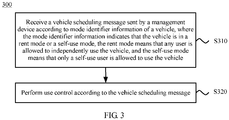
- FIG. 3 shows a schematic flowchart of a vehicle management method 300 according to an embodiment of the present invention.
- the method is executed by a vehicle.
- the method may be executed by an in-vehicle device on a vehicle or another proper device that is on the vehicle and that can communicate with a management center of an ITS. This is not limited.
- the method 300 includes the following steps.
- S310 Receive a vehicle scheduling message sent by a management device according to mode identifier information of a vehicle, where the mode identifier information indicates that the vehicle is in a rent mode or a self-use mode, the rent mode means that any user is allowed to independently use the vehicle, and the self-use mode means that only a self-use user is allowed to use the vehicle.
- the vehicle receives the vehicle scheduling message sent by the management device according to the mode identifier information, and performs use control according to the vehicle scheduling message, so that the management device can effectively manage vehicle resources.
- the performing use control according to the vehicle scheduling message includes: executing, by the vehicle in a time period indicated in a use time plan of the user, a control command that is for the vehicle and that is entered by the user.
- the executing a control command that is for the vehicle and that is entered by the user includes: travelling according to the use time plan of the user.
- the method further includes: obtaining the mode identifier information of the vehicle, and using the rent mode or the self-use mode according to the mode identifier information.
- the vehicle obtains the mode identifier information of the vehicle, where the mode identifier information indicates that the vehicle is in the rent mode or the self-use mode, the rent mode indicates that the vehicle may be independently used by any user.
- the self-use mode means that only a self-use user is allowed to use the vehicle, and in this case, the user of the vehicle is a self-use user.
- the vehicle may provide the mode identifier information to the management device, so that the management device generates a vehicle use notification message according to the mode identifier information, and the vehicle can perform corresponding execution actions according to different mode identifier information.
- the obtaining the mode identifier information of the vehicle includes: receiving the mode identifier information set by a user, where the user includes an owner of the vehicle or a user who has a management permission for the vehicle.
- the vehicle may receive the mode identifier information set by the user, and then sends the mode identifier information to the management center, so that the management center determines, according to the mode identifier information, a vehicle resource set corresponding to the vehicle.
- the user is a general designation of users who can set a vehicle use mode, and has no other assumed ambiguity.
- the user is not restricted to an owner.
- the user may include the owner of the vehicle or a user who has permission for the vehicle, specifically, such as the owner (who has highest permission for the vehicle, and may be set at vehicle delivery), a permission possessor specified by the owner (the owner may set multiple users who have permission for the vehicle, and the permission is inferior only to that of the owner).
- the user may set mode identifier information of the vehicle to the self-use mode, and also set a validity period of the mode.
- the vehicle After receiving the mode identifier information set by a management user, the vehicle sends the mode identifier information to the management center (a control center, a scheduling center, or a management center) of the ITS.
- the management center a control center, a scheduling center, or a management center
- a parameter value of the mode identifier information indicates that the vehicle is currently in the self-use mode, and a corresponding validity period is also carried.
- the management center incorporates the vehicle into a self-use vehicle resource set for management, and scheduling is performed only according to a driving plan of a current user during the period.
- the user may set the mode identifier information of the vehicle to the rent mode, and also set a validity period of the mode identifier information.
- the vehicle After receiving the mode identifier information set by a management user, the vehicle sends the mode identifier information to the management center (a control center, a scheduling center, or a management center) of the ITS.
- the management center incorporates the vehicle into a rent vehicle resource set for management, and the vehicle may be scheduled to another user who has a requirement during the period.
- the self-use mode may be switched to after the validity period of the rent mode ends.
- the management center schedules the vehicle according to the mode identifier information of the vehicle, so as to effectively manage vehicle resources.
- the obtaining the mode identifier information of the vehicle includes:
- the mode identifier information of the vehicle may be mode identifier information generated or set by the management center according to vehicle use information in the ITS or a transportation service scheduling requirement.
- a method for generating the mode identifier information by the management center according to the vehicle use information in the ITS or the transportation service scheduling requirement is described above, and details are not described herein.
- the vehicle After receiving the mode identifier information set by the management center, the vehicle changes the current mode identifier information of the vehicle according to the new mode identifier information. For example, when the management center requires the vehicle to be set to the rent mode, the vehicle changes the original self-use mode to the rent mode.
- the vehicle may receive a notification message from the management center, so as to restore to the original mode.
- the method further includes: sending the mode identifier information to the management device.
- the method before the providing the mode identifier information of the vehicle to the management device, the method further includes: receiving a query message sent by the management device, where the query message is used by the management center to obtain the mode identifier information.
- the receiving a vehicle scheduling message sent by a management device according to mode identifier information of a vehicle includes: receiving a first vehicle use notification message sent by the management device, where the first vehicle use notification message includes identity information of a user who is going to use the vehicle and a use time plan of the user who is going to use the vehicle, and a use time plan of a user who is allowed to use the vehicle is not in conflict with the use time plan of the user who is going to use the vehicle.
- the mode identifier information indicates that the vehicle is in the rent mode
- the user who is going to use the vehicle represents any other user different from the user who is allowed to use the vehicle, and the user who is allowed to use the vehicle represents any user who is allowed to use the vehicle; or when the mode identifier information indicates that the vehicle is in the self-use mode, the user who is going to use the vehicle represents another self-use user different from the user who is allowed to use the vehicle, and the user who is allowed to use the vehicle represents a self-use user who is allowed to use the vehicle.
- the vehicle receives the first vehicle use notification message sent by the management device, where the first vehicle use notification message includes the identity information of the user who is going to use the vehicle and the use time plan of the user who is going to use the vehicle, and the use time plan of the user who is going to use the vehicle is not in conflict with the use time plan of the user who is going to use the vehicle.
- the user who is going to use the vehicle represents any other user different from the user who is allowed to use the vehicle, and the user who is allowed to use the vehicle represents any user who is allowed to use the vehicle; or when the vehicle is in the self-use mode, the user who is going to use the vehicle represents another self-use user different from the user who is allowed to use the vehicle, and the user who is allowed to use the vehicle represents a self-use user who is allowed to use the vehicle.
- the method further includes: receiving a second vehicle use notification message sent by the management device, where the second vehicle use notification message includes identity information of the user who is allowed to use the vehicle and an updated use time plan of the user who is allowed to use the vehicle.
- the vehicle may pre-receive the second vehicle use notification message, where the second vehicle use notification message includes the identity information of the user who is allowed to use the vehicle and the use time plan of the user who is allowed to use the vehicle, and the use time plan of the user who is allowed to use the vehicle is not in conflict with the use time plan of the user who is going to use the vehicle, so that the vehicle can further learn related information of the user who is allowed to use the vehicle.
- Related information of the user who is going to use the vehicle has been obtained by using the first vehicle use notification message.
- the vehicle may further receive the second vehicle use notification message sent by the management device.
- the second vehicle use notification message includes the identity information of the user who is allowed to use the vehicle and the use time plan of the user who is allowed to use the vehicle, and the use time plan of the user who is allowed to use the vehicle is not in conflict with the use time plan of the user who is going to use the vehicle.
- the vehicle After confirming the identity information of the user who is allowed to use the vehicle, the vehicle allows the user who is allowed to use the vehicle to use the vehicle.
- the user who is allowed to use the vehicle represents a user who is allowed to use the vehicle.
- the user who is allowed to use the vehicle also needs to provide identity authentication information of the user who is allowed to use the vehicle.
- the vehicle Only after the vehicle confirms an identity or permission of the user who is allowed to use the vehicle, the user who is allowed to use the vehicle can use the vehicle.
- the vehicle receives the first vehicle use notification message, and executes, in a time period indicated in the use time plan of the user who is going to use the vehicle, a control command that is for the vehicle and that is entered by the user who is going to use the vehicle.
- the vehicle may further first receive the related information of the user who is allowed to use the vehicle.
- the management center when a vehicle can be rented, if another user sends a vehicle use requirement message to the management center, the management center makes selection from vehicles in a rent vehicle resource set. If a vehicle matching the requirement of the another user is found in the rent vehicle resource set, the management center determines to schedule the vehicle to the another user, and sends a notification message to the vehicle.
- the notification message includes identity authentication information and rent duration information of the user. After receiving the notification message, the vehicle first confirms the identity information of the user. After use permission confirmation is completed, the another user rents the vehicle to complete a related transaction.
- the method further includes: receiving a third vehicle use notification message sent by the management device, where the third vehicle use notification message includes the identity information of the user who is allowed to use the vehicle and the updated use time plan of the user who is allowed to use the vehicle, and the updated use time plan of the user who is allowed to use the vehicle is not in conflict with the use time plan of the user who is going to use the vehicle, or the updated use time plan of the user who is allowed to use the vehicle is in conflict with the use time plan of the user who is going to use the vehicle, but the vehicle is not used by the user who is going to use the vehicle.
- an alarm response message is sent to the management device.
- the alarm response message is used to indicate that the updated use time plan of the user who is allowed to use the vehicle is in conflict with the use time plan of the user who is going to use the vehicle.
- the vehicle may further receive the third vehicle use notification message sent by the management device.
- the third vehicle use notification message includes the identity information of the user who is allowed to use the vehicle and the updated use time plan of the user who is allowed to use the vehicle.
- the vehicle sends an alarm response message to the management device.
- the alarm response message is used to indicate that the updated use time plan of the user who is allowed to use the vehicle is in conflict with the use time plan of the user who is going to use the vehicle.
- the vehicle may provide a transportation service to the user who is allowed to use the vehicle. For example, after verifying the identity information of the user who is allowed to use the vehicle, the vehicle travels according to the updated use time plan of the user who is allowed to use the vehicle.
- the method further includes:
- the vehicle may receive the mode switch message from the management center.
- the mode switch message is used by the management center to instruct the vehicle to change the mode.
- the vehicle switches the rent mode of the vehicle to the self-use mode, so that the management center schedules the vehicle to the user who is allowed to use the vehicle.
- the user who is allowed to use the vehicle may be an owner of the vehicle or a user who has a management permission for the vehicle.
- the management center schedules the vehicle according to the mode identifier information of the vehicle, so as to effectively manage vehicle resources.
- the mode identifier information of the vehicle indicates that the vehicle is in the self-use mode
- the user is a self-use user, and only the self-use user is allowed to use the vehicle.
- the mode identifier information is obtained by the vehicle, and after the receiving a first vehicle use notification message sent by the management device, the method further includes:
- the self-use mode means that the vehicle can be used by only one user.
- a user who is going to use the vehicle is a self-use user.
- the first vehicle use notification message includes identity information of the self-use user and a use time plan of the self-use user.
- the fourth vehicle use notification message includes the identity information of the new user and the use time plan of the new user, and the new user is a user different from the self-use user.
- the vehicle sends a reject message to the management device.
- the reject message is used to indicate that the vehicle rejects to perform an operation according to the fourth vehicle use notification message. In other words, in the self-use mode, only one user is allowed to use the vehicle, and the vehicle may reject to receive the fourth vehicle use notification message.
- the method further includes:
- the management center when the vehicle is in the self-use mode of a self-use user, if another user (for example, the another user) sends a vehicle use request message to the management center, when the management center does not find, in vehicles in a rent mode, a vehicle matching the another user, the management center may make selection from vehicles in a self-use mode.
- the management center sends a fifth vehicle use notification message to the vehicle.
- the fifth vehicle use notification message includes identity information of the another user and a use time plan of the another user. After receiving the fifth vehicle use notification message, the vehicle decides whether to allow the another user to use the vehicle.
- the vehicle may notify the owner of the vehicle or the user who has permission for the vehicle, and the vehicle allows or rejects a vehicle use plan of the owner of the vehicle or the user who has permission for the vehicle.
- the vehicle sends a response message to the management center.
- the vehicle may set a use mode to the rent mode, and set a validity period of the rent mode according to rent duration information of a self-use user.
- the vehicle may restore to the self-use mode after the validity period of the rent mode ends.
- the management center schedules the vehicle according to the mode identifier information of the vehicle, so as to effectively manage vehicle resources.
- FIG. 4 shows a schematic diagram of an interaction example of the method according to an embodiment of the present invention. It should be noted that this is merely intended to help a person skilled in the art better understand this embodiment of the present invention, but is not intended to limit the scope of this embodiment of the present invention.
- a management center may be the management center 15 in FIG. 1
- a vehicle may be one of the vehicles 16 in FIG. 1
- a first user is another user different from a second user
- the second user is a user currently allowed to use the vehicle
- the method includes the following steps.
- the vehicle receives mode identifier information set by the second user, where the mode identifier information indicates whether the vehicle is in a rent mode.
- the vehicle receives the mode identifier information set by the second user.
- a vehicle mode set by the second user is the rent mode is used as an example for description.
- the vehicle sends the mode identifier information to the management center.
- the management center After the vehicle sends the mode identifier information to the management center, the management center receives the mode identifier information sent by the vehicle.
- the management center determines that a vehicle resource set corresponding to the vehicle is a rent vehicle resource set.
- the management center incorporates the vehicle to the rent vehicle resource set.
- the mode identifier information identifies that the vehicle is in the self-use mode
- the management center adds the vehicle to a self-use vehicle resource set.
- the rent vehicle resource set corresponding to the rent mode is used as an example for description.
- the management center receives a request message sent by the first user.
- the first user is another user different from the second user.
- the first user sends a vehicle use request message to the management center, and attaches identity authentication information and rent duration information of the first user.
- the management center determines that rent duration of the first user is not in conflict with rent duration of the second user.
- the management center determines that the rent duration of the first user is not in conflict with the rent duration of the second user, and determines to schedule the vehicle to the first user.
- the management center sends a notification message to the vehicle.
- the management center sends the notification message to the vehicle, and the notification message carries the identity authentication information and the rent duration information of the first user.
- the vehicle After confirming an identity of the first user, the vehicle allows the first user to use the vehicle.
- the vehicle After receiving the notification message from the management center, the vehicle needs to confirm the identity of the first user. After the identity or permission of the first user is confirmed, the first user is allowed to rent the vehicle.
- the management center may also determine the mode identifier information.
- the mode identifier information is set to the rent mode is used as an example for description.
- the mode identifier information is set to the self-use mode (not shown in the figure)
- processing may be performed with reference to the method for the self-use mode described above, and details are not described herein.
- the management center determines, according to the mode identifier information of the vehicle, a vehicle resource set corresponding to the vehicle, and schedules the vehicle according to the vehicle resource set corresponding to the vehicle, so that the first user and the second user can rent and use the vehicle, so as to implement flexible vehicle allocation.
- sequence numbers of the foregoing processes do not mean execution sequences in various embodiments of the present invention.
- the execution sequences of the processes should be determined according to functions and internal logic of the processes, and should not be construed as any limitation on the implementation processes of the embodiments of the present invention.
- FIG. 5 shows a schematic block diagram of a vehicle management apparatus 500 according to an embodiment of the present invention.
- the apparatus may be a management center, a control center, another device that has a function of centrally controlling an ITS system, or the like in the ITS system.
- the apparatus 500 includes:
- a management center schedules a vehicle according to mode identifier information of the vehicle, so as to effectively manage vehicle resources.
- the obtaining mode identifier information may comprises receiving the mode identifier information from the vehicle, or setting the mode identifier information for the vehicle.
- the obtaining module 510 is specifically configured to: receive the mode identifier information from the vehicle.
- the apparatus further includes: a query module, configured to send a query message to the vehicle, where the query message is used to obtain the mode identifier information.
- a query module configured to send a query message to the vehicle, where the query message is used to obtain the mode identifier information.
- the obtaining module 510 is specifically configured to: generate the mode identifier information according to vehicle use information in the Intelligent Transportation System ITS.
- the apparatus further includes: a sending module, configured to send the mode identifier information to the vehicle, so that the vehicle uses the rent mode or the self-use mode.
- a sending module configured to send the mode identifier information to the vehicle, so that the vehicle uses the rent mode or the self-use mode.
- the scheduling module 520 is specifically configured to:
- the scheduling module 520 is further specifically configured to: receive a first vehicle use request message of the user who is going to use the vehicle, where the first vehicle use request message includes the identity information of the user who is going to use the vehicle and the use time plan of the user who is going to use the vehicle.
- the scheduling module 520 is further specifically configured to:
- the scheduling module 520 is further specifically configured to: receive a second vehicle use request message of the user who is allowed to use the vehicle, where the second vehicle use request message includes the identity information of the user who is allowed to use the vehicle and the use time plan of the user who is allowed to use the vehicle.
- the scheduling module 520 is further specifically configured to:
- the vehicle management apparatus 500 may execute the vehicle management method 200 according to the embodiment of the present invention.
- the foregoing and other operations and/or functions of the modules in the apparatus 500 are separately used to implement corresponding procedures of the foregoing methods. For brevity, details are not described herein.
- a management center schedules a vehicle according to mode identifier information of the vehicle, so as to effectively manage vehicle resources.
- FIG. 6 shows a schematic block diagram of a vehicle 600 according to an embodiment of the present invention. As shown in FIG. 6 , the vehicle 600 includes:
- the vehicle receives the vehicle scheduling message sent by the management device according to the mode identifier information, and performs use control according to the vehicle scheduling message, so that the management device can effectively manage vehicle resources.
- the vehicle further includes: an obtaining module, configured to obtain the mode identifier information of the vehicle, and use the rent mode or the self-use mode according to the mode identifier information.
- an obtaining module configured to obtain the mode identifier information of the vehicle, and use the rent mode or the self-use mode according to the mode identifier information.
- the vehicle further includes: a provision module, configured to send the mode identifier information obtained by the obtaining module to the management device, so that the management device generates a vehicle use notification message according to the mode identifier information.
- a provision module configured to send the mode identifier information obtained by the obtaining module to the management device, so that the management device generates a vehicle use notification message according to the mode identifier information.
- the obtaining module is configured to: receive the mode identifier information set by a user, where the user includes an owner of the vehicle or a user who has a management permission for the vehicle.
- the first receiving module 610 is specifically configured to:
- the first receiving module 610 is further configured to: receive a second vehicle use notification message sent by the management device, where the second vehicle use notification message includes identity information of the user who is allowed to use the vehicle and an updated use time plan of the user who is allowed to use the vehicle.
- the first receiving module 610 is further configured to: receive a third vehicle use notification message sent by the management device, where the third vehicle use notification message includes the identity information of the user who is allowed to use the vehicle and the updated use time plan of the user who is allowed to use the vehicle, and the updated use time plan of the user who is allowed to use the vehicle is not in conflict with the use time plan of the user who is going to use the vehicle, or the updated use time plan of the user who is allowed to use the vehicle is in conflict with the use time plan of the user who is going to use the vehicle, but the vehicle is not used by the user who is going to use the vehicle.
- the vehicle further includes: a sending module, configured to send the mode identifier information to the management device.
- a sending module configured to send the mode identifier information to the management device.
- the vehicle further includes: a second receiving module, configured to receive a query message sent by the management device, where the query message is used by the management device to obtain the mode identifier information.
- a second receiving module configured to receive a query message sent by the management device, where the query message is used by the management device to obtain the mode identifier information.
- the vehicle receives the vehicle scheduling message sent by the management device according to the mode identifier information, and performs use control according to the vehicle scheduling message, so that the management device can effectively manage vehicle resources.
- the vehicle 600 may execute the vehicle management method 300 according to the embodiment of the present invention.
- the foregoing and other operations and/or functions of the modules in the in-vehicle device 600 are separately used to implement corresponding procedures of the foregoing methods. For brevity, details are not described herein.
- FIG. 7 shows a structure of a vehicle management apparatus according to another embodiment of the present invention.
- the vehicle management apparatus includes at least one processor 702 (for example, a CPU), at least one network interface 705 or another communications interface, a memory 706, and at least one communications bus 703 configured to implement connection and communication between these apparatuses.
- the processor 702 is configured to execute an executable module, for example, a computer program, stored in the memory 706.
- the memory 706 may include a high-speed random access memory (RAM: Random Access Memory), or may further include a non-volatile memory (non-volatile memory), such as at least one magnetic disk memory. Communication and connection between the vehicle management apparatus and at least one other network element is implemented by using the at least one network interface 705 (which may be wired or wireless).
- the memory 706 stores a program 7061
- the processor 702 executes the program 7061, so as to execute the vehicle management method on a management center side in the foregoing embodiment of the present invention.
- FIG. 8 shows a structure of a vehicle apparatus according to another embodiment of the present invention.
- the vehicle apparatus includes at least one processor 802 (for example, a CPU), at least one network interface 805 or another communications interface, a memory 806, and at least one communications bus 803 configured to implement connection and communication between these apparatuses.
- the processor 802 is configured to execute an executable module, for example, a computer program, stored in the memory 806.
- the memory 806 may include a high-speed random access memory (RAM: Random Access Memory), or may further include a non-volatile memory (non-volatile memory), such as at least one magnetic disk memory. Communication and connection between the vehicle and at least one other network element is implemented by using the at least one network interface 805 (which may be wired or wireless).
- the memory 806 stores a program 8061
- the processor 802 executes the program 8061, so as to execute the vehicle management method on a vehicle side in the foregoing embodiment of the present invention.
- sequence numbers of the foregoing processes do not mean execution sequences in various embodiments of the present invention.
- the execution sequences of the processes should be determined according to functions and internal logic of the processes, and should not be construed as any limitation on the implementation processes of the embodiments of the present invention.
- the disclosed system, apparatus, and method may be implemented in other manners.
- the described apparatus embodiment is merely an example.
- the unit division is merely logical function division and may be other division in actual implementation.
- a plurality of units or components may be combined or integrated into another system, or some features may be ignored or not performed.
- the displayed or discussed mutual couplings or direct couplings or communication connections may be implemented by using some interfaces.
- the indirect couplings or communication connections between the apparatuses or units may be implemented in electronic, mechanical, or other forms.
- the units described as separate parts may or may not be physically separate, and parts displayed as units may or may not be physical units, may be located in one position, or may be distributed on a plurality of network units. Some or all of the units may be selected according to actual requirements to achieve the objectives of the solutions of the embodiments.
- functional units in the embodiments of the present invention may be integrated into one processing unit, or each of the units may exist alone physically, or two or more units are integrated into one unit.
- the functions When the functions are implemented in the form of a software functional unit and sold or used as an independent product, the functions may be stored in a computer-readable storage medium. Based on such an understanding, the technical solutions of the present invention essentially, or the part contributing to the prior art, or some of the technical solutions may be implemented in a form of a software product.
- the software product is stored in a storage medium, and includes several instructions for instructing a computer device (which may be a personal computer, a server, or a network device) to perform all or some of the steps of the methods described in the embodiments of the present invention.
- the foregoing storage medium includes: any medium that can store program code, such as a USB flash drive, a removable hard disk, a read-only memory (ROM, Read-Only Memory), a random access memory (RAM, Random Access Memory), a magnetic disk, or an optical disc.
- program code such as a USB flash drive, a removable hard disk, a read-only memory (ROM, Read-Only Memory), a random access memory (RAM, Random Access Memory), a magnetic disk, or an optical disc.
Landscapes
- Business, Economics & Management (AREA)
- Engineering & Computer Science (AREA)
- General Physics & Mathematics (AREA)
- Physics & Mathematics (AREA)
- Tourism & Hospitality (AREA)
- Human Resources & Organizations (AREA)
- Economics (AREA)
- Strategic Management (AREA)
- Marketing (AREA)
- General Business, Economics & Management (AREA)
- Theoretical Computer Science (AREA)
- Accounting & Taxation (AREA)
- Development Economics (AREA)
- Entrepreneurship & Innovation (AREA)
- Finance (AREA)
- Operations Research (AREA)
- Quality & Reliability (AREA)
- Health & Medical Sciences (AREA)
- General Health & Medical Sciences (AREA)
- Primary Health Care (AREA)
- Educational Administration (AREA)
- Game Theory and Decision Science (AREA)
- Radar, Positioning & Navigation (AREA)
- Remote Sensing (AREA)
- Computer Networks & Wireless Communication (AREA)
- Traffic Control Systems (AREA)
- Management, Administration, Business Operations System, And Electronic Commerce (AREA)
Applications Claiming Priority (1)
| Application Number | Priority Date | Filing Date | Title |
|---|---|---|---|
| PCT/CN2016/088725 WO2018006278A1 (zh) | 2016-07-05 | 2016-07-05 | 管理车辆的方法和装置 |
Publications (2)
| Publication Number | Publication Date |
|---|---|
| EP3467751A1 true EP3467751A1 (de) | 2019-04-10 |
| EP3467751A4 EP3467751A4 (de) | 2019-04-17 |
Family
ID=60901314
Family Applications (1)
| Application Number | Title | Priority Date | Filing Date |
|---|---|---|---|
| EP16907783.1A Ceased EP3467751A4 (de) | 2016-07-05 | 2016-07-05 | Fahrzeugverwaltungsverfahren und -vorrichtung |
Country Status (6)
| Country | Link |
|---|---|
| US (1) | US20190139330A1 (de) |
| EP (1) | EP3467751A4 (de) |
| JP (1) | JP7042789B2 (de) |
| KR (1) | KR102276141B1 (de) |
| CN (1) | CN109416811A (de) |
| WO (1) | WO2018006278A1 (de) |
Cited By (2)
| Publication number | Priority date | Publication date | Assignee | Title |
|---|---|---|---|---|
| CN109887268A (zh) * | 2019-03-27 | 2019-06-14 | 腾讯科技(深圳)有限公司 | 车辆调度方法、装置及存储介质 |
| CN111833538A (zh) * | 2019-07-05 | 2020-10-27 | 北京骑胜科技有限公司 | 一种定点还车方法及装置 |
Families Citing this family (8)
| Publication number | Priority date | Publication date | Assignee | Title |
|---|---|---|---|---|
| JP2020030476A (ja) * | 2018-08-20 | 2020-02-27 | 富士ゼロックス株式会社 | 情報処理システム、自走式移動装置及びプログラム |
| CN109345855A (zh) * | 2018-09-19 | 2019-02-15 | 北京智行者科技有限公司 | 一种用户管理方法 |
| JP7243564B2 (ja) * | 2019-10-17 | 2023-03-22 | トヨタ自動車株式会社 | 情報処理装置および情報処理方法 |
| US20240217523A1 (en) * | 2020-06-17 | 2024-07-04 | Irdeto B.V. | System and Method for Controlling Access Based on Preconditioned Activities |
| WO2022025619A1 (ko) * | 2020-07-30 | 2022-02-03 | 주식회사 알티캐스트 | 운송 서비스 시스템 및 방법 |
| JP2022190288A (ja) * | 2021-06-14 | 2022-12-26 | トヨタ自動車株式会社 | 情報処理装置、情報処理方法、およびプログラム |
| KR102476131B1 (ko) * | 2022-02-08 | 2022-12-12 | 주식회사 비디 | 사용자 중심의 차량관리 플랫폼 제공 장치 및 방법 |
| US12524720B1 (en) * | 2022-06-30 | 2026-01-13 | Amazon Technologies, Inc. | Resource sharing between vehicles |
Family Cites Families (21)
| Publication number | Priority date | Publication date | Assignee | Title |
|---|---|---|---|---|
| JP2002032683A (ja) * | 2000-07-14 | 2002-01-31 | Nec Corp | 自家用車の個別貸借方法、自家用車の個別貸借システム、及びその制御プログラムを記録した記録媒体 |
| JP2002099762A (ja) * | 2000-09-21 | 2002-04-05 | Casio Comput Co Ltd | 自動車賃貸借仲介装置及びその方法 |
| JP2002123765A (ja) * | 2000-10-13 | 2002-04-26 | Suzuki Motor Corp | 携帯電話、車両貸出管理装置、車両貸出システム及び記憶媒体 |
| JP2002298037A (ja) * | 2001-03-29 | 2002-10-11 | Nec Corp | 自家用車貸借仲介方法、自家用車貸借仲介システム、貸借仲介業者サーバ及び自家用車貸借仲介プログラム |
| JP2004095699A (ja) * | 2002-08-30 | 2004-03-25 | Tokyo Electron Ltd | 基板処理装置及び基板処理装置のクリーニング方法 |
| JP2004094699A (ja) * | 2002-09-02 | 2004-03-25 | Tatsuya Sato | 車両共同利用の仲介システム |
| JP2004185468A (ja) * | 2002-12-05 | 2004-07-02 | Toppan Printing Co Ltd | レンタカー予約サーバ及び方法 |
| JP2004227174A (ja) * | 2003-01-21 | 2004-08-12 | Daihatsu Motor Co Ltd | 共用車両のデータ管理システム |
| JP2004295392A (ja) * | 2003-03-26 | 2004-10-21 | Fujitsu Ltd | レンタカー管理装置、及びプログラム |
| JP2008052663A (ja) * | 2006-08-28 | 2008-03-06 | Ntt Docomo Inc | マイカーの時間貸し仲介システム |
| JP5693935B2 (ja) * | 2010-12-02 | 2015-04-01 | 株式会社Isホールディングス | カーシェアリングフランチャイズにおけるシェアリングカーの管理システム |
| KR20130081552A (ko) * | 2012-01-09 | 2013-07-17 | 삼성전자주식회사 | 장애 복구 장치 및 방법 |
| KR20130112512A (ko) * | 2012-04-04 | 2013-10-14 | 주식회사 케이티 | 차량 운행 서비스 제공 방법과 시스템 및 이를 위한 장치 |
| US8880239B2 (en) * | 2012-11-07 | 2014-11-04 | Ford Global Technologies, Llc | Credential check and authorization solution for personal vehicle rental |
| CN103778666B (zh) * | 2014-03-04 | 2016-08-17 | 大连交通大学 | 一种出租车合乘计费系统 |
| CN103971313A (zh) * | 2014-05-06 | 2014-08-06 | 南京苏比尔信息技术有限公司 | 一种可兼容私家车的汽车共享管理方法和系统 |
| CN105094767B (zh) * | 2014-05-06 | 2019-02-12 | 华为技术有限公司 | 自动驾驶车辆调度方法、车辆调度服务器及自动驾驶车辆 |
| CN104008575A (zh) * | 2014-05-22 | 2014-08-27 | 南京苏比尔信息技术有限公司 | 一种基于行程管理的汽车共享控制器及控制方法 |
| CN203870680U (zh) * | 2014-05-22 | 2014-10-08 | 南京苏比尔信息技术有限公司 | 一种基于行程管理的汽车共享控制器 |
| CN104851035A (zh) * | 2015-05-13 | 2015-08-19 | 深圳易空间信息技术有限公司 | 一种基于互联网的社会运营车辆资源云调度共享方法 |
| CN105480192B (zh) * | 2015-12-08 | 2018-09-25 | 智车优行科技(北京)有限公司 | 车辆使用权共享装置、控制装置及智能汽车 |
-
2016
- 2016-07-05 WO PCT/CN2016/088725 patent/WO2018006278A1/zh not_active Ceased
- 2016-07-05 JP JP2019500247A patent/JP7042789B2/ja active Active
- 2016-07-05 EP EP16907783.1A patent/EP3467751A4/de not_active Ceased
- 2016-07-05 KR KR1020197001772A patent/KR102276141B1/ko not_active Expired - Fee Related
- 2016-07-05 CN CN201680087231.8A patent/CN109416811A/zh active Pending
-
2019
- 2019-01-04 US US16/240,414 patent/US20190139330A1/en not_active Abandoned
Cited By (4)
| Publication number | Priority date | Publication date | Assignee | Title |
|---|---|---|---|---|
| CN109887268A (zh) * | 2019-03-27 | 2019-06-14 | 腾讯科技(深圳)有限公司 | 车辆调度方法、装置及存储介质 |
| CN109887268B (zh) * | 2019-03-27 | 2022-01-25 | 腾讯科技(深圳)有限公司 | 车辆调度方法、装置及存储介质 |
| CN111833538A (zh) * | 2019-07-05 | 2020-10-27 | 北京骑胜科技有限公司 | 一种定点还车方法及装置 |
| CN111833538B (zh) * | 2019-07-05 | 2022-08-16 | 北京骑胜科技有限公司 | 一种定点还车方法及装置 |
Also Published As
| Publication number | Publication date |
|---|---|
| JP2019526117A (ja) | 2019-09-12 |
| KR102276141B1 (ko) | 2021-07-12 |
| KR20190020094A (ko) | 2019-02-27 |
| WO2018006278A1 (zh) | 2018-01-11 |
| CN109416811A (zh) | 2019-03-01 |
| US20190139330A1 (en) | 2019-05-09 |
| EP3467751A4 (de) | 2019-04-17 |
| JP7042789B2 (ja) | 2022-03-28 |
Similar Documents
| Publication | Publication Date | Title |
|---|---|---|
| US20190139330A1 (en) | Vehicle Management Method and Apparatus | |
| JP6825788B2 (ja) | 車両管理方法および装置 | |
| US11340631B2 (en) | Self-driving car scheduling method, car scheduling server, and self-driving car | |
| US20190025818A1 (en) | Autonomous product delivery vehicle fleet master-slave relationship management | |
| WO2019018337A1 (en) | TASK MANAGEMENT OF AUTONOMOUS PRODUCT DELIVERY VEHICLES | |
| JP5857581B2 (ja) | 配車装置および配車方法 | |
| CN100525177C (zh) | 用于广域网的接入认证系统、设备和方法 | |
| US11340607B2 (en) | Vehicle external communication method and apparatus, and terminal | |
| Braiteh et al. | Platooning in connected vehicles: A review of current solutions, standardization activities, cybersecurity, and research opportunities | |
| CN111639836A (zh) | 基于区块链的车辆调度处理方法、装置和计算机设备 | |
| JP2002297254A (ja) | ライセンス管理装置、ライセンス管理方法、サービス提供方法、モバイルエージェント | |
| EP3739925B1 (de) | Verfahren und vorrichtung zum betrieb eines beweglichen objekts auf basis von edge-computing | |
| CN102959553A (zh) | 控制装置 | |
| EP3580736B1 (de) | Vorrichtung, system und verfahren zur verkehrsverwaltung | |
| CN113673730A (zh) | 一种约车控制方法、装置、电子设备及存储介质 | |
| CN110914876A (zh) | 分配进入授权和行驶授权的方法 | |
| CN108749820A (zh) | 信息交互方法及系统 | |
| US20190080393A1 (en) | Methods and systems for providing services using autonomous economic agents | |
| CN112309013A (zh) | 一种停车场准入授权管理方法、装置、系统及存储介质 | |
| US11620699B2 (en) | Information processing apparatus, information processing method, and non-transitory storage medium | |
| CN116225723B (zh) | 数据处理方法、装置及计算机可读存储介质 | |
| JP2025050411A (ja) | システム、管理サーバ及びプログラム | |
| CN113657888B (zh) | 一种乘车扫码方法及系统 | |
| CN119646788A (zh) | 数据访问方法、机器人、服务器及计算机可读存储介质 | |
| JP2025050462A (ja) | システム及びプログラム |
Legal Events
| Date | Code | Title | Description |
|---|---|---|---|
| STAA | Information on the status of an ep patent application or granted ep patent |
Free format text: STATUS: THE INTERNATIONAL PUBLICATION HAS BEEN MADE |
|
| PUAI | Public reference made under article 153(3) epc to a published international application that has entered the european phase |
Free format text: ORIGINAL CODE: 0009012 |
|
| STAA | Information on the status of an ep patent application or granted ep patent |
Free format text: STATUS: REQUEST FOR EXAMINATION WAS MADE |
|
| 17P | Request for examination filed |
Effective date: 20190103 |
|
| AK | Designated contracting states |
Kind code of ref document: A1 Designated state(s): AL AT BE BG CH CY CZ DE DK EE ES FI FR GB GR HR HU IE IS IT LI LT LU LV MC MK MT NL NO PL PT RO RS SE SI SK SM TR |
|
| AX | Request for extension of the european patent |
Extension state: BA ME |
|
| A4 | Supplementary search report drawn up and despatched |
Effective date: 20190320 |
|
| RIC1 | Information provided on ipc code assigned before grant |
Ipc: G06Q 30/06 20120101ALI20190314BHEP Ipc: G06Q 10/02 20120101ALI20190314BHEP Ipc: G06Q 10/06 20120101ALI20190314BHEP Ipc: G06Q 30/00 20120101AFI20190314BHEP |
|
| DAV | Request for validation of the european patent (deleted) | ||
| DAX | Request for extension of the european patent (deleted) | ||
| STAA | Information on the status of an ep patent application or granted ep patent |
Free format text: STATUS: EXAMINATION IS IN PROGRESS |
|
| 17Q | First examination report despatched |
Effective date: 20191113 |
|
| REG | Reference to a national code |
Ref country code: DE Ref legal event code: R003 |
|
| STAA | Information on the status of an ep patent application or granted ep patent |
Free format text: STATUS: THE APPLICATION HAS BEEN REFUSED |
|
| 18R | Application refused |
Effective date: 20220417 |