EP3469057B1 - Dispositif pourvu d'un agent de nettoyage pour le domaine des toilettes - Google Patents
Dispositif pourvu d'un agent de nettoyage pour le domaine des toilettes Download PDFInfo
- Publication number
- EP3469057B1 EP3469057B1 EP17729440.2A EP17729440A EP3469057B1 EP 3469057 B1 EP3469057 B1 EP 3469057B1 EP 17729440 A EP17729440 A EP 17729440A EP 3469057 B1 EP3469057 B1 EP 3469057B1
- Authority
- EP
- European Patent Office
- Prior art keywords
- phase
- weight
- cleaning agent
- gel
- shaped
- Prior art date
- Legal status (The legal status is an assumption and is not a legal conclusion. Google has not performed a legal analysis and makes no representation as to the accuracy of the status listed.)
- Not-in-force
Links
Images


Classifications
-
- C—CHEMISTRY; METALLURGY
- C11—ANIMAL OR VEGETABLE OILS, FATS, FATTY SUBSTANCES OR WAXES; FATTY ACIDS THEREFROM; DETERGENTS; CANDLES
- C11D—DETERGENT COMPOSITIONS; USE OF SINGLE SUBSTANCES AS DETERGENTS; SOAP OR SOAP-MAKING; RESIN SOAPS; RECOVERY OF GLYCEROL
- C11D17/00—Detergent materials or soaps characterised by their shape or physical properties
- C11D17/0047—Detergents in the form of bars or tablets
- C11D17/0056—Lavatory cleansing blocks
-
- A—HUMAN NECESSITIES
- A61—MEDICAL OR VETERINARY SCIENCE; HYGIENE
- A61L—METHODS OR APPARATUS FOR STERILISING MATERIALS OR OBJECTS IN GENERAL; DISINFECTION, STERILISATION OR DEODORISATION OF AIR; CHEMICAL ASPECTS OF BANDAGES, DRESSINGS, ABSORBENT PADS OR SURGICAL ARTICLES; MATERIALS FOR BANDAGES, DRESSINGS, ABSORBENT PADS OR SURGICAL ARTICLES
- A61L9/00—Disinfection, sterilisation or deodorisation of air
- A61L9/015—Disinfection, sterilisation or deodorisation of air using gaseous or vaporous substances, e.g. ozone
- A61L9/04—Disinfection, sterilisation or deodorisation of air using gaseous or vaporous substances, e.g. ozone using substances evaporated in the air without heating
- A61L9/05—Disinfection, sterilisation or deodorisation of air using gaseous or vaporous substances, e.g. ozone using substances evaporated in the air without heating specially adapted to be released by contact with a liquid, e.g. for toilets
-
- C—CHEMISTRY; METALLURGY
- C11—ANIMAL OR VEGETABLE OILS, FATS, FATTY SUBSTANCES OR WAXES; FATTY ACIDS THEREFROM; DETERGENTS; CANDLES
- C11D—DETERGENT COMPOSITIONS; USE OF SINGLE SUBSTANCES AS DETERGENTS; SOAP OR SOAP-MAKING; RESIN SOAPS; RECOVERY OF GLYCEROL
- C11D3/00—Other compounding ingredients of detergent compositions covered in group C11D1/00
- C11D3/40—Dyes ; Pigments
-
- C—CHEMISTRY; METALLURGY
- C11—ANIMAL OR VEGETABLE OILS, FATS, FATTY SUBSTANCES OR WAXES; FATTY ACIDS THEREFROM; DETERGENTS; CANDLES
- C11D—DETERGENT COMPOSITIONS; USE OF SINGLE SUBSTANCES AS DETERGENTS; SOAP OR SOAP-MAKING; RESIN SOAPS; RECOVERY OF GLYCEROL
- C11D3/00—Other compounding ingredients of detergent compositions covered in group C11D1/00
- C11D3/50—Perfumes
-
- E—FIXED CONSTRUCTIONS
- E03—WATER SUPPLY; SEWERAGE
- E03D—WATER-CLOSETS OR URINALS WITH FLUSHING DEVICES; FLUSHING VALVES THEREFOR
- E03D9/00—Sanitary or other accessories for lavatories ; Devices for cleaning or disinfecting the toilet room or the toilet bowl; Devices for eliminating smells
- E03D9/02—Devices adding a disinfecting, deodorising, or cleaning agent to the water while flushing
- E03D9/03—Devices adding a disinfecting, deodorising, or cleaning agent to the water while flushing consisting of a separate container with an outlet through which the agent is introduced into the flushing water, e.g. by suction ; Devices for agents in direct contact with flushing water
- E03D9/032—Devices connected to or dispensing into the bowl
-
- E—FIXED CONSTRUCTIONS
- E03—WATER SUPPLY; SEWERAGE
- E03D—WATER-CLOSETS OR URINALS WITH FLUSHING DEVICES; FLUSHING VALVES THEREFOR
- E03D9/00—Sanitary or other accessories for lavatories ; Devices for cleaning or disinfecting the toilet room or the toilet bowl; Devices for eliminating smells
- E03D9/02—Devices adding a disinfecting, deodorising, or cleaning agent to the water while flushing
- E03D2009/024—Devices adding a disinfecting, deodorising, or cleaning agent to the water while flushing using a solid substance
-
- E—FIXED CONSTRUCTIONS
- E03—WATER SUPPLY; SEWERAGE
- E03D—WATER-CLOSETS OR URINALS WITH FLUSHING DEVICES; FLUSHING VALVES THEREFOR
- E03D9/00—Sanitary or other accessories for lavatories ; Devices for cleaning or disinfecting the toilet room or the toilet bowl; Devices for eliminating smells
- E03D9/02—Devices adding a disinfecting, deodorising, or cleaning agent to the water while flushing
- E03D2009/026—Devices adding a disinfecting, deodorising, or cleaning agent to the water while flushing using a gel-form substance
Definitions
- the present invention relates to a device with cleaning agent for attachment to the edge of a toilet, the cleaning agent being in the form of a piece and having a detergent tablet phase and a gel phase, and a manufacturing method.
- rim blocks which are fastened in a container, in particular a basket or cage-like container, at the edge ("rim") of the toilet.
- the rinsing water flows over the agent in the container during each rinsing process.
- a small proportion of the detergent is released with each flush, releasing surfactants, fragrances, etc., which then results in the desired cleaning of the toilet bowl and toilet sumps and the desired fragrance can be achieved.
- the well-known rim blocks are used only by the flushing flow of the water, and the release of the fragrance depends on the flushing of the toilet.
- the room blocks are essentially scented by flushing the fragrances out of the flushing water, getting into the toilet sump and evaporating some of the fragrances in the toilet sump.
- A1 lump-shaped toilet cleaning agents which comprise gelling agents, solvents and fragrances and which, with only a small amount of fragrance, enable adequate and permanent room fragrance even when the toilet is not flushed.
- the EP 1 418 225 A1 teaches lumpy detergents with a gel phase that can also be stained.
- a toilet cleaning agent that comprises both a detergent tablet phase and a water-soluble gel phase with a fragrance is known from US Pat EP 2 374 483 B1 known. With this agent, the desired cleaning effect is achieved, as well as sufficient and permanent room scenting is possible even when the fragrance is low, even if there is no toilet flush.
- a shaped detergent body is made with openings or depressions into which the liquid, hot gel phase is poured.
- the recesses can be, for example, grooves in the surface of the detergent tablet.
- the detergent tablet can also be extruded in the form of a hollow tube, the liquid gel phase then being filled into the interior. After cooling, the strand is then cut into individual detergent disks which have a detergent tablet phase on the outside and a gel phase on the inside.
- the EP 1 553 162 A1 teaches a detergent with a gel phase based on preferably water-insoluble polyamide resins and a detergent tablet phase.
- Toilet cleaners with gel and detergent tablet phase often have a white or colored detergent tablet phase and a different colored gel phase.
- Tricolor cleaning agents with two differently colored gel phases in red and blue and a detergent tablet phase in white are also known, for example, from the EU design patent 000748975-0009.
- toilet baskets which are several detergents, have also become known in recent years Contained in different colors, which not only serve a visually appealing exterior, but also visualize different ingredients and functions for the consumer.
- the individual cleaning agents can, for example, be disc-shaped, spherical or cube-shaped and are often in two changing colors, for example in the form of individual pink and blue spheres (in the color sequence pink-blue-pink-blue) according to the EU design 001973579-0003 or offered in the form of different colored discs.
- Such different-colored individual detergent bodies which are stored in the baskets, are usually extruded from powdered starting materials, but this leads to high scattering coefficients of the detergent tablet formulation and thus to paler colors due to the open-pore and rough surface.
- Such toilet baskets with the differently colored individual agents look optically appealing, but the manufacture of the individual differently colored cleaning agents and the filling of the baskets with the individual differently colored cleaning agents are complex.
- the object of the present invention is to provide a toilet basket with a cleaning agent which meets the wishes of the consumer for a visually appealing, special design, is easy to manufacture and is suitable for visualizing different functions due to the different colors.
- the container which comprises the piece-shaped cleaning agent has at least two viewing openings which are spaced apart from one another and point in the direction of the interior of the toilet bowl, and the cleaning agent has a detergent molded body phase and a gel phase, the Color of the gel phase changes substantially continuously from one side of the cleaning agent to the other side of the cleaning agent and the gel phase of the cleaning agent is visible through the viewing openings of the container, so that the color impression of the gel phase behind the first viewing opening differs from the color impression of the gel phase behind the second viewing opening differs.
- a single cleaning agent in a container which is in particular a toilet basket, can therefore be used in that the cleaning agent changes its color in the gel phase from one side to the other side of the agent essentially continuously and the agent in the container changes extends at least over the entire area of the openings of the two viewing openings spaced apart from one another, creates a different color impression in each viewing opening and thus also different functions of the means are visualized.
- Another advantage of the invention is that the agent there is not only easy to manufacture, but also enables brilliant colors and color changes to be made at low cost.
- the gel phase is colored according to the invention and not the detergent tablet phase, which is generally white, the colored phase is transparent and has little scattering. Because a transparent Gel phase is present and no scattering phase, the color impression is more brilliant and strong compared to the colored detergent tablets.
- a gel phase is transparent if a writing with a height of 7 pixels, which was created with an HP Laserjet 2100, can still be read through a gel plate with a layer thickness of 1 cm.
- a harmonious, brilliant color gradient in the gel phase from one color to another color can be produced in a simple manner, in such a way that the detergent shaped body phase is essentially U-shaped or trough-shaped and has a receiving space for the gel phase, the U -shaped detergent tablet phase liquid gel phase of a first color and near the second leg of the U-shaped detergent tablet phase liquid gel phase of a second color is filled.
- the two differently colored gel phases partially mix, so that ultimately a continuous color gradient from the inside of the first leg of the U-shaped detergent tablet phase with a first color to the inside of the second leg of the U-shaped detergent tablet phase with a second color is obtained.
- the viscosity of the two differently colored gel phases should be so low on the one hand that the two gel phases partially flow into one another and mix in part, fill the entire recording space and form a homogeneous smooth surface when hardening and on the other hand so high that the two colors do not mix completely takes place over the entire width of the gel phase.
- the cleaning agent is preferably essentially cuboid, the detergent tablet phase having a U-shaped receiving space for the gel phase and the detergent tablet phase forming three sides of the cuboid and the one opposite the floor
- the visible side of the cleaning agent is essentially formed by the gel phase, which has the color gradient in the region between the two legs of the gel phase and the visible side is delimited laterally by the ends of the two legs of the detergent molded body phase.
- the non-transparent, scattering detergent tablet phase which is generally white and the light that has passed through the gel layer, is reflected again below the transparent gel phase, the light traverses twice the layer thickness of the gel phase, i.e. the color impression - and thus also the impression of the color change - is enhanced by this effect compared to a simply transparent system.
- the light traverses twice the layer thickness of the gel phase, i.e. the color impression - and thus also the impression of the color change - is enhanced by this effect compared to a simply transparent system.
- thin gel layers of 1 to 10 mm, preferably 2 to 6 mm, and a color change across the width of the gel phase, e.g. from yellow to red, even with a thin layer of the gel phase, to achieve a significantly different color impression of the agent behind one and the other opening.
- the absorbance also changes over at least one wavelength in the visible spectral range across the width of the gel phase.
- Essentially continuous change in color or extinction is to be understood as a change in color that results across the width of the gel phase if at least two differently colored gel phases are filled into the receiving space of the detergent tablet phase at different locations with respect to the width of the gel phase .
- This feature is also fulfilled if the color does not change or changes little in the area of the one and / or the other leg and the area of the continuous color change from one color to the other color tends to affect the middle area limited in the gel phase.
- This characteristic is also fulfilled if only one gel phase is colored and the other is transparent.
- the “width” of the gel phase is understood to mean the distance between the two legs of the U-shaped detergent tablet phase.
- three, four or more differently colored gel phases can also be filled into the receiving space of the detergent tablet phase, provided that the receiving space is sufficiently wide.
- a cleaning agent with a brilliant, visually appealing color gradient from red to yellow to green to blue can be achieved in addition to the intermediate colors that result between two colors.
- the further nozzles are placed between the two nozzles located near the legs of the detergent tablet phase.
- gel phase (s) can also be equipped with colored pigments or other decorative additives.
- the program from BASF Chione® or Deko Stones offers a variety of design options.
- the total gel phases contain gel formers, fragrances and solvents.
- Metal soaps of the higher fatty acids in particular the corresponding alkali salts such as sodium stearate or sodium oleate, can be used, for example, as gel formers.
- other anionic surfactants can also be used, such as, for example, alkyl sulfates, alkyl ether sulfates, alkyl ether sulfonates, ethoxylated arylalkyl sulfates, ⁇ -olefin sulfonates, ⁇ -alkoxyalkane sulfonates, alkylarylsulfonates, alkyl monoglyceride sulfates, alkyl monoglyceride sulfonates, alkyl carbonates, alkyl ether carboxylates, octophosphate sulfates, alkylphosphate sulfates, alkylphosphate sulfates, alkylphosphate sulfates, alkylphosphate sulfates
- nonionic surfactants as gel formers, such as, for example, ethylene oxide / propylene oxide (EO / PO) block polymers, glycerol ethoxylates, partial glycerol ethoxylates, polyglycol ethoxylates, polyalkoxyalkanes, for example a mixture of alkyl (C20, C22) ethoxylate with 35 EO, Alkyl (C22) ethoxylate with 35 EO or alkyl (C16, C18) ethoxylate with 30 EO, natural polymers (“gums”) such as gum arabic, guar gum, agar agar, pectins, gelatin, starch, sorbitol, chemically modified or derivatized natural " gums” such as carboxymethyl cellulose, methyl cellulose, hydroxypropyl methyl cellulose, xanthan, sorbitol derivatives such as dibenzylidene sorbitol
- polymers can also be used as gel formers, such as, for example, polyalkoxylates (polyacrylic acid, polyacrylic acid derivatives, polymalinates, etc.), polystyrene-ethylene-butylene-styrene copolymers (SEBS), styrene-ethylene-ethylene-propylene-styrene copolymers (SEEPS) , Styrene-ethylene-propylene-styrene copolymers (SEPS), styrene-ethylene-propylene copolymers (SEP) and / or combinations thereof, provided that these form gels.
- SEBS polystyrene-ethylene-butylene-styrene copolymers
- SEEPS styrene-ethylene-ethylene-propylene-styrene copolymers
- SEPS Styrene-ethylene-propylene-styrene copolymers
- SEP styrene-ethylene-propylene cop
- Cationic surfactants can also be used as gelling agents, such as, for example, salts of aminated fatty acids, alkylpyridinium salts, quaternary ammonium salts, quaternary ethoxylated amines, alkylated ammonium salts, polymeric ammonium salts, arylated ammonium salts, alkylated and arylated ammonium salts, quaternary polydimethylsilane and quartar silanes / / quartan or silane combinations, quartary if they form gels.
- salts of aminated fatty acids alkylpyridinium salts, quaternary ammonium salts, quaternary ethoxylated amines, alkylated ammonium salts, polymeric ammonium salts, arylated ammonium salts, alkylated and arylated ammonium salts, quaternary polydimethylsilane and quartar silanes
- hydrophobic gel formers such as polyamide resins, in particular ester-terminated polyamide resins, for example in the US 6,268,466 are possible. These resins can form gels with hydrophobic solvents, so that gel formation with the perfume oils can take place without the addition of solvents, as in US Pat EP 1 553 162 is described. With these gel formers, the fragrance concentration can be up to 60% by weight of the gel phase.
- the proportion of the gel former in the gel phase depends on the gel former used in each case. If metal soaps are used as gel formers, their percentage by weight is between 0.5% by weight and 25% by weight and preferably between 1.0% by weight and 20% by weight and particularly preferably between 1.5% by weight and 15% by weight .%.
- polyalkoxyalkanes are used as gel formers, their proportion is between 10% by weight and 40% by weight, preferably between 15% by weight and 35% by weight; when using natural or synthetic " gums", they are preferably between 0.1% by weight and 10 wt.% used.
- the fragrances contained in the gel phase can be pure substances or fragrance mixtures, preferably a perfume oil or a mixture of perfume oils.
- a fragrance is understood to mean a chemical substance which is pleasant to the sense of smell, or a corresponding mixture of fragrance substances.
- No fragrance in the sense of the present invention is a volatile, but unpleasant smelling substance.
- the proportion of fragrances in the gel phase is preferably at least 2% by weight, preferably between 6% by weight and 50% by weight and particularly preferably between 15% by weight and 35% by weight.
- Another essential component of the gel phase is the solvent.
- an organic solvent water or a mixture thereof can be used as the solvent.
- alkylene glycol alkyl ethers such as propylene glycol n-butyl ether, dipropylene glycol methyl ether or a mixture thereof are particularly suitable as solvents.
- solvents are C 3 -C 5 glycols, propylene carbonates, C 2 -C 4 alcohols or polyalkylene glycols, preferably with 200-600 alkylene glycol units, polyalcohols, (2) -methyl-1,3-propanediol, also in mixtures of other solvents become.
- the solvent or solvents are generally polar solvents that dissolve the gelling agents. Their percentage is between 5% and 70% by weight.
- non-polar solvents or also perfume oils are preferably used as solvents.
- the total content of solvents in the gel phase is determined by the amount of solvent required for gel formation with the respective gel former.
- the total solvent content of the gel phase excludes that in others Components contained water, for example the water content of the added foamer with. If a metal soap is used as the gel former, the total solvent content is at least 10% by weight, preferably more than 20% by weight.
- a solvent for example, 0% by weight to 40% by weight of water together with 0% by weight to 50% by weight of organic solvent, for example 20% by weight to 25% by weight of water and 30% by weight to 40% by weight of organic Solvents, preferably from the group of alkylene glycol alkyl ethers, polyalcohols or perfume oils or a mixture thereof, are used.
- the fragrance components are also contained in the solvent components.
- the dyes in the gel phases can be selected from the group of acid, mordant, dispersion, natural, food, leather, direct, sulfur, vat, development, reactive, solvent, basic or organic dyes , the pigments, optical brighteners, the intermediates for color development and the pigments are selected.
- the proportion of the dye in the gel phases should be at least 0% by weight to 10% by weight, preferably 0.001% by weight to 5% by weight and particularly preferably between 0.01% by weight and 0.1% by weight.
- the gel phase can additionally comprise one or more foaming agents such as betaines, alkoxylated alkyl ether sulfates or lactobionic acid derivatives, such as, for example, fatty acid amidopropyl betaine with a C5-C21 fatty acid component such as, for example, coconut amidopropyl betaine, alkali metal or ammonium salts of lauryl ether sulfates with 1 to 5 EO, lactobactobocylamide, amide, lactobionotalgamide etc. or mixtures thereof.
- foaming agents are extremely easy to incorporate into the gel phase.
- the use of the liquid super foamers, namely betaines and lauryl ether sulfates, is particularly preferred. If a foamer is also used in the gel phase, the proportion thereof is preferably up to 10% by weight, particularly preferably 3% by weight to 7% by weight.
- the gel phase can furthermore contain di-, oligo- or polyhydroxy compounds or their ethers such as glycol, 1,2- or 1,3-dihydroxypropane, 1,2-, 1,3-, 2,3- or 1,4- Dihydroxybutane, the isomers of dihydroxyisobutane, dihydroxypentane etc., glycerin, pentaerythritol, penta- or hexahydroxy compounds or polyhydroxy ethers such as polymethylene or polypropylene glycol in a proportion of up to 20% by weight in order to prevent the formation of poorly soluble residues by drying out the gel, to accelerate the dissolution process and to achieve a smooth surface of the gel phase.
- Preservatives e.g. Hydroxybenzoic acid alkyl esters, such as methyl or propyl hydroxybenzoate, are added, generally between 0% by weight and 1% by weight.
- hydrophobizing agents such as, for example, coconut fatty acid monoethanolamide or other known hydrophobizing agents can also be added to the gel phase; preference is given to using 0% by weight to 10% by weight of hydrophobizing agent.
- the hydrophobic perfume oils contained in the gel phase also contribute to a reduction in the rate of dissolution.
- the gel phase can comprise other conventional constituents such as surfactants, in particular foaming surfactants, which do not have too high a wetting capacity, so that they do not bind to the fragrances to be released, disinfectants or salts for controlling the rate of dissolution.
- surfactants in particular foaming surfactants, which do not have too high a wetting capacity, so that they do not bind to the fragrances to be released, disinfectants or salts for controlling the rate of dissolution.
- the melting point of the gel phase should preferably be at least 40 ° C., preferably at least 50 ° C., in order to ensure dimensionally stable storage and transport of the agent.
- the red gel phase can additionally comprise foaming agents and the yellow gel phase additionally disinfectants such as quaternary ammonium compounds.
- the viscosity of the gel phase should be during the filling process in the receiving space of the detergent tablet phase in the Generally between 2 mPas and 2,000 mPas, preferably between 3 mPas and 500 mPas and particularly preferably between 4 mPas and 20 mPas.
- a detergent tablet is understood to be a solid body, which is preferably produced by extrusion, pressing or solidification from a melt in accordance with the customary production processes for rim blocks.
- the detergent tablet which contains at least 10% surfactants, is used for cleaning and can contain a fragrance for scenting the toilet.
- the detergent tablet comprises surfactants in order to achieve the desired cleaning effect.
- these surfactants should be surfactants with good wetting properties, thus preferably anionic or nonionic surfactants.
- anionic surfactants are suitable.
- Alkylbenzene sulfonates, alkyl sulfates, fatty alcohol sulfates and fatty alcohol ether sulfates are preferably used as anionic surfactants.
- the alkyl group or fatty acid component comprises between 8 and 18 carbon atoms.
- Sodium alkyl (C10-C13) benzene sulfonate for example, can be used as the alkyl benzene sulfonate.
- amphoteric surfactants are also possible.
- the detergent tablet can contain salts for regulating the consistency and the rinsing behavior.
- these salts are inorganic salts, which are preferably selected from the group of the alkali and alkaline earth salts of sulfuric acids, phosphoric acids, nitrogen acids, carbonic acid, halogen acids such as HCl or mixtures thereof.
- the proportion of these salts in the detergent tablet can be up to 80% by weight, preferably about 20% to 50% by weight. It is particularly preferred to use sodium chloride or sodium sulfate or a mixture thereof as salts.
- the detergent tablet can comprise lignin or lignin sulfonate as a filler.
- the detergent tablet can further comprise extrusion aids, preferably up to a proportion of 15% by weight.
- extrusion aids for example, alkyl polyethylene glycol ethers with up to 40 EO, but also other known extrusion aids, such as cellulose and its derivatives, can be used.
- the detergent tablet can comprise dyes and pigments such as titanium dioxide, but optionally also disinfectants, preservatives, bleaches, activators, enzymes, complexing agents and acids.
- the detergent tablet phase is preferably white, because this emphasizes the color contrast of the differently colored gel phases.
- the detergent tablet can also be colored, which gives the overall product a very pop appearance.
- the detergent tablet phase can in principle also be a soap phase.
- the soap phase should then in any case include other surfactants in addition to the alkane carboxylic acid salts in order to achieve the desired cleaning effect.
- the detergent tablet can in principle also be a phase comprising water-soluble or water-dispersing polymers, which comprises surfactants.
- the piece-like means according to the invention can be shaped differently, for example cuboid.
- the agent is usually shaped in such a way that it can be placed in a conventional toilet basket that can be attached to the edge of the toilet.
- the agent consists of the detergent tablet, the proportion of which in the agent should be at least 10% by weight, preferably at least 50% by weight and particularly preferably at least 60% by weight.
- the proportion of the gel phase is therefore at most 90% by weight, preferably at most 50% by weight and particularly preferably at most 40% by weight of the composition.
- the visible side of the agent should consist predominantly of the gel phase, since the gel phase should be visible to the consumer at least in the area of the viewing openings in the container.
- the three other sides of the detergent are formed from the detergent tablet phase, which ultimately forms a type of tub for the gel phase, into which the gel phase is filled with the color change over the "width" of the tub.
- the remaining two sides of the agent consist of the detergent tablet phase and the gel phase.
- the constituents of the detergent tablet are mixed and extruded in a continuous process to form an endless strand which is U-shaped or trough-shaped.
- a limitation is given by the shape of the U or trough, so that a receiving space for receiving the liquid gel phase is provided.
- the colored gel masses are poured into the receiving space from above via at least two nozzles, each metering in two differently colored hot gel phases in the edge areas of the receiving space, some of which mix and, after cooling, form a smooth, transparent gel surface with a Cure the color gradient.
- the present invention thus also relates to a method for producing a cleaning agent, in particular for storing in a device according to one of claims 1 to 7, characterized in that the detergent tablet phase is first extruded in a U-shape, as a result of which a receiving space is formed on the top of the detergent tablet phase is and at least two nozzles are provided, which are located above the receiving space near the two legs of the detergent tablet, and two different colored hot gel phases are injected into the receiving space through these two nozzles in order to partially mix and cool there.
- the device 11 is a toilet basket 11 with a holding device 12 which serves to grip around the edge 31 of a toilet bowl 32 and a container 13 which is used to store toilet cleaning agent 20, cf. Fig. 1 and Fig. 6 . Furthermore, such containers 13 usually have inflow openings 14 for the access of the flushing water into the container 13 and outflow openings 15 through which the flushing water is flushed into the toilet bowl 32 with part of the detergent 20 dissolved.
- Such a structure is known per se.
- the device 11 now has at least two viewing openings 16, 17 pointing in the direction of the interior 30 of the toilet bowl 32, which are spaced apart, cf. Fig. 1 and Fig. 6 .
- the cleaning agent 20 located in the container 13, namely its gel phase 22 is clearly visible.
- the two viewing openings 16, 17 act like separate windows and each allow a different area of the cleaning agent 20 in the container 13 or its gel phase 22 to appear.
- Each viewing opening 16, 17, 18, 19 should have a width between 0.2 cm and 5 cm, preferably between 0.5 and 2 cm, the viewing openings 16, 17, 18, 19 being square, round, oval, star-shaped, can be drop-shaped or shaped differently. Motifs such as animal motifs or geometric shapes are also possible as the shape of the viewing openings 16, 17, 18, 19.
- the viewing openings 16, 17, 18, 19 do not all have to be of the same shape, and different different opening shapes are also possible.
- the toilet basket 11 can be white, colored, milky or transparent.
- the viewing openings 16, 17, 18, 19 should be spaced from one another, as a rule the web width 40 between two viewing openings should be at least 1 mm, preferably at least 2 mm and less than 30 mm, preferably less than 20 mm.
- the distances between two viewing openings can of course be different.
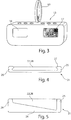
- the agent 20 according to the invention is in Figure 2 shown. It has a detergent tablet phase 21, which comprises surfactants and is used for cleaning, and a gel phase 22, which comprises gelling agents, fragrances and solvents and is used for scenting.
- a detergent tablet phase 21 which comprises surfactants and is used for cleaning
- a gel phase 22 which comprises gelling agents, fragrances and solvents and is used for scenting.
- the detergent molded body phase 21 is U-shaped in section and consists of a bottom 24 and a right 25 and a left 26 leg. The bottom 24 and the two legs 25, 26 delimit the receiving space 28 for the gel phase 22. In Figure 2 the detergent tablet phase 21 is tilted forward so that you can see it on the visible side.
- the detergent molded body phase 21 is preferably extruded as a U-shaped endless strand, the receiving space 28 pointing upwards during the manufacturing process.
- Two hot liquid gel phases 22 of different colors are then filled into this receiving space 28 via at least two nozzles, one nozzle being arranged near the right leg 25 and one nozzle near the left leg 26 of the detergent molded body 21, which then merge into one another in the central region of the receiving space 28 , whereas in the areas near the legs 25, 26 the pure gel phase 22 of the respective color virtually solidifies. In this way, a continuous, appealing color gradient is obtained in the gel phase 22 from the right leg 25 of the detergent tablet phase 21 to the left leg 26 of the detergent tablet phase 21.
- the width B of the gel phase 22 measured between the inner sides of the two legs 25, 26 can be between 1 cm and 20 cm, preferably between 3 cm and 15 cm.
- the gel phase 22 should be at least 0.5 mm, preferably at least 2 mm thick or high. The thicker the layer thickness of the gel phase 22, the easier it is to produce a flat gel phase 22 with an appealing color gradient, since a thicker layer counteracts faster cooling and associated streaks on the surface.
- the layer thickness of the detergent tablet phase 21 also depends on the cleaning effect to be achieved and the desired number of rinses depending on the geometry.
- the detergent tablet 21 is preferably between 3 mm and 30 mm, preferably between 5 mm and 20 mm thick.
- the height H of the means 20 is usually between 2 mm and 50 mm, preferably between 5 mm and 30 mm, so that the means 20 can still be positioned well below the flushing rim 31 of the toilet 32.
- the two colored areas shining through the viewing windows 16, 17 also correspond very harmoniously, since each color area also has portions of the other color.
- the color gradient within each viewing window 16, 17 contributes to an interesting, unusual look.
- substantially U-shaped shaped detergent body phases 21 are shown in section.
- the legs 25, 26 may have lugs 27 on their upward-facing side, which form an appealing optical finish for the gel phase 22 and prevent the rinsing water from penetrating directly into the phase transition gel phase 22 / detergent tablet phase 21 and falling out of the gel phase 22.
- the bottom 24 of the detergent molded body phase 21 can, for example, on the inside of the receiving space 28 according to Figure 5 run obliquely, as a result of which a lightening of the color of the gel phase 22 is achieved in the area with the thinner gel phase layer 22 in the case of a purely white detergent tablet phase 21.
- the detergent tablet phase 21 is also possible.
- the outside of the bottom 24 and the two legs 25, 26 should be perpendicular to one another in order to enable simple extrusion of an endless strand.
- the detergent tablet phase 21 can also be colored.
- a frame formulation for the detergent tablet phase 21 and the gel phase 22 is given below by way of example:
- Raw material function Proportion (% by weight) Fatty alcohol (C9-C15) ethoxylates with 10 or 11 EO non-ionic surfactant ⁇ 50 Sodium dodecylbenzenesulfonate 80% + toluenesulfonate anionic surfactant ⁇ 2 Sprayed sodium stearate anionic surfactant ⁇ 5 water Solvents ⁇ 10 1,2 propanediol Solvents ⁇ 10 Yellow orange dye Dye 1 > 0.05 Red dye Dye 2 > 0.02 Fragrance > 30
- Raw material function Proportion (% by weight) Sodium dodecylbenzenesulfonate, 90% anionic surfactant ⁇ 20 Cumene sulfonate, Na salt 93% Hydrothop ⁇ 10 ⁇ -olefin sulfonate, Na salt anionic surfactant ⁇ 10 Sodium sulfate salt ⁇ 50 Sodium chloride salt ⁇ 30 Polyethylene glycol 6000 DS Positioning means ⁇ 5 Titanium dioxide Dye 3 ⁇ 0.02
Landscapes
- Chemical & Material Sciences (AREA)
- Life Sciences & Earth Sciences (AREA)
- Engineering & Computer Science (AREA)
- Health & Medical Sciences (AREA)
- Public Health (AREA)
- Chemical Kinetics & Catalysis (AREA)
- Oil, Petroleum & Natural Gas (AREA)
- Wood Science & Technology (AREA)
- Organic Chemistry (AREA)
- Epidemiology (AREA)
- General Health & Medical Sciences (AREA)
- Animal Behavior & Ethology (AREA)
- Veterinary Medicine (AREA)
- Hydrology & Water Resources (AREA)
- Water Supply & Treatment (AREA)
- Detergent Compositions (AREA)
Claims (12)
- Dispositif (11) contenant un produit de nettoyage (20) en forme de pain pour la zone des toilettes, pourvu d'un dispositif d'attache (12) qui peut être fixé au rebord (31) d'une cuvette de toilettes (32) et d'un récipient (13) comprenant le produit de nettoyage (20) qui présente une phase de corps moulé de produit de nettoyage (21) et une phase de gel (22), le produit de nettoyage (20) servant à délivrer des substances odorantes et se dissolvant peu à peu à chaque passage de l'eau de la chasse, caractérisé en ce que le récipient (13) présente au moins deux ouvertures de visualisation (16, 17) espacées entre elles et tournées vers l'intérieur (30) de la cuvette de toilettes (32) à travers lesquelles la phase de gel (22) est visible et en ce que la couleur de la phase de gel (22) change essentiellement de manière continue depuis un côté du produit de nettoyage (20) vers l'autre côté du produit de nettoyage (20) de sorte que la couleur de la phase de gel (22) perçue derrière la première ouverture de visualisation (16) est différente de la couleur de la phase de gel (22) perçue derrière la deuxième ouverture de visualisation (17).
- Dispositif (11) selon la revendication 1, caractérisé en ce que le produit (20), à savoir dans sa phase de gel (22), s'étend au moins sur toute la zone des ouvertures (16) et (17).
- Dispositif (11) selon l'une quelconque des revendications 1 ou 2, caractérisé en ce que la phase de gel (22) est essentiellement transparente et que la phase de corps moulé de produit de nettoyage (21) n'est pas transparente.
- Dispositif (11) selon l'une quelconque des revendications précédentes, caractérisé en ce que la phase de corps moulé de produit de nettoyage (21) forme un espace de réception (28) pour la phase de gel (22) lequel est, en coupe transversale, de préférence essentiellement en forme de U ou en forme de cuve.
- Dispositif (11) selon l'une quelconque des revendications précédentes, caractérisé en ce que la phase de gel (22) présente des gélifiants, des substances odorantes et des solvants et/ou que la phase de corps moulé de produit de nettoyage (21) comprend des tensioactifs.
- Dispositif (11) selon l'une quelconque des revendications précédentes, caractérisé en ce que ledit dispositif (11) présente au moins trois (16, 17, 18), de préférence au moins quatre ouvertures de visualisation (16, 17, 18, 19) et/ou que le produit de nettoyage (20) présente au moins trois, de préférence au moins quatre couleurs différentes qui se fondent essentiellement de manière continue les unes dans les autres.
- Dispositif (11) selon l'une quelconque des revendications précédentes, caractérisé en ce que les ouvertures de visualisation (16, 17, 18, 19) du récipient (13) présentent respectivement une largeur comprise entre 0,2 cm et 5 cm, de préférence entre 0,5 et 2 cm, et/ou que les ouvertures de visualisation (16, 17, 18, 19) sont rectangulaires, rondes, étoilées, en forme de goutte ou ovales.
- Dispositif (11) selon l'une quelconque des revendications précédentes, caractérisé en ce que la proportion de substances odorantes contenue dans la phase de gel (22) est de préférence d'au moins 2 % poids, est comprise de préférence entre 6 % poids et 50 % poids et est comprise de manière particulièrement privilégiée entre 15 % poids et 35 % poids.
- Dispositif (11) selon l'une quelconque des revendications précédentes, caractérisé en ce que la proportion de matière colorante contenue dans les phases de gel (22) fait jusqu'à 10 % poids, est comprise de préférence entre 0,001 % poids et 5 % poids et est comprise de manière particulièrement privilégiée entre 0,01 % poids et 0,1 % poids.
- Dispositif (11) selon l'une quelconque des revendications précédentes, caractérisé en ce que le point de fusion de la phase de gel (22) est de préférence d'au moins 40 °C, de manière privilégiée d'au moins 50 °C.
- Dispositif (11) selon l'une quelconque des revendications précédentes, caractérisé en ce que la proportion du corps moulé de produit de nettoyage (21) contenue dans le produit (20) est d'au moins 10 % poids, de préférence d'au moins 50 % poids et de manière particulièrement privilégiée d'au moins 60 % poids.
- Procédé destiné à fabriquer un produit de nettoyage (20), en particulier pouvant être stocké dans un dispositif (11) selon l'une quelconque des revendications 1 à 11, caractérisé en ce que la phase de corps moulé de produit de nettoyage (21) est d'abord extrudée en forme de U, ce qui forme un la phase de corps moulé de produit de nettoyage (21), et en ce qu'au moins deux buses sont prévues, lesquelles se trouvent au-dessus de l'espace de réception (28), à proximité des deux côtés (25, 26) du corps moulé de produit de nettoyage (21) et en ce que deux phases de gel (22) chaudes de couleurs différentes sont injectées par lesdites deux buses dans l'espace de réception (28) afin de s'y mélanger partiellement et de refroidir.
Applications Claiming Priority (2)
| Application Number | Priority Date | Filing Date | Title |
|---|---|---|---|
| DE102016110584.8A DE102016110584A1 (de) | 2016-06-08 | 2016-06-08 | Vorrichtung mit Reinigungsmittel für den Toilettenbereich und ein Herstellungsverfahren |
| PCT/EP2017/063763 WO2017211857A1 (fr) | 2016-06-08 | 2017-06-07 | Dispositif pourvu d'un agent de nettoyage pour le domaine des toilettes |
Publications (2)
| Publication Number | Publication Date |
|---|---|
| EP3469057A1 EP3469057A1 (fr) | 2019-04-17 |
| EP3469057B1 true EP3469057B1 (fr) | 2020-08-05 |
Family
ID=59054103
Family Applications (1)
| Application Number | Title | Priority Date | Filing Date |
|---|---|---|---|
| EP17729440.2A Not-in-force EP3469057B1 (fr) | 2016-06-08 | 2017-06-07 | Dispositif pourvu d'un agent de nettoyage pour le domaine des toilettes |
Country Status (3)
| Country | Link |
|---|---|
| EP (1) | EP3469057B1 (fr) |
| DE (1) | DE102016110584A1 (fr) |
| WO (1) | WO2017211857A1 (fr) |
Families Citing this family (2)
| Publication number | Priority date | Publication date | Assignee | Title |
|---|---|---|---|---|
| DE102018123683A1 (de) * | 2018-09-26 | 2020-03-26 | Buck Service Gmbh | Reinigungs- und Beduftungsmittel für den Sanitärbereich und Herstellungsverfahren |
| DE102020215584A1 (de) | 2020-12-09 | 2022-06-09 | Henkel Ag & Co. Kgaa | Verfahren zur Herstellung mehrphasiger Wasch- oder Reinigungsmittelformkörper |
Family Cites Families (9)
| Publication number | Priority date | Publication date | Assignee | Title |
|---|---|---|---|---|
| DE19710635A1 (de) | 1997-03-14 | 1998-09-17 | Buck Chemie Gmbh | Gelbasierter Reinigungsblock für die Toilettenhygiene mit permanenter Raumluftbeduftung |
| DE19850896A1 (de) * | 1998-11-05 | 2000-05-11 | Buck Chemie Gmbh | Stückförmiges Mittel für den Toilettenbereich |
| US6268466B1 (en) | 1999-01-04 | 2001-07-31 | Arizona Chemical Company | Tertiary amide terminated polyamides and uses thereof |
| DE20221220U1 (de) * | 2002-11-08 | 2005-07-07 | Buck-Chemie Gmbh | Toilettenreinigungs- und Beduftungsmittel |
| GB2401791A (en) * | 2003-05-23 | 2004-11-24 | Reckitt Benckiser Inc | Fragrance device |
| EP1553162B2 (fr) | 2004-01-08 | 2011-04-20 | Unilever N.V. | Produits solides d'entretien de toilettes |
| DE102010013304A1 (de) * | 2010-03-29 | 2011-09-29 | Buck- Chemie Gmbh | Reinigungs- und Beduftungsmittel für den Sanitärbereich |
| DE102013105316A1 (de) * | 2013-05-23 | 2014-11-27 | Budich International Gmbh | Haltevorrichtung und Spülvorrichtung zur Anbringung in einer Toilettenschüssel und Herstellung derselben Spülvorrichtung |
| WO2016040341A1 (fr) * | 2014-09-08 | 2016-03-17 | S. C. Johnson & Son, Inc. | Bloc de rebord de toilettes et son procédé de fabrication |
-
2016
- 2016-06-08 DE DE102016110584.8A patent/DE102016110584A1/de not_active Withdrawn
-
2017
- 2017-06-07 WO PCT/EP2017/063763 patent/WO2017211857A1/fr not_active Ceased
- 2017-06-07 EP EP17729440.2A patent/EP3469057B1/fr not_active Not-in-force
Non-Patent Citations (1)
| Title |
|---|
| None * |
Also Published As
| Publication number | Publication date |
|---|---|
| DE102016110584A1 (de) | 2017-12-14 |
| WO2017211857A1 (fr) | 2017-12-14 |
| EP3469057A1 (fr) | 2019-04-17 |
Similar Documents
| Publication | Publication Date | Title |
|---|---|---|
| EP1418225B1 (fr) | Agent nettoyant et odorisant pour les toilettes | |
| WO2017140511A1 (fr) | Produit de nettoyage et de désodorisation pour le domaine sanitaire, et procédé de fabrication | |
| DE3225292C2 (fr) | ||
| DE60124247T2 (de) | Vorrichtung zum spülen von wc-becken | |
| EP0864637B1 (fr) | Bloc nettoyant à base de gel pour une hygiène des toilettes avec de l'air parfumé en permanence | |
| DE60131371T2 (de) | Körperreinigungsmittelstück enthaltend aneinanderliegende rückfettungsreiche und rückfettungsarme phasen | |
| DE4439677A1 (de) | Reinigungsmittelstück für Spültoiletten | |
| EP1953215B1 (fr) | Composition transparente de nettoyage et de desodorisation pour les toilettes | |
| EP2704753B1 (fr) | Utilisation d'un produit sanitaire en forme de pièce | |
| DE602004005409T2 (de) | Stückförmige Toilettenreinigungsmittel | |
| EP3469057B1 (fr) | Dispositif pourvu d'un agent de nettoyage pour le domaine des toilettes | |
| EP2374483B2 (fr) | Moyen de nettoyage et d'aération pour le domaine sanitaire | |
| WO2018001603A1 (fr) | Produit de nettoyage sous forme de bloc pour la zone des w.c. | |
| EP3628725A1 (fr) | Agent de nettoyage et de désodorisant sanitaire et procédé de fabrication | |
| EP2014758B1 (fr) | Produit de nettoyage en bloc pour le domaine sanitaire doté d'un support publicitaire | |
| WO2019081231A1 (fr) | Panier pour wc et système de rinçage de wc | |
| EP0879877B1 (fr) | Blocks de nettoyage de toilettes libérant du chlore actif | |
| EP3722401B1 (fr) | Moyen sanitaire sous la forme de gel permettant d'éviter un biofilm | |
| DE2602514A1 (de) | Selbsttragender formkoerper zur wirkstoffabgabe, insbesondere zur wc-spuelung | |
| DE102015109697A1 (de) | Stückförmiges Reinigungsmittel für den WC-Bereich | |
| EP4086331B1 (fr) | Bloc pour toilettes comprenant deux compositions différentes à pigments | |
| EP4382591B1 (fr) | Article pour le nettoyage de surfaces et son procédé de fabrication | |
| EP1621606B1 (fr) | Agent nettoyant et odorisant pour les toilettes | |
| DE202022106872U1 (de) | Artikel zum Reinigen von Oberflächen | |
| DE102022121759A1 (de) | Temperaturstabile gelzusammensetzungen |
Legal Events
| Date | Code | Title | Description |
|---|---|---|---|
| STAA | Information on the status of an ep patent application or granted ep patent |
Free format text: STATUS: UNKNOWN |
|
| STAA | Information on the status of an ep patent application or granted ep patent |
Free format text: STATUS: THE INTERNATIONAL PUBLICATION HAS BEEN MADE |
|
| PUAI | Public reference made under article 153(3) epc to a published international application that has entered the european phase |
Free format text: ORIGINAL CODE: 0009012 |
|
| STAA | Information on the status of an ep patent application or granted ep patent |
Free format text: STATUS: REQUEST FOR EXAMINATION WAS MADE |
|
| 17P | Request for examination filed |
Effective date: 20190108 |
|
| AK | Designated contracting states |
Kind code of ref document: A1 Designated state(s): AL AT BE BG CH CY CZ DE DK EE ES FI FR GB GR HR HU IE IS IT LI LT LU LV MC MK MT NL NO PL PT RO RS SE SI SK SM TR |
|
| AX | Request for extension of the european patent |
Extension state: BA ME |
|
| DAV | Request for validation of the european patent (deleted) | ||
| DAX | Request for extension of the european patent (deleted) | ||
| GRAP | Despatch of communication of intention to grant a patent |
Free format text: ORIGINAL CODE: EPIDOSNIGR1 |
|
| STAA | Information on the status of an ep patent application or granted ep patent |
Free format text: STATUS: GRANT OF PATENT IS INTENDED |
|
| INTG | Intention to grant announced |
Effective date: 20200113 |
|
| GRAS | Grant fee paid |
Free format text: ORIGINAL CODE: EPIDOSNIGR3 |
|
| GRAJ | Information related to disapproval of communication of intention to grant by the applicant or resumption of examination proceedings by the epo deleted |
Free format text: ORIGINAL CODE: EPIDOSDIGR1 |
|
| GRAL | Information related to payment of fee for publishing/printing deleted |
Free format text: ORIGINAL CODE: EPIDOSDIGR3 |
|
| STAA | Information on the status of an ep patent application or granted ep patent |
Free format text: STATUS: REQUEST FOR EXAMINATION WAS MADE |
|
| GRAP | Despatch of communication of intention to grant a patent |
Free format text: ORIGINAL CODE: EPIDOSNIGR1 |
|
| STAA | Information on the status of an ep patent application or granted ep patent |
Free format text: STATUS: GRANT OF PATENT IS INTENDED |
|
| INTC | Intention to grant announced (deleted) | ||
| GRAA | (expected) grant |
Free format text: ORIGINAL CODE: 0009210 |
|
| STAA | Information on the status of an ep patent application or granted ep patent |
Free format text: STATUS: THE PATENT HAS BEEN GRANTED |
|
| INTG | Intention to grant announced |
Effective date: 20200612 |
|
| AK | Designated contracting states |
Kind code of ref document: B1 Designated state(s): AL AT BE BG CH CY CZ DE DK EE ES FI FR GB GR HR HU IE IS IT LI LT LU LV MC MK MT NL NO PL PT RO RS SE SI SK SM TR |
|
| REG | Reference to a national code |
Ref country code: GB Ref legal event code: FG4D Free format text: NOT ENGLISH |
|
| REG | Reference to a national code |
Ref country code: CH Ref legal event code: EP |
|
| REG | Reference to a national code |
Ref country code: AT Ref legal event code: REF Ref document number: 1298732 Country of ref document: AT Kind code of ref document: T Effective date: 20200815 |
|
| REG | Reference to a national code |
Ref country code: DE Ref legal event code: R096 Ref document number: 502017006585 Country of ref document: DE |
|
| REG | Reference to a national code |
Ref country code: IE Ref legal event code: FG4D Free format text: LANGUAGE OF EP DOCUMENT: GERMAN |
|
| REG | Reference to a national code |
Ref country code: LT Ref legal event code: MG4D |
|
| REG | Reference to a national code |
Ref country code: NL Ref legal event code: MP Effective date: 20200805 |
|
| PG25 | Lapsed in a contracting state [announced via postgrant information from national office to epo] |
Ref country code: SE Free format text: LAPSE BECAUSE OF FAILURE TO SUBMIT A TRANSLATION OF THE DESCRIPTION OR TO PAY THE FEE WITHIN THE PRESCRIBED TIME-LIMIT Effective date: 20200805 Ref country code: BG Free format text: LAPSE BECAUSE OF FAILURE TO SUBMIT A TRANSLATION OF THE DESCRIPTION OR TO PAY THE FEE WITHIN THE PRESCRIBED TIME-LIMIT Effective date: 20201105 Ref country code: LT Free format text: LAPSE BECAUSE OF FAILURE TO SUBMIT A TRANSLATION OF THE DESCRIPTION OR TO PAY THE FEE WITHIN THE PRESCRIBED TIME-LIMIT Effective date: 20200805 Ref country code: GR Free format text: LAPSE BECAUSE OF FAILURE TO SUBMIT A TRANSLATION OF THE DESCRIPTION OR TO PAY THE FEE WITHIN THE PRESCRIBED TIME-LIMIT Effective date: 20201106 Ref country code: NO Free format text: LAPSE BECAUSE OF FAILURE TO SUBMIT A TRANSLATION OF THE DESCRIPTION OR TO PAY THE FEE WITHIN THE PRESCRIBED TIME-LIMIT Effective date: 20201105 Ref country code: FI Free format text: LAPSE BECAUSE OF FAILURE TO SUBMIT A TRANSLATION OF THE DESCRIPTION OR TO PAY THE FEE WITHIN THE PRESCRIBED TIME-LIMIT Effective date: 20200805 Ref country code: ES Free format text: LAPSE BECAUSE OF FAILURE TO SUBMIT A TRANSLATION OF THE DESCRIPTION OR TO PAY THE FEE WITHIN THE PRESCRIBED TIME-LIMIT Effective date: 20200805 Ref country code: PT Free format text: LAPSE BECAUSE OF FAILURE TO SUBMIT A TRANSLATION OF THE DESCRIPTION OR TO PAY THE FEE WITHIN THE PRESCRIBED TIME-LIMIT Effective date: 20201207 Ref country code: HR Free format text: LAPSE BECAUSE OF FAILURE TO SUBMIT A TRANSLATION OF THE DESCRIPTION OR TO PAY THE FEE WITHIN THE PRESCRIBED TIME-LIMIT Effective date: 20200805 |
|
| PG25 | Lapsed in a contracting state [announced via postgrant information from national office to epo] |
Ref country code: NL Free format text: LAPSE BECAUSE OF FAILURE TO SUBMIT A TRANSLATION OF THE DESCRIPTION OR TO PAY THE FEE WITHIN THE PRESCRIBED TIME-LIMIT Effective date: 20200805 Ref country code: RS Free format text: LAPSE BECAUSE OF FAILURE TO SUBMIT A TRANSLATION OF THE DESCRIPTION OR TO PAY THE FEE WITHIN THE PRESCRIBED TIME-LIMIT Effective date: 20200805 Ref country code: PL Free format text: LAPSE BECAUSE OF FAILURE TO SUBMIT A TRANSLATION OF THE DESCRIPTION OR TO PAY THE FEE WITHIN THE PRESCRIBED TIME-LIMIT Effective date: 20200805 Ref country code: LV Free format text: LAPSE BECAUSE OF FAILURE TO SUBMIT A TRANSLATION OF THE DESCRIPTION OR TO PAY THE FEE WITHIN THE PRESCRIBED TIME-LIMIT Effective date: 20200805 Ref country code: IS Free format text: LAPSE BECAUSE OF FAILURE TO SUBMIT A TRANSLATION OF THE DESCRIPTION OR TO PAY THE FEE WITHIN THE PRESCRIBED TIME-LIMIT Effective date: 20201205 |
|
| PG25 | Lapsed in a contracting state [announced via postgrant information from national office to epo] |
Ref country code: EE Free format text: LAPSE BECAUSE OF FAILURE TO SUBMIT A TRANSLATION OF THE DESCRIPTION OR TO PAY THE FEE WITHIN THE PRESCRIBED TIME-LIMIT Effective date: 20200805 Ref country code: SM Free format text: LAPSE BECAUSE OF FAILURE TO SUBMIT A TRANSLATION OF THE DESCRIPTION OR TO PAY THE FEE WITHIN THE PRESCRIBED TIME-LIMIT Effective date: 20200805 Ref country code: RO Free format text: LAPSE BECAUSE OF FAILURE TO SUBMIT A TRANSLATION OF THE DESCRIPTION OR TO PAY THE FEE WITHIN THE PRESCRIBED TIME-LIMIT Effective date: 20200805 Ref country code: DK Free format text: LAPSE BECAUSE OF FAILURE TO SUBMIT A TRANSLATION OF THE DESCRIPTION OR TO PAY THE FEE WITHIN THE PRESCRIBED TIME-LIMIT Effective date: 20200805 Ref country code: CZ Free format text: LAPSE BECAUSE OF FAILURE TO SUBMIT A TRANSLATION OF THE DESCRIPTION OR TO PAY THE FEE WITHIN THE PRESCRIBED TIME-LIMIT Effective date: 20200805 |
|
| REG | Reference to a national code |
Ref country code: DE Ref legal event code: R097 Ref document number: 502017006585 Country of ref document: DE |
|
| PG25 | Lapsed in a contracting state [announced via postgrant information from national office to epo] |
Ref country code: AL Free format text: LAPSE BECAUSE OF FAILURE TO SUBMIT A TRANSLATION OF THE DESCRIPTION OR TO PAY THE FEE WITHIN THE PRESCRIBED TIME-LIMIT Effective date: 20200805 |
|
| PLBE | No opposition filed within time limit |
Free format text: ORIGINAL CODE: 0009261 |
|
| STAA | Information on the status of an ep patent application or granted ep patent |
Free format text: STATUS: NO OPPOSITION FILED WITHIN TIME LIMIT |
|
| PG25 | Lapsed in a contracting state [announced via postgrant information from national office to epo] |
Ref country code: SK Free format text: LAPSE BECAUSE OF FAILURE TO SUBMIT A TRANSLATION OF THE DESCRIPTION OR TO PAY THE FEE WITHIN THE PRESCRIBED TIME-LIMIT Effective date: 20200805 |
|
| 26N | No opposition filed |
Effective date: 20210507 |
|
| PG25 | Lapsed in a contracting state [announced via postgrant information from national office to epo] |
Ref country code: IT Free format text: LAPSE BECAUSE OF FAILURE TO SUBMIT A TRANSLATION OF THE DESCRIPTION OR TO PAY THE FEE WITHIN THE PRESCRIBED TIME-LIMIT Effective date: 20200805 |
|
| PG25 | Lapsed in a contracting state [announced via postgrant information from national office to epo] |
Ref country code: SI Free format text: LAPSE BECAUSE OF FAILURE TO SUBMIT A TRANSLATION OF THE DESCRIPTION OR TO PAY THE FEE WITHIN THE PRESCRIBED TIME-LIMIT Effective date: 20200805 |
|
| PG25 | Lapsed in a contracting state [announced via postgrant information from national office to epo] |
Ref country code: MC Free format text: LAPSE BECAUSE OF FAILURE TO SUBMIT A TRANSLATION OF THE DESCRIPTION OR TO PAY THE FEE WITHIN THE PRESCRIBED TIME-LIMIT Effective date: 20200805 |
|
| REG | Reference to a national code |
Ref country code: CH Ref legal event code: PL |
|
| GBPC | Gb: european patent ceased through non-payment of renewal fee |
Effective date: 20210607 |
|
| REG | Reference to a national code |
Ref country code: BE Ref legal event code: MM Effective date: 20210630 |
|
| PG25 | Lapsed in a contracting state [announced via postgrant information from national office to epo] |
Ref country code: LU Free format text: LAPSE BECAUSE OF NON-PAYMENT OF DUE FEES Effective date: 20210607 |
|
| PG25 | Lapsed in a contracting state [announced via postgrant information from national office to epo] |
Ref country code: LI Free format text: LAPSE BECAUSE OF NON-PAYMENT OF DUE FEES Effective date: 20210630 Ref country code: IE Free format text: LAPSE BECAUSE OF NON-PAYMENT OF DUE FEES Effective date: 20210607 Ref country code: GB Free format text: LAPSE BECAUSE OF NON-PAYMENT OF DUE FEES Effective date: 20210607 Ref country code: CH Free format text: LAPSE BECAUSE OF NON-PAYMENT OF DUE FEES Effective date: 20210630 |
|
| PG25 | Lapsed in a contracting state [announced via postgrant information from national office to epo] |
Ref country code: FR Free format text: LAPSE BECAUSE OF NON-PAYMENT OF DUE FEES Effective date: 20210630 |
|
| PG25 | Lapsed in a contracting state [announced via postgrant information from national office to epo] |
Ref country code: BE Free format text: LAPSE BECAUSE OF NON-PAYMENT OF DUE FEES Effective date: 20210630 |
|
| P01 | Opt-out of the competence of the unified patent court (upc) registered |
Effective date: 20230516 |
|
| PG25 | Lapsed in a contracting state [announced via postgrant information from national office to epo] |
Ref country code: CY Free format text: LAPSE BECAUSE OF FAILURE TO SUBMIT A TRANSLATION OF THE DESCRIPTION OR TO PAY THE FEE WITHIN THE PRESCRIBED TIME-LIMIT Effective date: 20200805 |
|
| PG25 | Lapsed in a contracting state [announced via postgrant information from national office to epo] |
Ref country code: HU Free format text: LAPSE BECAUSE OF FAILURE TO SUBMIT A TRANSLATION OF THE DESCRIPTION OR TO PAY THE FEE WITHIN THE PRESCRIBED TIME-LIMIT; INVALID AB INITIO Effective date: 20170607 |
|
| PGFP | Annual fee paid to national office [announced via postgrant information from national office to epo] |
Ref country code: DE Payment date: 20230615 Year of fee payment: 7 |
|
| REG | Reference to a national code |
Ref country code: AT Ref legal event code: MM01 Ref document number: 1298732 Country of ref document: AT Kind code of ref document: T Effective date: 20220607 |
|
| PG25 | Lapsed in a contracting state [announced via postgrant information from national office to epo] |
Ref country code: AT Free format text: LAPSE BECAUSE OF NON-PAYMENT OF DUE FEES Effective date: 20220607 |
|
| PG25 | Lapsed in a contracting state [announced via postgrant information from national office to epo] |
Ref country code: MK Free format text: LAPSE BECAUSE OF FAILURE TO SUBMIT A TRANSLATION OF THE DESCRIPTION OR TO PAY THE FEE WITHIN THE PRESCRIBED TIME-LIMIT Effective date: 20200805 |
|
| PG25 | Lapsed in a contracting state [announced via postgrant information from national office to epo] |
Ref country code: MT Free format text: LAPSE BECAUSE OF FAILURE TO SUBMIT A TRANSLATION OF THE DESCRIPTION OR TO PAY THE FEE WITHIN THE PRESCRIBED TIME-LIMIT Effective date: 20200805 |
|
| REG | Reference to a national code |
Ref country code: DE Ref legal event code: R119 Ref document number: 502017006585 Country of ref document: DE |
|
| PG25 | Lapsed in a contracting state [announced via postgrant information from national office to epo] |
Ref country code: DE Free format text: LAPSE BECAUSE OF NON-PAYMENT OF DUE FEES Effective date: 20250101 |
|
| PG25 | Lapsed in a contracting state [announced via postgrant information from national office to epo] |
Ref country code: TR Free format text: LAPSE BECAUSE OF FAILURE TO SUBMIT A TRANSLATION OF THE DESCRIPTION OR TO PAY THE FEE WITHIN THE PRESCRIBED TIME-LIMIT Effective date: 20200805 |