EP3470383A1 - Stratifié gradateur de lumière et verre double - Google Patents
Stratifié gradateur de lumière et verre double Download PDFInfo
- Publication number
- EP3470383A1 EP3470383A1 EP17810365.1A EP17810365A EP3470383A1 EP 3470383 A1 EP3470383 A1 EP 3470383A1 EP 17810365 A EP17810365 A EP 17810365A EP 3470383 A1 EP3470383 A1 EP 3470383A1
- Authority
- EP
- European Patent Office
- Prior art keywords
- dimming
- transparent substrate
- transparent
- laminate
- thermal expansion
- Prior art date
- Legal status (The legal status is an assumption and is not a legal conclusion. Google has not performed a legal analysis and makes no representation as to the accuracy of the status listed.)
- Withdrawn
Links
Images





Classifications
-
- B—PERFORMING OPERATIONS; TRANSPORTING
- B32—LAYERED PRODUCTS
- B32B—LAYERED PRODUCTS, i.e. PRODUCTS BUILT-UP OF STRATA OF FLAT OR NON-FLAT, e.g. CELLULAR OR HONEYCOMB, FORM
- B32B7/00—Layered products characterised by the relation between layers; Layered products characterised by the relative orientation of features between layers, or by the relative values of a measurable parameter between layers, i.e. products comprising layers having different physical, chemical or physicochemical properties; Layered products characterised by the interconnection of layers
- B32B7/02—Physical, chemical or physicochemical properties
- B32B7/027—Thermal properties
-
- B—PERFORMING OPERATIONS; TRANSPORTING
- B32—LAYERED PRODUCTS
- B32B—LAYERED PRODUCTS, i.e. PRODUCTS BUILT-UP OF STRATA OF FLAT OR NON-FLAT, e.g. CELLULAR OR HONEYCOMB, FORM
- B32B17/00—Layered products essentially comprising sheet glass, or glass, slag, or like fibres
- B32B17/06—Layered products essentially comprising sheet glass, or glass, slag, or like fibres comprising glass as the main or only constituent of a layer, next to another layer of a specific material
-
- B—PERFORMING OPERATIONS; TRANSPORTING
- B32—LAYERED PRODUCTS
- B32B—LAYERED PRODUCTS, i.e. PRODUCTS BUILT-UP OF STRATA OF FLAT OR NON-FLAT, e.g. CELLULAR OR HONEYCOMB, FORM
- B32B17/00—Layered products essentially comprising sheet glass, or glass, slag, or like fibres
- B32B17/06—Layered products essentially comprising sheet glass, or glass, slag, or like fibres comprising glass as the main or only constituent of a layer, next to another layer of a specific material
- B32B17/10—Layered products essentially comprising sheet glass, or glass, slag, or like fibres comprising glass as the main or only constituent of a layer, next to another layer of a specific material of synthetic resin
- B32B17/10005—Layered products essentially comprising sheet glass, or glass, slag, or like fibres comprising glass as the main or only constituent of a layer, next to another layer of a specific material of synthetic resin laminated safety glass or glazing
- B32B17/10009—Layered products essentially comprising sheet glass, or glass, slag, or like fibres comprising glass as the main or only constituent of a layer, next to another layer of a specific material of synthetic resin laminated safety glass or glazing characterized by the number, the constitution or treatment of glass sheets
- B32B17/10036—Layered products essentially comprising sheet glass, or glass, slag, or like fibres comprising glass as the main or only constituent of a layer, next to another layer of a specific material of synthetic resin laminated safety glass or glazing characterized by the number, the constitution or treatment of glass sheets comprising two outer glass sheets
-
- B—PERFORMING OPERATIONS; TRANSPORTING
- B32—LAYERED PRODUCTS
- B32B—LAYERED PRODUCTS, i.e. PRODUCTS BUILT-UP OF STRATA OF FLAT OR NON-FLAT, e.g. CELLULAR OR HONEYCOMB, FORM
- B32B17/00—Layered products essentially comprising sheet glass, or glass, slag, or like fibres
- B32B17/06—Layered products essentially comprising sheet glass, or glass, slag, or like fibres comprising glass as the main or only constituent of a layer, next to another layer of a specific material
- B32B17/10—Layered products essentially comprising sheet glass, or glass, slag, or like fibres comprising glass as the main or only constituent of a layer, next to another layer of a specific material of synthetic resin
- B32B17/10005—Layered products essentially comprising sheet glass, or glass, slag, or like fibres comprising glass as the main or only constituent of a layer, next to another layer of a specific material of synthetic resin laminated safety glass or glazing
- B32B17/10009—Layered products essentially comprising sheet glass, or glass, slag, or like fibres comprising glass as the main or only constituent of a layer, next to another layer of a specific material of synthetic resin laminated safety glass or glazing characterized by the number, the constitution or treatment of glass sheets
- B32B17/10036—Layered products essentially comprising sheet glass, or glass, slag, or like fibres comprising glass as the main or only constituent of a layer, next to another layer of a specific material of synthetic resin laminated safety glass or glazing characterized by the number, the constitution or treatment of glass sheets comprising two outer glass sheets
- B32B17/10045—Layered products essentially comprising sheet glass, or glass, slag, or like fibres comprising glass as the main or only constituent of a layer, next to another layer of a specific material of synthetic resin laminated safety glass or glazing characterized by the number, the constitution or treatment of glass sheets comprising two outer glass sheets with at least one intermediate layer consisting of a glass sheet
-
- B—PERFORMING OPERATIONS; TRANSPORTING
- B32—LAYERED PRODUCTS
- B32B—LAYERED PRODUCTS, i.e. PRODUCTS BUILT-UP OF STRATA OF FLAT OR NON-FLAT, e.g. CELLULAR OR HONEYCOMB, FORM
- B32B17/00—Layered products essentially comprising sheet glass, or glass, slag, or like fibres
- B32B17/06—Layered products essentially comprising sheet glass, or glass, slag, or like fibres comprising glass as the main or only constituent of a layer, next to another layer of a specific material
- B32B17/10—Layered products essentially comprising sheet glass, or glass, slag, or like fibres comprising glass as the main or only constituent of a layer, next to another layer of a specific material of synthetic resin
- B32B17/10005—Layered products essentially comprising sheet glass, or glass, slag, or like fibres comprising glass as the main or only constituent of a layer, next to another layer of a specific material of synthetic resin laminated safety glass or glazing
- B32B17/10009—Layered products essentially comprising sheet glass, or glass, slag, or like fibres comprising glass as the main or only constituent of a layer, next to another layer of a specific material of synthetic resin laminated safety glass or glazing characterized by the number, the constitution or treatment of glass sheets
- B32B17/10036—Layered products essentially comprising sheet glass, or glass, slag, or like fibres comprising glass as the main or only constituent of a layer, next to another layer of a specific material of synthetic resin laminated safety glass or glazing characterized by the number, the constitution or treatment of glass sheets comprising two outer glass sheets
- B32B17/10045—Layered products essentially comprising sheet glass, or glass, slag, or like fibres comprising glass as the main or only constituent of a layer, next to another layer of a specific material of synthetic resin laminated safety glass or glazing characterized by the number, the constitution or treatment of glass sheets comprising two outer glass sheets with at least one intermediate layer consisting of a glass sheet
- B32B17/10055—Layered products essentially comprising sheet glass, or glass, slag, or like fibres comprising glass as the main or only constituent of a layer, next to another layer of a specific material of synthetic resin laminated safety glass or glazing characterized by the number, the constitution or treatment of glass sheets comprising two outer glass sheets with at least one intermediate layer consisting of a glass sheet with at least one intermediate air space
-
- B—PERFORMING OPERATIONS; TRANSPORTING
- B32—LAYERED PRODUCTS
- B32B—LAYERED PRODUCTS, i.e. PRODUCTS BUILT-UP OF STRATA OF FLAT OR NON-FLAT, e.g. CELLULAR OR HONEYCOMB, FORM
- B32B17/00—Layered products essentially comprising sheet glass, or glass, slag, or like fibres
- B32B17/06—Layered products essentially comprising sheet glass, or glass, slag, or like fibres comprising glass as the main or only constituent of a layer, next to another layer of a specific material
- B32B17/10—Layered products essentially comprising sheet glass, or glass, slag, or like fibres comprising glass as the main or only constituent of a layer, next to another layer of a specific material of synthetic resin
- B32B17/10005—Layered products essentially comprising sheet glass, or glass, slag, or like fibres comprising glass as the main or only constituent of a layer, next to another layer of a specific material of synthetic resin laminated safety glass or glazing
- B32B17/10009—Layered products essentially comprising sheet glass, or glass, slag, or like fibres comprising glass as the main or only constituent of a layer, next to another layer of a specific material of synthetic resin laminated safety glass or glazing characterized by the number, the constitution or treatment of glass sheets
- B32B17/10064—Layered products essentially comprising sheet glass, or glass, slag, or like fibres comprising glass as the main or only constituent of a layer, next to another layer of a specific material of synthetic resin laminated safety glass or glazing characterized by the number, the constitution or treatment of glass sheets comprising at least two glass sheets, only one of which being an outer layer
-
- B—PERFORMING OPERATIONS; TRANSPORTING
- B32—LAYERED PRODUCTS
- B32B—LAYERED PRODUCTS, i.e. PRODUCTS BUILT-UP OF STRATA OF FLAT OR NON-FLAT, e.g. CELLULAR OR HONEYCOMB, FORM
- B32B17/00—Layered products essentially comprising sheet glass, or glass, slag, or like fibres
- B32B17/06—Layered products essentially comprising sheet glass, or glass, slag, or like fibres comprising glass as the main or only constituent of a layer, next to another layer of a specific material
- B32B17/10—Layered products essentially comprising sheet glass, or glass, slag, or like fibres comprising glass as the main or only constituent of a layer, next to another layer of a specific material of synthetic resin
- B32B17/10005—Layered products essentially comprising sheet glass, or glass, slag, or like fibres comprising glass as the main or only constituent of a layer, next to another layer of a specific material of synthetic resin laminated safety glass or glazing
- B32B17/10009—Layered products essentially comprising sheet glass, or glass, slag, or like fibres comprising glass as the main or only constituent of a layer, next to another layer of a specific material of synthetic resin laminated safety glass or glazing characterized by the number, the constitution or treatment of glass sheets
- B32B17/10073—Layered products essentially comprising sheet glass, or glass, slag, or like fibres comprising glass as the main or only constituent of a layer, next to another layer of a specific material of synthetic resin laminated safety glass or glazing characterized by the number, the constitution or treatment of glass sheets comprising at least two glass sheets, neither of which being an outer layer
-
- B—PERFORMING OPERATIONS; TRANSPORTING
- B32—LAYERED PRODUCTS
- B32B—LAYERED PRODUCTS, i.e. PRODUCTS BUILT-UP OF STRATA OF FLAT OR NON-FLAT, e.g. CELLULAR OR HONEYCOMB, FORM
- B32B17/00—Layered products essentially comprising sheet glass, or glass, slag, or like fibres
- B32B17/06—Layered products essentially comprising sheet glass, or glass, slag, or like fibres comprising glass as the main or only constituent of a layer, next to another layer of a specific material
- B32B17/10—Layered products essentially comprising sheet glass, or glass, slag, or like fibres comprising glass as the main or only constituent of a layer, next to another layer of a specific material of synthetic resin
- B32B17/10005—Layered products essentially comprising sheet glass, or glass, slag, or like fibres comprising glass as the main or only constituent of a layer, next to another layer of a specific material of synthetic resin laminated safety glass or glazing
- B32B17/10009—Layered products essentially comprising sheet glass, or glass, slag, or like fibres comprising glass as the main or only constituent of a layer, next to another layer of a specific material of synthetic resin laminated safety glass or glazing characterized by the number, the constitution or treatment of glass sheets
- B32B17/10082—Properties of the bulk of a glass sheet
-
- B—PERFORMING OPERATIONS; TRANSPORTING
- B32—LAYERED PRODUCTS
- B32B—LAYERED PRODUCTS, i.e. PRODUCTS BUILT-UP OF STRATA OF FLAT OR NON-FLAT, e.g. CELLULAR OR HONEYCOMB, FORM
- B32B17/00—Layered products essentially comprising sheet glass, or glass, slag, or like fibres
- B32B17/06—Layered products essentially comprising sheet glass, or glass, slag, or like fibres comprising glass as the main or only constituent of a layer, next to another layer of a specific material
- B32B17/10—Layered products essentially comprising sheet glass, or glass, slag, or like fibres comprising glass as the main or only constituent of a layer, next to another layer of a specific material of synthetic resin
- B32B17/10005—Layered products essentially comprising sheet glass, or glass, slag, or like fibres comprising glass as the main or only constituent of a layer, next to another layer of a specific material of synthetic resin laminated safety glass or glazing
- B32B17/10009—Layered products essentially comprising sheet glass, or glass, slag, or like fibres comprising glass as the main or only constituent of a layer, next to another layer of a specific material of synthetic resin laminated safety glass or glazing characterized by the number, the constitution or treatment of glass sheets
- B32B17/10082—Properties of the bulk of a glass sheet
- B32B17/101—Properties of the bulk of a glass sheet having a predetermined coefficient of thermal expansion [CTE]
-
- B—PERFORMING OPERATIONS; TRANSPORTING
- B32—LAYERED PRODUCTS
- B32B—LAYERED PRODUCTS, i.e. PRODUCTS BUILT-UP OF STRATA OF FLAT OR NON-FLAT, e.g. CELLULAR OR HONEYCOMB, FORM
- B32B17/00—Layered products essentially comprising sheet glass, or glass, slag, or like fibres
- B32B17/06—Layered products essentially comprising sheet glass, or glass, slag, or like fibres comprising glass as the main or only constituent of a layer, next to another layer of a specific material
- B32B17/10—Layered products essentially comprising sheet glass, or glass, slag, or like fibres comprising glass as the main or only constituent of a layer, next to another layer of a specific material of synthetic resin
- B32B17/10005—Layered products essentially comprising sheet glass, or glass, slag, or like fibres comprising glass as the main or only constituent of a layer, next to another layer of a specific material of synthetic resin laminated safety glass or glazing
- B32B17/10165—Functional features of the laminated safety glass or glazing
- B32B17/10174—Coatings of a metallic or dielectric material on a constituent layer of glass or polymer
-
- B—PERFORMING OPERATIONS; TRANSPORTING
- B32—LAYERED PRODUCTS
- B32B—LAYERED PRODUCTS, i.e. PRODUCTS BUILT-UP OF STRATA OF FLAT OR NON-FLAT, e.g. CELLULAR OR HONEYCOMB, FORM
- B32B17/00—Layered products essentially comprising sheet glass, or glass, slag, or like fibres
- B32B17/06—Layered products essentially comprising sheet glass, or glass, slag, or like fibres comprising glass as the main or only constituent of a layer, next to another layer of a specific material
- B32B17/10—Layered products essentially comprising sheet glass, or glass, slag, or like fibres comprising glass as the main or only constituent of a layer, next to another layer of a specific material of synthetic resin
- B32B17/10005—Layered products essentially comprising sheet glass, or glass, slag, or like fibres comprising glass as the main or only constituent of a layer, next to another layer of a specific material of synthetic resin laminated safety glass or glazing
- B32B17/10165—Functional features of the laminated safety glass or glazing
- B32B17/10431—Specific parts for the modulation of light incorporated into the laminated safety glass or glazing
- B32B17/10467—Variable transmission
-
- B—PERFORMING OPERATIONS; TRANSPORTING
- B32—LAYERED PRODUCTS
- B32B—LAYERED PRODUCTS, i.e. PRODUCTS BUILT-UP OF STRATA OF FLAT OR NON-FLAT, e.g. CELLULAR OR HONEYCOMB, FORM
- B32B17/00—Layered products essentially comprising sheet glass, or glass, slag, or like fibres
- B32B17/06—Layered products essentially comprising sheet glass, or glass, slag, or like fibres comprising glass as the main or only constituent of a layer, next to another layer of a specific material
- B32B17/10—Layered products essentially comprising sheet glass, or glass, slag, or like fibres comprising glass as the main or only constituent of a layer, next to another layer of a specific material of synthetic resin
- B32B17/10005—Layered products essentially comprising sheet glass, or glass, slag, or like fibres comprising glass as the main or only constituent of a layer, next to another layer of a specific material of synthetic resin laminated safety glass or glazing
- B32B17/1055—Layered products essentially comprising sheet glass, or glass, slag, or like fibres comprising glass as the main or only constituent of a layer, next to another layer of a specific material of synthetic resin laminated safety glass or glazing characterized by the resin layer, i.e. interlayer
- B32B17/10761—Layered products essentially comprising sheet glass, or glass, slag, or like fibres comprising glass as the main or only constituent of a layer, next to another layer of a specific material of synthetic resin laminated safety glass or glazing characterized by the resin layer, i.e. interlayer containing vinyl acetal
-
- B—PERFORMING OPERATIONS; TRANSPORTING
- B32—LAYERED PRODUCTS
- B32B—LAYERED PRODUCTS, i.e. PRODUCTS BUILT-UP OF STRATA OF FLAT OR NON-FLAT, e.g. CELLULAR OR HONEYCOMB, FORM
- B32B17/00—Layered products essentially comprising sheet glass, or glass, slag, or like fibres
- B32B17/06—Layered products essentially comprising sheet glass, or glass, slag, or like fibres comprising glass as the main or only constituent of a layer, next to another layer of a specific material
- B32B17/10—Layered products essentially comprising sheet glass, or glass, slag, or like fibres comprising glass as the main or only constituent of a layer, next to another layer of a specific material of synthetic resin
- B32B17/10005—Layered products essentially comprising sheet glass, or glass, slag, or like fibres comprising glass as the main or only constituent of a layer, next to another layer of a specific material of synthetic resin laminated safety glass or glazing
- B32B17/1055—Layered products essentially comprising sheet glass, or glass, slag, or like fibres comprising glass as the main or only constituent of a layer, next to another layer of a specific material of synthetic resin laminated safety glass or glazing characterized by the resin layer, i.e. interlayer
- B32B17/10788—Layered products essentially comprising sheet glass, or glass, slag, or like fibres comprising glass as the main or only constituent of a layer, next to another layer of a specific material of synthetic resin laminated safety glass or glazing characterized by the resin layer, i.e. interlayer containing ethylene vinylacetate
-
- B—PERFORMING OPERATIONS; TRANSPORTING
- B32—LAYERED PRODUCTS
- B32B—LAYERED PRODUCTS, i.e. PRODUCTS BUILT-UP OF STRATA OF FLAT OR NON-FLAT, e.g. CELLULAR OR HONEYCOMB, FORM
- B32B17/00—Layered products essentially comprising sheet glass, or glass, slag, or like fibres
- B32B17/06—Layered products essentially comprising sheet glass, or glass, slag, or like fibres comprising glass as the main or only constituent of a layer, next to another layer of a specific material
- B32B17/10—Layered products essentially comprising sheet glass, or glass, slag, or like fibres comprising glass as the main or only constituent of a layer, next to another layer of a specific material of synthetic resin
- B32B17/10005—Layered products essentially comprising sheet glass, or glass, slag, or like fibres comprising glass as the main or only constituent of a layer, next to another layer of a specific material of synthetic resin laminated safety glass or glazing
- B32B17/10807—Making laminated safety glass or glazing; Apparatus therefor
- B32B17/10816—Making laminated safety glass or glazing; Apparatus therefor by pressing
- B32B17/10825—Isostatic pressing, i.e. using non rigid pressure-exerting members against rigid parts
- B32B17/10834—Isostatic pressing, i.e. using non rigid pressure-exerting members against rigid parts using a fluid
- B32B17/10844—Isostatic pressing, i.e. using non rigid pressure-exerting members against rigid parts using a fluid using a membrane between the layered product and the fluid
- B32B17/10853—Isostatic pressing, i.e. using non rigid pressure-exerting members against rigid parts using a fluid using a membrane between the layered product and the fluid the membrane being bag-shaped
-
- E—FIXED CONSTRUCTIONS
- E06—DOORS, WINDOWS, SHUTTERS, OR ROLLER BLINDS IN GENERAL; LADDERS
- E06B—FIXED OR MOVABLE CLOSURES FOR OPENINGS IN BUILDINGS, VEHICLES, FENCES OR LIKE ENCLOSURES IN GENERAL, e.g. DOORS, WINDOWS, BLINDS, GATES
- E06B3/00—Window sashes, door leaves, or like elements for closing wall or like openings; Layout of fixed or moving closures, e.g. windows in wall or like openings; Features of rigidly-mounted outer frames relating to the mounting of wing frames
- E06B3/66—Units comprising two or more parallel glass or like panes permanently secured together
-
- E—FIXED CONSTRUCTIONS
- E06—DOORS, WINDOWS, SHUTTERS, OR ROLLER BLINDS IN GENERAL; LADDERS
- E06B—FIXED OR MOVABLE CLOSURES FOR OPENINGS IN BUILDINGS, VEHICLES, FENCES OR LIKE ENCLOSURES IN GENERAL, e.g. DOORS, WINDOWS, BLINDS, GATES
- E06B5/00—Doors, windows, or like closures for special purposes; Border constructions therefor
-
- G—PHYSICS
- G02—OPTICS
- G02F—OPTICAL DEVICES OR ARRANGEMENTS FOR THE CONTROL OF LIGHT BY MODIFICATION OF THE OPTICAL PROPERTIES OF THE MEDIA OF THE ELEMENTS INVOLVED THEREIN; NON-LINEAR OPTICS; FREQUENCY-CHANGING OF LIGHT; OPTICAL LOGIC ELEMENTS; OPTICAL ANALOGUE/DIGITAL CONVERTERS
- G02F1/00—Devices or arrangements for the control of the intensity, colour, phase, polarisation or direction of light arriving from an independent light source, e.g. switching, gating or modulating; Non-linear optics
- G02F1/01—Devices or arrangements for the control of the intensity, colour, phase, polarisation or direction of light arriving from an independent light source, e.g. switching, gating or modulating; Non-linear optics for the control of the intensity, phase, polarisation or colour
- G02F1/15—Devices or arrangements for the control of the intensity, colour, phase, polarisation or direction of light arriving from an independent light source, e.g. switching, gating or modulating; Non-linear optics for the control of the intensity, phase, polarisation or colour based on an electrochromic effect
-
- G—PHYSICS
- G02—OPTICS
- G02F—OPTICAL DEVICES OR ARRANGEMENTS FOR THE CONTROL OF LIGHT BY MODIFICATION OF THE OPTICAL PROPERTIES OF THE MEDIA OF THE ELEMENTS INVOLVED THEREIN; NON-LINEAR OPTICS; FREQUENCY-CHANGING OF LIGHT; OPTICAL LOGIC ELEMENTS; OPTICAL ANALOGUE/DIGITAL CONVERTERS
- G02F1/00—Devices or arrangements for the control of the intensity, colour, phase, polarisation or direction of light arriving from an independent light source, e.g. switching, gating or modulating; Non-linear optics
- G02F1/01—Devices or arrangements for the control of the intensity, colour, phase, polarisation or direction of light arriving from an independent light source, e.g. switching, gating or modulating; Non-linear optics for the control of the intensity, phase, polarisation or colour
- G02F1/15—Devices or arrangements for the control of the intensity, colour, phase, polarisation or direction of light arriving from an independent light source, e.g. switching, gating or modulating; Non-linear optics for the control of the intensity, phase, polarisation or colour based on an electrochromic effect
- G02F1/153—Constructional details
-
- G—PHYSICS
- G02—OPTICS
- G02F—OPTICAL DEVICES OR ARRANGEMENTS FOR THE CONTROL OF LIGHT BY MODIFICATION OF THE OPTICAL PROPERTIES OF THE MEDIA OF THE ELEMENTS INVOLVED THEREIN; NON-LINEAR OPTICS; FREQUENCY-CHANGING OF LIGHT; OPTICAL LOGIC ELEMENTS; OPTICAL ANALOGUE/DIGITAL CONVERTERS
- G02F1/00—Devices or arrangements for the control of the intensity, colour, phase, polarisation or direction of light arriving from an independent light source, e.g. switching, gating or modulating; Non-linear optics
- G02F1/01—Devices or arrangements for the control of the intensity, colour, phase, polarisation or direction of light arriving from an independent light source, e.g. switching, gating or modulating; Non-linear optics for the control of the intensity, phase, polarisation or colour
- G02F1/15—Devices or arrangements for the control of the intensity, colour, phase, polarisation or direction of light arriving from an independent light source, e.g. switching, gating or modulating; Non-linear optics for the control of the intensity, phase, polarisation or colour based on an electrochromic effect
- G02F1/163—Operation of electrochromic cells, e.g. electrodeposition cells; Circuit arrangements therefor
Definitions
- the present invention relates to a dimming laminate and a multiple glass.
- a dimming laminate also referred to as a dimmer or a dimming glass
- a diming function material for controlling a transmission state of light by electric control
- Such a dimming laminate controls a transmission state of light so that a visual field of a user can be shielded or opened, or entrance of infrared rays can be controlled.
- the dimming laminate is used as a housing material such as an indoor partition member or an exterior window.
- a material using an electrochromic function material is known as the dimming function material for use in the dimming laminate as disclosed in Patent Document 1.
- the electrochromic function material is disposed on a glass layer.
- soda lime glass is not used as the glass layer, but glass with a low alkali oxide content is used in order to minimize diffusion of alkali such as sodium from the glass layer into the electrochromic function material.
- Patent Document 1 A product with a dimming function disclosed in Patent Document 1 will be described below.
- the product according to Patent Document 1 includes a glass layer having a thermal expansion coefficient of 50 ⁇ 10 -7 /°C or less and a thickness of 4 mm or less, an electrochromic function material disposed on the glass layer, a substrate having a larger thickness than the glass layer, and a laminate layer disposed between the substrate and either the glass layer or the electrochromic function material.
- Patent Document 1 suggests that a transparent glass layer having an alkali oxide content of 10% by mass or less and having a thickness from 0.5 mm to 4 mm is used as the glass layer, polyvinyl butyral is used as the laminate layer, and soda-lime glass is used as the substrate.
- Patent Document 1 suggests that alkali free glass is used as the glass layer for preventing migration of an alkali component to the electrochromic function material, soda lime glass is used as the substrate for reinforcing the strength of the alkali free glass, and the alkali free glass and the soda lime glass are bonded by polyvinyl butyral.
- Patent Document 1 Japanese Patent No. 5684113
- a method for manufacturing the product in Patent Document 1 includes a thermal treatment step called an autoclaving step in the same manner as a typical laminated glass manufacturing method. That is, the product according to the Patent Document 1 is manufactured by putting polyvinyl butyral between an alkali free glass and a soda lime glass, setting those glasses between rollers to thereby perform preliminary bonding thereon, then putting the glasses into an autoclave to heat and press the glasses, for example, at 120-150°C and at 1-1.5 MPa.
- the average thermal expansion coefficient at 50-350°C in the alkali free glass is 50 ⁇ 10 -7 /°C or less, while the average thermal expansion coefficient at 50-350°C in the soda lime glass is generally 80-100 ⁇ 10 -7 /°C.
- An object of the present invention is to provide a dimming laminate capable of reducing warpage occurring during manufacturing even when the dimming laminate is formed by a laminate of a plurality of substrates different in thermal expansion coefficient, and a multiple glass using the dimming laminate.
- a configuration of the present invention provides a dimming laminate including: a single dimming substrate in which a dimming function material is provided between two first transparent substrates; and a second transparent substrate that is bonded to one first transparent substrate of the two first transparent substrates through an adhesive layer, each of the first transparent substrates having a different average thermal expansion coefficient at 50-350°C from that of the second transparent substrate, in which a third transparent substrate is bonded to the other first transparent substrate of the two first transparent substrates through an adhesive layer, and a difference in average thermal expansion coefficient at 50-350°C between the third transparent substrate and the second transparent substrate is not higher than 20 ⁇ 10 -7 /°C.
- a dimming laminate including: a dimming substrate unit in which at least two dimming substrates each including a dimming function material provided between two first transparent substrates are laminated; and a second transparent substrate that is bonded through an adhesive layer to one first transparent substrate of two first transparent substrates located on an external side of the dimming substrate unit, each of the first transparent substrates having a different average thermal expansion coefficient at 50-350°C from that of the second transparent substrate, in which a third transparent substrate is bonded through an adhesive layer to the other first transparent substrate of the two first transparent substrates located on the external side of the dimming substrate unit, and a difference in average thermal expansion coefficient at 50-350°C between the third transparent substrate and the second transparent substrate is not higher than 20 ⁇ 10 -7 /°C.
- the average thermal expansion coefficient at 50-350°C is equal between the third transparent substrate and the second transparent substrate.
- the average thermal expansion coefficient at 50-350°C in each of the third transparent substrate and the second transparent substrate is higher than the average thermal expansion coefficient at 50-350°C in each of the first transparent substrates.
- a dimming laminate including: a single dimming substrate in which a dimming function material is provided between two first transparent substrates; and a second transparent substrate that is bonded to one first transparent substrate of the two first transparent substrates through an adhesive layer, each of the first transparent substrates having a different average thermal expansion coefficient at 50-350°C from that of the second transparent substrate, in which a third transparent substrate is bonded to the second transparent substrate through an adhesive layer, and a difference in average thermal expansion coefficient at 50-350°C between the third transparent substrate and each of the first transparent substrates is not higher than 10 ⁇ 10 -7 /°C.
- a dimming laminate including: a dimming substrate unit in which at least two dimming substrates each including a dimming function material provided between two first transparent substrates are laminated; and a second transparent substrate that is bonded through an adhesive layer to one first transparent substrate of two first transparent substrates located on an external side of the dimming substrate unit, each of the first transparent substrates having a different average thermal expansion coefficient at 50-350°C from that of the second transparent substrate, in which a third transparent substrate is bonded to the second transparent substrate through an adhesive layer, and a difference in average thermal expansion coefficient at 50-350°C between the third transparent substrate and each of the first transparent substrates is not higher than 10 ⁇ 10 -7 /°C.
- the average thermal expansion coefficient at 50-350°C is equal between the third transparent substrate and each of the first transparent substrates.
- the average thermal expansion coefficient at 50-350°C in the second transparent substrate is higher than the average thermal expansion coefficient at 50-350°C in each of the first transparent substrates and the third transparent substrate.
- a difference in average thermal expansion coefficient at 50-350°C between the two first transparent substrates is not higher than 10 ⁇ 10 -7 /°C.
- the average thermal expansion coefficient at 50-350°C is equal between the two first transparent substrates.
- an alkali metal oxide content of each of the first transparent substrates is not higher than 3% in terms of mol% on the basis of oxides.
- further another configuration of the present invention provides a multiple glass in which two glass plates are put separately from each other through a spacer, and circumferential edge portions of the two glass plates are sealed with a seal material, in which at least one glass plate of the two glass plates is the dimming laminate according to any one of the configurations of the present invention.
- the present invention it is possible to provide a dimming laminate capable of reducing warpage occurring during manufacturing even when the dimming laminate is formed by a laminate of a plurality of substrates different in thermal expansion coefficient, and a multiple glass using the dimming laminate.
- Fig. 1 is a main portion sectional view of a dimming laminate 10 according to a first embodiment.
- a dimming laminate 10 shown in Fig. 1 includes a single dimming substrate 18 in which a dimming function material 16 is provided between two first transparent substrates 12 and 14, and a second transparent substrate 22 that is bonded to one first transparent substrate 12 of the two first transparent substrates 12 and 14 of the dimming substrate 18 through an adhesive layer 20.
- Each of the first transparent substrates 12 and 14 has a different average thermal expansion coefficient at 50-350°C from that of the second transparent substrate 22.
- a third transparent substrate 26 is bonded to the other first transparent substrate 14 of the two first transparent substrates 12 and 14 through an adhesive layer 24, and an average thermal expansion coefficient at 50-350°C is equal between the third transparent substrate 26 and the second transparent substrate 22.
- Alkali free glass is used as the first transparent substrates 12 and 14.
- the alkali free glass is, for example, 0.1-2.0 mm thick.
- the alkali free glass may be not thinner than 0.5 mm, not thinner than 0.8 mm, or not thinner than 1.0 mm.
- the alkali free glass may be not thicker than 1.7 mm, not thicker than 1.5 mm, or not thicker than 1.3 mm.
- the average thermal expansion coefficient at 50-350°C in each of the first transparent substrates is preferably not higher than 50 ⁇ 10 -7 /°C, more preferably not higher than 45 ⁇ 10 -7 /°C, further more preferably not higher than 40 ⁇ 10 -7 /°C, especially preferably not higher than 38 ⁇ 10 -7 /°C.
- the average thermal expansion coefficient at 50-350°C in each of the first transparent substrates may be not lower than 30 ⁇ 10 -7 /°C, not lower than 32 ⁇ 10 -7 /°C, or not lower than 35 ⁇ 10 -7 /°C.
- a difference in average thermal expansion coefficient at 50-350°C between the first transparent substrates 12 and 14 is preferably not higher than 10 ⁇ 10 -7 /°C, more preferably not higher than 5 ⁇ 10 -7 /°C, further more preferably not higher than 1 ⁇ 10 -7 /°C.
- the average thermal expansion coefficient at 50-350°C is equal between the first transparent substrates 12 and 14.
- an alkali metal oxide content of each of the first transparent substrates is not higher than 3% in terms of mol% on the basis of oxides. Consequently, migration of an alkali component from the first transparent substrates 12 and 14 to the dimming function material 16 can be suppressed suitably.
- the alkali metal oxide content is more preferably not higher than 1% in terms of mol% on the basis of oxides, further more preferably not higher than 0.5% in terms of mol% on the basis of oxides.
- each of the first transparent substrates is substantially free from alkali metal oxide.
- substantially free means that nothing but inevitable impurities mixed from a raw material or the like are contained, that is, not intentionally added.
- the first transparent substrate that is substantially free from alkali metal oxide for example, has an alkali metal oxide content not higher than 0.1%.
- the average thermal expansion coefficient of the glass can be adjusted, for example, by changing the alkali metal oxide content. When the alkali metal oxide content is reduced, the average thermal expansion coefficient can be reduced.
- thickness in the present specification is a thickness including a tolerance according to JIS (Japanese Industrial Standard) R3202:2011.
- the dimming function material 16 is not limited thereto. That is, any material can be used as the dimming function material 16 as long as it is a material whose optical property can be changed reversibly.
- the dimming function material 16 may be a thin film with which at least one transparent substrate of the two first transparent substrates 12 and 14 can be coated, or a solid or gelatinous body that can be disposed between the two first transparent substrates 12 and 14.
- An SPD (Suspended Particle Device) material, a liquid crystal material, a polymer dispersed liquid crystal material, a photochromic material, and a thermochromic material can be also used as the dimming function material 16 by way of example.
- the dimming function material 16 is protected from the outside by the two first transparent substrates 12 and 14.
- the single dimming substrate 18 is constituted.
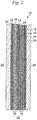
- Fig. 2 shows another form of a dimming laminate 10 including a dimming substrate unit 19 in which two dimming substrates 18 are laminated.
- the dimming laminate 10 shown in Fig. 2 includes: a dimming substrate unit 19 in which two dimming substrates 18 each having a dimming function material 16 provided between two first transparent substrates 12 and 14 are laminated; and a second transparent substrate 22 that is bonded through an adhesive layer 20 to one first transparent substrate 12 of the two first transparent substrates 12 and 14 located on an external side of the dimming substrate unit 19.
- Each of the first transparent substrates 12 and 14 has a different average thermal expansion coefficient at 50-350°C from that of the second transparent substrate 22.
- a third transparent substrate 26 is bonded through an adhesive layer 24 to the other first transparent substrate 14 of the two first transparent substrates 12 and 14 located on the external side of the dimming substrate unit 19, and an average thermal expansion coefficient at 50-350°C is equal between the third transparent substrate 26 and the second transparent substrate 22.
- the first transparent substrate 12 and the first transparent substrate 14 opposed to each other internally between the two dimming substrates 18 are bonded to each other through an adhesive layer 24.
- the number of dimming substrates 18 is not limited to two, but it may be three or more. When a plurality of dimming substrates 18 are provided, resolution for dimming control can be segmented.
- the second transparent substrate 22 functions as a plate for reinforcing the dimming substrates 18.
- Soda lime glass is used as the second transparent substrate 22.
- the soda lime glass is, for example, 1.0-12.0 mm thick.
- the soda lime glass may be not thinner than 2.0 mm, not thinner than 3.0 mm, or not thinner than 3.5 mm.
- the soda lime glass may be not thicker than 10.0 mm, not thicker than 8.0 mm, not thicker than 6.0 mm, or not thicker than 5.0 mm.
- the average thermal expansion coefficient at 50-350°C in the soda lime glass is preferably 60-100 ⁇ 10 -7 /°C.
- the average thermal expansion coefficient thereof at 50-350°C may be not lower than 70 ⁇ 10 -7 /°C, or not lower than 80 ⁇ 10 -7 /°C.
- the average thermal expansion coefficient thereof at 50-350°C may be not higher than 95 ⁇ 10 -7 /°C, or not higher than 90 ⁇ 10 -7 /°C.
- the average thermal expansion coefficient at 50-350°C is measured in a temperature range of 50-350°C by a differential thermal expansion meter (TMA) according to JIS R3102:1995.
- TMA differential thermal expansion meter
- a sheet-like member made of polyvinyl butyral (PVB), ethylene vinyl acetate copolymer (EVA), thermoplastic polyurethane (TPU), or the like can be used as the adhesive layer 20.
- the adhesive layer 20 is, for example, 0.1-2.0 mm thick.
- the adhesive layer 20 may be not thinner than 0.5 mm, or not thinner than 0.7 mm.
- the adhesive layer 20 may be not thicker than 1.5 mm.
- soda lime glass is used as the third transparent substrate 26.
- This soda lime glass is also, for example, 1.0-12.0 mm thick.
- the soda lime glass may be not thinner than 2.0 mm, not thinner than 3.0 mm, or not thinner than 3.5 mm.
- the soda lime glass may be not thicker than 10.0 mm, not thicker than 8.0 mm, not thicker than 6.0 mm, or not thicker than 5.0 mm.
- the average thermal expansion coefficient at 50-350°C in the third transparent substrate 26 is 60-100 ⁇ 10 -7 /°C.
- the average thermal expansion coefficient thereof at 50-350°C may be not lower than 70 ⁇ 10 -7 /°C, or not lower than 80 ⁇ 10 -7 /°C.
- the average thermal expansion coefficient thereof at 50-350°C may be not higher than 95 ⁇ 10 -7 /°C, or not higher than 90 ⁇ 10 -7 /°C.
- a sheet-like member made of polyvinyl butyral, ethylene vinyl acetate copolymer, thermoplastic polyurethane, or the like can be used as the adhesive layer 24.
- the adhesive layer 24 is also, for example, 0.1-2.0 mm thick.
- the first transparent substrate 14 of the dimming substrate 18 and the third transparent substrate 26 can be bonded to each other in an autoclaving step after preliminary press-bonding.
- the dimming laminate 10 according to the embodiment is manufactured.
- the manufacturing process of the dimming laminate 10 includes a preliminary press-bonding step prior to the autoclaving step.
- preliminary press-bonding is performed as follows. That is, the dimming laminate 10 in which bonding by the adhesive layers 20 and 24 has not been performed yet is put into a rubber bag, and the rubber bag is connected to a depressurization system so that the dimming laminate 10 can be kept at a heating temperature of 80-130°C for a predetermined time under an environment depressurized by several hundreds of mmHg.
- the air pressure inside the rubber bag is returned to the outside air pressure, and the autoclaving step is carried out.
- the dimming laminate 10 may be manufactured only by the preliminary press-bonding step using the rubber bag. Further, the dimming laminate 18 heated to 50-130°C may be passed between upper and lower nipper rolls to thereby apply pressure to the dimming laminate 18 and perform preliminary press-bonding thereon.
- EVA ethylene vinyl acetate copolymer
- the dimming laminate 10 thus configured according to the first embodiment, deformation caused by bonding in the preliminary press-bonding step or the autoclaving step (e.g. heating temperature: 120-150°C, pressure: 1-1.5 MPa, time: 10 minutes), that is, a warp of the dimming laminate 10 is controlled by the difference in thermal expansion coefficient between the second transparent substrate 22 and the third transparent substrate 26 disposed on the opposite sides of the dimming substrates 18.
- deformation caused by bonding in the preliminary press-bonding step or the autoclaving step e.g. heating temperature: 120-150°C, pressure: 1-1.5 MPa, time: 10 minutes
- the average thermal expansion coefficient at 50-350°C is equal between the second transparent substrate 22 and the third transparent substrate 26 disposed on the opposite sides, and hence the amount of thermal expansion is equal between the both.
- warpage in the dimming laminate 10 is suppressed.
- the dimming laminate 10 in the first embodiment warpage occurring during manufacturing can be reduced on a large scale because the dimming laminate 10 has a configuration in which the third transparent substrate 26 is laminated on the first transparent substrates 12 and 14 and the second transparent substrate 22 having different thermal expansion coefficients.
- a difference in thickness between the first transparent substrate 12 and the first transparent substrate 14 is not larger than 1 mm. Accordingly, warpage in the dimming laminate 10 is suppressed.
- the difference in thickness between the first transparent substrate 12 and the first transparent substrate 14 is more preferably not larger than 0.5 mm, or further more preferably not larger than 0.1 mm.
- a difference in thickness between the second transparent substrate 22 and the third transparent substrate 26 is preferably not larger than 1 mm. Accordingly, warpage in the dimming laminate 10 is suppressed.
- the difference in thickness between the second transparent substrate 22 and the third transparent substrate 26 is more preferably not larger than 0.5 mm, or further more preferably not larger than 0.1 mm
- the average thermal expansion coefficient at 50-350°C is equal between the second transparent substrate 22 and the third transparent substrate 26 disposed on the opposite sides, while the thermal expansion coefficient of each of the second transparent substrate 22 and the third transparent substrate 26 is larger than that of each of the first transparent substrates 12 and 14, and warpage in the dimming laminate 10 is suppressed.
- compressive stress occurs easily in each dimming substrate 18. It is therefore possible to suppress heat cracking in the dimming laminate 10 in use.
- the dimming laminate 10 according to the first embodiment may be applied to at least one glass plate of two glass plates constituting a multiple glass (see Fig. 5 ) as will be described later.
- the difference in average thermal expansion coefficient at 50-350°C between the second transparent substrate 22 and the third transparent substrate 26 is preferably not higher than 10 ⁇ 10 -7 /°C, more preferably not higher than 5 ⁇ 10 -7 /°C, further more preferably not higher than 2 ⁇ 10 -7 /°C, or especially preferably not higher than 1 ⁇ 10 -7 /°C.
- Fig. 3 is a main portion sectional view of a dimming laminate 30 according to a second embodiment.
- the dimming laminate 30 according to the second embodiment will be described as follows. That is, members the same as those in the dimming laminate 10 according to the first embodiment shown in Fig. 1 are referenced correspondingly, and their description will be omitted.
- the dimming laminate 30 includes: a single dimming substrate 18 in which a dimming function material 16 is provided between two first transparent substrates 12 and 14; and a second transparent substrate 22 that is bonded to one first transparent substrate 12 of the two first transparent substrates 12 and 14 of the dimming substrate 18 through an adhesive layer 20.
- Each of the first transparent substrates 12 and 14 has a different average thermal expansion coefficient at 50-350°C from that of the second transparent substrate 22.
- a third transparent substrate 32 is bonded to the second transparent substrate 22 through an adhesive layer 24, and an average thermal expansion coefficient at 50-350°C is equal between the third transparent substrate 32 and each of the first transparent substrates 12 and 14.
- Alkali free glass is used as the third transparent substrate 32 in the same manner as the first transparent substrates 12 and 14.
- the alkali free glass is, for example, 0.1-4.0 mm thick, but it is not limited thereto.
- the alkali free glass may be not thinner than 0.5 mm, not thinner than 0.8 mm, or not thinner than 1.0 mm.
- the alkali free glass may be not thicker than 1.7 mm, not thicker than 1.5 mm, or not thicker than 1.3 mm.
- the average thermal expansion coefficient at 50-350°C in the alkali free glass is preferably not higher than 50 ⁇ 10 -7 /°C, more preferably not higher than 45 ⁇ 10 -7 /°C, further more preferably not higher than 40 ⁇ 10 -7 /°C, especially preferably not higher than 38 ⁇ 10 -7 /°C.
- the average thermal expansion coefficient at 50-350°C in the alkali free glass may be not lower than 30 ⁇ 10 -7 /°C, not lower than 32 ⁇ 10 -7 /°C, or not lower than 35 ⁇ 10 -7 /°C.
- a warp of the dimming laminate 30 caused by thermal expansion is controlled by the difference in thermal expansion coefficient between each of the first transparent substrates 12 and 14 and the third transparent substrate 32 disposed on the opposite sides of the second transparent substrate 22.
- the average thermal expansion coefficient at 50-350°C is equal between each of the first transparent substrates 12 and 14 and the third transparent substrate 32 disposed on the opposite sides of the second transparent substrate 22, and hence the amount of thermal expansion is equal between the both.
- warpage in the dimming laminate 30 is suppressed.
- the dimming laminate 30 in the second embodiment warpage occurring during manufacturing can be reduced on a large scale because the dimming laminate 30 has a configuration in which the third transparent substrate 32 is laminated on the first transparent substrates 12 and 14 and the second transparent substrate 22 having different thermal expansion coefficients.
- a difference between the total thickness of the first transparent substrate 12 and the first transparent substrate 14 (total thickness of all the first transparent substrates 12 and the first transparent substrates 14 when two or more dimming substrates 18 are provided) and the thickness of the third transparent substrate 32 is preferably not larger than 1 mm, more preferably not larger than 0.5 mm, further more preferably not larger than 0.1 mm. Accordingly, warpage in the dimming laminate 30 is suppressed.
- the average thermal expansion coefficient at 50-350°C is equal between each of the first transparent substrates 12 and 14 and the third transparent substrate 32 disposed on the opposite sides of the second transparent substrate 22, while the thermal expansion coefficient of the second transparent substrate 22 is larger than that of each of the first transparent substrates 12 and 14 and the third transparent substrate 32, and the warpage in the dimming laminate 30 is suppressed.
- compressive stress occurs easily in the dimming substrate 18. It is therefore possible to suppress heat cracking in the dimming laminate 30 in use.
- first transparent substrates 12 and 14 and the third transparent substrate 32 equal in average thermal expansion coefficient at 50-350°C are used in the dimming laminate 30 according to the second embodiment, the present invention is not limited thereto. It will go well if the difference in average thermal expansion coefficient at 50-350°C between each of the first transparent substrates 12 and 14 and the third transparent substrate 32 is not higher than 10 ⁇ 10 -7 /°C.
- the difference in average thermal expansion coefficient at 50-350°C between each of the first transparent substrates 12 and 14 and the third transparent substrate 32 is not higher than 10 ⁇ 10 -7 /°C, it means that both the difference in average thermal expansion coefficient at 50-350°C between the first transparent substrate 12 and the third transparent substrate 32 and the difference in average thermal expansion coefficient at 50-350°C between the first transparent substrate 14 and the third transparent substrate 32 are not higher than 10 ⁇ 10 -7 /°C. In this manner, the warpage occurring in the dimming laminate 30 during manufacturing can be reduced so that a reflection image having no distortion can be obtained, as compared with the product according to Patent Document 1.
- the dimming laminate 30 according to the second embodiment may be applied to at least one glass plate of two glass plates constituting a multiple glass (see Fig. 6 ) as will be described later. Even in this case, warpage in the dimming laminate 30 can be reduced not to affect the heat insulating performance or heat shielding performance of the multiple glass, and defective adhesion in a seal material for suppressing moisture permeation to a hollow layer can be prevented.
- the difference in average thermal expansion coefficient at 50-350°C between each of the first transparent substrates 12 and 14 and the third transparent substrate 32 is more preferably not higher than 5 ⁇ 10 -7 /°C, further more preferably not higher than 2 ⁇ 10 -7 /°C, especially preferably not higher than 1 ⁇ 10 -7 /°C.
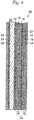
- Fig. 4 shows another form of a dimming laminate 30 including a dimming substrate unit 19 in which two dimming substrates 18 are laminated.
- the dimming laminate 30 shown in Fig. 4 includes: a dimming substrate unit 19 in which two dimming substrates 18 each having a dimming function material 16 provided between two first transparent substrates 12 and 14 are laminated; and a second transparent substrate 22 that is bonded through an adhesive layer 20 to one first transparent substrate 12 of the two first transparent substrates 12 and 14 located on an external side of the dimming substrate unit 19.
- Each of the first transparent substrates 12 and 14 has a different average thermal expansion coefficient at 50-350°C from that of the second transparent substrate 22.
- a third transparent substrate 32 is bonded to the second transparent substrate 22 through an adhesive layer 24, and an average thermal expansion coefficient at 50-350°C is equal between the third transparent substrate 32 and each of the first transparent substrates 12 and 14.
- Fig. 5 is a main portion sectional view of a multiple glass 40 to which the dimming laminate 10 according to the first embodiment has been applied.
- Fig. 6 is a main portion sectional view of a multiple glass 50 to which the dimming laminate 30 according to the second embodiment has been applied. Since the multiple glasses 40 and 50 shown in Figs. 5 and 6 have the same main portion configuration, description will be made using the same reference signs. The multiple glass 50 will be described with the signs in parentheses.
- the multiple glass 40 (50) includes the dimming laminate 10 (30) configured to be rectangular, a glass plate 42, and a spacer 44 having a frame-like shape.
- the dimming laminate 10 (30) and the glass plate 42 are placed at a distance from each other by the spacer 44 so as to form a hollow layer 46 between the dimming laminate 10 (30) and the glass plate 42.
- Opposite sides 44A of the spacer 44 are bonded to the dimming laminate 10 (30) and the glass plate 42 by primary seal materials 48 such as butyl based sealing materials, respectively.
- the third transparent substrate 26 of the dimming laminate 10 is bonded to the spacer 44 through the primary seal material 48.
- the first transparent substrate 14 of the dimming laminate 30 is bonded to the spacer 44 through the primary seal material 48.
- the third transparent substrate 32 may be bonded to the spacer 44 through the primary seal material 48.
- the form in Fig. 6 where the third transparent substrate 32 is disposed to face the outside is preferred in view of protection of the dimming substrate 18.
- a recess portion 43 at edge portion between the dimming laminate 10 (30) and the glass plate 42 is sealed with a secondary seal material 52 such as a silicone based sealing material, a polysulphide based sealing material, a polyurethane based sealing material, or a butyl based sealing material.
- a secondary seal material 52 such as a silicone based sealing material, a polysulphide based sealing material, a polyurethane based sealing material, or a butyl based sealing material.
- the spacer 44 is made of a hollow pipe material.
- a hollow portion 44B of the spacer 44 is filled with a drying material 54 such as zeolite.
- a through hole 44C through which the hollow portion 44B and the hollow layer 46 can communicate with each other is formed in the spacer 44 so that gas in the hollow layer 46 can be dried by the drying material 54.
- the hollow layer 46 may be filled with heat insulating gas (inert gas such as argon gas or krypton gas) as functional gas in advance. When the hollow layer 46 is filled with heat insulating gas in advance, the heat insulating performance of the multiple glass 40 (50) is improved.
- each of the glass plate 42 and the third transparent substrate 26 may be coated with a Low-E (Low Emissivity) film 56 as a low radiation film for improving the heat shielding performance or the heat insulating performance.
- the glass plate 42 may be made of so-called float glass manufactured by a float process.
- the glass plate 42 may be made of fireproof glass such as wired glass, or laminated glass.
- the dimming laminate 10 (30) When the dimming laminate 10 (30) is applied to at least one glass plate of the two glass plates constituting the multiple glass 40 (50), a dimming function can be provided for the multiple glass 40 (50).
- a dimming function can be provided for the multiple glass 40 (50).
- warpage in the dimming laminate 10 (30) itself is reduced, influence on the heat insulating performance or the heat shielding performance of the multiple glass 40 (50) can be prevented, and defective adhesion in the primary seal material 48 for suppressing moisture permeation to the hollow layer 46 can be also prevented.
- the glass plate 42 may be replaced by the dimming laminate 10 (30) in the multiple glass 40 (50).
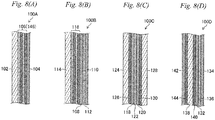
- the laminate 100A shown in Fig. 8(A) corresponds to each of laminates in Comparative Examples 1 and 2.
- the laminate 100A in each of Comparative Examples 1 and 2 is a laminate manufactured as follows. That is, a soda lime glass 102 having a thickness of 4 mm and an alkali free glass 104 having a thickness of 1.1 mm were laminated on each other through an adhesive layer 106 made of polyvinyl butyral (interlayer: PVB). Those glasses were heated and pressurized in an autoclaving chamber. Thus, the laminate 100A in each of Comparative Examples 1 and 2 was manufactured. The thicknesses of the adhesive layers 106 in Comparative Examples 1 and 2 are 0.76 mm and 3.05 mm respectively.
- the laminate 100B shown in Fig. 8(B) corresponds to a laminate in Comparative Example 3.
- the laminate 100B in Comparative Example 3 is a laminate manufactured as follows. That is, two alkali free glasses 108 and 110 each having a thickness of 1.1 mm were laminated on each other through an adhesive layer 112 made of polyvinyl butyral (interlayer: PVB) and having a thickness of 0.76 mm, and one alkali free glass 108 and a soda lime glass 114 having a thickness of 4 mm were laminated on each other through an adhesive layer 116 made of polyvinyl butyral (interlayer: PVB) and having a thickness of 3.05 mm. Those glasses were heated and pressurized in an autoclaving chamber. Thus, the laminate 100B in Comparative Example 3 was manufactured. Although the dimming function material 16 was absent, the laminate 100B in Comparative Example 3 was evaluated on the assumption that the adhesive layer 112 made of polyvinyl butyral was used in place of the dimming function material 16 and regarded as the dimming function material 16.
- the laminate 100C shown in Fig. 8(C) corresponds to a laminate in Example 1.
- the laminate 100C in Example 1 is a laminate manufactured as follows. That is, two alkali free glasses (two first transparent substrates) 118 and 120 each having a thickness of 1.1 mm were laminated on each other through an adhesive layer 122 made of polyvinyl butyral (interlayer: PVB) and having a thickness of 0.76 mm, and one alkali free glass 118 and a soda lime glass (second transparent substrate) 124 having a thickness of 4 mm were laminated on each other through an adhesive layer 126 made of polyvinyl butyral (interlayer: PVB) and having a thickness of 0.76 mm, while the other alkali free glass 120 and a soda lime glass (third transparent substrate) 128 having a thickness of 4 mm were laminated on each other through an adhesive layer 130 made of polyvinyl butyral (interlayer: PVB) and having a thickness of 0.76 mm.
- an adhesive layer 122 made of polyvinyl butyral (interlayer: PVB) and having a thickness of 0.76 mm
- the laminate 100C in Example 1 was manufactured. Although the dimming function material 16 is absent, the amount of warpage is substantially equivalent to that in the dimming laminate 10 according to the first embodiment. That is, the laminate 100C in Example 1 was evaluated on the assumption that the adhesive layer 122 made of polyvinyl butyral was used in place of the dimming function material 16 and regarded as the dimming function material 16.
- the laminate 100D shown in Fig. 8(D) corresponds to a laminate in Example 2.
- the laminate 100D in Example 2 is a laminate manufactured as follows. That is, two alkali free glasses (two first transparent substrates) 132 and 134 each having a thickness of 1.1 mm were laminated on each other through an adhesive layer 136 made of polyvinyl butyral (interlayer: PVB) and having a thickness of 0.76 mm, and one alkali free glass 132 and a soda lime glass (second transparent substrate) 138 having a thickness of 4 mm were laminated on each other through an adhesive layer 140 made of polyvinyl butyral (interlayer: PVB) and having a thickness of 0.76 mm, while the soda lime glass 138 and an alkali free glass (third transparent substrate) 142 having a thickness of 1.1 mm were laminated on each other through an adhesive layer 144 made of polyvinyl butyral (interlayer: PVB) and having a thickness of 0.76 mm.
- the laminate 100D in Example 2 was manufactured. Although the dimming function material 16 is absent, the amount of warpage is substantially equivalent to that in the dimming laminate 30 according to the second embodiment. That is, the laminate 100D in Example 2 was evaluated on the assumption that the adhesive layer 136 made of polyvinyl butyral was used in place of the dimming function material 16 and regarded as the dimming function material 16.
- the laminate 100A shown in Fig. 8(A) corresponds to a laminate in each of Comparative Examples 4, 5 and 6.
- the laminate 100A in each of Comparative Examples 4, 5 and 6 is a laminate manufactured as follows. That is, a soda lime glass 102 having a thickness of 4 mm and an alkali free glass 104 having a thickness of 1.1 mm were laminated on each other through an adhesive layer 146 made of ethylene vinyl acetate copolymer (inter layer: EVA). Those glasses were put into a rubber bag, and heated and depressurized therein. Thus, the laminate 100A in each of Comparative Examples 4, 5 and 6 was manufactured. The thicknesses of the adhesive layers 146 in Comparative Examples 4, 5 and 6 were 0.8, 2.0, and 3.2 mm respectively.
- the laminate 100C shown in Fig. 8(C) corresponds to a laminate in Example 3.
- the laminate 100C in Example 3 is a laminate manufactured as follows. That is, two alkali free glasses (two first transparent substrates) 118 and 120 each having a thickness of 1.1 mm were laminated on each other through an adhesive layer 122 made of ethylene vinyl acetate copolymer (inter layer: EVA) and having a thickness of 0.8 mm, and one alkali free glass 118 and a soda lime glass (second transparent substrate) 124 having a thickness of 4 mm were laminated on each other through an adhesive layer 126 made of ethylene vinyl acetate copolymer (inter layer: EVA) and having a thickness of 0.8 mm, while the other alkali free glass 120 and a soda lime glass (third transparent substrate) 128 having a thickness of 4 mm were laminated on each other through an adhesive layer 130 made of ethylene vinyl acetate copolymer (inter layer: EVA) and having a thickness of 0.8 mm.
- EVA ethylene vinyl acetate copolymer
- the laminate 100C in Example 3 was manufactured. Although the dimming function material 16 is absent, the amount of warpage is substantially equivalent to that in the dimming laminate 10 according to the first embodiment. That is, the laminate 100C in Example 3 was evaluated on the assumption that the adhesive layer 122 made of ethylene vinyl acetate copolymer was used in place of the dimming function material 16 and regarded as the dimming function material 16.
- the laminate 100D shown in Fig. 8(D) corresponds to a laminate in Example 4.
- the laminate 100D in Example 4 is a laminate manufactured as follows. That is, two alkali free glasses (two first transparent substrates) 132 and 134 each having a thickness of 1.1 mm were laminated on each other through an adhesive layer 136 made of ethylene vinyl acetate copolymer (inter layer: EVA) and having a thickness of 0.8 mm, and one alkali free glass 132 and a soda lime glass (second transparent substrate) 138 having a thickness of 4 mm were laminated on each other through an adhesive layer 140 made of ethylene vinyl acetate copolymer (inter layer: EVA) and having a thickness of 0.8 mm, while the soda lime glass 138 and an alkali free glass (third transparent substrate) 142 having a thickness of 1.1 mm were laminated on each other through an adhesive layer 144 made of ethylene vinyl acetate copolymer (inter layer: EVA) and having a thickness of 0.8 mm.
- EVA ethylene vinyl acetate copolymer
- the laminate 100D in Example 4 was manufactured. Although the dimming function material 16 is absent, the amount of warpage is substantially equivalent to that in the dimming laminate 30 according to the second embodiment. That is, the laminate 100D in Example 4 was evaluated on the assumption that the adhesive layer 136 made of ethylene vinyl acetate copolymer was used in place of the dimming function material 16 and regarded as the dimming function material 16.
- Figs. 9 are views for explaining places where a warp of each laminate 100A-100D was measured.
- Fig. 9(A) is a side view of the laminate 100A-100D
- Fig. 9(B) is a plan view of the laminate 100A-100D.
- each laminate 100A-100D has a rectangular shape with a long side a having a length of 1,335 mm and a short side b having a length of 825 mm.
- Measuring positions were set in positions along lines L connecting apexes C-D, apexes A-C, apexes A-B, apexes B-D, apexes B-C, and apexes A-D.
- an evaluation value to be satisfied was set as h ⁇ 3.0 mm in each examination when a warp amount at each position is h (mm). Further, the warp amount h (mm) in each laminate 100A-100D was measured by a measuring method according to JIS (Japanese Industrial Standard) R3205:2005.
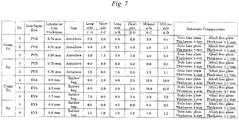
- the laminate 100A in Comparative Example 1 satisfied h ⁇ 3.0 mm at the measuring positions A-C (2.0 mm) and B-D (2.0 mm), but could not satisfy h ⁇ 3.0 mm at the other measuring positions.
- the laminate 100A in Comparative Example 2 satisfied h ⁇ 3.0 mm at the measuring positions A-C (1.0 mm), A-B (2.5 mm) and B-D (1.0 mm), but could not satisfy h ⁇ 3.0 mm at the other measuring positions.
- the laminate 100B in Comparative Example 3 satisfied h ⁇ 3.0 mm at the measuring positions A-C (1.5 mm), A-B (3.0 mm) and B-D (1.0 mm), but could not satisfy h ⁇ 3.0 mm at the other measuring positions.
- the laminate 100A in Comparative Example 4 satisfied h ⁇ 3.0 mm at the measuring positions A-C (2.0 mm) and B-D (2.5 mm), but could not satisfy h ⁇ 3.0 mm at the other measuring positions.
- the laminate 100A in Comparative Example 5 satisfied h ⁇ 3.0 mm at the measuring positions A-C (3.0 mm) and B-D (3.0 mm), but could not satisfy h ⁇ 3.0 mm at the other measuring positions.
- the laminate 100A in Comparative Example 6 satisfied h ⁇ 3.0 mm at the measuring positions A-C (0.5 mm) and B-D (1.0 mm), but could not satisfy h ⁇ 3.0 mm at the other measuring positions.
- the warp amount was zero at all the measuring positions in the laminate 100C in Example 1.
- the warp amount h (mm) was in a range of 0.5-1.5 mm at all the measuring positions in the laminate 100D in Example 2, satisfying h ⁇ 3.0 mm.
- the warp amount h (mm) was in a range of 0.0-0.5 mm at all the measuring positions in the laminate 100C in Example 3, satisfying h ⁇ 3.0 mm.
- the warp amount h (mm) was in a range of 1.0-1.5 mm at all the measuring positions in the laminate 100D in Example 4, satisfying h ⁇ 3.0 mm.
Landscapes
- Physics & Mathematics (AREA)
- Nonlinear Science (AREA)
- General Physics & Mathematics (AREA)
- Optics & Photonics (AREA)
- Engineering & Computer Science (AREA)
- Civil Engineering (AREA)
- Structural Engineering (AREA)
- Thermal Sciences (AREA)
- Joining Of Glass To Other Materials (AREA)
- Laminated Bodies (AREA)
- Securing Of Glass Panes Or The Like (AREA)
Applications Claiming Priority (2)
| Application Number | Priority Date | Filing Date | Title |
|---|---|---|---|
| JP2016114526 | 2016-06-08 | ||
| PCT/JP2017/021192 WO2017213191A1 (fr) | 2016-06-08 | 2017-06-07 | Stratifié gradateur de lumière et verre double |
Publications (2)
| Publication Number | Publication Date |
|---|---|
| EP3470383A1 true EP3470383A1 (fr) | 2019-04-17 |
| EP3470383A4 EP3470383A4 (fr) | 2020-02-19 |
Family
ID=60578638
Family Applications (1)
| Application Number | Title | Priority Date | Filing Date |
|---|---|---|---|
| EP17810365.1A Withdrawn EP3470383A4 (fr) | 2016-06-08 | 2017-06-07 | Stratifié gradateur de lumière et verre double |
Country Status (13)
| Country | Link |
|---|---|
| US (1) | US11119378B2 (fr) |
| EP (1) | EP3470383A4 (fr) |
| JP (1) | JP7183040B2 (fr) |
| CN (1) | CN109641792A (fr) |
| AU (1) | AU2017278767B2 (fr) |
| BR (1) | BR112018075349A2 (fr) |
| CA (1) | CA3026615A1 (fr) |
| EA (1) | EA038376B1 (fr) |
| MX (1) | MX2018015235A (fr) |
| PH (1) | PH12018502573A1 (fr) |
| SG (1) | SG11201810963WA (fr) |
| TW (1) | TW201802056A (fr) |
| WO (1) | WO2017213191A1 (fr) |
Families Citing this family (12)
| Publication number | Priority date | Publication date | Assignee | Title |
|---|---|---|---|---|
| US11872787B2 (en) * | 2016-11-09 | 2024-01-16 | Corning Incorporated | Dimmable window pane with reduced bow and insulated glazing unit comprising the same |
| JP7090280B2 (ja) * | 2018-04-13 | 2022-06-24 | Ykk Ap株式会社 | 日射遮蔽窓およびこれを備えた建物壁構造 |
| JP6887618B2 (ja) * | 2018-05-30 | 2021-06-16 | 日本電気硝子株式会社 | 調光機能付き積層体 |
| WO2020037185A1 (fr) * | 2018-08-17 | 2020-02-20 | Cardinal Ig Company | Structure de vitrage opaque dotée de décalages de vitre asymétriques pour configurations de connexion électrique |
| CN111231438A (zh) * | 2018-11-28 | 2020-06-05 | 华为技术有限公司 | 透明基板及其制备方法、电子设备 |
| KR20250084982A (ko) | 2019-02-07 | 2025-06-11 | 에이지씨 가부시키가이샤 | 무알칼리 유리 |
| CN113412244A (zh) | 2019-02-07 | 2021-09-17 | Agc株式会社 | 无碱玻璃 |
| TW202545844A (zh) | 2019-02-07 | 2025-12-01 | 日商Agc股份有限公司 | 無鹼玻璃 |
| KR102141856B1 (ko) | 2019-03-19 | 2020-08-07 | 에이지씨 가부시키가이샤 | 무알칼리 유리 기판 |
| CN211255711U (zh) * | 2019-12-13 | 2020-08-14 | 信义玻璃(营口)有限公司 | 防火夹层中空玻璃 |
| US20230415456A1 (en) * | 2020-11-30 | 2023-12-28 | Corning Incorporated | Glass polymer laminates with compressive top layer |
| US12332530B2 (en) * | 2021-06-29 | 2025-06-17 | Wicue Usa Inc. | Control system for dimmable film based on facial recognition |
Family Cites Families (12)
| Publication number | Priority date | Publication date | Assignee | Title |
|---|---|---|---|---|
| JPS63298224A (ja) * | 1987-05-28 | 1988-12-06 | Toyobo Co Ltd | エレクトロクロミック機能を有する合わせガラス |
| FR2666805B1 (fr) * | 1990-09-14 | 1992-10-30 | Saint Gobain Vitrage Int | Procede d'obtention de vitrages electrochromes. vitrages electrochromes. |
| JP3548434B2 (ja) * | 1998-09-14 | 2004-07-28 | 日本板硝子株式会社 | ガラスパネル |
| US20120037229A1 (en) | 2008-05-30 | 2012-02-16 | David Francis Dawson-Elli | Photovoltaic glass laminated articles and layered articles |
| US9782949B2 (en) | 2008-05-30 | 2017-10-10 | Corning Incorporated | Glass laminated articles and layered articles |
| ES2450520T5 (es) | 2010-03-05 | 2017-08-07 | Sage Electrochromics, Inc. | Laminado de un dispositivo electrocrómico a sustratos de vidrio |
| US20120192928A1 (en) * | 2011-01-27 | 2012-08-02 | Mark Francis Krol | Laminated pv module package |
| US20140127857A1 (en) * | 2012-11-07 | 2014-05-08 | Taiwan Semiconductor Manufacturing Company, Ltd. | Carrier Wafers, Methods of Manufacture Thereof, and Packaging Methods |
| JP6504753B2 (ja) | 2013-06-07 | 2019-04-24 | キヤノン株式会社 | エレクトロクロミック素子、その駆動方法、光学フィルタ、撮像装置、レンズユニットおよび窓材 |
| WO2015019925A1 (fr) * | 2013-08-05 | 2015-02-12 | 旭硝子株式会社 | Bi-verre |
| JP2017200856A (ja) * | 2014-09-17 | 2017-11-09 | 旭硝子株式会社 | 調光窓 |
| JP2016114526A (ja) | 2014-12-16 | 2016-06-23 | パナソニックIpマネジメント株式会社 | 物質検出センサ、測定光照射方法及び物質検出システム |
-
2017
- 2017-06-07 CA CA3026615A patent/CA3026615A1/fr not_active Abandoned
- 2017-06-07 SG SG11201810963WA patent/SG11201810963WA/en unknown
- 2017-06-07 CN CN201780035242.6A patent/CN109641792A/zh active Pending
- 2017-06-07 AU AU2017278767A patent/AU2017278767B2/en not_active Ceased
- 2017-06-07 MX MX2018015235A patent/MX2018015235A/es unknown
- 2017-06-07 BR BR112018075349-1A patent/BR112018075349A2/pt not_active Application Discontinuation
- 2017-06-07 EA EA201892565A patent/EA038376B1/ru unknown
- 2017-06-07 WO PCT/JP2017/021192 patent/WO2017213191A1/fr not_active Ceased
- 2017-06-07 EP EP17810365.1A patent/EP3470383A4/fr not_active Withdrawn
- 2017-06-07 JP JP2018521763A patent/JP7183040B2/ja active Active
- 2017-06-08 TW TW106119097A patent/TW201802056A/zh unknown
-
2018
- 2018-12-04 US US16/209,963 patent/US11119378B2/en not_active Expired - Fee Related
- 2018-12-06 PH PH12018502573A patent/PH12018502573A1/en unknown
Also Published As
| Publication number | Publication date |
|---|---|
| WO2017213191A1 (fr) | 2017-12-14 |
| CN109641792A (zh) | 2019-04-16 |
| MX2018015235A (es) | 2019-09-05 |
| US11119378B2 (en) | 2021-09-14 |
| JPWO2017213191A1 (ja) | 2019-07-11 |
| SG11201810963WA (en) | 2019-01-30 |
| AU2017278767A1 (en) | 2019-01-03 |
| PH12018502573A1 (en) | 2019-10-28 |
| EA038376B1 (ru) | 2021-08-18 |
| AU2017278767B2 (en) | 2021-04-29 |
| CA3026615A1 (fr) | 2017-12-14 |
| TW201802056A (zh) | 2018-01-16 |
| EA201892565A1 (ru) | 2019-05-31 |
| BR112018075349A2 (pt) | 2019-03-19 |
| EP3470383A4 (fr) | 2020-02-19 |
| US20190107762A1 (en) | 2019-04-11 |
| JP7183040B2 (ja) | 2022-12-05 |
Similar Documents
| Publication | Publication Date | Title |
|---|---|---|
| US11119378B2 (en) | Dimming laminate and multiple glass | |
| JP7574353B2 (ja) | 反りの少ない調光可能な窓ガラスおよびそれを含む断熱ガラスユニット | |
| CN105473526B (zh) | 多层玻璃 | |
| KR101731121B1 (ko) | 유리 라미네이트 제품 및 층상 제품 | |
| EP2583135B1 (fr) | Vitrage feuilleté avec une coloration réduite en reflection | |
| EP3102978B1 (fr) | Dispositif de régulation de la transmission de lumière | |
| US11007753B2 (en) | Laminate including panels and a fill material between the panels | |
| JP2017218349A (ja) | 調光積層体、及び複層ガラス | |
| US20240278538A1 (en) | Glass pane for use in architectural glazing, pane laminates and their use | |
| WO2026014287A1 (fr) | Verre feuilleté | |
| CN110894140A (zh) | 一种形成绝缘抗冲击复合材料的方法 |
Legal Events
| Date | Code | Title | Description |
|---|---|---|---|
| STAA | Information on the status of an ep patent application or granted ep patent |
Free format text: STATUS: THE INTERNATIONAL PUBLICATION HAS BEEN MADE |
|
| PUAI | Public reference made under article 153(3) epc to a published international application that has entered the european phase |
Free format text: ORIGINAL CODE: 0009012 |
|
| STAA | Information on the status of an ep patent application or granted ep patent |
Free format text: STATUS: REQUEST FOR EXAMINATION WAS MADE |
|
| 17P | Request for examination filed |
Effective date: 20181206 |
|
| AK | Designated contracting states |
Kind code of ref document: A1 Designated state(s): AL AT BE BG CH CY CZ DE DK EE ES FI FR GB GR HR HU IE IS IT LI LT LU LV MC MK MT NL NO PL PT RO RS SE SI SK SM TR |
|
| AX | Request for extension of the european patent |
Extension state: BA ME |
|
| DAV | Request for validation of the european patent (deleted) | ||
| DAX | Request for extension of the european patent (deleted) | ||
| A4 | Supplementary search report drawn up and despatched |
Effective date: 20200121 |
|
| RIC1 | Information provided on ipc code assigned before grant |
Ipc: E06B 5/00 20060101ALI20200115BHEP Ipc: G02F 1/15 20190101ALI20200115BHEP Ipc: B32B 17/06 20060101ALI20200115BHEP Ipc: E06B 3/66 20060101ALI20200115BHEP Ipc: B32B 17/10 20060101ALI20200115BHEP Ipc: B32B 7/02 20190101ALI20200115BHEP Ipc: C03C 27/12 20060101AFI20200115BHEP |
|
| STAA | Information on the status of an ep patent application or granted ep patent |
Free format text: STATUS: EXAMINATION IS IN PROGRESS |
|
| 17Q | First examination report despatched |
Effective date: 20210917 |
|
| GRAP | Despatch of communication of intention to grant a patent |
Free format text: ORIGINAL CODE: EPIDOSNIGR1 |
|
| STAA | Information on the status of an ep patent application or granted ep patent |
Free format text: STATUS: GRANT OF PATENT IS INTENDED |
|
| INTG | Intention to grant announced |
Effective date: 20230613 |
|
| STAA | Information on the status of an ep patent application or granted ep patent |
Free format text: STATUS: THE APPLICATION IS DEEMED TO BE WITHDRAWN |
|
| 18D | Application deemed to be withdrawn |
Effective date: 20231024 |