EP3472165B1 - N-(substituiertes phenyl)-sulfonamidderivate als kinaseinhibitoren - Google Patents
N-(substituiertes phenyl)-sulfonamidderivate als kinaseinhibitoren Download PDFInfo
- Publication number
- EP3472165B1 EP3472165B1 EP17732075.1A EP17732075A EP3472165B1 EP 3472165 B1 EP3472165 B1 EP 3472165B1 EP 17732075 A EP17732075 A EP 17732075A EP 3472165 B1 EP3472165 B1 EP 3472165B1
- Authority
- EP
- European Patent Office
- Prior art keywords
- fluoro
- formula
- pyrimidin
- phenyl
- compound
- Prior art date
- Legal status (The legal status is an assumption and is not a legal conclusion. Google has not performed a legal analysis and makes no representation as to the accuracy of the status listed.)
- Active
Links
Classifications
-
- A—HUMAN NECESSITIES
- A61—MEDICAL OR VETERINARY SCIENCE; HYGIENE
- A61K—PREPARATIONS FOR MEDICAL, DENTAL OR TOILETRY PURPOSES
- A61K31/00—Medicinal preparations containing organic active ingredients
- A61K31/33—Heterocyclic compounds
- A61K31/395—Heterocyclic compounds having nitrogen as a ring hetero atom, e.g. guanethidine or rifamycins
- A61K31/435—Heterocyclic compounds having nitrogen as a ring hetero atom, e.g. guanethidine or rifamycins having six-membered rings with one nitrogen as the only ring hetero atom
- A61K31/4353—Heterocyclic compounds having nitrogen as a ring hetero atom, e.g. guanethidine or rifamycins having six-membered rings with one nitrogen as the only ring hetero atom ortho- or peri-condensed with heterocyclic ring systems
- A61K31/4355—Heterocyclic compounds having nitrogen as a ring hetero atom, e.g. guanethidine or rifamycins having six-membered rings with one nitrogen as the only ring hetero atom ortho- or peri-condensed with heterocyclic ring systems the heterocyclic ring system containing a five-membered ring having oxygen as a ring hetero atom
-
- C—CHEMISTRY; METALLURGY
- C07—ORGANIC CHEMISTRY
- C07D—HETEROCYCLIC COMPOUNDS
- C07D487/00—Heterocyclic compounds containing nitrogen atoms as the only ring hetero atoms in the condensed system, not provided for by groups C07D451/00 - C07D477/00
- C07D487/02—Heterocyclic compounds containing nitrogen atoms as the only ring hetero atoms in the condensed system, not provided for by groups C07D451/00 - C07D477/00 in which the condensed system contains two hetero rings
- C07D487/04—Ortho-condensed systems
-
- A—HUMAN NECESSITIES
- A61—MEDICAL OR VETERINARY SCIENCE; HYGIENE
- A61K—PREPARATIONS FOR MEDICAL, DENTAL OR TOILETRY PURPOSES
- A61K31/00—Medicinal preparations containing organic active ingredients
- A61K31/33—Heterocyclic compounds
- A61K31/395—Heterocyclic compounds having nitrogen as a ring hetero atom, e.g. guanethidine or rifamycins
- A61K31/495—Heterocyclic compounds having nitrogen as a ring hetero atom, e.g. guanethidine or rifamycins having six-membered rings with two or more nitrogen atoms as the only ring heteroatoms, e.g. piperazine or tetrazines
- A61K31/505—Pyrimidines; Hydrogenated pyrimidines, e.g. trimethoprim
- A61K31/519—Pyrimidines; Hydrogenated pyrimidines, e.g. trimethoprim ortho- or peri-condensed with heterocyclic rings
-
- A—HUMAN NECESSITIES
- A61—MEDICAL OR VETERINARY SCIENCE; HYGIENE
- A61K—PREPARATIONS FOR MEDICAL, DENTAL OR TOILETRY PURPOSES
- A61K31/00—Medicinal preparations containing organic active ingredients
- A61K31/33—Heterocyclic compounds
- A61K31/395—Heterocyclic compounds having nitrogen as a ring hetero atom, e.g. guanethidine or rifamycins
- A61K31/435—Heterocyclic compounds having nitrogen as a ring hetero atom, e.g. guanethidine or rifamycins having six-membered rings with one nitrogen as the only ring hetero atom
- A61K31/4353—Heterocyclic compounds having nitrogen as a ring hetero atom, e.g. guanethidine or rifamycins having six-membered rings with one nitrogen as the only ring hetero atom ortho- or peri-condensed with heterocyclic ring systems
- A61K31/4365—Heterocyclic compounds having nitrogen as a ring hetero atom, e.g. guanethidine or rifamycins having six-membered rings with one nitrogen as the only ring hetero atom ortho- or peri-condensed with heterocyclic ring systems the heterocyclic ring system having sulfur as a ring hetero atom, e.g. ticlopidine
-
- A—HUMAN NECESSITIES
- A61—MEDICAL OR VETERINARY SCIENCE; HYGIENE
- A61P—SPECIFIC THERAPEUTIC ACTIVITY OF CHEMICAL COMPOUNDS OR MEDICINAL PREPARATIONS
- A61P25/00—Drugs for disorders of the nervous system
- A61P25/28—Drugs for disorders of the nervous system for treating neurodegenerative disorders of the central nervous system, e.g. nootropic agents, cognition enhancers, drugs for treating Alzheimer's disease or other forms of dementia
-
- A—HUMAN NECESSITIES
- A61—MEDICAL OR VETERINARY SCIENCE; HYGIENE
- A61P—SPECIFIC THERAPEUTIC ACTIVITY OF CHEMICAL COMPOUNDS OR MEDICINAL PREPARATIONS
- A61P31/00—Antiinfectives, i.e. antibiotics, antiseptics, chemotherapeutics
- A61P31/12—Antivirals
- A61P31/14—Antivirals for RNA viruses
- A61P31/18—Antivirals for RNA viruses for HIV
-
- A—HUMAN NECESSITIES
- A61—MEDICAL OR VETERINARY SCIENCE; HYGIENE
- A61P—SPECIFIC THERAPEUTIC ACTIVITY OF CHEMICAL COMPOUNDS OR MEDICINAL PREPARATIONS
- A61P35/00—Antineoplastic agents
-
- A—HUMAN NECESSITIES
- A61—MEDICAL OR VETERINARY SCIENCE; HYGIENE
- A61P—SPECIFIC THERAPEUTIC ACTIVITY OF CHEMICAL COMPOUNDS OR MEDICINAL PREPARATIONS
- A61P37/00—Drugs for immunological or allergic disorders
-
- C—CHEMISTRY; METALLURGY
- C07—ORGANIC CHEMISTRY
- C07D—HETEROCYCLIC COMPOUNDS
- C07D491/00—Heterocyclic compounds containing in the condensed ring system both one or more rings having oxygen atoms as the only ring hetero atoms and one or more rings having nitrogen atoms as the only ring hetero atoms, not provided for by groups C07D451/00 - C07D459/00, C07D463/00, C07D477/00 or C07D489/00
- C07D491/02—Heterocyclic compounds containing in the condensed ring system both one or more rings having oxygen atoms as the only ring hetero atoms and one or more rings having nitrogen atoms as the only ring hetero atoms, not provided for by groups C07D451/00 - C07D459/00, C07D463/00, C07D477/00 or C07D489/00 in which the condensed system contains two hetero rings
- C07D491/04—Ortho-condensed systems
- C07D491/044—Ortho-condensed systems with only one oxygen atom as ring hetero atom in the oxygen-containing ring
- C07D491/048—Ortho-condensed systems with only one oxygen atom as ring hetero atom in the oxygen-containing ring the oxygen-containing ring being five-membered
-
- C—CHEMISTRY; METALLURGY
- C07—ORGANIC CHEMISTRY
- C07D—HETEROCYCLIC COMPOUNDS
- C07D495/00—Heterocyclic compounds containing in the condensed system at least one hetero ring having sulfur atoms as the only ring hetero atoms
- C07D495/02—Heterocyclic compounds containing in the condensed system at least one hetero ring having sulfur atoms as the only ring hetero atoms in which the condensed system contains two hetero rings
- C07D495/04—Ortho-condensed systems
-
- C—CHEMISTRY; METALLURGY
- C07—ORGANIC CHEMISTRY
- C07D—HETEROCYCLIC COMPOUNDS
- C07D513/00—Heterocyclic compounds containing in the condensed system at least one hetero ring having nitrogen and sulfur atoms as the only ring hetero atoms, not provided for in groups C07D463/00, C07D477/00 or C07D499/00 - C07D507/00
- C07D513/02—Heterocyclic compounds containing in the condensed system at least one hetero ring having nitrogen and sulfur atoms as the only ring hetero atoms, not provided for in groups C07D463/00, C07D477/00 or C07D499/00 - C07D507/00 in which the condensed system contains two hetero rings
- C07D513/04—Ortho-condensed systems
Definitions
- the invention relates to N-(substituted-phenyl)-sulfonamide compounds, which are extremely useful as inhibitors of protein kinases (e.g. PERK kinase) and accordingly can be used for the treatment of cell proliferative disorders, such as cancer, or diseases associated with activated unfolded protein response pathways, such as Alzheimer's disease.
- protein kinases e.g. PERK kinase
- the present invention also provides methods for preparing these compounds, pharmaceutical compositions comprising these compounds, and methods of treating diseases utilizing pharmaceutical compositions comprising these compounds.
- the endoplasmic reticulum (ER) represents the main subcellular compartment involved in folding and maturation of proteins destined for organelles and the extracellular space.
- ER endoplasmic reticulum
- the UPR is typically associated to the maintenance of cellular homeostasis in specialized secretory cells, such as pancreatic ⁇ cells, salivary glands and plasma B cells, where the high demand for protein synthesis and secretion requires an efficient and tightly controlled protein homeostasis.
- specialized secretory cells such as pancreatic ⁇ cells, salivary glands and plasma B cells
- UPR is involved in many other physiological processes, including lipid and cholesterol metabolism, energy control, inflammation and cell differentiation ( Wang M. and Kaufman R. J., Nat Rev Cancer. 2014 (9):581-97 ).
- the large number of activities mediated by UPR reflects in the role of ER stress in the progression of diseases such as cancer, neurodegenerative disorders and diabetes.
- inositol-requiring enzyme 1 ⁇ IRE1 or ERN1, both ⁇ and ⁇ isoforms
- activating transcription factor 6 ATF6; both ⁇ and ⁇ isoforms
- protein kinase RNA-like ER kinase PERK or EIF2AK3
- IRE1 ⁇ Dimerization and autophosphorylation of IRE1 ⁇ implies a conformational change that activates its RNase activity resulting in the excision of a 26-nucleotide intron of the mRNA that encodes the transcription factor X-box binding protein 1 (XBP1).
- XBP1s transcription factor X-box binding protein 1
- ESD ER-associated protein degradation
- protein translocation to the ER and protein secretion
- ATF6 ⁇ is a transmembrane protein located in the ER, which upon ER stress, translocates to the Golgi complex where it is processed releasing a cytosolic fragment, ATF6f.
- This is a transcription factor that regulates the expression of genes of the ERAD pathway (Haze, K., Yoshida, H., Yanagi, H., Yura, T. & Mori, K., Mol. Biol. Cell
- the activation of PERK, as that of IRE1 involves dimerization, trans-autophosphorylation and the formation of large clusters.
- PERK phosphorylates eukaryotic translation initiator factor 2 ⁇ (eIF2 ⁇ ), which leads to the inhibition of protein synthesis, thus reducing the number of nascent proteins that enter the ER.
- eIF2 ⁇ eukaryotic translation initiator factor 2 ⁇
- This has an important pro-survival effect on the cell per se , but, in addition, it also allows the translation of mRNAs such as that of the activating transcription factor 4 (ATF4), which controls the expression of genes that encode proteins involved in redox processes and amino acid metabolism.
- ATF4 activating transcription factor 4
- ATF4 also regulates the expression of important genes involved in apoptosis, including the transcription factor C/EBP-homologous protein (CHOP) and growth arrest and DNA damage-inducible 34 (GADD34), which participates in a feedback loop to dephosphorylate eIF2 ⁇ , restoring protein synthesis.
- C/EBP-homologous protein CHOP
- GADD34 growth arrest and DNA damage-inducible 34
- Tumor cells are likely to be dependent on active UPR signaling, as during their growth they are often hypoxic and deprived of nutrient due to insufficient blood supply and abnormal blood vessel function ( Rzymski T. and Harris A. L., Clin. Cancer Res. 2007, 13(9): 2537-2540 ). In fact, activation of the UPR has been observed in clinical specimens.
- Human tumors including those derived from cervical carcinomas, glioblastomas ( Bi M., Naczki C., Koritzinsky M., Fels D., Blais J., Hu N., Harding H., Novoa I., Varia M., Raleigh J., et al., EMBO J.
- ocular diseases such as ocular diseases, obesity, diabetes (e.g. type 1 diabetes), stroke, myocardial infarction, cardiovascular disease, atherosclerosis, arrhythmias, viral infections, inflammatory diseases, neurodegenerative diseases (such as prion-related diseases, amyotrophic lateral sclerosis, Alzheimer's, Huntington's and Parkinson's disease), and the like.
- neurodegenerative diseases such as prion-related diseases, amyotrophic lateral sclerosis, Alzheimer's, Huntington's and Parkinson's disease
- inhibition of the UPR with small molecules capable of blocking the activity of PERK and other components of the UPR will result in an anticancer effect, as well as in the possibility to treat diseases where there is an activated unfolded protein response.
- Three examples of classes of compounds inhibitors of PERK are represented by the substituted indoline derivatives disclosed in application WO2011/119663 and the substituted pyrrolidinone derivatives disclosed in application WO2015/136463 , both in the name of Glaxosmithkline LLC, and the substituted quinazolamine derivatives disclosed in application WO2014/161808 in the name of Janssen Pharmaceutica NV.
- Novel classes of pyrrolo[2,3d]pyrimidines and 4-aminopyrrolopyrimidines, useful as serine/threonine or tyrosine kinase inhibitors, are respectively disclosed in WO98/41525 in the name of Knoll AG and WO00/17202 in the name of Basf AG.
- kinase inhibitors represented by fused ring heteroaryl compounds are described in WO2010/045542 in the name of The Regents of the University of California.
- references in the description to methods of treatment refer to the compounds, pharmaceutical compositions and medicaments of the present invention for use in a method for treatment of the human (or animal) body by therapy (or for diagnosis).
- a first object of the present invention is to provide an N-(substituted-phenyl)-sulfonamide represented by formula (I), wherein:
- the present invention also provides methods of preparing the N-(substituted-phenyl)-sulfonamide compounds represented by formula (I), prepared through a process consisting of standard synthetic transformations.
- the present invention also provides a method for treating diseases caused by and/or associated with dysregulated protein kinase activity, selected from the group consisting of cancer, cell proliferative disorders, viral infections, autoimmune and neurodegenerative disorders, which comprises administering to a mammal, in need thereof, an effective amount of an N-(substituted-phenyl)-sulfonamide compound represented by formula (I) as defined above.
- Another preferred method of the present invention is to treat specific types of cancer including but not limited to: carcinoma, including bladder, breast, colon, kidney, liver, lung, including small cell lung cancer, esophagus, gall-bladder, ovary, pancreas, stomach, cervix, thyroid, prostate, and skin, including squamous cell carcinoma; hematopoietic tumors of lymphoid lineage including leukaemia, acute lymphocitic leukaemia, acute lymphoblastic leukaemia, B-cell lymphoma, T-cell-lymphoma, Hodgkin's lymphoma, non-Hodgkin's lymphoma, hairy cell lymphoma and Burkett's lymphoma; hematopoietic tumors of myeloid lineage, including acute and chronic myelogenous leukemias, myelodysplastic syndrome and promyelocytic leukaemia; tumors of mesenchymal origin, including fibrosarcoma and
- the method of the present invention provides tumor angiogenesis and metastasis inhibition as well as the treatment of organ transplant rejection and host versus graft disease.
- Another preferred method of the present invention is to treat specific cellular proliferative disorders such as, for example, benign prostate hyperplasia, familial adenomatosis polyposis, neurofibromatosis, psoriasis, vascular smooth cell proliferation associated with atherosclerosis, pulmonary fibrosis, arthritis, glomerulonephritis and post-surgical stenosis and restenosis.
- specific cellular proliferative disorders such as, for example, benign prostate hyperplasia, familial adenomatosis polyposis, neurofibromatosis, psoriasis, vascular smooth cell proliferation associated with atherosclerosis, pulmonary fibrosis, arthritis, glomerulonephritis and post-surgical stenosis and restenosis.
- Another preferred method of the present invention is to treat viral infections, in particular the prevention of AIDS development in HIV-infected individuals.
- Another preferred method of the present invention is to treat autoimmune and neurodegenerative diseases, in particular transplant rejection, skin disorders including psoriasis, allergies, asthma, rheumatoid arthritis (RA), multiple sclerosis, systemic lupus erythematosus (SLE), Crohn's disease, prion-related diseases, Alzheimer's disease, degenerative nerve diseases, encephalitis, stroke, Parkinson's disease, amyotrophic lateral sclerosis, Huntington's disease and Pick's disease.
- skin disorders including psoriasis, allergies, asthma, rheumatoid arthritis (RA), multiple sclerosis, systemic lupus erythematosus (SLE), Crohn's disease, prion-related diseases, Alzheimer's disease, degenerative nerve diseases, encephalitis, stroke, Parkinson's disease, amyotrophic lateral sclerosis, Huntington's disease and Pick's disease.
- Another preferred method of the present invention is to treat Alzheimer's disease, which comprises administering to a subject in need thereof an effective amount of a compound of Formula (I).
- Another preferred method of the present invention is to treat stroke, which comprises administering to a subject in need thereof an effective amount of a compound of Formula (I).
- Another preferred method of the present invention is to treat Type 1 diabetes, which comprises administering to a subject in need thereof an effective amount of a compound of Formula (I).
- Another preferred method of the present invention is to treat a disease state selected from: myocardial infarction, cardiovascular disease, atherosclerosis, arrhythmias, obesity, ocular diseases and inflammatory diseases, which comprises administering to a subject in need thereof an effective amount of a compound of Formula (I).
- the method of the present invention further comprises subjecting the mammal in need thereof to a radiation therapy or chemotherapy regimen in combination with at least one cytostatic or cytotoxic agent.
- the present invention also provides a pharmaceutical composition
- a pharmaceutical composition comprising one or more compounds of formula (I) or a pharmaceutically acceptable salt thereof, as defined above, and at least one pharmaceutically acceptable excipient, carrier or diluent.
- the present invention further provides a pharmaceutical composition
- a pharmaceutical composition comprising a compound of formula (I) further comprising one or more chemotherapeutic - e.g. cytostatic or cytotoxic - agents, antibiotic-type agents, alkylating agents, antimetabolite agents, hormonal agents, immunological agents, interferon-type agents, cyclooxygenase inhibitors (e.g. COX-2 inhibitors), matrixmetalloprotease inhibitors, telomerase inhibitors, tyrosine kinase inhibitors, anti-growth factor receptor agents, anti-HER agents, anti-EGFR agents, anti-angiogenesis agents (e.g.
- chemotherapeutic e.g. cytostatic or cytotoxic - agents, antibiotic-type agents, alkylating agents, antimetabolite agents, hormonal agents, immunological agents, interferon-type agents, cyclooxygenase inhibitors (e.g. COX-2 inhibitors), matrixmetalloprotease inhibitors, telomerase inhibitors
- angiogenesis inhibitors farnesyl transferase inhibitors, ras-raf signal transduction pathway inhibitors, cell cycle inhibitors, cdks inhibitors, tubulin binding agents, topoisomerase I inhibitors, topoisomerase II inhibitors, and the like.
- the invention provides an in vitro method for inhibiting the protein kinase RNA-like ER kinase (PERK or EIF2AK3) activity which comprises contacting the said protein with an effective amount of a compound of formula (I) as defined above.
- PERK or EIF2AK3 protein kinase RNA-like ER kinase
- the invention provides a product comprising a compound of formula (I) or a pharmaceutically acceptable salt thereof, as defined above, and one or more chemotherapeutic agents, as a combined preparation for simultaneous, separate or sequential use in anticancer therapy.
- the invention provides a compound of formula (I) or a pharmaceutically acceptable salt thereof, as defined above, for use as a medicament.
- the invention provides a compound of formula (I) or a pharmaceutically acceptable salt thereof, as defined above, for use in a method of treating cancer.
- the invention provides the use of a compound of formula (I) or a pharmaceutically acceptable salt thereof, as defined above, in the manufacture of a medicament with anticancer activity.
- the present invention includes all of the hydrates, solvates, N-oxides and pharmaceutically acceptable salts of the compounds of this invention.
- N-oxides are compounds of formula (I) wherein nitrogen and oxigen are tethered through a dative bond.
- a chiral center or another form of an isomeric center is present in a compound of the present invention, all forms of such isomer or isomers, including enantiomers and diastereomers, are intended to be covered herein.
- Compounds containing a chiral center may be used as a racemic mixture, an enantiomerically enriched mixture, or the racemic mixture may be separated using well-known techniques and an individual enantiomer may be used alone. In cases in which compounds have unsaturated carbon-carbon double bonds, both the cis (Z) and trans (E) isomers are within the scope of this invention.
- each form is contemplated as being included within this invention whether existing in equilibrium or predominantly in one form.
- each tautomeric form is contemplated as being included within this invention whether existing in equilibrium or predominantly in one form.
- straight or branched (C 1 -C 8 ) alkyl we intend any of the groups such as, for instance, methyl, ethyl, n-propyl, isopropyl, n-butyl, isobutyl, tert-butyl, sec-butyl, n-pentyl, n-hexyl, and the like.
- (C 3 -C 8 ) cycloalkyl we intend, unless otherwise provided, 3- to 8-membered all-carbon monocyclic ring, which may contain one or more double bonds but does not have a completely conjugated ⁇ -etectron system.
- cycloalkyl groups without limitation, are cyclopropane, cyclobutane, cyclopentane, cyclopentene, cyclohexane, cyclohexene and cyclohexadiene.
- heterocyclyl we intend a 3- to 7-membered, saturated or partially unsaturated carbocyclic ring where one or more carbon atoms are replaced by heteroatoms such as nitrogen, oxygen and sulfur.
- heterocyclyl groups are, for instance, pyrane, pyrrolidine, pyrroline, imidazoline, imidazolidine, pyrazolidine, pyrazoline, thiazoline, thiazolidine, dihydrofuran, tetrahydrofuran, 1,3-dioxolane, piperidine, piperazine, morpholine and the like.
- the heterocyclyl ring can be optionally further fused or linked to aromatic and non-aromatic carbocyclic and heterocyclic rings.
- aryl refers to a mono-, bi- or poly-carbocyclic hydrocarbon with from 1 to 4 ring systems, optionally further fused or linked to each other by single bonds, wherein at least one of the carbocyclic rings is "aromatic", wherein the term “aromatic” refers to completely conjugated ⁇ -etectron bond system.
- aryl groups are phenyl, ⁇ - or ⁇ -naphthyl or biphenyl groups.
- heteroaryl refers to aromatic heterocyclic rings, typically 5- to 7-membered heterocycles with from 1 to 3 heteroatoms selected among N, O or S; the heteroaryl ring can be optionally further fused or linked to aromatic and non-aromatic carbocyclic and heterocyclic rings.
- heteroaryl groups are, for instance, pyridyl, pyrazinyl, pyrimidinyl, pyridazinyl, indolyl, imidazolyl, thiazolyl, isothiazolyl, pyrrolyl, phenyl-pyrrolyl, furyl, phenyl-furyl, oxazolyl, isoxazolyl, pyrazolyl, thienyl, benzothienyl, isoindolinyl, benzoimidazolyl, quinolinyl, isoquinolinyl, 1,2,3-triazolyl, 1-phenyl-1,2,3-triazolyl, 2,3-dihydroindolyl, 2,3-dihydrobenzofuranyl, 2,3-dihydrobenzothiophenyl, benzopyranyl, 2,3-dihydrobenzoxazinyl, 2,3-dihydroquinox
- halogen atom we intend a fluorine, chlorine, bromine or iodine atom.
- polyfluorinated alkyl or polyfluorinated alkoxy we intend any of the above straight or branched (C 1 -C 8 ) alkyl or alkoxy groups which are substituted by more than one fluorine atom such as, for instance, trifluoromethyl, trifluoroethyl, 1,1,1,3,3,3-hexafluoropropyl, trifluoromethoxy and the like.
- any group which name is a composite name such as, for instance, arylamino has to be intended as conventionally construed by the parts from which it derives, e.g. by an amino group which is further substituted by aryl, wherein aryl is as above defined.
- any of the terms such as, for instance, alkylthio, alkylamino, dialkylamino, alkoxycarbonyl, alkoxycarbonylamino, heterocyclylcarbonyl, heterocyclylcarbonylamino, cycloalkyloxycarbonyl and the like, include groups wherein the alkyl, alkoxy, aryl, cycloalkyl and heterocyclyl moieties are as above defined.
- Pharmaceutically acceptable salts of the compounds of formula (I) include the acid addition salts with inorganic or organic acids, e.g., nitric, hydrochloric, hydrobromic, sulfuric, perchloric, phosphoric, acetic, trifluoroacetic, propionic, glycolic, lactic, oxalic, malonic, malic, maleic, tartaric, citric, benzoic, cinnamic, mandelic, methanesulphonic, isethionic and salicylic acid.
- inorganic or organic acids e.g., nitric, hydrochloric, hydrobromic, sulfuric, perchloric, phosphoric, acetic, trifluoroacetic, propionic, glycolic, lactic, oxalic, malonic, malic, maleic, tartaric, citric, benzoic, cinnamic, mandelic, methanesulphonic, isethionic and salicylic acid.
- Pharmaceutically acceptable salts of the compounds of formula (I) also include the salts with inorganic or organic bases, e.g., alkali or alkaline-earth metals, especially sodium, potassium, calcium ammonium or magnesium hydroxides, carbonates or bicarbonates, acyclic or cyclic amines.
- inorganic or organic bases e.g., alkali or alkaline-earth metals, especially sodium, potassium, calcium ammonium or magnesium hydroxides, carbonates or bicarbonates, acyclic or cyclic amines.
- object of the present invention are compounds of formula (I) wherein R1 is an optionally substituted group selected from aryl and heteroaryl; R2 is halogen or (C 1 -C 8 ) alkyl; A is S or NR5 and E 1 , E 2 and R5 are as defined above.
- object of the present invention are compounds of formula (I) wherein R1 is an optionally substituted aryl or heteroaryl; R2 is halogen; A is NR5 and E 1 , E 2 and R5 are as defined above.
- object of the present invention are compounds of formula (I) wherein R1 is an optionally substituted aryl; R2 is halogen; E 1 is N; E 2 is CH; A is NR5, wherein R5 is straight or branched (C 1 -C 8 ) alkyl as defined above.
- the present invention also provides a process for the preparation of a compound of formula (I) as defined above, by using the reaction routes and synthetic schemes described below, employing the techniques available in the art and starting materials readily available.
- the preparation of certain embodiments of the present invention is described in the examples that follow, but those of ordinary skill in the art will recognize that the preparations described may be readily adapted to prepare other embodiments of the present invention.
- the synthesis on non-examplified compounds according to the invention may be performed by modifications apparent to those skilled in the art, for instance by appropriately protecting interfering groups, by changing to other suitable reagents known in the art, or by making routine modifications of reaction conditions.
- other reactions referred to herein or known in the art will be recognized as having adaptability for preparing other compounds of the invention.
- E 1 , E 2 , R1 and R2 are as defined above;
- X is a halogen atom, such as iodine or bromine, or a suitable leaving group, such as triflate;
- M is a suitable organometal group, such as B(OH) 2 , B(OAlk) 2 , Sn(Alk) 3 , Al(Alk) 2 , ZnX, MgX or ZrCp 2 X, wherein X is halogen and Alk is a (C 1 -C 8 ) alkyl, and Pg is a suitable nitrogen protecting group, such as tertbutoxy carbonyl, benzyl, benzyloxycarbonyl, methoxymethyl or the like.
- step "a” a compound of formula (II) is reacted with a compound of formula (IV) exploiting any of the cross-coupling reactions suitable for the formation of carbon-carbon bonds.
- Said reactions which are well known in the art, imply coupling with a suitable organometal reagent, such as, for instance, an organoboron, organotin, organozinc, organoalluminum or organozirconium compound and the like.
- step “b” the same kind of reaction may be performed to couple a compound of formula (II) with a compound of formula (VI) to yield a compound of formula (VII).
- step "c” the same kind of reaction may be performed to couple a compound of formula (II) with a compound of formula (VIII) to yield a compound of formula (I).
- step “d” the same kind of reaction may be performed to couple a compound of formula (II) with a compound of formula (IX) to yield a compound of formula (X).
- step “e” a compound of formula (V) undergoes selective removal of the group Pg to give a compound of formula (VII), which, in step “f", is reacted with a sulfonyl chloride derivative of formula (XI) to yield a compound of formula (I).
- step “g” selective removal of the protecting group from a compound of formula (X) yields a compound of formula (I).
- step “a1” a compound of formula (III) is reacted with a compound of formula (IV) exploiting any of the cross-coupling reactions suitable for the formation of carbon-carbon bonds as reported above for step “a” to form a compound of formula (XII).
- step “b1” the same kind of reaction may be performed to couple a compound of formula (III) with a compound of formula (VI) to yield a compound of formula (XIII).
- step “c1" the same kind of reaction may be performed to couple a compound of formula (III) with a compound of formula (VIII) to yield a compound of formula (XIV).
- step “d1” the same kind of reaction may be performed to couple a compound of formula (III) with a compound of formula (IX) to yield a compound of formula (XV).
- step “e1” a compound of formula (XII) undergoes selective removal of the group Pg to give a compound of formula (XIII), which, in step “f1", is reacted with a sulfonyl chloride derivative of formula (XI) to yield a compound of formula (XIV).
- step “g1” selective removal of the protecting group from a compound of formula (XV) yields a compound of formula (XIV).
- step “h” the reaction of a compound of formula (XV) with ammonia or an ammonia equivalent, such as ammonium acetate, affords a compound of general formula (X).
- step “h1” the same kind of reaction performed on a compound of formula (XIV) yields a compound of formula (I).
- step “h2” the same kind of reaction performed on a compound of formula (XIII) yields a compound of formula (VII).
- step “h3” the same kind of reaction performed on a compound of formula (XII) yields a compound of formula (V).
- a compound of formula (II) is reacted with a suitable organometal derivative of formula (IV), such as, for instance, an organoboron compound (Suzuki reaction), an organotin compound (Stille reaction), an organozinc, organoalluminium or organozirconium compound (Negishi reaction), and the like. Said reactions are well known among those with ordinary skills in the art.
- Preferred reaction is the Suzuki reaction where an appropriate aryl or heteroaryl boronate ester or acid is used in the presence of a palladium or nickel-based catalyst, such as, for instance, palladium(tetrakistriphenyl)phosphine, and a suitable base, such as Cs 2 CO 3 , K 2 CO 3 , Rb 2 CO 3 , NaOH, CsF, and the like.
- a palladium or nickel-based catalyst such as, for instance, palladium(tetrakistriphenyl)phosphine
- a suitable base such as Cs 2 CO 3 , K 2 CO 3 , Rb 2 CO 3 , NaOH, CsF, and the like.
- Said reactions can be carried out in a solvent such as N,N-dimethylformamide, dimethylsulfoxide, water, dimethoxyethane, 1,4-dioxane, tetrahydrofuran or the like, and mixtures thereof, in a microwaves apparatus or in the classical thermal conditions, at a temperature ranging from 90 to 120 °C and for a time ranging from 30 minutes to about 24 hours.
- a solvent such as N,N-dimethylformamide, dimethylsulfoxide, water, dimethoxyethane, 1,4-dioxane, tetrahydrofuran or the like, and mixtures thereof.
- a compound of formula (II) is transformed into a compound respectively of formula (VII), (I) and (X) as defined above, by means of a cross-coupling reaction with a derivative respectively of formula (VI), (VIII) and (IX) as defined above according to step "a" of scheme 1.
- step “e” or “g” of scheme 1 the selective removal of the Pg group, respectively from a compound of formula (V) to afford a compound of formula (VII) or from a compound of formula (X) to afford a compound of formula (I), can be accomplished using acidic or reductive conditions.
- the reaction is carried out using strong acids, such as trifluoroacetic acid, optionally in the presence of suitable co-solvent, such as dichloromethane, at temperatures ranging from 20 °C to reflux and for a time ranging from 30 minutes to about 48 hours.
- suitable co-solvent such as dichloromethane
- the hydrogenation catalyst is usually a metal, most often palladium, which can be used as such or supported on carbon, in a suitable solvent such as, for instance, tetrahydrofuran, 1,4-dioxane, N,N-dimethylformamide, methanol, ethyl acetate, or a mixture thereof.
- a suitable solvent such as, for instance, tetrahydrofuran, 1,4-dioxane, N,N-dimethylformamide, methanol, ethyl acetate, or a mixture thereof.
- Such a reaction is carried out in the presence of a suitable base, such as for instance pyridine, N-methyl morpholine or diisopropyl ethylamine, in the appropriate solvent such as pyridine, dichloromethane or tetrahydrofuran, at a temperature ranging from 0°C to reflux and for a time varying from about 1 hour to about 7 days.
- a suitable base such as for instance pyridine, N-methyl morpholine or diisopropyl ethylamine
- step “f1" of scheme 1 the conversion of a compound of formula (XIII) into a compound of formula (XIV) is accomplished as described under step “f” of scheme 1.
- a compound of formula (XV) is transformed into a compound of formula (X) using a solution of ammonia in a suitable solvent, such as tetrahydrofuran, 1,4-dioxane, pyridine, methanol, ethanol and the like, or ammonium salts, such as for instance ammonium acetate or ammonium hydrochloride in solvents such as water, N,N-dimethylformamide, N,N-dimethylacetamide, N-methyl pyrrolidone, dimethylsulfoxide and the like and mixture thereof, at temperatures ranging from 20 °C to reflux in the classical thermal conditions or using a microwaves apparatus for a time ranging from 30 minutes to about 24 hours.
- a suitable solvent such as tetrahydrofuran, 1,4-dioxane, pyridine, methanol, ethanol and the like
- ammonium salts such as for instance ammonium acetate or ammonium hydrochloride in solvents such as water,
- compounds of formula (I) or pharmaceutically acceptable salts thereof, as defined above can be prepared according to the process defined above, comprising the step of cross-coupling of an intermediate of formula (II) wherein E 1 , E 2 , A are as defined in claim 1 and X is halogen or a leaving group, alternatively with the following compounds: Step a) a derivative of formula (IV) wherein R2 is as defined above, M is an organometal group and Pg is a nitrogen protecting group; followed by
- E 1 , E 2 , R1, R2, X, M and Pg are as defined above.
- a compound of formula (XVI) is respectively reacted with a compound of formula (XVIII), (XIX), (XX), or (XXI) exploiting any of the cross-coupling reactions suitable for the formation of carbon-carbon bonds to yield respectively compounds of formula (V), (VII), (I), or (X).
- step “e” a compound of formula (V) undergoes selective removal of the group Pg to give a compound of formula (VII), which, in step “f", is reacted with a sulfonyl chloride derivative of formula (XI) to yield a compound of formula (I).
- step “g” selective removal of the protecting group from a compound of formula (X) yields a compound of formula (I).
- a compound of formula (XVII) is respectively reacted with a compound of formula (XVIII), (XIX), (XX), or (XXI) exploiting any of the cross-coupling reactions suitable for the formation of carbon-carbon bonds to yield respectively compounds of formula (XII), (XIII), (XIV), or (XV).
- step “e1” a compound of formula (XII) undergoes selective removal of the group Pg to give a compound of formula (XIII), which, in step “f1", is reacted with a sulfonyl chloride derivative of formula (XI) to yield a compound of formula (XIV).
- step "g1" selective removal of the protecting group from a compound of formula (XV) yields a compound of formula (XIV).
- step “h” the reaction of a compound of formula (XV) with ammonia or an ammonia equivalent such as ammonium acetate, affords a compound of general formula (X).
- step “h1” the same kind of reaction performed on a compound of formula (XIV) yields a compound of formula (I).
- step “h2” the same kind of reaction performed on a compound of formula (XIII) yields a compound of formula (VII).
- step “h3” the same kind of reaction performed on a compound of formula (XII) yields a compound of formula (V),
- steps “a2”, “b2”, “c2” and “d2” of scheme 2 the conversion of a compound of formula (XVI) into a compound respectively of formula (V), (VII), (I) and (X) is accomplished as described under step “a” of scheme 1.
- steps “e” and “g” of scheme 2 the conversion of a compound of formula (V) and (X) respectively into a compound formula (VII) and (I) is accomplished as described under step “e” of scheme 1.
- step "f” of scheme 2 the conversion of a compound of formula (VII) into a compound formula (I) is accomplished as described under step “f” of scheme 1.
- step “e1” and “g1” of scheme 2 the conversion of a compound of formula (XII) and (XV) into a compound respectively of formula (XIII) and (XIV) is accomplished as described under step “e” of scheme 1.
- step “f1” of scheme 2 the conversion of a compound of formula (XIII) into a compound of formula (XIV) is accomplished as described under step “f” of scheme 1.
- E 1 , E 2 , X, M are as defined above and L is OH or a group that may work as a leaving group, such as a halogen atom, a tosylate, mesylate or triflate, or L is a group -B(OH) 2 .
- step "h5" the reaction of a compound of formula (III) with ammonia or an ammonia equivalent, affords a compound of general formula (II).
- A is a group NH
- step "I" N-alkylation with a suitable alkylating agent of formula L-R5
- step "I1" N-alkylation of a compound of formula (III) with a suitable alkylating agent of formula L-R5
- affords a compound of formula (III)A when A is a group NH, in step "I1" N-alkylation of a compound of formula (III) with a suitable alkylating agent of formula L-R5, affords a compound of formula (III)A.
- step “h5A” such a compound of formula (III)A is treated with ammonia or an ammonia equivalent to afford a compound of general formula (II)A.
- step “i” a compound of formula (II) is converted into an organometal derivative of formula (XVI), such as, for instance, an organo-boron or an organo-tin derivative, which in step “I2” is N-alkylated with a suitable alkylating agent of formula L-R5, to afford a compound of formula (XVI)A.
- step “iA” a compound of formula (II)A is converted into an organometal derivative of formula (XVI)A.
- step “i1” a compound of formula (III) is converted into an organometal derivative of formula (XVII), which in step “I3” is N-alkylated with a suitable alkylating agent of formula L-R5, to afford a compound of formula (XVI)A.
- step “i1A” a compound of formula (III)A is converted into an organometal derivative of formula (XVII)A.
- step "h4" the reaction of a compound of formula (XVII) with ammonia or an ammonia equivalent, affords a compound of general formula (XVI), while in step “h4A” the reaction of a compound of formula (XVII)A with ammonia or an ammonia equivalent, affords a compound of general formula (XI)A.
- step "I" of scheme 3 the conversion of a compound of formula (II) in another compound of formula (IIA) can be accomplished using a compound of formula L-R5 wherein L is OH, in which case the Mitsunobu reaction conditions can be employed, or L is a group that optionally upon activation, may work as a leaving group, such as a halogen atom, a tosylate, mesylate or triflate.
- the reaction can be accomplished using a dialkyl azodicarboxylate, such as diethyl azodicarboxylate (DEAD), diisopropyl azodicarboxylate (DIAD) or the like, in the presence of a trialkyl or triaryl phosphine, preferably triphenyl phosphine in a suitable solvent such as tetrahydrofuran, 1,4-dioxane, 1,2-dimethoxyethane, acetonitrile.
- a dialkyl azodicarboxylate such as diethyl azodicarboxylate (DEAD), diisopropyl azodicarboxylate (DIAD) or the like
- DEAD diethyl azodicarboxylate
- DIAD diisopropyl azodicarboxylate
- a trialkyl or triaryl phosphine preferably triphenyl phosphine in a suitable solvent such as tetrahydrofur
- L is a halogen atom or a group such as tosylate, mesylate or triflate or the like
- a suitable base such as, for instance, NaH, K 2 CO 3 , Cs 2 CO 3 , NaOH, DBU, LiHMDS and the like
- a suitable solvent such as dichloromethane, tetrahydrofuran, 1,4-dioxane, 1,2-dimethoxyethane, methanol, ethanol, isopropanol, acetonitrile, acetic acid, N,N-dimethylformamide, N,N-dimethylacetamide, dimethylsulfoxide and the like.
- Said reactions can be carried out at temperatures ranging from 0 °C to reflux and for a time ranging from 30 minutes to about 48 hours. If required compounds of formula (IIA) can be separated and purified by silica gel chromatography or preparative HPLC.
- a compound of formula (II) can be converted into a suitable organometallic derivative of formula (XVI), such as an organoboron, an organotin derivative or the like.
- Organoboron derivatives can be obtained for instance reacting a compound of formula (II) with a suitable boron compound, such as bis(pinacolato)diboron, pinacolborane, or the like in the presence of a suitable palladium catalyst such as palladium acetate (Pd(OAc) 2 ), 1,1'-bis(diphenylphosphino)ferrocene-palladium(II)dichloride dichloromethane complex (Pd(dppf)Cl 2 •CH 2 Cl 2 ) or Pd(CH 3 CN) 2 Cl 2 and of a suitable base, such as KOAc, triethylamine and the like, in solvents such as N,N-dimethylformamide, dimethylsulfoxide, dimethoxye
- Organotin derivatives can be obtained for instance by rection with a suitable organotin reagent such as hexamethylditin or the like, in the presence of a suitable palladium catalyst such as palladium tetrakis(triphenylphosphine) (Pd(PPh 3 ) 4 ) or palladium acetate (Pd(OAc) 2 ) optionally a suitable phosphine such as triphenylphosphine, and optionally in the presence of a suitable base, such as KOAc, triethylamine and the like, in solvents such as N,N-dimethylformamide, dimethylsulfoxide, dimethoxyethane, 1,4-dioxane, tetrahydrofuran, toluene or the like, at a temperature ranging from 20 °C to reflux and for a time ranging from 30 minutes to about 24 hours.
- a suitable palladium catalyst such as palladium tetra
- steps “iA”, “i1” and “i1A” of scheme 3 the conversion of a compound of formula (II)A, (III) and (III)A into a compound respectively of formula (XVI)A, (XVII) and (XVII)A are accomplished as described under step "i" of scheme 3.
- the biochemical activity of compounds was determined by incubation with PERK recombinant enzyme (cytoplasmic domain corresponding to residues 540-1115) and elF2alpha peptide substrate (Aminoacid sequence: LLSELSRRRIRSINK - SEQ ID Nr: 1; purchased from American Peptide Company, product # 341923). This was followed by: Method 1: quantification of the ADP formed from the kinase reaction by ADP-Glo TM Kinase Assay (Promega cat. 9102). Utra Pure ATP was included into ADP-Glo TM Kinase Assay kit.
- the final concentration of the different reagents is 52 microM ATP, 8 nM PERK, 300 microM substrate, 50 mM Hepes pH 7.5, 3 mM MgCl 2 , 1mM DTT, 3 microM Na 3 VO 4 , 0.2mg/ml BSA, 1%DMSO.
- ADP-Glo TM Reagent After 60 minutes, an equal volume (15 microL) of ADP-Glo TM Reagent was added to each well to terminate the kinase reaction and deplete the remaining ATP. After 40 minutes, 30 microL of Kinase Detection Reagent is added, which simultaneously converts ADP to ATP and allows the newly synthesized ATP to be measured using a coupled luciferase/luciferin reaction. After further 40 minutes luminescence was read by ViewLux Instrument (Perkin Elmer).
- Method 2 quantification of the phosphorylated product formed from the kinase reaction in presence of ATP (Aldrich, cat # A2620-9).
- the reaction volume contains, in final concentration, 52 microM ATP, 8 nM PERK and 300 microM substrate in 50 mM Hepes pH 7.5, 3 mM MgCl 2 , 1mM DTT, 3 microM Na 3 VO 4 , 0.2mg/ml BSA.
- the final concentration of DMSO was 1%.
- novel compounds of formula (I) of the invention appear to be particularly advantageous in the therapy of diseases caused by deregulated protein kinase activity such as cancer.
- the compounds of the present invention can be administered either as single agents or, alternatively, in combination with known anticancer treatments such as radiation therapy or chemotherapy regimen in combination with, for example, antihormonal agents such as antiestrogens, antiandrogens and aromatase inhibitors, topoisomerase I inhibitors, topoisomerase II inhibitors, agents that target microtubules, platin-based agents, alkylating agents, DNA damaging or intercalating agents, antineoplastic antimetabolites, other kinase inhibitors, other anti-angiogenic agents, inhibitors of kinesins, therapeutic monoclonal antibodies, inhibitors of mTOR, histone deacetylase inhibitors, farnesyl transferase inhibitors, and inhibitors of hypoxic response.
- antihormonal agents such as antiestrogens, antiandrogens and aromatase inhibitors, topoisomerase I inhibitors, topoisomerase II inhibitors, agents that target microtubules, platin-based agents, alky
- the compounds of formula (I) of the present invention suitable for administration to a mammal, e.g., to humans, can be administered by the usual routes and the dosage level depends upon the age, weight, and conditions of the patient and administration route.
- a suitable dosage adopted for oral administration of a compound of formula (I) may range from about 10g to about 1g per dose, from 1 to 5 times daily.
- the compounds of the invention can be administered in a variety of dosage forms, e.g., orally, in the form tablets, capsules, sugar or film coated tablets, liquid solutions or suspensions; rectally in the form suppositories; parenterally, e.g., intramuscularly, or through intravenous and/or intrathecal and/or intraspinal injection or infusion.
- the present invention also includes pharmaceutical compositions comprising a compound of formula (I) or a pharmaceutically acceptable salt thereof in association with a pharmaceutically acceptable excipient, which may be a carrier or a diluent.
- a pharmaceutically acceptable excipient which may be a carrier or a diluent.
- compositions containing the compounds of the invention are usually prepared following conventional methods and are administered in a suitable pharmaceutical form.
- the solid oral forms may contain, together with the active compound, diluents, e.g., lactose, dextrose saccharose, sucrose, cellulose, corn starch or potato starch; lubricants, e.g., silica, talc, stearic acid, magnesium or calcium stearate, and/or polyethylene glycols; binding agents, e.g., starches, arabic gum, gelatine methylcellulose, carboxymethylcellulose or polyvinyl pyrrolidone; disintegrating agents, e.g., starch, alginic acid, alginates or sodium starch glycolate; effervescing mixtures; dyestuffs; sweeteners; wetting agents such as lecithin, polysorbates, laurylsulphates; and, in general, non-toxic and pharmacologically inactive substances used in pharmaceutical formulations.
- diluents e.g., lactose, dextrose saccharose, suc
- liquid dispersions for oral administration may be, e.g., syrups, emulsions and suspensions.
- the syrups may contain, as a carrier, saccharose or saccharose with glycerine and/or mannitol and sorbitol.
- the suspensions and the emulsions may contain, as examples of carriers, natural gum, agar, sodium alginate, pectin, methylcellulose, carboxymethylcellulose, or polyvinyl alcohol.
- the suspension or solutions for intramuscular injections may contain, together with the active compound, a pharmaceutically acceptable carrier, e.g., sterile water, olive oil, ethyl oleate, glycols, e.g., propylene glycol and, if desired, a suitable amount of lidocaine hydrochloride.
- a pharmaceutically acceptable carrier e.g., sterile water, olive oil, ethyl oleate, glycols, e.g., propylene glycol and, if desired, a suitable amount of lidocaine hydrochloride.
- the solutions for intravenous injections or infusions may contain, as a carrier, sterile water or preferably they may be in the form of sterile, aqueous, isotonic, saline solutions or they may contain propylene glycol as a carrier.
- the suppositories may contain, together with the active compound, a pharmaceutically acceptable carrier, e.g., cocoa butter, polyethylene glycol, a polyoxyethylene sorbitan fatty acid ester surfactant or lecithin.
- a pharmaceutically acceptable carrier e.g., cocoa butter, polyethylene glycol, a polyoxyethylene sorbitan fatty acid ester surfactant or lecithin.
- Electrospray (ESI) mass spectra were obtained on a Thermo Finnigan LCQ Deca XP ion trap.
- HPLC-UV-MS analyses used to assess compound purity, were carried out combining the ion trap MS instrument with HPLC system Surveyor (Thermo Finnigan) equipped with an autosampler and a diode array detector (UV detection 215-400 nm). Instrument control, data acquisition and processing were performed by using Xcalibur 1.4 SR1 software (Thermo Finnigan).
- HPLC chromatography was run at room temperature, and 1 ml/min flow rate, using a Phenomenex Gemini NX C18 column (4.6x 50mm; 3 ⁇ m).
- Mobile phase A was ammonium acetate 5 mM buffer (pH 5.5 with acetic acid): acetonitrile 95:5
- mobile phase B was ammonium acetate 5 mM buffer (pH 5.5 with acetic acid): acetonitrile 5:95; the gradient was from 0 to 100% B in 7 minutes then hold 100% B for 2 minutes before requilibration.
- Retention times (HPLC r.t.) are given in minutes at 220 nm or at 254 nm. Mass are given as m/z ratio.
- 3-Bromo-4-chloro-thieno[3,2-c]pyridine (300 mg, 1.21 mmol) was dissolved in NMP (3 mL) and placed in a 20-mL microwave vial. A saturated solution of NH 4 Cl (5 mL) was added to the vial and the mixture was microwave heated at 150 °C for a total time of 3 h. The mixture was then diluted with water and extracted with ethyl acetate. The aqueous solution was then basified with NaOH and extracted with AcOEt. The latter solution was dried with Na 2 SO 4 and evaporated to dryness. The residue was purified by flash column chromatography over silica gel eluting with DCM to yield 3-bromo-thieno[3,2-c]pyridin-4-ylamine (84 mg).
- the reaction mixture was degassed with nitrogen, heated to 85°C for 5 hours and then filtered through a celite pad.
- the filtrate was evaporated under reduced pressure; the crude was taken up with DCM, washed with saturated aqueous NaHCOs, brine and dried over Na 2 SO 4 .
- the reaction mixture was degassed with nitrogen, heated to 85° C for 5 hours and then filtered through a celite pad.
- the filtrate was evaporated under reduced pressure; the crude was taken up with DCM, washed with saturated aqueous NaHCOs, brine and dried over Na 2 SO 4 .
- the solvent was evaporated and the crude was purified by silica gel chromatography which was eluted AcOEt to furnish the title compound (247 mg) as white solid.
- the reaction mixture was degassed with nitrogen, heated to 85°C for 5 hours and then filtered through a celite pad.
- the filtrate was evaporated under reduced pressure; the crude was taken up with DCM, washed with saturated aqueous NaHCO 3 , brine and dried over Na 2 SO 4 .
- the solid obtained was triturated with Et 2 O to afford the title compound (39 mg) as white solid.
- Furan-2-sulfonic acid [3-(4-amino-7-methyl-7H-pyrrolo[2,3-d]pyrimidin-5-yl)-2-fluoro-phenyl]-amide, compound of formula (I) (cmpd 83)
- the reaction was diluted with DCM and treated with saturated aqueous NaHCO 3 .
- the aqueous layer was extracted with DCM and the combined organic phase washed with brine, dried over Na 2 SO 4 and evaporated.
- the reaction mixture was degassed with nitrogen, heated to 100°C overnight and then filtered through a celite pad.
- the filtrate was evaporated under reduced pressure; the crude was taken up with DCM, washed with saturated aqueous NaHCO 3 , brine and dried over Na 2 SO 4 .
Landscapes
- Health & Medical Sciences (AREA)
- Chemical & Material Sciences (AREA)
- Organic Chemistry (AREA)
- Life Sciences & Earth Sciences (AREA)
- Medicinal Chemistry (AREA)
- Pharmacology & Pharmacy (AREA)
- Animal Behavior & Ethology (AREA)
- General Health & Medical Sciences (AREA)
- Public Health (AREA)
- Veterinary Medicine (AREA)
- Nuclear Medicine, Radiotherapy & Molecular Imaging (AREA)
- Chemical Kinetics & Catalysis (AREA)
- General Chemical & Material Sciences (AREA)
- Epidemiology (AREA)
- Bioinformatics & Cheminformatics (AREA)
- Engineering & Computer Science (AREA)
- Neurosurgery (AREA)
- Biomedical Technology (AREA)
- Neurology (AREA)
- Immunology (AREA)
- Hospice & Palliative Care (AREA)
- Psychiatry (AREA)
- Virology (AREA)
- Communicable Diseases (AREA)
- Oncology (AREA)
- Molecular Biology (AREA)
- Tropical Medicine & Parasitology (AREA)
- AIDS & HIV (AREA)
- Pharmaceuticals Containing Other Organic And Inorganic Compounds (AREA)
- Heterocyclic Carbon Compounds Containing A Hetero Ring Having Oxygen Or Sulfur (AREA)
- Low-Molecular Organic Synthesis Reactions Using Catalysts (AREA)
- Nitrogen Condensed Heterocyclic Rings (AREA)
Claims (15)
- Verbindung der Formel (I)
 R1 eine Gruppe ist, ausgewählt aus: Aryl, wahlweise substituiert mit einer bis sechs Gruppen, ausgewählt aus Halogen, (C1-C8)-Alkoxy, (C1-C8)-Alkyl, Trifluormethyl, Nitro, Hydroxy und Cyano; einem 5- bis 7-gliedrigen Heteroaryl mit 1 bis 3 Heteroatomen, ausgewählt aus N, O, S, wahlweise substituiert mit einer Gruppe, ausgewählt aus Halogen und (C1-C8)-Alkyl;R2 Halogen, Cyano oder ein (C1-C8)-Alkyl ist;E1 und E2 unabhängig voneinander CH oder N sind;A O, S oder NR5 ist, wobeiR5 ausgewählt ist aus Wasserstoff; einer Gruppe, ausgewählt aus: geradkettigem oder verzweigtem (C1-C8)-Alkyl; Heterocyclyl; Aryl; und Heteroaryl, wahlweise substituiert mit (C1-C8)-Alkyl oder (C3-C8)-Cycloalkyl; wobei mit "Aryl" ein mono-, bi- oder polycarbocyclischer Kohlenwasserstoff mit 1 bis 4 Ringsystemen gemeint ist, die wahlweise weiter fusioniert oder durch Einfachbindungen miteinander verbunden sind, wobei mindestens einer der carbocyclischen Ringe aromatisch ist, wobei sich der Begriff aromatisch auf ein vollständig konjugiertes n-Elektronenbindungssystem bezieht; sowie Tautomeren, Hydraten, Solvaten, N-Oxiden und pharmazeutisch verträglichen Salzen davon.
 - Verbindung der Formel (I) nach Anspruch 1, wobei die Arylgruppe zwischen Phenyl und α- oder β-Naphthyl ausgewählt ist und das Heteroaryl 2,3-Dihydrobenzofuranyl ist.
- Verbindung der Formel (I) nach Anspruch 1, wobei R1 ausgewählt ist aus Aryl, Aryl, das mit einer bis sechs Gruppen substituiert ist, ausgewählt aus Halogen, (C1-C8)-Alkoxy, (C1-C8)-Alkyl, Trifluormethyl, Nitro, Hydroxy und Cyano, oder einem 5- bis 7-gliedrigen Heteroaryl mit 1 bis 3 Heteroatomen, ausgewählt aus N, O, S, wahlweise substituiert mit einer Gruppe, ausgewählt aus Halogen und Methyl; R2 Halogen oder (C1-C8)-Alkyl ist; und A S oder NR5 ist.
- Verbindung der Formel (I) nach Anspruch 3, wobei R2 Halogen ist und A NR5 ist.
- Verbindung der Formel (I) nach Anspruch 4, wobei R1 Aryl ist, wahlweise substituiert mit einer bis drei Gruppen, ausgewählt aus Halogen, (C1-C8)-Alkoxy, (C1-C8)-Alkyl, Trifluormethyl, Nitro, Hydroxy und Cyano und A NR5 ist.
- Verbindung der Formel (I) nach Anspruch 1 oder ein pharmazeutisch verträgliches Salz davon, ausgewählt aus der Gruppe, bestehend aus:N-[3-(4-Amino-7-methyl-7H-pyrrolo[2,3-d]pyrimidin-5-yl)-2-fluor-phenyl]-3-chlor-4-methoxy-benzolsulfonamid (Vbdg. 1);N-[3-(4-Amino-7-isopropyl-7H-pyrrolo[2,3-d]pyrimidin-5-yl)-2-fluor-phenyl]-3-chlor-4-methoxy-benzolsulfonamid (Vbdg. 2);N-{3-[4-Amino-7-(1-methyl-piperidin-4-yl)-7H-pyrrolo[2,3-d]pyrimidin-5-yl]-2-fluor-phenyl}-5-chlor-2-fluor-4-methoxy-benzolsulfonamid (Vbdg. 3);N-{3-[4-Amino-7-(1-methyl-piperidin-4-yl)-7H-pyrrolo[2,3-d]pyrimidin-5-yl]-2-fluor-phenyl}-3-chlor-4-methoxy-benzolsulfonamid (Vbdg. 4);N-{3-[4-Amino-7-(1-cyclopropyl-piperidin-4-yl)-7H-pyrrolo [2,3-d]pyrimidin-5-yl]-2-fluor-phenyl}-3-chlor-4-methoxybenzolsulfonamid (Vbdg. 5);N-{3-[4-Amino-7-(1-isopropyl-piperidin-4-yl)-7H-pyrrolo [2,3-d]pyrimidin-5-yl]-2-fluor-phenyl}-3-chlor-4-methoxy-benzolsulfonamid (Vbdg. 6);N-[3-(4-Amino-1-methyl-1H-pyrazolo[3,4-d]pyrimidin-3-yl)-2-fluor-phenyl]-5-chlor-2-fluor-4-methoxy-benzolsulfonamid (Vbdg. 9);N-[3-(4-Amino-7-methyl-7H-pyrrolo[2,3-d]pyrimidin-5-yl)-2-fluor-phenyl]-4-methoxy-3-methyl-benzolsulfonamid (Vbdg. 12);N-[3-(4-Amino-7-methyl-7H-pyrrolo[2,3-d]pyrimidin-5-yl)-2-fluorphenyl]-3-chlorbenzolsulfonamid (Vbdg. 13);N-[3-(4-Amino-7-methyl-7H-pyrrolo[2,3-d]pyrimidin-5-yl)-2-fluor-phenyl]-4-brom-2-fluor-benzolsulfonamid (Vbdg. 22);N-[3-(4-Amino-7-methyl-7H-pyrrolo[2,3-d]pyrimidin-5-yl)-2-fluor-phenyl]-5-chlor-2-fluor-4-methoxy-benzolsulfonamid (Vbdg. 24);N-[3-(4-Amino-7-methyl-7H-pyrrolo[2,3-d]pyrimidin-5-yl)-2-fluor-phenyl]-3,4-dichlor-benzolsulfonamid (Vbdg. 25);N-[3-(4-Amino-7-methyl-7H-pyrrolo[2,3-d]pyrimidin-5-yl)-2-fluor-phenyl]-3,5-dichlor-benzolsulfonamid (Vbdg. 26);N-[3-(4-Amino-7-methyl-7H-pyrrolo[2,3-d]pyrimidin-5-yl)-2-fluor-phenyl]-4-methoxy-3,5-dimethyl-benzolsulfonamid (Vbdg. 29);N-[3-(4-Amino-7-methyl-7H-pyrrolo[2,3-d]pyrimidin-5-yl)-2-fluor-phenyl]-3,4,5-trifluor-benzolsulfonamid (Vbdg. 32);5-Brom-6-chlor-pyridin-3-sulfonsäure[3-(4-amino-7-methyl-7H-pyrrolo[2,3-d]pyrimidin-5-yl)-2-fluorphenyl]-amid (Vbdg. 33);N-[3-(4-Amino-1-methyl-1H-pyrazolo[3,4-d]pyrimidin-3-yl)-2-fluorphenyl]-4-methoxy-3-methylbenzolsulfonamid (Vbdg. 34);N-[3-(4-Amino-1-methyl-1H-pyrazolo[3,4-d]pyrimidin-3-yl)-2-fluor-phenyl]-3-chlor-4-methoxy-benzolsulfonamid (Vbdg. 35);N-{3-[4-Amino-7-(tetrahydro-pyran-4-yl)-7H-pyrrolo[2,3-d]pyrimidin-5-yl]-2-fluor-phenyl}-4-methoxy-3-methylbenzolsulfonamid (Vbdg. 36);N-{3-[4-Amino-7-(tetrahydro-pyran-4-yl)-7H-pyrrolo[2,3-d]pyrimidin-5-yl]-2-fluor-phenyl}-3-chlor-4-methoxy benzolsulfonamid (Vbdg. 37);N-{3-[4-Amino-7-(1-methyl-piperidin-4-yl)-7H-pyrrolo[2,3-d]pyrimidin-5-yl]-2-fluor-phenyl}-4-methoxy-3-methyl benzolsulfonamid (Vbdg. 38);N-{3-[4-Amino-7-(1-cyclopropyl-piperidin-4-yl)-7H-pyrrolo[2,3-d]pyrimidin-5-yl]-2-fluor-phenyl}-4-methoxy-3-methylbenzolsulfonamid (Vbdg. 39);N-{3-[4-Amino-7-(1-isopropyl-piperidin-4-yl)-7H-pyrrolo [2,3-d]pyrimidin-5-yl]-2-fluor-phenyl}-4-methoxy-3-methylbenzolsulfonamid (Vbdg. 40);N-{3-[4-Amino-7-(1-ethyl-piperidin-4-yl)-7H-pyrrolo[2,3-d]pyrimidin-5-yl]-2-fluor-phenyl}-4-methoxy-3-methylbenzolsulfonamid (Vbdg. 41);N-[3-(4-Amino-7-methyl-7H-pyrrolo[2,3-d]pyrimidin-5-yl)-2-fluor-phenyl]-2-fluor-4-methoxy-5-methyl-benzolsulfonamid (Vbdg. 44);N-[3-(4-Amino-7-methyl-7H-pyrrolo[2,3-d]pyrimidin-5-yl)-2-fluor-phenyl]-4-brom-2,5-difluorbenzolsulfonamid (Vbdg. 46);5-Chlor-thiophen-2-sulfonsäure [3-(4-amino-7-methyl-7H-pyrrolo[2,3-d]pyrimidin-5-yl)-2-fluor-phenyl]-amid (Vbdg. 47);5-Brom-thiophen-2-sulfonsäure[3-(4-amino-7-methyl-7H-pyrrolo[2,3-d]pyrimidin-5-yl)-2-fluor-phenyl]-amid (Vbdg. 48);N-[3-(4-Amino-7-methyl-7H-pyrrolo[2,3-d]pyrimidin-5-yl)-2-fluor-phenyl]-4-brom-3-methyl-benzolsulfonamid (Vbdg. 52);N-{3-[4-Amino-1-(1-methyl-piperidin-4-yl)-1H-pyrazolo[3,4-d]pyrimidin-3-yl]-2-fluor-phenyl}-5-chlor-2-fluor-4-methoxy-benzolsulfonamid (Vbdg. 61);N-[3-(4-Amino-1-piperidin-4-yl-1H-pyrazolo[3,4-d] pyrimidin-3-yl)-2-fluor-phenyl]-5-chlor-2-fluor-4-methoxybenzolsulfonamid (Vbdg. 62);N-[3-(4-Amino-1-piperidin-4-yl-1H-pyrazolo[3,4-d] pyrimidin-3-yl)-2-fluor-phenyl]-3-chlor-4-methoxy-benzolsulfonamid (Vbdg. 63);N-[3-(4-Amino-7-piperidin-4-yl-7H-pyrrolo[2,3-d]pyrimidin-5-yl)-2-fluorphenyl]-4-methoxy-3-methyl-benzolsulfonamid (Vbdg. 64);N-{3-[4-Amino-7-(1-methyl-piperidin-4-yl)-7H-pyrrolo[2,3-d]pyrimidin-5-yl]-2-fluor-phenyl}-3,4-dichlorbenzol sulfonamid (Vbdg. 71);N-{3-[4-Amino-7-(1-methyl-piperidin-4-yl)-7H-pyrrolo[2,3-d]pyrimidin-5-yl]-2-fluor-phenyl}-4-brom-2-fluorbenzol sulfonamid (Vbdg. 72);N-{3-[4-Amino-7-(1-methyl-piperidin-4-yl)-7H-pyrrolo[2,3-d]pyrimidin-5-yl]-2-fluor-phenyl}-2-fluor-4-methoxy-5-methylbenzolsulfonamid (Vbdg. 73);6-Methoxypyridin-3-sulfonsäure[3-(4-amino-7-methyl-7H-pyrrolo[2,3-d]pyrimidin-5-yl)-2-fluor-phenyl]-amid (Vbdg. 81);N-[3-(4-Amino-7-methyl-7H-pyrrolo[2,3-d]pyrimidin-5-yl)-2-fluor-phenyl]-4-chlor-2-fluor-benzolsulfonamid (Vbdg. 85) undN-[3-(4-Amino-7-methyl-7H-pyrrolo[2,3-d]pyrimidin-5-yl)-2-fluor-phenyl]-3-brom-4-methoxy-benzolsulfonamid (Vbdg. 87).
- Verfahren zur Herstellung einer Verbindung der Formel (I), wie in Anspruch 1 definiert, oder der pharmazeutisch verträglichen Salze davon, welches den Schritt der Kreuzkupplung eines Zwischenprodukts der Formel (II) umfasst
 Schritt a) ein Derivat der Formel (IV)
 wobei R2 wie in Anspruch 1 definiert ist, M eine Organometallgruppe ist und Pg eine Stickstoffschutzgruppe ist;gefolgt vonSchritt e) selektivem Entfernen der Pg-Gruppe aus dem resultierenden Zwischenprodukt der Formel (V)
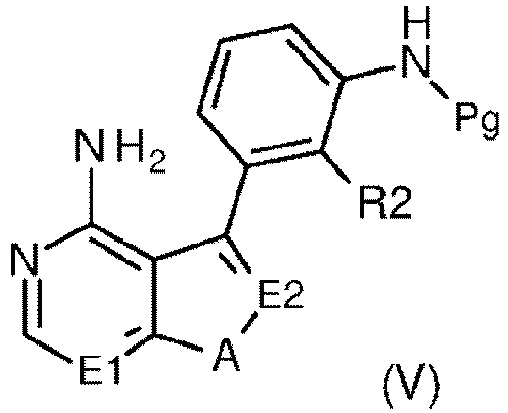 wobei E1, E2, A, R2 und Pg wie oben definiert sind; undSchritt f) Umsetzen des resultierenden Zwischenprodukts der Formel (VII)
 wobei E1, E2, A und R2 wie oben definiert sind, mit einem Derivat der Formel (XI)
 wobei R1 wie in Anspruch 1 definiert ist, um eine Verbindung der Formel (I) wie in Anspruch 1 definiert zu erhalten;
ODER:Schritt b) ein Derivat der Formel (VI) wobei R2 und M wie oben definiert sind; gefolgt vonSchritt f) Umsetzen des resultierenden Zwischenprodukts der Formel (VII), wie oben definiert, mit einem Derivat der Formel (XI), wie oben definiert, um eine Verbindung der Formel (I), wie in Anspruch 1 definiert, zu erhalten;
ODER:Schritt c) ein Derivat der Formel (VIII) wobei R1, R2 und M wie oben definiert sind;
ODER:Schritt d) ein Derivat der Formel (IX) wobei R1, R2, Pg und M wie oben definiert sind; gefolgt von:Schritt g) selektivem Entfernen der Pg-Gruppe aus dem resultierenden Zwischenprodukt der Formel (X)
 wobei E1, E2, A, R1, R2 und Pg wie oben definiert sind, um eine Verbindung der Formel (I) wie in Anspruch 1 definiert zu erhalten;wahlweise Umwandeln einer Verbindung der Formel (I) in eine andere Verbindung der Formel (I) und, falls gewünscht, Umwandeln einer Verbindung der Formel (I) in ein pharmazeutisch verträgliches Salz davon oder Umwandeln eines Salzes in die freie Verbindung (I).
 - Pharmazeutische Zusammensetzung, die eine oder mehrere Verbindungen der Formel (I) oder ein pharmazeutisch verträgliches Salz davon umfasst, wie in Anspruch 1 definiert, und mindestens einen pharmazeutisch verträglichen Hilfsstoff, Träger oder Verdünnungsmittel.
- Pharmazeutische Zusammensetzung nach Anspruch 8, die außerdem ein oder mehrere Chemotherapeutika umfasst.
- Produkt, das eine Verbindung der Formel (I) oder ein pharmazeutisch verträgliches Salz davon umfasst, wie in Anspruch 1 definiert, und ein oder mehrere Chemotherapeutika als Kombinationspräparat zur gleichzeitigen, getrennten oder aufeinanderfolgenden Verwendung in der Krebstherapie.
- Verbindung der Formel (I) oder ein pharmazeutisch verträgliches Salz davon, wie in Anspruch 1 definiert, zur Verwendung als Arzneimittel.
- Verbindung der Formel (I) oder ein pharmazeutisch verträgliches Salz davon, wie in Anspruch 1 definiert, zur Verwendung in einem Verfahren zur Behandlung einer Krankheit, ausgewählt aus der Gruppe, bestehend aus Krebs, Zellproliferationsstörungen, Virusinfektionen, Autoimmunerkrankungen und neurodegenerativen Erkrankungen.
- Verbindung zur Verwendung nach Anspruch 12, wobei der Krebs ausgewählt ist aus der Gruppe, bestehend aus Karzinomen einschließlich von Blase, Brust, Dickdarm, Niere, Leber, Lunge, einschließlich kleinzelligem Lungenkrebs, Speiseröhre, Gallenblase, Eierstock, Bauchspeicheldrüse, Magen, Gebärmutterhals, Schilddrüse, Prostata und Haut, einschließlich Plattenepithelkarzinom; hämatopoetischen Tumoren lymphoider Abstammung, einschließlich Leukämie, akuter lymphatischer Leukämie, akuter lymphoblastischer Leukämie, B-Zell-Lymphom, T-Zell-Lymphom, Hodgkin-Lymphom, Non-Hodgkin-Lymphom, Haarzellen-Lymphom und Burkett-Lymphom; hämatopoetischen Tumoren myeloischer Abstammung, einschließlich akuter und chronischer myeloischer Leukämien, myelodysplastischem Syndrom und Promyelozytärer Leukämie; Tumoren mesenchymalen Ursprungs, einschließlich Fibrosarkom und Rhabdomyosarkom; Tumoren des zentralen und peripheren Nervensystems, einschließlich Astrozytom, Neuroblastom, Gliom und Schwannomen; weiteren Tumoren, einschließlich Melanom, Seminom, Teratokarzinom, Osteosarkom, Xeroderma pigmentosum, Keratoxanthom, Schilddrüsenfollikelkrebs und Kaposi-Sarkom.
- Verbindung zur Verwendung nach einem der Ansprüche 12 oder 13, die außerdem das Unterziehen eines Säugetiers, das dies benötigt, einer Strahlentherapie oder Chemotherapie in Kombination mit mindestens einem Zytostatikum oder Zytotoxikum umfasst.
- Verbindung zur Verwendung nach Anspruch 12, wobei die Krankheit ausgewählt ist aus der Gruppe, bestehend aus Typ-1-Diabetes, Myokardinfarkt, Herz-Kreislauf-Erkrankung, Atherosklerose, Arrhythmien, Fettleibigkeit, Augenerkrankungen und entzündlichen Erkrankungen.
Priority Applications (1)
| Application Number | Priority Date | Filing Date | Title |
|---|---|---|---|
| SI201731456T SI3472165T1 (sl) | 2016-06-21 | 2017-06-19 | N-(substituirani fenil)-sulfonamidni derivati kot inhibitorji kinaz |
Applications Claiming Priority (2)
| Application Number | Priority Date | Filing Date | Title |
|---|---|---|---|
| EP16175386 | 2016-06-21 | ||
| PCT/EP2017/064904 WO2017220477A1 (en) | 2016-06-21 | 2017-06-19 | N-(substituted-phenyl)-sulfonamide derivatives as kinase inhibitors |
Publications (2)
| Publication Number | Publication Date |
|---|---|
| EP3472165A1 EP3472165A1 (de) | 2019-04-24 |
| EP3472165B1 true EP3472165B1 (de) | 2023-09-06 |
Family
ID=56148248
Family Applications (1)
| Application Number | Title | Priority Date | Filing Date |
|---|---|---|---|
| EP17732075.1A Active EP3472165B1 (de) | 2016-06-21 | 2017-06-19 | N-(substituiertes phenyl)-sulfonamidderivate als kinaseinhibitoren |
Country Status (18)
| Country | Link |
|---|---|
| US (4) | US10561660B2 (de) |
| EP (1) | EP3472165B1 (de) |
| JP (1) | JP6867417B2 (de) |
| KR (1) | KR102500416B1 (de) |
| CN (1) | CN109311894B (de) |
| AU (1) | AU2017279878B9 (de) |
| CA (1) | CA3029097A1 (de) |
| DK (1) | DK3472165T3 (de) |
| ES (1) | ES2964781T3 (de) |
| FI (1) | FI3472165T3 (de) |
| HU (1) | HUE064919T2 (de) |
| IL (1) | IL263739B (de) |
| MX (1) | MX388660B (de) |
| PL (1) | PL3472165T3 (de) |
| PT (1) | PT3472165T (de) |
| RU (1) | RU2753520C2 (de) |
| SI (1) | SI3472165T1 (de) |
| WO (1) | WO2017220477A1 (de) |
Families Citing this family (16)
| Publication number | Priority date | Publication date | Assignee | Title |
|---|---|---|---|---|
| EP3472165B1 (de) | 2016-06-21 | 2023-09-06 | Nerviano Medical Sciences S.r.l. | N-(substituiertes phenyl)-sulfonamidderivate als kinaseinhibitoren |
| US20220315594A1 (en) * | 2019-08-09 | 2022-10-06 | Ohm Oncology | Method of synthesis of compound for dual inhibition of jak2 and bet |
| KR20210056827A (ko) * | 2019-11-11 | 2021-05-20 | 일동제약(주) | 신규한 벤젠설폰아미드 유도체 및 그의 용도 |
| BR112022016072A2 (pt) * | 2020-02-17 | 2022-10-04 | Alesta Therapeutics BV | Compostos moduladores de gcn2, sal farmaceuticamente aceitável, seus usos, e composição farmacêutica |
| ES2991366T3 (es) | 2020-05-08 | 2024-12-03 | Halia Therapeutics Inc | Inhibidores de NEK7 cinasa |
| CN111454261A (zh) * | 2020-05-27 | 2020-07-28 | 南京普锐达医药科技有限公司 | 一种4-氯吡咯并嘧啶化合物的合成方法 |
| MX2023005747A (es) | 2020-11-18 | 2023-07-28 | Deciphera Pharmaceuticals Llc | Inhibidores de gcn2 y perk quinasas y metodos de uso de los mismos. |
| US20240382488A1 (en) | 2021-03-29 | 2024-11-21 | Halia Therapeutics, Inc. | Nek7 inhibitors |
| JP2024513227A (ja) | 2021-04-05 | 2024-03-22 | ハリア・セラピューティクス・インコーポレイテッド | Nek7阻害剤 |
| US20250000859A1 (en) | 2021-08-25 | 2025-01-02 | Alesta Therapeutics BV | Use of gcn2 inhibitors in treating cancer |
| KR20240113496A (ko) | 2021-12-03 | 2024-07-22 | 데시페라 파마슈티칼스, 엘엘씨. | Gcn2 및 perk 키나아제 억제제로서의 헤테로고리 화합물 |
| EP4504720A4 (de) * | 2022-04-08 | 2026-03-25 | Alesta Therapeutics BV | Gcn2-modulatorverbindungen |
| CN119343346A (zh) * | 2022-06-08 | 2025-01-21 | 韩国化学研究院 | 苯磺酰胺衍生物、其制备方法及含有其作为活性成分的预防或治疗癌症的药物组合物 |
| WO2024249493A2 (en) * | 2023-05-30 | 2024-12-05 | Deciphera Pharmaceuticals, Llc | Gcn2 and perk kinase modulators and methods of use thereof |
| AU2024356374A1 (en) * | 2023-10-06 | 2026-04-16 | Alesta Therapeutics BV | Compounds of gcn2 modulators |
| GB202407386D0 (en) | 2024-05-24 | 2024-07-10 | Apollo Ap45 Ltd | 1H-pyrazolo(4,3-D)pyrimidine derivatives |
Family Cites Families (10)
| Publication number | Priority date | Publication date | Assignee | Title |
|---|---|---|---|---|
| DK0970084T3 (da) * | 1997-03-19 | 2003-09-29 | Abbott Gmbh & Co Kg | Pyrrolo[2,3-d]pyrimidiner og deres anvendelse som inhibitorer for tyrosinkinase |
| CA2344262A1 (en) * | 1998-09-18 | 2000-03-30 | Basf Aktiengesellschaft | 4-aminopyrrolopyrimidines as kinase inhibitors |
| GB0625827D0 (en) * | 2006-12-22 | 2007-02-07 | Astex Therapeutics Ltd | New compounds |
| WO2010045542A2 (en) | 2008-10-16 | 2010-04-22 | The Regents Of The University Of California | Fused ring heteroaryl kinase inhibitors |
| UY33288A (es) | 2010-03-25 | 2011-10-31 | Glaxosmithkline Llc | Derivados de indolina inhibidores de la proteina quinasa r del reticulo endoplasmatico |
| AU2013333938A1 (en) * | 2012-10-16 | 2015-04-09 | Almirall, S.A. | Pyrrolotriazinone derivatives as PI3K inhibitors |
| CA2901267C (en) | 2013-04-04 | 2021-01-19 | Janssen Pharmaceutica Nv | Novel n-(2,3-dihydro-1h-pyrrolo[2,3-b]pyridin-5-yl)-4-quinazolinamine and n-(2,3-dihydro-1h-indol-5-yl)-4-quinazolinamine derivatives as perk inhibitors |
| EP3004060B1 (de) * | 2013-05-30 | 2019-11-27 | Plexxikon Inc. | Verbindungen zur kinasemodulation und indikationen dafür |
| WO2015136463A1 (en) | 2014-03-11 | 2015-09-17 | Glaxosmithkline Intellectual Property (No.2) Limited | Chemical compounds acting as perk inhibitors |
| EP3472165B1 (de) * | 2016-06-21 | 2023-09-06 | Nerviano Medical Sciences S.r.l. | N-(substituiertes phenyl)-sulfonamidderivate als kinaseinhibitoren |
-
2017
- 2017-06-19 EP EP17732075.1A patent/EP3472165B1/de active Active
- 2017-06-19 RU RU2019101002A patent/RU2753520C2/ru active
- 2017-06-19 HU HUE17732075A patent/HUE064919T2/hu unknown
- 2017-06-19 SI SI201731456T patent/SI3472165T1/sl unknown
- 2017-06-19 FI FIEP17732075.1T patent/FI3472165T3/fi active
- 2017-06-19 CA CA3029097A patent/CA3029097A1/en active Pending
- 2017-06-19 CN CN201780038709.2A patent/CN109311894B/zh active Active
- 2017-06-19 JP JP2018566910A patent/JP6867417B2/ja active Active
- 2017-06-19 MX MX2018016419A patent/MX388660B/es unknown
- 2017-06-19 KR KR1020197001839A patent/KR102500416B1/ko active Active
- 2017-06-19 PL PL17732075.1T patent/PL3472165T3/pl unknown
- 2017-06-19 ES ES17732075T patent/ES2964781T3/es active Active
- 2017-06-19 AU AU2017279878A patent/AU2017279878B9/en active Active
- 2017-06-19 US US16/312,061 patent/US10561660B2/en active Active
- 2017-06-19 PT PT177320751T patent/PT3472165T/pt unknown
- 2017-06-19 DK DK17732075.1T patent/DK3472165T3/da active
- 2017-06-19 WO PCT/EP2017/064904 patent/WO2017220477A1/en not_active Ceased
-
2018
- 2018-12-16 IL IL263739A patent/IL263739B/en unknown
-
2019
- 2019-12-19 US US16/721,267 patent/US10918642B2/en active Active
-
2021
- 2021-01-04 US US17/140,471 patent/US11491158B2/en active Active
-
2022
- 2022-09-29 US US17/936,576 patent/US11833153B2/en active Active
Also Published As
Similar Documents
| Publication | Publication Date | Title |
|---|---|---|
| EP3472165B1 (de) | N-(substituiertes phenyl)-sulfonamidderivate als kinaseinhibitoren | |
| CN114394966B (zh) | 吡啶并嘧啶酮cdk2/4/6抑制剂 | |
| EP3638680B1 (de) | Heteroaromatische verbindungen als vanininhibitoren | |
| EP3157925B1 (de) | Als caseinkinase-i-delta/epsilon-inhibitoren geeignete imidazopyridazinederivate | |
| EP3068784A1 (de) | Substituierte 4,5,6,7-tetrahydropyrazolo[1,5-a]pyrazin-derivative als casein-kinase-1-d/e-inhibitoren | |
| EP2552922A1 (de) | Substituierte pyrrolotriazine als proteinkinasehemmer | |
| CN105073751A (zh) | 作为酪蛋白激酶1δ/ε抑制剂的新的取代的咪唑 | |
| CN109790164B (zh) | 作为胆碱激酶抑制剂的嘌呤和3-去氮杂嘌呤类似物 | |
| EP2935272A1 (de) | Pyrazolsubstituierte imidazopyrazine als caseinkinase-1 d/e-inhibitoren | |
| EP3568397B1 (de) | Verbindungen und deren verwendung zur behandlung von schistosomiasis | |
| WO2007040439A1 (en) | New compounds ii | |
| WO2024067445A1 (zh) | 新型prmt5抑制剂及其应用 | |
| CA3249844A1 (en) | PYRAZOLOPYRIMIDINES USED AS SPERM OXIDASE MODULATORS | |
| HK1260454B (en) | N-(substituted-phenyl)-sulfonamide derivatives as kinase inhibitors | |
| HK1260454A1 (en) | N-(substituted-phenyl)-sulfonamide derivatives as kinase inhibitors | |
| HK40072682A (en) | Pyridopyrimdinone cdk2/4/6 inhibitors | |
| HK40002986A (zh) | 吡啶并嘧啶酮cdk2/4/6抑制剂 | |
| HK40006205A (en) | Purine and 3-deazapurine analogues as choline kinase inhibitors |
Legal Events
| Date | Code | Title | Description |
|---|---|---|---|
| STAA | Information on the status of an ep patent application or granted ep patent |
Free format text: STATUS: UNKNOWN |
|
| STAA | Information on the status of an ep patent application or granted ep patent |
Free format text: STATUS: THE INTERNATIONAL PUBLICATION HAS BEEN MADE |
|
| PUAI | Public reference made under article 153(3) epc to a published international application that has entered the european phase |
Free format text: ORIGINAL CODE: 0009012 |
|
| STAA | Information on the status of an ep patent application or granted ep patent |
Free format text: STATUS: REQUEST FOR EXAMINATION WAS MADE |
|
| 17P | Request for examination filed |
Effective date: 20181205 |
|
| AK | Designated contracting states |
Kind code of ref document: A1 Designated state(s): AL AT BE BG CH CY CZ DE DK EE ES FI FR GB GR HR HU IE IS IT LI LT LU LV MC MK MT NL NO PL PT RO RS SE SI SK SM TR |
|
| AX | Request for extension of the european patent |
Extension state: BA ME |
|
| DAV | Request for validation of the european patent (deleted) | ||
| DAX | Request for extension of the european patent (deleted) | ||
| STAA | Information on the status of an ep patent application or granted ep patent |
Free format text: STATUS: EXAMINATION IS IN PROGRESS |
|
| 17Q | First examination report despatched |
Effective date: 20210222 |
|
| GRAP | Despatch of communication of intention to grant a patent |
Free format text: ORIGINAL CODE: EPIDOSNIGR1 |
|
| STAA | Information on the status of an ep patent application or granted ep patent |
Free format text: STATUS: GRANT OF PATENT IS INTENDED |
|
| INTG | Intention to grant announced |
Effective date: 20230530 |
|
| GRAS | Grant fee paid |
Free format text: ORIGINAL CODE: EPIDOSNIGR3 |
|
| GRAA | (expected) grant |
Free format text: ORIGINAL CODE: 0009210 |
|
| STAA | Information on the status of an ep patent application or granted ep patent |
Free format text: STATUS: THE PATENT HAS BEEN GRANTED |
|
| AK | Designated contracting states |
Kind code of ref document: B1 Designated state(s): AL AT BE BG CH CY CZ DE DK EE ES FI FR GB GR HR HU IE IS IT LI LT LU LV MC MK MT NL NO PL PT RO RS SE SI SK SM TR |
|
| REG | Reference to a national code |
Ref country code: GB Ref legal event code: FG4D |
|
| REG | Reference to a national code |
Ref country code: CH Ref legal event code: EP |
|
| REG | Reference to a national code |
Ref country code: IE Ref legal event code: FG4D |
|
| REG | Reference to a national code |
Ref country code: DE Ref legal event code: R096 Ref document number: 602017073749 Country of ref document: DE |
|
| P01 | Opt-out of the competence of the unified patent court (upc) registered |
Effective date: 20230905 |
|
| REG | Reference to a national code |
Ref country code: FI Ref legal event code: FGE Ref country code: DK Ref legal event code: T3 Effective date: 20231206 Ref country code: NO Ref legal event code: T2 Effective date: 20230906 |
|
| REG | Reference to a national code |
Ref country code: PT Ref legal event code: SC4A Ref document number: 3472165 Country of ref document: PT Date of ref document: 20231212 Kind code of ref document: T Free format text: AVAILABILITY OF NATIONAL TRANSLATION Effective date: 20231205 |
|
| REG | Reference to a national code |
Ref country code: LT Ref legal event code: MG9D Ref country code: SE Ref legal event code: TRGR |
|
| REG | Reference to a national code |
Ref country code: GR Ref legal event code: EP Ref document number: 20230402351 Country of ref document: GR Effective date: 20240110 |
|
| PG25 | Lapsed in a contracting state [announced via postgrant information from national office to epo] |
Ref country code: RS Free format text: LAPSE BECAUSE OF FAILURE TO SUBMIT A TRANSLATION OF THE DESCRIPTION OR TO PAY THE FEE WITHIN THE PRESCRIBED TIME-LIMIT Effective date: 20230906 Ref country code: LV Free format text: LAPSE BECAUSE OF FAILURE TO SUBMIT A TRANSLATION OF THE DESCRIPTION OR TO PAY THE FEE WITHIN THE PRESCRIBED TIME-LIMIT Effective date: 20230906 Ref country code: LT Free format text: LAPSE BECAUSE OF FAILURE TO SUBMIT A TRANSLATION OF THE DESCRIPTION OR TO PAY THE FEE WITHIN THE PRESCRIBED TIME-LIMIT Effective date: 20230906 Ref country code: HR Free format text: LAPSE BECAUSE OF FAILURE TO SUBMIT A TRANSLATION OF THE DESCRIPTION OR TO PAY THE FEE WITHIN THE PRESCRIBED TIME-LIMIT Effective date: 20230906 |
|
| REG | Reference to a national code |
Ref country code: NL Ref legal event code: FP |
|
| PG25 | Lapsed in a contracting state [announced via postgrant information from national office to epo] |
Ref country code: IS Free format text: LAPSE BECAUSE OF FAILURE TO SUBMIT A TRANSLATION OF THE DESCRIPTION OR TO PAY THE FEE WITHIN THE PRESCRIBED TIME-LIMIT Effective date: 20240106 |
|
| REG | Reference to a national code |
Ref country code: ES Ref legal event code: FG2A Ref document number: 2964781 Country of ref document: ES Kind code of ref document: T3 Effective date: 20240409 |
|
| REG | Reference to a national code |
Ref country code: HU Ref legal event code: AG4A Ref document number: E064919 Country of ref document: HU |
|
| PG25 | Lapsed in a contracting state [announced via postgrant information from national office to epo] |
Ref country code: SM Free format text: LAPSE BECAUSE OF FAILURE TO SUBMIT A TRANSLATION OF THE DESCRIPTION OR TO PAY THE FEE WITHIN THE PRESCRIBED TIME-LIMIT Effective date: 20230906 Ref country code: IS Free format text: LAPSE BECAUSE OF FAILURE TO SUBMIT A TRANSLATION OF THE DESCRIPTION OR TO PAY THE FEE WITHIN THE PRESCRIBED TIME-LIMIT Effective date: 20240106 Ref country code: EE Free format text: LAPSE BECAUSE OF FAILURE TO SUBMIT A TRANSLATION OF THE DESCRIPTION OR TO PAY THE FEE WITHIN THE PRESCRIBED TIME-LIMIT Effective date: 20230906 Ref country code: SK Free format text: LAPSE BECAUSE OF FAILURE TO SUBMIT A TRANSLATION OF THE DESCRIPTION OR TO PAY THE FEE WITHIN THE PRESCRIBED TIME-LIMIT Effective date: 20230906 |
|
| REG | Reference to a national code |
Ref country code: DE Ref legal event code: R097 Ref document number: 602017073749 Country of ref document: DE |
|
| PLBE | No opposition filed within time limit |
Free format text: ORIGINAL CODE: 0009261 |
|
| STAA | Information on the status of an ep patent application or granted ep patent |
Free format text: STATUS: NO OPPOSITION FILED WITHIN TIME LIMIT |
|
| 26N | No opposition filed |
Effective date: 20240607 |
|
| PG25 | Lapsed in a contracting state [announced via postgrant information from national office to epo] |
Ref country code: BG Free format text: LAPSE BECAUSE OF FAILURE TO SUBMIT A TRANSLATION OF THE DESCRIPTION OR TO PAY THE FEE WITHIN THE PRESCRIBED TIME-LIMIT Effective date: 20230906 |
|
| PG25 | Lapsed in a contracting state [announced via postgrant information from national office to epo] |
Ref country code: BG Free format text: LAPSE BECAUSE OF FAILURE TO SUBMIT A TRANSLATION OF THE DESCRIPTION OR TO PAY THE FEE WITHIN THE PRESCRIBED TIME-LIMIT Effective date: 20230906 |
|
| PG25 | Lapsed in a contracting state [announced via postgrant information from national office to epo] |
Ref country code: MC Free format text: LAPSE BECAUSE OF FAILURE TO SUBMIT A TRANSLATION OF THE DESCRIPTION OR TO PAY THE FEE WITHIN THE PRESCRIBED TIME-LIMIT Effective date: 20230906 |
|
| PG25 | Lapsed in a contracting state [announced via postgrant information from national office to epo] |
Ref country code: LU Free format text: LAPSE BECAUSE OF NON-PAYMENT OF DUE FEES Effective date: 20240619 |
|
| PGFP | Annual fee paid to national office [announced via postgrant information from national office to epo] |
Ref country code: FI Payment date: 20250625 Year of fee payment: 9 |
|
| PGFP | Annual fee paid to national office [announced via postgrant information from national office to epo] |
Ref country code: PL Payment date: 20250612 Year of fee payment: 9 Ref country code: DE Payment date: 20250627 Year of fee payment: 9 |
|
| PGFP | Annual fee paid to national office [announced via postgrant information from national office to epo] |
Ref country code: GB Payment date: 20250627 Year of fee payment: 9 Ref country code: DK Payment date: 20250625 Year of fee payment: 9 |
|
| PGFP | Annual fee paid to national office [announced via postgrant information from national office to epo] |
Ref country code: NO Payment date: 20250627 Year of fee payment: 9 |
|
| PGFP | Annual fee paid to national office [announced via postgrant information from national office to epo] |
Ref country code: NL Payment date: 20250626 Year of fee payment: 9 Ref country code: BE Payment date: 20250627 Year of fee payment: 9 |
|
| PGFP | Annual fee paid to national office [announced via postgrant information from national office to epo] |
Ref country code: PT Payment date: 20250603 Year of fee payment: 9 |
|
| PGFP | Annual fee paid to national office [announced via postgrant information from national office to epo] |
Ref country code: HU Payment date: 20250612 Year of fee payment: 9 Ref country code: FR Payment date: 20250625 Year of fee payment: 9 |
|
| PGFP | Annual fee paid to national office [announced via postgrant information from national office to epo] |
Ref country code: GR Payment date: 20250626 Year of fee payment: 9 |
|
| PGFP | Annual fee paid to national office [announced via postgrant information from national office to epo] |
Ref country code: RO Payment date: 20250605 Year of fee payment: 9 Ref country code: AT Payment date: 20250603 Year of fee payment: 9 |
|
| PGFP | Annual fee paid to national office [announced via postgrant information from national office to epo] |
Ref country code: TR Payment date: 20250619 Year of fee payment: 9 |
|
| PGFP | Annual fee paid to national office [announced via postgrant information from national office to epo] |
Ref country code: CZ Payment date: 20250605 Year of fee payment: 9 |
|
| PGFP | Annual fee paid to national office [announced via postgrant information from national office to epo] |
Ref country code: IE Payment date: 20250627 Year of fee payment: 9 |
|
| PGFP | Annual fee paid to national office [announced via postgrant information from national office to epo] |
Ref country code: SE Payment date: 20250627 Year of fee payment: 9 Ref country code: SI Payment date: 20250530 Year of fee payment: 9 |
|
| PGFP | Annual fee paid to national office [announced via postgrant information from national office to epo] |
Ref country code: ES Payment date: 20250701 Year of fee payment: 9 |
|
| PGFP | Annual fee paid to national office [announced via postgrant information from national office to epo] |
Ref country code: IT Payment date: 20250619 Year of fee payment: 9 |
|
| PGFP | Annual fee paid to national office [announced via postgrant information from national office to epo] |
Ref country code: CH Payment date: 20250701 Year of fee payment: 9 |
|
| PG25 | Lapsed in a contracting state [announced via postgrant information from national office to epo] |
Ref country code: CY Free format text: LAPSE BECAUSE OF FAILURE TO SUBMIT A TRANSLATION OF THE DESCRIPTION OR TO PAY THE FEE WITHIN THE PRESCRIBED TIME-LIMIT; INVALID AB INITIO Effective date: 20170619 |
|
| REG | Reference to a national code |
Ref country code: HU Ref legal event code: HC9C Owner name: NERVIANO MEDICAL SCIENCES S.R.L., IT |