EP3473604B1 - Glasses having improved hydrolytic and lye resistance - Google Patents
Glasses having improved hydrolytic and lye resistance Download PDFInfo
- Publication number
- EP3473604B1 EP3473604B1 EP18212298.6A EP18212298A EP3473604B1 EP 3473604 B1 EP3473604 B1 EP 3473604B1 EP 18212298 A EP18212298 A EP 18212298A EP 3473604 B1 EP3473604 B1 EP 3473604B1
- Authority
- EP
- European Patent Office
- Prior art keywords
- mol
- glass
- reedmergnerite
- proportion
- albite
- Prior art date
- Legal status (The legal status is an assumption and is not a legal conclusion. Google has not performed a legal analysis and makes no representation as to the accuracy of the status listed.)
- Active
Links
Classifications
-
- C—CHEMISTRY; METALLURGY
- C03—GLASS; MINERAL OR SLAG WOOL
- C03C—CHEMICAL COMPOSITION OF GLASSES, GLAZES OR VITREOUS ENAMELS; SURFACE TREATMENT OF GLASS; SURFACE TREATMENT OF FIBRES OR FILAMENTS MADE FROM GLASS, MINERALS OR SLAGS; JOINING GLASS TO GLASS OR OTHER MATERIALS
- C03C3/00—Glass compositions
- C03C3/04—Glass compositions containing silica
- C03C3/076—Glass compositions containing silica with 40% to 90% silica, by weight
- C03C3/089—Glass compositions containing silica with 40% to 90% silica, by weight containing boron
- C03C3/091—Glass compositions containing silica with 40% to 90% silica, by weight containing boron containing aluminium
- C03C3/093—Glass compositions containing silica with 40% to 90% silica, by weight containing boron containing aluminium containing zinc or zirconium
-
- C—CHEMISTRY; METALLURGY
- C03—GLASS; MINERAL OR SLAG WOOL
- C03C—CHEMICAL COMPOSITION OF GLASSES, GLAZES OR VITREOUS ENAMELS; SURFACE TREATMENT OF GLASS; SURFACE TREATMENT OF FIBRES OR FILAMENTS MADE FROM GLASS, MINERALS OR SLAGS; JOINING GLASS TO GLASS OR OTHER MATERIALS
- C03C3/00—Glass compositions
- C03C3/04—Glass compositions containing silica
- C03C3/076—Glass compositions containing silica with 40% to 90% silica, by weight
- C03C3/089—Glass compositions containing silica with 40% to 90% silica, by weight containing boron
- C03C3/091—Glass compositions containing silica with 40% to 90% silica, by weight containing boron containing aluminium
-
- C—CHEMISTRY; METALLURGY
- C03—GLASS; MINERAL OR SLAG WOOL
- C03C—CHEMICAL COMPOSITION OF GLASSES, GLAZES OR VITREOUS ENAMELS; SURFACE TREATMENT OF GLASS; SURFACE TREATMENT OF FIBRES OR FILAMENTS MADE FROM GLASS, MINERALS OR SLAGS; JOINING GLASS TO GLASS OR OTHER MATERIALS
- C03C4/00—Compositions for glass with special properties
- C03C4/20—Compositions for glass with special properties for chemical resistant glass
-
- C—CHEMISTRY; METALLURGY
- C03—GLASS; MINERAL OR SLAG WOOL
- C03C—CHEMICAL COMPOSITION OF GLASSES, GLAZES OR VITREOUS ENAMELS; SURFACE TREATMENT OF GLASS; SURFACE TREATMENT OF FIBRES OR FILAMENTS MADE FROM GLASS, MINERALS OR SLAGS; JOINING GLASS TO GLASS OR OTHER MATERIALS
- C03C2203/00—Production processes
- C03C2203/10—Melting processes
-
- C—CHEMISTRY; METALLURGY
- C03—GLASS; MINERAL OR SLAG WOOL
- C03C—CHEMICAL COMPOSITION OF GLASSES, GLAZES OR VITREOUS ENAMELS; SURFACE TREATMENT OF GLASS; SURFACE TREATMENT OF FIBRES OR FILAMENTS MADE FROM GLASS, MINERALS OR SLAGS; JOINING GLASS TO GLASS OR OTHER MATERIALS
- C03C2203/00—Production processes
- C03C2203/50—After-treatment
Definitions
- the invention relates to glasses and glass products which combine good alkali and hydrolytic resistance with advantageous thermal expansion properties, these expansion properties in the interior of the glass ("bulk") and on the surface should be as similar as possible or the same. Manufacturing methods of such glasses and their uses are also according to the invention.
- EP 0 699 636 describes borosilicate glasses with high chemical resistance.
- the prior art lacks glasses which combine good hydrolytic resistance with a low removal rate when testing the alkali resistance according to ISO 695.
- these glasses should have advantageous thermal expansion properties.
- the glasses should also be able to be manufactured using modern tube drawing processes.
- Both the hydrolytic resistance according to ISO 719/720 and the alkali resistance according to ISO 695 essentially include a resistance of the glass to the attack of hydroxyl ions.
- concentration of the hydroxyl ions in the lye determined that a buffer solution with 0.5 mol / l sodium hydroxide and 0.25 mol / l sodium carbonate is used.
- the glass is placed in neutral water, the pH value of which is initially set to 5.5 (check using a methyl red indicator solution), but moves very quickly into the alkaline range due to the dissolution of the glass.
- a buffer solution is formed from the weak acids (or acid anhydrides) contained in the glass, namely silica and boric acid, and strong alkalis (such as sodium hydroxide), the pH of which is in the range 9 to 10, see Susanne Fagerlund, Paul Ek, Mikko Hupa and Leena Hupa: On determining chemical durability of glasses, Glass Technol .: Eur. J. Glass Sci. Technol. A, December 2010, 51 (6), 235-240 .
- the pKs values of the weak acid (s) are decisive for the pH of a buffer solution, the pKs value of boric acid being approx.
- the removal rate during the test according to ISO 695 must first be set to a low value.
- the pH value that results during a test according to ISO 719/720 and the resulting dissolution of a certain amount of glass in the aqueous test solution must be limited. The higher this pH value increases in the course of the test, the greater the risk of a positive feedback effect: with increasing pH, the removal rate increases, with increasing amount of removal in the aqueous solution, the pH value increases, etc.
- Chemically resistant glasses typically experience an erosion during the test, which leads to 100 ⁇ mol glass in the aqueous solution or less, the abrasion generally being the less congruent the less it is.
- the relevant pH is the pH which results from a congruent resolution of 50 ⁇ mol glass in neutral water. Glasses according to the invention in which this pH is less than 8.99, preferably less than 8.89, particularly preferably less than 8.79, very particularly preferably 8.7 or less.
- the removal rate according to ISO 695 according to the invention is a maximum of 135 mg / (dm 2 3h), a maximum of 125 mg / (dm 2 3h), a maximum of 115 mg / (dm 2 3h), a maximum of 105 mg / (dm 2 3h), preferably a maximum 95 mg / (dm 2 3h), particularly preferably at most 85 mg / (dm 2 3h), very particularly preferably at most 75 mg / (dm 2 3h).
- the latter number defines the boundary between alkali classes 1 and 2 in accordance with ISO 695. What is meant is the removal rate, which can be calculated using the formulas (2) and (3) for glasses of this invention.
- the coefficient of thermal expansion is preferably between 3 and 7 ppm / K, preferably between 4 and 6 ppm / K, particularly preferably between 4.5 and 5.5 ppm / K.
- CTE which can be calculated using the formula (5) for glasses of this invention. It is particularly advantageous for the processing of the glasses according to the invention if the coefficient of thermal expansion lies within the ranges mentioned above. High CTE values are associated with increased cooling voltages and can therefore make complex cooling processes necessary. On the other hand, low CTE values are associated with increased melting points and processing temperatures, which in turn lead to increased production costs. It is therefore advantageous to keep the coefficient of thermal expansion within the ranges given above.
- stoichiometric glasses i.e. glasses that also exist as crystals in the same stoichiometry and whose properties are due to the fact that - as in the literature - with many examples by NMR measurements or the like. checked - identical topology of the assemblies for glass and crystal can be assumed to be very similar, solved.
- stoichiometric glasses are selected, the mixture of which makes it possible to achieve behavior in the sense of solving the problem according to the invention.
- these stoichiometric glasses are also referred to as "basic glasses” or "constituent phases”.
- a glass with a combination of basic glasses which is characterized by the following phases constituting the glass: ⁇ b> Table 1 ⁇ /b> constituent phase Min (mol%) Max (mol%) Reedmergnerite 10th 80 Albite 1 40 Potash reedmergnerite 0 60 Danburit 0 30th Cordierite 0 20th Willemite 0 20th Silicon dioxide 0 65 Diboron trioxide 0 20th Pekovit 0 20th Maleevit 0 25th
- the invention is also a glass with a combination of basic glasses, which is characterized by the following phases constituting the glass, the sum of the proportions of reedmergnerite, potassium reedmergnerite and albite being at least 50 mol%: ⁇ b> Table 2 ⁇ /b> constituent phase Min (mol%) Max (mol%) Reedmergnerite 20th 50 Albite 15 40 Potash reedmergnerite 0 20th Danburit 0 15 Cordierite 0 15 Willemite 0 15 Silicon dioxide 25th 50 Diboron trioxide 1 10th Pekovit 0 10th Maleevit 0 10th
- According to the invention is also a glass with a combination of basic glasses, which is characterized by the following phases constituting the glass: ⁇ b> Table 3 ⁇ /b> constituent phase Min (mol%) Max (mol%) Reedmergnerite 9 50 Albite 1 15 Potash reedmergnerite 0 20th Danburit 0 30th Cordierite 0 20th Willemite 0 20th Silicon dioxide 25th 65 Diboron trioxide 0 10th Pekovit 0 20th Maleevit 0 25th
- the composition is chosen with regard to the phases constituting the glass within the limits described herein.
- the phases constituting the glass are of course not crystalline, but amorphous in the glass product.
- this does not mean that the constituent phases in the amorphous state have completely different assemblies than in the crystalline state.
- the topology of the assemblies is comparable, for example the coordination of the cations involved with surrounding oxygen atoms or that resulting from the coordination and strength of the bond between these cations and the surrounding ones Interatomic distance resulting in oxygen atoms. Therefore, many properties of the glass of the invention can be described well on the basis of the constituent phases, in particular in order to illustrate the inventive performance and the problems overcome with the invention (cf. Conradt R., loc. Cit.).
- the glass can of course not only be produced using the appropriate crystals, but also using the customary glass raw materials, as long as only the stoichiometric conditions allow the formation of the corresponding assemblies of the basic glasses.
- the phases are selected with regard to their influence on the hydrolytic and alkali resistance as well as the thermal expansion.
- calculation methods are given as to how these three quantities can be calculated from a given composition of constituent phases. These calculation methods are decisive both in the selection of the constituent phases and in the very composition of a glass according to the invention from these constituent phases.
- the calculation of the pH value in aqueous solution is based on the composition information in simple oxides.
- the corresponding cations pass into the highly oxidized hydroxides, see Table 4.
- the release of an H + or OH - these hydroxides is described in each case by a corresponding pKs or pKb value.
- Equations 1-25 are equilibrium conditions and equation 26 is the electroneutrality condition.
- concentrations in square brackets (“[...]") denote concentrations in "mol / l”.
- MATHEMATICA provides a list of solutions, only one of which fulfills the additional condition that all concentrations must have positive values.
- the pH value follows as a negative decimal logarithm of [H + ].
- the invention is based on a surprisingly found connection between a quantity constructed with the aid of topological considerations and the removal rate measured during the test according to ISO 695.
- Quartz glass therefore has a number of "3" constraints per atom, which exactly corresponds to the number of degrees of freedom per atom. Quartz glass should therefore have no (or more real: a very small) number of degrees of freedom per atom, which corresponds to the small c p jump of quartz glass in the glass transition measured by differential calorimetry, see R. Brüning, "On the glass transition in vitreous silica by differential thermal analysis measurements", Journal of Non-Crystalline Solids 330 (2003) 13-22 .
- the values for the number of distance and angle conditions per atom are generally lower than (rounded) 1.333333333 and 1.666666667.
- the differences are the numbers of degrees of freedom or angular degrees of freedom per atom. With the degrees of angular freedom, one can still differentiate whether the associated angular conditions relate to angles that are all in one plane (trigonal coordination) or not (tetrahedral or higher coordination). The latter are referred to here as 3D angle conditions; the difference to (rounded) 1.666666667 accordingly as 3D degrees of freedom.
- the numerical values are after the in DE 10 2014 119 594 A1 specified method have been calculated, here the number of degrees of freedom for all cations has been calculated as in DE 10 2014 119 594 A1 but only for boron and aluminum there; in addition, the degree of ionization of a cation-oxygen compound is not from the formula (8) DE 10 2014 119 594 A1 , but from the formula (3) Alberto Garcia, Marvon Cohen, First Principles Lonicity Scales, Phys. Rev. B 1993 been calculated.
- the necessary coordination numbers have been taken from the mineralogical literature listed below in the discussion of the constituent phases; after Conradt R., loc. cit., we assume that the coordination numbers of the cations in the glass are equal to those of the corresponding crystal phases.
- the number of angular degrees of freedom per atom in bulk is less than 0.25, even more preferably up to 0.244, even more preferably less than 0.23, even more preferably less than 0.22, even more preferred less than 0.21, still more preferably up to 0.204, even more preferably less than 0.19, even more preferably less than 0.18, even more preferably less than 0.17, even more preferably less than 0.16, yet more preferably up to 0.152. If it is ensured that the number of degrees of angular freedom per atom does not exceed this value, the fragility remains in a desired range. This value is particularly advantageous in order to enable the production of even the thinnest glass articles.
- the number of degrees of angular freedom per atom is at least 0.1.
- the position of the coefficient of thermal expansion in the desired range can also be represented using a very simple calculation rule. This results from the average bond strength.
- the cations are placed in a potential well formed by the surrounding oxygen atoms and the depth is taken to be the sum of the bond strengths of the various single bonds to the surrounding oxygen atoms, i.e. the entire interaction energy is concentrated in potential wells with the cations in the center and the oxygen atoms in the periphery.
- the reverse case no longer needs to be considered; it would also be more difficult to analyze, since an oxygen atom can be located between several different types of cations, which, conversely, cannot occur in purely oxidic glasses.
- An average potential pot depth can be calculated from the composition of a glass from the constituent phases specified above, the number of different cations contained in the respective phases and the potential pot depths per cation tabulated above:
- m is the number of cation types occurring, E pot, j is the potential well depth tabulated above for the j th cation type and Z j, i is the number of cations of the j th type in the i th constituent phase.
- the bond strength is inversely proportional to the melting point, an inverse proportionality also applies between the melting point and the coefficient of expansion, see again H. Föll, loc. cit.
- the melting point of non-stoichiometric glasses is not precisely defined, there is only a tendency relationship between the temperature, generally referred to as the melting point, at which the viscosity is 100 dPas, and the coefficient of expansion. However, this ensures that the glasses according to the invention can be melted. While the requirement for good meltability suggests the largest possible coefficient of thermal expansion, conversely, the requirement for the lowest possible thermal stresses in the event of thermal postprocessing suggests the lowest possible coefficient of thermal expansion. The combination of both requirements leads to the preferred middle range for the expansion coefficient or the average potential well depth.
- the glasses of this invention have average potential well depths of 1515 kJ / mol to 1634 kJ / mol, more preferably 1538 kJ / mol to 1634 kJ / mol, more preferably 1561 kJ / mol to 1634 kJ / mol and particularly preferably 1584 kJ / mol to 1634 kJ / mol.
- Reedmergnerit American Mineralogist, Volume 50, pages 1827-1850, 1965 ) select.
- Reedmergnerite has a small number of 3D angular degrees of freedom per atom, which is advantageous for the alkali resistance. It consists of 75 mol% SiO 2 and 12.5 mol% Na 2 O, which results in a buffer solution in water as described above. Their pH is reduced by the additional 12.5 mol% of B 2 O 3 (in relation to additional SiO 2 ).
- one mole of reedmergnerite means one mole (Na 2 O ⁇ B 2 O 3 ⁇ 6SiO 2 ) / 8.
- the proportion of reedmergnerite in the glass according to the invention is 10 to 80 mol%.
- the minimum proportion of reedmergnerite should not be undercut, since otherwise the high alkali resistance and hydrolytic resistance according to the invention will not be achieved.
- the proportion of reedmergnerite is preferably limited to at most 70 mol%, preferably at most 60 mol%, more preferably at most 50 mol% or particularly preferably at most 45 mol% or at most 40 mol%. In one embodiment, the proportion of this component is limited to a maximum of 35 mol%. Preferred proportion ranges for the component reedmergnerite are therefore: 24 mol% to 70 mol%, 26 mol% to 60 mol% and 28 mol% to 40 mol%.
- the reedmergnerite content is at least 11 mol%, at least 12 mol%, in particular at least 13 mol%, at least 15 mol%, at least 18 mol% or at least 20 mol%.
- the proportion of reedmergnerite is preferably limited to at most 40 mol%, preferably at most 36 mol%, more preferably at most 35 mol% or particularly preferably at most 30 mol% or at most 29 mol%. In one embodiment, the proportion of this component is limited to a maximum of 22 mol%. Preferred proportion ranges for the reedmergnerite component are therefore: 11 mol% to 40 mol%, 12 mol% to 36 mol% and 13 mol% to 35 mol% and 11 to 22 mol%.
- the proportion of albite in the glass according to the invention is 1 to 40 mol%.
- the minimum proportion of albite should not be undercut, otherwise there is a risk of excessive segregation.
- its proportion is even at least 4 mol% or at least 10 mol%, in particular at least 15 mol%, at least 20 mol%, at least 23 mol% or at least 25 mol%.
- the proportion of albite is preferably limited to at most 35 mol%, preferably at most 32 mol%, more preferably at most 30 mol% or particularly preferably at most 29 mol%.
- Preferred proportion ranges for the component albite are therefore: 15 mol% to 35 mol%, 20 mol% to 32 mol% and 23 mol% to 30 mol%.
- the proportion of albite is at least 1 mol%, at least 2 mol% or at least 3 mol%.
- the proportion of albite is preferably limited to at most 10 mol%, preferably at most 9 mol%, more preferably at most 8 mol% or particularly preferably at most 6 mol%.
- Preferred proportion ranges for the component albite are therefore: 1 mol% to 10 mol%, 2 mol% to 9 mol% and 3 mol% to 8 mol%.
- potassium reedmergnerite To suppress a possible tendency to segregate, the third phase of the potassium analogue of reedmergnerite is added ( Mineralogical Magazine 57 (1993) 157-164 ).
- One mole of potassium reedmergnerite means one mole (K 2 O ⁇ B 2 O 3 ⁇ 6SiO 2 ) / 8.
- the proportion of potassium reedmergnerite in the glass according to the invention is 0 to 60 mol% or 0 to 40 mol%.
- a certain amount of potassium reedmergnerite can be useful in order to suppress excessive tendency to segregate.
- the proportion of potassium reedmergnerite is preferably limited to at most 40 mol%, preferably at most 30 mol%, more preferably at most 20 mol% or particularly preferably at most 10 mol%.
- Preferred proportion ranges for the component potassium reedmergnerite are therefore: 0 mol% to 30 mol%, 0 mol% to 20 mol% and 0 mol% to 10 mol%.
- the glass is free of potassium reedgnerite.
- the sum of the proportions of reedmergnerite, potassium reedmergnerite and albite is at least 52 mol%, at least 54 mol%, at least 55 mol% or at least 56 mol%. This sum is preferably limited to at most 70 mol%, at most 65 mol% or at most 60 mol%. It has been shown that this compositional feature is useful for balancing hydrolytic and alkali resistance as well as tendency to segregate. The same applies to the sum of the proportions of reedmergnerite and albite, which is preferably at least 52 mol%, at least 54 mol%, at least 55 mol% or at least 56 mol%.
- the proportion of reedmergnerite is greater than the proportion of potassium reedmergnerite, in particular by a factor of at least 2, 3, 4, 5 or 6.
- the proportions of reedmergnerite to albite it applies that these are in a range from 0.5 to 1 to 1.5 to 1, in particular in a range from 0.8 to 1 to 1.4 to 1, in a range from 0.9 to 1 to 1.3 to 1 or in a range from> 1 to 1 to 1.2 to 1. It is preferred that the proportion of reedmergnerite is greater than that of albite, in particular by a relative proportion of 5%.
- the sum of the proportions of reedmergnerite, potassium reedmergnerite and albite is at least 10 mol%, at least 15 mol%, at least 20 mol% or at least 25 mol%. This sum is preferably limited to at most 45 mol%, at most 40 mol% or at most 35 mol%. It has been shown that this compositional feature is useful for balancing hydrolytic and alkali resistance as well as tendency to segregate. The same applies to the sum of the proportions of reedmergnerite and albite, which is preferably at least 10 mol%, at least 14 mol%, at least 19 mol% or at least 24 mol%.
- the proportion of reedmergnerite is greater than the proportion of potassium reedmergnerite, in particular by a factor of at least 2, 3, 4, 5 or 6.
- One mole of danburite means one mole (CaO ⁇ B 2 O 3 ⁇ 2SiO 2 ) / 4.
- the proportion of danburite in the glasses according to the invention is, based on the above considerations, at most 30 mol% or at most 20 mol%, preferably at most 18 mol%, at most 15 mol% or at most 12 mol%.
- a proportion of at least 1 mol%, at least 3 mol%, in particular at least 5 mol% or at least 7 mol% has proven useful.
- One mole of cordierite means one mole (2MgO ⁇ 2Al 2 O 3 ⁇ 5SiO 2 ) / 9.
- the proportion of cordierite in the glasses according to the invention is at most 20 mol%, preferably at most 10 mol%, at most 5 mol% or at most 3 mol%, based on the above considerations.
- the glass is free of cordierite, in another embodiment the glass contains cordierite in an amount of more than 0.1 mol%.
- One mole of willemite is understood to be one mole (2ZnO ⁇ SiO 2 ) / 3.
- the proportion of willemite in the glasses according to the invention is, based on the above considerations, at most 20 mol%, preferably at most 10 mol%, at most 5 mol% or at most 3 mol%.
- the glass is free of willemite, in another embodiment the glass contains willemite in a proportion of at least 0.1 mol% or at least 1 mol%.
- One mole of pekovite means one mole (SrO ⁇ B 2 O 3 ⁇ 2SiO 2 ) / 4.
- the proportion of Pekovit in the glasses according to the invention is, based on the above considerations, at most 20 mol%, preferably at most 10 mol%, at most 8 mol% or at most 7 mol%.
- the glass is free of pekovit, in another embodiment the glass contains pekovit in a proportion of at least 0.5 mol%, at least 1 mol% or at least 3 mol%.
- One mole of maleevit is understood to mean one mole (BaO ⁇ B 2 O 3 ⁇ 2SiO 2 ) / 4.
- the proportion of Maleevit in the glasses according to the invention is at most 25 mol%, preferably at most 20 mol%, at most 15 mol% or at most 10 mol%, based on the above considerations.
- the glass is free of Maleevit, in another embodiment the glass contains Maleevit in an amount of at least 1 mol%, at least 3 mol% or at least 5 mol%. In a particular embodiment, the proportion of Maleevit is at least 12 mol% or at least 15 mol%.
- the glass can additionally comprise SiO 2 (silicon dioxide) and / or B 2 O 3 (diboron trioxide).
- the proportion of SiO 2 according to the invention is 0 to 65 mol%. In preferred embodiments, this proportion is at least 1 mol%, in particular at least 5 mol%, at least 10 mol%, at least 15 mol%, at least 25 mol% or> 30 mol%. Too large a proportion of SiO 2 increases the processing temperatures and suppresses the desired properties of the important constituent phases reedmergnerite and albite. Therefore, in one embodiment, the content of this component is preferably limited to at most 60 mol%, at most 50 mol%, at most 40 mol%, at most 37 mol% or at most 34 mol%. In an alternative embodiment, the proportion of SiO 2 is at least 40 mol% or at least 50 mol%.
- the proportion of B 2 O 3 is 0 to 20 mol% according to the invention. In preferred embodiments, this proportion is at least 0.1 mol%, in particular at least 0.5 mol%, at least 1 mol%, at least 2 mol% or at least 3 mol%.
- the content of this component is preferably limited to at most 18 mol%, at most 15 mol%, at most 10 mol%, at most 7 mol% or at most 5 mol%.
- the content of B 2 O 3 is preferably less than that SiO 2 content. In particular, the SiO 2 content exceeds the B 2 O 3 content by a factor of at least 2, 3, 4, 5, 6 or 7. There is still another reason for introducing diboron trioxide into the glass as the constituent phase.
- the glass can contain further constituents, which are referred to herein as the “remainder”.
- the proportion of the rest of the glass according to the invention is at most 5 mol%, so as not to disturb the glass properties set by carefully selecting suitable base glasses.
- the proportion of residue in the glass is at most 3 mol%, more preferably at most 2 mol% or at most 1 mol% or at most 0.5 mol%.
- the rest contains in particular oxides that are not contained in the basic glasses mentioned here. Thus, the rest in particular contains no SiO 2 , B 2 O 3 , Al 2 O 3 , ZnO, MgO, CaO, SrO, BaO, Na 2 O or K 2 O.
- the glasses are free of a component or a constituent phase or do not contain a certain component or constituent phase, this means that this component or constituent phase may at best be present as an impurity in the glasses . This means that it is not added in significant quantities.
- Nonessential amounts are amounts according to the invention of less than 300 ppm (molar), preferably less than 100 ppm (molar), particularly preferably less than 50 ppm (molar) and most preferably less than 10 ppm (molar).
- the glasses of this invention are especially free of lithium, lead, arsenic, antimony, bismuth and / or cadmium.
- the glass according to the invention is characterized by the following preferred and particularly preferred proportions of constituent phases in the base glass composition.
- the above and below preferred ranges of proportions and further features with regard to the glass according to the invention also apply to the preferred and particularly preferred embodiment outlined below: ⁇ b> Table 8 ⁇ /b> prefers more preferred constituent phase Min (mol%) Max (mol%) Min (mol%) Max (mol%) Reedmergnerite 24th 70 26 60 Albite 15 35 20th 32 Potash reedmergnerite 0 30th 0 20th Danburit 3rd 14 3rd 10th Cordierite 0 10th 0 5 Willemite 0 10th 0 5 Silicon dioxide 1 50 5 40 Diboron trioxide 0.1 18th 0.5 15 Pekovit 0 10th 0 5 Maleevit 0 10th 0 5 optional rest 0 5 0 5
- the glass according to the invention is characterized by the following preferred and particularly preferred proportions of constituent phases in the base glass composition.
- the preferred share ranges set out above and below and further features with regard to the glass according to the invention also apply to the preferred and particularly preferred embodiment outlined below: ⁇ b> Table 9 ⁇ /b> prefers more preferred constituent phase Min (mol%) Max (mol%) Min (mol%) Max (mol%) Reedmergnerite 12 36 13 30th Albite 2nd 9 3rd 8th Potash reedmergnerite 0 20th 0 10th Danburit 1 20th 2nd 18th Cordierite 0 10th 0 5 Willemite 0 10th 0 5 Silicon dioxide 40 65 50 60 Diboron trioxide 0 18th 0 15 Pekovit 0 20th 0.5 10th Maleevit 0 25th 3rd 25th optional rest 0 5 0 5
- the glasses of this invention are preferably characterized by a relatively small property gradient between the bulk glass and the surface of a glass article made from the glass.
- a glass article made from the glass described herein is also part of the present invention.
- “surface” means a proportion of the glass that is close to the glass / air interface.
- the glass that forms the surface is called “surface glass” here; the rest of the glass that lies further inside is called “bulk glass” here.
- a precise demarcation between surface and bulk is difficult, therefore it is defined for this invention that the surface glass is present at a depth of approximately 6 nm.
- the properties of the surface glass are determined at a depth of approximately 6 nm.
- the properties of the bulk glass are determined by calculation, since the glass composition does not undergo any change at a greater depth due to the manufacturing process.
- Bulk glass is in any case at a depth of 500 nm.
- the surface can be influenced to advantage by certain measures during glass production.
- the composition of the surface glass at a depth of about 6 nm can be measured using Cs-TOF-SIMS at 1000 eV.
- alkali and boron can evaporate.
- alkali and boron preferably evaporate together as metaborates.
- Trigonal boron which is not converted into tetragonal coordination by the addition of another oxygen atom, for example from an alkali, is geometrically and energetically closely bound, which counteracts the tendency to evaporate, but can evaporate as metaboric acid, which together with water vapor from the surrounding atmosphere is formed.
- the loss of certain glass components on the surface of the glass is therefore not only dependent on the glass composition, but also on the manufacturing process.
- the loss of free B 2 O 3 can be adjusted by adjusting the water vapor partial pressure and the temperature when molding a glass article. It is true that at higher water vapor partial pressure, more diboron trioxide evaporates in the form of metaboric acid.
- the temperature control in the hot forming area and the exposure to water vapor should not lead to the composition of the surface changing too much compared to the interior of the glass, since this results in an undesirable difference between the expansion coefficients on the surface and in the bulk glass. The latter can lead to undesirable tensions.
- Boron is defined as the guiding element for the change in composition on the surface.
- a limit is therefore defined by the fact that the boron content measured with Cs-ToF-SIMS at 1000 eV in the surface glass is at least 50%, preferably at least 60%, particularly preferably at least 80% of the content provided in the embodiment of the invention and also present in the bulk glass reached on boron. It may differ from DE 10 2014 101 756 B4 not with a gas saturated with water vapor at 90 ° C, but with a gas with a lower water vapor content in order to keep the boron loss within the desired limits. A certain loss of boron increases the hydrolytic resistance, too high a loss of boron and thus a large difference in boron content between surface and bulk glass leads to stress.
- the boron content in the surface glass is preferably reduced in relation to the bulk glass by at least 0.1 mol%, in particular at least 0.5 mol%, or at least 1 mol%, in particular at least 2 mol% or at least 5 mol%.
- the values can in particular be measured immediately after the glass has been produced.
- the shaping of the glass can include a drawing process, in particular a pipe drawing process. Cooling can be an active cooling using a coolant, e.g. a cooling fluid, or by passive cooling.
- a coolant e.g. a cooling fluid
- the surrounding atmosphere in particular its degree of saturation with water vapor, can be adjusted during melting and / or molding.
- the step of melting and / or shaping comprises the step of loading the glass with a steam containing gas.
- the loss of diboron trioxide can be adjusted to the values according to the invention. Values of less than 100% relative humidity at 90 ° C., in particular less than 80% relative humidity at 90 ° C., preferably less than 70% relative humidity at 90 ° C. and particularly preferably less than 60% relative humidity at 90 ° are preferred C.
- the person skilled in the art can adjust the boron oxide contents in the surface glass described above as desired via the suitable choice of the relative humidity and the temperature.
- the atmosphere can be blown into the process space, for example in the form of a cooling gas, during molding, in particular into the cavity of a drawn glass tube.
- the invention also includes glass articles formed from the glass, such as glass tubes and containers (such as bottles, ampoules, cartridges, syringes).
- the glass articles are preferably intended for use as packaging for pharmaceutical products, in particular as containers for liquids.
- the hydrolytic and alkali resistance are of particular interest.
- composition in constituent phases is given for the purpose of conversion in the following standardized form: ⁇ b> Table 10 ⁇ /b> constituent phase Formula (standardized to a simple oxide) Reedmergnerite (Na 2 O ⁇ B 2 O 3 ⁇ 6SiO 2 ) / 8 Albite (Na 2 O ⁇ Al 2 O 3 ⁇ 6SiO 2 ) / 8 Potash reedmergnerite (K 2 O ⁇ B 2 O 3 ⁇ 6SiO 2 ) / 8 Danburit (CaO ⁇ B 2 O 3 ⁇ 2SiO 2 ) / 4 Cordierite (2MgO ⁇ 2Al 2 O 3 5SiO 2 ⁇ ) / 9 Willemite (2ZnO ⁇ SiO 2 ) / 3 Silicon dioxide SiO 2 Diboron trioxide B 2 O 3 Pekovit (SrO ⁇ B 2 O 3 ⁇ 2SiO 2 ) / 4 Maleevit (BaO ⁇ B 2 O 3 ⁇ 2SiO 2
- the result of the multiplication of the column vector on the matrix is the composition of the glass in mole percent.
- composition in molar percentages can easily be converted into a base glass composition via the respective inverse matrix.
- base glass compositions that do not result in negative values for the base glasses when converted are considered to be according to the invention.
- the first example is a glass in which a high proportion of diboron trioxide (8%) is contained in order to minimize the removal of boron and boron compounds in the hot forming area. It has the composition: ⁇ b> Table 11 ⁇ /b> constituent phase Proportion / mol% Reedmergnerite 37 Albite 8th Potash reedmergnerite 16 Danburit 8th Cordierite 0 Willemite 0 Silicon dioxide 31 Diboron trioxide 8th Pekovit 0 Maleevit 0
- Example 1 the water vapor conduction in Example 1 is set in the production such that the total boron content on the surface is at least 80% of the boron content in the interior of the glass.
- the second example is a glass, which in turn contains a high proportion of diboron trioxide (6%) with a view to minimizing the removal of boron and boron compounds in the hot forming area. It has the composition: ⁇ b> Table 12 ⁇ /b> constituent phase Proportion / mol% Reedmergnerite 42 Albite 12 Potash reedmergnerite 9 Danburit 0 Cordierite 0 Willemite 0 Silicon dioxide 31 Diboron trioxide 6 Pekovit 0 Maleevit 0
- Example 2 the water vapor conduction in Example 2 is set in the production such that the total boron content on the surface is at least 80% of the boron content in the interior of the glass.
- the third example is also a glass which contains a considerable amount of diboron trioxide (4%) in view of the low removal of boron and boron compounds in the hot forming area. It has the composition: ⁇ b> Table 13 ⁇ /b> constituent phase Proportion / mol% Reedmergnerite 40 Albite 8th Potash reedmergnerite 16 Danburit 0 Cordierite 0 Willemite 0 Silicon dioxide 32 Diboron trioxide 4th Pekovit 0 Maleevit 0
- Example 3 the water vapor conduction in Example 3 is set in the production such that the total boron content on the surface is at least 80% of the boron content in the glass interior.
- the fourth example is a glass in which the thermal expansion has been somewhat reduced in order to achieve a calculated removal rate of approx. 95 mg / (dm 2 3 h).
- a proportion of 4% diboron trioxide is contained. It has the composition: ⁇ b> Table 14 ⁇ /b> constituent phase Proportion / mol% Reedmergnerite 36 Albite 10th Potash reedmergnerite 10th Danburit 0 Cordierite 0 Willemite 0 Silicon dioxide 40 Diboron trioxide 4th Pekovit 0 Maleevit 0
- the fifth example is a glass that has a calculated removal rate below 105 mg / (dm 2 3h).
- a proportion of 4% diboron trioxide is contained. It has the composition: ⁇ b> Table 15 ⁇ /b> constituent phase Proportion / mol% Reedmergnerite 36 Albite 6 Potash reedmergnerite 6 Danburit 0 Cordierite 0 Willemite 0 Silicon dioxide 48 Diboron trioxide 4th Pekovit 0 Maleevit 0
- Example 5 the water vapor conduction in Example 5 is set in the production such that the total boron content on the surface is at least 80% of the boron content in the interior of the glass.
- the sixth example is a glass which has a calculated removal rate of approximately 80 mg / (dm 2 3 h) and a lower pH than that of Example 5.
- a proportion of 2% diboron trioxide is contained. It has the composition: ⁇ b> Table 16 ⁇ /b> constituent phase Proportion / mol% Reedmergnerite 34 Albite 8th Potash reedmergnerite 8th Danburit 0 Cordierite 0 Willemite 0 Silicon dioxide 48 Diboron trioxide 2nd Pekovit 0 Maleevit 0
- the seventh example is a glass which has an even lower calculated removal rate than 75 mg / (dm 2 3 h) compared to example 6. It does not contain any diboron trioxide.
- the composition is: ⁇ b> Table 17 ⁇ /b> constituent phase Proportion / mol% Reedmergnerite 37 Albite 4th Potash reedmergnerite 9 Danburit 0 Cordierite 0 Willemite 1 Silicon dioxide 49 Diboron trioxide 0 Pekovit 0 Maleevit 0
- Example 7 the water vapor conduction in Example 7 is set in the production such that the total boron content on the surface is at least 80% of the boron content in the interior of the glass.
- the eighth example is a glass which, compared to example 6, has a higher calculated removal rate of approximately 85 mg / (dm 2 3 h), but also a higher thermal expansion.
- the composition is: ⁇ b> Table 18 ⁇ /b> constituent phase Proportion / mol% Reedmergnerite 27th Albite 9 Potash reedmergnerite 12 Danburit 0 Cordierite 0 Willemite 4th Silicon dioxide 44 Diboron trioxide 2nd Pekovit 2nd Maleevit 0
- the ninth example is a glass which, in comparison to Example 8, combines an even higher removal rate of approx. 90 mg / (dm 2 3 h) with an even higher expansion coefficient of approx. 5 ppm / K.
- the composition is: ⁇ b> Table 19 ⁇ /b> constituent phase Proportion / mol% Reedmergnerite 32 Albite 10th Potash reedmergnerite 10th Danburit 1 Cordierite 0 Willemite 6 Silicon dioxide 38 Diboron trioxide 2nd Pekovit 1 Maleevit 0
- the tenth example is a glass that combines a low calculated removal rate below 100 mg / (dm 2 3 h) with an expansion coefficient of approx. 5.5 ppm / K and has a diboron trioxide content of 2 mol%.
- the composition is: ⁇ b> Table 20 ⁇ /b> constituent phase Proportion / mol% Reedmergnerite 38 Albite 6 Potash reedmergnerite 12 Danburit 4th Cordierite 0 Willemite 6 Silicon dioxide 29 Diboron trioxide 2nd Pekovit 3rd Maleevit 0
- Example 10 the water vapor conduction in Example 10 is set in the production such that the total boron content on the surface is at least 80% of the boron content in the interior of the glass.
- the eleventh example is a glass that has a calculated removal rate according to (2) comparable to Example 10, but has a higher coefficient of thermal expansion.
- the composition is: Table 21 constituent phase Proportion / mol% Reedmergnerite 26 Albite 4th Potash reedmergnerite 47 Danburit 0 Cordierite 0 Willemite 2nd Silicon dioxide 19th Diboron trioxide 2nd Pekovit 0 Maleevit 0
- Example 11 the water vapor conduction in Example 11 is set in the production such that the total boron content on the surface is at least 80% of the boron content in the interior of the glass.
- Example 12 also exists as a test melt, on the basis of which the theoretical considerations presented here have been verified.
- the composition is: ⁇ b> Table 22 ⁇ /b> constituent phase Proportion / mol% Reedmergnerite 32.2 Albite 24.7 Potash reedmergnerite 0 Danburit 6.7 Cordierite 0 Willemite 0 Silicon dioxide 32.6 Diboron trioxide 3.8 Pekovit 0 Maleevit 0
- Example 13 arises from Example 12 by switching two percent silicon dioxide and diboron trioxide to Danburit. The aim is to reduce the alkali resistance without the pH rising above 9 or the expansion coefficient above 6 ppm / K.
- Table 23 ⁇ /b> constituent phase Proportion / mol% Reedmergnerite 32.2 Albite 24.7 Potash reedmergnerite 0 Danburit 10.7 Cordierite 0 Willemite 0 Silicon dioxide 30.6 Diboron trioxide 1.8 Pekovit 0 Maleevit 0
- the removal rates measured on corresponding test melts according to ISO 695 are 99 mg / (dm 2 3 h) for the test melt for example 12 and 93 mg / (dm 2 3 h) for the test melt for example 13, which fits within the measurement errors to the calculated values.
Landscapes
- Chemical & Material Sciences (AREA)
- General Chemical & Material Sciences (AREA)
- Life Sciences & Earth Sciences (AREA)
- Engineering & Computer Science (AREA)
- Chemical Kinetics & Catalysis (AREA)
- Geochemistry & Mineralogy (AREA)
- Materials Engineering (AREA)
- Organic Chemistry (AREA)
- Glass Compositions (AREA)
Description
Die Erfindung betrifft Gläser und Glasprodukte, die gute Laugen- und hydrolytische Beständigkeit mit vorteilhaften thermischen Ausdehnungseigenschaften vereinen, wobei diese Ausdehnungseigenschaften im Glasinneren ("Bulk") und an der Oberfläche möglichst ähnlich oder gleich sein sollten. Erfindungsgemäß sind auch Herstellungsverfahren solcher Gläser und ihre Verwendungen.The invention relates to glasses and glass products which combine good alkali and hydrolytic resistance with advantageous thermal expansion properties, these expansion properties in the interior of the glass ("bulk") and on the surface should be as similar as possible or the same. Manufacturing methods of such glasses and their uses are also according to the invention.
Gläser mit guter hydrolytischer und Laugenbeständigkeit werden für viele Anwendungen benötigt, insbesondere für Anwendungen im Bereich "pharmaceutical packaging". Dabei wird im Allgemeinen noch ein bestimmter thermischer Ausdehnungskoeffizient verlangt. Dieser thermische Ausdehnungskoeffizient sollte im Hinblick auf mögliche thermische Nachverarbeitungen möglichst homogen, d.h. im Glasinneren und an der Oberfläche möglichst ähnlich oder gleich sein. Für die Charakterisierung der hydrolytischen und Laugenbeständigkeit gibt es eine Fülle von Vorschriften und Normen, insbesondere die ISO 719/720 für die hydrolytische und die ISO 695 für die Laugenbeständigkeit.Glasses with good hydrolytic and alkali resistance are required for many applications, in particular for applications in the field of "pharmaceutical packaging". In general, a certain coefficient of thermal expansion is required. This thermal expansion coefficient should be as homogeneous as possible with regard to possible thermal post-processing, i.e. be as similar or the same as possible inside the glass and on the surface. There is an abundance of regulations and standards for the characterization of hydrolytic and alkali resistance, in particular ISO 719/720 for hydrolytic and ISO 695 for alkali resistance.
Im Stand der Technik fehlt es an Gläsern, die eine gute hydrolytische Beständigkeit mit einer geringen Abtragrate beim Test der Laugenbeständigkeit nach ISO 695 verbinden. Zusätzlich sollen diese Gläser über vorteilhafte thermische Ausdehnungseigenschaften verfügen. Die Gläser sollten zudem in modernen Rohrzugfertigungsverfahren herstellbar sein.The prior art lacks glasses which combine good hydrolytic resistance with a low removal rate when testing the alkali resistance according to ISO 695. In addition, these glasses should have advantageous thermal expansion properties. The glasses should also be able to be manufactured using modern tube drawing processes.
Die Aufgabe wird durch die Gegenstände der Patentansprüche gelöst.The object is solved by the subject matter of the claims.
Sowohl die hydrolytische Beständigkeit nach ISO 719/720 als auch die Laugenbeständigkeit nach ISO 695 beinhalten im Wesentlichen eine Resistenz des Glases gegen den Angriff von Hydroxylionen. Dabei ist im Falle der ISO 695 die Konzentration der Hydroxylionen in der Lauge dadurch festgelegt, dass eine Pufferlösung mit 0,5 mol/l Natriumhydroxid und 0,25 mol/l Natriumcarbonat verwendet wird. Im Falle der ISO 719/720 wird das Glas in Neutralwasser gegeben, dessen pH-Wert zunächst auf 5,5 eingestellt wird (Überprüfung durch Methylrotindikatorlösung), sich aber durch die Auflösung des Glases sehr rasch in den alkalischen Bereich bewegt. Es entsteht eine Pufferlösung aus den im Glas enthaltenen schwachen Säuren (bzw. Säureanhydriden), nämlich Kieselsäure und Borsäure, und starken Laugen (wie Natriumhydroxid), deren pH im Bereich 9 bis 10 liegt, siehe
Um ein Glas sowohl laugen- als auch hydrolytisch resistent zu machen, muss damit erstens die Abtragrate beim Test nach ISO 695 auf einen niedrigen Wert festgelegt werden. Zweitens muss der pH-Wert begrenzt werden, der sich während eines Tests nach ISO 719/720 und der dabei erfolgenden Auflösung einer gewissen Glasmenge in der wässrigen Testlösung ergibt. Je höher dieser pH-Wert im Verlaufe des Testes steigt, desto größer ist die Gefahr eines positiven Rücckopplungseffektes: mit steigendem pH steigt die Abtragrate, mit steigender Menge Abtrag in der wässrigen Lösung steigt wiederum deren pH-Wert an usw.In order to make a glass both alkali and hydrolytically resistant, the removal rate during the test according to ISO 695 must first be set to a low value. Secondly, the pH value that results during a test according to ISO 719/720 and the resulting dissolution of a certain amount of glass in the aqueous test solution must be limited. The higher this pH value increases in the course of the test, the greater the risk of a positive feedback effect: with increasing pH, the removal rate increases, with increasing amount of removal in the aqueous solution, the pH value increases, etc.
Chemisch beständige Gläser (hydrolytische Klasse HGB I gemäß ISO 719) erfahren während des Testes typischerweise einen Abtrag, der zu 100 µmol Glas in der wässrigen Lösung oder weniger führt, wobei der Abtrag im Allgemeinen umso weniger kongruent ist, je geringer er ist.Chemically resistant glasses (hydrolytic class HGB I in accordance with ISO 719) typically experience an erosion during the test, which leads to 100 μmol glass in the aqueous solution or less, the abrasion generally being the less congruent the less it is.
Da sich ein Vergleich von Gläsern auf feste Verhältnisse beziehen muss, definieren wir jetzt als maßgeblichen pH denjenigen pH, der sich nach als kongruent angenommener Auflösung von 50 µmol Glas in Neutralwasser ergibt. Erfindungsgemäß sind Gläser, bei denen dieser pH weniger als 8,99, bevorzugt weniger als 8,89, besonders bevorzugt weniger als 8,79, ganz besonders bevorzugt 8,7 oder weniger beträgt.Since a comparison of glasses must refer to fixed ratios, we now define the relevant pH as the pH which results from a congruent resolution of 50 µmol glass in neutral water. Glasses according to the invention in which this pH is less than 8.99, preferably less than 8.89, particularly preferably less than 8.79, very particularly preferably 8.7 or less.
Die Abtragrate entsprechend ISO 695 beträgt erfindungsgemäß maximal 135 mg/(dm23h), maximal 125 mg/(dm23h), maximal 115 mg/(dm23h), maximal 105 mg/(dm23h), bevorzugt maximal 95 mg/(dm23h), besonders bevorzugt maximal 85 mg/(dm23h), ganz besonders bevorzugt maximal 75 mg/(dm23h). Letztere Zahl definiert die Grenze zwischen den Laugenklassen 1 und 2 gemäß der ISO 695. Gemeint ist die Abtragrate, die sich anhand der Formeln (2) und (3) für Gläser dieser Erfindung berechnen lässt.The removal rate according to ISO 695 according to the invention is a maximum of 135 mg / (dm 2 3h), a maximum of 125 mg / (dm 2 3h), a maximum of 115 mg / (dm 2 3h), a maximum of 105 mg / (dm 2 3h), preferably a maximum 95 mg / (dm 2 3h), particularly preferably at most 85 mg / (dm 2 3h), very particularly preferably at most 75 mg / (dm 2 3h). The latter number defines the boundary between alkali classes 1 and 2 in accordance with ISO 695. What is meant is the removal rate, which can be calculated using the formulas (2) and (3) for glasses of this invention.
Der thermische Ausdehnungskoeffizient liegt erfindungsgemäß bevorzugt zwischen 3 und 7 ppm/K, bevorzugt zwischen 4 und 6 ppm/K, besonders bevorzugt zwischen 4,5 und 5,5 ppm/K. Gemeint ist der Wert CTE, der sich anhand der Formel (5) für Gläser dieser Erfindung berechnen lässt. Es ist besonders vorteilhaft für die Verarbeitung der erfindungsgemäßen Gläser, wenn der thermische Ausdehnungskoeffizient innerhalb der oben genannten Bereiche liegt. Hohe CTE-Werte sind mit erhöhten Kühlspannungen verbunden und können daher aufwendige Kühlverfahren notwendig machen. Andererseits sind geringe CTE-Werte mit erhöhten Schmelzpunkten und Verarbeitungstemperaturen verbunden, die wiederum zu einem erhöhten Produktionsaufwand führen. Es ist daher vorteilhaft, den thermischen Ausdehnungskoeffizienten innerhalb der oben angegebenen Bereiche zu halten.According to the invention, the coefficient of thermal expansion is preferably between 3 and 7 ppm / K, preferably between 4 and 6 ppm / K, particularly preferably between 4.5 and 5.5 ppm / K. What is meant is the value CTE, which can be calculated using the formula (5) for glasses of this invention. It is particularly advantageous for the processing of the glasses according to the invention if the coefficient of thermal expansion lies within the ranges mentioned above. High CTE values are associated with increased cooling voltages and can therefore make complex cooling processes necessary. On the other hand, low CTE values are associated with increased melting points and processing temperatures, which in turn lead to increased production costs. It is therefore advantageous to keep the coefficient of thermal expansion within the ranges given above.
Die Aufgabe wird durch eine gezielte Kombination von stöchiometrischen Gläsern, also Gläsern, die in derselben Stöchiometrie auch als Kristalle existieren und deren Eigenschaft wegen der - wie in der Literatur an vielen Beispielen durch NMR-Messungen o.ä. überprüft - identischen Topologie der Baugruppen jeweils für Glas und Kristall als sehr ähnlich angenommen werden können, gelöst. Hierfür werden solche stöchiometrischen Gläser ausgewählt, deren Mischung ein Verhalten im Sinne einer Lösung der erfindungsgemäßen Aufgabe erzielbar macht. In dieser Anmeldung werden diese stöchiometrischen Gläser auch als "Grundgläser" bzw. "konstituierende Phasen" bezeichnet.The task is accomplished by a specific combination of stoichiometric glasses, i.e. glasses that also exist as crystals in the same stoichiometry and whose properties are due to the fact that - as in the literature - with many examples by NMR measurements or the like. checked - identical topology of the assemblies for glass and crystal can be assumed to be very similar, solved. For this purpose, such stoichiometric glasses are selected, the mixture of which makes it possible to achieve behavior in the sense of solving the problem according to the invention. In this application, these stoichiometric glasses are also referred to as "basic glasses" or "constituent phases".
Es ist kein neues Konzept, Gläser anhand der ihnen zuzuordnenden konstituierenden Phasen zu beschreiben. Durch die Angabe der Grundgläser lassen sich Rückschlüsse auf die chemische Struktur eines Glases ziehen (vgl.
Erfindungsgemäß ist ein Glas mit einer Kombination von Grundgläsern, die durch die folgenden das Glas konstituierenden Phasen gekennzeichnet ist:
Erfindungsgemäß ist auch ein Glas mit einer Kombination von Grundgläsern, die durch die folgenden das Glas konstituierenden Phasen gekennzeichnet ist, wobei die Summe der Anteile von Reedmergnerit, Kalium-Reedmergnerit und Albit wenigstens 50 Mol% beträgt:
Erfindungsgemäß ist auch ein Glas mit einer Kombination von Grundgläsern, die durch die folgenden das Glas konstituierenden Phasen gekennzeichnet ist:
Die Zusammensetzung ist im Hinblick auf die das Glas konstituierenden Phasen innerhalb der hierin beschriebenen Grenzen gewählt. Die das Glas konstituierenden Phasen liegen als solche im Glasprodukt selbstverständlich nicht kristallin, sondern amorph vor. Das heißt aber nicht, dass die konstituierenden Phasen im amorphen Zustand völlig andere Baugruppen als im kristallinen Zustand haben. Wie oben gesagt, ist die Topologie der Baugruppen vergleichbar, also z.B. die Koordination der beteiligten Kationen mit umgebenden Sauerstoffatomen oder der sich aus der Koordination und der Stärke der Bindung zwischen diesen Kationen und umgebenden Sauerstoffatomen ergebende interatomare Abstand. Daher lassen sich viele Eigenschaften des Glases der Erfindung gut anhand der konstituierenden Phasen beschreiben, insbesondere um die erfinderische Leistung und die mit der Erfindung überwundenen Probleme darzustellen (vgl. dazu Conradt R., loc. cit.). Dabei kann das Glas natürlich nicht nur unter Verwendung der entsprechenden Kristalle hergestellt werden, sondern auch unter Verwendung der üblichen Glasrohstoffe, solange nur die stöchiometrischen Verhältnisse die Ausbildung der entsprechenden Baugruppen der Grundgläser ermöglichen.The composition is chosen with regard to the phases constituting the glass within the limits described herein. As such, the phases constituting the glass are of course not crystalline, but amorphous in the glass product. However, this does not mean that the constituent phases in the amorphous state have completely different assemblies than in the crystalline state. As stated above, the topology of the assemblies is comparable, for example the coordination of the cations involved with surrounding oxygen atoms or that resulting from the coordination and strength of the bond between these cations and the surrounding ones Interatomic distance resulting in oxygen atoms. Therefore, many properties of the glass of the invention can be described well on the basis of the constituent phases, in particular in order to illustrate the inventive performance and the problems overcome with the invention (cf. Conradt R., loc. Cit.). The glass can of course not only be produced using the appropriate crystals, but also using the customary glass raw materials, as long as only the stoichiometric conditions allow the formation of the corresponding assemblies of the basic glasses.
Die Auswahl der Phasen erfolgt im Hinblick auf ihren Einfluss auf die hydrolytische und Laugenbeständigkeit sowie die thermische Ausdehnung. Im folgenden werden Berechnungsverfahren angegeben, wie sich diese drei Größen aus einer vorgegebenen Zusammensetzung aus konstituierenden Phasen berechnen lassen. Diese Berechnungsverfahren sind maßgeblich sowohl bei der Auswahl der konstituierenden Phasen als auch bei eben jener Zusammensetzung eines erfindungsgemäßen Glases aus diesen konstituierenden Phasen.The phases are selected with regard to their influence on the hydrolytic and alkali resistance as well as the thermal expansion. In the following, calculation methods are given as to how these three quantities can be calculated from a given composition of constituent phases. These calculation methods are decisive both in the selection of the constituent phases and in the very composition of a glass according to the invention from these constituent phases.
Die Berechnung des pH-Wertes in wässriger Lösung geht von der Zusammensetzungsangabe in einfachen Oxiden aus. In der verdünnten Lösung der Glasbestandteile gehen die entsprechenden Kationen in die höchstoxidierten Hydroxide über, siehe die Tabelle 4. Die Abgabe eines H+ bzw. OH- dieser Hydroxide wird jeweils durch einen entsprechenden pKs- bzw. pKb-Wert beschrieben.The calculation of the pH value in aqueous solution is based on the composition information in simple oxides. In the dilute solution of the glass components, the corresponding cations pass into the highly oxidized hydroxides, see Table 4. The release of an H + or OH - these hydroxides is described in each case by a corresponding pKs or pKb value.
Wir beziehen uns beim pH-Wert auf den Wert, der nach Auflösung von 50 µmol in einem Liter der wässrigen Lösung nach Abkühlung auf Raumtemperatur (25°C) vorliegt.
2)
3)
4)
5)
6)
7)
8)
9)
10)
11)
2 )
3 )
4 )
5 )
6 )
7 )
8 )
9 )
10 )
11 )
Der pH-Wert folgt bei gegebener Zusammensetzung durch Lösen des Gleichungssystems für die verschiedenen Konzentrationen [...] (für pKs und pKb sind die oben gelisteten Werte einzusetzen):
Gleichungssystem (1)
- 1. [H2SiO4 - -] [H+] / [H3SiO4 -] = 10-pks,
- 2. [H3SiO4 -] [H+] / [H4SiO4] = 10-pks,
- 3. [H2SiO4 - -] + [H3SiO4 -] + [H4SiO4] = 50 µmol/l * CSiO2,
- 4. [H2BO3 -] [H+] / [H3BO3] = 10-pks,
- 5. [H2BO3 -] + [H3BO3] = 50 µmol/l * 2 * CB2O3,
- 6. [H4AlO4 -] [H+] / [H3AlO3] = 10-pks, [H3AlO3] [H+] / [H2AlO2 +] = 10-pks,
- 7. [H4AlO4 -] + [H3AlO3] + [H2AlO2 +] = 50 µmol/l * 2 * cAl2O3,
- 8. [ZnOH+] [H+] / [Zn++] = 10-pks,
- 9. [Zn(OH)2] [H+] / [ZnOH+] = 10-pks,
- 10. [Zn(OH)3 -] [H+] / [Zn(OH)2] = 10-pks,
- 11. [Zn(OH)4 - -] [H+] / [Zn(OH)3 -] = 10-pks,
- 12. [ZnOH+] + [Zn++] + [Zn(OH)2] + [Zn(OH)3 -] + [Zn(OH)4 - -] = 50 µmol/l * cZnO,
- 13. [MgOH+] [OH-] / [Mg(OH)2] = 10-pkb, [Mg++] [OH-] / [MgOH+] = 10-pkb,
- 14. [MgOH+] + [Mg(OH)2] + [Mg++] = 50 µmol/l * cMgO,
- 15. [CaOH+] [OH-] / [Ca(OH)2] = 10-pkb, [Ca++] [OH-] / [CaOH+] = 10-pkb,
- 16. [CaOH+] + [Ca(OH)2] + [Ca++] = 50 µmol/l * cCaO,
- 17. [SrOH+] [OH-] / [Sr(OH)2] = 10-pkb, [Sr++] [OH-] / [SrOH+] = 10-pkb,
- 18. [SrOH+] + [Sr(OH)2] + [Sr++] = 50 µmol/l * cSrO,
- 19. [BaOH+] [OH-] / [Ba(OH)2] = 10-pkb, [Ba++] [OH-] / [BaOH+] = 10-pkb,
- 20. [BaOH+] + [Ba(OH)2] + [Ba++] = 50 µmol/l * cBaO,
- 21. [Na+] [OH-] / [NaOH] = 10-pkb,
- 22. [Na+] + [NaOH] = 50 µmol/l * 2 * cNa2O,
- 23. [K+] [OH-] / [KOH] = 10-pkb,
- 24. [K+] + [KOH] = 50 µmol/l * 2 * cK2O,
- 25. [OH-] [H+] = 10-14,
- 26. 2*[H2SiO4 - -] + [H3SiO4 -]+ [H2BO3 -] +[H4AlO4 -] + 2*[Zn(OH)4 - -] +[Zn(OH)3 -] + [OH-] = [H2AlO2 +] + 2*[Zn++] + [ZnOH+] + 2*[Ba++] + [BaOH+] + 2*[Ca++] + [CaOH+] + 2* [Mg++] + [MgOH+] + [Na+] + [K+] + [H+]
System of equations (1)
- 1. [H 2 SiO 4 - - ] [H + ] / [H 3 SiO 4 - ] = 10 -pks ,
- 2. [H 3 SiO 4 - ] [H + ] / [H 4 SiO 4 ] = 10 -pks ,
- 3. [H 2 SiO 4 - - ] + [H 3 SiO 4 - ] + [H 4 SiO 4 ] = 50 µmol / l * C SiO2 ,
- 4. [H 2 BO 3 - ] [H + ] / [H 3 BO 3 ] = 10 -pks ,
- 5. [H2BO 3 - ] + [H 3 BO 3 ] = 50 µmol / l * 2 * C B2O3 ,
- 6. [H 4 AlO 4 - ] [H + ] / [H 3 AlO 3 ] = 10 -pks , [H 3 AlO 3 ] [H + ] / [H 2 AlO 2 + ] = 10 -pks ,
- 7. [H 4 AlO 4 - ] + [H 3 AlO 3 ] + [H 2 AlO 2 + ] = 50 µmol / l * 2 * c Al2O3 ,
- 8. [ZnOH + ] [H + ] / [Zn ++ ] = 10 -pks ,
- 9. [Zn (OH) 2 ] [H + ] / [ZnOH + ] = 10 -pks ,
- 10. [Zn (OH) 3 - ] [H + ] / [Zn (OH) 2 ] = 10 -pks ,
- 11. [Zn (OH) 4 - - ] [H + ] / [Zn (OH) 3 - ] = 10 -pks ,
- 12. [ZnOH + ] + [Zn ++ ] + [Zn (OH) 2 ] + [Zn (OH) 3 - ] + [Zn (OH) 4 - - ] = 50 µmol / l * c ZnO ,
- 13. [MgOH + ] [OH - ] / [Mg (OH) 2 ] = 10 -pkb , [Mg ++ ] [OH - ] / [MgOH + ] = 10 -pkb ,
- 14. [MgOH + ] + [Mg (OH) 2 ] + [Mg ++ ] = 50 µmol / l * c MgO ,
- 15. [CaOH + ] [OH - ] / [Ca (OH) 2 ] = 10 -pkb , [Ca ++ ] [OH - ] / [CaOH + ] = 10 -pkb ,
- 16. [CaOH + ] + [Ca (OH) 2 ] + [Ca ++ ] = 50 µmol / l * c CaO ,
- 17. [SrOH + ] [OH - ] / [Sr (OH) 2 ] = 10 -pkb , [Sr ++ ] [OH - ] / [SrOH + ] = 10 -pkb ,
- 18. [SrOH + ] + [Sr (OH) 2 ] + [Sr ++ ] = 50 µmol / l * c SrO ,
- 19. [BaOH + ] [OH - ] / [Ba (OH) 2 ] = 10 -pkb , [Ba ++ ] [OH - ] / [BaOH + ] = 10 -pkb ,
- 20. [BaOH + ] + [Ba (OH) 2 ] + [Ba ++ ] = 50 µmol / l * c BaO ,
- 21. [Na + ] [OH - ] / [NaOH] = 10 -pkb ,
- 22. [Na + ] + [NaOH] = 50 µmol / l * 2 * c Na2O ,
- 23. [K + ] [OH - ] / [KOH] = 10 -pkb ,
- 24. [K + ] + [KOH] = 50 µmol / l * 2 * c K2O ,
- 25. [OH - ] [H + ] = 10 -14 ,
- 26. 2 * [H 2 SiO 4 - - ] + [H 3 SiO 4 - ] + [H2BO 3 - ] + [H 4 AlO 4 - ] + 2 * [Zn (OH) 4 - - ] + [Zn ( OH) 3 - ] + [OH-] = [H 2 AlO 2 + ] + 2 * [Zn ++] + [ZnOH +] + 2 * [Ba ++ ] + [BaOH + ] + 2 * [Ca ++ ] + [CaOH + ] + 2 * [Mg ++ ] + [MgOH + ] + [Na + ] + [K + ] + [H +]
Die Gleichungen 1 - 25 sind Gleichgewichtsbedingungen, und Gleichung 26 ist die Elektroneutralitätsbedingung. Entsprechend der allgemeinen Konvention bezeichnen Konzentrationsangaben in eckigen Klammern ("[...]") Konzentrationen in "mol/l".Equations 1-25 are equilibrium conditions and equation 26 is the electroneutrality condition. In accordance with the general convention, concentrations in square brackets ("[...]") denote concentrations in "mol / l".
Das Gleichungssystem ist mit einem der gängigen mathematischen Codes wie z.B. MATHEMATICA von Wolfram Research Inc. eindeutig lösbar. MATHEMATICA liefert eine Liste von Lösungen, von denen jedoch nur eine die notwendige Zusatzbedingung erfüllt, dass alle Konzentrationen positive Werte haben müssen.The system of equations is based on one of the common mathematical codes such as MATHEMATICA from Wolfram Research Inc. clearly solvable. MATHEMATICA provides a list of solutions, only one of which fulfills the additional condition that all concentrations must have positive values.
Der pH-Wert folgt definitionsgemäß als negativer dekadischer Logarithmus von [H+].By definition, the pH value follows as a negative decimal logarithm of [H + ].
Der Erfindung liegt an dieser Stelle ein überraschenderweise gefundener Zusammenhang zwischen einer mit Hilfe von topologischen Betrachtungen konstruierten Größe und der beim Test nach der ISO 695 gemessenen Abtragrate zugrunde.At this point, the invention is based on a surprisingly found connection between a quantity constructed with the aid of topological considerations and the removal rate measured during the test according to ISO 695.
Wesen topologischer Betrachtungen ist, wie beispielsweise in
In
Damit hat Quarzglas eine Zahl von "3" Zwangsbedingungen pro Atom, was genau der Zahl der Freiheitsgrade pro Atom entspricht. Quarzglas sollte also keine (oder realiter: eine sehr geringe) Zahl von Freiheitsgraden pro Atom haben, was dem geringen cp-Sprung von Quarzglas beim differenzkalorimetrisch gemessenen Glasübergang entspricht, siehe
Für andere oxidische Gläser ergeben sich im Allgemeinen niedrigere Werte für die Zahlen der Abstands- und Winkelbedingungen pro Atom als (gerundet) 1,333333333 bzw. 1,666666667. Die Differenzen sind entsprechend die Anzahlen der Abstands- bzw. Winkelfreiheitsgrade pro Atom. Bei den Winkelfreiheitsgraden kann man noch unterscheiden, ob die zugehörigen Winkelbedingungen sich auf Winkel beziehen, die alle in einer Ebene liegen (trigonale Koordination) oder nicht (tetraedrische oder höhere Koordination). Letztere werden hier als 3D-Winkel-bedingungen bezeichnet; die Differenz zu (gerundet) 1,666666667 entsprechend als 3D-Winkelfreiheitsgrade.For other oxide glasses, the values for the number of distance and angle conditions per atom are generally lower than (rounded) 1.333333333 and 1.666666667. The differences are the numbers of degrees of freedom or angular degrees of freedom per atom. With the degrees of angular freedom, one can still differentiate whether the associated angular conditions relate to angles that are all in one plane (trigonal coordination) or not (tetrahedral or higher coordination). The latter are referred to here as 3D angle conditions; the difference to (rounded) 1.666666667 accordingly as 3D degrees of freedom.
Überraschenderweise findet man einen Zusammenhang zwischen der Zahl der 3D-Winkelfreiheitsgrade pro Atom und der Abtragrate r beim ISO 695 Test. Dieser an einer Vielzahl von Borosilicatgläsern ausgetestete Zusammenhang ist gegeben durch: 
Da die erfindungsgemäßen Gläser eine Kombination der oben angegebenen konstituierenden Phasen aufweisen, ist es für die Berechnung der Zahl der 3D-Winkelfreiheitsgrade pro Atom zweckmäßig, diese zunächst für jede konstituierende Phase numerisch anzugeben. Es gilt:
Die Zahlenwerte sind nach dem in
Die Rechenvorschrift zur Bestimmung der 3D-Winkelfreiheitsgrade f pro Atom am fertigen Glas lautet damit: 
Für die Gläser dieser Erfindung gilt, dass die Anzahl der Winkelfreiheitsgrade pro Atom im Bulk weniger als 0,25, noch weiter bevorzugt bis zu 0,244, noch weiter bevorzugt weniger als 0,23, noch weiter bevorzugt weniger als 0,22, noch weiter bevorzugt weniger als 0,21, noch weiter bevorzugt bis zu 0,204, noch weiter bevorzugt weniger als 0,19, noch weiter bevorzugt weniger als 0,18, noch weiter bevorzugt weniger als 0,17, noch weiter bevorzugt weniger als 0,16, noch weiter bevorzugt bis zu 0,152 beträgt. Wird sichergestellt, dass die Anzahl der Winkelfreiheitsgrade pro Atom diesen Wert nicht überschreitet, so bleibt die Fragilität in einem erwünschten Bereich. Insbesondere ist dieser Wert vorteilhaft, um die Herstellung auch dünnster Glasartikel zu ermöglichen. Insbesondere beträgt die Anzahl der Winkelfreiheitsgrade pro Atom wenigstens 0,1.For the glasses of this invention, the number of angular degrees of freedom per atom in bulk is less than 0.25, even more preferably up to 0.244, even more preferably less than 0.23, even more preferably less than 0.22, even more preferred less than 0.21, still more preferably up to 0.204, even more preferably less than 0.19, even more preferably less than 0.18, even more preferably less than 0.17, even more preferably less than 0.16, yet more preferably up to 0.152. If it is ensured that the number of degrees of angular freedom per atom does not exceed this value, the fragility remains in a desired range. This value is particularly advantageous in order to enable the production of even the thinnest glass articles. In particular, the number of degrees of angular freedom per atom is at least 0.1.
Überraschenderweise lässt sich auch die Lage des thermischen Ausdehnungskoeffizienten im angestrebten Bereich mit Hilfe einer sehr einfachen Rechenvorschrift darstellen. Diese ergibt sich über die mittlere Bindungsstärke.Surprisingly, the position of the coefficient of thermal expansion in the desired range can also be represented using a very simple calculation rule. This results from the average bond strength.
Aus der Literatur ist bekannt, dass der thermische Ausdehnungskoeffizient z.B. für Metalle umgekehrt proportional zur Bindungsenergie (oder zur "Tiefe der interatomaren Potentialtöpfe") ist, siehe z.B.
In einem einfachen Bild oxidischer Gläser setzt man die Kationen in jeweils einen von den umgebenden Sauerstoffatomen gebildeten Potentialtopf und nimmt als dessen Tiefe die Summe der Bindungsstärken der verschiedenen Einfachbindungen zu den umgebenden Sauerstoffatomen an, konzentriert also die gesamte Wechselwirkungsenergie in Potentialtöpfe mit den Kationen im Zentrum und den Sauerstoffatomen in der Peripherie. Damit muss der umgekehrte Fall nicht mehr betrachtet werden; er wäre auch schwerer zu analysieren, da sich ein Sauerstoffatom zwischen mehreren verschiedenartigen Kationen befindet kann, was umgekehrt in rein oxidischen Gläsern nicht vorkommen kann. Diese Werte sind tabelliert, z.B. in
Die Werte für Sr, Ba und Zn stammen nicht aus
Aus der Zusammensetzung eines Glases aus den oben angegebenen konstituierenden Phasen, den in den jeweiligen Phasen enthaltenen Anzahlen verschiedener Kationen und der oben tabellierten Potentialtopftiefen pro Kation lässt sich eine mittlere Potentialtopftiefe errechnen: 
Dabei ist m die Zahl der auftretenden Kationentypen, Epot,j die oben tabellierte Potentialtopftiefe für den j-ten Kationentyp und Zj,i die Anzahl der Kationen des j-ten Typs in der i-ten konstituierenden Phase. Die Summen über j sind im Folgenden tabelliert:


Diese mittlere Bindungsstärke hängt, wie z:B. auch bei Metallen, siehe H. Föll, loc. cit., umgekehrt proportional mit dem thermischen Ausdehnungskoeffizienten zusammen. Die Auswertung einer Reihe verschiedener Gläser, darunter kommerzieller Gläser wie beispielsweise Borofloat33, Borofloat40, AF45, AF32 führt zu folgender Formel: 
Da die Bindungsstärke umgekehrt proportional zum Schmelzpunkt ist, gilt eine umgekehrte Proportionalität auch zwischen Schmelzpunkt und Ausdehnungskoeffizient, siehe wiederum H. Föll, loc. cit. Da der Schmelzpunkt bei nicht-stöchiometrischen Gläsern nicht genau definiert ist, gilt zwischen der im Allgemeinen als Schmelzpunkt bezeichneten Temperatur, bei der die Viskosität 100 dPas beträgt, und dem Ausdehnungskoeffizienten nur ein tendenzieller Zusammenhang. Über diesen ist aber sichergestellt, dass die erfindungsgemäßen Gläser schmelzbar sind. Während die Forderung nach einer guten Schmelzbarkeit einen möglichst großen thermischen Ausdehnungskoeffizienten nahelegt, legt umgekehrt die Forderung nach möglichst geringen thermischen Spannungen bei einer eventuellen thermischen Nachprozessierung einen möglichst geringen thermischen Ausdehnungskoeffizienten nahe. Die Kombination beider Forderungen führt auf den hier bevorzugten mittleren Bereich für den Ausdehnungskoeffizienten bzw. die mittlere Potentialtopftiefe.Since the bond strength is inversely proportional to the melting point, an inverse proportionality also applies between the melting point and the coefficient of expansion, see again H. Föll, loc. cit. Since the melting point of non-stoichiometric glasses is not precisely defined, there is only a tendency relationship between the temperature, generally referred to as the melting point, at which the viscosity is 100 dPas, and the coefficient of expansion. However, this ensures that the glasses according to the invention can be melted. While the requirement for good meltability suggests the largest possible coefficient of thermal expansion, conversely, the requirement for the lowest possible thermal stresses in the event of thermal postprocessing suggests the lowest possible coefficient of thermal expansion. The combination of both requirements leads to the preferred middle range for the expansion coefficient or the average potential well depth.
Die Gläser dieser Erfindung weisen mittlere Potentialtopftiefen von 1515 kJ/mol bis 1634 k//mol, mehr bevorzugt 1538 kJ/mol bis 1634 kJ/mol, mehr bevorzugt 1561 kJ/mol bis 1634 kJ/mol und besonders bevorzugt 1584 kJ/mol bis 1634 kJ/mol auf.The glasses of this invention have average potential well depths of 1515 kJ / mol to 1634 kJ / mol, more preferably 1538 kJ / mol to 1634 kJ / mol, more preferably 1561 kJ / mol to 1634 kJ / mol and particularly preferably 1584 kJ / mol to 1634 kJ / mol.
Im Hinblick auf die Laugen- und hydrolytische Beständigkeit wird als erste Phase Reedmergnerit (
Der Anteil an Reedmergnerit in dem erfindungsgemäßen Glas beträgt 10 bis 80 Mol%. Der Mindestanteil an Reedmergnerit sollte nicht unterschritten werden, da andernfalls die erfindungsgemäß hohe Laugenbeständigkeit und hydrolytische Beständigkeit nicht erreicht wird.The proportion of reedmergnerite in the glass according to the invention is 10 to 80 mol%. The minimum proportion of reedmergnerite should not be undercut, since otherwise the high alkali resistance and hydrolytic resistance according to the invention will not be achieved.
Sein Anteil beträgt in einer ersten bevorzugten Ausführungsform sogar wenigstens 15 Mol%, wenigstens 16 Mol% oder wenigstens 20 Mol%, insbesondere wenigstens 24 Mol%, wenigstens 26 Mol%, wenigstens 28 Mol% oder wenigstens 30 Mol%. Um der Entmischungsneigung des Glases entgegen zu wirken, ist der Anteil an Reedmergnerit vorzugsweise begrenzt auf höchstens 70 Mol%, bevorzugt höchstens 60 Mol%, mehr bevorzugt höchstens 50 Mol% oder besonders bevorzugt höchstens 45 Mol% oder höchstens 40 Mol%. In einer Ausführungsform ist der Anteil dieser Komponente auf höchstens 35 Mol% begrenzt. Bevorzugte Anteilsbereiche für die Komponente Reedmergnerit sind mithin: 24 Mol% bis 70 Mol%, 26 Mol% bis 60 Mol% und 28 Mol% bis 40 Mol%.In a first preferred embodiment, its proportion is even at least 15 mol%, at least 16 mol% or at least 20 mol%, in particular at least 24 mol%, at least 26 mol%, at least 28 mol% or at least 30 mol%. In order to counteract the tendency of the glass to separate, the proportion of reedmergnerite is preferably limited to at most 70 mol%, preferably at most 60 mol%, more preferably at most 50 mol% or particularly preferably at most 45 mol% or at most 40 mol%. In one embodiment, the proportion of this component is limited to a maximum of 35 mol%. Preferred proportion ranges for the component reedmergnerite are therefore: 24 mol% to 70 mol%, 26 mol% to 60 mol% and 28 mol% to 40 mol%.
In einer zweiten bevorzugten Ausführungsform beträgt der Reedmergnerit-Anteil wenigstens 11 Mol%, wenigstens 12 Mol%, insbesondere wenigstens 13 Mol%, wenigstens 15 Mol%, wenigstens 18 Mol% oder wenigstens 20 Mol%. Um der Entmischungsneigung des Glases entgegen zu wirken, ist der Anteil an Reedmergnerit vorzugsweise begrenzt auf höchstens 40 Mol%, bevorzugt höchstens 36 Mol%, mehr bevorzugt höchstens 35 Mol% oder besonders bevorzugt höchstens 30 Mol% oder höchstens 29 Mol%. In einer Ausführungsform ist der Anteil dieser Komponente auf höchstens 22 Mol% begrenzt. Bevorzugte Anteilsbereiche für die Komponente Reedmergnerit sind mithin: 11 Mol% bis 40 Mol%, 12 Mol% bis 36 Mol% und 13 Mol% bis 35 Mol% und 11 bis 22 Mol%.In a second preferred embodiment, the reedmergnerite content is at least 11 mol%, at least 12 mol%, in particular at least 13 mol%, at least 15 mol%, at least 18 mol% or at least 20 mol%. In order to counteract the tendency of the glass to separate, the proportion of reedmergnerite is preferably limited to at most 40 mol%, preferably at most 36 mol%, more preferably at most 35 mol% or particularly preferably at most 30 mol% or at most 29 mol%. In one embodiment, the proportion of this component is limited to a maximum of 22 mol%. Preferred proportion ranges for the reedmergnerite component are therefore: 11 mol% to 40 mol%, 12 mol% to 36 mol% and 13 mol% to 35 mol% and 11 to 22 mol%.
Zur Unterdrückung einer möglichen Entmischungsneigung eines reinen Borosilicatsystems wird als zweite Phase das Aluminium-Analogon des Reedmergnerit beigegeben, der Albit (
Der Anteil an Albit in dem erfindungsgemäßen Glas beträgt 1 bis 40 Mol%. Der Mindestanteil an Albit sollte nicht unterschritten werden, da andernfalls eine zu große Entmischungsneigung zu befürchten ist.The proportion of albite in the glass according to the invention is 1 to 40 mol%. The minimum proportion of albite should not be undercut, otherwise there is a risk of excessive segregation.
Sein Anteil beträgt in einer ersten bevorzugten Ausführungsform sogar wenigstens 4 Mol% oder wenigstens 10 Mol%, insbesondere wenigstens 15 Mol%, wenigstens 20 Mol%, wenigstens 23 Mol% oder wenigstens 25 Mol%. Um nicht eine Verschlechterung der hydrolytischen Beständigkeit zu riskieren, ist der Anteil an Albit vorzugsweise begrenzt auf höchstens 35 Mol%, bevorzugt höchstens 32 Mol%, mehr bevorzugt höchstens 30 Mol% oder besonders bevorzugt höchstens 29 Mol%. Bevorzugte Anteilsbereiche für die Komponente Albit sind mithin: 15 Mol% bis 35 Mol%, 20 Mol% bis 32 Mol% und 23 Mol% bis 30 Mol%.In a first preferred embodiment, its proportion is even at least 4 mol% or at least 10 mol%, in particular at least 15 mol%, at least 20 mol%, at least 23 mol% or at least 25 mol%. In order not to risk a deterioration in the hydrolytic stability, the proportion of albite is preferably limited to at most 35 mol%, preferably at most 32 mol%, more preferably at most 30 mol% or particularly preferably at most 29 mol%. Preferred proportion ranges for the component albite are therefore: 15 mol% to 35 mol%, 20 mol% to 32 mol% and 23 mol% to 30 mol%.
In einer zweiten bevorzugten Ausführungsform beträgt der Anteil an Albit wenigstens 1 Mol%, wenigstens 2 Mol% oder wenigstens 3 Mol%. Um nicht eine Verschlechterung der hydrolytischen Beständigkeit zu riskieren, ist der Anteil an Albit vorzugsweise begrenzt auf höchstens 10 Mol%, bevorzugt höchstens 9 Mol%, mehr bevorzugt höchstens 8 Mol% oder besonders bevorzugt höchstens 6 Mol%. Bevorzugte Anteilsbereiche für die Komponente Albit sind mithin: 1 Mol% bis 10 Mol%, 2 Mol% bis 9 Mol% und 3 Mol% bis 8 Mol%.In a second preferred embodiment, the proportion of albite is at least 1 mol%, at least 2 mol% or at least 3 mol%. In order not to risk a deterioration in the hydrolytic stability, the proportion of albite is preferably limited to at most 10 mol%, preferably at most 9 mol%, more preferably at most 8 mol% or particularly preferably at most 6 mol%. Preferred proportion ranges for the component albite are therefore: 1 mol% to 10 mol%, 2 mol% to 9 mol% and 3 mol% to 8 mol%.
Ebenfalls zur Unterdrückung einer möglichen Entmischungsneigung wird als dritte Phase des Kalium-Analogon des Reedmergnerit beigegeben (
Der Anteil an Kalium-Reedmergnerit in dem erfindungsgemäßen Glas beträgt 0 bis 60 Mol% oder 0 bis 40 Mol%. Ein gewisser Anteil an Kalium-Reedmergnerit kann sinnvoll sein, um eine zu große Entmischungsneigung zu unterdrücken.The proportion of potassium reedmergnerite in the glass according to the invention is 0 to 60 mol% or 0 to 40 mol%. A certain amount of potassium reedmergnerite can be useful in order to suppress excessive tendency to segregate.
Sein Anteil beträgt in bevorzugten Ausführungsformen sogar wenigstens 1 Mol%, wenigstens 3 Mol% oder wenigstens 5 Mol%. Um nicht eine Verschlechterung der hydrolytischen Beständigkeit zu riskieren, ist der Anteil an Kalium-Reedmergnerit vorzugsweise begrenzt auf höchstens 40 Mol%, bevorzugt höchstens 30 Mol%, mehr bevorzugt höchstens 20 Mol% oder besonders bevorzugt höchstens 10 Mol%. Bevorzugte Anteilsbereiche für die Komponente Kalium-Reedmergnerit sind mithin: 0 Mol% bis 30 Mol%, 0 Mol% bis 20 Mol% und 0 Mol% bis 10 Mol%. In einer Ausführungsform ist das Glas frei von Kalium-Reedmergnerit.In preferred embodiments, its proportion is even at least 1 mol%, at least 3 mol% or at least 5 mol%. In order not to risk a deterioration in the hydrolytic stability, the proportion of potassium reedmergnerite is preferably limited to at most 40 mol%, preferably at most 30 mol%, more preferably at most 20 mol% or particularly preferably at most 10 mol%. Preferred proportion ranges for the component potassium reedmergnerite are therefore: 0 mol% to 30 mol%, 0 mol% to 20 mol% and 0 mol% to 10 mol%. In one embodiment, the glass is free of potassium reedgnerite.
In einer ersten bevorzugten Ausführungsform beträgt die Summe der Anteile von Reedmergnerit, Kalium-Reedmergnerit und Albit wenigstens 52 Mol%, wenigstens 54 Mol%, wenigstens 55 Mol% oder wenigstens 56 Mol%. Diese Summe ist vorzugsweise begrenzt auf höchstens 70 Mol%, höchstens 65 Mol% oder höchstens 60 Mol%. Es hat sich gezeigt, dass dieses Zusammensetzungsmerkmal für einen Ausgleich von hydrolytischer und Laugenbeständigkeit sowie Entmischungsneigung sinnvoll ist. Gleiches gilt für die Summe der Anteile von Reedmergnerit und Albit, die vorzugsweise wenigstens 52 Mol%, wenigstens 54 Mol%, wenigstens 55 Mol% oder wenigstens 56 Mol% beträgt. Diese Summe ist vorzugsweise begrenzt auf höchstens 70 Mol%, höchstens 65 Mol% oder höchstens 60 Mol%. In einer Ausführungsform ist der Anteil an Reedmergnerit größer als der Anteil an Kalium-Reedmergnerit, insbesondere um einen Faktor von wenigstens 2, 3, 4, 5 oder 6. Insbesondere gilt im Hinblick auf die Anteilsverhältnisse von Reedmergnerit zu Albit, dass diese in einem Bereich von 0,5 zu 1 bis 1,5 zu 1 liegen, insbesondere in einem Bereich von 0,8 zu 1 bis 1,4 zu 1, in einem Bereich von 0,9 zu 1 bis 1,3 zu 1 oder in einem Bereich von >1 zu 1 bis 1,2 zu 1. Es ist bevorzugt, dass der Anteil Reedmergnerit größer ist als derjenige von Albit, insbesondere um einen relativen Anteil von 5%.In a first preferred embodiment, the sum of the proportions of reedmergnerite, potassium reedmergnerite and albite is at least 52 mol%, at least 54 mol%, at least 55 mol% or at least 56 mol%. This sum is preferably limited to at most 70 mol%, at most 65 mol% or at most 60 mol%. It has been shown that this compositional feature is useful for balancing hydrolytic and alkali resistance as well as tendency to segregate. The same applies to the sum of the proportions of reedmergnerite and albite, which is preferably at least 52 mol%, at least 54 mol%, at least 55 mol% or at least 56 mol%. This sum is preferably limited to at most 70 mol%, at most 65 mol% or at most 60 mol%. In one embodiment, the proportion of reedmergnerite is greater than the proportion of potassium reedmergnerite, in particular by a factor of at least 2, 3, 4, 5 or 6. In particular, with regard to the proportions of reedmergnerite to albite, it applies that these are in a range from 0.5 to 1 to 1.5 to 1, in particular in a range from 0.8 to 1 to 1.4 to 1, in a range from 0.9 to 1 to 1.3 to 1 or in a range from> 1 to 1 to 1.2 to 1. It is preferred that the proportion of reedmergnerite is greater than that of albite, in particular by a relative proportion of 5%.
In einer zweiten bevorzugten Ausführungsform beträgt die Summe der Anteile von Reedmergnerit, Kalium-Reedmergnerit und Albit wenigstens 10 Mol%, wenigstens 15 Mol%, wenigstens 20 Mol% oder wenigstens 25 Mol%. Diese Summe ist vorzugsweise begrenzt auf höchstens 45 Mol%, höchstens 40 Mol% oder höchstens 35 Mol%. Es hat sich gezeigt, dass dieses Zusammensetzungsmerkmal für einen Ausgleich von hydrolytischer und Laugenbeständigkeit sowie Entmischungsneigung sinnvoll ist. Gleiches gilt für die Summe der Anteile von Reedmergnerit und Albit, die vorzugsweise wenigstens 10 Mol%, wenigstens 14 Mol%, wenigstens 19 Mol% oder wenigstens 24 Mol% beträgt. Diese Summe ist vorzugsweise begrenzt auf höchstens 44 Mol%, höchstens 39 Mol% oder höchstens 34 Mol%. In einer Ausführungsform ist der Anteil an Reedmergnerit größer als der Anteil an Kalium-Reedmergnerit, insbesondere um einen Faktor von wenigstens 2, 3, 4, 5 oder 6. Insbesondere gilt im Hinblick auf die Anteilsverhältnisse von Reedmergnerit zu Albit, dass diese in einem Bereich von 4 zu 1 bis 11 zu 1 liegen, insbesondere in einem Bereich von 5 zu 1 bis 10 zu 1, in einem Bereich von 5,5 zu 1 bis 9 zu 1 oder in einem Bereich von 6 zu 1 bis 8 zu 1.In a second preferred embodiment, the sum of the proportions of reedmergnerite, potassium reedmergnerite and albite is at least 10 mol%, at least 15 mol%, at least 20 mol% or at least 25 mol%. This sum is preferably limited to at most 45 mol%, at most 40 mol% or at most 35 mol%. It has been shown that this compositional feature is useful for balancing hydrolytic and alkali resistance as well as tendency to segregate. The same applies to the sum of the proportions of reedmergnerite and albite, which is preferably at least 10 mol%, at least 14 mol%, at least 19 mol% or at least 24 mol%. This sum is preferably limited to at most 44 mol%, at most 39 mol% or at most 34 mol%. In one embodiment, the proportion of reedmergnerite is greater than the proportion of potassium reedmergnerite, in particular by a factor of at least 2, 3, 4, 5 or 6. The following applies in particular with regard to the proportions from reedmergnerite to albite, that they are in a range from 4 to 1 to 11 to 1, in particular in a range from 5 to 1 to 10 to 1, in a range from 5.5 to 1 to 9 to 1 or in a range from 6 to 1 to 8 to 1.
Alle drei bisher genannten konstituierenden Phasen sind alkalihaltig. Alkalihaltige Gläser haben je nach Höhe des Alkaligehaltes höhere Ausdehnungskoeffizienten (z.B. 8 bis 10 ppm/K) als erfindungsgemäß bevorzugt. Zum Ausgleich werden Phasen beigemischt, deren Beitrag den Ausdehnungskoeffizienten entweder weit nach unten drückt (SiO2, B2O3) oder zu mittleren Werten verschiebt (Boro- bzw- Aluminosilicate der Erdalkalis: Danburit, Cordierit, Pekovit, Maleevit; Willemit siehe
Bezüglich der Laugen- und hydrolytischen Beständigkeit verhalten sich diese weiteren Phasen unterschiedlich, so dass eine Mischung anzustreben ist. Danburit, Pekovit und Maleevit führen im Verhältnis zu Reedmergnerit zu einer geringen Absenkung der Laugenbeständigkeit. Cordierit und Willemit führen zu einer höheren Absenkung der Laugenbeständigkeit. Siliciumoxid führt zu einer drastischen Erhöhung der Laugenbeständigkeit, das (im Glas als trigonal koordiniert angenommene, siehe
Unter einem Mol Danburit wird ein Mol (CaO·B2O3·2SiO2)/4 verstanden. Der Anteil an Danburit in den erfindungsgemäßen Gläsern beträgt aufgrund obiger Erwägungen höchstens 30 Mol% oder höchstens 20 Mol%, vorzugsweise höchstens 18 Mol%, höchstens 15 Mol% oder höchstens 12 Mol%. Zur erfindungsgemäßen Beeinflussung des thermischen Ausdehnungskoeffizienten hat sich allerdings ein Anteil von wenigstens 1 Mol%, wenigstens 3 Mol%, insbesondere wenigstens 5 Mol% oder wenigstens 7 Mol% bewährt.One mole of danburite means one mole (CaO · B 2 O 3 · 2SiO 2 ) / 4. The proportion of danburite in the glasses according to the invention is, based on the above considerations, at most 30 mol% or at most 20 mol%, preferably at most 18 mol%, at most 15 mol% or at most 12 mol%. For influencing the coefficient of thermal expansion according to the invention, however, a proportion of at least 1 mol%, at least 3 mol%, in particular at least 5 mol% or at least 7 mol% has proven useful.
Unter einem Mol Cordierit wird ein Mol (2MgO·2Al2O3·5SiO2)/9 verstanden. Der Anteil an Cordierit in den erfindungsgemäßen Gläsern beträgt aufgrund obiger Erwägungen höchstens 20 Mol%, vorzugsweise höchstens 10 Mol%, höchstens 5 Mol% oder höchstens 3 Mol%. In einer Ausführungsform ist das Glas frei von Cordierit, in einer anderen Ausführungsform enthält das Glas Cordierit in einer Menge von mehr als 0,1 Mol%.One mole of cordierite means one mole (2MgO · 2Al 2 O 3 · 5SiO 2 ) / 9. The proportion of cordierite in the glasses according to the invention is at most 20 mol%, preferably at most 10 mol%, at most 5 mol% or at most 3 mol%, based on the above considerations. In one embodiment the glass is free of cordierite, in another embodiment the glass contains cordierite in an amount of more than 0.1 mol%.
Unter einem Mol Willemit wird ein Mol (2ZnO·SiO2)/3 verstanden. Der Anteil an Willemit in den erfindungsgemäßen Gläsern beträgt aufgrund obiger Erwägungen höchstens 20 Mol%, vorzugsweise höchstens 10 Mol%, höchstens 5 Mol% oder höchstens 3 Mol%. In einer Ausführungsform ist das Glas frei von Willemit, in einer anderen Ausführungsform enthält das Glas Willemit in einem Anteil von wenigstens 0,1 Mol% oder wenigstens 1 Mol%.One mole of willemite is understood to be one mole (2ZnO · SiO 2 ) / 3. The proportion of willemite in the glasses according to the invention is, based on the above considerations, at most 20 mol%, preferably at most 10 mol%, at most 5 mol% or at most 3 mol%. In one embodiment the glass is free of willemite, in another embodiment the glass contains willemite in a proportion of at least 0.1 mol% or at least 1 mol%.
Unter einem Mol Pekovit wird ein Mol (SrO·B2O3·2SiO2)/4 verstanden. Der Anteil an Pekovit in den erfindungsgemäßen Gläsern beträgt aufgrund obiger Erwägungen höchstens 20 Mol%, vorzugsweise höchstens 10 Mol%, höchstens 8 Mol% oder höchstens 7 Mol%. In einer Ausführungsform ist das Glas frei von Pekovit, in einer anderen Ausführungsform enthält das Glas Pekovit in einem Anteil von wenigstens 0,5 Mol%, wenigstens 1 Mol% oder wenigstens 3 Mol%.One mole of pekovite means one mole (SrO · B 2 O 3 · 2SiO 2 ) / 4. The proportion of Pekovit in the glasses according to the invention is, based on the above considerations, at most 20 mol%, preferably at most 10 mol%, at most 8 mol% or at most 7 mol%. In one embodiment the glass is free of pekovit, in another embodiment the glass contains pekovit in a proportion of at least 0.5 mol%, at least 1 mol% or at least 3 mol%.
Unter einem Mol Maleevit wird ein Mol (BaO·B2O3·2SiO2)/4 verstanden. Der Anteil an Maleevit in den erfindungsgemäßen Gläsern beträgt aufgrund obiger Erwägungen höchstens 25 Mol%, vorzugsweise höchstens 20 Mol%, höchstens 15 Mol% oder höchstens 10 Mol%. In einer Ausführungsform ist das Glas frei von Maleevit, in einer anderen Ausführungsform enthält das Glas Maleevit in einer Menge von wenigstens 1 Mol%, wenigstens 3 Mol% oder wenigstens 5 Mol%. In einer besonderen Ausführungsform beträgt der Anteil an Maleevit in einer Menge von wenigstens 12 Mol% oder wenigstens 15 Mol%.One mole of maleevit is understood to mean one mole (BaO · B 2 O 3 · 2SiO 2 ) / 4. The proportion of Maleevit in the glasses according to the invention is at most 25 mol%, preferably at most 20 mol%, at most 15 mol% or at most 10 mol%, based on the above considerations. In one embodiment the glass is free of Maleevit, in another embodiment the glass contains Maleevit in an amount of at least 1 mol%, at least 3 mol% or at least 5 mol%. In a particular embodiment, the proportion of Maleevit is at least 12 mol% or at least 15 mol%.
Das Glas kann neben den genannten das Glas konstituierenden Phasen zusätzlich SiO2 (Siliciumdioxid) und/oder B2O3 (Dibortrioxid) umfassen.In addition to the phases constituting the glass, the glass can additionally comprise SiO 2 (silicon dioxide) and / or B 2 O 3 (diboron trioxide).
Der Anteil an SiO2 beträgt erfindungsgemäß 0 bis 65 Mol%. In bevorzugten Ausführungsformen beträgt dieser Anteil wenigstens 1 Mol%, insbesondere wenigstens 5 Mol%, wenigstens 10 Mol%, wenigstens 15 Mol%, wenigstens 25 Mol% oder >30 Mol%. Ein zu großer Anteil an SiO2 erhöht die Verarbeitungstemperaturen und unterdrückt die gewünschten Eigenschaften der wichtigen konstituierenden Phasen Reedmergnerit und Albit. Daher ist der Gehalt dieser Komponente in einer Ausführungsform vorzugsweise auf höchstens 60 Mol%, höchstens 50 Mol%, höchstens 40 Mol%, höchstens 37 Mol% oder höchstens 34 Mol% begrenzt. In einer alternativen Ausführungsform beträgt der Anteil an SiO2 wenigstens 40 Mol% oder wenigstens 50 Mol%.The proportion of SiO 2 according to the invention is 0 to 65 mol%. In preferred embodiments, this proportion is at least 1 mol%, in particular at least 5 mol%, at least 10 mol%, at least 15 mol%, at least 25 mol% or> 30 mol%. Too large a proportion of SiO 2 increases the processing temperatures and suppresses the desired properties of the important constituent phases reedmergnerite and albite. Therefore, in one embodiment, the content of this component is preferably limited to at most 60 mol%, at most 50 mol%, at most 40 mol%, at most 37 mol% or at most 34 mol%. In an alternative embodiment, the proportion of SiO 2 is at least 40 mol% or at least 50 mol%.
Der Anteil an B2O3 beträgt erfindungsgemäß 0 bis 20 Mol%. In bevorzugten Ausführungsformen beträgt dieser Anteil wenigstens 0,1 Mol%, insbesondere wenigstens 0,5 Mol%, wenigstens 1 Mol%, wenigstens 2 Mol% oder wenigstens 3 Mol%. Der Gehalt dieser Komponente ist vorzugsweise auf höchstens 18 Mol%, höchstens 15 Mol%, höchstens 10 Mol%, höchstens 7 Mol% oder höchstens 5 Mol% begrenzt. Der Gehalt an B2O3 ist vorzugsweise geringer als der Gehalt an SiO2. Insbesondere übersteigt der Gehalt an SiO2 den Gehalt an B2O3 um einen Faktor von wenigstens 2, 3, 4, 5, 6 oder 7. Es gibt noch einen weiteren Grund, Dibortrioxid als konstituierende Phase in das Glas einzuführen. Dies verschiebt das Bor/Natrium-Verhältnis zu höheren Werten, was die Natrium- und Borverdampfung während Schmelze und Heißformgebung senkt, siehe in
Zusätzlich zu den bereits genannten Komponenten kann das Glas weitere Bestandteile enthalten, die hierin als "Rest" bezeichnet werden. Der Anteil des Restes an dem erfindungsgemäßen Glas beträgt höchstens 5 Mol-%, um die durch sorgsame Auswahl geeigneter Grundgläser eingestellten Glaseigenschaften nicht zu stören. In besonders bevorzugten Ausführungsformen beträgt der Anteil an Rest in dem Glas höchstens 3 Mol-%, mehr bevorzugt höchstens 2 Mol-% oder höchstens 1 Mol-% oder höchstens 0,5 Mol%. Der Rest enthält insbesondere Oxide, die nicht in den hierin genannten Grundgläsern enthalten sind. Somit enthält der Rest insbesondere kein SiO2, B2O3, Al2O3, ZnO, MgO, CaO, SrO, BaO, Na2O oder K2O. Erfindungsgemäß werden als Rest optional noch Beigaben weiterer einfacher Oxide von sogenannten "Intermediates", also Oxiden, die zwischen den Netzwerkbildnern wie SiO2 und den Netzwerkwandlern wie Na2O stehen, eingesetzt (siehe
Wenn es in dieser Beschreibung heißt, die Gläser seien frei von einer Komponente bzw. einer konstituierenden Phase oder enthalten eine gewisse Komponente bzw. konstituierende Phase nicht, so ist damit gemeint, dass diese Komponente bzw. konstituierende Phase allenfalls als Verunreinigung in den Gläsern vorliegen darf. Das bedeutet, dass sie nicht in wesentlichen Mengen zugesetzt wird. Nicht wesentliche Mengen sind erfindungsgemäß Mengen von weniger als 300 ppm (molar), bevorzugt weniger als 100ppm (molar), besonders bevorzugt weniger als 50 ppm (molar) und am meisten bevorzugt weniger als 10 ppm (molar). Die Gläser dieser Erfindung sind insbesondere frei von Lithium, Blei, Arsen, Antimon, Bismut und/oder Cadmium.When it is stated in this description that the glasses are free of a component or a constituent phase or do not contain a certain component or constituent phase, this means that this component or constituent phase may at best be present as an impurity in the glasses . This means that it is not added in significant quantities. Nonessential amounts are amounts according to the invention of less than 300 ppm (molar), preferably less than 100 ppm (molar), particularly preferably less than 50 ppm (molar) and most preferably less than 10 ppm (molar). The glasses of this invention are especially free of lithium, lead, arsenic, antimony, bismuth and / or cadmium.
In einer bevorzugten Ausführungsform ist das erfindungsgemäße Glas durch folgende bevorzugte und besonders bevorzugte Anteile konstituierender Phasen an der Grundglaszusammensetzung gekennzeichnet. Die zuvor und nachfolgend ausgeführten bevorzugten Anteilsbereiche und weiteren Merkmale hinsichtlich des erfindungsgemäßen Glases gelten auch für die nachfolgend skizzierte bevorzugte und besonders bevorzugte Ausführungsform:
In einer bevorzugten Ausführungsform ist das erfindungsgemäße Glas durch folgende bevorzugte und besonders bevorzugte Anteile konstituierender Phasen an der Grundglaszusammensetzung gekennzeichnet. Die zuvor und nachfolgend ausgeführten bevorzugten Anteilsbereiche und weiteren Merkmale hinsichtlich des erfindungsgemäßen Glases gelten auch für die nachfolgend skizzierte bevorzugte und besonders bevorzugte Ausführungsform:
Die Gläser dieser Erfindung zeichnen sich vorzugsweise durch einen verhältnismäßig kleinen Eigenschaftsgradienten zwischen dem Bulkglas und der Oberfläche eines aus dem Glas hergestellten Glasartikels aus. Ein Glasartikel aus dem hierin beschriebenen Glas ist ebenfalls Teil der vorliegenden Erfindung.The glasses of this invention are preferably characterized by a relatively small property gradient between the bulk glass and the surface of a glass article made from the glass. A glass article made from the glass described herein is also part of the present invention.
Unter "Oberfläche" wird erfindungsgemäß ein Anteil des Glases verstanden, der der Grenzfläche Glas/Luft nahe ist. Das Glas, das die Oberfläche bildet, wird hier "Oberflächenglas" genannt; das übrige Glas, das weiter im Inneren liegt, wird hier "Bulkglas" genannt. Eine genaue Abgrenzung zwischen Oberfläche und Bulk ist schwierig, daher wird für diese Erfindung definiert, dass das Oberflächenglas in einer Tiefe von etwa 6 nm vorliegt. Folglich werden die Eigenschaften des Oberflächenglases in etwa 6 nm Tiefe ermittelt. Die Eigenschaften des Bulkglases werden rechnerisch ermittelt, da die Glaszusammensetzung in größerer Tiefe durch die Herstellung keine Veränderung erfährt. Bulkglas liegt jedenfalls in 500 nm Tiefe vor. Die Oberfläche kann durch bestimmte Maßnahmen während der Glasherstellung zum Vorteil beeinflusst werden. Die Zusammensetzung des Oberflächenglases in etwa 6 nm Tiefe kann mittels Cs-TOF-SIMS bei 1000 eV gemessen werden.According to the invention, “surface” means a proportion of the glass that is close to the glass / air interface. The glass that forms the surface is called "surface glass" here; the rest of the glass that lies further inside is called "bulk glass" here. A precise demarcation between surface and bulk is difficult, therefore it is defined for this invention that the surface glass is present at a depth of approximately 6 nm. As a result, the properties of the surface glass are determined at a depth of approximately 6 nm. The properties of the bulk glass are determined by calculation, since the glass composition does not undergo any change at a greater depth due to the manufacturing process. Bulk glass is in any case at a depth of 500 nm. The surface can be influenced to advantage by certain measures during glass production. The composition of the surface glass at a depth of about 6 nm can be measured using Cs-TOF-SIMS at 1000 eV.
Es ist bekannt, dass es bei Schmelze und Heißformgebung alkalihaltiger Borosilicatgläser zum Abdampfen von Alkalis und Bor kommen kann. In Anwesenheit von Bor dampfen Alkalis und Bor vorzugsweise gemeinsam als Metaborate ab. Dies ist der Abdampfungsmechanismus für die Alkali- und Boratome, die in den konstituierenden Phasen Reedmergnerit, Kalium-Reedmergnerit und Albit enthalten sind. Trigonales Bor, das also nicht durch Anlagerung eines z.B. von einem Alkali stammenden weiteren Sauerstoffatoms in die tetragonale Koordination übergegangen ist, ist zwar geometrisch und energetisch eng gebunden, was der Abdampfneigung entgegenwirkt, kann aber als Metaborsäure abdampfen, die zusammen mit Wasserdampf aus der umgebenden Atmosphäre gebildet wird. Dies ist der Abdampfungsmechanismus für die Boratome, die in der eigenen konstituierenden Phase B2O3 vorliegen. Alle Abdampfmechanismen unterliegen einer starken Temperaturabhängigkeit.It is known that when alkali-containing borosilicate glasses are melted and hot-molded, alkali and boron can evaporate. In the presence of boron, alkali and boron preferably evaporate together as metaborates. This is the evaporation mechanism for the alkali and boron atoms contained in the constituent phases reedmergnerite, potassium reedmergnerite and albite. Trigonal boron, which is not converted into tetragonal coordination by the addition of another oxygen atom, for example from an alkali, is geometrically and energetically closely bound, which counteracts the tendency to evaporate, but can evaporate as metaboric acid, which together with water vapor from the surrounding atmosphere is formed. This is the evaporation mechanism for the boron atoms that are in their own constituent phase B 2 O 3 . All evaporation mechanisms are subject to a strong temperature dependence.
Der Verlust bestimmter Glaskomponenten an der Oberfläche des Glases ist damit nicht nur von der Glaszusammensetzung, sondern auch von dem Herstellungsverfahren abhängig. Insbesondere kann über die Einstellung des Wasserdampfpartialdruckes und der Temperatur beim Formen eines Glasartikels der Verlust an freiem B2O3 eingestellt werden. Es gilt, dass bei höherem Wasserdampfpartialdruck mehr Dibortrioxid in Form von Metaborsäure verdampft.The loss of certain glass components on the surface of the glass is therefore not only dependent on the glass composition, but also on the manufacturing process. In particular, the loss of free B 2 O 3 can be adjusted by adjusting the water vapor partial pressure and the temperature when molding a glass article. It is true that at higher water vapor partial pressure, more diboron trioxide evaporates in the form of metaboric acid.
Aus
Jedoch sollen die Temperaturführung im Heißformgebungsbereich und die Beaufschlagung mit Wasserdampf nicht dazu führen, dass sich die Zusammensetzung der Oberfläche im Vergleich zum Glasinneren zu stark ändert, da dies in einem unerwünschten Unterschied zwischen den Ausdehnungskoeffizienten an der Oberfläche und im Bulkglas resultiert. Letzterer kann zu unerwünschten Spannungen führen.However, the temperature control in the hot forming area and the exposure to water vapor should not lead to the composition of the surface changing too much compared to the interior of the glass, since this results in an undesirable difference between the expansion coefficients on the surface and in the bulk glass. The latter can lead to undesirable tensions.
Als Leitelement für die Zusammensetzungsänderung an der Oberfläche wird Bor definiert. Es wird daher eine Grenze dadurch definiert, dass der mit Cs-ToF-SIMS bei 1000 eV gemessene Borgehalt im Oberflächenglas mindestens 50%, vorzugsweise mindestens 60%, besonders bevorzugt mindestens 80% des in der Ausführung der Erfindung vorgesehenen und im Bulkglas auch vorhandenen Gehaltes an Bor erreicht. Gegebenenfalls ist abweichend von
Erfindungsgemäß ist auch ein Verfahren zur Herstellung eines Glases dieser Erfindung, mit den Schritten:
- Schmelzen der Glasrohstoffe,
- optional Formen eines Glasartikels, insbesondere eines Glasrohres, aus der Glasschmelze
- Abkühlen des Glases.
- Melting the glass raw materials,
- optionally forming a glass article, in particular a glass tube, from the glass melt
- Cooling the glass.
Das Formen des Glases kann ein Ziehverfahren umfassen, insbesondere ein Rohrzugverfahren. Das Abkühlen kann ein aktives Abkühlen unter Einsatz eines Kühlmittels, z.B. eines Kühlfluids, oder durch passives Abkühlen-lassen durchgeführt werden.The shaping of the glass can include a drawing process, in particular a pipe drawing process. Cooling can be an active cooling using a coolant, e.g. a cooling fluid, or by passive cooling.
Während des Schmelzens und/oder des Formens kann die umgebende Atmosphäre, insbesondere deren Sättigungsgrad mit Wasserdampf, eingestellt werden. Insbesondere umfasst der Schritt des Schmelzens und/oder Formens den Schritt des Beaufschlagens des Glases mit einem wasserdampfhaltigen Gas. Durch das Einstellen der Wasserdampfsättigung der Atmosphäre kann der Verlust von Dibortrioxid auf erfindungsgemäße Werte eingestellt werden. Bevorzugt sind Werte von weniger als 100% relativer Feuchte bei 90 °C, insbesondere weniger als 80% relativer Feuchte bei 90 °C, bevorzugt weniger als 70% relativer Feuchte bei 90 °C und besonders bevorzugt weniger als 60% relativer Feuchte bei 90 °C. Über die geeignete Wahl der relativen Feuchte und der Temperatur kann der Fachmann die weiter oben als gewünscht beschriebenen Boroxidgehalte in dem Oberflächenglas einstellen. Die Atmosphäre kann beispielsweise in Form eines Kühlgases während des Formens in den Prozessraum eingeblasen werden, insbesondere in den Hohlraum eines gezogenen Glasrohres.The surrounding atmosphere, in particular its degree of saturation with water vapor, can be adjusted during melting and / or molding. In particular, the step of melting and / or shaping comprises the step of loading the glass with a steam containing gas. By adjusting the water vapor saturation of the atmosphere, the loss of diboron trioxide can be adjusted to the values according to the invention. Values of less than 100% relative humidity at 90 ° C., in particular less than 80% relative humidity at 90 ° C., preferably less than 70% relative humidity at 90 ° C. and particularly preferably less than 60% relative humidity at 90 ° are preferred C. The person skilled in the art can adjust the boron oxide contents in the surface glass described above as desired via the suitable choice of the relative humidity and the temperature. The atmosphere can be blown into the process space, for example in the form of a cooling gas, during molding, in particular into the cavity of a drawn glass tube.
Erfindungsgemäß sind neben dem Glas auch aus dem Glas geformte Glasartikel wie Glasrohre und Behälter (wie Flaschen, Ampullen, Karpulen, Spritzen). Bevorzugt sind die Glasartikel zur Verwendung als Packmittel für pharmazeutische Erzeugnisse, insbesondere als Behälter für Flüssigkeiten, bestimmt. In Rahmen dieser Verwendungen sind die hydrolytische und die Laugenbeständigkeit von besonderem Interesse.In addition to the glass, the invention also includes glass articles formed from the glass, such as glass tubes and containers (such as bottles, ampoules, cartridges, syringes). The glass articles are preferably intended for use as packaging for pharmaceutical products, in particular as containers for liquids. In the context of these uses, the hydrolytic and alkali resistance are of particular interest.
Da es neben Eigenschaften, die sich gut anhand der Zusammensetzung aus konstituierenden Phasen beschreiben lassen, auch solche gibt, für die die konventionelle Beschreibung und Berechnung anhand der Zusammensetzung aus einfachen Oxiden erfolgen muss, geben wir zunächst eine Umrechnungsmatrix für die gegenseitige Umrechnung beider Zusammensetzungsangaben an.Since there are properties in addition to properties that can be well described using the composition of constituent phases, for which the conventional description and calculation must be based on the composition of simple oxides, we first provide a conversion matrix for the mutual conversion of both composition data.
Die Zusammensetzung in konstituierenden Phasen wird zum Zweck der Umrechnung in der folgenden normierten Form angegeben:
Die Umrechnung dieser Zusammensetzungen in eine Zusammensetzungsangabe in Mol-% bezüglich der folgenden einfachen Oxide ...
Als Ergebnis der Multiplikation des Spaltenvektors an die Matrix erhält man die Zusammensetzung des Glases in Molprozenten.The result of the multiplication of the column vector on the matrix is the composition of the glass in mole percent.
Umgekehrt lässt sich eine Zusammensetzung in Molprozenten einfach über die jeweilige inverse Matrix in eine Grundglaszusammensetzung überführen. Dabei gelten natürlich nur solche Grundglaszusammensetzungen als erfindungsgemäß, die bei Umrechnung keine negativen Werte für die Grundgläser ergeben.Conversely, a composition in molar percentages can easily be converted into a base glass composition via the respective inverse matrix. Of course, only those base glass compositions that do not result in negative values for the base glasses when converted are considered to be according to the invention.
Das erste Beispiel ist ein Glas, in dem im Hinblick auf einen möglichst geringen Abtrag von Bor und Borverbindungen im Heißformgebungsbereich ein hoher Anteil von Dibortrioxid (8%) enthalten ist. Es hat die Zusammensetzung:
Dieses Glas hat die folgenden weiteren Eigenschaften:
- 1. Durch Lösen des Gleichungssystem (1) kommt man auf einen pH = 8,76, wenn 50 µmol in 1 Liter Neutralwasser gelöst werden.
- 2. Die nach (3) berechnete Zahl der Winkelfreiheitsgrade pro Atom beträgt damit 0,35, was wiederum nach (2) auf eine Abtragrate von 135 mg/(dm23h) führt.
- 3. Die nach (4) berechnete mittlere Potentialtopftiefe beträgt 1612 kJ/mol, was wiederum nach (5) auf eine thermische Ausdehnung von 4,94 ppm/K führt.
- 1. Solving the system of equations (1) leads to a pH of 8.76 when 50 µmol are dissolved in 1 liter of neutral water.
- 2. The number of degrees of angular freedom per atom calculated according to (3) is thus 0.35, which in turn leads to a removal rate of 135 mg / (dm 2 3 h) according to (2).
- 3. The mean potential well depth calculated according to (4) is 1612 kJ / mol, which in turn leads to a thermal expansion of 4.94 ppm / K according to (5).
Außerdem wird die Wasserdampfüberleitung bei Beispiel 1 in der Herstellung so eingestellt, dass der Gesamtborgehalt an der Oberfläche minimal 80% des Borgehaltes im Glasinneren beträgt.In addition, the water vapor conduction in Example 1 is set in the production such that the total boron content on the surface is at least 80% of the boron content in the interior of the glass.
Das zweite Beispiel ist ein Glas, in dem wiederum im Hinblick auf einen möglichst geringen Abtrag von Bor und Borverbindungen im Heißformgebungsbereich ein hoher Anteil von Dibortrioxid (6%) enthalten ist. Es hat die Zusammensetzung:
Dieses Glas hat die folgenden Eigenschaften:
- 1. Durch Lösen des Gleichungssystem (1) kommt man auf einen pH = 8,79, wenn 50 µmol in 1 Liter Neutralwasser gelöst werden.
- 2. Die nach (3) berechnete Zahl der Winkelfreiheitsgrade pro Atom beträgt damit 0,31, was wiederum nach (2) auf eine Abtragrate von 117 mg/(dm23h) führt.
- 3. Die nach (4) berechnete mittlere Potentialtopftiefe beträgt 1612 kJ/mol, was wiederum nach (5) auf eine thermische Ausdehnung von 4,94 ppm/K führt.
- 1. Solving the system of equations (1) leads to a pH of 8.79 if 50 µmol are dissolved in 1 liter of neutral water.
- 2. The number of degrees of angular freedom per atom calculated according to (3) is thus 0.31, which in turn leads to a removal rate of 117 mg / (dm 2 3 h) according to (2).
- 3. The mean potential well depth calculated according to (4) is 1612 kJ / mol, which in turn leads to a thermal expansion of 4.94 ppm / K according to (5).
Außerdem wird die Wasserdampfüberleitung bei Beispiel 2 in der Herstellung so eingestellt, dass der Gesamtborgehalt an der Oberfläche minimal 80% des Borgehaltes im Glasinneren beträgt.In addition, the water vapor conduction in Example 2 is set in the production such that the total boron content on the surface is at least 80% of the boron content in the interior of the glass.
Auch das dritte Beispiel ist ein Glas, in dem im Hinblick auf einen geringen Abtrag von Bor und Borverbindungen im Heißformgebungsbereich ein erheblicher Anteil von Dibortrioxid (4%) enthalten ist. Es hat die Zusammensetzung:
Dieses Glas hat die folgenden Eigenschaften:
- 1. Durch Lösen des Gleichungssystem (1) kommt man auf einen pH = 8,81 , wenn 50 µmol in 1 Liter Neutralwasser gelöst werden.
- 2. Die nach (3) berechnete Zahl der Winkelfreiheitsgrade pro Atom beträgt damit 0,261, was wiederum nach (2) auf eine Abtragrate von knapp 100 mg/(dm23h) führt.
- 3. Die nach (4) berechnete mittlere Potentialtopftiefe beträgt 1614 kJ/mol, was wiederum nach (5) auf eine thermische Ausdehnung von 4,90 ppm/K führt.
- 1. Solving the system of equations (1) leads to a pH of 8.81 when 50 µmol are dissolved in 1 liter of neutral water.
- 2. The number of degrees of angular freedom per atom calculated according to (3) is thus 0.261, which in turn leads to a removal rate of just under 100 mg / (dm 2 3 h) according to (2).
- 3. The mean potential well depth calculated according to (4) is 1614 kJ / mol, which in turn leads to a thermal expansion of 4.90 ppm / K according to (5).
Außerdem wird die Wasserdampfüberleitung bei Beispiel 3 in der Herstellung so eingestellt, dass der Gesamtborgehalt an der Oberfläche minimal 80% des Borgehaltes im Glasinneren beträgt.In addition, the water vapor conduction in Example 3 is set in the production such that the total boron content on the surface is at least 80% of the boron content in the glass interior.
Das vierte Beispiel ist ein Glas, in dem die thermische Ausdehnung etwas verringert worden ist, um eine errechnete Abtragrate von ca. 95 mg/(dm23h) zu erreichen. Im Hinblick auf einen geringen Abtrag von Bor und Borverbindungen im Heißformgebungsbereich ist ein Anteil von 4% Dibortrioxid enthalten. Es hat die Zusammensetzung:
Dieses Glas hat die folgenden Eigenschaften:
- 1. Durch Lösen des Gleichungssystem (1) kommt man auf einen pH = 8,76, wenn 50 µmol in 1 Liter Neutralwasser gelöst werden.
- 2. Die nach (3) berechnete Zahl der Winkelfreiheitsgrade pro Atom beträgt damit 0,245, was wiederum nach (2) auf eine Abtragrate von 95,3 mg/(dm23h) beim Test gemäß ISO 695 führt.
- 3. Die nach (4) berechnete mittlere Potentialtopftiefe beträgt 1639 kJ/mol, was wiederum nach (5) auf eine thermische Ausdehnung von 4,41 ppm/K führt.
- 1. Solving the system of equations (1) leads to a pH of 8.76 when 50 µmol are dissolved in 1 liter of neutral water.
- 2. The number of degrees of angular freedom per atom calculated according to (3) is thus 0.245, which in turn leads to a removal rate of 95.3 mg / (dm 2 3h) in the test according to ISO 695 according to (2).
- 3. The mean potential well depth calculated according to (4) is 1639 kJ / mol, which in turn leads to a thermal expansion of 4.41 ppm / K according to (5).
Das fünfte Beispiel ist ein Glas, das eine niedrige errechnete Abtragrate unter 105 mg/(dm23h) hat. Im Hinblick auf einen geringen Abtrag von Bor und Borverbindungen im Heißformgebungsbereich ist ein Anteil von 4% Dibortrioxid enthalten. Es hat die Zusammensetzung:
Dieses Glas hat die folgenden Eigenschaften:
- 1. Durch Lösen des Gleichungssystem (1) kommt man auf einen pH = 8,69 , wenn 50 µmol in 1 Liter Neutralwasser gelöst werden.
- 2. Die nach (3) berechnete Zahl der Winkelfreiheitsgrade pro Atom beträgt damit 0,224, was wiederum nach (2) auf eine Abtragrate von 89,7 mg/(dm23h) führt.
- 3. Die nach (4) berechnete mittlere Potentialtopftiefe beträgt 1665 kJ/mol, was wiederum nach (5) auf eine thermische Ausdehnung von 3,9 ppm/K führt.
- 1. Solving the system of equations (1) leads to a pH = 8.69 when 50 µmol are dissolved in 1 liter of neutral water.
- 2. The number of degrees of angular freedom per atom calculated according to (3) is thus 0.224, which in turn leads to a removal rate of 89.7 mg / (dm 2 3 h) according to (2).
- 3. The mean potential well depth calculated according to (4) is 1665 kJ / mol, which in turn leads to a thermal expansion of 3.9 ppm / K according to (5).
Außerdem wird die Wasserdampfüberleitung bei Beispiel 5 in der Herstellung so eingestellt, dass der Gesamtborgehalt an der Oberfläche minimal 80% des Borgehaltes im Glasinneren beträgt.In addition, the water vapor conduction in Example 5 is set in the production such that the total boron content on the surface is at least 80% of the boron content in the interior of the glass.
Das sechste Beispiel ist ein Glas, das eine im Vergleich zu Beispiel 5 noch niedrigere errechnete Abtragrate von ca. 80 mg/(dm23h) und einen niedrigen pH hat. Im Hinblick auf einen geringen Abtrag von Bor und Borverbindungen im Heißformgebungsbereich ist ein Anteil von 2% Dibortrioxid enthalten. Es hat die Zusammensetzung:
Dieses Glas hat die folgenden Eigenschaften:
- 1. Durch Lösen des Gleichungssystem (1) kommt man auf einen pH = 8,73, wenn 50 µmol in 1 Liter Neutralwasser gelöst werden.
- 2. Die nach (3) berechnete Zahl der Winkelfreiheitsgrade pro Atom beträgt damit 0,1807, was wiederum nach (2) auf eine Abtragrate von 80,1 mg/(dm23h) führt.
- 3. Die nach (4) berechnete mittlere Potentialtopftiefe beträgt 1665 kJ/mol, was wiederum nach (5) auf eine thermische Ausdehnung von 3,91 ppm/K führt.
- 1. Solving the system of equations (1) leads to a pH = 8.73 if 50 µmol are dissolved in 1 liter of neutral water.
- 2. The number of degrees of angular freedom per atom calculated according to (3) is therefore 0.1807, which in turn leads to a removal rate of 80.1 mg / (dm 2 3 h) according to (2).
- 3. The mean potential well depth calculated according to (4) is 1665 kJ / mol, which in turn leads to a thermal expansion of 3.91 ppm / K according to (5).
Das siebte Beispiel ist ein Glas, das eine im Vergleich zu Beispiel 6 noch niedrigere errechnete Abtragrate unter 75 mg/(dm23h) hat. Es ist kein Anteil von Dibortrioxid enthalten. Die Zusammensetzung ist:
Dieses Glas hat die folgenden Eigenschaften:
- 1. Durch Lösen des Gleichungssystem (1) kommt man auf einen pH = 8,73, wenn 50 µmol in 1 Liter Neutralwasser gelöst werden.
- 2. Die nach (3) berechnete Zahl der Winkelfreiheitsgrade pro Atom beträgt damit 0,131, was wiederum nach (2) auf eine Abtragrate von 72 mg/(dm23h) führt.
- 3. Die nach (4) berechnete mittlere Potentialtopftiefe beträgt 1665 kJ/mol, was wiederum nach (5) auf eine thermische Ausdehnung von 3,9 ppm/K führt.
- 1. Solving the system of equations (1) leads to a pH = 8.73 if 50 µmol are dissolved in 1 liter of neutral water.
- 2. The number of degrees of angular freedom per atom calculated according to (3) is thus 0.131, which in turn leads to a removal rate of 72 mg / (dm 2 3 h) according to (2).
- 3. The mean potential well depth calculated according to (4) is 1665 kJ / mol, which in turn leads to a thermal expansion of 3.9 ppm / K according to (5).
Außerdem wird die Wasserdampfüberleitung bei Beispiel 7 in der Herstellung so eingestellt, dass der Gesamtborgehalt an der Oberfläche minimal 80% des Borgehaltes im Glasinneren beträgt.In addition, the water vapor conduction in Example 7 is set in the production such that the total boron content on the surface is at least 80% of the boron content in the interior of the glass.
Das achte Beispiel ist ein Glas, das eine im Vergleich zu Beispiel 6 eine höhere errechnete Abtragrate von ca. 85 mg/(dm23h) hat, dafür aber auch eine höhere thermische Ausdehnung. Die Zusammensetzung ist:
Dieses Glas hat die folgenden Eigenschaften:
- 1. Durch Lösen des Gleichungssystem (1) kommt man auf einen pH = 8,87, wenn 50 µmol in 1 Liter Neutralwasser gelöst werden.
- 2. Die nach (3) berechnete Zahl der Winkelfreiheitsgrade pro Atom beträgt damit 2,07, was wiederum nach (2) auf eine Abtragrate von 85,5 mg/(dm23h) führt.
- 3. Die nach (4) berechnete mittlere Potentialtopftiefe beträgt 1639 kJ/mol, was wiederum nach (5) auf eine thermische Ausdehnung von 4,4 ppm/K führt.
- 1. Solving the system of equations (1) leads to a pH = 8.87 if 50 µmol are dissolved in 1 liter of neutral water.
- 2. The number of degrees of angular freedom per atom calculated according to (3) is thus 2.07, which in turn leads to a removal rate of 85.5 mg / (dm 2 3 h) according to (2).
- 3. The average potential well depth calculated according to (4) is 1639 kJ / mol, which in turn leads to a thermal expansion of 4.4 ppm / K according to (5).
Das neunte Beispiel ist ein Glas, das im Vergleich zu Beispiel 8 eine noch einmal höhere errechnete Abtragrate von ca. 90 mg/(dm23h) mit einem noch einmal höheren Ausdehnungskoeffizienten von ca. 5ppm/K kombiniert. Die Zusammensetzung ist:
Dieses Glas hat die folgenden Eigenschaften:
- 1. Durch Lösen des Gleichungssystem (1) kommt man auf einen pH = 8,93, wenn 50 µmol in 1 Liter Neutralwasser gelöst werden.
- 2. Die nach (3) berechnete Zahl der Winkelfreiheitsgrade pro Atom beträgt damit 0,228, was wiederum nach (2) auf eine Abtragrate von 90,7 mg/(dm23h) führt.
- 3. Die nach (4) berechnete mittlere Potentialtopftiefe beträgt 1614 kJ/mol, was wiederum nach (5) auf eine thermische Ausdehnung von 4,91 ppm/K führt.
- 1. Solving the system of equations (1) leads to a pH of 8.93 when 50 µmol are dissolved in 1 liter of neutral water.
- 2. The number of degrees of freedom of angle per atom calculated according to (3) is thus 0.228, which in turn leads to a removal rate of 90.7 mg / (dm 2 3 h) according to (2).
- 3. The mean potential well depth calculated according to (4) is 1614 kJ / mol, which in turn leads to a thermal expansion of 4.91 ppm / K according to (5).
Das zehnte Beispiel ist ein Glas, das eine niedrige errechnete Abtragrate unter 100 mg/(dm23h) mit einem Ausdehnungskoeffizienten von ca. 5,5 ppm/K kombiniert und einen Dibortrioxidgehalt von 2 Mol% hat. Die Zusammensetzung ist:
Dieses Glas hat die folgenden Eigenschaften:
- 1. Durch Lösen des Gleichungssystem (1) kommt man auf einen pH = 8,99, wenn 50 µmol in 1 Liter Neutralwasser gelöst werden.
- 2. Die nach (3) berechnete Zahl der Winkelfreiheitsgrade pro Atom beträgt damit 0,249, was wiederum nach (2) auf eine Abtragrate von 96,6 mg/(dm23h) führt.
- 3. Die nach (4) berechnete mittlere Potentialtopftiefe beträgt 1589 kJ/mol, was wiederum nach (5) auf eine thermische Ausdehnung von 5,4 ppm/K führt.
- 1. Solving the system of equations (1) leads to a pH = 8.99 when 50 µmol are dissolved in 1 liter of neutral water.
- 2. The number of degrees of angular freedom per atom calculated according to (3) is thus 0.249, which in turn leads to a removal rate of 96.6 mg / (dm 2 3 h) according to (2).
- 3. The mean potential well depth calculated according to (4) is 1589 kJ / mol, which in turn leads to a thermal expansion of 5.4 ppm / K according to (5).
Außerdem wird die Wasserdampfüberleitung bei Beispiel 10 in der Herstellung so eingestellt, dass der Gesamtborgehalt an der Oberfläche minimal 80% des Borgehaltes im Glasinneren beträgt.In addition, the water vapor conduction in Example 10 is set in the production such that the total boron content on the surface is at least 80% of the boron content in the interior of the glass.
Das elfte Beispiel ist ein Glas, das eine mit Beispiel 10 vergleichbare errechnete Abtragrate nach (2) hat, aber einen höheren thermischen Ausdehnungskoeffizienten. Die Zusammensetzung ist:
Dieses Glas hat die folgenden Eigenschaften:
- 1. Durch Lösen des Gleichungssystem (1) kommt man auf einen pH = 8,94, wenn 50 µmol in 1 Liter Neutralwasser gelöst werden.
- 2. Die nach (3) berechnete Zahl der Winkelfreiheitsgrade pro Atom beträgt damit 0,250, was wiederum nach (2) auf eine Abtragsrate von 96,7 mg/(dm23h) führt.
- 3. Die nach (4) berechnete mittlere Potentialtopftiefe beträgt 1565 kJ/mol, was wiederum nach (5) auf eine thermische Ausdehnung von 5,91 ppm/K führt.
- 1. Solving the system of equations (1) leads to a pH = 8.94 when 50 µmol are dissolved in 1 liter of neutral water.
- 2. The number of degrees of angular freedom per atom calculated according to (3) is thus 0.250, which in turn leads to a removal rate of 96.7 mg / (dm 2 3 h) according to (2).
- 3. The mean potential well depth calculated according to (4) is 1565 kJ / mol, which in turn leads to a thermal expansion of 5.91 ppm / K according to (5).
Außerdem wird die Wasserdampfüberleitung bei Beispiel 11 in der Herstellung so eingestellt, dass der Gesamtborgehalt an der Oberfläche minimal 80% des Borgehaltes im Glasinneren beträgt.In addition, the water vapor conduction in Example 11 is set in the production such that the total boron content on the surface is at least 80% of the boron content in the interior of the glass.
Beispiel 12 existiert auch als Versuchsschmelze, anhand derer die hier vorgestellten theoretischen Überlegungen verifiziert worden sind. Die Zusammensetzung ist:
Dieses Glas hat die folgenden Eigenschaften:
- 1. Durch Lösen des Gleichungssystem (1) kommt man auf einen pH = 8,86 , wenn 50 µmol in 1 Liter Neutralwasser gelöst werden.
- 2. Die nach (3) berechnete Zahl der Winkelfreiheitsgrade pro Atom beträgt damit 0,275, was wiederum nach (2) auf eine Abtragrate von 104 mg/(dm23h) führt.
- 3. Die nach (4) berechnete mittlere Potentialtopftiefe beträgt 1620 kJ/mol, was wiederum nach (5) auf eine thermische Ausdehnung von 4,8 ppm/K führt.
- 1. Solving the system of equations (1) leads to a pH = 8.86 if 50 µmol are dissolved in 1 liter of neutral water.
- 2. The number of degrees of angular freedom per atom calculated according to (3) is thus 0.275, which in turn leads to a removal rate of 104 mg / (dm 2 3 h) according to (2).
- 3. The average potential well depth calculated according to (4) is 1620 kJ / mol, which in turn leads to a thermal expansion of 4.8 ppm / K according to (5).
Beispiel 13 entsteht aus Beispiel 12 durch Umlegen von je zwei Prozent Siliziumdioxid und Dibortrioxid auf Danburit. Ziel ist, die Laugenbeständigkeit zu senken, ohne dass der pH auf über 9 oder der Ausdehnungskoeffizient auf über 6 ppm/K steigt.
Dieses Glas hat die folgenden Eigenschaften:
- 1. Durch Lösen des Gleichungssystem (1) kommt man auf einen pH = 8,92 , wenn 50 µmol in 1 Liter Neutralwasser gelöst werden.
- 2. Die nach (3) berechnete Zahl der Winkelfreiheitsgrade pro Atom beträgt damit 0,239, was wiederum nach (2) auf eine Abtragsrate von 93,5 mg/(dm23h) beim Test gemäß ISO 695 führt.
- 3. Die nach (4) berechnete mittlere Potentialtopftiefe beträgt 1616 kJ/mol, was wiederum nach (5) auf eine thermische Ausdehnung von 4,8 ppm/K führt.
- 1. Solving the system of equations (1) leads to a pH = 8.92 when 50 µmol are dissolved in 1 liter of neutral water.
- 2. The number of degrees of angular freedom per atom calculated according to (3) is thus 0.239, which in turn leads to a removal rate of 93.5 mg / (dm 2 3h) in the test according to ISO 695 according to (2).
- 3. The average potential well depth calculated according to (4) is 1616 kJ / mol, which in turn leads to a thermal expansion of 4.8 ppm / K according to (5).
Die nach ISO 695 an entsprechenden Versuchsschmelzen gemessenen Abtragraten betragen 99 mg/(dm23h) bei der Versuchsschmelze zu Beispiel 12 und 93 mg/(dm23h) bei der Versuchsschmelze zu Beispiel 13, was innerhalb der Messfehler zu den Rechenwerten passt.The removal rates measured on corresponding test melts according to ISO 695 are 99 mg / (dm 2 3 h) for the test melt for example 12 and 93 mg / (dm 2 3 h) for the test melt for example 13, which fits within the measurement errors to the calculated values.
Claims (15)
- A glass having a composition which is characterized by the following phases constituting the glass:
constituting phase min (% by mol) max (% by mol) reedmergnerite 10 80 albite 1 40 potassium reedmergnerite 0 60 danburite 0 30 cordierite 0 20 willemite 0 20 silicon dioxide 0 65 diboron trioxide 0 20 pekovite 0 20 maleevite 0 25 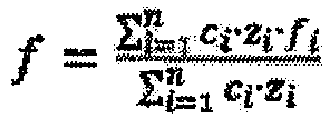
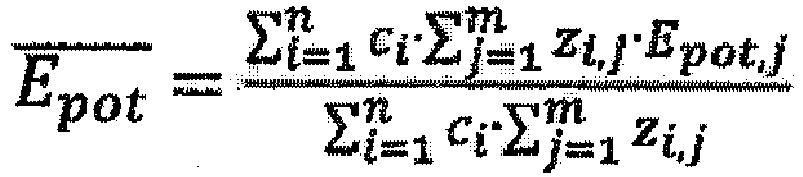
- The glass according to claim 1 having a composition of base glasses which is characterized by the following phases constituting the glass, wherein the sum of the proportions of reedmergnerite, potassium reedmergnerite and albite is at least 50 % by mol:
constituting phase min (% by mol) max (% by mol) reedmergnerite 20 50 albite 15 40 potassium reedmergnerite 0 20 danburite 0 15 cordierite 0 15 willemite 0 15 silicon dioxide 25 50 diboron trioxide 1 10 pekovite 0 10 maleevite 0 10 - The glass according to claim 1 having a composition of base glasses which is characterized by the following phases constituting the glass:
constituting phase min (% by mol) max (% by mol) reedmergnerite 9 50 albite 1 15 potassium reedmergnerite 0 20 danburite 0 30 cordierite 0 20 willemite 0 20 silicon dioxide 25 65 diboron trioxide 0 10 pekovite 0 20 maleevite 0 25 - The glass according to one of the preceding claims, wherein the proportion of silicon dioxide is at most 50 % by mol or at most 40 % by mol.
- The glass according to at least one of the preceding claims, wherein the proportion of reedmergnerite in the glass is higher than the proportion of albite.
- The glass according to at least one of the preceding claims, wherein the proportion of diboron trioxide is at most 15 % by mol, at most 10 % by mol or at most 7 % by mol.
- The glass according to at least one of the preceding claims with a number of freedom degrees of angles according to formula (3)

- The glass according to at least one of the preceding claims having a thermal expansion calculated according to formula (5)

- The glass according to at least one of the preceding claims, wherein a dissolution of 50 µmol of glass in neutral water results in a pH value of <8.99, in particularly <8.79.
- The glass according to at least one of the preceding claims, wherein the proportion of reedmergnerite in the glass is higher than the proportion of potassium reedmergnerite.
- The glass according to at least one of the preceding claims, wherein the glass according to formula (2)

- The glass according to at least one of the preceding claims, wherein the total content of boron in the surface glass is at least 60 %, in particularly at least 80 % of the boron content in the bulk glass and/or wherein the boron content in the surface glass in relation to the bulk glass is reduced in an amount of at least 0.1 % by mol, in particularly at least 0.5 % by mol or at least 1 % by mol, wherein the surface glass is present in a depth of about 6 nm.
- A method for the production of a glass according to at least one of the preceding claims, comprising the steps of- melting the raw materials of the glass,- optionally forming a glass article, in particularly a glass tube from the glass melt- cooling the glass.
- The method according to claim 13, comprising the additional step of- exposing the glass to a gas containing water vapor during the forming and/or the melting.
- A use of a glass according to one of claims 1 to 12 for containers and packages, in particularly for pharmaceutical packaging means.
Applications Claiming Priority (2)
| Application Number | Priority Date | Filing Date | Title |
|---|---|---|---|
| DE102017102485.9A DE102017102485A1 (en) | 2017-02-08 | 2017-02-08 | Glasses with improved hydrolytic and alkali resistance |
| EP18155777.8A EP3360852B1 (en) | 2017-02-08 | 2018-02-08 | Glasses having improved hydrolytic and alkali resistance |
Related Parent Applications (2)
| Application Number | Title | Priority Date | Filing Date |
|---|---|---|---|
| EP18155777.8A Division-Into EP3360852B1 (en) | 2017-02-08 | 2018-02-08 | Glasses having improved hydrolytic and alkali resistance |
| EP18155777.8A Division EP3360852B1 (en) | 2017-02-08 | 2018-02-08 | Glasses having improved hydrolytic and alkali resistance |
Publications (2)
| Publication Number | Publication Date |
|---|---|
| EP3473604A1 EP3473604A1 (en) | 2019-04-24 |
| EP3473604B1 true EP3473604B1 (en) | 2020-05-20 |
Family
ID=61188689
Family Applications (2)
| Application Number | Title | Priority Date | Filing Date |
|---|---|---|---|
| EP18155777.8A Active EP3360852B1 (en) | 2017-02-08 | 2018-02-08 | Glasses having improved hydrolytic and alkali resistance |
| EP18212298.6A Active EP3473604B1 (en) | 2017-02-08 | 2018-02-08 | Glasses having improved hydrolytic and lye resistance |
Family Applications Before (1)
| Application Number | Title | Priority Date | Filing Date |
|---|---|---|---|
| EP18155777.8A Active EP3360852B1 (en) | 2017-02-08 | 2018-02-08 | Glasses having improved hydrolytic and alkali resistance |
Country Status (3)
| Country | Link |
|---|---|
| US (1) | US10822265B2 (en) |
| EP (2) | EP3360852B1 (en) |
| DE (1) | DE102017102485A1 (en) |
Cited By (2)
| Publication number | Priority date | Publication date | Assignee | Title |
|---|---|---|---|---|
| WO2024012891A1 (en) | 2022-07-15 | 2024-01-18 | Schott Ag | Hydrogen store |
| DE102023111825A1 (en) | 2022-07-15 | 2024-01-18 | Bundesrepublik Deutschland (Bundesanstalt für Materialforschung und -prüfung (BAM)) | Hydrogen storage |
Families Citing this family (6)
| Publication number | Priority date | Publication date | Assignee | Title |
|---|---|---|---|---|
| DE102017102482B4 (en) * | 2017-02-08 | 2019-11-21 | Schott Ag | Glasses with improved ion exchangeability and thermal expansion |
| DE102018116460A1 (en) * | 2018-07-06 | 2020-01-09 | Schott Ag | Highly resistant and chemically toughened glasses |
| CN120607365A (en) * | 2019-08-05 | 2025-09-09 | 肖特股份有限公司 | Chemically toughened or chemically toughenable sheet glass product and method for producing the same |
| EP4031195A4 (en) | 2019-09-16 | 2023-11-29 | ABK Biomedical Incorporated | COMPOSITION OF RADIOACTIVE AND NON-RADIOACTIVE MICROPARTICLES |
| EP3907199B1 (en) * | 2020-05-08 | 2023-08-23 | Schott Ag | Prestressing using gradient material |
| WO2025124729A1 (en) * | 2023-12-15 | 2025-06-19 | Schott Ag | Glasses combining high chemical resistance, advantageous thermal expansion properties and good melting properties |
Family Cites Families (12)
| Publication number | Priority date | Publication date | Assignee | Title |
|---|---|---|---|---|
| DE4430710C1 (en) | 1994-08-30 | 1996-05-02 | Jenaer Glaswerk Gmbh | Low boric acid borosilicate glass and its use |
| DE19515608C1 (en) * | 1995-04-28 | 1996-08-08 | Ilmenau Tech Glas | Borosilicate glass with linear thermal expansion |
| DE10150884A1 (en) * | 2001-10-16 | 2003-05-08 | Schott Glas | Alkali borosilicate glass used in the production of flat glass comprises oxides of silicon, boron, aluminum, sodium and potassium, and optionally calcium |
| JP2005037651A (en) * | 2003-07-14 | 2005-02-10 | Hoya Corp | Optical glass for lens mounted in projector, its manufacturing method, lens mounted in projector, and projector |
| DE102004023732A1 (en) * | 2004-05-11 | 2005-12-08 | Schott Ag | Use of silicon containing and phosphorous-free glass for the treatment of e.g. autoimmune inflammatory diseases, infections, allergies, arthritis, dermatosis, stomach/gastric diseases and memory disorders |
| FR2936794A1 (en) * | 2008-10-08 | 2010-04-09 | Saint Gobain | Composition, useful as glass substrate, comprises silicon dioxide, aluminum oxide, boric oxide, calcium oxide, potassium oxide, sodium oxide, potassium oxide and sodium oxide, zirconium oxide, fluorine, and magnesium oxide |
| JPWO2015111524A1 (en) * | 2014-01-24 | 2017-03-23 | 旭硝子株式会社 | Tempered glass composition, tempered glass article and method for producing the same |
| DE102014101756B4 (en) | 2014-02-12 | 2016-01-21 | Schott Ag | Process for producing glass tubes with improved chemical resistance and use thereof |
| CN107001115A (en) * | 2014-12-02 | 2017-08-01 | 旭硝子株式会社 | Glass plate and heater using same |
| JP2016110746A (en) | 2014-12-03 | 2016-06-20 | 株式会社オートネットワーク技術研究所 | Wire harness and power supply system of automobile |
| DE102014119594B9 (en) | 2014-12-23 | 2020-06-18 | Schott Ag | Low brittleness and high intrinsic strength borosilicate glass, its manufacture and use |
| DE102017102482B4 (en) * | 2017-02-08 | 2019-11-21 | Schott Ag | Glasses with improved ion exchangeability and thermal expansion |
-
2017
- 2017-02-08 DE DE102017102485.9A patent/DE102017102485A1/en not_active Withdrawn
-
2018
- 2018-02-08 US US15/892,029 patent/US10822265B2/en active Active
- 2018-02-08 EP EP18155777.8A patent/EP3360852B1/en active Active
- 2018-02-08 EP EP18212298.6A patent/EP3473604B1/en active Active
Non-Patent Citations (1)
| Title |
|---|
| None * |
Cited By (2)
| Publication number | Priority date | Publication date | Assignee | Title |
|---|---|---|---|---|
| WO2024012891A1 (en) | 2022-07-15 | 2024-01-18 | Schott Ag | Hydrogen store |
| DE102023111825A1 (en) | 2022-07-15 | 2024-01-18 | Bundesrepublik Deutschland (Bundesanstalt für Materialforschung und -prüfung (BAM)) | Hydrogen storage |
Also Published As
| Publication number | Publication date |
|---|---|
| US10822265B2 (en) | 2020-11-03 |
| EP3360852B1 (en) | 2019-03-27 |
| DE102017102485A1 (en) | 2018-08-09 |
| EP3473604A1 (en) | 2019-04-24 |
| EP3360852A1 (en) | 2018-08-15 |
| US20180222791A1 (en) | 2018-08-09 |
Similar Documents
| Publication | Publication Date | Title |
|---|---|---|
| EP3360852B1 (en) | Glasses having improved hydrolytic and alkali resistance | |
| DE3116186C2 (en) | ||
| DE112006002185B4 (en) | Glass composition and method of making a glass composition | |
| DE112006004277B4 (en) | glass composition | |
| DE102014119594B4 (en) | Borosilicate glass with low brittleness and high intrinsic strength, its preparation and its use | |
| DE102015116097B4 (en) | Chemically resistant glass and its use | |
| DE102017102482B4 (en) | Glasses with improved ion exchangeability and thermal expansion | |
| DE202013012920U1 (en) | Zircon-compatible, ion-exchangeable glass with high damage resistance | |
| DE202013011766U1 (en) | Borosilicate glass with improved hydrolytic resistance for preferred use in the pharmaceutical field | |
| DE102015214431B3 (en) | Boron-poor zirconium-free neutral glass with optimized alkali ratio | |
| DE112017007131T5 (en) | Low-expansion lithium-containing aluminosilicate glass after chemical tempering | |
| DE102010031114B4 (en) | Glass with excellent resistance to surface damage and use of alkaline earth phosphates to increase the surface resistance of glass | |
| DE1596947A1 (en) | Process for improving the strength of glass objects | |
| DE102009021115A1 (en) | Silicate glass, useful e.g. as UV-permeable material for lamps, comprises glass composition of e.g. silicon dioxide, boron oxide, sodium oxide, potassium oxide, calcium oxide, barium oxide and aluminum oxide with a content of ferric oxide | |
| DE102018116483A1 (en) | Chemically toughened glasses with high chemical resistance and crack resistance | |
| DE2633946B2 (en) | Thorium-free optical glass of the system B2 ° 3 La2 O3 -Y2 O3 with a refraction equal to nd | |
| EP3590902B1 (en) | Highly durable and chemically prestressable glasses | |
| DE102018116464A1 (en) | Chemically toughened, corrosion-resistant glasses | |
| DE102019117498B4 (en) | Glasses with improved ion exchangeability | |
| DE60300262T2 (en) | Optical glass | |
| EP3670460A1 (en) | Chemically resistant, boron and alkali-free glasses | |
| DE102021109897A1 (en) | Glasses with high refractive index and low density | |
| DE102011084543B4 (en) | Borosilicate glass with high hydrolytic resistance | |
| EP3907199A1 (en) | Prestressing using gradient material | |
| DE2262364C3 (en) | Acid-resistant optical glass of the B2 O3 -PbO-Al 2 O3 system with anomaly of the partial dispersion in the IR range from 6263 to 768.2 mn, calculation indices nd from 134 to 1.71 and Abbe numbers vd from 55 to 30 |
Legal Events
| Date | Code | Title | Description |
|---|---|---|---|
| PUAI | Public reference made under article 153(3) epc to a published international application that has entered the european phase |
Free format text: ORIGINAL CODE: 0009012 |
|
| STAA | Information on the status of an ep patent application or granted ep patent |
Free format text: STATUS: REQUEST FOR EXAMINATION WAS MADE |
|
| 17P | Request for examination filed |
Effective date: 20181213 |
|
| AC | Divisional application: reference to earlier application |
Ref document number: 3360852 Country of ref document: EP Kind code of ref document: P |
|
| AK | Designated contracting states |
Kind code of ref document: A1 Designated state(s): AL AT BE BG CH CY CZ DE DK EE ES FI FR GB GR HR HU IE IS IT LI LT LU LV MC MK MT NL NO PL PT RO RS SE SI SK SM TR |
|
| STAA | Information on the status of an ep patent application or granted ep patent |
Free format text: STATUS: EXAMINATION IS IN PROGRESS |
|
| 17Q | First examination report despatched |
Effective date: 20190426 |
|
| GRAP | Despatch of communication of intention to grant a patent |
Free format text: ORIGINAL CODE: EPIDOSNIGR1 |
|
| STAA | Information on the status of an ep patent application or granted ep patent |
Free format text: STATUS: GRANT OF PATENT IS INTENDED |
|
| INTG | Intention to grant announced |
Effective date: 20200121 |
|
| RIN1 | Information on inventor provided before grant (corrected) |
Inventor name: GROSS, CHRISTOPH Inventor name: NASS, PETER Inventor name: BERNDHAEUSER, CHRISTOPH Inventor name: KASS, CHRISTOF Inventor name: FOTHERINGHAM, ULRICH Inventor name: SCHWALL, MICHAEL Inventor name: RITTER, SIMONE MONIKA |
|
| GRAS | Grant fee paid |
Free format text: ORIGINAL CODE: EPIDOSNIGR3 |
|
| GRAA | (expected) grant |
Free format text: ORIGINAL CODE: 0009210 |
|
| STAA | Information on the status of an ep patent application or granted ep patent |
Free format text: STATUS: THE PATENT HAS BEEN GRANTED |
|
| AC | Divisional application: reference to earlier application |
Ref document number: 3360852 Country of ref document: EP Kind code of ref document: P |
|
| AK | Designated contracting states |
Kind code of ref document: B1 Designated state(s): AL AT BE BG CH CY CZ DE DK EE ES FI FR GB GR HR HU IE IS IT LI LT LU LV MC MK MT NL NO PL PT RO RS SE SI SK SM TR |
|
| REG | Reference to a national code |
Ref country code: GB Ref legal event code: FG4D Free format text: NOT ENGLISH |
|
| REG | Reference to a national code |
Ref country code: CH Ref legal event code: EP |
|
| REG | Reference to a national code |
Ref country code: DE Ref legal event code: R096 Ref document number: 502018001486 Country of ref document: DE |
|
| REG | Reference to a national code |
Ref country code: AT Ref legal event code: REF Ref document number: 1272510 Country of ref document: AT Kind code of ref document: T Effective date: 20200615 |
|
| REG | Reference to a national code |
Ref country code: LT Ref legal event code: MG4D |
|
| REG | Reference to a national code |
Ref country code: NL Ref legal event code: MP Effective date: 20200520 |
|
| PG25 | Lapsed in a contracting state [announced via postgrant information from national office to epo] |
Ref country code: FI Free format text: LAPSE BECAUSE OF FAILURE TO SUBMIT A TRANSLATION OF THE DESCRIPTION OR TO PAY THE FEE WITHIN THE PRESCRIBED TIME-LIMIT Effective date: 20200520 Ref country code: PT Free format text: LAPSE BECAUSE OF FAILURE TO SUBMIT A TRANSLATION OF THE DESCRIPTION OR TO PAY THE FEE WITHIN THE PRESCRIBED TIME-LIMIT Effective date: 20200921 Ref country code: IS Free format text: LAPSE BECAUSE OF FAILURE TO SUBMIT A TRANSLATION OF THE DESCRIPTION OR TO PAY THE FEE WITHIN THE PRESCRIBED TIME-LIMIT Effective date: 20200920 Ref country code: NO Free format text: LAPSE BECAUSE OF FAILURE TO SUBMIT A TRANSLATION OF THE DESCRIPTION OR TO PAY THE FEE WITHIN THE PRESCRIBED TIME-LIMIT Effective date: 20200820 Ref country code: GR Free format text: LAPSE BECAUSE OF FAILURE TO SUBMIT A TRANSLATION OF THE DESCRIPTION OR TO PAY THE FEE WITHIN THE PRESCRIBED TIME-LIMIT Effective date: 20200821 Ref country code: LT Free format text: LAPSE BECAUSE OF FAILURE TO SUBMIT A TRANSLATION OF THE DESCRIPTION OR TO PAY THE FEE WITHIN THE PRESCRIBED TIME-LIMIT Effective date: 20200520 Ref country code: SE Free format text: LAPSE BECAUSE OF FAILURE TO SUBMIT A TRANSLATION OF THE DESCRIPTION OR TO PAY THE FEE WITHIN THE PRESCRIBED TIME-LIMIT Effective date: 20200520 |
|
| PG25 | Lapsed in a contracting state [announced via postgrant information from national office to epo] |
Ref country code: BG Free format text: LAPSE BECAUSE OF FAILURE TO SUBMIT A TRANSLATION OF THE DESCRIPTION OR TO PAY THE FEE WITHIN THE PRESCRIBED TIME-LIMIT Effective date: 20200820 Ref country code: HR Free format text: LAPSE BECAUSE OF FAILURE TO SUBMIT A TRANSLATION OF THE DESCRIPTION OR TO PAY THE FEE WITHIN THE PRESCRIBED TIME-LIMIT Effective date: 20200520 Ref country code: RS Free format text: LAPSE BECAUSE OF FAILURE TO SUBMIT A TRANSLATION OF THE DESCRIPTION OR TO PAY THE FEE WITHIN THE PRESCRIBED TIME-LIMIT Effective date: 20200520 Ref country code: LV Free format text: LAPSE BECAUSE OF FAILURE TO SUBMIT A TRANSLATION OF THE DESCRIPTION OR TO PAY THE FEE WITHIN THE PRESCRIBED TIME-LIMIT Effective date: 20200520 |
|
| PG25 | Lapsed in a contracting state [announced via postgrant information from national office to epo] |
Ref country code: NL Free format text: LAPSE BECAUSE OF FAILURE TO SUBMIT A TRANSLATION OF THE DESCRIPTION OR TO PAY THE FEE WITHIN THE PRESCRIBED TIME-LIMIT Effective date: 20200520 Ref country code: AL Free format text: LAPSE BECAUSE OF FAILURE TO SUBMIT A TRANSLATION OF THE DESCRIPTION OR TO PAY THE FEE WITHIN THE PRESCRIBED TIME-LIMIT Effective date: 20200520 |
|
| PG25 | Lapsed in a contracting state [announced via postgrant information from national office to epo] |
Ref country code: SM Free format text: LAPSE BECAUSE OF FAILURE TO SUBMIT A TRANSLATION OF THE DESCRIPTION OR TO PAY THE FEE WITHIN THE PRESCRIBED TIME-LIMIT Effective date: 20200520 Ref country code: RO Free format text: LAPSE BECAUSE OF FAILURE TO SUBMIT A TRANSLATION OF THE DESCRIPTION OR TO PAY THE FEE WITHIN THE PRESCRIBED TIME-LIMIT Effective date: 20200520 Ref country code: ES Free format text: LAPSE BECAUSE OF FAILURE TO SUBMIT A TRANSLATION OF THE DESCRIPTION OR TO PAY THE FEE WITHIN THE PRESCRIBED TIME-LIMIT Effective date: 20200520 Ref country code: DK Free format text: LAPSE BECAUSE OF FAILURE TO SUBMIT A TRANSLATION OF THE DESCRIPTION OR TO PAY THE FEE WITHIN THE PRESCRIBED TIME-LIMIT Effective date: 20200520 Ref country code: EE Free format text: LAPSE BECAUSE OF FAILURE TO SUBMIT A TRANSLATION OF THE DESCRIPTION OR TO PAY THE FEE WITHIN THE PRESCRIBED TIME-LIMIT Effective date: 20200520 Ref country code: CZ Free format text: LAPSE BECAUSE OF FAILURE TO SUBMIT A TRANSLATION OF THE DESCRIPTION OR TO PAY THE FEE WITHIN THE PRESCRIBED TIME-LIMIT Effective date: 20200520 |
|
| REG | Reference to a national code |
Ref country code: DE Ref legal event code: R097 Ref document number: 502018001486 Country of ref document: DE |
|
| PG25 | Lapsed in a contracting state [announced via postgrant information from national office to epo] |
Ref country code: SK Free format text: LAPSE BECAUSE OF FAILURE TO SUBMIT A TRANSLATION OF THE DESCRIPTION OR TO PAY THE FEE WITHIN THE PRESCRIBED TIME-LIMIT Effective date: 20200520 Ref country code: PL Free format text: LAPSE BECAUSE OF FAILURE TO SUBMIT A TRANSLATION OF THE DESCRIPTION OR TO PAY THE FEE WITHIN THE PRESCRIBED TIME-LIMIT Effective date: 20200520 |
|
| PLBE | No opposition filed within time limit |
Free format text: ORIGINAL CODE: 0009261 |
|
| STAA | Information on the status of an ep patent application or granted ep patent |
Free format text: STATUS: NO OPPOSITION FILED WITHIN TIME LIMIT |
|
| 26N | No opposition filed |
Effective date: 20210223 |
|
| PG25 | Lapsed in a contracting state [announced via postgrant information from national office to epo] |
Ref country code: SI Free format text: LAPSE BECAUSE OF FAILURE TO SUBMIT A TRANSLATION OF THE DESCRIPTION OR TO PAY THE FEE WITHIN THE PRESCRIBED TIME-LIMIT Effective date: 20200520 |
|
| PG25 | Lapsed in a contracting state [announced via postgrant information from national office to epo] |
Ref country code: MC Free format text: LAPSE BECAUSE OF FAILURE TO SUBMIT A TRANSLATION OF THE DESCRIPTION OR TO PAY THE FEE WITHIN THE PRESCRIBED TIME-LIMIT Effective date: 20200520 |
|
| PG25 | Lapsed in a contracting state [announced via postgrant information from national office to epo] |
Ref country code: CH Free format text: LAPSE BECAUSE OF NON-PAYMENT OF DUE FEES Effective date: 20210228 Ref country code: LI Free format text: LAPSE BECAUSE OF NON-PAYMENT OF DUE FEES Effective date: 20210228 Ref country code: LU Free format text: LAPSE BECAUSE OF NON-PAYMENT OF DUE FEES Effective date: 20210208 |
|
| PG25 | Lapsed in a contracting state [announced via postgrant information from national office to epo] |
Ref country code: IE Free format text: LAPSE BECAUSE OF NON-PAYMENT OF DUE FEES Effective date: 20210208 |
|
| GBPC | Gb: european patent ceased through non-payment of renewal fee |
Effective date: 20220208 |
|
| PG25 | Lapsed in a contracting state [announced via postgrant information from national office to epo] |
Ref country code: GB Free format text: LAPSE BECAUSE OF NON-PAYMENT OF DUE FEES Effective date: 20220208 |
|
| P01 | Opt-out of the competence of the unified patent court (upc) registered |
Effective date: 20230512 |
|
| PG25 | Lapsed in a contracting state [announced via postgrant information from national office to epo] |
Ref country code: CY Free format text: LAPSE BECAUSE OF FAILURE TO SUBMIT A TRANSLATION OF THE DESCRIPTION OR TO PAY THE FEE WITHIN THE PRESCRIBED TIME-LIMIT Effective date: 20200520 |
|
| PG25 | Lapsed in a contracting state [announced via postgrant information from national office to epo] |
Ref country code: HU Free format text: LAPSE BECAUSE OF FAILURE TO SUBMIT A TRANSLATION OF THE DESCRIPTION OR TO PAY THE FEE WITHIN THE PRESCRIBED TIME-LIMIT; INVALID AB INITIO Effective date: 20180208 |
|
| REG | Reference to a national code |
Ref country code: AT Ref legal event code: MM01 Ref document number: 1272510 Country of ref document: AT Kind code of ref document: T Effective date: 20230208 |
|
| PG25 | Lapsed in a contracting state [announced via postgrant information from national office to epo] |
Ref country code: AT Free format text: LAPSE BECAUSE OF NON-PAYMENT OF DUE FEES Effective date: 20230208 |
|
| PG25 | Lapsed in a contracting state [announced via postgrant information from national office to epo] |
Ref country code: MK Free format text: LAPSE BECAUSE OF FAILURE TO SUBMIT A TRANSLATION OF THE DESCRIPTION OR TO PAY THE FEE WITHIN THE PRESCRIBED TIME-LIMIT Effective date: 20200520 Ref country code: AT Free format text: LAPSE BECAUSE OF NON-PAYMENT OF DUE FEES Effective date: 20230208 |
|
| PG25 | Lapsed in a contracting state [announced via postgrant information from national office to epo] |
Ref country code: TR Free format text: LAPSE BECAUSE OF FAILURE TO SUBMIT A TRANSLATION OF THE DESCRIPTION OR TO PAY THE FEE WITHIN THE PRESCRIBED TIME-LIMIT Effective date: 20200520 |
|
| PG25 | Lapsed in a contracting state [announced via postgrant information from national office to epo] |
Ref country code: MT Free format text: LAPSE BECAUSE OF FAILURE TO SUBMIT A TRANSLATION OF THE DESCRIPTION OR TO PAY THE FEE WITHIN THE PRESCRIBED TIME-LIMIT Effective date: 20200520 |
|
| PGFP | Annual fee paid to national office [announced via postgrant information from national office to epo] |
Ref country code: DE Payment date: 20260218 Year of fee payment: 9 |
|
| PGFP | Annual fee paid to national office [announced via postgrant information from national office to epo] |
Ref country code: AT Payment date: 20260410 Year of fee payment: 5 |
|
| PGFP | Annual fee paid to national office [announced via postgrant information from national office to epo] |
Ref country code: BE Payment date: 20260218 Year of fee payment: 9 Ref country code: IT Payment date: 20260224 Year of fee payment: 9 |
|
| PGFP | Annual fee paid to national office [announced via postgrant information from national office to epo] |
Ref country code: FR Payment date: 20260218 Year of fee payment: 9 |