EP3473902A1 - Servoventilgehäuse - Google Patents
Servoventilgehäuse Download PDFInfo
- Publication number
- EP3473902A1 EP3473902A1 EP17461626.8A EP17461626A EP3473902A1 EP 3473902 A1 EP3473902 A1 EP 3473902A1 EP 17461626 A EP17461626 A EP 17461626A EP 3473902 A1 EP3473902 A1 EP 3473902A1
- Authority
- EP
- European Patent Office
- Prior art keywords
- outer shell
- housing
- lattice structure
- servo valve
- valve housing
- Prior art date
- Legal status (The legal status is an assumption and is not a legal conclusion. Google has not performed a legal analysis and makes no representation as to the accuracy of the status listed.)
- Withdrawn
Links
Images


Classifications
-
- F—MECHANICAL ENGINEERING; LIGHTING; HEATING; WEAPONS; BLASTING
- F16—ENGINEERING ELEMENTS AND UNITS; GENERAL MEASURES FOR PRODUCING AND MAINTAINING EFFECTIVE FUNCTIONING OF MACHINES OR INSTALLATIONS; THERMAL INSULATION IN GENERAL
- F16K—VALVES; TAPS; COCKS; ACTUATING-FLOATS; DEVICES FOR VENTING OR AERATING
- F16K27/00—Construction of housing; Use of materials therefor
-
- B—PERFORMING OPERATIONS; TRANSPORTING
- B23—MACHINE TOOLS; METAL-WORKING NOT OTHERWISE PROVIDED FOR
- B23P—METAL-WORKING NOT OTHERWISE PROVIDED FOR; COMBINED OPERATIONS; UNIVERSAL MACHINE TOOLS
- B23P15/00—Making specific metal objects by operations not covered by a single other subclass or a group in this subclass
- B23P15/001—Making specific metal objects by operations not covered by a single other subclass or a group in this subclass valves or valve housings
-
- B—PERFORMING OPERATIONS; TRANSPORTING
- B33—ADDITIVE MANUFACTURING TECHNOLOGY
- B33Y—ADDITIVE MANUFACTURING, i.e. MANUFACTURING OF THREE-DIMENSIONAL [3D] OBJECTS BY ADDITIVE DEPOSITION, ADDITIVE AGGLOMERATION OR ADDITIVE LAYERING, e.g. BY 3D PRINTING, STEREOLITHOGRAPHY OR SELECTIVE LASER SINTERING
- B33Y80/00—Products made by additive manufacturing
-
- F—MECHANICAL ENGINEERING; LIGHTING; HEATING; WEAPONS; BLASTING
- F15—FLUID-PRESSURE ACTUATORS; HYDRAULICS OR PNEUMATICS IN GENERAL
- F15B—SYSTEMS ACTING BY MEANS OF FLUIDS IN GENERAL; FLUID-PRESSURE ACTUATORS, e.g. SERVOMOTORS; DETAILS OF FLUID-PRESSURE SYSTEMS, NOT OTHERWISE PROVIDED FOR
- F15B13/00—Details of servomotor systems ; Valves for servomotor systems
- F15B13/02—Fluid distribution or supply devices characterised by their adaptation to the control of servomotors
- F15B13/04—Fluid distribution or supply devices characterised by their adaptation to the control of servomotors for use with a single servomotor
- F15B13/042—Fluid distribution or supply devices characterised by their adaptation to the control of servomotors for use with a single servomotor operated by fluid pressure
- F15B13/043—Fluid distribution or supply devices characterised by their adaptation to the control of servomotors for use with a single servomotor operated by fluid pressure with electrically-controlled pilot valves
- F15B13/0438—Fluid distribution or supply devices characterised by their adaptation to the control of servomotors for use with a single servomotor operated by fluid pressure with electrically-controlled pilot valves the pilot valves being of the nozzle-flapper type
Definitions
- This disclosure relates to a servo valve housing and also a method of manufacturing a servo valve housing.
- Servo valves are well-known in the art and can be used to control how much fluid is ported to an actuator.
- Servo valves include a housing that houses several components in cavities manufactured therein. Such components are well-known in the art, and include, for instance, fluid nozzles, spool valves, flappers, fluid ports etc.
- servo valve housings produced by existing methods may be relatively heavy. In many applications, particularly for aerospace applications, providing lower weight servo valve housings is highly desirable. However, the servo valve housing must still be able to cope with the various stress and fatigue properties needed to permit its operation under various conditions and in certain environments.
- the present disclosure relates to a servo valve housing comprising an outer shell, having an outer wall surface defining an outer perimeter of the housing, and a lattice structure within the outer shell.
- the outer shell includes an inner wall surface, defining an inner perimeter of the outer shell, and the lattice structure extends between different portions of the inner wall surface.
- At least one cavity is defined within the housing by the outer wall surface of the outer shell.
- the present disclosure relates to a method of manufacturing a servo valve housing using additive manufacturing.
- the additive manufacturing comprises wire-feed metal deposition.
- the method further comprises depositing successive layers of material one on top of each other to provide an outer shell and a lattice structure within the outer shell.
- the outer shell may include an inner wall surface, defining an inner perimeter of the outer shell, and the method may further comprise depositing the lattice structure to extend between different portions of the inner wall surface.
- the outer shell may have an outer wall surface defining an outer perimeter of the housing. The method may also further comprise depositing successive layers to form at least one cavity within the housing defined by the outer wall surface of the outer shell.
- the outer shell is a solid outer shell layer.
- the lattice structure has an irregular structure, defining a mixed density within the outer shell.
- the density of the lattice structure may be greater in an area of the housing determined to experience a relatively higher stress during operation, than in another area of the housing.
- the density of the lattice structure is greater in an area of the housing determined to be relatively more susceptible to stress concentrations and/or fatigue than in another area of the housing.
- the lattice structure may have an irregular structure, comprising more than one different types of lattice structure within the outer shell.
- the lattice structure has a regular structure, defining an approximately uniform density within the outer shell and one type of lattice structure.
- the thickness of the outer shell varies around the perimeter of the housing.
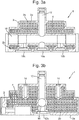
- FIG. 1 part of a servo valve housing 1 is illustrated.
- the housing 1 is shown part way through manufacture.
- An outer shell 2 has an outer wall surface 2a defining an outer perimeter of the housing and an inner wall surface 2b defining an inner perimeter of the outer shell 2, and enclosing an interior volume of the housing 1.
- a lattice structure 4 is disposed within the outer shell 2 and extends to fill the inner perimeter defined by the inner wall surface 2b. In this manner, the outer shell 2 forms an external layer of material that surrounds the lattice structure 4.
- the outer wall surface 2a defines a plurality of cavities located within the housing 1 that are designed to either house different servo valve components or act as ports.
- the precise arrangement of cavities is not important for understanding this disclosure, and as will be understood by the skilled person, may be different depending on the purpose, positioning and control mechanism of the eventual servo valve.
- housing 1 has been illustrated in Figures 1 to 4 with fluid supply cavities 6, 8, 12 and 14, mounting apertures 10, a spool valve cavity 16 and fluid control ports 18a-18c.
- the outer shell 2 may hermetically seal the interior volume defined thereby from the exterior of the housing 1.
- the lattice structure 4 can be any suitable lattice structure.
- the lattice structure may comprise a series of nodes interconnected by ligaments, defining a porous construction.
- the interior volume enclosed by the outer shell 2 where no nodes or ligaments are present is hollow (i.e. void of solid material).
- the volume defined within the outer shell not occupied by the lattice structure 4 may be empty or filled with a gas.
- the lattice structure 4 may be any Bravais lattice structure, such as cubic, triclinic, monoclinic, orthorhombic, tetragonal, hexagonal or rhombohedral.
- the lattice structure may be regular or irregular.
- the lattice structure has an approximately uniform density between the inner wall surface 2b and is one type of lattice structure.
- the lattice structure 4 has a mixed density between the inner wall surface 2b, and/or may comprise one or more types of lattice structure.
- the relative density of the lattice structure can be varied by making the unit cell of the lattice structure smaller or larger. For instance, an area of lattice structure 4 with a smaller (tighter spaced) unit cell will provide a denser lattice structure per unit volume than area of lattice structure 4 with a larger (more spaced apart) unit cell.
- the lattice structure type and density can be varied according to stress and fatigue requirements in certain areas of the servo valve housing. In areas where the servo valve housing is put under a relatively higher stress or is relatively more susceptible to stress concentrations and/or fatigue, a lattice structure type that is stronger and/or a lattice structure having a higher density may be used. As will be appreciated by the skilled person, such areas may be identified by modelling the housing 1 under operating conditions. Such modelling may involve computational fluid dynamics (CFD) and/or finite element analysis (FEA).
- CFD computational fluid dynamics
- FEA finite element analysis
- the lattice structure 4 has one density in one location within the housing 1 and a different density in another location within the housing 1.
- the lattice structure 4 can be one type of lattice structure 4 in one location within the housing 1 and may be a different type of lattice structure 4 in another location within the housing 1.
- the outer shell 2 is a solid outer shell layer, or in other words, a "fully-dense" structure that is non-porous, unlike the lattice structure 4. In this manner, outer shell 2 forms an external layer of "fully-dense" material that surrounds the lattice structure 4.
- the thickness of the outer shell 2 is defined as the distance between the outer and inner wall surfaces 2a, 2b.
- the thickness of outer shell 2 may be constant around the perimeter of the housing 1 or may be varied around the perimeter of the housing 1. For instance, the thickness of outer shell 2 may be varied to account for increased stress and fatigue resistance requirements, as discussed above with regard to the lattice structure 4.
- the housing 1 may be formed using additive manufacturing.
- a particularly suitable additive manufacturing technique may be wire feed additive manufacturing, and specifically, wire feed metal deposition.
- wire stock of metal is progressively fed through a wire feeder and deposited onto a substrate using a melting device, for example, an electron beam or laser. This allows layers of the housing 1 to be formed on a substrate, until the whole housing 1 has been formed.
- a melting device for example, an electron beam or laser.
- the housing 1 can be made of any suitable material that is available as a wire stock for wire feed additive manufacturing, and will be determined by the intended operating environment and conditions of the eventual servo valve.
- servo valve housing 1 may comprise an aluminium, steel, titanium or nickel-based alloy.
- different alloys may be used in different areas of the servo valve housing 1, according to differing mechanical property requirements.
- the use of wire feed additive manufacturing allows relatively quick and inexpensive manufacture of the housing 1 compared to prior art techniques.
- the formation of the outer shell 2 and lattice structure 4 permits substantial weight savings compared to prior art servo valve housings (for example, if the volume enclosed by the outer shell 2 were a solid, "fully-dense" structure that is non-porous and/or the volume enclosed by the outer shell 2 were filled with the material that defines the outer shell 2), which can be beneficial for certain servo valve applications, particularly those used in aerospace applications.
- existing servo valve housing geometries can be produced, meaning that the disclosed lighter weight servo valve housing can be used as a direct replacement for an existing servo valve housing, without the whole servo valve requiring a redesign.
Landscapes
- Engineering & Computer Science (AREA)
- General Engineering & Computer Science (AREA)
- Mechanical Engineering (AREA)
- Valve Housings (AREA)
Priority Applications (2)
| Application Number | Priority Date | Filing Date | Title |
|---|---|---|---|
| EP17461626.8A EP3473902A1 (de) | 2017-10-23 | 2017-10-23 | Servoventilgehäuse |
| US16/117,090 US20190120395A1 (en) | 2017-10-23 | 2018-08-30 | Servo valve housing |
Applications Claiming Priority (1)
| Application Number | Priority Date | Filing Date | Title |
|---|---|---|---|
| EP17461626.8A EP3473902A1 (de) | 2017-10-23 | 2017-10-23 | Servoventilgehäuse |
Publications (1)
| Publication Number | Publication Date |
|---|---|
| EP3473902A1 true EP3473902A1 (de) | 2019-04-24 |
Family
ID=60201490
Family Applications (1)
| Application Number | Title | Priority Date | Filing Date |
|---|---|---|---|
| EP17461626.8A Withdrawn EP3473902A1 (de) | 2017-10-23 | 2017-10-23 | Servoventilgehäuse |
Country Status (2)
| Country | Link |
|---|---|
| US (1) | US20190120395A1 (de) |
| EP (1) | EP3473902A1 (de) |
Cited By (2)
| Publication number | Priority date | Publication date | Assignee | Title |
|---|---|---|---|---|
| CN116600918A (zh) * | 2020-09-23 | 2023-08-15 | Q工具有限责任公司 | 通过增材制造制成的用于注射模制的模具 |
| EP4245541A2 (de) * | 2018-09-26 | 2023-09-20 | Hamilton Sundstrand Corporation | Servoventile |
Families Citing this family (1)
| Publication number | Priority date | Publication date | Assignee | Title |
|---|---|---|---|---|
| US10281053B2 (en) * | 2015-10-12 | 2019-05-07 | Emerson Process Management Regulator Technologies, Inc. | Lattice structure valve/regulator body |
Citations (4)
| Publication number | Priority date | Publication date | Assignee | Title |
|---|---|---|---|---|
| US20130004680A1 (en) * | 2011-06-28 | 2013-01-03 | Honeywell International Inc. | Methods for manufacturing engine components with structural bridge devices |
| JP2016050635A (ja) * | 2014-08-29 | 2016-04-11 | 株式会社フジキン | 流体機器及び流体制御機器 |
| US20160280197A1 (en) * | 2015-03-26 | 2016-09-29 | Robert Bosch Gmbh | Hydraulic Block for a Hydraulic Unit of a Brake Controller of a Hydraulic Vehicle Brake System |
| US20170102089A1 (en) * | 2015-10-12 | 2017-04-13 | Emerson Process Management Regulator Technologies, Inc. | Lattice structure valve/regulator body |
-
2017
- 2017-10-23 EP EP17461626.8A patent/EP3473902A1/de not_active Withdrawn
-
2018
- 2018-08-30 US US16/117,090 patent/US20190120395A1/en not_active Abandoned
Patent Citations (4)
| Publication number | Priority date | Publication date | Assignee | Title |
|---|---|---|---|---|
| US20130004680A1 (en) * | 2011-06-28 | 2013-01-03 | Honeywell International Inc. | Methods for manufacturing engine components with structural bridge devices |
| JP2016050635A (ja) * | 2014-08-29 | 2016-04-11 | 株式会社フジキン | 流体機器及び流体制御機器 |
| US20160280197A1 (en) * | 2015-03-26 | 2016-09-29 | Robert Bosch Gmbh | Hydraulic Block for a Hydraulic Unit of a Brake Controller of a Hydraulic Vehicle Brake System |
| US20170102089A1 (en) * | 2015-10-12 | 2017-04-13 | Emerson Process Management Regulator Technologies, Inc. | Lattice structure valve/regulator body |
Cited By (3)
| Publication number | Priority date | Publication date | Assignee | Title |
|---|---|---|---|---|
| EP4245541A2 (de) * | 2018-09-26 | 2023-09-20 | Hamilton Sundstrand Corporation | Servoventile |
| EP4245541B1 (de) * | 2018-09-26 | 2025-08-06 | Hamilton Sundstrand Corporation | Servoventile |
| CN116600918A (zh) * | 2020-09-23 | 2023-08-15 | Q工具有限责任公司 | 通过增材制造制成的用于注射模制的模具 |
Also Published As
| Publication number | Publication date |
|---|---|
| US20190120395A1 (en) | 2019-04-25 |
Similar Documents
| Publication | Publication Date | Title |
|---|---|---|
| US20190120395A1 (en) | Servo valve housing | |
| CN106985386B (zh) | 晶格结构的阀本体或调节器本体 | |
| US10436252B2 (en) | Building block for a mechanical construction | |
| JP5847084B2 (ja) | 少なくとも2種類の異なる粉末材料からレーザー処理によって物体を生成するための方法および関連設備 | |
| US8936068B2 (en) | Method of casting a component having interior passageways | |
| US8689446B2 (en) | Method for producing a watch case middle of reduced weight | |
| US12018394B1 (en) | Thin-walled high temperature alloy structures via multi-material additive manufacturing | |
| US5073459A (en) | Sintered light-weight structural material and method of its manufacture | |
| EP2937161A1 (de) | Durch additive fertigung hergestellter keramikgusskern | |
| EP3173167B1 (de) | Verfahren und vorrichtung zur behandlung eines objekts | |
| EP3428395B1 (de) | Gebläseschaufel und herstellungsverfahren | |
| CN107448241A (zh) | 高孔隙率材料及其制造方法 | |
| CN103080577A (zh) | 轴承构件特别是滚动轴承保持架及其制造方法 | |
| CA2982691A1 (en) | Method for manufacturing a component by thermal spraying | |
| RU2766514C2 (ru) | Способ изготовления устройства для снижения давления текучей среды | |
| Graf et al. | 3D laser metal deposition: process steps for additive manufacturing | |
| US10703045B2 (en) | Device with hatch for additive manufacturing | |
| JP2021000827A (ja) | 3次元の物体を付加製造する装置を動作させる方法 | |
| WO2019088064A1 (ja) | 金属部材の作製方法 | |
| CN109676136B (zh) | 一种用于首饰品或艺术品的激光增材制造方法 | |
| EP3483488A1 (de) | Rückschlagventilgehäuse | |
| Kumar | Air and ion deposition processes | |
| US20190134749A1 (en) | Building platform for additive manufacturing, and method | |
| US11377750B1 (en) | Ductile coatings on additive manufactured components | |
| RU2778985C1 (ru) | Способ изготовления аэродинамического профиля с внутренней ячеистой структурой, аэродинамический профиль с внутренней ячеистой структурой и ячеистая структура аэродинамического профиля |
Legal Events
| Date | Code | Title | Description |
|---|---|---|---|
| PUAI | Public reference made under article 153(3) epc to a published international application that has entered the european phase |
Free format text: ORIGINAL CODE: 0009012 |
|
| STAA | Information on the status of an ep patent application or granted ep patent |
Free format text: STATUS: THE APPLICATION HAS BEEN PUBLISHED |
|
| AK | Designated contracting states |
Kind code of ref document: A1 Designated state(s): AL AT BE BG CH CY CZ DE DK EE ES FI FR GB GR HR HU IE IS IT LI LT LU LV MC MK MT NL NO PL PT RO RS SE SI SK SM TR |
|
| AX | Request for extension of the european patent |
Extension state: BA ME |
|
| STAA | Information on the status of an ep patent application or granted ep patent |
Free format text: STATUS: THE APPLICATION IS DEEMED TO BE WITHDRAWN |
|
| 18D | Application deemed to be withdrawn |
Effective date: 20191025 |