EP3474006A1 - Mikrochip für freiflusselektrophorese - Google Patents
Mikrochip für freiflusselektrophorese Download PDFInfo
- Publication number
- EP3474006A1 EP3474006A1 EP17197296.1A EP17197296A EP3474006A1 EP 3474006 A1 EP3474006 A1 EP 3474006A1 EP 17197296 A EP17197296 A EP 17197296A EP 3474006 A1 EP3474006 A1 EP 3474006A1
- Authority
- EP
- European Patent Office
- Prior art keywords
- micro
- free flow
- sheet
- flow electrophoresis
- chip according
- Prior art date
- Legal status (The legal status is an assumption and is not a legal conclusion. Google has not performed a legal analysis and makes no representation as to the accuracy of the status listed.)
- Withdrawn
Links
- 238000001997 free-flow electrophoresis Methods 0.000 title claims abstract description 37
- 238000000926 separation method Methods 0.000 claims abstract description 64
- 239000012530 fluid Substances 0.000 claims abstract description 34
- 230000005684 electric field Effects 0.000 claims abstract description 16
- 239000011521 glass Substances 0.000 claims description 31
- 229920000642 polymer Polymers 0.000 claims description 11
- 238000001816 cooling Methods 0.000 claims description 9
- 239000012528 membrane Substances 0.000 claims description 6
- -1 polyethylene Polymers 0.000 claims description 6
- 229920001721 polyimide Polymers 0.000 claims description 6
- 239000003292 glue Substances 0.000 claims description 5
- 239000004593 Epoxy Substances 0.000 claims description 4
- 239000004642 Polyimide Substances 0.000 claims description 4
- 239000002826 coolant Substances 0.000 claims description 4
- 229910010272 inorganic material Inorganic materials 0.000 claims description 4
- 229920001169 thermoplastic Polymers 0.000 claims description 4
- 238000011144 upstream manufacturing Methods 0.000 claims description 4
- 239000000919 ceramic Substances 0.000 claims description 3
- 239000011147 inorganic material Substances 0.000 claims description 3
- 239000004417 polycarbonate Substances 0.000 claims description 3
- 229920000515 polycarbonate Polymers 0.000 claims description 3
- 239000004952 Polyamide Substances 0.000 claims description 2
- 239000004698 Polyethylene Substances 0.000 claims description 2
- PNEYBMLMFCGWSK-UHFFFAOYSA-N aluminium oxide Inorganic materials [O-2].[O-2].[O-2].[Al+3].[Al+3] PNEYBMLMFCGWSK-UHFFFAOYSA-N 0.000 claims description 2
- 239000011810 insulating material Substances 0.000 claims description 2
- 229910052751 metal Inorganic materials 0.000 claims description 2
- 239000002184 metal Substances 0.000 claims description 2
- 229920002647 polyamide Polymers 0.000 claims description 2
- 229920000573 polyethylene Polymers 0.000 claims description 2
- 229920000139 polyethylene terephthalate Polymers 0.000 claims description 2
- 229920005989 resin Polymers 0.000 claims description 2
- 239000011347 resin Substances 0.000 claims description 2
- 239000004416 thermosoftening plastic Substances 0.000 claims description 2
- 239000000243 solution Substances 0.000 description 44
- OKKJLVBELUTLKV-UHFFFAOYSA-N Methanol Chemical compound OC OKKJLVBELUTLKV-UHFFFAOYSA-N 0.000 description 24
- 229920003088 hydroxypropyl methyl cellulose Polymers 0.000 description 14
- 239000001866 hydroxypropyl methyl cellulose Substances 0.000 description 13
- 235000010979 hydroxypropyl methyl cellulose Nutrition 0.000 description 13
- UFVKGYZPFZQRLF-UHFFFAOYSA-N hydroxypropyl methyl cellulose Chemical compound OC1C(O)C(OC)OC(CO)C1OC1C(O)C(O)C(OC2C(C(O)C(OC3C(C(O)C(O)C(CO)O3)O)C(CO)O2)O)C(CO)O1 UFVKGYZPFZQRLF-UHFFFAOYSA-N 0.000 description 13
- 229920001213 Polysorbate 20 Polymers 0.000 description 12
- 235000010486 polyoxyethylene sorbitan monolaurate Nutrition 0.000 description 12
- 239000000203 mixture Substances 0.000 description 11
- 239000000256 polyoxyethylene sorbitan monolaurate Substances 0.000 description 11
- 239000007787 solid Substances 0.000 description 10
- 238000013461 design Methods 0.000 description 9
- 229910000514 dolomite Inorganic materials 0.000 description 8
- 239000010459 dolomite Substances 0.000 description 8
- GNBHRKFJIUUOQI-UHFFFAOYSA-N fluorescein Chemical class O1C(=O)C2=CC=CC=C2C21C1=CC=C(O)C=C1OC1=CC(O)=CC=C21 GNBHRKFJIUUOQI-UHFFFAOYSA-N 0.000 description 8
- BASFCYQUMIYNBI-UHFFFAOYSA-N platinum Chemical compound [Pt] BASFCYQUMIYNBI-UHFFFAOYSA-N 0.000 description 8
- JKMHFZQWWAIEOD-UHFFFAOYSA-N 2-[4-(2-hydroxyethyl)piperazin-1-yl]ethanesulfonic acid Chemical compound OCC[NH+]1CCN(CCS([O-])(=O)=O)CC1 JKMHFZQWWAIEOD-UHFFFAOYSA-N 0.000 description 7
- 238000012544 monitoring process Methods 0.000 description 7
- 102000004169 proteins and genes Human genes 0.000 description 7
- 108090000623 proteins and genes Proteins 0.000 description 7
- 239000000126 substance Substances 0.000 description 7
- LFQSCWFLJHTTHZ-UHFFFAOYSA-N Ethanol Chemical compound CCO LFQSCWFLJHTTHZ-UHFFFAOYSA-N 0.000 description 6
- 239000007995 HEPES buffer Substances 0.000 description 6
- 230000007935 neutral effect Effects 0.000 description 6
- 239000003550 marker Substances 0.000 description 5
- 239000000463 material Substances 0.000 description 5
- 230000000007 visual effect Effects 0.000 description 5
- QTBSBXVTEAMEQO-UHFFFAOYSA-M Acetate Chemical compound CC([O-])=O QTBSBXVTEAMEQO-UHFFFAOYSA-M 0.000 description 4
- KRKNYBCHXYNGOX-UHFFFAOYSA-K Citrate Chemical compound [O-]C(=O)CC(O)(CC([O-])=O)C([O-])=O KRKNYBCHXYNGOX-UHFFFAOYSA-K 0.000 description 4
- 239000004696 Poly ether ether ketone Substances 0.000 description 4
- JUPQTSLXMOCDHR-UHFFFAOYSA-N benzene-1,4-diol;bis(4-fluorophenyl)methanone Chemical compound OC1=CC=C(O)C=C1.C1=CC(F)=CC=C1C(=O)C1=CC=C(F)C=C1 JUPQTSLXMOCDHR-UHFFFAOYSA-N 0.000 description 4
- 239000000872 buffer Substances 0.000 description 4
- 239000007853 buffer solution Substances 0.000 description 4
- 238000000034 method Methods 0.000 description 4
- 239000002245 particle Substances 0.000 description 4
- 229910052697 platinum Inorganic materials 0.000 description 4
- 229920002530 polyetherether ketone Polymers 0.000 description 4
- 230000001681 protective effect Effects 0.000 description 4
- PYWVYCXTNDRMGF-UHFFFAOYSA-N rhodamine B Chemical compound [Cl-].C=12C=CC(=[N+](CC)CC)C=C2OC2=CC(N(CC)CC)=CC=C2C=1C1=CC=CC=C1C(O)=O PYWVYCXTNDRMGF-UHFFFAOYSA-N 0.000 description 4
- 229940043267 rhodamine b Drugs 0.000 description 4
- 229910052782 aluminium Inorganic materials 0.000 description 3
- XAGFODPZIPBFFR-UHFFFAOYSA-N aluminium Chemical compound [Al] XAGFODPZIPBFFR-UHFFFAOYSA-N 0.000 description 3
- 210000004027 cell Anatomy 0.000 description 3
- 230000009977 dual effect Effects 0.000 description 3
- 230000000694 effects Effects 0.000 description 3
- 229960002143 fluorescein Drugs 0.000 description 3
- 230000002209 hydrophobic effect Effects 0.000 description 3
- 238000002347 injection Methods 0.000 description 3
- 239000007924 injection Substances 0.000 description 3
- 239000007788 liquid Substances 0.000 description 3
- 229920003223 poly(pyromellitimide-1,4-diphenyl ether) Polymers 0.000 description 3
- 238000012545 processing Methods 0.000 description 3
- 239000005060 rubber Substances 0.000 description 3
- 239000004809 Teflon Substances 0.000 description 2
- 229920006362 Teflon® Polymers 0.000 description 2
- 230000002378 acidificating effect Effects 0.000 description 2
- VYXSBFYARXAAKO-WTKGSRSZSA-N chembl402140 Chemical compound Cl.C1=2C=C(C)C(NCC)=CC=2OC2=C\C(=N/CC)C(C)=CC2=C1C1=CC=CC=C1C(=O)OCC VYXSBFYARXAAKO-WTKGSRSZSA-N 0.000 description 2
- 150000005829 chemical entities Chemical class 0.000 description 2
- 239000006185 dispersion Substances 0.000 description 2
- 239000003480 eluent Substances 0.000 description 2
- 238000002474 experimental method Methods 0.000 description 2
- 238000010438 heat treatment Methods 0.000 description 2
- 238000002218 isotachophoresis Methods 0.000 description 2
- 230000007774 longterm Effects 0.000 description 2
- 238000004519 manufacturing process Methods 0.000 description 2
- CXQXSVUQTKDNFP-UHFFFAOYSA-N octamethyltrisiloxane Chemical compound C[Si](C)(C)O[Si](C)(C)O[Si](C)(C)C CXQXSVUQTKDNFP-UHFFFAOYSA-N 0.000 description 2
- 229920000136 polysorbate Polymers 0.000 description 2
- 229920001343 polytetrafluoroethylene Polymers 0.000 description 2
- 239000004810 polytetrafluoroethylene Substances 0.000 description 2
- 238000002360 preparation method Methods 0.000 description 2
- 239000010453 quartz Substances 0.000 description 2
- MYIOYATURDILJN-UHFFFAOYSA-N rhodamine 110 Chemical compound [Cl-].C=12C=CC(N)=CC2=[O+]C2=CC(N)=CC=C2C=1C1=CC=CC=C1C(O)=O MYIOYATURDILJN-UHFFFAOYSA-N 0.000 description 2
- VYPSYNLAJGMNEJ-UHFFFAOYSA-N silicon dioxide Inorganic materials O=[Si]=O VYPSYNLAJGMNEJ-UHFFFAOYSA-N 0.000 description 2
- SXGZJKUKBWWHRA-UHFFFAOYSA-N 2-(N-morpholiniumyl)ethanesulfonate Chemical compound [O-]S(=O)(=O)CC[NH+]1CCOCC1 SXGZJKUKBWWHRA-UHFFFAOYSA-N 0.000 description 1
- 230000005526 G1 to G0 transition Effects 0.000 description 1
- KDXKERNSBIXSRK-UHFFFAOYSA-N Lysine Natural products NCCCCC(N)C(O)=O KDXKERNSBIXSRK-UHFFFAOYSA-N 0.000 description 1
- 239000004472 Lysine Substances 0.000 description 1
- 239000012564 Q sepharose fast flow resin Substances 0.000 description 1
- FAPWRFPIFSIZLT-UHFFFAOYSA-M Sodium chloride Chemical compound [Na+].[Cl-] FAPWRFPIFSIZLT-UHFFFAOYSA-M 0.000 description 1
- HEMHJVSKTPXQMS-UHFFFAOYSA-M Sodium hydroxide Chemical compound [OH-].[Na+] HEMHJVSKTPXQMS-UHFFFAOYSA-M 0.000 description 1
- 229920001646 UPILEX Polymers 0.000 description 1
- 150000001413 amino acids Chemical group 0.000 description 1
- 229910021417 amorphous silicon Inorganic materials 0.000 description 1
- 238000013459 approach Methods 0.000 description 1
- 150000003841 chloride salts Chemical class 0.000 description 1
- 238000004587 chromatography analysis Methods 0.000 description 1
- 238000004140 cleaning Methods 0.000 description 1
- 239000011248 coating agent Substances 0.000 description 1
- 238000000576 coating method Methods 0.000 description 1
- 239000012809 cooling fluid Substances 0.000 description 1
- 239000007857 degradation product Substances 0.000 description 1
- 238000004925 denaturation Methods 0.000 description 1
- 230000036425 denaturation Effects 0.000 description 1
- 238000001514 detection method Methods 0.000 description 1
- 239000003599 detergent Substances 0.000 description 1
- 238000009792 diffusion process Methods 0.000 description 1
- 239000004205 dimethyl polysiloxane Substances 0.000 description 1
- 235000013870 dimethyl polysiloxane Nutrition 0.000 description 1
- 230000005520 electrodynamics Effects 0.000 description 1
- 238000005370 electroosmosis Methods 0.000 description 1
- 230000002708 enhancing effect Effects 0.000 description 1
- 229920006335 epoxy glue Polymers 0.000 description 1
- 230000004907 flux Effects 0.000 description 1
- HNDVDQJCIGZPNO-UHFFFAOYSA-N histidine Natural products OC(=O)C(N)CC1=CN=CN1 HNDVDQJCIGZPNO-UHFFFAOYSA-N 0.000 description 1
- 150000002484 inorganic compounds Chemical class 0.000 description 1
- 230000010354 integration Effects 0.000 description 1
- 150000002500 ions Chemical class 0.000 description 1
- 230000002427 irreversible effect Effects 0.000 description 1
- 229920002521 macromolecule Polymers 0.000 description 1
- 238000012423 maintenance Methods 0.000 description 1
- 230000037230 mobility Effects 0.000 description 1
- 230000003287 optical effect Effects 0.000 description 1
- 210000003463 organelle Anatomy 0.000 description 1
- 150000002894 organic compounds Chemical class 0.000 description 1
- 239000011368 organic material Substances 0.000 description 1
- 238000004987 plasma desorption mass spectroscopy Methods 0.000 description 1
- 239000004033 plastic Substances 0.000 description 1
- 229920003023 plastic Polymers 0.000 description 1
- 229920000435 poly(dimethylsiloxane) Polymers 0.000 description 1
- 229920002401 polyacrylamide Polymers 0.000 description 1
- 239000005020 polyethylene terephthalate Substances 0.000 description 1
- 239000002861 polymer material Substances 0.000 description 1
- 229920001296 polysiloxane Polymers 0.000 description 1
- 238000003825 pressing Methods 0.000 description 1
- 102000004196 processed proteins & peptides Human genes 0.000 description 1
- 108090000765 processed proteins & peptides Proteins 0.000 description 1
- 238000005086 pumping Methods 0.000 description 1
- 239000011780 sodium chloride Substances 0.000 description 1
- 238000005063 solubilization Methods 0.000 description 1
- 230000007928 solubilization Effects 0.000 description 1
- 238000001179 sorption measurement Methods 0.000 description 1
- 238000001228 spectrum Methods 0.000 description 1
- 239000000758 substrate Substances 0.000 description 1
- 230000003612 virological effect Effects 0.000 description 1
- 238000011179 visual inspection Methods 0.000 description 1
- 239000002699 waste material Substances 0.000 description 1
- XLYOFNOQVPJJNP-UHFFFAOYSA-N water Substances O XLYOFNOQVPJJNP-UHFFFAOYSA-N 0.000 description 1
- 238000007693 zone electrophoresis Methods 0.000 description 1
Images


Classifications
-
- G—PHYSICS
- G01—MEASURING; TESTING
- G01N—INVESTIGATING OR ANALYSING MATERIALS BY DETERMINING THEIR CHEMICAL OR PHYSICAL PROPERTIES
- G01N27/00—Investigating or analysing materials by the use of electric, electrochemical, or magnetic means
- G01N27/26—Investigating or analysing materials by the use of electric, electrochemical, or magnetic means by investigating electrochemical variables; by using electrolysis or electrophoresis
- G01N27/416—Systems
- G01N27/447—Systems using electrophoresis
- G01N27/44756—Apparatus specially adapted therefor
- G01N27/44769—Continuous electrophoresis, i.e. the sample being continuously introduced, e.g. free flow electrophoresis [FFE]
-
- G—PHYSICS
- G01—MEASURING; TESTING
- G01N—INVESTIGATING OR ANALYSING MATERIALS BY DETERMINING THEIR CHEMICAL OR PHYSICAL PROPERTIES
- G01N27/00—Investigating or analysing materials by the use of electric, electrochemical, or magnetic means
- G01N27/26—Investigating or analysing materials by the use of electric, electrochemical, or magnetic means by investigating electrochemical variables; by using electrolysis or electrophoresis
- G01N27/416—Systems
- G01N27/447—Systems using electrophoresis
- G01N27/44756—Apparatus specially adapted therefor
- G01N27/44791—Microapparatus
Definitions
- This invention relates to the field of free flow electrophoresis (FFE) and to analytical and (micro-)preparative methods and devices for the separation of chemical or biological entities.
- FFE free flow electrophoresis
- Free-Flow electrophoresis is a free flow separation method: indeed, it works without any stationary phase.
- FFE has a longstanding position among analytical and (micro-)preparative methods in biochemistry and chemistry for the separation of, e.g., organic and inorganic compounds, peptides, macro-biomolecules, organelles, cells and other particles or biological or chemical entities. It can be used in different modes such as zone electrophoresis, isoelectro-focusing or isotachophoresis.
- Entities to be separated are introduced into a separation chamber in between two plates where an electric field is applied in a transverse manner, usually perpendicular to the flow. According to their charge to mass ratio and media viscosity, the entities are deflected. Consequently, entities with different electrophoretic mobilities can be separated from complex mixtures.
- FFE Fluorescence Activated FFE
- the available devices are uneasy to operate due to tricky settings and long processing times.
- those systems show a lot of dispersion effects that limit their performances, like heating (due to Joule Effect) and diffusion (due to long residence times).
- micro-FFE At micrometric levels, FFE is named micro-FFE ( ⁇ FFE). micro-FFE is merely dedicated to analytical purposes, due to low productivity. Up-to-date, ⁇ PPE is usually not considered as being a preparative tool.
- thermo-plastics e.g. such as cyclic cycloolefin (COC) or polycarbonate (PC) which are hydrophobic and not biocompatible: biomolecules and biological particles are hardly processed onto them and tend to stick irreversibly to the inner surfaces. Also, (thermo-)plastics degrade overtime.
- COC cyclic cycloolefin
- PC polycarbonate
- This invention aims at providing a cost-effective ⁇ PPE chip, easy to manufacture, to operate and to care for; especially the chip of the invention can be easily and rapidly dismantled and reassembled. Maintenance and cleaning are also streamlined and in case a part is broken it could be quickly fixed-up by replacement.
- This invention aims at providing a robust ⁇ PPE chip, i.e. capable to sustain long-term steady operations.
- An advantage of the chip of the invention is its versatility, i.e. its ability to process and purify all kind of biological and chemical entities e.g. ions, small chemicals, proteins, microvesicles, viral particles, cells.
- the invention enables a quick designing of varieties of fluidic circuits to be tested and their subsequent easy integration in the chip in a timely manner.
- the ⁇ PPE chip of this invention can be used in any situation where an electric field is applied to extract, separate or purify charged as well as neutral particles from an injected mixture with at least two components.
- the ⁇ PPE chip of the invention is designed to suit to a wide spectrum of applications, and may be used for (micro-)preparative as well as for all analytical purposes related to ⁇ PPE and their variations, e.g. isoelectrofocusing or isotachophoresis.
- this invention addresses the productivity issue by multi-processing simultaneously the sample through a so-called numbering-up approach.
- this invention relates to a micro-free flow electrophoresis chip for analyzing or separating a sample including a pile comprising or consisting of:
- the micro-free flow electrophoresis chip of the invention includes a pile comprising or consisting of:
- the first and the second fluid electrodes are flowing electrodes.
- the fluid electrodes are highly conductive solutions.
- flowing electrodes may include ionic entities such as saline solutions, for example.
- the fluid electrodes may include chloride salts.
- the fluid electrodes may include HEPES (4-(2-hydroxyethyl)-1-piperazineethanesulfonic acid), citrate, MES (2-( N- morpholino)ethanesulfonic acid), or acetate.
- the fluid electrodes may further include HPMC (Hydroxypropyl methyl cellulose), Tween 20 (Polyoxyethylene (20) sorbitan monolaurate), methanol, ethanol and/or KCl.
- HPMC Hydrophilic
- Tween 20 Polyoxyethylene (20) sorbitan monolaurate
- methanol ethanol
- KCl KCl
- Fluorescein sodium salt., Rhodamine B or Rhodamine 110 may be used as visual marker for monitoring the flowing electrodes fluidics.
- the fluid electrodes comprise HEPES 10 mM, pH7.5, HPMC 0.2% (w/v), Tween 20 0.1% (w/v), Methanol 40% (v/v), 0.5 M KCl.
- the first fluid electrode flows from an inner port to an outer port along a first wall of the separation chamber. In one embodiment, the first fluid electrode flows in direct contact with a first wall of the separation chamber. In another embodiment, the first fluid electrode flows from a source of highly conductive solutions, preferably from a container storing a highly conductive solution, to the inner port and continues flowing from the inner port to the outer port along a first wall of the separation chamber. In one embodiment, the first fluid electrode is then recycled. According to the invention, the first fluid electrode is in contact with means for generating an electric field. In one embodiment, the means for generating the electric field within the flowing electrodes are located upstream and/or downstream the pile. In one embodiment, the means for generating an electric field is a solid electrode. In one embodiment, the solid electrode is a platinum electrode. In one embodiment, the highly conductive solution is stored in a container, where it is in contact with a solid electrode. In one embodiment, the highly conductive solutions are pumped out from the container to the fluidic circuit.
- the second fluid electrode flows from an inner port to an outer port along a second wall of the separation chamber, opposite to the first wall, in direct contact with said second wall of the separation chamber.
- the second fluid electrode flows from a source of highly conductive solutions, preferably from a container storing a highly conductive solution, to the inner port and continues flowing from the inner port to the outer port along the second wall of the separation chamber.
- the second fluid electrode is then recycled.
- the second fluid electrode is in contact with a means for generating an electric field.
- the means for generating an electric field is a solid electrode.
- the solid electrode is a platinum electrode.
- the highly conductive solution used for both first and second fluid electrode is stored in a container, where it is in contact with a solid electrode.
- the highly conductive solution used for the first fluid electrode is stored in a first container.
- the highly conductive solution used for the second fluid electrode is stored in a second container.
- solid electrodes are connected to a power supply so that a voltage can be applied and generate an electric field in the separation chamber.
- One electrode is a cathode and one electrode is an anode.
- a counter-pressure or flow resistance can be added at some or all of the outlets in order to steer the entity of interest to one particular outlet, e.g. with flow adjustable restrictors connected at the outlets. Such steering can also take place upstream the chamber by applying asymmetric flows entering the chamber. This may be implemented with an asymmetric design of the sheet.
- the chip further comprises a carrier flowing between the flowing electrodes and the sample in the separation chamber.
- the carrier is intended to sheath and focus the sample flow.
- the fluid electrodes are in direct contact on one side with the walls of the chamber and adjacent on the other side to the carrier, also referred to as low conductive solution.
- the carrier may include HEPES, citrate, MES, or acetate.
- the carrier may further include HPMC, TWEEN, methanol, ethanol and/or KCl.
- the carrier includes HEPES 10mM, pH7.5, HPMC 0.2% (w/v), Tween 20 0.1% (w/v).
- HPMC may be used to limit or even suppress electrodynamic dispersion due to electro-osmotic flow. It may serve also as a dynamic coating of the inner surfaces of the chamber and channels to prevent potential non-specific entities adsorption. Tween detergent favors solubilization of the injected material and can also limit the occurrence of bubbles. In one embodiment, all the solutions are 0.2 ⁇ m filtered and degassed before use. Carrier may be the same or different at both sides of the sample. In one embodiment, carrier is pumped with positive pressure or with negative pressure from at least one container into the separation chamber. Conductivity of the flowing electrodes is usually within the range 0.3 to 250 mS/cm and need to be at least 3-fold higher than the conductivity of carrier solutions. The conductivity of the sample needs to be the same or close to the one of low conductive solution.
- the clamping means comprise glue and/or screws and/or springs and/or any type of clamps.
- the clamping means include screws, rings and springs.
- the clamping means comprise two clamping plates or protective plates, including an upper clamping plate and a bottom clamping plate.
- the clamping means may include sticking the upper protective plate and the bottom protective plate one to another, for example with any suitable glue such as an epoxy based glue or with any other chemical based bonding, such as for example plasma anode bonding.
- the chip of the invention further includes at least one gasket, such as a rubber sheet for example, placed in-between a clamping plate and a stack.
- the clamping plates are in metal, such as aluminum; in polymer, especially resin; or in a suitable insulating material.
- the chip further comprises connectors and/or tubings for bringing in and out the fluidic circuit, the flowing electrodes, the sample, and optionally the carrier.
- the connectors are Dolomite linear 7-way connectors.
- the micro-free flow electrophoresis chip of the invention comprises connectors between inner ports and tubings bringing in the fluidic circuit the flowing electrodes, the sample and optionally the carrier.
- the connectors fitting the tubings to the top glass plate are decoupled from the two plates.
- tubings are in direct contact with holes in the top plate.
- tubings are set laterally.
- the tubings connecting the container with the high conductive solution to the device have a bigger cross section to decrease ohmic resistance and deliver a higher electric field within the chamber.
- the tightness was achieved by screwing: the upper clamping plate is pierced with four screws while the bottom clamping plate is holed so both can match.
- nuts equipped with metallic rings can be screwed so the two clamping plates press the gasket joint, the glass plates and the sheet ensuring tightness of the separation chamber and of the different layers.
- these additional connectors Dolomite linear 7-way connectors
- all the tubings go through fastener into the Dolomite part.
- the tubings are in direct contact with holes in the top glass plate.
- both Dolomite connectors are fitted over the top glass plate thanks to a specially designed part that presses them and avoid leakage at the interface.
- this specific part has two screws, with two rings and two springs. In one embodiment, by screwing the springs push onto the part which in turn presses the gasket joint of the Dolomite part. In one embodiment, there is one such pressing part per Dolomite connector.
- the extremity of every 1/32" tubing connected to the fluidic circuit is milled to match with laser machined holes in the top glass plate.
- tubings can as well be stuck with a specific epoxy based glue and the use of Dolomite connectors is no more necessary.
- two narrow shafts may be used as guides to lay out all the different layers so holes match well. In one embodiment, this may avoid any flow encountering unwanted high fluidic resistance. In one embodiment, this may simplify the numbering-up of separation chambers by multi-stacking.
- inlets and outlets related to the flowing electrodes are larger than 1/32" o.d tubings in order to limit the ohmic resistance.
- these connector parts are PEEK with male 1/16" o.d (GE Healthcare) screwed to the top plates.
- the part is female Metric 6 upstream and can fit larger tubings from the container with highly conductive solution.
- the chip further comprises means for cooling the chip, especially means for circulating a coolant fluid in, over, under or at the sidewall of a plate, a sheet or a stack, wherein the means may be a cooling plate integrated in the stack and/or may be cooling means integrated within at least one clamping plate.
- n is 0 or ranges from 1 to 1000, preferably 2 to 100.
- the fluidic circuit is free of any membranes.
- the sheet has a micrometric height, which can range from 1 to 500 micrometers, preferably 10 to 250 micrometers, more preferably 50 to 200 micrometers.
- the sheet can be made of any suitable material according to compatibility and the kind of entities to be analyzed, extracted or purified with the microchip of the invention.
- the sheet may preferably be made of a hydrophobic material.
- polar or hydrophilic entities such as for example proteins, microvesicles or cells have to be analyzed, extracted or purified
- the sheet may preferably be made of a hydrophilic material.
- the sheet is made of a polymer.
- the sheet is made of a polymer selected in the group consisting of organic materials, such as for example polyimide, polyethylene, polyethylene terephthalate, polyamide, epoxy or polycarbonate; or of inorganic materials, such as for example glass, quartz or alumina.
- organic materials such as for example polyimide, polyethylene, polyethylene terephthalate, polyamide, epoxy or polycarbonate
- inorganic materials such as for example glass, quartz or alumina.
- suitable polymer is a polyimide film such a Kapton® film.
- the sheet can also be textured or engraved, e.g. by laser so to add a porous physical separation in between the flowing electrodes (highly conductive solution) and the carrier (low conductive solution).
- Another possibility is to build inner porous walls from different material, e.g. polyacrylamide membranes, amorphous silicon or textured glass. The advantage of building inner walls is that the set-up flow of the highly conductive solutions no longer affects the flows in the separation space provided that the membrane is mechanically resistant to the flow.
- the plates are, individually, in glass, in quartz, in ceramic or in thermoplastic. In one embodiment, plates are planar plates. In one embodiment, at least one plate, preferably both plates, are free of any graving or carving. In one embodiment, the plates may be, individually, treated chemically and/or physically. Glass has the advantage of being highly stable electrically and chemically. Moreover, glass is highly tolerant to biomolecules, e.g. proteins and has good microfluidic properties. Glass is cheap and widespread, easy to be purchased. In one embodiment, the plates have each a thickness ranging from 0.5 to 5 mm, preferably 0.8 to 2 mm, more preferably about 1 mm.
- theses plates may be referred to as protective plates, as they protect the integrity of the fluidic circuit.
- at least part of the sheet is hollowed out and the hollow corresponds to the fluidic circuit, comprising at least two inner ports, a separation chamber, and at least one outer port.
- the pressure within the chamber ranges from atmospheric pressure to 1000 bars. In one embodiment, a pressure ranging from more than atmospheric pressure from more than atmospheric pressure to 1000 bars, is applied at the exit of the separation chamber with at least one flow restrictor or more.
- the separation chamber is elongated. It may have a rectangular general form, defining two lateral walls.
- the injection point of the sample will depend upon the design of the sheet, which so is used not only as walls but also as a fluidic circuit. The injection point can be centered or off-centered (symmetric or asymmetric design, respectively). The possibility to hollow out quickly many different designs from the sheet is an important advantage of this invention.
- the conductivity gradients at the interface between a high-conductivity and a low-conductivity phase that is perpendicular to the applied electric field it is preferred that entities of interest included in the sample shall not be in direct contact with the high conductive solution.
- the size of the flowing electrodes, depending on the set-up of fluidics, are larger or smaller thus confining more or less the actual available separation space.
- the chip of the invention does not comprise any optical detection portion.
- this invention relates to a network of at least two micro-free flow electrophoresis chips according to the invention, wherein a single sample is simultaneously provided to at least two micro-free flow electrophoresis chips of the invention.
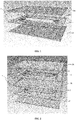
- FIG. 1 shows a micro-Free-Flow-Electrophoresis chip which is made with two plates, an upper plate 2A and a bottom plate 2B, both made of glass.
- the plates squeeze a sheet 3 (laser cut 50 ⁇ m height sheet), so that the sheet 3 is uniformly disposed between upper and bottom plates ( 2A, 2B ).
- the sheet 3 is made of Kapton®, a polyimide film developed by DuPont.
- the sheet 3 is bonded to the glass plates 2A, 2B by epoxy glue.
- the sheet 3 forms the walls of the separation chamber 31.
- the height of the sheet determines the height of the separation chamber 31.
- the upper glass slide 2A is drilled with a driller (Dremel) to insert connection tubings (not represented).
- the fluidic circuit shows five inlets 11 (inner ports) and three outlets 12 (outer ports) and a separation chamber 31.
- Flowing electrodes made of highly conductive solutions (up to 0.5M KCl, about 30 mS/cm) are introduced and flown in into the separation chamber 31 along the walls.
- the flowing electrodes are pumped with positive or negative pressure from remote containers, relative to the separation chamber, filled with the highly conductive solutions.
- Flow-scheme can be such as the highly conductive solutions can be recycled.
- Solid electrodes are in direct contact with the highly conductive solutions. Solid electrodes are connected to a power supply so that a voltage can be applied and generate an electric field in the separation chamber.
- One electrode is a cathode and one electrode is an anode.
- solid electrodes are external platinum rod-shaped electrodes each embedded within a glass bottle (Schott) filled with the highly conductive solution; one end of the platinum electrode is in direct contact with the solution whether the other end is connected to a power supply.
- a standard blue cap from a Schott bottle is specifically adapted to fit with the electrode and the tubings. Three holes have been drilled in each cap: one for introducing the electrode, one to adapt the tubing (PTFE) connecting the bottle to the microchip and one connecting the bottle to the pressure controller. The latter applies a pressure onto the liquids in the closed pressured container so that fluids are pumped into the tubing connected to the microchip and ultimately into the separation chamber.
- PTFE tubing
- a carrier solution Adjacent to and in contact with the flowing electrodes, a carrier solution may be injected.
- Containers are connected to the microchip by tubings of any type, e.g. PEEK or PTFE, or any other means suitable to deal with liquid flows.
- Carrier solution is pumped with positive pressure into the separation chamber 31.
- Eluents can be sorted to waste or collected in various eluent containers according to the end user needs.
- downstream to the flowing electrodes outlets 12 are flow restrictors. They are used to adjust and tune counter pressures at the outlets and so the fluidics within the separation chamber 31.
- FIG. 2 shows another embodiment of the invention: in order to increase the productivity, a so-called DUAL chip was built.
- two separation chambers work in parallel with only one system pumping fluids, one set of electrodes, etc.
- This dual microchip shows the possibility of numbering-up the device and hence increase the volume of sample treated.
- the microchip is built as follows from top layer to bottom layer:
- Downstream to the flowing electrodes outlets may be placed flow restrictors. They are used to adjust and tune counter pressures at the outlets and so the fluidics within the chamber.
- FIG. 3A and FIG. 3B show a further embodiment of the invention including cooling means: in this embodiment, the micro-Free-Flow-Electrophoresis chip of the invention is built as follows from top layer to bottom layer:
- Holes 16 were drilled in the clamping plates, the gasket and the glass plate 2A for connecting tubings. The number of holes corresponds to the sum of inlet and outlet ports. Supplementary holes 16 were drilled in the clamping plates for circulating a cooling fluid.
- a modified syringe pump with several syringes was connected downstream the chip. It commanded the fluidics at the outlets and manages in a tidy manner the flows at the outlets. This was simply done by matching the in and out flux from the chamber.
- the syringe pump was the driver of a steady flow because it forced flows to evenly exit provided each outlet channel is connected to one syringe.
- all syringes have the same setting at a time. In other words, it smoothed small differences in fluidic resistance at the outlets. Eventually syringe pump gave a satisfactory result and allows the collection of fractions directly into syringes.
- the microchip is as described before, except that upper and bottom clamping plates 13 may be holed laterally.
- Each plate 13 may have two holes drilled to fit connectors (PEEK, GE Healthcare) where flexible pipes are connected.
- connectors may be made of plastic with ferrules and rings to tighten the PEEK tubings to the upper glass plate 2A of the separation chamber 31.
- a third difference is that on each plate a small glass plate may be stuck onto the open window necessary to visualize the streams in the chamber. Once assembled there are three closed chambers, from top to bottom: a first chamber with two pipes connected, a second chamber which is the separation chamber and a third chamber with two pipes.
- the pipes are used to let a coolant circulate, e.g. water.
- the pipes are connected to a controlled circulating bath filled with the coolant.
- This microchip enables very long run at higher voltage, for instance 1000 V with a good command of Joule effect thus limiting heating. Thermal energy due to the current is greatly limited to ensure stable separation over time. This is also particularly suitable for the separation of proteins, which are usually prone to irreversible denaturation at temperatures higher than physiological ones.
- the microchip enables to maintain temperature below 25°C. Separation of two forms of a same GFP was successfully performed with this microchip.
- GFPmut2A206KSTSHis6 shows a main degradation product due to the loss of some amino acids at the C-terminus. The run demonstrated there is a high separation of the degraded GFP from its non-degraded form.
- a sample of fluorescein sodium salt (Sigma, ref 46860-25G-F) is injected, at 5 ⁇ L/min, through the inlet 11 while carrier solutions are flown in, alongside the highly conductive solutions, at 100 ⁇ L/min, to sheath and focus the sample stream.
- the stream remained stable for more than an hour even when the injection flow was varied down to 0.5 ⁇ L/min or up to 25 ⁇ L/min.
- low conductive carrier was HEPES 10 mM, pH 7.5, HPMC 0.2% (w/v), Tween 20 0.1% (w/v).
- the highly conductive buffer solution was HEPES 10 mM, pH 7.5, HPMC 0.2% (w/v), Tween 20 0.1% (w/v), Methanol 40% (v/v), 0.5 M KCl and Fluorescein sodium salt used as visual marker for monitoring the flowing electrodes fluidics.
- the highly conductive solution used as flowing electrode is prepared with HEPES 5 mM, pH 7.5, HPMC 0.2% (w/v), Tween 20 0.1% (w/v), Methanol 40% (v/v), 0.5 M KCl, with conductivity ⁇ 30 mS/cm.
- Rhodamine B is added to that buffer. Indeed, Rhodamine B, which is neutral at such pH and shall not migrate under voltage, serves for flowing electrodes fluidic stability monitoring over time.
- the sample is a mixture made with Rhodamine B, Rhodamine 6G and Fluorescein. It was processed into the separation chamber 31 under a 1.5 kV voltage: at pH 7.5, the said chemicals are respectively neutral, monocationic and dianionic.
- the sample is injected at 15 ⁇ L/min, focused by low conductive solution, i.e. carrier 5, at both sides injected evenly at 250 ⁇ L/min with residence time ⁇ 5 seconds.
- Example 1 The low conductive and the highly conductive solutions are as described in Example 1.
- the sample was a mix of fluorescein coupled to lysine at different molar ratios.
- the sample is injected at 11 ⁇ L/min, focused by low conductive solution at both sides injected at 175 ⁇ L/min.
- the molecules deflected according to expectations and a base-line resolution (Rs > 1.5) is achieved for at least 3 different components.
- the streams were stable. At the start and for a few dozen seconds there was a gap between the patterns in the two chambers. Over time electric fields in each chamber stabilize and there was no more any gap at visual inspection. The separation was carried for 30 minutes with steady deflections and no bubbles sighted.
- Example 1 The low conductive and the highly conductive solutions are as described in Example 1.
- the mixture with small chemicals was injected under a 1.5 kV voltage.
- the highly conductive solution is as previously but with KCl 0.2 M instead of 0.5 M.
- Low conductive solution are identical to the one used in Example 1.
- Sample (same as in Example 2) is injected at 10 ⁇ L/min, and low conductive solution sheathing the sample at 280 ⁇ L/min measured through flowmeters. Residence time was less than 5 seconds.
- the 3 molecules of the mixture did separate well with a very stable fluidic over the course of the run. The experiment lasted for more than two hours with an excellent stability with no bubbles sighted.
- the sample is a mixture of Rhodamine 6G and Fluorescein. It was processed into the chamber under a 1.0 kV voltage: at pH 3.6, the said chemicals are respectively monocationic and neutral. The sample is injected at 1.5 ⁇ L/min, focused by low conductive solution at both sides injected at 20 and 25 ⁇ L/min. The molecules deflected according to expectations and a base-line resolution (Rs > 1.5) is achieved.
- Low conductive buffer was citrate 10 mM, pH 3.6, HPMC 0.2% (w/v), Tween 20 0.1% (w/v), Ethanol 70% (v/v).
- High conductive buffer solution was citrate 10 mM, pH 3.6, HPMC 0.2% (w/v), Tween 20 0.1% (w/v), Methanol 40% (v/v), 0.5 M KCl and Rhodamine 110 used as visual marker for monitoring the flowing electrodes fluidics.
- the sample is a mixture containing B-Phycoerythrin and a GFPmut2 with a 6 Histidine tag called GFPmut2His6.
- the mixture was processed into the chamber under a 750 V voltage.
- the sample is injected at 3 ⁇ L/min, focused by low conductive solution at both sides injected at 50-55 ⁇ L/min with residence time close to 20 seconds.
- Both the proteins are acidic with expected pI values of ⁇ 4.5 and ⁇ 5.5 respectively for B-Phycoerythrin and GFPmut2His6. Both proteins are expected to go to the anode.
- the upper stream is related to B-Phycoerythrin, whether GFP which is less acidic is also less deflected.
- a third stream is visible in between the two main streams: it is possibly a minor form of B-Phycoerythrin. This result is consistent with deflection patterns observed when these proteins are migrated separately.
- Low conductive buffer was MES 10 mM, pH 6, HPMC 0.2% (w/v), Tween 20 0.1% (w/v).
- High conductive buffer solution was same with Methanol 40% (v/v), 0.5 M KCl and Fluorescein sodium salt used as visual marker for monitoring the flowing electrodes fluidics.
- a seventh embodiment an interesting achieved separation was carried out with two GFPs that cannot be separated otherwise to a baseline separation on a reference chromatography column (Q Sepharose Fast Flow, data not shown). Furthermore, the two GFPs, operated at a pH close to their pI (pH 5), tend to stick to the said reference column and can only be eluted with a highly concentrated sodium hydroxyde solution.
- Low conductive buffer was Acetate 10 mM, pH 5, HPMC 0.2% (w/v), Tween 20 0.1% (w/v).
- High conductive buffer solution was Acetate 10 mM, pH 5, HPMC 0.2% (w/v), Tween 20 0.1% (w/v), Methanol 40% (v/v), 0.5 M KCl and Fluorescein sodium salt used as visual marker for monitoring the flowing electrodes fluidics.
- a binary mixture made of GFPmut2 and GFPmut2His6 was processed into the chamber under a 1000V voltage: at pH 5, the GFPs are close to their pI and are neutral or slightly positively charged. The theoretical pI difference between the two GFPs is 0.37.
- the sample is injected at 3.5 ⁇ L/min, focused by low conductive solution at both sides injected at 93 ⁇ L/min. The molecules deflected according to expectations and a separation is achieved.
Landscapes
- Health & Medical Sciences (AREA)
- Life Sciences & Earth Sciences (AREA)
- Chemical & Material Sciences (AREA)
- Molecular Biology (AREA)
- Biochemistry (AREA)
- Electrochemistry (AREA)
- Physics & Mathematics (AREA)
- Analytical Chemistry (AREA)
- Chemical Kinetics & Catalysis (AREA)
- General Health & Medical Sciences (AREA)
- General Physics & Mathematics (AREA)
- Immunology (AREA)
- Pathology (AREA)
- Dispersion Chemistry (AREA)
- Automatic Analysis And Handling Materials Therefor (AREA)
- Electrostatic Separation (AREA)
Priority Applications (5)
| Application Number | Priority Date | Filing Date | Title |
|---|---|---|---|
| EP17197296.1A EP3474006A1 (de) | 2017-10-19 | 2017-10-19 | Mikrochip für freiflusselektrophorese |
| CA3078747A CA3078747A1 (en) | 2017-10-19 | 2018-10-19 | Microchip for free flow electrophoresis |
| US16/756,570 US20200240951A1 (en) | 2017-10-19 | 2018-10-19 | Microchip for free flow electrophoresis |
| EP18793201.7A EP3698130B1 (de) | 2017-10-19 | 2018-10-19 | Mikrochip für freiflusselektrophorese |
| PCT/EP2018/078769 WO2019077134A1 (en) | 2017-10-19 | 2018-10-19 | Microchip for free flow electrophoresis |
Applications Claiming Priority (1)
| Application Number | Priority Date | Filing Date | Title |
|---|---|---|---|
| EP17197296.1A EP3474006A1 (de) | 2017-10-19 | 2017-10-19 | Mikrochip für freiflusselektrophorese |
Publications (1)
| Publication Number | Publication Date |
|---|---|
| EP3474006A1 true EP3474006A1 (de) | 2019-04-24 |
Family
ID=60143609
Family Applications (2)
| Application Number | Title | Priority Date | Filing Date |
|---|---|---|---|
| EP17197296.1A Withdrawn EP3474006A1 (de) | 2017-10-19 | 2017-10-19 | Mikrochip für freiflusselektrophorese |
| EP18793201.7A Active EP3698130B1 (de) | 2017-10-19 | 2018-10-19 | Mikrochip für freiflusselektrophorese |
Family Applications After (1)
| Application Number | Title | Priority Date | Filing Date |
|---|---|---|---|
| EP18793201.7A Active EP3698130B1 (de) | 2017-10-19 | 2018-10-19 | Mikrochip für freiflusselektrophorese |
Country Status (4)
| Country | Link |
|---|---|
| US (1) | US20200240951A1 (de) |
| EP (2) | EP3474006A1 (de) |
| CA (1) | CA3078747A1 (de) |
| WO (1) | WO2019077134A1 (de) |
Families Citing this family (2)
| Publication number | Priority date | Publication date | Assignee | Title |
|---|---|---|---|---|
| FR3149691B1 (fr) * | 2023-06-12 | 2026-02-27 | Ipsomel Innovation | Dispositif de microcellules d’électrophorèse à flux libre et ses utilisations |
| FR3166972A1 (fr) * | 2024-09-30 | 2026-04-03 | Ipsomel Innovation | Cellule d’électrophorèse, dispositif d’électrophorèse à flux libre la contenant et ses utilisations |
Citations (4)
| Publication number | Priority date | Publication date | Assignee | Title |
|---|---|---|---|---|
| US3829370A (en) * | 1971-03-30 | 1974-08-13 | Rhone Poulenc Sa | Method for forced flow electrophoresis |
| EP0497077A1 (de) * | 1991-01-28 | 1992-08-05 | Ciba-Geigy Ag | Vorrichtung zur Vorbereitung von Proben insbesondere für Analysezwecke |
| WO2008025806A1 (en) * | 2006-08-29 | 2008-03-06 | Becton, Dickinson & Company | Method and apparatus for carrier-free deflection electrophoresis |
| US20120228141A1 (en) * | 2011-03-07 | 2012-09-13 | Byoungsok Jung | Liquid and gel electrodes for transverse free flow electrophoresis |
Family Cites Families (8)
| Publication number | Priority date | Publication date | Assignee | Title |
|---|---|---|---|---|
| US20030019753A1 (en) * | 2000-10-05 | 2003-01-30 | David Ogle | Multi-port separation apparatus and method |
| DE10063097B4 (de) * | 2000-12-18 | 2007-04-19 | Becton, Dickinson And Co. | Elektrophoresevorrichtung |
| US6974528B2 (en) * | 2001-07-24 | 2005-12-13 | Biomics, Inc. | High performance wide bore electrophoresis |
| DE102005020134A1 (de) * | 2005-04-29 | 2006-11-02 | Becton, Dickinson And Co. | Verfahren und Vorrichtung zur Durchführung eines parallelen und simultanen Mehrfachprozesses der trägerfreien isoelektrischen Fokussierung |
| CN100493682C (zh) * | 2007-06-21 | 2009-06-03 | 上海交通大学 | 自由流电泳的分离室装置 |
| CN102688692A (zh) * | 2012-05-28 | 2012-09-26 | 上海交通大学 | 用于制备型自由流电泳的分离室装置 |
| WO2017096243A1 (en) * | 2015-12-04 | 2017-06-08 | President And Fellows Of Harvard College | Elastomeric gasket for fluid interface to a microfluidic chip |
| GB201602946D0 (en) * | 2016-02-19 | 2016-04-06 | Fluidic Analytics Ltd And Cambridge Entpr Ltd | Improvements in or relating to microfluidic free-flow electrophoresis |
-
2017
- 2017-10-19 EP EP17197296.1A patent/EP3474006A1/de not_active Withdrawn
-
2018
- 2018-10-19 US US16/756,570 patent/US20200240951A1/en not_active Abandoned
- 2018-10-19 EP EP18793201.7A patent/EP3698130B1/de active Active
- 2018-10-19 WO PCT/EP2018/078769 patent/WO2019077134A1/en not_active Ceased
- 2018-10-19 CA CA3078747A patent/CA3078747A1/en not_active Abandoned
Patent Citations (4)
| Publication number | Priority date | Publication date | Assignee | Title |
|---|---|---|---|---|
| US3829370A (en) * | 1971-03-30 | 1974-08-13 | Rhone Poulenc Sa | Method for forced flow electrophoresis |
| EP0497077A1 (de) * | 1991-01-28 | 1992-08-05 | Ciba-Geigy Ag | Vorrichtung zur Vorbereitung von Proben insbesondere für Analysezwecke |
| WO2008025806A1 (en) * | 2006-08-29 | 2008-03-06 | Becton, Dickinson & Company | Method and apparatus for carrier-free deflection electrophoresis |
| US20120228141A1 (en) * | 2011-03-07 | 2012-09-13 | Byoungsok Jung | Liquid and gel electrodes for transverse free flow electrophoresis |
Non-Patent Citations (1)
| Title |
|---|
| SONG ET AL., ANALYTICAL CHEMISTRY, vol. 92, 2010, pages 2317 - 2325 |
Also Published As
| Publication number | Publication date |
|---|---|
| EP3698130A1 (de) | 2020-08-26 |
| WO2019077134A1 (en) | 2019-04-25 |
| CA3078747A1 (en) | 2019-04-25 |
| EP3698130B1 (de) | 2021-10-13 |
| US20200240951A1 (en) | 2020-07-30 |
Similar Documents
| Publication | Publication Date | Title |
|---|---|---|
| Kohlheyer et al. | Microfluidic high-resolution free-flow isoelectric focusing | |
| JP7570403B2 (ja) | 等電点電気泳動デバイスおよび固定具 | |
| Lewis et al. | Review on the development of truly portable and in-situ capillary electrophoresis systems | |
| Renzi et al. | Hand-held microanalytical instrument for chip-based electrophoretic separations of proteins | |
| US11298699B2 (en) | Separation and analysis of samples bymicrofluidic free-flow electrophoresis | |
| Saar et al. | On-chip label-free protein analysis with downstream electrodes for direct removal of electrolysis products | |
| US11635407B2 (en) | Pressure driven fluidic injection for chemical separations | |
| de Jesus et al. | Microchip free‐flow electrophoresis on glass substrate using laser‐printing toner as structural material | |
| CN102159303A (zh) | 实现放大的动电流体泵吸改变和脱盐的装置及方法 | |
| Sommer et al. | IEF in microfluidic devices | |
| EP3698130B1 (de) | Mikrochip für freiflusselektrophorese | |
| US10734216B2 (en) | Pressure driven fluidic injection for chemical separations by electrophoresis | |
| CN102688692A (zh) | 用于制备型自由流电泳的分离室装置 | |
| WO2017039080A1 (ko) | 샘플 농축 장치 및 이를 이용하여 농축된 샘플 추출 방법 | |
| WO2021222171A1 (en) | Microfluidic devices with gas channels for sample nebulization | |
| Yan et al. | A simple and highly stable free-flow electrophoresis device with thermoelectric cooling system | |
| Derakhshan et al. | Continuous size-based DEP separation of particles using a bi-gap electrode pair | |
| Chen et al. | A simple preparative free‐flow electrophoresis joined with gratis gravity: I. Gas cushion injector and self‐balance collector instead of multiple channel pump | |
| Shimura et al. | Isoelectric focusing in a microfluidically defined electrophoresis channel | |
| WO2003035228A1 (en) | Method and apparatus for generating electric fields and flow distributions for rapidly separating molecules | |
| US8029743B2 (en) | Microfluidic device with vertical injection aperture | |
| Fang et al. | Investigation of a microfluidic free-flow electrophoresis chip of glass substrate with integrated indium tin oxide electrodes | |
| JP2004157096A (ja) | 化学物質の二次元分離機構及びその装置 | |
| Kochmann et al. | Hyphenation of production-scale free-flow electrophoresis to electrospray ionization mass spectrometry using a highly conductive background electrolyte | |
| Tracy et al. | Design and construction of a preparative‐scale dynamic field gradient focusing apparatus |
Legal Events
| Date | Code | Title | Description |
|---|---|---|---|
| PUAI | Public reference made under article 153(3) epc to a published international application that has entered the european phase |
Free format text: ORIGINAL CODE: 0009012 |
|
| AK | Designated contracting states |
Kind code of ref document: A1 Designated state(s): AL AT BE BG CH CY CZ DE DK EE ES FI FR GB GR HR HU IE IS IT LI LT LU LV MC MK MT NL NO PL PT RO RS SE SI SK SM TR |
|
| AX | Request for extension of the european patent |
Extension state: BA ME |
|
| 17P | Request for examination filed |
Effective date: 20191024 |
|
| RBV | Designated contracting states (corrected) |
Designated state(s): AL AT BE BG CH CY CZ DE DK EE ES FI FR GB GR HR HU IE IS IT LI LT LU LV MC MK MT NL NO PL PT RO RS SE SI SK SM TR |
|
| STAA | Information on the status of an ep patent application or granted ep patent |
Free format text: STATUS: THE APPLICATION HAS BEEN WITHDRAWN |
|
| 18W | Application withdrawn |
Effective date: 20201202 |