EP3474206A1 - Véhicule et système de livraison dans ce véhicule - Google Patents
Véhicule et système de livraison dans ce véhicule Download PDFInfo
- Publication number
- EP3474206A1 EP3474206A1 EP18201266.6A EP18201266A EP3474206A1 EP 3474206 A1 EP3474206 A1 EP 3474206A1 EP 18201266 A EP18201266 A EP 18201266A EP 3474206 A1 EP3474206 A1 EP 3474206A1
- Authority
- EP
- European Patent Office
- Prior art keywords
- vehicle
- delivery
- server
- position information
- processor
- Prior art date
- Legal status (The legal status is an assumption and is not a legal conclusion. Google has not performed a legal analysis and makes no representation as to the accuracy of the status listed.)
- Withdrawn
Links
Images




Classifications
-
- H—ELECTRICITY
- H04—ELECTRIC COMMUNICATION TECHNIQUE
- H04W—WIRELESS COMMUNICATION NETWORKS
- H04W4/00—Services specially adapted for wireless communication networks; Facilities therefor
- H04W4/02—Services making use of location information
- H04W4/025—Services making use of location information using location based information parameters
-
- G—PHYSICS
- G06—COMPUTING OR CALCULATING; COUNTING
- G06Q—INFORMATION AND COMMUNICATION TECHNOLOGY [ICT] SPECIALLY ADAPTED FOR ADMINISTRATIVE, COMMERCIAL, FINANCIAL, MANAGERIAL OR SUPERVISORY PURPOSES; SYSTEMS OR METHODS SPECIALLY ADAPTED FOR ADMINISTRATIVE, COMMERCIAL, FINANCIAL, MANAGERIAL OR SUPERVISORY PURPOSES, NOT OTHERWISE PROVIDED FOR
- G06Q10/00—Administration; Management
- G06Q10/08—Logistics, e.g. warehousing, loading or distribution; Inventory or stock management
- G06Q10/083—Shipping
-
- B—PERFORMING OPERATIONS; TRANSPORTING
- B60—VEHICLES IN GENERAL
- B60R—VEHICLES, VEHICLE FITTINGS, OR VEHICLE PARTS, NOT OTHERWISE PROVIDED FOR
- B60R16/00—Electric or fluid circuits specially adapted for vehicles and not otherwise provided for; Arrangement of elements of electric or fluid circuits specially adapted for vehicles and not otherwise provided for
- B60R16/02—Electric or fluid circuits specially adapted for vehicles and not otherwise provided for; Arrangement of elements of electric or fluid circuits specially adapted for vehicles and not otherwise provided for electric constitutive elements
- B60R16/03—Electric or fluid circuits specially adapted for vehicles and not otherwise provided for; Arrangement of elements of electric or fluid circuits specially adapted for vehicles and not otherwise provided for electric constitutive elements for supply of electrical power to vehicle subsystems or for
- B60R16/033—Electric or fluid circuits specially adapted for vehicles and not otherwise provided for; Arrangement of elements of electric or fluid circuits specially adapted for vehicles and not otherwise provided for electric constitutive elements for supply of electrical power to vehicle subsystems or for characterised by the use of electrical cells or batteries
-
- G—PHYSICS
- G06—COMPUTING OR CALCULATING; COUNTING
- G06Q—INFORMATION AND COMMUNICATION TECHNOLOGY [ICT] SPECIALLY ADAPTED FOR ADMINISTRATIVE, COMMERCIAL, FINANCIAL, MANAGERIAL OR SUPERVISORY PURPOSES; SYSTEMS OR METHODS SPECIALLY ADAPTED FOR ADMINISTRATIVE, COMMERCIAL, FINANCIAL, MANAGERIAL OR SUPERVISORY PURPOSES, NOT OTHERWISE PROVIDED FOR
- G06Q10/00—Administration; Management
- G06Q10/08—Logistics, e.g. warehousing, loading or distribution; Inventory or stock management
- G06Q10/083—Shipping
- G06Q10/0833—Tracking
-
- H—ELECTRICITY
- H04—ELECTRIC COMMUNICATION TECHNIQUE
- H04L—TRANSMISSION OF DIGITAL INFORMATION, e.g. TELEGRAPHIC COMMUNICATION
- H04L67/00—Network arrangements or protocols for supporting network services or applications
- H04L67/01—Protocols
- H04L67/12—Protocols specially adapted for proprietary or special-purpose networking environments, e.g. medical networks, sensor networks, networks in vehicles or remote metering networks
-
- H—ELECTRICITY
- H04—ELECTRIC COMMUNICATION TECHNIQUE
- H04L—TRANSMISSION OF DIGITAL INFORMATION, e.g. TELEGRAPHIC COMMUNICATION
- H04L67/00—Network arrangements or protocols for supporting network services or applications
- H04L67/50—Network services
- H04L67/52—Network services specially adapted for the location of the user terminal
-
- H—ELECTRICITY
- H04—ELECTRIC COMMUNICATION TECHNIQUE
- H04W—WIRELESS COMMUNICATION NETWORKS
- H04W4/00—Services specially adapted for wireless communication networks; Facilities therefor
- H04W4/30—Services specially adapted for particular environments, situations or purposes
- H04W4/40—Services specially adapted for particular environments, situations or purposes for vehicles, e.g. vehicle-to-pedestrians [V2P]
- H04W4/48—Services specially adapted for particular environments, situations or purposes for vehicles, e.g. vehicle-to-pedestrians [V2P] for in-vehicle communication
-
- H—ELECTRICITY
- H04—ELECTRIC COMMUNICATION TECHNIQUE
- H04W—WIRELESS COMMUNICATION NETWORKS
- H04W52/00—Power management, e.g. Transmission Power Control [TPC] or power classes
- H04W52/02—Power saving arrangements
- H04W52/0209—Power saving arrangements in terminal devices
- H04W52/0261—Power saving arrangements in terminal devices managing power supply demand, e.g. depending on battery level
Definitions
- the present disclosure relates to a vehicle and a delivery system.
- a communication system described in the Japanese Patent Laying-Open No. 2007-328477 includes a plurality of vehicles, and a report management center configured to communicate with the plurality of vehicles.
- the report management center monitors cameras and the like arranged at intersections and the like to sense occurrence of an accident and calculate accident occurrence time and position information.
- the report management center requests the vehicles to provide accident information.
- the vehicle transmits the information to the report management center.
- the inventor of the present application has been studying a delivery system which can deliver a delivery item to a vehicle equipped with a home delivery box, and the vehicle.
- the delivery system under study includes a vehicle equipped with a home delivery box, an input device through which a user inputs various types of information, and a server configured to communicate with the vehicle and the input device.
- the vehicle includes a vehicle-mounted communication device configured to communicate with the server, a position information acquisition device configured to acquire position information, and a battery.
- the battery stores electric power for driving the vehicle-mounted communication device and the position information acquisition device.
- the server has to transmit, to a deliverer, the position information of the vehicle designated as the delivery destination. Accordingly, the server has to acquire the position information from the vehicle.
- the server can request the vehicle to transmit the position information.
- the battery always has to supply electric power to the vehicle-mounted communication device and the vehicle ECU.
- the time for which the vehicle is parked is long.
- the position information acquisition device and the like are always activated in consideration of a case where the home delivery box of the vehicle is designated as a home delivery destination, most of the electric power stored in the battery may be consumed wastefully.
- the present disclosure has been made in view of the aforementioned problem, and an object thereof is to provide: a delivery system including a vehicle equipped with a home delivery box, a user terminal through which a user inputs various types of information, and a server configured to communicate with the vehicle and the user terminal; and the vehicle used for the system, which can suppress wasteful consumption of electric power stored in a battery mounted in the vehicle.
- a vehicle in accordance with the present disclosure includes a home delivery box in which a deliverer places a delivery item, a vehicle-mounted communication device configured to communicate with a server provided outside, a position information acquisition device configured to acquire position information, a power storage device configured to store electric power for driving the vehicle-mounted communication device and the position information acquisition device, and a processor.
- the processor acquires, from the server, information indicating that a user has selected the home delivery box as a delivery destination of the delivery item, the processor is configured to start transmission of the position information to the server through the vehicle-mounted communication device.
- the position information is transmitted after sensing that the user has designated the home delivery box mounted in the vehicle as the delivery destination of the delivery item.
- power consumption of a battery can be made low, when compared with a case where the position information is always transmitted to the server.
- the vehicle described above further includes a drive unit configured to drive a driving wheel, and an operation device configured to be operated by a vehicle user and switch between activation and stop of the drive unit.
- the processor In a state where the drive unit is stopped by operation of the operation device, the processor is configured to intermittently communicate with the server.
- examples of the state where the drive unit is stopped include a case where the vehicle is parked.
- the time for which the vehicle is parked is much longer than the time for which the vehicle is traveling.
- power consumption of the battery is decreased by intermittently communicating with the server in such a case where the drive unit is stopped.
- a delivery system in accordance with the present disclosure is a delivery system including: a vehicle including a home delivery box; a user terminal through which a delivery user inputs various types of information; and a server configured to communicate with the vehicle and the user terminal.
- the vehicle includes a position information acquisition device configured to acquire position information, a vehicle-mounted communication device configured to communicate with the server, and a battery configured to store electric power for driving the position information acquisition device and the vehicle-mounted communication device.
- the user terminal When the delivery user selects the home delivery box as a delivery destination of a delivery item using the user terminal, the user terminal is configured to transmit, to the server, request information in which the home delivery box is designated as the delivery destination.
- the vehicle acquires, from the server, information indicating that the delivery user has selected the home delivery box as the delivery destination of the delivery item, the vehicle is configured to transmit the position information to the server.
- the delivery system described above further includes a deliverer terminal configured to notify a deliverer who will deliver the delivery item to the home delivery box about various types of information.
- the server acquires the position information from the vehicle, the server is configured to transmit the position information to the deliverer terminal.
- the vehicle includes a drive unit configured to drive a driving wheel, and an operation device configured to be operated by a vehicle user and switch between activation and stop of the drive unit. In a state where the drive unit is stopped by operation of the operation device, the vehicle is configured to intermittently communicate with the server.
- a delivery system 1 in accordance with the present embodiment will be described.
- the same or substantially the same components are designated by the same reference characters, and the description thereof will not be repeated.
- Fig. 1 is a block diagram schematically showing delivery system 1.
- Delivery system 1 includes a vehicle 2, deliverer terminals 3 and 4, a server 5, a user terminal 6, and the Internet 7.
- Vehicle 2 deliverer terminals 3 and 4, server 5, and user terminal 6 are configured to communicate with one another through the Internet 7.
- User terminal 6 is a terminal used by a user 8 who utilizes delivery system 1. Examples of user terminal 6 include a personal computer, a smart phone, a mobile phone, and the like.
- User 8 can input various types of information using user terminal 6. For example, user 8 can designate a home delivery box mounted in vehicle 2 as a delivery destination of a delivery item W.
- Deliverer terminal 3 is a terminal carried by a deliverer 9
- deliverer terminal 4 is a terminal carried by a deliverer 10.
- Deliverer terminals 3 and 4 notify deliverers 9 and 10 about various types of information.
- Deliverer 9 delivers a plurality of delivery items W to designated delivery destinations using a delivery vehicle 11
- deliverer 10 delivers a plurality of delivery items W to designated delivery destinations using a delivery vehicle 12.
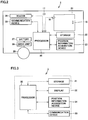
- Fig. 2 is a block diagram schematically showing vehicle 2.
- Vehicle 2 includes a switch 17, a door 18, a locking device 19, a processor 20, a home delivery box 21, a storage 22, a position information acquisition device 23, a communication device (vehicle-mounted communication device) 25, a reader 26, a battery 27, a drive unit 28, and driving wheels 29.
- a switch 17 includes a switch 17, a door 18, a locking device 19, a processor 20, a home delivery box 21, a storage 22, a position information acquisition device 23, a communication device (vehicle-mounted communication device) 25, a reader 26, a battery 27, a drive unit 28, and driving wheels 29.
- a communication device vehicle-mounted communication device
- reader 26 a battery 27, a drive unit 28, and driving wheels 29.
- Processor 20 is configured to perform processing computation using information acquired through communication device 25, information stored in storage 22, and the like.
- the processing computation by processor 20 is implemented by software, or by hardware such as an electrical circuit.
- Home delivery box 21 is for accommodating delivery item W.
- Home delivery box 21 includes door 18 provided on the outside of vehicle 2. By opening door 18, deliverer 9, 10 can place delivery item W within home delivery box 21.
- Locking device 19 is configured to lock door 18 in a closed state. It should be noted that locking device 19 releases a locked state of door 18 in response to an instruction from processor 20.
- Position information acquisition device 23 is configured to acquire position information of a current location of vehicle 2. As a method of acquiring the position information of vehicle 2 , a method of acquiring the position information through WiFi (Wireless Fidelity), a method of acquiring the position information using a GPS (Global Positioning System), or the like can be adopted. The position information acquired by position information acquisition device 23 is transmitted to processor 20.
- WiFi Wireless Fidelity
- GPS Global Positioning System
- Communication device 25 is configured to communicate with server 5 and the like, through the Internet 7.
- Reader 26 is configured to read a QR code. Reader 26 transmits acquired information to processor 20.
- Battery 27 is configured to supply electric power to processor 20, storage 22, position information acquisition device 23, communication device 25, reader 26, and drive unit 28.
- Battery 27 is a lithium ion secondary battery, a lead storage battery, or the like, for example.
- Drive unit 28 is configured to generate a driving force for driving driving wheels 29 using the electric power from battery 27.
- Drive unit 28 includes a DCDC converter, an inverter, and a motor, for example.
- the DCDC converter boosts the voltage of direct current (DC) power supplied from battery 27 and supplies the DC power to the inverter.
- the inverter converts the DC power into alternating current (AC) power and supplies the AC power to the motor.
- the motor is driven by the AC power supplied from the inverter to drive driving wheels 29.
- Switch (operation device) 17 is configured to be operated by a vehicle user. When switch 17 is turned ON by the vehicle user, switch 17 transmits an activation signal to processor 20. Upon receiving the activation signal, processor 20 activates drive unit 28.
- processor 20 drives drive unit 28 to drive driving wheels 29.
- switch 17 when switch 17 is ON, processor 20, position information acquisition device 23, communication device 25, and reader 26 are activated. Specifically, when switch 17 is ON, position information acquisition device 23 always acquires the current position information. Further, communication device 25 is also activated, and is in a state where it can always communicate with server 5.
- Locking device 19 is in a state where it locks door 18.
- processor 20 is intermittently activated. Then, when processor 20 is activated, processor 20 communicates with server 5 through communication device 25.
- vehicle 2 is an electric vehicle, and drives driving wheels 29 only with the driving force of the motor of drive unit 28.
- vehicle 2 is not limited to an electric vehicle, and may be a hybrid vehicle, or an engine vehicle including a drive unit not provided with a motor, for example. It should be noted that, when vehicle 2 is an engine vehicle, battery 27 is an auxiliary battery, and for example, a lead storage battery or the like is adopted as battery 27.
- Fig. 3 is a block diagram showing a configuration of deliverer terminal 3.
- Deliverer terminal 3 includes a processor 30, a storage 31, a display 32, a communication device 33, and a position information acquisition device 34.
- Processor 30 is configured to perform various types of processing computation based on information acquired through communication device 33, information stored in storage 31, and the like.
- the processing computation by processor 30 may be performed by software, or may be performed by hardware such as an electrical circuit.
- Storage 31 is a non-volatile memory. Storage 31 stores various types of information.
- Display 32 is a screen for notifying deliverer 9 about various types of information.
- Display 32 is a touch-sensitive liquid crystal display, for example.
- Deliverer 9 can perform various operations using display 32.
- display 32 also functions as an input device through which deliverer 9 performs various operations.
- Communication device 33 is configured to communicate with server 5 through the Internet 7.
- Position information acquisition device 34 is configured to acquire position information of deliverer terminal 3.
- Position information acquisition device 34 transmits the acquired position information to processor 30.
- Processor 30 constantly transmits the position information to server 5 through communication device 33.
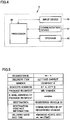
- Fig. 4 is a block diagram schematically showing user terminal 6.
- User terminal 6 includes a processor 35, a storage 36, a communication device 37, and input device 38.
- Input device 38 is a touch-sensitive liquid crystal display, for example. User 8 can acquire various types of information through input device 38. Further, input device 38 also functions as an operation device configured to be operated by user 8, and user 8 can input various types of information using input device 38.
- Storage 36 is a non-volatile memory, and stores various types of information.
- Communication device 37 is configured to communicate with server 5, user terminal 6, and the like, through the Internet 7.
- Processor 35 performs various types of processing computation using information stored in storage 36, information input to input device 38, information acquired through communication device 37, and the like.
- the processing computation by processor 35 is performed by software, or by hardware such as an electrical circuit.
- processor 35 transmits request information to server 5 based on the information input to input device 38 and the like.
- Fig. 5 is a diagram schematically showing the request information.
- the request information includes a requester ID, a delivery item, a sender, a sender's address, a package recipient, an e-mail address of the package recipient, a destination, destination contact information, delivery date and time, and the like.
- the requester ID is information for specifying user 8.
- the delivery item is a commodity for which user 8 has requested home delivery.
- User 8 can designate a registered vehicle registered beforehand, for example, as the destination.
- a registered vehicle ID is stored in the "destination”.
- As the delivery date and time, date and time designated by user 8 is stored.
- Fig. 6 is a block diagram schematically showing a configuration of server 5.
- Server 5 includes a processor 40, a storage 41, and a communication device 42.
- Communication device 42 is configured to communicate with user terminal 6, deliverer terminals 3 and 4, and vehicle 2, through the Internet 7.
- Processor 40 is configured to perform processing computation based on information stored in storage 41, information acquired through communication device 42, and the like.
- the processing computation by processor 40 is performed by software, or by hardware such as an electrical circuit.
- Storage 41 includes a delivery item database, a registered vehicle database, a deliverer database, a QR code database, and a request information database.
- Fig. 7 is a diagram schematically showing the delivery item database.
- the delivery item database includes a delivery item ID, a delivery item, a sender, a sender's address, a package recipient, an e-mail address of the package recipient, a destination, destination contact information, and the like.
- a registered vehicle ID is stored therein. The details of the registered vehicle ID will be described later.
- a communication ID of vehicle 2 (communication ID of a registered vehicle) specified by the registered vehicle ID is stored in the destination contact information.
- a home is stored in a destination, an address of the home is stored in the destination communication information.
- Fig. 8 is a diagram schematically showing the registered vehicle database.
- the registered vehicle database stores a registered vehicle ID, a vehicle number (number indicated on a license plate attached to a vehicle), a registrant, a communication ID, contact information of the registrant, and the like.
- the registered vehicle database also stores information such as a vehicle type (sedan, SUV, or the like) and a vehicle color.
- vehicle 2 which can be designated as a delivery destination is a vehicle registered beforehand.
- a delivery user can register the vehicle as a delivery destination in a homepage or the like of a delivery company, through user terminal 6 or the like.
- Fig. 9 is a diagram schematically showing the deliverer database.
- the deliverer database stores a deliverer ID, a deliverer mobile phone number, position information, and a deliverer name.
- deliverer terminal 3, 4 has a call function
- a phone number of deliverer terminal 3, 4 is stored in the deliverer mobile phone number.
- Position information of each deliverer terminal is updated based on position information always or intermittently transmitted from deliverer terminal 3, 4.
- Fig. 10 is a diagram schematically showing the QR code database.
- the QR code database includes a server address, a delivery item ID, a package recipient, a destination, and a deliverer ID.
- Fig. 11 is a diagram schematically showing the request information database.
- the request information database includes a requester ID, a delivery item ID, a delivery item, a sender, a sender's address, a package recipient, an e-mail address of the package recipient, a destination, destination contact information, and the like.
- information stored in the request information database is created and updated by processor 40 based on the request information received from user terminal 6 of each user 8.
- processor 40 Based on the request information database, processor 40 assigns a deliverer who will deliver each delivery item, and creates the delivery item database.
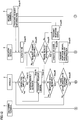
- Step 10 An operation of delivery system 1 configured as described above will be described with reference to Figs. 12 , 13 , and the like.
- User 8 transmits request information to server 5 using user terminal 6 (Step 10).
- This request information includes the various types of information shown in Fig. 5 .
- processor 40 of server 5 acquires the request information
- processor 40 updates the request information database (Step 12). Then, processor 40 sets a deliverer who will deliver a requested commodity using the request information database, the deliverer database, and the like, and processor 40 updates the delivery item database.
- Processor 20 of vehicle 2 determines whether switch 17 is ON (Step 14). When switch 17 is OFF, processor 20 is intermittently activated (Step 16), and transmits a request signal (Step 18). Further, when processor 20 determines that switch 17 is ON (Yes in Step 14), processor 20 transmits a request signal (Step 18). This request signal includes a registered vehicle ID of the vehicle. It should be noted that, in Step 16, processor 20 is activated every 15 minutes, for example.
- processor 40 of server 5 updates the database (Step 12)
- processor 40 determines whether the request signal is received from vehicle 2 (Step 20). Then, when processor 40 determines that the request signal is not received from vehicle 2 (No in Step 20), processor 40 waits until the request signal is received.
- processor 40 of server 5 determines whether or not there is request information corresponding to vehicle 2 (Step 22).
- the request signal transmitted from vehicle 2 includes the registered vehicle ID of vehicle 2.
- Processor 40 determines whether the request information database has a "destination" in which the registered vehicle ID of vehicle 2 is stored.
- processor 40 determines that the request information corresponding to vehicle 2 which has transmitted the request signal is received (Yes in Step 22), processor 40 creates a QR code (registered trademark) corresponding to the request information, and information included in the QR code (QR information) (Step 24).
- QR code registered trademark
- the information included in the QR code includes the information shown in Fig. 10 , and the information included in the QR code is created based on the delivery item database.
- Processor 40 of server 5 transmits a response signal including the QR information to vehicle 2 which has transmitted the request signal (Step 26).
- the request signal includes the registered vehicle ID of vehicle 2 which has transmitted the request signal.
- processor 40 acquires a communication ID of vehicle 2 which has transmitted the request signal, using the registered vehicle database. Then, using the communication ID, processor 40 transmits the response signal including the QR information to vehicle 2 which has transmitted the request signal.
- processor 40 determines in Step 22 described above that the request information corresponding to vehicle 2 which has transmitted the request signal is not received (No in Step 22), processor 40 transmits a response signal not including the QR information (Step 28), and thereafter returns to Step 12 again.
- processor 20 of vehicle 2 transmits the request signal (Step 18)
- processor 20 waits until the response signal is received (Step 30). Then, when processor 20 determines that the response signal is received (Yes in Step 30), processor 20 determines whether the QR information is included in the response signal (Step 32). If the QR information is included in the response signal, it means that user 8 has designated vehicle 2 as a delivery destination. By receiving the response signal including the QR information, vehicle 2 can learn that vehicle 2 has been designated as a home delivery destination.
- processor 20 of vehicle 2 determines that the QR information is included in the response signal (Yes in Step 32)
- processor 20 activates position information acquisition device 23, and acquires the current position information from position information acquisition device 23 (Step 34).
- processor 20 When processor 20 acquires the position information, processor 20 transmits the position information to server 5 through communication device 25 (Step 36). It should be noted that this position information includes the registered vehicle ID of vehicle 2.
- processor 20 of vehicle 2 transmits the position information (Step 36)
- processor 20 activates reader 26. It should be noted that processor 20 is always activated after transmitting the position information.
- processor 40 of server 5 transmits the response signal including the QR information (Step 26)
- processor 40 waits until it acquires the position information (Step 40). Then, when processor 40 acquires the position information (Yes in Step 40), processor 40 transmits delivery information, the vehicle position information, and the QR code, to deliverer terminal 3 (Step 44).
- the delivery information includes a deliverer terminal ID of deliverer terminal 3, of the delivery item database shown in Fig. 7 . It should be noted that the QR code is stored for each registered vehicle ID.
- the vehicle position information includes vehicle position information for each registered vehicle ID.
- processor 30 of deliverer terminal 3 acquires the delivery information, the QR code, and the vehicle position information from server 5, processor 30 notifies deliverer 9 that it acquires various types of information (Step 50). Then, deliverer 9 moves to vehicle 2 based on the acquired position information of vehicle 2. When deliverer 9 comes close to vehicle 2, deliverer 9 operates deliverer terminal 3 to cause the QR code to be displayed on display 32. Then, deliverer 9 passes display 32 displaying the QR code over reader 26.
- Processor 20 of vehicle 2 waits with reader 26 being activated, until the QR code is acquired through reader 26 (Steps 46, 52).
- reader 26 When reader 26 acquires the QR code, reader 26 transmits an image of the QR code to processor 20.
- processor 20 determines that the QR code is acquired (Yes in Step 52), processor 20 performs authentication (Step 54).
- processor 20 reads information included in the QR code, and authenticates whether it matches the QR information acquired in Step 32.
- processor 20 determines that the information read from the QR code does not match the QR information acquired beforehand (No in Step 54), processor 20 returns to Step 34.
- processor 20 unlocks locking device 19 (Step 56). Thereby, deliverer 9 can place delivery item W within home delivery box 21.
- processor 20 and communication device 25 are intermittently activated, and the request signal is intermittently transmitted to server 5.
- processor 20 of vehicle 2 acquires the QR information
- processor 20 transmits the position information acquired by position information acquisition device 23 to server 5.
- power consumption of battery 27 can be made low, when compared with a case where the position information is always transmitted to server 5.
Landscapes
- Engineering & Computer Science (AREA)
- Business, Economics & Management (AREA)
- Economics (AREA)
- Signal Processing (AREA)
- Computer Networks & Wireless Communication (AREA)
- General Business, Economics & Management (AREA)
- Theoretical Computer Science (AREA)
- Operations Research (AREA)
- Quality & Reliability (AREA)
- Strategic Management (AREA)
- Tourism & Hospitality (AREA)
- Physics & Mathematics (AREA)
- Human Resources & Organizations (AREA)
- General Physics & Mathematics (AREA)
- Marketing (AREA)
- Development Economics (AREA)
- Entrepreneurship & Innovation (AREA)
- Mechanical Engineering (AREA)
- General Health & Medical Sciences (AREA)
- Medical Informatics (AREA)
- Computing Systems (AREA)
- Health & Medical Sciences (AREA)
- Management, Administration, Business Operations System, And Electronic Commerce (AREA)
- Traffic Control Systems (AREA)
Applications Claiming Priority (1)
| Application Number | Priority Date | Filing Date | Title |
|---|---|---|---|
| JP2017203749A JP2019079129A (ja) | 2017-10-20 | 2017-10-20 | 車両および配送システム |
Publications (1)
| Publication Number | Publication Date |
|---|---|
| EP3474206A1 true EP3474206A1 (fr) | 2019-04-24 |
Family
ID=64267424
Family Applications (1)
| Application Number | Title | Priority Date | Filing Date |
|---|---|---|---|
| EP18201266.6A Withdrawn EP3474206A1 (fr) | 2017-10-20 | 2018-10-18 | Véhicule et système de livraison dans ce véhicule |
Country Status (4)
| Country | Link |
|---|---|
| US (1) | US20190124164A1 (fr) |
| EP (1) | EP3474206A1 (fr) |
| JP (1) | JP2019079129A (fr) |
| CN (1) | CN109699001A (fr) |
Families Citing this family (4)
| Publication number | Priority date | Publication date | Assignee | Title |
|---|---|---|---|---|
| US11347219B2 (en) * | 2019-04-29 | 2022-05-31 | GM Cruise Holdings, LLC | Trailer for autonomous delivery |
| JP7476503B2 (ja) * | 2019-09-19 | 2024-05-01 | 株式会社Jvcケンウッド | 宅配物管理システム、宅配物管理方法及びプログラム |
| JP7453026B2 (ja) * | 2020-03-18 | 2024-03-19 | 本田技研工業株式会社 | 運搬システム、および管理方法 |
| US20220063679A1 (en) * | 2020-08-26 | 2022-03-03 | Karma Automotive Llc | Logistics system |
Citations (7)
| Publication number | Priority date | Publication date | Assignee | Title |
|---|---|---|---|---|
| US20040181495A1 (en) * | 2003-01-21 | 2004-09-16 | Bernard Grush | Method and apparatus for a satellite positioning-based metering system for use in transport-related applications |
| JP2007328477A (ja) | 2006-06-07 | 2007-12-20 | Hitachi Ltd | 通信システム、通信端末および情報処理装置 |
| US20160099927A1 (en) * | 2014-10-01 | 2016-04-07 | Continental Intelligent Transportation Systems, LLC | Hacker security solution for package transfer to and from a vehicle |
| DE102015205298A1 (de) * | 2015-03-24 | 2016-09-29 | Volkswagen Aktiengesellschaft | Vorrichtungen, Verfahren und Computerprogramm zum Bereitstellen einer Information über ein mobiles Logistikziel |
| EP3151188A1 (fr) * | 2014-05-30 | 2017-04-05 | Zhejiang Geely Holding Group Co., Ltd. | Procédé de réception, système et appareil pour la logistique de véhicule |
| DE112015004559T5 (de) * | 2014-11-06 | 2017-07-13 | Rudolf King | Persönliches notfallreaktionssystem und sein betriebsverfahren |
| JP2017203749A (ja) | 2016-05-13 | 2017-11-16 | 清水建設株式会社 | 蓄電池管理システム、及び蓄電池管理方法 |
Family Cites Families (10)
| Publication number | Priority date | Publication date | Assignee | Title |
|---|---|---|---|---|
| US20070257774A1 (en) * | 2003-09-19 | 2007-11-08 | Martin Stumpert | Method and Device for Delivery or Obtaining of a Good |
| WO2007062244A2 (fr) * | 2005-11-28 | 2007-05-31 | White Bear Technologies | Systeme de suivi de position |
| US20090289844A1 (en) * | 2008-05-23 | 2009-11-26 | White Bear Technologies | Position monitoring system |
| US10387824B2 (en) * | 2012-12-21 | 2019-08-20 | United Parcel Service Of America, Inc. | Systems and methods for delivery of an item |
| WO2015061008A1 (fr) * | 2013-10-26 | 2015-04-30 | Amazon Technologies, Inc. | Système de livraison par véhicule aérien sans pilote |
| US10002479B2 (en) * | 2014-10-01 | 2018-06-19 | Continental Intelligent Transportation Systems, LLC | End to end system for service delivery to and from a vehicle using a dongle |
| US11238397B2 (en) * | 2015-02-09 | 2022-02-01 | Fedex Corporate Services, Inc. | Methods, apparatus, and systems for generating a corrective pickup notification for a shipped item using a mobile master node |
| CN106570667B (zh) * | 2016-10-25 | 2020-08-21 | 北京印刷学院 | 一种基于车-快递柜-无人机的快递配送方法 |
| CN107133771A (zh) * | 2017-06-05 | 2017-09-05 | 北京联合大学 | 园区无人驾驶快递车配送系统及其自动配送方法 |
| US20190066032A1 (en) * | 2017-08-22 | 2019-02-28 | Qualcomm Incorporated | Robotic Vehicle Item Delivery Security System |
-
2017
- 2017-10-20 JP JP2017203749A patent/JP2019079129A/ja not_active Withdrawn
-
2018
- 2018-10-17 US US16/163,506 patent/US20190124164A1/en not_active Abandoned
- 2018-10-18 CN CN201811215818.XA patent/CN109699001A/zh active Pending
- 2018-10-18 EP EP18201266.6A patent/EP3474206A1/fr not_active Withdrawn
Patent Citations (7)
| Publication number | Priority date | Publication date | Assignee | Title |
|---|---|---|---|---|
| US20040181495A1 (en) * | 2003-01-21 | 2004-09-16 | Bernard Grush | Method and apparatus for a satellite positioning-based metering system for use in transport-related applications |
| JP2007328477A (ja) | 2006-06-07 | 2007-12-20 | Hitachi Ltd | 通信システム、通信端末および情報処理装置 |
| EP3151188A1 (fr) * | 2014-05-30 | 2017-04-05 | Zhejiang Geely Holding Group Co., Ltd. | Procédé de réception, système et appareil pour la logistique de véhicule |
| US20160099927A1 (en) * | 2014-10-01 | 2016-04-07 | Continental Intelligent Transportation Systems, LLC | Hacker security solution for package transfer to and from a vehicle |
| DE112015004559T5 (de) * | 2014-11-06 | 2017-07-13 | Rudolf King | Persönliches notfallreaktionssystem und sein betriebsverfahren |
| DE102015205298A1 (de) * | 2015-03-24 | 2016-09-29 | Volkswagen Aktiengesellschaft | Vorrichtungen, Verfahren und Computerprogramm zum Bereitstellen einer Information über ein mobiles Logistikziel |
| JP2017203749A (ja) | 2016-05-13 | 2017-11-16 | 清水建設株式会社 | 蓄電池管理システム、及び蓄電池管理方法 |
Also Published As
| Publication number | Publication date |
|---|---|
| CN109699001A (zh) | 2019-04-30 |
| JP2019079129A (ja) | 2019-05-23 |
| US20190124164A1 (en) | 2019-04-25 |
Similar Documents
| Publication | Publication Date | Title |
|---|---|---|
| US10525845B2 (en) | Electric vehicle charging station parking spot monitoring system | |
| EP3474206A1 (fr) | Véhicule et système de livraison dans ce véhicule | |
| US10242516B2 (en) | Car sharing system and in-vehicle apparatus for car sharing system | |
| CN112036303A (zh) | 遗留物品的提醒方法及装置、电子设备和存储介质 | |
| CN111009115A (zh) | 遗失物品递送辅助装置、遗失物品递送辅助系统、遗失物品递送辅助方法以及存储介质 | |
| CN108462739B (zh) | 车辆电池的报告和自动充电 | |
| CN112566064A (zh) | 交通工具数字密钥云存储 | |
| US10777105B2 (en) | Movable body and advertisement providing method | |
| CN117081275A (zh) | 车载无线充电方法、装置、汽车及存储介质 | |
| US20130262335A1 (en) | Collection and delivery management system | |
| CN112109587A (zh) | 车辆的智能充电提示方法、装置及存储介质 | |
| US20250133288A1 (en) | Information processing device | |
| JP7655270B2 (ja) | 給電方法及び給電システム | |
| JP2010127166A (ja) | 車輌のエネルギー残量表示システムおよび車輌キー | |
| JP2003233655A (ja) | 配送車両運行管理システムおよびその方法 | |
| US20240249627A1 (en) | Server apparatus | |
| JP7798049B2 (ja) | サーバ装置 | |
| US20220309435A1 (en) | Information processing apparatus, method, and non-transitory computer readable medium | |
| US20240246443A1 (en) | Server device | |
| US20230249648A1 (en) | Information processing apparatus, information processing system, and information processing method | |
| JP7848726B2 (ja) | サーバ装置 | |
| US12515585B2 (en) | Control method | |
| US20240326635A1 (en) | Server device | |
| US20230324193A1 (en) | Control apparatus, system, and operating method of system | |
| US20240273993A1 (en) | Portable vehicle charger tracking and reminder system |
Legal Events
| Date | Code | Title | Description |
|---|---|---|---|
| PUAI | Public reference made under article 153(3) epc to a published international application that has entered the european phase |
Free format text: ORIGINAL CODE: 0009012 |
|
| STAA | Information on the status of an ep patent application or granted ep patent |
Free format text: STATUS: REQUEST FOR EXAMINATION WAS MADE |
|
| 17P | Request for examination filed |
Effective date: 20181018 |
|
| AK | Designated contracting states |
Kind code of ref document: A1 Designated state(s): AL AT BE BG CH CY CZ DE DK EE ES FI FR GB GR HR HU IE IS IT LI LT LU LV MC MK MT NL NO PL PT RO RS SE SI SK SM TR |
|
| AX | Request for extension of the european patent |
Extension state: BA ME |
|
| STAA | Information on the status of an ep patent application or granted ep patent |
Free format text: STATUS: EXAMINATION IS IN PROGRESS |
|
| STAA | Information on the status of an ep patent application or granted ep patent |
Free format text: STATUS: THE APPLICATION HAS BEEN WITHDRAWN |
|
| 17Q | First examination report despatched |
Effective date: 20200826 |
|
| 18W | Application withdrawn |
Effective date: 20200903 |