EP3475285B1 - Mechanistisches target von rapamycinsignalweghemmern und therapeutische anwendungen davon - Google Patents
Mechanistisches target von rapamycinsignalweghemmern und therapeutische anwendungen davon Download PDFInfo
- Publication number
- EP3475285B1 EP3475285B1 EP17814538.9A EP17814538A EP3475285B1 EP 3475285 B1 EP3475285 B1 EP 3475285B1 EP 17814538 A EP17814538 A EP 17814538A EP 3475285 B1 EP3475285 B1 EP 3475285B1
- Authority
- EP
- European Patent Office
- Prior art keywords
- alkyl
- compound
- substituted
- independently
- synthesis
- Prior art date
- Legal status (The legal status is an assumption and is not a legal conclusion. Google has not performed a legal analysis and makes no representation as to the accuracy of the status listed.)
- Active
Links
- ZIUUAWQUQROIKC-UHFFFAOYSA-N Nc(cc1)ccc1-c(nc1N2CCOCC2)n[n]2c1ccc2 Chemical compound Nc(cc1)ccc1-c(nc1N2CCOCC2)n[n]2c1ccc2 ZIUUAWQUQROIKC-UHFFFAOYSA-N 0.000 description 12
- 0 *c1ccc2[n]1nc(-c(cc1)ccc1NC(N*)=S)nc2N(I)I Chemical compound *c1ccc2[n]1nc(-c(cc1)ccc1NC(N*)=S)nc2N(I)I 0.000 description 10
- LHVNMBYGICKFCN-UHFFFAOYSA-N Clc(nc1N2CCOCC2)n[n]2c1ccc2 Chemical compound Clc(nc1N2CCOCC2)n[n]2c1ccc2 LHVNMBYGICKFCN-UHFFFAOYSA-N 0.000 description 5
- ZQAHGPAFJQMXQU-UHFFFAOYSA-N OC(c(cc1)ccc1NC(Nc(cc1)ccc1-c(nc1N2CCOCC2)n[n]2c1ccc2)=O)=O Chemical compound OC(c(cc1)ccc1NC(Nc(cc1)ccc1-c(nc1N2CCOCC2)n[n]2c1ccc2)=O)=O ZQAHGPAFJQMXQU-UHFFFAOYSA-N 0.000 description 5
- ZANPJXNYBVVNSD-UHFFFAOYSA-N CC1(C)OB(c(cc2)ccc2N)OC1(C)C Chemical compound CC1(C)OB(c(cc2)ccc2N)OC1(C)C ZANPJXNYBVVNSD-UHFFFAOYSA-N 0.000 description 3
- MFJBPNAHQVEYGE-CQSZACIVSA-N C[C@H](COCC1)N1c1nc(-c(cc2)ccc2NC(NCCO)=O)n[n]2c1ccc2 Chemical compound C[C@H](COCC1)N1c1nc(-c(cc2)ccc2NC(NCCO)=O)n[n]2c1ccc2 MFJBPNAHQVEYGE-CQSZACIVSA-N 0.000 description 3
- IYRXYJOWUUYKEL-MRXNPFEDSA-N C[C@H](COCC1)N1c1nc(-c(cc2)ccc2NC(Nc2cnccc2)=O)n[n]2c1ccc2 Chemical compound C[C@H](COCC1)N1c1nc(-c(cc2)ccc2NC(Nc2cnccc2)=O)n[n]2c1ccc2 IYRXYJOWUUYKEL-MRXNPFEDSA-N 0.000 description 3
- OXJNLMRCAZMKFI-UHFFFAOYSA-N Cc(nc1)ccc1NC(Nc(cc1)ccc1-c(nc1N2CCOCC2)n[n]2c1ccc2)=O Chemical compound Cc(nc1)ccc1NC(Nc(cc1)ccc1-c(nc1N2CCOCC2)n[n]2c1ccc2)=O OXJNLMRCAZMKFI-UHFFFAOYSA-N 0.000 description 3
- UTFBWFCFOLRYOB-UHFFFAOYSA-N C(COCC1)N1c1nc(-c2ccccc2)n[n]2c1ccc2 Chemical compound C(COCC1)N1c1nc(-c2ccccc2)n[n]2c1ccc2 UTFBWFCFOLRYOB-UHFFFAOYSA-N 0.000 description 2
- IGKTYWGPMRKFMT-UHFFFAOYSA-N CN(C)CCCNC(c(cc1)ccc1NC(Nc(cc1)ccc1-c(nc1N2CCOCC2)n[n]2c1ccc2)=O)=O Chemical compound CN(C)CCCNC(c(cc1)ccc1NC(Nc(cc1)ccc1-c(nc1N2CCOCC2)n[n]2c1ccc2)=O)=O IGKTYWGPMRKFMT-UHFFFAOYSA-N 0.000 description 2
- BHIXNICIDFUEJB-UHFFFAOYSA-N CN(C)CCNC(c(cc1)ccc1NC(Nc(cc1)ccc1-c(nc1N2CCOCC2)n[n]2c1ccc2)=O)=O Chemical compound CN(C)CCNC(c(cc1)ccc1NC(Nc(cc1)ccc1-c(nc1N2CCOCC2)n[n]2c1ccc2)=O)=O BHIXNICIDFUEJB-UHFFFAOYSA-N 0.000 description 2
- RQQPSZPLDDLISX-GFCCVEGCSA-N C[C@H](COCC1)N1c1nc(-c(cc2)ccc2N)n[n]2c1ccc2 Chemical compound C[C@H](COCC1)N1c1nc(-c(cc2)ccc2N)n[n]2c1ccc2 RQQPSZPLDDLISX-GFCCVEGCSA-N 0.000 description 2
- XZTMJECXCAYBGU-MRXNPFEDSA-N C[C@H](COCC1)N1c1nc(-c(cc2)ccc2NC(Nc(cc2)ccc2C(O)=O)=O)n[n]2c1ccc2 Chemical compound C[C@H](COCC1)N1c1nc(-c(cc2)ccc2NC(Nc(cc2)ccc2C(O)=O)=O)n[n]2c1ccc2 XZTMJECXCAYBGU-MRXNPFEDSA-N 0.000 description 2
- ATDNCPCSMPCHDM-MRVPVSSYSA-N C[C@H](COCC1)N1c1nc(Cl)n[n]2c1ccc2 Chemical compound C[C@H](COCC1)N1c1nc(Cl)n[n]2c1ccc2 ATDNCPCSMPCHDM-MRVPVSSYSA-N 0.000 description 2
- JRFASVZNJKOJIP-UHFFFAOYSA-N NC(CC1)CCN1c(nc1N2CCOCC2)n[n]2c1ccc2 Chemical compound NC(CC1)CCN1c(nc1N2CCOCC2)n[n]2c1ccc2 JRFASVZNJKOJIP-UHFFFAOYSA-N 0.000 description 2
- BCIIMDOZSUCSEN-UHFFFAOYSA-N NC1CCNCC1 Chemical compound NC1CCNCC1 BCIIMDOZSUCSEN-UHFFFAOYSA-N 0.000 description 2
- TZVBVILGONWWGN-UHFFFAOYSA-N Nc(nc1)ncc1-c(nc1N2CCOCC2)n[n]2c1ccc2 Chemical compound Nc(nc1)ncc1-c(nc1N2CCOCC2)n[n]2c1ccc2 TZVBVILGONWWGN-UHFFFAOYSA-N 0.000 description 2
- CUYKNJBYIJFRCU-UHFFFAOYSA-N Nc1cccnc1 Chemical compound Nc1cccnc1 CUYKNJBYIJFRCU-UHFFFAOYSA-N 0.000 description 2
- NUKYPUAOHBNCPY-UHFFFAOYSA-N Nc1ccncc1 Chemical compound Nc1ccncc1 NUKYPUAOHBNCPY-UHFFFAOYSA-N 0.000 description 2
- LNDKZLGTCIQKGC-UHFFFAOYSA-N O=C(Nc(cc1)ccc1-c(nc1N2CCOCC2)n[n]2c1ccc2)Nc1ccncc1 Chemical compound O=C(Nc(cc1)ccc1-c(nc1N2CCOCC2)n[n]2c1ccc2)Nc1ccncc1 LNDKZLGTCIQKGC-UHFFFAOYSA-N 0.000 description 2
- FCZHRGHZGWJQJD-UHFFFAOYSA-N C(COCC1)N1c1nc(-c2cccnc2)n[n]2c1ccc2 Chemical compound C(COCC1)N1c1nc(-c2cccnc2)n[n]2c1ccc2 FCZHRGHZGWJQJD-UHFFFAOYSA-N 0.000 description 1
- SQMRJGGCCLWSQR-UHFFFAOYSA-N C(c1ccccc1)Nc1cccnc1 Chemical compound C(c1ccccc1)Nc1cccnc1 SQMRJGGCCLWSQR-UHFFFAOYSA-N 0.000 description 1
- CZRNBAMNHUACHW-UHFFFAOYSA-N CC(C)(C)NC(Nc(cc1)ccc1-c(nc1N2CCOCC2)n[n]2c1ccc2)=O Chemical compound CC(C)(C)NC(Nc(cc1)ccc1-c(nc1N2CCOCC2)n[n]2c1ccc2)=O CZRNBAMNHUACHW-UHFFFAOYSA-N 0.000 description 1
- XYHBFOKWPOMIAS-UHFFFAOYSA-N CC(C)(C)c1ccc2[n]1nc(-c(cc1)ccc1N)nc2N1CCOCC1 Chemical compound CC(C)(C)c1ccc2[n]1nc(-c(cc1)ccc1N)nc2N1CCOCC1 XYHBFOKWPOMIAS-UHFFFAOYSA-N 0.000 description 1
- RUKUSBAAOJIJEX-UHFFFAOYSA-N CC(C)(C)c1ccc2[n]1nc(-c(cc1)ccc1NC(NCCO)=O)nc2N1CCOCC1 Chemical compound CC(C)(C)c1ccc2[n]1nc(-c(cc1)ccc1NC(NCCO)=O)nc2N1CCOCC1 RUKUSBAAOJIJEX-UHFFFAOYSA-N 0.000 description 1
- QONHSPJVRUNPOA-UHFFFAOYSA-N CC(C)(CNC(Nc(cc1)ccc1-c(nc1N2CCOCC2)n[n]2c1ccc2)=O)O Chemical compound CC(C)(CNC(Nc(cc1)ccc1-c(nc1N2CCOCC2)n[n]2c1ccc2)=O)O QONHSPJVRUNPOA-UHFFFAOYSA-N 0.000 description 1
- IMAHRRHCLBGMQK-UHFFFAOYSA-N CC(C)(c1ccc(c(N2CCOCC2)n2)[n]1nc2Cl)O Chemical compound CC(C)(c1ccc(c(N2CCOCC2)n2)[n]1nc2Cl)O IMAHRRHCLBGMQK-UHFFFAOYSA-N 0.000 description 1
- POOQFUWIZZNCMZ-UHFFFAOYSA-N CC(C)(c1ccc2[n]1nc(-c(cc1)ccc1N)nc2N1CCOCC1)O Chemical compound CC(C)(c1ccc2[n]1nc(-c(cc1)ccc1N)nc2N1CCOCC1)O POOQFUWIZZNCMZ-UHFFFAOYSA-N 0.000 description 1
- MXVIIRCCFIVEGK-UHFFFAOYSA-N CC(C)(c1ccc2[n]1nc(-c(cc1)ccc1NC(Nc(cc1)ccc1C(N(CC1)CCC1N(C)C)=O)=O)nc2N1CCOCC1)O Chemical compound CC(C)(c1ccc2[n]1nc(-c(cc1)ccc1NC(Nc(cc1)ccc1C(N(CC1)CCC1N(C)C)=O)=O)nc2N1CCOCC1)O MXVIIRCCFIVEGK-UHFFFAOYSA-N 0.000 description 1
- FIPCZFDJCZAQJN-UHFFFAOYSA-N CC(C)(c1ccc2[n]1nc(-c1cnc(N)nc1)nc2N1CCOCC1)O Chemical compound CC(C)(c1ccc2[n]1nc(-c1cnc(N)nc1)nc2N1CCOCC1)O FIPCZFDJCZAQJN-UHFFFAOYSA-N 0.000 description 1
- ANGBKSKTLZUZKY-UHFFFAOYSA-N CC(C)C1(C)OB(c(cc2)ccc2N)OC1(C)C Chemical compound CC(C)C1(C)OB(c(cc2)ccc2N)OC1(C)C ANGBKSKTLZUZKY-UHFFFAOYSA-N 0.000 description 1
- AFRIWAYXXOWSDX-QLHVEACGSA-N CC(C)CC(OCCNC(Nc(cc1)ccc1C(/N=C(\c1ccc[nH]1)/N1C[C@H](CC2)[O-3][C@H]2C1)=N)=S)=O Chemical compound CC(C)CC(OCCNC(Nc(cc1)ccc1C(/N=C(\c1ccc[nH]1)/N1C[C@H](CC2)[O-3][C@H]2C1)=N)=S)=O AFRIWAYXXOWSDX-QLHVEACGSA-N 0.000 description 1
- PVCMJMORQCBTQT-UHFFFAOYSA-N CC(C)N(C(Nc(cc1)ccc1-c(nc1N2CCOCC2)n[n]2c1ccc2)=O)c1cccnc1 Chemical compound CC(C)N(C(Nc(cc1)ccc1-c(nc1N2CCOCC2)n[n]2c1ccc2)=O)c1cccnc1 PVCMJMORQCBTQT-UHFFFAOYSA-N 0.000 description 1
- KJSHRGNATIWUSZ-UHFFFAOYSA-N CC(C)Nc1cccnc1 Chemical compound CC(C)Nc1cccnc1 KJSHRGNATIWUSZ-UHFFFAOYSA-N 0.000 description 1
- JSGPXCUXFBJRQR-PLJWLUBLSA-N CC(C1)OC(C)CN1c1nc(C(/C=C(/C=N)\C(\N)=C/C)=C)n[n]2c1ccc2 Chemical compound CC(C1)OC(C)CN1c1nc(C(/C=C(/C=N)\C(\N)=C/C)=C)n[n]2c1ccc2 JSGPXCUXFBJRQR-PLJWLUBLSA-N 0.000 description 1
- CVCDGQVQQGSYMK-UHFFFAOYSA-N CC(CCNC)O Chemical compound CC(CCNC)O CVCDGQVQQGSYMK-UHFFFAOYSA-N 0.000 description 1
- ATXZIPTXFWCYMI-UHFFFAOYSA-N CC(c1ccc(c(N2CCOCC2)n2)[n]1nc2Cl)=C Chemical compound CC(c1ccc(c(N2CCOCC2)n2)[n]1nc2Cl)=C ATXZIPTXFWCYMI-UHFFFAOYSA-N 0.000 description 1
- SEPQZPKFPKHEII-UHFFFAOYSA-N CC(c1ccc2[n]1nc(-c(cc1)ccc1NC(Nc1cnccc1)=O)nc2N1CCOCC1)=C Chemical compound CC(c1ccc2[n]1nc(-c(cc1)ccc1NC(Nc1cnccc1)=O)nc2N1CCOCC1)=C SEPQZPKFPKHEII-UHFFFAOYSA-N 0.000 description 1
- XEMDFESAXKSEGI-UHFFFAOYSA-N CC1(C)OB(c2cnccc2)OC1(C)C Chemical compound CC1(C)OB(c2cnccc2)OC1(C)C XEMDFESAXKSEGI-UHFFFAOYSA-N 0.000 description 1
- VRENYROAHIVWSE-UHFFFAOYSA-N CC1(CNC(Nc(cc2)ccc2-c(nc2N3CCOCC3)n[n]3c2ccc3)=O)COC1 Chemical compound CC1(CNC(Nc(cc2)ccc2-c(nc2N3CCOCC3)n[n]3c2ccc3)=O)COC1 VRENYROAHIVWSE-UHFFFAOYSA-N 0.000 description 1
- JUVPRFLZYODZNU-UHFFFAOYSA-N CCNC(Nc(cc1)ccc1-c(nc1N2CCOCC2)n[n]2c1ccc2)=O Chemical compound CCNC(Nc(cc1)ccc1-c(nc1N2CCOCC2)n[n]2c1ccc2)=O JUVPRFLZYODZNU-UHFFFAOYSA-N 0.000 description 1
- DDGYCNSXHWODMB-FIUPAYIKSA-N CCNC(Nc(cc1)ccc1C(/N=C(\c1ccc[nH]1)/N1[C@H](C)COCC1)=N)=O Chemical compound CCNC(Nc(cc1)ccc1C(/N=C(\c1ccc[nH]1)/N1[C@H](C)COCC1)=N)=O DDGYCNSXHWODMB-FIUPAYIKSA-N 0.000 description 1
- YVAWSJLZBHBJKZ-VCDXOPAFSA-N CC[C@@H](C1)[O-3]CCN1/C(/c1ccc[nH]1)=N/C(c(cc1)ccc1NC(NCCOC(C(C)(C)C)=O)=S)=N Chemical compound CC[C@@H](C1)[O-3]CCN1/C(/c1ccc[nH]1)=N/C(c(cc1)ccc1NC(NCCOC(C(C)(C)C)=O)=S)=N YVAWSJLZBHBJKZ-VCDXOPAFSA-N 0.000 description 1
- ZZZGWXZXEDIVEW-UHFFFAOYSA-N CN(C)C(CC1)CCN1C(c(cc1)ccc1N)=O Chemical compound CN(C)C(CC1)CCN1C(c(cc1)ccc1N)=O ZZZGWXZXEDIVEW-UHFFFAOYSA-N 0.000 description 1
- AOGYJYZOUZYIJS-UHFFFAOYSA-N CN(C)C(CC1)CCN1C(c(cc1)ccc1NC(Nc(cc1)ccc1-c(nc1N2CCOCC2)n[n]2c1ccc2C(F)(F)F)=O)=O Chemical compound CN(C)C(CC1)CCN1C(c(cc1)ccc1NC(Nc(cc1)ccc1-c(nc1N2CCOCC2)n[n]2c1ccc2C(F)(F)F)=O)=O AOGYJYZOUZYIJS-UHFFFAOYSA-N 0.000 description 1
- IUNMPGNGSSIWFP-UHFFFAOYSA-N CN(C)CCCN Chemical compound CN(C)CCCN IUNMPGNGSSIWFP-UHFFFAOYSA-N 0.000 description 1
- HFBPWPZQPYRNBL-UHFFFAOYSA-N CN(C)CCCN(CCC1CC1)C(c(cc1)ccc1NC(Nc(cc1)ccc1-c(nc1N2CCOCC2)n[n]2c1ccc2)=O)=O Chemical compound CN(C)CCCN(CCC1CC1)C(c(cc1)ccc1NC(Nc(cc1)ccc1-c(nc1N2CCOCC2)n[n]2c1ccc2)=O)=O HFBPWPZQPYRNBL-UHFFFAOYSA-N 0.000 description 1
- PDLVZLGDVWIPND-UHFFFAOYSA-N CN(C)CCNC(Nc(cc1)ccc1-c(nc1N2CCOCC2)n[n]2c1ccc2)=O Chemical compound CN(C)CCNC(Nc(cc1)ccc1-c(nc1N2CCOCC2)n[n]2c1ccc2)=O PDLVZLGDVWIPND-UHFFFAOYSA-N 0.000 description 1
- FQJJIHGIAOPMFP-UHFFFAOYSA-N CN(C1N2CCOCC2)C(c(cc2)ccc2N)=N[n]2c1ccc2 Chemical compound CN(C1N2CCOCC2)C(c(cc2)ccc2N)=N[n]2c1ccc2 FQJJIHGIAOPMFP-UHFFFAOYSA-N 0.000 description 1
- CLCVKCDSAKBOOM-UHFFFAOYSA-N CN(C1N2CCOCC2)C(c(cc2)ccc2NC(Nc2cc(CO)ncc2)O)=N[n]2c1ccc2 Chemical compound CN(C1N2CCOCC2)C(c(cc2)ccc2NC(Nc2cc(CO)ncc2)O)=N[n]2c1ccc2 CLCVKCDSAKBOOM-UHFFFAOYSA-N 0.000 description 1
- DVTRTLVTBRMZOD-UHFFFAOYSA-N CN(CC1)CCN1C(c(cc1)ccc1NC(Nc(cc1)ccc1-c(nc1N2CCOCC2)n[n]2c1ccc2)=O)=O Chemical compound CN(CC1)CCN1C(c(cc1)ccc1NC(Nc(cc1)ccc1-c(nc1N2CCOCC2)n[n]2c1ccc2)=O)=O DVTRTLVTBRMZOD-UHFFFAOYSA-N 0.000 description 1
- UEPQMSNFMCSZPQ-NXOQLLSFSA-N CN1CCN(CCNC(c(cc2)ccc2NC(Nc(cc2)ccc2C(/N=C(\c2ccc[nH]2)/N2CCOCC2)=N)=O)=O)CC1 Chemical compound CN1CCN(CCNC(c(cc2)ccc2NC(Nc(cc2)ccc2C(/N=C(\c2ccc[nH]2)/N2CCOCC2)=N)=O)=O)CC1 UEPQMSNFMCSZPQ-NXOQLLSFSA-N 0.000 description 1
- IGUXPXGRGMZSLT-UHFFFAOYSA-N CN1CCN(Cc(nc2)ccc2N)CC1 Chemical compound CN1CCN(Cc(nc2)ccc2N)CC1 IGUXPXGRGMZSLT-UHFFFAOYSA-N 0.000 description 1
- FGNJDKGBOLKROW-UHFFFAOYSA-N CN1CCN(Cc(nc2)ccc2NC(Nc(cc2)ccc2-c(nc2N3CCOCC3)n[n]3c2ccc3)=O)CC1 Chemical compound CN1CCN(Cc(nc2)ccc2NC(Nc(cc2)ccc2-c(nc2N3CCOCC3)n[n]3c2ccc3)=O)CC1 FGNJDKGBOLKROW-UHFFFAOYSA-N 0.000 description 1
- COTGNYNOORNIEQ-ZDUSSCGKSA-N C[C@@H](CN(C1)c2nc(-c3ccc4[nH]ncc4c3)n[n]3c2ccc3)OC1=C Chemical compound C[C@@H](CN(C1)c2nc(-c3ccc4[nH]ncc4c3)n[n]3c2ccc3)OC1=C COTGNYNOORNIEQ-ZDUSSCGKSA-N 0.000 description 1
- VSIPSJVIFZRXCA-AWEZNQCLSA-N C[C@@H](CO)NC(Nc(cc1)ccc1-c(nc1N2CCOCC2)n[n]2c1ccc2)=O Chemical compound C[C@@H](CO)NC(Nc(cc1)ccc1-c(nc1N2CCOCC2)n[n]2c1ccc2)=O VSIPSJVIFZRXCA-AWEZNQCLSA-N 0.000 description 1
- PMPAJHGQHFPPGG-BETUJISGSA-N C[C@H](C1)O[C@@H](C)CN1c1nc(-c(cc2)ccc2N)n[n]2c1ccc2 Chemical compound C[C@H](C1)O[C@@H](C)CN1c1nc(-c(cc2)ccc2N)n[n]2c1ccc2 PMPAJHGQHFPPGG-BETUJISGSA-N 0.000 description 1
- BIBOZPCPGCOLGA-OKILXGFUSA-N C[C@H](C1)O[C@@H](C)CN1c1nc(-c(cc2)ccc2N=C=S)n[n]2c1ccc2 Chemical compound C[C@H](C1)O[C@@H](C)CN1c1nc(-c(cc2)ccc2N=C=S)n[n]2c1ccc2 BIBOZPCPGCOLGA-OKILXGFUSA-N 0.000 description 1
- PRWCCTARKVAQJN-DTORHVGOSA-N C[C@H](C1)O[C@@H](C)CN1c1nc(Cl)n[n]2c1ccc2 Chemical compound C[C@H](C1)O[C@@H](C)CN1c1nc(Cl)n[n]2c1ccc2 PRWCCTARKVAQJN-DTORHVGOSA-N 0.000 description 1
- XMEYHXRDHTVJTE-CQSZACIVSA-N C[C@H](COCC1)N1c1nc(-c(cc2)ccc2NC(NC2CC2)=O)n[n]2c1ccc2 Chemical compound C[C@H](COCC1)N1c1nc(-c(cc2)ccc2NC(NC2CC2)=O)n[n]2c1ccc2 XMEYHXRDHTVJTE-CQSZACIVSA-N 0.000 description 1
- NPEPMRCCHPVYIP-BNHYFUMASA-N C[C@H](COCC1)N1c1nc(-c(cc2)ccc2NC(Nc(cc2)ccc2C(N(C2)CC2N(C)CC(C2)OCCN2c2nc(-c(cc3)ccc3NC(Nc(cc3)ccc3C(N(C3)CC3N(C)C)=O)=O)n[n]3c2ccc3)=O)=O)n[n]2c1ccc2 Chemical compound C[C@H](COCC1)N1c1nc(-c(cc2)ccc2NC(Nc(cc2)ccc2C(N(C2)CC2N(C)CC(C2)OCCN2c2nc(-c(cc3)ccc3NC(Nc(cc3)ccc3C(N(C3)CC3N(C)C)=O)=O)n[n]3c2ccc3)=O)=O)n[n]2c1ccc2 NPEPMRCCHPVYIP-BNHYFUMASA-N 0.000 description 1
- RZCSJBASWNXZCB-HXUWFJFHSA-N C[C@H](COCC1)N1c1nc(-c(cc2)ccc2NC(Nc(cc2)ccc2C(N(CC2)CCC2O)=O)=O)n[n]2c1ccc2 Chemical compound C[C@H](COCC1)N1c1nc(-c(cc2)ccc2NC(Nc(cc2)ccc2C(N(CC2)CCC2O)=O)=O)n[n]2c1ccc2 RZCSJBASWNXZCB-HXUWFJFHSA-N 0.000 description 1
- DBZJDGUAVSZRDM-QFQXNSOFSA-N C[C@H](COCC1)N1c1nc(-c(cc2)ccc2NC(Nc(cc2)ccc2C(N(CC2)C[C@@H]2N(C)C)=O)=O)n[n]2c1ccc2 Chemical compound C[C@H](COCC1)N1c1nc(-c(cc2)ccc2NC(Nc(cc2)ccc2C(N(CC2)C[C@@H]2N(C)C)=O)=O)n[n]2c1ccc2 DBZJDGUAVSZRDM-QFQXNSOFSA-N 0.000 description 1
- LDBZALGYEHJBLT-UHFFFAOYSA-N Cc(nc1)ccc1NC(Nc(cc1)ccc1-c(nc1N2CCOCC2)n[n]2c1ccc2)=S Chemical compound Cc(nc1)ccc1NC(Nc(cc1)ccc1-c(nc1N2CCOCC2)n[n]2c1ccc2)=S LDBZALGYEHJBLT-UHFFFAOYSA-N 0.000 description 1
- GNCLPNMQEGMNTG-UHFFFAOYSA-N Cc1cc(N)ccn1 Chemical compound Cc1cc(N)ccn1 GNCLPNMQEGMNTG-UHFFFAOYSA-N 0.000 description 1
- ZSFPJJJRNUZCEV-UHFFFAOYSA-N Cc1ncccc1N Chemical compound Cc1ncccc1N ZSFPJJJRNUZCEV-UHFFFAOYSA-N 0.000 description 1
- ZAQFITFXBRSUEG-UHFFFAOYSA-N Cc1ncccc1NC(Nc(cc1)ccc1-c(nc1N2CCOCC2)n[n]2c1ccc2)=O Chemical compound Cc1ncccc1NC(Nc(cc1)ccc1-c(nc1N2CCOCC2)n[n]2c1ccc2)=O ZAQFITFXBRSUEG-UHFFFAOYSA-N 0.000 description 1
- VLMVWXKLCOWOCD-DTORHVGOSA-N Clc(nc1N2C[C@H](CC3)O[C@H]3C2)n[n]2c1ccc2 Chemical compound Clc(nc1N2C[C@H](CC3)O[C@H]3C2)n[n]2c1ccc2 VLMVWXKLCOWOCD-DTORHVGOSA-N 0.000 description 1
- WTVQYHCXWCYDCK-UHFFFAOYSA-N Clc1n[n]2c(Br)ccc2c(N2CCOCC2)n1 Chemical compound Clc1n[n]2c(Br)ccc2c(N2CCOCC2)n1 WTVQYHCXWCYDCK-UHFFFAOYSA-N 0.000 description 1
- BDRWECDHPUHVEW-UHFFFAOYSA-N Fc1ccc(CNc2cccnc2)cc1 Chemical compound Fc1ccc(CNc2cccnc2)cc1 BDRWECDHPUHVEW-UHFFFAOYSA-N 0.000 description 1
- GMPDJPNRANUNKS-UHFFFAOYSA-N N#CCCNC(Nc(cc1)ccc1-c(nc1N2CCOCC2)n[n]2c1ccc2)=O Chemical compound N#CCCNC(Nc(cc1)ccc1-c(nc1N2CCOCC2)n[n]2c1ccc2)=O GMPDJPNRANUNKS-UHFFFAOYSA-N 0.000 description 1
- XGFQGEFYVHEFGD-UHFFFAOYSA-N N=C(Nc1ccccc1)Nc(cc1)ccc1-c(nc1N2CCOCC2)n[n]2c1ccc2 Chemical compound N=C(Nc1ccccc1)Nc(cc1)ccc1-c(nc1N2CCOCC2)n[n]2c1ccc2 XGFQGEFYVHEFGD-UHFFFAOYSA-N 0.000 description 1
- NJEZGVXGZNPODY-QBTKXMCKSA-N N=C(c(cc1)ccc1NC(Nc(cc1)ccc1C(NCCN1CCOCC1)=O)=O)/N=C(\c1ccc[nH]1)/N1CCOCC1 Chemical compound N=C(c(cc1)ccc1NC(Nc(cc1)ccc1C(NCCN1CCOCC1)=O)=O)/N=C(\c1ccc[nH]1)/N1CCOCC1 NJEZGVXGZNPODY-QBTKXMCKSA-N 0.000 description 1
- VEWNIELBAYBENG-UHFFFAOYSA-N Nc(cc1)ccc1-c(nc1N2CCOCC2)n[n]2c1ccc2C(F)(F)F Chemical compound Nc(cc1)ccc1-c(nc1N2CCOCC2)n[n]2c1ccc2C(F)(F)F VEWNIELBAYBENG-UHFFFAOYSA-N 0.000 description 1
- LTBBTCDDQIAWEW-GASCZTMLSA-N Nc(cc1)ccc1-c(nc1N2C[C@H](CC3)O[C@H]3C2)n[n]2c1ccc2 Chemical compound Nc(cc1)ccc1-c(nc1N2C[C@H](CC3)O[C@H]3C2)n[n]2c1ccc2 LTBBTCDDQIAWEW-GASCZTMLSA-N 0.000 description 1
- ALYNCZNDIQEVRV-UHFFFAOYSA-N Nc(cc1)ccc1C(O)=O Chemical compound Nc(cc1)ccc1C(O)=O ALYNCZNDIQEVRV-UHFFFAOYSA-N 0.000 description 1
- NIQHCVHCIHDNAD-UHFFFAOYSA-N Nc(cc1)ccc1C1=NN2C=CCC2C(N2CCOCC2)=N1 Chemical compound Nc(cc1)ccc1C1=NN2C=CCC2C(N2CCOCC2)=N1 NIQHCVHCIHDNAD-UHFFFAOYSA-N 0.000 description 1
- PAYRUJLWNCNPSJ-UHFFFAOYSA-N Nc1ccccc1 Chemical compound Nc1ccccc1 PAYRUJLWNCNPSJ-UHFFFAOYSA-N 0.000 description 1
- ZBKZWFGHOALGNP-UHFFFAOYSA-N Nc1ccnc(CO)c1 Chemical compound Nc1ccnc(CO)c1 ZBKZWFGHOALGNP-UHFFFAOYSA-N 0.000 description 1
- CGHYQZASLKERLV-UHFFFAOYSA-N Nc1ncc(B(O)O)cn1 Chemical compound Nc1ncc(B(O)O)cn1 CGHYQZASLKERLV-UHFFFAOYSA-N 0.000 description 1
- HPKOMSLDZIUYNX-UHFFFAOYSA-N O=C(NC(CC1)CCN1c(nc1N2CCOCC2)n[n]2c1ccc2)Nc1cccnc1 Chemical compound O=C(NC(CC1)CCN1c(nc1N2CCOCC2)n[n]2c1ccc2)Nc1cccnc1 HPKOMSLDZIUYNX-UHFFFAOYSA-N 0.000 description 1
- RHYPGTPRVYUPKO-UHFFFAOYSA-N O=C(NC1CC1)Nc(cc1)ccc1-c(nc1N2CCOCC2)n[n]2c1ccc2 Chemical compound O=C(NC1CC1)Nc(cc1)ccc1-c(nc1N2CCOCC2)n[n]2c1ccc2 RHYPGTPRVYUPKO-UHFFFAOYSA-N 0.000 description 1
- DSGHQMVUXDRIPF-UHFFFAOYSA-N O=C(NCC(F)(F)F)Nc(cc1)ccc1-c(nc1N2CCOCC2)n[n]2c1ccc2 Chemical compound O=C(NCC(F)(F)F)Nc(cc1)ccc1-c(nc1N2CCOCC2)n[n]2c1ccc2 DSGHQMVUXDRIPF-UHFFFAOYSA-N 0.000 description 1
- OMWRCTHBZDRBGY-UHFFFAOYSA-N O=C(NCCCN1CCOCC1)Nc(cc1)ccc1-c(nc1N2CCOCC2)n[n]2c1ccc2 Chemical compound O=C(NCCCN1CCOCC1)Nc(cc1)ccc1-c(nc1N2CCOCC2)n[n]2c1ccc2 OMWRCTHBZDRBGY-UHFFFAOYSA-N 0.000 description 1
- RVDODOCYRFMKLX-UHFFFAOYSA-N O=C(NCCN1CCOCC1)Nc(cc1)ccc1-c(nc1N2CCOCC2)n[n]2c1ccc2 Chemical compound O=C(NCCN1CCOCC1)Nc(cc1)ccc1-c(nc1N2CCOCC2)n[n]2c1ccc2 RVDODOCYRFMKLX-UHFFFAOYSA-N 0.000 description 1
- QOEHVJXXCWZKLM-UHFFFAOYSA-N O=C(Nc(cc1)ccc1-c(nc1N2CCOCC2)n[n]2c1ccc2)N(Cc(cc1)ccc1F)c1cccnc1 Chemical compound O=C(Nc(cc1)ccc1-c(nc1N2CCOCC2)n[n]2c1ccc2)N(Cc(cc1)ccc1F)c1cccnc1 QOEHVJXXCWZKLM-UHFFFAOYSA-N 0.000 description 1
- NMRWJKKYAMJDOX-UHFFFAOYSA-N O=C(Nc(cc1)ccc1-c(nc1N2CCOCC2)n[n]2c1ccc2)N(Cc1ccccc1)c1cccnc1 Chemical compound O=C(Nc(cc1)ccc1-c(nc1N2CCOCC2)n[n]2c1ccc2)N(Cc1ccccc1)c1cccnc1 NMRWJKKYAMJDOX-UHFFFAOYSA-N 0.000 description 1
- WPMKFGCCABCSIX-UHFFFAOYSA-N O=C(Nc(cc1)ccc1-c(nc1N2CCOCC2)n[n]2c1ccc2)Nc1cnccc1 Chemical compound O=C(Nc(cc1)ccc1-c(nc1N2CCOCC2)n[n]2c1ccc2)Nc1cnccc1 WPMKFGCCABCSIX-UHFFFAOYSA-N 0.000 description 1
- CDXMUXVHXMYTLD-UHFFFAOYSA-N OC(Nc(cc1)ccc1-c(nc1N2CCOCC2)n[n]2c1ccc2)Nc1ccncc1 Chemical compound OC(Nc(cc1)ccc1-c(nc1N2CCOCC2)n[n]2c1ccc2)Nc1ccncc1 CDXMUXVHXMYTLD-UHFFFAOYSA-N 0.000 description 1
- CAKHDRLPUBNOPC-UHFFFAOYSA-N OC(c(cc1)ccc1NC(Nc(cc1)ccc1-c(nc1N2CCOCC2)n[n]2c1ccc2C(F)(F)F)=O)=O Chemical compound OC(c(cc1)ccc1NC(Nc(cc1)ccc1-c(nc1N2CCOCC2)n[n]2c1ccc2C(F)(F)F)=O)=O CAKHDRLPUBNOPC-UHFFFAOYSA-N 0.000 description 1
- NRHBNIHDXNNFEE-UHFFFAOYSA-N OCCNC(c(cc1)ccc1NC(Nc(cc1)ccc1-c(nc1N2CCOCC2)n[n]2c1ccc2)=O)=O Chemical compound OCCNC(c(cc1)ccc1NC(Nc(cc1)ccc1-c(nc1N2CCOCC2)n[n]2c1ccc2)=O)=O NRHBNIHDXNNFEE-UHFFFAOYSA-N 0.000 description 1
- HWLLZNZODHNMJZ-UHFFFAOYSA-N S=C(Nc(cc1)ccc1-c(nc1N2CCOCC2)n[n]2c1ccc2)Nc1cccnc1 Chemical compound S=C(Nc(cc1)ccc1-c(nc1N2CCOCC2)n[n]2c1ccc2)Nc1cccnc1 HWLLZNZODHNMJZ-UHFFFAOYSA-N 0.000 description 1
- NKWTZIDEMAJXNF-BGYRXZFFSA-N S=C(Nc(cc1)ccc1-c(nc1N2C[C@H](CC3)O[C@H]3C2)n[n]2c1ccc2)Nc1ccncc1 Chemical compound S=C(Nc(cc1)ccc1-c(nc1N2C[C@H](CC3)O[C@H]3C2)n[n]2c1ccc2)Nc1ccncc1 NKWTZIDEMAJXNF-BGYRXZFFSA-N 0.000 description 1
- CIMXJJJVNPRIPK-UHFFFAOYSA-N S=C(Nc1ccccc1)Nc(cc1)ccc1-c(nc1N2CCOCC2)n[n]2c1ccc2 Chemical compound S=C(Nc1ccccc1)Nc(cc1)ccc1-c(nc1N2CCOCC2)n[n]2c1ccc2 CIMXJJJVNPRIPK-UHFFFAOYSA-N 0.000 description 1
- RYQDOMZUJRVNMF-UHFFFAOYSA-N S=C=Nc(cc1)ccc1-c(nc1N2CCOCC2)n[n]2c1ccc2 Chemical compound S=C=Nc(cc1)ccc1-c(nc1N2CCOCC2)n[n]2c1ccc2 RYQDOMZUJRVNMF-UHFFFAOYSA-N 0.000 description 1
- DBJJLBLDPIWJNN-IYBDPMFKSA-N S=C=Nc(cc1)ccc1-c(nc1N2C[C@H](CC3)O[C@H]3C2)n[n]2c1ccc2 Chemical compound S=C=Nc(cc1)ccc1-c(nc1N2C[C@H](CC3)O[C@H]3C2)n[n]2c1ccc2 DBJJLBLDPIWJNN-IYBDPMFKSA-N 0.000 description 1
- VMSZFBSYWXMXRF-UHFFFAOYSA-N S=C=Nc1cccnc1 Chemical compound S=C=Nc1cccnc1 VMSZFBSYWXMXRF-UHFFFAOYSA-N 0.000 description 1
- ZIUUAWQUQROIKC-UHFFFAOYSA-O [NH3+]c(cc1)ccc1-c(nc1N2CCOCC2)n[n]2c1ccc2 Chemical compound [NH3+]c(cc1)ccc1-c(nc1N2CCOCC2)n[n]2c1ccc2 ZIUUAWQUQROIKC-UHFFFAOYSA-O 0.000 description 1
Images

Classifications
-
- C—CHEMISTRY; METALLURGY
- C07—ORGANIC CHEMISTRY
- C07D—HETEROCYCLIC COMPOUNDS
- C07D487/00—Heterocyclic compounds containing nitrogen atoms as the only ring hetero atoms in the condensed system, not provided for by groups C07D451/00 - C07D477/00
- C07D487/02—Heterocyclic compounds containing nitrogen atoms as the only ring hetero atoms in the condensed system, not provided for by groups C07D451/00 - C07D477/00 in which the condensed system contains two hetero rings
- C07D487/04—Ortho-condensed systems
-
- A—HUMAN NECESSITIES
- A61—MEDICAL OR VETERINARY SCIENCE; HYGIENE
- A61K—PREPARATIONS FOR MEDICAL, DENTAL OR TOILETRY PURPOSES
- A61K31/00—Medicinal preparations containing organic active ingredients
- A61K31/33—Heterocyclic compounds
- A61K31/395—Heterocyclic compounds having nitrogen as a ring hetero atom, e.g. guanethidine or rifamycins
- A61K31/535—Heterocyclic compounds having nitrogen as a ring hetero atom, e.g. guanethidine or rifamycins having six-membered rings with at least one nitrogen and one oxygen as the ring hetero atoms, e.g. 1,2-oxazines
- A61K31/5375—1,4-Oxazines, e.g. morpholine
- A61K31/5377—1,4-Oxazines, e.g. morpholine not condensed and containing further heterocyclic rings, e.g. timolol
-
- A—HUMAN NECESSITIES
- A61—MEDICAL OR VETERINARY SCIENCE; HYGIENE
- A61P—SPECIFIC THERAPEUTIC ACTIVITY OF CHEMICAL COMPOUNDS OR MEDICINAL PREPARATIONS
- A61P35/00—Antineoplastic agents
-
- C—CHEMISTRY; METALLURGY
- C07—ORGANIC CHEMISTRY
- C07D—HETEROCYCLIC COMPOUNDS
- C07D519/00—Heterocyclic compounds containing more than one system of two or more relevant hetero rings condensed among themselves or condensed with a common carbocyclic ring system not provided for in groups C07D453/00 or C07D455/00
Definitions
- Phosphoinositide 3-kinases are a family of related enzymes that play a pivotal role in important cellular regulatory mechanisms. PI3Ks are capable of phosphorylating the 3' - OH position of phosphoinositide lipids (PIs) generating lipid second messengers. Their function has been linked to the regulation of numerous biological processes including cell growth, differentiation, survival, proliferation, migration. Three major groups of PI3K enzymes are known which are classified according to their physiological substrate specificity. Class III PI3K enzymes phosphorylate PI alone. In contrast, Class II PI3K enzymes phosphorylate both PI and PI 4-phosphate [PI(4)P].
- Class I PI3K enzymes phosphorylate PI, PI(4)P and PI 4,5-bisphosphate [PI(4,5)P2], although only PI(4,5)P2 is believed to be the physiological cellular substrate. Phosphorylation of PI(4,5)P2 produces the lipid second messenger PI 3,4,5-triphosphate [PI(3,4,5)P3]. More distantly related members of this superfamily are Class IV kinases such as mTOR and DNA-dependent kinase that phosphorylate serine/threonine residues within protein substrates. The most studied and understood of these lipid kinases are the Class I PI3K enzymes, which are further divided into two groups: PI3K IA and PI3K IB.
- Class I PI3Ks are heterodimers composed of various combinations of catalytic and regulator subunit isoforms.
- Class IA PI3K heterodimers contain specific isoforms of the 85 kDa adaptor subunit that facilitates interaction with receptor tyrosine kinases (RTK) and either an alpha, beta or delta p110 catalytic subunit (p110 ⁇ , p110 ⁇ , or p110 ⁇ ).
- Class IB PI3K heterodimers contain a p101 regulatory subunit that responds to specific GPCR-associated G-protein, ⁇ -subunits and a gamma p110 (p110 ⁇ ) catalytic subunit.
- mTOR Mammalian target of rapamycin
- mTOR is a serine/threonine kinase. It is a member of phosphatidylinositol-3 kinase (PI3K) related kinases (PIKKs) family.
- PI3K phosphatidylinositol-3 kinase
- PIKKs phosphatidylinositol-3 kinase
- mTOR regulates cellular metabolism, growth, and proliferation. It effects downstream pathway and forms two complexes, mTORC1 and mTORC2.
- growth factors, cell metabolism signals such as amino acids, ATP, and oxygen levels regulate mTOR signaling.
- Several downstream pathways that regulate cell-cycle progression, translation, initiation, transcriptional stress responses, protein stability, and survival of cells are signaling through mTOR.
- mTOR is a downstream effector of the PI3K/AKT signaling pathway, and forms two different multiprotein complexes, mTORC1 and mTORC2. These two complexes each have a separate network of protein partners, feedback loops, substrates, and regulators.
- mTORC1 is sensitive to rapamycin but mTORC2 is not and is generally insensitive to nutrients and energy signals.
- mTORC2 is activated by growth factors, phosphorylates PKC ⁇ , AKT and paxillin, and regulates the activity of the small GTPase, Rac, and Rho related to cell survival, migration and regulation of the actin cytoskeleton.
- the mTORC1 signaling cascade is activated by phosphorylated AKT and results in phosphorylation of S6K1, and 4EBP1, which lead to mRNA translation in oncogenic process.
- mTOR is an interesting therapeutic target for treating multiple cancers, either the mTOR inhibitor as a monotherapy or in combination with inhibitors of other pathways.
- mTOR is a key node in multiple networks of oncogenic signaling pathways.
- PI3K/AKT signaling is deregulated through a variety of mechanisms, including overexpression or activation of growth factor receptors, mutations in PI3K and mutations/amplifications of AKT.
- Tumor suppressor phosphatase and tensin homologue deleted on chromosome ten (PTEN) is a negative regulator of PI3K signaling. In many tumors, the PTEN expression is downregulated.
- S6 kinase 1 S6 kinase 1
- EBP1 eukaryotic initiation factor 4E-binding protein 1
- eIF4E eukaryotic initiation factor 4E
- mTOR is a clinically validated target for treating a number of cancers such as renal cell carcinoma, endometrial cancer, and mantle cell lymphoma.
- cancers such as renal cell carcinoma, endometrial cancer, and mantle cell lymphoma.
- rapalogues' macrolide rapamycin analogues
- the use of rapalogues as a single agent therapy in most of the solid tumors only demonstrated modest objective response rates.
- the current understanding is that rapalogues only inhibit one of two functional multiprotein complexes--mTORC1 but not mTORC2, an important driver for cancer cell growth and survival.
- mTORC1/mTORC2 dual inhibitors are designed to compete with ATP in the catalytic site of mTOR. They inhibit all of the kinase-dependent functions of mTORC1 and mTORC2 and therefore, block the feedback activation of PI3K/AKT signaling, unlike rapalogs that only target mTORC1.
- PI3K/mTOR dual inhibitors or Pan PI3K inhibitors have also led to the development of PI3K/mTOR dual inhibitors or Pan PI3K inhibitors.
- the dual P13K/mTOR inhibitors or Pan PI3K inhibitors are also likely to have increased toxicity hence reduced therapeutic range (maximum efficacy and scope), which makes them more difficult to combine with the agents with other mechanisms of action in clinical practice.
- Many of PI3K isoforms play critical roles in essential cellular regulatory mechanisms of normal cells.
- pan PI3K inhibitor GDC-941 is a potent inhibitor of Class I PI3K isoforms-IC 50 of PI3K ⁇ / ⁇ : 3 nM in biochemical kinase inhibition assay with minimum activities against members of PI3K class II, III, and IV, including DNA-PK, and mTOR.
- Dual PI3K/mTOR inhibitor BEZ235 (Dactolisib) is a potent inhibitor of PI3K ⁇ / ⁇ / ⁇ / ⁇ and mTOR (p70S6K) with IC 50 's of 4 nM /5 nM /7 nM /75 nM /6 nM in biochemical kinase inhibition assay.
- CN 103450204 relates to a pyrrole [2,1-f][1,2,4] triazine compound, isomers or pharmaceutically acceptable salts, esters or hydrates thereof, and a preparation method and purpose thereof.
- the pyrrole [2,1-f][1,2,4] triazine compound can inhibit a phosphatidyl inositol 3-kinase (PI3K) signal channel, so as to be used in preparation of medicaments for the treatment of PI3K correlative diseases like cancer.
- PI3K phosphatidyl inositol 3-kinase
- CN 102675323 relates a pyrrole-(2, 1-f) (1, 2 and 4) triazine derivative and the antitumor effect thereof.
- Pharmacological experiment results show that the compound provided has remarkable antiproliferative activity to various human tumor cell strains, and can be used for curing cancers, especially solid tumors such as stomach cancer, lung cancer, liver cancer, breast cancer, colon cancer, prostate cancer and oral cancer.
- CN 102558185 relates to a novel dual inhibitor of phosphatidylinositol-3 kinase and rapamycin target protein, a preparation method and application of the dual inhibitor, in particular to a pyrido-pyrrole triazine compound a preparation method of the compound and application of the compound as a dual inhibitor of phosphatidylinositol-3 kinase and rapamycin target protein in preparation medicines for treating phosphatidylinositol-3 kinase related diseases such as tumors.
- the present disclosure provides selective mTOR inhibitors of formulas (I)-(III), processes for their preparation, pharmaceutical compositions containing them, and their use in the treatment of diseases and disorders, arising from abnormal cell growth, functions or behaviors mediated by an mTOR kinase and/or one or more PI3K enzyme.
- diseases and disorder include cancer, immune disorders, cardiovascular disease, viral infection, inflammation, metabolism/endocrine function disorders and neurological disorders.
- An aspect of the present disclosure provides a compound of formula (I): or a pharmaceutically acceptable salt, solvate or a stereoisomer or a tautomer thereof, wherein X and X' are each independently H, C 1-8 alkyl, CF3, -C(O)NR 11 R 12 , halogen, cyano, -S(O)R 13 , - S(O) 2 R 13 , -S(O) 2 NR 11 R 12 , -NR 13 S(O) 2 NR 11 R 12 , -OR 13 , -NR 13 C(O)NR 11 R 12 or C 1-6 alkyl substituted with -OH, -NR 11 R 12 , or -OR 13 ; Y and Y' are each independently H, C 1-3 alkyl, oxo or cyano, or Y and Y', together with the atom to which they are attached, form a 4- to 7-membered ring including 1-4 atoms of the morpholine
- Another aspect of the present disclosure provides a compound of formula (II): or a pharmaceutically acceptable salt, solvate or a stereoisomer or a tautomer thereof, wherein X is H, C 1-8 alkyl, CF3, -C(O)NR 11 R 12 , halogen, cyano, -S(O)R 13 , -S(O) 2 R 13 , -S(O) 2 NR 11 R 12 , - NR 13 S(O) 2 NR 11 R 12 , -OR 13 , -NR 13 C(O)NR 11 R 12 or C 1-6 alkyl substituted with -OH, -NR 11 R 12 , or - OR 13 ; Y and Y' are each independently H, methyl, ethyl, oxo or cyano, or Y and Y', together with the atom to which they are attached, form a 4- to 7-membered ring including 1-4 atoms of the morpholine; W
- Still another aspect of the present disclosure provides a compound of formula (III): or a pharmaceutically acceptable salt, solvate or a stereoisomer or a tautomer thereof, wherein X is H, C 1-8 alkyl, CF3, -C(O)NR 11 R 12 , halogen, cyano, -S(O)R 13 , -S(O) 2 R 13 , -S(O) 2 NR 11 R 12 , - NR 13 S(O) 2 NR 11 R 12 , -OR 13 , -NR 13 C(O)NR 11 R 12 or C 1-6 alkyl substituted with -OH, -NR 11 R 12 , or - OR 13 ; Y and Y' are each independently H, methyl, ethyl, oxo or cyano, or Y and Y', together with the atom to which they are attached, form a 4- to 7-membered ring including 1-4 atoms of the morpholine; W
- One aspect of the present disclosure provides a method for synthesizing compounds of formulas (I)-(III)
- Still another aspect of the present disclosure provides a pharmaceutical composition
- a pharmaceutical composition comprising a compound of formulas (I)-(III) or a pharmaceutically acceptable salt thereof and a pharmaceutically acceptable carrier.
- the present invention comprises compounds of formula I, methods of using such compounds as inhibitors of mTOR kinase domain and pharmaceutical compositions containing such compounds and salts thereof.
- An aspect of the present disclosure provides a compound of formula (I): or a pharmaceutically acceptable salt, solvate or a stereoisomer or a tautomer thereof, wherein X and X' are each independently H, C 1-8 alkyl, CF3, -C(O)NR 11 R 12 , halogen, cyano, -S(O)R 13 , - S(O) 2 R 13 , -S(O) 2 NR 11 R 12 , -NR 13 S(O) 2 NR 11 R 12 , -OR 13 , -NR 13 C(O)NR 11 R 12 or C 1-6 alkyl substituted with -OH, -NR 11 R 12 , or -OR 13 ; Y and Y' are each independently H, C 1-3 alkyl, oxo or cyano, or Y and Y', together with the atom to which they are attached, form a 4- to 7-membered ring including 1-4 atoms of the morpholine
- X' is H in the compound of formula (I). In some embodiments of aspects provided herein, X is H in the compound of formula (I). In some embodiments of aspects provided herein, both X and X' are H in the compound of formula (I).
- X is t-butyl, CF3, halogen, cyano, -S(O)R 13 , -S(O) 2 R 13 , -S(O) 2 NR 11 R 12 , -NR 13 S(O) 2 NR 11 R 12 , -OR 13 , - NR 13 C(O)NR 11 R 12 or C 1-6 alkyl substituted with -OH, -NR 11 R 12 , or -OR 13 .
- R 3 is pyridine or pyrimidine, which pyridine or pyrimidine is unsubstituted or substituted with one or more - NR 11 R 12 , methyl, methoxy or trifluoromethyl.
- R 3 is phenyl with a 4-substitution of -NHC(W)NHR 18 , wherein W is O, S, N-CN, NH or N-NO 2 ;
- R 18 is C 1-6 alkyl unsubstituted or substituted with one or more R 18a , C 1-6 cyclic alkyl unsubstituted or substituted with one or more R 18a , 5- or 6-membered heteroaryl, or phenyl unsubstituted or substituted with a 4-substitution of -C(O)NR 19 R 20 ;
- R 18a is -OH, cyano, -NR 11 R 12 , -OR 13 , morpholine, piperazine, or heterocycle;
- R 19 and R 20 are each independently H, C 1-6 alkyl unsubstituted or substituted with one or more R 19a , or R 19 and R 20 , together with the nitrogen atom to which they
- R 3 is phenyl with a 4-substitution of -NHC(W)NHR 18 , wherein W is O, S, N-CN, NH or N-NO 2 ;
- R 18 is C 1-6 alkyl unsubstituted or substituted with one or more R 18a , C 1-6 cyclic alkyl unsubstituted or substituted with one or more R 18a , 5- or 6-membered heteroaryl, or phenyl unsubstituted or substituted with a 4-substitution of -C(O)NR 19 R 20 ;
- R 18a is -OH, cyano, -NR 11 R 12 , -OR 13 , morpholine, piperazine, or heterocycle;
- R 19 and R 20 are each independently H, C 1-6 alkyl unsubstituted or substituted with one or more R 19a , or R 19 and R 20 , together with the nitrogen
- R 3 is phenyl with a 4-substitution of -NHC(S)NHR 18 , wherein W is O, S, N-CN, NH or N-NO 2 ;
- R 18 is C 1-6 alkyl unsubstituted or substituted with one or more R 18a , C 1-6 cyclic alkyl unsubstituted or substituted with one or more R 18a , 5- or 6-membered heteroaryl, or phenyl unsubstituted or substituted with a 4-substitution of -C(O)NR 19 R 20 ;
- R 18a is -OH, cyano, -NR 11 R 12 , -OR 13 , morpholine, piperazine, or heterocycle;
- R 19 and R 20 are each independently H, C 1-6 alkyl unsubstituted or substituted with one or more R 19a , or R 19 and R 20 , together with the nitrogen atom to which they
- R 3 is phenyl with a 4-substitution of -NHC(S)NHR 18 , wherein W is O, S, N-CN, NH or N-NO 2 ;
- R 18 is C 1-6 alkyl unsubstituted or substituted with one or more R 18a , C 1-6 cyclic alkyl unsubstituted or substituted with one or more R 18a , 5- or 6-membered heteroaryl, or phenyl unsubstituted or substituted with a 4-substitution of -C(O)NR 19 R 20 ;
- R 18a is -OH, cyano, -NR 11 R 12 , -OR 13 , morpholine, piperazine, or heterocycle;
- R 19 and R 20 are each independently H, C 1-6 alkyl unsubstituted or substituted with one or more R 19a , or R 19 and R 20 , together with the nitrogen
- At least one -OH group in R 3 of the compound of formula (I) is independently converted to a corresponding phosphate ester -OP(O)(OH) 2 .
- at least one -OH group in R 3 is independently converted to -OR 25 , and wherein R 25 is independently an ester, ether or substituted ether.
- Another aspect of the present disclosure provides a compound of formula (II): or a pharmaceutically acceptable salt, solvate or a stereoisomer or a tautomer thereof, wherein X is H, C 1-8 alkyl, CF3, -C(O)NR 11 R 12 , halogen, cyano, -S(O)R 13 , -S(O) 2 R 13 , -S(O) 2 NR 11 R 12 , - NR 13 S(O) 2 NR 11 R 12 , -OR 13 , -NR 13 C(O)NR 11 R 12 or C 1-6 alkyl substituted with -OH, -NR 11 R 12 , or - OR 13 ; Y and Y' are each independently H, methyl, ethyl, oxo or cyano, or Y and Y', together with the atom to which they are attached, form a 4- to 7-membered ring including 1-4 atoms of the morpholine; W
- X is H in the compound of formula (II).
- R z in the compound of formula (II) is C 1-4 alkyl, C 1-4 cyclic alkyl, or C 1-6 alkyl substituted with one or more R 18a .
- R z in the compound of formula (II) is 5- or 6-membered heteroaryl comprising pyridine, pyrimidine, pyrazine, pyridazine, imidazole, triazine, oxazole and thiazole.
- R z in the compound of formula (II) is phenyl unsubstituted or substituted with a 4-substitution of -C(O)NR 19 R 20 .
- W in the compound of formula (II) is O or S.
- At least one -OH group in Rz in the compound of formula (II) is independently converted to a corresponding phosphate ester -OP(O)(OH) 2 . In some embodiments of aspects provided herein, at least one -OH group in Rz in the compound of formula (II) is independently converted to -OR 25 , and wherein R 25 is independently an ester, ether or substituted ether.
- Still another aspect of the present disclosure provides a compound of formula (III): or a pharmaceutically acceptable salt, solvate or a stereoisomer or a tautomer thereof, wherein X is H, C 1-8 alkyl, CF3, -C(O)NR 11 R 12 , halogen, cyano, -S(O)R 13 , -S(O) 2 R 13 , -S(O) 2 NR 11 R 12 , - NR 13 S(O) 2 NR 11 R 12 , -OR 13 , -NR 13 C(O)NR 11 R 12 or C 1-6 alkyl substituted with -OH, -NR 11 R 12 , or - OR 13 ; Y and Y' are each independently H, methyl, ethyl, oxo or cyano, or Y and Y', together with the atom to which they are attached, form a 4- to 7-membered ring including 1-4 atoms of the morpholine; R
- X is H in the compound of formula (III). In some embodiments of aspects provided herein, X is H. In some embodiments of aspects provided herein, X is t-butyl, CF 3 , halogen, cyano, -S(O)R 13 , -S(O) 2 R 13 , -S(O) 2 NR 11 R 12 , - NR 13 S(O) 2 NR 11 R 12 , -OR 13 , -NR 13 C(O)NR 11 R 12 or C 1-6 alkyl substituted with -OH, -NR 11 R 12 , or - OR 13 .
- R z is selected from C 1-4 alkyl, C 1-4 cyclic alkyl or C 1-6 alkyl substituted with one or more R 18a .
- R z is a 5- or 6-membered heteroaryl comprising pyridine, pyrimidine, pyrazine, pyridazine, imidazole, triazine, oxazole and thiazole.
- R z is a phenyl unsubstituted or substituted with a 4-substitution of -C(O)NR 19 R 20 .
- At least one -OH group in Rz in the compound of formula (III) is independently converted to a corresponding phosphate ester -OP(O)(OH) 2 . In some embodiments of aspects provided herein, at least one -OH group in Rz in the compound of formula (III) is independently converted to -OR 25 , and wherein R 25 is independently an ester, ether or substituted ether.
- At least one NH group of the -NHC(S)NHR z group in the compound of formula (III) is independently substituted with alkyl, alkylaryl, arylalkyl, alkylheteroaryl, heteroarylalkyl, or -CH 2 OR 26 , and wherein R 26 is independently phosphate, ester, alkyl or alkylaryl.
- At least one hydrogen of the compound is replaced with a deuterium. In some embodiments, at least one hydrogen at the bridged ring, pyrrole ring or ethylene group is replaced with a deuterium.
- One aspect of the present disclosure provides a method for synthesizing compounds of formulas (I)-(III)
- Still another aspect of the present disclosure provides a pharmaceutical composition
- a pharmaceutical composition comprising a compound of formulas (I)-(III) or a pharmaceutically acceptable salt thereof and a pharmaceutically acceptable carrier.
- a method for treating a disease or disorder related to mTOR inhibition comprising administering a pharmaceutical composition comprising a compound of formulas (I)-(III) or a pharmaceutically acceptable salt thereof.
- a method is disclosed for treating a disease or disorder related to mTOR inhibition comprising administering a pharmaceutical composition according to comprising a compound of formulas (I)-(III) or a pharmaceutically.
- a method is disclosed for treating a disease or disorder related to selective mTOR inhibition.
- a method is disclosed for related to inhibiting ATP-binding proteins including PI3K kinases.
- the ATP-binding proteins include PI3K kinases.
- the disorder is related hyperplasia related to PI3K pathway dysregulation.
- the disorder is related hyperplasia related to mTOR pathway dysregulation.
- the disorder is related hyperplasia.
- alkyl refers to a straight or branched chain saturated aliphatic hydrocarbon.
- Alkyl groups include groups having from 1 to 8 carbon atoms (C 1-8 alkyl), from 1 to 6 carbon atoms (C 1-6 alkyl) and from 1 to 4 carbon atoms (C 1-4 alkyl), including, for example, methyl, ethyl, propyl, isopropyl, n-butyl, sec -butyl, tert -butyl, pentyl, 2-pentyl, isopentyl, neopentyl, hexyl, 2-hexyl, 3-hexyl and 3-methylpentyl.
- a substituent of an alkyl group is specifically indicated.
- cyanoalkyl refers to an alkyl group substituted with at least one cyano substituent.
- Alkenyl refers to straight or branched chain alkene groups, which comprise at least one unsaturated carbon-carbon double bond. Alkenyl groups include C 2-8 alkenyl, C 2-6 alkenyl and C 2-4 alkenyl groups, which have from 2 to 8, 2 to 6 or 2 to 4 carbon atoms, respectively, including, for example, ethenyl, allyl or isopropenyl. "Alkynyl” refers to straight or branched chain alkyne groups, which have one or more unsaturated carbon-carbon bonds, at least one of which is a triple bond. Alkynyl groups include C 2-8 alkynyl, C 2-6 alkynyl and C 2-4 alkynyl groups, which have from 2 to 8, 2 to 6 or 2 to 4 carbon atoms, respectively.
- a “cycloalkyl” is a group that comprises one or more saturated rings in which all ring members are carbon, including, for example, cyclopropyl, cyclobutyl, cyclopentyl, cyclohexyl, cycloheptyl, cyclooctyl, adamantyl. Cycloalkyl groups do not comprise an aromatic ring or a heterocyclic ring. Certain cycloalkyl groups are C 3-7 cycloalkyl, in which the cycloalkyl group contains a single ring having from 3 to 7 ring members, all of which are carbon.
- a "cycloalkenyl” is a group that comprises one or more unsaturated rings in which all ring members are carbon.
- Alkoxy is meant an alkyl group as described above attached via an oxygen bridge.
- Alkoxy groups include C 1-6 alkoxy and C 1-4 groups, which have from 1 to 6 or from 1 to 4 carbon atoms, respectively.
- Methoxy, ethoxy, propoxy, isopropoxy, n-butoxy, sec -butoxy, tert -butoxy, n-pentoxy, 2-pentoxy, 3-pentoxy, isopentoxy, neopentoxy, hexoxy, 2-hexoxy, 3-hexoxy, and 3-methylpentoxy are representative alkoxy groups.
- Alkylamino refers to a secondary or tertiary amine that has the general structure -NH-alkyl or -N(alkyl)(alkyl), wherein each alkyl is selected independently from alkyl, cycloalkyl and (cycloalkyl)alkyl groups.
- groups include, for example, mono- and di- (C 1-6 alkyl)amino groups, in which each C 1-6 alkyl may be the same or different. It will be apparent that the definition of "alkyl” as used in the term “alkylamino” differs from the definition of "alkyl” used for all other alkyl-containing groups, in the inclusion of cycloalkyl and (cycloalkyl)alkyl groups.
- Halogen means fluorine, chlorine, bromine, and iodine.
- a “haloalkyl” is an alkyl group that is substituted with 1 or more independently chosen halogens (e.g., "C 1-6 haloalkyl” groups have from 1 to 6 carbon atoms and at least one halogen).
- haloalkyl groups include, but are not limited to, mono-, di- or tri-fluoromethyl; mono-, di- or tri-chloromethyl; mono-, di-, tri-, tetra- or penta-fluoroethyl; mono-, di-, tri-, tetra- or penta-chloroethyl; and 1,2,2,2-tetrafluoro-l-trifluoromethyl-ethyl.
- heteroaryl is an aromatic group in which at least one aromatic ring comprises at least one heteroatom selected from N, O and S.
- Heteroaryls include, for example, 5-12 membered heteroaryls. Examples included but are not limited to imidazole, furan, furazan, isothiazole, isoxazole, oxadiazole, oxazole, pyrazine, pyrazole, pyridazine, pyridine, pyrimidine, tetrazole, thiazole and thiophene.
- heterocyclic refers to a ring structure containing 3-12 ring atoms, in which at least one ring atom is carbon and at least one ring atom is heteroatom selected from N, O, and S.
- a heterocyclic group may be aromatic or non-aromatic.
- Piperidine and oxetane are non-limiting examples of non-aromatic heterocycles.
- Thiazole and pyridine are non-limiting examples of aromatic heterocycles.
- a ring substituent may be a moiety such as a halogen, alkyl group, haloalkyl group or other group that is covalently bonded to an atom (preferably a carbon or nitrogen atom) that is a ring member.
- Substituents of aromatic groups are generally covalently bonded to a ring carbon atom.
- the invention also includes isotopically-labeled compounds of the invention, wherein one or more atoms is replaced by an atom having the same atomic number, but an atomic mass or mass number different from the atomic mass or mass number usually found in nature.
- isotopes suitable for inclusion in the compounds of the invention include isotopes of hydrogen, such as deuterium and carbon such as 13 C. Substitution with heavier isotopes such as deuterium may afford certain therapeutic advantages resulting from greater metabolic stability; for example, increased in vivo half-life or reduced dosage requirements, and hence may be preferred in some circumstances.
- Deuterium (D or 2 H) is a non-radioactive, stable isotope of hydrogen, the natural abundance of deuterium is about 0.015%.
- a compound should be considered to be unnatural, if its level of deuterium has been enriched to be greater than the natural abundance level of 0.015%.
- the abundance of deuterium is substantially greater than the natural abundance of deuterium, which is 0.015%, when a particular position is designated as deuterium.
- a position designated as deuterium typically has a minimum isotopic enrichment factor of at least 3000 at each atom designated as deuterium in said compound.
- the concentration of naturally abundant stable hydrogen is small and immaterial compared to the degree of stable isotopic substitution of compounds of this invention.
- a pharmaceutically acceptable when used with reference to a compound of formula I is intended to refer to a form of the compound that is safe for administration to a subject.
- a free base, a salt form, a solvate, a hydrate, a prodrug or derivative form of a compound of formula I which has been approved for mammalian use, via oral ingestion or any other route of administration, by a governing authority or regulatory agency, such as the Food and Drug Administration (FDA) of the United States, is pharmaceutically acceptable.
- FDA Food and Drug Administration
- salts include salts, commonly used to form alkali metal salts and to form addition salts of free acids or free bases, which have been approved by a regulatory agency. Salts are formed from ionic associations, charge-charge interactions, covalent bonding, complexation, coordination, etc. The nature of the salt is not critical, provided that it is pharmaceutically acceptable.
- the compound(s) of formula I is used to treat a subject by administering the compound(s) as a pharmaceutical composition.
- the compound(s) in one embodiment, is combined with one or more pharmaceutically acceptable excipients, including carriers, diluents or adjuvants, to form a suitable composition, which is described in more detail herein.
- excipient denotes any pharmaceutically acceptable additive, carrier, adjuvant, or other suitable ingredient, other than the active pharmaceutical ingredient (API), which is typically included for formulation and/or administration purposes.
- API active pharmaceutical ingredient
- treat refers to therapy, including without limitation, curative therapy, prophylactic therapy, and preventative therapy.
- Prophylactic treatment generally constitutes either preventing the onset of disorders altogether or delaying the onset of a pre-clinically evident stage of disorders in individuals.
- the phrase "effective amount" is intended to quantify the amount of each agent, which will achieve the goal of improvement in disorder severity and the frequency of incidence over treatment of each agent by itself, while avoiding adverse side effects typically associated with alternative therapies.
- the effective amount in one embodiment, is administered in a single dosage form or in multiple dosage forms.
- the compounds of the present invention which may be used in a suitable hydrated form, and/or the pharmaceutical compositions of the present invention, are formulated into pharmaceutically acceptable dosage forms or by other conventional methods known to those of skill in the art.
- Actual dosage levels of the active ingredients in the pharmaceutical compositions of the present invention may be varied so as to obtain an effective amount of the active ingredient to achieve the desired therapeutic response for a particular patient, composition, and mode of administration, without being toxic to the patient.
- the selected dosage level will depend upon a variety of factors including the activity of the particular compound of the present invention employed, the route of administration, the time of administration, the rate of excretion of the particular compound being employed, the duration of the treatment, other drugs, compounds and/or materials used in combination with the particular hedgehog inhibitor employed, the age, sex, weight, condition, general health and prior medical history of the patient being treated, and like factors well known in the medical arts.
- a physician or veterinarian having ordinary skill in the art can readily determine and prescribe the effective amount of the pharmaceutical composition required.
- the physician or veterinarian could start doses of the compounds of the invention employed in the pharmaceutical composition at levels lower than that required in order to achieve the desired therapeutic effect and gradually increase the dosage until the desired effect is achieved.
- a suitable daily dose of a compound of the invention will be that amount of the compound which is the lowest dose effective to produce a therapeutic effect. Such an effective dose will generally depend upon the factors described above. Generally, intravenous, intracerebroventricular and subcutaneous doses of the compounds of this invention for a patient will range from about 0.0001 to about 100 mg per kilogram of body weight per day. The mode of administration can have a large effect on dosage. Higher doses may be used for localized routes of delivery.
- This disclosure includes a drug which comprises the compound or a pharmaceutically acceptable salt, prodrug or solution thereof according to any one of formulas (I)-(III) as an active ingredient.
- a method for treating a disease or disorder related to mTOR inhibition comprising administering a pharmaceutical composition containing any one of formulas (I)-(III) as an active ingredient.
- a method for treating a disease or disorder related to selective mTOR inhibition comprising administering a pharmaceutical composition containing any one of formulas (I)-(III) as an active ingredient.
- a method for treating a disease or disorder related to selective mTOR inhibition comprising orally administering a pharmaceutical composition containing any one of formulas (I)-(III) as an active ingredient.
- a method for treating a disease or disorder related to inhibiting ATP-binding proteins such as PI3K kinases comprising administering a pharmaceutical composition containing any one of formulas (I)-(III) as an active ingredient.
- a method for treating a disease or disorder related to inhibiting ATP-binding proteins such as protein kinases comprising administering a pharmaceutical composition containing any one of formulas (I)-(III) as an active ingredient.
- a method of treatment using a pharmaceutical composition contains any one of formulas (I)-(III) as an active ingredient, wherein the disorder is related hyperplasia.
- the effective daily dose of the active compound may be administered as two, three, four, five, six or more sub-doses administered separately at appropriate intervals throughout the day, optionally, in unit dosage forms.
- dose levels can vary as a function of the specific compound, the severity of the symptoms and the susceptibility of the subject to side effects. Dosages for a given compound disclosed herein are readily determinable by those of skill in the art by a variety of means.
- a work-up involves generally quenching of a reaction to terminate any remaining catalytic activity and starting reagents. This is generally followed by addition of an organic solvent and separation of the aqueous layer from the organic layer. The product is typically obtained from the organic layer and unused reactants and other spurious side products and unwanted chemicals are generally trapped in the aqueous layer and discarded.
- the work-up in standard organic synthetic procedures found throughout the literature is generally followed by drying the product by exposure to a drying agent to remove any excess water or aqueous byproducts remaining partially dissolved in the organic layer and concentration of the remaining organic layer.
- Concentration of product dissolved in solvent may be achieved by any known means, such as evaporation under pressure, evaporation under increased temperature and pressure, and the like. Such concentrating may be achieved by use of standard laboratory equipment such as rotary-evaporator distillation, and the like. This is optionally followed by one or more purification steps which may include, but is not limited to, flash column chromatography, filtration through various media and/or other preparative methods known in the art and/or crystallization/recrystallization. (See, for instance, Addison Ault, "Techniques and Experiments for Organic Chemistry," 6th Ed., University Science Books, Sausalito, Calif., 1998, Ann B. McGuire, Ed., pp. 45-59 ).
- 2' can be prepared from 1 and 1a via a standard basic SNAr displacement where the base can be selected (not limited to) from triethylamine, diisopropylethylamine, potassium carbonate, cesium carbonate or CsF and the solvent can be selected (not limited to) from isopropanol, toluene, ethanol, DMSO, DMA or NMP
- the final compound 4' can be synthesized by coupling the chloride 2' with a boronic acid or ester 3' under Suzuki conditions.
- the palladium catalyst can be selected from a number of commercially available palladium catalysts such as Pd(dppb)Cl 2 .
- the Ar group here can be either an aryl or a heteroaryl.
- the boronic acid or ester 3' can be obtained commercially, or can be prepared from an aryl bromide or aryl iodide by methods reported in the literature.
- Dichloride 1 can be obtained commercially, or can be prepared by methods known in the literature or by the method described in Scheme 2 .
- Example 9 A mixture of Example 9 (20mg, 0.06mmol ) and Fe(20mg, 0.37mmol) in EA (1.5 mL) and acetic acid (1.5 mL) was stirred at reflux for overnight. After adjusted pH to 8 with Na 2 CO 3 (aq.), the mixture was extracted with EA. The combined organic layers were washed with brine, dried over Na 2 SO 4 and concentrated to dryness to give compound 6 (10 mg, 55.1%). The crude product was used directly for the next step without purification.
- Example 16 The procedure of Example 16 (5.0 mg, yield: 23.4%) was similar to that of Example 15.
- Method B used 30 mg of compound 3 to obtained 20 mg of compound 13, yield in 54.5%.
- Example 17 (6.0 mg, yield: 21.3%) was similar to that of Example 15.
- Example 18 The procedure of Example 18 (5.0 mg, yield: 23.7%) was similar to that of Example 15.
- Example 19 The procedure of Example 19 (20 mg, yield: 69.5%) was similar to that of Example 15.
- Example 20 The procedure of Example 20 (6.9 mg, yield: 22.6%) was similar to that of Example 15.
- Example 21 The procedure of Example 21 (15.0 mg, yield: 53.5%) was similar to that of Example 15.
- Example 22 The procedure of Example 22 (15.0 mg, yield: 56.7%) was similar to that ofExample 15.
- Example 23 The procedure of Example 23 (20.0 mg, yield: 72.8%) was similar to that of Example 15.
- Example 26 The procedure of Example 26 (5.0 mg, yield: 12.4%) was similar to that of Example 24.
- Example 27 (12 mg) as a white solid.
- 1 H NMR 400 MHz, CDCl 3 ): ⁇ 8.54 (s, 1H), 7.68-7.64 (m, 1H), 6.84 (s, 1H), 6.72-6.76 (m, 1H), 6.68-6.72 (m, 1H), 5.03 (bs, 2H), 4.11-4.03 (m, 4H), 3.87-3.80 (m, 4H).
- Example 28 The procedure of Example 28 (4.0 mg, yield: 9.5%) was similar to that ofExample 15.
- Example 29 The procedure of Example 29 (20.0 mg, yield: 51.5%) was similar to that of Example 15.
- Example 30 The procedure of Example 30 (20.0 mg, yield: 46.5%) was similar to that of Example 15.
- Example 31 The procedure of Example 31 (5.0 mg, yield: 20.1%) was similar to that of Example 24.
- Example 34 The procedure of Example 34 (20.0 mg, yield: 71.4%) was similar to that of Example 15.
- Example 35 The procedure of Example 35 (20.0 mg, yield: 56.2%) was similar to that of Example 15.
- Example 36 (15.0 mg, yield: 48.5%) was similar to that of Example 15.
- Example 37 (15.0 mg, yield: 47.4%) was similar to that of Example 15.
- Example 38 The procedure of Example 38 (15.0 mg, yield: 58.3%) was similar to that of Example 15.
- Example 9 The procedure of Example 9 (5.0 mg, yield: 20.1%) was similar to that of Example 15.
- 1 H NMR 400 MHz, MeOD
- ⁇ 8.39(s,1H), 8.12 ⁇ 8.03 (m, 4H), 7.39 (d, 2H, J 4.8 Hz), 7.26 ⁇ 7.22 (m, 1H), 6.61 ⁇ 6.57 (m, 2H), 6.32(s, 1H), 5.26 (s, 1H), 3.76 ⁇ 3.74 (m, 4H), 3.20 ⁇ 3.19 (m, 4H), 2.15 (s, 3H).
- ESI-MS M+H + : 456.97.
- Example 40 The procedure of Example 40 (10.0 mg, yield: 51.1%) was similar to that of Example 15.
- ESI-MS (M+H) + 392.
- Example 41 (10.0 mg, yield: 50.7%) was similar to that of Example 15.
- ESI-MS (M+H) + : 395.
- Example 42 The procedure of Example 42 (10.0 mg, yield: 48.7%) was similar to that of Example 15.
- Example 43 The procedure of Example 43 (10.0 mg, yield: 47.3%) was similar to that of Example 15.
- Example 44 (160.0 mg, yield: 51.5%) was similar to that of Example 15.
- Example 44 A mixture of Example 44 (20 mg, 0.04 mmol) and HATU (25 mg, 0.06 mmol ) in DCM (2 mL) was added Et 3 N (19 uL,0.13 mmol) at room temperature. After 5 mins, N1,N1-dimethylethane-1,2-diamine (7 ⁇ L, 0.06 mmol) was added. The mixture was stirred at RT for 3h, diluted with H 2 O, and extracted with DCM. The combined organic layers were washed with brine, dried over Na 2 SO 4 and concentrated. The crude material was purified by Prep-TLC to give Example 45 (7 mg, 30.4%).
- Example 46 The procedure of Example 46 (9.0 mg, yield: 41.7%) was similar to that of Example 45.
- ESI-MS (M+H) + 541.
- Example 47 The procedure of Example 47 (9.0 mg, yield: 41.5%) was similar to that of Example 45.
- ESI-MS (M+H) + 543.
- Example 48 The procedure of Example 48 (5.0 mg, yield: 21.9%) was similar to that of Example 45.
- Example 49 The procedure of Example 49 (10.0 mg, yield: 42.9%) was similar to that of Example 45.
- Example 50 (15.0 mg, yield: 30.0%) was similar to that of Example 15.
- ESI-MS (M+H) + : 428.1.
- Example 51 The procedure of Example 51 (5.0 mg, yield: 17.9%) was similar to that of Example 15.
- Example 52 The procedure of Example 52 (5.0 mg, yield: 18.6%) was similar to that of Example 15.
- Example 53 The procedure of Example 53 (5.0 mg, yield: 18.6%) was similar to that of Example 15.
- 1 H NMR (MeOD-d 4 , 400MHz): ⁇ 8.17 (d, 2H , J 6.8Hz), 7.67 (s, 1H), 7.51-7.45 (m, 2H), 6.76 (s, 1H), 6.69 (s, 1H), 4.15 (s, 4H), 3.91 (s, 5H), 3.61-3.52 (m, 2H), 1.21-1.19 (m, 3H).
- Example 54 (18 mg, 85%) was similar to that of Example 45.
- ESI-MS (M+H) + : 514.2
- Example 55 (16 mg, 72%) was similar to that of Example 45.
- ESI-MS (M+H) + : 542.3
- Example 57 (12 mg, 54%) was similar to that of Example 45.
- ESI-MS M+H + :555.3
- Example 58 (12 mg, 50%) was similar to that of Example 45.
- ESI-MS M+H + :555.3
- Example 59 (12 mg, 54%) was similar to that of Example 45.
- ESI-MS M+H + :555.3
- Example 60 The procedure of Example 60 (8.0 mg, yield: 22.9%) was similar to that of Example 15.
- Example 61 The procedure of Example 61 (4.0 mg, yield: 6.2%) was similar to that of Example 15.
- 1 H NMR (MeOD-d 4 , 400MHz): ⁇ 9.22 (s, 1H), 9.10 (s, 1H),8.18 (d, 2H, J 8.8Hz), 8.02-8.00 (m, 1H), 7.81 (s, 1H), 7.65-7.56 (m, 1H), 7.19-7.17 (m, 1H), 7.01-7.00 (m, 1H), 6.73-6.72 (m, 1H), 4.07-4.06 (m, 4H), 3.80-3.79 (m, 4H), 2.78-2.77 (m, 3H).
- Example 62 The procedure of Example 62 (7.0 mg, yield: 52.6%) was similar to that of Example 15.
- Example 63 The procedure of Example 63 (2.0 mg, yield: 24.9%) was similar to that of Example 15.
- 1 H NMR 400 MHz, MeOD
- ESI-MS M-H) - : 472.34
- Example 64 (7.0 mg, yield:82.7%) was similar to that of Example 45.
- 1 H NMR 400 MHz, MeOD
- ESI-MS (M+H) + : 637.16
- Example 65 (4.0 mg, yield:34.6%) was similar to that of Example 45.
- 1 H NMR 400 MHz, MeOD
- ESI-MS M+H + : 609.14
- Example 66 (4.0 mg, yield:33.8%) was similar to that of Example 45.
- ESI-MS M+H + : 623.12
- Example 67 The procedure of Example 67 (20 mg, 71%) was similar to that of Example 45.
- Example 68 The procedure of Example 68 (20 mg, 71%) was similar to that of Example 45.
- Example 69 The procedure of Example 69 (20 mg, 52%) was similar to that of Example 15.
- Example 70 (30 mg, 78%) was similar to that of Example 15.
- Example 73 14 mg, 60% was similar to that of Example 6.
- Example 75 The procedure of Example 75 (10 mg, 42%) was similar to that of Example 6.
- ESI-MS (M+H) + 283.
- Example 76 The procedure of Example 76 (15 mg, 51%) was similar to that of Example 45.
- Example 77 The procedure of Example 77 (10 mg, 72%) was similar to that of Example 45.
- HNMR (400 MHz, MeOD) ⁇ 8.10-8.25 (m,2H), 7.46-7.70 (m,7H), 6.75-6.85 (m, 1H), 6.62-6.72 (m, 1H), 4.96-5.08 (m,1H), 4.46-4.80 (m,3H), 4.34-4.44 (m, 1H),4.15-4.25 (m, 1H), 4.03-4.13 (m,1H), 3.93-4.12 (m,1H), 3.80-3.92 (m, 2H), 3.55-3.75 (m, 2H), 1.45-1.58 (m, 3H).
- Example 78 (7.0 mg, yield: 37.4%) was similar to that of Example 15.
- Example 79 The procedure of Example 79 (8.0 mg, yield: 39.7%) was similar to that of Example 15.
- Example 80 The procedure of Example 80 (10 mg, 36%) was similar to that of Example 45.
- Example 81 The procedure of Example 81 (15 mg, 53%) was similar to that of Example 45.
- Example 83 (6.0 mg, yield:51.7%) was similar to that of Example 45.
- 1 H NMR 400 MHz, DMSO
- Example 84 The procedure of Example 84 (9 mg, 31%) was similar to that of Example 45.
- Example 85 The procedure of Example 85 (9 mg, 31%) was similar to that of Example 45.
- Example 86 The procedure of Example 86 (15 mg, 69%) was similar to that of Example 45.
- Example 87 The procedure of Example 87 (5 mg, 24%) was similar to that of Example 45.
- Example 88 The procedure of Example 88 (10 mg, 36%) was similar to that of Example 45.
- Example 89 The procedure of Example 89 (5 mg, 18%) was similar to that of Example 45.
- Example 90 The procedure of Example 90 (2.7 mg, yield: 20.1%) was similar to that of Example 15.
- Example 91 The procedure of Example 91 (2.0 mg, yield: 8.35%) was similar to that of Example 24.
- Example 92 The procedure of Example 92 (10 mg, yield: 39%) was similar to that of Example 15.
- Example 93 The procedure of Example 93 (25 mg, yield: 57%) was similar to that of Example 6.
- Example 94 The procedure of Example 94 (15 mg, yield: 52%) was similar to that of Example 6.
- Example 96 The procedure of Example 96 (7mg, yield: 9%) was similar to that of Example 15.
- Example 97 The procedure of Example 97 (7mg, yield: 21%) was similar to that of Example 95.
- Example 98 The procedure of Example 98 (4mg, yield: 5%) was similar to that of Example 15.
- Example 99 The procedure of Example 99 (5 mg, yield: 6%) was similar to that of Example 15.
- ESI-MS M+H + : 432.
- Example 106 A mixture of Example 106 (50 mg, 0.1 mmol) and NaOH (7 mg, 0.2mmol) in EtOH (5 mL) was added CH 3 I (11 uL, 0.1 mmol). The reaction mixture was stirred at room temperature for overnight. TLC showed the starting material was completely consumed. Then the reaction mixture was quenched by H 2 O and extracted with EA. The combined organic layer was dried over anhydrous Na 2 SO 4 and filtered. The filtrate was concentrated to afford compound 51 (50 mg). The crude was used directly in the next step without further purification.
- Example 101 The procedure of Example 101 (6 mg, yield: 8%) was similar to that of Example 15.
- Example 102 The procedure of Example 102 (8 mg, 10%) was similar to that of Example 15.
- Example 103 The procedure of Example 103 (6 mg, 6.8%) was similar to that of Example 15.
- Example 104 The procedure of Example 104 (8 mg, 8.9%) was similar to that of Example 15.
- Example 105 The procedure of Example 105 (32 mg, 21%) was similar to that of Example 15.
- Example 107 The procedure of Example 107 (35 mg, 33%) was similar to that of Example 15.
- Example 108 The procedure of Example 108 (10 mg, 8%) was similar to that ofExample 106.
- Example 109 The procedure of Example 109 (21 mg, 16%) was similar to that of Example 106.
- Example 110 The procedure of Example 110 (38 mg, 27%) was similar to that of Example 106.
- Example 112 The procedure of Example 112 (24 mg, 47.0%) was similar to that of Example 111.
- Example 113 (19 mg, 40.2%) was similar to that of Example 111.
- 1 H NMR 400 MHz, DMSO
- Example 114 The procedure of Example 114 (17 mg, 59%) was similar to that ofExample 111.
- 1 H NMR 400 MHz, MeOD
- Example 115 120 mg, 36%) was similar to that of Example 106.
- Example 116 (40 mg, 63%) was similar to that of Example 111.
- ESI-MS (M+H) + : 383.
- Example 117 The procedure of Example 117 (25 mg, 33.2%) was similar to that of Example 111.
- Method B used 1.0 g of compound 4 to obtained 1.1 g of compound 59 , yield in 90.2%.
- Example 118 The procedure of Example 118 (21 mg, 32%) was similar to that of Example 111.
- Example 119 The procedure of Example 119 (56 mg, 44%) was similar to that of Example 111.
- Method B used 814 mg of compound 5 to obtained 938 mg of compound 61 , yield in 95%.
- Example 120 The procedure of Example 120 (31 mg, 67%) was similar to that of Example 111.
- Example 121 The procedure of Example 121 (34 mg, 73%) was similar to that of Example 111.
- Example 122 60 mg, 62%) was similar to that of Example 111.
- Example 123 The procedure of Example 123 (32 mg, 36%) was similar to that of Example 15.
- Example 124 38 mg, 50% was similar to that of Example 15.
- Example 125 The procedure of Example 125 (71 mg, 74%) was similar to that of Example 15.
- Example 126 (36 mg, 37.4%) was similar to that of Example 15.
- Example 127 The procedure of Example 127 (47 mg, 52%) was similar to that of Example 15.
- Example 130 The procedure of Example 130 (50 mg, 41.5%) was similar to that of Example 128.
- 1 H NMR 400 MHz, DMSO
- Example 131 The procedure of Example 131 (60 mg, 62%) was similar to that of Example 111.
- 1 H NMR 400 MHz, DMSO
- Example 132 (30 mg, 17%) was similar to that of Example 128.
- 1 H NMR 400 MHz, DMSO
- ⁇ 9.84 s, 1H
- 7.97 s, 1H
- 7.87-7.74 m, 1H
- 7.03-7.00 m, 1H
- 4.07 (t, J 4.4 Hz, 4H)
- Example 133 The procedure of Example 133 (15 mg, 41%) was similar to that of Example 128.
- Example 134 The procedure of Example 134 (90 mg, 75%) was similar to that of Example 128.
- Example 122 To a solution of Example 122 (212 mg, 0.5 mmol), (S)-2-((tert-butoxycarbonyl) amino)-3-methylbutanoic acid (217 mg, 1.0 mmol), DCC (206 mg, 1.0 mmol) and DMAP (30 mg, 0.25 mmol) in DCM (5 mL) / DMF (2 mL) was added Et 3 N (0.21 mL,1.5 mmol), the mixture was stirred at 20°C for 12 h. TLC showed the reaction was completed.
- the compounds of present invention are selective inhibitors of mTOR kinase and/or one or more Class I PI3K isoforms.
- the preferred compounds are selective mTOR kinase inhibitor with minimum activities against PI3K and other kinases such as VEGF2, FGFR1, HER1 (EGFR) and HER2.
- the selective mTOR inhibitors are useful for treatment of PI3K/mTOR-associated diseases and disorders, especially for cancer, immune disorders, cardiovascular disease, viral infection, inflammation, metabolism/endocrine function disorders and neurological disorders.
- the compounds of the present invention can be used alone or in combination with one or more other therapeutic agent(s).
- the K-LISA TM mTOR (Recombinant) Activity Kit EMD:Calbiochem
- EMD:Calbiochem an ELISA-based activity assay that utilizes a p70S6K-GST fusion protein as a specific mTOR substrate
- EMD:Calbiochem an ELISA-based activity assay that utilizes a p70S6K-GST fusion protein as a specific mTOR substrate
- the principle of the assay is that the mTOR Substrate is bound to the wells of a Glutathione-Coated 96-Well Plate then incubated with mTOR-containing sample. Active mTOR phosphorylates p70S6K at Thr 389 in the presence of ATP.
- the phosphorylated substrate is detected with Anti-p70S6K-pT389 antibody, followed by detection with HRP-Antibody Conjugate and TMB Substrate. Relative activity is determined by reading the absorbance at dual wavelengths of 450/540 nm or 450/595 nm. Inhibition profiles can be generated based on mTOR activity in the presence and absence of test inhibitors. Most of the compounds tested exhibited IC 50 values less than 1 ⁇ M. Many compounds described herein exhibited an IC 50 less than 0.1 ⁇ M.
- Some of the example compounds were submitted to Life Technologies Corporation SelectScreen ® Profiling Service to test their potency in inhibiting the kinase catalytic activities of mTOR, PI3K ⁇ , VEGF2, FGFR1, HER1 (EGFR) and HER2.
- a concentration of ATP at the Km of the corresponding kinase was used for all assays.
- the mTOR (FRAP1), VEGF2, FGFR1, HER1 (EGFR) and HER2 assays used Z'-LYTE ® technology.
- the PI3K ⁇ assay used Adapta ® technology. The results are shown in Table 1.
- the symbol "inh%" as used herein generally refers to inhibition percentage.
- the compounds of formula I-III are potent mTOR inhibitors with at least >10X weaker PI3K ⁇ activity (based on estimated Ki values) and minimum VEGF2, FGFR1, HER1 (EGFR) and HER2 activities.
- the cytotoxic or cytostatic activity of Formula I-III exemplary compounds was measured by establishing proliferating mammalian tumor cell lines such as PC-3, LNCAP, U87, Huh-7, HepG2 and MDA-MB-468 in a cell culture medium, adding a test compound, culturing the cells for a period of 5 days by measuring cell viability via MTT assays. Dose response data were obtained for each test compound and the degree of inhibition of tumor cell growth was expressed as an IC 50 value. Majority of the compounds tested exhibited IC 50 values less than 5 ⁇ M. Many compounds described herein exhibited an IC 50 less than 0.5 ⁇ M. For example, compounds of example 14, 15, 46,29, 45, 49, 122, 88, 54, 55, 58, 59, 63, 64, 66, 67, 68, 113, 86, 90.
- PC-3(or U87) cells were seeded in 96-well plates at low density (at 2,000 cells per well ) in media supplemented with 10% FBS (growth media) and transferred to serum-free media (1% FBS) after 24 h. Designated concentrations of drug were added to each well. The cells were incubated for 120h. At the end of drug exposure, 20 ⁇ L/well of MTT solution was added. After 4 h at 37°C in a humidified 5% CO 2 atmosphere, the absorbance at 490 nm was recorded by using a microplate reader. IC 50 was calculated using GraphPad Prism version 5 for Windows. The curves were fit using a nonlinear regression model with a log (inhibitor) versus response formula.
- NCI-60 platform is a cancer cell platform established with 60 different human cancer cell lines from 9 different kinds of organs. This platform represents the biological characteristics of the corresponding tumor type.
- the drugs were screened by measuring the ability of each test compound at a range of concentrations to inhibit the growth of various tumor cells. The results are summarized in following Table 2.
- the tested example compounds demonstrated potent anti-proliferative activities against NCI 60 human cell lines with averaged GI 50 's of 59-120nM.
- Table 2 Growth Inhibition (GI 50 ) of Selected Example Compounds against NCI 60 Cell Lines Cell Lines
- Example 14 (nM) Example 15 (nM)
- Example 46 (nM) Example 122 (nM) PC-3 51 25 23 41 MCF-7 48.3 ⁇ 10 14.4 26.8 HCT-116 41 65.7 60.2 364 NCI-H23 269 123 96.2 70.3 NCI-H460 142 67 59.7 35.9 SKOV-3 98.7 46.3 26.8 18.9
- Active mTOR inhibitors in enzymatic and/or cell-based assays herein were evaluated for pharmacokinetic properties.
- Preferable compounds are with pharmacokinetic properties of low clearance, long half-life and/or good oral bioavailability (Fpo).
- selected example compounds were evaluated for metabolic stability by incubating with human liver microsome (HLM) for 60min. Compounds that were metabolized slower (i.e. higher % remaining) are preferred.
- Many example compounds were found to be metabolically stable, for example, Example 14, 15, 46, 29, 55, 56, 64, 67, 89, 96, 122, 106 and 127. The more metabolic stable example compounds in the HLM assay were further evaluated for pharmacokinetic properties in vivo.
- selected example compounds were dosed to rats intravenously (IV, 5mg/kg, 30%PEG400+30%PG+1%DMSO in saline) and orally (PO, 10mg/kg, 2.4%DMSO+0.1%Tween80 in 0.5%CMC-Na), rat blood samples were taken at designed time points after dosing and analyzed for tested drug concentrations using LC-MS/MS. Pharmacokinetic parameters were derived from the time curve of drug concentrations. Results of selected example compounds are summarized in following Table 3.
- Example 29 IV(5mg/kg) 11.87 - 16.56 1.49 1.84 0.29 PO(10mg/kg) 0.38 2 1.65 1.12 2.9 5.94 5
- Example 128 (prodrug of 29) PO(10mg/kg) 1.517 1.667 7.286 1.899 3.45 1.503 22
- Example 46 IV (5mg/kg) 8.46 - 8.76 3.25 3.658 0.497 PO(10mg/kg) N.D. - - - - - N.D.
- Example 106 IV(5mg/kg) 21.2 - 41.455 1.416 1.672 0.122 PO(10mg/kg) 9.987 2.5 73.44 3.258 5.68 0.247 89
- Example 127 IV(5mg/kg) 3.375 - 3.418 1.467 1.301 1.461 PO(10mg/kg) 0.296 0.417 1.4 3.295 5.107 6.772 22
- Example 122 IV(5mg/kg) 4.7 11.371 2.132 3.032 0.441 PO(10mg/kg) 1.907 0.833 11.94 4.721 7.331 0.796 48 N.D.: tested drug was not detected in rat plasma
- More potent mTOR inhibitors in both enzymatic and cell-based assays mentioned above with appropriate pharmacokinetic properties can be further evaluated in mouse tumor xenograft models (e.g. U87, PC-3 and Huh-7) for in vivo efficacy.
- tumor cells are implanted into immunodeficient animals, and the effect of the compound on tumor cell survival, growth, metastasis and volume, among other properties, is evaluated by administration (via either IP, PO or IV) of the test compound to the animal, general starting a different times after implantation.
- this assay compounds can be shown to demonstrate ability to tumor growth when the mice are treated with the compounds. More preferably, compounds can prevent the regrowth of the tumors even after the drug treatment (4-6 weeks) has been stopped.
Landscapes
- Chemical & Material Sciences (AREA)
- Organic Chemistry (AREA)
- Health & Medical Sciences (AREA)
- General Health & Medical Sciences (AREA)
- Veterinary Medicine (AREA)
- Pharmacology & Pharmacy (AREA)
- Life Sciences & Earth Sciences (AREA)
- Animal Behavior & Ethology (AREA)
- Medicinal Chemistry (AREA)
- Public Health (AREA)
- Chemical Kinetics & Catalysis (AREA)
- General Chemical & Material Sciences (AREA)
- Nuclear Medicine, Radiotherapy & Molecular Imaging (AREA)
- Epidemiology (AREA)
- Pharmaceuticals Containing Other Organic And Inorganic Compounds (AREA)
- Nitrogen Condensed Heterocyclic Rings (AREA)
- Nitrogen And Oxygen Or Sulfur-Condensed Heterocyclic Ring Systems (AREA)
Claims (14)
- Verbindung der Formel (I):
 oder ein pharmazeutisch akzeptables Salz, Solvat, Stereoisomer oder Tautomer davon, wobeies sich bei X' um H handelt;es sich bei X um H, ein C1-18-Aklyl, CF3, -C(O)NR11R12, Halogen, Cyano, -(O)R13, -S(O)2R13, -S(O)2NR11R12, NR13S(O)2NR11R12, -OR13, -NR13C(O)NR11R12 oder ein C1-6-Alkyl handelt, das mit -OH, -NR11R12 oder -OR13 substituiert ist; wobei,wenn es sich bei X um ein C1-18-Akyl, CF3, -C(O)NR11R12, Halogen, Cyano, -S(O)R13, -S(O)2R13, -S(O)2NR11R12, NR13S(O)2NR11R12, -OR13, -NR13 C(O)NR11R12 oder einC1-6-Alkyl handelt, das mit -OH, -NR11R12 oder -OR13 substituiert ist, es sich bei R3 um ein Phenyl, das nicht substituiert oder mit mindestens einem R14 substituiert ist, Pyridin, das nicht substituiert oder mit einem oder mehreren R14 substituiert ist, Pyrimidin, das nicht substituiert oder mit einem oder mehreren R14 substituiert ist, Indol, das nicht substituiert oder mit einem oder mehreren R15 substituiert ist, Azaindol, das nicht substituiert oder mit einem oder mehreren R15 substituiert ist, Indazol, das nicht substituiert oder mit einem oder mehreren R15 substituiert ist, Azaindazol, das nicht substituiert oder mit einem oder mehreren R15 substituiert ist, handelt;wenn es sich bei X um H handelt, es sich bei R3 um Phenyl mit einer 4-Substitution von -NCH(W)NHR18 handelt, wobeies sich bei W um O, S, N-CN, NH oder N-NO2 handelt;es sich bei R18 um ein C1-6-Alkyl, das nicht substituiert oder mit einem oder mehreren R18a substituiert ist, ein C1-6-zyklisches Alkyl, das nicht substituiert oder mit einem oder mehreren R18a substituiert ist, ein 5- oder 6-teiliges Heteroaryl oder Phenyl handelt, das nicht substituiert oder mit einer 4-Substitution von -C(O)NR19R20 substituiert ist;es sich bei R18a um -OH, Cyano, -NR11R12, -OR13, Morpholin, Piperazin oder einen Heterozyklus handelt;es sich bei R19 und R20 jeweils unabhängig um H, ein C1-6-Alkyl handelt, das nicht substituiert oder mit einem oder mehreren R19a substituiert ist, oder R19 und R20 zusammen mit dem Stickstoffatom, an dem sie befestigt sind, einen 3- bis 8-teiligen monozyklischen Ring oder einen 5- bis 10-teiligen bizyklischen Ring bilden, wobei es sich bei jedem Atom in dem monozyklischen Ring oder bizyklischen Ring um NR21 oder CR22 handeln kann;es sich bei R19a um -OH, -OR13, -NR11R12, Cyano oder Morpholin handelt;es sich bei R21 um H, Methyl, ein C1-3-Alkyl oder zyklisches Alkyl handelt;es sich bei R22 um H, -OH oder NR23R24 handelt; undes sich bei R23 und R24 jeweils unabhängig um H, Methyl, ein C1-3-Alkyl oder zyklisches Alkyl handelt;es sich bei Y und Y' jeweils unabhängig um H, ein C1-3-Alkyl, Oxo oder Cyano handelt, die zusammen mit dem Atom, an dem sie befestigt sind, einen 4- bis 7-teiligen Ring bilden, der 1 bis 4 Atome des Morpholins enthält;es sich bei R11 und R12 jeweils unabhängig um H, Alkyl, Hydroxyalkyl, Aryl, Heteroaryl, Arylalkyl oder Heteroarylalkyl handelt, oder R11 und R12 zusammen mit dem Stickstoffatom, an dem sie befestigt sind, einen 4- bis 7-teiligen Ring bilden;es sich bei R13 um H, Alkyl, Aryl, Heteroaryl, Alkylaryl, Arylalkyl, Alkylheteroaryl oder Heteroarylalkyl handelt;es sich bei R14 um H, Alkyl, Halogen, C1-3-Alkoxy, CF3, Amino, Cyano, -NR13C(O)NR11R12, -C(O)NR11R12, -S(O)2NR11R12, - NR13S(0)2NR11R12, -NR13C(S)NR11R12, -NR13C(=N-CN)R11R12, - NR13C(=NH)R11R12 oder -NR13C(=NH-NO2)R11R12 handelt; undes sich bei R15 um H, Halogen, Alkyl, Cyano, Alkoxy, - C(O)NR11R12, -S(O)2NR11R12, -NR13S(O)2NR11R12 oder NR13C(O)NR11R12 handelt.
 - Verbindung nach Anspruch 1, wobeies sich bei R3 um Phenyl mit einer 4-Substitution von - NHC(S)NHR18 handelt;es sich bei R18 um ein C1-6-Alkyl, das nicht substituiert oder mit einem oder mehreren R18a substituiert ist, ein C1-6-zyklisches Alkyl, das nicht substituiert oder mit einem oder mehreren R18a substituiert ist, um ein 5- oder 6-teiliges Heteroaryl oder Phenyl handelt, das nicht substituiert oder mit einer 4-Substitution von -C(O)NR19R20 substituiert ist;es sich bei R18a um -OH, Cyano, -NR11R12, -OR13, Morpholin, Piperazin oder einen Heterozyklus handelt;es sich bei R19 und R20 jeweils unabhängig um H, ein C1-6-Alkyl handelt, das nicht substituiert oder mit einem oder mehreren R19a substituiert ist, oder R19 und R20 zusammen mit dem Stickstoffatom, an dem sie befestigt sind, einen 3- bis 8-teiligen monozyklischen Ring oder einen 5- bis 10-teiligen bizyklischen Ring bilden, wobei es sich bei jedem Atom in dem monozyklischen Ring oder bizyklischen Ring um NR21 oder CR22 handeln kann;es sich bei R19a um -OH, -OR13, -NR11R12, Cyano oder Morpholin handelt;es sich bei R21 um H, Methyl, ein C1-3-Alkyl oder zyklisches Alkyl handelt;es sich bei R22 um H, -OH oder -NR23R24 handelt; undes sich bei R23 und R24 unabhängig um H, Methyl, ein C1-3-Alkyl oder zyklisches Alkyl handelt.
- Arzneistoffvorläufer aus der Verbindung nach Anspruch 1 oder Anspruch 2, wobeimindestens eine -OH-Gruppe in R3 unabhängig in ein entsprechendes Phosphatester -OP(O)(OH)2 oder -OR25 umgewandelt wird, und wobei R25 unabhängig ein Ester, Ether oder substituierter Ether ist;oder mindestens eine NH-Gruppe der -NHC(=W)NHR18-Gruppe in R3 unabhängig mit Alkyl, Alkylaryl, Arylalkyl, Alkylheteroaryl, Heteroarylalkyl oder -CH2OR26 substituiert ist, und wobei R26 unabhängig Phosphat, Ester, Alkyl oder Alkylaryl ist.
- Verbindung nach einem der Ansprüche 1 bis 3, wobei die Verbindung der Formel (II) entspricht:
 oder einem pharmazeutisch akzeptablen Salz, Solvat, Stereoisomer oder Tautomer davon, wobeies sich bei X um H, ein C1-8-Alkyl, CF3, -C(O)NR11R12, Halogen, Cyano, -S(O)R13, -S(O)2R13, -S(O)2NR11R12, -NR13S(O)2 NR11R12, -OR13, -NR13C(O)NR11R12 oder C1-6-Alkyl handelt, das mit -OH, -NR11R12 oder -OR13 substituiert ist;es sich bei Y und Y' jeweils unabhängig um H, Methyl, Ethyl, Oxo oder Cyano handelt, oder Y und Y' zusammen mit dem Atom, an dem sie befestigt sind, einen 4- bis 7-teiligen Ring bilden, der 1 bis 4 Atome des Morpholins enthält;es sich bei W um O, S, N-CN, NH oder N-NO2 handelt;es sich bei Rz um ein C1-6-Alkyl, das nicht substituiert oder mit einem oder mehreren R18a substituiert ist, ein C1-6-zyklisches Alkyl, das nicht substituiert oder mit einem oder mehreren R18a substituiert ist, ein 5- oder 6-teiliges Heteroaryl oder Phenyl handelt, das nicht substituiert oder mit einer 4-Substitution von -C(O)NR19R20 substituiert ist;es sich bei R18a um -OH, Cyano,-NR11R12, -OR13, Morpholin, Piperazin oder einen Heterozyklus handelt;es sich bei R19 und R20 jeweils unabhängig um H, ein C1-6-Alkyl handelt, das nicht substituiert oder mit einem oder mehreren R19a substituiert ist, oder R19 und R20 zusammen mit dem Stickstoffatom, an dem sie befestigt sind, einen 3- bis 8-teiligen monozyklischen Ring oder einen 5- bis 10-teiligen bizyklischen Ring bilden, wobei es sich bei jedem Atom in dem monozyklischen Ring oder bizyklischen Ring um NR21 oder CR22 handeln kann;es sich bei R19a um -OH, -OR13, -NR11R12, Cyano oder Morpholin handelt;es sich bei R21 um H, Methyl, ein C1-3-Alkyl oder zyklisches Alkyl handelt;es sich bei R22 um H, -OH oder NR23R24 handelt; undes sich bei R23 und R24 jeweils unabhängig um H, Methyl, ein C1-3-Alkyl oder zyklisches Alkyl handelt.
 - Arzneistoffvorläufer aus der Verbindung nach Anspruch 4, wobeimindestens eine -OH-Gruppe in Rz unabhängig in ein entsprechendes Phosphatester -OP(O)(OH)2 oder -OR25 umgewandelt wird, und wobei R25 unabhängig ein Ester, Ether oder substituierter Ether ist;oder mindestens eine NH-Gruppe der -NHC(=W)NHR18-Gruppe in R3 unabhängig mit Alkyl, Alkylaryl, Arylalkyl, Alkylheteroaryl, Heteroarylalkyl oder -CH2OR26 substituiert ist, und wobei R26 unabhängig Phosphat, Ester, Alkyl oder Alkylaryl ist.
- Verbindung nach einem der Ansprüche 1 bis 5, wobei die Verbindung Formel (III) entspricht
 oder einem pharmazeutisch akzeptablen Salz, Solvat, Stereoisomer oder Tautomer davon, wobeies sich bei X um H, ein C1-8-Alkyl, CF3, -C(O)NR11R12, Halogen, Cyano, -S(O)R13, -S(O)2R13, -S(O)2NR11R12, -NR13S(O)2 NR11R12, -OR13, -NR13C(O)NR11R12 oder C1-6-Alkyl handelt, das mit -OH, -NR11R12 oder -OR13 substituiert ist;es sich bei Y und Y' jeweils unabhängig um H, Methyl, Ethyl, Oxo oder Cyano handelt, oder Y und Y' zusammen mit dem Atom, an dem sie befestigt sind, einen 4- bis 7-teiligen Ring bilden, der 1 bis 4 Atome des Morpholins enthält;es sich bei Rz um ein C1-6-Alkyl, das nicht substituiert oder mit einem oder mehreren R18a substituiert ist, ein C1-6-Alkyl, das nicht substituiert oder mit einem oder mehreren R18a substituiert ist, ein 5- oder 6-teiliges Heteroaryl oder Phenyl handelt, das nicht substituiert oder mit einer 4-Substitution von -C(O)NR19R20 substituiert ist;es sich bei R18a um -OH, Cyano,- NR11R12, -OR13, Morpholin, Piperazin oder einen Heterozyklus handelt;es sich bei R19 und R20 jeweils unabhängig um H, ein C1-6-Alkyl handelt, das nicht substituiert oder mit einem oder mehreren R19a substituiert ist, oder R19 und R20 zusammen mit dem Stickstoffatom, an dem sie befestigt sind, einen 3- bis 8-teiligen monozyklischen Ring oder einen 5- bis 10-teiligen bizyklischen Ring bilden, wobei es sich bei jedem Atom in dem monozyklischen Ring oder bizyklischen Ring um NR21 oder CR22 handeln kann;es sich bei R19a um -OH, -OR13, -NR11R12, Cyano oder Morpholin handelt;es sich bei R21 um H, Methyl, ein C1-3-Alkyl oder zyklisches Alkyl ist;es sich bei R22 um H, -OH oder NR23R24 handelt; undes sich bei R23 und R24 jeweils unabhängig um H, Methyl, ein C1-3-Alkyl oder zyklisches Alkyl handelt.
 - Verbindung nach Anspruch 6, wobei Rz aus C1-3-Alkyl, C1-4-zyklischem Alkyl oder C1-6-Alkyl ausgewählt ist, das mit einem oder mehreren R18a substituiert ist.
- Verbindung nach Anspruch 6, wobei Rz ein 5- oder 6-teiliges Heteroaryl ist, das Pyridin, Pyrimidin, Pyrazin, Pyridazin, Imidazol, Triazin, Oxazol und Thiazol umfasst.
- Verbindung nach Anspruch 6, wobei Rz ein Phenyl ist, das nicht substituiert oder mit einer 4-Substitution von - C(O)NR19R20 substituiert ist.
- Arzneistoffvorläufer aus der Verbindung nach Anspruch 6, wobeimindestens eine -OH-Gruppe in Rz unabhängig in ein entsprechendes Phosphatester -OP(O)(OH)2 oder -OR25 umgewandelt wird, und wobei R25 unabhängig ein Ester, Ether oder substituierter Ether ist;oder mindestens eine NH-Gruppe der -NHC(=W)NHR18-Gruppe in R3 unabhängig mit Alkyl, Alkylaryl, Arylalkyl, Alkylheteroaryl, Heteroarylalkyl oder -CH2OR26 substituiert ist, und wobei R26 unabhängig Phosphat, Ester, Alkyl oder Alkylaryl ist.
- Verbindung nach einem der Ansprüche 1 bis 10, wobei die Verbindung aus der Gruppe ausgewählt ist, die besteht aus: [Example = Beispiel]








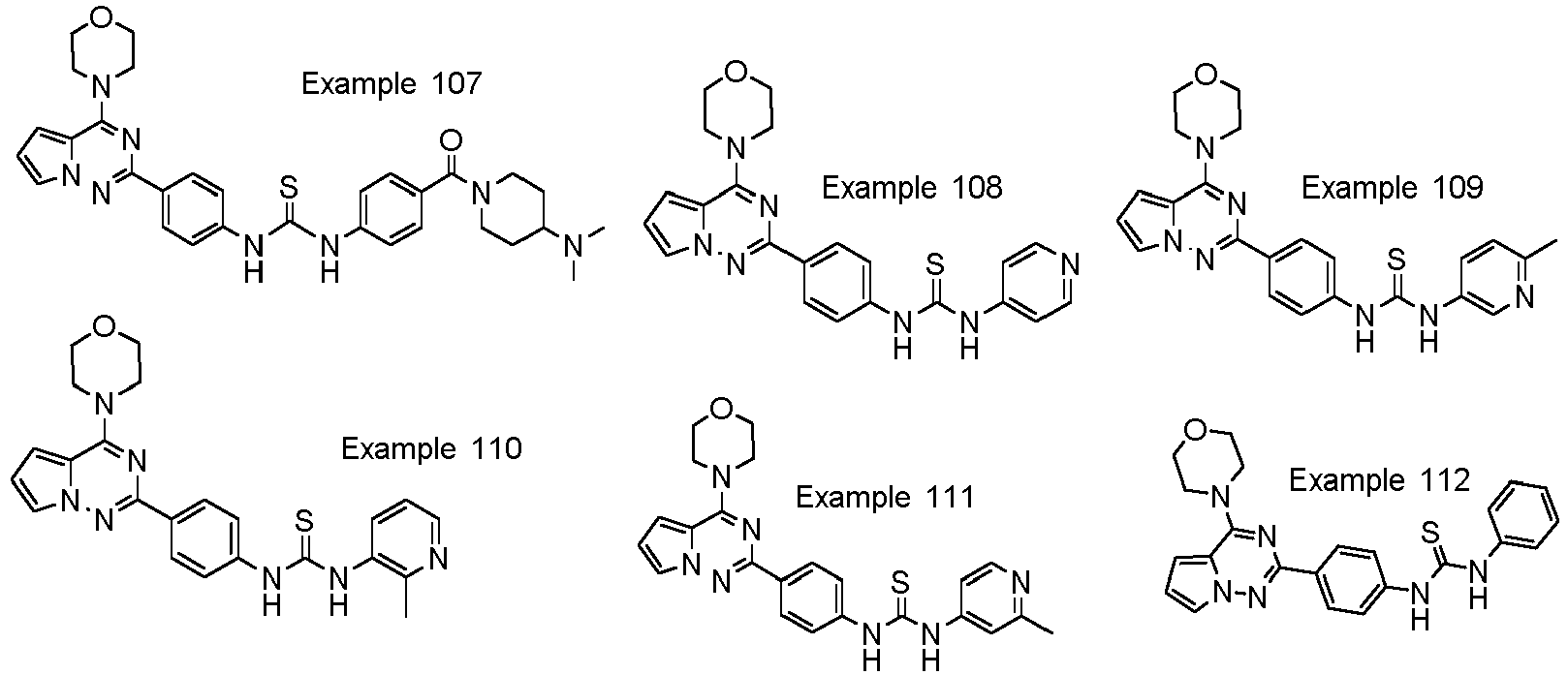


- Pharmazeutische Zusammensetzung, die eine Verbindung nach einem der Ansprüche 1 bis 11 oder ein pharmazeutisch akzeptables Salz davon und einen pharmazeutisch akzeptablen Träger umfasst.
- Verbindung nach einem der Ansprüche 1 bis 11 zur Verwendung beim Hemmen von Mammalian Target of Rapamycin (mTOR) bei einem Patienten, bei dem eine mit mTOR zusammenhängende Krankheit oder Störung diagnostiziert wurde, wobei eine Zusammensetzung, die eine Verbindung nach einem der Ansprüche 1 bis 11 umfasst, dem Patienten in einer wirksamen Menge verabreicht wird, um mTOR in der Zelle des Patienten zu hemmen.
- Verbindung zur Verwendung nach Anspruch 13, wobei die Krankheit oder Störung mit mTOR-Leitungsweg-Dysregulation zusammenhängende Hyperplasie ist.
Applications Claiming Priority (2)
| Application Number | Priority Date | Filing Date | Title |
|---|---|---|---|
| US201662354754P | 2016-06-25 | 2016-06-25 | |
| PCT/CN2017/084683 WO2017219800A1 (en) | 2016-06-25 | 2017-05-17 | Mechanistic target of rapamycin signaling pathway inhibitors and therapeutic applications thereof |
Publications (3)
| Publication Number | Publication Date |
|---|---|
| EP3475285A1 EP3475285A1 (de) | 2019-05-01 |
| EP3475285A4 EP3475285A4 (de) | 2019-12-25 |
| EP3475285B1 true EP3475285B1 (de) | 2022-02-09 |
Family
ID=60784327
Family Applications (1)
| Application Number | Title | Priority Date | Filing Date |
|---|---|---|---|
| EP17814538.9A Active EP3475285B1 (de) | 2016-06-25 | 2017-05-17 | Mechanistisches target von rapamycinsignalweghemmern und therapeutische anwendungen davon |
Country Status (8)
| Country | Link |
|---|---|
| US (1) | US11242346B2 (de) |
| EP (1) | EP3475285B1 (de) |
| JP (1) | JP6858252B2 (de) |
| KR (1) | KR102288246B1 (de) |
| CN (1) | CN109641909B (de) |
| AU (1) | AU2017280293B2 (de) |
| CA (1) | CA3028822C (de) |
| WO (1) | WO2017219800A1 (de) |
Families Citing this family (4)
| Publication number | Priority date | Publication date | Assignee | Title |
|---|---|---|---|---|
| CN109111447A (zh) * | 2017-06-23 | 2019-01-01 | 中国科学院上海药物研究所 | 7-位取代吡咯并三嗪类化合物或其药学上可用的盐,及其制备方法和用途 |
| CN109970745B (zh) * | 2018-04-16 | 2020-12-08 | 深圳市塔吉瑞生物医药有限公司 | 取代的吡咯并三嗪类化合物及其药物组合物及其用途 |
| CN114426952A (zh) * | 2020-10-29 | 2022-05-03 | 中国科学技术大学 | 用于白血病的car t细胞疗法的t细胞增效剂及获得增效t细胞的方法 |
| IL315733A (en) | 2022-04-08 | 2024-11-01 | SHY Therapeutics LLC | Compounds that Interact with RAS Superfamily Proteins for the Treatment of Cancer, Inflammatory, Basoplastic, and Fibrotic Diseases |
Family Cites Families (3)
| Publication number | Priority date | Publication date | Assignee | Title |
|---|---|---|---|---|
| CN102558185B (zh) | 2010-12-09 | 2016-02-10 | 中国科学院上海药物研究所 | 吡啶并吡咯三嗪化合物、其制备方法和用途 |
| CN103450204B (zh) * | 2012-05-31 | 2016-08-17 | 中国科学院上海药物研究所 | 吡咯[2,1-f][1,2,4]并三嗪类化合物,其制备方法及用途 |
| CN102675323B (zh) * | 2012-06-01 | 2014-04-09 | 南京药石药物研发有限公司 | 吡咯并[2,1-f][1,2,4]三嗪衍生物及其抗肿瘤用途 |
-
2017
- 2017-05-17 KR KR1020197002079A patent/KR102288246B1/ko active Active
- 2017-05-17 CN CN201780038513.3A patent/CN109641909B/zh active Active
- 2017-05-17 WO PCT/CN2017/084683 patent/WO2017219800A1/en not_active Ceased
- 2017-05-17 US US16/313,081 patent/US11242346B2/en active Active
- 2017-05-17 EP EP17814538.9A patent/EP3475285B1/de active Active
- 2017-05-17 JP JP2019520187A patent/JP6858252B2/ja active Active
- 2017-05-17 AU AU2017280293A patent/AU2017280293B2/en active Active
- 2017-05-17 CA CA3028822A patent/CA3028822C/en active Active
Also Published As
| Publication number | Publication date |
|---|---|
| CA3028822A1 (en) | 2017-12-28 |
| CN109641909A (zh) | 2019-04-16 |
| AU2017280293A1 (en) | 2019-01-24 |
| KR102288246B1 (ko) | 2021-08-10 |
| EP3475285A1 (de) | 2019-05-01 |
| US20200181147A1 (en) | 2020-06-11 |
| WO2017219800A1 (en) | 2017-12-28 |
| JP2019522682A (ja) | 2019-08-15 |
| CN109641909B (zh) | 2022-01-11 |
| JP6858252B2 (ja) | 2021-04-14 |
| US11242346B2 (en) | 2022-02-08 |
| KR20190020122A (ko) | 2019-02-27 |
| CA3028822C (en) | 2021-06-22 |
| EP3475285A4 (de) | 2019-12-25 |
| AU2017280293B2 (en) | 2020-02-06 |
Similar Documents
| Publication | Publication Date | Title |
|---|---|---|
| US10851109B2 (en) | Compositions and methods of using the same for treatment of neurodegenerative and mitochondrial disease | |
| EP2978759B1 (de) | Benzimidazolonderivate als bromdomänenhemmer | |
| EP3917527B1 (de) | Verbindungen und verwendungen davon | |
| JP6959248B2 (ja) | 癌治療用の4,6−ジヒドロピロロ[3,4−c]ピラゾール−5(1H)−カルボニトリル誘導体 | |
| EP2953941B1 (de) | Modulatoren methylmodifizierender enzyme, zusammensetzungen und verwendungen davon | |
| EP2812001B1 (de) | Modulatoren methylmodifizierender enzyme, zusammensetzungen und verwendungen davon | |
| JP2021532077A (ja) | セレブロン系機構に対抗する二量体免疫調節化合物 | |
| FR3041640A1 (de) | ||
| CA2951971C (en) | PYRIDINO ANALOGUE [1,2-A] PYRIMIDONE USED AS A PI3K INHIBITOR | |
| EP3475285B1 (de) | Mechanistisches target von rapamycinsignalweghemmern und therapeutische anwendungen davon | |
| KR20190098266A (ko) | 치환된 축합 헤테로아릴기 화합물인 키나제 억제제 및 이의 응용 | |
| CN111454327A (zh) | 一种nampt蛋白降解靶向嵌合体及其制备方法和应用 | |
| EP4373817B1 (de) | Substituierte pyrazin-2-carboxamide als hpk1-inhibitoren zur behandlung von krebs | |
| CN118201896A (zh) | PI3K-α抑制剂和其使用方法 | |
| WO2023141866A1 (en) | Pyrazolopyrimidines as modulators of spermine oxidase | |
| HK40002867A (en) | Mechanistic target of rapamycin signaling pathway inhibitors and therapeutic applications thereof | |
| TW202333677A (zh) | 蛋白質激酶C θ抑制劑 | |
| HK40002867B (zh) | 雷帕霉素信号通路抑制剂的机理靶标及其治疗应用 | |
| HK1220692B (en) | Benzimidazolone derivatives as bromodomain inhibitors |
Legal Events
| Date | Code | Title | Description |
|---|---|---|---|
| STAA | Information on the status of an ep patent application or granted ep patent |
Free format text: STATUS: THE INTERNATIONAL PUBLICATION HAS BEEN MADE |
|
| PUAI | Public reference made under article 153(3) epc to a published international application that has entered the european phase |
Free format text: ORIGINAL CODE: 0009012 |
|
| STAA | Information on the status of an ep patent application or granted ep patent |
Free format text: STATUS: REQUEST FOR EXAMINATION WAS MADE |
|
| 17P | Request for examination filed |
Effective date: 20190117 |
|
| AK | Designated contracting states |
Kind code of ref document: A1 Designated state(s): AL AT BE BG CH CY CZ DE DK EE ES FI FR GB GR HR HU IE IS IT LI LT LU LV MC MK MT NL NO PL PT RO RS SE SI SK SM TR |
|
| AX | Request for extension of the european patent |
Extension state: BA ME |
|
| DAV | Request for validation of the european patent (deleted) | ||
| DAX | Request for extension of the european patent (deleted) | ||
| A4 | Supplementary search report drawn up and despatched |
Effective date: 20191126 |
|
| RIC1 | Information provided on ipc code assigned before grant |
Ipc: C07D 487/04 20060101AFI20191120BHEP Ipc: C07D 519/00 20060101ALI20191120BHEP Ipc: A61K 31/5377 20060101ALI20191120BHEP Ipc: A61P 35/00 20060101ALI20191120BHEP |
|
| STAA | Information on the status of an ep patent application or granted ep patent |
Free format text: STATUS: EXAMINATION IS IN PROGRESS |
|
| 17Q | First examination report despatched |
Effective date: 20210319 |
|
| GRAP | Despatch of communication of intention to grant a patent |
Free format text: ORIGINAL CODE: EPIDOSNIGR1 |
|
| STAA | Information on the status of an ep patent application or granted ep patent |
Free format text: STATUS: GRANT OF PATENT IS INTENDED |
|
| INTG | Intention to grant announced |
Effective date: 20210827 |
|
| GRAS | Grant fee paid |
Free format text: ORIGINAL CODE: EPIDOSNIGR3 |
|
| GRAA | (expected) grant |
Free format text: ORIGINAL CODE: 0009210 |
|
| STAA | Information on the status of an ep patent application or granted ep patent |
Free format text: STATUS: THE PATENT HAS BEEN GRANTED |
|
| AK | Designated contracting states |
Kind code of ref document: B1 Designated state(s): AL AT BE BG CH CY CZ DE DK EE ES FI FR GB GR HR HU IE IS IT LI LT LU LV MC MK MT NL NO PL PT RO RS SE SI SK SM TR |
|
| REG | Reference to a national code |
Ref country code: GB Ref legal event code: FG4D |
|
| REG | Reference to a national code |
Ref country code: CH Ref legal event code: EP Ref country code: AT Ref legal event code: REF Ref document number: 1467464 Country of ref document: AT Kind code of ref document: T Effective date: 20220215 |
|
| REG | Reference to a national code |
Ref country code: DE Ref legal event code: R096 Ref document number: 602017053221 Country of ref document: DE |
|
| REG | Reference to a national code |
Ref country code: IE Ref legal event code: FG4D |
|
| REG | Reference to a national code |
Ref country code: LT Ref legal event code: MG9D |
|
| REG | Reference to a national code |
Ref country code: NL Ref legal event code: MP Effective date: 20220209 |
|
| REG | Reference to a national code |
Ref country code: AT Ref legal event code: MK05 Ref document number: 1467464 Country of ref document: AT Kind code of ref document: T Effective date: 20220209 |
|
| PG25 | Lapsed in a contracting state [announced via postgrant information from national office to epo] |
Ref country code: SE Free format text: LAPSE BECAUSE OF FAILURE TO SUBMIT A TRANSLATION OF THE DESCRIPTION OR TO PAY THE FEE WITHIN THE PRESCRIBED TIME-LIMIT Effective date: 20220209 Ref country code: RS Free format text: LAPSE BECAUSE OF FAILURE TO SUBMIT A TRANSLATION OF THE DESCRIPTION OR TO PAY THE FEE WITHIN THE PRESCRIBED TIME-LIMIT Effective date: 20220209 Ref country code: PT Free format text: LAPSE BECAUSE OF FAILURE TO SUBMIT A TRANSLATION OF THE DESCRIPTION OR TO PAY THE FEE WITHIN THE PRESCRIBED TIME-LIMIT Effective date: 20220609 Ref country code: NO Free format text: LAPSE BECAUSE OF FAILURE TO SUBMIT A TRANSLATION OF THE DESCRIPTION OR TO PAY THE FEE WITHIN THE PRESCRIBED TIME-LIMIT Effective date: 20220509 Ref country code: NL Free format text: LAPSE BECAUSE OF FAILURE TO SUBMIT A TRANSLATION OF THE DESCRIPTION OR TO PAY THE FEE WITHIN THE PRESCRIBED TIME-LIMIT Effective date: 20220209 Ref country code: LT Free format text: LAPSE BECAUSE OF FAILURE TO SUBMIT A TRANSLATION OF THE DESCRIPTION OR TO PAY THE FEE WITHIN THE PRESCRIBED TIME-LIMIT Effective date: 20220209 Ref country code: HR Free format text: LAPSE BECAUSE OF FAILURE TO SUBMIT A TRANSLATION OF THE DESCRIPTION OR TO PAY THE FEE WITHIN THE PRESCRIBED TIME-LIMIT Effective date: 20220209 Ref country code: ES Free format text: LAPSE BECAUSE OF FAILURE TO SUBMIT A TRANSLATION OF THE DESCRIPTION OR TO PAY THE FEE WITHIN THE PRESCRIBED TIME-LIMIT Effective date: 20220209 Ref country code: BG Free format text: LAPSE BECAUSE OF FAILURE TO SUBMIT A TRANSLATION OF THE DESCRIPTION OR TO PAY THE FEE WITHIN THE PRESCRIBED TIME-LIMIT Effective date: 20220509 |
|
| PG25 | Lapsed in a contracting state [announced via postgrant information from national office to epo] |
Ref country code: PL Free format text: LAPSE BECAUSE OF FAILURE TO SUBMIT A TRANSLATION OF THE DESCRIPTION OR TO PAY THE FEE WITHIN THE PRESCRIBED TIME-LIMIT Effective date: 20220209 Ref country code: LV Free format text: LAPSE BECAUSE OF FAILURE TO SUBMIT A TRANSLATION OF THE DESCRIPTION OR TO PAY THE FEE WITHIN THE PRESCRIBED TIME-LIMIT Effective date: 20220209 Ref country code: GR Free format text: LAPSE BECAUSE OF FAILURE TO SUBMIT A TRANSLATION OF THE DESCRIPTION OR TO PAY THE FEE WITHIN THE PRESCRIBED TIME-LIMIT Effective date: 20220510 Ref country code: FI Free format text: LAPSE BECAUSE OF FAILURE TO SUBMIT A TRANSLATION OF THE DESCRIPTION OR TO PAY THE FEE WITHIN THE PRESCRIBED TIME-LIMIT Effective date: 20220209 Ref country code: AT Free format text: LAPSE BECAUSE OF FAILURE TO SUBMIT A TRANSLATION OF THE DESCRIPTION OR TO PAY THE FEE WITHIN THE PRESCRIBED TIME-LIMIT Effective date: 20220209 |
|
| PG25 | Lapsed in a contracting state [announced via postgrant information from national office to epo] |
Ref country code: IS Free format text: LAPSE BECAUSE OF FAILURE TO SUBMIT A TRANSLATION OF THE DESCRIPTION OR TO PAY THE FEE WITHIN THE PRESCRIBED TIME-LIMIT Effective date: 20220609 |
|
| PG25 | Lapsed in a contracting state [announced via postgrant information from national office to epo] |
Ref country code: SM Free format text: LAPSE BECAUSE OF FAILURE TO SUBMIT A TRANSLATION OF THE DESCRIPTION OR TO PAY THE FEE WITHIN THE PRESCRIBED TIME-LIMIT Effective date: 20220209 Ref country code: SK Free format text: LAPSE BECAUSE OF FAILURE TO SUBMIT A TRANSLATION OF THE DESCRIPTION OR TO PAY THE FEE WITHIN THE PRESCRIBED TIME-LIMIT Effective date: 20220209 Ref country code: RO Free format text: LAPSE BECAUSE OF FAILURE TO SUBMIT A TRANSLATION OF THE DESCRIPTION OR TO PAY THE FEE WITHIN THE PRESCRIBED TIME-LIMIT Effective date: 20220209 Ref country code: EE Free format text: LAPSE BECAUSE OF FAILURE TO SUBMIT A TRANSLATION OF THE DESCRIPTION OR TO PAY THE FEE WITHIN THE PRESCRIBED TIME-LIMIT Effective date: 20220209 Ref country code: DK Free format text: LAPSE BECAUSE OF FAILURE TO SUBMIT A TRANSLATION OF THE DESCRIPTION OR TO PAY THE FEE WITHIN THE PRESCRIBED TIME-LIMIT Effective date: 20220209 Ref country code: CZ Free format text: LAPSE BECAUSE OF FAILURE TO SUBMIT A TRANSLATION OF THE DESCRIPTION OR TO PAY THE FEE WITHIN THE PRESCRIBED TIME-LIMIT Effective date: 20220209 |
|
| REG | Reference to a national code |
Ref country code: DE Ref legal event code: R097 Ref document number: 602017053221 Country of ref document: DE |
|
| PG25 | Lapsed in a contracting state [announced via postgrant information from national office to epo] |
Ref country code: AL Free format text: LAPSE BECAUSE OF FAILURE TO SUBMIT A TRANSLATION OF THE DESCRIPTION OR TO PAY THE FEE WITHIN THE PRESCRIBED TIME-LIMIT Effective date: 20220209 |
|
| PLBE | No opposition filed within time limit |
Free format text: ORIGINAL CODE: 0009261 |
|
| STAA | Information on the status of an ep patent application or granted ep patent |
Free format text: STATUS: NO OPPOSITION FILED WITHIN TIME LIMIT |
|
| REG | Reference to a national code |
Ref country code: CH Ref legal event code: PL |
|
| 26N | No opposition filed |
Effective date: 20221110 |
|
| REG | Reference to a national code |
Ref country code: BE Ref legal event code: MM Effective date: 20220531 |
|
| PG25 | Lapsed in a contracting state [announced via postgrant information from national office to epo] |
Ref country code: MC Free format text: LAPSE BECAUSE OF FAILURE TO SUBMIT A TRANSLATION OF THE DESCRIPTION OR TO PAY THE FEE WITHIN THE PRESCRIBED TIME-LIMIT Effective date: 20220209 Ref country code: LU Free format text: LAPSE BECAUSE OF NON-PAYMENT OF DUE FEES Effective date: 20220517 Ref country code: LI Free format text: LAPSE BECAUSE OF NON-PAYMENT OF DUE FEES Effective date: 20220531 Ref country code: CH Free format text: LAPSE BECAUSE OF NON-PAYMENT OF DUE FEES Effective date: 20220531 |
|
| PG25 | Lapsed in a contracting state [announced via postgrant information from national office to epo] |
Ref country code: SI Free format text: LAPSE BECAUSE OF FAILURE TO SUBMIT A TRANSLATION OF THE DESCRIPTION OR TO PAY THE FEE WITHIN THE PRESCRIBED TIME-LIMIT Effective date: 20220209 |
|
| PG25 | Lapsed in a contracting state [announced via postgrant information from national office to epo] |
Ref country code: IE Free format text: LAPSE BECAUSE OF NON-PAYMENT OF DUE FEES Effective date: 20220517 |
|
| PG25 | Lapsed in a contracting state [announced via postgrant information from national office to epo] |
Ref country code: BE Free format text: LAPSE BECAUSE OF NON-PAYMENT OF DUE FEES Effective date: 20220531 |
|
| P01 | Opt-out of the competence of the unified patent court (upc) registered |
Effective date: 20230524 |
|
| PG25 | Lapsed in a contracting state [announced via postgrant information from national office to epo] |
Ref country code: IT Free format text: LAPSE BECAUSE OF FAILURE TO SUBMIT A TRANSLATION OF THE DESCRIPTION OR TO PAY THE FEE WITHIN THE PRESCRIBED TIME-LIMIT Effective date: 20220209 |
|
| PG25 | Lapsed in a contracting state [announced via postgrant information from national office to epo] |
Ref country code: HU Free format text: LAPSE BECAUSE OF FAILURE TO SUBMIT A TRANSLATION OF THE DESCRIPTION OR TO PAY THE FEE WITHIN THE PRESCRIBED TIME-LIMIT; INVALID AB INITIO Effective date: 20170517 |
|
| PG25 | Lapsed in a contracting state [announced via postgrant information from national office to epo] |
Ref country code: MK Free format text: LAPSE BECAUSE OF FAILURE TO SUBMIT A TRANSLATION OF THE DESCRIPTION OR TO PAY THE FEE WITHIN THE PRESCRIBED TIME-LIMIT Effective date: 20220209 Ref country code: CY Free format text: LAPSE BECAUSE OF FAILURE TO SUBMIT A TRANSLATION OF THE DESCRIPTION OR TO PAY THE FEE WITHIN THE PRESCRIBED TIME-LIMIT Effective date: 20220209 |
|
| PG25 | Lapsed in a contracting state [announced via postgrant information from national office to epo] |
Ref country code: MT Free format text: LAPSE BECAUSE OF FAILURE TO SUBMIT A TRANSLATION OF THE DESCRIPTION OR TO PAY THE FEE WITHIN THE PRESCRIBED TIME-LIMIT Effective date: 20220209 |
|
| PGFP | Annual fee paid to national office [announced via postgrant information from national office to epo] |
Ref country code: DE Payment date: 20250521 Year of fee payment: 9 |
|
| PGFP | Annual fee paid to national office [announced via postgrant information from national office to epo] |
Ref country code: FR Payment date: 20250528 Year of fee payment: 9 |
|
| PG25 | Lapsed in a contracting state [announced via postgrant information from national office to epo] |
Ref country code: TR Free format text: LAPSE BECAUSE OF FAILURE TO SUBMIT A TRANSLATION OF THE DESCRIPTION OR TO PAY THE FEE WITHIN THE PRESCRIBED TIME-LIMIT Effective date: 20220209 |
|
| PGFP | Annual fee paid to national office [announced via postgrant information from national office to epo] |
Ref country code: GB Payment date: 20260306 Year of fee payment: 10 |