EP3478110B1 - Vêtement avec isolation à zones et perméabilité à l'air variable - Google Patents
Vêtement avec isolation à zones et perméabilité à l'air variable Download PDFInfo
- Publication number
- EP3478110B1 EP3478110B1 EP17761759.4A EP17761759A EP3478110B1 EP 3478110 B1 EP3478110 B1 EP 3478110B1 EP 17761759 A EP17761759 A EP 17761759A EP 3478110 B1 EP3478110 B1 EP 3478110B1
- Authority
- EP
- European Patent Office
- Prior art keywords
- yarn
- garment
- textile
- air permeability
- projections
- Prior art date
- Legal status (The legal status is an assumption and is not a legal conclusion. Google has not performed a legal analysis and makes no representation as to the accuracy of the status listed.)
- Active
Links
Images




Classifications
-
- A—HUMAN NECESSITIES
- A41—WEARING APPAREL
- A41D—OUTERWEAR; PROTECTIVE GARMENTS; ACCESSORIES
- A41D27/00—Details of garments or of their making
- A41D27/28—Means for ventilation
-
- A—HUMAN NECESSITIES
- A41—WEARING APPAREL
- A41D—OUTERWEAR; PROTECTIVE GARMENTS; ACCESSORIES
- A41D31/00—Materials specially adapted for outerwear
-
- A—HUMAN NECESSITIES
- A41—WEARING APPAREL
- A41D—OUTERWEAR; PROTECTIVE GARMENTS; ACCESSORIES
- A41D31/00—Materials specially adapted for outerwear
- A41D31/04—Materials specially adapted for outerwear characterised by special function or use
- A41D31/14—Air permeable, i.e. capable of being penetrated by gases
-
- D—TEXTILES; PAPER
- D04—BRAIDING; LACE-MAKING; KNITTING; TRIMMINGS; NON-WOVEN FABRICS
- D04B—KNITTING
- D04B1/00—Weft knitting processes for the production of fabrics or articles not dependent on the use of particular machines; Fabrics or articles defined by such processes
- D04B1/14—Other fabrics or articles characterised primarily by the use of particular thread materials
- D04B1/16—Other fabrics or articles characterised primarily by the use of particular thread materials synthetic threads
-
- D—TEXTILES; PAPER
- D04—BRAIDING; LACE-MAKING; KNITTING; TRIMMINGS; NON-WOVEN FABRICS
- D04B—KNITTING
- D04B1/00—Weft knitting processes for the production of fabrics or articles not dependent on the use of particular machines; Fabrics or articles defined by such processes
- D04B1/22—Weft knitting processes for the production of fabrics or articles not dependent on the use of particular machines; Fabrics or articles defined by such processes specially adapted for knitting goods of particular configuration
- D04B1/24—Weft knitting processes for the production of fabrics or articles not dependent on the use of particular machines; Fabrics or articles defined by such processes specially adapted for knitting goods of particular configuration wearing apparel
-
- A—HUMAN NECESSITIES
- A41—WEARING APPAREL
- A41D—OUTERWEAR; PROTECTIVE GARMENTS; ACCESSORIES
- A41D2500/00—Materials for garments
- A41D2500/10—Knitted
-
- D—TEXTILES; PAPER
- D10—INDEXING SCHEME ASSOCIATED WITH SUBLASSES OF SECTION D, RELATING TO TEXTILES
- D10B—INDEXING SCHEME ASSOCIATED WITH SUBLASSES OF SECTION D, RELATING TO TEXTILES
- D10B2401/00—Physical properties
- D10B2401/02—Moisture-responsive characteristics
Definitions
- the present disclosure relates to a garment having insulation zones with variable air permeability characteristics.
- Garments configured for cold weather typically use some type of insulation to provide warmth to the wearer.
- the insulation is generally uniformly dispersed over the garment.
- Patent EP 0 062 969 describes a ski sock including additional yarn knit in plated relationship with the body yarns to form a thickened fabric area extending down the front portion of the leg of the sock to cushion and protect the front portion of the leg of the wearer from discomfort caused by the front and upper edge of the ski boot.
- the ski sock also includes a thickened fabric area extending along the rear half of the sock and at least through the heel and sole area to cushion and protect the heel and lower portion of the foot of the wearer.
- Opposite side panels of thinner fabric are provided between the thickened fabric areas in the front and rear of the sock to reduce the bulk of the fabric.
- Stretch restricting opposite side panels are provided in the lower portion of the foot, that portion of the foot adapted to fit over the forward portion of the foot and up to the medial portion of the ball of the foot, to limit the stretch-ability and to provide a snug fit on the forward end of the foot of the wearer.
- Document EP 1 676 944 describes a stretchable composite fabric appropriate to sportswear and underwear that is a woven or knitted fabric including a composite yarns formed from stretchable yarns having a self-elongation of 5% or more upon absorbing water and an elongation at break of 200% or more and non-stretchable yarns having a self-elongation less than 5% upon absorbing water, and yarns including stretchable yarns having a self-elongation less than 5% upon absorbing water and an elongation at break of 30% or more, wherein the yarns and in a sample taken from the composite fabric respectively have a length L1 and a length L2, the ratio L1/L2 is 0.9 or less, and the yarns can self-elongate upon absorbing water and shrink upon drying.
- aspects herein relate to a textile knitted with an adaptive yarn that incorporates insulation features as well as variable air permeability features.
- the adaptive textile may exhibit a baseline level of insulation.
- the adaptive textile is configured to exhibit a first air permeability when unexposed to a physical stimulus such as water and a second air permeability when exposed to the physical stimulus where the second air permeability is greater than the first air permeability.
- water is meant to encompass substances such as sweat or perspiration.
- the knitted textile comprises a single knit jersey with terry loops on one surface of the textile.
- the adaptive textile is formed using at least a first yarn that is dimensionally stable upon exposure to a physical stimulus such as water, a second yarn that dimensionally transforms when exposed to the physical stimulus, and a third yarn that is dimensionally stable when exposed to the physical stimulus.
- the first yarn is knit to form a first surface of the textile
- the second yarn is plated with the first yarn such that it is generally positioned under the first yarn in the knitted textile.
- the third yarn is mechanically manipulated to create terry loops that form the second opposite surface of the textile.
- the terry loops are clustered together to form discrete projections that extend away from the second surface of the textile ( i.e., extend in the z-direction).
- the projections may have terminal ends located opposite the surface plane of the textile.
- the projections may be arranged in a tessellation pattern that maximizes the number of projections per unit area, and spaces may be formed between adjacent projections.
- the textile When the adaptive textile is incorporated into a garment, such as a garment configured for cold-weather conditions, the textile may be strategically positioned on the garment such that it is located adjacent to, for instance, high heat or sweat producing areas of the wearer when the garment is worn.
- the second surface may comprise an inner-facing surface of the garment, and the first surface may help to form an outer-facing surface of the garment.
- the projections formed by the terry loops may come into contact or near contact with the wearer's body when the garment is worn helping to maintain heated air produced by the wearer in contact with the wearer's body.
- the projections may help to "trap" heated air and may reduce opportunities for the heated air to be channeled away from the wearer's body. This is helpful when the wearer is at rest or is generating minimal body heat.
- the projections may help transport the perspiration to the second yarn causing the second yarn to undergo a dimensional transformation from a crimped state to a straight or flat state. This results in an increase in size of the openings formed between the yarn loops, which, in turn, increases the air permeability of the textile.
- the increase in air permeability may help to dissipate wearer-generated heat and/or moisture vapor and thereby cool the wearer.
- the result is a garment that is able to provide both insulation when needed such as when a wearer is resting, and cooling when needed such as when the wearer is active or exercising.
- aspects herein are directed to a garment according to claim 1.
- a knitted textile according to claim 7 is provided.
- a garment according to claim 12 is provided.
- directional terms such as front, back, side, anterior, posterior, superior, inferior, inner-facing, outer-facing, and the like are to be given their common meanings with respect to a garment being worn as intended by a wearer standing in anatomical position.
- Terms such as “configured to cover [a designated body part of a wearer]” are to be construed with respect to a garment that is appropriately sized for a particular wearer.
- Terms such as “proximate” mean within 0.5 cm to 40 cm from the indicated area.
- an exemplary knit structure 100 is provided in accordance with aspects herein.
- Use of a knit construction as described herein may inherently provide a greater level of baseline air permeability due to the interlooping nature of the knit construction as compared to, for instance, weaving constructions.
- a knit structure may inherently have a greater number and/or surface area of spaces formed between knit loops as compared to a woven structure.
- the knit structure 100 is formed using at least a first yarn 110, a second yarn 112 that is plated with the first yarn 110, and a third yarn 114.
- the first yarn 110 may comprise a yarn that is dimensionally stable upon exposure to a physical stimulus such as, for example, water, increased temperature, wind, light energy, magnetic energy, and the like. In other words, the first yarn 110 does not undergo a measurable change in dimension or characteristics (i.e., length, thickness, degree of crimp, for example) when exposed to a physical stimulus.
- the first yarn 110 may comprise a 20 gauge, 150 denier, 144 filament semi-dull heather polyester yarn.
- Formulations for the fiber or filament content of the first yarn 110 may comprise, for example, a 50% regular non-absorptive polyester and a 50% cationic dyeable polyester yarn that is also non-absorptive. Other formulations for the fiber or filament content of the first yarn 110 are contemplated herein. As well, other non-absorptive polymer fibers or filaments are contemplated herein such as rayon, nylon, polyacrylic, and the like.
- the second yarn 112 may comprise a yarn that dimensionally transforms (i.e., undergoes a change in length, thickness, degree of crimp, and the like) upon exposure to a physical stimulus such as water (in a liquid or gaseous state), increased temperature, moving air, light energy, magnetic energy, and the like.
- a physical stimulus such as water (in a liquid or gaseous state), increased temperature, moving air, light energy, magnetic energy, and the like.
- An exemplary yarn may be manufactured by Teijin Fibers Limited of Japan. With respect to water, the dimensional transformation may occur relatively quickly (such as under 30 seconds) due to, for instance, immersion or contact with liquid water. Alternatively, the transformation may occur more slowly due to prolonged exposure to air with a relative humidity above, for instance, 75%.
- the second yarn 112 may comprise a 20 gauge 75 denier/24 filament semi-dull bi-component yarn or a 50 denier/24 filament semi-dull bi-component yarn.
- the 75 denier/24 filament yarn may exhibit less crimp than the 50 denier/24 filament yarn but may exhibit a higher stability ( i.e., a longer shelf life).
- Formulations for the fiber or filament content of the second yarn 112 may comprise, for instance, a 50% modified cationic dyeable polyester that is non-absorptive and a 50% moisture-absorbing polycaprolactam or Nylon 6.
- the second yarn 112 is formed using an air intermingling process to combine the polycaprolactam fibers or filaments with the modified cationic dyeable polyester fibers or filaments.
- polycaprolactam or Nylon 6 exhibits a moisture regain of approximately 4.1%
- the modified cationic dyeable polyester fibers or filaments may exhibit a moisture regain of 0.2-0.4% where moisture regain may be defined as the weight of water in a material as a percentage of the oven dry weight.
- use of these two types of fibers or filaments may enable a moisture regain differential sufficient to induce a dimensional change in the second yarn 112.
- the 50% modified cationic dyeable polyester fibers or filaments and the 50% moisture-absorbing polycaprolactam or Nylon 6 fibers or filaments are generally arranged in a side-by-side manner with minimal twist between the different fiber/filament groups to generate a yarn with a generally round cross-section.
- the cationic dyeable polyester fibers or filaments in the second yarn 112 are modified so that they will better adhere to the polycaprolactam or Nylon 6 fibers or filaments.
- the cationic dyeable polyester fibers or filaments may be modified by increasing the number of cations and anions. The higher cationic content may cause a greater amount of adhesion to the polycaprolactam or Nylon 6 fibers or filaments than traditional cationic dyeable polyester fibers or filaments. This, in turn, may lower the melting temperature and may lower the degree of crystallinity of the modified cationic dyeable polyester fibers or filaments.
- the cationic dyeable polyester fibers or filaments in the second yarn 112 may exhibit a greater affinity to dyes (disperse dyes and cationic dyes) than cationic dyeable polyester fibers or filaments used in the first yarn 110 and/or the third yarn 114.
- the modified cationic dyeable polyester fibers or filaments in the second yarn 112 may absorb dyes to a greater extent than the first yarn 110 or the third yarn 114 and thus appear darker than these yarns after dyeing.
- a heather yarn may be used for the first yarn 110.
- the first yarn 110 may form, for example, an outer-facing surface of the textile.
- the first yarn 110 is plated with the second yarn 112.
- the second yarn 112 may occasionally show through on the outer-facing surface of the textile.
- Use of a heather yarn for the first yarn 110 helps to conceal, camouflage, or hide the darker-dyed second yarn 112 because heather yarns possess both lighter and darker-colored areas.
- the fiber or filament content of the second yarn 112 are contemplated herein such as: 1) 70% non-absorptive polyester and 30% moisture-absorptive polyester; 2) 80% non-absorptive polyester and 20% moisture-absorptive polyester; 3) 80% percent cationic dyeable polyester that is generally non-absorptive and 20% moisture-absorptive polyester, and the like.
- the percentage of the fibers or filaments formed from moisture-absorptive materials may vary considerably within the scope of aspects herein.
- a non-absorptive or otherwise dimensionally stable polyester fiber or filament is combined with a moisture-absorptive material to form a bi-component yarn.
- Other non-absorptive materials may be used herein such as rayon, nylon, polyacrylic, and the like.
- the second yarn 112 may comprise between 20-30% and/or between 22-26% of the yarns in the finished textile.
- the third yarn 114 may comprise a yarn that is dimensionally stable upon exposure to a physical stimulus such as water.
- the third yarn 114 may comprise a 20 gauge, 100 denier, 144 filament semi-dull, 100% non-absorptive polyester yarn, while in another exemplary aspect, the third yarn 114 may comprise a 75 denier, 36 filament semi-dull 100% non-absorptive polyester yarn or a 75 denier, 72 filament semi-dull, 100% non-absorptive polyester yarn.
- a cationic dyeable non-absorptive polyester yarn may be used for the third yarn 114 alone or in combination with regular polyester fibers or filaments (i.e., a 50% regular non-absorptive polyester and a 50% cationic dyeable polyester yarn). Utilizing different denier/filament ratios may be useful in providing greater or lesser degrees of insulation. For instance, the 100 denier, 144 filament yarn may provide a higher degree of insulation when formed into the terry loops as compared to the 75 denier/36 filament yarn. It is contemplated that other non-absorptive fibers or filaments such as rayon, nylon, polyacrylic, and the like may be used herein. The use of polyester fibers and/or filaments as described herein may be advantageous due to the high abrasion resistance, tenacity, resiliency, dimensional stability, and elastic recovery of polyester fibers and/or filaments.
- the second yarn 112 is plated with the first yarn 110 such that the second yarn 112 generally lies under, and/or is positioned adjacent, the first yarn 110 in the finished textile or fabric.
- the first and second yarns 110 and 112 may be knit in a single jersey pattern to form a first face or first surface 116 of the resulting textile or fabric.
- the first yarn 110 forms the majority of the first surface 116.
- a plated structure contains loops composed of at least two yarns, each separately supplied through its own guide or guide hole to the needle hook in order to influence its respective position relative to the surface of the textile.
- the yarn positioned underneath the face yarn may occasionally show through on the face of the textile.
- the majority may comprise up to 80%, 85%, 90%, 95% or greater of the first surface 116.
- plating the second yarn 112 with the first yarn 110 may be important in helping to "lock-down" or securing the second yarn 112.
- the second yarn 112 undergoes a dimensional transformation when exposed to a physical stimulus
- locking down or securing this yarn via the plating and interlooping process with the first yarn 110 may be important for constraining, at least partially, some of the dimensional changes of the second yarn 112 so that a garment incorporating the knit structure 100 does not generally deform, bag, or sag to an appreciable degree when the second yarn 112 transitions from, for instance, a crimped state to a flat or straight state.
- a single knit construction may be ideal. This construction has been found to facilitate a measurable change in air permeability due to the dimensional transformation of the second yarn 112 while still providing sufficient lockdown so that any garments incorporating the knit construction as described herein maintain their general shape. Moreover, use of a single knit construction may allow for production of a lightweight garment.
- the third yarn 114 is used to form a terry loop on the second face or second surface 118 of the resulting textile.
- the first yarn 110 would form the majority of a first surface 116 of the textile
- the third yarn 114 would form the second opposite surface 118 of the textile.
- the second yarn 112 would generally be positioned between the first yarn 110 and the third yarn 114 (and/or between the first surface 116 and the second surface 118) in the finished textile.
- Other knit constructions are contemplated herein such as, for example, a double knit pique structure, and the like.
- FIG. 2 illustrates an exemplary second yarn 112 in a crimped and uncrimped state in accordance with aspects herein.
- the second yarn 112 to the left of the arrow is shown in a crimped state where the degree of crimp may be thought of as a measure of the waviness in the yarn.
- the crimped state may exist when the second yarn 112 has not been exposed to a physical stimulus such as, for example, water or moisture vapor.
- the yarn 112 may not assume a crimped state until after the yarn 112 has undergone a dyeing process.
- the second yarn 112 may be activated when exposed to a predetermined temperature and moisture level for a predetermined period of time.
- Activation causes the second yarn 112 to crimp into a textured state because of the differential shrinkage of the side-by-side non-absorptive fibers or filaments and the absorptive fibers or filaments.
- the polycaprolactam or Nylon 6 fibers or filaments shrink to a greater degree than the cationic dyeable polyester fibers or filaments to create the crimp configuration.
- the second yarn 112 maintains the crimped state after activation until exposed to a stimulus as explained below.
- the yarn 112 shown to the right of the arrow has undergone a dimensional transformation upon exposure to a physical stimulus such as, for example, water.
- a physical stimulus such as, for example, water.
- the second yarn 112 has gone from a crimped state to a generally non-crimped or flat state.
- the transition from a crimped to an uncrimped or flat state may cause an increase in the length of the yarn 112.
- Other dimensional transformations of the second yarn 112 are contemplated herein such as an increase or decrease in the diameter of the yarn 112, an increase or decrease in the length of the yarn 112, and the like.
- FIGs. 3A and 3B illustrate the second yarn 112 knitted to form a series of interlocking loops in accordance with aspects herein.
- the second yarn 112 is shown by itself for illustration purposes, but, as described above with respect to the knit structure 100, the second yarn 112 would be plated with the first yarn 110, and the third yarn 114 would form a series of terry loops on the second surface.
- FIG. 3A illustrates a knit structure 300 incorporating the second yarn 112 in a crimped state
- FIG. 3B illustrates a knit structure 350 with the second yarn 112 in an uncrimped or flat state.
- the knit structure 300 occurs before the second yarn(s) 112 has been exposed to a physical stimulus such as, for instance, water
- the knit structure 350 occurs after the second yarn(s) 112 has been exposed to a physical stimulus such as water.
- spaces such as spaces 310
- the average area of the spaces 310 in the knit structure 300 is generally smaller than the average area of the spaces 310 in the knit structure 350 where the yarn(s) 112 is straight or uncrimped.
- Increasing the average area of the spaces 310 when going from a crimped state ( FIG. 3A ) to an uncrimped state ( FIG. 3B )) causes a resultant increase in overall permeability of the knit structure 350 to, for instance, water, light, air, and the like.
- the textile when the second yarn 112 is incorporated into a textile with the first yarn 110, and the third yarn 114 as described above, and when the textile is exposed to a physical stimulus such as water, the textile may exhibit a positive change in air permeability as measured using, for example, ASTM D737 - Standard Test Method for Air Permeability of Textile Fabrics.
- ASTM D737 - Standard Test Method for Air Permeability of Textile Fabrics This testing method is performed on both wet and dry specimens. In other words, the air permeability is measured on both wet and dry specimens.
- the test method may be modified by decreasing the pressure differential to 20 Pa (versus 125 Pa in the ASTM D737 test) to prevent the wet textile from drying out and to more closely approximate the air flow and/or air pressure experienced by, for instance, a runner while running.
- the textile when the textile comprising the second yarn 112 is exposed to a physical stimulus such as water, the textile may have may have a 16.0-17.0%, a 16.0-16.5%, or a 16.1%-16.3% positive change in air permeability measured before the textile has been washed.
- the textile may exhibit an air permeability of between 25.5 ft 3 /min/ft 2 and 30.0 ft 3 /min/ft 2 when dry and before being washed and an air permeability between 32.0 ft 3 /min/ft 2 and 32.5 ft 3 /min/ft 2 when wet and before being washed.
- the textile may have a 23.0-39.0%, a 26.0-28.0%, or a 26.0-27.0% positive change in air permeability.
- the textile may exhibit an air permeability of between 17.4 ft 3 /min/ft 2 and 17.9 ft 3 /min/ft 2 when dry and after being washed and an air permeability between 22.4 ft 3 /min/ft 2 and 22.8 ft 3 /min/ft 2 when wet and after being washed.
- this is compared to a textile that does not incorporate the second yarn 112 which may have a 9.0-9.5% negative change in air permeability before the textile has been washed and when exposed to a physical stimulus such as water and a 2.0 to 3.0% negative change in air permeability after the textile has been washed and when exposed to the physical stimulus.
- a positive change in air permeability generally means that the textile is becoming more permeable, while a negative change in air permeability generally means the textile is becoming less permeable.
- a negative change in air permeability may be due to, for instance, the water being trapped between the yarns in the knit structure thereby inhibiting the passage of air through the yarn spaces.
- the differences in percentage change in air permeability before and after wash may be ascribed to shrinkage of the textile that occurs after washing. For instance, when the textile shrinks, a "tighter" knit structure is produced which may limit air permeability. As can be seen with the percent change in air permeability for the textile incorporating the second yarn 112, the percent change in air permeability is higher after washing.
- first surface 405 of a textile 400 incorporating the knit structure 100 is illustrated in accordance with aspects herein.
- the first surface 405 is formed by knitting a single jersey pattern using the first yarn 110 plated with the second yarn 112. This is indicated in FIG. 4 by the reference numeral 410 which shows an interlocking pattern of loops. Due to imperfections in the plating process, although the first yarn 110 forms the majority ( e.g ., greater than 80%, greater than 85%, greater than 90%, greater than 95% or above) of the first surface 405 of the textile 400, it is contemplated herein that the second yarn 112 may be present on the first surface 405.
- the first surface 405 may form, at least in part, an outer-facing surface of the garment as will be explained in greater depth below.
- FIG. 5 illustrates a second surface 505 of the textile 400 incorporating the knit structure 100 in accordance with aspects herein.
- the second surface 505 may form, at least in part, an inner-facing surface of the garment as will be explained in greater depth below.
- the third yarn 114 is used to form a series of terry loops arranged in a set of projections 510 separated by spaces 512. This is shown in the close-up view in FIG. 5 and is indicated by the reference numeral 514.
- the projections 510 extend in the z-direction with respect to the surface plane of the textile 400, and each projection 510 may terminate in a terminal end 511 (indicated by dashed lines) to form a node-like structure. This is better shown in a cross-sectional view such as that shown in FIG. 6 .
- FIG. 6 which is a cross-sectional view of the textile 400, depicts the first surface 405 generally comprising the first yarn 110.
- FIG. 6 further indicates a layer 612 comprising primarily the second yarn 112.
- FIG. 6 additionally illustrates the second surface 505 formed using the third yarn 114.
- the layer 612 formed using the second yarn 112 is generally positioned between or interposed between the first surface 405 formed using the first yarn 110 and the second surface 505 formed using the third yarn 114.
- the second surface 505 comprises projections 510 that extend in the z-direction with respect to the surface plane of the textile 400.
- Each projection 510 is spaced apart from an adjacent projection 510 by space 512.
- each projection 510 comprises side portions 622 and a terminal end 511 located opposite, for instance, the first surface 405 and/or the second surface 505.
- the side portions 622 may be substantially perpendicular to the surface plane of the textile 400 such that the terminal ends 511 of the projections 510 have a surface area that is similar to the surface area of the base of the projections 510.
- the side portions 622 may be angled such that the terminal ends 511 of the projections 510 have a smaller surface area than the surface area of the base of the projections 510. In yet another aspect, the side portions 622 may be angled with respect to the surface plane of the textile 400 such that the terminal ends 511 of the projections 510 have a greater surface area than the surface area of the base of the projections 510. Any and all aspects, and any variation thereof, are contemplated as being within the scope herein.
- the projections 510 may be located adjacent to each other in a tessellation pattern. Utilizing such a pattern may help to maximize the number of projections 510 per unit area of the textile 400.
- the projections 510 may assume different shapes such as squares, rectangles, an auxetic structure such as a triad, triangles, circles, ovals, diamonds, and other known geometric shapes.
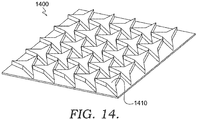
- FIG. 14 illustrates another exemplary shape for projections 1400. The shape comprises a triad structure 1410 arranged in a tessellation pattern.
- each projection 510 may have an approximate diameter (measured from one side of the terminal end 511 to an opposing side of the terminal end 511) between, for instance, 5 mm and 50 mm although diameters above and below these ranges are contemplated herein.
- each projection 510 may be separated from adjacent projections 510 by space 512.
- the width of the spaces 512 between adjacent projections 510 may be between, for instance, 1 mm and 15 mm, although widths above and below these ranges are contemplated herein.
- the projections 510 are formed from the terry loops of the knit structure 100. Forming the projections 510 using a terry loop structure helps to increase the surface area of the projections 510 which, in turn, may be useful for trapping air when the textile 400 is incorporated into a garment and the garment is worn by a wearer.
- the terminal ends 511 of the projections 510 may be brushed to increase the surface area even further and to impart an increased softness or warmth to the projections 510.
- the insulation features provided by the projections 510 may be primarily due to the size and/or surface area of the projections 510, the brushed terminal ends, the density of the projections 510, and the like.
- the textile 400 with its projections 510 may have a thermal resistance of 0.05 RCT or less.
- RCT is a measure of thermal resistance and provides an indication of how well a textile keeps a wearer warm or insulated.
- thermal resistance may be measured using test method ISO 11092 Textiles - physiological effects - measurement of thermal and water-vapour resistance under steady state conditions (sweating guarded-hotplate test).
- the RCT value of the textile 400 may decrease when the textile is exposed to a physical stimulus such as water. This may be due to, for instance, the increased permeability of the textile 400 after exposure to water. Any and all aspects, and any variation thereof, are contemplated as being within the scope herein.
- the spaces 512 between adjacent projections 510 may act as hinge points or flexion points allowing, for instance, adjacent projections 510 to flex toward one another or away from one another when the textile 400 is manipulated thereby increasing the pliability and/or drape of the textile 400.
- the pliability and/or drape of the textile 400 may also be increased through the use of the single knit construction.
- the spaces 512 may act as conduits for air movement when the textile 400 is incorporated into a garment and the garment is worn. In other words, air may travel through the spaces 512 thereby providing a degree of ventilation to the textile 400 when incorporated into a garment.
- use of the projections 510 in combination with the spaces 512 between the projections 510 help to create a flexible textile that provides insulation to the wearer when the garment is worn while still enabling a degree of ventilation for improved wearer comfort.
- the third yarn 114 used to form the second surface 505 of the textile 400 may comprise a non-absorptive polyester yarn.
- the second surface 505 of the textile 400 formed using the third yarn 114 may possess moisture-management characteristics (i.e., the ability of a textile to move moisture from one surface to an opposite surface through, for instance, capillary action, a denier differential, and the like).
- moisture and/or perspiration may move from the wearer's body surface, between the yarn(s) 114 forming the projections 510, and to the second yarn 112. Once the moisture and/or perspiration has reached the second yarn 112 it may cause a dimensional transformation of the yarn 112 that results in an increase in air permeability of the textile 400 as described above with respect to FIGs. 3A and 3B .
- the textile 400 in exemplary aspects, may be incorporated into a garment.
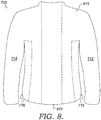
- An exemplary garment 700 is shown in FIGs. 7 and 8 which respectively depict front and back views of the garment 700 in accordance with aspects herein.
- the garment 700 may be in the form of a garment for a lower torso of a wearer (e.g., a pant, a short, a legging, a capri, and the like), or the garment 700 may take the form of a sock, a shin guard or other type of protective equipment, a hat, and the like. Any and all aspects, and any variation thereof, are contemplated as being within the scope herein.
- the garment 700 in FIGs. 7 and 8 is shown in the form of a jacket, it is contemplated herein that the garment 700 may be in the form of a shirt (pullover, hoodie, sweatshirt, and the like), a coat, and/or it may comprise a liner layer adapted to be worn under an external shell layer or an external shell layer adapted to be worn over a liner layer. As well, although not shown, the garment 700 may comprise an optional hood portion. Any and all aspects, and any variation thereof, are contemplated as being within the scope herein.
- the zoned garment 700 comprises at least a front portion 710 adapted to be positioned adjacent to a front torso area of a wearer when the garment 700 is worn, and a first and second sleeve portion 712 and 714 adapted to be positioned adjacent to the wearer's arms when the garment 700 is worn.
- the garment 700 further comprises side portions 716 indicated by dashed lines configured to be positioned adjacent to the side areas of the wearer when the garment 700 is worn.
- the side portions 716 may extend from an inferior margin of the sleeve openings for the sleeve portions 712 and 714 to near or at a waist opening of the garment 700 although it is contemplated herein that the side portions 716 may extend from an area proximate the sleeve openings for the sleeve portions 712 and 714 to an area proximate the waist opening of the garment 700. Any and all aspects, and any variation thereof, are contemplated as being within aspects herein.
- the garment 700 is shown with an optional releasable closure mechanism 715 (such as a zipper) that can be used to open and close the garment 700 for donning and doffing. When in the form of a shirt, the releasable closure mechanism 715 may not be utilized.
- the garment 700 further comprises a back portion 810 adapted to be positioned adjacent to a back torso area of the wearer when the garment 700 is worn.
- a central back portion 812 (indicated by dashed lines) may extend along an area adjacent to the wearer's spine when the garment 700 is worn.
- the central back portion 812 may extend from a neck opening of the garment 700 to the waist opening of the garment 700 although it is contemplated herein that the central back portion 812 may extend from an area proximate the neck opening of the garment 700 to an area proximate the waist opening of the garment 700. Any and all aspects, and any variation thereof, are contemplated as being within aspects herein.
- the front portion 710, the back portion 810, and/or the sleeve portions 712 and 714 may be formed from separate panels that are affixed together to form the garment 700.
- the front portion 710, the back portion 810, and/or the sleeve portions 712 and 714 may be formed from a seamless construction utilizing, for example, a flat knitting process, a circular knitting process, and the like.
- the side portions 716 may comprise integral extensions of the front portion 710 and/or the back portion 810, or the side portions 716 may comprise separate panels interposed between the front and back portions 710 and 810.
- central back portion 812 may comprise an integral extension of the back portion 810, or the central back portion 812 may comprise a separate panel(s) inserted into the back portion 810 Any and all aspects and any variation thereof, are contemplated as being within aspects hereof.
- some or all of the garment 700 may be formed using the textile 400.
- just the side portions 716 and the central back portion 812 may be formed from the textile 400 such that the outer-facing surface of these portions 716 and 812 may comprise the first surface 405 of the textile 400.
- the entirety of the garment 700 (including or excluding the sleeve portions 712 and 714) maybe formed from the textile 400 such that the outer-facing surface of the garment 700 comprises the first surface 405 of the textile 400.
- Other configurations are contemplated herein.
- different areas of the front portion 710 may be formed from the textile 400 such that the outer-facing surface of these areas may comprise the first surface 405 of the textile 400. Any and all aspects, and any variation thereof, are contemplated as being within aspects herein.
- an additional backing layer may optionally be positioned on some or all of the outer-facing surface of the garment 700.
- the backing layer may be affixed to the outer-facing surface of the garment 700 using, for instance, welding, adhesives, thermal bonding, stitching, and the like.
- the backing layer may be selectively applied to the outer-facing surface of the garment 700 using for instance, adhesives applied in a dot pattern, spot welding, and the like to increase permeability and/or breathability characteristics of the garment 700.
- the backing layer comprises a separate textile that is affixed to the outer-facing surface of the garment 700 to form a composite fabric
- the backing layer may comprise, for instance, a double jersey fabric or a spacer mesh.
- Such materials may help to provide structure to the garment 700 while still providing breathability and/or permeability features.
- different functional finishes such as a durable water repellent, may be applied to the backing layer to help make the resulting garment 700 substantially impervious to water. Any and all aspects, and any variation thereof, are contemplated as being within aspects herein.
- FIG. 9 a front view of the garment 700 with the garment 700 in an open state such that the interior or inner-facing surface of the garment 700 is shown is provided in accordance with aspects herein.
- the textile 400 is shown as being incorporated into the garment 700 at least at the side portions 716 and the central back portion 812 of the garment 700.
- the selection of these areas may be based on, for instance, sweat or heat maps of the human body as the generation of sweat by the wearer may be used to trigger the dimensional transformation of, for instance, the second yarn 112.
- the textile 400 may be incorporated into other areas of the garment 700, such as the areas indicated by reference numerals 910, 912, 914, and/or 916, or the textile 400 may comprise the entirety of the garment 700 including or excluding the sleeve portions 712 and 714.
- the projections 510 of the textile 400 extend inwardly such that they face a body surface of a wearer when the garment 700 is worn.
- the projections 510 are shown as being generally equal in diameter, it is contemplated herein that the projections 510 may comprise different diameters.
- the projections 510 may be used to provide insulation to the wearer.
- the terry loops of the projections 510 may help to trap heated air produced by the wearer and maintain the heated air in contact with the wearer's body. This is particularly useful when the wearer is at rest or is lightly exercising.
- the terry loops may help to wick the perspiration produced by the wearer to the second yarn 112 that is positioned adjacent to the second surface 505 of the textile 400.
- the second yarn 112 may undergo a dimensional transformation such as going from a crimped state to an uncrimped or flat state. As explained with respect to FIGs. 3A and 3B , this change causes an increase in the size of the openings formed by the loops of the first yarn 110 and the second yarn 112, with a resultant increase in permeability.
- the increase in permeability may help cool the wearer by allowing air from the ambient environment to funnel into the apparel item 700 and by creating a passageway by which moisture vapor and/or heat produced by the wearer can escape. Once the wearer has stopped perspiring, the second yarn 112 may transition back to a crimped state causing the permeability of the textile 400 to decrease with the result that the wearer's body heat is maintained.
- these areas generally correspond to lower heat and/or sweat producing areas of the wearer when the garment 700 is worn.
- a textile having a somewhat similar construction as the textile 400 but lacking the second yarn 112 may be used to form the areas 910, 912, 914, and 916.
- the textile would have an outer-facing surface similar to the surface 405 of the textile, and would further comprise projections such as the projections 510 of the textile 400, but would not include the adaptive second yarn 112.
- this textile may be useful for providing insulation features but would not undergo an increase in air permeability when the wearer begins producing sweat.
- a wearer of the garment 700 may maintain optimal temperature ranges during, for instance, exercise and at rest. It is also contemplated herein that other textiles may be used to form the areas 910, 912, 914, and 916. For instance, textiles without the projections shown in FIG. 5 may be used in these areas. Any and all aspects, and any variation thereof, are contemplated as being within aspects herein.
- FIGs. 10 and 11 depict front and back perspective views respectively of an outer-facing surface of another exemplary garment 1000 in accordance with aspects herein.
- the garment 1000 comprises at least a torso portion 1010 having a front aspect 1012 (shown in FIG. 10 ) and a back aspect 1110 (shown in FIG. 11 ).
- the garment 700 is in the form of a pull-over shirt, although other configurations are contemplated herein such as a jacket, a vest, a pant, a short, a hat, a sock, and the like.
- an area indicated by the reference numeral 1014 and shown using dashed lines is illustrated as extending along a central portion of the front aspect 1012 of the torso portion 1010.
- the area 1014 in exemplary aspects, may extend from an area proximate the neck opening of the garment 1000 ( i.e ., within 5 to 15 cm of the neck opening) to an area approximately 5 to 40 centimeters from the bottom margin of the garment 1000.
- an area indicated by the reference numeral 1112 and shown using dashed lines is illustrated extending along a central portion of the back aspect 1110 of the torso portion 1010.
- the area 1112 in exemplary aspects, may extend from an area proximate the neck opening of the garment 1000 ( i.e., within 5 to 15 cm of the neck opening) to an area approximately 5 to 30 centimeters from the bottom margin of the garment 1000.
- the areas 1014 and 1112 may be formed from the textile 400.
- the areas 1014 and 1112 generally correspond to high sweat-producing areas of a wearer when the garment 1000 is worn. As such, forming these areas using the textile 400 increases the likelihood that the second yarn 112 will dimensionally transform and cause the textile 400 to undergo an increase in air permeability.
- other areas of the garment 1000 may be formed of a textile that does not include the adaptive second yarn 112. Any and all aspects, and any variation thereof, are contemplated as being within the scope herein.
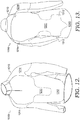
- FIGs. 12 and 13 illustrate front and back perspective view respectively of another exemplary garment 1200 in accordance with aspects herein. Again, much of the general discussion regarding the garment 700 is also applicable to the garment 1200.
- the garment 1200 incorporates the textile 400 in additional areas besides those shown for the garment 1000 as shown by the dashed lines. The additional areas may generally correspond to medium sweat-producing areas of the wearer when the garment 1200 is worn. For instance, besides being incorporated in a central front aspect 1211 and a central back aspect 1311 of a torso portion 1210 similar to the garment 1000, the textile 400 may also be incorporated along shoulder regions 1214 of the torso portion 1210 and may extend from the shoulder regions 1214 to the central front and back aspects 1211 and 1311 of the torso portion 1210.
- the torso portion 1210 may be incorporated along the lateral sides of the back aspect of the torso portion 1210 in an area proximate to the lower margin of the garment 1200 ( i.e., in an area approximately 5 to 40 cm from the lower margin of the garment 1200) as indicated by the reference numeral 1312.
- Other areas of the garment 1200 may be formed of a textile that does not include the adaptive yarn 112. Any and all aspects, and any variation thereof, are contemplated as being within aspects herein.
Landscapes
- Engineering & Computer Science (AREA)
- Textile Engineering (AREA)
- Knitting Of Fabric (AREA)
- Professional, Industrial, Or Sporting Protective Garments (AREA)
Claims (15)
- Vêtement (700, 1000, 1200) comprenant :une première portion de vêtement formée d'une première matière (100) ayant une première surface (116) et une seconde surface (118),la première matière (100) étant formée en utilisant au moins :un premier fil (110) qui est stable au niveau dimensionnel dès l'exposition à un stimulus physique,un deuxième fil (112) qui présente une transformation dimensionnelle dès l'exposition au stimulus physique, le deuxième fil (112) étant vanisé avec le premier fil (110) de sorte que le premier fil (110) forme généralement la première surface (116) de la première matière (100) et le deuxième fil (112) est généralement positionné sous le premier fil (110),un troisième fil (114) formant la seconde surface (118) de la première matière (100), le troisième fil (114) étant manipulé mécaniquement pour former une pluralité de saillies qui s'étendent depuis la seconde surface (118), chacune de la pluralité de saillies ayant une extrémité terminale située à l'opposé de la première matière (100), dans lequel la première matière (100) comprend une matière tricotée (100), et dans lequel la première surface (118) de la première matière (100) comprend une surface tournée vers l'extérieur du vêtement et dans lequel la seconde surface (116) de la première matière (100) comprend une surface tournée vers l'intérieur du vêtement ; etcaractérisé en ce quela première portion de vêtement présente une première perméabilité à l'air lors de la non exposition au stimulus physique et dans lequel la première portion de vêtement présente une seconde perméabilité à l'air lors de l'exposition au stimulus physique, la première perméabilité à l'air étant inférieure à la seconde perméabilité à l'air.
- Vêtement selon la revendication 1, dans lequel le premier fil (110) comprend 50 % de fibres ou filaments de polyester ordinaires et 50 % de fibres ou filaments de polyester cationiques pouvant être teints.
- Vêtement (700, 1000, 1200) selon la revendication 2, dans lequel le deuxième fil (112) est un fil à deux composants formé de fibres ou filaments de Nylon 6 et de fibres ou filaments de polyester cationiques pouvant être teints.
- Vêtement (700, 1000, 1200) selon la revendication 3, dans lequel le deuxième fil (112) comprend 50 % de fibres ou filaments de Nylon 6 et 50 % de fibres ou filaments de polyester cationiques pouvant être teints.
- Vêtement (700, 1000, 1200) selon la revendication 1, dans lequel le troisième fil (114) est stable au niveau dimensionnel dès l'exposition au stimulus physique.
- Vêtement (700, 1000, 1200) selon la revendication 5, dans lequel le troisième fil (114) comprend 100 % de fibres ou filaments de polyester.
- Textile tricoté (100) comprenant :une première surface (116) et une seconde surface opposée (118) ;un premier fil (110) qui est stable au niveau dimensionnel dès l'exposition à de l'eau ;un deuxième fil (112) qui présente une transformation dimensionnelle dès l'absorption de l'eau, le deuxième fil (112) étant vanisé avec le premier fil (110) de sorte que le premier fil (110) forme généralement la première surface (116) du textile (100) et le deuxième fil (112) est généralement positionné sous le premier fil (110) ; etun troisième fil (114) formant la seconde surface (118) de la première matière, le troisième fil (114) étant manipulé mécaniquement pour former une pluralité de saillies qui s'étendent depuis la seconde surface (118), chacune de la pluralité de saillies ayant une extrémité terminale située à l'opposé de la seconde surface (118) ;caractérisé en ce quele textile (100) présente une première perméabilité à l'air lors de la non exposition à de l'eau et une seconde perméabilité à l'air lors de l'exposition à de l'eau, dans lequel la première perméabilité à l'air est inférieure à la seconde perméabilité à l'air.
- Textile (100) selon la revendication 7, dans lequel le textile (100) comprend un tricot jersey simple et dans lequel la pluralité de saillies comprennent des bouclettes.
- Textile selon la revendication 7, dans lequel le troisième fil (114) est stable au niveau dimensionnel dès l'exposition à de l'eau.
- Textile selon la revendication 7, dans lequel le deuxième fil (114) comprend entre 20 % et 30 % du textile.
- Textile selon la revendication 7, dans lequel la pluralité de saillies sont situées de manière adjacente l'une à l'autre en un motif de tessellation, notamment dans lequel des portions latérales de la pluralité de saillies sont essentiellement perpendiculaires à un plan superficiel de la seconde surface du textile (100).
- Vêtement (700) comprenant :une région de torse ayant au moins une zone avant (710),une zone arrière (810),une première ouverture de bras et une seconde ouverture de bras,une première zone latérale (716) s'étendant de la proximité de la première ouverture de bras à la proximité d'une ouverture de taille du vêtement (700), etune seconde zone latérale (716) s'étendant de la proximité de la seconde ouverture de bras à la proximité de l'ouverture de taille du vêtement (700) ;dans lequel au moins une première portion du vêtement (700) est formée d'une première matière (100) ayant une première surface et une seconde surface,la première matière (100) comprenant une matière tricotée (100) formée en utilisant au moins :un premier fil (110) qui est stable au niveau dimensionnel dès l'exposition à un stimulus physique, un deuxième fil (112) qui présente une transformation dimensionnelle dès l'exposition au stimulus physique, le deuxième fil (112) étant vanisé avec le premier fil (110) de sorte que le premier fil (110) forme généralement la première surface (116) de la première matière (100) et le deuxième fil (112) est généralement positionné sous le premier fil (110), et un troisième fil (114) qui est stable au niveau dimensionnel dès l'exposition au stimulus physique, le troisième fil (114) formant la seconde surface de la première matière (100), le troisième fil étant manipulé mécaniquement pour former une pluralité de saillies qui s'étendent depuis la seconde surface, chacune de la pluralité de saillies ayant une extrémité terminale située à l'opposé de la première matière (100),dans lequel la première matière (100) présente une première perméabilité à l'air lors de la non exposition au stimulus physique et dans lequel la première matière (100) présente une seconde perméabilité à l'air lors de l'exposition au stimulus physique, la seconde perméabilité à l'air étant supérieure à la première perméabilité à l'air.
- Vêtement (700) selon la revendication 12, dans lequel la première surface de la première matière (100) comprend une surface tournée vers l'extérieur de la première matière (100) et dans lequel la seconde surface de la première matière (100) comprend une surface tournée vers l'intérieur de la première matière.
- Vêtement (700) selon la revendication 13, dans lequel la première portion du vêtement est positionnée au moins dans une direction verticale le long d'une portion centrale de la zone arrière (810) du vêtement (700).
- Vêtement (700) selon la revendication 12, dans lequel la seconde perméabilité à l'air est au moins 25 % supérieure à la première perméabilité à l'air.
Applications Claiming Priority (3)
| Application Number | Priority Date | Filing Date | Title |
|---|---|---|---|
| US201662379466P | 2016-08-25 | 2016-08-25 | |
| US15/683,931 US10973268B2 (en) | 2016-08-25 | 2017-08-23 | Garment with zoned insulation and variable air permeability |
| PCT/US2017/048592 WO2018039550A1 (fr) | 2016-08-25 | 2017-08-25 | Vêtement avec isolation à zones et perméabilité à l'air variable |
Publications (2)
| Publication Number | Publication Date |
|---|---|
| EP3478110A1 EP3478110A1 (fr) | 2019-05-08 |
| EP3478110B1 true EP3478110B1 (fr) | 2020-06-10 |
Family
ID=61240856
Family Applications (1)
| Application Number | Title | Priority Date | Filing Date |
|---|---|---|---|
| EP17761759.4A Active EP3478110B1 (fr) | 2016-08-25 | 2017-08-25 | Vêtement avec isolation à zones et perméabilité à l'air variable |
Country Status (4)
| Country | Link |
|---|---|
| US (2) | US10973268B2 (fr) |
| EP (1) | EP3478110B1 (fr) |
| CN (1) | CN109640723B (fr) |
| WO (1) | WO2018039550A1 (fr) |
Cited By (1)
| Publication number | Priority date | Publication date | Assignee | Title |
|---|---|---|---|---|
| EP3933083A3 (fr) * | 2020-07-01 | 2022-01-12 | adidas AG | Article auxétique |
Families Citing this family (8)
| Publication number | Priority date | Publication date | Assignee | Title |
|---|---|---|---|---|
| US8336117B2 (en) * | 2005-10-19 | 2012-12-25 | Nike, Inc. | Article of apparel with material elements having a reversible structure |
| JP2016535823A (ja) * | 2013-11-05 | 2016-11-17 | ユニヴァーシティ オブ ワシントン センター フォー コマーシャライゼーション | 非線形変形要素を備えるヘルメット |
| US10973268B2 (en) | 2016-08-25 | 2021-04-13 | Nike, Inc. | Garment with zoned insulation and variable air permeability |
| US12392058B1 (en) * | 2017-04-27 | 2025-08-19 | Winds Enterprises Limited | Heather filament yarns and fabrics, and methods for producing the same |
| US11564430B2 (en) * | 2018-05-30 | 2023-01-31 | Nike, Inc. | Lightweight, permeable garment formed from monofilament yarns |
| WO2020092873A1 (fr) * | 2018-11-01 | 2020-05-07 | Marmot Mountain, Llc | Motif de cellules de réchauffement pour vêtements et autres équipements extérieurs |
| WO2023197067A1 (fr) * | 2022-04-12 | 2023-10-19 | Lululemon Athletica Canada Inc. | Article d'habillement ayant de multiples zones de régulation thermique |
| CN118704149B (zh) * | 2024-07-09 | 2025-09-23 | 东华大学 | 一种自适应智能呼吸的紫外防护针织物及其制备方法 |
Family Cites Families (117)
| Publication number | Priority date | Publication date | Assignee | Title |
|---|---|---|---|---|
| USRE16584E (en) * | 1927-04-05 | R h lawson | ||
| US252552A (en) * | 1882-01-17 | Stocking | ||
| US561558A (en) * | 1896-06-09 | Ribbed knit fabric with backing | ||
| US280750A (en) * | 1883-07-03 | Knit fabric and the art of constructing the same | ||
| US693409A (en) * | 1901-04-04 | 1902-02-18 | Leighton Machine Company | Rib-knitted pile fabric. |
| US709839A (en) * | 1902-02-19 | 1902-09-23 | Robert w scott | Knitted fabric. |
| US709828A (en) * | 1902-02-26 | 1902-09-23 | Louis N D Williams | Ribbed knitted fabric. |
| US709840A (en) * | 1902-02-28 | 1902-09-23 | Robert w scott | Knitted fabric. |
| US865279A (en) * | 1906-02-26 | 1907-09-03 | Steber Machine Company Of Utica | Knitted fabric. |
| US1067952A (en) * | 1911-11-28 | 1913-07-22 | Frank J Volz | Fleeced knitted fabric. |
| US1577752A (en) * | 1922-07-28 | 1926-03-23 | Horn Surgical Company | Elastic garment |
| US1976885A (en) * | 1931-08-01 | 1934-10-16 | Brinton Company H | Knitted fabric and method of making same |
| US1994482A (en) * | 1932-04-28 | 1935-03-19 | Moore David Pelton | Method of making knitted pile fabrics |
| US2040318A (en) * | 1934-09-26 | 1936-05-12 | Lombardi Knitting Machine Co I | Knitted fabric |
| US2009361A (en) * | 1934-11-15 | 1935-07-23 | Lawson Knitting Company | Knitted fabric |
| US2379852A (en) * | 1935-03-28 | 1945-07-03 | Nebel Max | Production of loop-plush fabric |
| US2319340A (en) * | 1939-11-24 | 1943-05-18 | Nebel Max | Method of producing double-sided plated knit fabrics |
| US2320989A (en) * | 1940-08-27 | 1943-06-08 | Harrison Mills Inc | Knitting machine |
| US2378780A (en) * | 1941-12-15 | 1945-06-19 | Lombardi Knitting Machine Co I | Knitted fabric |
| US2384079A (en) * | 1943-07-24 | 1945-09-04 | W B Davis & Son Inc | Hosiery |
| US2435897A (en) * | 1946-12-20 | 1948-02-10 | Newman Milton | Warp-knitted fabric |
| US2696723A (en) * | 1951-07-05 | 1954-12-14 | Hagin Frith & Sons | Locked pile fabric |
| US2741108A (en) * | 1951-09-20 | 1956-04-10 | Beaunit Mills Inc | Flame resistant fabric |
| US3219514A (en) * | 1952-11-21 | 1965-11-23 | Otto George Johan Stru Roysanc | Heat insulating textile material and method of making same |
| US2836970A (en) * | 1953-04-20 | 1958-06-03 | Vyzkummy Ustav Tvarecich Stroj | Method of knitting a backed fabric with binding thread |
| US2800782A (en) * | 1953-07-27 | 1957-07-30 | Waldensian Hosiery Mills Inc | Argyle stocking with cushion high splice and method |
| US2815558A (en) * | 1954-10-21 | 1957-12-10 | Borg George W Corp | Pile fabrics and method of pile fabric treatment |
| US2741825A (en) * | 1955-02-11 | 1956-04-17 | Alexander Smith Inc | Knitted fabric and method of making the same |
| US3040551A (en) * | 1956-02-10 | 1962-06-26 | George A Urlaub | Stretch fabric and method |
| US2974508A (en) * | 1958-05-09 | 1961-03-14 | Fred Folger Jr | Knit fabric |
| DE1164017B (de) * | 1960-02-20 | 1964-02-27 | Bruno Pfrommer | Doppelflaechige Strickware und Verfahren zu ihrer Herstellung |
| US3111829A (en) * | 1960-03-22 | 1963-11-26 | Artzt William Walter | Knitted pile fabric |
| US3066513A (en) * | 1960-03-28 | 1962-12-04 | Texama Ltd | Knitted carpet |
| DE1250587B (de) * | 1961-10-30 | 1967-09-21 | Ames Textile Corporation, Lowell, Mass (V St A) | I Verfahren und Rundstrickmaschine zum Stricken von Plüschware |
| GB962594A (en) * | 1962-02-23 | 1964-07-01 | Kint Slaid Engineering Company | Improvements in or relating to the manufacture of tufted fabrics |
| US3153793A (en) * | 1962-10-26 | 1964-10-27 | Mcgregor Doniger Inc | Zippered expansible back jacket |
| US3250095A (en) * | 1964-10-01 | 1966-05-10 | Alamance Ind Inc | Sock for active participator sports |
| US3259915A (en) * | 1964-10-21 | 1966-07-12 | Stanley W Dison | Double sock |
| US3296626A (en) * | 1965-01-27 | 1967-01-10 | Stanley W Ludwikowski | Ventilated rainwear |
| US3561441A (en) * | 1967-08-10 | 1971-02-09 | Victor J Lombardi | Surgical product for dressing and treating wounds, and method of manufacture |
| US3468139A (en) * | 1968-03-06 | 1969-09-23 | Roland Bitzer | Knitted pile fabric and method of making the same |
| US3654054A (en) * | 1969-08-22 | 1972-04-04 | Gottlieb Binder Holzgerlingen | Knitted fabric with projecting barbs |
| US3703432A (en) * | 1970-11-18 | 1972-11-21 | John T Koski | Rainproof ventilated plastic sheet material for rainwear and method of making same |
| US3760611A (en) * | 1971-05-03 | 1973-09-25 | Stevens & Co Inc J P | Panty hose garment having antistatic properties |
| US3853680A (en) * | 1971-10-29 | 1974-12-10 | Bunker Ramo | Pile faced upholstery fabric |
| US3793851A (en) * | 1972-05-19 | 1974-02-26 | Thorneburg Hosiery Mills Inc | Boot sock |
| US3796067A (en) * | 1973-03-05 | 1974-03-12 | Crescent Hosiery Mills | Two-ply terry sock and method of forming same |
| US4125001A (en) * | 1975-12-15 | 1978-11-14 | Austen Bryars Of London, Inc. | Multi-gauge knit fabric with inlay |
| US4047400A (en) * | 1976-09-13 | 1977-09-13 | Thorneburg Hosiery Mill, Inc. | Moisture absorbent band |
| US4104892A (en) * | 1976-11-15 | 1978-08-08 | Thorneburg Hosiery Mill, Inc. | Cushioned sole tube sock and method |
| US4185327A (en) * | 1978-07-17 | 1980-01-29 | Markve Howard J | Ventilating and insulating garment |
| US4194249A (en) * | 1979-02-14 | 1980-03-25 | Thorneburg Hosiery Co., Inc. | Jogging and running athletic sock |
| US4322232A (en) * | 1979-05-09 | 1982-03-30 | Beane Filter Media, Inc. | Filter bag and method for suppressing electrostatic charges |
| DE2943263C2 (de) * | 1979-10-26 | 1982-03-11 | Norddeutsche Faserwerke GmbH, 2350 Neumünster | Rundstrick- oder Rundwirkware mit einer Polyurethanbeschichtung |
| USRE30638E (en) * | 1979-11-14 | 1981-06-09 | Austen Bryars Of London, Inc. | Multi-gauge knit fabric with fleece inlay yarn |
| US4277959A (en) * | 1980-03-24 | 1981-07-14 | Thorneburg James L | Socks with integrally knit cushions in heel, arch and ball |
| DE3021039A1 (de) * | 1980-06-03 | 1981-12-10 | Kufner Textilwerke KG, 8000 München | Einlagen fuer kleidungsstuecke und verfahren zu deren herstellung |
| US4390999A (en) * | 1980-12-29 | 1983-07-05 | Kellwood Company | Panty hose with body bulge control |
| US4373361A (en) | 1981-04-13 | 1983-02-15 | Thorneburg James L | Ski sock with integrally knit thickened fabric areas |
| US4408356A (en) * | 1981-12-14 | 1983-10-11 | Simon Abrams | Ventilated rain garment |
| GB8316704D0 (en) * | 1983-06-20 | 1983-07-20 | Bondina Ltd | Interlinings |
| US4905692A (en) * | 1984-01-10 | 1990-03-06 | K. T. Medical, Inc. | Medical and orthopedic support fabric |
| US4733546A (en) * | 1984-02-24 | 1988-03-29 | Toray Industries, Inc. | Knitted fabric for clothing |
| US4702091A (en) * | 1985-09-30 | 1987-10-27 | Good David S | Cuff member and sock |
| US4732015A (en) * | 1985-10-23 | 1988-03-22 | American Doubloon Corporation | Knitted article |
| GB8611412D0 (en) * | 1986-05-09 | 1986-06-18 | Moore Rosemary V A | Loop pile fabric |
| US4794767A (en) * | 1987-08-14 | 1989-01-03 | Lombardi Victor J | Circular knit two-layer upholstery fabric and method |
| US5033116A (en) * | 1989-07-24 | 1991-07-23 | Descente Ltd. | Clothing for reducing fluid resistance |
| US5016450A (en) * | 1989-10-10 | 1991-05-21 | Monarch Knitting Machinery Corporation | Knit fabric with inlay pile yarn and method |
| US5040245A (en) * | 1990-02-05 | 1991-08-20 | Staley William L | Undergarment having stretch panels |
| US5095548A (en) * | 1991-01-31 | 1992-03-17 | Wigwam Mills, Inc. | Moisture control sock |
| US5282277A (en) * | 1992-04-27 | 1994-02-01 | Shoji Onozawa | Body cover for outdoor use |
| US5335517A (en) * | 1993-07-23 | 1994-08-09 | James L. Throneburg | Anatomical isotonic sock and method of knitting the same |
| US5515543A (en) * | 1994-07-13 | 1996-05-14 | Gioello; Debbie | Multilayered ribbed ventilating garment |
| US5603232A (en) * | 1995-11-22 | 1997-02-18 | Throneburg; James L. | Foot protector for use in combination with hosiery and method of making and using same |
| US5918319A (en) * | 1996-07-22 | 1999-07-06 | Baxter; Hal Thomas | Protective garment incorporating an abrasion-resistant fabric |
| US5896758A (en) * | 1997-04-17 | 1999-04-27 | Malden Mills Industries, Inc. | Three-dimensional knit spacer fabric for footwear and backpacks |
| US6339845B1 (en) * | 1998-11-20 | 2002-01-22 | Salomon S.A. | Wearing apparel with venting apparatus |
| US20020104576A1 (en) * | 2000-08-30 | 2002-08-08 | Howland Charles A. | Multi-layer and laminate fabric systems |
| JP3875008B2 (ja) * | 2000-09-01 | 2007-01-31 | ユニ・チャーム株式会社 | 表面に繊維層を有する吸収性物品の製造方法 |
| US7119036B2 (en) * | 2001-02-09 | 2006-10-10 | E. I. Du Pont De Nemours And Company | Protective apparel fabric and garment |
| US6946412B2 (en) * | 2001-05-09 | 2005-09-20 | Glen Raven, Inc. | Flame-resistant, high visibility, anti-static fabric and apparel formed therefrom |
| JP2003041462A (ja) * | 2001-07-24 | 2003-02-13 | Teijin Ltd | 通気性自己調節織編物 |
| US6931665B2 (en) * | 2001-07-30 | 2005-08-23 | 3M Innovative Properties Company | Vapor permeable retroreflective garment |
| US6855220B2 (en) * | 2002-08-05 | 2005-02-15 | Tietex International, Ltd. | Fastener fabric and related method |
| US7168140B2 (en) * | 2002-08-08 | 2007-01-30 | Milliken & Company | Flame resistant fabrics with improved aesthetics and comfort, and method of making same |
| TWI276715B (en) * | 2002-12-02 | 2007-03-21 | Teijin Fibers Ltd | Three-dimensional fabric and method for producing the same |
| CA2522075A1 (fr) * | 2003-06-23 | 2004-12-29 | Teijin Fibers Limited | Tisse ou tricot contenant deux differents fils et vetement comprenant ce tisse ou tricot |
| US20050003142A1 (en) * | 2003-07-03 | 2005-01-06 | Williamson Curtis Brian | Pile fabric, and heat modified fiber and related manufacturing process |
| US20050003184A1 (en) * | 2003-07-03 | 2005-01-06 | Milliken & Company | Yarn having variable shrinkage zones |
| DE602004030975D1 (de) * | 2003-08-07 | 2011-02-24 | Mmi Ipco Llc | Aus Kompositstoff mit kontrolierter Luftdurchlässigkeit hergestellte Waren mit verbesserter Oberflächenhaltbarkeit |
| CA2539780A1 (fr) | 2003-10-22 | 2005-04-28 | Teijin Fibers Limited | Tissu composite etirable et produit d'habillement obtenu a partir dudit tissu |
| US20050183216A1 (en) * | 2003-12-23 | 2005-08-25 | Invista North America S.A R.I. | Polamide composition comprising optical brightener yarns made therefrom, and process for heat setting such yarns |
| US7437774B2 (en) * | 2004-03-19 | 2008-10-21 | Nike, Inc. | Article of apparel incorporating a zoned modifiable textile structure |
| US9700077B2 (en) * | 2004-03-19 | 2017-07-11 | Nike, Inc. | Article of apparel with variable air permeability |
| US20050208857A1 (en) * | 2004-03-19 | 2005-09-22 | Nike, Inc. | Article of apparel incorporating a modifiable textile structure |
| EP1774076A4 (fr) * | 2004-06-24 | 2008-04-30 | Mmi Ipco Llc | Articles en tissu manufactures |
| US7234171B2 (en) * | 2004-09-30 | 2007-06-26 | Kimberly-Clark Worldwide, Inc. | Expandable material for use in a garment |
| US7669250B2 (en) * | 2004-10-14 | 2010-03-02 | Nike, Inc. | Article of apparel incorporating an embossed material |
| JP2006118062A (ja) * | 2004-10-19 | 2006-05-11 | Teijin Fibers Ltd | 湿潤時に空隙率が低下する織編物およびその製造方法および繊維製品 |
| US20080254263A1 (en) * | 2005-02-23 | 2008-10-16 | Teijin Fibers Limited | Composite Fabric Material Exhibiting Three-Dimensional Structural Change Upon Water Absorption, and Textile Products |
| US8336117B2 (en) * | 2005-10-19 | 2012-12-25 | Nike, Inc. | Article of apparel with material elements having a reversible structure |
| JP5102045B2 (ja) * | 2006-01-26 | 2012-12-19 | 旭化成せんい株式会社 | セルロース繊維混用布帛 |
| CA2642390C (fr) * | 2006-03-07 | 2014-09-30 | Pacific Brands Clothing Pty Ltd. | Chaussette |
| US8172782B2 (en) * | 2008-11-25 | 2012-05-08 | Mmi-Ipco, Llc | Compression garments |
| WO2011090845A1 (fr) * | 2010-01-19 | 2011-07-28 | Mmi-Ipco, Llc | Tissus textiles composites |
| US9961943B2 (en) * | 2010-11-03 | 2018-05-08 | F3 Tech, Llc | Athletic sock |
| CN102599664A (zh) | 2011-01-19 | 2012-07-25 | 东丽纤维研究所(中国)有限公司 | 一种透气量可变上衣 |
| US8448474B1 (en) * | 2012-02-20 | 2013-05-28 | Nike, Inc. | Article of footwear incorporating a knitted component with a tongue |
| AU2013309017B2 (en) * | 2012-08-27 | 2016-12-08 | Nike Innovate C.V. | Dynamic materials integrated into articles for adjustable physical dimensional characteristics |
| CN203058371U (zh) | 2012-12-29 | 2013-07-17 | 福建泉州匹克体育用品有限公司 | 一种透气性可变的运动服 |
| WO2014120867A1 (fr) * | 2013-01-30 | 2014-08-07 | Miller Stephen D | Tissu à protubérance souple et articles fabriqués à partir de celui-ci |
| JP6562952B2 (ja) * | 2014-05-09 | 2019-08-21 | ザ ノース フェイス アパレル コーポレイションThe North Face Apparel Corp. | 複数のゾーンの単一の織られた生地構築体 |
| US20150315728A1 (en) * | 2015-07-13 | 2015-11-05 | Sung-Yun Yang | Process of manufacturing fabrics having jacquard and terry patterns |
| CN105495797B (zh) | 2016-01-06 | 2017-10-24 | 江苏海阳化纤有限公司 | 一种功能性纺织面料 |
| US10575569B2 (en) * | 2016-05-27 | 2020-03-03 | Nike, Inc. | Zoned insulation garment |
| US10973268B2 (en) | 2016-08-25 | 2021-04-13 | Nike, Inc. | Garment with zoned insulation and variable air permeability |
-
2017
- 2017-08-23 US US15/683,931 patent/US10973268B2/en active Active
- 2017-08-25 CN CN201780052103.4A patent/CN109640723B/zh active Active
- 2017-08-25 WO PCT/US2017/048592 patent/WO2018039550A1/fr not_active Ceased
- 2017-08-25 EP EP17761759.4A patent/EP3478110B1/fr active Active
-
2021
- 2021-01-07 US US17/143,656 patent/US11871805B2/en active Active
Non-Patent Citations (1)
| Title |
|---|
| None * |
Cited By (3)
| Publication number | Priority date | Publication date | Assignee | Title |
|---|---|---|---|---|
| EP3933083A3 (fr) * | 2020-07-01 | 2022-01-12 | adidas AG | Article auxétique |
| EP4428282A1 (fr) * | 2020-07-01 | 2024-09-11 | adidas AG | Article auxétique |
| US12392060B2 (en) | 2020-07-01 | 2025-08-19 | Adidas Ag | Auxetic article |
Also Published As
| Publication number | Publication date |
|---|---|
| US11871805B2 (en) | 2024-01-16 |
| CN109640723B (zh) | 2021-05-25 |
| WO2018039550A1 (fr) | 2018-03-01 |
| US10973268B2 (en) | 2021-04-13 |
| CN109640723A (zh) | 2019-04-16 |
| EP3478110A1 (fr) | 2019-05-08 |
| US20210120894A1 (en) | 2021-04-29 |
| US20180055117A1 (en) | 2018-03-01 |
Similar Documents
| Publication | Publication Date | Title |
|---|---|---|
| US11871805B2 (en) | Garment with zoned insulation and variable air permeability | |
| US20220132960A1 (en) | Article of apparel incorporating a zoned modifiable textile structure | |
| US12599187B2 (en) | Article with adaptive ventilation | |
| US11840054B2 (en) | Composite textile fabrics | |
| AU2018204638B2 (en) | Fabric system | |
| CN109788813B (zh) | 保温服装 | |
| CN102355828B (zh) | 具有可变透气率的服饰物品 | |
| EP3329791B1 (fr) | Bande tricotée à ventilation intégrée | |
| EP3462954A1 (fr) | Vêtement d'isolation par zones | |
| US20190125018A1 (en) | Flat-knitted outdoor clothing and method for manufacturing same | |
| HK40003649A (en) | Garment with zoned insulation and variable air permeability | |
| HK40003649B (zh) | 具有区域化的保温性和可变透气性的服装 |
Legal Events
| Date | Code | Title | Description |
|---|---|---|---|
| STAA | Information on the status of an ep patent application or granted ep patent |
Free format text: STATUS: UNKNOWN |
|
| STAA | Information on the status of an ep patent application or granted ep patent |
Free format text: STATUS: THE INTERNATIONAL PUBLICATION HAS BEEN MADE |
|
| PUAI | Public reference made under article 153(3) epc to a published international application that has entered the european phase |
Free format text: ORIGINAL CODE: 0009012 |
|
| STAA | Information on the status of an ep patent application or granted ep patent |
Free format text: STATUS: REQUEST FOR EXAMINATION WAS MADE |
|
| 17P | Request for examination filed |
Effective date: 20190131 |
|
| AK | Designated contracting states |
Kind code of ref document: A1 Designated state(s): AL AT BE BG CH CY CZ DE DK EE ES FI FR GB GR HR HU IE IS IT LI LT LU LV MC MK MT NL NO PL PT RO RS SE SI SK SM TR |
|
| AX | Request for extension of the european patent |
Extension state: BA ME |
|
| DAV | Request for validation of the european patent (deleted) | ||
| DAX | Request for extension of the european patent (deleted) | ||
| GRAP | Despatch of communication of intention to grant a patent |
Free format text: ORIGINAL CODE: EPIDOSNIGR1 |
|
| STAA | Information on the status of an ep patent application or granted ep patent |
Free format text: STATUS: GRANT OF PATENT IS INTENDED |
|
| INTG | Intention to grant announced |
Effective date: 20200120 |
|
| GRAS | Grant fee paid |
Free format text: ORIGINAL CODE: EPIDOSNIGR3 |
|
| GRAA | (expected) grant |
Free format text: ORIGINAL CODE: 0009210 |
|
| STAA | Information on the status of an ep patent application or granted ep patent |
Free format text: STATUS: THE PATENT HAS BEEN GRANTED |
|
| AK | Designated contracting states |
Kind code of ref document: B1 Designated state(s): AL AT BE BG CH CY CZ DE DK EE ES FI FR GB GR HR HU IE IS IT LI LT LU LV MC MK MT NL NO PL PT RO RS SE SI SK SM TR |
|
| REG | Reference to a national code |
Ref country code: GB Ref legal event code: FG4D |
|
| REG | Reference to a national code |
Ref country code: CH Ref legal event code: EP Ref country code: AT Ref legal event code: REF Ref document number: 1278532 Country of ref document: AT Kind code of ref document: T Effective date: 20200615 |
|
| REG | Reference to a national code |
Ref country code: DE Ref legal event code: R096 Ref document number: 602017018065 Country of ref document: DE |
|
| REG | Reference to a national code |
Ref country code: IE Ref legal event code: FG4D |
|
| REG | Reference to a national code |
Ref country code: LT Ref legal event code: MG4D |
|
| PG25 | Lapsed in a contracting state [announced via postgrant information from national office to epo] |
Ref country code: SE Free format text: LAPSE BECAUSE OF FAILURE TO SUBMIT A TRANSLATION OF THE DESCRIPTION OR TO PAY THE FEE WITHIN THE PRESCRIBED TIME-LIMIT Effective date: 20200610 Ref country code: FI Free format text: LAPSE BECAUSE OF FAILURE TO SUBMIT A TRANSLATION OF THE DESCRIPTION OR TO PAY THE FEE WITHIN THE PRESCRIBED TIME-LIMIT Effective date: 20200610 Ref country code: NO Free format text: LAPSE BECAUSE OF FAILURE TO SUBMIT A TRANSLATION OF THE DESCRIPTION OR TO PAY THE FEE WITHIN THE PRESCRIBED TIME-LIMIT Effective date: 20200910 Ref country code: GR Free format text: LAPSE BECAUSE OF FAILURE TO SUBMIT A TRANSLATION OF THE DESCRIPTION OR TO PAY THE FEE WITHIN THE PRESCRIBED TIME-LIMIT Effective date: 20200911 Ref country code: LT Free format text: LAPSE BECAUSE OF FAILURE TO SUBMIT A TRANSLATION OF THE DESCRIPTION OR TO PAY THE FEE WITHIN THE PRESCRIBED TIME-LIMIT Effective date: 20200610 |
|
| REG | Reference to a national code |
Ref country code: NL Ref legal event code: MP Effective date: 20200610 |
|
| PG25 | Lapsed in a contracting state [announced via postgrant information from national office to epo] |
Ref country code: LV Free format text: LAPSE BECAUSE OF FAILURE TO SUBMIT A TRANSLATION OF THE DESCRIPTION OR TO PAY THE FEE WITHIN THE PRESCRIBED TIME-LIMIT Effective date: 20200610 Ref country code: RS Free format text: LAPSE BECAUSE OF FAILURE TO SUBMIT A TRANSLATION OF THE DESCRIPTION OR TO PAY THE FEE WITHIN THE PRESCRIBED TIME-LIMIT Effective date: 20200610 Ref country code: BG Free format text: LAPSE BECAUSE OF FAILURE TO SUBMIT A TRANSLATION OF THE DESCRIPTION OR TO PAY THE FEE WITHIN THE PRESCRIBED TIME-LIMIT Effective date: 20200910 Ref country code: HR Free format text: LAPSE BECAUSE OF FAILURE TO SUBMIT A TRANSLATION OF THE DESCRIPTION OR TO PAY THE FEE WITHIN THE PRESCRIBED TIME-LIMIT Effective date: 20200610 |
|
| REG | Reference to a national code |
Ref country code: AT Ref legal event code: MK05 Ref document number: 1278532 Country of ref document: AT Kind code of ref document: T Effective date: 20200610 |
|
| PG25 | Lapsed in a contracting state [announced via postgrant information from national office to epo] |
Ref country code: NL Free format text: LAPSE BECAUSE OF FAILURE TO SUBMIT A TRANSLATION OF THE DESCRIPTION OR TO PAY THE FEE WITHIN THE PRESCRIBED TIME-LIMIT Effective date: 20200610 Ref country code: AL Free format text: LAPSE BECAUSE OF FAILURE TO SUBMIT A TRANSLATION OF THE DESCRIPTION OR TO PAY THE FEE WITHIN THE PRESCRIBED TIME-LIMIT Effective date: 20200610 |
|
| PG25 | Lapsed in a contracting state [announced via postgrant information from national office to epo] |
Ref country code: CZ Free format text: LAPSE BECAUSE OF FAILURE TO SUBMIT A TRANSLATION OF THE DESCRIPTION OR TO PAY THE FEE WITHIN THE PRESCRIBED TIME-LIMIT Effective date: 20200610 Ref country code: RO Free format text: LAPSE BECAUSE OF FAILURE TO SUBMIT A TRANSLATION OF THE DESCRIPTION OR TO PAY THE FEE WITHIN THE PRESCRIBED TIME-LIMIT Effective date: 20200610 Ref country code: EE Free format text: LAPSE BECAUSE OF FAILURE TO SUBMIT A TRANSLATION OF THE DESCRIPTION OR TO PAY THE FEE WITHIN THE PRESCRIBED TIME-LIMIT Effective date: 20200610 Ref country code: SM Free format text: LAPSE BECAUSE OF FAILURE TO SUBMIT A TRANSLATION OF THE DESCRIPTION OR TO PAY THE FEE WITHIN THE PRESCRIBED TIME-LIMIT Effective date: 20200610 Ref country code: IT Free format text: LAPSE BECAUSE OF FAILURE TO SUBMIT A TRANSLATION OF THE DESCRIPTION OR TO PAY THE FEE WITHIN THE PRESCRIBED TIME-LIMIT Effective date: 20200610 Ref country code: AT Free format text: LAPSE BECAUSE OF FAILURE TO SUBMIT A TRANSLATION OF THE DESCRIPTION OR TO PAY THE FEE WITHIN THE PRESCRIBED TIME-LIMIT Effective date: 20200610 Ref country code: ES Free format text: LAPSE BECAUSE OF FAILURE TO SUBMIT A TRANSLATION OF THE DESCRIPTION OR TO PAY THE FEE WITHIN THE PRESCRIBED TIME-LIMIT Effective date: 20200610 Ref country code: PT Free format text: LAPSE BECAUSE OF FAILURE TO SUBMIT A TRANSLATION OF THE DESCRIPTION OR TO PAY THE FEE WITHIN THE PRESCRIBED TIME-LIMIT Effective date: 20201012 |
|
| PG25 | Lapsed in a contracting state [announced via postgrant information from national office to epo] |
Ref country code: SK Free format text: LAPSE BECAUSE OF FAILURE TO SUBMIT A TRANSLATION OF THE DESCRIPTION OR TO PAY THE FEE WITHIN THE PRESCRIBED TIME-LIMIT Effective date: 20200610 Ref country code: PL Free format text: LAPSE BECAUSE OF FAILURE TO SUBMIT A TRANSLATION OF THE DESCRIPTION OR TO PAY THE FEE WITHIN THE PRESCRIBED TIME-LIMIT Effective date: 20200610 Ref country code: IS Free format text: LAPSE BECAUSE OF FAILURE TO SUBMIT A TRANSLATION OF THE DESCRIPTION OR TO PAY THE FEE WITHIN THE PRESCRIBED TIME-LIMIT Effective date: 20201010 |
|
| REG | Reference to a national code |
Ref country code: DE Ref legal event code: R097 Ref document number: 602017018065 Country of ref document: DE |
|
| PG25 | Lapsed in a contracting state [announced via postgrant information from national office to epo] |
Ref country code: MC Free format text: LAPSE BECAUSE OF FAILURE TO SUBMIT A TRANSLATION OF THE DESCRIPTION OR TO PAY THE FEE WITHIN THE PRESCRIBED TIME-LIMIT Effective date: 20200610 |
|
| REG | Reference to a national code |
Ref country code: CH Ref legal event code: PL |
|
| PLBE | No opposition filed within time limit |
Free format text: ORIGINAL CODE: 0009261 |
|
| STAA | Information on the status of an ep patent application or granted ep patent |
Free format text: STATUS: NO OPPOSITION FILED WITHIN TIME LIMIT |
|
| PG25 | Lapsed in a contracting state [announced via postgrant information from national office to epo] |
Ref country code: LU Free format text: LAPSE BECAUSE OF NON-PAYMENT OF DUE FEES Effective date: 20200825 Ref country code: LI Free format text: LAPSE BECAUSE OF NON-PAYMENT OF DUE FEES Effective date: 20200831 Ref country code: DK Free format text: LAPSE BECAUSE OF FAILURE TO SUBMIT A TRANSLATION OF THE DESCRIPTION OR TO PAY THE FEE WITHIN THE PRESCRIBED TIME-LIMIT Effective date: 20200610 Ref country code: CH Free format text: LAPSE BECAUSE OF NON-PAYMENT OF DUE FEES Effective date: 20200831 |
|
| 26N | No opposition filed |
Effective date: 20210311 |
|
| REG | Reference to a national code |
Ref country code: BE Ref legal event code: MM Effective date: 20200831 |
|
| PG25 | Lapsed in a contracting state [announced via postgrant information from national office to epo] |
Ref country code: SI Free format text: LAPSE BECAUSE OF FAILURE TO SUBMIT A TRANSLATION OF THE DESCRIPTION OR TO PAY THE FEE WITHIN THE PRESCRIBED TIME-LIMIT Effective date: 20200610 |
|
| PG25 | Lapsed in a contracting state [announced via postgrant information from national office to epo] |
Ref country code: BE Free format text: LAPSE BECAUSE OF NON-PAYMENT OF DUE FEES Effective date: 20200831 Ref country code: IE Free format text: LAPSE BECAUSE OF NON-PAYMENT OF DUE FEES Effective date: 20200825 |
|
| PG25 | Lapsed in a contracting state [announced via postgrant information from national office to epo] |
Ref country code: TR Free format text: LAPSE BECAUSE OF FAILURE TO SUBMIT A TRANSLATION OF THE DESCRIPTION OR TO PAY THE FEE WITHIN THE PRESCRIBED TIME-LIMIT Effective date: 20200610 Ref country code: MT Free format text: LAPSE BECAUSE OF FAILURE TO SUBMIT A TRANSLATION OF THE DESCRIPTION OR TO PAY THE FEE WITHIN THE PRESCRIBED TIME-LIMIT Effective date: 20200610 Ref country code: CY Free format text: LAPSE BECAUSE OF FAILURE TO SUBMIT A TRANSLATION OF THE DESCRIPTION OR TO PAY THE FEE WITHIN THE PRESCRIBED TIME-LIMIT Effective date: 20200610 |
|
| PG25 | Lapsed in a contracting state [announced via postgrant information from national office to epo] |
Ref country code: MK Free format text: LAPSE BECAUSE OF FAILURE TO SUBMIT A TRANSLATION OF THE DESCRIPTION OR TO PAY THE FEE WITHIN THE PRESCRIBED TIME-LIMIT Effective date: 20200610 |
|
| P01 | Opt-out of the competence of the unified patent court (upc) registered |
Effective date: 20230515 |
|
| PGFP | Annual fee paid to national office [announced via postgrant information from national office to epo] |
Ref country code: DE Payment date: 20250702 Year of fee payment: 9 |
|
| PGFP | Annual fee paid to national office [announced via postgrant information from national office to epo] |
Ref country code: GB Payment date: 20250703 Year of fee payment: 9 |
|
| PGFP | Annual fee paid to national office [announced via postgrant information from national office to epo] |
Ref country code: FR Payment date: 20250703 Year of fee payment: 9 |