EP3478657B1 - Derives de dicarbazolebiphenyle et leur utilisation pour des dispositifs optoelectroniques - Google Patents
Derives de dicarbazolebiphenyle et leur utilisation pour des dispositifs optoelectroniques Download PDFInfo
- Publication number
- EP3478657B1 EP3478657B1 EP17739484.8A EP17739484A EP3478657B1 EP 3478657 B1 EP3478657 B1 EP 3478657B1 EP 17739484 A EP17739484 A EP 17739484A EP 3478657 B1 EP3478657 B1 EP 3478657B1
- Authority
- EP
- European Patent Office
- Prior art keywords
- atoms
- group
- substituted
- radicals
- replaced
- Prior art date
- Legal status (The legal status is an assumption and is not a legal conclusion. Google has not performed a legal analysis and makes no representation as to the accuracy of the status listed.)
- Active
Links
- OHXYHDADANBYAR-UHFFFAOYSA-N Cc(cc1)ccc1-c(cc1c2c3ccc(-c4ccc(C(F)(F)F)cc4)c2)ccc1[n]3-c1ccc(C(F)(F)F)c(-c2cc(-[n](c(c(c3c4)c5)ccc5-c5ccc(C(F)(F)F)cc5)c3ccc4-c3ccc(C(F)(F)F)cc3)ccc2C(F)(F)F)c1 Chemical compound Cc(cc1)ccc1-c(cc1c2c3ccc(-c4ccc(C(F)(F)F)cc4)c2)ccc1[n]3-c1ccc(C(F)(F)F)c(-c2cc(-[n](c(c(c3c4)c5)ccc5-c5ccc(C(F)(F)F)cc5)c3ccc4-c3ccc(C(F)(F)F)cc3)ccc2C(F)(F)F)c1 OHXYHDADANBYAR-UHFFFAOYSA-N 0.000 description 1
- SJOWHKCPNXCCCT-UHFFFAOYSA-N Cc1cc(-c(cc2)cc(c3ccccc33)c2[n]3-c(cc2)cc(-c3cc(-[n](c(cccc4)c4c4c5)c4ccc5-c4cc(C)ccc4)ccc3C#N)c2C#N)ccc1 Chemical compound Cc1cc(-c(cc2)cc(c3ccccc33)c2[n]3-c(cc2)cc(-c3cc(-[n](c(cccc4)c4c4c5)c4ccc5-c4cc(C)ccc4)ccc3C#N)c2C#N)ccc1 SJOWHKCPNXCCCT-UHFFFAOYSA-N 0.000 description 1
- UCWAPXMNJVMYDU-UHFFFAOYSA-N Cc1cc(-c(cc2)cc3c2c(ccc(-c2cccc(C)c2)c2)c2[n]3-c(cc2-c(cc(cc3)-[n]4c(cc(cc5)-c6cccc(C)c6)c5c(cc5)c4cc5-c4cc(C)ccc4)c3C#N)ccc2C#N)ccc1 Chemical compound Cc1cc(-c(cc2)cc3c2c(ccc(-c2cccc(C)c2)c2)c2[n]3-c(cc2-c(cc(cc3)-[n]4c(cc(cc5)-c6cccc(C)c6)c5c(cc5)c4cc5-c4cc(C)ccc4)c3C#N)ccc2C#N)ccc1 UCWAPXMNJVMYDU-UHFFFAOYSA-N 0.000 description 1
- ZZPUQOZJNODLKT-UHFFFAOYSA-N Cc1cccc(-c(cc2)cc(c3cc(-c4cc(C)ccc4)ccc33)c2[n]3-c(cc2-c(cc(cc3)-[n]4c(ccc(-c5cc(C)ccc5)c5)c5c5cc(-c6cccc(C)c6)ccc45)c3C#N)ccc2C#N)c1 Chemical compound Cc1cccc(-c(cc2)cc(c3cc(-c4cc(C)ccc4)ccc33)c2[n]3-c(cc2-c(cc(cc3)-[n]4c(ccc(-c5cc(C)ccc5)c5)c5c5cc(-c6cccc(C)c6)ccc45)c3C#N)ccc2C#N)c1 ZZPUQOZJNODLKT-UHFFFAOYSA-N 0.000 description 1
- SBMDSUBGRKJZGG-UHFFFAOYSA-N Cc1cccc(-c(cc2)cc3c2c2ccccc2[n]3-c(cc2)cc(-c3cc(-[n]4c5cc(-c6cccc(C)c6)ccc5c5c4cccc5)ccc3C#N)c2C#N)c1 Chemical compound Cc1cccc(-c(cc2)cc3c2c2ccccc2[n]3-c(cc2)cc(-c3cc(-[n]4c5cc(-c6cccc(C)c6)ccc5c5c4cccc5)ccc3C#N)c2C#N)c1 SBMDSUBGRKJZGG-UHFFFAOYSA-N 0.000 description 1
- XHSLNFILKUXPKL-UHFFFAOYSA-N FC(c(cccc1)c1-c(cc1)cc([n](c2c3)-c4ccc(C(F)(F)F)c(-c5cc(-[n]6c7cc(-c8c(C(F)(F)F)cccc8)ccc7c(cc7)c6cc7-c6c(C(F)(F)F)cccc6)ccc5C(F)(F)F)c4)c1c2ccc3-c1c(C(F)(F)F)cccc1)(F)F Chemical compound FC(c(cccc1)c1-c(cc1)cc([n](c2c3)-c4ccc(C(F)(F)F)c(-c5cc(-[n]6c7cc(-c8c(C(F)(F)F)cccc8)ccc7c(cc7)c6cc7-c6c(C(F)(F)F)cccc6)ccc5C(F)(F)F)c4)c1c2ccc3-c1c(C(F)(F)F)cccc1)(F)F XHSLNFILKUXPKL-UHFFFAOYSA-N 0.000 description 1
Images


Classifications
-
- C—CHEMISTRY; METALLURGY
- C07—ORGANIC CHEMISTRY
- C07D—HETEROCYCLIC COMPOUNDS
- C07D209/00—Heterocyclic compounds containing five-membered rings, condensed with other rings, with one nitrogen atom as the only ring hetero atom
- C07D209/56—Ring systems containing three or more rings
- C07D209/80—[b, c]- or [b, d]-condensed
- C07D209/82—Carbazoles; Hydrogenated carbazoles
- C07D209/86—Carbazoles; Hydrogenated carbazoles with only hydrogen atoms, hydrocarbon or substituted hydrocarbon radicals, directly attached to carbon atoms of the ring system
-
- C—CHEMISTRY; METALLURGY
- C07—ORGANIC CHEMISTRY
- C07D—HETEROCYCLIC COMPOUNDS
- C07D209/00—Heterocyclic compounds containing five-membered rings, condensed with other rings, with one nitrogen atom as the only ring hetero atom
- C07D209/56—Ring systems containing three or more rings
- C07D209/80—[b, c]- or [b, d]-condensed
- C07D209/82—Carbazoles; Hydrogenated carbazoles
- C07D209/88—Carbazoles; Hydrogenated carbazoles with hetero atoms or with carbon atoms having three bonds to hetero atoms with at the most one bond to halogen, e.g. ester or nitrile radicals, directly attached to carbon atoms of the ring system
-
- C—CHEMISTRY; METALLURGY
- C09—DYES; PAINTS; POLISHES; NATURAL RESINS; ADHESIVES; COMPOSITIONS NOT OTHERWISE PROVIDED FOR; APPLICATIONS OF MATERIALS NOT OTHERWISE PROVIDED FOR
- C09K—MATERIALS FOR MISCELLANEOUS APPLICATIONS, NOT PROVIDED FOR ELSEWHERE
- C09K11/00—Luminescent materials, e.g. electroluminescent or chemiluminescent
- C09K11/06—Luminescent materials, e.g. electroluminescent or chemiluminescent containing organic luminescent materials
-
- H—ELECTRICITY
- H10—SEMICONDUCTOR DEVICES; ELECTRIC SOLID-STATE DEVICES NOT OTHERWISE PROVIDED FOR
- H10K—ORGANIC ELECTRIC SOLID-STATE DEVICES
- H10K85/00—Organic materials used in the body or electrodes of devices covered by this subclass
- H10K85/60—Organic compounds having low molecular weight
- H10K85/631—Amine compounds having at least two aryl rest on at least one amine-nitrogen atom, e.g. triphenylamine
- H10K85/636—Amine compounds having at least two aryl rest on at least one amine-nitrogen atom, e.g. triphenylamine comprising heteroaromatic hydrocarbons as substituents on the nitrogen atom
-
- H—ELECTRICITY
- H10—SEMICONDUCTOR DEVICES; ELECTRIC SOLID-STATE DEVICES NOT OTHERWISE PROVIDED FOR
- H10K—ORGANIC ELECTRIC SOLID-STATE DEVICES
- H10K85/00—Organic materials used in the body or electrodes of devices covered by this subclass
- H10K85/60—Organic compounds having low molecular weight
- H10K85/649—Aromatic compounds comprising a hetero atom
- H10K85/657—Polycyclic condensed heteroaromatic hydrocarbons
- H10K85/6572—Polycyclic condensed heteroaromatic hydrocarbons comprising only nitrogen in the heteroaromatic polycondensed ring system, e.g. phenanthroline or carbazole
-
- C—CHEMISTRY; METALLURGY
- C09—DYES; PAINTS; POLISHES; NATURAL RESINS; ADHESIVES; COMPOSITIONS NOT OTHERWISE PROVIDED FOR; APPLICATIONS OF MATERIALS NOT OTHERWISE PROVIDED FOR
- C09K—MATERIALS FOR MISCELLANEOUS APPLICATIONS, NOT PROVIDED FOR ELSEWHERE
- C09K2211/00—Chemical nature of organic luminescent or tenebrescent compounds
- C09K2211/10—Non-macromolecular compounds
- C09K2211/1003—Carbocyclic compounds
- C09K2211/1007—Non-condensed systems
-
- C—CHEMISTRY; METALLURGY
- C09—DYES; PAINTS; POLISHES; NATURAL RESINS; ADHESIVES; COMPOSITIONS NOT OTHERWISE PROVIDED FOR; APPLICATIONS OF MATERIALS NOT OTHERWISE PROVIDED FOR
- C09K—MATERIALS FOR MISCELLANEOUS APPLICATIONS, NOT PROVIDED FOR ELSEWHERE
- C09K2211/00—Chemical nature of organic luminescent or tenebrescent compounds
- C09K2211/10—Non-macromolecular compounds
- C09K2211/1018—Heterocyclic compounds
- C09K2211/1025—Heterocyclic compounds characterised by ligands
-
- H—ELECTRICITY
- H10—SEMICONDUCTOR DEVICES; ELECTRIC SOLID-STATE DEVICES NOT OTHERWISE PROVIDED FOR
- H10K—ORGANIC ELECTRIC SOLID-STATE DEVICES
- H10K10/00—Organic devices specially adapted for rectifying, amplifying, oscillating or switching; Organic capacitors or resistors having potential barriers
- H10K10/40—Organic transistors
- H10K10/46—Field-effect transistors, e.g. organic thin-film transistors [OTFT]
-
- H—ELECTRICITY
- H10—SEMICONDUCTOR DEVICES; ELECTRIC SOLID-STATE DEVICES NOT OTHERWISE PROVIDED FOR
- H10K—ORGANIC ELECTRIC SOLID-STATE DEVICES
- H10K30/00—Organic devices sensitive to infrared radiation, light, electromagnetic radiation of shorter wavelength or corpuscular radiation
- H10K30/30—Organic devices sensitive to infrared radiation, light, electromagnetic radiation of shorter wavelength or corpuscular radiation comprising bulk heterojunctions, e.g. interpenetrating networks of donor and acceptor material domains
-
- H—ELECTRICITY
- H10—SEMICONDUCTOR DEVICES; ELECTRIC SOLID-STATE DEVICES NOT OTHERWISE PROVIDED FOR
- H10K—ORGANIC ELECTRIC SOLID-STATE DEVICES
- H10K30/00—Organic devices sensitive to infrared radiation, light, electromagnetic radiation of shorter wavelength or corpuscular radiation
- H10K30/50—Photovoltaic [PV] devices
-
- H—ELECTRICITY
- H10—SEMICONDUCTOR DEVICES; ELECTRIC SOLID-STATE DEVICES NOT OTHERWISE PROVIDED FOR
- H10K—ORGANIC ELECTRIC SOLID-STATE DEVICES
- H10K50/00—Organic light-emitting devices
- H10K50/10—OLEDs or polymer light-emitting diodes [PLED]
-
- H—ELECTRICITY
- H10—SEMICONDUCTOR DEVICES; ELECTRIC SOLID-STATE DEVICES NOT OTHERWISE PROVIDED FOR
- H10K—ORGANIC ELECTRIC SOLID-STATE DEVICES
- H10K50/00—Organic light-emitting devices
- H10K50/10—OLEDs or polymer light-emitting diodes [PLED]
- H10K50/11—OLEDs or polymer light-emitting diodes [PLED] characterised by the electroluminescent [EL] layers
-
- H—ELECTRICITY
- H10—SEMICONDUCTOR DEVICES; ELECTRIC SOLID-STATE DEVICES NOT OTHERWISE PROVIDED FOR
- H10K—ORGANIC ELECTRIC SOLID-STATE DEVICES
- H10K71/00—Manufacture or treatment specially adapted for the organic devices covered by this subclass
- H10K71/10—Deposition of organic active material
- H10K71/12—Deposition of organic active material using liquid deposition, e.g. spin coating
-
- H—ELECTRICITY
- H10—SEMICONDUCTOR DEVICES; ELECTRIC SOLID-STATE DEVICES NOT OTHERWISE PROVIDED FOR
- H10K—ORGANIC ELECTRIC SOLID-STATE DEVICES
- H10K71/00—Manufacture or treatment specially adapted for the organic devices covered by this subclass
- H10K71/10—Deposition of organic active material
- H10K71/16—Deposition of organic active material using physical vapour deposition [PVD], e.g. vacuum deposition or sputtering
- H10K71/164—Deposition of organic active material using physical vapour deposition [PVD], e.g. vacuum deposition or sputtering using vacuum deposition
-
- Y—GENERAL TAGGING OF NEW TECHNOLOGICAL DEVELOPMENTS; GENERAL TAGGING OF CROSS-SECTIONAL TECHNOLOGIES SPANNING OVER SEVERAL SECTIONS OF THE IPC; TECHNICAL SUBJECTS COVERED BY FORMER USPC CROSS-REFERENCE ART COLLECTIONS [XRACs] AND DIGESTS
- Y02—TECHNOLOGIES OR APPLICATIONS FOR MITIGATION OR ADAPTATION AGAINST CLIMATE CHANGE
- Y02E—REDUCTION OF GREENHOUSE GAS [GHG] EMISSIONS, RELATED TO ENERGY GENERATION, TRANSMISSION OR DISTRIBUTION
- Y02E10/00—Energy generation through renewable energy sources
- Y02E10/50—Photovoltaic [PV] energy
- Y02E10/549—Organic PV cells
-
- Y—GENERAL TAGGING OF NEW TECHNOLOGICAL DEVELOPMENTS; GENERAL TAGGING OF CROSS-SECTIONAL TECHNOLOGIES SPANNING OVER SEVERAL SECTIONS OF THE IPC; TECHNICAL SUBJECTS COVERED BY FORMER USPC CROSS-REFERENCE ART COLLECTIONS [XRACs] AND DIGESTS
- Y02—TECHNOLOGIES OR APPLICATIONS FOR MITIGATION OR ADAPTATION AGAINST CLIMATE CHANGE
- Y02P—CLIMATE CHANGE MITIGATION TECHNOLOGIES IN THE PRODUCTION OR PROCESSING OF GOODS
- Y02P70/00—Climate change mitigation technologies in the production process for final industrial or consumer products
- Y02P70/50—Manufacturing or production processes characterised by the final manufactured product
Definitions
- the invention relates to purely organic molecules and their use in organic light-emitting diodes (OLEDs) and in other organic optoelectronic devices.
- the present invention was based on the object of providing molecules which are suitable for use in optoelectronic devices.
- the invention provides a new class of organic molecules suitable for use in organic optoelectronic devices.
- the organic molecules according to the invention are purely organic molecules, that is to say have no metal ions and are thus distinguished from the metal complex compounds known for use in organic optoelectronic devices.
- the organic molecules according to the invention are distinguished by emissions in the blue, sky-blue or green spectral range.
- the photoluminescence quantum yields of the organic molecules according to the invention are in particular 20% and more.
- the molecules according to the invention show in particular thermally activated delayed fluorescence (TADF).
- TADF thermally activated delayed fluorescence
- Corresponding OLEDs have a higher stability than OLEDs with known emitter materials and a comparable color.
- the blue spectral range is understood here to mean the visible range from 430 nm to 470 nm.
- the sky-blue spectral range is understood here to mean the range from 470 nm to 499 nm.
- the green spectral range is understood here to mean the range from 500 nm to 599 nm.
- the emission maximum lies in the respective area.
- R 1 and R 2 on each occurrence, identically or differently, are H, deuterium, a linear alkyl group with 1 to 5 carbon atoms, a linear alkenyl or alkynyl group with 2 to 8 carbon atoms, a branched or cyclic alkyl, alkenyl group or an alkynyl group with 3 to 10 carbon atoms, where one or more H atoms can be replaced by deuterium, or an aromatic ring system with 5 to 15 aromatic ring atoms, which can each be substituted by one or more radicals R 6.
- R 6 is on each occurrence, identically or differently, H, deuterium, OH, CF 3 , CN, F, Br, I, a linear alkyl, alkoxy or thioalkoxy group with 1 to 5 carbon atoms or a linear alkenyl or alkynyl group 2 to 5 carbon atoms or a branched or cyclic alkyl, alkenyl, alkynyl, alkoxy or thioalkoxy group with 3 to 5 carbon atoms, one or more H atoms being replaced by deuterium, CN, CF 3 or NO 2 could be; or an aromatic or heteroaromatic ring system with 5 to 60 aromatic ring atoms or an aryloxy or heteroaryloxy group with 5 to 60 aromatic ring atoms or a diarylamino group, diheteroarylamino group or arylheteroarylamino group with 10 to 40 aromatic ring atoms.
- Each of the radicals R a , R 3 , R 4 or R 5 can also form a mono- or polycyclic, aliphatic, aromatic and / or benzo-fused ring system with one or more further radicals R a , R 3 , R 4 or R 5.
- At least one R a is not equal to H and at least one R 2 is equal to H.
- R 1 is H or methyl and R 2 is H.
- both X are equal to CN.
- the two groups D are identical, in another embodiment the two groups D are different.
- a group D or both groups D have a structure of the formula IIa or consists or consist of a structure of the formula IIa: where the above definitions apply to # and R a.
- a group D or both groups D have a structure of the formula IIc, the formula IIc-2 or the formula IIc-3 or consists or consist of: where the above definitions apply.
- R b is independently selected at each occurrence from the group consisting of Me, i Pr, t Bu, CN, CF 3 , Ph, each with one or more radicals selected from Me, i Pr , t Bu, CN, CF 3 or Ph can be substituted, pyridinyl, pyrimidinyl, carbazolyl, which in each case can be substituted by one or more radicals selected from Me, i Pr, t Bu, CN, CF 3 , or Ph, and N (Ph) 2 .
- Embodiments of group D are shown below by way of example: where the above definitions apply to #, Z, R a and R 5.
- the radical R 5 is selected identically or differently on each occurrence from the group consisting of H, methyl, ethyl, phenyl and mesityl.
- R a is selected identically or differently on each occurrence from the group consisting of H, methyl (Me), i-propyl (CH (CH 3 ) 2 ) ( i Pr), t-butyl ( t Bu), phenyl (Ph), CN, CF 3 and diphenylamine (NPh 2 ), where at least one R a is not H.
- an aryl group contains 6 to 60 aromatic ring atoms; a heteroaryl group contains 5 to 60 aromatic ring atoms, at least one of which is a heteroatom.
- the heteroatoms are in particular N, O and / or S. If in the description of certain embodiments of the invention other definitions that deviate from the definition mentioned are given, for example with regard to the number of aromatic ring atoms or the heteroatoms contained, then these apply.
- aryl group or heteroaryl group is understood to mean a simple aromatic cycle, that is benzene, or a simple heteroaromatic cycle, for example pyridine, pyrimidine or thiophene, or a heteroaromatic polycycle, for example phenanthrene, quinoline or carbazole.
- a condensed (fused) aromatic or heteroaromatic polycycle consists of two or more simple aromatic or heteroaromatic rings condensed with one another.
- An aryl or heteroaryl group which can be substituted by the above-mentioned radicals and which can be linked via any positions on the aromatic or heteroaromatic, is understood to mean, in particular, groups which are derived from benzene, naphthalene, anthracene, phenanthrene, pyrene, Dihydropyrene, chrysene, perylene, fluoranthene, benzanthracene, benzphenanthrene, tetracene, pentacene, benzpyrene, furan, Benzofuran, isobenzofuran, dibenzofuran, thiophene, benzothiophene, isobenzothiophene, dibenzothiophene; Pyrrole, indole, isoindole, carbazole, pyridine, quinoline, isoquinoline, acridine, phenanthridine, benzo-5,6-quinoline, isoquinoline
- a cyclic alkyl, alkoxy or thioalkoxy group is understood here to mean a monocyclic, a bicyclic or a polycyclic group.
- a C 1 - to C 40 -alkyl group in which individual H atoms or CH 2 groups can also be substituted by the groups mentioned above, for example the radicals methyl, ethyl, n-propyl, i Propyl, cyclopropyl, n-butyl, i-butyl, s-butyl, t-butyl, cyclobutyl, 2-methylbutyl, n-pentyl, s-pentyl, t-pentyl, 2-pentyl, neo-pentyl, cyclopentyl, n-hexyl , s-hexyl, t-hexyl, 2-hexyl, 3-hexyl, neo-hexyl, cyclohexyl, 1-methylcyclopentyl, 2-methylpentyl, n-heptyl, 2-heptyl, 3-hepty
- alkenyl group is understood to mean, for example, ethenyl, propenyl, butenyl, pentenyl, cyclopentenyl, hexenyl, cyclohexenyl, heptenyl, cycloheptenyl, octenyl, cyclooctenyl or cyclooctadienyl.
- An alkynyl group is understood to mean, for example, ethynyl, propynyl, butynyl, pentynyl, hexynyl, heptynyl or octynyl.
- a C 1 - to C 40 -alkoxy group is understood to mean, for example, methoxy, trifluoromethoxy, ethoxy, n-propoxy, i-propoxy, n-butoxy, i-butoxy, s-butoxy, t-butoxy or 2-methylbutoxy.
- One embodiment of the invention relates to organic molecules which have a ⁇ E (S 1 -T 1 ) value between the lowest excited singlet (S 1 ) and the triplet (T 1 ) state below of not higher than 5000 cm -1 , in particular not higher than 3000 cm -1 , or not higher than 1500 cm -1 or 1000 cm -1 and / or have an emission lifetime of no more than 150 ⁇ s, in particular no more than 100 ⁇ s, no more than 50 ⁇ s, or no more than 10 ⁇ s and / or have a main emission band with a full width at half maximum (FWHM) less than 0.55 eV, in particular less than 0.50 eV, less than 0.48 eV, or less than 0.45 eV.
- FWHM full width at half maximum
- the organic molecules according to the invention have an emission maximum between 430 and 520 nm, between 440 and 495 nm or between 450 and 470 nm.
- the organic molecules according to the invention are suitable for use in displays, in particular in ultra high definition displays, in particular televisions (UHDTVs).
- the color space of a UHDTV is determined according to the so-called Rec.2020 recommendation (Recommendation ITU-R BT.2020) using the basic colors.
- the optimal color point is a CIE x coordinate of 0.131 and a CIE y coordinate of 0.046. With a half-width of the blue emission band of 0 nm, this corresponds to an emission maximum of 467 nm. With increasing half-width, the optimal emission maximum for the blue base color according to Rec. 2020 is at shorter wavelengths, e.g. with a half-width of 35 nm at 464 nm due to other components of the display are not taken into account in this value. Thus, an ideal blue emitter for UHDTV applications has an emission maximum between 450 and 470 nm.
- the molecules have a "blue material index" (BMI), the quotient of the PLQY (in%) and its CIE y color coordinate of the light emitted by the molecule according to the invention, of greater than 120, in particular of greater than 200, of greater than 250 or from greater than 300 to.
- BMI blue material index
- the quotient of the PLQY (in%) and its CIE y color coordinate of the light emitted by the molecule according to the invention of greater than 120, in particular of greater than 200, of greater than 250 or from greater than 300 to.
- the invention relates to a method for producing an organic molecule according to the invention of the type described here (with a possible subsequent reaction), wherein a 2- in the 6-position R 1 -substituted and in the 3- and 5-position R 2 -substituted 2- Bromo-4-fluorobenzonitrile or a 2-bromo-4-fluorobenzotrifluoride substituted in the 6-position R 1 and substituted in the 3- and 5-position R 2 is used as starting material.
- the product is obtained by deprotonation of the corresponding amine and subsequent nucleophilic substitution of the fluorine groups.
- a nitrogen heterocycle in the sense of a nucleophilic aromatic substitution is implemented with an educt E1.
- Typical conditions include the use of a base such as tribasic potassium phosphate or sodium hydride in an aprotic polar solvent such as dimethyl sulfoxide (DMSO) or N, N-dimethylformamide (DMF).
- the composition according to the invention consists of an organic molecule according to the invention and one or more host materials.
- the host material or materials have, in particular, triplet (T 1 ) and singlet (S 1 ) energy levels which are higher in energy than the triplet (T 1 ) and singlet (S 1 ) energy levels of the organic molecule according to the invention.
- the composition in addition to the organic molecule according to the invention, has an electron-dominant and a hole-dominant host material.
- the highest occupied orbital (HOMO) and the lowest unoccupied orbital (LUMO) of the hole-dominant host material are in particular higher in energy than that of the electron-dominant host material.
- the HOMO of the hole-dominant host material is energetically below the HOMO of the organic molecule according to the invention, while the LUMO of the electron-dominant host material is energetically above the LUMO of the organic molecule according to the invention.
- the materials should be selected so that the energy distances between the respective orbitals are small.
- the distance between the LUMO of the electron-dominant host material and the LUMO of the organic molecule according to the invention is in particular less than 0.5 eV, preferably less than 0.3 eV, even more preferably less than 0.2 eV.
- the distance between the HOMO of the hole-dominant host material and the The HOMO of the organic molecule according to the invention is in particular less than 0.5 eV, preferably less than 0.3 eV, even more preferably less than 0.2 eV.
- the invention relates to an organic optoelectronic device which has an organic molecule according to the invention or a composition according to the invention.
- the organic optoelectronic device is in particular formed as a device selected from the group consisting of organic light-emitting diode (OLED); light emitting electrochemical cell; OLED sensors, in particular gas and vapor sensors that are not hermetically shielded from the outside; organic diode; organic solar cell; organic transistor; organic field effect transistor; organic laser and down-conversion element.
- OLED organic light-emitting diode
- OLED sensors in particular gas and vapor sensors that are not hermetically shielded from the outside
- organic diode organic solar cell
- organic transistor organic field effect transistor
- organic laser and down-conversion element organic laser and down-conversion element.
- Individual layers are only available in an optional manner. Furthermore, several of these layers can coincide. And there can be multiple individual layers in the component.
- At least one electrode of the organic component is designed to be translucent.
- translucent means a layer that is permeable to visible light.
- the translucent layer can be clearly translucent, that is to say transparent, or at least partially absorbing light and / or partially scattering light, so that the translucent layer can also be diffuse or milky translucent, for example.
- a layer designated here as translucent is made as transparent as possible, so that in particular the absorption of light is as low as possible.
- Individual layers are only available in an optional manner. Furthermore, several of these layers can coincide. And there can be multiple individual layers in the component.
- the anode layer of the typical structure e.g. an ITO layer (indium tin oxide), is connected as the cathode in the case of the inverted OLED.
- ITO layer indium tin oxide
- the organic component in particular an OLED, has a stacked structure.
- the individual OLEDs are arranged on top of one another and not next to one another as usual.
- the generation of mixed light can be made possible by a stacked structure.
- this structure can be used in the generation of white light, for the generation of which the entire visible spectrum is typically achieved by combining the emitted light of blue, green and red emitters.
- significantly longer lifetimes compared to conventional OLEDs can be achieved with practically the same efficiency and identical luminance.
- a so-called charge generation layer (CGL) is optionally used between two OLEDs. This consists of an n-doped and a p-doped layer, the n-doped layer typically being applied closer to the anode.
- tandem OLED two or more emission layers occur between anode and cathode.
- three emission layers are arranged one above the other, one emission layer emitting red light, one emission layer emitting green light and one emission layer emitting blue light and optionally further charge generation, blocking or transport layers being applied between the individual emission layers.
- the respective emission layers are applied directly adjacent.
- emission layers which are directly adjacent and separated by charge generation layers can be combined in an OLED.
- An encapsulation can also be arranged over the electrodes and the organic layers.
- the encapsulation can be implemented, for example, in the form of a glass cover or in the form of a thin-layer encapsulation.
- the carrier material can, for example, have one or more materials in the form of a layer, a film, a plate or a laminate.
- transparent conductive metal oxides such as ITO (indium tin oxide), zinc oxide, tin oxide, cadmium oxide, titanium oxide, indium oxide or aluminum zinc oxide (AZO), Zn 2 SnO 4 , CdSnO 3 , ZnSnO 3 , MgIn 2 O can be used as the anode of the optoelectronic device 4 , GalnO 3 , Zn 2 In 2 O 5 or In 4 Sn 3 O 12 or mixtures of different transparent conductive oxides are used.
- PEDOT PSS (poly-3,4-ethylenedioxythiophene: polystyrene sulfonic acid), PEDOT (poly-3,4-ethylenedioxythiophene), m-MTDATA (4,4 ', 4 "-Tris [phenyl (m- tolyl) amino] triphenylamine), spiro-TAD (2,2 ', 7,7'-tetrakis (N, N-diphenylamino) -9,9-spirobifluorene), DNTPD (4,4'-bis [N- [4 - ⁇ N, N-bis (3-methylphenyl) amino ⁇ phenyl] -N-phenylamino] biphenyl), NPB (N, N'-bis- (1-naphthalenyl) -N, N'-bis-phenyl- (1,1'-biphenyl) -4,4'-diamine), NPNPB (N, N'-diphenyl- N,
- the layer thickness is 10-80 nm by way of example.
- small molecules e.g. copper phthalocyanine (CuPc e.g. 10 nm thick)
- metal oxides such as MoO 3 , V 2 O 5, for example.
- Tertiary amines Tertiary amines, carbazole derivatives, polyethylenedioxythiophene doped with polystyrene sulfonic acid, polyaniline doped with camphorsulfonic acid, poly-TPD (poly (4-butylphenyl-diphenyl-amine)), [alpha] -NPD (poly (4-butylphenyl-diphenyl-amine) )), TAPC (4,4'-cyclohexylidene-bis [N, N-bis (4-methylphenyl) benzenamine]), TCTA (tris (4-carbazoyl-9-ylphenyl) amine), 2-TNATA (4,4 ', 4 "-Tris [2-naphthyl (phenyl) amino] triphenylamine), Spiro-TAD, DNTPD, NPB, NPNPB, MeO-TPD, HAT-CN or TrisPcz (9,9'-diphenyl
- the HTL can have a p-doped layer which has an inorganic or organic dopant in an organic hole-conducting matrix.
- transition metal oxides such as vanadium oxide, molybdenum oxide or tungsten oxide can be used as inorganic dopants.
- tetrafluorotetracyanoquinodimethane (F4-TCNQ), copper pentafluorobenzoate (Cu (I) pFBz) or transition metal complexes can be used as organic dopants.
- the layer thickness is 10 nm to 100 nm as an example.
- mCP (1,3-bis (carbazol-9-yl) benzene
- TCTA 2-TNATA
- mCBP (3,3-di (9H-carbazol-9-yl) biphenyl)
- tris- Pcz (9,9'-Diphenyl-6- (9-phenyl-9H-carbazol-3-yl) -9H, 9'H-3,3'-bicarbazole)
- CzSi (9- (4-tert-butylphenyl) -3,6-bis (triphenylsilyl) -9H-carbazole) or DCB (N, N'-dicarbazolyl-1,4-dimethylbenzene).
- the layer thickness is 10 nm to 50 nm as an example.
- the emitter layer EML or emission layer consists of or contains emitter material or a mixture comprising at least two emitter materials and optionally one or more host materials.
- Suitable host materials are, for example, mCP, TCTA, 2-TNATA, mCBP, CBP (4,4'-bis (N-carbazolyl) -biphenyl), Sif87 (dibenzo [b, d] thiophen-2-yltriphenylsilane), Sif88 (Dibenzo [b, d] thiophen-2-yl) diphenylsilane) or DPEPO (bis [2 - ((oxo) diphenylphosphino) phenyl] ether).
- the common matrix materials such as CBP are suitable for emitter material or a mixture comprising at least two emitter materials.
- UHG matrix materials ultra-high energy gap materials
- the layer thickness is 10 nm to 250 nm as an example.
- the layer thickness is 10 nm to 50 nm as an example.
- the electron transport layer ETL can, for example, be based on AlQ 3 , TSPO1, BPyTP2 (2,7-di (2,2'-bipyridin-5-yl) triphenyl), Sif87, Sif88, BmPyPhB (1,3-bis [3, 5-di (pyridin-3-yl) phenyl] benzene) or BTB (4,4'-bis- [2- (4,6-diphenyl-1,3,5-triazinyl)] -1,1'-biphenyl ) exhibit.
- the layer thickness is exemplary from 10 nm to 200 nm.
- CsF, LiF, 8-hydroxyquinolinolatolithium (Liq), Li 2 O, BaF 2 , MgO or NaF can be used as materials of a thin electron injection layer EIL.
- Metals or alloys can serve as materials for the cathode layer, for example Al, Al> AlF, Ag, Pt, Au, Mg, Ag: Mg.
- Typical layer thicknesses are 100 nm to 200 nm.
- one or more metals are used which are stable in air and / or which are self-passivating, for example through the formation of a thin protective oxide layer.
- suitable materials for encapsulation are aluminum oxide, vanadium oxide, zinc oxide, zirconium oxide, titanium oxide, hafnium oxide, lanthanum oxide, tantalum oxide.
- the organic molecule according to the invention is used as an emission material in one light-emitting layer EML used, where it is used either as a pure layer or in combination with one or more host materials.
- the mass fraction of the organic molecule according to the invention in the emitter layer EML is between 1% and 80% in a light-emitting layer in optical light-emitting devices, in particular in OLEDs.
- the light-emitting layer is applied to a substrate, an anode and a cathode preferably being applied to the substrate and the light-emitting layer being applied between anode and cathode.
- the light-emitting layer can exclusively have an organic molecule according to the invention in 100% concentration, the anode and the cathode being applied to the substrate and the light-emitting layer being applied between the anode and the cathode.
- a hole- and electron-injecting layer between anode and cathode, and a hole- and electron-transporting layer between hole- and electron-injecting layer, and the light-emitting layer between hole- and electron-transporting layer are applied.
- the organic optoelectronic device has: a substrate, an anode, a cathode and at least one hole- and electron-injecting layer, and at least one hole- and electron-transporting layer, and at least one light-emitting layer, the organic according to the invention Molecule and one or more host materials, the triplet (T 1 ) and singlet (S 1 ) energy levels of which are higher in energy than the triplet (T 1 ) and singlet (S 1 ) energy levels of the organic molecule, the anode and the cathode is applied to the substrate, and the hole- and electron-injecting layer is applied between anode and cathode, and the hole- and electron-transporting layer is applied between hole- and electron-injecting layer, and the light-emitting layer is applied between hole- and electron-transporting layer .
- the invention relates to a method for producing an optoelectronic component.
- An organic molecule according to the invention is used here.
- the production method comprises the processing of the organic molecule according to the invention by means of a vacuum evaporation method or from a solution.
- the layers are applied individually to a suitable substrate in successive deposition process steps.
- the usual methods such as thermal evaporation, chemical vapor deposition (CVD), physical vapor deposition (PVD) can be used for gas phase deposition.
- CVD chemical vapor deposition
- PVD physical vapor deposition
- AMOLED active matrix OLED
- layers of solutions or dispersions in suitable solvents can be applied.
- suitable coating processes are spin coating, dip coating and jet printing methods.
- the individual layers can be produced using the same or different coating methods in each case.
- 2-bromo-4-fluorobenzotrifluoride (1.00 equivalents), bis (pinacolato) diboron (2.00 equivalents), Pd 2 (dba) 3 (0.01 equivalents), SPhos (0.04 equivalents) and tribasic potassium phosphate ( 6.00 equivalents) are stirred under nitrogen in a dioxane / water mixture (ratio 10: 1) at 110 ° C. for 16 h. Then the insoluble components of the The reaction mixture is filtered off and washed with dioxane. The solvent in the filtrate is removed and the residue obtained is recrystallized from toluene.
- DH corresponds to a 3,6-substituted carbazole (e.g. 3,6-dimethylcarbazole, 3,6-diphenylcarbazole, 3,6-di-tert-butylcarbazole), a 2,7-substituted carbazole (e.g. 2,7-dimethylcarbazole, 2,7-diphenylcarbazole, 2,7-di-tert-butylcarbazole), a 1,8-substituted carbazole (e.g.
- a 1-substituted carbazole e.g. 1-methylcarbazole, 1-phenylcarbazole, 1-tert-butylcarbazole
- a 2-substituted carbazole e.g. 2-methylcarbazole, 2- Phenylcarbazole, 2-
- All glasses (cuvettes and substrates made of quartz glass, diameter: 1 cm) were cleaned after each use: rinsing three times with dichloromethane, acetone, ethanol, demineralized water, soaking in 5% Hellmanex solution for 24 h, rinsing thoroughly with demineralized water. The optical glasses were blown off with nitrogen for drying.
- the sample concentration corresponded to 10 mg / ml, made up in toluene or chlorobenzene.
- the films were dried in air for 1 min at 70 ° C. on a precision heating plate from LHG.
- Steady-state emission spectroscopy was carried out with a fluorescence spectrometer from Horiba Scientific, model FluoroMax-4, equipped with a 150 W xenon arc lamp, excitation and emission monochromators and a Hamamatsu R928 photomultiplier tube, as well as a "time-correlated one-photon count" ( Time -correlated single-photon counting, TCSPC) option. Emission and excitation spectra were corrected using standard correction curves.
- the evaluation was carried out with the DataStation software package and the DAS 6 evaluation software.
- the photoluminescence quantum yield (PLQY) was measured using an Absolute PL Quantum Yield Measurement C9920-03G system from Hamamatsu Photonics. This consists of a 150 W xenon gas discharge lamp, automatically adjustable Czerny-Turner monochromators (250 - 950 nm) and an integrating sphere with a highly reflective Spectralon coating (a Teflon derivative) that is connected to a PMA-12 multi-channel detector via a fiber optic cable BT (back thinned) CCD chip with 1024 x 122 pixels (size 24 x 24 ⁇ m) is connected.
- the evaluation of the quantum efficiency and the CIE coordinates was carried out with the help of the software U6039-05 Version 3.6.0.
- the emission maximum is given in nm, the quantum yield ⁇ in% and the CIE color coordinates as x, y values.
- OLED devices can be created using vacuum sublimation technology.
- OLEDs can be characterized in a standard manner; for this purpose, the electroluminescence spectra, the external quantum efficiency (measured in%) as a function of the brightness, calculated from the light detected by the photodiode, the electroluminescence spectra and the current are recorded.
- Example 1 was prepared according to AAV 1 (yield 72%) and AAV2 (yield 78%).
- 1 H NMR 500 MHz, chloroform-d
- Figure 1 shows the emission spectrum of Example 1 (10% in PMMA).
- the emission maximum is 448 nm.
- the photoluminescence quantum yield (PLQY) is 68% and the half width is 0.45 eV.
- the CIE x color coordinate is 0.16 and the ClE y color coordinate is 0.13.
- Example 2 was prepared according to AAV 1 (yield 72%) and AAV2 (yield 96%).
- Example 3 was prepared according to AAV1 (yield 72%) and AAV2 (yield 33%).
- Figure 3 shows the emission spectrum of Example 3 (10% in PMMA).
- the emission maximum is at 487 nm.
- the photoluminescence quantum yield (PLQY) is 58% and the half width is 0.48 eV.
- the CIE x color coordinate is 0.21 and the ClE y color coordinate is 0.35.
- Example 4 was prepared according to AAV1 (yield 72%) and AAV2.
- Figure 4 shows the emission spectrum of Example 4 (10% in PMMA).
- the emission maximum is 444 nm.
- the photoluminescence quantum yield (PLQY) is 34% and the half width is 0.52 eV.
- the CIE x color coordinate is 0.19 and the ClE y color coordinate is 0.17.
- Example 5 was prepared according to AAV1 (yield 72%) and AAV2.
- Figure 5 shows the emission spectrum of Example 5 (10% in PMMA).
- the emission maximum is 509 nm.
- the photoluminescence quantum yield (PLQY) is 57% and the half width is 0.51 eV.
- the emission decay time was determined to be 21.6 ⁇ s.
- the CIE x color coordinate is 0.27 and the ClE y color coordinate is 0.46.
- Example 6 was prepared with the reaction conditions described in AAV1 and AAV2, 2-bromo-4-fluoro-3-methylbenzonitrile being used as starting material instead of 2-bromo-4-fluorobenzonitrile.
- Figure 6 shows the emission spectrum of Example 6 (10% in PMMA).
- the emission maximum is 434 nm.
- the photoluminescence quantum yield (PLQY) is 35% and the half width is 0.49 eV.
- Example 2 was tested in an OLED component (component X1) with the following structure (the proportion of the molecule according to the invention in the emission layer is given in percent by mass, substrate glass): layer thickness 10 100 nm AI 9 2 nm Liq 8th 30 nm TPBi 7th 10 nm DPEPO 6th 20 nm 2 (30%): DPEPO 5 10 nm CzSi 4th 20 nm TCTA 3 50 nm NPB 2 20 nm m-MTDATA 1 120 nm ITO
Landscapes
- Chemical & Material Sciences (AREA)
- Organic Chemistry (AREA)
- Engineering & Computer Science (AREA)
- Materials Engineering (AREA)
- Physics & Mathematics (AREA)
- Spectroscopy & Molecular Physics (AREA)
- Electroluminescent Light Sources (AREA)
Claims (15)
- Molécule organique, comprenant une structure de formule I
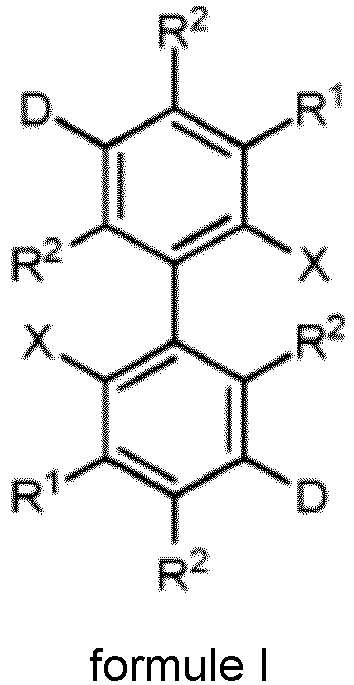 X = CN ou CF3, etD =
 # étant le point de fixation du motif D à l'un des cycles phényle montrés dans la formule I ;Z étant une liaison directe ou étant choisi dans le groupe constitué par CR3R4, C=CR3R4, C=O, C=NR3, NR3, O, SiR3R4, S, S(O) et S(O)2 ;R1 et R2, identiques ou différents en chaque occurrence, étant choisis dans le groupe constitué par :- H, deutérium ;- un groupe alkyle linéaire comportant 1 à 5 atomes de C, un ou plusieurs atomes de H pouvant être remplacés par deutérium ;- un groupe alcényle ou alcynyle linéaire comportant 2 à 8 atomes de C, un ou plusieurs atomes de H pouvant être remplacés par deutérium ;- un groupe alkyle, alcényle ou alcynyle, ramifié ou cyclique, comportant 3 à 10 atomes de C, un ou plusieurs atomes de H pouvant être remplacés par deutérium ; et- un système cyclique aromatique comportant 5 à 15 atomes de cycle aromatique, qui peut être à chaque fois substitué par un ou plusieurs radicaux R6 ;Ra, R3 et R4, identiques ou différents en chaque occurrence, étant choisis dans le groupe constitué par :- H, deutérium, N(R5)2, OH, Si(R5)3, B(OR5)2, OSO2R5, CF3, CN, F, Br, I,- un groupe alkyle, alcoxy ou thioalcoxy comportant 1 à 40 atomes de C, qui peut être à chaque fois substitué par un ou plusieurs radicaux R5, un ou plusieurs groupes CH2 non adjacents étant éventuellement substitués par R5C=CR5, C=C, Si(R5)2, Ge(R5)2, Sn(R5)2, C=O, C=S, C=Se, C=NR5, P(=O)(R5), SO, SO2, NR5, O, S, ou CONR5 et un ou plusieurs atomes de H pouvant être remplacés par deutérium, CN, CF3 ou NO2 ;- un groupe alcényle ou alcynyle linéaire comportant 2 à 40 atomes de C, qui peut être à chaque fois substitué par un ou plusieurs radicaux R5, un ou plusieurs groupes CH2 non adjacents étant éventuellement substitués par R5C=CR5, C=C, Si(R5)2, Ge(R5)2, Sn(R5)2, C=O, C=S, C=Se, C=NR5, P(=O)(R5), SO, SO2, NR5, O, S, ou CONR5 et un ou plusieurs atomes de H pouvant être remplacés par deutérium, CN, CF3 ou NO2 ;- un groupe alkyle, alcényle, alcynyle, alcoxy ou thioalcoxy, ramifié ou cyclique, comportant 3 à 40 atomes de C, qui peut être à chaque fois substitué par un ou plusieurs radicaux R5, un ou plusieurs groupes CH2 non adjacents étant éventuellement substitués par R5C=CR5, C=C, Si(R5)2, Ge(R5)2, Sn(R5)2, C=O, C=S, C=Se, C=NR5, P(=O)(R5), SO, SO2, NR5, O, S, ou CONR5 et un ou plusieurs atomes de H pouvant être remplacés par deutérium, CN, CF3 ou NO2 ;- un système cyclique aromatique ou hétéroaromatique comportant 5 à 60 atomes de cycle aromatique, qui peut être à chaque fois substitué par un ou plusieurs radicaux R5 ;- un groupe aryloxy ou hétéroaryloxy comportant 5 à 60 atomes de cycle aromatique, qui peut être substitué par un ou plusieurs radicaux R5; et- un groupe diarylamino, un groupe dihétéroarylamino ou un groupe arylhétéroarylamino comportant 10 à 40 atomes de cycle aromatique, qui peut être substitué par un ou plusieurs radicaux R5 ;R5, identique ou différent en chaque occurrence, étant choisi dans le groupe constitué par :- H, deutérium, N(R6)2, OH, Si(R6)3, B(OR6)2, OSO2R6, CF3, CN, F, Br, I,- un groupe alkyle, alcoxy ou thioalcoxy comportant 1 à 40 atomes de C, qui peut être à chaque fois substitué par un ou plusieurs radicaux R6, un ou plusieurs groupes CH2 non adjacents étant éventuellement substitués par R6C=CR6, C=C, Si(R6)2, Ge(R6)2, Sn(R6)2, C=O, C=S, C=Se, C=NR6, P(=O)(R6), SO, SO2, NR6, O, S, ou CONR6 et un ou plusieurs atomes de H pouvant être remplacés par deutérium, CN, CF3 ou NO2 ;- un groupe alcényle ou alcynyle linéaire comportant 2 à 40 atomes de C, qui peut être à chaque fois substitué par un ou plusieurs radicaux R6, un ou plusieurs groupes CH2 non adjacents étant éventuellement substitués par R6C=CR6, C=C, Si(R6)2, Ge(R6)2, Sn(R6)2, C=O, C=S, C=Se, C=NR6, P(=O)(R6), SO, SO2, NR6, O, S, ou CONR6 et un ou plusieurs atomes de H pouvant être remplacés par deutérium, CN, CF3 ou NO2 ;- un groupe alkyle, alcényle, alcynyle, alcoxy ou thioalcoxy, ramifié ou cyclique, comportant 3 à 40 atomes de C, qui peut être à chaque fois substitué par un ou plusieurs radicaux R6, un ou plusieurs groupes CH2 non adjacents étant éventuellement substitués par R6C=CR6, C=C, Si(R6)2, Ge(R6)2, Sn(R6)2, C=O, C=S, C=Se, C=NR6, P(=O)(R6), SO, SO2, NR6, O, S, ou CONR6 et un ou plusieurs atomes de H pouvant être remplacés par deutérium, CN, CF3 ou NO2 ;- un système cyclique aromatique ou hétéroaromatique comportant 5 à 60 atomes de cycle aromatique, qui peut être à chaque fois substitué par un ou plusieurs radicaux R6 ;- un groupe aryloxy ou hétéroaryloxy comportant 5 à 60 atomes de cycle aromatique, qui peut être substitué par un ou plusieurs radicaux R6 ; et- un groupe diarylamino, un groupe dihétéroarylamino ou un groupe arylhétéroarylamino comportant 10 à 40 atomes de cycle aromatique, qui peut être substitué par un ou plusieurs radicaux R6 ;R6, identique ou différent en chaque occurrence, étant choisi dans le groupe constitué par :- H, deutérium, OH, CF3, CN, F, Br, I,- un groupe alkyle, alcoxy ou thioalcoxy linéaire comportant 1 à 5 atomes de C, un ou plusieurs atomes de H pouvant être remplacés par deutérium, CN, CF3 ou NO2 ;- un groupe alcényle ou alcynyle linéaire comportant 2 à 5 atomes de C, un ou plusieurs atomes de H pouvant être remplacés par deutérium, CN, CF3 ou NO2 ;- un groupe alkyle, alcényle, alcynyle, alcoxy ou thioalcoxy, ramifié ou cyclique, comportant 3 à 5 atomes de C, un ou plusieurs atomes de H pouvant être remplacés par deutérium, CN, CF3 ou NO2 ;- un système cyclique aromatique ou hétéroaromatique comportant 5 à 60 atomes de cycle aromatique ;- un groupe aryloxy ou hétéroaryloxy comportant 5 à 60 atomes de cycle aromatique ; et- un groupe diarylamino, un groupe dihétéroarylamino ou un groupe arylhétéroarylamino comportant 10 à 40 atomes de cycle aromatique ;chacun des radicaux Ra, R3, R4 ou R5 pouvant également former un système cyclique monocyclique ou polycyclique, aliphatique, aromatique et/ou benzoannelé avec un ou plusieurs autres radicaux Ra, R3, R4 ou R5; etau moins un Ra étant différent de H ; etau moins un R2 étant égal à H.
 - Molécule organique selon la revendication 1, R1 étant égal à H ou méthyle et R2 étant égal à H.
- Molécule organique selon la revendication 1 ou 2, les deux X étant égaux à CN.
- Molécule organique selon les revendications 1 à 3, D comprenant une structure de formule IIa :

- Molécule organique selon les revendications 1 à 4, D comprenant une structure de formule IIb :
 Rb, identique ou différent en chaque occurrence, étant choisi dans le groupe constitué par :- N(R5)2, OH, Si(R5)3, B(OR5)2, OSO2R5, CF3, CN, F, Br, I ;- un groupe alkyle, alcoxy ou thioalcoxy comportant 1 à 40 atomes de C, qui peut être à chaque fois substitué par un ou plusieurs radicaux R5, un ou plusieurs groupes CH2 non adjacents étant éventuellement substitués par R5C=CR5, C=C, Si(R5)2, Ge(R5)2, Sn(R5)2, C=O, C=S, C=Se, C=NR5, P(=O)(R5), SO, SO2, NR5, O, S, ou CONR5 et un ou plusieurs atomes de H pouvant être remplacés par deutérium, CN, CF3 ou NO2 ;- un groupe alcényle ou alcynyle linéaire comportant 2 à 40 atomes de C, qui peut être à chaque fois substitué par un ou plusieurs radicaux R5, un ou plusieurs groupes CH2 non adjacents étant éventuellement substitués par R5C=CR5, C=C, Si(R5)2, Ge(R5)2, Sn(R5)2, C=O, C=S, C=Se, C=NR5, P(=O)(R5), SO, SO2, NR5, O, S, ou CONR5 et un ou plusieurs atomes de H pouvant être remplacés par deutérium, CN, CF3 ou NO2 ;- un groupe alkyle, alcényle, alcynyle, alcoxy ou thioalcoxy, ramifié ou cyclique, comportant 3 à 40 atomes de C, qui peut être à chaque fois substitué par un ou plusieurs radicaux R5, un ou plusieurs groupes CH2 non adjacents étant éventuellement substitués par R5C=CR5, C=C, Si(R5)2, Ge(R5)2, Sn(R5)2, C=O, C=S, C=Se, C=NR5, P(=O)(R5), SO, SO2, NR5, O, S, ou CONR5 et un ou plusieurs atomes de H pouvant être remplacés par deutérium, CN, CF3 ou NO2 ;- un système cyclique aromatique ou hétéroaromatique comportant 5 à 60 atomes de cycle aromatique, qui peut être à chaque fois substitué par un ou plusieurs radicaux R5 ;- un groupe aryloxy ou hétéroaryloxy comportant 5 à 60 atomes de cycle aromatique, qui peut être substitué par un ou plusieurs radicaux R5; et- un groupe diarylamino, un groupe dihétéroarylamino ou un groupe arylhétéroarylamino comportant 10 à 40 atomes de cycle aromatique, qui peut être substitué par un ou plusieurs radicaux R5 ;les définitions mentionnées dans la revendication 1 s'appliquant pour # et R5.
 - Molécule organique selon les revendications 1 à 4, D comprenant une structure de formule IIc :
 Rb, identique ou différent en chaque occurrence, étant choisi dans le groupe constitué par :- N(R5)2, OH, Si(R5)3, B(OR5)2, OSO2R5, CF3, CN, F, Br, I ;- un groupe alkyle, alcoxy ou thioalcoxy comportant 1 à 40 atomes de C, qui peut être à chaque fois substitué par un ou plusieurs radicaux R5, un ou plusieurs groupes CH2 non adjacents étant éventuellement substitués par R5C=CR5, C=C, Si(R5)2, Ge(R5)2, Sn(R5)2, C=O, C=S, C=Se, C=NR5, P(=O)(R5), SO, SO2, NR5, O, S, ou CONR5 et un ou plusieurs atomes de H pouvant être remplacés par deutérium, CN, CF3 ou NO2;- un groupe alcényle ou alcynyle linéaire comportant 2 à 40 atomes de C, qui peut être à chaque fois substitué par un ou plusieurs radicaux R5, un ou plusieurs groupes CH2 non adjacents étant éventuellement substitués par R5C=CR5, C=C, Si(R5)2, Ge(R5)2, Sn(R5)2, C=O, C=S, C=Se, C=NR5, P(=O)(R5), SO, SO2, NR5, O, S, ou CONR5 et un ou plusieurs atomes de H pouvant être remplacés par deutérium, CN, CF3 ou NO2;- un groupe alkyle, alcényle, alcynyle, alcoxy ou thioalcoxy, ramifié ou cyclique, comportant 3 à 40 atomes de C, qui peut être à chaque fois substitué par un ou plusieurs radicaux R5, un ou plusieurs groupes CH2 non adjacents étant éventuellement substitués par R5C=CR5, C=C, Si(R5)2, Ge(R5)2, Sn(R5)2, C=O, C=S, C=Se, C=NR5, P(=O)(R5), SO, SO2, NR5, O, S, ou CONR5 et un ou plusieurs atomes de H pouvant être remplacés par deutérium, CN, CF3 ou NO2 ;- un système cyclique aromatique ou hétéroaromatique comportant 5 à 60 atomes de cycle aromatique, qui peut être à chaque fois substitué par un ou plusieurs radicaux R5 ;- un groupe aryloxy ou hétéroaryloxy comportant 5 à 60 atomes de cycle aromatique, qui peut être substitué par un ou plusieurs radicaux R5; et- un groupe diarylamino, un groupe dihétéroarylamino ou un groupe arylhétéroarylamino comportant 10 à 40 atomes de cycle aromatique, qui peut être substitué par un ou plusieurs radicaux R5 ;et pour le reste, les définitions mentionnées dans la revendication 1 s'appliquant.
 - Molécule organique selon la revendication 5 ou 6, Rb, identique ou différent en chaque occurrence, étant choisi dans le groupe constitué par :- Me, iPr, tBu, CN, CF3 ;- Ph, qui peut à chaque fois être substitué par un ou plusieurs radicaux choisis parmi Me, iPr, tBu, CN, CF3 et Ph ;- pyridinyle, qui peut à chaque fois être substitué par un ou plusieurs radicaux choisis parmi Me, iPr, tBu, CN, CF3 et Ph ;- pyrimidinyle, qui peut à chaque fois être substitué par un ou plusieurs radicaux choisis parmi Me, iPr, tBu, CN, CF3 et Ph ;- carbazolyle, qui peut à chaque fois être substitué par un ou plusieurs radicaux choisis parmi Me, iPr, tBu, CN, CF3 et Ph ; et- N(Ph)2.
- Procédé pour la préparation d'une molécule organique selon les revendications 1 à 7, un 2-bromo-4-fluorobenzonitrile substitué par R1 en position 6 et substitué par R2 en positions 3 et 5 ou un 2-bromo-4-fluorobenzotrifluorure substitué par R1 en position 6 et substitué par R2 en positions 3 et 5 étant utilisé comme éduit.
- Utilisation d'une molécule organique selon les revendications 1 à 7 en tant qu'émetteur et/ou en tant que matériau hôte et/ou en tant que matériau de transport d'électrons et/ou en tant que matériau d'injection de trous et/ou en tant que matériau de blocage de trous, luminescent, dans un dispositif optoélectronique organique.
- Utilisation selon la revendication 9, le dispositif optoélectronique organique étant choisi dans le groupe constitué par :• des diodes organiques luminescentes (OLED),• des cellules électrochimiques luminescentes,• des capteurs OLED, en particulier dans des capteurs de gaz et de vapeur non hermétiquement protégés vers l'extérieur,• des diodes organiques,• des cellules solaires organiques,• des transistors organiques,• des transistors organiques à effet de champ,• des lasers organiques, et• des éléments de conversion par abaissement.
- Composition comprenant ou constituée de :(a) au moins une molécule organique selon l'une quelconque des revendications 1 à 7, en particulier en tant qu'émetteur et/ou hôte, et(b) un ou plusieurs matériaux émetteurs et/ou hôtes différents de la molécule selon l'une quelconque des revendications 1 à 7 et(c) éventuellement un ou plusieurs colorants et/ou un ou plusieurs solvants.
- Dispositif optoélectronique organique, comprenant une molécule organique selon les revendications 1 à 7 ou une composition selon la revendication 11, en particulier sous forme d'un dispositif choisi dans le groupe constitué par une diode luminescente organique (OLED), une cellule électrochimique luminescente, un capteur OLED, en particulier des capteurs de gaz et de vapeur non hermétiquement protégés vers l'extérieur, une diode organique, une cellule solaire organique, un transistor organique, un transistor organique à effet de champ, un laser organique et un élément de conversion par abaissement.
- Dispositif optoélectronique organique selon la revendication 12, présentant- un substrat,- une anode et- une cathode, l'anode ou la cathode étant appliquée sur le substrat, et- au moins une couche luminescente, qui est disposée entre l'anode et la cathode et qui présente une molécule organique selon les revendications 1 à 7 ou une composition selon la revendication 11.
- Procédé pour la préparation d'un composant optoélectronique, une molécule organique selon les revendications 1 à 7 étant utilisée.
- Procédé selon la revendication 14, comprenant le traitement de la molécule organique au moyen d'un procédé d'évaporation sous vide ou à partir d'une solution.
Applications Claiming Priority (2)
| Application Number | Priority Date | Filing Date | Title |
|---|---|---|---|
| DE102016112078 | 2016-07-01 | ||
| PCT/EP2017/065225 WO2018001821A1 (fr) | 2016-07-01 | 2017-06-21 | Dérivés dicarbazolbiphényle à utiliser dans des dispositifs optoélectroniques |
Publications (2)
| Publication Number | Publication Date |
|---|---|
| EP3478657A1 EP3478657A1 (fr) | 2019-05-08 |
| EP3478657B1 true EP3478657B1 (fr) | 2021-04-21 |
Family
ID=59337621
Family Applications (1)
| Application Number | Title | Priority Date | Filing Date |
|---|---|---|---|
| EP17739484.8A Active EP3478657B1 (fr) | 2016-07-01 | 2017-06-21 | Derives de dicarbazolebiphenyle et leur utilisation pour des dispositifs optoelectroniques |
Country Status (5)
| Country | Link |
|---|---|
| US (1) | US11380849B2 (fr) |
| EP (1) | EP3478657B1 (fr) |
| KR (1) | KR102226479B1 (fr) |
| CN (1) | CN109415316B (fr) |
| WO (1) | WO2018001821A1 (fr) |
Families Citing this family (8)
| Publication number | Priority date | Publication date | Assignee | Title |
|---|---|---|---|---|
| US11618730B2 (en) | 2016-09-09 | 2023-04-04 | Toyobo Co., Ltd. | Organic light-emitting element, and light-emitting material and compound for use therein |
| CN109422674B (zh) * | 2017-08-25 | 2024-03-22 | 三星显示有限公司 | 有机分子,特别是用于光电子器件的有机分子 |
| JP7165943B2 (ja) * | 2017-11-01 | 2022-11-07 | 東洋紡株式会社 | π電子共役単位とカルバゾール基を有する化合物 |
| KR102772386B1 (ko) | 2018-11-16 | 2025-02-26 | 삼성디스플레이 주식회사 | 유기 전계 발광 소자 및 유기 전계 발광 소자용 화합물 |
| KR102856251B1 (ko) | 2018-12-21 | 2025-09-09 | 삼성에스디아이 주식회사 | 축합환 화합물 및 이를 포함한 유기 발광 소자 |
| KR20200138532A (ko) | 2019-05-30 | 2020-12-10 | 삼성전자주식회사 | 축합환 화합물, 이를 포함한 유기 발광 소자, 및 이를 포함한 전자 장치 |
| KR102793989B1 (ko) | 2019-11-08 | 2025-04-15 | 삼성디스플레이 주식회사 | 유기 전계 발광 소자 및 유기 전계 발광 소자용 방향족 화합물 |
| CN117534605A (zh) * | 2023-11-03 | 2024-02-09 | 中国科学院化学研究所 | 一种轴手性热激活延迟发光材料及其制备方法与应用 |
Family Cites Families (4)
| Publication number | Priority date | Publication date | Assignee | Title |
|---|---|---|---|---|
| JP5620125B2 (ja) * | 2010-01-28 | 2014-11-05 | ユー・ディー・シー アイルランド リミテッド | 有機電界発光素子 |
| JP5590897B2 (ja) * | 2010-01-28 | 2014-09-17 | ユー・ディー・シー アイルランド リミテッド | 有機電界発光素子 |
| KR101910112B1 (ko) * | 2015-05-06 | 2018-10-19 | 삼성에스디아이 주식회사 | 유기광전자소자용 도펀트, 유기광전자소자 및 표시장치 |
| CN105418486A (zh) * | 2015-12-25 | 2016-03-23 | 上海天马有机发光显示技术有限公司 | 有机电致发光化合物及其有机光电装置 |
-
2017
- 2017-06-21 US US16/313,104 patent/US11380849B2/en active Active
- 2017-06-21 WO PCT/EP2017/065225 patent/WO2018001821A1/fr not_active Ceased
- 2017-06-21 KR KR1020197002630A patent/KR102226479B1/ko active Active
- 2017-06-21 CN CN201780041209.4A patent/CN109415316B/zh active Active
- 2017-06-21 EP EP17739484.8A patent/EP3478657B1/fr active Active
Non-Patent Citations (1)
| Title |
|---|
| None * |
Also Published As
| Publication number | Publication date |
|---|---|
| EP3478657A1 (fr) | 2019-05-08 |
| KR102226479B1 (ko) | 2021-03-10 |
| US20190198778A1 (en) | 2019-06-27 |
| KR20190021443A (ko) | 2019-03-05 |
| US11380849B2 (en) | 2022-07-05 |
| CN109415316B (zh) | 2023-02-24 |
| WO2018001821A1 (fr) | 2018-01-04 |
| CN109415316A (zh) | 2019-03-01 |
Similar Documents
| Publication | Publication Date | Title |
|---|---|---|
| EP3315581B1 (fr) | Molécules organiques, en particulier destinées à être utilisées dans des composants optoélectroniques organiques | |
| EP3287451B1 (fr) | Molécules organiques, en particulier destinées à être utilisées dans des composants optoélectroniques organiques | |
| EP3507285B1 (fr) | Molécules organiques, en particulier destinées à être utilisées dans des dispositifs optoélectroniques organiques | |
| EP3287450B1 (fr) | Molécules organiques, en particulier destinées à être utilisées dans des composants optoélectroniques organiques | |
| EP3452471B1 (fr) | Molécules organiques pour une utilisation en particulier dans des dispositifs optoélectroniques | |
| EP3504200B1 (fr) | Biphényles à substitution hétérocyclique, en particulier destinés à être utilisés dans des dispositifs optoélectroniques | |
| EP3266772B1 (fr) | Molécules organiques, en particulier destinées à être utilisées dans des composants optoélectroniques | |
| EP3585777B1 (fr) | Molécules organiques, en particulier destinées à être utilisées dans des dispositifs optoélectroniques organiques | |
| EP3478656B1 (fr) | Derives de dicarbazole diphenyle et leur utilisations pour des dispositifs optoelectroniques | |
| DE102016120373B3 (de) | Organische Moleküle, insbesondere zur Verwendung in organischen optoelektronischen Vorrichtungen | |
| WO2018001821A1 (fr) | Dérivés dicarbazolbiphényle à utiliser dans des dispositifs optoélectroniques | |
| DE102016112082B4 (de) | Organische Moleküle, insbesondere zur Verwendung in organischen optoelektronischen Vorrichtungen | |
| DE102016115853B4 (de) | Organische Moleküle, insbesondere zur Verwendung in organischen optoelektronischen Vorrichtungen | |
| DE102016115851B3 (de) | Organische Moleküle, insbesondere zur Verwendung in organischen optoelektronischen Vorrichtungen | |
| EP3645523B1 (fr) | Molécules organiques destinées en particulier à être utilisées dans des dispositifs optoélectroniques | |
| WO2018077492A1 (fr) | Molécules organiques, en particulier destinées à être utilisées dans des dispositifs optoélectroniques organiques | |
| DE102017102363B4 (de) | Organische Moleküle, insbesondere zur Verwendung in organischen optoelektronischen Vorrichtungen | |
| DE102016123105B4 (de) | Organische Moleküle, insbesondere zur Verwendung in organischen optoelektronischen Vorrichtungen | |
| EP3581632B1 (fr) | Molécules organiques pour dispositifs optoélectroniques | |
| EP3580300B1 (fr) | Molécules organiques, en particulier destinées à être utilisées dans des dispositifs optoélectroniques organiques | |
| EP3399004B1 (fr) | Molécules organiques, en particulier destinées à être utilisées dans des composants optoélectroniques | |
| EP3290411B1 (fr) | Molecules organiques, en particulier pour appareils organiques optoelectriques | |
| DE102016115854B3 (de) | Organische Moleküle, insbesondere zur Verwendung in organischen optoelektronischen Vorrichtungen | |
| DE102016121562B4 (de) | Organische Moleküle, insbesondere zur Verwendung in organischen optoelektronischen Vorrichtungen | |
| EP3774774B1 (fr) | Dérivés 2,2'-di-9h-carbazol-9-yl-[1,1'-biphényl]-dicarbonitrile substitués par pyridine et composés similaires à être utilisées dans des dispositifs optoélectroniques |
Legal Events
| Date | Code | Title | Description |
|---|---|---|---|
| STAA | Information on the status of an ep patent application or granted ep patent |
Free format text: STATUS: UNKNOWN |
|
| STAA | Information on the status of an ep patent application or granted ep patent |
Free format text: STATUS: THE INTERNATIONAL PUBLICATION HAS BEEN MADE |
|
| PUAI | Public reference made under article 153(3) epc to a published international application that has entered the european phase |
Free format text: ORIGINAL CODE: 0009012 |
|
| STAA | Information on the status of an ep patent application or granted ep patent |
Free format text: STATUS: REQUEST FOR EXAMINATION WAS MADE |
|
| 17P | Request for examination filed |
Effective date: 20190201 |
|
| AK | Designated contracting states |
Kind code of ref document: A1 Designated state(s): AL AT BE BG CH CY CZ DE DK EE ES FI FR GB GR HR HU IE IS IT LI LT LU LV MC MK MT NL NO PL PT RO RS SE SI SK SM TR |
|
| AX | Request for extension of the european patent |
Extension state: BA ME |
|
| DAV | Request for validation of the european patent (deleted) | ||
| DAX | Request for extension of the european patent (deleted) | ||
| STAA | Information on the status of an ep patent application or granted ep patent |
Free format text: STATUS: EXAMINATION IS IN PROGRESS |
|
| 17Q | First examination report despatched |
Effective date: 20200304 |
|
| GRAP | Despatch of communication of intention to grant a patent |
Free format text: ORIGINAL CODE: EPIDOSNIGR1 |
|
| STAA | Information on the status of an ep patent application or granted ep patent |
Free format text: STATUS: GRANT OF PATENT IS INTENDED |
|
| INTG | Intention to grant announced |
Effective date: 20201110 |
|
| GRAS | Grant fee paid |
Free format text: ORIGINAL CODE: EPIDOSNIGR3 |
|
| GRAA | (expected) grant |
Free format text: ORIGINAL CODE: 0009210 |
|
| STAA | Information on the status of an ep patent application or granted ep patent |
Free format text: STATUS: THE PATENT HAS BEEN GRANTED |
|
| AK | Designated contracting states |
Kind code of ref document: B1 Designated state(s): AL AT BE BG CH CY CZ DE DK EE ES FI FR GB GR HR HU IE IS IT LI LT LU LV MC MK MT NL NO PL PT RO RS SE SI SK SM TR |
|
| REG | Reference to a national code |
Ref country code: GB Ref legal event code: FG4D Free format text: NOT ENGLISH |
|
| REG | Reference to a national code |
Ref country code: CH Ref legal event code: EP |
|
| REG | Reference to a national code |
Ref country code: DE Ref legal event code: R096 Ref document number: 502017010144 Country of ref document: DE |
|
| REG | Reference to a national code |
Ref country code: IE Ref legal event code: FG4D Free format text: LANGUAGE OF EP DOCUMENT: GERMAN |
|
| REG | Reference to a national code |
Ref country code: AT Ref legal event code: REF Ref document number: 1384492 Country of ref document: AT Kind code of ref document: T Effective date: 20210515 |
|
| REG | Reference to a national code |
Ref country code: LT Ref legal event code: MG9D |
|
| REG | Reference to a national code |
Ref country code: NL Ref legal event code: MP Effective date: 20210421 |
|
| PG25 | Lapsed in a contracting state [announced via postgrant information from national office to epo] |
Ref country code: FI Free format text: LAPSE BECAUSE OF FAILURE TO SUBMIT A TRANSLATION OF THE DESCRIPTION OR TO PAY THE FEE WITHIN THE PRESCRIBED TIME-LIMIT Effective date: 20210421 Ref country code: LT Free format text: LAPSE BECAUSE OF FAILURE TO SUBMIT A TRANSLATION OF THE DESCRIPTION OR TO PAY THE FEE WITHIN THE PRESCRIBED TIME-LIMIT Effective date: 20210421 Ref country code: NL Free format text: LAPSE BECAUSE OF FAILURE TO SUBMIT A TRANSLATION OF THE DESCRIPTION OR TO PAY THE FEE WITHIN THE PRESCRIBED TIME-LIMIT Effective date: 20210421 Ref country code: HR Free format text: LAPSE BECAUSE OF FAILURE TO SUBMIT A TRANSLATION OF THE DESCRIPTION OR TO PAY THE FEE WITHIN THE PRESCRIBED TIME-LIMIT Effective date: 20210421 Ref country code: BG Free format text: LAPSE BECAUSE OF FAILURE TO SUBMIT A TRANSLATION OF THE DESCRIPTION OR TO PAY THE FEE WITHIN THE PRESCRIBED TIME-LIMIT Effective date: 20210721 |
|
| PG25 | Lapsed in a contracting state [announced via postgrant information from national office to epo] |
Ref country code: SE Free format text: LAPSE BECAUSE OF FAILURE TO SUBMIT A TRANSLATION OF THE DESCRIPTION OR TO PAY THE FEE WITHIN THE PRESCRIBED TIME-LIMIT Effective date: 20210421 Ref country code: RS Free format text: LAPSE BECAUSE OF FAILURE TO SUBMIT A TRANSLATION OF THE DESCRIPTION OR TO PAY THE FEE WITHIN THE PRESCRIBED TIME-LIMIT Effective date: 20210421 Ref country code: PL Free format text: LAPSE BECAUSE OF FAILURE TO SUBMIT A TRANSLATION OF THE DESCRIPTION OR TO PAY THE FEE WITHIN THE PRESCRIBED TIME-LIMIT Effective date: 20210421 Ref country code: PT Free format text: LAPSE BECAUSE OF FAILURE TO SUBMIT A TRANSLATION OF THE DESCRIPTION OR TO PAY THE FEE WITHIN THE PRESCRIBED TIME-LIMIT Effective date: 20210823 Ref country code: NO Free format text: LAPSE BECAUSE OF FAILURE TO SUBMIT A TRANSLATION OF THE DESCRIPTION OR TO PAY THE FEE WITHIN THE PRESCRIBED TIME-LIMIT Effective date: 20210721 Ref country code: IS Free format text: LAPSE BECAUSE OF FAILURE TO SUBMIT A TRANSLATION OF THE DESCRIPTION OR TO PAY THE FEE WITHIN THE PRESCRIBED TIME-LIMIT Effective date: 20210821 Ref country code: LV Free format text: LAPSE BECAUSE OF FAILURE TO SUBMIT A TRANSLATION OF THE DESCRIPTION OR TO PAY THE FEE WITHIN THE PRESCRIBED TIME-LIMIT Effective date: 20210421 Ref country code: GR Free format text: LAPSE BECAUSE OF FAILURE TO SUBMIT A TRANSLATION OF THE DESCRIPTION OR TO PAY THE FEE WITHIN THE PRESCRIBED TIME-LIMIT Effective date: 20210722 |
|
| REG | Reference to a national code |
Ref country code: DE Ref legal event code: R097 Ref document number: 502017010144 Country of ref document: DE |
|
| PG25 | Lapsed in a contracting state [announced via postgrant information from national office to epo] |
Ref country code: ES Free format text: LAPSE BECAUSE OF FAILURE TO SUBMIT A TRANSLATION OF THE DESCRIPTION OR TO PAY THE FEE WITHIN THE PRESCRIBED TIME-LIMIT Effective date: 20210421 Ref country code: RO Free format text: LAPSE BECAUSE OF FAILURE TO SUBMIT A TRANSLATION OF THE DESCRIPTION OR TO PAY THE FEE WITHIN THE PRESCRIBED TIME-LIMIT Effective date: 20210421 Ref country code: MC Free format text: LAPSE BECAUSE OF FAILURE TO SUBMIT A TRANSLATION OF THE DESCRIPTION OR TO PAY THE FEE WITHIN THE PRESCRIBED TIME-LIMIT Effective date: 20210421 Ref country code: CZ Free format text: LAPSE BECAUSE OF FAILURE TO SUBMIT A TRANSLATION OF THE DESCRIPTION OR TO PAY THE FEE WITHIN THE PRESCRIBED TIME-LIMIT Effective date: 20210421 Ref country code: EE Free format text: LAPSE BECAUSE OF FAILURE TO SUBMIT A TRANSLATION OF THE DESCRIPTION OR TO PAY THE FEE WITHIN THE PRESCRIBED TIME-LIMIT Effective date: 20210421 Ref country code: DK Free format text: LAPSE BECAUSE OF FAILURE TO SUBMIT A TRANSLATION OF THE DESCRIPTION OR TO PAY THE FEE WITHIN THE PRESCRIBED TIME-LIMIT Effective date: 20210421 Ref country code: SM Free format text: LAPSE BECAUSE OF FAILURE TO SUBMIT A TRANSLATION OF THE DESCRIPTION OR TO PAY THE FEE WITHIN THE PRESCRIBED TIME-LIMIT Effective date: 20210421 Ref country code: SK Free format text: LAPSE BECAUSE OF FAILURE TO SUBMIT A TRANSLATION OF THE DESCRIPTION OR TO PAY THE FEE WITHIN THE PRESCRIBED TIME-LIMIT Effective date: 20210421 |
|
| REG | Reference to a national code |
Ref country code: CH Ref legal event code: PL |
|
| PLBE | No opposition filed within time limit |
Free format text: ORIGINAL CODE: 0009261 |
|
| STAA | Information on the status of an ep patent application or granted ep patent |
Free format text: STATUS: NO OPPOSITION FILED WITHIN TIME LIMIT |
|
| REG | Reference to a national code |
Ref country code: BE Ref legal event code: MM Effective date: 20210630 |
|
| 26N | No opposition filed |
Effective date: 20220124 |
|
| PG25 | Lapsed in a contracting state [announced via postgrant information from national office to epo] |
Ref country code: LU Free format text: LAPSE BECAUSE OF NON-PAYMENT OF DUE FEES Effective date: 20210621 |
|
| PG25 | Lapsed in a contracting state [announced via postgrant information from national office to epo] |
Ref country code: LI Free format text: LAPSE BECAUSE OF NON-PAYMENT OF DUE FEES Effective date: 20210630 Ref country code: IE Free format text: LAPSE BECAUSE OF NON-PAYMENT OF DUE FEES Effective date: 20210621 Ref country code: CH Free format text: LAPSE BECAUSE OF NON-PAYMENT OF DUE FEES Effective date: 20210630 |
|
| PG25 | Lapsed in a contracting state [announced via postgrant information from national office to epo] |
Ref country code: IS Free format text: LAPSE BECAUSE OF FAILURE TO SUBMIT A TRANSLATION OF THE DESCRIPTION OR TO PAY THE FEE WITHIN THE PRESCRIBED TIME-LIMIT Effective date: 20210821 Ref country code: AL Free format text: LAPSE BECAUSE OF FAILURE TO SUBMIT A TRANSLATION OF THE DESCRIPTION OR TO PAY THE FEE WITHIN THE PRESCRIBED TIME-LIMIT Effective date: 20210421 |
|
| REG | Reference to a national code |
Ref country code: DE Ref legal event code: R081 Ref document number: 502017010144 Country of ref document: DE Owner name: SAMSUNG DISPLAY CO., LTD., YONGIN-SI, KR Free format text: FORMER OWNER: CYNORA GMBH, 76646 BRUCHSAL, DE Ref country code: DE Ref legal event code: R082 Ref document number: 502017010144 Country of ref document: DE Representative=s name: DR. WEITZEL & PARTNER PATENT- UND RECHTSANWAEL, DE |
|
| REG | Reference to a national code |
Ref country code: GB Ref legal event code: 732E Free format text: REGISTERED BETWEEN 20220609 AND 20220615 |
|
| PG25 | Lapsed in a contracting state [announced via postgrant information from national office to epo] |
Ref country code: IT Free format text: LAPSE BECAUSE OF FAILURE TO SUBMIT A TRANSLATION OF THE DESCRIPTION OR TO PAY THE FEE WITHIN THE PRESCRIBED TIME-LIMIT Effective date: 20210421 Ref country code: BE Free format text: LAPSE BECAUSE OF NON-PAYMENT OF DUE FEES Effective date: 20210630 |
|
| P01 | Opt-out of the competence of the unified patent court (upc) registered |
Effective date: 20230516 |
|
| PG25 | Lapsed in a contracting state [announced via postgrant information from national office to epo] |
Ref country code: CY Free format text: LAPSE BECAUSE OF FAILURE TO SUBMIT A TRANSLATION OF THE DESCRIPTION OR TO PAY THE FEE WITHIN THE PRESCRIBED TIME-LIMIT Effective date: 20210421 |
|
| PG25 | Lapsed in a contracting state [announced via postgrant information from national office to epo] |
Ref country code: HU Free format text: LAPSE BECAUSE OF FAILURE TO SUBMIT A TRANSLATION OF THE DESCRIPTION OR TO PAY THE FEE WITHIN THE PRESCRIBED TIME-LIMIT; INVALID AB INITIO Effective date: 20170621 |
|
| REG | Reference to a national code |
Ref country code: AT Ref legal event code: MM01 Ref document number: 1384492 Country of ref document: AT Kind code of ref document: T Effective date: 20220621 |
|
| PG25 | Lapsed in a contracting state [announced via postgrant information from national office to epo] |
Ref country code: AT Free format text: LAPSE BECAUSE OF NON-PAYMENT OF DUE FEES Effective date: 20220621 |
|
| PG25 | Lapsed in a contracting state [announced via postgrant information from national office to epo] |
Ref country code: MK Free format text: LAPSE BECAUSE OF FAILURE TO SUBMIT A TRANSLATION OF THE DESCRIPTION OR TO PAY THE FEE WITHIN THE PRESCRIBED TIME-LIMIT Effective date: 20210421 |
|
| PG25 | Lapsed in a contracting state [announced via postgrant information from national office to epo] |
Ref country code: TR Free format text: LAPSE BECAUSE OF FAILURE TO SUBMIT A TRANSLATION OF THE DESCRIPTION OR TO PAY THE FEE WITHIN THE PRESCRIBED TIME-LIMIT Effective date: 20210421 |
|
| PG25 | Lapsed in a contracting state [announced via postgrant information from national office to epo] |
Ref country code: MT Free format text: LAPSE BECAUSE OF FAILURE TO SUBMIT A TRANSLATION OF THE DESCRIPTION OR TO PAY THE FEE WITHIN THE PRESCRIBED TIME-LIMIT Effective date: 20210421 |
|
| PGFP | Annual fee paid to national office [announced via postgrant information from national office to epo] |
Ref country code: DE Payment date: 20250520 Year of fee payment: 9 |
|
| PGFP | Annual fee paid to national office [announced via postgrant information from national office to epo] |
Ref country code: GB Payment date: 20250520 Year of fee payment: 9 |
|
| PGFP | Annual fee paid to national office [announced via postgrant information from national office to epo] |
Ref country code: FR Payment date: 20250521 Year of fee payment: 9 |