EP3480176A1 - Microsphères creuses de verre et leur procédé de fabrication - Google Patents
Microsphères creuses de verre et leur procédé de fabrication Download PDFInfo
- Publication number
- EP3480176A1 EP3480176A1 EP18200866.4A EP18200866A EP3480176A1 EP 3480176 A1 EP3480176 A1 EP 3480176A1 EP 18200866 A EP18200866 A EP 18200866A EP 3480176 A1 EP3480176 A1 EP 3480176A1
- Authority
- EP
- European Patent Office
- Prior art keywords
- release agent
- glass
- particles
- kaolin
- hollow
- Prior art date
- Legal status (The legal status is an assumption and is not a legal conclusion. Google has not performed a legal analysis and makes no representation as to the accuracy of the status listed.)
- Granted
Links
Images

Classifications
-
- C—CHEMISTRY; METALLURGY
- C03—GLASS; MINERAL OR SLAG WOOL
- C03C—CHEMICAL COMPOSITION OF GLASSES, GLAZES OR VITREOUS ENAMELS; SURFACE TREATMENT OF GLASS; SURFACE TREATMENT OF FIBRES OR FILAMENTS MADE FROM GLASS, MINERALS OR SLAGS; JOINING GLASS TO GLASS OR OTHER MATERIALS
- C03C1/00—Ingredients generally applicable to manufacture of glasses, glazes, or vitreous enamels
- C03C1/002—Use of waste materials, e.g. slags
-
- C—CHEMISTRY; METALLURGY
- C03—GLASS; MINERAL OR SLAG WOOL
- C03B—MANUFACTURE, SHAPING, OR SUPPLEMENTARY PROCESSES
- C03B19/00—Other methods of shaping glass
- C03B19/10—Forming beads
- C03B19/107—Forming hollow beads
- C03B19/1075—Forming hollow beads by blowing, pressing, centrifuging, rolling or dripping
-
- C—CHEMISTRY; METALLURGY
- C03—GLASS; MINERAL OR SLAG WOOL
- C03C—CHEMICAL COMPOSITION OF GLASSES, GLAZES OR VITREOUS ENAMELS; SURFACE TREATMENT OF GLASS; SURFACE TREATMENT OF FIBRES OR FILAMENTS MADE FROM GLASS, MINERALS OR SLAGS; JOINING GLASS TO GLASS OR OTHER MATERIALS
- C03C1/00—Ingredients generally applicable to manufacture of glasses, glazes, or vitreous enamels
- C03C1/02—Pretreated ingredients
-
- C—CHEMISTRY; METALLURGY
- C03—GLASS; MINERAL OR SLAG WOOL
- C03C—CHEMICAL COMPOSITION OF GLASSES, GLAZES OR VITREOUS ENAMELS; SURFACE TREATMENT OF GLASS; SURFACE TREATMENT OF FIBRES OR FILAMENTS MADE FROM GLASS, MINERALS OR SLAGS; JOINING GLASS TO GLASS OR OTHER MATERIALS
- C03C11/00—Multi-cellular glass ; Porous or hollow glass or glass particles
- C03C11/002—Hollow glass particles
Definitions
- the invention relates to hollow glass microspheres and to a process for their preparation.
- Hollow glass microspheres ie spherical hollow particles with typical diameters in the sub-millimeter range (about 1 to 1,000 micrometers) are widely used as lightweight aggregates in composite materials and lightweight concrete. Furthermore, these hollow microspheres, also referred to as “hollow glass microspheres (HGM)", are used, inter alia, in medicine, the consumer goods industry and the oil and gas industry. Hollow microspheres are at least substantially mono-cellularly expanded, i. they have a (compared to the ball diameter) thin glass wall, which encloses a single large, central and spherical cavity (the diameter of this central cavity, the ball diameter only slightly below). However, the glass wall of such a hollow microspheres may contain further cavities (bubbles) of much smaller diameter.
- Expanded glass particles which are also frequently used as lightweight aggregates. Expanded glass particles may likewise have a spherical or spheroidal outer contour, but differ from the above-described hollow microspheres in their multicellular structure. The volume of expanded glass particles is thus filled by a foam-like glass matrix which encloses a plurality of cavities, each of these cavities being small in comparison to the particle size.
- Expanded glass particles are usually produced by expanding a green-grain granulate (also called firing material) formed from glass powder, water glass and a blowing agent in a rotary kiln.
- a release agent is regularly entered together with the kiln in the oven.
- a release agent for example, kaolin or clay flour are used.
- Glass hollow microspheres and expanded glass particles can in principle be produced from the same or similar starting materials.
- the production of hollow glass microspheres is technically much more difficult to master than the production of expanded glass particles. This is due in particular to the fact that for the production of hollow microspheres, the green-grained particles must be melted to a much greater extent than in Blähglasher too so that the bubbles forming at the beginning of the expansion process unite to the large central cavity and so can displace the glass matrix to the ball outer edge.
- hollow glass microspheres have heretofore been conventionally produced in vertical ovens (hereinafter also referred to as a "shaft furnace") in which the green-grained particles are expanded either in an upwardly directed hot gas flow and then with the gas flow from the upper end of the vertical furnace be discharged (so eg according to US 3,230,064 A ) or in which the green grain particles are expanded in the fall (so eg according to US 2007/0275335 A1 ).
- the invention has for its object to enable an effective production of hollow microspheres made of glass.
- the object is achieved according to the invention by the features of claim 1.
- the object according to the invention is achieved by the features of claim 8.
- an aqueous suspension of starting materials comprising glass powder and water glass, which is referred to below as “starting suspension” is used for the production of hollow glass microspheres.
- the starting suspension is added a blowing agent (also referred to as a "propellant", eg, sodium nitrate, glycerine or sugar).
- a blowing agent also referred to as a "propellant”, eg, sodium nitrate, glycerine or sugar.
- fuel particles green grain
- the lower limit of the above range data refers, for example, to the d 10 value of the respective particle size distribution.
- the upper limit relates for example to the d 90 value of the respective particle size distribution.
- the d 50 value indicates the mean particle size, with respect to which 50% of the particles are smaller.
- the fuel particles expand to the hollow microspheres.
- the Brenngutpizer here are in a typical expression of the method in terms of their diameter by 25% 70% enlarged or expanded (inflated).
- the diameter of the hollow microspheres resulting from the expansion process (“swelling process") is typically between approximately 2 and 1000 microns, preferably between 7 microns and 600 microns.
- a release agent which contains aluminum hydroxide, ie Al (OH) 3 , and dehydroxilated kaolin.
- dehydroxilated kaolin is used as a generic term that includes metakaolin and calcined (anhydrous) kaolin.
- Metakaolin is usually prepared by heating kaolin to temperatures between 650 ° C and 750 ° C.
- Calcined (anhydrous) kaolin is obtained by heating kaolin to temperatures above 900 ° C, cf. for example EP 1 715 009 A2 ,
- the invention is based on extensive experiments which have shown that the use of Al (OH) 3 as a release agent effectively suppresses the tendency of the green grain particles and the resulting hollow microspheres to stick together, so that production of the hollow microspheres takes place at least in a small, indirectly heated rotary kiln (pilot scale) ).
- Al (OH) 3 as a release agent effectively suppresses the tendency of the green grain particles and the resulting hollow microspheres to stick together, so that production of the hollow microspheres takes place at least in a small, indirectly heated rotary kiln (pilot scale) ).
- production scale production scale
- pure Al (OH) 3 pure Al (OH) 3
- the release agent apart from ordinary impurities in the order of a maximum of 1 to 2 wt .-% - exclusively of Al (OH) 3 and dehydroxiliertem kaolin.
- the optionally used for the release agent dehydroxilated kaolin is selected or conditioned in an expedient embodiment of the invention such that at least 90% of the dehydroxilated kaolin particles in the release agent have a particle diameter of less than 5 microns, preferably less than 4 microns.
- Experimentally found to be particularly suitable and therefore also preferred here are products in which the dehydroxilated kaolin particles have a mean grain size of 3 microns.
- the Brenngutpumble are preferably prepared by spray granulation.
- the Brenngutpgregate be prepared by granulation in an intensive mixer, in particular an intensive mixer according to Eirich.
- the Brenngutp before the task in the combustion chamber in an intensive mixer with the powder Release agent mixed.
- the intensive mixer By mixing in the intensive mixer a particularly dense and homogeneous distribution of the release agent is achieved on the surface of the Brenngutp motherboard, which - can be saved without an increase of agglomeration during the firing in - compared to other types of mixing of Brenngutpumblen and release agent - release agent Purchase would have to be taken.
- An intensive mixer is a mixer in which the mixing operation is carried out at a power input of at least about 2 kilowatts per 100 kilograms of mix, or whose mixing tool moves in the mixing process at a peripheral speed of at least 15 meters per second relative to the mixing vessel.
- the intensive mixer used according to the invention has a power input of at least 5 kilowatts per 100 kilograms of mix, in particular at least 10 kilowatts per 100 kilograms.
- an intensive mixer according to Eirich is used for mixing the Brenngutpumble with the release agent.
- the process with a "lying" Pflugscharmischer after Lödige or with a marked by a conical mixing vessel mixers to Ekato.
- the mixture of Brenngutpumblen and release agent is mixed intensively before introduction into the combustion chamber for a mixing time of 1 to 10 minutes, in particular for about 5 minutes.
- a rotary kiln As a furnace for the expansion process, a rotary kiln is preferably used.
- a rotary kiln which has been heated directly by flame treatment that is, from the inside
- flame treatment that is, from the inside
- a decisive advance lies in the fact that the advantages of the directly heated rotary kiln can be utilized with the method according to the invention without the kiln particles and the hollow microspheres arising therefrom overheating.
- a (again preferably by flame) indirectly heated rotary kiln is used. In the latter case the heat is supplied into the combustion chamber from the outside via the lateral surface of the rotary tube.
- a shaft furnace vertical furnace
- the use of the separating agent according to the invention by known means causes a significant reduction in the tendency to sticking and advantageously contributes to the formation of hollow spheres.
- the firing process is preferably carried out at a firing temperature between 800 ° C and 980 ° C, preferably between 830 ° C and 940 ° C.
- a special embodiment of the invention are the hollow glass microspheres obtainable by the process according to the invention described above.
- Another embodiment of the invention is the use of a release agent containing Al (OH) 3 in admixture with dehydroxilated kaolin (especially metakaolin or calcined (anhydrous) kaolin) in the manufacture of hollow glass microspheres.
- dehydroxilated kaolin especially metakaolin or calcined (anhydrous) kaolin
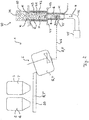
- Fig. 1 shows a plant 1 for the production of hollow microspheres M made of glass, ie for the production of hollow glass spheres whose typical diameter, for example, are predominantly in a range between 40 and 350 micrometers.
- the plant 1 comprises a first silo 2 as a reservoir for Brenngutpiety G, and a second silo 3 as a reservoir for powdered release agent T. Furthermore, the system 1 comprises a mixer 5 for mixing the Brenngutpiety G with the release agent T, as well as a rotating kiln 6 running Kiln for expanding the fuel particles G to the desired hollow microspheres M.
- the fuel particles G stored in the first silo 2 are approximately spherical particles whose diameters are preferably approximately in the range between 20 microns and 200 microns.
- the fuel particles G are preferably produced by spray granulation.
- the starting materials used are glass powder, water glass and a blowing agent (for example sodium nitrate, sugar or glycerol) with water to form a low-viscosity suspension (slurry) which is sprayed in a spray tower to form the fuel particles G.
- the Brenngutpellen G are then dried.
- a classification takes place, wherein the fraction with the desired diameters is selected and fed to the silo 2.
- the mixer 5 is designed as an intensive mixer according to Eirich.
- the mixer 5 in this case comprises a substantially cup-shaped mixing container 10, which is rotatably mounted about its longitudinal axis 11 inclined relative to the vertical.
- a counter-rotating to the mixing container 10 mixing tool 12 is arranged parallel to the longitudinal axis 11 eccentrically in the mixing container 10.
- the mixing container 10 can be loaded via a closable lid opening 15 and via an also closable lid centrally located bottom opening 16 emptied.
- the mixer 5 in this embodiment has a power input of 10 to 20 kilowatts per 100 kg of mix (preferably about 15 kilowatts per 100 kg of mix) and a peripheral speed at the outermost point of the agitator of at least 30 meters per second.
- the plant 1 may also contain a different type of mixer, for example a drum mixer.
- the rotary kiln 6 conventionally comprises a long-extended hollow cylindrical rotary tube 20 made of high-temperature-resistant steel, in the interior of which a combustion chamber 21 is formed.
- the rotary tube 20 is rotatably mounted about its relative to the horizontal slightly inclined longitudinal axis 23 arranged.
- the rotary kiln is designed as a directly heated rotary kiln.
- the combustion chamber 21 is in this case fired directly with a gas-operated burner 26, which is arranged at the output-side end of the rotary tube 21.
- fuel particles G and separating agent T are metered from the two silos 2 to a mixing channel 30 arranged below the silos 2, 3, so that there is a pre-mixture of combustible particles G and separating agent T with a predetermined proportion of release agent is present.
- the setting of the desired mass ratio for example, by means of a balance. Alternatively, the adjustment is made volumetrically, for example, by means of silos 2, 3 assigned rotary valves or screw conveyors.
- the pre-mixture of Brenngutpumblen G and release agent T is conveyed into the mixing vessel 10 of the mixer 5.
- the mixing trough 30 can also be dispensed with, in which case firing material particles G and separating agent T are each metered separately into the mixer 5, so that the desired mixing ratio is generated there.
- the mixing process is batchwise, whereby in each case one batch of the pre-mixture is subjected to a mixing process.
- the pre-mixture of release agent T and Brenngutpumble G is homogenized in the mixer 5 for a mixing time of 1 to 10 minutes.
- the mixture of Brenngutpumblen G and release agent T via the bottom opening 16 is discharged from the mixing container 10.
- the mixture is optionally stored in a buffer vessel interposed between the mixer 5 and the rotary kiln 6 (not explicitly shown).
- the mixture of Brenngutpumblen G and release agent T is continuously fed by means of a feed device not shown here the combustion chamber 21 of the rotary kiln 6 (indicated by an arrow 31).
- a predetermined firing temperature is generated during operation of the system 1 by means of the burner 26, in which the Brenngutpiety G inflate successively in a period of about 1 to 15 minutes to the desired hollow microspheres M.
- the hollow microspheres M produced are discharged from the combustion chamber 21 and fed to a product reservoir after a cooling and sorting step (not shown here).
- the release agent T is separated from the hollow microspheres M by sieving or air classification.
- the hollow microspheres M again by sieving or air classification, are separated by multicellular (foam-like) expanded particles (ie particles having a plurality of large cavities), which optionally form next to the hollow microspheres M in the firing process. These multicellular expanded particles are either discarded as bad parts or used for other purposes.
- Fig. 2 shows an alternative embodiment of the system 1.
- the expansion process is not carried out in a rotary kiln, but in a shaft furnace 40th
- the shaft furnace 40 comprises a shaft-like elongated, with respect to the longitudinal extent vertically aligned combustion chamber 41, which is surrounded by a thermally insulated to the outside double jacket 42 made of steel. In one through the double jacket 42 formed cooling gap 43 cooling air K is performed. Towards the top, the combustion chamber 41 is steppedly widened.
- the shaft furnace 40 is associated with a gas-powered burner 45, which serves to generate in the combustion chamber 41 from the bottom upwards directed hot gas flow H.
- the hot gas generated by the burner 45 is supplied via a hot gas line 46 of the combustion chamber 41 as a hot gas stream H.
- a number of (for example six) additional, gas-operated burners 47 are arranged, which are arranged in a circle around the circumference of the combustion chamber 41.
- combustion chamber 41 closes according to Fig. 2 an area which serves as a cold trap 50 and which has a cross-section of the upper portion of the combustion chamber 41 again enlarged cross-section.
- the combustion chamber 41 and the optionally provided cold trap 50 can be designed over the entire height with a uniform cross section.
- the shaft furnace 40 comprises a charging device, which is formed here by a Brennguttechnisch 55.
- the Brenngut réelle 55 is guided through the double jacket 42 and opens into the lower portion of the combustion chamber 41.
- the Brenngut réelle 55 is fed from the mixer 5 or an optionally downstream buffer tank (indicated by the arrow 56).
- the Brenngut réelle 55 runs in particular falling in the feed direction, so that the kiln slides without active promotion (only under the action of gravity) into the combustion chamber 41.
- the feeder may also comprise means for actively conveying the combustible, e.g. a compressed air system or a screw conveyor.
- a temperature of, for example, about 650 ° C is generated in the lower portion of the combustion chamber 41, in which the Brenngutpumblen G are first preheated.
- the combustion chamber 41 is additionally heated, so that the temperature in the upper portion of the combustion chamber 41 is increased to the firing temperature exceeding the softening temperature of the glass powder.
- the expansion of the fuel particles G to the hollow microspheres M takes place here in the short-term flame contact at about 1400 ° C.
- the expanded hollow microspheres M are finally fed to the cold trap 50 and quenched there by the supply of cooling air K. Finally, the hollow microspheres M are separated from the hot gas stream via a solids separator and optionally fed to a product reservoir after a sorting step (again not shown here). The discharged release agent T is in turn separated from the hollow microspheres M by means of a cyclone.
- micro hollow spheres with good product quality could be obtained in the fractions with ball diameters in the ranges 40-90 ⁇ m and 90-180 ⁇ m.
- hollow microspheres of the fraction with ball diameters in the range 180-300 microns were not completely foamed. No agglomeration was observed.
- This mixture was then expanded in a directly heated rotary kiln (production scale) at a firing temperature of 780-840 ° C.
- micro hollow spheres with good product quality could be obtained in the fractions with ball diameters in the ranges 40-90 ⁇ m, 90-180 ⁇ m and 180-300 ⁇ m. No agglomeration was observed.
- This mixture was then expanded in a directly heated rotary kiln (production scale) at a firing temperature of 814 ° C.
- micro hollow spheres with good product quality could be obtained in the fractions with ball diameters in the ranges 40-90 ⁇ m and 90-180 ⁇ m.
- hollow microspheres of the fraction with ball diameters in the range 180-300 microns were not completely foamed.
- agglomeration was observed.
- This mixture was then expanded in a directly heated rotary kiln (production scale) at a firing temperature of 838 ° C.
- micro hollow spheres with good product quality could be obtained in the fractions with ball diameters in the ranges 40-90 ⁇ m, 90-180 ⁇ m and 180-300 ⁇ m.
- agglomeration was observed
- This mixture was expanded analogously to Example 1 in the directly heated rotary kiln (production scale) at a firing temperature of 720 ° C.
- the expanded material contained a high proportion of bad parts (multicellular expanded particles).
- This mixture was expanded analogously to Example 1 in the directly heated rotary kiln (production scale) at a firing temperature of 800 ° C.
- This mixture was expanded analogously to Example 3 in the directly heated rotary kiln (production scale) at a firing temperature of 862 ° C to 930 ° C.
- the product resulting from this experiment consisted almost exclusively of multicellular expanded particles. No agglomerates were observed.
Landscapes
- Chemical & Material Sciences (AREA)
- Engineering & Computer Science (AREA)
- Materials Engineering (AREA)
- Organic Chemistry (AREA)
- Life Sciences & Earth Sciences (AREA)
- Chemical Kinetics & Catalysis (AREA)
- General Chemical & Material Sciences (AREA)
- Geochemistry & Mineralogy (AREA)
- Manufacturing & Machinery (AREA)
- Glass Compositions (AREA)
Priority Applications (1)
| Application Number | Priority Date | Filing Date | Title |
|---|---|---|---|
| PL18200866T PL3480176T3 (pl) | 2017-11-06 | 2018-10-17 | Puste mikrosfery ze szkła i sposób ich wytwarzania |
Applications Claiming Priority (1)
| Application Number | Priority Date | Filing Date | Title |
|---|---|---|---|
| DE102017219693.9A DE102017219693A1 (de) | 2017-11-06 | 2017-11-06 | Mikrohohlkugeln aus Glas und Verfahren zu deren Herstellung |
Publications (2)
| Publication Number | Publication Date |
|---|---|
| EP3480176A1 true EP3480176A1 (fr) | 2019-05-08 |
| EP3480176B1 EP3480176B1 (fr) | 2020-12-09 |
Family
ID=63878481
Family Applications (1)
| Application Number | Title | Priority Date | Filing Date |
|---|---|---|---|
| EP18200866.4A Not-in-force EP3480176B1 (fr) | 2017-11-06 | 2018-10-17 | Microsphères creuses de verre et leur procédé de fabrication |
Country Status (9)
| Country | Link |
|---|---|
| US (1) | US20190135676A1 (fr) |
| EP (1) | EP3480176B1 (fr) |
| AU (1) | AU2018256538A1 (fr) |
| CA (1) | CA3022738A1 (fr) |
| DE (1) | DE102017219693A1 (fr) |
| DK (1) | DK3480176T3 (fr) |
| ES (1) | ES2859103T3 (fr) |
| LT (1) | LT3480176T (fr) |
| PL (1) | PL3480176T3 (fr) |
Cited By (1)
| Publication number | Priority date | Publication date | Assignee | Title |
|---|---|---|---|---|
| AT525539B1 (de) * | 2022-04-19 | 2023-05-15 | Ape Man Gmbh | Verfahren zur herstellung mikroholkugel ähnlicher strukturen |
Families Citing this family (3)
| Publication number | Priority date | Publication date | Assignee | Title |
|---|---|---|---|---|
| EP3957610A1 (fr) | 2020-08-17 | 2022-02-23 | DENNERT PORAVER GmbH | Dénitrification de gaz d'échappement lors de la fabrication de granules de verre expansé |
| CN112777937B (zh) * | 2021-01-27 | 2023-09-15 | 中钢集团马鞍山矿山研究总院股份有限公司 | 一种以废玻璃为主要原料制备的微孔发泡玻璃 |
| US12103887B1 (en) | 2023-08-21 | 2024-10-01 | Revitri, LLC | Foamed glass beads and process of making same |
Citations (5)
| Publication number | Priority date | Publication date | Assignee | Title |
|---|---|---|---|---|
| DE2603534A1 (de) * | 1975-01-29 | 1976-08-19 | Minnesota Mining & Mfg | Hohlkuegelchen |
| US4778502A (en) * | 1984-06-21 | 1988-10-18 | Saint-Gobain Vitrage | Production of glass microspheres |
| US8951608B1 (en) * | 2004-10-22 | 2015-02-10 | Imaging Systems Technology, Inc. | Aqueous manufacturing process and article |
| DE102015003398A1 (de) * | 2015-03-18 | 2016-09-22 | Dennert Poraver Gmbh | Verfahren und Anlage zur Herstellung von Mikrohohlkugeln aus Glas |
| WO2017194485A1 (fr) * | 2016-05-11 | 2017-11-16 | Dennert Poraver Gmbh | Procédé et installation destinés à la fabrication de microsphères creuses en verre |
Family Cites Families (3)
| Publication number | Priority date | Publication date | Assignee | Title |
|---|---|---|---|---|
| US3230064A (en) | 1960-10-21 | 1966-01-18 | Standard Oil Co | Apparatus for spherulization of fusible particles |
| DE102005018650B4 (de) | 2005-04-21 | 2009-07-23 | Bene_Fit Gmbh | Verwendung von kalziniertem Kaolin für Oberflächenbeschichtungen |
| US20070275335A1 (en) | 2006-05-25 | 2007-11-29 | Giang Biscan | Furnace for heating particles |
-
2017
- 2017-11-06 DE DE102017219693.9A patent/DE102017219693A1/de not_active Ceased
-
2018
- 2018-10-17 EP EP18200866.4A patent/EP3480176B1/fr not_active Not-in-force
- 2018-10-17 DK DK18200866.4T patent/DK3480176T3/da active
- 2018-10-17 LT LTEP18200866.4T patent/LT3480176T/lt unknown
- 2018-10-17 ES ES18200866T patent/ES2859103T3/es active Active
- 2018-10-17 PL PL18200866T patent/PL3480176T3/pl unknown
- 2018-10-31 CA CA3022738A patent/CA3022738A1/fr not_active Abandoned
- 2018-10-31 AU AU2018256538A patent/AU2018256538A1/en not_active Abandoned
- 2018-11-06 US US16/181,408 patent/US20190135676A1/en not_active Abandoned
Patent Citations (5)
| Publication number | Priority date | Publication date | Assignee | Title |
|---|---|---|---|---|
| DE2603534A1 (de) * | 1975-01-29 | 1976-08-19 | Minnesota Mining & Mfg | Hohlkuegelchen |
| US4778502A (en) * | 1984-06-21 | 1988-10-18 | Saint-Gobain Vitrage | Production of glass microspheres |
| US8951608B1 (en) * | 2004-10-22 | 2015-02-10 | Imaging Systems Technology, Inc. | Aqueous manufacturing process and article |
| DE102015003398A1 (de) * | 2015-03-18 | 2016-09-22 | Dennert Poraver Gmbh | Verfahren und Anlage zur Herstellung von Mikrohohlkugeln aus Glas |
| WO2017194485A1 (fr) * | 2016-05-11 | 2017-11-16 | Dennert Poraver Gmbh | Procédé et installation destinés à la fabrication de microsphères creuses en verre |
Cited By (2)
| Publication number | Priority date | Publication date | Assignee | Title |
|---|---|---|---|---|
| AT525539B1 (de) * | 2022-04-19 | 2023-05-15 | Ape Man Gmbh | Verfahren zur herstellung mikroholkugel ähnlicher strukturen |
| AT525539A4 (de) * | 2022-04-19 | 2023-05-15 | Ape Man Gmbh | Verfahren zur herstellung mikroholkugel ähnlicher strukturen |
Also Published As
| Publication number | Publication date |
|---|---|
| PL3480176T3 (pl) | 2021-05-31 |
| DK3480176T3 (da) | 2021-02-22 |
| AU2018256538A1 (en) | 2019-05-23 |
| US20190135676A1 (en) | 2019-05-09 |
| DE102017219693A1 (de) | 2019-05-09 |
| ES2859103T3 (es) | 2021-10-01 |
| LT3480176T (lt) | 2021-03-10 |
| CA3022738A1 (fr) | 2019-05-06 |
| EP3480176B1 (fr) | 2020-12-09 |
Similar Documents
| Publication | Publication Date | Title |
|---|---|---|
| EP3480176B1 (fr) | Microsphères creuses de verre et leur procédé de fabrication | |
| EP2665687B1 (fr) | Prétraitement de matériau brut pour la fabrication de fibres de basalte | |
| DE2631481C2 (de) | Verfahren zur Herstellung von expandierbaren Perlen und deren Verwendung | |
| DE2904317C2 (de) | Verfahren zum Herstellen von geschmolzenem Glas | |
| DE2651545A1 (de) | Verfahren zur herstellung von glasperlen und die dabei erhaltenen produkte | |
| DE102006046803A1 (de) | Verfahren und thermischer Reaktor zur Herstellung von Partikeln | |
| EP3050854A1 (fr) | Procede et installation destines a la fabrication de microbilles en verre | |
| EP3455177B1 (fr) | Procédé de fabrication de microsphères creuses en verre | |
| CN115094234B (zh) | 一种烧结料一体化混合-制粒的方法及装置 | |
| CH664356A5 (de) | Verfahren zur herstellung von geblaehtem mineralischem korngut. | |
| DE2509730A1 (de) | Sorptionstraeger und verfahren zu dessen herstellung | |
| DE112019005739T5 (de) | Gemengebeschicker für eine schmelzkammer | |
| DE2910512A1 (de) | Verfahren zur herstellung von koernigen pellets als glasrohmaterial | |
| EP3480175B1 (fr) | Microsphères creuses en verre et leur procédé de fabrication | |
| DE102015215800A1 (de) | Verfahren und Anlage zur Herstellung von mono- oder multizellulär expandierten Partikeln aus einem glasartigen oder keramischen Material | |
| DE102006003295B4 (de) | Verwendung eines Kerns für Stützgranulat | |
| DE102015003398B4 (de) | Verfahren und Anlage zur Herstellung von Mikrohohlkugeln aus Glas und Verwendung eines Pulsationsreaktors | |
| AT504051B1 (de) | Verfahren zur herstellung von schüttgut | |
| DE4344994C2 (de) | Verfahren zur Herstellung von Blähglasgranulaten | |
| DE10360508A1 (de) | Rohstoffgranaliengranulat für feuerfeste Erzeugnisse sowie Verfahren zur Herstellung und Verwendung des Rohstoffgranaliengranulats | |
| EP3181527A1 (fr) | Procédé et installation de fabrication de particules de verre expansé | |
| DE19522460C2 (de) | Verfahren zur Herstellung von Schaumglas-Granulat | |
| DE102016211418A1 (de) | Verfahren und Produktionsanlage zur Herstellung von Hohlkugeln aus Perlit | |
| DE2606927A1 (de) | Verfahren zum herstellen von als pellets vorbehandelten chargen bei der herstellung von glas | |
| US2242443A (en) | Preparation of roofing granules and the like |
Legal Events
| Date | Code | Title | Description |
|---|---|---|---|
| PUAI | Public reference made under article 153(3) epc to a published international application that has entered the european phase |
Free format text: ORIGINAL CODE: 0009012 |
|
| STAA | Information on the status of an ep patent application or granted ep patent |
Free format text: STATUS: THE APPLICATION HAS BEEN PUBLISHED |
|
| AK | Designated contracting states |
Kind code of ref document: A1 Designated state(s): AL AT BE BG CH CY CZ DE DK EE ES FI FR GB GR HR HU IE IS IT LI LT LU LV MC MK MT NL NO PL PT RO RS SE SI SK SM TR |
|
| AX | Request for extension of the european patent |
Extension state: BA ME |
|
| STAA | Information on the status of an ep patent application or granted ep patent |
Free format text: STATUS: REQUEST FOR EXAMINATION WAS MADE |
|
| 17P | Request for examination filed |
Effective date: 20191108 |
|
| RBV | Designated contracting states (corrected) |
Designated state(s): AL AT BE BG CH CY CZ DE DK EE ES FI FR GB GR HR HU IE IS IT LI LT LU LV MC MK MT NL NO PL PT RO RS SE SI SK SM TR |
|
| GRAP | Despatch of communication of intention to grant a patent |
Free format text: ORIGINAL CODE: EPIDOSNIGR1 |
|
| STAA | Information on the status of an ep patent application or granted ep patent |
Free format text: STATUS: GRANT OF PATENT IS INTENDED |
|
| RIC1 | Information provided on ipc code assigned before grant |
Ipc: C03C 1/00 20060101AFI20200427BHEP Ipc: C03C 11/00 20060101ALI20200427BHEP |
|
| INTG | Intention to grant announced |
Effective date: 20200518 |
|
| GRAS | Grant fee paid |
Free format text: ORIGINAL CODE: EPIDOSNIGR3 |
|
| GRAA | (expected) grant |
Free format text: ORIGINAL CODE: 0009210 |
|
| STAA | Information on the status of an ep patent application or granted ep patent |
Free format text: STATUS: THE PATENT HAS BEEN GRANTED |
|
| AK | Designated contracting states |
Kind code of ref document: B1 Designated state(s): AL AT BE BG CH CY CZ DE DK EE ES FI FR GB GR HR HU IE IS IT LI LT LU LV MC MK MT NL NO PL PT RO RS SE SI SK SM TR |
|
| REG | Reference to a national code |
Ref country code: GB Ref legal event code: FG4D Free format text: NOT ENGLISH |
|
| REG | Reference to a national code |
Ref country code: AT Ref legal event code: REF Ref document number: 1343272 Country of ref document: AT Kind code of ref document: T Effective date: 20201215 Ref country code: CH Ref legal event code: EP |
|
| REG | Reference to a national code |
Ref country code: DE Ref legal event code: R096 Ref document number: 502018003253 Country of ref document: DE |
|
| REG | Reference to a national code |
Ref country code: IE Ref legal event code: FG4D Free format text: LANGUAGE OF EP DOCUMENT: GERMAN |
|
| REG | Reference to a national code |
Ref country code: DK Ref legal event code: T3 Effective date: 20210218 |
|
| REG | Reference to a national code |
Ref country code: CH Ref legal event code: NV Representative=s name: HEPP WENGER RYFFEL AG, CH |
|
| REG | Reference to a national code |
Ref country code: NL Ref legal event code: FP |
|
| REG | Reference to a national code |
Ref country code: EE Ref legal event code: FG4A Ref document number: E020424 Country of ref document: EE Effective date: 20210225 |
|
| PG25 | Lapsed in a contracting state [announced via postgrant information from national office to epo] |
Ref country code: GR Free format text: LAPSE BECAUSE OF FAILURE TO SUBMIT A TRANSLATION OF THE DESCRIPTION OR TO PAY THE FEE WITHIN THE PRESCRIBED TIME-LIMIT Effective date: 20210310 Ref country code: NO Free format text: LAPSE BECAUSE OF FAILURE TO SUBMIT A TRANSLATION OF THE DESCRIPTION OR TO PAY THE FEE WITHIN THE PRESCRIBED TIME-LIMIT Effective date: 20210309 Ref country code: FI Free format text: LAPSE BECAUSE OF FAILURE TO SUBMIT A TRANSLATION OF THE DESCRIPTION OR TO PAY THE FEE WITHIN THE PRESCRIBED TIME-LIMIT Effective date: 20201209 Ref country code: RS Free format text: LAPSE BECAUSE OF FAILURE TO SUBMIT A TRANSLATION OF THE DESCRIPTION OR TO PAY THE FEE WITHIN THE PRESCRIBED TIME-LIMIT Effective date: 20201209 |
|
| PG25 | Lapsed in a contracting state [announced via postgrant information from national office to epo] |
Ref country code: SE Free format text: LAPSE BECAUSE OF FAILURE TO SUBMIT A TRANSLATION OF THE DESCRIPTION OR TO PAY THE FEE WITHIN THE PRESCRIBED TIME-LIMIT Effective date: 20201209 Ref country code: BG Free format text: LAPSE BECAUSE OF FAILURE TO SUBMIT A TRANSLATION OF THE DESCRIPTION OR TO PAY THE FEE WITHIN THE PRESCRIBED TIME-LIMIT Effective date: 20210309 |
|
| PG25 | Lapsed in a contracting state [announced via postgrant information from national office to epo] |
Ref country code: HR Free format text: LAPSE BECAUSE OF FAILURE TO SUBMIT A TRANSLATION OF THE DESCRIPTION OR TO PAY THE FEE WITHIN THE PRESCRIBED TIME-LIMIT Effective date: 20201209 |
|
| PG25 | Lapsed in a contracting state [announced via postgrant information from national office to epo] |
Ref country code: SM Free format text: LAPSE BECAUSE OF FAILURE TO SUBMIT A TRANSLATION OF THE DESCRIPTION OR TO PAY THE FEE WITHIN THE PRESCRIBED TIME-LIMIT Effective date: 20201209 Ref country code: PT Free format text: LAPSE BECAUSE OF FAILURE TO SUBMIT A TRANSLATION OF THE DESCRIPTION OR TO PAY THE FEE WITHIN THE PRESCRIBED TIME-LIMIT Effective date: 20210409 Ref country code: SK Free format text: LAPSE BECAUSE OF FAILURE TO SUBMIT A TRANSLATION OF THE DESCRIPTION OR TO PAY THE FEE WITHIN THE PRESCRIBED TIME-LIMIT Effective date: 20201209 Ref country code: RO Free format text: LAPSE BECAUSE OF FAILURE TO SUBMIT A TRANSLATION OF THE DESCRIPTION OR TO PAY THE FEE WITHIN THE PRESCRIBED TIME-LIMIT Effective date: 20201209 |
|
| REG | Reference to a national code |
Ref country code: DE Ref legal event code: R097 Ref document number: 502018003253 Country of ref document: DE |
|
| PG25 | Lapsed in a contracting state [announced via postgrant information from national office to epo] |
Ref country code: IS Free format text: LAPSE BECAUSE OF FAILURE TO SUBMIT A TRANSLATION OF THE DESCRIPTION OR TO PAY THE FEE WITHIN THE PRESCRIBED TIME-LIMIT Effective date: 20210409 |
|
| REG | Reference to a national code |
Ref country code: ES Ref legal event code: FG2A Ref document number: 2859103 Country of ref document: ES Kind code of ref document: T3 Effective date: 20211001 |
|
| PLBE | No opposition filed within time limit |
Free format text: ORIGINAL CODE: 0009261 |
|
| STAA | Information on the status of an ep patent application or granted ep patent |
Free format text: STATUS: NO OPPOSITION FILED WITHIN TIME LIMIT |
|
| PG25 | Lapsed in a contracting state [announced via postgrant information from national office to epo] |
Ref country code: AL Free format text: LAPSE BECAUSE OF FAILURE TO SUBMIT A TRANSLATION OF THE DESCRIPTION OR TO PAY THE FEE WITHIN THE PRESCRIBED TIME-LIMIT Effective date: 20201209 |
|
| 26N | No opposition filed |
Effective date: 20210910 |
|
| PG25 | Lapsed in a contracting state [announced via postgrant information from national office to epo] |
Ref country code: SI Free format text: LAPSE BECAUSE OF FAILURE TO SUBMIT A TRANSLATION OF THE DESCRIPTION OR TO PAY THE FEE WITHIN THE PRESCRIBED TIME-LIMIT Effective date: 20201209 |
|
| PGFP | Annual fee paid to national office [announced via postgrant information from national office to epo] |
Ref country code: NL Payment date: 20211021 Year of fee payment: 4 |
|
| PGFP | Annual fee paid to national office [announced via postgrant information from national office to epo] |
Ref country code: CZ Payment date: 20211005 Year of fee payment: 4 Ref country code: EE Payment date: 20211020 Year of fee payment: 4 Ref country code: DK Payment date: 20211021 Year of fee payment: 4 Ref country code: ES Payment date: 20211117 Year of fee payment: 4 Ref country code: DE Payment date: 20210713 Year of fee payment: 4 Ref country code: LT Payment date: 20211004 Year of fee payment: 4 |
|
| PGFP | Annual fee paid to national office [announced via postgrant information from national office to epo] |
Ref country code: LV Payment date: 20211019 Year of fee payment: 4 Ref country code: IT Payment date: 20211031 Year of fee payment: 4 Ref country code: FR Payment date: 20211021 Year of fee payment: 4 Ref country code: CH Payment date: 20211022 Year of fee payment: 4 Ref country code: BE Payment date: 20211021 Year of fee payment: 4 |
|
| PGFP | Annual fee paid to national office [announced via postgrant information from national office to epo] |
Ref country code: PL Payment date: 20211005 Year of fee payment: 4 |
|
| PG25 | Lapsed in a contracting state [announced via postgrant information from national office to epo] |
Ref country code: IS Free format text: LAPSE BECAUSE OF FAILURE TO SUBMIT A TRANSLATION OF THE DESCRIPTION OR TO PAY THE FEE WITHIN THE PRESCRIBED TIME-LIMIT Effective date: 20210409 |
|
| PG25 | Lapsed in a contracting state [announced via postgrant information from national office to epo] |
Ref country code: MC Free format text: LAPSE BECAUSE OF FAILURE TO SUBMIT A TRANSLATION OF THE DESCRIPTION OR TO PAY THE FEE WITHIN THE PRESCRIBED TIME-LIMIT Effective date: 20201209 |
|
| PG25 | Lapsed in a contracting state [announced via postgrant information from national office to epo] |
Ref country code: LU Free format text: LAPSE BECAUSE OF NON-PAYMENT OF DUE FEES Effective date: 20211017 |
|
| PG25 | Lapsed in a contracting state [announced via postgrant information from national office to epo] |
Ref country code: IE Free format text: LAPSE BECAUSE OF NON-PAYMENT OF DUE FEES Effective date: 20211017 |
|
| REG | Reference to a national code |
Ref country code: DE Ref legal event code: R119 Ref document number: 502018003253 Country of ref document: DE |
|
| REG | Reference to a national code |
Ref country code: LT Ref legal event code: MM4D Effective date: 20221017 |
|
| REG | Reference to a national code |
Ref country code: EE Ref legal event code: MM4A Ref document number: E020424 Country of ref document: EE Effective date: 20221031 |
|
| REG | Reference to a national code |
Ref country code: DK Ref legal event code: EBP Effective date: 20221031 |
|
| REG | Reference to a national code |
Ref country code: CH Ref legal event code: PL |
|
| REG | Reference to a national code |
Ref country code: NL Ref legal event code: MM Effective date: 20221101 |
|
| REG | Reference to a national code |
Ref country code: BE Ref legal event code: MM Effective date: 20221031 |
|
| GBPC | Gb: european patent ceased through non-payment of renewal fee |
Effective date: 20221017 |
|
| PG25 | Lapsed in a contracting state [announced via postgrant information from national office to epo] |
Ref country code: CY Free format text: LAPSE BECAUSE OF FAILURE TO SUBMIT A TRANSLATION OF THE DESCRIPTION OR TO PAY THE FEE WITHIN THE PRESCRIBED TIME-LIMIT Effective date: 20201209 |
|
| PG25 | Lapsed in a contracting state [announced via postgrant information from national office to epo] |
Ref country code: NL Free format text: LAPSE BECAUSE OF NON-PAYMENT OF DUE FEES Effective date: 20221101 Ref country code: LV Free format text: LAPSE BECAUSE OF NON-PAYMENT OF DUE FEES Effective date: 20221017 Ref country code: LT Free format text: LAPSE BECAUSE OF NON-PAYMENT OF DUE FEES Effective date: 20221017 Ref country code: LI Free format text: LAPSE BECAUSE OF NON-PAYMENT OF DUE FEES Effective date: 20221031 Ref country code: HU Free format text: LAPSE BECAUSE OF FAILURE TO SUBMIT A TRANSLATION OF THE DESCRIPTION OR TO PAY THE FEE WITHIN THE PRESCRIBED TIME-LIMIT; INVALID AB INITIO Effective date: 20181017 Ref country code: FR Free format text: LAPSE BECAUSE OF NON-PAYMENT OF DUE FEES Effective date: 20221031 Ref country code: EE Free format text: LAPSE BECAUSE OF NON-PAYMENT OF DUE FEES Effective date: 20221031 Ref country code: DE Free format text: LAPSE BECAUSE OF NON-PAYMENT OF DUE FEES Effective date: 20230503 Ref country code: CZ Free format text: LAPSE BECAUSE OF NON-PAYMENT OF DUE FEES Effective date: 20221017 Ref country code: CH Free format text: LAPSE BECAUSE OF NON-PAYMENT OF DUE FEES Effective date: 20221031 |
|
| PG25 | Lapsed in a contracting state [announced via postgrant information from national office to epo] |
Ref country code: BE Free format text: LAPSE BECAUSE OF NON-PAYMENT OF DUE FEES Effective date: 20221031 |
|
| PG25 | Lapsed in a contracting state [announced via postgrant information from national office to epo] |
Ref country code: IT Free format text: LAPSE BECAUSE OF NON-PAYMENT OF DUE FEES Effective date: 20221017 Ref country code: GB Free format text: LAPSE BECAUSE OF NON-PAYMENT OF DUE FEES Effective date: 20221017 Ref country code: DK Free format text: LAPSE BECAUSE OF NON-PAYMENT OF DUE FEES Effective date: 20221031 |
|
| REG | Reference to a national code |
Ref country code: ES Ref legal event code: FD2A Effective date: 20231127 |
|
| PG25 | Lapsed in a contracting state [announced via postgrant information from national office to epo] |
Ref country code: ES Free format text: LAPSE BECAUSE OF NON-PAYMENT OF DUE FEES Effective date: 20221018 |
|
| PG25 | Lapsed in a contracting state [announced via postgrant information from national office to epo] |
Ref country code: ES Free format text: LAPSE BECAUSE OF NON-PAYMENT OF DUE FEES Effective date: 20221018 |
|
| PG25 | Lapsed in a contracting state [announced via postgrant information from national office to epo] |
Ref country code: MK Free format text: LAPSE BECAUSE OF FAILURE TO SUBMIT A TRANSLATION OF THE DESCRIPTION OR TO PAY THE FEE WITHIN THE PRESCRIBED TIME-LIMIT Effective date: 20201209 |
|
| PG25 | Lapsed in a contracting state [announced via postgrant information from national office to epo] |
Ref country code: PL Free format text: LAPSE BECAUSE OF NON-PAYMENT OF DUE FEES Effective date: 20221017 |
|
| PG25 | Lapsed in a contracting state [announced via postgrant information from national office to epo] |
Ref country code: MT Free format text: LAPSE BECAUSE OF FAILURE TO SUBMIT A TRANSLATION OF THE DESCRIPTION OR TO PAY THE FEE WITHIN THE PRESCRIBED TIME-LIMIT Effective date: 20201209 |
|
| REG | Reference to a national code |
Ref country code: AT Ref legal event code: MM01 Ref document number: 1343272 Country of ref document: AT Kind code of ref document: T Effective date: 20231017 |
|
| PG25 | Lapsed in a contracting state [announced via postgrant information from national office to epo] |
Ref country code: AT Free format text: LAPSE BECAUSE OF NON-PAYMENT OF DUE FEES Effective date: 20231017 |
|
| PG25 | Lapsed in a contracting state [announced via postgrant information from national office to epo] |
Ref country code: AT Free format text: LAPSE BECAUSE OF NON-PAYMENT OF DUE FEES Effective date: 20231017 |
|
| PG25 | Lapsed in a contracting state [announced via postgrant information from national office to epo] |
Ref country code: TR Free format text: LAPSE BECAUSE OF FAILURE TO SUBMIT A TRANSLATION OF THE DESCRIPTION OR TO PAY THE FEE WITHIN THE PRESCRIBED TIME-LIMIT Effective date: 20201209 |
|
| PGFP | Annual fee paid to national office [announced via postgrant information from national office to epo] |
Ref country code: AT Payment date: 20260410 Year of fee payment: 5 |