EP3480596A1 - Zusammensetzung zur diagnose eines follikulären schilddrüsenkarzinoms unter verwendung des expressionsniveaus eines aminoacyl-trna-synthetase-bezogenen proteins und verfahren zum nachweis eines diagnostischen markers - Google Patents
Zusammensetzung zur diagnose eines follikulären schilddrüsenkarzinoms unter verwendung des expressionsniveaus eines aminoacyl-trna-synthetase-bezogenen proteins und verfahren zum nachweis eines diagnostischen markers Download PDFInfo
- Publication number
- EP3480596A1 EP3480596A1 EP17820597.7A EP17820597A EP3480596A1 EP 3480596 A1 EP3480596 A1 EP 3480596A1 EP 17820597 A EP17820597 A EP 17820597A EP 3480596 A1 EP3480596 A1 EP 3480596A1
- Authority
- EP
- European Patent Office
- Prior art keywords
- trna synthetase
- aminoacyl
- protein
- follicular
- genbank
- Prior art date
- Legal status (The legal status is an assumption and is not a legal conclusion. Google has not performed a legal analysis and makes no representation as to the accuracy of the status listed.)
- Withdrawn
Links
Images


Classifications
-
- G—PHYSICS
- G01—MEASURING; TESTING
- G01N—INVESTIGATING OR ANALYSING MATERIALS BY DETERMINING THEIR CHEMICAL OR PHYSICAL PROPERTIES
- G01N33/00—Investigating or analysing materials by specific methods not covered by groups G01N1/00 - G01N31/00
- G01N33/48—Biological material, e.g. blood, urine; Haemocytometers
- G01N33/50—Chemical analysis of biological material, e.g. blood, urine; Testing involving biospecific ligand binding methods; Immunological testing
- G01N33/53—Immunoassay; Biospecific binding assay; Materials therefor
- G01N33/575—Immunoassay; Biospecific binding assay; Materials therefor for cancer
- G01N33/5758—Immunoassay; Biospecific binding assay; Materials therefor for cancer involving compounds serving as markers for tumours, cancers or neoplasias, e.g. cellular determinants, receptors, heat shock/stress proteins, A-protein, oligosaccharides or metabolites
- G01N33/57585—Immunoassay; Biospecific binding assay; Materials therefor for cancer involving compounds serving as markers for tumours, cancers or neoplasias, e.g. cellular determinants, receptors, heat shock/stress proteins, A-protein, oligosaccharides or metabolites involving compounds identifiable in body fluids
-
- G—PHYSICS
- G01—MEASURING; TESTING
- G01N—INVESTIGATING OR ANALYSING MATERIALS BY DETERMINING THEIR CHEMICAL OR PHYSICAL PROPERTIES
- G01N33/00—Investigating or analysing materials by specific methods not covered by groups G01N1/00 - G01N31/00
- G01N33/48—Biological material, e.g. blood, urine; Haemocytometers
- G01N33/50—Chemical analysis of biological material, e.g. blood, urine; Testing involving biospecific ligand binding methods; Immunological testing
- G01N33/74—Chemical analysis of biological material, e.g. blood, urine; Testing involving biospecific ligand binding methods; Immunological testing involving hormones or other non-cytokine intercellular protein regulatory factors such as growth factors, including receptors to hormones and growth factors
- G01N33/78—Thyroid gland hormones, e.g. T3, T4, TBH, TBG or their receptors
-
- G—PHYSICS
- G01—MEASURING; TESTING
- G01N—INVESTIGATING OR ANALYSING MATERIALS BY DETERMINING THEIR CHEMICAL OR PHYSICAL PROPERTIES
- G01N33/00—Investigating or analysing materials by specific methods not covered by groups G01N1/00 - G01N31/00
- G01N33/48—Biological material, e.g. blood, urine; Haemocytometers
- G01N33/50—Chemical analysis of biological material, e.g. blood, urine; Testing involving biospecific ligand binding methods; Immunological testing
- G01N33/53—Immunoassay; Biospecific binding assay; Materials therefor
- G01N33/573—Immunoassay; Biospecific binding assay; Materials therefor for enzymes or isoenzymes
-
- G—PHYSICS
- G01—MEASURING; TESTING
- G01N—INVESTIGATING OR ANALYSING MATERIALS BY DETERMINING THEIR CHEMICAL OR PHYSICAL PROPERTIES
- G01N33/00—Investigating or analysing materials by specific methods not covered by groups G01N1/00 - G01N31/00
- G01N33/48—Biological material, e.g. blood, urine; Haemocytometers
- G01N33/50—Chemical analysis of biological material, e.g. blood, urine; Testing involving biospecific ligand binding methods; Immunological testing
- G01N33/53—Immunoassay; Biospecific binding assay; Materials therefor
- G01N33/575—Immunoassay; Biospecific binding assay; Materials therefor for cancer
-
- G—PHYSICS
- G01—MEASURING; TESTING
- G01N—INVESTIGATING OR ANALYSING MATERIALS BY DETERMINING THEIR CHEMICAL OR PHYSICAL PROPERTIES
- G01N33/00—Investigating or analysing materials by specific methods not covered by groups G01N1/00 - G01N31/00
- G01N33/48—Biological material, e.g. blood, urine; Haemocytometers
- G01N33/50—Chemical analysis of biological material, e.g. blood, urine; Testing involving biospecific ligand binding methods; Immunological testing
- G01N33/53—Immunoassay; Biospecific binding assay; Materials therefor
- G01N33/575—Immunoassay; Biospecific binding assay; Materials therefor for cancer
- G01N33/57557—Immunoassay; Biospecific binding assay; Materials therefor for cancer of other specific parts of the body, e.g. brain
Definitions
- the present invention relates to a method for detecting markers for the diagnosis of follicular thyroid carcinoma using an expression level of aminoacyl-tRNA synthetase-related protein. More specifically, the present invention relates to a method for detecting markers of follicular carcinoma in order to provide information necessary for the diagnosis of follicular thyroid carcinoma in a patient suspected of having follicular thyroid carcinoma, the method comprising the steps of; a) obtaining a sample from a subject suspected of having follicular thyroid carcinoma; (b) measuring the protein expression level of an aminoacyl-tRNA synthetase (ARS) or an aminoacyl-tRNA synthetase complex-interacting multifunctional protein (AIMP) in the sample; and (c) comparing the measured protein expression level with that of a control, and determining that the subject having a change in the protein expression level has follicular thyroid carcinoma.
- ARS aminoacyl-tRNA synthetase
- AIMP aminoacyl-tRNA synthetase complex-
- Follicular thyroid carcinoma which accounts for about 20% of all thyroid cancers, is frequently found in women and belongs to a differentiated thyroid cancer with good prognosis.
- Thyroid follicular carcinoma is mainly found in older ages, compared to papillary thyroid carcinoma which is the most common thyroid cancer.
- Papillary thyroid carcinoma is mainly metastasized through the lymph nodes, whereas thyroid follicular carcinoma through the blood vessels.
- papillary thyroid carcinoma can be diagnosed relatively easily through fine needle aspiration test by observing characteristic nuclear morphology.
- thyroid follicular carcinoma has difficulties in accurately diagnosing it because definite criteria have not been established.
- thyroid follicular carcinoma can be mistaken for follicular adenoma because 20-30% of follicular adenomas, which are benign tumors of the thyroid gland, cannot be distinguished from thyroid follicular carcinoma by fine needle aspiration test.
- thyroid follicular carcinoma is possible only be collecting thyroid tissues through surgery and identifying the pathology in the tissues.
- pathologic examination including surgery is first performed by the surgical excision of the half of the thyroid where nodules is found, followed by histological examination.
- thyroid follicular carcinoma is diagnosed, such a method is a very cumbersome method because the other half of the thyroid must be removed again through surgery, except for early cancer with good prognosis. Therefore, it is necessary to develop a biomarker that can distinguish thyroid follicular carcinoma from follicular adenoma and confirm thyroid follicular carcinoma, in the thyroid tissue or blood obtained during the fine needle aspiration test.
- the level of expression of the marker can be measured using an antibody or the like, so that information necessary for diagnosis can be quickly obtained, without a necessity to perform surgery for pathologic examination.
- the present inventors collect pathologic tissues from patients diagnosed with thyroid follicular carcinoma and follicular adenoma, respectively, and analyzed the level of a various proteins by mass spectrometry. As a result, it was confirmed that the level of various aminoacyl-tRNA synthetase-related proteins are distinguishable between thyroid follicular carcinoma and follicular adenoma tissue, thus completing the present invention.
- an aspect of the present invention is to provide a method for providing information necessary for diagnosis of follicular thyroid carcinoma, the method comprising the steps of:
- An embodiment according to an aspect of the present invention provides a method for providing information necessary for diagnosis of follicular thyroid carcinoma, the method comprising the steps of:
- the present invention provides a method for providing information necessary for diagnosis of follicular thyroid carcinoma, the method comprising the steps of:
- the step (a) is a step of obtaining a sample from a subject in order to provide information necessary for diagnosis of follicular thyroid carcinoma in the subject suspected of having follicular thyroid carcinoma, according to the method of the present invention.
- the term 'diagnosis' or 'diagnosing' means identifying the presence or characteristic of a certain pathological condition.
- the 'diagnosis' or 'diagnosing' refers to the measurement of the expression level of aminoacyl tRNA (ARS) or aminoacyl tRNA synthetase complex-interacting multifunctional protein (AIMP) to determine the occurrence of thyroid follicular carcinoma, in particular differentially identifying thyroid follicular carcinoma from benign tumors, such as follicular adenoma.
- ARS aminoacyl tRNA
- AIMP aminoacyl tRNA synthetase complex-interacting multifunctional protein
- 'follicular thyroid carcinoma is a malignant tumor of the thyroid gland. It is one of the differentiated thyroid cancers that develops mainly in the glandular tissue associated with the production of thyroid hormone. It is characterized by its metastasis to other tissues through the blood stream. Thyroid follicular carcinoma is often diagnosed as a thyroid nodule incidentally without pain by ultrasound examination, palpation, and the like during a medical examination. Thyroid cancer is diagnosed by examining the size, location, and shape of the thyroid tumor through thyroid ultrasonography. Thyroid gland is pierced with a fine needle while observing the thyroid by ultrasonography, thyroid cells are collected and their cell shapes are checked (fine needle aspiration cytology).
- the cell shape of thyroid follicular carcinoma is not distinguishable from that of benign tumors such as follicular adenoma (FA). Therefore, the current diagnostic method is to collect pathological tissues by a surgical method and confirm it by biopsy. It is not efficient, even if it is not clear whether it is a malignant tumor, and since reoperation is required to completely remove the tumor if it is confirmed to be a malignant tumor.
- FA follicular adenoma
- the present invention provides a novel diagnostic marker and method that can clearly diagnose thyroid follicular carcinoma by a non-surgical method in a patient with a tumor or nodule found in his or her thyroid that needs to be checked for its malignancy.
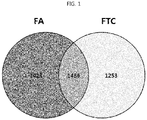
- the present inventors identified more than 4000 proteins by mass spectrometry (MS) and protein sequencing in thyroid follicular carcinoma and follicular adenoma tissues and compared the protein levels in both pathological tissues.
- MS mass spectrometry
- Gene ontology analysis showed that proteins related to oxidation/reduction, protein localization, and intracellular transport were prominent in follicular adenoma, whereas proteins related to proteolysis, macromolecule catabolic process, RNA processing, and cell cycle were predominated in thyroid follicular cancer.
- the subject in the method of the present invention may be a patient suspected of having follicular thyroid carcinoma. That is, the subject may be a patient who is found to have a tumor or nodule in his or her thyroid gland which needs to be differentiated between malignant follicular thyroid carcinoma and benign follicular adenoma
- the sample for the method of the present invention may be selected from the group consisting of thyroid tissue, blood, plasma, serum, lymph, and urine. The sample can be appropriately collected from the subject according to a known method and may be subjected to necessary pre-treatment according to protein detection methods.
- the step (b) is a step of measuring the protein expression level of the aminoacyl-tRNA synthetase (ARS) or aminoacyl-tRNA synthetase complex-interacting multifunctional protein (AIMP) in the sample collected (separated) from the subject in the step (a).
- ARS aminoacyl-tRNA synthetase
- AIMP aminoacyl-tRNA synthetase complex-interacting multifunctional protein
- 'protein' is used interchangeably with 'polypeptide' or 'peptide', and refers to a polymer of amino acid residues such as ones commonly found in natural state proteins.
- an 'aminoacyl-tRNA synthetase or an aminoacyl-tRNA ligase (ARS)' is an enzyme that mediates an aminoacylation reaction linking an amino acid to an appropriate tRNA. It is also called a tRNA ligase.
- glutamic acid and proline are linked to tRNA in the cytoplasm by a single ARS, which is called bifunctional aminoayl-tRNA synthetase or bifunctional glutamyl-prolyl-tRNA synthetase.
- ARS is generally classified into Class I series that mediate aminoacylation reaction at the 2'-OH end of adenosine nucleotide of tRNA and Class II series that mediates aminoacylation reaction at 3'-OH end of adenosine nucleotide of tRNA.
- Class I series include arginine tRNA synthetase, cysteine tRNA synthetase, glutamic acid tRNA synthetase, glutamine tRNA synthetase, isoleucine tRNA synthetase, leucine tRNA synthetase, methionine tRNA synthetase, tryptophan tRNA synthetase, valine tRNA synthetase, and tyrosine tRNA synthetase.
- Class II series include alanine tRNA synthetase, aspartic acid tRNA synthetase, asparagine tRNA synthetase, glycine tRNA synthetase, histidine tRNA synthetase, lysine tRNA synthetase, phenyalanine tRNA synthetase, proline tRNA synthetase, threonine tRNA synthetase, and serine tRNA synthetase.
- cytoplasmic or mitochondrial one depending on the location of its intracellular distribution, while being referred to as are existing in the cytoplasm unless otherwise indicated in the present specification.
- ARS may be one or more proteins selected from isoleucyl-tRNA synthetase mitochondrial (IARS mitochondrial), seryl-tRNA synthetase mitochondrial (SARS mitochondrial), lysyl-tRNA synthetase (KARS), valyl-tRNA synthetase (VARS), phenylalanyl-tRNA synthetase (FARS) alpha subunit (FARSA), alanyl-tRNA synthetase (AARS), aspartyl-tRNA synthetase (DARS), bifunctional aminoacyl-tRNA synthetase or glutamyl-prolyl-tRNA synthetase (EPRS), tryptophanyl-tRNA synthetase (WARS), glycyl-tRNA synthetase (GARS), isoleucyl-tRNA synthe mitochondrial (IARS mitochondrial), seryl-tRNA synthetase mitochondrial
- the 'aminoacyl-tRNA synthetase complex-interacting multifunctional protein (AIMP)' is a protein known to enhance the catalytic activity of the multi-tRNA synthetase complex (MSC) by binding to the multi-tRNA synthetase complex.
- AIMP1 aminoacyl-tRNA synthetase complex-interacting multifunctional protein 1
- AIMP2 aminoacyl-tRNA synthetase complex-interacting multifunctional protein 2
- AIMP3 aminoacyl-tRNA synthetase complex-interacting multifunctional protein 3
- the AIMP in the present invention may be AIMP1, also known as p43. If the AIMP (particularly AIMP1) are of human origin, the specific sequence thereof is not particularly limited, but the sequence information described in Table 5 of the present specification can be referred to.
- the term 'expression' means that a protein or a nucleic acid is produced in a cell.
- a method of measuring protein expression level can be performed by appropriately selecting known methods. For example, such method include western blotting, dot blotting, enzyme-linked immunosorbent assay (ELISA), radio immunoassay (RIA), radial immunodiffusion assay, Ouchterlony immunodiffusion assay, rocket immunoelectrophoresis, immunohistochemistry, immunoprecipitation, complement fixation assay, Flow cytometry (FACS), protein chips and mass spectrometry, but are not limited thereto. Most preferably, the protein level in the sample can be measured by mass spectrometry.
- the step (c) is a step of comparing the measured protein expression level with that of a control, and determining that the subject having a change in the protein expression level has follicular thyroid carcinoma.
- AIMP1 isoleucyl-tRNA synthetase mitochondrial
- SARS mitochondria seryl-tRNA synthetas
- the control group is preferably a patient having a tumor or nodule on the thyroid gland which has been identified as a follicular adenoma (FA), a benign tumor.
- FA follicular adenoma
- the level of the ARS or aminoacyl tRNA synthetase complex-binding multifunctional protein (AIMP) is measured beforehand in a plurality of FA patients prior to the detection of the follicular thyroid carcinoma marker in the subject, a range of a protein levels or baseline values expected from patients identified as FA is thereby obtained. Thereafter, the method of the present invention is performed in such a manner as to determine a difference in comparison with the protein level measured in a subject suspected of having follicular thyroid carcinoma.
- the step of comparing the ARS or AIMP expression level of a subject suspected of having follicular thyroid carcinoma with the control group may be performed by any method without limitation as long as it can clearly differentiate FTC from FA using the marker protein according to the present invention.
- a value representing the ARS protein or AIMP protein expression level measured in the comparison group that is, the concentration of the marker protein measured in the tissue sample or a value such as ion peak area of marker protein derived from MS analysis can be directly compared.
- the relative level between the comparison group such as 'the ratio of ARS or AIMP protein expression levels in FTC patients versus FA patients', may be used as a criteria of such determination.
- the ARS or AIMP marker proteins listed above exhibit specific expression patterns that distinguish FA from FTC, in order to diagnose follicular thyroid carcinoma, multiple marker proteins may be selected to measure the expression level, and their expression pattern may be used to diagnose FTC based on their expression patterns.
- the expression pattern is a qualitative feature of expression which represents an indicator of the expression pattern, the expression ranking and the like of the marker proteins, observed by measuring and comparing the expression levels of a plurality of marker proteins.
- the present invention also provides a composition for diagnosing thyroid follicular carcinoma, the composition comprising an agent for measuring the expression level of an aminoacyl-tRNA synthetase (ARS) or an aminoacyl-tRNA synthetase complex-interacting multifunctional protein (AIMP).
- ARS aminoacyl-tRNA synthetase
- AIMP aminoacyl-tRNA synthetase complex-interacting multifunctional protein
- composition for diagnosing follicular thyroid carcinoma of the present invention may be a composition for distinguishing follicular adenoma from follicular thyroid carcinoma, and the specific types of ARS and AIMP, and their detection characteristics can be understood with reference to the above description.
- the agent for measuring the ARS and AIMP expression level of the present invention is not particularly limited as long as it is a ligand that specifically adheres to the above-mentioned specific protein.
- it may be a peptide, an antibody, or an aptamer having a binding domain specific for the above-mentioned protein, but is not limited thereto.
- the term 'antibody' means a specific immunoglobulin directed against an antigenic site, as used in the art. Any of those prepared through the above-mentioned one or more protein injections or commercially available can be used.
- the antibody includes a polyclonal antibody, a monoclonal antibody, a chimeric antibody, and a fragment capable of binding to an epitope.
- the term 'peptide' refers to a polypeptide that does not have the structure of the intact antibody, but has a specific antigen binding site (binding domain) directed against the antigenic site.
- the peptide comprises a functional fragment of an antibody molecule that is not a complete form of an antibody having two light chains and two heavy chains.
- the length of the peptide is not particularly limited, but may be, for example, 2 to 100 amino acids, preferably 5 to 50 amino acids.
- the term 'aptamer' refers to an oligonucleotide molecule having a binding activity to a specific target molecule.
- the aptamer may be RNA, DNA, modified nucleic acid or a mixture thereof, and may be in a linear or cyclic form.
- the present invention also provides a kit for diagnosing a thyroid follicular carcinoma, the kit comprising an agent for measuring the expression level of an aminoacyl-tRNA synthetase (ARS) or an aminoacyl-tRNA synthetase complex-interacting multifunctional protein (AIMP).
- ARS aminoacyl-tRNA synthetase
- AIMP aminoacyl-tRNA synthetase complex-interacting multifunctional protein
- the diagnostic kit of the present invention may comprise one or more other compositions (Reagents capable of detecting antibodies, such as labeled secondary antibodies, chromophores, enzymes (in conjugated form with antibodies) and other substance capable of binding to their substrates or antibodies, a washing solution or an eluent which can remove a substrate to be color-developed with an enzyme and unbound proteins and retain only a bound protein marker), solutions or devices suitable for an assay, as well as peptides, antibodies, and aptamers that selectively recognize the above-mentioned proteins as markers for measuring ARS or AIMP expression levels .
- Reagents capable of detecting antibodies such as labeled secondary antibodies, chromophores, enzymes (in conjugated form with antibodies) and other substance capable of binding to their substrates or antibodies, a washing solution or an eluent which can remove a substrate to be color-developed with an enzyme and unbound proteins and retain only a bound protein marker
- solutions or devices suitable for an assay as well as peptides, antibodies
- the present invention also provides a method for diagnosing thyroid follicular carcinoma, wherein the expression level of an aminoacyl-tRNA synthetase (ARS) or an aminoacyl-tRNA synthetase complex-interacting multifunctional protein (AIMP) in a sample of a subject is measured.
- the method for diagnosing follicular thyroid carcinoma may further comprise comparing ARS or AIMP expression level with that of the follicular adenoma patient, and determining the follicular thyroid carcinoma in the subject whose expression level has changed.
- the specific types and expression patterns of ARS or AIMP are as described above.
- the term 'subject' refers to an animal, preferably a mammal, particularly an animal including a human, more preferably a human or a patient who needs diagnosis.
- the subject is as described above.
- compositions or methods comprising or consisting of ingredients or steps that are not mentioned in the compositions and the methods.
- Consisting of excludes additional elements, steps, or ingredients that are not specificity described.
- Consisting essentially of means that in the scope of the compositions or methods, the term includes any material or step that does not substantially affect basic characteristics of the compositions or methods, as well as described materials or steps.
- the present invention provides a method for detecting a follicular thyroid carcinoma diagnosing marker using the expression level aminoacyl-tRNA synthetase related protein.
- the present inventors confirmed that the levels of a plurality of aminoacyl-tRNA synthetase and related proteins are different in follicular thyroid carcinoma tissues and follicular adenoma, which are benign tumors of the thyroid gland.
- the types of proteins disclosed herein are capable of diagnosing follicular thyroid carcinoma easily and clearly without any tissue collection through surgery, and have high diagnostic sensitivity and specificity.
- Thyroid tissue samples were used which were donated to Bio-Resource Center of the Asan Medical Center upon consent to donation of human tissue for a study.
- the study protocol was approved by the Asan Medical Center Institutional Review Board (approval number: 2013-0539).
- FTC follicular thyroid carcinoma
- FA follicular adenoma
- Tissue homogenization was performed on the thyroid tissue collected from FTC and FA patients, respectively, and protein extraction was the performed with RIPA buffer supplemented with 1% SDS and protease/phosphatase inhibitor cocktail. The extracted proteins were quantitated with BCA, and 100 ⁇ g of each sample was mixed to prepare a pooling set.
- Peptides were prepared by the filter-aided sample preparation (FASP) method, followed by Nano LC-Q Exactive mass spectrometry and protein analysis. Specific experimental methods are as follows:
- the focal adhesion-related proteins were significantly increased compared to follicular adenoma thyroid tissue.
- spliceosome-related proteins were found to be specifically increased in follicular thyroid carcinoma.
- Example 3 Trend analysis of ARS (aminoacyl-tRNA synthetase)-related protein expression
- ARS-related proteins were selected and label free semi-quantification was performed based on the peak area.
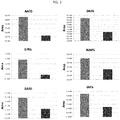
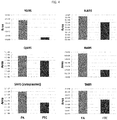
- 20 ARS and AIMP in follicular adenoma, 21 ARS and AIMP in follicular thyroid carcinoma tissues were identified, and quantitative analysis results are shown in the table below (Table 3, Table 4).
- AARS is decreased and AIMP1, KARS and VARS are increased in follicular thyroid carcinoma tissue, compared with follicular adenoma tissue ( FIG. 2 and FIG. 3 ).
- AARS aspartate-tRNA ligase
- DARS bifunctional glutamate/proline-tRNA ligase
- EPRS tryptophan-tRNA ligase
- WARS tryptophan-tRNA ligase
- GAS glycine-tRNA ligase
- IARS isoleucine-tRNA ligase cytoplasmic
- YARS tyrosine-tRNA ligase
- NARS glutamine-tRNA ligase
- QARS glutamine-tRNA ligase
- RARS arginine-tRNA ligase
- SARS cytoplasmic serine-tRNA ligase cytoplasmic
- TARS threonine-tRNA ligase
- AIMP1 isoleucine-tRNA ligase mitochondrial
- SARS mitochondrial serine-tRNA ligase mitochondrial
- KARS lysine-tRNA ligase
- VARS valine-tRNA ligase
- FARS alpha subunit phenylalanine-tRNA ligase alpha subunit
- AIMP1 was used as a representative, to confirm its detection ability described.
- Receiver Operating Characteristic (ROC) analysis was performed by deriving the band intensities and Area Under Curve (AUC) was calculated. As a result, the AUC was 0.770 and the significance level was 0.0195 (see FIG. 6 ).
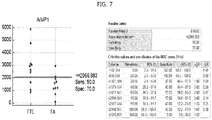
- FIG. 7 the result of the interactive plotting analysis showed that the AIMP1 can distinguish the follicular thyroid carcinoma from follicular adenoma with the sensitivity of 90% and the specificity of 70%.
- the ARS or AIMP protein types disclosed in the present invention are diagnostic markers that can differentially detect benign tumors such as follicular adenomas without tissue collection through surgery for follicular thyroid carcinoma in which a simple and definite diagnosis method is not available, thus being able to be used in fields such as an in vitro diagnostic industry.
Landscapes
- Health & Medical Sciences (AREA)
- Life Sciences & Earth Sciences (AREA)
- Engineering & Computer Science (AREA)
- Immunology (AREA)
- Molecular Biology (AREA)
- Biomedical Technology (AREA)
- Chemical & Material Sciences (AREA)
- Hematology (AREA)
- Urology & Nephrology (AREA)
- Food Science & Technology (AREA)
- General Physics & Mathematics (AREA)
- Cell Biology (AREA)
- Biotechnology (AREA)
- Medicinal Chemistry (AREA)
- Physics & Mathematics (AREA)
- Analytical Chemistry (AREA)
- Biochemistry (AREA)
- General Health & Medical Sciences (AREA)
- Microbiology (AREA)
- Pathology (AREA)
- Endocrinology (AREA)
- Measuring Or Testing Involving Enzymes Or Micro-Organisms (AREA)
- Investigating Or Analysing Biological Materials (AREA)
- Peptides Or Proteins (AREA)
- Hospice & Palliative Care (AREA)
- Oncology (AREA)
Applications Claiming Priority (2)
| Application Number | Priority Date | Filing Date | Title |
|---|---|---|---|
| KR20160083361 | 2016-07-01 | ||
| PCT/KR2017/007042 WO2018004321A1 (ko) | 2016-07-01 | 2017-07-03 | 아미노아실 티알엔에이 중합효소 관련 단백질 발현 수준을 이용한 갑상선 여포암 진단용 조성물과 진단 마커 검출 방법 |
Publications (2)
| Publication Number | Publication Date |
|---|---|
| EP3480596A1 true EP3480596A1 (de) | 2019-05-08 |
| EP3480596A4 EP3480596A4 (de) | 2020-07-22 |
Family
ID=60787463
Family Applications (1)
| Application Number | Title | Priority Date | Filing Date |
|---|---|---|---|
| EP17820597.7A Withdrawn EP3480596A4 (de) | 2016-07-01 | 2017-07-03 | Zusammensetzung zur diagnose eines follikulären schilddrüsenkarzinoms unter verwendung des expressionsniveaus eines aminoacyl-trna-synthetase-bezogenen proteins und verfahren zum nachweis eines diagnostischen markers |
Country Status (6)
| Country | Link |
|---|---|
| US (1) | US10677806B2 (de) |
| EP (1) | EP3480596A4 (de) |
| JP (1) | JP6792001B2 (de) |
| KR (1) | KR101995579B1 (de) |
| CN (1) | CN109844535A (de) |
| WO (1) | WO2018004321A1 (de) |
Families Citing this family (8)
| Publication number | Priority date | Publication date | Assignee | Title |
|---|---|---|---|---|
| JP7491510B2 (ja) | 2018-04-26 | 2024-05-28 | メディシナル バイオコンバージェンス リサーチ センター | mTOR阻害剤としての新規化合物及びその用途 |
| EP4001312A4 (de) * | 2019-07-18 | 2023-08-16 | JW Bioscience | Spezifisch an wrs-protein bindende antikörper und verwendung davon |
| KR102399033B1 (ko) * | 2019-10-30 | 2022-05-17 | 재단법인 아산사회복지재단 | 갑상선 여포 종양의 감별진단용 조성물 및 이를 이용한 감별진단 방법 |
| KR102252879B1 (ko) | 2019-11-15 | 2021-05-17 | 성균관대학교산학협력단 | 혈장 내 aimp2를 이용한 파킨슨 질환의 진단 방법, 이를 위한 조성물 및 이를 포함하는 키트 |
| CN114480569B (zh) * | 2022-01-21 | 2023-08-11 | 中山大学附属第一医院 | 一种高效的tRNA甲基化酶抑制剂筛选方法 |
| CN115047191B (zh) * | 2022-05-09 | 2024-12-17 | 上海市嘉定区中心医院(上海健康医学院附属嘉定区中心医院、上海交通大学医学院附属仁济医院嘉定分院) | 一种用于检测抗oj抗体的elisa试剂盒及其检测方法及应用 |
| CN115029433A (zh) * | 2022-06-22 | 2022-09-09 | 广州锦派生物科技有限责任公司 | 一种用于甲状腺结节相关基因甲基化检测的基因靶标及其试剂盒与应用 |
| KR20240161980A (ko) * | 2023-05-04 | 2024-11-14 | 연세대학교 산학협력단 | 갑상선암의 진단을 위한 신규한 바이오 마커 |
Family Cites Families (17)
| Publication number | Priority date | Publication date | Assignee | Title |
|---|---|---|---|---|
| ES2297953B1 (es) * | 2003-06-30 | 2009-10-21 | Progenika Biopharma, S.A. | Metodos in vitro para la deteccion de un carcinoma, determinacion de su estadio o severidad y para la determinacion de su desarrollo. |
| US7319011B2 (en) * | 2004-04-08 | 2008-01-15 | Duke University | Method for distinguishing follicular thyroid adenoma (FTA) from follicular thyroid carcinoma (FTC) |
| WO2008002672A2 (en) * | 2006-06-28 | 2008-01-03 | The Cleveland Clinic Foundation | Targets for use in diagnosis, prognosis and therapy of cancer |
| KR101067817B1 (ko) * | 2008-10-10 | 2011-09-27 | 서울대학교산학협력단 | Aimp1 폴리펩티드에 대한 항체를 포함하는 관절염 진단용 조성물 |
| KR101009501B1 (ko) * | 2008-10-10 | 2011-01-18 | 서울대학교산학협력단 | 항-라이실 티알엔에이 합성효소 항체 및 항-라미닌 수용체 항체를 유효성분으로 포함하는 암 진단용 조성물 |
| EP2427166B1 (de) * | 2009-05-07 | 2013-10-16 | Gea Pharma Systems Limited | Tablettenproduktionsmodul und verfahren zur kontinuierlichen herstellung von tabletten |
| US8828395B2 (en) * | 2009-12-11 | 2014-09-09 | Atyr Pharma, Inc. | Antibodies that bind tyrosyl-tRNA synthetases |
| CA2800281C (en) * | 2010-06-01 | 2021-01-12 | Atyr Pharma, Inc. | Innovative discovery of therapeutic, diagnostic, and antibody compositions related to protein fragments of lysyl-trna synthetases |
| KR20180059575A (ko) * | 2010-07-12 | 2018-06-04 | 에이티와이알 파마, 인코포레이티드 | 아스파르틸trna 합성효소의 단백질 단편에 관련된 치료적, 진단적, 및 항체 조성물의 혁신적 발견 |
| US20120184452A1 (en) * | 2011-01-13 | 2012-07-19 | Universidade De Santiago De Compostela | Methods for diagnosing follicular thyroid cancer |
| KR101589135B1 (ko) * | 2011-04-20 | 2016-01-29 | 주식회사 셀앤바이오 | 인간화 항-emapii 항체 및 이의 용도 |
| KR101888185B1 (ko) * | 2013-12-30 | 2018-08-13 | 재단법인 의약바이오컨버젼스연구단 | 항 AIMP1/p43 모노클로날 항체 및 이의 용도 |
| JP2017502672A (ja) * | 2013-12-30 | 2017-01-26 | メディシナル バイオコンバージェンス リサーチ センター | 抗krsモノクロナル抗体及びこれの用途 |
| KR20150077749A (ko) * | 2013-12-30 | 2015-07-08 | 재단법인 의약바이오컨버젼스연구단 | 항 grs 모노클로날 항체 및 이의 용도 |
| KR20150077891A (ko) * | 2013-12-30 | 2015-07-08 | 재단법인 의약바이오컨버젼스연구단 | 항 wrs 모노클로날 항체 및 이의 용도 |
| KR20150078013A (ko) * | 2013-12-30 | 2015-07-08 | 재단법인 의약바이오컨버젼스연구단 | 항 yrs 모노클로날 항체 및 이의 용도 |
| KR20160083361A (ko) | 2014-12-30 | 2016-07-12 | (주)센코 | 전기화학식 가스센서 전해질 및 그 제조방법 |
-
2017
- 2017-07-03 JP JP2018569007A patent/JP6792001B2/ja not_active Expired - Fee Related
- 2017-07-03 WO PCT/KR2017/007042 patent/WO2018004321A1/ko not_active Ceased
- 2017-07-03 CN CN201780052589.1A patent/CN109844535A/zh active Pending
- 2017-07-03 EP EP17820597.7A patent/EP3480596A4/de not_active Withdrawn
- 2017-07-03 KR KR1020170084428A patent/KR101995579B1/ko not_active Expired - Fee Related
-
2018
- 2018-12-27 US US16/233,695 patent/US10677806B2/en active Active
Also Published As
| Publication number | Publication date |
|---|---|
| WO2018004321A1 (ko) | 2018-01-04 |
| KR101995579B1 (ko) | 2019-07-03 |
| EP3480596A4 (de) | 2020-07-22 |
| JP6792001B2 (ja) | 2020-11-25 |
| CN109844535A (zh) | 2019-06-04 |
| US10677806B2 (en) | 2020-06-09 |
| US20190277865A1 (en) | 2019-09-12 |
| KR20180004674A (ko) | 2018-01-12 |
| JP2019525160A (ja) | 2019-09-05 |
Similar Documents
| Publication | Publication Date | Title |
|---|---|---|
| US10677806B2 (en) | Composition for diagnosing follicular thyroid carcinoma using expression level of aminoacyl-tRNA synthetase-related protein and method for detecting diagnostic marker | |
| KR101858717B1 (ko) | 췌장암 진단용 조성물 및 이를 이용한 췌장암 진단방법 | |
| CA2954051A1 (en) | Srm assays to chemotherapy targets | |
| JP6612414B2 (ja) | Pd−l1に対するsrmアッセイ | |
| JP2017133831A (ja) | 大腸がんの転移検出方法 | |
| US20160320398A1 (en) | SRM/MRM Assay for Subtyping Lung Histology | |
| KR101478826B1 (ko) | 신규한 대장암 진단용 마커 및 이를 이용한 대장암 진단 키트 | |
| JP5445969B2 (ja) | 膀胱癌の診断 | |
| WO2015023068A1 (ko) | 당단백질의 탈당화 검출을 통한 암 마커 스크리닝 방법 및 간세포암 마커 | |
| KR20140002149A (ko) | 췌장암 진단용 마커 및 이의 용도 | |
| CN116121392B (zh) | 用于胰腺囊性肿瘤诊断的方法和试剂 | |
| KR101878974B1 (ko) | 신장암 진단용 조성물과 진단 마커 검출 방법 | |
| JP5429725B1 (ja) | 前立腺癌の進行度の評価方法、前立腺癌の検出方法、および検査キット | |
| KR102735773B1 (ko) | 혈액 내 단백질 바이오마커를 포함하는 암 진단용 키트 | |
| JP2017215150A (ja) | 膀胱癌マーカー及びその使用 | |
| CN120891196A (zh) | 标志物lap3在胃癌检测上的应用 | |
| TWI487913B (zh) | A method for finding serum / plasma biomarker molecules of hepatocellular carcinoma and a method for detecting serum / plasma biomarker molecules |
Legal Events
| Date | Code | Title | Description |
|---|---|---|---|
| STAA | Information on the status of an ep patent application or granted ep patent |
Free format text: STATUS: THE INTERNATIONAL PUBLICATION HAS BEEN MADE |
|
| PUAI | Public reference made under article 153(3) epc to a published international application that has entered the european phase |
Free format text: ORIGINAL CODE: 0009012 |
|
| STAA | Information on the status of an ep patent application or granted ep patent |
Free format text: STATUS: REQUEST FOR EXAMINATION WAS MADE |
|
| 17P | Request for examination filed |
Effective date: 20190201 |
|
| AK | Designated contracting states |
Kind code of ref document: A1 Designated state(s): AL AT BE BG CH CY CZ DE DK EE ES FI FR GB GR HR HU IE IS IT LI LT LU LV MC MK MT NL NO PL PT RO RS SE SI SK SM TR |
|
| AX | Request for extension of the european patent |
Extension state: BA ME |
|
| DAV | Request for validation of the european patent (deleted) | ||
| DAX | Request for extension of the european patent (deleted) | ||
| RIC1 | Information provided on ipc code assigned before grant |
Ipc: G01N 33/573 20060101ALI20200207BHEP Ipc: G01N 33/574 20060101AFI20200207BHEP |
|
| A4 | Supplementary search report drawn up and despatched |
Effective date: 20200624 |
|
| RIC1 | Information provided on ipc code assigned before grant |
Ipc: G01N 33/573 20060101ALI20200618BHEP Ipc: G01N 33/574 20060101AFI20200618BHEP |
|
| STAA | Information on the status of an ep patent application or granted ep patent |
Free format text: STATUS: THE APPLICATION IS DEEMED TO BE WITHDRAWN |
|
| 18D | Application deemed to be withdrawn |
Effective date: 20210126 |