EP3486231B1 - Dérivé de pyrrolidine servant d'agoniste de ppar - Google Patents
Dérivé de pyrrolidine servant d'agoniste de ppar Download PDFInfo
- Publication number
- EP3486231B1 EP3486231B1 EP17826992.4A EP17826992A EP3486231B1 EP 3486231 B1 EP3486231 B1 EP 3486231B1 EP 17826992 A EP17826992 A EP 17826992A EP 3486231 B1 EP3486231 B1 EP 3486231B1
- Authority
- EP
- European Patent Office
- Prior art keywords
- compound
- mmol
- mixture
- solution
- ethyl acetate
- Prior art date
- Legal status (The legal status is an assumption and is not a legal conclusion. Google has not performed a legal analysis and makes no representation as to the accuracy of the status listed.)
- Active
Links
- 0 Cc1ccc(*)cc1 Chemical compound Cc1ccc(*)cc1 0.000 description 25
- ZMWYDAFTQMKSCS-UHFFFAOYSA-N CC(C)(C(O)=O)Oc1c(C)cc(C(CNC2)C2C(c(cc2)ccc2SC)=O)cc1C Chemical compound CC(C)(C(O)=O)Oc1c(C)cc(C(CNC2)C2C(c(cc2)ccc2SC)=O)cc1C ZMWYDAFTQMKSCS-UHFFFAOYSA-N 0.000 description 2
- OSIGJGFTADMDOB-UHFFFAOYSA-N Cc1cc(OC)ccc1 Chemical compound Cc1cc(OC)ccc1 OSIGJGFTADMDOB-UHFFFAOYSA-N 0.000 description 2
- BNOLDZWLWSTHQW-UHFFFAOYSA-N CC(C)(C(O)=O)OC1C=CC(CCC(CN(C2)C(Oc3ccccc3)=O)C2C(c(cc2)ccc2SC)=O)=CC1 Chemical compound CC(C)(C(O)=O)OC1C=CC(CCC(CN(C2)C(Oc3ccccc3)=O)C2C(c(cc2)ccc2SC)=O)=CC1 BNOLDZWLWSTHQW-UHFFFAOYSA-N 0.000 description 1
- AXVFEJPPBYZIKA-UHFFFAOYSA-N CC(C)(C(O)=O)Oc1c(C)cc(C(C2)C(Cc(cc3)ccc3SC)CN2C(OC)=O)cc1C Chemical compound CC(C)(C(O)=O)Oc1c(C)cc(C(C2)C(Cc(cc3)ccc3SC)CN2C(OC)=O)cc1C AXVFEJPPBYZIKA-UHFFFAOYSA-N 0.000 description 1
- ICGOYOUTMDUCGA-UHFFFAOYSA-N CC(C)(C(O)=O)Oc1c(C)cc(C(CN(C)C2)C2C(c(cc2)ccc2SC)=O)cc1C Chemical compound CC(C)(C(O)=O)Oc1c(C)cc(C(CN(C)C2)C2C(c(cc2)ccc2SC)=O)cc1C ICGOYOUTMDUCGA-UHFFFAOYSA-N 0.000 description 1
- TVFUNVRBIKCALT-BPGUCPLFSA-N CC(C)(C(O)=O)Oc1c(C)cc(C(CN(C2)C(OC)=O)[C@@H]2C(c(cc2)ccc2SC)=O)cc1C Chemical compound CC(C)(C(O)=O)Oc1c(C)cc(C(CN(C2)C(OC)=O)[C@@H]2C(c(cc2)ccc2SC)=O)cc1C TVFUNVRBIKCALT-BPGUCPLFSA-N 0.000 description 1
- JWYQXZHULLQWNL-UHFFFAOYSA-N CC(C)(C(O)=O)Oc1c(C)cc(C(CN(C2)C(Oc(ccc(Cl)c3)c3Cl)=O)C2C(c(cc2)ccc2SC)=O)cc1C Chemical compound CC(C)(C(O)=O)Oc1c(C)cc(C(CN(C2)C(Oc(ccc(Cl)c3)c3Cl)=O)C2C(c(cc2)ccc2SC)=O)cc1C JWYQXZHULLQWNL-UHFFFAOYSA-N 0.000 description 1
- ZLFMZFKGXFJEIF-UHFFFAOYSA-N CC(C)(C(O)=O)Oc1c(C)cc(C(CN(C2)C(Oc3ccc(C)cc3)=O)C2C(c(cc2)ccc2SC)=O)cc1C Chemical compound CC(C)(C(O)=O)Oc1c(C)cc(C(CN(C2)C(Oc3ccc(C)cc3)=O)C2C(c(cc2)ccc2SC)=O)cc1C ZLFMZFKGXFJEIF-UHFFFAOYSA-N 0.000 description 1
- QGRMNOAIDVNXLO-UHFFFAOYSA-N CC(C)(C(O)=O)Oc1c(C)cc(C(CN(Cc2ccccc2)C2)C2C(c(cc2)ccc2SC)=O)cc1C Chemical compound CC(C)(C(O)=O)Oc1c(C)cc(C(CN(Cc2ccccc2)C2)C2C(c(cc2)ccc2SC)=O)cc1C QGRMNOAIDVNXLO-UHFFFAOYSA-N 0.000 description 1
- HRDORTZYXOMOPQ-UHFFFAOYSA-N CC(C)(C(O)=O)Oc1c(C)cc(CC(CC2)CN2C(Oc(cc2)ccc2Br)=O)cc1C Chemical compound CC(C)(C(O)=O)Oc1c(C)cc(CC(CC2)CN2C(Oc(cc2)ccc2Br)=O)cc1C HRDORTZYXOMOPQ-UHFFFAOYSA-N 0.000 description 1
- SYYPEFXWTRQQDA-UHFFFAOYSA-N CC(C)(C(O)=O)Oc1c(C)cc(CCC(CN(C2)C(Oc3ccccc3)=O)C2C(c(cc2)ccc2SC)=O)cc1 Chemical compound CC(C)(C(O)=O)Oc1c(C)cc(CCC(CN(C2)C(Oc3ccccc3)=O)C2C(c(cc2)ccc2SC)=O)cc1 SYYPEFXWTRQQDA-UHFFFAOYSA-N 0.000 description 1
- ZBLQJNABDLZYIV-UHFFFAOYSA-N CC(C)(C(O)=O)Oc1c(C)cc(CCC(CNC2)C2C(c(cc2)ccc2SC)O)cc1C Chemical compound CC(C)(C(O)=O)Oc1c(C)cc(CCC(CNC2)C2C(c(cc2)ccc2SC)O)cc1C ZBLQJNABDLZYIV-UHFFFAOYSA-N 0.000 description 1
- ZWBAFEWLXCEDRR-GMAHTHKFSA-N CC(C)(C(O)=O)Oc1c(C)cc(CC[C@@H](CN(C2)C(OC)=O)[C@H]2C(c(cc2)ccc2SC)=O)cc1C Chemical compound CC(C)(C(O)=O)Oc1c(C)cc(CC[C@@H](CN(C2)C(OC)=O)[C@H]2C(c(cc2)ccc2SC)=O)cc1C ZWBAFEWLXCEDRR-GMAHTHKFSA-N 0.000 description 1
- AIWGSNVNEDXYPT-OCXYILCQSA-N CC(C)(C(O)=O)Oc1c(C)cc(CC[C@@H](CN(C2)C(Oc3ccccc3)=[U])[C@H]2C(c2ccccc2)=O)cc1C Chemical compound CC(C)(C(O)=O)Oc1c(C)cc(CC[C@@H](CN(C2)C(Oc3ccccc3)=[U])[C@H]2C(c2ccccc2)=O)cc1C AIWGSNVNEDXYPT-OCXYILCQSA-N 0.000 description 1
- ZWBAFEWLXCEDRR-FYYLOGMGSA-N CC(C)(C(O)=O)Oc1c(C)cc(CC[C@H](CN(C2)C(OC)=O)[C@@H]2C(c(cc2)ccc2SC)=O)cc1C Chemical compound CC(C)(C(O)=O)Oc1c(C)cc(CC[C@H](CN(C2)C(OC)=O)[C@@H]2C(c(cc2)ccc2SC)=O)cc1C ZWBAFEWLXCEDRR-FYYLOGMGSA-N 0.000 description 1
- DZKRBWHWWXOWNI-UFHPHHKVSA-N CC(C)(C(O)=O)Oc1c(C)cc(CC[C@H](CN(C2)C(Oc(cc3)ccc3Cl)=O)[C@@H]2C(c(cc2)ccc2SC)=O)cc1C Chemical compound CC(C)(C(O)=O)Oc1c(C)cc(CC[C@H](CN(C2)C(Oc(cc3)ccc3Cl)=O)[C@@H]2C(c(cc2)ccc2SC)=O)cc1C DZKRBWHWWXOWNI-UFHPHHKVSA-N 0.000 description 1
- WFWAQWSNFOVIQW-LEAFIULHSA-N CC(C)(C(O)=O)Oc1c(C)cc(CC[C@H](CN(C2)C(Oc3ccccc3)=O)[C@@H]2C(c(cc2)ccc2SC)=O)cc1C Chemical compound CC(C)(C(O)=O)Oc1c(C)cc(CC[C@H](CN(C2)C(Oc3ccccc3)=O)[C@@H]2C(c(cc2)ccc2SC)=O)cc1C WFWAQWSNFOVIQW-LEAFIULHSA-N 0.000 description 1
- WTIREHJPNZGIEV-ILBGXUMGSA-N CC(C)(C(O)=O)Oc1c(C)cc(CC[C@H](CN(CCOC)C2)[C@@H]2C(c(cc2)ccc2SC)=O)cc1C Chemical compound CC(C)(C(O)=O)Oc1c(C)cc(CC[C@H](CN(CCOC)C2)[C@@H]2C(c(cc2)ccc2SC)=O)cc1C WTIREHJPNZGIEV-ILBGXUMGSA-N 0.000 description 1
- ZWPYJSSJBKSFHK-HOFKKMOUSA-N CC(C)(C(O)=O)Oc1c(C)cc(C[C@@H](CN(C2)C(Oc(cc3)ccc3Br)=O)[C@H]2C(c(cc2)ccc2SC)=O)cc1C Chemical compound CC(C)(C(O)=O)Oc1c(C)cc(C[C@@H](CN(C2)C(Oc(cc3)ccc3Br)=O)[C@H]2C(c(cc2)ccc2SC)=O)cc1C ZWPYJSSJBKSFHK-HOFKKMOUSA-N 0.000 description 1
- QMNPLRLDHOPOEK-OZXSUGGESA-N CC(C)(C(O)=O)Oc1c(C)cc(C[C@@H](CN(C2)C(Oc3ccccc3)=O)[C@H]2C(c(cc2)ccc2Cl)=O)cc1C Chemical compound CC(C)(C(O)=O)Oc1c(C)cc(C[C@@H](CN(C2)C(Oc3ccccc3)=O)[C@H]2C(c(cc2)ccc2Cl)=O)cc1C QMNPLRLDHOPOEK-OZXSUGGESA-N 0.000 description 1
- QMNPLRLDHOPOEK-ZEQKJWHPSA-N CC(C)(C(O)=O)Oc1c(C)cc(C[C@H](CN(C2)C(Oc3ccccc3)=O)[C@@H]2C(c(cc2)ccc2Cl)=O)cc1C Chemical compound CC(C)(C(O)=O)Oc1c(C)cc(C[C@H](CN(C2)C(Oc3ccccc3)=O)[C@@H]2C(c(cc2)ccc2Cl)=O)cc1C QMNPLRLDHOPOEK-ZEQKJWHPSA-N 0.000 description 1
- KZRIQYMORZINHQ-ZEQKJWHPSA-N CC(C)(C(O)=O)Oc1c(C)cc(C[C@H](CN(C2)C(Oc3ccccc3)=O)[C@@H]2C(c(cc2)ccc2F)=O)cc1C Chemical compound CC(C)(C(O)=O)Oc1c(C)cc(C[C@H](CN(C2)C(Oc3ccccc3)=O)[C@@H]2C(c(cc2)ccc2F)=O)cc1C KZRIQYMORZINHQ-ZEQKJWHPSA-N 0.000 description 1
- JINBLUQXIQCLCX-JMFFZLBJSA-N CC(C)(C(O)=O)Oc1c(C)cc(C[C@H](CN(C2)C(Oc3ccccc3)=O)[C@@H]2C(c(cc2)ccc2SCOC(C(C)(C)Oc2c(C)cc(C[C@@H](CN(C3)C(Oc4ccccc4)=O)[C@H]3C(c(cc3)ccc3SCOC(C(C)(C)Oc3cc([C@@H](CN(C4)C(Oc5ccccc5)=O)[C@H]4C(c(cc4)ccc4SC)=O)ccc3)=O)=O)cc2C)=O)=O)cc1C Chemical compound CC(C)(C(O)=O)Oc1c(C)cc(C[C@H](CN(C2)C(Oc3ccccc3)=O)[C@@H]2C(c(cc2)ccc2SCOC(C(C)(C)Oc2c(C)cc(C[C@@H](CN(C3)C(Oc4ccccc4)=O)[C@H]3C(c(cc3)ccc3SCOC(C(C)(C)Oc3cc([C@@H](CN(C4)C(Oc5ccccc5)=O)[C@H]4C(c(cc4)ccc4SC)=O)ccc3)=O)=O)cc2C)=O)=O)cc1C JINBLUQXIQCLCX-JMFFZLBJSA-N 0.000 description 1
- YIWZSPUKLBRXGS-SXOMAYOGSA-N CC(C)(C(O)=O)Oc1c(C)cc([C@@H](CN(C2)C(Cc(cc3)ccc3Cl)=O)[C@H]2C(c(cc2)ccc2SC)=O)cc1C Chemical compound CC(C)(C(O)=O)Oc1c(C)cc([C@@H](CN(C2)C(Cc(cc3)ccc3Cl)=O)[C@H]2C(c(cc2)ccc2SC)=O)cc1C YIWZSPUKLBRXGS-SXOMAYOGSA-N 0.000 description 1
- NELHHJYRMADSAN-FTJBHMTQSA-N CC(C)(C(O)=O)Oc1c(C)cc([C@@H](CN(C2)C(Nc(cc3)ccc3Cl)=O)[C@H]2C(c(cc2)ccc2SC)=O)cc1C Chemical compound CC(C)(C(O)=O)Oc1c(C)cc([C@@H](CN(C2)C(Nc(cc3)ccc3Cl)=O)[C@H]2C(c(cc2)ccc2SC)=O)cc1C NELHHJYRMADSAN-FTJBHMTQSA-N 0.000 description 1
- ILOZWWHDYKADHN-SXOMAYOGSA-N CC(C)(C(O)=O)Oc1c(C)cc([C@@H](CN(C2)C(OCc3ccccc3)=O)[C@H]2C(c(cc2)ccc2SC)=O)cc1C Chemical compound CC(C)(C(O)=O)Oc1c(C)cc([C@@H](CN(C2)C(OCc3ccccc3)=O)[C@H]2C(c(cc2)ccc2SC)=O)cc1C ILOZWWHDYKADHN-SXOMAYOGSA-N 0.000 description 1
- PNDKJHYCUWJWKO-DCWQJPKNSA-N CC(C)(C(O)=O)Oc1c(C)cc([C@@H](CN(C2)C(Oc(cc3)ccc3F)=O)C2C(c(cc2)ccc2SC)=O)cc1C Chemical compound CC(C)(C(O)=O)Oc1c(C)cc([C@@H](CN(C2)C(Oc(cc3)ccc3F)=O)C2C(c(cc2)ccc2SC)=O)cc1C PNDKJHYCUWJWKO-DCWQJPKNSA-N 0.000 description 1
- CRKHQRYASUICNK-DUGNHKKISA-N CC(C)(C(O)=O)Oc1c(C)cc([C@@H](CN(C2)C(Oc3cccc(Cl)c3)=O)[C@H]2C(C(C=C2)=CCC2SC)O)cc1C Chemical compound CC(C)(C(O)=O)Oc1c(C)cc([C@@H](CN(C2)C(Oc3cccc(Cl)c3)=O)[C@H]2C(C(C=C2)=CCC2SC)O)cc1C CRKHQRYASUICNK-DUGNHKKISA-N 0.000 description 1
- YZAZACHCZYXHFD-UXHICEINSA-N CC(C)(C(O)=O)Oc1c(C)cc([C@@H](CN(C2)S(N)(=O)=O)[C@H]2C(c(cc2)ccc2SC)=O)cc1C Chemical compound CC(C)(C(O)=O)Oc1c(C)cc([C@@H](CN(C2)S(N)(=O)=O)[C@H]2C(c(cc2)ccc2SC)=O)cc1C YZAZACHCZYXHFD-UXHICEINSA-N 0.000 description 1
- YIWZSPUKLBRXGS-RRPNLBNLSA-N CC(C)(C(O)=O)Oc1c(C)cc([C@H](CN(C2)C(Cc(cc3)ccc3Cl)=O)[C@@H]2C(c(cc2)ccc2SC)=O)cc1C Chemical compound CC(C)(C(O)=O)Oc1c(C)cc([C@H](CN(C2)C(Cc(cc3)ccc3Cl)=O)[C@@H]2C(c(cc2)ccc2SC)=O)cc1C YIWZSPUKLBRXGS-RRPNLBNLSA-N 0.000 description 1
- WZIJOAODMYCBAI-QMXUZLBISA-N CC(C)(C(O)=O)Oc1c(C)cc([C@H](CN(C2)C(OC(CCC3)=CC3Cl)=O)[C@@H]2C(c(cc2)ccc2SC)=O)cc1C Chemical compound CC(C)(C(O)=O)Oc1c(C)cc([C@H](CN(C2)C(OC(CCC3)=CC3Cl)=O)[C@@H]2C(c(cc2)ccc2SC)=O)cc1C WZIJOAODMYCBAI-QMXUZLBISA-N 0.000 description 1
- ILOZWWHDYKADHN-RRPNLBNLSA-N CC(C)(C(O)=O)Oc1c(C)cc([C@H](CN(C2)C(OCc3ccccc3)=O)[C@@H]2C(c(cc2)ccc2SC)=O)cc1C Chemical compound CC(C)(C(O)=O)Oc1c(C)cc([C@H](CN(C2)C(OCc3ccccc3)=O)[C@@H]2C(c(cc2)ccc2SC)=O)cc1C ILOZWWHDYKADHN-RRPNLBNLSA-N 0.000 description 1
- PNDKJHYCUWJWKO-IZZNHLLZSA-N CC(C)(C(O)=O)Oc1c(C)cc([C@H](CN(C2)C(Oc(cc3)ccc3F)=O)[C@@H]2C(c(cc2)ccc2SC)=O)cc1C Chemical compound CC(C)(C(O)=O)Oc1c(C)cc([C@H](CN(C2)C(Oc(cc3)ccc3F)=O)[C@@H]2C(c(cc2)ccc2SC)=O)cc1C PNDKJHYCUWJWKO-IZZNHLLZSA-N 0.000 description 1
- VYAITFWSVFYJCJ-IZZNHLLZSA-N CC(C)(C(O)=O)Oc1c(C)cc([C@H](CN(C2)C(Oc3ccccc3)=O)[C@@H]2C(c(cc2)ccc2SC)=O)cc1C Chemical compound CC(C)(C(O)=O)Oc1c(C)cc([C@H](CN(C2)C(Oc3ccccc3)=O)[C@@H]2C(c(cc2)ccc2SC)=O)cc1C VYAITFWSVFYJCJ-IZZNHLLZSA-N 0.000 description 1
- KPYUGMQZJXMMOM-UHFFFAOYSA-N CC(C)(C(O)=O)Oc1c(C)cccc1C Chemical compound CC(C)(C(O)=O)Oc1c(C)cccc1C KPYUGMQZJXMMOM-UHFFFAOYSA-N 0.000 description 1
- GIIFZDPQJALDRJ-UHFFFAOYSA-N CC(C)(C(O)=O)Oc1ccc(CCC(CN(C2)C(OC3=CCCC=C3)=O)C2C(c(cc2)ccc2SC)=O)cc1F Chemical compound CC(C)(C(O)=O)Oc1ccc(CCC(CN(C2)C(OC3=CCCC=C3)=O)C2C(c(cc2)ccc2SC)=O)cc1F GIIFZDPQJALDRJ-UHFFFAOYSA-N 0.000 description 1
- MWFRMSKDYXRHAQ-DIMJTDRSSA-N CC(C)(C(O)=O)Oc1ccc(C[C@@H](CN(C2)C(Oc3ccccc3)=O)C2SC)cc1 Chemical compound CC(C)(C(O)=O)Oc1ccc(C[C@@H](CN(C2)C(Oc3ccccc3)=O)C2SC)cc1 MWFRMSKDYXRHAQ-DIMJTDRSSA-N 0.000 description 1
- OUGIJYGUTCNPIK-NVQXNPDNSA-N CC(C)(C(O)=O)Oc1ccc(C[C@@H](CN(C2)C(Oc3ccccc3)=O)[C@H]2C(c(cc2)ccc2SC)=O)cc1 Chemical compound CC(C)(C(O)=O)Oc1ccc(C[C@@H](CN(C2)C(Oc3ccccc3)=O)[C@H]2C(c(cc2)ccc2SC)=O)cc1 OUGIJYGUTCNPIK-NVQXNPDNSA-N 0.000 description 1
- YHSWOGUZUGPFRZ-UHFFFAOYSA-N CC(C)(C(O)O)Oc1c(C)cc(CC(CN(C2)C(Oc3ccccc3)=O)C2C(c(cc2)ccc2SC)=O)cc1C Chemical compound CC(C)(C(O)O)Oc1c(C)cc(CC(CN(C2)C(Oc3ccccc3)=O)C2C(c(cc2)ccc2SC)=O)cc1C YHSWOGUZUGPFRZ-UHFFFAOYSA-N 0.000 description 1
- NRUGDNSXJKVRJR-UHFFFAOYSA-N CC(C)(C(OC)=O)Oc1c(C)cc(CCC(CN(CCOC)C2)C2C(c(cc2)ccc2SC)=O)cc1C Chemical compound CC(C)(C(OC)=O)Oc1c(C)cc(CCC(CN(CCOC)C2)C2C(c(cc2)ccc2SC)=O)cc1C NRUGDNSXJKVRJR-UHFFFAOYSA-N 0.000 description 1
- VQZIWYCCOKOMPY-NPGPHTGCSA-N CC(C)(C(OC)=O)Oc1c(C)cc(CCC(CNC2)C2C(C(C)(C=C)SC2C(C(OC(Cl)=O)Cl)C3(C)[C@@H]2C3)=O)cc1C Chemical compound CC(C)(C(OC)=O)Oc1c(C)cc(CCC(CNC2)C2C(C(C)(C=C)SC2C(C(OC(Cl)=O)Cl)C3(C)[C@@H]2C3)=O)cc1C VQZIWYCCOKOMPY-NPGPHTGCSA-N 0.000 description 1
- QPBYVHFWMCPBCG-BBQAJUCSSA-N CC(C)(C(OC)=O)Oc1c(C)cc(CC[C@@H](CNC2)C2C(c(cc2)ccc2SC)=O)cc1C Chemical compound CC(C)(C(OC)=O)Oc1c(C)cc(CC[C@@H](CNC2)C2C(c(cc2)ccc2SC)=O)cc1C QPBYVHFWMCPBCG-BBQAJUCSSA-N 0.000 description 1
- GDRFBTNLMDGOBY-UHFFFAOYSA-N CC(C)(C)OC(C(C)(C)Oc1c(C)cc(CCC(CN(C2)C(Oc3ccccc3)=O)C2C(c(cc2)ccc2SC)=O)cc1C)=O Chemical compound CC(C)(C)OC(C(C)(C)Oc1c(C)cc(CCC(CN(C2)C(Oc3ccccc3)=O)C2C(c(cc2)ccc2SC)=O)cc1C)=O GDRFBTNLMDGOBY-UHFFFAOYSA-N 0.000 description 1
- MSDXKPLAULJHKA-IZEXYCQBSA-N CC(C)OC(C(C)(C)Oc1c(C)cc(CC[C@@H](CN(C2)C(Oc3ccccc3)=O)[C@H]2C(c(cc2)ccc2SC)=O)cc1C)=O Chemical compound CC(C)OC(C(C)(C)Oc1c(C)cc(CC[C@@H](CN(C2)C(Oc3ccccc3)=O)[C@H]2C(c(cc2)ccc2SC)=O)cc1C)=O MSDXKPLAULJHKA-IZEXYCQBSA-N 0.000 description 1
- MSDXKPLAULJHKA-GRKNLSHJSA-N CC(C)OC(C(C)(C)Oc1c(C)cc(CC[C@H](CN(C2)C(Oc3ccccc3)=O)[C@@H]2C(c(cc2)ccc2SC)=O)cc1C)=O Chemical compound CC(C)OC(C(C)(C)Oc1c(C)cc(CC[C@H](CN(C2)C(Oc3ccccc3)=O)[C@@H]2C(c(cc2)ccc2SC)=O)cc1C)=O MSDXKPLAULJHKA-GRKNLSHJSA-N 0.000 description 1
- GFVBSNCHWHRVRH-PKTZIBPZSA-N CC(C)OC(N(C[C@@H]1C(c(cc2)ccc2SC)=O)C[C@@H]1c(cc1C)cc(C)c1OC(C)(C)C(O)=O)=O Chemical compound CC(C)OC(N(C[C@@H]1C(c(cc2)ccc2SC)=O)C[C@@H]1c(cc1C)cc(C)c1OC(C)(C)C(O)=O)=O GFVBSNCHWHRVRH-PKTZIBPZSA-N 0.000 description 1
- SUROZNHRDAOBFB-ZCYQVOJMSA-N CC(C)OC(N(C[C@@H]1CCc(cc2C)cc(C)c2OC(C)(C)C(O)=O)C[C@@H]1C(c(cc1)ccc1SC)=O)=O Chemical compound CC(C)OC(N(C[C@@H]1CCc(cc2C)cc(C)c2OC(C)(C)C(O)=O)C[C@@H]1C(c(cc1)ccc1SC)=O)=O SUROZNHRDAOBFB-ZCYQVOJMSA-N 0.000 description 1
- GFVBSNCHWHRVRH-XZOQPEGZSA-N CC(C)OC(N(C[C@H]1C(c(cc2)ccc2SC)=O)C[C@H]1c(cc1C)cc(C)c1OC(C)(C)C(O)=O)=O Chemical compound CC(C)OC(N(C[C@H]1C(c(cc2)ccc2SC)=O)C[C@H]1c(cc1C)cc(C)c1OC(C)(C)C(O)=O)=O GFVBSNCHWHRVRH-XZOQPEGZSA-N 0.000 description 1
- YPSKBJMKWGYYDU-UHFFFAOYSA-N CC(C)c(cc1)ccc1OC(N(CC1C(c(cc2)ccc2SC)=O)CC1c(cc1C)cc(C)c1OC(C)(C)C(O)=O)=O Chemical compound CC(C)c(cc1)ccc1OC(N(CC1C(c(cc2)ccc2SC)=O)CC1c(cc1C)cc(C)c1OC(C)(C)C(O)=O)=O YPSKBJMKWGYYDU-UHFFFAOYSA-N 0.000 description 1
- LPOPZTYHTQBTCE-SEHCUKSESA-N CC(C1)C(C(C2)C2C(C)(C)C(O)=O)=C(C)C=C1[C@@H](CN(C1)C(Oc2cc(Cl)ccc2)=O)C1C(c(cc1)ccc1SC)=O Chemical compound CC(C1)C(C(C2)C2C(C)(C)C(O)=O)=C(C)C=C1[C@@H](CN(C1)C(Oc2cc(Cl)ccc2)=O)C1C(c(cc1)ccc1SC)=O LPOPZTYHTQBTCE-SEHCUKSESA-N 0.000 description 1
- NUAXFDMHHQJOQN-XHEPWMPHSA-N CC(C1)C(OC(C)(C)C(O)=O)=C(C)C=C1[C@@H](CN(C1)C(OC)=O)[C@H]1C(c(cc1)ccc1SC)=O Chemical compound CC(C1)C(OC(C)(C)C(O)=O)=C(C)C=C1[C@@H](CN(C1)C(OC)=O)[C@H]1C(c(cc1)ccc1SC)=O NUAXFDMHHQJOQN-XHEPWMPHSA-N 0.000 description 1
- BQIGTRNGINYHCG-UUBLPABXSA-N CC1C=C(CC[C@@H](CN(Cc2ccccc2)C2)C2C(c(cc2)ccc2SC)=O)C=C(C)C1(C)OC(C)(C)C(OC(C)(C)C)=O Chemical compound CC1C=C(CC[C@@H](CN(Cc2ccccc2)C2)C2C(c(cc2)ccc2SC)=O)C=C(C)C1(C)OC(C)(C)C(OC(C)(C)C)=O BQIGTRNGINYHCG-UUBLPABXSA-N 0.000 description 1
- VHJQELACKFOBPC-UHFFFAOYSA-N CCOC(C(C)(C)Oc1c(C)cc(CC(CN(C2)C(Oc(cc3)ccc3Br)=O)C2C(c(cc2)ccc2SC)=O)cc1C)=O Chemical compound CCOC(C(C)(C)Oc1c(C)cc(CC(CN(C2)C(Oc(cc3)ccc3Br)=O)C2C(c(cc2)ccc2SC)=O)cc1C)=O VHJQELACKFOBPC-UHFFFAOYSA-N 0.000 description 1
- DFRROPQSFGVGNS-FYYLOGMGSA-N CCOC(C(C)(C)Oc1c(C)cc(C[C@H](CNC2)[C@@H]2C(c(cc2)ccc2SC)=O)cc1C)=O Chemical compound CCOC(C(C)(C)Oc1c(C)cc(C[C@H](CNC2)[C@@H]2C(c(cc2)ccc2SC)=O)cc1C)=O DFRROPQSFGVGNS-FYYLOGMGSA-N 0.000 description 1
- WOGITAPSQLQSSV-QXPUDEPPSA-N CCOC(C(C)(C)Oc1c(C)cc([C@@H](CN(C2)C(Oc(cc3)ccc3F)=O)C2C(c(cc2)ccc2SC)=O)cc1C)=O Chemical compound CCOC(C(C)(C)Oc1c(C)cc([C@@H](CN(C2)C(Oc(cc3)ccc3F)=O)C2C(c(cc2)ccc2SC)=O)cc1C)=O WOGITAPSQLQSSV-QXPUDEPPSA-N 0.000 description 1
- CKDXIXYEMNEWTH-ZMFCMNQTSA-N CCOC(C(C)(C)Oc1c(C)cc([C@@H](CNC2)C2C(c(cc2)ccc2SC)=O)cc1C)=O Chemical compound CCOC(C(C)(C)Oc1c(C)cc([C@@H](CNC2)C2C(c(cc2)ccc2SC)=O)cc1C)=O CKDXIXYEMNEWTH-ZMFCMNQTSA-N 0.000 description 1
- LLXARJCAAWRVCT-SOFGYWHQSA-N CCOC(C(C)(C)Oc1ccc(C/C=C/C(c(cc2)ccc2SC)=O)cc1)=O Chemical compound CCOC(C(C)(C)Oc1ccc(C/C=C/C(c(cc2)ccc2SC)=O)cc1)=O LLXARJCAAWRVCT-SOFGYWHQSA-N 0.000 description 1
- WXEFSQBNHXMQHQ-ZZDYIDRTSA-N CCOC(C(C)(C)Oc1ccc(C[C@@H](CN(C2)C(Oc3ccccc3)=O)C2C(c(cc2)ccc2SC)=O)cc1)=O Chemical compound CCOC(C(C)(C)Oc1ccc(C[C@@H](CN(C2)C(Oc3ccccc3)=O)C2C(c(cc2)ccc2SC)=O)cc1)=O WXEFSQBNHXMQHQ-ZZDYIDRTSA-N 0.000 description 1
- GLNVWVQNIKFGJV-QUWDGAPNSA-N CCOC(C(C)(C)Oc1ccc(C[C@@H](CN(Cc2ccccc2)C2)C2C(c(cc2)ccc2SC)=O)cc1)=O Chemical compound CCOC(C(C)(C)Oc1ccc(C[C@@H](CN(Cc2ccccc2)C2)C2C(c(cc2)ccc2SC)=O)cc1)=O GLNVWVQNIKFGJV-QUWDGAPNSA-N 0.000 description 1
- PNWADPGHTXSHLE-YADHBBJMSA-N CCOC(N(C[C@@H]1C(c(cc2)ccc2SC)=O)C[C@@H]1c(cc1C)cc(C)c1OC(C)(C)C(O)=O)=O Chemical compound CCOC(N(C[C@@H]1C(c(cc2)ccc2SC)=O)C[C@@H]1c(cc1C)cc(C)c1OC(C)(C)C(O)=O)=O PNWADPGHTXSHLE-YADHBBJMSA-N 0.000 description 1
- PNWADPGHTXSHLE-FCHUYYIVSA-N CCOC(N(C[C@H]1C(c(cc2)ccc2SC)=O)C[C@H]1c(cc1C)cc(C)c1OC(C)(C)C(O)=O)=O Chemical compound CCOC(N(C[C@H]1C(c(cc2)ccc2SC)=O)C[C@H]1c(cc1C)cc(C)c1OC(C)(C)C(O)=O)=O PNWADPGHTXSHLE-FCHUYYIVSA-N 0.000 description 1
- SWYXIPRGTQBOIC-UHFFFAOYSA-N CSc(cc1)ccc1C(C(CC1)CN1C(Oc1cccc(Cl)c1)=O)=O Chemical compound CSc(cc1)ccc1C(C(CC1)CN1C(Oc1cccc(Cl)c1)=O)=O SWYXIPRGTQBOIC-UHFFFAOYSA-N 0.000 description 1
- ISLPFJVYFQPOAL-UHFFFAOYSA-N CSc(cc1)ccc1C(C=P(c1ccccc1)(c1ccccc1)c1ccccc1)=O Chemical compound CSc(cc1)ccc1C(C=P(c1ccccc1)(c1ccccc1)c1ccccc1)=O ISLPFJVYFQPOAL-UHFFFAOYSA-N 0.000 description 1
- QRVYABWJVXXOTN-UHFFFAOYSA-N CSc1ccc(C=O)cc1 Chemical compound CSc1ccc(C=O)cc1 QRVYABWJVXXOTN-UHFFFAOYSA-N 0.000 description 1
- CHLICZRVGGXEOD-UHFFFAOYSA-N Cc(cc1)ccc1OC Chemical compound Cc(cc1)ccc1OC CHLICZRVGGXEOD-UHFFFAOYSA-N 0.000 description 1
- GOAPCIVDGQHYDU-UHFFFAOYSA-N Nc([o]1)ccc1I Chemical compound Nc([o]1)ccc1I GOAPCIVDGQHYDU-UHFFFAOYSA-N 0.000 description 1
- IKMNJYGTSSQNSE-UHFFFAOYSA-N O=C(Oc(cc1)ccc1Br)Cl Chemical compound O=C(Oc(cc1)ccc1Br)Cl IKMNJYGTSSQNSE-UHFFFAOYSA-N 0.000 description 1
- MSBGPEACXKBQSX-UHFFFAOYSA-N O=C(Oc(cc1)ccc1F)Cl Chemical compound O=C(Oc(cc1)ccc1F)Cl MSBGPEACXKBQSX-UHFFFAOYSA-N 0.000 description 1
- AHWALFGBDFAJAI-UHFFFAOYSA-N O=C(Oc1ccccc1)Cl Chemical compound O=C(Oc1ccccc1)Cl AHWALFGBDFAJAI-UHFFFAOYSA-N 0.000 description 1
- HORNXRXVQWOLPJ-UHFFFAOYSA-N Oc1cccc(Cl)c1 Chemical compound Oc1cccc(Cl)c1 HORNXRXVQWOLPJ-UHFFFAOYSA-N 0.000 description 1
Classifications
-
- C—CHEMISTRY; METALLURGY
- C07—ORGANIC CHEMISTRY
- C07D—HETEROCYCLIC COMPOUNDS
- C07D207/00—Heterocyclic compounds containing five-membered rings not condensed with other rings, with one nitrogen atom as the only ring hetero atom
- C07D207/02—Heterocyclic compounds containing five-membered rings not condensed with other rings, with one nitrogen atom as the only ring hetero atom with only hydrogen or carbon atoms directly attached to the ring nitrogen atom
- C07D207/04—Heterocyclic compounds containing five-membered rings not condensed with other rings, with one nitrogen atom as the only ring hetero atom with only hydrogen or carbon atoms directly attached to the ring nitrogen atom having no double bonds between ring members or between ring members and non-ring members
- C07D207/08—Heterocyclic compounds containing five-membered rings not condensed with other rings, with one nitrogen atom as the only ring hetero atom with only hydrogen or carbon atoms directly attached to the ring nitrogen atom having no double bonds between ring members or between ring members and non-ring members with hydrocarbon radicals, substituted by hetero atoms, attached to ring carbon atoms
-
- A—HUMAN NECESSITIES
- A61—MEDICAL OR VETERINARY SCIENCE; HYGIENE
- A61K—PREPARATIONS FOR MEDICAL, DENTAL OR TOILETRY PURPOSES
- A61K31/00—Medicinal preparations containing organic active ingredients
- A61K31/33—Heterocyclic compounds
- A61K31/395—Heterocyclic compounds having nitrogen as a ring hetero atom, e.g. guanethidine or rifamycins
- A61K31/40—Heterocyclic compounds having nitrogen as a ring hetero atom, e.g. guanethidine or rifamycins having five-membered rings with one nitrogen as the only ring hetero atom, e.g. sulpiride, succinimide, tolmetin, buflomedil
-
- A—HUMAN NECESSITIES
- A61—MEDICAL OR VETERINARY SCIENCE; HYGIENE
- A61K—PREPARATIONS FOR MEDICAL, DENTAL OR TOILETRY PURPOSES
- A61K31/00—Medicinal preparations containing organic active ingredients
- A61K31/33—Heterocyclic compounds
- A61K31/395—Heterocyclic compounds having nitrogen as a ring hetero atom, e.g. guanethidine or rifamycins
- A61K31/40—Heterocyclic compounds having nitrogen as a ring hetero atom, e.g. guanethidine or rifamycins having five-membered rings with one nitrogen as the only ring hetero atom, e.g. sulpiride, succinimide, tolmetin, buflomedil
- A61K31/4025—Heterocyclic compounds having nitrogen as a ring hetero atom, e.g. guanethidine or rifamycins having five-membered rings with one nitrogen as the only ring hetero atom, e.g. sulpiride, succinimide, tolmetin, buflomedil not condensed and containing further heterocyclic rings, e.g. cromakalim
-
- A—HUMAN NECESSITIES
- A61—MEDICAL OR VETERINARY SCIENCE; HYGIENE
- A61K—PREPARATIONS FOR MEDICAL, DENTAL OR TOILETRY PURPOSES
- A61K31/00—Medicinal preparations containing organic active ingredients
- A61K31/33—Heterocyclic compounds
- A61K31/395—Heterocyclic compounds having nitrogen as a ring hetero atom, e.g. guanethidine or rifamycins
- A61K31/41—Heterocyclic compounds having nitrogen as a ring hetero atom, e.g. guanethidine or rifamycins having five-membered rings with two or more ring hetero atoms, at least one of which being nitrogen, e.g. tetrazole
- A61K31/415—1,2-Diazoles
- A61K31/4155—1,2-Diazoles non condensed and containing further heterocyclic rings
-
- A—HUMAN NECESSITIES
- A61—MEDICAL OR VETERINARY SCIENCE; HYGIENE
- A61P—SPECIFIC THERAPEUTIC ACTIVITY OF CHEMICAL COMPOUNDS OR MEDICINAL PREPARATIONS
- A61P1/00—Drugs for disorders of the alimentary tract or the digestive system
- A61P1/16—Drugs for disorders of the alimentary tract or the digestive system for liver or gallbladder disorders, e.g. hepatoprotective agents, cholagogues, litholytics
-
- A—HUMAN NECESSITIES
- A61—MEDICAL OR VETERINARY SCIENCE; HYGIENE
- A61P—SPECIFIC THERAPEUTIC ACTIVITY OF CHEMICAL COMPOUNDS OR MEDICINAL PREPARATIONS
- A61P3/00—Drugs for disorders of the metabolism
-
- A—HUMAN NECESSITIES
- A61—MEDICAL OR VETERINARY SCIENCE; HYGIENE
- A61P—SPECIFIC THERAPEUTIC ACTIVITY OF CHEMICAL COMPOUNDS OR MEDICINAL PREPARATIONS
- A61P3/00—Drugs for disorders of the metabolism
- A61P3/04—Anorexiants; Antiobesity agents
-
- A—HUMAN NECESSITIES
- A61—MEDICAL OR VETERINARY SCIENCE; HYGIENE
- A61P—SPECIFIC THERAPEUTIC ACTIVITY OF CHEMICAL COMPOUNDS OR MEDICINAL PREPARATIONS
- A61P3/00—Drugs for disorders of the metabolism
- A61P3/06—Antihyperlipidemics
-
- A—HUMAN NECESSITIES
- A61—MEDICAL OR VETERINARY SCIENCE; HYGIENE
- A61P—SPECIFIC THERAPEUTIC ACTIVITY OF CHEMICAL COMPOUNDS OR MEDICINAL PREPARATIONS
- A61P5/00—Drugs for disorders of the endocrine system
- A61P5/48—Drugs for disorders of the endocrine system of the pancreatic hormones
- A61P5/50—Drugs for disorders of the endocrine system of the pancreatic hormones for increasing or potentiating the activity of insulin
-
- A—HUMAN NECESSITIES
- A61—MEDICAL OR VETERINARY SCIENCE; HYGIENE
- A61P—SPECIFIC THERAPEUTIC ACTIVITY OF CHEMICAL COMPOUNDS OR MEDICINAL PREPARATIONS
- A61P9/00—Drugs for disorders of the cardiovascular system
-
- A—HUMAN NECESSITIES
- A61—MEDICAL OR VETERINARY SCIENCE; HYGIENE
- A61P—SPECIFIC THERAPEUTIC ACTIVITY OF CHEMICAL COMPOUNDS OR MEDICINAL PREPARATIONS
- A61P9/00—Drugs for disorders of the cardiovascular system
- A61P9/10—Drugs for disorders of the cardiovascular system for treating ischaemic or atherosclerotic diseases, e.g. antianginal drugs, coronary vasodilators, drugs for myocardial infarction, retinopathy, cerebrovascula insufficiency, renal arteriosclerosis
-
- C—CHEMISTRY; METALLURGY
- C07—ORGANIC CHEMISTRY
- C07D—HETEROCYCLIC COMPOUNDS
- C07D207/00—Heterocyclic compounds containing five-membered rings not condensed with other rings, with one nitrogen atom as the only ring hetero atom
- C07D207/02—Heterocyclic compounds containing five-membered rings not condensed with other rings, with one nitrogen atom as the only ring hetero atom with only hydrogen or carbon atoms directly attached to the ring nitrogen atom
- C07D207/04—Heterocyclic compounds containing five-membered rings not condensed with other rings, with one nitrogen atom as the only ring hetero atom with only hydrogen or carbon atoms directly attached to the ring nitrogen atom having no double bonds between ring members or between ring members and non-ring members
- C07D207/10—Heterocyclic compounds containing five-membered rings not condensed with other rings, with one nitrogen atom as the only ring hetero atom with only hydrogen or carbon atoms directly attached to the ring nitrogen atom having no double bonds between ring members or between ring members and non-ring members with hetero atoms or with carbon atoms having three bonds to hetero atoms with at the most one bond to halogen, e.g. ester or nitrile radicals, directly attached to ring carbon atoms
- C07D207/12—Oxygen or sulfur atoms
-
- C—CHEMISTRY; METALLURGY
- C07—ORGANIC CHEMISTRY
- C07D—HETEROCYCLIC COMPOUNDS
- C07D207/00—Heterocyclic compounds containing five-membered rings not condensed with other rings, with one nitrogen atom as the only ring hetero atom
- C07D207/02—Heterocyclic compounds containing five-membered rings not condensed with other rings, with one nitrogen atom as the only ring hetero atom with only hydrogen or carbon atoms directly attached to the ring nitrogen atom
- C07D207/04—Heterocyclic compounds containing five-membered rings not condensed with other rings, with one nitrogen atom as the only ring hetero atom with only hydrogen or carbon atoms directly attached to the ring nitrogen atom having no double bonds between ring members or between ring members and non-ring members
- C07D207/10—Heterocyclic compounds containing five-membered rings not condensed with other rings, with one nitrogen atom as the only ring hetero atom with only hydrogen or carbon atoms directly attached to the ring nitrogen atom having no double bonds between ring members or between ring members and non-ring members with hetero atoms or with carbon atoms having three bonds to hetero atoms with at the most one bond to halogen, e.g. ester or nitrile radicals, directly attached to ring carbon atoms
- C07D207/16—Carbon atoms having three bonds to hetero atoms with at the most one bond to halogen, e.g. ester or nitrile radicals
-
- C—CHEMISTRY; METALLURGY
- C07—ORGANIC CHEMISTRY
- C07D—HETEROCYCLIC COMPOUNDS
- C07D403/00—Heterocyclic compounds containing two or more hetero rings, having nitrogen atoms as the only ring hetero atoms, not provided for by group C07D401/00
- C07D403/02—Heterocyclic compounds containing two or more hetero rings, having nitrogen atoms as the only ring hetero atoms, not provided for by group C07D401/00 containing two hetero rings
- C07D403/12—Heterocyclic compounds containing two or more hetero rings, having nitrogen atoms as the only ring hetero atoms, not provided for by group C07D401/00 containing two hetero rings linked by a chain containing hetero atoms as chain links
-
- C—CHEMISTRY; METALLURGY
- C07—ORGANIC CHEMISTRY
- C07D—HETEROCYCLIC COMPOUNDS
- C07D405/00—Heterocyclic compounds containing both one or more hetero rings having oxygen atoms as the only ring hetero atoms, and one or more rings having nitrogen as the only ring hetero atom
- C07D405/02—Heterocyclic compounds containing both one or more hetero rings having oxygen atoms as the only ring hetero atoms, and one or more rings having nitrogen as the only ring hetero atom containing two hetero rings
- C07D405/04—Heterocyclic compounds containing both one or more hetero rings having oxygen atoms as the only ring hetero atoms, and one or more rings having nitrogen as the only ring hetero atom containing two hetero rings directly linked by a ring-member-to-ring-member bond
-
- C—CHEMISTRY; METALLURGY
- C07—ORGANIC CHEMISTRY
- C07D—HETEROCYCLIC COMPOUNDS
- C07D409/00—Heterocyclic compounds containing two or more hetero rings, at least one ring having sulfur atoms as the only ring hetero atoms
- C07D409/02—Heterocyclic compounds containing two or more hetero rings, at least one ring having sulfur atoms as the only ring hetero atoms containing two hetero rings
- C07D409/06—Heterocyclic compounds containing two or more hetero rings, at least one ring having sulfur atoms as the only ring hetero atoms containing two hetero rings linked by a carbon chain containing only aliphatic carbon atoms
-
- C—CHEMISTRY; METALLURGY
- C07—ORGANIC CHEMISTRY
- C07D—HETEROCYCLIC COMPOUNDS
- C07D401/00—Heterocyclic compounds containing two or more hetero rings, having nitrogen atoms as the only ring hetero atoms, at least one ring being a six-membered ring with only one nitrogen atom
- C07D401/02—Heterocyclic compounds containing two or more hetero rings, having nitrogen atoms as the only ring hetero atoms, at least one ring being a six-membered ring with only one nitrogen atom containing two hetero rings
- C07D401/12—Heterocyclic compounds containing two or more hetero rings, having nitrogen atoms as the only ring hetero atoms, at least one ring being a six-membered ring with only one nitrogen atom containing two hetero rings linked by a chain containing hetero atoms as chain links
-
- C—CHEMISTRY; METALLURGY
- C07—ORGANIC CHEMISTRY
- C07D—HETEROCYCLIC COMPOUNDS
- C07D403/00—Heterocyclic compounds containing two or more hetero rings, having nitrogen atoms as the only ring hetero atoms, not provided for by group C07D401/00
- C07D403/02—Heterocyclic compounds containing two or more hetero rings, having nitrogen atoms as the only ring hetero atoms, not provided for by group C07D401/00 containing two hetero rings
- C07D403/06—Heterocyclic compounds containing two or more hetero rings, having nitrogen atoms as the only ring hetero atoms, not provided for by group C07D401/00 containing two hetero rings linked by a carbon chain containing only aliphatic carbon atoms
Definitions
- the present invention relates to a class of pyrrolidine derivatives as PPAR agonist, as well as their use for the treatment of some diseases related to PPAR receptor-associated pathways (such as, nonalcoholic steatohepatitis and concurrent fibrosis, insulin resistance, primary biliary cholangitis, dyslipidemia, hyperlipidemia, hypercholesterolemia, atherosclerosis, hypertriglyceridemia, cardiovascular disease, obesity, and the like).
- some diseases related to PPAR receptor-associated pathways such as, nonalcoholic steatohepatitis and concurrent fibrosis, insulin resistance, primary biliary cholangitis, dyslipidemia, hyperlipidemia, hypercholesterolemia, atherosclerosis, hypertriglyceridemia, cardiovascular disease, obesity, and the like.
- the present invention relates to a compound represented by Formula (I) or a pharmaceutically acceptable salt thereof.
- Nonalcoholic fatty liver disease which is the most common liver disease in developed countries or regions, means that excess fat accumulates in the liver in a form of triglycerides (steatosis > 5% of hepatocyte tissue).
- NAFLD Nonalcoholic fatty liver disease
- patients suffering from NAFLD may be accompanied with hepatocyte injury and inflammation (fatty liver hepatitis), of which the latter is NASH (Nonalcoholic steatohepatitis).
- NAFLD having steatosis alone does not correlate with increased short-term morbidity or mortality, but once developed into NASH, it would increase significantly the risk of having liver cirrhosis, liver failure, and hepatocellular carcinoma (HCC).
- HCC hepatocellular carcinoma
- NASH Newcastle disease virus
- NASH nonalcoholic fatty liver disease
- Most patients with NAFLD are males, old people, hypertensives and diabetics. 60-76 % of diabetics have NAFLD, and 22% have NASH.
- the number of children with NAFLD is also growing year by year, and 38-53% of obese children have NAFLD.
- the incidence of nonalcoholic fatty liver disease has been ranked first.
- liver protection medicaments such as polyene phosphatidylcholine, silymarin, ursodeoxycholic acid, glycyrrhizic acid and the like.
- PPARs Peroxisome proliferator-activated receptors
- PPAP Alpha which is mainly expressed in brown adipose tissue, liver, heart and skeletal muscle, and plays a major role in the metabolism of bile acids, lipids and sugars
- PPAP Delta which has no obvious specific expression, and may have anti-inflammatory effect
- PPAP Gamma which has certain effects on insulin resistance.
- This receptor is associated with various diseases, including dyslipidemia, hyperlipidemia, hypercholesterolemia, atherosclerosis, atherogenesis, hypertriglyceridemia, heart failure, myocardial infarction, vascular diseases, cardiovascular diseases, hypertension, obesity, inflammation, arthritis, cancer, Alzheimer's disease, skin diseases, respiratory diseases, eye disorders, IBD (irritable bowel disease), ulcerative colitis, and Crohn's disease.
- PPAR has various mechanisms beneficial to liver functions
- PPAR agonists are one of the most effective potential medicaments for the treatment of fatty liver.
- PPAR agonist compounds which have been reported in literatures.
- PPAR agonist compounds comprising a pyrrolidine ring have been disclosed in Bioorg. Med. Chem. Lett. 25 (2015) 1196-1205 .
- the present invention provides a compound of Formula (I), and a pharmaceutically acceptable salt thereof, wherein:
- the above R 1 is selected from H, NH 2 , or from C 1-6 alkyl, cyclopentyl, azetidinyl, pyrrolidinyl, tetrahydrothienyl, tetrahydrofuranyl, piperidyl, morpholinyl, piperazinyl, phenyl, pyrazolyl, pyridyl, cyclohexyl each of which is optionally substituted with 1, 2, or 3 R.
- R 1 is selected from H, NH 2 , or from Me, Et, each of which is optionally substituted with 1, 2, or 3 R.
- R 1 is selected from H, NH 2 , Me, Et,
- R 2 , R 3 are independently selected from H, F, Cl, Br, I, OH, NH 2 , or from Me, Et each of which is optionally substituted with 1, 2, or 3 R.
- R 2 , R 3 are independently selected from H, F, Cl, Br, I, OH, NH 2 , Me, Et.
- R 4 is selected from H, or from Me, Et, each of which is optionally substituted with 1, 2, or 3 R.
- R 4 is selected from H, Me, Et,
- R 4 is selected from H, Me, Et,
- R 5 is selected from H, F, Cl, Br, I, OH, NH 2 , CN, COOH, or from Me, Et, each of which is optionally substituted with 1, 2, or 3 R.
- R 5 is selected from H, F, Cl, Br, I, OH, NH 2 , CN, COOH, CF 3 ,
- the above structural unit is selected from:
- the above structural unit is selected from:
- the above structural unit is selected from:
- the above ring A is selected from: phenyl, naphthyl, pyridyl, pyrimidyl, pyrazinyl, pyridazinyl, thienyl, pyrazolyl, imidazolyl, oxazolyl, thiazolyl, isoxazolyl, isothiazolyl.
- the above structural unit is selected from:
- the above structural unit is selected from
- the above L 4 is selected from a single bond, - CH 2 -,- CH 2 CH 2 -.
- the above R 1 is selected from H, NH 2 , or from C 1-6 alkyl, cyclopentyl, azetidinyl, pyrrolidinyl, tetrahydrothienyl, tetrahydrofuranyl, piperidyl, morpholinyl, piperazinyl, phenyl, pyrazolyl, pyridyl, cyclohexyl each of which is optionally substituted with 1, 2, or 3 R, and other variables are as defined above.
- R 1 is selected from H, NH 2 , or from Me, Et, each of which is optionally substituted with 1, 2, or 3 R, and other variables are as defined above.
- R 1 is selected from H, NH 2 , Me, Et, and other variables are as defined above.
- R 2 , R 3 are independently selected from H, F, Cl, Br, I, OH, NH 2 , or from Me, Et each of which is optionally substituted with 1, 2, or 3 R, and other variables are as defined above.
- R 2 , R 3 are independently selected from H, F, Cl, Br, I, OH, NH 2 , Me, Et, and other variables are as defined above.
- R 4 is selected from H, or from Me, Et, each of which is optionally substituted with 1, 2, or 3 R, and other variables are as defined above.
- R 4 is selected from H, Me, Et, and other variables are as defined above.
- R 4 is selected from H, Me, Et, and other variables are as defined above.
- R 5 is selected from H, F, Cl, Br, I, OH, NH 2 , CN, COOH, or from Me, Et, each of which is optionally substituted with 1, 2, or 3 R, and other variables are as defined above.
- R 5 is selected from H, F, Cl, Br, I, OH, NH 2 , CN, COOH, CF 3 , and other variables are as defined above.
- the above structural unit is selected: and other variables are as defined above.
- the above structural unit is selected from: and other variables are as defined above.
- the above structural unit is selected from: and other variables are as defined above.
- the above ring A is selected from: phenyl, naphthyl, pyridyl, pyrimidyl, pyrazinyl, pyridazinyl, thienyl, pyrazolyl, imidazolyl, oxazolyl, thiazolyl, isoxazolyl, isothiazolyl, and other variables are as defined above.
- the above structural unit is selected from: and other variables are as defined above.
- the above structural unit is selected from and other variables are as defined above.
- the above L 4 is selected from a single bond, - CH 2 -, -CH 2 CH 2 -, and other variables are as defined above.
- the above compound or pharmaceutically acceptable salt thereof which is selected from: wherein R 1 , R 2 , R 3 , R 5 , L 1 , L 2 , L 3 , L 4 are as defined above.
- the present invention further provides a compound which is represented by a formula selected from:
- the above compound is selected from:
- the present invention may further comprise some embodiments which is obtained from any combination of the above variables.
- the present invention further provides a pharmaceutical composition
- a pharmaceutical composition comprising a therapetically effective amount of the above compound or pharmaceutically acceptable salt thereof as an active ingredient, as well as a pharmaceutically acceptable carrier.
- the present invention further provides use of the above compound or pharmaceutically acceptable salt thereof, or the above composition for the manufacture of a medicament for treating PPAR receptor-associated disorders.
- the present invention further provides use of the above compound or pharmaceutically acceptable salt thereof, or the above composition for manufacture of a medicament for treating nonalcoholic steatohepatitis and concurrent fibrosis, insulin resistance, primary biliary cholangitis, dyslipidemia, hyperlipidemia, hypercholesterolemia, atherosclerosis, hypertriglyceridemia, cardiovascular disease, obesity.
- the present invention discloses a class of pyrrolidine derivatives of Fomula (I) as PPAR agonists and a method for preparing the same, wherein this class of compounds can be used to treat some diseases related to PPAR receptor-associated pathways (such as, nonalcoholic steatohepatitis and concurrent fibrosis, insulin resistance, primary biliary cholangitis, dyslipidemia, hyperlipidemia, hypercholesterolemia, atherosclerosis, hypertriglyceridemia, cardiovascular Disease, obesity, and the like). As compared with conventional PPAR agonists, this class of agonists show better activity, higher selectivity, and superior efficacy.
- some diseases related to PPAR receptor-associated pathways such as, nonalcoholic steatohepatitis and concurrent fibrosis, insulin resistance, primary biliary cholangitis, dyslipidemia, hyperlipidemia, hypercholesterolemia, atherosclerosis, hypertriglyceridemia, cardiovascular Disease, obesity, and the like.
- pharmaceutically acceptable salt refers to the salts of the compounds of the present invention, and the salts are prepared from the compounds having specific substituent(s) with a relatively non-toxic acid or alkali.
- a alkali addition salt may be obtained by means of contacting a sufficient amount of alkali with a neutral form of such compounds in a pure solution or a suitable inert solvent.
- Pharmaceutically acceptable alkali additional salts include sodium, potassium, calcium, ammonium, organic amine or magnesium salts, or the like.
- an acid additional salt may be obtained by means of contacting a sufficient amount of acid with a neutral form of such compounds in a pure solution or a suitable inert solvent.
- the pharmaceutically acceptable acid addition salts comprise inorganic acid salts, in which the inorganic acid include, e.g., hydrochloric acid, hydrobromic acid, nitric acid, carbonic acid, bicarbonate radical, phosphoric acid, monohydrogen phosphate radical, dihydrogen phosphate radical, sulphuric acid, hydrosulfate radical, hydroiodic acid, phosphorous acid, etc.; and organic acid salts, in which the organic acid include, e.g., acetic acid, propionic acid, isobutyric acid, maleic acid, malonic acid, benzoic acid, succinic acid, suberic acid, fumaric acid, lactic acid, mandelic acid, phthalic acid, benzenesulfonic acid, p-to
- the neutral form of a compound can be regenerated by conventionally contacting a salt with an alkali or acid, followed by isolating a parent compound.
- the parent compound of a compound differs from the salt thereof in certain physical properties, e.g., in solubility in a polar solvent.
- pharmaceutically acceptable salt belongs to the derivative of the compound of the present invention, wherein the parent compound is modified by forming a salt with an acid or alkali.
- pharmaceutically acceptable salts include, but are not limited to, inorganic or organic acid salts of alkaline groups, such as amines; alkali metal or organic salts of acidic radicals, such as, carboxylic acid.
- the pharmaceutically acceptable salts comprise common non-toxic salts or quaternary ammonium salts of the parent compound, such as, the salts formed from non-toxic inorganic or organic acids.
- the common non-toxic salts include, but are not limited to, those derived from inorganic and organic acids selected from 2-acetoxybenzoic acid, 2-hydroxyethanesulfonic acid, acetic acid, ascorbic acid, benzenesulfonic acid, benzoic acid, hydrocarbonate radical, carbonic acid, citric acid, edetic acid, ethanedisulfonic acid, ethanesulfonic acid, fumaric acid, glucoheptose, gluconic acid, glutamic acid, glycolic acid, hydrobromic acid, hydrochloric acid, hydriodate, hydroxyl, hydroxynaphthalene, isethionic acid, lactic acid, lactose, dodecyl sulfonic acid, maleic acid, malic acid, mandelic acid, methanesulfonic acid, nitric acid, oxalic acid, pamoic acid, pantothenic acid, phenylacetic acid, phosphoric acid
- the pharmaceutically acceptable salts of the present invention may be synthesized from a parent compound having an acidic or alkaline group via a conventional chemical method.
- such salts are prepared by reacting these compounds in a form of free acid or alkali with a stoichiometric amount of a suitable alkali or acid in water or an organic solvent or a mixture thereof.
- a non-aqueous medium e.g., ether, ethyl acetate, ethanol, isopropanol, acetonitrile or the like, are preferred.
- the compounds provided by the present invention may have a form of prodrug.
- the prodrug of the compounds as described herein can be easily chemically converted to the compounds of the present invention under physiological conditions.
- the prodrugs may be, in vivo, converted to the compounds of the present invention via a chemical or biochemical process.
- Some compounds of the present invention may be present in a form of non-solvate or solvate, including a form of hydrate.
- the non-solvate form and the solvate form are comparable with each other, both of them are encompassed within the scope of the present invention.
- Some compounds of the present invention may have asymmetric carbon atoms (optical center) or double bonds. Racemates, diastereomers, geometric isomers, and individual isomers are all encompassed within the scope of the present invention.
- a wedge bond and dashed bond are used to indicate the absolute configuration of a stereocenter; a wavy line is used to indicate a wedge or dashed bond ( or ), and are used to indicate a relative configuration of a stereocenter.
- the compounds as described herein comprise an olefinic double bond or other geometrically asymmetric centers, unless defined otherwise, they would comprise E -, Z -geometrical isomers. Similarly, all the tautomers are encompassed within the scope of the present invention.
- the compounds of the present invention may be present in a specific geometric or stereoisomeric form. It is expected by present invention that all of such compounds include cis- and trans -isomers, (-)- and (+)-enantiomers, ( R ) - and ( S )-enantiomers, diastereomers, ( D )-isomers, ( L )-isomers and a racemic mixture thereof, as well as other mixture such as an enantiomer- or diastereomer-enriched mixture, all of the mixtures are encompassed within the scope of the present invention.
- the substituents, such as alkyl and the like, may have additional asymmetric carbon atoms. All of these isomers and the mixtures thereof are encompassed within the scope of the present invention.
- Optically active ( R) - and ( S ) - isomers and D - and L- isomers may be prepared by chiral synthesis or chiral reagents or by other conventional technologies. If one enantiomer of a compound of the present invention is desired, it could be prepared by asymmetric synthesis or derivatization with a chiral auxiliary, in which the resulted mixture of diastereomers would be isolated, and then a pure enantiomer as desired would be provided by cleaving the auxiliary group.
- a molecule may be reacted with a suitable optically active acid or alkali to form a salt of diastereomers, which are in turn subjected to diastereoisomer resolution via a well-known conventional method in the art, and are then recovered to give a pure enantiomer.
- a suitable optically active acid or alkali to form a salt of diastereomers, which are in turn subjected to diastereoisomer resolution via a well-known conventional method in the art, and are then recovered to give a pure enantiomer.
- the isolation of the enantiomers and diastereoisomers is usually accomplished by chromatography, which may utilize a chiral stationary phase, and optionally be combined with a chemical derivatization method (e.g., producing carbamate from amine).
- the compounds of the present invention may comprise a non-naturally occurring ratio of isotope(s) at one or more atoms of the compounds.
- the compounds may be labelled with radioisotope(s), such as tritium ( 3 H), iodine-125 ( 121 I) or C-14 ( 14 C). All isotopic variants of the compounds of the present invention, are encompassed within the scope of the present invention, regardless of their radioactivity.
- pharmaceutically acceptable carrier refers to any preparation or carrier medium which can deliver an effective amount of the active substances of the present invention, without interfering with the bioactivity of the active substances, and without toxic and side effects to subjects or patients.
- Representive carriers comprise water, oil, vegetables and minerals, cream base, lotion base, ointment base, and the like. These base materials comprise suspending agents, thickening agents, transdermal enhancers, and the like.
- the preparations thereof are well known by the skilled persons in the cosmetic or topical drug field. Other information for the carriers may refer to Remington: The Science and Practice of Pharmacy, 21st Ed., Lippincott, Williams & Wilkins (2005 ), the conents of which are incorporated herein by reference.
- excipient generally refers to carriers, diluents, and/or media required by the formulation of an efficive pharmaceutical composition.
- an "effective amount” or “therapetically effective amount” refers to a sufficient amount of the drug or medicament which can achieve the desired effect, without producing toxicity.
- an "effective amount" of one active substance in the composition refers to the amount required to achieve the desired effect, when used in combination with another active substance in the composition. The determination of the effective amount varies from person to person, depending on the age and general conditions of the subject, and on the particular active substance. The appropriate effective amount for an individual case may be determined by a person skilled in the art via conventional experiments.
- active ingredient(s) refers to a chemical entity which can effectively treat disorders, diseases, or conditions of the subject.
- substituted refers that any one or more hydrogen atom(s) of a particular atom are substituted with a substituent, which may include variants of heavy hydrogen and hydrogen, as long as the valence of the particular atom is normal and the substituted compound is stable.
- Ketone substitution would not occur on an aromatic group.
- optionally substituted means that it may be or not be substituted. Unless defined otherwise, the substituents may be of any type and any number as long as they are chemically achievable.
- any variable e.g., R
- the definition thereof is independent in each case.
- the group may be optionally substituted with at most 2 R, and each R has independent selections in each case.
- a combination of the substituents and/or the variants thereof is allowable only if such combination leads to a stable compound.
- linking group When the number of a linking group is zero, such as-(CRR) 0 -, it means that the linking group is a single bond.
- variable When a variable is selected from a single bond, it means that the two groups linked by this variable are directly linked. For example, when L in a structure A-L-Z represents a single bond, this structure actually is A-Z.
- substituent When a substituent is absent, it means that the substituent does not exist. For instance, when X in a structure A-X is absent, it means that the structure actually is A. When a substituent can be linked to more than one atom in a ring, this substituent may be bound to any atom in the ring.
- a structural unit means that the substituent R may be attached to any site of cyclohexyl or cyclohexadiene. When it is not indicated through which atom a recited substituent is attached to a substituted group, the substituent may be bound through any atom therein.
- pyridyl as a substituent may be attachced to a substituted group via any carbon atom of the pyridyl ring.
- the linking direction of a recited linking group is not indicated, the linking direction thereof is random.
- the linking group L in is-M-W-
- -M-W- may not only link ring A to ring B in a direction identical to a reading order from left to right so as to form but also link ring A to ring B in a direction opposite to a reading order from left ot right so as to form
- substituents and/or variants thereof is allowable only if such combination leads to a stable compound.
- a "ring” refers that substituted or unsubstituted cycloalkyl, heterocycloalkyl, cycloalkylene, heretocycloalkylene, cycloalkynyl, heretocycloalkynyl, aryl or heteroaryl.
- Said ring comprises a mono ring, linked ring, spiro ring, fused ring, or bridged ring.
- the number of the atoms in the ring is typically defined as the membered number of the ring. For example, "5-7 membered ring” means that 5-7 atoms are arranged in a circular manner. Unless defined otherwise, the ring optionally contains 1-3 heteroatoms.
- 5-7 membered ring comprises, e.g., phenyl, pyridinyl and piperidyl; and on the other hand, the term “5-7-membered heterocycloalkyl ring” comprises pyridyl and piperidyl, but does not comprise phenyl.
- cyclo/ring further comprises a ring system containing at least one ring, in which each "ring" meets independently the above definition.
- heterocycle refers to a stable mono-, double-, or triple-ring containing heteroatom(s) or heteroatomic group(s), such ring may be saturated, partially unsaturated or unsaturated (aromatic), and may comprise carbon atom(s) and 1, 2, 3 or 4 ring heteroatom(s) independently selected from N, O and S, wherein any of the above heterocycles may be fused to a phenyl ring to form a double ring.
- Nitrogen and sulfur heteroatoms may be optionally oxidized (i.e., NO and S (O) p , wherein p is 1 or 2).
- Nitrogen atom may be substituted or unsubstituted (i.e., N or NR, wherein R is H or another substituent as defined herein).
- the heterocycle may be attached to a side group of any heteroatom or carbon atom, thereby forming a stable structure. If the resulted compound is stable, the heterocycle as described herein may be substituted at a carbon- or nitrogen- site.
- Nitrogen atom in the heterocycle is optionally quaternized. In a preferred embodiment, when the total number of S and O atoms in the heterocycle exceeds one, these heteroatoms are not adjacent to each other. In another preferred embodiment, the total number of S and O atoms in the heterocycle is not more than 1.
- aromatic heterocyclyl or “heteroaryl” refers to a stable 5-, 6-, 7-membered monocyclic or bicyclic, or 7-, 8-, 9- or 10-membered bicyclic heterocyclyl aromatic ring that comprises carbon atoms and 1, 2, 3 or 4 heteroatoms in the ring independently selected from N, O and S.
- Nitrogen atom may be substituted or unsubstituted (i.e., N or NR, wherein R is H or another substituent as defined herein).
- Nitrogen and sulfur heteroatoms may be optionally oxidized (i.e., NO and S (O) p , wherein p is 1 or 2).
- the total number of S and O atoms in the aromatic heretocycle is not more than 1.
- the bridge ring is also encompassed within the definition of heterocycle.
- a bridge ring would be formed when one or more atoms (i.e., C, O, N or S) link two non-adjacent carbon or nitrogen atoms.
- the bridge ring includes, but is not limited to, one carbon atom, two carbon atoms, one nitrogen atom, two nitrogen atom, and one carbon-nitrogen bond. It should be noted that one bridge always converts a mono-cycle to a triple-cycle.
- the substituent(s) of the ring may also be attachced to the bridge.
- heterocyclic compounds include, but are not limited to: acridinyl, azocinyl, benzimidazolyl, benzofuryl, benzothiofuryl, benzothiophenyl, benzoxazolyl, benzoxazolinyl, benzothiazolyl, benzotriazolyl, benzotetrazolyl, benzisoxazolyl, benzisothiazolyl, benzimidazolinyl, carbazolyl, 4a H -carbazolyl, carbolinyl, chromanyl, chromenyl, cinnolinyl, decahydroquinolyl, 2 H ,6 H -1,5,2-dithiazinyl, dihydrofuro[2,3-b]tetrahydrofuran, furyl, furazanyl, imidazolidinyl, imidazolinyl, imidazolyl, 1 H -indazolyl, indo
- hydrocarbyl or its specific terms (e.g., alkyl, alkenyl, alkynyl, aryl, etc.), per se or as a portion of another substituent, represent a linear, branched, or cyclic hydrocarbon radical or a combination thereof, and may: be completely saturated (e.g., alkyl), mono- or multi-unsaturated (e.g., alkenyl, alkynyl, aryl); be mono- or multi-substituted; be monovalent (e.g., methyl), divalent (e.g., methylene) or multivalent (e.g., methine); and comprise divalent or multivalent atomic group(s) having a specified number of carbon atoms (e.g., C 1 -C 12 represents 1-12 carbon atoms, C 1-12 is selected from C 1 , C 2 , C 3 , C 4 , C 5 , C 6 , C 7 , C 8
- hydrocarbyl comprise, but is not limited to, aliphatic hydrocarbyl and aromatic hydrocarbyl, wherein the aliphatic hydrocarbyl may be linear or cyclic, and in particular include, but are not limited to, alkyl, alkenyl, alkynyl; and the aromatic hydrocarbyl includes, but are not limited to, 6-12 membered aromatic hydrocarbyls, such as, phenyl, naphthyl and the like.
- the term “hydrocarbyl” represents linear or branched atomic groups or the combination thereof, and may be completely saturated, mono- or poly-unsaturated, and may comprise divalent and multivalent atomic group(s).
- saturated hydrocarbon atomic group examples include, but are not limited to, methyl, ethyl, n-propyl, iso -propyl, n -butyl, tert- butyl , iso -butyl, sec -butyl, iso -butyl, cyclohexyl, (cyclohexyl)methyl, cyclopropylmethyl, and homologs or isomers of n -pentyl, n -hexyl, n -heptyl, n -octyl and other atomic groups.
- the unsaturated hydrocarbyl may have one or more double bond(s) or triple bond(s), and the examples thereof include, but are not limited to, ethenyl, 2-propenyl, butenyl, crotyl, 2-isopentenyl, 2-(butadienyl), 2,4-pentadienyl, 3-(1,4-pentadienyl), ethynyl, 1- and 3-propynyl, 3-butynyl, and higher homologs and isomers.
- hetero-hydrocarbyl or its specific terms (e.g., heteroalkyl, heteroalkenyl, heteroalkynyl, heteroaryl, etc.), per se or in combination with another term, represents a stable linear, branched or cyclic hydrocarbon atomic group or a combination thereof, and consists of a number of carbon atoms and at least one heteroatom.
- heteroalkyl per se or in combination with another term, represents a stable linear, branched hydrocarbon atomic group or a combination thereof, and consists of a number of carbon atoms and at least one heteroatom.
- the heteroatom is selected from B, O, N and S, wherein nitrogen and sulfur atoms are optionally oxidized, and the nitrogen heteroatom is optionally quaternized.
- the heteroatom or heteroatomic group may be located at any site of the hetero-hydrocarbyl, including a site through which the hetero-hydrocarbyl is attached to the remaining moiety of the molecule.
- the term "alkoxy”, “alkylamino” and “alkylthio” (or thio-alkoxy) are routine expressions, and refer to those alkyl groups attachecd to the remaining moiety of the molecule via one oxygen atom, amino, or sulfur atom, respectively.
- cyclohydrocarbyl "heterocyclohydrocarbyl” or their specific terms (e.g., aryl, heteroaryl, cycloalkyl, heterocycloalkyl, cycloalkylene, heretocycloalkylene, cycloalkynyl, heretocycloalkynyl, etc.), per se or in combination with other terms, represent cyclized “hydrocarbyl", “hetero-hydrocarbyl”, respectively.
- hetero-hydrocarbyl or heterocyclohydrocarbyl e.g., heteroalkyl, heterocycloalkyl
- the heteroatom(s) may be located at the site through which the heterocyclyl is attached to the remaining moiety of the molecule.
- cyclohydrocarbyl include, but are not limited to, cyclopentyl, cyclohexyl, 1-cyclohexenyl, 3-cyclohexenyl, cycloheptyl, and the like.
- heterocyclyl comprise 1-(1,2,5,6-tetrahydropyridyl), 1-piperidyl, 2-piperidyl, 3-piperidyl, 4-morpholinyl, 3-morpholinyl, tetrahydrofuran-2-yl, tetrahydrofuranoindol-3-yl, tetrahydrothiophen-2-yl, tetrahydrothiophen-3-yl, 1-piperazinyl and 2-piperazinyl.
- alkyl refers to a linear or branched saturated hydrocarbyl, and may be mono-substituted (e.g., -CH 2 F) or multi-substituted (e.g., -CF 3 ), and may be monovalent (e.g., methyl), divalent (e.g., methylene) or multivalent (e.g., methine).
- alkyl examples include methyl (Me), ethyl (Et), propyl (e.g., n-propyl and iso -propyl), butyl (e.g., n -butyl, iso -butyl, s -butyl, t -butyl), pentyl (e.g., n -pentyl, iso -pentyl, neo -pentyl) or the like.
- Me methyl
- Et ethyl
- propyl e.g., n-propyl and iso -propyl
- butyl e.g., n -butyl, iso -butyl, s -butyl, t -butyl
- pentyl e.g., n -pentyl, iso -pentyl, neo -pentyl
- alkenyl refers to an alkyl having one or more carbon-carbon double bond(s) at any site of the chain, and may be mono-substituted or multi-substituted, and may be monovalent, divalent or multivalent.
- alkenyl comprise ethenyl, propenyl, butenyl, pentenyl, hexenyl, butadienyl, pentadienyl, hexadienyl, and the like.
- alkynyl refers to an alkyl having one or more carbon-carbon triple bond(s) at any site of the chain, and may be mono-substituted or multi-substituted, and may be monovalent, divalent or multivalent.
- alkynyl comprise ethynyl, propynyl, butynyl, pentynyl and the like.
- cycloalkyl comprises any stable cyclic or polycyclic hydrocarbyl in which all carbon atoms are saturated, and may be mono-substituted or multi-substituted, and may be monovalent, divalent or multivalent.
- examples of these cycloalkyls include, but are not limited to, cyclopropyl, norbornanyl, [2.2.2]bicyclooctyl, [4.4.0]bicyclodecanyl, and the like.
- cycloalkylene comprises any stable cyclic or polycyclic hydrocarbyl which comprises one or more unsaturated carbon-carbon double bond(s) at any site of the ring(s), and may be mono-substituted or multi-substituted, may be monovalent, divalent or multivalent.
- examples of these cycloalkylenes comprise, but are not limited to, cyclopentenyl, cyclohexenyl, and the like.
- cycloalkynyl comprises any stable cyclic or polycyclic hydrocarbyl which have one or more carbon-carbon triple bond(s) at any site of the ring(s), and may be mono-substituted or multi-substituted, and may be monovalent, divalent or multivalent.
- halo- or “halogen”, per se or as a part of another substituent, represents fluorine, chlorine, bromine or iodine atom.
- haloalkyl comprises monohalo-alkyl and polyhalo-alkyl.
- halo(C 1 -C 4 ) alkyl comprises, but is not limited to, trifluoromethyl, 2,2,2-trifluoroethyl, 4-chlorobutyl and 3-bromopropyl, etc.
- examples of haloalkyl include, but are not limited to, trifluoromethyl, trichloromethyl, pentafluoroethyl, and pentachloroethyl.
- Alkoxy represents the above alkyl that is attached via an oxygen bridge and has a certain number of carbon atoms. Unless defined otherwise, C 1-6 alkoxy comprises C 1 , C 2 , C 3 , C 4 , C 5 and C 6 alkoxy. Examples of alkoxy comprise, but are not limited to, methoxy, ethoxy, n -propoxy, iso- propoxy, n -butoxy, sec -butoxy, tert -butoxy, n -pentyloxy and s-pentyloxy.
- aryl refers to a multi-unsaturated aromatic hydrocarbon substituent, may be mono- or multi-substituted, may be mono-, di-, or poly-valent, and may be mono- or poly-cyclic (e.g., 1-3 ring(s), of which at least one ring is aromatic) fused or covalently bound to each other.
- heteroaryl refers to aryl (or ring) containing 1-4 heteroatom(s). In an exemplary embodiment, the heteroatom is selected from B, N, O and S, wherein nitrogen and sulfur atoms are optionally oxidized, and nitrogen atom is optionally quaternized.
- Heteroaryl may be attached via a heteroatom to the remaining moiety of a molecule.
- aryl or heteroaryl comprise phenyl, naphthyl, diphenyl, pyrrolyl, pyrazolyl, imidazolyl, pyrazinyl, oxazolyl, phenyl-oxazolyl, isoxazolyl, thiazolyl, furanyl, thienyl, pyridyl, pyrimidyl, benzothiazolyl, purinyl, benzimidazolyl, indolyl, isoquinolyl, quinoxalinyl, quinolyl, 1-naphthyl, 2-naphthyl, 4-diphenyl, 1-pyrrolyl, 2-pyrrolyl, 3-pyrrolyl, 3-pyrazolyl, 2-imidazolyl, 4-imidazolyl, pyrazinyl, 2-oxazolyl, 4-o
- aryl comprises the aryl and heteroaryl rings as defined above.
- aralkyl comprises those groups having aryl attached to alkyl (e.g., benzyl, phenylethyl, pyridylmethyl, etc.), and those alkyl groups in which carbon atom(s) (e.g., methylene) have been replaced with oxygen atom(s), such as, phenoxymethyl, 2-pyridyloxymethyl-3-(1-naphthyloxy) propyl and the like.
- leaving group refers to a functional group or atom which can be replaced with another functional or atom via a substitution reaction (e.g., a nucleophilic substitution reaction).
- representive leaving groups comprise trifluoromethanesulfonate; chloride, bromide, iodide; sulfonate, e.g., methanesulfonate, tosylate, p -bromobenzenesulfonate, p -toluenesulfonate, and the like; acyloxy, e.g., acetoxy, trifluoroacetoxy, etc.
- protective group include, but are not limited to, a “amino protective group”, “hydroxyl protective group” or “mercapto protective group”.
- amino protective group refers to a protective group adapted to prevent the secondary reaction occurred at the nitrogen site of an amino group.
- Representive amino protective groups include, but are not limited to: formyl; acyl, such as, alkanoyl (e.g., acetyl, trichloroacetyl or trifluoroacetyl); alkoxycarbonyl, such as, tert- butoxycarbonyl (Boc); arylmethoxycarbonyl, such as, carbobenzoxy (Cbz) and 9-fluorenylmethoxycarbonyl (Fmoc); arylmethyl, such as, benzyl (Bn), trityl (Tr), 1,1-di-(4'-methoxy phenyl) methyl; silyl, such as, trimethylsilyl (TMS) and tert -butyl dimethylsilyl (TBS), etc.
- alkanoyl e.g., acetyl, trichloroacetyl or trifluoroacetyl
- alkoxycarbonyl
- hydroxyl protective group refers to a protective group adapted to prevent the secondary reaction of a hydroxyl group.
- Reprsentive hydroxyl protective groups include, but are not limited to: alkyl, such as, methyl, ethyl and tert -butyl; acyl, such as, alkanoyl (e,g,, acetyl); arylmethyl, such as, benzyl (Bn), p -methoxybenzyl (PMB), 9-fluorenylmethyl (Fm) and benzhydryl (diphenylmethyl, DPM); silyl, such as, trimethylsilyl (TMS) and tert -butyl dimethylsilyl (TBS), etc.
- alkyl such as, methyl, ethyl and tert -butyl
- acyl such as, alkanoyl (e,g, acetyl)
- arylmethyl such as, benzyl (Bn
- the compounds of the present invention may be prepared by a variety of synthetic methods well known by those persons skilled in the art, including the embodiments as listed below, the embodiments formed by the embodiments as listed below in combination with other chemical synthetic methods, as well as equivalence(s) well known by those persons skilled in the art.
- Preferred embodiments include, but are not limited to the examples of the present invention.
- aq represents aqueous
- HATU O-(7-azabenzotriazol-1-yl)-N,N,N',N'-tetramethylureahexafluorophosphate
- EDC represents N-(3-dimethylaminopropyl)-N'-ethylcarbodiimide hydrochloride
- m-CPBA represents 3-chloroperoxybenzoic acid
- eq represents equivalent
- CDI represents Carbonyl Diimidazole
- DCM represents dichloromethane
- PE represents petroleum ether
- DIAD represents di- iso -propyl azodicarboxylate
- DMF represents N, N-dimethylformamide
- DMSO represents dimethylsulfoxide
- EtOAc represents ethyl acetate
- EtOH represents ethanol
- MeOD represents methanol
- CBz represents benzyloxycarbonyl, an amino protective group
- THF tetrahydrofuran
- Boc 2 O di- tert -butyl dicarbonate
- TFA trifluoroacetic acid
- DIPEA di- iso -propylethylamine
- SOCl 2 represents sulfoxide chloride
- CS 2 represents carbon disulfide
- TsOH represents p -toluenesulfonic acid
- NFSI represents N-fluoro-N-(benzenesulfonyl)benzenesulfonamide
- NCS represents 1-chloro pyrrolidine-2,5-dione
- n -Bu 4 NF represents tetrabutylammonium fluoride
- iPrOH represents 2-propanol
- mp melting point
- LDA lithium di- iso -propylamide.
- the compounds are named manually or by ChemDraw® software, and the commercially available compounds are named based on the supplier's catalog names.
- Trifluoroacetic acid (923.40 mg, 8.10 mmol, 599.61 ⁇ L, 11.54 eq) was slowly added into a solution of Compound 6-a (390.00 mg, 701.78 ⁇ mol, 1.00 eq) in dichloromethane (10.00 mL). The mixture was stirred at 20 °C for 3 h. The mixture was concentrated under reduced pressure, and the residue was purified by preparative High Performance Liquid Chromatography to give Compound 6-b. MS m/z (ESI): 500.2 [M+1].
- Trifluoroacetic acid (3.09 g, 27.09 mmol, 2.01 mL, 19.29 eq ) was added into a solution of Compound 7-a (800.00 mg, 1.40 mmol, 1.00 eq ) in dichloromethane (10.00 mL). The mixture was stirred at 25 °C for 3 h. The mixture was concentrated under reduced pressure. The residue was purified by preparative High Performance Liquid Chromatography to give Compound 7-b. MS m/z (ESI): 514.2 [M+1].
- Lithium hydroxide (21.20 mg, 885.00 ⁇ mol, 3.00 eq ) and H 2 O (2.00 mL) was added into a solution of Compound 13-a (255.00 mg, 417.92 ⁇ mol, 1.00 eq ) in ethanol (6.00 mL).
- the mixture was stirred at 40 °C for 16 h.
- the aqueous phase was extracted with ethyl acetate (20 mL x 2).
- the combined organic phase was dried over anhydrous sodium sulfate, filtered, and concentrated under reduced pressure.
- Triethylsilicane (636.86 mg, 5.48 mmol, 872.41 ⁇ L, 5.00 eq ) was added into a solution of Compound 22-a (600.00 mg, 1.10 mmol, 1.00 eq ) in dichloromethane (5.00 mL), and then trifluoroacetic acid (624.48 mg, 5.48 mmol, 405.51 ⁇ L, 5.00 eq ) was added. The mixture was stirred at 25 °C for 3 h. The mixture was added with a saturated solution of sodium carbonate (30 mL), and was extracted with ethyl acetate (30 mLx 3).
- N-(methoxymethyl)-1-phenyl-N-(trimethylsilylmethyl)methylamine (6.10 g, 25.70 mmol, 2.00 eq) and TFA (2.20 g, 19.28 mmol, 1.43 mL, 1.50 eq ) was added into a solution of Compound 24-c (5.30 g, 12.85 mmol, 1.00 eq ) in dichloromethane (25.00 mL) at 0 °C.
- the mixture was stirred at 20 °C for 16 h.
- the mixture was directly concentrated under reduced pressure.
- Trimethylchlorosilicane (23.53 g, 216.55 mmol, 27.36 mL, 1.20 eq ) was added into a solution of Compound 1-a (30.00 g, 180.46 mmol, 1.00 eq) in dichloromethane (200.00 mL) at 20 °C. The mixture was stirred at 20 °C for 1 h. Then, N-bromosuccinimide (38.54 g, 216.55 mmol, 1.20 eq ) was added. The mixture was stirred at 20 °C for 1 h. The mixture was concentrated under reduced pressure.
- Triphenylphosphine (32.10 g, 122.38 mmol, 1.00 eq ) was added into a solution of Compound 25-a (30.00 g, 122.38 mmol, 1.00 eq ) in toluene (250.00 mL) at 20 °C. The mixture was stirred at 80 °C for 17 h. The mixture was filtered, and the filter cake was washed with ethyl acetate (250 mL x 3). The organic phases were combined and concentrated to give Compound 25-b.
- N-(methoxymethyl)-1-phenyl-N-(trimethylsilyl)methylamine (3.33 g, 14.04 mmol, 6.00 eq ) and trifluoroacetic acid (1.60 g, 14.04 mmol, 1.04 mL, 6.00 eq ) was added into a solution of Compound 25-g (1.00 g, 2.34 mmol, 1.00 eq) in dichloromethane (60.00 mL) at 20 °C. The mixture was stirred at 40 °C for 17 h. The mixture was concentrated under reduced pressure.
- Retention time of Compound 25 2.018 min (peak 1); Retention time of Compound 26: 2.410 min (peak 2).
- Retention time of Compound 29 1.376 min (peak 1); Retention time of Compound 30: 2.462 min (peak 2).
- Retention time of Compound 31 2.644 min (peak 1); Retention time of Compound 32: 3.026 min (peak 2).
- Retention time of Compound 33 5.039 min (peak 1); Retention time of Compound 34: 6.986 min (peak 2).
- reaction solution was filtered and concentrated, and the resulted crude product was dissolved in tetrahydrofuran (20.00 mL), and then 10-a (1.00 g, 2.19 mmol, 1.00 eq ) and di- iso -propyl ethylamine (424.55 mg, 3.29 mmol, 573.72 ⁇ L, 1.50 eq ) were added and stirred at 20 °C for 1 h.
- Oxalyl chloride (1.42 g, 11.16 mmol, 976.92 ⁇ L, 2.00 eq ) was added into a solution of dimethylsulfoxide (1.74 g, 22.32 mmol, 1.74 mL, 4.00 eq ) in dichloromethane (15.00 mL) at -78°C. The mixture was sirred at -78 °C for 5 min. Then, Compound 44-d (1.80 g, 5.58 mmol, 1.00 eq ) was added, and the mixture was sirred at -78 °C for 40 min.
- potassium tert -butoxide (8.55 g, 76.16 mmol, 1.20 eq ) was added into a solution of a compound methoxymethyl triphenylphosphine chloride (28.29 g, 82.54 mmol, 1.30 eq ) in tetrahydrofuran (100.00 mL) at 0 °C, and the mixture was stirred at 0 °C for 30 min. Then, a solution of Compound 49-b (15.00 g, 63.49 mmol, 1.00 eq ) in tetrahydrofuran (50.00 mL) was added dropwise.
- N-methoxymethyl-1-phenyl-N-(trimethyldisilanyl)methylamine (8.94 g, 37.64 mmol, 1.50 eq) was added dropwise into a solution of Compound 49-e (10.00 g, 25.09 mmol, 1.00 eq) and trifluoroacetic acid (143.05 mg, 1.25 mmol, 92.89 ⁇ L, 0.05 eq ) in dioxane (50.00 mL) solution at 90 °C.
- the mixture was stirred at 90 °C for 0.5 h.
- the mixture was diluted with water (500 mL), and extracted with ethyl acetate (300 mL x 3).
- Retention time of Compound 49 1.904 min (peak 1); Retention time of Compound 50: 2.071 min (peak 2).
- Phenyl chloroformate (156.09 mg, 996.94 ⁇ mol, 124.87 ⁇ L, 1.00 eq ) was slowly added into a solution of Compound 44-h (600.00 mg, 996.94 ⁇ mol, 1.00 eq ) in chloroform (10.00 mL). The mixture was stirred at 70 °C for 4 h. The mixture was concentrated under reduced pressure. The residue was purified by flash column chromatography (51.6%, ethyl acetate/petroleum ether) to give Compound 51-a. MS m/z (ESI): 654.4 [M+23].
- Retention time of Compound 51 8.092 min (peak 1); Retention time of Compound 52: 13.834 min (peak 2).
- triphosgene (2.17 g, 7.33 mmol, 0.80 eq ) was slowly added into a solution of Compound 53-a (1.00 g, 9.16 mmol, 1.00 eq ) and triethylamine (926.90 mg, 9.16 mmol, 1.27 mL, 1.00 eq ) in tetrahydrofuran (20.00 mL) at 0 °C.
- the mixture was stirred at 20 °C for 1 h.
- the mixture was filtered, and the filtrate was concentrated under reduced pressure to give a residue.
- triphosgene (2.08 g, 7.01 mmol, 0.80 eq ) was slowly added dropwise into a solution of Compound 54-a (1.00 g, 8.76 mmol, 1.08 mL, 1.00 eq ) and triethylamine (886.42 mg, 8.76 mmol, 1.21 mL, 1.00 eq) in tetrahydrofuran (10.00 mL) at 0 °C.
- the mixture was stirred at 20 °C for 2 h.
- the mixture was filtered, and the filtrate was concentrated under reduced pressure to give a residue.
- Trifluoroacetic acid (1.30 g, 11.41 mmol, 844.16 ⁇ L, 30.00 eq ) was added into a solution of Compound 55-a (200.00 mg, 380.42 ⁇ mol, 1.00 eq ) in dichloromethane (10.00 mL) .
- the mixture was stirred at 25 °C for 4 h.
- the mixture was concentrated under reduced pressure.
- the residue was purified by flash column chromatography (80.3%, ethyl acetate/petroleum ether), and then isolated by High Performance Liquid Chromatography to give Compound 55.
- Trifluoroacetic acid (1.86 g, 16.32 mmol, 1.21 mL, 30.00 eq ) was added into a solution of Compound 57-a (310.00 mg, 544.10 ⁇ mol, 1.00 eq ) in dichloromethane (30.00 mL). The reaction solution was stirred at 25 °C for 4 h. The reaction solution was concentrated under reduced pressure to give a crude product which was purified by flash column chromatography (73.3%, ethyl acetate/petroleum ether) to give a product. The product was subjected to chiral separation to give Compound 57. MS m/z (ESI): 536.1 [M+23].
- Trifluoroacetic acid (801.08 mg, 7.03 mmol, 520.18 ⁇ L, 30.00 eq ) was added into a solution of Compound 58-a (140.00 mg, 234.19 ⁇ mol, 1.00 eq ) in dichloromethane (30.00 mL). The reaction solution was stirred at 25 °C for 4 h. The reaction solution was concentrated under reduced pressure, and the crude product was purified by flash column chromatography (73.3%, ethyl acetate/petroleum ether) to give a product. The product was subjected to chiral separation to give Compound 58. MS m/z (ESI): 564.1 [M+23].
- Step 2 Compounds 59 and 60
- triphenylphosphine (37.37 g, 142.48 mmol, 1.00 eq ) was added into a solution of Compound 62-a (28.36 g, 142.48 mmol, 1.00 eq ) in toluene (300.00 mL). The mixture was stirred at 25 °C for 4 h. The reaction solution was filtered, and the filter cake was washed with dichloromethane (200 mL) and dried under reduced pressure to give Compound 62-b.
- N-(methoxymethyl)-1-phenyl-N-(trimethylsilylmethyl)methylamine 264.06 mg, 1.11 mmol, 1.00 eq
- trifluoroacetic acid 12.68 mg, 111.23 ⁇ mol, 0.10 eq
- the reaction solution was stirred at 25 °C for 16 h.
- the reaction solution was concentrated under reduced pressure to give a crude product.
- triphenylphosphine 60.43 g, 230.38 mmol, 1.00 eq . was added into a solution of Compound 63-a (50.00 g, 230.38 mmol, 1.00 eq ) in toluene (300.00 mL). The mixture was stirred at 25 °C for 4 h. The reaction solution was filtered, and the filter cake was washsed with dichloromethane (300 mL) and then dried under reduced pressure to give Compound 63-b. MS m/z (ESI): 399.1 [M+1].
- N-(methoxymethyl)-1-phenyl-N-(trimethylsilylmethyl)methylamine (538.93 mg, 2.27 mmol, 1.00 eq ) and trifluoroacetic acid (258.83 mg, 2.27 mmol, 168.07 ⁇ L, 1.00 eq ) was added into a solution of Compound 63-d (999.00 mg, 2.27 mmol, 1.00 eq) in dichloromethane (20.00 mL).
- the reaction solution was stirred at 25 °C for 16 h.
- the reaction solution was concentrated under reduced pressure to give a crude product.
- triphenylphosphine 49.54 g, 188.88 mmol, 1.05 eq
- Toluene 500.00 mL
- the reaction solution was stirred at 25 °C for 12 h.
- the reaction solution was filtered, and the filter cake was washsed with dichloromethane (200 mL), and then dried under reduced pressure to give Compound 64-b.
- N-(methoxymethyl)-1-phenyl-N-(trimethylsilylmethyl)methylamine (467.22 mg, 1.97 mmol, 1.20 eq ) and trifluoroacetic acid (187.00 mg, 1.64 mmol, 121.43 ⁇ L, 1.00 eq ) was added into a solution of Compound 64-d (824.00 mg, 1.64 mmol, 1.00 eq) in dichloromethane (20.00 mL). The reaction solution was stirred at 25 °C for 16 h.
- triphenylphosphine (58.97 g, 224.85 mmol, 1.05 eq ) was added into a solution of Compound 65-a (50.00 g, 214.14 mmol, 1.00 eq ) in toluene (500.00 mL).
- the reaction solution was stirred at 25 °C for 48 h under nitrogen protection.
- the reaction solution was filtered, and the filter cake was washsed with dichloromethane (200 mL), and dried under reduced pressure to give Compound 65-b.
- N-(methoxymethyl)-1-phenyl-N-(trimethylsilylmethyl)methylamine (441.99 mg, 1.86 mmol, 1.20 eq ) and trifluoroacetic acid (176.89 mg, 1.55 mmol, 114.87 ⁇ L, 1.00 eq ) was added into a solution of Compound 65-d (709.00 mg, 1.55 mmol, 1.00 eq ) in dichloromethane (20.00 mL).
- the reaction solution was warmed to 25 °C and stirred for 16 h.
- Retention time of Compound 65 1.835 min (peak 1). Retention time of Compound 66: 1.905 min (peak 2).
- Example 68 Compound 68
- Lithium hydroxide (20.03 mg, 836.40 ⁇ mol, 10.00 eq ) and water (2.00 mL) was added into a solution of Compound 72-a (50.00 mg, 83.64 ⁇ mol, 1.00 eq ) in ethanol solution (6.00 mL).
- the mixed solution was stirred at 40 °C for 16 h.
- the aqueous phase was extracted with ethyl acetate (10 mL x 3).
- the combined organic phase was dried over anhydrous sodium sulfate, filtered, and concentrated under reduced pressure to give a residue.
- Example 76 Compound 76
- Oxalyl chloride (15.99 g, 125.98 mmol, 11.03 mL, 2.00 eq ) was slowly added into a solution of Compound 76-c (16.65 g, 62.99 mmol, 1.00 eq ) in chloroform (200.00 mL) at 0 °C, and then ethanol (5.80 g, 125.98 mmol, 7.34 mL, 2.00 eq ) and water (2.27 g, 125.98 mmol, 2.27 mL, 2.00 eq ) were added. The mixed solution was stirred at 0 °C for 1 h. A saturated aqueous sodium carbonate solution was added dropwise to the reaction system to pH 7-8.
- the reaction system was extracted with dichloromethane (20 mL) and water (20 mL). After phase separation, the organic phases were collected, and the aqueous phase was extracted with ethyl acetate (3 x 20 mL). The organic phases were combined and successively washed with water (3 x 20 mL) and saturated brine (3 x 20 mL), dried over anhydrous sodium sulfate, and concentrated under reduced pressure to give Compound 76-d.
- Trifluoroacetic acid (90.27 mg, 791.50 ⁇ mol, 58.62 ⁇ L, 0.05 eq ) was added into a solution of Compound 76-e (6.31 g, 15.83 mmol, 1.00 eq) in 1,4-dioxane (350.00 mL), and then N-benzyl-1-methoxy-N-((trimethylsilyl)methyl)methylamine (11.28 g, 47.49 mmol, 3.00 eq ) was slowly added. The mixture was stirred at 80 °C for 2 h. The reaction solution was concentrated under reduced pressure to give a crude product.
- Lithium hydroxide (766.40 mg, 32.00 mmol, 10.00 eq ) and water (5.00 mL) was added into a solution of Compound 76-g (1.80 g, 3.20 mmol, 1.00 eq ) in ethanol (15.00 mL), and the mixture was stirred at 40 °C for 4 h.
- the reaction system was extracted with ethyl acetate (20 mL) and water (20 mL). After phase separation, the organic phases were collected.
- the aqueous phase was extracted with ethyl acetate (3 x 10 mL).
- Oxalyl chloride (12.51 g, 98.58 mmol, 8.63 mL, 2.00 eq ) was slowly added into a solution of Compound 77-c (13.72 g, 49.29 mmol, 1.00 eq) in chloroform (150.00 mL) at 0°C, and then ethanol (4.54 g, 98.58 mmol, 5.75 mL, 2.00 eq) and water (1.78 g, 98.58 mmol, 1.78 mL, 2.00 eq ) were added.
- the mixed solution was stirred 0 °C for 1 h.
- a saturated aqueous sodium carbonate solution was added dropwise into the reaction system to pH 7-8.
Landscapes
- Health & Medical Sciences (AREA)
- Chemical & Material Sciences (AREA)
- Organic Chemistry (AREA)
- Medicinal Chemistry (AREA)
- General Health & Medical Sciences (AREA)
- Public Health (AREA)
- Animal Behavior & Ethology (AREA)
- Veterinary Medicine (AREA)
- Life Sciences & Earth Sciences (AREA)
- Pharmacology & Pharmacy (AREA)
- Bioinformatics & Cheminformatics (AREA)
- Engineering & Computer Science (AREA)
- Nuclear Medicine, Radiotherapy & Molecular Imaging (AREA)
- General Chemical & Material Sciences (AREA)
- Chemical Kinetics & Catalysis (AREA)
- Diabetes (AREA)
- Obesity (AREA)
- Hematology (AREA)
- Epidemiology (AREA)
- Child & Adolescent Psychology (AREA)
- Endocrinology (AREA)
- Cardiology (AREA)
- Heart & Thoracic Surgery (AREA)
- Gastroenterology & Hepatology (AREA)
- Urology & Nephrology (AREA)
- Vascular Medicine (AREA)
- Pharmaceuticals Containing Other Organic And Inorganic Compounds (AREA)
- Plural Heterocyclic Compounds (AREA)
- Pyrrole Compounds (AREA)
Claims (29)
- Composé de formule (I),

dans lequelR1 est choisi parmi H, NH2 ou parmi un alkyle en C1-6, un hétéroalkyle en C1-6, un cycloalkyle en C3-6, un hétérocycloalkyle de 3 à 6 chaînons, un phényle, un hétéroaryle de 5 à 6 chaînons, chacun étant éventuellement substitué par 1, 2 ou 3 R ;R2, R3 sont indépendamment choisis parmi H, un halogène, OH, NH2 ou parmi un alkyle en C1-3 éventuellement substitué par 1, 2 ou 3 R ;X est choisi parmi NH, O, S ;lorsque X est choisi parmi O ou S, R4 est choisi parmi H ou parmi un alkyle en C1-6 éventuellement substitué par 1, 2 ou 3 R ;lorsque X est choisi parmi NH, R4 est choisi parmi H, un alkyle en C1-6 ou parmi un alkyle-S(=O)2- en C1-6, un alkyle-S(=O)2OH en C1-6, éventuellement substitué par 1, 2 ou 3 R ;ou,une unité structurelle R4-X- est choisie parmi :


 R5 est choisi parmi H, un halogène, OH, NH2, CN, COOH, ou parmi un alkyle en C1-6, un alkyle-S(=O)- en C1-6, un alkyle-S(=O)2- en C1-6, un alcoxy en C1-6, un alkylthio en C1-6, chacun étant éventuellement substitué par 1, 2 ou 3 R ;n est choisi parmi 0, 1, 2 ou 3 ;un cycle A est choisi parmi le phényle, le naphtyle, l'hétéroaryle de 5 à 6 chaînons ;L1 est choisi parmi une liaison simple, -C(=O)-, -O-, -NH-, -C(=O)O-, -C(=O)NH-, -S(=O)2-, -S(=O)-, -(CRR)1-3- ;L2 est choisi parmi une liaison simple, -(CRR)1-3-, -C(=O)-, -O-, -S-, -NH-, -C(=O)O-, -C(=O)NH-, -S(=O)2-, -S(=O)- ;L3 est choisi parmi -(CRR)-, -C(=O)- ;L4 est choisi parmi une liaison simple, - (CRR)1-3- ;R est choisi parmi H, F, Cl, Br, I, OH, CN, NH2, COOH, C(=O)NH2, ou parmi un alkyle en C1-6, un hétéroalkyle en C1-6, chacun étant éventuellement substitué par 1, 2 ou 3 R' ;R' est choisi parmi F, Cl, Br, I, OH, CN, NH2, COOH, Me, Et, CF3, CHF2, CH2F, NHCH3, N(CH3)2 ;« hétéro- » fait référence à un hétéroatome ou à un groupe hétéroatomique, et est choisi parmi -C(=O)NH-, -NH-, -C(=NH)-, -S(=O)2NH-, -S(=O) NH-, -O-, -S-, =O, =S, -O-N=, -C(=O)O-,-C(=O)-, -C(=S)-, -S(=O)-, -S(=O)2- et -NHC(=O)NH- ;dans l'un quelconque des cas définis ci-dessus, le nombre d'hétéroatomes ou de groupes hétéroatomiques est indépendamment choisi parmi 1, 2 ou 3.
 - Composé ou sel pharmaceutiquement acceptable de celui-ci selon la revendication 1, dans lequel R est choisi parmi H, F, Cl, Br, I, OH, CN, NH2, COOH, C(=O)NH2, ou parmi un alkyle en C1-3, un alcoxy en C1-3, un alkylthio en C1-3, un alkylamino en C1-3, un N,N'-di(alkyle en C1-3) amino, chacun étant éventuellement substitué par 1, 2 ou 3 R'.
- Composé ou sel pharmaceutiquement acceptable de celui-ci selon la revendication 2, dans lequel R est choisi parmi H, F, Cl, Br, I, OH, CN, NH2, COOH, C(=O)NH2, Me, CF3, CHF2, CH2F,

- Composé ou sel pharmaceutiquement acceptable de celui-ci selon l'une quelconque des revendications 1 à 3, dans lequel R1 est choisi parmi H, NH2, ou parmi un alkyle en C1-6, un cyclopentyle, un azétidinyle, un pyrrolidinyle, un tétrahydrothiényle, un tétrahydrofuranyle, un pipéridyle, un morpholinyle, un pipérazinyle, un phényle, un pyrazolyle, un pyridyle, un cyclohexyle, chacun étant éventuellement substitué par 1, 2 ou 3 R.
- Composé ou sel pharmaceutiquement acceptable de celui-ci selon la revendication 4, dans lequel R1 est choisi parmi H, NH2, ou parmi Me, Et,


- Composé ou sel pharmaceutiquement acceptable de celui-ci selon la revendication 4, dans lequel R1 est choisi parmi H, NH2, Me, Et,




- Composé ou sel pharmaceutiquement acceptable de celui-ci selon l'une quelconque des revendications 1 à 3, dans lequel R2, R3 sont choisis indépendamment parmi H, F, Cl, Br, I, OH, NH2 ou parmi Me, Et, chacun étant éventuellement substitué par 1, 2 ou 3 R.
- Composé ou sel pharmaceutiquement acceptable de celui-ci selon la revendication 7, dans lequel R2, R3 sont choisis indépendamment parmi H, F, Cl, Br, I, OH, NH2, Me, Et.
- Composé ou sel pharmaceutiquement acceptable de celui-ci selon l'une quelconque des revendications 1 à 3, dans lequel, lorsque X est choisi parmi O ou S, R4 est choisi parmi H, ou parmi Me, Et,

- Composé ou sel pharmaceutiquement acceptable de celui-ci selon l'une quelconque de la revendication 9, dans lequel, lorsque X est choisi parmi O ou S, R4 est choisi parmi H, Me, Et,

- Composé ou sel pharmaceutiquement acceptable de celui-ci selon l'une quelconque des revendications 1 à 3, dans lequel, lorsque X est choisi parmi NH, R4 est choisi parmi H, un alkyle en C1-4, ou parmi un alkyle-S(=O)2- en C1-4, un alkyle-S(=O)2OH en C1-3, chacun étant éventuellement substitué par 1, 2 ou 3 R.
- Composé ou sel pharmaceutiquement acceptable de celui-ci selon la revendication 11, dans lequel, lorsque X est choisi parmi NH, R4 est choisi parmi H, Me, Et,


- Composé ou sel pharmaceutiquement acceptable de celui-ci selon l'une quelconque des revendications 1 à 3, dans lequel R5 est choisi parmi H, F, Cl, Br, I, OH, NH2, CN, COOH, ou parmi Me, Et,


- Composé ou sel pharmaceutiquement acceptable de celui-ci selon la revendication 13, dans lequel R5 est choisi parmi H, F, Cl, Br, I, OH, NH2, CN, COOH, CF3,


- Composé ou sel pharmaceutiquement acceptable de celui-ci selon l'une quelconque des revendications 1 à 3, dans lequel une unité structurale
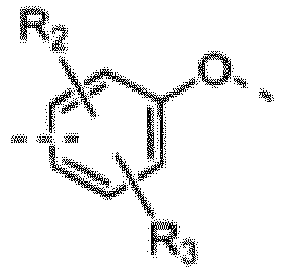

- Composé ou sel pharmaceutiquement acceptable de celui-ci selon la revendication 15, dans lequel l'unité structurale


- Composé ou sel pharmaceutiquement acceptable de celui-ci selon la revendication 16, dans lequel l'unité structurale


- Composé ou sel pharmaceutiquement acceptable de celui-ci selon l'une quelconque des revendications 1 à 3, dans lequel le cycle A est choisi parmi : le phényle, le naphtyle, le pyridyle, le pyrimidyle, le pyrazinyle, le pyridazinyle, le thiényle, le pyrazolyle, l'imidazolyle, l'oxazolyle, le thiazolyle, l'isoxazolyle, l'isothiazolyle.
- Composé ou sel pharmaceutiquement acceptable de celui-ci selon l'une quelconque des revendications 1 à 3, dans lequel l'unité structurale


- Composé ou sel pharmaceutiquement acceptable de celui-ci selon la revendication 19, dans lequel l'unité structurale
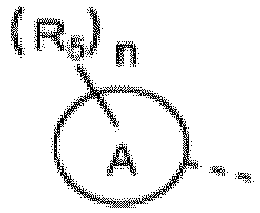


- Composé ou sel pharmaceutiquement acceptable de celui-ci selon l'une quelconque des revendications 1 à 3, dans lequel L2 est choisi parmi une liaison simple, -CH2-, -CH2CH2-, -C(=O)-,-O-, -S-, -NH-, -C(=O)O-, -C(=O)NH-, -S(=O)2-,-S(=O)-.
- Composé ou sel pharmaceutiquement acceptable de celui-ci selon l'une quelconque des revendications 1 à 3, dans lequel L3 est choisi parmi -CH2-, -C(=O)-.
- Composé ou sel pharmaceutiquement acceptable de celui-ci selon l'une quelconque des revendications 1 à 3, dans lequel une unité structurale L1-L2 est choisie parmi : une liaison simple, -CH2-, -C(=O)-, -S(=O)2-, -C(=O)O-, -C(=O)NH-, -C(=O)-CH2-,-C(=O)O-CH2-, -CH2CH2O-.
- Composé ou sel pharmaceutiquement acceptable de celui-ci selon l'une quelconque des revendications 1 à 3, dans lequel L4 est choisi parmi : une liaison simple, -CH2-, -CH2CH2-.
- Composé ou sel pharmaceutiquement acceptable de celui-ci selon l'une quelconque des revendications 1 à 14 et 21 à 24, qui est choisi parmi :


- Composé selon la revendication 1, qui est choisi parmi :


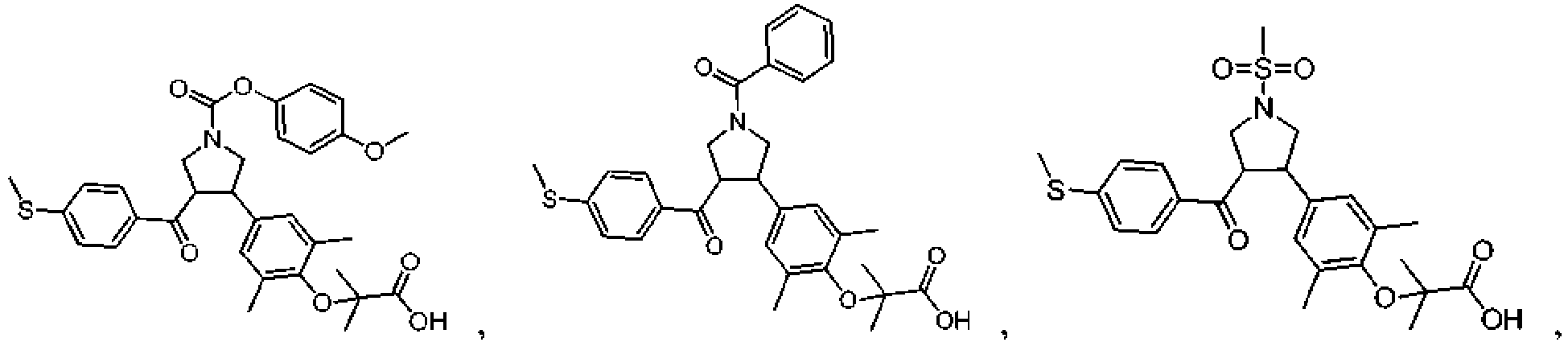


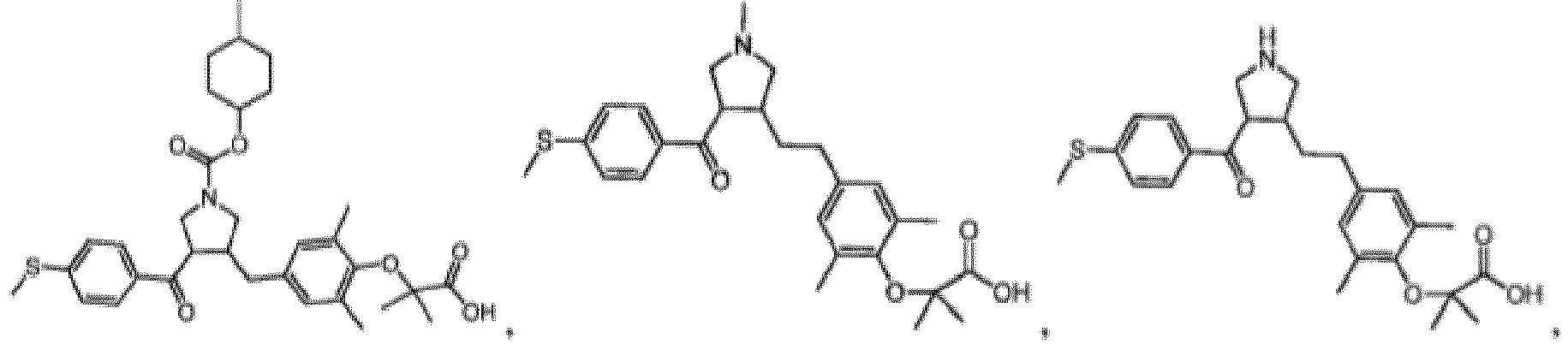
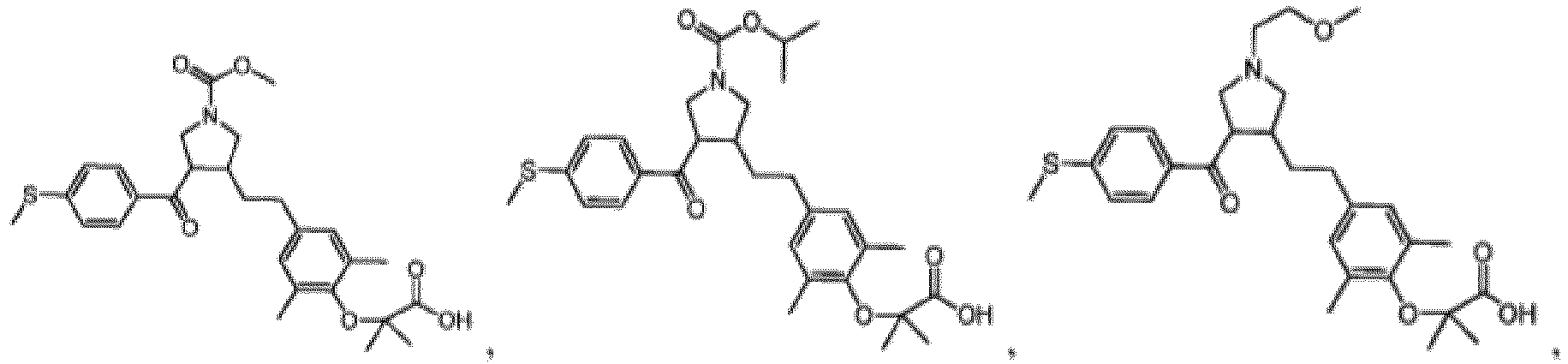




- Composé selon la revendication 26, qui est choisi parmi :


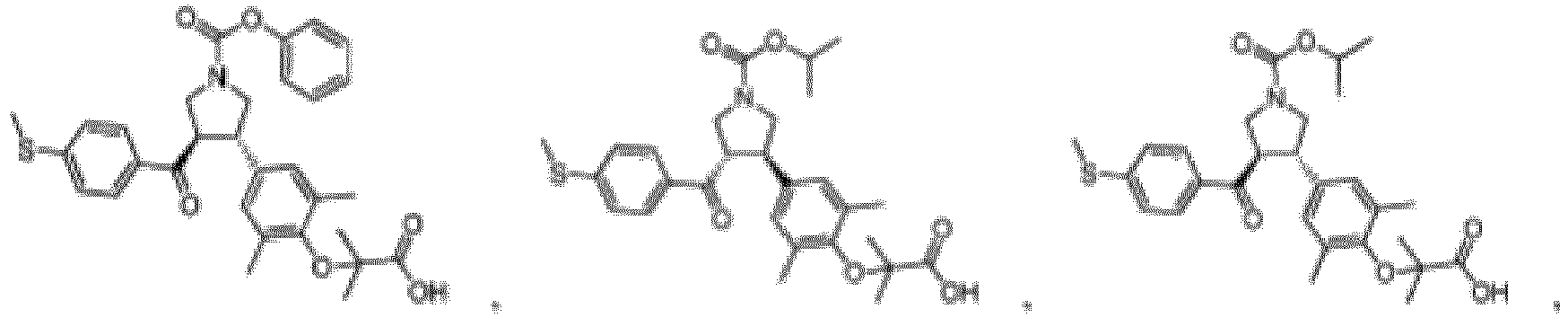


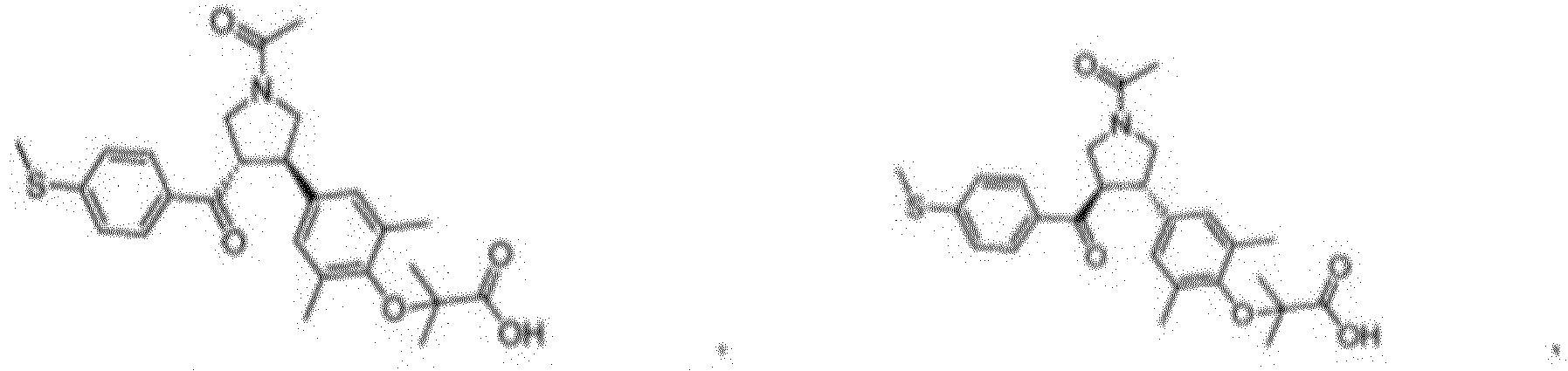



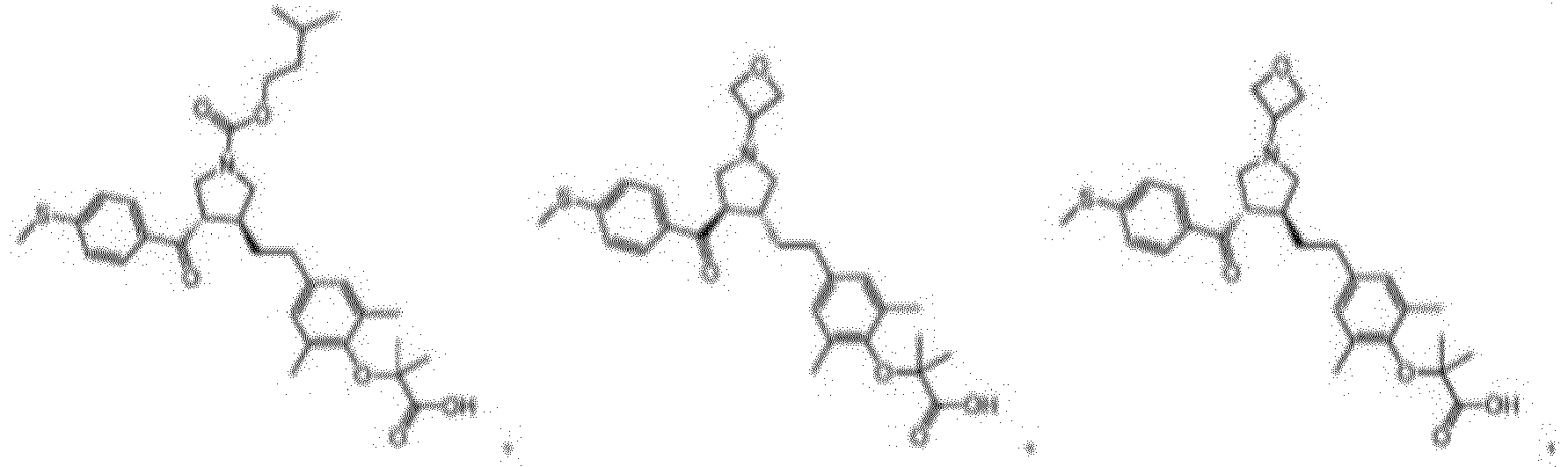


- Composition pharmaceutique comprenant une quantité thérapeutiquement efficace du composé selon l'une quelconque des revendications 1 à 27 ou sel pharmaceutiquement acceptable de celui-ci en tant qu'ingrédient actif, ainsi que véhicule pharmaceutiquement acceptable.
- Utilisation du composé de l'une quelconque des revendications 1 à 27 ou d'un sel pharmaceutiquement acceptable de celui-ci, ou composition selon la revendication 28 pour la fabrication d'un médicament pour le traitement de la stéatohépatite non alcoolique et de la fibrose concomitante, de la résistance à l'insuline, de la cholgangite biliaire primitive, de la dyslipidémie, de l'hyperlipidémie, de l'hypercholestérolémie, de l'athérosclérose, de l'hypertriglycéridémie, de la maladie cardiovasculaire, de l'obésité.
Applications Claiming Priority (3)
| Application Number | Priority Date | Filing Date | Title |
|---|---|---|---|
| CN201610547500 | 2016-07-12 | ||
| CN201710087306 | 2017-02-17 | ||
| PCT/CN2017/092583 WO2018010656A1 (fr) | 2016-07-12 | 2017-07-12 | Dérivé de pyrrolidine servant d'agoniste de ppar |
Publications (3)
| Publication Number | Publication Date |
|---|---|
| EP3486231A1 EP3486231A1 (fr) | 2019-05-22 |
| EP3486231A4 EP3486231A4 (fr) | 2019-05-22 |
| EP3486231B1 true EP3486231B1 (fr) | 2020-05-20 |
Family
ID=60952288
Family Applications (1)
| Application Number | Title | Priority Date | Filing Date |
|---|---|---|---|
| EP17826992.4A Active EP3486231B1 (fr) | 2016-07-12 | 2017-07-12 | Dérivé de pyrrolidine servant d'agoniste de ppar |
Country Status (9)
| Country | Link |
|---|---|
| US (1) | US10526320B2 (fr) |
| EP (1) | EP3486231B1 (fr) |
| JP (1) | JP6754899B2 (fr) |
| KR (1) | KR102200264B1 (fr) |
| CN (1) | CN109563032B (fr) |
| AU (1) | AU2017297550B2 (fr) |
| CA (1) | CA3030431C (fr) |
| RU (1) | RU2711991C1 (fr) |
| WO (1) | WO2018010656A1 (fr) |
Families Citing this family (4)
| Publication number | Priority date | Publication date | Assignee | Title |
|---|---|---|---|---|
| US11021514B2 (en) | 2016-06-01 | 2021-06-01 | Athira Pharma, Inc. | Compounds |
| TWI822716B (zh) * | 2017-12-21 | 2023-11-21 | 大陸商廣東眾生睿創生物科技有限公司 | 作為ppar促效劑的吡咯啶衍生物的非晶形及其製備方法 |
| CA3121202A1 (fr) | 2018-11-30 | 2020-06-04 | Nuvation Bio Inc. | Composes pyrrole et pyrazole et leurs procedes d'utilisation |
| CN110156648A (zh) * | 2019-05-30 | 2019-08-23 | 河北科技大学 | 一种Elafibranor中间体的制备方法 |
Family Cites Families (10)
| Publication number | Priority date | Publication date | Assignee | Title |
|---|---|---|---|---|
| JP3637974B2 (ja) * | 1993-03-25 | 2005-04-13 | エーザイ株式会社 | ピロリジン誘導体 |
| US5665754A (en) * | 1993-09-20 | 1997-09-09 | Glaxo Wellcome Inc. | Substituted pyrrolidines |
| WO2002017912A1 (fr) * | 2000-08-31 | 2002-03-07 | Abbott Laboratories | Antagonistes de l'endotheline |
| CN1625554A (zh) * | 2002-02-01 | 2005-06-08 | 诺沃挪第克公司 | 氨基烷基-取代的氮杂环丁烷、吡咯烷、哌啶与氮杂环庚烷的酰胺 |
| DE102005000666B3 (de) * | 2005-01-04 | 2006-10-05 | Sanofi-Aventis Deutschland Gmbh | Sulfonylpyrrolidine, Verfahren zu ihrer Herstellung und ihre Verwendung als Arzneimittel |
| EP1702916A1 (fr) | 2005-03-18 | 2006-09-20 | Santhera Pharmaceuticals (Schweiz) GmbH | Inhibiteurs de DPP-IV |
| EP1943215A2 (fr) * | 2005-10-31 | 2008-07-16 | Brystol-Myers Squibb Company | Inhibiteurs à base d amide et de bêta-amino de pyrrolidinyle de la dipeptidyl peptidase iv et procédés |
| FR2908766B1 (fr) | 2006-11-20 | 2009-01-09 | Sanofi Aventis Sa | Derives de pyrrole,leur preparation et leur utilisation en therapeutique. |
| EP3280709B1 (fr) * | 2015-04-10 | 2021-05-26 | FMC Corporation | Amides cycliques susbtitués utilisés comme herbicides |
| TWI822716B (zh) * | 2017-12-21 | 2023-11-21 | 大陸商廣東眾生睿創生物科技有限公司 | 作為ppar促效劑的吡咯啶衍生物的非晶形及其製備方法 |
-
2017
- 2017-07-12 CA CA3030431A patent/CA3030431C/fr active Active
- 2017-07-12 US US16/317,510 patent/US10526320B2/en active Active
- 2017-07-12 CN CN201780043426.7A patent/CN109563032B/zh active Active
- 2017-07-12 KR KR1020197002454A patent/KR102200264B1/ko active Active
- 2017-07-12 EP EP17826992.4A patent/EP3486231B1/fr active Active
- 2017-07-12 JP JP2019523157A patent/JP6754899B2/ja active Active
- 2017-07-12 WO PCT/CN2017/092583 patent/WO2018010656A1/fr not_active Ceased
- 2017-07-12 RU RU2019102688A patent/RU2711991C1/ru active
- 2017-07-12 AU AU2017297550A patent/AU2017297550B2/en active Active
Non-Patent Citations (1)
| Title |
|---|
| None * |
Also Published As
| Publication number | Publication date |
|---|---|
| CN109563032B (zh) | 2022-05-20 |
| CN109563032A (zh) | 2019-04-02 |
| AU2017297550B2 (en) | 2019-07-11 |
| CA3030431A1 (fr) | 2018-01-18 |
| US10526320B2 (en) | 2020-01-07 |
| AU2017297550A8 (en) | 2019-03-14 |
| US20190225597A1 (en) | 2019-07-25 |
| RU2711991C1 (ru) | 2020-01-23 |
| WO2018010656A1 (fr) | 2018-01-18 |
| CA3030431C (fr) | 2021-05-11 |
| EP3486231A1 (fr) | 2019-05-22 |
| JP2019527730A (ja) | 2019-10-03 |
| AU2017297550A1 (en) | 2019-01-31 |
| EP3486231A4 (fr) | 2019-05-22 |
| KR102200264B1 (ko) | 2021-01-11 |
| JP6754899B2 (ja) | 2020-09-16 |
| KR20190020339A (ko) | 2019-02-28 |
Similar Documents
| Publication | Publication Date | Title |
|---|---|---|
| EP3601290B1 (fr) | Saxitoxines 11,13-modifiées destinées au traitement de la douleur | |
| EP4289823A1 (fr) | Dérivés de pyridazine phénol substitués | |
| CA3155885A1 (fr) | Composes macrocycliques substitues et methodes de traitement associees | |
| EP3486231B1 (fr) | Dérivé de pyrrolidine servant d'agoniste de ppar | |
| IL269599B2 (en) | 11,13-modified saxitoxins for the treatment of pain | |
| JP2024540080A (ja) | Irak4分解剤およびその合成 | |
| EP3590929B1 (fr) | Composé spiro et son utilisation | |
| EP3194403B1 (fr) | Dérivés de pyrrolopyrimidine à titre d'antagonistes des récepteurs nmda nr2b | |
| WO2016065264A1 (fr) | Dérivés de diterpénoïdes et leurs procédés d'utilisation | |
| EP1472214A2 (fr) | Composes inhibant la secretion d'insuline et methodes connexes | |
| WO2025160286A1 (fr) | 2-aryl cycloalkyle et inhibiteurs d'hétérocycloalkyle de nav1.8 pour le traitement de la douleur | |
| EP3456711A1 (fr) | Inhibiteur de caspase et composition pharmaceutique, utilisation et procédé thérapeutique associés | |
| EP3492465B1 (fr) | Agoniste de s1p1 et son application | |
| EP4082616B1 (fr) | Dérivé amide d'acide aliphatique | |
| CN109071429A (zh) | 丙啶磺酰胺类化合物及其使用方法 | |
| US4753949A (en) | 2-chloronicergoline having antihypoxic activity | |
| CN120424061A (zh) | 用于抑制Nav1.8的N-酰基吖啶类化合物 | |
| HK40110761A (en) | Therapeutic uses of deuterated derivatives of lanifibranor | |
| WO2025140288A1 (fr) | Tétrahydroisoquinoléine et son utilisation pharmaceutique | |
| DK175127B1 (da) | Gabapentin monohydrat og fremgangsmåde til fremstilling deraf | |
| HK40001048B (zh) | S1p1激动剂及其应用 | |
| HK1241366B (en) | Pyrrolopyrimidine derivatives as nr2b nmda receptor antagonists | |
| HK1241366A1 (en) | Pyrrolopyrimidine derivatives as nr2b nmda receptor antagonists |
Legal Events
| Date | Code | Title | Description |
|---|---|---|---|
| STAA | Information on the status of an ep patent application or granted ep patent |
Free format text: STATUS: THE INTERNATIONAL PUBLICATION HAS BEEN MADE |
|
| PUAI | Public reference made under article 153(3) epc to a published international application that has entered the european phase |
Free format text: ORIGINAL CODE: 0009012 |
|
| STAA | Information on the status of an ep patent application or granted ep patent |
Free format text: STATUS: REQUEST FOR EXAMINATION WAS MADE |
|
| 17P | Request for examination filed |
Effective date: 20190109 |
|
| A4 | Supplementary search report drawn up and despatched |
Effective date: 20190402 |
|
| AK | Designated contracting states |
Kind code of ref document: A1 Designated state(s): AL AT BE BG CH CY CZ DE DK EE ES FI FR GB GR HR HU IE IS IT LI LT LU LV MC MK MT NL NO PL PT RO RS SE SI SK SM TR |
|
| AX | Request for extension of the european patent |
Extension state: BA ME |
|
| DAV | Request for validation of the european patent (deleted) | ||
| DAX | Request for extension of the european patent (deleted) | ||
| GRAP | Despatch of communication of intention to grant a patent |
Free format text: ORIGINAL CODE: EPIDOSNIGR1 |
|
| STAA | Information on the status of an ep patent application or granted ep patent |
Free format text: STATUS: GRANT OF PATENT IS INTENDED |
|
| RAP1 | Party data changed (applicant data changed or rights of an application transferred) |
Owner name: GUANGDONG RAYNOVENT BIOTECH CO., LTD. |
|
| INTG | Intention to grant announced |
Effective date: 20191219 |
|
| GRAS | Grant fee paid |
Free format text: ORIGINAL CODE: EPIDOSNIGR3 |
|
| GRAA | (expected) grant |
Free format text: ORIGINAL CODE: 0009210 |
|
| STAA | Information on the status of an ep patent application or granted ep patent |
Free format text: STATUS: THE PATENT HAS BEEN GRANTED |
|
| AK | Designated contracting states |
Kind code of ref document: B1 Designated state(s): AL AT BE BG CH CY CZ DE DK EE ES FI FR GB GR HR HU IE IS IT LI LT LU LV MC MK MT NL NO PL PT RO RS SE SI SK SM TR |
|
| REG | Reference to a national code |
Ref country code: GB Ref legal event code: FG4D |
|
| REG | Reference to a national code |
Ref country code: CH Ref legal event code: EP |
|
| REG | Reference to a national code |
Ref country code: DE Ref legal event code: R096 Ref document number: 602017017122 Country of ref document: DE |
|
| REG | Reference to a national code |
Ref country code: AT Ref legal event code: REF Ref document number: 1272518 Country of ref document: AT Kind code of ref document: T Effective date: 20200615 |
|
| REG | Reference to a national code |
Ref country code: CH Ref legal event code: NV Representative=s name: PINTZ AND PARTNERS LLC, CH |
|
| REG | Reference to a national code |
Ref country code: NL Ref legal event code: FP |
|
| REG | Reference to a national code |
Ref country code: NO Ref legal event code: T2 Effective date: 20200520 |
|
| REG | Reference to a national code |
Ref country code: LT Ref legal event code: MG4D |
|
| PG25 | Lapsed in a contracting state [announced via postgrant information from national office to epo] |
Ref country code: IS Free format text: LAPSE BECAUSE OF FAILURE TO SUBMIT A TRANSLATION OF THE DESCRIPTION OR TO PAY THE FEE WITHIN THE PRESCRIBED TIME-LIMIT Effective date: 20200920 Ref country code: SE Free format text: LAPSE BECAUSE OF FAILURE TO SUBMIT A TRANSLATION OF THE DESCRIPTION OR TO PAY THE FEE WITHIN THE PRESCRIBED TIME-LIMIT Effective date: 20200520 Ref country code: FI Free format text: LAPSE BECAUSE OF FAILURE TO SUBMIT A TRANSLATION OF THE DESCRIPTION OR TO PAY THE FEE WITHIN THE PRESCRIBED TIME-LIMIT Effective date: 20200520 Ref country code: GR Free format text: LAPSE BECAUSE OF FAILURE TO SUBMIT A TRANSLATION OF THE DESCRIPTION OR TO PAY THE FEE WITHIN THE PRESCRIBED TIME-LIMIT Effective date: 20200821 Ref country code: PT Free format text: LAPSE BECAUSE OF FAILURE TO SUBMIT A TRANSLATION OF THE DESCRIPTION OR TO PAY THE FEE WITHIN THE PRESCRIBED TIME-LIMIT Effective date: 20200921 Ref country code: LT Free format text: LAPSE BECAUSE OF FAILURE TO SUBMIT A TRANSLATION OF THE DESCRIPTION OR TO PAY THE FEE WITHIN THE PRESCRIBED TIME-LIMIT Effective date: 20200520 |
|
| PG25 | Lapsed in a contracting state [announced via postgrant information from national office to epo] |
Ref country code: RS Free format text: LAPSE BECAUSE OF FAILURE TO SUBMIT A TRANSLATION OF THE DESCRIPTION OR TO PAY THE FEE WITHIN THE PRESCRIBED TIME-LIMIT Effective date: 20200520 Ref country code: LV Free format text: LAPSE BECAUSE OF FAILURE TO SUBMIT A TRANSLATION OF THE DESCRIPTION OR TO PAY THE FEE WITHIN THE PRESCRIBED TIME-LIMIT Effective date: 20200520 Ref country code: BG Free format text: LAPSE BECAUSE OF FAILURE TO SUBMIT A TRANSLATION OF THE DESCRIPTION OR TO PAY THE FEE WITHIN THE PRESCRIBED TIME-LIMIT Effective date: 20200820 Ref country code: HR Free format text: LAPSE BECAUSE OF FAILURE TO SUBMIT A TRANSLATION OF THE DESCRIPTION OR TO PAY THE FEE WITHIN THE PRESCRIBED TIME-LIMIT Effective date: 20200520 |
|
| REG | Reference to a national code |
Ref country code: AT Ref legal event code: MK05 Ref document number: 1272518 Country of ref document: AT Kind code of ref document: T Effective date: 20200520 |
|
| PG25 | Lapsed in a contracting state [announced via postgrant information from national office to epo] |
Ref country code: AL Free format text: LAPSE BECAUSE OF FAILURE TO SUBMIT A TRANSLATION OF THE DESCRIPTION OR TO PAY THE FEE WITHIN THE PRESCRIBED TIME-LIMIT Effective date: 20200520 |
|
| PG25 | Lapsed in a contracting state [announced via postgrant information from national office to epo] |
Ref country code: RO Free format text: LAPSE BECAUSE OF FAILURE TO SUBMIT A TRANSLATION OF THE DESCRIPTION OR TO PAY THE FEE WITHIN THE PRESCRIBED TIME-LIMIT Effective date: 20200520 Ref country code: IT Free format text: LAPSE BECAUSE OF FAILURE TO SUBMIT A TRANSLATION OF THE DESCRIPTION OR TO PAY THE FEE WITHIN THE PRESCRIBED TIME-LIMIT Effective date: 20200520 Ref country code: SM Free format text: LAPSE BECAUSE OF FAILURE TO SUBMIT A TRANSLATION OF THE DESCRIPTION OR TO PAY THE FEE WITHIN THE PRESCRIBED TIME-LIMIT Effective date: 20200520 Ref country code: EE Free format text: LAPSE BECAUSE OF FAILURE TO SUBMIT A TRANSLATION OF THE DESCRIPTION OR TO PAY THE FEE WITHIN THE PRESCRIBED TIME-LIMIT Effective date: 20200520 Ref country code: DK Free format text: LAPSE BECAUSE OF FAILURE TO SUBMIT A TRANSLATION OF THE DESCRIPTION OR TO PAY THE FEE WITHIN THE PRESCRIBED TIME-LIMIT Effective date: 20200520 Ref country code: AT Free format text: LAPSE BECAUSE OF FAILURE TO SUBMIT A TRANSLATION OF THE DESCRIPTION OR TO PAY THE FEE WITHIN THE PRESCRIBED TIME-LIMIT Effective date: 20200520 Ref country code: CZ Free format text: LAPSE BECAUSE OF FAILURE TO SUBMIT A TRANSLATION OF THE DESCRIPTION OR TO PAY THE FEE WITHIN THE PRESCRIBED TIME-LIMIT Effective date: 20200520 Ref country code: ES Free format text: LAPSE BECAUSE OF FAILURE TO SUBMIT A TRANSLATION OF THE DESCRIPTION OR TO PAY THE FEE WITHIN THE PRESCRIBED TIME-LIMIT Effective date: 20200520 |
|
| REG | Reference to a national code |
Ref country code: DE Ref legal event code: R097 Ref document number: 602017017122 Country of ref document: DE |
|
| PG25 | Lapsed in a contracting state [announced via postgrant information from national office to epo] |
Ref country code: SK Free format text: LAPSE BECAUSE OF FAILURE TO SUBMIT A TRANSLATION OF THE DESCRIPTION OR TO PAY THE FEE WITHIN THE PRESCRIBED TIME-LIMIT Effective date: 20200520 Ref country code: PL Free format text: LAPSE BECAUSE OF FAILURE TO SUBMIT A TRANSLATION OF THE DESCRIPTION OR TO PAY THE FEE WITHIN THE PRESCRIBED TIME-LIMIT Effective date: 20200520 Ref country code: MC Free format text: LAPSE BECAUSE OF FAILURE TO SUBMIT A TRANSLATION OF THE DESCRIPTION OR TO PAY THE FEE WITHIN THE PRESCRIBED TIME-LIMIT Effective date: 20200520 |
|
| PLBE | No opposition filed within time limit |
Free format text: ORIGINAL CODE: 0009261 |
|
| STAA | Information on the status of an ep patent application or granted ep patent |
Free format text: STATUS: NO OPPOSITION FILED WITHIN TIME LIMIT |
|
| 26N | No opposition filed |
Effective date: 20210223 |
|
| PG25 | Lapsed in a contracting state [announced via postgrant information from national office to epo] |
Ref country code: LU Free format text: LAPSE BECAUSE OF NON-PAYMENT OF DUE FEES Effective date: 20200712 |
|
| PG25 | Lapsed in a contracting state [announced via postgrant information from national office to epo] |
Ref country code: SI Free format text: LAPSE BECAUSE OF FAILURE TO SUBMIT A TRANSLATION OF THE DESCRIPTION OR TO PAY THE FEE WITHIN THE PRESCRIBED TIME-LIMIT Effective date: 20200520 |
|
| PG25 | Lapsed in a contracting state [announced via postgrant information from national office to epo] |
Ref country code: TR Free format text: LAPSE BECAUSE OF FAILURE TO SUBMIT A TRANSLATION OF THE DESCRIPTION OR TO PAY THE FEE WITHIN THE PRESCRIBED TIME-LIMIT Effective date: 20200520 Ref country code: MT Free format text: LAPSE BECAUSE OF FAILURE TO SUBMIT A TRANSLATION OF THE DESCRIPTION OR TO PAY THE FEE WITHIN THE PRESCRIBED TIME-LIMIT Effective date: 20200520 Ref country code: CY Free format text: LAPSE BECAUSE OF FAILURE TO SUBMIT A TRANSLATION OF THE DESCRIPTION OR TO PAY THE FEE WITHIN THE PRESCRIBED TIME-LIMIT Effective date: 20200520 |
|
| PG25 | Lapsed in a contracting state [announced via postgrant information from national office to epo] |
Ref country code: MK Free format text: LAPSE BECAUSE OF FAILURE TO SUBMIT A TRANSLATION OF THE DESCRIPTION OR TO PAY THE FEE WITHIN THE PRESCRIBED TIME-LIMIT Effective date: 20200520 |
|
| PGFP | Annual fee paid to national office [announced via postgrant information from national office to epo] |
Ref country code: NO Payment date: 20250627 Year of fee payment: 9 |
|
| PGFP | Annual fee paid to national office [announced via postgrant information from national office to epo] |
Ref country code: NL Payment date: 20250630 Year of fee payment: 9 |
|
| PGFP | Annual fee paid to national office [announced via postgrant information from national office to epo] |
Ref country code: IE Payment date: 20250620 Year of fee payment: 9 |
|
| PGFP | Annual fee paid to national office [announced via postgrant information from national office to epo] |
Ref country code: DE Payment date: 20250711 Year of fee payment: 9 |
|
| PGFP | Annual fee paid to national office [announced via postgrant information from national office to epo] |
Ref country code: BE Payment date: 20250724 Year of fee payment: 9 Ref country code: GB Payment date: 20250723 Year of fee payment: 9 |
|
| PGFP | Annual fee paid to national office [announced via postgrant information from national office to epo] |
Ref country code: FR Payment date: 20250730 Year of fee payment: 9 |
|
| PGFP | Annual fee paid to national office [announced via postgrant information from national office to epo] |
Ref country code: CH Payment date: 20250801 Year of fee payment: 9 |
|
| REG | Reference to a national code |
Ref country code: CH Ref legal event code: R18 Free format text: ST27 STATUS EVENT CODE: U-0-0-R10-R18 (AS PROVIDED BY THE NATIONAL OFFICE) Effective date: 20260331 |