EP3486816A1 - Procédé, dispositif et programme informatique pour générer des séquences de protéines avec des réseaux neuronaux autorégressifs - Google Patents
Procédé, dispositif et programme informatique pour générer des séquences de protéines avec des réseaux neuronaux autorégressifs Download PDFInfo
- Publication number
- EP3486816A1 EP3486816A1 EP17306591.3A EP17306591A EP3486816A1 EP 3486816 A1 EP3486816 A1 EP 3486816A1 EP 17306591 A EP17306591 A EP 17306591A EP 3486816 A1 EP3486816 A1 EP 3486816A1
- Authority
- EP
- European Patent Office
- Prior art keywords
- autoregressive
- amino acids
- sequence
- encoder
- neural network
- Prior art date
- Legal status (The legal status is an assumption and is not a legal conclusion. Google has not performed a legal analysis and makes no representation as to the accuracy of the status listed.)
- Withdrawn
Links
Images







Classifications
-
- G—PHYSICS
- G16—INFORMATION AND COMMUNICATION TECHNOLOGY [ICT] SPECIALLY ADAPTED FOR SPECIFIC APPLICATION FIELDS
- G16B—BIOINFORMATICS, i.e. INFORMATION AND COMMUNICATION TECHNOLOGY [ICT] SPECIALLY ADAPTED FOR GENETIC OR PROTEIN-RELATED DATA PROCESSING IN COMPUTATIONAL MOLECULAR BIOLOGY
- G16B30/00—ICT specially adapted for sequence analysis involving nucleotides or amino acids
-
- G—PHYSICS
- G16—INFORMATION AND COMMUNICATION TECHNOLOGY [ICT] SPECIALLY ADAPTED FOR SPECIFIC APPLICATION FIELDS
- G16B—BIOINFORMATICS, i.e. INFORMATION AND COMMUNICATION TECHNOLOGY [ICT] SPECIALLY ADAPTED FOR GENETIC OR PROTEIN-RELATED DATA PROCESSING IN COMPUTATIONAL MOLECULAR BIOLOGY
- G16B20/00—ICT specially adapted for functional genomics or proteomics, e.g. genotype-phenotype associations
-
- G—PHYSICS
- G16—INFORMATION AND COMMUNICATION TECHNOLOGY [ICT] SPECIALLY ADAPTED FOR SPECIFIC APPLICATION FIELDS
- G16B—BIOINFORMATICS, i.e. INFORMATION AND COMMUNICATION TECHNOLOGY [ICT] SPECIALLY ADAPTED FOR GENETIC OR PROTEIN-RELATED DATA PROCESSING IN COMPUTATIONAL MOLECULAR BIOLOGY
- G16B20/00—ICT specially adapted for functional genomics or proteomics, e.g. genotype-phenotype associations
- G16B20/20—Allele or variant detection, e.g. single nucleotide polymorphism [SNP] detection
-
- G—PHYSICS
- G16—INFORMATION AND COMMUNICATION TECHNOLOGY [ICT] SPECIALLY ADAPTED FOR SPECIFIC APPLICATION FIELDS
- G16B—BIOINFORMATICS, i.e. INFORMATION AND COMMUNICATION TECHNOLOGY [ICT] SPECIALLY ADAPTED FOR GENETIC OR PROTEIN-RELATED DATA PROCESSING IN COMPUTATIONAL MOLECULAR BIOLOGY
- G16B40/00—ICT specially adapted for biostatistics; ICT specially adapted for bioinformatics-related machine learning or data mining, e.g. knowledge discovery or pattern finding
- G16B40/30—Unsupervised data analysis
Definitions
- the invention generally relates to the field of protein sequences and of generating protein sequences. More particularly, the invention concerns a method, a device, and a computer program for generating protein sequences with autoregressive neural networks.
- Proteins are versatile molecules consisting of chains of amino acids which fold in 3D space to form molecular machines able to bind specific substrates, selforganize in larger structures, catalyze chemical reactions, and convert various sources of energy such as light and chemical gradients into chemical bonds or work, and more.
- proteins are composed of 20 different amino acids forming chains ranging from just a few, to thousands of amino acids. Accordingly, there are 20 300 possible proteins of length 300 (which corresponds to an average sized protein), i.e. vastly more than the number of atoms in the universe and what has been explored by the natural evolutionary process.
- the inventors provide a method, a device, and a computer program for generating protein sequences, i.e. ordered sequences of amino acids, with autoregressive neural networks.
- a computer method for generating a protein sequence in an autoregressive neural network comprising an encoder and a decoder, the decoder comprising an autoregressive module, the method comprising the steps of:
- the claimed method makes it possible to sample new proteins, in particular proteins having specific physical or functional properties, to obtain variants of a sequence while conserving structural and functional properties of the initial protein, and to obtain sequence variants with desired modified physical or functional properties.
- the autoregressive neural network learns transformations preserving similarities in structures and relatedness between amino acids. It is able to modify physical properties of existing proteins and to generate new ones having chosen properties with relative accuracy.
- the method further comprises a step of obtaining additional information representative of at least one characteristic of a protein sequence to be generated, the additional information being input along with the latent code into the autoregressive module, additional information representative of characteristics of protein sequences used for training the autoregressive neural network being input along with protein sequences into the encoder during training.
- the additional information is directed to physical characteristics of the protein sequences to be generated and of the protein sequences used for training the autoregressive neural network.
- the decoder further comprises an up-sampling module, the obtained latent code being input into the up-sampling module and the up-sampled latent code being input into the autoregressive module.
- the step of generating an ordered sequence of amino acids comprises a step of selecting sequentially each amino acid of the ordered sequence and, after an amino acid is selected to belong to the ordered sequence, a step of checking the ordered sequence at least partially generated.
- the step of checking the ordered sequence at least partially generated comprises a step of comparing the length of the ordered sequence at least partially generated with a threshold.
- the step of generating an ordered sequence of amino acids comprises a step of selecting sequentially each amino acid of the ordered sequence and the step of generating an ordered sequence of amino acids is stopped if a specific symbol is selected as an amino acid for a given position of the ordered sequence.
- the step of generating an ordered sequence of amino acids comprises a step of selecting one amino acid, for a given position of the ordered sequence, among a plurality of amino acids, the one amino acid being selected as a function of the probabilities associated with amino acids of the plurality of amino acids for the given position.
- the method further comprises a step of modifying probabilities obtained from the autoregressive neural network, denoted the first autoregressive neural network, as a function of probabilities obtained from a second autoregressive neural network different from the first autoregressive neural network.
- the method further comprises a learning phase for determining parameters of the autoregressive module.
- the learning phase is unsupervised.
- the autoregressive neural network is of the variational auto-encoder type or of the adversarial auto-encoder type.
- the autoregressive neural network is a recurrent neural network.
- an apparatus comprising means configured for carrying out each step of the method described above.
- the advantages provided by the second aspect of the present invention are similar to the ones provided by the first above-mentioned aspect.
- a tangible carrier medium may comprise a storage medium such as a floppy disk, a CD-ROM, a hard disk drive, a magnetic tape device or a solid state memory device and the like.
- a transient carrier medium may include a signal such as an electrical signal, an electronic signal, an optical signal, an acoustic signal, a magnetic signal or an electromagnetic signal, e.g. a microwave or RF signal.
- the computer code exploits graphic processing units (GPUs) that allow parallel processing of large matrix data.
- GPUs graphic processing units
- a generative deep neural model is used to generate protein sequences.
- the generative deep neural model is an autoregressive neural network such as a recurrent neural network (RNN), an autoregressive convolutional neural network, for example a variational auto-encoder (VAE) or a conditional variational auto-encoder (CVAE), or an adversarial auto-encoder (AAE) or a conditional adversarial auto-encoder (CAAE).
- RNN recurrent neural network
- VAE variational auto-encoder
- CVAE conditional variational auto-encoder
- AAE adversarial auto-encoder
- CAAE conditional adversarial auto-encoder
- the generative deep neural model comprises a probabilistic encoder and a probabilistic decoder of the variational auto-encoder type, wherein the decoder is an autoregressive decoder that may comprise an up-sampler. It has proven extremely efficient at learning high level features of complex datasets in an unsupervised fashion, and at generating novel samples with similar properties to the data they are trained on.
- samples of the learning dataset are encoded into latent vectors (or latent codes) using the encoder.
- the latent vectors are then used to train the decoder to predict the next element in the sequence being constructed, based on previous elements of this sequence.
- latent vectors are used to stimulate the autoregressive sequential generation of a new sample, one amino acid at a time.
- conditioning vectors comprising additional information, also referred to as conditions, are given to the encoder during the training.
- conditions typically represent characteristics of protein sequences.
- both the latent vectors and the conditioning vectors are then used to train the decoder to predict the next element in the sequence being constructed, based on previous elements of this sequence.
- latent vectors and conditioning vectors are used to stimulate the autoregressive sequential generation of a new sample one amino acid at a time.
- VAE Variational auto-encoder
- variational auto-encoders are a deep learning technique for learning latent representations. They consist in a probabilistic encoder, a probabilistic decoder, and a loss function.
- the probabilistic encoder is a neural network that outputs a latent representation (hidden representation) from input data, for example from an image. The dimension of the latent space is much less than the one of the input space.
- the probabilistic decoder is a neural network that outputs data, for example an image, from a latent representation. The dimension of the output space is typically the same as the one of the input space.
- the latent space corresponds to latent variables that may be understood as unobserved variables that capture the most salient parts of the input data used for training the variational auto-encoder. They can be thought of as a compressed version of these data.
- Figure 1a and Figure 1b illustrate the logical architecture of a variational auto-encoder and of a conditional variational auto-encoder, respectively.
- variational auto-encoder 100 comprises a probabilistic encoder 105 and a probabilistic decoder 110, referred to below as the encoder and the decoder, respectively.
- the input vector 115, denoted x is applied to encoder 105 to generate latent vector 120, denoted z, that is in turn applied to decoder 110 to generate result 125, denoted x'.
- output x' should be close to input x.
- the dimension of latent vector z is much less than that of input x and output x'.
- a main difference between a variational auto-encoder and a conditional variational auto-encoder is that additional information 130 or conditions, denoted c, is input into the encoder in addition to input vector x and in the decoder in addition to the latent representation z.
- the encoder and the decoder are jointly trained to reconstruct the sample the encoder takes as an input.
- the parameters of the variational auto-encoder are updated end-to-end using, for example, backpropagation with stochastic gradient descent to minimize a loss function, as described, in particular, in the article entitled “ Stochastic Backpropagation and Approximate Inference in Deep Generative Models", Rezende DJ et al., 2014, arXiv:1401.4082v3 (see e.g. ⁇ 3), as well as in the article " tutorial on Variational Autoencoders", Carl Doersch, 2016, arXiv:1606.05908v2 (see e.g. ⁇ 2.2, equation 10, and the right panel of Figure 4 ).
- the encoder learns a distribution over the latent representation z (which typically has a reduced number of dimensions compared to the input x, as mentioned above). This leads to an information bottleneck in the variational auto-encoders, forcing them to learn an identity function in a non-trivial way and to capture high level patterns about the data.
- the decoder learns to predict the sample that is the most likely to be expressed by a latent code.
- variational auto-encoders are forced to learn latent representations in a space that can be decoded into valid samples. This is achieved by imposing a prior ( p(z) ) over the distribution of the latent representation ( p(z
- the encoder learns the parameters of a distribution (usually normal) that is then sampled and decoded.
- a penalty term is used to encourage all areas of the latent space to be decoded into valid samples.
- the resulting model has the advantage of learning a useful latent representation of the data.
- variational auto-encoders represent interpretable high level features such as hair color, having glasses or wearing a hat.
- Variational auto-encoder having an autoregressive decoder
- variational auto-encoders effectively generate samples that capture the global structure of the data, these samples tend to be blurry.
- the inventors have observed that this results from each point in a generated sample being not conditioned on the other points but being only inferred from the latent space.
- embodiments of the invention use autoregressive decoders, for example an autoregressive decoder, in a variational auto-encoder.
- Autoregressive models are used to predict the next element in a sequence, given the previous values in this sequence.
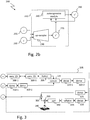
- Figure 2a and Figure 2b illustrate an example of the logical architecture of a conditional variational auto-encoder having an autoregressive decoder, used during the training phase and for generating new protein sequences, respectively.
- conditional variational auto-encoder 200 comprises a probabilistic encoder 205 and a probabilistic autoregressive decoder 210, referred to as the encoder and the decoder, respectively, in the following.
- the input vector 215, denoted x, as well as additional information 220 or conditions, denoted c, are applied to encoder 205 to generate latent vector 225, denoted z.
- Encoder 205 may be similar to encoder 105 described in reference to Figures 1 b. An example of encoder 205 is illustrated in Figure 3 .
- additional information 220 may comprise the length of the protein, its charge, its isoelectric point, its molar extinction coefficient, its solubility (e.g. probability of expression in E.coli inclusion bodies: the smaller this quantity, the more soluble the protein is), and/or its molecular weight, it being observed that some of these values may be correlated (for example, the molecular weight of a protein is highly correlated with its length).
- latent vector 225 and additional information 220 are then applied to up-sampler 230 to generate up-sampled latent vector 235, denoted z'.
- Latent representation z is up-sampled in up-sampler 230 while being conditioned by additional information c to generate latent representation z'.
- the obtained up-sampled latent vector 235, i.e. latent representation z ', and input vector x are then input in autoregressive module 240 to generated result 245, denoted x '.
- the size of the latent code z may be increased by concatenation to reach the one of input vector x.
- autoregressive decoder 210 A more detailed example of autoregressive decoder 210 is described by reference to Figures 4a, 4b , 5a, and 5b .
- the decoder comprising up-sampler 230 and autoregressive module 240, is used for generating a protein sequence from a latent vector, additional information (conditions), and previously determined amino acids of the sequence being generated ( x ').
- encoder 205 and autoregressive decoder 210 comprise convolutional layers, with strided convolutions for down-sampling in the encoder and transposed convolution for up-sampling in the decoder.
- the kernel size of the convolutional layers is preferably set to two.
- all convolutional layers are followed by batch normalization and a parametric rectified linear unit (PReLU) activation (unless otherwise specified, in particular in description of Figures 3 , 4a , 4b , 5a and 5b ).
- batch normalization has been very effective at improving both the training speed and the reconstruction performance of the network.
- Dense layers are preferably followed by PReLU activation, except those that output the parameters of the Gaussian distribution learned by the encoder ⁇ ( x , c ) (no activation) and ⁇ ( x , c ) (softplus activation).
- Activations and batch normalization are not shown in Figures 3 , 4a , 4b , 5a, and 5b to make them easier to read.
- autoregressive decoder 210 makes use of gated activation functions, for example the gated activation functions described in " WaveNet: A Generative Model for Raw Audio", van den Oord A et al., 2016, arXiv:1609.03499v2 (see e.g. ⁇ 2.3, equation 2).
- Feature maps of convolutional layers may be split in two parts and two different activation functions may be applied on each half, followed by elementwise multiplication. The result is convolved upon and passed to the next stack, as well as kept to be used in skip connections.
- Figure 3 illustrates an example of the functional architecture of encoder 205 illustrated in Figure 2a . It is to be noted that other functional architectures may be implemented.
- input vector x is fed in five successive 1D convolution layers referenced 300-1 to 300-5 (for the sake of clarity only two of them are represented).
- the stride of these convolution layers is set to two, except for the first one which is set to one.
- the output of 1D convolution layer 300-5 is flattened (reference 305) so as to suppress one dimension.
- the convolution layers aim at establishing relations between parts of protein sequences.
- additional information or conditions c are fed into two successive dense layers 310-1 and 310-2, i.e. into two fully connected neural networks that aim at identifying what should be in protein sequences.
- the output of flattened layer 305 and the output of dense layer 310-2 are then concatenated (reference 315). As illustrated, the result of the concatenation is fed into two successive dense layers 320-1 and 320-2, the result of the latter being fed into dense layers 325 and 330. Again, these fully connected neural networks aim at identifying what should be in protein sequences, taking into account the conditions.
- the output of dense layer 330 is then used as input of a stochastic layer comprising an activation function 335, for example the softplus activation function, the square root function 340, and the application of a Gaussian function (references 345 and 350).
- an activation function 335 for example the softplus activation function, the square root function 340, and the application of a Gaussian function (references 345 and 350).
- the output of the stochastic layer is added (reference 355) to the output of dense layer 325 to create latent representation z.
- the output of the encoder being stochastic (a Gaussian parametrized by the neural network), it has an additional input: random standard Gaussian noise. This makes it possible to backpropagate the gradients of the loss through the stochastic layer.
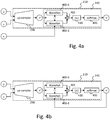
- Figure 4a and Figure 4b illustrate an example of the functional architecture of autoregressive decoder 210 illustrated in Figures 2a and 2b , during training and during generation, respectively. Again, it is to be noted that other functional architectures may be implemented.
- autoregressive decoder 210 comprises up-sampler 230 and autoregressive module 240.
- Up-sampler 230 generates up-sampled latent vector z 'from latent vector z and additional information c .
- An example of the functional architecture of up-sampler 230 is described in reference with Figure 5a . Again, it is to be noted that up-sampler 230 is not required for carrying out the invention.
- Up-sampled latent vector z' is fed into a set of network blocks, for example a set of K network blocks of the WaveNet type, as illustrated.
- a set of network blocks for example a set of K network blocks of the WaveNet type, as illustrated.
- Such a type of network block is described, for example, in the paper entitled “ WaveNet: A Generative Model for Raw Audio", van den Oord A et al., 2016, arXiv:1609.03499v2 (see e.g. ⁇ 2.4).
- input vector x is fed into the first network block of which the output is fed into the second network block and so on until the last one.
- input vector x represents the input protein sequence and output vector x ' its reconstruction.
- input vector x is initialized to zeros and previously determined amino acids of the sequence being generated ( x' ) are fed into the first network block of which the output is fed into the second network block and so on until the last one, as illustrated in Figure 4b .
- Sequentially, a reconstructed protein sequence is obtained by predicting the next amino acid in the sequence, as described in reference to Algorithm 1 given in the Appendix. At each step, an amino acid is predicted, added to input vector x, so that the next one can be predicted.
- the output of network block k is transmitted to network block k+1 and is kept to be added later to other residual connections.
- Figure 5a illustrates an example of the functional architecture of up-sampler 230 illustrated in Figures 2a , 2b , 4a, and 4b . Again, it is to be noted that other functional architectures may be implemented.
- the up-sampler comprises two parts whose results are concatenated.
- latent vector z which may be obtained from the decoder during training or that may be obtained from another way, typically from a user, for generating new protein sequences, is fed into dense layer 500 to be up-sampled by a fully connected artificial neural network.
- the output of the latter is reshaped (reference 505) so as to add one dimension before being fed into four successive 1D deconvolution layers referenced 510-1 to 510-4 (for the sake of clarity only two of them are represented).
- the deconvolution layers add information about where something should be in the protein sequence while the fully connected neural network adds information about what should be in the protein sequence.
- a 1D deconvolution layer is to a 2D deconvolution layer the same as what a 1D convolution layer is to a 2D convolution layer.
- it is a 2D deconvolution layer applied on a 1D input to which one additional dimension has been added.
- a tensor of shape (75, 21) is reshaped into (75, 1, 21) before being passed in the 2D deconvolution layer, thus becoming (150, 1, 21), which is finally reshaped into (150, 21).
- latent vector z is concatenated (reference 515) with additional information or conditions c.
- the result of this concatenation is fed into dense layer 520 the output of which being reshaped (reference 525) so as to add one dimension.
- the fully connected neural network adds information about what should be in the protein sequence, taking into account the conditions.
- Figure 5b illustrates an example of the functional architecture of the network blocks of autoregressive module 240 illustrated in Figures 2a , 2b , 4a, and 4b . Again, it is to be noted that other functional architectures may be implemented. For the sake of illustration, only one network block (400-k) is illustrated.
- Up-sampled latent vector z' obtained from up-sampler 230, is fed into convolution layer 550.
- the ( k -1) first values of the input vector x (during training) or of the protein sequence being generated, denoted x ( k ) are fed into two successive causal convolution layers 555-1 and 555-2, the dilation factor of the causal convolution being, for example, doubled each time so that the receptive field of the autoregressive model grows exponentially with the number of WaveNet-like stacks.
- the receptive field is 32 (each of the three network block comprising two blocks of causal convolution, which means six causal convolutional layers).
- ⁇ represents the sigmoid activation function.
- a gated activation may be used, for example the one described in the paper entitled “ WaveNet: A Generative Model for Raw Audio", van den Oord A et al., 2016, arXiv:1609.03499v2 (see e.g. ⁇ 2.3, equation 2).
- the output of the activation function is then combined (reference 570) with the addition of the output of convolution layer 550 and of causal convolution layer 555-2 and the obtained result is fed into convolution layer 575 to update the protein sequence being reconstructed or generated with the k th prediction.
- the output of convolution layer 575 (i.e. x (k+1) ) is both passed to the (k+1) th network block (i.e. network block 400-(k+1)) and kept to be added later to the other residual connections.
- the (k+1) th network block i.e. network block 400-(k+1)
- these residual connections reduce the vanishing gradient problem, making training easier.
- the output of network blocks 400-1 to 400-K are combined (reference 405) and filtered in convolution layer 410 of which the output is normalized (reference 415), for example using the softmax function, to generate output x'.
- Algorithm 1 given in the appendix illustrates an example of steps for generating protein sequences.
- each amino acid is determined one after the other in a loop the size of which may be determined by the length of the protein to be generated.
- a probability is determined for each amino acid to be the one used to generate the protein sequence. As described above, it is based on a latent code, on conditions, and on the probabilities associated with each amino acid in the protein sequence for the positions preceding the one that is processed.
- the amino acid that is selected, at a given position is the one of higher probability.
- sequence variants may be generated by choosing amino acids that do not have the highest probability but, for instance, choosing the second most probable amino acid.
- variational auto-encoder 200 may be trained by minimizing the variational lower bound, as described in the paper entitled " Auto-Encoding Variational Bayes", Kingma DP et al., 2013, arXiv:1312.6114v10 (see e.g. ⁇ 2, in particular ⁇ 2.2. to ⁇ 2.4).
- the loss function preferably comprises a cross-entropy term and a Kullback-Leibler divergence term.
- the cross-entropy is minimum when the model predicts the right amino acid with a probability of 1 and gives a probability of 0 to all other amino acids.
- the Kullback-Leibler divergence is a regularization-like term that is minimum when the data projected onto the latent space follows a standard normal distribution.
- the loss function is minimized using the Adam optimization algorithm mentioned above, with default parameters for 50 epochs.
- Figure 6 illustrates an example of steps of a method for generating a protein sequence with an autoregressive neural network such as the conditional variational auto-encoder illustrated in Figures 2a and 2b or a (conditional) adversarial auto-encoder.
- an autoregressive neural network such as the conditional variational auto-encoder illustrated in Figures 2a and 2b or a (conditional) adversarial auto-encoder.
- a first step is directed to obtaining a training dataset comprising protein sequences and, preferably, associated conditions.
- This training set is used to train the autoregressive neural network (step 605) until a loss error reached a threshold denoted ⁇ error (step 610).
- Step 605 comprises steps 615 to 650 described hereafter.
- a latent code and, preferably, associated conditions are obtained (step 615) and an index i representing a location within the protein sequence to be generated is initialized to 1 (step 620).
- index i representing a location within the protein sequence to be generated is initialized to 1 (step 620).
- other variables are initialized, such as the probability for each amino acid to be selected at a given position of the sequence being generated.
- the obtained latent code and conditions (if any) are up-sampled (step 625).
- the latent code and conditions (if any) or the up-sampled latent code and conditions (if any) as well as the probabilities previously obtained are input in the autoregressive module (step 630) for obtaining probabilities for amino acids to be selected at position i in the generated sequence (step 635).
- index i is incremented by one (step 640) and a test is carried out to determine whether or not the value of index i has reached the length of the protein sequence to be generated (step 645), i.e. to determine whether or not probabilities have been obtained for each location of the protein sequence to be generated, or whether or not another criterion is reached, indicating that the protein sequence has been generated.
- a criterion may be for example the selection of padding character instead of an amino acid for position i of the protein sequence.
- steps 630 to 645 are repeated.
- a protein sequence is generated as a function of the obtained probabilities (step 650).
- the amino acid associated with the higher probability may be selected.
- Training such a neural network can be seen as unsupervised as the model is simply learning to reconstruct samples from the dataset while passing through an informational bottleneck.
- a variant of this training procedure is possible where in addition to performing reconstruction, the model is also asked to predict certain properties related to the protein. An error term reflecting how well these predictions are made can then be added to the loss function. Training such a model could be described as semi-supervised.
- the data used for training the variational auto-encoder 200 may be obtained from the databases known as InterPro and UniPro.
- luciferase-like proteins containing the Interpro domain IPR011251 having a length smaller than 600 amino acids may be chosen. There are about 72,000 of them. Some of these proteins have an easily testable activity: they emit light. Furthermore, the UniProt SPARQL endpoint may be queried to retrieve additional information about the sequences (such as Interpro families). The obtained sequences are advantageously padded with spaces at the end so that they all have the same length, for example a length of 600 amino acids. Still for the sake of illustration, the obtained sequences can be one-hot-encoded into matrices of shape 600 x 21 (20 amino acid, plus the padding character). Additional protein properties mays be obtained, for example they may be computed with the EMBOSS 'pepstats' software.
- variational auto-encoder 200 may predict the next amino acid in the sequence (based on the previous amino acids, the latent representation, and the conditions) with an 85.5% test accuracy.
- the variational auto-encoder being autoregressive, it learns quickly that after a padding character comes another one. It is almost 100% accurate at predicting padding characters and predicts the next amino acid in a sequence with a 78% accuracy.
- a good accuracy of the reconstructions i.e. protein sequence x ' generated by the decoder in an autoregressive fashion from projection z of protein x, given conditions c, as described by reference to Algorithm 1 and Figure 2b ) is also obtained.
- the decoder generates sequence x' one amino acid at a time, the next amino acid in the sequence being predicted based on the previous predictions rather than on the input sequence (x).
- the accuracy of reconstructions is 82.5% overall, and 75% on the amino acid sequence (excluding padding). It is to be noted that these accuracies are lower than the test accuracy mentioned above, as errors accumulate during the reconstruction process.
- Figure 7 illustrates a conditional probability distribution table wherein the probability of each amino acid is computed as a function of the previous amino acids and of the up-sampled latent vector z'. As illustrated, the most likely amino acid is added to the sequence which is constructed one amino acid at a time. For example, amino acid G (glycine) in the eighteenth position of the protein sequence is the one having the higher probability. Accordingly, it is selected as belonging to the protein sequence represented on top of the conditional probability distribution table.
- G glycine
- Table 1 in the Appendix illustrates the alignments between a protein sequence used as input (denoted init) and the corresponding reconstructed protein sequence (denoted recons).
- the protein sequence that is used as input is Pyrimidine monooxygenase (RutA, UniProt ID: A1JMY1).
- (*) indicate identical amino acids, (:) very similar amino acids, and (.) similar amino acids.
- Table 2 in the Appendix illustrates alignment between a generated protein randomly sampled from the latent space and the most similar known sequence (glucose-6-phosphate dehydrogenase, F420-dependent, UniProt ID: D9VBX0). The latter is identified with HMMER. Again, (*) indicate identical amino acids, (:) very similar amino acids, and (.) similar amino acids.
- the Kullback-Leibler divergence term pushes the data projected onto the latent space to follow a standard normal distribution.
- this is not perfect and some regions of the latent space are left "empty".
- points in the latent space that are too distant from actual projections might not be well decoded, explaining why a substantial number of the sequences generated above are not recognized as part of the PF00296 family.
- reconstructions from projected points are almost always valid. As an example, 10,000 proteins from the dataset have been projected and reconstructed and it has been found that 95% of the reconstructed proteins were identified as part of the PF00296 family.
- the network should also learn what amino acids usually follow other amino acids.
- the luciferase-like dataset contains 8,397 unique trigrams (3-mers). Their frequency in the dataset has been compared to their frequency in generated proteins. While the frequencies are nicely correlated, it has been observed, as illustrated on graph C in Figure 8 , the same tendency of the variational auto-encoder to produce abundant trigrams too frequently.
- Figure 8 makes it possible to compare the distribution of amino acids in generated sequences with patterns of amino acid occurrences of the training dataset.
- Graph A illustrates the distribution of the occurrence frequencies of amino acids in luciferase-like sequences
- graph B illustrates the distribution of the occurrence frequencies of amino acids in generated sequences
- graph C illustrates the comparison of the occurrence log frequencies of the 8,397 trigrams in each dataset.
- the variational auto-encoder should also understand aspects of secondary and tertiary structures. To investigate this, nine reconstructions of a F420-dependent glucose-6-phosphate dehydrogenase protein (UniProt ID: A6WD69), which displayed low sequence identity to the initial protein (40-48%), have been selected. If the variational auto-encoder has some understanding of protein structure, it is expected that it preserves structure even when the primary sequence diverges, by selecting amino acids that will maintain a structure similar to that of the initial protein.
- PSIPRED Protein Sequence Analysis Workbench aggregating several UCL structure prediction methods into one location
- 3D structures have been predicted using Protein Homology/analogY Recognition Engine v 2.0 (Phyre2).
- Figure 9 illustrates preservation of secondary structures in reconstructions by showing alignments between one protein (Uniprot: A6WD69, denoted init in Figure 9 ) and its reconstructions (denoted 0 to 7 in Figure 9 ). Secondary structures as predicted by PSIPRED are highlighted as follow: Alpha helices are colored in purple, and beta sheets in yellow. Bold amino acids are the highly conserved positions from the HMM profile of Bacterial Luciferase (PF00296). Again, (*) indicate identical amino acids, (:) very similar amino acids and (.) similar amino acids.
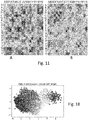
- Figure 10 illustrates 3D structures of the two proteins as predicted by Phyre2 for the initial protein (A) and for one of its reconstructions presented in Figure 9 (B) .
- Amino acids having similar properties are more likely to preserve the activity and folding of the protein when swapped in a sequence. These similarities are usually represented in the form of a BLOSUM matrix (blocks substitution matrix).
- BLOSUM matrix blocks substitution matrix
- the variational auto-encoder seems to learn which amino acids can be swapped as seen by the fact that the few positions in a reconstructed protein that are different from the initial protein are usually very similar amino acids. This may be confirmed by comparing the knowledge obtained by the variational auto-encoder to the BLOSUM62 matrix. As mentioned above, the decoder predicts the probability that each amino acid will occupy a given position.
- the chosen amino acid is the one with the highest probability but the other probabilities can be used to study how similar two amino acids are according to the variational auto-encoder and compute a BLOSUM-like matrix. For instance, it is expected that the probabilities for Leucine (L) and Isoleucine (I) to be relatively high when Valine (V) is predicted, since they all have hydrophobic side chains.
- Algorithm 2 in the Appendix illustrates an example of steps for computing a BLOSUM-like matrix.
- Figure 11 illustrates a BLOSUM62 matrix (left) and BLOSUM-like generated matrix (right). Red indicates that high likelihood that these amino acids can be swapped and blue a low likelihood.
- variational auto-encoder does correctly identify many of the similarities and dissimilarities between amino acids, with the notable exception of W and Y which the variational auto-encoder does not predict as easily swappable but are identified as such by the BLOSUM62 matrix.
- the variational auto-encoder thus learns what amino acids are related since they tend to appear in similar contexts, simply by being trained to perform reconstructions.
- the encoder having a stochastic output (it predicts a distribution over the latent variables), the variational auto-encoder can reconstruct a given sequence in a variety of ways.
- conditioning essentially consists in adding additional information to the encoder and to the decoder, which can then be used to control the generation process beyond random sampling.
- additional information has been used as a conditioning vector (c): the length of the protein, its weight, charge, isoelectric point, molar extinction coefficient and probability of expression in inclusion bodies (a measure of solubility).
- conditioning values have been modified linearly from -2 to +2 one at a time (quantities are standard scaled), while keeping the other values unchanged.
- 32 points have been randomly sampled in the latent space and the corresponding protein sequences have been generated. This enabled proteins to be generated which have, on average, chosen physical properties. This is exemplified, in particular, in Figure 12 where solubility has been modified. It is to be noted that properties that are strongly linked physically such as molecular weight and length cannot be conditioned upon separately, but conditioning is still possible when both are changed in the same direction.
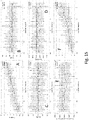
- Figures 12 to 16 illustrate generation of protein sequences when conditioned on solubility, protein length, protein length and weight, charge, and molar extinction coefficient, respectively. As mentioned above, proteins were generated while progressively changing the considered one(s) of these parameters from -2 to 2 and keeping the other physical properties unchanged.
- the green line represents the value provided in the conditioning vector. 32 proteins were generated for each set of values. The points represent the mean and bars represent the standard deviation.
- an F420-dependent glucose-6-phosphate dehydrogenase was chosen and 100 different reconstructions were generated by sampling the latent space while conditioning for increased solubility, protein length, protein length and weight, charge, and molar extinction coefficient.
- solubility as expected, conditioned proteins had increased solubility on average, although not as much as expected if conditioning worked perfectly. Further, it was observed that conditioning on solubility did not affect other physical properties. Reconstructed sequences were on average 95% identical to the initial sequence, and the accuracy only dropped to 94% when conditioning.
- Figure 17 illustrates generation of variants of a protein with desired properties. Reconstructions of a F420-dependent glucose-6-phosphate dehydrogenase are generated while conditioning for increased solubility (decreased insolubility). The distributions over all the six physical properties (graph A: weight, graph B: charge, graph C: isoelectric point (PI), graph D: molar extinction coefficient, graph E: length, and graph F: insolubility) of 100 reconstructions are shown:
- Figure 18 illustrates the projection of the training set in the latent space of an unconditioned model, colored as a function of the protein length.
- the x-axis is the projection on the first principal component (PC) and the y-axis is that on the second principal component (PC).
- Conditioning should in theory provide this physical information to the variational auto-encoder and thus free the latent space to encode other properties of the proteins. Indeed, in the variational auto-encoder trained with conditioning, it becomes impossible to predict protein size and the other properties from the latent space representation.
- the latent space self-organizes so that proteins from the same families cluster together.
- the luciferase-like domain (IPR011251) combines 88 Interpro families containing proteins with related functions, similarities in sequence, or similar secondary or tertiary structure.
- Figure 19 illustrates the projection of five Interpro families in the latent space.
- the z-axis is a vector that is obtained by maximizing its projection on five normal vectors of the hyperplanes defined by the logistic regression.
- FIG 20 schematically illustrates a processing device 2000 configured to implement at least one embodiment of at least part of the invention, for example one or several of the algorithms described by reference to Figures 3 to 9 .
- the processing device 2000 may be a device such as a micro-computer, a workstation, or a highly parallel computer.
- the device 2000 comprises a communication bus 2013 to which there are preferably connected:
- the apparatus 2000 may also include the following components:
- the communication bus provides communication and interoperability between the various elements included in the apparatus 2000 or connected to it.
- the representation of the bus is not limiting and in particular the central processing unit is operable to communicate instructions to any element of the apparatus 2000 directly or by means of another element of the apparatus 2000.
- the disk 2006 can be replaced by any information medium such as for example a compact disk (CD-ROM), rewritable or not, a ZIP disk or a memory card and, in general terms, by an information storage means that can be read by a microcomputer or by a microprocessor, integrated or not into the apparatus, possibly removable and adapted to store one or more programs whose execution enables the method for improving the assembling of raw images obtained by single molecule localization microscopy according to embodiments of the invention to be implemented.
- CD-ROM compact disk
- ZIP disk or a memory card
- an information storage means that can be read by a microcomputer or by a microprocessor, integrated or not into the apparatus, possibly removable and adapted to store one or more programs whose execution enables the method for improving the assembling of raw images obtained by single molecule localization microscopy according to embodiments of the invention to be implemented.
- the executable code may be stored either in read only memory 2007, on the hard disk 2004 or on a removable digital medium such as for example a disk 2006 as described previously.
- the executable code of the programs can be received by means of the communication network 2003, via the interface 2002, in order to be stored in one of the storage means of the apparatus 2000 before being executed, such as the hard disk 2004.
- the central processing unit 2011 is adapted to control and direct the execution of the instructions or portions of software code of the program or programs according to the invention, instructions that are stored in one of the aforementioned storage means.
- the program or programs that are stored in a nonvolatile memory for example on the hard disk 2004 or in the read only memory 2007, are transferred into the random access memory 2012, which then contains the executable code of the program or programs, as well as registers for storing the variables and parameters necessary for implementing the invention.
- the apparatus is a programmable apparatus which uses software to implement the invention.
- the present invention may be implemented in hardware (for example, in the form of an Application Specific Integrated Circuit or ASIC).
- embodiments have been described by reference to variational auto-encoders, other generative deep neural models may be used.
- embodiments may use adversarial auto-encoders (AAE) or conditional adversarial auto-encoders (CAAE) that add a discriminator network to an auto-encoder.
- AAE adversarial auto-encoder
- CAAE conditional adversarial auto-encoders
- the discriminator is trained to differentiate randomly sampled points in the latent space from the projection of actual data.
- the encoder is trained to fool this discriminator, thus forcing projections to occupy the whole latent space and ensuring that all points of the latent space can be decoded into valid samples.
- Figure 21 illustrates an example of the logical architecture of a conditional adversarial auto-encoder having an autoregressive decoder.
- conditional adversarial auto-encoder 2100 comprises an encoder 2105 and an autoregressive decoder 2110.
- the input vector 2115, denoted x, as well as additional information 2120 or conditions, denoted c, are applied to encoder 2105 to generate latent vector 2125, denoted z.
- An example of encoder 2105 is illustrated in Figure 22a .
- additional information 2120 may comprise the length of the protein, its charge, its isoelectric point, its molar extinction coefficient, its solubility (e.g. probability of expression in E.coli inclusion bodies: the smaller this quantity, the more soluble the protein is), and/or its molecular weight, it being observed that some of these values may be correlated (for example, the molecular weight of a protein is highly correlated with its length).
- latent vector 2125 and additional information 2120 are then applied to up-sampler 2130 to generate up-sampled latent vector 2135, denoted z'.
- Latent representation z is up-sampled in up-sampler 2130 while being conditioned by additional information c to generate latent representation z'.
- the obtained up-sampled latent vector 2135, i.e. latent representation z', and input vector x are then input in autoregressive module 2140 to generated result 2145, denoted x '.
- the size of the latent code z may be increased by concatenation to reach the one of input vector x .
- Autoregressive decoder 2110 may be similar to autoregressive decoder 210 described by reference to Figure 2a .
- Encoder 2105 and decoder 2140 can be similar to those described previously, with the difference that in the case of an adversarial auto-encoder architecture, the encoder is not probabilistic and simply makes a projection of vector x onto latent space z as illustrated in Figure 22a .
- Conditional adversarial auto-encoder 2100 further comprises a discriminator 2150 for discriminating projected samples (i.e. samples projected from input vectors) from drawn samples (i.e. samples obtained from the distribution within the latent space (p(z)).
- a discriminator 2150 for discriminating projected samples (i.e. samples projected from input vectors) from drawn samples (i.e. samples obtained from the distribution within the latent space (p(z)).
- An example of discriminator is illustrated in Figure 22b .
- Figure 22a illustrates an example of the functional architecture of encoder 2105 illustrated in Figure 21 . It is to be noted that other functional architectures may be implemented.
- input vector x is fed in five successive 1D convolution layers referenced 2200-1 to 2200-5 (for the sake of clarity only two of them are represented).
- the stride of these convolution layers is set to two, except for the first one which is set to one.
- the output of 1D convolution layer 2200-5 is flattened (reference 2205) so as to suppress one dimension.
- the convolution layers aim at establishing relations between parts of protein sequences.
- additional information or conditions c are fed into two successive dense layers 2210-1 and 2210-2, i.e. into two fully connected neural networks that aim at identifying what should be in protein sequences.
- the output of flattened layer 2205 and the output of dense layer 2210-2 are then concatenated (reference 2215). As illustrated, the result of the concatenation is fed into two successive dense layers 2220-1 and 2220-2, the result of the latter being latent vector z.
- Figure 22b illustrates an example of the functional architecture of discriminator 2150 illustrated in Figure 21 . It is to be noted that other functional architectures may be implemented.
- discriminator 2150 is based on two dense layers 2250-1 and 2250-2 that are fully connected neural networks aiming at identifying what should be in protein sequences.
- Training such a conditional adversarial auto-encoder and generating protein sequences with such a conditional adversarial auto-encoder may be based on the steps described by reference to Figure 6 .
- GANs generative adversarial networks
- Generative Adversarial Networks Goodfellow IJ, Pouget-Abadie J, Mirza M, Xu B, Warde-Farley D, Ozair S et al., arXiv:1406.2661v1
- NIPS 2016 Tutorial Generative Adversarial Networks
- Goodfellow I arXiv:1701.00160v4 Goodfellow I arXiv:1701.00160v4 .
- Another possible improvement is to make the autoregressive module bidirectional.
- Two networks would be trained in parallel to predict the next amino-acid in a sequence, one from left to right and the other from right to left. The generation process would then happen in two steps. In a first step a protein sequence can be generated from left to right (or vice-versa), and in a second step the generated sequence can be modified according to the predictions made by the second model reading the sequence in the opposite direction.
Landscapes
- Engineering & Computer Science (AREA)
- Physics & Mathematics (AREA)
- Life Sciences & Earth Sciences (AREA)
- Health & Medical Sciences (AREA)
- Bioinformatics & Cheminformatics (AREA)
- Medical Informatics (AREA)
- Theoretical Computer Science (AREA)
- Bioinformatics & Computational Biology (AREA)
- Biophysics (AREA)
- Spectroscopy & Molecular Physics (AREA)
- General Health & Medical Sciences (AREA)
- Evolutionary Biology (AREA)
- Biotechnology (AREA)
- Chemical & Material Sciences (AREA)
- Proteomics, Peptides & Aminoacids (AREA)
- Analytical Chemistry (AREA)
- Data Mining & Analysis (AREA)
- Molecular Biology (AREA)
- Genetics & Genomics (AREA)
- Bioethics (AREA)
- Databases & Information Systems (AREA)
- Epidemiology (AREA)
- Computer Vision & Pattern Recognition (AREA)
- Evolutionary Computation (AREA)
- Software Systems (AREA)
- Public Health (AREA)
- Artificial Intelligence (AREA)
- Investigating Or Analysing Biological Materials (AREA)
Priority Applications (4)
| Application Number | Priority Date | Filing Date | Title |
|---|---|---|---|
| EP17306591.3A EP3486816A1 (fr) | 2017-11-16 | 2017-11-16 | Procédé, dispositif et programme informatique pour générer des séquences de protéines avec des réseaux neuronaux autorégressifs |
| PCT/EP2018/081614 WO2019097014A1 (fr) | 2017-11-16 | 2018-11-16 | Procédé, dispositif et programme informatique de production de séquences de protéines avec des réseaux neuronaux autorégressifs |
| EP18803984.6A EP3711057B1 (fr) | 2017-11-16 | 2018-11-16 | Procédé, dispositif et programme informatique pour générer des séquences de protéines avec des réseaux neuronaux autorégressifs |
| US16/757,230 US12567481B2 (en) | 2017-11-16 | 2018-11-16 | Method, device, and computer program for generating protein sequences with autoregressive neural networks |
Applications Claiming Priority (1)
| Application Number | Priority Date | Filing Date | Title |
|---|---|---|---|
| EP17306591.3A EP3486816A1 (fr) | 2017-11-16 | 2017-11-16 | Procédé, dispositif et programme informatique pour générer des séquences de protéines avec des réseaux neuronaux autorégressifs |
Publications (1)
| Publication Number | Publication Date |
|---|---|
| EP3486816A1 true EP3486816A1 (fr) | 2019-05-22 |
Family
ID=61094174
Family Applications (2)
| Application Number | Title | Priority Date | Filing Date |
|---|---|---|---|
| EP17306591.3A Withdrawn EP3486816A1 (fr) | 2017-11-16 | 2017-11-16 | Procédé, dispositif et programme informatique pour générer des séquences de protéines avec des réseaux neuronaux autorégressifs |
| EP18803984.6A Active EP3711057B1 (fr) | 2017-11-16 | 2018-11-16 | Procédé, dispositif et programme informatique pour générer des séquences de protéines avec des réseaux neuronaux autorégressifs |
Family Applications After (1)
| Application Number | Title | Priority Date | Filing Date |
|---|---|---|---|
| EP18803984.6A Active EP3711057B1 (fr) | 2017-11-16 | 2018-11-16 | Procédé, dispositif et programme informatique pour générer des séquences de protéines avec des réseaux neuronaux autorégressifs |
Country Status (3)
| Country | Link |
|---|---|
| US (1) | US12567481B2 (fr) |
| EP (2) | EP3486816A1 (fr) |
| WO (1) | WO2019097014A1 (fr) |
Cited By (6)
| Publication number | Priority date | Publication date | Assignee | Title |
|---|---|---|---|---|
| WO2021026037A1 (fr) * | 2019-08-02 | 2021-02-11 | Flagship Pioneering Innovations Vi, Llc | Conception de polypeptides guidée par apprentissage automatique |
| WO2021059066A1 (fr) * | 2019-09-27 | 2021-04-01 | Uab ”Biomatter Designs” | Procédé de génération de séquences de protéines fonctionnelles avec des réseaux antagonistes génératifs |
| WO2021142306A1 (fr) * | 2020-01-10 | 2021-07-15 | Modernatx, Inc. | Auto-encodeur variationnel pour génération de séquence biologique |
| CN113873534A (zh) * | 2021-10-15 | 2021-12-31 | 重庆邮电大学 | 一种雾计算中区块链协助的联邦学习主动内容缓存方法 |
| CN115798581A (zh) * | 2022-09-29 | 2023-03-14 | 南开大学 | 一种基于深度学习的酶改造的理性设计方法 |
| CN116964678A (zh) * | 2021-02-05 | 2023-10-27 | 渊慧科技有限公司 | 使用以蛋白质结构嵌入为条件的生成模型预测蛋白质氨基酸序列 |
Families Citing this family (28)
| Publication number | Priority date | Publication date | Assignee | Title |
|---|---|---|---|---|
| EP3924971A1 (fr) * | 2019-02-11 | 2021-12-22 | Flagship Pioneering Innovations VI, LLC | Analyse de polypeptides guidée par l'apprentissage automatique |
| US20200273541A1 (en) * | 2019-02-27 | 2020-08-27 | The Regents Of The University Of California | Unsupervised protein sequence generation |
| CA3132181A1 (fr) * | 2019-05-03 | 2020-11-12 | Simon FRIEDENSOHN | Identification de motifs convergents de sequence de specificite d'anticorps |
| JP7178323B2 (ja) * | 2019-05-23 | 2022-11-25 | 日本電信電話株式会社 | 学習装置、学習方法、および、学習プログラム |
| JP2022548841A (ja) | 2019-09-13 | 2022-11-22 | ザ・ユニバーシティ・オブ・シカゴ | タンパク質および他の配列定義された生体分子の進化的なデータ駆動型設計のための機械学習を使用した方法および装置 |
| CN111063391B (zh) * | 2019-12-20 | 2023-04-25 | 海南大学 | 一种基于生成式对抗网络原理的不可培养微生物筛选系统 |
| US20210249104A1 (en) * | 2020-02-06 | 2021-08-12 | Salesforce.Com, Inc. | Systems and methods for language modeling of protein engineering |
| WO2021165887A1 (fr) * | 2020-02-19 | 2021-08-26 | Insilico Medicine Ip Limited | Architecture d'autocodeur contradictoire pour des procédés de modèles de graphe à séquence |
| EP4205125A4 (fr) | 2020-08-28 | 2024-02-21 | Just-Evotec Biologics, Inc. | Mise en oeuvre d'une architecture d'apprentissage machine génératif pour produire des données d'apprentissage pour un modèle de classification |
| CN112116963B (zh) * | 2020-09-24 | 2024-11-19 | 深圳智药信息科技有限公司 | 自动药物设计方法、系统、计算设备及计算机可读存储介质 |
| US11929853B2 (en) * | 2020-10-19 | 2024-03-12 | Qualcomm Incorporated | Data-driven probabilistic modeling of wireless channels using conditional variational auto-encoders |
| WO2022245737A1 (fr) * | 2021-05-17 | 2022-11-24 | Genentech, Inc. | Conception de protéine in silico guidée par une fonction |
| EP4095863A1 (fr) * | 2021-05-28 | 2022-11-30 | InstaDeep Ltd | Apprentissage machine pour l'évaluation d'une chaîne d'acides aminés |
| US20230130863A1 (en) * | 2021-06-25 | 2023-04-27 | Bae Systems Information And Electronic Systems Integration Inc. | Method for signal representation and reconstruction |
| CN113569338B (zh) * | 2021-08-06 | 2022-10-14 | 大连理工大学 | 一种基于时间扩张卷积网络的压气机旋转失速预警方法 |
| US20240404634A1 (en) * | 2021-08-31 | 2024-12-05 | Just-Evotec Biologics, Inc. | Residual artificial neural network to generate protein sequences |
| CN114155909B (zh) * | 2021-12-03 | 2025-10-28 | 北京有竹居网络技术有限公司 | 构建多肽分子的方法和电子设备 |
| CN114360636B (zh) * | 2022-01-04 | 2025-12-12 | 北京航空航天大学 | 一种基于流模型的抗体序列结构协同设计方法 |
| IL314286A (en) * | 2022-01-17 | 2024-09-01 | Univ Washington | Luciferase designed de novo |
| CN115811304A (zh) * | 2022-08-05 | 2023-03-17 | 江苏科技大学 | 一种基于条件变分自编码网络的海洋脉冲噪声消除方法 |
| CN115512762B (zh) * | 2022-10-26 | 2023-06-20 | 北京百度网讯科技有限公司 | 多肽序列的生成方法、装置、电子设备及存储介质 |
| GB202303199D0 (en) * | 2023-03-03 | 2023-04-19 | Lyu Suyue | System and method for generating protein sequences |
| CN116343908B (zh) * | 2023-03-07 | 2023-10-17 | 中国海洋大学 | 融合dna形状特征的蛋白质编码区域预测方法、介质和装置 |
| US12587274B2 (en) | 2023-03-28 | 2026-03-24 | Quantum Generative Materials Llc | Satellite optimization management system based on natural language input and artificial intelligence |
| CN116994642B (zh) * | 2023-08-09 | 2026-01-27 | 上海交通大学 | 用于蛋白质序列生成的离散图概率去噪扩散模型 |
| US20250140349A1 (en) * | 2023-10-26 | 2025-05-01 | Microsoft Technology Licensing, Llc | Conditional generation of protein sequences |
| US12603701B2 (en) | 2023-12-27 | 2026-04-14 | Quantum Generative Materials Llc | Distributed satellite constellation management and control system |
| US12368503B2 (en) | 2023-12-27 | 2025-07-22 | Quantum Generative Materials Llc | Intent-based satellite transmit management based on preexisting historical location and machine learning |
-
2017
- 2017-11-16 EP EP17306591.3A patent/EP3486816A1/fr not_active Withdrawn
-
2018
- 2018-11-16 EP EP18803984.6A patent/EP3711057B1/fr active Active
- 2018-11-16 WO PCT/EP2018/081614 patent/WO2019097014A1/fr not_active Ceased
- 2018-11-16 US US16/757,230 patent/US12567481B2/en active Active
Non-Patent Citations (21)
| Title |
|---|
| AARON VAN DEN OORD ET AL: "Conditional Image Generation with PixelCNN Decoders", ARXIV.ORG, CORNELL UNIVERSITY LIBRARY, 201 OLIN LIBRARY CORNELL UNIVERSITY ITHACA, NY 14853, 16 June 2016 (2016-06-16), XP080709038 * |
| AÄRON VAN DEN OORD ET AL: "Pixel Recurrent Neural Networks", 25 January 2016 (2016-01-25), XP055404359, Retrieved from the Internet <URL:https://arxiv.org/pdf/1601.06759.pdf> [retrieved on 20170906] * |
| ANONYMOUS: "Autoencoder - Wikipedia", 9 November 2017 (2017-11-09), XP055472587, Retrieved from the Internet <URL:https://en.wikipedia.org/w/index.php?title=Autoencoder&oldid=809530971> [retrieved on 20180504] * |
| ASHISH VASWANI; NOAM SHAZEER; NIKI PARMAR; JAKOB USZKOREIT; LLION JONES; AIDAN N; GOMEZ, LUKASZ KAISER; ILLIA POLOSUKHIN: "Attention Is All You Need", ARXIV:1706.03762V4 |
| CARL DOERSCH: "Tutorial on Variational Autoencoders", ARXIV:1606.05908V2, 2016 |
| DEVON HJELM R; JACOB AP; CHE T; CHO K; BENGIO Y.: "Boundary-Seeking Generative Adversarial Networks", ARXIV:1702.08431V2 |
| GAINZA P ET AL.: "Algorithms for protein design", CURR. OPIN. STRUCT. BIOL., vol. 39, 2016, pages 16 - 26, XP029764634, DOI: doi:10.1016/j.sbi.2016.03.006 |
| GOODFELLOW I: "NIPS 2016 Tutorial: Generative Adversarial Networks", ARXIV:1701.00160V4 |
| GOODFELLOW IJ; POUGET-ABADIE J; MIRZA M; XU B; WARDE-FARLEY D; OZAIR S ET AL.: "Generative Adversarial Networks", ARXIV:1406.2661V1 |
| HUANG PS ET AL.: "The coming of age of de novo protein design", NATURE, vol. 537, 2016, pages 320 - 327 |
| ILYA SUTSKEVER ET AL: "Generating Text with Recurrent Neural Networks", 1 July 2011 (2011-07-01), XP055472805, Retrieved from the Internet <URL:http://www.icml-2011.org/papers/524_icmlpaper.pdf> [retrieved on 20180504] * |
| ISHAAN GULRAJANI ET AL: "PixelVAE: A Latent Variable Model for Natural Images", ARXIV.ORG, CORNELL UNIVERSITY LIBRARY, 201 OLIN LIBRARY CORNELL UNIVERSITY ITHACA, NY 14853, 15 November 2016 (2016-11-15), XP080731998 * |
| JONAS GEHRING; MICHAEL AULI; DAVID GRANGIER; DENIS YARATS; YANN N. DAUPHIN: "Convolutional Sequence to Sequence Learning", ARXIV:1705.03122V3 |
| KINGMA DP ET AL.: "Auto- Encoding Variational Bayes", ARXIV:1312.6114V10, 2013 |
| PACKER MS ET AL.: "Methods for the directed evolution of proteins", NAT. REV. GENET., vol. 16, 2015, pages 379 - 394 |
| RAFAEL GÓMEZ-BOMBARELLI ET AL: "Automatic Chemical Design Using a Data-Driven Continuous Representation of Molecules", ARXIV.ORG, 6 January 2017 (2017-01-06), XP055471667, Retrieved from the Internet <URL:https://arxiv.org/pdf/1610.02415v2.pdf> [retrieved on 20180502] * |
| REZENDE DJ ET AL.: "Stochastic Backpropagation and Approximate Inference in Deep Generative Models", ARXIV:1401.4082V3, 2014 |
| STANISLAU SEMENIUTA ET AL: "A Hybrid Convolutional Variational Autoencoder for Text Generation", ARXIV.ORG, CORNELL UNIVERSITY LIBRARY, 201 OLIN LIBRARY CORNELL UNIVERSITY ITHACA, NY 14853, 8 February 2017 (2017-02-08), XP080747075 * |
| VAN DEN OORD A ET AL.: "WaveNet: A Generative Model for Raw Audio", ARXIV:1609.03499V2, 2016 |
| XUELIANG LIU: "Deep Recurrent Neural Network for Protein Function Prediction from Sequence", 28 January 2017 (2017-01-28), XP055472357, Retrieved from the Internet <URL:https://arxiv.org/ftp/arxiv/papers/1701/1701.08318.pdf> [retrieved on 20180503] * |
| YO JOONG CHOE ET AL: "Probabilistic Interpretations of Recurrent Neural Networks", 29 May 2017 (2017-05-29), XP055472541, Retrieved from the Internet <URL:https://www.cs.cmu.edu/~epxing/Class/10708-17/project-reports/project10.pdf> [retrieved on 20180504] * |
Cited By (13)
| Publication number | Priority date | Publication date | Assignee | Title |
|---|---|---|---|---|
| IL290507B1 (en) * | 2019-08-02 | 2025-08-01 | Flagship Pioneering Innovations Vi Llc | Machine learning guided polypeptide design |
| WO2021026037A1 (fr) * | 2019-08-02 | 2021-02-11 | Flagship Pioneering Innovations Vi, Llc | Conception de polypeptides guidée par apprentissage automatique |
| CN115136246A (zh) * | 2019-08-02 | 2022-09-30 | 旗舰开拓创新六世公司 | 机器学习引导的多肽设计 |
| JP2022543234A (ja) * | 2019-08-02 | 2022-10-11 | フラッグシップ・パイオニアリング・イノベーションズ・ブイアイ,エルエルシー | 機械学習支援ポリペプチド設計 |
| IL290507B2 (en) * | 2019-08-02 | 2025-12-01 | Flagship Pioneering Innovations Vi Llc | Machine learning guided polypeptide design |
| CN115136246B (zh) * | 2019-08-02 | 2025-09-09 | 旗舰开拓创新六世公司 | 机器学习引导的多肽设计 |
| WO2021059066A1 (fr) * | 2019-09-27 | 2021-04-01 | Uab ”Biomatter Designs” | Procédé de génération de séquences de protéines fonctionnelles avec des réseaux antagonistes génératifs |
| WO2021142306A1 (fr) * | 2020-01-10 | 2021-07-15 | Modernatx, Inc. | Auto-encodeur variationnel pour génération de séquence biologique |
| EP4088281A4 (fr) * | 2020-01-10 | 2024-02-21 | ModernaTX, Inc. | Auto-encodeur variationnel pour génération de séquence biologique |
| CN116964678A (zh) * | 2021-02-05 | 2023-10-27 | 渊慧科技有限公司 | 使用以蛋白质结构嵌入为条件的生成模型预测蛋白质氨基酸序列 |
| CN113873534A (zh) * | 2021-10-15 | 2021-12-31 | 重庆邮电大学 | 一种雾计算中区块链协助的联邦学习主动内容缓存方法 |
| CN113873534B (zh) * | 2021-10-15 | 2024-02-06 | 深圳点链科技有限公司 | 一种雾计算中区块链协助的联邦学习主动内容缓存方法 |
| CN115798581A (zh) * | 2022-09-29 | 2023-03-14 | 南开大学 | 一种基于深度学习的酶改造的理性设计方法 |
Also Published As
| Publication number | Publication date |
|---|---|
| US20210193259A1 (en) | 2021-06-24 |
| US12567481B2 (en) | 2026-03-03 |
| EP3711057C0 (fr) | 2024-07-17 |
| WO2019097014A1 (fr) | 2019-05-23 |
| EP3711057B1 (fr) | 2024-07-17 |
| EP3711057A1 (fr) | 2020-09-23 |
Similar Documents
| Publication | Publication Date | Title |
|---|---|---|
| EP3486816A1 (fr) | Procédé, dispositif et programme informatique pour générer des séquences de protéines avec des réseaux neuronaux autorégressifs | |
| US11256995B1 (en) | System and method for prediction of protein-ligand bioactivity using point-cloud machine learning | |
| US11256994B1 (en) | System and method for prediction of protein-ligand bioactivity and pose propriety | |
| US12223435B2 (en) | System and method for molecular reconstruction from molecular probability distributions | |
| Wilson et al. | The future of adaptive machine learning algorithms in high-dimensional data processing | |
| US11354582B1 (en) | System and method for automated retrosynthesis | |
| US20230038256A1 (en) | System and method for the contextualization of molecules | |
| US11263534B1 (en) | System and method for molecular reconstruction and probability distributions using a 3D variational-conditioned generative adversarial network | |
| Zhang et al. | A survey on graph diffusion models: Generative ai in science for molecule, protein and material | |
| US12248885B2 (en) | System and method for feedback-driven automated drug discovery | |
| US20220358373A1 (en) | System and method for the latent space optimization of generative machine learning models | |
| US11615324B2 (en) | System and method for de novo drug discovery | |
| US12511869B2 (en) | System and method for pharmacophore-conditioned generation of molecules | |
| Kramer | Machine learning for evolution strategies | |
| US11568961B2 (en) | System and method for accelerating FEP methods using a 3D-restricted variational autoencoder | |
| US11367006B1 (en) | Toxic substructure extraction using clustering and scaffold extraction | |
| Kolodiazhnyi | Hands-On Machine Learning with C++: Build, train, and deploy end-to-end machine learning and deep learning pipelines | |
| US20250117973A1 (en) | Style-based image generation | |
| Melki et al. | OLLAWV: online learning algorithm using worst-violators | |
| Hassanieh et al. | Selective deep autoencoder for unsupervised feature selection | |
| Mitrai et al. | Accelerating process control and optimization via machine learning: A review | |
| Hamad | Integrating machine learning and genetic algorithms to enhance gene-disease classification: an XBNet-based framework | |
| Lacan et al. | In silico generation of gene expression profiles using diffusion models | |
| US20260065516A1 (en) | Plug-and-play diffusion distillation | |
| JP7625096B2 (ja) | 訓練データのための少数クラス例の生成 |
Legal Events
| Date | Code | Title | Description |
|---|---|---|---|
| PUAI | Public reference made under article 153(3) epc to a published international application that has entered the european phase |
Free format text: ORIGINAL CODE: 0009012 |
|
| STAA | Information on the status of an ep patent application or granted ep patent |
Free format text: STATUS: THE APPLICATION HAS BEEN PUBLISHED |
|
| AK | Designated contracting states |
Kind code of ref document: A1 Designated state(s): AL AT BE BG CH CY CZ DE DK EE ES FI FR GB GR HR HU IE IS IT LI LT LU LV MC MK MT NL NO PL PT RO RS SE SI SK SM TR |
|
| AX | Request for extension of the european patent |
Extension state: BA ME |
|
| STAA | Information on the status of an ep patent application or granted ep patent |
Free format text: STATUS: THE APPLICATION IS DEEMED TO BE WITHDRAWN |
|
| 18D | Application deemed to be withdrawn |
Effective date: 20191123 |