EP3488768A1 - Procédé et appareil permettant de déterminer la santé physique par surveillance de l'activité cardiaque - Google Patents
Procédé et appareil permettant de déterminer la santé physique par surveillance de l'activité cardiaque Download PDFInfo
- Publication number
- EP3488768A1 EP3488768A1 EP17203696.4A EP17203696A EP3488768A1 EP 3488768 A1 EP3488768 A1 EP 3488768A1 EP 17203696 A EP17203696 A EP 17203696A EP 3488768 A1 EP3488768 A1 EP 3488768A1
- Authority
- EP
- European Patent Office
- Prior art keywords
- cfi
- cfr
- time
- user
- acceleration
- Prior art date
- Legal status (The legal status is an assumption and is not a legal conclusion. Google has not performed a legal analysis and makes no representation as to the accuracy of the status listed.)
- Withdrawn
Links
Images


Classifications
-
- A—HUMAN NECESSITIES
- A61—MEDICAL OR VETERINARY SCIENCE; HYGIENE
- A61B—DIAGNOSIS; SURGERY; IDENTIFICATION
- A61B5/00—Measuring for diagnostic purposes; Identification of persons
- A61B5/72—Signal processing specially adapted for physiological signals or for diagnostic purposes
- A61B5/7271—Specific aspects of physiological measurement analysis
- A61B5/7275—Determining trends in physiological measurement data; Predicting development of a medical condition based on physiological measurements, e.g. determining a risk factor
-
- A—HUMAN NECESSITIES
- A61—MEDICAL OR VETERINARY SCIENCE; HYGIENE
- A61B—DIAGNOSIS; SURGERY; IDENTIFICATION
- A61B5/00—Measuring for diagnostic purposes; Identification of persons
- A61B5/02—Detecting, measuring or recording for evaluating the cardiovascular system, e.g. pulse, heart rate, blood pressure or blood flow
- A61B5/02028—Determining haemodynamic parameters not otherwise provided for, e.g. cardiac contractility or left ventricular ejection fraction
-
- A—HUMAN NECESSITIES
- A61—MEDICAL OR VETERINARY SCIENCE; HYGIENE
- A61B—DIAGNOSIS; SURGERY; IDENTIFICATION
- A61B5/00—Measuring for diagnostic purposes; Identification of persons
- A61B5/103—Measuring devices for testing the shape, pattern, colour, size or movement of the body or parts thereof, for diagnostic purposes
- A61B5/11—Measuring movement of the entire body or parts thereof, e.g. head or hand tremor or mobility of a limb
- A61B5/1118—Determining activity level
-
- A—HUMAN NECESSITIES
- A61—MEDICAL OR VETERINARY SCIENCE; HYGIENE
- A61B—DIAGNOSIS; SURGERY; IDENTIFICATION
- A61B5/00—Measuring for diagnostic purposes; Identification of persons
- A61B5/22—Ergometry; Measuring muscular strength or the force of a muscular blow
- A61B5/221—Ergometry, e.g. by using bicycle type apparatus
- A61B5/222—Ergometry, e.g. by using bicycle type apparatus combined with detection or measurement of physiological parameters, e.g. heart rate
-
- G—PHYSICS
- G01—MEASURING; TESTING
- G01G—WEIGHING
- G01G19/00—Weighing apparatus or methods adapted for special purposes not provided for in the preceding groups
- G01G19/44—Weighing apparatus or methods adapted for special purposes not provided for in the preceding groups for weighing persons
-
- G—PHYSICS
- G01—MEASURING; TESTING
- G01G—WEIGHING
- G01G19/00—Weighing apparatus or methods adapted for special purposes not provided for in the preceding groups
- G01G19/44—Weighing apparatus or methods adapted for special purposes not provided for in the preceding groups for weighing persons
- G01G19/50—Weighing apparatus or methods adapted for special purposes not provided for in the preceding groups for weighing persons having additional measuring devices, e.g. for height
-
- G—PHYSICS
- G16—INFORMATION AND COMMUNICATION TECHNOLOGY [ICT] SPECIALLY ADAPTED FOR SPECIFIC APPLICATION FIELDS
- G16H—HEALTHCARE INFORMATICS, i.e. INFORMATION AND COMMUNICATION TECHNOLOGY [ICT] SPECIALLY ADAPTED FOR THE HANDLING OR PROCESSING OF MEDICAL OR HEALTHCARE DATA
- G16H20/00—ICT specially adapted for therapies or health-improving plans, e.g. for handling prescriptions, for steering therapy or for monitoring patient compliance
- G16H20/30—ICT specially adapted for therapies or health-improving plans, e.g. for handling prescriptions, for steering therapy or for monitoring patient compliance relating to physical therapies or activities, e.g. physiotherapy, acupressure or exercising
-
- G—PHYSICS
- G16—INFORMATION AND COMMUNICATION TECHNOLOGY [ICT] SPECIALLY ADAPTED FOR SPECIFIC APPLICATION FIELDS
- G16H—HEALTHCARE INFORMATICS, i.e. INFORMATION AND COMMUNICATION TECHNOLOGY [ICT] SPECIALLY ADAPTED FOR THE HANDLING OR PROCESSING OF MEDICAL OR HEALTHCARE DATA
- G16H50/00—ICT specially adapted for medical diagnosis, medical simulation or medical data mining; ICT specially adapted for detecting, monitoring or modelling epidemics or pandemics
- G16H50/30—ICT specially adapted for medical diagnosis, medical simulation or medical data mining; ICT specially adapted for detecting, monitoring or modelling epidemics or pandemics for calculating health indices; for individual health risk assessment
-
- A—HUMAN NECESSITIES
- A61—MEDICAL OR VETERINARY SCIENCE; HYGIENE
- A61B—DIAGNOSIS; SURGERY; IDENTIFICATION
- A61B2503/00—Evaluating a particular growth phase or type of persons or animals
- A61B2503/10—Athletes
-
- A—HUMAN NECESSITIES
- A61—MEDICAL OR VETERINARY SCIENCE; HYGIENE
- A61B—DIAGNOSIS; SURGERY; IDENTIFICATION
- A61B2505/00—Evaluating, monitoring or diagnosing in the context of a particular type of medical care
- A61B2505/09—Rehabilitation or training
-
- A—HUMAN NECESSITIES
- A61—MEDICAL OR VETERINARY SCIENCE; HYGIENE
- A61B—DIAGNOSIS; SURGERY; IDENTIFICATION
- A61B2562/00—Details of sensors; Constructional details of sensor housings or probes; Accessories for sensors
- A61B2562/02—Details of sensors specially adapted for in-vivo measurements
- A61B2562/0219—Inertial sensors, e.g. accelerometers, gyroscopes, tilt switches
-
- A—HUMAN NECESSITIES
- A61—MEDICAL OR VETERINARY SCIENCE; HYGIENE
- A61B—DIAGNOSIS; SURGERY; IDENTIFICATION
- A61B5/00—Measuring for diagnostic purposes; Identification of persons
- A61B5/02—Detecting, measuring or recording for evaluating the cardiovascular system, e.g. pulse, heart rate, blood pressure or blood flow
- A61B5/024—Measuring pulse rate or heart rate
- A61B5/02416—Measuring pulse rate or heart rate using photoplethysmograph signals, e.g. generated by infrared radiation
-
- A—HUMAN NECESSITIES
- A61—MEDICAL OR VETERINARY SCIENCE; HYGIENE
- A61B—DIAGNOSIS; SURGERY; IDENTIFICATION
- A61B5/00—Measuring for diagnostic purposes; Identification of persons
- A61B5/02—Detecting, measuring or recording for evaluating the cardiovascular system, e.g. pulse, heart rate, blood pressure or blood flow
- A61B5/024—Measuring pulse rate or heart rate
- A61B5/0245—Measuring pulse rate or heart rate by using sensing means generating electric signals, i.e. ECG signals
- A61B5/02455—Measuring pulse rate or heart rate by using sensing means generating electric signals, i.e. ECG signals provided with high/low alarm devices
-
- A—HUMAN NECESSITIES
- A61—MEDICAL OR VETERINARY SCIENCE; HYGIENE
- A61B—DIAGNOSIS; SURGERY; IDENTIFICATION
- A61B5/00—Measuring for diagnostic purposes; Identification of persons
- A61B5/68—Arrangements of detecting, measuring or recording means, e.g. sensors, in relation to patient
- A61B5/6801—Arrangements of detecting, measuring or recording means, e.g. sensors, in relation to patient specially adapted to be attached to or worn on the body surface
- A61B5/6813—Specially adapted to be attached to a specific body part
- A61B5/6814—Head
- A61B5/6815—Ear
- A61B5/6816—Ear lobe
-
- A—HUMAN NECESSITIES
- A61—MEDICAL OR VETERINARY SCIENCE; HYGIENE
- A61B—DIAGNOSIS; SURGERY; IDENTIFICATION
- A61B5/00—Measuring for diagnostic purposes; Identification of persons
- A61B5/68—Arrangements of detecting, measuring or recording means, e.g. sensors, in relation to patient
- A61B5/6801—Arrangements of detecting, measuring or recording means, e.g. sensors, in relation to patient specially adapted to be attached to or worn on the body surface
- A61B5/6813—Specially adapted to be attached to a specific body part
- A61B5/6823—Trunk, e.g., chest, back, abdomen, hip
-
- A—HUMAN NECESSITIES
- A61—MEDICAL OR VETERINARY SCIENCE; HYGIENE
- A61B—DIAGNOSIS; SURGERY; IDENTIFICATION
- A61B5/00—Measuring for diagnostic purposes; Identification of persons
- A61B5/68—Arrangements of detecting, measuring or recording means, e.g. sensors, in relation to patient
- A61B5/6801—Arrangements of detecting, measuring or recording means, e.g. sensors, in relation to patient specially adapted to be attached to or worn on the body surface
- A61B5/6813—Specially adapted to be attached to a specific body part
- A61B5/6825—Hand
-
- A—HUMAN NECESSITIES
- A61—MEDICAL OR VETERINARY SCIENCE; HYGIENE
- A61B—DIAGNOSIS; SURGERY; IDENTIFICATION
- A61B5/00—Measuring for diagnostic purposes; Identification of persons
- A61B5/72—Signal processing specially adapted for physiological signals or for diagnostic purposes
- A61B5/7235—Details of waveform analysis
- A61B5/7264—Classification of physiological signals or data, e.g. using neural networks, statistical classifiers, expert systems or fuzzy systems
Definitions
- the present disclosure generally relates to a method and apparatus for determining physical fitness by monitoring cardiac activity. More particularly, the present disclosure relates to a method and apparatus for determining physical fitness by monitoring the cardiac activity of an individual during exercise using a cardiac parameter derived from a heart rate, a weight and/or an acceleration of the individual.
- Sudden cardiac death is defined as non-violent and unexpected death due to cardiac causes in persons with or without cardiac disease. Sudden cardiac death generally occurs within one hour of the onset of symptoms, if any.
- Heart rate monitors and fitness trackers can only measure the heart rate, blood oxygen level, blood pressure and/or respiration rate of the user, but these devices cannot provide instantaneous information about the user's cardiac status and cardiac loading condition, which are crucial indicators for evaluating the risk of sudden cardiac death.
- CFI cardiac force index
- CFI cardiac force index
- CFR' cardiac force ratio
- spatially relative terms such as “beneath,” “below,” “lower,” “above,” “upper” and the like, may be used herein for ease of description to describe one element or feature's relationship to another element or feature as illustrated in the figures.
- the spatially relative terms are intended to encompass different orientations of the device in use or operation in addition to the orientation depicted in the figures.
- the apparatus may be otherwise oriented (e.g., rotated 90 degrees or at other orientations) and the spatially relative descriptors used herein may be interpreted accordingly.
- the present disclosure provides a cardiac force index (CFI) to reflect the instantaneous cardiac status of an individual.
- CFI cardiac force index
- the CFI is associated with the heart rate, acceleration and/or weight of the individual.
- the heart rate is the speed of the heartbeat measured by the number of contractions of the heart per minute. Measurement of the heart rate can be carried out by detecting the heart beating or artery pulsing of the individual in any feasible way, such as detecting the blood flow in a capillary vessel of a fingertip or an earlobe, detecting an electrocardiographic signal of a palm area, or detecting an electrocardiographic signal of a chest area with electrodes.
- the acceleration of the individual during exercise can be measured by an accelerometer of any form, such as a three-axis accelerometer, a nine-axis accelerometer, a sixteen-axis accelerometer, and a G-sensor.
- a cardiac force ratio (CFR) that compares the CFI of an individual during exercise to the CFI of a walking individual.
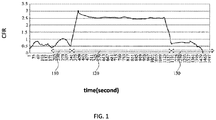
- FIG. 1 illustrates a CFR versus time graph according to one embodiment of the present disclosure.
- the CFI of an individual is measured for a time period comprising a pre-exercise phase 110, an exercise phase 120 and a post-exercise phase 130 (the signals before the start of the pre-exercise phase 110 are noises).
- the pre-exercise phase 110 can be a walking phase in which the individual is walking.
- the maximum CFI of the pre-exercise phase 110 (which occurs at around the 273 th second) is employed as a reference for calculation of cardiac force ratios.
- the CFR at around the 273 th second is set to "1."
- the individual Upon entering the exercise phase 120 that follows the pre-exercise phase 110, the individual changes from a relatively stable condition of walking into a dynamic condition of exercise, which is indicated by a sharp increase in the acceleration of the individual. Accordingly, the cardiac force ratio quickly rises to a peak.
- the exercise may comprise running, jogging, swimming, cycling and so on.
- the peak indicates the explosive power of the individual. In FIG. 1 , the peak has a cardiac force ratio of around 3.
- the cardiac force ratio decreases.
- the cardiac force ratio decreases most significantly within 40 to 80 seconds after the peak. In one embodiment, the cardiac force ratio decreases most significantly within 70 seconds after the peak.
- the cardiac force ratio becomes stable and enters an endurance period, where the cardiac force ratio is around 2.5.
- the exercise phase 120 is followed by the post-exercise phase 130 at the 1191 th second.
- FIG. 1 shows that the cardiac force ratio plummets, and this is because the dynamic exercise condition of the individual changes to a relatively static condition.
- CFR' cardiac force ratio
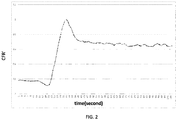
- FIG. 2 illustrates a CFR' versus time graph according to the above embodiment of the present disclosure.
- the pre-exercise phase 110 ends at around the 21 st second, where the exercise phase 120 begins.
- the maximum CFI of the exercise phase 120 (which occurs at around the 33 th second) is employed as a reference for calculation of the CFR's, and therefore the CFR' at around the 33 th second is set to "1.”
- the CFR's decrease at the maximum CFI (the 33 th second).
- the cardiac force ratio decreases most significantly within 40 to 80 seconds after the peak (maximum CFI of the exercise phase 120). In one embodiment, the cardiac force ratio decreases most significantly within 70 seconds after the peak.
- the CFR' (CFI/maximum CFI of the exercise phase) can provide crucial information for evaluating the risk of sudden cardiac death during exercise.
- FIG. 3 illustrates a CFR' versus time graph for an individual with normal cardiac condition, wherein the maximum CFI of the exercise phase 120 is set at the 0 th second (with the CFR' being "1").
- the CFR' at the 30 th second i.e., the CFI at the 30 th second divided by the maximum CFI of the exercise phase 120
- the CFR' at the 40 th second is 0.78
- the CFR' at the 50 th second is 0.75
- the CFR' at the 60 th second is 0.73
- the CFR' at the 90 th second is 0.69
- the CFR' at the 120 th second is 0.69
- the CFR' at the 150 th second is 0.68
- the CFR' at the 180 th second is 0.68.
- the drop of the CFR' to a value smaller than a threshold value e.g., between about 0.5 and about 0.7
- a threshold value e.g., between about 0.5 and about 0.7
- the threshold value of the CFR' is about 0.6.
- the CFR' can be employed as an indicator for evaluating whether an individual is in good physical fitness. For example, the sudden drop of the CFR' to about 0.6 during exercise may indicates that the individual might not in a good physical fitness.
- a method for determining physical fitness by monitoring cardiac activity during exercise comprises measuring the CFI of an individual wherein the CFI for each second in the exercise phase 120 is recorded.
- the second step of the method is to identify the maximum CFI that occurs at the start of the exercise phase 120.
- the CFR' for each second following the maximum CFI of the exercise phase 120 can be calculated.
- the method determines whether the CFR' within a period of time after the maximum CFI of the exercise phase 120 is smaller than a threshold value (e.g., 0.6). This period of time may be about 90 seconds following the maximum CFI of the exercise phase 120. This period of time may be about 80 seconds following the maximum CFI of the exercise phase 120.
- This period of time may be about 70 seconds following the maximum CFI of the exercise phase 120. This period of time may be about 60 seconds following the maximum CFI of the exercise phase 120. This period of time may be about 50 seconds following the maximum CFI of the exercise phase 120.
- the method further comprises producing an alarm signal in response to detecting that the CFR' within this period of time is smaller than a threshold value (e.g., 0.6). This method for monitoring cardiac activity during exercise can be further illustrated by the embodiment shown in FIG. 4 .
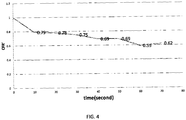
- FIG. 4 illustrates a CFR' versus time graph for an individual (not all the CFR' values are listed).
- the identified maximum CFI of the exercise phase 120 is set at the 0 th second and is used for calculating the CFR' within a period of time. In this embodiment, the period of time is 70 seconds following the maximum CFI of the exercise phase 120. As shown in FIG.
- the CFR' at the 10 th second (i.e., the CFI at the 10 th second divided by the maximum CFI of the exercise phase 120) is 0.79
- the CFR' at the 20 th second is 0.78
- the CFR' at the 30 th second is 0.75
- the CFR' at the 40 th second is 0.69
- the CFR' at the 50 th second is 0.69
- the CFR' at the 60 th second is 0.59
- the CFR' at the 70 th second is 0.62.
- a method for determining physical fitness by monitoring cardiac activity during exercise comprises: measuring the CFI of an individual; identifying the maximum CFI that occurs at the start of the exercise phase 120; and determines whether the CFR' after the maximum CFI of the exercise phase 120 is smaller than a threshold value (e.g., 0.6) for a period of time.
- a threshold value e.g., 0.6
- the method may comprise determining whether the CFR' after the maximum CFI of the exercise phase 120 is smaller than 0.6 for 60 seconds.
- This method for monitoring cardiac activity during exercise can be further illustrated by the embodiment shown in FIG. 5 .
- FIG. 5 illustrates a CFR' versus time graph for an individual (not all the CFR' values are listed).
- the identified maximum CFI of the exercise phase 120 is set at the 0 th second.
- the CFR' at the 20 th second is 0.79
- the CFR' at the 40 th second is 0.78
- the CFR' at the 60 th second is 0.75
- the CFR' at the 80 th second is 0.69
- the CFR' at the 100 th second is 0.64
- the CFR' at the 120 th second is 0.62
- the CFR' at the 140 th second is 0.59
- the CFR' at the 160 th second is 0.59
- the CFR' at the 180 th second is 0.58
- the CFR' at the 200 th second is 0.55.
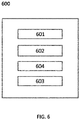
- FIG. 6 illustrates a monitoring apparatus 600 for determining physical fitness by monitoring a user's cardiac activity during exercise.
- the monitoring apparatus 600 comprises a heart rate measuring device 601 for measuring a heart rate of the user.
- the monitoring apparatus 600 further comprises an acceleration measuring device 602 for measuring an acceleration of the user.
- the acceleration measuring device 602 may be a three-axis accelerometer, a nine-axis accelerometer, a sixteen-axis accelerometer, or a G-sensor.
- the monitoring apparatus 600 comprises a processor 603 for deriving the CFI from the acceleration and the heart rate of the user.
- the processor is also configured to identify the maximum CFI that occurs at the start of an exercise phase of the user and determine whether any CFR' value within about 70 seconds after the maximum CFI of the exercise phase is smaller than a threshold value (e.g., 0.6).
- the monitoring apparatus 600 further comprises an alarming device 604 for generating an alarm signal in response to the processor 603 determining that at least one CFR' value within about 70 seconds after the maximum CFI of the exercise phase is smaller than 0.6.
- the processor is configured to determine whether the CFR' after the maximum CFI of the exercise phase is smaller than 0.6 for a period of time (e.g., 60 seconds), and the alarming device 604 generates an alarm signal in response to the processor 603 determining that the CFR' is smaller than the threshold value of 0.6 for at least 60 seconds.
- a component provided or disposed “on” or “over” another component can encompass cases where the former component is directly on (e.g., in physical or direct contact with) the latter component, as well as cases where one or more intervening components are located between the former component and the latter component.
- the terms “approximately,” “substantially,” “substantial,” “around” and “about” are used to describe and account for small variations. When used in conjunction with an event or circumstance, the terms can refer to instances in which the event or circumstance occurs precisely as well as instances in which the event or circumstance occurs to a close approximation.
Landscapes
- Health & Medical Sciences (AREA)
- Life Sciences & Earth Sciences (AREA)
- Engineering & Computer Science (AREA)
- Medical Informatics (AREA)
- Public Health (AREA)
- Physics & Mathematics (AREA)
- General Health & Medical Sciences (AREA)
- Biophysics (AREA)
- Biomedical Technology (AREA)
- Pathology (AREA)
- Animal Behavior & Ethology (AREA)
- Heart & Thoracic Surgery (AREA)
- Physiology (AREA)
- Veterinary Medicine (AREA)
- Surgery (AREA)
- Molecular Biology (AREA)
- Cardiology (AREA)
- General Physics & Mathematics (AREA)
- Epidemiology (AREA)
- Primary Health Care (AREA)
- Physical Education & Sports Medicine (AREA)
- Artificial Intelligence (AREA)
- Signal Processing (AREA)
- Computer Vision & Pattern Recognition (AREA)
- Psychiatry (AREA)
- Data Mining & Analysis (AREA)
- Databases & Information Systems (AREA)
- Dentistry (AREA)
- Oral & Maxillofacial Surgery (AREA)
- Measuring Pulse, Heart Rate, Blood Pressure Or Blood Flow (AREA)
Priority Applications (1)
| Application Number | Priority Date | Filing Date | Title |
|---|---|---|---|
| EP17203696.4A EP3488768A1 (fr) | 2017-11-27 | 2017-11-27 | Procédé et appareil permettant de déterminer la santé physique par surveillance de l'activité cardiaque |
Applications Claiming Priority (1)
| Application Number | Priority Date | Filing Date | Title |
|---|---|---|---|
| EP17203696.4A EP3488768A1 (fr) | 2017-11-27 | 2017-11-27 | Procédé et appareil permettant de déterminer la santé physique par surveillance de l'activité cardiaque |
Publications (1)
| Publication Number | Publication Date |
|---|---|
| EP3488768A1 true EP3488768A1 (fr) | 2019-05-29 |
Family
ID=60654637
Family Applications (1)
| Application Number | Title | Priority Date | Filing Date |
|---|---|---|---|
| EP17203696.4A Withdrawn EP3488768A1 (fr) | 2017-11-27 | 2017-11-27 | Procédé et appareil permettant de déterminer la santé physique par surveillance de l'activité cardiaque |
Country Status (1)
| Country | Link |
|---|---|
| EP (1) | EP3488768A1 (fr) |
Citations (4)
| Publication number | Priority date | Publication date | Assignee | Title |
|---|---|---|---|---|
| US20160051156A1 (en) * | 2013-03-24 | 2016-02-25 | Seoul National University R&Db Foundaton | Film-type biomedical signal measuring apparatus, blood pressure measuring apparatus using the same, cardiopulmonary fitness estimating apparatus, and personal authentication apparatus |
| US20160058314A1 (en) * | 2014-09-01 | 2016-03-03 | National Defense Medical Center | Method for detecting cardiac status, method for monitoring cardiac status during exercise, and apparatus for monitoring cardiac status |
| WO2016044831A1 (fr) * | 2014-09-21 | 2016-03-24 | Athlete Architect Llc | Procédés et appareil de détermination de dépense d'énergie et de technique durant un mouvement des jambes |
| US20170216673A1 (en) * | 2016-02-01 | 2017-08-03 | JayBird LLC | Systems, methods and devices for providing exertion as a measure of accumulated exercise intensity |
-
2017
- 2017-11-27 EP EP17203696.4A patent/EP3488768A1/fr not_active Withdrawn
Patent Citations (4)
| Publication number | Priority date | Publication date | Assignee | Title |
|---|---|---|---|---|
| US20160051156A1 (en) * | 2013-03-24 | 2016-02-25 | Seoul National University R&Db Foundaton | Film-type biomedical signal measuring apparatus, blood pressure measuring apparatus using the same, cardiopulmonary fitness estimating apparatus, and personal authentication apparatus |
| US20160058314A1 (en) * | 2014-09-01 | 2016-03-03 | National Defense Medical Center | Method for detecting cardiac status, method for monitoring cardiac status during exercise, and apparatus for monitoring cardiac status |
| WO2016044831A1 (fr) * | 2014-09-21 | 2016-03-24 | Athlete Architect Llc | Procédés et appareil de détermination de dépense d'énergie et de technique durant un mouvement des jambes |
| US20170216673A1 (en) * | 2016-02-01 | 2017-08-03 | JayBird LLC | Systems, methods and devices for providing exertion as a measure of accumulated exercise intensity |
Similar Documents
| Publication | Publication Date | Title |
|---|---|---|
| JP6516846B2 (ja) | 睡眠監視のデバイス及び方法 | |
| JP5587328B2 (ja) | 転倒検出システム | |
| US9655532B2 (en) | Wearable physiological monitoring and notification system based on real-time heart rate variability analysis | |
| CN108430327B (zh) | 用于产生指示心脏状况的信息的方法和设备 | |
| EP2965239B1 (fr) | Calcul de l'état physiologique d'un utilisateur dans le cadre d'exercices physiques | |
| US20170258349A1 (en) | Biological information detection device | |
| CN106343979B (zh) | 一种静息心率测量方法与装置及包括该装置的可穿戴设备 | |
| US20230172517A1 (en) | Sensor apparatuses, methods of operating same, and systems including same, and methods and systems for sensing and analyzing electromechanical characteristics of a heart | |
| EP2967337B1 (fr) | Détection d'état pathologique au moyen de valeurs de plage d'indices corporels déterminées de façon dynamique | |
| US20180279953A1 (en) | Wearable Blood Pressure Measurement Systems | |
| US11179045B2 (en) | Blood pressure measurement device and blood pressure measurement method | |
| JP2019025253A (ja) | 自律神経状態評価装置、自律神経状態評価システム、自律神経状態評価方法及びプログラム | |
| KR102053329B1 (ko) | 생체 및 운동 신호 기반의 스트레스 분석 방법 | |
| US20210068736A1 (en) | Method and device for sensing physiological stress | |
| EP3488768A1 (fr) | Procédé et appareil permettant de déterminer la santé physique par surveillance de l'activité cardiaque | |
| US10537264B2 (en) | G-LOC warning method and system using G-LOC warning algorithm | |
| KR102218439B1 (ko) | 착용형 ecg 모니터링 장치를 이용한 이상 심박동 검출 시스템 | |
| JP2016067481A (ja) | 生体情報検出装置 | |
| US20210235998A1 (en) | Method and Apparatus for Determining the Impact of Behavior-Influenced Activities on the Health Level of a User | |
| WO2019033235A1 (fr) | Système de détection de chute |
Legal Events
| Date | Code | Title | Description |
|---|---|---|---|
| PUAI | Public reference made under article 153(3) epc to a published international application that has entered the european phase |
Free format text: ORIGINAL CODE: 0009012 |
|
| AK | Designated contracting states |
Kind code of ref document: A1 Designated state(s): AL AT BE BG CH CY CZ DE DK EE ES FI FR GB GR HR HU IE IS IT LI LT LU LV MC MK MT NL NO PL PT RO RS SE SI SK SM TR |
|
| AX | Request for extension of the european patent |
Extension state: BA ME |
|
| STAA | Information on the status of an ep patent application or granted ep patent |
Free format text: STATUS: THE APPLICATION IS DEEMED TO BE WITHDRAWN |
|
| 18D | Application deemed to be withdrawn |
Effective date: 20191130 |