EP3489433A1 - Dispositif d'isolation facilement déplaçable pour bâtiments et procédé économique d'isolation durable et de régulation de l'humidité correspondant - Google Patents
Dispositif d'isolation facilement déplaçable pour bâtiments et procédé économique d'isolation durable et de régulation de l'humidité correspondant Download PDFInfo
- Publication number
- EP3489433A1 EP3489433A1 EP18400032.1A EP18400032A EP3489433A1 EP 3489433 A1 EP3489433 A1 EP 3489433A1 EP 18400032 A EP18400032 A EP 18400032A EP 3489433 A1 EP3489433 A1 EP 3489433A1
- Authority
- EP
- European Patent Office
- Prior art keywords
- building
- chamber
- walls
- outer walls
- air
- Prior art date
- Legal status (The legal status is an assumption and is not a legal conclusion. Google has not performed a legal analysis and makes no representation as to the accuracy of the status listed.)
- Withdrawn
Links
Images


Classifications
-
- E—FIXED CONSTRUCTIONS
- E04—BUILDING
- E04B—GENERAL BUILDING CONSTRUCTIONS; WALLS, e.g. PARTITIONS; ROOFS; FLOORS; CEILINGS; INSULATION OR OTHER PROTECTION OF BUILDINGS
- E04B1/00—Constructions in general; Structures which are not restricted either to walls, e.g. partitions, or floors or ceilings or roofs
- E04B1/62—Insulation or other protection; Elements or use of specified material therefor
- E04B1/74—Heat, sound or noise insulation, absorption, or reflection; Other building methods affording favourable thermal or acoustical conditions, e.g. accumulating of heat within walls
-
- F—MECHANICAL ENGINEERING; LIGHTING; HEATING; WEAPONS; BLASTING
- F24—HEATING; RANGES; VENTILATING
- F24S—SOLAR HEAT COLLECTORS; SOLAR HEAT SYSTEMS
- F24S20/00—Solar heat collectors specially adapted for particular uses or environments
- F24S20/60—Solar heat collectors integrated in fixed constructions, e.g. in buildings
- F24S20/66—Solar heat collectors integrated in fixed constructions, e.g. in buildings in the form of facade constructions, e.g. wall constructions
-
- E—FIXED CONSTRUCTIONS
- E04—BUILDING
- E04F—FINISHING WORK ON BUILDINGS, e.g. STAIRS, FLOORS
- E04F17/00—Vertical ducts; Channels, e.g. for drainage
- E04F17/04—Air-ducts or air channels
-
- Y—GENERAL TAGGING OF NEW TECHNOLOGICAL DEVELOPMENTS; GENERAL TAGGING OF CROSS-SECTIONAL TECHNOLOGIES SPANNING OVER SEVERAL SECTIONS OF THE IPC; TECHNICAL SUBJECTS COVERED BY FORMER USPC CROSS-REFERENCE ART COLLECTIONS [XRACs] AND DIGESTS
- Y02—TECHNOLOGIES OR APPLICATIONS FOR MITIGATION OR ADAPTATION AGAINST CLIMATE CHANGE
- Y02B—CLIMATE CHANGE MITIGATION TECHNOLOGIES RELATED TO BUILDINGS, e.g. HOUSING, HOUSE APPLIANCES OR RELATED END-USER APPLICATIONS
- Y02B10/00—Integration of renewable energy sources in buildings
- Y02B10/20—Solar thermal
-
- Y—GENERAL TAGGING OF NEW TECHNOLOGICAL DEVELOPMENTS; GENERAL TAGGING OF CROSS-SECTIONAL TECHNOLOGIES SPANNING OVER SEVERAL SECTIONS OF THE IPC; TECHNICAL SUBJECTS COVERED BY FORMER USPC CROSS-REFERENCE ART COLLECTIONS [XRACs] AND DIGESTS
- Y02—TECHNOLOGIES OR APPLICATIONS FOR MITIGATION OR ADAPTATION AGAINST CLIMATE CHANGE
- Y02E—REDUCTION OF GREENHOUSE GAS [GHG] EMISSIONS, RELATED TO ENERGY GENERATION, TRANSMISSION OR DISTRIBUTION
- Y02E10/00—Energy generation through renewable energy sources
- Y02E10/40—Solar thermal energy, e.g. solar towers
Definitions
- the invention relates to an easily deployable insulation device for a building with the same on the outer walls arranged chamber means for dehumidifying and tempering of the structure, the outside of the outer walls having a coating, and a cost effective method for permanent insulation of a building against temperature losses, preferably for heating and cooling of the building, and for the moisture regulation of the building shells.
- EP 1 507 046 discloses the provision of a conventional energy-efficient house with a glazed conservatory conservatory, although the energy-saving house from the outside can be heated and the heat via Zu Kunststoff- and exhaust air openings distributed.
- a control of the temperature in the interior of the energy-saving house takes place with connectable with the outside air Zu Kunststoffötechnischen; Possibilities of full insulation of the conventional building for the purpose of temperature control and dehumidification thereof and the use of conventional teaching in old buildings, possibly with wet outer walls are not proposed.
- the DE 33 12 998 Although describes a conventional building facade with an outside glass surface, which is spaced from the building exterior wall to provide a so-called. Speichererns. This memory core is also not suitable for dehumidifying buildings, so there is a risk of fungal infection between the memory core and the outside of the outer walls of the buildings. In addition, there are no proposals to reduce the energy demand inside the building, the extraction and the sustainable use of solar energy depending on climatic conditions as well for applicability to buildings regardless of their age.
- the DE 10 2013 018 627.7 describes an insulating device for conventional buildings with an outside transparent shell, which is spaced from the building exterior wall and provides heat transfer and insulation, without preventing the air supply to the building exterior walls. Dehumidification options for the buildings while maintaining the required moisture balance and options for uniform vertical surface temperature control of the exterior walls are not provided.
- no opportunities for the use of renewable energies are taken into account by future potential innovations in this area.
- the cost and expense of the insulation device will increase depending on the increasing number of floors of the building.
- a conventional watertight insulation of a structure is disclosed, which is spaced from the outside of the building.
- the ventilation of the space between the insulation and the outside of the outer wall is made by an externally accessible ventilation pipe.
- the insulation disclosed in the document covers the entire surface of one of the outer sides of a building; directed.
- the fungal spore proliferation risk is overlooked and the penetration of the fungal spores out of the contact area between the insulation and the exterior wall via the window openings in the exterior walls of the building remains unnoticed, thereby urging the user to implement conventional teaching is discouraged.
- Air conditioning of the structure ensures that regulates the moisture of the outer walls, the functional, aesthetic and historical original character of the facades of the building preserved and upgraded.
- the object of the invention is to provide an easily deployable Dämmvorraum and an affordable and economical method for the energetic use of the outer walls of buildings, regardless of their age, their size and the nature of the use thereof.
- the insulating device to be provided should minimize the heating energy requirement inside the building, gain additional heat and use the heat for the building, such as buildings, at least the possibility of obtaining and using solar energy depending on the climatic conditions, provide for air conditioning of the structure, regulate the humidity of the outer walls, and preserve and enhance the functional, aesthetic and historical character of the facades of the building.
- the insulation device and the method for energetic use of the outer walls of the building should be sustainable and economical and to maintain the longevity of Dämmalleddling.
- the insulation device and the method for energetic use of the outer walls of the building are suitable for buildings of all kinds, regardless of the time of their creation.
- the object of the invention relates to an easily installable insulation device for a building with at least one, preferably two or three or more arranged on the outer walls of the same chamber means for dehumidifying and tempering of the building, the chamber means having interiors, wherein the outer sides of the outer walls have a coating, which is characterized in that the coating is waterproof and permeable to water vapor, preferably the chamber devices are arranged on top of each other,
- the chamber means extend in a circumferential direction about the outer walls of the building, in particular the chamber devices, or their interior spaces or the center longitudinal axes extending in the interior spaces thereof are aligned transversely to the perpendicular, the interior spaces of the chamber devices are laterally delimited by outer side walls and / or partitions and / or by the coating or a part thereof,
- at least the outer side walls are translucent, in particular, the dividing walls are arranged in the upper regions and the lower regions of the chamber devices, the partitions on the outer sides are airtight coupled, preferably the
- Another object of the invention relates to a building with the insulation device according to the invention with the same arranged on the outer walls of chamber equipment for dehumidification and temperature control of the building.
- Another object of the invention relates to a cost effective method for permanent insulation of a building against temperature losses, preferably heating of the structure, and for maintaining the water vapor permeability of the outer walls of the building to the outside in the outside environment, which is characterized in that a waterproof and water-vapor-permeable coating is applied against the outer walls of the building, Chamber devices, which in the upper and lower portions of their interiors dividing walls and in the building remote from the building area of their interior translucent outer side walls, set against the coating of the outer sides and airtight to the outer walls and their outer sides are coupled, in particular the partitions, for example, the outer walls, the chamber means against the coating of the outer sides or against the coating laterally delimiting portions of the outer sides of the outer walls attached and airtight be coupled to the coating or the outer walls and their outer sides, the chamber units located one above the other are aligned transversely to the vertical and are arranged to extend in a circumferential direction around the outer walls of the building, the air circulation, the temperature and / or the humidity in the interior
- Another object of the invention is directed to a building, the, preferably all, features of easily deployable Dämmvorraum with the Having outer walls of the building attached membrane layer and arranged chamber devices, whose outer side walls are made of transparent plastic-like material and / or glass at least on the east, south and west sides of the building or at least contain these their inner and / or outer locks and / or cellar, hallway and / or roof windows are variably controlled depending on the needs and / or season and / or climatic conditions and / or temperature and / or humidity in the interiors of the chamber devices and other embodiments of the invention.
- a building is also understood to mean one or more buildings which are adjacent to one another or, for example, are formed as a building unit, which may have a common outer wall.
- coating also means a water-tight, water vapor-permeable layer or an inner watertight, water-vapor-permeable side wall which is applied or applied to the outside of the outer wall of the building.
- the coating can be applied in the form of a facade paint.
- the coating may be a membrane layer which is semi-permeable, so that it is permeable to water vapor and impermeable to water.
- the membrane layer could for example be applied as a foil to the outside of the outer wall of the building, as glued, or be coupled in other ways known in the art firmly on the outside of the outer wall, so that further moisture from the outer wall of the building passes through the membrane layer to the outside; the e.g.
- As a membrane film applied coating may also be referred to as an inner waterproof, water vapor permeable side wall of the chamber device.
- the term "permeable to water vapor" also means permeable.
- the chamber devices with their separating walls bounding the interior and side walls can be tubular or belt-shaped run around the outer wall of the building or the perpendicular of the same.
- the center longitudinal axes extending in the interior spaces thereof can be oriented transversely to the perpendicular and / or parallel to one another.
- the partitions and / or their sides facing the interior of the chamber devices and / or the outer side walls and / or their sides facing the interior of the chamber devices in the direction of rotation transverse to are aligned and / or parallel to the same.
- the interior of the chamber device facing sides of the inner side walls or the membrane sheets may extend in the direction of rotation transverse to the perpendicular and / or parallel to the perpendicular.
- the insulation device according to the invention with three chamber devices arranged on top of each other, their inner spaces are laterally bounded by outer side walls, the partitions and by the coating; the interior of, for example, arranged on the central chamber means upper chamber means may be laterally delimited in the upper area of an outer wall or the outer side wall is, for example, partially circular, in the coating on; the interior of, for example, arranged below the middle chamber means, lower chamber means may be additionally limited laterally in the lower area of an outer wall or the ground or its cover or the outer side wall is, for example partially circular, in the coating over.
- the interior spaces of the chamber means are bounded by the coating or at least part of it in the area facing the building, in the area facing away from the exterior wall of the building, from the outside sidewalls and / or in the top and bottom areas advantageously limited by the partitions. Since the chamber devices are arranged on one another, the adjacent chamber devices advantageously have a common partition wall in each case.
- the partition wall or its planes, which may correspond to the interior-facing sides thereof, are preferably oriented at right angles or approximately at right angles to the outer wall or to its outer side.
- At least two chamber devices are preferably attached to the outer wall of the building airtight, so that an air transport between the partitions of the chamber devices and the outside of the outer wall of the building is prevented.
- the airtight coupling can be done for example by means of conventional couplings, such as bonding, riveting, connection by means of attached strips or rails and / or the like.
- the chamber equipment, the outer wall and the outside of which are airtight delimited from the outside environment, so that water vapor or moisture from the outer wall of the building in the interior of the chamber device and can escape from there via the outer locks to the outside.
- the outer side walls and / or the partitions are airtight and / or waterproof and / or permeable to water vapor.
- the chamber devices are set against the coating, so that the coating, in addition to eg the partitions, the interiors of the chamber devices advantageously also at least partially limit, abut the partitions and / or outer walls also on the coating ; the chamber devices attached airtight to the coating with partitions and / or outer walls are coupled to the outer wall, such as its outer sides, so that their interiors are delimited laterally from the coating towards the building.
- the chamber means are attached to the coating, so that the partitions and / or the outer walls of the same applied to the applied to the outside coating limiting portions of the outside of the outer walls and the partitions and / or the outer walls airtight on the outer walls, as the outer sides, are directly coupled;
- the interior of the chamber devices are advantageously also at least partially limited by the coating, in addition to, for example, the partitions.
- the outer side walls may have outer locks which also allow the accessibility of the interiors of the chamber devices to the outside environment.
- the partitions may also have internal sluices which can pass through the interiors of the adjacent chamber devices or the chamber devices arranged on top of each other for the purpose of exchanging air, moisture and / or temperature in the vertical direction.
- the main advantage of the insulating device according to the invention is basically the horizontal air circulation in the interiors of the chamber devices, as it turns out that the conventional air circulation in a vertical orientation is not able to solve the above objects.
- an external lock also means an advantageously controllable device for opening and closing an access of an interior of the chamber device to the outside environment.
- an advantageously controllable device is provided for opening and closing an access between two internal spaces of the chamber devices or an interior of the chamber device and the interior of the building understood.
- the inner locks and the outer locks are controlled by means of a conventional control device.
- the interiors of the chamber devices may be continuously connected to the openings of windows of cellars, roof or hallways of the structure, so that an air exchange considered by the user as required is possible through the windows in the interiors of the chamber device.
- the inner locks in the partitions allow air exchange and heat exchange as well as moisture exchange between the chamber devices arranged on each other and their interiors.
- the outer locks which are arranged in the outer side walls, also allow the exchange of air between the air of the interiors with the external environment corresponding temperature exchange.
- the interiors can still be connected to or arranged in fans which amplify the air circulation in the horizontal direction around the outer wall of the building around.
- the air circulation taking place in the interior takes place essentially horizontally and can be assisted by the vertical exchange taking place via internal locks of the partition walls.
- the prepared membrane layer consists of a coating of conventional facade paint containing particles with thermal insulation properties.
- the facade paints additionally contain particles with heat-insulating properties, which may consist of cork, of hollow spheres of ceramic or glass and / or of airgel, and / or a diameter of lnm to 999 nm and / or 1 nm to 999 ⁇ m and / or 1 ⁇ m to 999 ⁇ m.
- a membrane layer of Dämmute with shares of airgel is characterized by a high insulation effect.
- Cork paint as a used insulating coating is sustainable, contains no biocides and no other carcinogenic substances and can easily be sprayed on the outside of the outer wall.
- a Dämmute with a proportion of hollow glass spheres is permeable to water vapor, can fill facade cracks and form a tension-free paint surface. The hollow glass spheres additionally cause the sun's rays to be reflected at a steep angle of incidence of the sun, and the sun's rays, which strike in shallow light, heat the interior spaces of the chamber devices.
- a conventional diffusion-open facade paint based on silicone resin with a high proportion of ceramic hollow spheres or nano-crystals also makes the membrane layer particularly elastic, avoids stress cracks and generates a thermal heat protection.
- it is waterproof, non-toxic, contains no flammable natural substances and is resistant to UV rays due to the ceramic components.
- the ceramic particles distribute the heat within the membrane layer faster around the outer walls due to their high thermal conductivity. Moisture that occurs on the exterior walls of the building is transported outward by its directional diffusion-openness and can not reach the interior walls of the building via the membrane layer. Due to the Dämmde no condensation, so that entomination is avoided at the inner spaces limiting inner sides of the chamber devices.
- plates or sheets of colorless transparent, weather-resistant and fully recyclable plastics such as ETFE or PMMA or PC are used for the outer side walls and / or for the partitions of the chamber devices.
- ETFE ethylene-tetrafluoroethylene copolymer
- ETFE fluorinated copolymer consisting of the monomers tetrafluoroethylene and ethylene.
- Teflon a derivative of the plastic known as Teflon
- ETFE has a low weight and has high light and ultraviolet transmittance.
- ETFE for example for the production of the separating and the outer side walls, gains as so-called Architectural film growing importance in construction.
- This architectural film is an innovative building material commonly used by civil engineers as well as architects technical term in the literature, which nowadays no longer needs to be explained - prior art - especially in the context of "textile membrane architecture".
- PMMA polymethyl methacrylate polymethylmethacrylate
- PC polycarbonate
- PMMA polymethyl methacrylate polymethylmethacrylate
- PC polycarbonate
- ETFE, PMMA and PC are very suitable for the design of the chamber devices due to their properties.
- the outer side walls of the chamber means of the building may also be referred to as weather sheaths, since the weather sheath only holds the weather and contains air, but does not have a supporting or supportive function, such as a supporting or supporting outer wall owns.
- the chamber equipment of the building can be individually adapted to the special requirements of fire protection, algae resistance, impact resistance and other building physical properties.
- the transparent outer side walls of the chamber devices to increase the thermal insulation properties consist of several equally spaced diaphragm layers, for example by the use of double-wall plates made of PMMA or PC or by multiple layers of transparent film with ETFE.
- the chamber devices are produced cost-effectively, with the respective measures and shapes adapted to the concrete exterior walls of the building via 3D printing.
- the partitions of the chamber means for further regulation of the humidity can be configured as a drying layer and for this example consist of airtight, water vapor diffusion open material or be manufactured with these and / or semipermeable material with osmotic effect.
- the inner locks of the partitions of the chamber devices can be configured as a drying layer, wherein the drying layer can contain airtight, open to water vapor diffusion material and / or semipermeable material with osmotic effect.
- the control of the locks of the insulation device according to the invention can be carried out by means of various configurations: Manual, mechanical, automatic and / or digital.
- the control may simply be automatic based on a timer.
- it may also be based on the geographical location of the structure, taking into account the calendar, seasonal and / or daily position of the sun and / or on the basis of the measured temperatures and / or humidity of the air inside the chamber and / or outside air and Include weather conditions, such as storm, hail, rain and others.
- the locks of the damping device according to the invention are controlled based on digital control via SMART control.
- the insulation device according to the invention can cost to a large number of buildings standing together as a building to complete streets, regardless of how high the number of floors of each building of the building.
- the chamber devices of Insulating device according to the invention with greenhouses, conservatories and / or other additional greenhouses connected or provided via air-tight lockable inner locks. By controlling these locks, the temperature of the air between the respective greenhouse and the interior of the chamber devices can be equalized.
- transparent conduits may be laid within the chamber means that carry water during warm seasons and are used for additional recovery of hot water and / or for cooling the exterior walls of the structure.
- Another particular embodiment of the insulating device according to the invention is to apply to the outer side walls of the chamber devices that are exposed to particularly intense solar radiation, partially thin-layer solar cells to obtain electrical energy.
- the air is additionally tempered in the interior of the chamber devices by means of geothermally generated energy. Due to the construction of the insulation device according to the invention, the heat output of future innovations for the energetic use of building shells or of renewable energies can also be easily connected via internal locks with the air in the chamber devices in other embodiments.
- the invention is based on the one on the principle that air of different temperatures, pressure ratios and / or humidity within the limits of an airtight limited system compensates their existing, energetic differences, and in principle from high to low temperature or pressure according to thermodynamic laws or Humidity.
- a self-contained insulating device arises independently of other chamber devices and / or the external environment within the chamber device.
- the air in the interior of the closed Chamber device can compensate for their existing temperature differences only within the limits of the chamber device, from warm to cold.
- In the interior of the chamber means it comes automatically to the uniform horizontal distribution of heat around all outer walls of the building.
- all the inner sides of the chamber device are uniformly tempered.
- it is prevented by the closed chamber means that heated air can collect on an outer wall of the building in the upper region of the outer wall, since the heated air can not rise vertically due to the airtight partition to the other chamber means.
- the swelling and thermal conductivity properties of the membrane layer increase the thermal effects in the insulation device and the even heat distribution on all external walls of the structure.
- Both the positive energetic effects of the membrane layer and the air in the chamber devices are used in parallel, with both components serving as the thermal buffer of the other and mutually reinforcing the positive effects of both components. This leads to a Displacement of the dew point to the outside and counteracts mold growth on or in the outer walls of the chamber means of the building.
- the closed air system also called air device
- the closed air system can be extended to several chamber devices and take place a temperature compensation in the expanded air device, including between different chamber facilities of the building.
- an air device is also understood to mean an air control device or the inventive insulation device.
- the closed air device can be extended by the air volume of building parts, such as basements, hallways and / or roofs, and a temperature compensation of the air in the extended air device take place, in addition to the air within the Chamber facilities also includes the volume of air of cellars, hallways and / or roofs.
- the closed air device can be expanded by the air volume of the outside environment and a temperature equalization of the air in the chamber devices with the air volume of the outside environment take place.
- the temperature compensation can be limited to reduced air systems again by deliberate closing of external and / or internal locks.
- the principle of energetic compensation in the direction from high to low level applies within a closed air device also for the humidity.
- the variable Control of the locks in the insulation device is therefore also used for the purpose of dehumidifying and / or for moisture balance of the air.
- the closed air system can be extended or limited to compensate for moisture on one and / or more chamber devices and / or basements and / or roofs and / or the inclusion of the external environment.
- variable and targeted diffusion-openness of the membrane layer also optimizes the positive effects of the insulation device for regulating the moisture balance of the structure.
- the diffusion-open nature of the membrane layer ensures that increased moisture of the outer walls of the building is discharged outwards into the chamber devices and the penetration of excessive moisture from the chamber devices into the outer walls of the structure is prevented.
- the humidity in the chamber devices can be released by controlling the outer locks to the outside environment.
- the outer walls are not damp and dam better. This leads to a further shift of the dew point to the outside and counteracts mold growth on or in the outer walls of the building.
- Both the positive effects of regulating the moisture through the membrane layer and the air in the chamber devices are used in parallel, with both components serving as moisture buffers for the other. The required moisture balance of the outer walls is maintained, excess moisture eliminated.
- the invention is based, inter alia, on the variable insulation properties of air: the lower the flow velocity of air, the higher are its insulation values.
- variable insulation values of air are used in the insulating device on the one hand to insulate the outer walls of the building in the colder months by the air in the chamber devices.
- the attenuation values of the air in the chamber devices become higher the smaller the closed air system in which the air is selected can circulate.
- the highest insulation values are the air inside the chamber means when the closed air system is reduced by the airtight sealing of all the outer and inner locks of the insulating device to a respective chamber device.
- variable attenuation values of air are also used to cool the outer walls of the building in warmer months by the air in the chamber bands.
- the insulation values of the air in the chamber devices become smaller and smaller, the larger the closed system is chosen, in which the air can circulate.
- the insulation values of the air in the chamber devices are reduced to a minimum when the closed air system incorporates the external environment into the air system by opening external locks. By opening the outer and by opening relevant inner locks of the insulation device, a targeted "passage" of the air can be generated.
- the flow velocity of the air when passing through is so high that it no longer has insulating properties, and leads to the cooling of the outer walls or the basement, hallway and / or roofs of the building.
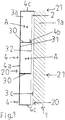
- the insulating device according to the invention for a building in one embodiment, a plurality of arranged on the outer sides 3c of its outer walls 1a interiors 3a comprehensive chamber means 4; the outer sides 3c of the outer walls 1a have a full surface of a waterproof and water vapor-permeable coating 2, which the interiors 3a to the outer sides 3c out.
- Three chamber devices 4 are arranged on top of each other ( Fig. 1 ) and their interior spaces 3a extend in the direction of rotation 50 (FIG. Fig. 2 see also arrow as an exemplary circulation direction) around the outer walls 1a of the building 1 and each interior 3a in the circumferential direction 50 is continuous ( Fig. 2 see also arrow as exemplary circulation direction), for example, to provide the horizontal air circulation.
- the three chamber devices 4 arranged on top of one another and their interior spaces are oriented transversely or approximately transversely to the vertical, such as perpendicular or perpendicular; the interior spaces 3a of the chamber devices 4 are laterally bounded by outer side walls 4a and the partitions 4b and by the coating 2; the two outer walls 4c which laterally delimit the interior 3a of the upper chamber means 4 in the upper region 21 and the inner space 3a of the lower chamber means 4 in the lower region 20 can also be referred to as partitions 4b for the sake of simplicity.
- the interior 3a of the lower chamber device 4 in the lower region 20 is bounded laterally from the ground.
- the chamber devices include Fig. 1 in an embodiment in longitudinal section a lower chamber means, a central chamber means and an upper chamber means.
- the outer side walls 4a are designed to be translucent, for example, in order to heat up the air contained in the interior spaces 3a 3 as a result of solar radiation cost-saving.
- the partition walls 4b are arranged in the upper regions 21 and the lower regions 20 of the chamber devices 4 and airtightly coupled to the outer sides 3c of the structure 1, so that the interiors 3a of two chamber devices 4 arranged one above the other each have a common partition wall 4b.
- the partitions 4b have inner locks 5b for controlling air circulation and temperature and their course in the interior spaces 3a of the chamber units 4 adjacent to one another.
- Center longitudinal axes A of the chamber devices 4 are oriented transversely to the perpendicular and parallel to each other; the partitions 4b are aligned with their sides 3a bordering the interiors 3a transversely to a perpendicular and the outer side walls 4a with their sides 3a delimiting the interiors 3a parallel to the perpendicular.
- a center longitudinal axis is understood to mean a center line extending in the longitudinal direction of the interior 3a or the chamber device 4 in the center line running in the same direction;
- perpendicular also means a vertical or vertical, essentially pointing to the center of the earth or approximately to the same.
- the membrane layer 3b is formed as a heat-insulating facade paint, wherein the facade color has particles with heat-insulating properties, preferably contains these particles of cork, hollow spheres or nanocrystals of glass or ceramic and / or airgel.
- the insulating devices according to the invention have one or more locks 5.
- the outer side walls are formed with outer air flow control and temperature control slits 5a, and the course thereof in the interiors 3a of the chamber devices 4, and the air exchange of the interiors 3a of the chamber devices 4 with that of the outside environment.
- the outer side walls 4a and the partition walls 4b are formed as plates with a glassy material or a plastic-like material.
- the plastic-like material is PMMA (polymethyl methacrylate), PC (polycarbonate) and / or ETFE (ethylene-tetrafluoroethylene copolymer).
- the extent of opening and closing of the openings of the inner sluices 5b and the outer sluices 5a by means of their sluice valves 5e, also called flap 5e, is effected in one embodiment by means of a control device similar to those of conventional e.g. in indoor spaces 3a, in rooms of the building 1 and outside the same installed sensor devices produced actual values of temperature and humidity with their set in the control device setpoints, possibly based on a timer or the geographical location, and compares in the case of deviation of the actual values of the
- the correction values are generated according to the setpoint values and the correcting variables corresponding to the correction values are forwarded as signals to the electrical units controlling the position of the lock gates 5e, also referred to as a lock flap.
- the insulating device according to the invention advantageously not only allows the outer wall dehumidification, but also the movement of the air and the course of the temperature in the inner spaces 3a along the direction of rotation 50, ie horizontally realized, which, if necessary, driven by the inner locks 5b as required horizontal movement and history can be supported.
- Dämmvoriques locks 5 are arranged as interior locks in the interiors 3a, the air, Temperature, humidity circulation within the interior 3a, if necessary, also able to control.
- the interior spaces 3a of the chamber devices 4 can be heated in one embodiment by means of geothermal energy and / or other renewable energies. Transparent lines for heating the same are arranged in another embodiment in the interiors 3a of the chamber means 4, which are filled depending on the season with water for the production of hot water and / or for cooling the outer walls of the building.
- greenhouses, conservatories and / or other greenhouses are connected via airtight sealable inner locks 5b with the interior spaces 3a of the chamber devices 4.
- the inner locks 5b also allow the controlled exchange of air, temperature, humidity within the interiors of mutually arranged chamber means, as in FIG Fig. 1 shown.
- a waterproof and water-vapor-permeable coating 2 is applied against the outer sides 3c of the outer walls 1a of the building.
- the chambers 4 having the side walls 4a are provided with their partitions 4b in the form of colorless transparent panels or colorless transparent foils against the coating 2 of the outer sides 3c attached and airtight, the partitions 4b bonded to the outer sides 3c of the outer walls 1a or coupled to other skilled in the art, so that the chamber means 4 aligned with their interiors 3a transverse to the perpendicular and in the direction of rotation 50 about the outer walls 3a of the building 1 without interruption (see also Fig.
- the air circulation, the temperature and the humidity in the interiors 3a of the chamber devices 4 and between them are controlled by the inner gates 5b located in the partition walls 4b and the outer gates 5a arranged in the outer waterproof vapor permeable side walls 4a.
- the interiors 3a of the chamber devices 4 are advantageously provided by the partitions 4b, the outer side walls 4a and the Coating 2 limited, wherein the interior of the upper chamber means 4 may be additionally limited by the upper outer wall 4 c and / or the lower chamber means 4 in addition to the lower outer wall 4 c.
- the directionally permeable membrane layer 2 causes excessive moisture or moisture in the outer walls of the structure is automatically discharged to the outside and penetration of water from the outside into the outer wall 1 is effectively prevented.
- the membrane layer 2 acts in contrast to that in the document FR 2 709 319 - A1
- conventional teachings discouraged mold growth.
- the membrane layer 2 forms the inner side or inner side wall 32 of the chamber devices 4, which are arranged one above the other in layers. They are aligned transversely to the perpendicular in insulating position as a lateral boundary of the interior spaces 3a running.
- the air 3 within the chamber means 4 is mainly used to insulate or cool the building 1 according to the climatic conditions and / or to air condition.
- the material of the outer side walls 4a and 4b of the partition means of the chamber devices 4 is glass or transparent plastic material, such as architectural film with or made of ETFE.
- the architectural film can be designed in two layers at least on the outer side walls 4a in order to increase the insulation values.
- the building 1 may consist of a building, but also of several adjacent or adjacent buildings.
- a building is defined in terms of the insulation device according to the invention by the number of buildings, which are jointly enclosed by an insulation device according to the invention.
- Fig. 2 shows an example of a building 1, which includes three adjacent or adjacent buildings, around which extends a damping device according to the invention.
- Local heat on the outer walls of the structure 1 is forwarded by the thermally conductive property of the membrane layer 2 to colder outer walls, which supports the uniform temperature control of all outer walls of the building within the building 1.
- the natural pursuit of air for an energetic balance in a closed air device or in a closed air system causes the outer walls of all buildings of the building 1 evenly by an automatic horizontal circulation of air around all outer walls of the structure 1 within the air layer 3 of the chamber devices be tempered.
- Fig. 3 is shown that the greenhouse effect of the outer side walls 4a of the chamber devices 4 additionally provides year-round heat gains, depending on the climatic conditions for the building 1. These heat gains are also distributed by the air layer 3 of the chamber devices 4 to all outer walls of the building. Seasonally are also the heat losses, which usually emerge in heating periods in the form of transmission heat from the interior of the building on the outer walls of the same, via the air 3 in the interiors of the chamber devices 4 automatically passes on to cooler outer walls. There they provide additional heat gains for the building.
- the membrane layer 2 and the air layer 3 of the chamber devices 4 work automatically, in parallel, independently of each other and complement each other optimally in the uniform surface temperature control of the outer walls of the building 1. In addition, they form a thermal buffer for the other layer. The thermal properties of both layers cause the dew point to shift further outwards, which counteracts mold growth in the building.
- the buffering of moisture by the swelling ability of the membrane layer 2 and its variable and directed vapor diffusion openness also have a positive effect on the energetic effects of the process. They prevent condensation inside the air layer 3.
- a difference and significant advantage over other insulation methods is that the energetic and climatic effects are achieved mainly by a natural distribution to all outer walls of the structure 1.
- the chamber devices 4 are applied against the coating 2, so that the coating 2, in addition to eg the partitions 4b, the outer walls 4c, the outer side walls 4a, as well as the locks 5, the interiors 3a of the chamber devices 4 advantageously also limited: the airtight to the coating 2 with partitions 4a and outer walls 4c scheduled chamber devices 4 are coupled to the outer wall 1a, as the outer sides 3c.
- the chamber means 4 are set against the coating 2, for example, if only the outer sides 3c provided so far with the coating 2, that the coating 2 only the interiors 3a of the coating to the second limit set chamber devices 4.
- the partitions and the outer walls 4c thereof are attached to the side of the coating 2, such as adjacent to the coating 2, portions of the outer sides 3a of the outer walls 1a, which portions have no coating 2, and the partitions 4a and the outer walls 4c are airtightly coupled to the outer walls 1a, as their outer sides 3c;
- the interior spaces 3a of the chamber devices 4 are advantageously also bounded by the coating 2, in addition to, for example, the partitions 4b, the outer walls 4c, the outer side walls 4a, as well as the locks 5.
- Another advantage of the insulating device according to the invention consists in the airtight separation of the chamber means 4 from each other by means of the partitions 4b.
- the airtight separation of the chamber devices 4 takes place via the partitions 4b in tiers. If the chamber devices 4 are hermetically sealed to the outside environment and to the other chamber devices 4, a self-sufficient insulating system is created within the chamber device, which is delimited from the outside environment and to the other chamber devices.
- Locally heated air 3 in the interior 3a of the closed chamber device 4 can compensate for their existing temperature differences only within the limits of their own combing device. In the interior of the chamber device 4 it comes automatically to the horizontal distribution of the local heat to all outer walls of the building 1.
- all inner sides 2 of the chamber device are uniformly tempered. It is also prevented by closed chamber means 4 that can be collected on an outer wall of the building 1 heated air in the upper region of the outer wall, because the heated air can not rise vertically through the airtight partition closed to another chamber device 4. In one embodiment, the complete circulation of the air within the air layers 3 in the horizontal direction is not prevented, but limited in the vertical direction.
- the tier-wise separation of the chamber devices 4 results in that the usual high temperature differences between the colder ground floor apartments and the warmer attic apartments of a property are compensated.
- the compensation of different pressure and humidity conditions can be controlled and / or accelerated within an air system through arranged locks 5 in the insulation device according to the invention.
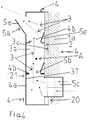
- Fig. 4 shows the lock types of the insulation device according to the invention:
- outer locks 5a are arranged in the outer side walls 4a of the chamber devices 4 . Their control causes the air 3 inside the chamber devices 4 to reach the outside environment via external locks 5a or is separated airtight from the outside air.
- the inner sluices 5b of the partition walls 4b are arranged in the partition walls 4b of the chamber devices 4. Its control causes the air 3 of a chamber device to circulate with the air 3 in other chamber devices 4 or be separated airtight from it.
- windows of cellars, hallways and / or roofs are sealed airtight to the outside environment by an opposite completely closed outer side wall 4a of the chamber device 4. If the windows are opened, the air from the cellars, hallways and / or roofs can not enter the outside environment, but only the air layer 3 of the chamber device 4, so that the windows are converted into inner locks 5c of the inner side walls 2 of the chamber devices 4 can.
- All existing locks 5 of the insulating device according to the invention can be variably, independently and purposefully opened or sealed airtight.
- the control can be done manually, but preferably at least automatically, for example, by a timer that takes into account seasonal solar statuses.
- digital control via the evaluation of relevant measured values inside and outside of the inventive insulating device, for example via an intelligent SMART control, should be preferred and is assumed in the following exemplary embodiment.
- An opening of external locks 5a serves primarily to dissipate heat excess of the air 3 in chamber devices 4 into the outside environment. However, the opening is always accompanied by heat losses for the building 1. If temporary local heat surplus on an outer wall of the structure 1 is caused, either by the greenhouse effect of the outer side walls 4a of the chamber devices 4 and / or by transmission heat from the interior of the building, it is in the inventive Dämmvoriques primarily within the membrane layer 1 and / or the Air layer 3 distributed to cooler outer walls of the structure 1. Thus, the local heat surplus is substantially reduced or prevented.
- An opening external locks 5a for dissipating excess heat in the outside environment is delayed or not required by the heat distribution of the insulating device according to the invention, which leads to the reduction of heat losses for the structure 1.
- the greenhouse effect of the respective sun-facing sides of the structure can be used by the heat distribution directly to the temperature of the north sides of the chamber facilities of the building 1, without having to conduct the heat gained through the interior of the building or parts thereof.
- outer locks 5a on the outer sides 4a which are opposite to the sun-facing side, the heat distribution over the air layer 3 within the chamber devices 4 can be accelerated.
- the closed system in which the air 3 of a chamber device 4 is located, can be extended to a plurality of chamber devices 4.
- the temperature compensation of the air 4 of the chamber device 4 can in the extended Air system also take place between different chamber devices 4.
- the closed air system can be extended by the air volume of building parts, such as basements, hallways and / or roofs, and take place a temperature compensation of air in the extended device that in addition to Air 3 within the chamber devices 4 also includes the volume of air from basements, hallways and / or roofs.
- the closed air system can be expanded by the air volume of the external environment and a temperature compensation of the air 3 in chamber devices 4 with the air volume of the external environment take place.
- the respective closed air device is extended to compensate for temperature, can be limited by targeted closing of outer and / or inner locks 5a, 5b, 5c of the insulating device, the temperature compensation back to reduced air systems.
- the insulating device according to the invention is used for air conditioning and / or cooling of the outer walls or for drying the outer walls.
- the property of the air is used to have different insulation values depending on their flow velocity.
- the circulation of the air 3 of the chamber devices 4 is reduced to a minimum, in which the smallest air device for the air 3 of the chamber devices 4 is generated by the closed locks 5 of the chamber device.
- the flow velocity of the air 3 is increased within the chamber means 4 to a maximum, in which all inner and outer locks 5 of the chamber devices 4 are opened, so that a "draft" arises.
- the air 3 of the chamber devices 4 is discharged to the outside environment.
- the flow rate of the air 3 of the chamber devices is so high through the passage that it no longer has insulating properties, which leads to cooling, air conditioning and / or drying of the outer walls of the structure 1 and also to support the dehumidification of other components, such as basement and / or Hallways can be used.
- Fig. 4 shows how through various opened inner and outer locks 5a, 5b, 5c of the insulating device according to the invention a passage in the insulation device according to the invention and the air exchange of the air 3 can be made with the air of the outside environment.
- the insulating device can be used to cool overheated roofs or attic apartment in which by opening the locks 5, such as the inner and outer locks 5a, 5b, the temperature of the air from the upper part of the building 1, in roofs or / and hallways, to the lower cooler exterior walls and / or to the basement and / or the outside environment.
- the locks 5 such as the inner and outer locks 5a, 5b
- the temperature of the air from the upper part of the building 1, in roofs or / and hallways to the lower cooler exterior walls and / or to the basement and / or the outside environment.
- Another embodiment shows additional heat gains by opening only inner locks 5b, 5c of the insulation device according to the invention. Since in cellars, even in cold seasons, the temperatures do not fall below freezing (approximately constant 5 ° C), the opening of the inner locks 5b of the partitions 4b and the basement windows, which are converted to inner locks 5c, on the days and nights, where the outside temperatures fall below freezing, for temperature compensation of the air 3 of the chamber devices 4 with the volume of air of the cellar. So will ensures that the temperature of the air 3 in the chamber devices 4 can not fall below the cellar temperature. As a result, the outer walls of the building can not be cooled below about 5 ° C. The less the outer walls of the structure 1 cool, the lower the heating requirement in the interior 3a of the chamber devices of the structure 1 in order to reheat them.
- the properties swelling capacity and thermal conductivity of the membrane layer 2 enhance the thermal and energetic effects of the insulating device.
- Both the positive energetic effects of the membrane layer 2 and of the chamber devices 4 are used in parallel, both components serving as thermal and / or as moisture buffer of the other and mutually reinforcing the positive effects of both components.
- a single insulating device can enclose several buildings of the building, but can also be constructed by the horizontally arranged chamber devices, only for one floor of a building in the form of a single chamber device.
- greenhouses and / or conservatories and / or other greenhouses are connected via airtight sealable inner locks 5b, 5c with the chamber devices 4 of the insulating device according to the invention.
- water-carrying lines are laid in the chamber devices, which are used seasonally for the additional production of hot water and / or for cooling the outer walls of the structure 1.
- the insulation device Due to the construction of the insulation device according to the invention can Executions are made, which incorporate further energy innovations in a simple way in the insulation device: So can be applied to outer side walls 4a of the chamber devices 4, which are exposed to particularly intense solar radiation, partially thin-layer solar cells to obtain electrical energy.
- the air 3 in the interior spaces of the chamber devices 4 is additionally tempered by means of geothermally obtained energy and / or other renewable energies.
- Other future innovations that use renewable energy, for example, to separate the heat demand of the building can be easily connected via internal locks with the air 3 in the chamber devices 4.
- the method for the permanent insulation of building units against temperature losses, preferably from heating of the building, and for uniform temperature control of all outer walls of the building unit 1, characterized by the insulation device according to the invention which is placed against the outer wall 1a and has the membrane layer 2 and chamber devices 4 set against the outer walls 1a, the thermal conductivity of the membrane layer 2, which ensures an all-round and uniform temperature control of the outer walls 1a of the building 1 and / or compensates the expansions of the building materials in a heat-regulating manner, and or the warm air, which occurs locally on outer walls 1a and is distributed automatically to cooler outer walls of the structure 1, locally heated air 3 in the interior 3a of a chamber device 4, which is caused depending on the climatic conditions of solar energy and / or seasonally from transmission heat from the interior of the building 1 on the outer walls 1a of the same 1, and for temperature compensation with unshaded and / or cooler outer walls 1a automatically horizontally in the interior 3a of the chamber device 4 is circulated around the outer walls 1a, the attached membrane layer 2 and the air
- the inventive method is characterized by the insulating device with an attached to the outer walls 1a membrane layer 2 and arranged chamber means 4, the swelling capacity of the membrane layer 2 can compensate for different moisture budgets of the outer walls of the building unit 1, the variable moisture vapor permeable membrane layer 2 the required moisture balance preserved, being the directed water vapor permeable membrane layer 2 dissipates excessive moisture from the building substance to the outside, the directed water vapor permeable membrane layer 2 prevents the penetration of moisture from the outside into the building substance, the mutual thermal buffering of the attached membrane layer 2 and of the air 3 in the interior 3a of the chamber device 4 shifts the dew point to the outside, the locally increased humidity occurring in the interior 3a of a chamber device 4 automatically compensates for lower air humidity inside the chamber device 4, the variable control of the outer sluices 5b arranged in the outer side walls 4a enables the moisture exchange of the air 3 in the chamber device 4 with the outside environment, the variable control of the inner sluices 5b arranged in the partition walls 4b enables the moisture
Landscapes
- Engineering & Computer Science (AREA)
- Physics & Mathematics (AREA)
- Architecture (AREA)
- Mechanical Engineering (AREA)
- Sustainable Energy (AREA)
- Thermal Sciences (AREA)
- Chemical & Material Sciences (AREA)
- Combustion & Propulsion (AREA)
- Sustainable Development (AREA)
- General Engineering & Computer Science (AREA)
- Acoustics & Sound (AREA)
- Life Sciences & Earth Sciences (AREA)
- Electromagnetism (AREA)
- Civil Engineering (AREA)
- Structural Engineering (AREA)
- Building Environments (AREA)
Applications Claiming Priority (1)
| Application Number | Priority Date | Filing Date | Title |
|---|---|---|---|
| DE102017010949.4A DE102017010949A1 (de) | 2017-11-27 | 2017-11-27 | Leicht verlegbare Dämmvorrichtung für Bauwerke und kostengünstiges Verfahren zur dauerhaften lsolierung und zur Feuchtigkeitsregulierung derselben |
Publications (1)
| Publication Number | Publication Date |
|---|---|
| EP3489433A1 true EP3489433A1 (fr) | 2019-05-29 |
Family
ID=61695319
Family Applications (1)
| Application Number | Title | Priority Date | Filing Date |
|---|---|---|---|
| EP18400032.1A Withdrawn EP3489433A1 (fr) | 2017-11-27 | 2018-11-27 | Dispositif d'isolation facilement déplaçable pour bâtiments et procédé économique d'isolation durable et de régulation de l'humidité correspondant |
Country Status (2)
| Country | Link |
|---|---|
| EP (1) | EP3489433A1 (fr) |
| DE (2) | DE102017010949A1 (fr) |
Citations (4)
| Publication number | Priority date | Publication date | Assignee | Title |
|---|---|---|---|---|
| DE3312998A1 (de) | 1983-04-12 | 1984-10-18 | Arno 7130 Mühlacker Graul | Gebaeudefassade zur nutzung der solarenergie |
| FR2709319A1 (fr) | 1993-08-24 | 1995-03-03 | Mezri Abdou Mebi | Les bâtiments thermo-actifs. |
| EP1507046A2 (fr) | 2003-08-14 | 2005-02-16 | Sandmeir-Exclusiv Stahlbau GmbH | Ensemble d'éléments de construction pour une maison à consommation d'énergie réduite |
| DE102013018627A1 (de) | 2013-11-06 | 2015-05-07 | Doris Frenzel | Atmunasaktive Basishülle für den Wohnbestand |
-
2017
- 2017-11-27 DE DE102017010949.4A patent/DE102017010949A1/de not_active Withdrawn
- 2017-12-23 DE DE202017006601.7U patent/DE202017006601U1/de active Active
-
2018
- 2018-11-27 EP EP18400032.1A patent/EP3489433A1/fr not_active Withdrawn
Patent Citations (4)
| Publication number | Priority date | Publication date | Assignee | Title |
|---|---|---|---|---|
| DE3312998A1 (de) | 1983-04-12 | 1984-10-18 | Arno 7130 Mühlacker Graul | Gebaeudefassade zur nutzung der solarenergie |
| FR2709319A1 (fr) | 1993-08-24 | 1995-03-03 | Mezri Abdou Mebi | Les bâtiments thermo-actifs. |
| EP1507046A2 (fr) | 2003-08-14 | 2005-02-16 | Sandmeir-Exclusiv Stahlbau GmbH | Ensemble d'éléments de construction pour une maison à consommation d'énergie réduite |
| DE102013018627A1 (de) | 2013-11-06 | 2015-05-07 | Doris Frenzel | Atmunasaktive Basishülle für den Wohnbestand |
Also Published As
| Publication number | Publication date |
|---|---|
| DE202017006601U1 (de) | 2018-03-01 |
| DE102017010949A1 (de) | 2019-05-29 |
Similar Documents
| Publication | Publication Date | Title |
|---|---|---|
| EP1062463B1 (fr) | Methode de climatisation de batiments et batiments climatises | |
| Nahar et al. | Performance of different passive techniques for cooling of buildings in arid regions | |
| Tatarestaghi et al. | A comparative study of passive design features/elements in Malaysia and passive house criteria in the tropics | |
| Sandak et al. | State of the art in building façades | |
| DE19809974B4 (de) | Gebäude mit Klimatisierung | |
| WO1997030316A1 (fr) | Procede et dispositif de chauffage et de refroidissement de batiments, et revetement de murs thermo-isolant | |
| DE102013021773B4 (de) | Verfahren und Vorrichtung zum Temperieren eines Objektes gegenüber seiner Umgebung | |
| DE102013018627A1 (de) | Atmunasaktive Basishülle für den Wohnbestand | |
| DE19845557C2 (de) | Lüftungsdämmsystem | |
| DE3017223C2 (de) | Heizungsanlage für Gebäude | |
| EP3489433A1 (fr) | Dispositif d'isolation facilement déplaçable pour bâtiments et procédé économique d'isolation durable et de régulation de l'humidité correspondant | |
| EP2463601A2 (fr) | Élément de fassade solaire, système der fassade solaire | |
| WO2002036896A1 (fr) | Batiment a faible consommation d'energie | |
| DE4033276A1 (de) | Vorrichtung zur regulierung des waermeflusses in aussenwaenden von gebaeuden | |
| Okwandu et al. | Passive Design Principles: A Tool For Enhancing Energy Efficiency in Architectural Design Of A Mall Architectural Design of A Mall | |
| DE19514952C2 (de) | Verfahren und Anlage zur Veränderung der Funktion von Gebäudehüllen und Bauelement einer Gebäudehülle | |
| DE102012022939A1 (de) | Solarkollektor und Wäremspeicher | |
| DE102011121734A1 (de) | Reversibel steuerbare solare heiz- und isoliervorrichtung für dach- und wandkonstruktionen von gebäuden | |
| WO2016206706A1 (fr) | Enveloppe de base respirante | |
| EP0151993B1 (fr) | Elément d'une paroi extérieure pour un bâtiment | |
| Mohammed et al. | Solar Control and Shading Strategies for Double Skin Facade in Hot Climate | |
| Rajagopalan | Recent Advances in Passive Cooling Techniques | |
| DE202010010199U1 (de) | Schichtenaufbau für energieeffiziente Gebäudehülle | |
| EP0683363A2 (fr) | Procédé pour changer la fonction d'un mur rideau ou d'un ou plusieurs de ses composants | |
| DE10010260B4 (de) | Verfahren zur Nutzung der Geothermik zur Beheizung von Häusern und Haus mit Keller |
Legal Events
| Date | Code | Title | Description |
|---|---|---|---|
| PUAI | Public reference made under article 153(3) epc to a published international application that has entered the european phase |
Free format text: ORIGINAL CODE: 0009012 |
|
| STAA | Information on the status of an ep patent application or granted ep patent |
Free format text: STATUS: THE APPLICATION HAS BEEN PUBLISHED |
|
| AK | Designated contracting states |
Kind code of ref document: A1 Designated state(s): AL AT BE BG CH CY CZ DE DK EE ES FI FR GB GR HR HU IE IS IT LI LT LU LV MC MK MT NL NO PL PT RO RS SE SI SK SM TR |
|
| AX | Request for extension of the european patent |
Extension state: BA ME |
|
| STAA | Information on the status of an ep patent application or granted ep patent |
Free format text: STATUS: REQUEST FOR EXAMINATION WAS MADE |
|
| 17P | Request for examination filed |
Effective date: 20190607 |
|
| RBV | Designated contracting states (corrected) |
Designated state(s): AL AT BE BG CH CY CZ DE DK EE ES FI FR GB GR HR HU IE IS IT LI LT LU LV MC MK MT NL NO PL PT RO RS SE SI SK SM TR |
|
| STAA | Information on the status of an ep patent application or granted ep patent |
Free format text: STATUS: EXAMINATION IS IN PROGRESS |
|
| 17Q | First examination report despatched |
Effective date: 20220223 |
|
| STAA | Information on the status of an ep patent application or granted ep patent |
Free format text: STATUS: THE APPLICATION IS DEEMED TO BE WITHDRAWN |
|
| 18D | Application deemed to be withdrawn |
Effective date: 20250403 |