EP3492170A1 - Revêtements photocatalytiques à semi-conducteurs sulfidiques - Google Patents
Revêtements photocatalytiques à semi-conducteurs sulfidiques Download PDFInfo
- Publication number
- EP3492170A1 EP3492170A1 EP17204819.1A EP17204819A EP3492170A1 EP 3492170 A1 EP3492170 A1 EP 3492170A1 EP 17204819 A EP17204819 A EP 17204819A EP 3492170 A1 EP3492170 A1 EP 3492170A1
- Authority
- EP
- European Patent Office
- Prior art keywords
- weight
- coating material
- sulfidic
- tio
- coating
- Prior art date
- Legal status (The legal status is an assumption and is not a legal conclusion. Google has not performed a legal analysis and makes no representation as to the accuracy of the status listed.)
- Ceased
Links
Images
Classifications
-
- B—PERFORMING OPERATIONS; TRANSPORTING
- B01—PHYSICAL OR CHEMICAL PROCESSES OR APPARATUS IN GENERAL
- B01J—CHEMICAL OR PHYSICAL PROCESSES, e.g. CATALYSIS OR COLLOID CHEMISTRY; THEIR RELEVANT APPARATUS
- B01J23/00—Catalysts comprising metals or metal oxides or hydroxides, not provided for in group B01J21/00
- B01J23/06—Catalysts comprising metals or metal oxides or hydroxides, not provided for in group B01J21/00 of zinc, cadmium or mercury
-
- B—PERFORMING OPERATIONS; TRANSPORTING
- B01—PHYSICAL OR CHEMICAL PROCESSES OR APPARATUS IN GENERAL
- B01J—CHEMICAL OR PHYSICAL PROCESSES, e.g. CATALYSIS OR COLLOID CHEMISTRY; THEIR RELEVANT APPARATUS
- B01J27/00—Catalysts comprising the elements or compounds of halogens, sulfur, selenium, tellurium, phosphorus or nitrogen; Catalysts comprising carbon compounds
- B01J27/02—Sulfur, selenium or tellurium; Compounds thereof
- B01J27/04—Sulfides
-
- B—PERFORMING OPERATIONS; TRANSPORTING
- B01—PHYSICAL OR CHEMICAL PROCESSES OR APPARATUS IN GENERAL
- B01J—CHEMICAL OR PHYSICAL PROCESSES, e.g. CATALYSIS OR COLLOID CHEMISTRY; THEIR RELEVANT APPARATUS
- B01J35/00—Catalysts, in general, characterised by their form or physical properties
- B01J35/30—Catalysts, in general, characterised by their form or physical properties characterised by their physical properties
- B01J35/39—Photocatalytic properties
-
- B—PERFORMING OPERATIONS; TRANSPORTING
- B01—PHYSICAL OR CHEMICAL PROCESSES OR APPARATUS IN GENERAL
- B01J—CHEMICAL OR PHYSICAL PROCESSES, e.g. CATALYSIS OR COLLOID CHEMISTRY; THEIR RELEVANT APPARATUS
- B01J37/00—Processes, in general, for preparing catalysts; Processes, in general, for activation of catalysts
- B01J37/02—Impregnation, coating or precipitation
- B01J37/0215—Coating
-
- B—PERFORMING OPERATIONS; TRANSPORTING
- B01—PHYSICAL OR CHEMICAL PROCESSES OR APPARATUS IN GENERAL
- B01J—CHEMICAL OR PHYSICAL PROCESSES, e.g. CATALYSIS OR COLLOID CHEMISTRY; THEIR RELEVANT APPARATUS
- B01J37/00—Processes, in general, for preparing catalysts; Processes, in general, for activation of catalysts
- B01J37/02—Impregnation, coating or precipitation
- B01J37/0215—Coating
- B01J37/0219—Coating the coating containing organic compounds
-
- B—PERFORMING OPERATIONS; TRANSPORTING
- B01—PHYSICAL OR CHEMICAL PROCESSES OR APPARATUS IN GENERAL
- B01D—SEPARATION
- B01D2255/00—Catalysts
- B01D2255/20—Metals or compounds thereof
- B01D2255/207—Transition metals
- B01D2255/20792—Zinc
-
- B—PERFORMING OPERATIONS; TRANSPORTING
- B01—PHYSICAL OR CHEMICAL PROCESSES OR APPARATUS IN GENERAL
- B01D—SEPARATION
- B01D2255/00—Catalysts
- B01D2255/80—Type of catalytic reaction
- B01D2255/802—Photocatalytic
-
- B—PERFORMING OPERATIONS; TRANSPORTING
- B01—PHYSICAL OR CHEMICAL PROCESSES OR APPARATUS IN GENERAL
- B01D—SEPARATION
- B01D2257/00—Components to be removed
- B01D2257/70—Organic compounds not provided for in groups B01D2257/00 - B01D2257/602
- B01D2257/702—Hydrocarbons
- B01D2257/7022—Aliphatic hydrocarbons
- B01D2257/7025—Methane
-
- B—PERFORMING OPERATIONS; TRANSPORTING
- B01—PHYSICAL OR CHEMICAL PROCESSES OR APPARATUS IN GENERAL
- B01D—SEPARATION
- B01D2259/00—Type of treatment
- B01D2259/45—Gas separation or purification devices adapted for specific applications
- B01D2259/4591—Construction elements containing cleaning material, e.g. catalysts
-
- B—PERFORMING OPERATIONS; TRANSPORTING
- B01—PHYSICAL OR CHEMICAL PROCESSES OR APPARATUS IN GENERAL
- B01D—SEPARATION
- B01D53/00—Separation of gases or vapours; Recovering vapours of volatile solvents from gases; Chemical or biological purification of waste gases, e.g. engine exhaust gases, smoke, fumes, flue gases, aerosols
- B01D53/34—Chemical or biological purification of waste gases
- B01D53/74—General processes for purification of waste gases; Apparatus or devices specially adapted therefor
- B01D53/86—Catalytic processes
- B01D53/8621—Removing nitrogen compounds
- B01D53/8625—Nitrogen oxides
- B01D53/8628—Processes characterised by a specific catalyst
-
- B—PERFORMING OPERATIONS; TRANSPORTING
- B01—PHYSICAL OR CHEMICAL PROCESSES OR APPARATUS IN GENERAL
- B01D—SEPARATION
- B01D53/00—Separation of gases or vapours; Recovering vapours of volatile solvents from gases; Chemical or biological purification of waste gases, e.g. engine exhaust gases, smoke, fumes, flue gases, aerosols
- B01D53/34—Chemical or biological purification of waste gases
- B01D53/74—General processes for purification of waste gases; Apparatus or devices specially adapted therefor
- B01D53/86—Catalytic processes
- B01D53/8668—Removing organic compounds not provided for in B01D53/8603 - B01D53/8665
-
- Y—GENERAL TAGGING OF NEW TECHNOLOGICAL DEVELOPMENTS; GENERAL TAGGING OF CROSS-SECTIONAL TECHNOLOGIES SPANNING OVER SEVERAL SECTIONS OF THE IPC; TECHNICAL SUBJECTS COVERED BY FORMER USPC CROSS-REFERENCE ART COLLECTIONS [XRACs] AND DIGESTS
- Y02—TECHNOLOGIES OR APPLICATIONS FOR MITIGATION OR ADAPTATION AGAINST CLIMATE CHANGE
- Y02C—CAPTURE, STORAGE, SEQUESTRATION OR DISPOSAL OF GREENHOUSE GASES [GHG]
- Y02C20/00—Capture or disposal of greenhouse gases
- Y02C20/20—Capture or disposal of greenhouse gases of methane
Definitions
- the present invention relates to photocatalytic coating materials.
- the present invention relates to a coating material comprising at least one organic binder, at least one sulfidic photocatalytically active semiconductor and at least one filler and / or a pigment, wherein the coating material is substantially free of titanium dioxide.
- the invention also relates to the use of such coating materials for the degradation of pollutants contained in atmospheric and / or ambient air, in particular methane.
- coating material used interchangeably, and may also refer to a “coating” produced or producible therefrom.
- coating composition used interchangeably, and may also refer to a “coating” produced or producible therefrom.
- Photocatalytic coatings of surfaces are coatings which are a photocatalyst whose activity may affect certain properties of the coating.
- coatings are used to produce a self-cleaning surface and / or they serve to degrade harmful gases from the ambient air.
- Photocatalytic coatings are known in the art.
- this describes EP 1 735 372 a coating material comprising a binder and a filler comprising particles having a size and / or surface roughness of 100 ⁇ m or less and a photocatalytically active agent, the binder being at least partially degraded by the photocatalytic action and a microstructured, self-cleaning surface arises.
- EP 1 753 831 describes coating materials with a binder and a photocatalyst of TiO 2 , which is surface-modified with carbon and / or sulfur and is therefore also photocatalytically active with visible light. The coating is said to show activity against biocidal growth.
- the German Utility Model DE 203 06 431 describes a photocatalyst-containing coating composition that is cementless and includes a calcium sulfate component.
- the calcium sulfate is to be considered here as a binder component.
- Such coatings are known as photocatalytic gypsum plasters, but can not be used outdoors due to the low weather resistance, since CaSO 4 as the binder used for it has too little "binding force" and is too water-soluble.
- compositions which, in addition to TiO 2, contain metal sulfides such as zinc sulfide (ZnS).
- ZnS zinc sulfide
- the focus is on the use of TiO 2 as a photocatalyst.
- Zinc sulfide is also in EP 1809707 mentioned.
- Chalking refers to the surface disintegration of the coating, in which particles, in particular catalyst particles, are dissolved out of the composite of the composition matrix. Chalking is not only relevant outdoors, where the coatings are exposed to natural weather and strong UV radiation. Chalking plays a role especially in interior colors and is absolutely undesirable. Although there is relatively little natural UV light suitable for photocatalysis indoors, this is usually sufficient for the desired photocatalytic reactions. V. A. There must be no chalking in the soffit area on windows.
- Silicate binders are therefore considered as an alternative to organic binders. Silicate binders can not be further oxidized since Si is already in the oxidation state IV. However, since photocatalysis (in particular of titanium dioxide) produces very nucleophilic and siliconic oxygen species (such as OH radicals or O 2 - , etc.), the Si-O-Si bonds are attacked very quickly. There are nucleophilic substitution reactions and the silicate network is destroyed. The result is massive photocorrosion of the entire binder matrix. These processes are chemically comparable with alkaline digestion of silicates.
- silicate coating compositions To counteract this photocorrosion, the manufacturers of such silicate coating compositions often use less TiO 2 than the photocatalyst, with the result that the photocatalytic activity of these coatings is very poor overall.
- the water glass binds very well to the TiO 2 , so that under some circumstances the TiO 2 catalyst particle is coated and encapsulated. This leads to a further reduction of the photocatalytic activity.
- Such a coating of TiO 2 with silicates is also used selectively in order to "stabilize" pigmentary TiO 2 and thus to reduce its photocatalytic activity. The undesired photocatalytic activity is suppressed by treatment with silicate.
- cementitious coating materials are considered.
- Cement-bound coating compositions which are generally applied in thick layers, usually also show low photocatalytic activity, since usually very little of the expensive raw material TiO 2 is used. The largest part of the photocatalyst disappears in the depth of the coating and is lost for photocatalytic processes that occur only near the surface.
- the continuous carbonation of cementitious coating compositions forms a near-surface CaCO 3 layer which adversely affects photocatalysis.
- compositions with TiO 2 as photocatalyst show disadvantages in the degradation of less reactive VOCs such as methane and other, in particular homologous, nonpolar hydrocarbons.
- TiO 2 in the known compositions is based primarily on the efficiency of this photocatalyst.
- coatings with active TiO 2 have quite high photocatalytic activities. This means that they reduce air pollutants such as VOCs and / or nitrogen oxides quite efficiently.
- This degradation proceeds on TiO 2 via highly oxidative species, mostly OH radicals. These OH radicals are very nonselective and react with each other after their formation Reactants you meet. OH radicals react very fast with almost all oxidisable substances.
- OH radicals are very unselective. They also oxidize the polymeric binders. Although their range is limited, they destroy the binder matrix around a TiO 2 photocatalyst particle, the TiO 2 particle loses its hold and falls out of the matrix. This is probably the cause of the chalking observed in the prior art and discussed above.
- TiO 2 -based photocatalytic coating compositions therefore, a balance between the activity and the stability of the coating must be found, which is not easy.
- the coating material which, on the one hand, has high activity against noxious gases, in particular methane and similar hydrocarbons, contained in the ambient air and, on the other hand, is sufficient for outdoor use, and also indoors weather resistant and durable.
- the coating material should be able to comprise organic binders, yet not subject to the known problems of chalking, or at least not to a relevant extent.
- the present invention has for its object to provide such a coating material.
- the invention is based on the finding that the problems described above can be completely or at least largely avoided if the use of TiO 2 in the coating compositions concerned is dispensed with and a sulfidic, photocatalytically active semiconductor is used instead.
- Zinc sulfide (ZnS) is particularly suitable for this purpose.
- the position of the valence band of ZnS at neutral or basic pH values is no longer sufficiently anodic for the formation of OH radicals.
- the valence band edge of zinc sulfide is about + 1.8V.
- the redox potential for OH / OH - (or H 2 O) is approx. + 2.8V versus normal hydrogen electrode and therefore well below the valence band edge of the ZnS. Oxidative generation of OH radicals from the surface OH groups or water is thermodynamically impossible.
- methane is not usually a problem pollutant in practice, it is a significant greenhouse gas. Methane is often excluded from the group of VOCs.
- the VOCs are also often referred to as NMVOC (NON METHANE VOLATILE ORGANIC COMPOUND) Consequently, it can be deduced that methane has a special importance in atmospheric chemistry.
- Methane is degraded quite slowly at ZnS, but better than at TiO 2 .
- Degradation of other organic and inorganic pollutants (VOC, NOx) also occurs on zinc sulfide, albeit at a slower rate than TiO 2 .
- Sub-step of the relevant process the reduction of atmospheric oxygen with the electron of the electron-hole pair, which is formed upon irradiation of the photocatalyst, to the O 2 - - ion, which is also highly reactive.
- the electron-hole pair formed could carry an energy transfer to the oxygen molecule and form singlet oxygen, which is also highly reactive (strong oxidant).
- substantially in the context of this invention means a content of less than 1% by weight, preferably less than 0.5% by weight, more preferably less than 0.2% by weight, even more preferably less than 0.1% by weight, especially less than 0.05 % By weight, more particularly less than 0.01% by weight, all based on the total weight of the dry components of the coating material.
- substantially none means that no TiO 2 is contained within the customary wet-chemical detection limits (Neumann and Murphy titration).
- the coating materials according to the invention are suitable for the photocatalytic decomposition of noxious gases contained in atmospheric air, eg Methane and nitrogen oxides, such as NO and NO 2 .
- the coating materials of the invention show a high activity even when using relatively small amounts of photocatalytically active agent. Therefore, the present invention also relates to the use of a coating material as defined above for the decomposition of noxious gases contained in atmospheric air, in particular methane, homologous hydrocarbons and nitrogen oxides, such as NO or NO 2 .
- oxide semiconductors usually TiO 2
- sulfide semiconductors are used as photocatalysts in coating compositions according to the invention.
- the sulfidic semiconductor zinc sulfide is preferred, no matter in which modification or crystal structure (zinc blende or wurtzite), with synthetic zinc sulfide being particularly preferred.
- binders the known organic binders (usually polymer dispersions, as well as reactive binders such as polyurethane or epoxy binders) can be used.
- inorganic mineral binders such as water glass or cement, etc. can be used. Binder selection is far less limited than with TiO2 photocat coatings, as organic polymer binders no longer need to be sensitive to their oxidation sensitivity to OH radicals.
- the coating composition contains at least one (further) pigment and / or at least one (further) filler.
- fillers there is no restriction. It could be used all conventional fillers (silicate, carbonaceous, sulfatic, oxidic, hydroxidische fillers, etc.).
- the sulfidic semiconductor comprises zinc sulfide (ZnS). In a more preferred embodiment, the sulfidic semiconductor comprises a synthetic zinc sulfide.
- the sulfidic semiconductor comprises a naturally occurring zinc sulfide (then usually in sufficiently purified form and white color), such as zinc blende or wurtzite.
- the particle size of the sulfidic semiconductor preferably corresponds to the sulfides used as pigment in the prior art, in particular zinc sulfide white pigment.
- the coating material of the present invention contains at least one filler and / or at least one pigment which is not the photocatalyst, ie, e.g. B. zinc sulfide is.
- the photocatalyst ie, e.g. B. zinc sulfide is.
- other fillers include aluminum hydroxide, sand, CaCO 3 , and siliceous fillers.
- the coating material of the present invention further contains as an essential ingredient an organic binder.
- Organic binders suitable for coating materials of the invention are known in the art.
- the organic binder is selected from polymer dispersions, redispersants, alkyd resins, polyurethanes, epoxy resins, silicone resins, silanes, siloxanes, polysiloxanes, and mixtures thereof.
- the organic binder is selected from copolymers of acrylic and methacrylic acid esters with styrene or ethylene-vinyl esters, acrylates, styrene acrylates and other similar polymers or copolymers.
- Particularly preferred organic binders are a silicone resin, a polyvinyl acetate, a polyvinyl acetate-vinyl ester, a styrene-acrylate binder, a polyurethane dispersion, an OH-functional dispersion, an alkyd resin emulsion, an epoxy resin, an ethylene-vinyl ester terpolymer binder and Mixtures thereof or a two-component binder of a crosslinkable polyacrylate and an aliphatic polyisocyanate.
- the coating materials of the present invention may contain a single organic binder or a mixture of various organic binders.
- the coating composition of the invention may contain one or more inorganic binders contain.
- these are water glass, esp. Kaliwasserglas or a sol-silicate.
- photocatalytically active coating compositions it is preferred that it is a supercritical formulation. That the pigment volume concentration is above the critical PVK, which is usually around 55-65%.
- the photocatalyst counts as a pigment. This increases the likelihood that photocatalyst particles will be on the coating surface (and not packed in the binder) and that light, methane and other pollutants, and oxygen will have access to the photocatalyst.
- the PVK should therefore be between 50 and 99%, more preferably between 55 and 98%, even more preferably between 60 and 95%.
- the KPVK is experimentally determined by the method of film tension, which is the highest in the KPVK.
- the film tension builds up on drying of the paint and is manifested by the curvature of the film. The stronger the curvature, the greater the film tension.
- the strongest curvature lies the KPVK (see also appendix).
- the method is known to the person skilled in the art and belongs to its routine. Furthermore, the method is described in Detlef Gysau, Bushstoffe, Hannover, Vincenz Network, 2005 or Dörr, H. et al. "KRONOS titanium dioxide in emulsion paints", Kronos Titan GmbH, Leverkusen, 1989 ,
- the PVK (EN ISO 4618-1) gives the volume ratio between pigments and / or fillers on the one hand and the binder on the other hand in the coating film.
- the photocatalyst volume concentration (PhVK) can also be used to characterize the relevant coating compositions.
- the PHV indicates the likelihood that a photocatalyst particle will be accessible to the surface of the coating rather than being enclosed (and shadowed) by the coating.
- the PhVK is between at least 2% and 25%, preferably between 3% and 20%, more preferably between 4% and 15%, and most preferably between 5% and 12%. If the PhVK is below 3%, usually no photocatalytic activity can be determined within the scope of the measurement accuracy. At about 3%, the photocatalytic activity in most cases increases and then increases with increasing PhVK.
- composition usually requires the addition of conventional additives such as rheology additives, water repellents, defoamers, film-forming aids, fibers, wetting and dispersing agents, preservatives, colorants, etc.
- additives such as rheology additives, water repellents, defoamers, film-forming aids, fibers, wetting and dispersing agents, preservatives, colorants, etc.
- Ready-to-use coating compositions according to the invention may have the following compositions: 1 - 40% by weight organic and / or inorganic binders (calculated as solids), bvzgt. 2% to 30% by weight, more preferably 2.5% to 25% by weight 10 - 87.5% by weight silicate, carbonaceous and / or sulphatic fillers / pigments bvzgt. 20-85% by weight, more preferably 25-80% by weight 1 - 30% by weight sulfidic semiconductor bvzgt. 2% to 25% by weight, more preferably 3% to 20% by weight 0.1-10% by weight additives bvzgt. 0.2% to 8% by weight, more preferably 0.5 % to 6 % by weight 10 - 60% by weight water
- the sulfidic semiconductor preferably comprises ZnS, more preferably it consists of ZnS.
- ready-to-use coating compositions refers to the coating material in usable form.
- the solid constituents of the coating material are usually dispersed in a liquid medium, for example water.
- the coating material according to the invention contains from 10% by weight to 60% by weight of water.
- the coating material of the present invention can be used in various applications.
- the coating material may be present as a paint, in particular facade paint, a paint or a plaster.
- the coating material of the present invention is particularly suitable for outdoor use, e.g. For painting, painting, plastering or coating of building parts, such as concrete walls, brick walls or other walls, masonry, etc., but also in lichtbeetzschlagten interior areas.
- the present invention also relates to the use of a coating material according to the invention for decomposing noxious gases contained in atmospheric and / or ambient air, in particular methane, homologous hydrocarbons and nitrogen oxides, such as NO or NO 2 .
- the coating material of the present invention is used outdoors.
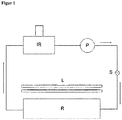
- the methane is introduced via a septum (S).
- the initial concentration of methane at the start of the exposure is set to about 100 ppm.
- the total volume of the system is 9.5 L.
- the air is circulated in a closed circuit in a circle.
- the FTIR spectrometer as a detector absorbs complete spectra from 4000 cm-1 to 700 cm-1 at given time intervals after addition of the methane. From these snapshots of the composition of the atmosphere in the system can be determined continuously and without delay, the concentration of methane in the gas phase. Exposure is achieved with Philips TL 40W / 05 UV fluorescent tubes.
- Comparative Example 1 conventional silicone resin facade paint with TiO 2 photocatalyst
- Comparative Example 2 conventional internal dispersion paint with TiO 2 photocatalyst
- the formulations according to the comparative and exemplary embodiments can be prepared by mixing the stated components in the stated amounts in a manner known per se.
- the formulations were each applied to aluminum foil and dried under normal room conditions.
- the samples were pre-exposed for 120 hours with an intensity of 10 W / m 2 UV-A.
- the samples were still moistened every 24 hours with distilled water and rinsed.
- the exposure was carried out with an intensity of 11.2 W / m 2 (in the UV-A range from 315 nm to 380 nm).
- the photocatalytic methane degradation rates of Comparative Examples 1 and 2 could not be determined within the measurement accuracy.
- the photocatalytic degradation rate of embodiment 1 averaged about 105 ⁇ g methane m -2 h -1 .
- the photocatalytic degradation rate of Example 2 was an average of about 140 ug methane m -2 h -1 .
- the photocatalytic degradation rate of Example 3 was an average of about 48 ug methane m -2 h -1.
- Comparative Example 1 samples of Comparative Example 1 and Embodiment 1 were subjected to natural weathering (45 ° south display in southern Germany). Within a year year, Comparative Example 1 showed strong surface changes and chalked strongly to very strongly. In the embodiment 1, however, hardly any surface changes and no Chalking phenomena are found. In the interior, coatings according to the invention in light-exposed areas, such as window reveals and under strong artificial illumination, in comparison with TiO 2 -based coatings also show a reduced tendency to chalk.
Landscapes
- Chemical & Material Sciences (AREA)
- Engineering & Computer Science (AREA)
- Materials Engineering (AREA)
- Organic Chemistry (AREA)
- Chemical Kinetics & Catalysis (AREA)
- Catalysts (AREA)
Priority Applications (2)
| Application Number | Priority Date | Filing Date | Title |
|---|---|---|---|
| EP17204819.1A EP3492170A1 (fr) | 2017-11-30 | 2017-11-30 | Revêtements photocatalytiques à semi-conducteurs sulfidiques |
| EP19157955.6A EP3505247A1 (fr) | 2017-11-30 | 2017-11-30 | Revêtements photocatalytiques à semi-conducteurs sulfidiques |
Applications Claiming Priority (1)
| Application Number | Priority Date | Filing Date | Title |
|---|---|---|---|
| EP17204819.1A EP3492170A1 (fr) | 2017-11-30 | 2017-11-30 | Revêtements photocatalytiques à semi-conducteurs sulfidiques |
Related Child Applications (2)
| Application Number | Title | Priority Date | Filing Date |
|---|---|---|---|
| EP19157955.6A Division-Into EP3505247A1 (fr) | 2017-11-30 | 2017-11-30 | Revêtements photocatalytiques à semi-conducteurs sulfidiques |
| EP19157955.6A Division EP3505247A1 (fr) | 2017-11-30 | 2017-11-30 | Revêtements photocatalytiques à semi-conducteurs sulfidiques |
Publications (1)
| Publication Number | Publication Date |
|---|---|
| EP3492170A1 true EP3492170A1 (fr) | 2019-06-05 |
Family
ID=60856838
Family Applications (2)
| Application Number | Title | Priority Date | Filing Date |
|---|---|---|---|
| EP17204819.1A Ceased EP3492170A1 (fr) | 2017-11-30 | 2017-11-30 | Revêtements photocatalytiques à semi-conducteurs sulfidiques |
| EP19157955.6A Pending EP3505247A1 (fr) | 2017-11-30 | 2017-11-30 | Revêtements photocatalytiques à semi-conducteurs sulfidiques |
Family Applications After (1)
| Application Number | Title | Priority Date | Filing Date |
|---|---|---|---|
| EP19157955.6A Pending EP3505247A1 (fr) | 2017-11-30 | 2017-11-30 | Revêtements photocatalytiques à semi-conducteurs sulfidiques |
Country Status (1)
| Country | Link |
|---|---|
| EP (2) | EP3492170A1 (fr) |
Citations (9)
| Publication number | Priority date | Publication date | Assignee | Title |
|---|---|---|---|---|
| EP0903389A1 (fr) | 1996-05-31 | 1999-03-24 | Toto Ltd. | Element anti-encrassement et composition pour revetement anti-encrassement |
| DE20306431U1 (de) | 2003-04-25 | 2004-09-02 | Maxit Deutschland Gmbh | Photokatalysatorhaltige Beschichtungsmassen, damit erhältliche Oberflächenbeschichtungen und Kits |
| US20050084543A1 (en) * | 2002-01-11 | 2005-04-21 | Sandrine Rochat | Use of zinc sulfide as an anti-mite agent |
| DE102005013259A1 (de) | 2005-03-22 | 2006-09-28 | Deutsche Amphibolin-Werke Von Robert Murjahn Stiftung & Co Kg | Photokatalytisch wirkender Bautenanstrichsstoff |
| EP1735372A1 (fr) | 2004-04-15 | 2006-12-27 | Sto Ag | Materiau de revetement |
| EP1753831A1 (fr) | 2004-06-04 | 2007-02-21 | Sto Ag | Composition de revetement |
| EP1809707A1 (fr) | 2004-11-05 | 2007-07-25 | Basf Aktiengesellschaft | Matieres de revetement |
| EP2722370A1 (fr) | 2012-10-17 | 2014-04-23 | Sto Ag | Revêtements photocatalytiques avec matières de remplissage |
| US20150158017A1 (en) * | 2012-06-29 | 2015-06-11 | Cnrs | Metal sulphide-based composite photocatalyst for producing hydrogen |
-
2017
- 2017-11-30 EP EP17204819.1A patent/EP3492170A1/fr not_active Ceased
- 2017-11-30 EP EP19157955.6A patent/EP3505247A1/fr active Pending
Patent Citations (11)
| Publication number | Priority date | Publication date | Assignee | Title |
|---|---|---|---|---|
| EP0903389A1 (fr) | 1996-05-31 | 1999-03-24 | Toto Ltd. | Element anti-encrassement et composition pour revetement anti-encrassement |
| US20050084543A1 (en) * | 2002-01-11 | 2005-04-21 | Sandrine Rochat | Use of zinc sulfide as an anti-mite agent |
| DE20306431U1 (de) | 2003-04-25 | 2004-09-02 | Maxit Deutschland Gmbh | Photokatalysatorhaltige Beschichtungsmassen, damit erhältliche Oberflächenbeschichtungen und Kits |
| EP1735372A1 (fr) | 2004-04-15 | 2006-12-27 | Sto Ag | Materiau de revetement |
| EP1753831A1 (fr) | 2004-06-04 | 2007-02-21 | Sto Ag | Composition de revetement |
| EP1809707A1 (fr) | 2004-11-05 | 2007-07-25 | Basf Aktiengesellschaft | Matieres de revetement |
| US20070269650A1 (en) * | 2004-11-05 | 2007-11-22 | Basf Aktiengesellschaft | Coating Materials |
| EP1809707B1 (fr) | 2004-11-05 | 2010-01-27 | Basf Se | Matieres de revetement |
| DE102005013259A1 (de) | 2005-03-22 | 2006-09-28 | Deutsche Amphibolin-Werke Von Robert Murjahn Stiftung & Co Kg | Photokatalytisch wirkender Bautenanstrichsstoff |
| US20150158017A1 (en) * | 2012-06-29 | 2015-06-11 | Cnrs | Metal sulphide-based composite photocatalyst for producing hydrogen |
| EP2722370A1 (fr) | 2012-10-17 | 2014-04-23 | Sto Ag | Revêtements photocatalytiques avec matières de remplissage |
Non-Patent Citations (6)
| Title |
|---|
| DÖRR, H. ET AL.: "KRONOS Titandioxid in Dispersionsfarben", 1989, KRONOS TITAN-GMBH |
| GIERCZAK, J. PHYS. CHEM A, vol. 101, 1997, pages 3125 |
| M. MIYAUCHI; A. NAKAJIMA; T. WATANABE; K. HASHIMOTO, CHEMISTRY OF MATERIALS, vol. 14, no. 6, 2002, pages 2812 - 2816 |
| P. V. KAMAT, CHEM. REV., vol. 93, 1993, pages 267 - 300 |
| R. BAUMSTARK; M. SCHWANZ: "Dispersionen für Bautenfarben, Acrylatsysteme in Theorie und Praxis", 2001, CURT R. VINCENTZ VERLAG, pages: 64 |
| R. BENEDIX ET AL., LACER, no. 5, 2000, pages 161 |
Also Published As
| Publication number | Publication date |
|---|---|
| EP3505247A1 (fr) | 2019-07-03 |
Similar Documents
| Publication | Publication Date | Title |
|---|---|---|
| EP1507752B1 (fr) | Corps ceramique moule a revetement photocatalytique et son procede de realisation | |
| EP1887055A1 (fr) | Revêtement avec activité photocatalytique | |
| EP2547720B1 (fr) | Matériau plastique plat revêtu à propension réduite à la prolifération d'algues, son procédé de fabrication en ligne et son utilisation | |
| EP2722370B1 (fr) | Revêtements photocatalytiques avec matières de remplissage | |
| EP3805325A1 (fr) | Composition aqueuse pour un système de nuançage, ensemble de pièces du système de nuançage, systèmes d'enduit ou de peinture nuancés ainsi que peintures et enduits obtenus par application des systèmes d'enduit ou de peinture nuancés | |
| DE10001831A1 (de) | Silikatische Beschichtungsmasse mit verbesserter Stabilität | |
| EP2754699A1 (fr) | Base de revêtement pour une peinture, notamment matte, en particulier pour une couleur de façade, ainsi qu'une peinture, notamment matte, en particulier pour une couleur de façade contenant cette base de revêtement et peinture contenant cette peinture, notamment matte | |
| EP2953913B2 (fr) | L'utilisation d'un mortier sec définissable par une méthode spéciale | |
| EP1457529B1 (fr) | Revêtement avec indicateur de couleur | |
| EP1919995B1 (fr) | Composition aqueuse pour peintures d'exterieur, d'interieur, de façade et de toit | |
| EP3505575A1 (fr) | Matériaux de revêtement, revêtements à base des dits matériaux de revêtement ainsi que leur utilisation | |
| WO2023094379A1 (fr) | Pâte pigmentaire et son utilisation | |
| EP1735372B1 (fr) | Materiau de revetement | |
| Amorim et al. | Antifungal and photocatalytic activity of smart paint containing porous microspheres of TiO2 | |
| EP3492170A1 (fr) | Revêtements photocatalytiques à semi-conducteurs sulfidiques | |
| EP3739008A1 (fr) | Matière de revêtement aqueuse, en particulier matière de revêtement aqueuse pâteuse, revêtement obtenu à partir de la matière de revêtement et son utilisation | |
| DE102005013259B4 (de) | Photokatalytisch wirkender Bautenanstrichsstoff und seine Verwendung | |
| EP1832624A1 (fr) | Stabilisation de polymères organiques contre les radicaux libres | |
| EP3498784B1 (fr) | Substance de revêtement, procédé de fabrication de la substance de revêtement et son utilisation | |
| EP2331619A1 (fr) | Enduit contenant un additif basique | |
| DE202020106552U1 (de) | Wässriger Beschichtungsstoff sowie Dispersionsfarbe, Grundierung oder Putzmasse umfassend diesen wässrigen Beschichtungsstoff sowie Beschichtung erhalten durch Auftragen des wässrigen Beschichtungsstoffs | |
| EP4563664A1 (fr) | Base de tone et composition de revêtement teintée | |
| JP2019167522A (ja) | 防藻持続性防汚剤組成物 | |
| EP2844709A1 (fr) | Utilisation de polyacrylate de lithium comme agent dispersant | |
| DE102006049923B4 (de) | Mittel zur Behandlung von organischem und/oder anorganischem Material |
Legal Events
| Date | Code | Title | Description |
|---|---|---|---|
| STAA | Information on the status of an ep patent application or granted ep patent |
Free format text: STATUS: EXAMINATION IS IN PROGRESS |
|
| PUAI | Public reference made under article 153(3) epc to a published international application that has entered the european phase |
Free format text: ORIGINAL CODE: 0009012 |
|
| 17P | Request for examination filed |
Effective date: 20180613 |
|
| AK | Designated contracting states |
Kind code of ref document: A1 Designated state(s): AL AT BE BG CH CY CZ DE DK EE ES FI FR GB GR HR HU IE IS IT LI LT LU LV MC MK MT NL NO PL PT RO RS SE SI SK SM TR |
|
| AX | Request for extension of the european patent |
Extension state: BA ME |
|
| APBK | Appeal reference recorded |
Free format text: ORIGINAL CODE: EPIDOSNREFNE |
|
| APBN | Date of receipt of notice of appeal recorded |
Free format text: ORIGINAL CODE: EPIDOSNNOA2E |
|
| APBR | Date of receipt of statement of grounds of appeal recorded |
Free format text: ORIGINAL CODE: EPIDOSNNOA3E |
|
| APAF | Appeal reference modified |
Free format text: ORIGINAL CODE: EPIDOSCREFNE |
|
| APBT | Appeal procedure closed |
Free format text: ORIGINAL CODE: EPIDOSNNOA9E |
|
| STAA | Information on the status of an ep patent application or granted ep patent |
Free format text: STATUS: THE APPLICATION HAS BEEN REFUSED |
|
| 18R | Application refused |
Effective date: 20211104 |